A useful recommendation on X can start with a simple question: “Do you know anyone who can help me with this?” The problem is getting your offer into that conversation through someone who understands it.
Without that fit, you can spend evenings sending messages and still collect little more than polite replies. Even an interested partner needs to know whom to refer, what they earn and how you’ll credit the sale. To move those conversations toward a paid referral, this guide pairs outreach copy with affordable reward examples and a way to track sales through to payout.
Define an Offer Partners Can Confidently Recommend
Start with one offer a partner can explain without needing you beside them.
Write down who it helps, what problem it solves, what the buyer receives, the price and the next action. Then prepare a page where people can buy or ask about it, plus a preview your partner can inspect.
Throughout this guide, imagine you sell a self-paced beginner watercolor-landscape course. The messages, terms and figures below are illustrations.
Your offer summary could read:
A self-paced course for beginners who want step-by-step help painting watercolor landscapes. Preview a lesson, check the materials list and buy the course here.
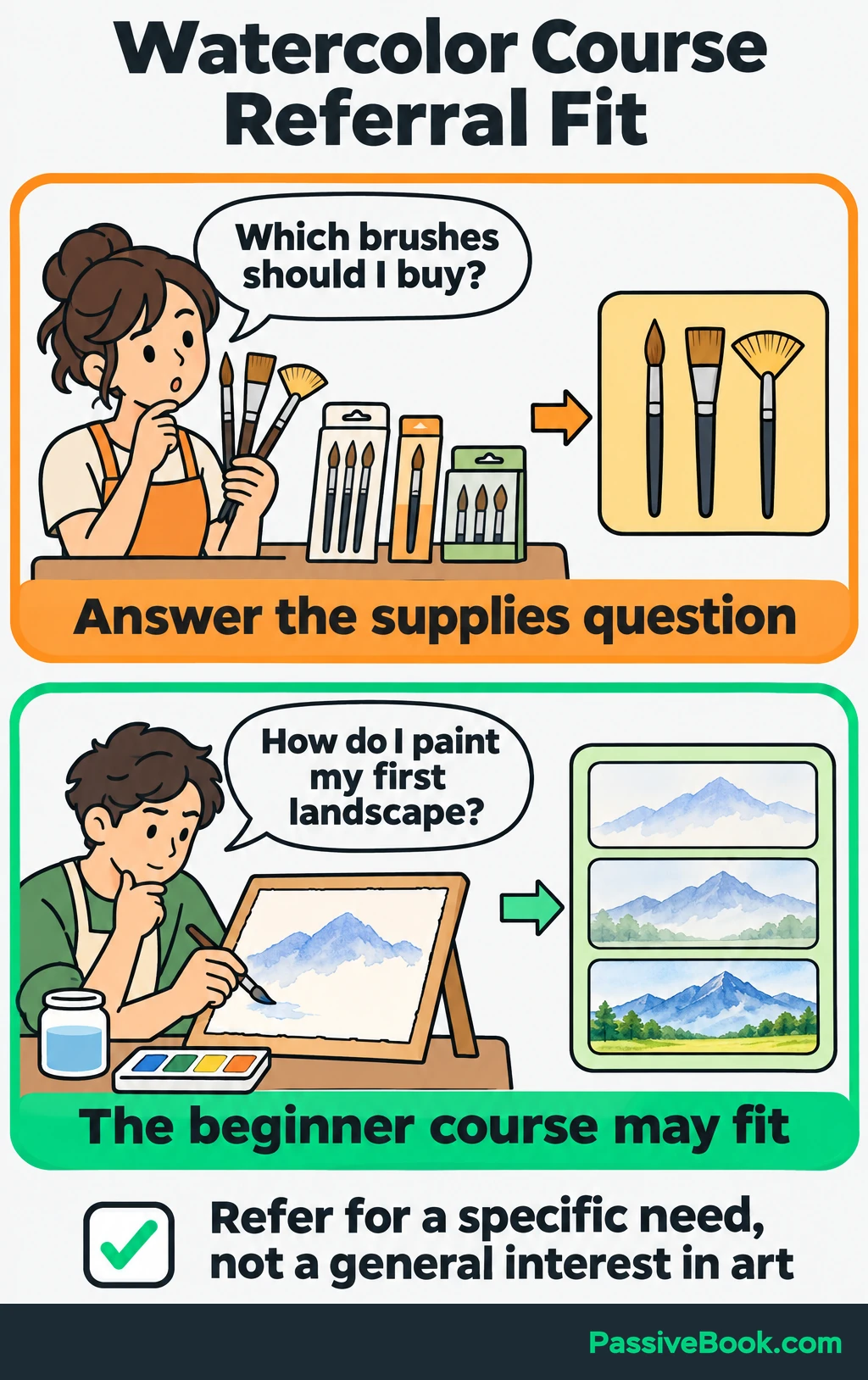
A qualified referral needs more than an interest in art. For this course, the person should want structured beginner instruction in painting landscapes and have expressed interest in getting help.
That gives partners a useful distinction:
- Someone asks which brushes to buy: answer the supplies question.
- Someone asks how to use those brushes to paint their first landscape: the course may fit.
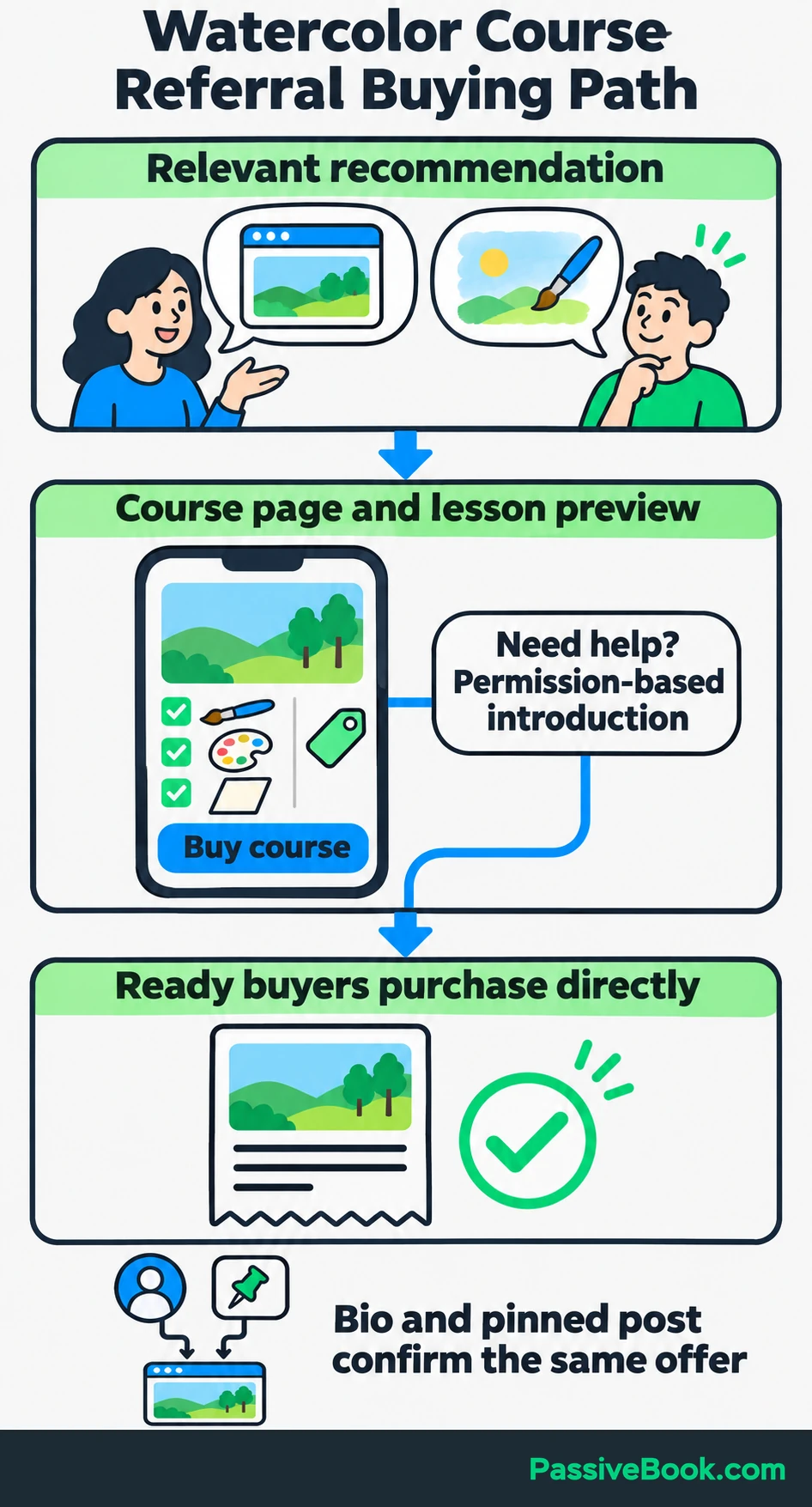
The path should be simple: recommendation → course page or permission-based introduction → purchase. Add a conversation when someone needs help deciding, but let ready buyers purchase directly.
For a service, send people to a project enquiry or booking page and agree which enquiries qualify as referrals. For physical products, include shipping and expected return costs in the reward budget below.
Make your X bio and pinned post explain the same offer and point to the same destination. A partner checking your profile should find confirmation of what you told them.
Around 2022, I spent six months chasing Instagram and Twitter followers in another niche with little financial progress. That wasn’t Passive Book or a referral-partnership experiment, but it explains why I’m wary of follower goals without a buying path behind them.
I would approach a suitable partner once the offer and preview are ready. An arbitrary follower milestone adds nothing to their product review.
Find Credible Partners in Relevant X Conversations
Search for Complementary Audiences
Start with people who already know your work: customers, professional contacts and anyone who has recommended it without being asked. You still need to check fit, but you have a reason to begin the conversation.
Then search X for questions your buyers ask and businesses that serve them before or after you do.
For the watercolor course, useful starting phrases include:
- “beginner watercolor”
- “painting landscapes”
- “watercolor supplies”
Read the conversations around those posts. Who gives helpful answers? What do people ask next? Does the account link to a real business with a related offer?
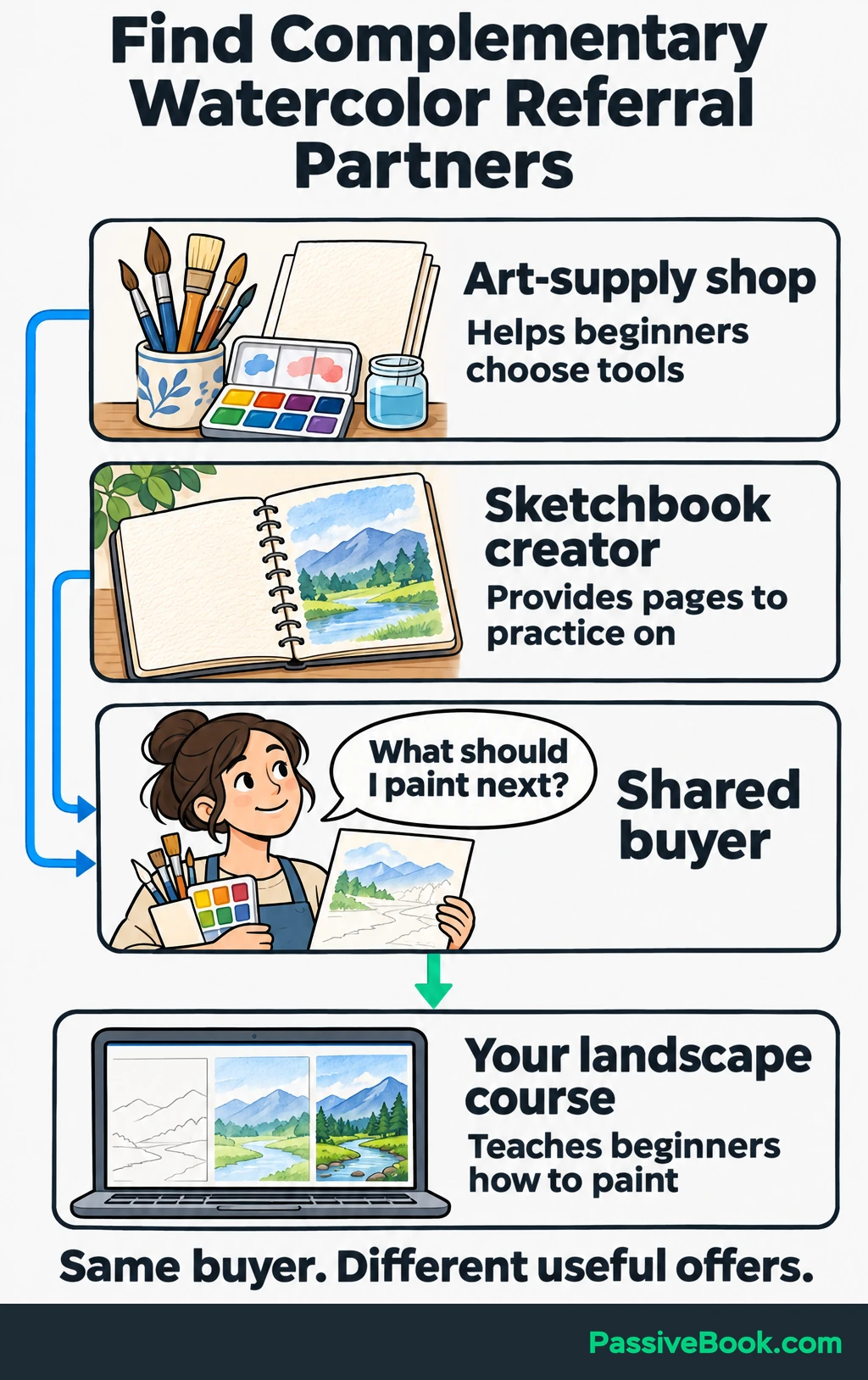
An art-supply shop could help customers choose their first set, while your course helps them use it. A sketchbook creator might hear from buyers who want guidance filling the pages.
That connection matters more than a shared interest in “creativity.”
Use this search as a channel check, too. If you struggle to find active, relevant businesses and genuine buyer questions, I would pause recruitment on X. You can test the same partnership offer through existing contacts rather than committing to months of posting.
Shortlist by Fit and Credibility
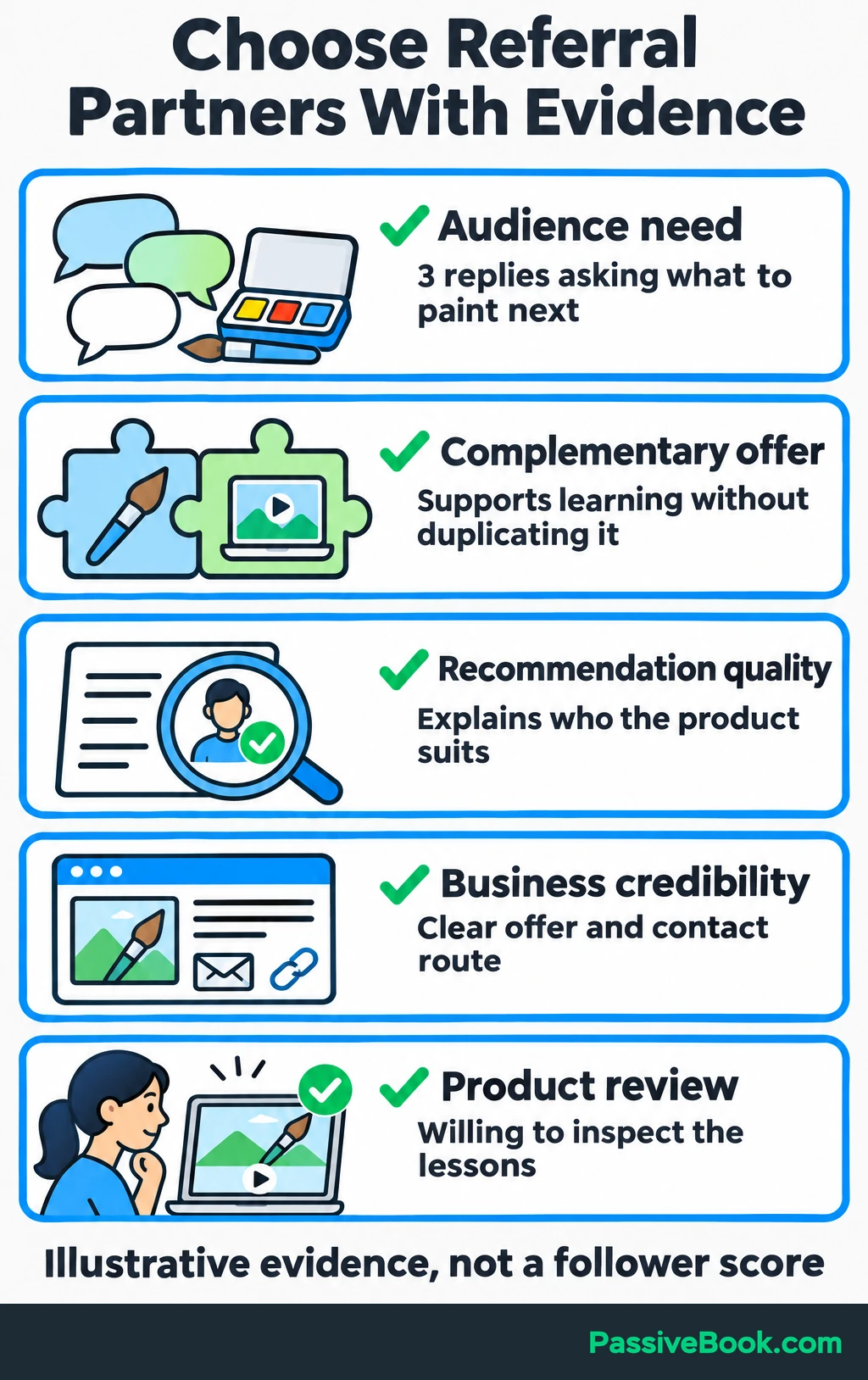
Before contacting someone, look for evidence that they understand the buyer and take recommendations seriously.
| Check | Evidence Worth Looking For |
|---|---|
| Audience need | Replies asking how to start painting, rather than only admiring finished artwork |
| Complementary offer | Supplies or sketchbooks that support learning without duplicating your course |
| Recommendation quality | Specific explanations of whom a product suits and why |
| Business credibility | A working website, clear offers and a way to contact the business |
| Product review | Willingness to inspect your lessons before recommending them |
A large account that posts unrelated jokes may offer less useful reach than a small shop answering beginner questions every week. Follower totals alone won’t settle the decision.
Keep a prospect sheet with the profile URL, business, audience need, evidence of fit, possible mutual benefit, contact route, conversation status and next action.
Write something concrete in the evidence column: “Three replies asking what to paint after buying a starter set.” “Good engagement” tells you very little when you return next week.
During the conversation, ask:
“What question from a customer would make this course useful to recommend?”
Also ask what they already suggest. An existing recommendation may serve their customers perfectly well. You need a useful reason to join that conversation.
Choose a Referral Reward Your Margins Can Support
Decide what earns a reward before choosing the amount.
You could pay for an accepted, qualified introduction or a completed sale. I would start with completed sales unless you already know what a qualified lead is worth. Otherwise, you can end up paying for interest that never becomes revenue.
There are several ways to reward a partner:
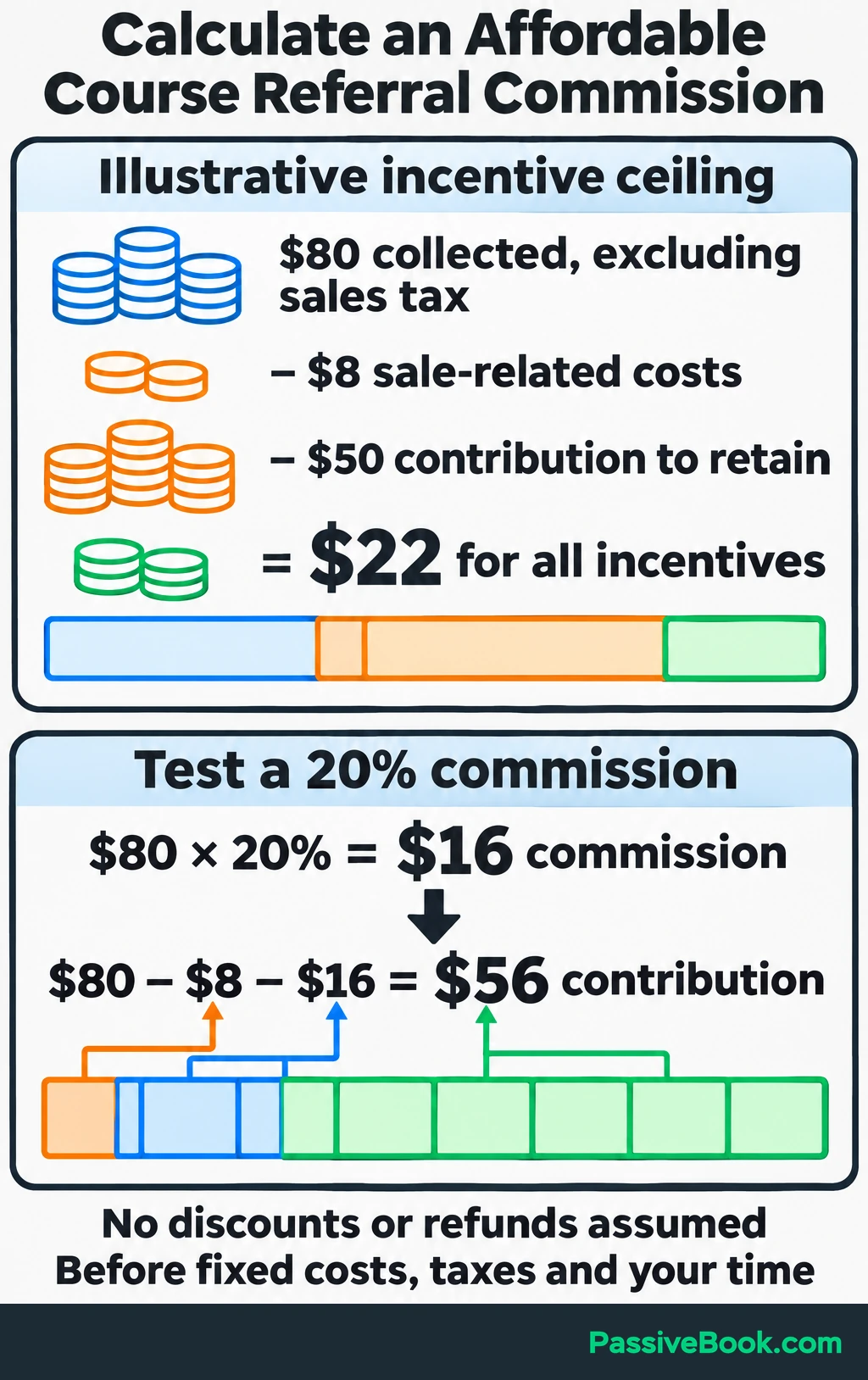
- A fixed payment gives a predictable amount per eligible sale.
- A percentage commission moves with the eligible purchase amount.
- Product credit can work when the partner wants what you sell.
- Reciprocal introductions can help both businesses, but neither side should promise equal referral volume.
I would offer cash for the first course partnership and discuss reciprocal recommendations separately. Forced swaps encourage recommendations that don’t fit.
To work out your reward ceiling, start with the money collected from a sale, excluding sales tax. Subtract the costs that rise with that sale, then subtract the amount you need to retain.
For illustration:
| Item | Amount |
|---|---|
| Course revenue collected | $80 |
| Payment, delivery and support costs tied to the sale | −$8 |
| Contribution you want to retain | −$50 |
| Available for all incentives | $22 |
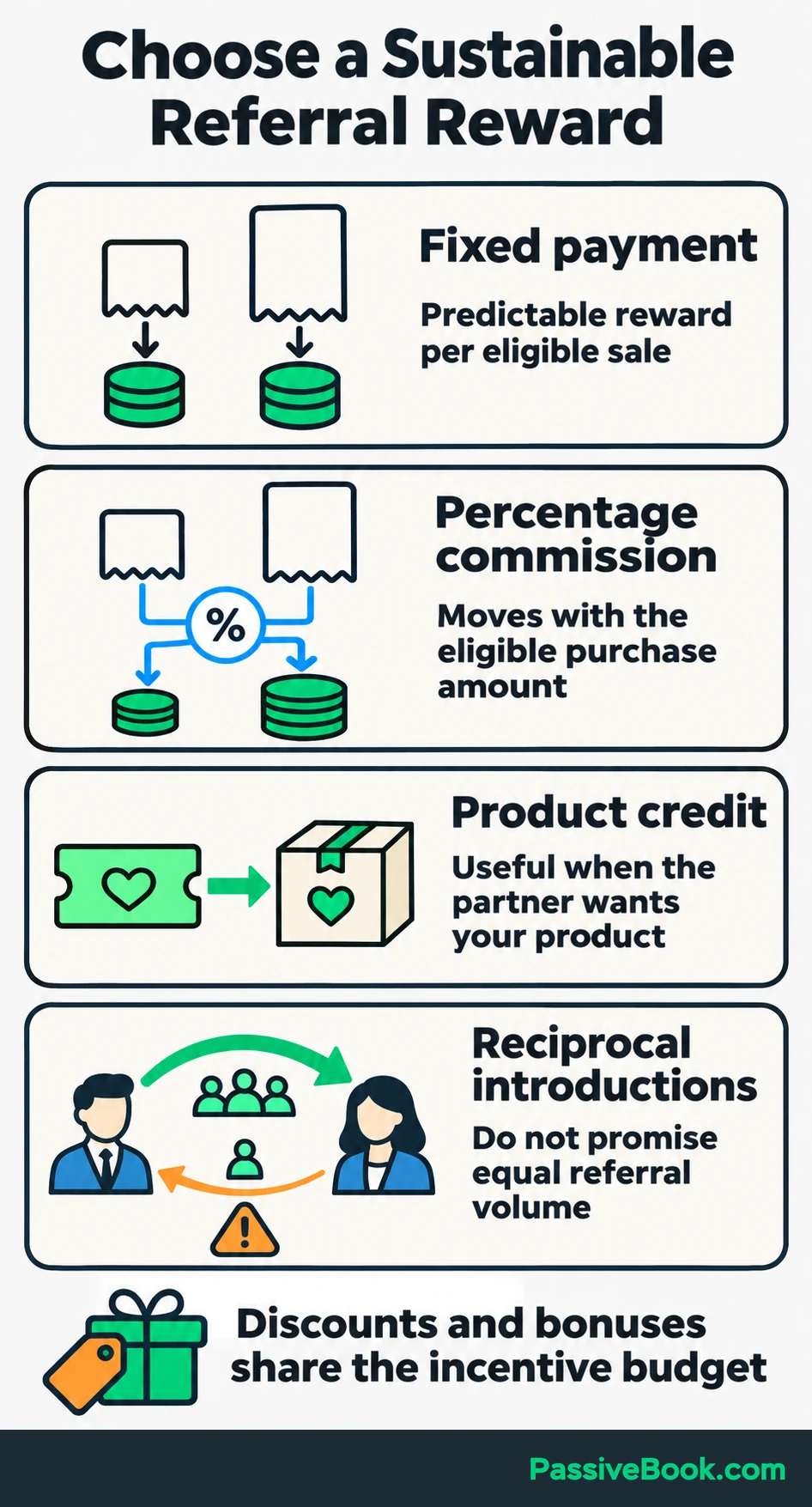
A 20% commission would pay $16 and leave $56 before fixed costs, taxes and your time, assuming no discount or refund.
That makes 20% affordable under these assumptions. It doesn’t make it the right rate for every course.
Include buyer discounts and bonuses in the same budget. If you add a discount, calculate both the commission and your remaining contribution again. Generosity is easier when you forget to subtract things.
The Referral Reward Planner lets you compare several arrangements side by side, including a discount or bonus for the buyer. You’ll see which options meet your contribution target before you put a number in your proposal.
Free Referral Reward Planner




Approach Partners With a Specific Proposal
Make the First Contact Relevant
Contribute a useful reply when you have something specific to add. There’s no need to spend three weeks liking posts before explaining why you’re there.
An existing relationship or clear business fit can justify a direct invitation. Use an available DM or the business contact route they publish.
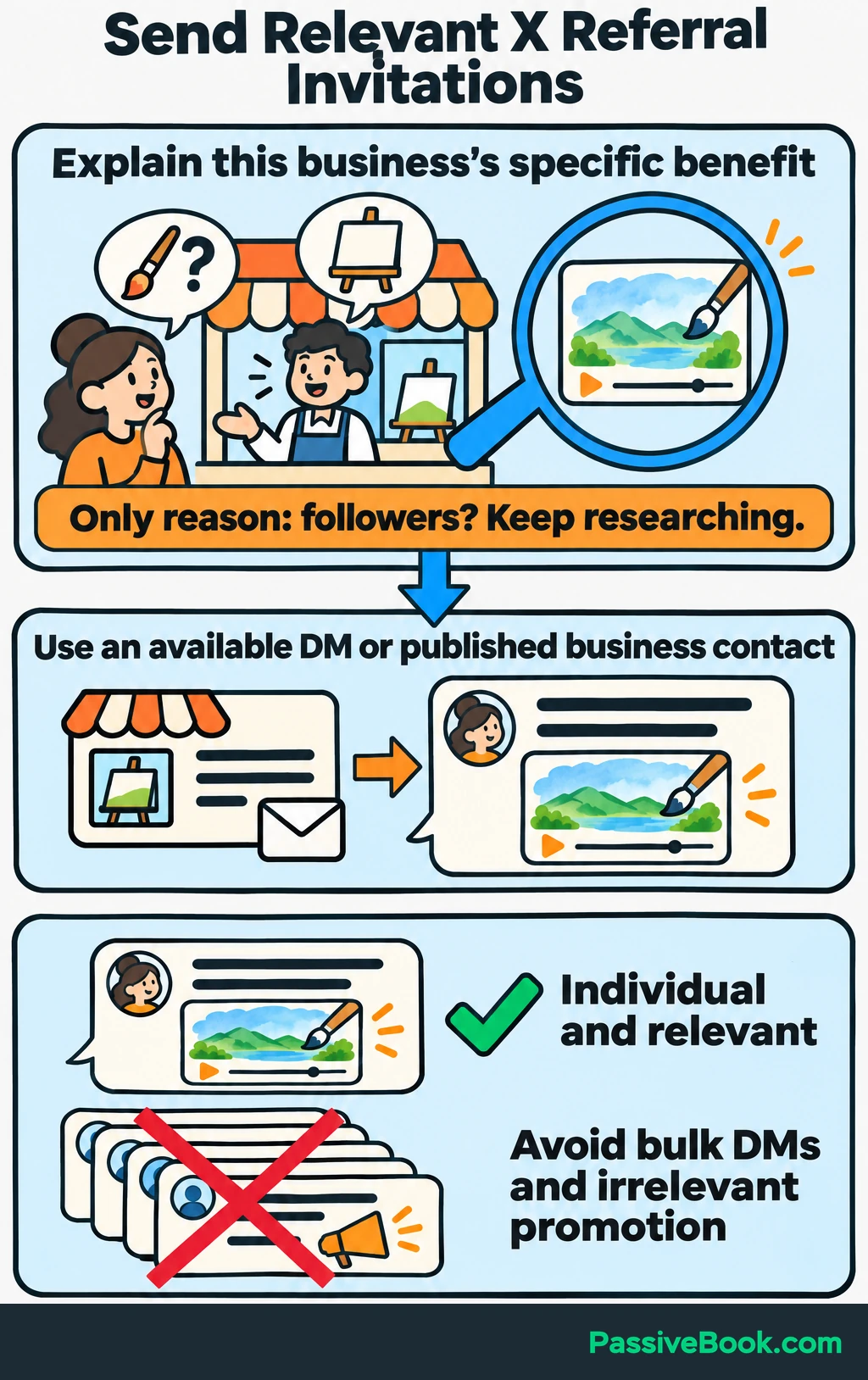
Keep each message individual and relevant. X’s authenticity policy prohibits disruptive spam, including bulk unsolicited messages, repetitive DMs and irrelevant promotional replies. X’s authenticity policy
The practical test is simple: can you explain why this particular business might benefit? If the answer is only “they have followers,” keep researching.
Offer a Clear Next Step
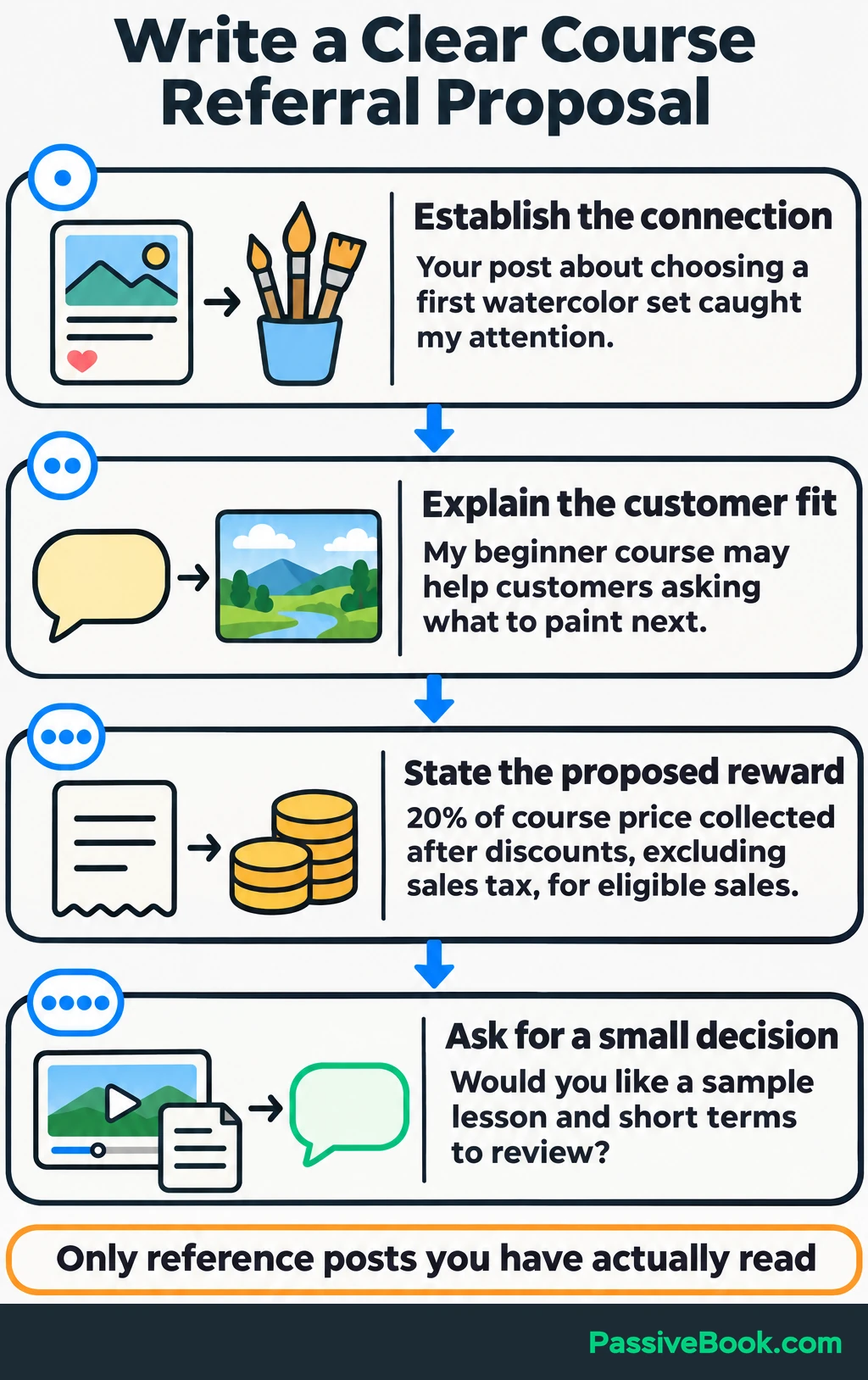
Your first message should establish the connection, state the proposed reward and ask for a small decision.
Here’s a complete outreach message you can adapt. Use the post reference only when you have actually read it:
Hi [Name], your post about choosing a first watercolor set caught my attention. I sell a self-paced beginner watercolor-landscape course, and there may be a fit for customers who ask what to paint after buying their supplies.
I’d like to explore a small referral test. My proposed reward is 20% of the course price collected after discounts, excluding sales tax, for eligible sales.
Would you like a sample lesson and the short terms to review? I’d also like to hear what would make a referral arrangement useful for your business.
Offer enough product access for them to judge the course. A sample can start the conversation, but don’t ask for a recommendation they can’t support from what they’ve reviewed.
Once they’re interested, agree on one bounded activity: a relevant public recommendation or a permission-based introduction to someone already seeking instruction. Confirm who handles each part and when you’ll review the result.
If they go quiet, send one useful follow-up:
Hi [Name], following up on the course referral idea. Here’s the sample lesson I mentioned: [link]. It should help you judge whether the teaching suits your customers. If it isn’t a fit, no problem—I’ll leave it there.
Then close the record if they decline or remain unresponsive. A follow-up reminder is useful. A pursuit campaign is another unpaid job.
If the example still feels awkward to adapt, the AI Partnership Writer can draft a message around your offer and the business you want to approach. It also gives you a follow-up, so you don’t have to start again if they go quiet.

Free AI Partnership Writer
Put Referral Terms in Writing
A short agreement should answer the questions that could otherwise become payout arguments.
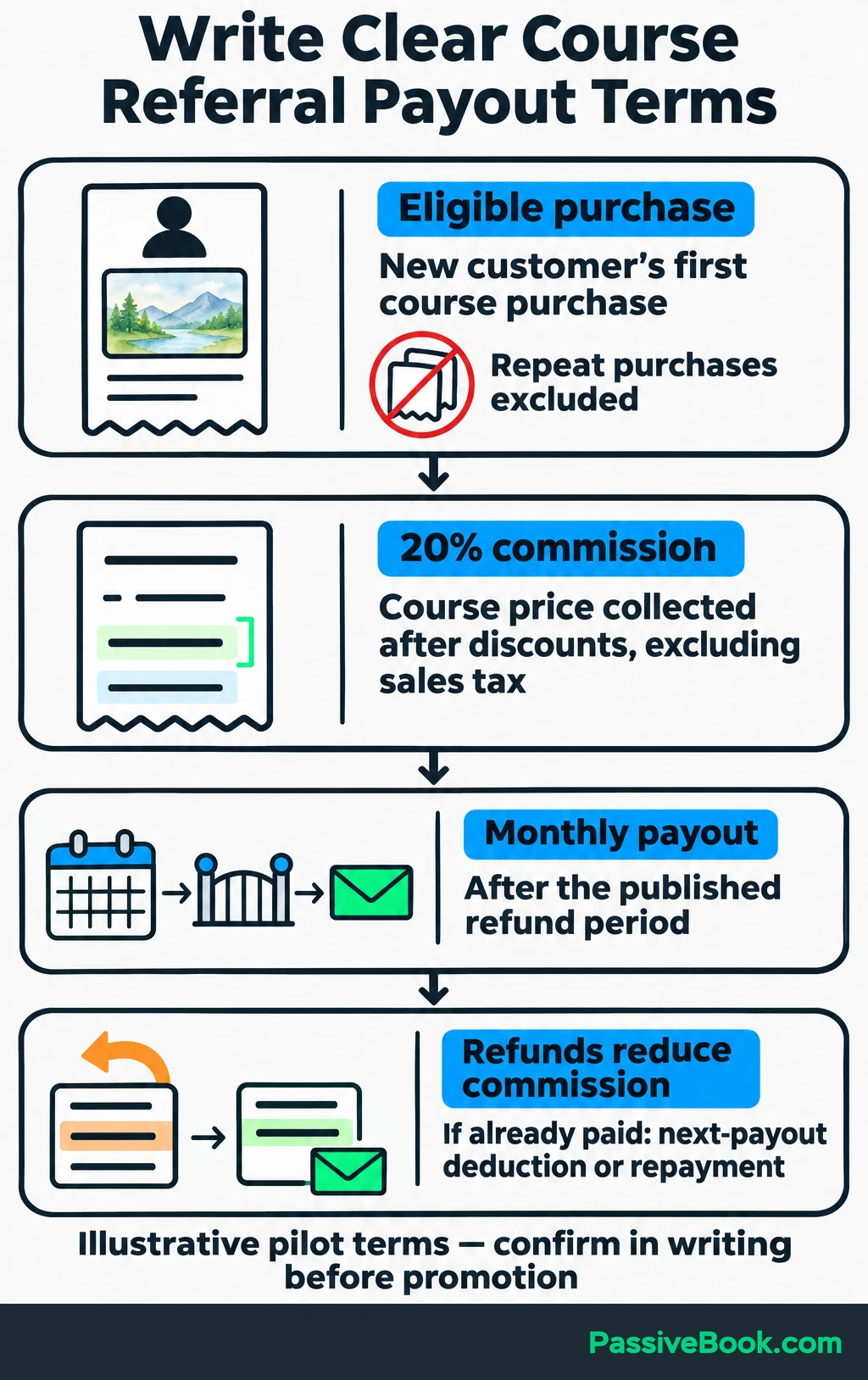
For the course pilot, you could use these starting terms and adjust them together:
| Term | Example Agreement |
|---|---|
| Eligible purchase | A new customer’s first purchase of the beginner watercolor-landscape course |
| Reward | 20% of the course price collected after discounts, excluding sales tax |
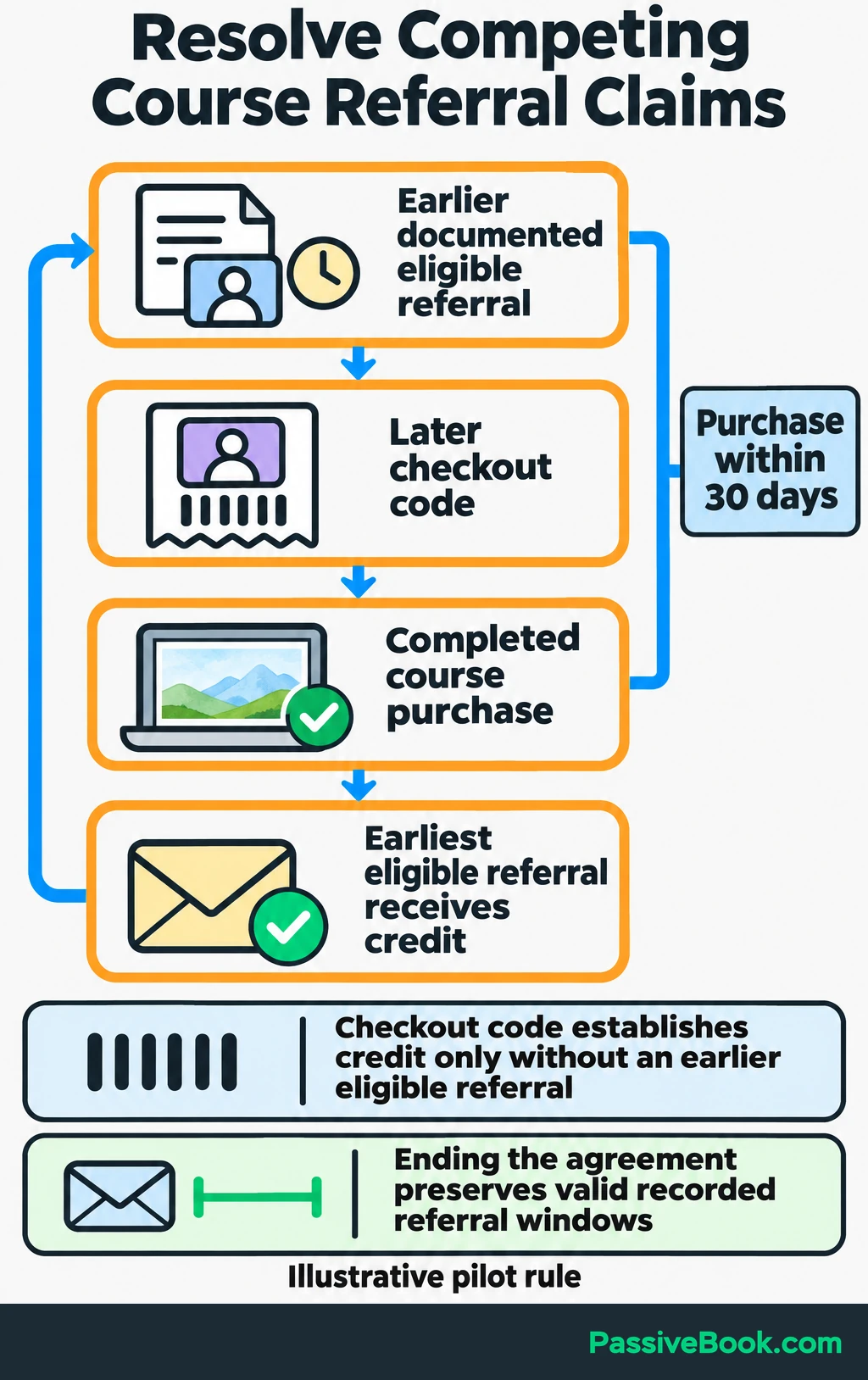
| Credit window | Purchase must occur within 30 days of a recorded eligible referral |
| Competing claims | The earliest documented eligible referral within that window receives credit; a checkout code establishes credit only if no earlier eligible referral exists |
| Repeat purchases | Excluded from this pilot |
| Payout | Monthly, once the published refund period has passed |
| Refund adjustment | Reduce commission for refunded amounts; if already paid, deduct the adjustment from the next payout or arrange repayment |
| Ending the arrangement | Either party may end it by email; valid referrals already recorded keep their agreed credit window |
Make responsibilities clear as well. You supply accurate product information, answer course questions, maintain records and pay commissions. The partner reviews the product, uses supported claims and makes required disclosures.
Before agreeing to incentivized public promotion, check X’s industry and country restrictions. Some categories are ineligible for paid partnerships, and disclosure doesn’t make a prohibited promotion permissible. X’s paid partnerships policy
Ask the partner to confirm the terms in writing before promotion begins. Don’t leave the important parts scattered across several DMs.
Set up Attribution Before the First Referral
Every referral needs a way to connect the customer to the partner.
Give each partner a stable ID, such as p01, and choose a method your existing setup can support:
- A unique referral link that saves the partner ID through purchase.
- A checkout code recorded against the order.
- A permission-based introduction logged with the partner, prospect and date.
A code can identify a partner without offering a discount. For a small pilot, I would use a code or documented introductions if reliable link tracking would require custom work.
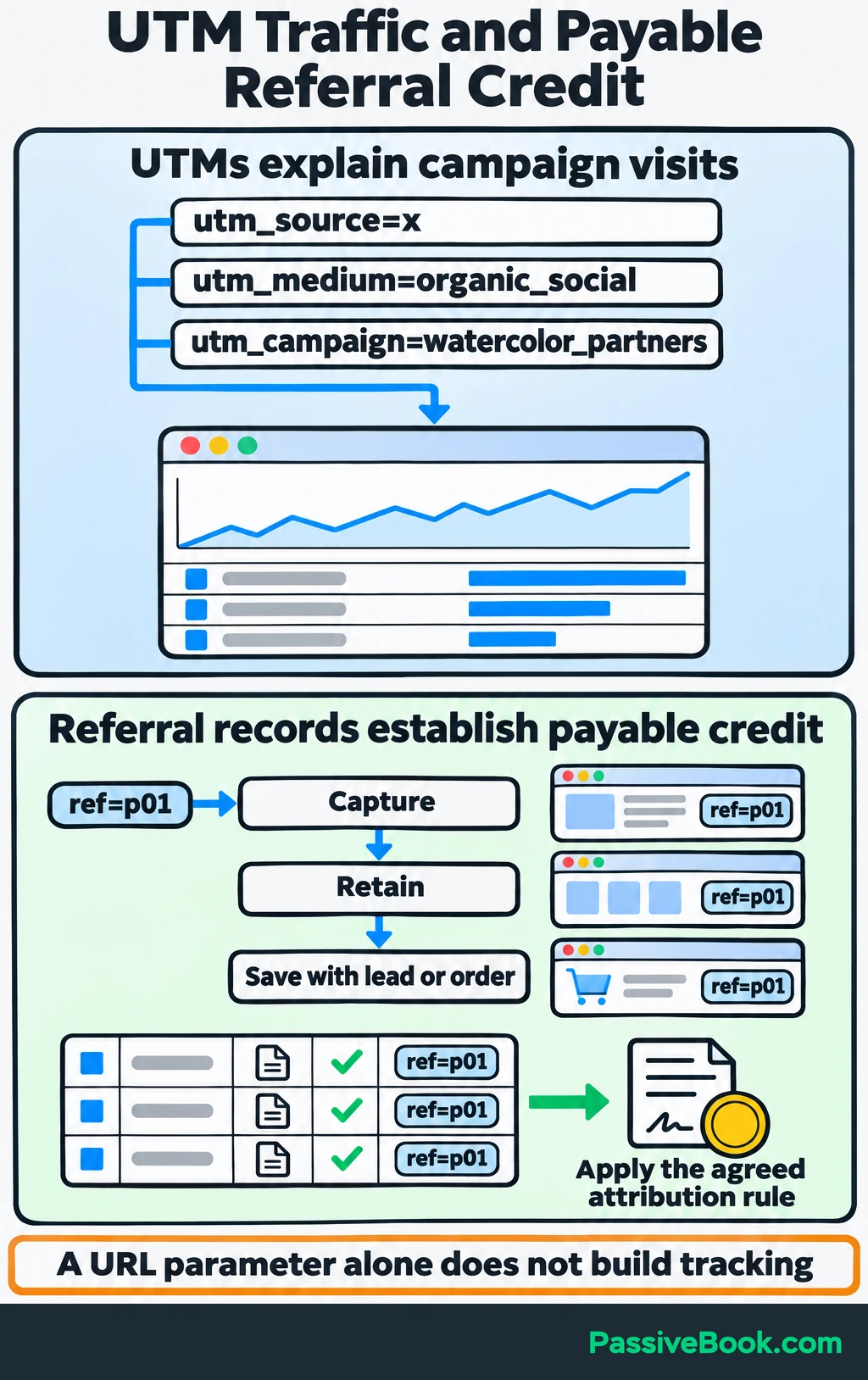
Campaign tags, often called UTMs, serve a different purpose: they help Google Analytics identify which campaigns send traffic. Google’s campaign URL guidance
A public-post link might look like this:
/watercolor-course?ref=p01&utm_source=x&utm_medium=organic_social&utm_campaign=watercolor_partnersHere, ref=p01 identifies the partner only if your site is set up to capture it, retain it and save it with the lead or order. Adding those characters to a URL doesn’t build a tracking system.
Use the UTM tags to understand visits, and use your agreed referral and order records to establish payable credit.
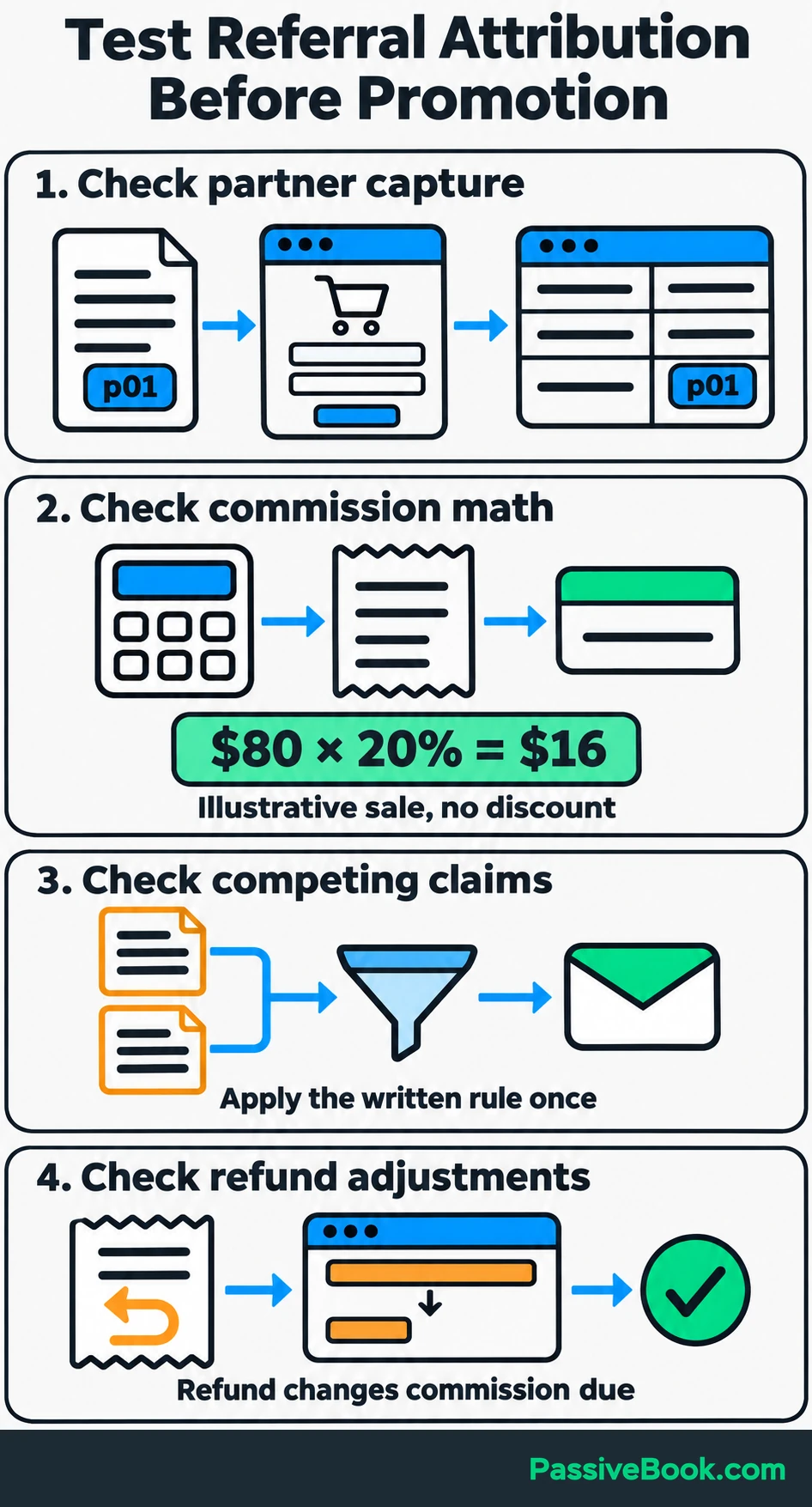
Keep a referral ledger with:
- Partner ID, referral date and lead or order ID.
- Referral channel, qualification status and attribution evidence.
- Collected revenue, refunds, commission due and payment status.
Also record where you first met the partner. A partnership found on X might later generate an email introduction. Those are two useful facts, so don’t force them into one “source” field.
If someone switches devices or forgets a code, apply the written rule and record any correction with supporting evidence. Don’t award two commissions because two systems tell different stories.
Before promotion, run a test purchase or supported checkout test. Check partner-ID capture, commission calculation, duplicate claims and refund adjustments. A spreadsheet is enough for a pilot when the underlying records support your rules.
Help Partners Make Their First Useful Referral
Give the partner a compact kit they can use without searching through your message history:
- An offer summary and buyer-fit criteria.
- A product preview and purchase destination.
- Their referral link, code or introduction method.
- Reward terms, disclosure guidance and a support contact.
Reuse the material you’ve already prepared. I would skip a long promotional handbook until partners ask questions the short version cannot answer.
Then connect the offer to a real audience question. Someone asking what to paint after buying their first watercolor set has a clearer next step than someone who simply likes a landscape photo.
For a private introduction, give the partner adaptable wording:
You mentioned wanting step-by-step help painting your first watercolor landscape. [Business] has a beginner course that may suit you. I receive a commission on eligible purchases. Would you like the course details or an introduction?
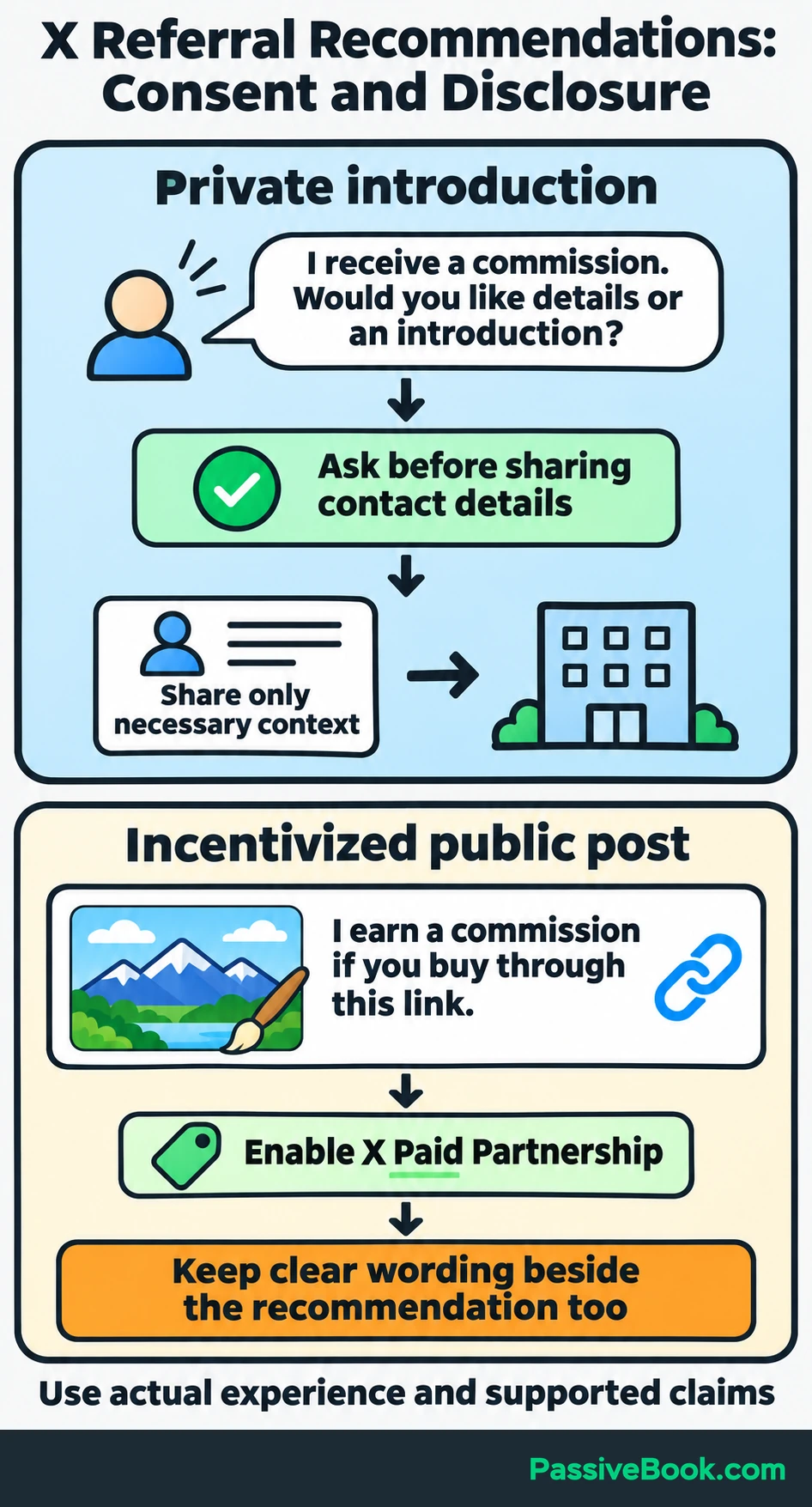
Get permission before sharing contact details, and pass along only the context needed to help.
For a public recommendation, supply clear copy the partner can adjust after reviewing the course:
I earn a commission if you buy through this link. [Course] teaches beginner watercolor landscapes with step-by-step lessons. Preview a lesson here: [partner link].
For incentivized public posts, the partner must turn on X’s “Paid Partnership” disclosure when composing the post. X’s disclosure requirement
Keep clear wording beside the recommendation as well. FTC guidance says disclosures should be easy to notice and understand, and warns against relying solely on a platform tool. It also explains that U.S. law can apply to posts from abroad when effects on U.S. consumers are reasonably foreseeable; applicable local rules matter too. FTC disclosure guidance
Partners should describe their actual experience and supported benefits. Don’t supply invented testimonials or guaranteed painting results.
When an introduction arrives, acknowledge it, confirm what the person wants and guide them to the relevant lesson preview or purchase page. Give the partner useful status updates, such as “purchase confirmed” or “awaiting a decision,” without forwarding private customer conversations.
Improve Partnerships Using Qualified Sales and Contribution
Use your referral ledger to compare each partner’s qualified leads, sales and contribution—the money left after sale-related costs and rewards. Record the time spent maintaining each relationship, too. A profitable sale can still come from a process you can’t sustain.
For lead-based referrals, qualification rate tells you how many submitted leads met your agreed criteria. Lead-to-sale conversion tells you how many of those qualified leads purchased.
Suppose ten referred leads produce eight qualified leads, and two of those eight people each buy the $80 course within their 30-day credit window. Review the group after its normal buying cycle and all referral windows have ended:
| Measure | Calculation | Result |
|---|---|---|
| Qualification rate | 8 qualified leads ÷ 10 submitted leads | 80% |
| Lead-to-sale conversion | 2 purchasing customers ÷ 8 qualified leads | 25% |
| Collected revenue | 2 sales × $80 | $160 |
| Contribution | $160 − $16 variable costs − $32 commissions | $112 |
The contribution is before fixed costs, taxes and your time, with no refunds or discounts. These are illustrative figures, not performance benchmarks.
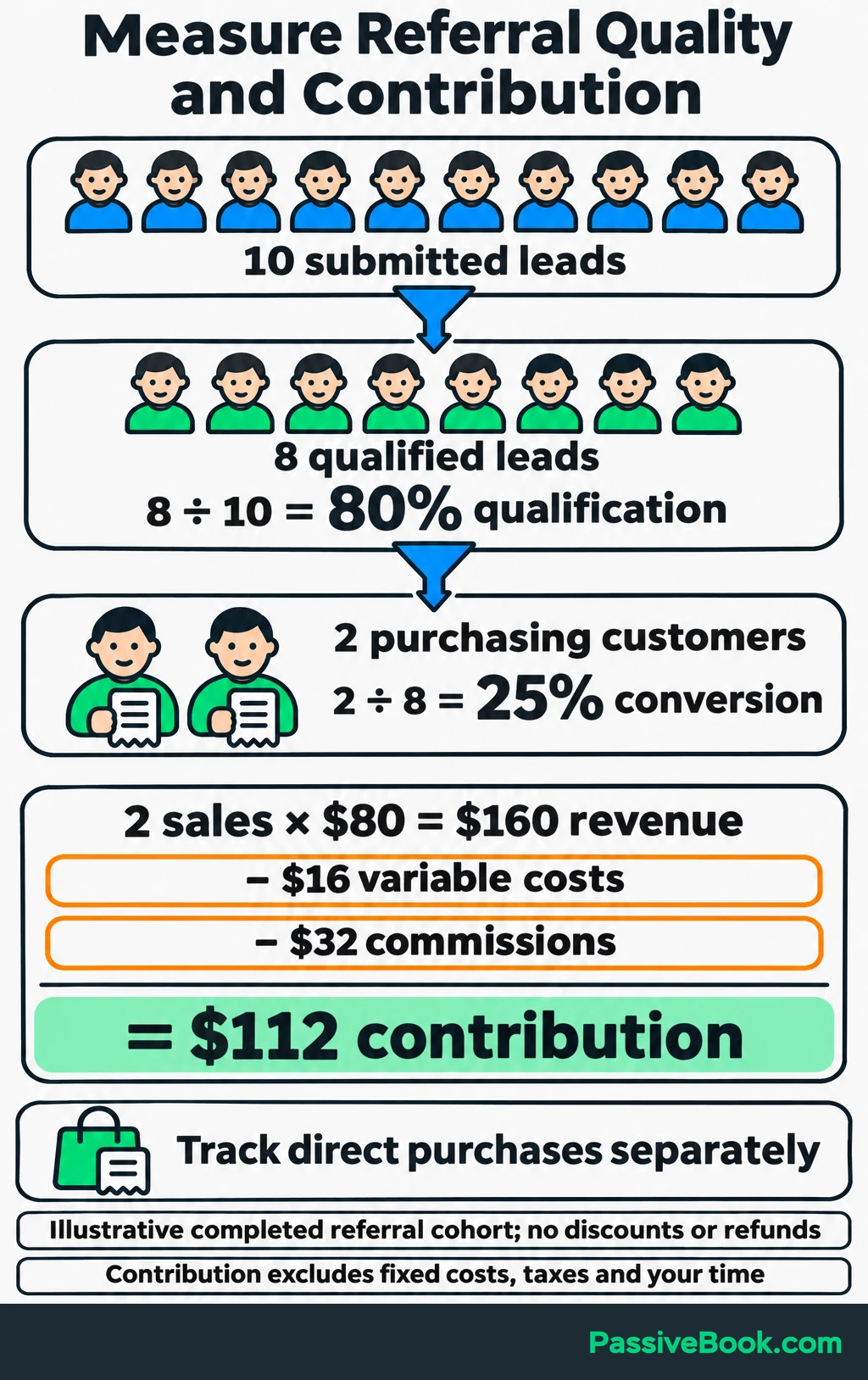
Track direct purchases separately when buyers bypass lead qualification. Don’t add those customers to the numerator of a qualified-lead conversion rate when they were never in that lead group.
Use the results to choose a specific change:
- No introductions: ask whether the partner recognizes a clear referral opportunity.
- Poor-fit leads: tighten the buyer criteria and give examples of whom to exclude.
- Qualified leads who stall: inspect the preview, offer and customer handoff.
- Sales with weak contribution: revisit discounts, rewards, support costs or pricing.
Share useful feedback, settle credit questions and pay on schedule. Update the partner kit when the same customer question keeps appearing.
Once the process works, I’d use an automation tool such as n8n or Make for reminders and record updates. Keep product review and relationship decisions personal.
Expand the relationships that produce suitable customers and enough contribution. Revise or end arrangements that repeatedly miss those goals. Recruitment volume is a poor substitute for a partnership worth keeping.
What Next?
Write a five-line offer brief: buyer, problem, outcome, price and next action. Then choose one potential partner and record the specific customer question your offer could help them answer.
Use the social buttons to share this guide when you want to bring clearer terms and trackable sales into a partnership conversation.
What would a customer need to say before your ideal partner could confidently recommend your offer? Leave your answer—and any other questions—in the comments.
Share this post with your friends & followers:

