You answer a question on X, get a few likes, and move on. The person might need exactly what you sell, but the conversation ends without a clear next step.
Repeat that for a month and you can stay busy without learning whether X brings customers. More posting only gives you more activity to sort through.
The useful question is where an interested person goes after that reply. This guide connects those conversations to an offer, follow-up and sales tracking, so you can decide whether X deserves more of your limited time.
Choose Your Revenue Source
Start With a Buyer Problem and an Offer
Before building a publishing routine, check whether people on X discuss problems your offer solves.
Search recent conversations for questions, requests for recommendations and mentions of paid solutions. Read enough to see who needs help and what they want to accomplish. If you sell locally, check whether those people are within your service area.
I would test a few useful conversations before committing to a content calendar. If relevant buyers are hard to find, that is useful information. You can spend your next hour on another channel.
Around 2022, I spent six months chasing Instagram and Twitter/X followers for another niche while my bank account stayed around $47. That was my bank balance, not platform earnings, and the experience was separate from Passive Book.
I had made follower growth the task and left the commercial next step vague. That is why I would choose an offer before choosing a posting schedule.
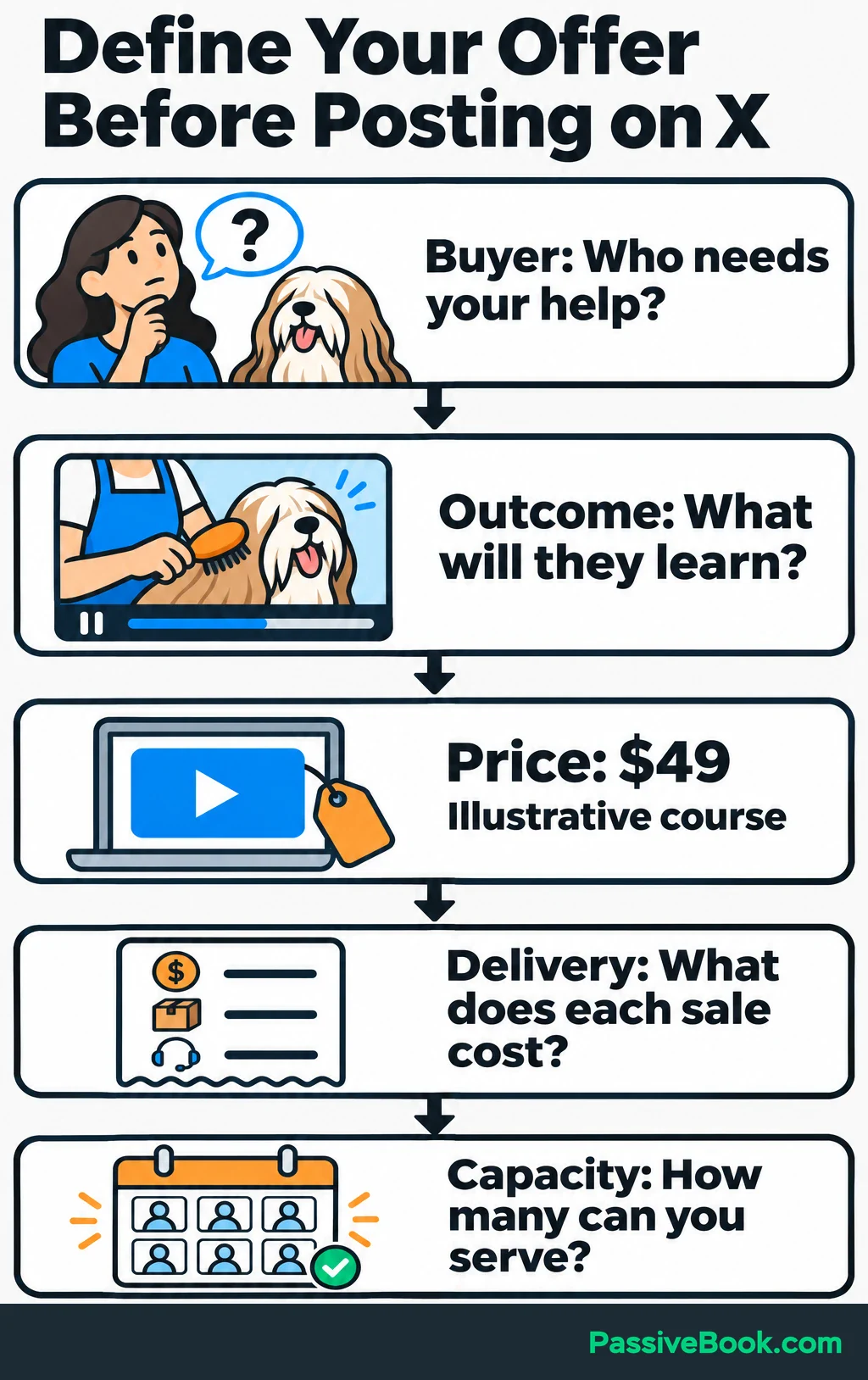
Start with one product or service and write down:
- Buyer: Who has the problem, and what makes them a suitable customer?
- Outcome: What will the purchase help them do?
- Price: What will they pay?
- Delivery: What does each sale cost you in fees, materials, support or time?
- Capacity: How many customers can you serve well?
For the running example, imagine you run an online grooming business selling a $49 course on at-home brushing for long-haired dogs. A free brushing-session checklist helps people prepare and identify questions they want answered. The business, sample copy and campaign figures below are illustrations, not documented results or benchmarks.
The checklist and course serve different needs. Someone exploring the problem may want the checklist. Someone asking about lesson contents or price should get the course page directly.
Keep those people separate in your records. A resource subscriber has requested information. A qualified lead has a relevant need, fits your offer and has expressed interest in getting help. A download alone does not establish buying intent.
Your own offer can also sit alongside affiliate recommendations or sponsorships. Affiliate programs pay you for referred purchases, while sponsors pay for an agreed placement. I would add either only when it helps the same audience.
Make paid relationships clear beside the endorsement. For example: “I earn a commission if you buy through this link.” The FTC’s guidance covers commissions, sponsorships, free products and other material relationships when posts can reasonably affect US consumers. FTC disclosure guidance
Can X Pay You Directly?
Yes, but receiving money through X’s creator programs is a separate business decision from finding customers there.
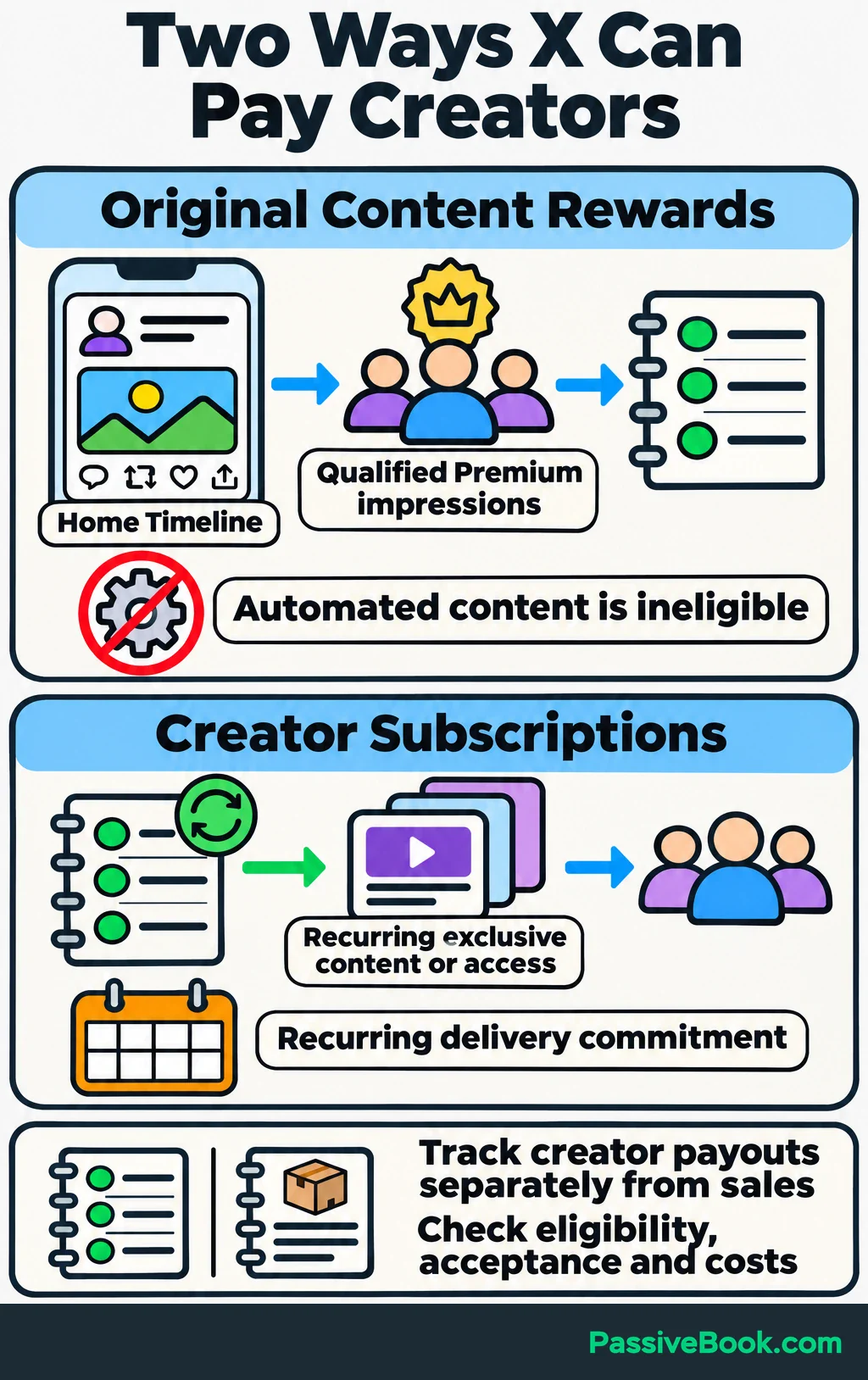
Two routes to consider are:
- Original Content Rewards: Eligible creators can receive payouts based on qualified impressions of original content from Premium users in the Home Timeline. Check the country, age, subscription and audience requirements before pursuing it. Content created or posted through automated means is ineligible, so an automated publishing workflow should not be treated as a plan for earning these rewards. Original Content Rewards requirements
- Creator Subscriptions: You can charge for recurring exclusive content or access if you meet X’s requirements, including account, subscription, audience and identity conditions. Meeting the requirements does not guarantee acceptance. Subscriptions eligibility policy
I would start with customer sales when you already have a useful offer. You can test whether a conversation leads to a purchase without making creator-program eligibility your first milestone.
Subscriptions also create recurring work. I abandoned a membership site because producing constant premium content became too much alongside a day job. Before promising weekly lessons or private access, decide whether you want that obligation.
Track creator payouts separately from customer revenue, including the subscription costs and work required to earn them.
Build the Path From Your Profile to Conversion
Create a Focused Destination
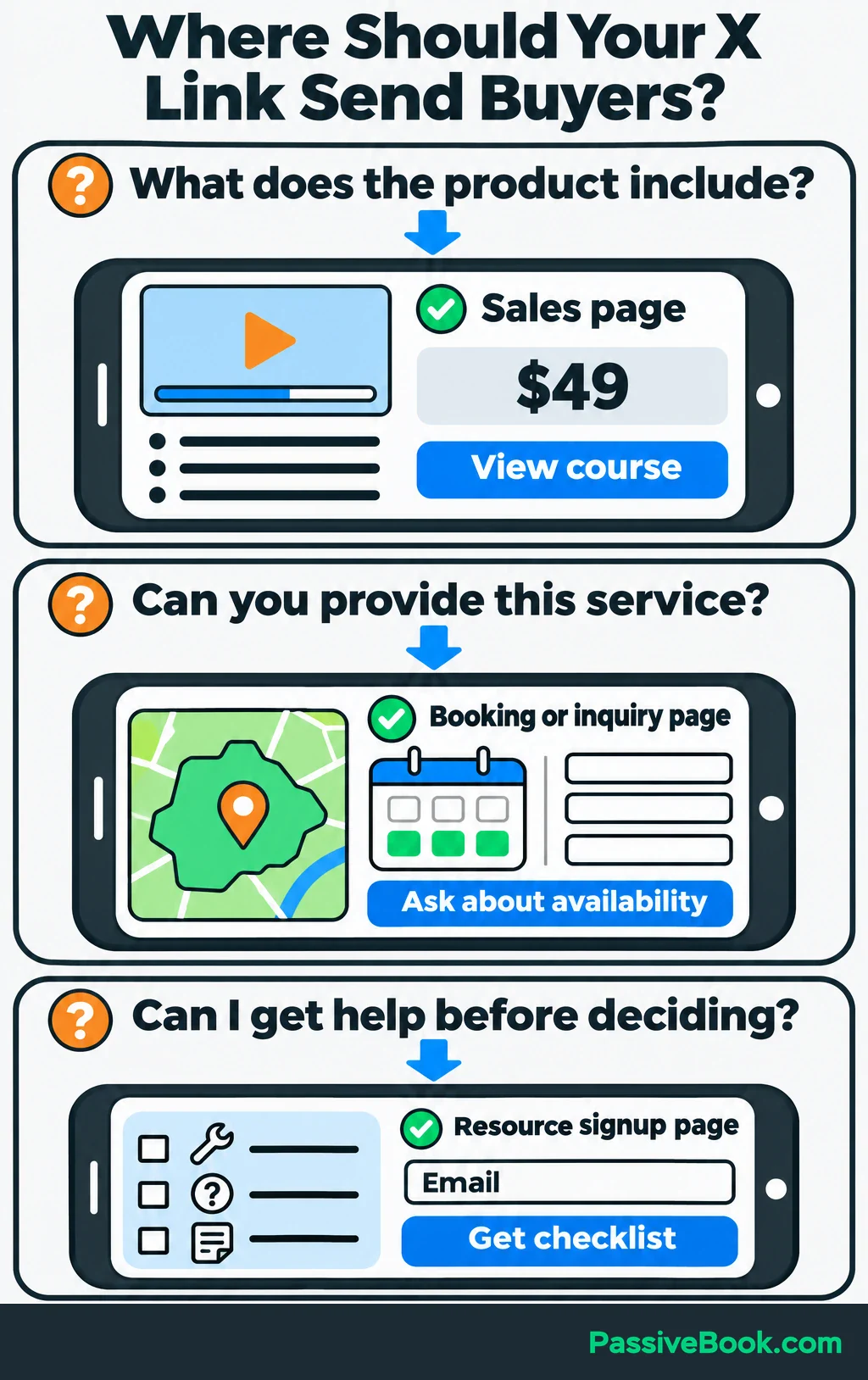
Give each promotion one main destination based on what the person is ready to do.
| Visitor’s Need | Suitable Destination |
|---|---|
| Understand a straightforward product | A sales page with contents, price, preview and purchase details |
| Discuss a service | A booking or inquiry page with service area and availability |
| Get help before deciding | A resource signup page with a clear download promise |
For the brushing checklist, the page might open with:
Plan your next brushing session.
Get a printable checklist to record your tools, prepare your questions and note what you want help understanding.
Show part of the actual checklist. A useful preview makes the promise easier to judge than a decorative image of a PDF cover.
Collect only what you need. An email address may be enough to deliver the resource. Add another field only when the answer changes what happens next.
Explain any marketing follow-up separately from resource delivery. An optional, unchecked box could say:
Send me brushing lesson tips and occasional course offers by email. I can unsubscribe at any time.
Record the permission, provide privacy information and include an unsubscribe route in marketing messages. Follow the rules that apply to your recipients; when relying on consent, UK guidance requires a freely given, specific, informed agreement through a positive action. ICO guidance on consent and opt-outs
Connect the form to your email system so it stores contacts and their follow-up status. On WordPress, I prefer Fluent Forms for signups and FluentCRM for contact management and email automation. Use your existing setup if it already does this.
Before sending traffic, complete the journey on your phone. Submit the form, open the delivery email, download the checklist and check the purchase path. Confirm that the contact and permission record appear where expected.
Then label your promotional links with campaign tags. These are URL details that help analytics identify the source of a visit. For the pinned post, you might use:
utm_source=x
utm_medium=organic_social
utm_campaign=brushing_course
utm_content=pinned_post
Use a different utm_content value for another placement, and save the source with the contact when your form supports it.
Make Your Profile Reinforce the Offer
A person who likes your reply should be able to visit your profile and understand what you provide.
Use a recognizable name and image. Make the bio explain the problem you help solve, and let the header support the same promise.
For the example:
At-home brushing lessons for long-haired dogs. Start with the free brushing-session checklist.
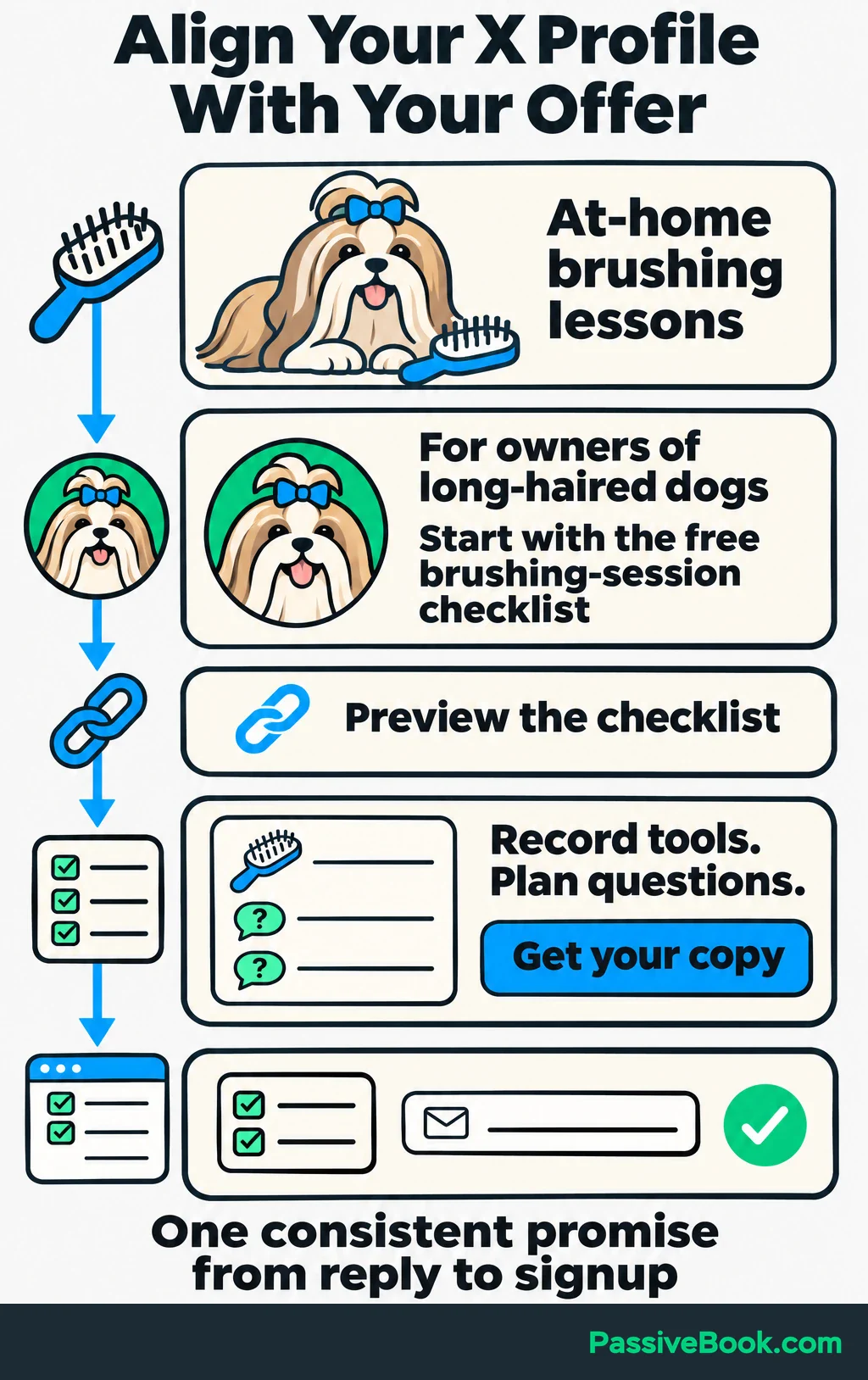
Point the profile link toward your main conversion goal. If you are testing checklist signups, use the checklist page and pin a post that explains it.
Here is a complete pinned-post sample to adapt:
Not sure what to prepare before brushing your long-haired dog? My free checklist helps you record your tools, plan your session and organize questions for your groomer. Preview it and get your copy here: [checklist page URL]
Use genuine credentials and testimonials where they help people decide. Get permission before sharing identifiable customer material, and describe documented outcomes accurately.
Find Prospects Through Search and Useful Replies
Search the words buyers use when they need help. Broad terms such as “dogs” will bring you plenty to read, but little direction.
For the brushing course, investigate phrases such as:
- “Which brush should I use?”
- “Grooming between appointments”
- “Brushing course recommendations”
- “Long-haired dog brushing”
Read the surrounding discussion before replying. A complaint may be a request for help, but it may also be a joke or part of an unrelated conversation.
Answer the actual question first. If you need more context, ask for the detail that would change your answer:
Which brush are you using, and what part of the session is difficult?
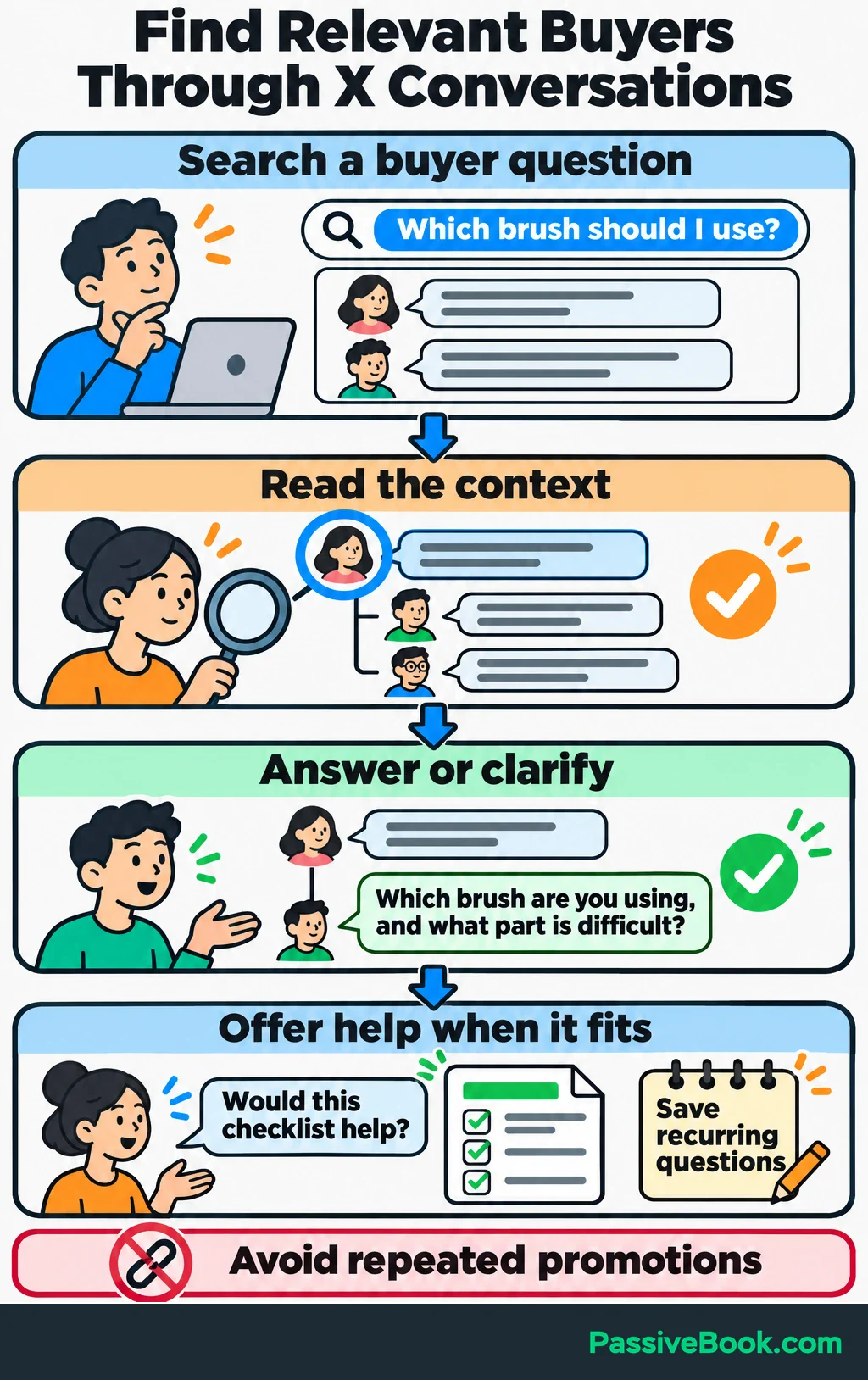
That exchange should still help if the person never clicks a link. When the checklist fits, explain its use and offer it. Avoid dropping the same promotion under every vaguely related post.
Save recurring questions in a simple document. Note the wording, the underlying need and whether it connects to your offer. Those notes can guide both future posts and improvements to the course.
A small private List of relevant accounts can make useful discussions easier to revisit. Choose people because their conversations matter to your work, rather than because their follower counts look impressive.
You can also work with a complementary business on something useful. For example, a groomer could help develop a short list of questions owners can bring to an appointment. Agree on each person’s contribution and where the checklist link belongs.
The point is to find repeated needs and respond well. You do not need to win every conversation.
Publish Content That Leads to Your Offer
Give each post a clear job. I would use three:
| Post’s Job | What It Could Show | Suitable Next Step |
|---|---|---|
| Answer a buyer’s question | How to organize questions before a grooming appointment | Invite a relevant reply |
| Demonstrate your approach | An annotated checklist entry or lesson excerpt | Offer the checklist |
| Explain the purchase | Course topics, viewing format, price and intended buyer | Link to the course page |
Start with the question, explain one usable action, and then connect it to the resource or offer.
For example:
Before your next brushing session, write down the tool you use and where you get stuck. Bring those questions to your groomer. My free checklist gives you a place to organize them: [URL]
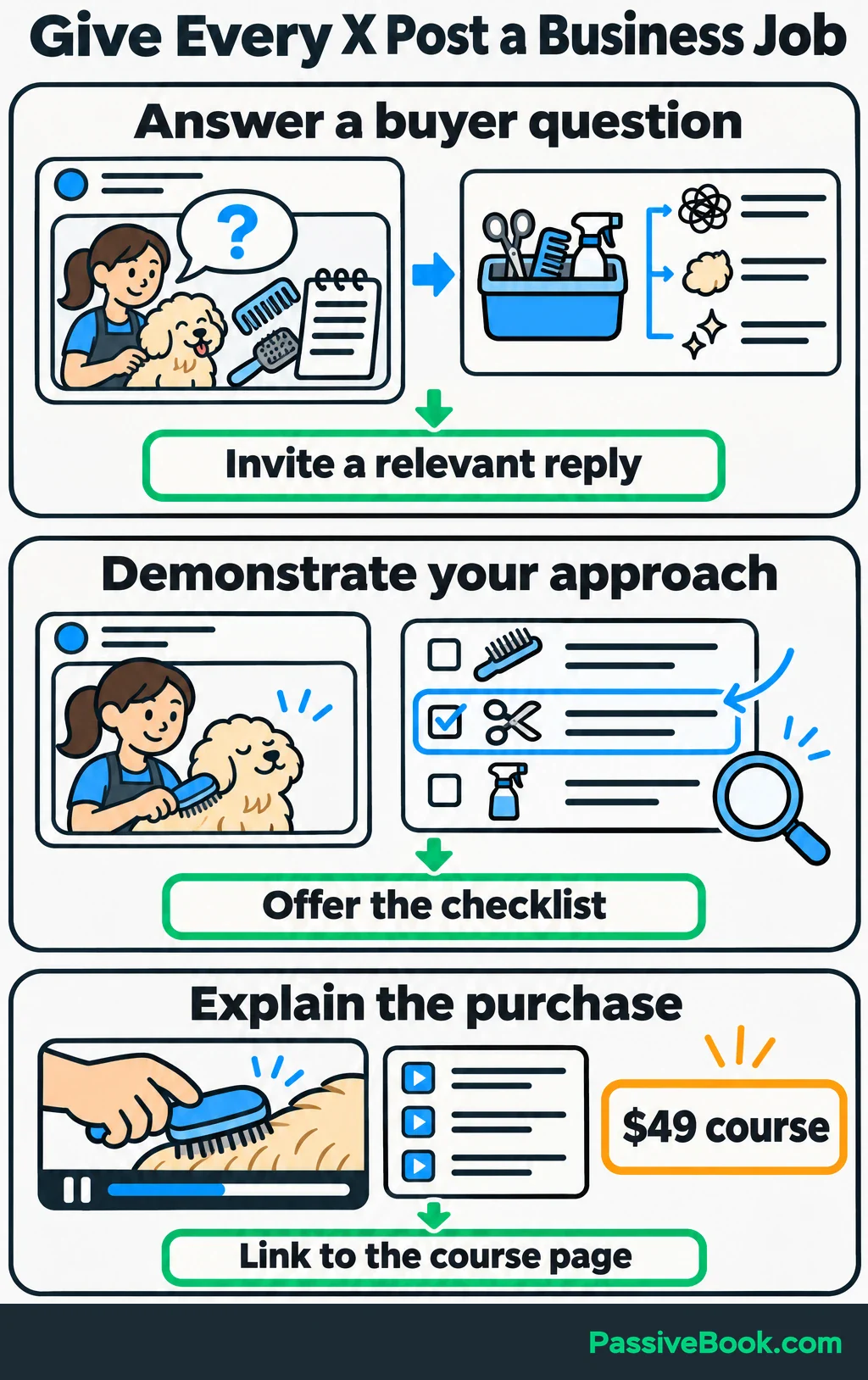
A demonstration post should show something people can inspect. Share a checklist excerpt with a note explaining how to fill it in, or a short preview of a course lesson.
When explaining the paid course, be specific about what is included. “Close-up demonstrations you can pause and replay” tells a prospective buyer more than “packed with value.”
I learned a version of this while reviewing copy for one of my digital products. I had written about the work behind it, but the page still gave buyers little to examine. Replacing that explanation with a preview made the offer clearer. On X, I would make the same choice: show the thing people are considering.
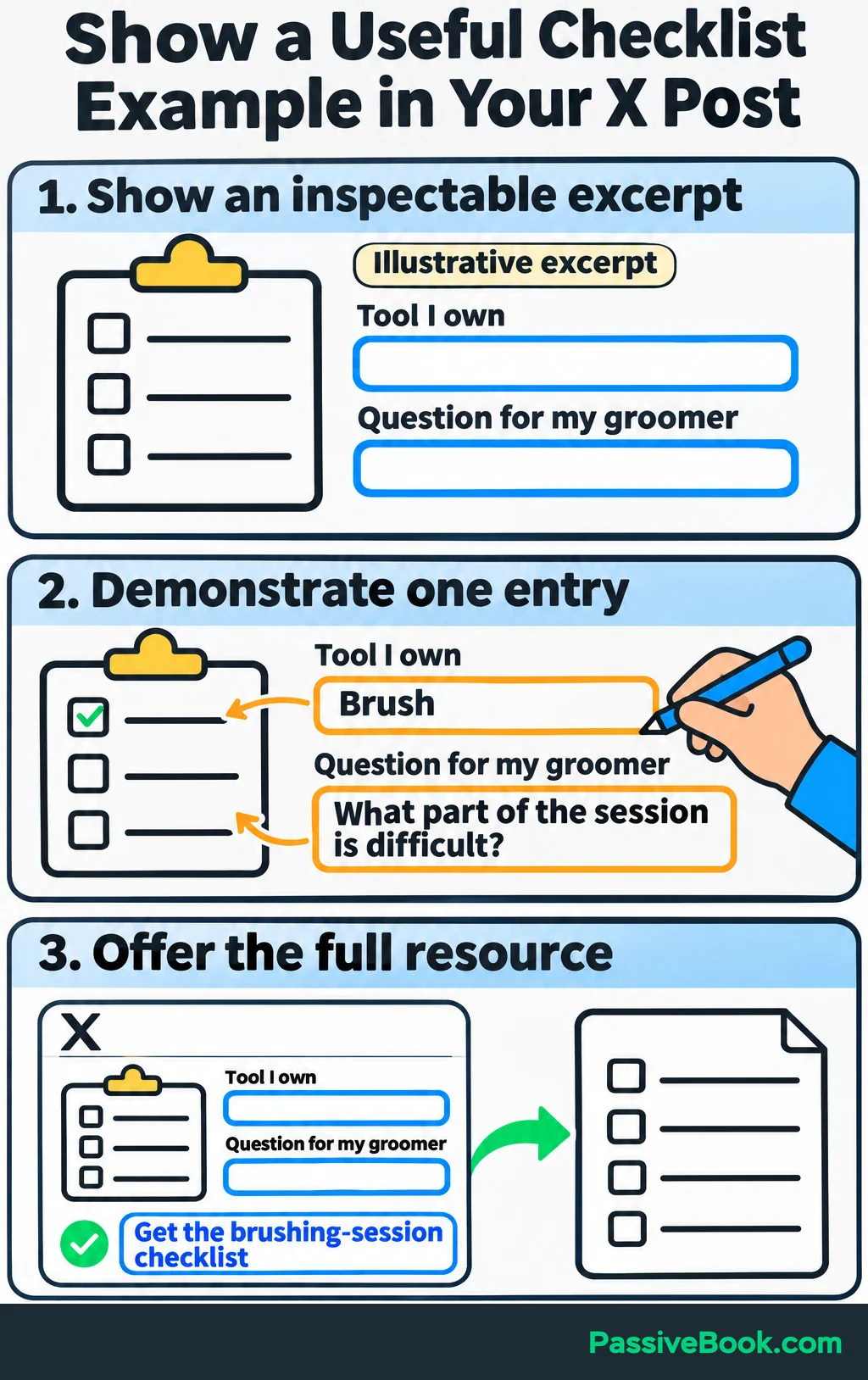
Choose the format that suits the explanation. Text works for a short answer. Images help with annotated examples. A thread can connect several steps, and close-up video can show movement without requiring you to appear on camera.
If you have the offer but keep getting stuck on the wording, AI Social Copy Studio can draft a connected set from your own details. Start with the profile and two posts, then check the facts and links before publishing.

Free AI Social Copy Studio




Revisit questions that lead to suitable inquiries. Use another example or a different lesson excerpt rather than reposting the same promotion.
Let your available time and results set the publishing workload. A rigid daily quota is easy to measure, but it can become another job that never sends an invoice.
Use DMs to Qualify Interested Prospects
Move to direct messages when someone asks you to send a resource there or agrees to discuss their situation privately. If they request the checklist in a public reply, ask whether they want the link there or by DM.
Deliver the requested help first. Then ask one question that helps you understand the next useful step.
For example:
Here’s the brushing-session checklist you requested: [URL]. Are you mainly looking for help choosing tools or following a brushing demonstration?
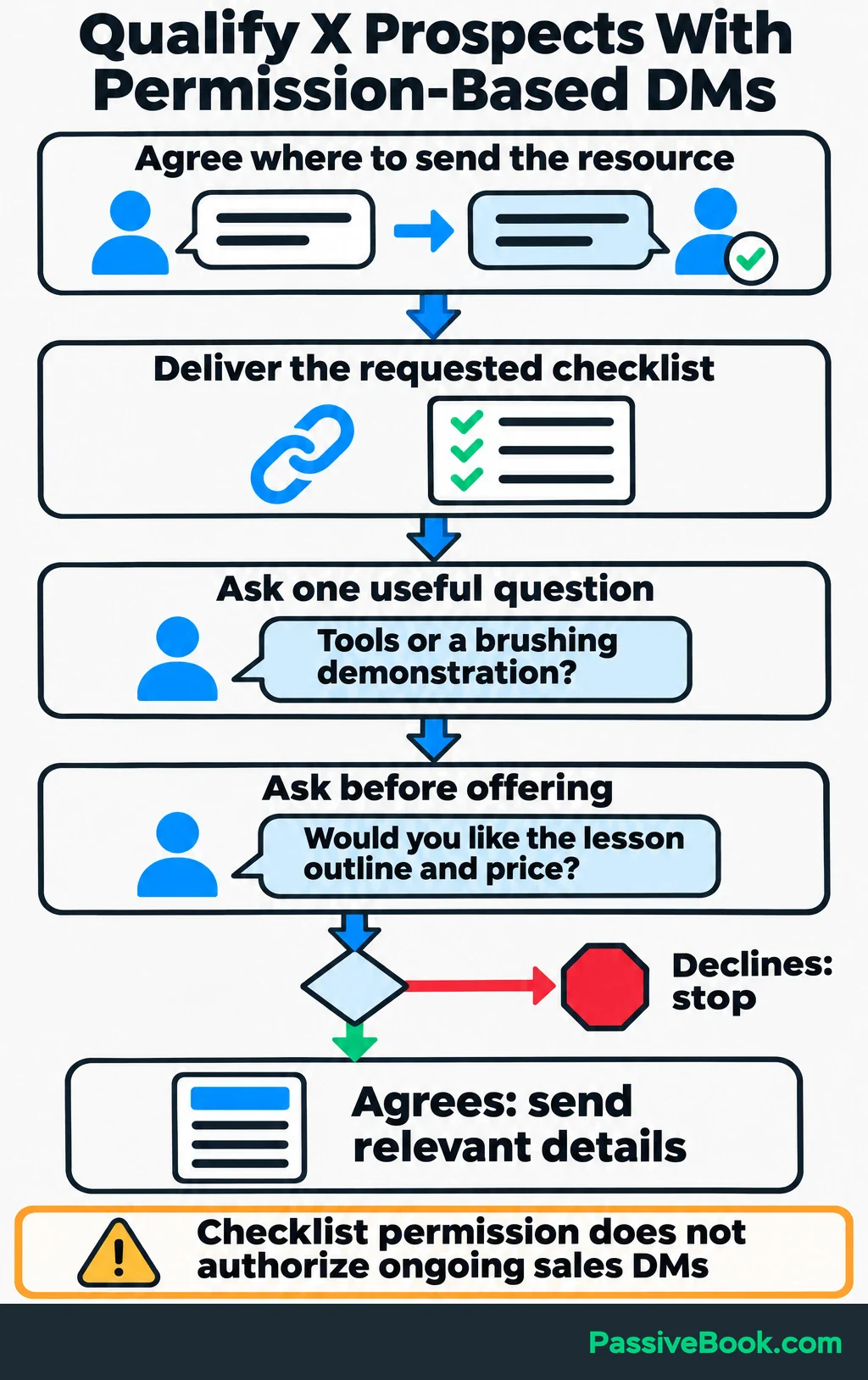
Their answer should shape your recommendation. Someone who wants a lesson demonstration may suit the course. Someone who wants an appointment needs a service option.
Before turning the exchange into an offer, ask:
The course includes close-up brushing demonstrations. Would you like the lesson outline and price?
If they agree, send the relevant details and sales page. If they decline, stop. Record the need, source, qualification status and agreed next action so you do not restart the conversation from scratch later.
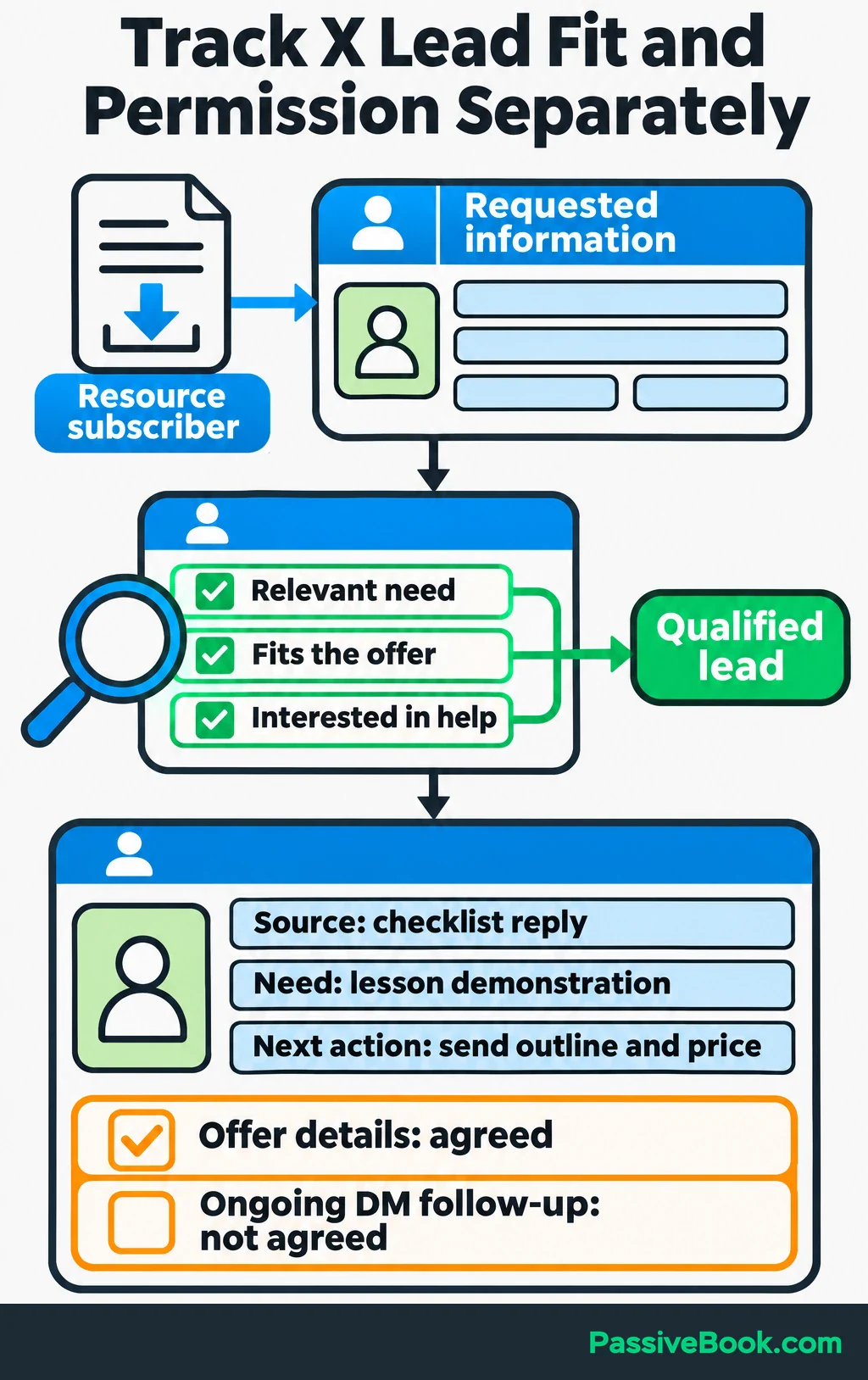
Permission to receive a checklist is not permission for an ongoing sales sequence in DMs.
X prohibits unsolicited bulk or automated DMs. Automated messages require a request or clear intent to receive them and an easy opt-out. A follow or an open inbox is insufficient permission, and additional follow-up after an interaction ends needs permission. X’s automated DM rules
I would keep this part manual while testing the offer. A few real exchanges can reveal a purchase concern that a polished automation would keep missing.
Turn Signups Into Customers With Relevant Follow-up
The delivery email should help someone use the resource immediately. Send promotional follow-up only to people who agreed to receive it.
Here is a complete delivery email you can adapt:
Subject: Your brushing-session checklist
Hi,
Here’s your checklist: [download URL]
Start by filling in the tools you already own. Then note the part of the session you want help understanding, so you have a clear question to bring to your groomer.
You do not need to complete every box at once.
What would you most like a brushing demonstration to show? Reply and let me know.
[Your name]
Build the following messages around separate purposes:
| Message | What It Helps the Subscriber Do |
|---|---|
| Apply the checklist | Work through one entry and prepare a useful question |
| Evaluate the teaching | Watch a lesson excerpt and understand the viewing format |
| Consider the course | Review its contents, intended buyer, price and purchase details |
Give people enough time to use the resource before asking what they thought. The timing should follow the task, rather than whatever delays came with an email template.
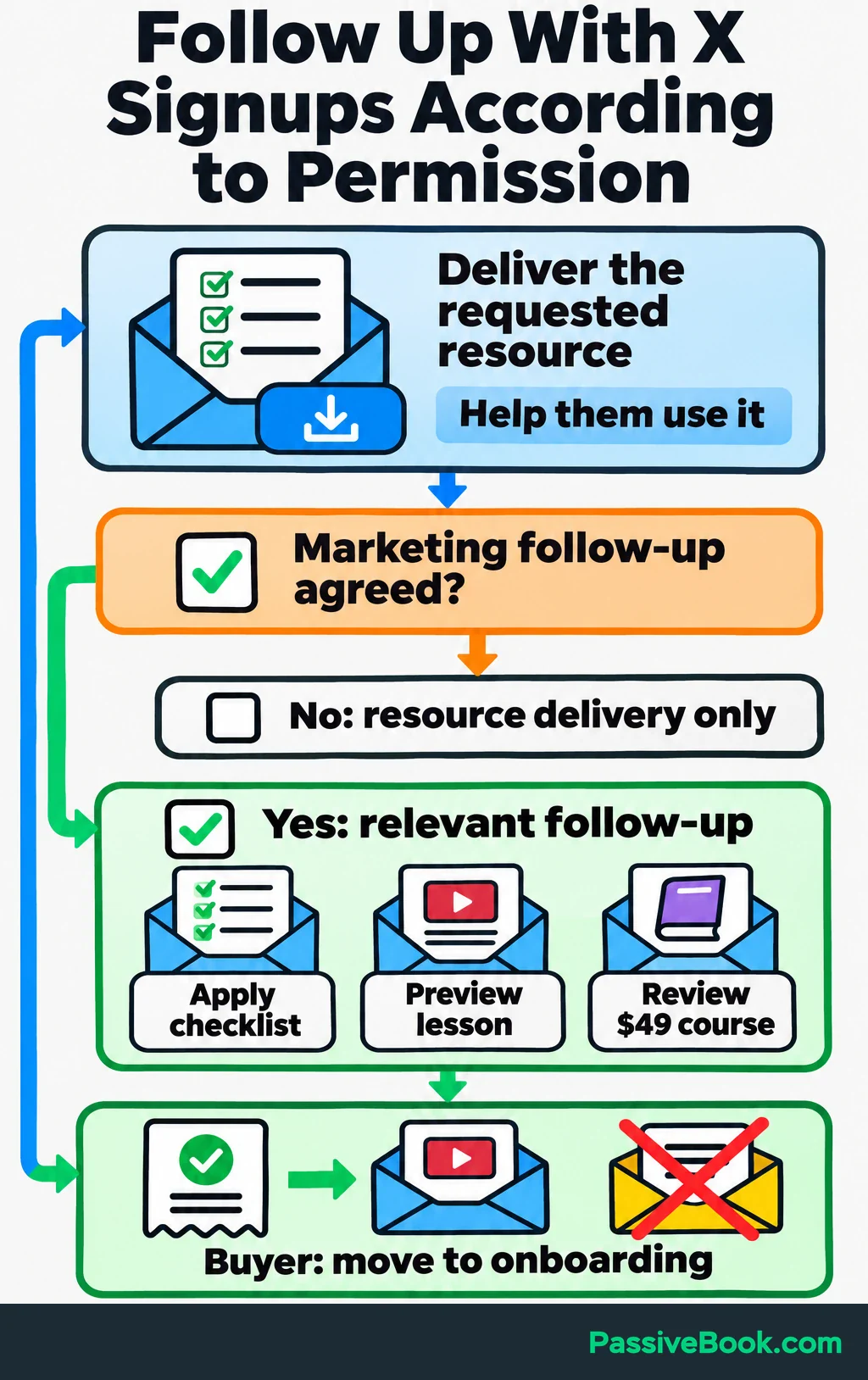
Use actual questions to decide what needs explaining. If people wonder whether they can follow the demonstrations, show an excerpt and explain how lessons can be watched. If they ask whether the course covers their need, answer with the relevant lesson topics and limits.
Keep the offer clear. Include what buyers receive, who it suits, the $49 price and the purchase link. Skip invented urgency. A downloadable course does not need a countdown timer pretending the internet is running out of shelves.
Move purchasers into onboarding and remove them from introductory offers they have already accepted. Route other follow-up using stated interests when those interests meaningfully change the message.
Review replies, offer clicks and purchases. Those signals can show which explanations help and which questions your page still leaves unanswered.
Measure Whether X Produces a Worthwhile Return
Connect Activity to Leads and Customers
Use one record per campaign to track landing-page visits, signups, qualified leads, customers, revenue, refunds, costs and hours.
Signup conversion counts completed signups from those landing-page visits. Lead-to-customer conversion counts buyers from a defined group of qualified leads over a period that fits your sales cycle. For checklist subscribers, call it signup-to-customer conversion: downloading a resource does not establish buying intent.
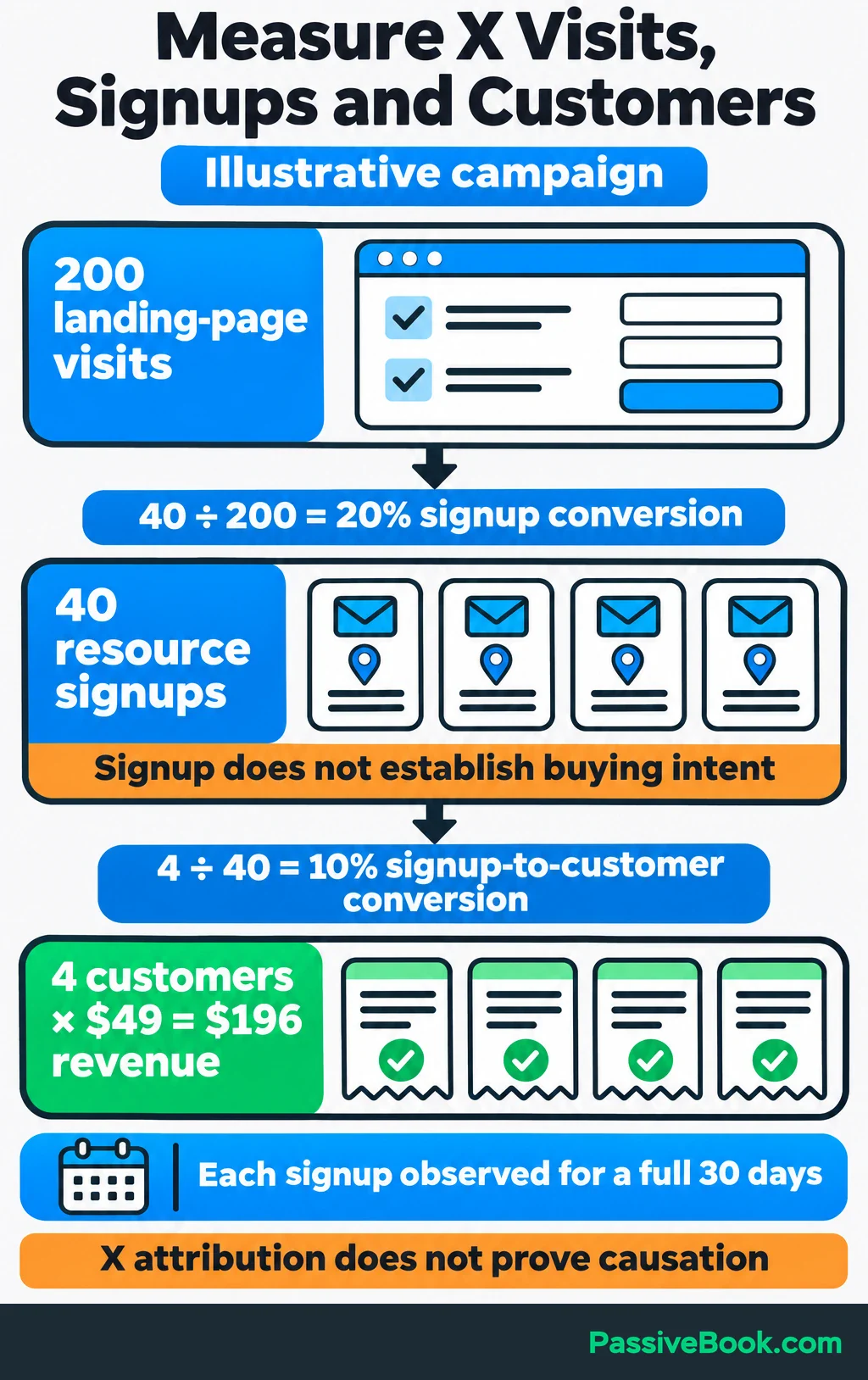
Match tagged visits to contact and order records, record DM sources manually and keep unattributed sales separate. An X visit shows that X was part of the journey; it does not prove X caused the sale.
For the running illustration, suppose 200 visits to the checklist landing page produce 40 signups. Each subscriber has had a full 30 days to buy, and four purchased within that window.
That gives you:
- Signup Conversion: 40 ÷ 200 = 20%.
- Signup-to-Customer Conversion: 4 ÷ 40 = 10%.
- Collected Revenue: Four purchases at $49 = $196.
Calculate Contribution After Acquisition Costs
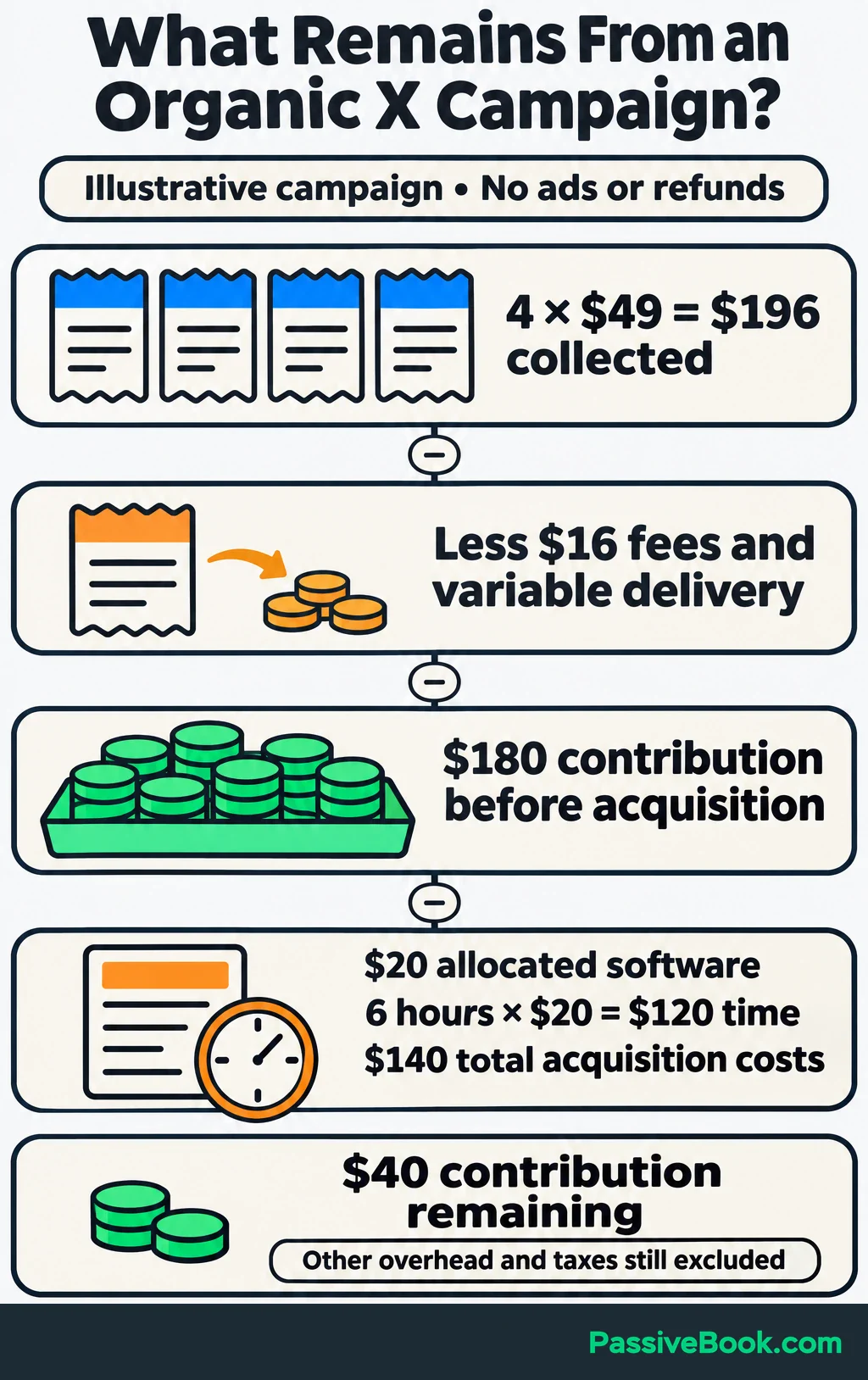
First, work out what remains from sales after refunds, payment fees and costs that rise with each purchase. This is the contribution available to cover customer acquisition, other overhead and profit.
Then count acquisition costs. Include ads, an allocated share of software costs and a stated value for your working time.
For the example, assume no ad spend or refunds and $4 in payment fees and variable delivery costs per sale:
| Item | Calculation | Amount |
|---|---|---|
| Collected revenue | 4 × $49 | $196 |
| Refunds | None in this illustration | $0 |
| Payment fees and variable delivery costs | 4 × $4 | $16 |
| Contribution before acquisition | $196 − $16 | $180 |
| Allocated software costs | Assumed campaign share of email and form tools | $20 |
| Working time | 6 hours × $20 | $120 |
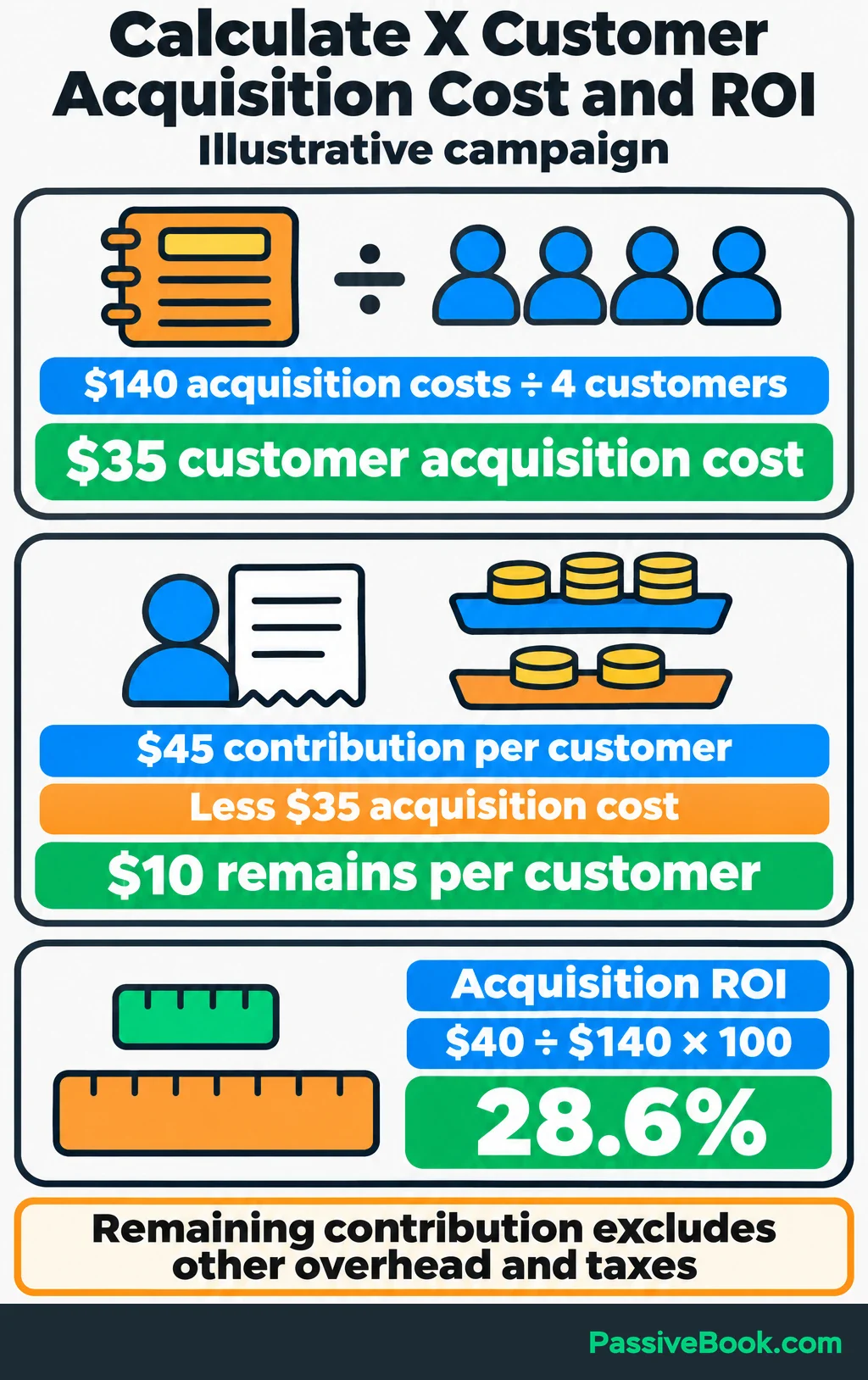
| Total acquisition costs | $20 + $120 | $140 |
| Contribution remaining | $180 − $140 | $40 |
Customer acquisition cost divides total acquisition costs by new customers:
Customer acquisition cost = $140 ÷ 4 = $35To calculate the return on your acquisition spending (ROI), divide the contribution left after acquisition costs by those costs:
Acquisition ROI = ($180 − $140) ÷ $140 × 100 = 28.6%The $40 remaining still excludes other business overhead and taxes. It is not take-home profit.
Counting time matters. An organic campaign can cost no ad money and still consume hours you could use elsewhere.
Use the numbers to choose what to improve. Unsuitable visitors point toward targeting or messaging. Relevant visitors who rarely sign up suggest a page or resource problem. Suitable leads who do not buy give you a reason to inspect the offer, purchase questions and follow-up.
Fix the step where suitable buyers drop out before adding more traffic.
Test X Ads When the Economics Support Them
I would test the organic path first, then consider ads once you have some evidence about who buys and what it costs to serve them.
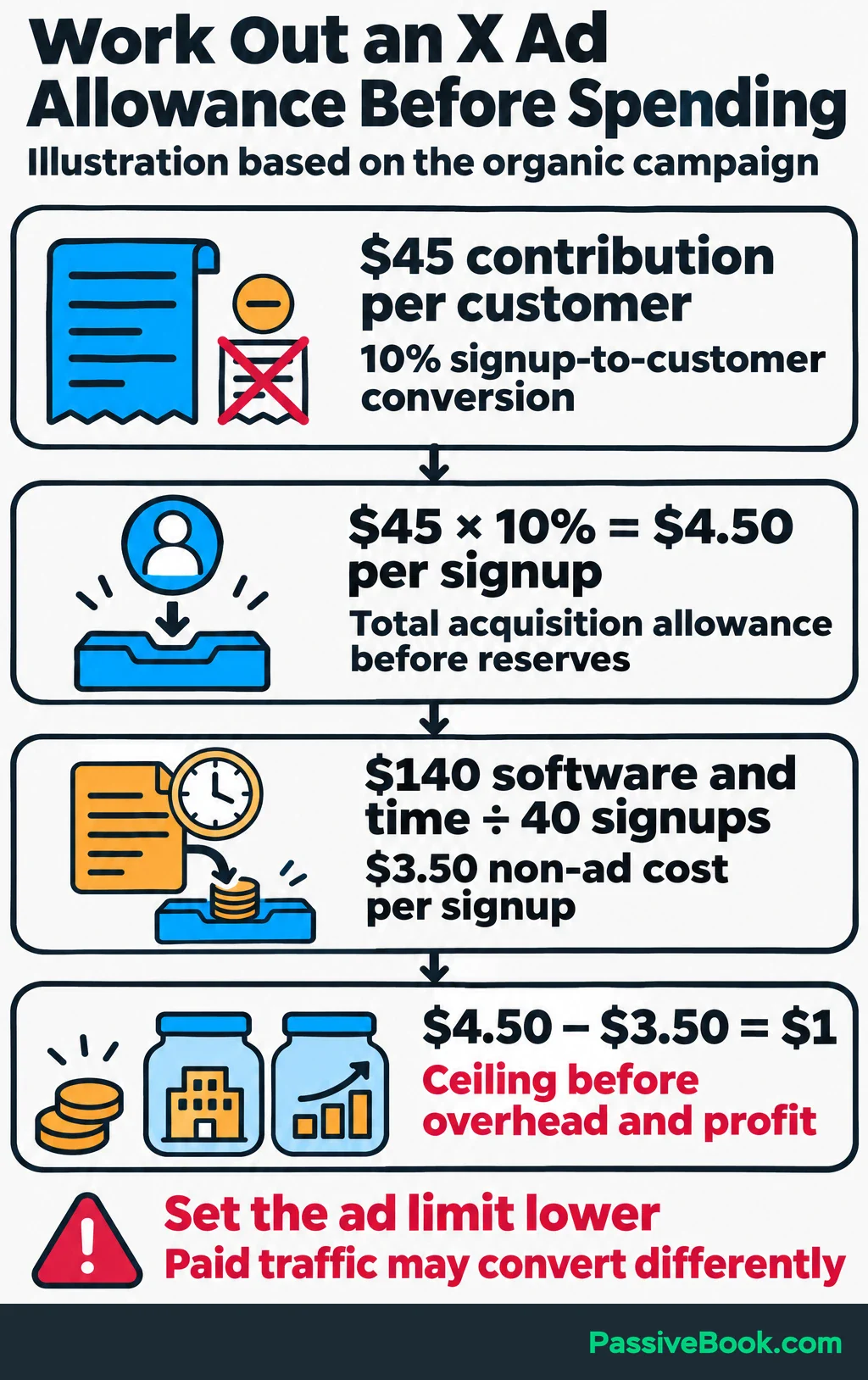
Start with the contribution per customer. Reserve money for overhead and profit, then decide how much remains for acquisition. Subtract non-ad acquisition costs before setting an ad budget.
In the illustration, each course purchase contributes $45 before acquisition. At a 10% signup-to-customer rate, each signup supports $4.50 in total acquisition costs before overhead and profit.
Across the same 40 signups, that is $180. The $140 already assigned to software and time leaves just $40 for advertising, or $1 per signup, before those reserves.
That $1 ceiling leaves nothing for other overhead or profit, so your spending limit needs to be lower. Paid visitors may also convert at a different rate.
X Ads uses auction pricing, so there is no fixed cost per click or lead. X states that there is no minimum advertising spend. Set both a campaign spending cap and a loss limit you can afford. X Ads pricing
Before launch, check account verification, public post status, market availability and compliance of your profile, ads and destination. Include any verification expense in the channel budget. X Ads eligibility requirements
Choose the campaign around the action you need:
- Website Conversion: Use this when your page needs to explain, qualify or sell the offer. Set up and test the chosen conversion event before spending. X’s guidance calls for functioning website conversion tracking. Website conversion guidance
- Native Lead Collection: Consider Lead Gen Ads when collecting contact details inside X is the immediate task. Connect submissions to resource delivery, include privacy information and test the handoff. A submitted form still needs qualification and follow-up. Native lead-generation documentation
Test one offer and audience with a small set of distinct messages. Decide the spending limit and review point in advance.
Keep paid and organic records separate. Before increasing spend, recalculate the cost per qualified lead and customer using the paid campaign’s results.
Make the Workflow Repeatable
Choose a workload you can maintain around the rest of your business.
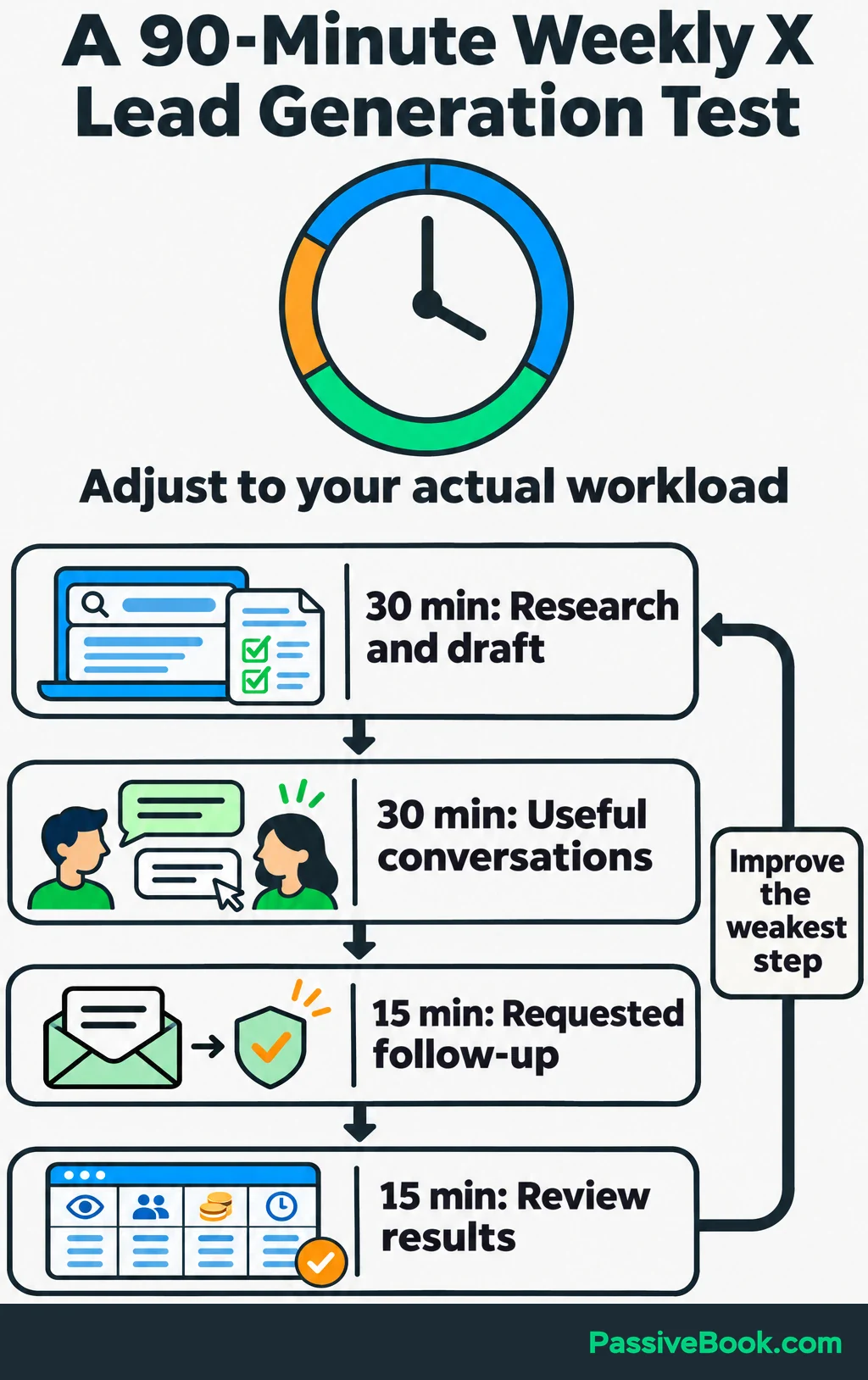
For a small test, you could reserve 90 minutes a week: 30 minutes for question research and drafting, 30 for conversations, 15 for requested follow-up and 15 for reviewing results. Adjust that split when actual work shows where the time goes.
Batch the preparation, but leave room to answer people while the conversation is still relevant.
AI can help turn approved lesson notes into drafts. A useful prompt is:
Create three standalone X posts from these brushing-course notes. Answer one buyer question per post and include one practical action. Use only the supplied information. Do not invent facts, customer results or product features. Flag anything that needs my review.
Review every draft against your lesson notes before publishing.
Then automate the repeated work behind the conversation: resource delivery, source tagging, agreed email sequences, purchaser onboarding and reporting.
I use n8n to connect tools and automate workflows. For this setup, I would first use the connections already available in the form, email and checkout tools. Add another automation tool when it solves a specific handoff.
Test each connection, add a failure alert and keep a way to pause the workflow. An automation that quietly stops delivering downloads can waste every visit you worked to earn.
Keep individual recommendations under human review. For platform automation, use authorized API-based tools. X prohibits unsolicited keyword-triggered automated replies and requires prior written approval for AI reply bots. X’s automation rules
At each review, keep the activities producing suitable customers, improve the weakest step and reduce work whose contribution does not justify its cost.
That is how I would use X for lead generation and monetization: build a useful path to a purchase, measure it, and make the parts that work easier to repeat.
What Next?
Search X for one question your offer answers and write a helpful reply. Then check whether your profile gives an interested person a clear next step.
Use the social buttons to share this guide when the conversation turns to getting customers from X; the worked calculation gives that discussion something more useful than follower counts.
Where does your path currently stall: finding relevant people, getting signups or turning interest into purchases? Share your answer and any other questions in the comments.
Share this post with your friends & followers:

