You find a product your audience might buy, but the brand’s website offers little more than an affiliate signup form. Do you apply, send a pitch, or build a bigger following first?
It’s easy to spend hours approaching brands and posting links without knowing whether the offer fits, the sales will count, or anyone will pay you. This guide helps you resolve those questions and build affiliate partnerships on X around useful buying advice, with clear terms and records that show whether your recommendations earn commissions.
Find Affiliate Partners That Fit Your Audience
Start With Buying Questions on X
Start with what people want help buying. Search for a specific product question, then read the replies for requirements, complaints, and alternatives.
Look for details that could change a purchase:
- What does the product need to do?
- Where will the buyer use it?
- What disappointed them about their last purchase?
- Which products are they already comparing?
Throughout this article, imagine you run an indoor-cat care blog. Your X account answers practical buying questions, and you’re considering litter-mat recommendations. The pitches, posts, product details, and calculations below are illustrations.
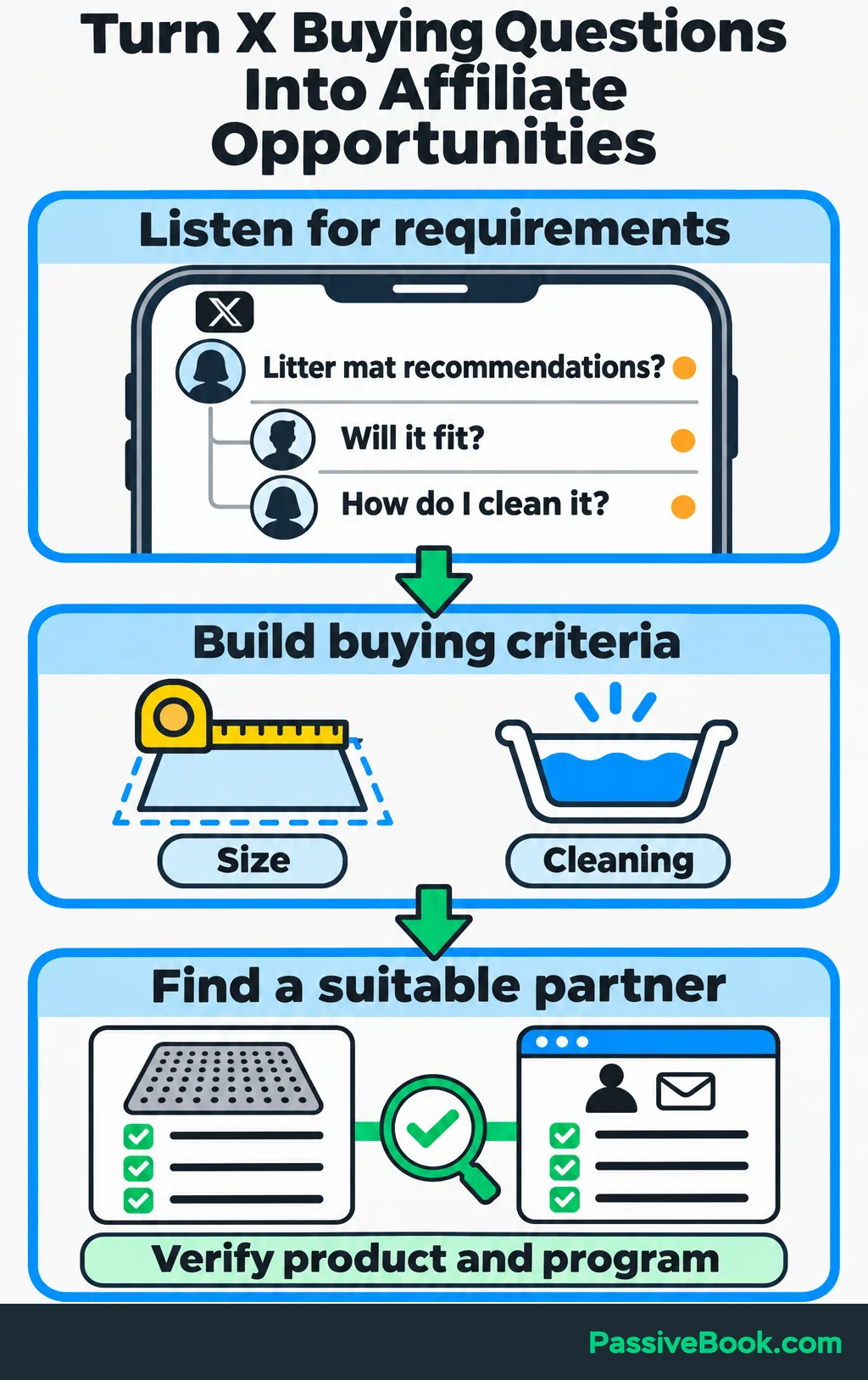
Searches such as “litter mat recommendations” and “easy-to-clean litter mat” give you somewhere to start. Read the actual conversations before deciding what matters. If people keep asking about size and cleaning, a buying checklist has a clear purpose.
Then find brands selling suitable products and check their official websites for affiliate programs or partnership contacts. Audience conversations reveal the need; the merchant or affiliate manager confirms the arrangement.
Keep a shortlist in a spreadsheet or a Notion table, with one row per candidate. Record the audience problem, product, official program URL, and contact. Add eligibility and permitted channels, then note commission terms, how long referrals can earn credit, and payment conditions. Mark missing information as unknown so you can ask about it.
I would research three strong candidates before collecting thirty names. A long list can become a very respectable way to avoid sending a useful pitch.
Check Suitability Before Commission Rates
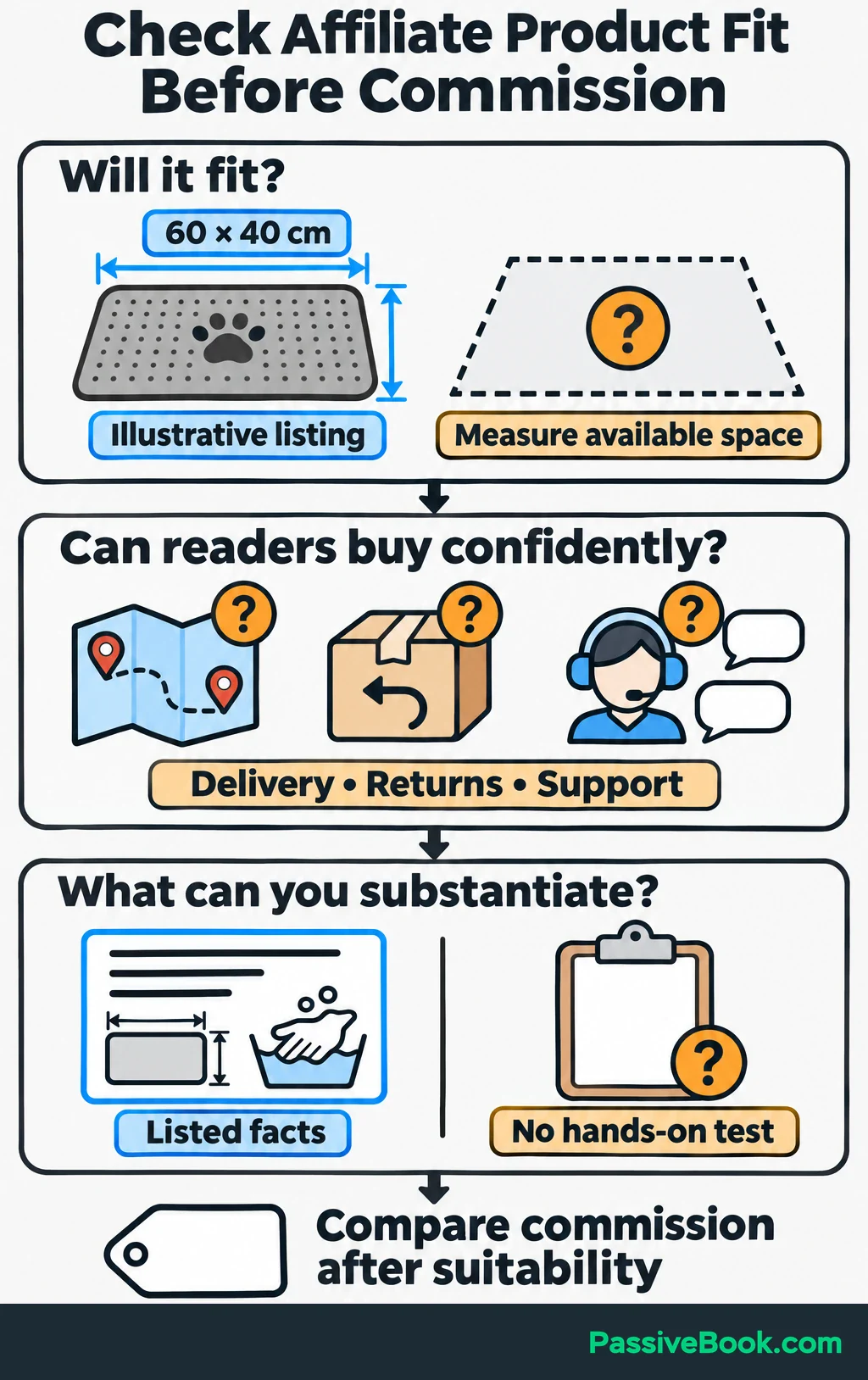
Decide whether you can recommend the product before comparing what it pays.
| Check | What To Verify | Litter-Mat Example |
|---|---|---|
| Product fit | Specifications and limits that affect use | Illustrative listing: 60 × 40 cm; available floor space still needs measuring. |
| Buying experience | Delivery coverage, returns, and support | Delivery, returns, and support for your main market are not yet checked. |
| Recommendation basis | What you have tried or can verify | Listed dimensions and hand-washing instructions; no hands-on test. |
| Program eligibility | Accepted locations, accounts, and placements | Your country’s eligibility and permission to promote on X still need confirming. |
There is no follower threshold you should assume across all programs. For example, Amazon’s US guidance accepts Twitter accounts but generally expects at least 500 organic followers for social applications. Its review also requires three qualifying sales within 180 days, excluding personal orders. Those are Amazon’s requirements, so check each program separately. Amazon’s application guidance
A small account is a reason to check eligibility early. It doesn’t tell you whether every possible partner will reject you.
Also check product restrictions before investing in a pitch. X excludes categories such as drugs and health supplements from paid partnerships, which matters if you later expand from accessories into other pet products. Regional restrictions also apply. X’s paid partnerships policy
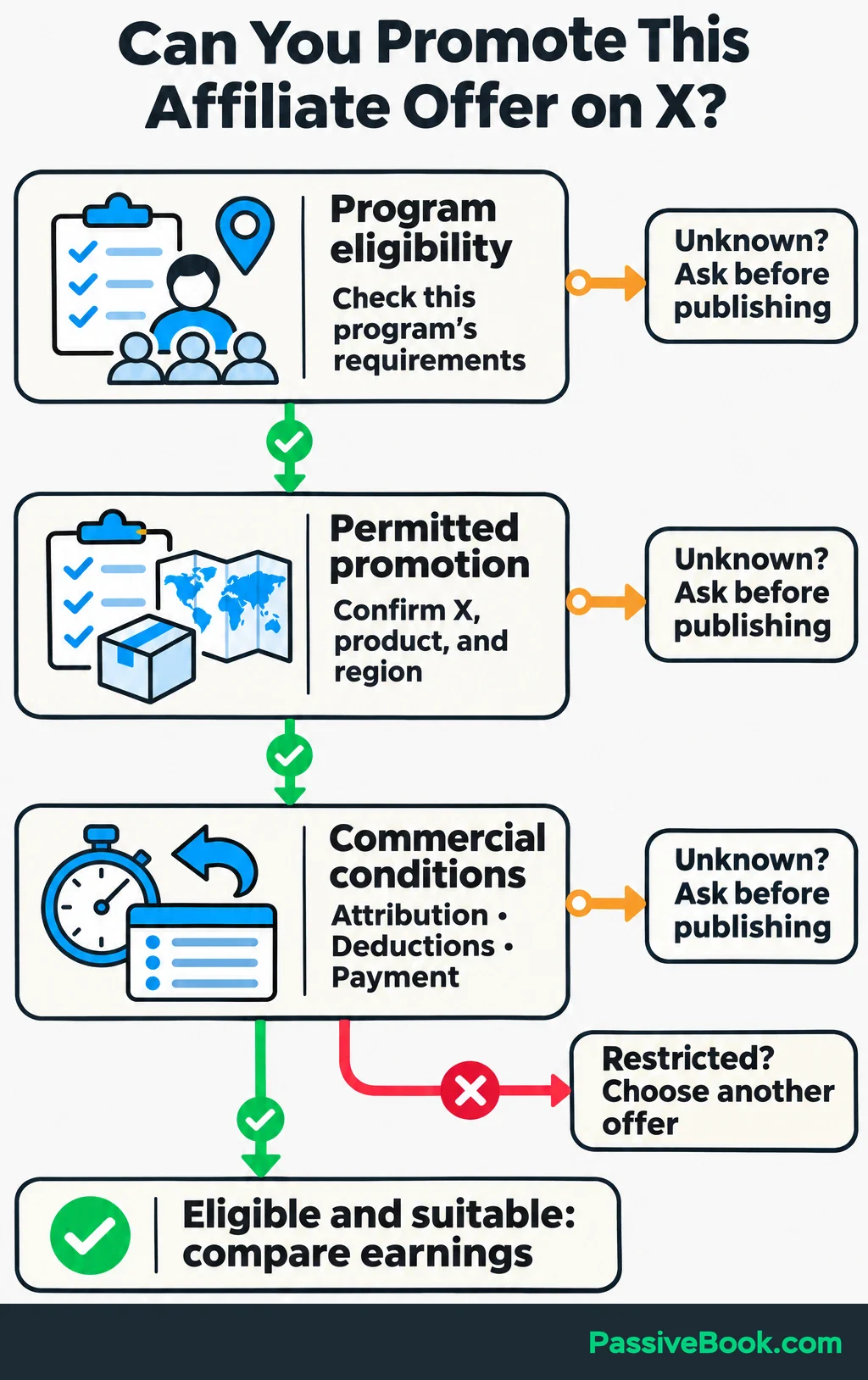
Once the product passes those checks, compare the commission on eligible purchases, attribution rules, refund deductions, and payout conditions. A large percentage means little if your readers cannot buy the product or your recommendations rarely qualify.
My first three months in affiliate marketing brought in roughly $23 because I chased unsuitable products. Switching to honest reviews of tools I used eventually brought that to roughly $340 a month. Those were tool-review results, separate from X and pet products.
In one review draft, writing the paragraph about who should skip the tool made me rewrite the recommendation. I could describe its features, but I hadn’t made a convincing case for the buyer. I now treat that paragraph as a useful test before pursuing an offer.
Pitch a Specific Collaboration
Give the Partner Something Relevant to Assess
Before contacting anyone, make your account easy to understand. Your profile should explain what readers get, and a pinned post should show the quality of your advice.
For the cat-care blog, that could be a short checklist explaining how to measure the space beside a litter box. It gives a partner more to assess than “I love cats and want to collaborate.”
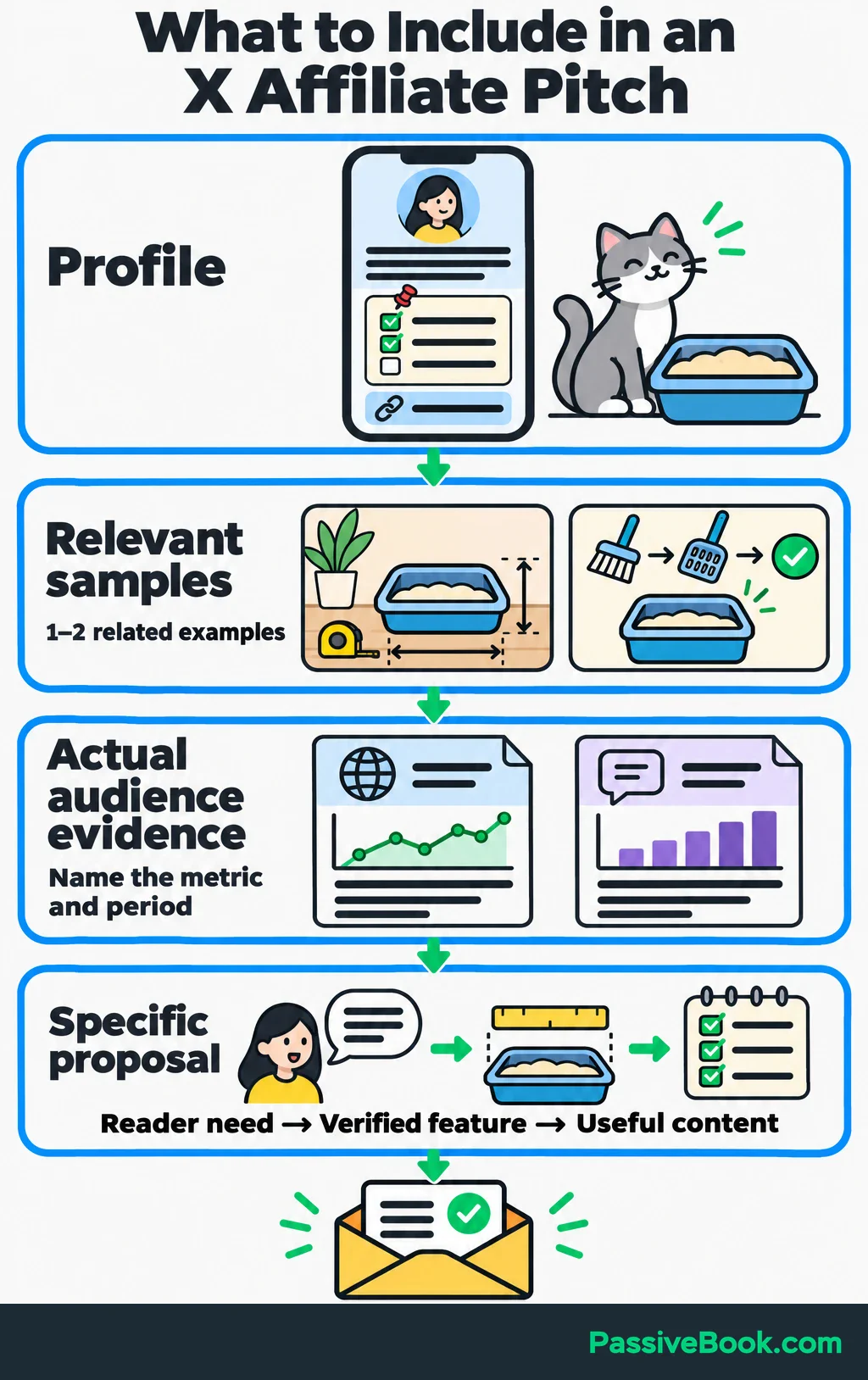
Prepare a short introduction containing:
- Profile: Your X account and relevant website.
- Content: One or two samples related to the proposed product.
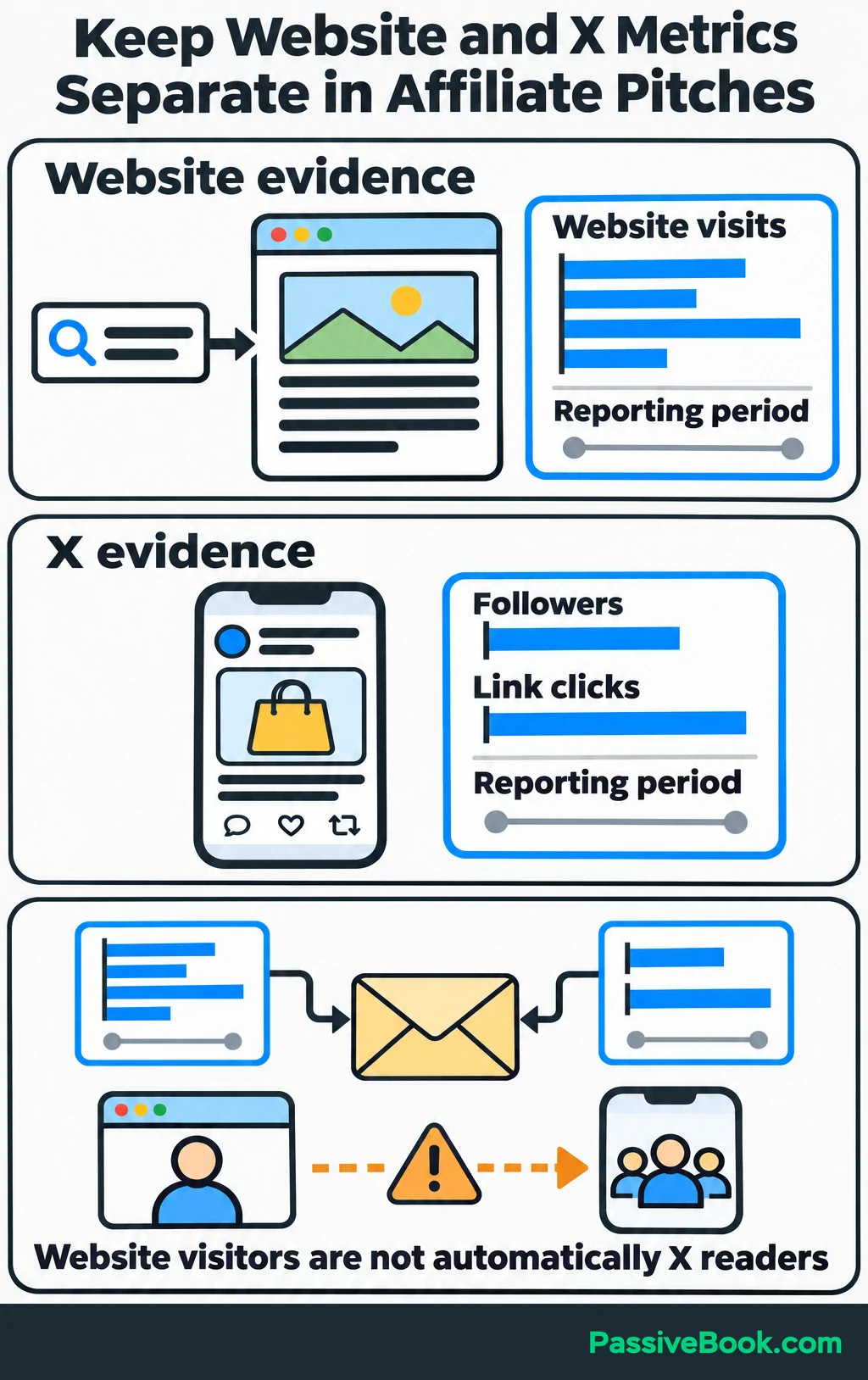
- Audience: Actual figures with a clear period, such as website visits last month or X link clicks over the past month.
- Proposal: One useful content idea and why the product belongs in it.
Keep website traffic separate from X activity. A blog with steady search traffic can strengthen your proposal, but those visitors are not automatically an audience for your X posts.
If you have little reach or no sales history, lead with a useful sample and ask about eligibility. You don’t need a ten-page proposal to discover that the program cannot accept your location.
Useful replies to brand conversations can help you become familiar with the product and team. Add something relevant when you have it, then use the official application, published partnership email, or an appropriate DM.
Offer a Manageable First Collaboration
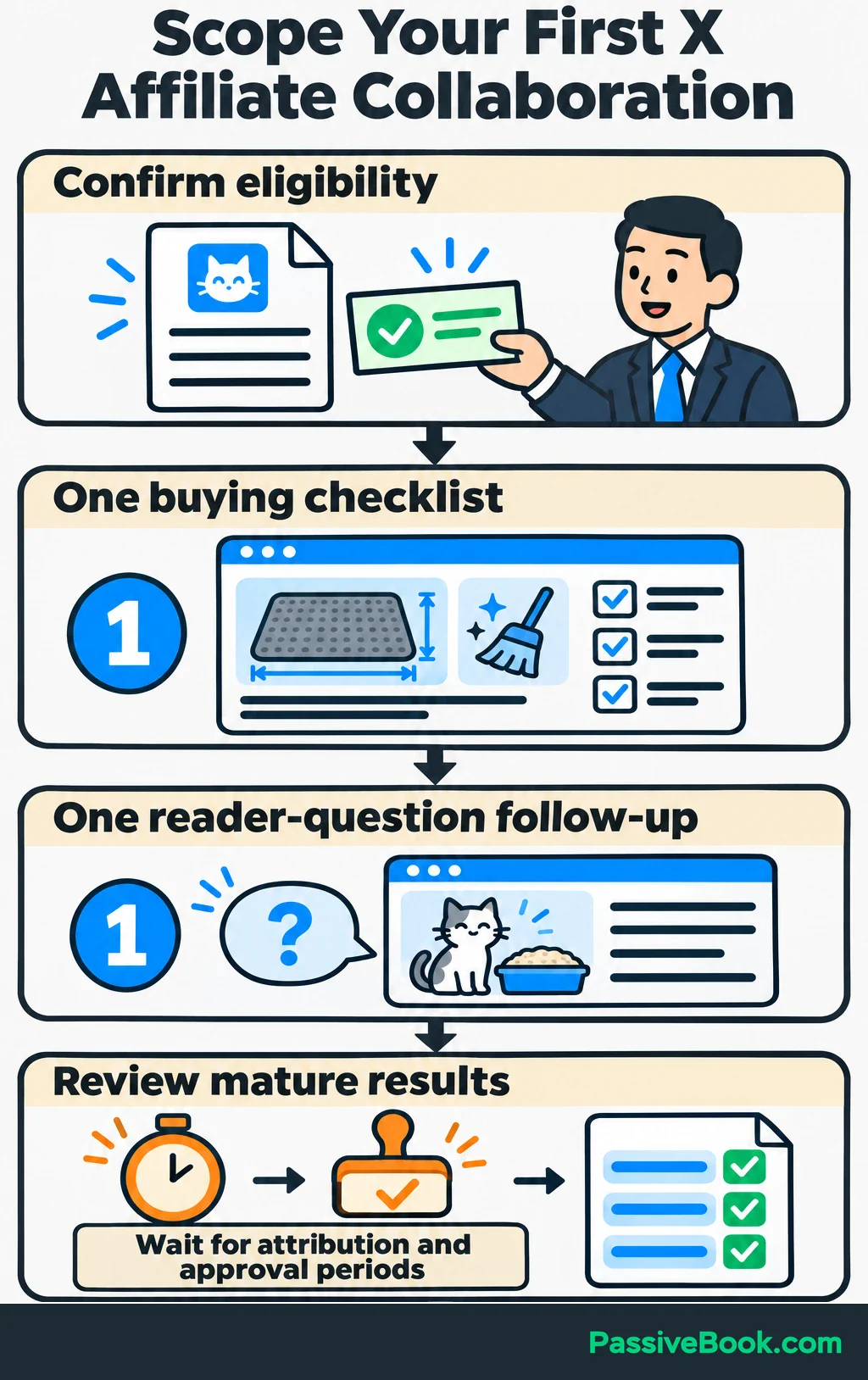
Make the first proposal small enough to deliver around your existing work. One buying checklist and a follow-up answering reader questions give both sides something specific to review.
Here is a complete outreach message you can adapt:
Subject: Litter-mat buying checklist for [Brand]
Hi [Name],
I publish practical indoor-cat care guides at [Website] and share buying advice on X at [Profile URL].
I’m preparing a litter-mat checklist covering size, placement, and cleaning. [Product] looks relevant because [verified feature that answers a reader need].
Here’s a related content sample: [URL]. My X account currently has [actual follower count], and [optional relevant traffic or click figure, clearly labeled with its period].
Does your affiliate program accept my location and X account, and is [application URL] the right route?
If eligible, I’d like to start with the checklist and one follow-up answering reader questions. We could review recorded clicks and credited sales once the applicable attribution and approval periods have passed.
Thanks,
[Name]
Replace every bracketed detail, and remove the optional figure if you have nothing useful to report. An honest small number is easier to work with than an impressive number nobody can explain.
If you have a product in mind but keep rewriting the introduction, the AI Partnership Writer can turn your notes into a first approach.

Free AI Partnership Writer




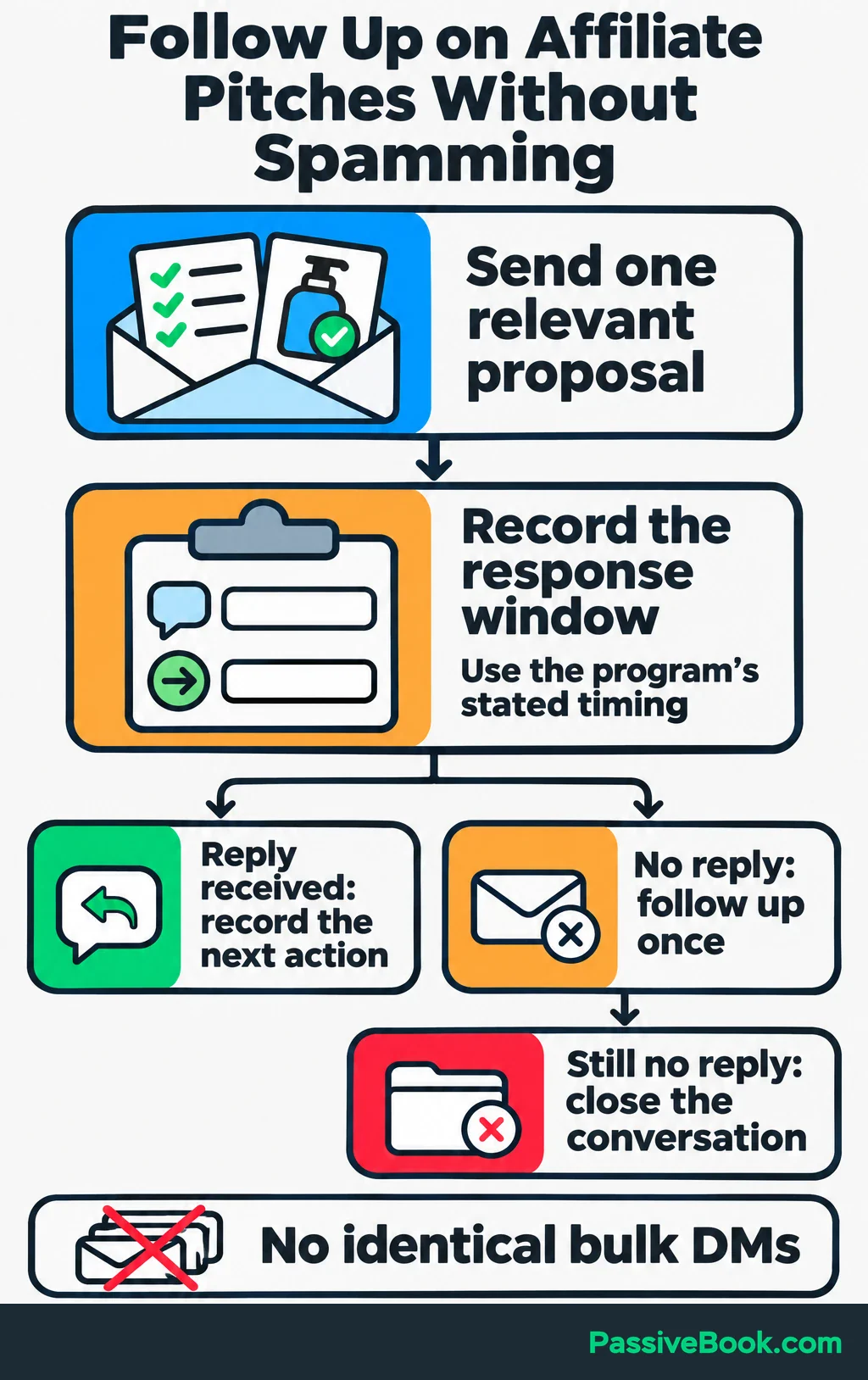
Keep each approach relevant to its recipient. X prohibits bulk unsolicited messaging, identical DMs, and irrelevant promotional replies. A saved pitch structure should help you write a specific message, rather than become an automatic DM campaign. X’s authenticity policy
Record the response and next action. I would follow up once after about a week, unless the program gives a different response window:
Hi [Name], following up on the litter-mat checklist proposal below. Is this relevant to your affiliate program, or should I contact someone else?
Then close the conversation if there is no response. When a manager gives a specific reason for declining, use it to improve your shortlist or proposal.
Agree on Commission and Working Terms
Get accepted and save the written terms before publishing affiliate promotions. A standard program agreement may cover most of what you need.
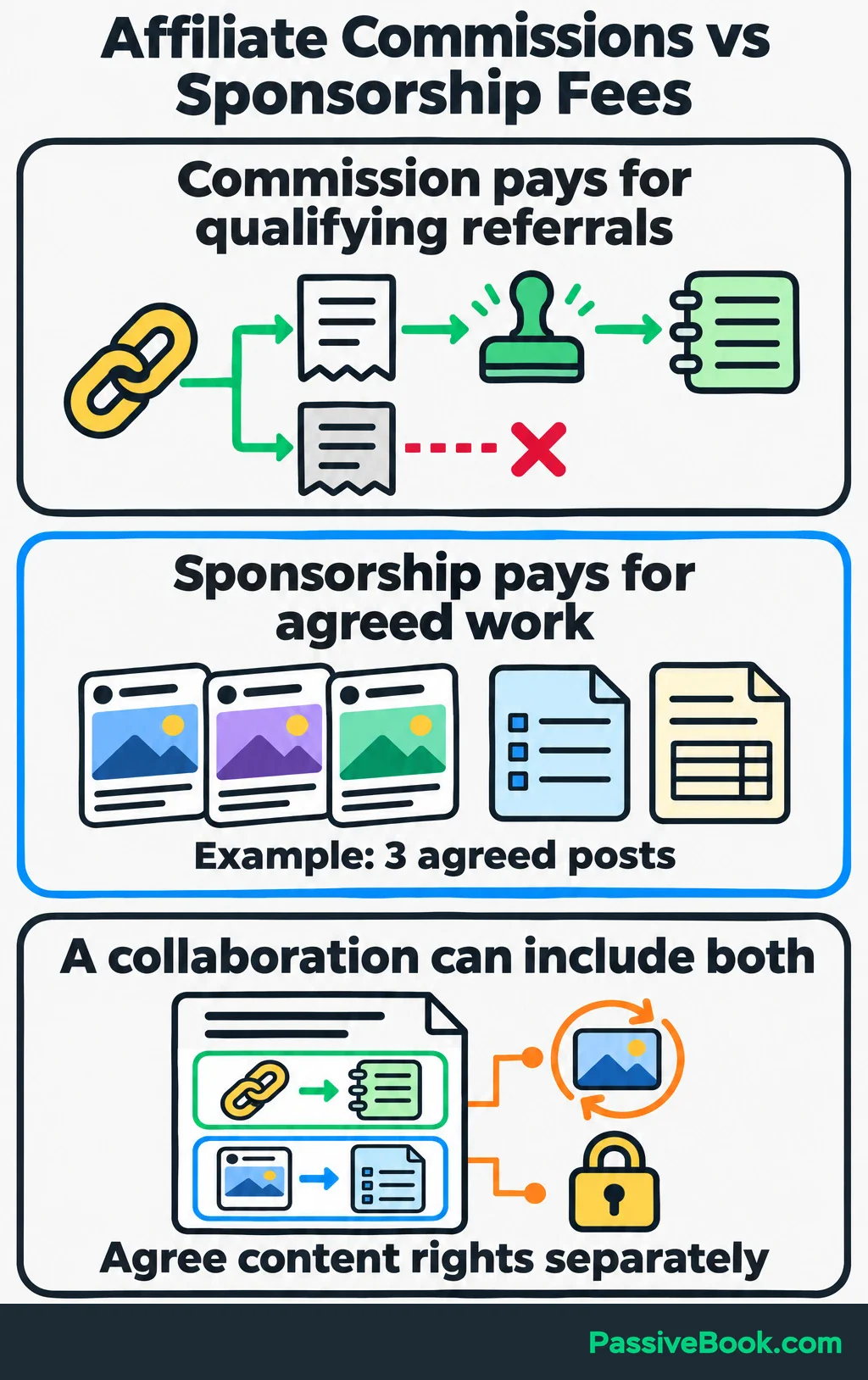
Affiliate commissions pay for qualifying referrals. Sponsorship fees pay for agreed promotional work. A collaboration can include both, but they create different obligations.
Confirm these points:
- Qualifying referrals: Which products or actions earn commission, what purchase value counts, and whether repeat purchases or renewals qualify.
- Attribution: How long a referral can receive credit and how later clicks or discount codes affect that credit.
- Approval and payment: Review periods, refund reversals, payout dates, minimum balances, currency, and payment method.
- Permitted promotion: Approved channels, images, claims, discount codes, and rules for affiliate links.
- Problem contact: Who handles missing transactions, broken links, and overdue payments.
The attribution window is the period during which a referral can receive credit. Ask what happens if someone clicks your link and later uses another affiliate’s code. The answer belongs in your decision about the offer.
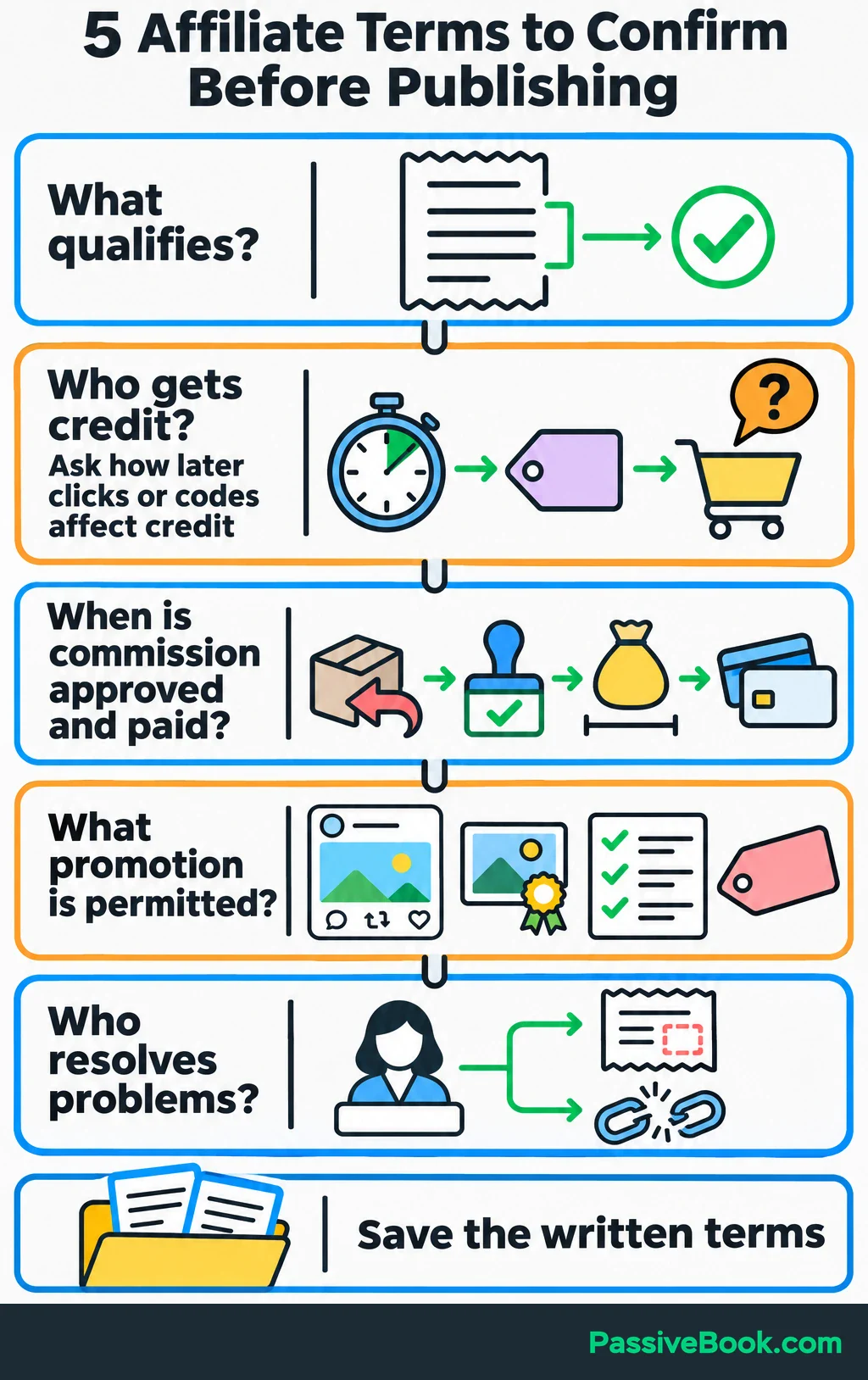
For a negotiated collaboration, also agree on the number of posts, deadlines, revisions, reporting, content reuse, exclusivity, and how either side can end the arrangement.
I would charge separately for guaranteed production work and additional content rights. If a brand wants three posts and permission to reuse your images, uncertain future commissions do not tell you what that work will pay.
Keep the agreement, acceptance record, contact, and approved materials together. You want to find the answer quickly when a payment or content question appears.
Set up Referral Tracking Before Publishing
Create links through the affiliate program’s approved system. If it supports placement identifiers, assign a clear name such as xlittermat01 and record it beside the product and planned post.
Use a different identifier for the follow-up when the system allows it. That helps you compare content without guessing which post sent the referral.
If your blog uses Google Analytics to measure visits, add campaign tags to the article URL you share on X. Here’s how they fit together in an example link:
https://example.com/litter-mat-guide?utm_source=x&utm_medium=organic_social&utm_campaign=littermat&utm_content=dimensions01These tags identify X as the source, organic social as the channel, and the dimensions post as part of the litter-mat campaign. They do not establish that a merchant owes you a commission; the affiliate system records credited sales. Google’s campaign-tagging guidance
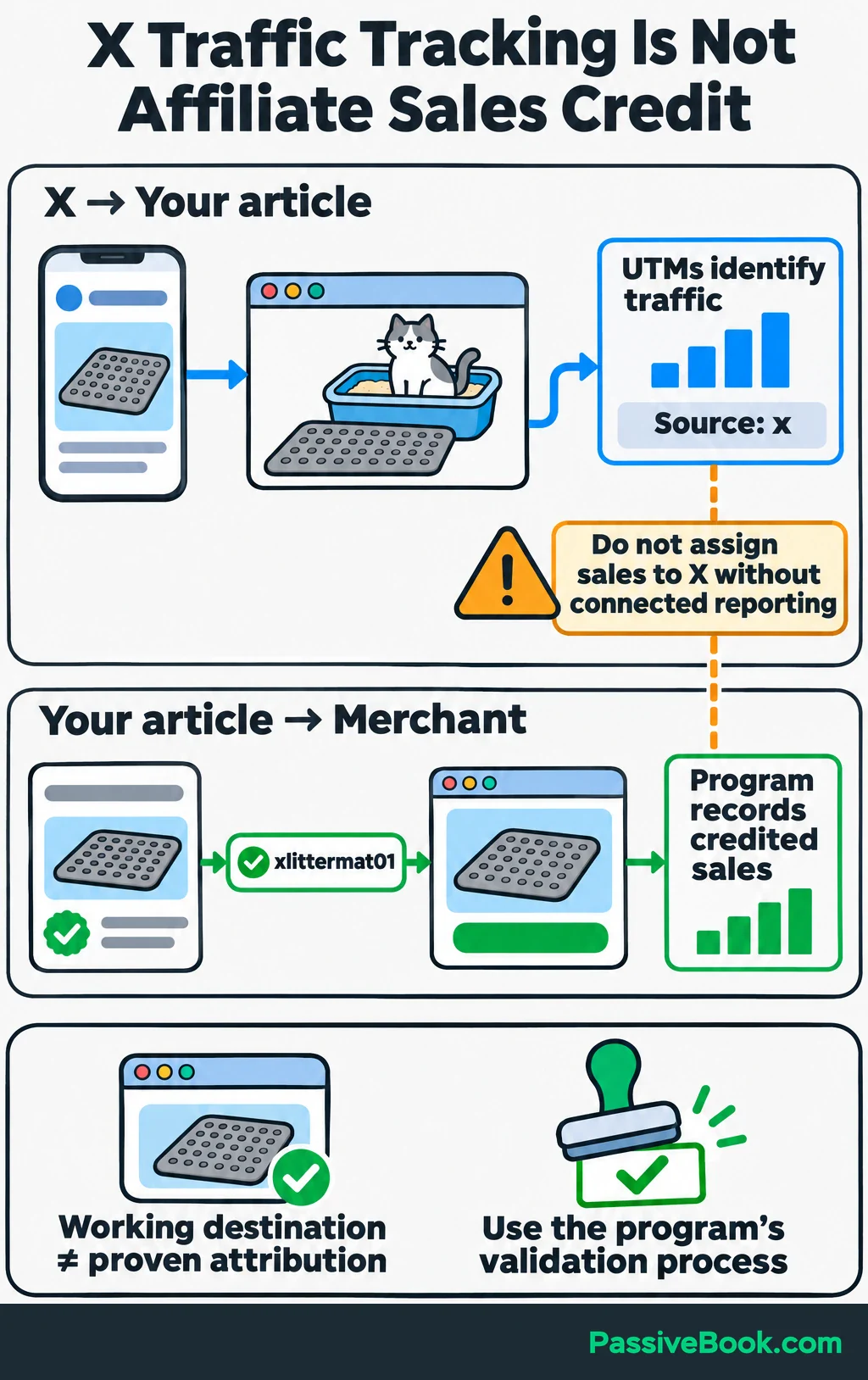
Keep the two stages distinct: X sends someone to your article, and the article may send them to the merchant through an approved affiliate link. Unless your reporting connects those stages, don’t assign every sale from that article to X.
Before publishing:
- Open the completed link on mobile and desktop.
- Check the product, destination market, and availability.
- Follow the program’s validation process to check tracking.
After publishing, save the post URL beside its identifier.
A working redirect confirms the destination, but it does not prove attribution. Ask the manager how to validate the link if the program gives no clear method.
When post-level tracking is unavailable, report results at the partner level. Keep that limit visible rather than manufacturing precision.
Complete payment details and any required tax information through the official portal before commissions start accumulating.
Publish Recommendations That Help People Choose
Start with the buying decision, then introduce the product where it fits.
For the litter-mat checklist, explain how to measure the available floor space, compare it with the listed dimensions, and check the cleaning instructions. Readers can use that advice even if they choose another product.
Choose the format that gives the explanation enough room:
- Single post: One decision, such as measuring the available space.
- Annotated image: Dimensions and placement, using an original or licensed image.
- Short thread: Several trade-offs that need separate explanations.
- Linked article: A review or comparison that needs more detail than the post can hold.
You can do all of this with writing and suitable images. An on-camera presentation is optional.
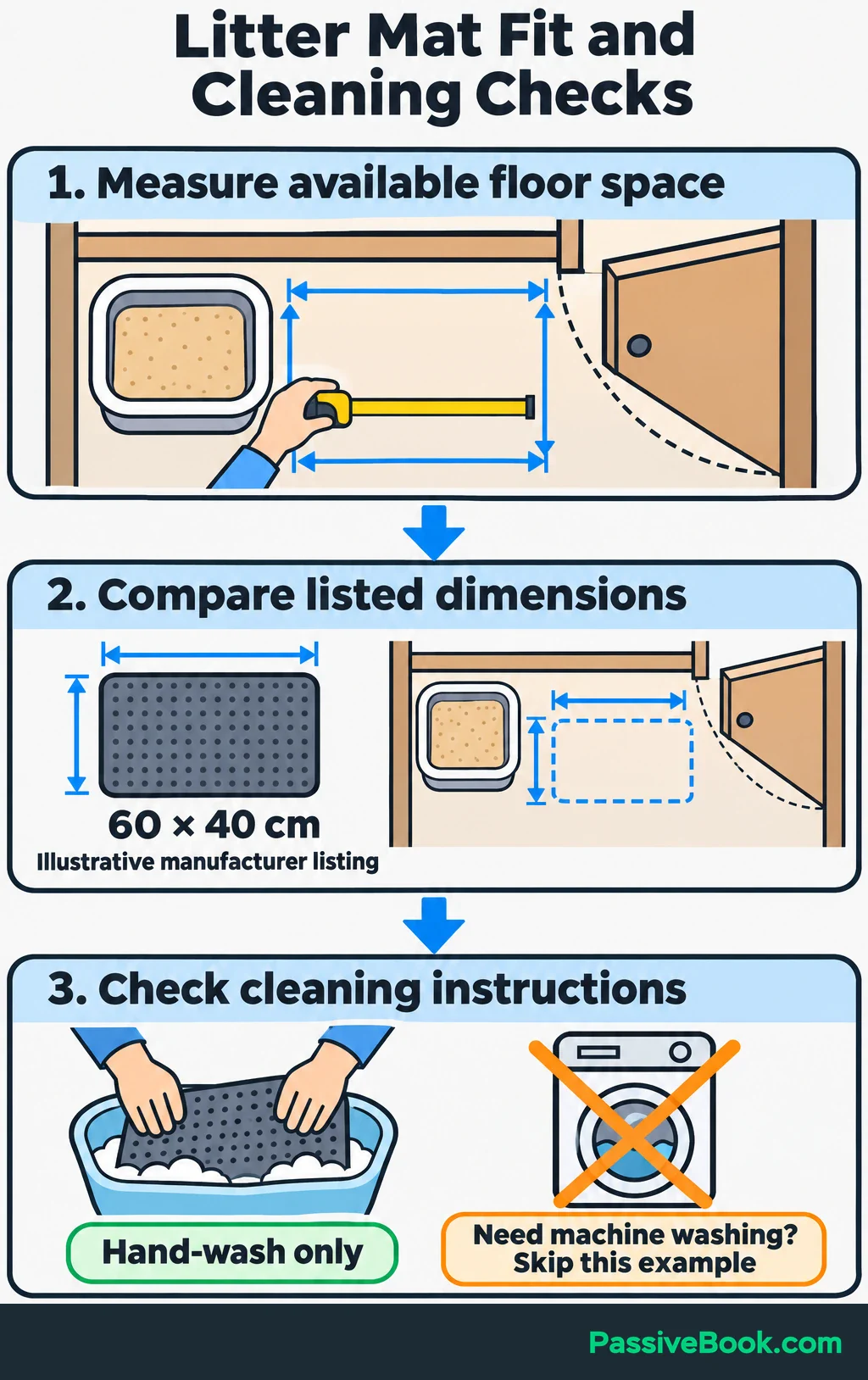
Make the recommendation specific, and include a drawback that affects the choice. A mat’s size may suit one space and obstruct another. Hand-washing may be acceptable to one reader and a reason to skip it for another.
For organic affiliate promotions, turn on X’s “Paid Partnership” disclosure when composing the post. X includes commission-generating affiliate links and codes within that policy. X’s paid partnerships policy
Also put plain disclosure wording with the endorsement, such as “Ad — I earn a commission on qualifying purchases.” Don’t leave it only in your profile or the first post of a thread. Each promotional post or reply needs its own visible disclosure. The FTC advises using a clear disclosure alongside platform tools; US requirements can apply to posts from abroad when effects on US consumers are reasonably foreseeable. Follow applicable local rules too. FTC disclosure guidance
For this sample, assume the manufacturer’s listing confirms a 60 × 40 cm mat that requires hand-washing:
Ad — I earn a commission on qualifying purchases. The manufacturer lists [Product] as 60 × 40 cm and hand-wash only. Measure beside your litter box first, and skip it if you need machine washing. Details: [tracked link]
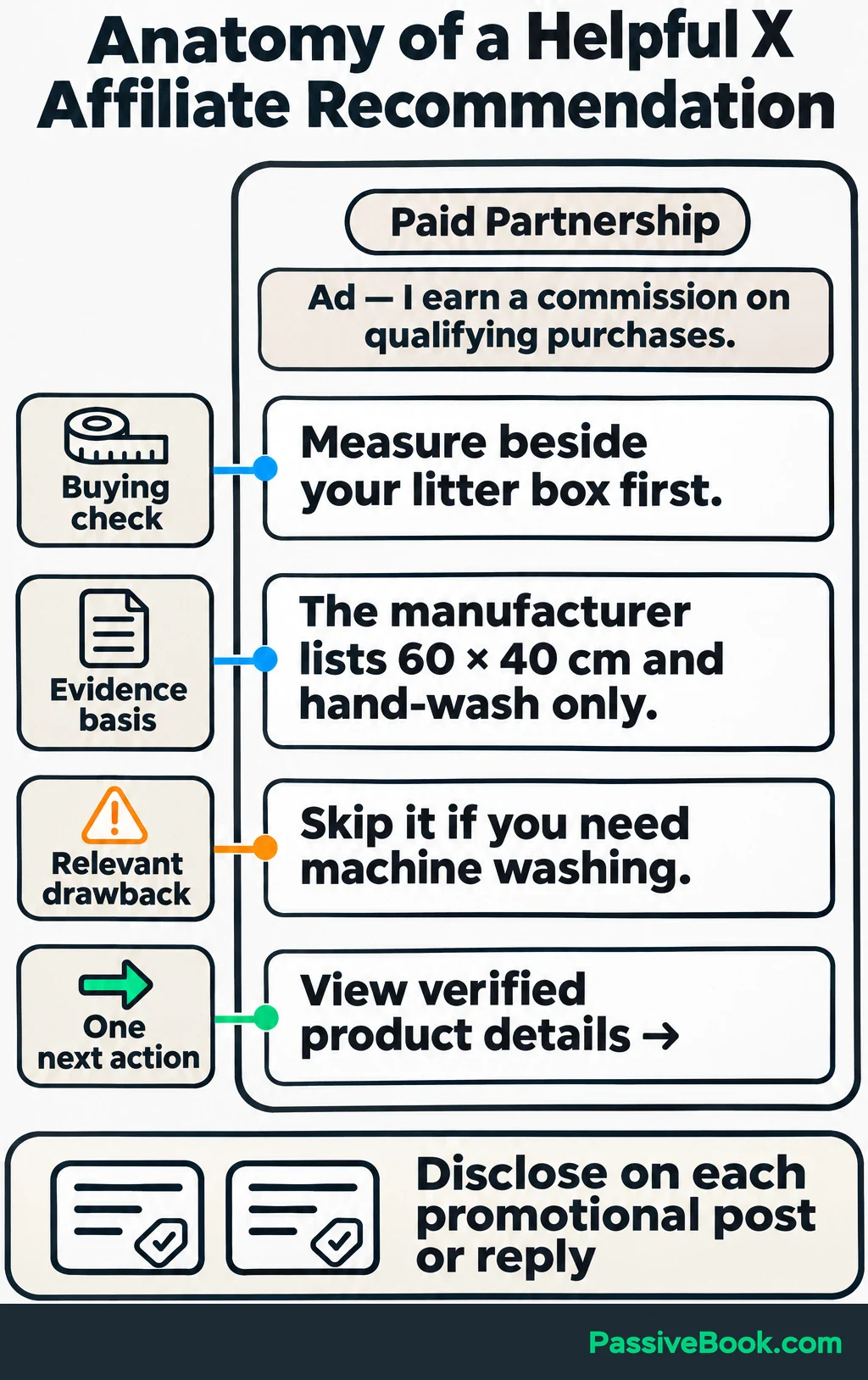
This gives a buying check, a product detail, a drawback, and one next action. Adapt it only after verifying the actual specifications.
Say “the manufacturer lists” when your basis is the product listing. Reserve statements such as “I found it easy to clean” for something you have tried.
Link directly to the product when the post supplies enough context. Use your review or comparison when readers need more explanation, and disclose the affiliate relationship on that page too.
In replies, answer the question before offering a link. If someone asks whether a mat will fit, explain what to measure. A commission link cannot operate a tape measure.
Use new questions to shape follow-ups. “Will it fit?” earns a measuring guide. “How do I clean it?” earns an explanation based on the manufacturer’s instructions. Those are useful additions, so you don’t need to keep reposting the same sales message.
Review Approved Sales and Payments
Keep a results sheet with the partner, post URL, tracking identifier, publication date, affiliate clicks, attributed orders, pending commission, approved commission, paid commission, production time, and next action.
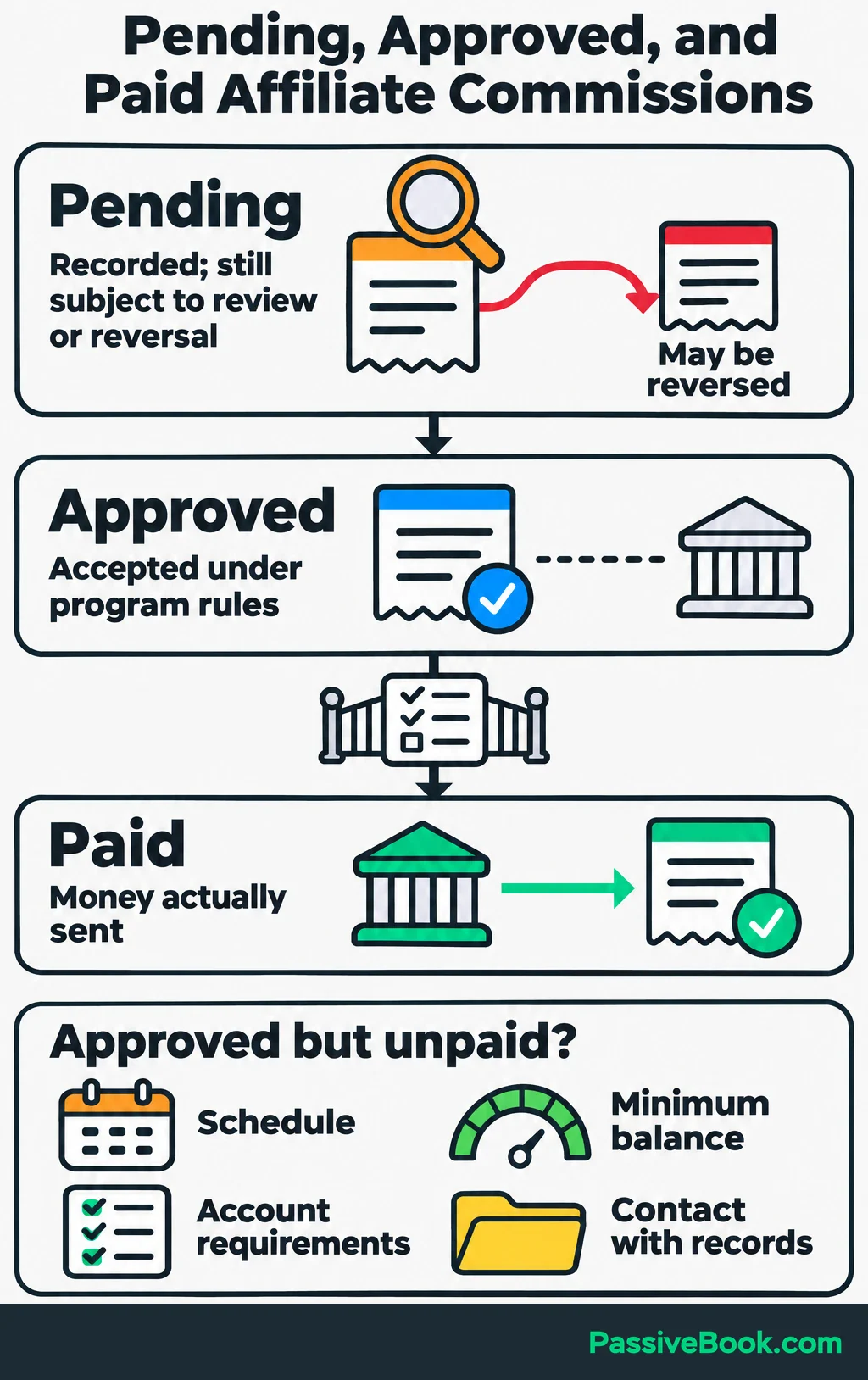
Pending, approved, and paid amounts mean different things:
- Pending: Recorded commission that is still subject to review or reversal.
- Approved: Commission accepted under the program’s rules.
- Paid: Money actually sent to you.
Compare clicks with the approved orders resulting from those clicks. Allow the applicable attribution and approval periods to finish before treating the result as settled. Dividing this week’s approved orders by this week’s clicks can mix different groups of people.
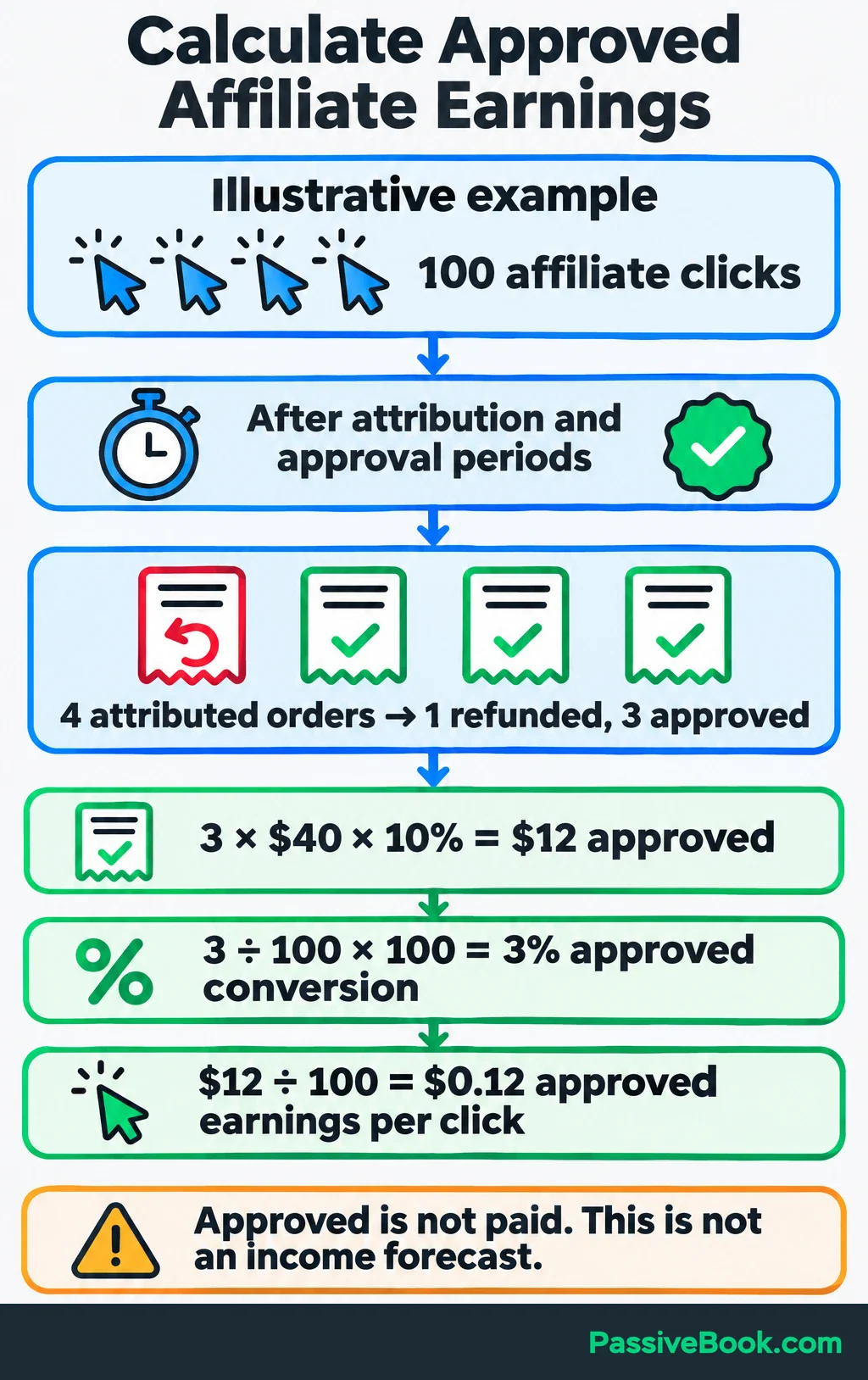
Here is an illustrative calculation. Suppose one post records 100 affiliate clicks. After the applicable attribution and approval periods have passed, those clicks have produced four attributed orders: one fully refunded and three approved. Each approved order contains $40 in eligible purchases, earning 10% commission.
| Measure | Calculation | Result |
|---|---|---|
| Approved commission | 3 orders × $40 × 10% | $12 |
| Approved-order conversion rate | 3 approved orders ÷ 100 affiliate clicks × 100 | 3% |
| Approved earnings per click | $12 approved commission ÷ 100 affiliate clicks | $0.12 |
The $12 is approved commission, so record it as paid only when the payment arrives. These figures illustrate the method; they are not an income forecast.
Reconcile payments against the agreed schedule. Impact, for example, identifies unmet payment requirements and insufficient brand funding as possible causes of delays. Check the account notices and contact the manager with the relevant transaction records. Impact’s partner payment guidance
Then diagnose the weak point:
| What You See | What To Check Next |
|---|---|
| Few pitch responses | Eligibility, audience fit, contact, and clarity of the proposal |
| Reach but few affiliate clicks | Whether the post answers a buying question and gives a clear next step |
| Clicks but few approved sales | Tracking, availability, product fit, price, checkout, and refunds |
| Approved commission but no payment | Payout dates, minimum balance, account requirements, and overdue transactions |
When I ran X and Instagram for another niche, I spent six months chasing followers. I could tell which posts attracted attention, but that gave me little help deciding what deserved more work.
I would now judge a partnership through approved earnings, reliable payments, reader feedback, and the time it takes. Impressions and likes help explain reach, but they cannot settle whether the arrangement is worth continuing.
Turn Successful Partnerships Into Repeat Collaborations
Once the results are ready, send the manager a short recap. Include what you published, recorded clicks, approved referrals, commission status, and the questions readers asked.
Use that evidence to propose one useful improvement:
Hi [Name],
The dimensions checklist and follow-up are live here: [post URLs].
The program reports [clicks] and [approved orders] for [tracking identifiers and observation period]. Commission status is [pending, approved, and paid amounts].
Readers also asked about cleaning. I’d like to publish a care-focused follow-up using your verified instructions. Would that be useful for your team?
Fill in the recap from your records. If orders are still pending, say so and save the performance conclusion for later.
Documented results give you a basis to request better commission terms, relevant product access, or a useful audience offer. Ask for the change that would improve the next collaboration, and confirm it in writing.
Keep a simple pipeline:
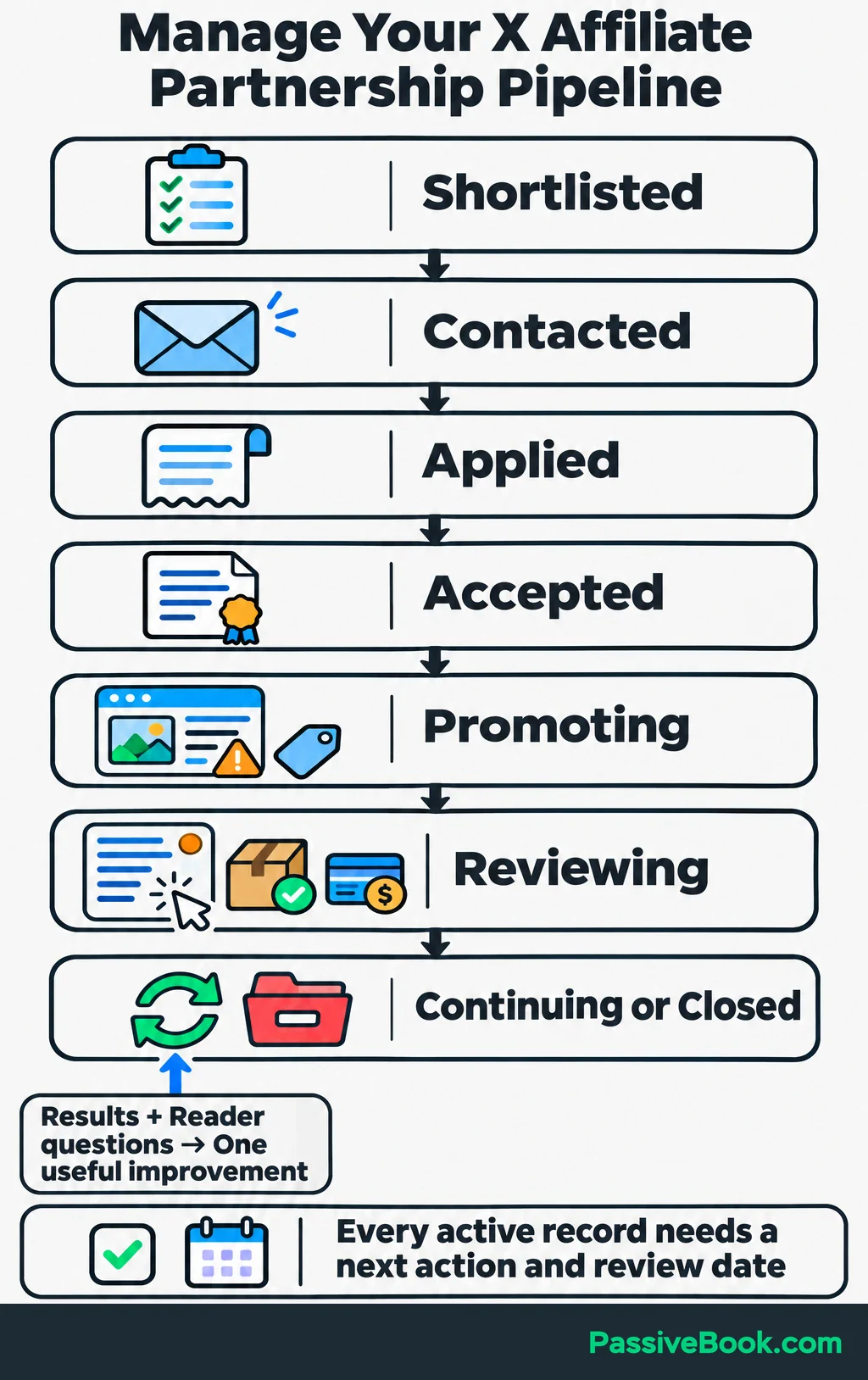
Shortlisted → Contacted → Applied → Accepted → Promoting → Reviewing → Continuing or Closed
Give each active prospect or partner a next action and review date. “Waiting” becomes much more useful when it has a date attached.
I would batch research and reporting into short weekly sessions. Reuse the selection checklist, pitch structure, tracking names, and recap format, while keeping the recommendation specific.
If you already use n8n, it can help create reminders or move supported report data into your sheet. I would automate those routine records before attempting anything that sends messages or publishes recommendations.
Expand when the existing partnerships justify more work. Pause offers with poor product fit, unreliable payments, or weak returns on your time. A second partner should improve the business, rather than just make the spreadsheet longer.
What Next?
Choose one buying question from X and shortlist three products that could answer it. Check eligibility before writing one specific pitch.
Use the social buttons to pass this guide along when your next conversation turns to affiliate outreach or tracking what actually pays.
Which buying question could become your first partner proposal? Share it in the comments, along with any other questions about the process.
Share this post with your friends & followers:

