You have time for two LinkedIn posts and a list of twenty ideas. One answers a customer question. Another follows a trend. A third would be easy to write because you already have the notes.
Without clear priorities, the easy idea often wins. But a finished post can still leave you wondering what it was supposed to achieve.
That makes the next choice harder, too. The framework below helps you build a ranked list of LinkedIn topics and a manageable publishing queue, with clear reasons for giving one idea your next hour ahead of another.
Choose the Outcome Your Topics Should Support
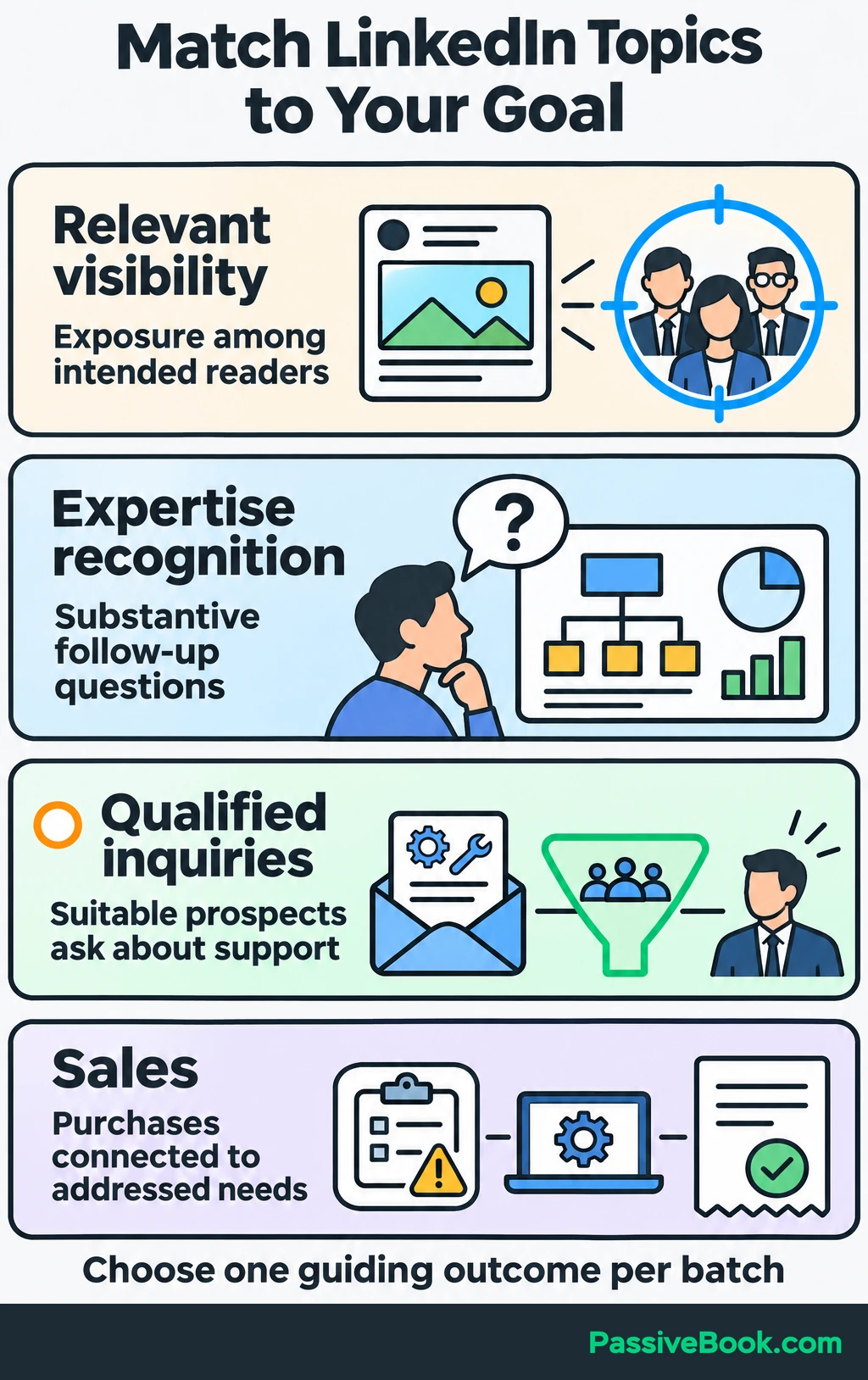
Choose one primary outcome for your next publishing cycle. That could be a month or a small batch of posts, depending on your available time.
Be specific about what progress means:
| Primary outcome | Progress to look for |
|---|---|
| Relevant visibility | More exposure among people you want to reach |
| Recognition for your expertise | Relevant readers asking substantive follow-up questions |
| Qualified inquiries | People who fit your offer asking about working with you |
| Sales | Purchases connected to the needs your posts address |
Posts can support several outcomes, but one should guide your choices. Otherwise, almost any topic can sound useful.
I spent six months chasing followers on Instagram and Twitter/X for a side niche while my bank account stayed at about $47. When I reviewed my content ideas, I could explain why they might attract attention. I had a much weaker answer for what an interested reader should do next.
That experience is why I would define the desired action before filling a content calendar.
For our running example, imagine you offer virtual bookkeeping for independent design studios. Your primary goal is qualified inquiries about ongoing monthly support. A qualified inquiry means a design studio owner asking about that service.
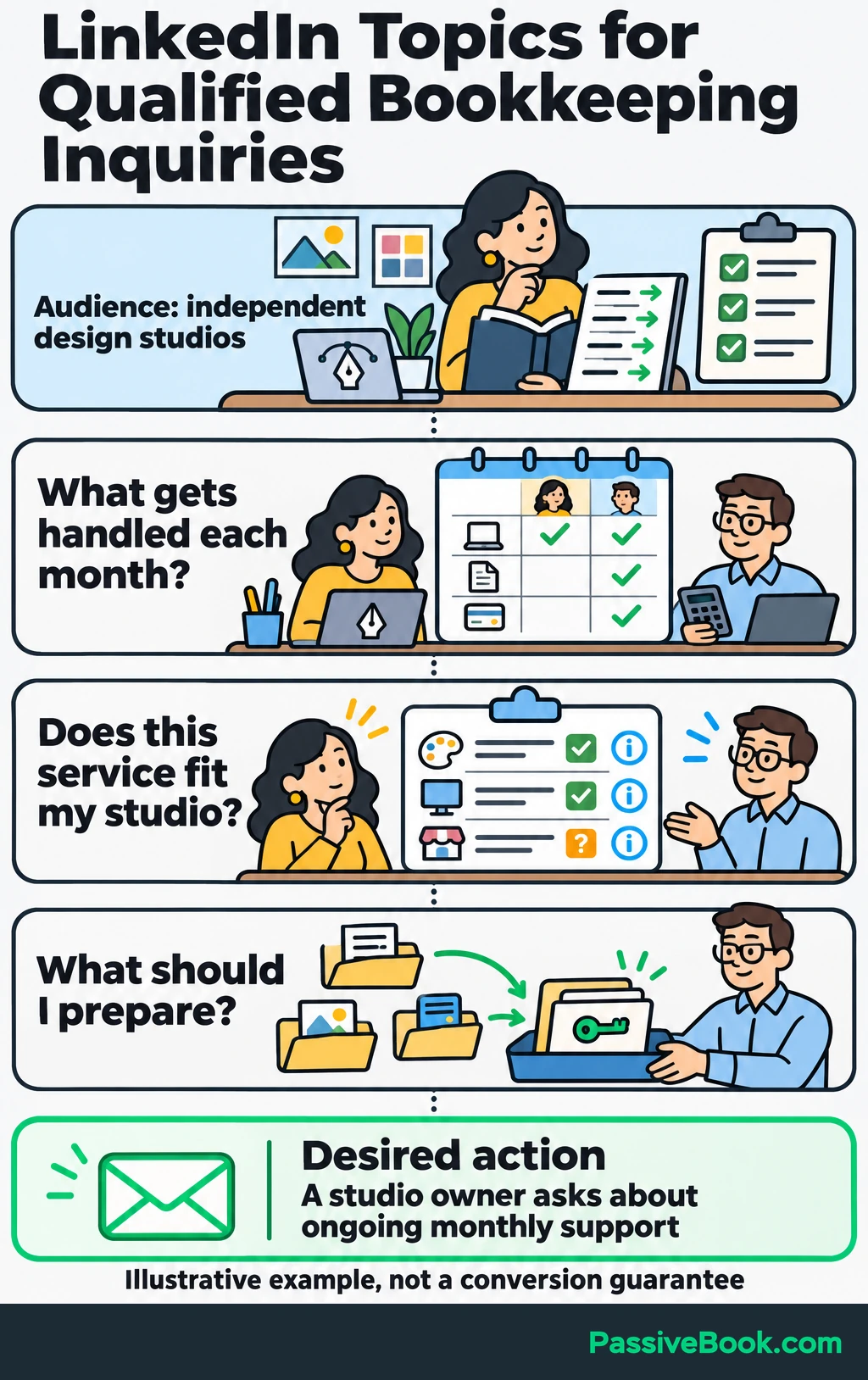
The business, audience signals, scores, and publishing slots in this example are illustrative.
Now connect that goal to decisions your audience needs to make. Before getting in touch, a studio owner might need to understand:
- What a bookkeeper would handle each month.
- How to tell whether a service fits their studio.
- What they would need to prepare before starting.
Those questions give educational content a useful job. You can help someone evaluate the service without turning every post into a sales pitch.
Build a Shortlist From Audience Questions
Start with questions people ask, then turn them into topics.
Look through customer inquiries, messages, sales conversations, LinkedIn comments, and relevant discussions. Record three things: the question, who asked it, and the decision or difficulty behind it.
A simple record might look like this:
| Question | Who asked | Decision behind it |
|---|---|---|
| “What would I still need to do each month?” | A design studio owner considering support | Whether the service removes enough work to be worthwhile |
| “Do my records need to be organized before we start?” | A prospective client | Whether they are ready to get help |
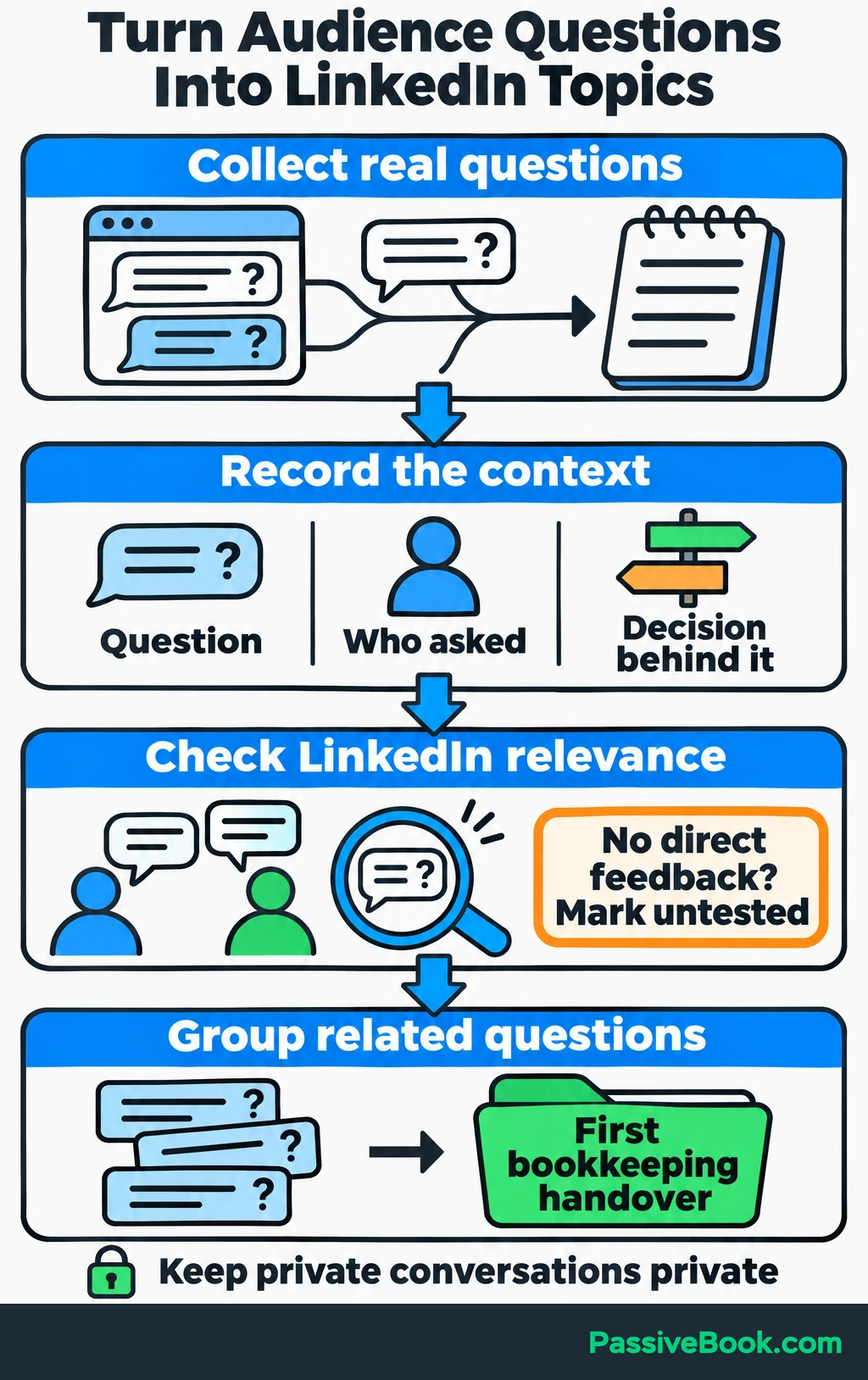
Keep private conversations private when using them to develop posts.
If you have no audience yet, speak with prospective customers. Ask what feels confusing, what they have already tried, and what stops them from taking the next step. You can also suggest questions from your service process, but mark them as untested until you get direct feedback.
Competitor discussions can help too. Look for the follow-up question nobody answered or the practical detail readers still need. Capture that gap rather than borrowing someone else’s topic list.
Check whether your intended readers discuss these problems on LinkedIn. A question from another channel is a useful candidate, but a relevant LinkedIn conversation gives you evidence that it belongs here.
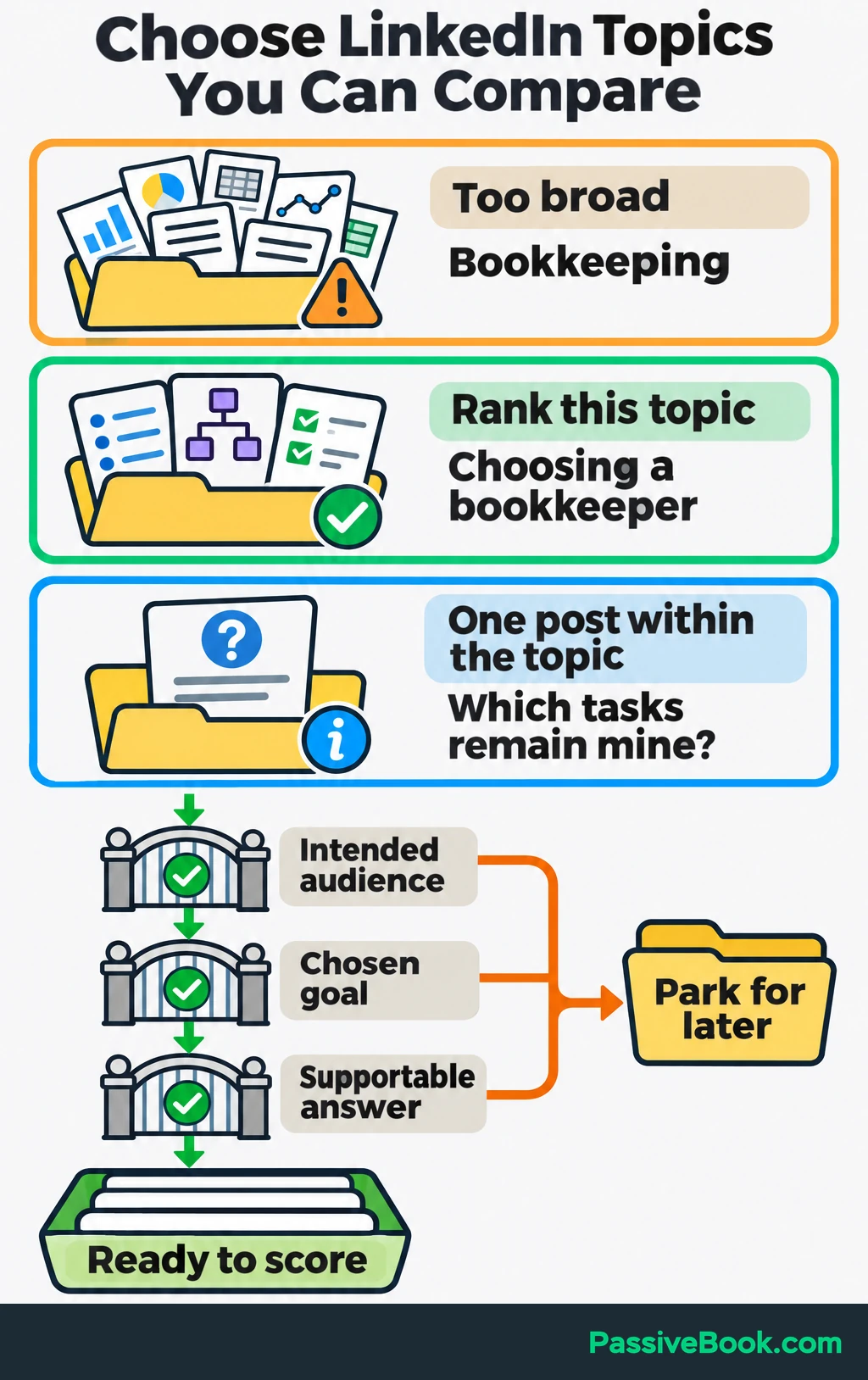
Then group related questions into topics of roughly similar size. For the bookkeeping service, the shortlist becomes:
- Choosing a bookkeeper.
- Preparing for the first bookkeeping handover.
- Organizing records from multiple payment platforms.
Each topic can support several posts. “Bookkeeping” is too broad to rank usefully, while one tiny question may be better treated as a post within a topic.
Before scoring, keep only topics that serve your intended audience, connect to your goal, and allow an answer you can support. Park the rest.
A trend gets the same test. LinkedIn says its feed systems are improving their understanding of post subjects and professional interests while reducing repetitive, low-substance content. That supports choosing useful subjects over empty trend participation; it does not promise reach for any particular topic. LinkedIn’s explanation of its feed changes
Rank Topics by Demand, Business Value, Expertise, and Effort
Apply the Same Scoring Criteria to Every Topic
Use four criteria, each scored from 1 to 3. Write a short reason beside every score so you can review the evidence later.
Audience relevance remains an entry requirement. An unrelated topic cannot earn its way onto the list just because it takes ten minutes to produce.
| Criterion | 1 Point | 2 Points | 3 Points |
|---|---|---|---|
| Demand (D) | Plausible question with no direct audience feedback | One relevant question or response from an intended reader | The problem comes up independently among intended readers |
| Business value (B) | Indirect connection to your chosen outcome | Builds relevant understanding or trust | Answers a clear obstacle to the action you want |
| Expertise (X) | You can give a checked explanation of the basics | You have practical knowledge you can explain | You can share a useful process or example supported by your work |
| Production fit (F) | Needs substantial new research or assets | Needs manageable preparation | An existing, checked resource makes production straightforward |
For demand, count separate signals. Ten replies within one discussion may reveal useful details, but they are not ten independent requests.
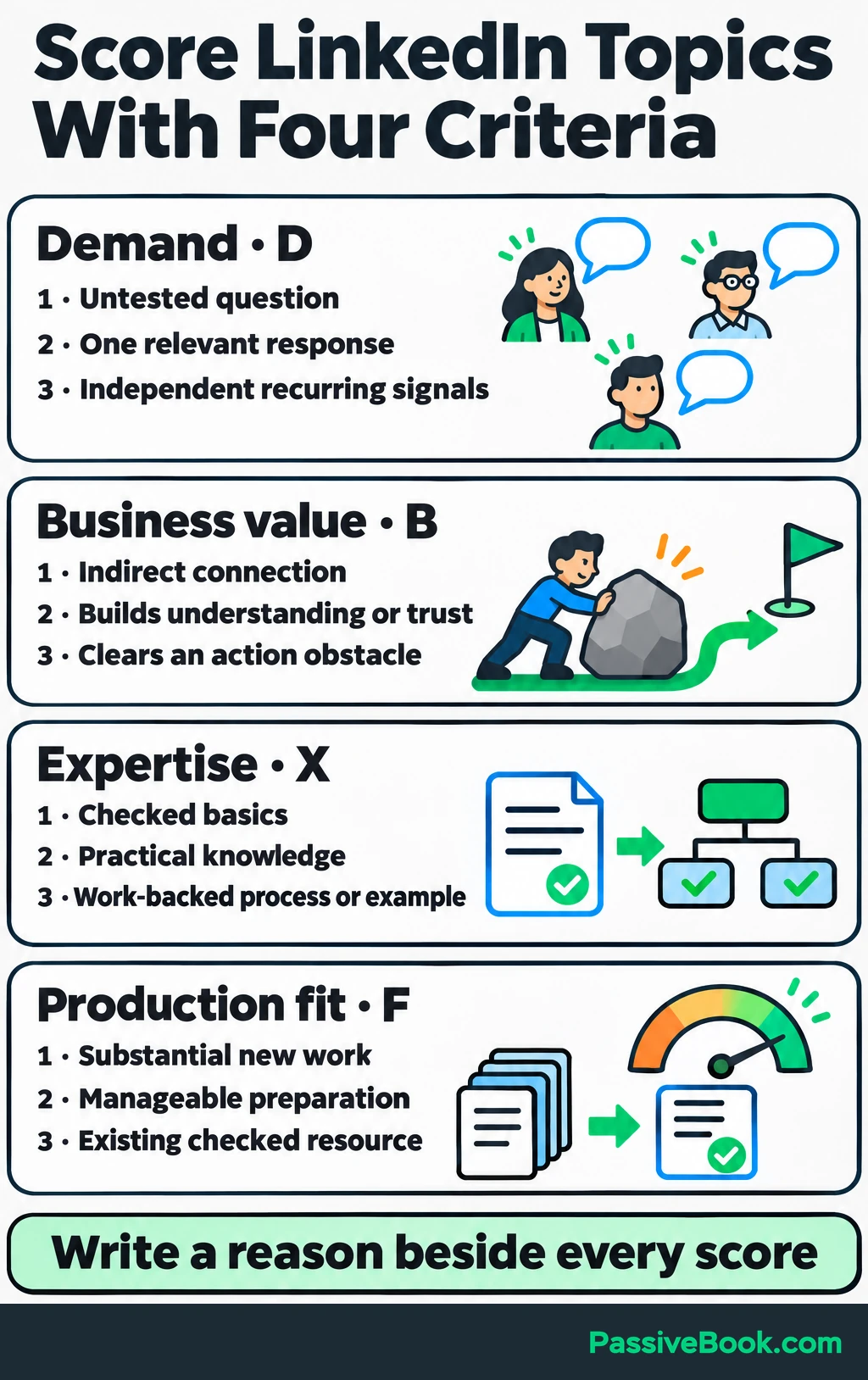
For production fit, estimate the work for one representative post. Include research, drafting, visuals, and review. A topic that sounds easy can become expensive once you decide it needs a custom diagram and three interviews.
The score gives extra weight to demand and business value. It then adds your ability to give a credible answer and produce it with the time available:
Priority score = (2 × D) + (2 × B) + X + F
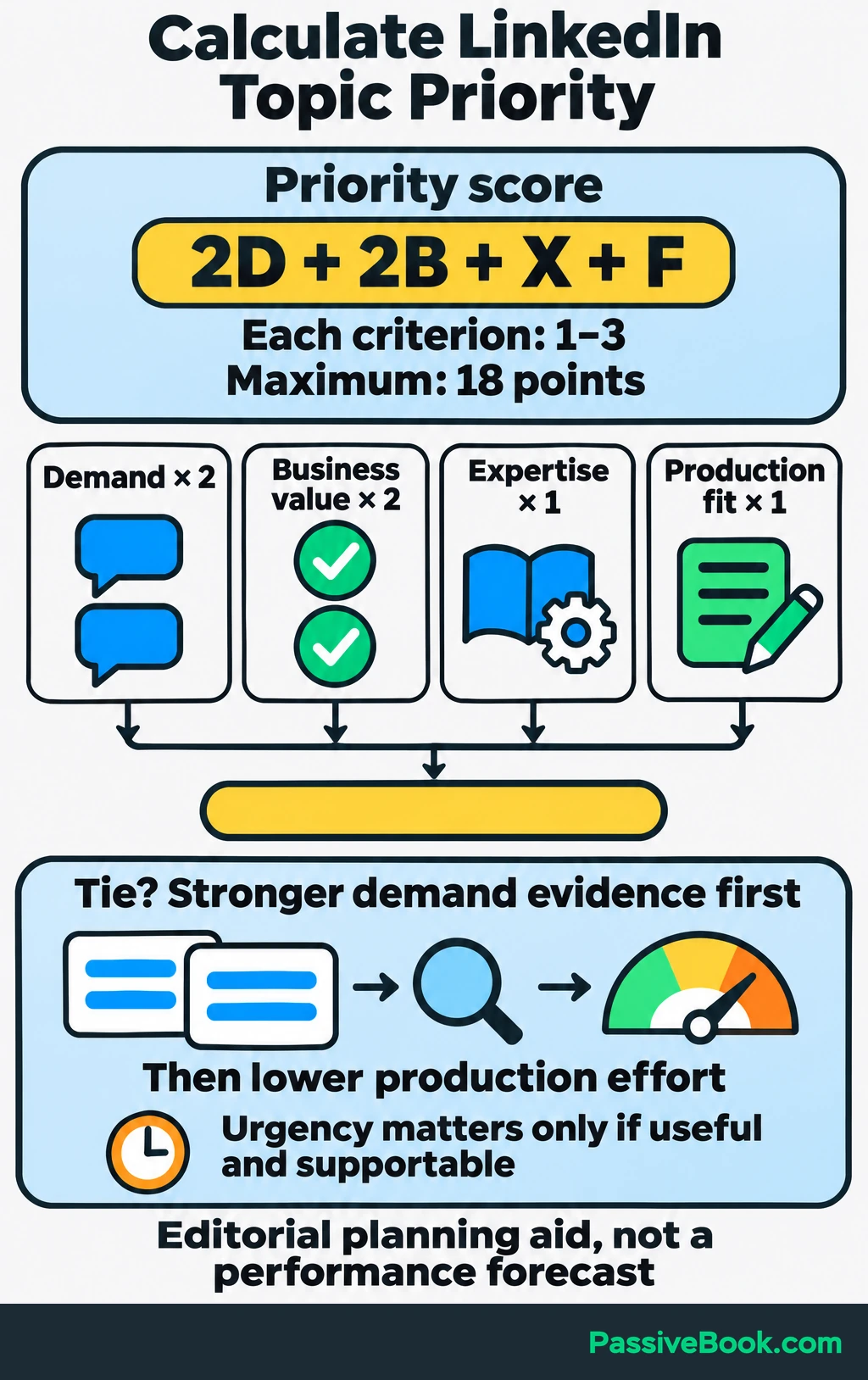
The maximum is 18 points. A higher production-fit score means less work.
This is an editorial planning aid, not a formula validated by LinkedIn or a research study. It helps you compare choices; it does not predict views, inquiries, or sales.
When scores tie, I would choose stronger demand evidence first, then lower production effort. Move a time-sensitive topic forward only if its usefulness will expire and you can still answer it well.
An untested topic can deserve a small experiment. It does not yet deserve your entire afternoon.
Work Through a Sample Ranking
Apply the same criteria to all three bookkeeping topics. The evidence below is assumed for the example, rather than reported audience research.
| Topic | Evidence Behind the Scores | D | B | X | F | Total | Next Action |
|---|---|---|---|---|---|---|---|
| Choosing a bookkeeper | Studio owners independently raise selection questions. Your service-fit checklist answers hiring concerns, but the post needs a fresh example. | 3 | 3 | 3 | 2 | 17 | Publish first |
| Preparing for the first bookkeeping handover | One prospective client asks how to get started. Your existing onboarding checklist addresses that concern. | 2 | 3 | 3 | 3 | 16 | Publish next |
| Organizing records from multiple payment platforms | No recorded audience question yet. You have practical knowledge, but a useful walkthrough needs substantial preparation. | 1 | 2 | 2 | 1 | 9 | Test demand first |
The first topic wins because it combines recurring demand with a decision close to hiring. The handover topic follows closely, and an existing checklist makes it easier to produce.
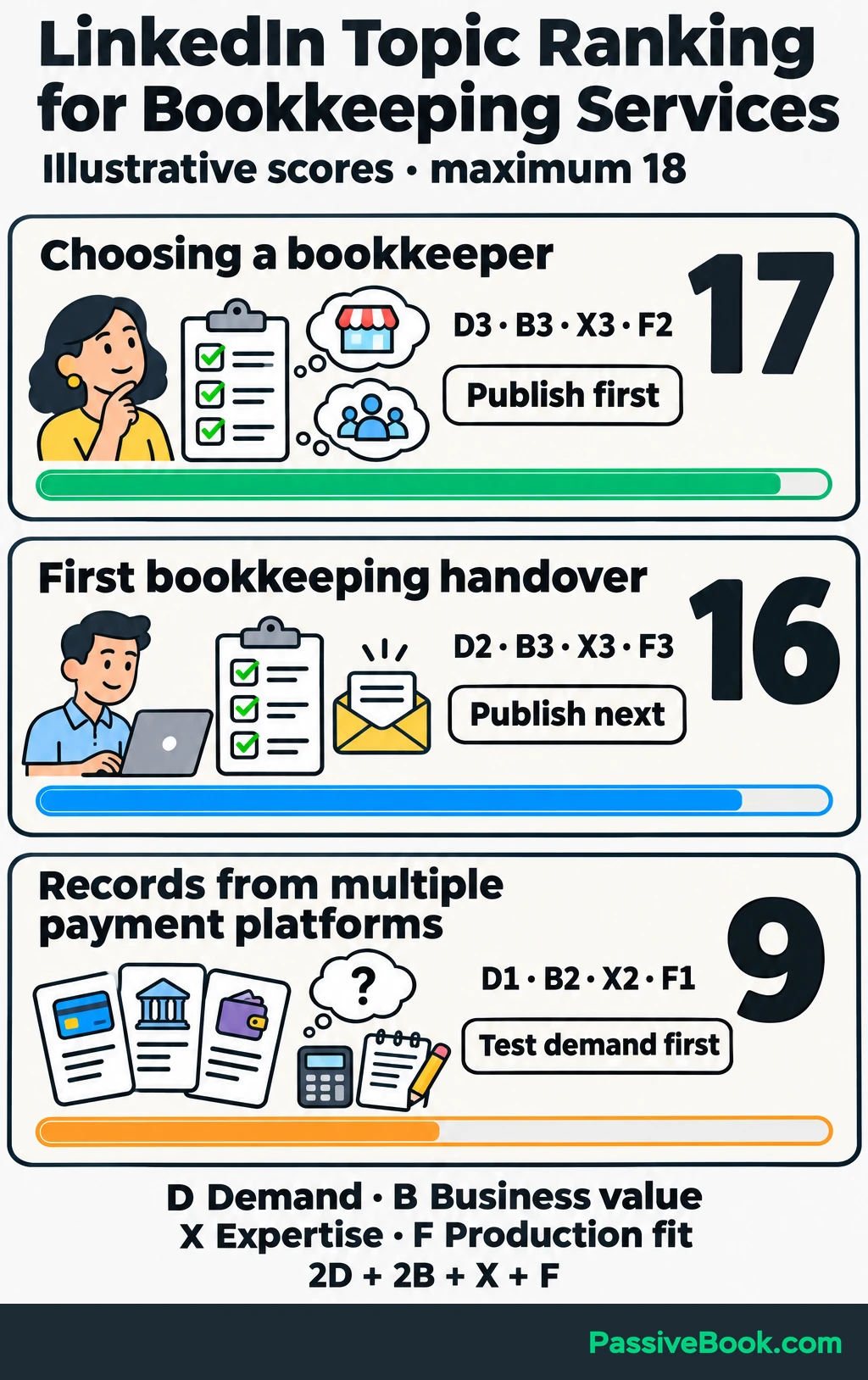
The third topic could still be valuable. Its low score means you have less reason to invest heavily in it now.
Before creating a detailed guide, ask intended readers a focused question:
“Which part of gathering records from different payment platforms takes you the most time?”
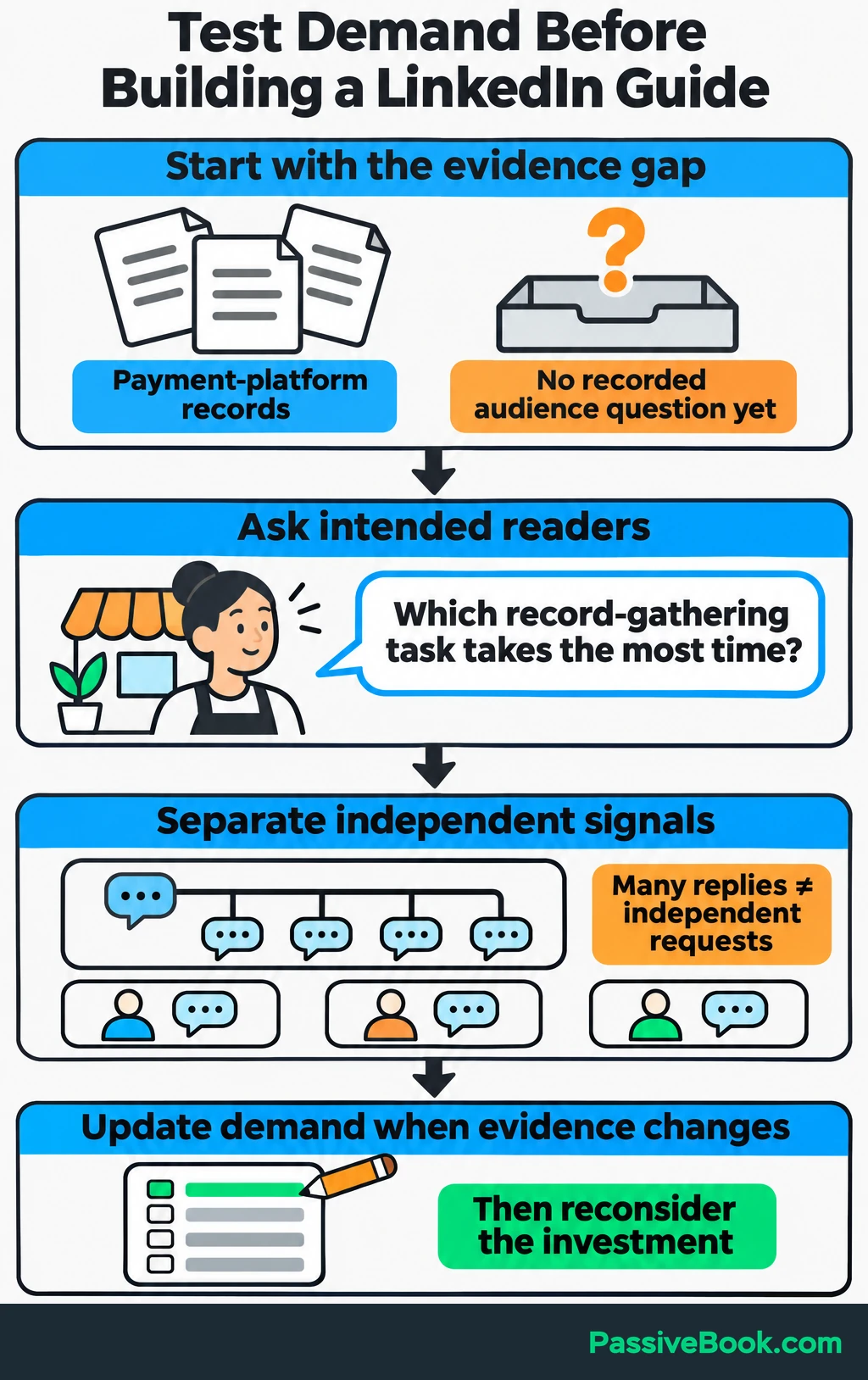
You could use that in a relevant conversation or a short post that explains the problem. Record what people actually describe. If the same difficulty appears independently, update the demand score.
The ranking has now produced three decisions: make the first post, prepare the second, and investigate the third.
You can use the same calendar to compare your topics and find the strongest one that fits your time. The quick-start version ranks three topics from four guided ratings.
Turn Your Marketing Ideas Into a Publishing Plan
Organize content ideas, set publishing dates, and track what resonates with your audience in one calendar.
Turn Your Ranking Into a Manageable Publishing Queue
A ranked list tells you what matters. A publishing queue tells you what you can finish.
Start with the time you can consistently protect. Estimate a complete post, including a reasonable allowance for responding to comments. Then choose how many slots that time supports.
I would leave a slot empty before filling it with an unrelated trend. A calendar is supposed to help you make useful work, not invent obligations.
Break your strongest topics into distinct reader questions. “Choosing a bookkeeper” could become:
- “When is it time to hire a bookkeeper?”
- “Which monthly tasks would still be my responsibility?”
- “How can I tell whether a service fits my studio?”
These belong to one topic, but they address timing, responsibilities, and service fit. You do not need a completely new subject every time you publish.
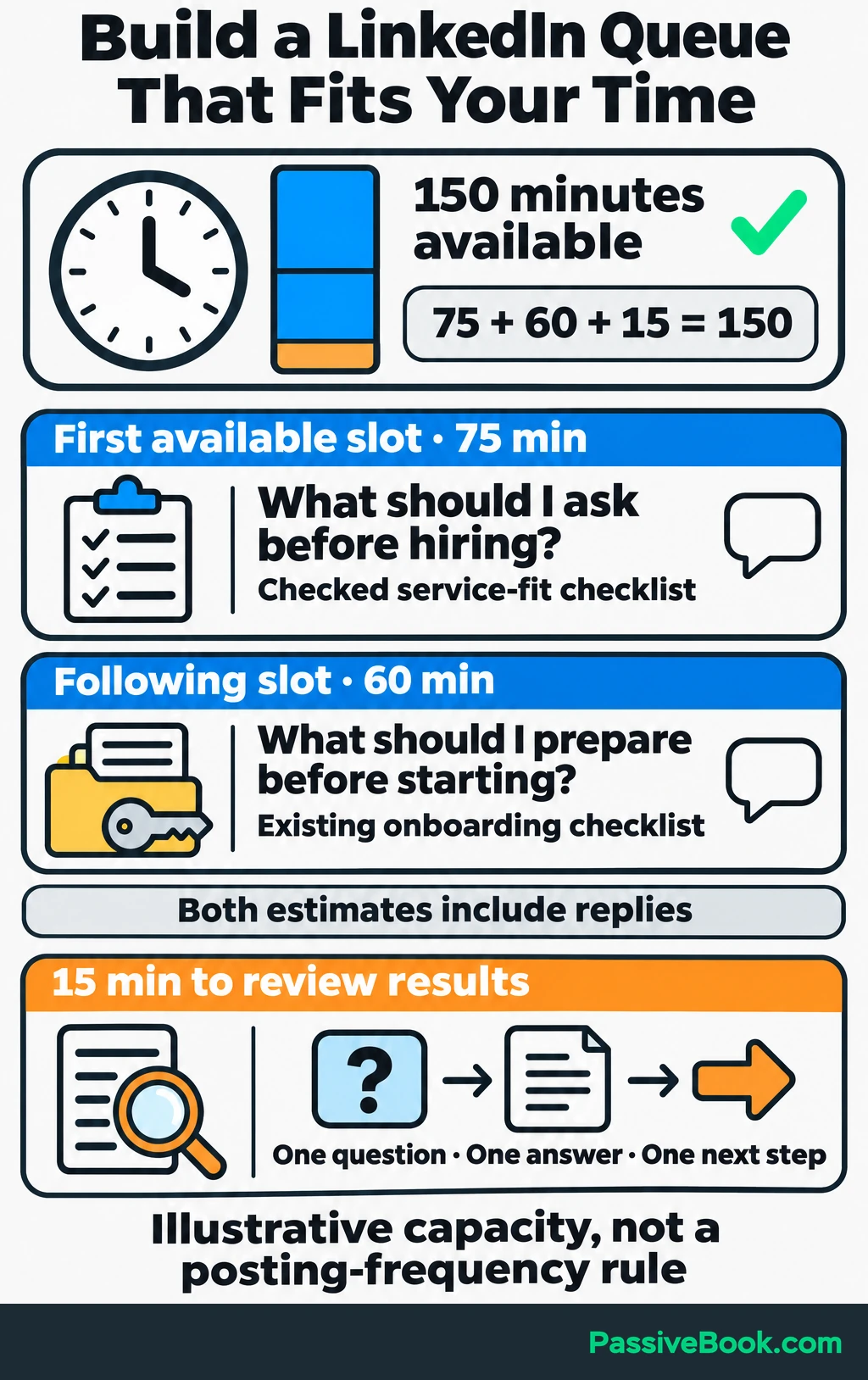
Give each post one question, one main answer, supporting material, and a suitable next step. Choose the format after deciding what the answer needs. A short explanation may work as text, while a sequence of tasks may benefit from a checklist.
Here is a two-slot queue based on the sample ranking:
| Priority | Topic | Specific Question | Reader Takeaway | Supporting Material | Next Action | Estimated Effort | Publication Slot |
|---|---|---|---|---|---|---|---|
| 1 | Choosing a bookkeeper | What should I ask before hiring? | Questions that clarify responsibilities and service fit | Checked service-fit checklist | Ask about monthly support if the service fits | 75 minutes, including replies | First available slot |
| 2 | First bookkeeping handover | What should I prepare before we start? | A clear list of records and access arrangements to discuss | Existing onboarding checklist | Ask about the onboarding process | 60 minutes, including replies | Following slot |
These slots show capacity planning, not a recommended posting frequency. If you have two and a half hours available for the batch, those estimates leave fifteen minutes to review results.
Keep the post small enough to deliver its promised answer. If “everything to know before hiring a bookkeeper” becomes unwieldy, narrow it to clarifying monthly responsibilities. A complete answer to a smaller question is easier to use than half an answer to a large one.
Store the remaining ideas in one backlog. A spreadsheet is enough; use Notion if you already plan work there. I would skip buying another tool for a list this small.
Leave room to change the queue when new evidence matters. A recurring customer concern can earn a slot ahead of an older idea.
Update Priorities From Responses That Match Your Goal
Review the batch after posts have had similar amounts of time to attract responses. Comparing a post published yesterday with one published three weeks ago tells you little about topic quality.
Record the topic, specific question, format, production effort, and outcome connected to your goal.
LinkedIn’s post analytics can show reach, engagement, and audience demographics, depending on the post type. Use the available information to check whether you are attracting intended readers. LinkedIn’s post analytics guidance
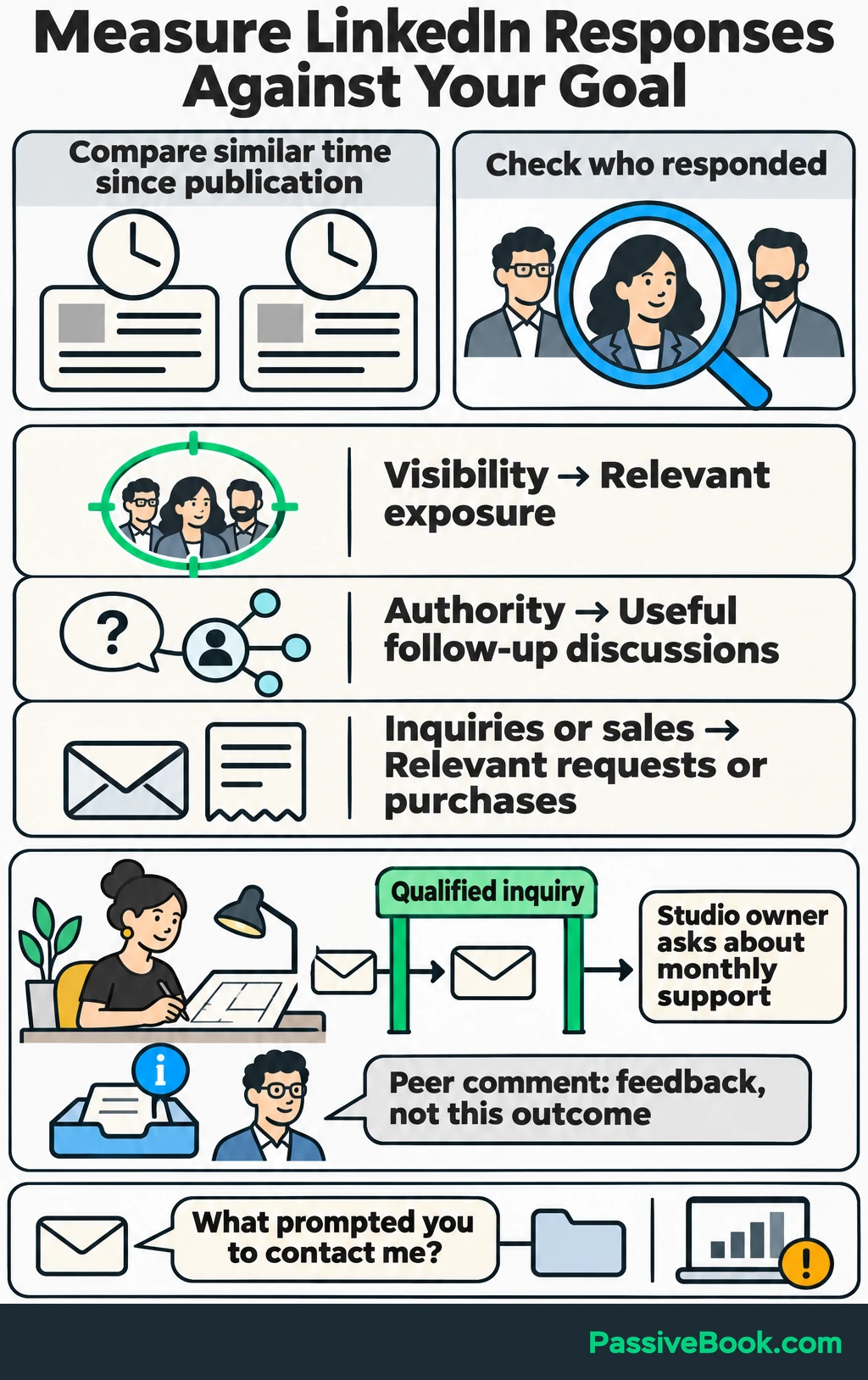
Then look beyond the dashboard. Ask new inquirers what prompted them to contact you and record the topic they mention. Their answer can help connect a post with a business conversation, even when analytics alone cannot.
For the bookkeeping example, keep the original definition of a qualified inquiry: a design studio owner asking about ongoing monthly support. A comment from another bookkeeper may be useful feedback, but it is not that outcome.
Match your review to your goal:
- Visibility: Look for exposure among relevant readers, using available audience information and responses.
- Authority: Look for substantive questions and follow-up discussions about the expertise you want to be known for.
- Inquiries or sales: Track relevant service requests or purchases, and what people say brought them to you.
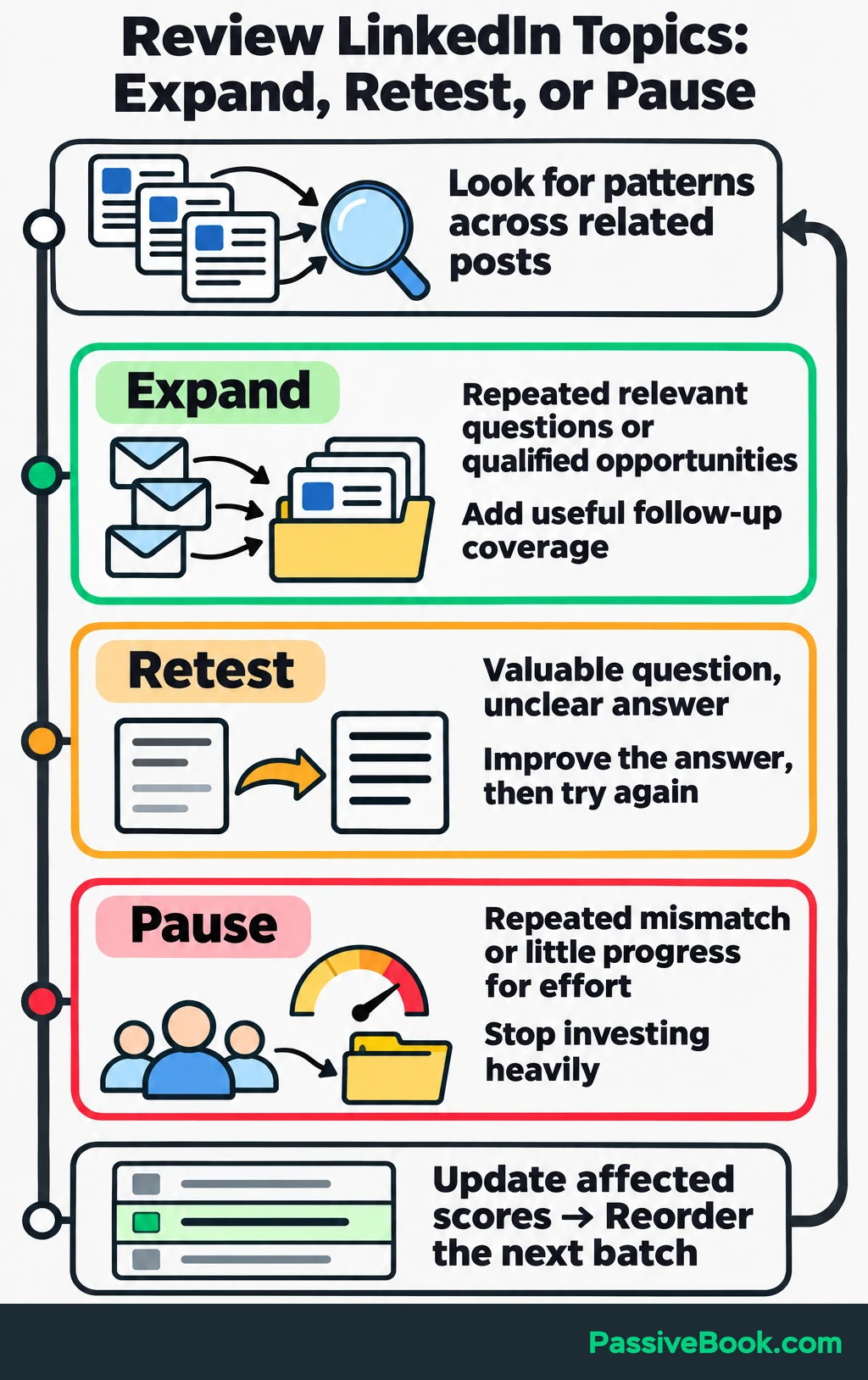
Look for patterns across related posts. One weak result cannot tell you whether the topic, explanation, format, or distribution caused the problem.
I would use three decisions:
- Expand: Give more space to topics that repeatedly attract relevant questions or qualified opportunities. Add unresolved follow-up questions to the backlog.
- Retest: Revisit a valuable question when the original answer was unclear or incomplete. Improve the answer before abandoning the topic.
- Pause: Stop spending heavily on topics that repeatedly attract an unrelated audience or produce little progress for the effort involved.
Update only the scores affected by new evidence, then reorder the next batch.
If choosing-a-bookkeeper posts repeatedly lead to qualified inquiries, that supports further coverage. If payment-platform posts attract useful questions from studio owners, their demand score can rise. Unrelated reactions alone do not justify either decision.
What Next?
Put three audience questions into a spreadsheet and score them before drafting your next LinkedIn post. Choose the strongest candidate, narrow it to one useful answer, and give it a realistic publishing slot.
Use the social sharing buttons to pass along the framework when a content-planning discussion needs a clear way to choose what comes first.
Which topic on your list would move down if you judged it by business value instead of ease? Share your answer in the comments, and bring any other questions about prioritizing your topics.
Share this post with your friends & followers:

