A dog photo can earn plenty of likes while telling you very little about who needs what you sell. Finding people who share an interest is easy compared with finding people who have a problem your business can solve.
That gap matters when X gets the spare half hour between work and everything else. A rising follower count alone won’t tell you whether you’re reaching potential customers. This guide gives you a repeatable way to find potential customers in X’s search results and replies, and test whether your content connects with them—without paid ads, paid analytics, or an existing following.
Define the Problem Your Audience Needs Help With
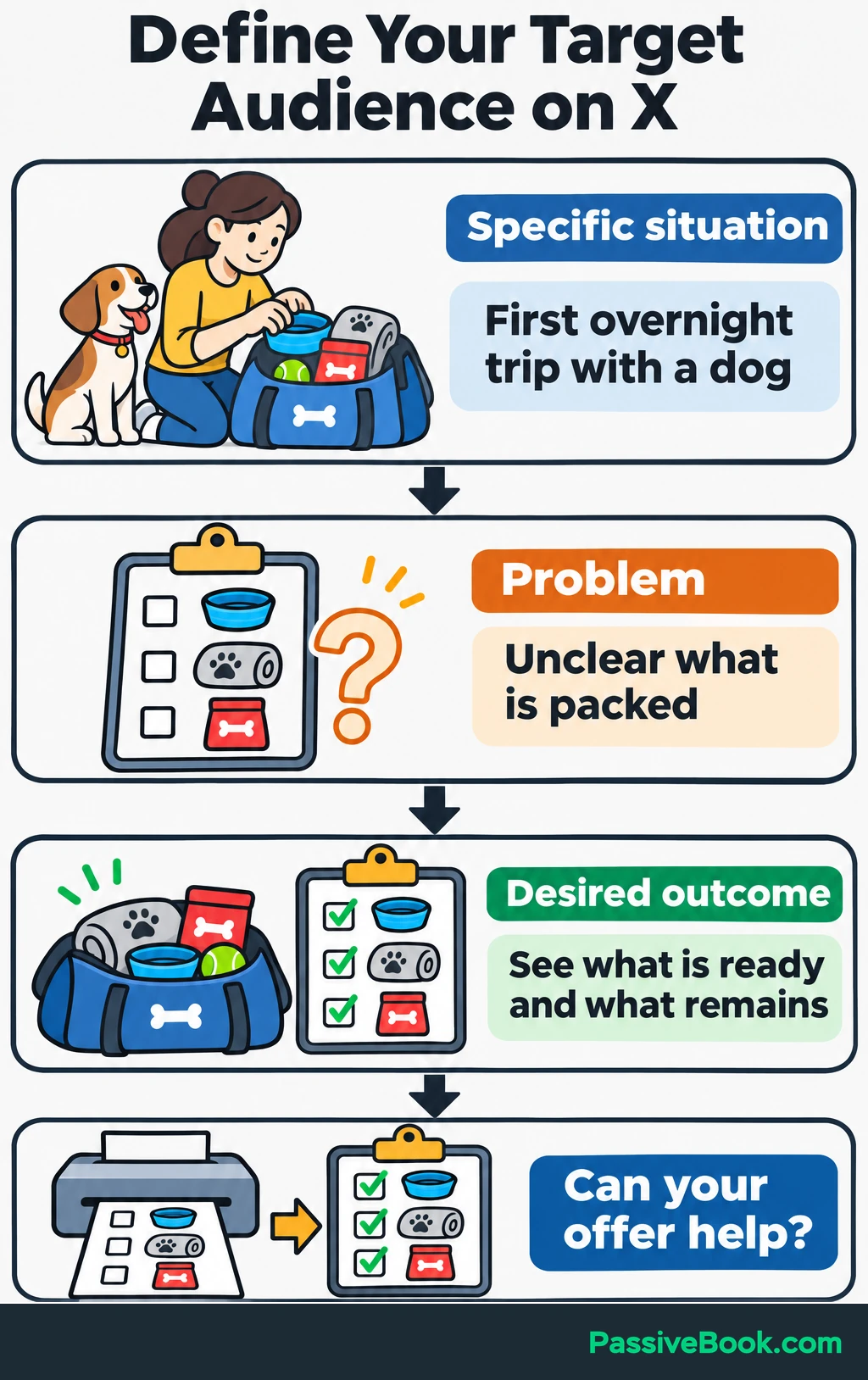
Start with a situation you can help someone handle. “Dog lovers” gives you a huge group but very little direction. Someone preparing for their first overnight trip with a dog gives you something useful to investigate.
Write a working audience statement:
I help [people in a specific situation] solve [problem] so they can [desired outcome].
Connect that problem to your product, service, or community. If your offer cannot help with it, finding more people with that problem won’t improve the fit.
Throughout this guide, imagine you run a shop selling printable packing planners for overnight trips with a dog. The sample posts, conversations, and results are illustrations.
Your starting statement could be:
I help people preparing for their first overnight trip with their dog organize packing so they can see what is ready and what remains.
That sentence gives your research a boundary. You’re looking for preparation problems, rather than every conversation about dogs or travel.
Existing customer questions are a useful starting point. Without customers, begin with a problem you can investigate in public posts. Treat your statement as a working guess and change it when the evidence points elsewhere.
Add details such as language or location only when they affect your solution. An English-language planner needs readers who can use it. An invented age range adds nothing. Leave unknown details blank.
Search X for People Discussing That Problem
Start With Everyday Questions and Frustrations
Search for the words people use while dealing with the problem. They may describe what happened without naming the product you sell.
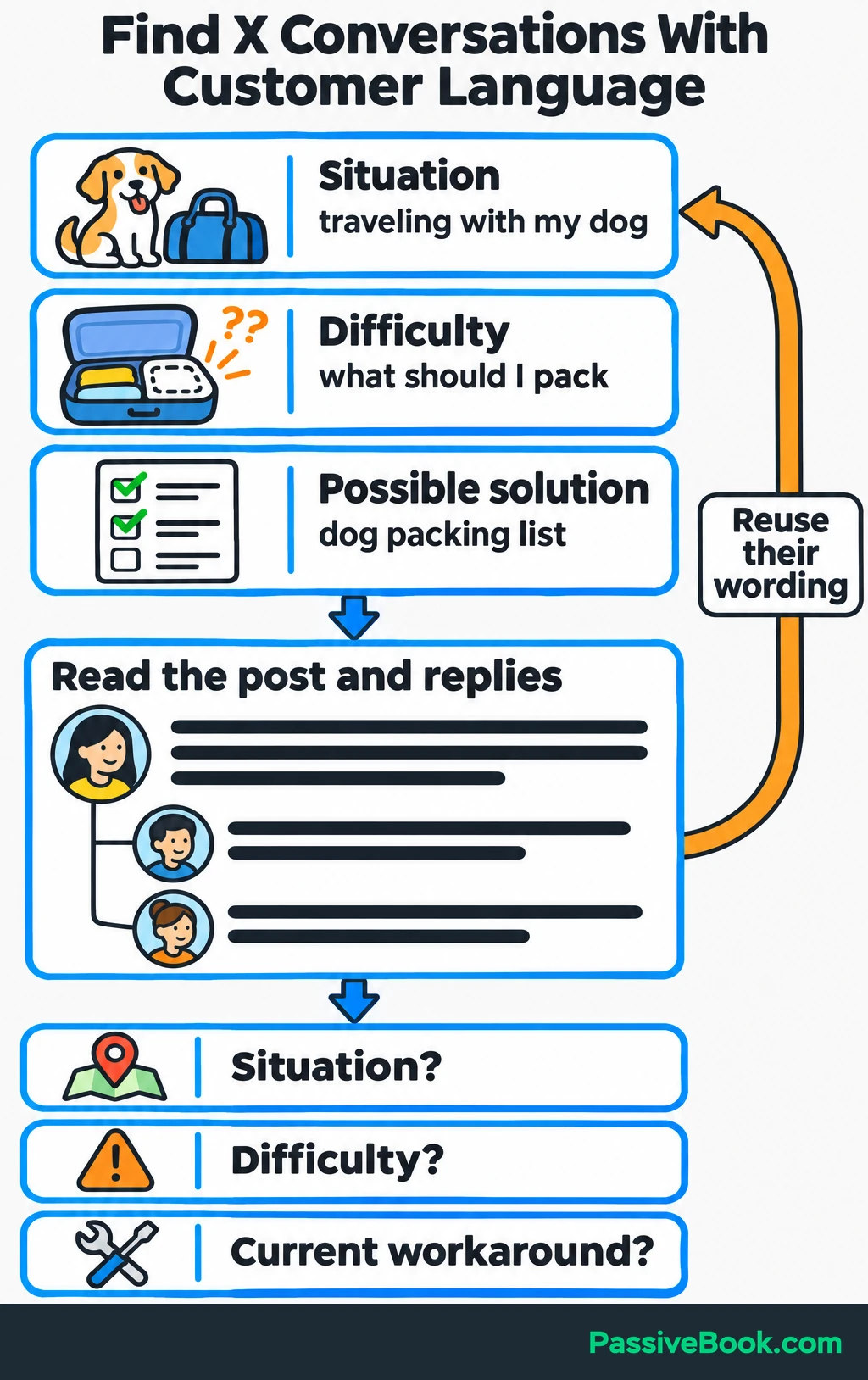
Build a small keyword bank around three things:
- Situation: “traveling with my dog,” “first trip with our dog,” “weekend away with the dog.”
- Difficulty: “forgot,” “what should I pack,” “who packed.”
- Possible solution: “dog packing list,” “dog travel checklist.”
Try a few searches and inspect the conversations behind the results.
| Research Goal | Query | What to Inspect |
|---|---|---|
| Understand trip circumstances | "traveling with my dog" | Whether the person describes an overnight trip, a first trip, or another situation |
| Find preparation questions | "dog packing list" | What they need help organizing and which resources they already use |
| Find packing difficulties | dog trip "forgot" | What was forgotten and how the person explains the mistake |
In the X app, enter a query in search. Compare the recent discussions under Latest with prominent conversations under Top. Use People when you want to discover relevant accounts.
I would begin with Latest because the immediate task is finding current conversations you can learn from or join. Top can help you find active discussion threads, but a popular post doesn’t automatically contain useful customer research.
Open the original post and read its replies. Look for three answers:
- What is this person trying to do?
- What makes it difficult?
- What are they doing about it already?
Save useful wording as you go. If people talk about “getting the dog’s bag ready,” add that phrase to your searches. Your first keyword list is a starting point, not sacred text.
If translating your offer into everyday customer language is the sticking point, AI Social Copy Studio can draft your starting wording. You’ll get searches to try and a post to test, not a claim that the audience is already validated.

Free AI Social Copy Studio




Refine Searches When Results Become Noisy
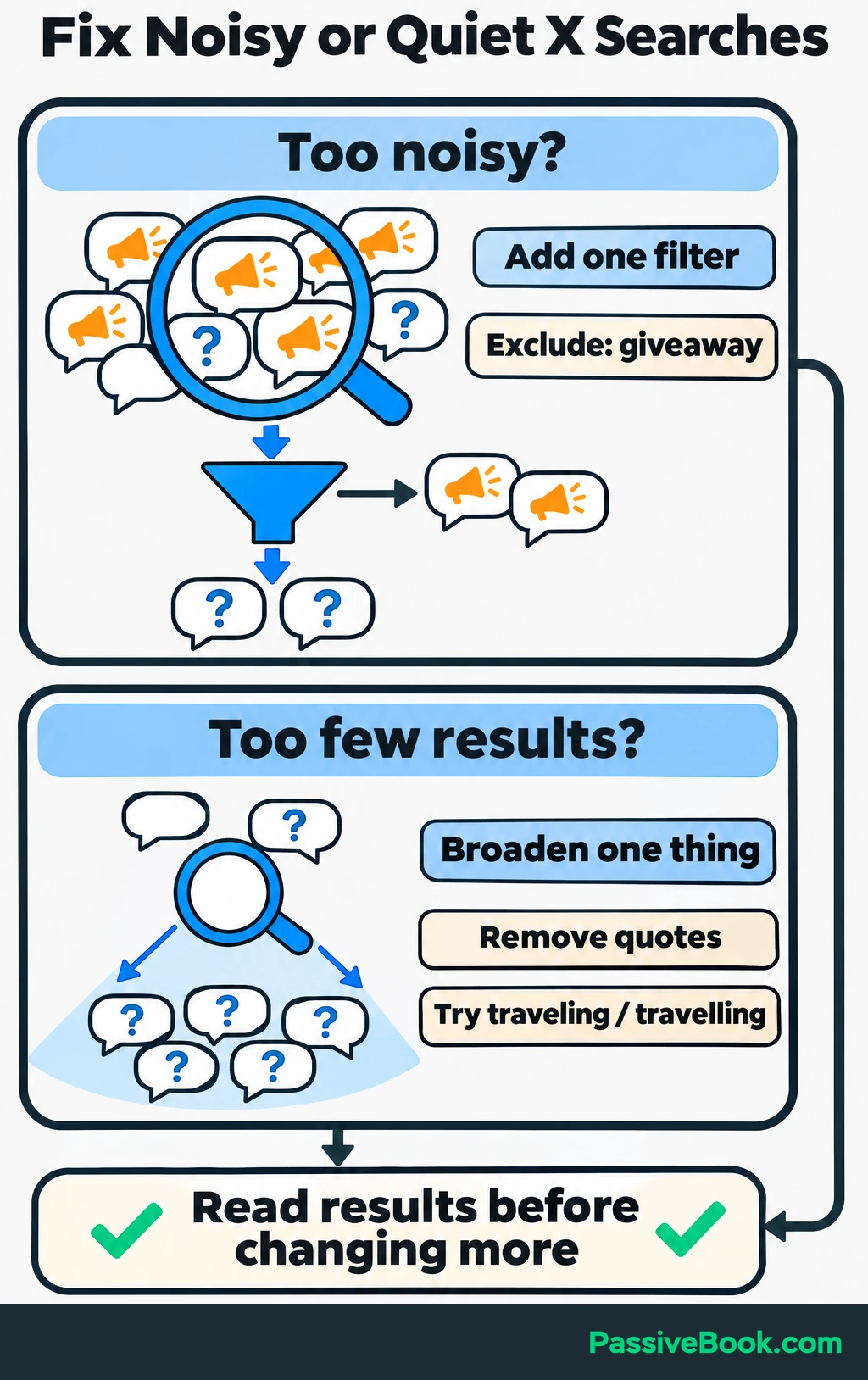
When a search fills with promotions or unrelated posts, narrow it before abandoning it.
While signed into x.com in a browser, run your search and open Advanced Search from the results page. You can combine an exact phrase with excluded words, accounts, language, and dates. For example, put “dog packing list” in the exact-phrase field and “giveaway” in the excluded-words field.
To find questions directed at a dog-travel creator, enter their handle in the field for replies to an account. Add a recent date range if old discussions dominate.
Use one filter at a time until the results become useful. Applying every filter at once is an efficient way to find absolutely nothing.
If a search produces little, broaden the wording:
- Remove quotation marks.
- Try “travelling” as well as “traveling.”
- Replace the product phrase with a difficulty, such as forgetting supplies.
- Search the broader situation, such as a weekend away with a dog.
A quiet search for “printable packing planner” tells you little about whether people struggle with packing. Customers don’t have to use your product category to need help.
Keep useful queries and conversation links in a simple spreadsheet or Notion page so you can revisit them.
Find More Potential Customers Around Niche Accounts
Relevant accounts give you another way into the same conversations.
Look for creators, educators, and businesses discussing the problem you solve. Read the replies beneath practical posts, especially where people ask follow-up questions or explain their own circumstances.
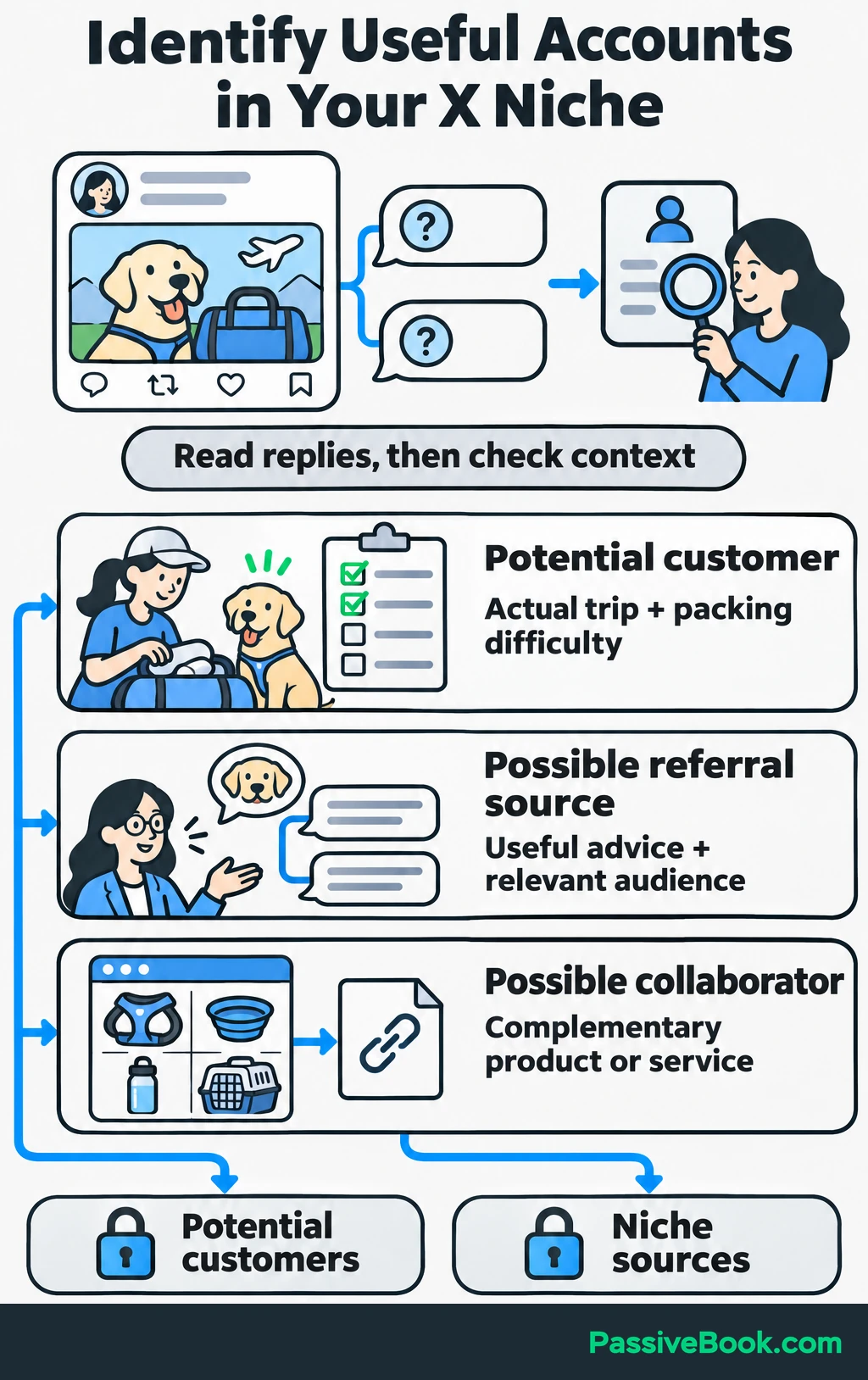
For the packing shop, a dog-travel creator might attract someone asking how to prepare for an upcoming weekend away. That question gives you more context than their decision to follow the creator.
Check the person’s bio and recent posts before recording them as a possible customer. Keep different roles separate:
| Account Role | Useful Evidence | Why You Might Keep It |
|---|---|---|
| Potential customer | Describes preparing for an actual dog trip and struggling with packing | Could help you understand or test the planner |
| Possible referral source | Publishes useful dog-travel advice and answers relevant questions | May eventually recommend a suitable resource |
| Possible collaborator | Sells a related travel product or service | Could help with a joint resource or promotion |
Don’t turn every account into a sales lead. Another planner seller may be worth knowing, but they are probably not waiting to buy yours.
Group potential customers and useful niche sources into separate Lists, which collect posts from the accounts you add. When creating each List, turn on Private so only you can access it. That gives you a focused place to return without rebuilding your research from the main feed.
You can also explore relevant public Lists and search Communities for dog-travel discussions. Read the exchanges before joining in, and follow each Community’s rules. I would choose a small group with thoughtful questions over a large one filled with promotional links.
Validate Recurring Needs Through Conversations
Record Patterns Across Different People
A memorable complaint can suggest a topic. Repeated complaints from different people give you a stronger reason to investigate it.
Create a research sheet with one row for each person and problem. Include:
- Source: Account, post link, and date.
- Situation: What the person explicitly says they are preparing for.
- Problem: Their exact wording, desired outcome, and attempted solution.
- Offer Fit: How your product could help, or why it cannot.
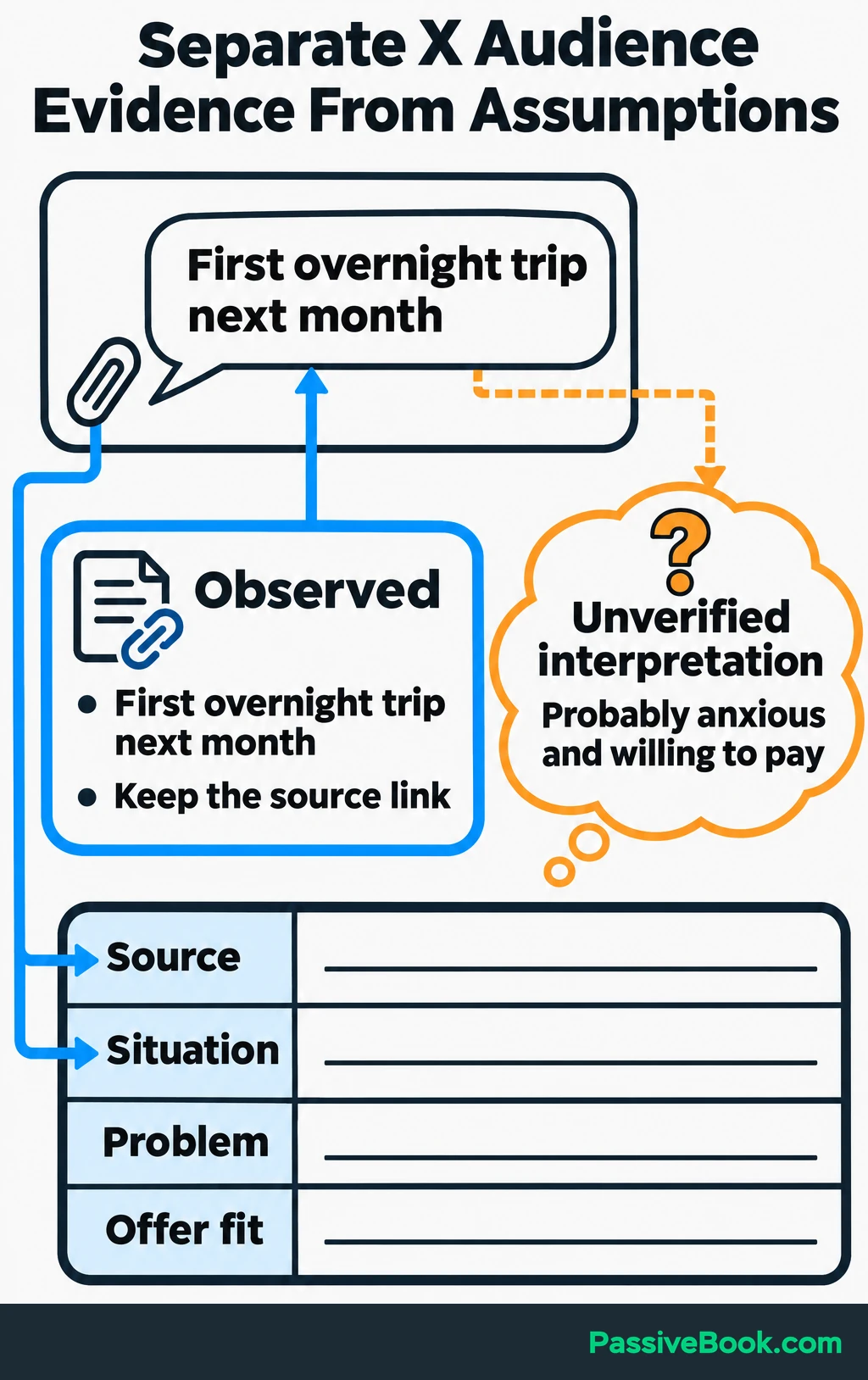
Keep observations separate from guesses. “First overnight trip next month” is a stated situation. “Probably anxious and willing to pay” is your interpretation.
Group related observations into themes. For the planner, those might include forgotten supplies, duplicated packing, or uncertainty about what is already ready.
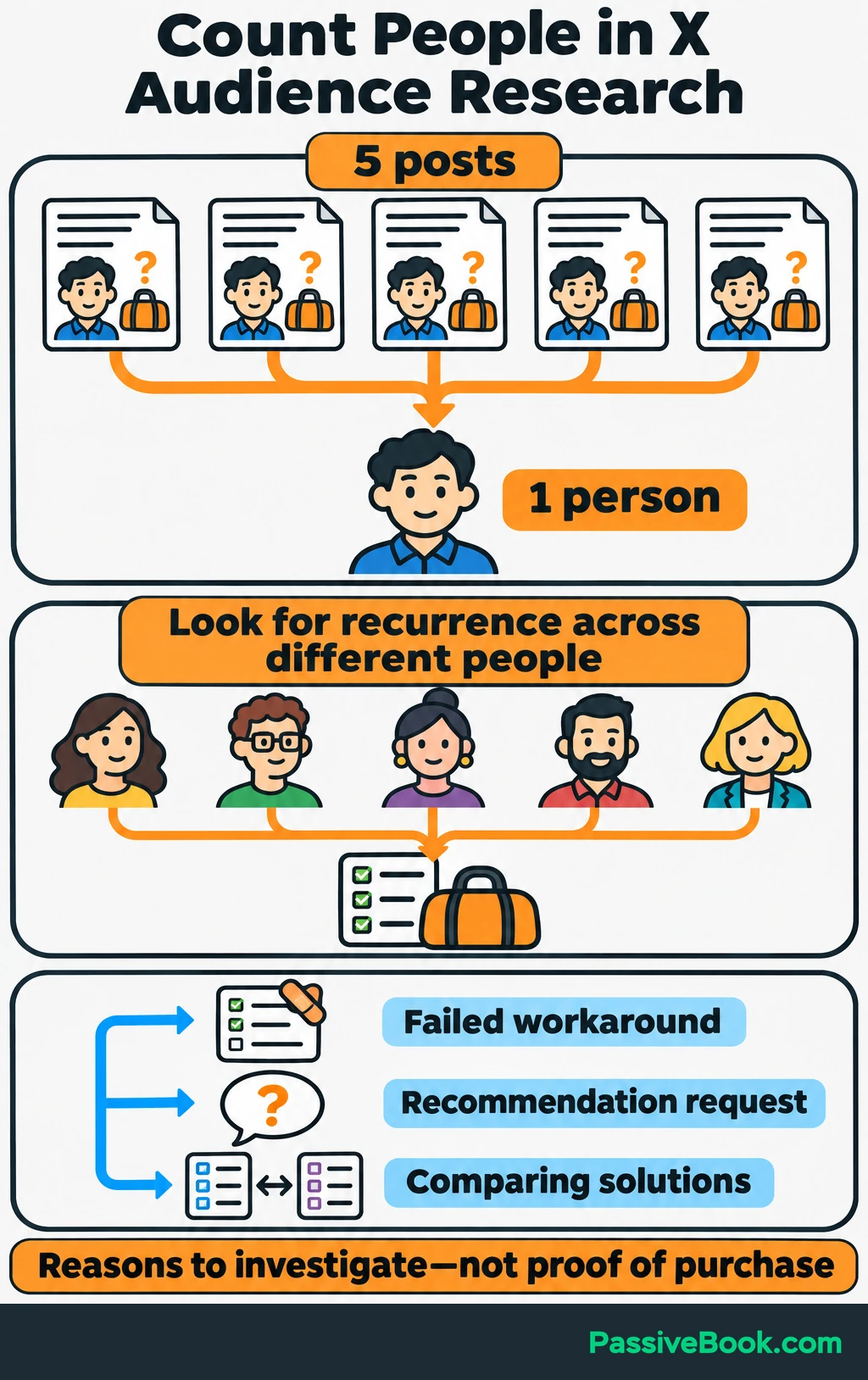
Count distinct people expressing each need. One person posting five times is still one person, though their repeated difficulty may be worth a closer conversation.
Pay particular attention to people who describe a failed workaround, ask for recommendations, or compare existing solutions. Those are useful reasons to talk. They don’t establish that someone will buy.
Then tighten your audience statement. If shared packing keeps appearing, you might test:
I help people sharing packing duties for their first overnight dog trip keep one list of who is bringing what.
Ask About Current Behavior and Unresolved Problems
Answer a relevant question before asking your own. Then use one focused follow-up that fits the discussion.
For example, if someone says two people are packing separate bags, you could suggest keeping one shared list and ask:
How are you keeping track of what each person has already packed?
Once they answer, follow the part that remains unclear:
- What do you currently use?
- When did it last become difficult to keep track?
- What did you do when that happened?
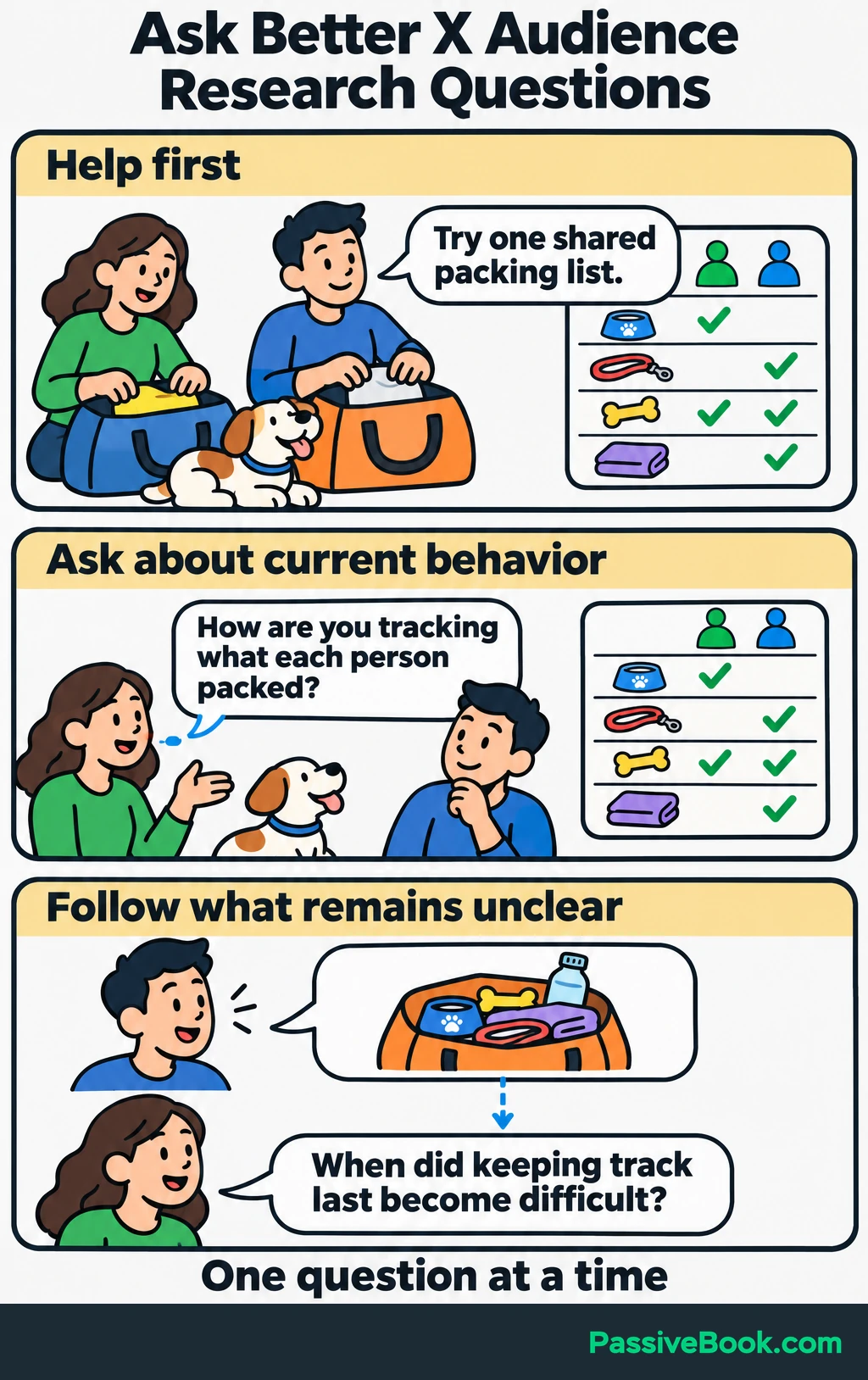
Ask one question at a time. A public reply should feel like a conversation, not an application form.
I would skip “Would you buy my planner?” at this stage. Someone explaining their current workaround gives you more to use than a polite answer about a product they haven’t needed to choose.
Check whether the problem fits your offer. Confusion about packing responsibilities could suit a planner. Difficulty finding accommodation that accepts dogs calls for different help.
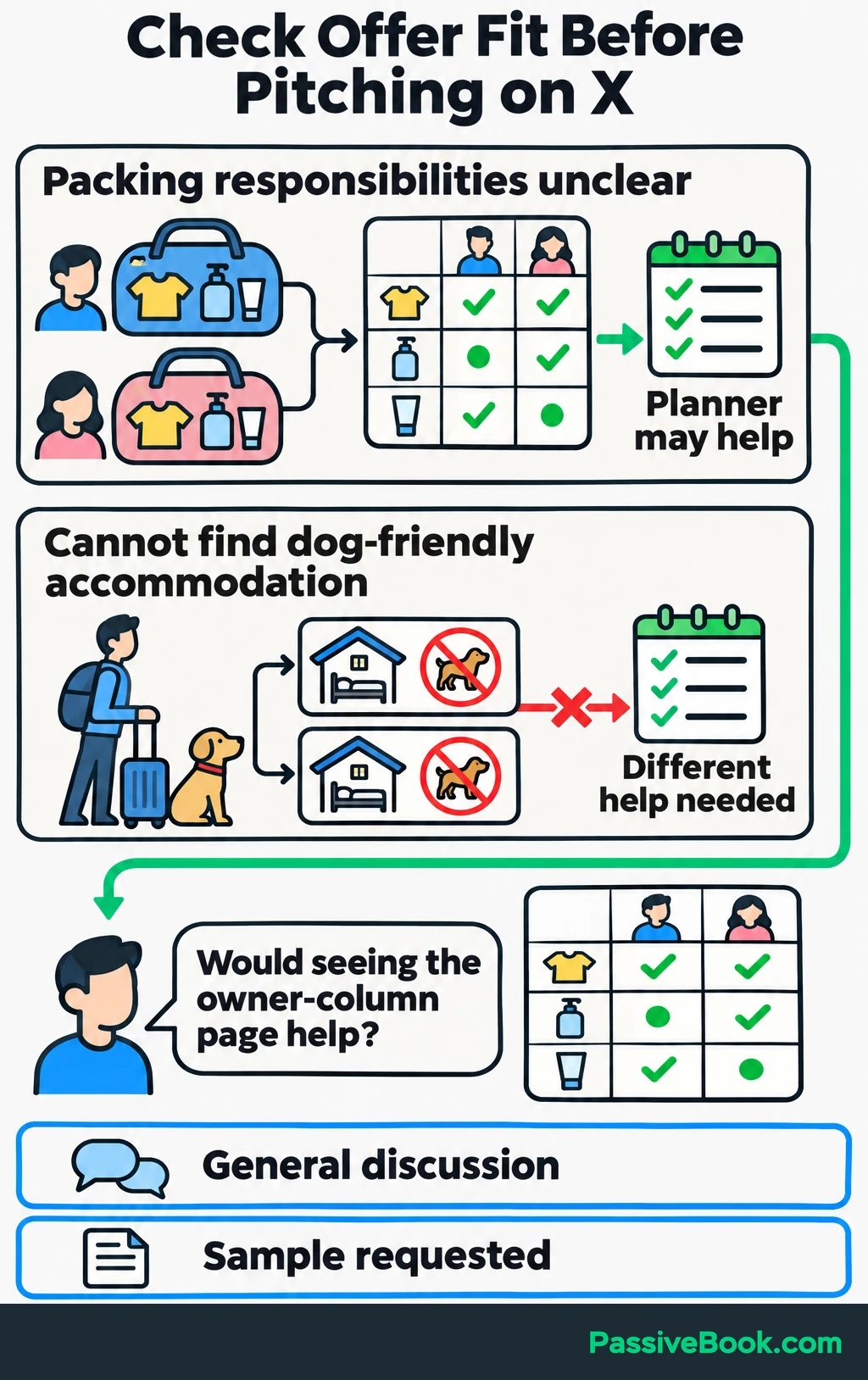
When the fit is clear, introduce the relevant part:
My packing planner includes a column for who is bringing each item. Would seeing that page help?
Record a request to see it separately from general discussion. Interest in a sample is a different action from answering your question.
Keep replies individual and relevant. X’s authenticity policy prohibits bulk or duplicative content spam, including repeated unsolicited replies and messages. A copied pitch pasted under every dog-travel post is both poor research and a policy problem. X’s authenticity policy
Create Content That Tests Your Audience Understanding
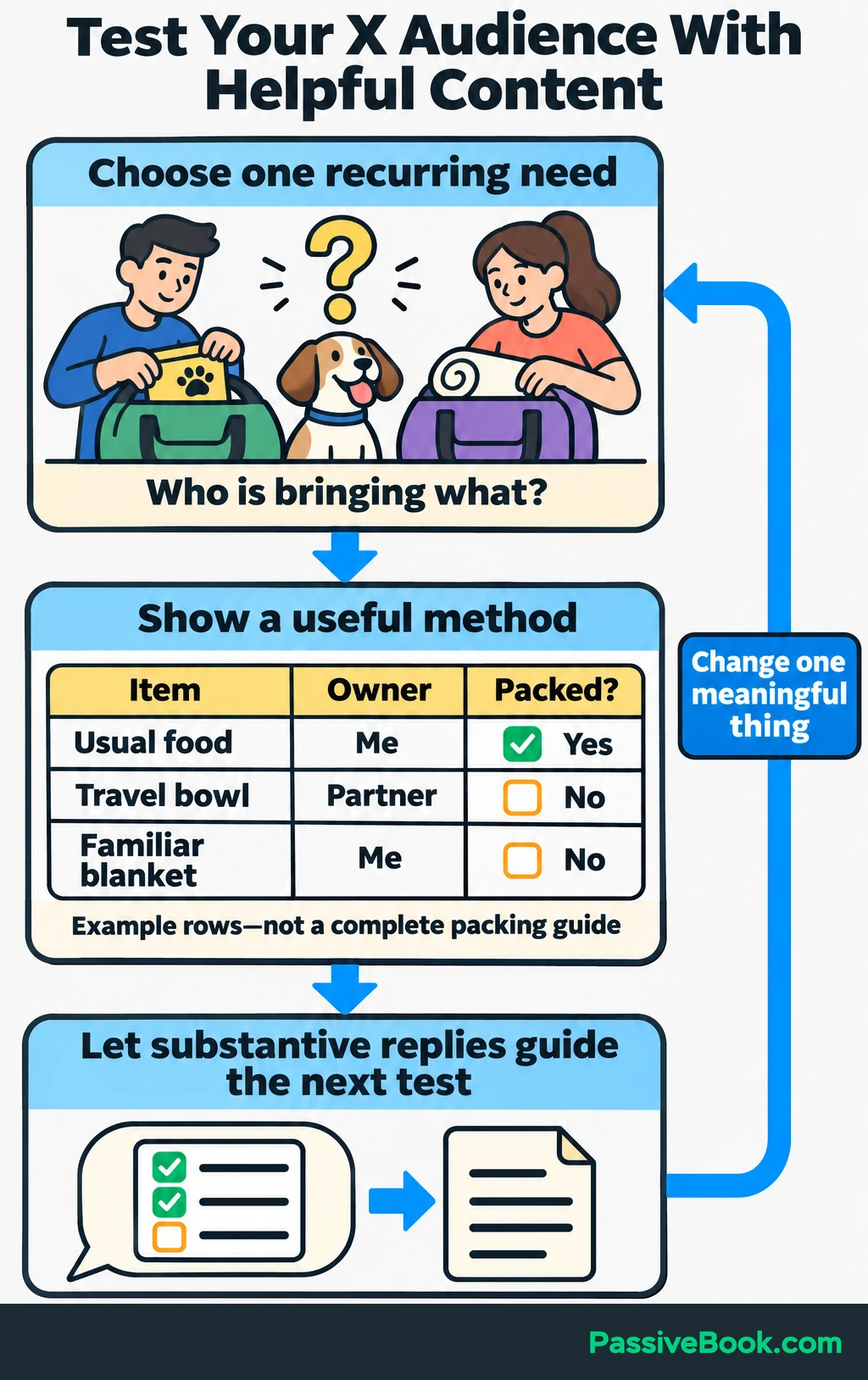
Choose one recurring problem and publish something that helps with it. Make the situation recognizable in the opening so the right person can see why it matters.
For shared packing, an opening could be:
Packing for your first weekend away with your dog? Give each item an owner so you can see who is bringing it.
Then show the method with a short example:
| Item | Person Responsible | Packed? |
|---|---|---|
| Usual food | Me | Yes |
| Travel bowl | Travel partner | No |
| Familiar blanket | Me | No |
These rows demonstrate how to organize a list; they are not a complete packing guide. Follow with a question such as:
What do you currently use to keep track when you’re both packing?
Choose the format that explains the idea with the least fuss. A short tip may need only text. A checklist layout may be clearer as an image made in Canva. Use a thread when the explanation genuinely needs several parts.
Make the next step clear when someone visits your profile. Your bio should say whom you help and what you provide. A pinned post can show a sample page and link to it.
For this shop, a compact bio could say:
Printable packing planners for overnight trips with your dog. See who is bringing each item and what is ready.
Keep one main next action, such as viewing the sample. Sending someone toward a shop, newsletter, community, and unrelated freebie at once makes the choice harder to understand.
Record the need each post tests. Change one meaningful thing at a time, such as the opening or the problem addressed. This makes the response easier to interpret.
Use substantive replies to choose the next topic. A question about sharing the list suggests a follow-up about coordination. A request for destination recommendations suggests a different need, which your planner may not serve.
Check Whether X Is Reaching the Right People
Decide what useful progress looks like before comparing posts.
For the planner shop, a qualified enquiry could mean someone asking about using the planner for an actual upcoming dog trip. For a community, the useful outcome might be people returning to take part in relevant discussions.
I spent six months chasing followers on Instagram and Twitter/X in another niche while my bank balance stayed around $47. That’s why I check for a connection to the business goal before giving a channel more time.
Keep a small record for each test post: its topic, date, relevant respondents, substantive replies, and resulting actions. Count people separately from replies so one long exchange doesn’t look like ten interested people.
Use views to understand visibility. They don’t tell you how many potential customers saw the post: X can count repeat viewing and your own views. X’s explanation of view counts
Here is an illustrative comparison:
| Post | Views | Relevant Response |
|---|---|---|
| General dog photo | 600 | No questions connected to trip preparation |
| Shared-packing checklist | 150 | Four people planning first dog trips reply, and one asks about the planner |
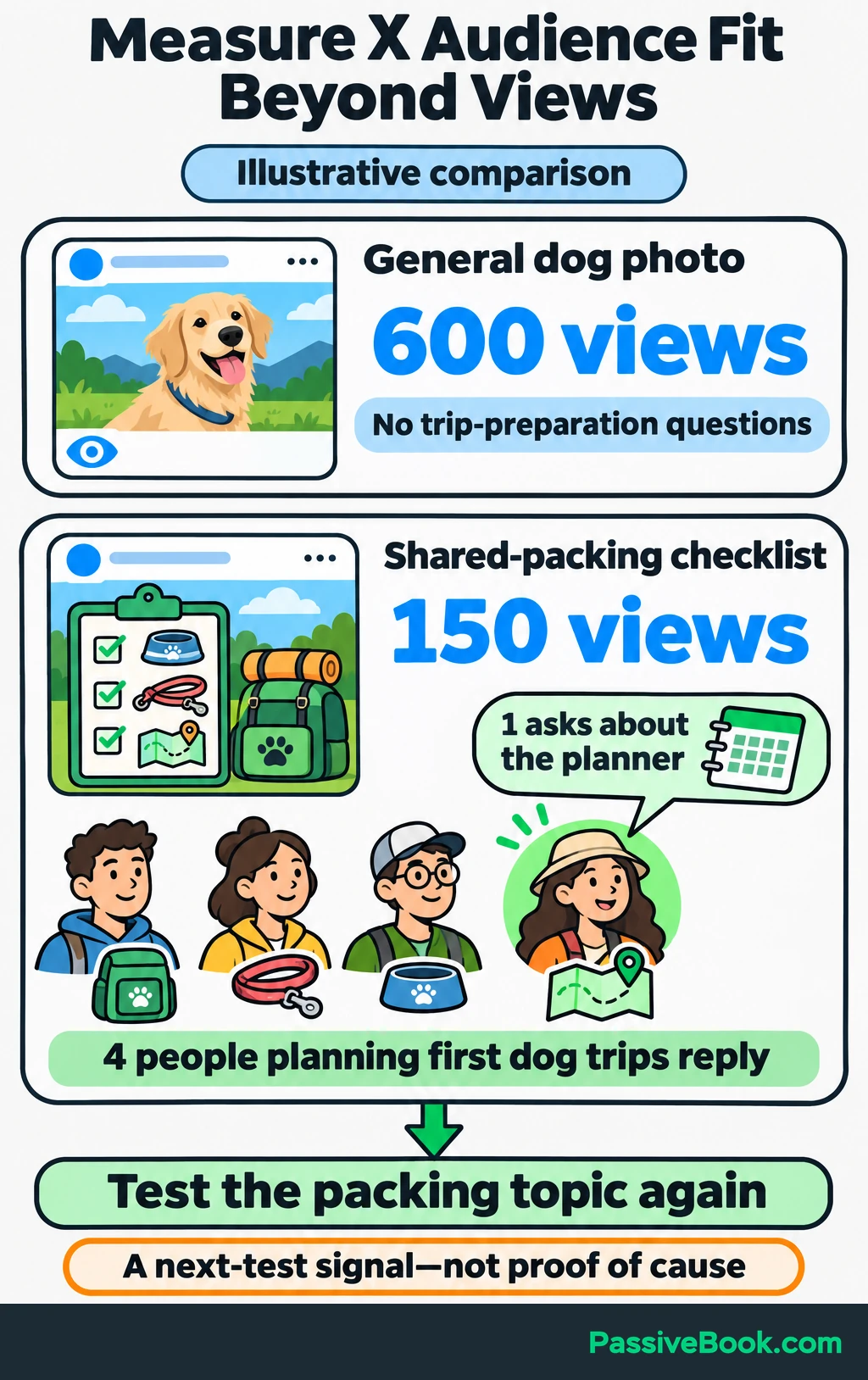
I would test the packing topic again. The smaller view count came with more useful evidence. This comparison suggests a next test; it doesn’t prove the checklist caused the difference.
If you already use Google Analytics to track website visits, add campaign tags—labels in the link—to identify traffic from each post:
utm_source=xutm_medium=organic_socialutm_campaign=dog_trip_plannerutm_content=shared_packing_01
Keep the first three values consistent for this campaign and change utm_content for each post. Google’s campaign-tagging guide shows how to add them. Your website must also record sign-ups or sales before you can compare those actions.
Let the result guide your next decision:
| What You Observe | What I Would Change |
|---|---|
| Replies come mostly from people outside the intended audience | Make the situation more specific in the topic and opening |
| Relevant people discuss the problem but show no interest in the offer | Check whether the planner solves the difficulty and whether the sample shows how |
| Searches reveal few useful conversations | Try broader wording and read replies under relevant niche accounts |
| People ask relevant questions or take useful next steps | Continue testing that need and its connection to the offer |
Give the work a boundary. I would start with three 20-minute sessions a week and review after two weeks. That is a manageable first review point, not a deadline for proving demand.
Continue when relevant participation or customer actions justify the effort. If repeated searches and content tests produce little useful activity, reduce the time you spend or investigate another channel. X needs to earn its place in your week.
What Next?
Write one audience statement and use it to find three relevant conversations on X. Save what each person says they need before planning your next post.
Use the social buttons to share this guide when your community could use a clearer way to connect content with potential customers.
Which part is hardest for you: choosing whom to help, finding their conversations, or deciding whether the response matters? Leave your answer in the comments, and bring any other questions too.
Share this post with your friends & followers:

