You have ideas for dog-care Pins and a few evenings to work on them. But should you recommend products, sell a printable, or try to get a brand to pay you?
Each option asks for different work, and weeks of posting can pass without showing whether that work is paying off. To help you choose where to spend those evenings, this guide walks through earning commissions, selling your own products, and pitching paid campaigns, with a complete example that connects Pins to purchases.
How Does Pinterest Turn Pins Into Income?
For sales, the basic path is:
Search → Pin → product or recommendation page → purchase.
An affiliate link earns you a commission when someone makes a qualifying purchase from a merchant. You can also sell your own products. Sponsorships work differently: a brand pays you for agreed content, such as creating and publishing Pins.
Customers, affiliate programs, and brands provide the money. These methods do not pay a fixed amount for every thousand views, and Pinterest does not handle your affiliate or sponsorship payments. Its monetization guidance explains those relationships.
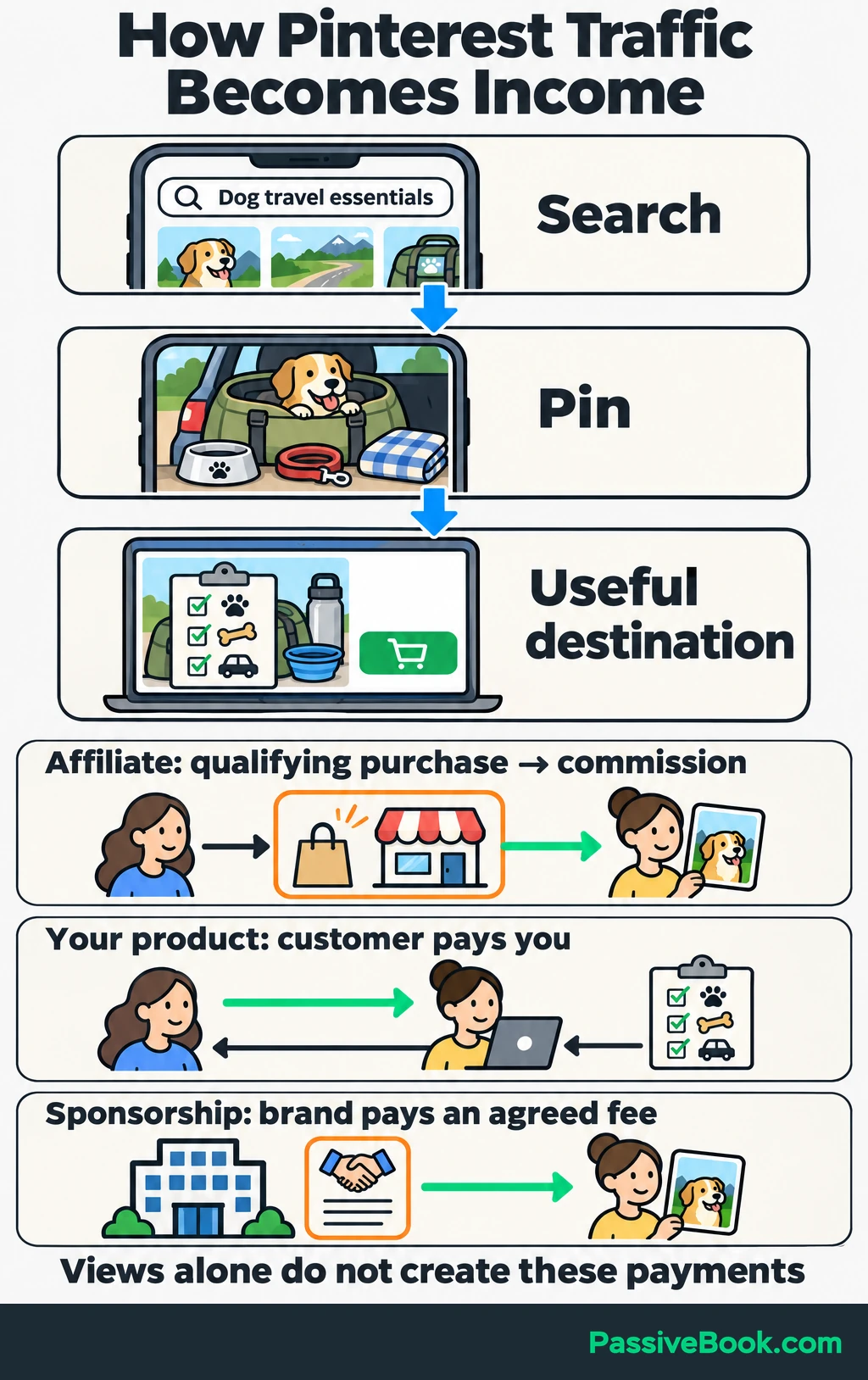
You can start with image Pins and organic distribution. A blog, camera, and paid ads are optional. A hosted product page can handle sales, and an approved affiliate link can send visitors directly to a merchant.
Selling your own download does not require a large following. Affiliate programs and brands have their own acceptance criteria.
To make the process concrete, imagine you run a dog-travel resource shop. You sell a printable road-trip packing organizer and recommend useful travel accessories. The shop, products, sample copy, and calculations below are illustrative.
Your first job is to choose which purchase the next Pin should support.
Choose Your First Monetization Model
I would start with the model closest to something you can already deliver. Existing products deserve a test before you build new ones.
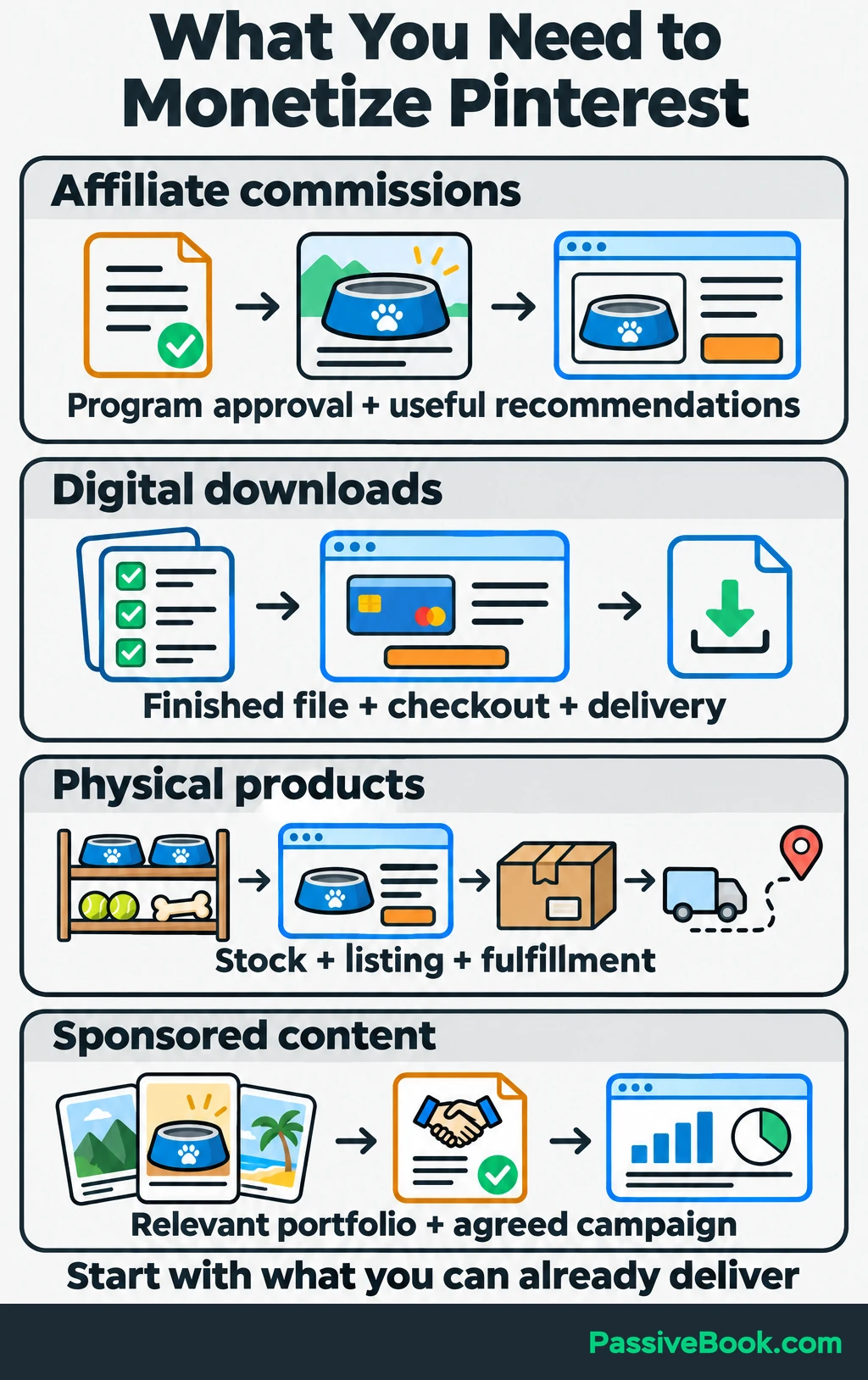
| Model | Who pays | Required assets or approval | Destination | Main costs | Revenue trigger |
|---|---|---|---|---|---|
| Affiliate commissions | Merchant or affiliate program | Program approval, permitted publishing channel, useful recommendations | Approved merchant product page or your recommendation page | Research, content creation, optional website | A qualifying purchase earns a commission |
| Digital downloads | Customer | Finished file, sales page, checkout, delivery | Product page | Creation time, selling and payment fees, support, refunds | Customer completes payment |
| Existing physical products | Customer | Available stock, product listing, fulfillment | Specific product listing | Inventory, packaging, shipping, selling fees, returns | Customer places a paid order |
| Sponsored content | Brand | Relevant portfolio, agreed campaign, brand acceptance | Agreed guide or product page | Production, revisions, reporting | Brand pays under the agreement |
Choose affiliate marketing when you can help someone select a product. Choose a digital product when you can package a useful solution. Pursue sponsorships when you can show relevant work and explain why your content fits the brand.
For the dog-travel shop, I would test the packing organizer first. It gives you one offer and one clear path to measure:
Pin → organizer sales page → checkout → download.
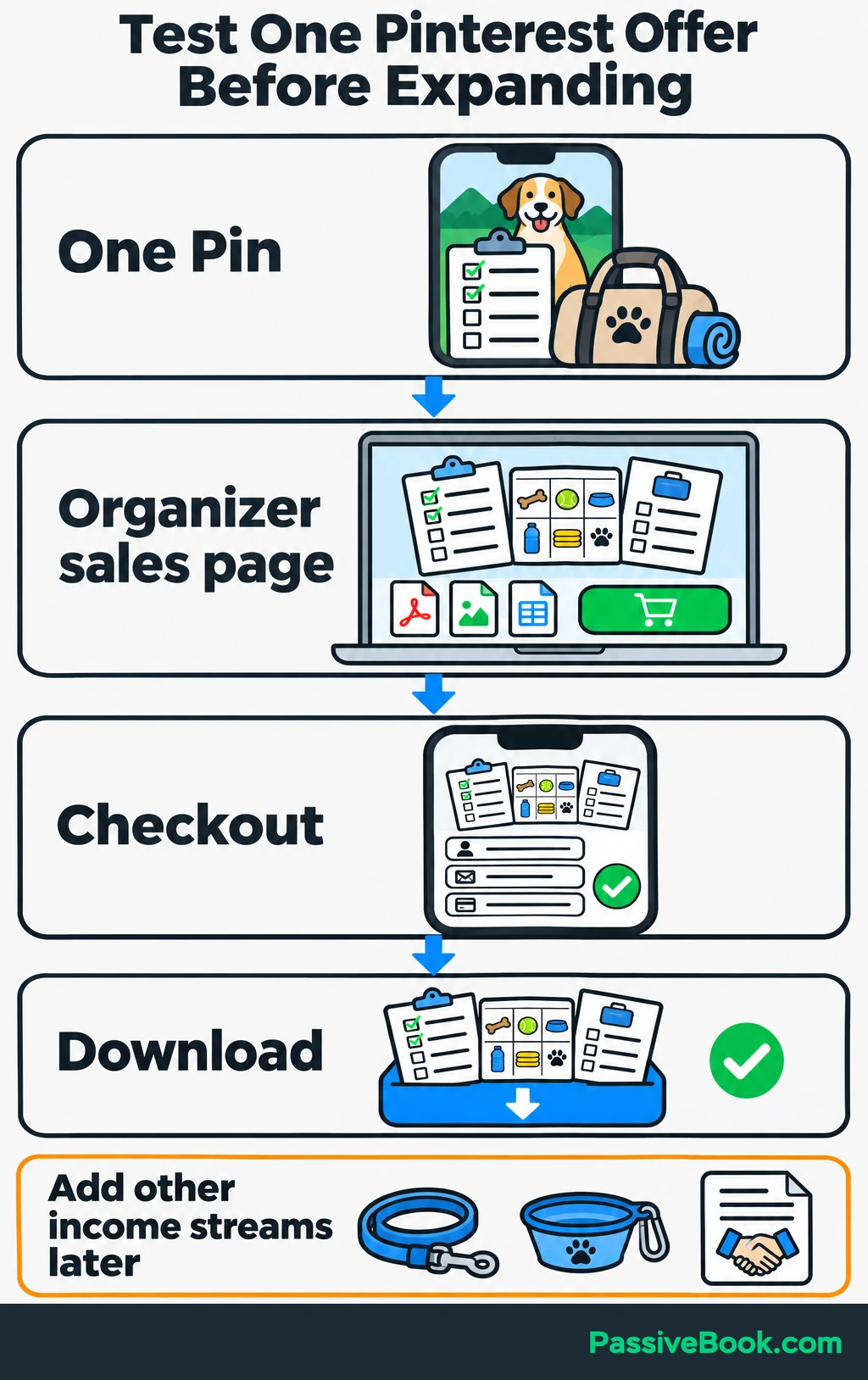
Accessory recommendations can come later, and a relevant brand campaign can sit alongside both. You do not need three unfinished income streams to prove you are serious.
If you already sell physical products, link to the exact item shown. Judge the result by what remains after inventory, packaging, shipping, fees, and returns. An order notification is pleasant, but it does not tell you the profit.
Match Your Offer to a Pinterest Search
Start with the task someone wants to finish. Then look for the words they use to describe it.
Type a relevant phrase into Pinterest, examine the suggestions, and open the results. Notice whether the Pins lead to instructions, product comparisons, free resources, or paid products. That helps you understand what your destination needs to provide.
For the shop, research candidates include:
- “Dog road trip packing list”
- “Dog travel essentials”
- “Dog travel planner printable”
These are starting points to investigate, not verified high-volume keywords.
Use Pinterest Trends to examine interest and seasonal timing in your intended market. The scores show how search interest changes over time, not how many searches a phrase gets. They also cannot tell you whether someone will buy.
If interest rises before a travel season, plan your content ahead of that rise.
Keep a small planning sheet that connects each search to a useful destination:
| Search phrase | Buyer task | Offer | Pin promise | Destination |
|---|---|---|---|---|
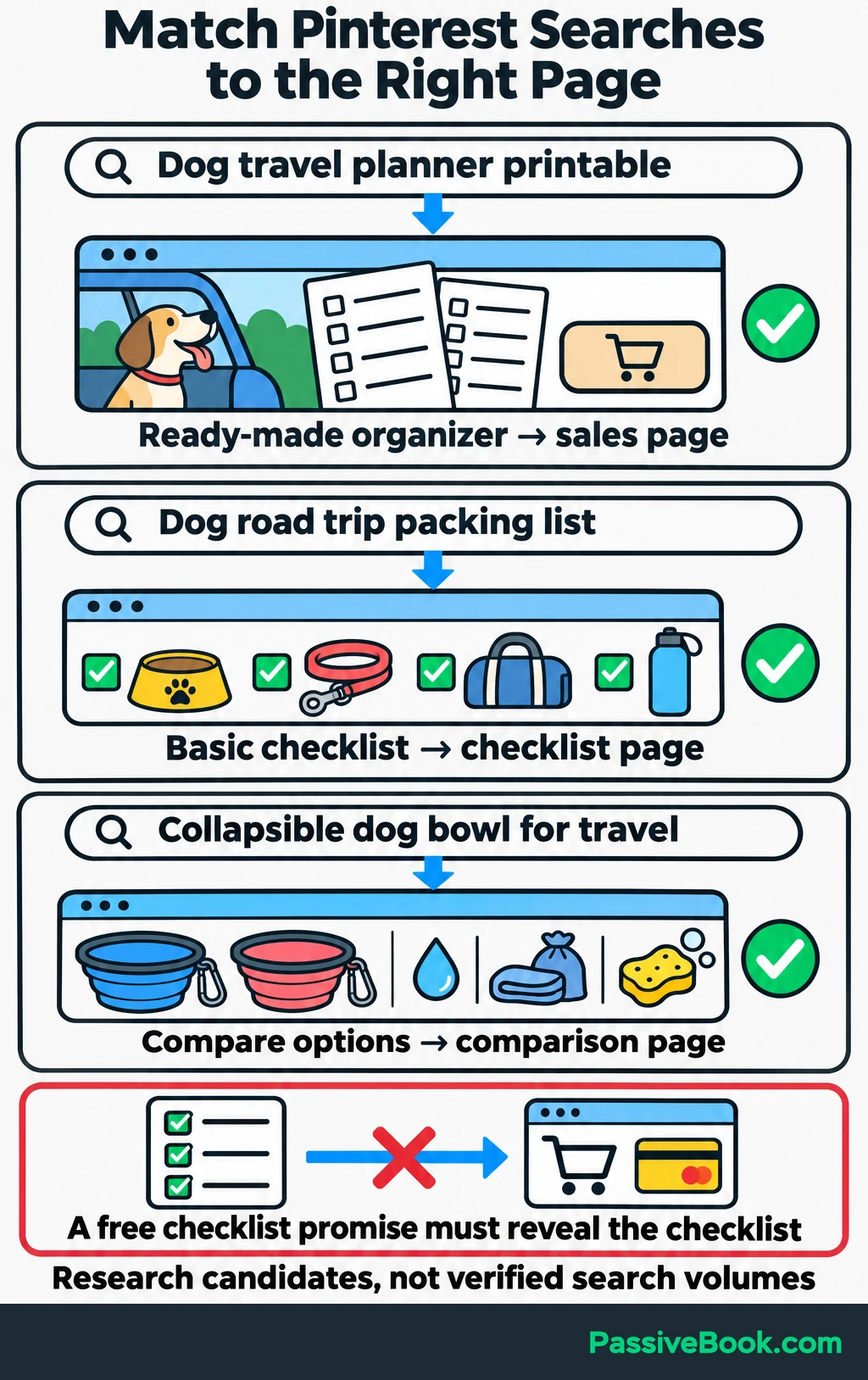
| Dog travel planner printable | Find a ready-made organizer | Paid packing organizer | Preview the printable packing pages | Organizer sales page |
| Dog road trip packing list | Work out what to organize | Free checklist, with an optional paid organizer | See a basic packing checklist | Page containing the checklist |
| Collapsible dog bowl for travel | Compare bowls before buying | Relevant affiliate recommendations | Compare packed size and cleaning needs | Bowl comparison page |
The destination must fulfill the promise immediately. If the Pin offers a free checklist, show the checklist. Do not send visitors straight to a paid organizer and hope they overlook the difference.
On one of my sites, I caught this mismatch while checking a Pin’s destination. The Pin promised a checklist, but the page opened with several paragraphs before the checklist appeared. I moved the promised resource above the background explanation. That check now comes before I make another design.
Build the Path From Pin to Purchase
Affiliate Links: Help Someone Choose a Product
A useful affiliate recommendation answers a buying question. It gives someone a reason to choose one product over another.
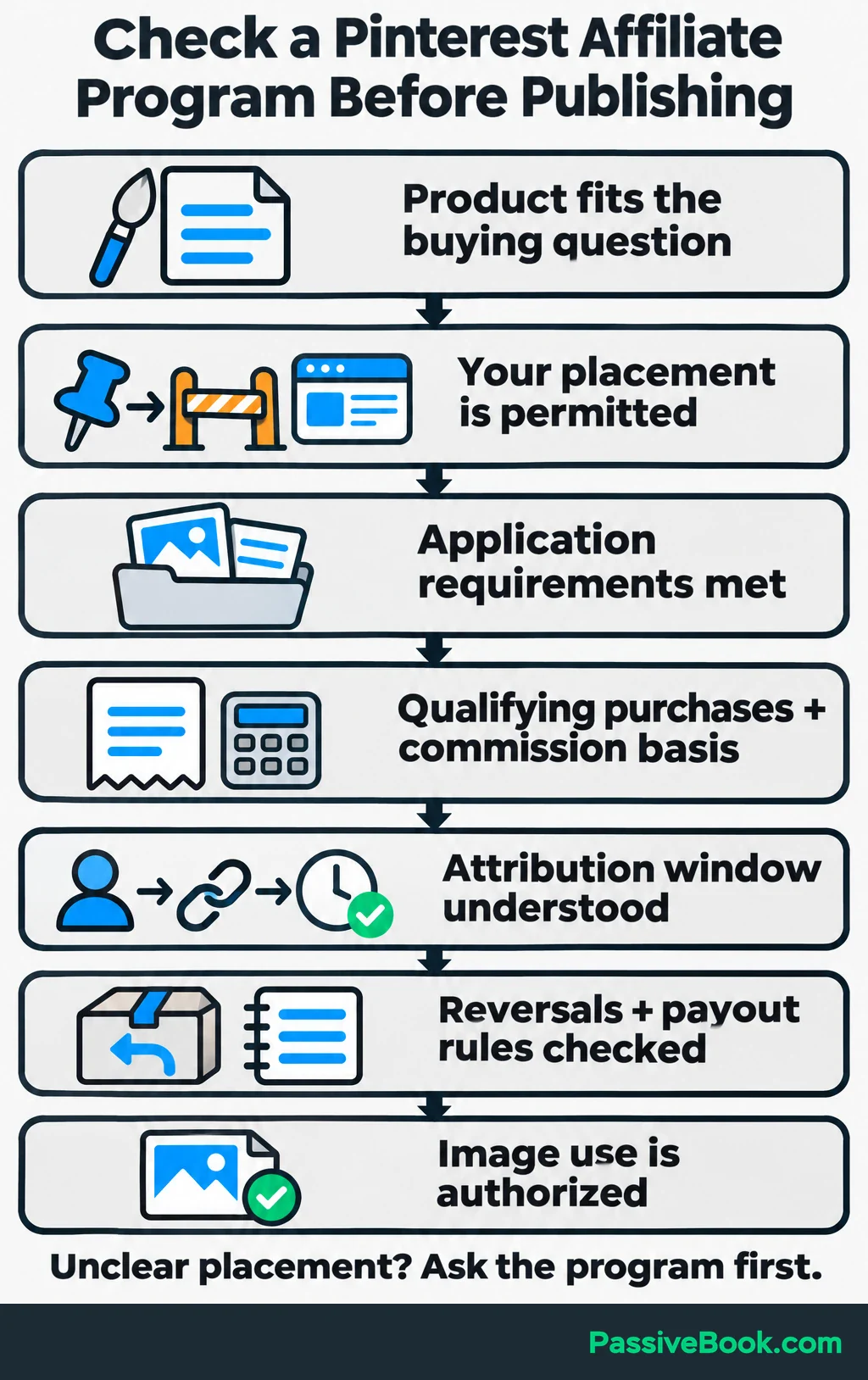
Start with products that fit the task, then examine the program:
- Channel permission: Does it accept your Pinterest account or website, and allow the placement you intend to use?
- Customer fit: Can your likely customers buy from the merchant and receive the product?
- Earning rules: What does an ordinary qualifying order pay, and which purchases are excluded?
- Attribution: How long after a click can a purchase qualify?
- Payment conditions: When are commissions approved and paid, and when can returns or cancellations reverse them?
Pinterest permits affiliate destination links, but the merchant’s agreement determines your eligibility and commission. Its affiliate-link guidance describes linking directly to a shop’s product detail page.
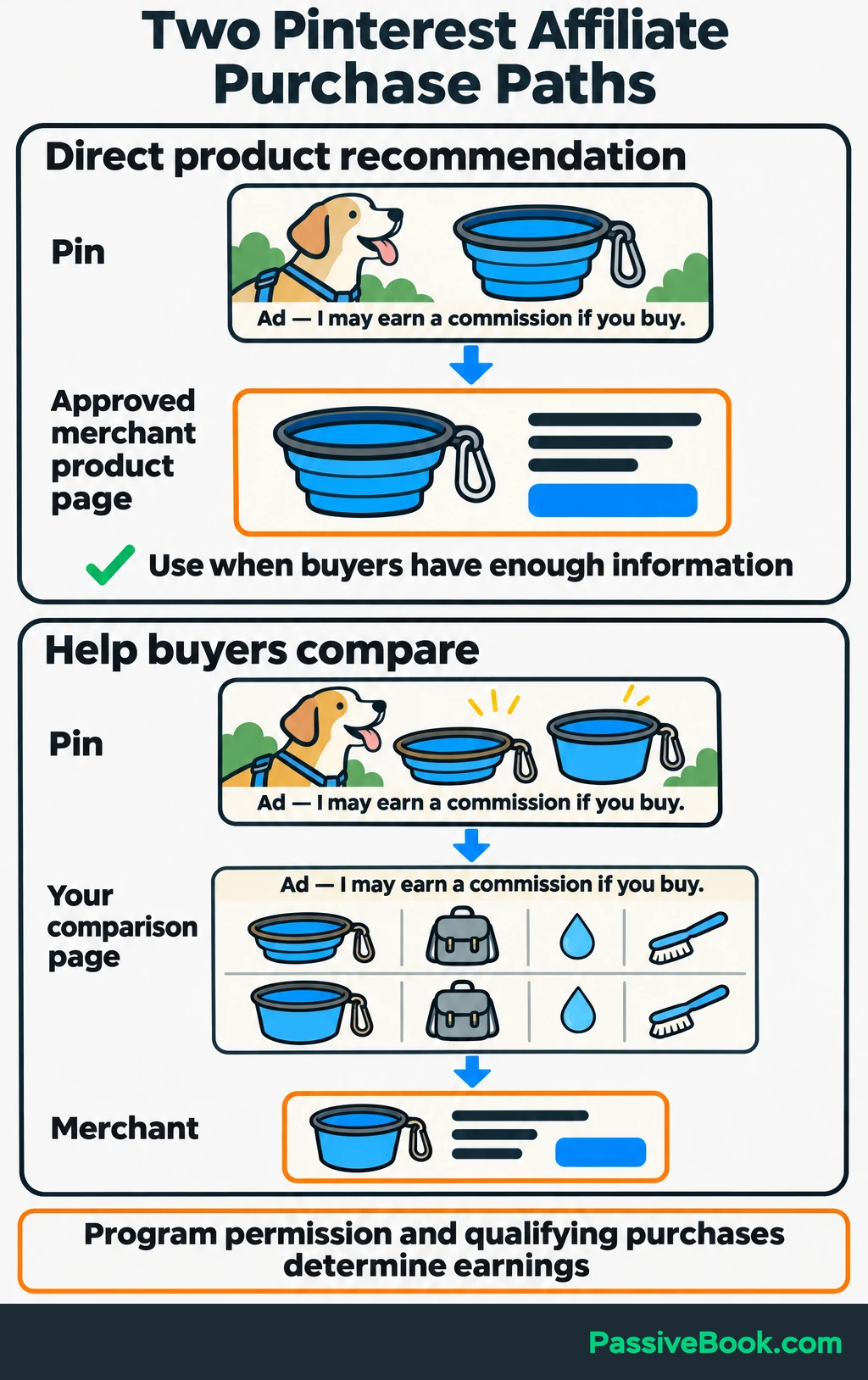
I would choose between two paths:
- Direct recommendation: Pin → approved merchant product page. Use this when the Pin recommends a specific product and the product page supplies what buyers need.
- Comparison: Pin → your useful recommendation page → merchant. Use this when people need help weighing options.
For the dog-travel shop, a bowl comparison could cover packed size, water capacity, cleaning instructions, and where each bowl fits in a travel bag. Explain the tradeoffs and distinguish your own testing from manufacturer specifications.
“Here are ten bowls” leaves most of the work with the reader.
My first three months of affiliate marketing brought in about $23. Switching to honest reviews of tools I actually used helped that business reach about $340 a month consistently. Those were affiliate-business results, not Pinterest earnings. The useful lesson was to make the buying decision easier instead of chasing products because they offered commissions.
Disclose the relationship beside the recommendation. A plain example is:
Ad — I may earn a commission if you buy.
When the image itself carries the endorsement, put a readable disclosure on the image too. A profile disclosure is too far away. The FTC’s disclosure guidance explains placement and wording for U.S. audiences; follow the rules that apply to your audience.
Keep each recommendation original and useful. Pinterest’s affiliate guidelines prohibit artificial traffic manipulation and repetitive or excessive affiliate posting. Changing a background color does not create a new buying reason.
Digital Products: Sell a Small, Useful Resource
Before building a download, find out how people handle the problem now.
Ask prospective buyers about their last attempt. What did they use? What did they forget? What took too long? Show a few sample pages and ask what they would actually use.
“Would you buy my planner?” invites encouragement. “Show me how you packed for your last trip” gives you something to work with.
I have sold courses, ebooks, templates, and bundles across niches. I also rushed a course without validating it, received few sales and a bad review, and removed it. Pinterest did not cause that failure. I had built something before understanding what buyers needed.
For the dog-travel shop, the smallest complete product could contain:
- A packing checklist for organizing supplies.
- A reusable inventory showing what is already in the travel kit.
- A bag-by-bag packing sheet so items have a known place.
That is enough to solve one clear problem. It does not need to become a hundred-page dog-travel encyclopedia.
Build the full purchase path before promoting it:
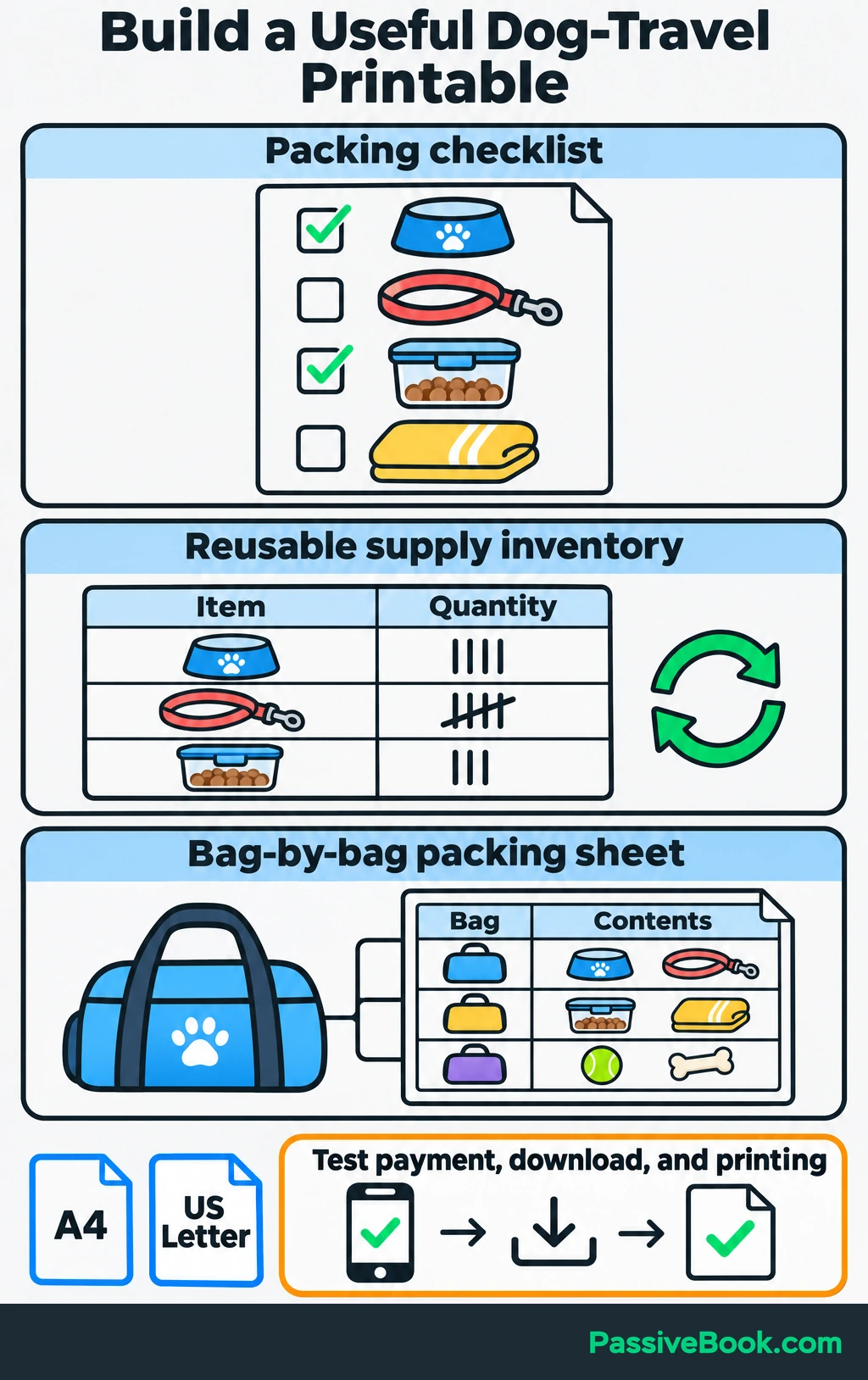
Pin → product page → checkout → automatic download delivery.
Without a website, I would use Gumroad as a hosted storefront. If you already run WordPress and want to sell there, WooCommerce can handle downloadable products. Choose the simpler setup you can maintain.
The product page should show sample pages, included files, paper sizes, whether the PDF is editable, the price, and how delivery works.
For the illustrative organizer, a short section could read:
Keep your dog’s road-trip supplies in one place.
This printable PDF includes a packing checklist, reusable supply inventory, and bag-by-bag packing sheet. Print the pages before your trip and check items off as you pack.
Includes A4 and US Letter files. Download after payment. No physical product is shipped.
Preview enough of the product for buyers to judge whether it suits them.
Set a price that leaves room for selling fees, payment processing, support, and refunds. Then complete a test purchase on your phone. Check the payment, confirmation, download link, and printed pages.
For broader searches, you can offer a free checklist and invite visitors to receive follow-up emails about the organizer. I would add that only when it helps people decide. Someone searching for a printable to buy should have a direct route to checkout.
Create and Publish Searchable Pins
Set up the account and tracking before you start filling a publishing calendar.
- Create or convert to a free Pinterest business account so you can use Pinterest Analytics. Explain what you offer, add your destination link, and create boards around the topics you plan to cover.
- For pages you control, add tracking labels to each destination URL. These labels, called campaign parameters, identify Pinterest, the offer, and the design in your analytics tool.
- Create an image with one clear promise and a relevant preview. I would use Canva and a small set of reusable layouts.
- Write a natural title and description, select a relevant board, and add alt text describing the image.
- Open the destination on your phone, confirm the next action works, and check that the test visit appears in your reporting.
For the organizer, you might use utm_source=pinterest, utm_medium=organic_social, utm_campaign=dog_trip_organizer, and utm_content=checklist_preview.
The utm_content label distinguishes the checklist preview from an inventory preview. For affiliate links, use the program’s approved tracking identifiers.
Pinterest recommends a 2:3 image ratio, such as 1,000 × 1,500 pixels. Keep the headline readable at phone size and show something the visitor will find after clicking.
Here is an illustrative Pin for the organizer:
- Image headline: “Pack Your Dog’s Road-Trip Bag”
- Visual: A readable preview of the bag-by-bag packing sheet.
- Title: “Dog Road Trip Packing List: Printable Packing Organizer”
- Description: “Organize supplies before you leave with a printable checklist, reusable inventory, and bag-by-bag packing sheet. Preview the pages and see what’s included.”
- Destination: The organizer’s product page.
- Alt text: “Preview of printable dog-travel packing pages with checkboxes and spaces for organizing supplies by bag.”
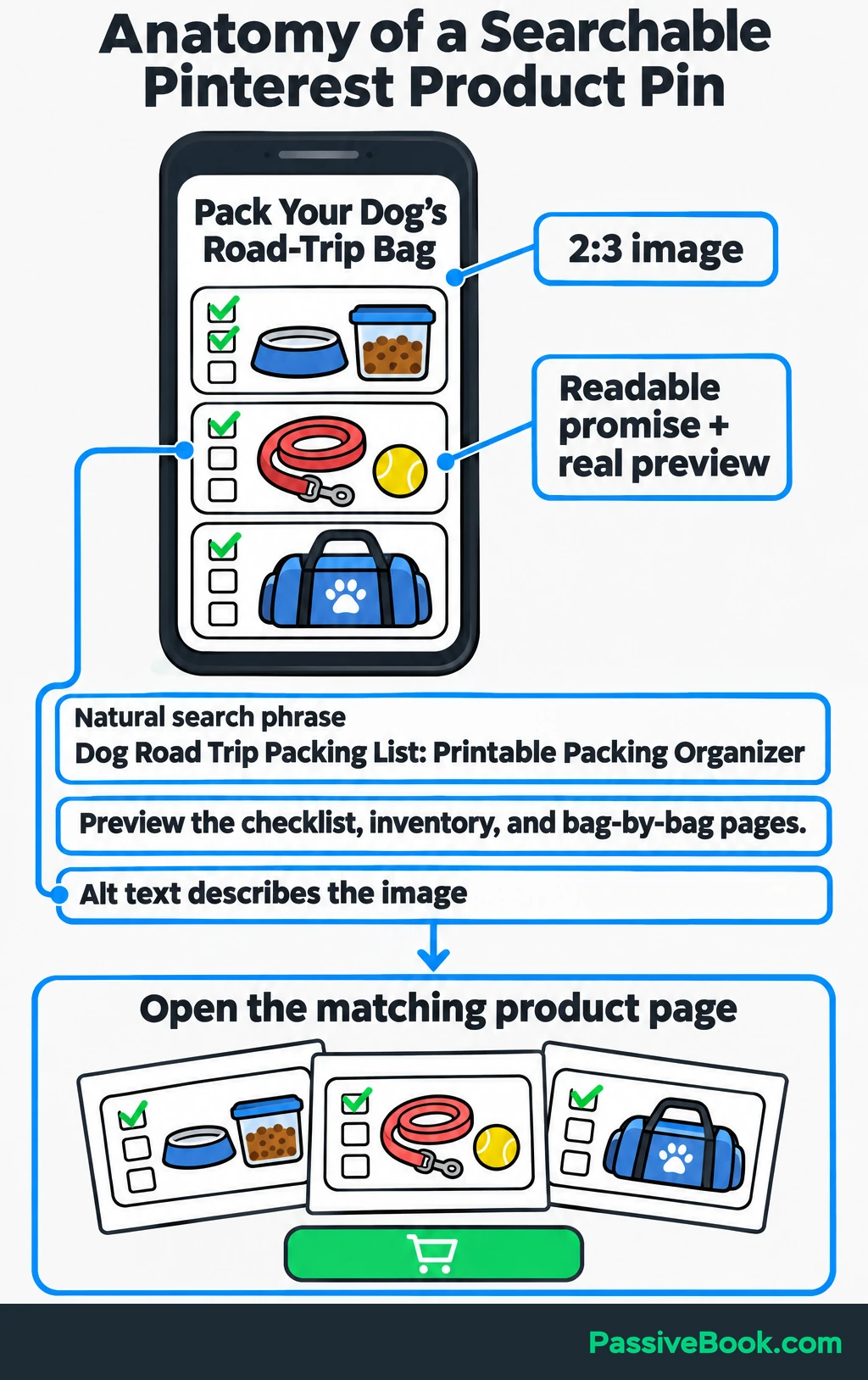
The search phrase belongs in the title and description where it makes sense. Alt text should describe the image.
Create distinct reasons to visit the same page. One Pin can show the checklist, another the reusable inventory, and another the packing sheet. Each gives a different view of the product.
If you know what you’re promoting but keep rewriting the headline, AI Pinterest Studio can give you three different angles to work with. It also drafts the page opening each Pin leads to, so the promise stays consistent after the click.
Free AI Pinterest Studio




Batch research, design, and writing into a routine you can sustain. I would start with Pinterest’s native scheduler before paying for a separate scheduling tool.
There is no universal daily quota that makes this work. Consistency gives you material to test, but it does not guarantee reach or income.
Track Sales and Improve the Weakest Stage
Connect Pins to Completed Purchases
Follow the whole path:
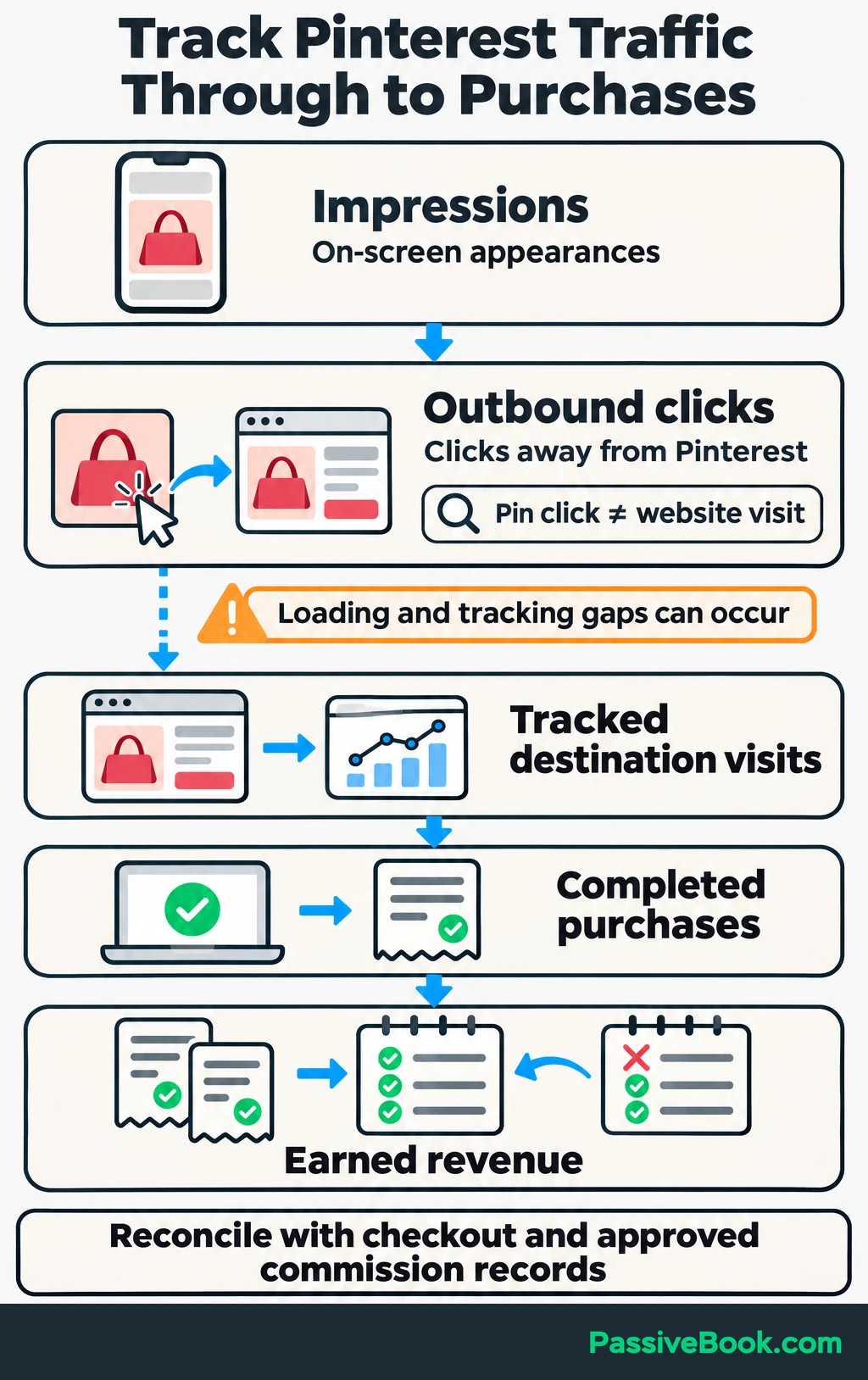
Impressions → outbound clicks → destination visits → purchases → earned revenue.
Pinterest defines impressions as on-screen appearances. Pin clicks open the Pin in closeup, while outbound clicks lead away from Pinterest. Those distinctions matter because a Pin click is not necessarily a website visit. See Pinterest’s metric definitions.
Keep one sheet with these columns:
| Field | What to record |
|---|---|
| Offer and Pin | Product name, Pin link, design label, publication date |
| Reporting period | Start and end dates used for the review |
| Traffic | Outbound clicks and tracked destination visits |
| Purchases | Completed orders attributed to that traffic |
| Revenue | Product receipts or approved affiliate commissions |
| Costs | Fees, refunds, and other relevant costs |
Check sales against checkout records. For affiliate income, use approved commissions and account for reversals.
An outbound click does not always produce a recorded visit. Loading failures and tracking differences can create gaps, so investigate large changes without expecting both tools to match perfectly.
A hosted storefront may provide less detail than your own website. Use the reporting it supports and mark missing information as unknown. Assigning every sale to the most popular Pin would make a tidy spreadsheet and a poor decision.
Estimate Income From Visits and Conversions
For a product, count tracked sales-page visits, the share of those visits that produce a purchase, and the average amount spent per order.
Suppose the organizer receives 500 Pinterest-attributed sales-page visits during a reporting period. Ten purchases are attributed to those visits in that period, so the observed purchase rate is 2%.
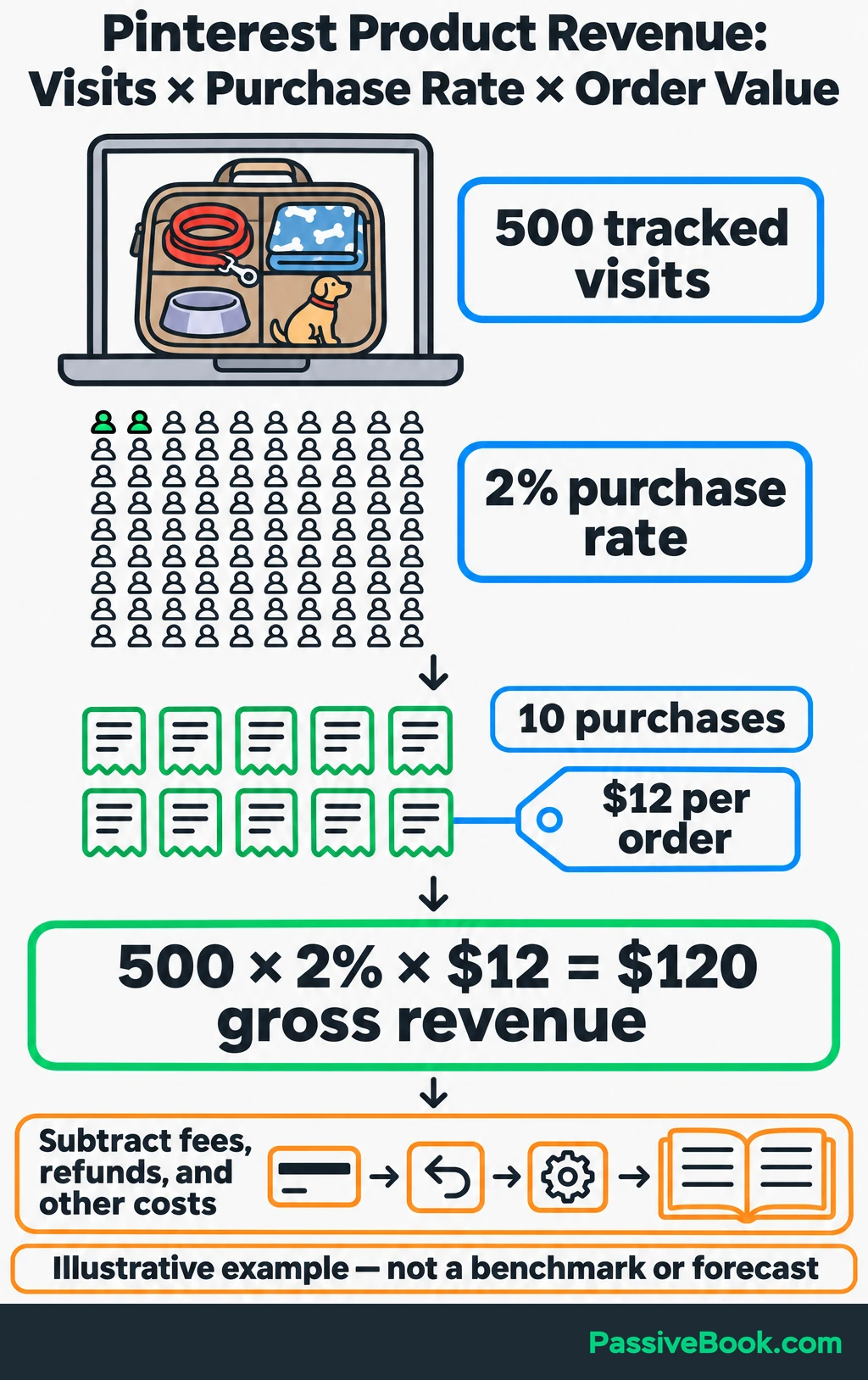
At an illustrative $12 per order:
500 visits × 2% purchase rate × $12 = $120 gross revenue.
Deduct fees, refunds, and other business costs to estimate profit.
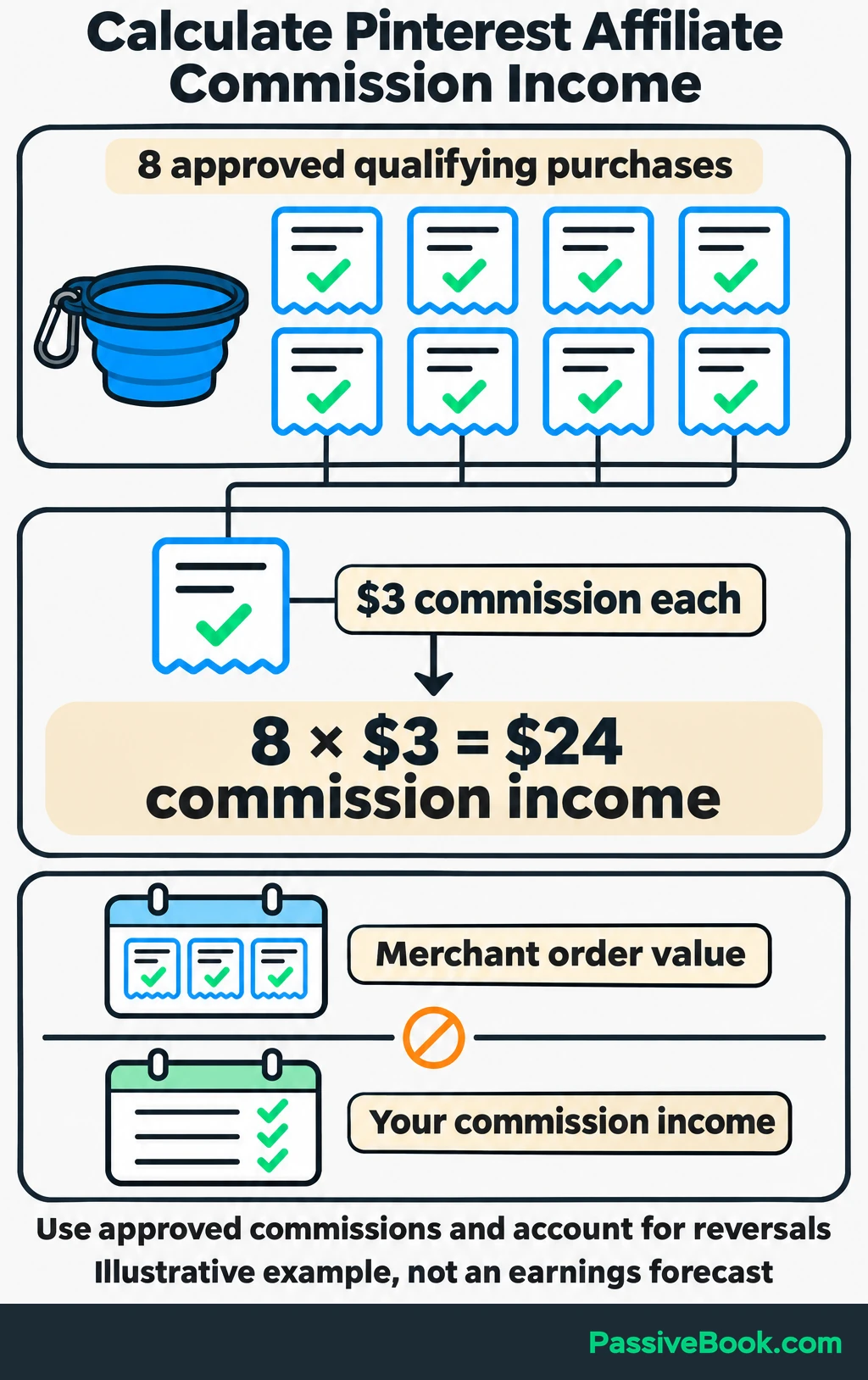
The 2% rate is part of this example. It is not a benchmark or an earnings forecast.
For affiliate income, count qualifying merchant purchases and the commission earned on each. For example, eight approved purchases paying $3 each would produce $24 in commission. That is your income, not the total value of the merchant’s orders.
This is why “How much do a million views pay?” is the wrong calculation for these models. You need to know what people buy after visiting.
Fix the Bottleneck Before Increasing Output
Find where the path weakens, then work on that stage.
| What you observe | What I would check first |
|---|---|
| Little exposure | Search topic, wording, board relevance, and whether the Pin clearly covers that topic |
| Impressions but few outbound clicks | Benefit, readable headline, useful preview, and reason to visit |
| Outbound clicks but few tracked visits | Broken links, slow loading, and tracking setup |
| Visits but few purchases | Offer fit, sample pages, price, delivery details, and mobile checkout |
| Sales but little profit | Fees, refunds, fulfillment costs, and support demands |
For the organizer, visits without sales call for a product-page review before another design session. Buyers may not understand what is included, or the preview may reveal that the product does not solve enough of their problem.
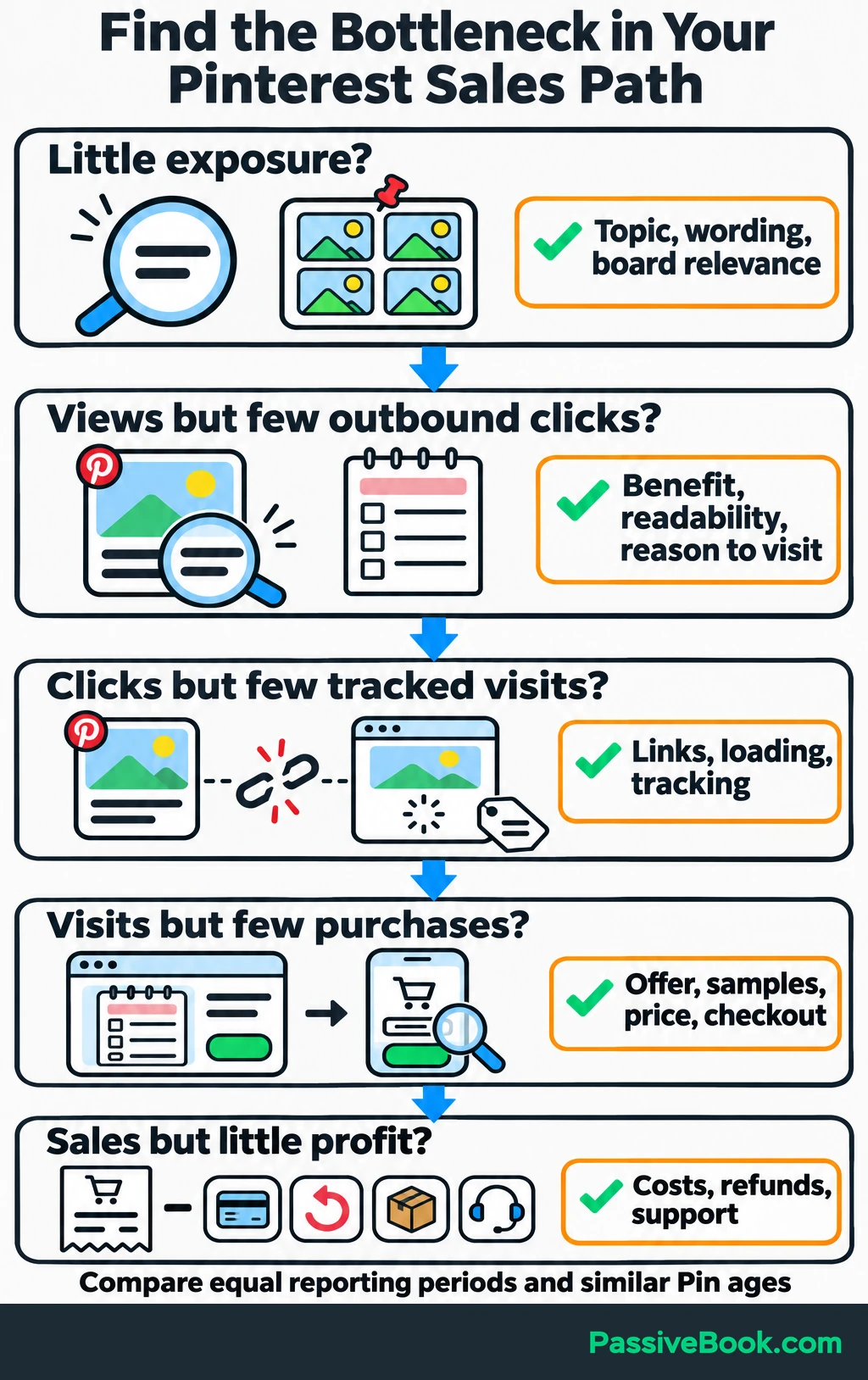
Compare consistent reporting periods and give Pins comparable time to collect activity. A Pin published yesterday has had less opportunity than one published weeks ago.
I would review weekly, but I would not rewrite everything after a handful of visits. Set a test budget and a review date before expanding. Repeat angles that produce purchases or approved commissions, and keep your time in the cost calculation.
Turn Your Content Into Paid Brand Partnerships
Pitch a Campaign That Fits the Brand
A sponsorship needs a clear reason for the brand to pay. “I post on Pinterest” is an activity, not a campaign proposal.
Prepare a compact portfolio with sample Pins, relevant audience information, and recent results over a stated period. Include outbound clicks or relevant conversions alongside reach.
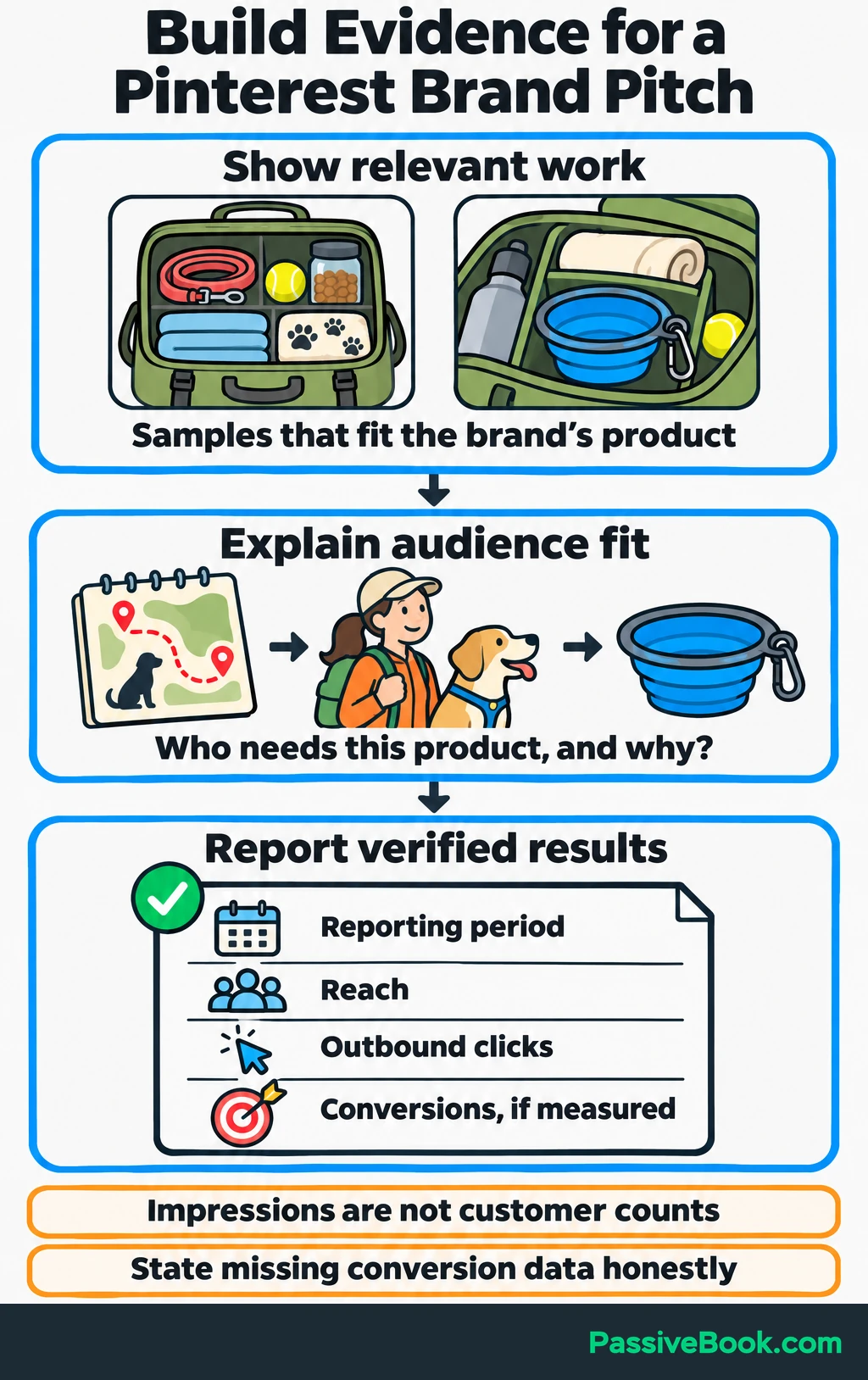
If you have no conversion results, say so and show the work you can produce. Do not rename total impressions “potential customers.”
Approach brands whose products fit content you already create. The dog-travel shop could propose a packing-guide feature and supporting Pins showing how a travel bowl fits into an organized kit.
Here is a complete pitch you can adapt. Replace the brackets with real details and remove anything you cannot support.
Subject: Dog road-trip packing campaign for [Brand]
Hi [Name],
I create packing resources for people taking road trips with their dogs. Your fits a question my content covers: how to organize supplies in a travel bag.
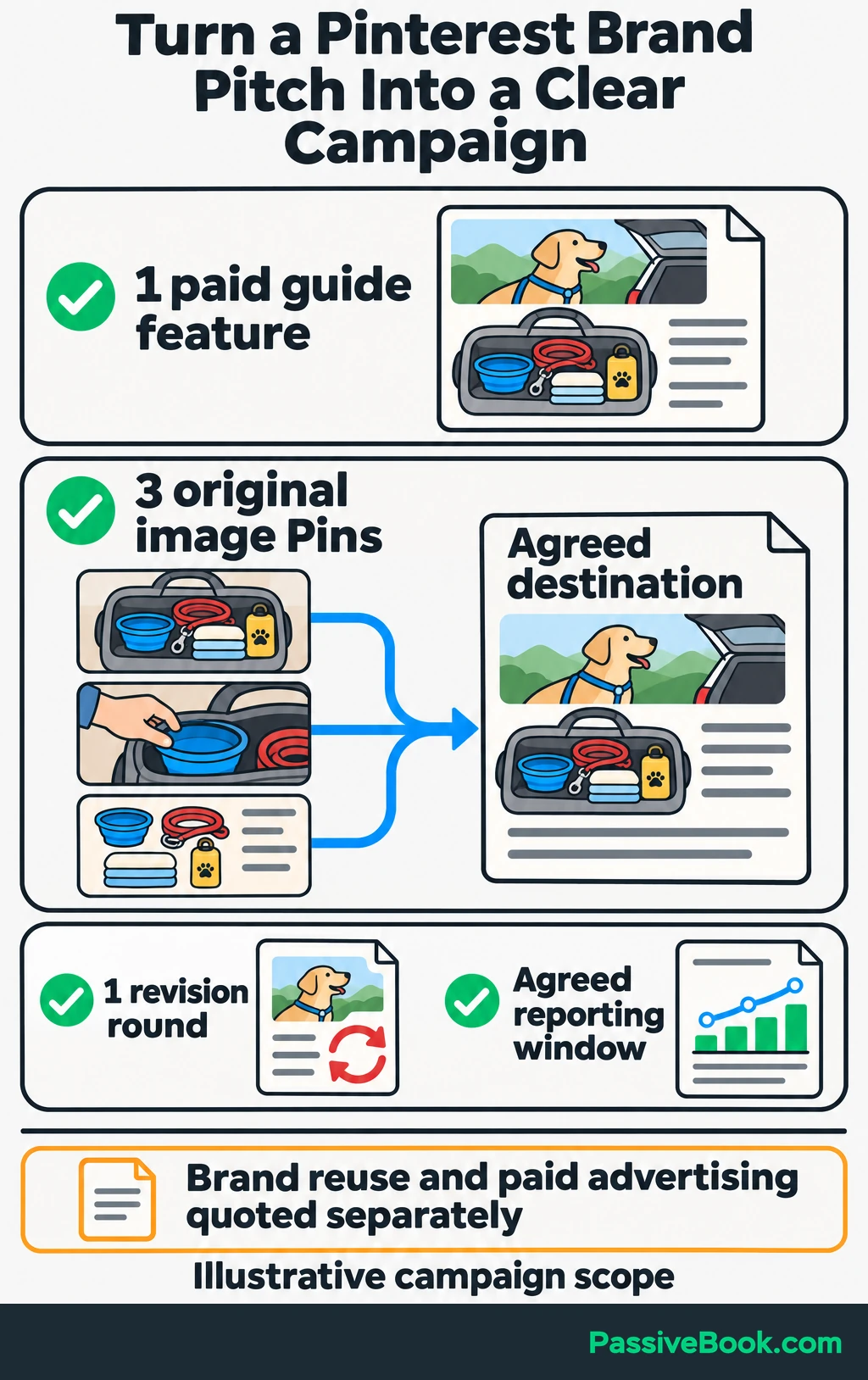
I’d like to propose a paid packing-guide feature and three original Pinterest image Pins showing the product in a packed kit. The Pins would link to [agreed destination].
Here are two relevant content samples: [links]. Over [reporting period], my related content generated [verified results]. I can share the supporting report.
The campaign would include one revision round and a performance report after an agreed reporting window. Brand reuse and paid advertising would be quoted separately.
Are you open to discussing the campaign and budget?
Thanks,
[Name]
[Shop and contact details]
Keep sponsored publication separate from creating assets for a brand’s own channels. They are different jobs.
A cash fee, affiliate commission, and gifted product are also different forms of compensation. A free bowl can be useful, but it does not pay your electricity bill.
Agree on the Work and Deliver the Campaign
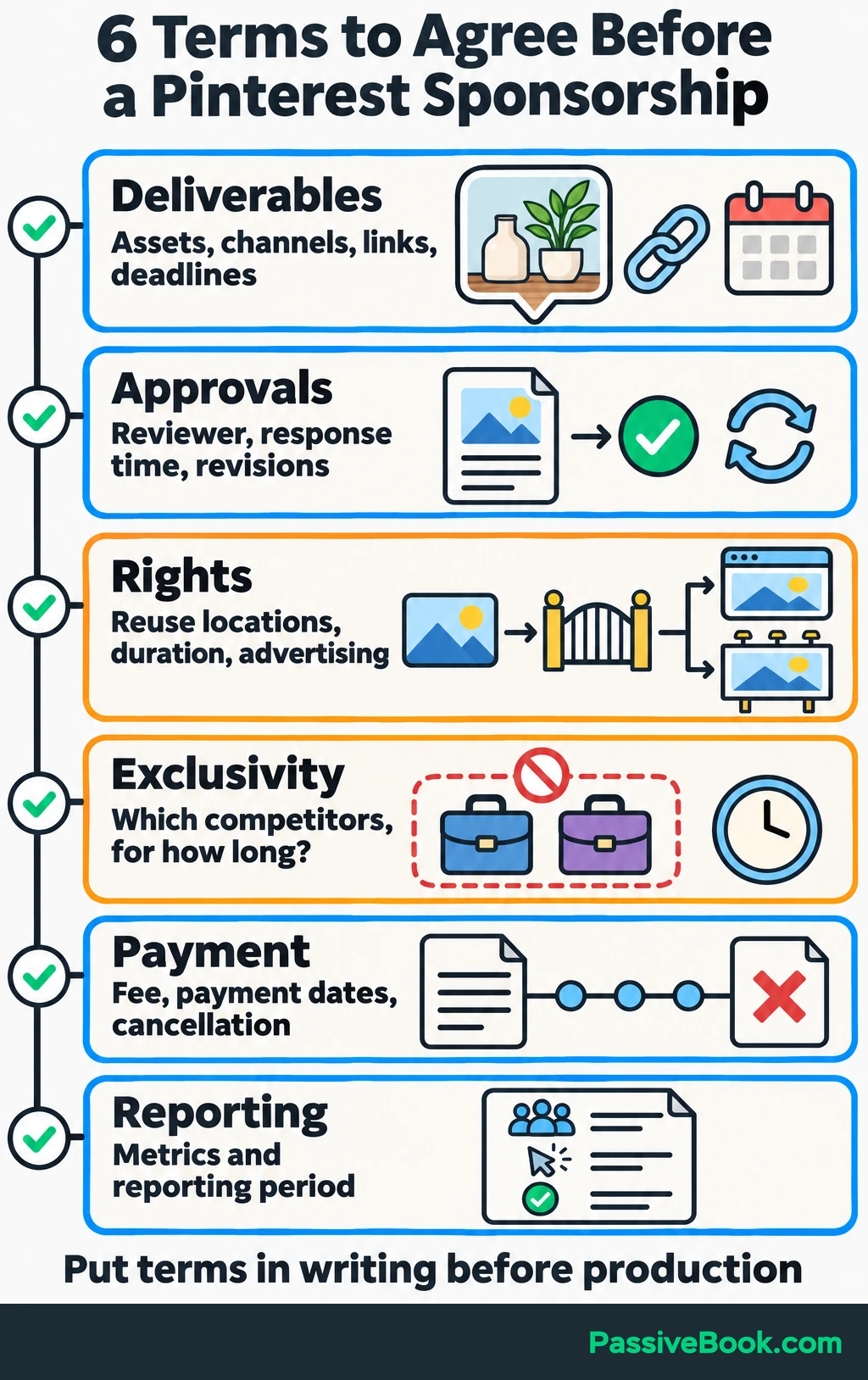
Put the agreement in writing before production begins. It should cover:
- Deliverables: Assets, dimensions, publication channels, destination links, and deadlines.
- Approvals: Who reviews the work, the response deadline, and included revision rounds.
- Rights: Where the brand may reuse the content, for how long, and whether advertising is included.
- Exclusivity: Which competing work you must decline and for how long.
- Payment: Fee, payment dates, and cancellation terms.
- Reporting: Metrics and the period covered by the final report.
Price the requested work and rights. I would not grant unlimited reuse or broad exclusivity as an unnoticed extra.
When creating the sponsored Pin in the Pinterest app, add the paid partnership label and tag the brand. The label can appear before approval, but the brand must approve the tag for its name to appear. Pinterest explains that process in its paid partnership guidance. Payment is arranged directly with the brand.
Disclose paid and gifted relationships clearly beside the endorsement. Use the platform label alongside an adequate disclosure rather than assuming the label alone satisfies applicable rules. The FTC guidance covers both payment and free products.
Deliver what you agreed, report the agreed metrics, and explain what the results suggest. A useful follow-up proposal builds on a specific finding, such as which product demonstration attracted visits. It does not need to pretend every campaign was a triumph.
What Next?
Write down one offer, one search phrase to investigate, and the exact page your first Pin will open. Then test the purchase path on your phone before designing the Pin.
Use the social buttons to share this guide when a Pinterest income discussion needs a clearer connection between publishing and getting paid.
Which part of your path needs the most work: choosing the offer, earning the click, or completing the sale? Tell me in the comments, and bring any other questions too.
Share this post with your friends & followers:

