A publisher wants to feature your podcast, but its offer includes permission to edit episodes and sell ads around them. You want the extra audience. You’re less sure what you would be handing over.
Even adding your show to listening apps raises questions about permissions, ownership and payment. A wider release can also expose gaps in guest permission forms or music licenses that never seemed urgent before. To weigh that extra reach against the rights and work involved, this guide explains what changes when you list a show in listening apps or license episodes to a publisher.
What Is the Difference Between Podcast Licensing and Syndication?
Licensing gives someone permission to use specified content under agreed conditions. Syndication makes that content available through additional outlets.
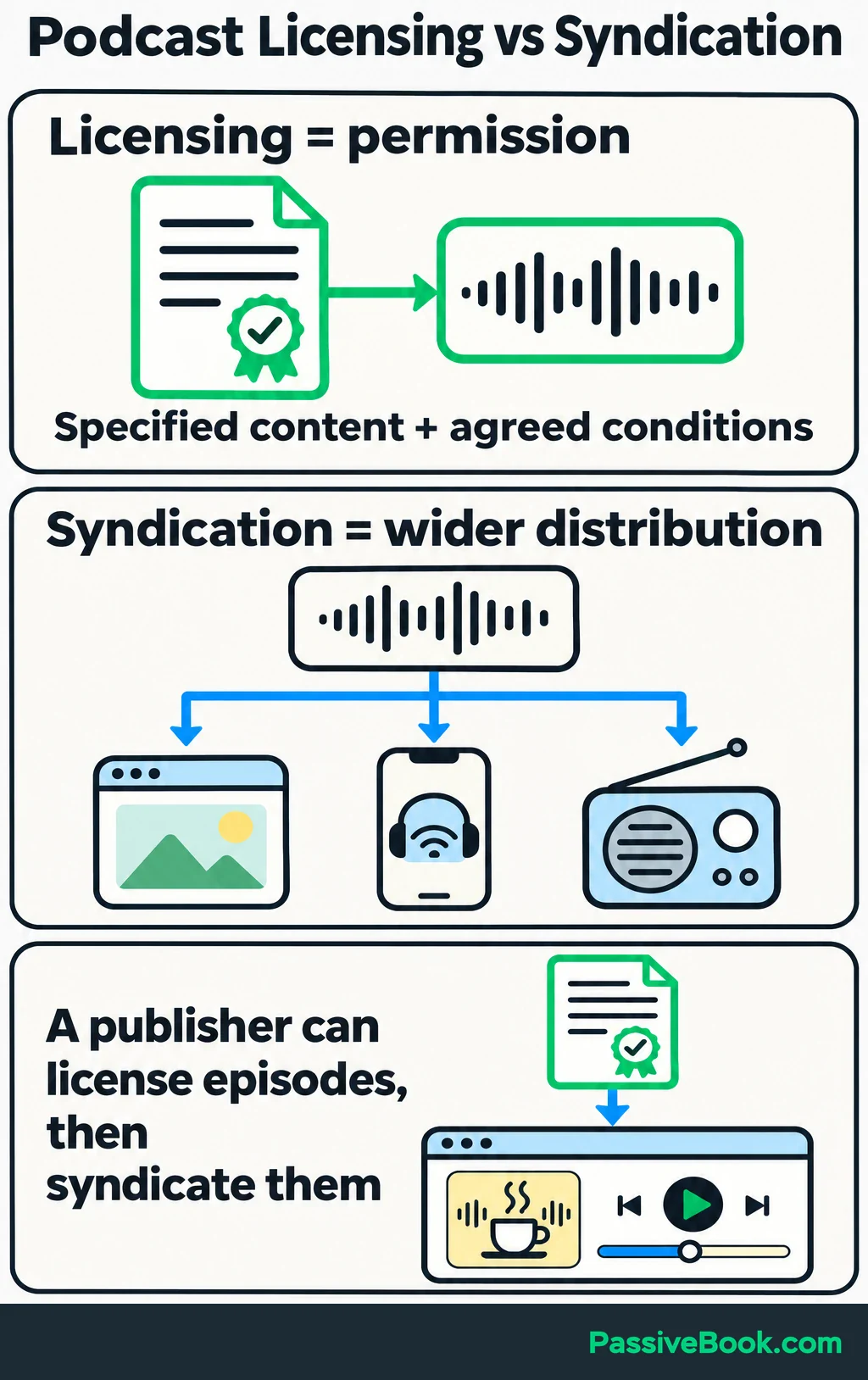
They often work together. A publisher might license three episodes and then syndicate them on its website. But listing your show in a listening app is a different arrangement from delivering files for another company to republish or broadcast.
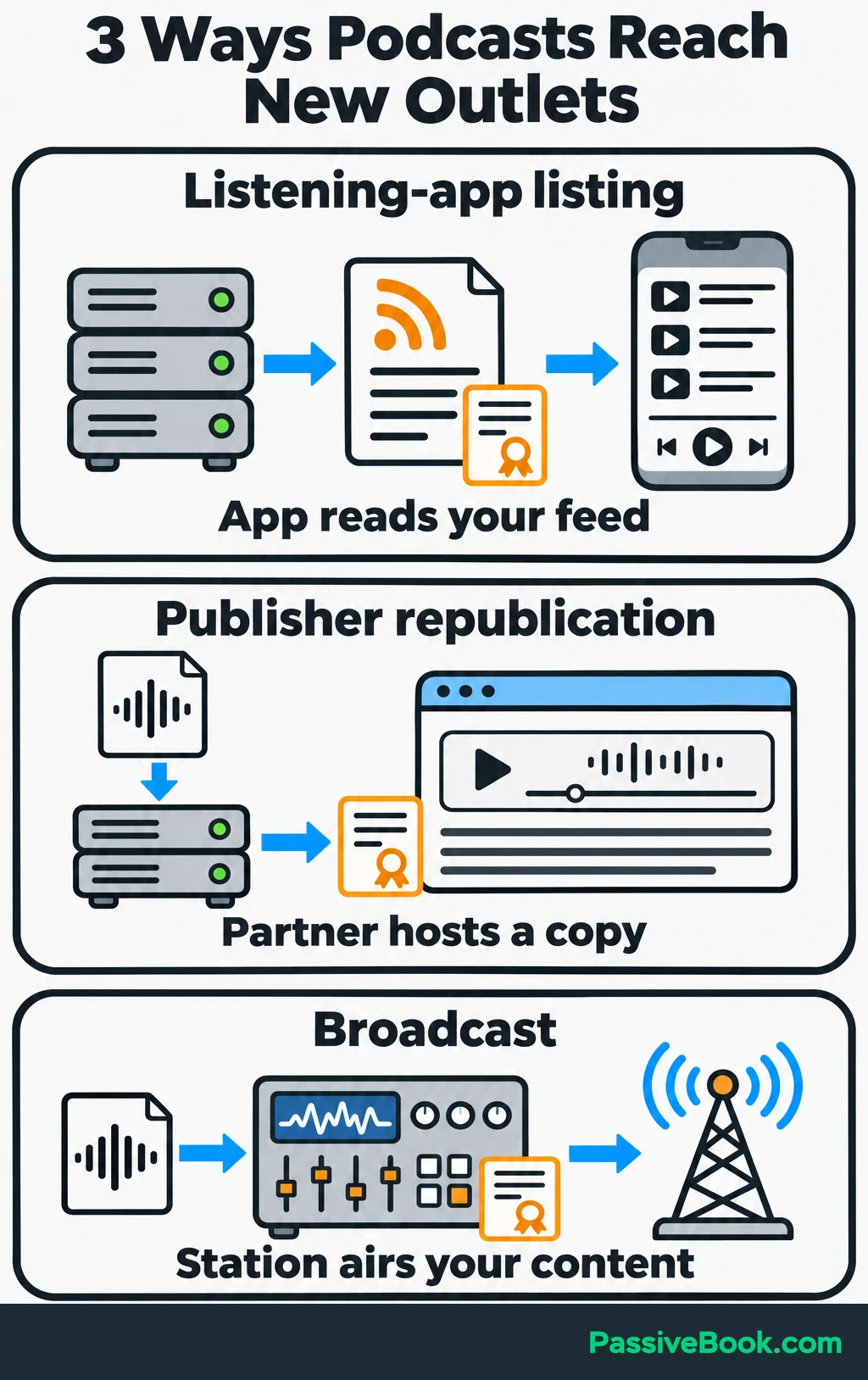
| Arrangement | What Happens | What You Need to Establish |
|---|---|---|
| Listening-app listing | The app reads your RSS feed, a file containing show details and links to episode audio. | Feed access, account control and acceptable platform terms |
| Publisher republication | A partner hosts its own copies of selected episodes. | Permission for those copies, their use, payment and removal |
| Broadcast | A station airs your content. | Permission covering the broadcast, edits, advertising and any later online use |
Syndication does not automatically sell your show. Under U.S. copyright law, a nonexclusive license does not transfer copyright ownership. An exclusive license does transfer ownership of the specified rights, which can be limited by use, territory or time. That is why “exclusive” deserves more attention than the friendly introduction above it. U.S. copyright definitions
Platform submission also grants permissions. Spotify’s creator terms say you retain ownership, but grant Spotify a nonexclusive license covering distribution and other specified uses, including promotion and certain modifications. Ownership and permission are separate questions. Read both parts. Spotify for Creators terms
Throughout this guide, imagine you run Better Home Coffee, a podcast supporting a business that sells printable brew journals. App listings make the show easier to access, while a coffee publisher wants to license selected barista interviews. The offers and figures below are illustrations.
Which Rights Do You Need Before Sharing Your Podcast?
Before submitting episodes or promising them to a partner, match the proposed use against the permissions you hold.
Keep a simple rights register in a spreadsheet. Include columns for the episode or asset, rights holder, permission document, allowed uses, territory, expiry and restrictions. Link each entry to the actual agreement.
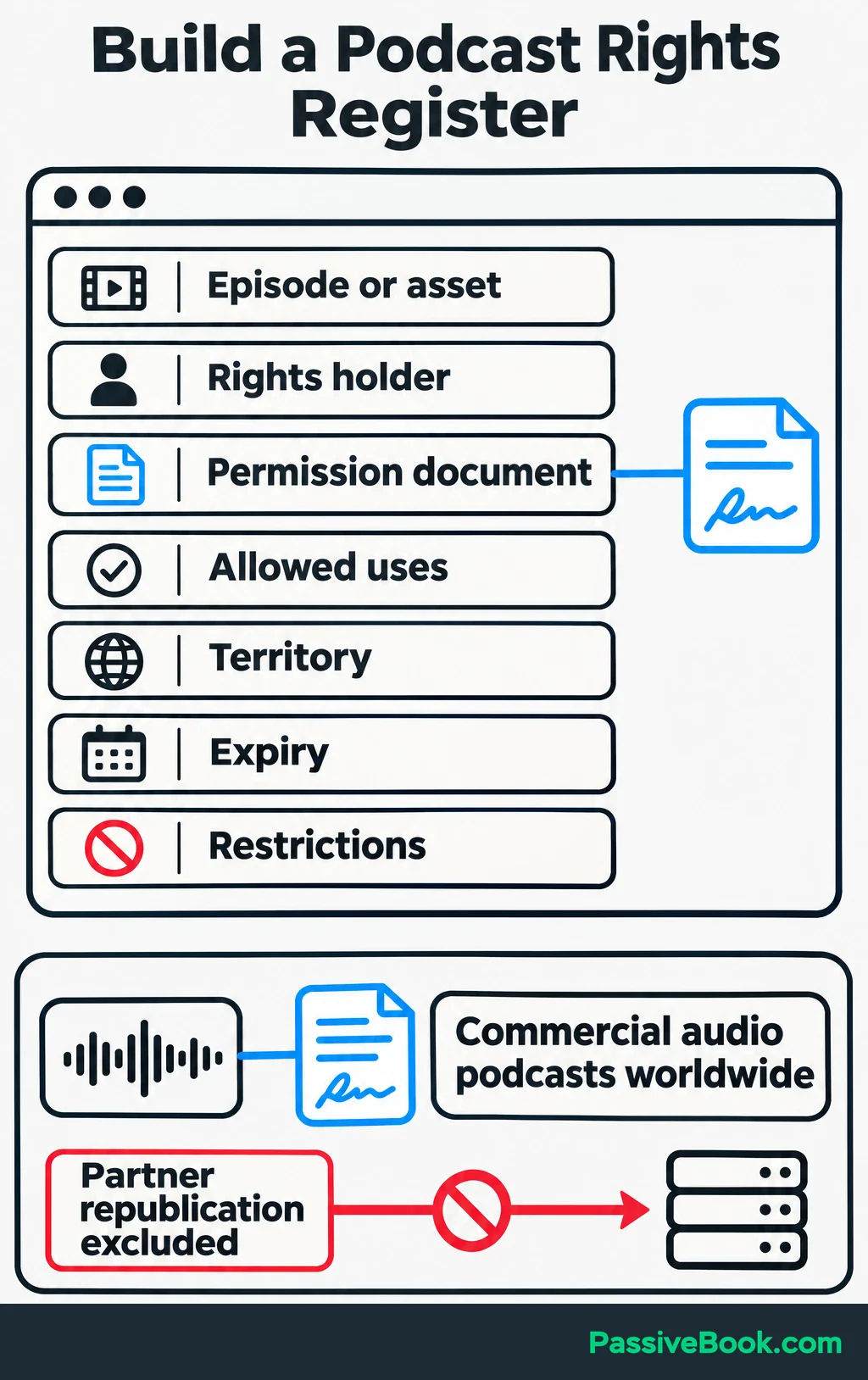
A row saying “music cleared” is not enough. “Intro recording licensed for commercial audio podcasts worldwide; partner republication excluded” tells you what needs fixing before delivery.
The copyright rules below use U.S. law as an example. Ownership, recording consent and contract rules vary by jurisdiction, so check the rules that apply to your contributors and agreement.
Confirm Ownership and Contributor Permissions
Start with the recording, script, artwork and any other material included in the delivery. Establish who controls each part and who can authorize reuse.
For co-hosts and collaborators, agree on:
- Authority: Who can negotiate and approve a license?
- Proceeds: How will payments and related expenses be divided?
- Restrictions: Do employer, network or sponsor agreements limit redistribution?
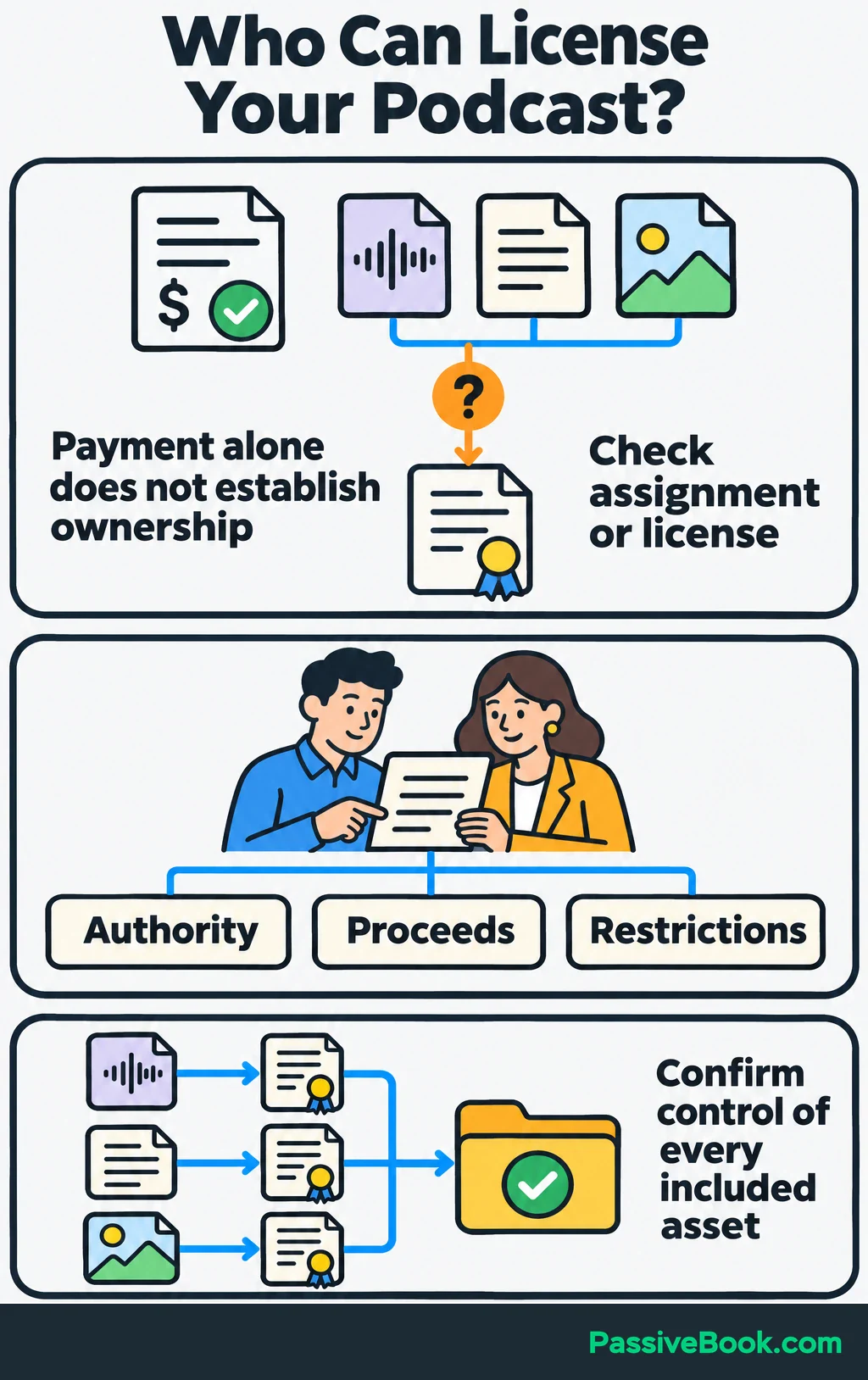
Paying a contractor does not automatically make you the copyright owner. In the U.S., work-for-hire status depends on specific employment or commissioning conditions. Obtain an assignment or a license that covers the uses you need rather than relying on an invoice marked “paid.” Copyright Office work-for-hire guidance
I ran into a smaller version of this while preparing a digital-product bundle for reuse. I had the finished files, but the designer’s usage terms were buried in an old message thread. Finding the files was easy. Establishing what I could do with them took longer. I now keep the permission beside the asset.
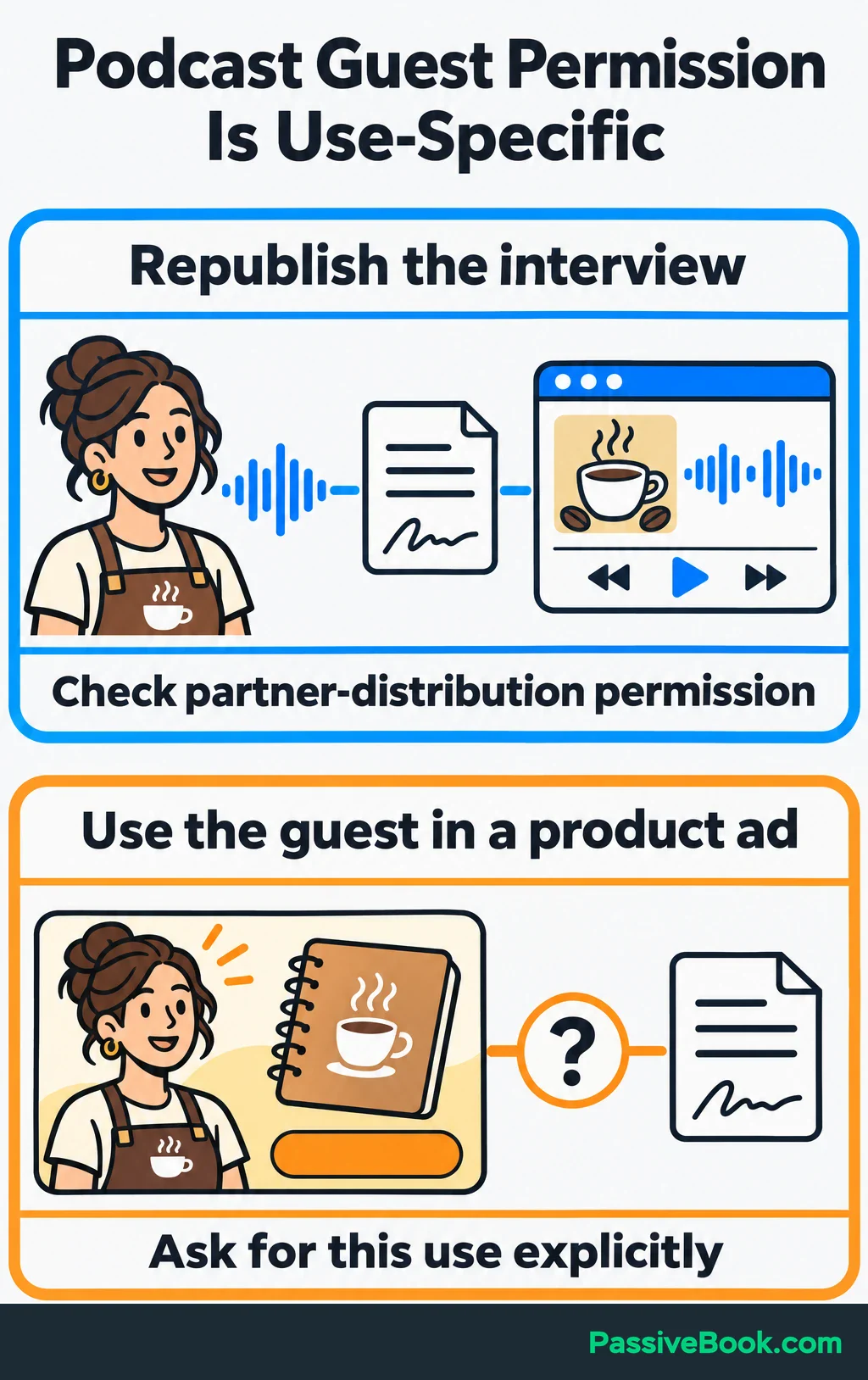
For podcast guests, document permission to record, edit, publish, make promotional excerpts and distribute through partners. Get this settled before recording and follow the applicable recording-consent rules. Check older releases again before including archive interviews in a new deal.
For Better Home Coffee, permission to republish a barista’s interview is different from permission to place their face and quote in an advertisement for your brew journals. Ask for the intended use explicitly rather than treating an interview appearance as a product endorsement.
Clear Music and Other Third-party Material
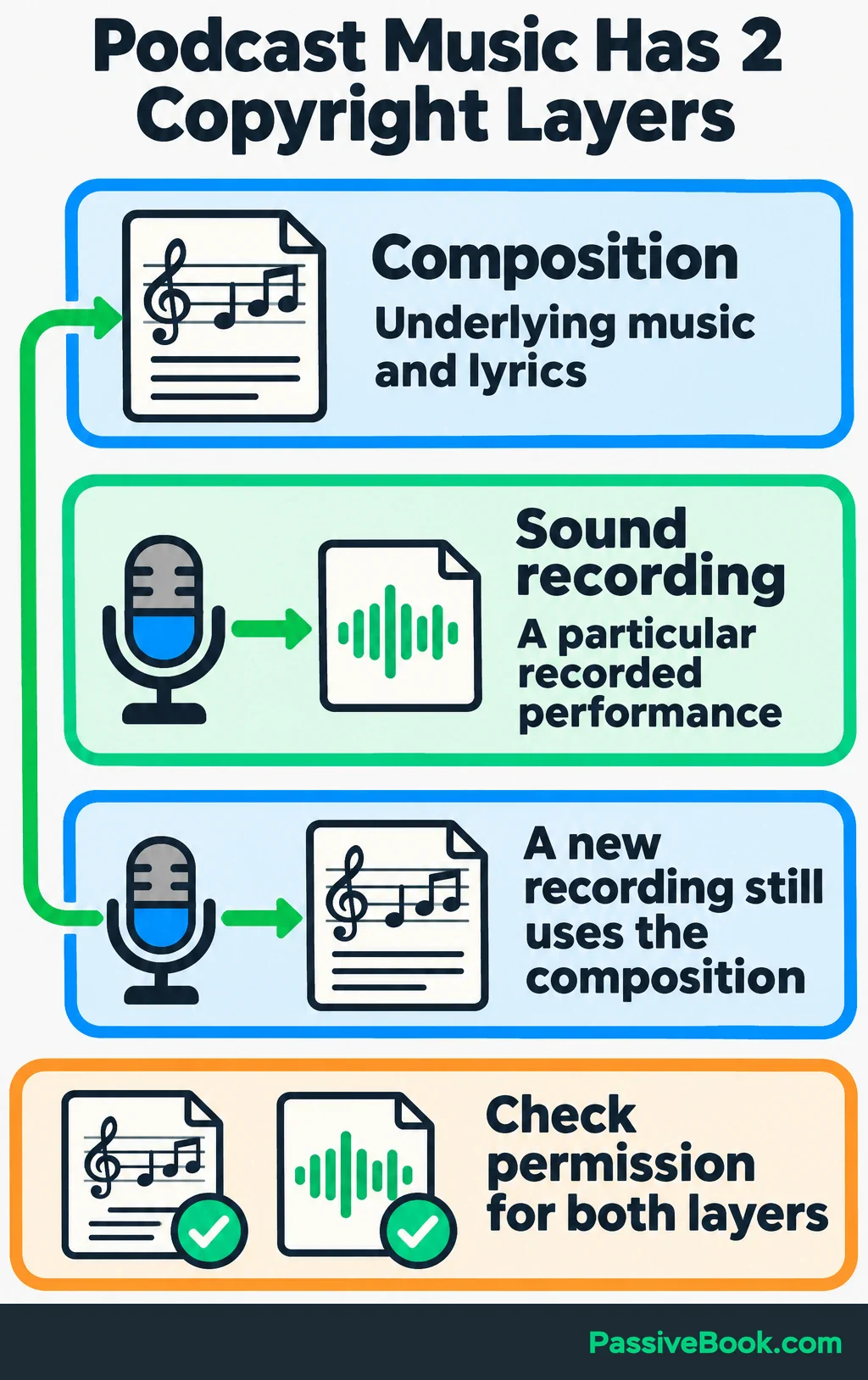
Music has two separate copyright layers: the composition—the underlying music and any lyrics—and the particular sound recording. Permission covering one does not establish permission for the other. A newly recorded version of a song still contains the underlying composition. Copyright Office explanation of music copyrights
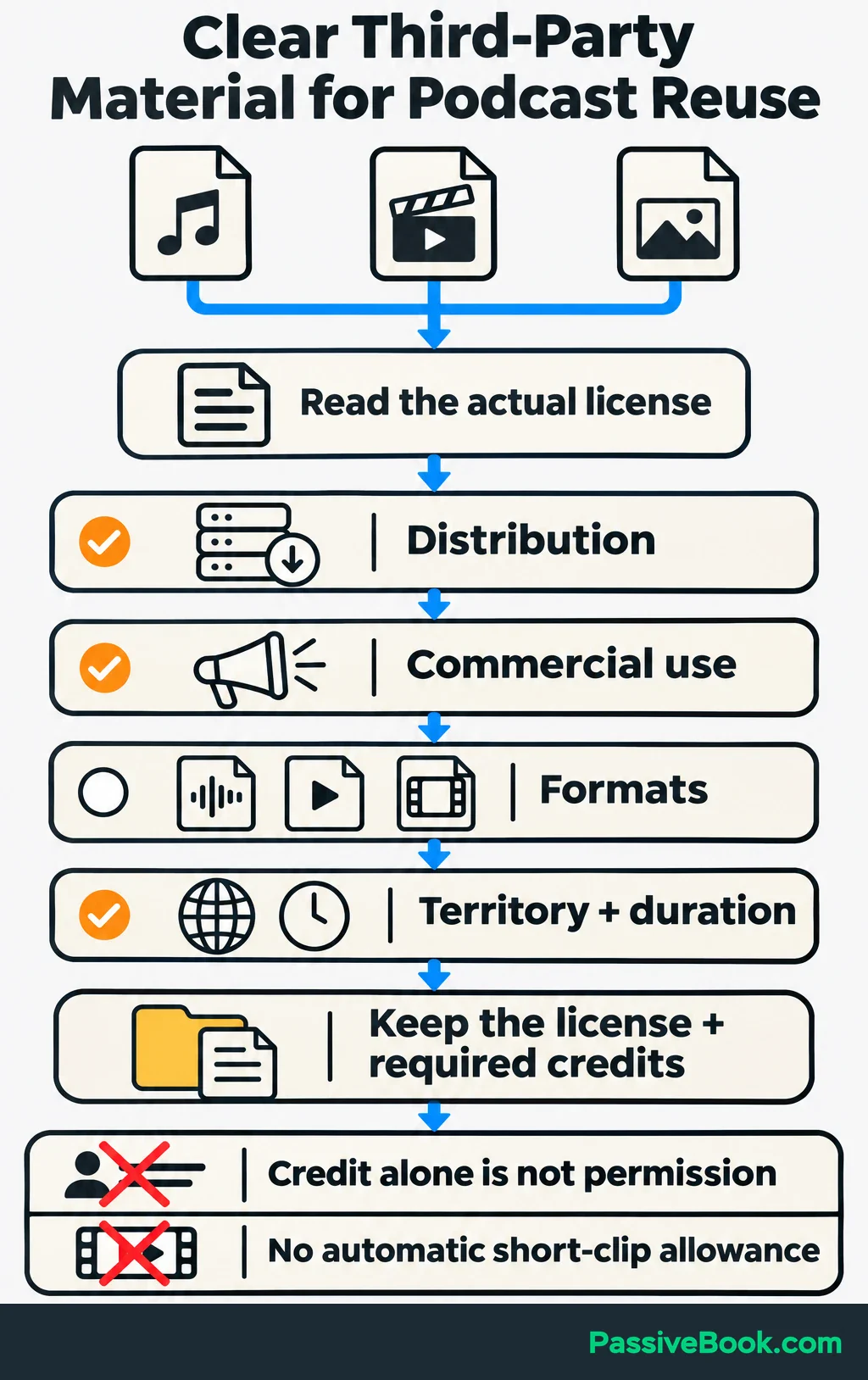
Check whether each license covers your planned:
- Distribution: Streams, downloads and separately hosted partner copies
- Commercial use: Advertising, sponsorship and other monetization
- Formats: Audio episodes, video versions and promotional clips
- Reach: The territories and duration of the proposed release
Apply the same check to borrowed clips, photographs and illustrations.
“Royalty-free” does not answer all these questions. Read the actual license and retain a copy. Creative Commons licenses also differ: some restrict commercial use, and others restrict sharing adaptations or impose additional conditions. Supply any required credits with the delivered files. Creative Commons license conditions
For the coffee show, an intro track licensed only for your own podcast may need replacing before the publisher can host an episode. I would replace it if broader permission costs more time or money than the track is worth.
Credit alone does not create permission. Nor does keeping a clip under a certain number of seconds. U.S. fair use depends on the circumstances, including purpose, amount used and market effect; there is no automatic “short clip” allowance. Copyright Office fair-use guidance
How Do You Syndicate a Podcast Through an RSS Feed?
RSS distribution lets you publish from one source and make episodes available across listening apps. You generally submit the feed once to each destination, then publish later episodes through your host.
That removes repeated uploading, but you still need to check that each listing works.
Prepare a Working Feed
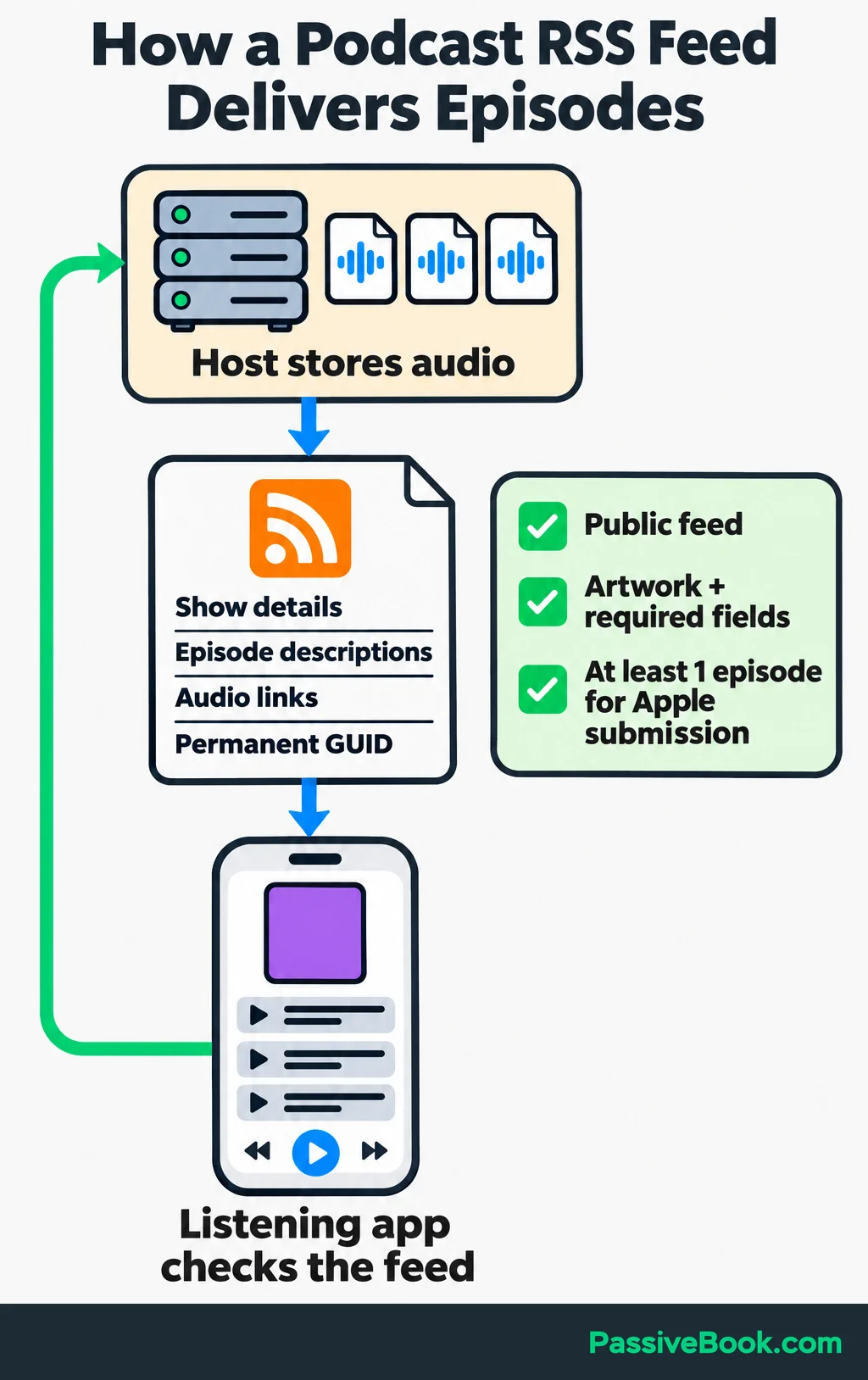
A podcast host stores your audio and supplies an RSS feed. The feed contains your show details, episode descriptions and links to the media files. Listening apps check it for episodes and updates.
Choose a host that lets you export your episodes and redirect your feed when you move, and provides useful analytics. I would prioritize those basics over a long list of production extras.
Before submitting, prepare:
- Show information: A clear title, description, language and category
- Artwork: A readable cover that meets destination requirements
- Episodes: Playable audio, accurate descriptions and correct content labels
- Contact details: An email address you monitor
- Validation: A feed check that identifies missing or invalid fields
Apple requires a publicly accessible feed, required information, artwork and at least one episode. Each episode also needs a valid media-file entry and a permanent identifier, called a GUID, that does not change. Your host should generate these correctly. Apple’s RSS feed requirements
Having one episode can satisfy that particular submission requirement. It does not establish eligibility for a publisher’s licensing offer or a platform’s monetization program.
Submit or Claim the Show on Each Destination
Search each destination before creating a listing. Your show may already appear there, and claiming an existing listing avoids creating a duplicate.
The usual process is straightforward:
- Copy the RSS feed address from your host.
- Submit it through the destination’s creator account, or claim the existing show.
- Complete the requested ownership verification.
- Review the imported artwork, descriptions and episode details.
- Submit for review where required, then record the live listing URL.
Check which submissions your host handles. “Distribution included” should lead to a list of actual destinations, not an assumption that your show is everywhere.
For Apple Podcasts, you can submit an externally hosted RSS feed through Apple Podcasts Connect. The show goes through technical validation and content review. A paid subscription is optional and separate from ordinary RSS submission.
Spotify-hosted shows appear on Spotify automatically, but you still submit them to other services yourself. If you host elsewhere, submit or claim the show through Spotify’s creator process.
For Better Home Coffee, these listings make the existing show available in more places. They do not create the separate agreement the coffee publisher needs to host its own interview copies.
Check Publication and Maintain Distribution
Open each live listing and play an episode. Check the artwork, episode order, descriptions, credits and links.
After that, publish through your host and confirm that new episodes appear. Keep a small distribution sheet with the destination, listing URL, account owner and any unresolved issue.
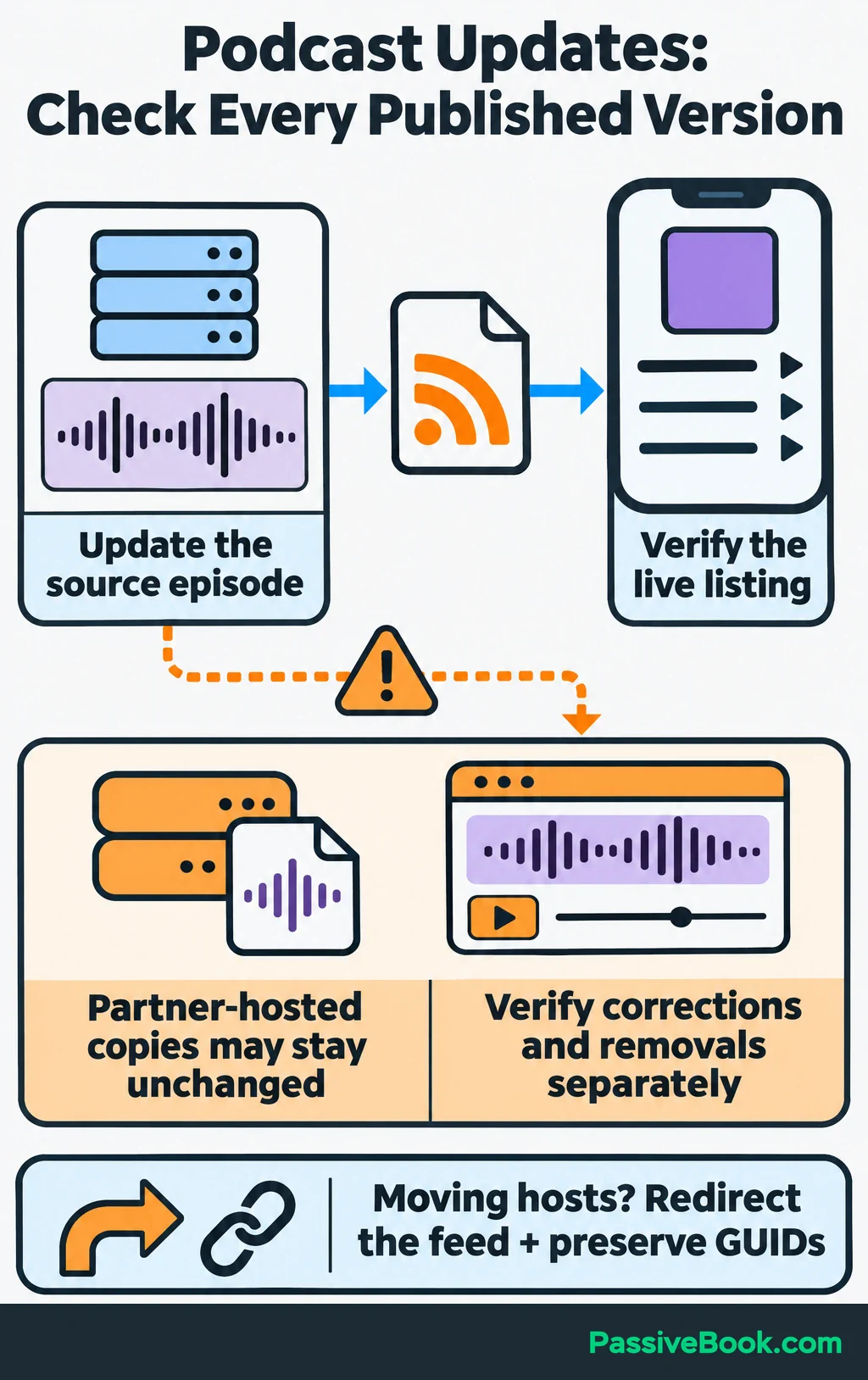
Corrections and removals need their own check. A partner’s downloaded copy may remain unchanged after you update the source episode. Verify every separately published version rather than assuming the feed update reached it.
Keep administrative control of your hosting and destination accounts. Before moving hosts, arrange a feed redirect and preserve episode identifiers. This helps existing listings and subscriptions follow the move.
I would also keep local copies of the audio, artwork and descriptions. An account login is a poor substitute for a backup.
How Does a Podcast Licensing Deal Work?
A licensing deal begins with a specific proposed use. You then check that you can authorize it, agree on the terms and deliver only the approved material.
You do not need a large network to have this conversation. You need content a partner wants and a clear account of what they may do with it.
Identify the Content and Intended Use
Approach partners whose audiences have a reason to care about your episodes. Explain what is available, who it serves and how you propose they use it.
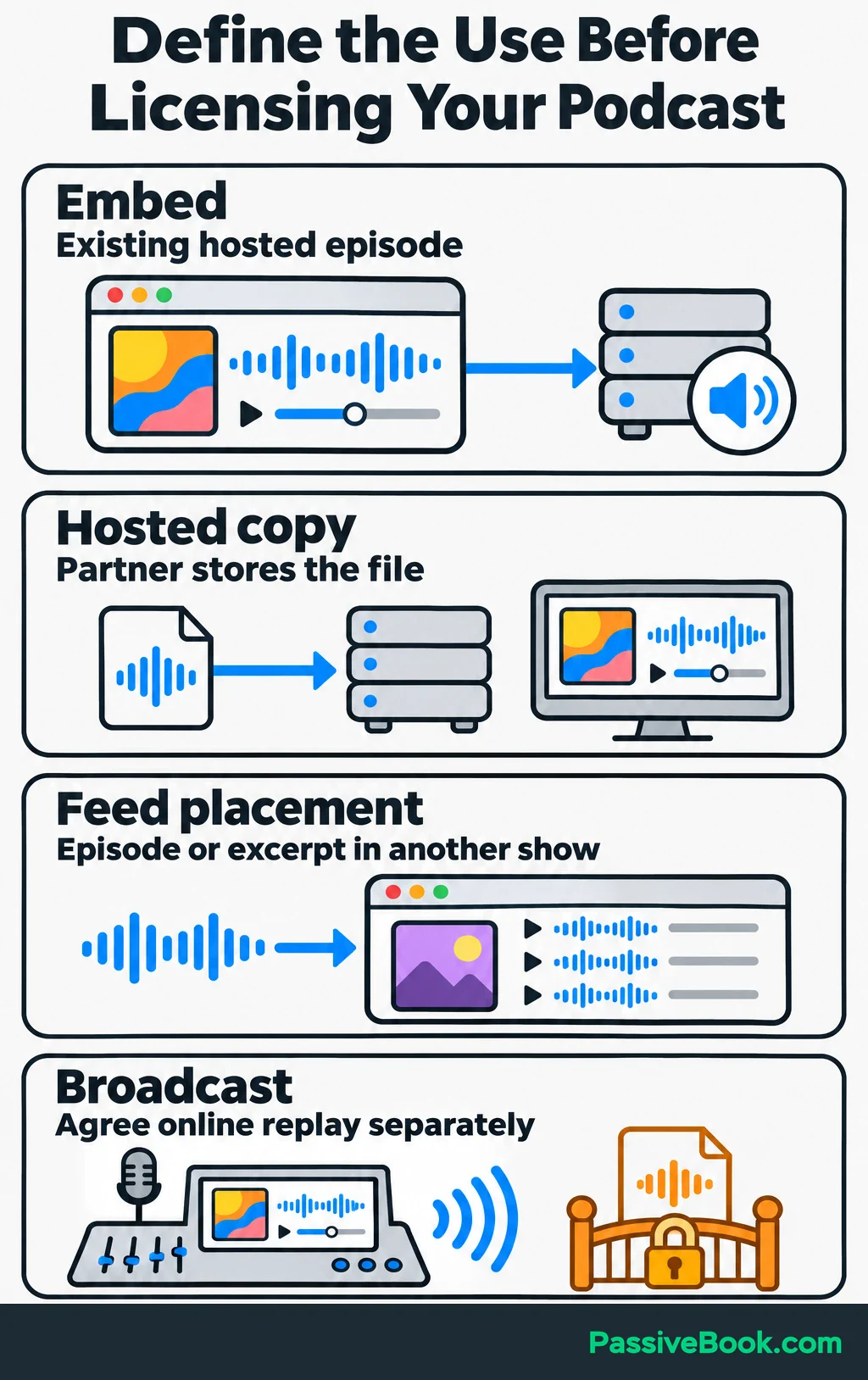
Before discussing payment, establish whether the partner wants:
- An embed: A player on its website using the existing hosted episode
- A hosted copy: An audio file stored and published by the partner
- A feed placement: An episode or excerpt inside another podcast
- A broadcast: Permission to air the content, with any online replay agreed separately
These uses create different delivery and permission needs.
For Better Home Coffee, you could approach a coffee publisher about three barista interviews on dialing in espresso, choosing a grinder and recording brew results. Name the episodes rather than offering “access to the archive.”
Once you have specific episodes and a publisher in mind, put the proposed use into a short first message. Keep it a proposal, not a promise that every permission is cleared.
Free AI Partnership Writer




Then ask how the publisher plans to present and monetize them. A free article with an embedded player is a different proposal from a paid audio collection containing edited interviews.
Do this before promising delivery. You can then check guest releases, music permissions and sponsor commitments against a real request.
Define the Rights and Exclusivity
Write down the exact boundaries of the license. For the coffee publisher, a manageable first offer could look like this:
| Term | Proposed Scope |
|---|---|
| Content | Three barista interviews on dialing in espresso, choosing a grinder and recording brew results; exact titles and episode numbers still to be added |
| Outlet | The coffee publisher’s website; domain still to be specified |
| Format | Approved English-language audio files and accompanying descriptions |
| Territory | Worldwide website access, subject to the underlying permissions |
| Duration | Six months from the agreed publication date |
| Exclusivity | Nonexclusive; the original episodes remain in your feed |
| Editing | Technical adjustments allowed; substantive edits require approval |
| Promotion | Approved short excerpts promoting the licensed interviews |
| Attribution | Better Home Coffee, required contributor and music credits, and a link to each original episode page |
| Further licensing | No permission to license the files to other publishers |
| Excluded assets | Future episodes, feed ownership, accounts and product-advertising rights |
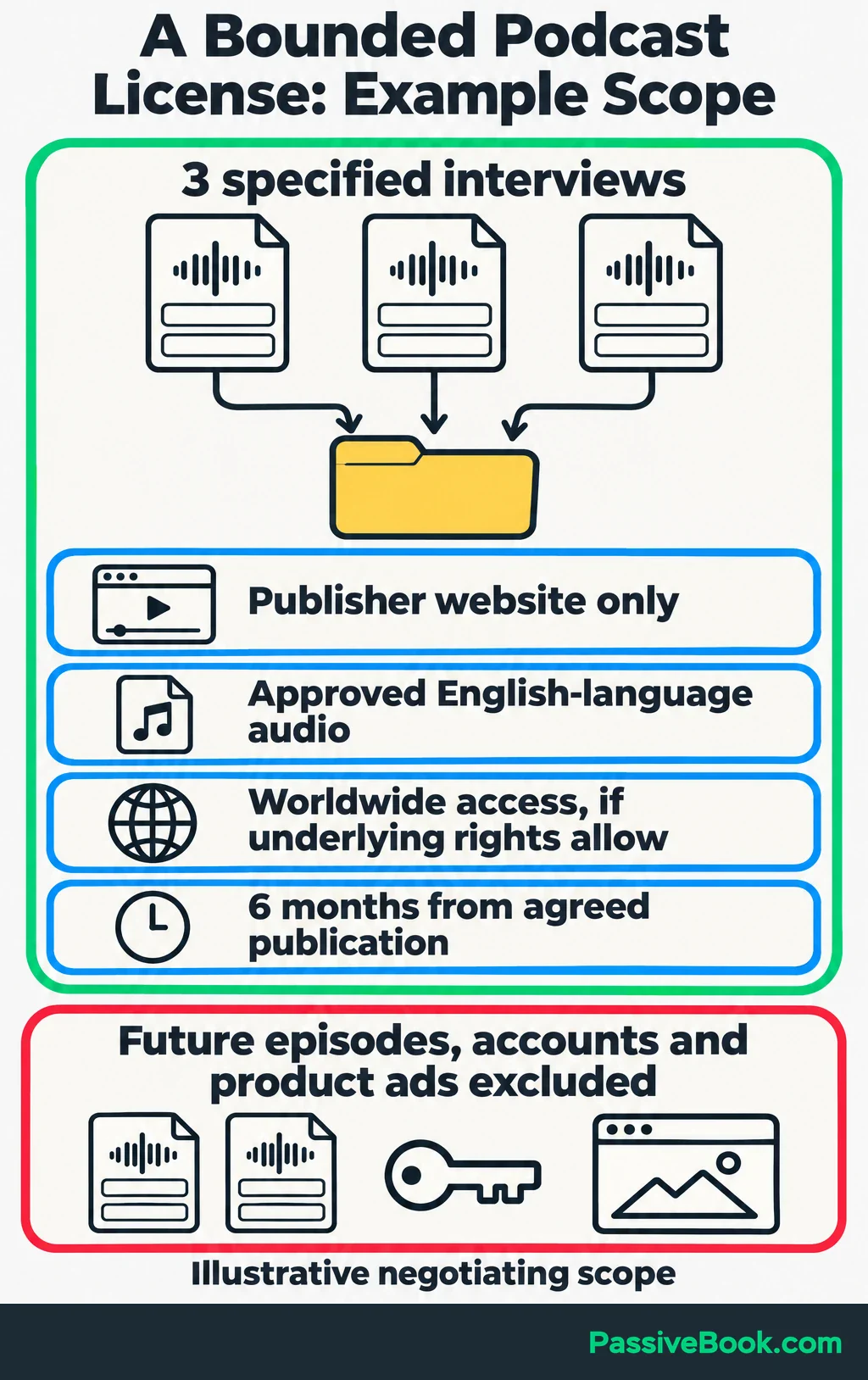
This is a negotiating outline, not a complete contract. It makes the intended exchange concrete enough to review.
If the partner asks for exclusivity, define exactly what becomes exclusive. Does it cover website republication, all audio distribution, one territory or a particular language? Can the episodes stay in your feed, and can existing sponsors remain?
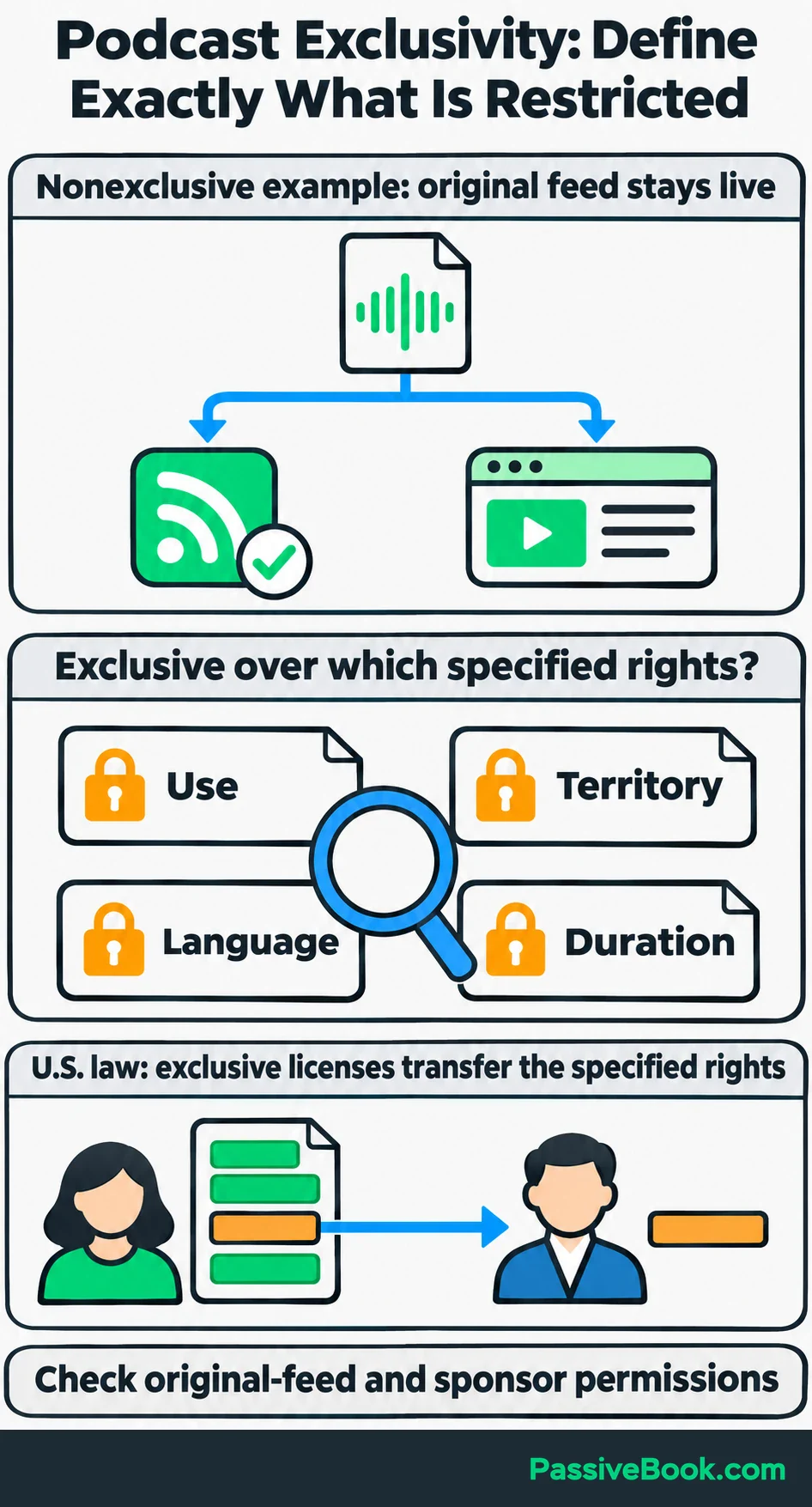
I would start with a short, nonexclusive arrangement. A partner asking to block other opportunities should offer enough value to justify that restriction.
Put the final agreement in writing. Under U.S. law, transfers of copyright ownership, including exclusive licenses, generally require a written document signed by the owner or authorized agent. U.S. written-transfer requirement
Agree on Payment, Delivery and Exit Terms
Payment can take several forms:
- Fixed fee: An agreed amount for the specified rights
- Revenue share: A percentage of the revenue defined in the contract
- Minimum guarantee: A payment floor under agreed conditions, sometimes combined with a share
An advance may be recouped from later earnings. Establish whether later royalties first repay that advance before you receive additional money.
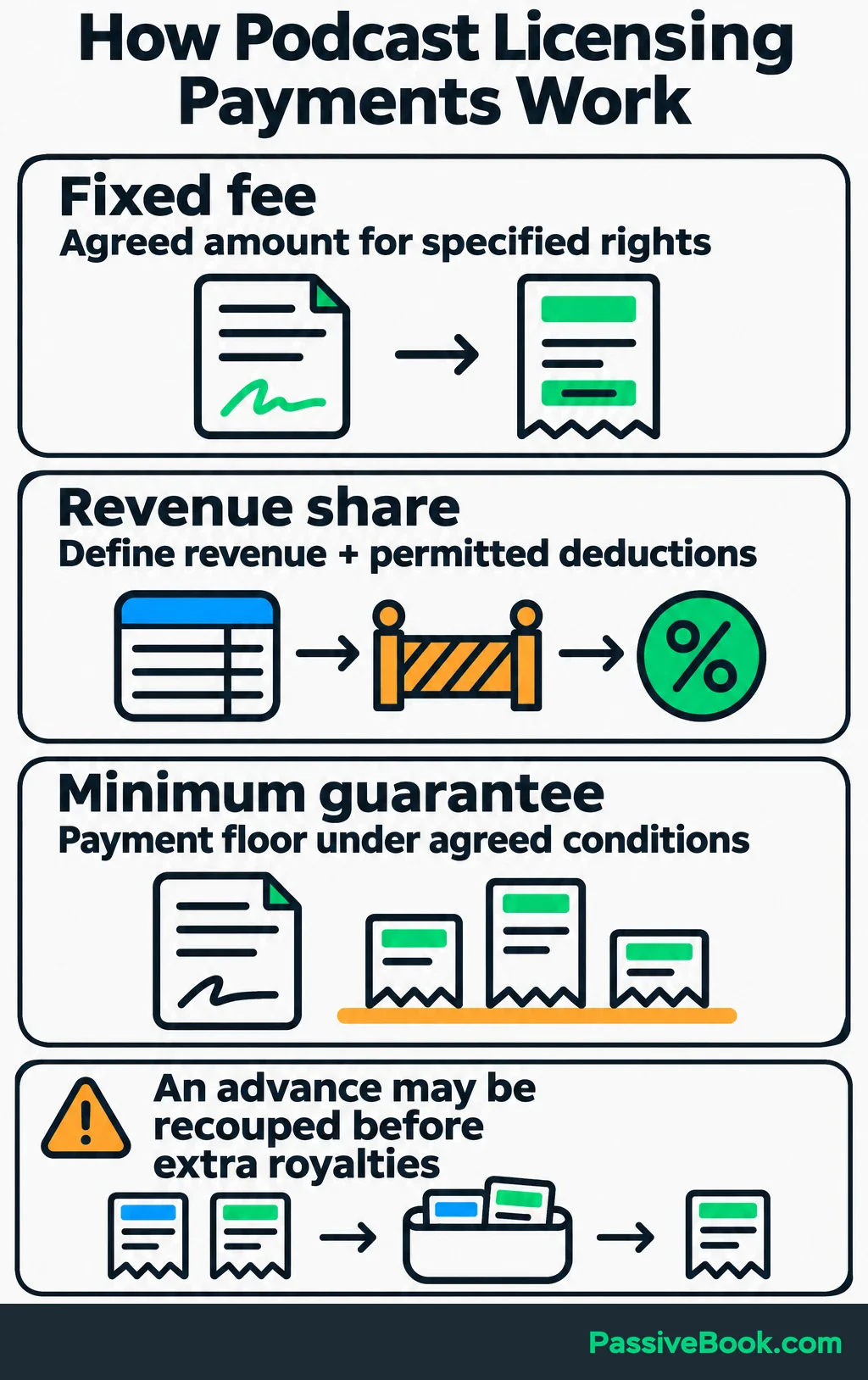
For a revenue share, define what counts as revenue and which deductions come first. Also settle payment dates, reporting frequency and access to supporting records. “A generous share of net revenue” is not useful until “net” has a definition.
Agree who controls advertising slots. If the coffee publisher wants clean audio, decide whether existing sponsor messages can be removed and who produces that version.
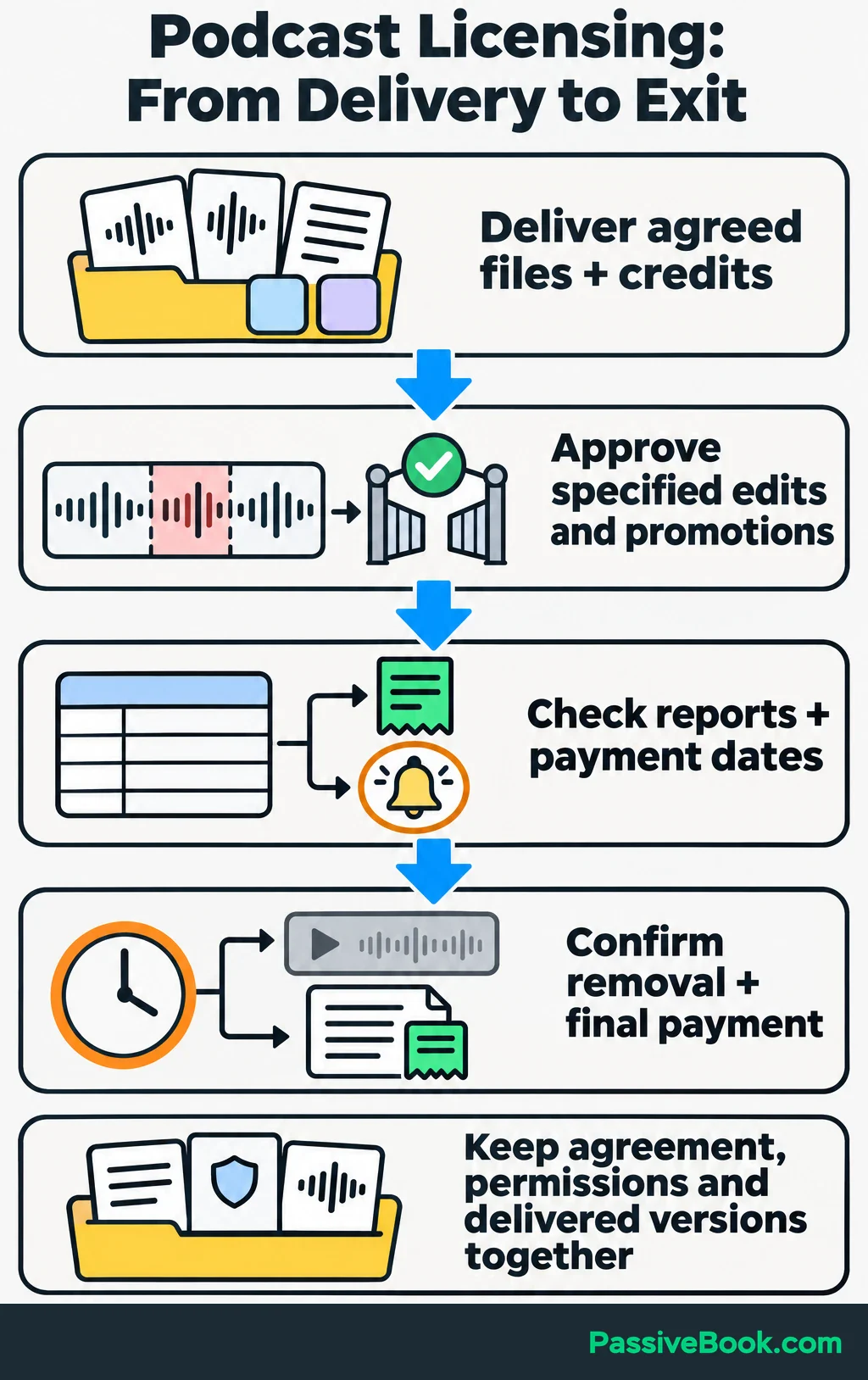
The agreement should also cover:
- Delivery: File formats, versions, deadlines and accompanying credits
- Approvals: Which edits, headlines and promotional uses need your consent
- Problems: Who handles corrections, complaints and removal requests
- Exit: Renewal, termination, removal deadlines and any permitted use afterward
- Final payment: When outstanding fees or revenue shares become due
Get focused legal review when the deal includes broad exclusivity, ownership transfers, perpetual rights or substantial liability obligations. Give the reviewer your proposed use and your main concerns so the review answers a business decision.
After signing, store the agreement, supporting permissions and delivered versions together. Add reminders for reports, payments and expiry.
Is a Licensing or Syndication Deal Worthwhile?
Additional availability creates an opportunity to reach listeners. It does not itself create a payment.
Keep licensing receipts separate from advertising income, subscriptions and sales of your own products. For Better Home Coffee, a publisher might pay for interviews while new listeners separately buy brew journals. Those are two different returns.
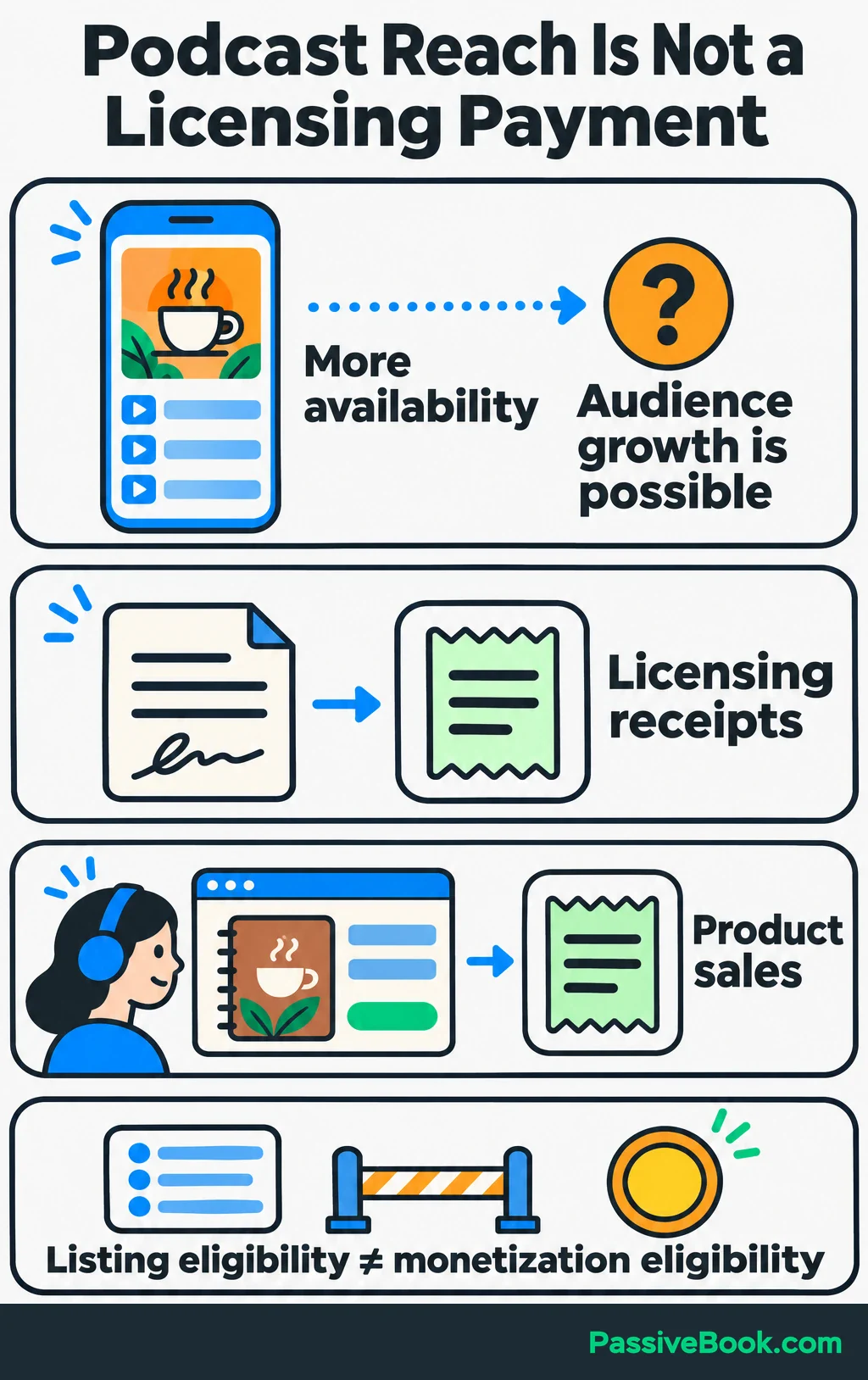
Publication eligibility is also separate from monetization eligibility. Spotify’s Partner Program, for example, has hosting, eligible-market, episode-count and recent-audience requirements, followed by content review. Being listed on Spotify does not mean your show qualifies. Spotify Partner Program requirements
I would build a decision around the payment promised and the benefits you can check. Treat projected audience growth as a possibility until the partner supplies useful evidence.
Calculate What You Retain
First establish which way the money flows. A publisher paying to use your episodes is offering something different from a service charging to distribute them.
For a revenue share, begin with the contract’s defined revenue base. Subtract permitted deductions, apply your share and then subtract your additional expenses.
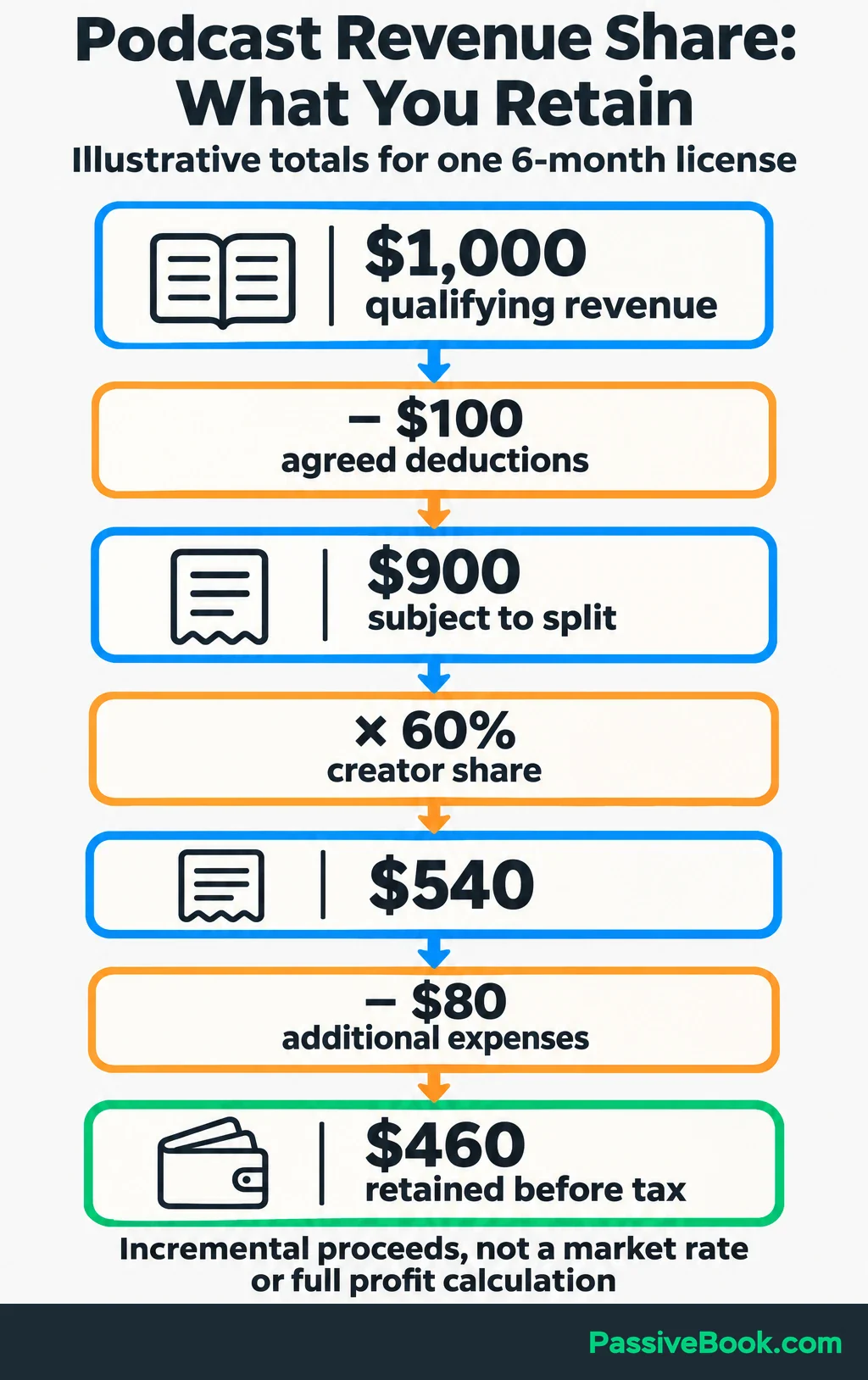
Suppose the coffee publisher reports $1,000 in qualifying revenue across the full six-month license. The contract allows $100 in total deductions, and you receive 60% of the remainder. Your additional editing and administration expenses total $80 for those six months.
The calculation is:
Qualifying revenue                         $1,000
Less agreed publisher deduction             $100
Amount subject to the split                 $900
Your 60% share                              $540
Less your additional expenses                $80
Retained before tax                         $460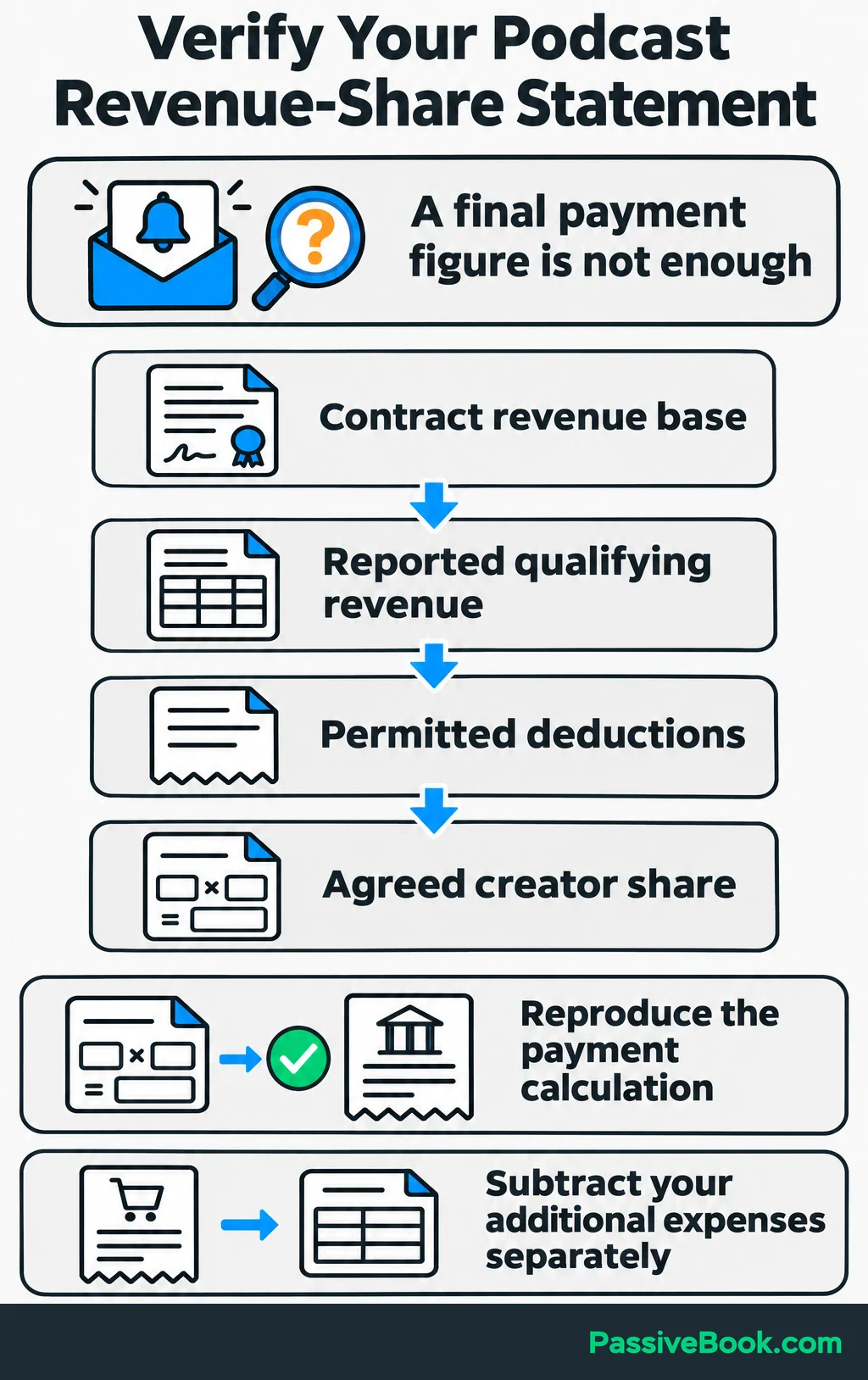
These figures illustrate incremental proceeds, not typical earnings or a market rate. A full profitability calculation would also include applicable production costs already incurred.
Ask for reporting that lets you reproduce the calculation. If the partner supplies only a final payment figure, you cannot check whether the agreed share was applied correctly.
Compare the Return With the Rights and Work Required
Compare the whole offer, including certainty, restrictions and administration.
For example, suppose the coffee publisher offers these two payment options for the same six-month license:
| Term | Fixed-fee Option | Revenue-share Option |
|---|---|---|
| Payment basis | $500 agreed fee for six months | 60% after agreed deductions over six months; no guarantee |
| Publisher deductions | None from the agreed fee | $100 total across the illustrated six-month license |
| Additional creator expenses | $80 total over six months | $80 total over six months |
| Advertising control surrendered | Publisher sells ads around its website copies; original feed stays unchanged | Publisher sells ads around its website copies; original feed stays unchanged |
| Exclusivity | Nonexclusive | Nonexclusive |
| Promotion | One newsletter feature and one homepage placement during launch week | One newsletter feature and one homepage placement during launch week |
| Reporting access | Publication and promotion report | Publication and promotion report, revenue statements and agreed access to supporting records |
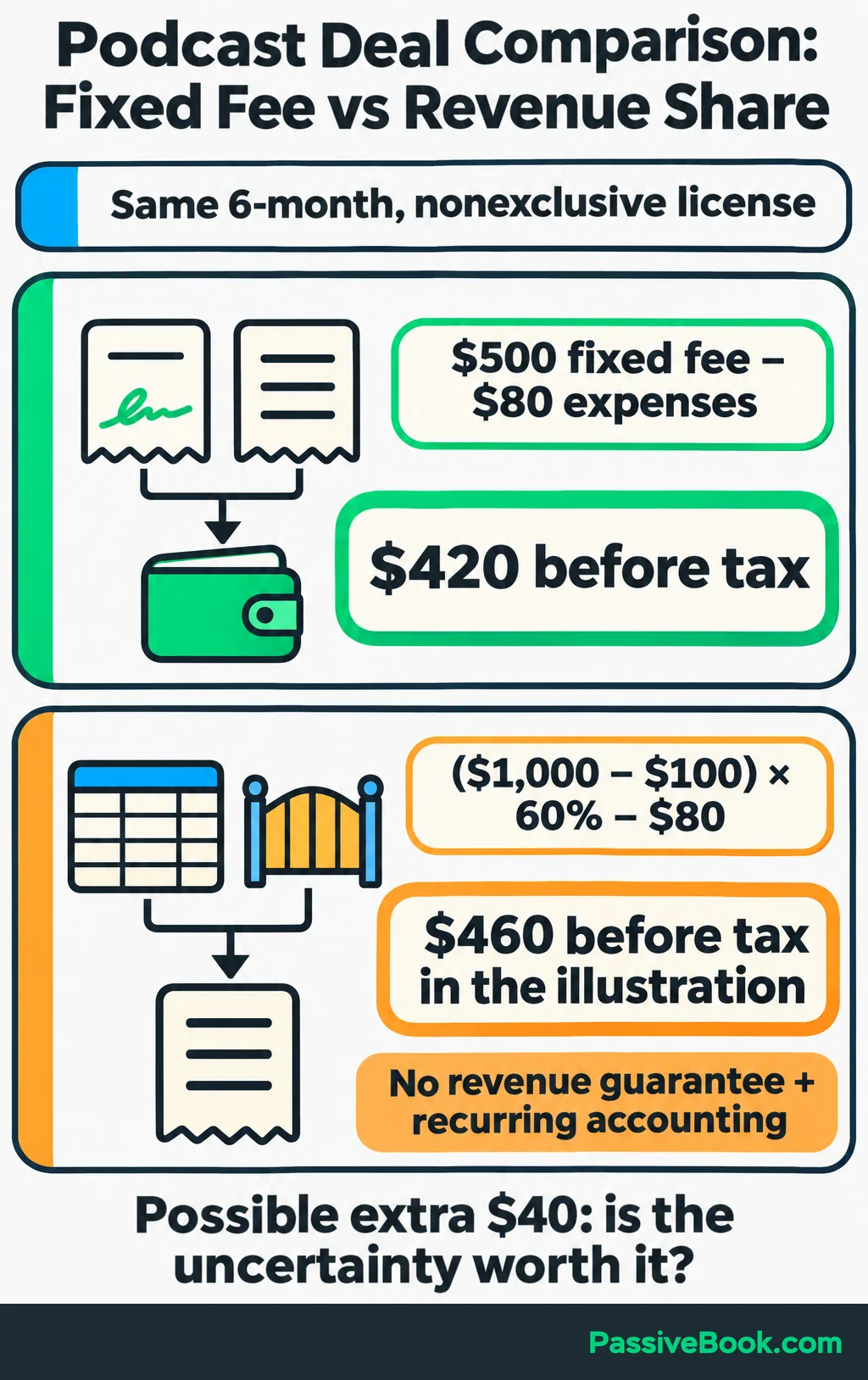
The fixed fee leaves $420 before tax after those additional expenses. The revenue share leaves $460 under the earlier illustration, but that amount depends on qualifying revenue actually arriving.
I would choose the fixed fee for a first trial unless the publisher could support its revenue forecast. A possible extra $40 is not much compensation for uncertainty and recurring accounting work.
Ask for audience information relevant to your subject, results from comparable licensed shows and specific promotional commitments. A publisher’s total website traffic does not tell you how many people will encounter your interviews.
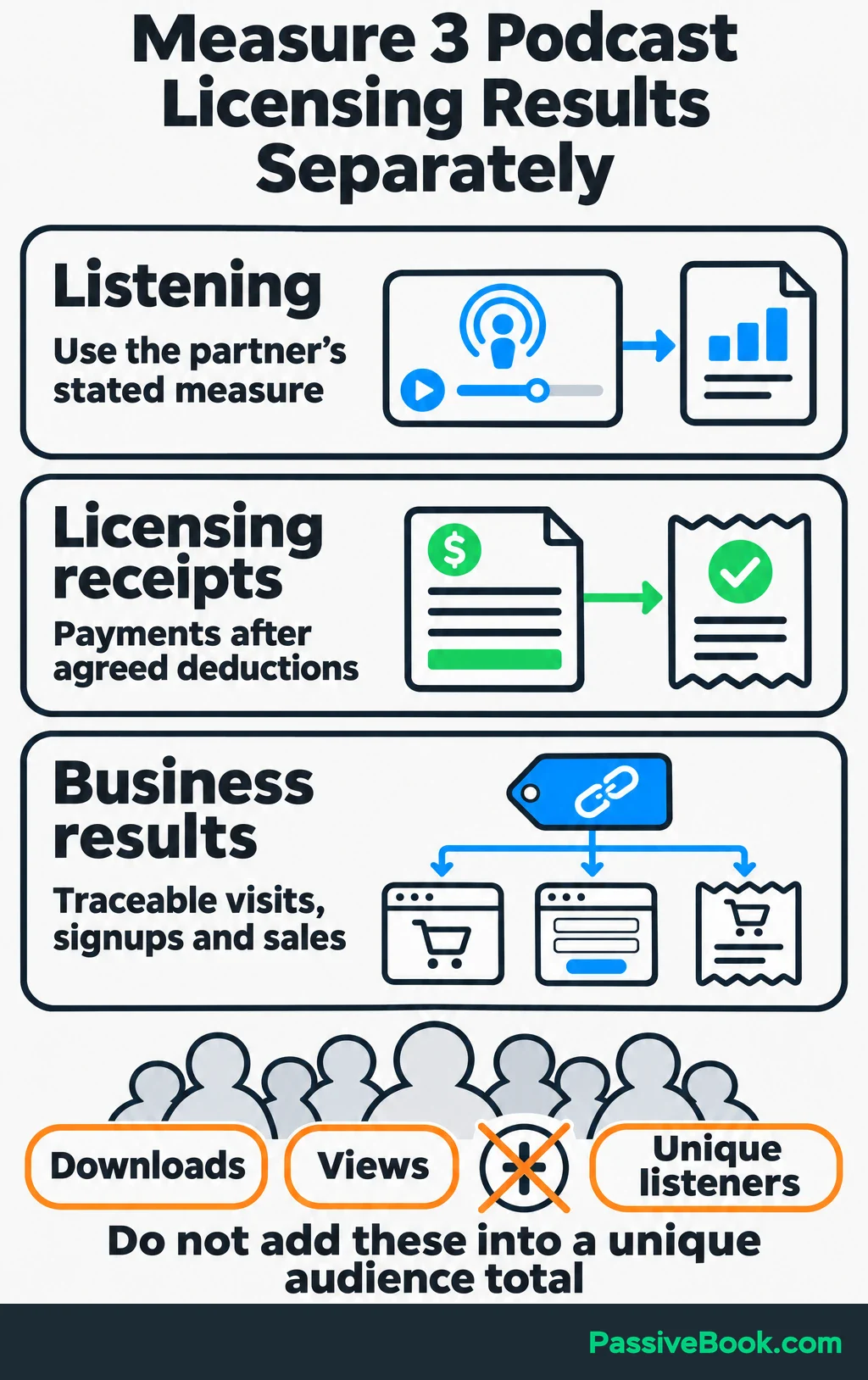
For Better Home Coffee, track three things separately:
- Listening: Consumption of the licensed episodes, using the partner’s stated measurement
- Licensing receipts: Payments received after agreed deductions
- Business results: Visits, signups and brew-journal sales traceable to the placement
Keep downloads, platform views and unique listeners separate. Adding them together does not establish a combined unique audience because the measures differ and people may overlap.
Choose terms that preserve the uses your business needs. Exclusivity can be worthwhile, but its compensation and benefits should justify the opportunities you give up, with reporting and exit terms you can use.
What Next?
Pick one episode and create its rights-register entry. Find the guest release, music license, artwork permission and any sponsor restrictions, then compare them with one outlet you want to approach.
Use the social buttons to share this guide when a wider release is on the table. It gives the discussion something more useful than a promise of “exposure.”
Which right would you be least willing to restrict in exchange for a licensing payment? Share your reasoning in the comments, and bring any other questions about your proposed arrangement.
Share this post with your friends & followers:

