Your podcast can have regular listeners and still bring in nothing. People finish an episode, get on with their day, and have no clear way to buy from you or support the show.
Waiting for a sponsor leaves that gap open, but adding random offers can make a useful episode feel like a shopping channel.
That trade-off gets harder when you’re recording around a day job. The revenue comparisons and worked earnings example below help you choose a stream that fits your listeners and schedule, check platform eligibility, and estimate what you could keep after costs.
How Many Listeners Do You Need to Monetize a Podcast?
There is no universal listener minimum. You can sell a product or service to one person, earn a qualifying affiliate commission, or accept a voluntary contribution. Advertising networks and platform programs set their own requirements.
That means you can test an offer before qualifying for ads. A listener asking, “Do you sell the checklist you mentioned?” gives you a reason to investigate demand. A purchase gives you stronger evidence.
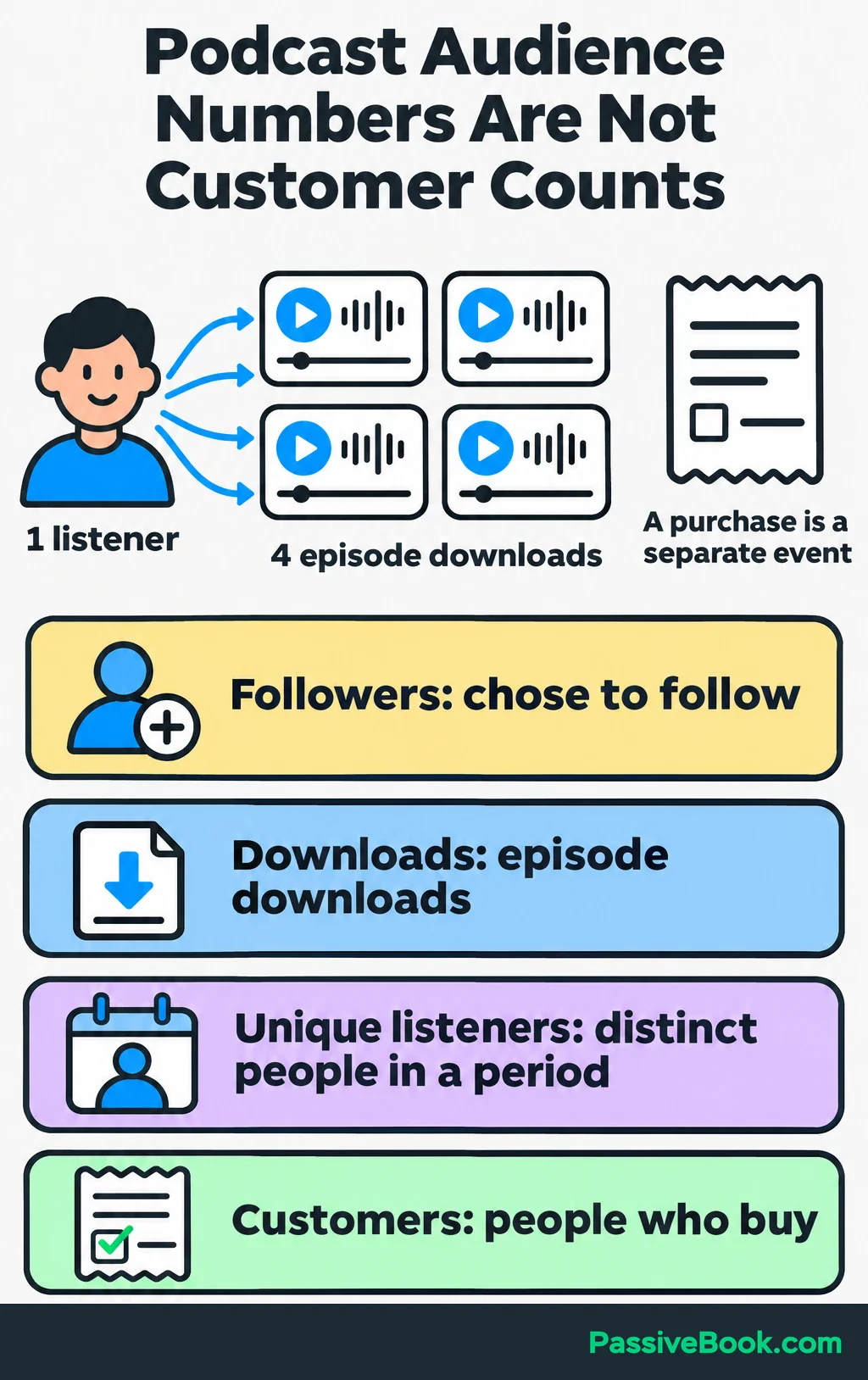
Keep these numbers separate:
- Followers are people who have chosen to follow the show.
- Downloads count episode downloads, so one person can generate several.
- Unique listeners represent distinct listeners reported within a stated period.
- Customers are people who actually buy.
Someone downloading four episodes is still one potential customer. Multiplying downloads by a guessed purchase rate can produce a lovely forecast and a disappointing bank balance.
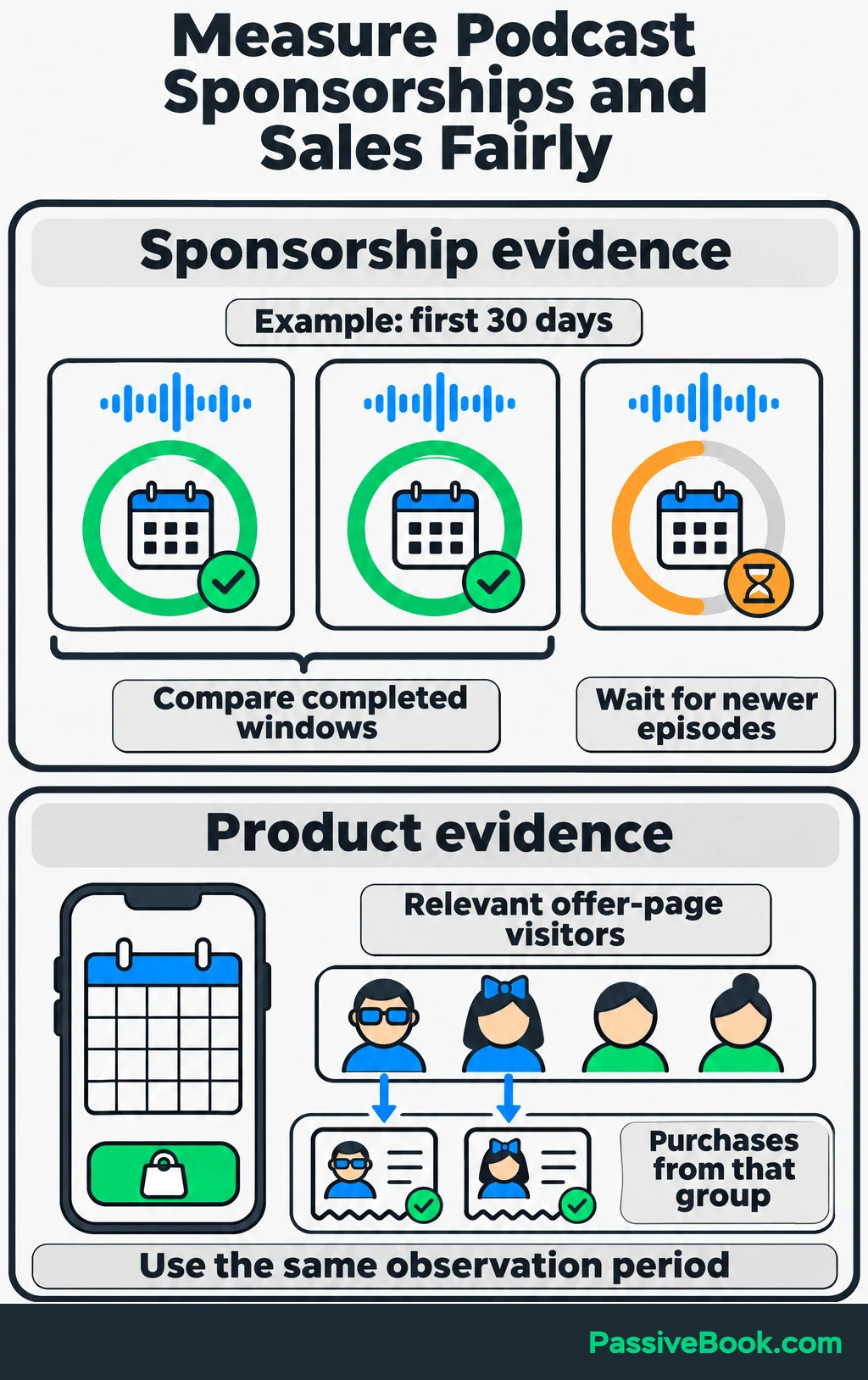
For sponsorships, compare recent episodes over the same reporting window, such as their first 30 days. Include only episodes old enough to have completed that window.
For products, track visits to the relevant offer page and purchases from those visitors. Those numbers tell you more about sales than your follower total does.
Choose Revenue Streams That Fit Your Podcast
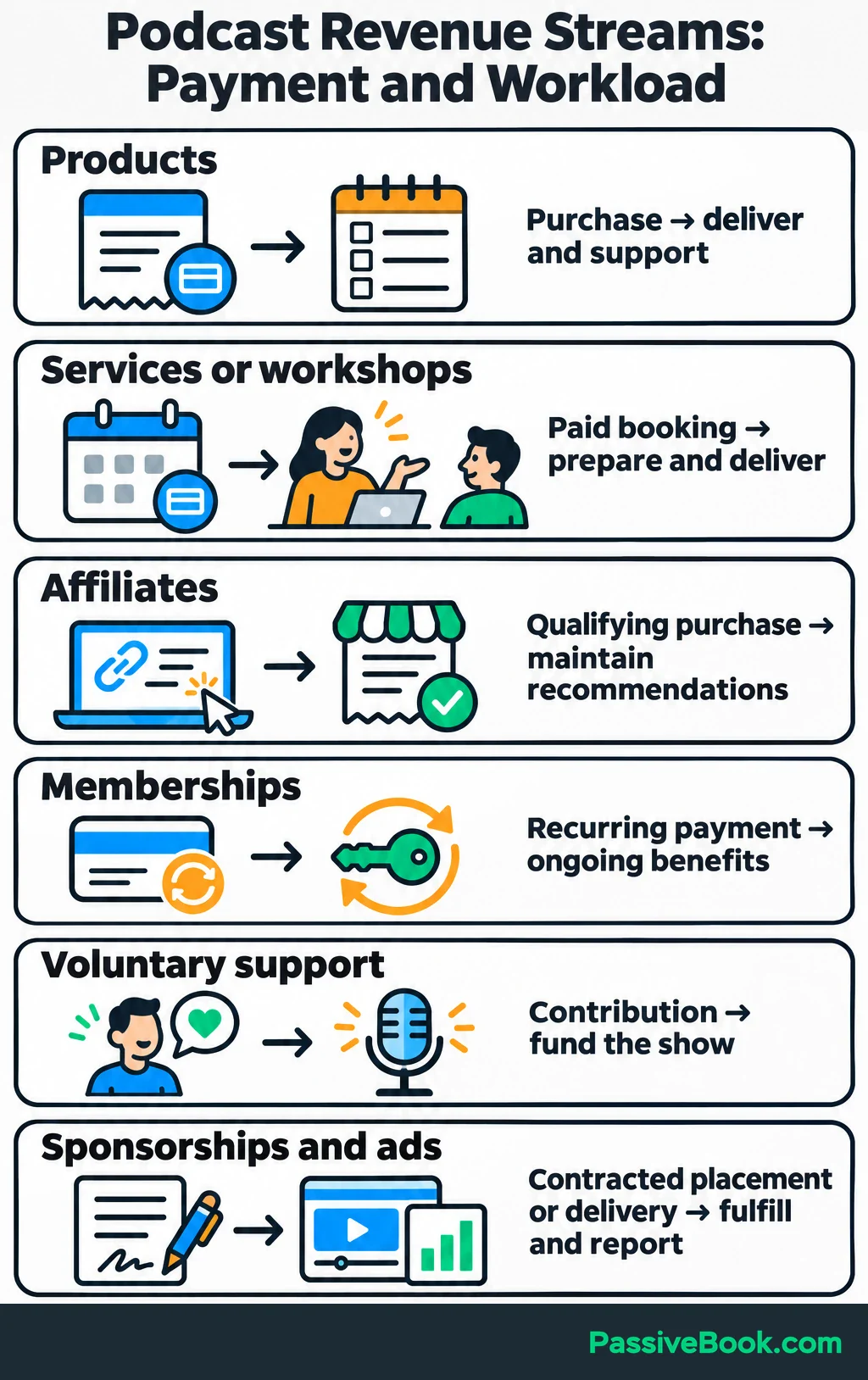
Start with the problem listeners want solved, then consider what you can deliver alongside your existing work. Compare the money left after costs, the ongoing workload, and how much control you have over pricing.
| Revenue Stream | Who Pays | Payment Trigger | Audience Evidence Needed | Main Costs | Delivery Work |
|---|---|---|---|---|---|
| Products | Listener buying your resource | Completed purchase | Questions about a problem the product solves; initial sales | Creation, checkout fees, refunds | Deliver files, update them, answer questions |
| Services or workshops | Customer buying your help | Paid booking or ticket | Requests for help with a defined task | Preparation, delivery time, payment fees | Run sessions and provide agreed follow-up |
| Affiliate commissions | Merchant or affiliate program | Approved qualifying purchase | Interest in a relevant recommendation | Testing products, creating content | Maintain links and recommendations |
| Paid memberships | Member buying continuing benefits | Successful recurring payment | Willingness to pay for ongoing access | Platform fees, recurring content or events | Provide benefits every billing period |
| Voluntary support | Listener supporting the show | Contribution received | Listeners asking how to contribute | Payment or platform fees | Maintain the show and any promised acknowledgment |
| Sponsorships and advertising | Advertiser | Contracted placement or qualifying delivery | Audience fit and comparable reach data | Sales time, production, network deductions | Produce placements and report results |
I would start with an existing relevant product if you have one. Otherwise, test a small resource, a tightly defined service, or an affiliate recommendation that answers a real question. A simple support option also makes sense when listeners mainly want to help fund the show.
To make the choices concrete, imagine you publish a podcast about weekend trips with dogs and sell printable dog-friendly trip planners. This is an illustrative business we’ll follow through the article.
Sell Your Own Products
Choose one recurring problem and make the smallest product that helps someone solve it. That could be a printable, template, guide, workshop recording, or course.
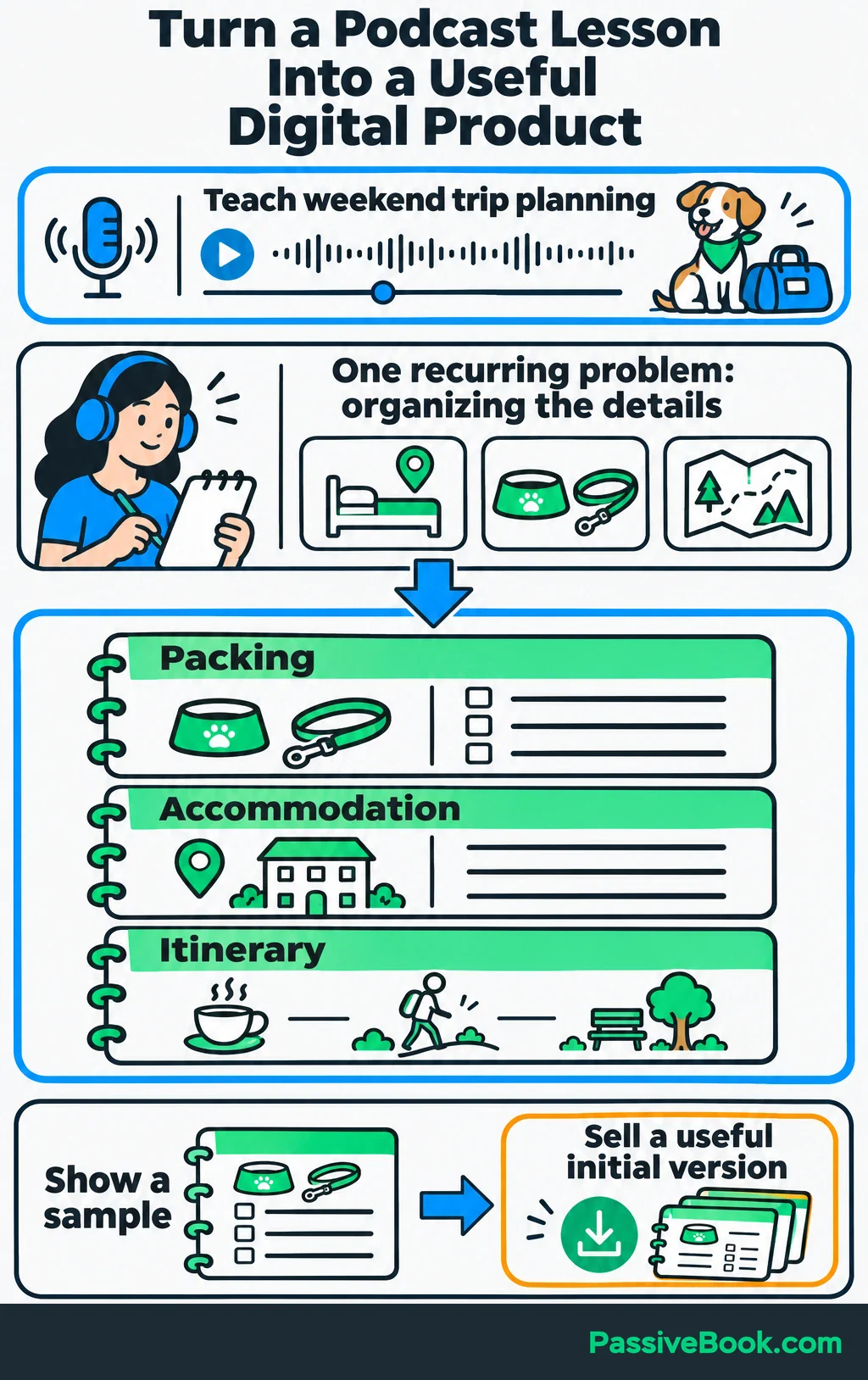
For the trip podcast, an episode about organizing a weekend away could lead to a planner with packing pages, accommodation notes, and an itinerary. Listeners can use it to organize the information you just taught them to gather.
If your business already sells that planner, promote it before building another product.
I once rushed a digital course into the world without validating it properly. It attracted few sales, received a bad review, and I took it down. Finishing the course had felt like progress, but I had skipped the part that mattered: checking whether people wanted that particular help.
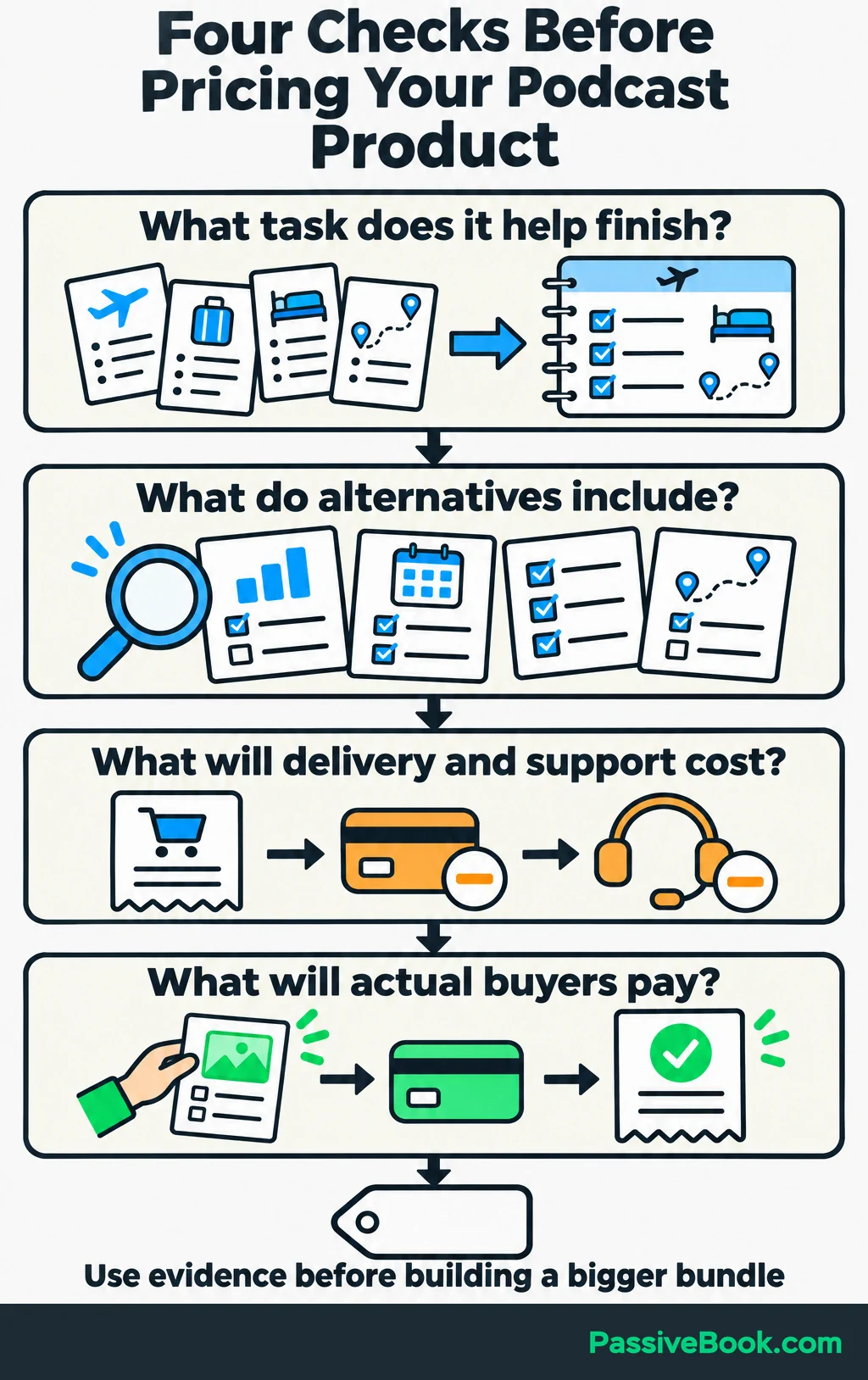
For your first offer, show a sample and sell a useful initial version. Set its price by considering:
- The task it helps the buyer complete.
- What competing solutions include.
- Your delivery and support costs.
- What actual buyers are willing to pay.
A large bundle can wait until customers give you a reason to make it.
Offer Services or Paid Workshops
Services can bring in money while revealing where people get stuck. Define the outcome, scope, preparation, price, and follow-up before opening bookings.
In the running business, you could offer a planner-setup session. Customers bring their own accommodation details, travel times, and activity ideas, and you help organize them into the planner.
A group workshop could demonstrate the same process using sample trip information. State whether buyers receive a recording, worksheets, or answers to submitted questions.
Count preparation and administration as well as delivery time. A one-hour session can consume two hours once you include emails, preparation, and follow-up.
I would cap appointments before promoting them. Use repeated customer questions to improve the planner or build a workshop, because an unlimited booking calendar is a demanding form of side income.
Earn Affiliate Commissions
Affiliate income fits episodes where listeners need help choosing something. Explain what a product does, why it suits the task, and where it falls short.
A packing episode might discuss portable bowls or washable car-seat covers. Recommend specific products only when you can explain the choice honestly, then provide a trackable link or code.
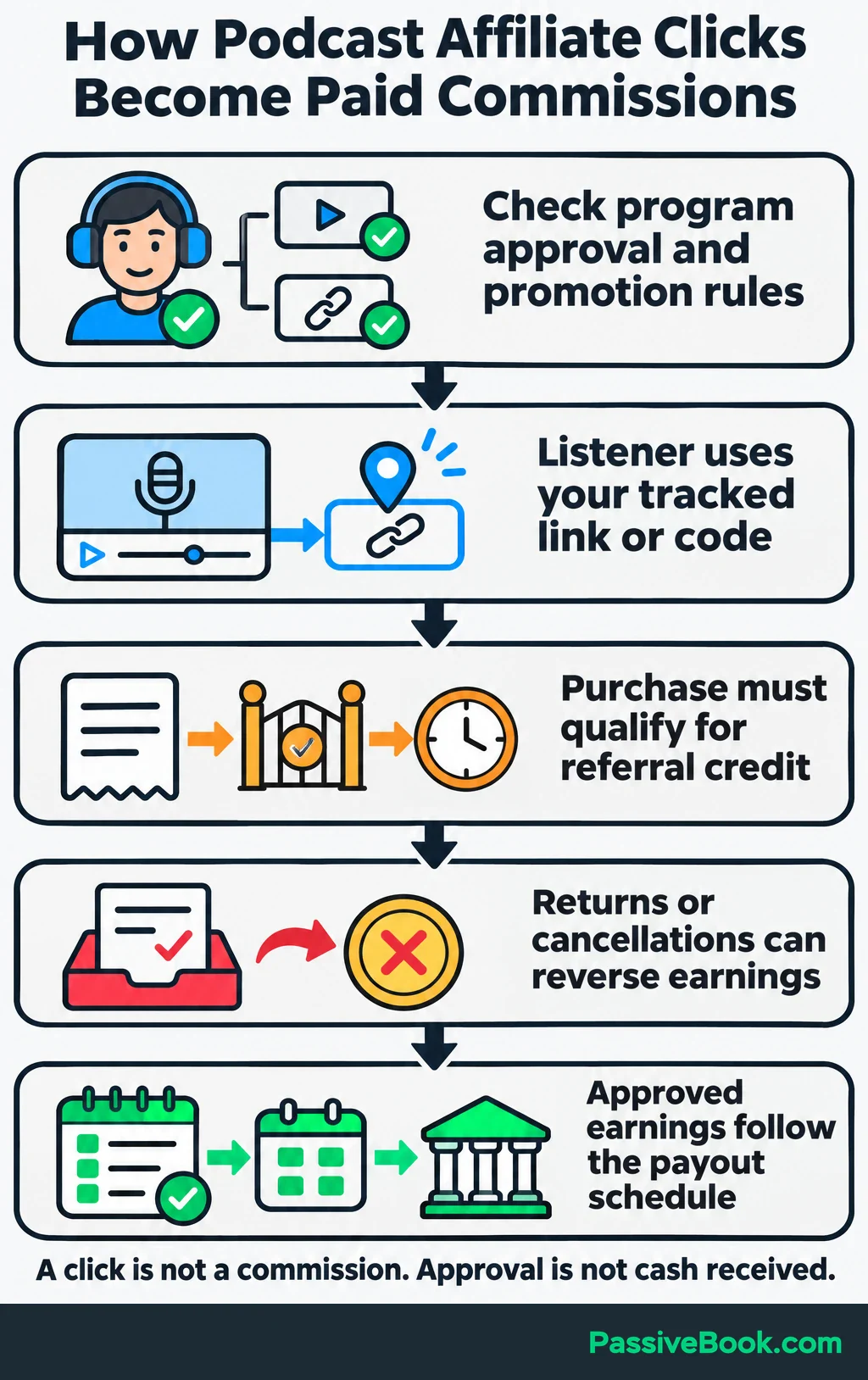
Before forecasting commissions, check:
- Whether the program has approved you.
- Whether podcast promotion and your intended links are permitted.
- Which purchases qualify and how commissions are calculated.
- How long a referral can receive credit.
- Which returns, exclusions, or cancellations reverse earnings.
- When approved earnings become payable.
In my affiliate-marketing work, chasing products brought little return. Income became more consistent after I switched to honest reviews of tools I actually used. That experience came from websites, and it informs what I would recommend on a show: products I can explain from use.
For endorsements reaching US consumers, disclose paid relationships with the spoken recommendation and clearly beside affiliate links. “I earn a commission if you buy through this link” is plain language. Apply the same approach to sponsor endorsements, including relevant free products or other benefits. The FTC’s endorsement guidance explains these connections and disclosure placement.
Review old recommendations periodically so discontinued products and broken links don’t keep sending listeners nowhere.
Offer Paid Memberships or Listener Support
Voluntary support helps fund the existing show. A paid membership sells continuing benefits. These create different expectations, so choose deliberately.
You might offer bonus episodes, early access, a resource library, or scheduled discussions. Pick a benefit you can sustain during a busy month, then price it against the work required each billing period.
I spent six months building a membership site alongside corporate work and abandoned it because the content workload was unsustainable. The plan depended on fresh premium content I couldn’t keep producing. That experience makes me cautious about promising “more content” as the main benefit.
For the trip-planner business, test a paid planning discussion before promising one every month. An occasional planner purchase doesn’t establish demand for a subscription.
If listeners simply want to contribute, offer that option without attaching a growing list of rewards. Track voluntary contributions separately from active paying members and cancellations.
Sell Sponsorships and Advertising
Direct sponsorships are deals you negotiate with a business. Network advertising is sold or delivered under a platform’s terms.
You can approach a relevant sponsor without meeting an advertising network’s minimum audience size. Your pitch still needs a credible reason for that business to pay.
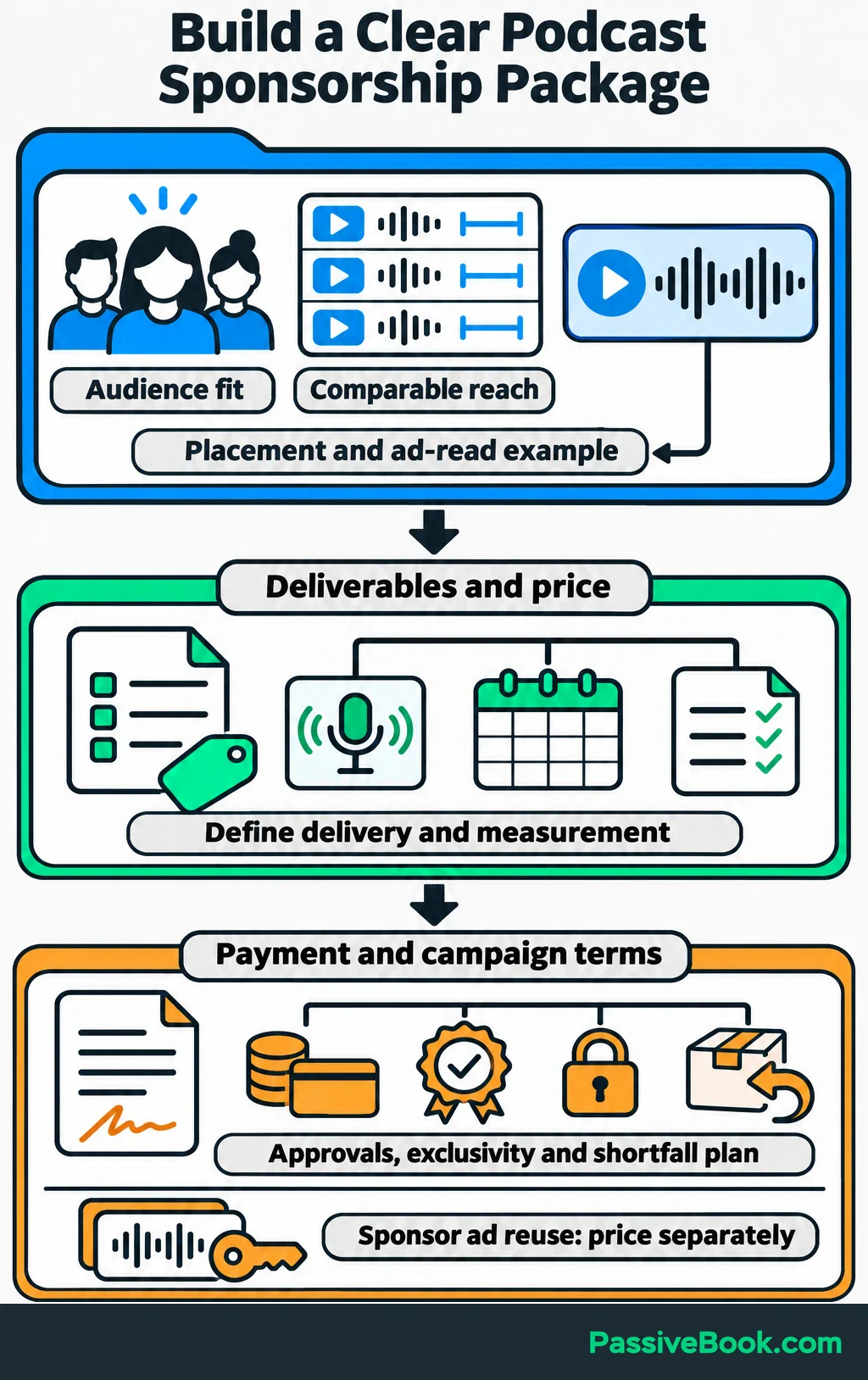
Prepare a short media kit containing:
- The show’s subject and the audience it serves.
- Audience information you can substantiate through analytics or surveys.
- Recent episode downloads measured over a consistent window.
- Available placements and an example ad read.
- The campaign deliverables and proposed price.
For the trip podcast, you could propose placements around a short series of weekend-planning episodes to a suitable pet-travel supplier.
Price a flat package around its deliverables and rights, or use CPM, which means the price per thousand contracted downloads or ad impressions. Define exactly what counts and when it will be measured.
Put payment timing, placement, campaign duration, approval rights, exclusivity, and reporting in writing. Also agree on what happens if delivery falls short.
I would charge separately for permission to reuse your recording in the sponsor’s own advertising. That gives the sponsor something beyond placement in your episode.
Which Platforms Can Pay Podcast Creators?
Choose the revenue stream before choosing the platform. Free distribution alone doesn’t create a fixed payment for every listen.
The table below focuses on collecting revenue. Eligibility allows you to apply or participate under the relevant terms; it doesn’t guarantee earnings.
| Platform or Program | Revenue Mechanism | Entry Requirements | Main Fees or Deductions |
|---|---|---|---|
| Spotify Partner Program | Advertising and eligible Premium video revenue | Host on Spotify for Creators; legal address in an eligible market; 3 published episodes; 2,000 Spotify consumption hours and an audience count of 1,000 in the previous 30 days; review | Creator receives 50% of recognized program ad revenue. Premium video uses a proprietary formula and requires an ad break in eligible episodes |
| Spotify Memberships | Monthly payments for member benefits | For shows created from October 20, 2026: supported market, 3 published episodes, and 100 consumption hours plus 100 Spotify listeners or viewers in the previous 30 days | New membership payments carry a 10% platform fee including processing, foreign exchange, and payout fees; applicable taxes also affect proceeds. See the fee schedule |
| Apple Podcasts Subscriptions | Paid podcast subscriptions | Join the Apple Podcasters Program, complete agreements and payment details, and meet availability and content requirements | Annual program fee; creator receives 70% of subscription price minus applicable taxes, rising to 85% after each subscriber accumulates one year of paid service |
| Patreon | Memberships and one-time purchases | Eligible creator account and payout method; no podcast-listener threshold | Pages published after August 4, 2025 use a 10% standard platform fee, plus processing and applicable additional fees. In-app purchase charges can affect proceeds |
| YouTube Partner Program | Advertising on uploaded episodes | Long-form advertising route: 1,000 subscribers and 4,000 qualified public watch hours in 12 months, plus country, account, policy, and review requirements | Under the Watch Page Monetization Module, creators receive 55% of net watch-page ad revenue |
For a first digital download, I would use a simple checkout such as Gumroad if starting from scratch. If the business already runs on WordPress, I would consider WooCommerce, a plugin for selling through your site, before adding another sales platform.
For paid listening, consider where your audience already listens and how easily they can access the benefits. Check country availability, payout verification, deductions on small payments, and what customer records you can export.
I would add YouTube advertising only when publishing episodes there fits the production schedule. Another distribution channel comes with work even before it earns anything.
How Much Money Can You Make From a Podcast?
Estimate income from the transaction that generates payment. A product sale, approved commission, paid membership, and delivered ad each have different economics.
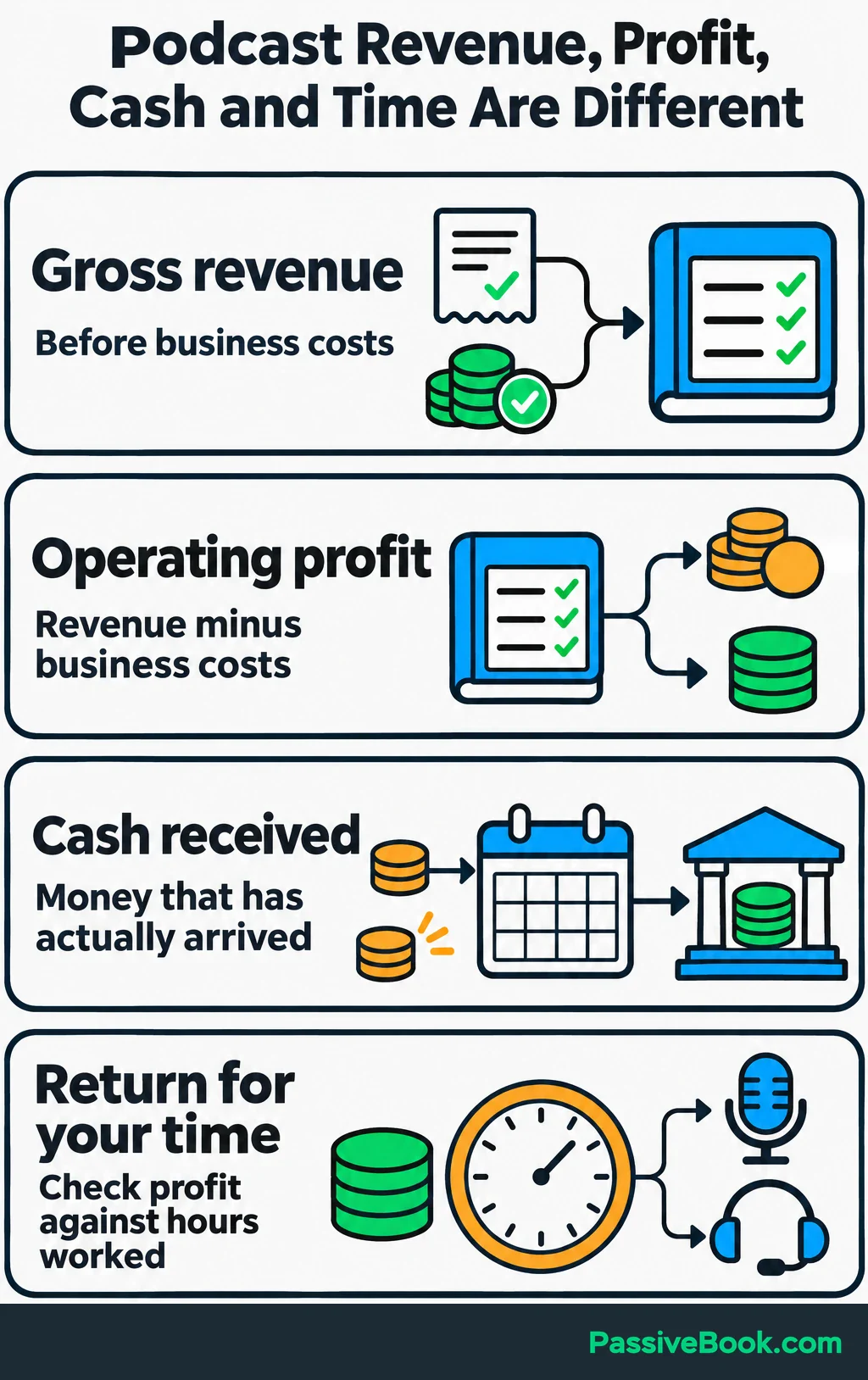
Keep four figures separate: gross revenue, operating profit after business costs, cash actually received, and what remains to compensate you for your time.
The worked figures below are planning assumptions. They are not typical conversion rates, suggested market rates, or promised results.
Calculate Revenue From Each Stream
Start with the activity that can produce a payment:
- Products: Relevant offer-page visitors × purchase rate × selling price.
- Affiliates: Tracked clicks × qualifying purchase rate × approved commission per purchase.
- Memberships: Members who successfully pay for the billing period × price per member.
- Voluntary Support: Add the contributions received.
- Services: Paid bookings × price per booking, then check the hours required.
- Advertising: Qualifying delivery ÷ 1,000 × agreed CPM.
For product conversion, count buyers from the same visitor group and observation period. Four buyers among 100 unique offer-page visitors gives a 4% purchase rate for that group.
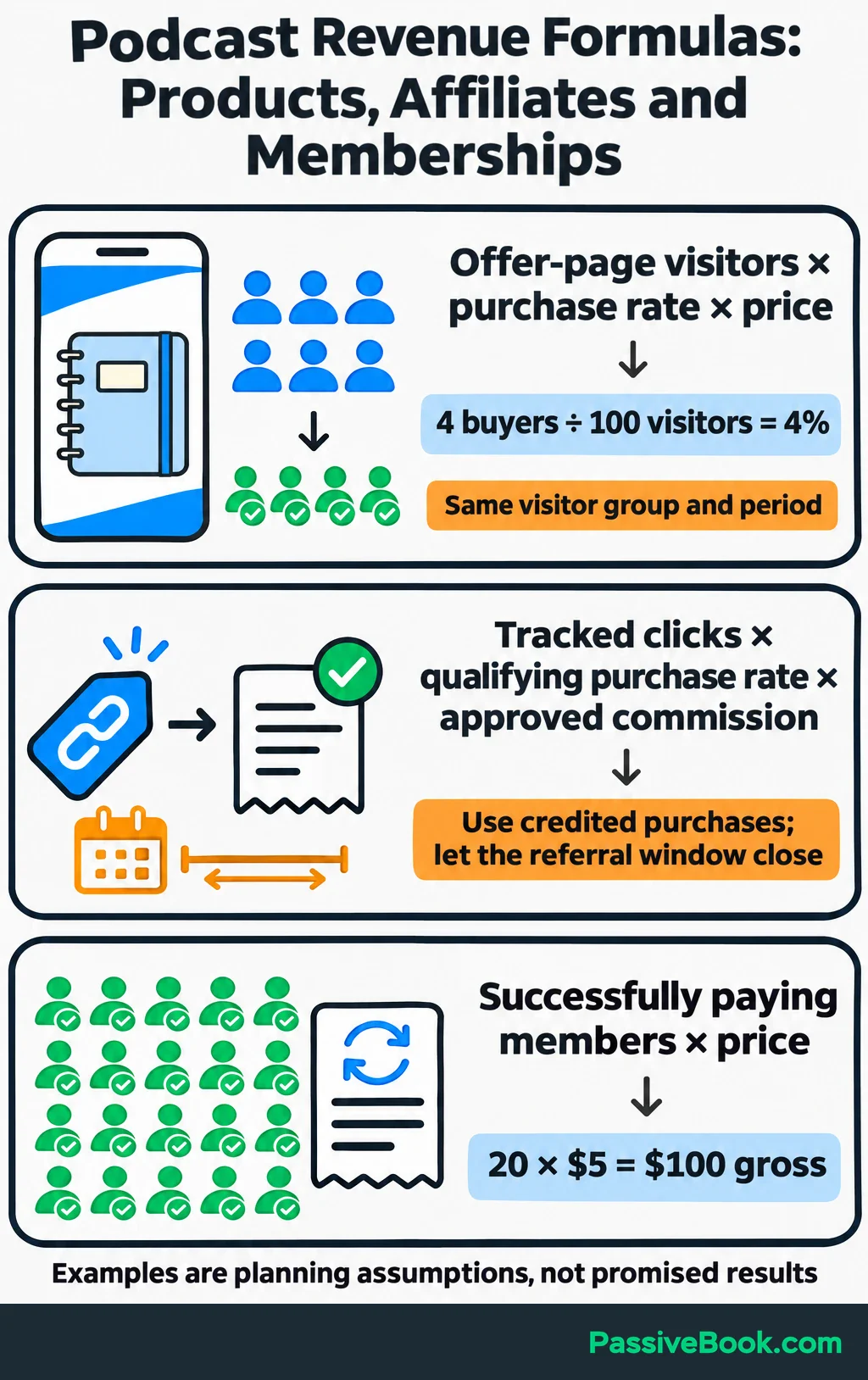
For affiliate conversion, count only qualifying purchases credited to the same group of tracked clicks under the program’s referral rules. Let the referral window close before calculating the final rate.
Twenty members each successfully paying $5 for the month produce $100 gross before deductions. For a service, two bookings at $75 produce $150 gross, but six total hours of preparation, delivery, and administration would leave $25 per hour before costs and tax.
For advertising, suppose you publish four episodes and sell one placement in each. Each placement receives 1,000 qualifying downloads within the contracted window:
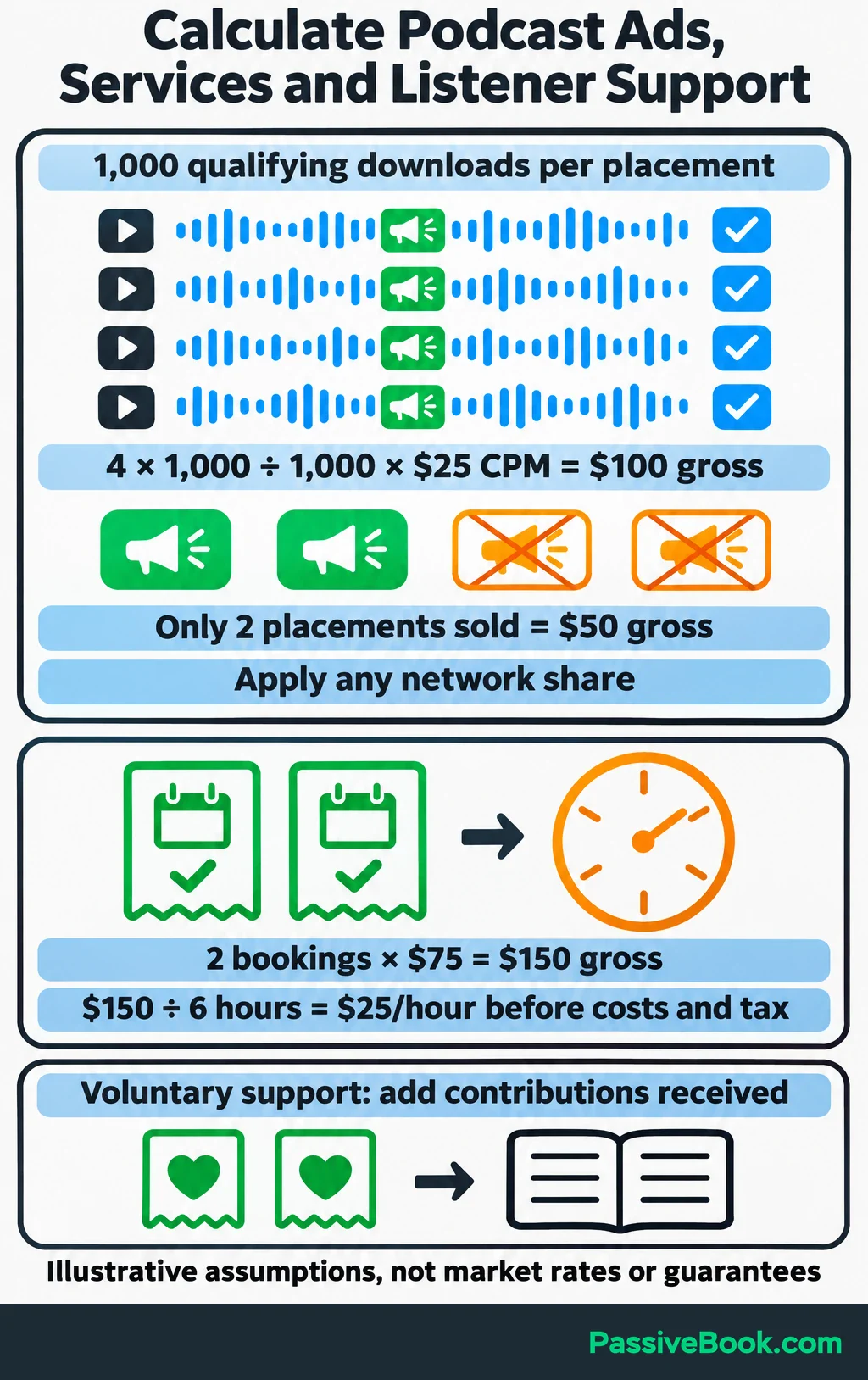
4 × 1,000 ÷ 1,000 × $25 CPM = $100 gross
Selling only two placements produces $50. Unsold space earns nothing. Multiply by placements only when delivery is measured per placement, and apply the creator share when a network takes part of the revenue.
For a reported example, Justin Jackson wrote in April 2020 that Build Your SaaS had reached $300 a month from Patreon and later added $600 a month from advertising. The report gives no comparable audience count or net profit, so it cannot establish what your show would earn.
Work Out Profit and Break-Even
Now apply the numbers to one month of the trip-planner business.
Count unique visitors to the planner page during the month and purchases made by that group. Assume 100 visitors, four buyers, and a $19 selling price:
100 × 4% × $19 = $76 product revenue
Separately, assume 20 tracked affiliate clicks lead to two qualifying purchases with approved commissions of $5 each:
20 × 10% × $5 = $10 affiliate income
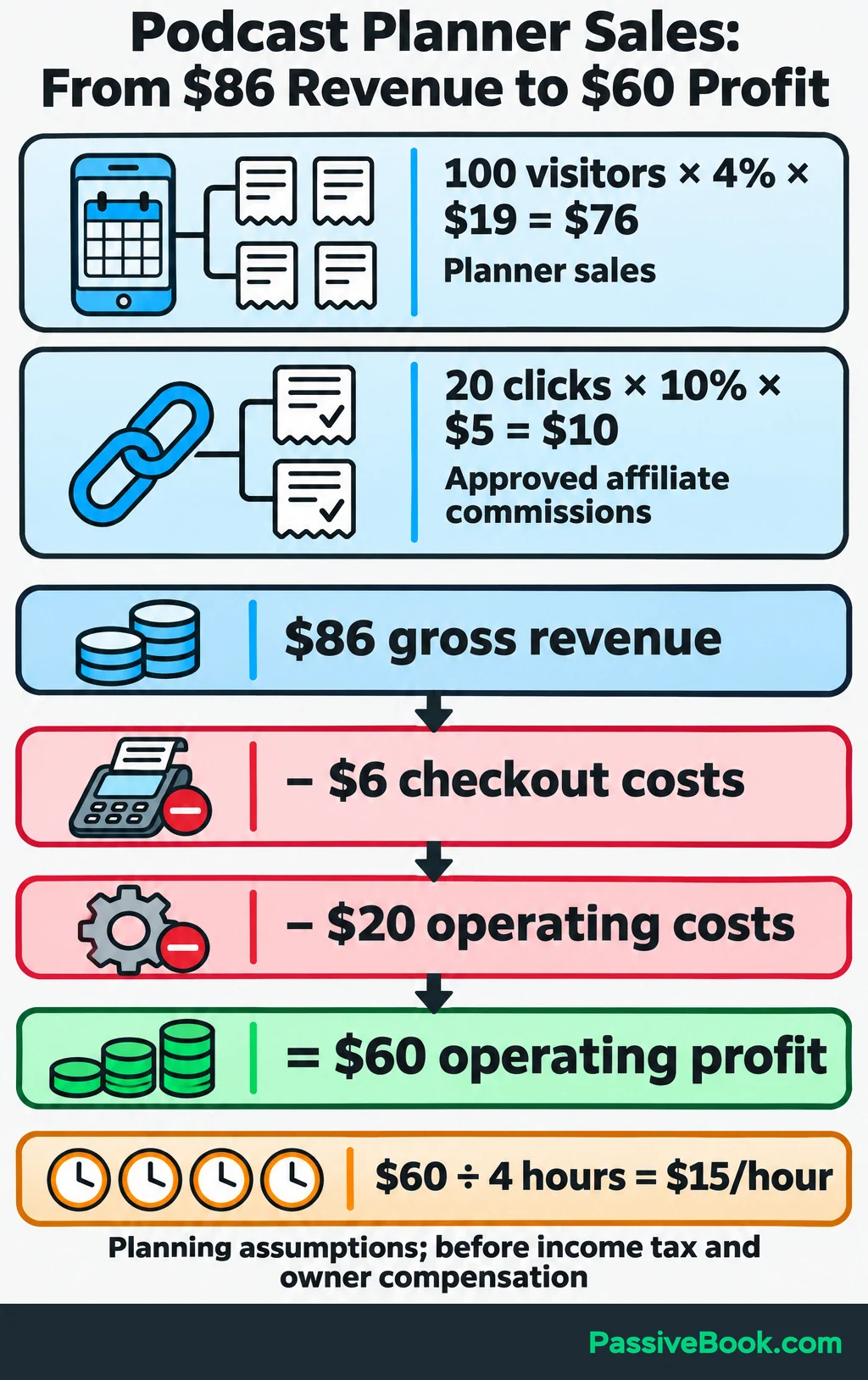
Here is the resulting monthly picture:
| Item | Amount |
|---|---|
| Planner sales | $76 |
| Approved affiliate commissions | $10 |
| Total gross revenue | $86 |
| Checkout costs on the four planner sales | −$6 |
| Monthly operating costs | −$20 |
| Operating profit before income tax and owner compensation | $60 |
Replace those costs with your own. Include applicable hosting, editing, refunds, fulfillment, platform charges, and customer support.
If you spent four hours producing and supporting this month’s work, the $60 would represent $15 per hour before income tax. That time check matters when deciding whether to continue.
To calculate break-even, first find what each planner sale leaves after costs that rise with each sale. Here, $6 across four transactions means $1.50 per sale:
$19 − $1.50 = $17.50 contribution per sale
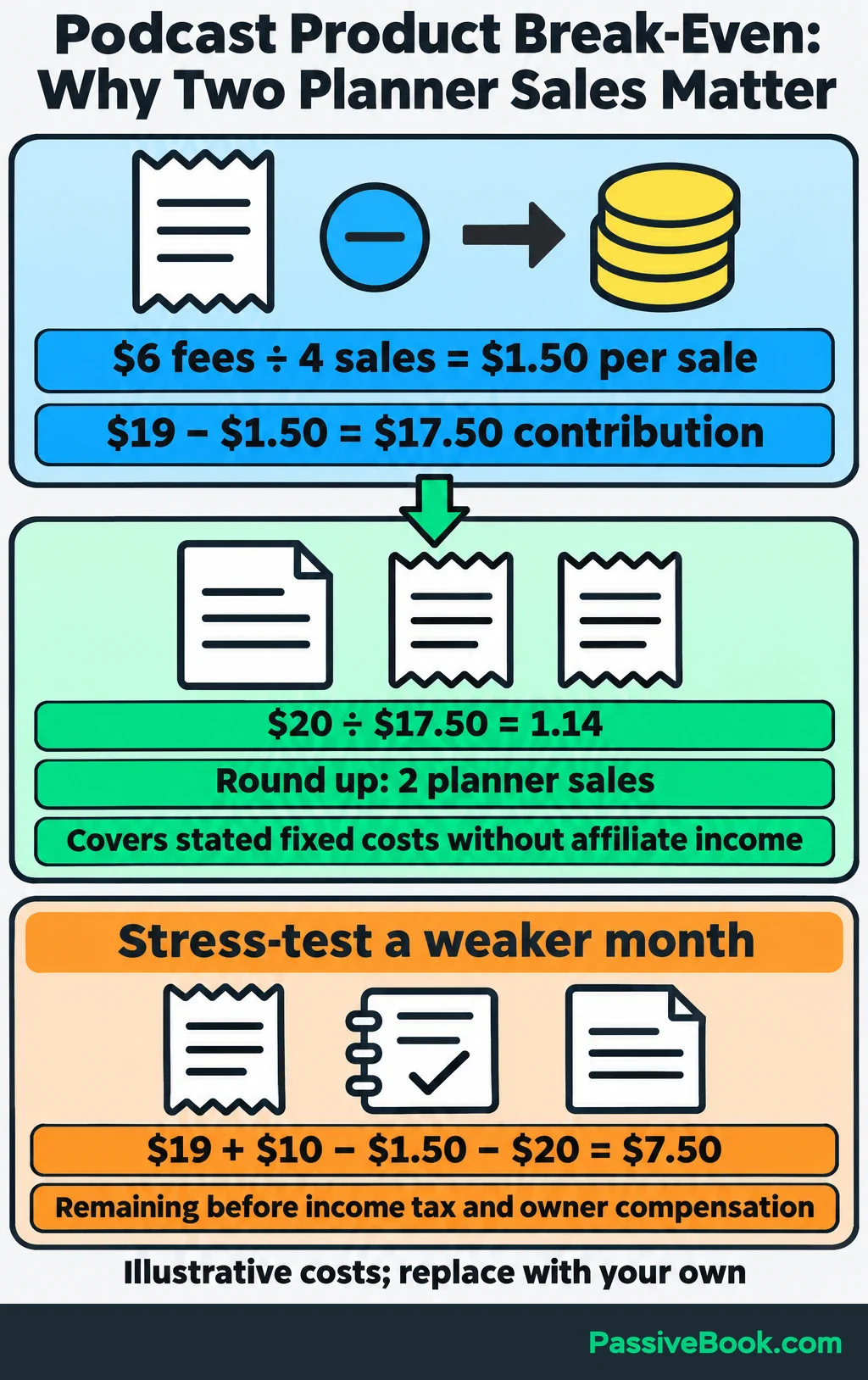
Divide the $20 fixed monthly cost by that contribution and round up:
$20 ÷ $17.50 = 1.14 → 2 planner sales
Two sales cover the stated fixed cost without relying on affiliate income.
Then change one assumption. With just one planner sale and the same $10 affiliate income, revenue falls to $29. After $1.50 in transaction costs and $20 in fixed costs, only $7.50 remains.
Use that weaker month when judging whether another recurring expense is affordable. Also remember that an approved commission may reach your bank later than a product payment.
A profitable sale can still leave you with too much work for too little income. Use the calculator to check your own offer, including the price and sales volume your target would require.
Free Pricing Profit Calculator




Turn Podcast Listeners Into Paying Customers
Validate One Offer
Review listener questions, replies, and requests from existing customers. Choose one problem closely connected to the show and define what your offer will help someone do.
For the trip podcast, the problem might be organizing accommodation details, packing, and activities in one place. Show a sample planner page and offer a useful initial version before designing a large travel bundle.
Set a small test with clear limits. For example, you might choose to:
- Spend no more than one afternoon improving the initial planner.
- Promote it in the next three relevant episodes.
- Wait until each episode has had the same response window before reviewing results.
- Require several paid orders before investing in a larger version.
Choose the purchase or inquiry response that would justify your next investment. Compliments can help you improve wording, but paid orders provide stronger evidence that the offer deserves more work.
Build a Simple Purchase Path
Give listeners one destination that explains the outcome, contents, price, intended buyer, and purchase action. Show a sample so they can see what they’re getting.
For the planner, the page should make clear whether buyers receive a printable PDF, editable file, or both. Include delivery details and how to get help.
Use a short address on your own domain that you can say aloud, and put the matching link in the episode notes.
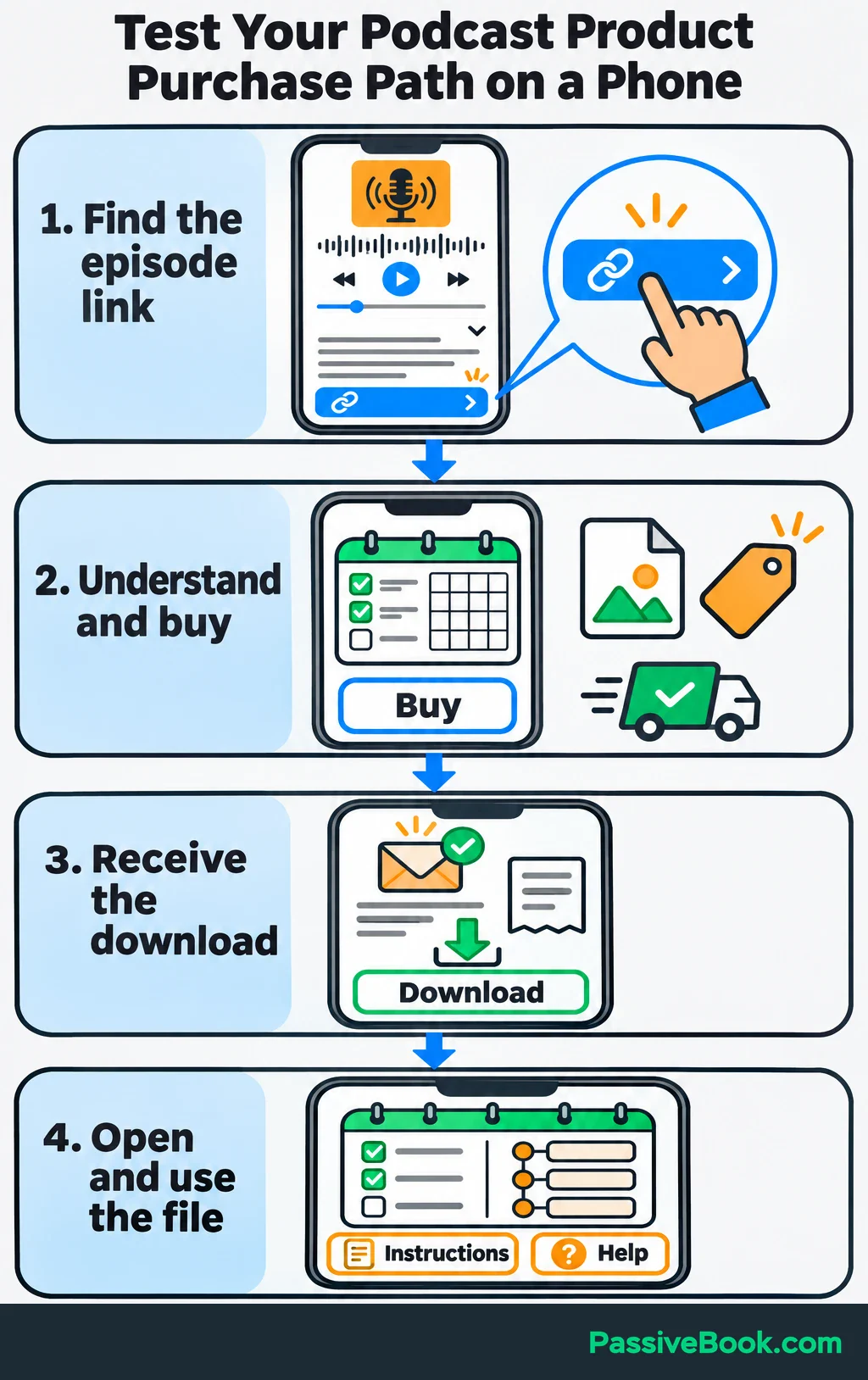
Test the whole journey on a phone:
- Find the link from the episode.
- Read the offer and complete payment.
- Receive the confirmation and download.
- Open the file and find the instructions.
For bookings, test the scheduling and preparation instructions instead. For memberships, check that payment leads to the promised listening access.
An optional email signup can help people who need more explanation before buying. Describe what they will receive. If you already use WordPress, a form connected to FluentCRM, an email tool that runs on your site, can manage signups and follow-up emails.
For US commercial follow-up emails, use accurate sender details and subject lines, identify advertising, include a valid postal address and working opt-out, and honor unsubscribe requests within 10 business days. The FTC’s CAN-SPAM guide explains these requirements.
Match the Promotion to the Episode
Teach something useful first, then introduce an offer that helps listeners apply it. Give them one primary next step and a concrete reason to take it.
After explaining how to organize trip information, a short invitation could be:
“The printable dog-friendly trip planner gives you one place for your packing list, accommodation notes, and weekend itinerary. You can see a sample and buy the download through the planner link in this episode’s notes.”
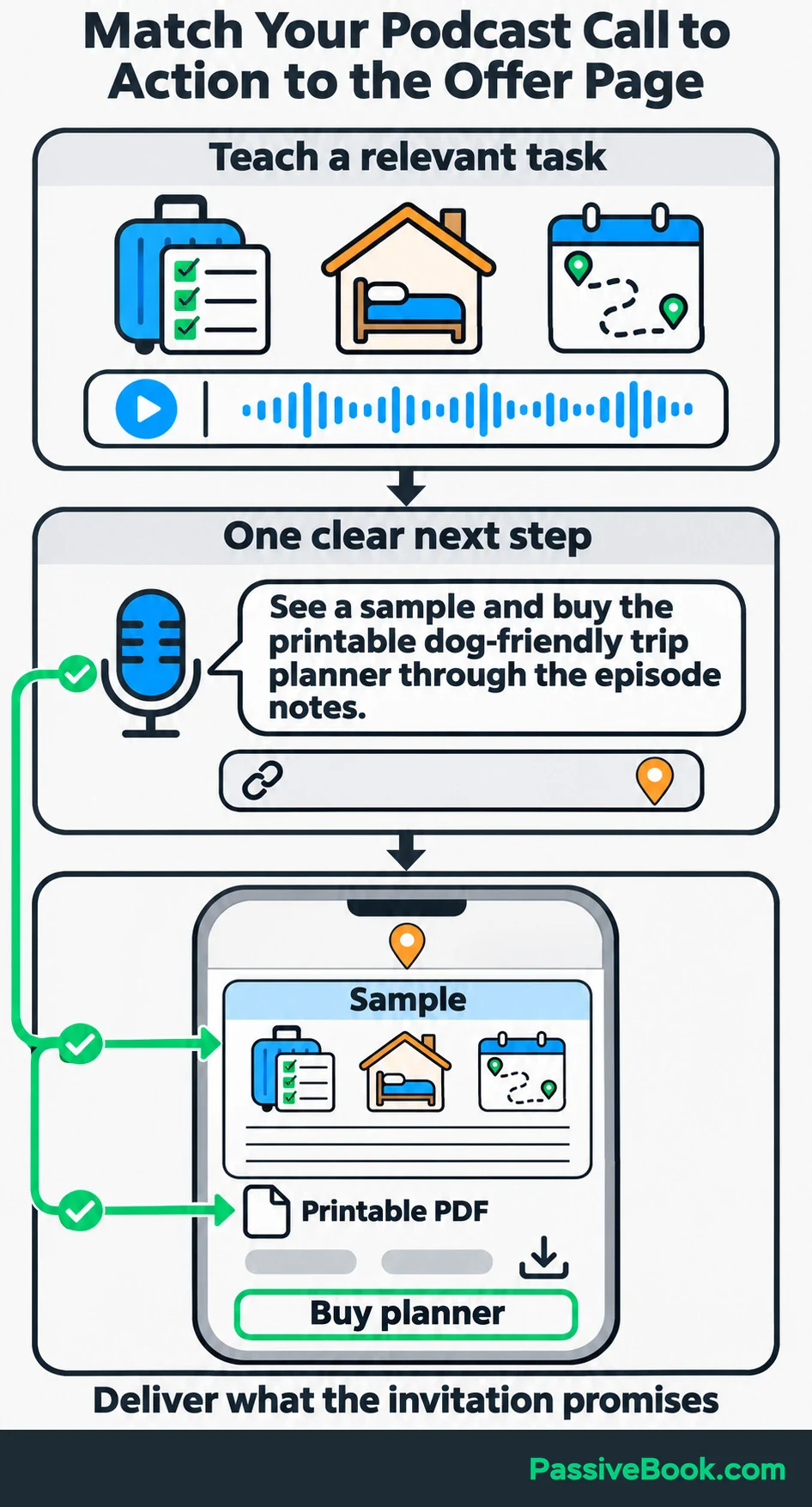
Keep the spoken invitation and linked page consistent. If the invitation promises a sample, visitors should find it easily.
If you have an offer in mind but not the words to sell it, the AI Skill can draft the invitation and matching page together. Start with what listeners will receive, what it costs, and how it connects to the episode.
Free AI Podcast Studio
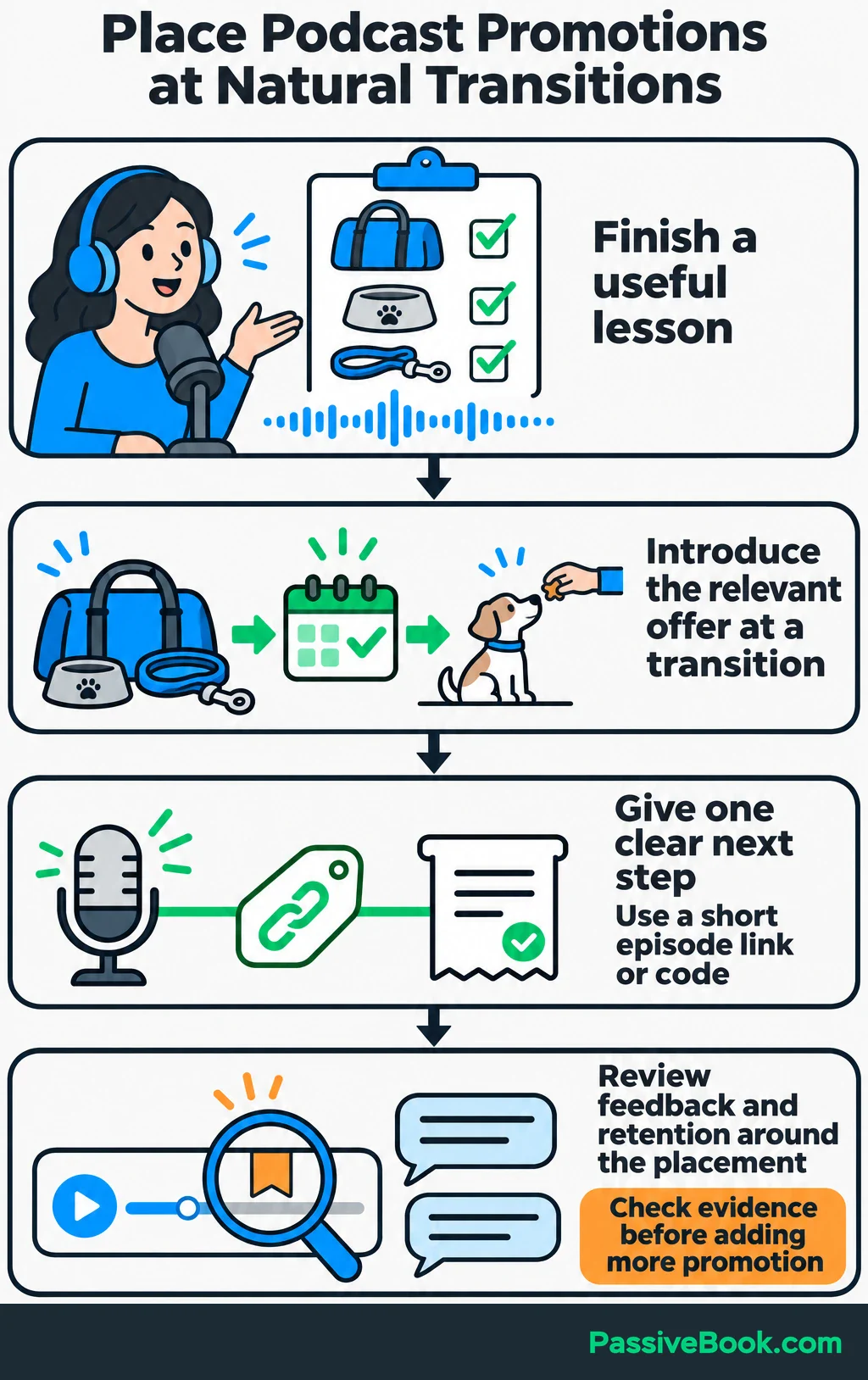
An episode-specific link or code can help identify responses. Keep the address short enough to say clearly.
Place promotions at natural transitions, and review listener feedback and retention around those points before adding more. More selling time needs a reason beyond an empty slot in the episode.
Improve Results Before Adding Another Stream
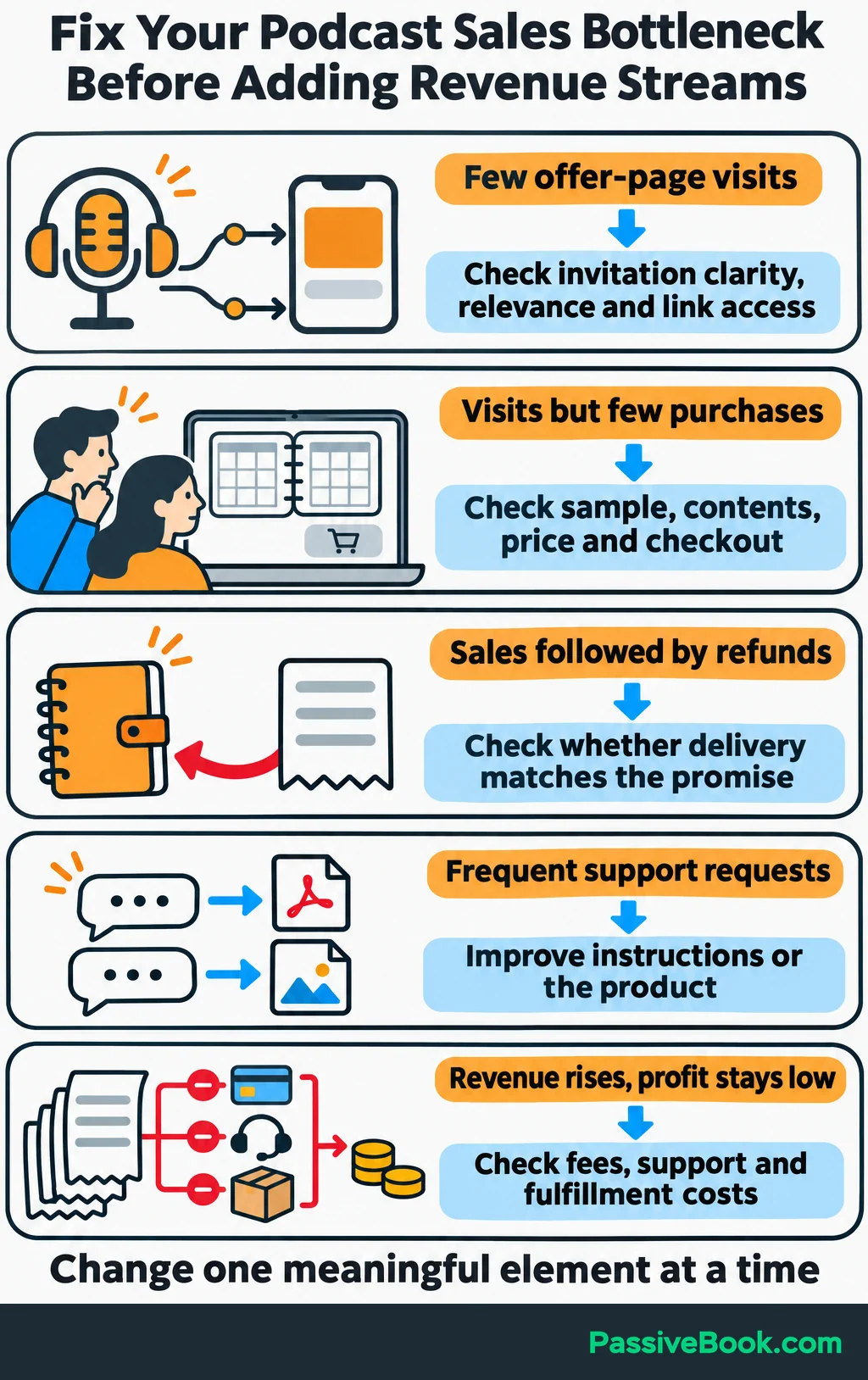
Keep a simple monthly record of visits, inquiries, purchases, approved commissions, refunds, collected revenue, costs, and delivery hours.
Use it to find the next problem to fix:
| What You Observe | What to Check Next |
|---|---|
| Few visits to the offer page | Whether the invitation is clear, relevant, and easy to follow |
| Visits but few purchases | Whether the sample, contents, price, and checkout answer buyers’ questions |
| Sales followed by refunds | Whether the product matches its promise |
| Frequent requests for help | Whether delivery instructions or the product need improvement |
| Revenue rising but little profit | Whether fees, support, or fulfillment are consuming the margin |
Change one meaningful element at a time. You need to know whether a clearer invitation or a revised offer made the difference.
Once planner sales work at an acceptable profit and workload, add selective affiliate recommendations. If you later introduce memberships, track cancellations and delivery time. For sponsors, track payment collection, campaign results, and renewals.
Automate payment confirmation and product delivery once the purchase path works. Tools such as Make or n8n can connect routine reporting when manual work starts repeating, but a simple spreadsheet is enough to begin.
Check failed payments, missing deliveries, and customer questions regularly. Automation still needs someone to notice when it fails.
Keep your offer pages, source files, sales records, and permission-based email contacts organized and backed up. That gives the business a way to continue if you change podcast platforms.
What Next?
Write down the listener question you hear most often and draft a one-sentence paid offer that answers it. Estimate what one sale would leave after costs before building anything larger.
Use the social buttons to share the revenue comparisons and break-even example when podcast earnings come up in your conversations.
Which listener problem could your first paid offer solve? Tell me in the comments, and bring any other questions about choosing or testing your revenue stream.
Share this post with your friends & followers:

