You have time to record one episode this week, but your topic list could fill the next six months. Which idea deserves the microphone?
Choosing only what sounds interesting leaves an awkward gap: you know what you want to say, but not how a new listener would find it.
A useful episode can still sit behind a title nobody thinks to search. This guide helps close that gap with a research process for choosing topics listeners look for and making those answers easier to find in podcast apps, on your website, and on YouTube if you publish there.
How Podcast Keywords Support Discovery
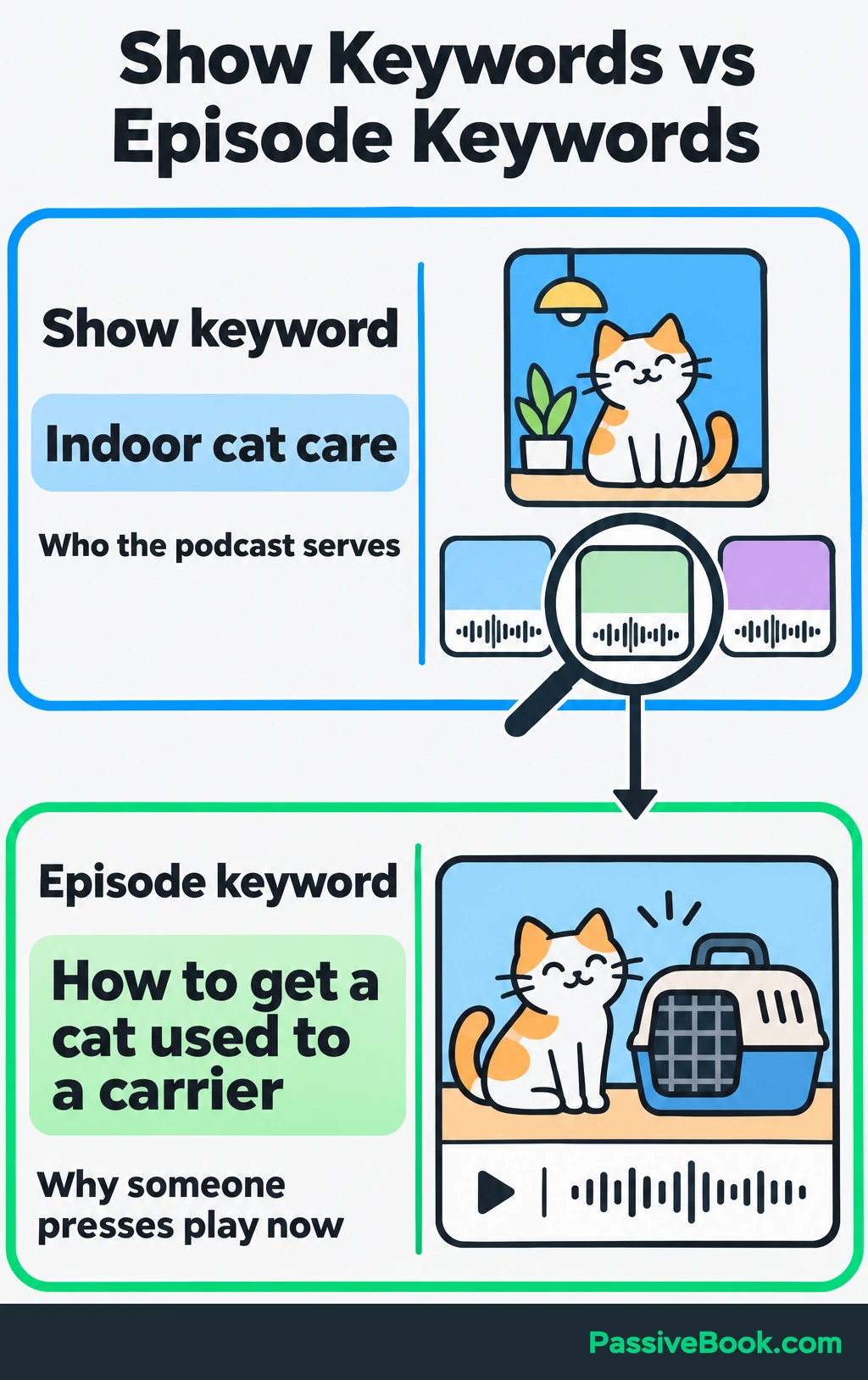
Podcast keywords work at two levels:
- Show keywords: Describe the subject you return to across episodes, such as “indoor cat care.”
- Episode keywords: Describe a particular question, such as “how to get a cat used to a carrier.”
The show phrase helps explain who the podcast serves. The episode phrase gives a listener a reason to press play now.
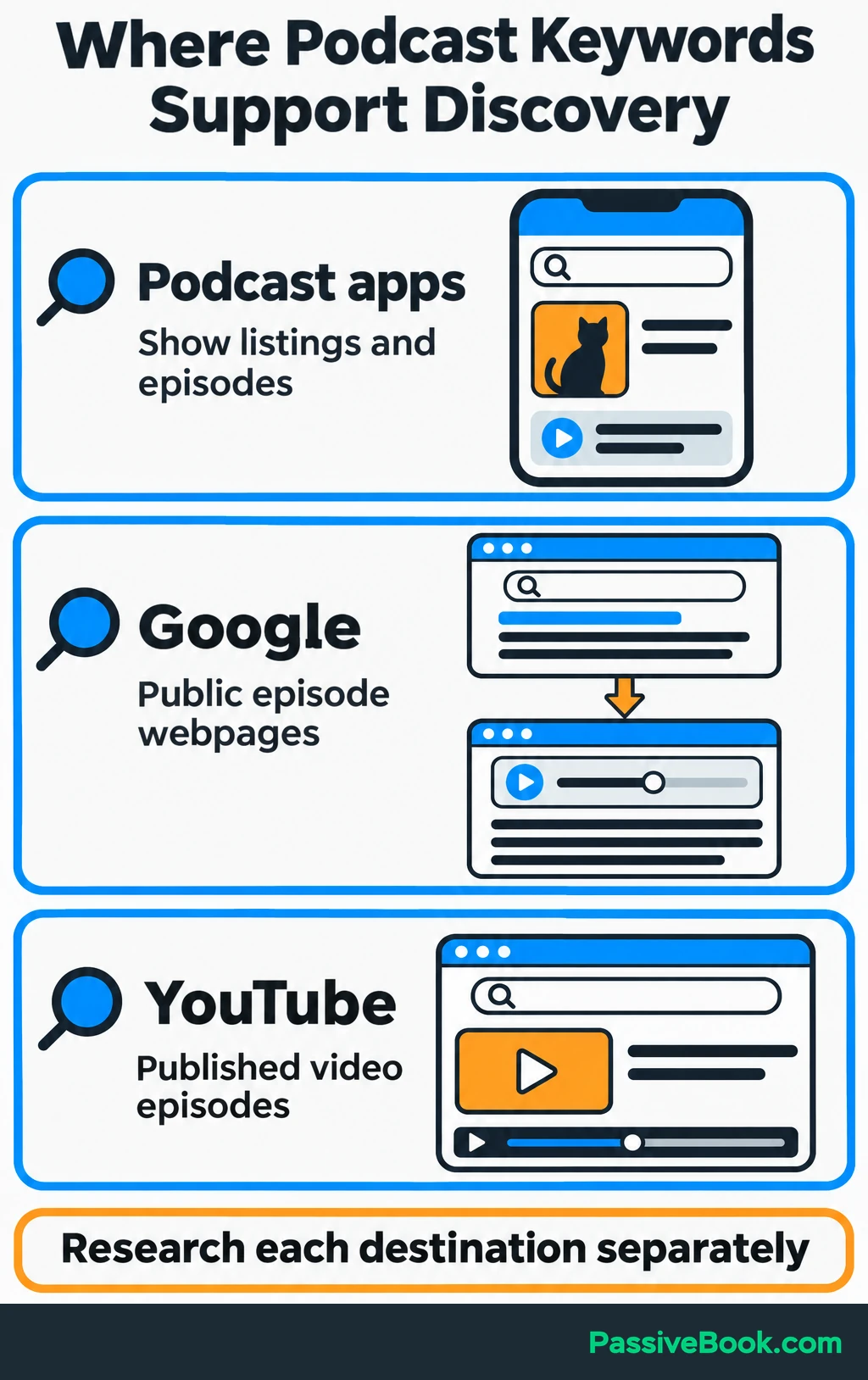
There are also different places to be found. Podcast apps show podcast listings and episodes. Google can lead people to public episode pages on your website. YouTube offers another route if you publish episodes there.
Research each destination you actually use. A phrase that brings up written instructions on Google may produce quite different results inside a podcast app.
This work has a practical basis. Apple lists show names and episode titles among its search factors, alongside popularity and listener engagement. Clear wording helps establish relevance, but it does not secure a ranking by itself. Apple’s explanation of podcast search makes that distinction.
You can start this process without paid ads, a large audience, or a paid research tool. I would begin with search results, audience questions, and a spreadsheet.
Throughout this guide, imagine you run an indoor-cat care podcast supporting a shop that sells printable cat-care planners. The sample phrases, titles, descriptions, and planning choices are illustrations to investigate, rather than verified opportunities or measured results.
1. Define the Listener Problems Your Show Will Solve
Before collecting keywords, write one sentence that names your subject, the listener’s situation, and the useful outcome.
For the running example:
Practical routines that help you care for an indoor cat, from setting up your home to preparing for trips.
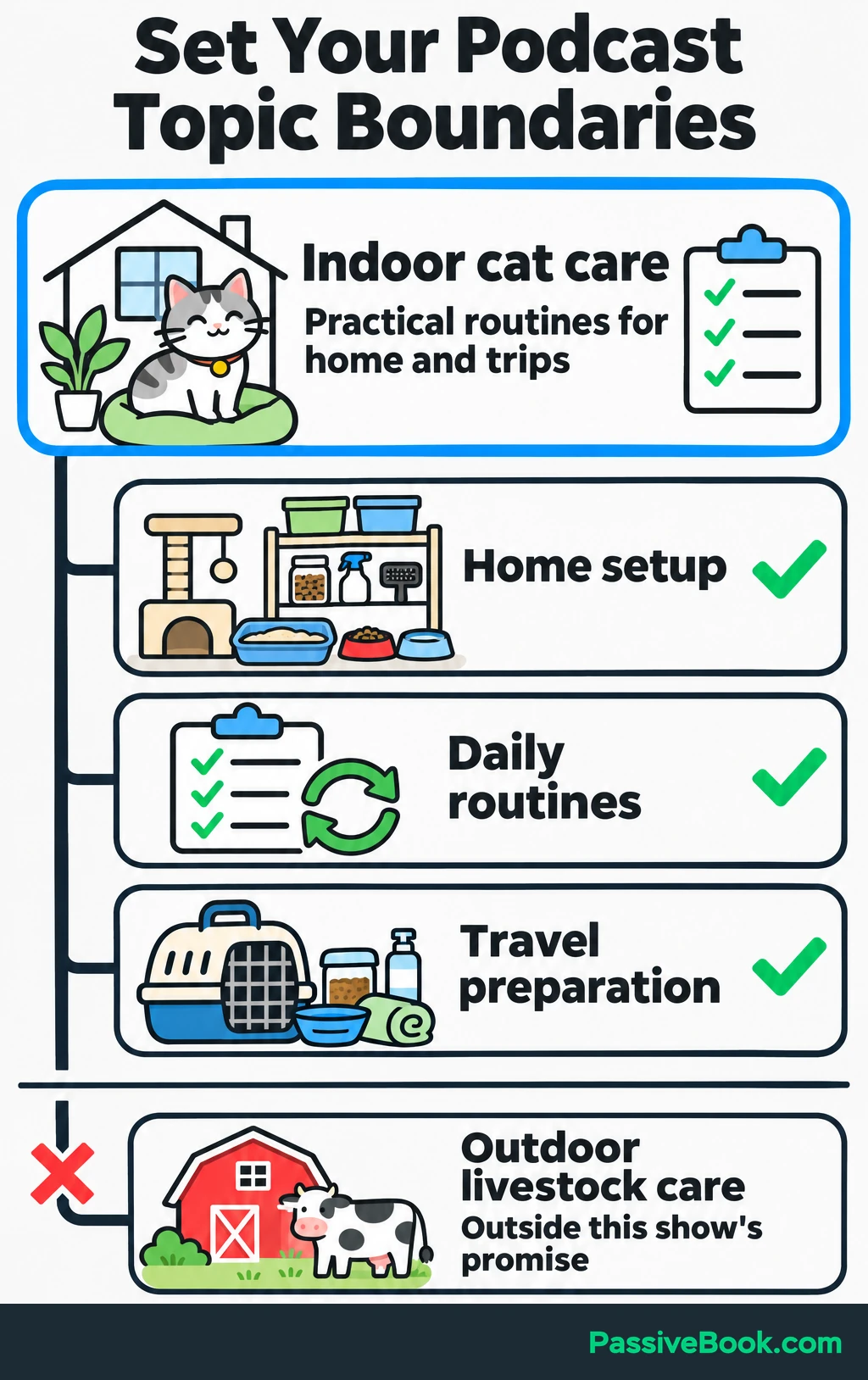
That promise gives you boundaries. Without them, keyword research can become an excellent way to collect work you should never do.
Choose a few topic groups beneath the promise:
- Home setup: Preparing spaces, organizing supplies, and making everyday care easier.
- Daily routines: Planning activities and keeping track of care tasks.
- Travel preparation: Organizing supplies, preparing for appointments, and planning carrier practice.
A phrase about caring for outdoor livestock falls outside those boundaries, however popular it might be.
I learned the cost of weak topic selection with my productivity blog. I spent eight months publishing more than 127 posts before abandoning it because the niche was too competitive and difficult for me to monetize. That was a blogging failure, but it informs how I choose content topics now: I want a clear audience need and a sensible business fit before committing to production.
For your podcast, connect each topic to a useful next action. That might be another episode, a free checklist, or a relevant product.
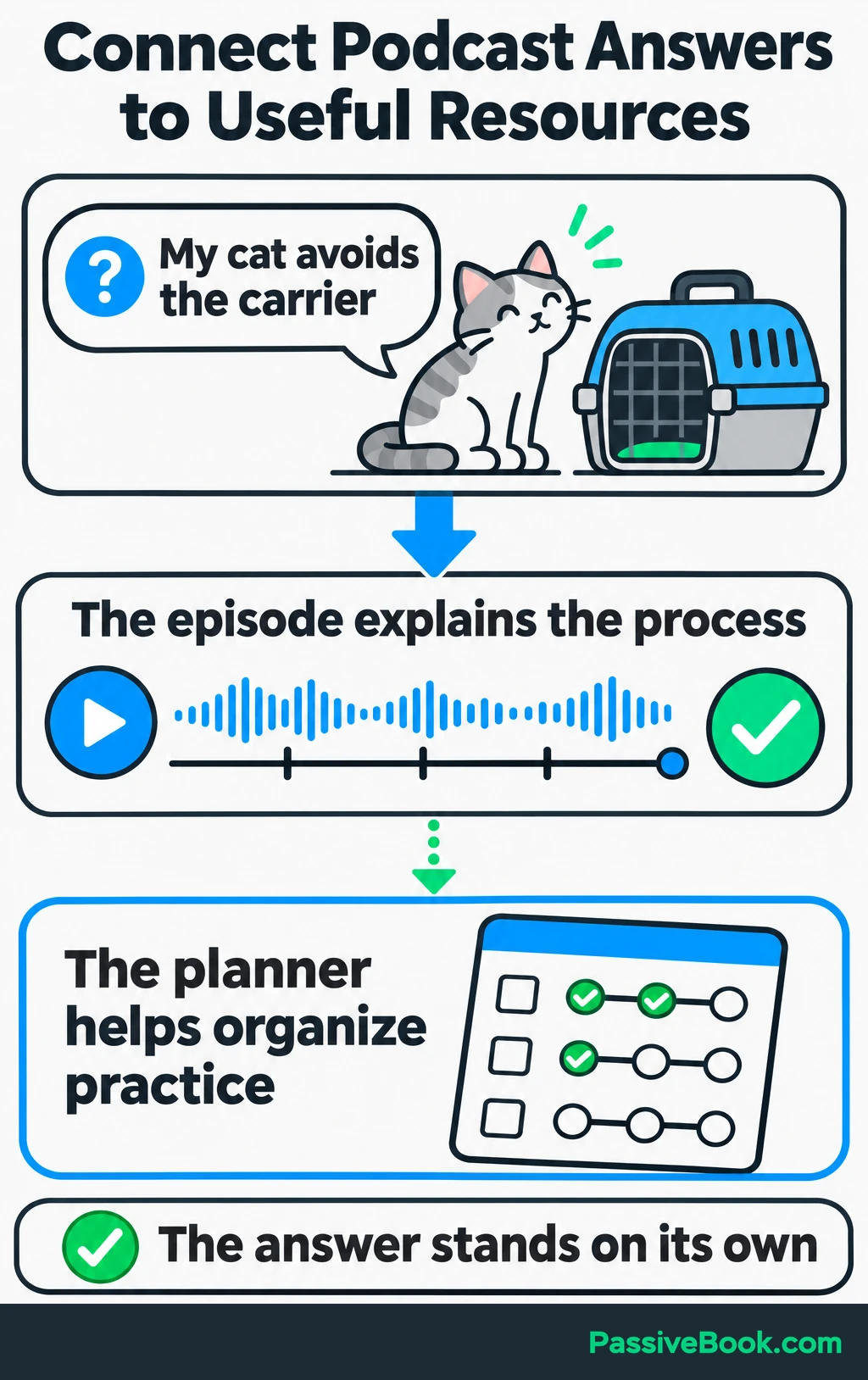
The carrier episode could lead to a printable practice planner. But the episode should still explain the process clearly if the listener never buys anything. A sales pitch with an audio file attached is a poor substitute for an answer.
2. Collect Keyword Ideas From Listener Questions
Start with the words people use when they need help. Save the original question before rewriting it into a tidy keyword.
Useful places to look include:
- Direct questions: Listener emails, customer inquiries, comments, and conversations.
- Community discussions: Repeated questions in relevant groups and forums, including the follow-up replies that reveal what remains confusing.
- Search suggestions: Suggested phrases, related searches, and relevant People Also Ask questions.
- Existing podcasts: Titles, descriptions, and episodes serving the same listener need.
Before launch, you can use conversations with prospective listeners and existing public discussions. You do not need an audience of your own to begin listening.
Expand each broad subject through three angles: the situation, the obstacle, and the desired outcome.
For “cat carriers,” that could produce questions about choosing a carrier, helping a cat become comfortable with it, or cleaning it afterward. Those subjects share an object, but they do not all need the same episode.
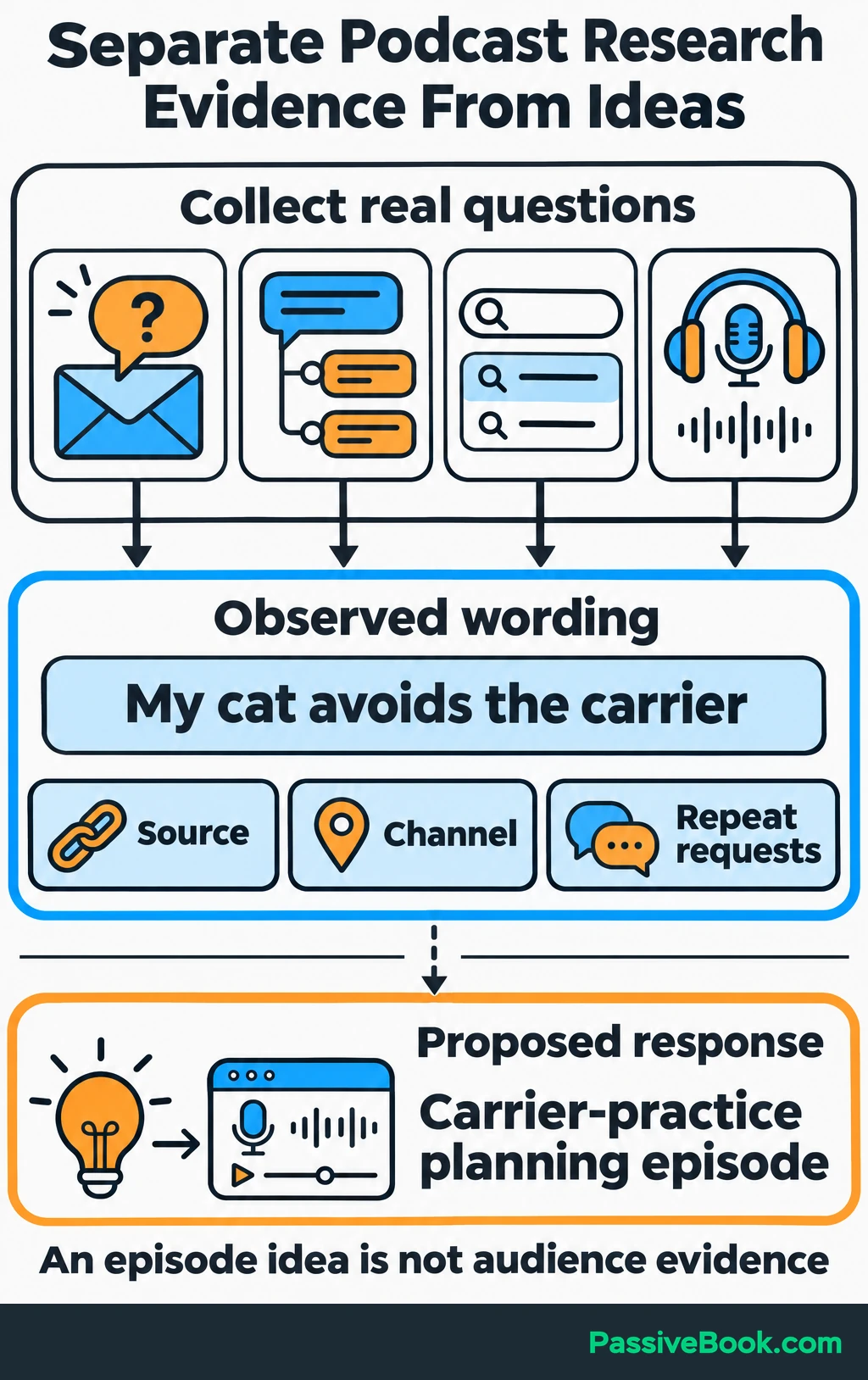
Keep a research sheet with these fields:
| Field | What to record |
|---|---|
| Original wording | The actual question or search suggestion you observed |
| Source and collection date | Where you found it and when |
| Intended channel | Apple Podcasts, Spotify, Google, or YouTube |
| Repeat requests | Separate occasions when the same problem appeared |
| Possible episode angle | Your proposed answer, kept separate from the original wording |
That last distinction matters. “My cat avoids the carrier” is an audience observation. “A weekly carrier-practice planning episode” is your proposed response. Do not let your idea quietly become evidence that people requested it.
When reviewing another podcast, listen to the relevant episode before declaring a gap. A vague description may hide an excellent answer.
You can also give your collected questions to Claude or ChatGPT and ask it to group similar tasks while preserving the original wording. Have it flag suggested additions separately. AI is useful for sorting the pile, but its suggestions still need checking.
Search suggestions belong in that same research pile. They offer wording to investigate, not a measured audience size.
3. Choose Relevant Keywords With Realistic Opportunities
Match the Keyword to the Searcher’s Task
Search each promising phrase where you want the episode to be discovered. Look at what the results help people do.
This is search intent: the task behind the words.
| Candidate phrase | Likely task | How I would use it |
|---|---|---|
| cat care podcast | Find a show to follow | Investigate for show positioning |
| how to get a cat used to a carrier | Find practical instructions | Investigate as an instructional episode |
| best cat carrier | Compare products before buying | Consider only if you can offer a useful, well-supported comparison |
| how to clean a cat carrier | Complete a cleaning task | Investigate as a separate episode |
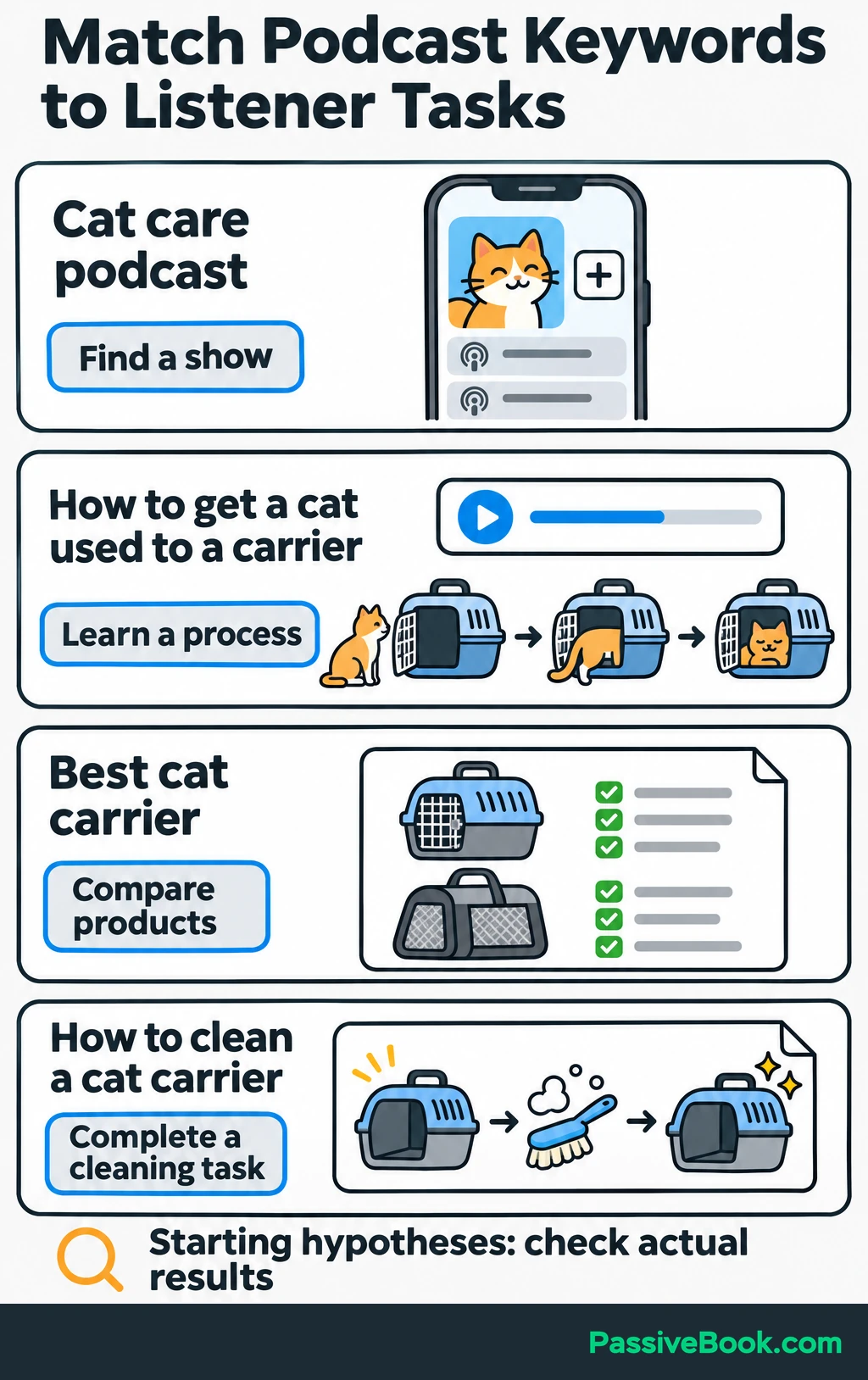
Treat those interpretations as starting points and check the actual results.
Notice the format, too. Do people receive complete shows, individual episodes, written guides, demonstrations, or shopping pages?
Choose a question your recording can answer clearly. If listeners need to see a movement or compare physical features, plan a useful visual or supporting page. I would skip an audio-only treatment when the missing picture would leave the listener stuck.
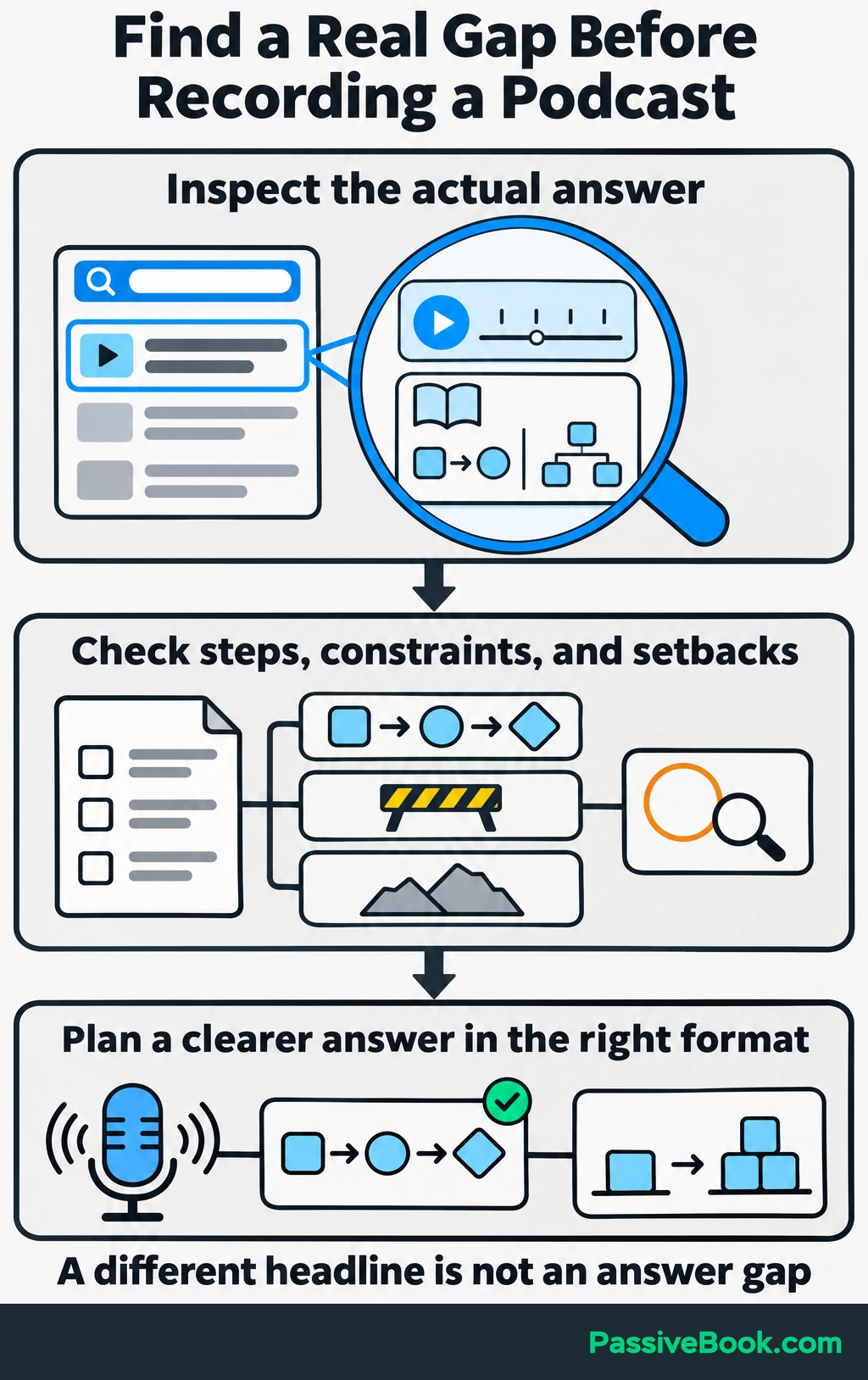
Then inspect the competing answers. Listen or read far enough to judge what they cover.
A useful improvement might be a clearer sequence, an overlooked constraint, or help with a common setback. For the carrier topic, investigate whether existing answers explain how to introduce the carrier gradually and what to do when the cat avoids it. Do not assume that gap exists because a title leaves it out.
A slightly different headline is not much of a reason to produce another episode. A clearer answer is.
Compare Interest and Competing Answers
I would assess a short list through five questions:
- Does this fit the show’s promise?
- Is the listener’s task clear?
- What evidence suggests people want this answer?
- What do the existing answers leave unresolved?
- Can I deliver the improvement with the time and resources available?
Begin with recurring audience questions and direct inspection of results. Add numerical estimates when they help you compare website opportunities.
For that job, I would choose Ubersuggest before building an expensive research stack. It suggests related keywords and estimates monthly web searches. Its SEO difficulty score estimates how hard it may be to rank a webpage in unpaid search results. Compare phrases using the same location and language. Ubersuggest’s keyword research guide explains what its reports contain.
Keep those web-search estimates separate from your podcast-app notes. They do not measure searches inside Apple Podcasts or Spotify, and a low website difficulty score does not establish an easy podcast opportunity.
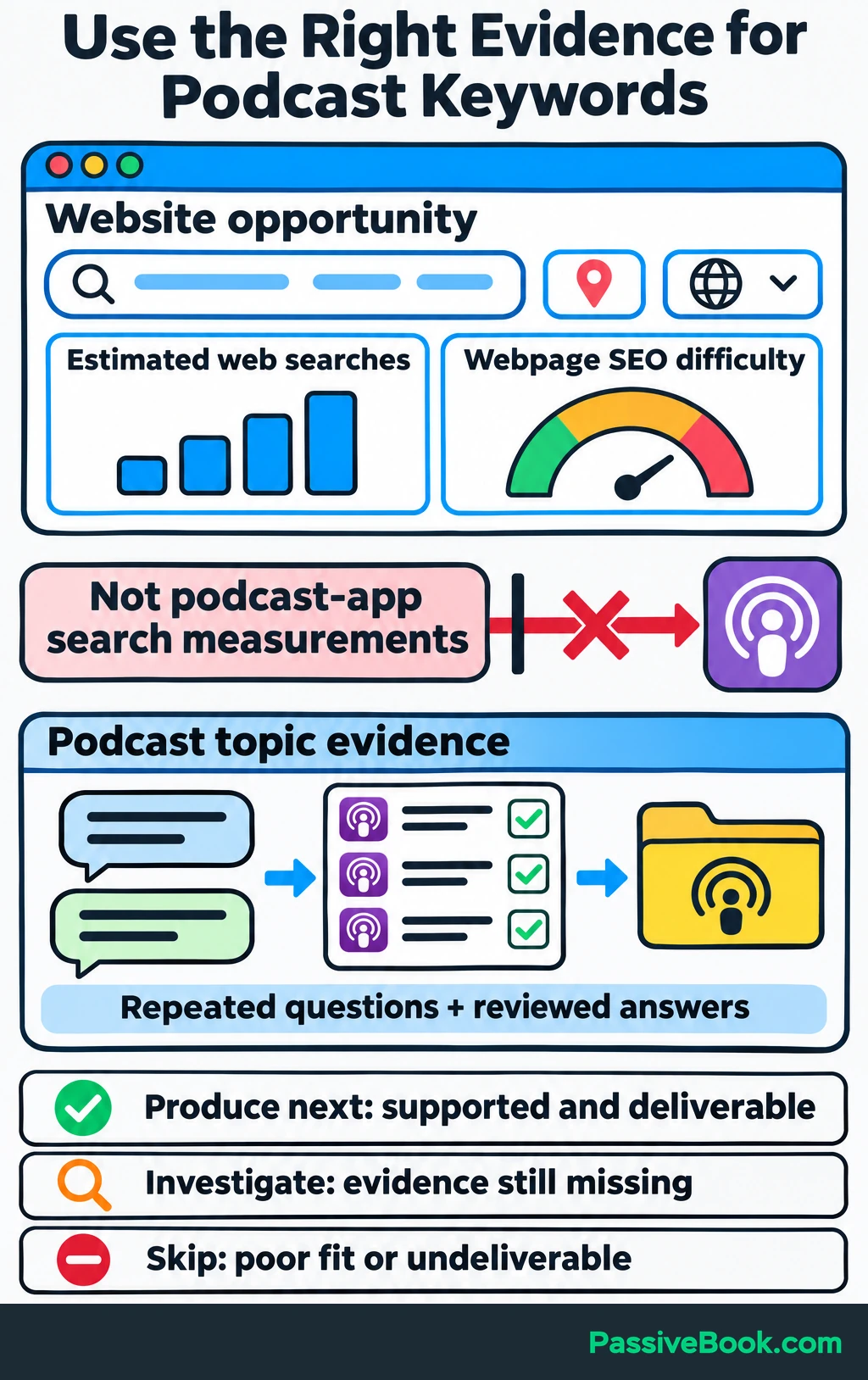
Specific phrases are useful when they reveal a clearer problem. Adding more words does not automatically make a keyword easier.
Give each candidate a decision:
- Produce next: The topic fits, there is credible interest, and you can explain what your answer will improve.
- Investigate: The question looks relevant, but you still need audience evidence, a review of competing answers, or suitable expert input.
- Skip: The phrase falls outside your promise or requires an answer you cannot deliver well.
For the carrier-training question, I would start at “investigate.” Move it to “produce next” when listener requests and the competing answers support that choice.
A recurring listener problem deserves attention even when a tool has no estimate for it. A large estimate deserves no special loyalty when the topic is wrong for your show.
4. Map Related Keywords to Distinct Episodes
Group phrases when one episode can satisfy the same underlying task. Choose one primary phrase to name that task and use related questions to complete the answer.
For example, “how to get a cat used to a carrier” and “cat carrier training” could belong together. Questions about planning practice and recording setbacks could support that same episode.
Cleaning the carrier calls for different instructions, so it belongs elsewhere.
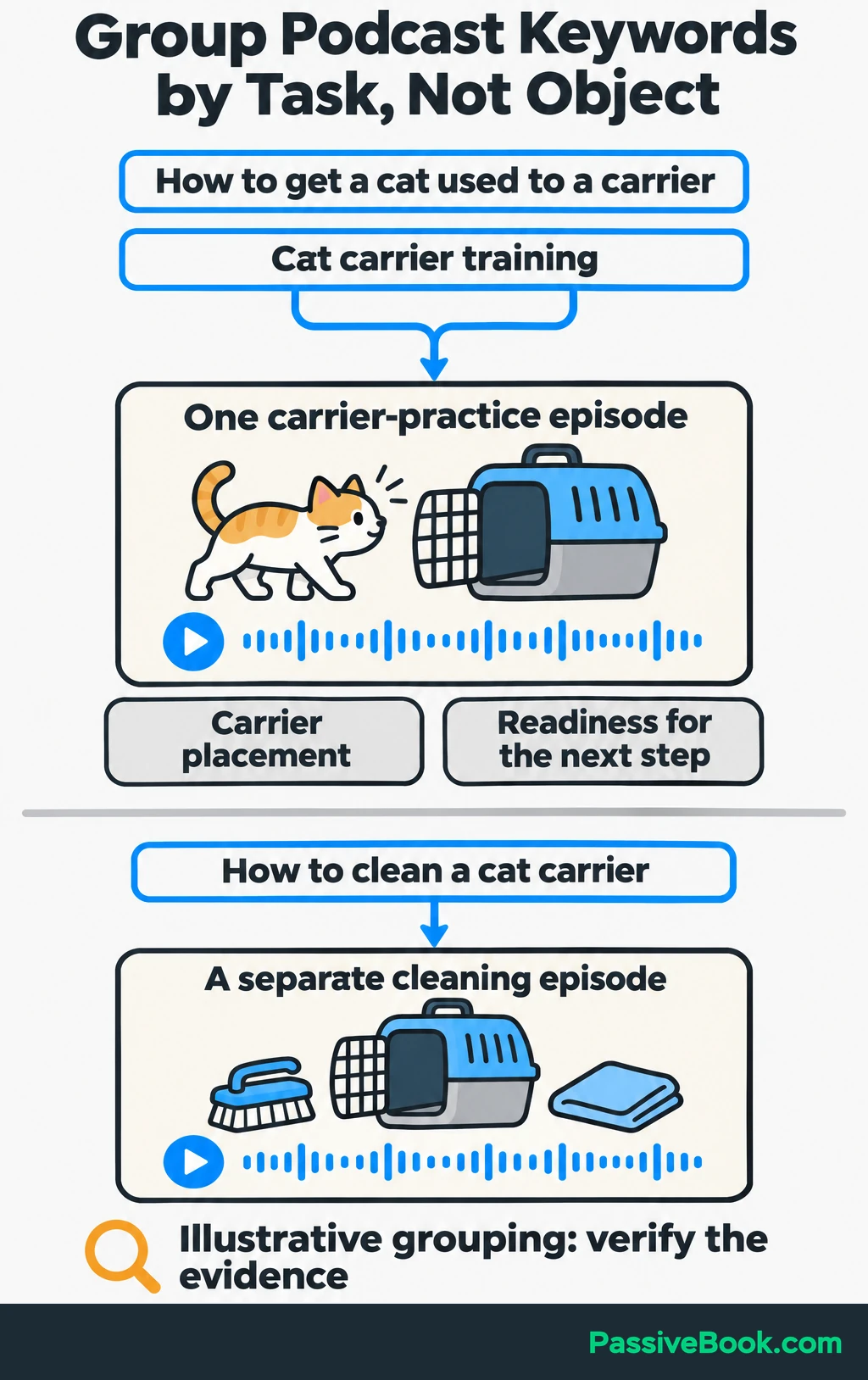
Before adding either episode, check your existing catalog. If you already have a useful answer, improving its title, description, or missing section may be the better use of your time. Create a follow-up when the listener needs something substantially different.
Use your research sheet as an episode map. Here is one complete illustrative entry:
| Planning field | Carrier episode entry |
|---|---|
| Primary keyword | how to get a cat used to a carrier |
| Related questions | Where should I put the carrier? How can I tell when my cat is ready for the next step? |
| Listener outcome | Know how to introduce a carrier gradually and respond when a cat avoids it |
| Discovery channels | Podcast-app listing and a public episode webpage; assess each separately |
| Research evidence | Not yet collected; check audience requests and listen to competing answers |
| Planned title | How to Get a Cat Used to a Carrier |
| Existing episode or page | None assumed; check the catalog before creating one |
| Priority | Investigate until the evidence and production requirements are clear |
| Publication status | Unscheduled |
For the cleaning phrase, create another entry titled “How to Clean a Cat Carrier.” Give it its own evidence check, outcome, and production brief. The shared word “carrier” is no reason to squeeze two tasks into one recording.
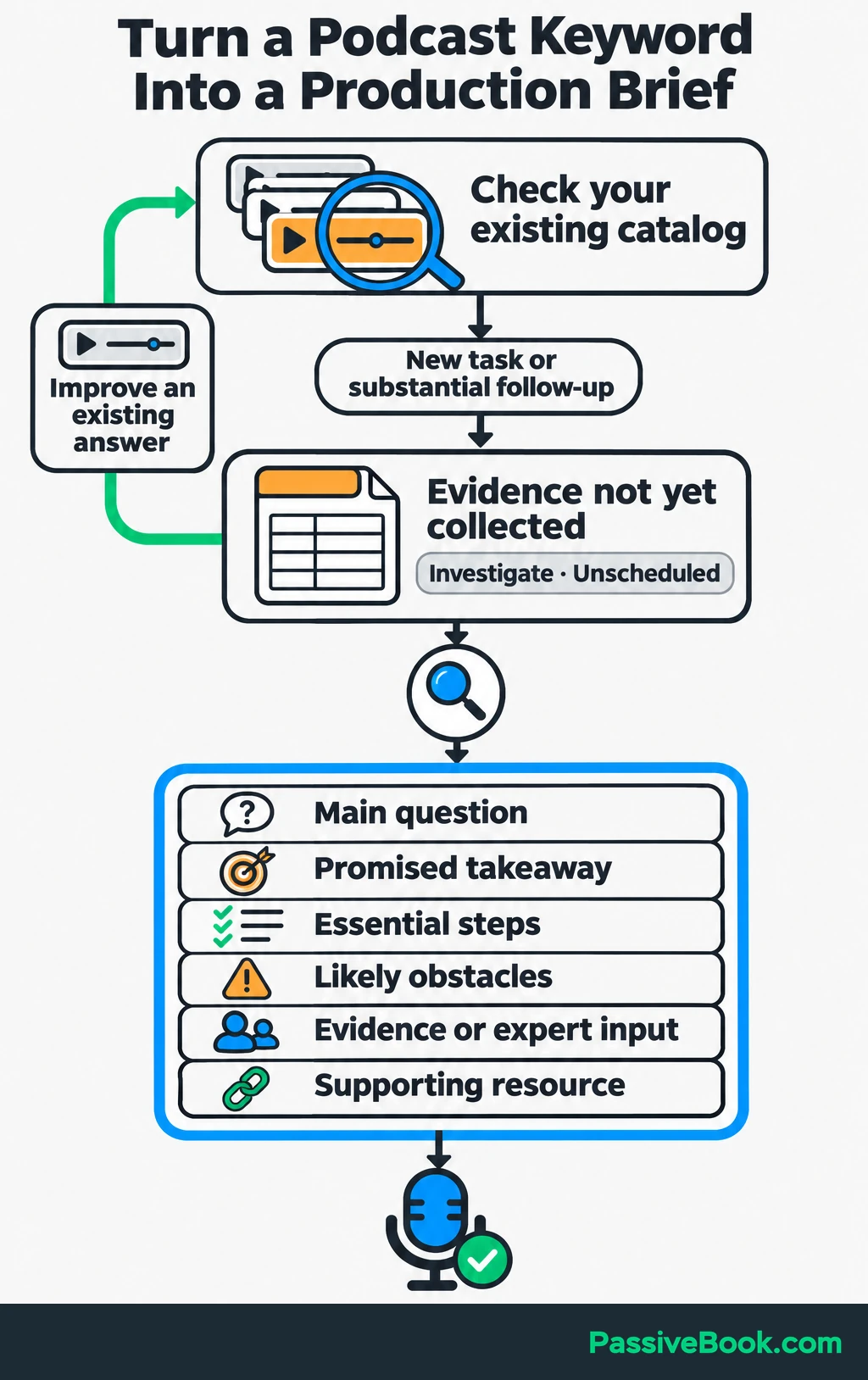
Once an entry is selected, turn it into a brief covering:
- Main question: The problem the episode must answer.
- Promised takeaway: What the listener should understand or be able to do afterward.
- Essential steps: The order needed to reach that outcome.
- Likely obstacles: Where someone could get stuck.
- Evidence or expert input: What you need before recording.
- Supporting resource: A summary, planner, demonstration, or related episode.
For the carrier episode, the printable planner could help listeners organize their notes. It should support the explanation rather than contain the missing half of it.
Schedule only what you can produce well. I would rather have three researched episodes ready for production than a six-month calendar built from guesses. Link related episodes, but make each one useful to someone who discovers it first.
If turning your research into a usable brief is where you get stuck, AI Podcast Studio can draft one from your listener’s question. It also writes matching title and description options, so the recording and its listing promise the same answer.
Free AI Podcast Studio




5. Apply the Keywords to Your Published Content
Write Clear Episode Titles and Descriptions
Write the title so a new listener can recognize the subject without knowing your show.
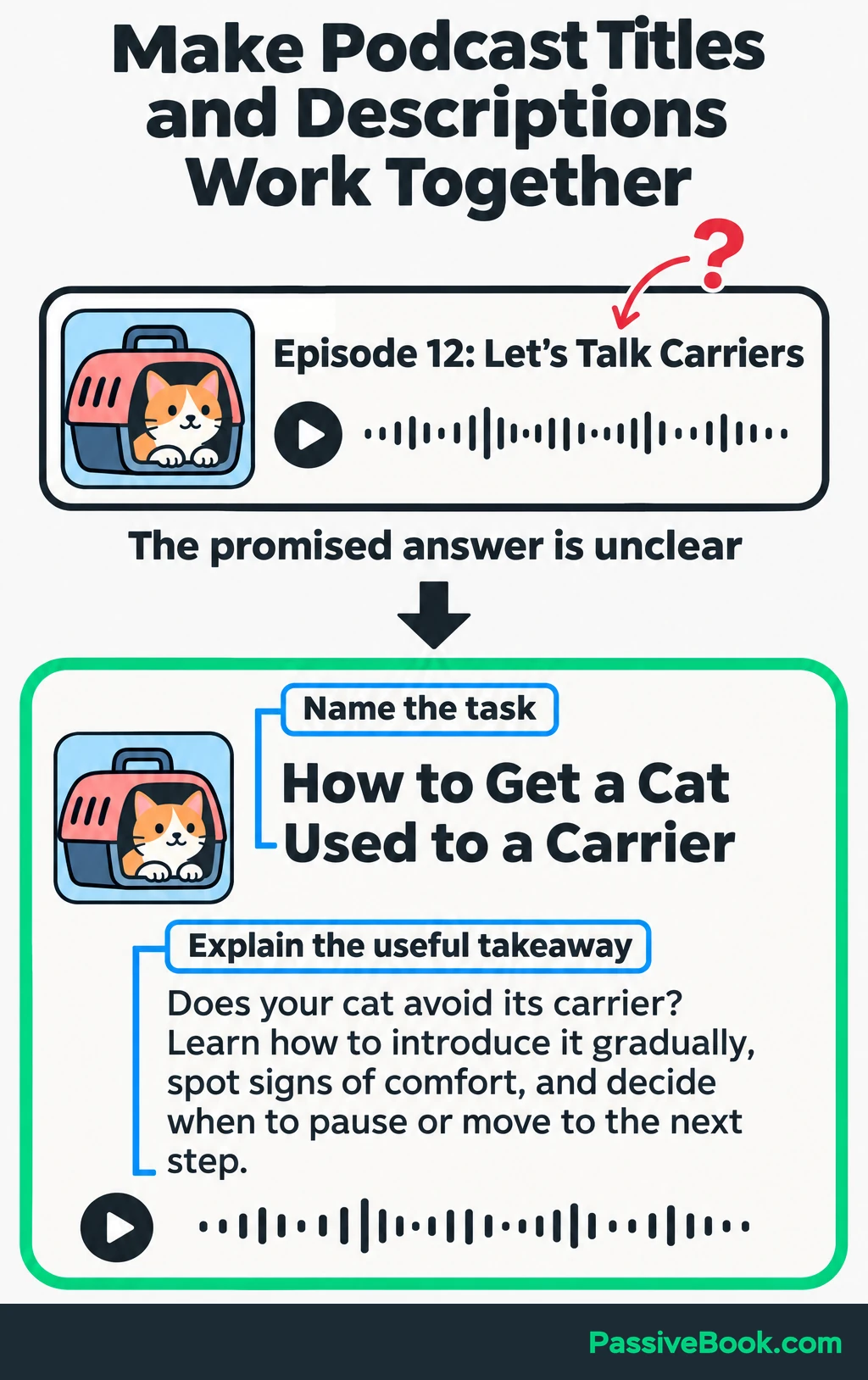
“Episode 12: Let’s Talk Carriers” gives them little to work with. “How to Get a Cat Used to a Carrier” makes the promised answer clear.
Put the recognizable topic before optional numbering or recurring branding. Keep the show name stable and distinctive, and let its description explain the ongoing subject. There is no need to rename the show every time you find another keyword.
Open each episode description with the problem and useful takeaway. Here is a short illustrative description for the planned carrier episode:
Does your cat avoid its carrier? Learn how to introduce it gradually, spot signs of comfort, and decide when to pause or move to the next step.
Use supporting topics and relevant guest names where they add meaning. Spotify identifies the match between search terms and an episode’s title and description as an important discovery factor. Its episode-description guidance also recommends making the title and description work together.
The title names the task. The description gives someone more reason to listen. Repeating the same phrase four times does neither job well.
Build the recording around that promise and introduce the useful outcome early. Read the title and description aloud before publishing. If they sound like a list of search terms, rewrite them.
You are allowed to sound human in your titles and descriptions. I recommend it.
Support Discovery on Your Website and YouTube
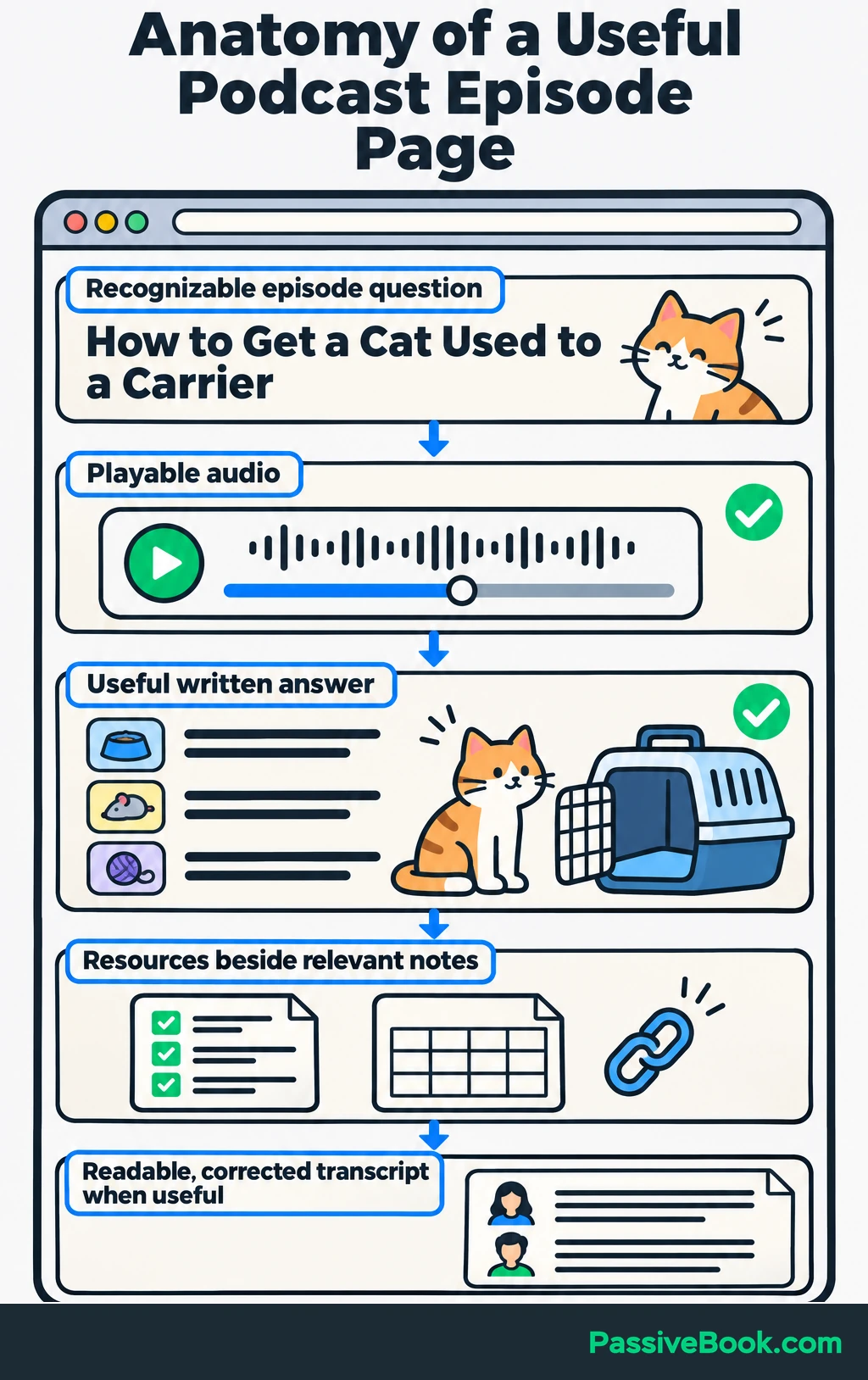
Give each episode a public webpage if Google discovery is part of your plan.
I would use WordPress for control over the page and its supporting content, but the basic workflow works with other website tools. Include:
- A descriptive title and heading: Make the episode’s question easy to recognize.
- Playable audio: Let visitors hear the answer without hunting for it.
- Useful written notes: Explain the main answer and organize details around listener questions.
- Relevant resources: Place downloads and related episodes beside the points they support.
- A readable transcript: Add one when it helps, and correct errors that change the meaning.
Google recommends descriptive, concise page titles and warns against repeated keyword variations. You can use the episode’s clear title as your starting point. Google’s title guidance supports that approach.
For the carrier episode, place the practice summary and referenced planner near the player. Visitors who came for instructions should be able to use what they find.
A transcript can add detail, but I would still write a short, organized answer above it. Readers should not have to search a long conversation for the promised steps.
If you publish on YouTube, align the title, description, and actual episode with the same question. YouTube says search considers relevance, engagement, and quality, including how the content matches a query. YouTube’s search explanation makes clear that the title is only part of the picture.
You do not need to add another publishing channel immediately. Apply this process to the destinations you can maintain.
6. Refine Your Strategy With Discovery and Listening Data
Record publication dates and meaningful title or description changes in your episode map. Those notes help you interpret what happens later.
Compare episodes over similar periods after publication. A new release and an episode with months of exposure have had different chances to be found.
For website pages, use Google Search Console to review the search phrases that brought up your episode page. Filter to that page and choose a date range. The report counts appearances in search results as impressions and shows how many clicks they led to. Its click-through rate tells you how often an appearance led to a click. Google’s Performance report documentation explains these measures.
If related queries reveal an unanswered part of the same task, improve the page. If they reveal a different task, investigate a separate episode.
On Spotify, review how often your content appeared (impressions), how often those appearances led to plays, and whether listeners stayed through the episode. Keep one reporting detail in mind: Spotify’s “Search” discovery category includes search queries, charts, and editorial recommendations. It does not isolate keyword-search traffic. Spotify’s Discovery analytics guide explains that grouping.
On YouTube, check which search terms brought viewers to an episode and where viewers stopped watching. Use both to assess whether the episode answers the question people came with.
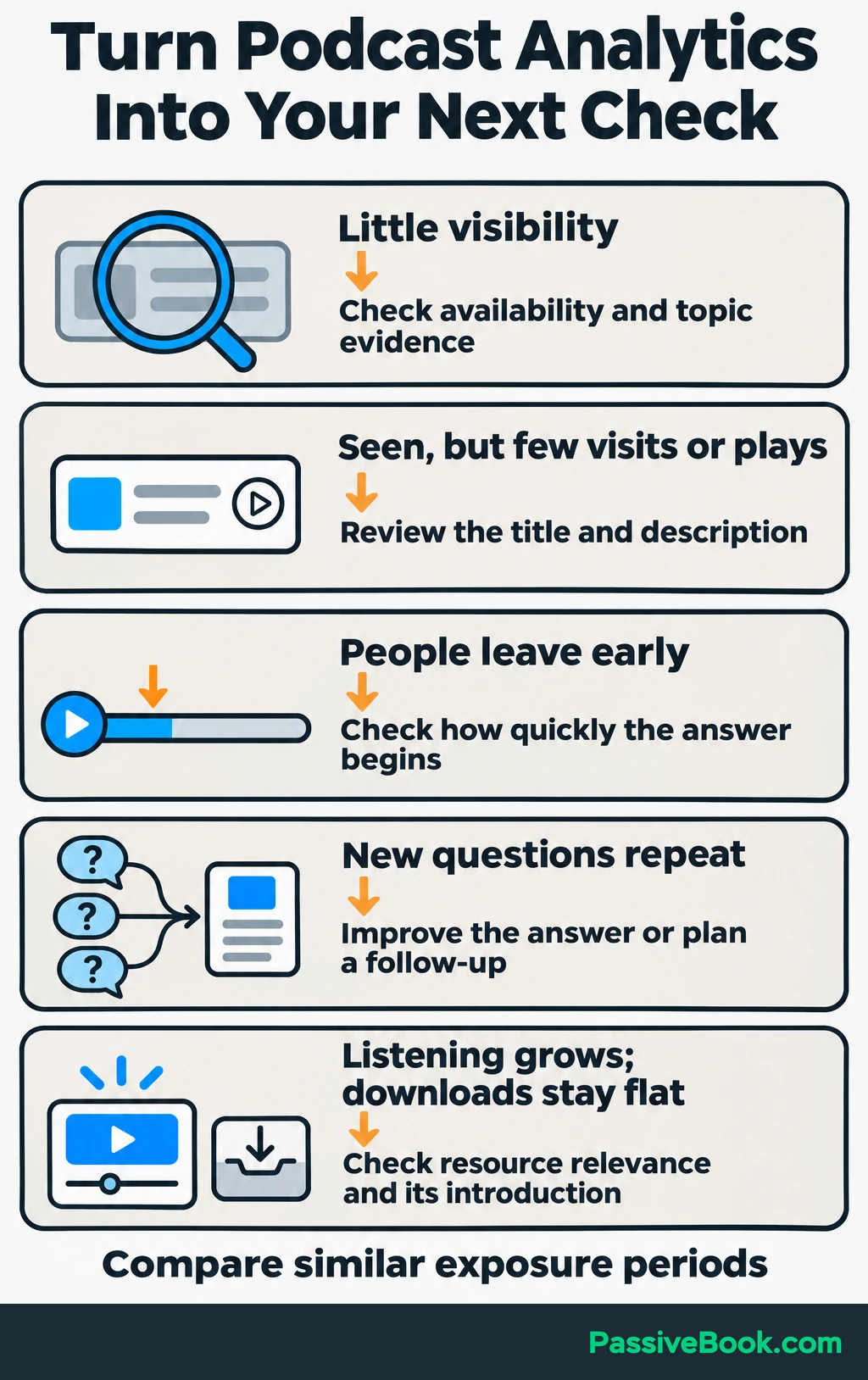
Let the problem determine the change:
| What you observe | What to check next |
|---|---|
| Little visibility | Confirm the episode or page is available, then revisit topic fit and your research evidence |
| Relevant impressions but few visits or plays | Review whether the title and description make the useful outcome clear |
| People start but leave early | Listen to the opening and check how quickly it begins answering the promised question |
| New questions appear repeatedly | Decide whether the existing answer needs work or a distinct follow-up |
| Listening grows but planner downloads stay flat | Check the resource’s relevance and how you introduce it |
Keep listener growth separate from business outcomes. Plays, related-episode visits, email signups, and planner downloads answer different questions.
I would review the map monthly and record useful questions as they arrive. Sparse data may justify waiting; a repeated mismatch deserves attention.
When a change is followed by better results, record what you observed. Other factors may have changed too, so do not treat that sequence as proof that a keyword edit caused the growth.
The point of the review is to make the next production decision better informed.
What Next?
Choose one listener question and create its episode-map entry before you record again. Find the existing answers, write down what yours would improve, and decide whether it deserves production or more research.
Use the social buttons to share this guide when you want a podcast planning discussion to end with a researched topic ready to record.
Which question would you investigate for your next episode, and what evidence would make it worth recording? Share your thinking in the comments, and bring any other questions too.
Share this post with your friends & followers:

