Your latest episode is live, but you can’t explain how a new listener is supposed to find it. You’ve shared the link, and now you’re back to planning the next recording.
That cycle can eat your spare evenings without showing which work brings people in or gives them a reason to return. Publishing more episodes adds to the pile, but it doesn’t answer either question. To make those evenings count, this guide shows how to reach people who need your episodes and earn another listen, with a promotion routine that fits around recording.
Give Listeners a Clear Reason to Choose Your Show
Start with the recurring problem your show helps someone solve. “A podcast for dog lovers” describes an interest, but it gives people little reason to choose your next episode.
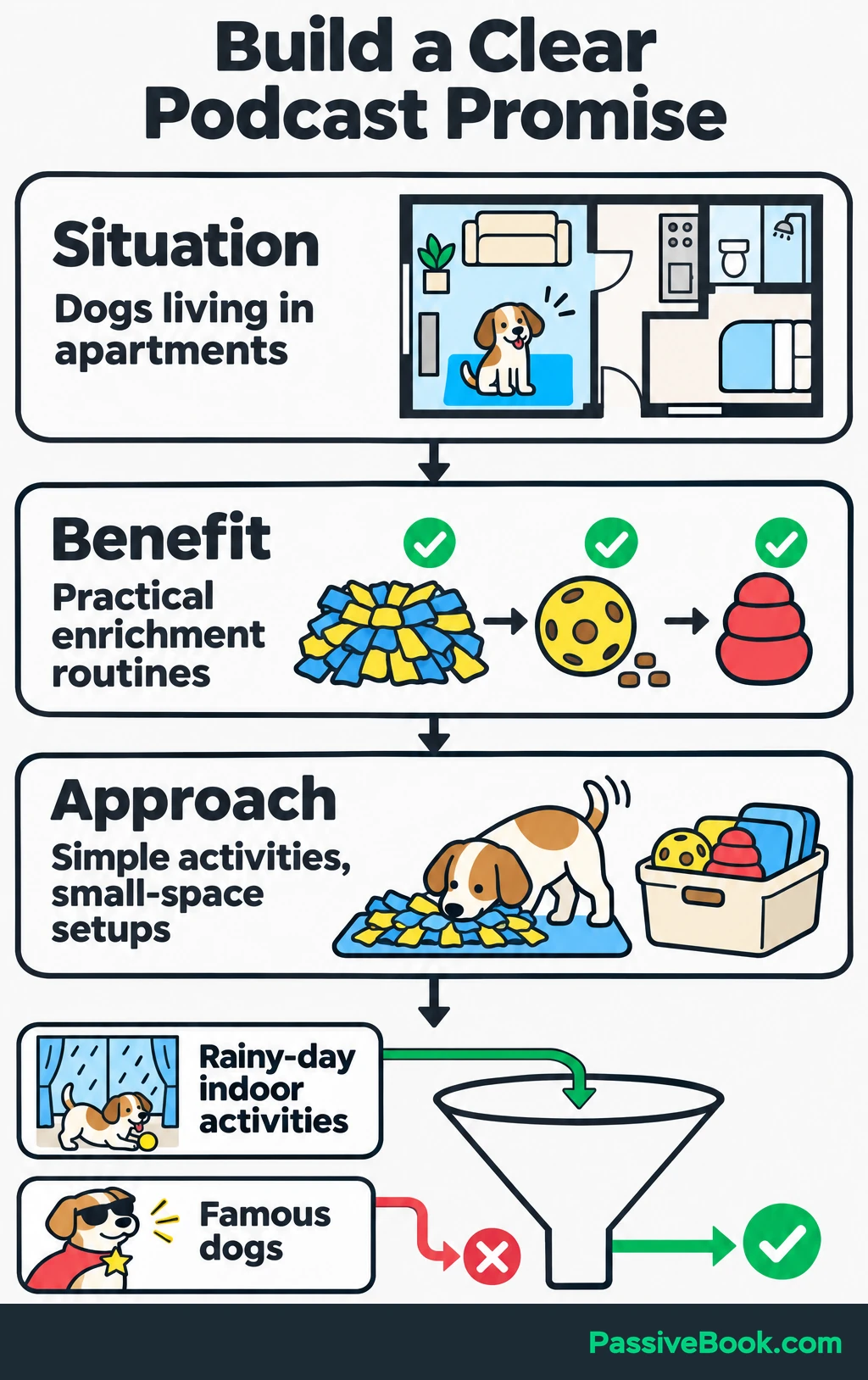
A useful promise combines three things:
- Situation: What is happening in the listener’s life?
- Benefit: What will listening help them do?
- Approach: How will you make that easier?
Throughout this guide, imagine you run Apartment Dog Days, a podcast supporting a business that sells printable enrichment cards for apartment dogs. Its copy and figures are illustrations.
The show’s promise could be:
Practical enrichment routines for dogs living in apartments, explained through simple activities and small-space setups.
That promise gives you a filter for topics. A question about organizing indoor activities fits. A general discussion about famous dogs probably doesn’t, however excellent the dogs are.
Before settling on your promise, talk to prospective listeners. Ask what they find difficult, what advice they’ve already tried, and what other shows leave unanswered. Ask where they found the last useful answer, too. That can help you choose a promotion channel later.
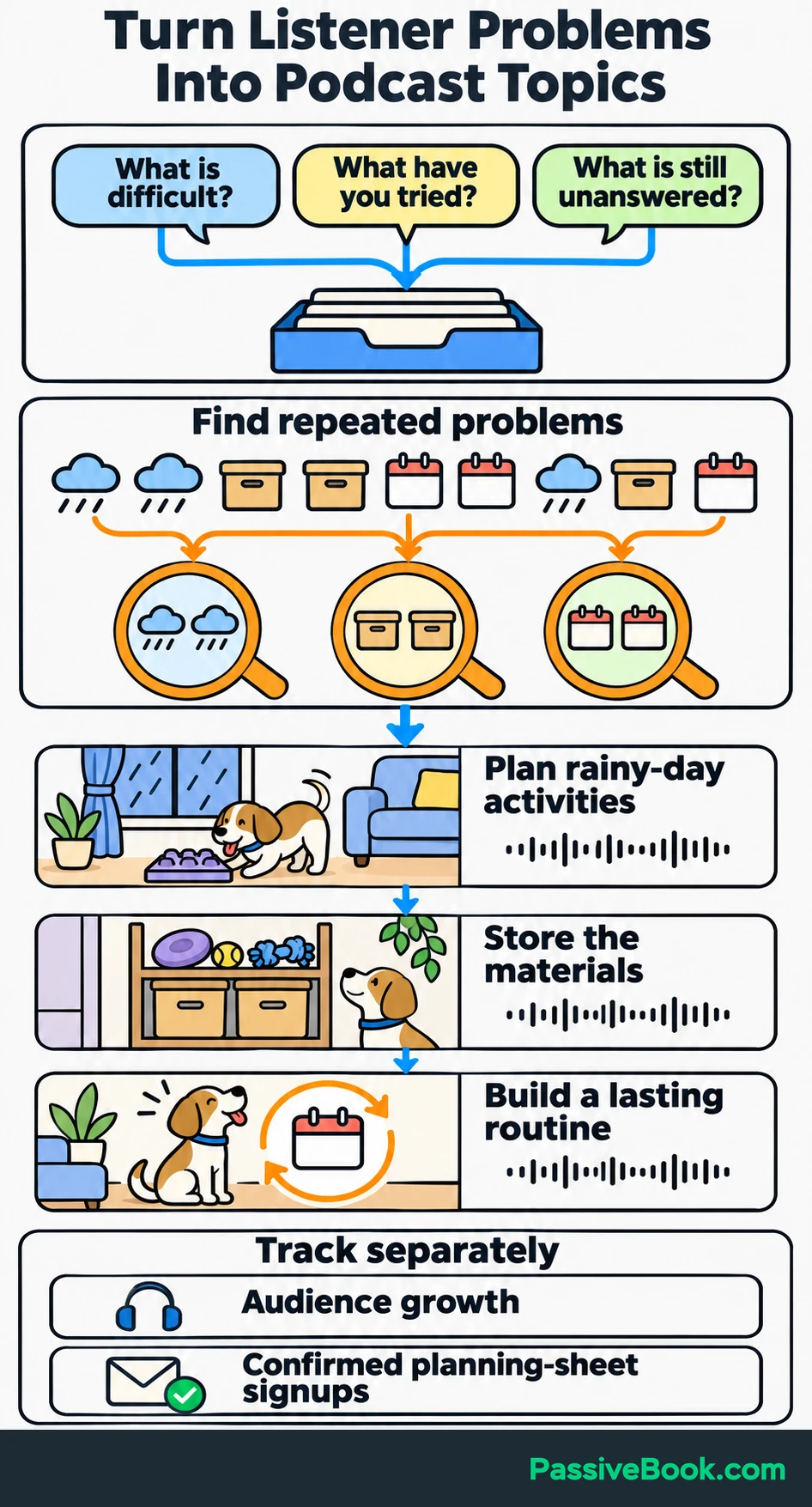
Look for repeated problems rather than collecting compliments about your idea.
Then build a short queue of connected questions. For Apartment Dog Days, that might be:
- How do I plan indoor enrichment for a rainy day?
- Where do I store activity materials in a small apartment?
- How do I build a routine I can keep using?
Choose one business outcome alongside your audience goal. In this example, I would track confirmed email subscribers who request a rainy-day planning sheet. Keep that separate from listener growth so you can see whether the show is attracting people and whether it is supporting the business.
Make Each Episode Worth Finishing
Answer One Question Well
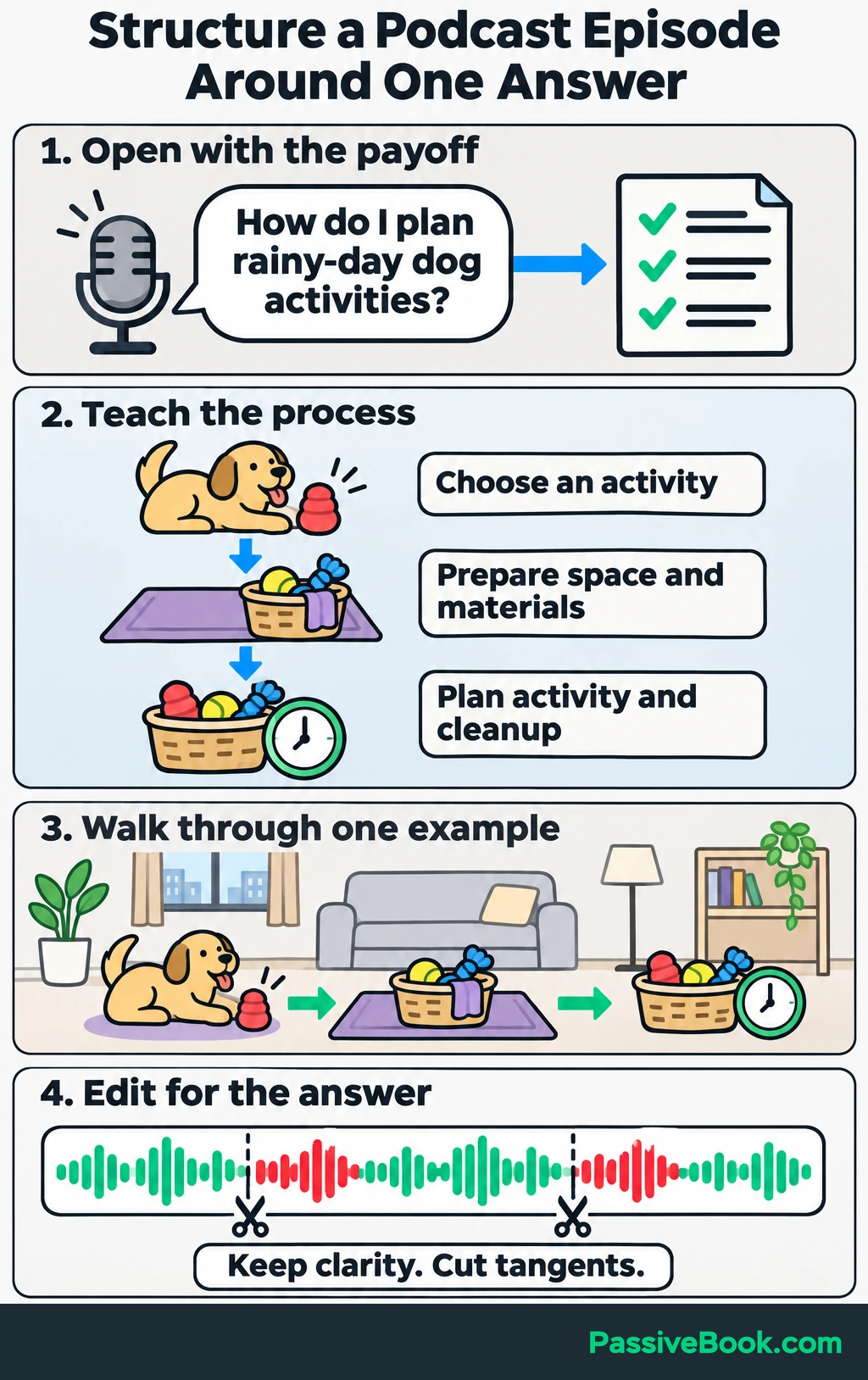
Give each episode one central question and a useful takeaway. Write the answer in rough form before recording.
For an interview, send that question to the guest in advance. Prepare follow-ups that turn broad advice into something listeners can use: “What would you do first?” and “What usually goes wrong?”
Open with the problem and the payoff. The rainy-day episode could begin:
“Rain has changed your plans, and your usual indoor activities are scattered around the apartment. Let’s put together a simple activity plan you can prepare, use, and pack away.”
That tells listeners why to stay. Your full biography can wait.
Teach the process before giving the example. This episode could cover:
- Choose an activity suited to your dog and available space.
- Prepare the space and gather the materials.
- Fit the activity and cleanup into your routine.
Then walk through one setup using those same steps. Listeners should hear how the decisions connect, rather than receive a loose list of ideas.
During editing, remove repeated explanations, unrelated tangents, and audio problems that make speech hard to follow. Keep a story when it makes the answer clearer. Cut it when listeners have to remember why you started telling it.
I wouldn’t force every episode into the same length. Finish the answer, then finish the episode.
Use Listening Behavior to Improve the Experience
After release, inspect where listening falls away and replay those passages yourself.
A drop near the beginning gives you something to investigate. Did the introduction delay the answer? Did you repeat the description? Did the sound become harder to hear?
Apple Podcasts Analytics provides listening and consumption information, and its Performance view lets you compare episodes by days since release. Compare similar formats and lengths over the same period, such as their first seven days.
A few departures won’t tell you why people left. Look for a pattern across releases and ask a focused question, such as, “Which part needed a clearer example?”
If several episodes lose attention during long background sections, shorten the background in your next recording. That is a useful test. Rebuilding the entire show after three listening sessions is mostly an expensive mood swing.
Make Your Podcast Easy to Find and Try
First, check that people can actually play the show where they expect to find it.
Search for it in Apple Podcasts, Spotify, and the apps your prospective listeners mentioned. Open an episode and test playback. Your podcast host stores your episode audio, but that doesn’t automatically put it in every listening app. For example, Spotify-hosted shows require submission to other listening services.
Next, check what a stranger sees:
- Show name: Distinctive enough to recognize and search for.
- Description: The listener’s problem and benefit appear early.
- Artwork: The name remains readable at thumbnail size.
- Episode title: The subject is clear without opening the description.
“Rainy-Day Enrichment for Apartment Dogs” gives someone more information than “Episode 12: Keeping Busy.”
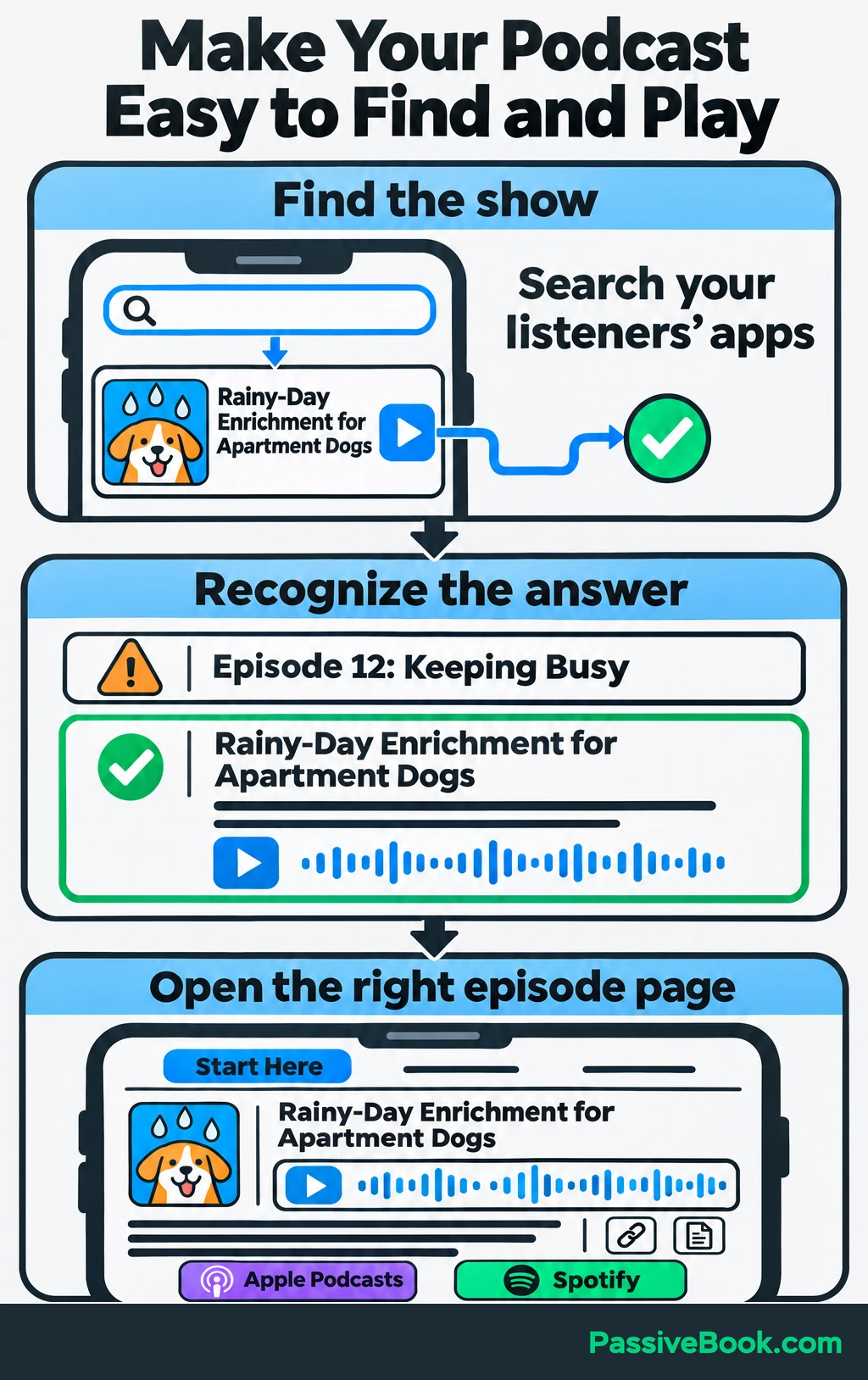
That clarity also matters for discovery. Apple includes show names and episode titles among its search factors. Use words that describe the answer, and keep episode numbers in their dedicated fields where available.
Make the title, description, and opening promise the same thing. A title about rainy-day planning shouldn’t lead into fifteen minutes of unrelated updates.
Give each promoted episode a stable page on your website. Include an embedded player, a short summary, useful resources, and recognizable listening-app links. When someone asks about rainy days, send them to that episode rather than your general homepage.
I would also add a “Start Here” recommendation to the website and relevant profiles. Choose the episode that shows your value most clearly. Your newest recording hasn’t automatically earned that job.
Choose One Way to Reach New Listeners
You can reach people through collaborations, community participation, or searchable content. Start with one approach that fits where your audience already spends time and the work you can maintain.
| Approach | I Would Start Here When… | First Useful Test |
|---|---|---|
| Collaborations | You can identify relevant shows or newsletters and offer a useful contribution. | Pitch one specific topic to a short list of suitable partners. |
| Communities | People already ask your episode questions in an active group you can join. | Answer a real question fully and add the episode when it helps. |
| Searchable content | You have a website or YouTube workflow and can turn spoken answers into clear pages or videos. | Build one useful search-focused version of a strong episode. |
For Apartment Dog Days, I would first test collaborations with apartment-living newsletters that regularly cover life with pets. The shared problem is clear, and the contribution can be written. There’s no need to buy camera equipment to send a checklist.
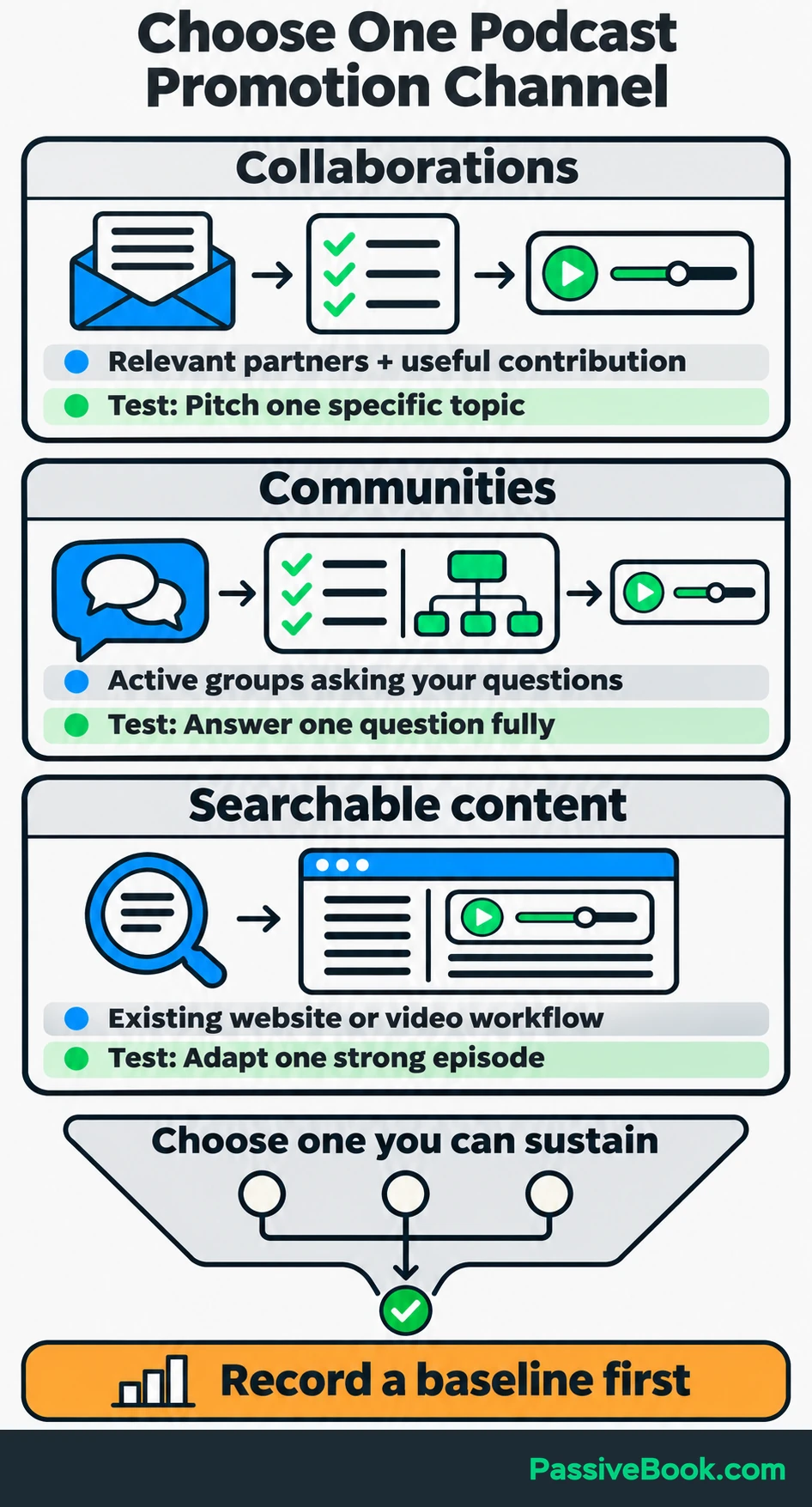
Before testing, record your current results. Use the same observation window for each release, such as its first seven days. A new show can start with its first episode.
Prepare separate links for each promotional source once the episode is live. If you use Google Analytics on your website, campaign tags are labels you add to those links so its reports can distinguish traffic sources. For the newsletter test, use the partner’s name as the source, “email” as the medium, and the episode name as the campaign.
Those reports show visits to the page, not confirmed listens.
Collaborate With Related Podcasts and Newsletters
Look for active partners whose audiences share the problem your episode solves. Check recent topics and the kind of questions their readers or listeners ask.
Audience fit comes before audience size. A large general newsletter may offer less useful exposure than a small publication with a regular pet-care section.
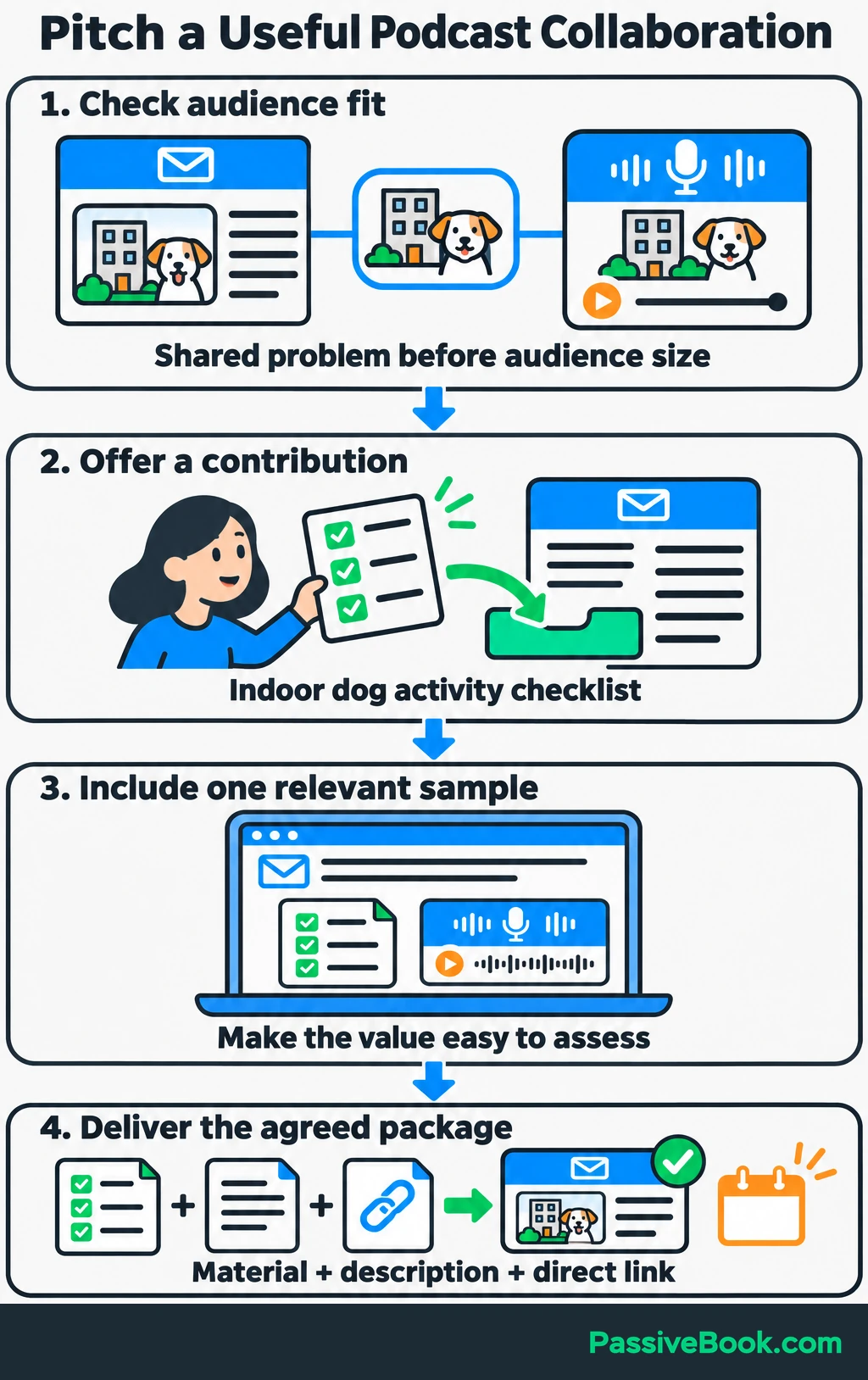
Offer a specific contribution. Explain what their audience gets and include one relevant sample.
For the running example, the core pitch could be:
“I can contribute a short checklist for organizing indoor dog activities in a small home, with a related rainy-day episode for readers who want the walkthrough.”
That gives the editor something concrete to assess. “I’d love to collaborate” gives them another task.
Once someone agrees, provide the promised material, a short episode description, and the direct link. Agree on what will appear and when so you can record the promotion accurately.
For podcast partnerships, propose a focused guest contribution or a recommendation exchange when both shows fit. Invite guests for what they can teach. After publication, give them optional sharing copy and a useful excerpt, but don’t build your growth plan around their willingness to promote you.
Contribute Useful Answers in Relevant Communities
Choose one community where people already discuss the questions your show answers. Read its promotion rules before posting.
Your contribution should help even if nobody clicks.
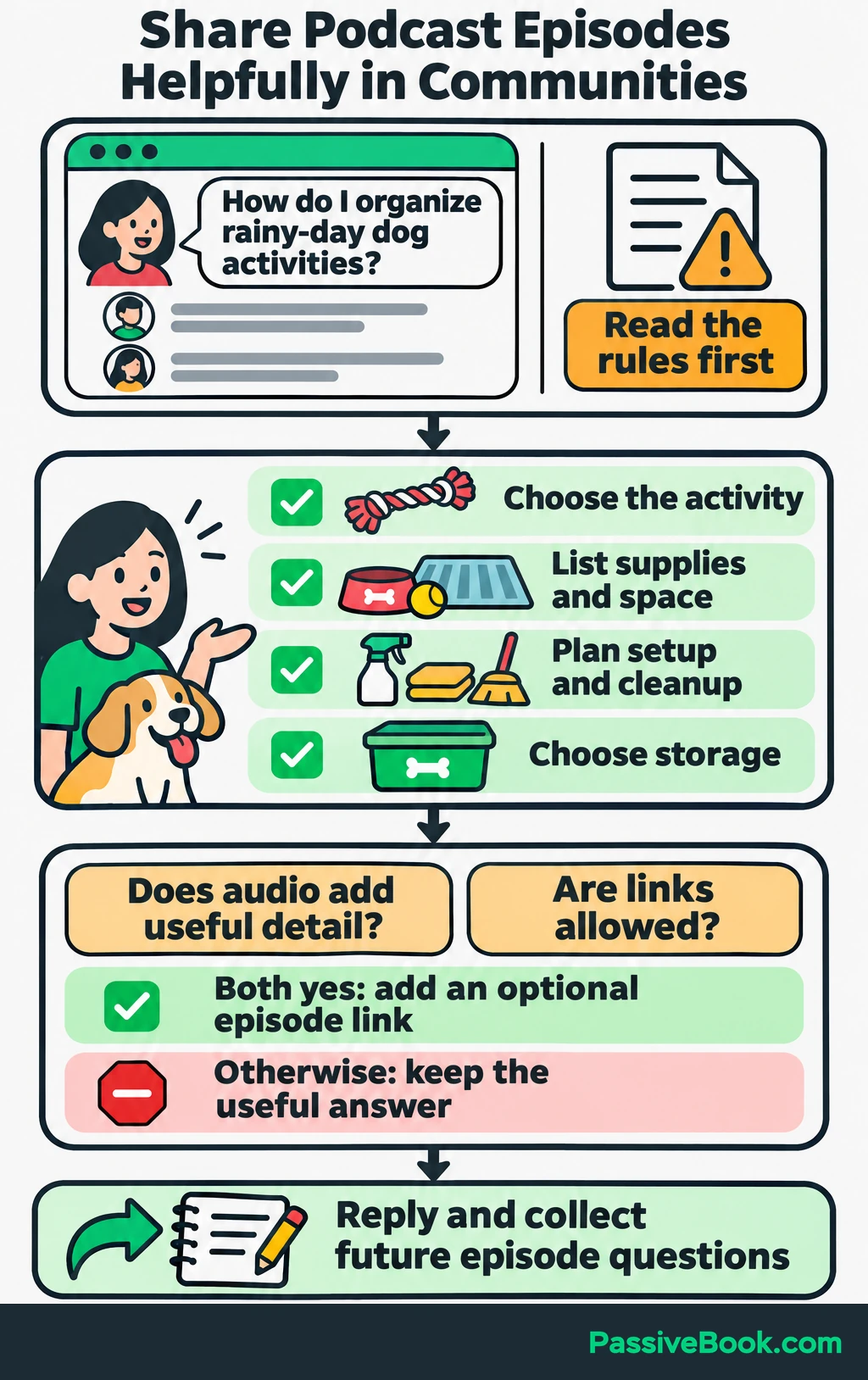
For the rainy-day episode, you could share a short planning checklist:
- Choose the activity before gathering supplies.
- List what you need and where it will happen.
- Include setup and cleanup in the plan.
- Decide where everything will go afterward.
Then explain what listening adds: “The episode walks through preparing the space and organizing the materials.”
Link when that extra detail fits the question and the community allows it. A useful answer with an optional next step gives people a reason to investigate. A link dropped beneath every vaguely related post gives moderators a reason to investigate.
Reply to follow-up questions and record recurring problems for future episodes. Keep evaluating the channel by listening, relevant replies, and business actions. Post reach alone doesn’t tell you whether the effort belongs in your routine.
Make Selected Episodes Searchable
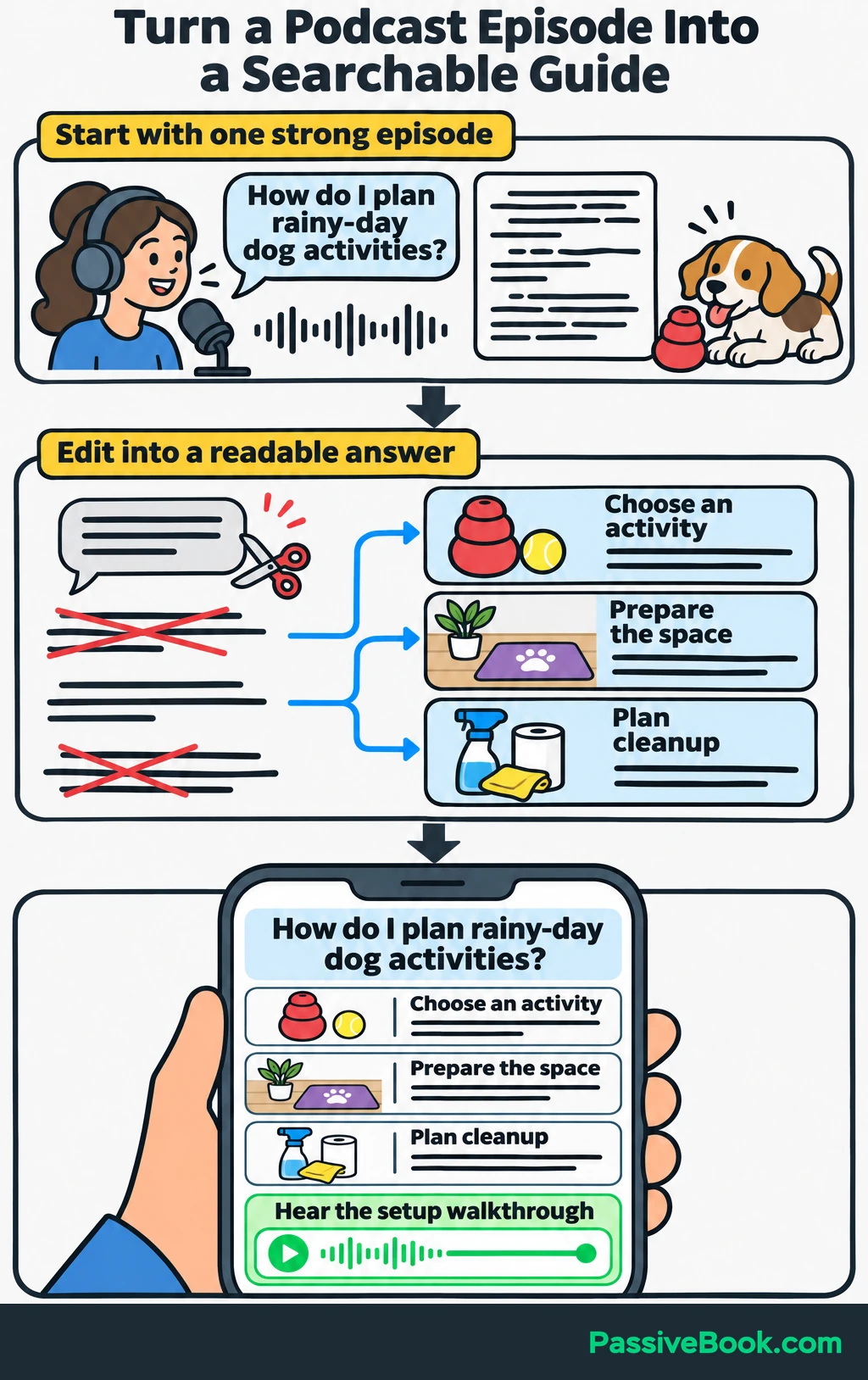
Turn the episode’s question into an answer someone can find through search. Choose a written page or YouTube based on where prospective listeners seek help and what you can produce well.
For a written page, teach the answer in clear sections. Add the embedded episode where listening becomes a useful option, and explain what the audio adds.
For Apartment Dog Days, the page could explain the rainy-day planning process and offer the episode’s spoken walkthrough. Edit the transcript into a readable guide. Readers shouldn’t have to wade through greetings and half-finished sentences to find the answer.
For YouTube, use a specific title and a legible thumbnail. You can stay off camera. In supported locations, YouTube’s RSS delivery creates videos from your show artwork and automatically uploads new feed episodes. An RSS feed is the file your podcast host uses to send episode updates to listening services.
Check eligibility before choosing that route. YouTube also restricts advertisements in RSS-delivered content and requires declarations for branded content, including host-read promotions and sponsorships. That matters if your feed includes promotions for your products or partners.
I would start by adapting one strong episode and checking the result. Uploading the entire archive creates more pages or videos to maintain before you know whether this channel suits the show.
Turn First-Time Listeners Into Regulars
Give a satisfied listener a clear next destination.
At the end of an episode, recommend one related episode and explain why it helps. For Apartment Dog Days, the rainy-day episode could lead to organizing activity materials:
“If gathering everything is the part that stops you, listen to ‘Organizing Dog Activity Materials in a Small Apartment’ next. It walks through keeping the supplies together without taking over the room.”
Recommend an available episode. If it hasn’t been published, tell listeners when to expect it and invite them to follow instead.
Choose one main spoken request per episode. You might ask people to follow, hear the related episode, submit a question, or share. I would use the next-listen recommendation here because it continues the problem they came to solve.
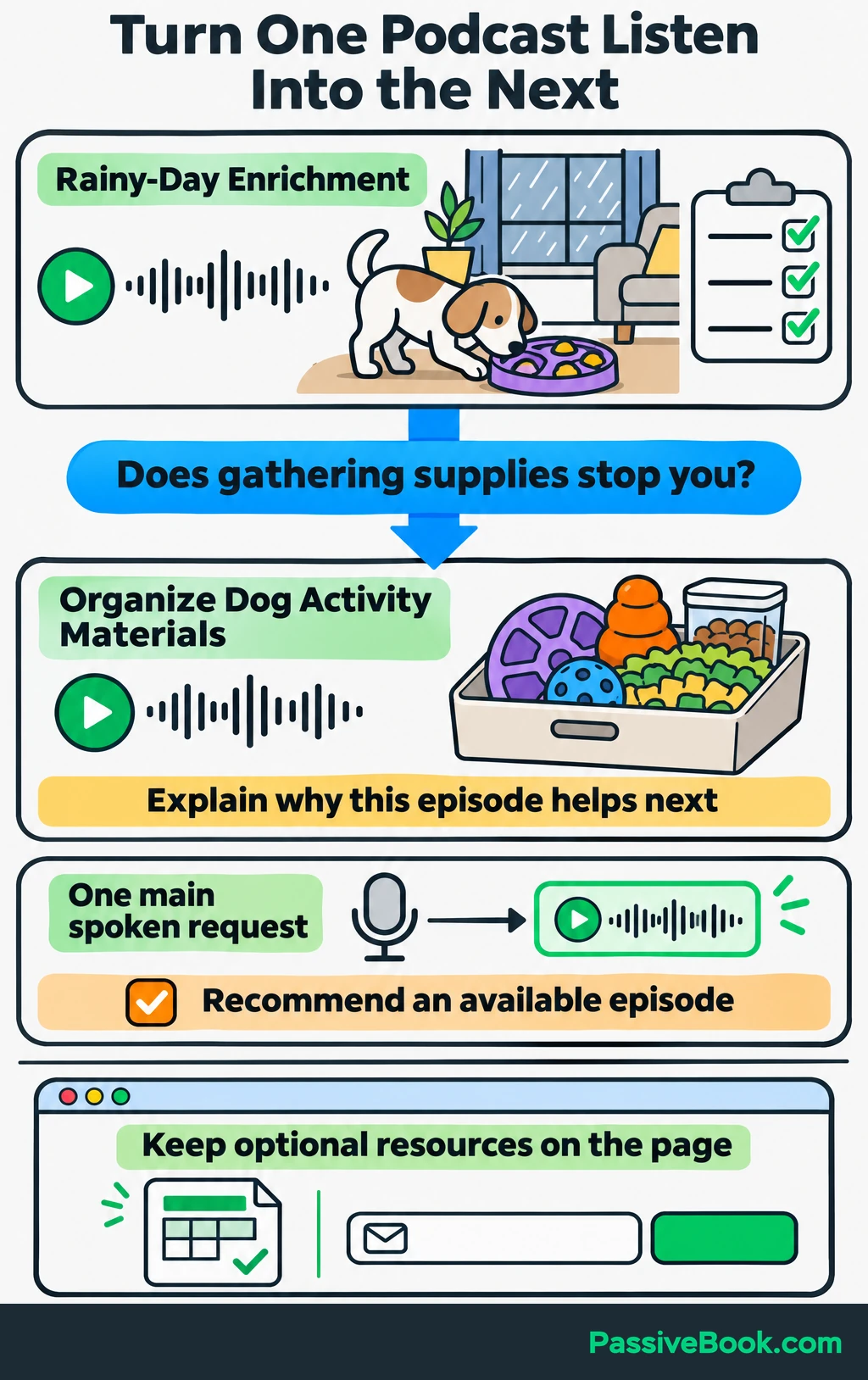
Other options can stay on the episode page. You don’t need to read out the entire menu.
For feedback, ask one focused question and provide a simple reply route, such as an email address or form. “Which part of setting up indoor activities takes you longest?” is easier to answer than “What did you think?”
An optional email subscription can continue that help. In this example, offer the rainy-day planning sheet, then send related episode recommendations and relevant information about the enrichment cards.
Explain those emails at signup, get clear permission, and include an easy unsubscribe option. If you already use WordPress, I would consider FluentCRM to send the follow-up emails. A simple creator email tool such as Kit is another option if you want less setup.
The email should carry the listener’s question forward. Requesting a planning sheet shouldn’t suddenly feel like applying for a sales department internship.
Build Promotion Into Your Publishing Routine
Choose a release schedule that leaves room to help people find each episode.
I would rather publish a useful episode every two weeks with a repeatable promotion routine than promise weekly releases and spend every spare hour editing. Pick the pace your calendar can support.
Before recording, decide the central question, the promotional angle, and the next episode to recommend. Mark useful excerpts while editing so you don’t have to search the recording again later.
Then reuse a short checklist:
- Publish the episode and its page.
- Test playback, resources, and listening-app links.
- Prepare the material your chosen channel needs.
- Share it through that channel.
- Respond to questions.
- Record results after the agreed observation window.
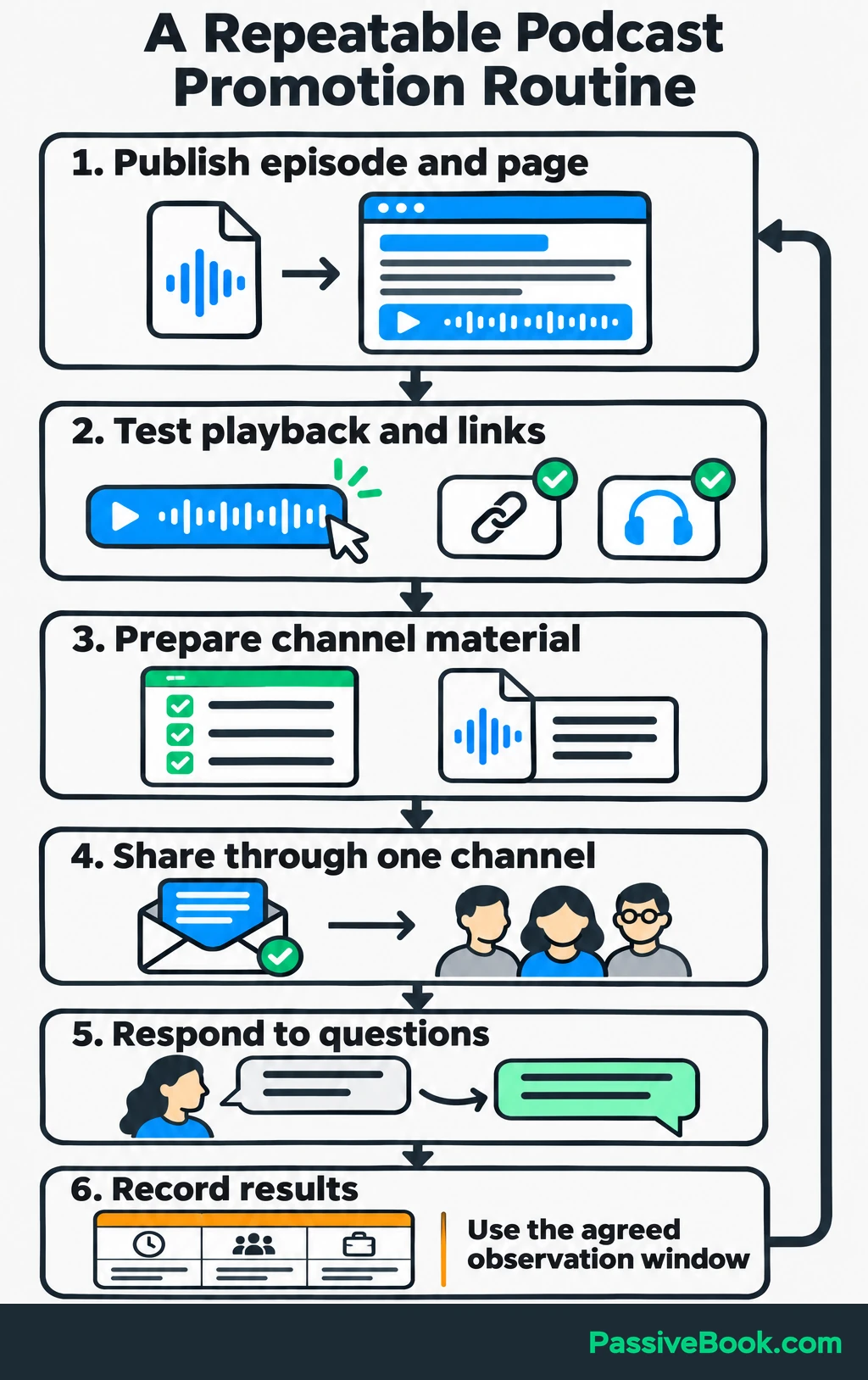
For the newsletter collaboration test, that means preparing the checklist and partner copy. It doesn’t also require five clips, three graphics, and a new account on whatever platform appeared this morning.
Keep reusable templates for descriptions, outreach, graphics, and emails. Batch similar work when it saves setup time. If practical, keep a finished episode in reserve and tell listeners about planned breaks.
If writing the promotion keeps slipping to the bottom of your list, AI Podcast Studio can turn your episode notes into a draft for your chosen channel. Start with the one piece you need for this release.

Free AI Podcast Studio




AI can draft summaries or suggest excerpts from a transcript, but check each suggestion against the recording. It may turn a qualified explanation into a much stronger claim.
Run the process manually before automating it. Once it works, use an automation tool such as Make or n8n to move information between apps when a task is completed. I would automate moving approved information between tools before automating public posting. An unchecked draft can travel remarkably far when everything is connected.
Use Results to Choose the Next Improvement
Keep a small record that helps you decide where the next hour should go.
For each episode, record the topic, promotion source, promotion time, seven-day audience metric and its source, returning-audience information, and your chosen business action.
Here is an illustrative entry:
| Episode And Topic | Promotion Source | Promotion Time | First Seven Days | Returning Audience | Business Action |
|---|---|---|---|---|---|
| Rainy-day enrichment | Apartment-living newsletter | 45 minutes | 120 downloads reported by host | Not available yet | 3 confirmed planning-sheet signups; source unknown |
This row gives you a record of the work and results. It doesn’t prove that the newsletter caused all 120 downloads or the three signups.
Keep downloads, listeners, plays, followers, and subscribers separate. A download doesn’t establish that someone listened, and a follow doesn’t establish that they returned. Don’t add audiences from different apps and call the result a unique listener total because the same person may use more than one app.
Within Spotify, Discovery analytics shows impressions and conversion to plays. Its Engagement analytics reports episode completion and week-over-week returning audience. Those returning-audience figures describe activity on Spotify, so keep them labeled with the platform and reporting period.
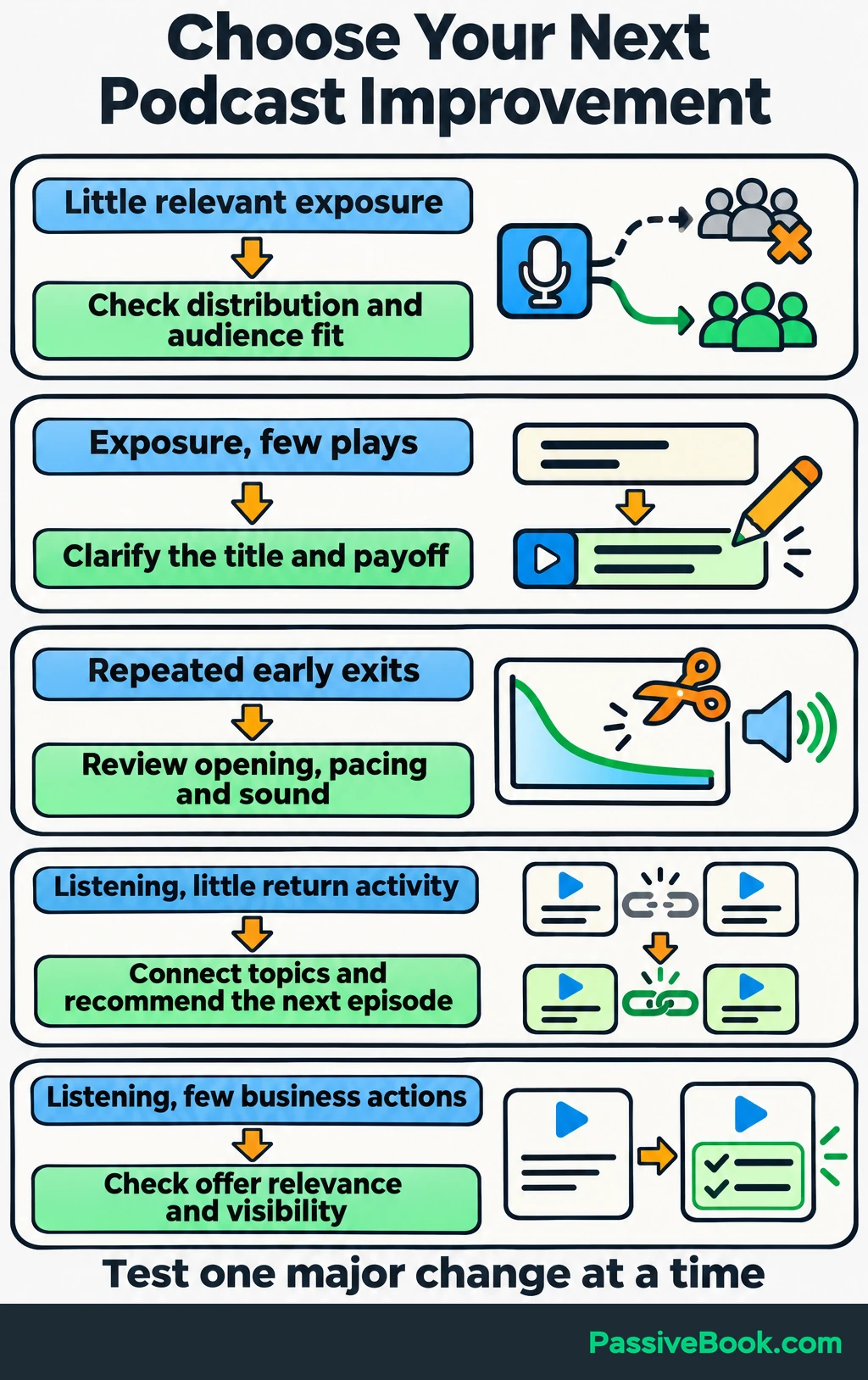
Use the signal to choose a test:
| What You Observe | Next Improvement To Test |
|---|---|
| Little exposure to relevant people | Check distribution and whether your chosen channel reaches the right audience. |
| Exposure without many plays | Make the title and description clearer about the episode’s payoff. |
| Repeated early exits | Deliver the answer sooner and review pacing or audio problems. |
| Listening without much return activity | Strengthen connected topics and the next-episode recommendation. |
| Listeners but few relevant business actions | Check whether the offer continues the episode’s value and is easy to find. |
These are starting points for investigation. Change one major element at a time so the result remains useful.
For promotion that sends people directly to Spotify, use a link created in Spotify for Creators; links copied from the Spotify app don’t provide click data. Suppose the rainy-day episode’s sharing report shows 80 clicks and 12 attributed plays for that link in the same reporting period. You’re measuring the share of reported clicks that led to attributed plays:
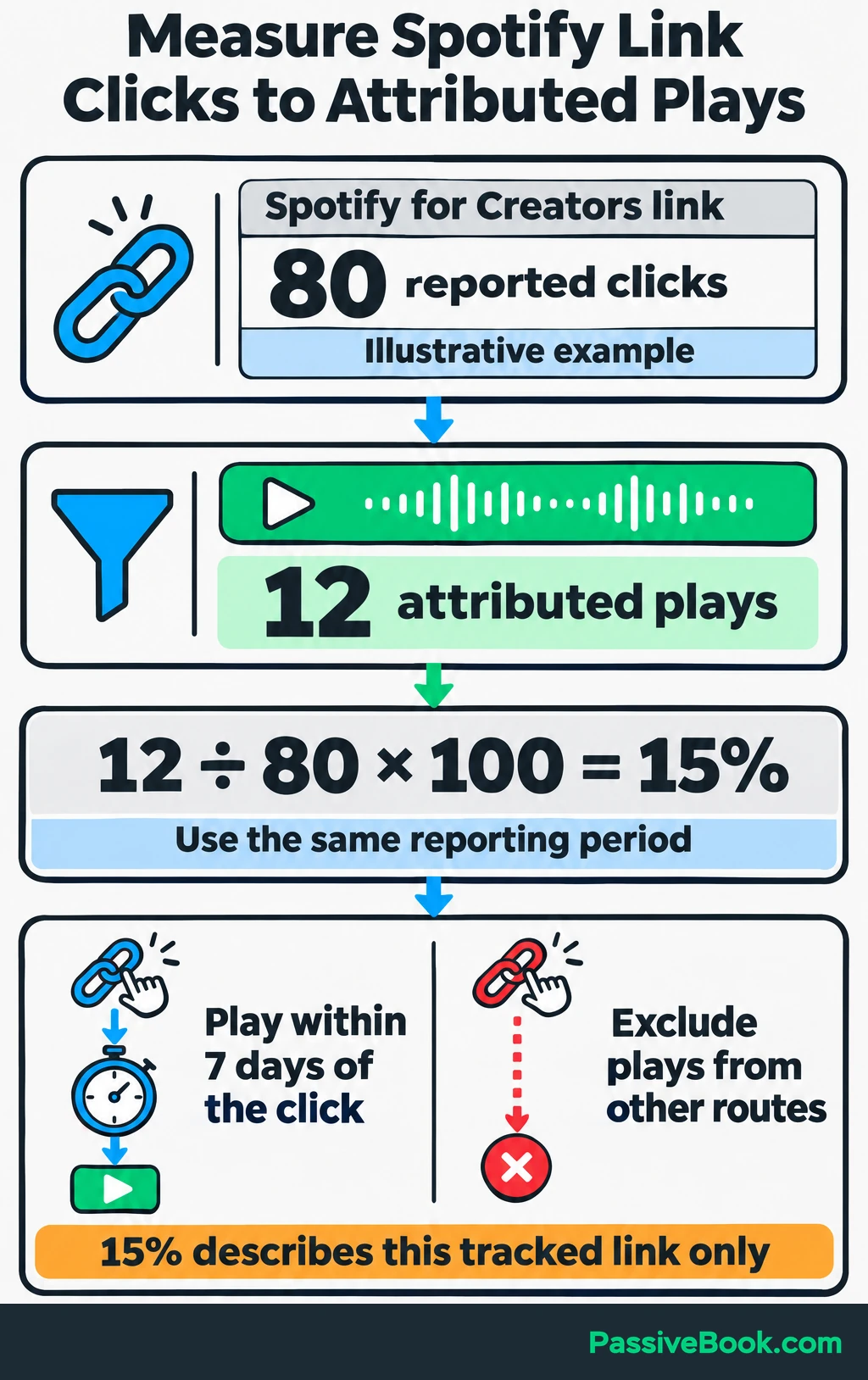
12 ÷ 80 × 100 = 15%.
Spotify attributes a play to a shared link when it happens within seven days of the click. That 15% describes this tracked route, so don’t divide all episode plays by those 80 clicks. Some plays may have come from elsewhere.
I spent six months chasing Instagram and Twitter/X followers in another niche while the bank account stayed around $47. My mistake was letting the platforms’ scoreboards become my business plan. That is why I prefer a record that connects effort to useful actions.
For the first few releases, aim to establish a baseline and repeat the chosen channel test. Keep an approach when it brings relevant listening, useful responses, or business actions at a workload you can sustain. If your choice is search, allow longer than one release week to assess discovery, while keeping seven-day episode comparisons consistent.
Organic growth is possible without ads or celebrity reach, but no publishing schedule guarantees it. The useful system is one you can repeat, measure, and improve before committing more time.
What Next?
Choose one existing episode and write down the exact question it answers. Check whether its title and opening make that answer clear, then choose one place to put it in front of relevant people.
Use the social buttons to share this guide if it would help turn podcast promotion into a manageable publishing habit.
Which part of your process needs the most work: getting discovered, keeping attention, or earning the next listen? Share your answer in the comments, and bring any other questions too.
Share this post with your friends & followers:

