A club already discusses the questions your podcast answers. Getting an introduction to its members sounds promising, but “please share my show” gives the organizer another task and little reason to do it.
You could spend a weekend preparing a collaboration and still have no agreed place for the episode to appear. A friendly reply leaves you guessing how much time to commit and whether anyone will hear the result. This guide helps you build a community partnership that gives members a useful reason to listen—and gives you enough evidence to decide whether to repeat it.
What Can a Small Podcast Offer a Community?
You can offer useful production work even when your audience is small. An organizer may have recurring questions to answer but no time to research, record, and package the answers.
Your contribution could be:
- A relevant episode: Give members a clear answer to a problem they already discuss.
- A qualified contributor: Arrange a conversation with someone who can answer questions beyond your knowledge.
- A reusable resource: Turn scattered questions into an episode, checklist, or listening guide the organizer can share again.
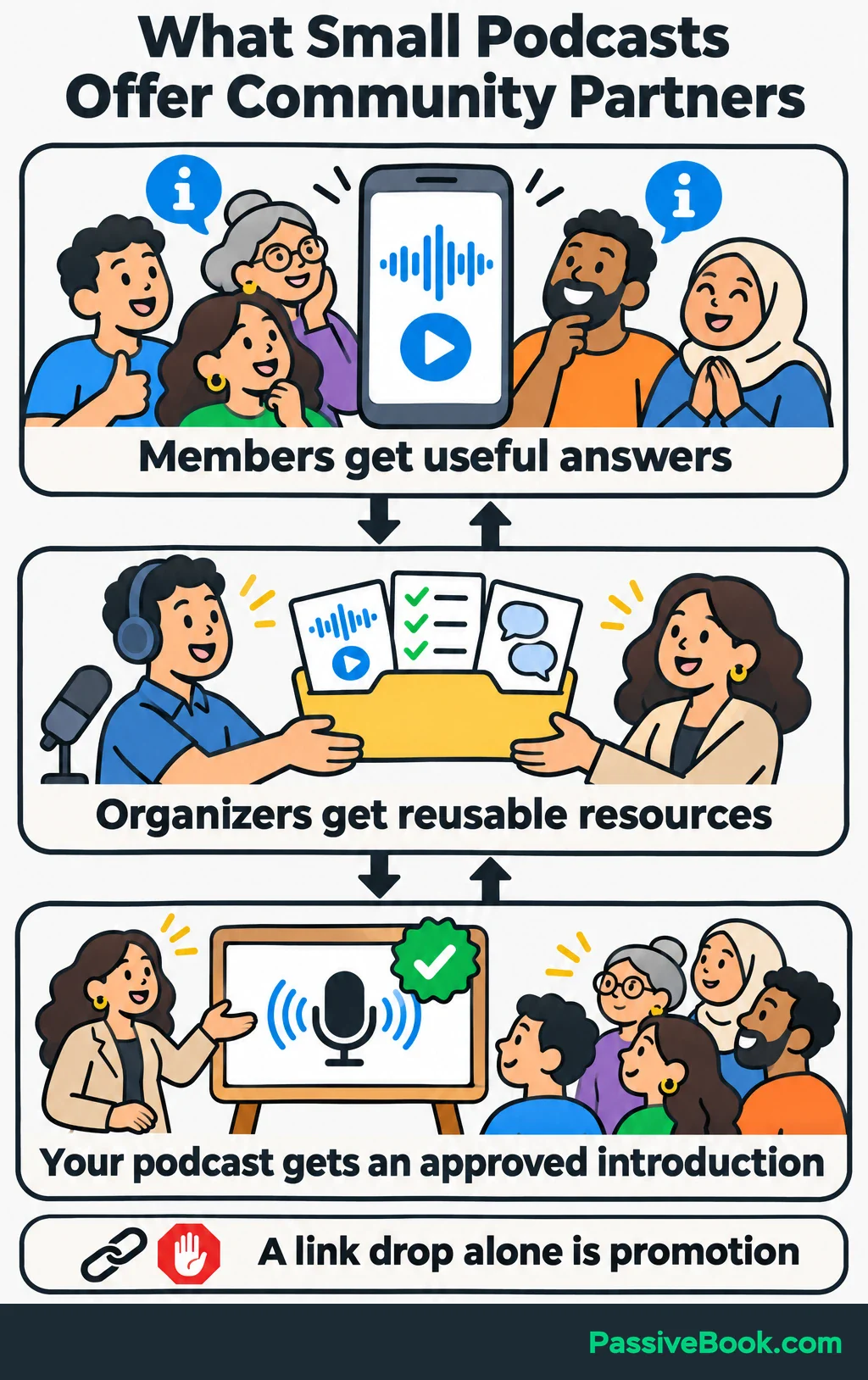
The exchange should be clear. Members get useful help, the organizer gets a resource or programming, and your podcast gets an approved introduction to potential listeners.
That agreement makes it a partnership. Posting your link in a group without discussing it with the organizer is simply promotion.
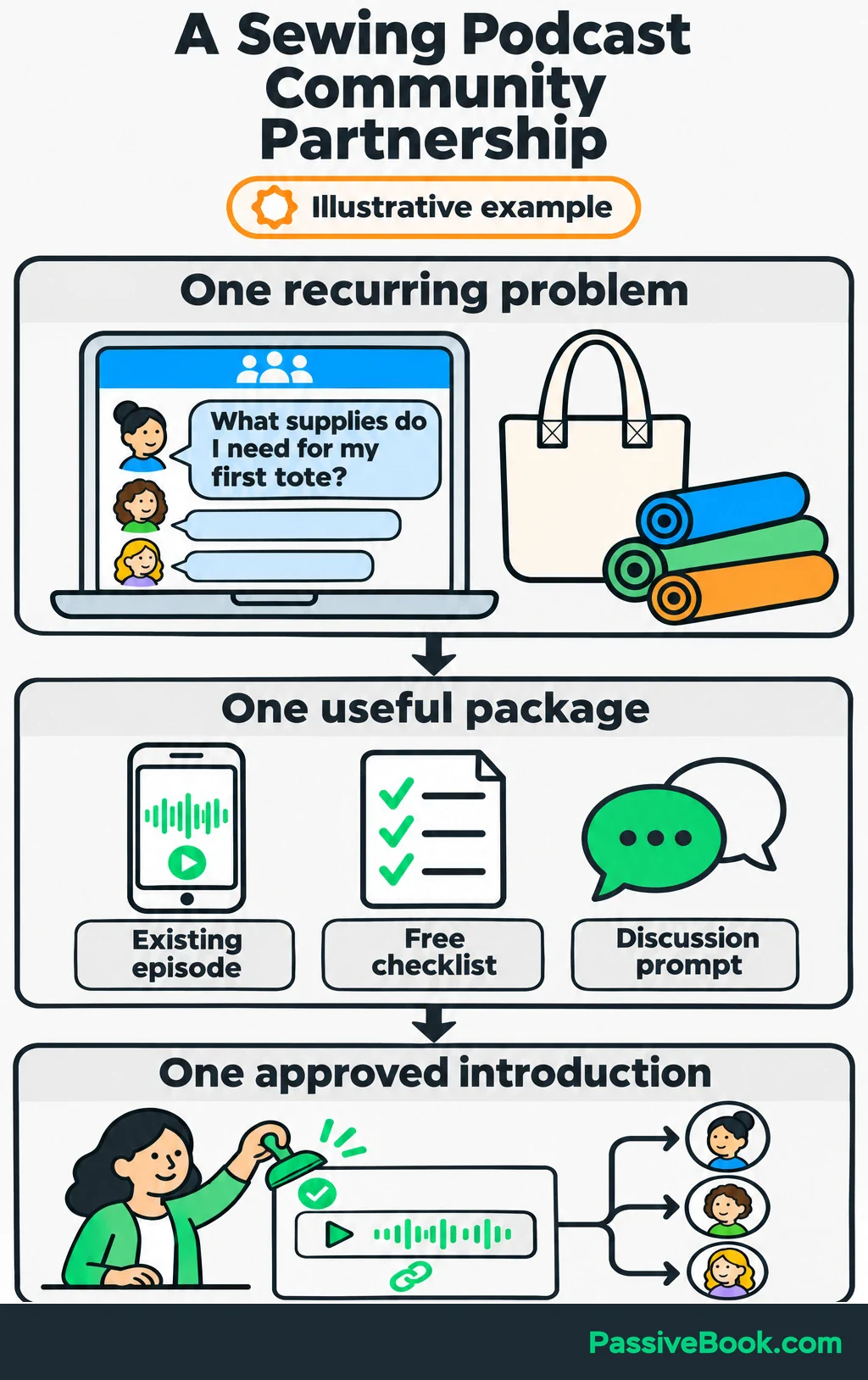
For the running example, imagine you run First Stitch Notes, a beginner-sewing podcast supporting a business that sells downloadable sewing patterns. You approach a sewing circle whose members keep asking what fabric and supplies they need for a first tote bag.
You already have a suitable episode, so you offer to pair it with a free supplies checklist and a short discussion prompt. The sewing circle, sample copy, and figures below are illustrations, not reported results.
Find Communities Whose Members Need Your Episodes
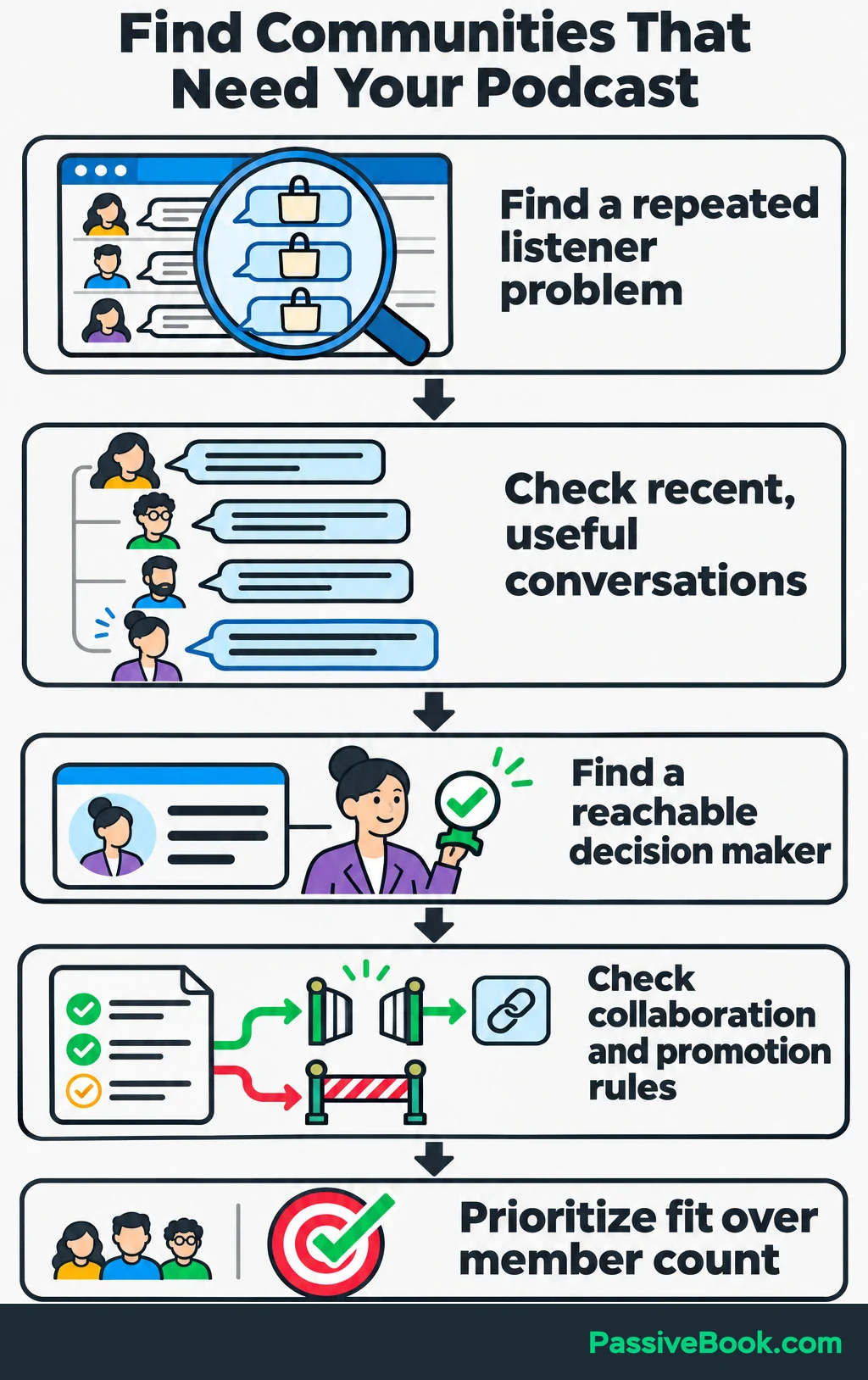
Start with one listener problem. “People interested in sewing” is too broad. “Beginners choosing fabric and supplies for their first tote bag” gives you something to look for.
Ask existing listeners where they discuss that problem. Then search for relevant clubs, forums, membership groups, and recurring meetups. Search phrases might combine the topic with words such as “beginner group,” “club,” or “questions.”
Read recent conversations before making contact. Look for repeated questions, useful replies, and organizers who participate. A large membership count tells you little if recent posts receive no response.
I once drafted a digital-product guide around the topics I thought buyers needed. Then I reread their emails and found the same small setup question appearing repeatedly. I had treated it as a footnote. Those messages gave me a much clearer starting point than my original chapter list.
Use community conversations the same way: look for the problem people keep trying to solve.
A small shortlist is enough to begin:
| Community | Recurring Member Problem | Evidence to Check | Next Action |
|---|---|---|---|
| Beginner sewing circle | Choosing supplies for a first tote bag | Repeated questions about which fabric and supplies to buy | Find the program contact and collaboration rules |
| General sewing discussion group | Many topics, with occasional beginner questions | Beginner replies have not yet been reviewed | Check for a dedicated beginner thread |
| Podcast-hosting group | Finding guests and improving production | Host-to-host discussions about guests and production | Keep for professional connections |
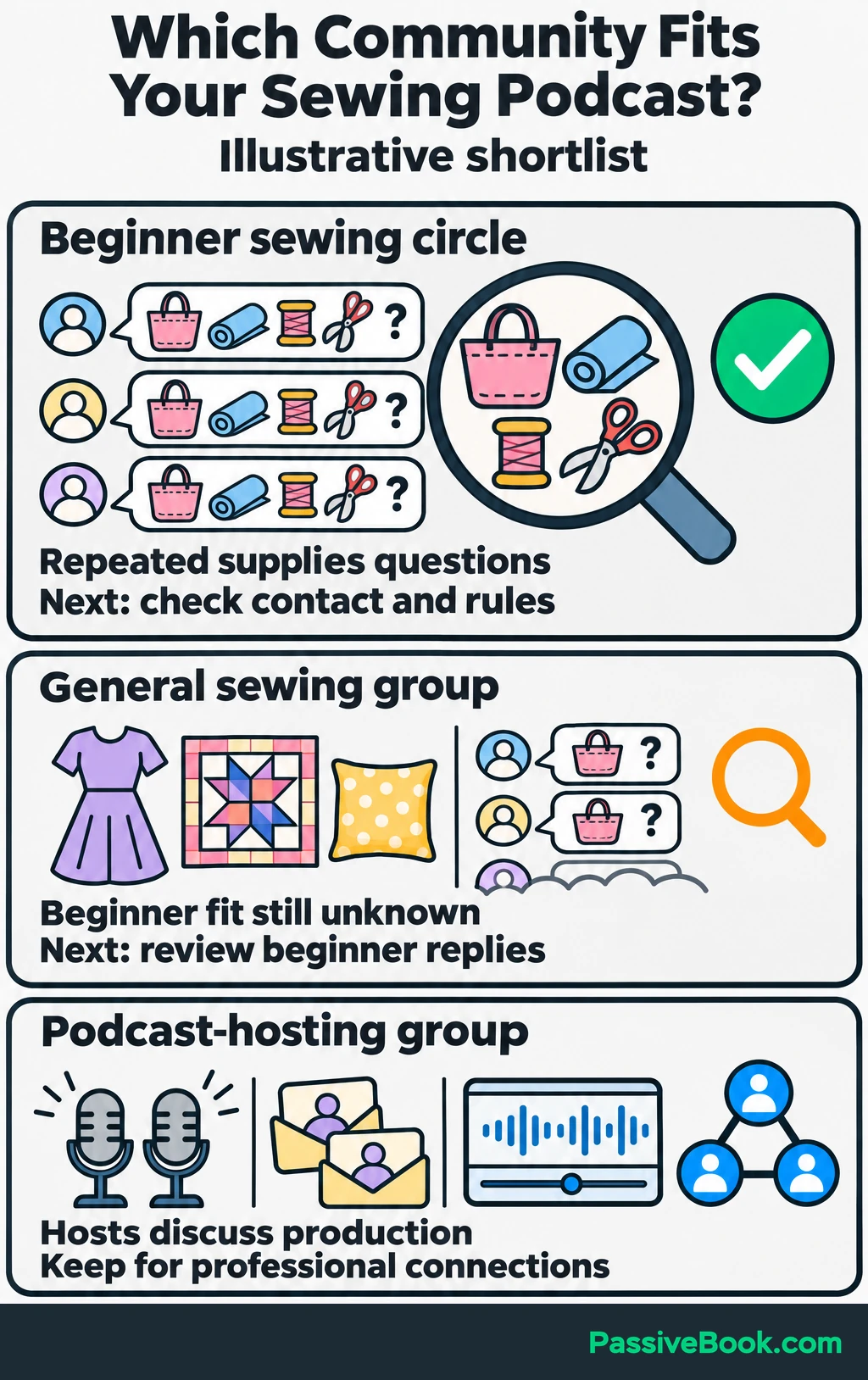
For each promising community, also record the relevant episode, organizer contact, permitted placements, and contribution you could offer. Mark unknowns as unknowns.
Check promotional rules before approaching anyone. Some Reddit communities prohibit promotional content entirely, even though Reddit does not treat all promotion as spam. The community’s rules determine whether your proposal belongs there. Reddit’s guidance explains this distinction.
I would prioritize topic fit, compatible values, and a reachable organizer over size. Start with the strongest opportunity you can serve well.
Design a Collaboration Around One Member Problem
Choose the smallest contribution that solves the selected problem. If an existing episode answers it well, use that episode. Another recording needs a reason beyond making the partnership feel more impressive.
Compare formats by what both sides must do:
| Format | Member Benefit | Organizer Contribution | Podcast Contribution | Route to Listening | Production Effort |
|---|---|---|---|---|---|
| Member-question episode | Answers to recurring questions | Select questions and introduce the episode | Research, record, and edit | Announcement links to the answers | New episode production |
| Community-expert interview | Focused help from a knowledgeable member | Arrange access and agree on promotion | Prepare and produce the interview | Approved community introduction | Interview preparation and editing |
| Live Q&A with an edited episode | Answers and participation | Convene members and manage attendance | Host, record, and edit | Event invitation and replay link | Scheduling, live delivery, and editing |
| Curated listening resource | An existing answer with a useful aid | Check fit and share the resource | Select the episode and create supporting material | Direct episode link | Review and resource preparation |
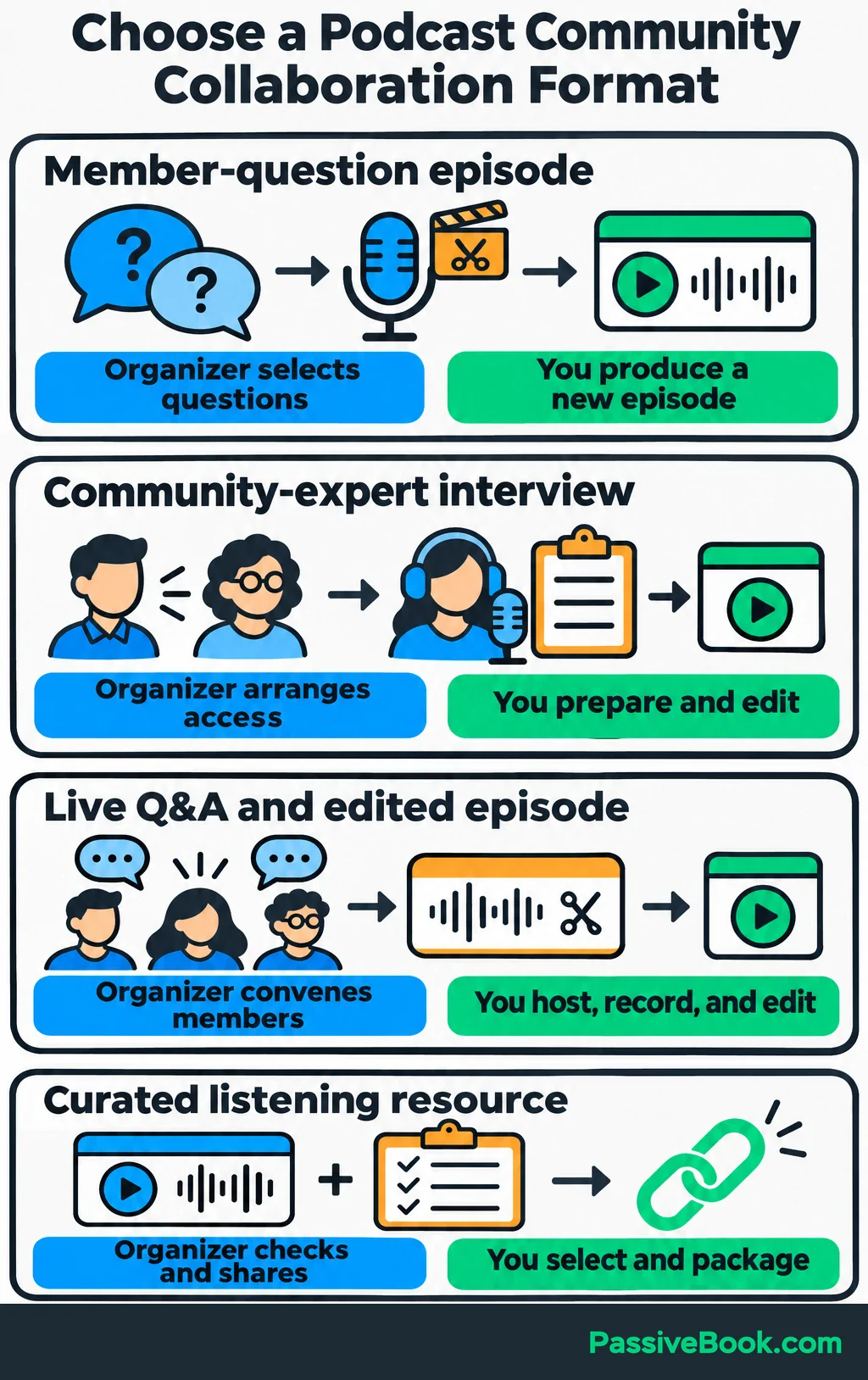
These formats can overlap. An expert interview can answer submitted questions, and a checklist can accompany it. But each addition should serve the same problem.
For First Stitch Notes, I would begin with the existing tote-bag preparation episode. Ask the organizer to select three recurring questions it answers, then create a matching supplies checklist.
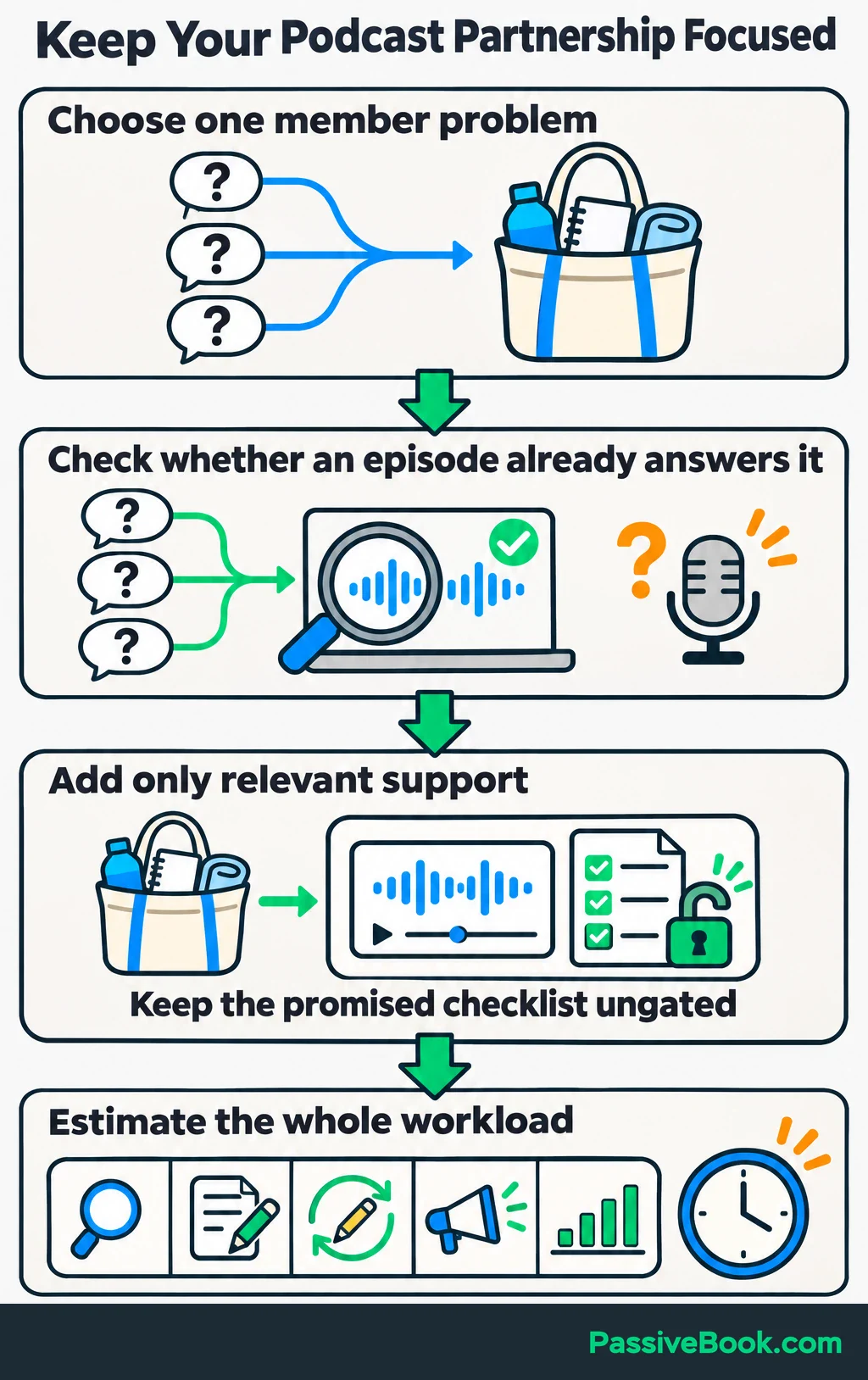
Before offering anything else, estimate the time needed for review, resource creation, revisions, promotion, and reporting. Keep the checklist accessible without an email signup so the organizer has a complete resource to share.
A community connection also does not establish expertise. Choose contributors for the question being answered. In a pet-focused show, for example, a club organizer’s experience would not by itself qualify them to give veterinary advice.
Pitch the Person Who Can Approve the Partnership
Use the stated contact route for the moderator, club secretary, community manager, or program organizer. Contact the person who can approve both the collaboration and its distribution.
A useful pitch covers five things: the need you observed, a bounded offer, the member benefit, each side’s contribution, and an easy next step.
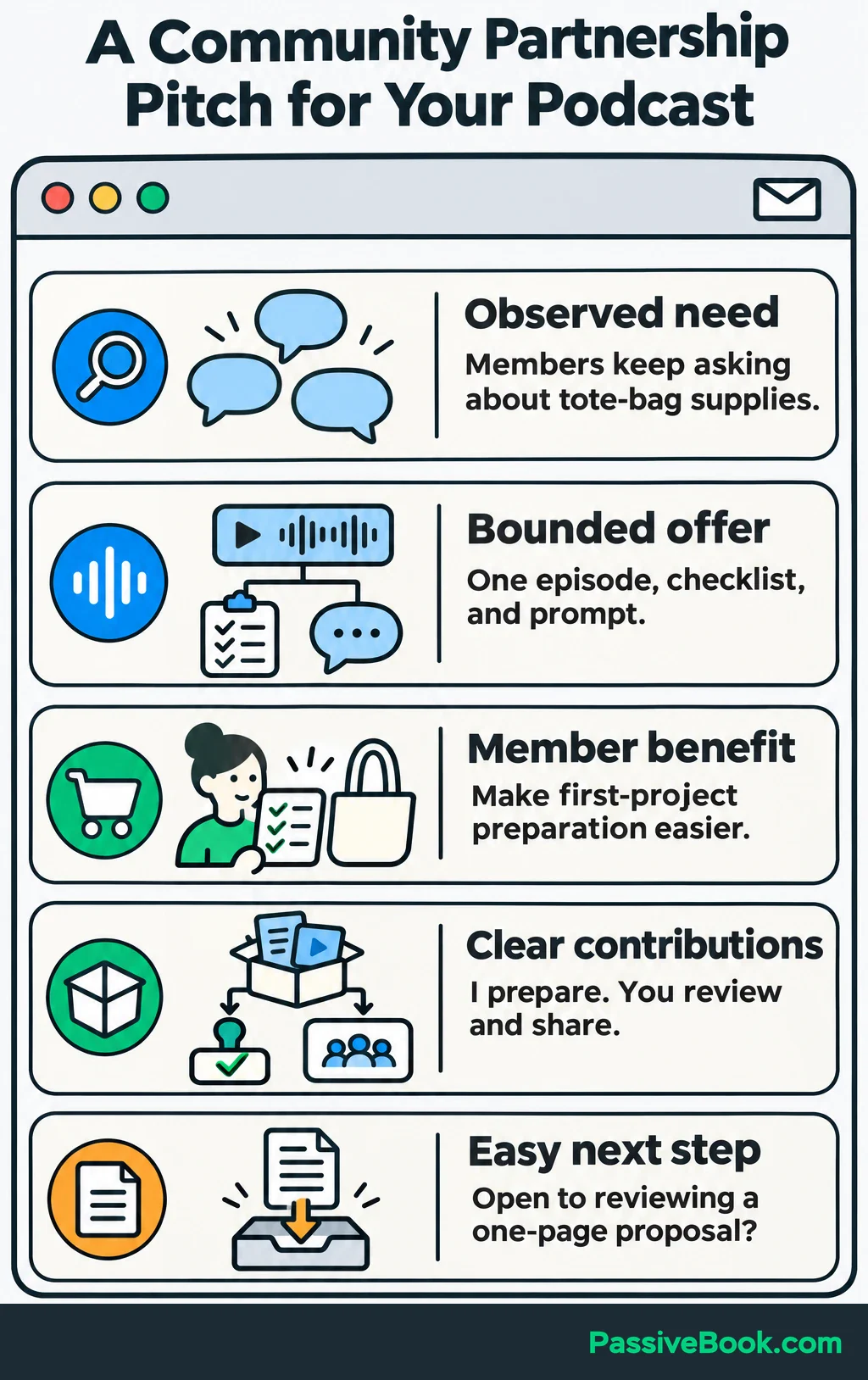
Here is a complete email you can adapt after reviewing actual discussions:
Subject: A first-tote-bag resource for your beginner members
Hi [Name],
I noticed several recent discussions in [community] about choosing fabric and supplies for a first tote bag.
I host First Stitch Notes, and I have an episode that covers those decisions. I could pair it with a free supplies checklist and a short discussion prompt for your members.
I would prepare the resource and draft announcement. Your team would choose the questions to highlight, check the material for fit, and share one approved post linking to the episode.
Here’s the episode so you can judge whether it would help: [episode link].
Would you be open to reviewing a one-page proposal?
Thanks,
[Your name]
Replace the observations and deliverables with things you can honestly support. One relevant sample is more useful than a folder of unrelated work.
If you have a community and an episode in mind, the AI Partnership Writer can draft your email and follow-up. It helps explain the member benefit and request a specific introduction before you commit to more production work.
Free AI Partnership Writer




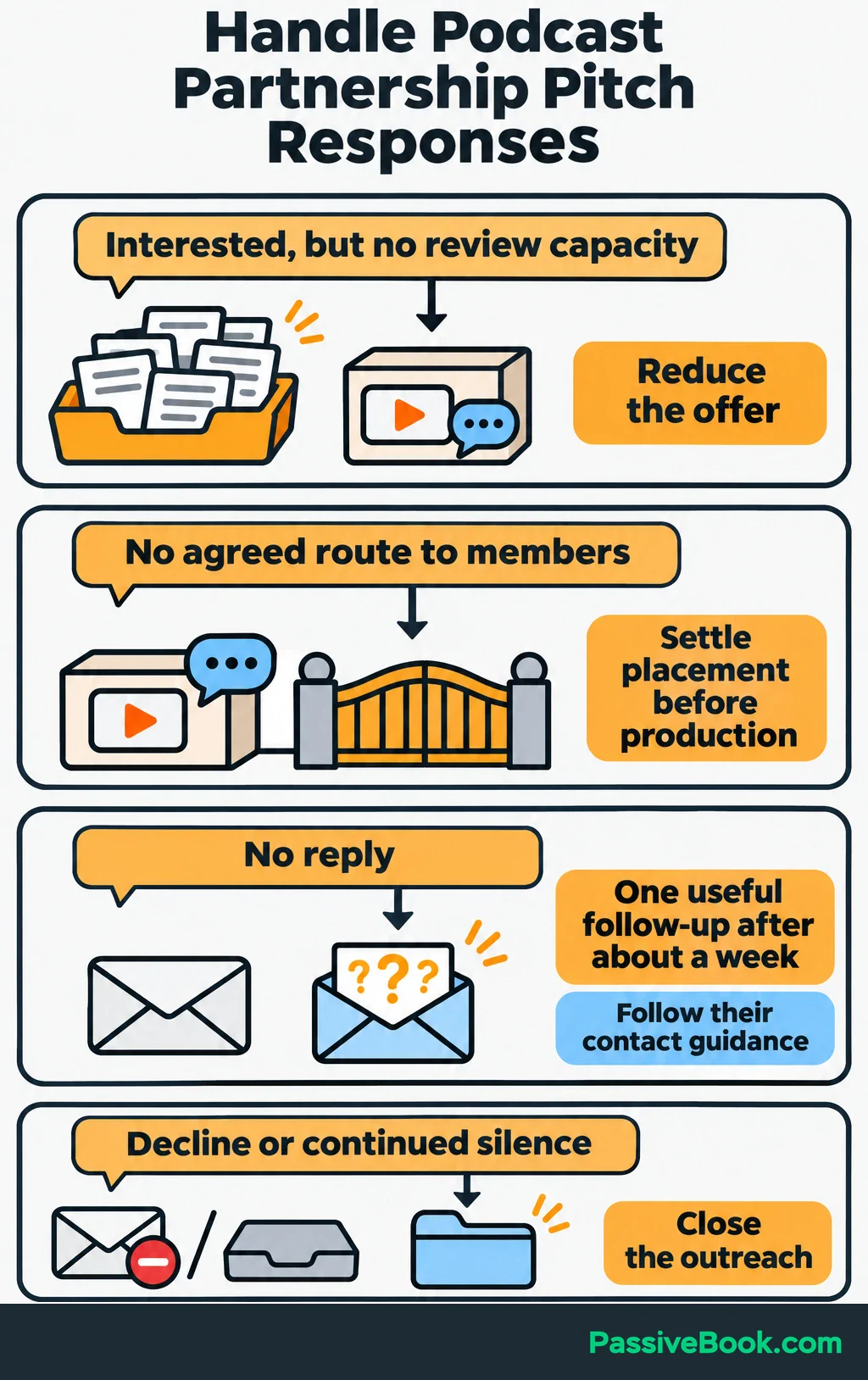
If the organizer likes the idea but cannot review a new resource, reduce the offer to the existing episode and a discussion prompt. If they cannot offer a route to members, settle that before doing production work.
I would send one brief follow-up after about a week, unless their contact guidance suggests otherwise. Add something useful, such as the exact questions the episode answers. After a decline or continued silence, close the outreach.
Agree on a Small, Measurable Pilot
Confirm Contributions and Distribution
Agree on one member problem, one collaboration, and one primary podcast outcome. Ask the organizer what would make the pilot worthwhile for them, too.
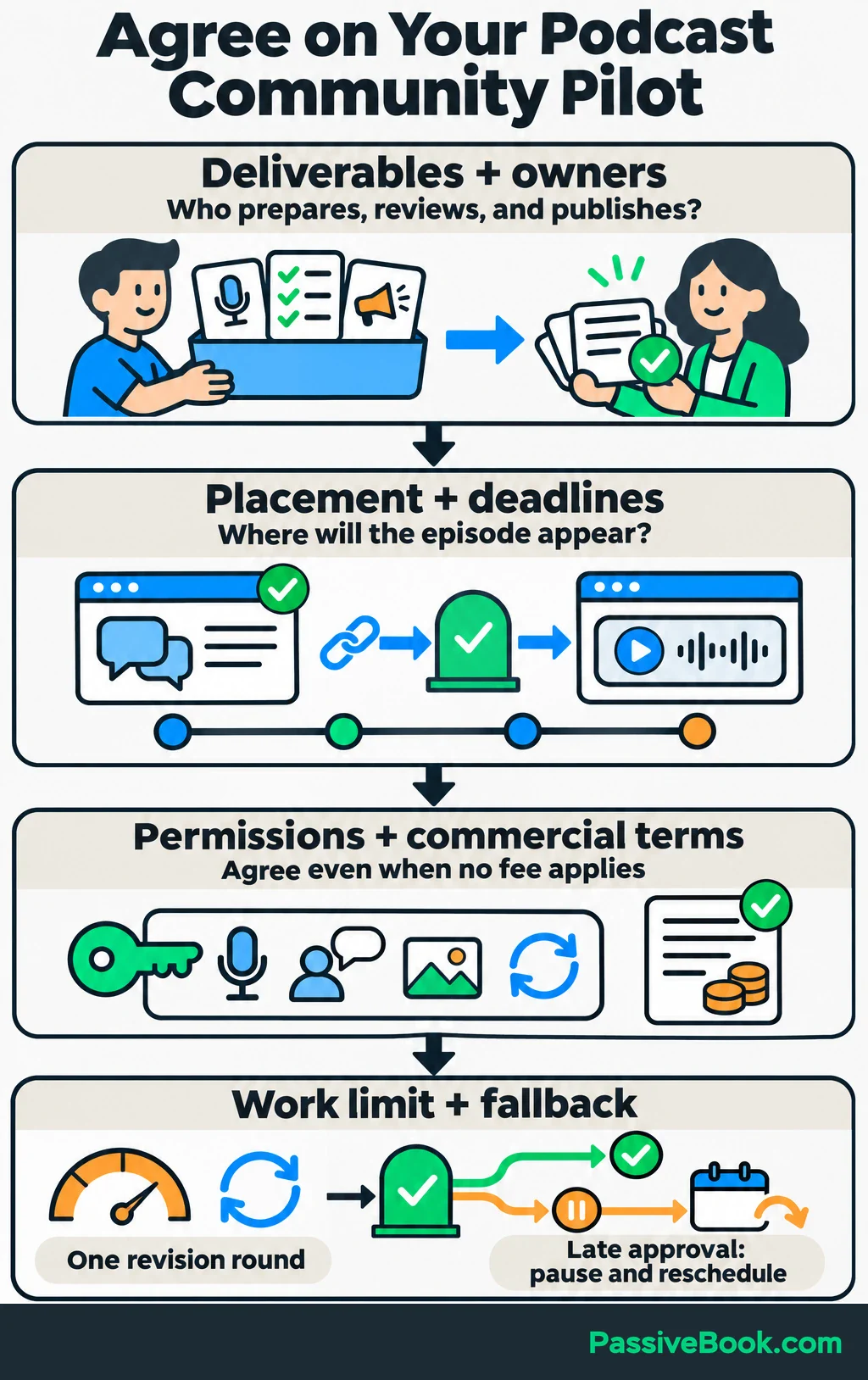
For the sewing-circle pilot, aim to simplify tote-bag preparation for members and attract listening-app clicks for the podcast. Track confirmed email subscriptions separately.
Put the agreement in a short shared brief:
- Deliverables: One existing episode, a free supplies checklist, and a draft announcement.
- Owners: You prepare the package; the organizer selects questions, reviews it, and publishes the announcement.
- Distribution: One post in the beginner discussion area, linked directly to the episode page.
- Deadlines: Resource delivery, organizer review, publication, and results review.
- Permissions: Any recording, member-question attribution, artwork, and future reuse.
- Commercial Terms: Any fee or partner share, including a clear agreement when neither applies.
- Work Limit: A maximum time commitment and one round of revisions.
- Fallback: Pause publication if approval is late; agree on a new date before continuing.
Prepare Tracking Before Promotion
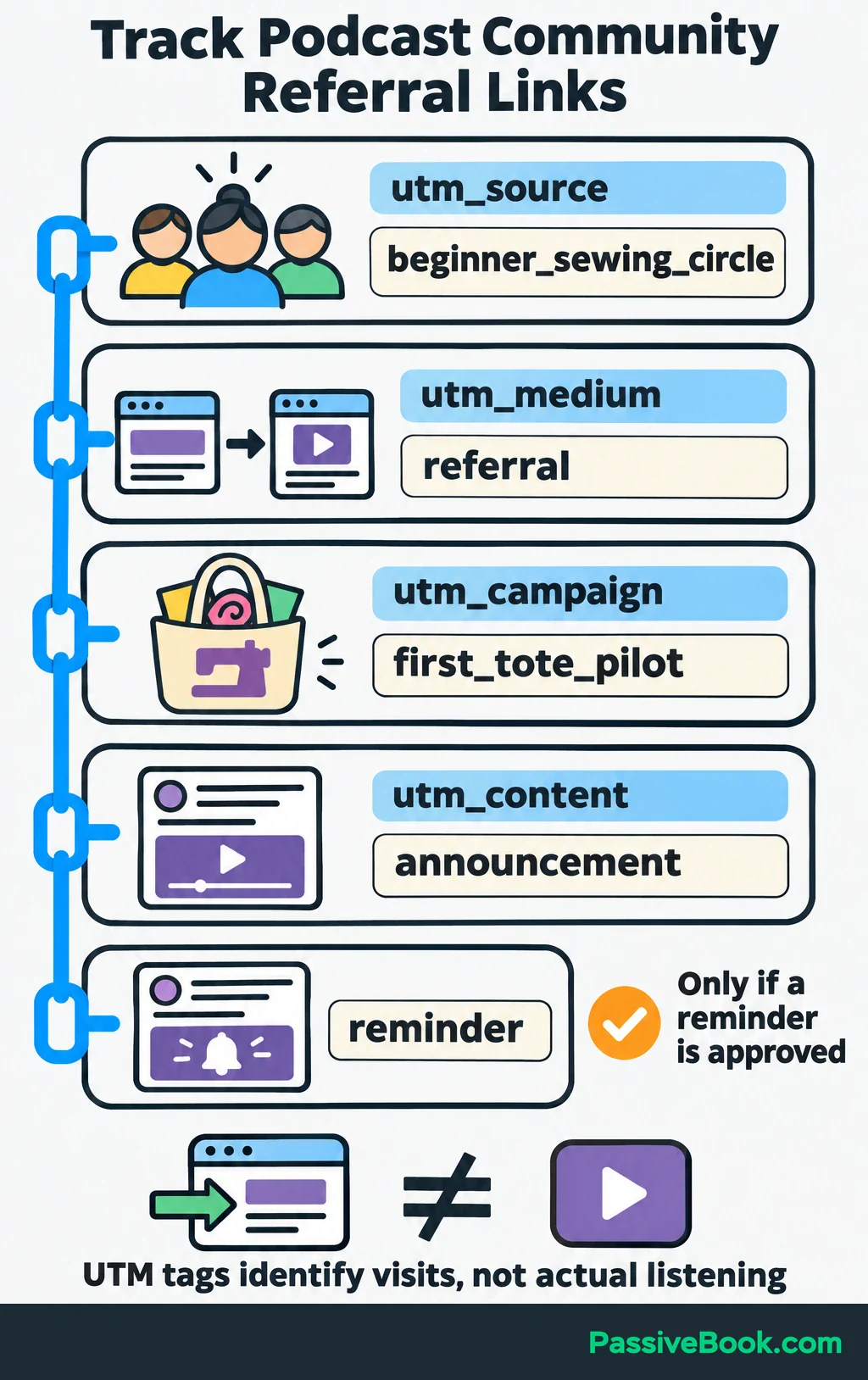
Give each partner and placement a distinct episode-page link with UTM tags—labels in the URL that identify referred visits in Google Analytics, not actual listening. Google’s campaign-link guidance explains the tags.
For the sewing-circle announcement, a simple naming system could be:
| Tag | Example Value | What It Identifies |
|---|---|---|
utm_source | beginner_sewing_circle | Beginner sewing circle |
utm_medium | referral | Visit from another site |
utm_campaign | first_tote_pilot | First-tote resource pilot |
utm_content | announcement | Organizer’s announcement post |
If the organizer later approves a reminder, change the placement value to reminder. Keep names and capitalization consistent.
Set up your analytics to count referred visits and which of those visits include at least one listening-app click. Count the visit once even if someone clicks several app buttons. For signups, make sure your form or email system retains the campaign source through confirmation.
Test the whole route on your phone: promotional link, episode page, player, app buttons, checklist, and optional signup.
Choose a reporting window before launch, such as 14 days after the announcement. For an existing episode, record listening during the preceding 14 days for context.
Turn the Collaboration Into New and Returning Listeners
Deliver and Distribute the Promised Answer
Make the promised answer easy to find. If you produce a new episode, begin answering promptly. If you reuse one, check that it still delivers what the announcement promises.
Briefly explain the community’s contribution so members recognize why the resource is relevant. Avoid turning the opening into a long thank-you speech before the answer begins.
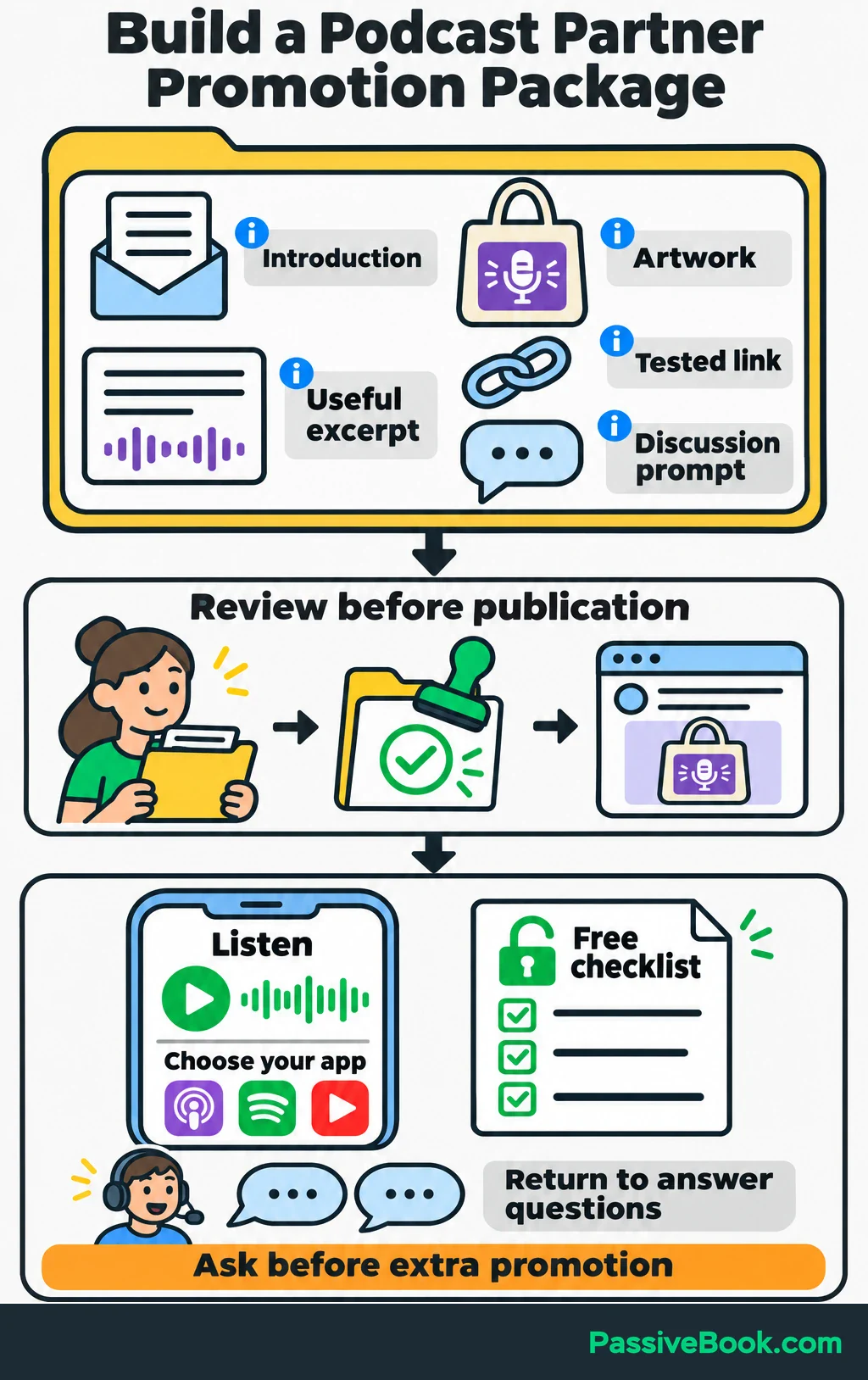
Send the agreed review materials before publication. Your promotion package should include:
- Introduction: A short invitation focused on the member problem.
- Artwork: An image that fits the agreed placement.
- Excerpt: One useful answer or timestamp.
- Link: The tested tracking link to the episode page.
- Discussion Prompt: A question members can answer after listening.
For the sewing circle, the announcement could read:
Planning your first tote bag? This episode answers the fabric and supplies questions raised in our beginner discussions. Listen here and download the free supplies checklist: [tracked episode link]. Which item on your shopping list are you still unsure about?
Put the player and listening-app choices near the top of the destination page. Keep listening as the main action, with the checklist close by.
After the organizer publishes, return to answer relevant questions. Ask before adding reminders or promoting other episodes. Approval for one post covers the agreed post.
Give Listeners a Useful Next Step
Recommend one closely related episode before asking people to explore the rest of your show.
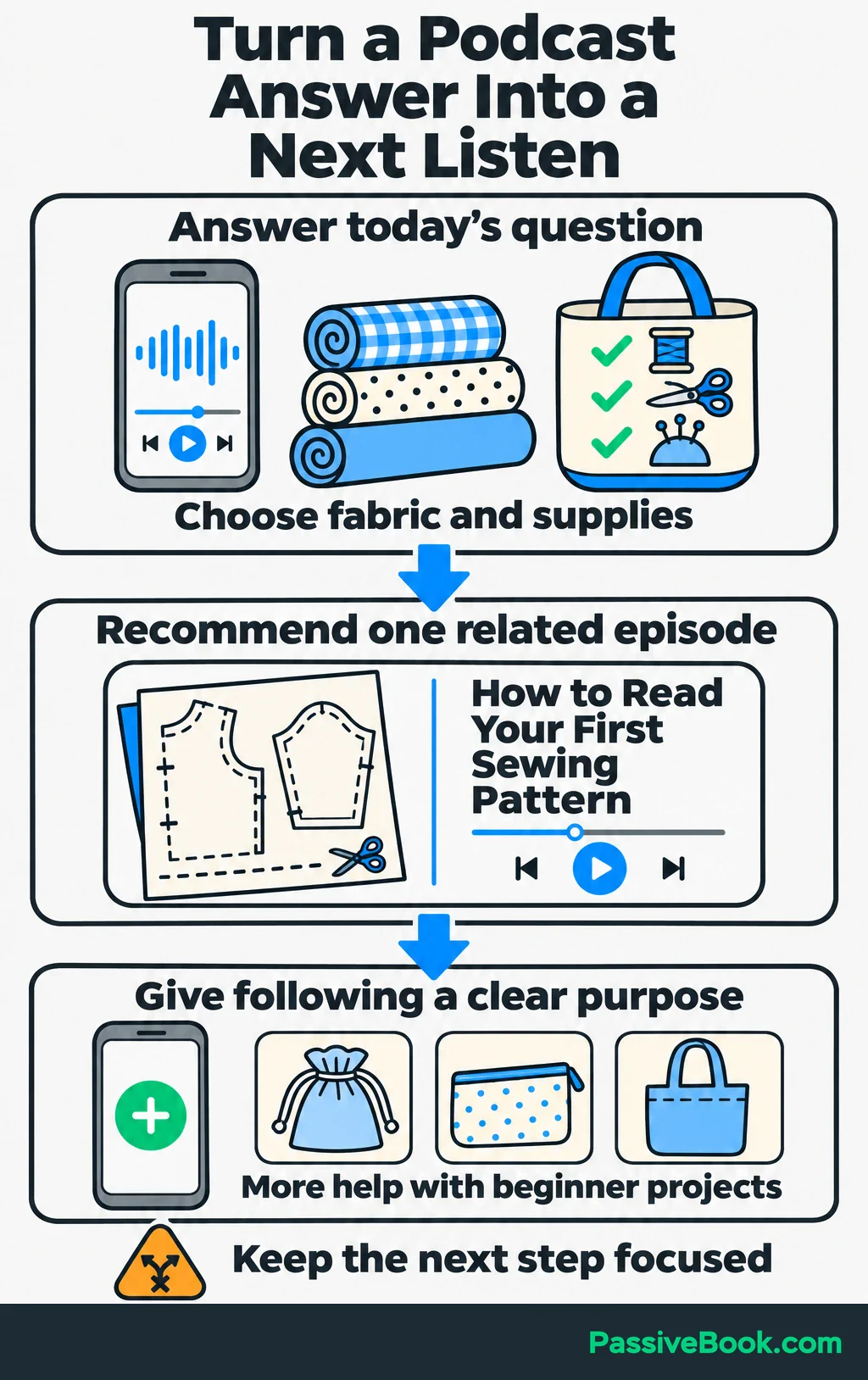
For First Stitch Notes, preparation leads naturally to an episode about understanding a beginner sewing pattern. A short closing invitation could be:
Once your fabric and supplies are ready, listen to “How to Read Your First Sewing Pattern.” It explains the markings you’ll meet before you cut. Follow First Stitch Notes for more help choosing and preparing beginner projects.
That gives following the show a concrete purpose.
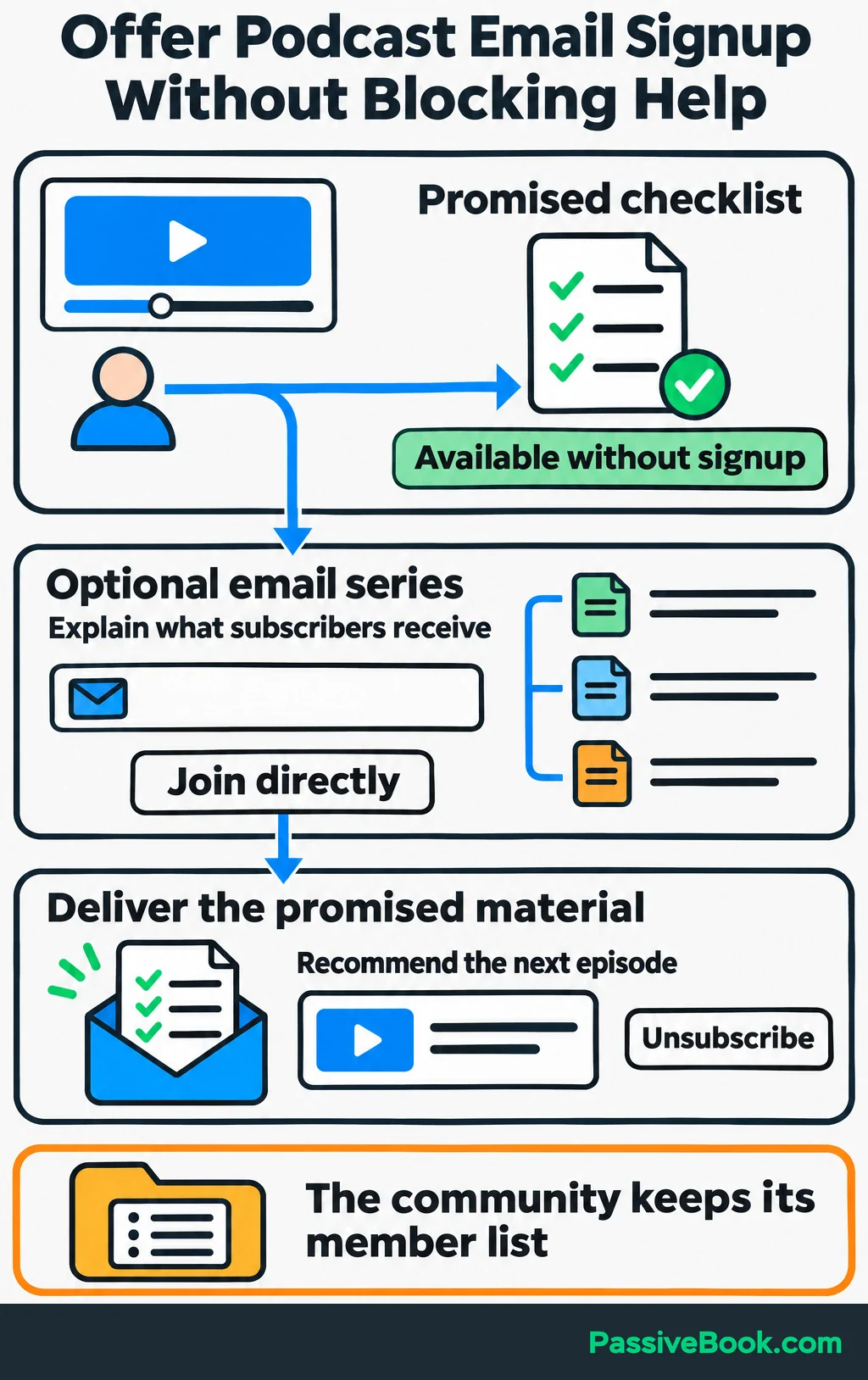
An optional email signup can extend the topic. You might offer a short series that helps listeners prepare their first project. Explain what they will receive, and keep the community’s promised checklist available without enrollment.
The welcome email should deliver the promised material and recommend the next relevant episode. Invite members to subscribe directly, provide an unsubscribe option, and leave the community’s membership list with the community.
Measure Whether the Partnership Earned Its Time
Start by checking whether the agreed placements appeared. Then review the route from those placements to listening interest, subscriptions, and any relevant sales.
I spent six months chasing Instagram and Twitter followers in another niche without corresponding business growth. That experience is why I want a result beyond “more people saw us.”
A compact pilot report could look like this. All figures are illustrative:
| Measure | First Stitch Notes Pilot |
|---|---|
| Partner | Beginner sewing circle |
| Delivered Placement | One organizer post; no reminder agreed |
| Reporting Window | First 14 days after the post |
| Referred Visits | 120 |
| Visits With a Listening-App Click | 36 |
| Confirmed Signups From Those Visits | 12 |
| Organizer Feedback | Checklist helped answer repeated supplies questions |
| Total Work | Four hours |
| Direct Costs | No additional cash expense |
| Partner-Attributed Plays | Unavailable |
| Next Decision | Test another resource using an existing episode |
For listening-click rate, count referred visits that included at least one app click, then divide by all referred visits in the same window:
36 ÷ 120 × 100 = 30%.
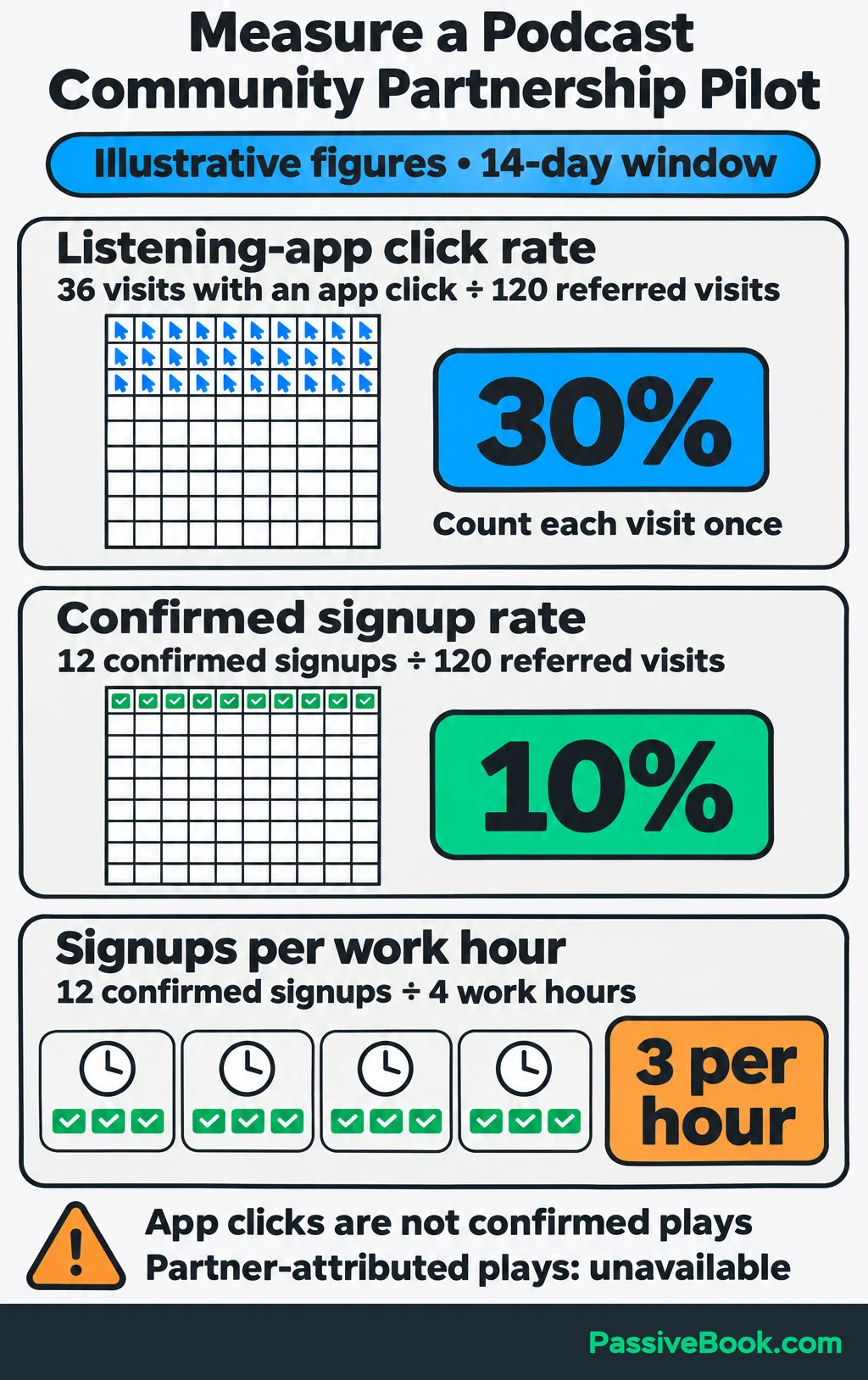
For signup rate, count confirmed subscribers acquired from those referred visits, then divide by the same 120 visits:
12 ÷ 120 × 100 = 10%.
The pilot gained three confirmed signups per work hour. Judge that return against your own goals and the effort needed to repeat the work.
Use Apple Podcasts Analytics to check listening and how much of the featured episode and its follow-up people heard on Apple Podcasts. These totals do not identify community referrals.
Use the evidence to choose the next change:
- Missing Placement: Clarify ownership and publication dates before another pilot.
- Few Referred Visits: Revisit the placement and the invitation’s relevance.
- Visits Without Listening Clicks: People may listen in the page’s player instead. Check for those plays before changing the episode promise or the app buttons.
- Weak Listening Engagement: Check whether the episode answers the question that brought people there.
If sales are the goal, subtract refunds, partner shares, and direct campaign and delivery costs from attributable revenue. Review the return alongside work hours.
Turn a Useful Pilot Into a Repeat Partnership
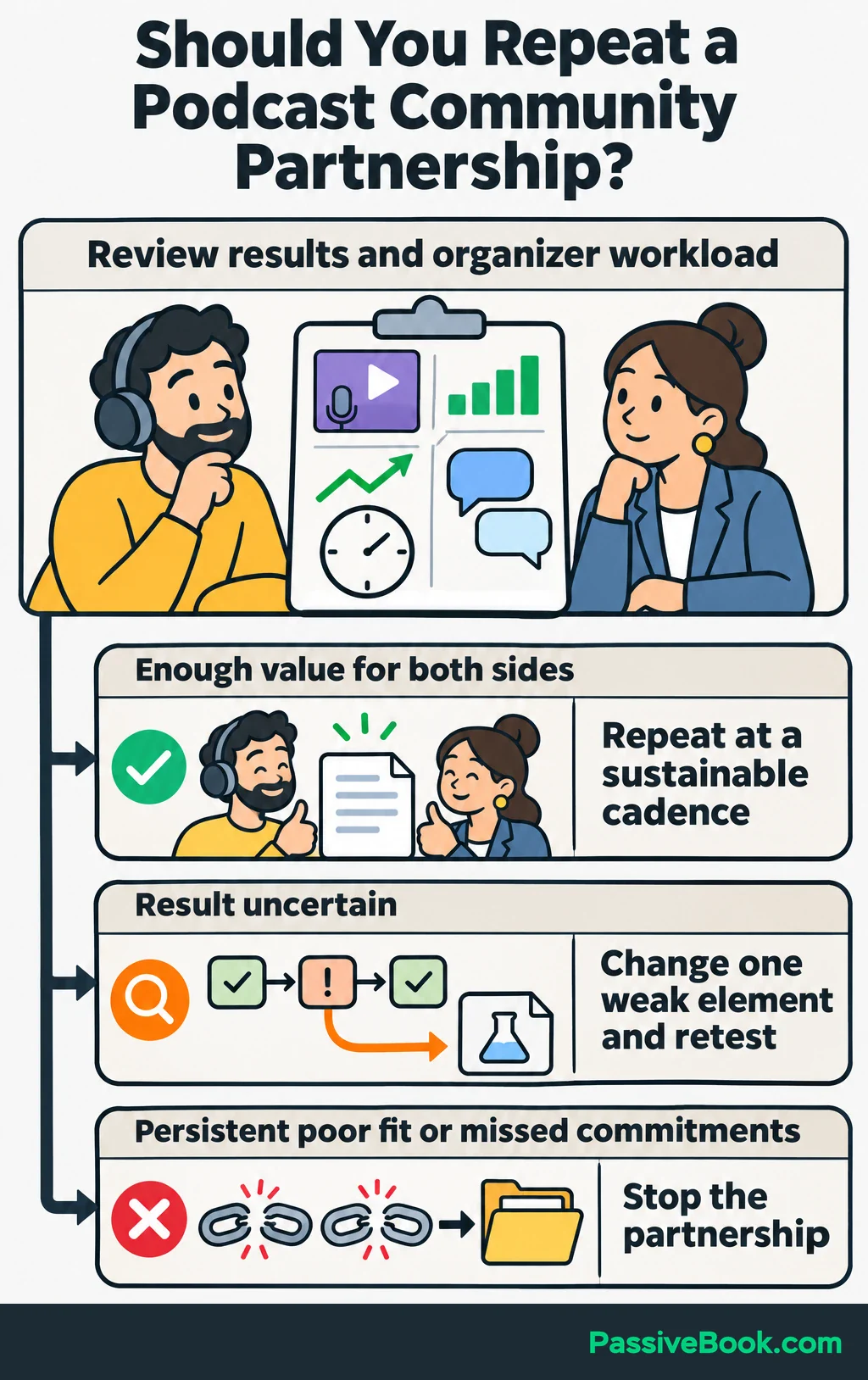
Send the organizer a short report with the delivered placement, useful results, and proposed next decision. Ask whether the resource answered member questions and whether preparing it created more work than it saved.
Repeat when both sides received enough value to justify the effort. If the result is uncertain, change one weak element before retesting. Persistent poor fit or missed commitments are reasons to stop.
For First Stitch Notes, the next collaboration might address recurring confusion about pattern markings. There is no need to invent a new theme while a useful question is already waiting.
Agree on a sustainable cadence after testing the workload. I would prefer an occasional resource that the organizer wants over a monthly obligation both sides begin to resent.
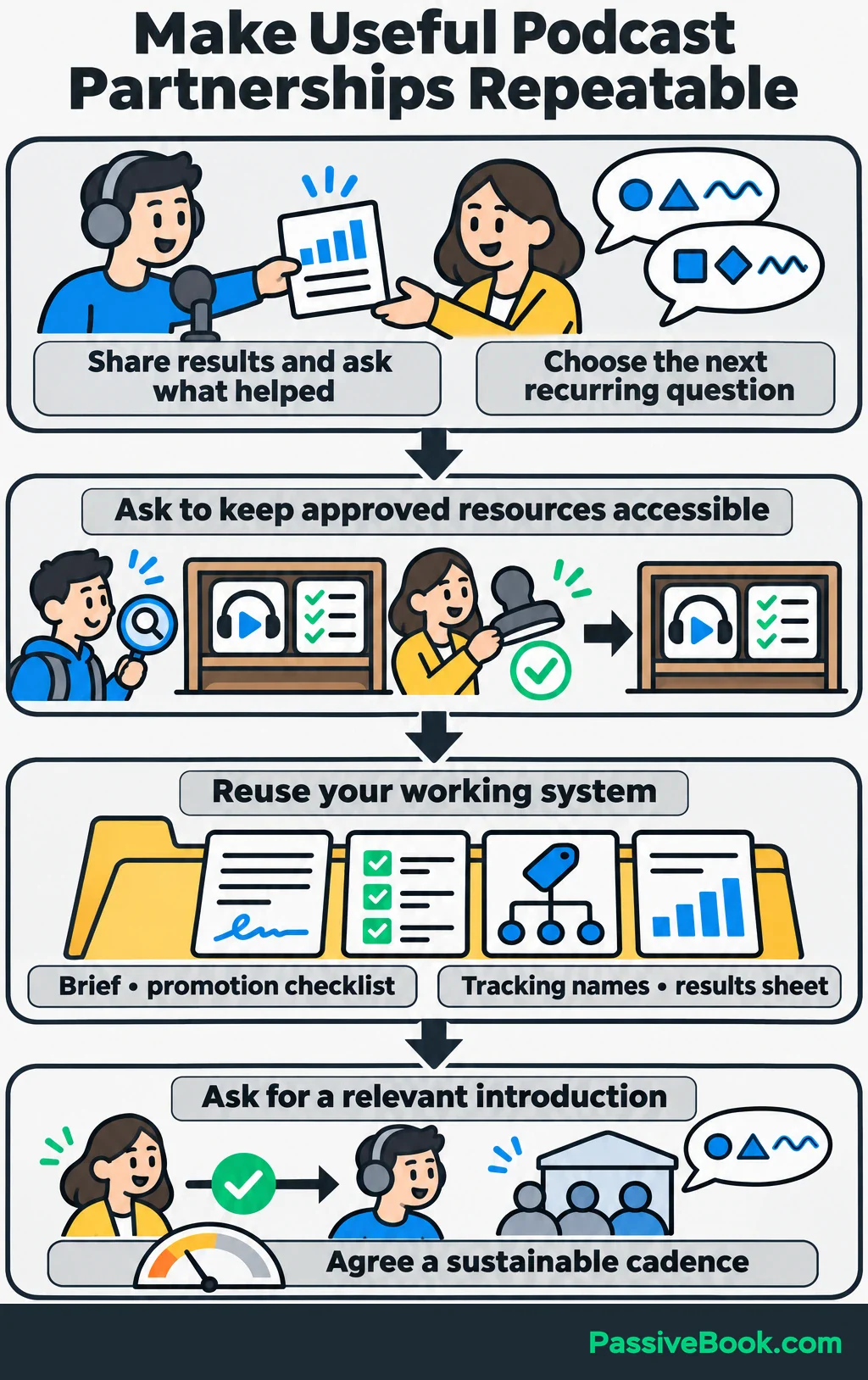
Ask whether the approved episode and checklist can stay in the community’s resource collection. That gives future members a way to discover the show without another launch.
Reuse the brief, promotion checklist, tracking names, and results sheet. Once the organizer has seen the value, ask whether another community faces the same problem. That is a much easier introduction to make than a vague request for contacts.
What Next?
Find one community discussion that your existing episode can answer, then write down what you could contribute and who can approve it. That is enough to begin a focused proposal.
Use the social buttons to share this guide when discussing podcast collaborations; it gives both sides a practical way to define the exchange before committing time.
What recurring question could your podcast help a community answer? Share it in the comments, and bring any other questions about planning your first partnership.
Share this post with your friends & followers:

