A customer recommends your product, their friend buys, and then someone asks where the referral reward went. You have an order confirmation, but no record connecting the purchase to the recommendation.
That gap makes a promising growth channel hard to trust. You could pay for purchases that don’t qualify or frustrate customers who earned a reward.
A referral program needs enough structure to prevent both problems. This guide shows how to build that structure around a small pilot, so you can judge customer quality, acquisition costs, and reward delivery before inviting more people.
1. Define a Successful Referral
Referral marketing turns customer recommendations into a process you can track. Your strategy decides whom to invite, what they recommend, when you ask, and which action earns a reward.
Start by describing the customer you want to acquire. Include their problem and why your offer fits. “Anyone who buys” gives customers very little help choosing whom to recommend.
Imagine you sell an online course that teaches owners of curly-coated dogs an at-home brushing routine. A suitable referral would be a first-time buyer who wants help maintaining their dog’s coat between grooming appointments.
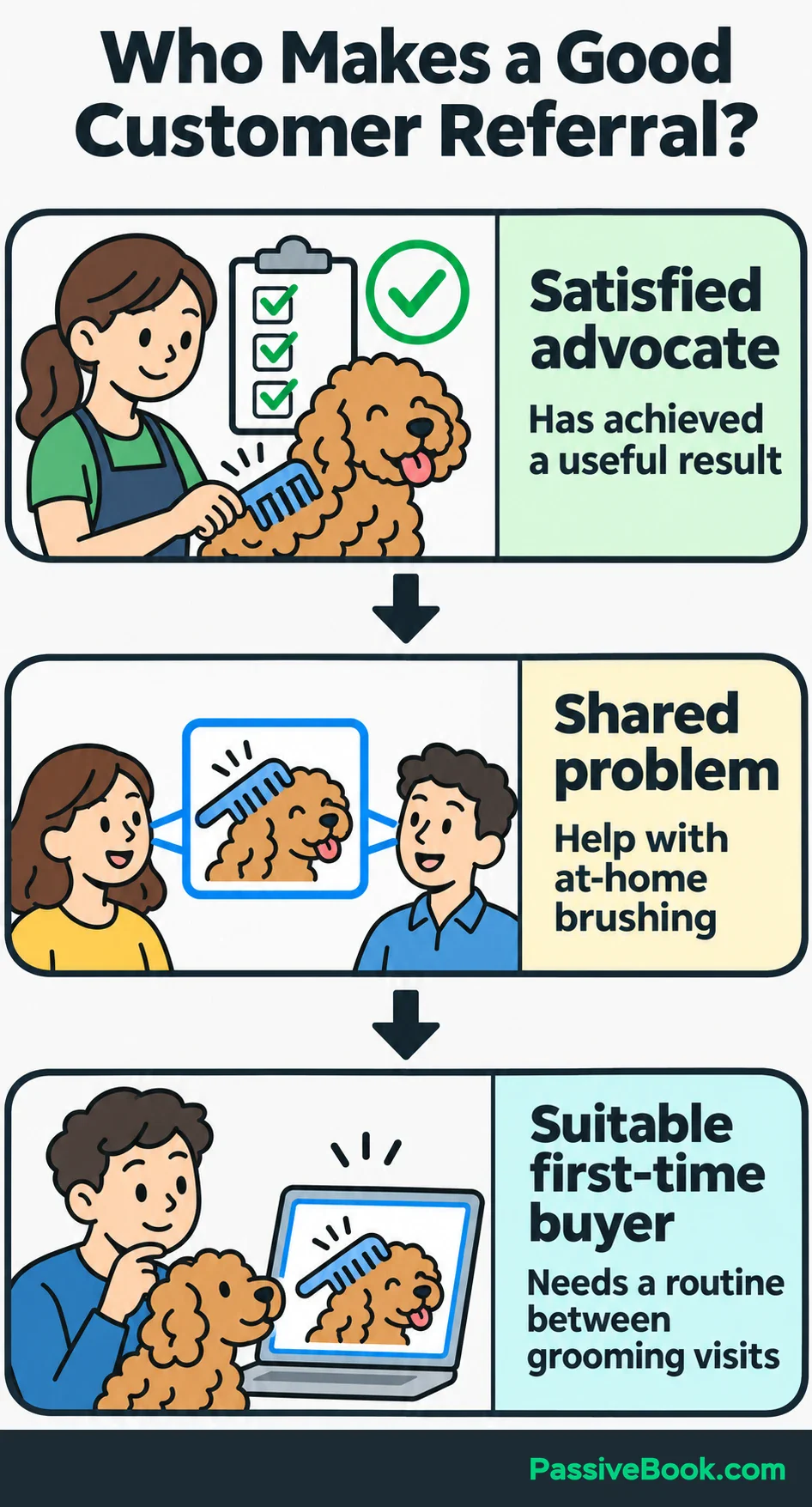
Next, choose one action that earns the reward. I would use an eligible first purchase that remains valid after the refund period. Clicks and email signups can show progress, but they don’t yet pay for the program.
Choose your recommending customers just as carefully. Look for people who have:
- Used the product and reached a useful result.
- Given specific, positive feedback.
- Already recommended it without being asked.
- Connections who face the problem your offer solves.
On one of my digital-product sites, a buyer asked whether she could send a template to a friend. I initially treated it as a file-sharing question, then realized she had named a reason to recommend the product. That’s the kind of moment I would investigate before writing a referral invitation.
If customers repeatedly struggle with delivery, instructions, or support, fix that first. If you have no customers yet, establish successful customer experiences before building a customer referral program.
Put your decisions into one sentence:
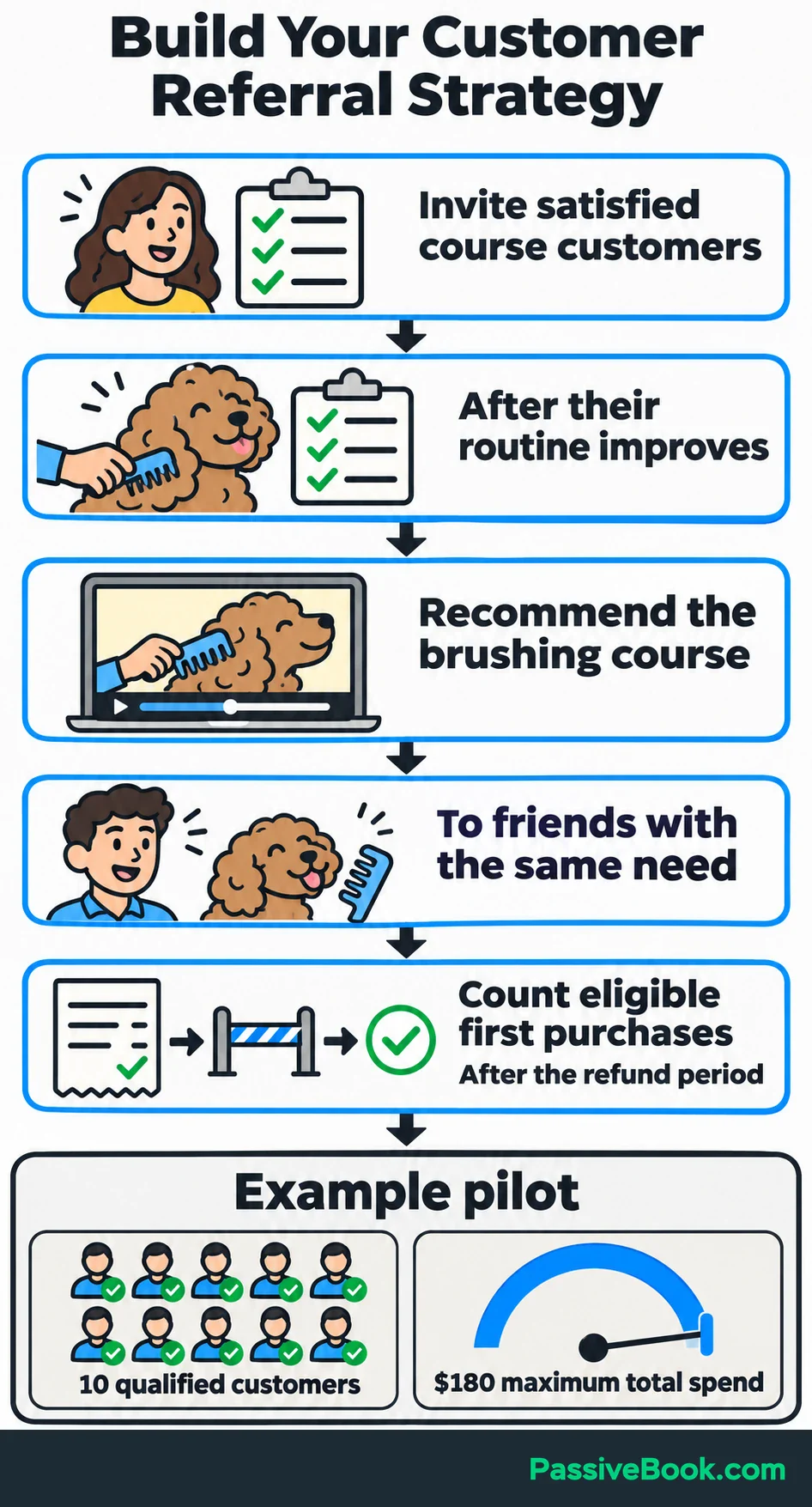
Invite [satisfied customer group] after [value milestone] to recommend [offer] to [suitable friend], rewarding [qualified action].
For the course:
Invite customers who report establishing a manageable brushing routine to recommend the course to friends with the same need, rewarding eligible first purchases after the refund period.
Then set a pilot goal and spending cap. For this worked example, suppose you aim for ten qualified new customers with a maximum total program spend of $180.
2. Calculate Your Referral Cost Ceiling
Before choosing a reward, work out how much each sale leaves available.
Start with the selling price before any referral discount. Subtract the costs that come with serving that purchase, including payment processing, delivery, and expected support. What remains is your contribution before referral costs.
Then decide how much contribution you need to retain. That money still has to help cover fixed overhead and taxes.
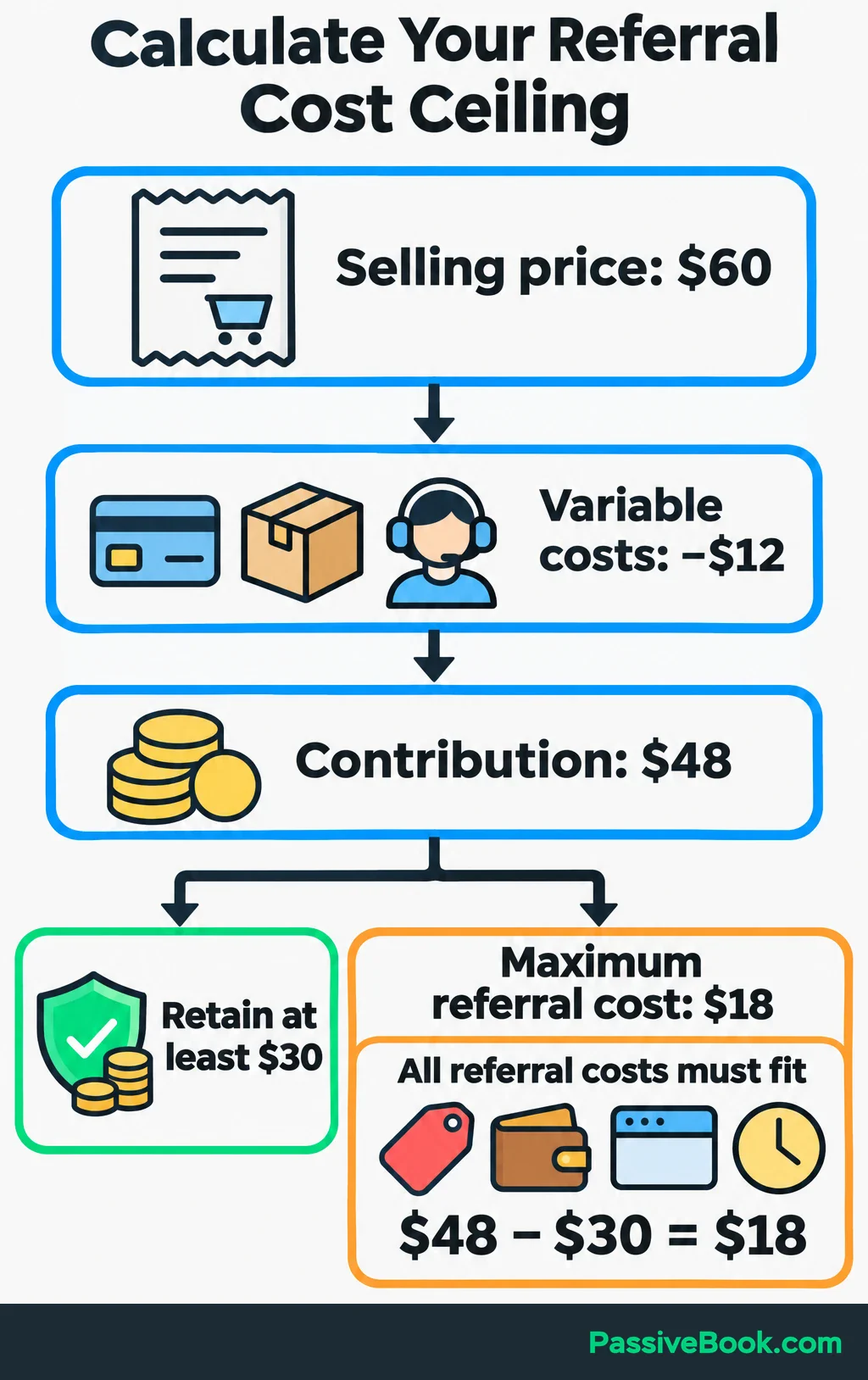
Suppose the course has these economics:
| Item | Amount per purchase |
|---|---|
| Selling price before referral discount | $60 |
| Variable delivery, payment, and support costs | −$12 |
| Contribution before referral costs | $48 |
| Minimum contribution you want to retain | $30 |
| Maximum total referral cost | $18 |
The calculation is $48 minus $30, leaving an $18 referral cost ceiling per qualified customer.
That ceiling must cover more than the reward:
- The friend’s discount.
- The recommending customer’s reward.
- Software and payout fees.
- Setup and administration time.
- Any extra cost of delivering a bonus.
Count your time even when no money leaves the bank. Otherwise, a cheap program can quietly become another unpaid job.
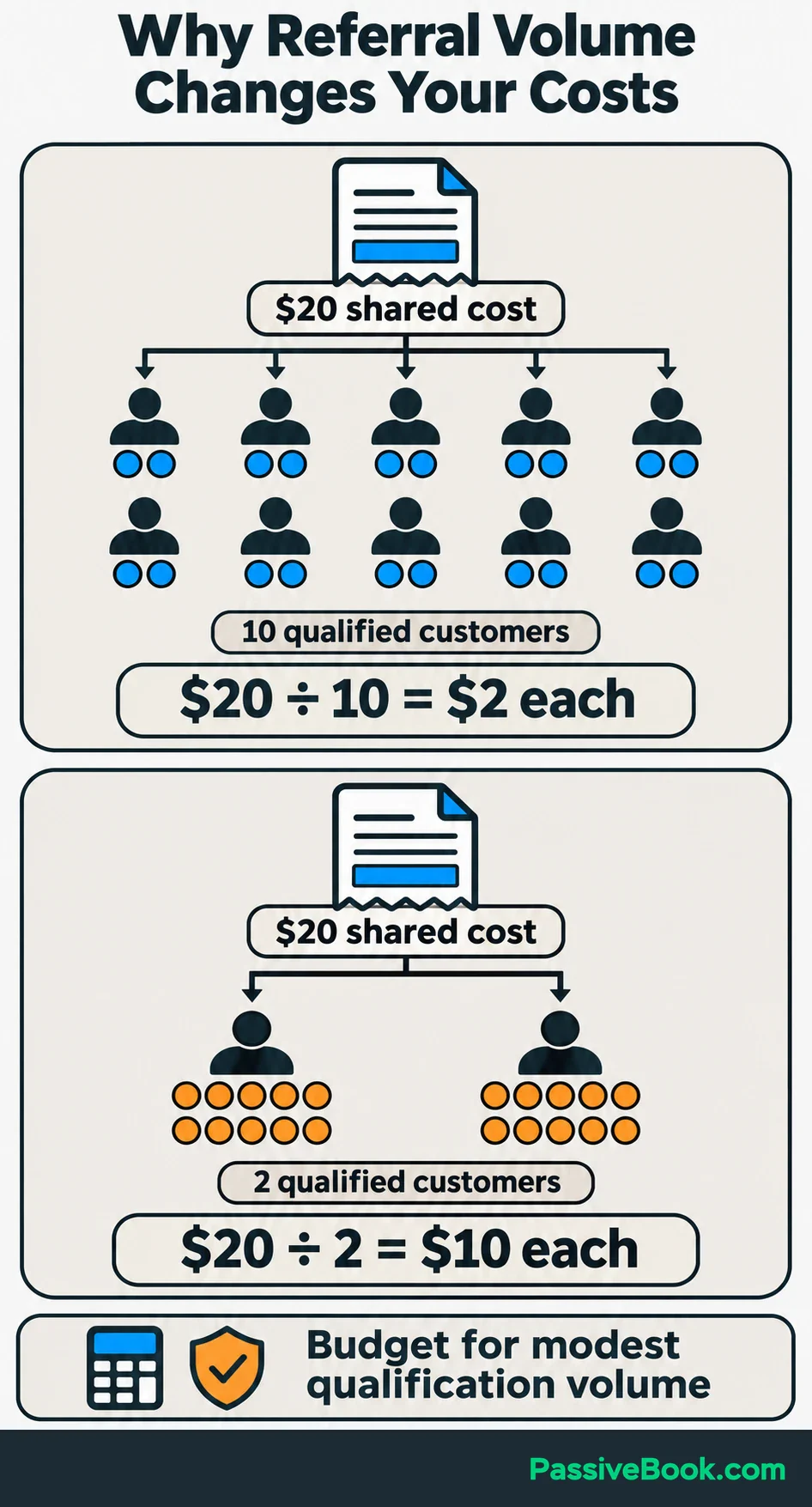
For shared costs, divide the total by a conservative number of qualified customers. Suppose setup and administration cost $20 for the pilot. Ten qualified customers would carry $2 each, but two would carry $10 each.
I would base the first budget on the first purchase. Future purchases can justify a larger allowance once you have evidence that those purchases happen.
Keep the friend’s discount in the referral budget and count it once. Also reserve money for earned and pending rewards before sending more invitations.
A reward can fit your budget at ten customers and exceed it at two. Use your own estimates to see that trade-off before you commit to an offer.
Free Partnership Offer Calculator




3. Choose the Referral Offer and Rules
Choose Who Receives the Benefit
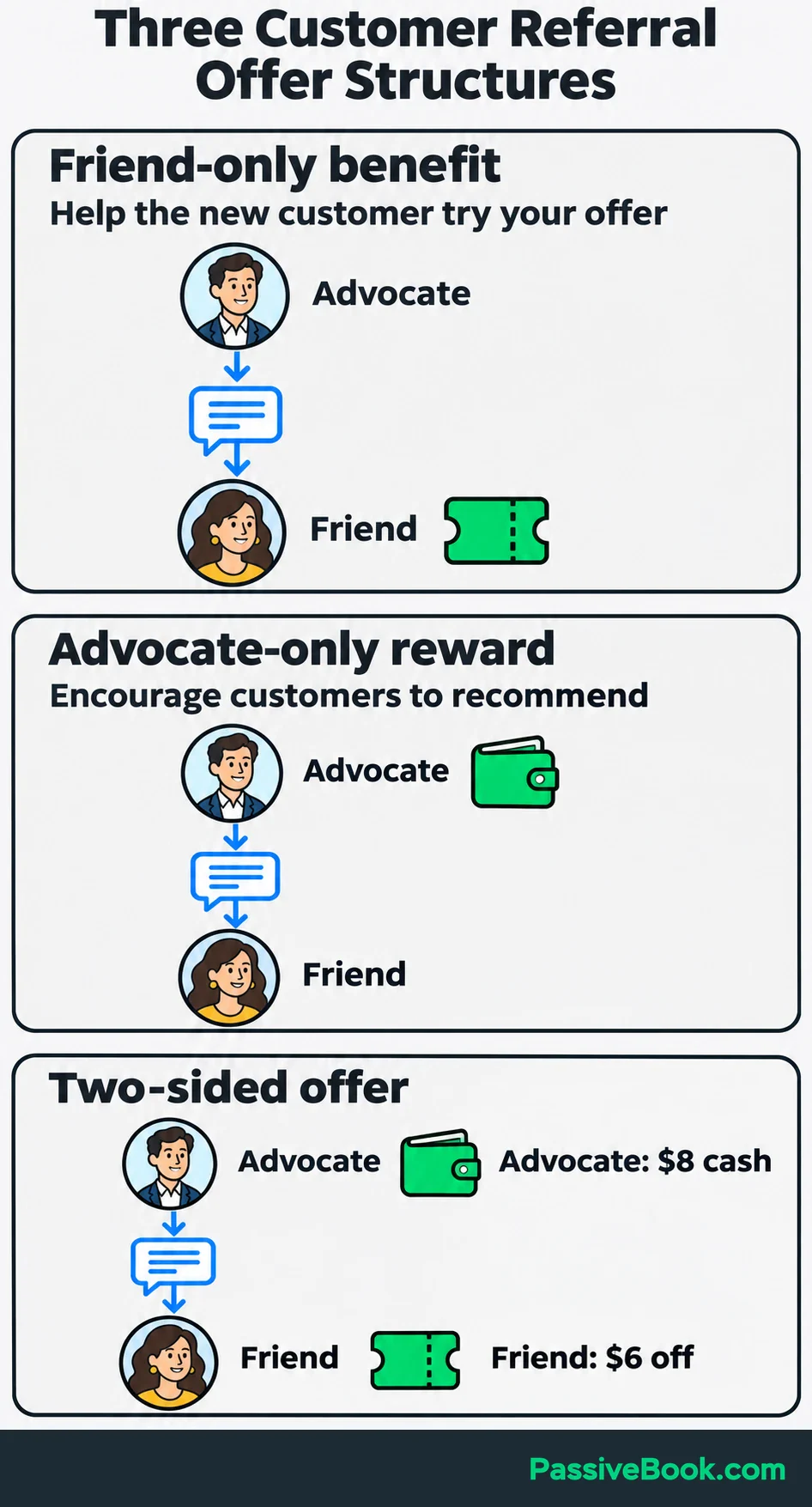
There are three straightforward ways to structure the offer.
| Structure | What it gives people | When I would consider it |
|---|---|---|
| Friend-only benefit | A discount or bonus for the new customer | Customers already recommend the product, but friends need a reason to try it |
| Advocate-only reward | Cash, credit, or a bonus for the recommending customer | The offer already converts well, and you want to encourage recommendations |
| Two-sided offer | A benefit for both people | You want customers to offer something useful while receiving a reward |
Here, “advocate” simply means the customer making the recommendation.
Don’t assume paying that person more will produce the most customers. In a randomized experiment with subscription company Game Access, Gershon, Cryder, and John found that giving the referred friend a free month produced more new subscriptions than giving the recommending customer a free month. The company emailed friends whose details customers supplied, so I would use the finding as a reason to test friend benefits, rather than copy the campaign. Read the original study.
Match the reward to what customers can use. Store credit makes sense when there is a useful next purchase. For a standalone course, I would prefer cash or a relevant bonus over credit toward a product that doesn’t exist.
Budget store credit at face value until you have better evidence. For a bonus, count its extra delivery and support costs.
For the brushing-course pilot, suppose you choose:
- $6 off for the friend.
- $8 cash for the advocate.
- $2 per qualified customer for all other program costs, assuming ten qualify.
At ten qualified customers, acquisition cost is $16 each, below the $18 ceiling. That leaves $32 contribution per customer, above the $30 minimum.
Make Qualification and Reward Timing Clear
Write the rules before anyone starts sharing. Cover:
- Who can participate and which first purchases qualify.
- Whether referral discounts combine with other offers.
- Reward amounts, participant limits, and any overall program cap.
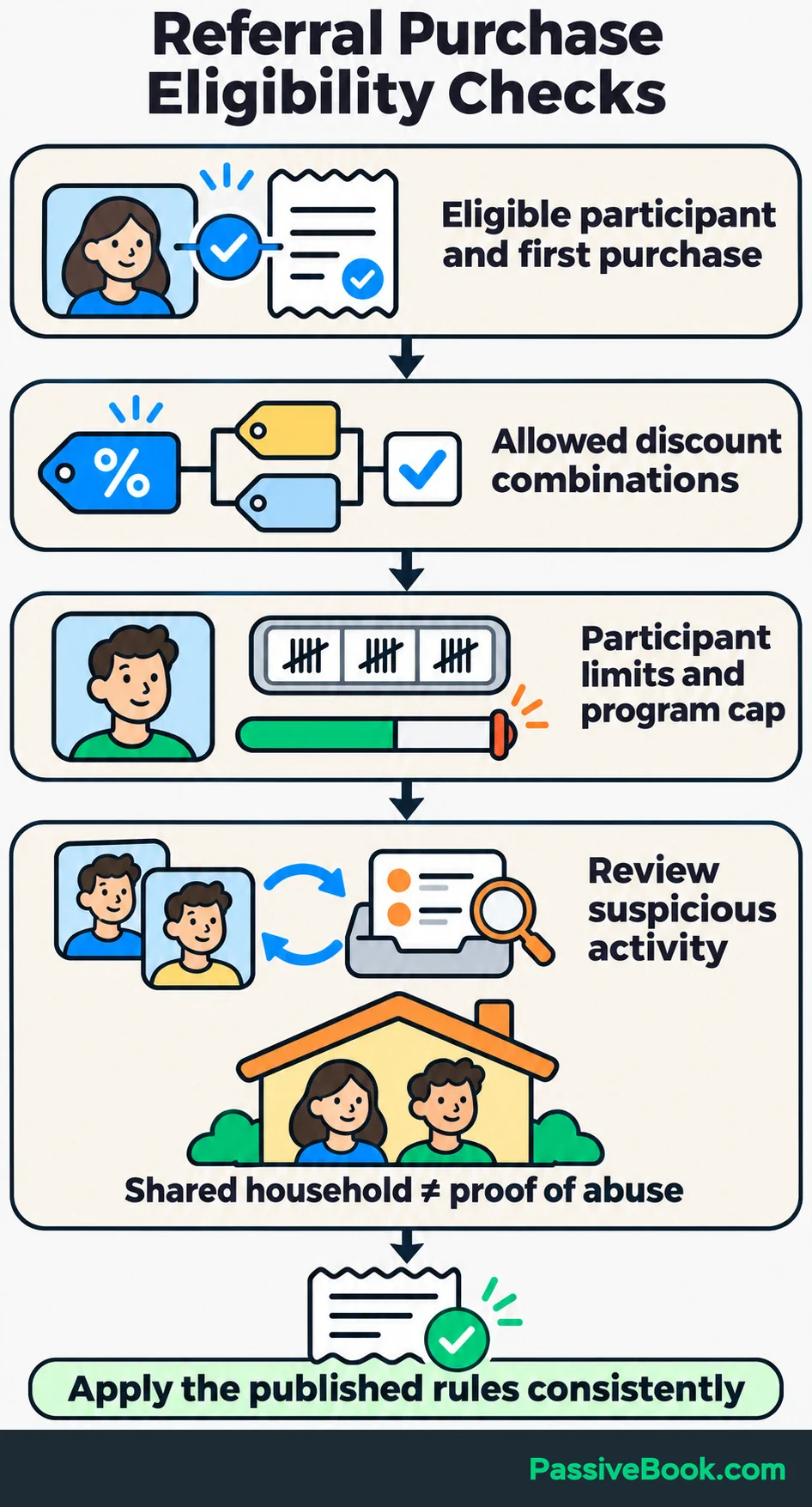
- The refund period and payout schedule.
- What happens after cancellations, refunds, or payment reversals.
- Whether public coupon listings or other forms of code sharing are allowed.
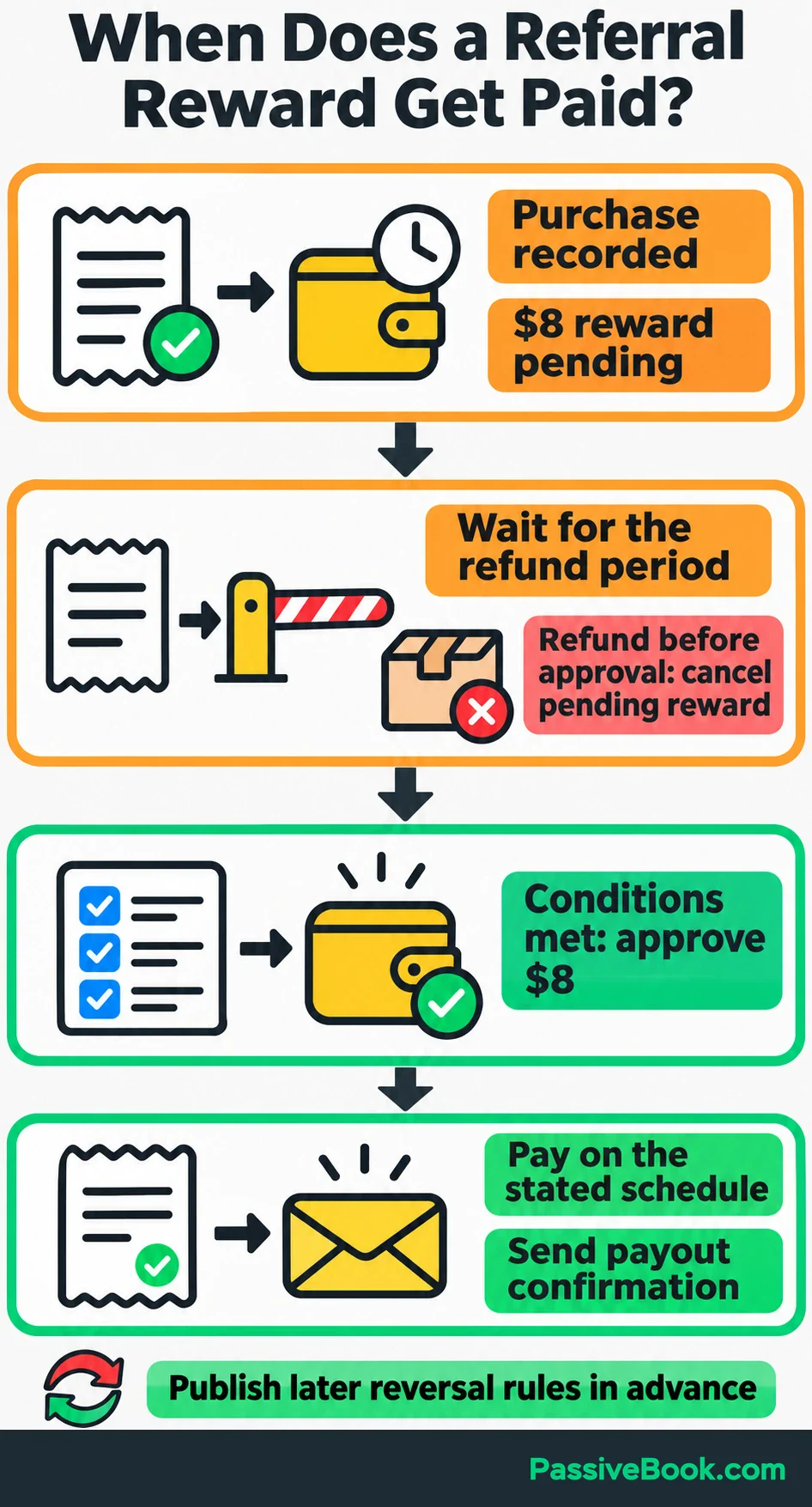
Define self-referrals and duplicate accounts, too. Review suspicious activity before approving rewards, but don’t treat a shared household as proof of abuse.
Keep rewards pending until the qualifying conditions are met. For later payment reversals, explain in advance whether unpaid rewards are cancelled or already issued rewards can be recovered.
The short version should be easy to understand:
Give a friend $6 off their first brushing-course purchase and earn $8 after their eligible order clears the refund period.
Place the full terms beside that summary. Customers shouldn’t need a support conversation to learn when they get paid.
4. Make Referrals Easy to Share and Redeem
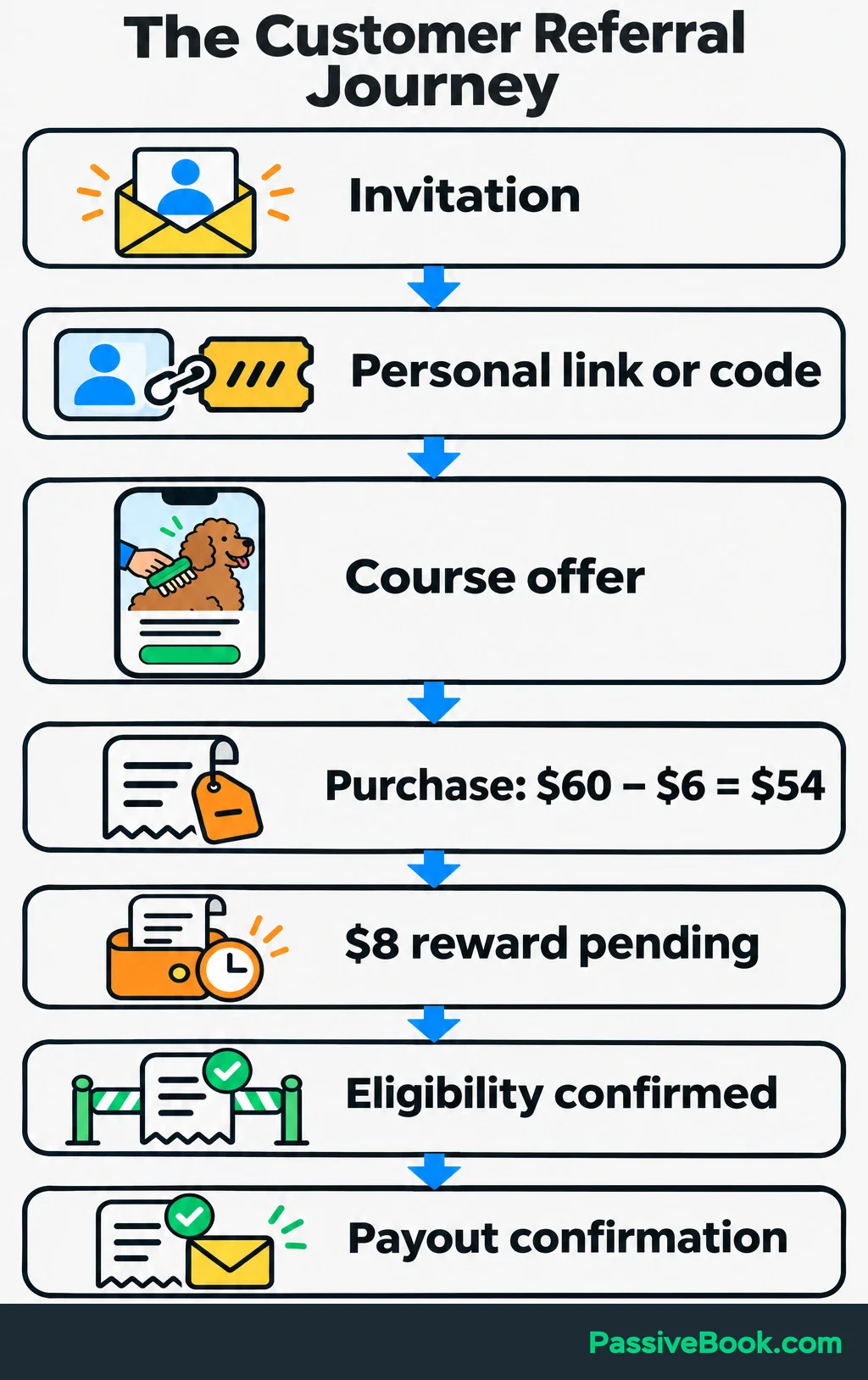
Map the journey before building pages:
Invitation → personal link or code → course offer → purchase → pending reward → qualification → payout confirmation
Each step should lead naturally to the next.
Create a referral page that explains whom the course helps, what both people receive, and what makes a purchase eligible. Give each advocate a personal link and a short code they can mention in conversation.
For permitted channels, offer editable sharing copy:
Learning to brush a curly-coated dog at home? This course could help you build a routine between grooming appointments. Get $6 off your first purchase here: [personal link]. I receive $8 if your purchase qualifies.
Let customers add their own experience rather than asking them to repeat praise you wrote. Keep the reward disclosure beside the recommendation. For U.S.-facing incentivized recommendations, the FTC calls for unexpected material connections to be disclosed clearly and conspicuously. FTC disclosure guidance.
Send the friend directly to the course offer. Show:
- Who the course is for and what it covers.
- How the referral discount works.
- The final payable price before purchase.
- Any important purchase conditions.
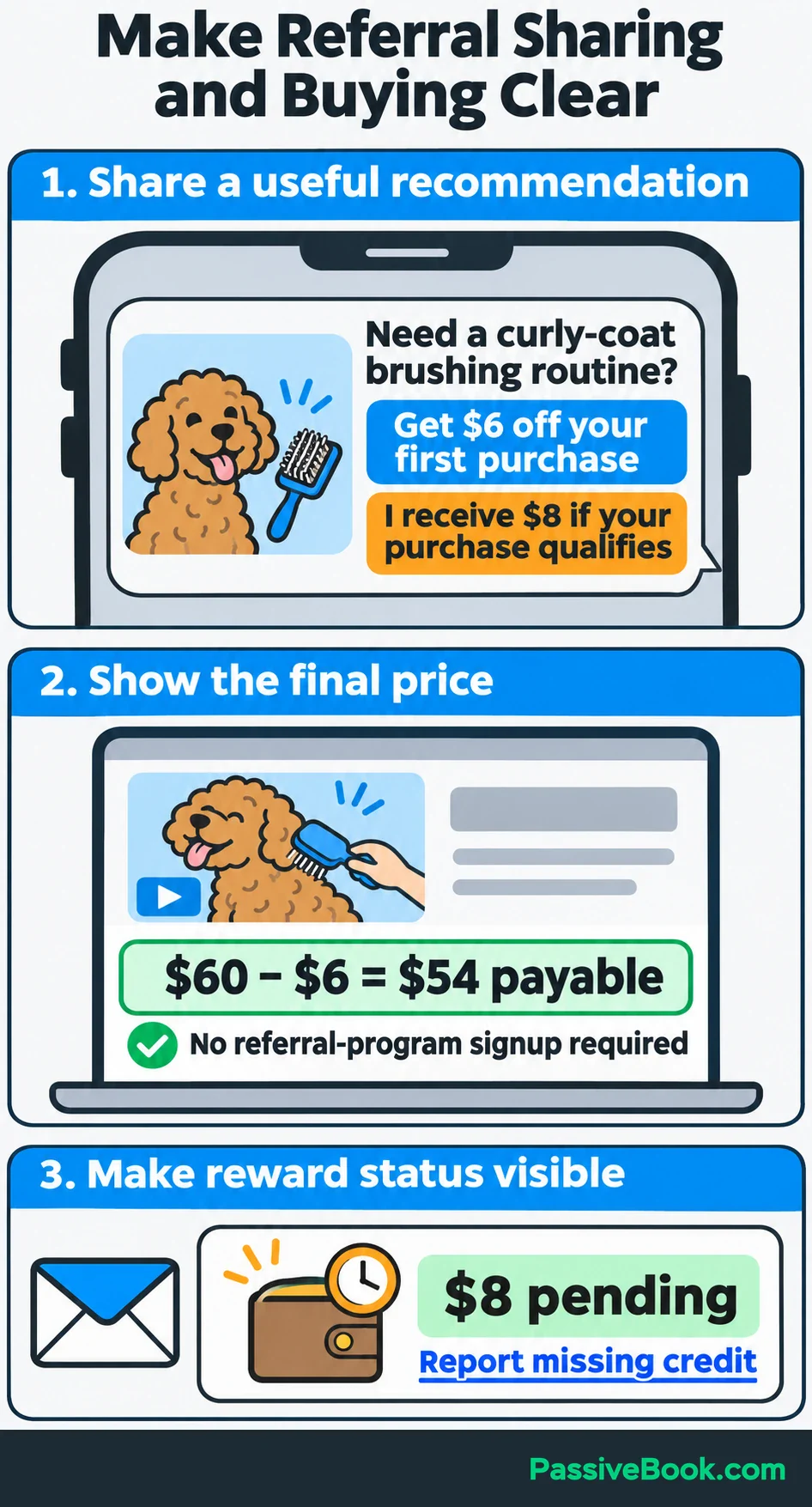
The friend should be able to buy without joining the referral program.
Advocates also need a way to check their rewards and report missing credit. During a small pilot, confirmation emails and a support address may be enough. Send an update when a reward becomes pending and another when it is issued.
I would build that basic visibility before adding badges, leaderboards, or a glossy dashboard. A customer waiting for eight dollars rarely needs a leaderboard.
5. Connect Purchases to Referral Rewards
Establish One Attribution Rule
Attribution means deciding which recommendation gets credit for a purchase.
Give every advocate a unique identifier, then save it against the referred customer’s order and reward record. A general referral discount code shared by everyone cannot tell you whom to pay.
Choose an attribution window that fits the time people need to decide. Also settle these questions:
- If someone clicks two advocates’ links, which one receives credit?
- Does a code entered at checkout override a saved link?
- How do you handle a purchase made on another device?
- How can a customer request missing credit?
For the course pilot, you might credit the last eligible referral link clicked within 30 days, with an entered advocate code taking priority. One new customer earns one referral reward, even if several people recommended the course.
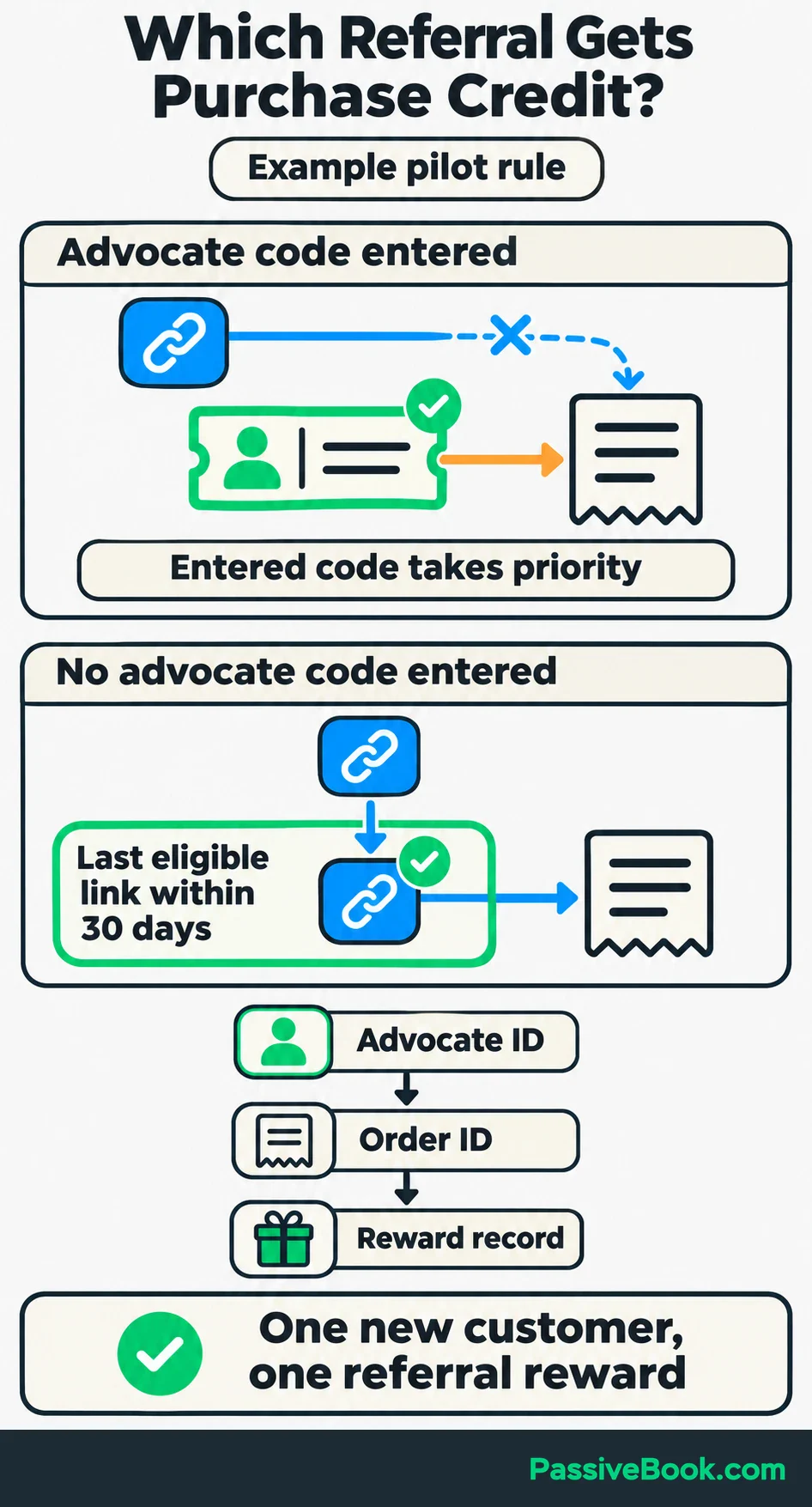
Publish the rule and apply it consistently.
Keep one row per referred order in your tracking sheet. Include:
- Advocate ID, customer ID, and order ID.
- Referral date, link or code method, and order date.
- Order value and friend discount.
- Refund status and qualification date.
- Reward amount, reward status, and payout date.
Add Google Analytics campaign tags—labels on links—to compare traffic sources. Approve rewards from order records.
Use internal IDs in public links and restrict access to reward records. Follow the ICO’s data-minimisation guidance by collecting only what tracking and reward delivery require. Remove personal information when it is no longer needed.
Automate Qualification and Notifications
For a manageable pilot, unique codes and a regular order check may be enough. Start with your existing checkout rather than buying another subscription immediately.
When order checks or reward delivery become unreliable, choose referral software that connects purchases to advocates in your checkout and can:
- Apply your attribution and eligibility rules.
- Handle refunds and cancelled rewards.
- Export order and reward records.
- Prevent duplicate payouts.
The workflow you want is:
Eligible purchase → pending reward → refund-period check → approval → payout → confirmation
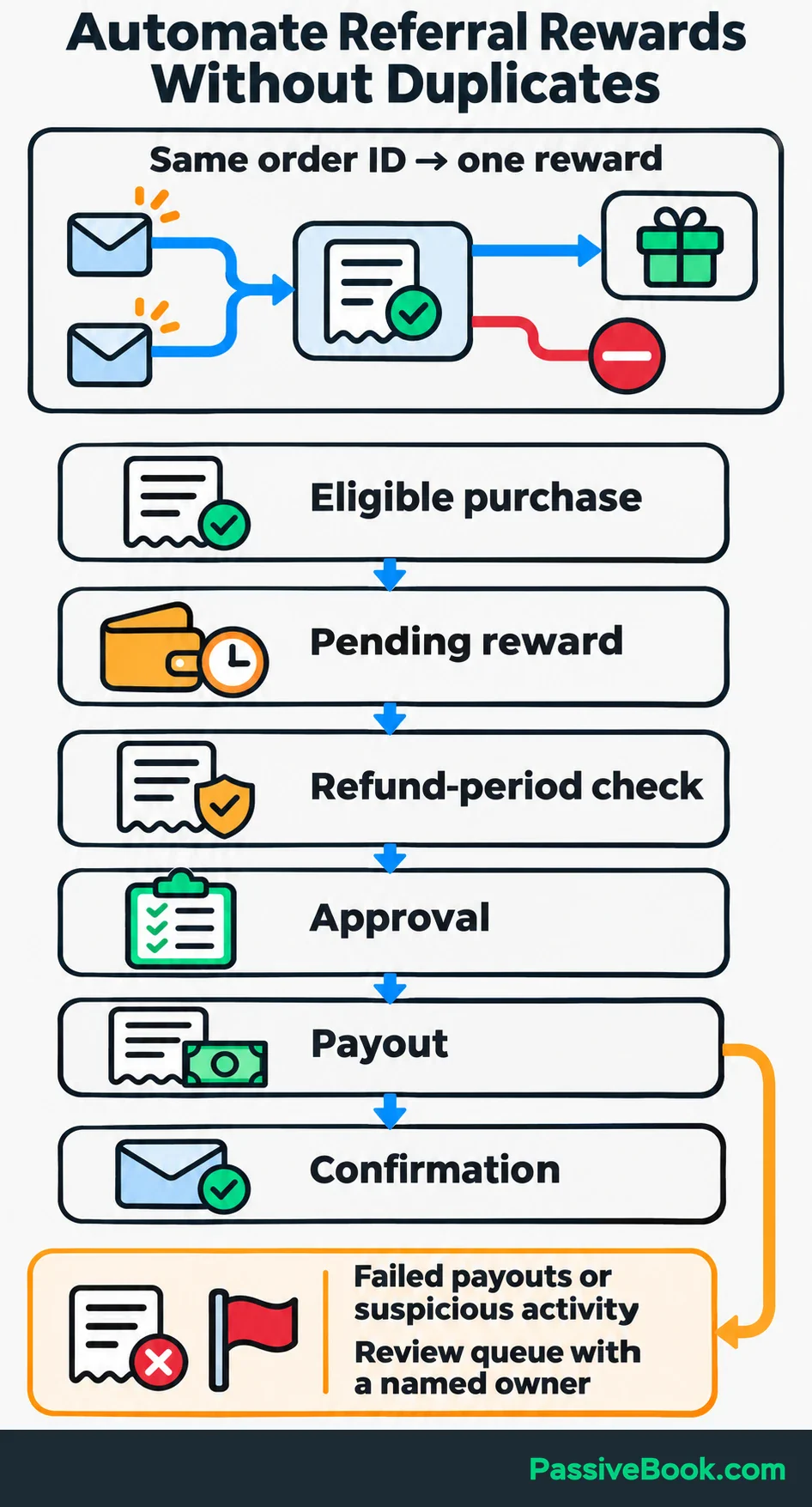
Use the order ID to prevent repeated notifications from creating another reward. Failed payouts and suspicious activity should go to a review queue with a named owner.
I use n8n, a tool that connects apps and automates repeated tasks. For this program, I would use it to update reward records from order data and send status emails.
Automating an unclear rule just applies the confusion faster.
6. Launch Through Customer Value Moments
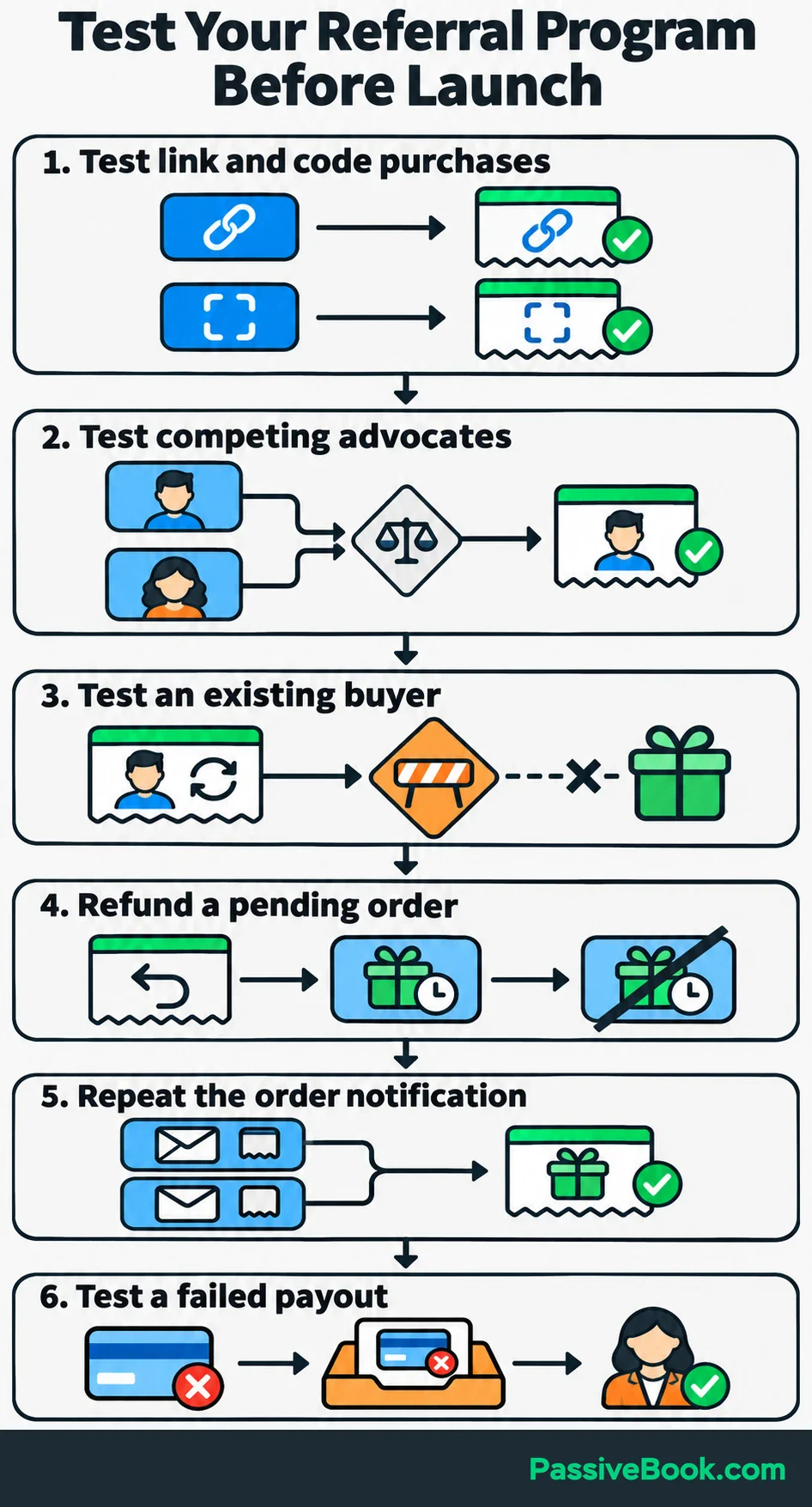
Test the full journey before inviting customers. Complete a test purchase through a referral link and another through a code.
Also check what happens when:
- Two advocates’ links compete for credit.
- An existing customer tries to claim the first-purchase offer.
- A purchase is refunded.
- The same order notification arrives twice.
- A payout fails.
Fix these failures before promotion. They become much harder to untangle once real rewards are involved.
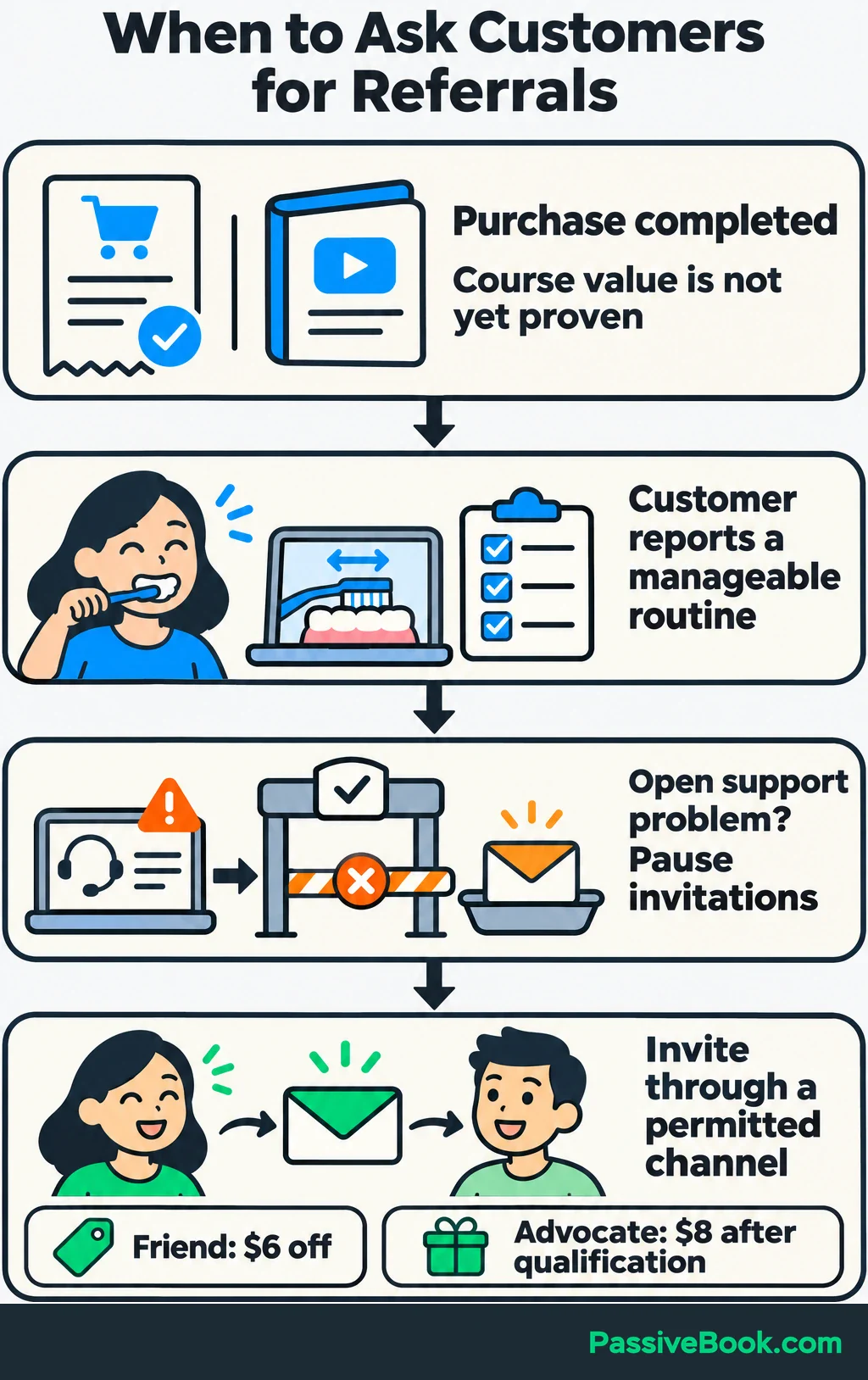
Then choose one satisfied customer group, one offer, and one main invitation channel. Ask after people experience the result they would recommend.
For the course, that could mean inviting customers after they report establishing a manageable brushing routine. Finishing checkout is too early to know whether the course helped.
Keep the referral page available in the course dashboard afterward. Here is a complete invitation you can adapt for an audience you are permitted to email:
Subject: Give a friend $6 off the brushing course
Hi [First name],
You mentioned that your brushing routine is becoming easier to manage. If a friend is working through the same problem, you can give them $6 off their first purchase of the course.
You’ll receive $8 after their eligible purchase clears the refund period.
Your personal referral link: [link]
The referral page explains the eligibility rules and payout timing. If you recommend the course, please make clear that you receive a reward when the purchase qualifies.
Questions or missing referral credit? Reply to this email.
Thanks,
[Your name]
[Business name and postal address]
[Unsubscribe from marketing emails]
Replace the placeholders before sending. Suppress invitations during unresolved support problems, and use a relevant follow-up only for customers who welcome reminders.
The invitation is only one message customers will see. You can use the same brief to draft your referral page and reward updates, keeping the offer and qualification rules consistent throughout.

Free AI Partnership Writer
Choose sharing channels before encouraging customers to use them. In the U.S., you may also be responsible for customers’ incentivized referral emails. Those messages and your own commercial emails must meet CAN-SPAM requirements, including accurate sender information, a postal address, and a working opt-out. FTC commercial-email requirements.
If you encourage customers to send referral emails or texts to UK consumers, you need recipients’ prior consent to your marketing. Having customers press “send” does not remove that requirement. The ICO describes a referral page that explains the scheme without suggesting email or text sharing. ICO referral-message guidance.
Set a review date that gives purchases time to clear qualification. During the pilot, record questions and failures as carefully as purchases. A confusing discount message is something you can fix.
7. Measure Customer Quality and Acquisition Cost
Keep a compact scorecard that shows where people stop and what qualified customers cost.
| Measure | What to count |
|---|---|
| Invitations delivered | Invitations recorded as delivered; exclude bounced emails |
| Advocates generating visits | Distinct advocates whose links brought tracked visitors |
| Referred visitors | Distinct visitors arriving through referral links during the pilot |
| Qualified new customers | Distinct first-time buyers whose purchases met all conditions |
| Refunds | Referred purchases refunded, with reasons where available |
| Outstanding rewards | Pending and approved amounts still owed |
| Total program costs | Discounts, earned rewards, fees, setup, and administration |
To measure conversion, count qualified new customers who came from the tracked visitor group. Divide that count by the unique visitors in the same group.
Suppose 100 unique visitors arrive through referral links during the pilot. After each visitor’s 30-day purchase window and any resulting refund period have ended, eight have become qualified customers. Eight divided by 100 gives an 8% qualified referral conversion rate.
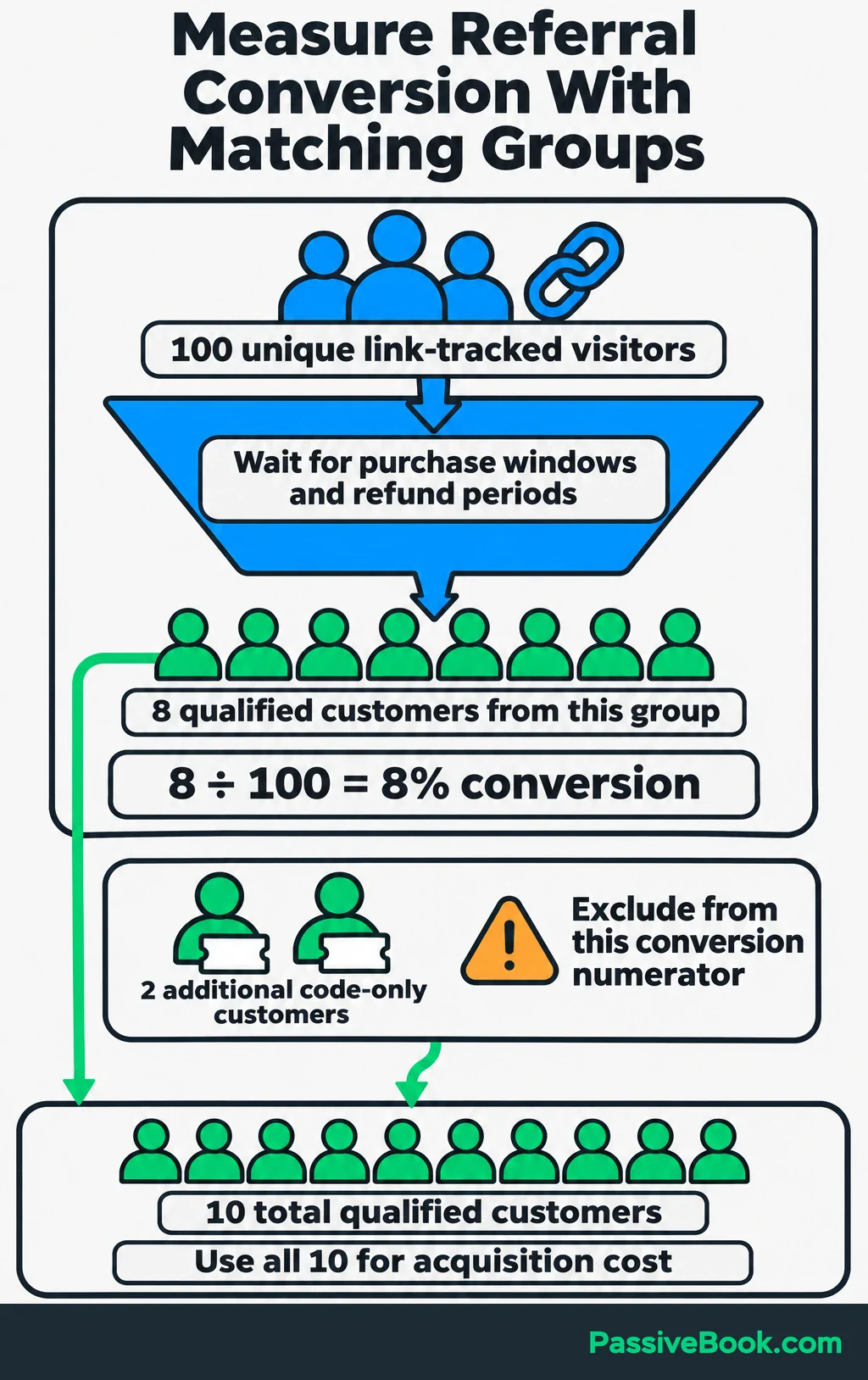
If another two qualified customers used codes without a tracked visit, report them separately. They count toward acquisition, but adding them to that conversion numerator would mix two different groups.
For acquisition cost, add all program costs for the pilot and divide by all qualified new customers. Include unsuccessful activity and earned rewards that have not yet been paid.
Returning to the course example, suppose ten customers qualify and there are no other purchases or costs in the pilot:
| Item | Pilot total |
|---|---|
| Contribution before referral costs: ten × $48 | $480 |
| Friend discounts: ten × $6 | −$60 |
| Advocate rewards: ten × $8 | −$80 |
| All other program costs | −$20 |
| Retained contribution | $320 |
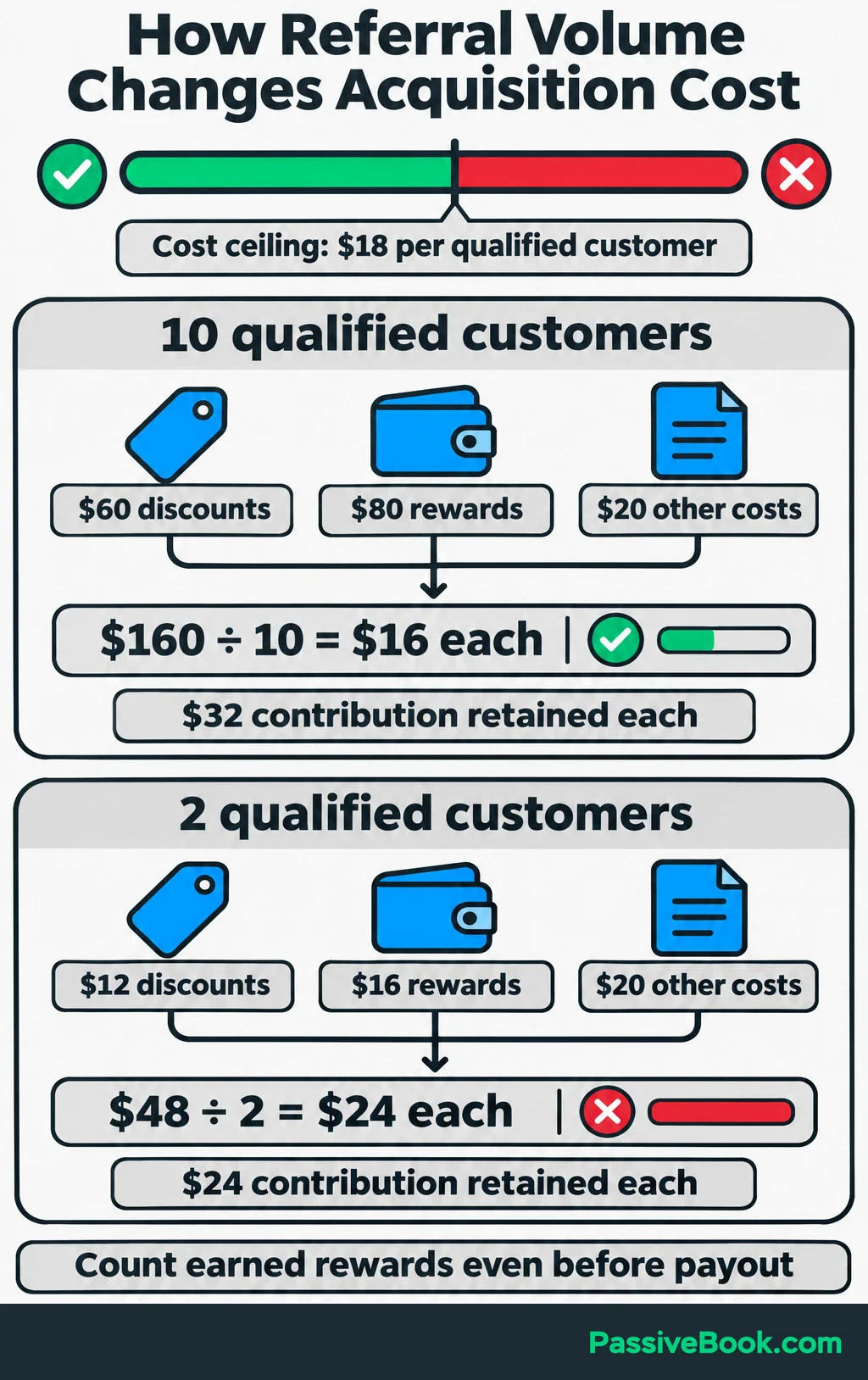
Total referral costs are $160, so acquisition cost is $16 per qualified customer. Retained contribution is $32 each, meeting the $30 target.
Volume matters here. If only two customers qualify and the shared costs remain $20, acquisition cost becomes $24 each: $14 in discounts and rewards, plus $10 in shared costs. The same offer now exceeds the $18 ceiling.
Before expanding, compare referred customers with similar non-referred customers. Look at refunds, support demand, retained contribution, and relevant repeat purchases over comparable periods.
Some referred buyers might have purchased anyway, so these figures alone do not show the program’s return on investment. Use them to check costs and contribution against your targets. To measure the return, compare the extra contribution caused by the program with all program costs.
8. Improve the Weakest Step Before Expanding
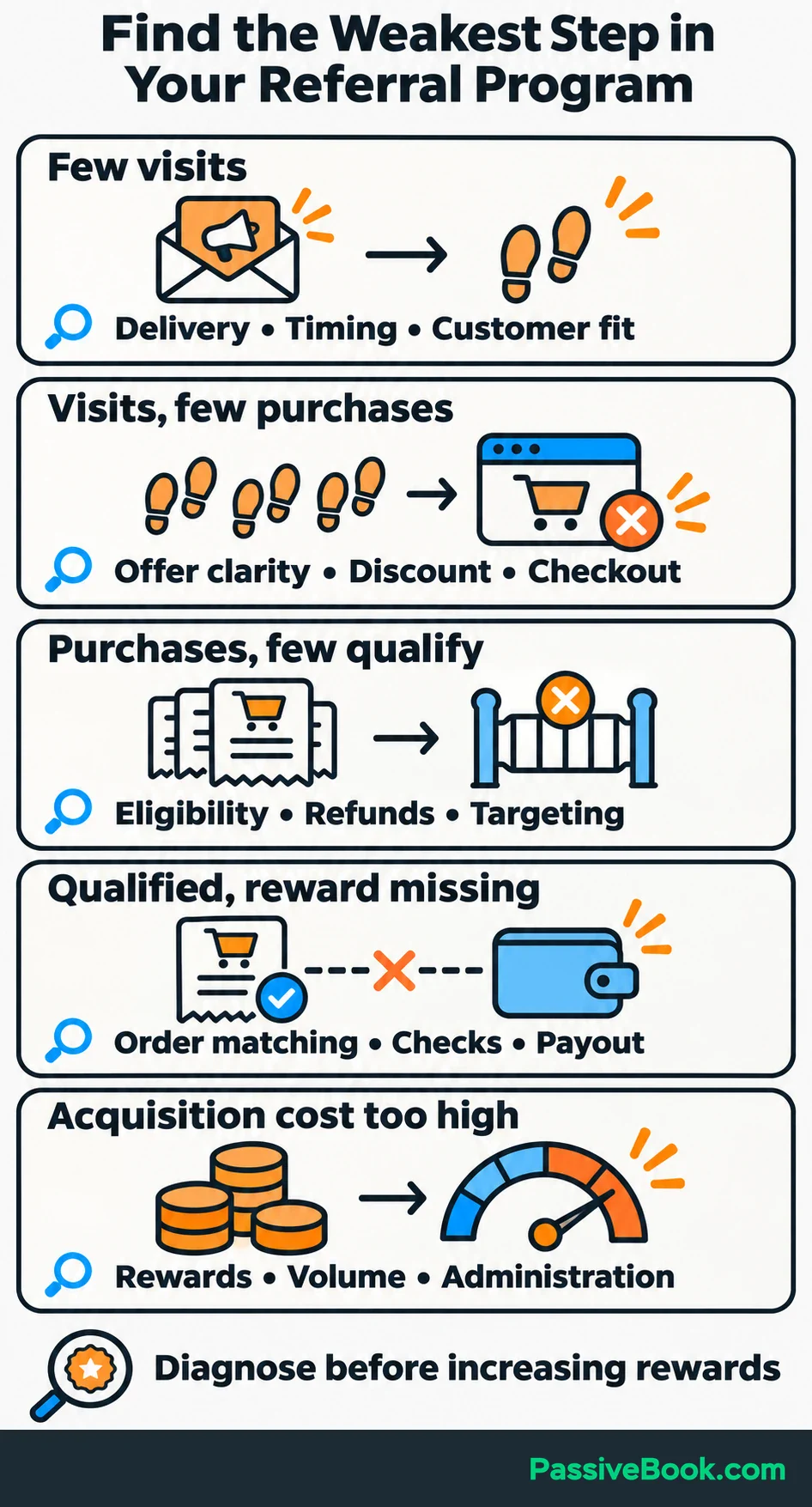
Use the scorecard to choose the next change. I would resist increasing rewards until I knew where the journey was failing.
| What you see | What to check first |
|---|---|
| Few referred visits | Invitation delivery, timing, customer selection, and clarity about whom the course helps |
| Visits but few purchases | Recommendation fit, course-page clarity, discount redemption, and checkout problems |
| Purchases but few qualified customers | Eligibility confusion, refunds, poor targeting, and abuse |
| Qualified purchases but missing rewards | Order matching, qualification checks, duplicate processing, and payout failures |
| Acquisition cost above the ceiling | Reward amounts, actual volume, administration costs, and qualifying purchase economics |
Change one meaningful element at a time and decide what result would justify keeping it.
For example, if customers say they don’t know whom to invite, test a clearer description of the suitable friend. Keep the reward unchanged while you learn whether that description produces more relevant visits.
When completed referrals are too few for a useful numerical comparison, use customer questions and observed failures to choose the next change. Two purchases do not require a statistical victory speech.
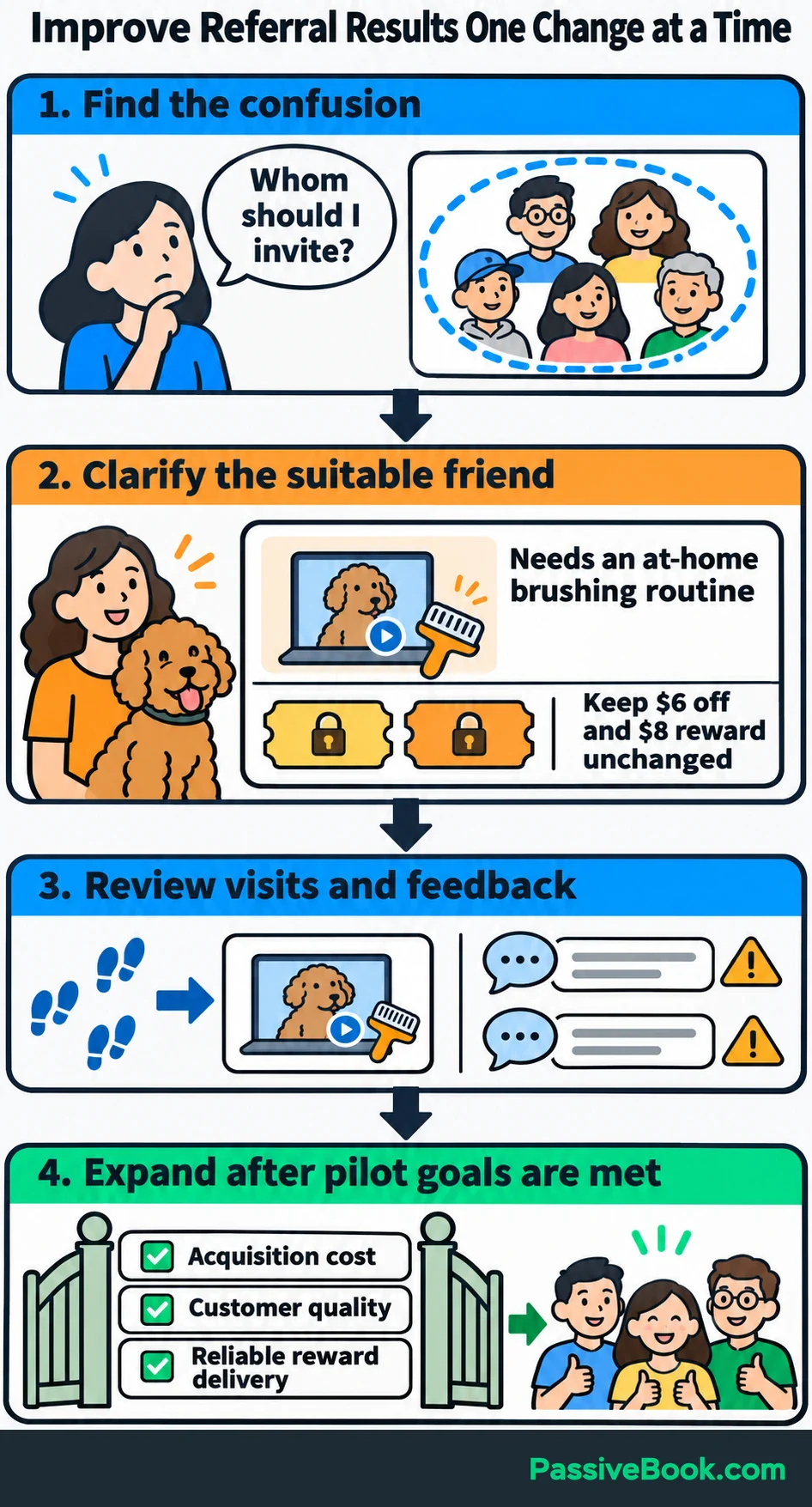
Expand once acquisition costs, customer quality, and reward delivery meet the pilot’s goals. Invite more satisfied customers and add relevant touchpoints gradually. Newly referred customers can become advocates after they experience value themselves.
Assign a recurring review of costs, outstanding rewards, failed automations, and customer questions. Someone must remain responsible for the program, even when most of the work runs automatically.
What Next?
Write your one-sentence referral strategy and calculate the most you can spend to acquire one qualified customer. Those two decisions give you a useful starting point for choosing the offer.
Use the social buttons to share this guide if it would help turn a referral idea into a pilot with clear costs and rules.
What customer milestone would make you comfortable asking for a recommendation? Share it in the comments, along with any questions about building your program.
Share this post with your friends & followers:

