A business with the right customers could introduce your offer next week. But “we should collaborate” can also turn into three calls, an unfinished resource, and no clear route to a sale.
That’s the risk when your spare hours are already spoken for. A friendly relationship can feel promising long before either side agrees to do anything useful.
Those hours need to lead somewhere you can measure. Here’s a practical framework for a small partnership campaign, from the first proposal to a decision about whether its leads and sales are worth repeating.
1. Define Your Growth Goal and Investment Limit
Choose one business outcome before approaching partners. Qualified leads, first-time customers, and repeat purchases need different offers and follow-up.
Partnership marketing means working with another business or creator, with each side contributing something useful. That might be expertise, production work, customer access, products, or paid referrals. You don’t need matching audience sizes, but both sides need a reason to participate.
Throughout this guide, imagine you sell an online loose-leash walking course. You’re considering a partnership with an independent pet retailer on a walk-preparation checklist and a tracked course recommendation. The arrangement, copy, and figures are illustrative.
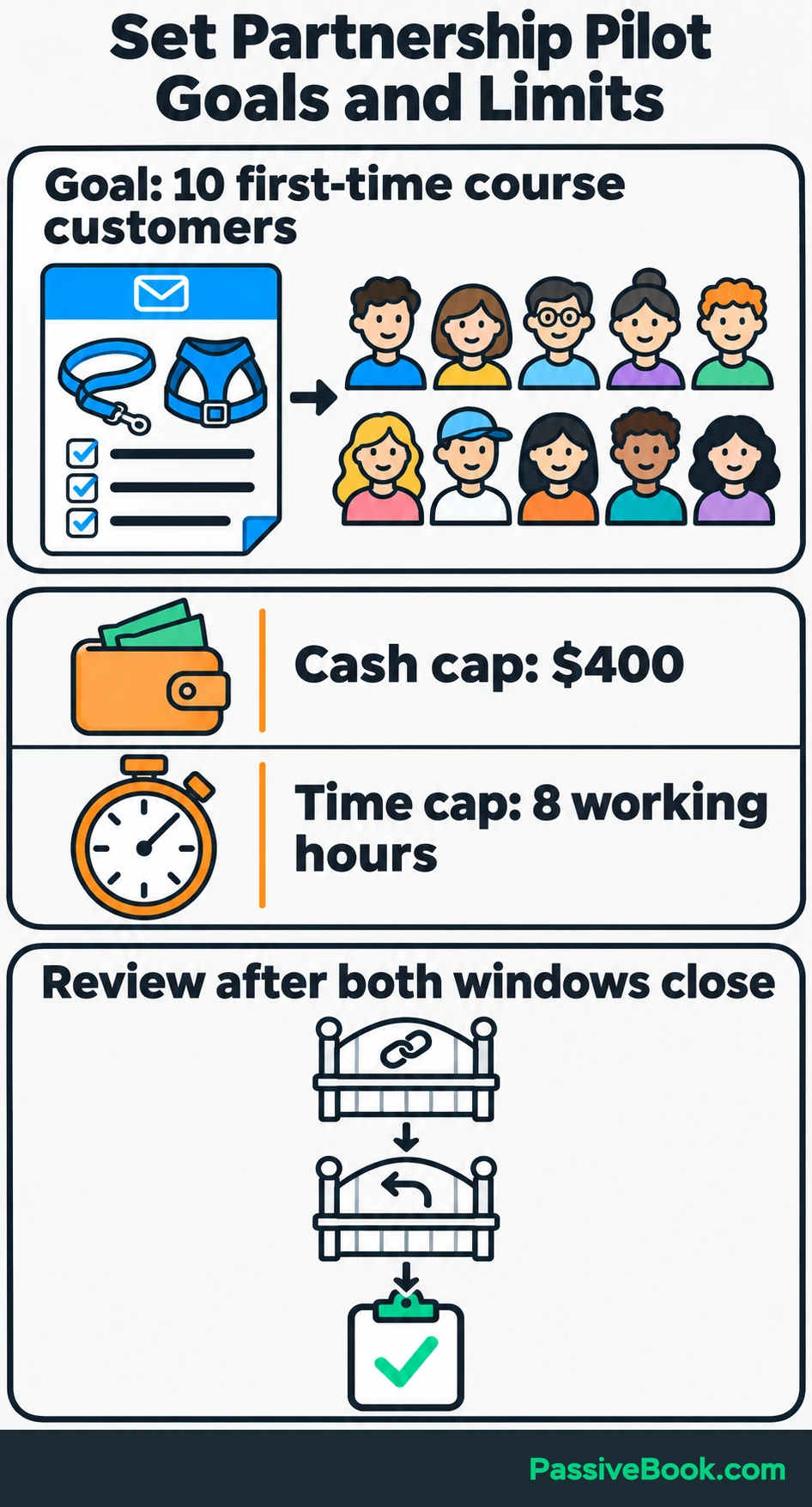
Your primary goal could be 10 first-time course customers from one newsletter placement. A supporting measure would be qualified leads: people who request the checklist, say pulling on walks is a problem, and haven’t already bought the course.
Set the review point around the buying journey. Allow the agreed referral window and refund period to close before declaring the result.
Then limit your investment:
- Cash: Set a spending cap that includes production expenses, fees, and commissions.
- Time: Include research, outreach, calls, asset creation, support, and reporting.
- Acquisition cost: Decide how much you can spend to acquire one customer while leaving enough for overhead and profit.
To find that acquisition ceiling, start with revenue from one purchase, subtract variable delivery costs, and subtract the contribution you want to keep.
For the example course:
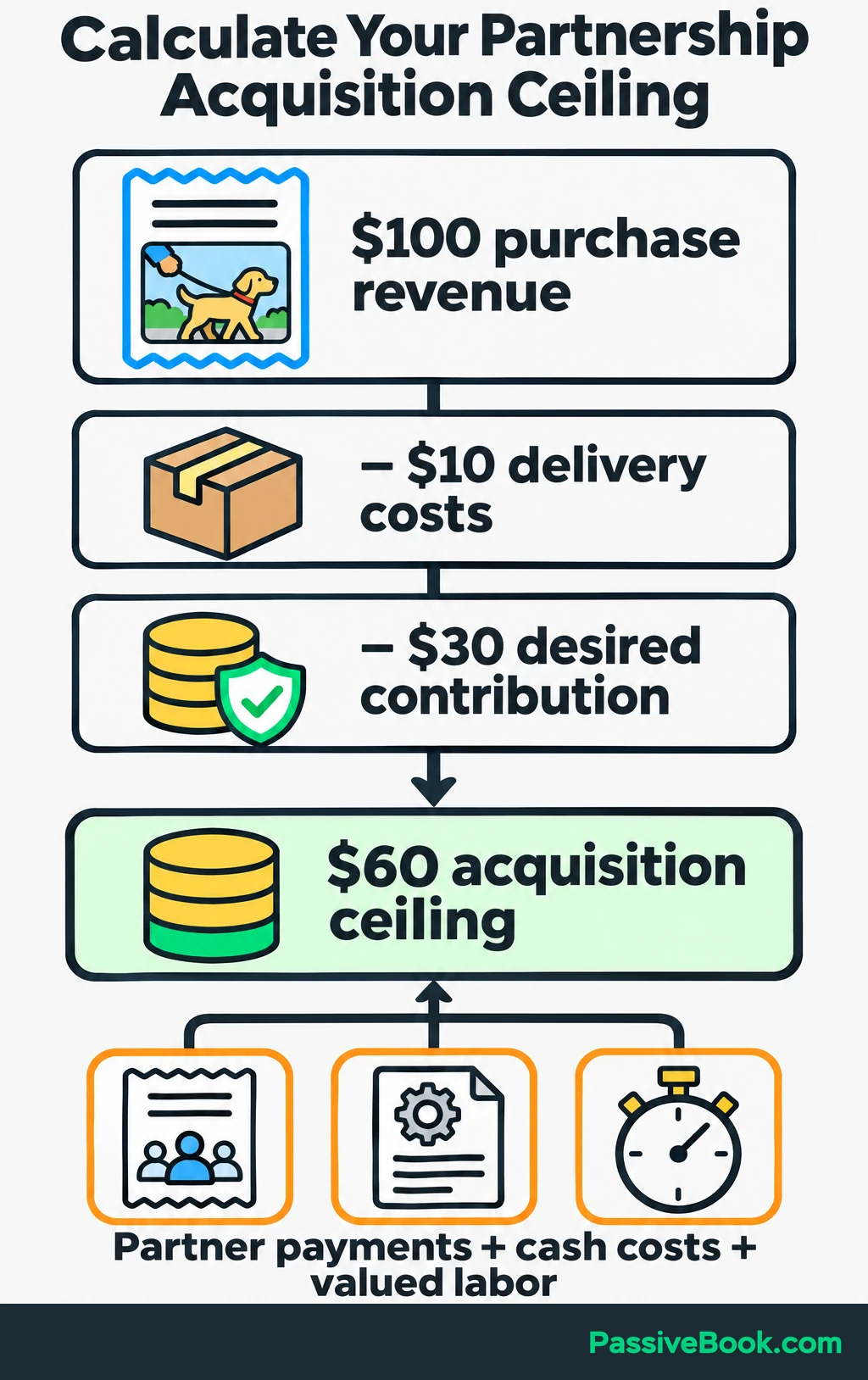
$100 revenue − $10 delivery costs − $30 desired contribution = $60 acquisition ceiling
That $60 must cover partner payments and the rest of your acquisition work, including valued labor. I would leave possible future purchases out until customer records support their value.
Put the strategy into one sentence:
Reach dog owners struggling with pulling through a pet retailer’s newsletter, using a joint walk-preparation checklist, aiming for 10 first-time course customers within $400 cash and eight working hours.
A spending limit gives you permission to stop. Otherwise, “just one more revision” becomes a business model.
2. Find Partners Who Reach the Right Customers
Build a Shortlist Around the Customer Journey
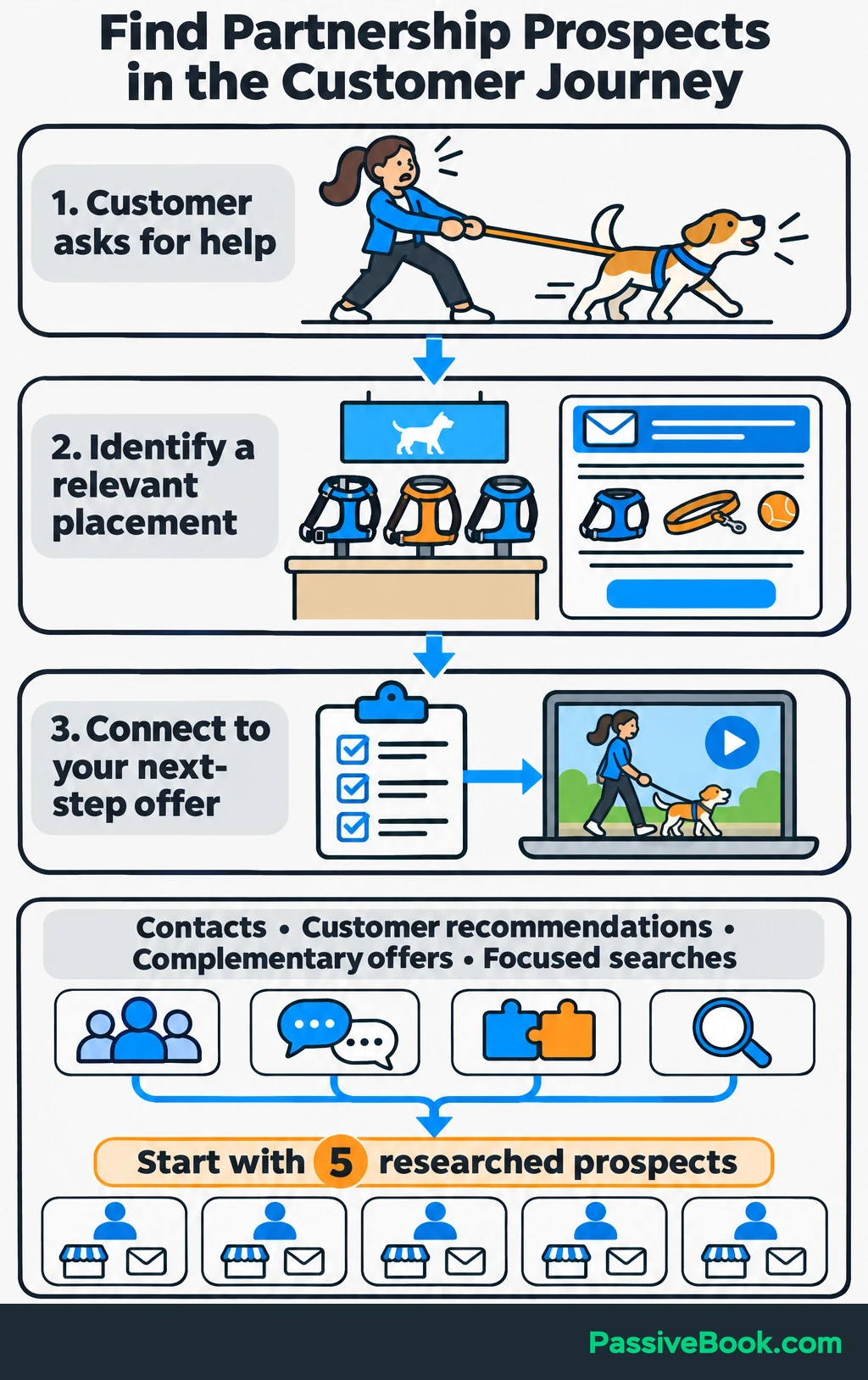
Look at what customers do immediately before they need your offer. Where do they ask questions, compare choices, or buy something related?
For the walking course, a retailer whose customers ask about walking equipment is worth investigating. A large pet account posting amusing clips may offer less useful access.
Start with:
- Existing contacts: Suppliers, customers, and businesses you already know.
- Customer recommendations: Ask where buyers went for help before finding you.
- Complementary offers: Look for businesses solving a related problem.
- Focused searches: Find relevant shops, newsletters, resource pages, and creators.
Identify a placement you could actually use. “They have an audience” is vague. “They send a customer newsletter that covers walking equipment” gives you something to discuss.
I would begin with five carefully researched prospects. You need enough choice to compare partners without turning research into a second job.
Evaluate Fit Before Audience Size
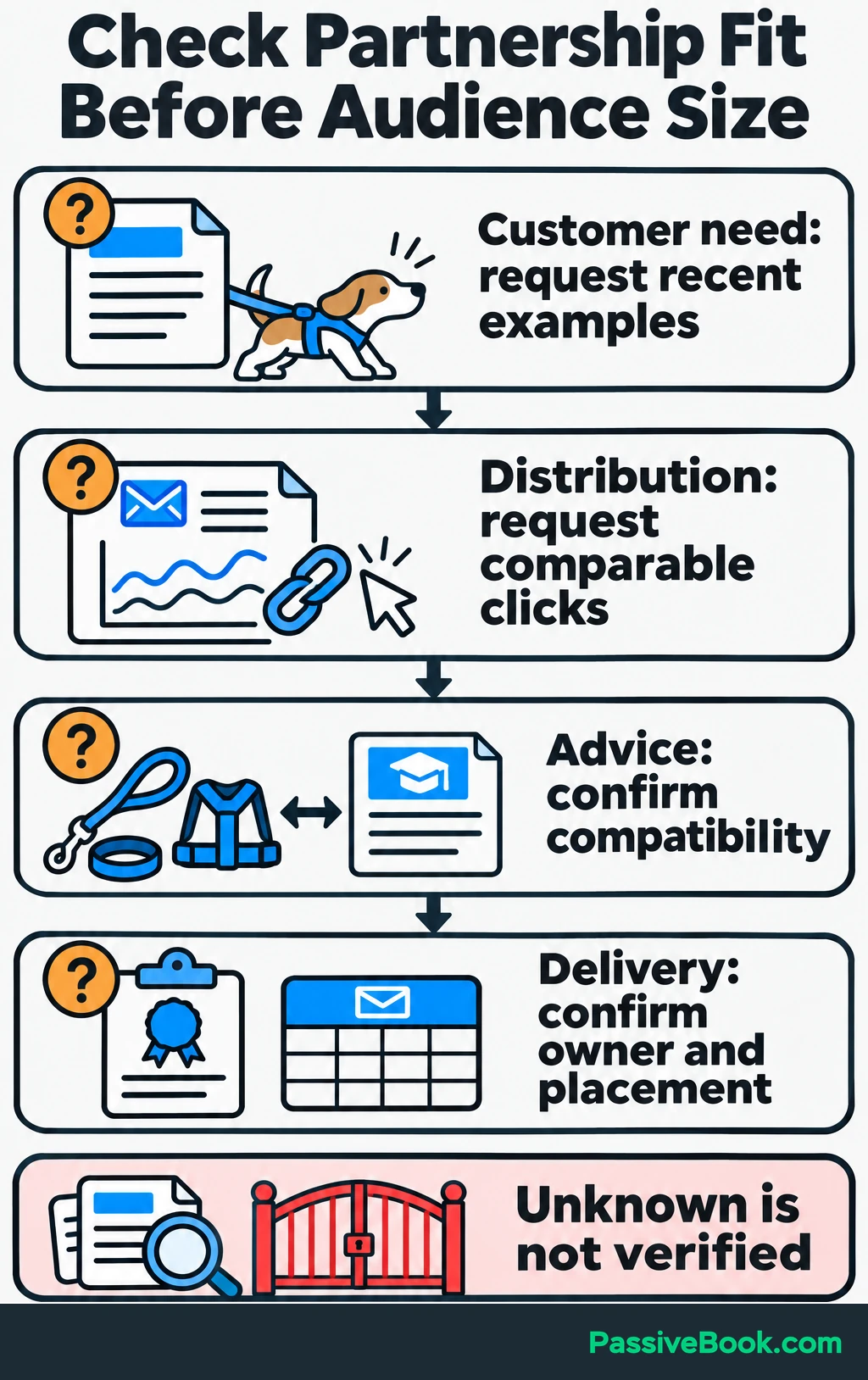
Check whether the partner reaches suitable customers, has their trust, and can deliver the proposed promotion.
For each candidate, record the contact person, audience needs, distribution opportunity, proposed exchange, capacity, concerns, and next action. Use evidence rather than a score that merely makes your guess look official.
For the retailer, your notes might look like this:
| Check | What to Establish |
|---|---|
| Customer relevance | Customer questions about pulling have not been recorded; ask the retailer for recent examples. |
| New reach | Audience overlap is unknown; ask whether these customers already know your course. |
| Location | Readers’ locations are not recorded; confirm they can access and pay for the course. |
| Product and advice quality | Equipment recommendations still need checking against your course’s training advice. |
| Distribution evidence | Comparable newsletter click totals have not been supplied; request them. |
| Proposed exchange | You create the training resource and page; the retailer adds equipment guidance and promotion. |
| Delivery capacity | The person approving the newsletter and the available send date still need confirming. |
| Concerns and next action | Confirm compatible advice and a newsletter slot before drafting the pilot. |
Read public content and customer feedback, then ask questions tied to the proposed placement. Total followers won’t tell you how many people click a newsletter recommendation.
A smaller audience can still support a fair exchange. You might contribute the expertise and production work while the partner contributes distribution. But serious trust or fulfillment concerns are reasons to decline, regardless of reach.
3. Design a Shared Offer With Workable Economics
Give Customers a Reason to Participate
Start with one customer problem and decide what the collaboration helps them do.
Use this sentence:
Together, we help [customer] achieve [outcome] by combining [your contribution] with [partner contribution].
Then choose a format that fits the customer’s next decision.
| Format | When I Would Choose It |
|---|---|
| Tracked recommendation | Customers already understand the problem and are considering a purchase. |
| Joint resource | Customers need a useful first step before considering the paid offer. |
| Workshop | Customers need explanation or a demonstration before they can decide. |
For the walking course, I would start with the checklist. A workshop adds scheduling and delivery work before you know whether the partnership can attract suitable customers.
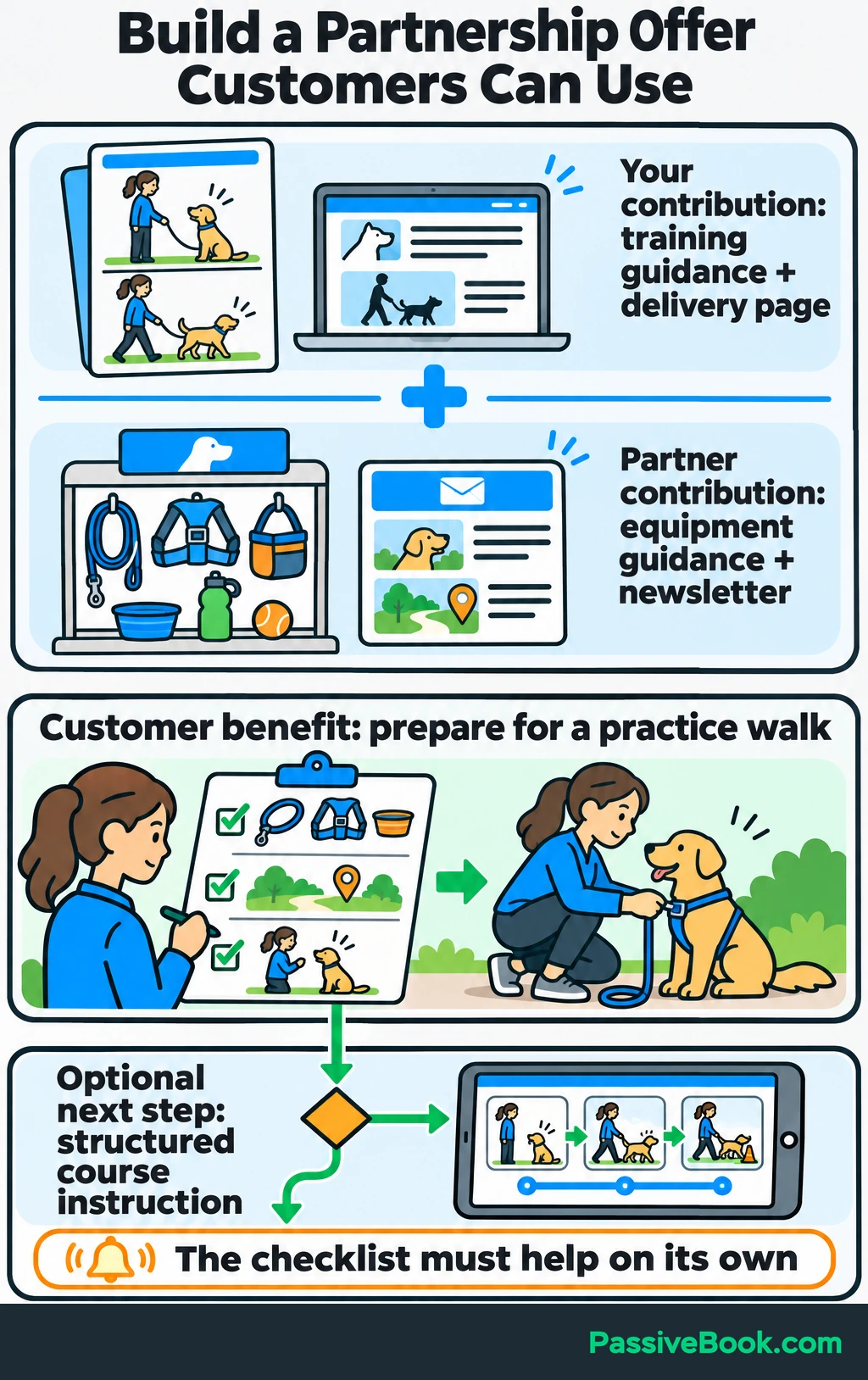
Your contribution is training guidance and a page that delivers the resource. The retailer contributes equipment-selection guidance and one newsletter placement.
The customer gets help preparing for a walk. You reach potential course buyers, and the retailer provides a useful resource while earning an agreed referral commission.
Keep the next action clear at each stage:
- Request the checklist.
- Use it to prepare equipment and a short practice session.
- Consider the course for structured instruction.
A short invitation could say:
Before your next practice walk, use this checklist to prepare your equipment, choose a practice spot, and find the first exercise.
The checklist should deliver that benefit on its own. A sales page wearing a printable hat is still a sales page.
Check the Exchange Before Promising Compensation
Decide how each contribution will be rewarded. Options include reciprocal promotion, a fixed fee, referral commissions, or a combination.
I would choose a commission for this pilot because the retailer is making a tracked recommendation. But commission-only terms still need to justify the retailer’s preparation and promotional work.
The course has a $60 acquisition ceiling. A $20 commission leaves $40 per customer for other acquisition costs.
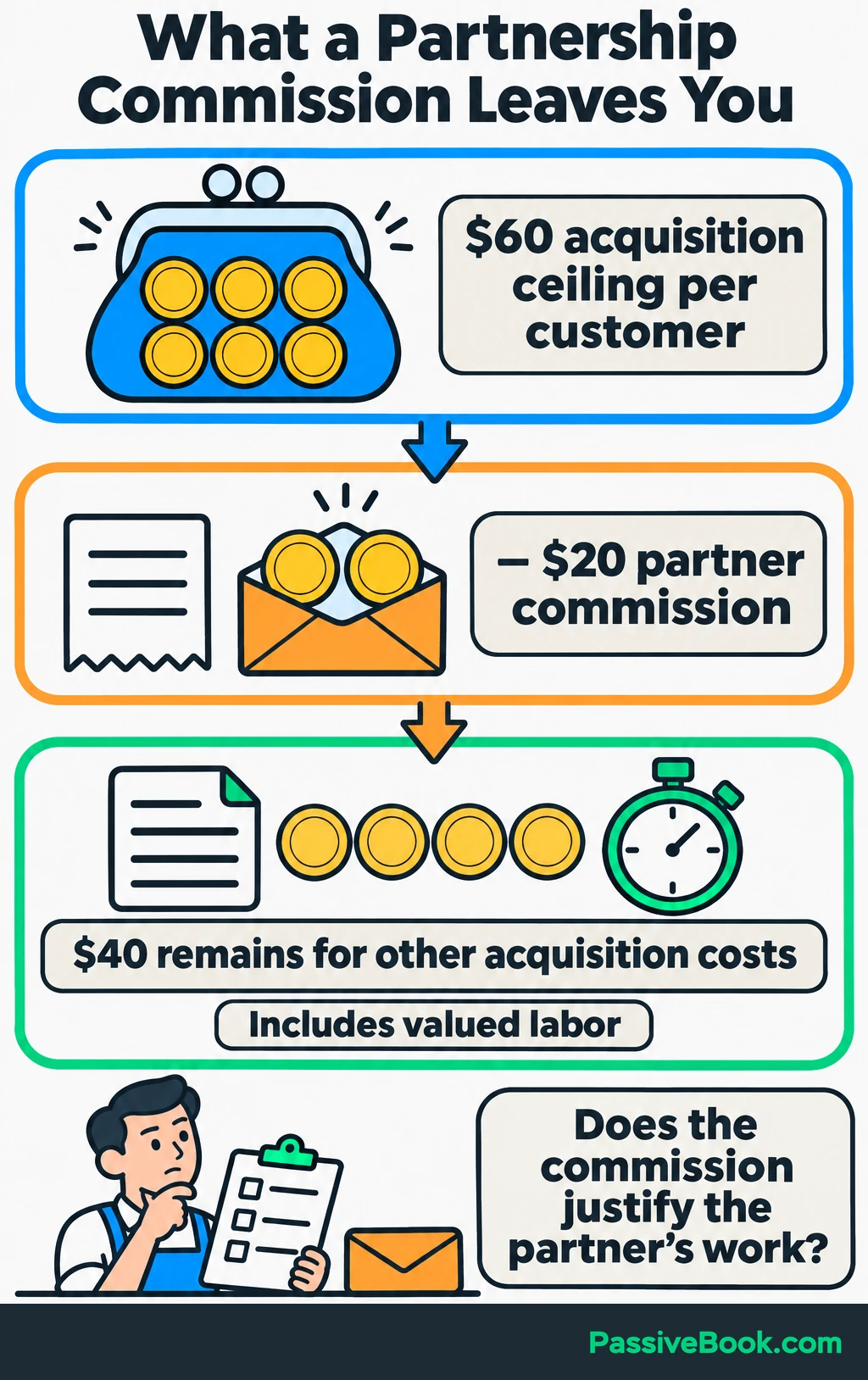
Suppose you expect to spend $100 in other cash costs and eight hours valued at $25 each. That creates $300 in preparation and campaign costs.
To stay within the acquisition ceiling, those costs need to be spread across enough customers:
$300 ÷ $40 remaining allowance = 7.5
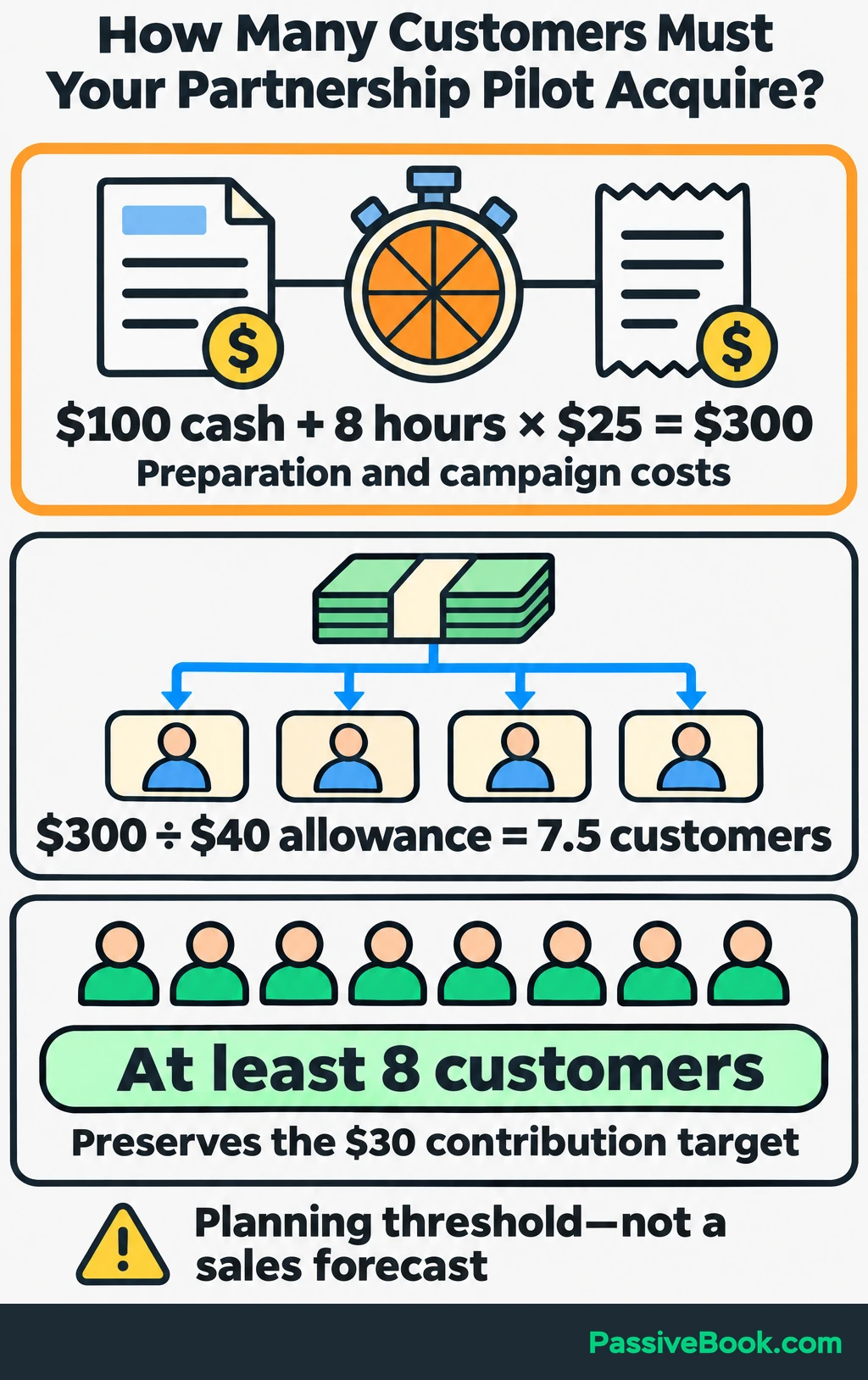
You need at least eight customers to preserve the intended $30 contribution per purchase under these assumptions. This is a planning threshold, not a sales forecast.
Ask whether the proposed placement could reasonably support that volume, using comparable clicks or campaign results where available. If the required sales look implausible, reduce the work, change the terms, or skip the pilot.
The Partnership Offer Calculator lets you compare payment structures before you promise one. It also shows the fee or commission your own limits can support at different customer counts.
Free Partnership Offer Calculator




4. Pitch a Specific, Manageable Pilot
Contact whoever controls the relevant channel or relationship. For a small retailer, that may be the owner. For a larger operation, it may be the person responsible for customer email.
Lead with a customer need you can point to, then propose a small test. Avoid asking someone to invent the partnership for you.
Here is a complete message to adapt. Replace the bracketed observation with something you actually found.
Subject: A walk-preparation checklist for your customers
Hi [Name],
I noticed [specific customer question or relevant content] on [location]. My loose-leash walking course covers the practice side of that same problem.
Would you consider testing a joint walk-preparation checklist through one customer newsletter placement?
I’d draft the training guidance, build the registration page, and handle resource delivery and course support. You’d contribute equipment-selection guidance, approve the resource, and send the newsletter placement.
Customers would get a practical preparation resource, and your business would earn $20 for each eligible first-time course purchase under agreed referral terms.
I’ve attached a short checklist draft so you can judge whether it would help your customers. Could I send over a one-page pilot brief?
Thanks,
[Your name]
[Business and website]
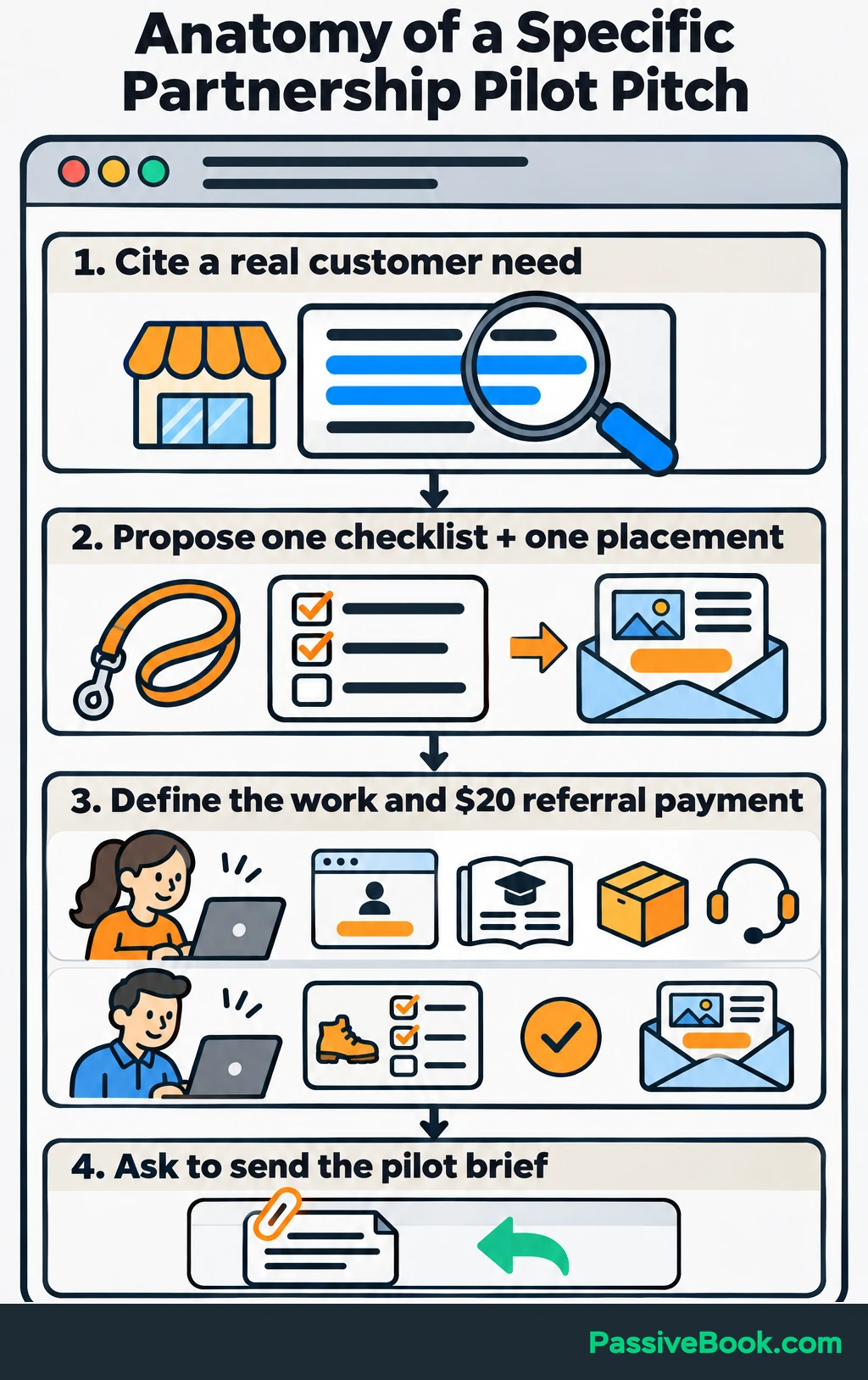
Use the first discussion to confirm customer needs, each side’s desired return, available time, approval authority, and timing.
If you have a partner in mind, the AI Partnership Writer can turn your proposed exchange into an email and a short pilot proposal. That gives the other person something concrete to respond to.

Free AI Partnership Writer
Track the response and next action. I would send one follow-up with something useful, such as a revised checklist excerpt that addresses their concern. Repeated “just checking in” messages don’t improve the offer.
5. Agree on the Campaign Before Creating Assets
Write a shared brief before making the finished resource. Keep it short enough that both people will actually read it.
I once drafted a joint resource before confirming who could approve the promotion. My contact liked the idea, but they couldn’t promise a newsletter placement. I shelved the draft. Since then, I confirm the distribution commitment before doing the production work.
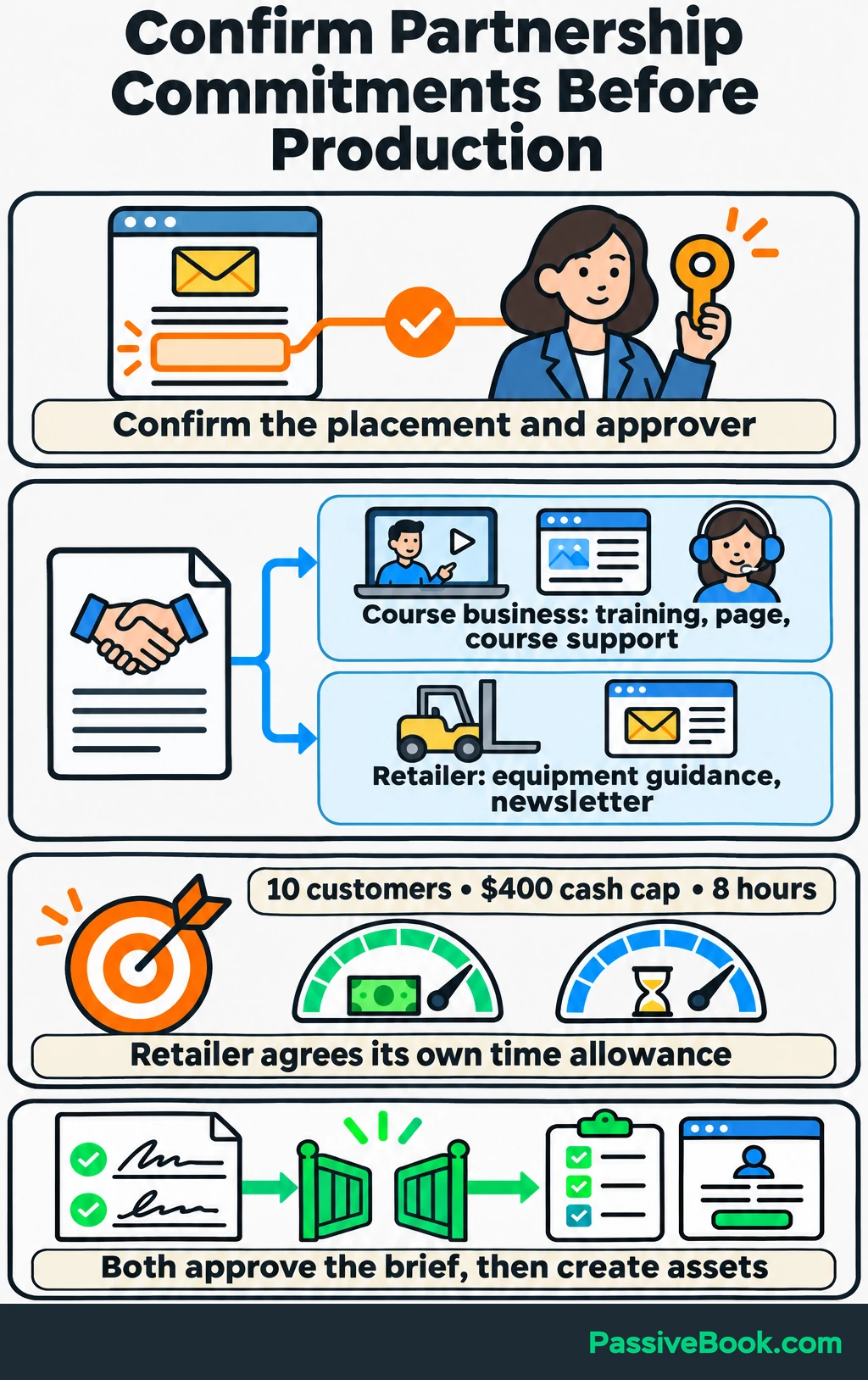
For your pilot, cover these decisions:
| Decision | Example Agreement |
|---|---|
| Goal | Aim for 10 first-time course customers; track qualified leads separately. |
| Offer | Joint walk-preparation checklist with a course recommendation. |
| Contributions | Course business creates training content and the page; retailer supplies equipment guidance and newsletter distribution. |
| Promotion | One approved newsletter placement on an agreed date. |
| Budget | Up to $400 cash and eight hours for the course business; retailer agrees its own time allowance. |
| Support | Retailer handles equipment questions; course business handles resource delivery and course questions. |
| Review | Review after the referral window and eligible refund period close. |
Also record the referral terms: eligible purchases, attribution window, refunds, payout timing, and how disputed referrals will be resolved.
Agree on content approval, logo use, reuse rights, and how either side can end the pilot. A recurring partnership should be a decision, not something that happens because nobody cancelled it.
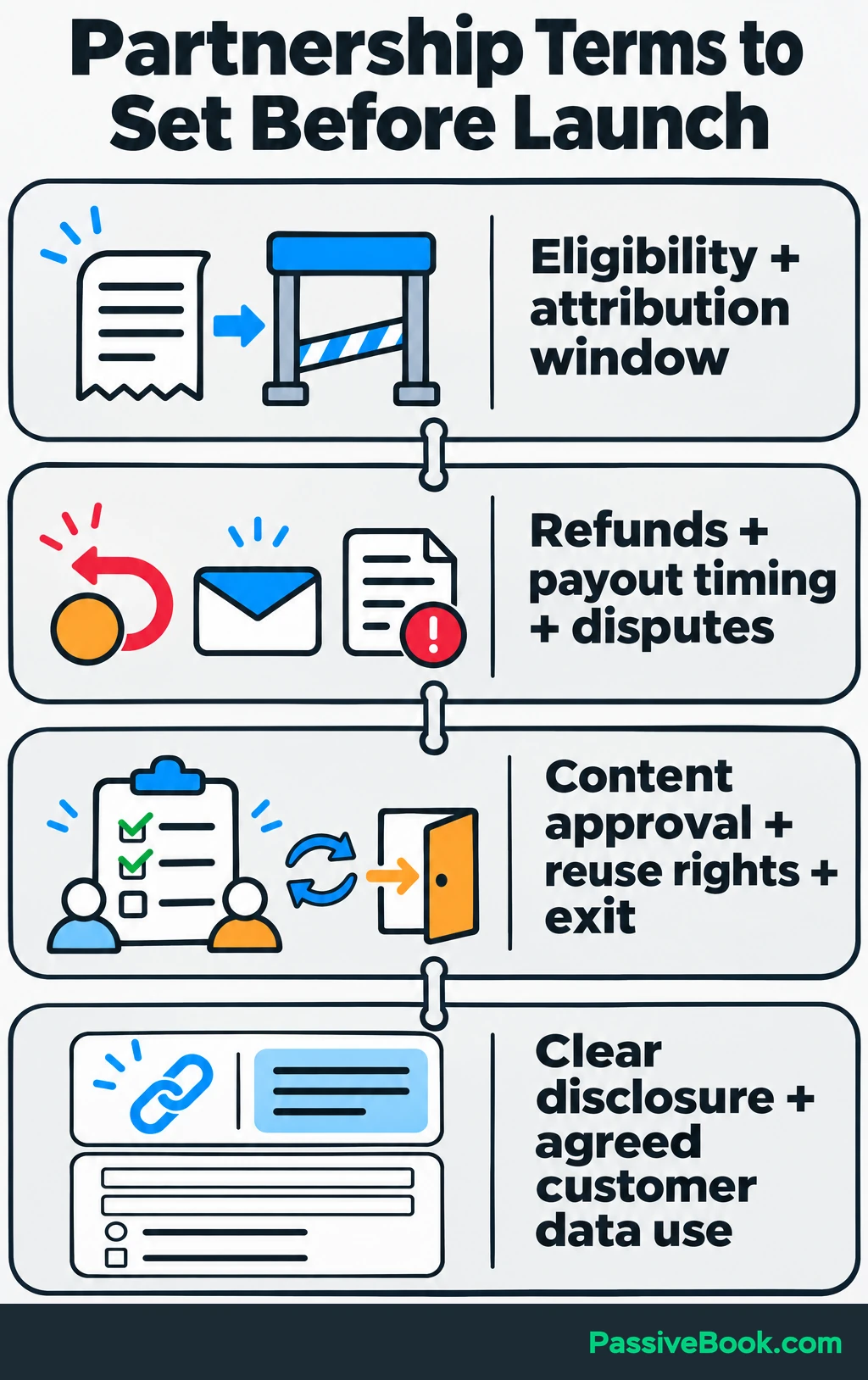
For U.S.-directed recommendations, clearly disclose commissions, payments, or other material connections customers would not expect. Put the disclosure beside the recommendation. “We earn a commission if you buy through this link” explains this arrangement plainly. FTC endorsement guidance
Decide who collects customer information and what each business may use it for. I would have the retailer send its own promotion and let interested customers register on your page, with clear choices about follow-up.
If you rely on consent collected through a partner for UK email marketing, check that it names your business and specifically covers email. “Trusted partners” is insufficient. ICO guidance on third-party email consent
6. Connect Partner Activity to Leads and Revenue
Map the journey before launch:
Partner promotion → checklist registration → course offer → purchase → refund, if any
Give each placement a distinct tagged link. For example:
https://example.com/walk-checklist
?utm_source=pet_retailer
&utm_medium=email
&utm_campaign=walking_checklist
&utm_content=launch
Use that as one continuous URL. Its UTM tags are labels that identify the partner, channel, campaign, and placement in your website analytics.
Save the partner identifier and click date with each registration, then carry them into the order record. UTM tags alone won’t connect a subscriber to a later purchase.
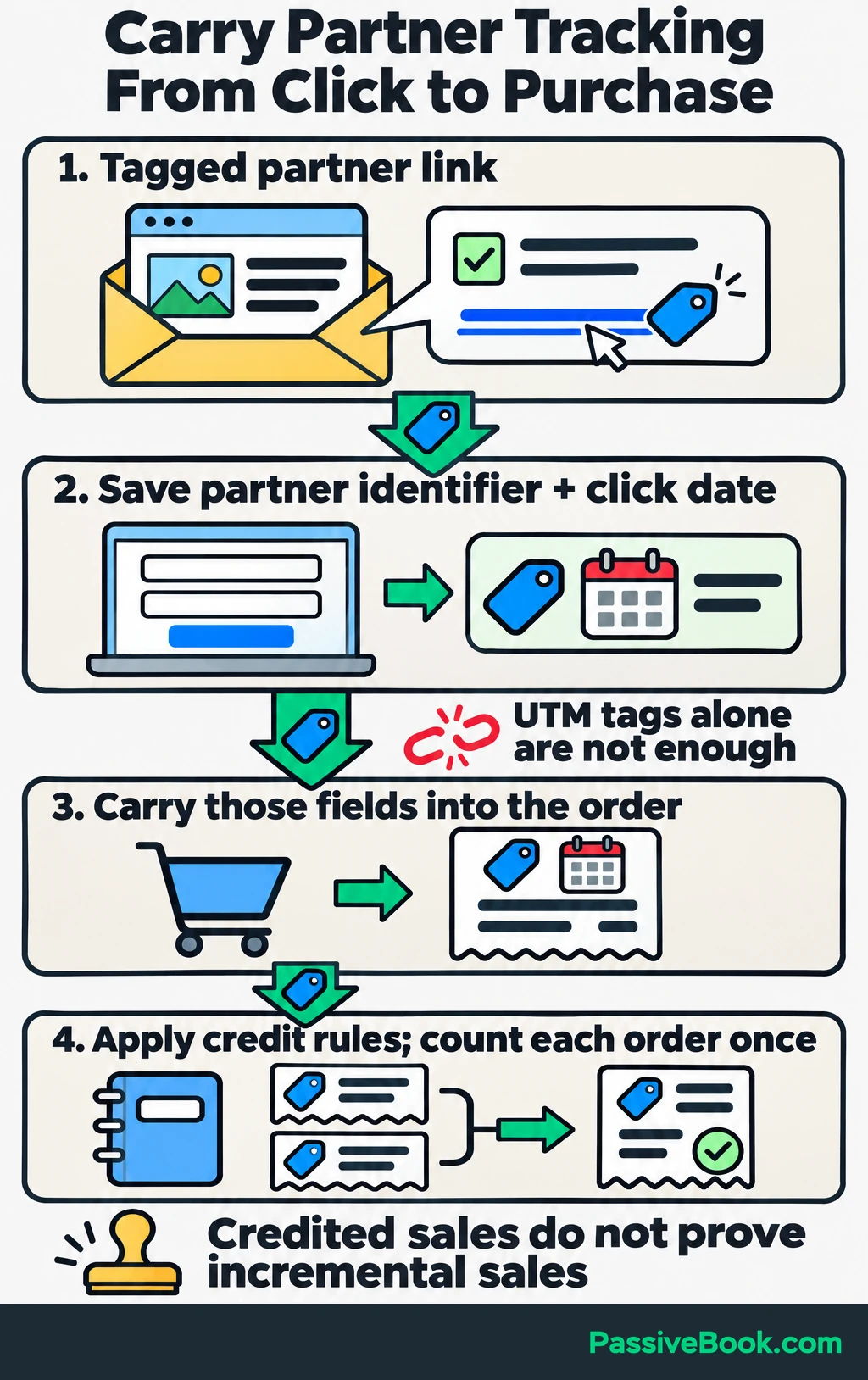
Agree on who gets credit before sales arrive. For example, the pilot might credit eligible first-time purchases made within 30 days of a tracked retailer click, with an explicit referral code overriding a conflicting click record.
The business that first introduced a buyer may differ from the partner owed commission. Record both, remove duplicate registrations, and count each order once in total revenue.
A basic tracking sheet should record:
- Activity: Partner, campaign, placement, launch date, and review date.
- Customers: Unique qualified leads and first-time buyers, linked to their source.
- Revenue: Sales after discounts and refunds.
- Costs: Variable delivery costs, commissions, other campaign spending, and working hours.
- Result: Acquisition cost and campaign contribution.
Start with tools you already use. On WordPress, I would use Fluent Forms for registration and FluentCRM for follow-up, then check that the partner identifier reaches the order record. A spreadsheet is enough for reviewing one pilot.
Attributed sales are purchases credited under your rule. They don’t prove how many additional purchases the partnership caused. Some buyers may have purchased anyway, so don’t describe every tracked order as new growth caused by the campaign.
7. Launch the Pilot and Complete the Follow-Up
Build only the assets needed to complete the journey:
- Invitation: Explain the checklist’s benefit and link to registration.
- Registration page: Show what customers receive, ask whether pulling on walks is a problem, and explain the email choices.
- Resource: Deliver the promised preparation help.
- Course offer: Explain who the course suits and what it includes.
- Follow-up: Help people use the resource, then introduce the relevant paid next step.
Give the retailer a compact promotion kit with approved copy, one graphic if needed, the tracking link, disclosure wording, and a contact for questions.
Then test the whole journey. Click the promotion link, register, receive the checklist, and complete a test purchase. Check the saved partner identifier, confirmation message, and support handoff.
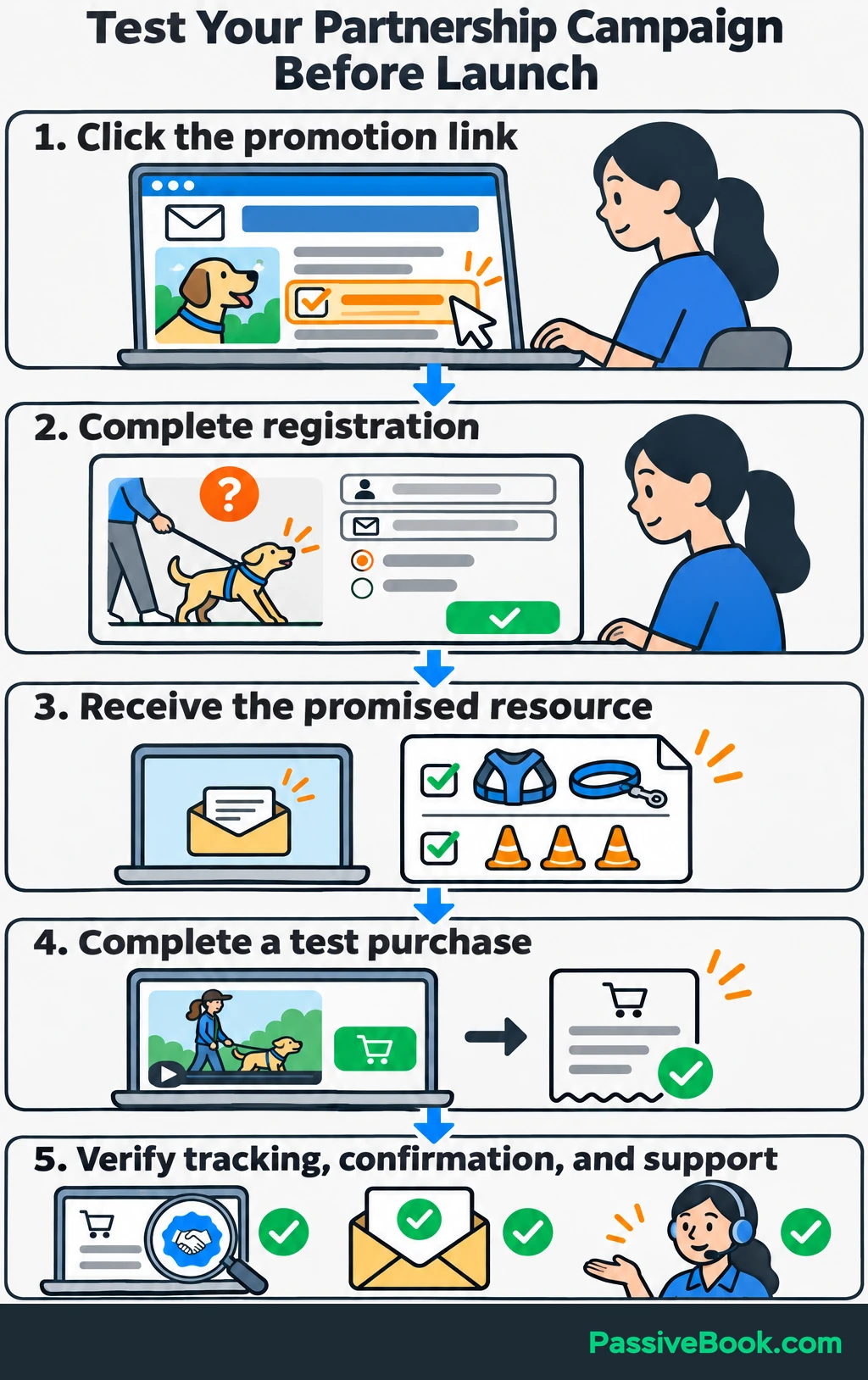
Both partners should approve the assets and schedule their commitments before launch.
For follow-up, I would start with three messages:
- Deliver the checklist and explain where to begin.
- Help the reader use one part and invite a reply about what remains difficult.
- Explain how the course provides structured practice, with a clear purchase link.
For example, the final message could include:
The checklist helps you prepare for practice. If you want a lesson sequence to follow, the course provides the exercises in order so you can work through them at your own pace.
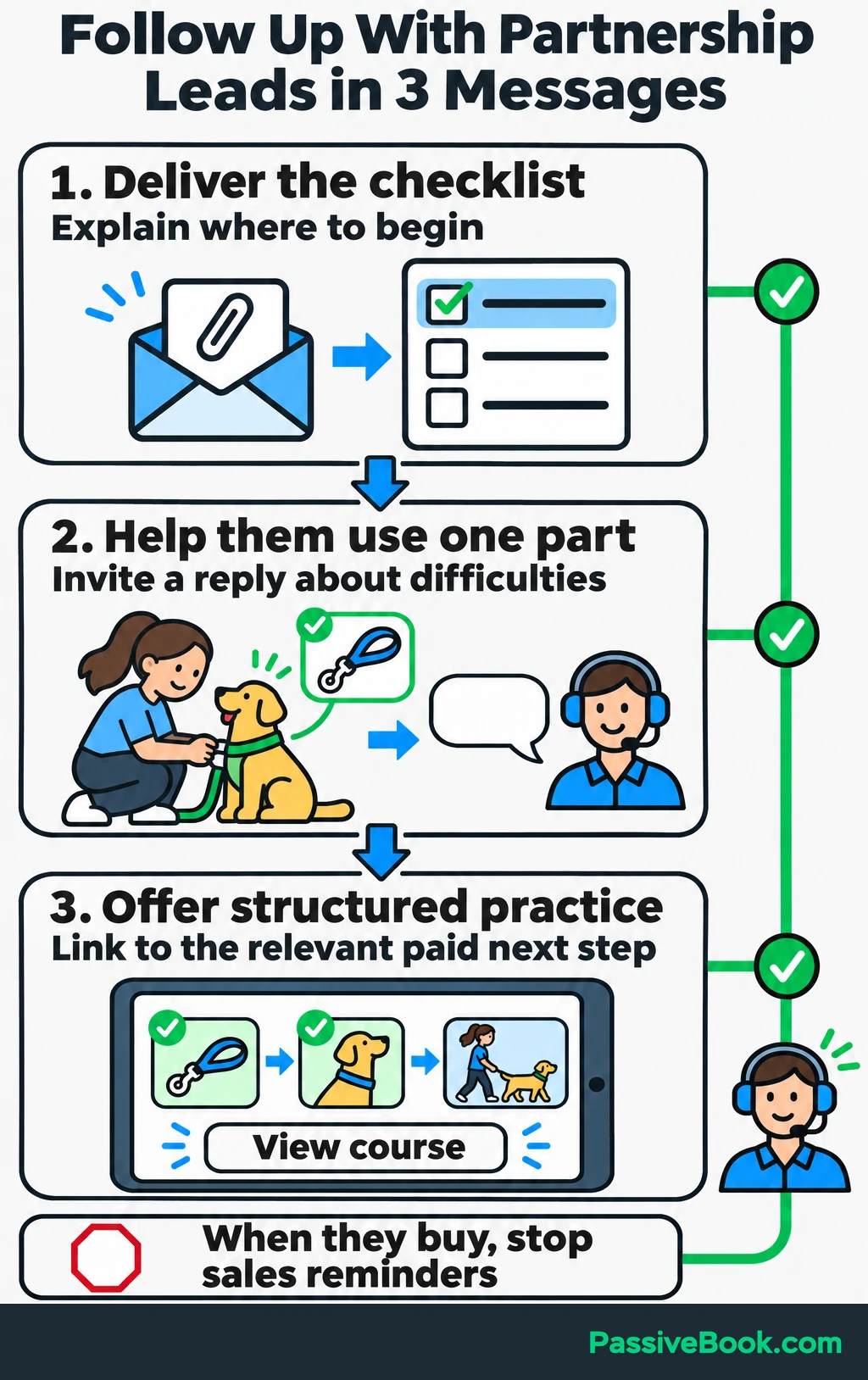
Stop sales reminders when someone buys. Automate resource delivery and routine reminders, but keep a clear route to a person when customers need help.
Check delivery and tracking early. A missing newsletter placement, failed form, or broken purchase link can make a useful offer look unsuccessful.
Send the partner a short update covering completed commitments, customer responses, early results, and blockers. That gives both sides a chance to fix delivery problems before the review.
8. Measure Results and Decide What to Repeat
Calculate the Business Result
Wait until every qualified lead has had the full purchase window and the refund period has closed. Count only first-time buyers from that qualified-lead group in its conversion rate.
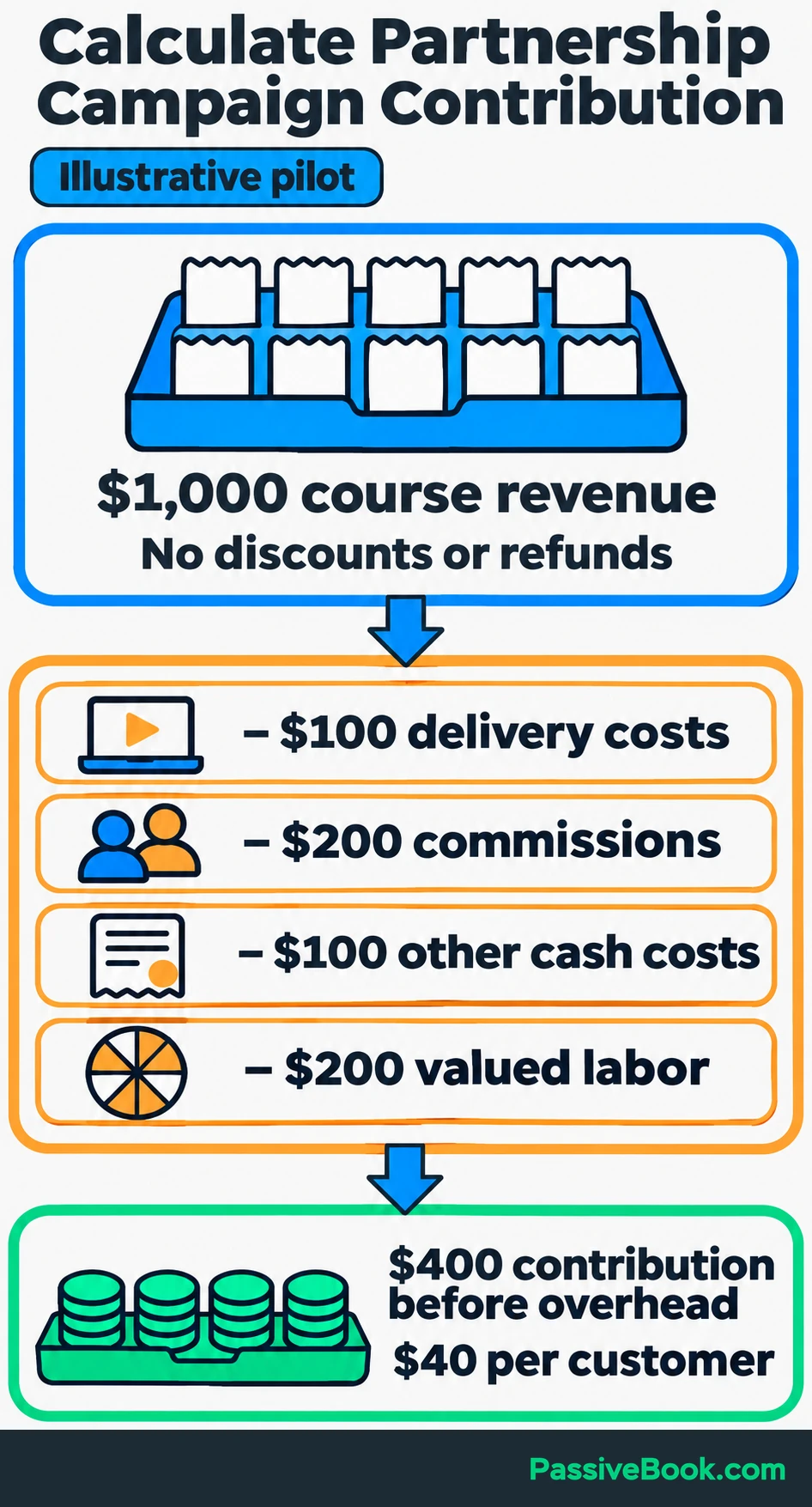
Here is the completed illustrative pilot:
| Item | Result |
|---|---|
| Qualified leads | 100 |
| First-time customers from those leads | 10 |
| Course revenue, with no discounts or refunds | $1,000 |
| Variable course delivery costs | $100 |
| Partner commissions | $200 |
| Other campaign cash costs | $100 |
| Campaign labor: eight hours at $25 | $200 |
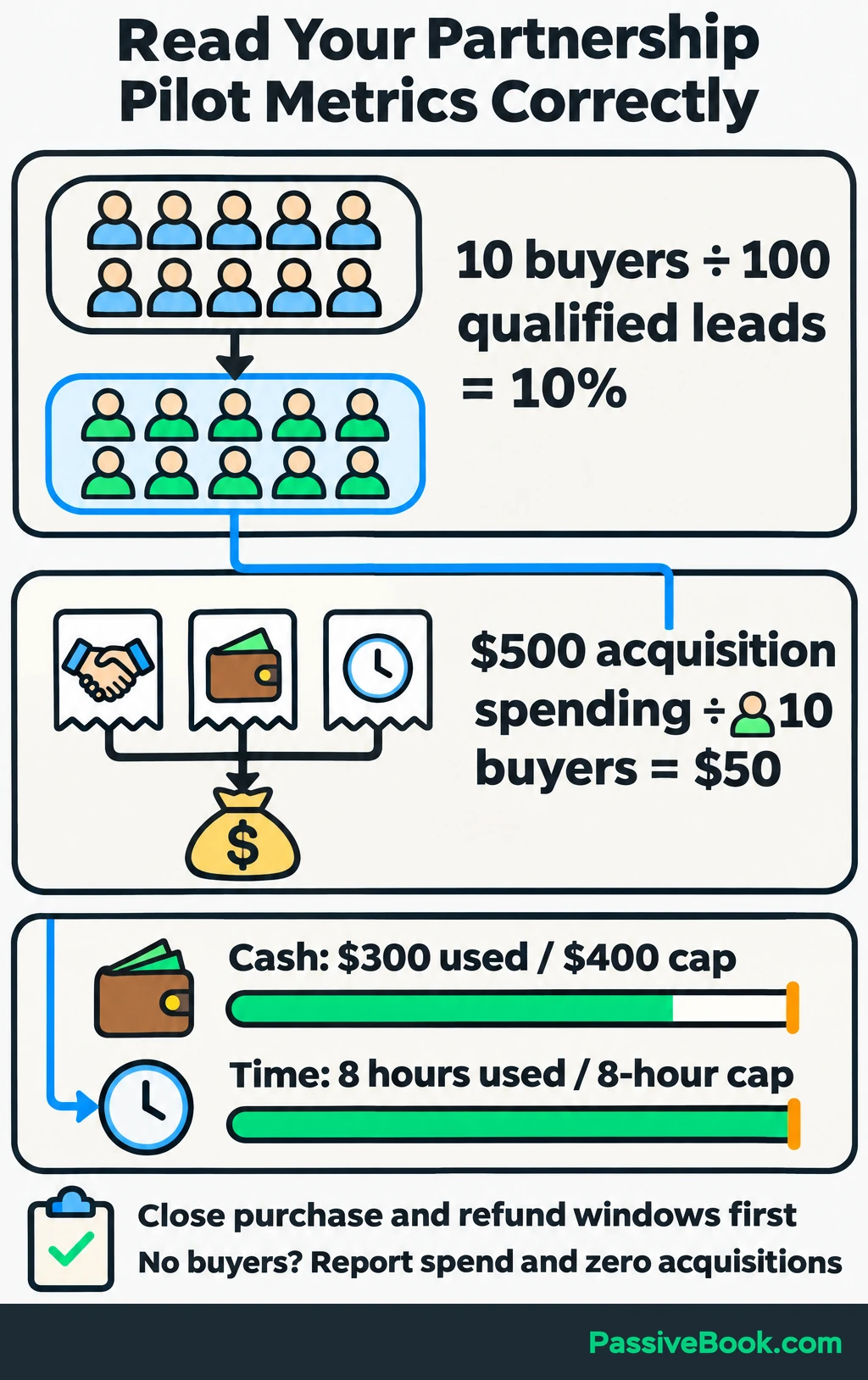
Ten of the 100 qualified leads became first-time customers: a 10% conversion rate.
Acquisition spending was $500: $100 in other cash costs, $200 in labor, and $200 in commissions. Dividing by 10 buyers gives a $50 acquisition cost.
Subtract $100 in delivery costs and $500 in acquisition spending from $1,000 in revenue. The remaining $400 is contribution before overhead: $40 per customer, above the $30 target.
The pilot used $300 in campaign cash and eight hours, within its limits. With no buyers, report spending and zero acquisitions instead of a per-customer cost.
Improve, Expand, or Stop
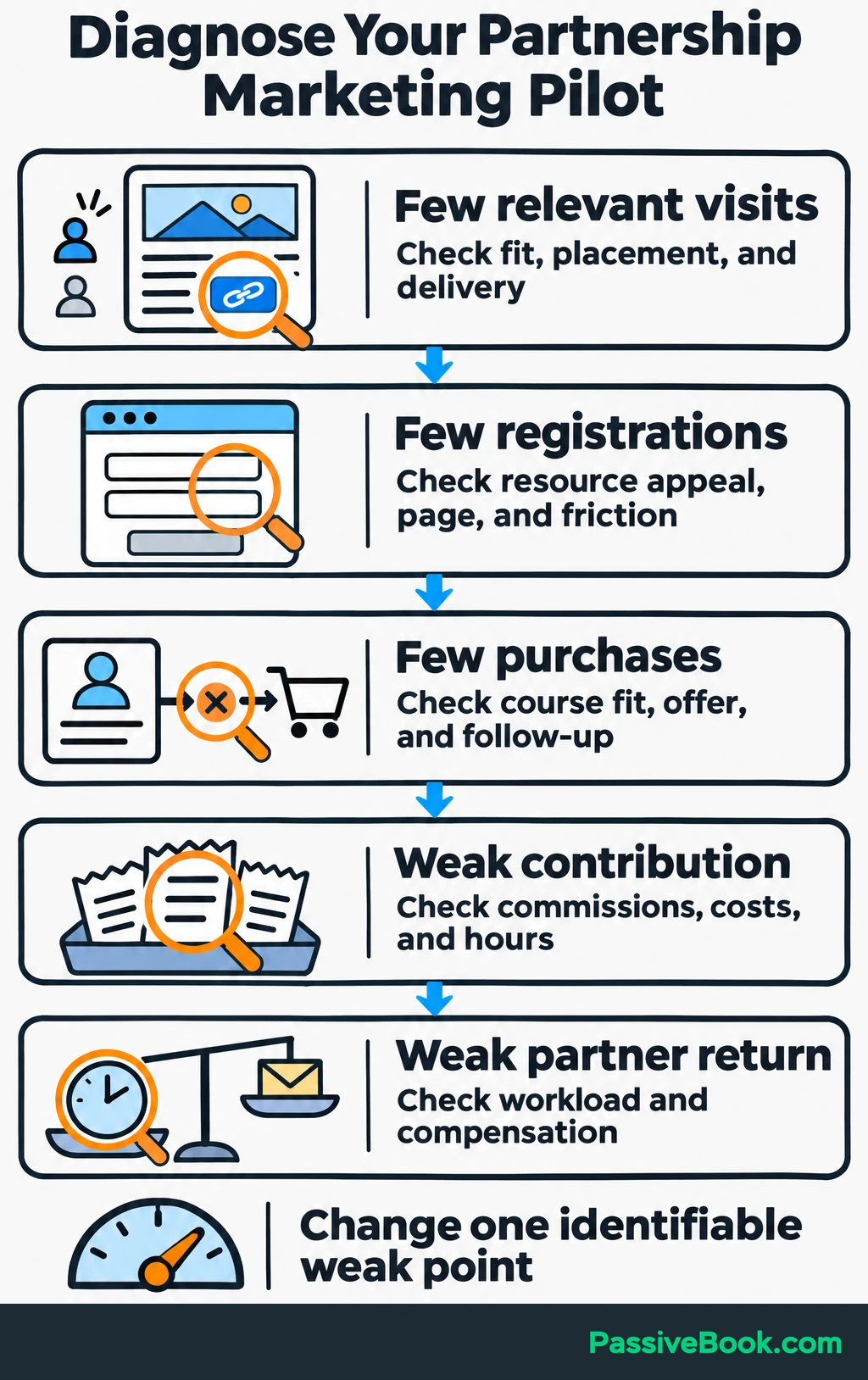
Use the customer journey to locate the weak point before changing the campaign.
| What Happened | What to Review |
|---|---|
| Few relevant visits | Partner fit, placement visibility, and whether the promotion happened as agreed. |
| Visits but few registrations | The checklist’s appeal, page clarity, and form friction. |
| Qualified leads but few purchases | Course fit, offer clarity, price, and follow-up. |
| Sales but weak contribution | Commission terms, discounts, production costs, and working time. |
| Good results for you but little return for the partner | The partner’s workload and compensation. |
Repeat when customer quality, economics, workload, and partner benefit meet the agreed standards. Change one identifiable weak point when there is a plausible fix. Stop when trust, delivery, or economics remain unresolved.
Ask the retailer directly whether the commission justified its work. Your spreadsheet can show a successful campaign while the partner quietly decides never to do it again.
In a vendor case study, impact.com reported 117% year-over-year commission growth for Great Pet Care alongside expanded partnerships, consolidated tracking, and new commerce content. The publisher had over one million monthly readers; the report doesn’t establish profitability. Great Pet Care case study
I’d borrow its practice of reviewing revenue by partner. Its growth isn’t a forecast for your pilot.
Save the brief, assets, follow-up messages, tracking rules, and lessons for reuse. I’d repeat a worthwhile placement before adding another offer or channel, then check whether the work gets easier and the results hold up.
What Next?
Write your one-sentence strategy and list three businesses that reach customers just before they need your offer. Set your cash and time limits before sending the first pitch.
Use the social buttons to share this guide when you want a potential collaborator to work from the same pilot framework.
Which part would be hardest to agree on in your first partnership: the shared offer, each side’s work, or how sales get credited? Tell me in the comments, and bring any other questions too.
Share this post with your friends & followers:

