You can spend a week publishing useful content, answering questions and improving your website, then finish without knowing which activity brought a sale. Next week, you repeat whatever feels productive.
That makes planning difficult. You cannot tell whether you need more visitors, a clearer offer or better follow-up, so each new tactic competes for the same few spare hours. To decide where those hours go, this guide works through a downloadable product’s sales strategy and shows how to adapt it to your own offer, time and budget. A completed one-page plan brings those choices together.
1. Identify Your Target Customer and Buying Problem
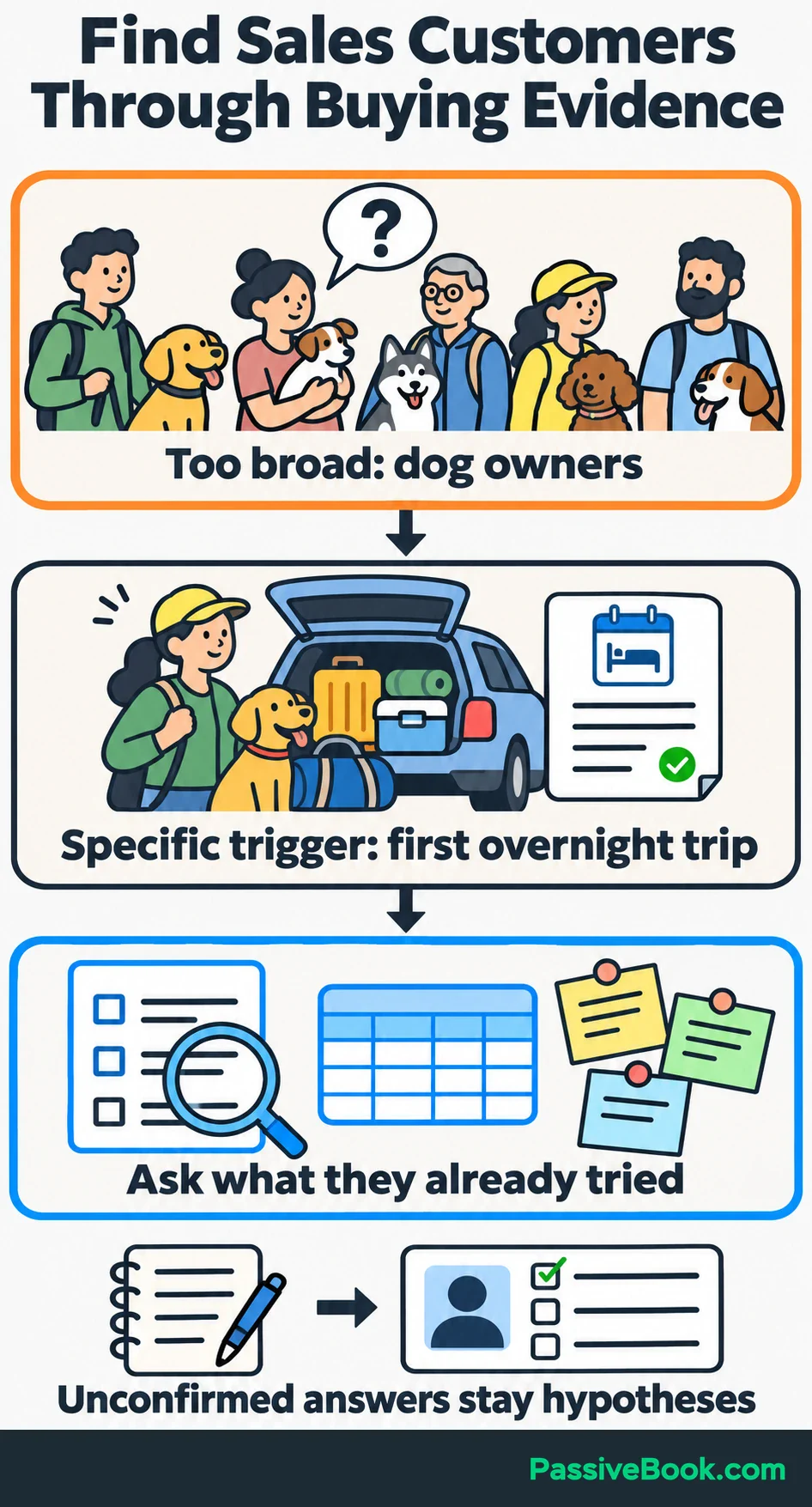
Start with a buying situation. “Dog owners” describes a large group, but it tells you little about what would make someone spend money.
Choose people facing a problem your offer can help them solve. Then find out what they already do about it.
If you have customers, review purchases, questions, support messages, refunds and lost sales. Look for repeated needs and reasons people hesitate. Without customers, speak to prospective buyers about their last attempt to solve the problem.
Ask questions that bring out actions:
- What problem were you trying to solve?
- Which part took the most effort?
- What did you use, and did you pay for it?
- Where did you search for help?
- What remained difficult afterward?
I would skip “Would you buy this?” at this stage. A polite yes tells you much less than a description of something the person already tried.
The SBA recommends investigating demand, competing options and what customers pay for alternatives. Use those questions to give your conversations some direction. SBA market research guidance
For our worked example, imagine you sell a downloadable road-trip planning kit. Your initial customer is preparing for their first overnight trip with a dog and wants to organize packing, stops and questions for accommodation providers. The product and numbers below are illustrative.
Write a short profile:
| Profile Field | Working Answer |
|---|---|
| Buying trigger | An overnight road trip is booked or being planned |
| Desired result | Packing, stops and accommodation questions organized in one place |
| Main objection to investigate | “Why pay when I can find free checklists?” |
| Existing alternatives | Free lists, a homemade spreadsheet or scattered notes |
| Places to investigate | Search results, travel discussions and questions sent to relevant businesses |
Treat the unconfirmed parts as research questions. You have not discovered a customer objection just because you wrote one in a table.
I skipped this work with my online jewellery store. I bought inventory without proper market research and ended up with unsold stock. That experience makes me reluctant to expand an offer before I understand why people would choose it.
2. Define Your Offer and Price
Make the Value Clear
Describe what the customer receives and what they can do with it. Include the format, delivery method, price and support boundaries.
A useful positioning statement is:
For [customer in a specific situation], [offer] helps with [problem] through [useful deliverables or approach].
Applied to the kit:
For dog owners preparing for their first overnight road trip, this planning kit helps organize preparation through editable packing lists, a trip worksheet and an accommodation-question checklist.
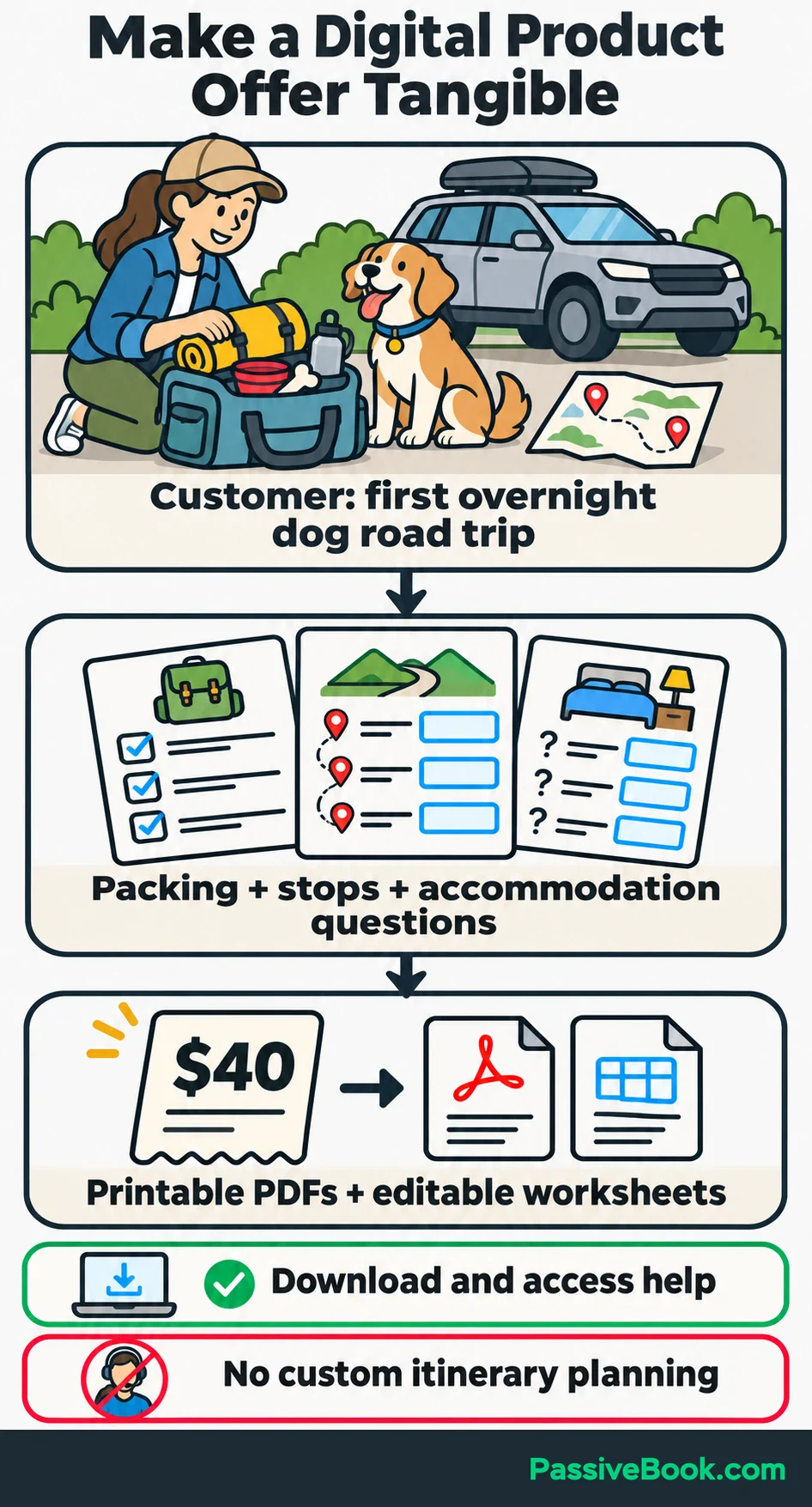
The sample offer costs $40 and includes printable PDFs plus editable worksheets, available after payment. Support covers download and file-access problems; personalized itinerary planning is outside the offer.
That boundary matters. A download that quietly includes unlimited personal advice has very different economics.
Show a filled-in worksheet preview so buyers can judge the format. Explain how the parts work together. “Everything in one place” becomes more convincing when people can see what that place contains.
I would sell a small, usable version before adding more sections. Offer it to suitable prospective customers and record purchases alongside reasons for declining. If people want a different format, you can investigate that before building another twenty pages.
Check the Economics
Customer feedback and competing options help you judge the price, but you also need to know what each sale leaves behind.
Count the costs that increase with an order, such as payment fees, partner commissions, delivery charges and paid support tied to purchases. Keep acquisition spending separate if you plan to assess it separately.
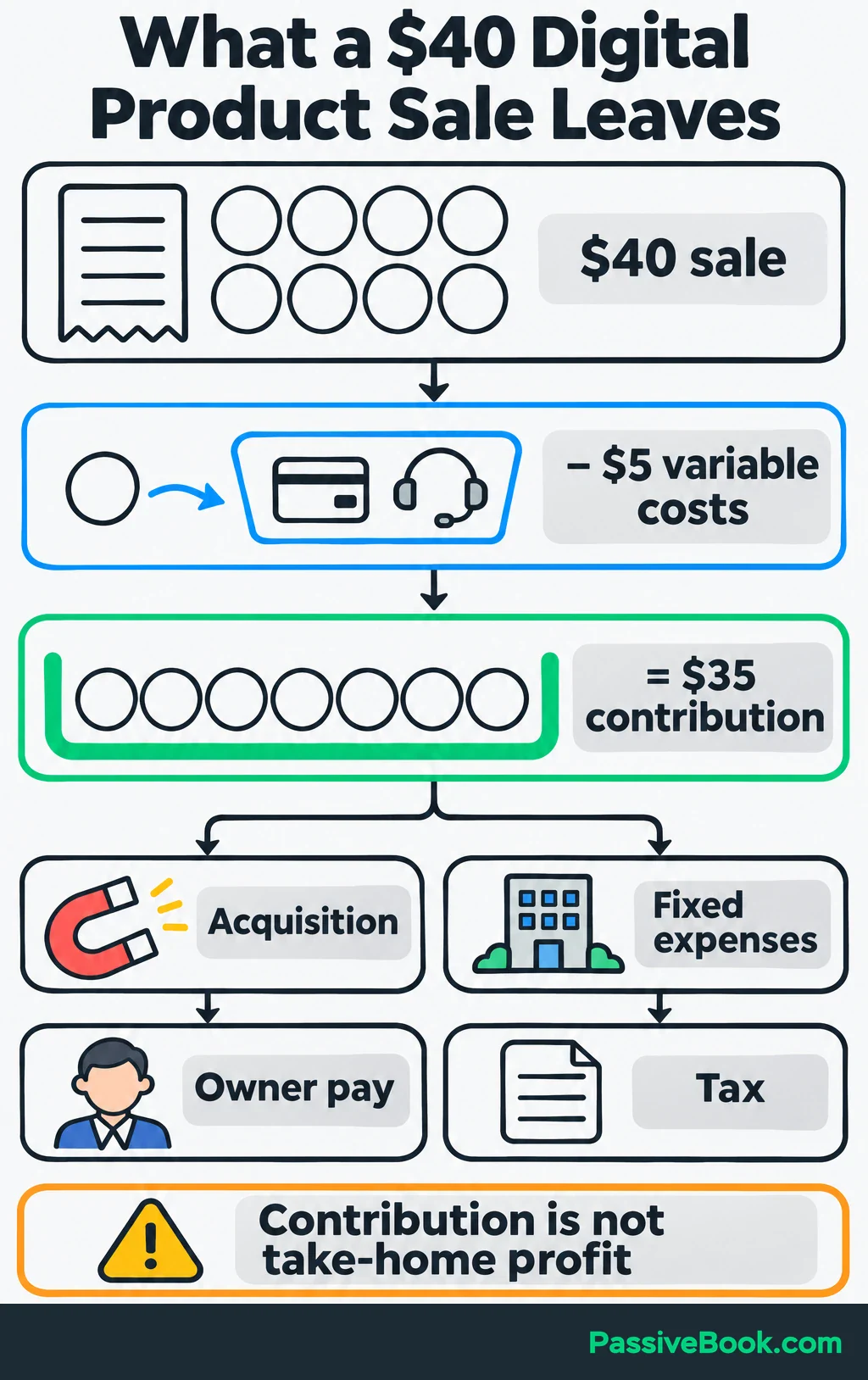
For this example, each kit sells for $40 and creates $5 in variable costs. Subtract those costs from the price to find the contribution per order:
Contribution per order = $40 − $5 = $35
That $35 remains available for acquisition spending, fixed expenses and the return you need from the business. It is not take-home profit.
The SBA’s break-even calculation uses this difference between price and variable cost to work out how many sales cover fixed costs. SBA break-even guidance
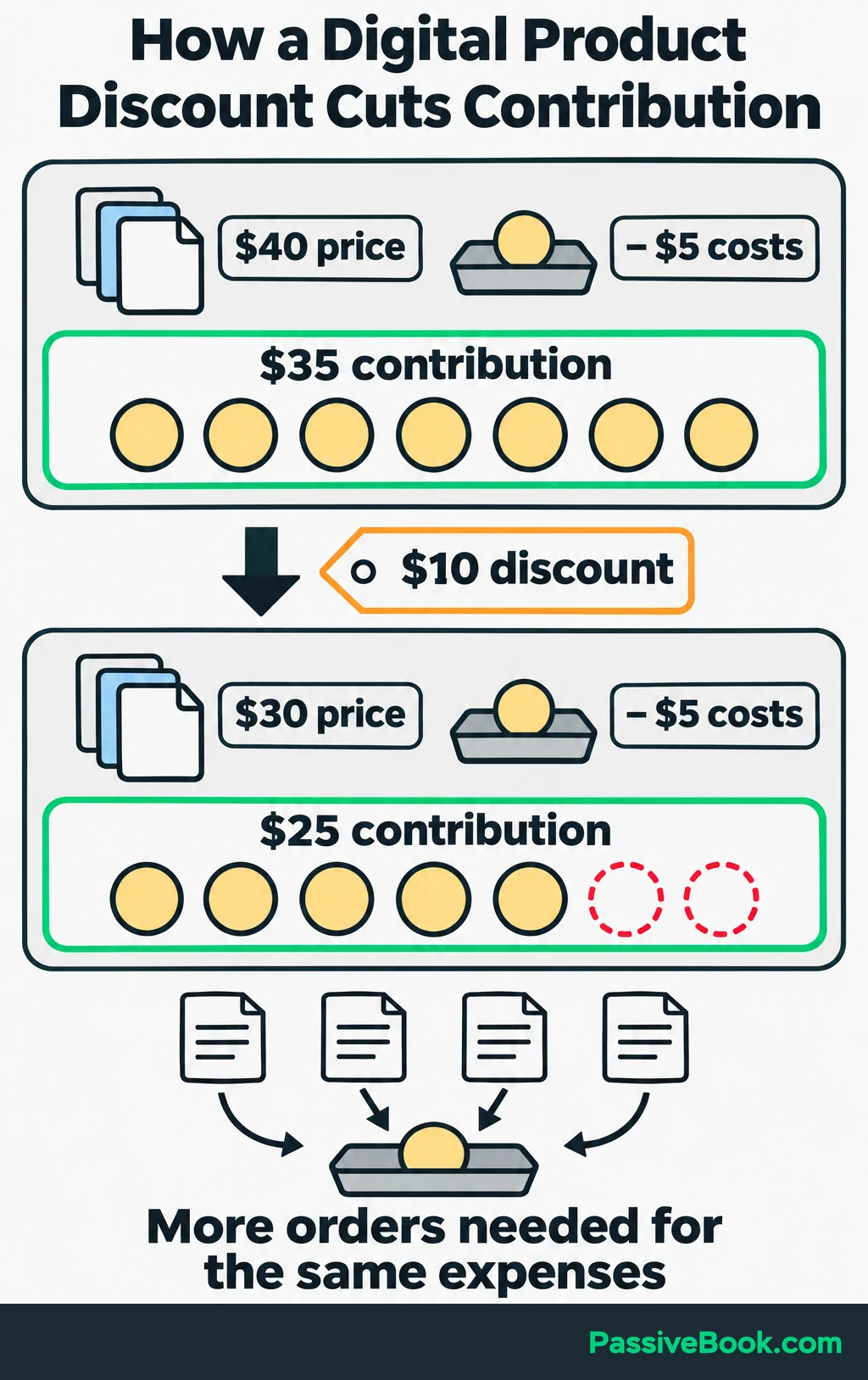
Recalculate before offering a discount or commission. If you reduce the price to $30 while variable costs remain $5, contribution falls to $25. More orders would then be needed to cover the same expenses.
I would check that before writing the discount email. Enthusiasm is a poor calculator.
3. Set a Revenue Target With Resource Limits
Choose a planning period and say whether the target means total revenue or additional revenue. Record your current orders and revenue beside it so the starting point stays visible.
To turn a revenue target into required orders, divide it by the expected average order value and round up.
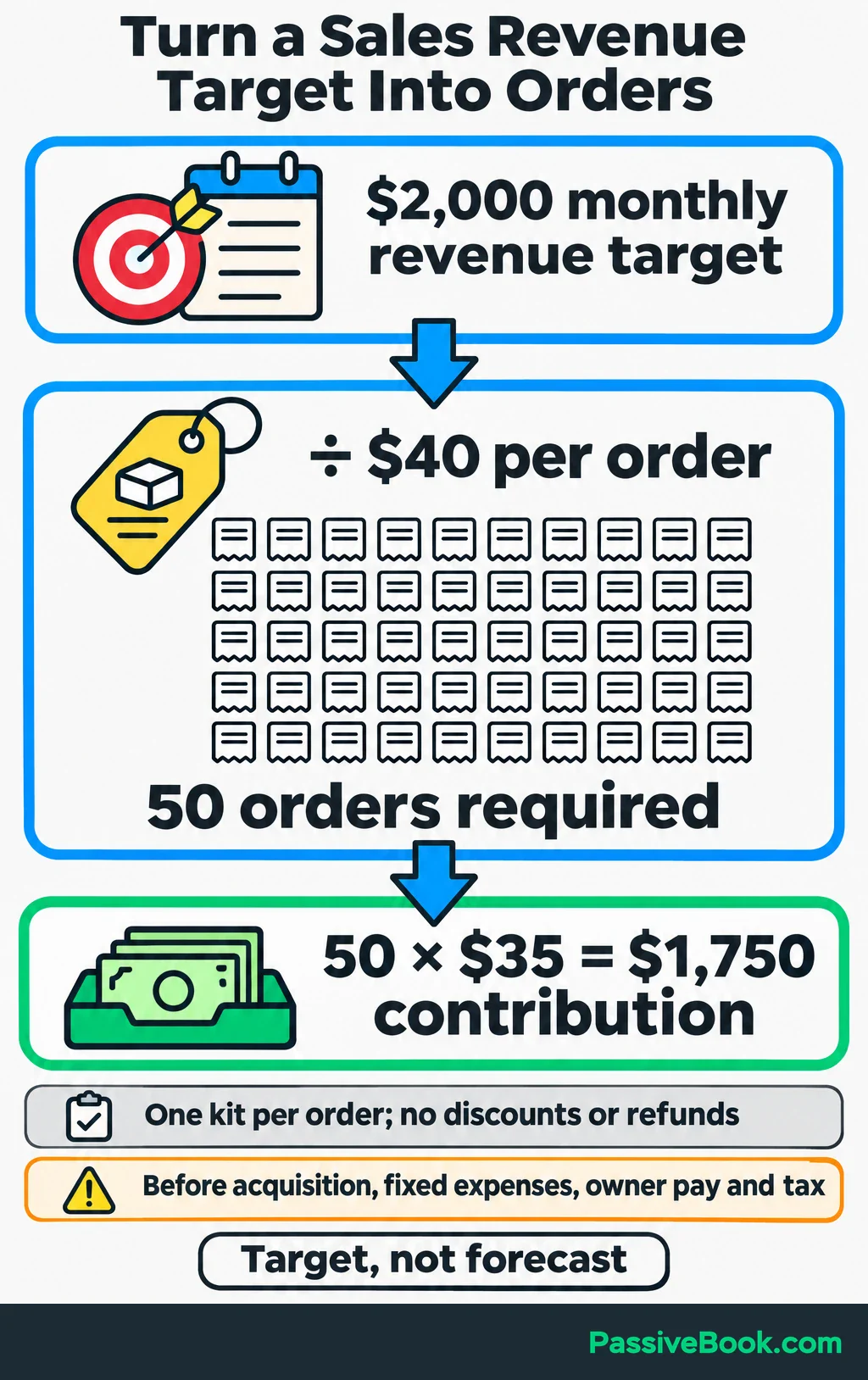
For the kit, assume one $40 kit per order with no discounts or refunds:
$2,000 monthly revenue target ÷ $40 per order = 50 orders
Those orders would generate $1,750 in contribution:
50 orders × $35 contribution = $1,750
Acquisition spending, fixed expenses, owner compensation and tax still need to come out of that amount.
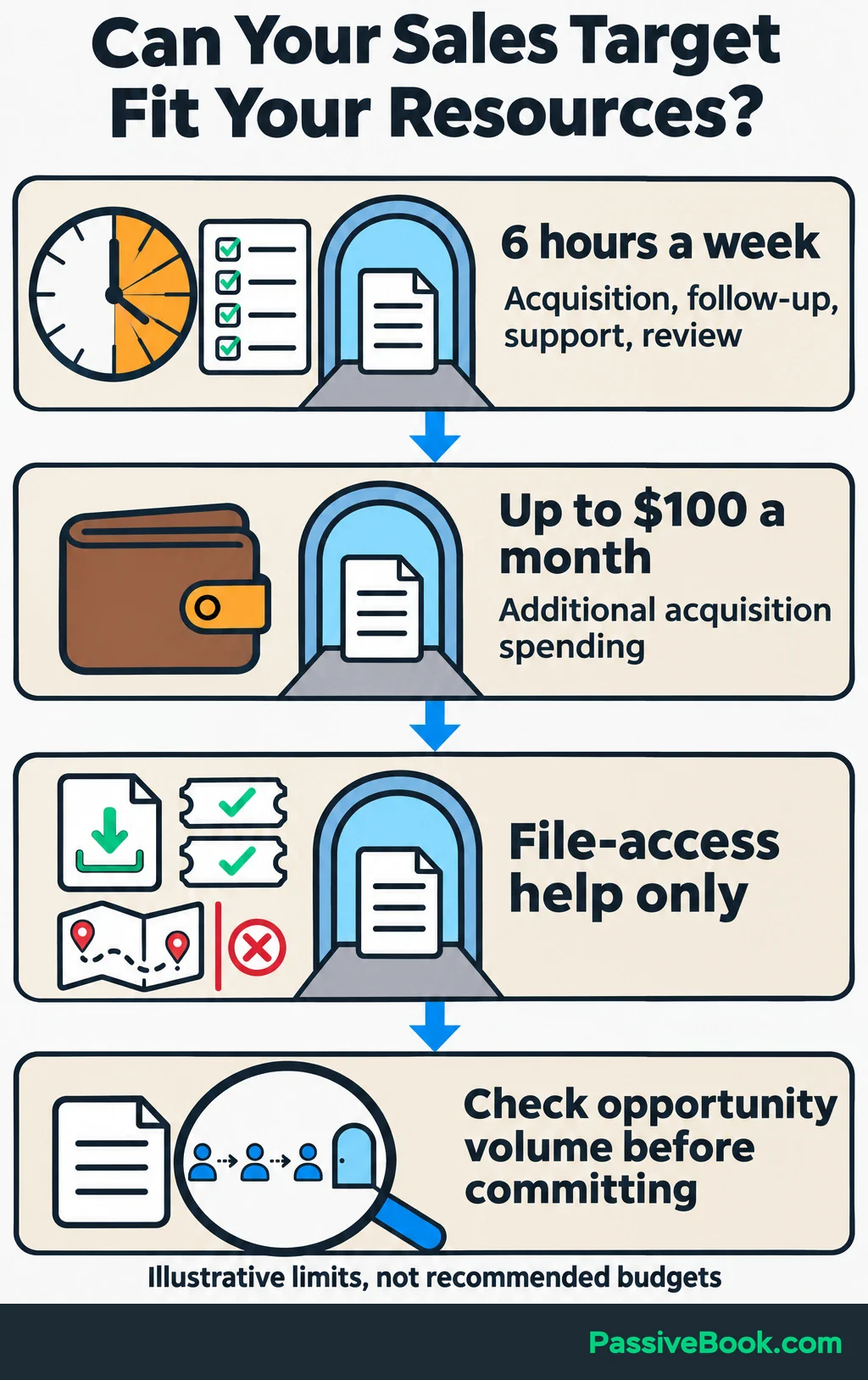
Next, put limits around the work. For the sample plan, allow:
- Time Limit: Six hours a week for acquisition, follow-up, support and review.
- Spending Limit: Up to $100 a month in additional acquisition spending.
- Capacity Limit: Handle routine file questions, but exclude custom trip planning.
These are planning choices, not recommended budgets. Choose limits that fit your own available hours and finances.
Keep the revenue target provisional until you work backward through the buying process. Fifty orders may sound modest, but the traffic needed to produce them could exceed what your current channel can supply.
4. Choose Your Sales Approach and Acquisition Channel
Match the Buying Path to the Purchase
Decide how much help someone needs before they can buy.
Use self-service checkout when the product page, preview and terms can answer the main questions. Add an assisted conversation when suitability, customization or complexity needs discussion.
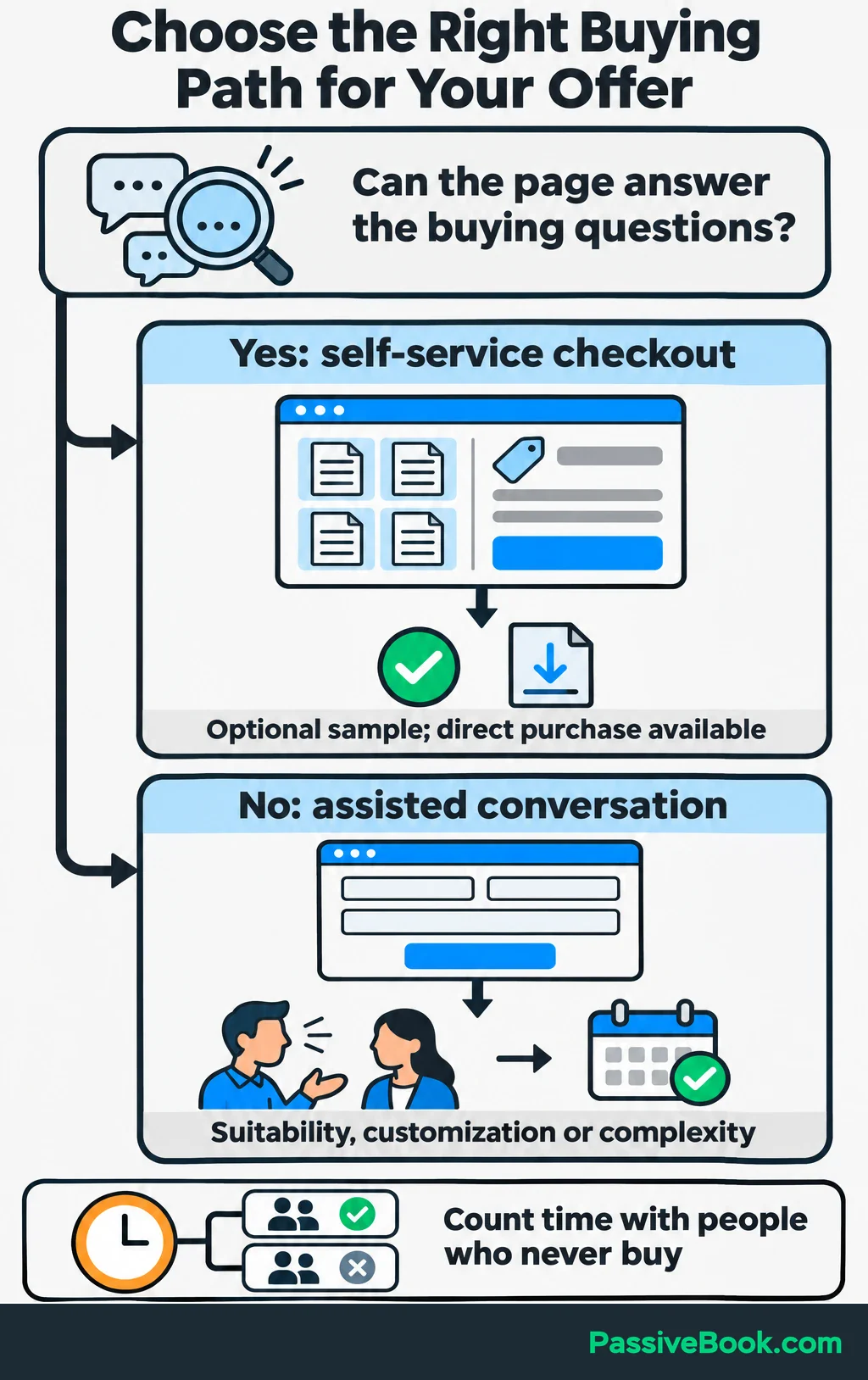
For the kit, I would choose a clear product page and self-service checkout. Give ready buyers a direct purchase link, and offer a sample with optional email follow-up for people who want a closer look.
I would skip routine sales calls for this offer. When checking whether calls make financial sense, count time spent with people who never buy as well as those who do.
For a service that needs a suitability check, the same strategy might include an inquiry form and consultation before booking. The question is whether the conversation helps make a decision the sales page cannot reasonably handle.
Select a Primary Acquisition Channel
An acquisition channel introduces suitable people to your offer. Follow-up helps interested people decide what to do next.
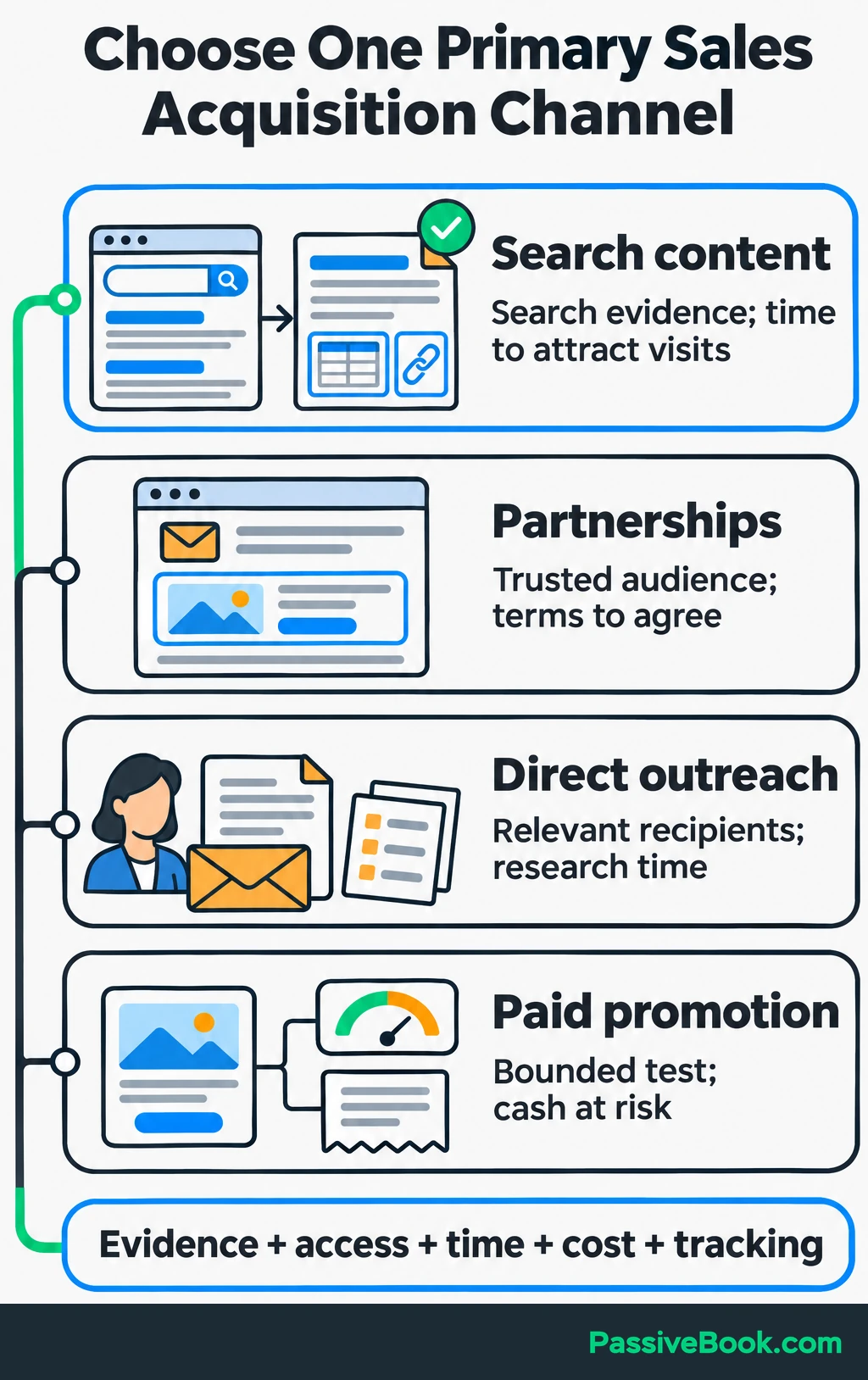
Choose one primary channel using customer evidence, your available access, the work involved and the time before it could produce opportunities.
| Acquisition Method | Customer Evidence to Seek | Next Action | Time Required | Cash Cost | Sales Tracking |
|---|---|---|---|---|---|
| Search content | Buyers search for packing and overnight-trip help | Publish an article linked to the sample and kit | Writing, updates and time to attract visitors | Can begin without ad spending; owner hours still count | Track article visits and resulting orders |
| Relevant partnerships | A travel publisher or business reaches suitable readers | Propose one useful resource placement | Finding partners, agreeing terms and maintaining contact | May involve a placement fee or commission | Use a partner link or order code |
| Direct outreach | Suitable publishers or businesses accept relevant proposals | Send a specific partnership proposal | Research and individual messages | Mainly working time unless tools are added | Record replies, placements and orders |
| Paid promotion | A bounded test shows suitable visitors can be reached | Test one offer with a spending cap | Setup, monitoring and revisions | Direct advertising spend | Compare spend with attributed orders and contribution |
For the kit, I would start with search-focused articles about preparing for an overnight dog road trip. Each article would lead naturally to a worksheet sample and the full product.
That choice needs patience. Google says changes can take anything from hours to several months to affect search results, and some changes produce no noticeable impact. I would not rely on new articles to meet an immediate revenue deadline. Google’s SEO Starter Guide
If interviews instead reveal that buyers rely on a few trusted travel newsletters, test a partnership before building a large article library.
Any paid acquisition must fit the economics. Spending $35 to acquire a kit order would consume its entire contribution before fixed expenses and owner pay.
5. Build a Repeatable Sales Process
Map Each Stage to a Customer Action
Write down what customers need to do between discovering the business and receiving their purchase. Mark progress with actions you can observe.
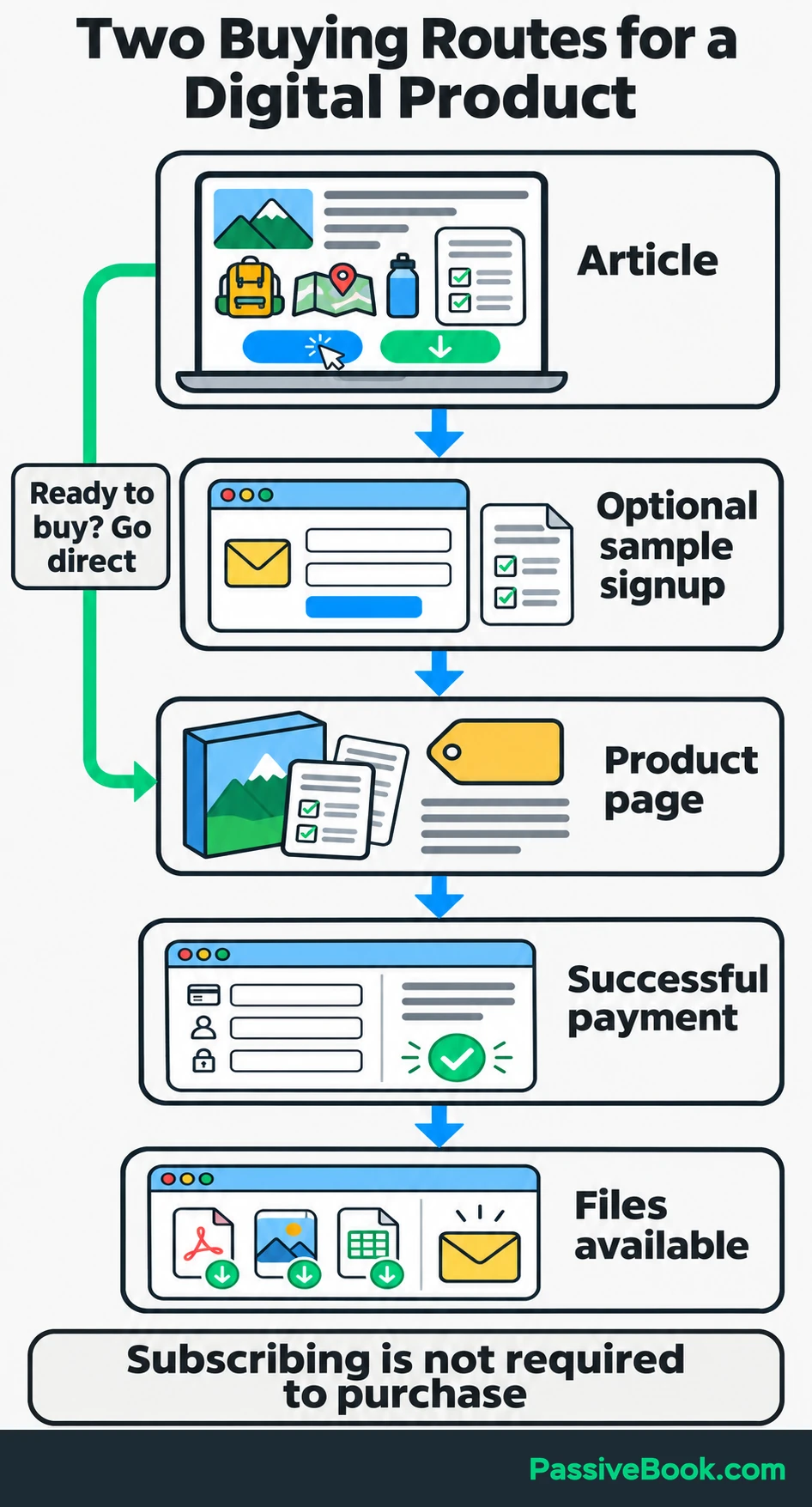
The kit has two routes:
Article → sample signup → product page → checkout → delivery
Article → product page → checkout → delivery
The second route matters because subscribing should not be an obstacle to buying.
| Stage | Customer Question | Message or Asset | Completion Event | Responsible Person | Next Action |
|---|---|---|---|---|---|
| Discovery | “How do I organize this trip?” | Relevant planning article | Article visit | Owner | Offer the sample and product link |
| Sample | “Would this format help me?” | Worksheet preview and signup form | Sample request | Owner; automated delivery | Send the requested file |
| Evaluation | “What does the complete kit include?” | Product page with previews and terms | Product-page visit | Owner | Make checkout easy to find |
| Purchase | “What will I pay and receive?” | Checkout with clear order details | Successful payment | Owner; checkout system | Confirm the order |
| Delivery | “Where are my files?” | Download page and delivery email | Files made available | Owner; delivery system | Resolve access failures |
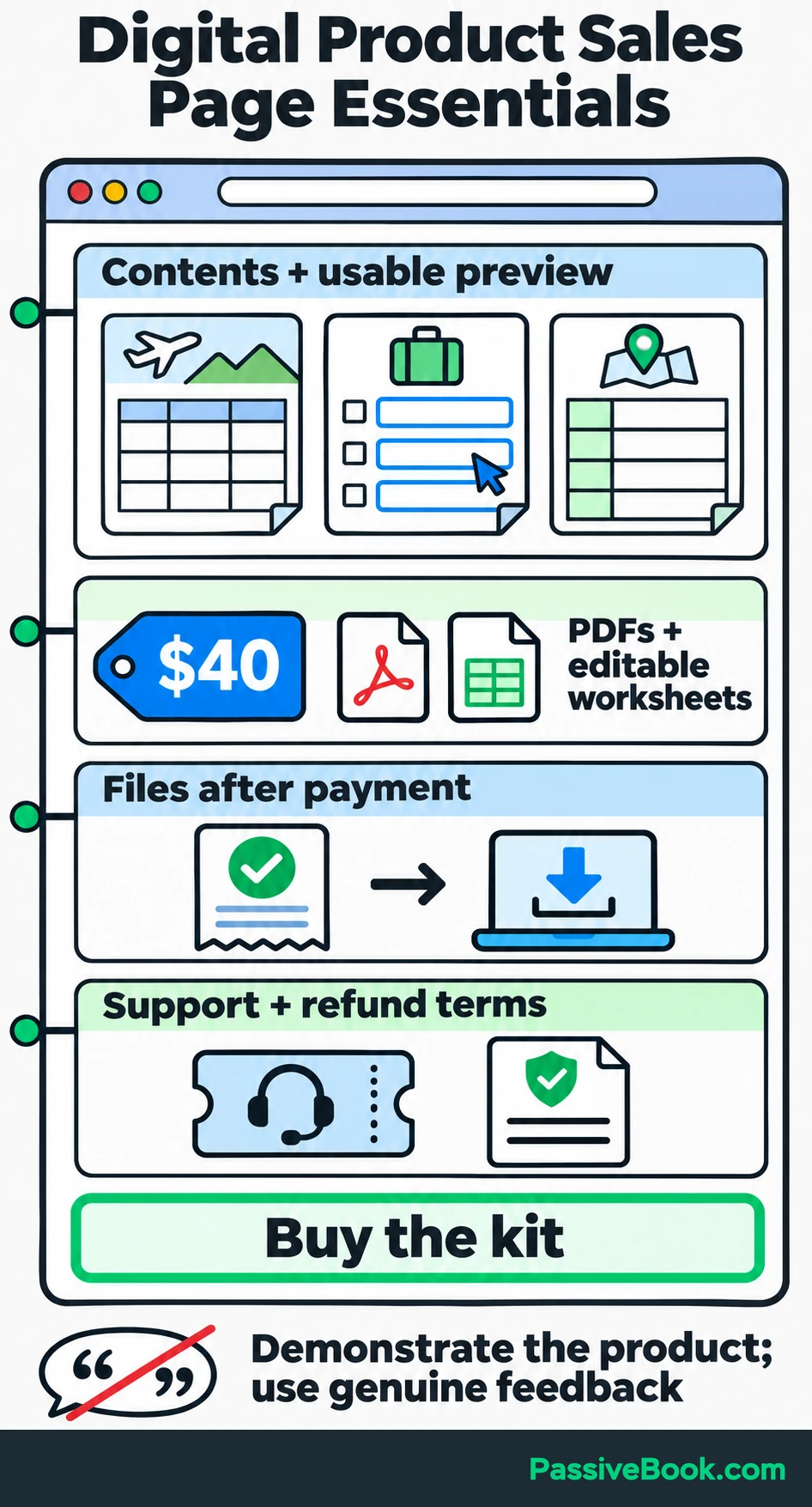
Your sales page should cover contents, price, file formats, access, support and refund terms. Put a worksheet preview beside the explanation of that worksheet.
Use genuine customer feedback when available, with permission where needed. Until then, demonstrate the product itself. A clear preview gives buyers something concrete to judge without invented testimonials or promises.
Prepare Useful Follow-up
Give each message one job and one clear next action. Choose timing that fits how soon customers need to make their decision.
A short sequence for the kit could look like this:
| Timing | Message Job | Next Action |
|---|---|---|
| Immediately after signup | Deliver the requested worksheet | Open the sample |
| Two days later | Demonstrate how to complete one part | Try that part |
| Five days later | Explain what the complete kit adds and answer the free-checklist objection | Review the kit |
These timings are a starting point to test. If people usually sign up just before leaving, a slower sequence may arrive after the buying moment has passed.
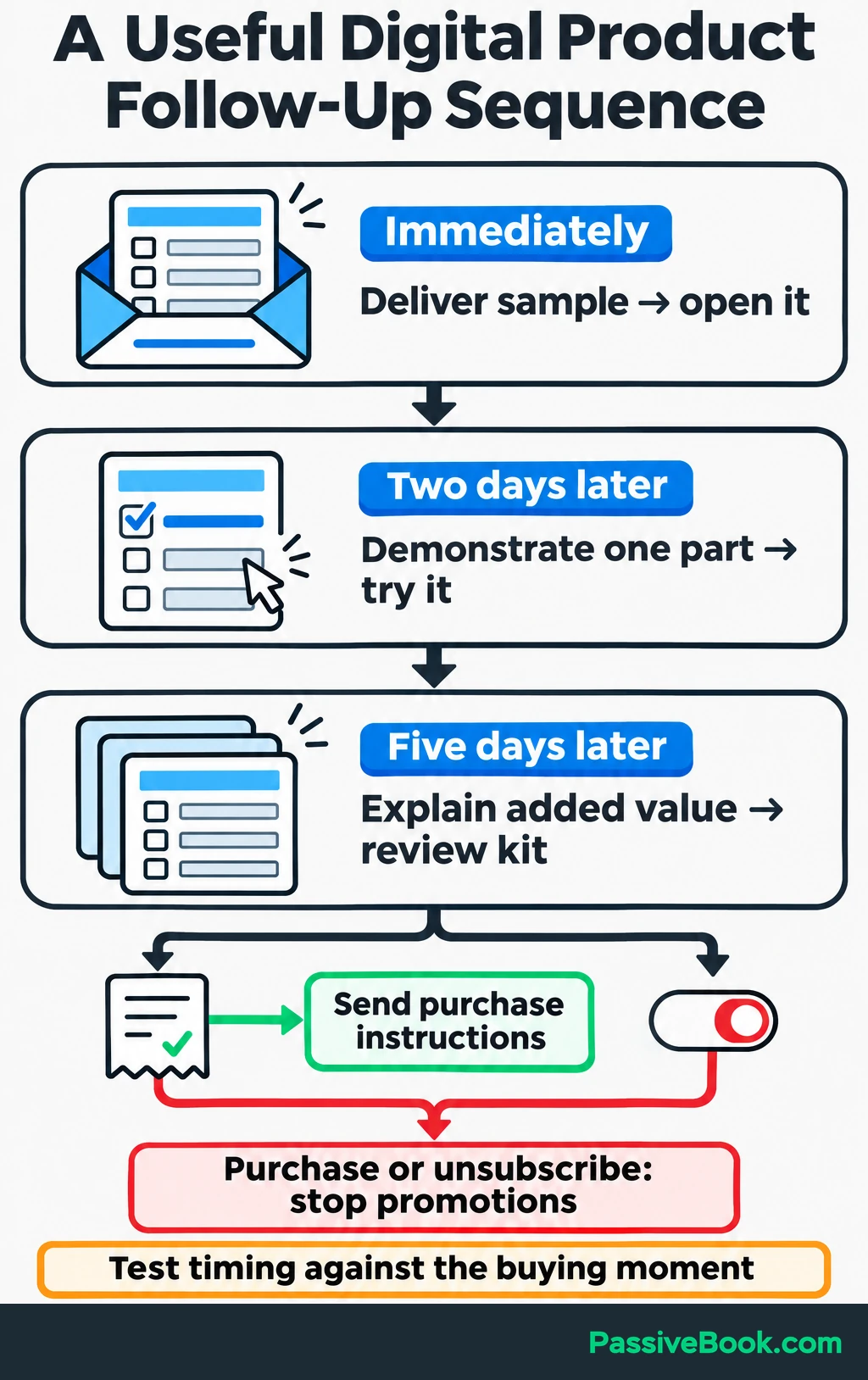
End this sequence after the final message, and stop its promotional messages when someone buys or unsubscribes. Buyers should receive their purchase instructions instead.
On one of my digital-product sites, I caught myself writing different versions of the same answer about what buyers could edit. The repeated question showed me where the product explanation was weak, so I added a clearer preview before adding more follow-up. I would make that check here too.
The sequence above gives each message a job, but you still need the words for your own offer. This AI Skill drafts the page and follow-up together, using the product details and customer questions you provide.

Free AI Copywriting Studio




Ask permission for promotional follow-up and explain what subscribers will receive. Apply the email rules where you operate and sell. For U.S. commercial email, requirements include accurate sender information, honest subjects, clear advertising identification, a valid postal address and an opt-out honored within 10 business days. FTC CAN-SPAM guidance
Document and Automate Recurring Work
Write a short procedure for each repeated task. Include its trigger, action, owner, timing, completion condition and exception.
For sample delivery, that could be:
When someone requests the worksheet, send its download link immediately. The owner checks failed sends each working day. Delivery problems go into the support list for a personal response.
For subscribers and people who contact you, keep source, current stage, last contact, next action and purchase status in one spreadsheet or CRM—a tool for keeping customer records and follow-up together.
If you already use WordPress, I would consider FluentCRM for email automation alongside WooCommerce for checkout. FluentCRM supports WooCommerce purchase triggers and conditions that can change what happens after an order. FluentCRM’s WooCommerce automation documentation
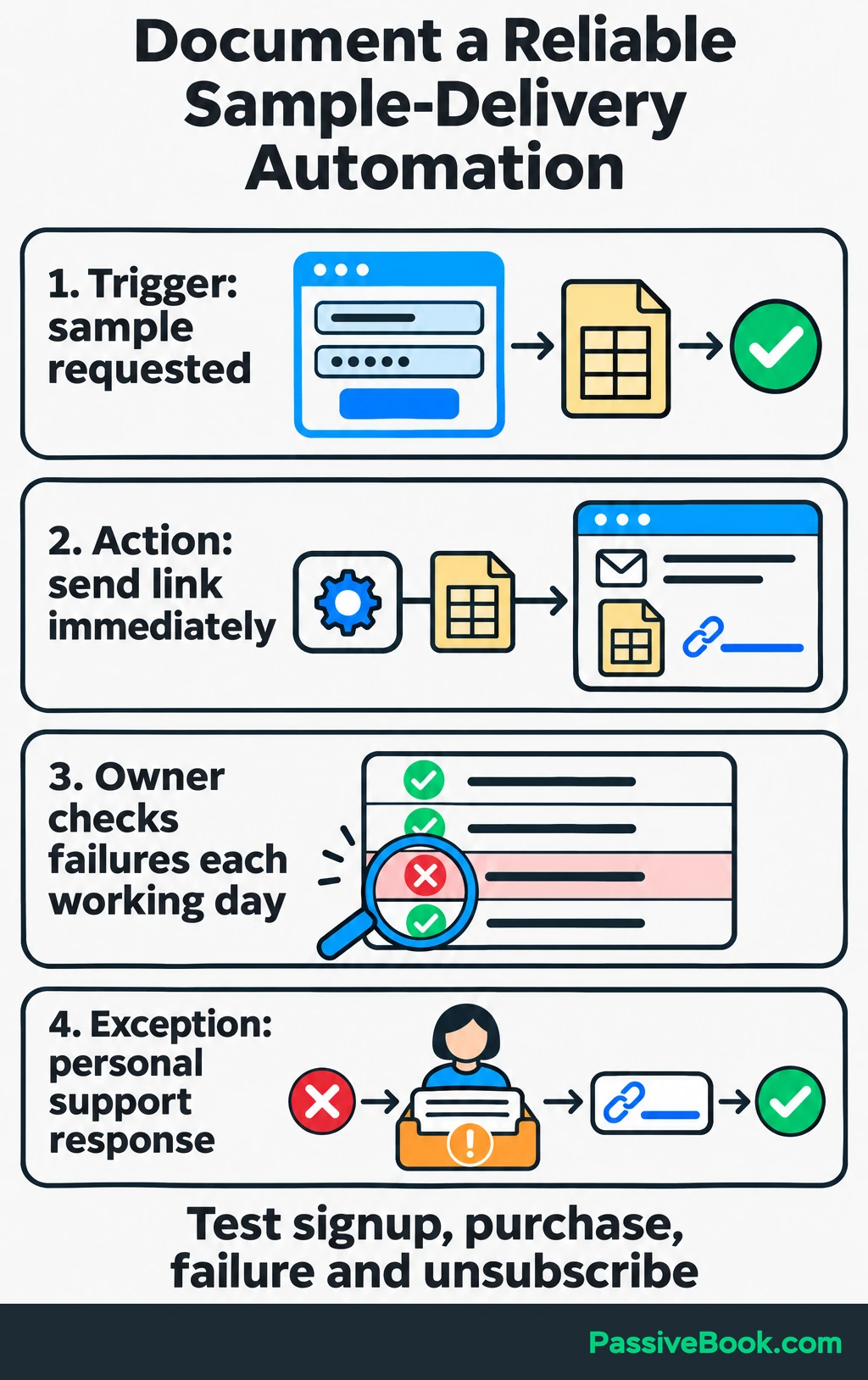
Use the tools you already have if they can handle the same process. A small workflow does not need five subscriptions.
Test signup, purchase, failed delivery and unsubscribe behavior before relying on automation. Check that a buyer stops receiving invitations to buy the same kit.
AI can help group anonymized questions, summarize sales notes and draft answers from approved product details. Give it a bounded task:
Using only these kit details and anonymized customer questions, draft three concise answers about what buyers receive. Flag missing information instead of filling it in.
Review claims, prices and calculations before using the output. Automate the repeated work once you know what the correct result looks like.
6. Turn the Target Into Scheduled Sales Activities
Work backward from orders through each buying route. This shows whether your sales target fits the opportunities you can realistically create.
First, estimate how many new subscribers you need to get 50 buyers. Assume each buyer places one order.
If all 50 kit orders came through email, and an assumed 5% of new subscribers bought within 30 days of signup:
50 purchasing subscribers ÷ 0.05 = 1,000 subscribers
Next, count the relevant article visits needed to produce those signups. If an assumed 20% of visits to articles offering the sample resulted in signup:
1,000 subscribers ÷ 0.20 = 5,000 relevant article visits
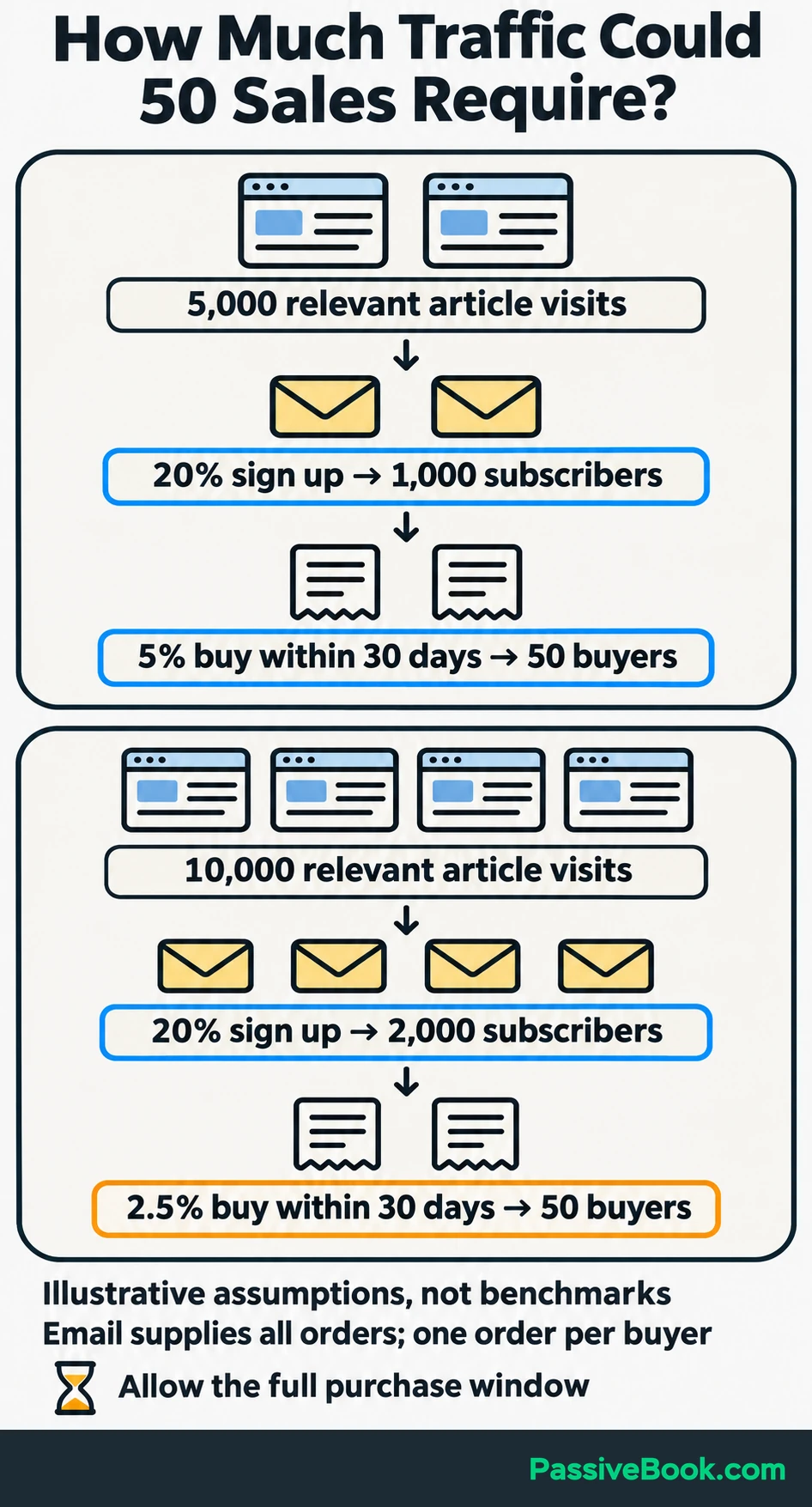
Those rates are assumptions, not benchmarks. Test a less favorable case before committing:
| Planning Assumption | Required Subscribers | Required Article Visits at 20% Signup |
|---|---|---|
| 5% of subscribers buy within 30 days | 1,000 | 5,000 |
| 2.5% of subscribers buy within 30 days | 2,000 | 10,000 |
This model gives the email route responsibility for all 50 orders. Once you have evidence of direct purchases, plan that route separately and reduce the orders email must supply.
Also allow time for purchases. Someone joining near the end of the month may buy next month, so 1,000 signups this month do not automatically mean 50 orders this month.
Now turn the requirement into work you control:
| Task | Owner | Frequency or Deadline | Intended Stage Contribution | Hours | Spending Cap | Results to Record |
|---|---|---|---|---|---|---|
| Publish or improve a selected article | You | Weekly | Attract relevant visits | 3/week | $0 additional cash | Relevant article visits and attributed orders |
| Improve the sample or product explanation | You | Weekly | Help visitors evaluate the offer | 1/week | $0 additional cash | Signups, product-page visits and recurring questions |
| Handle replies and delivery exceptions | You | Working-day checks | Resolve purchase and access questions | 1/week total | $0 additional cash | Questions received and unresolved delivery issues |
| Update the scorecard and choose the next change | You | Weekly | Direct the following week’s work | 1/week | $0 additional cash | Next change to make and its review date |
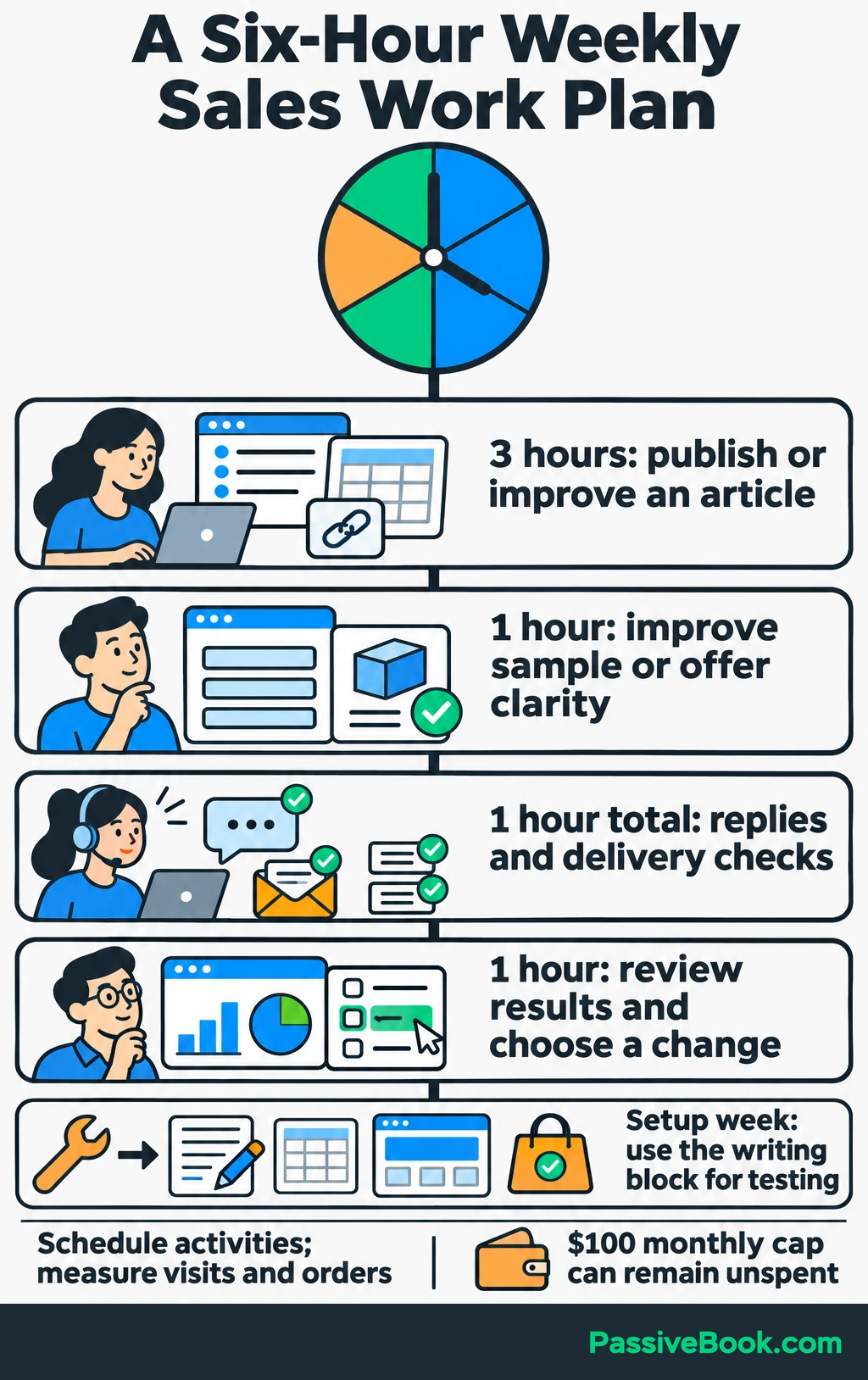
For the setup week, use the article-writing block to finish and test the sample, sales page and checkout. The ongoing schedule begins after that.
The table plans no additional acquisition spending, so the $100 monthly cap remains unspent unless a specific test justifies it.
Publishing an article is an activity. Visits and orders are results. You can schedule the first, but you must measure the others.
If your current traffic is nowhere near the requirement, revise the target, timeframe, offer or channel. More ambitious arithmetic will not bring more visitors.
Before you commit more evenings to the plan, check its traffic and workload requirements together. This calculator shows where your target exceeds the resources you have entered.
Free Sales Target Calculator
7. Measure Results and Improve the Weakest Stage
Keep a Small Sales Scorecard
Track enough to see where sales are being limited and whether the work pays.
| Measure | What to Record |
|---|---|
| Relevant visits | Visits to the selected articles offering the sample or kit |
| New subscribers | New sample subscribers, grouped by signup period and source |
| Purchasing customers and orders | Unique buyers and total orders, counted separately |
| Revenue | Order revenue after discounts and refunds |
| Acquisition spending | Cash spent attracting prospective customers |
| Contribution after acquisition | Revenue minus variable order costs and acquisition spending |
| Sales-related hours | Time spent on content, outreach, follow-up, support and review |
| Delivery problems | Failed access, recurring support questions and refund reasons |
Keep conversion calculations consistent with your plan.
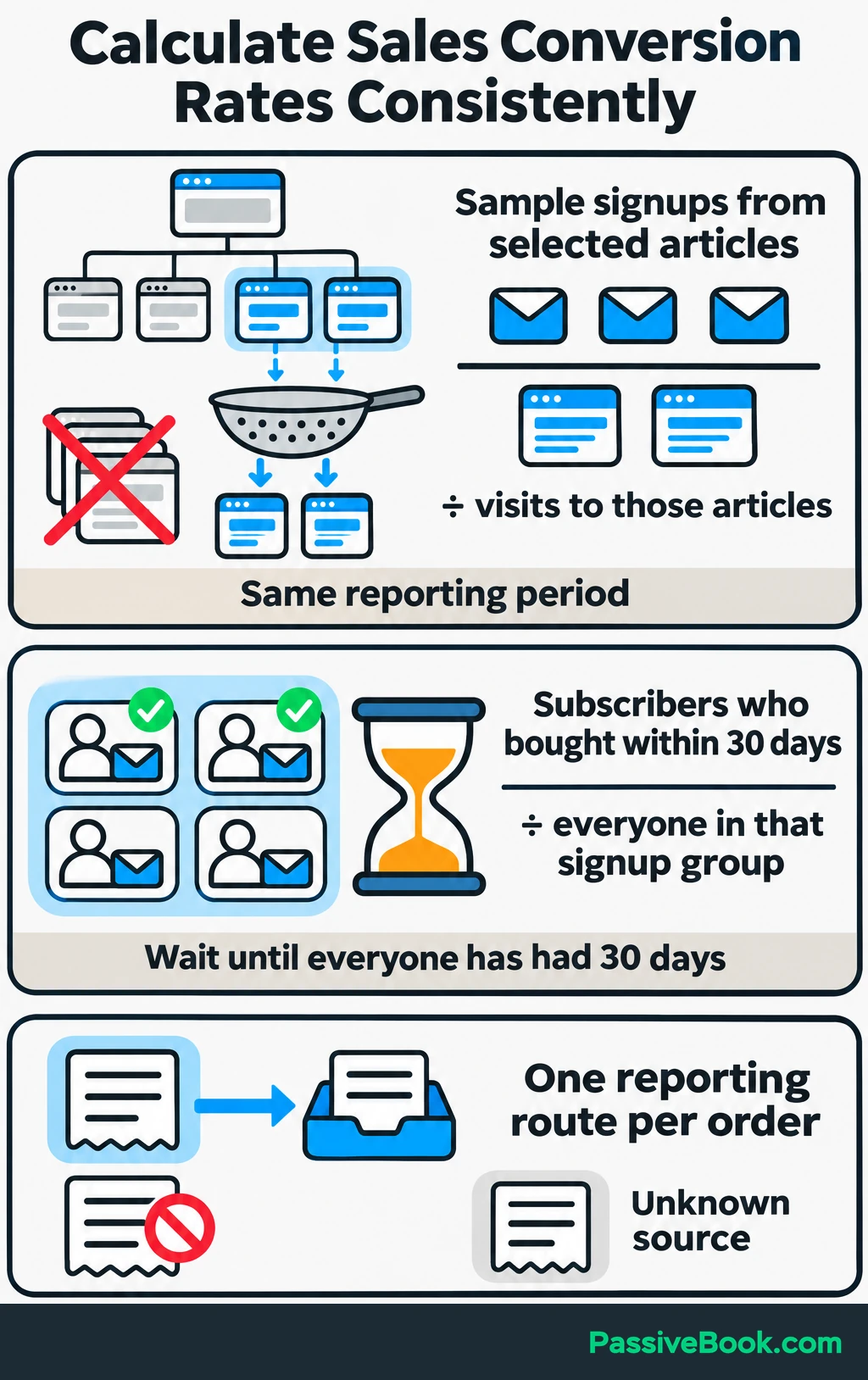
For the sample signup rate, divide signups from the selected articles by visits to those articles during the same period. Do not divide by all website traffic if other pages do not offer the sample.
For the 30-day subscriber purchase rate, divide subscribers who bought within 30 days of joining by everyone in that signup group. Wait until each person has had the full 30 days before comparing groups.
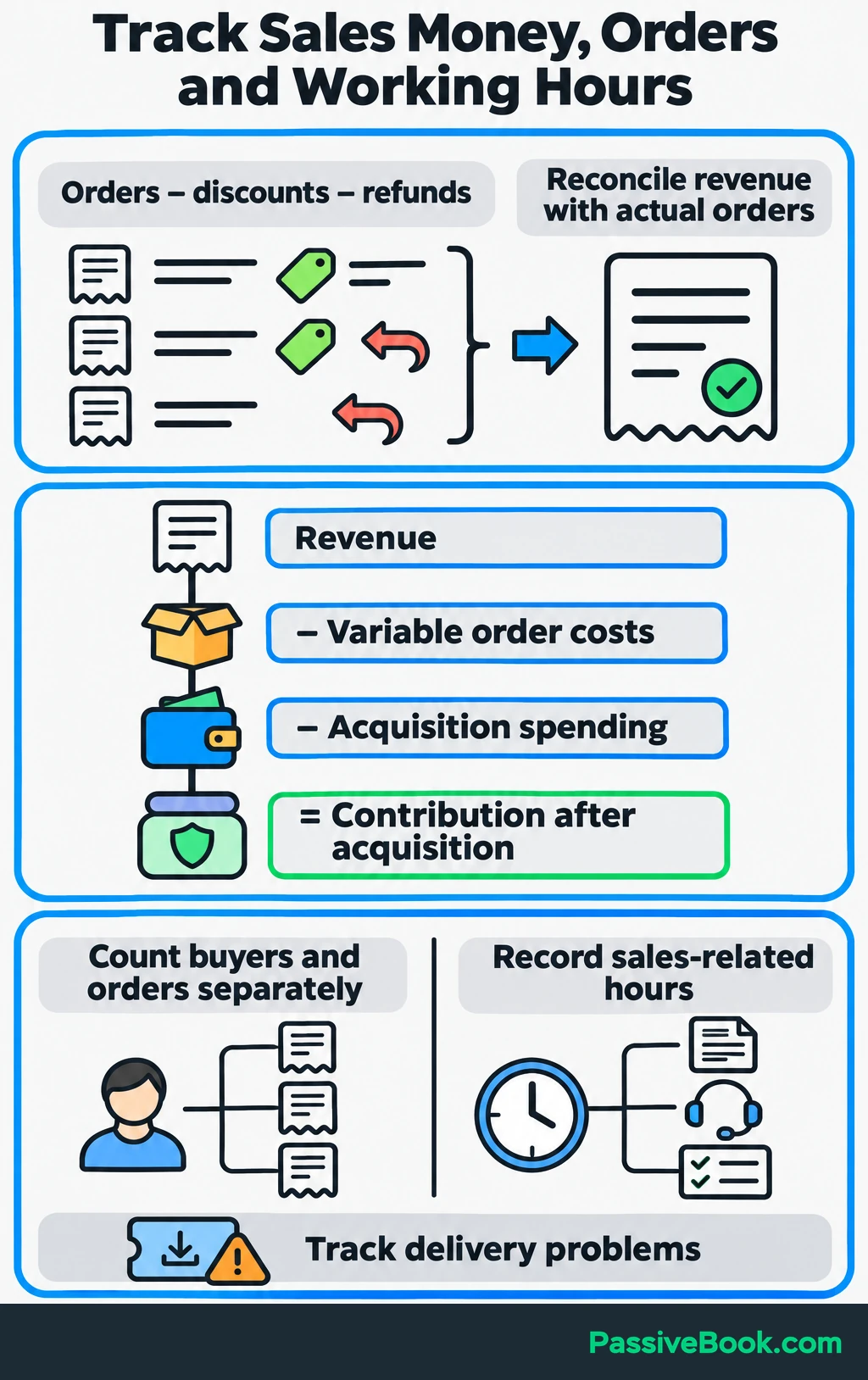
Count direct purchases separately and give each order one reporting route so you do not count the same sale twice. Keep source labels consistent, and mark unknown sources as unknown.
Finally, reconcile revenue and refunds with actual orders. Compare channels using working hours as well as cash spending. A channel can cost little money and still consume every evening.
Use the Results to Choose the Next Change
First check whether the planned work happened. A strategy cannot tell you much if its checkout stayed unfinished or its follow-up never went live.
Then investigate where the shortfall begins:
- Too Few Relevant Visits: Review topic choice, customer access and acquisition activity.
- Visits but Few Signups: Check whether the sample solves an immediate problem and whether the form works.
- Signups but Few Purchases: Review customer fit, product clarity, objections and follow-up.
- Checkout Attempts but Few Completed Orders: Test payments and look for confusing purchase details.
- Sales With Heavy Support or Refunds: Review expectations, file usability and delivery before attracting more buyers.
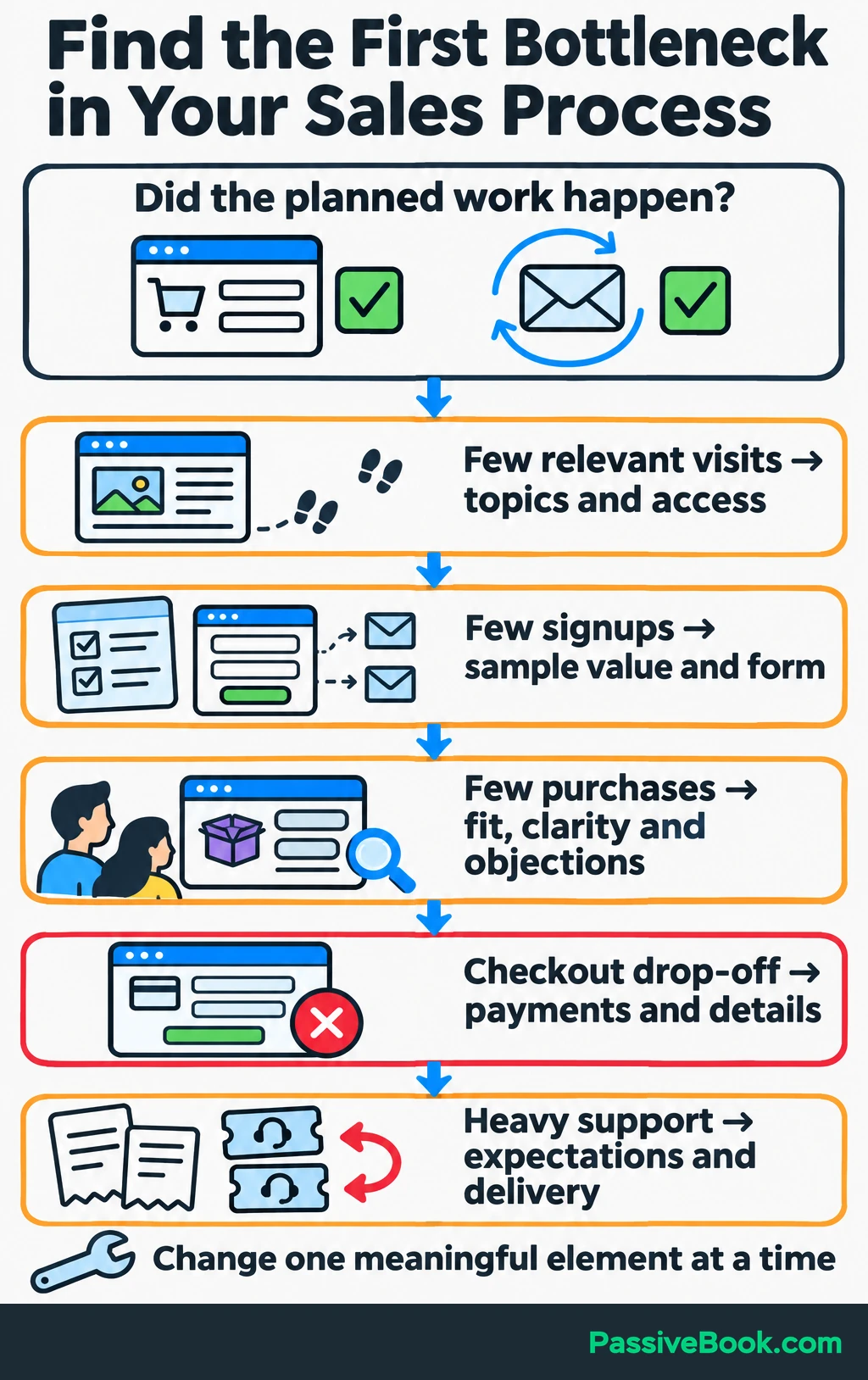
I would change one meaningful element at a time. If you rewrite the offer, replace the sample and change the price together, you make the result harder to interpret.
Keep a short decision record:
Problem: Visitors request the sample, but replies show uncertainty about editable files.
Change: Add a preview showing which fields buyers can edit.
Expected effect: Fewer format questions and more informed purchase decisions.
Review: Compare the next completed 30-day subscriber group, including purchases, questions and refunds.
Decision: Keep, revise or remove the preview.
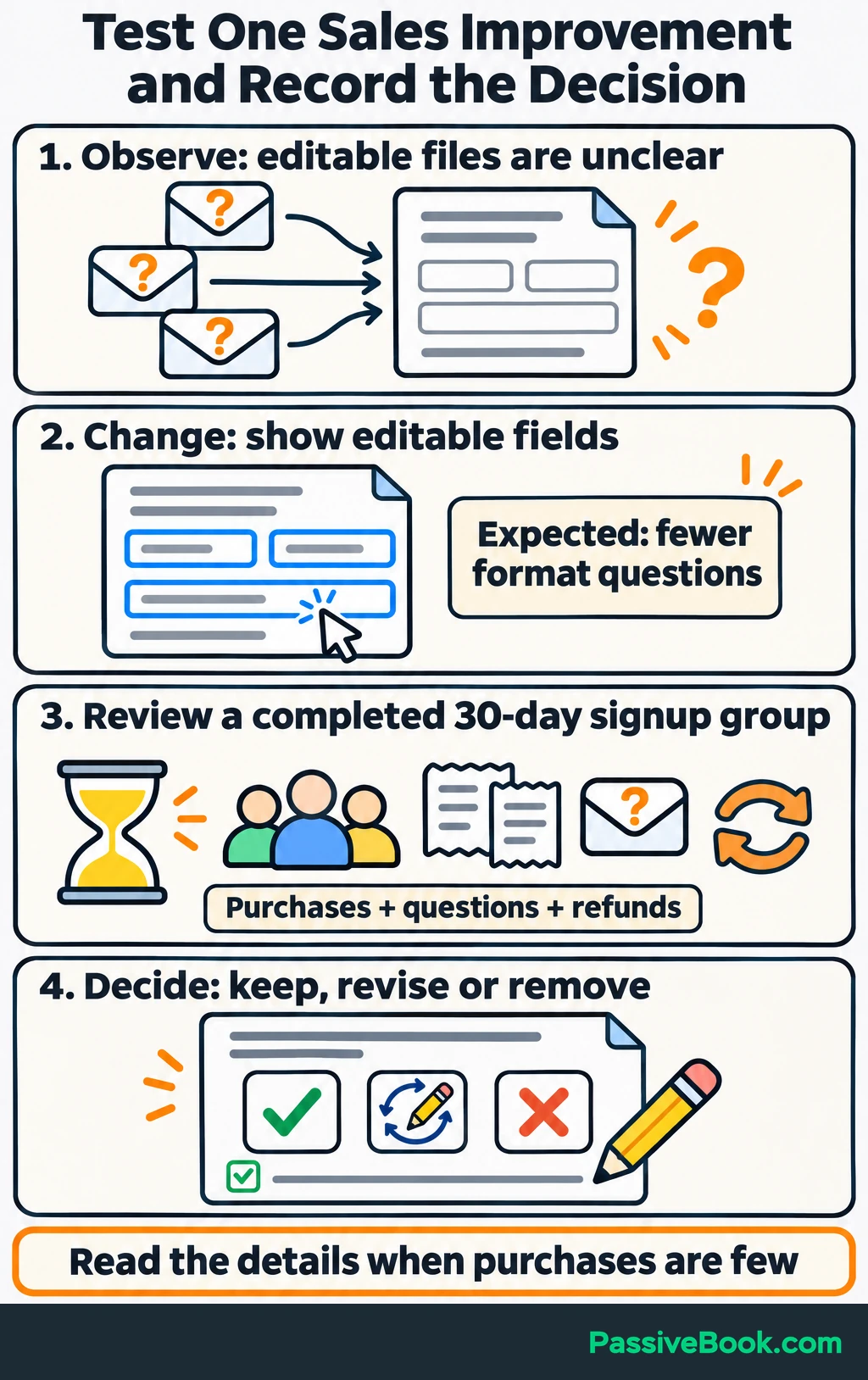
When there are only a handful of purchases, read the questions and order details alongside the percentages. Avoid rebuilding the strategy around one sale.
Expand when purchases leave enough contribution and delivery fits your capacity. If repeated feedback shows the customer wants something different, revisit the customer or offer before increasing activity.
Your One-Page Sales Strategy Template
Start with one sentence that captures your main choices:
We will reach [customer] through [channel] and help them choose [offer] because [meaningful difference].
For the worked example:
We will reach dog owners preparing for their first overnight road trip through practical search articles and help them choose a downloadable planning kit because its linked worksheets keep packing, stops and accommodation questions together.
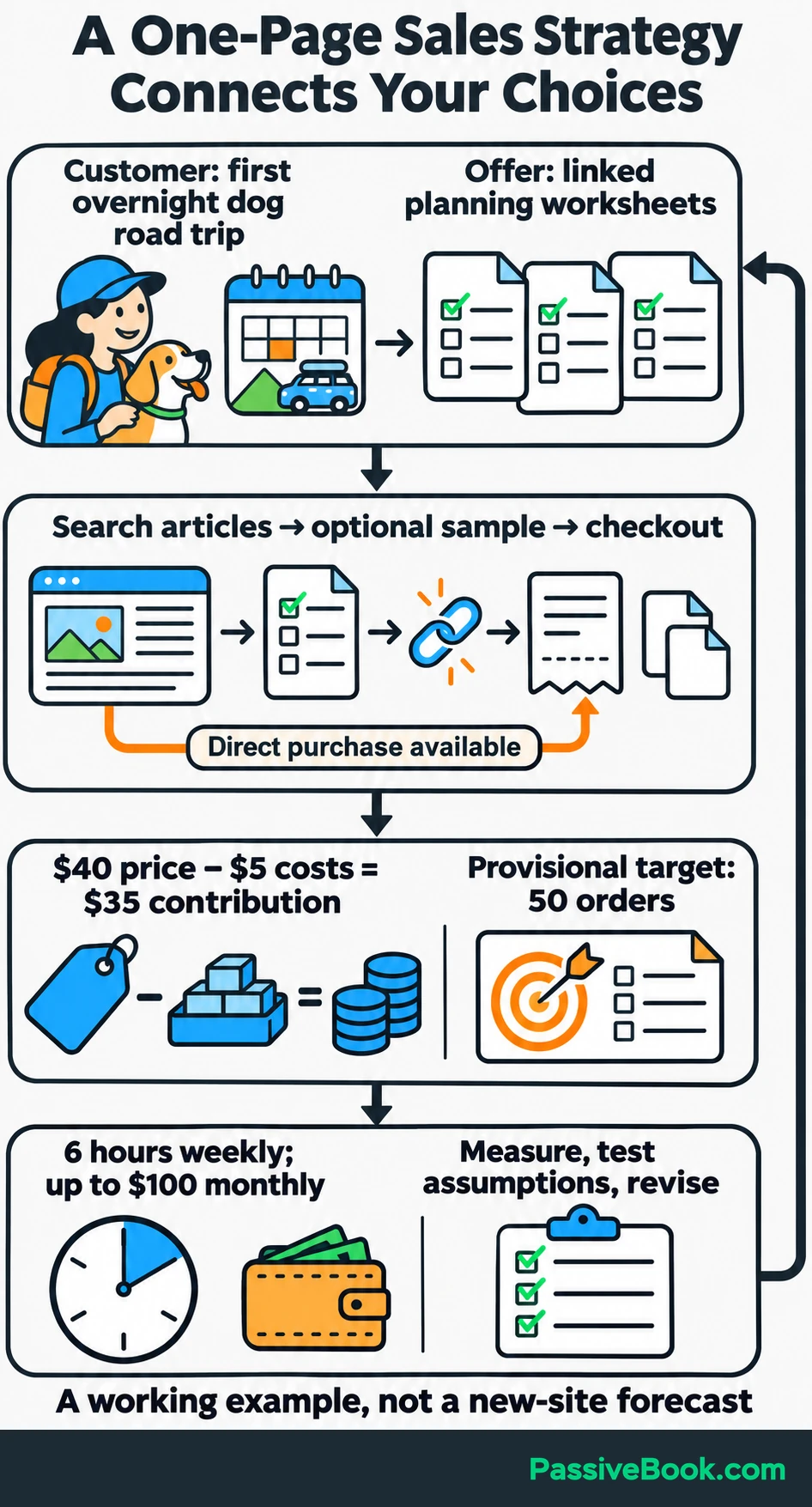
Use this completed plan as a model, then replace each answer with your own.
| Strategy Field | Completed Road-Trip Kit Example |
|---|---|
| Customer and buying trigger | A dog owner planning a first overnight road trip |
| Offer and positioning | Printable and editable worksheets for organizing preparation in one place |
| Price and delivery | $40; files available after successful payment |
| Support boundary | Download and file-access help; no custom itinerary planning |
| Economics | $5 variable cost per order; $35 contribution before acquisition and fixed expenses |
| Revenue target | Provisional $2,000 total monthly revenue target, subject to traffic feasibility |
| Required orders | 50 orders, assuming one kit per order with no discounts or refunds |
| Sales approach | Self-service checkout, with optional sample and email follow-up |
| Primary acquisition channel | Search articles addressing specific trip-preparation questions |
| Buying stages | Article → sample → product page → checkout → delivery; direct purchase also available |
| Follow-up | Sample delivery, worksheet demonstration and full-kit explanation; promotional sequence ends on purchase or unsubscribe |
| Owner and limits | You; six hours weekly and up to $100 monthly additional acquisition spending |
| Assumptions to test | Willingness to pay, search access, signup rate, 30-day purchase rate and support workload |
| Required opportunities | If email supplies all orders: 1,000–2,000 subscribers and 5,000–10,000 relevant visits under the sample assumptions |
| First activities | Test checkout and delivery, publish the first selected article, and record customer questions |
| Scorecard | Relevant visits, signups, customers, orders, net revenue, contribution, spending and hours |
| Review schedule | Weekly activity review; purchase review after each signup group has had 30 days |
| First test decision | Whether evidence supports the monthly target or calls for a different offer, channel or timeframe |
The monthly target is not a forecast for a new website. For an initial test, choose a fixed period for attracting prospects, then allow the purchase window to finish before judging its sales results.
Keep this page beside your activity tracker. Update both as measured results replace assumptions. That is how the strategy becomes useful: it helps you decide what deserves the next hour of work.
What Next?
Write your customer-and-offer sentence, then calculate how many orders your target requires. Those two actions will give you something concrete to test before you add another tactic.
Use the social buttons to share this guide when you want a practical way to discuss sales targets, workload and follow-up together.
Which part of your current buying process is hardest to explain or measure? Leave it in the comments, along with any other questions.
Share this post with your friends & followers:

