Your marketing list has a blog post, three social updates, a newsletter and a new landing page. Each task seems useful, but you can’t explain how they work together to bring in a customer.
That gap makes it hard to choose what deserves your next free evening. You keep producing things without knowing whether the problem is your audience, your offer or the route to buying it.
To make that next free evening count, this guide connects your marketing tasks to a clear route from discovery to purchase, with a plan that fits your time and budget.
1. Research the Customer Problem
Start with a problem people already try to solve. Find out what triggers that need, what they do about it and where the current options let them down.
A useful starting audience shares a buying situation. “People interested in sewing” is broad. “People with everyday clothes they want to repair, but no hand-sewing skills” gives you something concrete to investigate.
Imagine you sell a self-paced course on repairing clothes by hand. Before recording lessons, speak with people who recently faced a loose button or small seam tear.
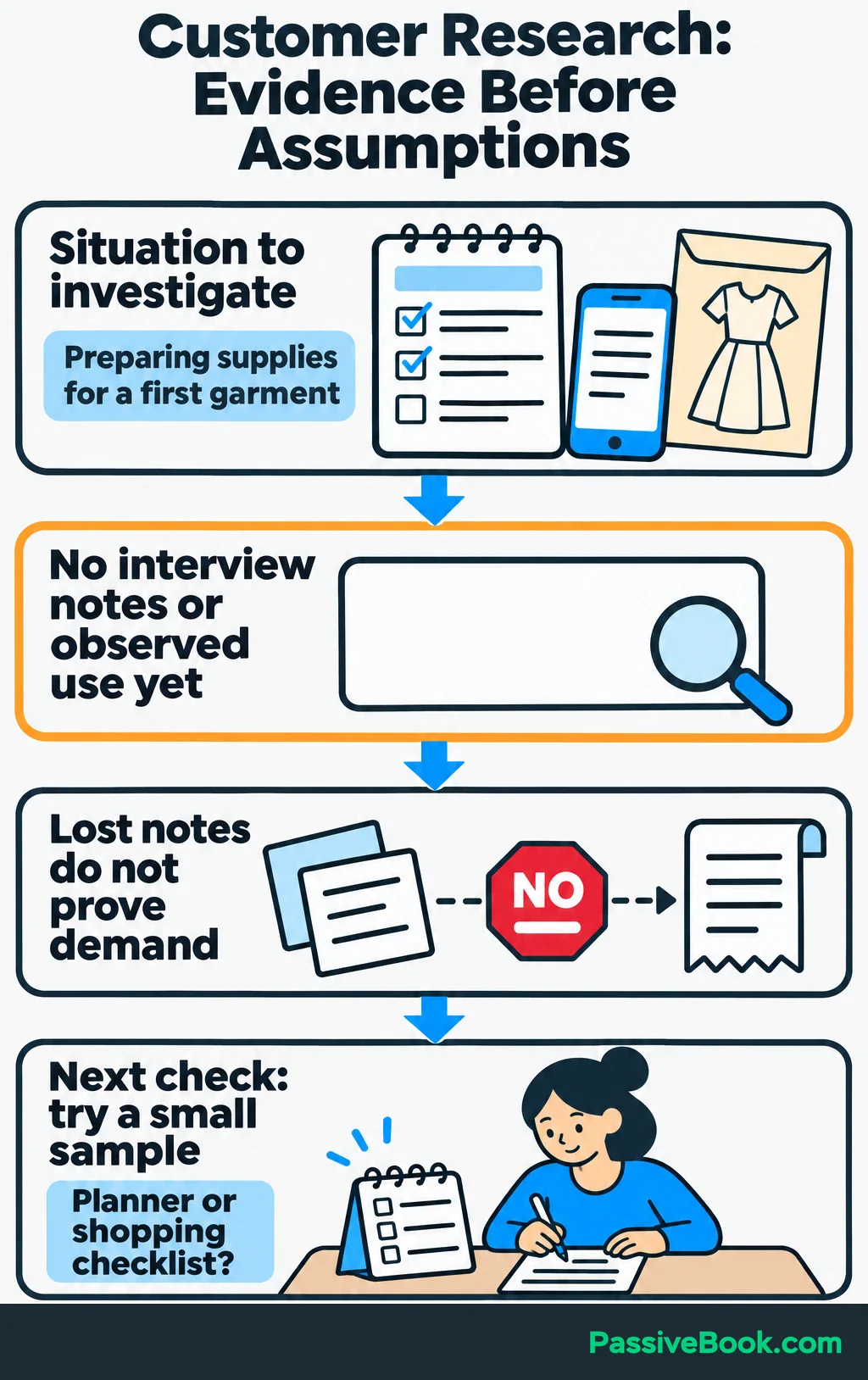
Ask about what happened:
- What needed repairing, and why did you want to keep the item?
- What did you try first?
- Where did you look for help?
- What did you spend money on, and what still felt difficult?
These questions reveal actions rather than polite guesses about whether someone might buy. Interviews are also one of the direct research methods covered in the SBA’s market research guidance.
Add evidence from product reviews, support questions and relevant discussions. Keep the customer’s words separate from your interpretation. A comment about struggling to see a stitch might suggest clearer demonstrations; it doesn’t automatically prove demand for a course.
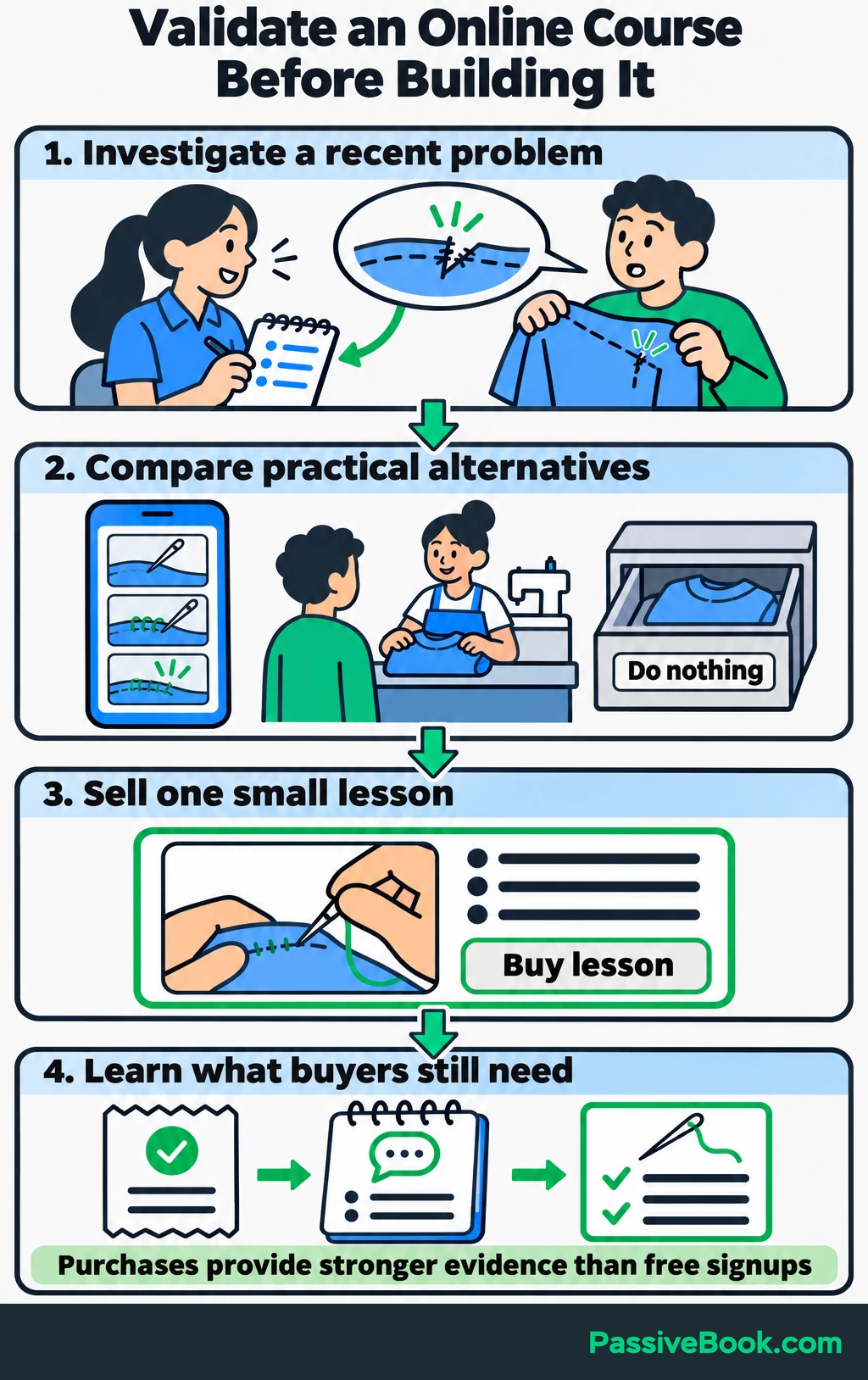
Compare every practical alternative, including free tutorials, repair services and leaving the garment in a drawer. Your competition includes doing nothing.
I skipped this work with my online jewellery store. I invested about $1,200 without doing market research and ended up with unsold inventory. Choosing stock felt like progress because I had something tangible to show for it. I had spent money before answering why anyone would choose my store.
For the repair course, I would test a small paid lesson before building a large library. Show what it teaches, let people buy it and ask what they still need afterward. Free signups can show interest, but purchases give you stronger evidence of willingness to pay.
2. Position an Offer You Can Sell Profitably
Give Buyers a Clear Reason to Choose You
Choose one offer to anchor the plan. If you already sell several products, compare their demand, the money left after refunds and per-sale costs, and the support they require.
I would prioritize an offer people want that you can deliver well without consuming every spare hour.
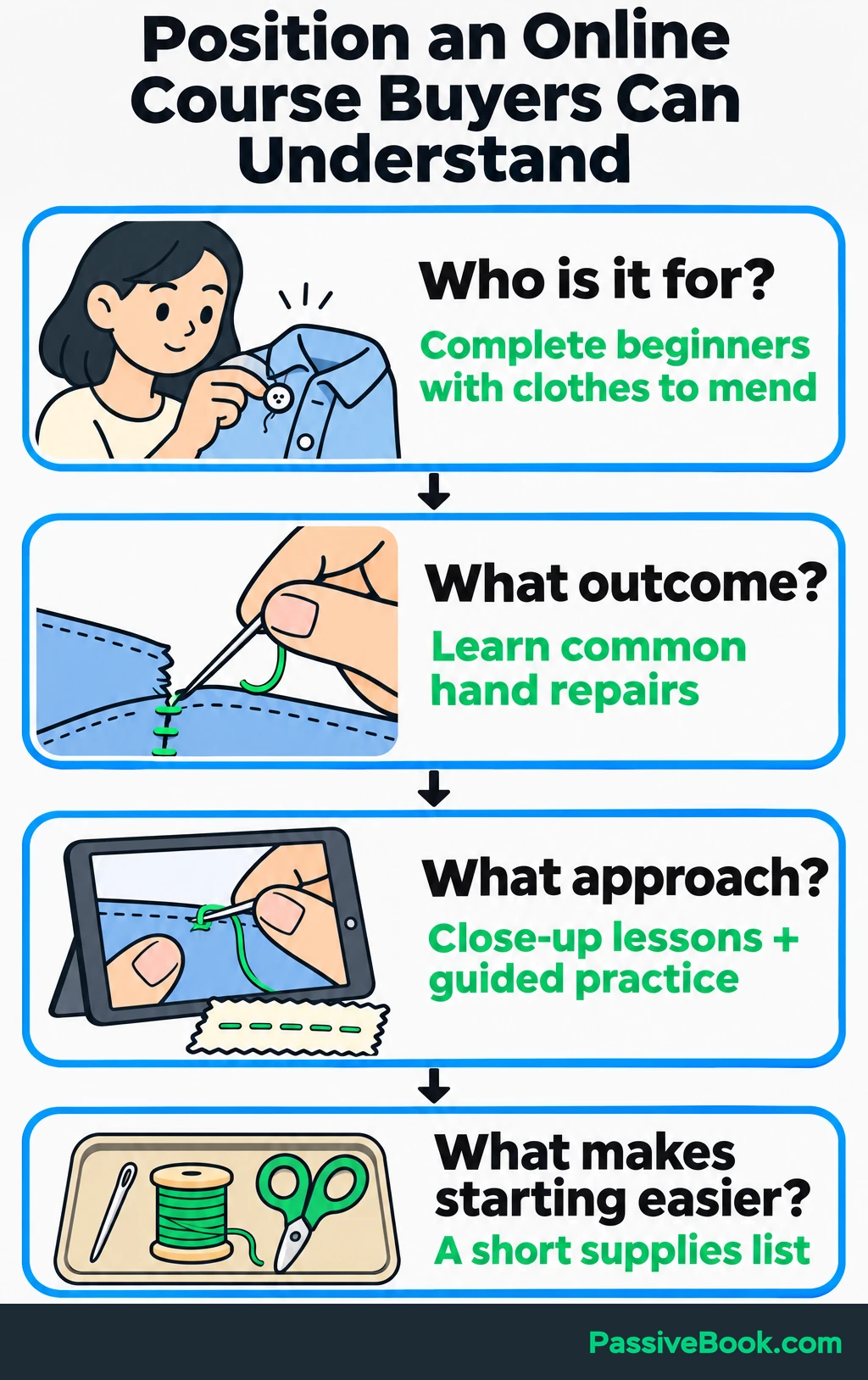
Then write a positioning statement:
For [people facing a specific problem], [offer] helps achieve [outcome] through [distinct approach].
For the repair course, that might become:
For complete beginners with everyday clothes to mend, this course teaches common hand repairs through close-up lessons, guided practice and a short supplies list.
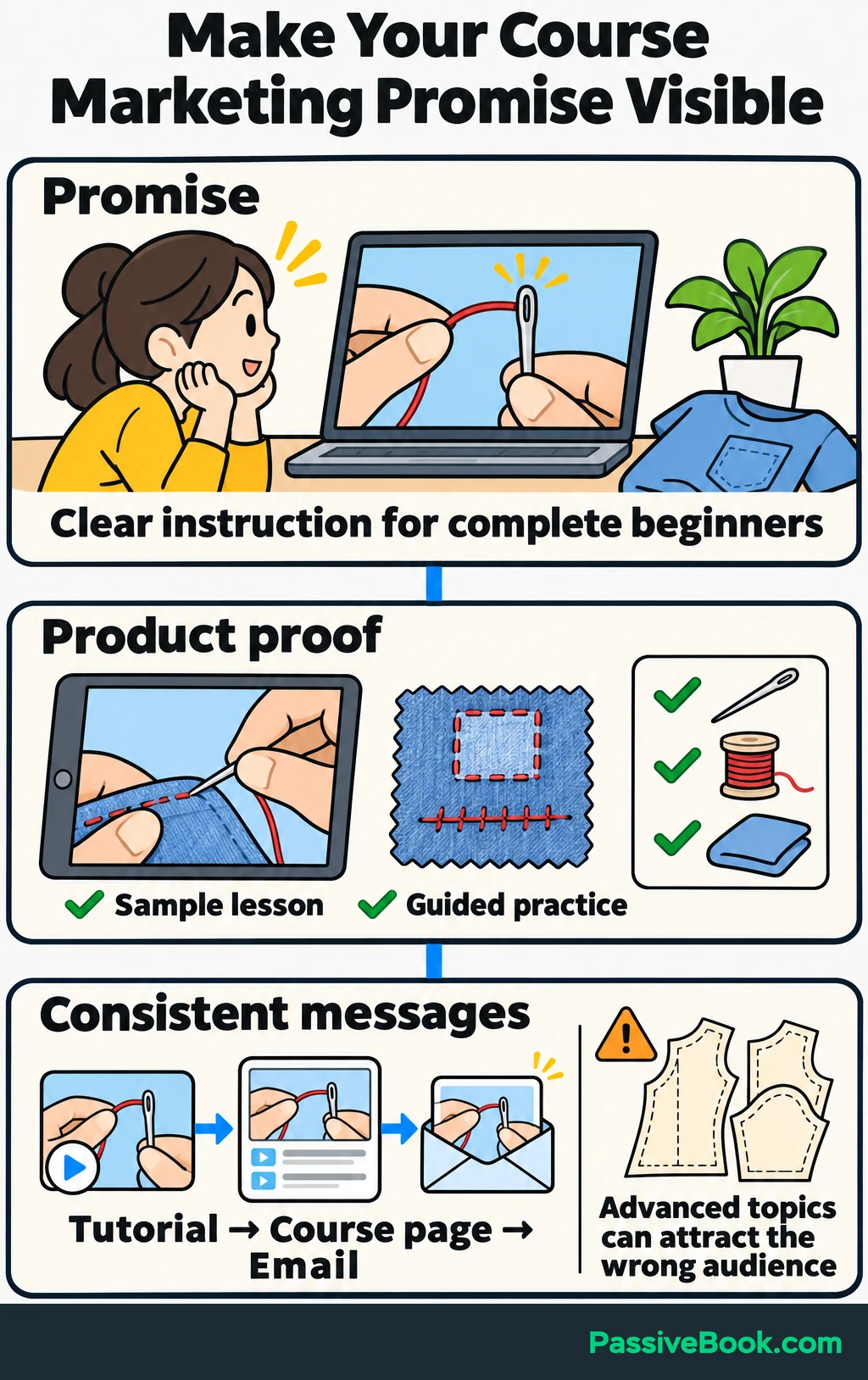
The advantage needs to appear in the product. Show the progression from threading a needle to practising a repair, and offer a sample lesson so buyers can judge the teaching.
Carry that same promise into your tutorials, course page and emails. If the attraction is clear instruction for beginners, content about advanced dressmaking will pull the strategy elsewhere.
Set an Acquisition-cost Ceiling
Before choosing channels, work out how much a sale leaves available for marketing.
Start with revenue after discounts, refunds and any taxes collected for remittance. Subtract costs that rise with each sale, such as payment fees and per-customer delivery costs. What remains is contribution before marketing.
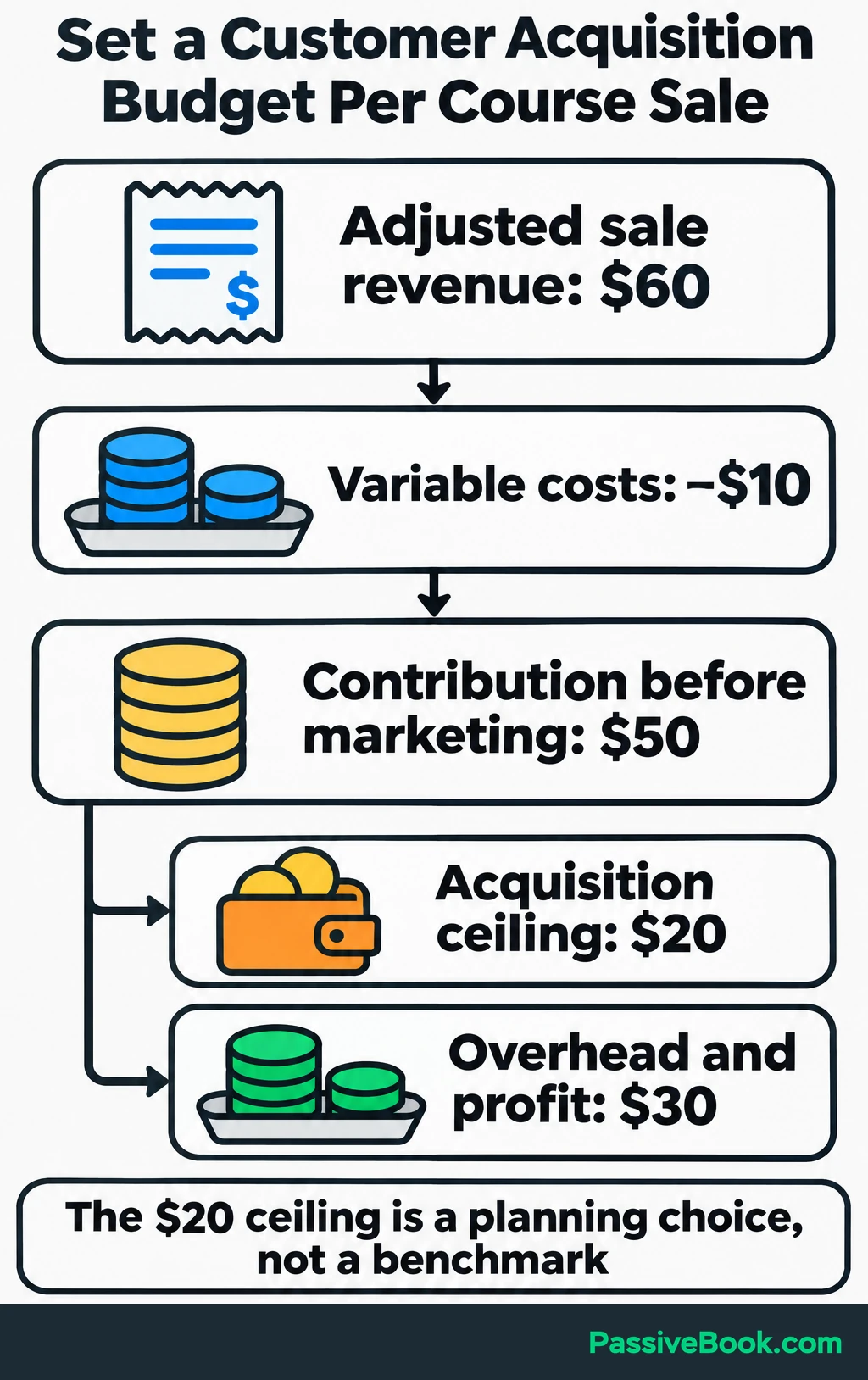
For planning, suppose a course sale brings in $60 after those adjustments, and variable costs are $10:
| Item | Amount |
|---|---|
| Revenue from one sale | $60 |
| Variable costs | −$10 |
| Contribution before marketing | $50 |
| Maximum acquisition spending | −$20 |
| Amount left for overhead and profit | $30 |
The $20 ceiling is a choice about what you need to retain. It isn’t an industry benchmark.
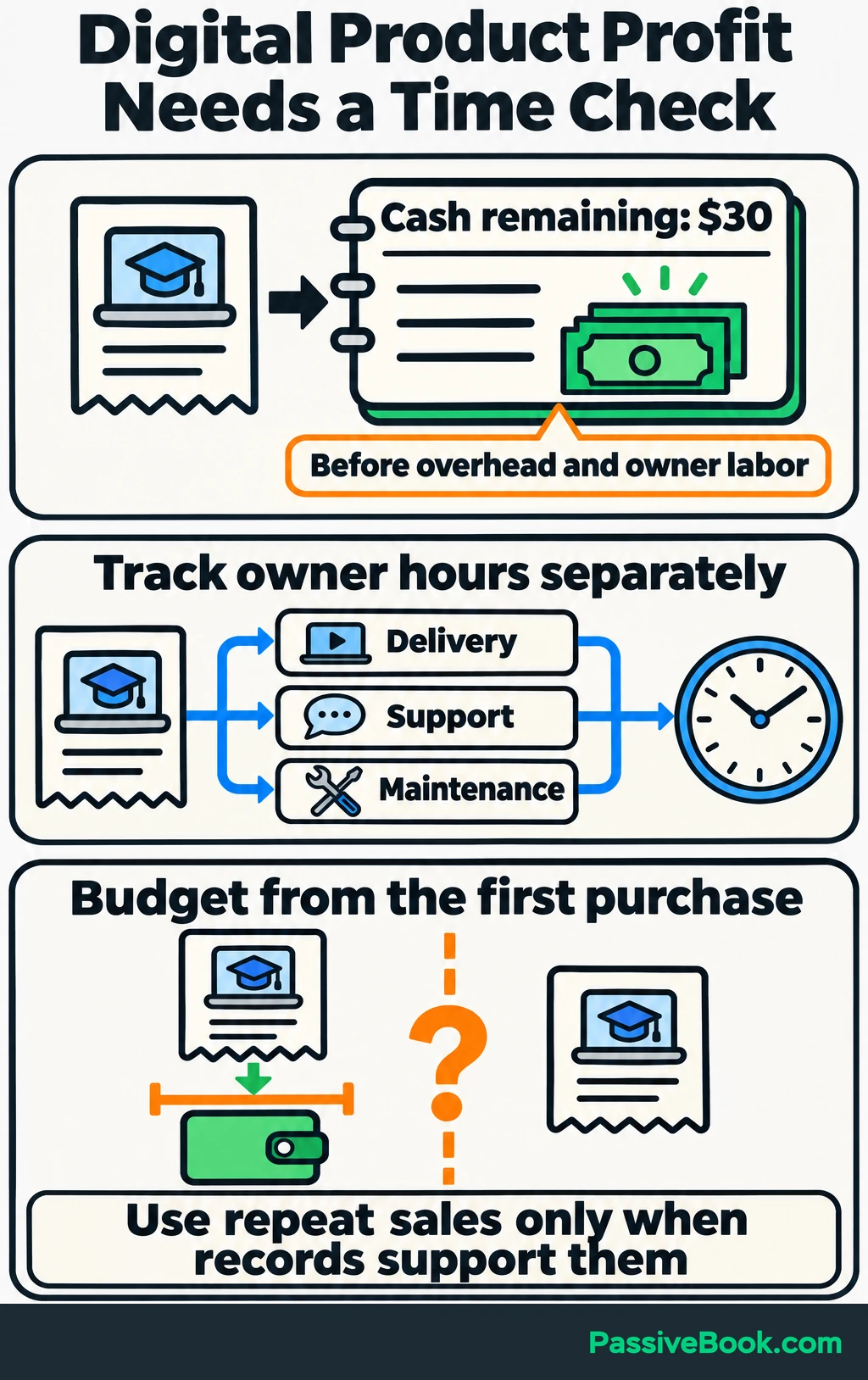
Base the ceiling on the first purchase until your own customer records support repeat-purchase assumptions. I wouldn’t fund acquisition with imaginary future sales.
Track your hours separately, too. An offer can look profitable in cash while quietly buying itself a full-time support person: you.
3. Set a Goal and Resource Limits
Choose one business outcome and a review date. That could be your first paying customers, more profitable orders or qualified enquiries for a service.
For the course, an initial planning goal could be ten first-time customers within 90 days of launch. That is a target to test, not a sales forecast.
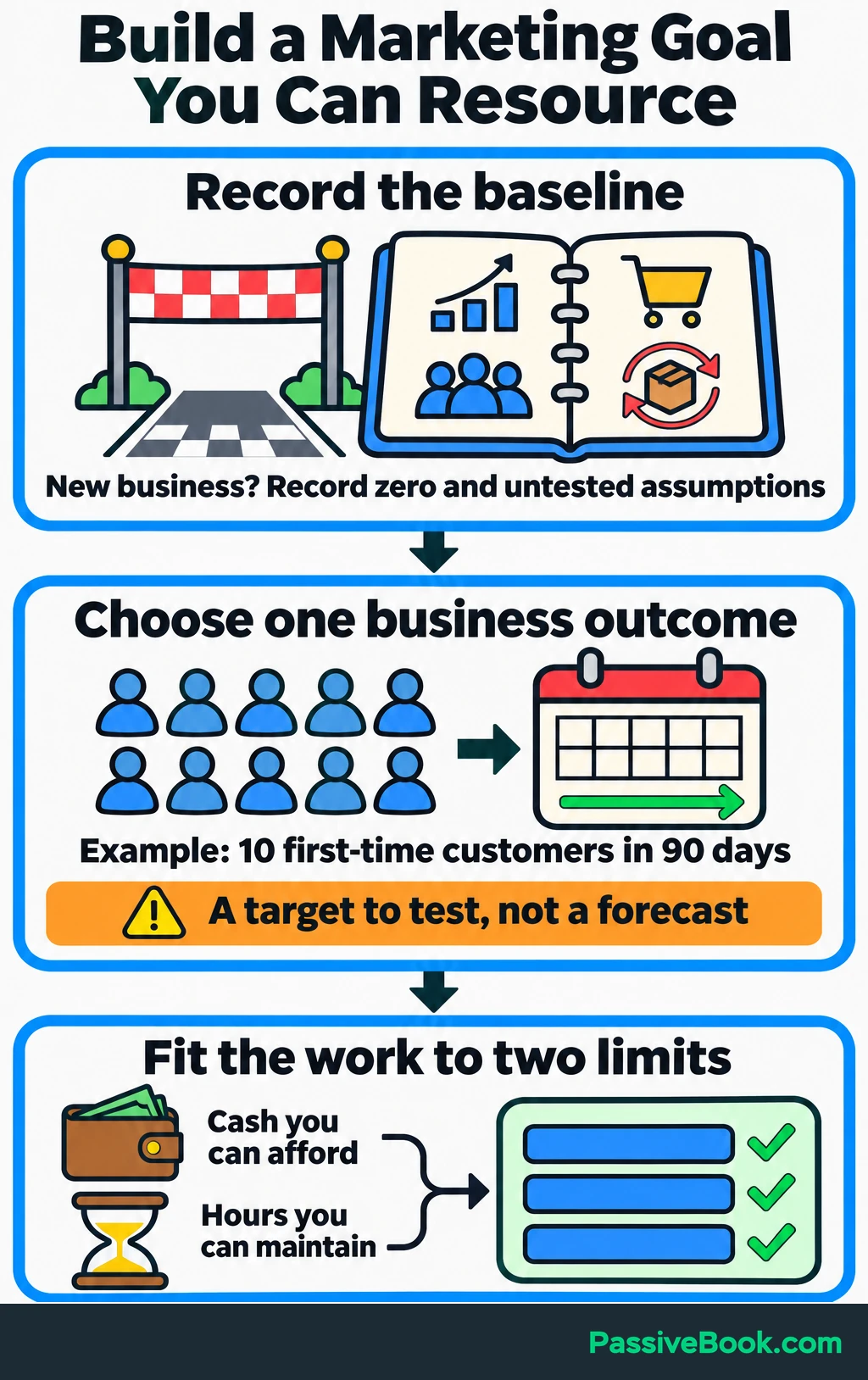
Record your starting point. An existing business should note current traffic, leads, sales, refunds and acquisition costs. A new business can record zero and list which assumptions remain untested.
Next, inspect what you already have. A relevant tutorial, a useful customer relationship or a working checkout may save more time than another tool.
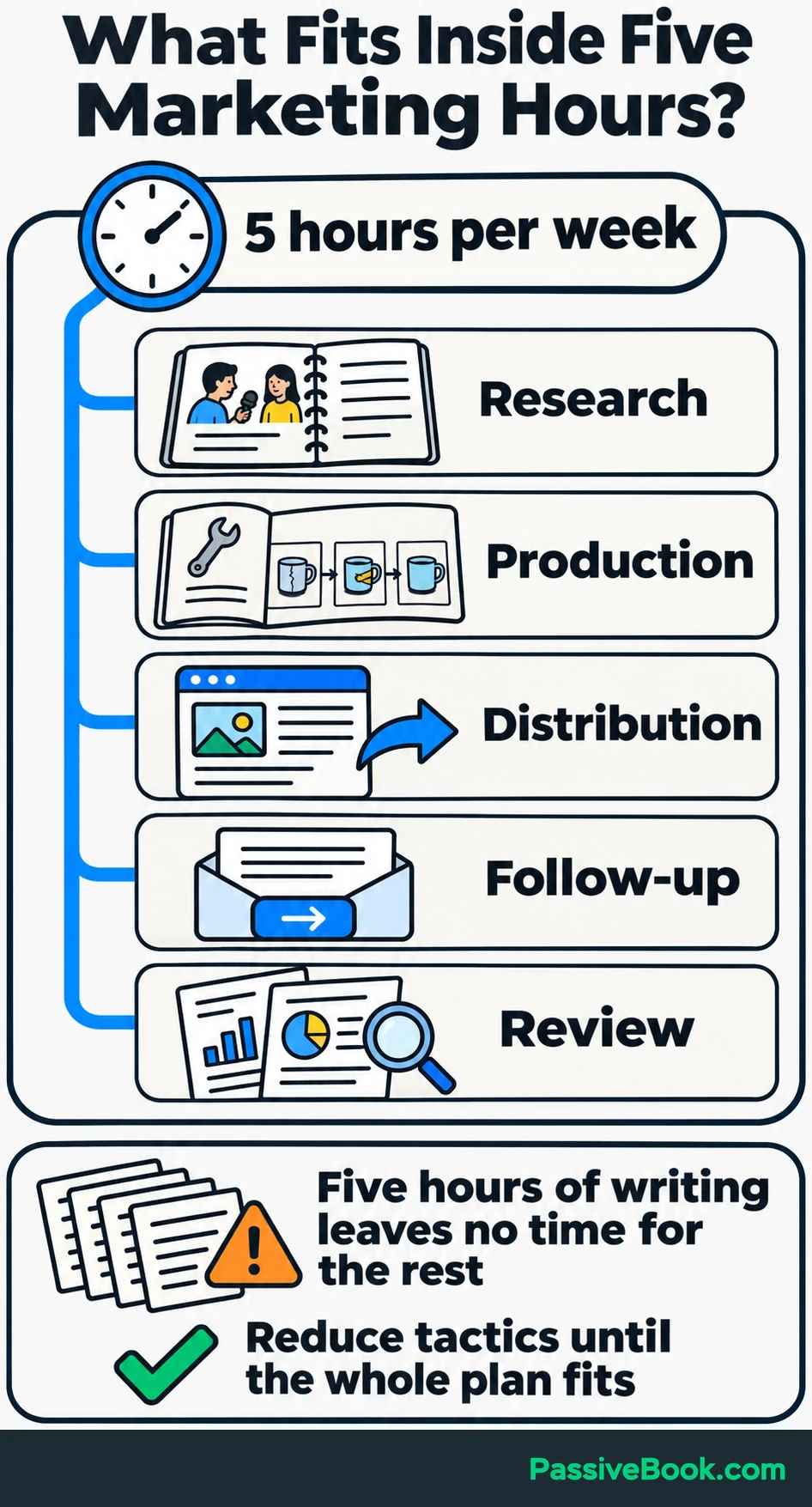
Set two separate limits:
- Cash: What can you spend without needing the plan to rescue your finances?
- Hours: What can you maintain alongside delivery, customer support and your other commitments?
A five-hour weekly allowance must cover research, production, distribution, follow-up and review. Five hours of writing plus everything else is a different budget.
Your strategy explains whom you will reach and why they will buy. Publishing articles and sending emails are tactics that carry it out. Reduce those tactics until the whole plan fits.
4. Choose a Focused Acquisition Channel Mix
Choose channels from customer behavior. Where do people look when they need help, and what can you produce well enough to earn their attention?
I would start with one main acquisition channel and a relevant page on your website. Add email when people need help before deciding to buy. Acquisition brings people in; follow-up continues the conversation.
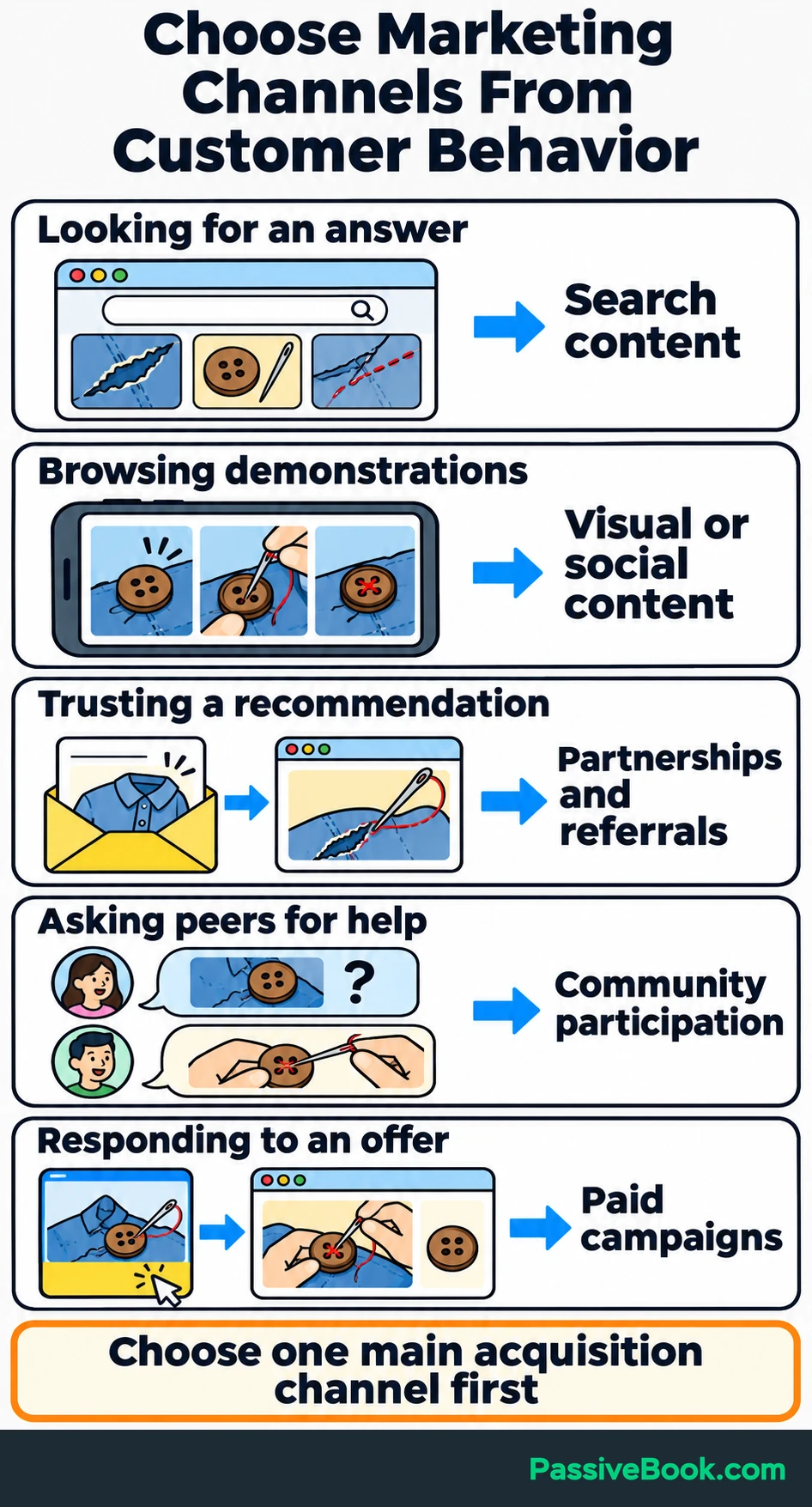
Use this comparison to narrow the options. The review windows are planning choices, so adjust them to the activity you actually observe.
| Channel | Customer Behavior Served | Required Assets | Ongoing Workload | Cash Cost | Early Success Signal | Evaluation Window |
|---|---|---|---|---|---|---|
| Search content | Looking for an answer or comparing solutions | Useful pages, clear demonstrations, internal links | Research, publishing and updates | Production and website costs; no ad spend | Relevant search clicks and next-step actions | Check monthly; allow several months to assess the direction |
| Visual or social content | Browsing ideas and watching demonstrations | Image sequences or short demonstrations, relevant destination | Regular production, distribution and replies | Creation costs; promotion optional | Visits that lead to signups or offer views | Review an initial four-to-six-week batch |
| Partnerships and referrals | Following a trusted recommendation | Audience fit, useful contribution, tracked link | Outreach and relationship management | Time, plus any agreed fee or commission | Referred visitors taking useful actions | Review each placement after its follow-up window |
| Community participation | Asking peers for practical help | Helpful answers and a relevant resource | Consistent participation within community rules | Mainly working time | Relevant enquiries or permitted referral visits | Review after a month of useful participation |
| Paid campaigns | Responding to a targeted offer | Tested offer, landing page, tracking and creative | Monitoring, creative changes and budget control | Ad spend plus production | Customers acquired within the cost ceiling | Set a spending cap and decision point before launch |
For the repair course, I would investigate search-led tutorials first. Check whether prospective buyers search for specific repairs, then inspect the results. Can you answer the question clearly, and is there a sensible connection to the course?
A sewing newsletter partnership could later complement search by introducing the lessons to a relevant audience. It doesn’t need to become a second publishing treadmill.
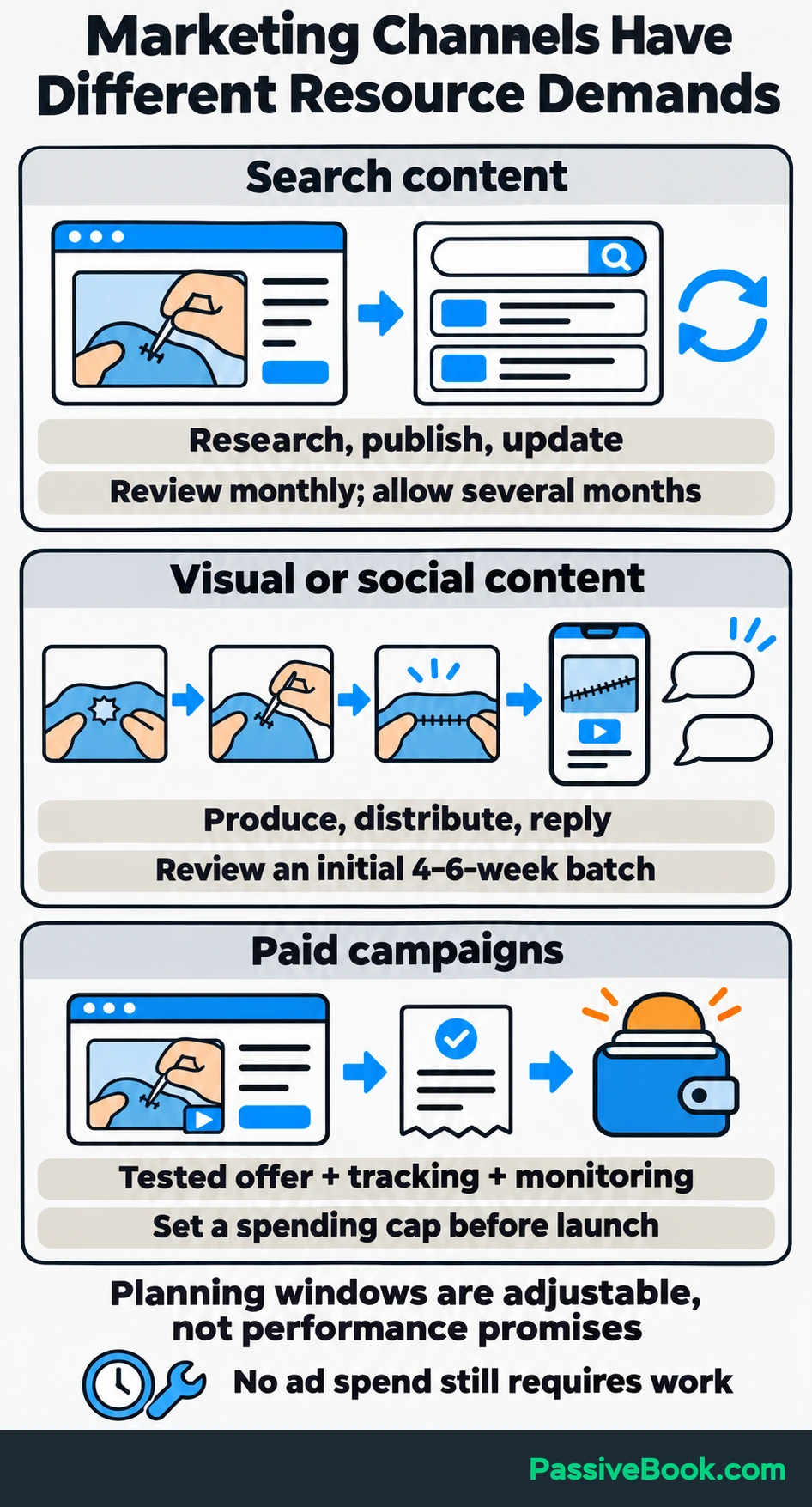
Search needs patience. Google says website changes can take hours to several months to affect search results. That describes search visibility, not a promise of profitable traffic. Set your review window accordingly. Google’s SEO Starter Guide
You can also choose formats that keep you off camera: illustrated guides, annotated photos or overhead demonstrations of your hands.
Organic acquisition is a reasonable starting choice when it fits the customer and your resources. Budget for the work even when advertising spend is zero.
5. Map the Path From Discovery to Purchase
Match Each Page to the Visitor’s Next Decision
Draw the shortest useful route from discovering your business to receiving the product:
Discovery → relevant page → purchase → delivery
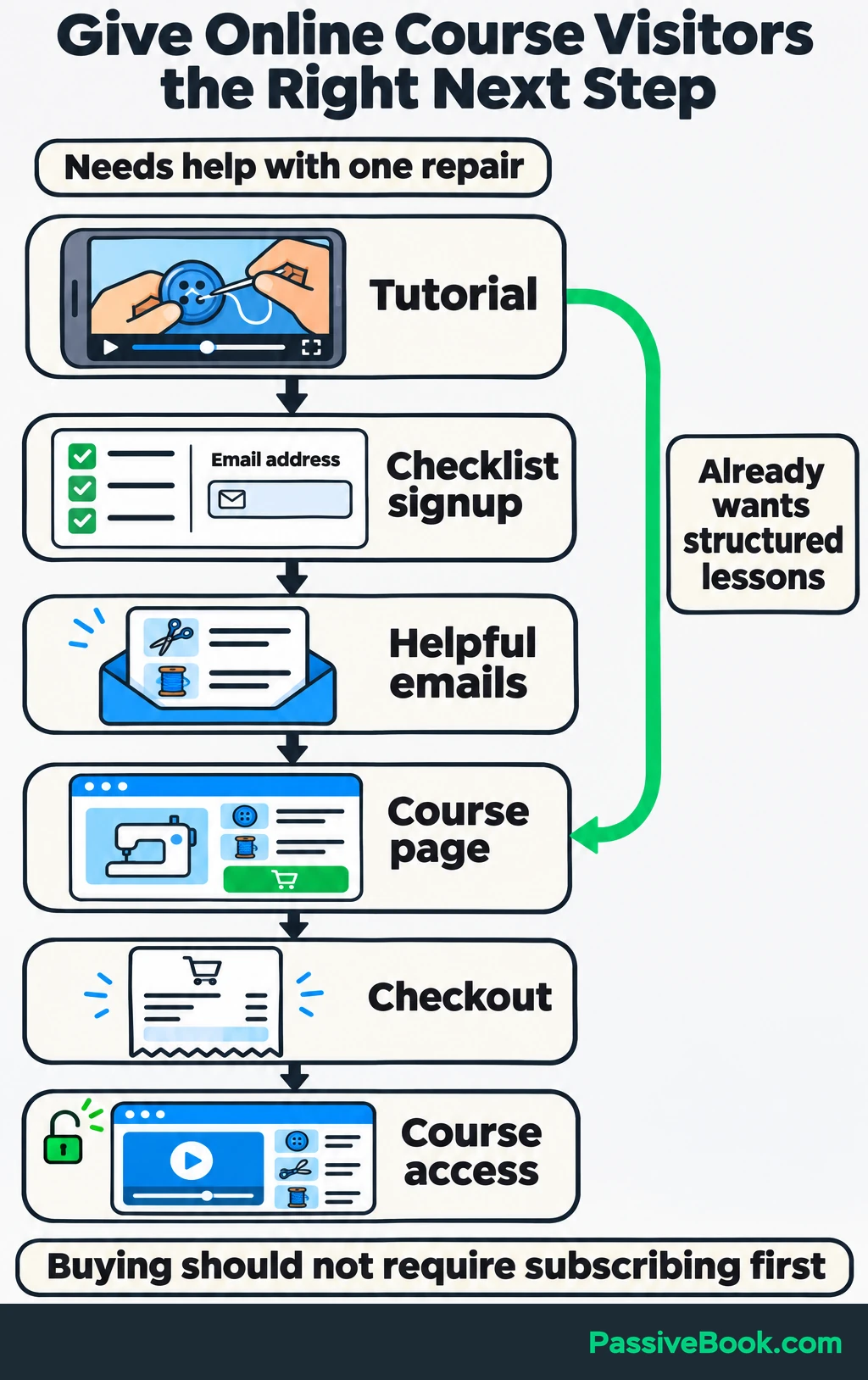
Add a signup and follow-up sequence when the visitor needs more help. Someone searching for a course may be ready to see the offer. Someone trying to fix one button probably wants that answer first.
For the course, the longer route could be:
Loose-button tutorial → sewing-kit checklist signup → helpful emails → course page → checkout → course access
Keep a direct course link available for people who already want structured lessons. Don’t make them subscribe to earn the right to buy.
The course page should explain:
- Who the lessons suit and what learners should be able to do.
- Which repairs are included and what supplies they need.
- How the lessons work, with sample material.
- What the course costs and what happens after payment.
- Available evidence, such as clear demonstrations or genuine customer feedback.
- How to purchase and where to ask questions.
When you have no testimonials, show the teaching. A sample lesson gives buyers something real to assess.
Now work backward from your goal. For the email route, count tutorial visitors who aren’t already subscribers or customers, then track which ones sign up and make a first purchase.
Suppose 10% of those visitors sign up through the tutorial, and 5% of those new subscribers buy within 30 days of signup:
- Ten purchases require 200 subscribers:
10 ÷ 0.05. - Those 200 subscribers require 2,000 eligible tutorial visitors:
200 ÷ 0.10.
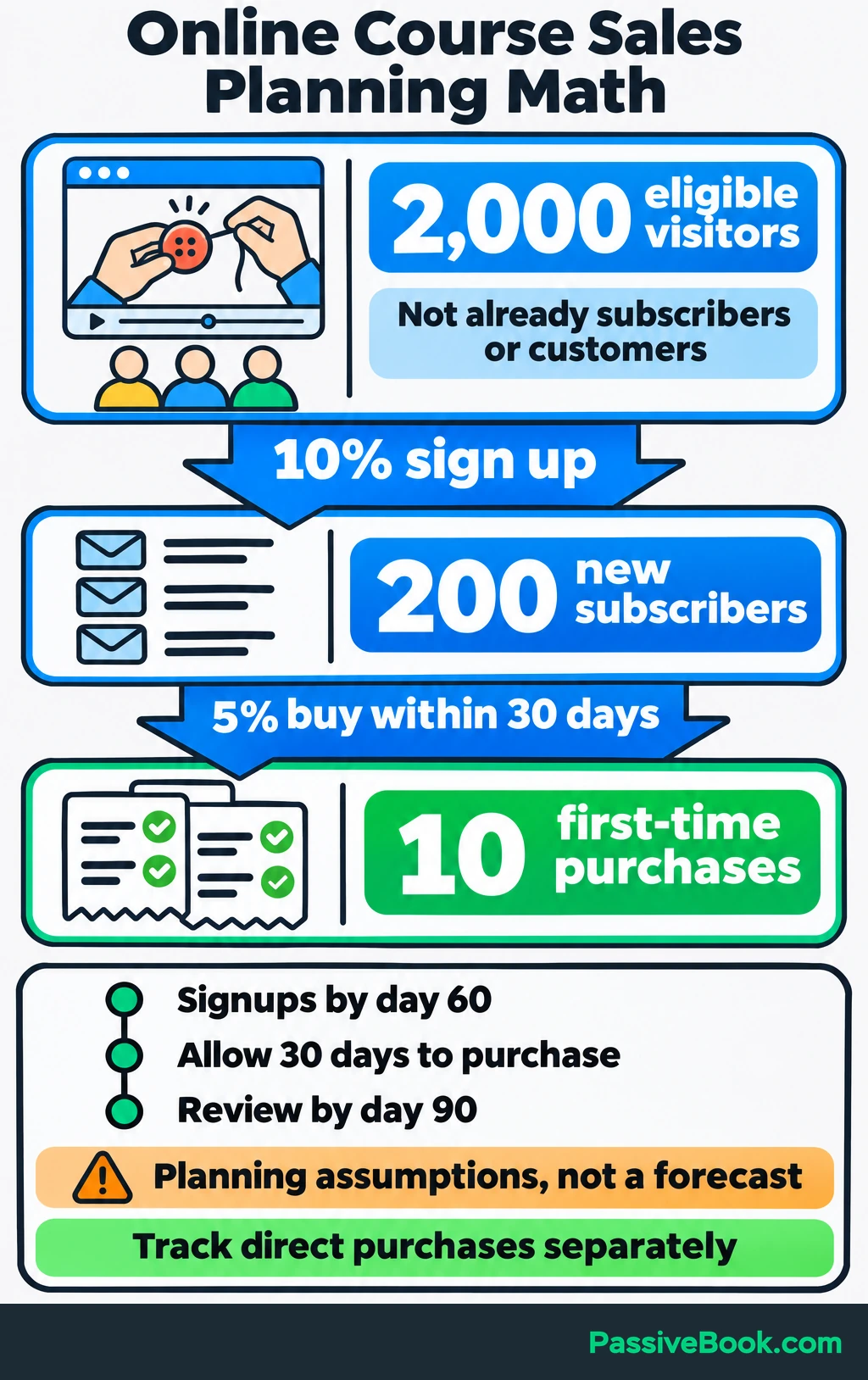
These are planning assumptions. To allow the full 30-day purchase window within your 90-day goal, plan to get those signups by day 60. Replace the assumed rates with observed rates once each signup group has had 30 days to buy, and track direct purchases separately.
If the required volume looks unrealistic, revisit the offer, route or timeline before committing to more production.
The traffic target is only part of the decision. You can use the planner below to check it alongside the work and cash needed to support it.
Free Marketing Campaign Planner




Make the form usable, too. Keep “Email address” visible above or beside the field and use the form builder’s label setting so screen-reading software can identify it. Text that disappears when someone types isn’t a substitute for a label. W3C’s guidance on form labels
Use Email to Support the Buying Decision
Offer a signup resource that helps with the same problem as the paid product. A basic sewing-kit checklist fits the course because learners need supplies before practising.
Explain that signing up brings the checklist and follow-up lessons or offers. Don’t promise a download and quietly turn it into an unrelated newsletter.
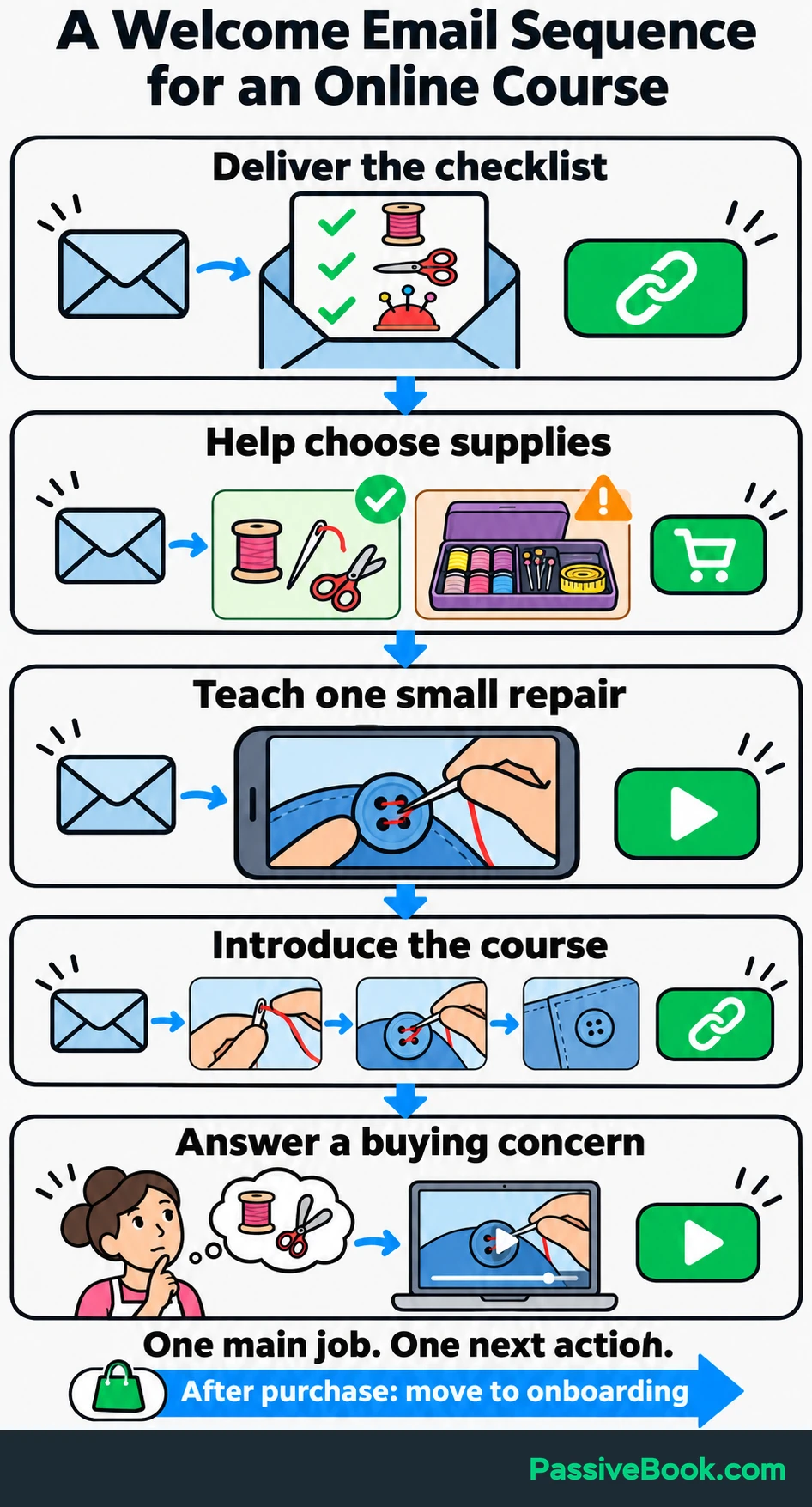
A short welcome sequence could:
- Deliver the checklist and explain how to use it.
- Help the subscriber choose supplies without buying an unnecessary kit.
- Teach one small repair through a linked demonstration.
- Introduce the course and show how its lessons connect.
- Answer a purchase concern that customer conversations have revealed.
Give each email one main job and one next action. For example:
Before buying more supplies, check the list against what you already have. Open the checklist and mark what’s missing.
For WordPress, I would consider FluentCRM to manage the sequence within the site. If you want a separate email service, compare Kit and MailerLite. Start with the tool you can maintain, and skip a migration if your current service already handles the sequence.
Move buyers out of prospect promotions and into onboarding. Send access instructions, point to the first lesson and explain how to get help.
Writing these pieces separately can leave gaps between what the page promises and what the emails say. The AI Skill below uses the same offer notes to draft them together.

Free AI Copywriting Studio
Use permission-based signups and follow the email rules that apply to your audience. For U.S. commercial email, the FTC’s requirements include accurate sender details and subject lines, clear advertising identification, a valid postal address and an easy opt-out. Opt-outs must be honored within ten business days. FTC CAN-SPAM guidance
6. Plan Content Around Buying Questions
Build your content plan from decisions buyers need to make. They need to understand the problem, choose an approach, assess your offer and get started after buying.
For the repair course, I would begin with a connected set: one useful tutorial, the checklist, the course page and supporting emails. Add content when it answers another relevant question.
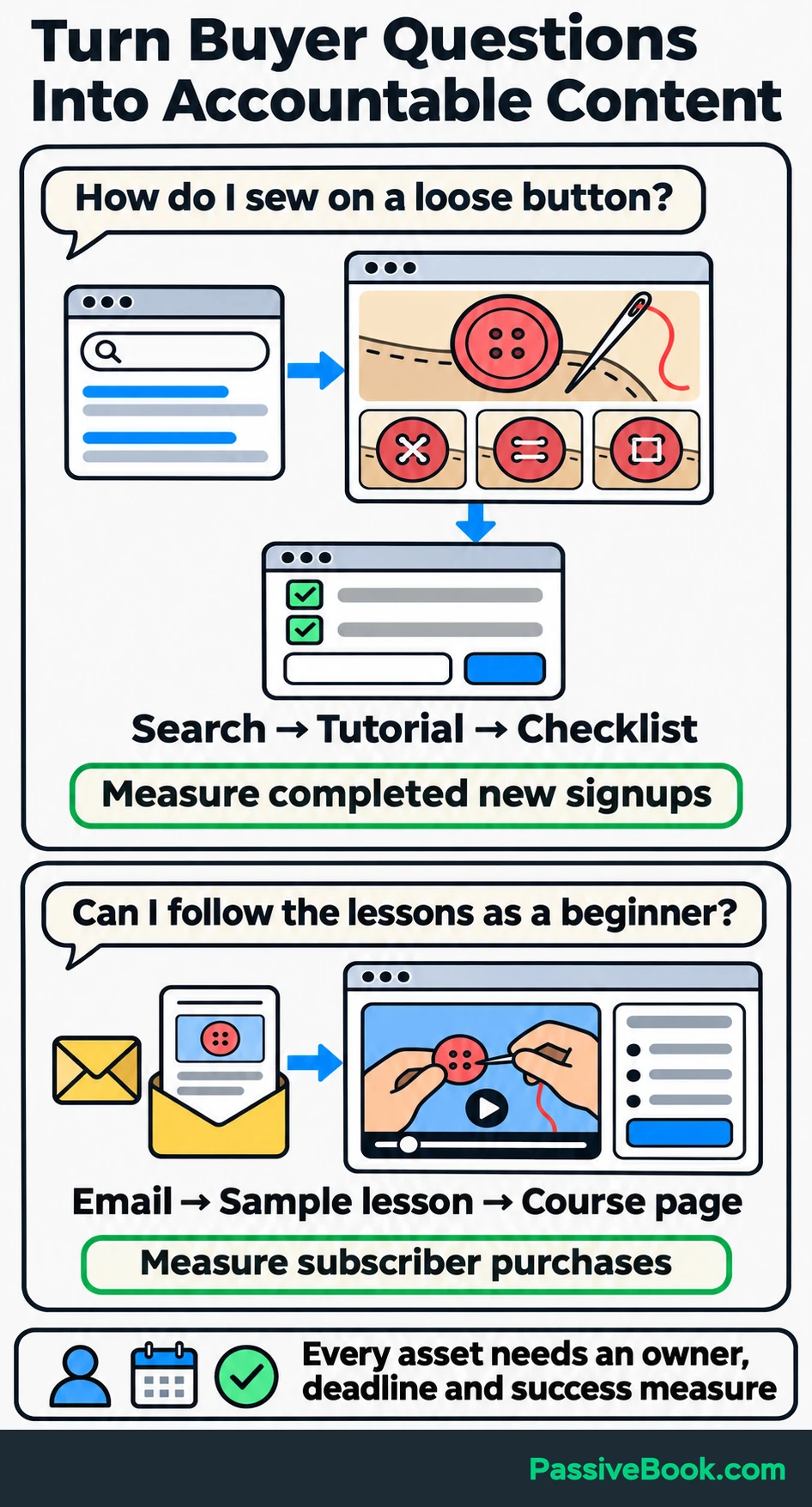
Use a table like this to make each asset accountable. Relative publication dates can become calendar dates when you schedule the work.
| Customer Question | Buying Stage | Format | Distribution Channel | Destination | Call to Action | Owner | Publication Date | Success Measure |
|---|---|---|---|---|---|---|---|---|
| How do I sew on a loose button? | Solving an immediate problem | Illustrated tutorial | Organic search | Button-repair tutorial | Download the sewing-kit checklist | You | Launch day | Completed new signups from tutorial visitors |
| Will I be able to follow the lessons with no experience? | Assessing the course | Sample lesson and explanation | Welcome email | Course page | Watch the sample lesson, then view enrollment details | You | Launch day | Purchases by subscribers who viewed the page |
Create the main asset first, then adapt useful parts for distribution. The tutorial’s close-up photographs could become an image sequence for a partner newsletter or a visual channel you later choose.
Publishing frequency should follow your available hours. One strong tutorial every two weeks may be a better plan than weekly articles that leave no time for emails or updates.
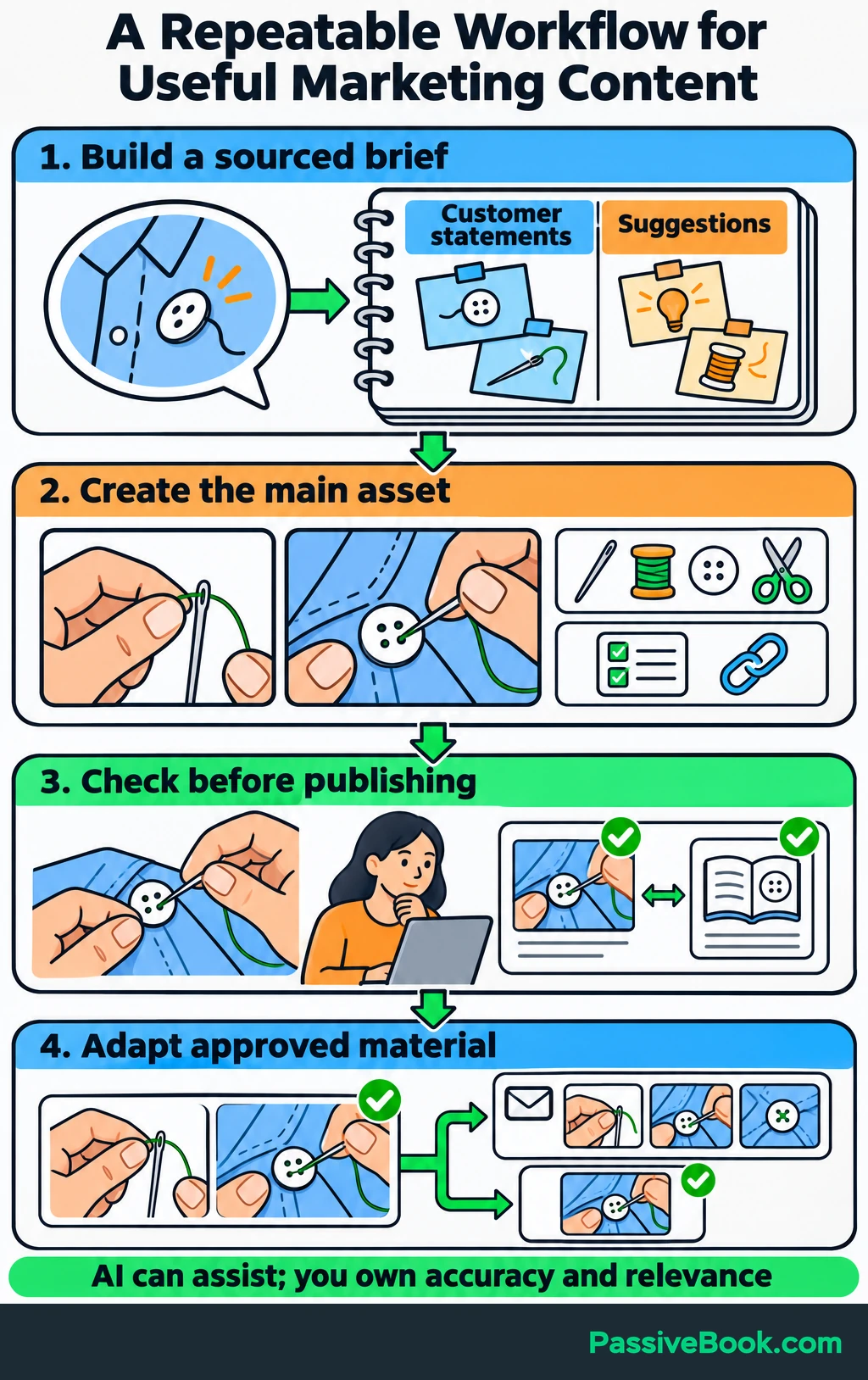
AI can organize research notes, prepare briefs, draft alternatives and adapt approved material. Give it source notes and ask it to separate customer statements from suggestions.
My custom AI content pipeline reduced article production from days to hours. The useful change was having a repeatable process for briefs, drafts and review. It didn’t remove the need to decide which articles deserved to exist.
Check every repair demonstration yourself and review factual claims before publishing. Google’s guidance also emphasizes accuracy, quality and relevance when using generative AI content. Google’s generative AI guidance
7. Define How You Will Measure Results
Connect Channel Activity to Business Outcomes
Track the path you expect people to follow:
Relevant visits → completed signups → new customers → contribution after marketing
For a service, replace purchases with qualified enquiries and confirmed clients. Define “qualified” with observable conditions, such as needing your service, fitting its scope and asking about a paid engagement.
Use website analytics to track visits and signups, email reports to review follow-up, and order records to confirm purchases and refunds. Google Search Console shows which Google searches bring visitors to your pages.
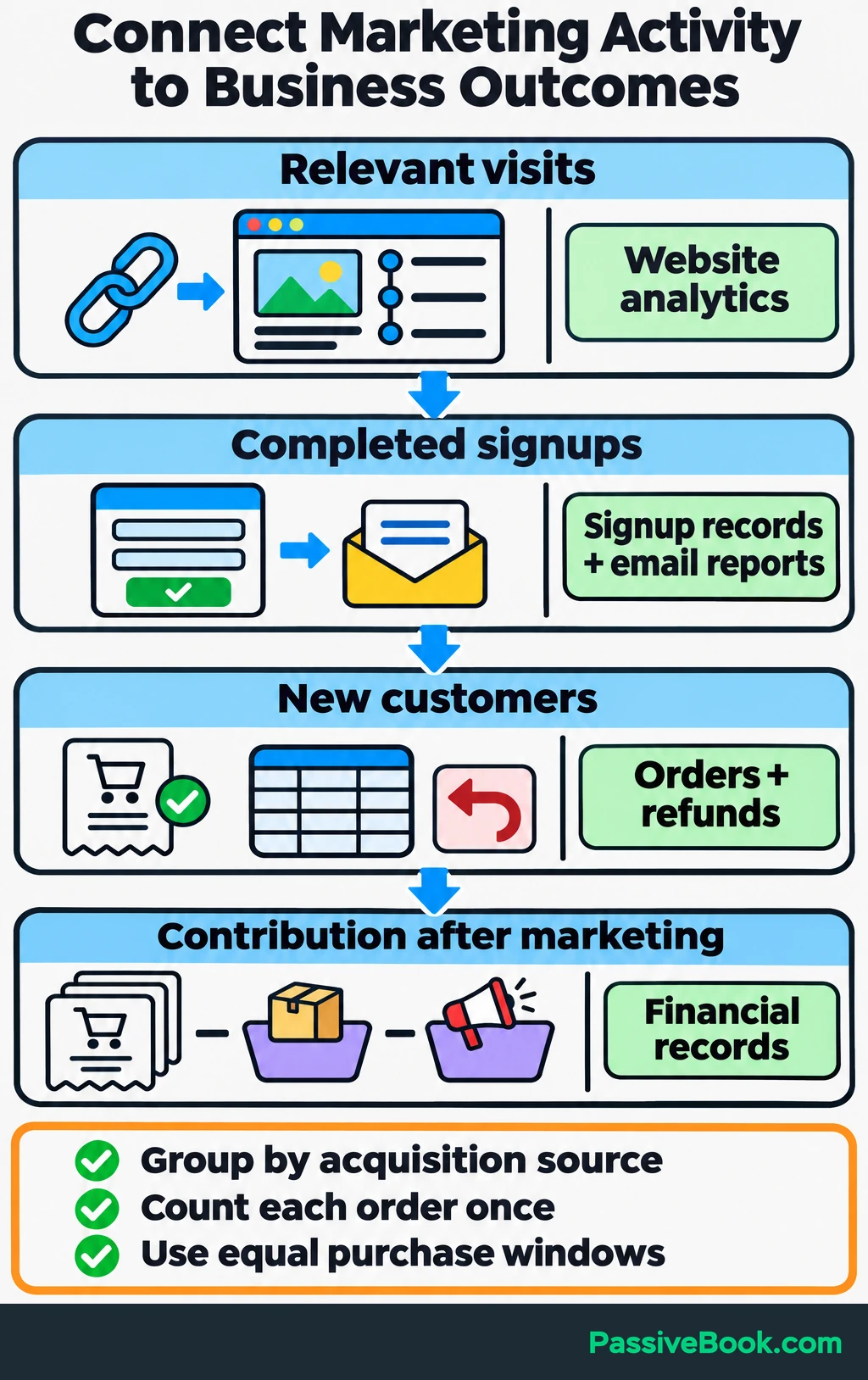
Keep a dashboard by acquisition source with relevant traffic, new leads, new customers, revenue, refunds, marketing costs and owner hours. Test signup and purchase tracking against actual records, and count each order once.
Add consistent tracking tags to external links you control. For a partner newsletter, use sewing_newsletter as the source, referral as the medium and repair_course_launch as the campaign. Keep these tags off internal links.
When calculating subscriber-to-customer rates, count only first-time buyers from the subscriber group being reviewed and give each group the same purchase window.
Calculate Acquisition Cost and Marketing ROI
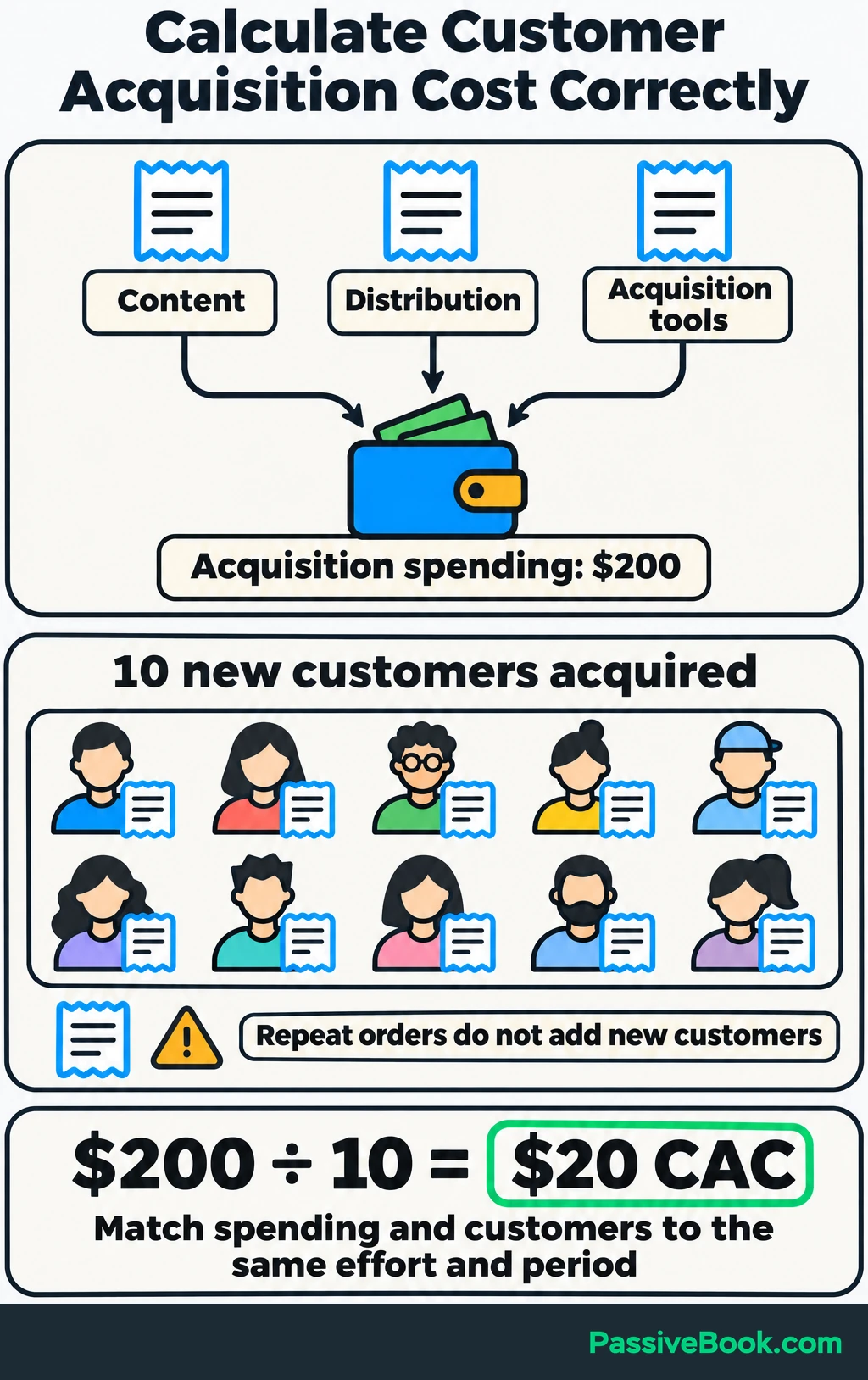
Customer acquisition cost tells you how much acquisition spending went into each new customer.
Count spending and new customers from the same acquisition effort and review period. Include content, distribution, advertising and acquisition tools, and exclude repeat orders from the customer count.
Customer acquisition cost = acquisition spending ÷ new customers acquired
For marketing ROI, estimate how much more contribution you earned because of the activity than you would have earned without it. Subtract marketing spending from that additional contribution, then compare the remainder with what you spent:
Marketing ROI = (incremental contribution before marketing − marketing cost) ÷ marketing cost × 100
Using the course assumptions, suppose a campaign produces ten additional first-time purchases:
| Item | Calculation | Result |
|---|---|---|
| Revenue | 10 purchases × $60 | $600 |
| Variable costs | 10 purchases × $10 | $100 |
| Contribution before marketing | $600 − $100 | $500 |
| Marketing spending, all on acquisition | Content, distribution and acquisition tools | $200 |
| Acquisition cost | $200 ÷ 10 new customers | $20 |
| Marketing ROI | ($500 − $200) ÷ $200 × 100 | 150% |
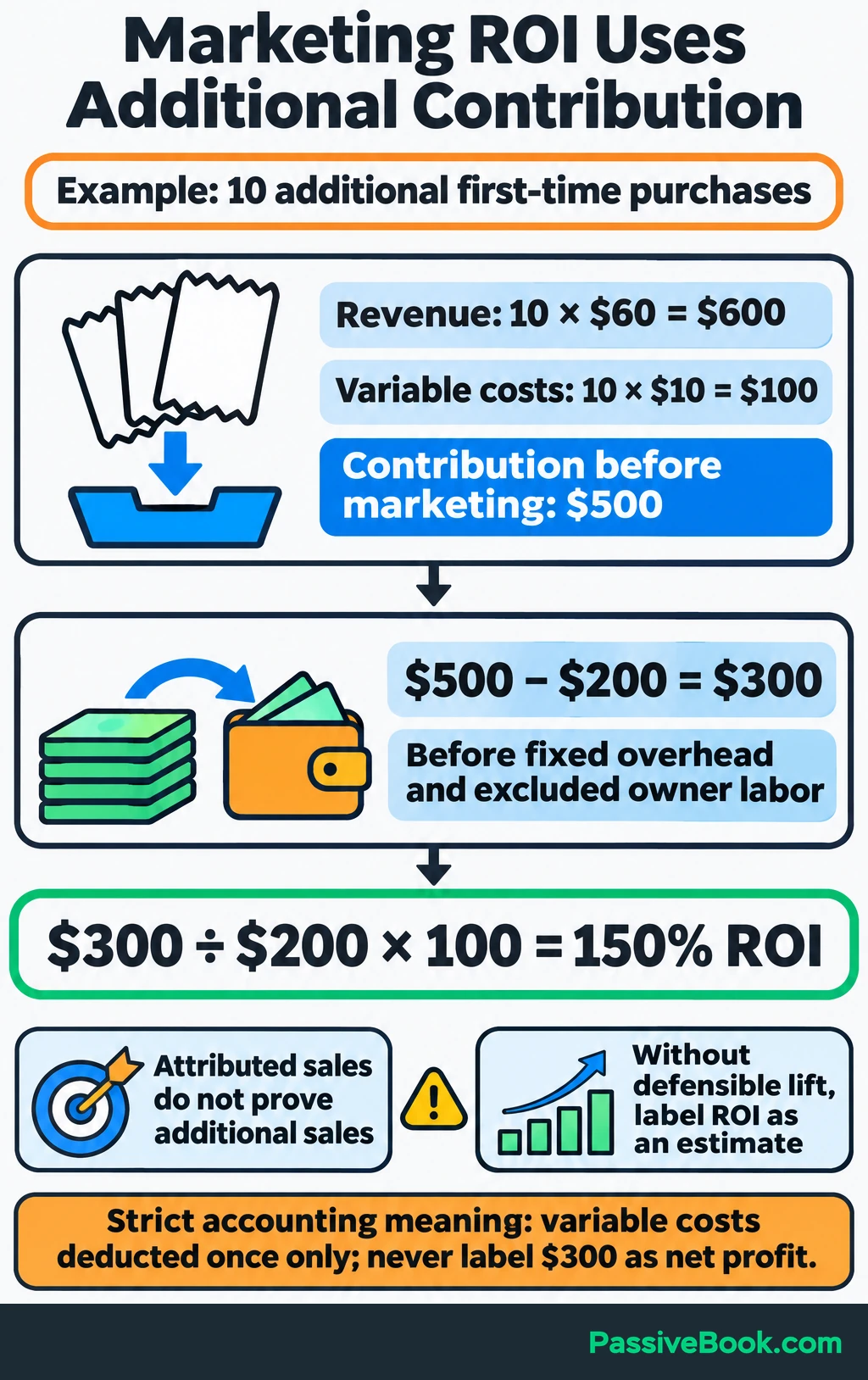
That leaves $300 before fixed overhead and excluded owner labor. The variable costs have already been deducted, so don’t subtract them again as marketing expenses.
Attribution assigns credit for a purchase to the ads, clicks or other marketing interactions a buyer encountered, as Google’s attribution overview explains. That credit doesn’t prove marketing caused the sale. If you use credited orders rather than a defensible estimate of additional sales, label the ROI as an estimate.
When marketing spending is zero, report contribution and hours invested. An ROI percentage with a zero denominator won’t tell you anything useful.
8. Launch the Strategy With Repeatable Workflows
Bring your decisions into a one-page plan. Keep it short enough to consult when another tempting tactic appears.
Here is a completed planning example for the course, assuming the validated product and website already exist:
| Decision | Working Plan |
|---|---|
| Audience | Beginners who want to repair everyday clothes by hand |
| Customer problem | They struggle to follow scattered repair instructions and choose basic supplies |
| Offer | Self-paced hand-repair course |
| Positioning | Close-up lessons with guided practice and a minimal supplies list |
| Goal | Ten first-time customers within 90 days of launch |
| Acquisition-cost ceiling | $20 per new customer |
| Primary acquisition channel | Search-led repair tutorials |
| Buying path | Tutorial → checklist → welcome emails → course → checkout → access, with a direct purchase option |
| First content priorities | Button tutorial, checklist, course page, sample lesson and welcome sequence |
| Resource limits | $200 in marketing cash and five working hours per week |
| Responsibilities | You handle publishing, email, customer support and measurement |
| Launch deadline | End of preparation week four |
| Review schedule | Weekly journey checks, monthly progress review and a 90-day business review |
That launch deadline covers marketing preparation, not building a large course from scratch. If the offer is untested, return to the small paid lesson first.
Give each essential asset its own deadline. Then test the complete journey on mobile: discovery link, page, form, email, checkout, confirmation and course access.
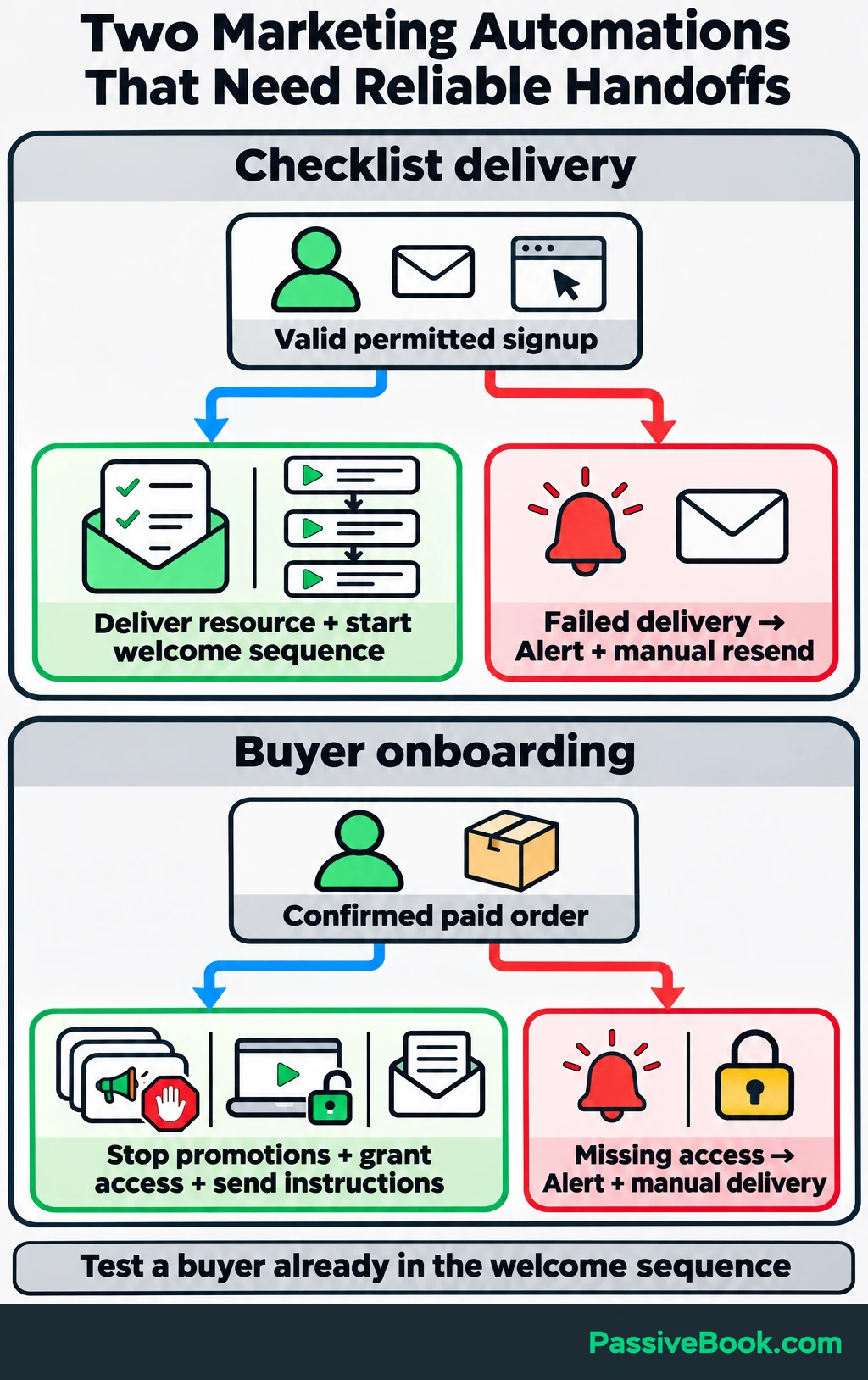
Automate the handoffs once they work:
| Workflow | Trigger and Required Information | Expected Result | Failure Response |
|---|---|---|---|
| Checklist delivery | New permitted signup with a valid email address and source | Send the resource and begin the welcome sequence | Alert you to failed delivery and provide a manual resend |
| Buyer onboarding | Confirmed paid order with customer email and product | Stop prospect promotions, grant access and send the first-lesson instructions | Alert you to missing access and allow manual access delivery |
Use your existing email and checkout tools where possible. Make and n8n connect apps and pass information between them. I’d add one only if your existing tools can’t pass signup or purchase details directly.
I would automate resource delivery before building an elaborate content machine. Missing access after payment is a more urgent problem than an unscheduled social post.
Test with sample records, including a buyer already in the welcome sequence. Keep time for maintenance and review in the weekly allowance. Automation still needs an owner.
9. Improve the Bottleneck Before Expanding
Review results against your goal, starting point, acquisition-cost ceiling and resource limits.
Use the buying path to decide where to investigate:
- Too little relevant traffic: Check targeting, search visibility and distribution.
- Visits without action: Examine whether the page answers the question and offers a useful next step.
- Leads without purchases: Review the offer, recurring objections, sales page and checkout.
- Purchases followed by refunds: Compare expectations with the teaching and delivery.
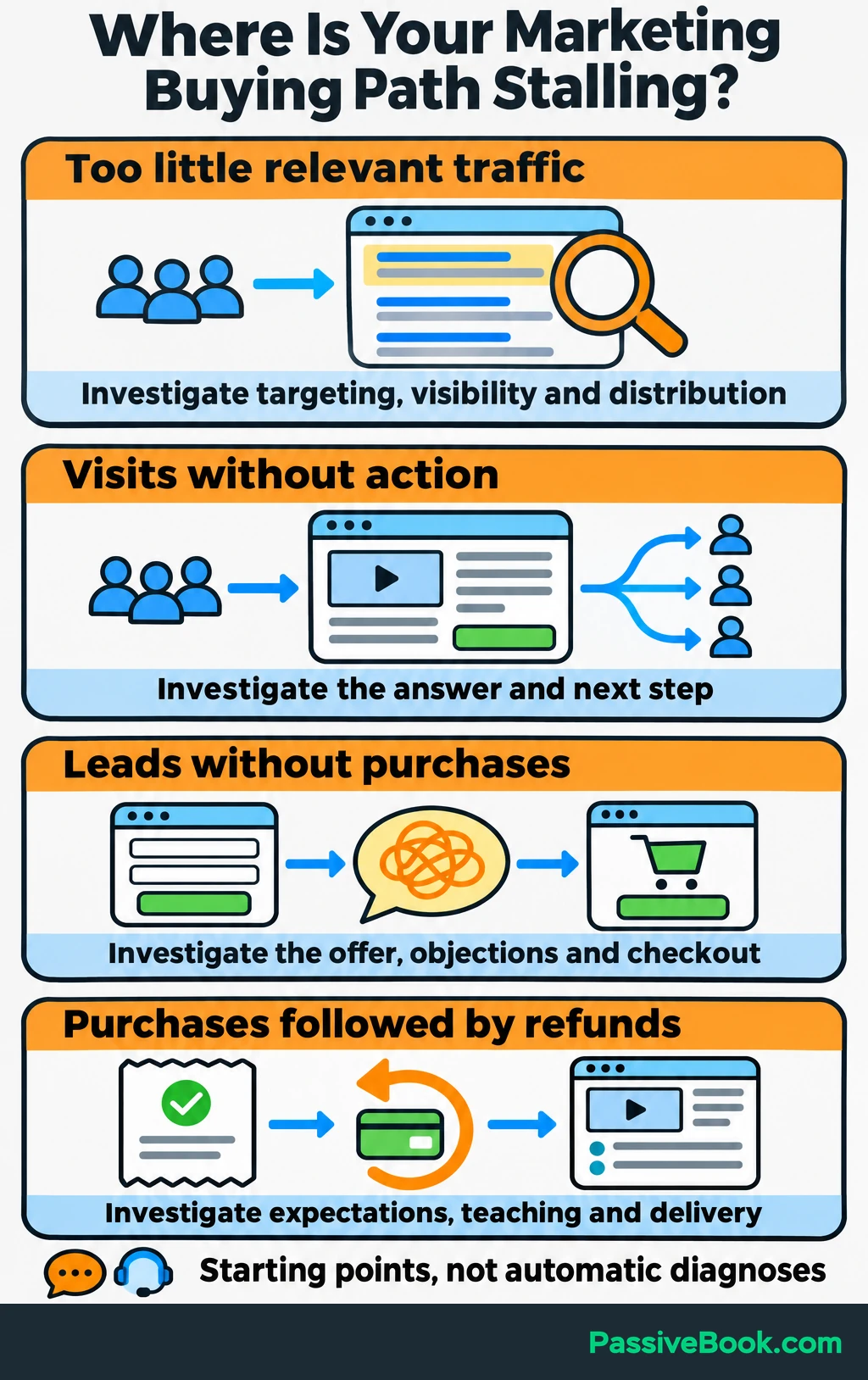
These are starting points for investigation, not automatic diagnoses. Ask customers what confused them and read support questions alongside the numbers.
Choose one weak point, write down your explanation and make a focused change. If you change the tutorial, checklist, price and emails together, you’ll struggle to tell which change helped.
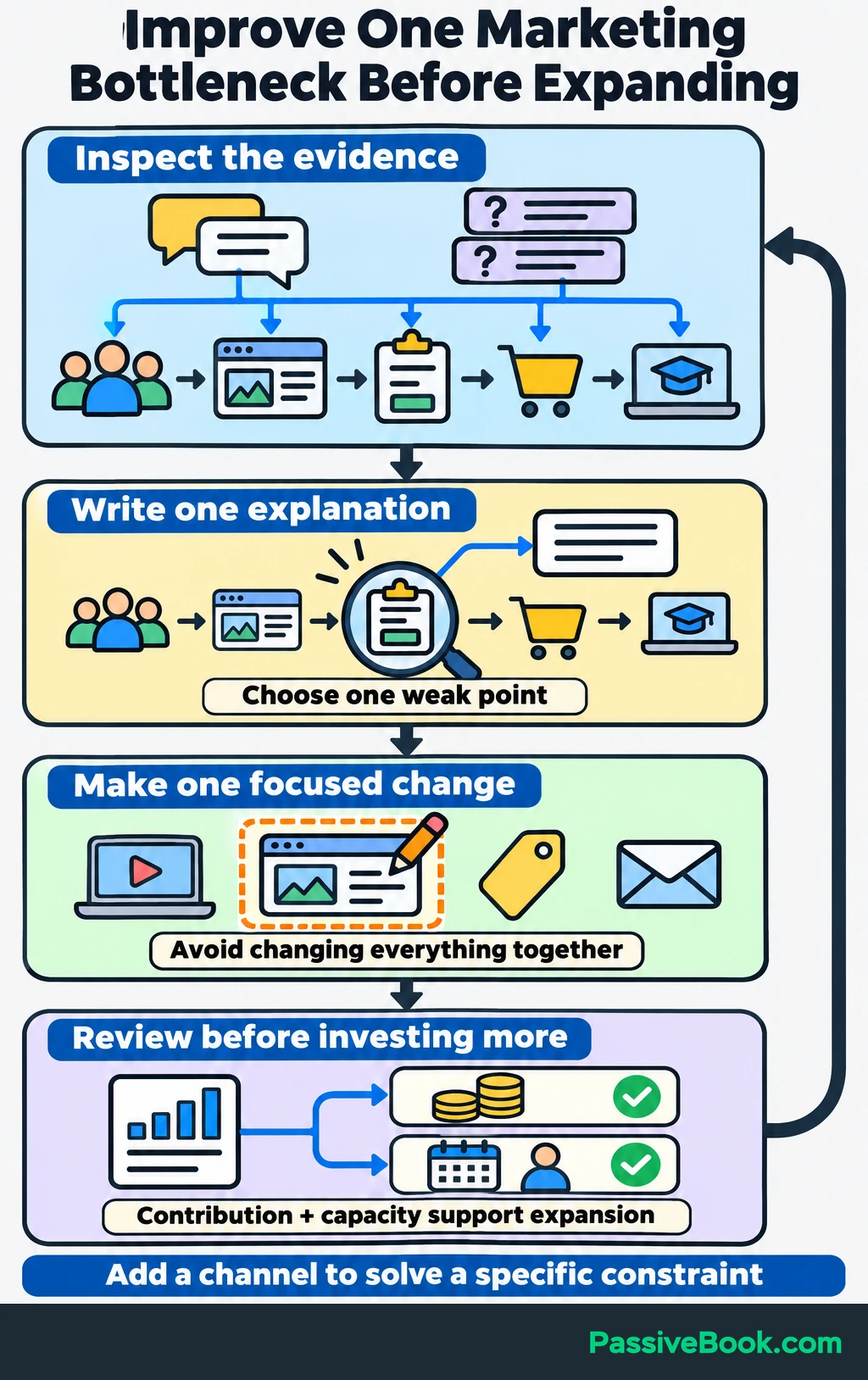
Keep working activities that acquire suitable customers within your economics and capacity. Revise promising ones with a clear problem to fix, and stop work that keeps consuming resources without useful progress.
Increase investment when contribution and delivery capacity support it. Add another channel when it addresses a specific constraint, such as limited reach or dependence on one traffic source.
The aim is to reuse effective content, follow-up and workflows so each new effort has something useful behind it.
What Next?
Write down one customer problem, one offer and the shortest route between discovering it and buying it. Use that route to choose your next marketing task.
The social buttons below can help pass along a practical way to turn scattered tactics into a working plan.
Which part of your buying path needs attention first? Share your answer in the comments, and bring any other questions along.
Share this post with your friends & followers:

