A retailer asks for your wholesale range, and suddenly every product decision is connected. More colors mean more stock. Smaller packs make the range easier to try, but each order still takes time to pack and ship.
You need enough choice to make an opening order worthwhile, without spending your budget on products that sit in boxes.
The hard part is seeing how one retailer’s opening order affects your prices, minimums, and total stock commitment. This guide works through a four-SKU range in a spreadsheet, including how much cash stays in unsold products if fewer retailers order.
Define What Your Retailers Need
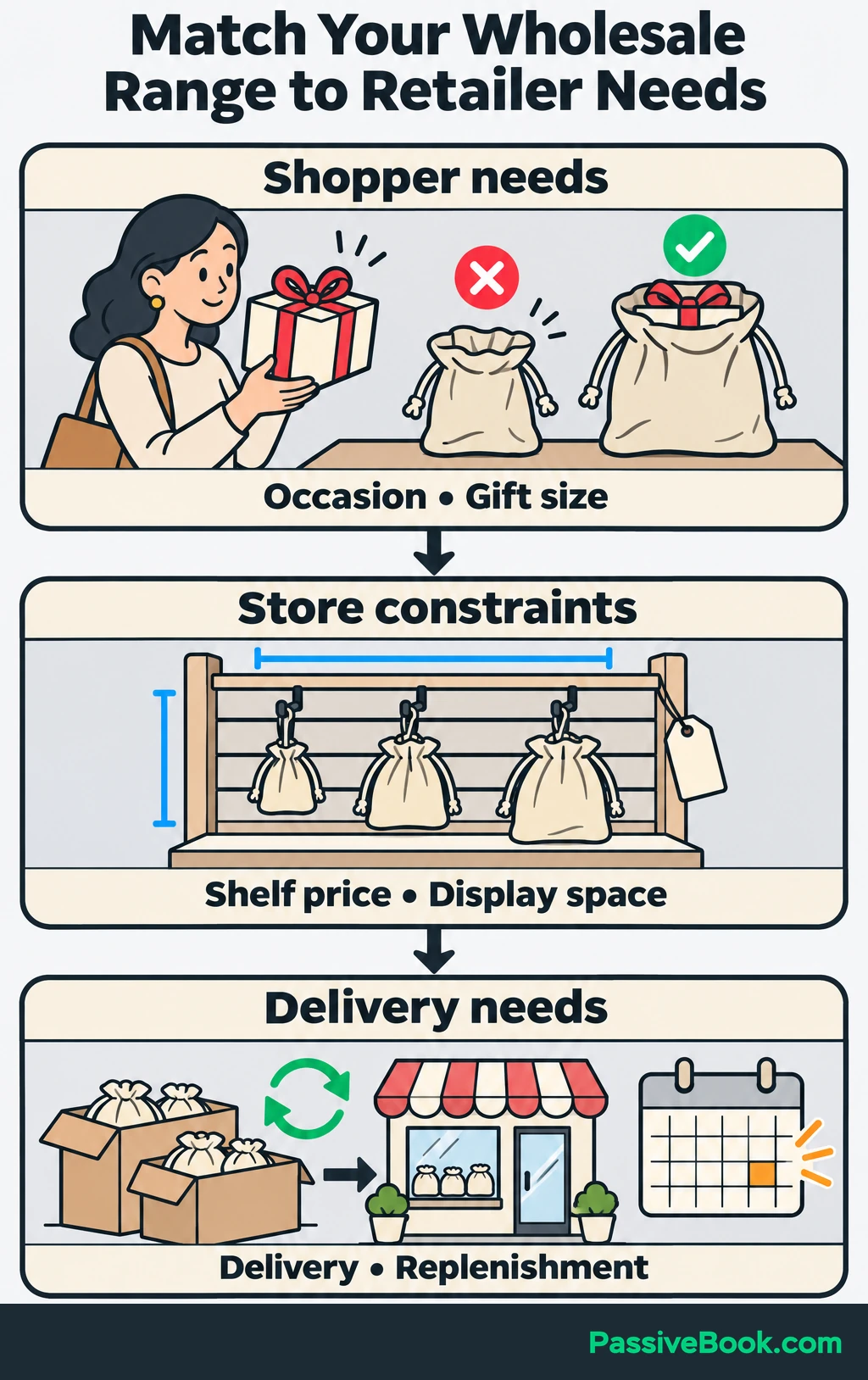
Start with the stores you want to supply and the shoppers they serve, as Maine SBDC’s wholesale guidance recommends.
Write a short description of your intended stockists. Include:
- The products they already carry and the shoppers buying them.
- The occasions your range would serve.
- The shelf prices they consider realistic.
- The display space they could give you.
- When they need delivery and how quickly they expect replenishment.
Then speak with prospective buyers. Ask questions that require a buying decision:
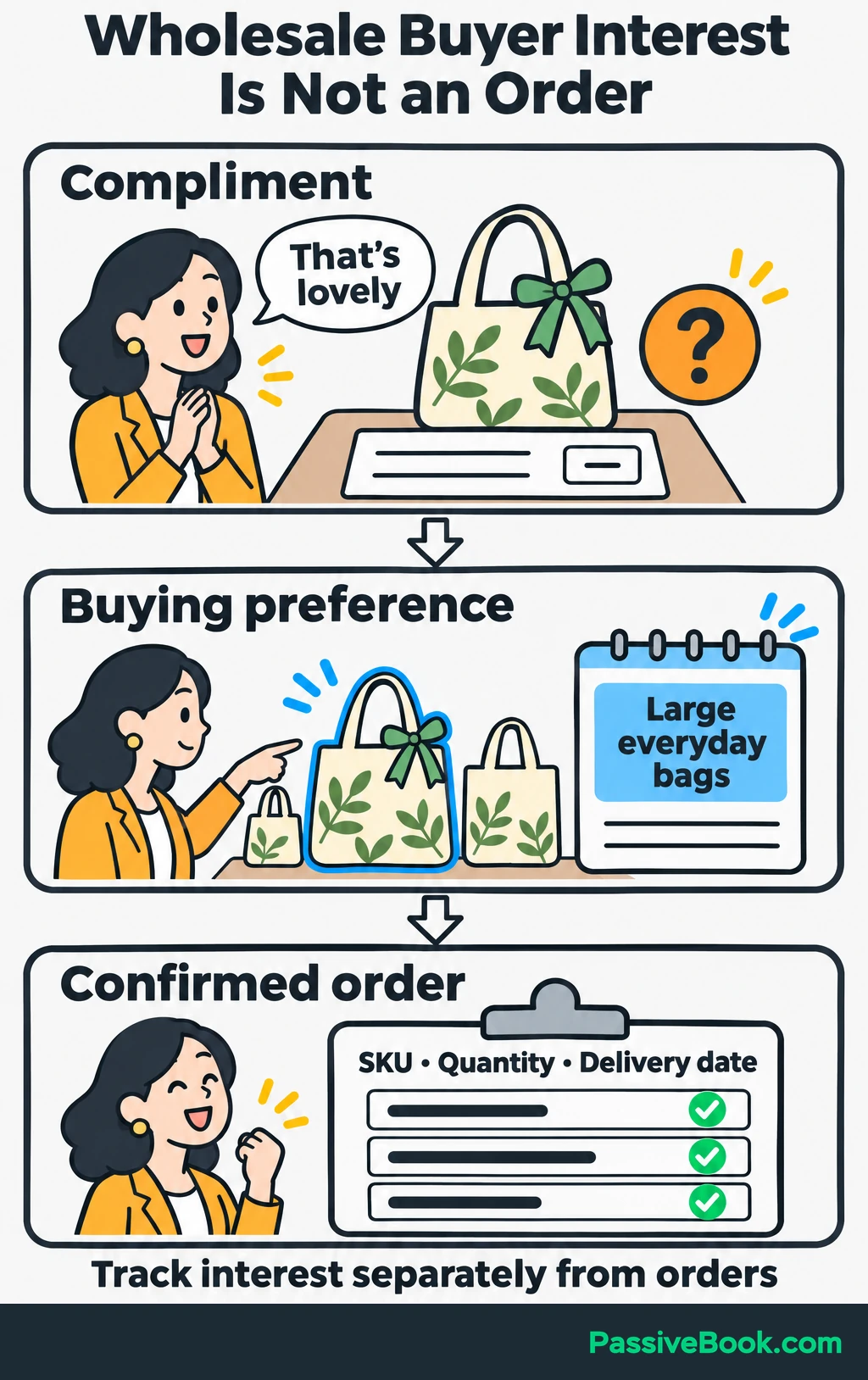
“Which of these products would you put on your shelves?”
“What would a realistic first order contain?”
“What would you need to see before ordering again?”
“That’s lovely” is pleasant feedback, but it leaves the quantity column empty. Record interest separately from confirmed orders.
Throughout this guide, imagine you sell reusable fabric gift bags to independent gift shops. The prices, costs, quantities, and budgets are illustrations, not industry benchmarks.
Before choosing patterns, find out whether buyers want everyday bags or occasion-specific designs. Ask which gift sizes their customers need and what they would pay. A beautiful small bag is a weak choice if most gifts sold in the shop will not fit inside it.
Use existing orders, sales records, and repeated requests where you have them. Direct sales can suggest popular sizes, but they do not establish how many units a retailer will buy.
I lost most of my jewellery store’s $1,200 budget after buying stock without market research. That direct-to-consumer mistake is why I would put buyer conversations before wholesale inventory spending.
Without wholesale history, start with a limited test and record what buyers actually choose.
Choose Products and Variants That Earn Their Place
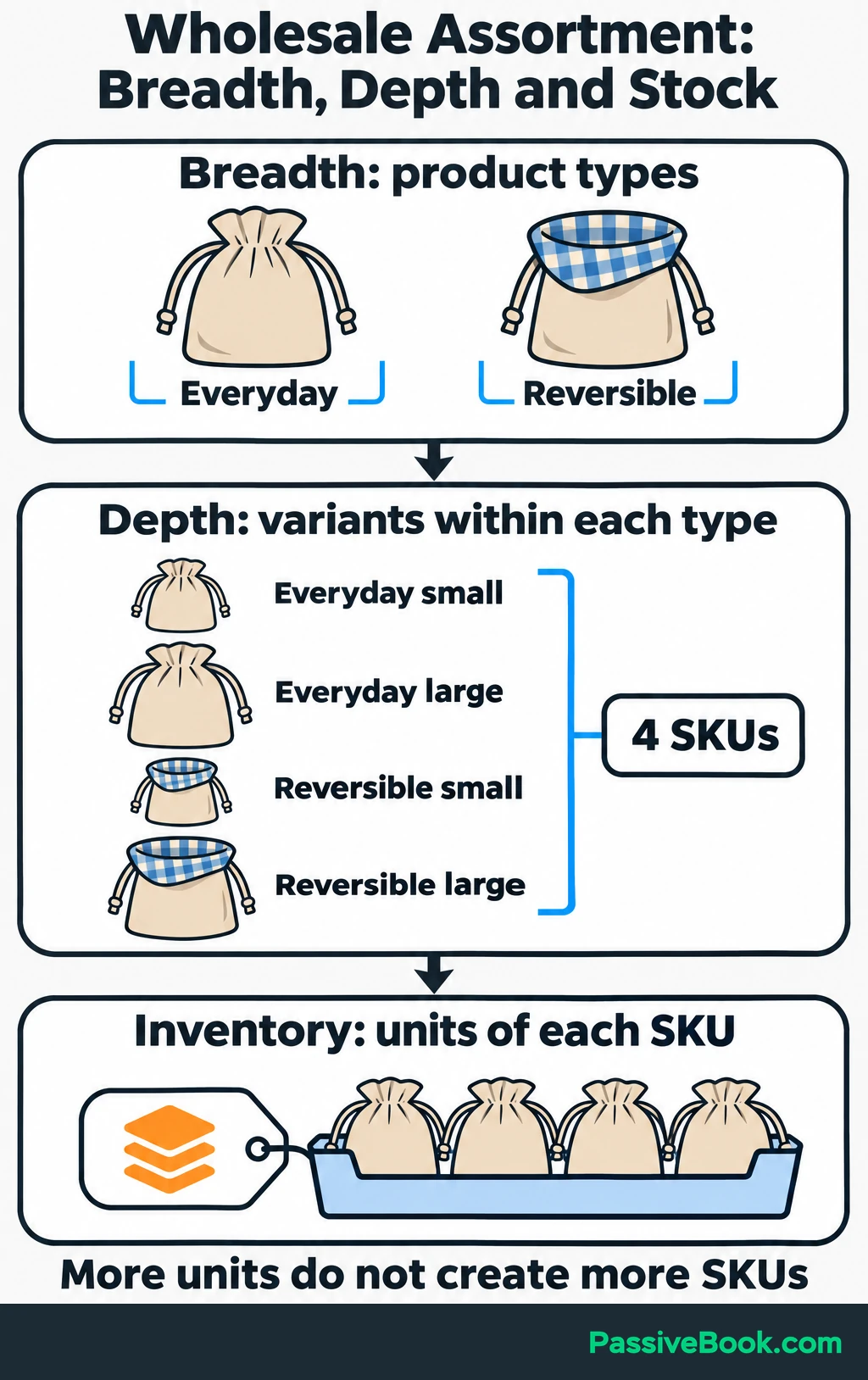
Separate the range’s breadth from its depth:
- Breadth is the different product types you offer.
- Depth is the choice within each type, such as sizes, colors, or finishes.
- Inventory quantity is how many units you hold of each choice.
Give every separately stocked and sold combination a stock keeping unit, or SKU. A small everyday gift bag and a large everyday gift bag need separate rows because their demand and stock levels can differ.
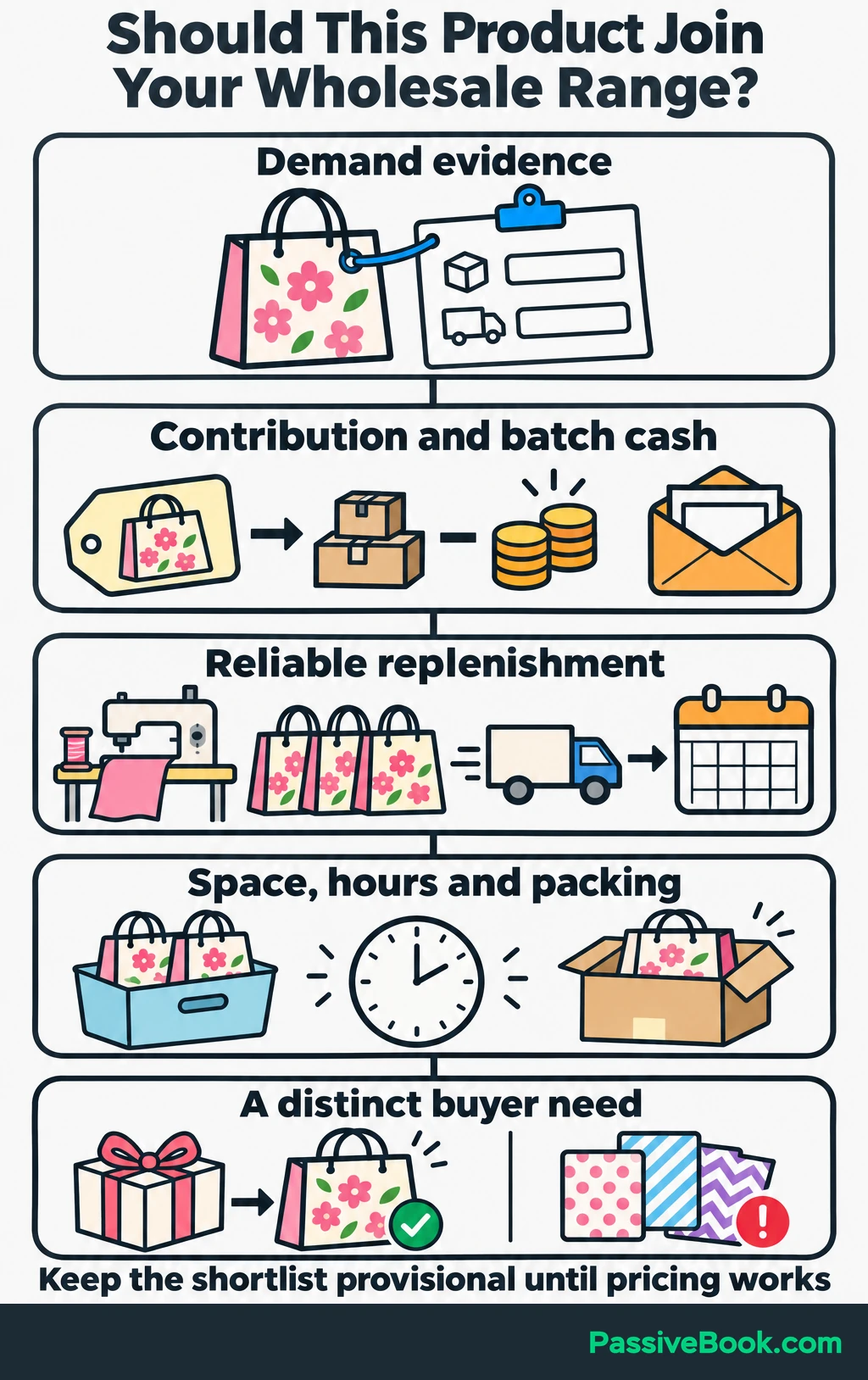
Each product should earn its place by doing a useful job. It might meet a repeated request, offer a meaningful feature, fill a price gap, or test a specific opportunity.
Before keeping a candidate, check:
| Decision | What to record |
|---|---|
| Demand | A buyer’s requested quantity, previous orders, or relevant sales history |
| Economics | Wholesale price minus variable product, selling, and fulfillment costs; cash needed for the batch |
| Supply | Production reliability and time needed to replace stock |
| Practical fit | Storage space, production hours, and packing needs |
| Distinct purpose | The need this product meets that another product does not |
Keep the shortlist provisional until the pricing checks pass.
For the gift-bag range, shortlist everyday bags and reversible bags, each in small and large sizes. That creates four SKUs. Reversible bags offer a higher-priced option because they add a usable second design.
I would defer extra patterns until buyers give them a reason to exist. Four patterns competing for the same purchase can leave you holding four small piles of slow stock.
There is no universal right SKU count or size split. Keep the choices that serve a practical need or a meaningful preference, and remove choices that mostly duplicate each other.
Set Prices That Support Both Businesses
Check whether the retailer can sell the product at a believable shelf price and whether your wholesale price leaves enough money for your business.
First, calculate the unit product cost. Include materials or purchase cost, production labor, product packaging, inbound freight, applicable duties, and a reasonable share of production overhead where relevant.
Keep selling expenses and other fixed overhead visible separately. They still need paying.
Supplier gross margin measures how much wholesale revenue remains after product cost. Use the price you receive after discounts:
Supplier gross margin =
(net wholesale price − unit product cost) ÷ net wholesale price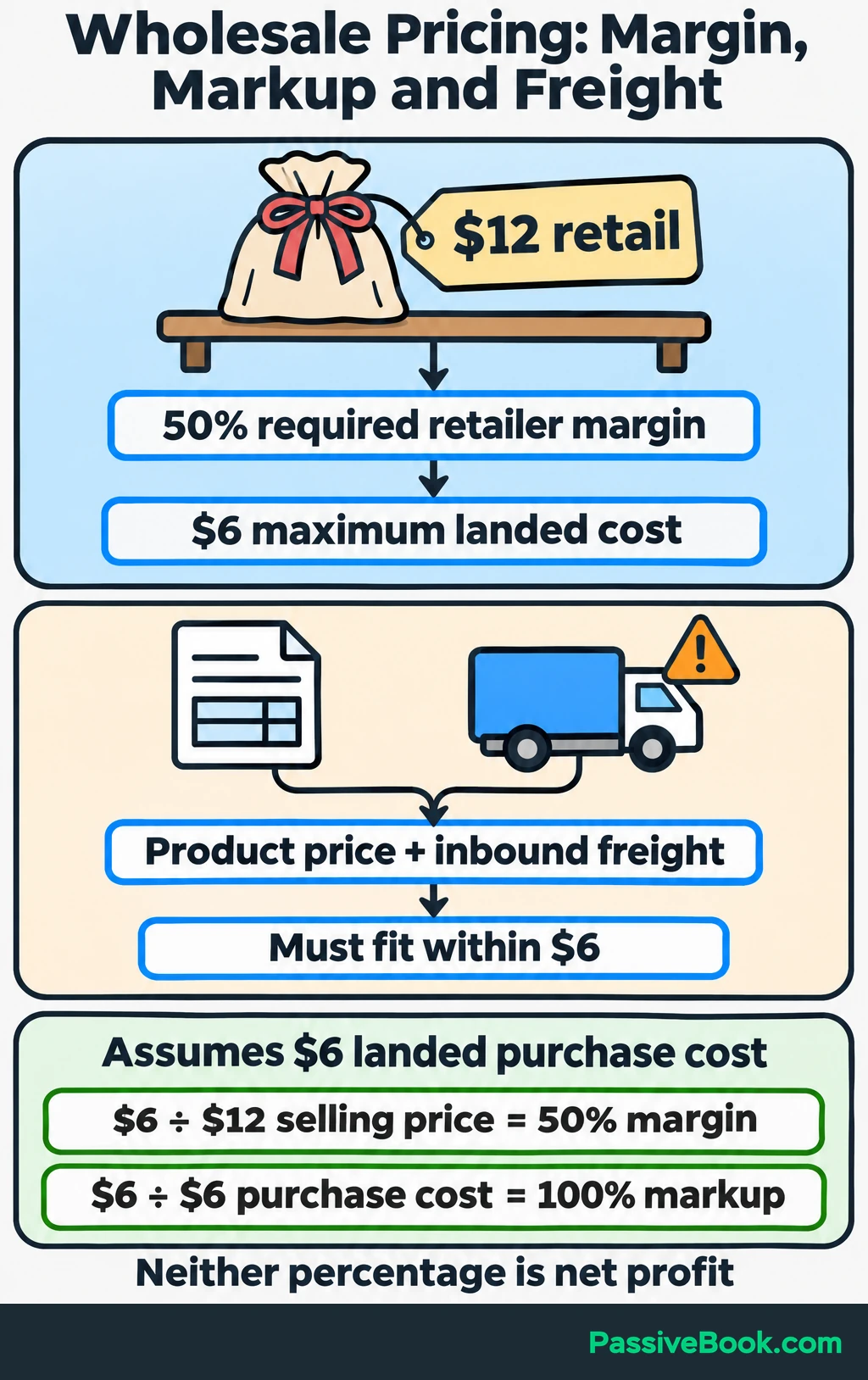
The retailer has a separate calculation, based on its selling price and product purchase cost. Shopify’s wholesale pricing examples show why the supplier’s margin and retailer’s margin must be checked separately.
Work backward from a shelf price buyers consider achievable. Find the most the retailer can pay to buy and receive one unit while keeping its required merchandise margin:
Maximum landed wholesale cost =
retail selling price × (1 − retailer’s required margin)
“Landed” means the retailer’s cost to get the goods into the store. Subtract any retailer-paid inbound freight per unit to find the maximum product purchase price. Compare all prices on the same tax basis.
In the gift-bag example, a $12 retail price and a retailer requirement of 50% leave room for a $6 landed cost. If the retailer pays freight on top, the product purchase price must be lower to preserve that margin.
Also keep margin and markup separate. Buying at $6 and selling at $12 produces:
- A 50% merchandise margin: $6 divided by the $12 selling price.
- A 100% markup: $6 divided by the $6 purchase cost.
Neither figure is net profit.
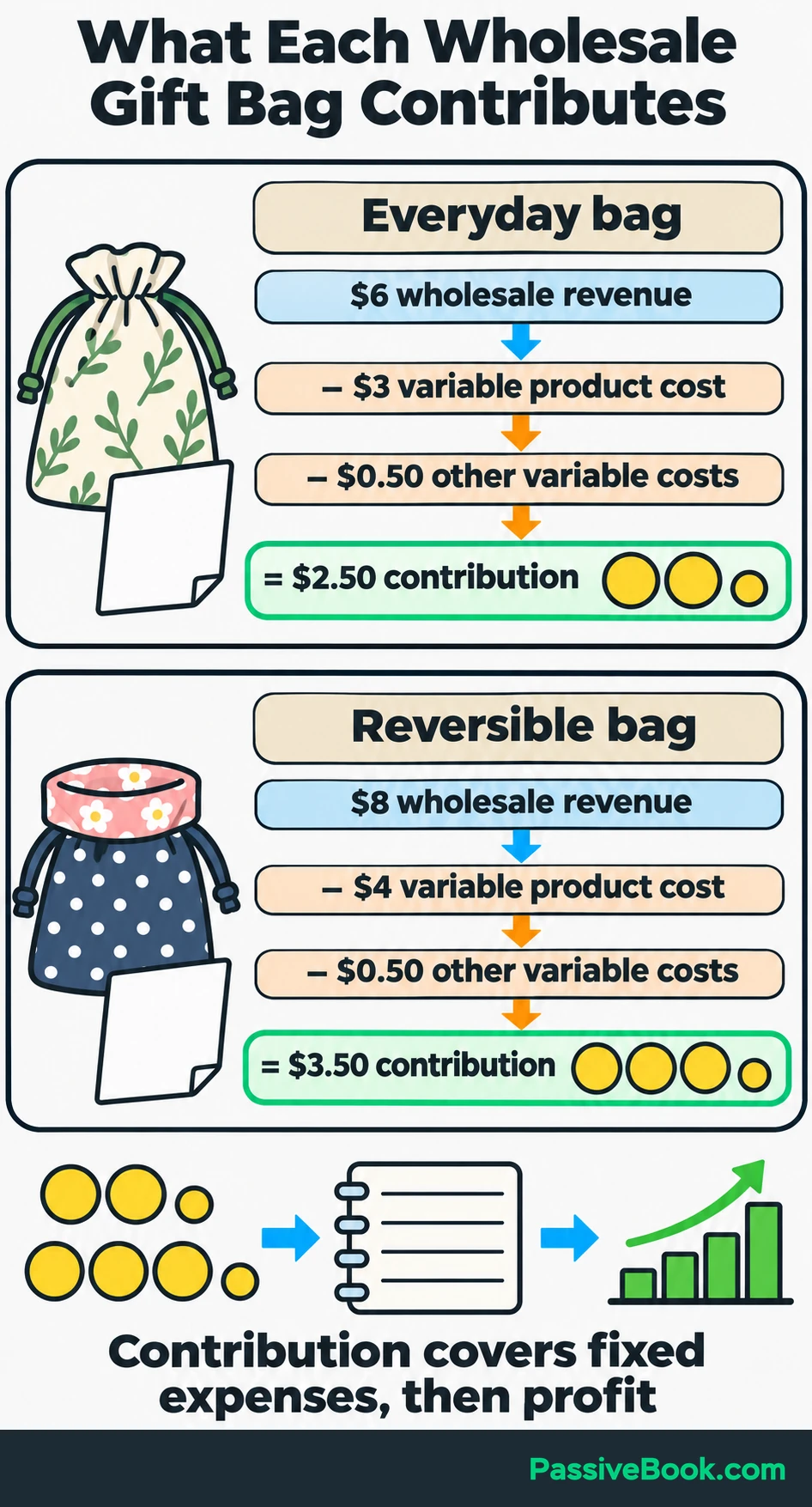
For your own buying decisions, calculate contribution: net wholesale revenue minus all variable product, selling, and fulfillment costs. Contribution is what remains to cover fixed expenses and profit. Use only the variable portion of product cost here, and count allocated fixed overhead with your fixed expenses.
In the worked example, all product costs are variable. An everyday bag sells wholesale for $6, costs $3, and carries another $0.50 in variable selling and fulfillment expenses. Its contribution is $2.50. A reversible bag sells wholesale for $8 and costs $4, with the same $0.50 in other variable expenses, leaving $3.50.
Check expected contribution across the whole range against your fixed expenses and desired profit. A positive contribution per unit does not automatically make the business worthwhile.
I would add an entry or premium option only when buyers need it. If the economics fail, change the specifications, costs, price, or product selection. Wholesale at half the suggested retail price is a pricing convention, not a promise that either business will make money.
Set Case Packs and Order Minimums
Write down each ordering constraint separately. “Minimum order quantity,” often shortened to MOQ, can otherwise mean several different things.
| Constraint | What it controls |
|---|---|
| Upstream supplier minimum | The smallest batch your manufacturer or material supplier will accept |
| Retailer minimum per SKU | The fewest units a retailer can buy of one variant |
| Case pack or ordering multiple | The increments retailers must order, such as four, eight, or twelve units |
| Whole-order minimum | The minimum total units or spending across the order |
Faire’s explanation of case sizes and order minimums makes the distinction between product packs and the total order requirement.
Choose packs around likely demand, shelf space, and handling costs. Your supplier’s large batch requirement does not mean every retailer must buy the same quantity.
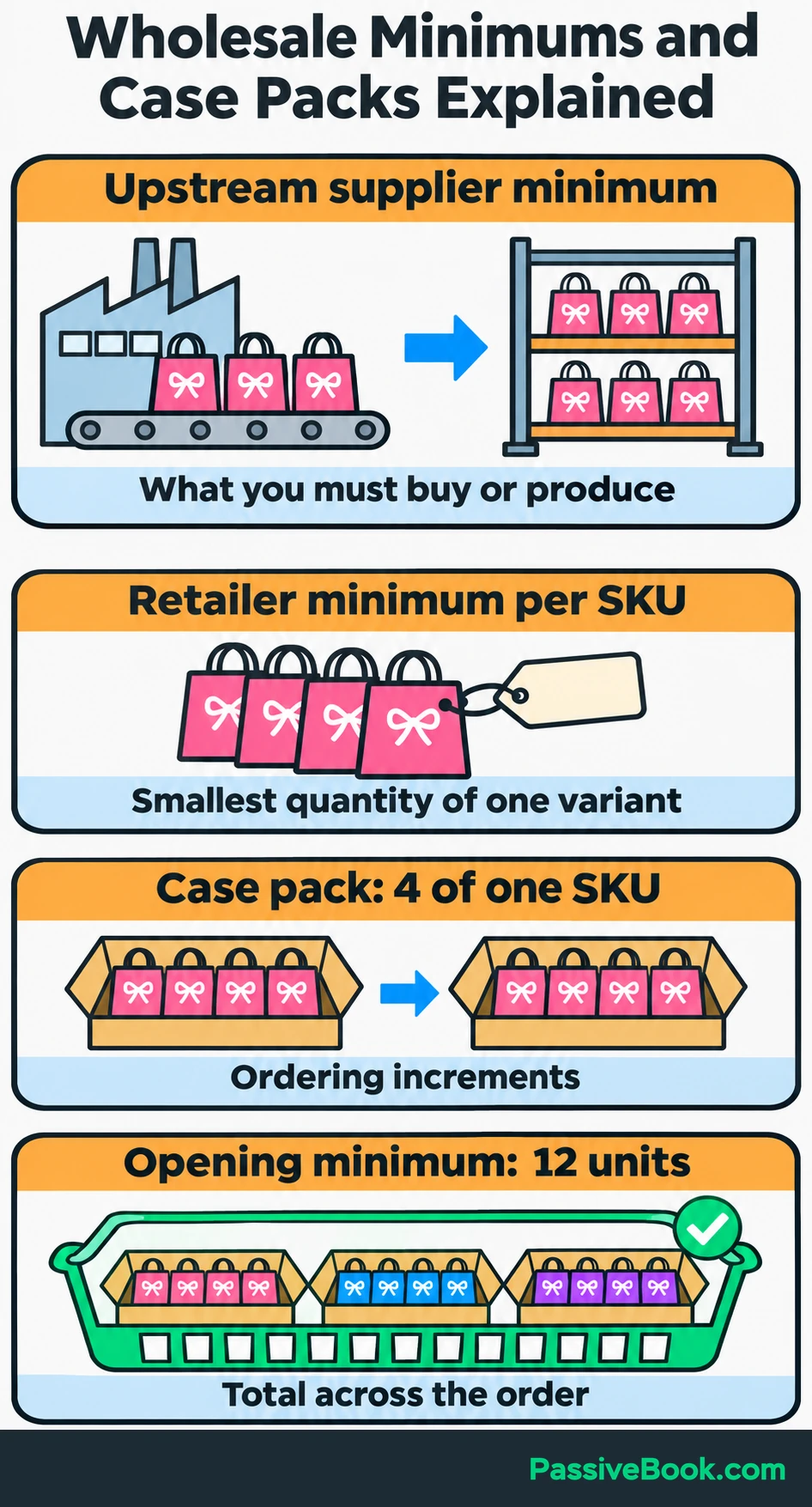
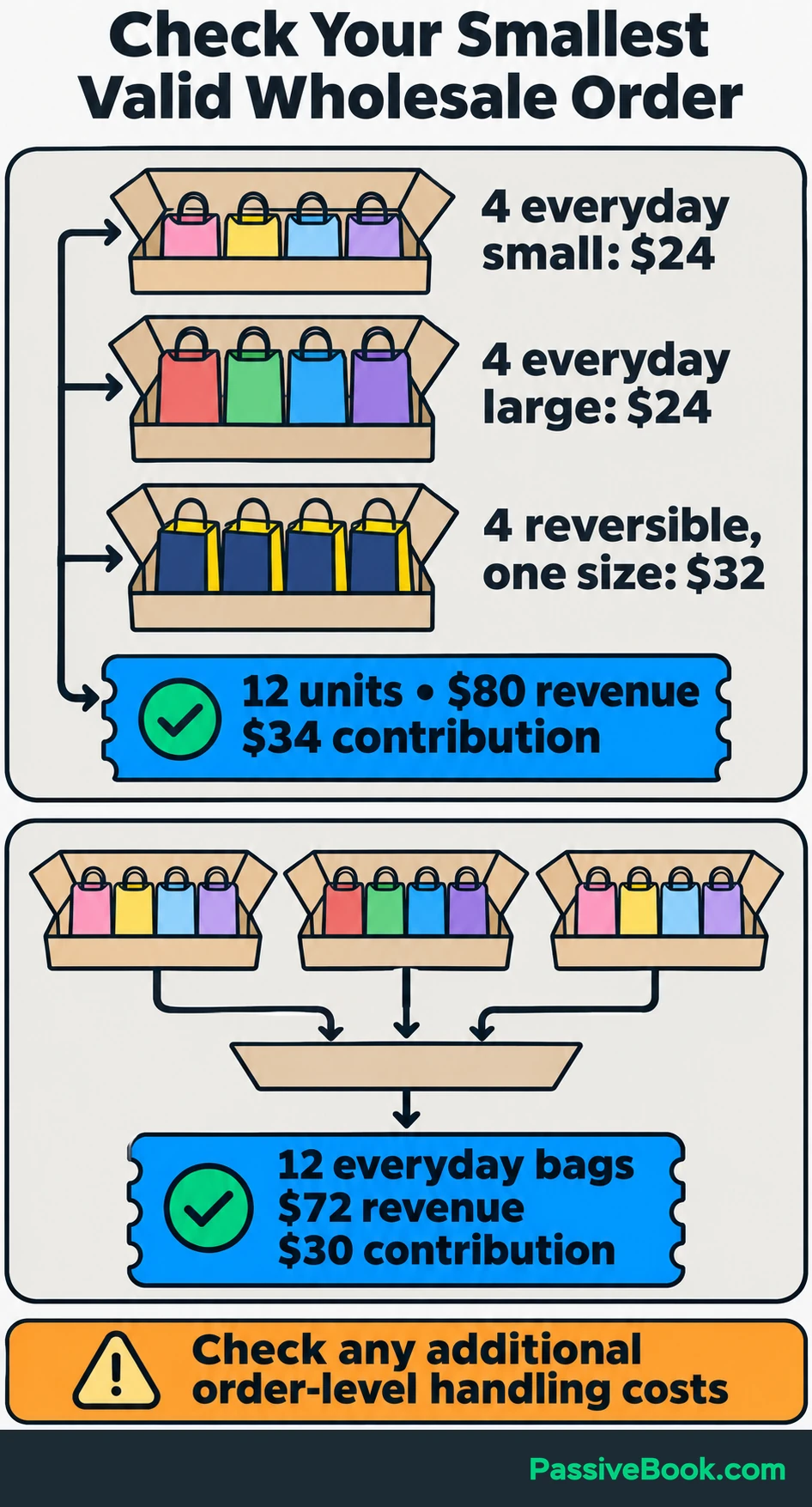
For the gift bags, use four-unit packs containing one SKU and a 12-unit opening minimum. A buyer could choose:
- Four small everyday bags: $24.
- Four large everyday bags: $24.
- Four reversible bags in one size: $32.
That creates an $80 opening order.
Check the smallest valid baskets as well as your preferred mix. At the example’s contribution rates, this basket contributes $34. An order of 12 everyday bags contributes $30. Both must leave enough after any order-level handling costs not already included in your variable expenses.
Set a reorder minimum separately if smaller repeat orders make sense. Check its economics before promising it.
If you sell mixed packs, state their exact contents and deduct sales from the individual SKUs inside them. Otherwise, the pack may show as sold while its component stock remains untouched in your spreadsheet.
Before buying inventory, show prospective retailers a concise line sheet: a product list with photos, SKUs, sizes, wholesale prices, suggested retail prices, pack sizes, minimums, delivery availability, and payment and freight terms.
Ask a buyer to assemble an opening order from it. Their choices can reveal a missing size or an awkward minimum before either becomes an expensive problem.
Plan Inventory Quantities
Forecast Demand by SKU and Delivery Period
Choose a planning period around retailer delivery dates and the time needed to replenish. Work backward through production, transit, and receiving to decide when goods must be ready.
Build demand from two parts:
- Confirmed orders with quantities and delivery dates.
- Additional expected orders that remain uncertain.
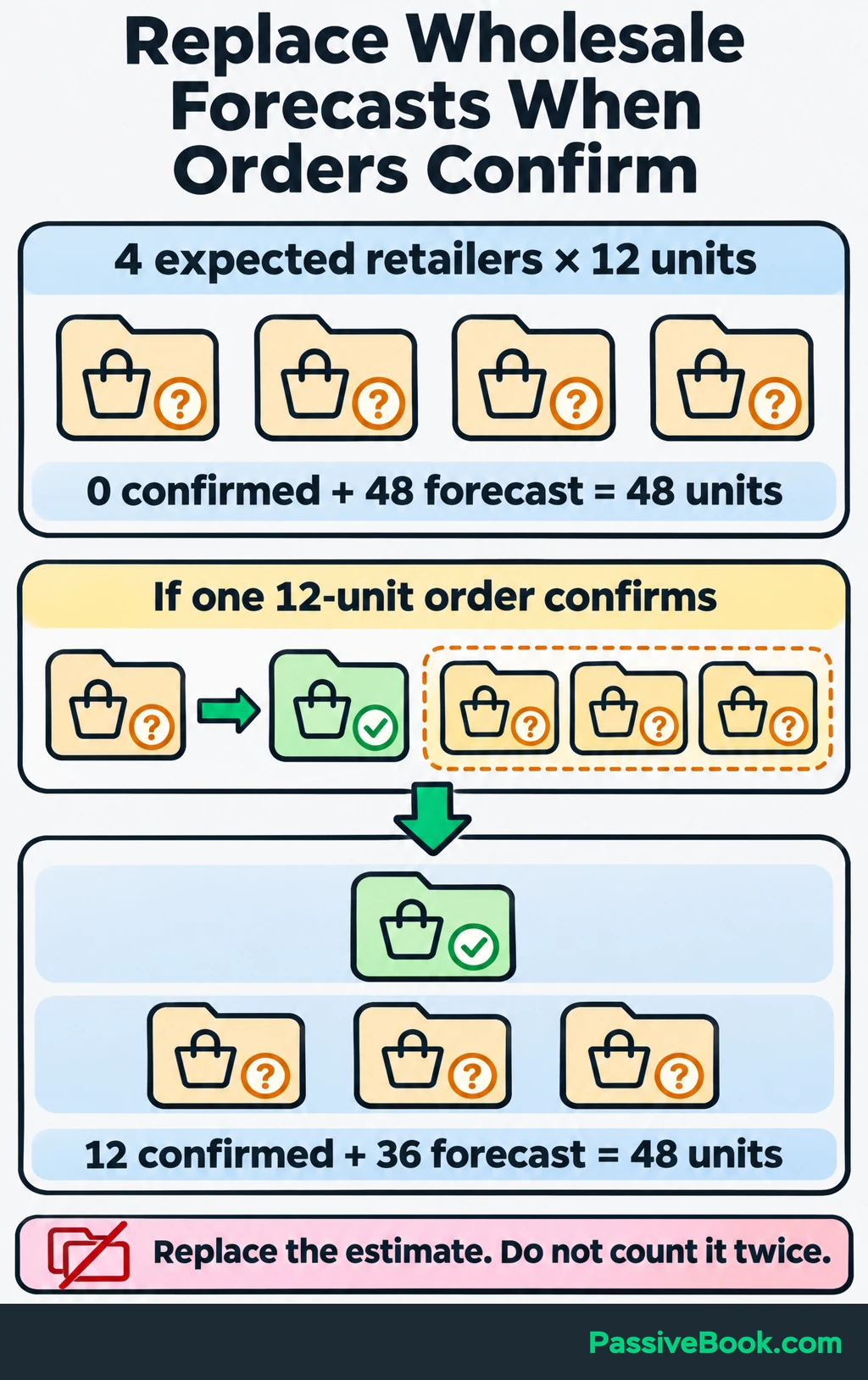
For the uncertain portion, estimate how many prospective accounts will order and how many units each will buy. Then allocate those units across SKUs using buyer feedback or sales history.
In the gift-bag example, four expected retailers buying 12 units each create a 48-unit forecast. None of those orders is confirmed yet.
When a retailer confirms an order, replace the quantities you forecast for that retailer with the confirmed quantities. Keep only other expected orders in the remaining forecast.
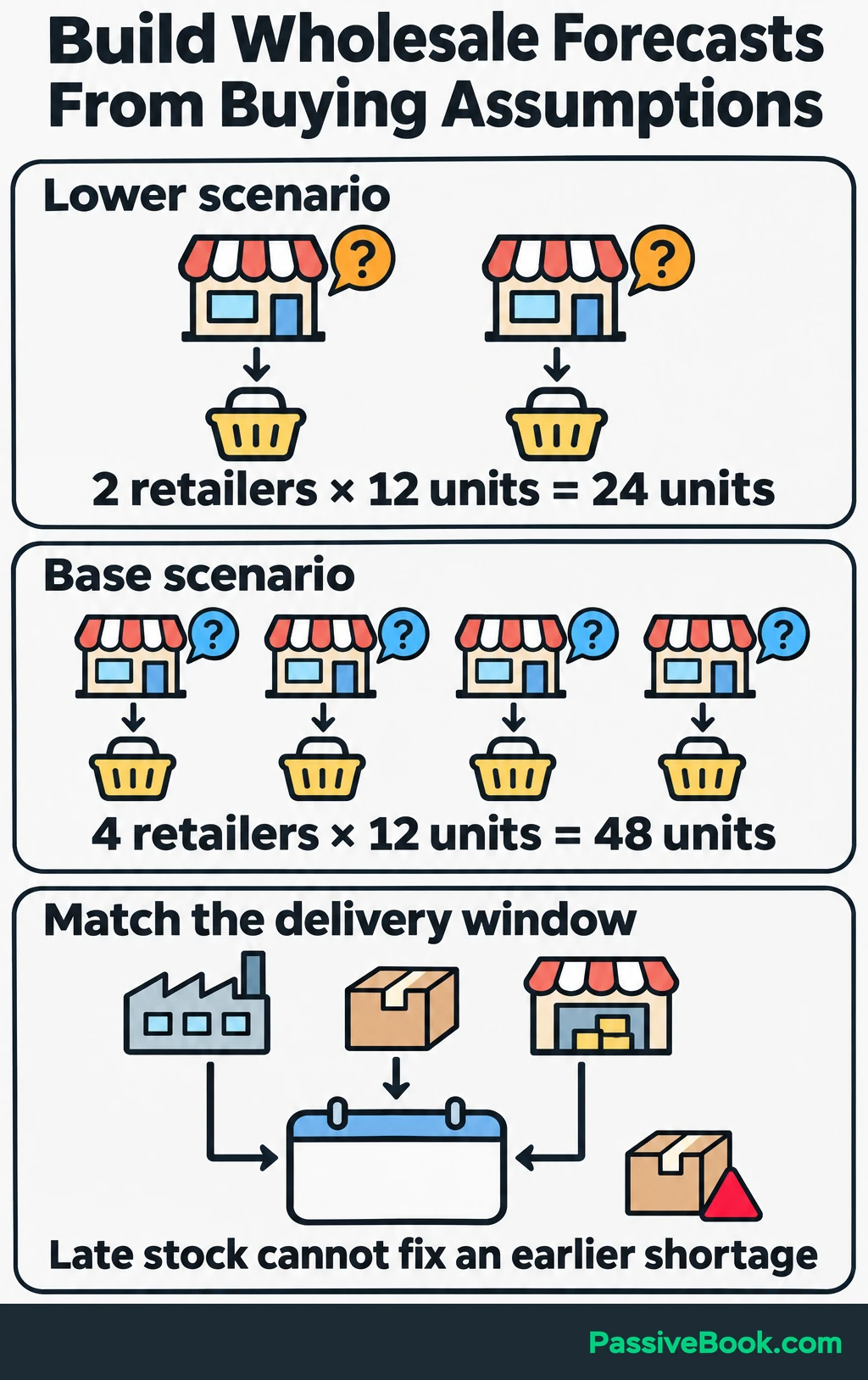
Use lower, base, and higher scenarios by changing specific assumptions. For example, compare two retailers ordering with four retailers ordering. “Sales might be lower” gives you little to plan around; “two fewer opening orders” gives you quantities to calculate.
Keep seasonal demand within its selling window. Stock arriving after the intended occasion cannot solve an earlier shortage.
Also separate your shipments to retailers from their sales to shoppers. An opening order proves that a buyer accepted the range. Sales and remaining-stock information, where retailers will share it, help you judge whether a reorder is likely.
Fit Purchases to Cash and Capacity
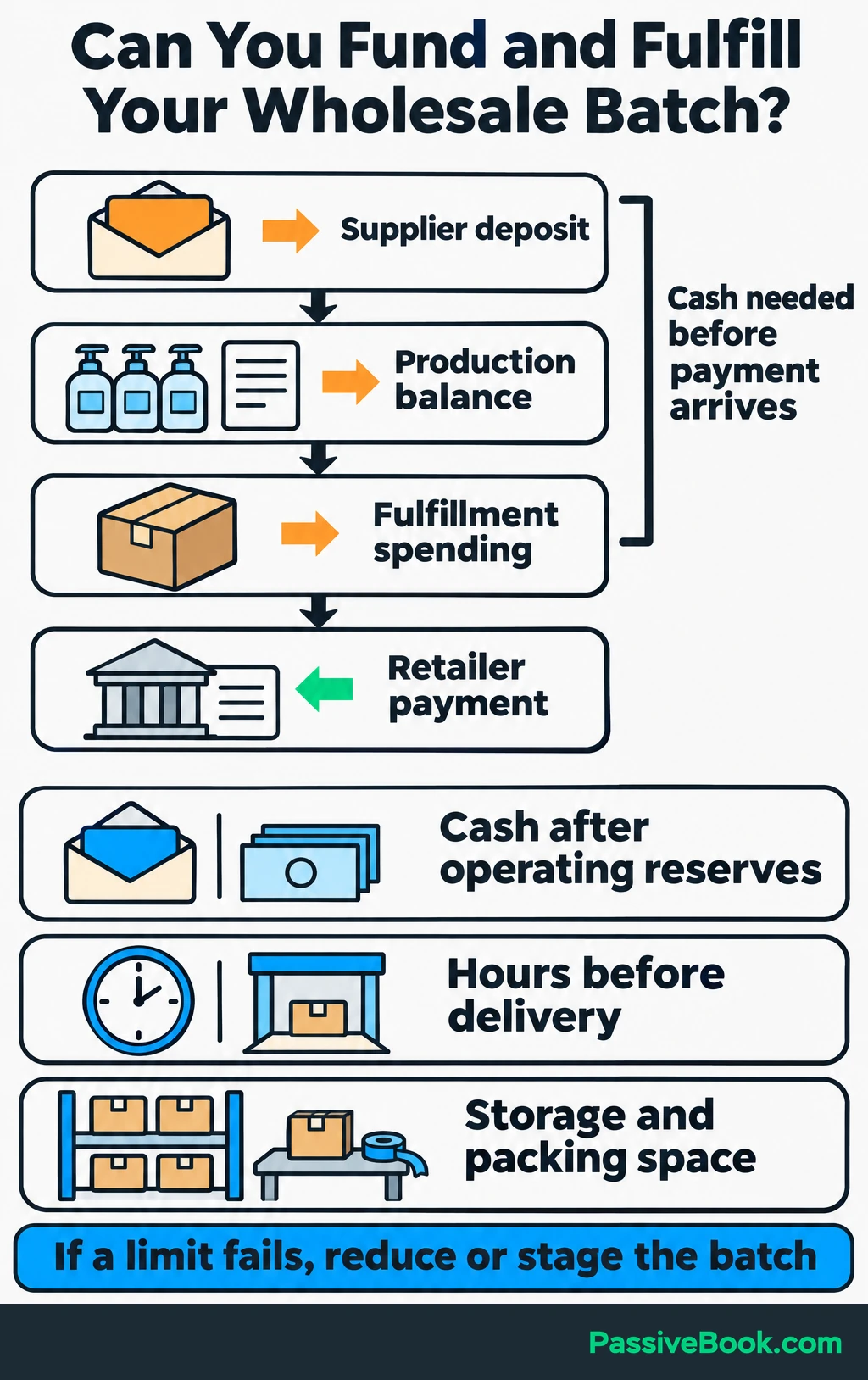
Set a purchasing ceiling after reserving cash for operating obligations.
Then map payments and receipts by date: supplier deposits, production balances, fulfillment expenses, and retailer payments. A profitable order may still require cash weeks before the customer pays. LA Regional SBDC’s cash-flow guidance identifies excess inventory and customer credit terms as possible causes of cash shortages.
Choose a stock buffer for a named risk. You might hold enough to cover one extra reorder or a plausible delivery delay. Check what that protection costs.
Longer replenishment times and more variable demand or delivery generally require more safety stock, as NC State’s inventory tutorial explains. That does not make a large buffer affordable. You still need to choose which risks your cash can cover.
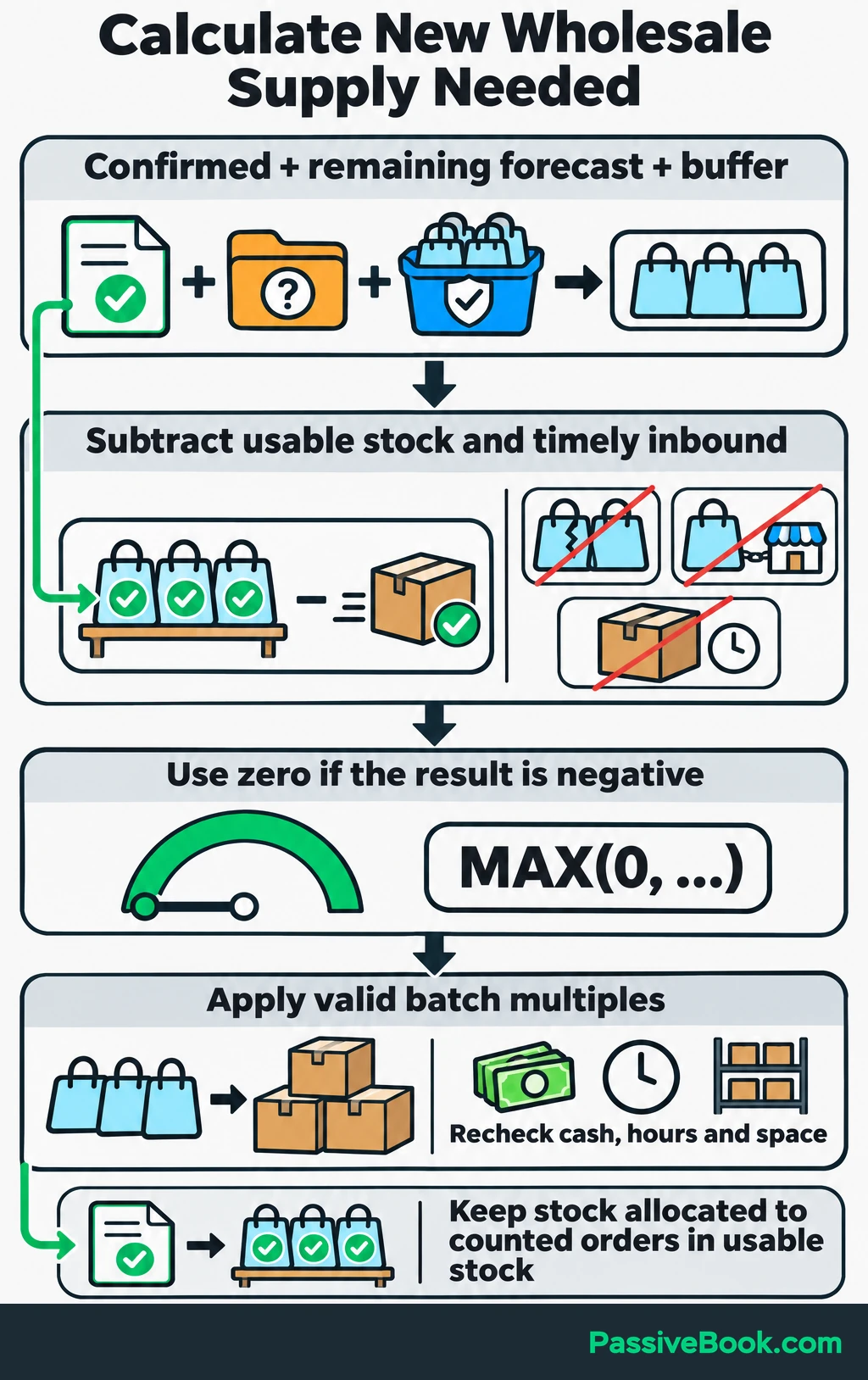
For each SKU, add confirmed orders, remaining forecast demand, and buffer units. Subtract usable stock and incoming units that will arrive in time. Use zero if the result is negative; MAX(0, …) does that below:
New supply needed =
MAX(0,
confirmed orders + remaining forecast + buffer
− usable stock − inbound units arriving in time)
Usable stock excludes damaged goods and units reserved for other channels.
Keep the calculation consistent for wholesale commitments. If a confirmed order appears in demand, include the stock allocated to that order in usable stock. Removing that stock while also including the order would make you buy replacements twice.
Next, apply supplier minimums and production multiples. Rounding a requirement up to a valid batch can change the budget substantially, so recalculate:
- Inventory spending.
- Production hours available before delivery.
- Storage and packing space.
- Cash remaining on each payment date.
If the plan exceeds a limit, reduce speculative quantities, stage purchases, or remove weak variants. Made-to-order production can help when buyers accept the wait and you have enough production capacity.
Finally, check each dated delivery. Having enough stock by the end of the month does not help a retailer whose order is due next week.
Set a Replenishment Rule
Choose a regular stock review schedule and make the coverage period match it.
At each review, plan enough supply for demand during replenishment lead time plus the interval until the next review. Add your chosen buffer, then subtract usable stock and inbound goods that will arrive in time.
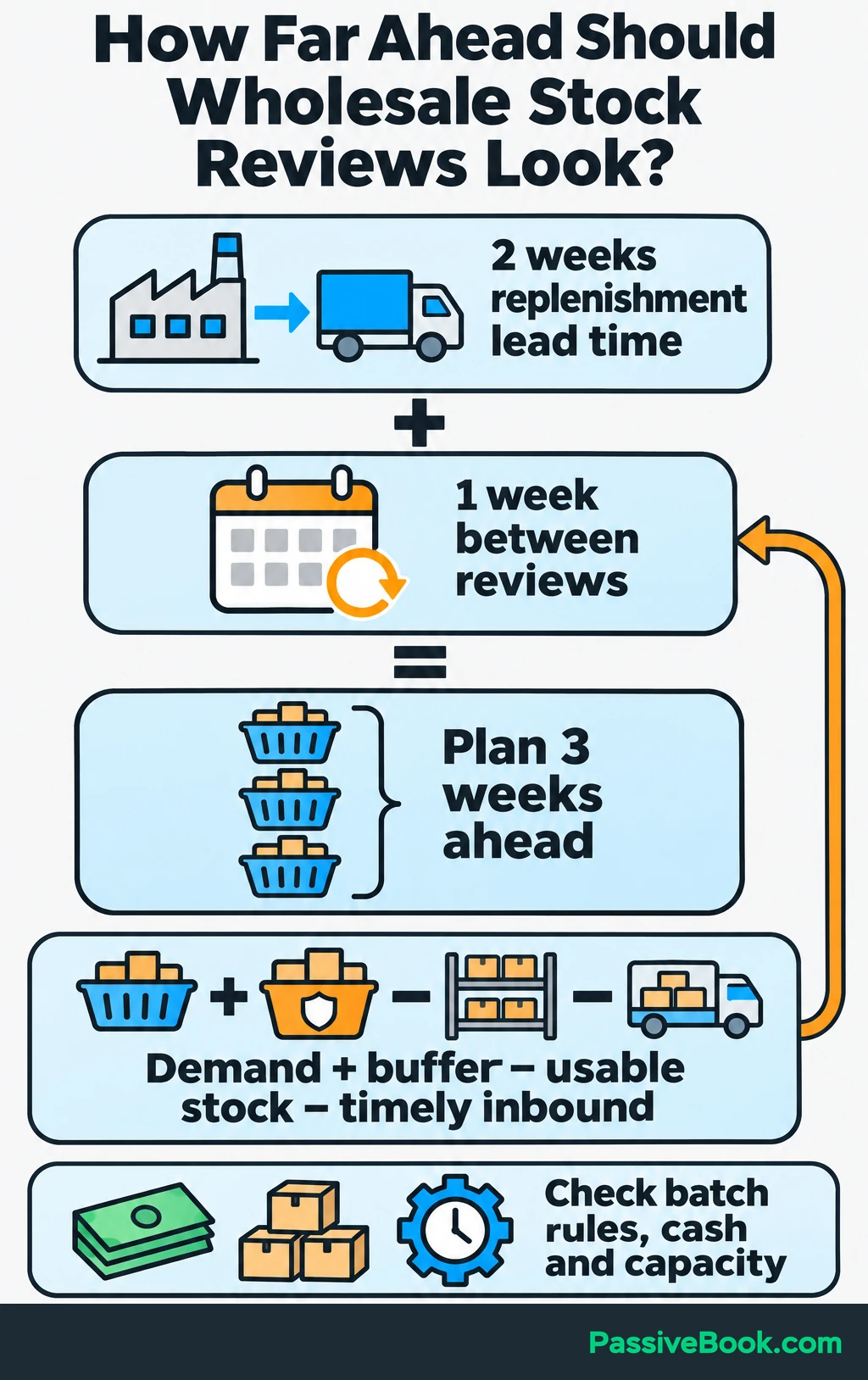
For example, if production and delivery take two weeks and you review weekly, look three weeks ahead at each review.
Include confirmed orders once, apply valid production multiples, and check cash and capacity before placing the order. A spreadsheet can calculate a quantity quickly, but it cannot make an unaffordable batch sensible.
Build Your Assortment Planning Spreadsheet
Reusable Template
I would start with a spreadsheet. You need a place where a price change updates the margin and a quantity change updates the cash requirement. A large catalog and specialist software can wait.
Create an Assortment tab with one row per SKU. Copy these column headings into the first row:
Product | SKU | Variant | Assortment role | Demand evidence | Unit product cost | Net wholesale price | Suggested retail price | Supplier gross margin | Retailer merchandise margin | Variable product cost | Other variable expenses | Contribution per unit | Case pack | Retailer minimumCreate an Inventory tab with one row per SKU per delivery period:
SKU | Delivery period | Confirmed units | Remaining forecast | Buffer | Usable stock | Inbound units | Inbound arrival date | Supplier minimum | Production multiple | Lead time | Planned purchase quantity | Planned spending | Production hours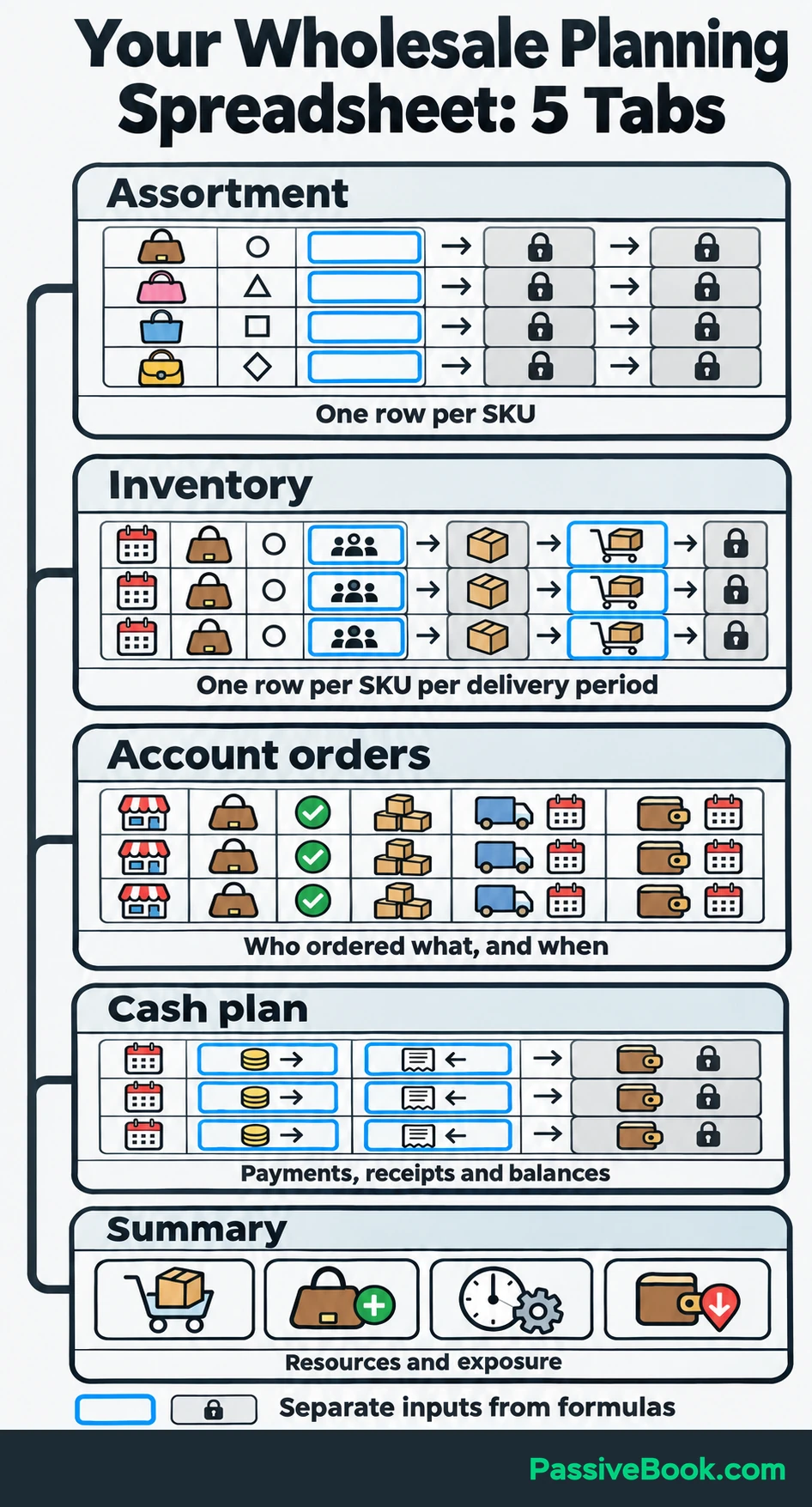
Use supporting tabs for the details that should not be squeezed into one SKU row:
| Tab | What to record |
|---|---|
| Account orders | Retailer, SKU, quantity, order status, delivery date, and payment due date |
| Cash plan | Opening cash and each expected payment or receipt by date |
| Summary | Active SKUs, purchase spending, forecast contribution, production hours, and lowest projected cash balance |
Separate editable inputs from formulas, using a different cell background or protected formula columns.
Calculate planned spending from purchase quantities and cash costs. Calculate expected contribution from expected units sold, rather than units purchased. Unsold bags do not contribute anything yet, however neatly you stack them.
Worked Example: A Four-SKU Gift-Bag Assortment
Here is a four-week purchasing plan.
Assume four retailers each buy 12 units: four small everyday bags, four large everyday bags, and four reversible bags. Two stores choose small reversible bags and two choose large. All 48 units remain unconfirmed forecast demand.
There is no inbound stock, and production runs in multiples of four units per SKU, with no larger supplier minimum. Assume you can make and store the batch before retailers need delivery.
| SKU | Forecast Units | Buffer | Usable Stock | Purchase Quantity | Unit Cost | Wholesale Price | Suggested Retail Price |
|---|---|---|---|---|---|---|---|
| Everyday small | 16 | 4 | 4 | 16 | $3 | $6 | $12 |
| Everyday large | 16 | 4 | 4 | 16 | $3 | $6 | $12 |
| Reversible small | 8 | 0 | 0 | 8 | $4 | $8 | $16 |
| Reversible large | 8 | 0 | 0 | 8 | $4 | $8 | $16 |
| Total | 48 | 8 | 8 | 48 | — | — | — |
For each everyday SKU, 16 forecast units plus four buffer units minus four existing units means purchasing 16. Each reversible SKU needs eight units.
The plan places the buffer in everyday bags to cover a possible additional four-unit pack of each size. It leaves reversible demand unbuffered for this test.
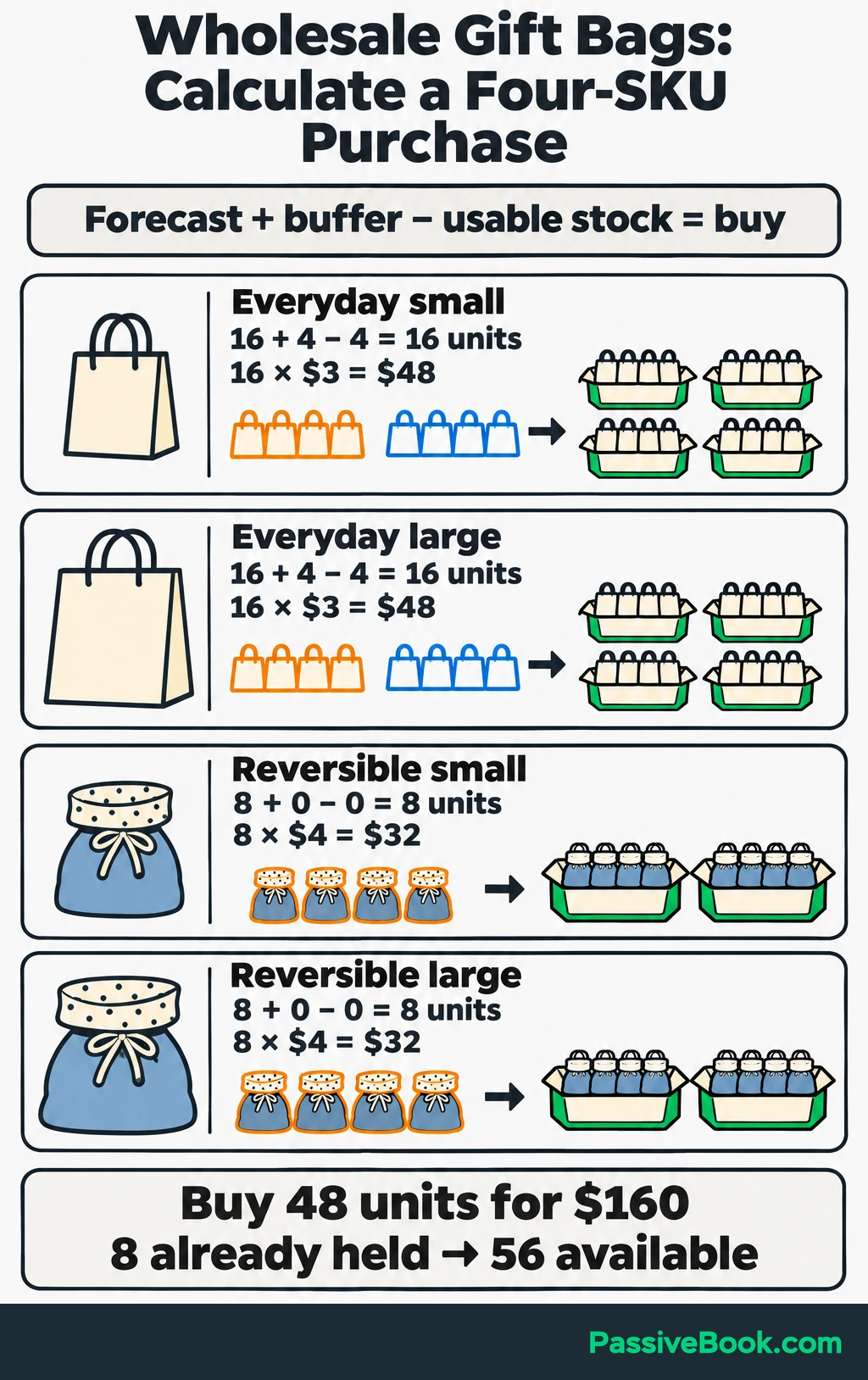
You will purchase 32 everyday bags and 16 reversible bags:
New inventory spending = (32 × $3) + (16 × $4) = $160The eight bags already held bring total available inventory to 56 units.
Assume you have $280 in opening cash and reserve $80 for selling expenses and operating obligations. That leaves a $200 purchasing ceiling. The $160 purchase fits, with $40 uncommitted above the reserve.
Existing stock was paid for before that opening cash balance. All example product costs are variable cash costs paid before delivery, and another $0.50 per sold unit covers all other variable selling and fulfillment expenses. There are no discounts, returns, or retailer-paid inbound freight in these margin calculations.
At the stated selling prices:
| Product Type | Supplier Gross Margin | Retailer Merchandise Margin | Contribution Per Unit |
|---|---|---|---|
| Everyday | 50% | 50% | $2.50 |
| Reversible | 50% | 50% | $3.50 |
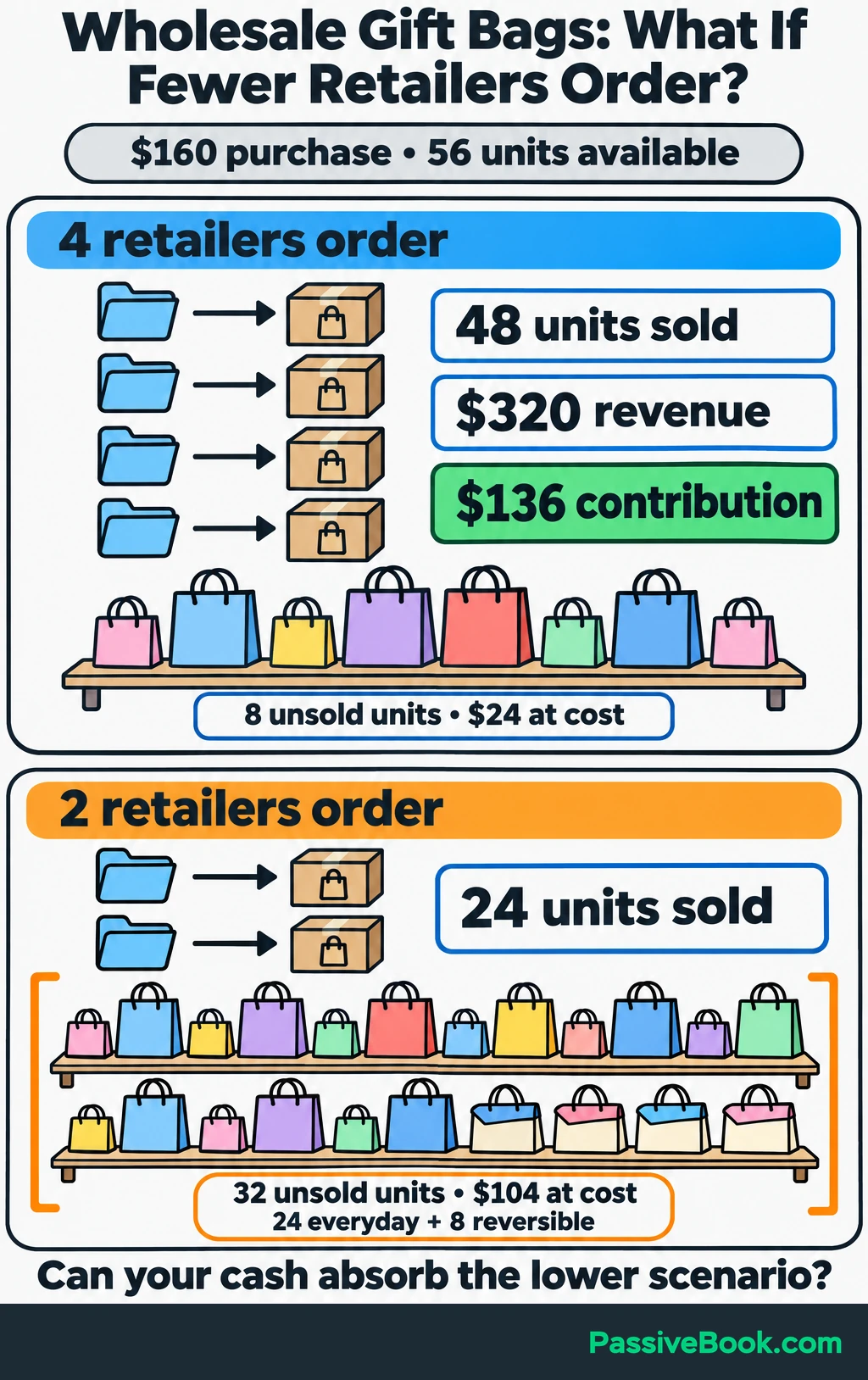
If all four forecast retailers order, you sell 32 everyday bags and 16 reversible bags:
| Result | Calculation | Amount |
|---|---|---|
| Wholesale revenue | 32 × $6, plus 16 × $8 | $320 |
| Product cost of units sold | 32 × $3, plus 16 × $4 | $160 |
| Other variable expenses | 48 × $0.50 | $24 |
| Contribution | $320 − $160 − $24 | $136 |
| Remaining inventory at cost | Eight everyday bags × $3 | $24 |
The cost of units sold includes existing inventory used to fulfill orders. Contribution is not net profit; fixed expenses still need covering.
Now test the lower scenario. Only two retailers order, with the same overall product mix: 16 everyday bags and eight reversible bags sell.
You retain 24 everyday bags and eight reversible bags. Those 32 unsold units hold $104 at cost.
That is the decision I would focus on before production. Can you afford to leave $104 in stock, and when will the retailers pay?
If that exposure is too high, stage the purchase around confirmed orders, provided production lead times still meet delivery promises. The base forecast fits the budget, but the lower scenario tells you whether the commitment is comfortable.
You can copy our planner to compare buying upfront with staging the batch. It shows the cash and stock left under each demand scenario, alongside any delivery shortfalls.
Free Wholesale Inventory Planner




Refine the Assortment With Orders and Reorders
Review stock and open orders often enough to act before replenishment becomes urgent. Review the product mix after retailers have had a meaningful chance to sell and reorder.
Track these by SKU:
- Actual units shipped against forecast.
- Contribution earned.
- Repeat orders.
- Remaining inventory.
- Returns and their reasons.
- Requests you could not fulfill because stock was unavailable.
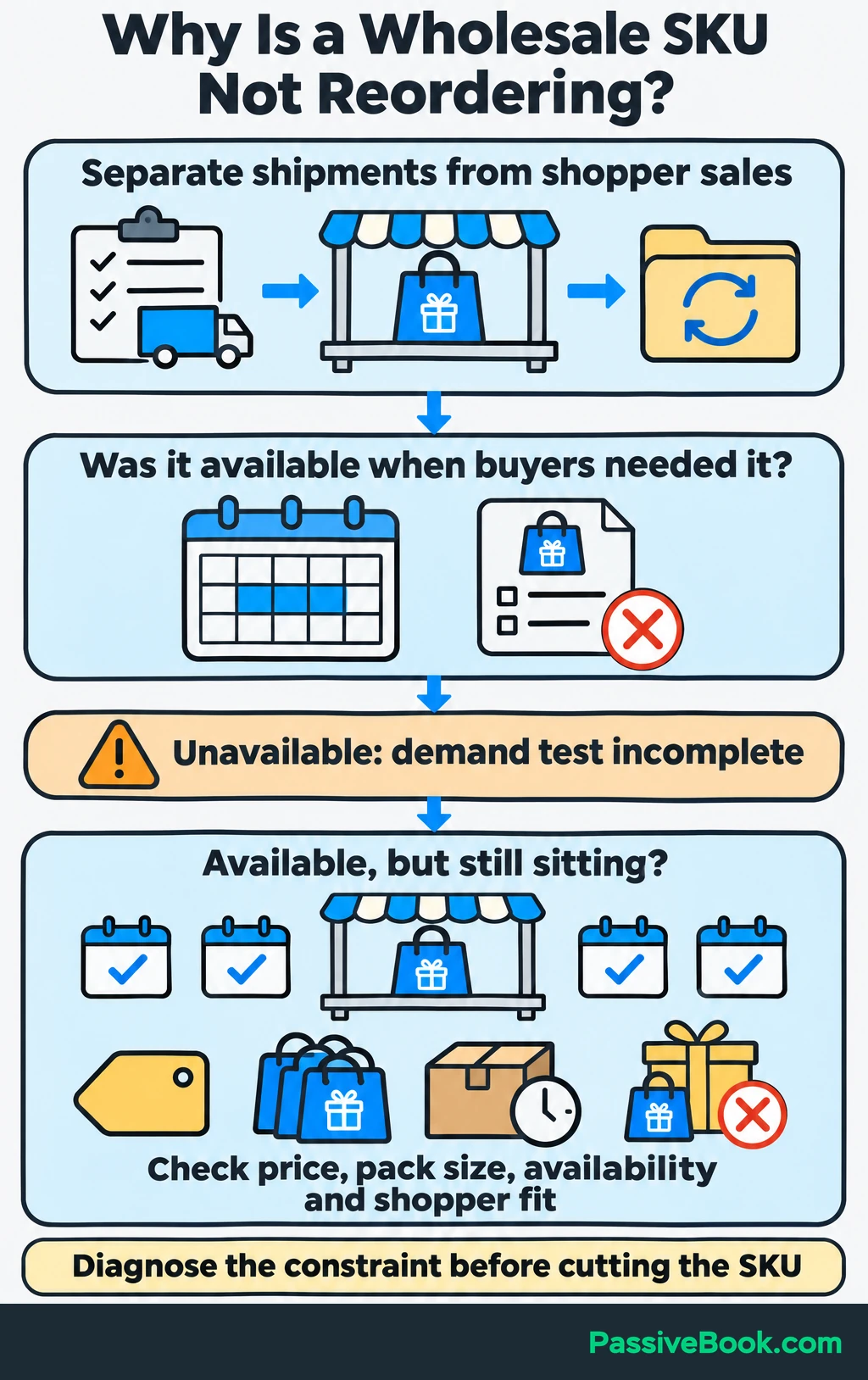
Increase quantities for profitable repeat sellers. Before removing a weak product, check whether buyers faced a price problem, unsuitable pack size, poor availability, or a product that did not fit their shoppers.
A bag that was unavailable during the buying window has not had a fair demand test. A bag that keeps sitting in stores has given you different evidence.
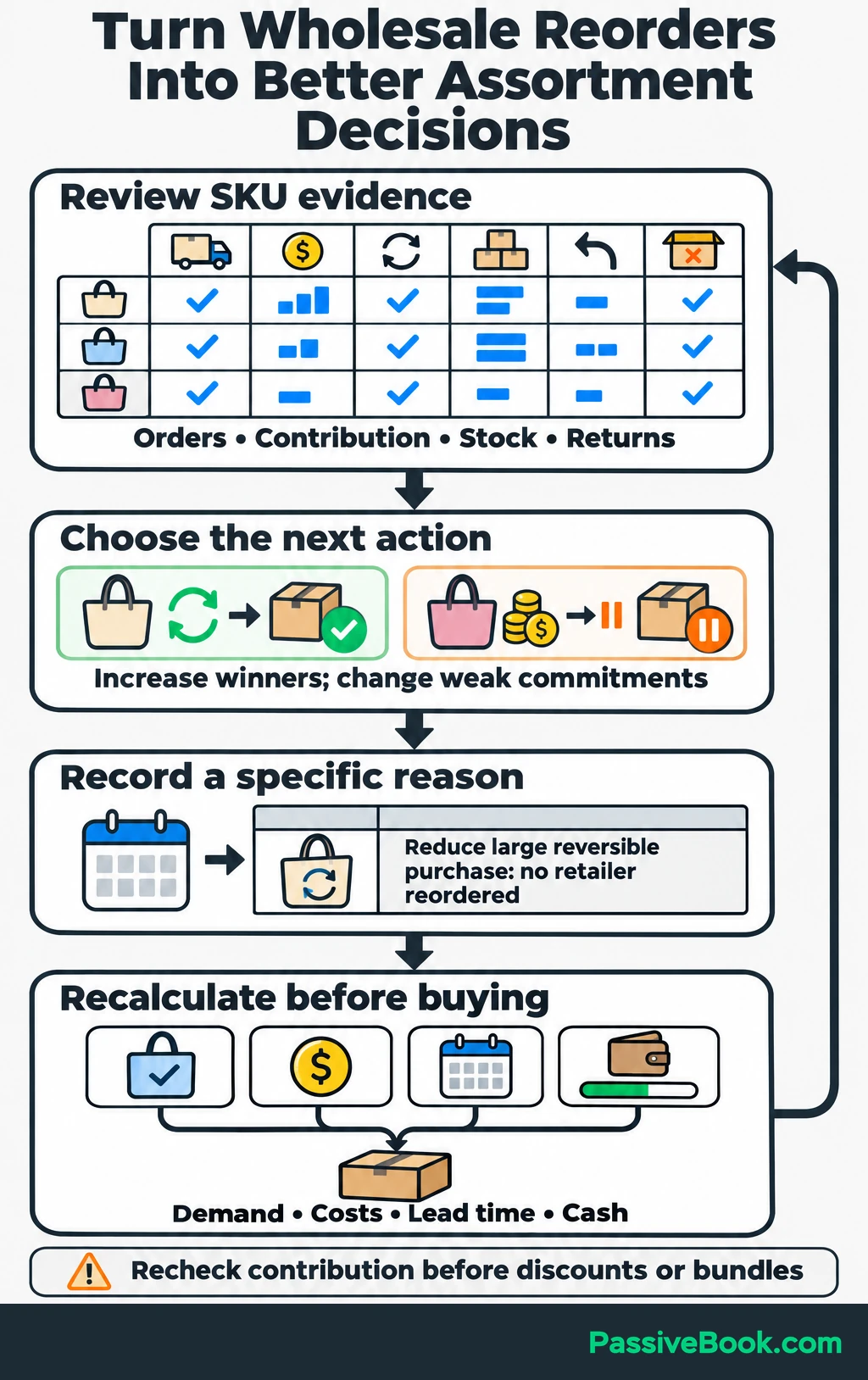
When a variant repeatedly ties up cash, stop replenishing it, combine overlapping choices, offer it made to order, or discontinue it. Recalculate contribution before using discounts or bundles to clear stock. Moving a box is useful only if the deal makes sense.
Record each decision and its reason in the spreadsheet. “Reduce large reversible purchase because no retailer reordered after the selling period” is useful next cycle. “Try fewer” is easy to forget and hard to learn from.
Update demand, costs, lead times, and cash limits before placing the next batch.
What Next?
Create one spreadsheet row for each product variant you are considering, then ask a prospective retailer to assemble a realistic opening order. Use that basket to check your margins, minimums, and cash commitment before buying stock.
Use the social buttons to share this guide when a wholesale planning discussion needs quantities and costs on the table.
Which product or variant in your planned range has the weakest evidence behind it? Share your answer, along with any other questions, in the comments.
Share this post with your friends & followers:

