A supplier offers a pouch for $6, and similar products sell for $20. That looks promising until you add delivery, selling fees, packaging, and the cost of stock that might sit unsold.
The difficult part is deciding whether enough money will remain—and whether buyers want your particular offer.
I learned how expensive that gap can be with my online jewellery store. Before you commit your savings to stock, this guide helps you judge whether a small wholesale order is worth funding, based on buyer demand, supplier terms, and the full cost of each sale.
Understand the Wholesale Resale Model
You buy finished goods from a manufacturer, wholesaler, or distributor and sell them individually at retail prices. Your earnings come from what remains after buying, selling, delivering, and running the business.
A wholesale discount gives you room to work, but it does not guarantee profit. A cheap product can become an expensive mistake if delivery costs too much or customers keep returning it.
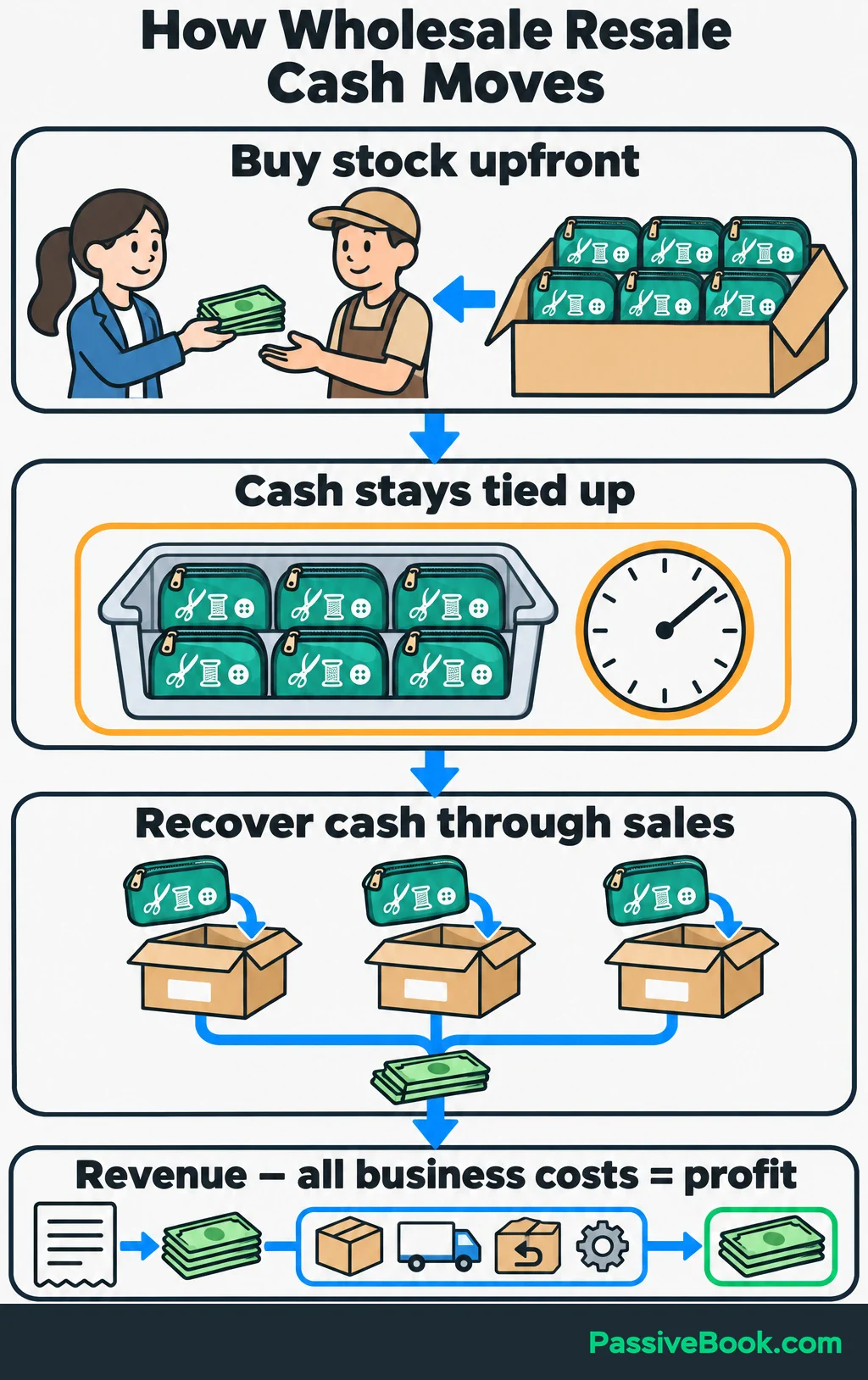
You also pay for stock before recovering that money through sales. Some cash may remain tied up for weeks or months, so your first order needs to fit your budget and storage space.
Throughout this guide, imagine you run a small online sewing-supplies shop and want to sell a compact sewing-tool pouch to hobby quilters. The business, supplier comparisons, figures, and promotional copy are illustrative.
I would start with one product and one sales channel. That gives you a manageable way to learn what sells, what each order costs, and how long it takes to pack and send an order.
Choose a Product and Validate Demand
Start With a Specific Buying Need
Start with something buyers need to do, then look for merchandise that helps.
For the sewing shop, investigate how quilters carry small tools to classes. Do scissors puncture their current bags? Are small items hard to find? Does the pouch need to fit inside a larger project bag?
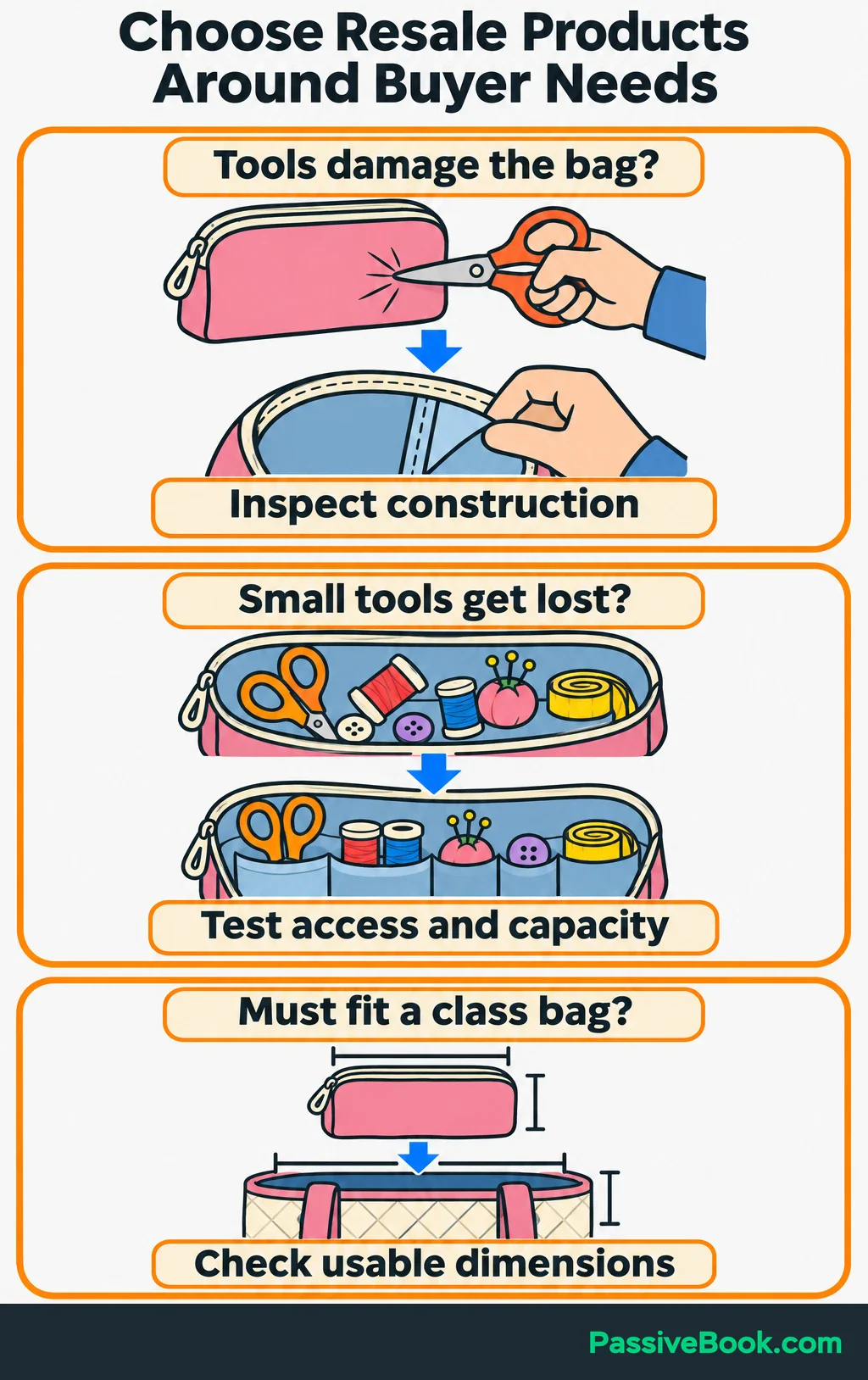
Those answers give you product requirements you can check.
Compare candidates using:
- Demand: Evidence that people already buy products for this task.
- Selling Price: What comparable products actually sell for.
- Delivery: Packed size, weight, and likely shipping expense.
- Quality: Parts that can break, leak, wear out, or disappoint.
- Storage: Space and conditions needed to keep stock sellable.
- Replenishment: Whether the supplier can reliably provide the same item again.
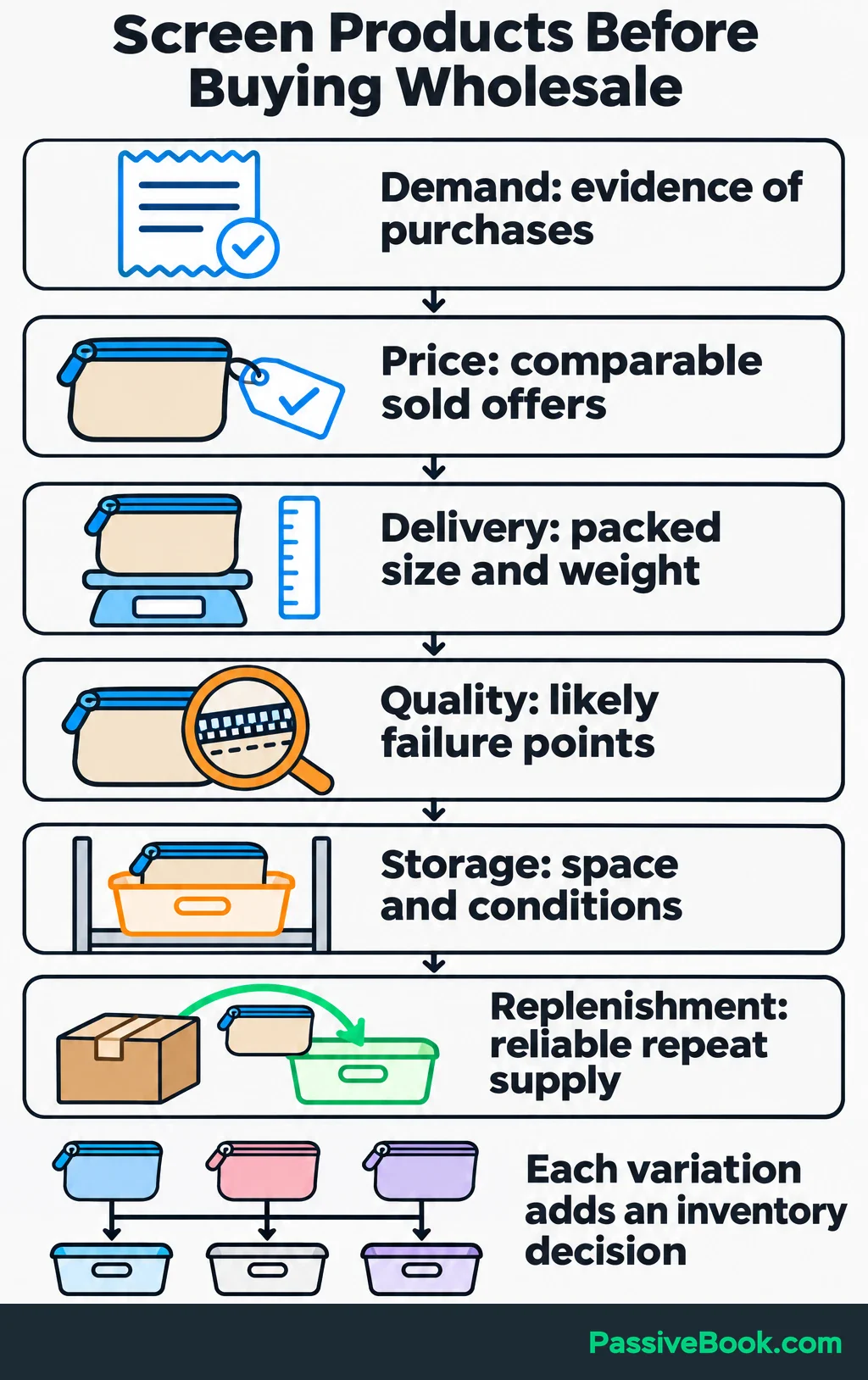
Treat every size and color as another inventory decision. Five colors can leave you with four slow sellers and one color everyone wants.
My jewellery store began with about $1,200, but I skipped market research and ended up with unsold inventory that consumed most of the investment. Choosing products felt like progress. I had not established whether people wanted to buy them.
That is why I would favor a small, durable product with few variations for an opening trial. Fragile goods, expiring products, and complicated electronics add costs and failure points you must understand before ordering.
Check Demand Through One Sales Channel
Choose where you expect to make your first sales, then research buying behavior there.
A marketplace lets buyers discover your listing alongside competing products. Your own store gives you more control, but you must bring people to it. Local events offer direct conversations, though travel, stall fees, and selling time belong in the budget.
For the pouch example, suppose your research points toward an eBay launch. Its Product Research tool provides actual sold prices, sales trends, shipping information, and seller counts.
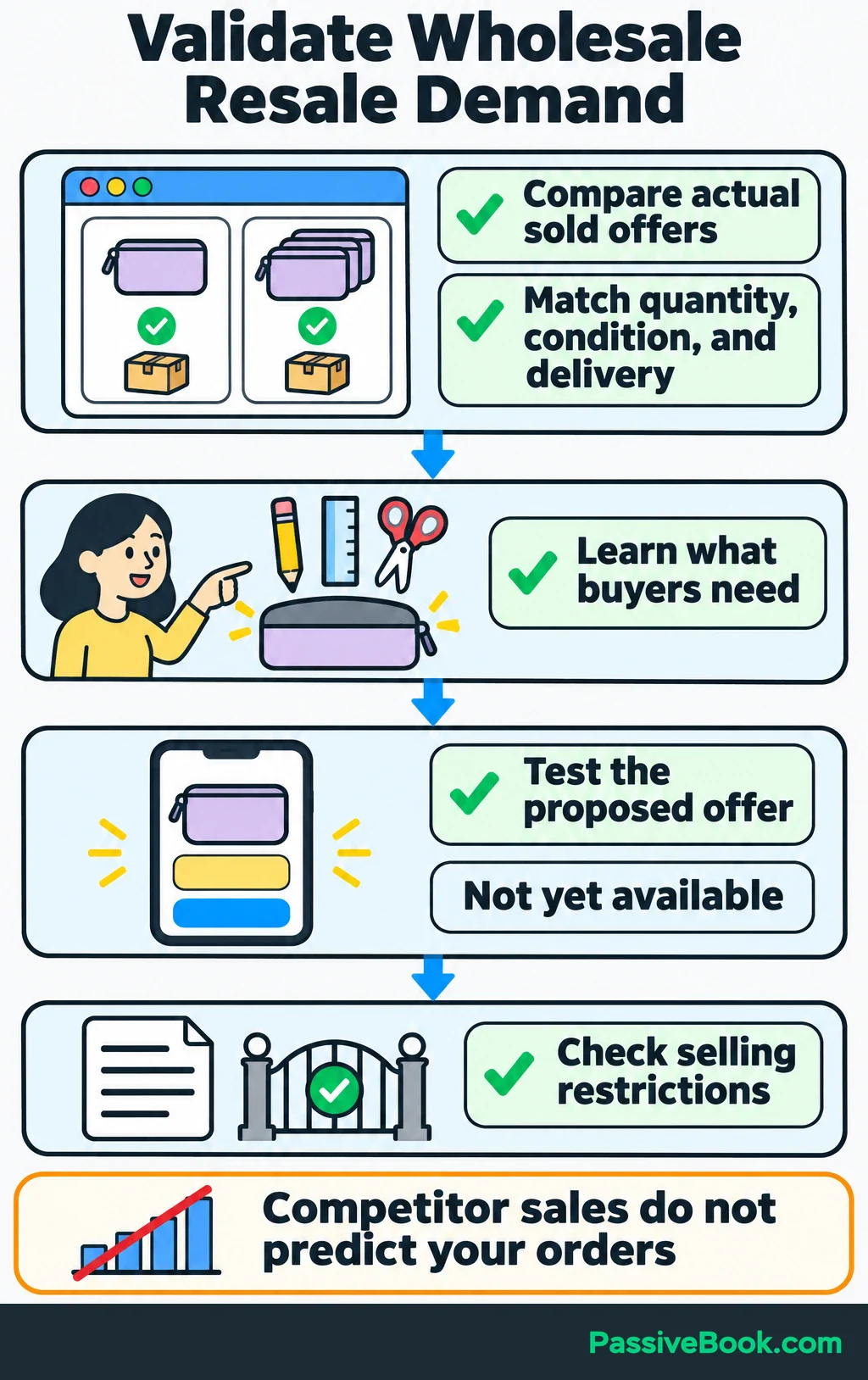
Compare like with like. Check whether a sale included one pouch or several, whether delivery was extra, and whether the item was new. Asking prices alone do not show what buyers paid.
Then read complaints and speak with prospective customers. Ask:
- “What do you currently use to carry tools to class?”
- “What gets lost or damaged?”
- “Which tools must fit inside?”
- “What did you pay for your current solution?”
Show the proposed pouch and price after learning how they buy. A specific concern about dimensions tells you more than a polite “looks nice.”
You can also collect interest through a simple page showing the proposed product, price, and expected availability. Make clear that it is not yet available.
Before buying, check product, brand, and category restrictions on your chosen channel. For example, Amazon may require approval and supporting documents.
Move forward when buyers show interest at a plausible price and you have a practical way to reach them. Competitor sales support the existence of demand; they do not predict your orders.
Set up Your Business for Wholesale Purchasing
The legal and tax examples here concern the United States. Elsewhere, use the equivalent business registry, tax authority, and local licensing office.
A limited liability company (LLC) is not required for every U.S. reseller. A sole proprietorship leaves you personally responsible for business obligations; an LLC generally protects personal assets but adds costs and administration. Compare the SBA’s business structure guidance before applying for supplier accounts so names and documents match.
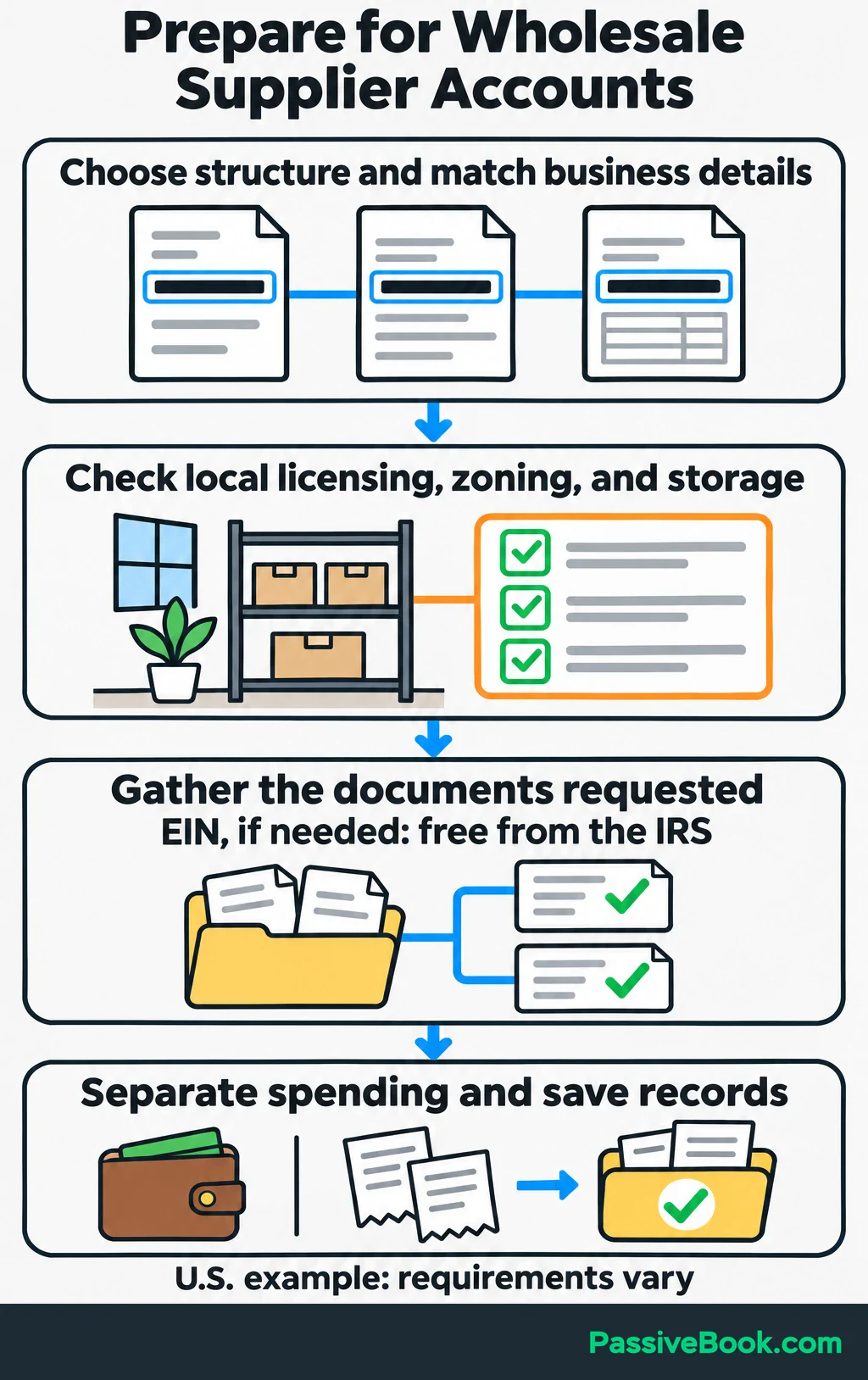
Check registration and licensing requirements for your activity and location, including trading names. For a home operation, also check zoning, lease terms, and stock storage.
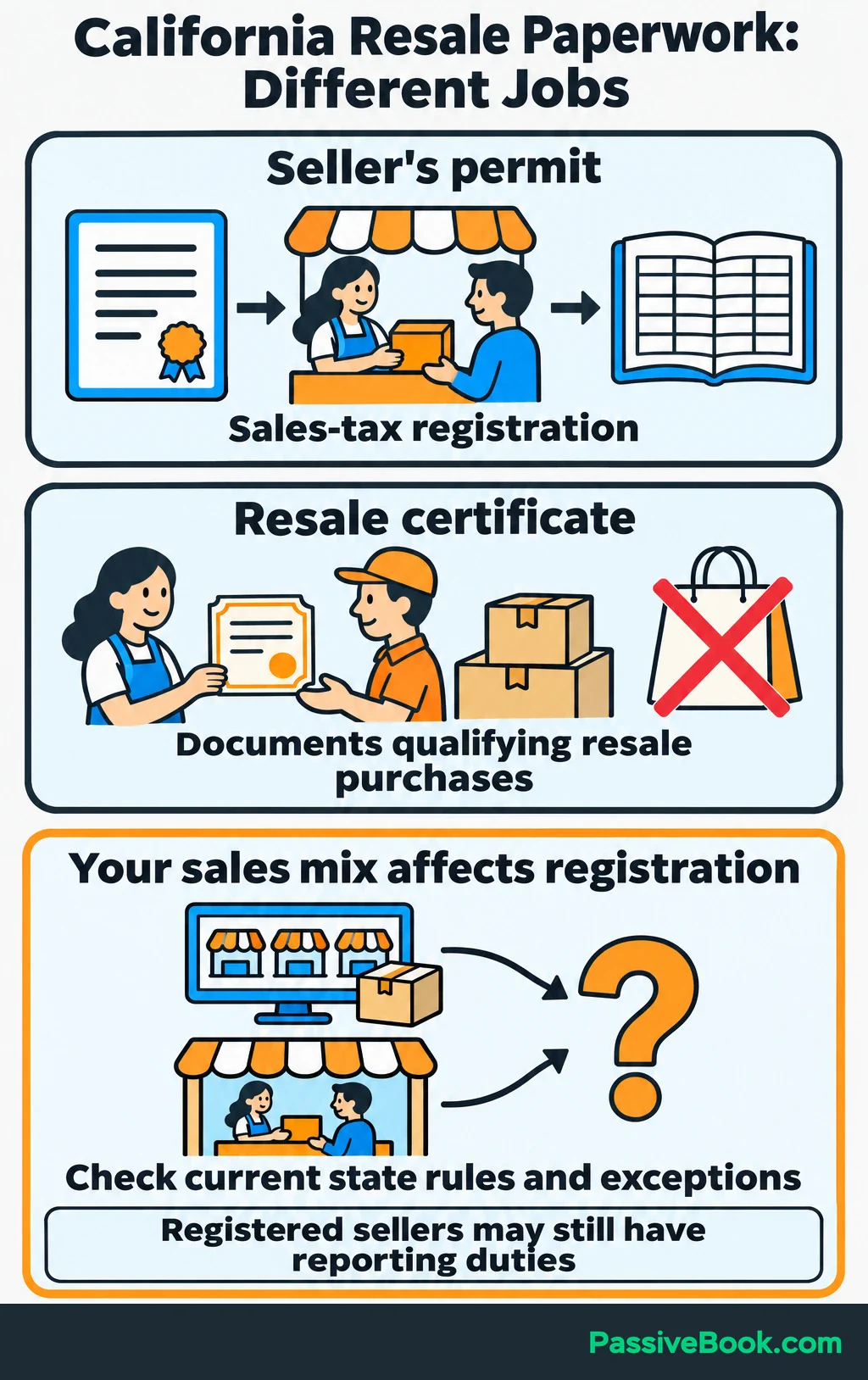
Sales-tax registration and resale paperwork serve different purposes. In California:
- Seller’s Permit: Registers a seller for sales tax, subject to applicable exceptions. Check California’s seller’s permit guidance.
- Resale Certificate: Documents qualifying tax-free purchases of goods for resale, excluding personal use. Check California’s resale certificate rules.
Your sales channel also matters. California generally exempts sellers from registration when all retail merchandise sales go through marketplace facilitators—platforms handling sales tax—registered as retailers with the state. Direct sales may require registration, and registered sellers may still have reporting duties. Check California’s marketplace seller guidance for your sales mix.
Gather the documents your supplier requests. If you need an Employer Identification Number (EIN), a federal business tax ID, get it free from the IRS.
Keep business spending separate from personal spending and save invoices, receipts, sales records, and payout statements from the first purchase.
Find and Vet Wholesale Suppliers
Request Comparable Quotes
Start with the manufacturer or brand’s official website. Ask whether it offers wholesale accounts or can name authorized distributors. Trade directories, trade shows, and wholesale marketplaces can help you find more candidates.
Send a short inquiry explaining what you sell, your intended channel, and the opening order you are considering:
“I’m opening an online sewing-supplies shop and researching compact tool pouches. Do you supply retailers selling through eBay? Please send your account requirements, catalog, opening-order minimum, and written terms.”
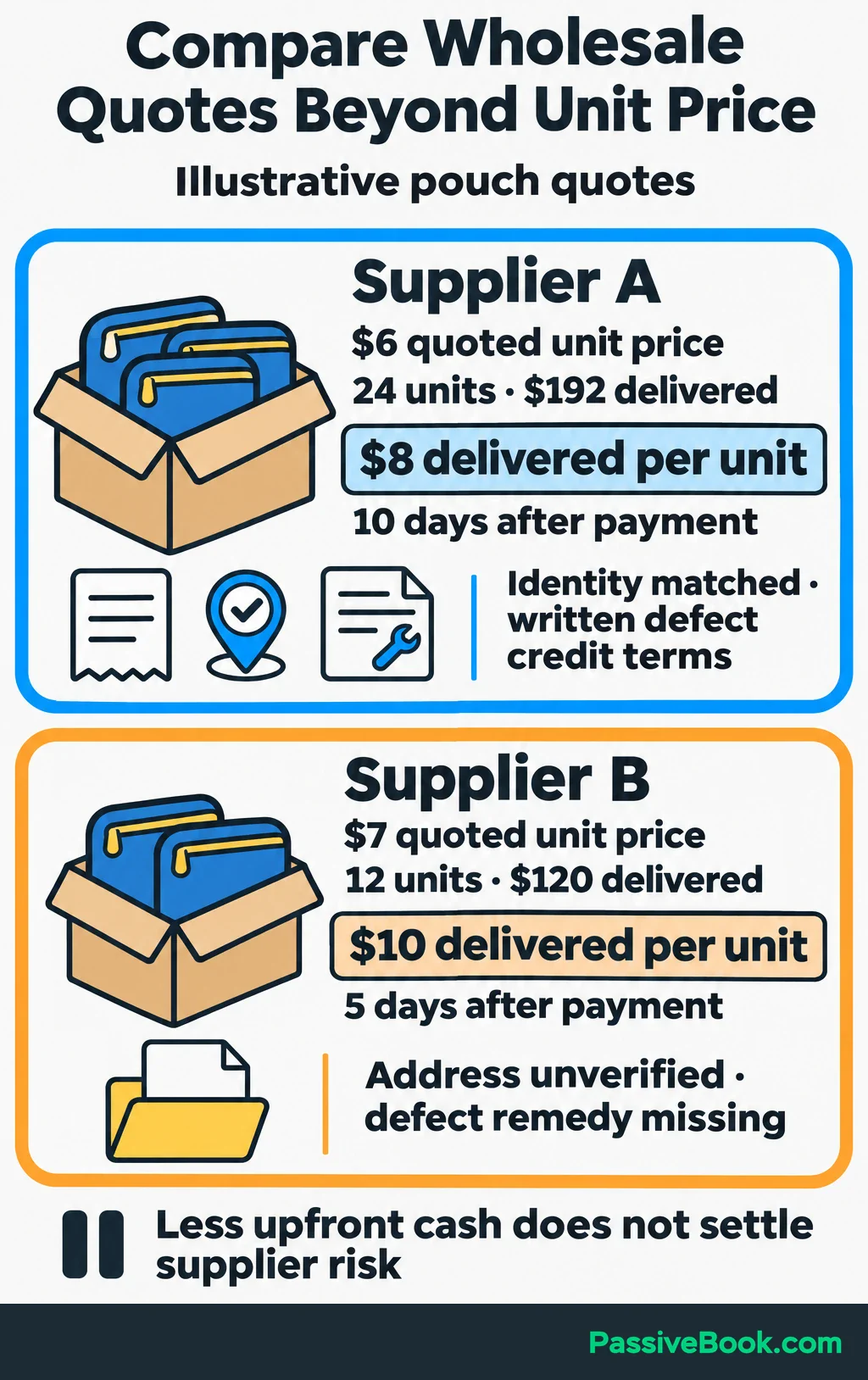
Ask every candidate for the unit price, minimum order quantity, units per case, and freight charges. Also confirm where the goods ship from, how long delivery takes after payment, payment terms, and remedies for defects.
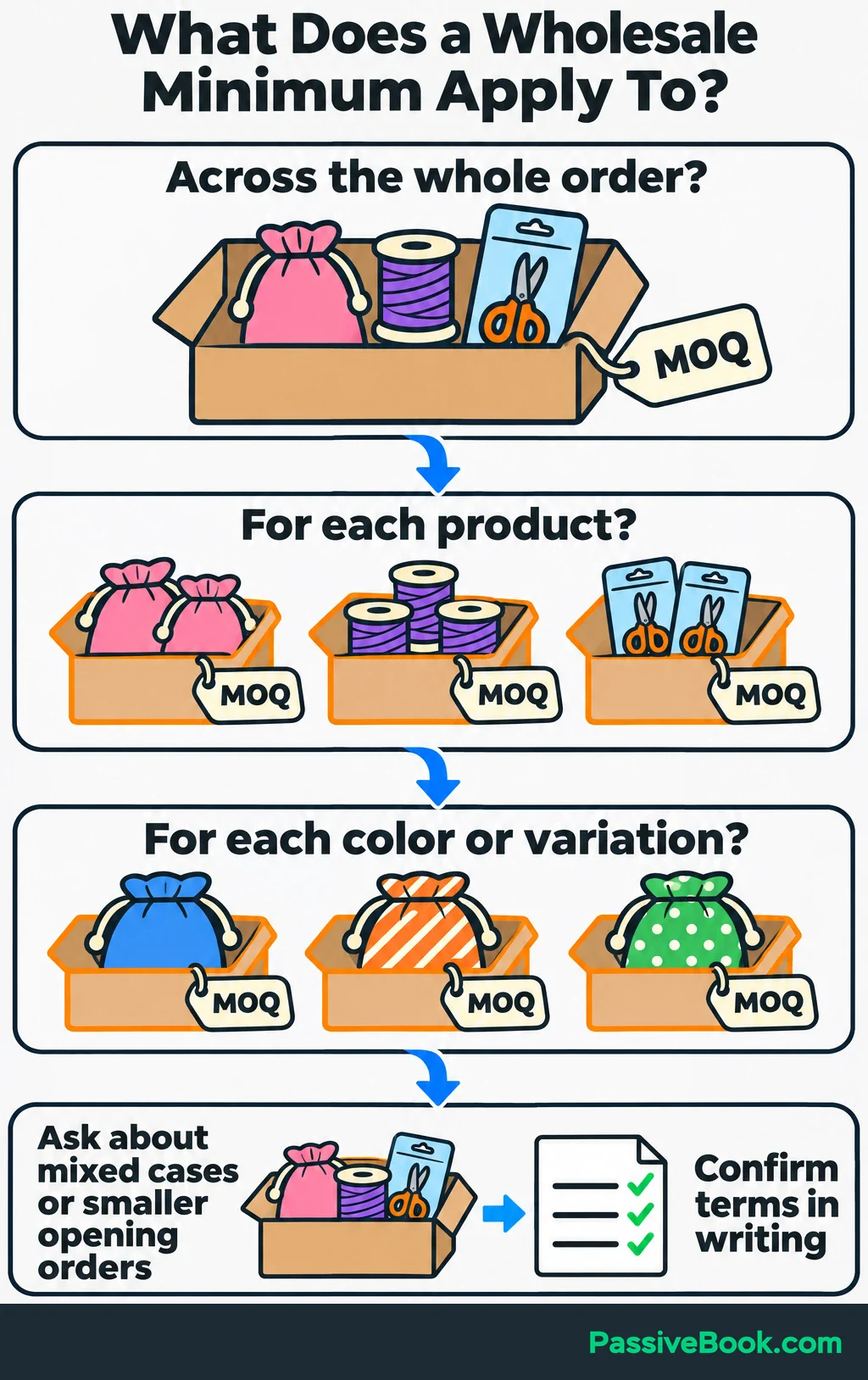
Minimum order quantity means the fewest units you can buy. Check whether it applies across the order, to each product, or to each color. A mixed case or smaller opening order may be possible.
Record the answers side by side. These illustrative entries show the detail worth collecting:
| Supplier | Verification Evidence | Unit Price | Order Minimum | Delivered Cost | Lead Time | Payment Terms | Defect Remedies |
|---|---|---|---|---|---|---|---|
| A | Registry entry and invoice address match | $6 | 24 pouches, one color | $192 total; $8 each | 10 days after payment | Card payment before dispatch | Credit for documented defects reported within 7 days |
| B | Legal name supplied; address not yet verified | $7 | 12 pouches | $120 total; $10 each | 5 days after payment | Bank transfer before dispatch | No written remedy supplied |
Supplier A has the lower delivered unit cost, while B requires less cash. I would leave B pending until its identity and defect terms were clear. A smaller minimum does not settle the decision.
If a supplier’s minimum stretches your budget, ask about alternatives before committing. The AI Supplier Correspondence Studio helps you put your limits and unanswered questions into a clear message.

Free AI Supplier Correspondence Studio




Verify the Supplier and Inspect a Sample
Check the supplier independently before paying.
Confirm its legal identity, address, contact details, and payment recipient. For branded goods, ask the brand directly whether the supplier is authorized to distribute them.
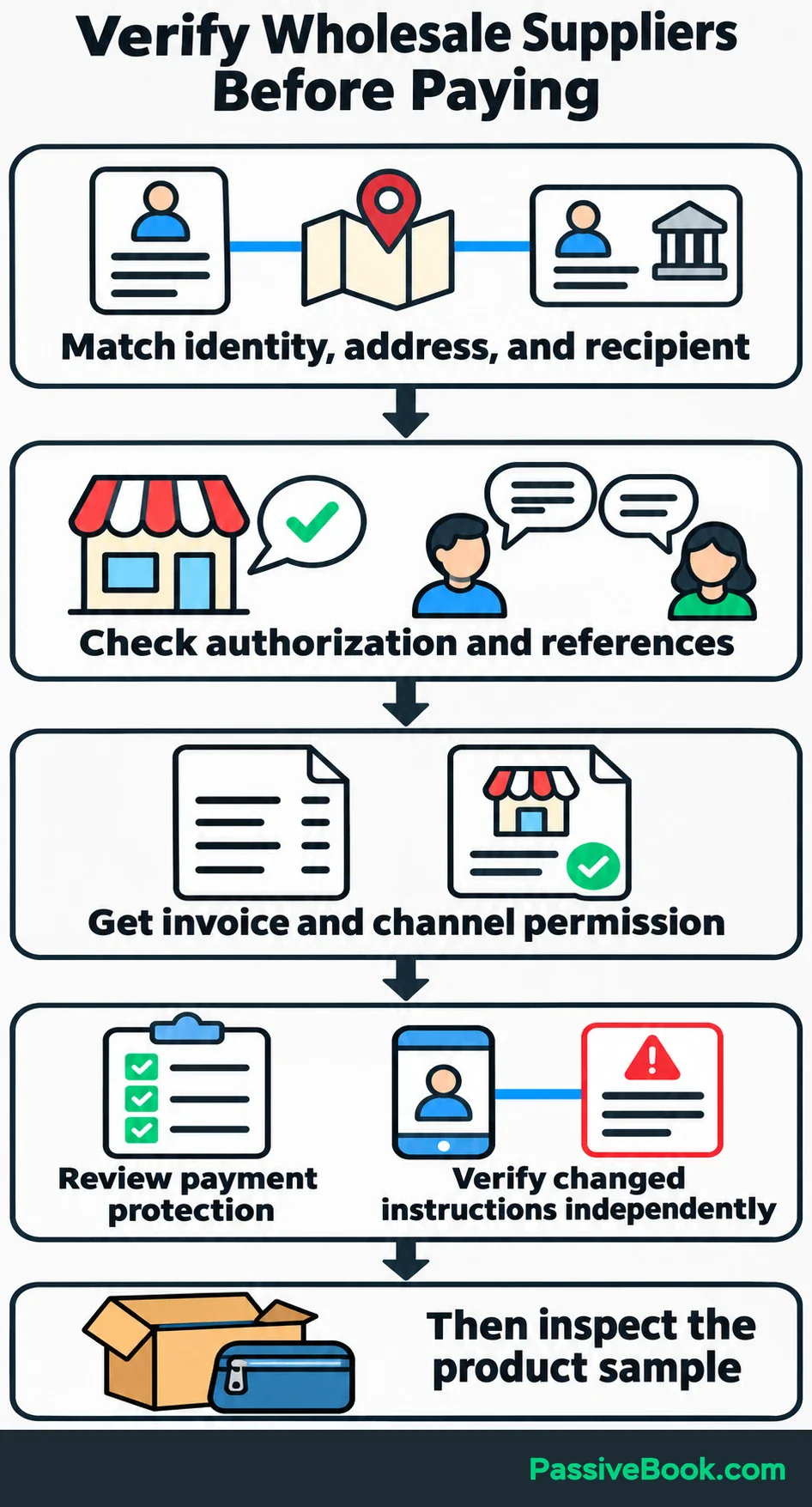
Search the company name with “complaint” and “scam,” and request references you can contact. The FTC’s small-business scam guidance explains common pressure and impersonation tactics.
If payment instructions unexpectedly change, verify them through a contact method you already trust. Review payment protection and dispute procedures before choosing how to pay.
Get written confirmation that your intended sales channel is permitted and request an itemized invoice.
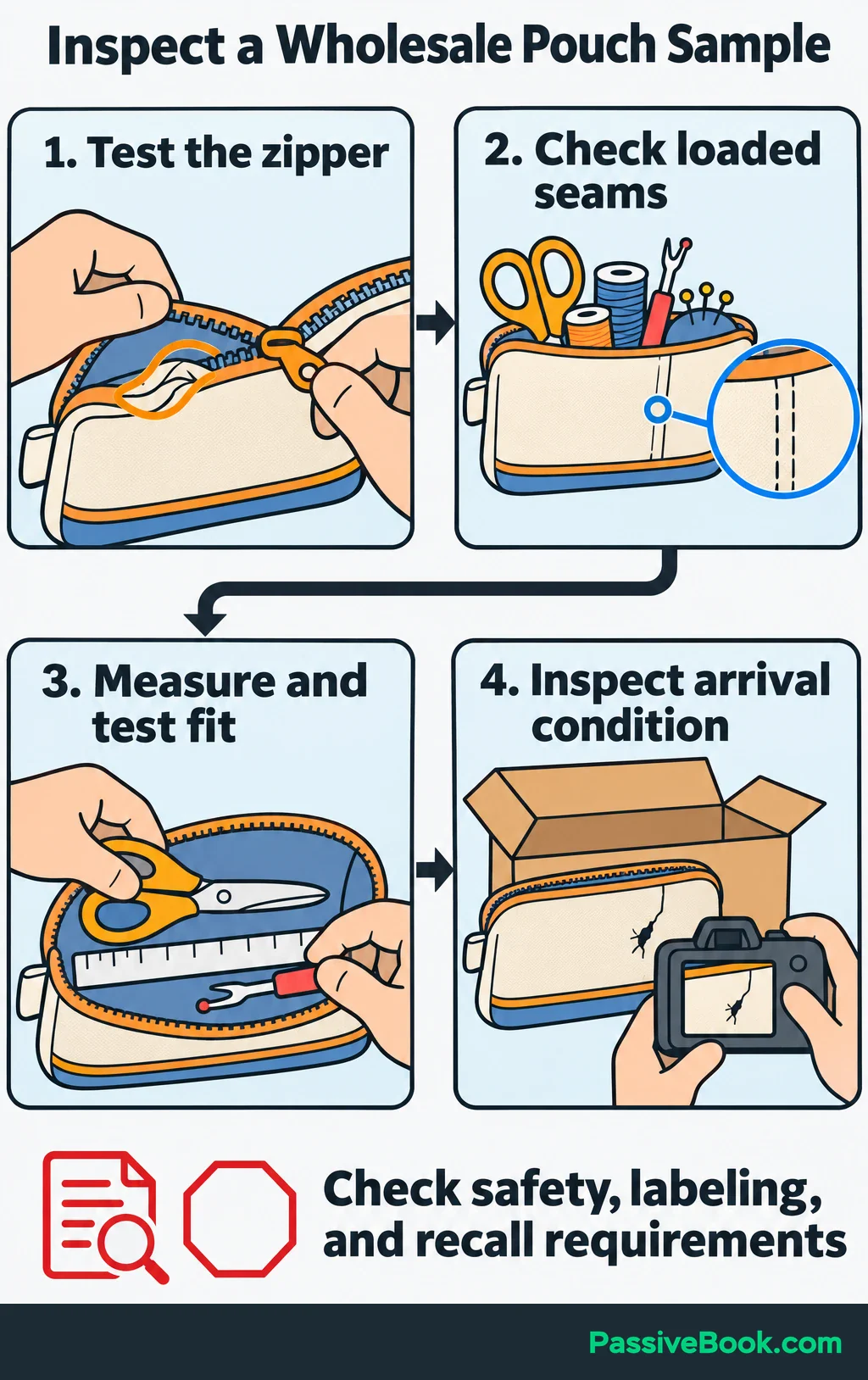
Then order a sample. For the pouch, check:
- Whether the zipper opens smoothly and catches fabric.
- Whether seams hold when the pouch is filled.
- Usable internal dimensions.
- Whether the pictured tools actually fit.
- Packaging and condition on arrival.
A catalog photo cannot tell you whether the zipper becomes a daily argument.
Also check applicable safety, labeling, and import requirements for the exact product. In the U.S., search recall records before purchasing consumer goods. The CPSC explains that selling recalled products is unlawful unless the specified recall remedy has been applied. Exclude recalled stock from your opening order.
Calculate a Selling Price That Leaves a Profit
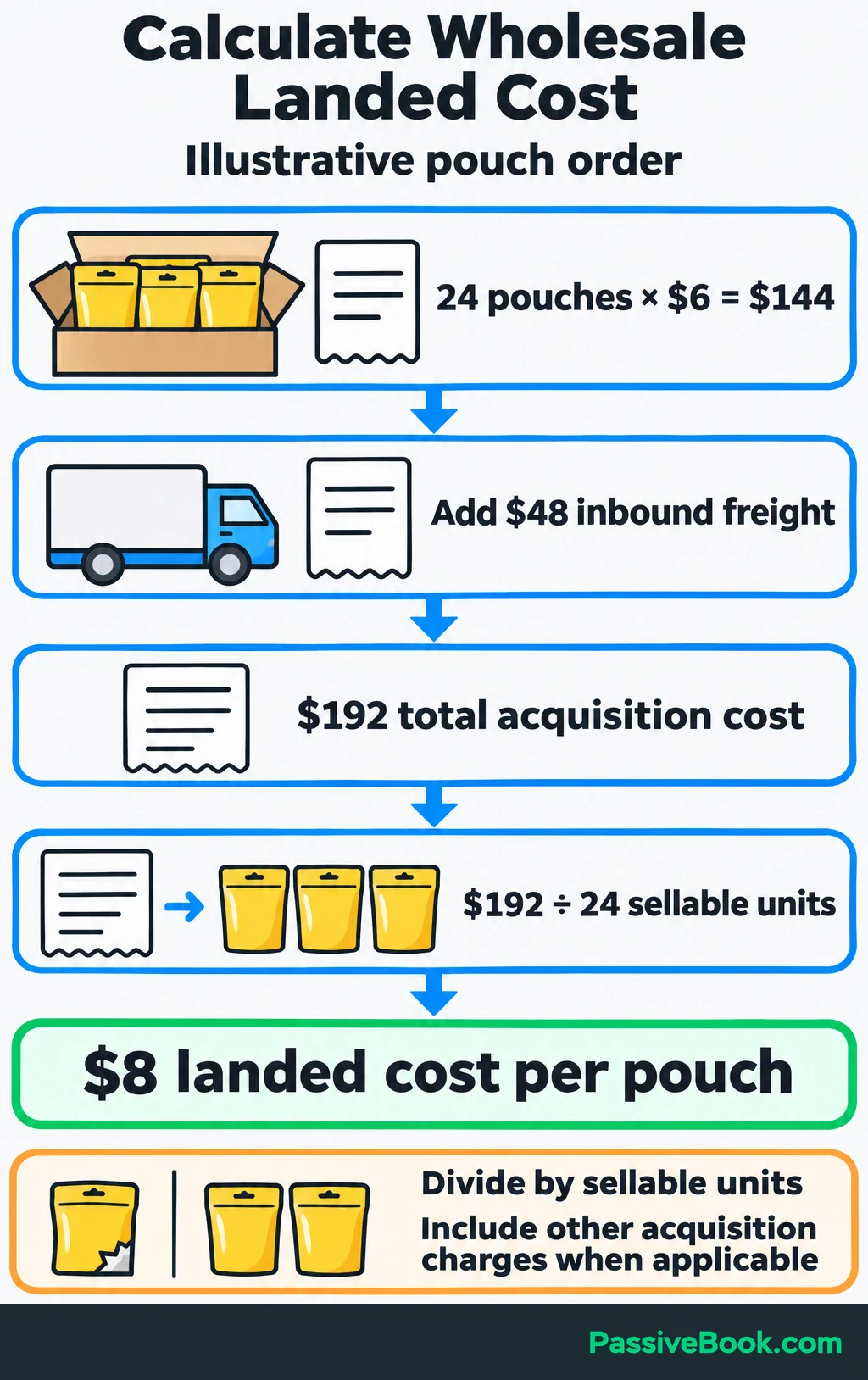
First, add merchandise, inbound freight, applicable duties, and other acquisition charges, then divide by sellable units. This is your landed cost per unit.
For 24 sellable pouches at $6 each, $48 freight, and no other acquisition charges:
(24 × $6 + $48) ÷ 24 = $8 landed cost per pouch
Spread unrecovered costs from damaged stock across the units you can sell.
Subtract landed cost and the other per-sale costs from revenue. The remainder is contribution: money for fixed expenses, then operating profit.
At a $20 selling price:
| Item | Amount Per Sale |
|---|---|
| Selling revenue, excluding sales tax | $20.00 |
| Landed product cost | −$8.00 |
| Selling and payment fees | −$3.00 |
| Seller-paid delivery | −$3.00 |
| Packaging | −$0.50 |
| Expected returns cost | −$0.50 |
| Paid packing and dispatch labor | −$1.00 |
| Contribution | $4.00 |
Contribution is $4, or 20% of revenue. Subtract any paid promotion costs too.
For monthly break-even, count how many sales cover fixed expenses. Divide those expenses by positive contribution per unit and round up, following the SBA’s break-even formula.
With $60 in monthly fixed costs:
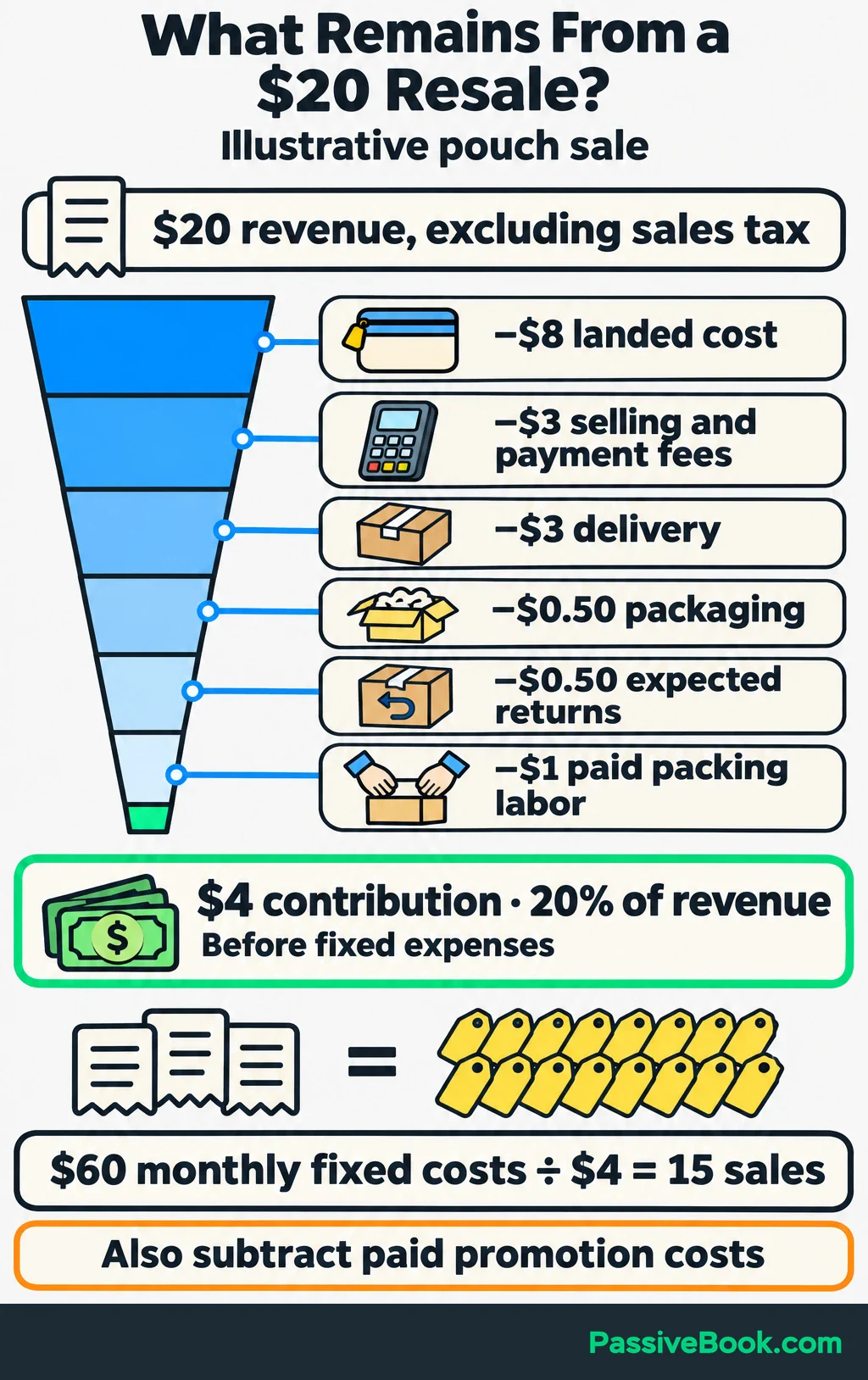
$60 ÷ $4 = 15 sales
This covers that month’s fixed expenses, not startup spending.
Use your own quotes and fees, and test higher shipping costs or returns. If contribution is zero or negative, fix the costs or price before selling more.
I would time packing work too. Doing it yourself saves cash, but your time still has a cost.
A profitable sale does not mean your opening order has paid for itself. Use the calculator to compare your price with the number of sales needed to recover the cash you put in.
Free Pricing Profit Calculator
Budget for a Manageable First Order
Set the most you can afford to lose on the trial before deciding how much stock to buy. Keep money for operations and unexpected costs outside the inventory order.
Your budget should cover registration, samples, inventory, freight, packaging, equipment, selling costs, appropriate insurance, and a reserve.
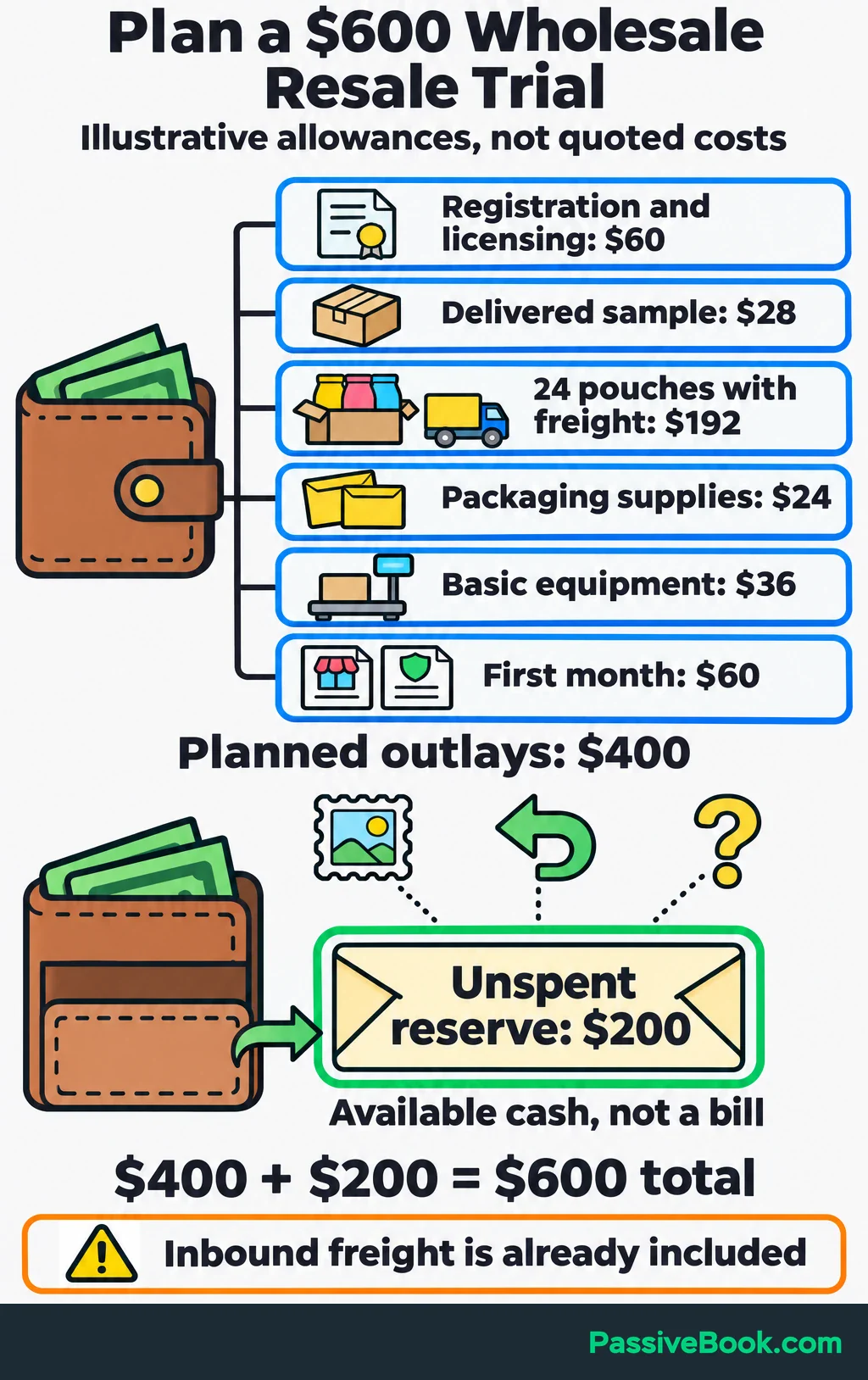
Here is an illustrative $600 plan. Replace these allowances with quotes for your location and product.
| Expense | Planned Amount | Cash Needed |
|---|---|---|
| Registration and licensing allowance | $60 | Before account applications; check renewal costs |
| Sample, including delivery | $28 | Before batch order |
| 24 pouches, including inbound freight | $192 | When ordering |
| Packaging supplies | $24 | Before launch; replenish as used |
| Shipping scale and basic equipment | $36 | Before launch |
| First month’s channel and insurance costs | $60 | Before launch; budget monthly thereafter |
| Shipping, refunds, and contingency reserve | $200 | Hold from the start; available cash, not a bill |
| Total | $600 | Includes $200 in unspent reserve |
Inbound freight is already included in inventory, so it is not added again.
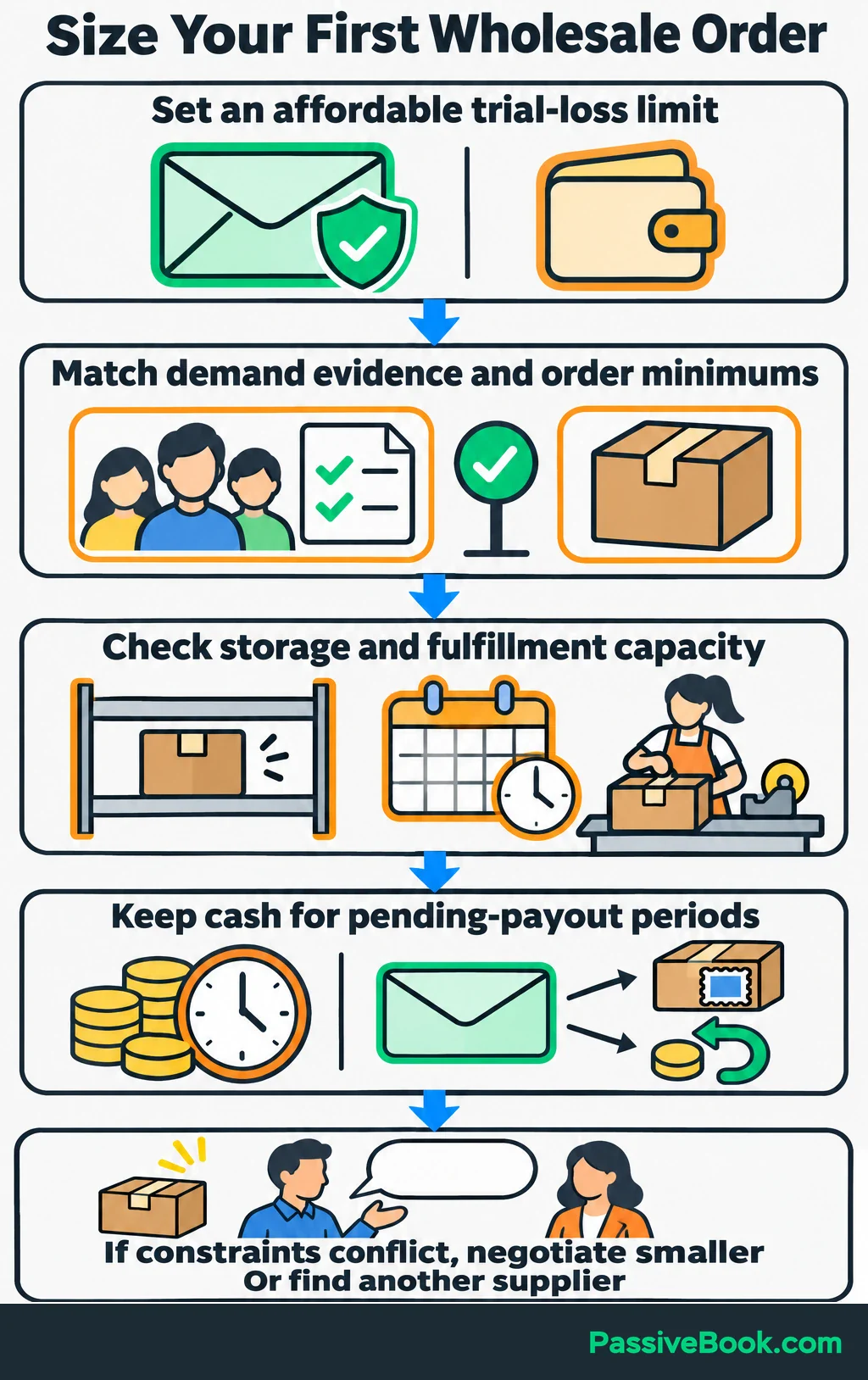
Match the order to demand evidence, supplier minimums, storage, and the number of orders you can handle around other commitments. If those constraints conflict, negotiate a smaller order or find another supplier.
Leave cash available while payouts are pending. You may need to buy postage or issue a refund before sales money reaches your bank.
Prepare Your Inventory and Store
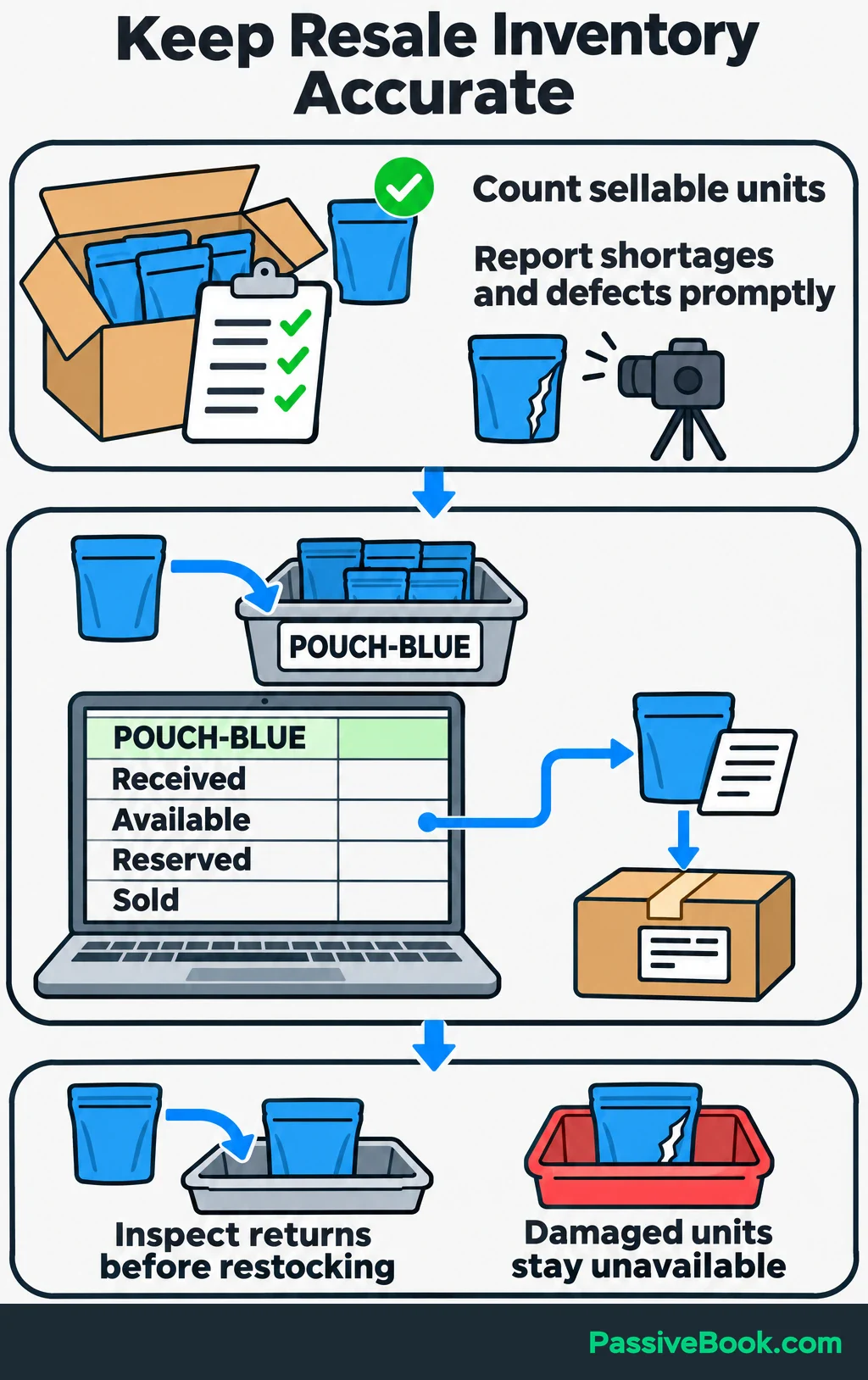
When the shipment arrives, compare it with the invoice and count sellable units. Photograph defects and report shortages within the supplier’s claim period.
Give each variation a stock identifier and a labeled storage location. A simple spreadsheet can track received, available, reserved, sold, returned, and damaged units.
For example, use POUCH-BLUE for the blue pouch and store it in one labeled bin. Record damaged returns separately so they do not become available stock by accident.
Pack and weigh a sample order before finalizing shipping charges. Include the actual packaging, because its weight and dimensions affect the cost.
Your listing should answer the questions buyers need resolved:
- Product Details: Dimensions, material, closure, and included items.
- Photographs: The pouch open and closed, with clear views of its storage space.
- Use: How it carries small tools to class.
- Purchase Terms: Price, dispatch timing, delivery information, and returns.
Show familiar tools for scale, but clearly identify props that are sold separately. Use photographs you own or have permission to publish, and make claims you can support. Do not call the pouch waterproof because the fabric looks shiny.
Test checkout, shipping charges, applicable tax settings, stock changes, and order notifications before accepting orders.
For an existing WordPress site, WooCommerce adds a store. Otherwise, I would stick to the channel where you validated demand.
Set regular packing and dispatch times around your other commitments, and show those times in your listing.
Make Your First Sales Through the Chosen Channel
Launch where you researched demand and send interested prospects directly to the finished listing.
On a marketplace, use accurate product terms buyers used during research and choose a clear main photograph. On your own store, bring people from the relevant contacts, communities, or content you identified earlier. Follow community promotion rules.
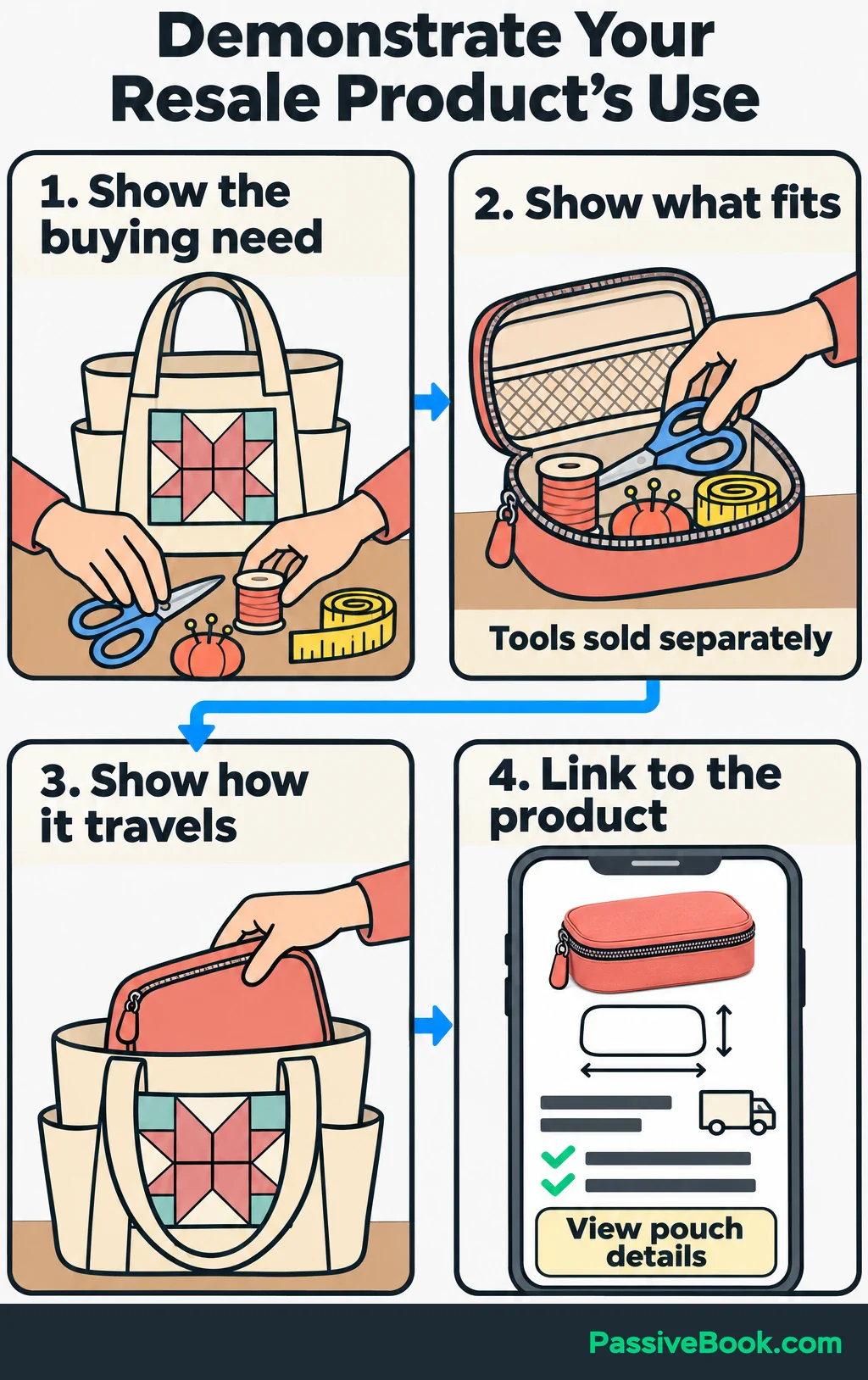
Lead with the buying need. A short demonstration can show the pouch holding small tools and fitting inside a class bag.
Keep the accompanying invitation simple:
“Taking your sewing tools to quilting class? See what fits in this compact pouch.”
Link directly to the product listing so people can check dimensions, included items, and price.
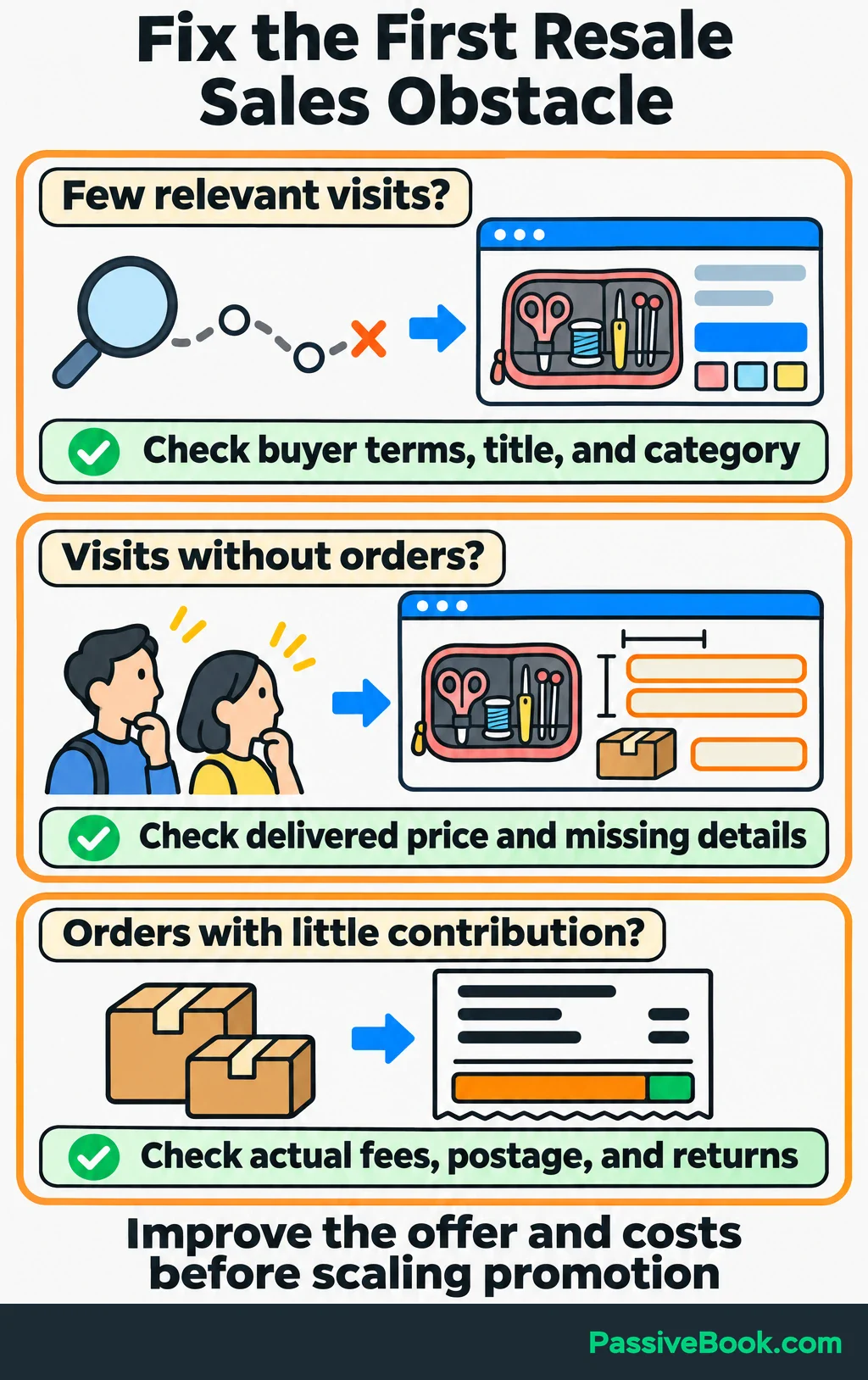
Record visits or inquiries, orders, actual selling prices, promotion spending, fulfillment costs, and customer objections. Then fix the first obstacle you can observe:
- Few Relevant Visits: Check whether your title and category match comparable sold listings. For the pouch, use the terms quilters used in your research.
- Visits Without Orders: Compare the delivered price with similar sold offers, and answer missing questions about size, capacity, and returns.
- Orders With Little Contribution: Check actual fees, postage, and returns against your estimate, then adjust costs or price before promoting again.
If several buyers ask whether particular scissors fit, measure them and improve the listing. Another logo revision can wait.
I would use these first orders to learn before spending heavily on promotion. More traffic becomes useful once the offer and costs work together.
Reorder From Actual Sales and Available Cash
Review the trial before placing another order. Compare units sold, actual contribution, returns, remaining stock, payout timing, and fulfillment time with your original assumptions.
Reorder when the product sells at a worthwhile contribution and you have enough available cash. Keep replacement-stock money separate from money you can withdraw.
To estimate when to reorder, count the units likely to sell while replenishment is on its way, then add a buffer for uncertainty.
Suppose 12 pouches sell over 20 calendar days while the pouch is continuously in stock. That is an average of 0.6 pouches per day. If replenishment takes 10 days and you allow three extra units as a buffer:
0.6 × 10 + 3 = 9 pouches
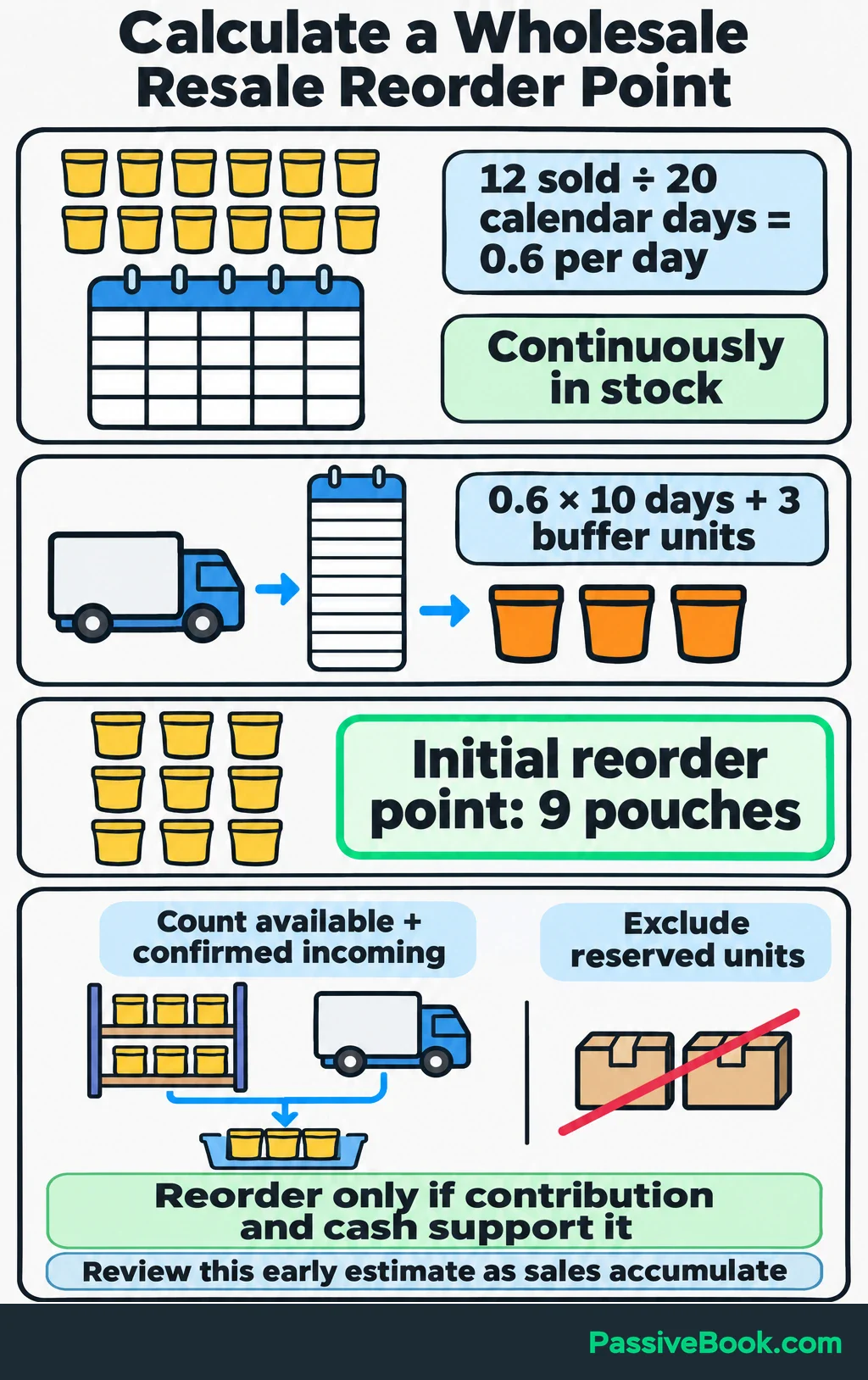
Nine becomes an initial reorder point. Compare it with available stock plus confirmed incoming stock, without counting units already reserved for customers. Early sales provide a rough estimate, so review it as more orders come in.
Set a review date for slow stock too. Compare the cash you could recover through a discount, a useful bundle, another permitted channel, or a supplier return allowed by your agreement. Include the extra fees and work.
Do not buy more merely because the next quantity discount looks attractive. A lower unit price can leave you with more money trapped on a shelf.
Once sales and fulfillment repeat reliably, document the process. Then automate useful stock alerts, order updates, and bookkeeping transfers. I use n8n to connect repeat tasks, but a basic stock alert may be all a small trial needs.
Keep purchasing decisions and supplier problems under regular review. Automation can send a reorder reminder; you still decide whether that reorder deserves your cash.
What Next?
Choose one product today and record three comparable sold offers, including delivery charges and pack quantities. Use that evidence to decide whether requesting supplier quotes is worthwhile.
Use the social buttons to share this guide when a wholesale discount starts looking like an easy profit—the full cost calculation deserves a place in that conversation.
What would you need to learn before feeling comfortable funding your first order? Leave your answer, along with any other questions, in the comments.
Share this post with your friends & followers:

