A supplier offers a lower price if you double your order. Each unit looks more profitable, but the invoice would swallow most of your stock budget. Is that a better deal?
The discount is easy to see. The cost of holding extra inventory is harder to judge, especially before you know what customers will buy. Money tied up in slow-selling stock is money you can’t use for other bills. Here’s how to compare the full offer and make a counteroffer that protects your margin without tying up cash you need elsewhere.
What Wholesale Terms Can You Negotiate?
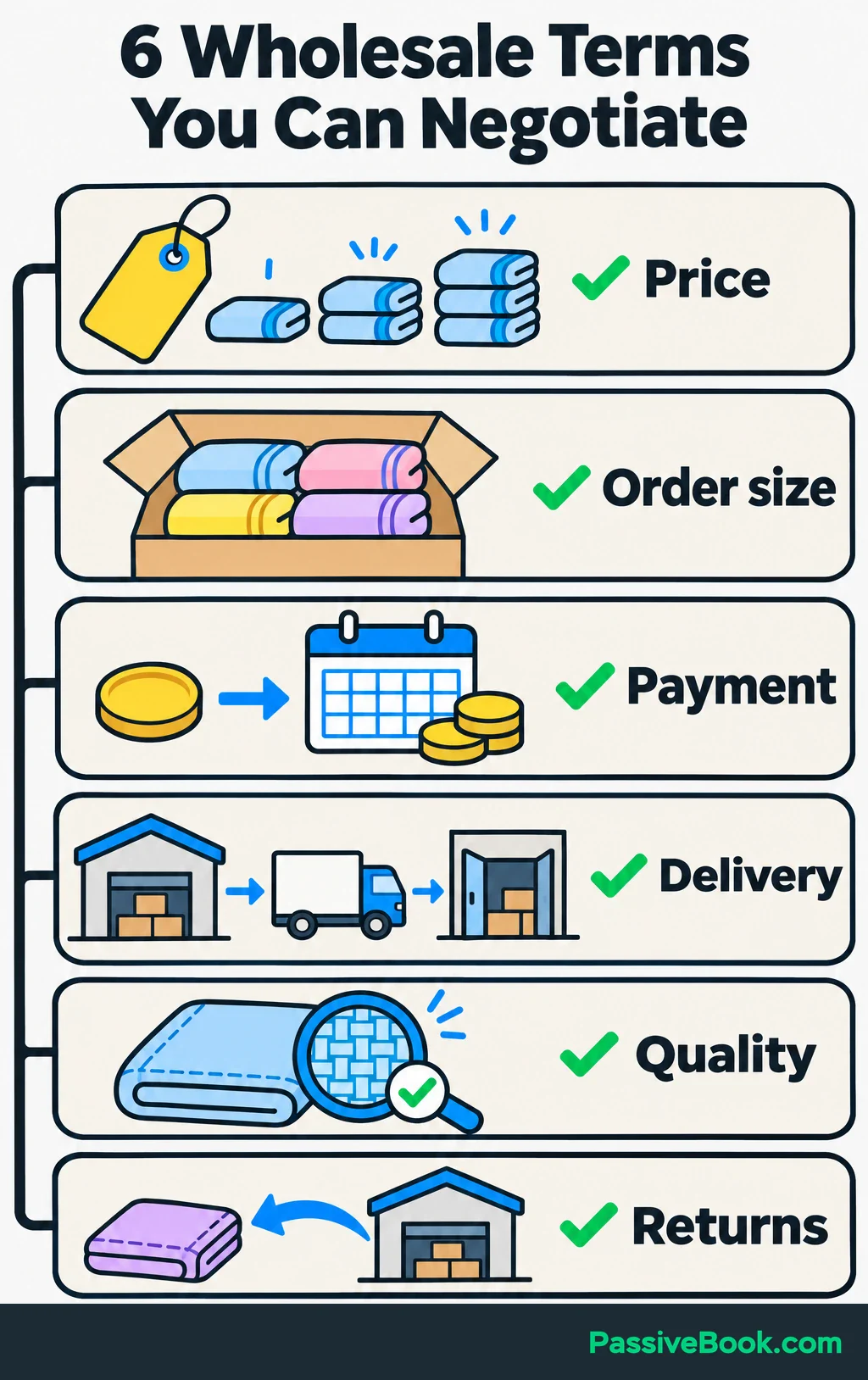
If you’re learning how to negotiate wholesale purchasing terms, look beyond “Can you lower the price?”
The purchasing package can include:
- Price: Unit cost, quantity discounts, and how long the quote remains valid.
- Order Size: Minimum quantities, mixed products or colours, and reorder minimums.
- Payment: Deposit, balance deadline, and the event that starts the payment period.
- Delivery: Freight charges, dispatch dates, arrival commitments, and responsibility for damage.
- Quality: Product specifications, inspection deadlines, and remedies for faulty or incorrect goods.
- Returns: Whether unsold stock can be returned or exchanged, and at what cost.
Alibaba’s buyer guidance specifically identifies deposits, payment schedules, shipping, warranties, and packaging as options beyond price.
A supplier may hold firm on price but consider a smaller order using stocked designs and standard packaging. You can propose that trade without pretending to be a large buyer.
Set Your Purchasing Limits
Before contacting a supplier, decide what the purchase must leave available for the rest of your business.
Start with your maximum landed cost: the cost of buying each unit and getting it ready at the location you sell from.
Work backwards from a realistic selling price. Subtract your other variable selling costs, then subtract the amount each sale needs to contribute toward fixed expenses and profit.
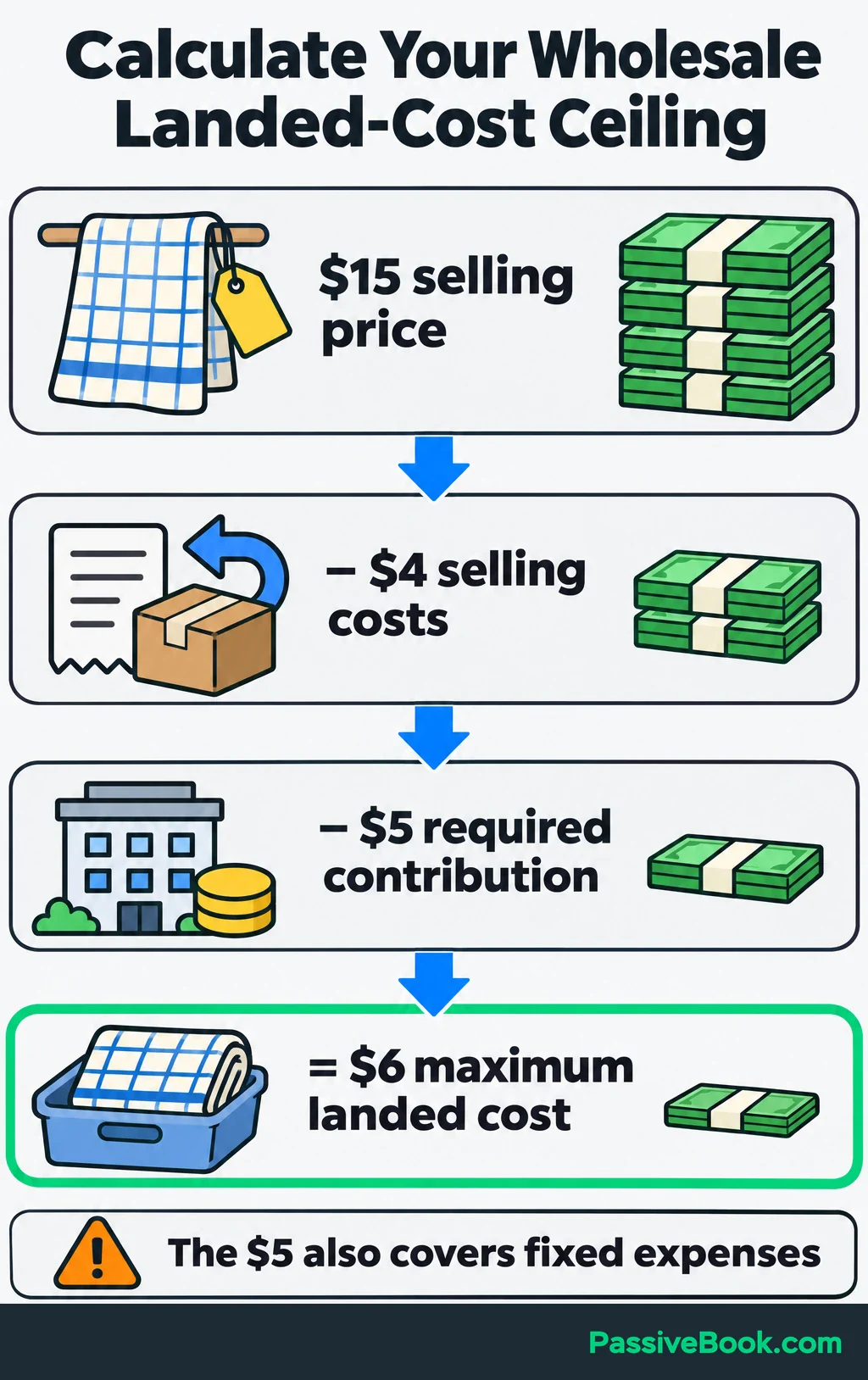
Suppose you sell cotton kitchen tea towels online:
| Item | Amount Per Towel |
|---|---|
| Expected selling price | $15 |
| Selling fees, customer fulfillment, and an allowance for returns or markdowns | $4 |
| Required contribution toward fixed expenses and profit | $5 |
| Maximum landed cost | $6 |
That leaves $15 − $4 − $5 = $6 to buy each towel and bring it into stock. The $5 contribution is not all profit because fixed expenses still need paying.
Set quantity and cash limits separately:
- Preferred Trial: 60 towels.
- Maximum Quantity: 100 towels.
- Total Purchasing Limit: $550, including inbound charges.
- Maximum Before Delivery: $550, with that money available after reserving cash for other bills.
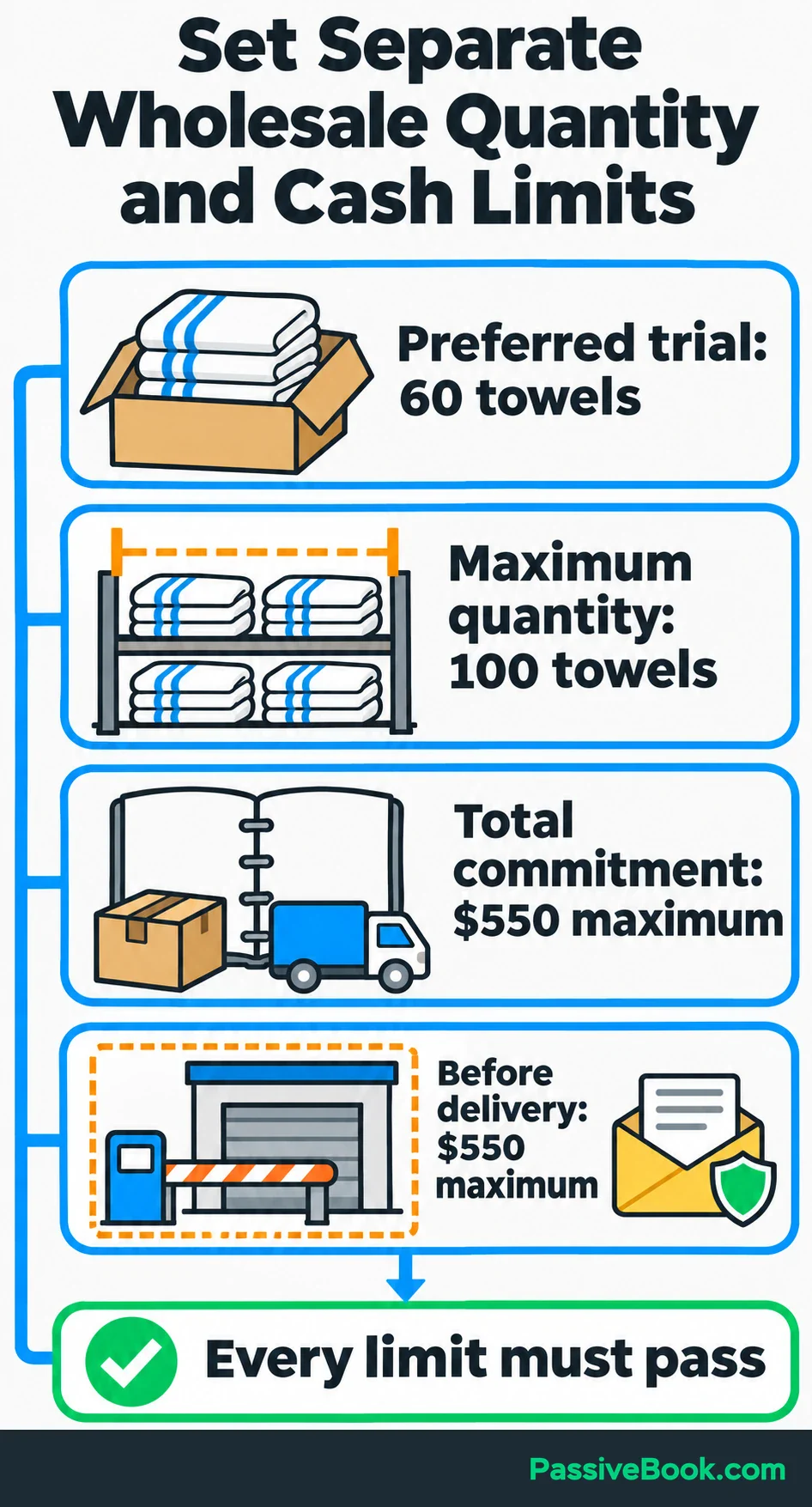
These are illustrative limits. Yours should reflect demand evidence, storage space, and money you can afford to commit.
My online jewellery store started with about $1,200, and I lost most of that investment after insufficient market research left me with unsold inventory. I could look at the remaining pieces and imagine their retail value, but that didn’t put the money back in my account. That experience is why I would set an inventory limit before chasing a quantity discount.
Choose an alternative, too. Another suitable supplier, a smaller range, or postponing the purchase gives you somewhere to go if the offer cannot work.
Compare Supplier Offers on the Same Basis
Request Matching Specifications and Complete Quotes
Send each supplier the same buying brief. Otherwise, you may compare different products and mistake the difference for a saving.
Include the product specification, quantity, colour mix, packaging, delivery destination, and required arrival window. For the towels, specify dimensions, fabric, stitching, and print quality. Check samples before treating two products as equivalent.
Ask for a written quote covering:
- Pricing: Currency, unit price, quantity breaks, additional charges, and quote expiry.
- Minimums: Whether the minimum applies per order, product, colour, or carton, and whether reorders have a different minimum.
- Payment: Deposit, balance, payment method, fees, and due dates.
- Timing: Production time, dispatch date, and expected arrival.
- Problems: Inspection deadlines and terms for shortages, defects, transit damage, and unsold-stock returns.
“Ships in two weeks” needs a follow-up. Does production start then, does the parcel leave then, or should it reach you then?
Calculate Landed Cost and Total Commitment
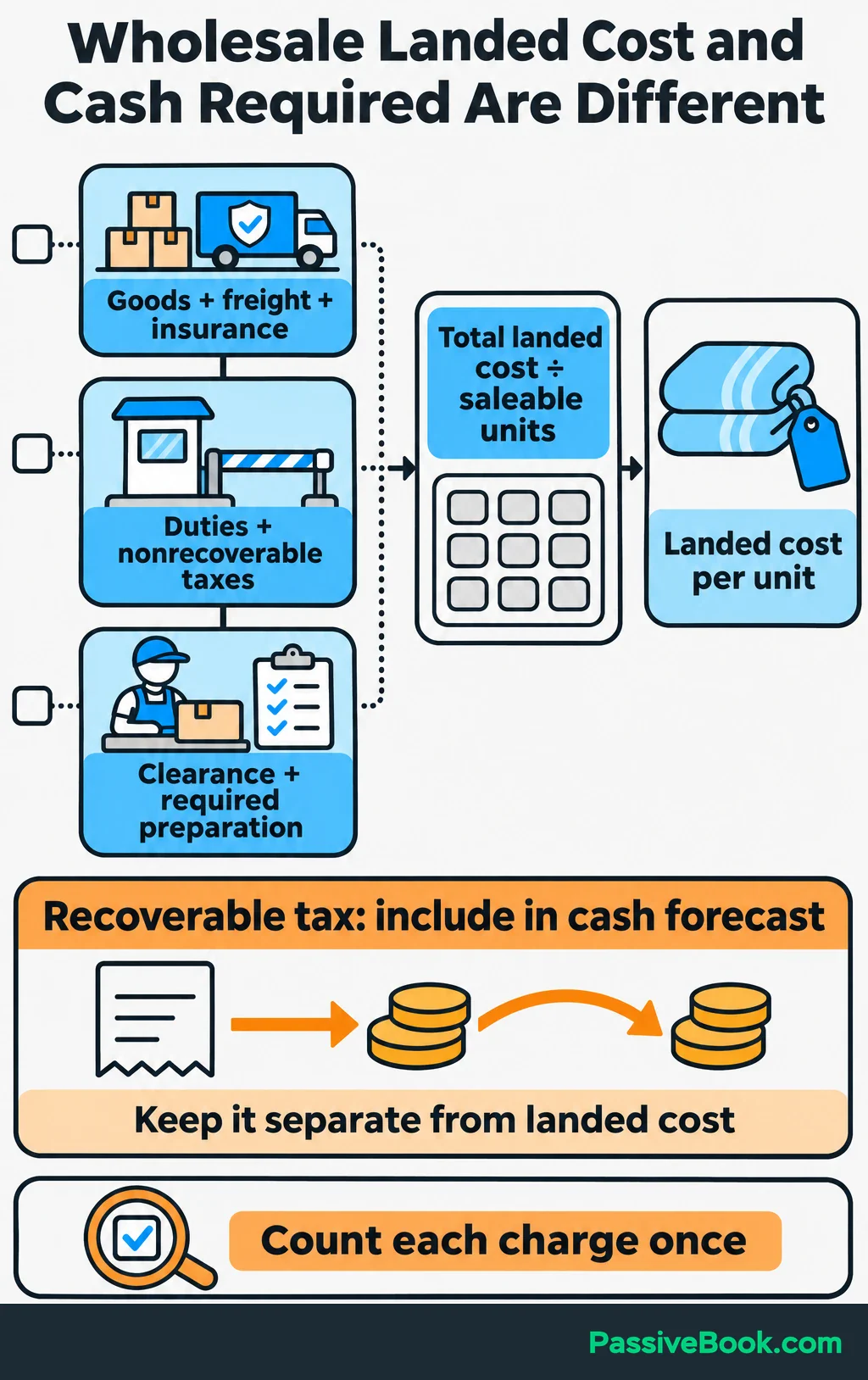
Add the costs needed to buy the stock and bring it to its selling location. These may include freight, insurance, duties, nonrecoverable taxes, clearance fees, and required preparation.
The International Trade Administration’s landed-cost guidance includes product cost, insurance, freight, tariffs, taxes, and other fees. Check what the quote already includes so you don’t count a charge twice.
Divide the total by the number of saleable units. Keep recoverable taxes in your cash forecast when you must pay them, even if they will later be recovered.
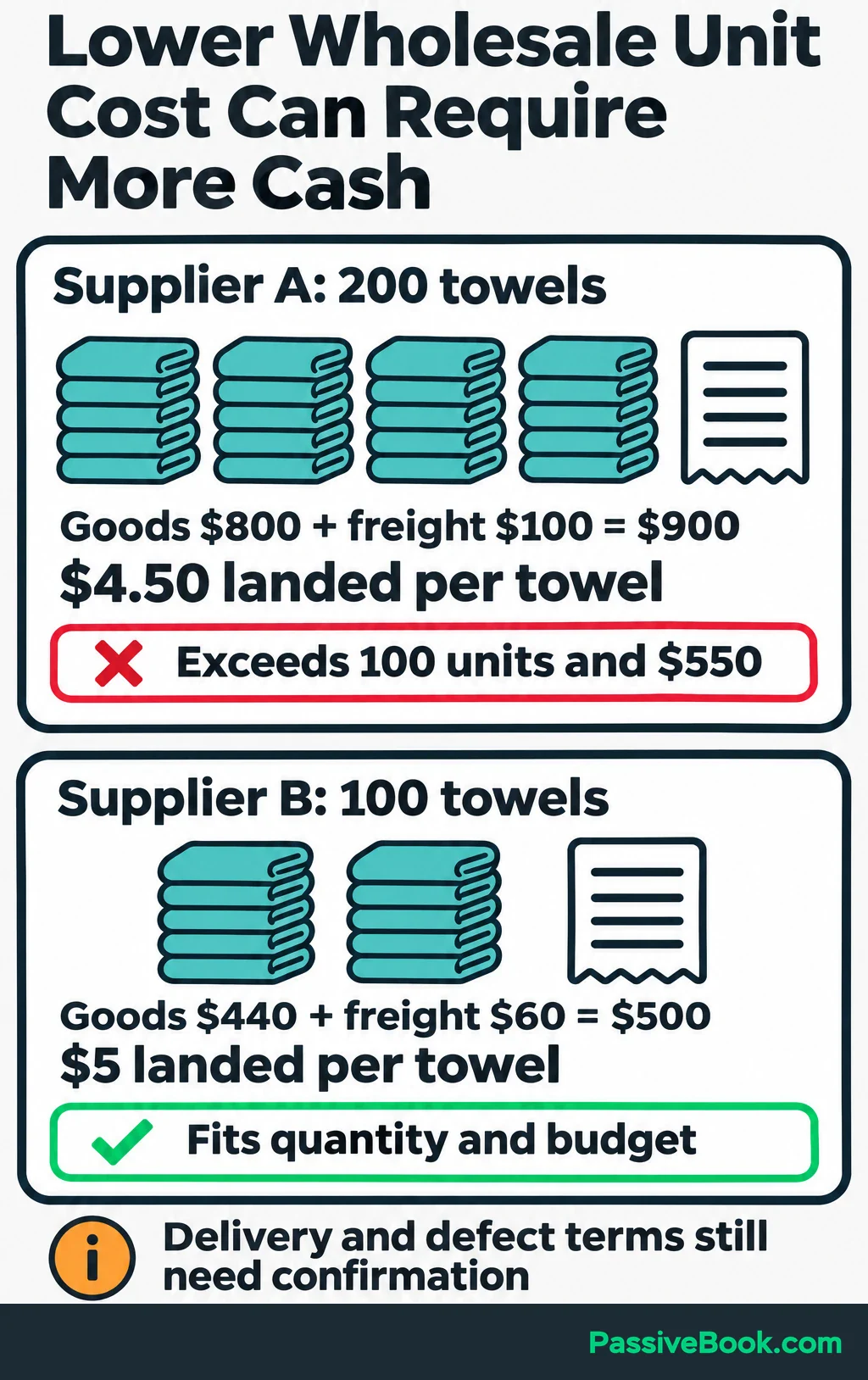
For this illustrative domestic comparison, both suppliers’ towels meet the same quality standard, every unit is saleable, and the only purchasing charges are goods and inbound freight:
| Term | Supplier A | Supplier B |
|---|---|---|
| Quantity | 200 towels | 100 towels |
| Unit price | $4 | $4.40 |
| Goods cost | $800 | $440 |
| Inbound freight | $100 | $60 |
| Total commitment | $900 | $500 |
| Landed cost per towel | $4.50 | $5 |
| Payment | Full payment before dispatch | Full payment before dispatch |
| Arrival commitment | Not yet confirmed | Not yet confirmed |
| Defect and return terms | Not yet confirmed | Not yet confirmed |
Supplier A has the lower landed cost. But its order exceeds both your 100-unit limit and your $550 budget. Supplier B fits those limits, so it is the more useful starting point while you resolve its missing terms.
A quote can fit your unit-cost ceiling and still leave you short when payment is due. This workbook checks both and shows the numbers you can take into a counteroffer.

Free Supplier Purchase Planner




For imports, Incoterms rules define who handles transport tasks and costs, and when the risk of loss or damage passes from seller to buyer. Record the agreed rule, named location, and version year, then identify your remaining transport and clearance costs. These rules do not settle payment, ownership, or what happens if either party breaks the agreement. Set those terms separately. ICC explains these distinctions.
Prioritize the Terms That Make the Purchase Workable
Pick one main request and one fallback. I would address an excessive inventory commitment or unaffordable payment schedule before asking for minor extras.
For the towel purchase, the main request is a 60-unit trial. The fallback could be Supplier B’s original 100-unit order, provided its quality, delivery, and payment terms also pass your checks.
Minimum Quantities and Unit Prices
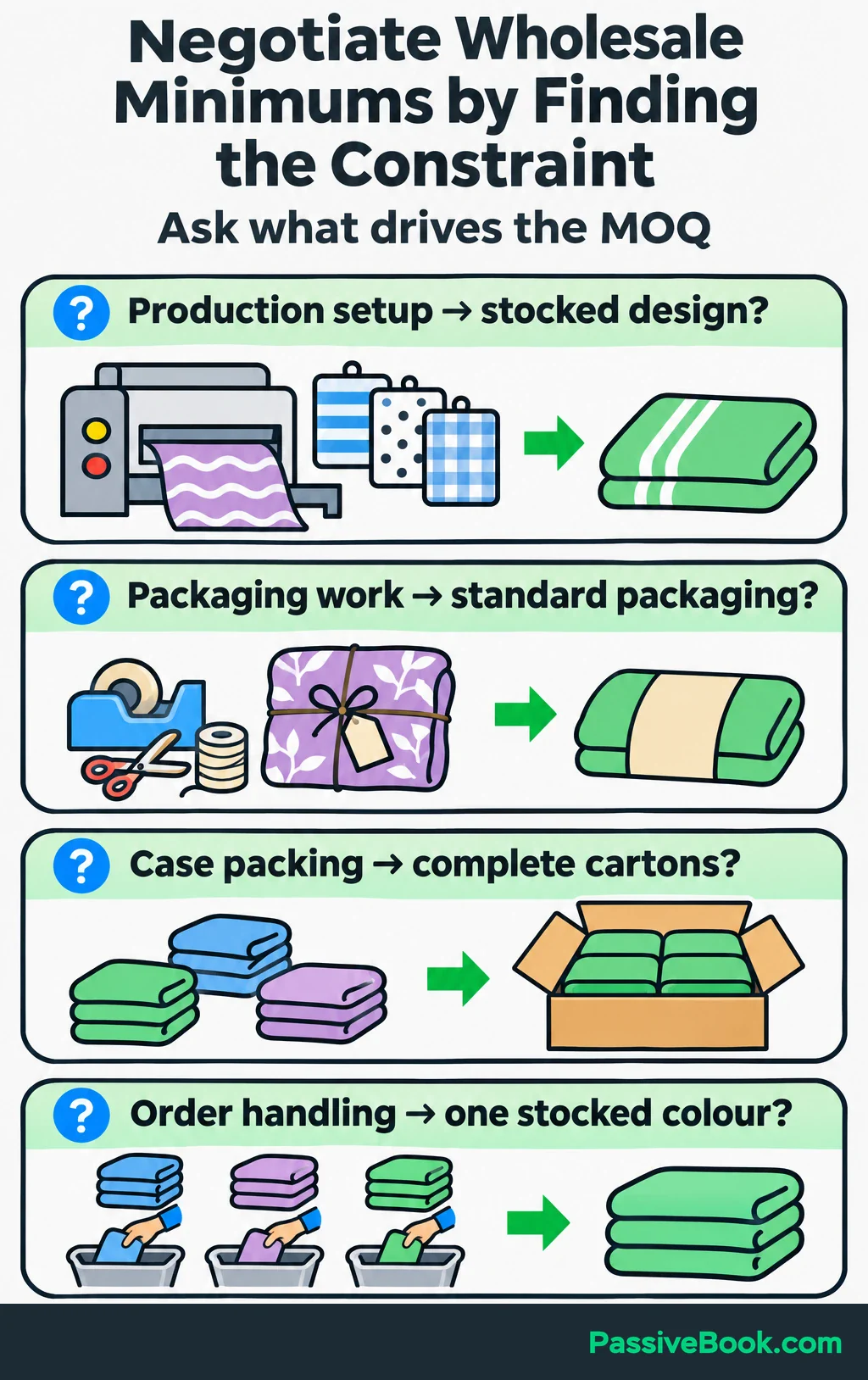
Ask what drives the minimum order quantity, or MOQ. Production setup, packaging, case sizes, and order handling call for different solutions.
Try a question such as:
“Is the 100-unit minimum based on production, case packing, or the total order? Would one stocked colour make a 60-unit trial possible?”
Alibaba’s MOQ guidance describes negotiating smaller orders when they still make financial sense for the supplier. That gives you a useful direction: make the order easier to supply.
You could offer fewer colours, an existing design, standard packaging, or complete cartons. Ask for a specific benefit in return, such as retaining the quoted unit price on a smaller trial.
You can also ask for a better price at your planned quantity. I would skip negotiating a discount at a volume I had no sound reason to buy.
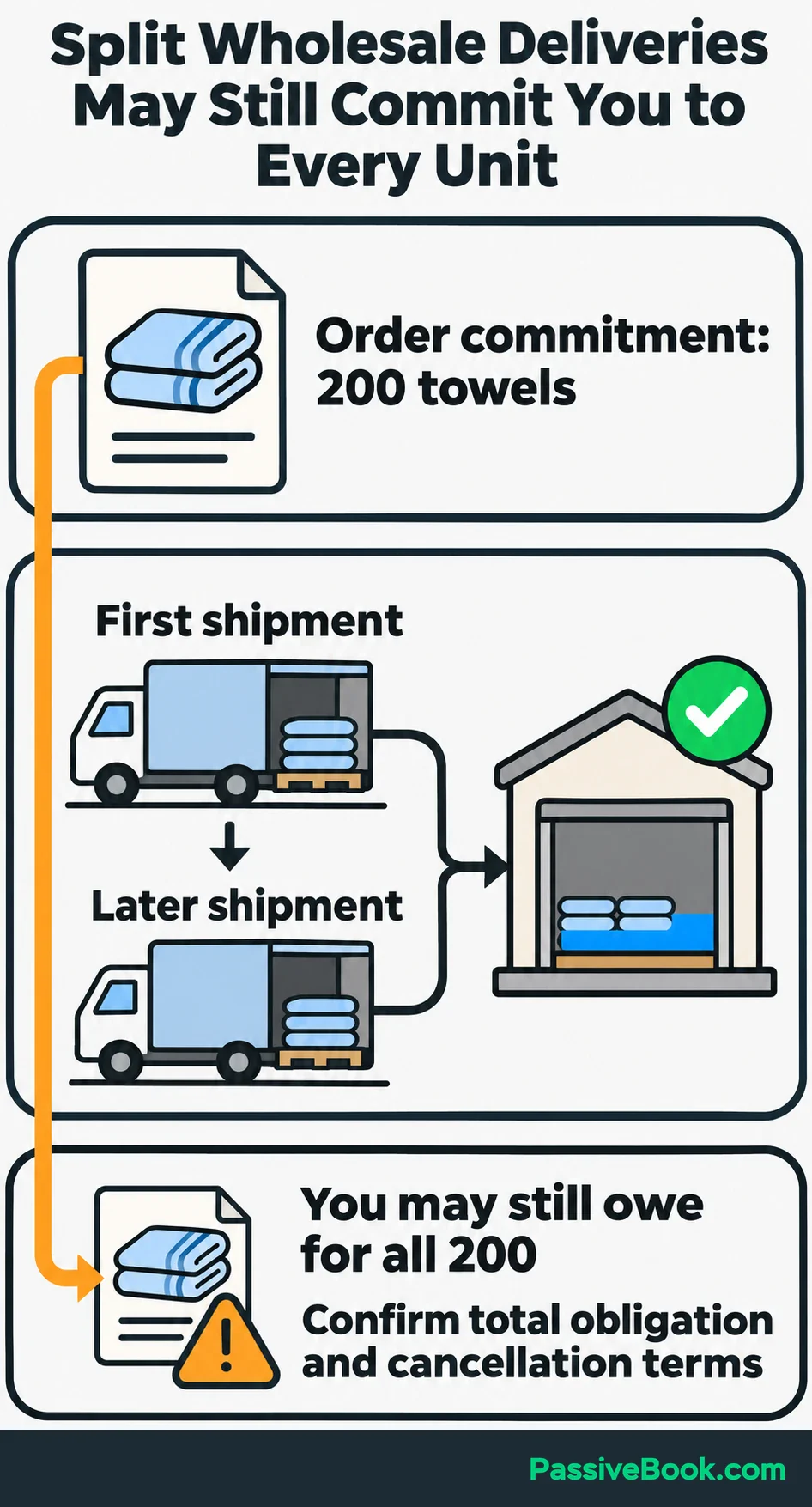
Watch staged deliveries. Receiving 200 towels in two shipments may reduce storage pressure, but you could still owe for all 200. Confirm the total purchase obligation and cancellation terms.
Deposits and Payment Deadlines
If payment timing is the obstacle, request a smaller deposit or a balance tied to an agreed inspection or delivery milestone.
For a new account, ask:
“What would qualify us for payment after delivery, and when could you review our terms after completed orders?”
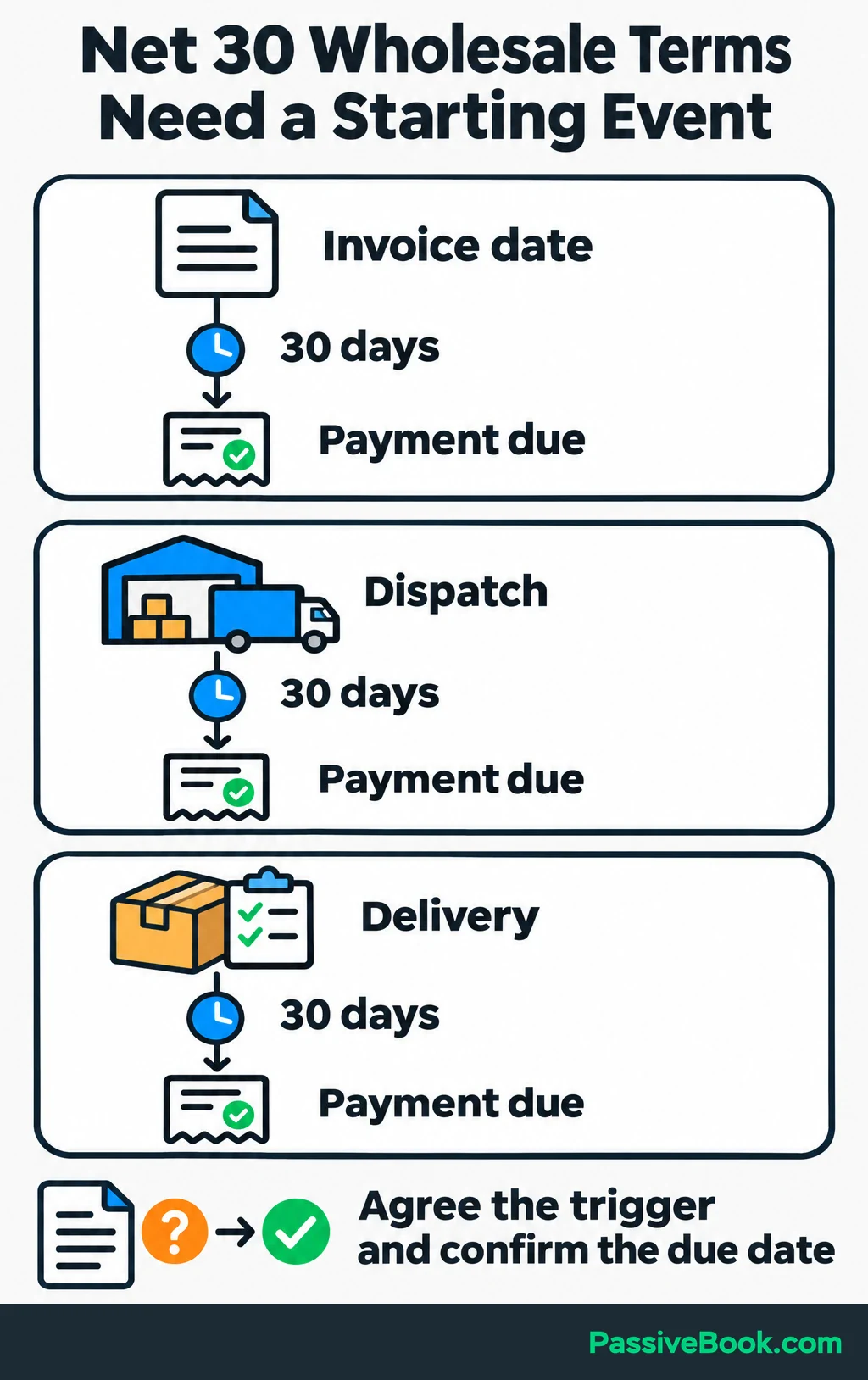
Business Queensland identifies longer payment periods and starting the payment period from completed delivery as matters buyers can raise with suppliers. Its supplier-payment guidance also notes that supplier policies may limit flexibility.
Define the trigger. “Net 30” means payment is due 30 days after the agreed starting event. Specify whether that event is the invoice date, dispatch, or delivery, and confirm the resulting due date.
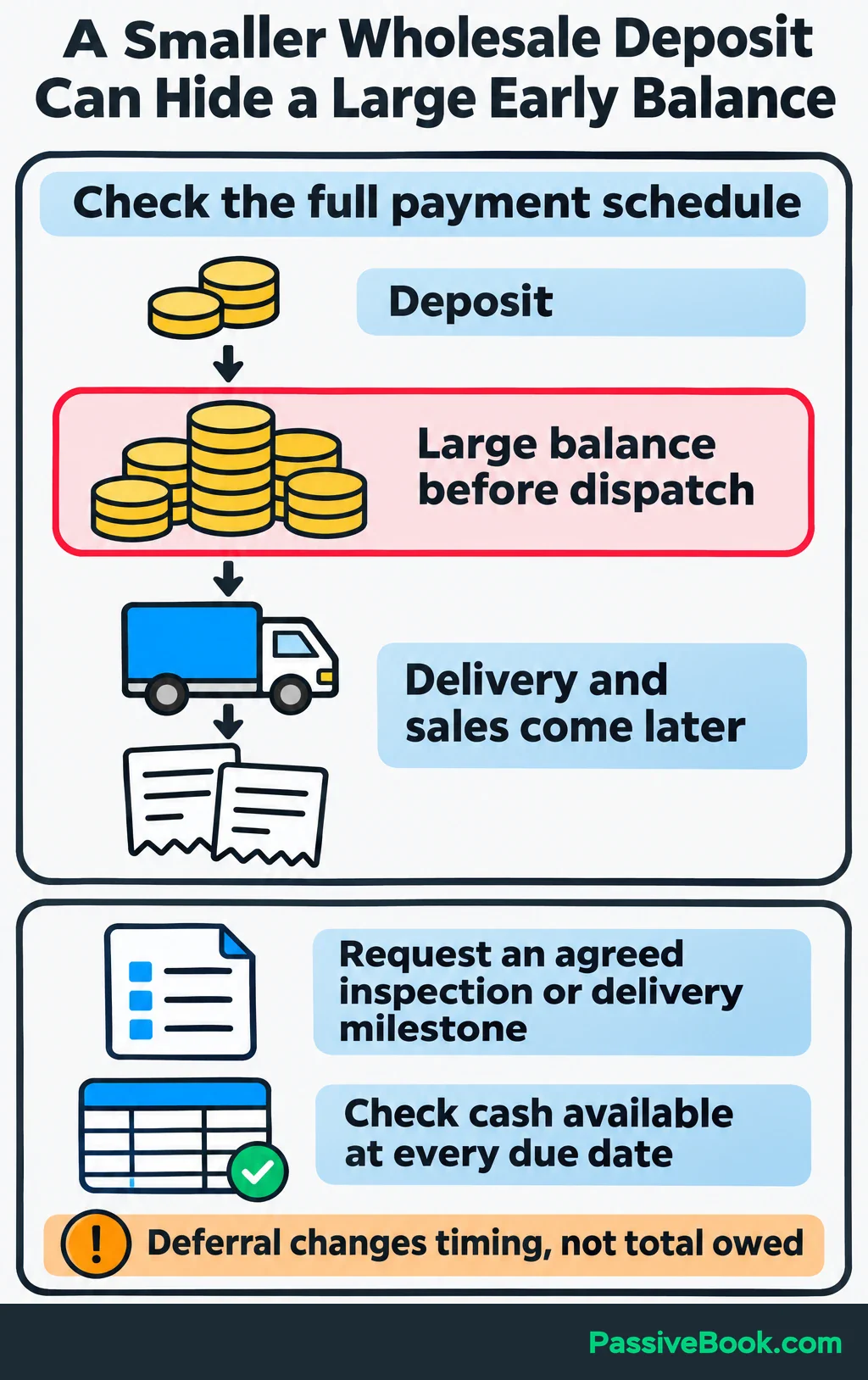
Check each payment against cash you expect to have available, using conservative sales estimates. A smaller deposit helps less if a large balance falls due before customers are likely to buy.
Deferred payment changes timing, not the amount owed. And paying the balance before dispatch still leaves you exposed to delivery problems.
Delivery and Restocking
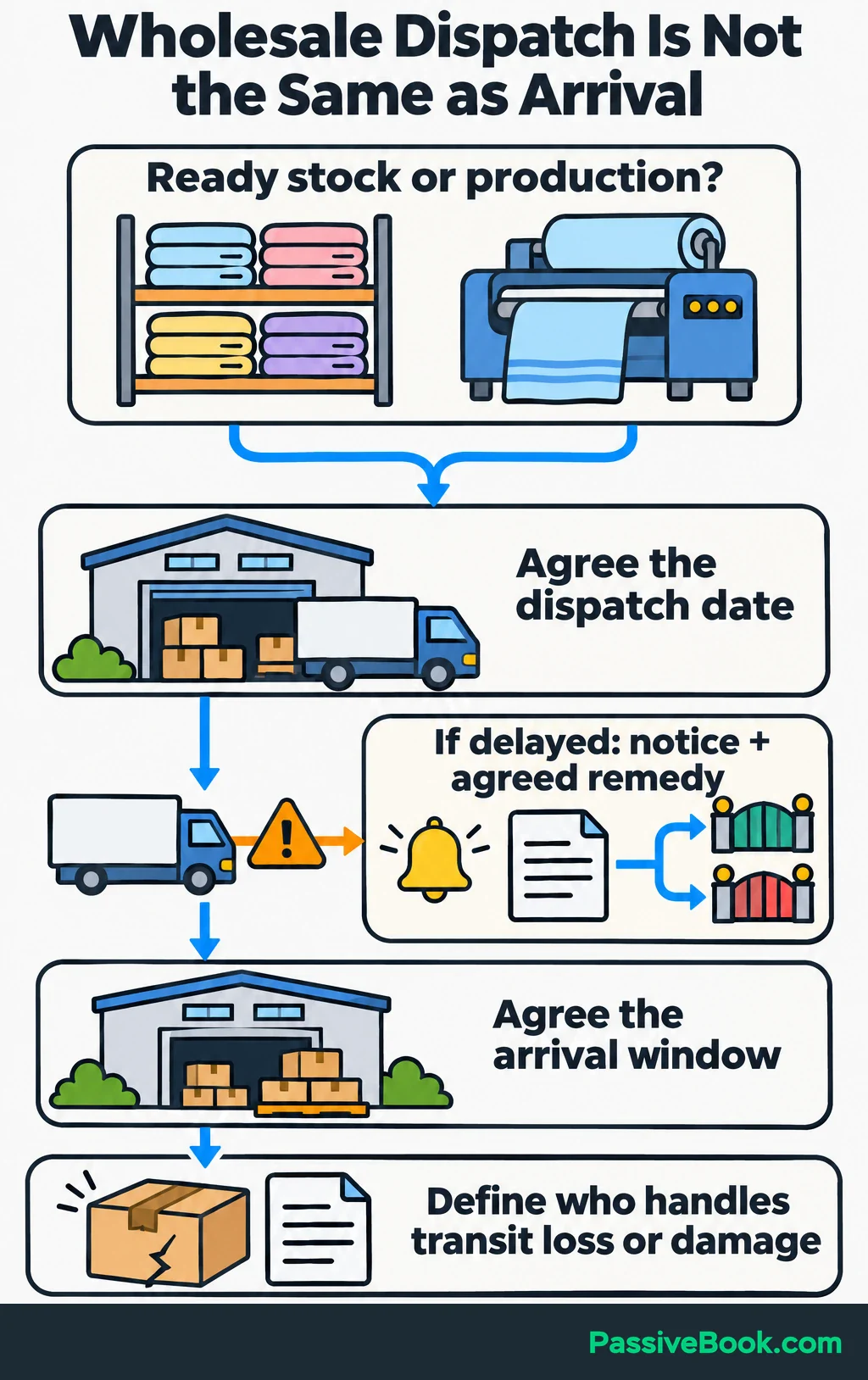
Ask whether the stock is ready or needs production, then agree on a dispatch date and arrival window.
Also settle what happens if the order slips. Depending on your needs, you could request notice by a set date, cancellation before dispatch after an agreed deadline, or another clearly defined remedy.
For freight, consider consolidation or a shipping allowance before buying extra stock to reach a free-delivery threshold. Compare the extra inventory bill with the delivery charge you would avoid. Free shipping can come with an expensive pile of towels.
For future orders, clarify:
- Reorder Size: The minimum quantity for each product or colour.
- Availability: Expected lead time and how shortages will be communicated.
- Substitutions: Written approval before changing colours, materials, or products.
- Extra Shipments: Who pays for split deliveries or expedited replacements.
- Transit Problems: Who handles claims and pays for loss or damage.
Defects and Returns
Agree on acceptable quality using written specifications and an approved sample.
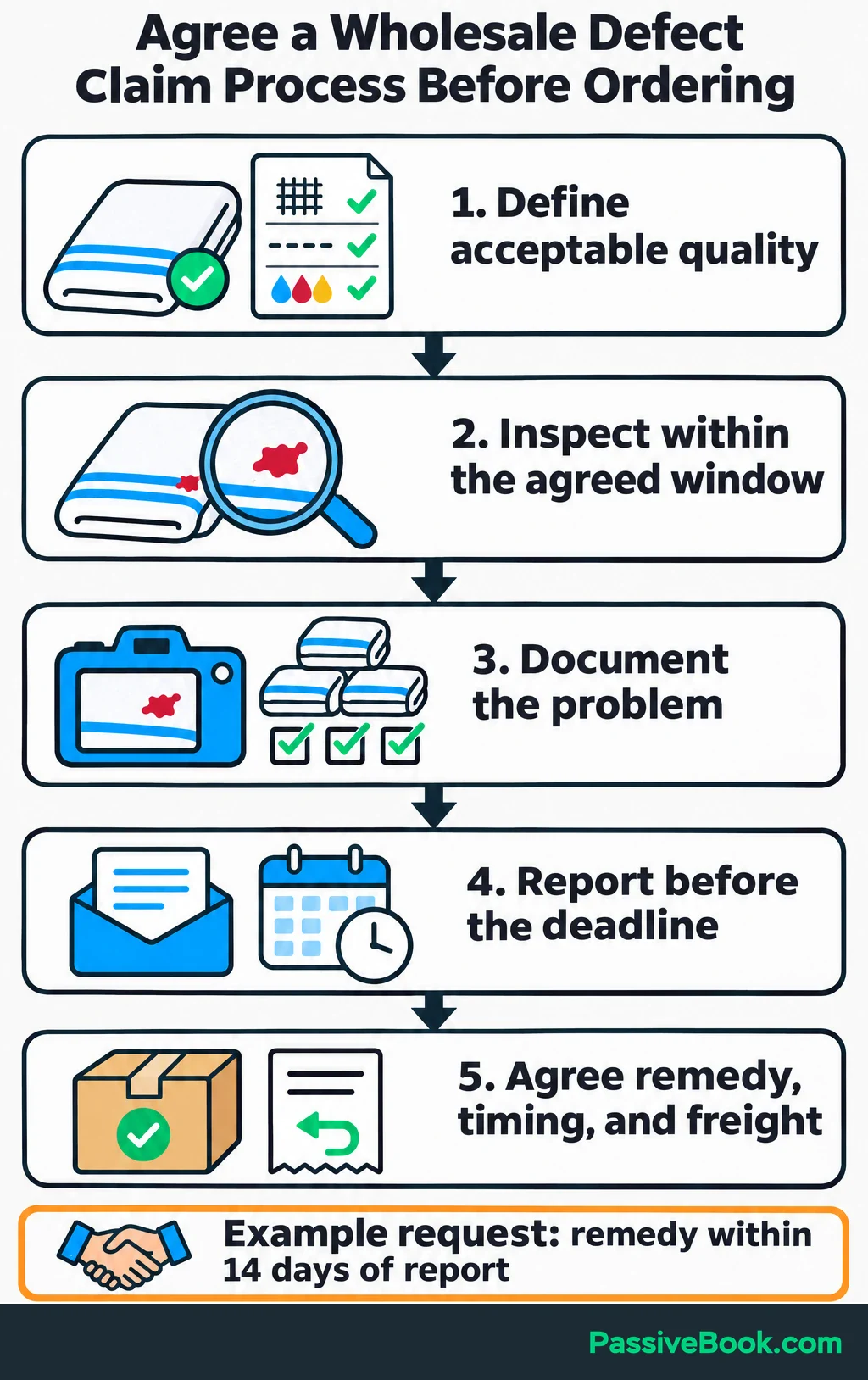
For the towels, that might cover fabric, dimensions, stitching, and print finish. Then define the inspection period, reporting deadline, and evidence needed for faulty, short, or incorrect deliveries.
Ask for a remedy with a deadline:
“If towels arrive with printing defects, can you replace them or issue a refund within 14 days of our report, and cover the related freight?”
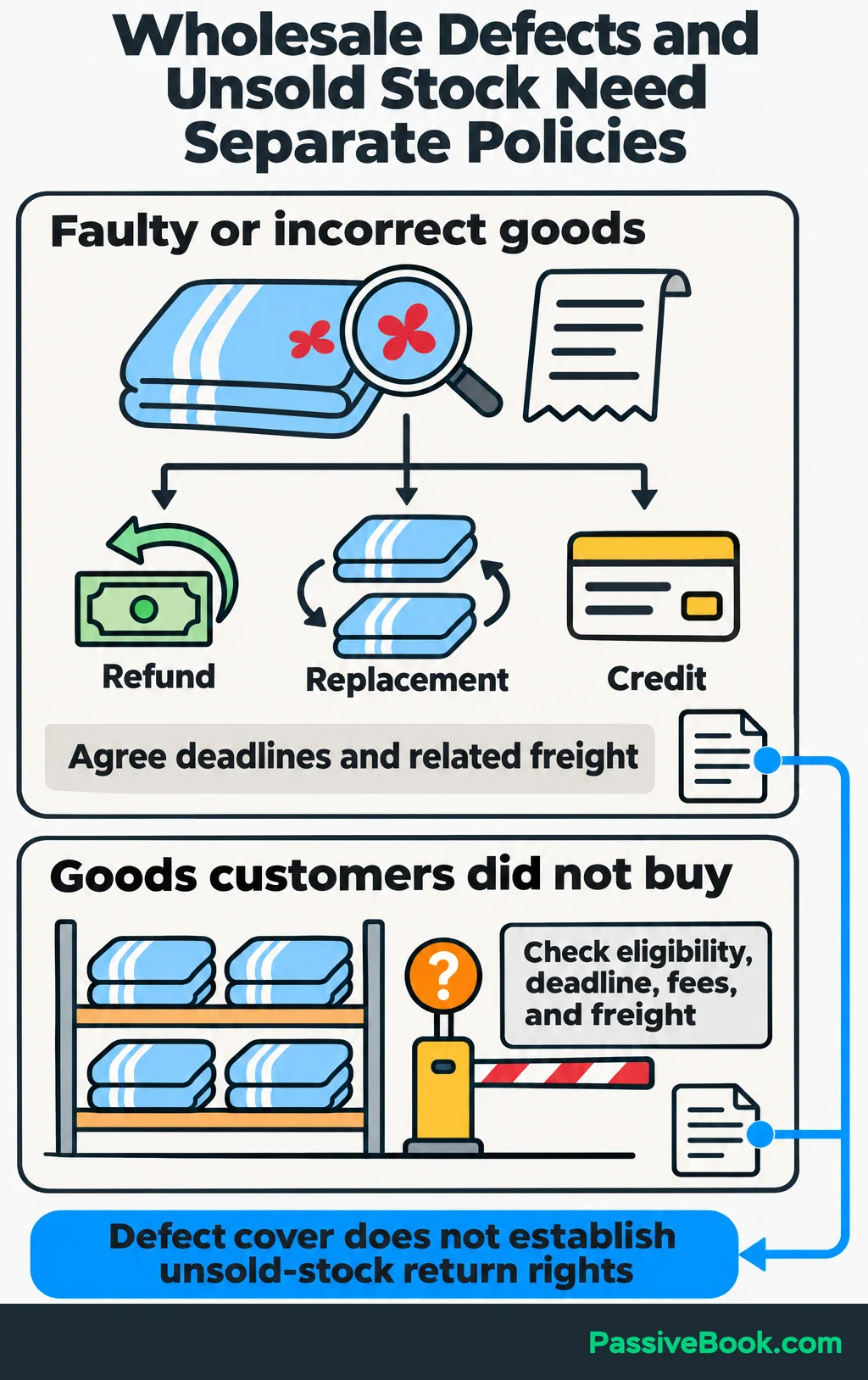
Check whether the supplier offers refunds, replacements, or credit. Credit may have little value if you no longer want to order from them.
Discuss unsold-stock returns separately. A defect policy does not tell you whether you can return products customers simply didn’t buy. Ask about eligible goods, deadlines, restocking fees, and return freight.
Make a Specific Counteroffer
Offer a Conditional Trade
Open with the obstacle and ask a practical question:
“The product fits our range, but we want a smaller trial. What makes the opening minimum necessary?”
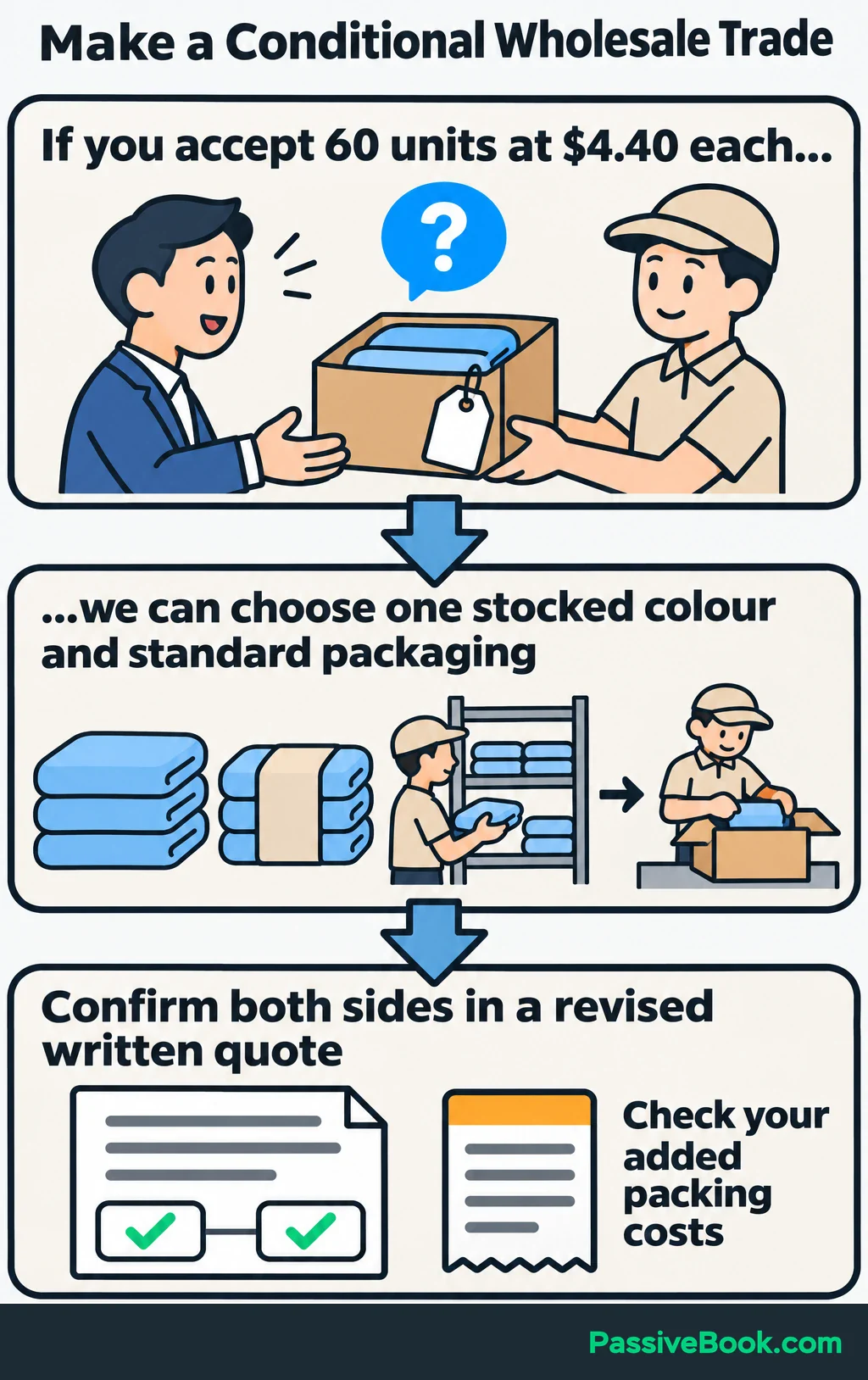
Use the answer to propose a trade:
“If you can accept 60 units at the quoted price, we can use one stocked colour and your standard packaging.”
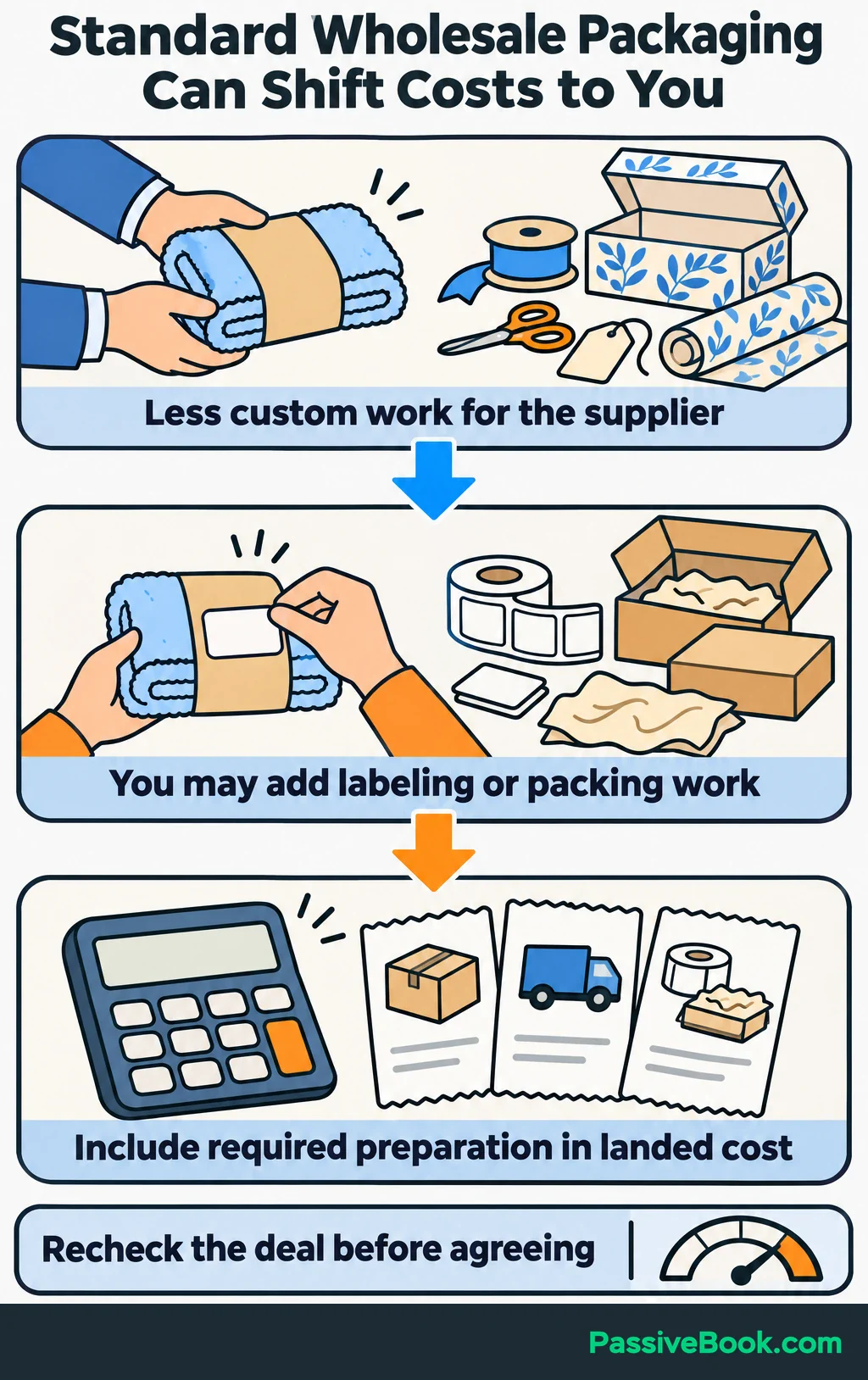
Offer a flexible dispatch window only if your own launch can wait. Standard packaging may save the supplier work but leave you with extra labeling or packing costs, so include those before agreeing.
Keep competing quotes and future-volume claims accurate. “We may reorder after testing demand” is enough. You do not need to promise a year of purchases to ask about the first one.
Send a Clear Counteroffer Email
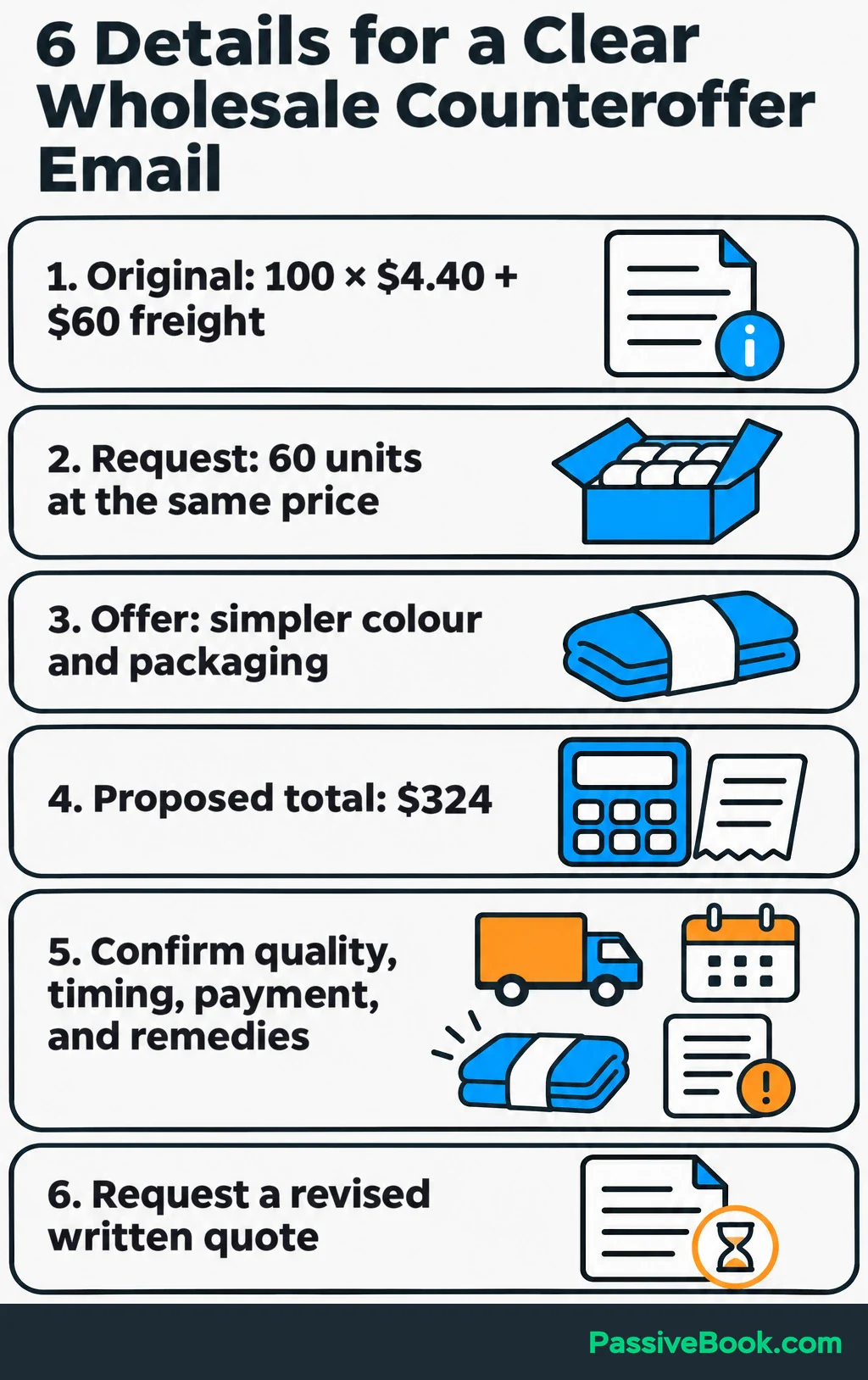
Give the supplier the original quote, your requested change, what you offer in return, and the confirmation you need.
Here is a complete email you can adapt:
Subject: Request for a 60-unit tea-towel trial
Hi,
Thank you for quoting 100 cotton tea towels at $4.40 each plus $60 freight.
We would like to begin with a 60-unit trial before committing to a larger order. If we choose one stocked colour and your standard packaging, could you retain the $4.40 unit price and keep freight at $60, with the towels matching the approved sample?
That would make the trial $324 in total.
Please confirm the dispatch date, expected arrival window, payment schedule, defect-reporting deadline, and remedy for faulty items. Please also confirm whether any charges would apply beyond the $324.
If this package works for you, please send a revised written quote for us to review.
Thanks,
[Your name]
If accepted, the goods cost would be 60 × $4.40 = $264. Adding $60 freight gives a $324 commitment, and dividing that by 60 towels gives a landed cost of $5.40 each.
That is higher than Supplier B’s original $5 landed cost, but it remains below your $6 ceiling and reduces the commitment by $176.
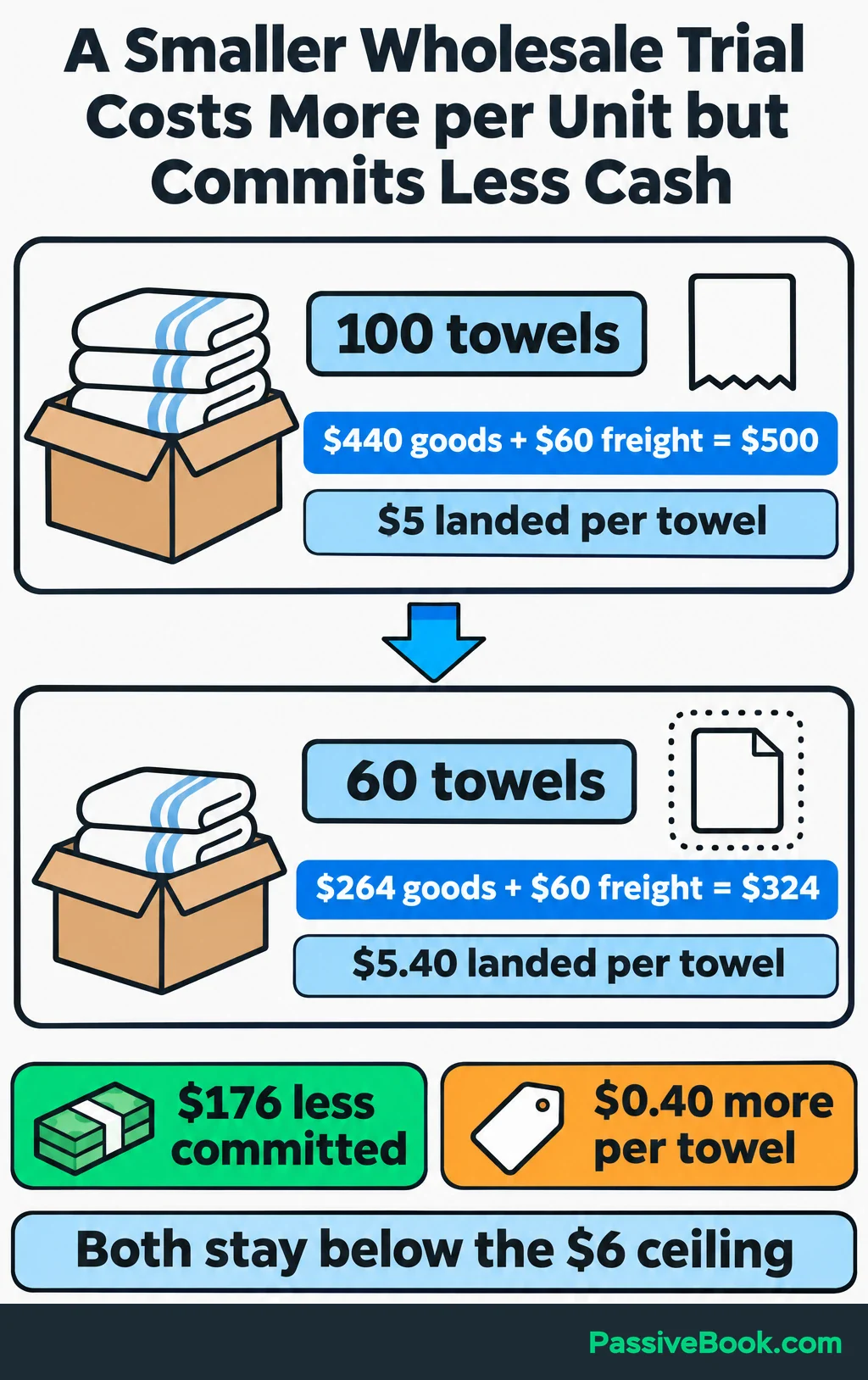
I would prefer that trade for an uncertain trial. It costs more per towel, but leaves less money tied up before demand is proven. Recalculate if the packaging change creates extra preparation costs.
Your supplier’s sticking point may be different from the one in this example. The AI Supplier Correspondence Studio can draft your email around the change you need and what you can genuinely offer in return.

Free AI Supplier Correspondence Studio
Respond When the Supplier Refuses
Ask which constraint can move:
“If the opening quantity must stay at 100, could we discuss a smaller deposit or a balance due after delivery?”
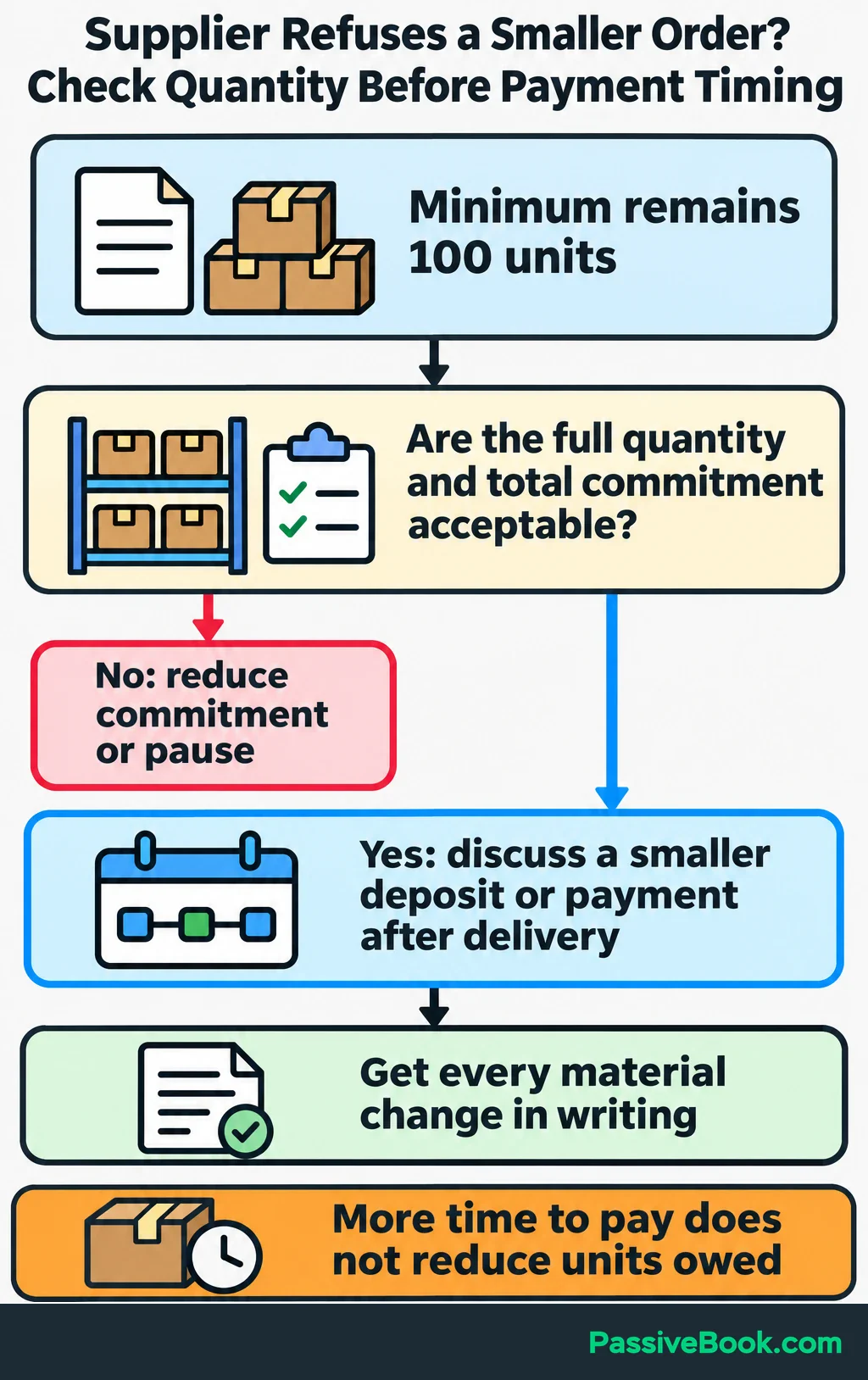
Changing payment terms is useful only if the full quantity and total commitment remain acceptable. It cannot fix an order that is simply too large.
If you have a genuinely comparable quote, use it constructively:
“Our alternative delivered cost for this specification and quantity is [amount]. What package could you offer?”
Request a revised written quote after any material change. A concession discussed on a call needs to appear in the final offer.
When nothing workable remains, close plainly:
“This commitment exceeds our current purchasing limit. Please keep us in mind for smaller batches.”
Decide Whether to Accept, Counter, or Walk Away
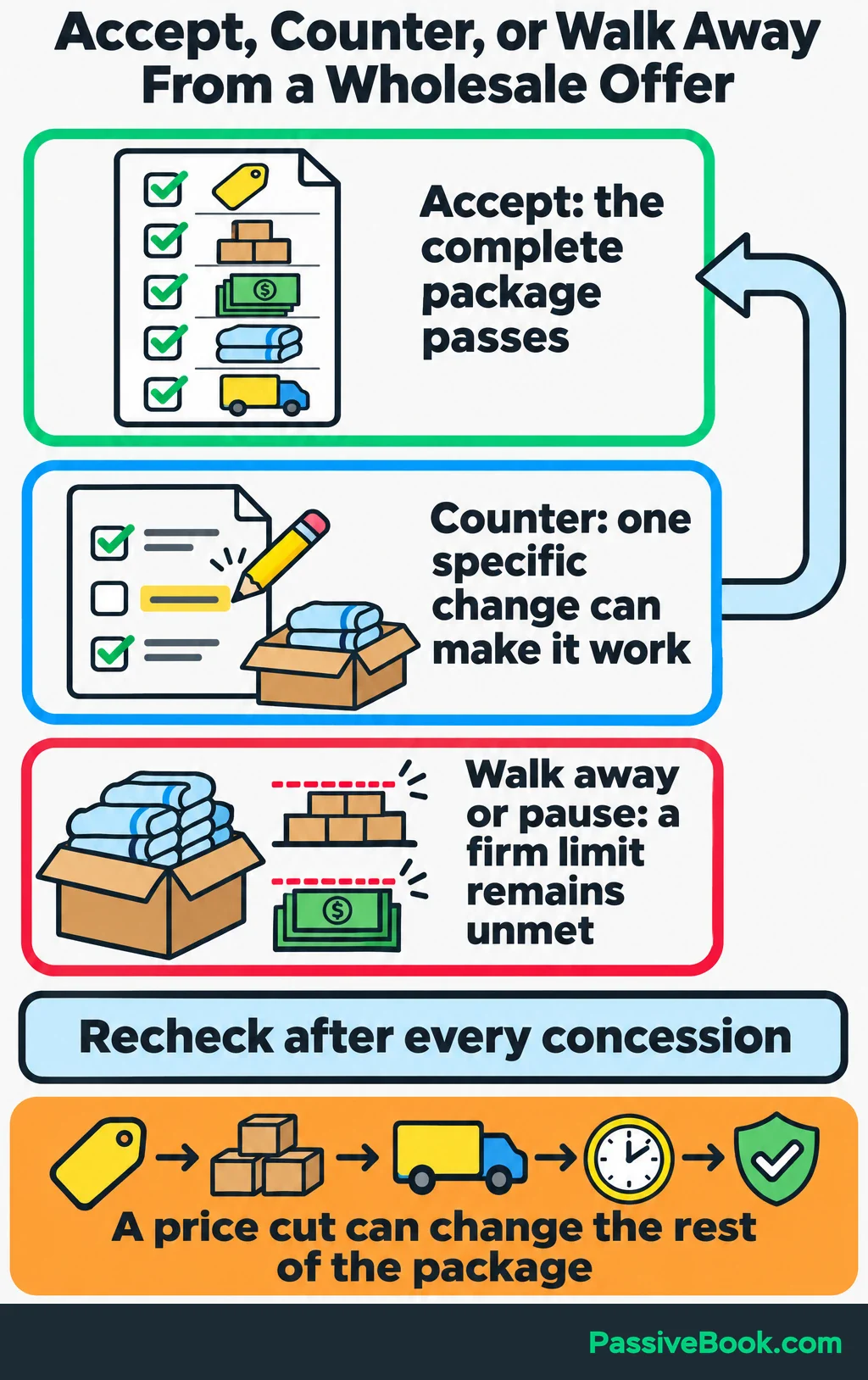
Judge the whole offer against your limits and your alternative.
- Accept: The complete package meets your cost, quantity, cash, quality, and delivery requirements.
- Counter: A specific change could make an otherwise suitable purchase work.
- Walk Away or Pause: A firm limit remains unmet, essential charges are unresolved, or quality protections are unacceptable.
For the towel shop, Supplier B’s original $500 offer remains within the spending and quantity limits if the smaller trial is refused. You could accept it once the remaining terms are satisfactory.
The proposed $324 trial reduces exposure if accepted. Supplier A’s $900 order needs a smaller commitment before its lower unit cost becomes useful.
After every concession, check the package again. A lower price may come with more units, higher freight, earlier payment, or weaker remedies. Decide from the revised total.
Confirm the Agreement Before Paying
Get the final terms in writing and resolve conflicts between the quote, purchase order, invoice, and supplier’s standard terms.
Your record should cover:
- Goods: Specifications, approved sample, quantities, colours, and packaging.
- Charges: Currency, unit prices, freight, taxes, fees, and total commitment.
- Payment: Deposit, balance, milestones, due dates, and payment method.
- Delivery: Dispatch and arrival commitments, substitutions, and the response to delays.
- Problems: Inspection deadlines, shortages, defects, transit loss, insurance, remedies, and associated freight.
- Exit and Disputes: Returns, cancellation, dispute escalation, and terms governing the agreement.
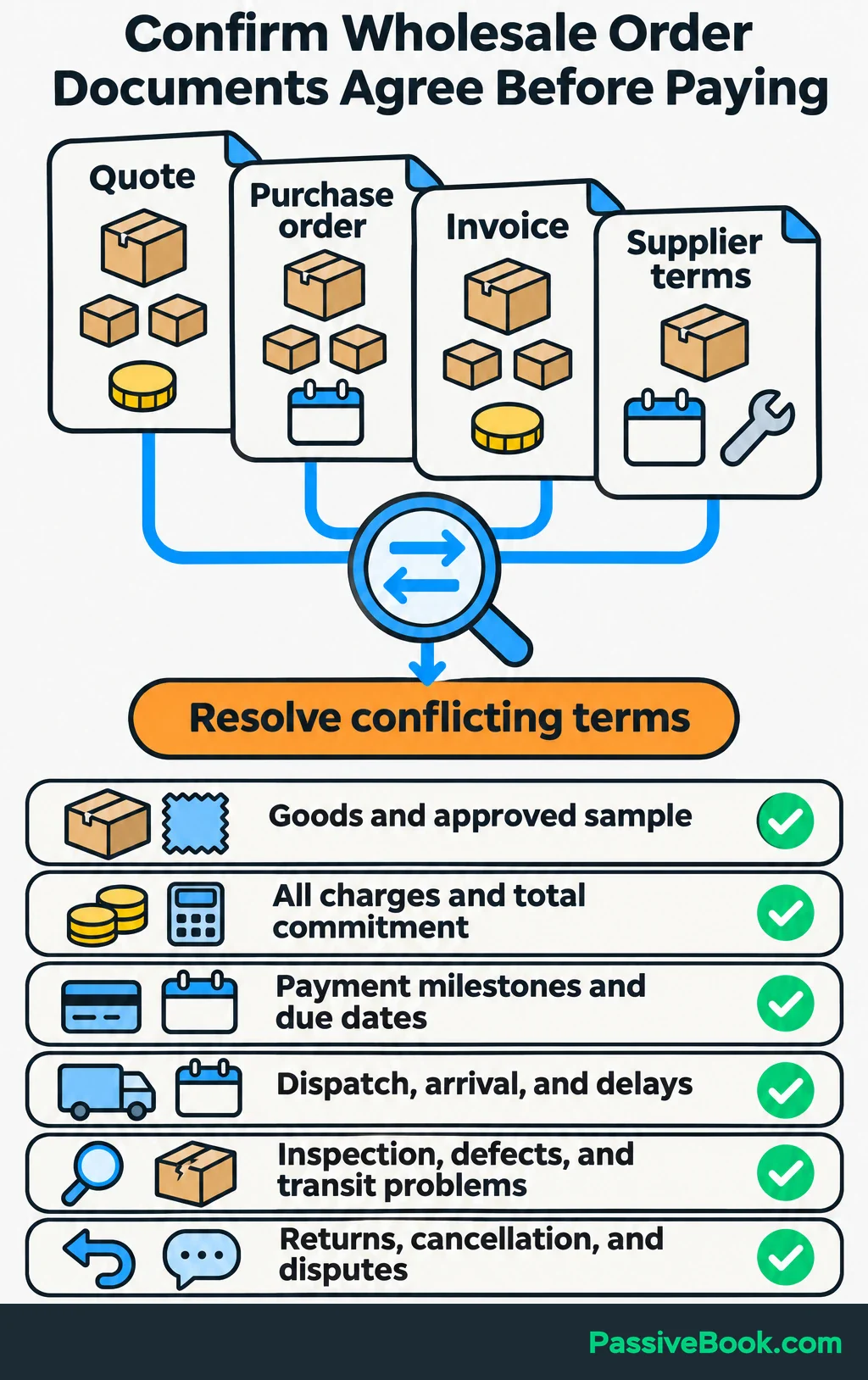
Business Queensland recommends documenting payment, delivery, quality, insurance, dispute, and termination terms, and seeking legal advice before signing supplier contracts. Its supplier-contract guidance provides a useful checklist.
I would get local legal advice before accepting unfamiliar guarantees, obligations to cover another party’s losses, liability exclusions, or dispute-location clauses that could expose the business to a serious loss.
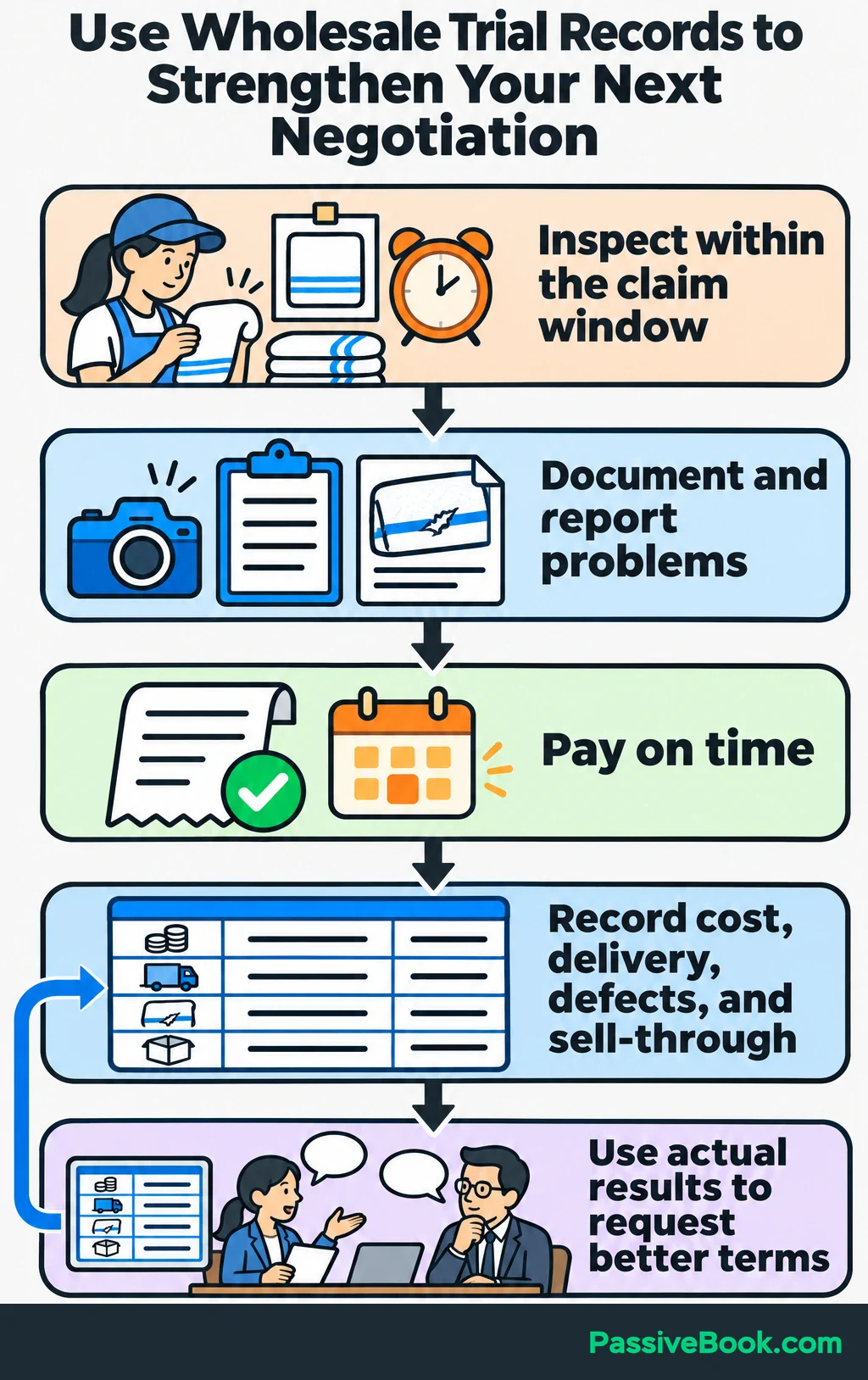
After delivery, inspect within the agreed claim window, document problems, and pay on time. Record actual landed cost, delivery performance, defects, and how much stock sells.
Those records give the next negotiation a firmer basis:
“The trial sold through and payment was on time. Can we review the reorder minimum or payment terms?”
What Next?
Take one supplier quote and write down your maximum landed cost, quantity, total commitment, and payment exposure. Then draft one conditional counteroffer around the term that matters most.
Use the social buttons to share this guide when your next conversation turns to minimum orders, deposits, or whether a discount is worth the extra stock.
Which term would make the biggest difference to your next purchase? Share your answer, along with any other questions, in the comments.
Share this post with your friends & followers:

