A supplier’s quote leaves plenty of room below your planned selling price. The product looks profitable, but freight, payment fees and delivery still need to come out of that gap.
Miss those costs and you can make sales while leaving too little to pay the bills—or yourself.
You need a calculation that follows the money beyond the supplier’s invoice. This guide shows you how to find your margin, choose a price and check the profit left after expenses, using one aquarium-shop example you can adapt to your own products.
What Is the Wholesale Resale Margin Formula?
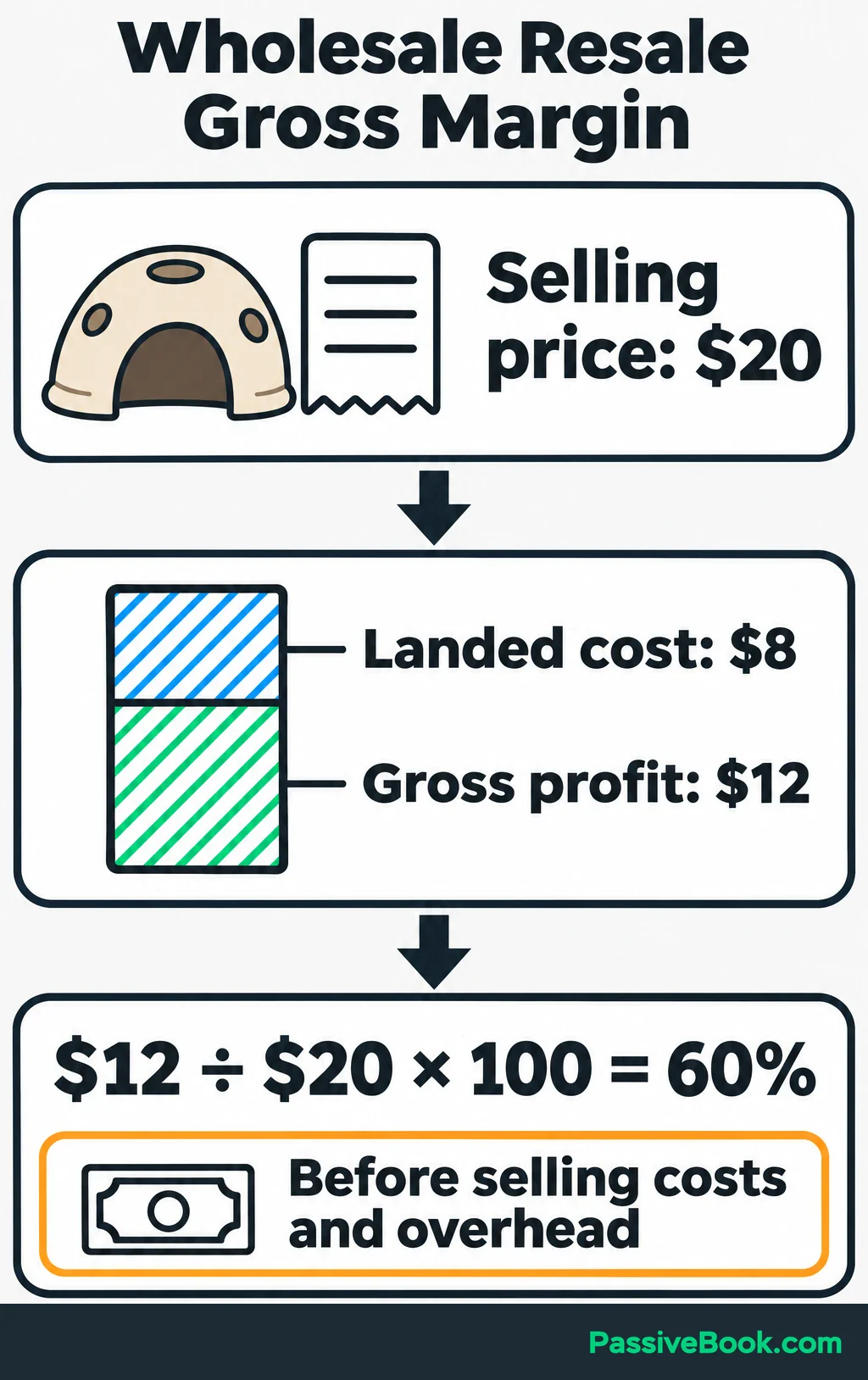
Subtract the cost of getting one product into stock from its selling price. That gives you gross profit per unit. Then divide gross profit by the selling price to find your gross margin:
Gross profit per unit = Selling price − Landed unit cost

Gross margin (%) = Gross profit per unit ÷ Selling price × 100
Gross margin measures gross profit as a share of sales revenue.
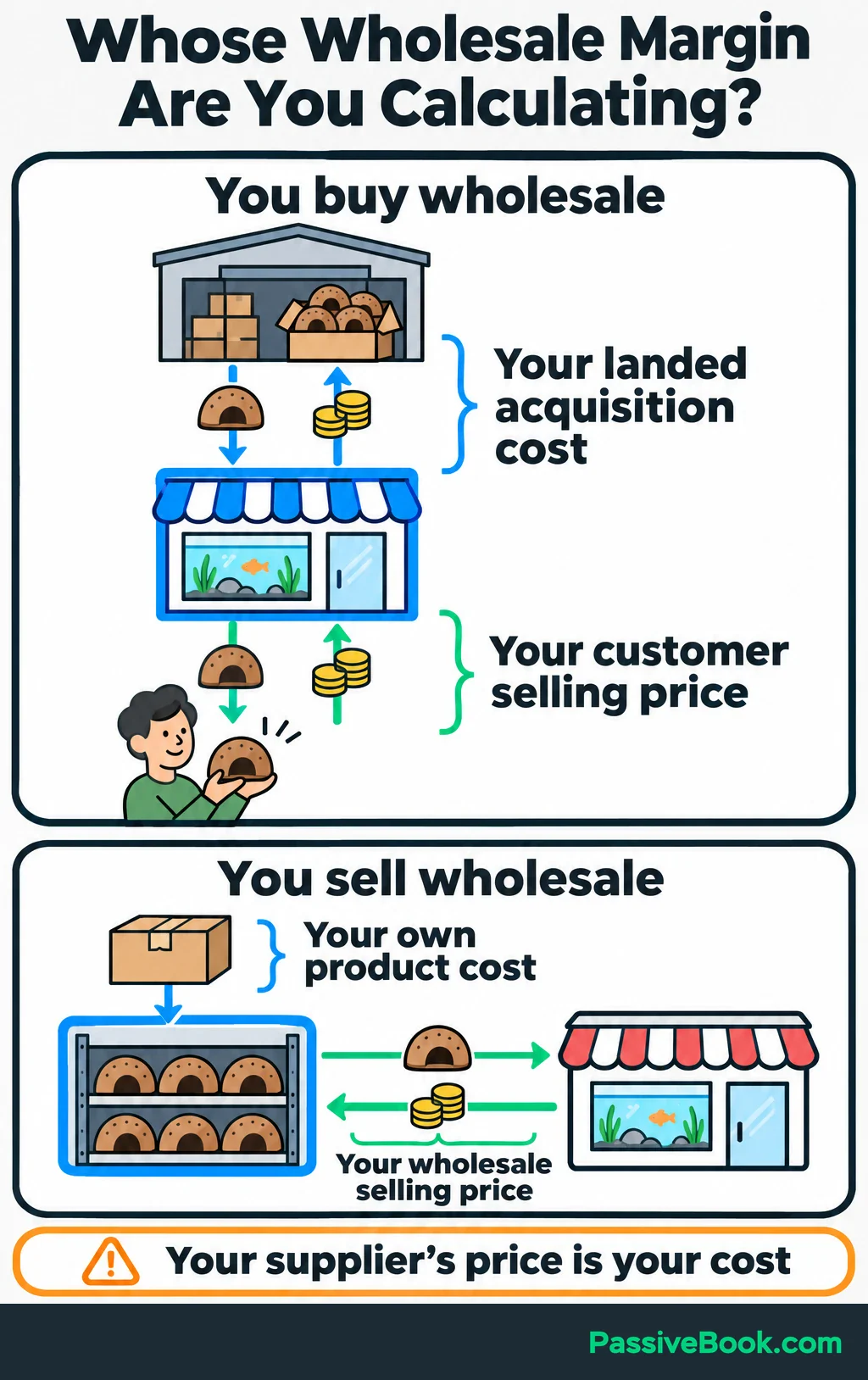
Calculate your own side of the transaction:
- If you buy wholesale and resell to customers, compare your resale price with your landed acquisition cost.
- If you sell wholesale to another shop, compare your wholesale selling price with your own product cost.
Your supplier’s wholesale price is part of your cost. It is not the selling price in your margin calculation.
For the worked example, suppose you run an online aquarium shop reselling ceramic aquarium caves. Each cave costs $8 landed, and you sell it for $20.
Gross profit = $20 − $8 = $12

Gross margin = $12 ÷ $20 × 100 = 60%
Use the price the customer actually pays after discounts, excluding sales taxes you collect for the government.
That $12 still has to cover selling expenses and overhead. Gross profit is the first checkpoint, not your take-home income.
Calculate Your Landed Unit Cost
Landed unit cost includes the purchase price and the costs of bringing the product into stock, ready to sell.
Start with the supplier’s price after discounts, then add:
- Inbound freight and handling.
- Import duties.
- Purchase taxes you cannot recover.
- Other costs directly tied to getting the goods to their present location and condition.
This follows the inventory-cost principle described in IAS 2.
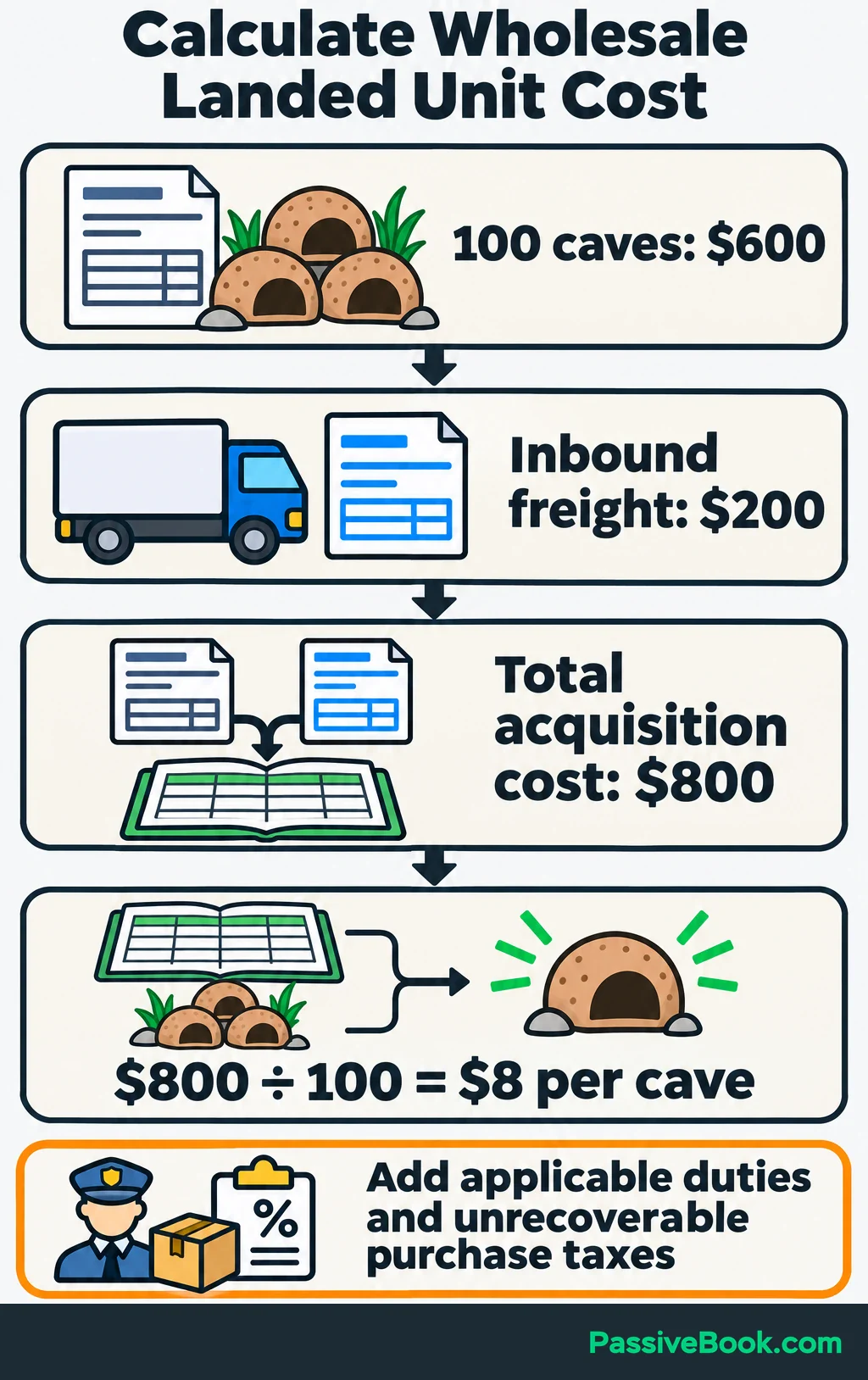
For identical items, add the batch’s acquisition costs and divide by the number of units. In the aquarium example, suppose you buy 100 caves:
| Acquisition cost | Batch total |
|---|---|
| Supplier purchase: 100 caves | $600 |
| Inbound freight | $200 |
| Total acquisition cost | $800 |
Landed unit cost = $800 ÷ 100 = $8The supplier charges $6 per cave, but your landed cost is $8. Pricing from $6 would leave freight out of every margin calculation.
For mixed shipments, divide shared costs on a sensible basis. Weight may work better than item count when one product is much heavier than another.
Keep customer delivery, payment fees and business overhead separate for the calculations below, and count every expense once.
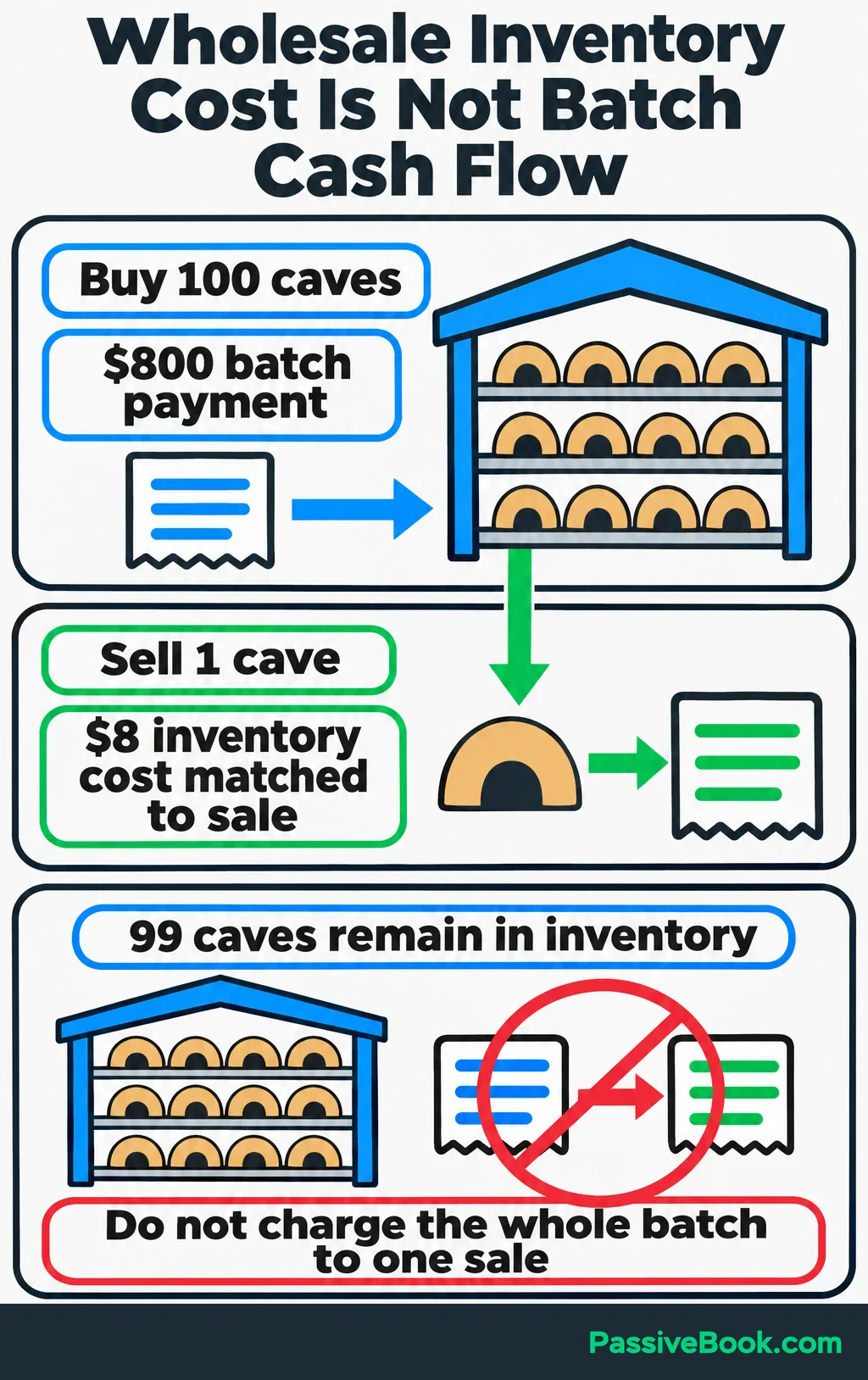
When measuring actual gross profit, match inventory cost to the units sold. Selling one cave uses $8 of inventory cost; it does not make the entire $800 purchase an expense against that first sale. The batch payment matters for cash flow, but it answers a different question.
Understand Margin Versus Markup
Margin and markup use the same gross profit, but margin divides it by selling price and markup divides it by cost:
Gross margin (%) = Gross profit ÷ Selling price × 100

Markup (%) = Gross profit ÷ Landed unit cost × 100
For the $8 cave sold at $20:
| Measure | Calculation | Result |
|---|---|---|
| Gross margin | $12 ÷ $20 × 100 | 60% |
| Markup | $12 ÷ $8 × 100 | 150% |
The sale has not changed. Only the denominator has.
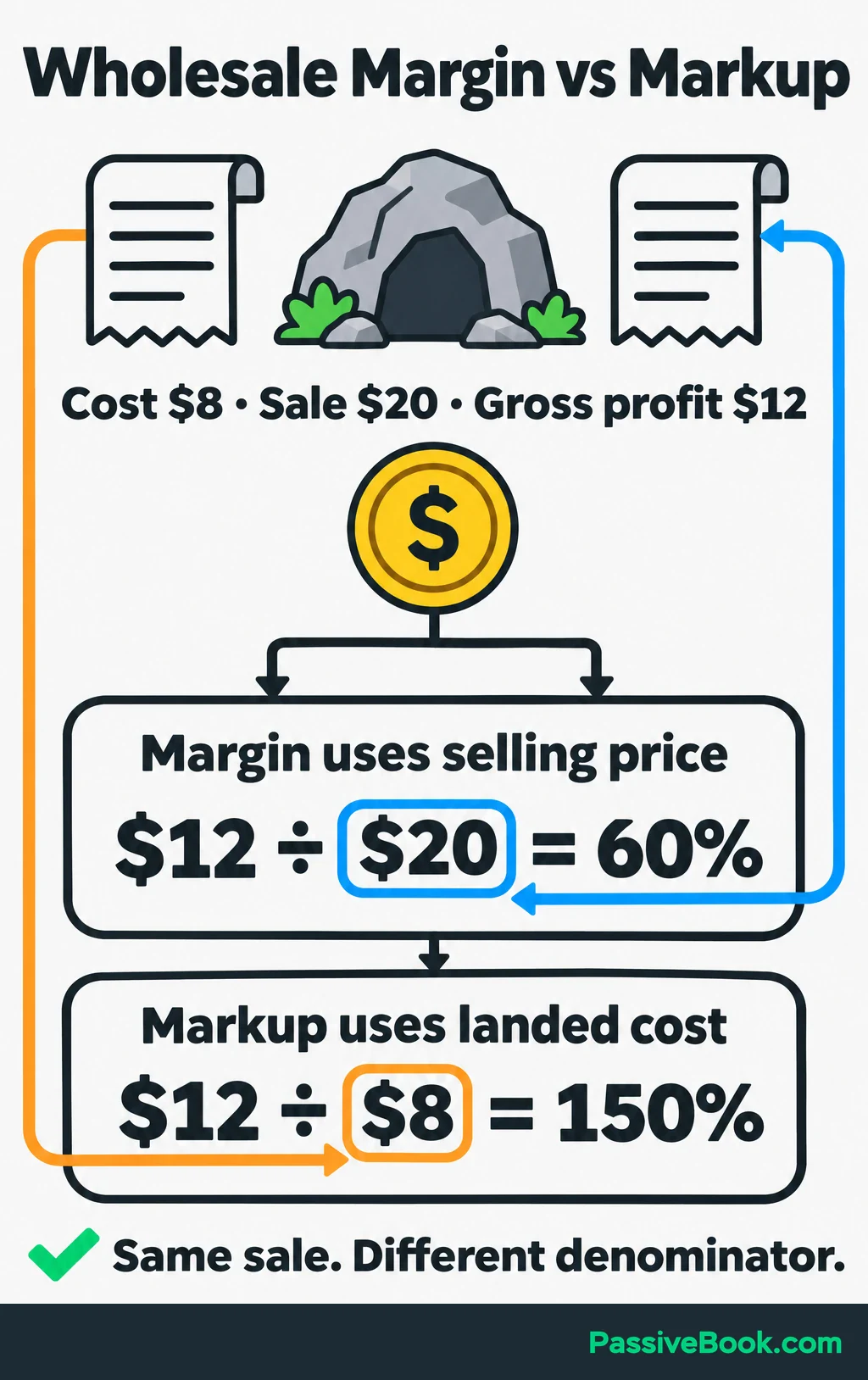
This matters when setting prices. Adding 30% to your cost gives you a 30% markup:
Selling price = $8 × 1.30 = $10.40But the gross margin is lower:
Gross margin = ($10.40 − $8) ÷ $10.40 × 100 = 23.08%I would label every pricing target before using it: gross margin, markup or operating margin. A spreadsheet cell called “profit percentage” leaves far too much room for interpretation.
Estimate Profit After Selling Costs and Overhead
Next, subtract the costs that arise when you make a sale. What remains is contribution: the money available to cover fixed overhead and profit. OpenStax explains contribution as selling price minus variable costs.
For this resale calculation:
Contribution per unit =
Selling price − Landed unit cost − Variable selling costs
Variable selling costs can include payment and marketplace fees, packaging, paid fulfillment labor, customer delivery you absorb and expected return costs you will not recover.
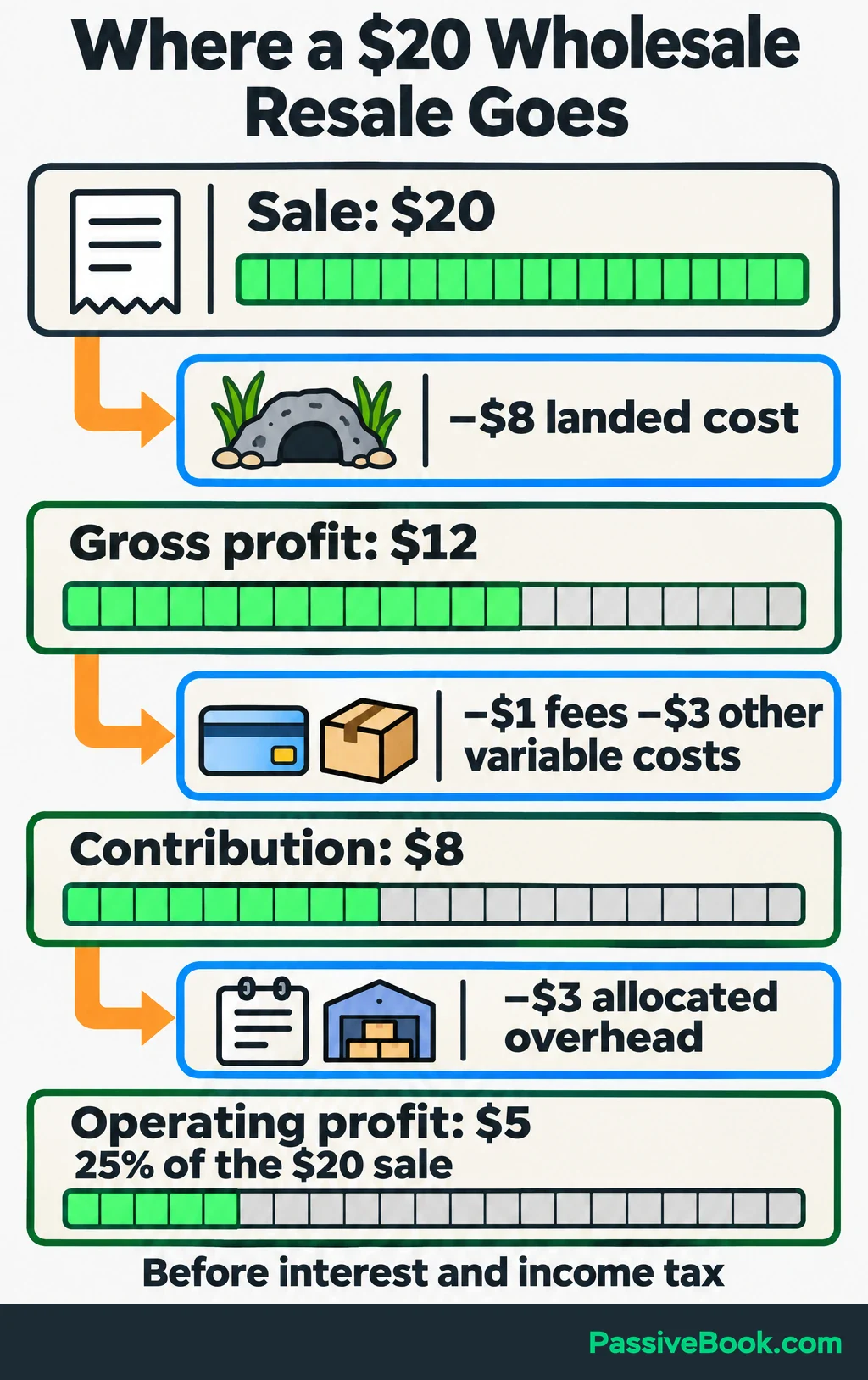
Separate fees charged as a percentage of revenue from other variable costs stated in dollars. If a charge applies to an entire order, spread it across the units in that order.
Suppose the aquarium shop pays fees equal to 5% of product revenue, plus $3 in other variable costs per cave:
| Per-cave calculation | Amount |
|---|---|
| Selling price | $20.00 |
| Less landed cost | −$8.00 |
| Less revenue-based fees: $20 × 5% | −$1.00 |
| Less other variable costs | −$3.00 |
| Contribution | $8.00 |
Now account for fixed monthly overhead, such as store subscriptions, insurance and fixed storage costs.
Suppose those expenses total $300, and you expect to sell 100 caves per month. This example treats the caves as the shop’s only product.
Allocated overhead per unit = $300 ÷ 100 = $3

Estimated operating profit per unit = $8 − $3 = $5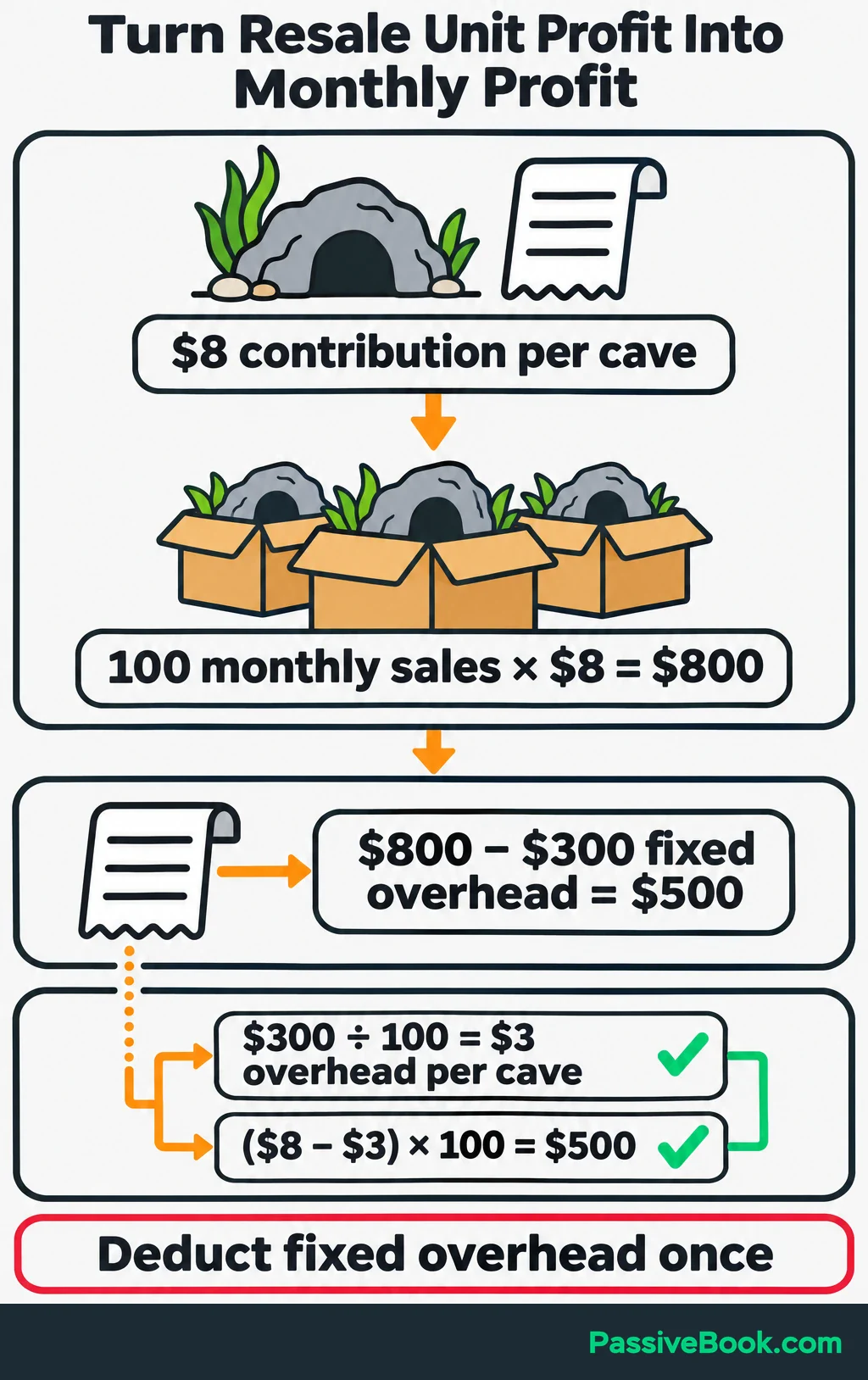
That is a 25% operating margin:
Operating margin = $5 ÷ $20 × 100 = 25%You can also calculate monthly operating profit directly:
Monthly operating profit =
Units sold × Contribution per unit − Fixed overhead

100 × $8 − $300 = $500
These estimates assume all operating expenses are included and are before interest and income tax.
Include paid labor in the appropriate costs. If you plan to take owner income as a draw rather than wages, build that income into your profit target. Otherwise, the price may cover everyone except you.
Set a Selling Price That Meets Your Target
Choose the target you need to meet, then calculate the price. I would use gross margin for a quick product check and operating profit for the final decision.
Price for a Target Gross Margin
To price for a gross margin, divide landed cost by the share of revenue left after your target margin:
Selling price = Landed unit cost ÷ (1 − Target gross margin)Enter the target as a decimal. For a 60% gross margin, use 0.60:
Selling price = $8 ÷ (1 − 0.60)
              = $8 ÷ 0.40
              = $20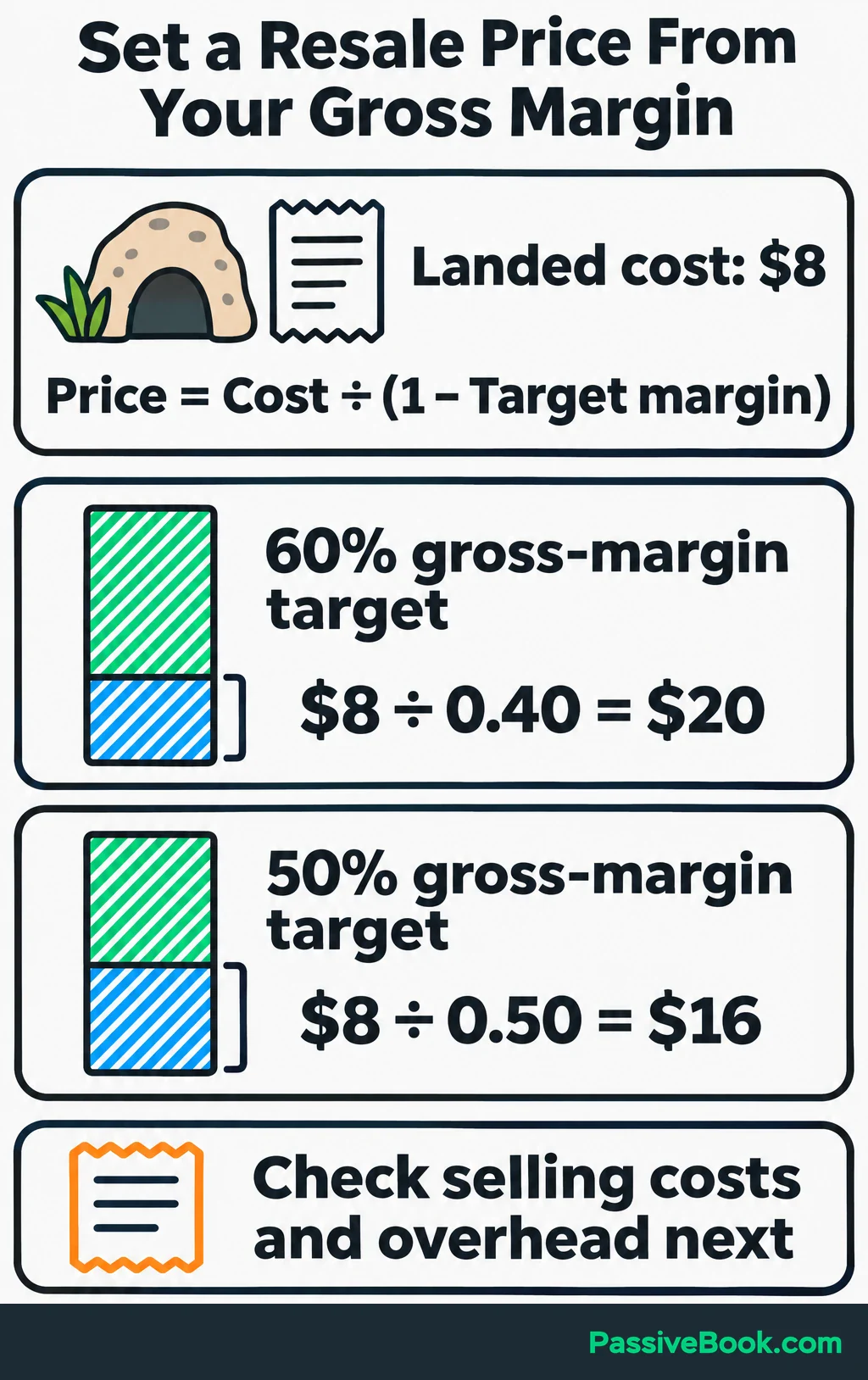
A 50% gross-margin target gives a different price:
Selling price = $8 ÷ 0.50 = $16You can use this formula for your wholesale selling price or your consumer resale price. Either way, check selling costs and overhead before accepting the result.
Price for a Target Operating Margin
An operating-margin target accounts for selling costs and overhead as well as landed cost.
First, add the dollar costs each sale must cover: landed cost, other variable costs and an overhead allowance. Then divide by the share of revenue left after percentage fees and your target operating margin.
Price =
(C + V + H ÷ Q) ÷ (1 − f − t)
The letters mean:
| Input | Meaning | Aquarium example |
|---|---|---|
| C | Landed unit cost | $8 |
| V | Other variable dollar costs per unit, excluding percentage fees | $3 |
| H | Monthly fixed overhead allocated to this product and channel | $300 |
| Q | Expected monthly units sold | 100 |
| f | Revenue-based fee rate | 0.05 |
| t | Target operating margin | 0.25 |
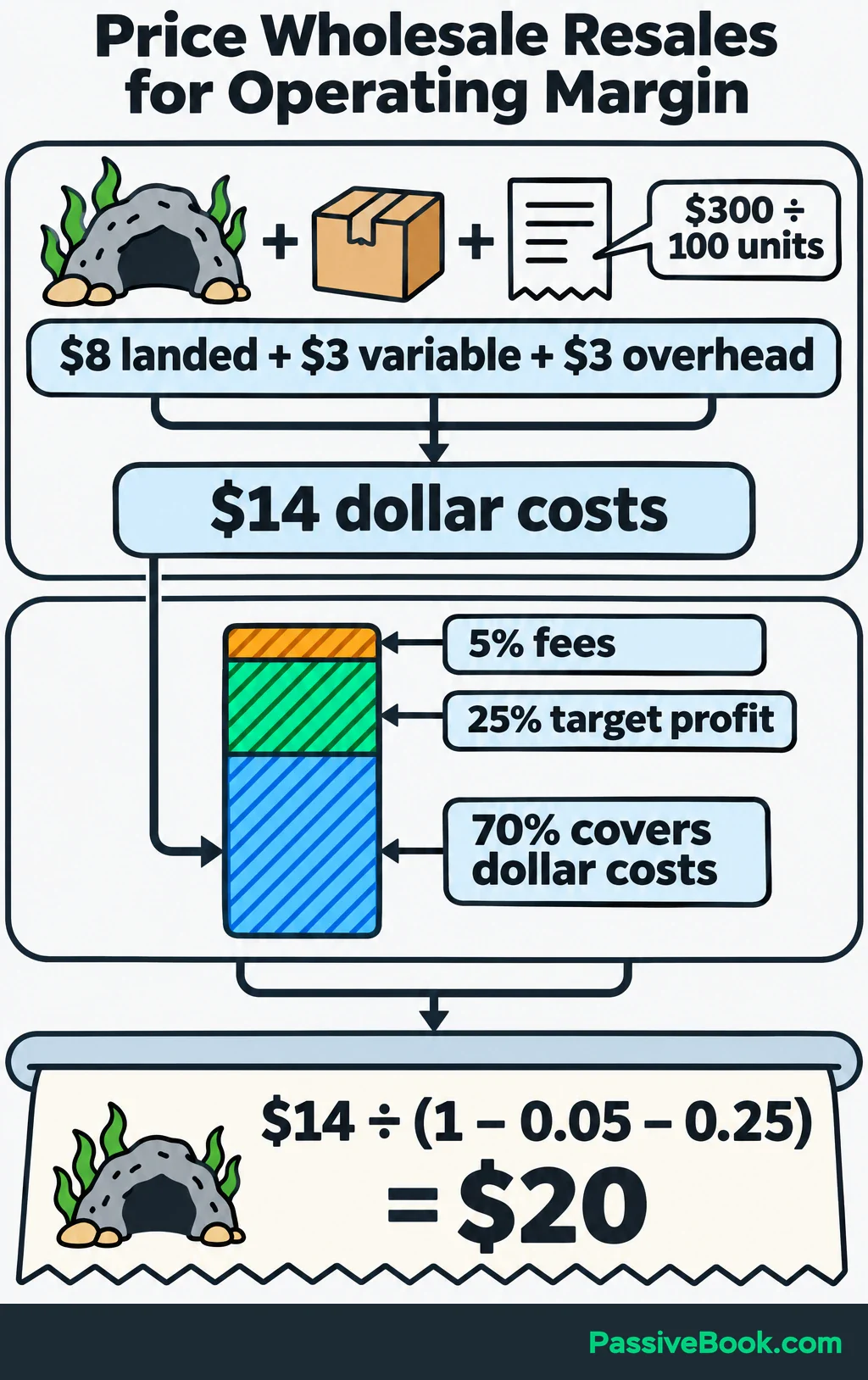
For the aquarium shop:
Price = ($8 + $3 + $300 ÷ 100) ÷ (1 − 0.05 − 0.25)
      = $14 ÷ 0.70
      = $20
If you prefer a dollar-profit target, add that amount to the dollar costs before allowing for percentage fees:
Price =
(C + V + H ÷ Q + Target profit per unit) ÷ (1 − f)
For a $5 operating-profit target per cave:
Price = ($8 + $3 + $3 + $5) ÷ 0.95 = $20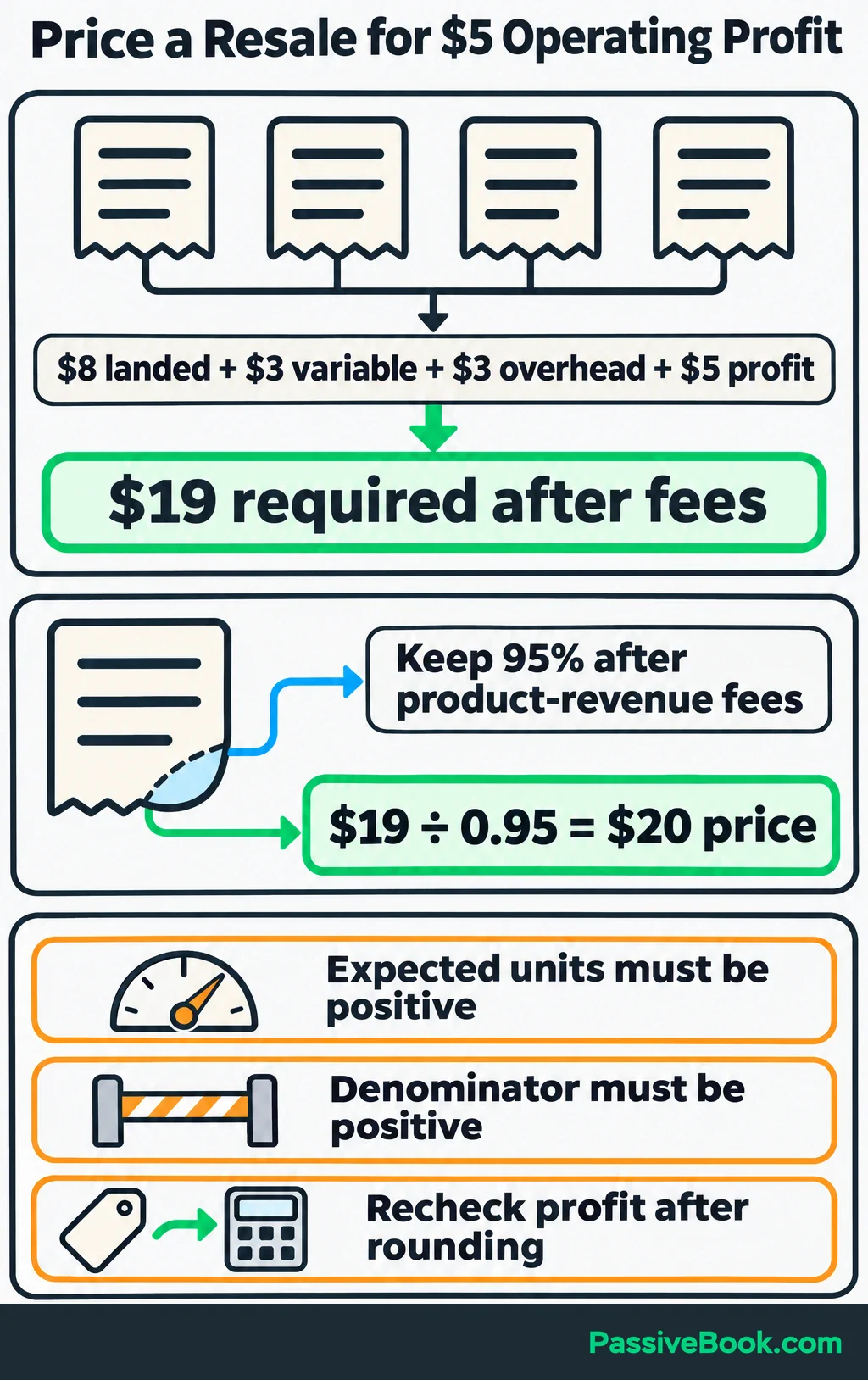
Use positive expected sales and a positive denominator. A fee rate plus target margin of 100% or more leaves nothing to cover positive dollar costs.
The percentage-fee calculation also needs the right base. These examples assume fees apply to product revenue. Account separately for charges on shipping, tax or other amounts.
Keep full precision while calculating, then check profit again after rounding your selling price.
If you want to check both margin targets together, the calculator below gives you a price floor for your expected sales and a slower month. It also shows how much room you have for discounts.
Free Pricing Profit Calculator




Work Backward to Your Maximum Wholesale Buying Price
Sometimes the market gives you the likely resale price first. You then need to work out how much you can afford to pay.
Start by finding the highest landed cost that meets your gross-margin target:
Maximum landed unit cost =
Resale price × (1 − Target gross margin)
Then remove the acquisition costs you will pay on top of the supplier’s invoice:
Maximum supplier price =
Maximum landed unit cost − Additional acquisition costs per unit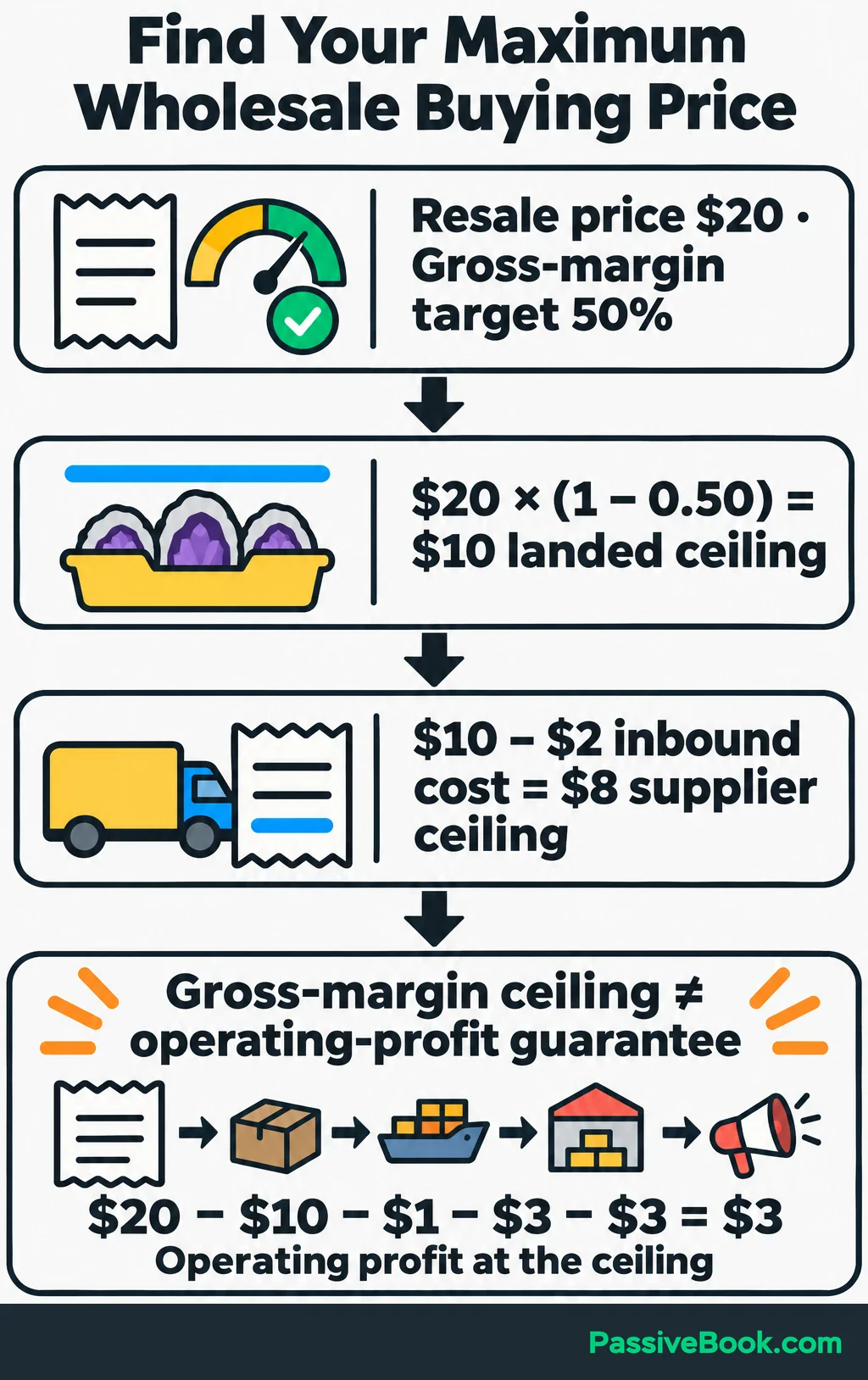
Suppose you expect to sell the cave for $20 and are considering a 50% gross-margin target:
Maximum landed cost = $20 × 0.50 = $10

Maximum supplier price = $10 − $2 inbound cost = $8
That $8 supplier-price ceiling meets the gross-margin target. It does not preserve the earlier $5 operating profit.
At a $10 landed cost, the same $20 sale leaves:
Operating profit per unit =
$20 − $10 − $1 fees − $3 other variable costs − $3 overhead
= $3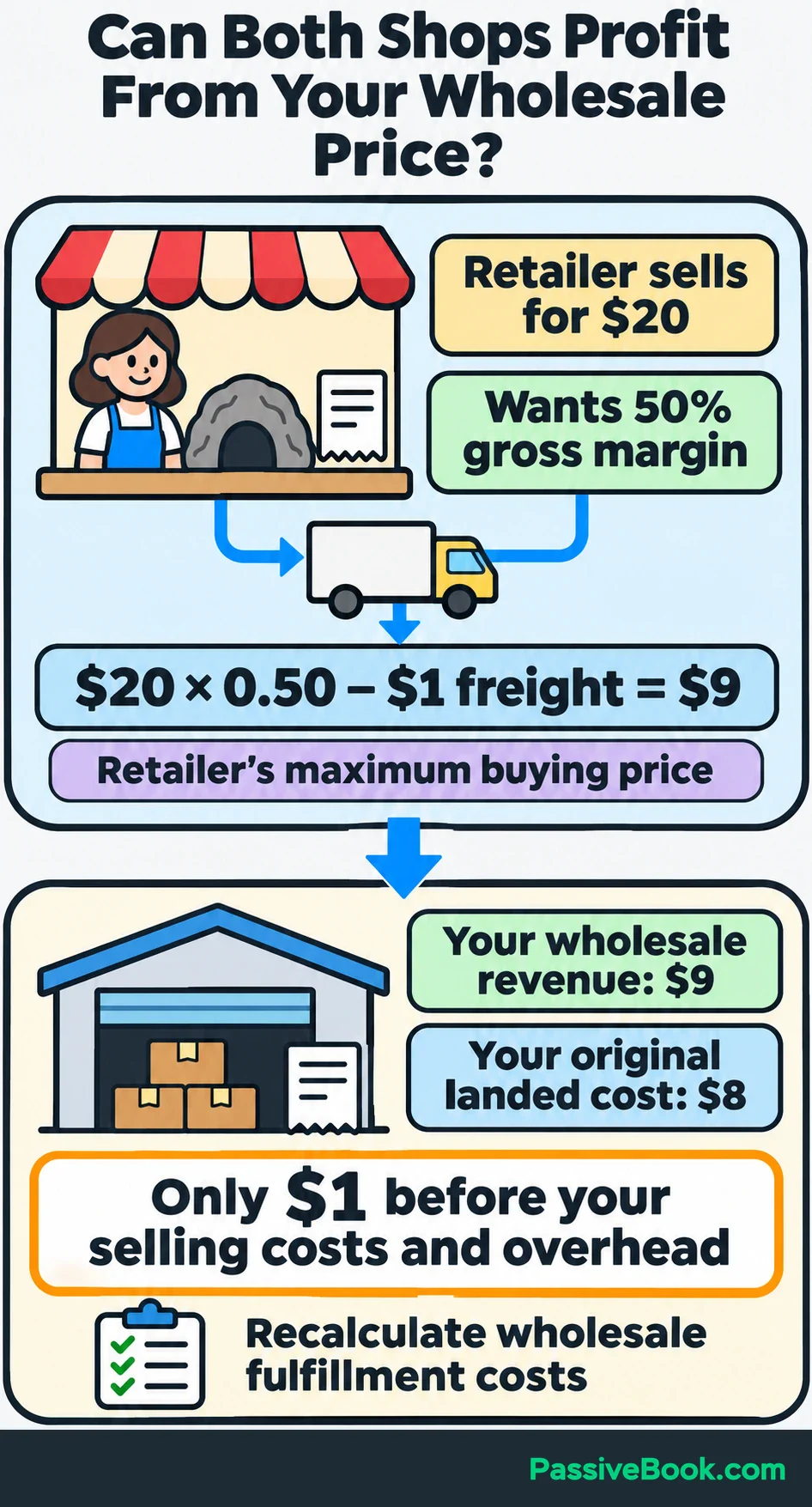
Check both targets before ordering.
If you sell wholesale to another shop, calculate its buying ceiling separately. Suppose that shop expects a $20 retail price, wants a 50% gross margin and pays $1 inbound freight per cave:
Its maximum buying price = $20 × 0.50 − $1 = $9At $9 wholesale revenue and your original $8 landed cost, you have only $1 left before your wholesale selling expenses and overhead.
Wholesale orders may have different fulfillment costs, so calculate that channel separately. A larger order is useful only if its economics work.
What Is a Good Wholesale Resale Margin?
A good margin covers selling costs, overhead and your profit target at a sales volume you can reasonably achieve.
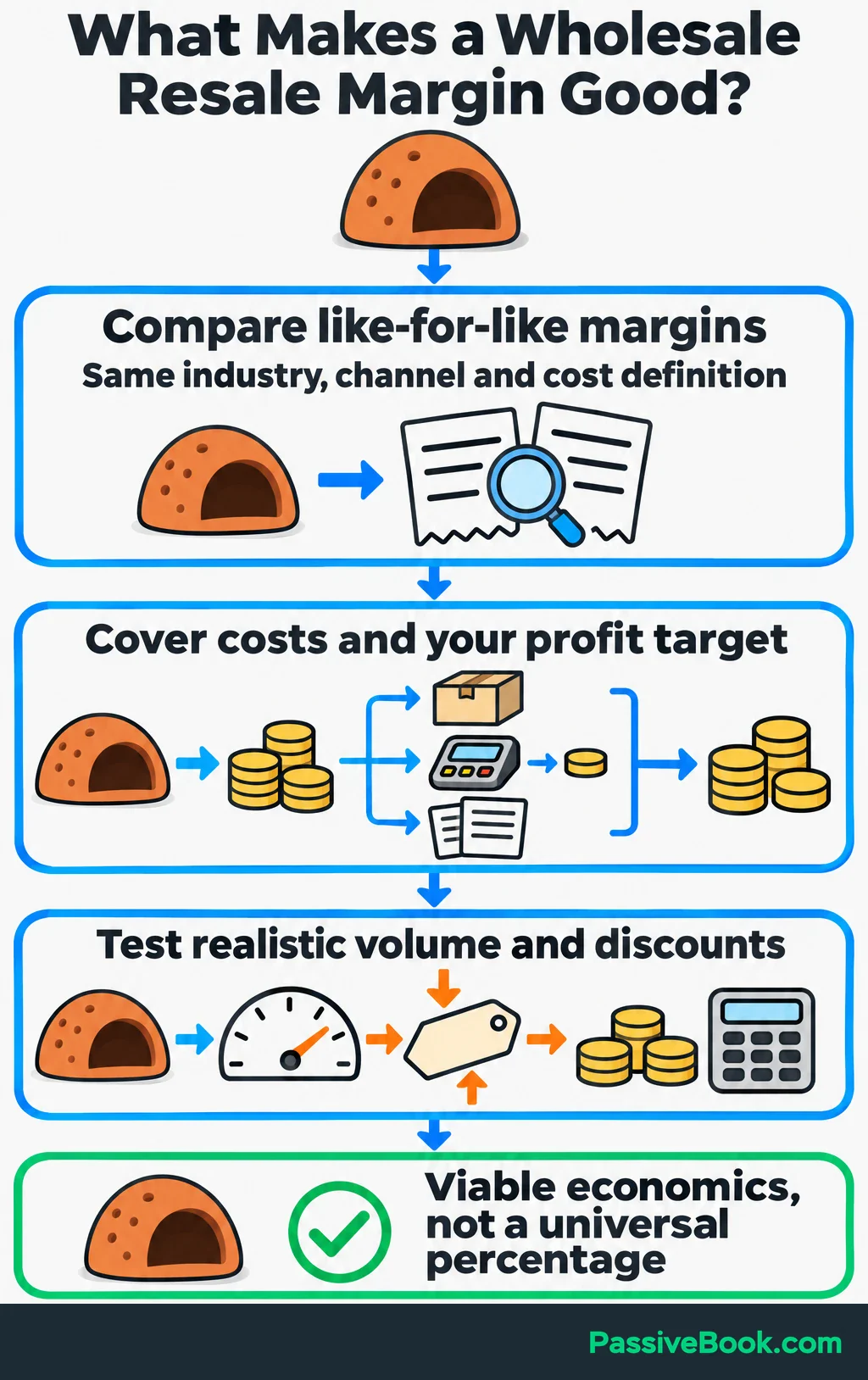
There is no universal target. Compare gross margins within the same industry, using similar products, sales channels and cost definitions.
For the aquarium shop, test the original $20 price against a slower sales month, then compare it with a discounted $16 price.
Check Break-even Sales Volume
Break-even volume is the number of units you must sell to cover the modeled costs.
Divide monthly fixed overhead by contribution per unit, then round up. This follows the SBA’s break-even formula:
Monthly break-even units =
Monthly fixed overhead ÷ Contribution per unit
At the original $20 price, contribution is $8:
Break-even units = $300 ÷ $8 = 37.5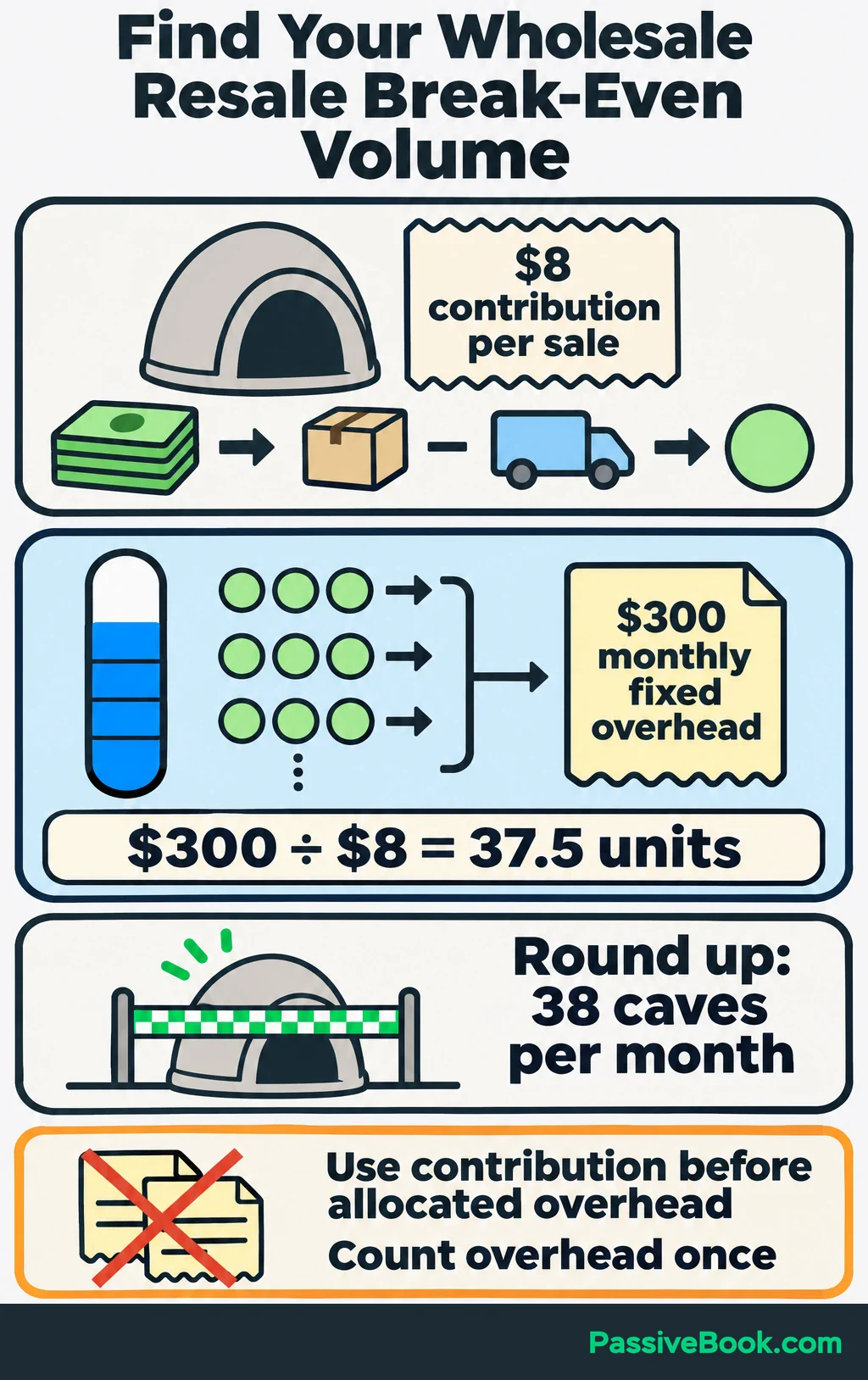
You need to sell 38 caves per month to cover the modeled costs.
Use contribution before allocated overhead so you don’t count overhead twice.
Also test what happens below your forecast. At 50 monthly sales:
Monthly operating profit = 50 × $8 − $300 = $100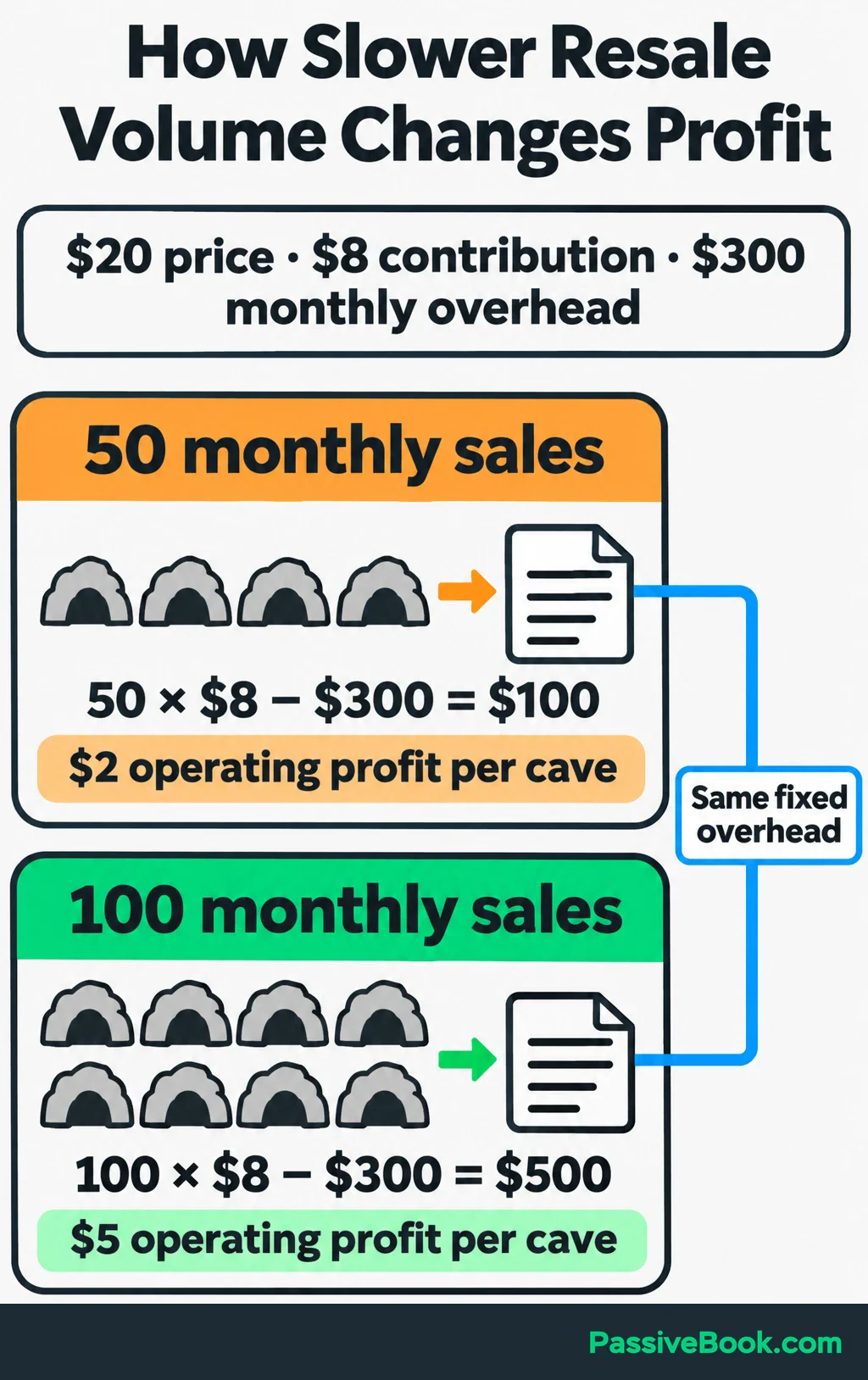
That leaves $2 per cave after overhead, compared with $5 at 100 sales.
Sales with zero or negative contribution cannot cover positive fixed overhead.
For a mixed catalog, compare the products’ combined contribution with shared overhead, counting that overhead once.
Test Discounts and Customer Demand
Recalculate using the price customers are likely to pay, including routine promotions.
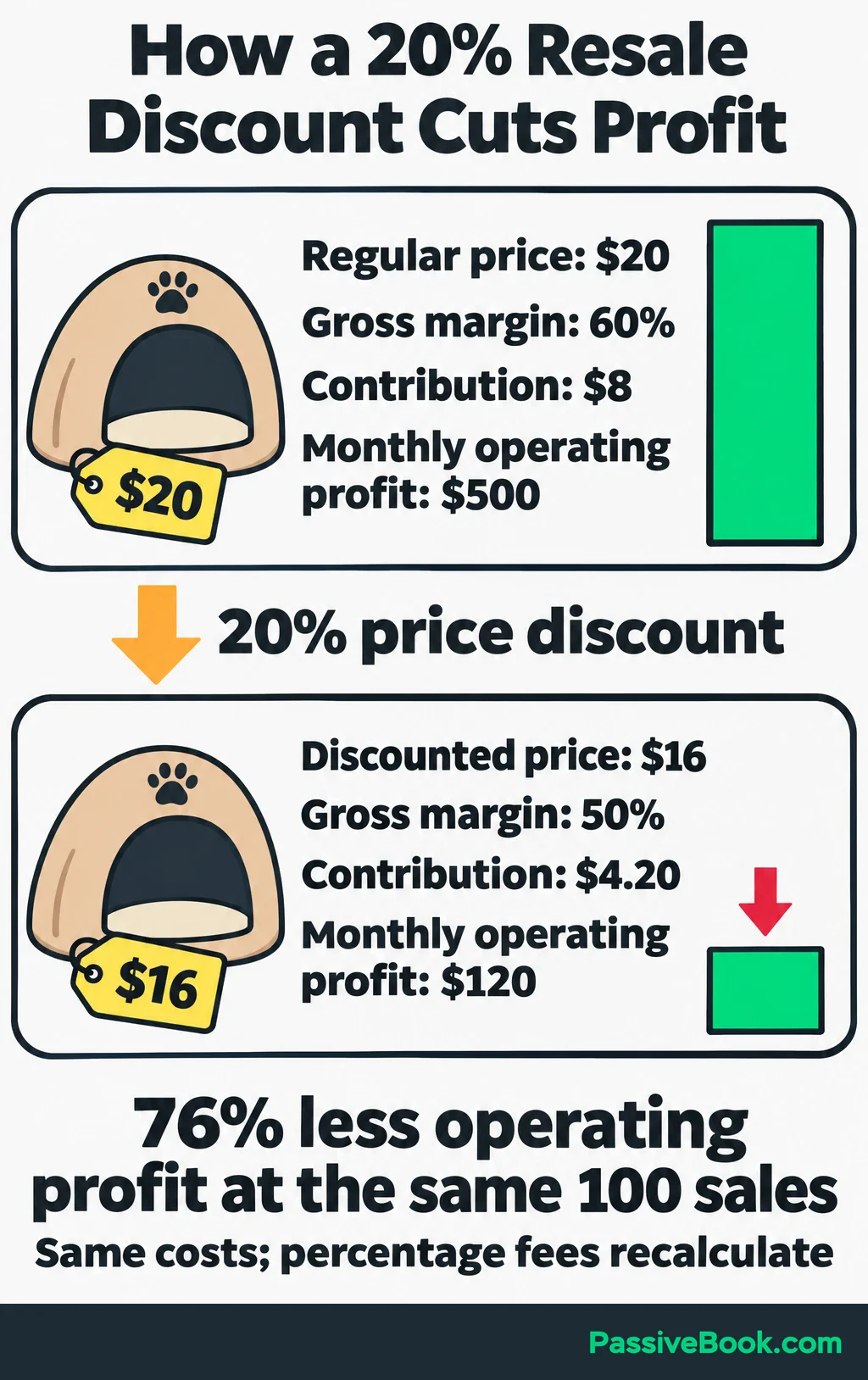
A 20% discount takes the cave from $20 to $16. With the original $8 landed cost:
Gross margin = ($16 − $8) ÷ $16 × 100 = 50%

Contribution = $16 − $8 − ($16 × 5%) − $3 = $4.20
At 100 monthly sales, the effect is substantial:
| Measure | $20 regular price | $16 discounted price |
|---|---|---|
| Gross margin | 60% | 50% |
| Contribution per cave | $8.00 | $4.20 |
| Monthly operating profit | $500 | $120 |
| Operating margin | 25% | 7.5% |
The discount cuts the price by 20%, but monthly operating profit falls by 76% at the same sales volume.
Compare your required price with competing offers, accounting for differences in size, quality, features and the total delivered price. Your costs establish what you need to charge; customers still need a reason to pay it.
I learned the demand side painfully with my online jewellery store around 2013–2014. I invested about $1,200, skipped market research and ended up with unsold inventory. I lost most of the investment. Choosing stock had felt like progress, but I had given too little attention to whether people would buy it.
That experience is why I would test demand before committing to a large order, even when the margin calculation looks attractive.
If your required price looks hard to support, negotiate acquisition costs, reduce fulfillment costs or test whether buyers will pay more for a clear benefit. If none of those works, skip the product.
Build a Reusable Margin Calculator
I would start with a spreadsheet. You need visible inputs and repeatable formulas; a separate software subscription can wait.
Use one row per product and sales channel. Put these headings in row 1 and enter your first product in row 2:
| Column | Input | Aquarium example |
|---|---|---|
| A | Product and channel | Ceramic cave, direct retail |
| B | Landed unit cost | $8 |
| C | Selling price after discounts, excluding sales tax | $20 |
| D | Revenue-based fee rate | 5% |
| E | Other variable costs per unit | $3 |
| F | Expected monthly units sold | 100 |
| G | Monthly fixed overhead allocated to this row | $300 |
Then add the output columns below. Enter the formulas in row 2 and copy them down for other products.
| Column | Output | Spreadsheet formula | Example result |
|---|---|---|---|
| H | Gross profit per unit | =C2-B2 | $12 |
| I | Gross margin | =H2/C2 | 60% |
| J | Markup | =H2/B2 | 150% |
| K | Contribution per unit | =C2-B2-(C2*D2)-E2 | $8 |
| L | Overhead per unit | =G2/F2 | $3 |
| M | Operating profit per unit | =K2-L2 | $5 |
| N | Operating margin | =M2/C2 | 25% |
| O | Monthly operating profit | =F2*K2-G2 | $500 |
Format margin and markup outputs as percentages. These spreadsheet formulas return decimal ratios, so do not also multiply them by 100.
Add input cells for your target margins and inbound cost if you want the sheet to calculate target selling prices and supplier-price ceilings using the earlier formulas.
For shared overhead, allocate the budget across rows once. The amounts in column G should add up to the business’s total overhead budget.
I would also add alerts for inputs that break the calculation:
- A zero selling price makes margin undefined.
- A zero landed cost makes markup undefined.
- Zero expected sales prevents an overhead-per-unit estimate.
- Nonpositive contribution means sales cannot cover positive fixed overhead.
Duplicate a row to test a discounted price or lower sales volume. Recalculate percentage fees when price changes, and overhead per unit when volume changes. Treat those rows as alternative scenarios, so you do not accidentally add them together as separate sales forecasts.
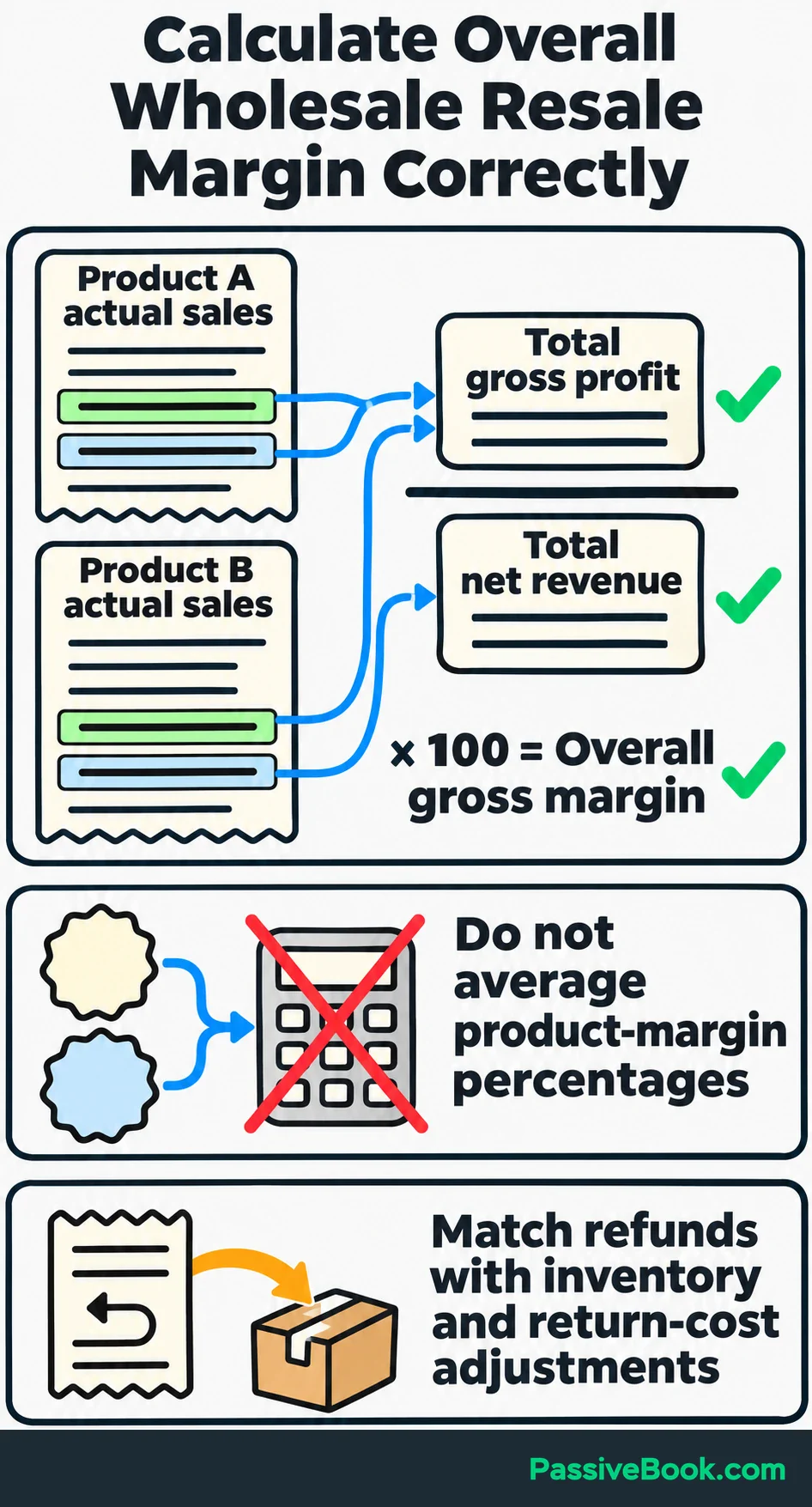
For actual period results, add up gross profit and net revenue first:
Overall gross margin =
Total gross profit ÷ Total net revenue × 100
Do not average product-margin percentages; products with different revenue need different weights. Match refunds with the appropriate inventory and return-cost adjustments.
Update the sheet when supplier costs, freight, fees or sales expectations change, and compare estimated profit with recorded results. That comparison tells you which inputs need fixing.
What Next?
Take one supplier quote and calculate its landed unit cost, gross margin and operating profit at the price you expect customers to pay. Then test a discount and a slower sales month before placing the order.
Use the social buttons to share this guide when a pricing discussion needs more than “double the cost.”
Which cost could change your buying decision once you include it? Share your answer in the comments, and bring any other pricing questions too.
Share this post with your friends & followers:

