Your supplier approves your account and sends a wholesale price list. You’re ready to order, but the application asks for a resale certificate. Is that your limited liability company (LLC) paperwork, your tax permit, or something else?
Getting those documents mixed up can mean paying tax unnecessarily, claiming an exemption you cannot support, or buying stock before you have the required permissions. For U.S. merchandise resale, the requirements depend on where you operate, store inventory and deliver goods, plus what you sell. We’ll follow a Texas stationery shop through those checks so you can identify the paperwork you need before money leaves your account.
What Do You Need to Legally Resell Wholesale Products?
You can legally resell wholesale products once you meet the business-registration, licensing, sales-tax and product requirements that apply to your operation. Buying at a wholesale price does not automatically make your purchases or later sales tax-exempt.
A reseller buys goods to sell again. You might sell individual items to consumers, supply other businesses, or do both. The customer’s intended use helps determine whether a sale qualifies for a resale exemption.
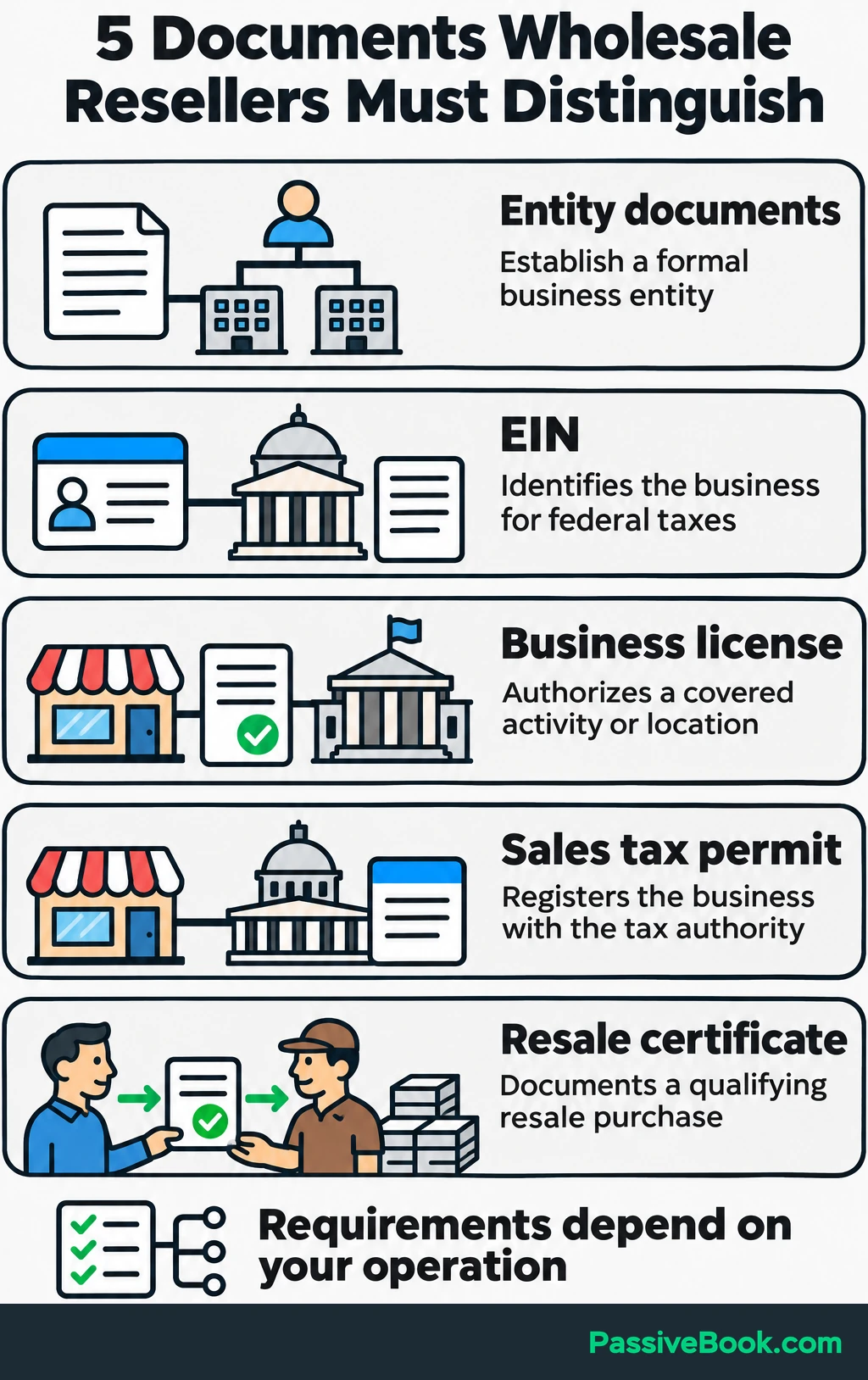
The paperwork serves several separate purposes:
| Document | Purpose | Issuing Authority or Recipient | When Needed |
|---|---|---|---|
| Entity formation documents | Establish an LLC, corporation or another formal entity | Usually the state’s business-registration office | When you choose a structure that requires formation |
| Employer identification number, or EIN | Identifies the business for federal tax purposes | IRS | When federal rules require one; other institutions may also request it |
| Business license | Authorizes a covered business activity or operation in a location | Relevant state, county or city agency | When the activity or location requires it |
| Sales tax permit | Registers the business with the sales-tax authority | State revenue agency or other responsible tax authority | When that jurisdiction requires registration |
| Resale certificate | Documents a qualifying purchase for resale | Completed by the purchaser and given to the supplier | When claiming the resale exemption under the applicable rules |
The permit and certificate are especially easy to confuse. In Texas, giving a supplier your permit number or a copy of your permit does not replace a completed resale certificate. Texas resale certificate requirements.
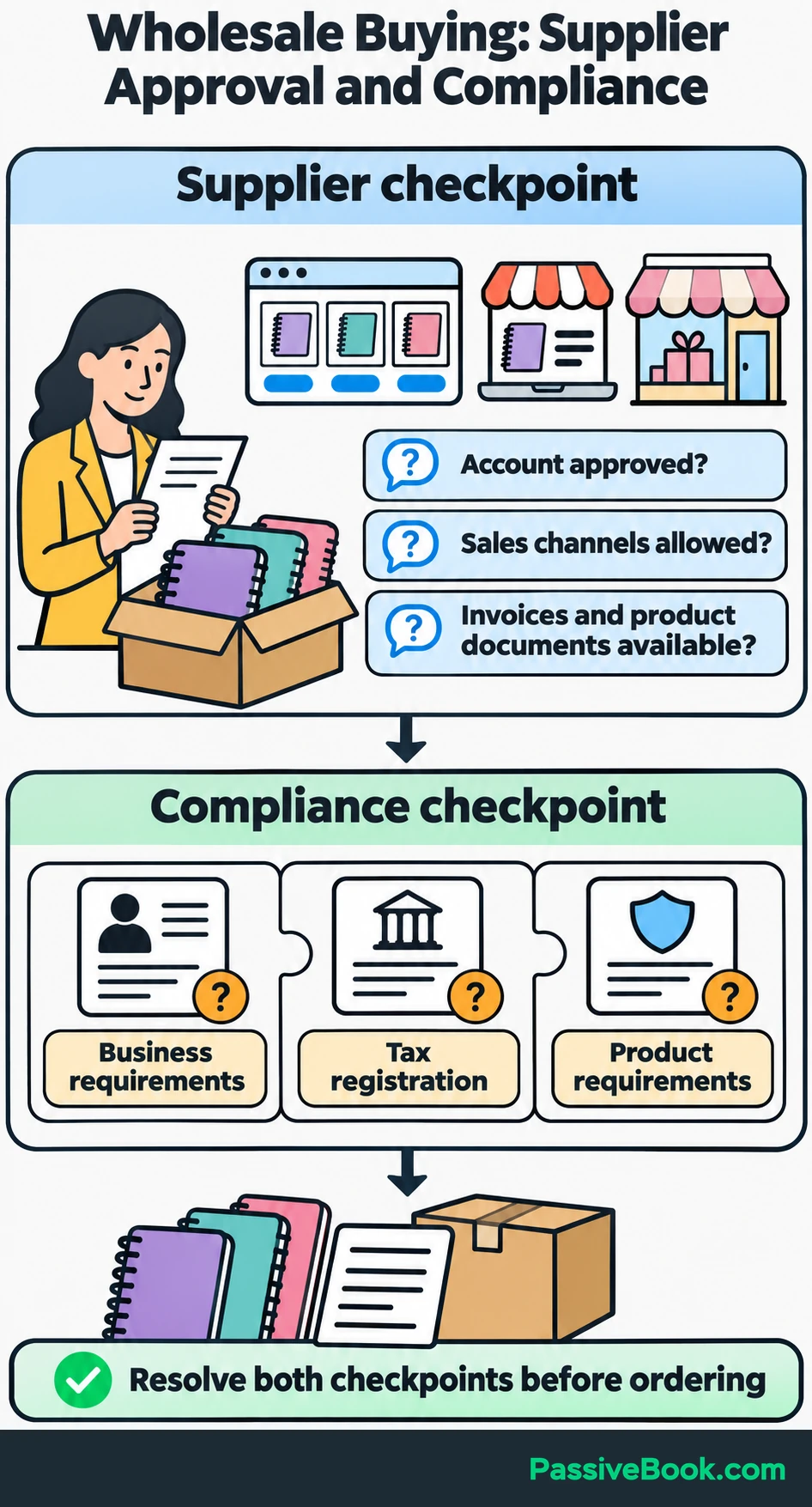
For our running example, imagine you operate a Texas stationery shop. You buy finished paper journals from domestic wholesalers and sell through your website, a marketplace and wholesale orders to gift shops.
Before ordering, confirm the supplier’s account requirements and whether its terms allow those sales channels. Ask about marketplace restrictions and the invoices or product documents it can provide. Supplier approval answers whether that supplier will sell to you; your registrations and product checks answer whether your operation meets the applicable rules.
Do You Need an LLC or Business License?
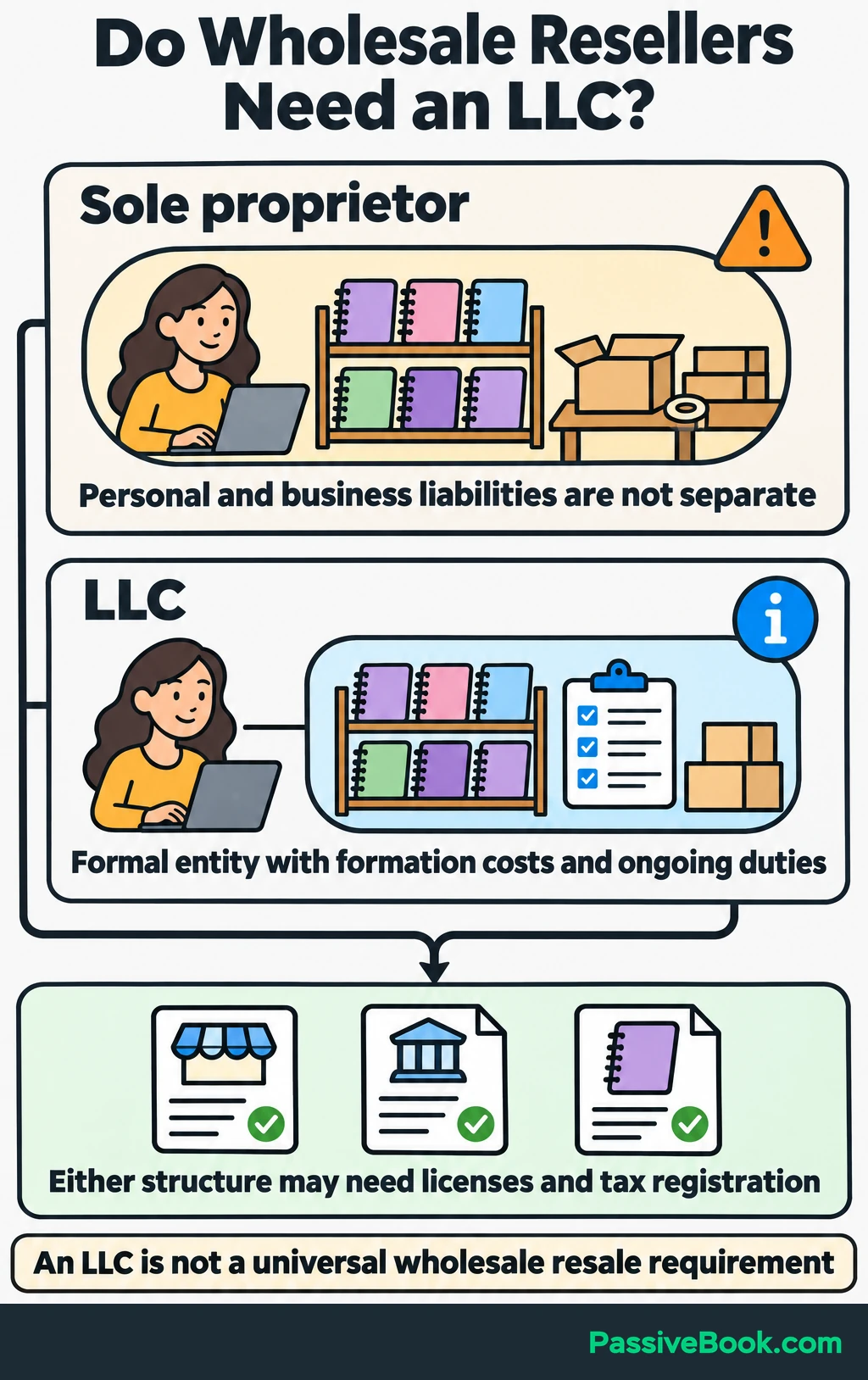
An LLC is not a universal requirement for wholesale resale. You can operate as a sole proprietor and obtain the registrations and licenses your business needs.
The choice still matters because a sole proprietorship does not separate your personal and business liabilities. An LLC offers a different legal structure, with its own formation costs and ongoing duties. Choose based on ownership, liability, taxes and administration rather than treating “LLC” as a wholesale buying pass. SBA business-structure guidance.
I would settle the ownership structure before opening supplier accounts and applying for permits. Otherwise, you may finish a stack of applications and then need to replace them when the legal owner changes.
Use the owner’s legal identity consistently across registrations, bank records, supplier accounts and sales channels. If you trade under another name, check whether an assumed-name or business-name registration is required.
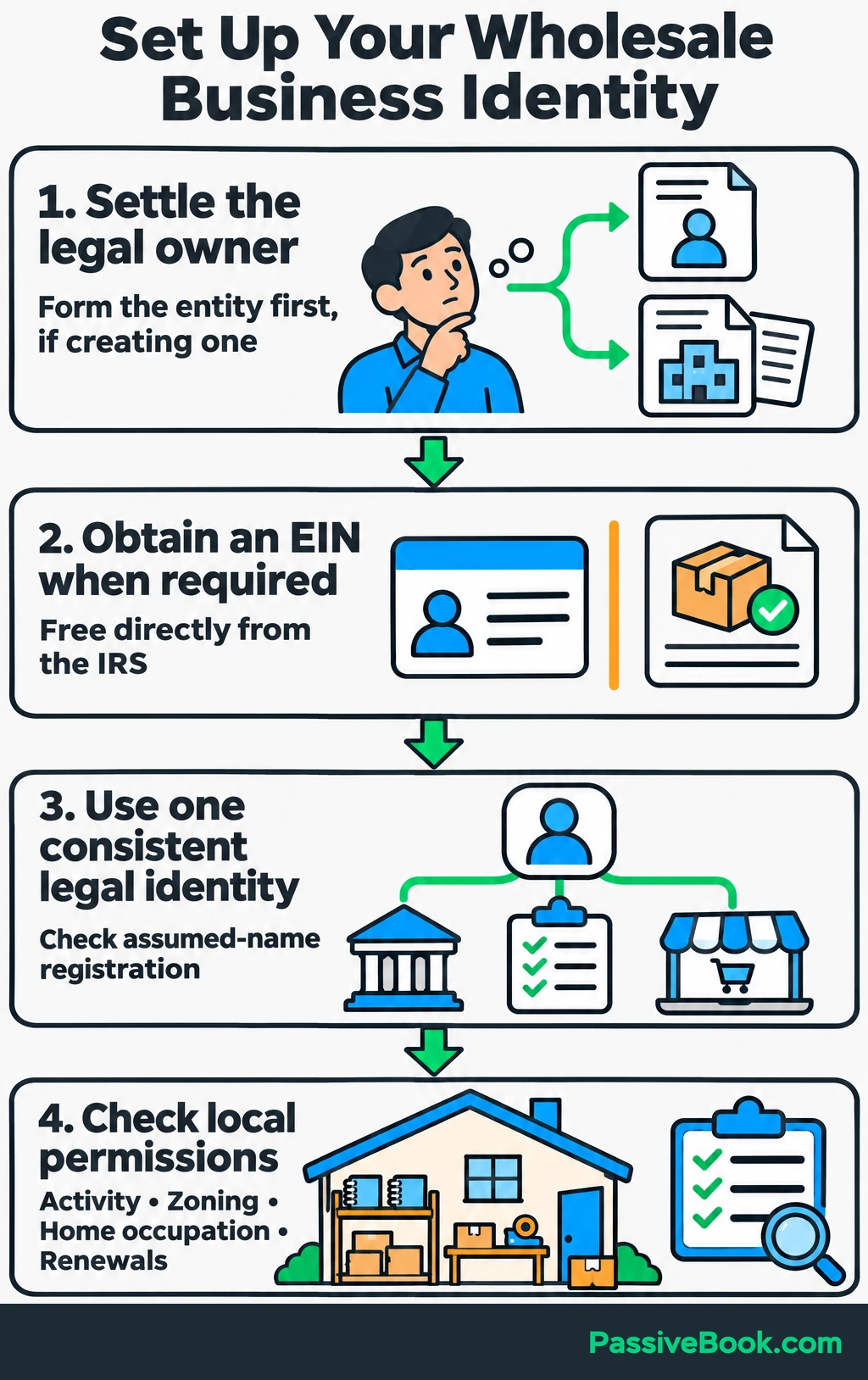
An EIN is a federal tax identifier. It does not authorize tax-free inventory purchases. Obtain one when IRS rules require it, and form your entity first if you are creating one. You can get an EIN free directly from the IRS. IRS EIN guidance.
Licensing is a separate check. Ask the relevant state and local offices about:
- Licenses for your business activity.
- Zoning rules for the storage and shipping address.
- Home-occupation approval if you work from home.
- Required renewals, inspections or location approvals.
For the stationery shop, describe the actual operation: cartons of journals stored at home, orders packed there and parcels collected or dropped off. That gives the local office something useful to assess.
Where Must You Register for Sales Tax?
Start with where the business operates and keeps goods, then check where it sells. A remote-sales threshold is only one possible reason to register.
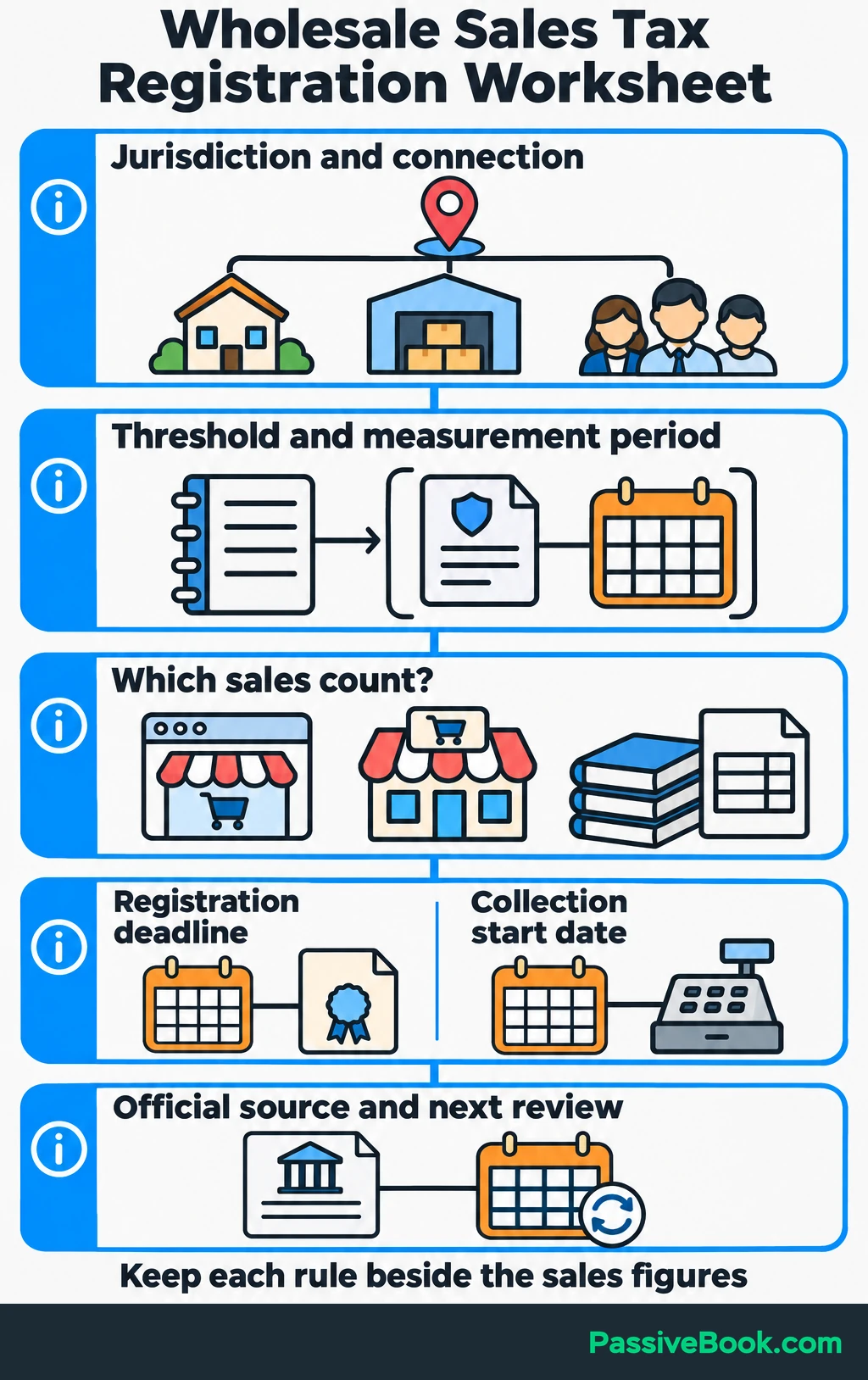
Create one worksheet with a row for each jurisdiction you need to assess. Record:
- The state or locality and your connection to it.
- Any applicable sales threshold and measurement period.
- Which sales count toward that threshold.
- The registration deadline and collection start date.
- The official source and your next review date.
Keep the rule beside the sales figures. A total without its measurement period or included sales tells you very little.
Check Physical Presence First
List your operating premises, employees, inventory and fulfillment locations. Check these connections before relying on a rule for sellers with no physical presence.
The stationery shop begins with Texas because it operates and stores stock there. Texas requires a sales and use tax permit for businesses engaged in selling tangible personal property in the state, and its rules include business locations such as offices and warehouses. Texas permit requirements.
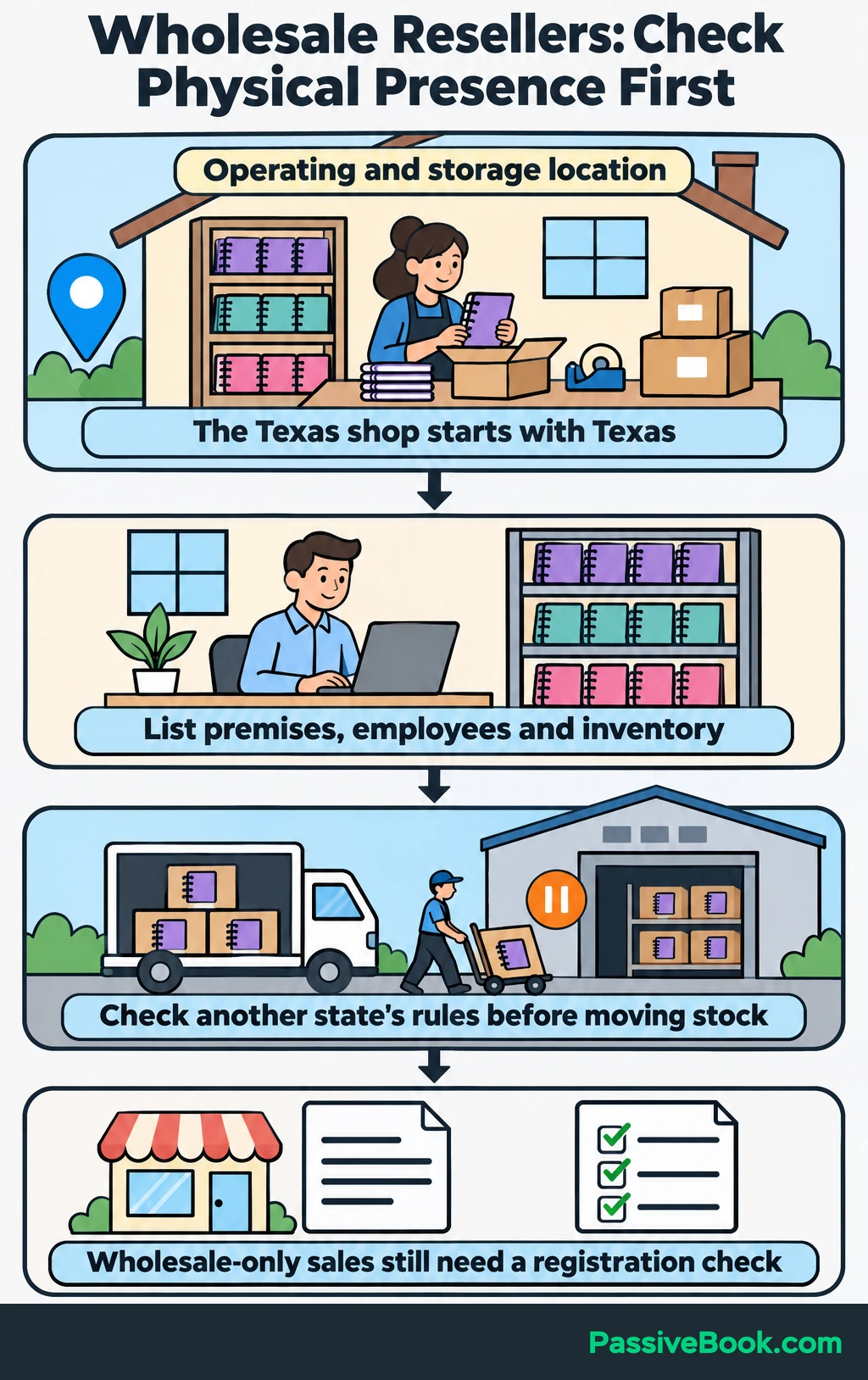
Check another state’s rules before moving stock into a fulfillment warehouse there. A third party storing your goods does not make the location irrelevant.
Wholesale-only sales also deserve a registration check. Selling every journal to another shop does not automatically remove permit duties. Registration and the tax treatment of an individual sale are separate questions.
Check Economic Nexus and Marketplace Rules
Economic nexus means your sales activity can create a sales-tax collection duty even without physical presence.
Use each destination state’s revenue-agency guidance to complete the worksheet.
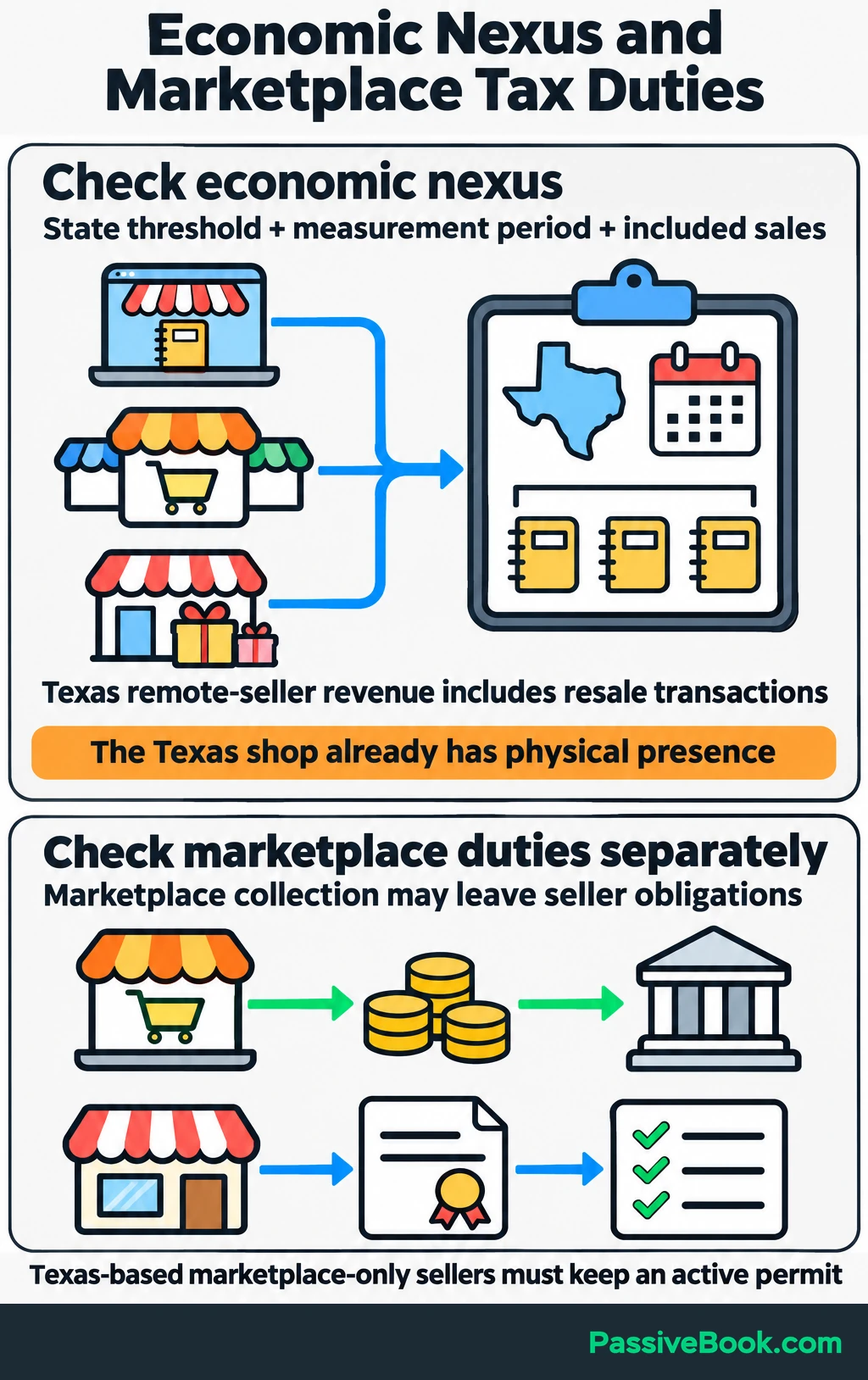
Some calculations include sales you would not collect tax on. Texas, for example, includes resale transactions when calculating a remote seller’s Texas revenue. But that remote-seller rule is not the basis for our shop’s Texas registration because the shop already operates there.
Marketplace collection needs its own check. A marketplace may collect and remit tax while you still have registration or reporting duties. Texas-based sellers must maintain an active permit even if they sell only through a marketplace that has certified it will collect Texas tax. Texas remote-seller and marketplace rules.
For the stationery shop, keep website, marketplace and gift-shop sales identifiable in your records. Then include each group in another state’s threshold calculation as that state requires.
Apply for the Required Permits
Apply through the responsible revenue agency using the business’s actual owner, locations, activities and sales channels.
Save the approval and record the effective date, account number, assigned filing schedule and first return deadline. Registration creates an ongoing task, so put that first deadline in your calendar immediately.
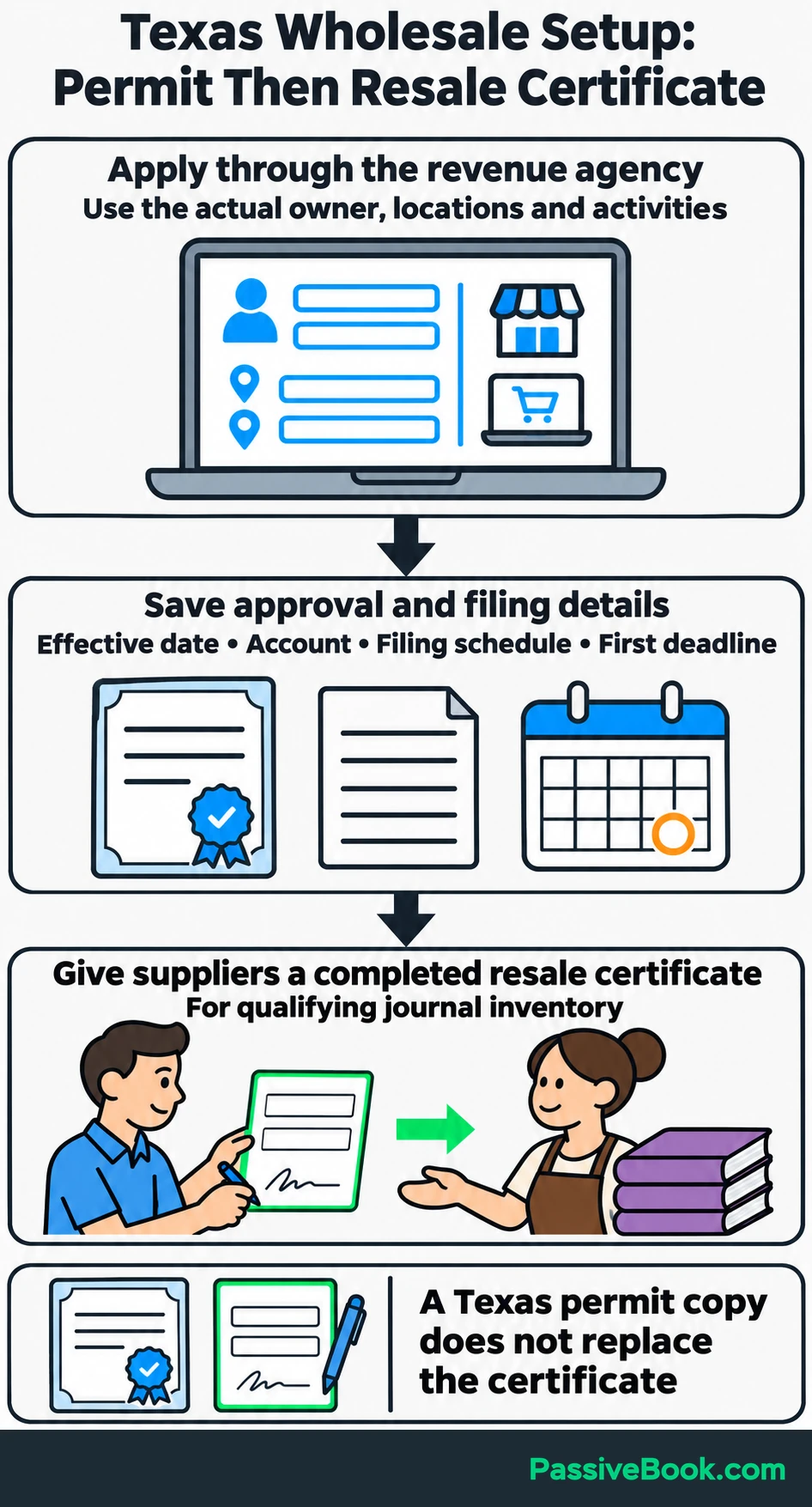
For the Texas shop, the sequence is to obtain the required sales and use tax permit, then give suppliers a completed resale certificate for qualifying journal inventory.
Check the meaning of each document in the jurisdiction involved. “Seller’s permit,” “reseller permit” and “resale certificate” can refer to different paperwork. A supplier’s application field may use those terms loosely, so confirm what it actually needs.
Check Product Requirements Before Buying Inventory
Tax paperwork does not establish that a product is safe or lawful to sell. Check the goods before committing to an order.
Write down the exact product, its intended users and what you will do with it. Reselling a finished domestic product can bring different duties from importing it, manufacturing it, repackaging it or selling it under your own brand.
For each product, gather:
- The manufacturer or importer’s identity and product identifiers.
- Applicable safety certificates, labels and handling information.
- Recall information for the exact product.
- Documents your intended marketplace requires.
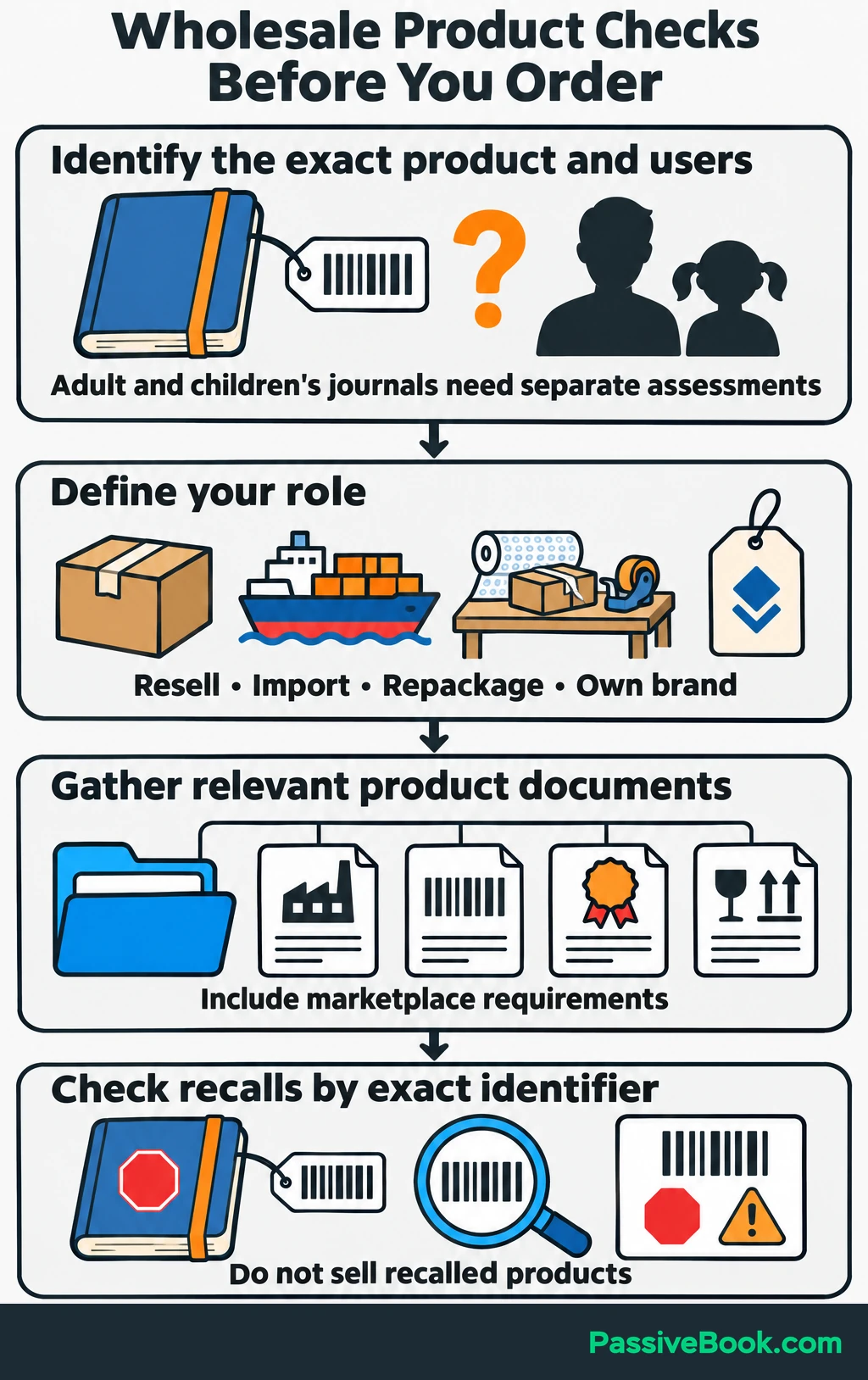
The Consumer Product Safety Commission’s online-seller resources explain how requirements differ by product and seller activity. Selling recalled products is unlawful, so check using the actual model or product identifiers rather than a broad description. CPSC online-seller safety guidance.
For the stationery shop, assess the finished journals and their intended users. A journal sold for general adult use and one designed primarily for young children need separate product assessments. Ask the supplier for the documentation relevant to the item you will list.
If you still need documents, put the exact product, intended use and missing information into one supplier request. The email helps you ask focused questions; it does not verify compliance.

Free AI Supplier Correspondence Studio




When FDA Requirements Apply
Check Food and Drug Administration (FDA) requirements if you sell food, cosmetics, medical devices, drugs or other products it regulates. The product category and your activities determine which requirements to investigate. “FDA registration” is not a general reseller permit. Products regulated by FDA.
Our shop’s ordinary paper journals do not create a food or drug operation. Adding food to a journal gift bundle would introduce a separate product check, though, even if the food arrives sealed.
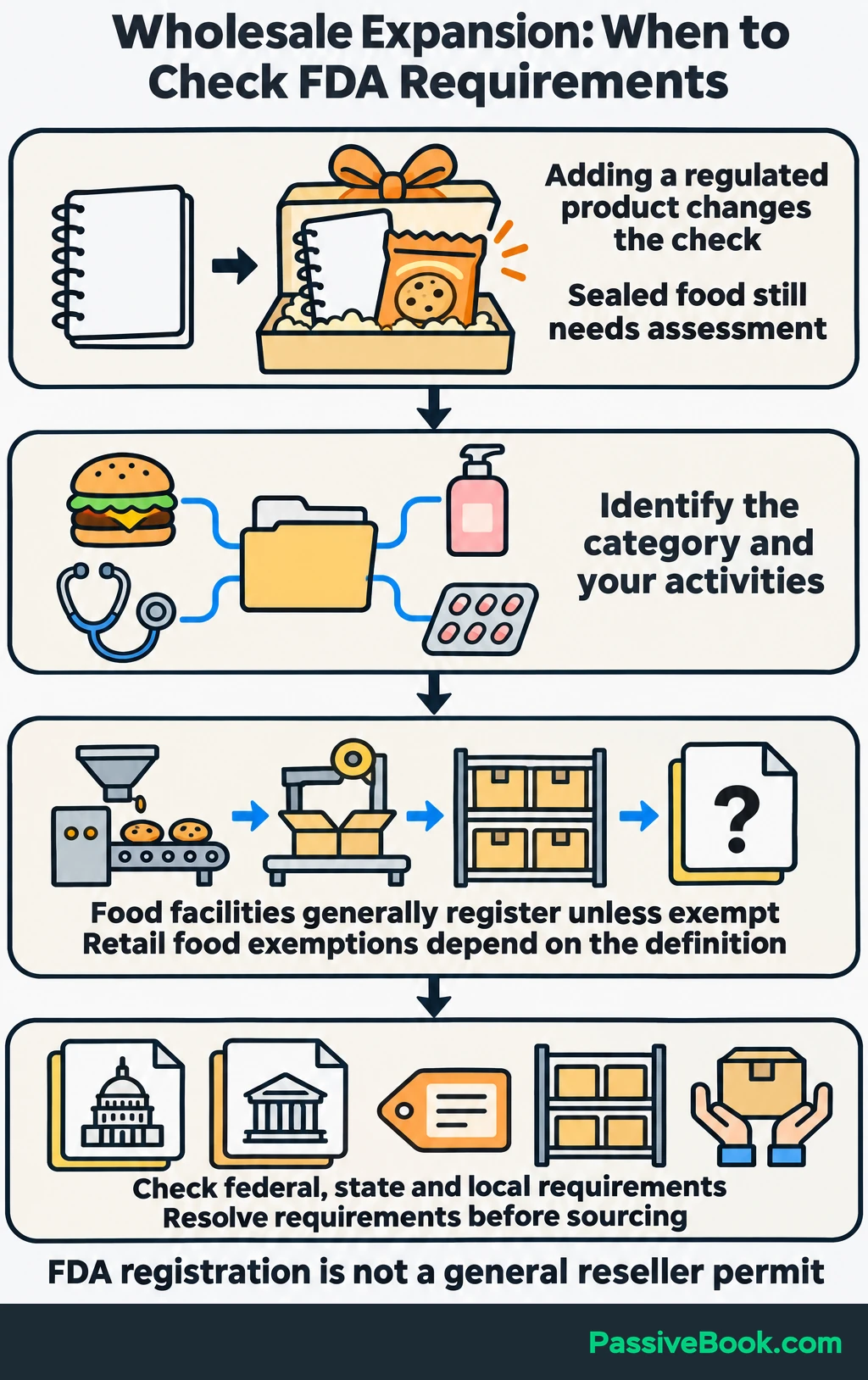
Facilities that manufacture, process, pack or hold food for U.S. consumption generally must register with FDA before those activities begin unless an exemption applies. Retail food establishments are among the exemptions, but you need to meet the relevant definition. State and local food permissions require a separate check. FDA guidance on starting a food business.
Before expanding into an FDA-regulated category, identify the registration, labeling, storage and handling requirements for your precise role. I would resolve that before comparing suppliers on price.
When DSCSA Applies to Prescription Drugs
The Drug Supply Chain Security Act, or DSCSA, covers most human prescription drugs in finished dosage form. It does not cover ordinary merchandise, and over-the-counter and animal drugs are excluded from its product-tracing requirements.
Your role matters. A wholesale drug distributor has duties that a stationery wholesaler does not acquire merely by selling in bulk.
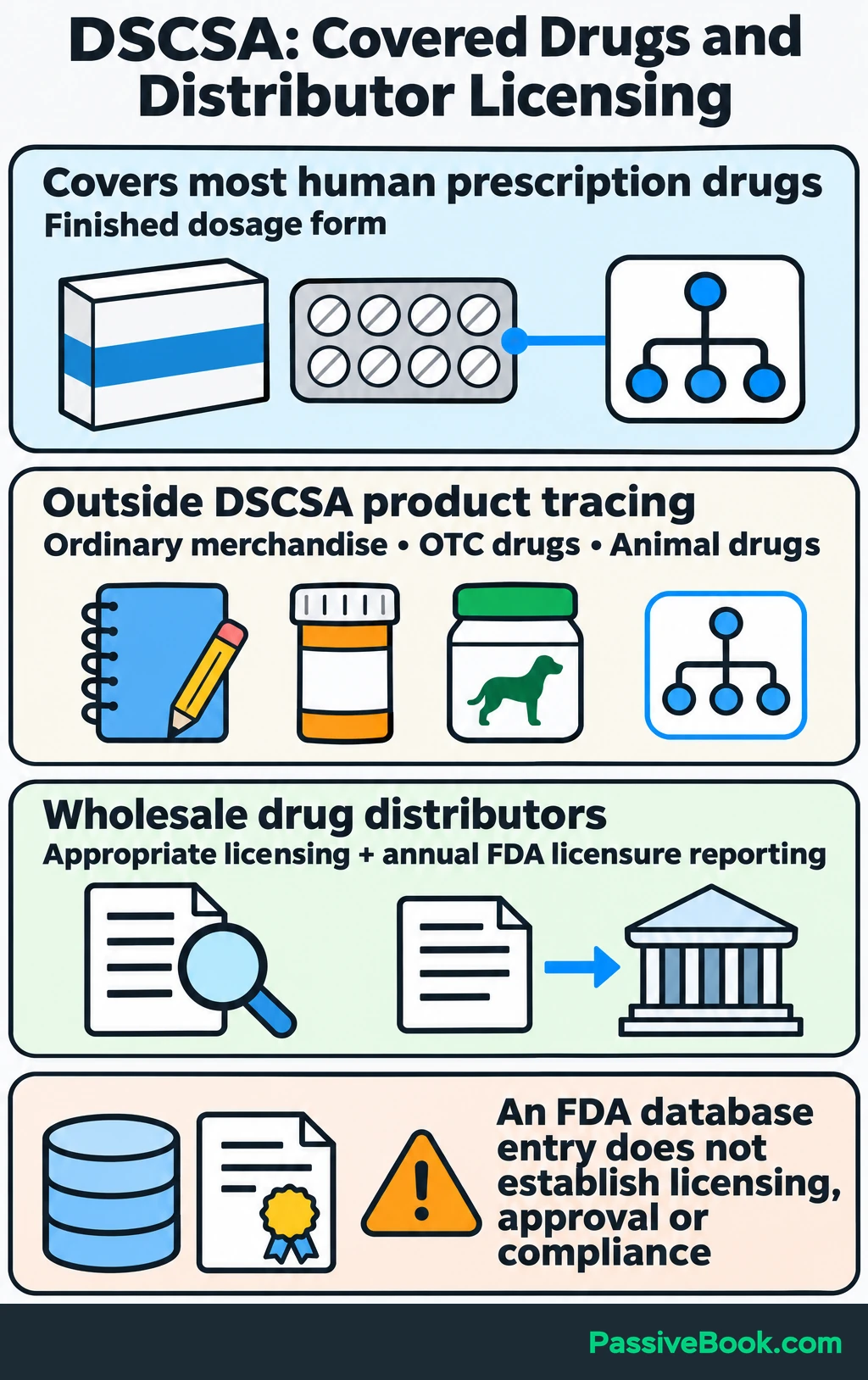
Wholesale drug distributors must be appropriately licensed and report licensure information to FDA annually. Verify licenses with the relevant authorities. An entry in FDA’s reporting database does not establish that a facility is licensed, approved or compliant. FDA wholesale drug distributor reporting requirements.
Before trading covered inventory, establish the applicable systems for:
- Checking that trading partners are authorized.
- Exchanging electronic tracing information at the package level.
- Verifying products and handling suspect or illegitimate stock.
- Retaining required transaction records for at least six years after the transaction.
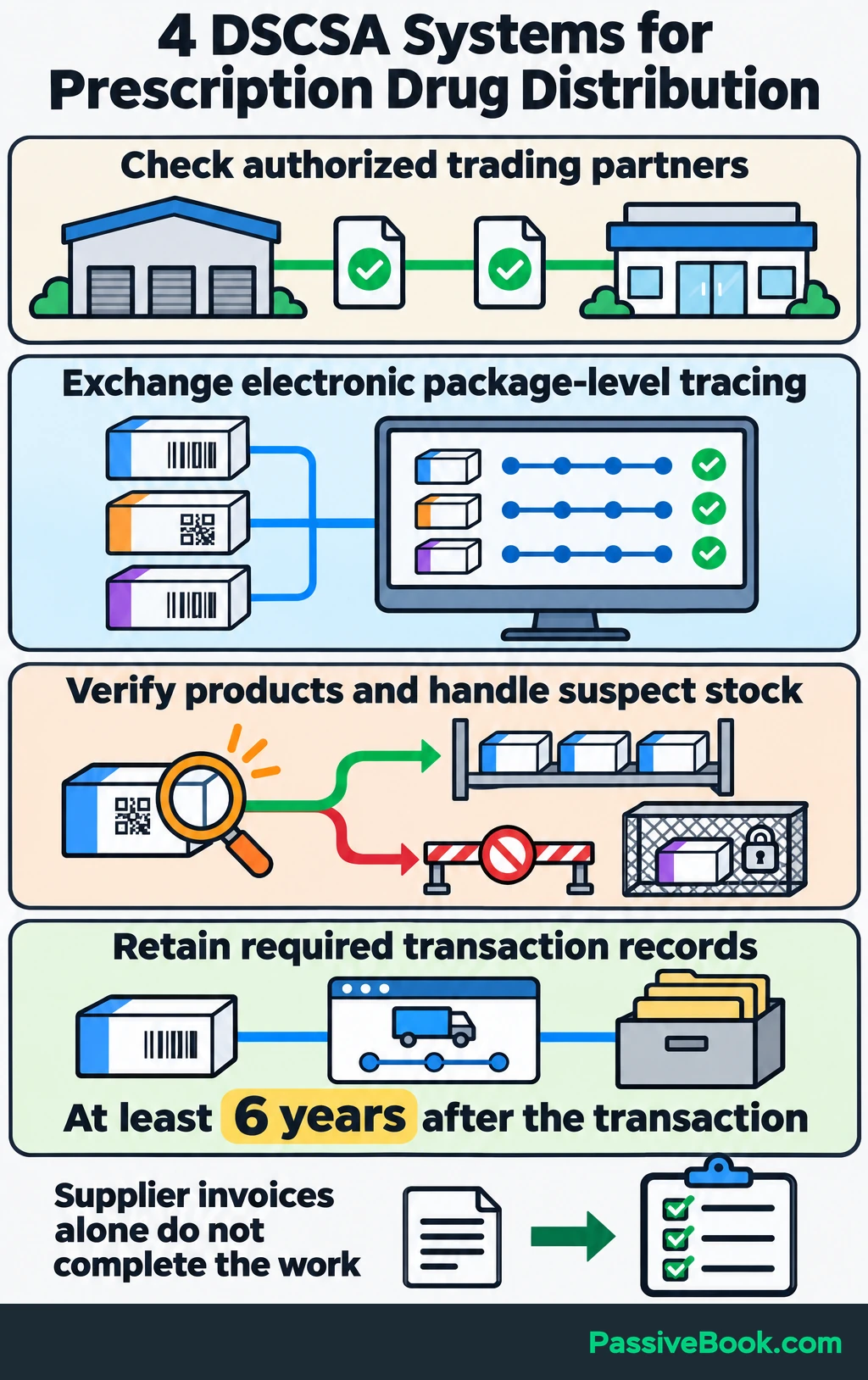
These are operating requirements under the law, so ordinary supplier invoices alone do not complete the work. Confirm any exemption that applies to your role and transactions before relying on it. DSCSA requirements.
For a business considering prescription-drug distribution, this is where I would pay for specialist help before sourcing inventory.
Use Resale Certificates Correctly
A resale certificate documents why a qualifying purchase can be made without sales tax. You may handle it in two directions: giving one to suppliers and receiving one from wholesale customers.
Document Qualifying Inventory Purchases
First confirm that the goods are intended for resale and that you meet the applicable certificate rules.
Use the document accepted for the transaction. Complete its required purchaser details, registration information or permitted explanation, goods description, resale declaration and authorization. Do not assume every state requires exactly the same information.
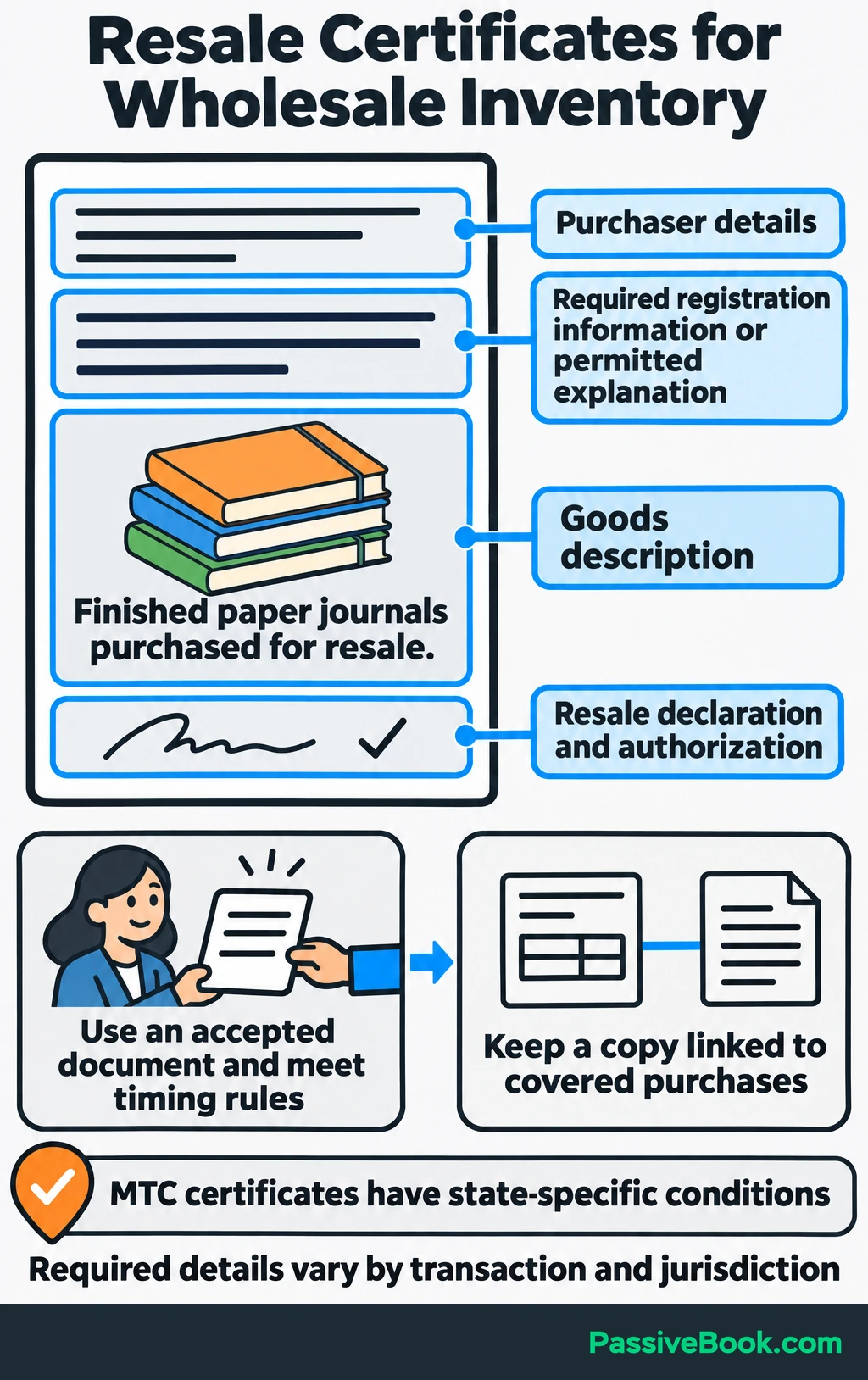
For the stationery shop, a clear inventory description is:
Finished paper journals purchased for resale.
That describes the goods being bought. “Business supplies” would obscure the purpose.
Give the certificate to the supplier within the applicable timing rules, and keep a copy linked to the purchases it covers. For repeat orders, check whether a blanket certificate can cover qualifying future purchases.
Interstate purchases need another check. Confirm that the supplier can accept your certificate for that transaction before ordering. The Multistate Tax Commission’s uniform certificate has state-specific conditions and limitations; it is not a replacement for required registration. MTC certificate and instructions.
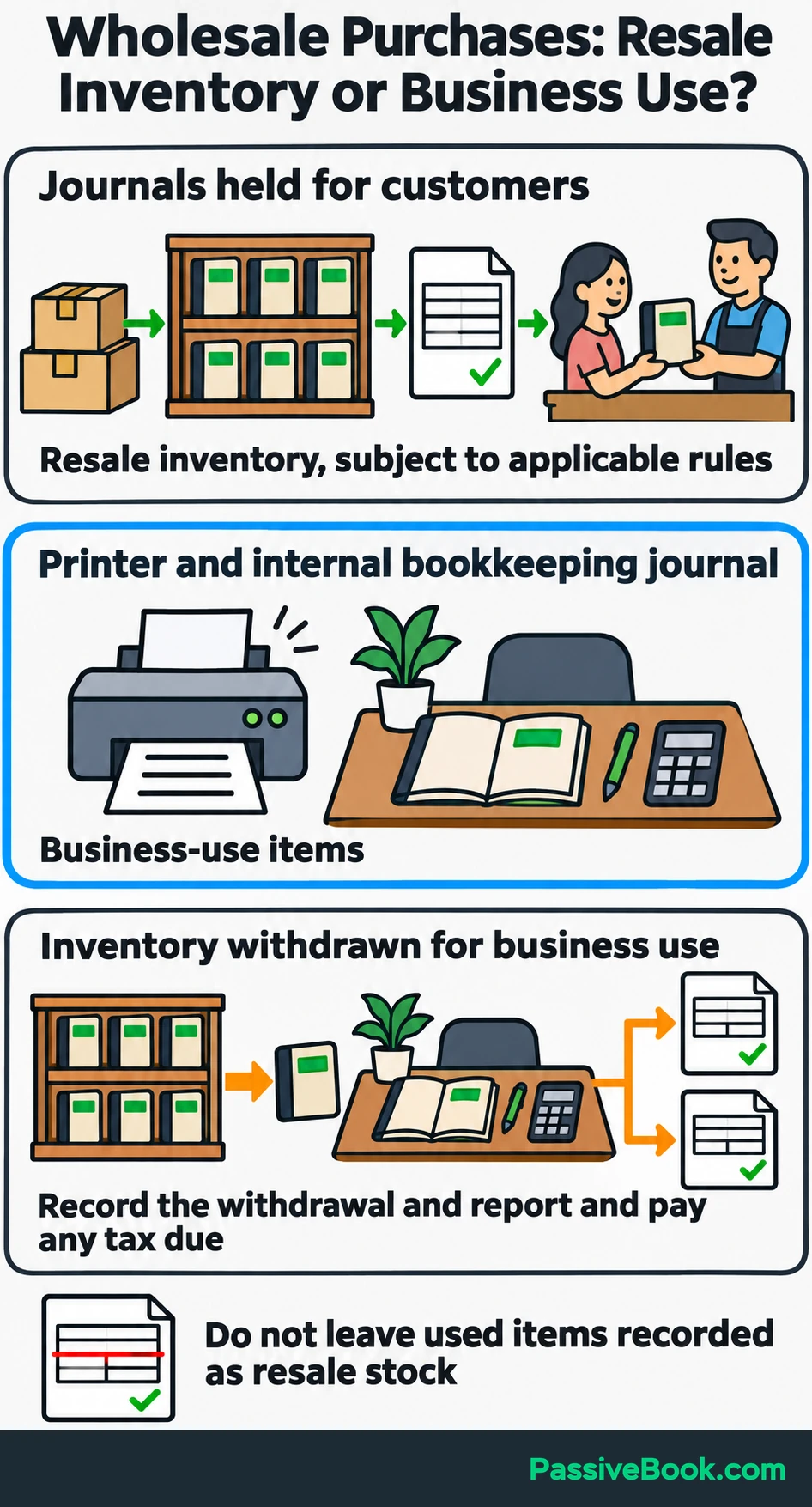
Keep business-use purchases separate. Journals held for customers are resale inventory. The shop’s printer and a journal used for internal bookkeeping are business-use items.
If you withdraw inventory bought tax-free for business use, record the withdrawal and report and pay any tax due under the jurisdiction’s rules. Do not leave it recorded as stock waiting for a customer.
Validate Certificates From Wholesale Customers
When a customer asks to buy tax-free for resale, obtain the accepted document and review it before approving the exemption.
Check that it is complete, verify registration as the jurisdiction requires and consider whether the products fit the customer’s stated business. Save the verification result with the certificate.
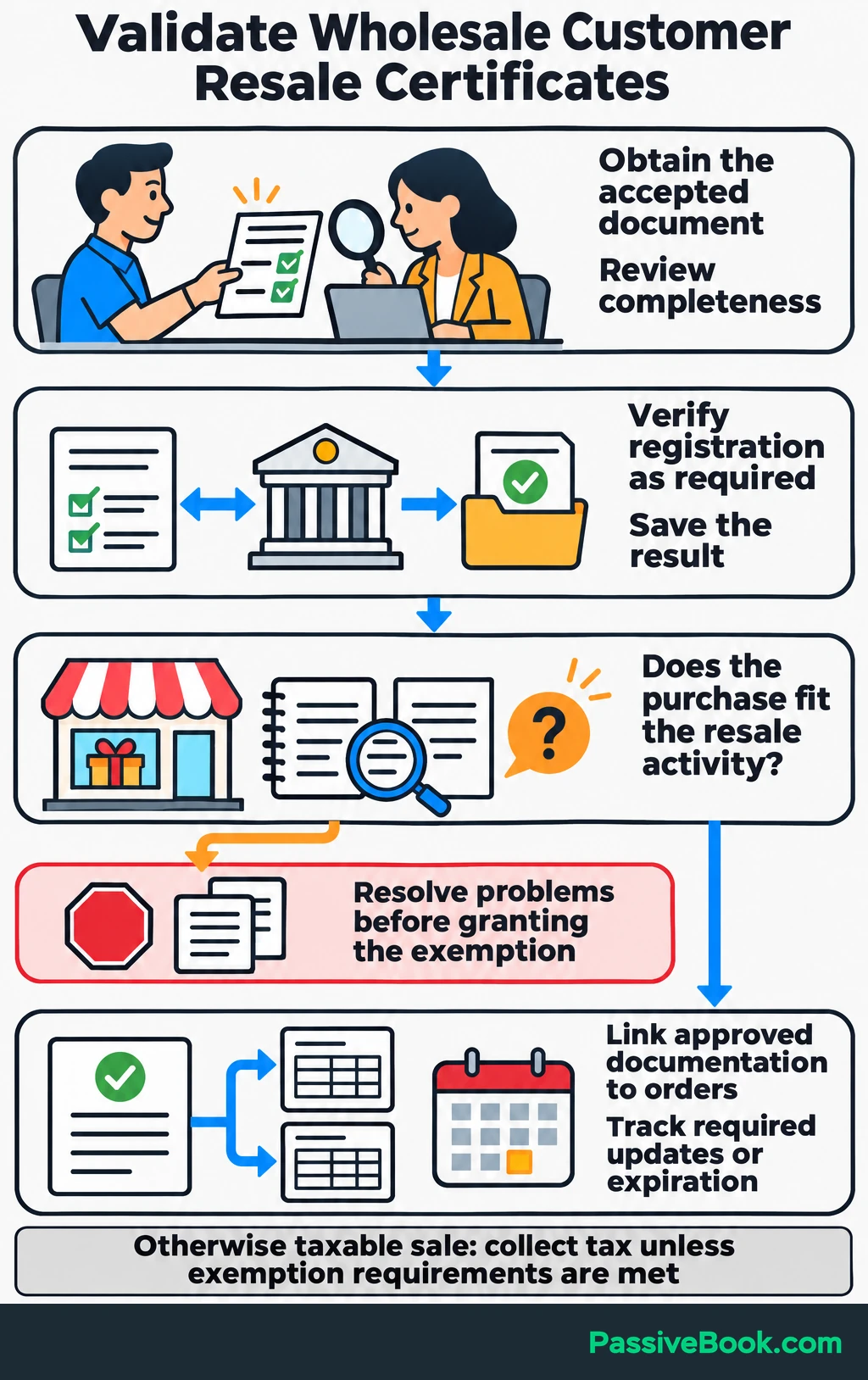
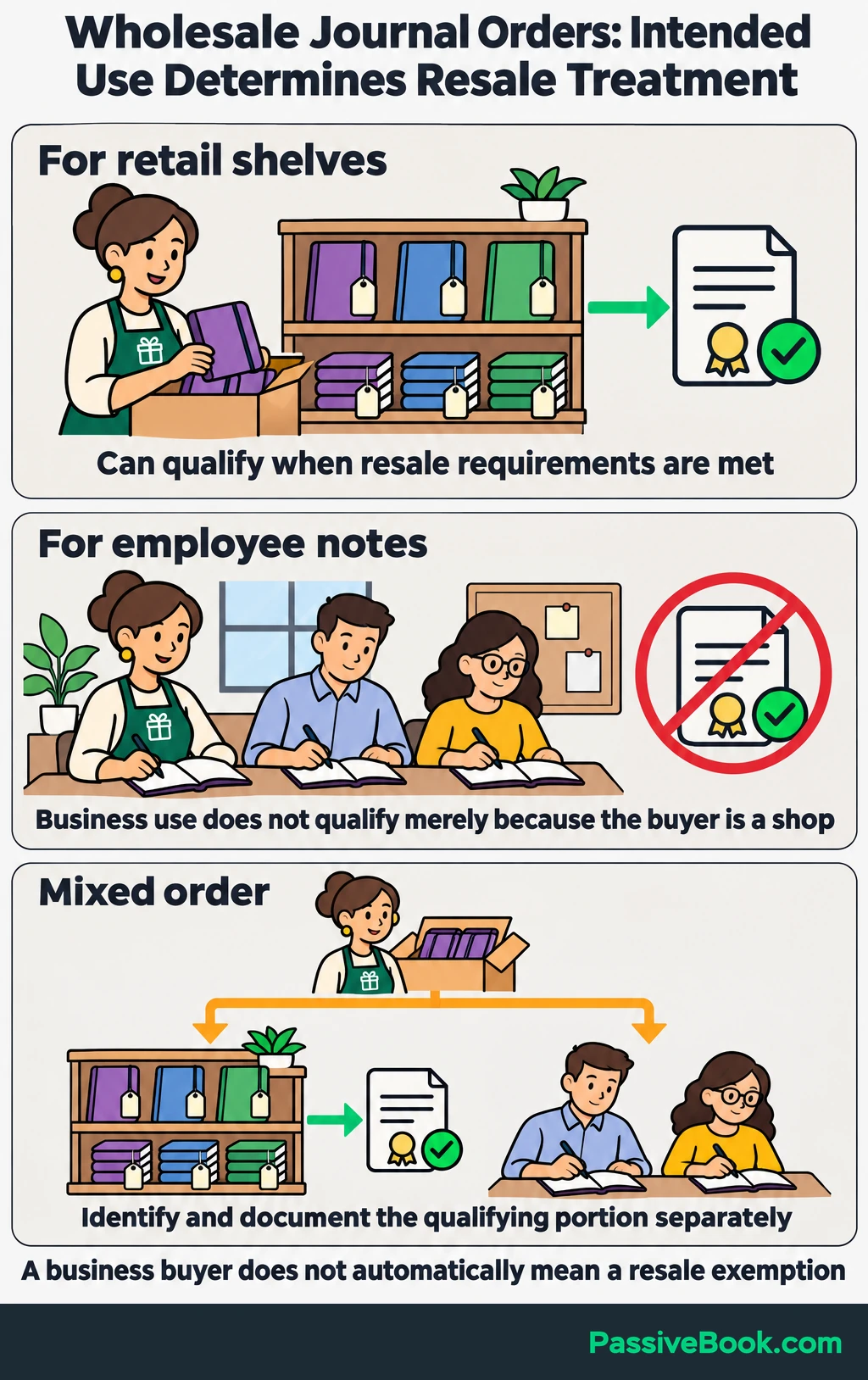
The intended use matters more than the fact that the buyer is a business:
| Gift-Shop Order | Intended Use | Resale Treatment |
|---|---|---|
| Journals for the shop’s retail shelves | Sell them to customers | Can qualify when the applicable resale requirements are met |
| Journals for employees’ meeting notes | Use them inside the business | Does not qualify merely because a gift shop bought them |
| A mixed order for shelves and staff use | Resell some and use some | Identify and document the qualifying portion separately |
In Texas, sellers must review certificates for completeness and question purchases that do not fit the buyer’s resale activity. You should not accept a certificate when you know or have reason to believe the goods are being bought for another use. Texas certificate-acceptance responsibilities.
Resolve missing or questionable paperwork before granting the exemption. For an otherwise taxable sale where you must collect, charge tax unless the applicable exemption requirements are satisfied.
Connect the approved certificate to the orders it supports. Track updates or expiration dates where required rather than treating every certificate as permanent.
Collect and Report Sales Tax by Sales Channel
Before configuring checkout, determine the product’s taxability, the location rules, applicable rates and treatment of shipping.
“Sourcing” means deciding which location’s tax rules and rates apply. It is not always as simple as using the customer’s address. Texas distinguishes local sales tax from local use tax, and shipped orders can involve both. Texas local sales and use tax guidance.
Keep the stationery shop’s transactions in three useful groups:
| Sales Channel | What to Establish | What to Keep |
|---|---|---|
| Website | Whether you must collect and which tax applies | Order details, delivery address, tax calculation and refunds |
| Wholesale gift-shop orders | Whether the sale is taxable or supported by valid resale documentation | Certificate, verification record and linked invoices |
| Marketplace | Which taxes the marketplace collects for the transaction | Collection confirmation, order reports and adjustments |
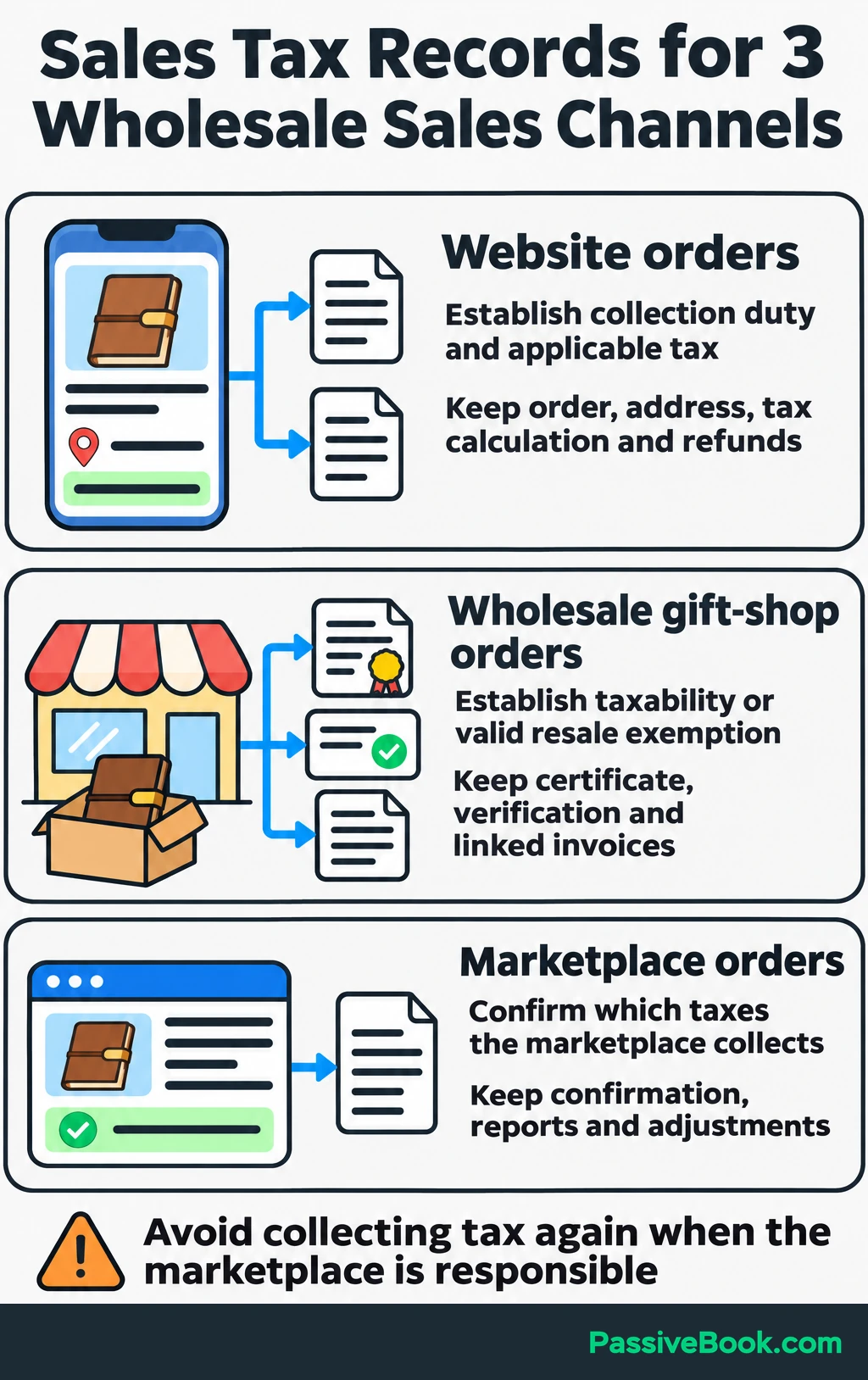
Avoid collecting tax again when the marketplace is responsible for collecting it. Keep its confirmation and follow the state’s instructions for reporting those sales.
For a simple calculation, first identify the amount subject to tax. Suppose the shop has a wholly taxable $200 journal order, no additional charges and an assumed applicable combined rate of 8%.
The tax is $200 × 0.08 = $16, so the customer’s total is $216. The 8% rate is illustrative; use the rate that applies to the actual transaction.
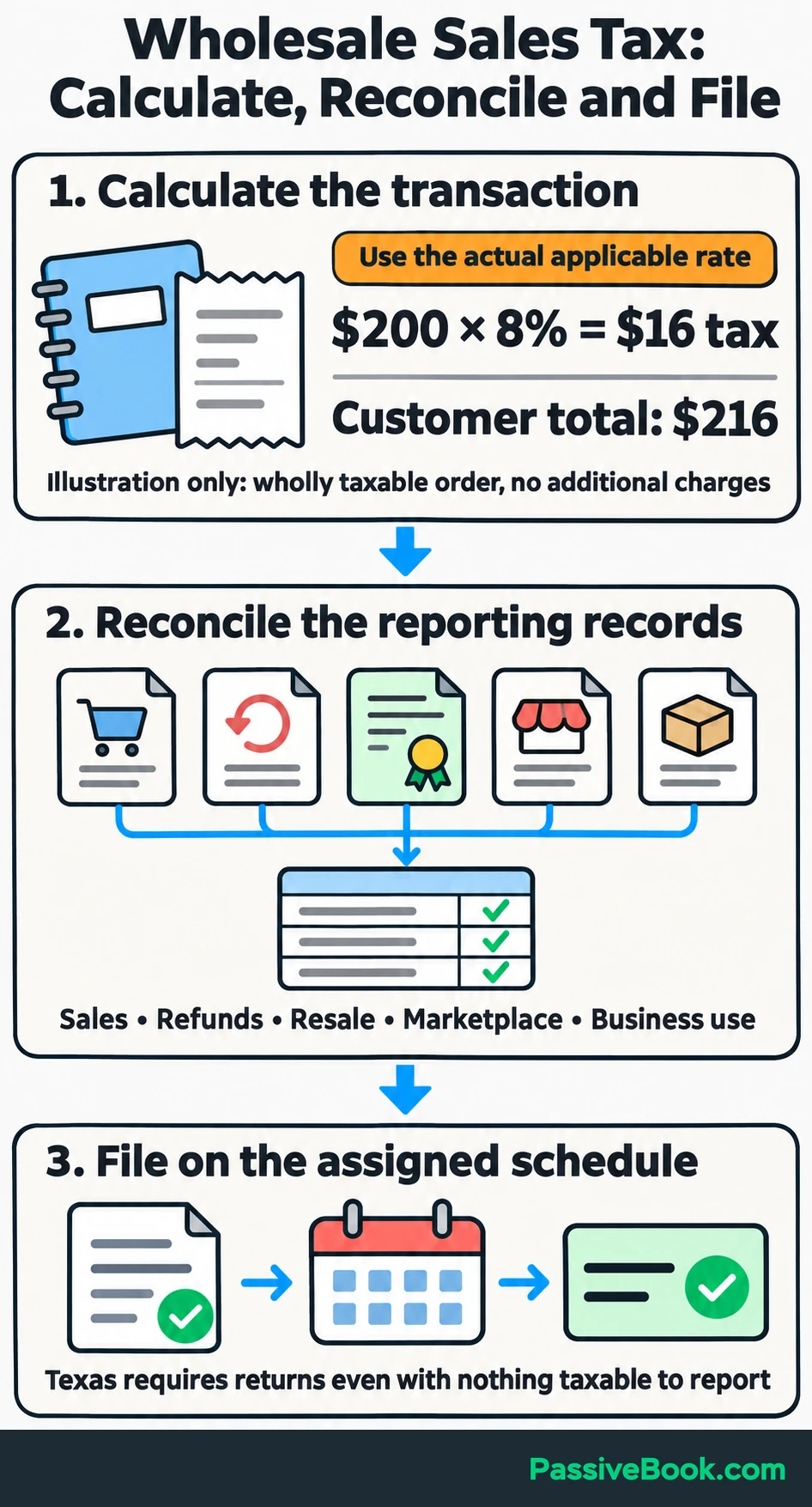
Before filing, reconcile sales, refunds, resale transactions, marketplace reports and any taxable business-use purchases. Follow each jurisdiction’s return instructions because an exempt or marketplace-collected sale may still need to appear in reported totals.
File on the assigned schedule even during quiet periods when a return is required. Texas requires a return even when there are no taxable sales or purchases to report. Texas permit-holder filing obligations.
A checkout tax setting is useful, but it cannot decide whether an exemption is valid or whether you have registered everywhere required.
Keep Records and Review Requirements as You Grow
Your records should let you explain a purchase or sale without searching through months of messages.
Keep retrievable copies of registrations, licenses, supplier invoices, certificates you issue and receive, verification results, product documents, sales reports, returns and payment confirmations. Link them through order numbers, customer accounts or product identifiers.
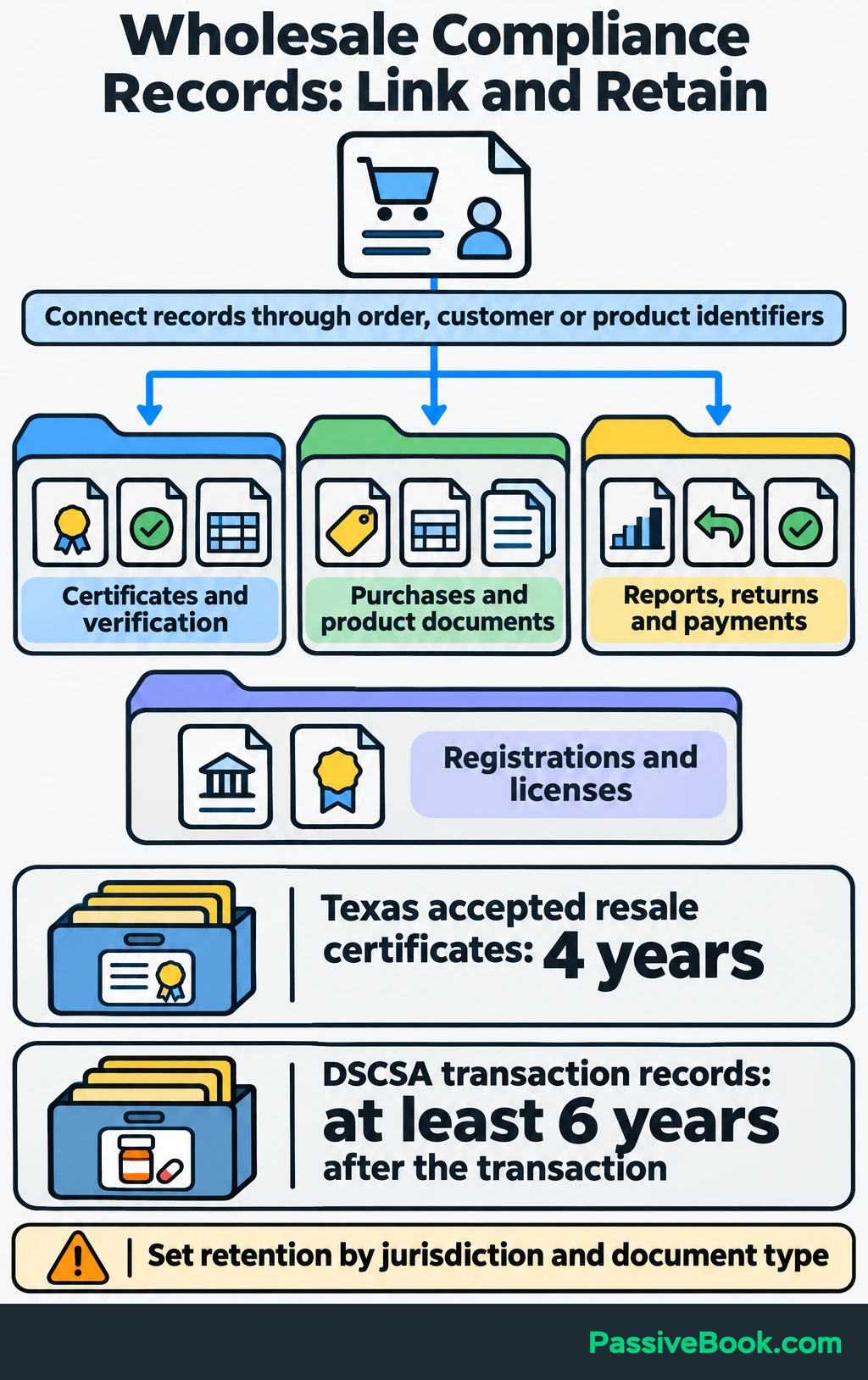
Set retention periods by jurisdiction and document type. Texas requires sellers to retain accepted resale certificates for four years. Prescription-drug transaction records have the separate minimum discussed above. One deletion rule for the whole business can remove records you still need.
I would automate reminders for filing dates, renewals and required certificate updates before adding another paid tool. A spreadsheet and calendar can work if someone owns the review.
Recheck wholesale reseller compliance requirements before you:
- Store inventory in another state.
- Add a warehouse, employee or fulfillment provider.
- Enter a new product category or begin importing.
- Open another sales channel.
- Change ownership or business structure.
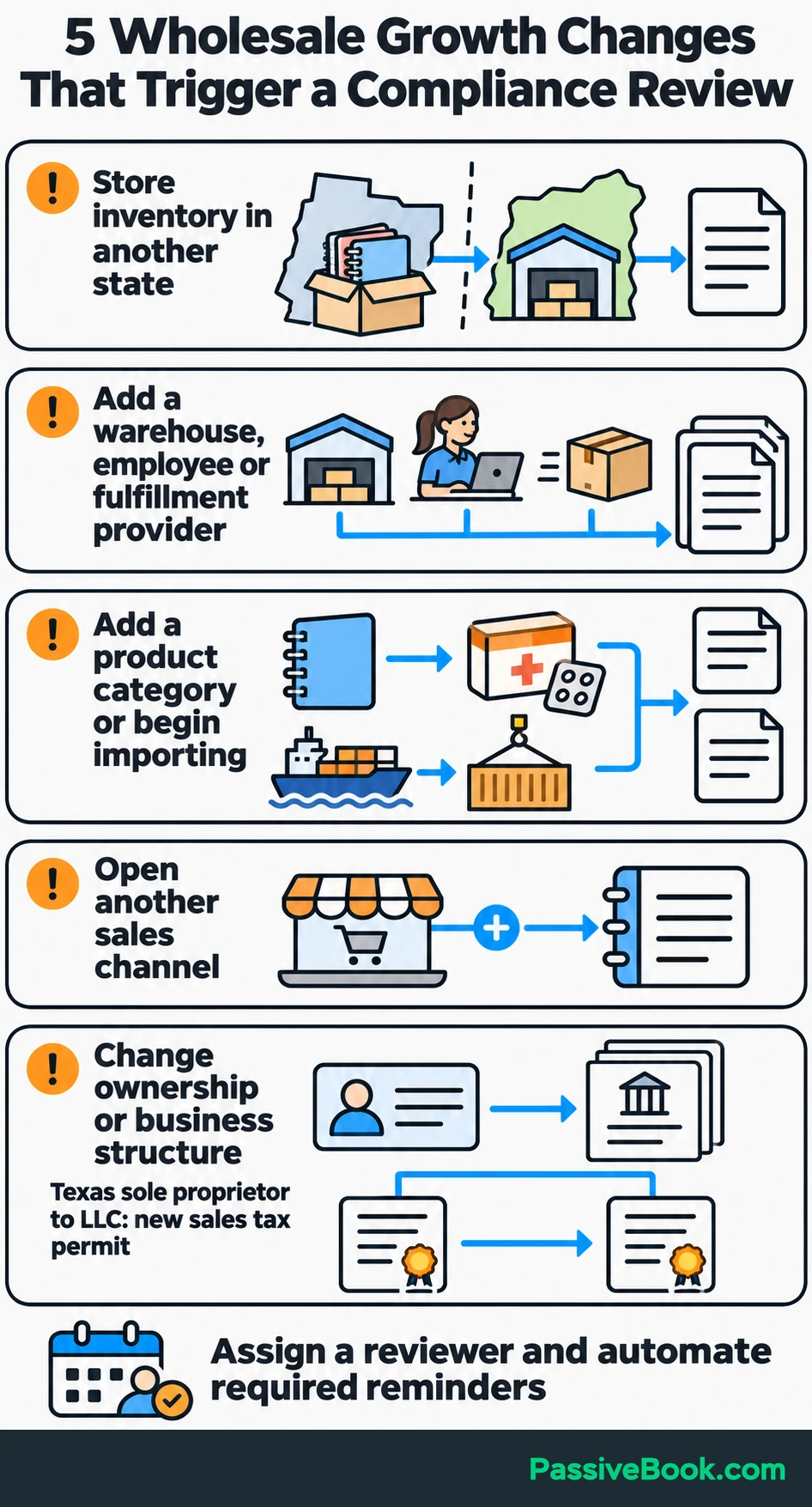
An entity change can affect existing registrations. In Texas, changing from a sole proprietorship to an LLC requires a new sales tax permit.
If you discover a gap, preserve the records and identify the affected transactions, dates and jurisdictions. Then get targeted guidance from the agency or a qualified professional about missing registrations, returns or product permissions.
A focused question is easier to resolve than “Is my business compliant?” Bring the facts that determine the answer.
What Next?
Make a one-page checklist for your first inventory order: legal owner, operating and storage locations, required permits, accepted resale certificate and product documents. Resolve each blank before paying the supplier.
Use the social buttons to share this guide when a wholesale buying conversation needs a clearer paperwork checklist.
Which part of your setup still needs an answer before you can order or expand? Leave it in the comments, along with any other questions.
Share this post with your friends & followers:

