A brand you trust could be a good fit for your online shop. But its wholesale discount tells you little about whether you can sell from home, list on Amazon, or afford the opening order.
Buy before those details are clear and you could end up with genuine products you cannot sell through your planned channel. Even an approved account can leave you with margins too thin to cover delivery. This guide pairs the reseller requirements with a pet shop’s application and first-order budget, so you can judge whether a program fits your sales plans and available cash.
What Does Authorized Reseller Status Mean?
Authorized reseller status means a brand has given your business permission to sell specified products under its terms. That permission can cover particular countries, websites, stores, or marketplace accounts.
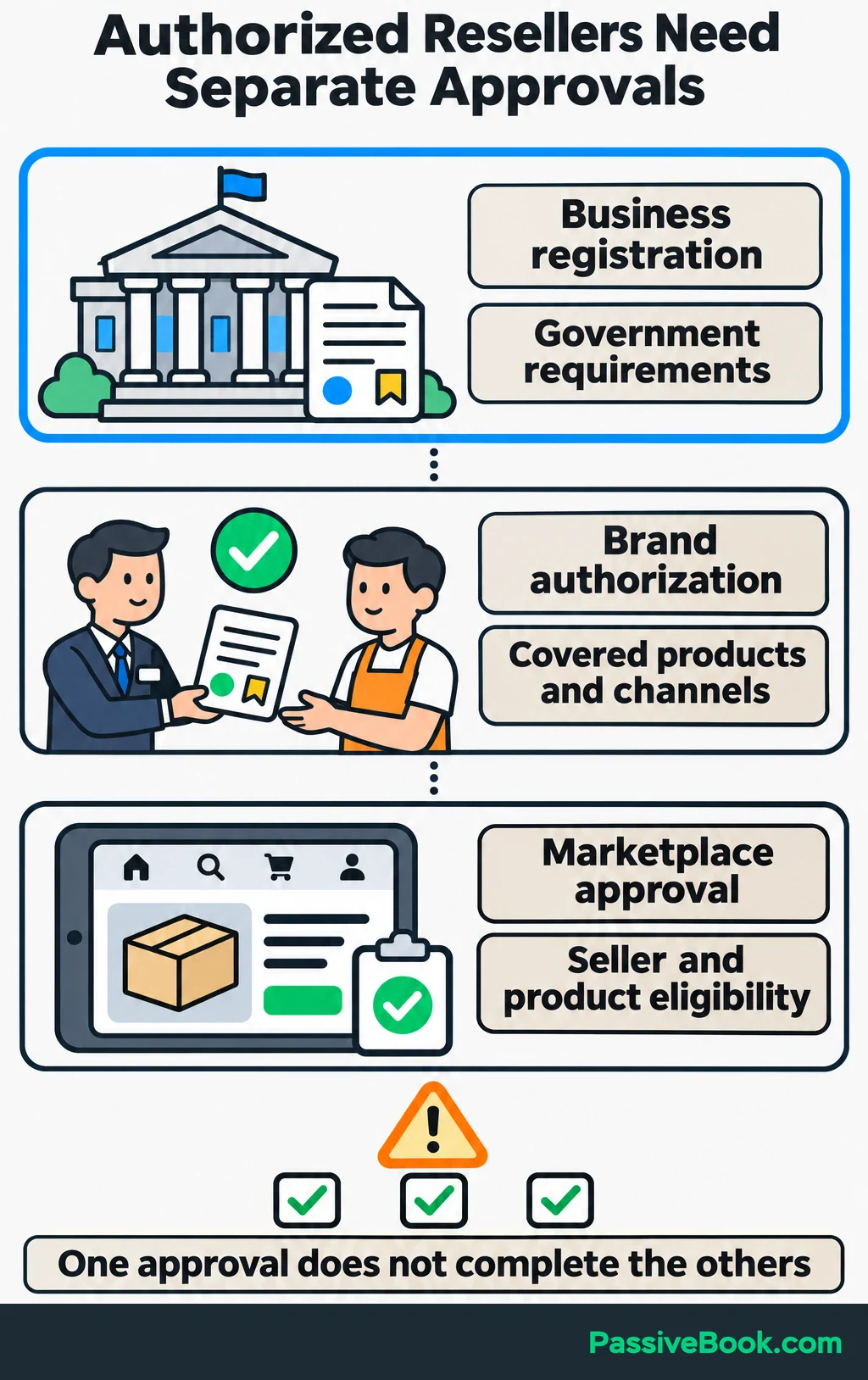
Three separate requirements can apply:
| Requirement | What It Establishes |
|---|---|
| Business registration and applicable permits | Your business has completed the government paperwork required for its activities and location. |
| Brand authorization | The brand permits your business to sell covered products under agreed terms. |
| Marketplace approval | The marketplace permits your seller account to offer the particular products. |
Completing one does not complete the others. A registered business can still be rejected by a brand, and an authorized reseller can still need marketplace approval.
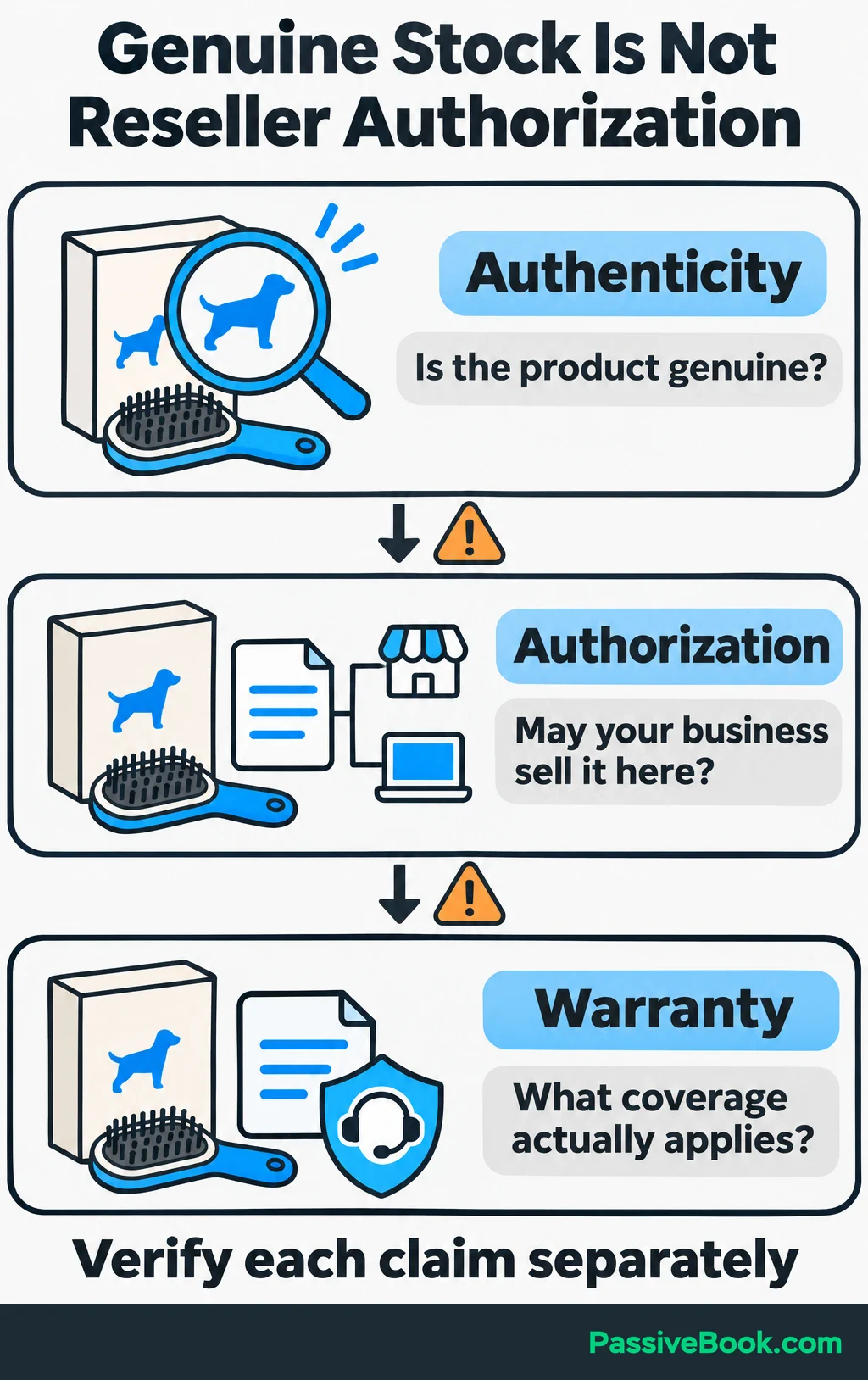
Buying genuine stock or opening a wholesale account also does not establish permission for every channel. If you buy through a distributor, ask whether the brand requires separate approval.
Genuine products can exist outside an authorized sales relationship, so “unauthorized” does not automatically mean counterfeit. Authorization also does not guarantee manufacturer warranty coverage. Confirm the warranty terms before promising anything to customers.
1. Find Brands That Accept Your Sales Model
Check Eligibility Before Applying
Start by writing down what you intend to sell, where your customers will be, and which channels you want to use. Your own website, Amazon, and a physical shop are different proposals.
Then screen each program for these requirements:
- Business Model: Does it accept new, home-based, or online-only businesses?
- Sales Channels: Are your website and intended marketplaces permitted?
- Facilities: Does it require a storefront, commercial storage, or particular handling conditions?
- Experience: Are sales history, training, or trade references required?
- Service: Can you meet its expectations for dispatch, customer questions, and returns?
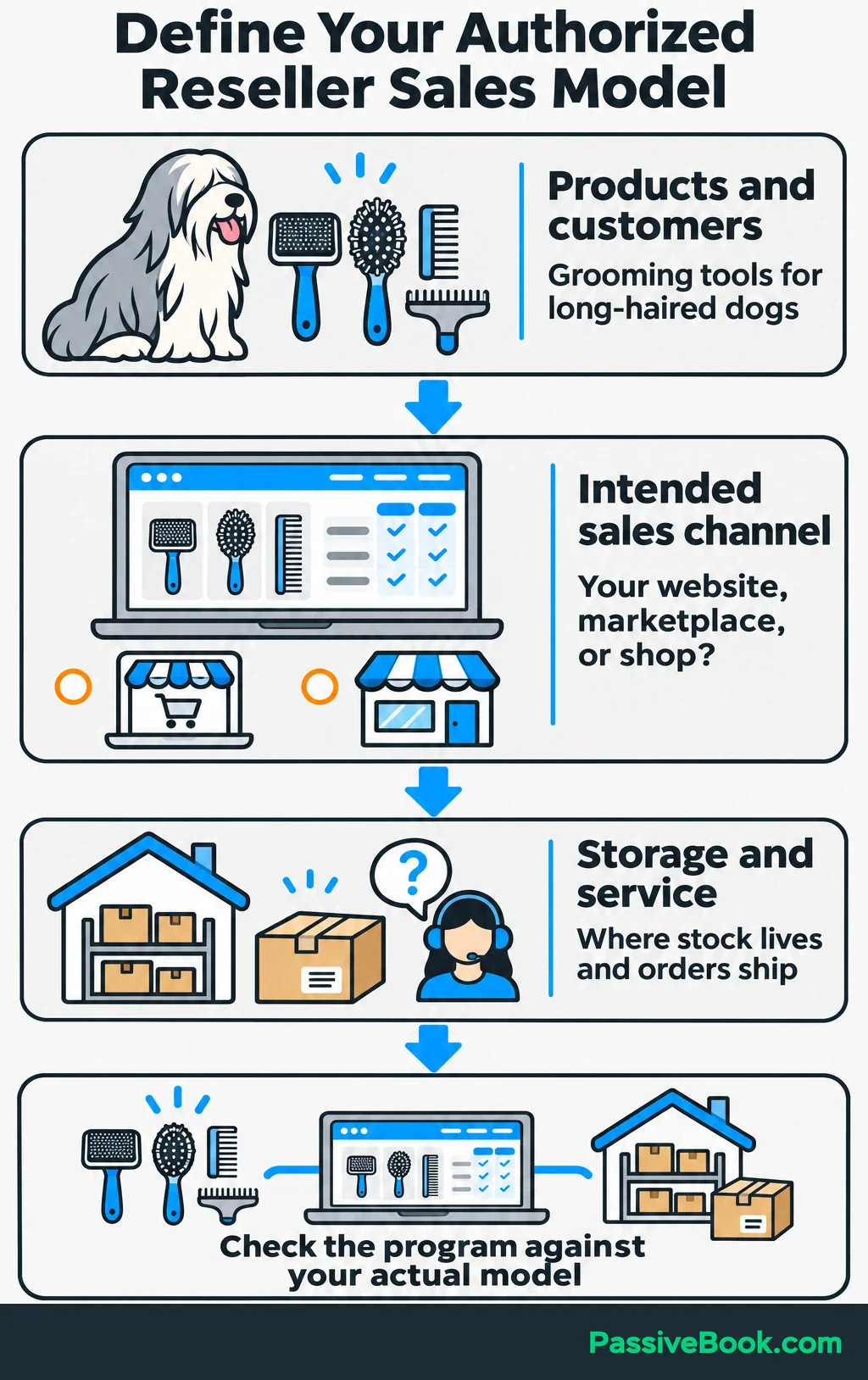
These checks can save you an application. For example, West Paw’s U.S. retailer application page says it is not accepting Amazon or e-commerce-only reseller accounts. An online-only shop should screen that program out while that restriction applies.
For the running example, imagine you are preparing Coat & Comb, a small online shop selling brushes and combs for long-haired dogs. The shop and all financial figures below are illustrations.
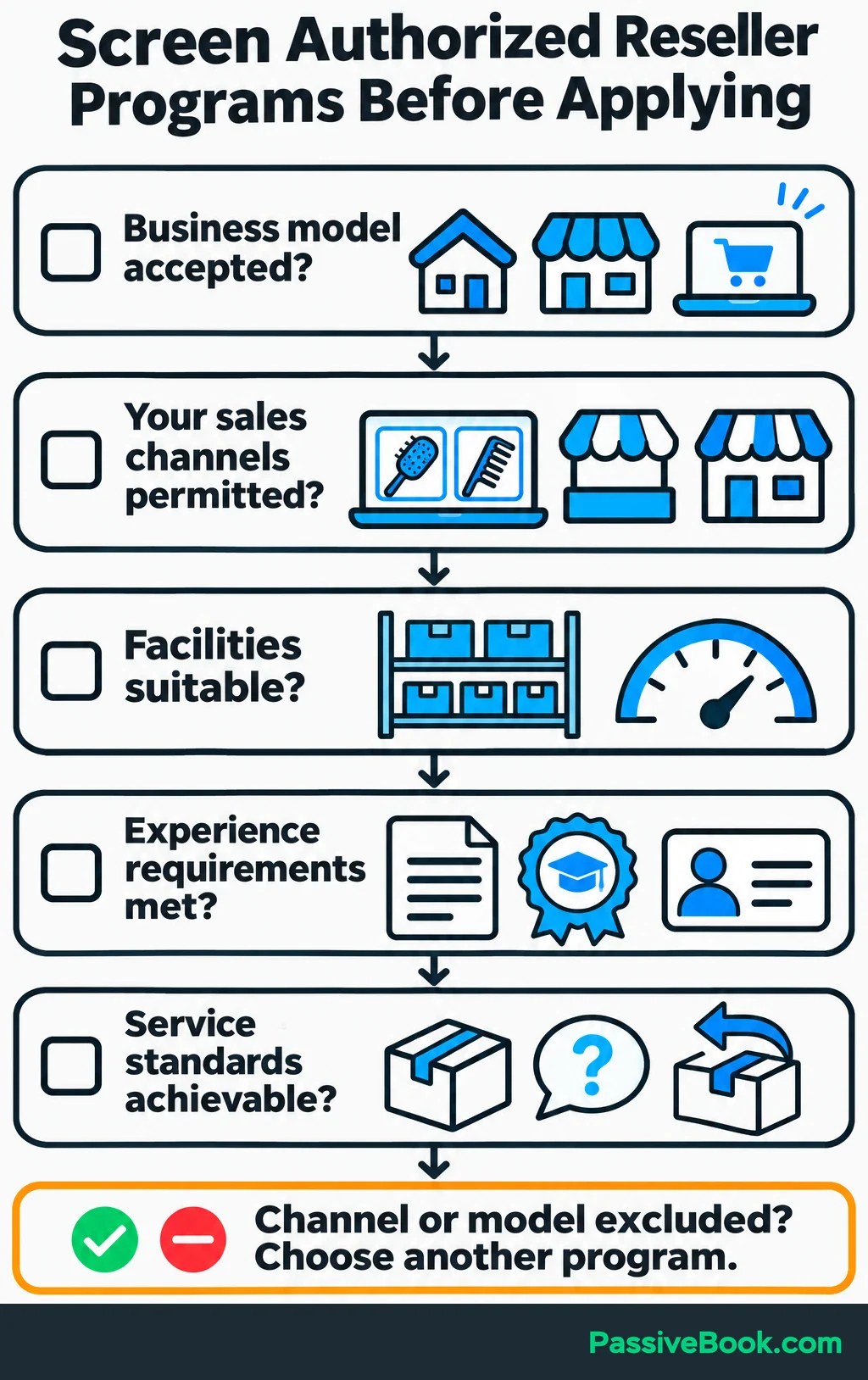
Your reason for stocking a brand should go beyond liking its products. Look at competing shops, their prices, and the questions their listings leave unanswered. Coat & Comb might help customers compare brush types through clear, manufacturer-supported guidance.
I would choose a narrow range I could explain well before building a general pet store. More products also mean more purchasing decisions, stock to track, and money sitting on shelves.
Verify the Supplier and Purchasing Route
Find suppliers through the brand’s official retailer, dealer, wholesale, or distributor pages. If another company offers you stock, confirm its relationship through contact details published by the brand before sending documents or payment.
You can buy directly from a brand or through a brand-confirmed distributor:
- Direct Account: You deal with one brand and follow its purchasing terms.
- Distributor Account: You may combine several brands in one order, but each brand can have separate resale restrictions.
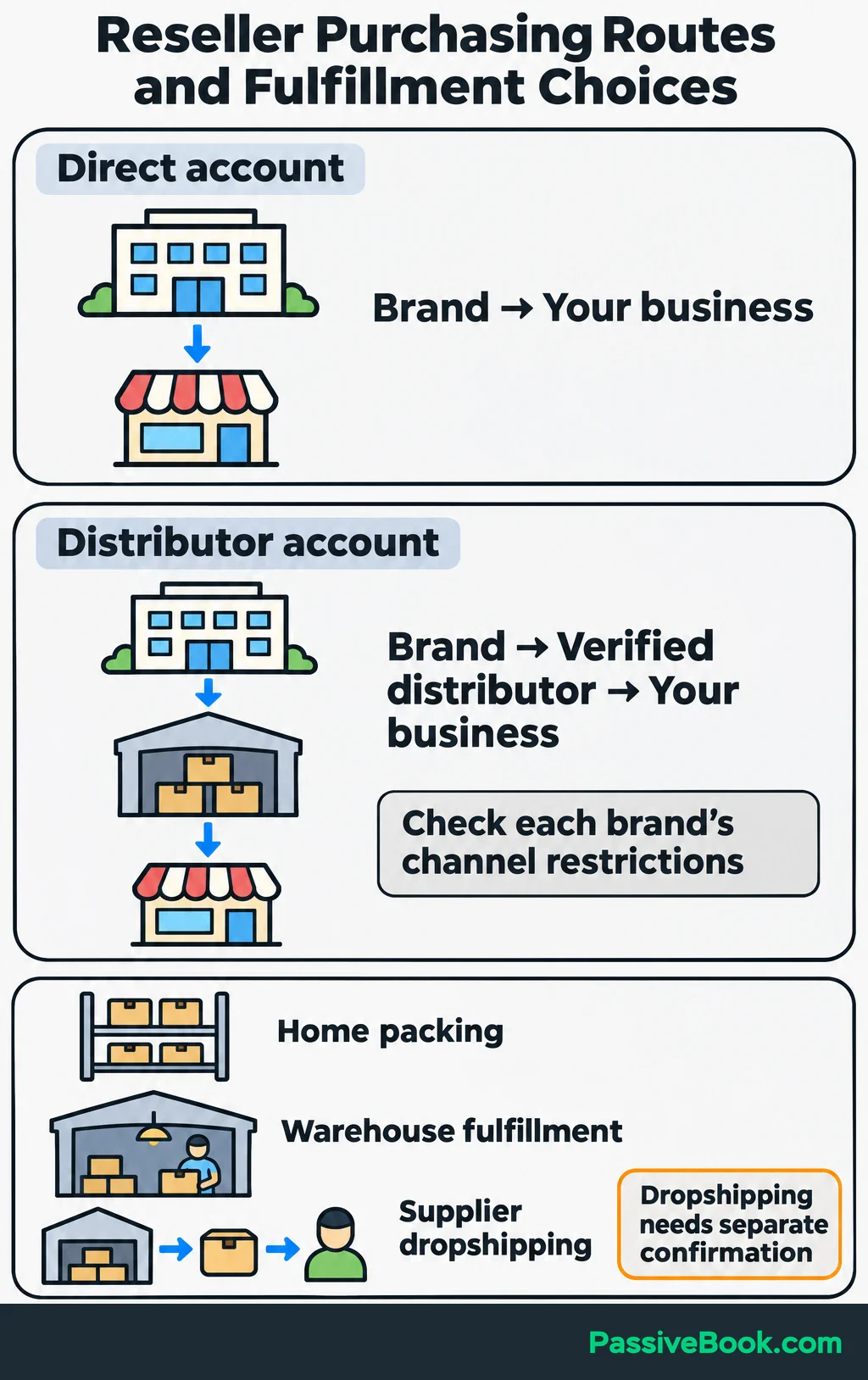
A shop can use both routes. Choose based on access, order sizes, delivery costs, and permission to sell through your channels.
Request wholesale prices, case quantities, opening and reorder minimums, freight charges, payment dates, and any ongoing purchasing commitments. If prices are available only after applying, check eligibility first and finish your margin calculation before ordering.
Also decide who will fulfill orders. You might pack your stock at home, pay a warehouse to store and ship it, or ask a supplier to ship directly to customers. That last arrangement is dropshipping, and reseller approval alone does not include it.
Keep one row per brand in a shortlist spreadsheet. Include columns for brand, verified supplier, permitted channels, eligibility requirements, opening commitment, ongoing minimums, fulfillment arrangement, and application contact. Mark unanswered items as “not confirmed” so a missing answer does not quietly become an assumption.
2. Check Startup Costs and Profit Potential
Calculate What Each Sale Leaves You
Before comparing wholesale discounts, calculate the money left from an order after its variable costs. This is your contribution.
Start with revenue excluding sales tax. Subtract product cost, freight to receive the stock, delivery to the customer, packaging, selling and payment fees, expected return costs, and any spending needed to acquire that customer.
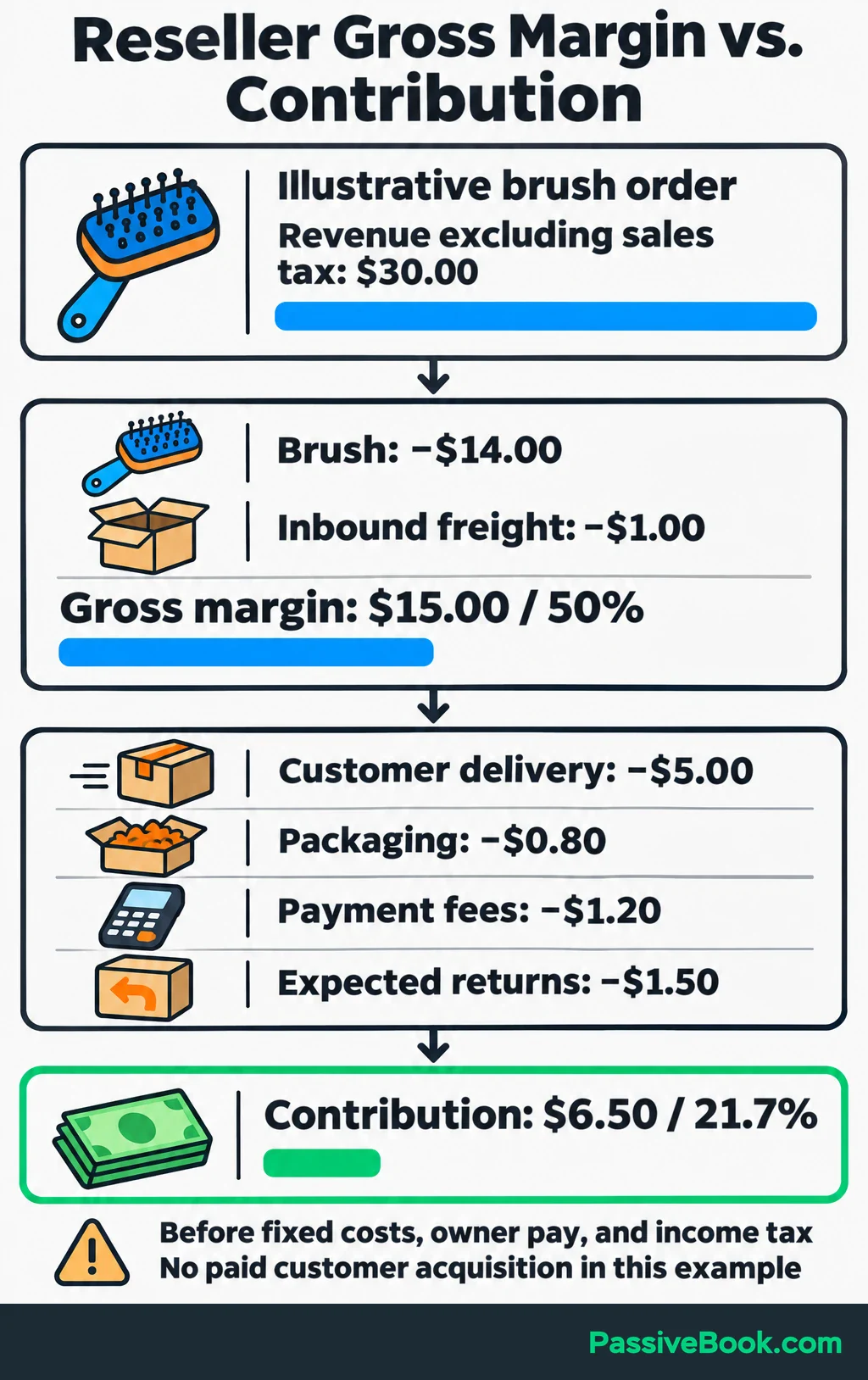
Here is one illustrative brush order. It contains one brush, includes delivery in the selling price, and uses no paid customer acquisition.
| Order Item | Amount |
|---|---|
| Revenue excluding sales tax | $30.00 |
| Wholesale brush cost | −$14.00 |
| Inbound freight allocated to the brush | −$1.00 |
| Delivery to the customer | −$5.00 |
| Packaging | −$0.80 |
| Payment fees | −$1.20 |
| Allowance for expected return costs | −$1.50 |
| Contribution left | $6.50 |
The brush costs $15 to buy and receive. Subtracting that landed product cost from $30 leaves $15, giving a 50% gross margin. After the other variable costs, contribution is $6.50, or about 21.7% of revenue.
That is still before fixed expenses, owner compensation, and income tax. A 50% gross margin sounds generous until a parcel needs delivering.
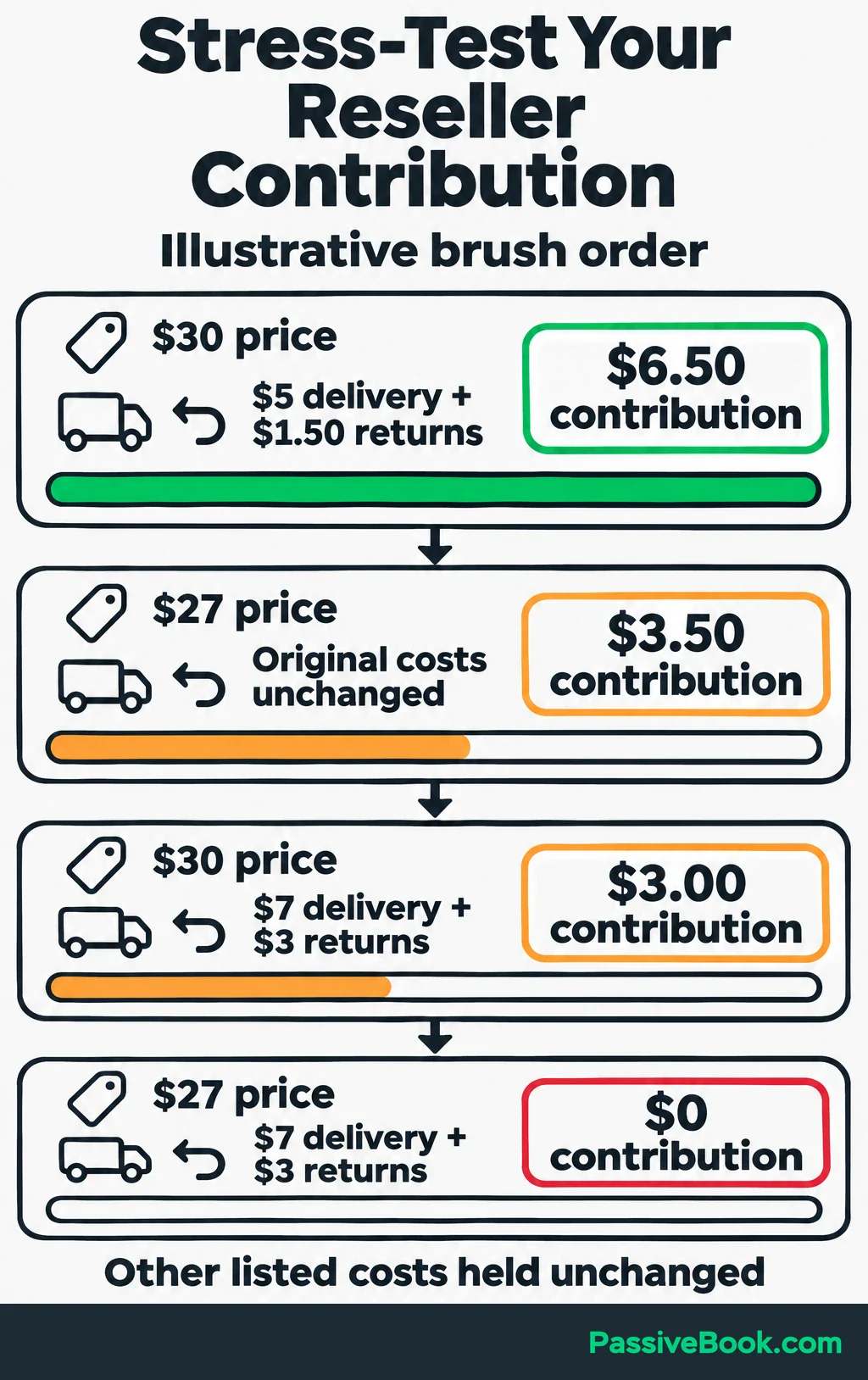
Now test less comfortable conditions:
- Lower Selling Price: At $27, holding the listed costs unchanged, contribution falls to $3.50.
- Higher Delivery and Returns: At the original $30 price, $7 delivery and a $3 returns allowance leave $3.
- Both Changes Together: The $27 price with those higher costs leaves nothing.
Use the price customers can reasonably be expected to pay, not simply the brand’s suggested price. For a marketplace, replace the website payment-fee assumption with the applicable selling and fulfillment fees.
I would skip a product that works only when every order goes perfectly.
Estimate Cash Needed Before Sales Arrive
Build your starting budget around the supplier’s actual requirements. Count inventory, inbound freight, registrations, store setup, packaging, required insurance, and reserves for refunds, operating bills, and reorders.
For Coat & Comb, a simple illustration looks like this:
| Starting Budget Item | Amount |
|---|---|
| 30 brushes at $14 each | $420 |
| Inbound freight | $30 |
| Registration and store setup allowance | $250 |
| Packaging supplies | $50 |
| Cash reserve | $250 |
| Total starting cash | $1,000 |
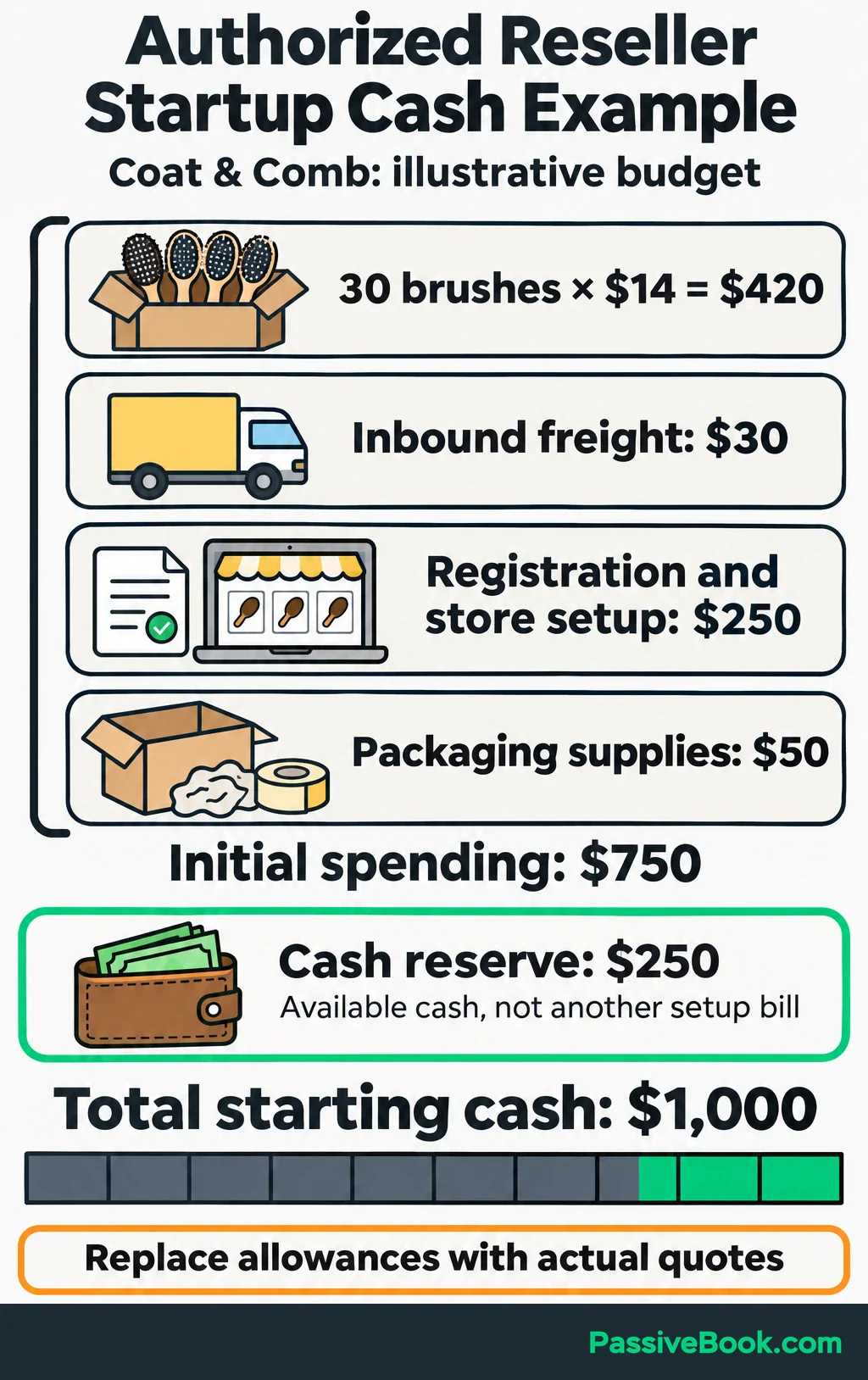
The $250 reserve stays available; it is not another setup bill. Replace every allowance with actual fees and quotes, and add insurance or storage costs if required.
Keep initial spending separate from recurring commitments such as software subscriptions, registration renewals, and minimum purchases. Map payment dates too. A supplier bill may be due before customer payouts arrive, and credit terms may require separate approval.
My online jewellery store started with roughly $1,200. I spent more time choosing pieces than checking why customers would buy them from my shop. Inadequate market research and unsold inventory cost me most of that investment.
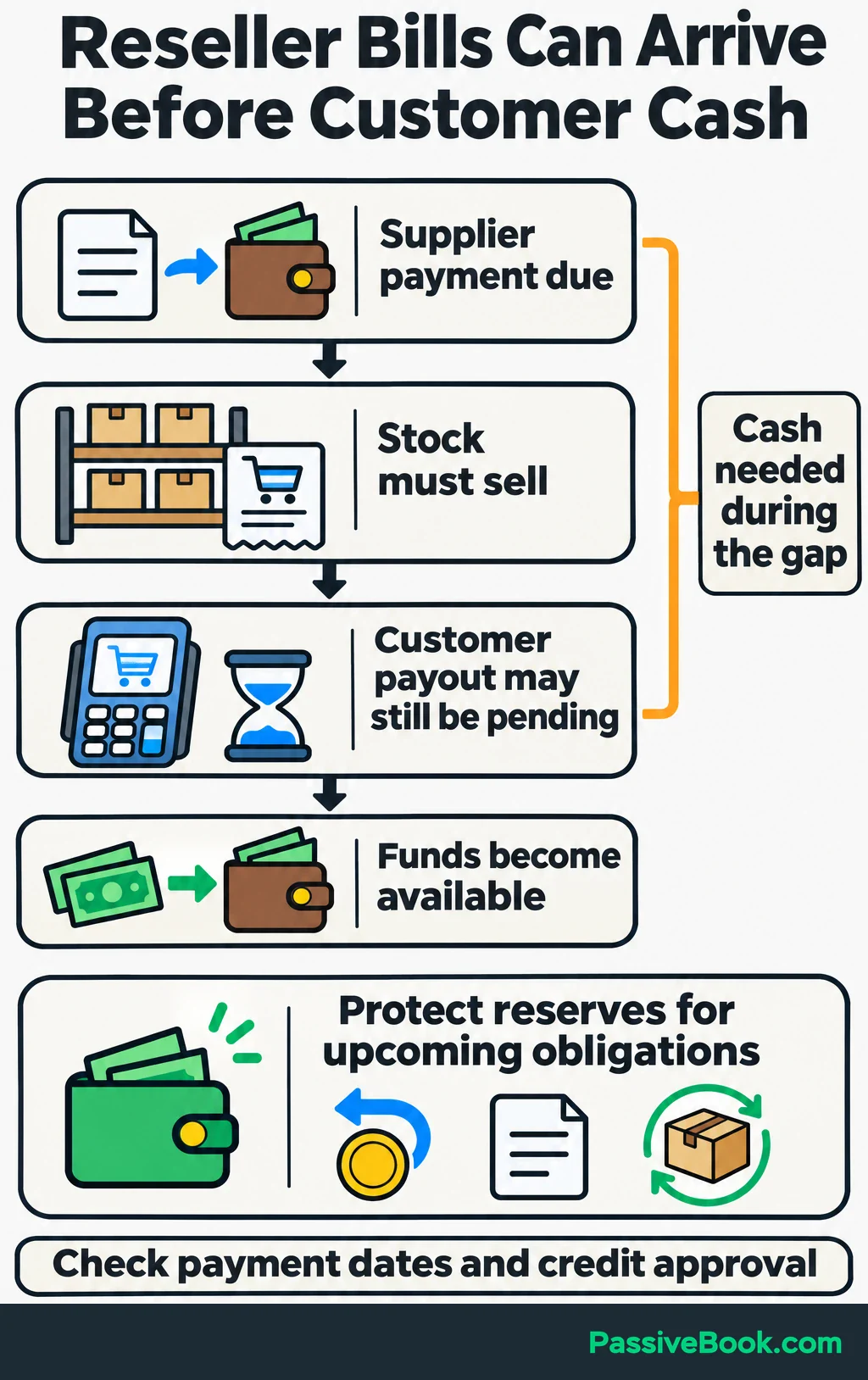
That experience is why I would start with fewer variants and a smaller permitted order. A discount for buying more is useful only when the extra stock sells.
A first order can look affordable while leaving too much cash tied up in stock. This calculator shows what each sale leaves you and how much of your purchase remains unrecovered if sales are slower than expected.
Free Pricing Profit Calculator




If the program’s minimum commitments exceed your available cash, choose another program. You do not need to turn a supplier’s sales target into your personal emergency.
3. Prepare Your Business and Application Documents
Complete the Required Business Paperwork
The registration and tax examples in this section are U.S.-specific. Requirements elsewhere need to be checked with the relevant local authorities.
Choose a business structure, then complete the entity, trading-name, and licensing requirements that apply. A limited liability company (LLC) is not a universal reseller requirement, though a particular supplier may require a specific structure.
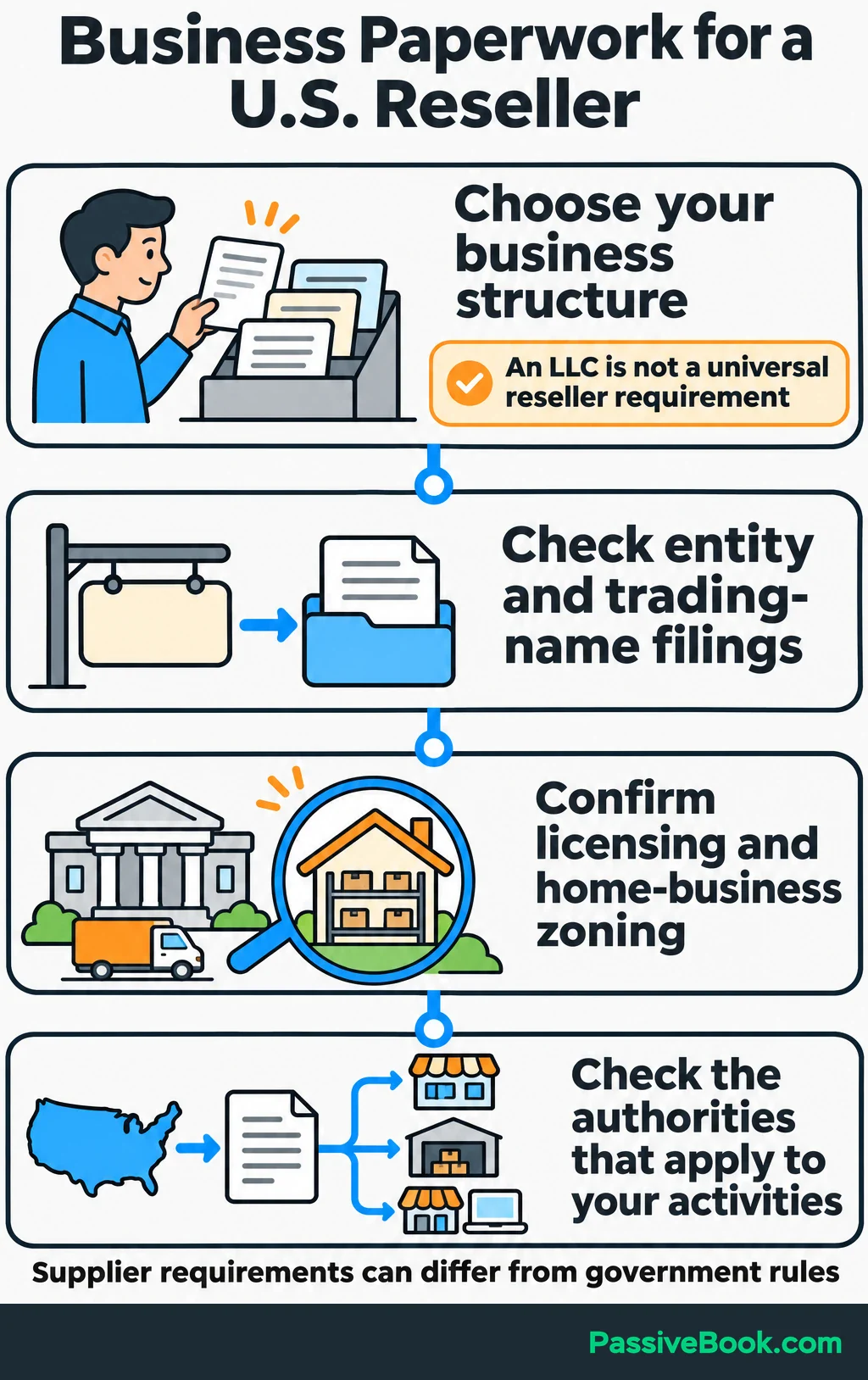
Before storing stock at home, confirm that local licensing and zoning rules allow your planned storage and deliveries. The SBA’s business-launch guidance notes that zoning restrictions can apply to home businesses.
You may also need these tax documents:
- Federal Tax ID: Obtain an employer identification number, or EIN, when your business requires one or a supplier requests it. The IRS issues EINs free.
- Sales-Tax Registration: Check whether your activities require registration with the relevant state tax agency and what returns you must file.
- Resale Documentation: This supports qualifying purchases of inventory for resale without sales tax. It serves a different purpose from registration and does not exempt every business purchase.
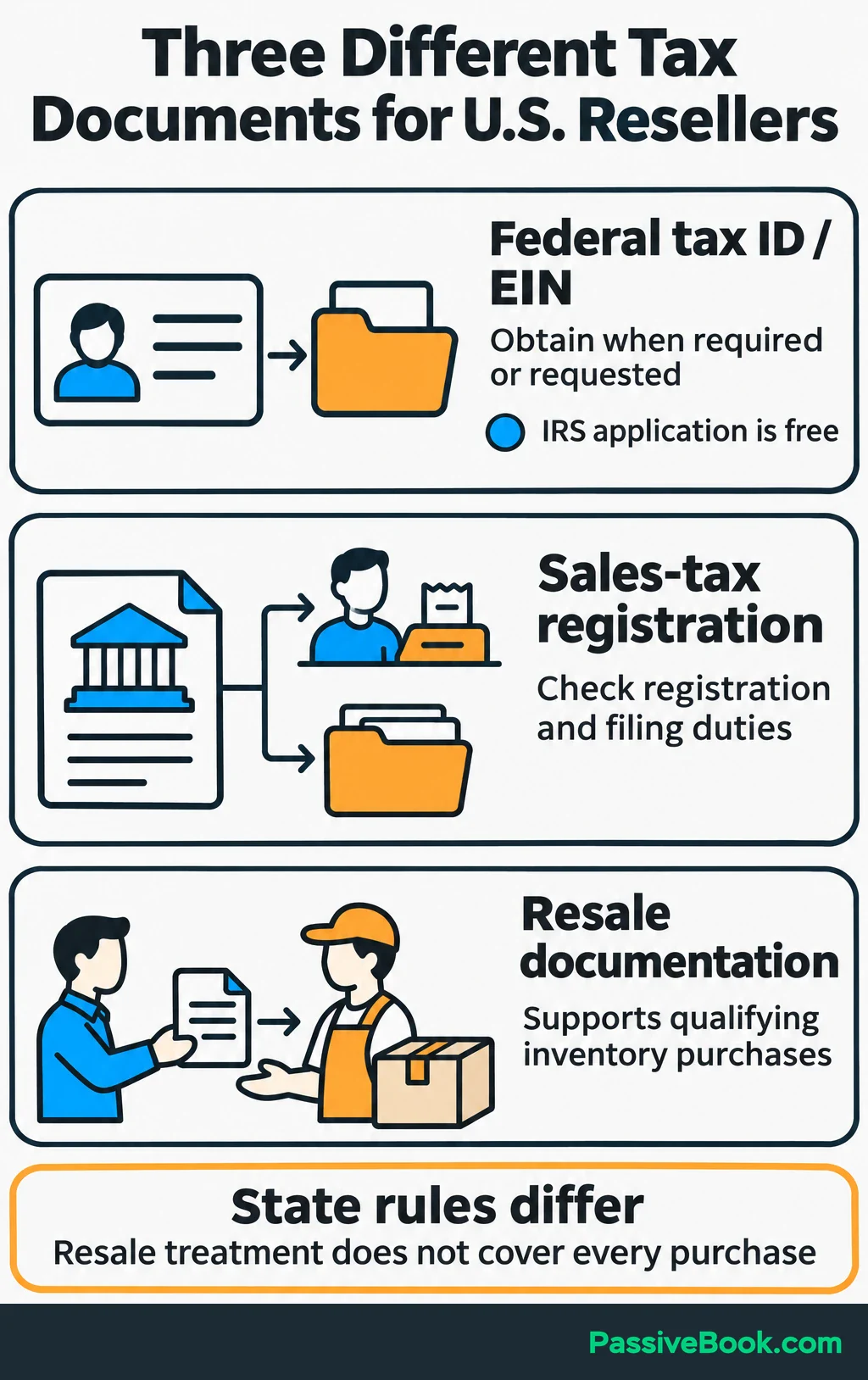
For example, North Carolina’s guidance explains the documentation a buyer provides for qualifying resale purchases. Use your own jurisdiction’s requirements rather than treating one state’s form as a national reseller license.
Check obligations against your business location, inventory locations, sales, and channels. Marketplace tax collection does not automatically settle your registration or filing duties. California’s marketplace guidance, for example, distinguishes businesses selling exclusively through qualifying marketplaces from those also making direct sales, and explains reporting duties for registered sellers.
Show How Your Store Will Operate
Prepare one application folder so you can supply accurate information without rebuilding it for each brand.
Include:
- Business Details: Legal name, trading name, owner contact details, and requested registration or tax documents.
- Addresses: Billing, stock storage, and fulfillment addresses.
- Store Preview: Your website or a clearly labeled preview, proposed sales channels, and product range.
- Purchase Plan: An opening-order estimate that fits your budget.
- Operating Plan: How you will dispatch orders, answer questions, and handle returns.
- Additional Evidence: References, insurance, sales history, or training credentials when requested.
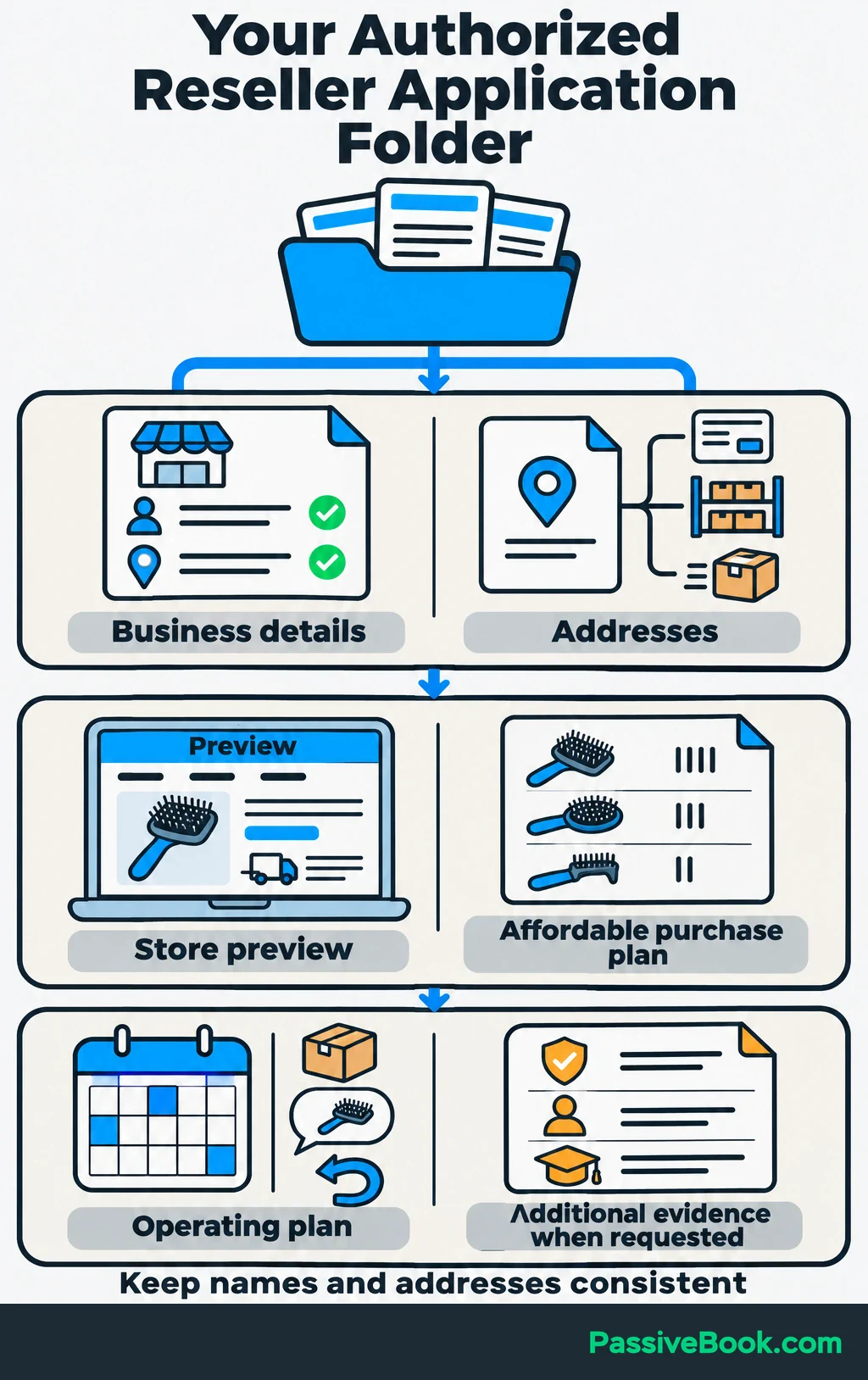
For Coat & Comb, the operating plan could explain where brushes will be stored, which days orders will be dispatched, and how customers can ask about product suitability.
If you can dispatch on three set days each week, include those days in your operating plan.
Keep names and addresses consistent across supplier, tax, and marketplace records.
4. Submit a Focused Reseller Application
Follow the process published by the verified supplier. Some use a detailed form; others begin with an account and supporting documents.
For example, SodaPup’s wholesale page lists direct, wholesale-marketplace, and distributor routes. Its direct process asks applicants to create an account, submit a sales-tax license, and wait for approval before ordering. Those purchasing routes do not establish blanket permission for every resale channel.
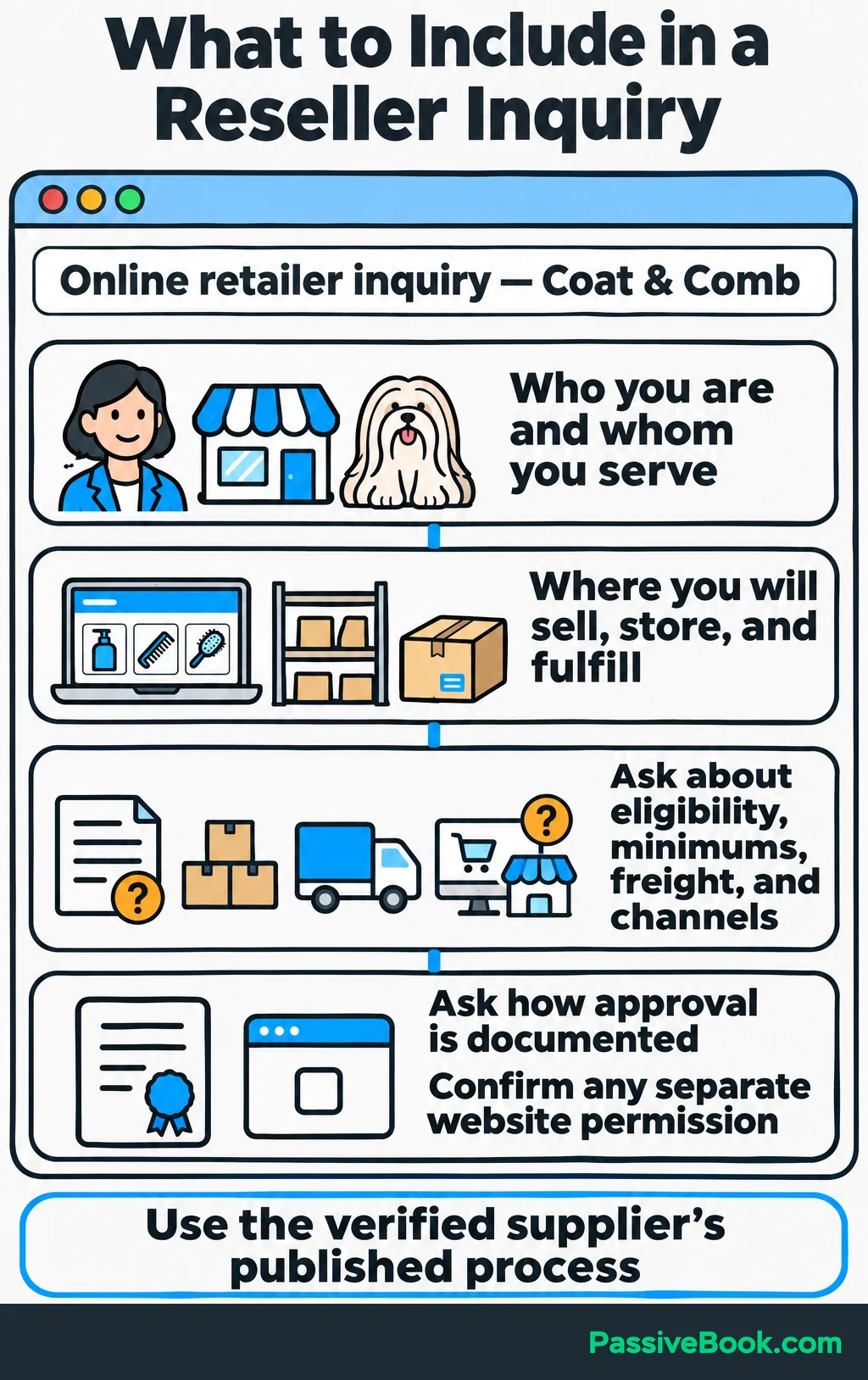
Your application should explain who operates the business, whom it serves, where sales will happen, and how you will handle orders. Give the brand enough detail to assess your proposal without sending your autobiography.
Here is a complete inquiry you can adapt:
Subject: Online retailer inquiry — Coat & Comb
Hello [Brand] team,
I’m preparing to launch Coat & Comb, a small U.S. online shop focused on brushes and combs for long-haired dogs.
I plan to sell through [website address] and store and pack orders from my home in [city, state]. My proposed opening range includes
. The store will provide clear product comparisons, delivery information, and a contact route for product questions and returns.
Do you accept new, home-based, online-only retailers using this model? If so, please share your application requirements, opening and reorder minimums, freight terms, and sales-channel restrictions.
Please also confirm how reseller approval is documented and whether separate website permission is required.
Thank you,
[Name]
[Business contact details]
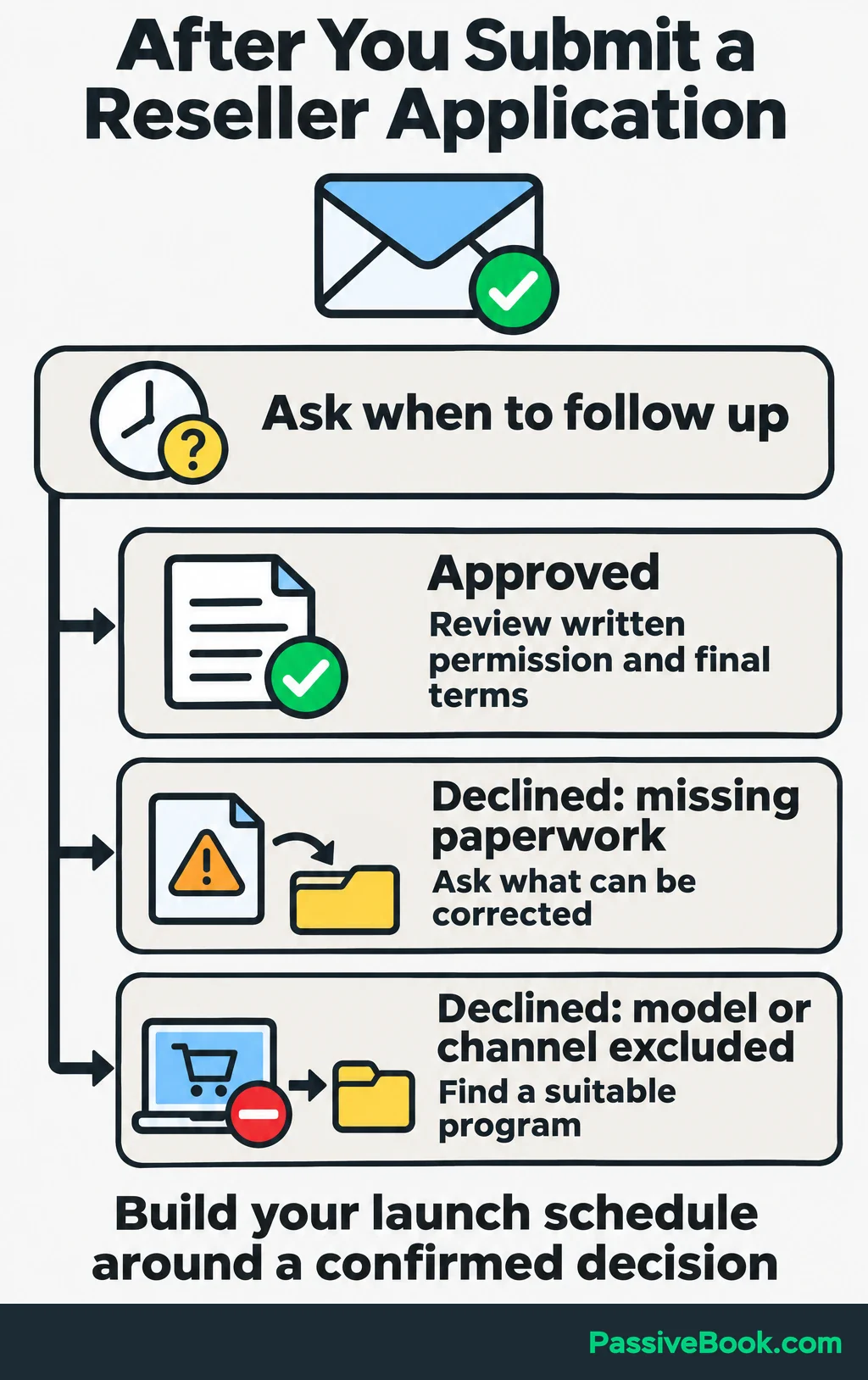
Once you apply, ask when a follow-up would be appropriate. Approval times and acceptance standards vary, so build your launch schedule around a confirmed decision.
If declined, ask which requirement was unmet. Missing paperwork may be fixable. A restriction against your channel or business model is a reason to move to another suitable program.
5. Confirm Your Authorization Before Buying Inventory
Review the Agreement and Its Scope
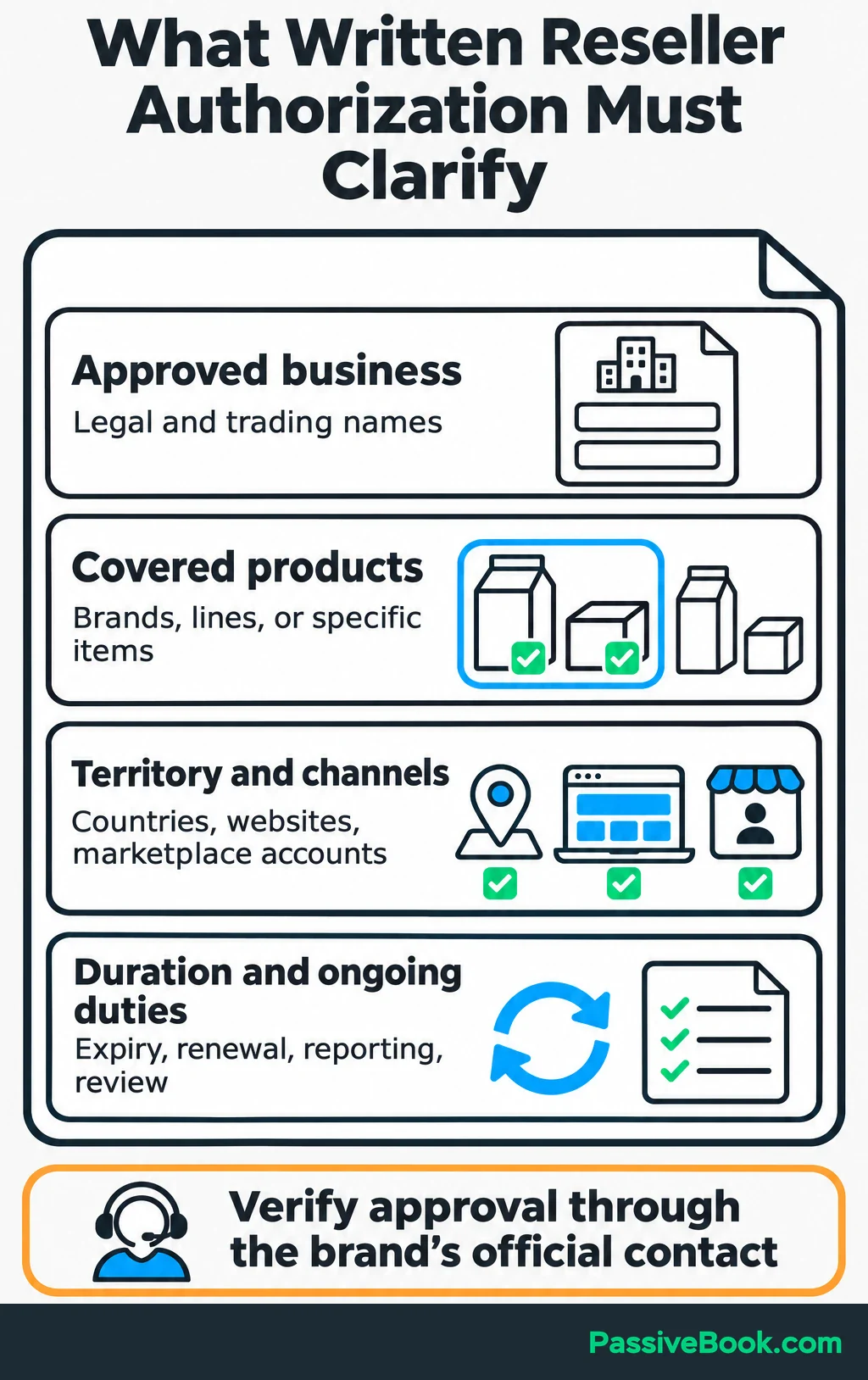
Get written approval that identifies what your business may do. A wholesale login or a friendly conversation leaves too much unclear.
Confirm these points in the agreement or approval correspondence:
- Approved Business: Your legal business name and any trading name.
- Covered Products: The brands, product lines, or items you may sell.
- Territory and Channels: Permitted countries, websites, and marketplace accounts.
- Duration: Any expiry, renewal, reporting, or review requirements.
Verify approval through the brand’s official contact. If a distributor supplies an authorization document, confirm that it has authority to grant the permission described.
Then read the commercial terms. Check opening and ongoing purchases, payment dates, freight responsibility, returns, restocking fees, damaged products, warranty handling, termination, and what happens to remaining inventory.
I would ask about unsold stock before signing. “Can I return it?” is a much cheaper question while the stock still belongs to the supplier.
Pricing terms deserve a separate read. A manufacturer’s suggested retail price is a suggested selling price. A minimum advertised price, or MAP, policy concerns advertised pricing, and its wording determines how promotions are treated. SodaPup’s MAP policy, for example, specifically addresses bundles, coupons, and other incentives.
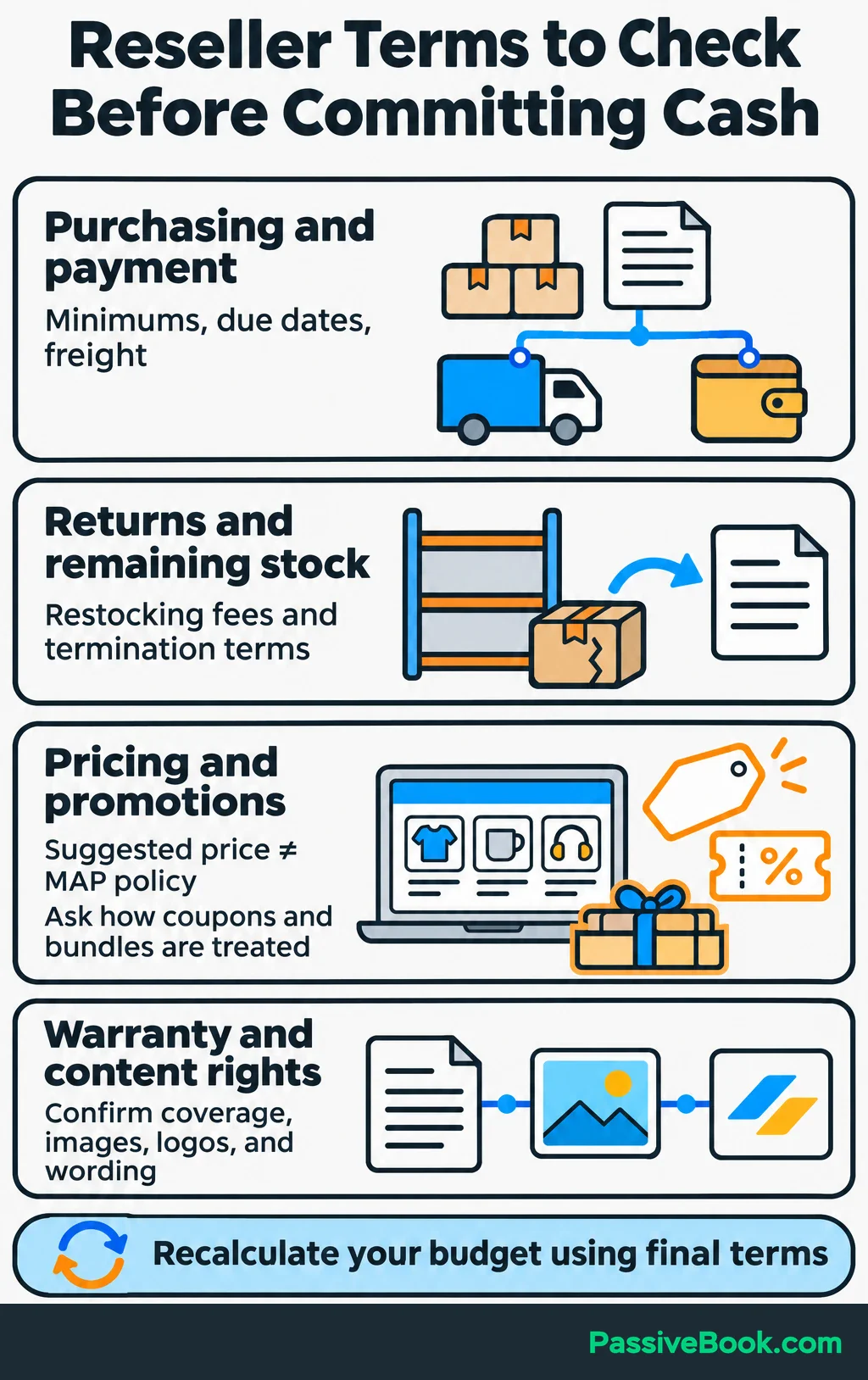
Do not assume a coupon or bundle sits outside the policy. Ask how your planned promotion would be treated.
The legality of pricing restrictions also varies by jurisdiction. The FTC’s manufacturer-restrictions guidance explains that some state and international rules differ from U.S. federal standards.
Confirm permission to use product photographs, logos, and authorized-reseller wording too. Request a smaller opening order or clearer return terms where needed, then recalculate your budget using the final terms. Keep the agreement, incorporated policies, and approval emails together.
Complete Separate Marketplace Approval
If you intend to sell on a marketplace, check the exact product and condition through your seller account before committing to stock for that channel.
For products that require approval, Amazon’s branded-product guidance says you may need a manufacturer or distributor invoice or a brand authorization letter. Follow the document requirements shown for your application.
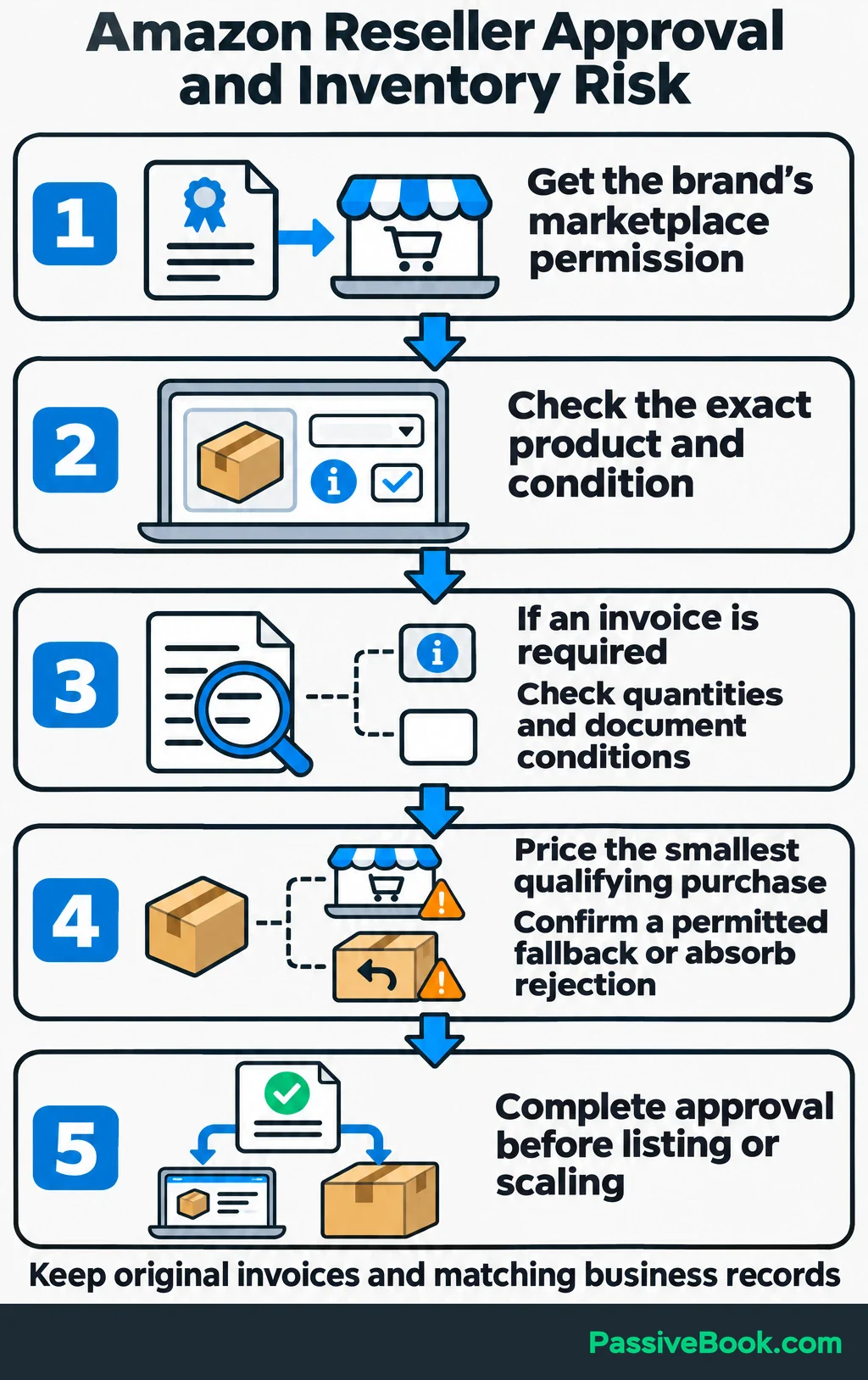
Sometimes the marketplace requires an invoice, which means you must buy something before it decides. Treat that as a purchasing risk:
- Obtain the brand’s permission for the intended marketplace first.
- Check the invoice requirements, including any stated quantities and document conditions.
- Price the smallest purchase that meets both marketplace and supplier requirements.
- Confirm whether rejected stock could be sold through another brand-permitted channel or returned under agreed terms.
Proceed only if you can absorb rejection. An alternative channel is useful only when you are permitted and prepared to sell there.
Keep original invoices and authorization records with matching business details. Complete marketplace approval before listing there or increasing purchases for that channel.
6. Place a Small First Order and Begin Selling
Order the smallest practical range that meets the agreement and fits your budget.
For Coat & Comb, that might mean a few brushes and combs with distinct uses rather than every size and color. Select the range using customer needs and the manufacturer’s product guidance.
When the shipment arrives, match it against the invoice. Check quantities, condition, packaging, and product identifiers, and resolve discrepancies before selling affected items. If the supplier ships directly to customers, place a test order to check delivery, tracking, packaging, and the returns process.
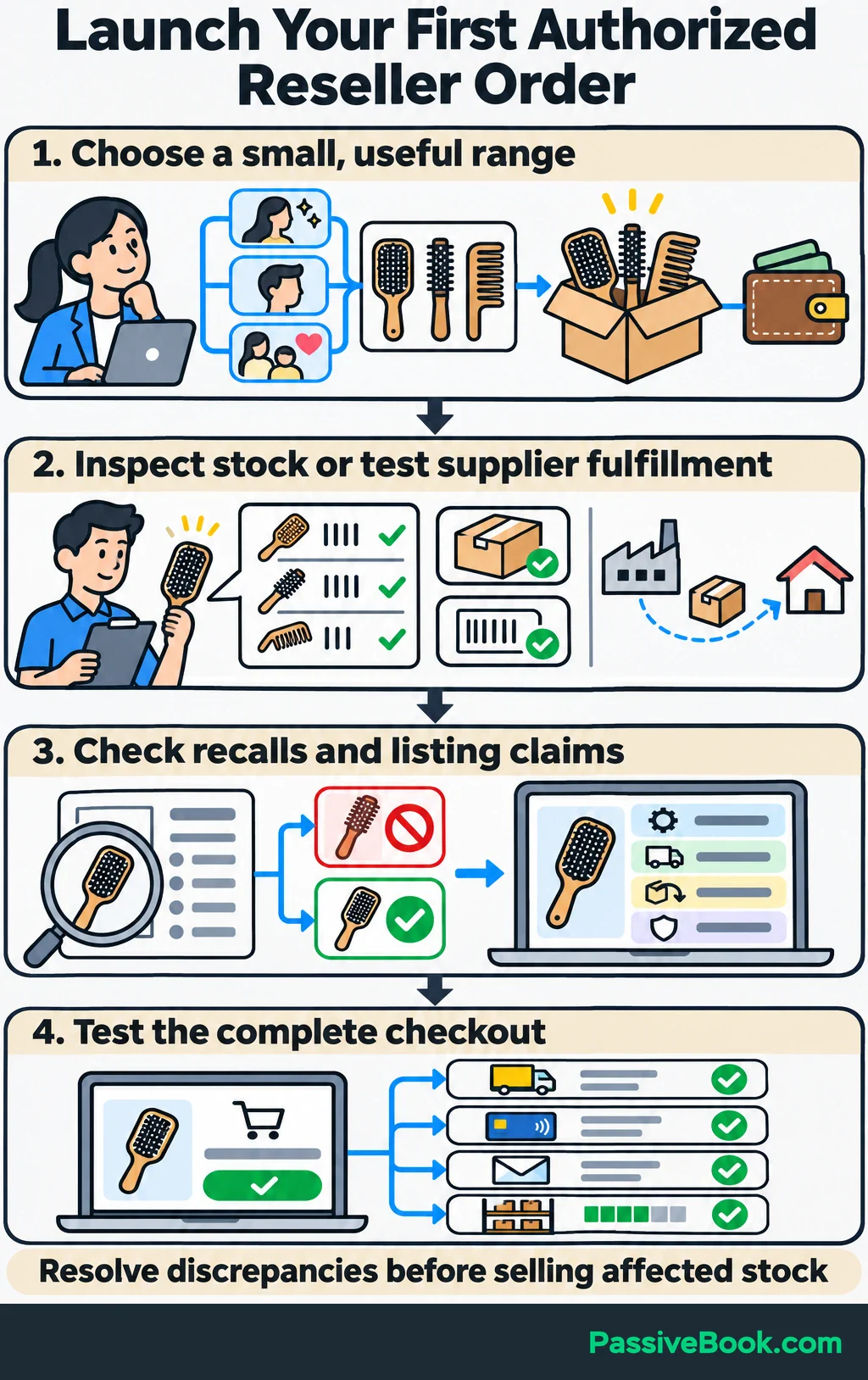
Check recalls before listing stock and keep watching for notices. In the U.S., offering recalled consumer products for sale is unlawful, as the CPSC’s resale guidance explains.
Build listings that help customers decide what to buy. Include the product’s intended use, relevant specifications, permitted images, delivery expectations, and applicable return and warranty terms. Avoid adding claims the manufacturer does not support.
Complete a test checkout and confirm that payment, shipping charges, order emails, and stock updates work.
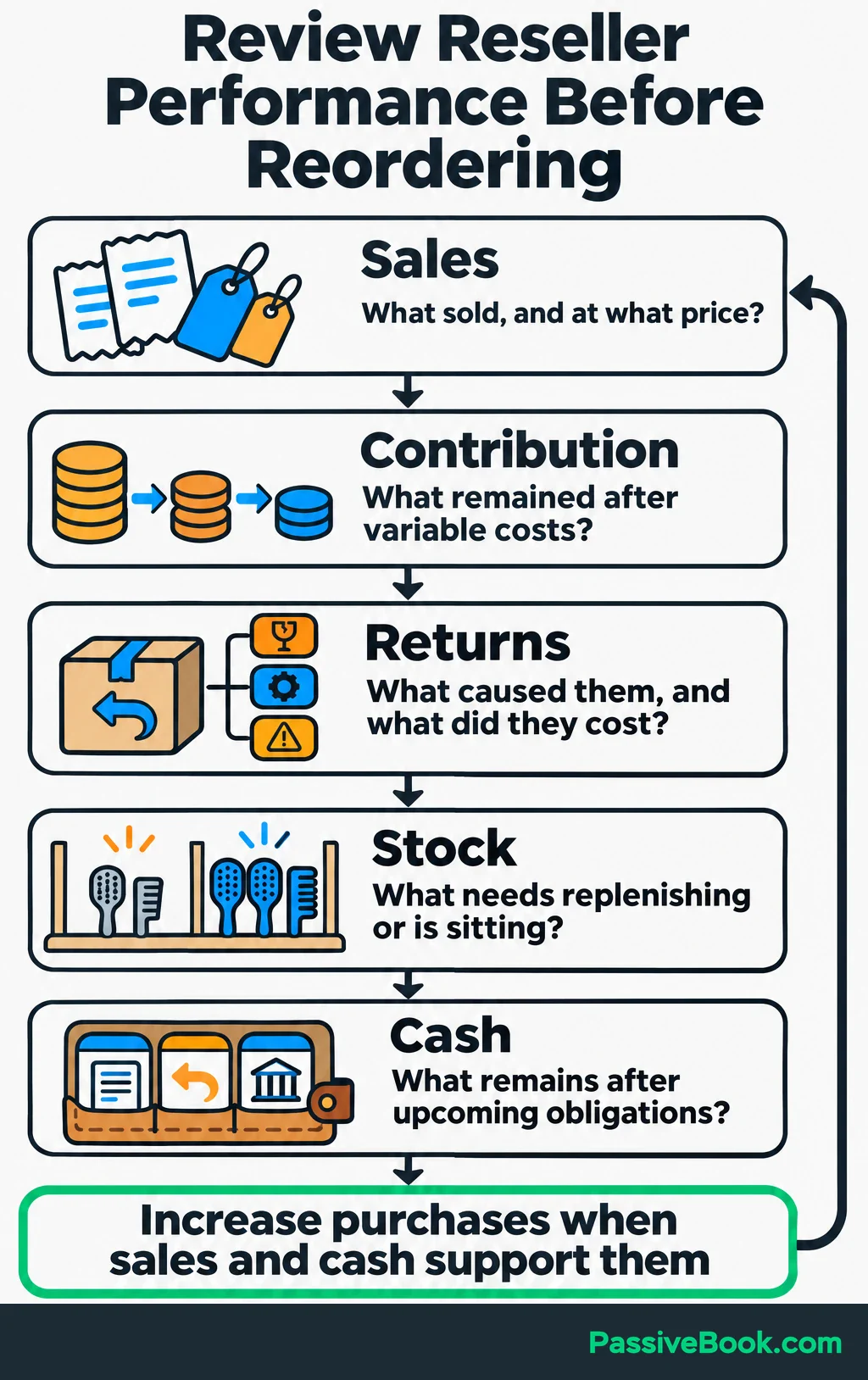
Then review the business weekly:
- Sales: Which products sold, and at what actual prices?
- Contribution: What remained after the real variable costs?
- Returns: What caused them, and what did they cost?
- Stock: Which items need reordering, and which are sitting?
- Cash: What is available after upcoming bills, refunds, and tax amounts are set aside?
Increase purchases when sales and cash flow support them. Approval gives you access to products; actual orders tell you which products deserve more cash.
Maintain the program’s purchasing, service, reporting, and renewal requirements. Keep sourcing and tax records current, and obtain permission before adding restricted channels or territories.
What Next?
Write down your intended sales channel and maximum opening-order budget, then check three brands against both. That gives you a useful shortlist before you spend money on stock.
Use the social buttons to share this guide when you want to compare supplier terms or work through a first-order budget together.
Which requirement would most affect your decision to proceed: channel permission, minimum orders, or the money left per sale? Share your answer in the comments, and bring any other questions too.
Share this post with your friends & followers:

