Your supplier says the order is ready, but you still don’t know whether the products match the sample, carry the right labels or will survive delivery.
If customers discover the problems first, you may be paying for refunds and replacements while deciding whether the remaining stock is safe to sell.
That uncertainty makes the next release decision harder. This guide shows you how to set pass/fail standards, check suppliers and finished goods, and keep the evidence needed to release a batch or hold it for correction.
What Does Ecommerce Product Quality Control Involve?
Ecommerce product quality control and compliance need a connected workflow: define what passes, approve the supplier and sample, check production, decide whether to release stock, and protect it through delivery. Returns then feed back into those checks.
Three jobs sit inside that workflow:
- Quality Control: Inspect and test products against agreed requirements.
- Quality Assurance: Establish processes that help suppliers and staff meet those requirements consistently.
- Compliance: Meet applicable legal obligations and your selling channels’ requirements.
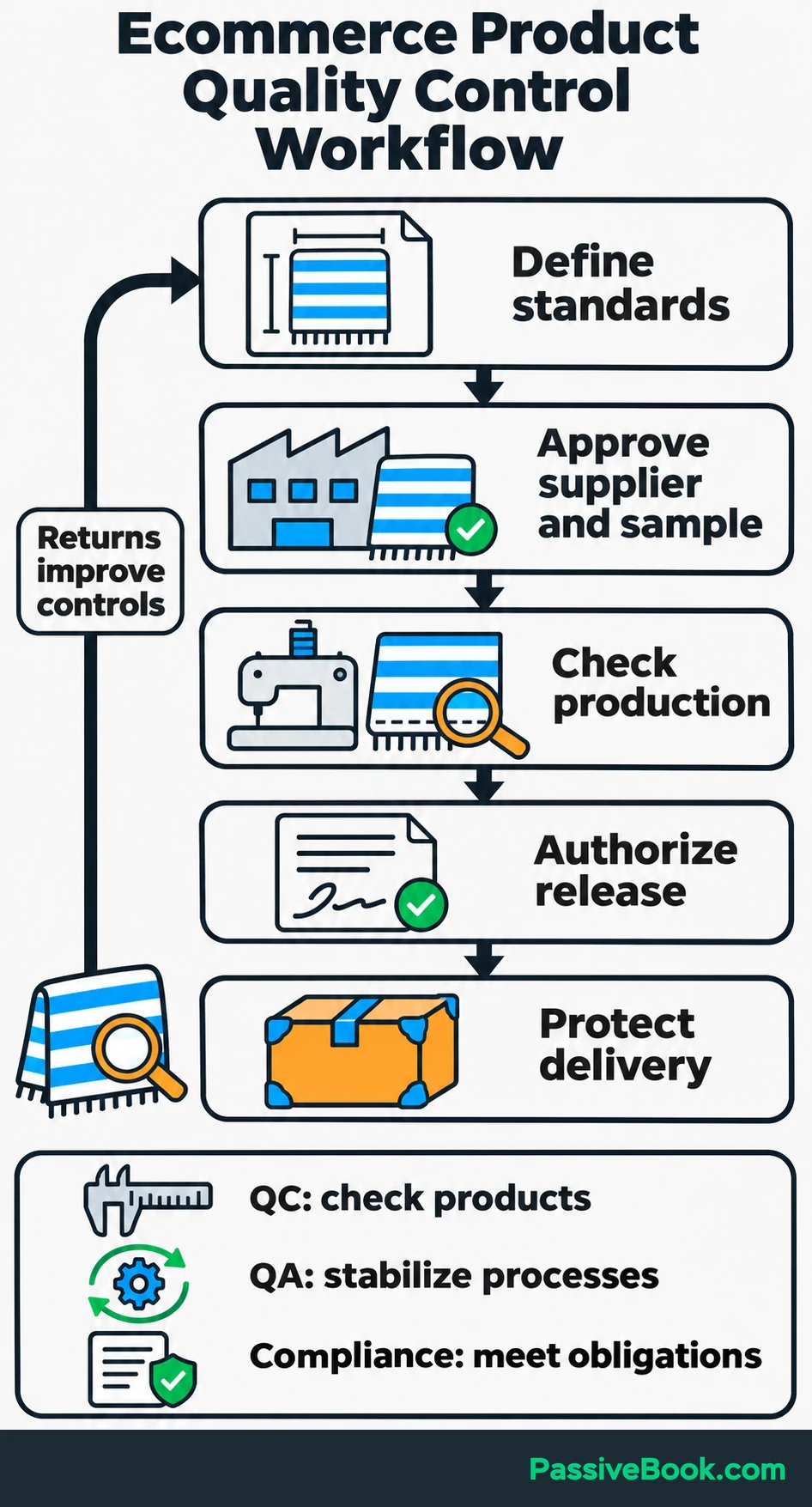
ASQ explains the distinction between quality assurance and quality control. In practice, you need both the product check and a process that makes the next batch more dependable.
Give each checkpoint an owner and name the person authorized to release stock. In a small store, you may fill several roles, but suppliers and warehouses still need written instructions about when to stop.
Throughout this guide, imagine you run a coastal kitchen-linen store selling blue-striped cotton tea towels. Its specifications, findings and figures are illustrations.
Define Pass/Fail Standards for Each SKU
Identify the Requirements for Each Selling Market
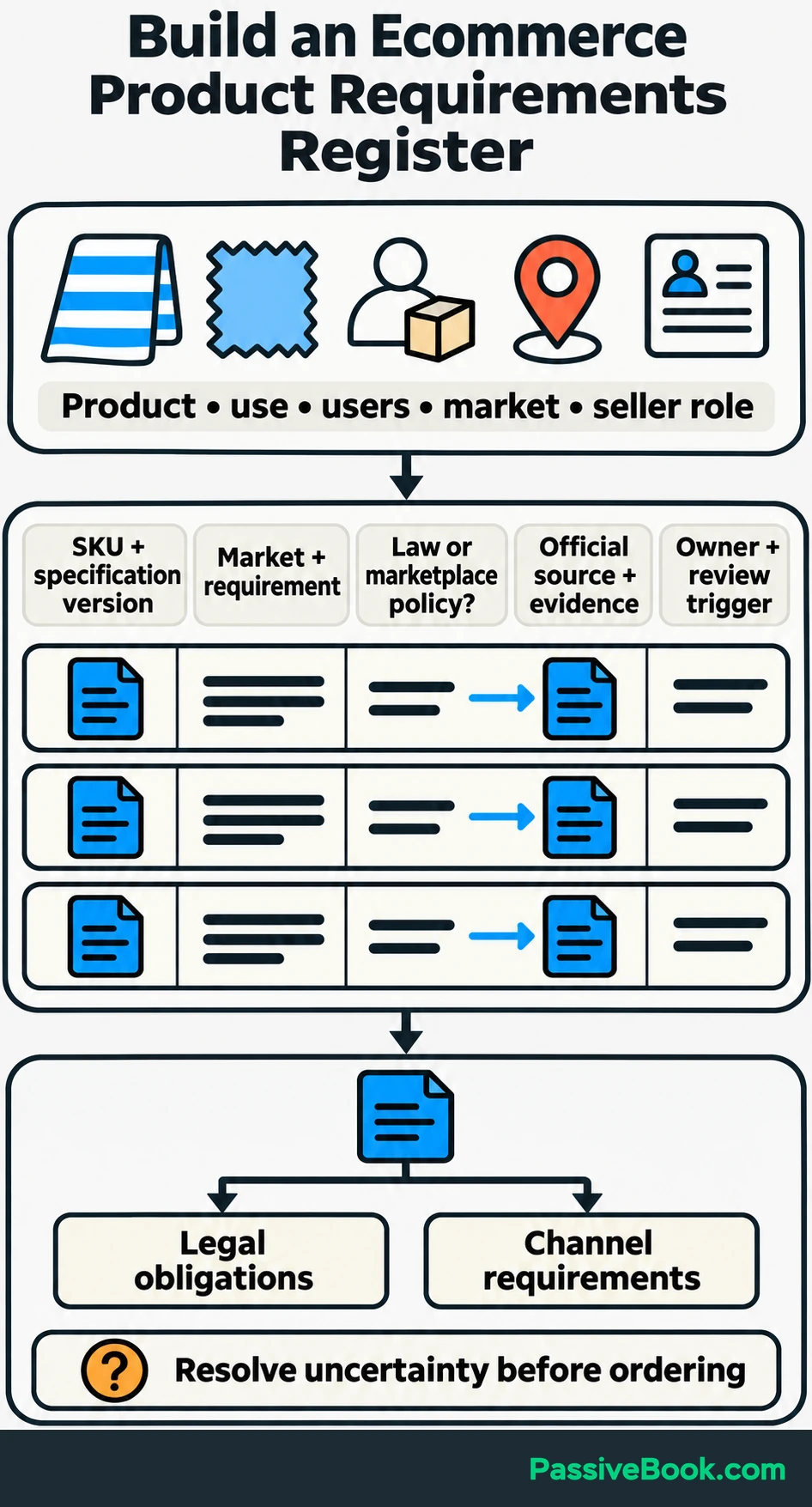
Before searching for rules, record the product’s materials, intended use and users, destination markets and sales channels. Note whether you act as the manufacturer, importer or reseller; these details determine which requirements apply.
Create a requirements register with these fields:
- SKU, which is your product identifier, and specification version.
- Destination market and requirement.
- Whether it comes from law or a marketplace policy.
- Official source and required evidence.
- Responsible person and review trigger.
For U.S. consumer products, the CPSC Regulatory Robot helps identify requirements within the Consumer Product Safety Commission’s scope. You still need to identify the responsible regulator for requirements outside that scope.
For the tea towels, U.S. labeling checks should cover fiber content, country of origin and the identity of the responsible business. Towels are among the products covered by the FTC’s textile-labeling requirements.
EU sales require a separate review of the applicable product-safety obligations. Also, CE marking applies only where the relevant EU legislation requires it. Products outside those rules must not carry it, as the EU’s CE-marking guidance explains.
I would resolve uncertainty about product classification or required testing before placing the inventory order. That is a useful, bounded job for a qualified specialist.
Turn Requirements Into a Measurable Checklist
Write one specification for each product version, with a date and version number. Cover materials, dimensions, construction, appearance, function, included items, labels, packaging and the claims made on your listing.
When I ran my jewellery store, I kept notes like “nice finish” beside supplier photos. Later, those notes couldn’t tell me whether a difference was a fault or something I had already accepted. I needed a reference picture and an observable rule.
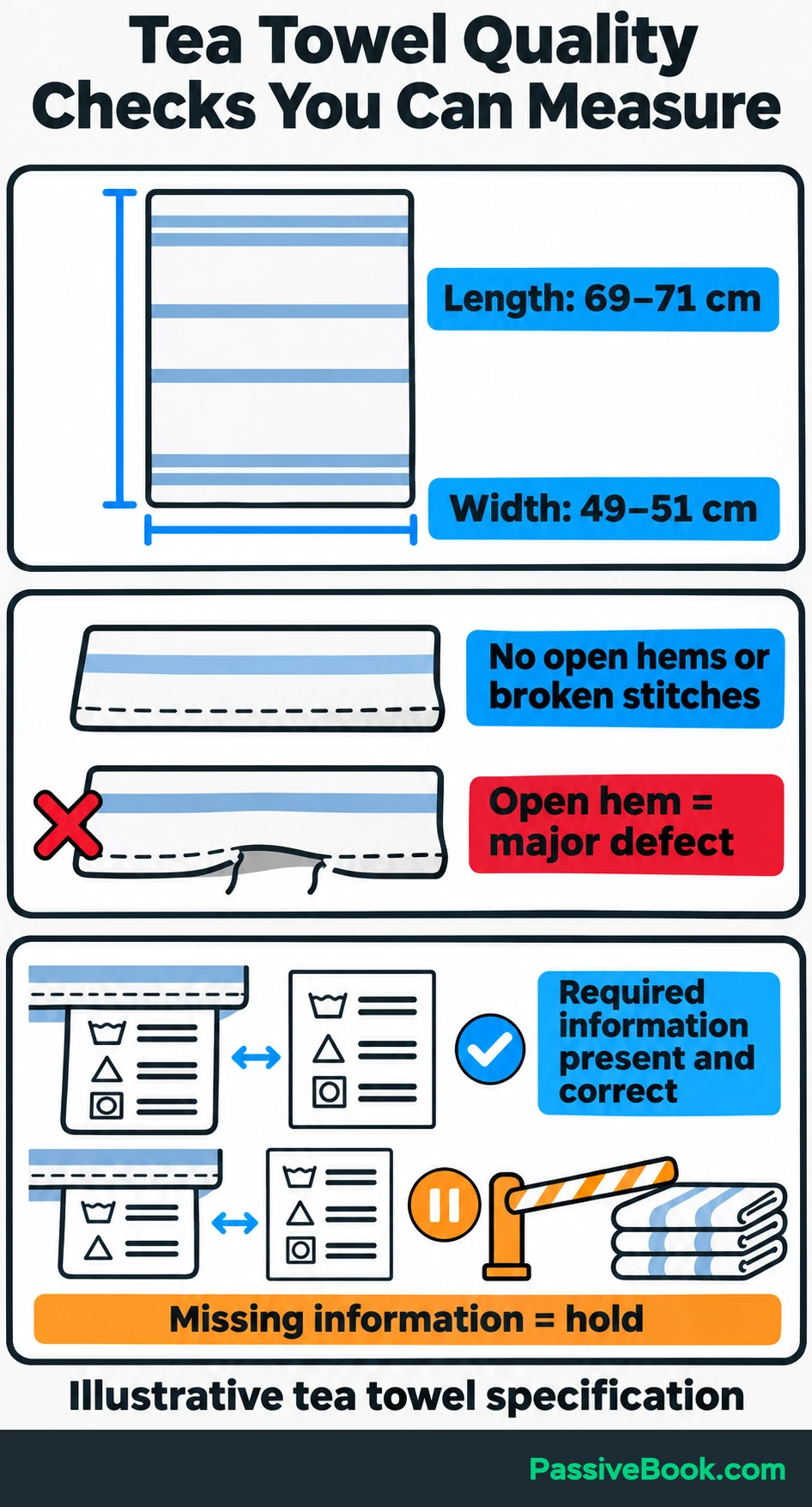
For your own checklist, replace “good stitching” with a description such as “no open hems or broken stitches,” supported by close-up reference photos.
Classify failures before inspection:
- Critical Defects: Hazards that could make the product unsafe.
- Major Defects: Problems that affect use or materially differ from the promised product.
- Minor Defects: Limited cosmetic differences that do not affect use or break an explicit promise.
Give compliance failures separate hold rules. A missing required label does not become acceptable because the towel still dries dishes.
A few tea-towel checklist entries could look like this:
| Characteristic | Method and Equipment | Acceptance Criterion | Defect or Hold Rule |
|---|---|---|---|
| Finished size before washing | Lay flat without stretching; measure with a suitable tape | Width 49–51 cm; length 69–71 cm | Major if outside either range |
| Hems | Inspect all edges under good lighting | No open hems or broken stitches | Major |
| Stripe pattern | Compare with dated reference sample and photos | Approved stripe direction, spacing and placement | Major for the wrong pattern |
| Wash stability | Follow recorded wash-and-dry method W1 | No more than 5% shrinkage in either dimension | Major |
| Required labeling | Compare label with verified artwork and requirements register | All required information present and correct | Hold until corrected and verified |
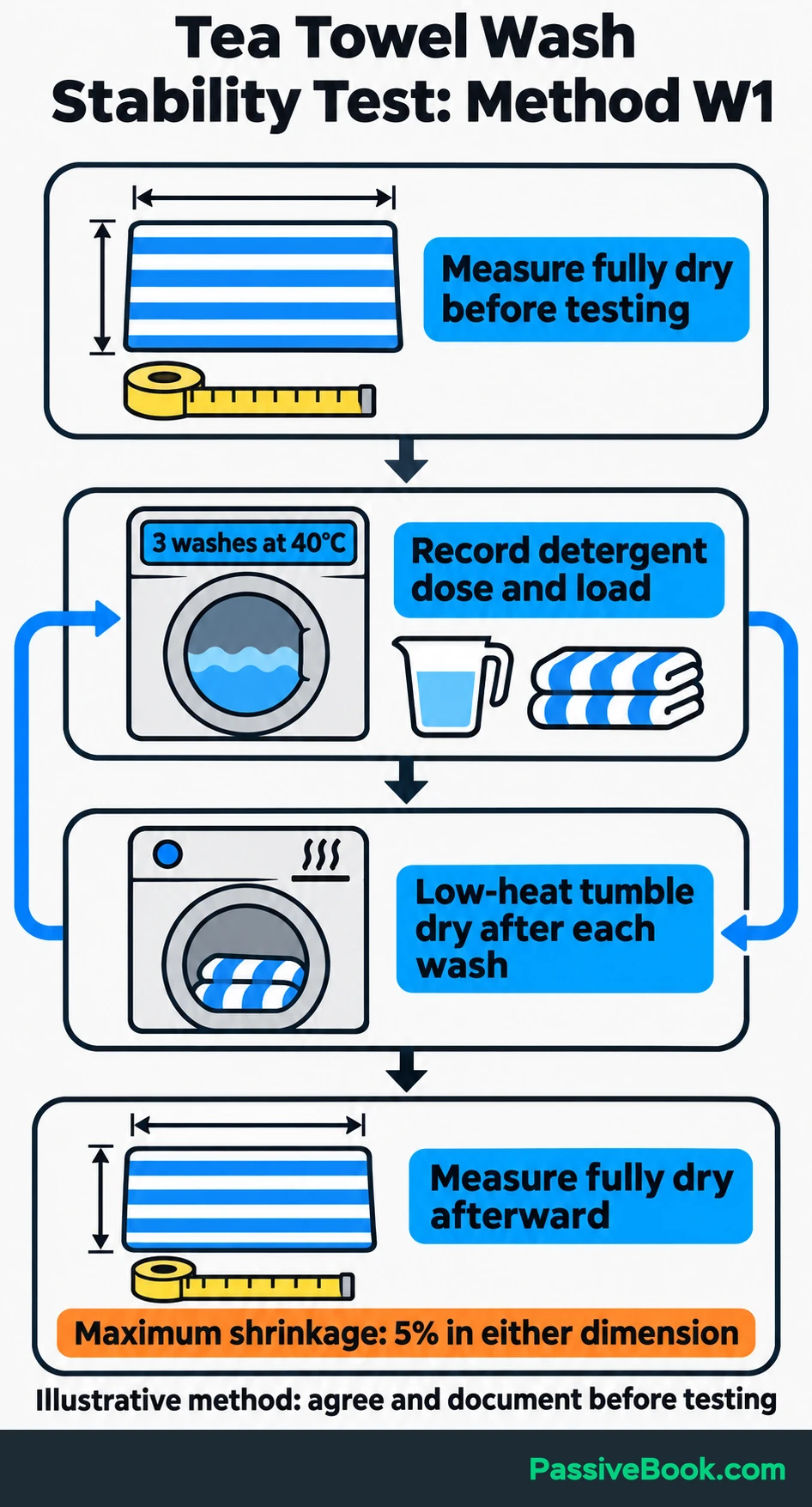
For the illustrative W1 check, agree on three 40°C washes, each followed by low-heat tumble drying. Record the detergent dose and load conditions, and measure the towels fully dry before and after testing. Keep this method with the specification so another person can repeat it.
Your inspection form should also capture the checkpoint, inspector, actual result and evidence. Finally, compare the specification with your listing. If the page promises a two-pack, the packing check needs to verify two towels.
If your product requirements are still scattered across a listing and supplier messages, the AI Supplier Correspondence Studio can turn them into one specification draft. It also writes the questions you need your supplier to answer before those standards are agreed.

Free AI Supplier Correspondence Studio




Approve the Supplier and Production Sample
Before approving a supplier, establish who will make the goods and where. Check the business identity, manufacturing location, relevant capabilities, subcontracting arrangements and process for handling defects.
I would use a supplier audit when product risk, order value or uncertainty justifies it. For a straightforward product, you may first need better samples and clearer production evidence.
Ask for a sample made with the materials, methods, labels and packaging intended for production. Check it against the specification, including durability and normal use. Retain a dated reference sample and link it to the approved specification version.
Review test reports just as carefully. Match them to the actual product, materials, variants, manufacturer, methods and destination requirements. If a report looks questionable, verify it with the issuer.
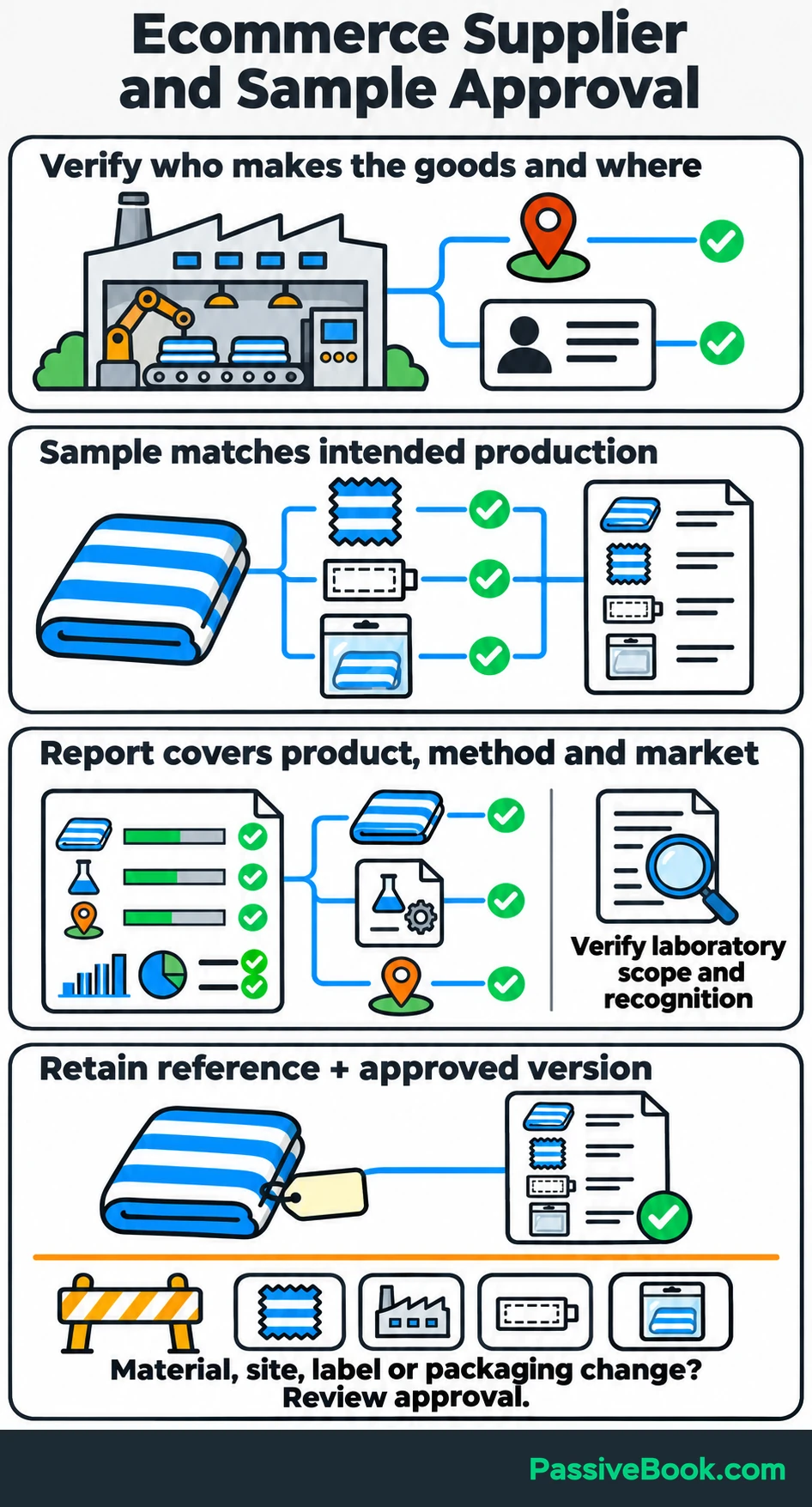
When selecting a laboratory, check that its accredited scope covers the required methods and that it meets any applicable regulatory recognition requirements. ILAC explains why accreditation scope and acceptance of results matter. A laboratory’s logo alone does not answer those questions.
Put the working agreement in writing. It should cover:
- Inspection access and the evidence required before shipment.
- Responsibility for correction, reinspection and related costs.
- Shipment-release conditions and their relationship to payment terms.
- Changes that require your approval, including materials, production sites, labels and packaging.
Define which changes require new samples or testing. Otherwise, you can approve one towel and receive a quietly revised version.
For supplier-direct fulfillment, agree on inspection evidence, order identification and failure escalation before accepting customer orders. You need a way to stop affected shipments even when the goods never pass through your hands.
Build a Risk-based Inspection Plan
Put Checks Where They Prevent Costly Failures
Place checks where they can prevent harm or expensive correction. Consider safety, function, supplier history and production variability, including changes such as a new fabric source.
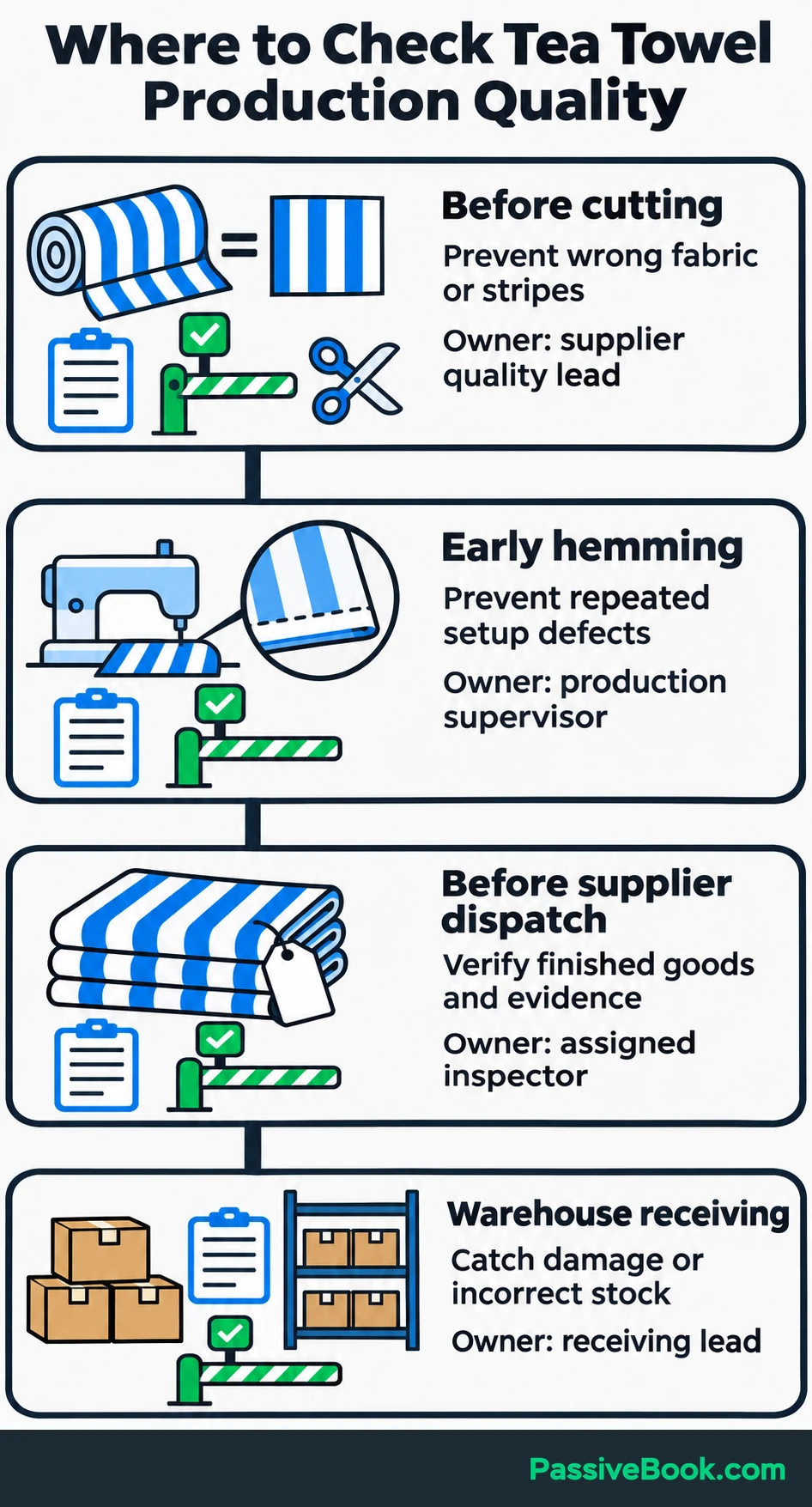
For each checkpoint, define the method, coverage, owner, evidence and release condition.
| Checkpoint | Failure Being Prevented | Method and Coverage | Owner and Evidence | Release Condition |
|---|---|---|---|---|
| Before cutting | Wrong fabric or stripe pattern used across the batch | Check incoming fabric against approved material evidence and reference | Supplier quality lead; material records and photos | Fabric and pattern approved |
| Early hemming | A faulty setup repeated throughout production | Inspect output from each active setup before continuing | Production supervisor; recorded findings and corrections | Setup produces acceptable hems |
| Before supplier dispatch | Finished defects or missing required labels shipped | Agreed product sampling, label checks and required tests | Assigned inspector; inspection report and test evidence | Acceptance criteria met and release approved |
| Warehouse receiving | Transit damage or incorrect stock enters available inventory | Match delivery records and inspect condition before put-away | Receiving lead; receiving report and damage photos | Delivery accepted and inventory status updated |
These checks serve different purposes. Trained staff can handle routine measurements and packing checks. An independent inspector can verify production, and a qualified laboratory can perform specialist tests.
Decide Between Sampling and Checking Every Unit
First define the lot: a traceable group of goods produced under shared conditions. Avoid treating unrelated production runs as one batch simply because they arrive together.
For suitable batch decisions, randomly select samples across cartons and production positions. Cover distinct variants rather than assuming one color or size represents everything.
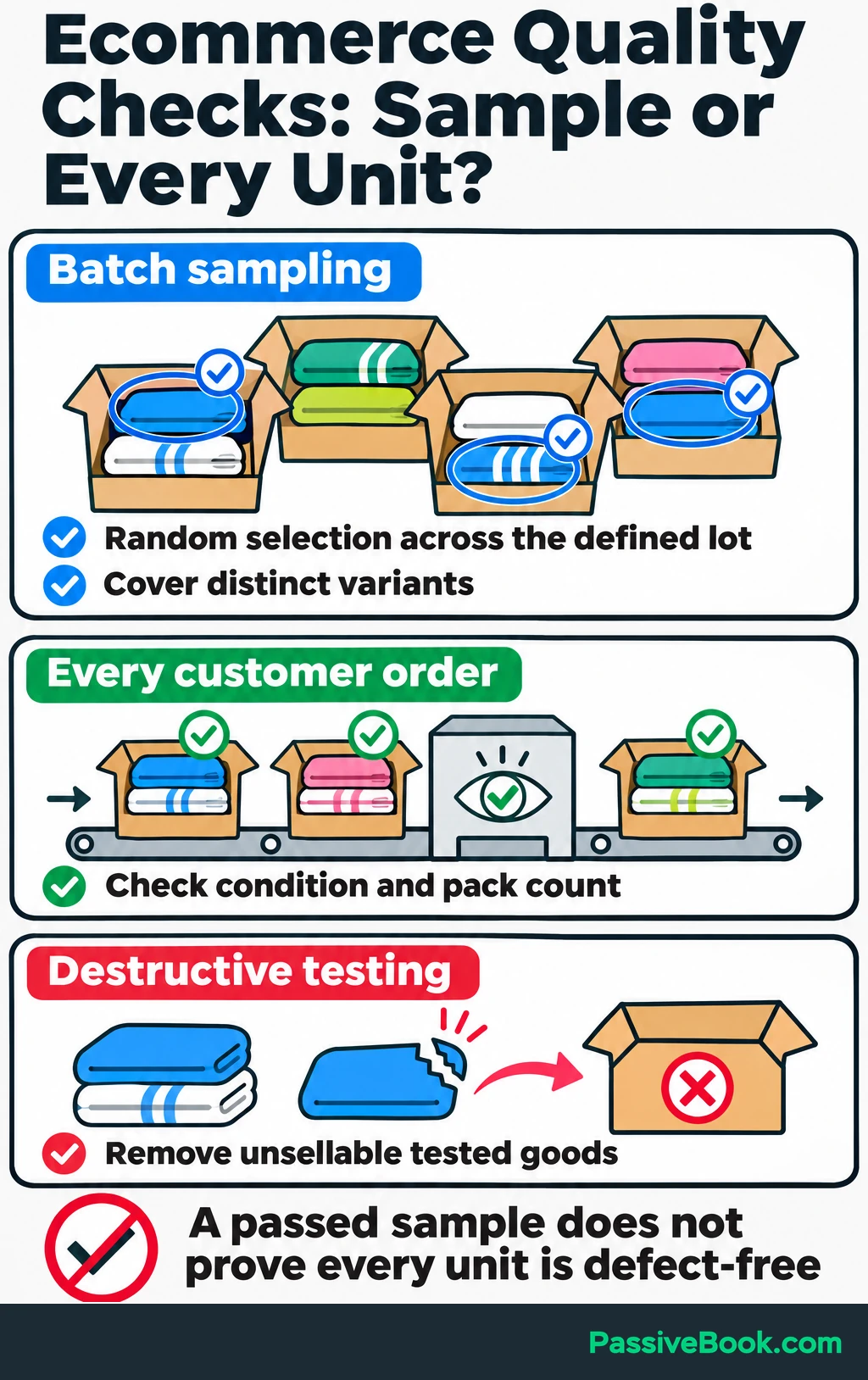
Other checks may need every unit. For example, you can require a visible-condition and pack-count check on every customer order while using sampling for finished dimensions. Keep destructive testing separate and remove tested, unsellable goods from available stock.
For formal acceptance sampling, have a competent inspector choose the plan before inspection. It should specify how many units to check and how many defective units or individual defects trigger rejection. ISO 2859-1 provides plans indexed by acceptance quality limit (AQL), a quality level used to select a plan.
Record the standard and edition, lot size, inspection level and severity, defect classes, AQLs, sample sizes, and acceptance and rejection numbers.
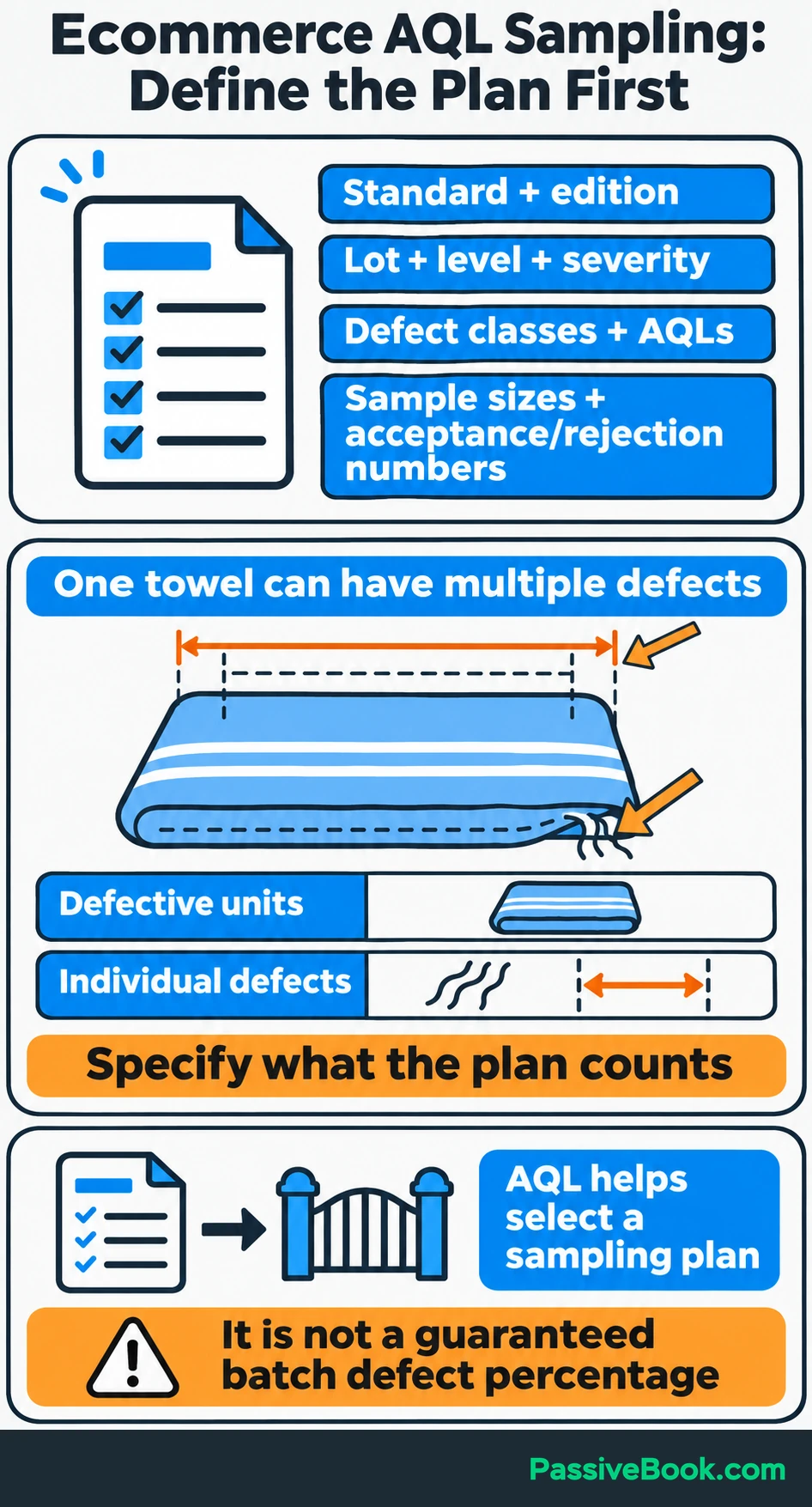
Also specify what you count. A towel with both an open hem and the wrong dimensions may count differently under a plan based on defective units versus one based on individual defects.
A passed sample supports a lot-acceptance decision. It does not prove that every unit is defect-free or guarantee that the batch’s defect percentage falls below its AQL. NIST makes this purpose of acceptance sampling clear.
Hold the affected lot when a critical hazard appears, and keep mandatory safety testing separate from cosmetic sampling.
Inspect and Release Each Finished Batch
Run the Agreed Product and Packaging Checks
Before inspection begins, confirm the lot identity, quantity, specification version and whether enough finished goods are available for representative selection.
Use the approved methods to check dimensions, workmanship, function, variants, labels, included items and packaging. Measuring equipment should suit the tolerance, and its accuracy needs to be verified.
Record actual measurements. “Size checked” gives you very little to investigate later.
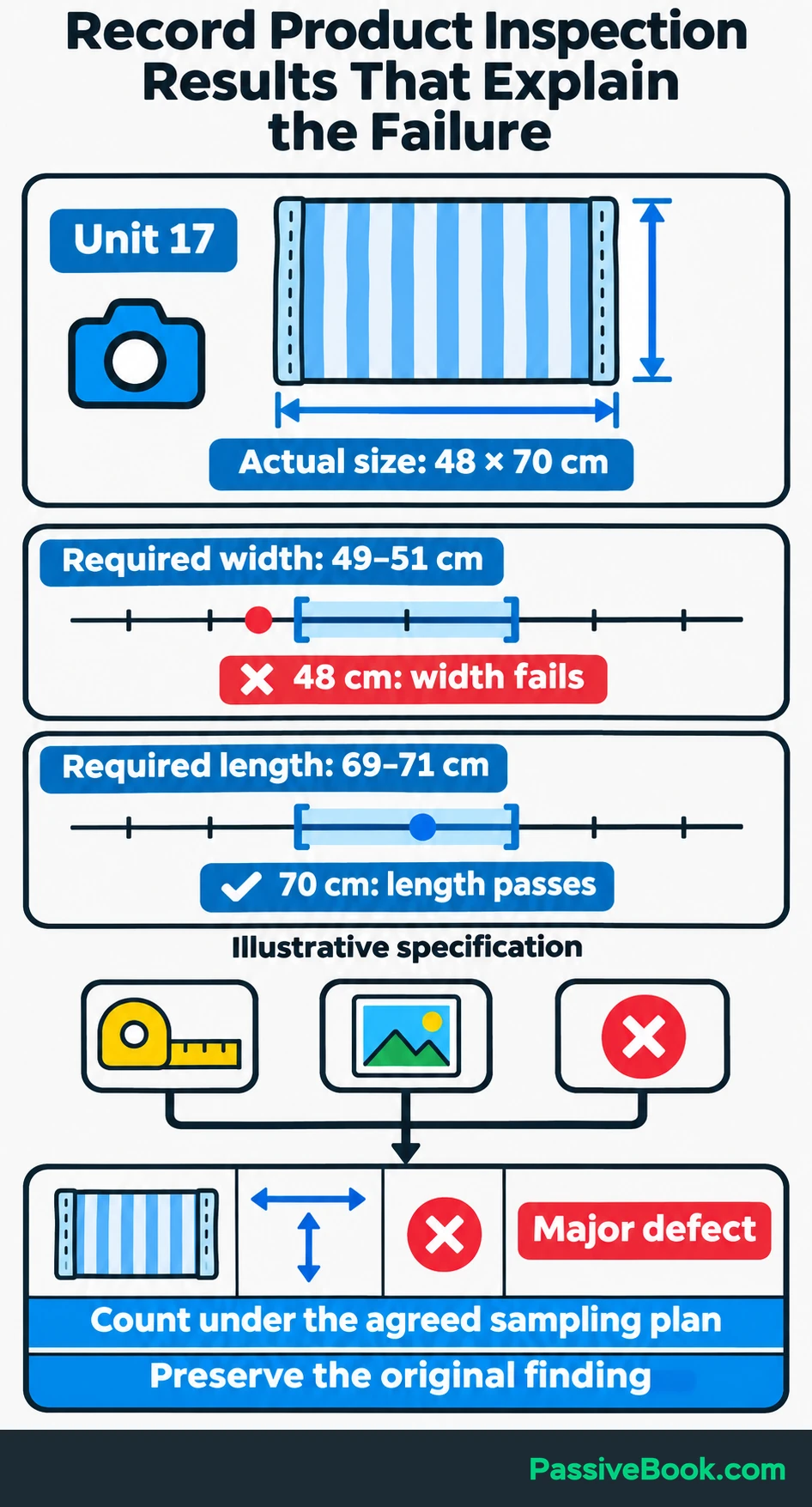
For example:
Unit 17 measures 48 × 70 cm. Width fails the required 49–51 cm range. Classified as a major defect and counted under the agreed sampling plan.
Compare the stripes and hems with the reference sample, and review the required wash-test results. Preserve the original findings. Replacing a failed sample unit with a better one and deleting the failure turns inspection into creative writing.
Check the product and packaging together. The tea towels should arrive clean and dry, with packaging that remains protective through the expected delivery conditions.
Where formal transit testing is needed, choose a protocol suited to the shipment type. ISTA’s test-procedure guidance distinguishes tests for different transport conditions.
The report should contain inspected quantities, measurements, defect counts, photographs, missing evidence, inspector and date.
Record the Release Decision
Make one explicit decision:
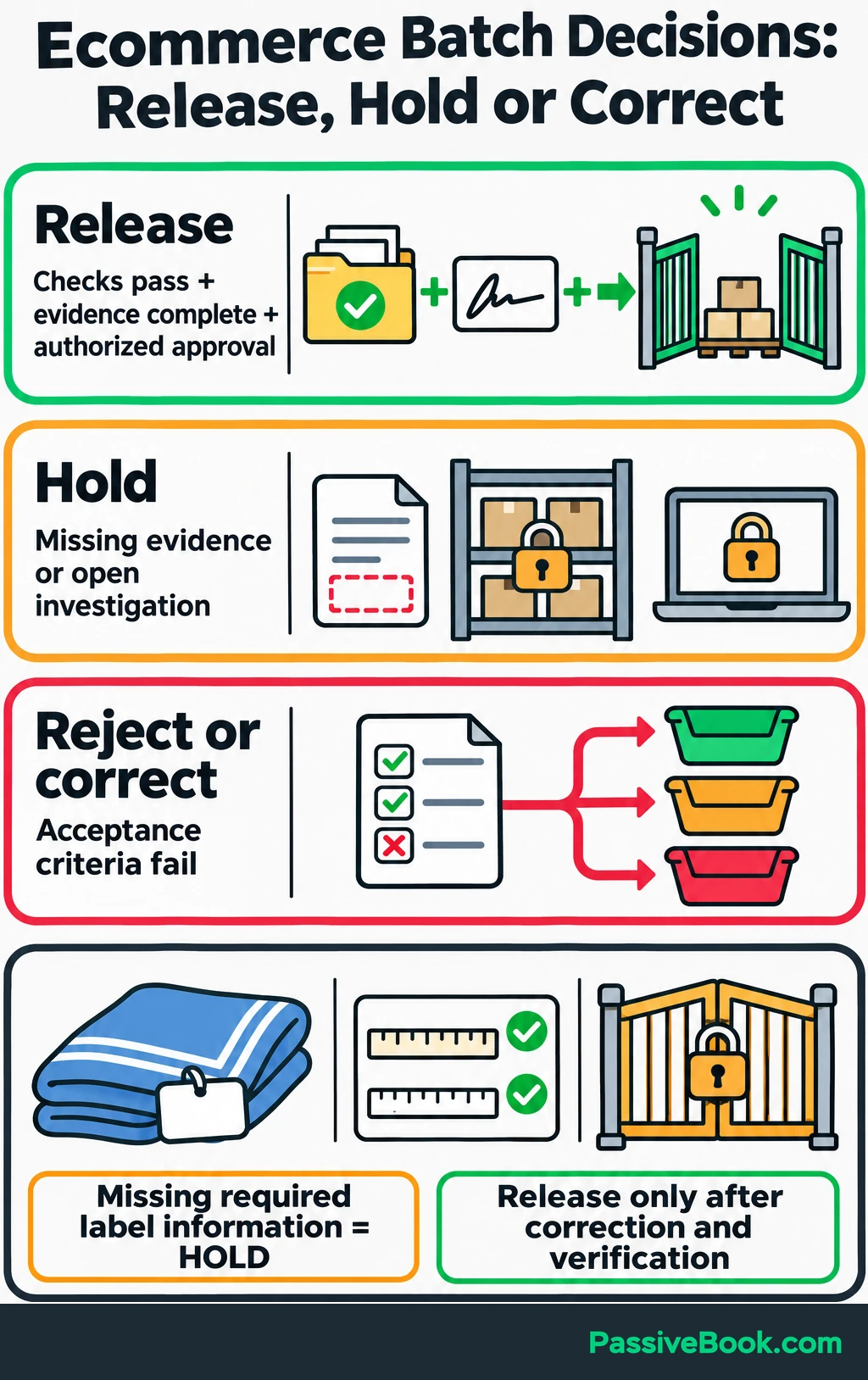
- Release: Required checks pass, evidence is complete and an authorized person approves.
- Hold: Evidence is missing or an investigation remains open.
- Reject or Correct: Acceptance criteria fail. An authorized person must decide whether to sort, repair, return or dispose of the goods.
Block held stock physically and in the inventory system. A “HOLD” note is useful only if the goods cannot still be picked and shipped.
Here is a compact batch-release record for the tea-towel store:
| Field | Illustrative Entry |
|---|---|
| SKU and version | TT-BLUE-2PK, specification v3 |
| Purchase order | PO-104 |
| Supplier | Linen Supplier A |
| Lot | TL-01 |
| Inspection report | IR-TL-01, stored in the lot folder |
| Evidence status | Required country-of-origin information missing from labels |
| Disposition | Hold for label correction and verification |
| Approver | Store owner; release approval pending |
| Decision date | Not supplied; record the actual hold date |
Missing required labeling holds the batch even if its dimensions and workmanship pass. Release follows correction and verification.
Keep the release record linked to the product file: specifications, reference-sample details, supplier agreement, test evidence, applicable certificates, label artwork and inspection reports. Record the permitted next action and who owns it.
Protect Product Quality Through Fulfillment
Inspect Receiving and Preserve Traceability
Supplier approval does not tell you what happened during transport. At receiving, match the delivery to the purchase order, packing list, lot identifiers and supplier-release record.
Check for wet cartons, contamination, damage and quantity differences before making stock available.
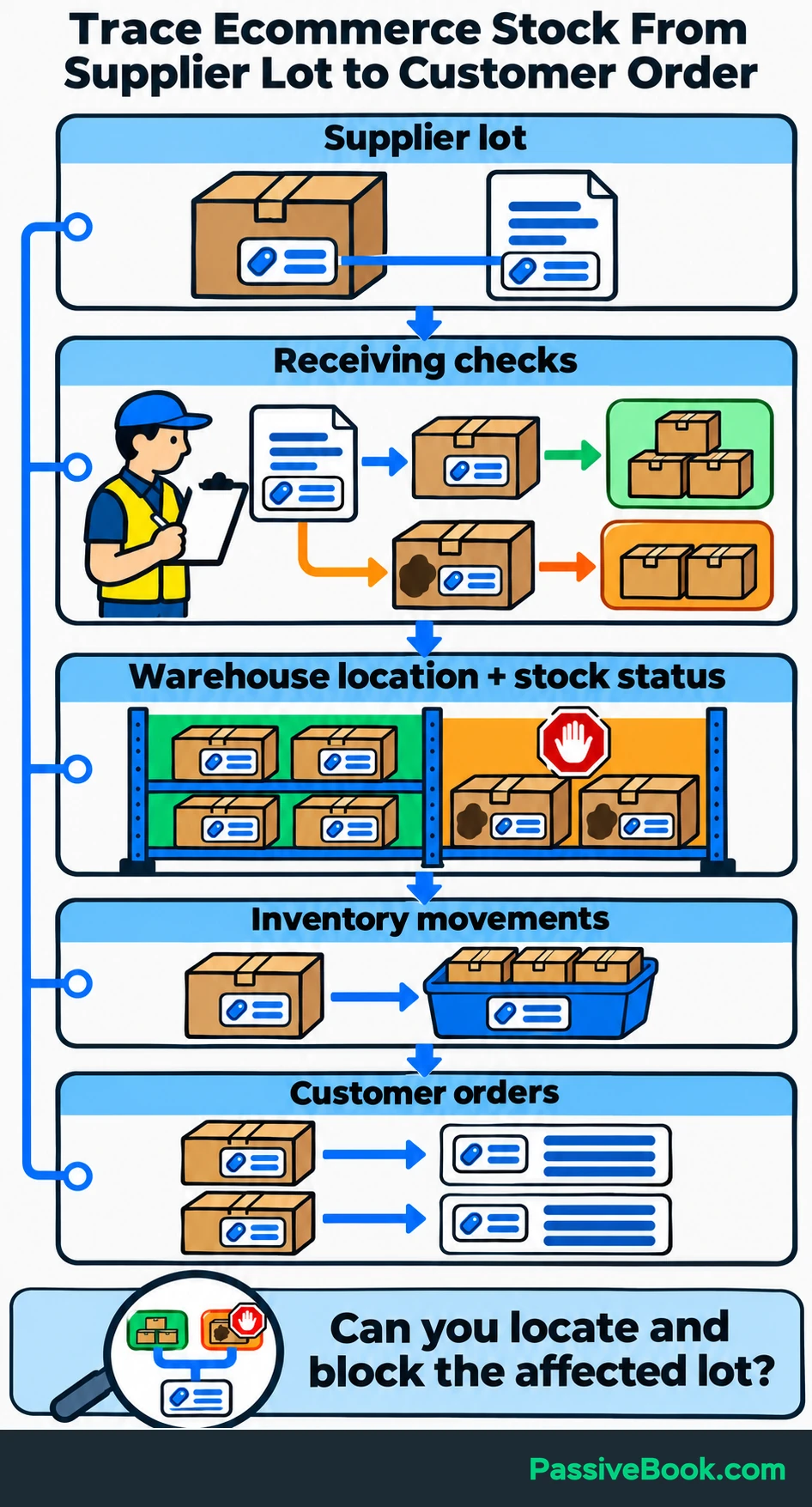
Preserve the link between the supplier lot, warehouse location, inventory movements and dispatched orders. When staff replenish a picking bin, they should retain enough information to identify which lots supplied the orders.
For the tea towels, storage instructions should protect the fabric from moisture and contamination. Keep approved, held, damaged and returned stock separate.
Give a third-party warehouse the same receiving checks, hold rules, evidence requirements and escalation contacts. Ask it to demonstrate that it can locate and block an affected lot. That demonstration is more useful than a reassuring sentence in a sales proposal.
Verify Each Order Before Dispatch
Make the final order check short enough to perform consistently. Before sealing the parcel, verify:
- SKU, variant and quantity against the order.
- Included items and visible product condition.
- Protective packaging and delivery label.
- Any applicable selling-channel preparation or identification requirements.
For the tea towels, the stripe design and two-pack quantity must match the order, and the fabric needs protection during delivery.
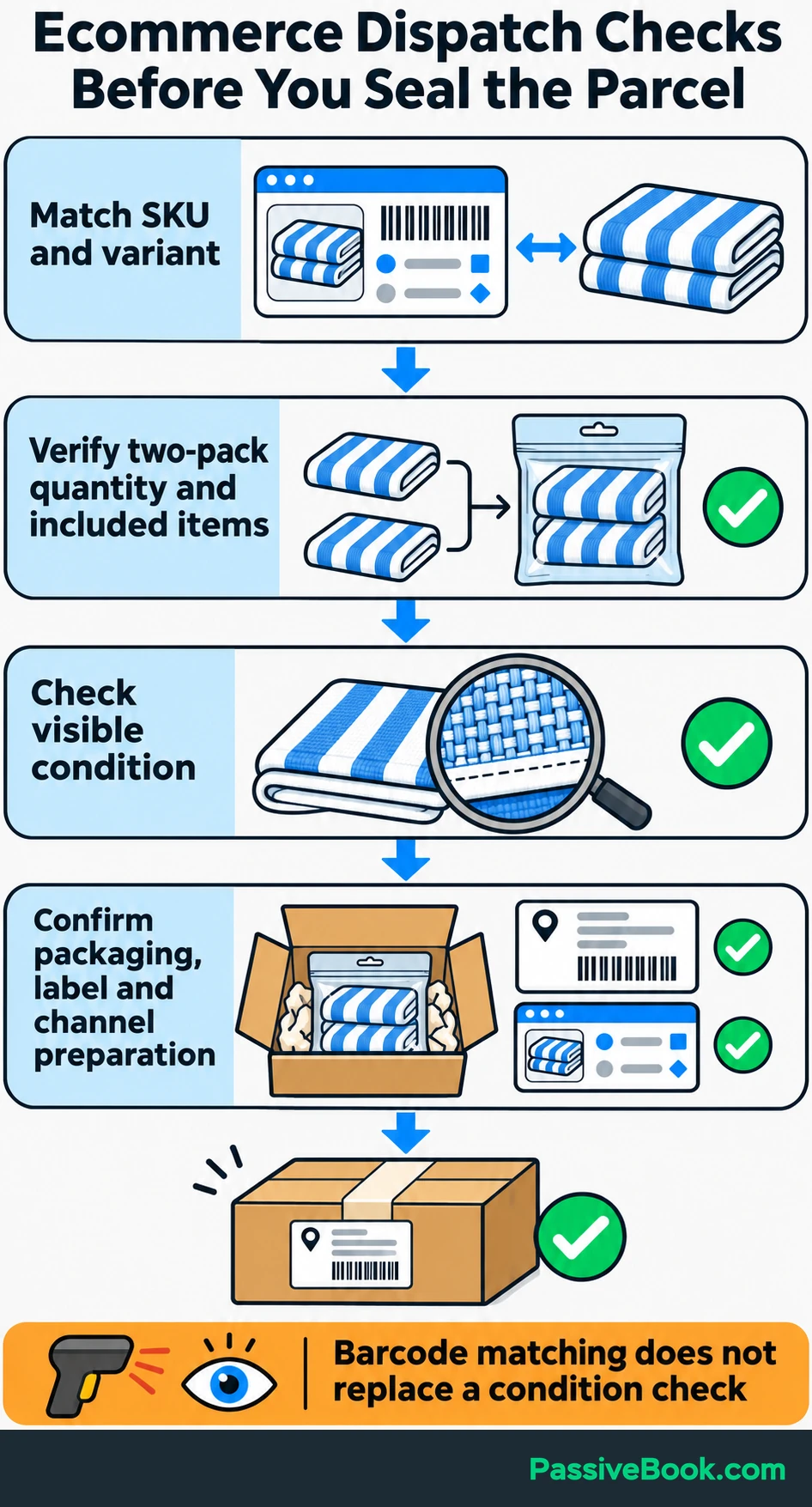
Barcode matching can help reduce picking mistakes where products look alike. It does not replace a condition check.
When the approved specification changes, update the listing and warehouse instructions together. A correct new product can still disappoint customers if the page describes the old version.
Contain Failures and Verify Corrective Action
Isolate Affected Goods and Escalate Safety Concerns
When a failure appears, stop release of suspect stock, preserve the evidence and assign an incident owner. Identify related inventory and already-shipped orders using the lot records.
For ordinary defects, an authorized person can approve sorting, rework, supplier return or disposal. Keep rejected goods from drifting back into available inventory.
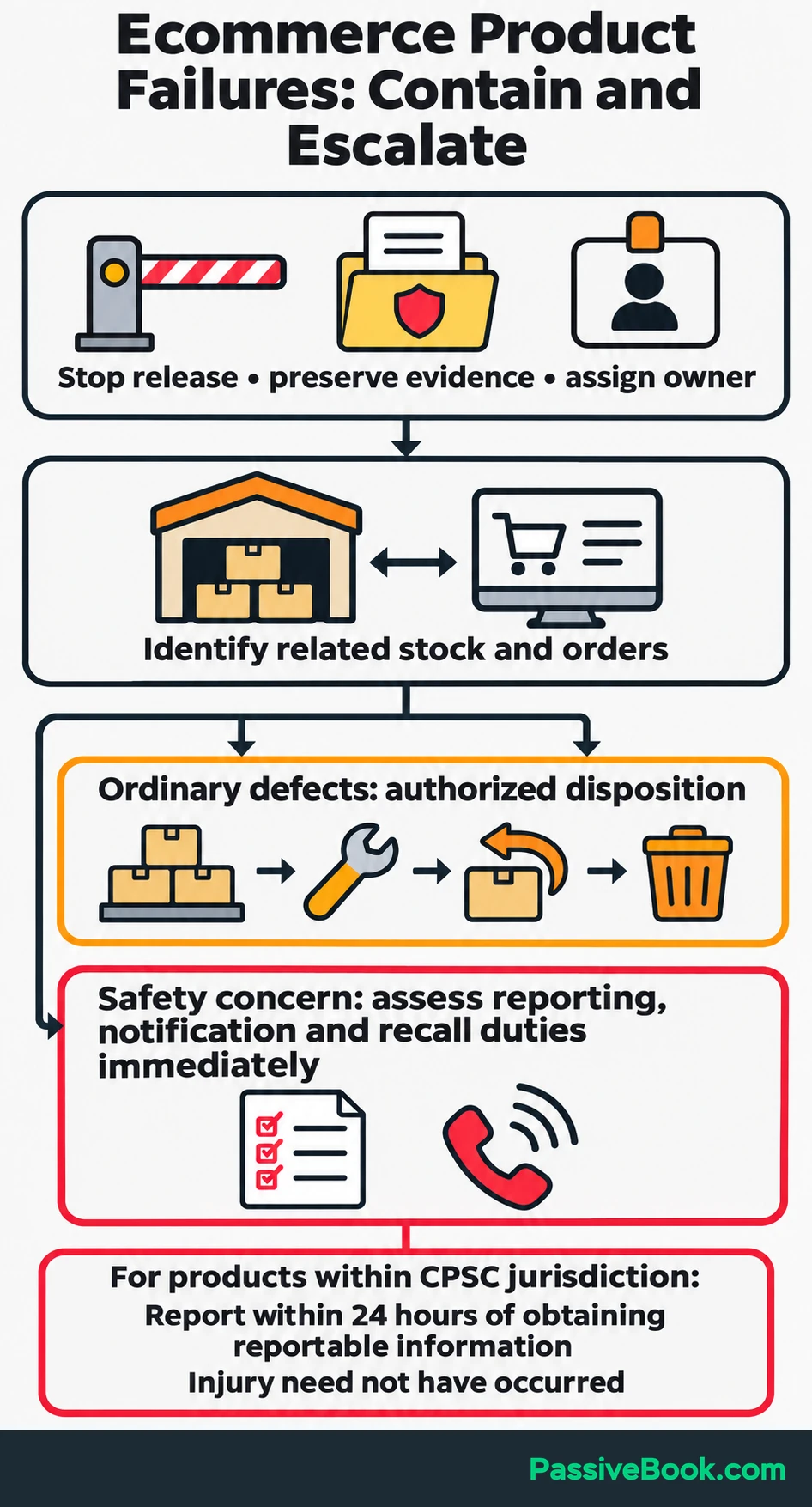
Safety concerns require immediate assessment of reporting, customer-notification and recall duties. Do not wait for a monthly review or a second complaint.
For products within CPSC jurisdiction, companies must report within 24 hours of obtaining reportable information, and injury does not need to have occurred. Follow the CPSC’s reporting guidance when assessing the obligation.
For EU sales, follow the applicable notification and corrective-action duties described in the EU’s unsafe-product guidance. Build the relevant regulator contacts into your incident instructions before you need them.
Fix the Cause Before Closing the Issue
Separate the immediate correction from the action that prevents recurrence.
Replacing a badly hemmed towel corrects that item. Fixing a hemming setup that produces repeated open seams addresses the cause.
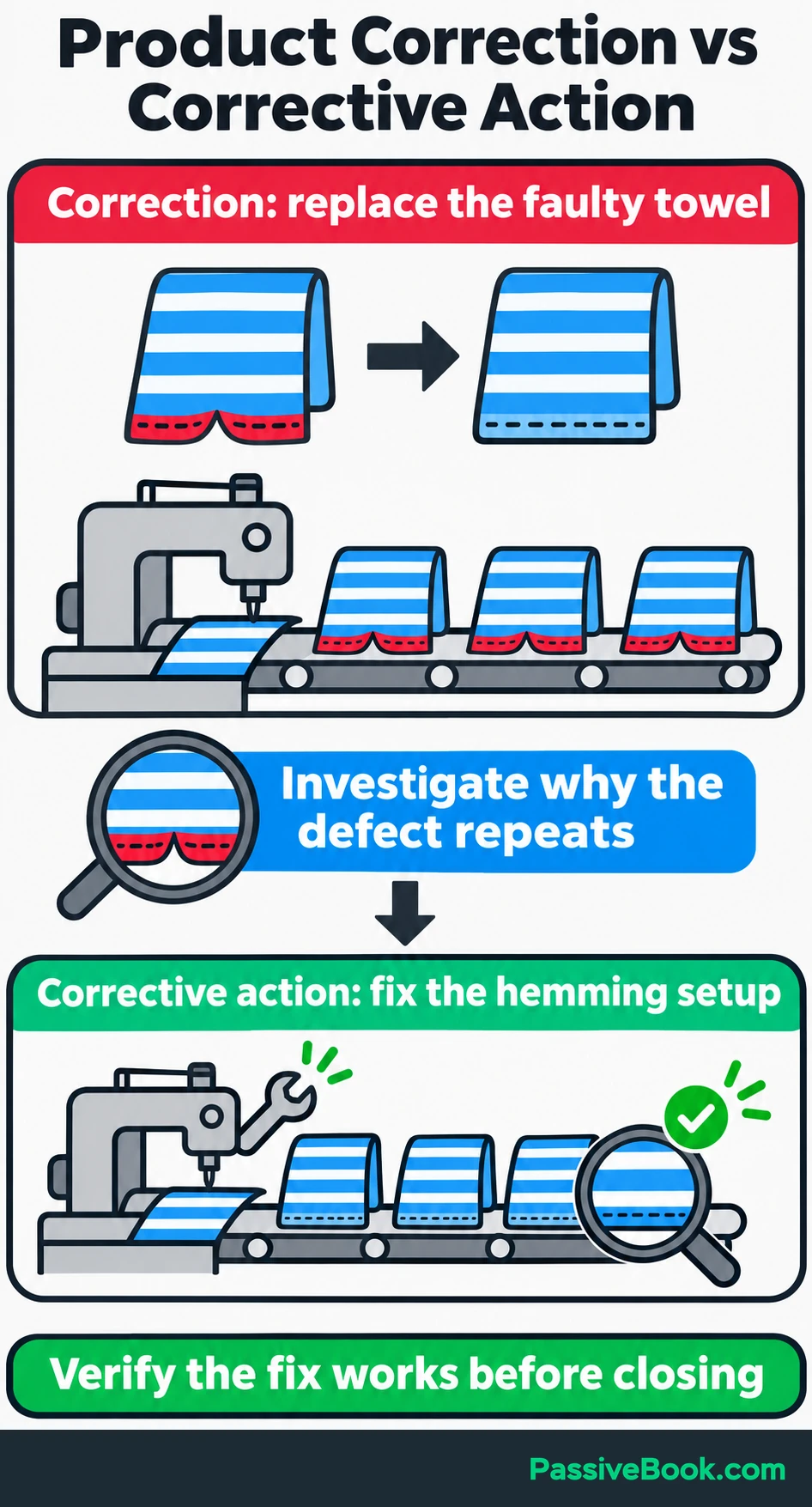
Give the supplier or internal owner a clear problem statement, supporting evidence, required action and completion date. For example:
Open hems appeared in the finished-goods inspection. Hold affected stock, identify the production setups involved, document the cause and submit corrected goods for reinspection.
Require evidence of the investigation. “Staff reminded to be careful” deserves another question when the same equipment or method remains unchanged.
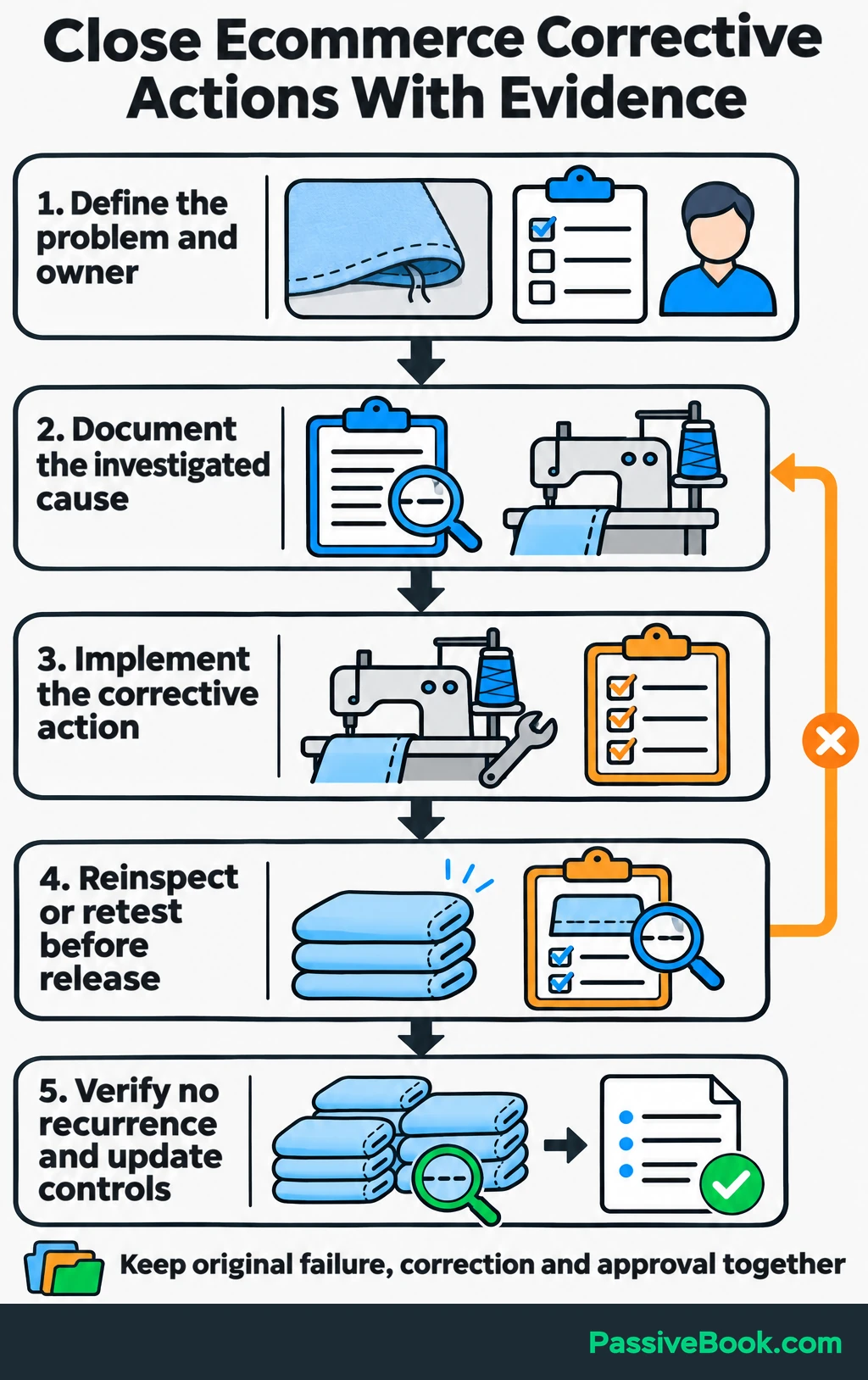
Reinspect or retest corrected goods under a defined plan before release. Preserve the original failure alongside the correction and approval.
Then check later production or shipments for recurrence. Close the issue when the action has proved effective, and update the relevant specification, supplier control, inspection coverage or packing instruction.
Use Returns and Complaints to Improve Controls
Inspect returns before restocking them. A customer choosing the wrong color and a towel arriving with an open hem tell you different things.
Separate confirmed manufacturing defects, transit damage, wrong-item shipments, listing mismatches and customer-preference returns. Link each record to the SKU, supplier, lot, fulfillment location, evidence and final disposition.
A serious individual incident should escalate immediately. You do not need a trend before investigating a possible hazard.
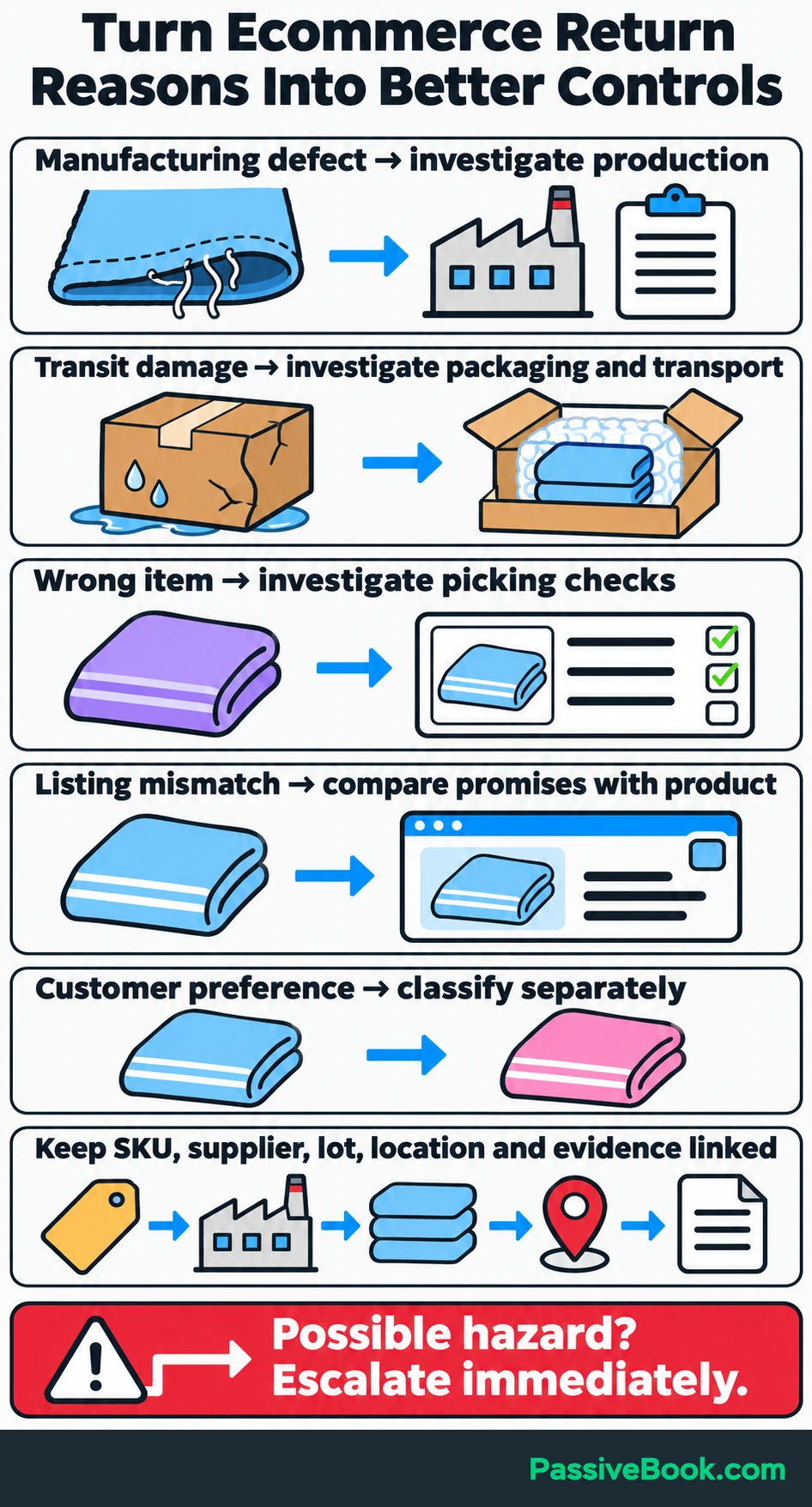
If tea-towel customers repeatedly report shrinkage, compare returned products with the approved wash-test evidence. Investigate fabric or production changes and the reported care conditions before choosing a fix.
Group orders by delivery period; each group is a delivery cohort. Start with a small set of clearly defined measures:
| Measure | What to Count | What It Helps You Investigate |
|---|---|---|
| First-pass batch acceptance | Batches accepted at their first completed inspection ÷ all batches receiving a first completed inspection in the period | Repeated failures before release |
| Quality-related order returns | Delivered orders with a confirmed quality-related return ÷ delivered orders in the same delivery cohort | Product problems reaching customers |
| Transit damage | Delivered orders with confirmed transit damage ÷ delivered orders in the same delivery cohort | Packaging and transport failures |
| Wrong-item shipments | Delivered orders with a confirmed picking error ÷ delivered orders in the same delivery cohort | Picking and order-verification failures |
| Corrective-action completion | Actions due in the reporting period that were completed by their due date ÷ all actions due in that period | Overdue work that leaves known problems open |
For the quality-return rate, count each affected order once, even if it contains several defective items.
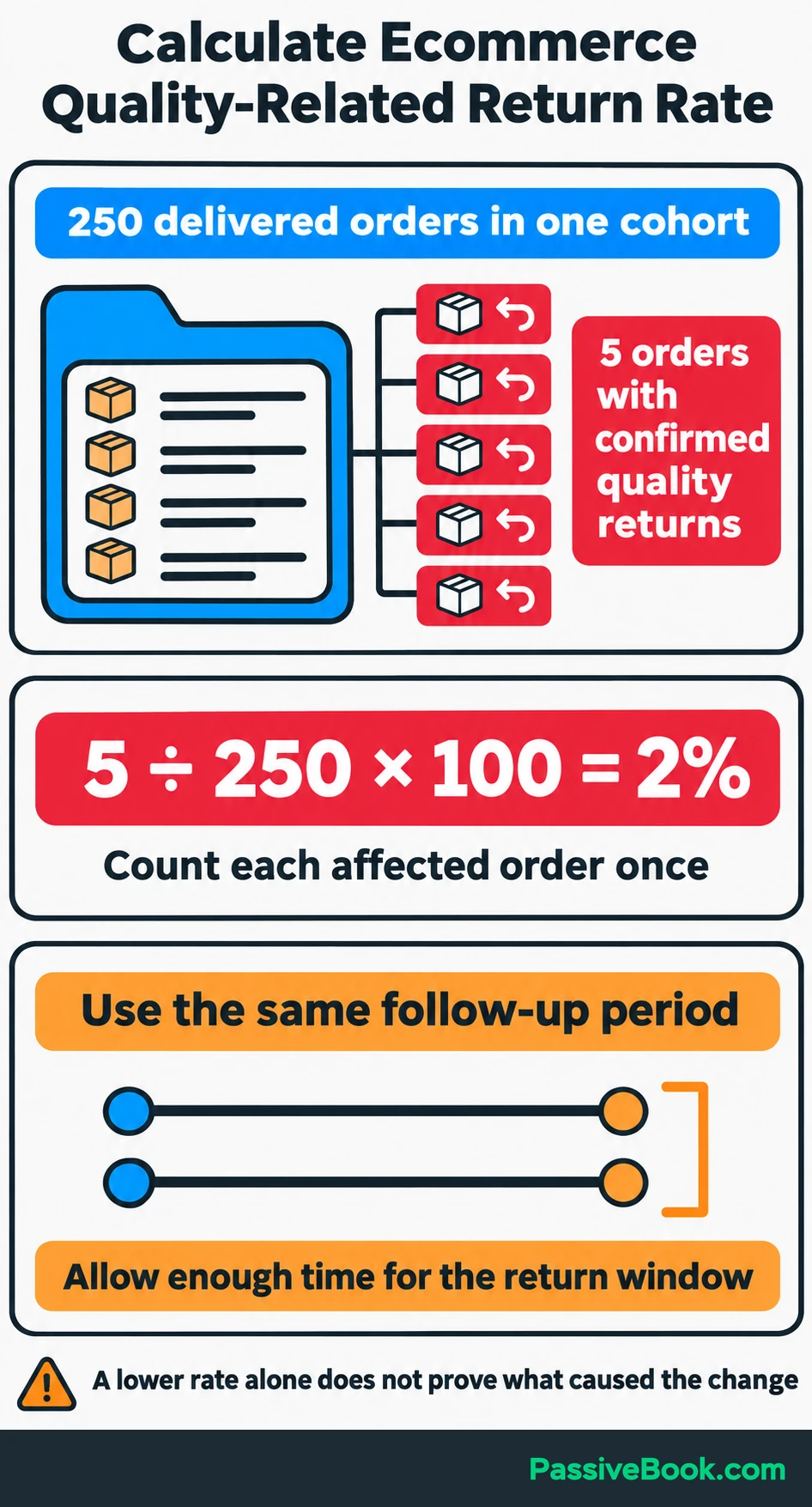
Suppose five orders have confirmed quality-related returns among 250 delivered orders from the same delivery cohort:
5 ÷ 250 × 100 = 2%
Before comparing delivery cohorts, give every order the same follow-up period, long enough to cover your return window. Otherwise, recent orders have had less time to produce returns.
Use these figures to decide where to investigate. A lower return rate after a process change is useful evidence, but it does not by itself prove the change caused the reduction.
Scale Quality Controls Without Unnecessary Headcount
Allocate Spending to the Controls That Matter
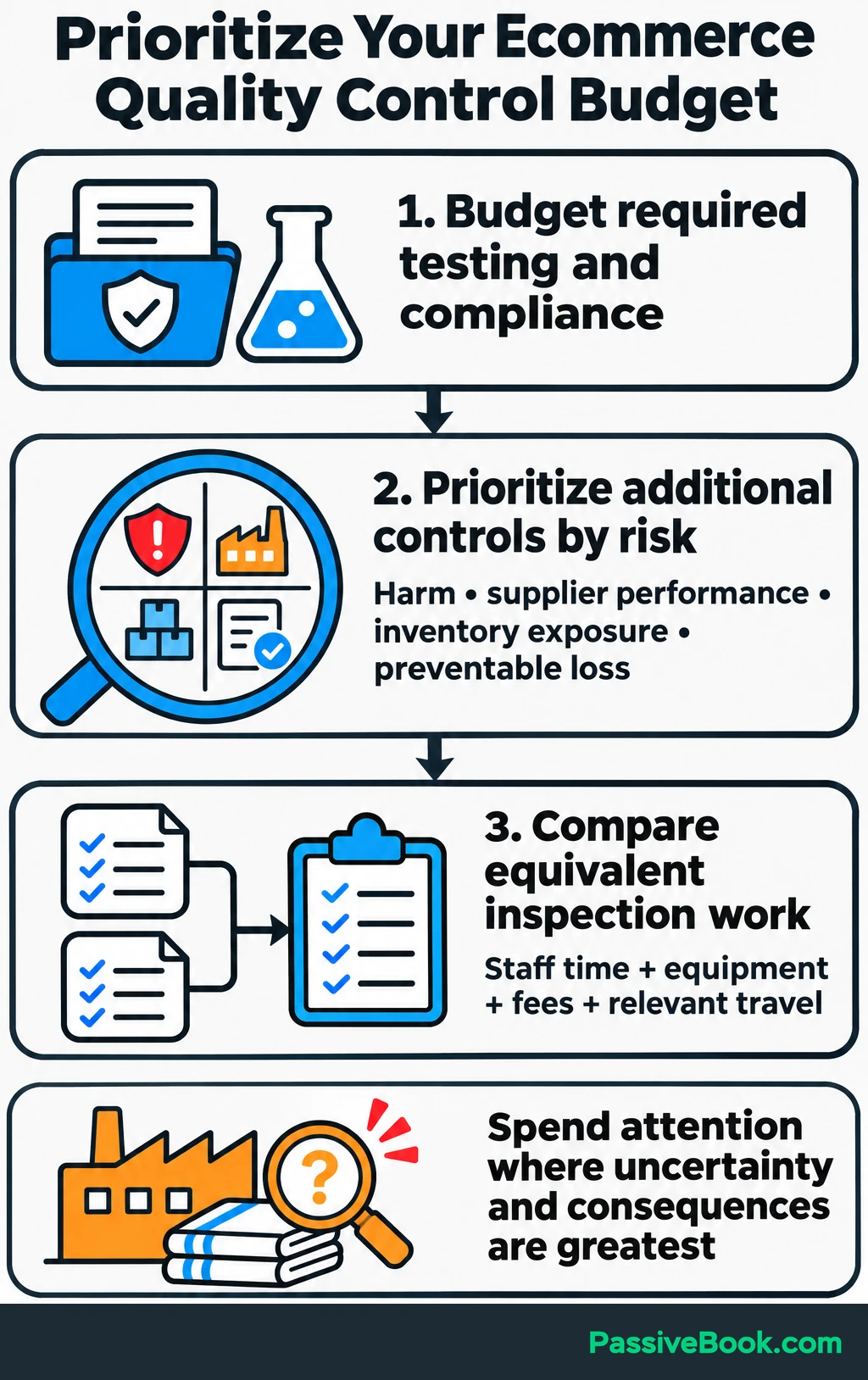
Budget required testing and compliance work first. Then prioritize additional checks by potential harm, supplier performance, inventory exposure and how much loss the check can realistically prevent.
Compare equivalent work when deciding between internal and outsourced inspection. Include staff time, equipment, inspection fees and travel where relevant.
Estimate avoidable failure costs carefully. Include rework, replacement shipping, refunds or disposal as appropriate, but do not count the same loss twice.
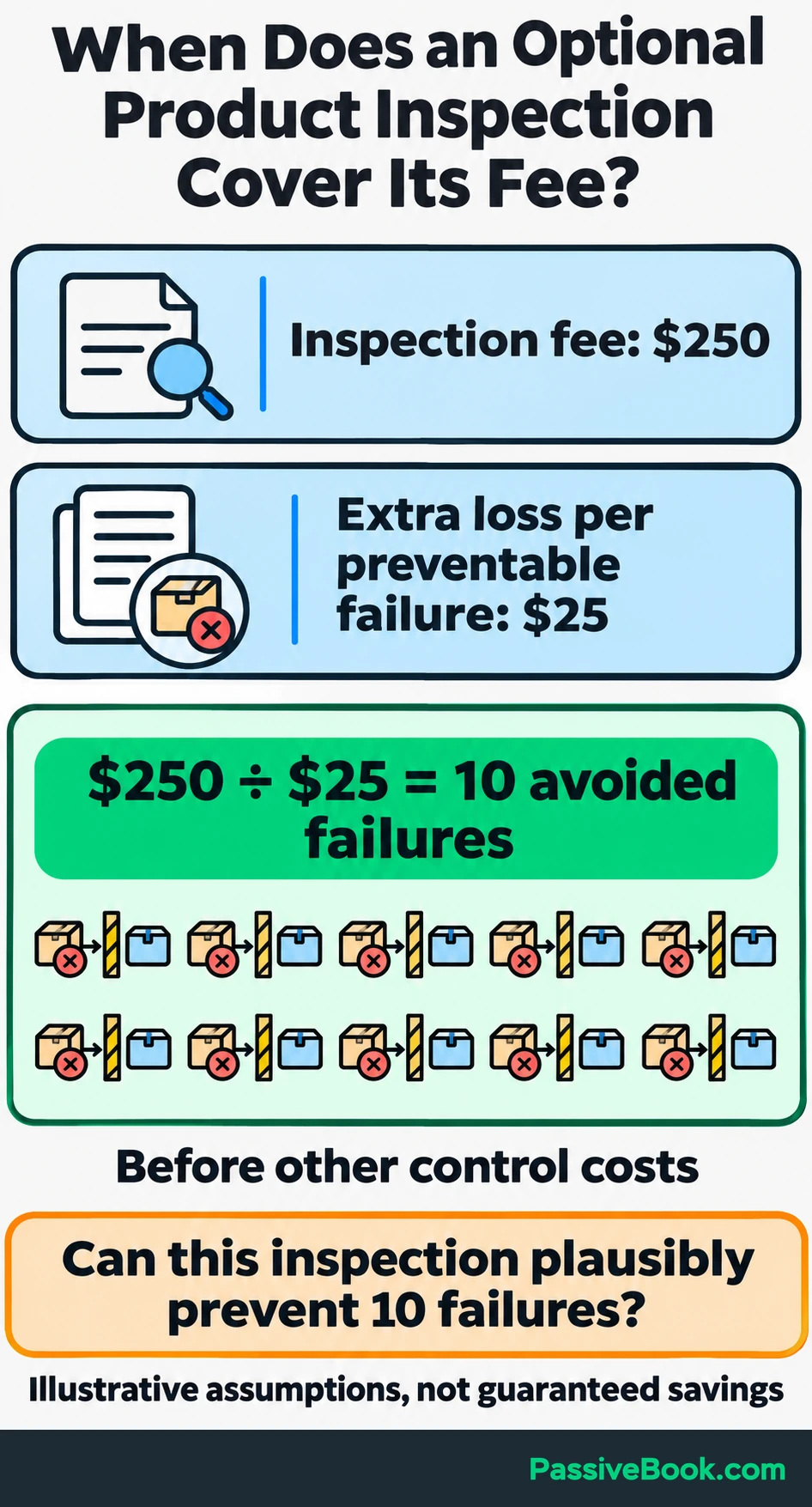
For the tea-towel store, suppose an optional inspection costs $250 and each preventable failure would create an additional $25 loss. Count only the extra loss associated with that failure, using consistent assumptions.
$250 ÷ $25 = 10 avoided failures
Ten avoided failures would cover the inspection fee before other control costs. You still need a plausible reason to believe the inspection could prevent that many failures.
I would spend more attention on a new supplier’s first production run than on adding another cosmetic check to a stable product. Mandatory requirements remain part of the cost of selling either way.
Automate Administration and Keep Decisions Accountable
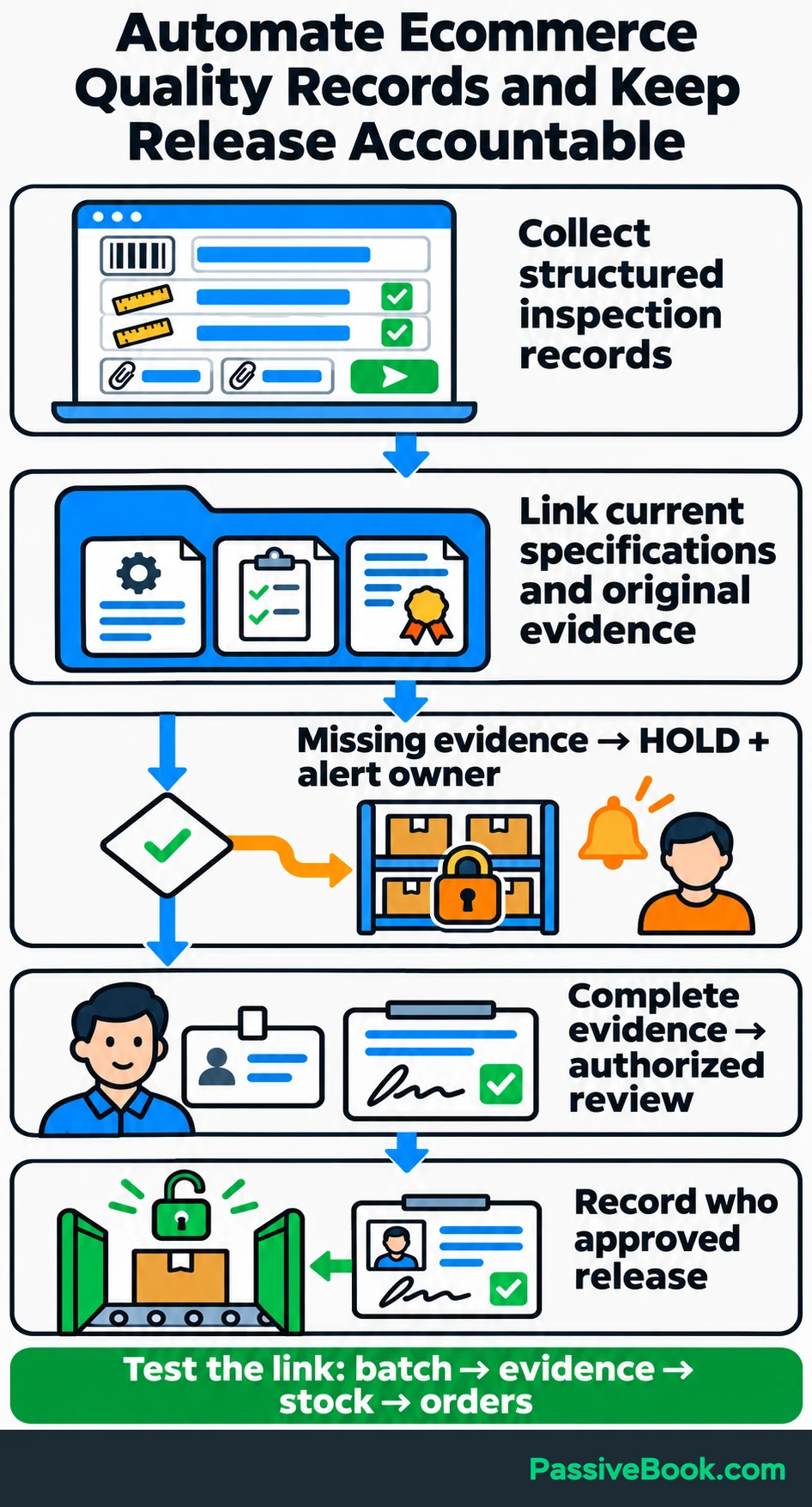
Start with shared specifications, structured inspection forms, linked evidence folders and clear inventory statuses.
A spreadsheet can manage a simple operation if the records stay connected and access is controlled. Add dedicated software when multiple locations, permissions or traceability become difficult to manage reliably.
For a WordPress store, Fluent Forms can collect inspection records. Make or n8n can connect those submissions to reminders, document storage and assigned tasks. Choose the tools that fit your existing setup.
Useful automations include:
- Inspection reminders triggered by expected production or delivery dates.
- Missing-document alerts before a planned shipment.
- Failed-check notifications sent to the responsible person.
- Corrective-action reminders tied to due dates.
- Regular reports grouped by supplier, SKU and failure type.
Keep release approvals attributable to an authorized person. Design the workflow so incomplete evidence leaves the batch on hold.
I would use AI to group complaint themes or summarize inspection findings, then review its output against the original records. Preserve the reports and certificates themselves.
Assign document owners, version controls and retention periods based on applicable requirements and operational needs. An automation pointing to an outdated specification simply spreads the wrong instructions faster.
Finally, test traceability. Pick a batch and locate its evidence, remaining stock and associated orders. Any broken link gives you a specific process to repair.
Review controls after supplier, material, product or market changes, and when documented performance changes. If you use a formal sampling scheme, follow its switching rules when adjusting inspection intensity.
What Next?
Pick one product from your next delivery and write its pass/fail checklist. Name the person who can release it and decide where held stock will go.
Use the social buttons to share this guide when clearer supplier instructions and fewer shipment surprises would make a useful conversation.
Which product check is hardest to make repeatable in your store? Share your answer in the comments, and bring any other questions about setting up the process.
Share this post with your friends & followers:

