A large order is ready to pack, but the buyer has tried several cards and now wants express delivery to a different address. Shipping could turn a suspicious payment into lost stock. Canceling could cost you a real customer.
The difficult part is deciding which orders need another check without making every buyer work harder to pay. The checks and review rules below help you decide when to hold a shipment, how to resolve a warning, and where a smaller store should spend its fraud-prevention budget.
Match Common Fraud Types to Their Defenses
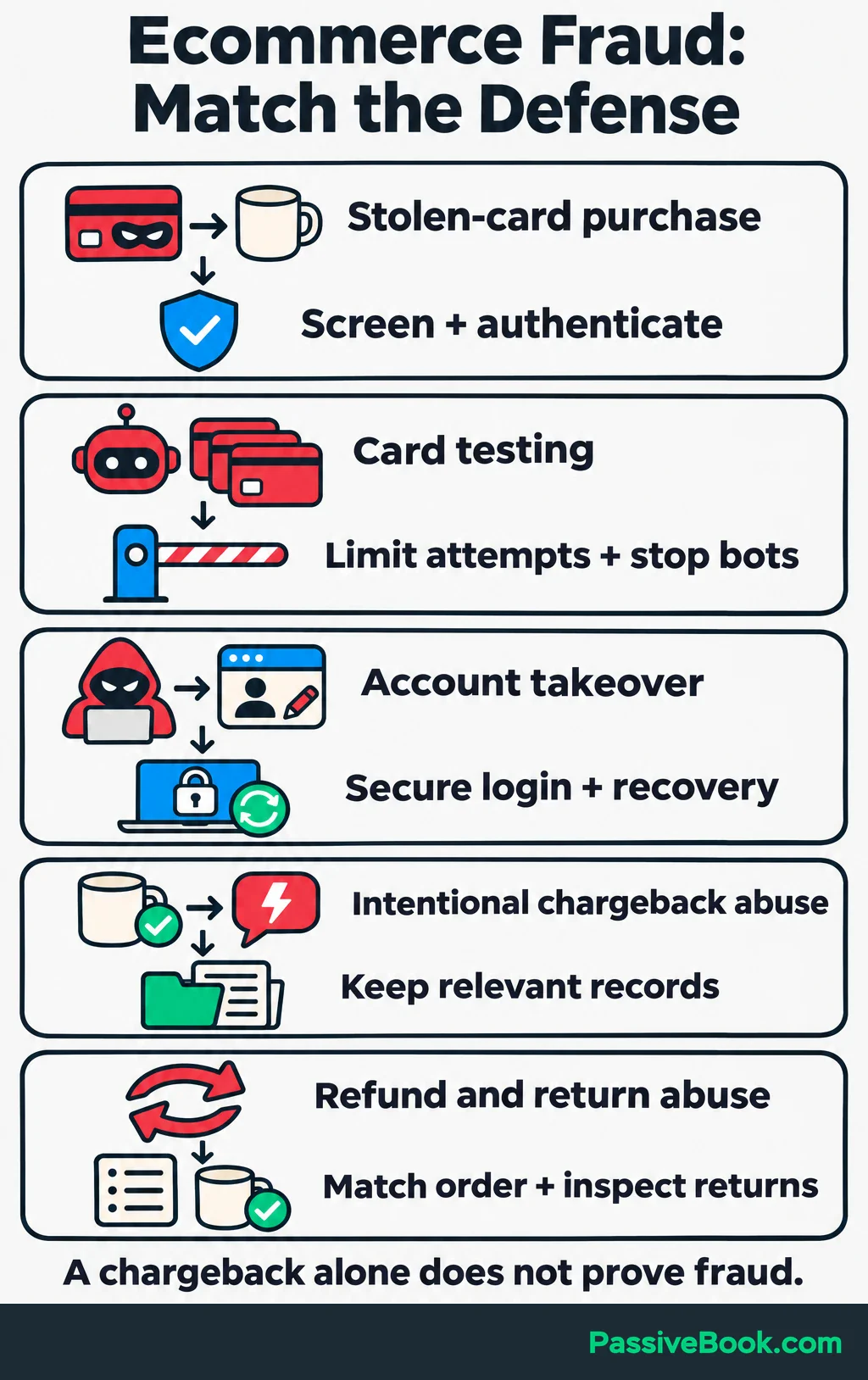
Start by identifying what someone could misuse: a payment card, a customer account, your refund process, or the dispute system. Each needs a different defense.
| Fraud Type | What Happens | First Defense |
|---|---|---|
| Stolen-card purchases | Someone buys goods using card details without the cardholder’s permission. | Screen payments and use supported cardholder authentication. |
| Card testing | Bots try card details to find which ones work. | Limit payment attempts and protect payment and card-saving flows from bots. |
| Account takeover | An attacker gets into a customer’s account and uses its saved details or changes them. | Protect login, recovery, and sensitive account changes. |
| Intentional chargeback abuse | A buyer knowingly disputes a purchase they authorized. | Keep relevant payment, communication, and fulfillment records. |
| Refund and return abuse | Someone requests duplicate refunds, redirects repayments, or returns different goods. | Match refunds to original orders and inspect returned items. |
A chargeback is a payment reversal through the card dispute process. It does not, by itself, prove fraud. An unfamiliar billing name, a missing parcel, or your own shipping mistake can also lead to a dispute.
For the examples below, imagine you run an online store selling handmade ceramic mugs. Your main checkpoints are before shipping an unusual order and before refunding returned goods. The incidents and figures are illustrative.
I would begin with the protections already available in your store and payment processor. Add another paid service when you can name the gap it needs to close.
Protect Customer and Staff Accounts
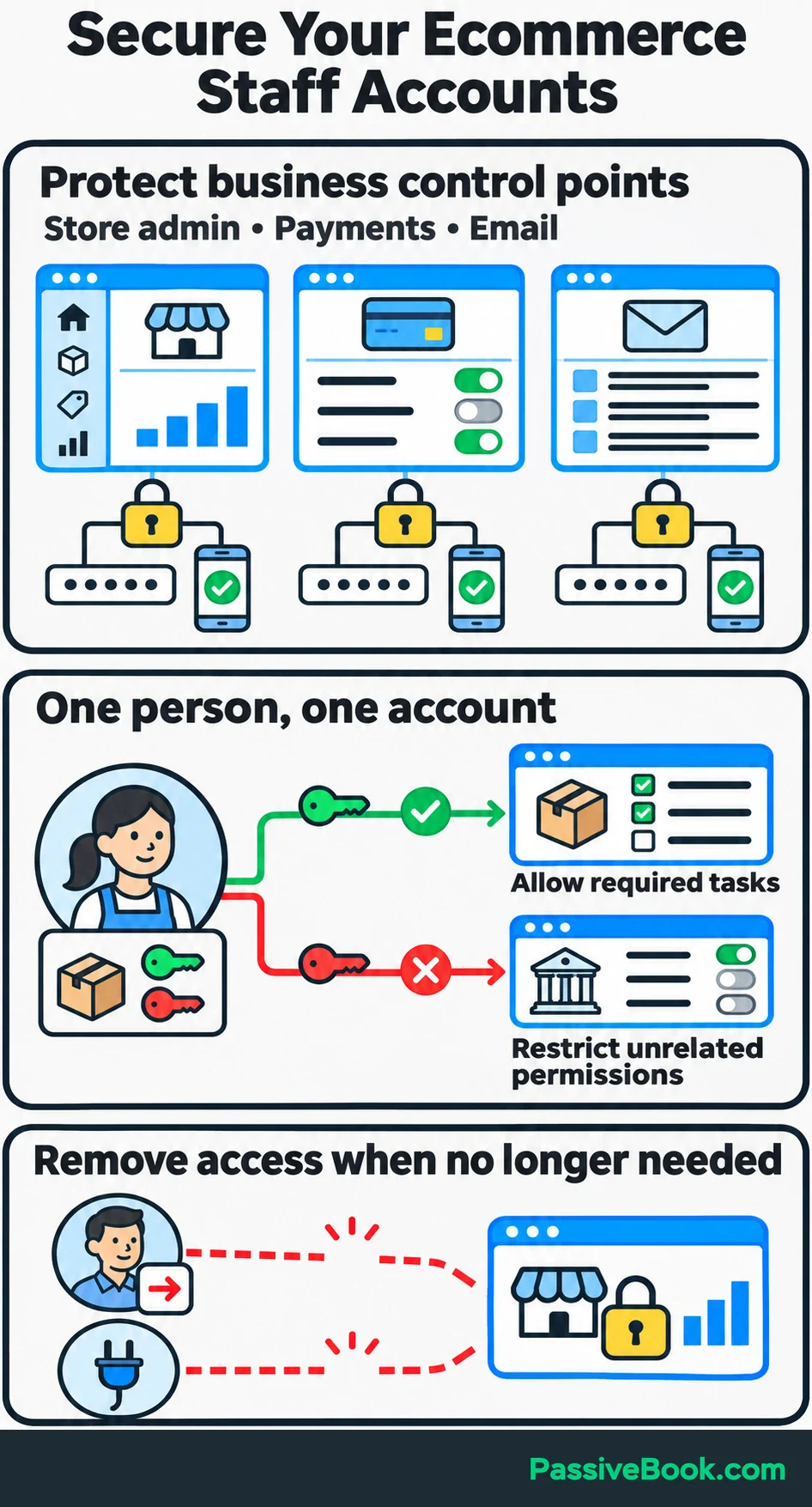
Secure the accounts that control the business first. Require multifactor authentication, or MFA, for store administration, payment dashboards, and business email. It adds another proof of identity beyond a password.
Give each staff member an individual account and access only to the tasks they handle. Someone packing orders rarely needs permission to change bank details. Remove access when a person leaves or an integration is no longer used.
Then check the less visible parts of account security:
- Recovery: Protect backup codes and use the platform’s established password-reset process.
- Login Attempts: Enable throttling, which slows repeated attempts to guess passwords.
- Maintenance: Keep your store, payment extensions, and integrations updated, and remove unused components.
- Sensitive Changes: Require customers to verify their identity again before changing an email address or password. Require the same check before a delivery-address change when account activity looks suspicious.
OWASP’s authentication guidance supports throttling and fresh authentication for sensitive actions.
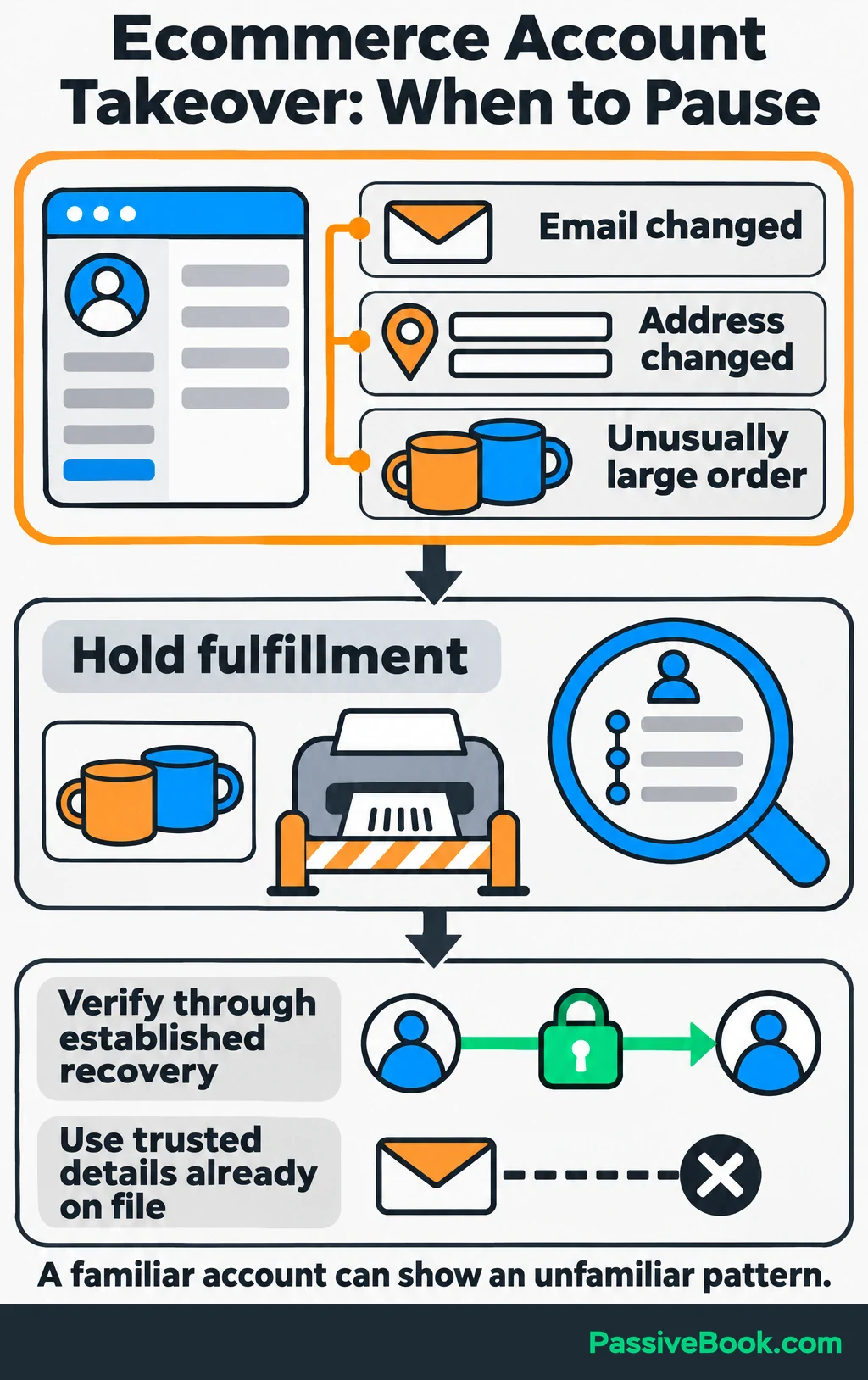
Suppose a returning mug customer changes their email and delivery address, then places an unusually large order. Hold fulfillment and check the earlier account activity. Verify account ownership through the established recovery process or a trusted channel already on file, rather than relying on the newly supplied contact details.
A familiar account name should not give an unfamiliar pattern a free pass.
Secure Checkout Against Payment Fraud
Keep Card Details in the Provider’s Payment Flow
Use a maintained hosted checkout or an embedded payment integration that sends card details directly to the payment provider. Avoid collecting them through ordinary website forms, email, or support messages.
For saved cards, use the provider’s tokenized payment feature. Your store uses a reference to the payment method instead of keeping the full card number itself.
This approach reduces your exposure to sensitive card data, as Stripe’s integration security guide explains. Keep HTTPS active and remove checkout scripts that serve no useful purpose.
You still need to confirm your remaining PCI DSS responsibilities—the payment-card security requirements—with the organization that manages your compliance, usually your acquiring bank or payment provider.
Never store CVV, the card’s security code, after authorization. That includes logs and support records, and encryption does not make storage acceptable. PCI SSC explicitly prohibits this.
Use Verification and Authentication Selectively
Collect the security code and supported billing details through the provider’s card-entry form.
Two checks deserve a clear distinction:
- CVV Check: Compares the supplied security code with records held by the card issuer—the bank or company that issued the card.
- Address Verification Service: Compares supported parts of the billing address with the issuer’s records.
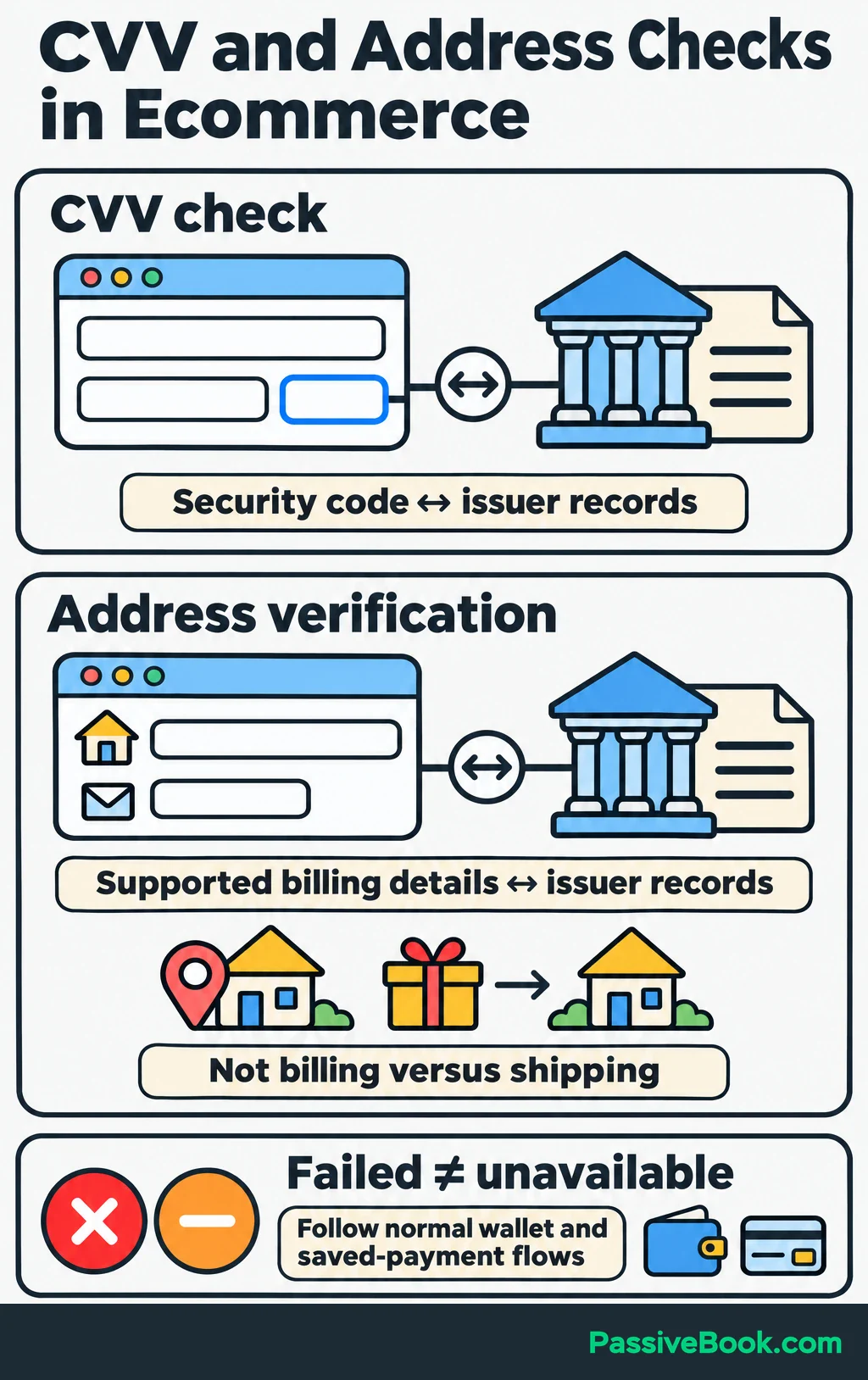
Address verification does not compare billing and shipping addresses. A gift sent to another household can have perfectly valid billing details. Stripe explains these card-verification checks here.
Read “failed” and “unavailable” separately. An unavailable check is not a mismatch. Follow the provider’s normal flow for wallets and saved payments rather than forcing every payment through identical fields.
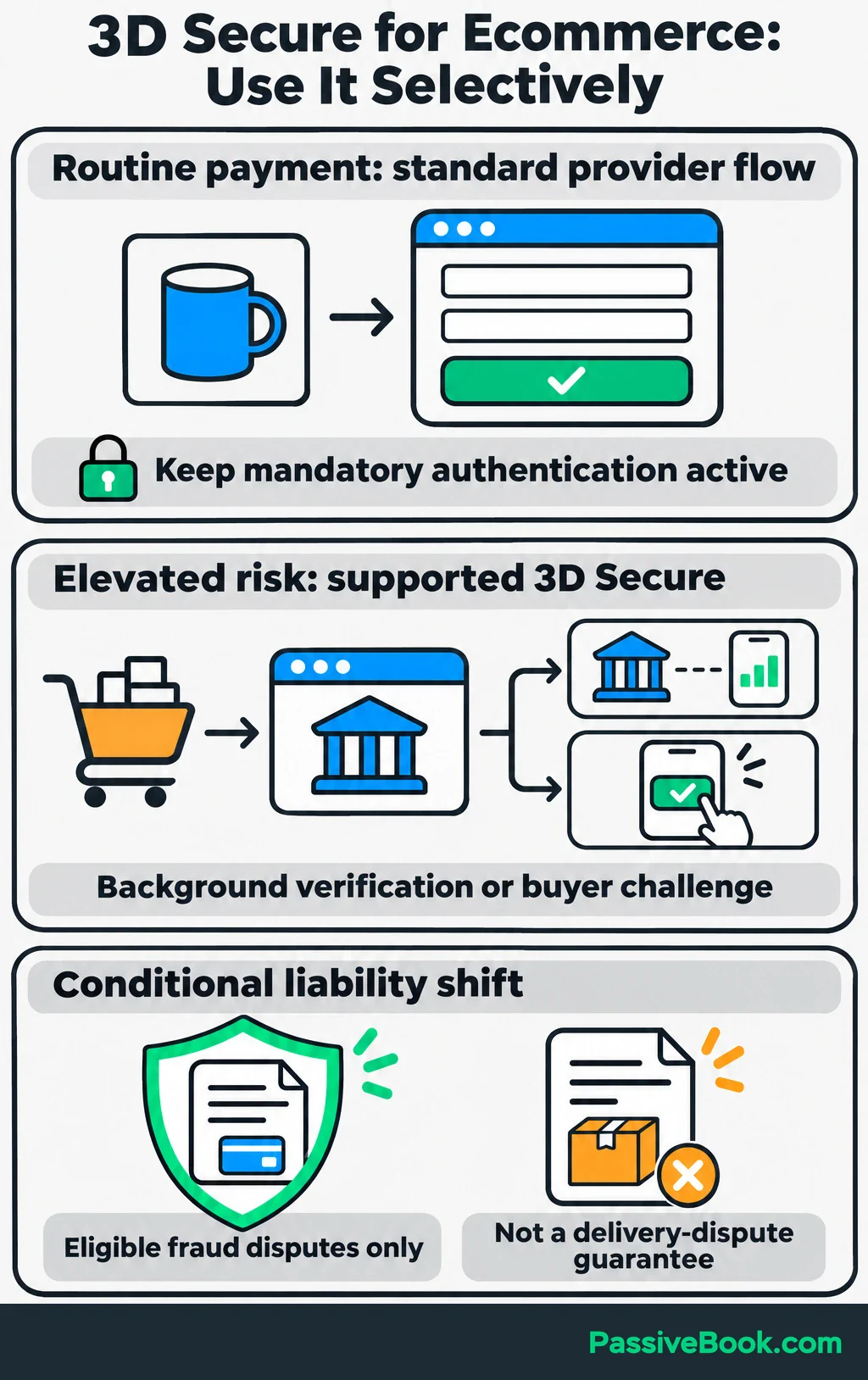
For elevated-risk card payments, enable supported 3D Secure authentication while keeping mandatory authentication active. The cardholder’s bank may verify the payment in the background or ask the buyer to complete a challenge.
Successful authentication can shift responsibility for eligible fraud disputes to the issuer, subject to network and transaction conditions. It does not guarantee protection or settle a claim that the mugs never arrived. Those limits are covered in Stripe’s 3D Secure guidance.
I would use extra authentication where risk justifies it and let routine purchases follow the provider’s standard flow.
Limit Automated Payment Attempts
Watch payment attempts as well as completed orders. A sudden burst of failures, repeated card changes, or unusual card-saving activity deserves attention.
Card testing can happen when someone adds a card to an account without buying anything. Looking only at your order list can miss the attack.
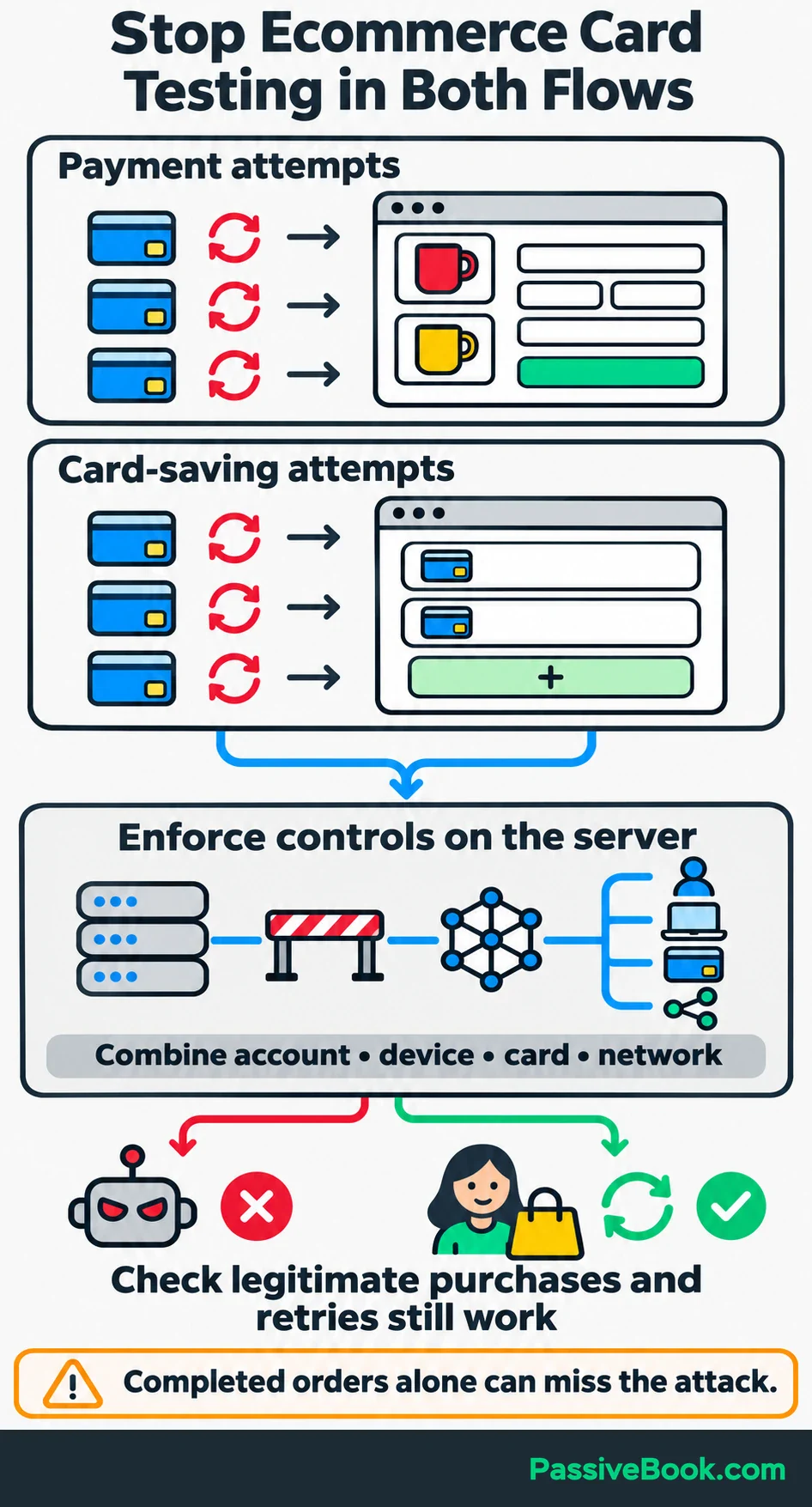
Use your provider’s protections, then check that attempt limits and bot controls cover both payment and card-saving requests. Limits must be enforced on the server, where changing browser behavior cannot bypass them.
Combine available account, device, card, and network signals. One IP-address block is a thin defense on its own. Stripe’s card-testing guidance recommends combining controls and tailoring them to the activity you see.
During an attack, contact your processor and platform or integration provider. Identify the affected flow, tighten its controls, and check that ordinary purchases and legitimate retries still work.
Screen Orders Before Fulfillment
Assess Signals Together
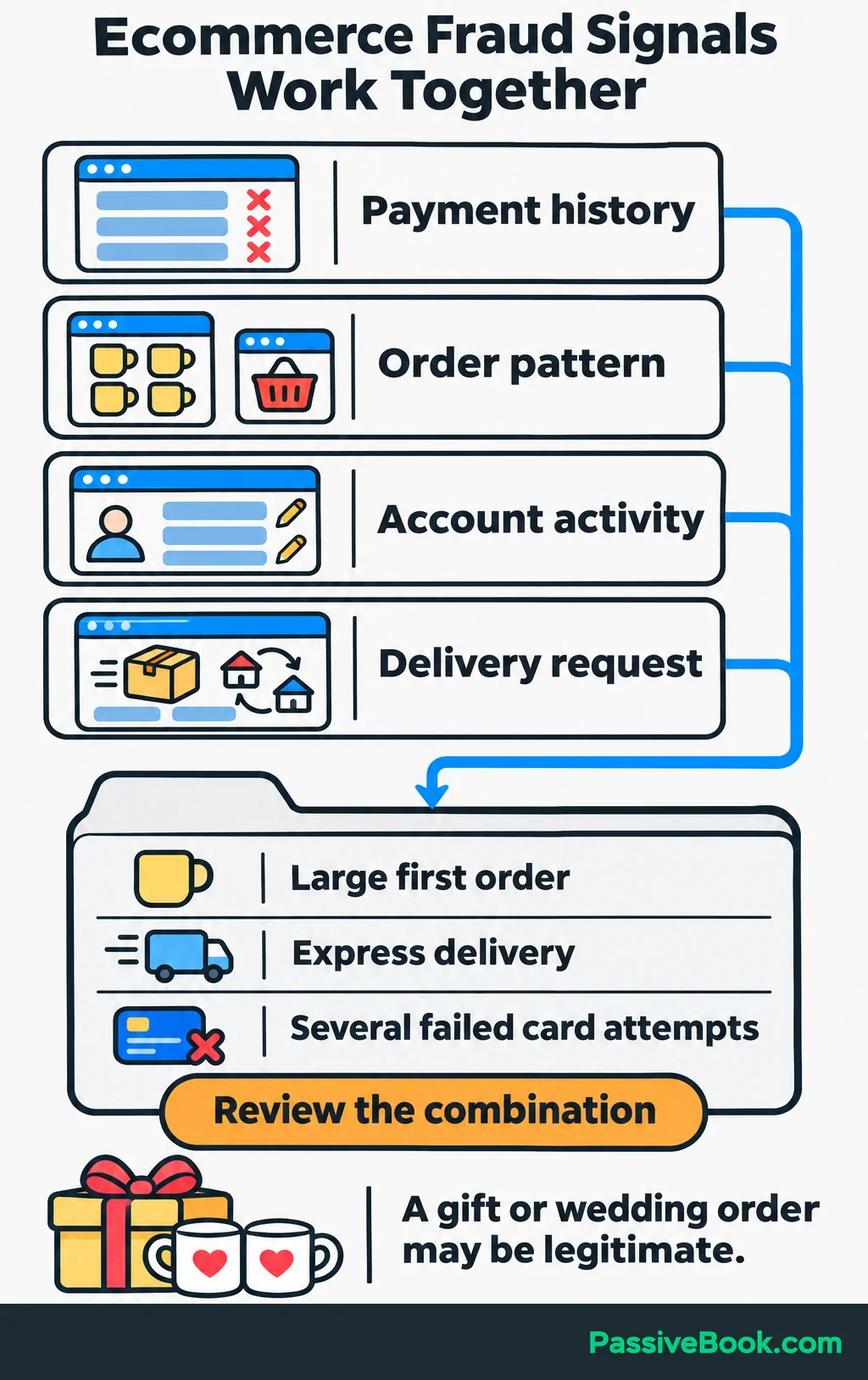
Review the payment provider’s risk assessment alongside the order’s actual behavior:
- Payment History: Failed attempts, cards tried, and verification results.
- Order Pattern: Value and quantity compared with normal purchases.
- Account Activity: Recent recovery, contact changes, or unusual login activity.
- Delivery Request: Express shipping, address changes, or unusual collection arrangements.
No single item tells the whole story. Different billing and shipping addresses can mean a gift. A large order can mean a wedding. Express delivery can mean someone forgot the wedding.
Set thresholds around your own buying patterns. A quantity that is unusual for individual customers may be normal for your wholesale buyers.
For the mug store, a large first order with express shipping and several failed card attempts belongs in review. The combination matters more than any one detail.
Set Approve, Review, and Decline Rules
Give each order a clear destination.
| Decision | When to Use It | What Happens Next |
|---|---|---|
| Approve | The order fits normal patterns and passes the required checks. | Release it for fulfillment once payment requirements are complete. |
| Review | Several signals create uncertainty that further checks could resolve. | Hold fulfillment and assign a reviewer. |
| Decline | The processor blocks the payment or checks establish an attack. | Stop the order and follow the provider’s cancellation process. |
The review rule must stop shipping. An alert that arrives after the parcel leaves is mostly paperwork.
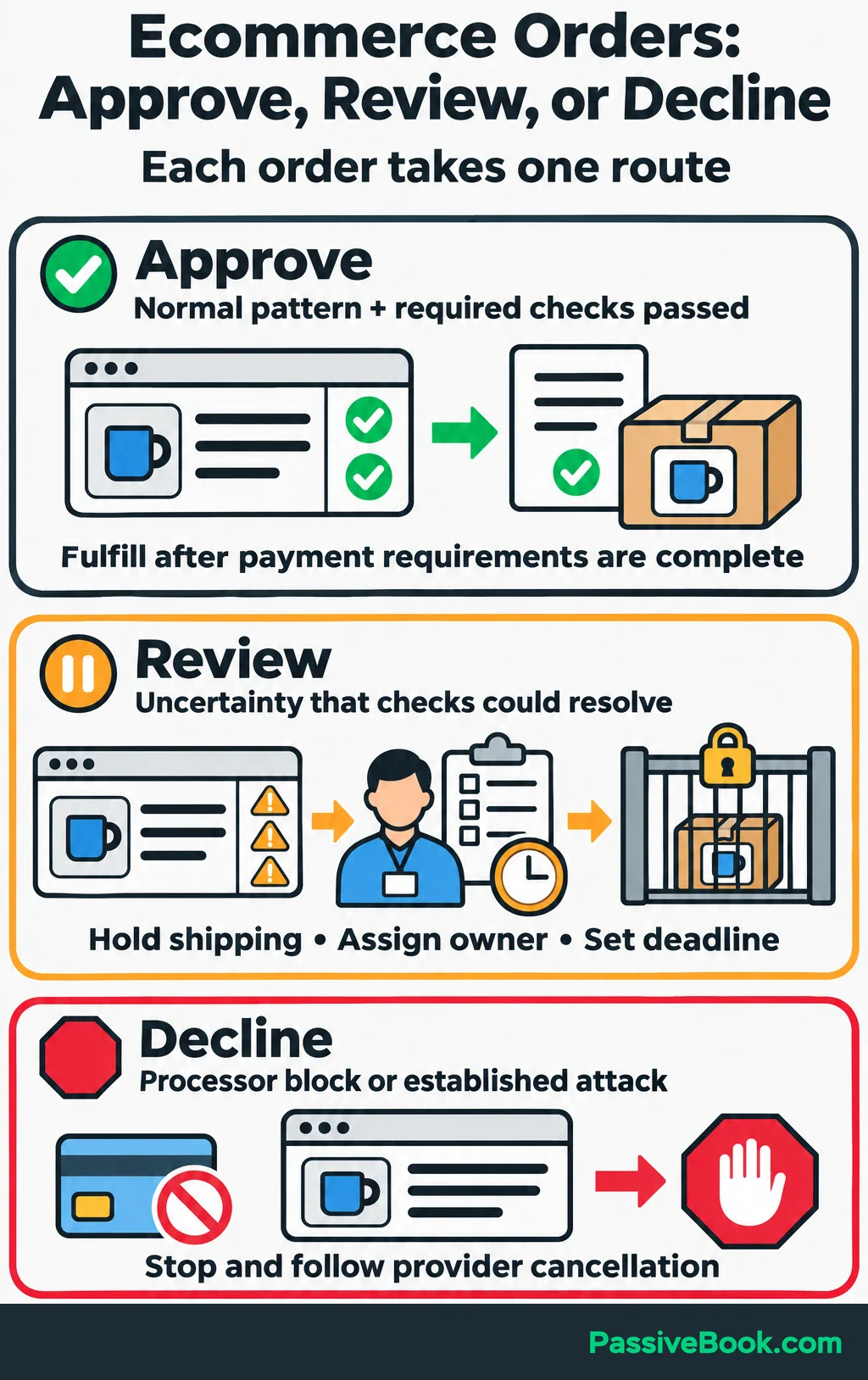
Test that held orders stay out of packing lists, warehouse queues, and automatic shipping integrations. Assign a review owner, a short checklist, and a deadline before the promised dispatch time. Record the decision and why it was made.
Write these rules down so whoever reviews an order knows what to check, what they can decide, and when to ask for help.

Free AI Operations Writer




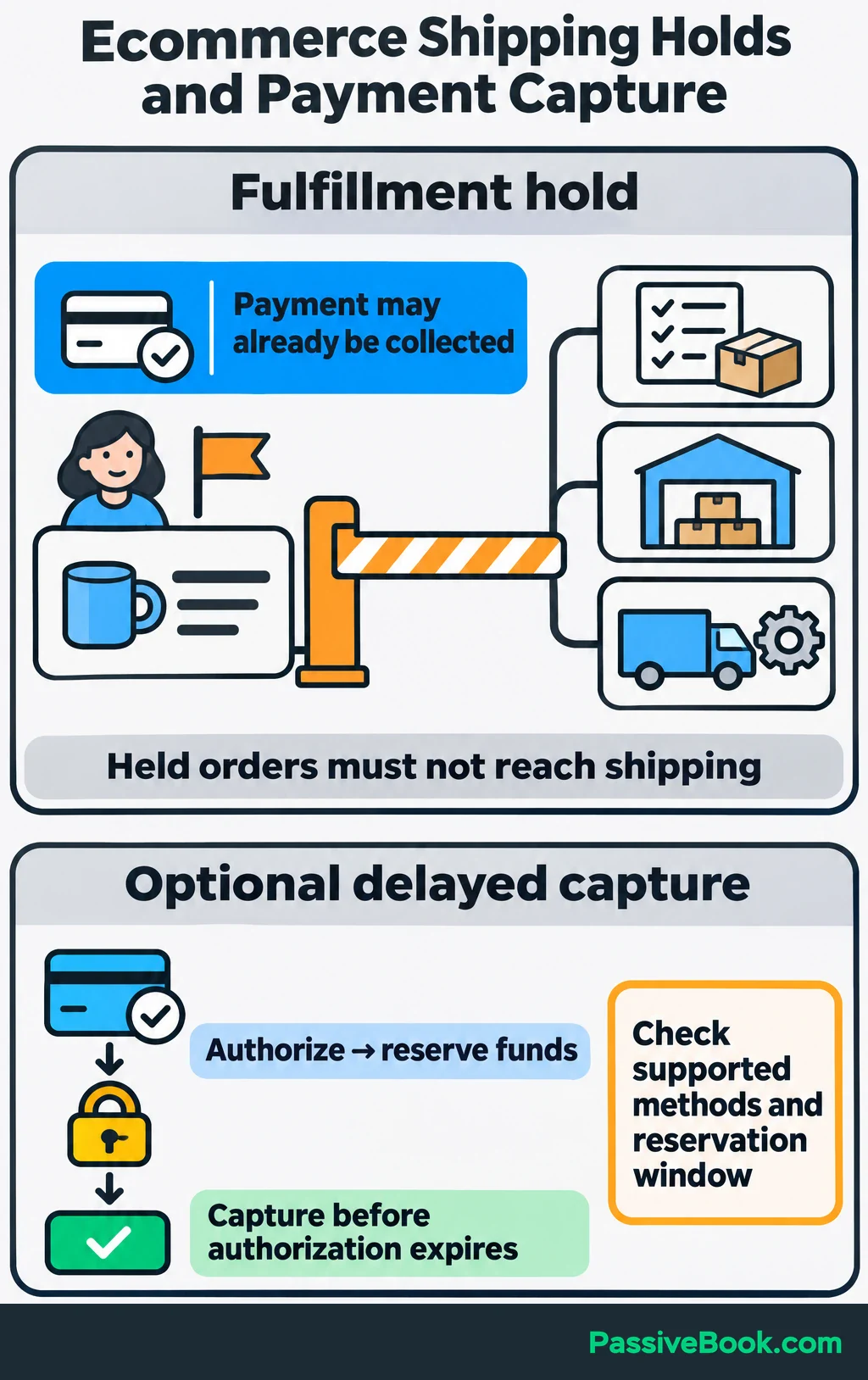
Keep a fulfillment hold separate from payment collection. For example, Stripe notes that payments in review are typically already processed, unless you use delayed capture.
With delayed capture, the card issuer first approves the payment and reserves funds; you collect them later. Check which payment methods support this and how long the funds remain reserved. You must collect payment before that reservation expires. I would start with a shipping hold unless delaying collection solves a specific problem.
Resolve Flagged Orders Safely
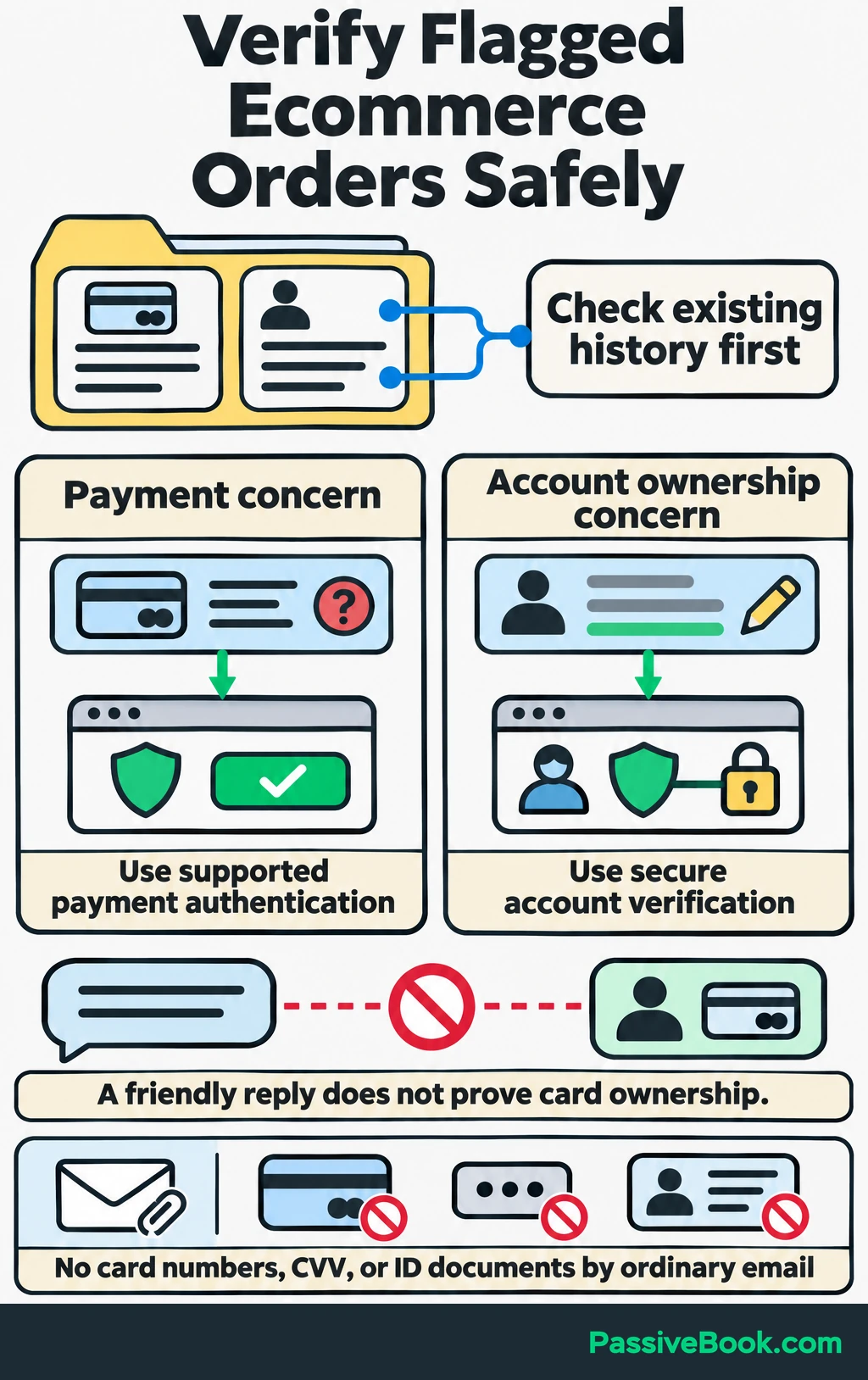
Check related transactions and account history before contacting the buyer. You may already have enough information to understand the flag.
Then choose verification that addresses the concern. Payment authentication belongs in the provider’s supported flow. Account ownership needs secure account verification. A friendly reply does not establish that someone owns the card.
When the payment provider has created a verification request the customer can complete through your store, explain the hold without accusing them:
“We’ve paused dispatch while we complete a payment check. Please sign in through our store to complete the verification request.”
Tell the customer when to expect a decision. Do not ask for full card numbers, CVV, or identity documents by ordinary email.
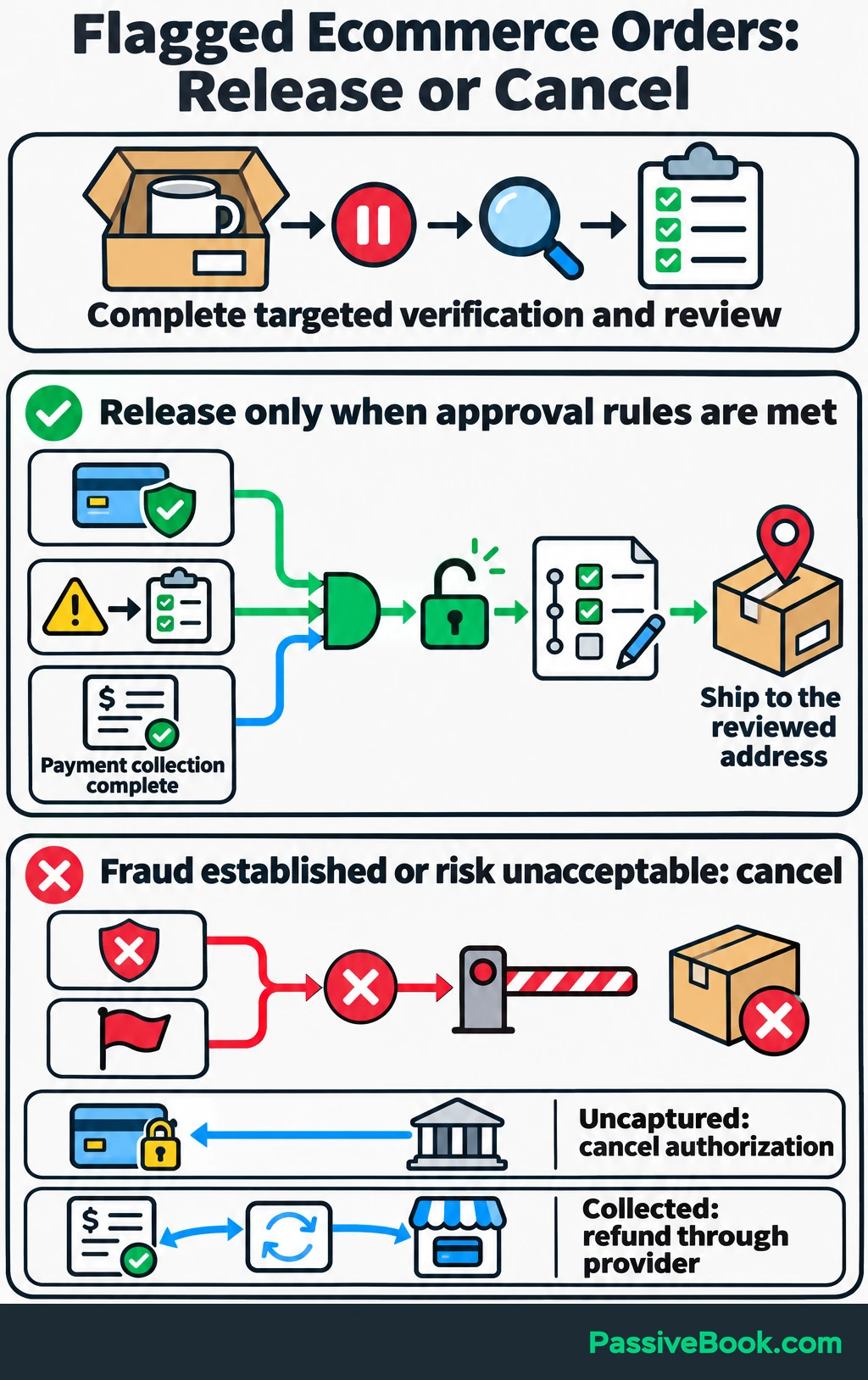
For the mug order flagged after several card attempts, suppose the buyer completes the provider’s payment authentication and your review finds no unresolved warning signs. If the order now meets your approval rules and payment collection is complete, record the decision and release the parcel to the reviewed address.
If checks establish fraud or leave unacceptable risk unresolved, cancel the order. Cancel an uncaptured authorization or refund a collected payment through the provider’s workflow.
Control Delivery Changes and Refunds
Recheck Delivery Changes
Ship to the address you reviewed and keep tracking and delivery confirmation with the order.
A later request to change the address, reroute the parcel, or arrange collection creates a new decision. Pause fulfillment while you verify it and record the approved destination.
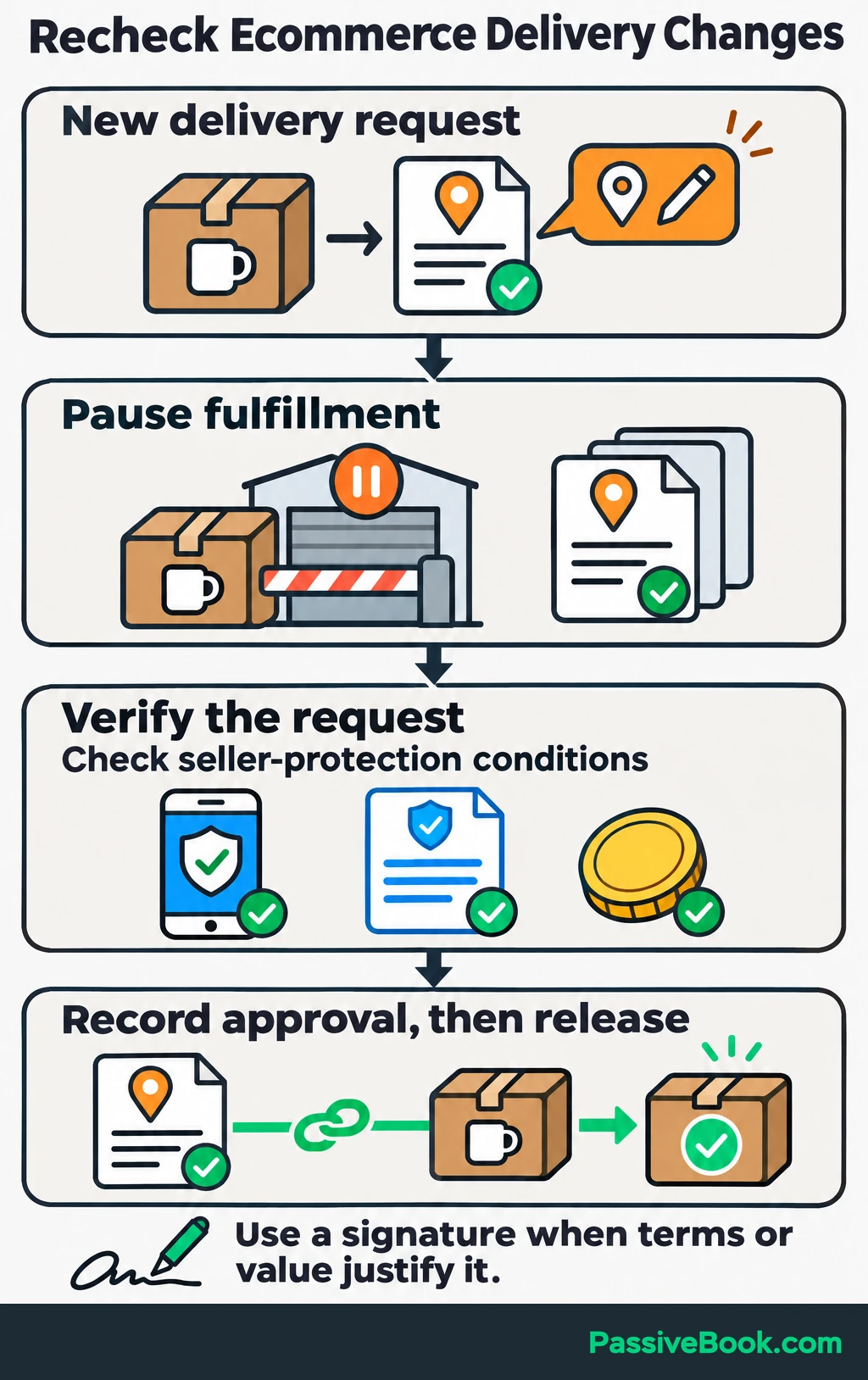
For the mug store, “Please send it to this other address instead” should not bypass the review that cleared the original order.
Check any seller-protection requirements before changing fulfillment arrangements. Use a signature service when those terms require it or the order’s value justifies the extra cost. I would not add a signature requirement to every small parcel by habit.
Refund Against the Original Order
Before refunding, match the request to the order and check its payment history. Look for completed refunds, pending refunds, and open disputes. If a dispute is open, use the provider’s dispute process to avoid reimbursing the same purchase twice.
A second support message is not a second refund entitlement. Keep the refund status visible so another person—or another automation—does not issue it again.
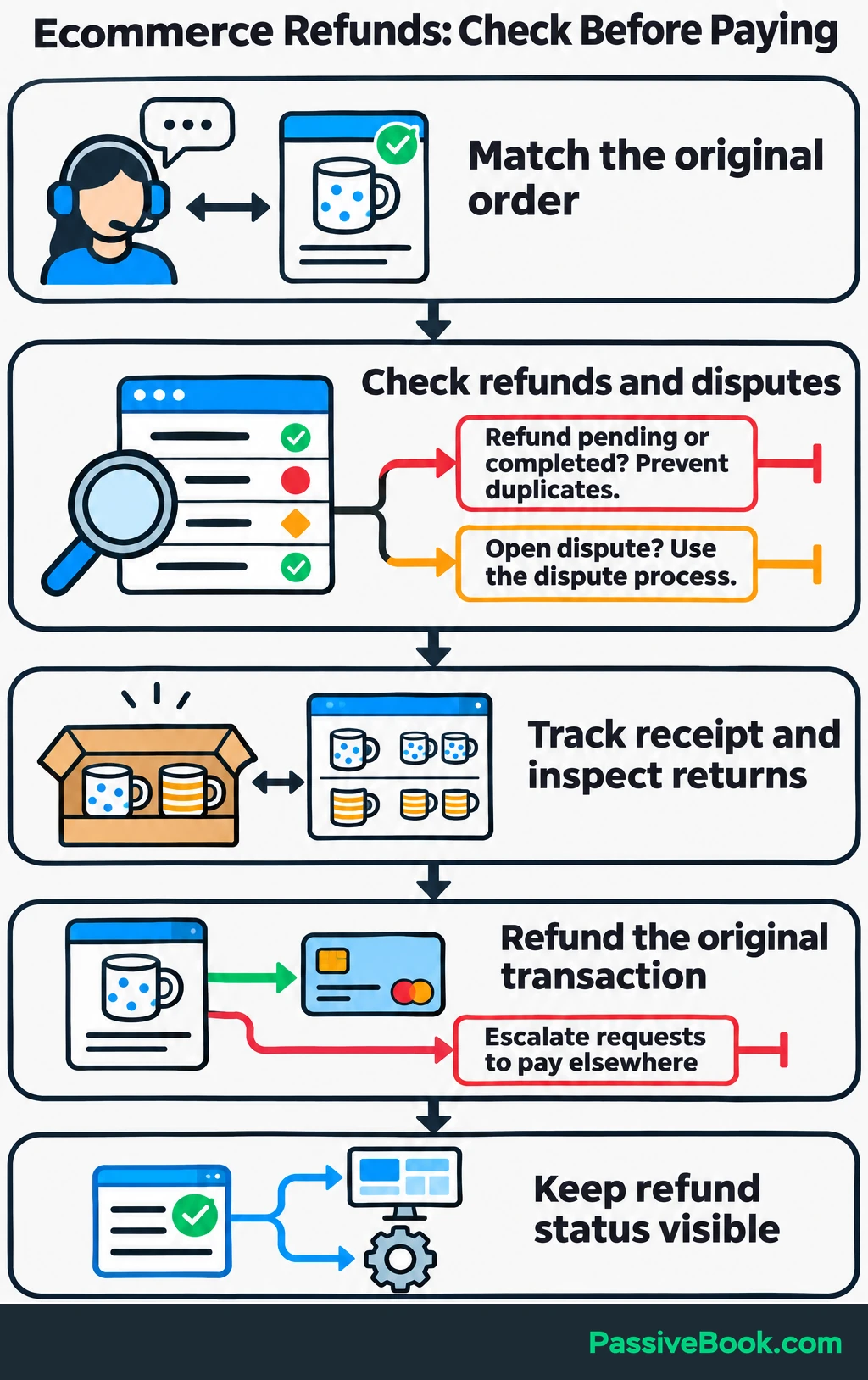
Refund through the original transaction and escalate requests to send money elsewhere. For Stripe card payments, refunds go back to the original payment method, and the issuer generally handles expired or canceled cards. Stripe’s refund-destination rules explain this.
Track return authorization, receipt, inspection, and refund status together. At the mug store, compare the returned designs and quantities with the order before completing the refund.
Handle genuine breakage through the published damage and returns process. A broken mug is a customer-service problem until there is evidence of deception.
Reduce Preventable Chargebacks
Some disputes start with confusion you can remove before anyone contacts their bank.
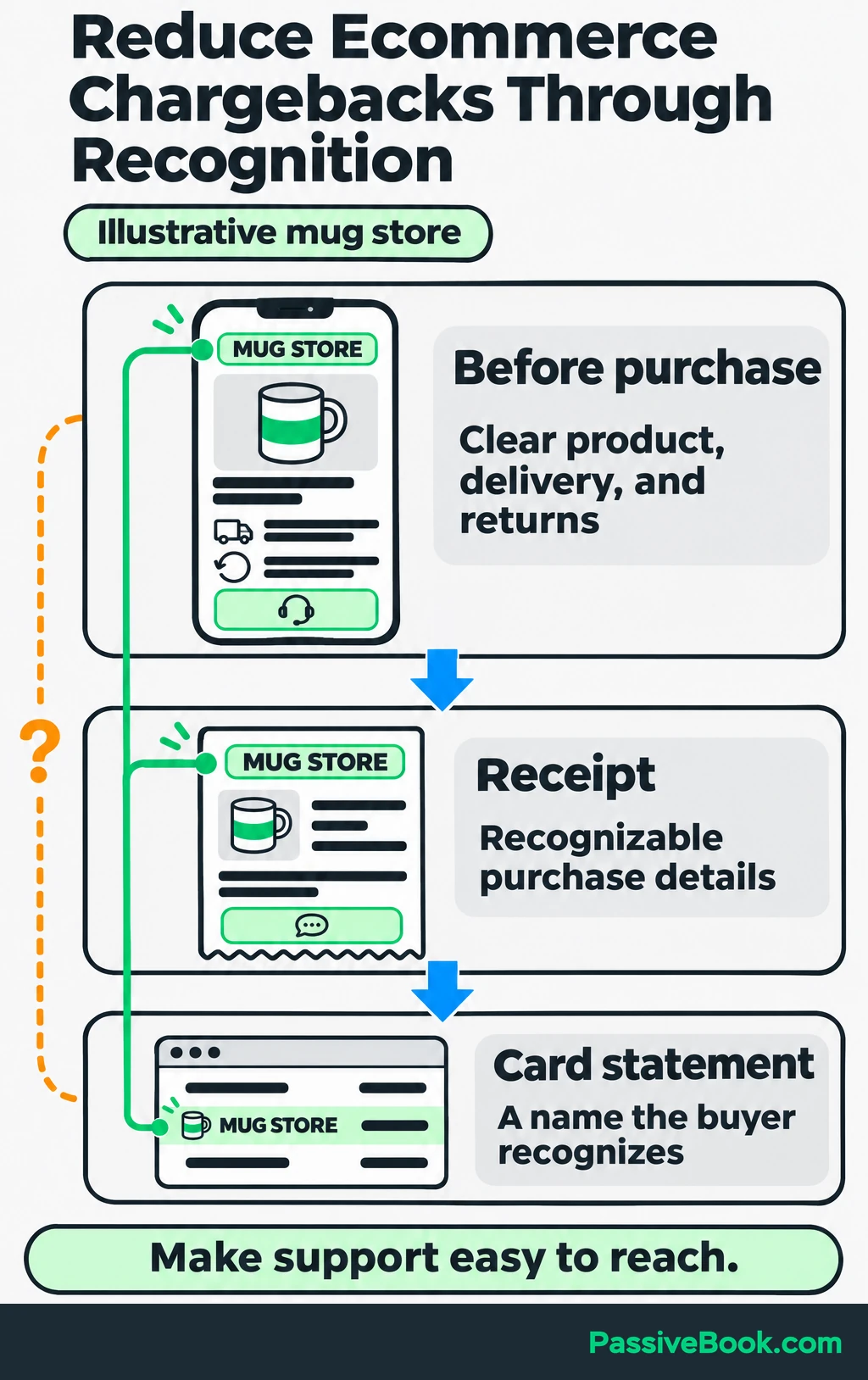
Make product descriptions, delivery expectations, return conditions, and support details easy to find before purchase. Send a recognizable receipt and delivery updates. Check that the statement descriptor—the business name shown on the customer’s card statement—is one they can connect to your store.
When I reviewed the purchase journey on one of my digital-product sites, I spent more time checking the download than the receipt. The receipt felt like admin work. Reading it separately made me notice how much context I expected the buyer to remember.
I would make the same check at the mug store: can a buyer connect the product page, receipt, and card-statement name without doing detective work?
Route genuine billing and delivery problems to someone who can resolve them promptly. Reports of unauthorized purchases also need a person who can investigate and stop unfulfilled shipments.
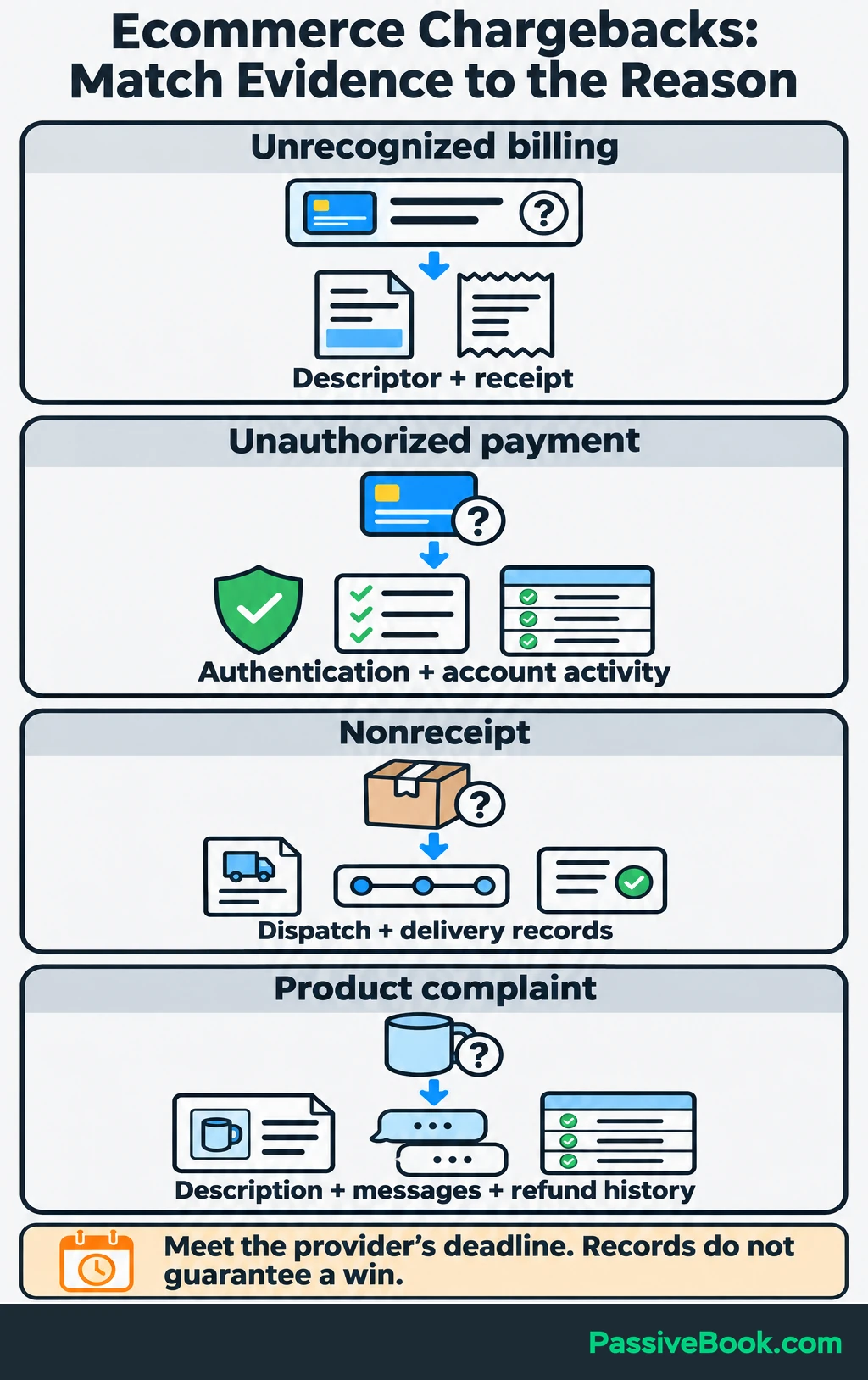
Group disputes by reason so each leads to a useful fix:
- Unrecognized Billing: Check the descriptor and receipt.
- Unauthorized Payment: Review authentication, screening, and account activity.
- Nonreceipt: Check dispatch, tracking, and delivery handling.
- Product Complaint: Review descriptions, quality, and support responses.
Keep order details, authentication records, messages, tracking, delivery confirmation, and refund history together. Submit evidence that answers the stated dispute reason before the provider’s displayed deadline. Stripe’s dispute-response guidance explains why the reason determines the evidence needed.
Good records support your response, but they do not guarantee a win.
Choose Fraud Tools for Your Store’s Gaps
Before buying anything, list what your current setup already does. Check payment screening, account protection, bot controls, review alerts, and shipping holds.
Then describe the missing behavior in one sentence. “We need flagged orders to stop reaching the packing queue” is a buying requirement. “We need more security” is an invitation to collect subscriptions.
| Tool | Compatible Setup | Relevant Controls | Coverage Limits | Added Cost |
|---|---|---|---|---|
| Shopify Fraud Analysis | Eligible orders in a Shopify store. | Fraud indicators and, where eligible, risk recommendations. | Online credit-card orders Shopify can verify; recommendations exclude some order types. | Available within eligible store plans; an upgrade may be needed for recommendations without Shopify Payments. |
| Stripe Radar | Supported payment flows using Stripe; broader arrangements need separate confirmation. | Payment screening; Plus and Pro add custom rules, testing against past payments, and manual transaction reviews. | Payment-method and plan support vary; a payment decision still needs to connect to your shipping process. | Lite is included with standard payments pricing; paid plans offer subscription or usage-based pricing. |
| Your Platform’s Account and Bot Controls | Your store’s login, recovery, payment, and card-saving flows. | Available MFA, login throttling, attempt limits, and bot challenges. | Features depend on the platform and installed integrations; confirm which flows they cover. | Check included features first; extensions or setup work may cost extra. |
Shopify provides fraud indicators on Basic or higher. Recommendations require Grow or higher, or Shopify Payments. Test orders, gift-card-only orders, and subscription renewals are among the cases that do not receive recommendations. Check Shopify’s eligibility and coverage before relying on them.
For Stripe, choose the plan around the controls you need. Custom rules are useful when you have a pattern to address and enough order history to assess the effect. They are not a reason to upgrade by themselves. Stripe’s Radar comparison and pricing show the available features and charging options.
Pair payment screening with account and bot controls, which also protect logins, account recovery, and repeated payment attempts.
I would consider specialist software when recurring losses reveal a missing control or manual reviews consume too much time. Compare screening fees, subscriptions, minimum commitments, integration work, and staff time.
If a service offers a chargeback guarantee, read which disputes and transactions qualify, what fulfillment conditions apply, and how reimbursement works. Buy the coverage described in the terms.
Measure Fraud Losses Alongside Legitimate Sales
A rule that blocks more orders has proved only that it blocks more orders. You need to know what happened to fraud losses, real purchases, and review work.
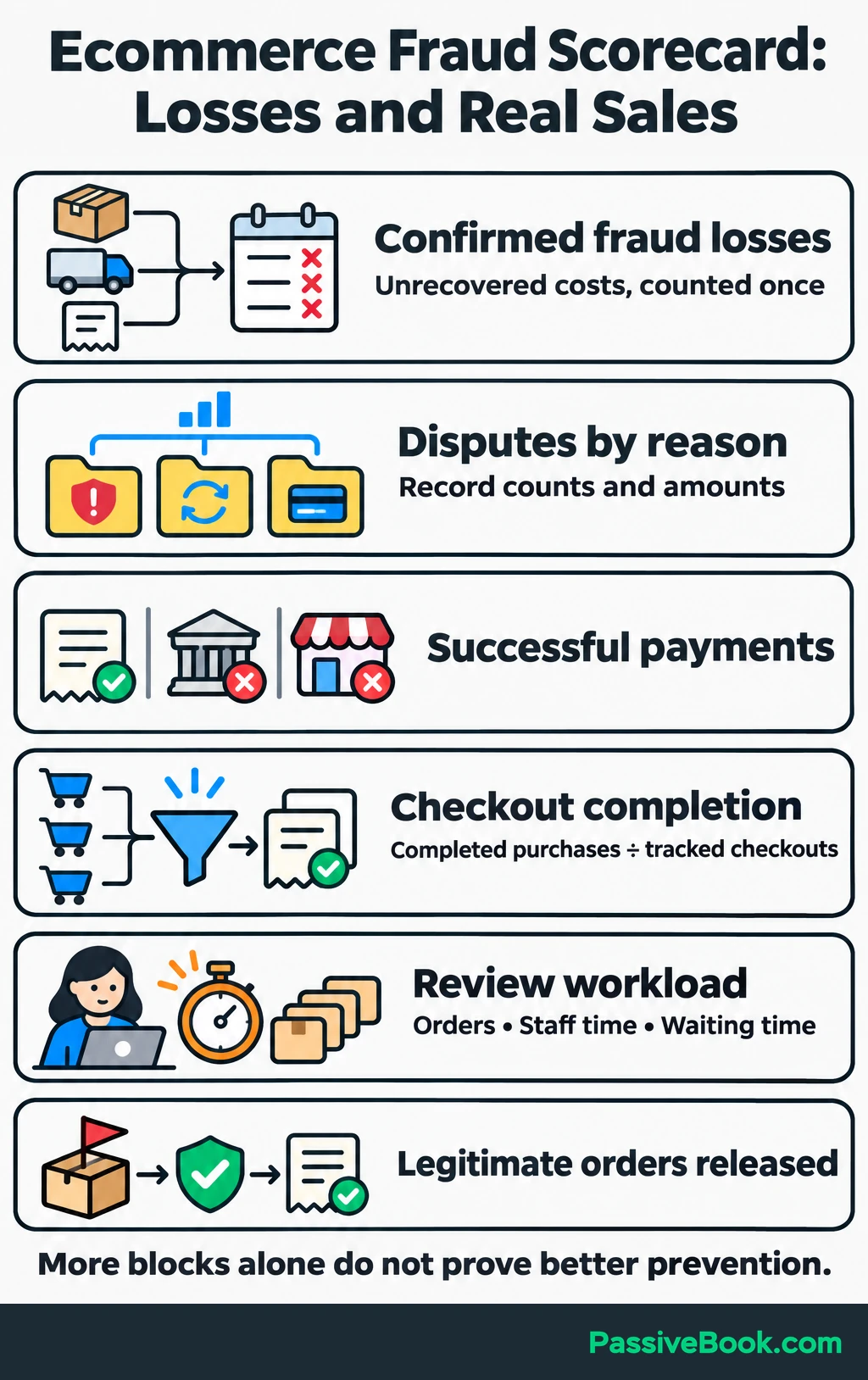
Keep a small weekly scorecard:
| Measure | What to Record |
|---|---|
| Confirmed fraud losses | Unrecovered product costs, shipping, and fees from confirmed fraud; avoid counting the same loss twice. |
| Disputes by reason | Counts and amounts for unauthorized payments, nonreceipt, billing confusion, and product complaints. |
| Successful payments | Completed payments and value, with issuer declines separate from your own blocks. |
| Checkout completion | Tracked checkout sessions that end in a completed purchase, out of all tracked checkout sessions in the same period. |
| Review workload | Orders reviewed, total staff time, and time waiting for a decision. |
| Legitimate orders released | Flagged orders cleared through verification and completed; revisit them if later evidence changes the assessment. |
Decline counts alone cannot tell you how many real customers you rejected. Review individual cases and record purchases recovered through verification.
Compare similar sales periods and account for promotions. A bulk-order offer may change normal quantities, so yesterday’s review rule may suddenly flag the buyers you invited.
Disputes also arrive late. When comparing purchases made in a given period, count disputes tied to those purchases and update the results as more disputes arrive. Do not mix that measure with disputes received during the period from older sales. Stripe’s dispute-measurement explanation shows the distinction.
Where practical, change one discretionary rule at a time. Inspect affected orders, then keep or reverse the change based on losses, approvals, and workload.
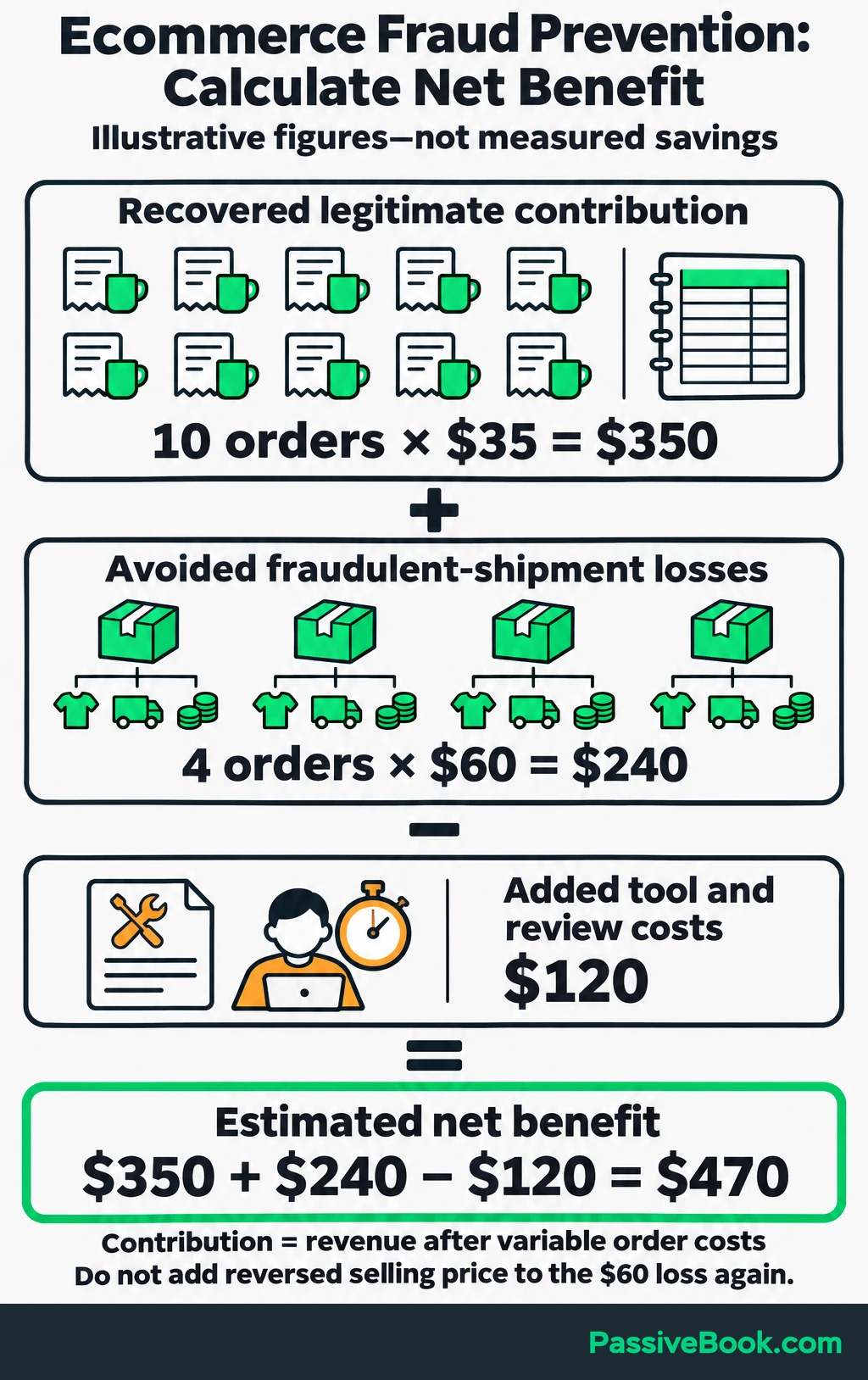
To assess the financial benefit, count avoided fraud losses and the contribution from legitimate orders you recovered, then subtract added tool and review costs. Contribution means revenue left after variable order costs, such as the product, packaging, shipping you cover, and payment fees.
Here is an illustrative calculation for the mug store. Assume these are separate groups of orders that would otherwise have been wrongly declined or fraudulently shipped:
| Item | Hypothetical Calculation |
|---|---|
| Recovered legitimate contribution | 10 orders × $35 contribution = $350 |
| Avoided fraudulent-shipment losses | 4 orders × $60 loss = $240 |
| Added tool and review costs | $120 |
| Estimated net benefit | $350 + $240 − $120 = $470 |
The assumed $60 loss includes merchandise, shipping, and fees lost after payment proceeds are reversed. It does not add the reversed selling price again.
These figures demonstrate the calculation; they are not measured results or expected savings. A suspicious order alone does not prove you avoided a fraud loss.
What Next?
Check one thing today: whether an order flagged for review can still reach your packing or shipping queue. Trace the full path and close any gap you find.
Use the social buttons to share this guide when your team needs a common process for reviewing orders without making every purchase harder.
Which part of your process leaves you least confident: payment screening, order review, or refunds? Leave your answer—and any other questions—in the comments.
Share this post with your friends & followers:

