A $4,000 hourly rate makes a three-hour flight look like a $12,000 purchase. But that number tells you little about what you’ll pay to get everyone there and back.
Two quotes for the same route may cover different costs, leaving you unsure whether the cheaper offer fits your budget. That uncertainty matters before you commit, especially when the return involves an overnight stay. This guide puts published price ranges beside a worked round-trip budget and shows what to check in each quote before deciding which offer is worth accepting.
How Much Does a Private Jet Charter Cost?
Published jet rates span roughly $2,900–$17,000 per hour across the categories below. Providers charge for billable hours, which can include flights that move the aircraft without your passengers. Whole-aircraft charter books the aircraft and crew for your group, rather than individual tickets.
Your total depends on the aircraft, billable time and costs needed to complete the itinerary.
Hourly Rates by Aircraft Category
These USD benchmarks come from Paramount Business Jets’ published pricing. Its rates include the aircraft, crew, fuel, standard fuel surcharges and insurance. Trip logistics and taxes are additional.
| Aircraft category | Published hourly range |
|---|---|
| Very light jet | $2,900–$3,400 |
| Light jet | $3,750–$4,200 |
| Super-light jet | $4,200–$4,600 |
| Midsize jet | $4,700–$5,500 |
| Super-midsize jet | $6,200–$7,500 |
| Large jet | $8,500–$10,000 |
| Ultra-long-range jet | $12,000–$17,000 |
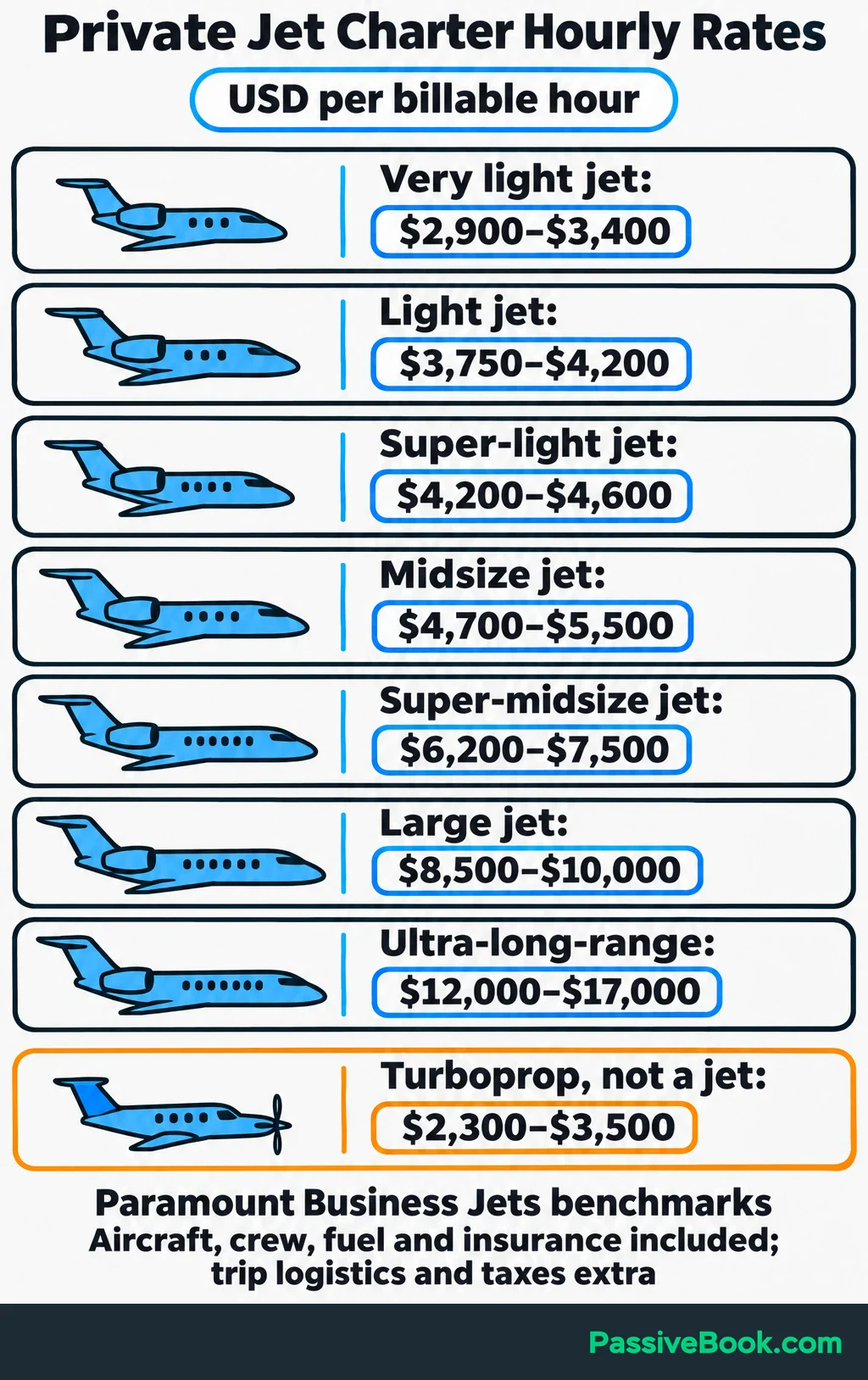
A turboprop is a separate, non-jet option, with published rates of $2,300–$3,500 per hour.
These are one broker’s benchmarks. Use them to set an initial budget, then request a price for your itinerary.
Published One-way Trip Estimates
Paramount also publishes these one-way starting estimates, including taxes and fees:
| Route | Aircraft category | Starting estimate |
|---|---|---|
| New York–Miami | Light jet | $17,000 |
| New York–Los Angeles | Super-midsize jet | $40,000 |
| New York–London | Large jet | $95,000 |
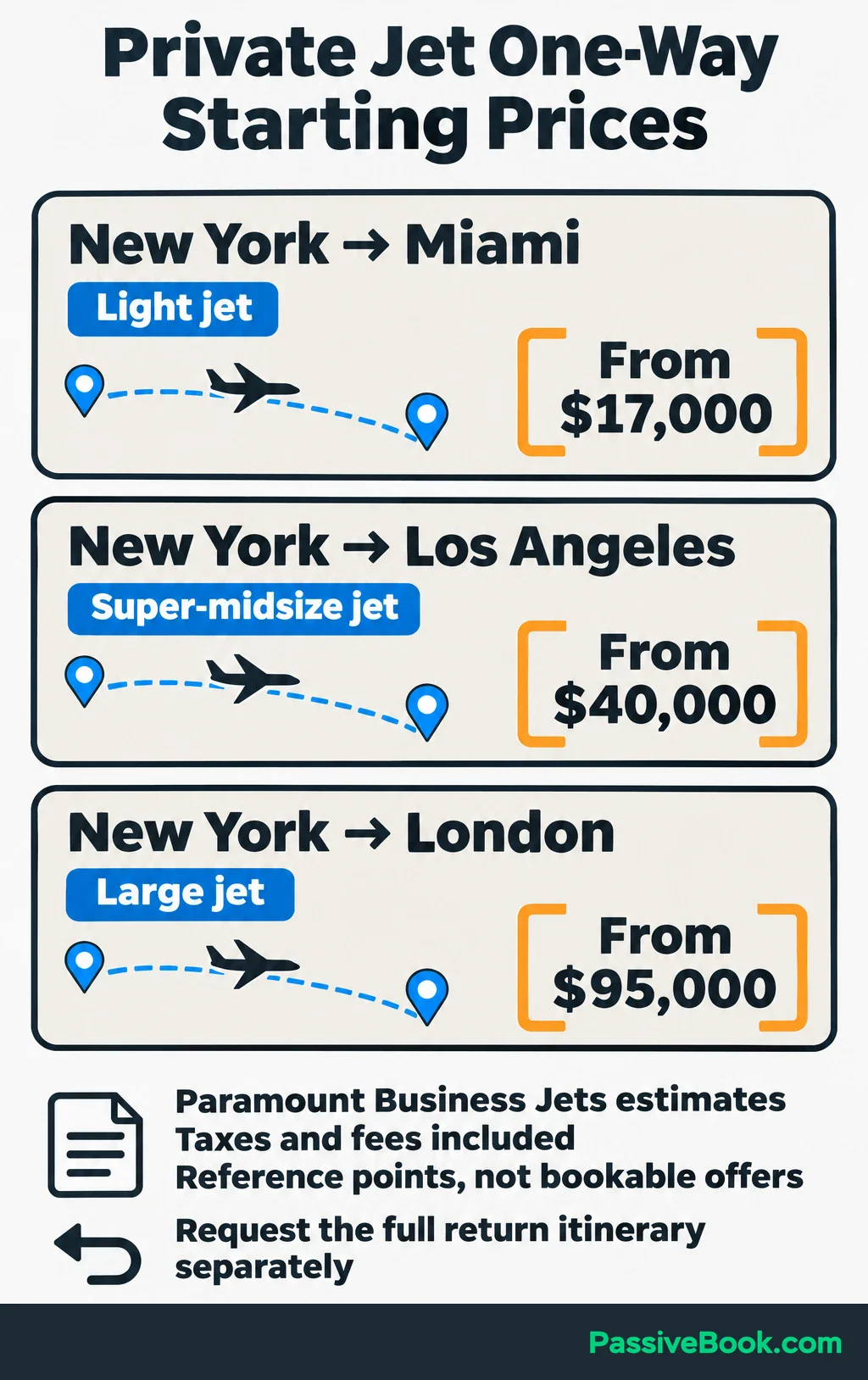
The estimates have no specified travel dates, so they are reference points rather than offers you can book.
For a return trip, request both directions together. Doubling a one-way estimate won’t tell you how the provider will handle the aircraft between flights.
Which Aircraft Does Your Trip Require?
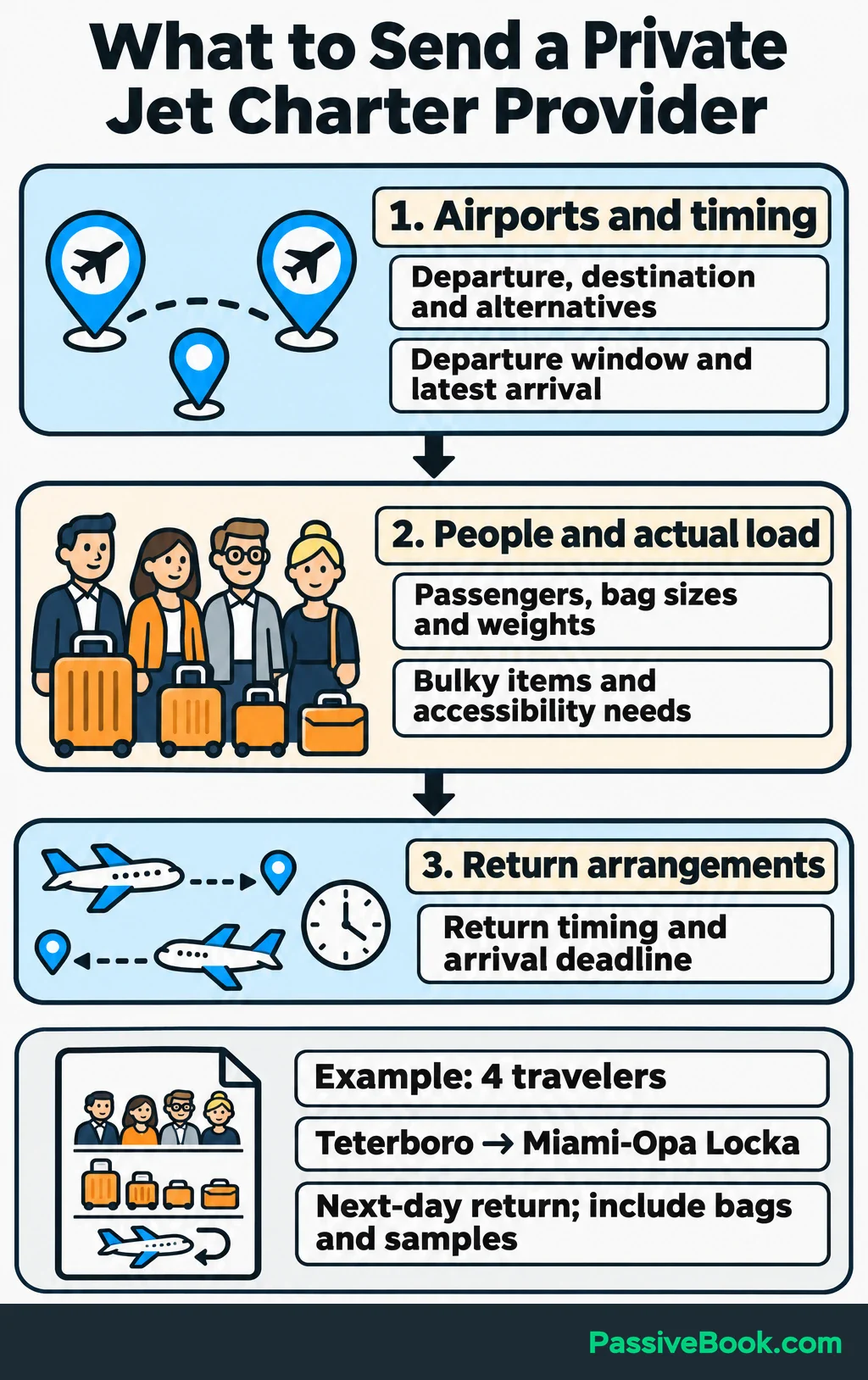
Start with the trip requirements before choosing an aircraft category. Send each provider:
- Departure and destination airports, plus acceptable alternatives.
- Travel dates and departure windows.
- Passenger count.
- Number, size and weight of bags.
- Any bulky items, accessibility needs or other requirements.
- Return timing and the latest acceptable arrival.
Ask the operator to confirm usable passenger seating, baggage space and whether the proposed aircraft can fly nonstop with your actual load. A category name alone doesn’t answer those questions.
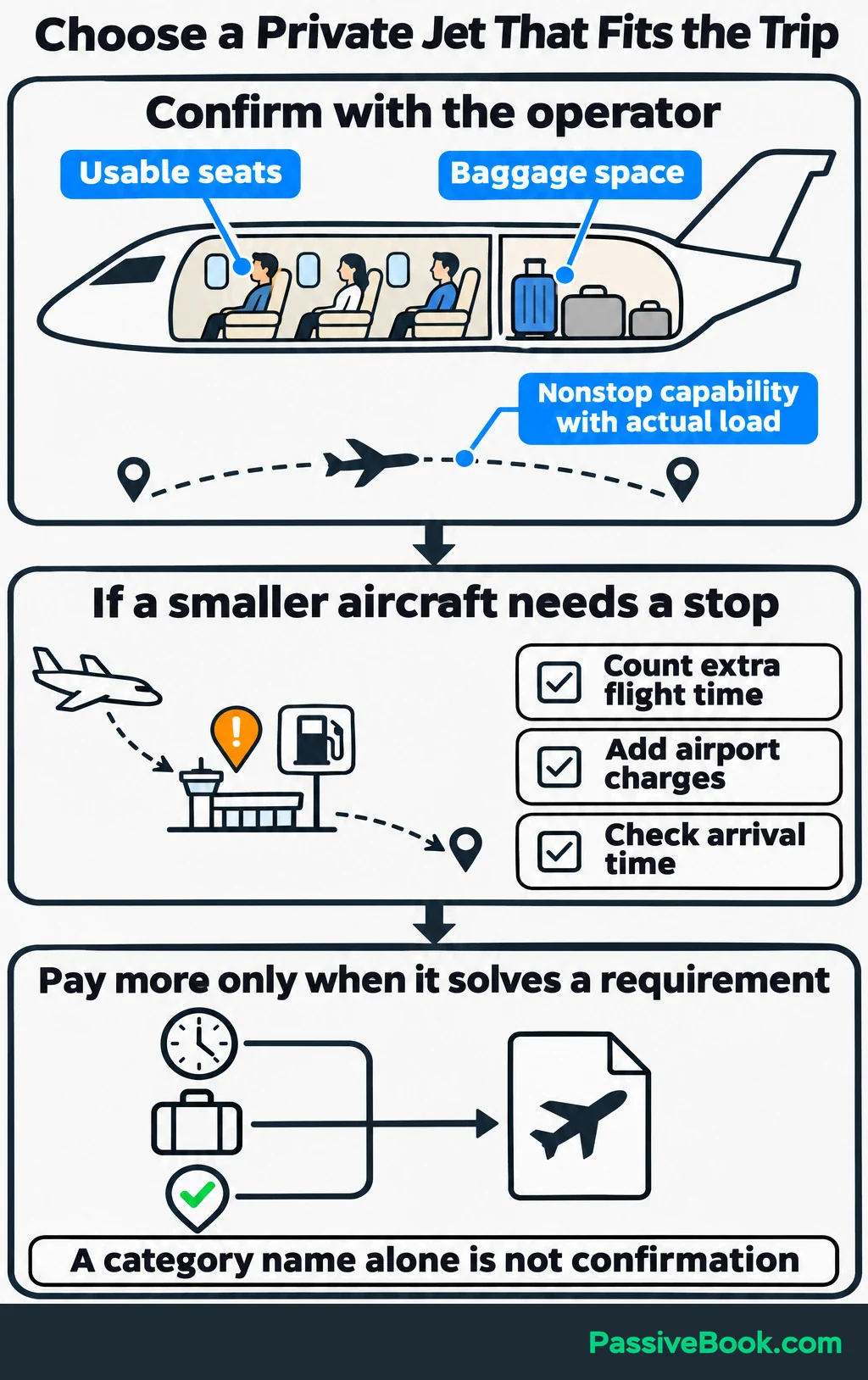
If a smaller aircraft needs a fuel stop, compare the full result: extra flying time, airport charges and arrival time. I would pay more for a larger aircraft only when it solves a requirement that matters.
For the running example, imagine you sell specialty loose-leaf tea online. You need four people to travel from Teterboro to Miami-Opa Locka for a supplier visit, returning the next day.
Your request should include the team’s bags and any samples coming home. It should also state when you need to reach the supplier. “Four passengers to Miami” leaves too much room for providers to price different trips.
You can turn your trip details into a complete request without writing it from scratch. Our AI Skill drafts the email and includes questions about the costs your itinerary could leave unclear.

Free AI Provider Buying Assistant




We’ll use that overnight itinerary for the worked budget below.
What Fees Can Appear in a Charter Quote?
Read the quote as a list of commitments: what you must pay, what you can choose and what could change.
An omitted line isn’t proof that the service is free. Ask where it is covered.
Billable Time, Minimums and Repositioning
Occupied flight time covers the flights carrying your passengers. Repositioning covers flights that move the aircraft into place before pickup or away afterward.
Ask the provider to show how it reached the billable hours, including:
- Time charged for taxiing before takeoff and after landing.
- How flight time is rounded for billing.
- Minimum billable hours per flight.
- Minimum billable hours per day.
- Repositioning flights.
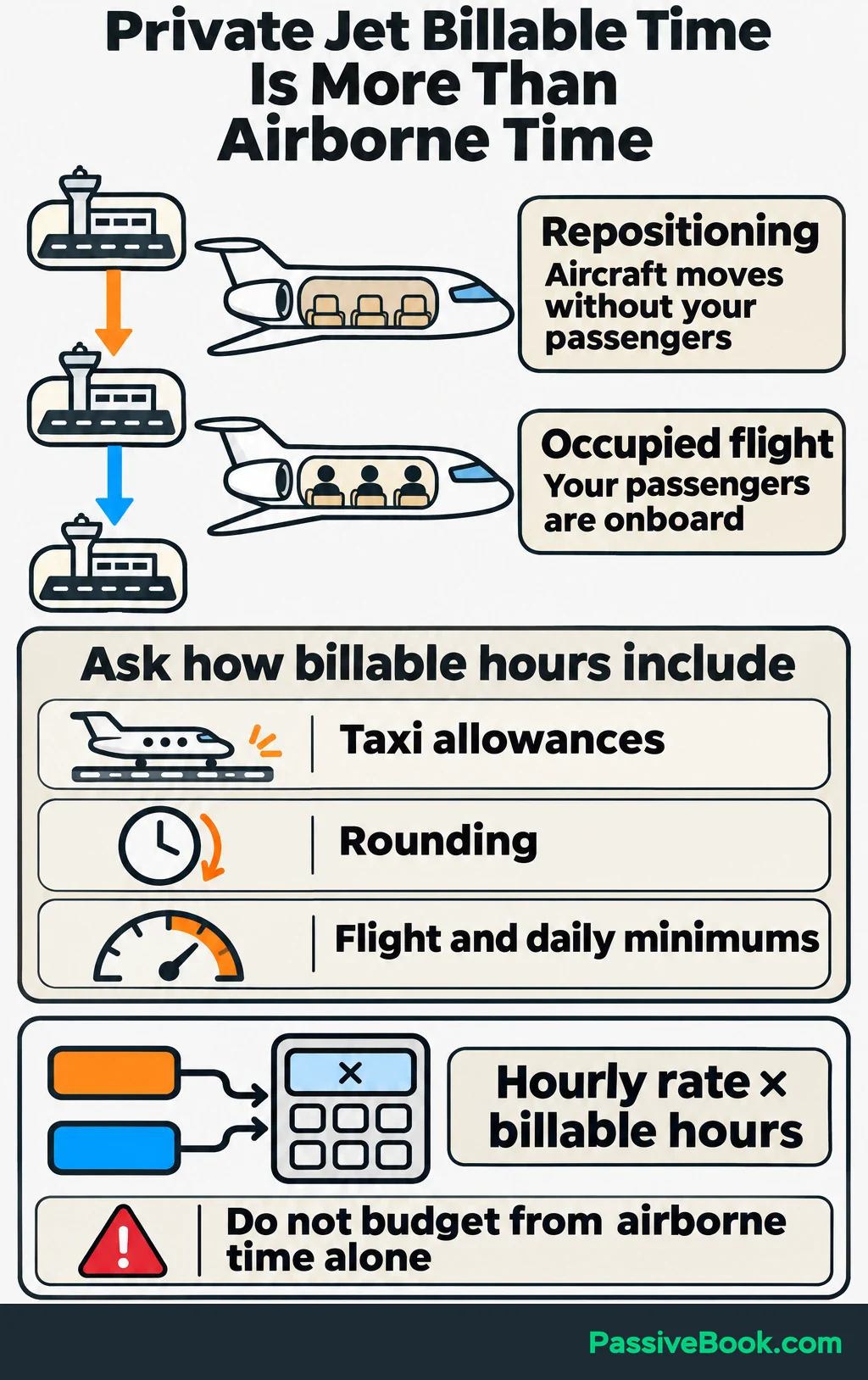
Multiply the hourly rate by those billable hours. Airborne time alone can leave out part of the charge.
Your return schedule matters too. Keeping the aircraft nearby may add crew accommodation, parking, waiting charges or daily minimums. Releasing it may require more positioning flights.
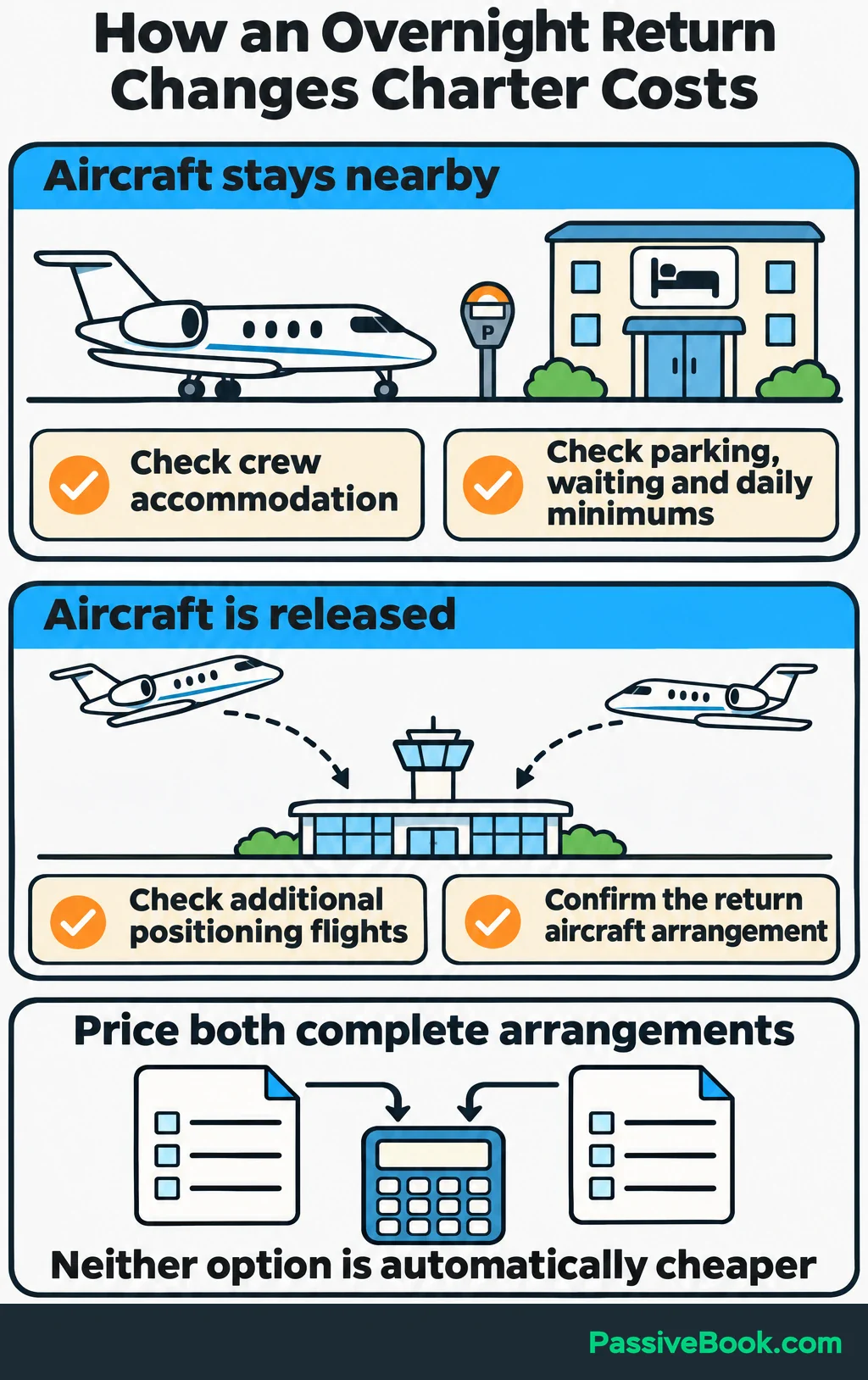
For the tea-business trip, ask how the next-day return has been priced. Is the aircraft staying overnight, or are you paying for another aircraft to arrive?
Also confirm whether fuel surcharges and broker compensation are included. Count each cost once, even if the quote describes it in more than one place.
Airport, Crew and Service Charges
Give every extra a clear status: included, a fixed additional amount or payable as incurred.
| Possible charge | What to establish |
|---|---|
| Landing and handling | Which airport visits are covered and whether positioning stops add charges |
| Parking or hangar | Whether the overnight stay is included |
| Crew overnight expenses | Whether accommodation, meals and local transport are covered |
| Catering | What comes with the flight and what your requested order adds |
| Connectivity | Whether internet access is included or charged by use |
| Ground transfers | Whether airport-to-meeting transport is part of the quote |
| De-icing or diversions | How costs are calculated and when you will be notified |
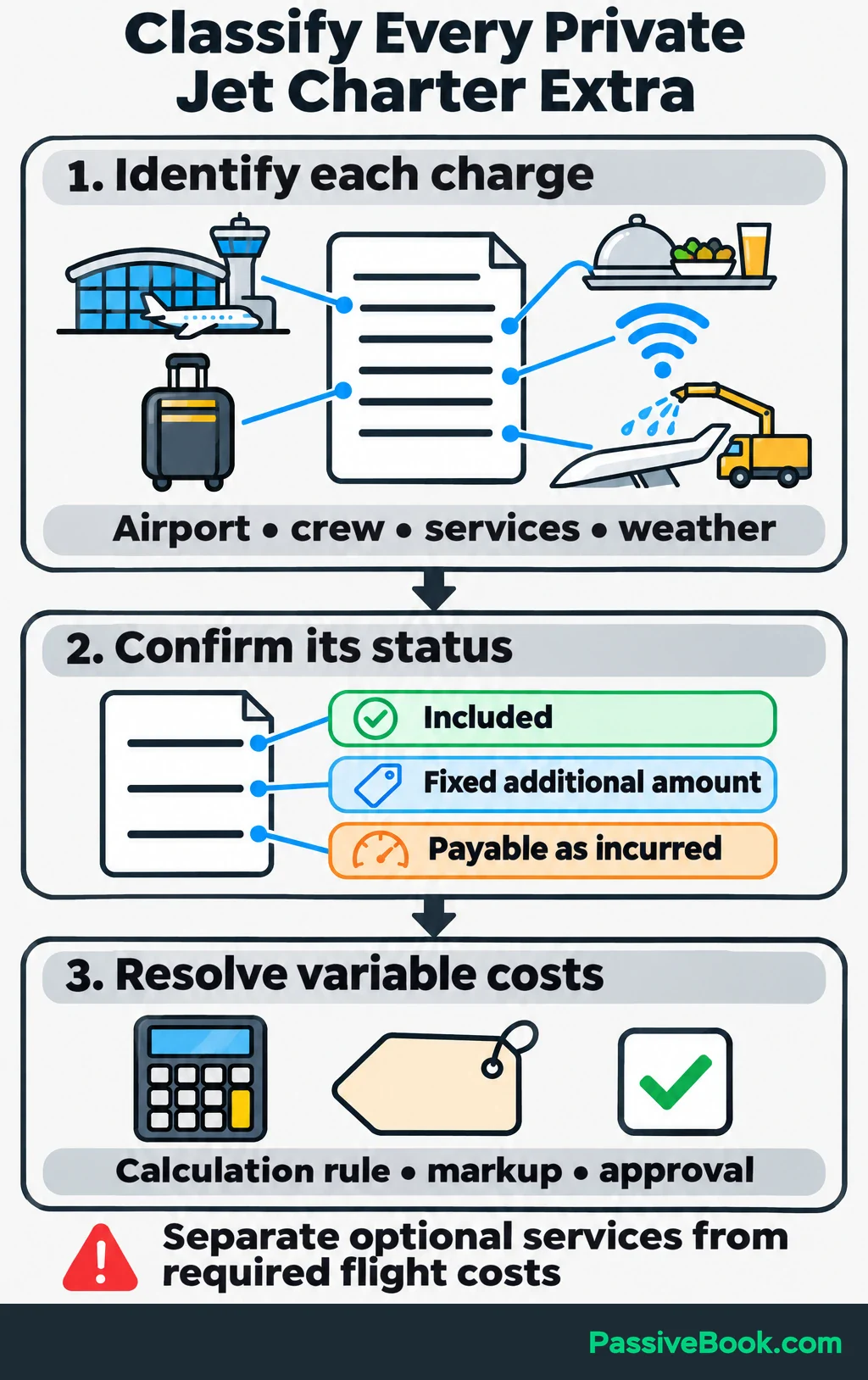
Keep optional services separate from costs required to operate the flight. You can remove an elaborate meal order; you cannot budget on the assumption that required de-icing will be skipped.
For variable expenses, ask about the calculation rule, any markup and which charges require your approval. Read the contract for any right to adjust the quoted price.
Taxes on Your Itinerary
For taxable U.S. domestic passenger transportation in 2026, the federal taxes are:
- Percentage Tax: 7.5% of the taxable transportation amount.
- Domestic Segment Tax: $5.30 per passenger per taxable domestic segment.
A segment runs from takeoff to landing. Qualifying rural-airport segments are exempt from the segment tax. These rules and the charter calculation are set out in the IRS Form 720 instructions.
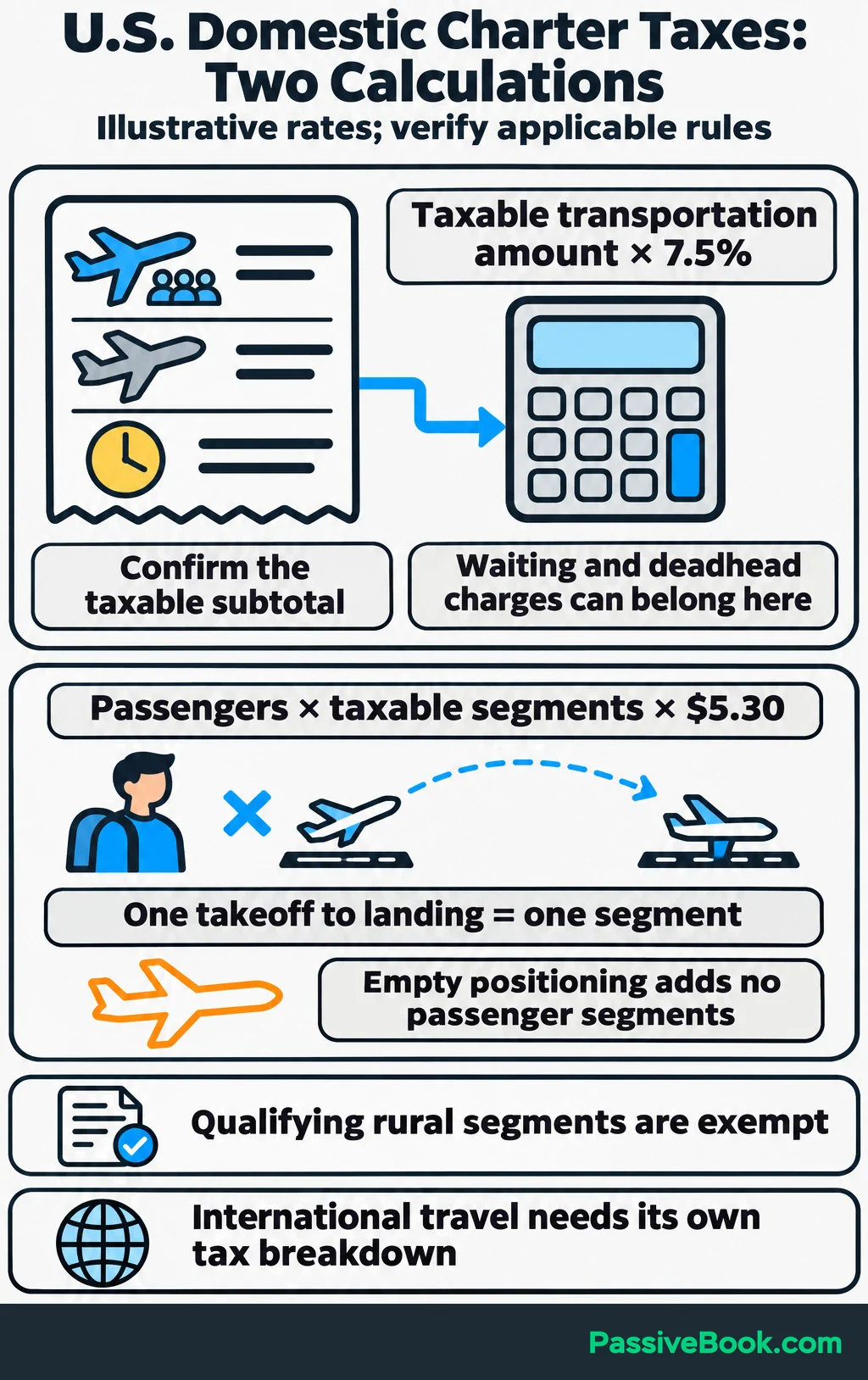
Ask the provider to identify the taxable subtotal. The IRS includes waiting-time and deadhead aircraft movement charges in amounts paid for taxable transportation, so applying 7.5% only to the passenger-flight line can understate the tax. See IRS Publication 510.
For international travel, request an itinerary-specific tax breakdown rather than carrying the domestic calculation across.
How to Estimate Your Total Charter Cost
Get estimated billable hours and aircraft suitability from the provider first. Distance alone doesn’t establish either.
Then build the budget in this order:
- Flight charges.
- Separately billed positioning and minimum-charge adjustments.
- Mandatory airport, crew and other trip fees.
- Optional services you choose.
- Applicable taxes.
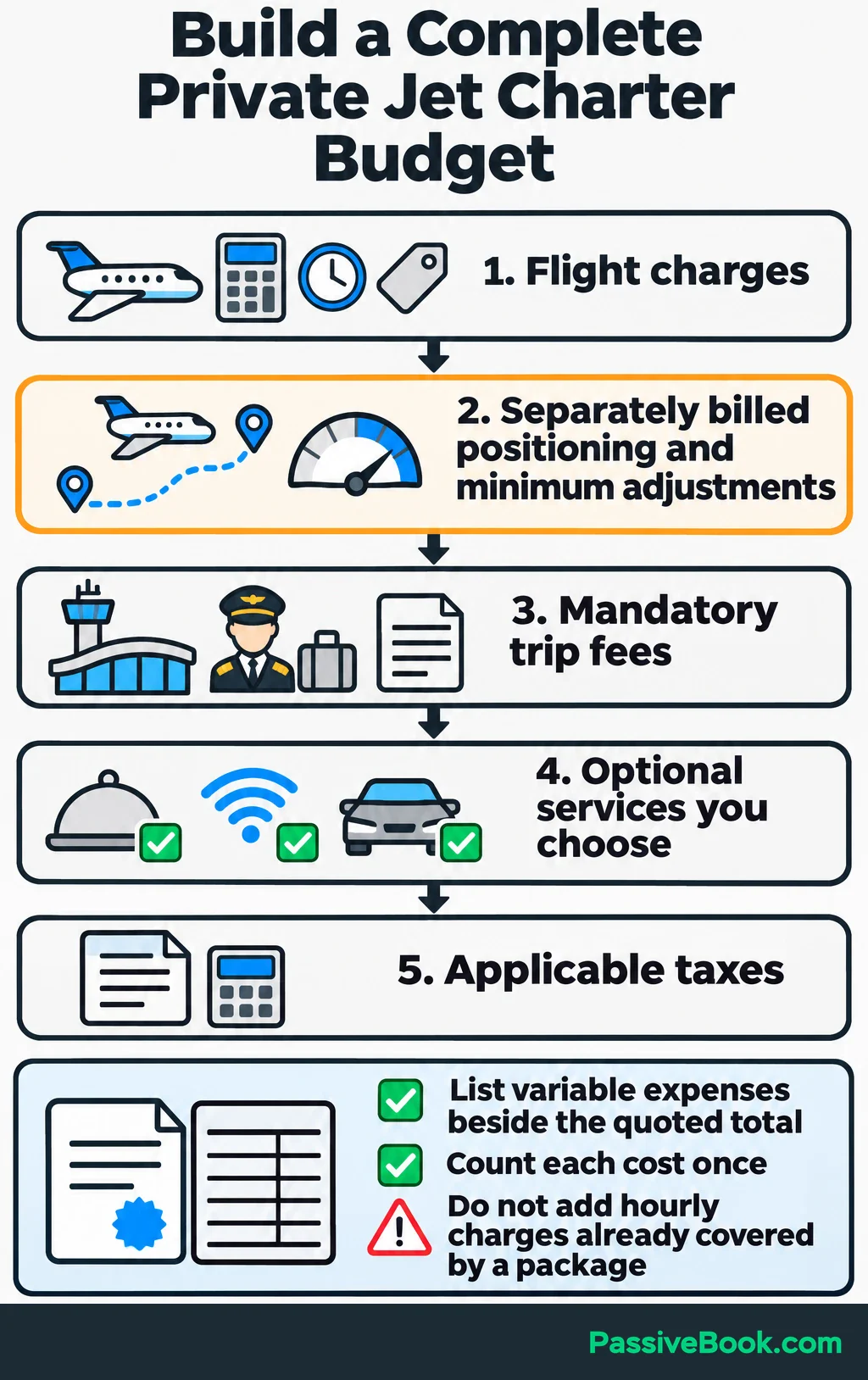
List variable expenses beside the quoted total, with an estimate where available and the rule for calculating each charge. An unknown cost still belongs in your budget, even when it isn’t part of the fixed price.
If you receive a fixed itinerary quote, check its total against its inclusions and exclusions. Don’t add a second hourly estimate to a package that already covers the flying.
A Worked Round-trip Estimate
Here is an illustrative budget for the four-person tea-business trip. It is not an actual invoice or an observed route fare. All commercial amounts and flight hours are assumptions; the taxes use 2026 rules.
Assume the operator confirms a suitable light jet and two nonstop passenger flights. Each direction has three billable occupied hours, including taxi allowances. One additional positioning hour brings the total to seven hours at $4,000 per hour.
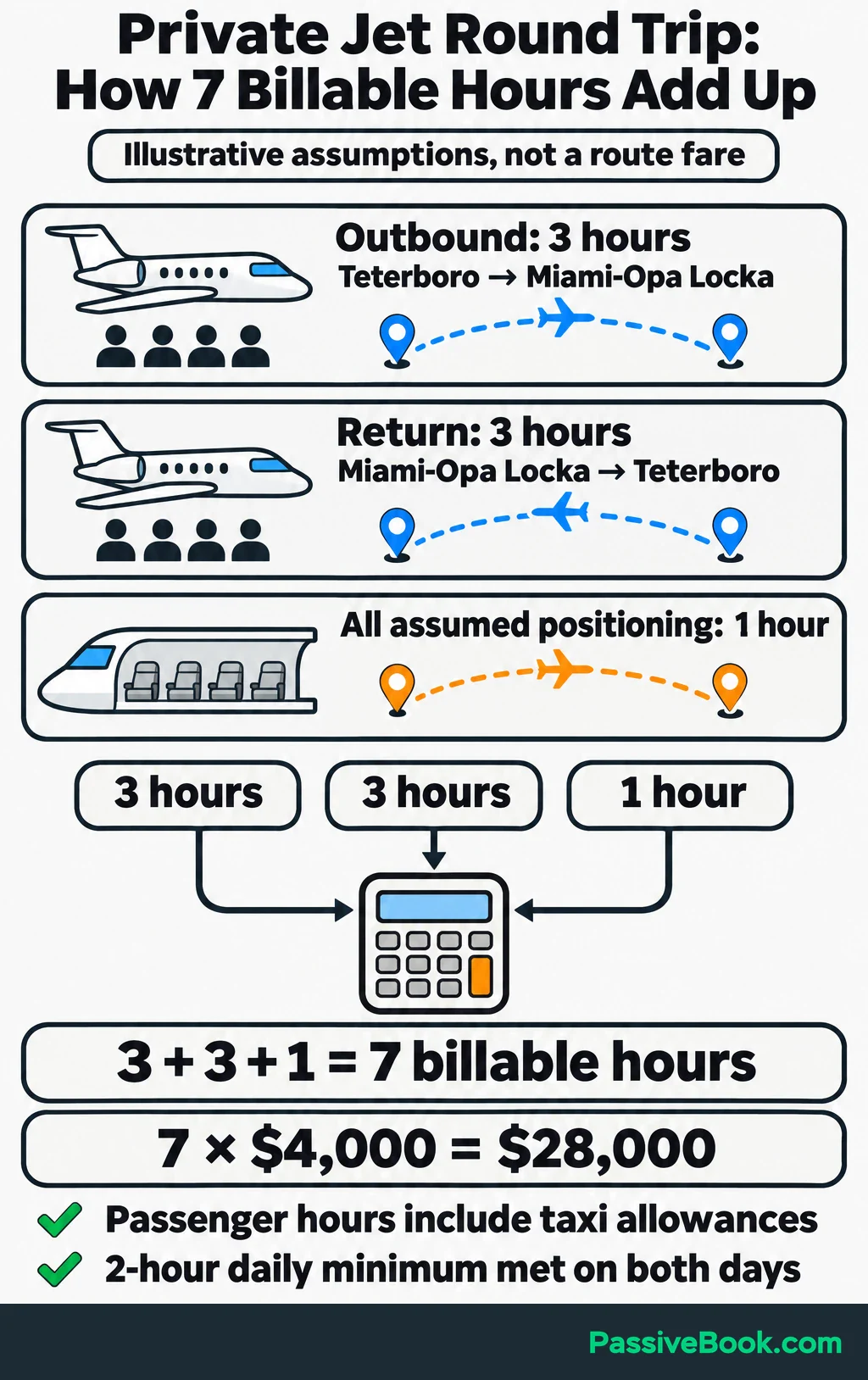
A two-hour daily minimum is satisfied on both travel days. Fuel and broker compensation are included, and no optional services are selected.
For this calculation, assume the entire $30,000 subtotal is taxable transportation and neither passenger segment qualifies for an exemption. Four passengers each take two flights, giving eight taxable passenger segments. The empty positioning flight adds no passenger segment tax.
| Charge | Calculation or assumption | Amount |
|---|---|---|
| Outbound passenger flight | 3 billable hours × $4,000, including taxi allowance | $12,000.00 |
| Return passenger flight | 3 billable hours × $4,000, including taxi allowance | $12,000.00 |
| Positioning flight | 1 billable hour × $4,000; covers all assumed positioning | $4,000.00 |
| Crew overnight expenses | Assumed total for the crew’s overnight stay | $800.00 |
| Airport charges | Assumed total for all planned airport visits | $1,200.00 |
| Subtotal | Charges before federal taxes; entire amount assumed taxable | $30,000.00 |
| Federal percentage tax | $30,000 × 7.5% | $2,250.00 |
| Domestic segment tax | 4 passengers × 2 segments × $5.30; no exempt segments | $42.40 |
| Total | Subtotal plus federal taxes; excludes expenses listed below | $32,292.40 |
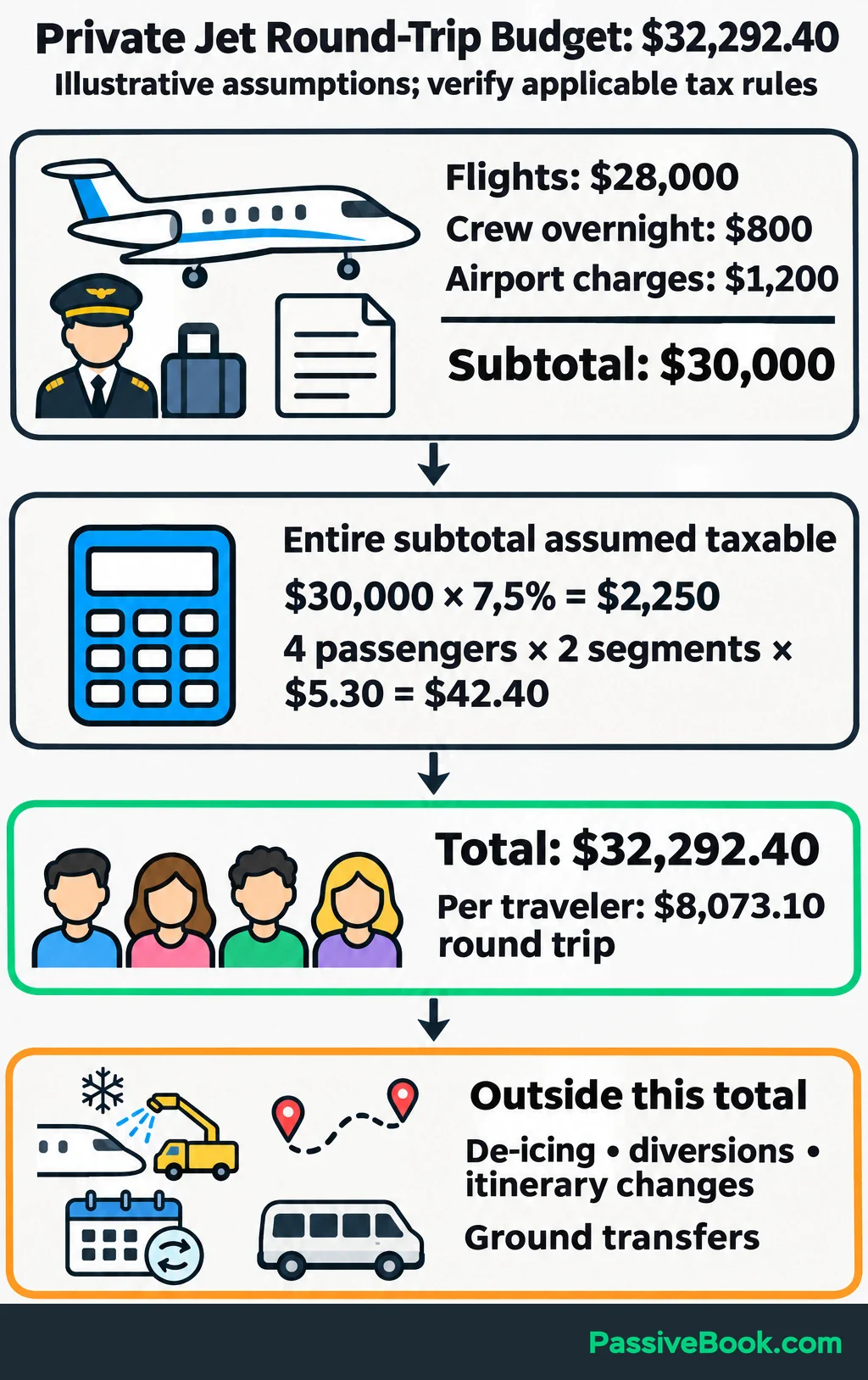
Dividing the total among the four people traveling gives $8,073.10 per traveler for the round trip.
De-icing, diversions, itinerary changes and ground transfers are outside this calculated total. Before using the budget to approve travel, establish how those expenses would be handled.
How to Compare Charter Quotes Before Booking
Send every provider the same trip specification. Otherwise, the lowest quote may simply describe a different trip.
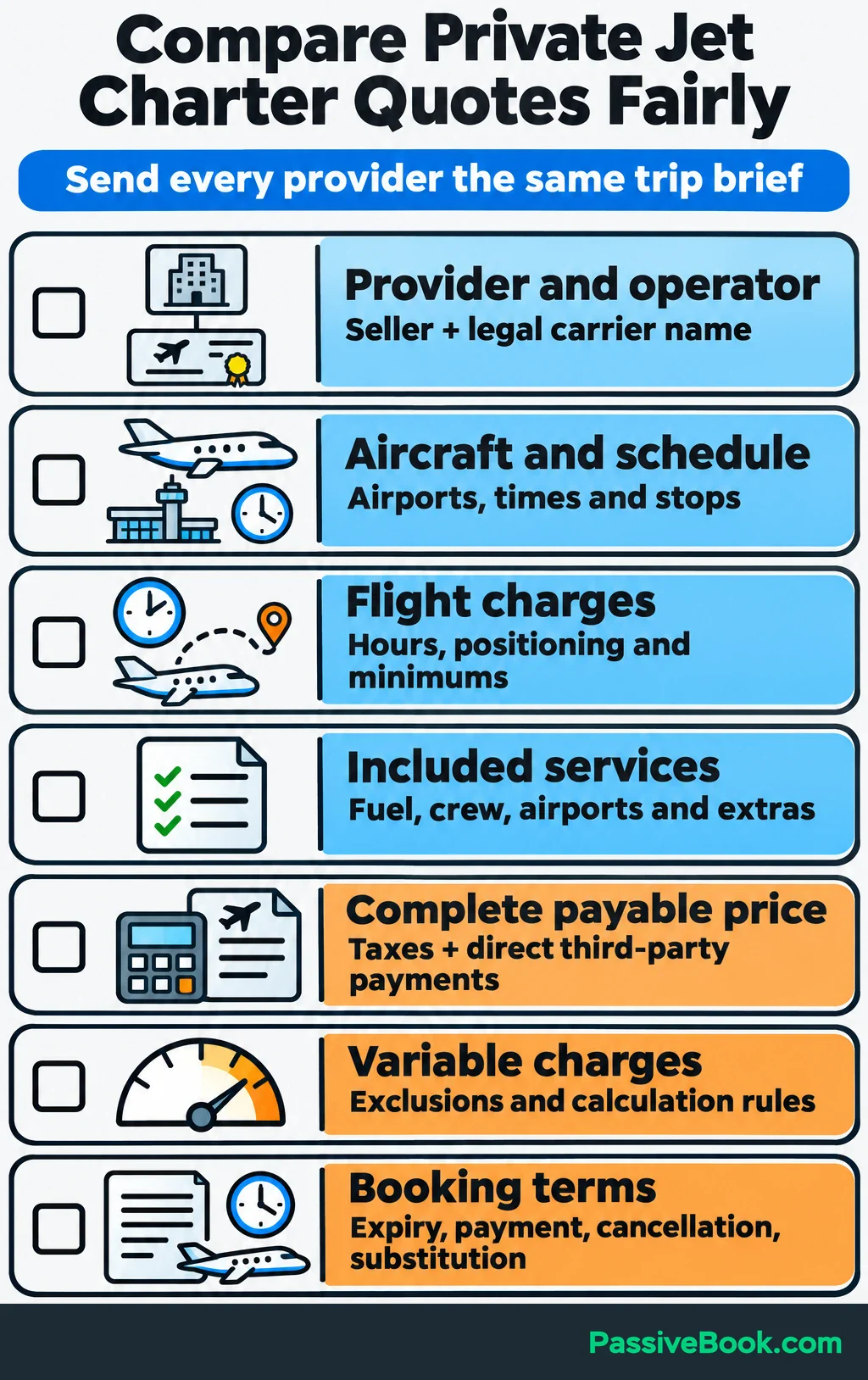
Build a comparison sheet with one column per provider. Record these details in the rows:
- Provider And Operator: The company selling the trip and the legal name of the carrier flying it.
- Aircraft And Schedule: Proposed aircraft, airports, departure times, arrival times and stops.
- Flight Charges: Billable hours, positioning charges and minimum adjustments.
- Included Services: Fuel, crew expenses, airport charges and selected extras.
- Complete Price: Total including taxes, plus anything payable directly to another company.
- Variable Charges: Excluded expenses and their calculation rules.
- Booking Terms: Quote expiry, payment deadlines, cancellation charges and substitution terms.
I made this mistake with supplier quotes during my ecommerce work. I ranked the prices before putting freight in its own row, and the cheapest option became less impressive once delivery was included. Now I compare complete payable costs before deciding whether a price is attractive.
For U.S. charter brokers, you can request the total payable to or through the broker and fees payable directly to third parties before contracting. Unknown third-party amounts require good-faith estimates, although individual itemization is not required under 14 CFR 295.24.
Check the carrier too. For a U.S. charter, use the FAA’s operator and aircraft resources to verify that the company is authorized to operate charters and that the proposed aircraft is listed under it. Search by operator name and aircraft registration number. If either is missing, contact the local Flight Standards District Office to verify its status, as the FAA advises.
Finally, establish whether the price is fixed or adjusted after the trip. Read what happens if the aircraft becomes unavailable, who arranges replacement transportation and who pays.
For the tea-business itinerary, a cheaper quote using another airport or a fuel stop needs a second look. Check whether the four travelers can still reach the supplier on time before treating it as a saving.
How to Reduce Charter Costs
I would start with aircraft location and schedule flexibility. Ask providers to price suitable aircraft already near your departure airport, then compare a few workable alternatives.
Useful requests include:
- Aircraft: The least expensive option that meets your passenger, baggage and arrival requirements.
- Timing: Alternative departure windows or dates you can actually use.
- Airports: Nearby options, with the extra ground travel included in your comparison.
- Return Arrangements: Keeping the aircraft nearby versus separate one-way arrangements.
- Services: A revised total without optional catering, connectivity or transfers you don’t need.
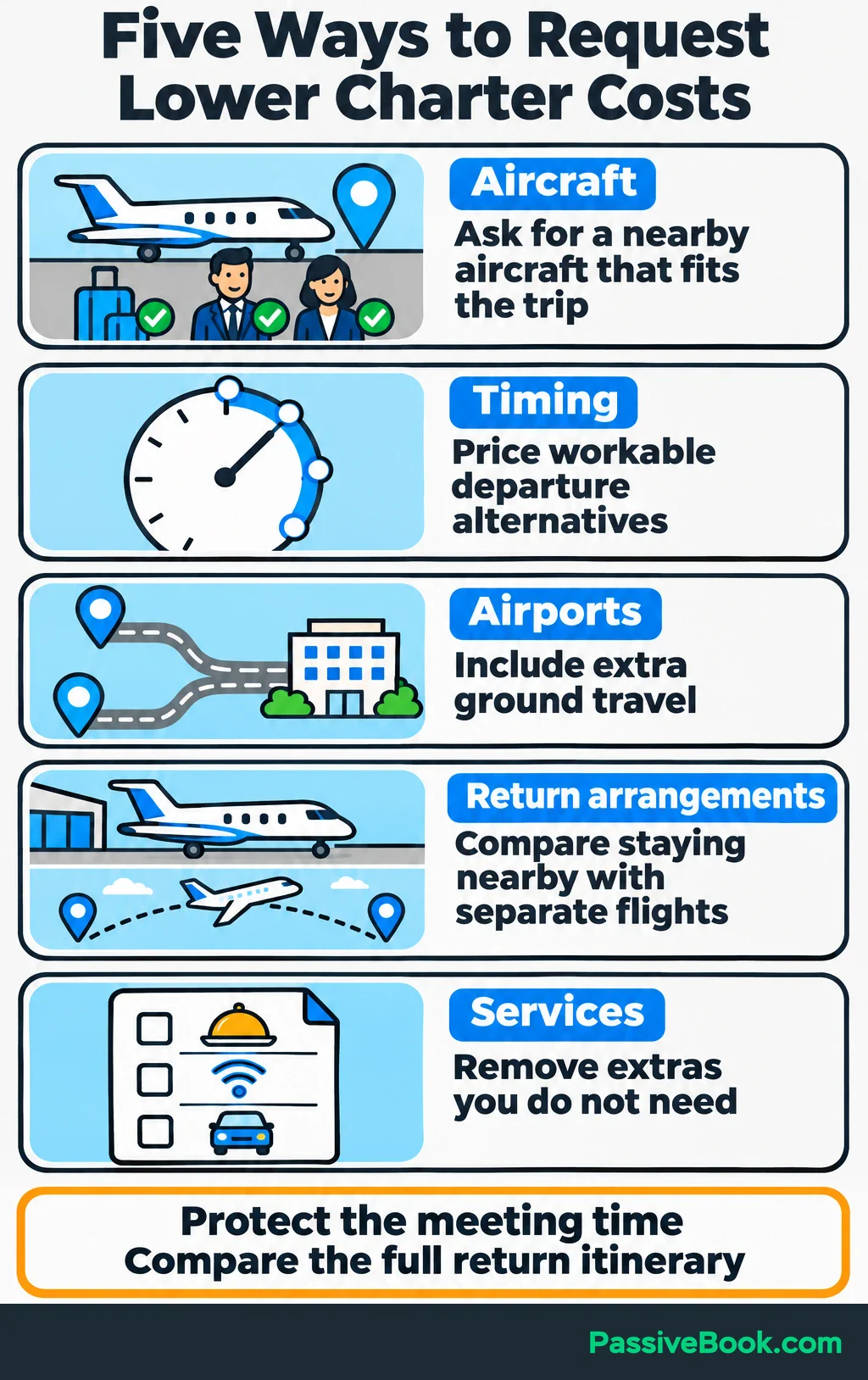
Price the full return itinerary together so you can see the effect of the overnight stay.
For the supplier visit, you might accept a different departure window but need to preserve the meeting time. Tell the provider which part is flexible. A saving that makes you miss the reason for traveling isn’t useful.
When an Empty Leg Makes Sense
An empty leg is a flight that would otherwise reposition an aircraft without passengers. It can be worth considering when its existing route and departure window fit your plans.
Compare the complete journey, including return travel and a workable backup. An attractive outbound price doesn’t settle either cost.
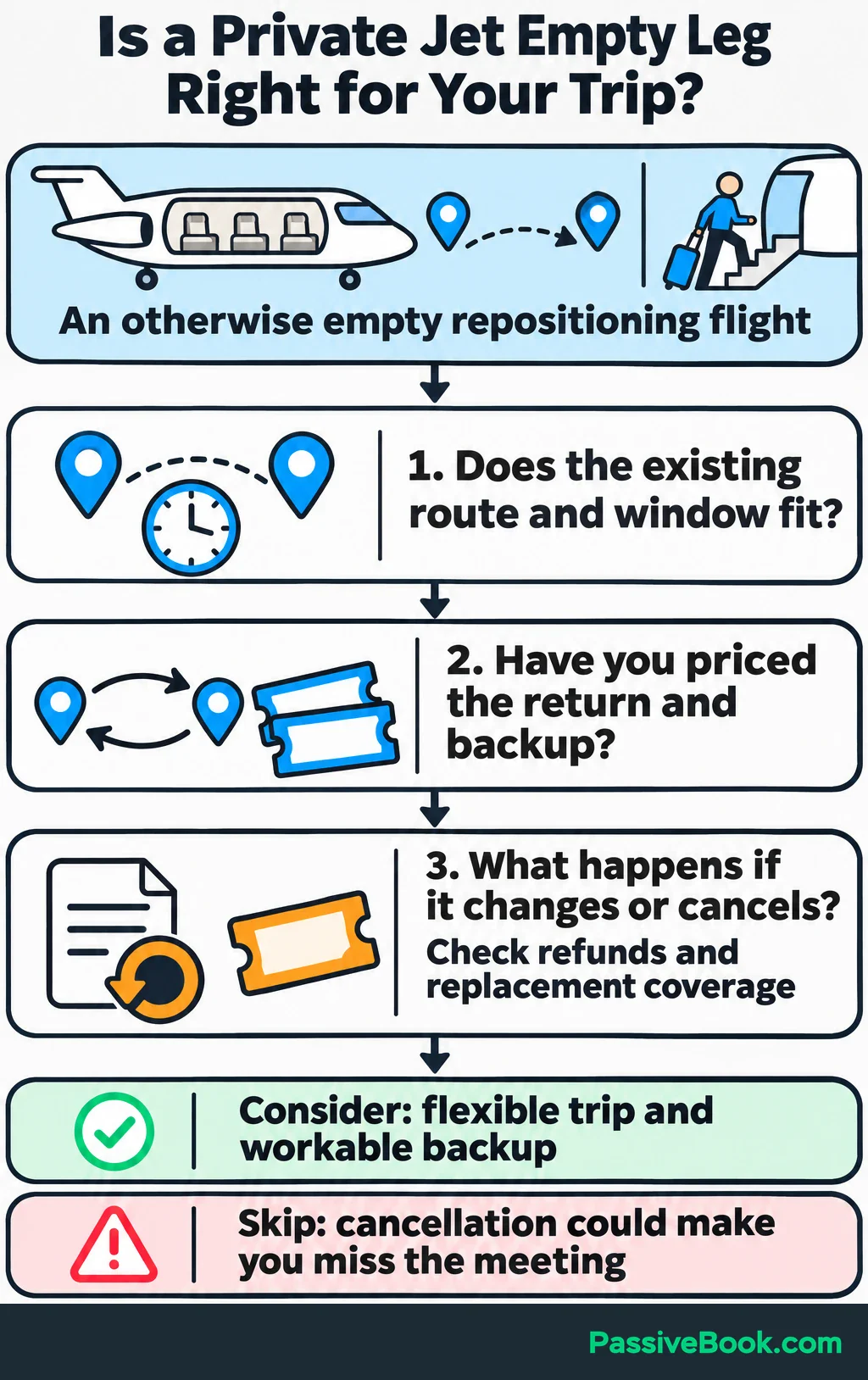
Read the cancellation terms closely. For example, section 15 of Volare’s empty-leg terms allows schedule changes or cancellation. Its cancellation liability is limited to refunding the unused portion, and it excludes replacement transportation costs.
That is one provider’s contract, but it shows why the terms matter as much as the fare.
I would consider an empty leg for a flexible trip where a cancellation is manageable. For the tea-business visit, I would skip it if the backup cannot reliably get the group to the supplier on time.
When Is Charter Worth the Cost?
Charter can be a reasonable purchase when a specific travel benefit justifies the premium. Name that benefit before trying to justify the bill.
“More convenient” is too vague. “The group can attend the meeting and return without an extra hotel night” gives you something to compare.
Charter Versus Commercial Flights
Compare the complete charter price with the commercial itinerary your group would actually buy. Include airport transfers, baggage charges and any necessary hotel nights on both sides.
Then check the practical differences:
- Departure and arrival times.
- Connections and waiting time.
- Ground travel from each airport.
- Whether everyone can travel together.
- Whether either option changes the meeting schedule.
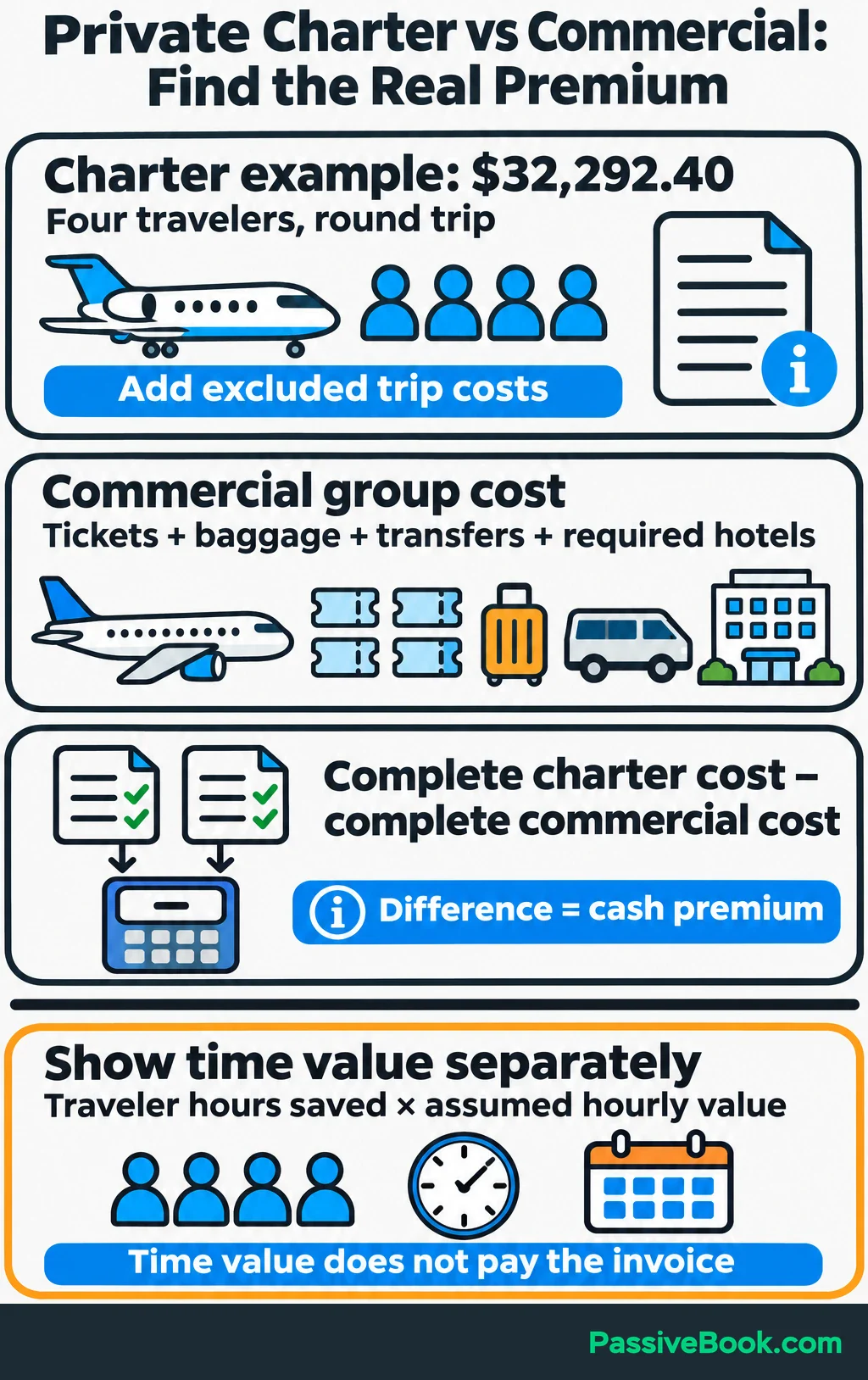
For the tea-business trip, start with the illustrative $32,292.40 charter budget and obtain commercial prices for all four travelers. Add the relevant ground travel and hotel costs, then check the supplier-visit schedule each option permits.
The remaining price gap is the premium for the identified benefits. It may be worth paying, but convenience doesn’t automatically become cash savings.
If you put a value on time saved, show that separately. Count each traveler’s hours against the commercial itinerary and state the assumed hourly value. Time has value, but it doesn’t pay the invoice.
Is Owning a Jet Cheaper Than Chartering?
Ownership needs a separate cost model for an aircraft capable of the same trips. Comparing charter invoices with fuel bills leaves most of the ownership decision out.
Use the same evaluation period and include:
- Capital Costs: The aircraft’s loss in value, plus financing costs or the return you give up by tying cash up in the purchase.
- Standing Costs: Crew, insurance, hangar and management.
- Operating Costs: Fuel, maintenance and other costs tied to use.
- Coverage Gaps: Replacement travel during downtime and charter for trips the owned aircraft cannot handle.
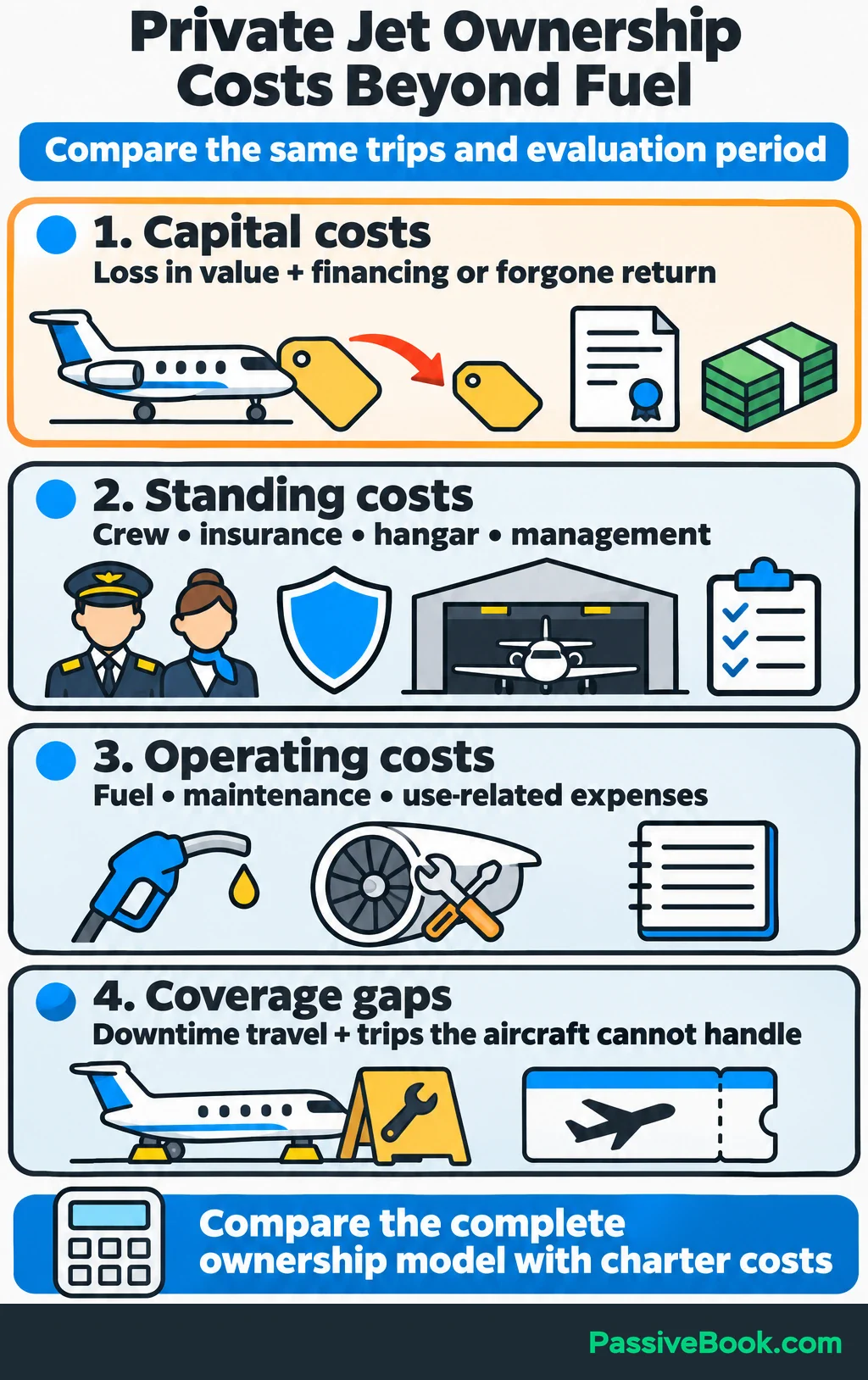
Keep the cash needed to buy the aircraft separate from the cost of owning it over time. Estimate its loss in value by comparing the purchase price with expected resale value at the end of your evaluation period, and count that loss only once.
NBAA’s ownership and operating-cost framework provides useful cost categories. Use current aircraft-specific estimates to fill them.
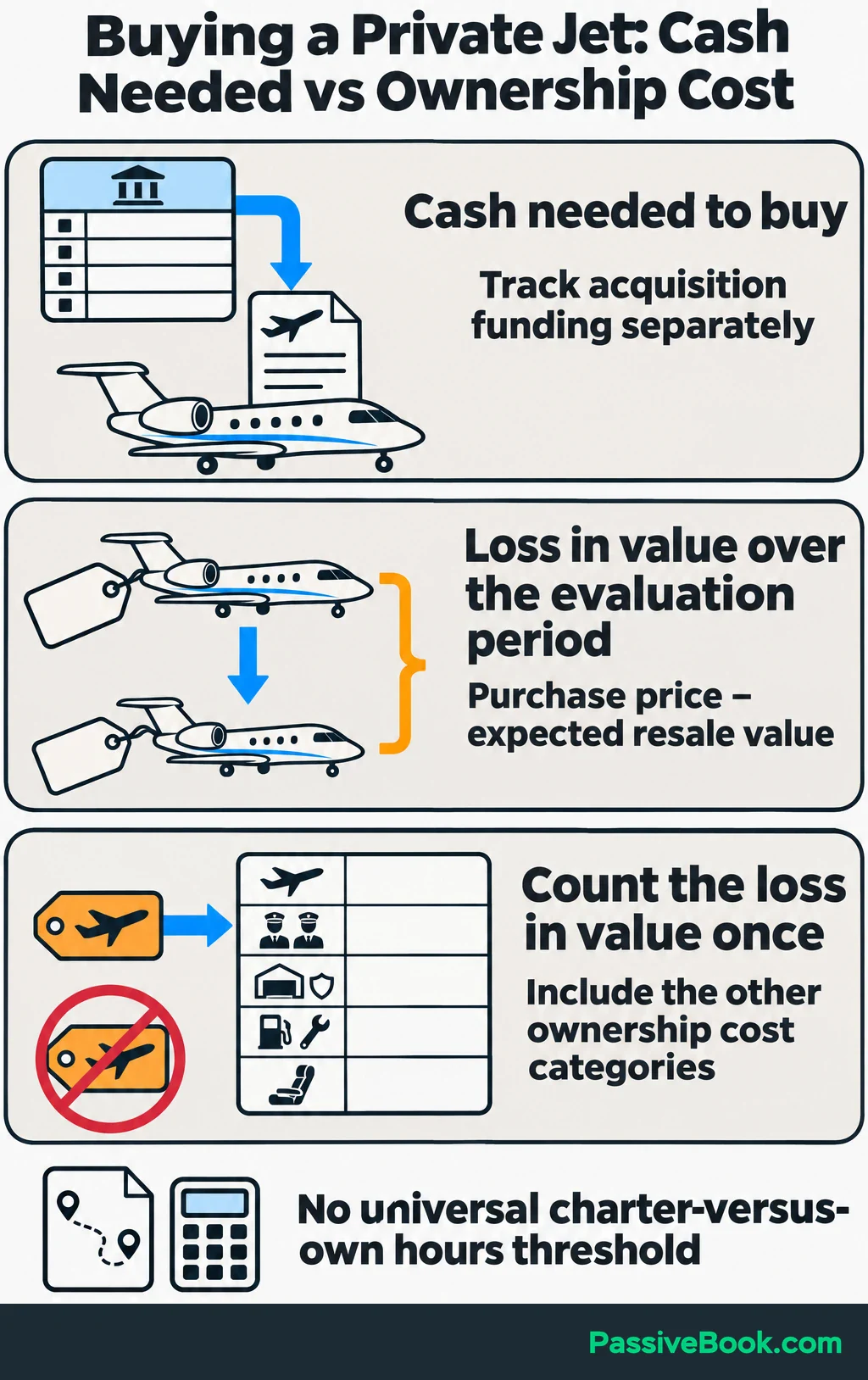
I would skip any blanket claim that ownership becomes cheaper at a certain number of annual hours. Your routes, aircraft needs and ownership costs must support that conclusion.
For occasional supplier visits, I would compare charter options first. Ownership deserves a serious analysis when recurring travel needs provide a reason to take on its ongoing costs.
What Next?
Write a one-page brief for your next trip and send the same version to three providers. Ask for the complete payable price, the exclusions and the rules for any variable charges.
Use the social buttons to share this guide when a travel budget needs a clearer comparison between the advertised rate and the final bill.
Which part of your trip would make paying a charter premium worthwhile? Leave your answer in the comments, and bring any other pricing questions with it.
Share this post with your friends & followers:

