You can explain your offer to a friend in a minute, but the sales page somehow needs six paragraphs and still sounds vague.
That gap gives readers extra work. They have to figure out what you sell, why it matters and whether the next click is worth their time.
I’ve spent evenings polishing digital-product copy while leaving basic questions about the download unanswered. This guide gives those rewrites a clearer purpose: helping people understand your offer, trust what you claim and decide what to do next, across pages, emails and short promotions.
What Is Copywriting?
Copywriting uses words to communicate value and encourage an action. That action might be buying a product, joining an email list, booking a call or requesting more information. Brand copy also gives a business a recognizable voice.
The difference between copywriting and content writing comes down to purpose. An educational article helps someone understand a subject. Promotional copy helps them decide whether to act. One page can do both.
For example, a guide might explain how to choose a dog-walking accessory, then introduce a product that meets a particular need. The explanation teaches, and the product section helps readers evaluate the offer.
You can learn this without formal writing credentials. To start writing your own marketing, you need an offer you understand, a document and access to people who might want it. Paid ads and appearing on camera are optional.
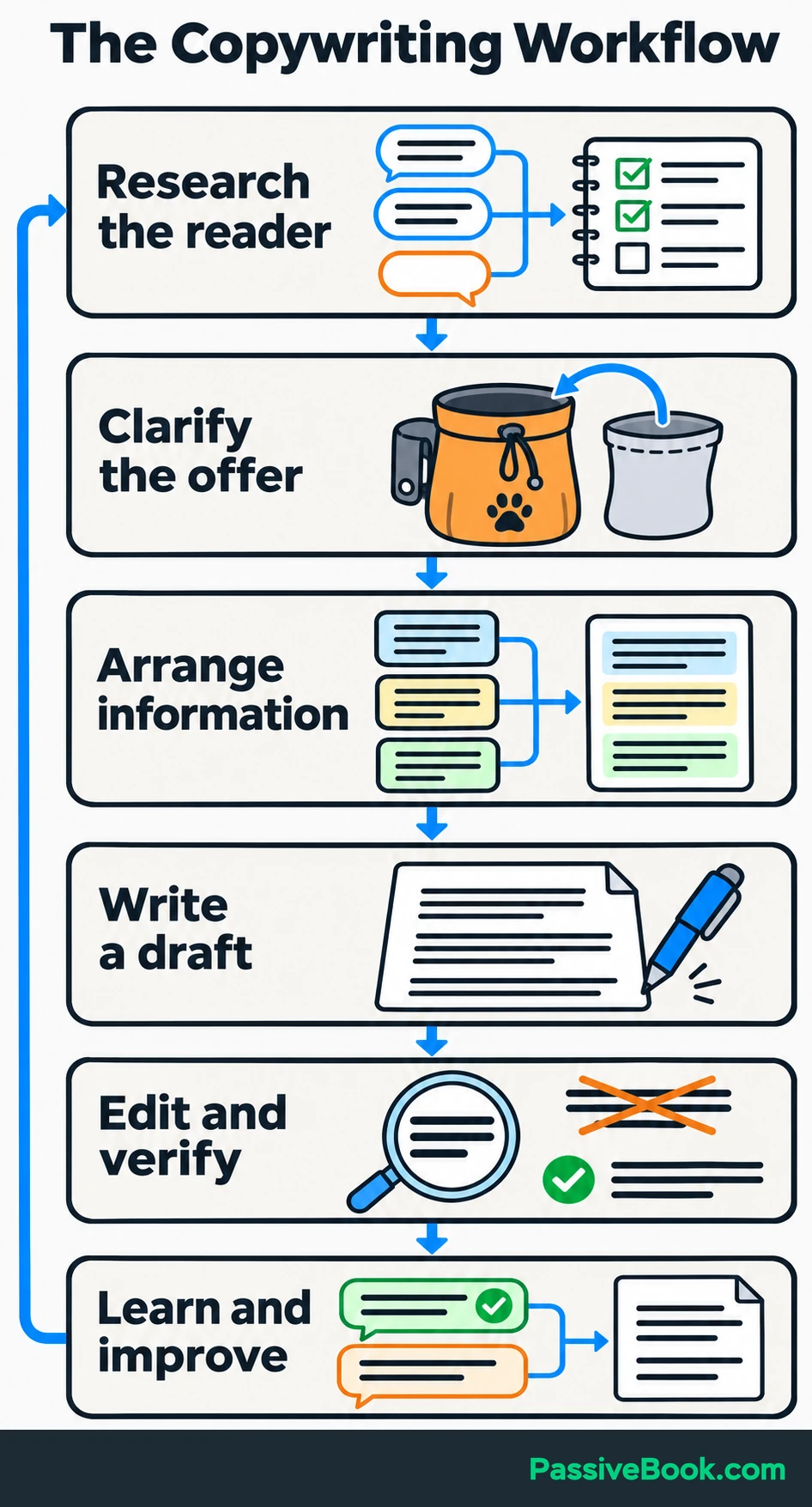
The process is repeatable:
- Research the reader’s decision.
- Clarify the offer.
- Arrange the information.
- Write a draft.
- Edit for clarity and credibility.
- Use feedback and results to improve it.
Throughout this guide, imagine you run a small online shop selling a dog-walking treat pouch. It has a belt loop, a drawstring closure and a removable, hand-washable liner. Its details, sample copy and figures are illustrations.
The aim is to make that offer easier to understand and assess. Words alone cannot create demand for something people do not want.
Research the Reader’s Buying Decision
Before writing, give the piece one clear job. Decide who will encounter it, what they already know and what you want them to do next.
Someone comparing treat pouches needs different information from someone who has never considered buying one. The first person may want dimensions and attachment photos. The second may need a reason to carry treats somewhere other than a pocket.
Start by learning how people handle the task now. Ask about a recent experience:
- “Where did you carry treats on your last walk?”
- “What was inconvenient about that?”
- “Have you tried carrying them another way?”
- “What would you need to know before buying a pouch?”
These questions give people something concrete to recall. “Would you buy this amazing product?” mostly gives them an opportunity to be polite.
If you have customers, review support messages, product reviews and questions asked before purchase. Without customers, speak with prospective buyers and read relevant discussions. Reviews of competing products can reveal questions worth investigating, but they do not establish what your own customers think.
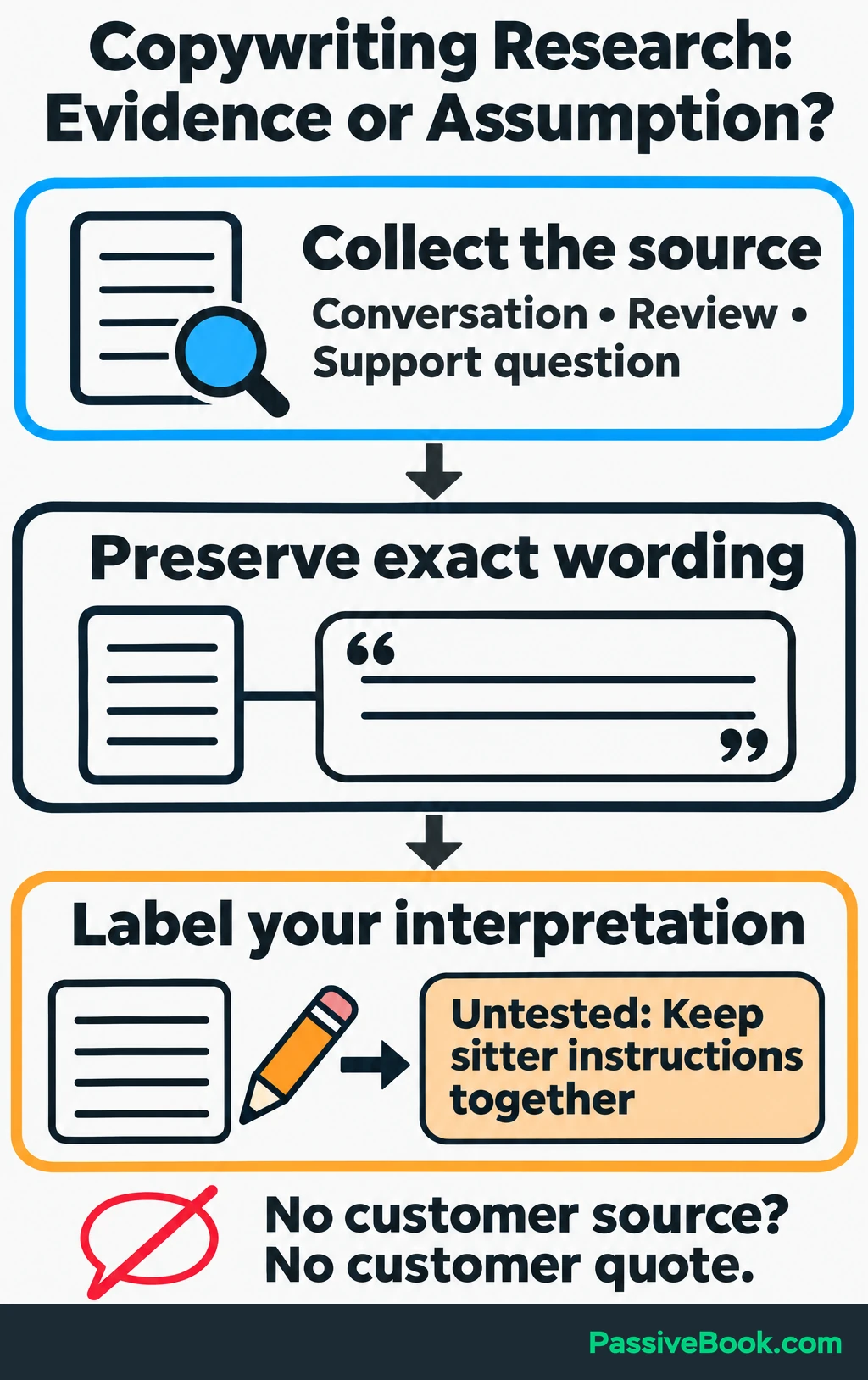
Keep exact wording and its source separate from your interpretation. A comment about crumbs in a pocket might suggest a cleaning concern. It does not prove that cleaning is everyone’s main reason to buy. GOV.UK’s user-research guidance makes the useful distinction between observed needs and assumptions that still need research.
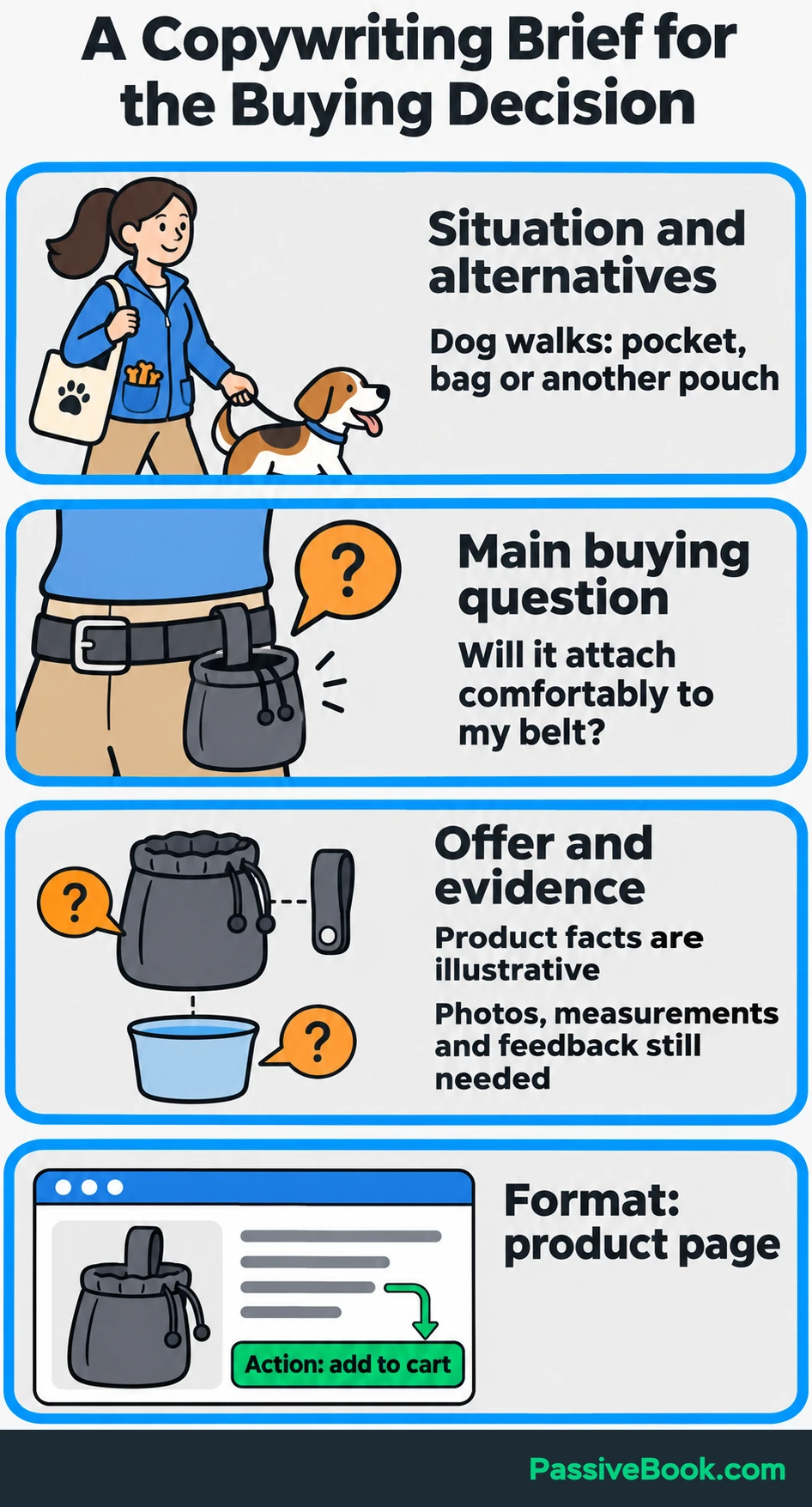
Turn what you learn into a short brief you can reuse:
| Brief Item | Working Pouch Example |
|---|---|
| Reader’s situation | Carries treats during dog walks; interest in a separate pouch still needs checking |
| Desired outcome | Carry treats outside clothing pockets |
| Current alternative | A pocket, reusable bag or another pouch |
| Main question | Will it attach comfortably to the belt used for walks? |
| Offer | Treat pouch with belt loop, drawstring closure and removable liner |
| Format | Product page |
| Intended action | Add the pouch to the cart |
| Available evidence | Assumed product facts for this exercise; actual photos, measurements and customer feedback are not supplied |
A brief saves you from researching the audience again every time you write an email. Update it when you learn something useful.
Define an Offer Worth Choosing
Establish the facts before trying to make the offer sound attractive.
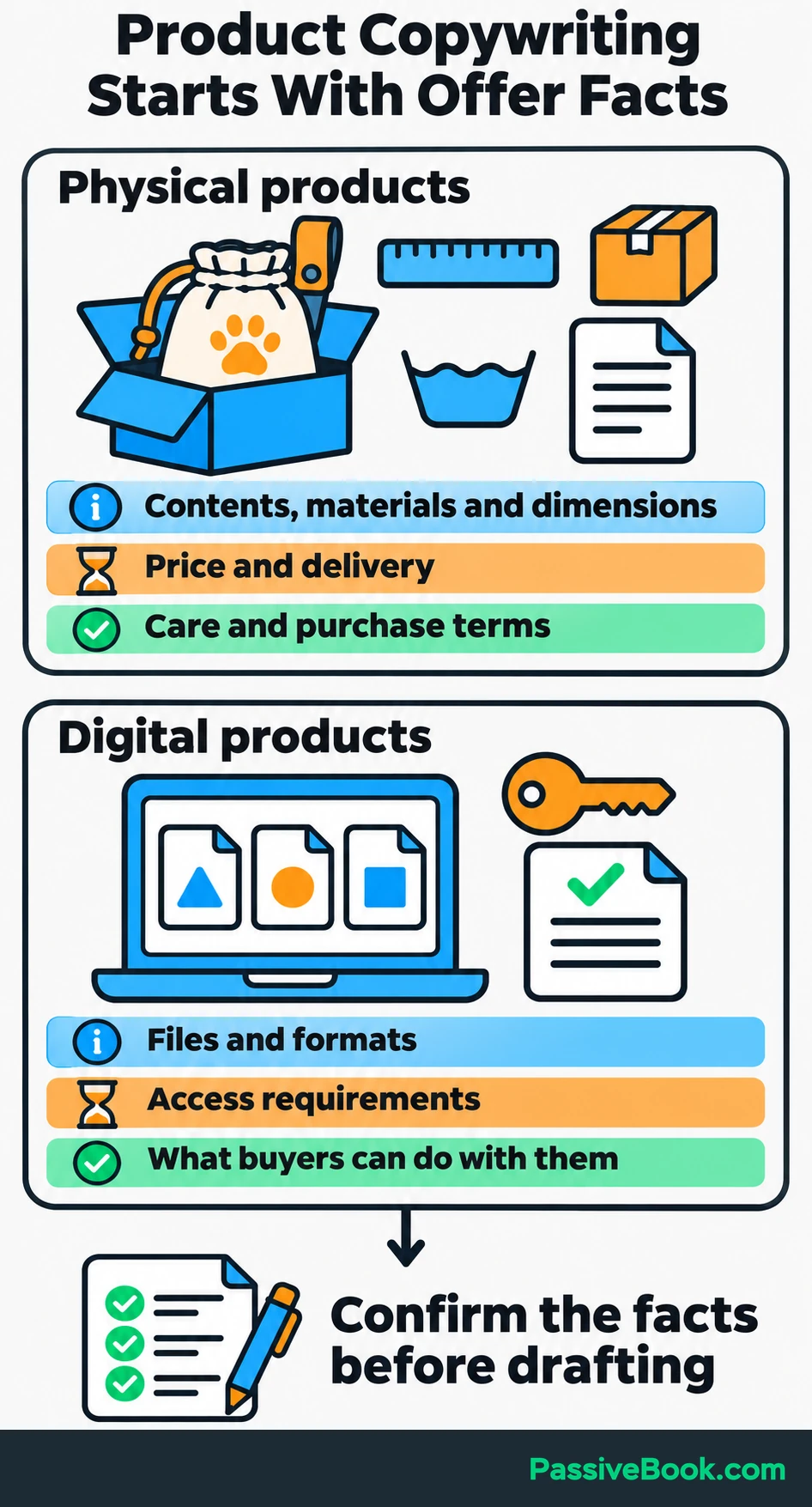
For a physical product, collect its contents, materials, dimensions, price, delivery details, care instructions and purchase terms. For a digital product, specify the files, formats, access requirements and what the buyer can do with them.
Missing facts create holes that enthusiastic adjectives cannot fill.
I skipped market research when I started my online jewellery store and ended up with unsold inventory. I lost most of the investment. That experience shapes how I approach an offer now: I want evidence that people want it before I spend days finding prettier ways to describe it.
Use this sentence to clarify the value:
For [reader in a situation], [offer] helps [useful outcome] through [specific capability].
For the pouch:
For people carrying treats on dog walks, this pouch provides a dedicated place outside clothing pockets through its belt-loop design.
That is a planning sentence. The published version can sound more natural:
Keep dog treats within reach on walks with a belt-loop pouch and a removable liner you can hand-wash afterward.
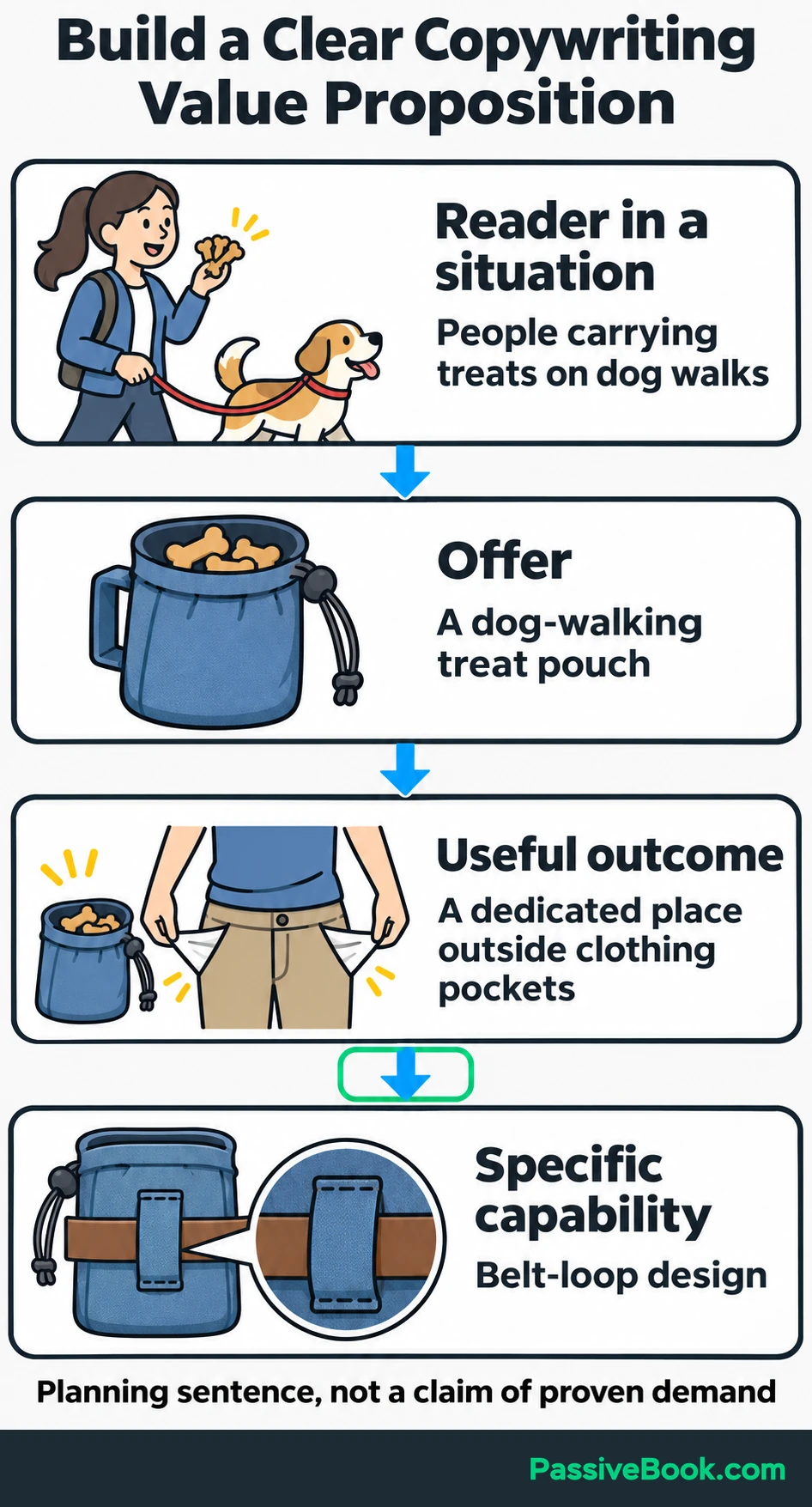
Choose one main benefit and let the other details support it. Here, the main benefit is having a dedicated place to carry treats. The liner explains how you clean that space, and the drawstring explains how you close it between uses.
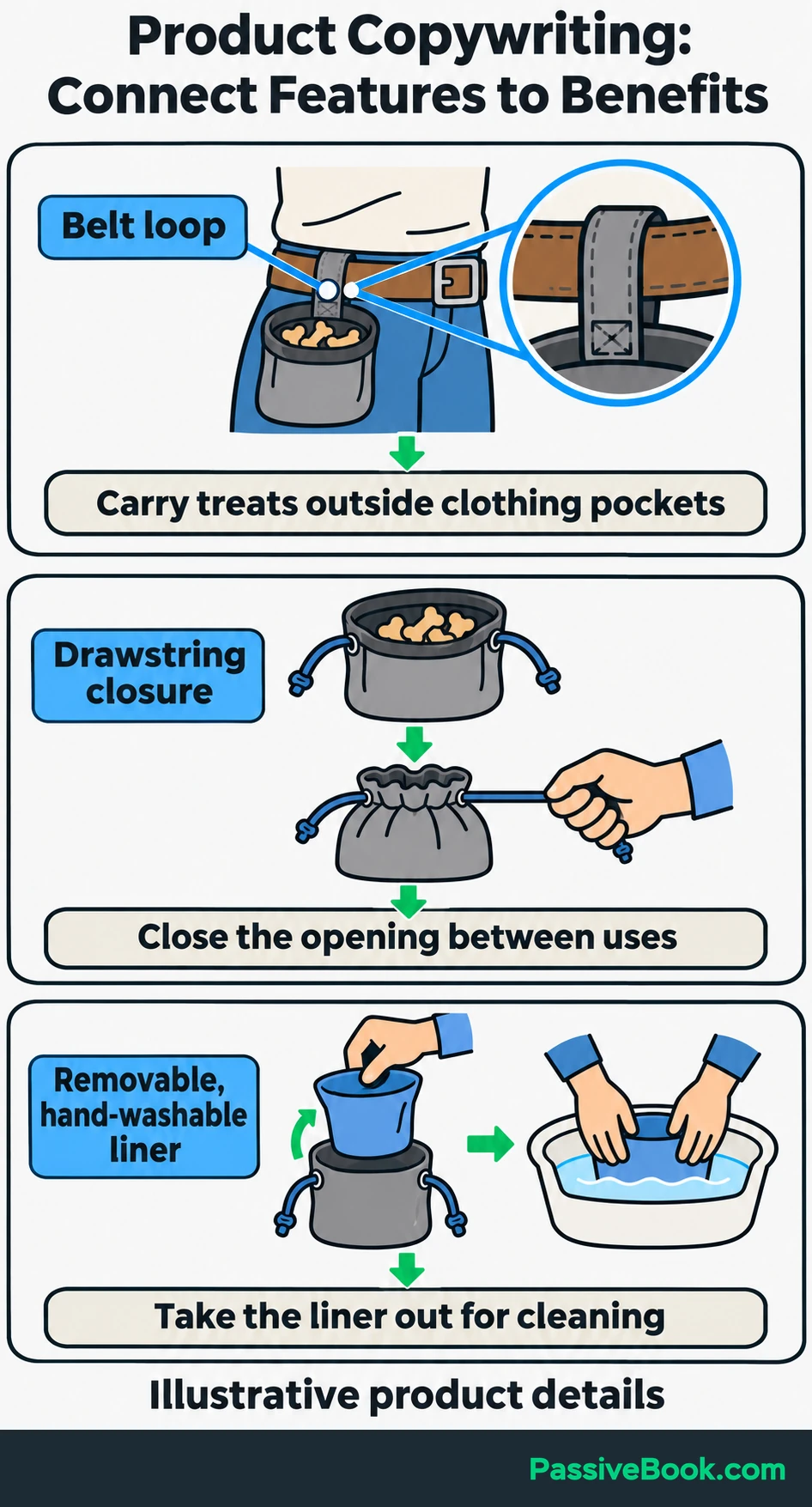
Features matter because they make the benefit believable:
| Feature | Practical Meaning |
|---|---|
| Belt loop | Carry the pouch on your belt instead of putting treats in clothing pockets |
| Drawstring closure | Close the opening between uses |
| Removable, hand-washable liner | Take the liner out for cleaning afterward |
Also consider the alternatives people actually use. A pocket costs nothing extra. A reusable bag may already do the job.
I would explain the pouch’s attachment and cleaning design rather than declare it “better than every alternative.” The reader can then decide whether those differences justify buying it.
Choose a Structure That Fits the Decision
A useful structure answers the reader’s questions in a sensible order:
- “Is this for me?”
- “What do I get?”
- “How does it help?”
- “Why should I believe it?”
- “What happens next?”
The opening depends on what the reader already understands. Someone shopping for a treat pouch can meet the product immediately. Someone reading about ways to carry walking supplies may need the situation explained first.
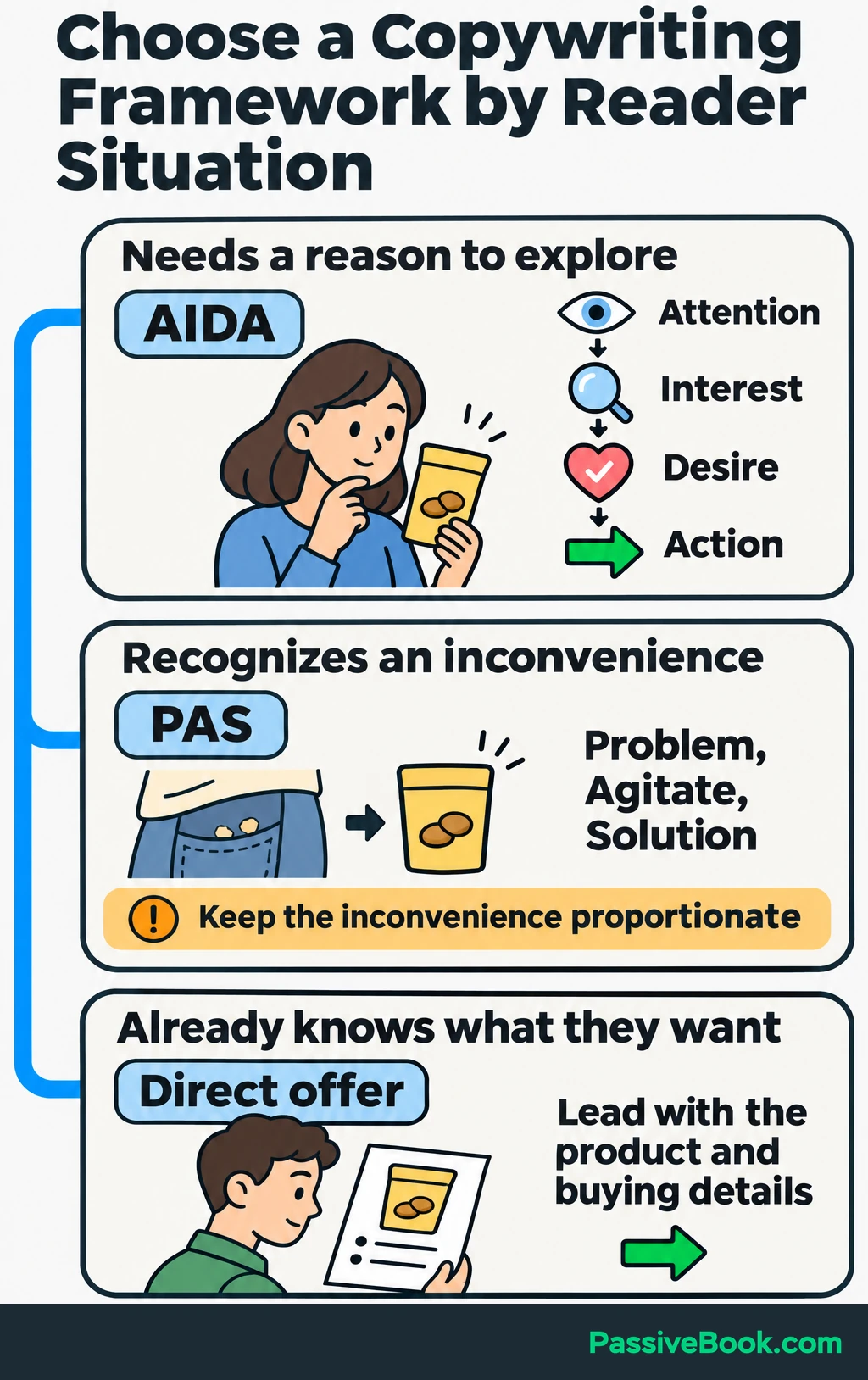
Three common frameworks can help organize the draft:
| Framework | Suitable Reader Situation | Message Sequence | Pouch Example |
|---|---|---|---|
| AIDA | The reader needs a reason to explore the offer | Attention → Interest → Desire → Action | Introduce carrying treats outside pockets, explain the design, show its practical value, invite a product-page visit |
| PAS | The reader recognizes a specific inconvenience | Problem → Agitate → Solution | Mention loose treats in pockets, describe crumbs left behind, introduce the pouch and removable liner |
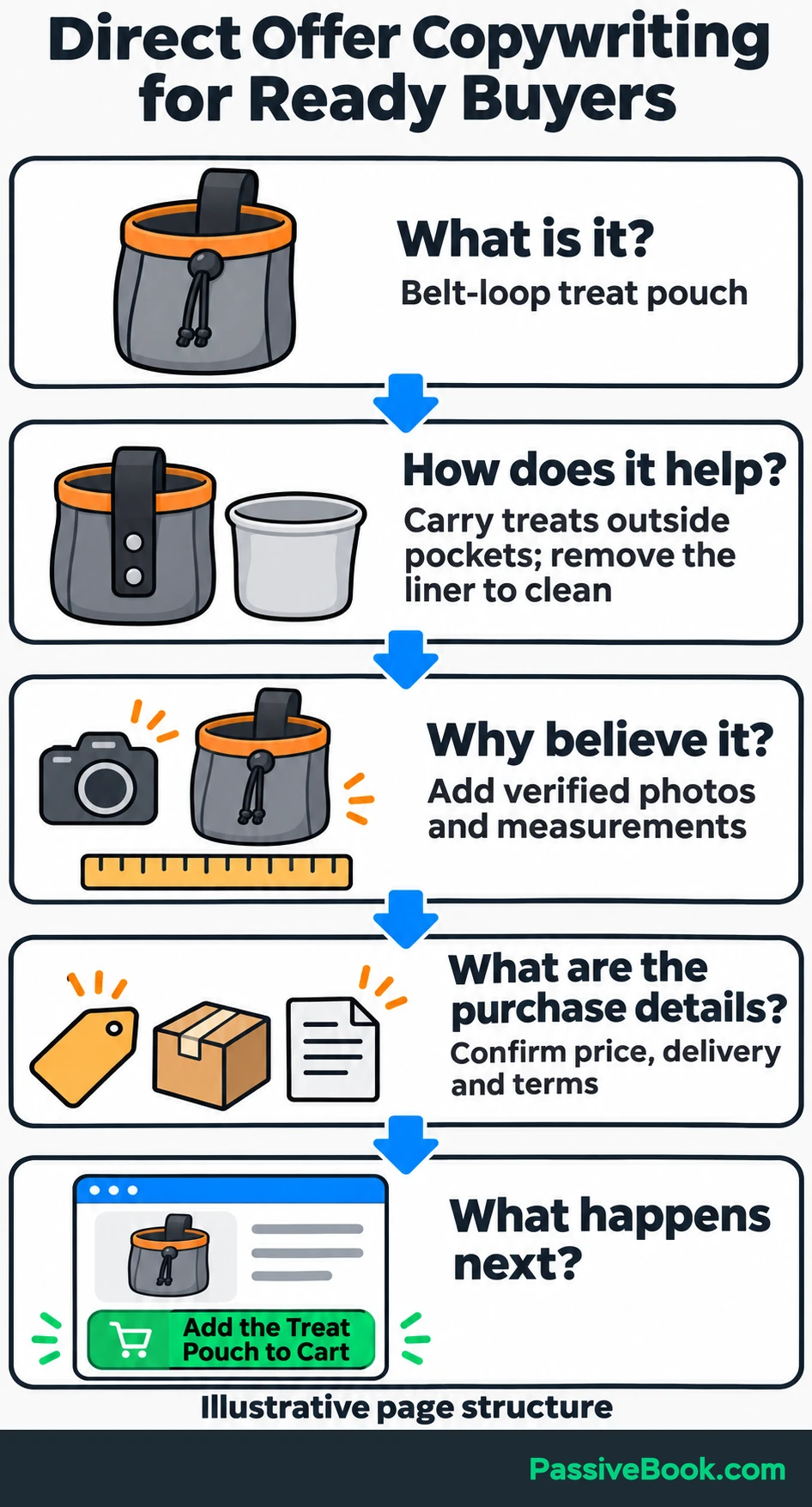
| Direct offer | The reader already knows what they want | Product → Benefits and contents → Evidence → Purchase details → Action | Name the pouch, explain attachment and cleaning, show photos and measurements, provide terms and a purchase button |
AIDA stands for Attention, Interest, Desire and Action. “Desire” is where you help readers see why the offer suits their needs, using details and evidence.
PAS stands for Problem, Agitate and Solution. Keep the middle step proportionate. Crumbs in a pocket are inconvenient. They do not require a dramatic account of how someone’s life has gone wrong.
For a product page reached from a relevant search, I would start with the direct offer structure. It answers the buying questions without making someone scroll through a problem they already understand.
Let those questions determine the length. A short description may answer them in a few sentences, while an expensive or unfamiliar offer may need demonstrations, comparisons and more explanation.
Write Persuasive Copy From the Brief
Draft the whole argument before polishing individual sentences. Give each paragraph a job, such as introducing the product, explaining attachment or answering a cleaning question.
This prevents an attractive headline from leading into a page that never explains the offer.
Write a Specific Headline
A headline should identify the offer or a useful outcome clearly enough for the intended reader to recognize its relevance.
Compare these:
The Ultimate Accessory for Happy Dog Owners
Keep Walk-Time Treats in a Belt-Loop Pouch
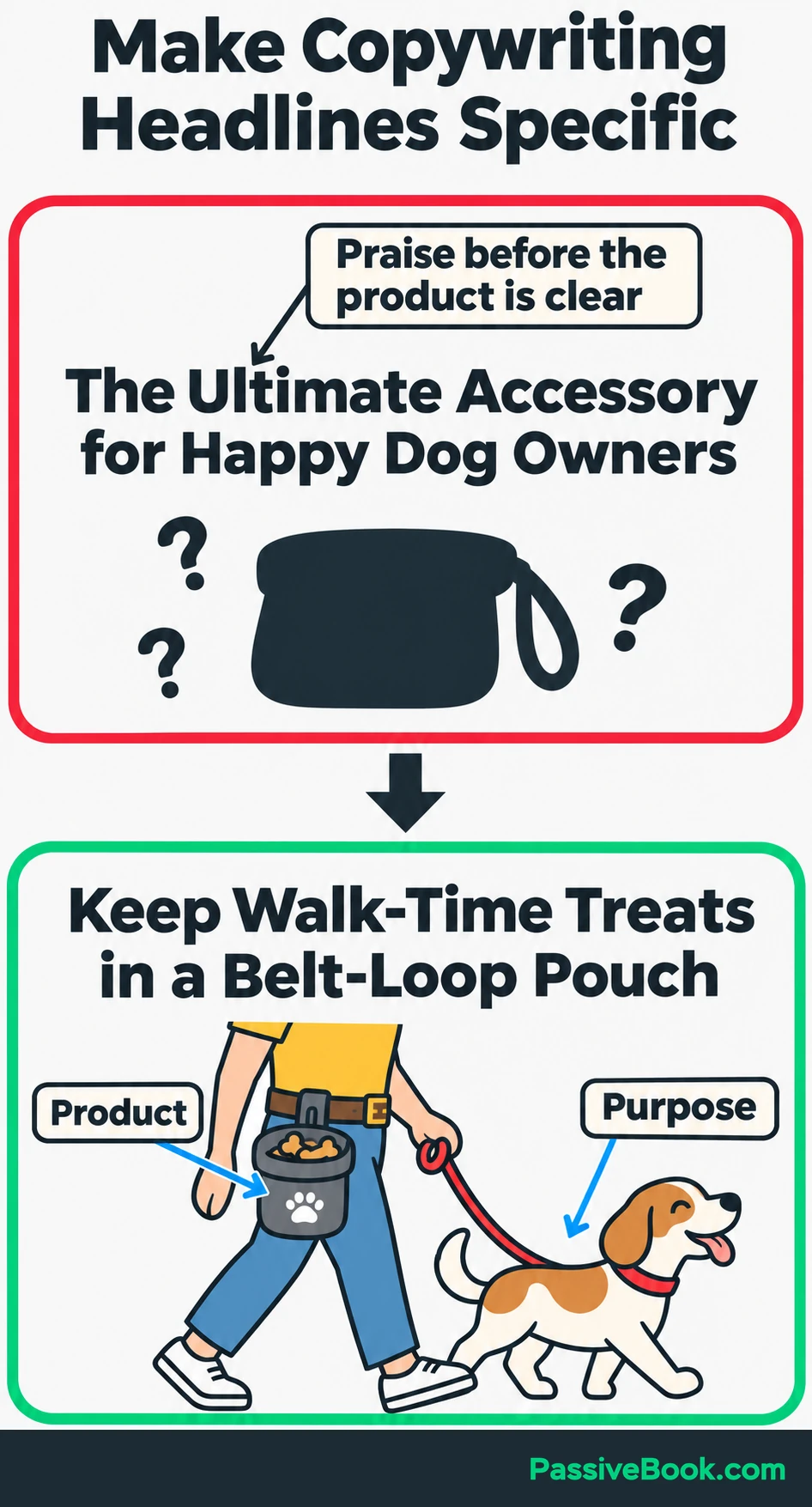
The second names the product and its purpose. “Ultimate” asks readers to accept praise before they know what is being praised.
Write alternatives around distinct, supported angles:
- Product: “A Belt-Loop Treat Pouch for Dog Walks”
- Use: “Carry Walk-Time Treats Outside Your Pockets”
- Care: “A Treat Pouch With a Removable, Hand-Washable Liner”
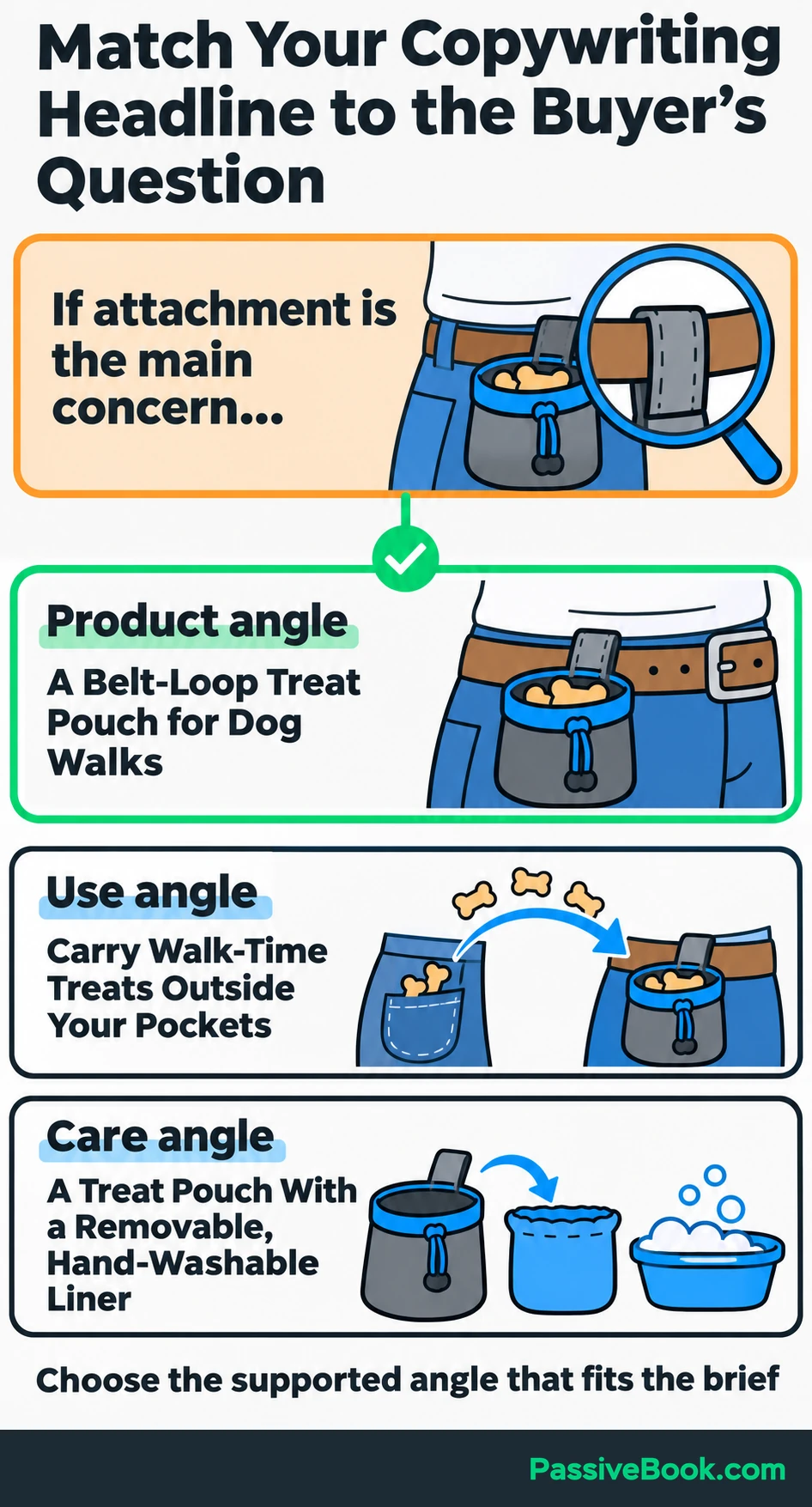
Then choose the angle that fits the brief. If research points to attachment as the main concern, a cleaning headline may lead with the wrong detail.
Keep the promise consistent with the message that brought readers there. A promotion about the removable liner should lead to a page where the liner is easy to find.
Make the Opening Earn Its Place
The opening should add the next useful detail. It can explain the situation, show how the product works or answer an immediate question.
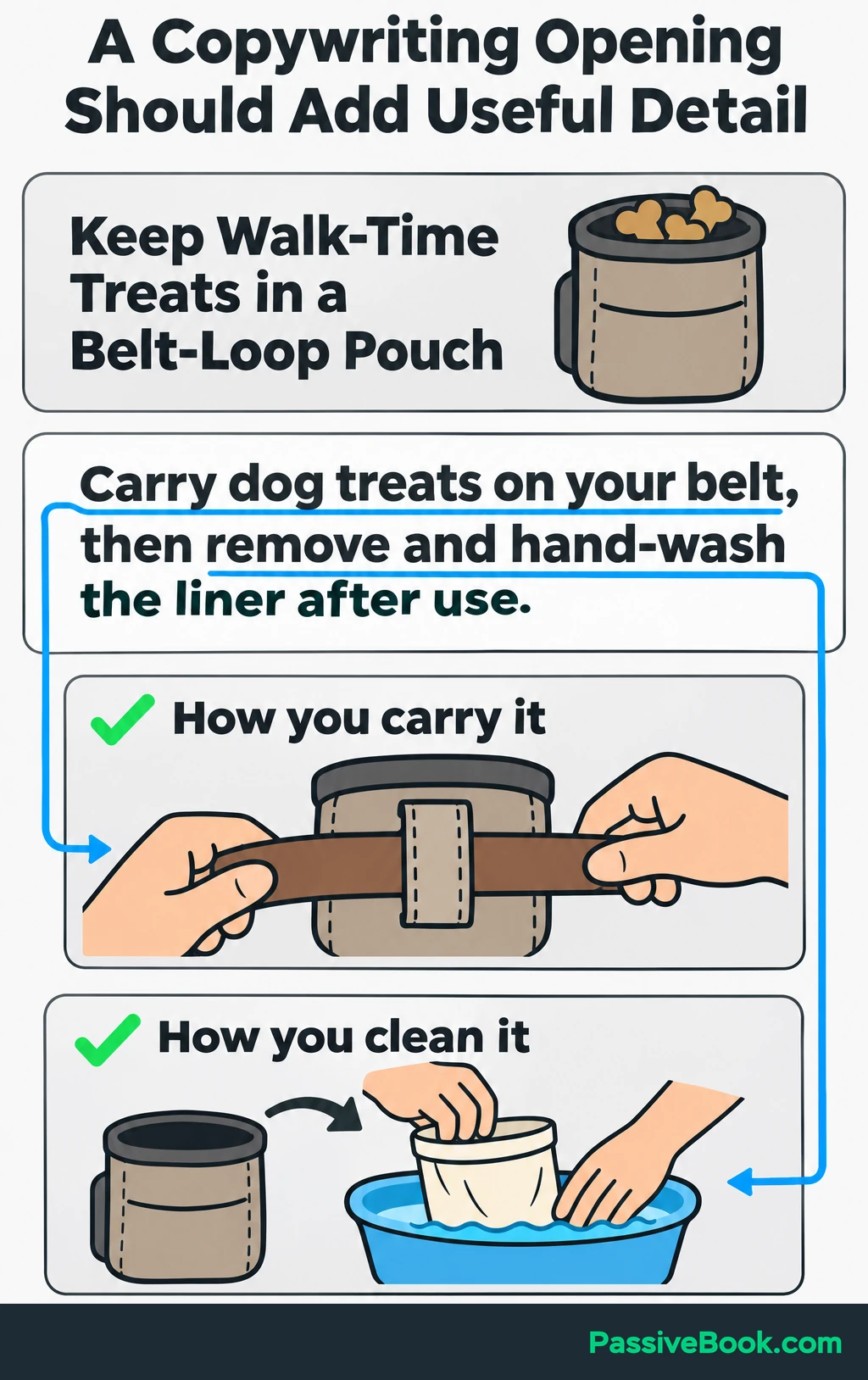
For example:
Carry dog treats on your belt, then remove and hand-wash the liner after use.
That sentence develops the headline through two concrete actions.
Cut openings about how busy modern life has become or how passionate the business is about quality. Those ideas rarely help someone assess a pouch.
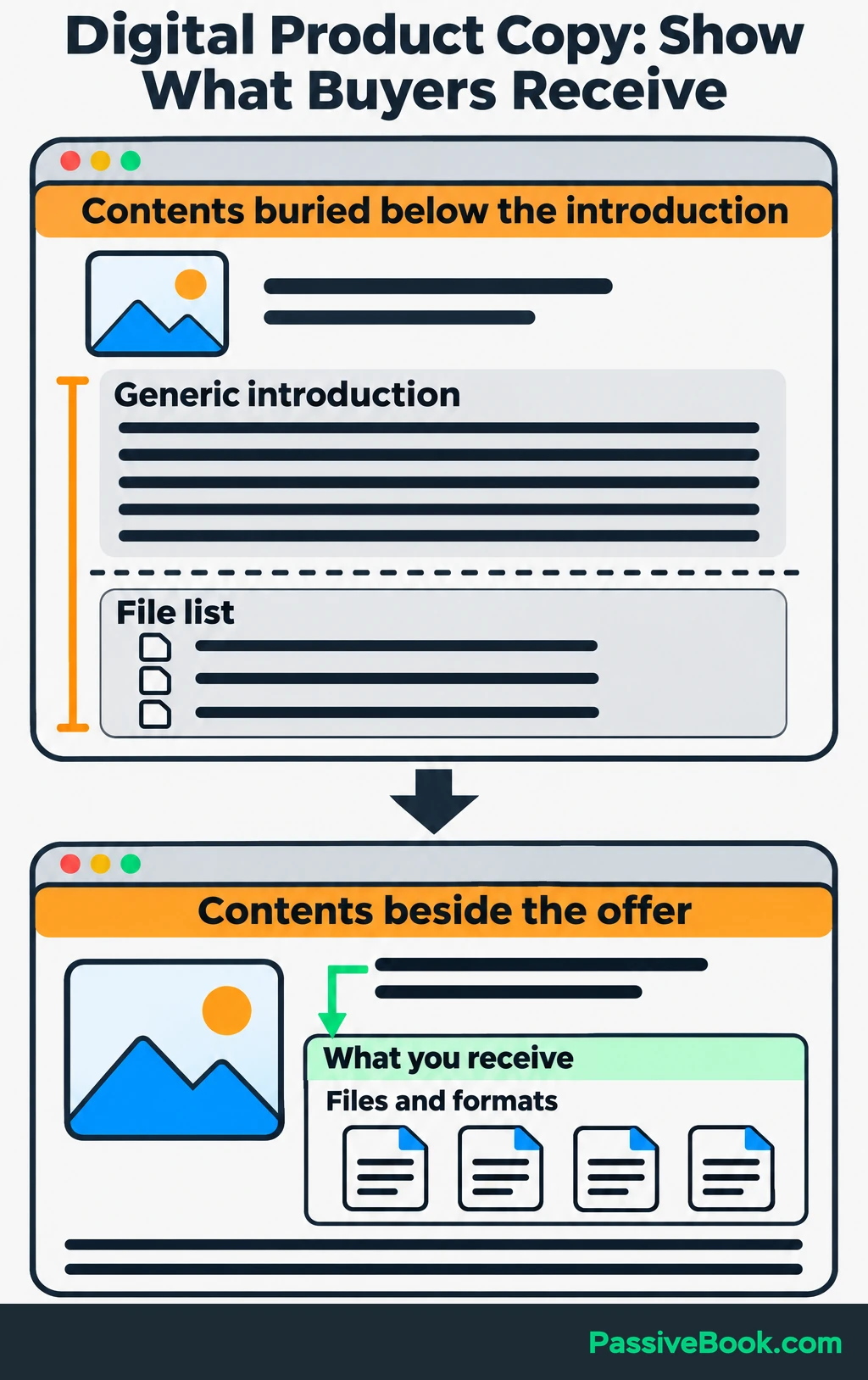
On one of my digital-product pages, I kept revising the opening while the actual download contents sat farther down the page. Putting the file list beside the offer exposed what the introduction had failed to explain. I now check whether the opening adds useful information before giving it another rewrite.
Explain Benefits Through Concrete Details
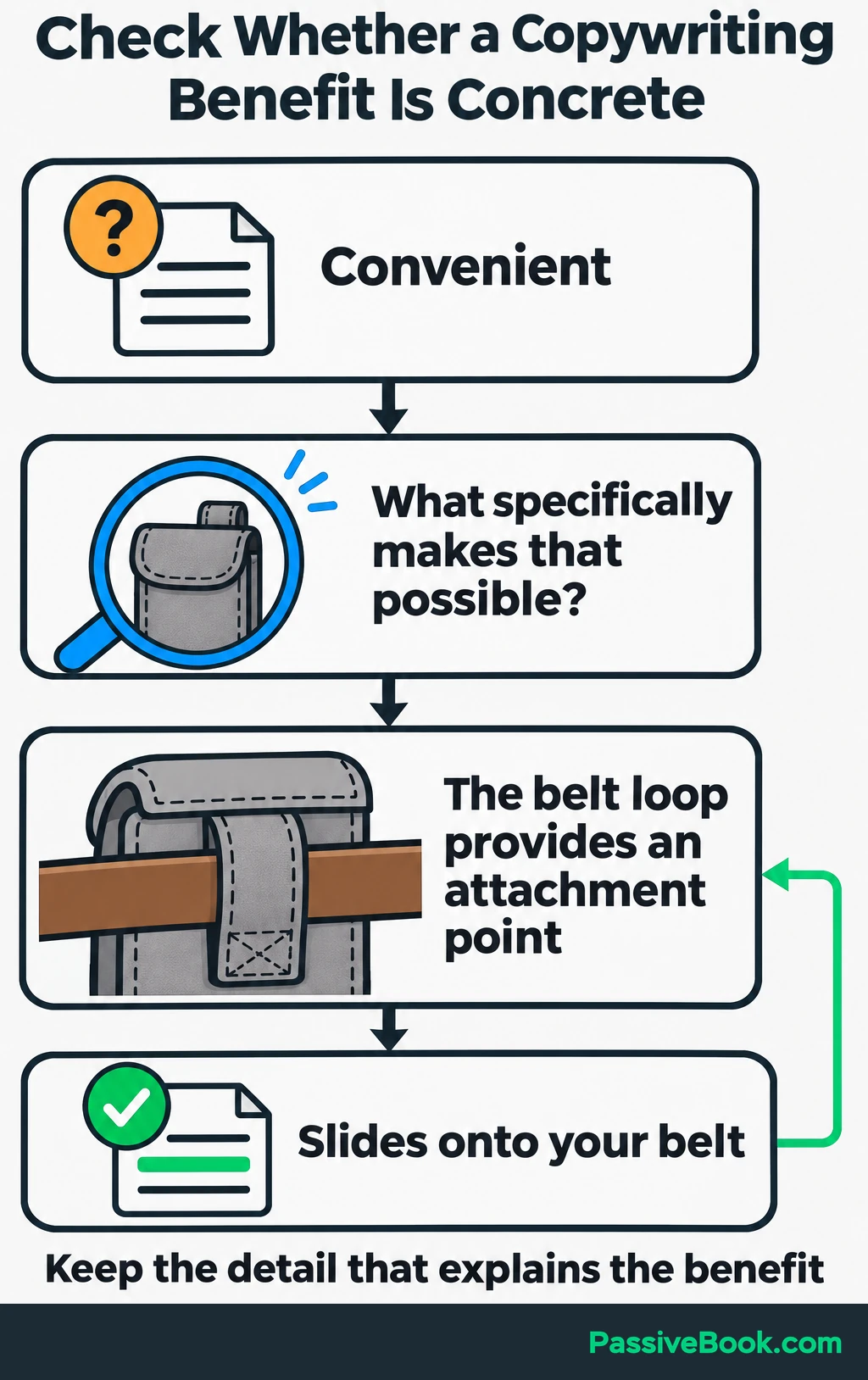
Write each benefit with the feature or process that makes it possible.
“Convenient” leaves readers to imagine the convenience. “Slides onto your belt” explains an action they can picture.
You can check a benefit by asking:
What, specifically, lets the buyer do that?
For the pouch, the belt loop provides somewhere to attach it. The removable liner can be taken out for cleaning.
Use customer language where it makes the explanation clearer, but keep a consistent voice. You do not need to copy every dramatic phrase from a review.
Organize the body around the reader’s priorities. Use short paragraphs for explanations and bullets for parallel details, such as what is included. Avoid turning every sentence into a separate bullet just because the page looks busy.
Support Claims and Resolve Objections
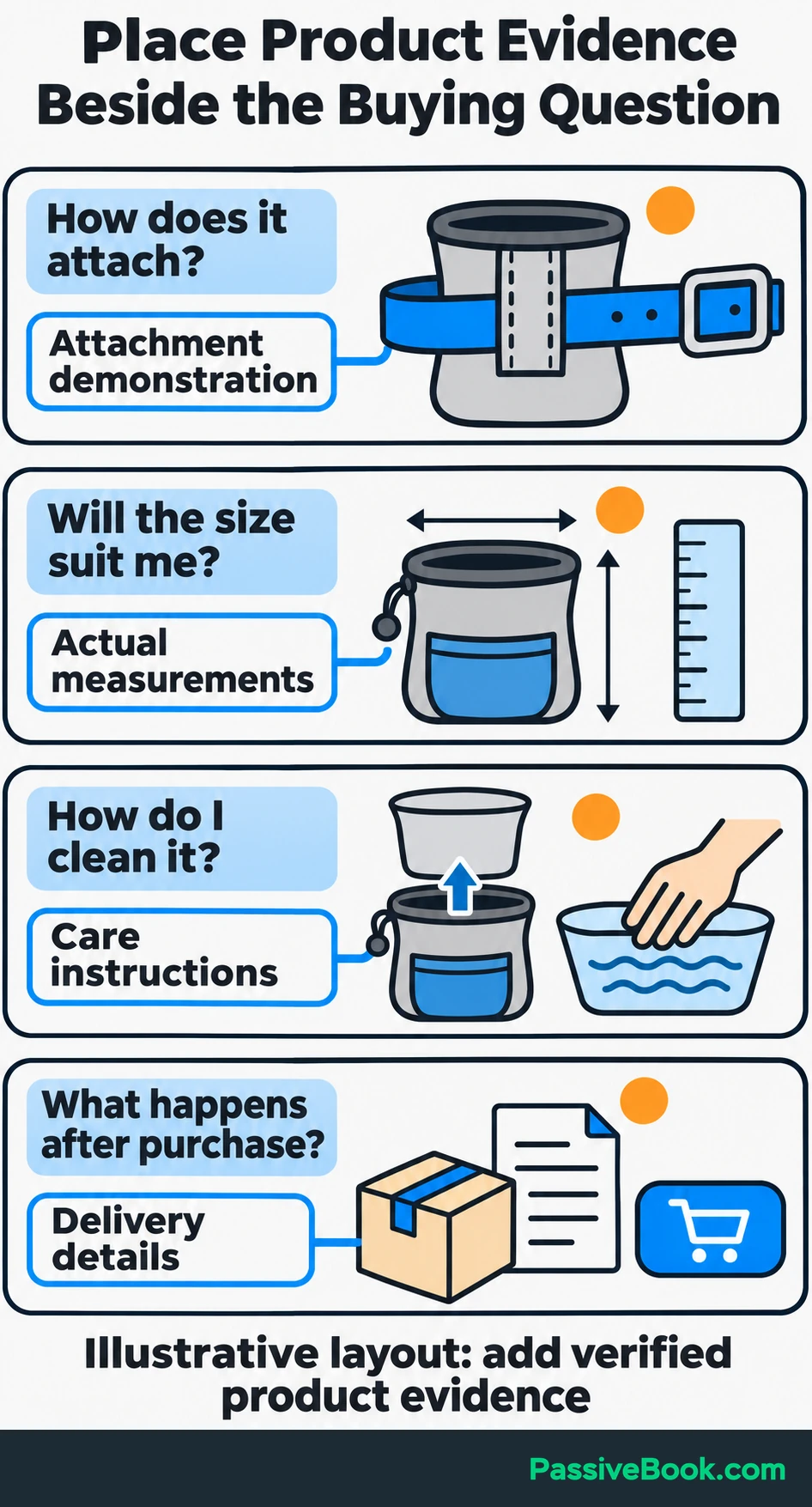
Place evidence beside the claim it supports.
An interior photo can show the liner. An attachment demonstration can show how the belt loop works. Measurements can help someone assess size. A relevant customer review can describe that person’s experience.
If you have no testimonials, use product evidence people can inspect. A clear demonstration gives a new shop something useful to show without borrowing anyone’s praise.
Answer purchase questions where they arise:
- Attachment details belong beside the belt-loop explanation.
- Dimensions belong beside size and capacity information.
- Care instructions belong beside the cleaning benefit.
- Delivery details belong near the purchase decision.
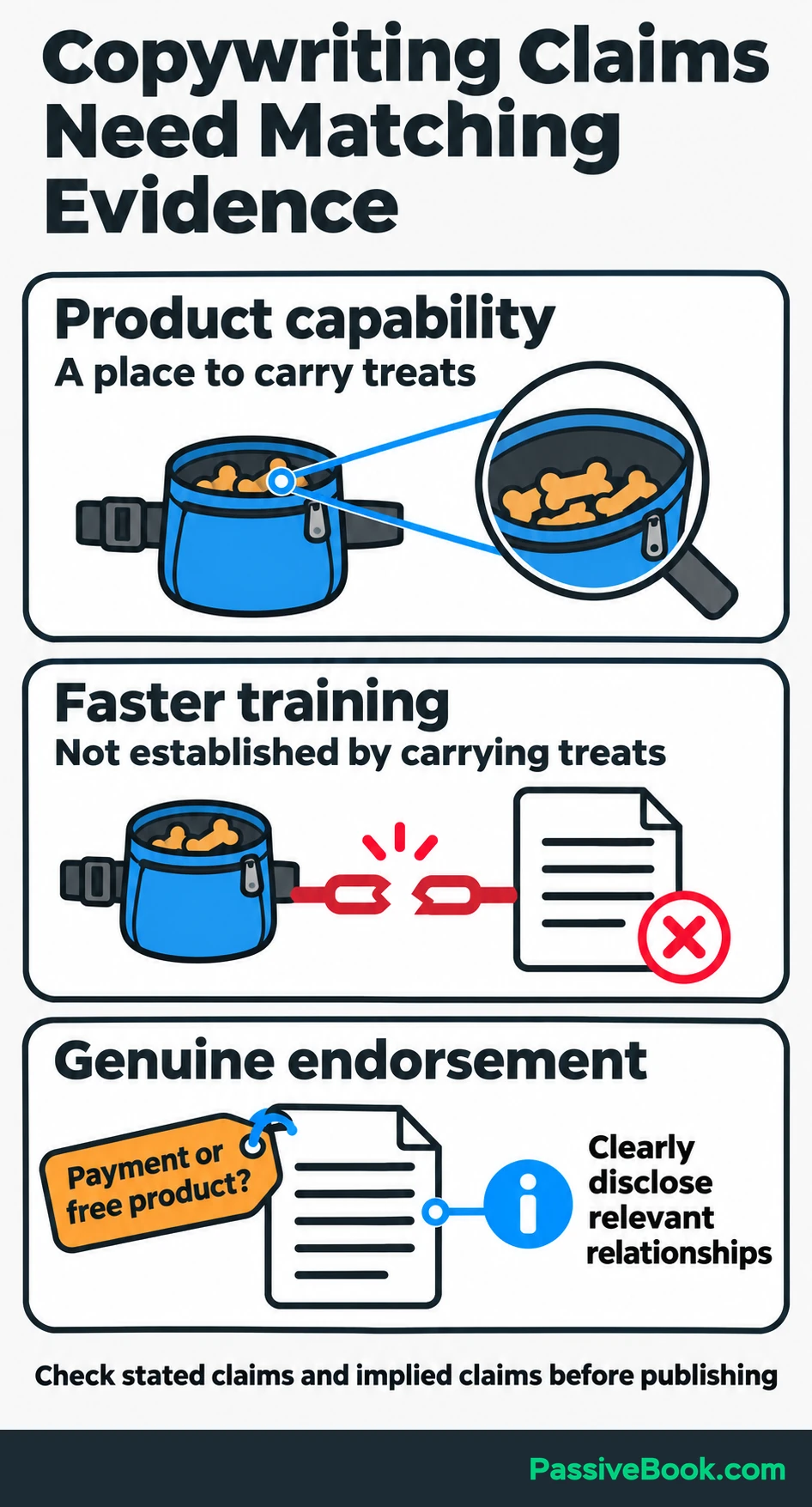
For U.S. advertising, the Federal Trade Commission (FTC) says advertisers must have evidence for both stated claims and claims the message implies before publication. A pouch that carries treats does not, by itself, support a promise of faster training. See the FTC’s advertising guidance.
Use genuine endorsements, and clearly disclose relationships that could affect how readers judge them, such as payment or a free product. The FTC’s endorsement guidance explains those obligations.
Write a Clear Call to Action
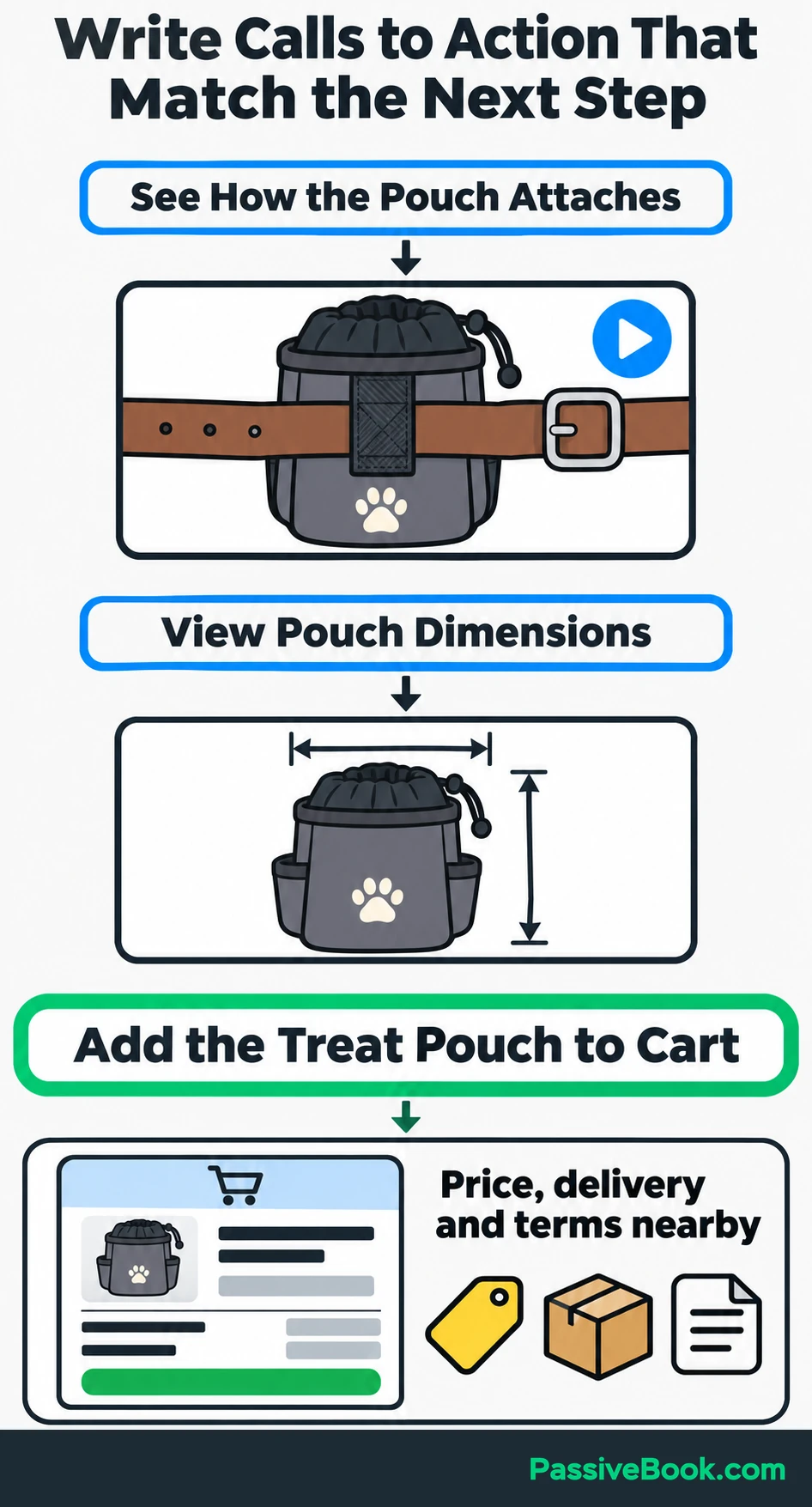
A call to action tells the reader what to do next. Match its wording to the actual destination or action:
- “See How the Pouch Attaches” opens the demonstration.
- “View Pouch Dimensions” leads to measurements.
- “Add the Treat Pouch to Cart” adds the product to the cart.
These labels also make links easier to understand. W3C’s descriptive-link guidance explains how meaningful link text helps users distinguish destinations and decide whether to follow them.
Give a focused promotional page one primary goal. Supporting links can answer questions that help someone reach that decision, and you can repeat the purchase action after useful explanation.
Keep the price, relevant delivery information and terms close enough to assess before acting. If the next step is an enquiry rather than a purchase, say what information to send and what happens afterward.
A countdown timer that restarts tomorrow is an awkward way to introduce yourself.
Use AI With a Specific Brief
AI is more useful when it has facts and a defined task. I use Claude for long-form writing, but the same briefing process works with your existing writing tool.
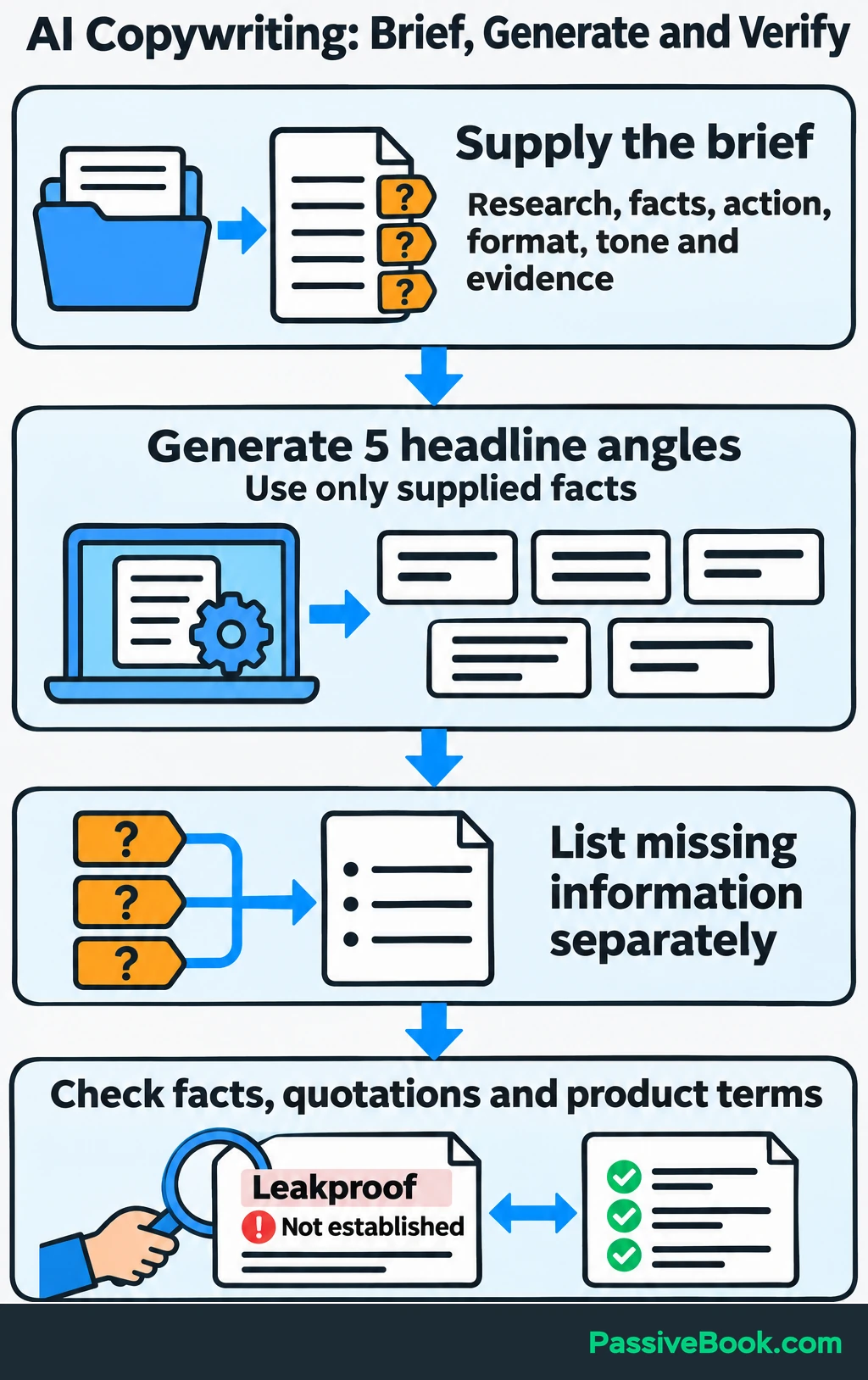
Provide the reader research, product facts, intended action, format, tone examples and available evidence. Mark assumptions and missing information.
For example:
Using only the supplied research and product facts, write five headlines for a dog-walking treat pouch. Emphasize carrying treats outside clothing pockets. Give each headline a different angle. Do not invent customer quotes, product capabilities or results. List missing information separately.
Use AI to explore angles, shorten a passage or identify unanswered buying questions. Keep the wording that fits the brief.
Check every generated fact, quotation, product term and example manually. An AI draft can suggest “leakproof,” but that word still needs evidence. Replace generic praise with details you can verify.
I would build one reusable brief before building an automated writing workflow. Otherwise, you can automate the production of copy you still have to rewrite.
If turning those facts into a draft is where you get stuck, AI Copywriting Studio can help. It builds a reusable brief and drafts your chosen piece, keeping unanswered questions separate from the copy.

Free AI Copywriting Studio




Adapt the Message to the Format
Keep the same audience understanding and core promise across formats. Change how much you explain and what you ask the reader to do immediately.
A product page supports a purchase decision. An email may only need to earn a relevant visit to that page.
Websites and Landing Pages
A homepage should make the business understandable and offer clear routes to its main products or services. A focused landing page should support one primary action with the information needed to decide.
For the pouch, I would arrange the page like this:
- A specific headline and short explanation.
- Photos or a demonstration showing attachment.
- Relevant features, dimensions and other specifications.
- Cleaning instructions and purchase details.
- A clear purchase action.
Move information earlier when readers need it sooner. If attachment keeps causing confusion, do not leave the demonstration beneath the brand story.
For a page intended to attract search traffic, use the words people use for the product where they fit naturally. A keyword should help identify the offer rather than interrupt the explanation.
Product and Service Descriptions
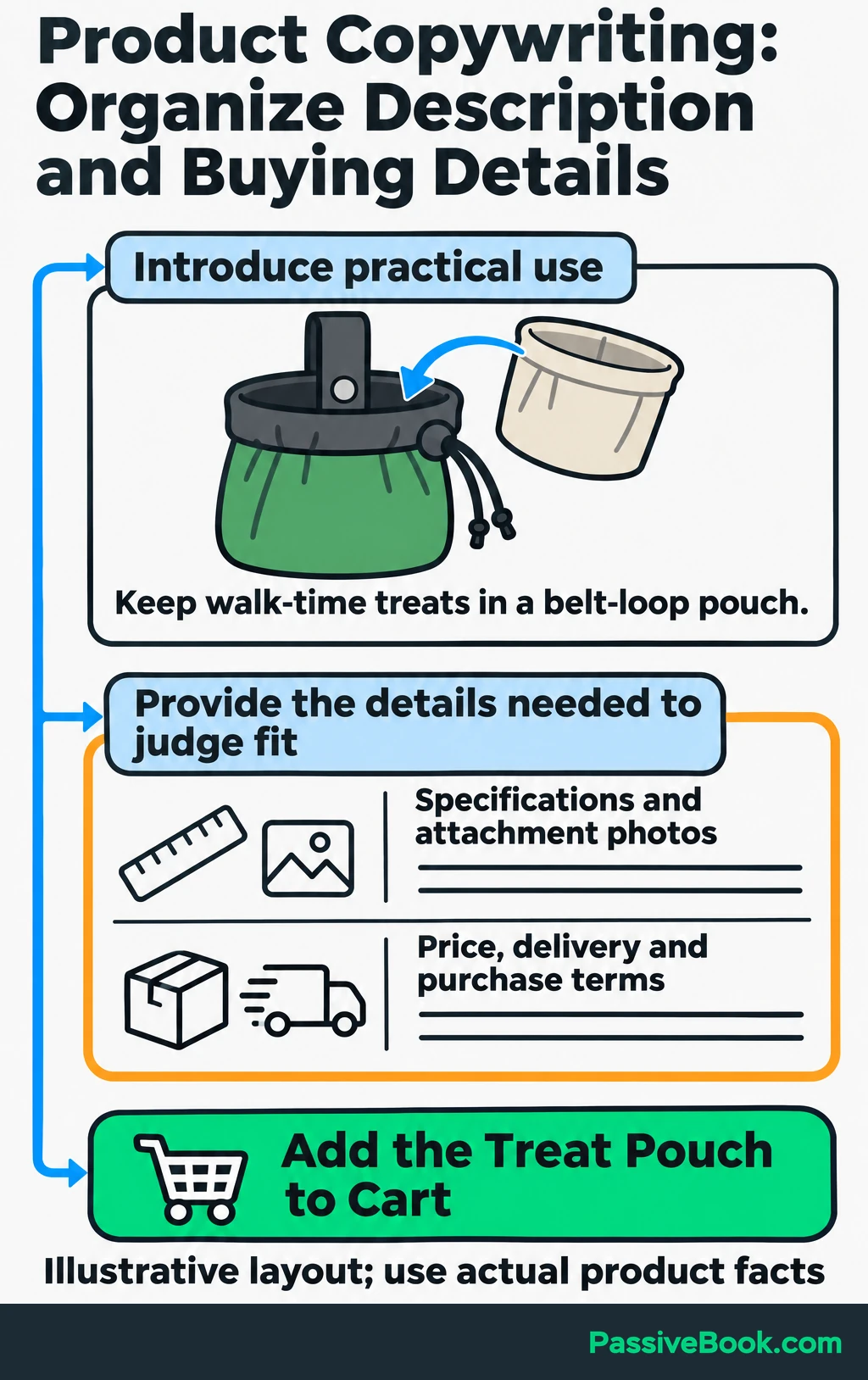
Lead with practical use, then provide the details needed to judge fit.
A compact pouch description could read:
Keep walk-time treats in a belt-loop pouch. The drawstring closure lets you close the opening between uses, and the removable liner can be hand-washed afterward. Check the dimensions and attachment photos to see whether it suits your walking setup.
Follow it with actual specifications, price, delivery information, purchase terms and the cart action. The description introduces the offer; it should not have to carry every specification inside one crowded paragraph.
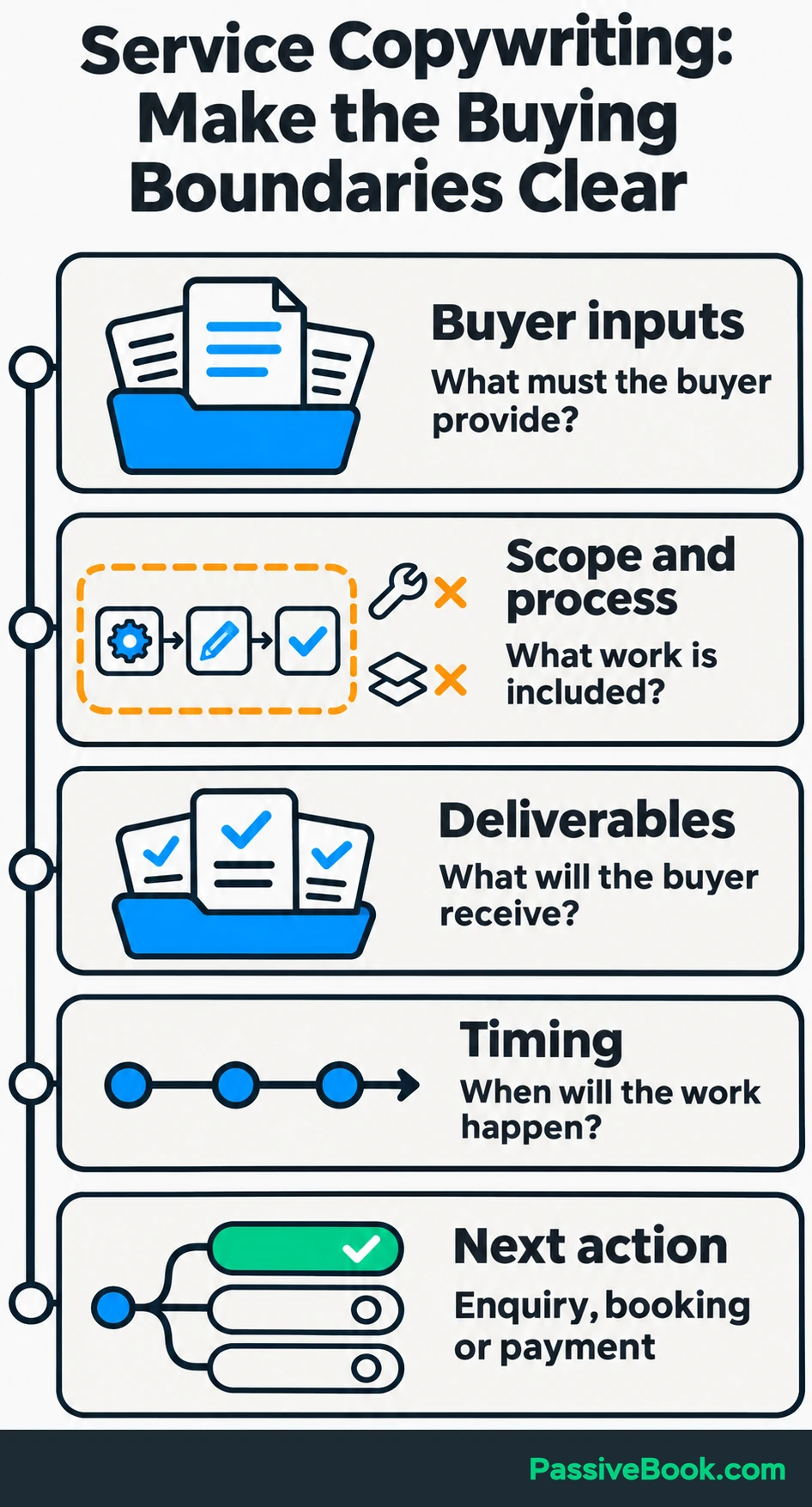
For a service, replace physical specifications with scope, deliverables, process and timing. Explain what the buyer provides, what they receive and whether the next step is an enquiry, booking or payment.
I would make those boundaries clear before adding more persuasive language. “What is included?” is a reasonable buying question.
Emails
Give each email one main purpose. The subject should accurately introduce the message, and preview text should add context rather than repeat it.
Here is a complete promotional email for the example shop. Replace the destination placeholder with the actual product-page link.
Subject: A dedicated place for walk-time treats
Preview text: See the belt-loop design and removable liner.
Hi,
If you carry dog treats in your clothing pockets on walks, this pouch gives them a separate place.
Slide the pouch onto your belt, add the treats you plan to carry and use the drawstring to close the opening between uses. Afterward, you can remove the liner and hand-wash it.
Before ordering, check the dimensions and attachment photos on the product page to see whether it fits your walking setup. You’ll also find the price and delivery details there.
[View the treat pouch — insert product-page link]
Thanks for taking a look,
The shop team
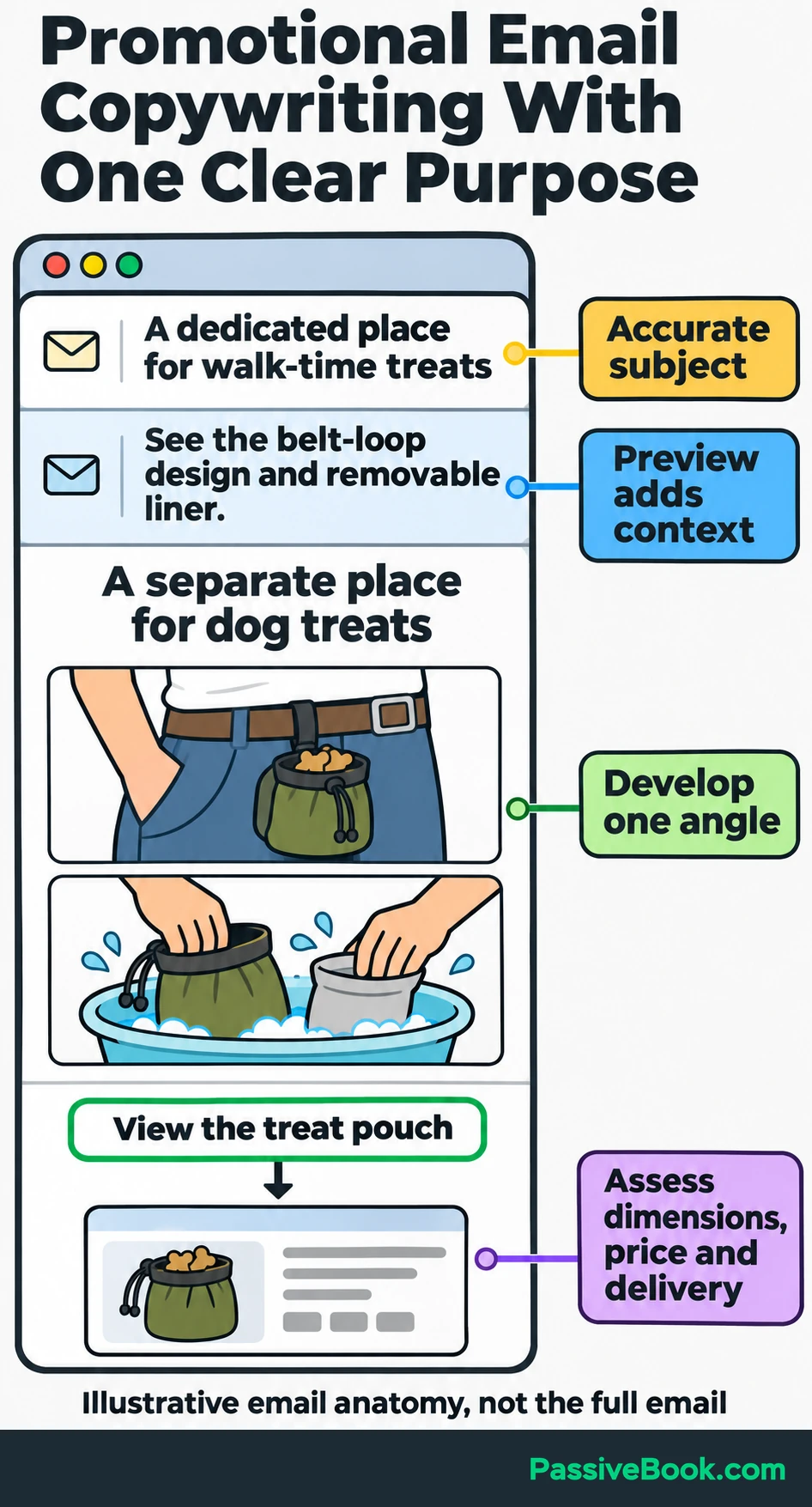
The email develops one angle and gives interested readers somewhere to assess the details.
For an educational email, make the lesson useful on its own and introduce the offer where it fits. I would skip a product pitch in every paragraph. Readers should not have to dodge sales links to finish a sentence.
Ads and Short Promotional Posts
Short copy needs a relevant angle and a clear next step. It does not need to squeeze in the whole sales page.
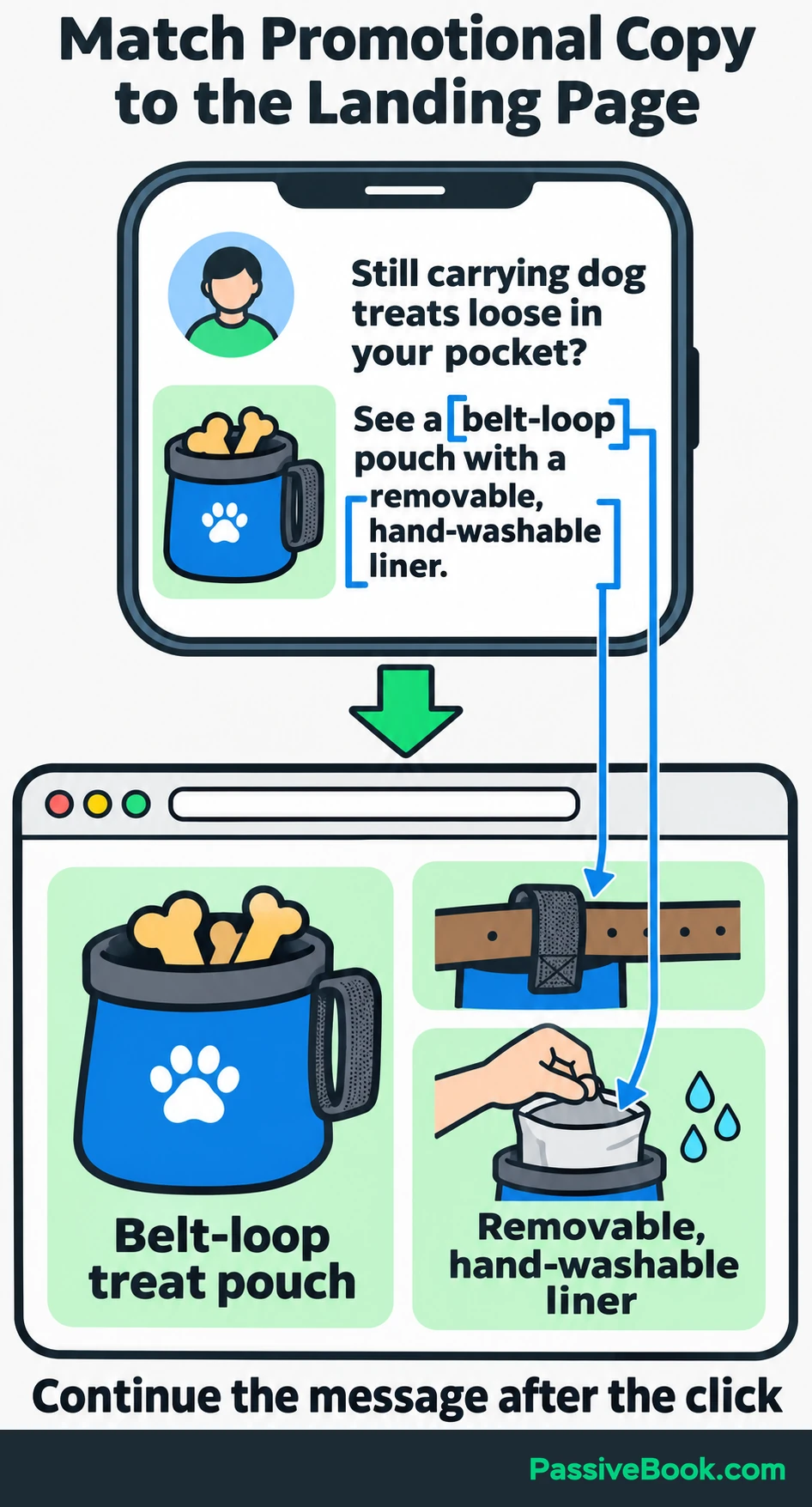
For example:
Still carrying dog treats loose in your pocket? See a belt-loop pouch with a removable, hand-washable liner.
The destination page should continue that message and show the features mentioned.
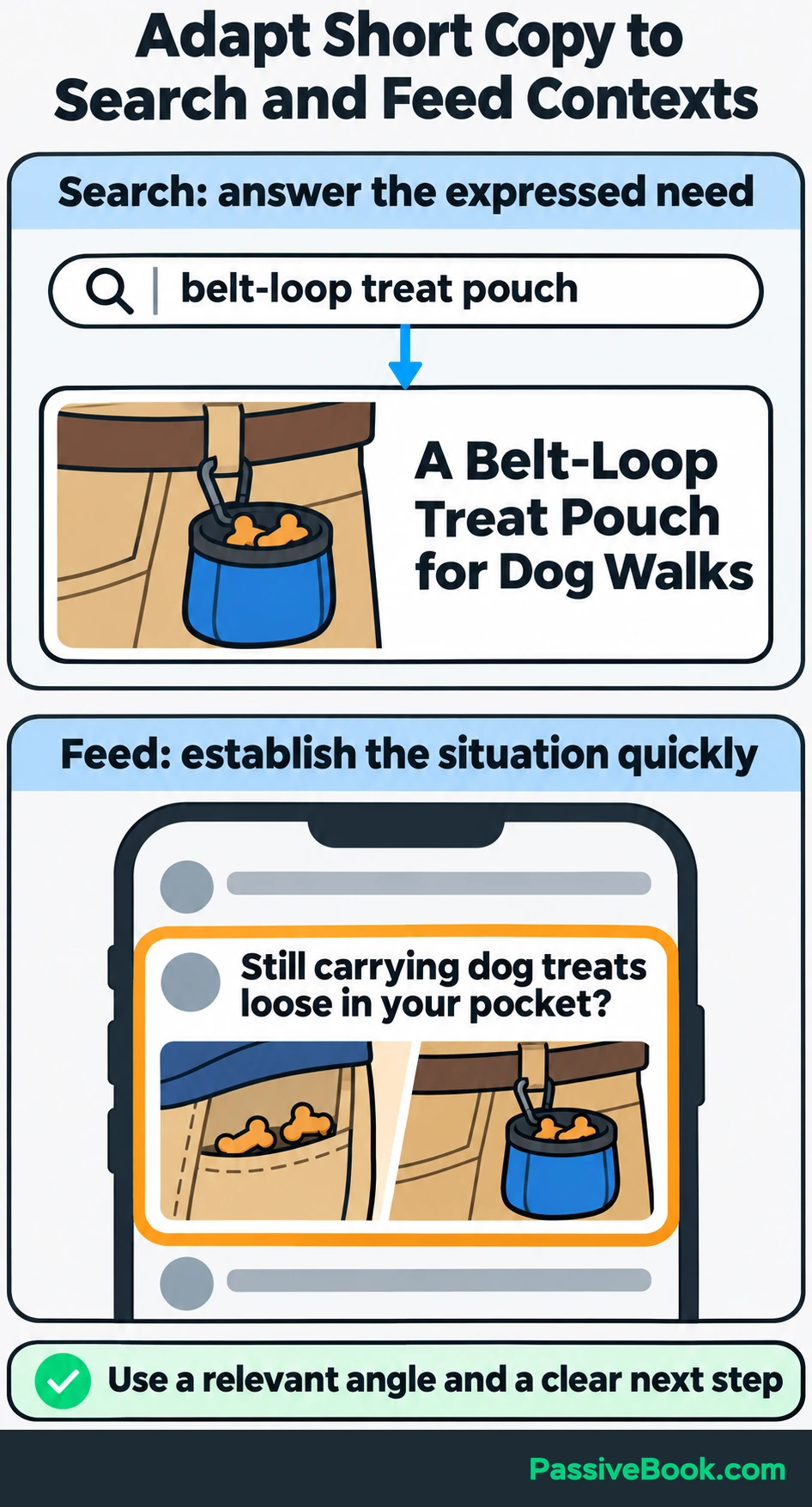
In a search ad, respond directly to the need expressed in the search. In a feed post, establish the situation quickly because the reader may not be shopping.
You can practice with an organic promotional post before spending money on ads. The work of choosing a relevant promise and matching it to a destination is useful either way.
Edit for Clarity and Credibility
Edit in separate passes so you do not spend an hour polishing a paragraph that needs removing.
- Check the argument. Is the offer clear? Are important questions unanswered? Does the evidence support the promise?
- Sharpen the wording. Replace vague praise, repetition and awkward sentences with concrete details.
- Check the finished layout. Read the page on mobile, test links and inspect the purchase journey.
Compare:
An innovative accessory that transforms your dog-walking experience.
With:
A belt-loop treat pouch with a removable, hand-washable liner.
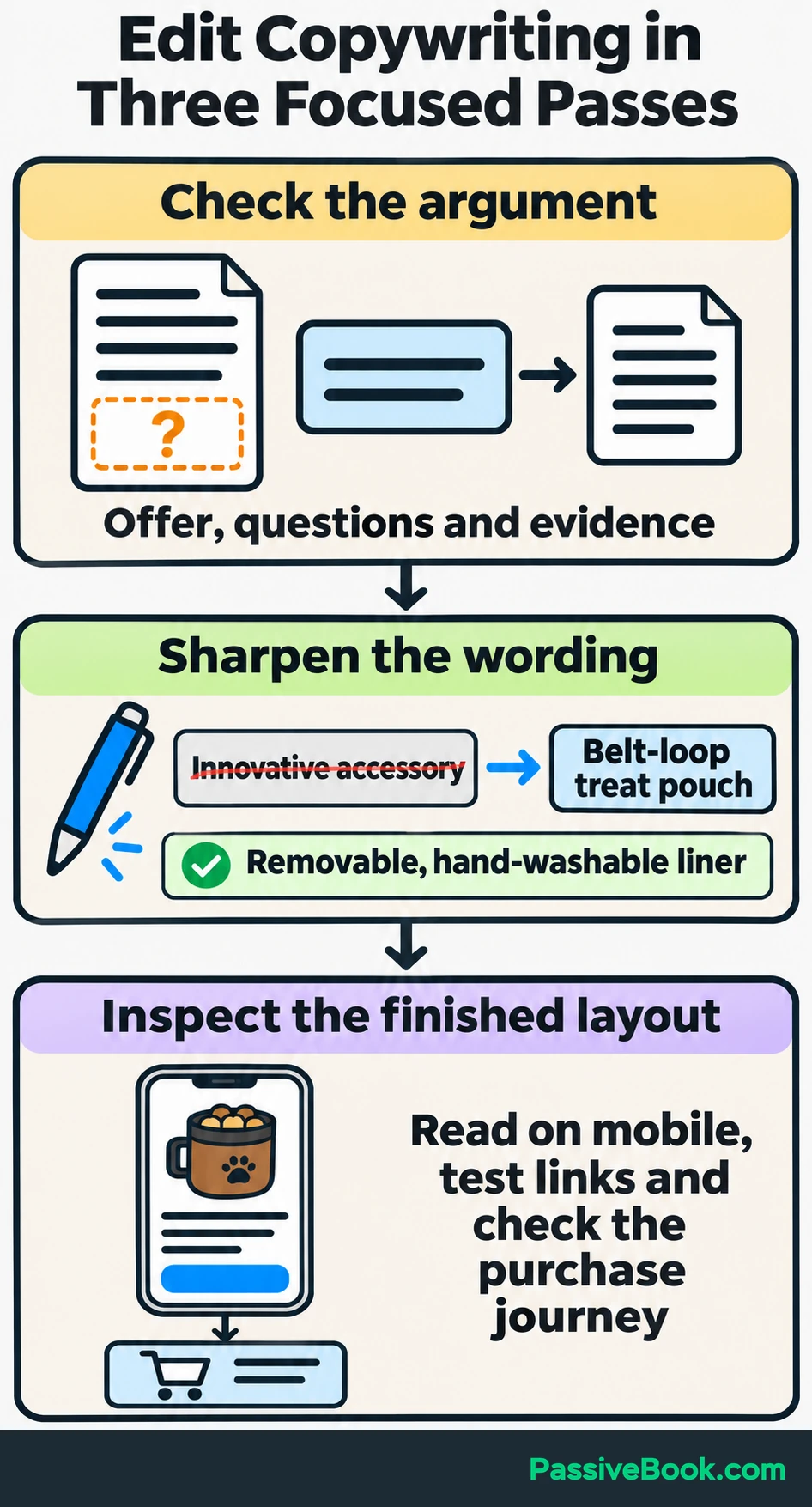
The second gives readers something to evaluate. Keep useful detail even when it adds words. Shortening “removable, hand-washable liner” to “easy cleaning” loses information.
Morkes and Nielsen tested five versions of a travel-information site with 51 users. Participants completed tasks faster and made fewer errors with the concise, scannable and objective version than with the promotional version. The study measured usability, so it does not establish a sales increase. Read the original study.
Read your draft aloud to catch awkward wording. Then read only the headings and button labels. Can you still follow the offer and the next step?
Finally, verify product details, prices, delivery statements and links. A polished paragraph beside an incorrect dimension still creates a problem for the buyer.
Test and Improve Your Copy
Choose a measure that matches the action you wanted.
| Copy Asset | Useful Measure | What It Helps You Assess |
|---|---|---|
| Product page | Share of eligible visitors who purchase | Whether visits lead to purchases |
| Service page | Qualified enquiries | Whether suitable prospects get in touch |
| Promotional email | Product-link clicks and resulting purchases | Whether the message earns relevant visits and supports sales |
| Signup page | Completed signups from eligible visitors | Whether visitors accept the signup offer |
Define “qualified” before counting enquiries. For example, you might require that the requested work falls within the service scope.
For a visitor-based purchase rate, choose a measurement period and decide which visitors count. For example, exclude bots and your own test visits. Count each eligible visitor once, then count how many of those visitors purchased within that same period. Use buyers rather than orders, because one person may place several orders.
For illustration, suppose 200 eligible people visit the pouch page during a measurement period and eight of those people purchase within the defined window:
Purchase conversion rate = 8 ÷ 200 × 100 = 4%
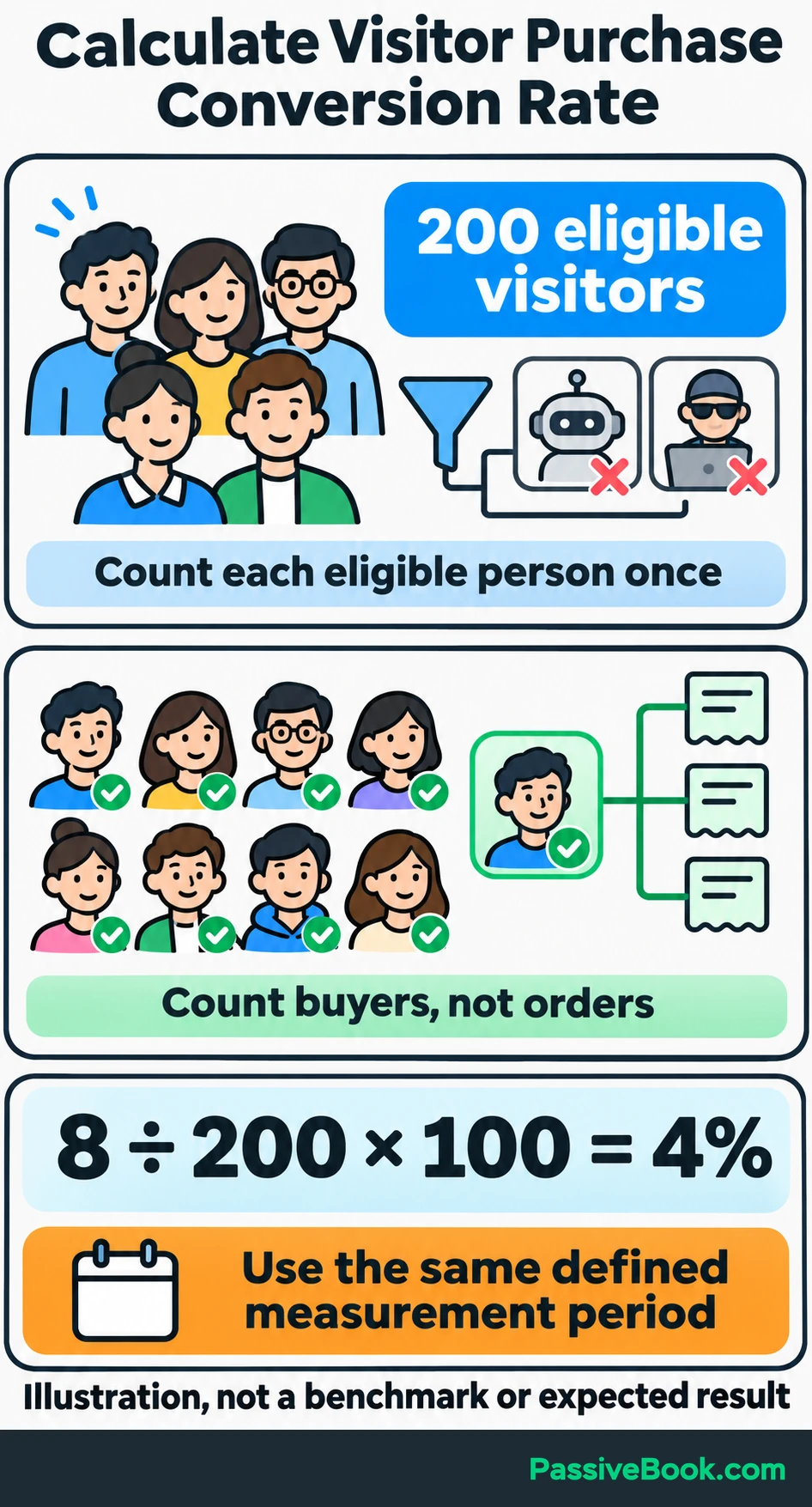
That demonstrates the arithmetic. It is not a benchmark or an expected result.
With little traffic, I would start with buyer feedback. Ask prospective buyers to read the page and answer:
- “What is being offered?”
- “What would you receive?”
- “What remains unclear?”
- “What would you do next?”
Observe their understanding. Asking whether they “like the copy” can produce praise without showing whether the page explains anything.
Diagnose the obstacle before rewriting. Check audience fit, the offer, missing information and the purchase process. If people cannot understand how the pouch attaches, form a specific hypothesis:
Showing the belt-loop demonstration earlier will help visitors assess attachment before reaching the purchase button.
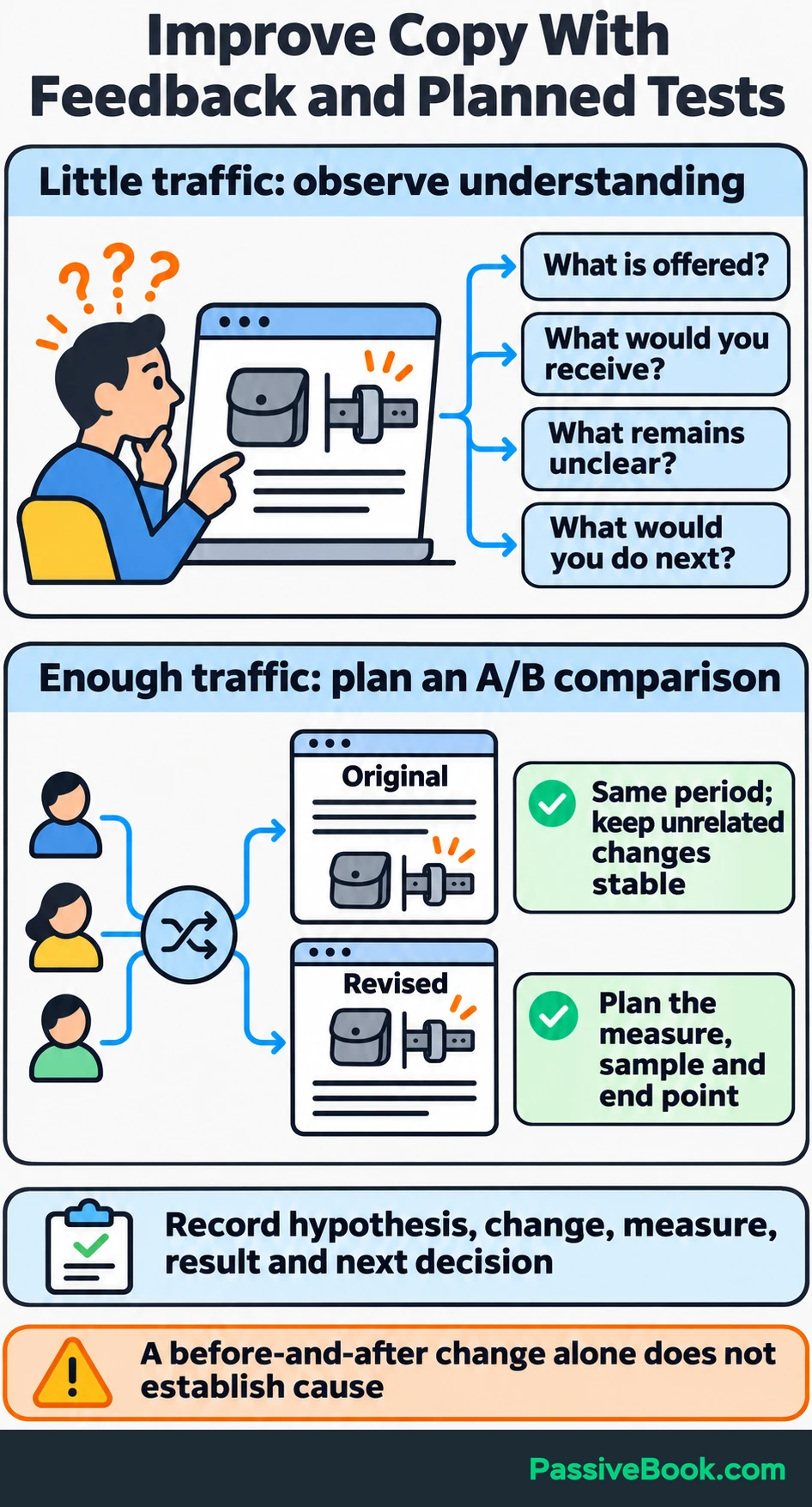
When you have enough traffic for a planned comparison, use an A/B test: randomly show visitors the original or revised version during the same period. Before starting, choose what to measure, how many visitors you need and when the test will end. Keep unrelated changes stable. Microsoft’s experimentation guidance explains why inadequate samples and changes during a test can undermine the result.
A few extra sales after an edit do not establish that the wording caused them. Before-and-after comparisons can raise useful questions, but traffic sources, timing and other changes may explain the difference.
Keep a short learning log with the asset, hypothesis, change, measure, result and next decision. “Attachment remains unclear” is worth recording even before you have a reliable sales comparison.
Practice through complete revisions. Write the product description, adapt its main benefit into an email, collect feedback and revise the weakest passage. Judge progress by relevance, specificity, supported value and a clear next step. Those are skills you can improve without waiting to become a “natural writer.”
What Next?
Choose one live product or service page and write its brief before changing a sentence. Then revise the passage that leaves the biggest buying question unanswered.
Use the social buttons to share this guide when the next copy discussion needs a practical way forward. A shared brief gives that discussion something more useful than competing headline opinions.
Which buying question does your current copy leave unanswered? Tell me in the comments, and add any other copywriting questions you want help working through.
Share this post with your friends & followers:

