Charging enough to cover the product feels like a sensible starting point. Then packaging, payment fees, support, and your own time take their share. A busy week can leave surprisingly little money in the business.
I’ve had that uncomfortable gap between sales revenue and what was left. The orders looked encouraging, but I hadn’t given the costs the same attention.
That uncertainty is what this guide tackles: how to compare pricing approaches, choose a starting price you can explain, and test whether it earns enough for the work involved.
Calculate What Each Sale Must Contribute
Before choosing a pricing strategy, work out what each sale needs to leave behind. That money must cover your ongoing expenses and, eventually, produce a profit.
We’ll follow an imaginary online shop selling washable knitting project bags and a downloadable project planner. Its prices, costs, fees, and results are illustrative USD figures. They exclude taxes collected from customers for remittance.
Include the Full Cost of Delivering the Offer
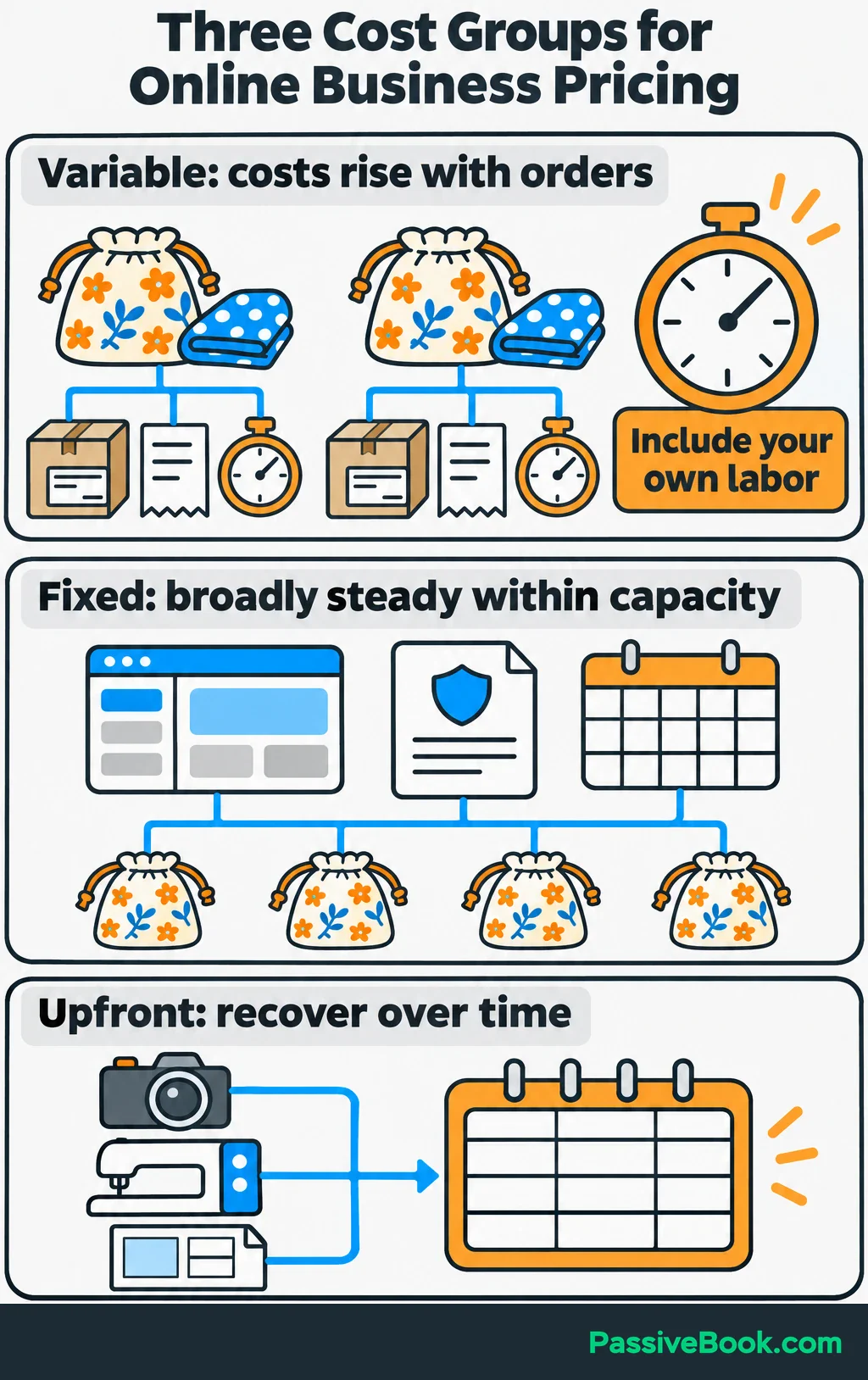
Separate costs that rise with sales from expenses you pay regardless of how many orders arrive.
| Cost group | What belongs here |
|---|---|
| Variable costs | Materials, production, packaging, fulfillment, shipping you cover, payment fees, expected returns, and order-specific labor |
| Fixed expenses | Software, insurance, administration, and other expenses that stay broadly steady within your current capacity |
| Upfront spending | Product development, photography, equipment, and initial creation work that you plan to recover over time |
Include your own labor. An unpaid afternoon still uses an afternoon.
For services, count preparation, client calls, revisions, and support alongside the main delivery work. For digital products, separate the work of creating the product from the support and delivery costs of each sale.
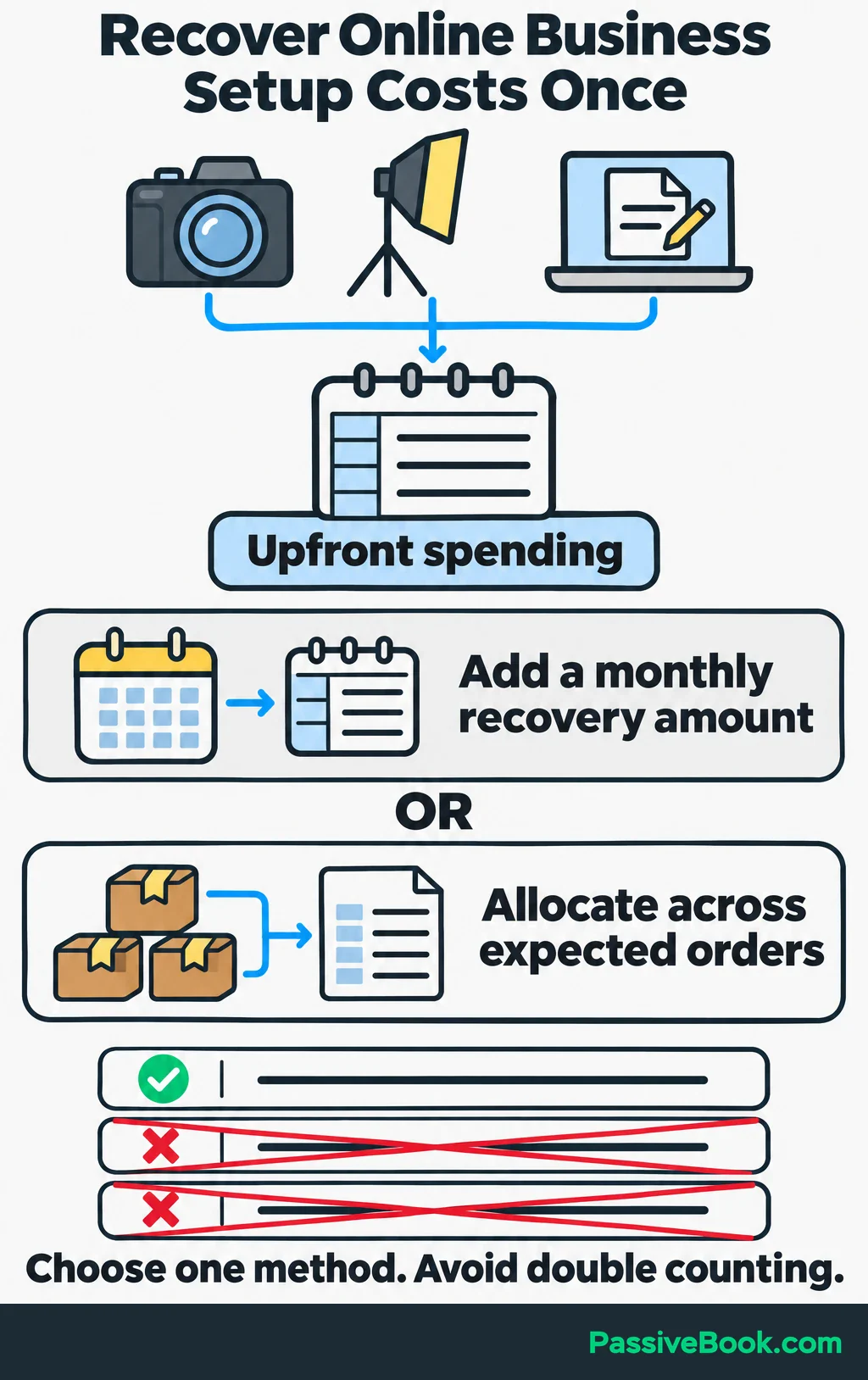
Plan to recover upfront spending over a realistic sales period. You can add a monthly recovery amount to fixed expenses or divide the spending across expected orders. Choose one method so you don’t count the same cost twice.
My print-on-demand experiment brought in about $1,200 in revenue and roughly $300 in profit over six months. Hiring designers ate into the margin. The sales total was the more flattering number, so naturally it was the one I preferred looking at.
That experience is why I start with what remains after delivery costs. Revenue alone cannot tell you whether the price works.
Check Break-even Sales and Capacity
First, calculate the money left from one sale after its variable costs. This is its contribution toward fixed expenses and profit.
Contribution per sale = selling price − variable costs
Then divide your fixed expenses by that contribution to find the sales needed to break even. Round up to a whole order. Business Victoria explains this break-even calculation.
For the project bag, assume:
- Per-order costs are $18, including labor, packaging, shipping you cover, and an allowance for returns.
- Transaction fees add another 5% of the selling price.
- Monthly fixed expenses are $600.
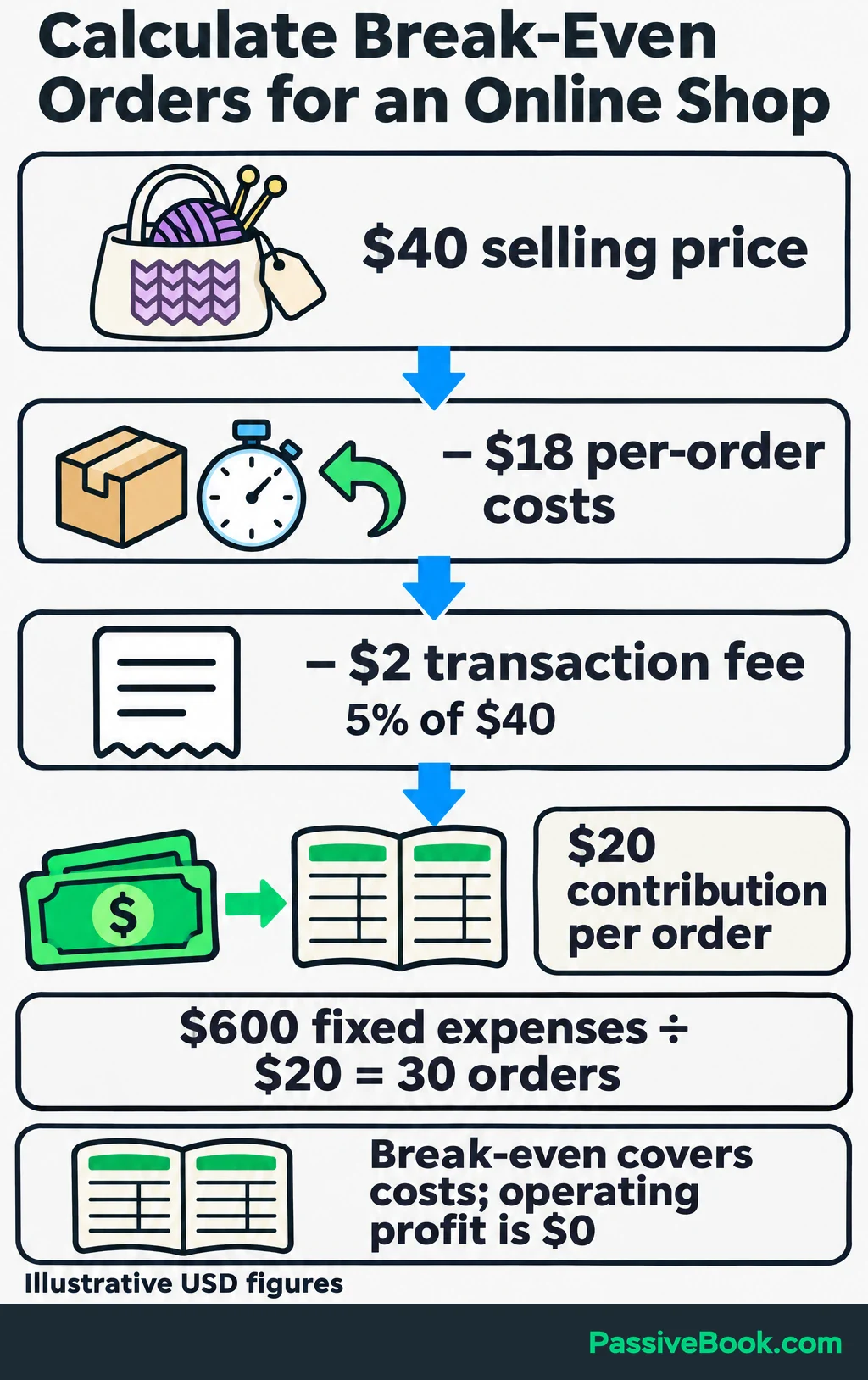
At a $40 price, the transaction fee is $2, so each bag contributes:
$40 − $18 − $2 = $20
Covering the monthly fixed expenses requires:
$600 ÷ $20 = 30 orders
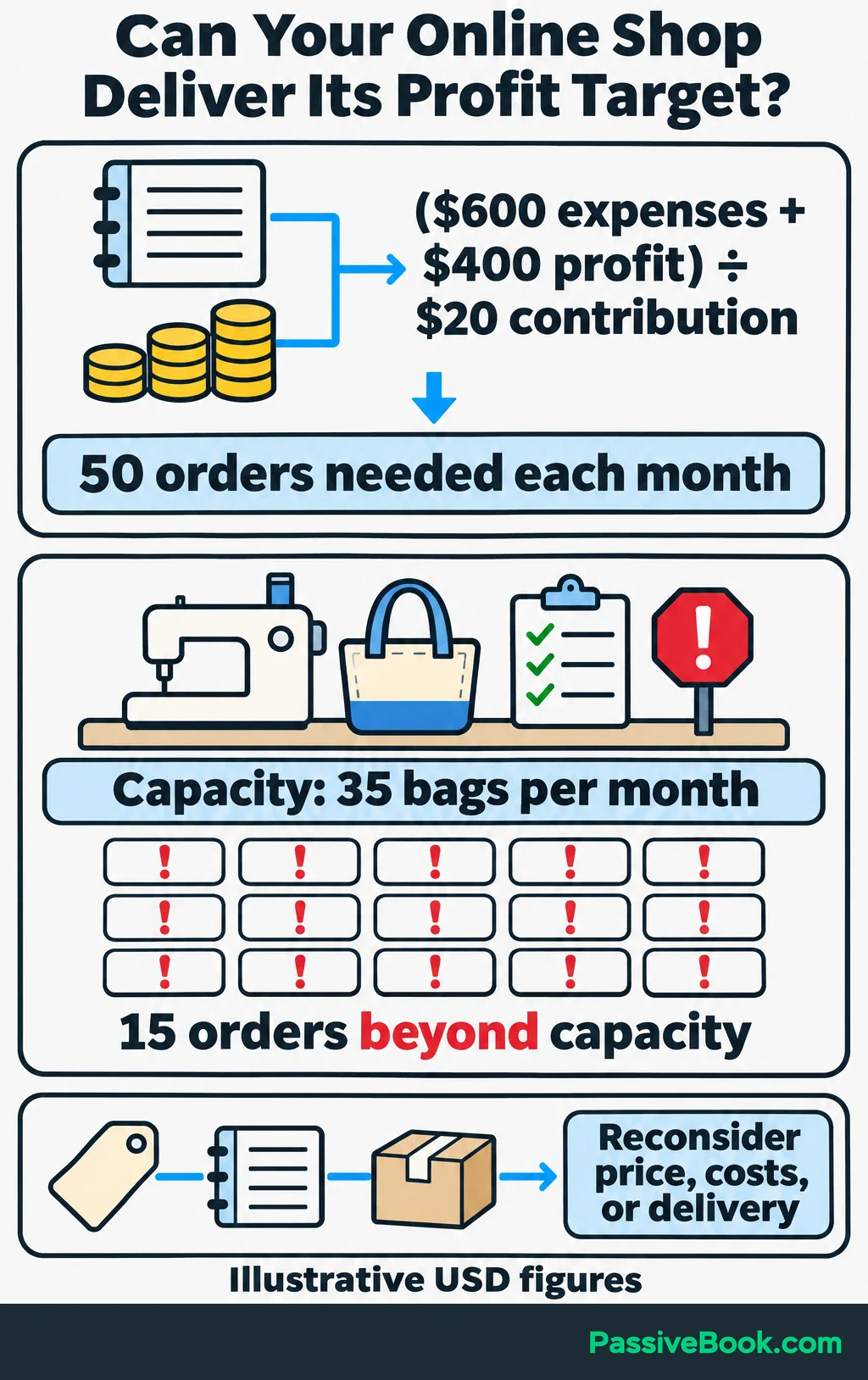
Those 30 orders cover costs. They don’t produce an operating profit.
For a profit target, add the desired profit to fixed expenses before dividing by contribution. A $400 monthly operating-profit target requires:
($600 + $400) ÷ $20 = 50 orders
Now check whether you can reach and fulfill 50 orders. If you can make only 35 bags a month, the plan needs a different price, lower costs, or a different delivery method.
A calculation that requires more orders than you can handle is a useful warning before launch.
Compare the Main Pricing Strategies
A pricing strategy guides how you set and change prices. A pricing model defines what customers pay for and how often. Discounts and price endings are tactics.
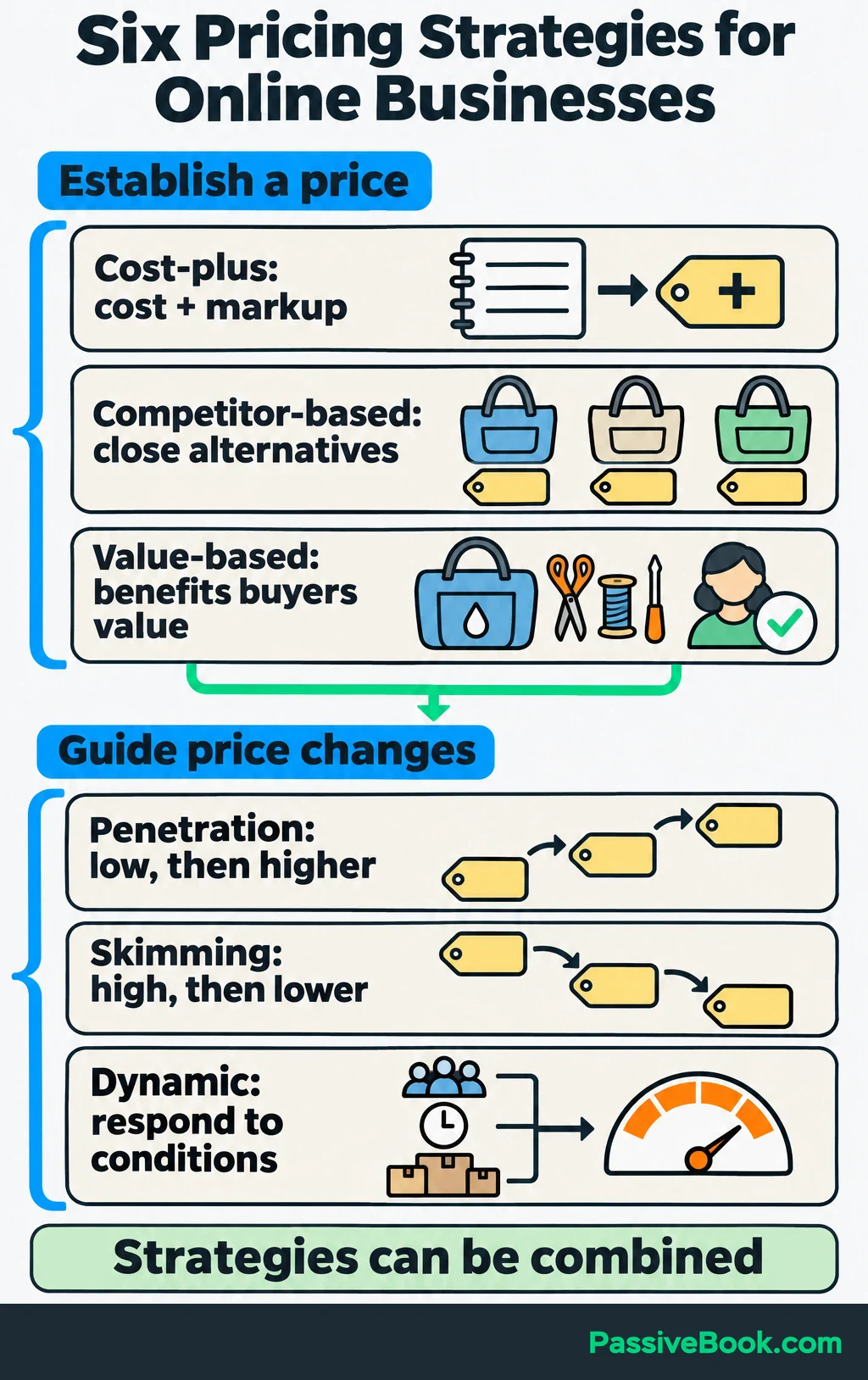
The main pricing strategies for online businesses answer different questions. Cost-plus, competitor-based, and value-based pricing help establish a price. Penetration, skimming, and dynamic pricing guide how it starts or changes. You can combine them.
| Strategy | How the price is set | Suitable conditions | Project-bag application | Main tradeoff |
|---|---|---|---|---|
| Cost-plus | Add a markup to a defined cost | Costs are predictable | A 50% markup on $18 gives a $27 price | The result may miss what buyers will pay |
| Competitor-based | Position against close alternatives | Buyers can compare similar offers | Compare similar bags and delivered prices | Competitors may have very different costs |
| Value-based | Price around benefits buyers value | Meaningful differences influence purchases | Check whether washability and compartments justify more | Requires evidence of what buyers care about |
| Penetration | Begin low, then raise the price | You can fund lower early margins to attract buyers | A $32 introductory price leaves $12.40 contribution per bag | Buyers may resist the later increase |
| Price skimming | Begin high, then lower the price | Early buyers strongly value a distinctive offer | Launch a genuinely different bag at a premium | Ordinary products may lack that early demand |
| Dynamic | Adjust with demand, timing, or stock | Conditions change enough to justify reviews | Review the price if orders repeatedly exceed production capacity | Adds work and can confuse buyers |
Cost-plus Pricing
Cost-plus pricing adds a markup to a stated cost base. It gives you a repeatable calculation when costs are stable.
Be clear about which costs you mark up: production alone, all variable costs, or a share of fixed expenses.
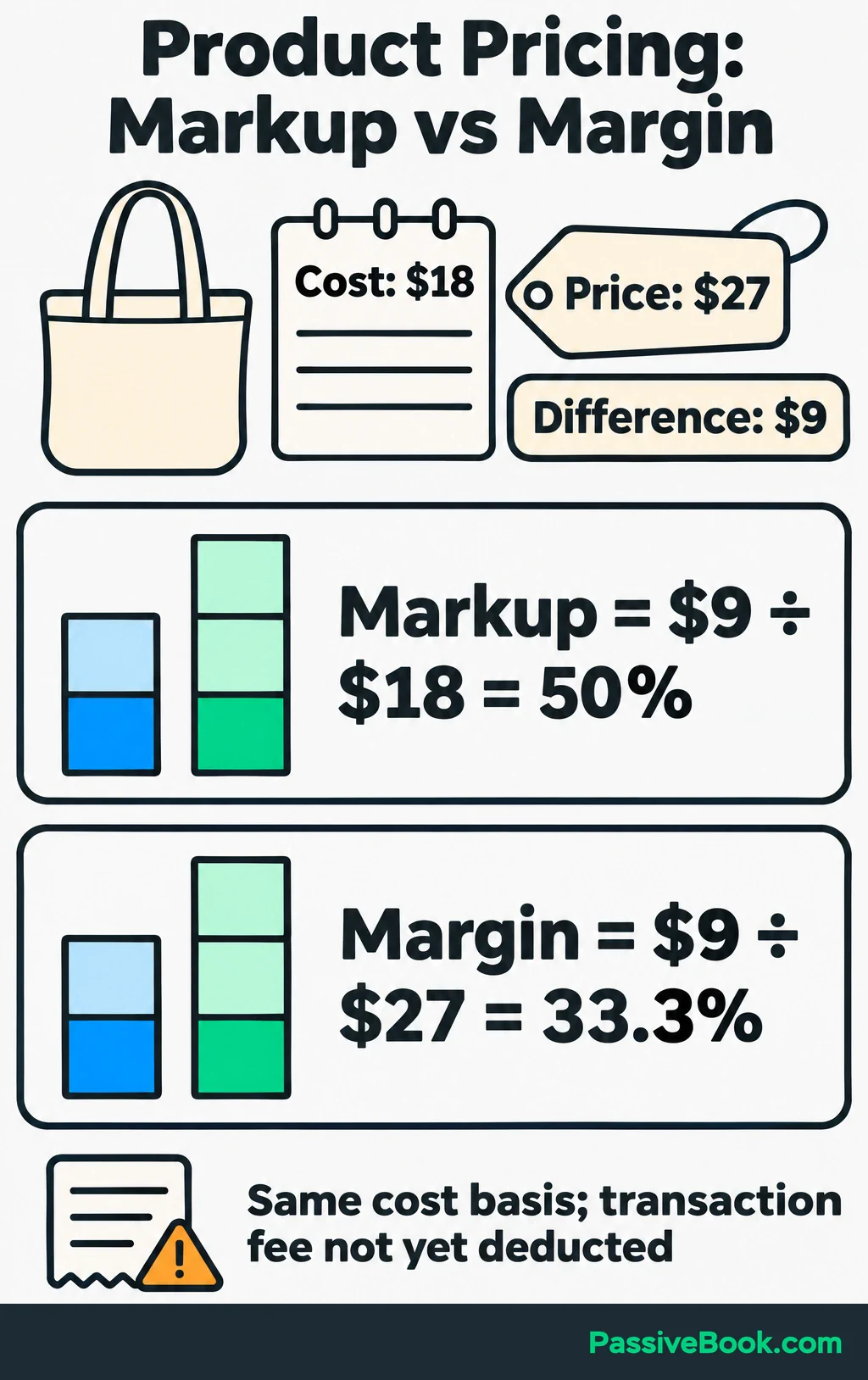
Markup and margin also use different starting numbers:
- Markup divides the difference between price and cost by the cost.
- Margin divides that difference by the selling price.
A 50% markup produces a 33.3% margin on the same cost basis. Business Victoria shows both calculations.
For the bag, a 50% markup on the $18 cost gives a $27 price. But the transaction fee still needs paying:
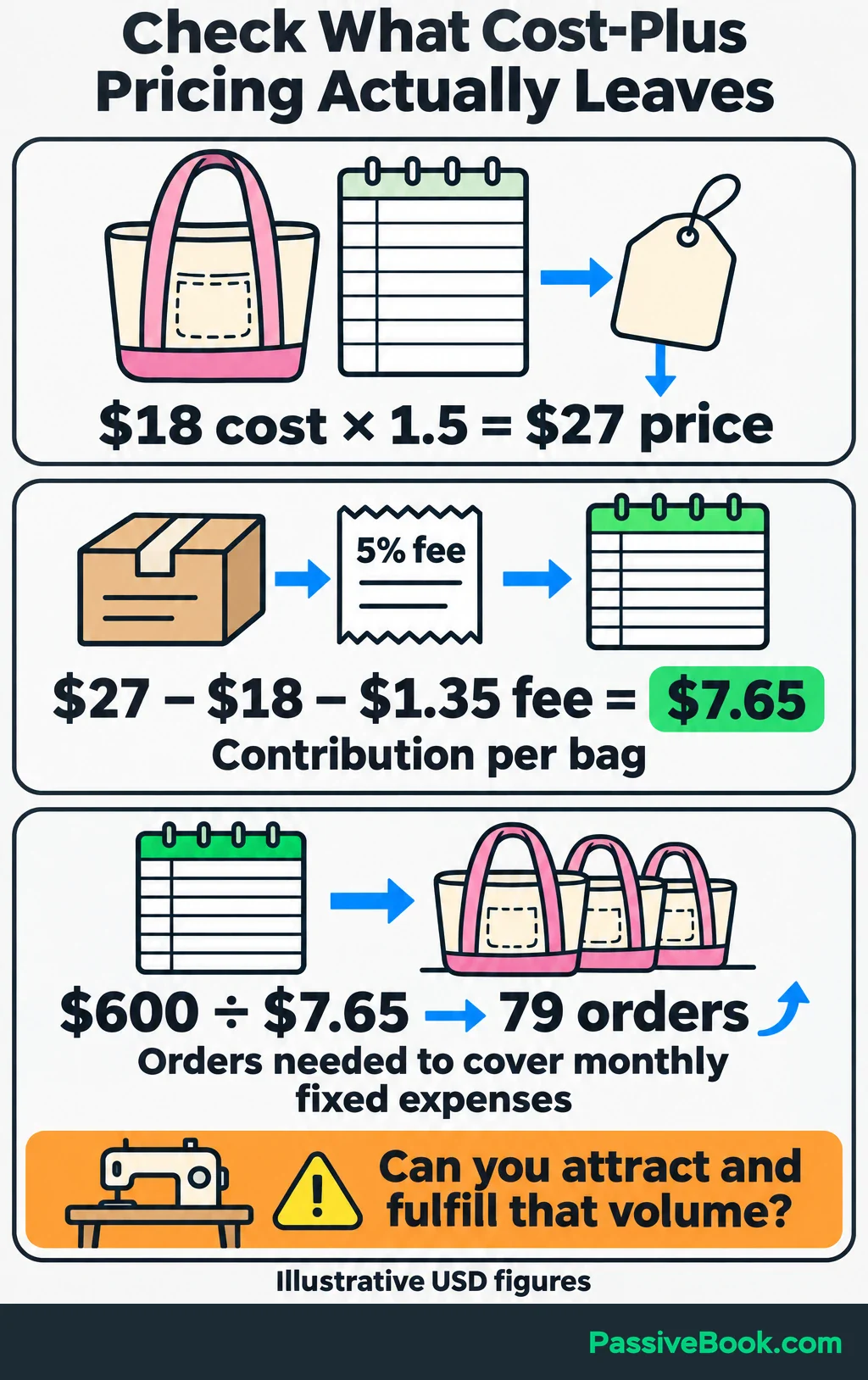
$27 − $18 − $1.35 = $7.65 contribution
At that contribution, covering $600 in monthly fixed expenses requires 79 orders.
I would use cost-plus as a starting calculation, then check demand and capacity. Choosing a markup doesn’t make the resulting sales target achievable.
Competitor-based Pricing
Competitor-based pricing places your offer below, alongside, or above comparable alternatives. It is useful when buyers can easily compare products. BDC describes this approach and its tradeoffs.
For the bag, compare size, material, construction, compartments, and delivery terms. A small pouch with paid shipping is a weak comparison for a larger bag with delivery included.
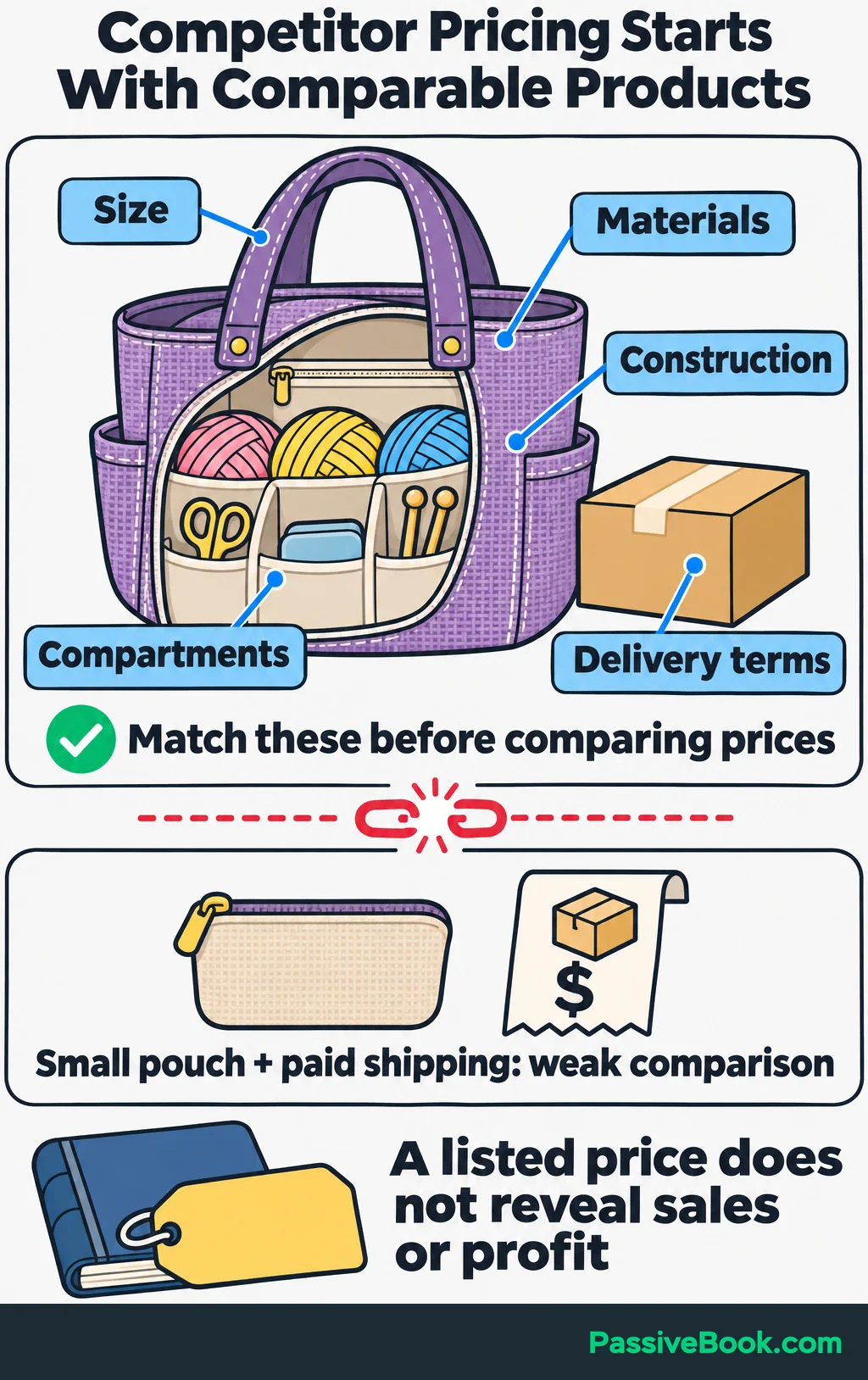
Advertised prices show what buyers can choose. They don’t reveal how many units a competitor sells or whether the business makes money.
Economy pricing uses low operating costs to support consistently low prices. Matching a cheaper seller doesn’t give you their supplier agreement or fulfillment setup.
Value-based Pricing
Value-based pricing starts with benefits customers care about and the alternatives available to them. Customer conversations and purchase tests help establish what those differences are worth. Australian government guidance explains this approach.
For the bag, investigate whether buyers value:
- Fabric they can wash after carrying projects around.
- Compartments that keep small tools together.
- Construction that holds up to regular use.
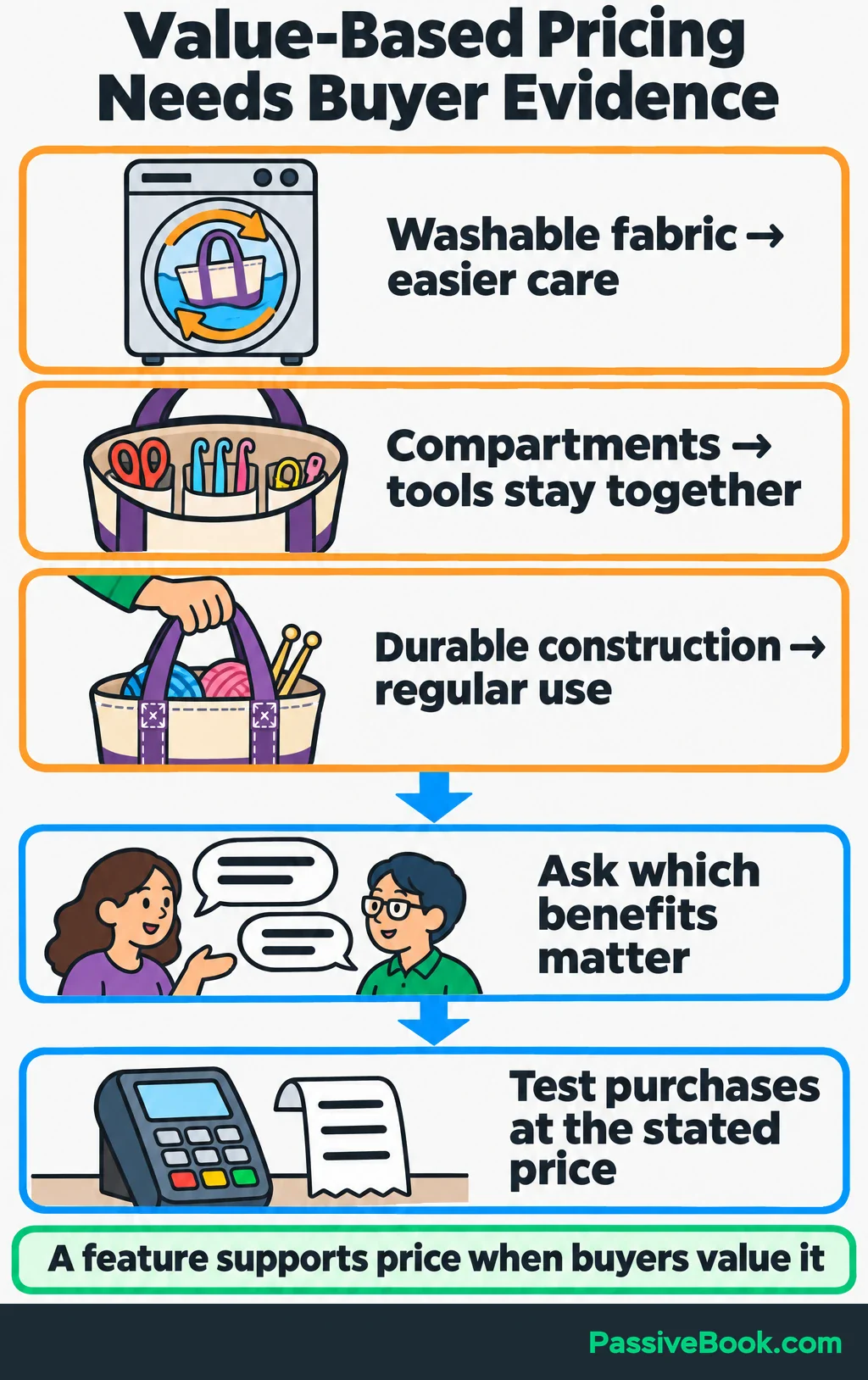
A feature belongs in the pricing argument when it matters to the buyer. The number of hours you spent choosing the zipper may matter deeply to you and nobody else.
Premium pricing supports a higher market position through quality, useful differences, and service. I would choose it only when the offer gives buyers a clear reason to pay more, and realistic sales volume still covers the costs.
Penetration Pricing
Penetration pricing starts deliberately low to encourage adoption, then moves toward a sustainable price.
It needs a purpose beyond “perhaps people will buy.” BDC notes that customers attracted by a low price may expect it to stay low or leave when it rises. See BDC’s explanation of penetration pricing.
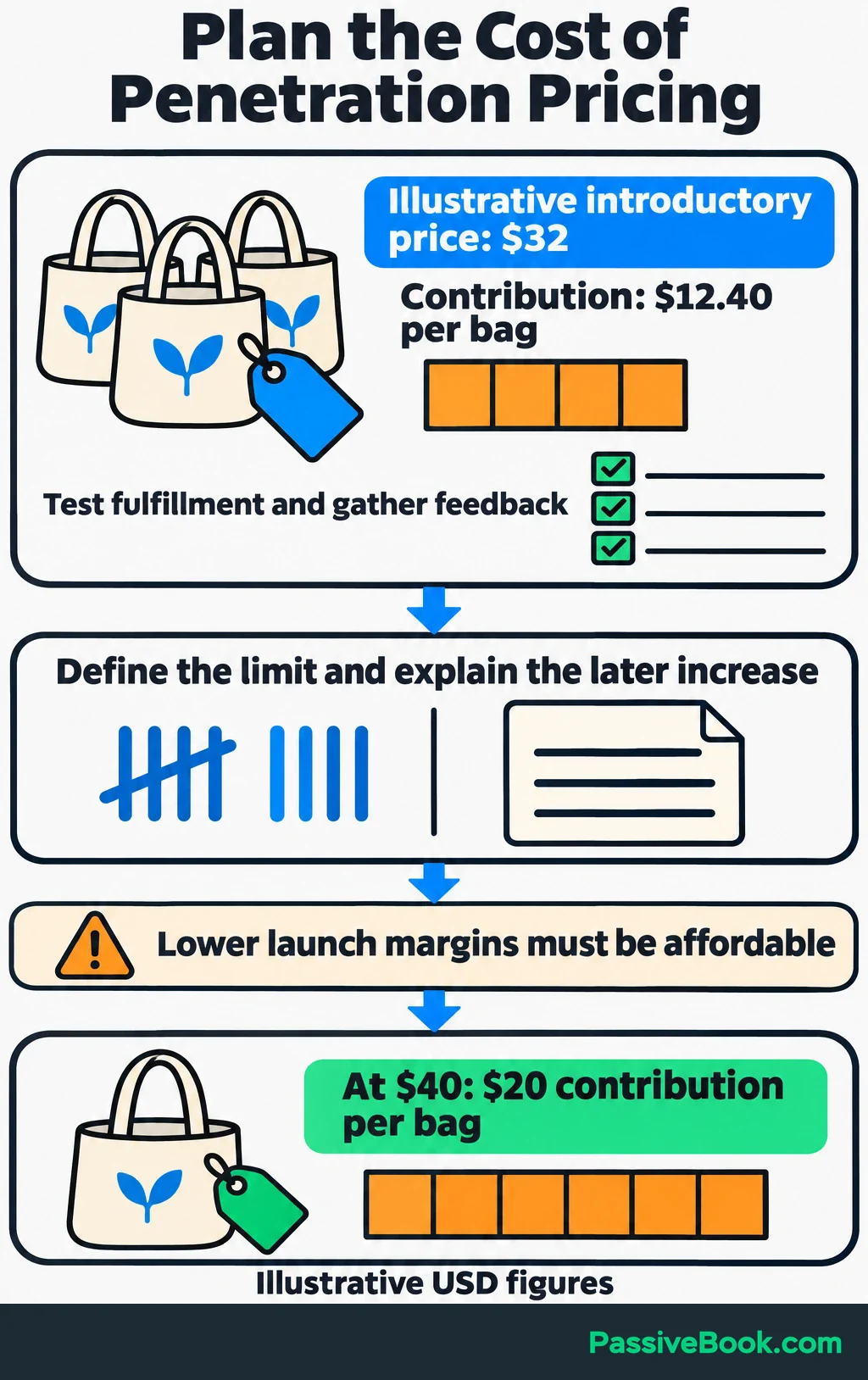
For the shop, a limited introductory batch could help test fulfillment and gather early customer feedback. Define the batch size or end date, explain the introductory terms, and calculate how much contribution you’re giving up.
I would skip this approach if the business needs every early order to cover normal expenses. A launch discount is spending, even when it never appears as a bill.
Price Skimming
Price skimming starts high for early buyers who strongly value something new or distinctive. The price later falls to reach more price-sensitive buyers.
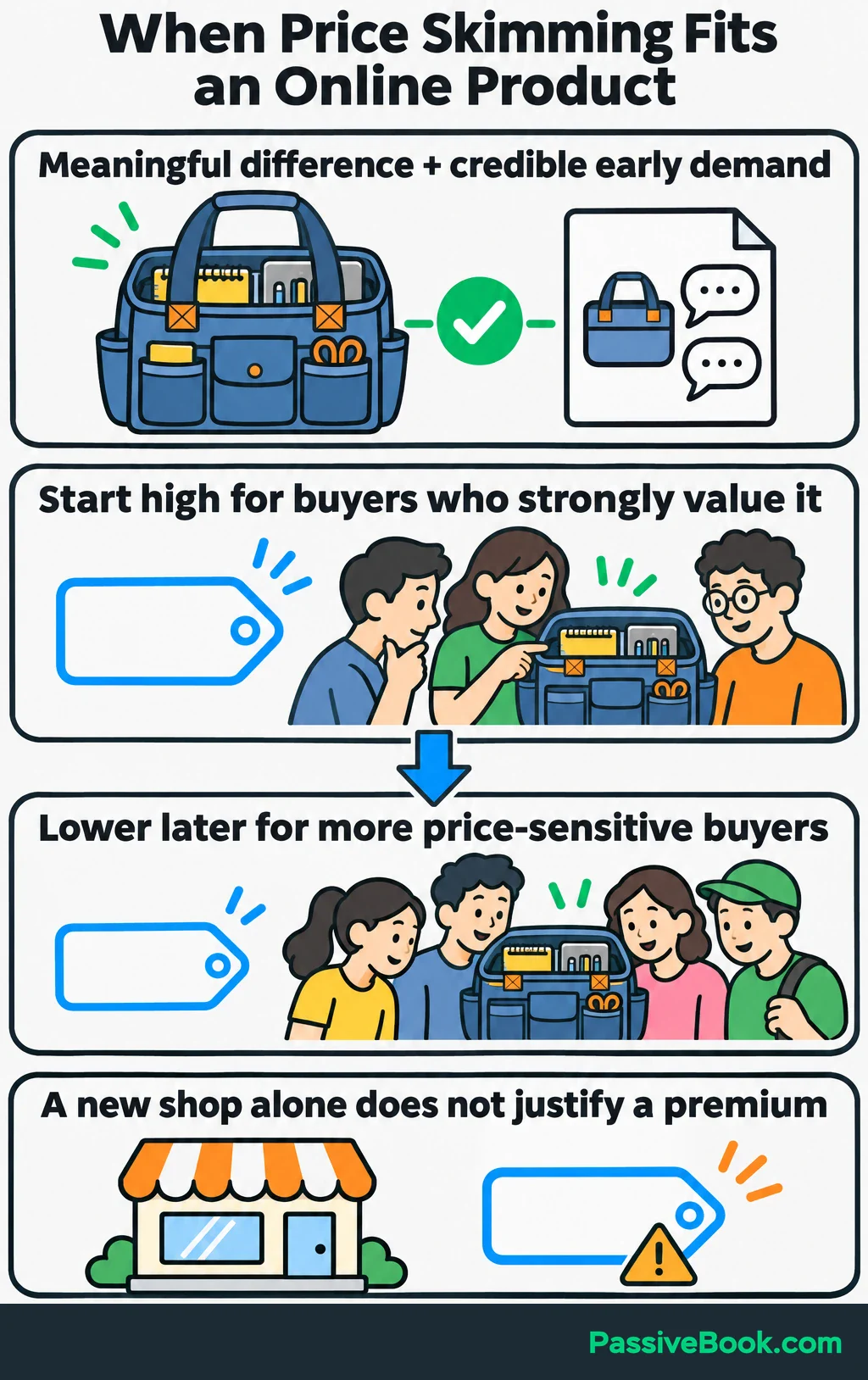
For the bag shop, I would consider this only with credible early demand for a meaningful design difference. Opening a new shop doesn’t create an early-access premium by itself.
If buyers can already get the same practical benefits elsewhere, I would start with a competitor or value comparison instead.
Dynamic Pricing
Dynamic pricing changes prices in response to demand, timing, or available stock. Australian government guidance describes these triggers.
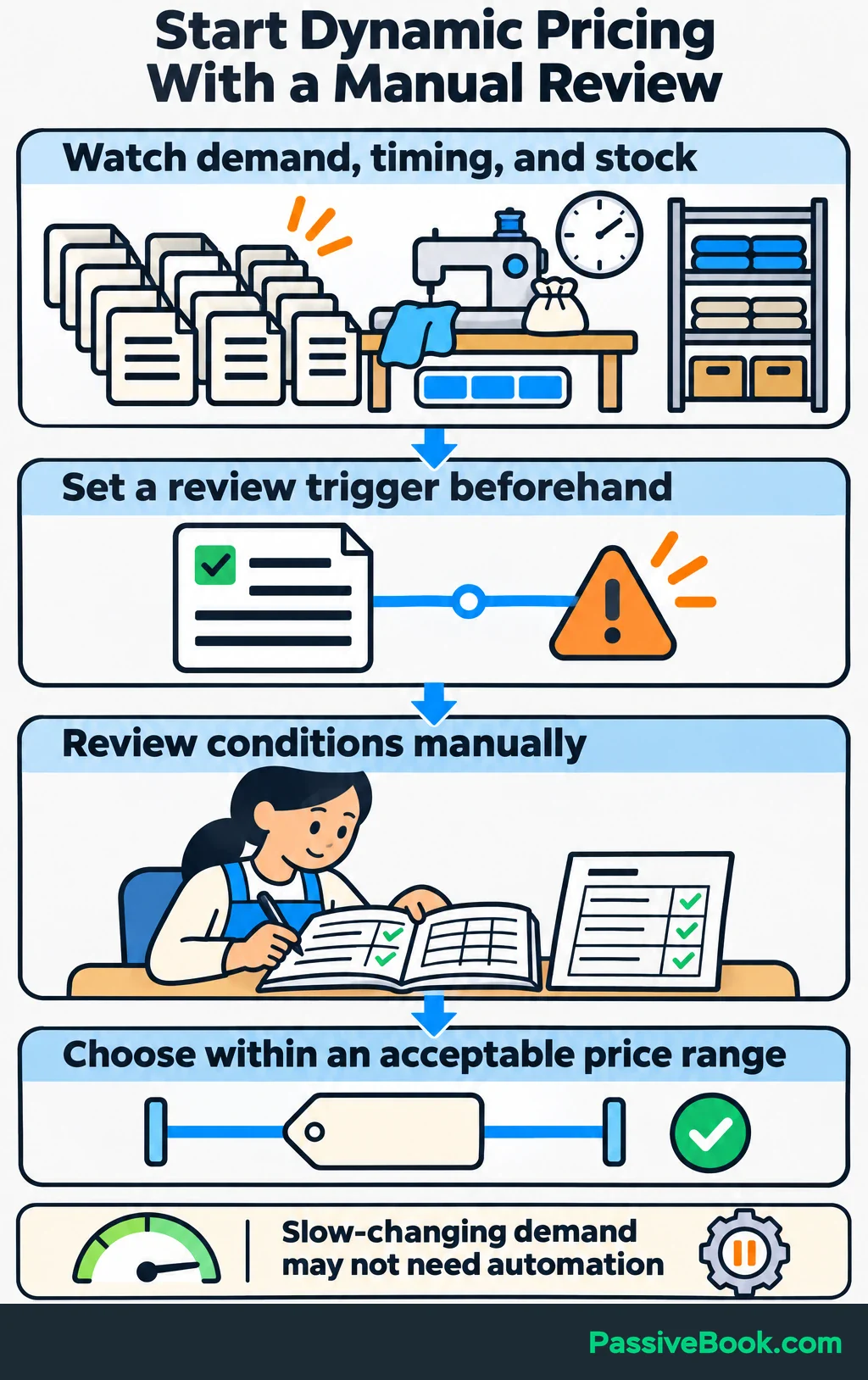
For the shop, you might review the bag’s price when orders repeatedly exceed production capacity. Decide beforehand what triggers a review and what price range remains acceptable.
Start manually. If demand changes slowly, frequent automated price changes create another system to supervise without solving much.
Choose How Customers Will Pay
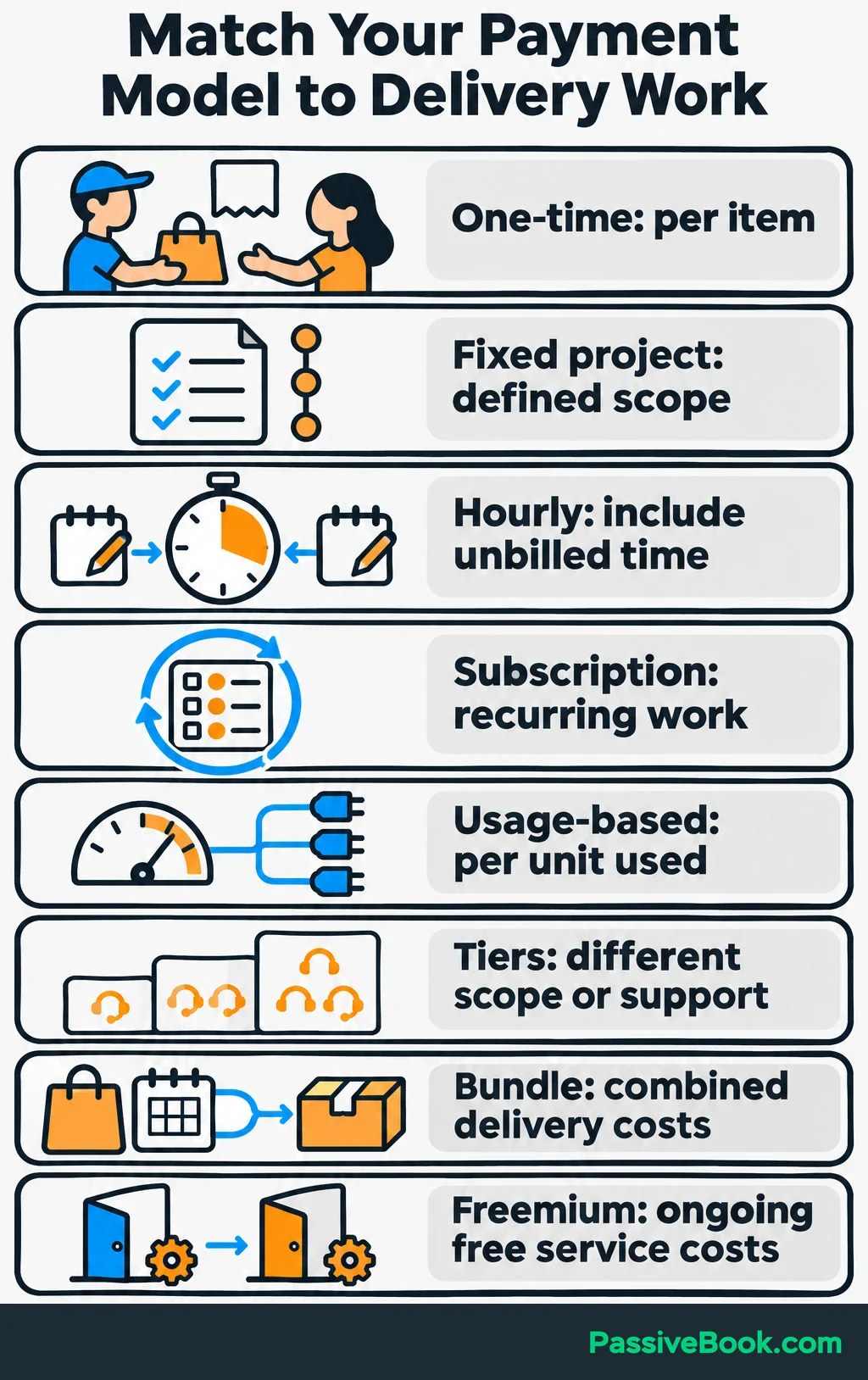
Once you have a basis for the price, choose a charging structure that matches what you must deliver.
| Model or structure | Suitable offer | Charging unit or frequency | Delivery cost to check |
|---|---|---|---|
| One-time purchase | A bag or downloadable planner | Once per item | Fulfillment, fees, returns, and support |
| Fixed project price | A service with a clear scope | Once per project or milestone | Preparation, delivery, and included revisions |
| Hourly billing | Work with uncertain scope | Per hour | Unbilled preparation and administration |
| Subscription | Ongoing access, replenishment, or service | Recurring billing period | Work required during every period |
| Usage-based | A service with measurable consumption | Per unit used | Cost of supplying and measuring each unit |
| Tiers | Different levels of scope or support | Per chosen package | Extra work promised at each level |
| Bundle | Complementary items sold together | Per package | Combined delivery and support costs |
| Freemium | An ongoing usable free version with paid upgrades | Free access plus paid options | Cost of serving people who never upgrade |
Subscriptions can also include usage charges. For example, payment platform Stripe supports a fixed fee plus charges for additional usage.
For the shop, I would start with one-time purchases. The bag and planner can each stand alone, and a bundle can serve buyers who want both.
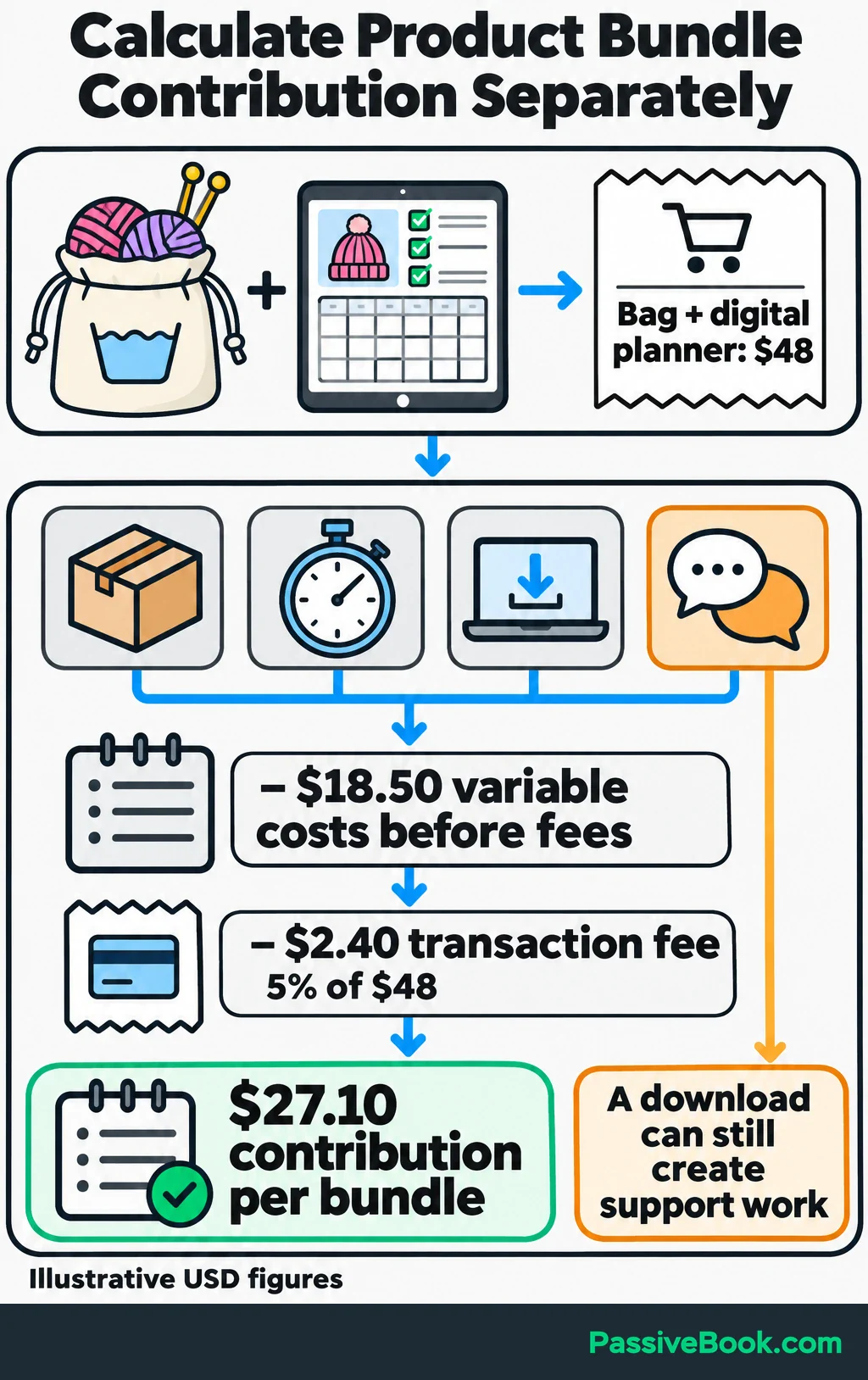
Calculate the bundle separately. If a $48 bundle has $18.50 in variable costs before the 5% fee, its contribution is:
$48 − $18.50 − $2.40 = $27.10
That gives you a useful package to assess without assuming the download costs nothing to support.
For services, I prefer fixed prices when the scope is clear. When it isn’t, hourly billing can work, but give buyers an estimated total so they can assess the commitment.
Be especially careful with subscriptions. I abandoned a membership site after six months because producing premium content alongside corporate work became unsustainable. Recurring billing had created recurring work I couldn’t maintain.
Freemium also carries an ongoing obligation. A free sample of the planner is a sample; a temporary trial is a trial. Neither requires you to maintain a permanent free product.
How to Choose Your Starting Price
Find out What Buyers Already Value and Purchase
Start with what people have done, then ask what drove the decision. “Would you buy this?” leaves too much room for polite encouragement.
Ask a few potential customers:
- “What did you buy most recently for carrying a knitting project?”
- “What did you pay, including delivery?”
- “What else did you consider?”
- “What made you choose that one?”
- “What has annoyed you since using it?”
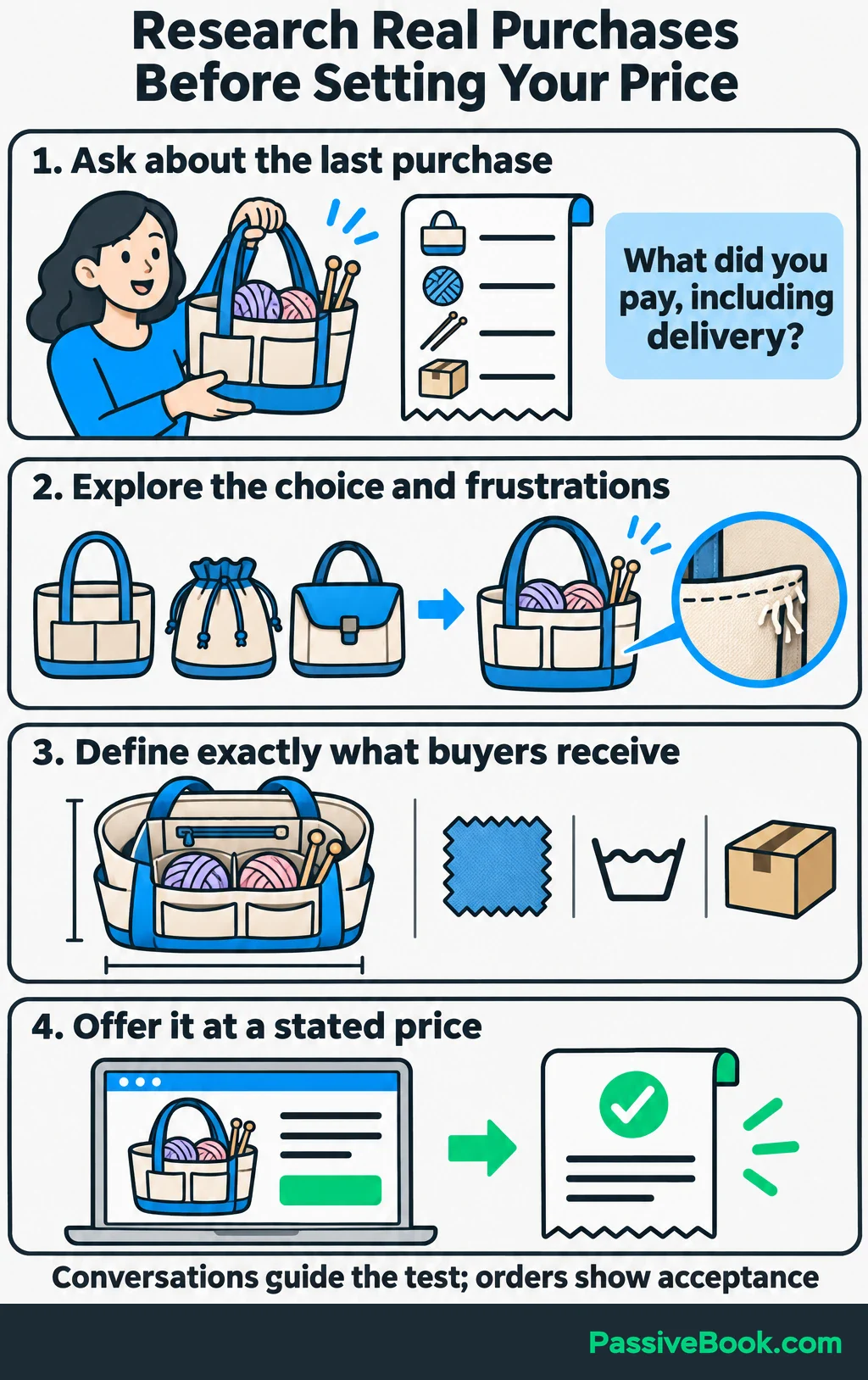
These questions help connect price with actual choices.
Next, define your offer clearly: what arrives, what problem it addresses, and what delivery or support includes. For the bag, specify its size, materials, compartments, care instructions, and delivery terms.
Then present that offer for purchase. Conversations help you choose what to test, but paid orders tell you whether people accept the offer at its stated price.
Compare the Closest Alternatives
Record several alternatives your intended buyer would realistically consider.
Use a simple sheet with:
- Total delivered price.
- Size, materials, and relevant features.
- Quality evidence, such as clear construction photos.
- Delivery, return, and support terms.
- The date you checked.
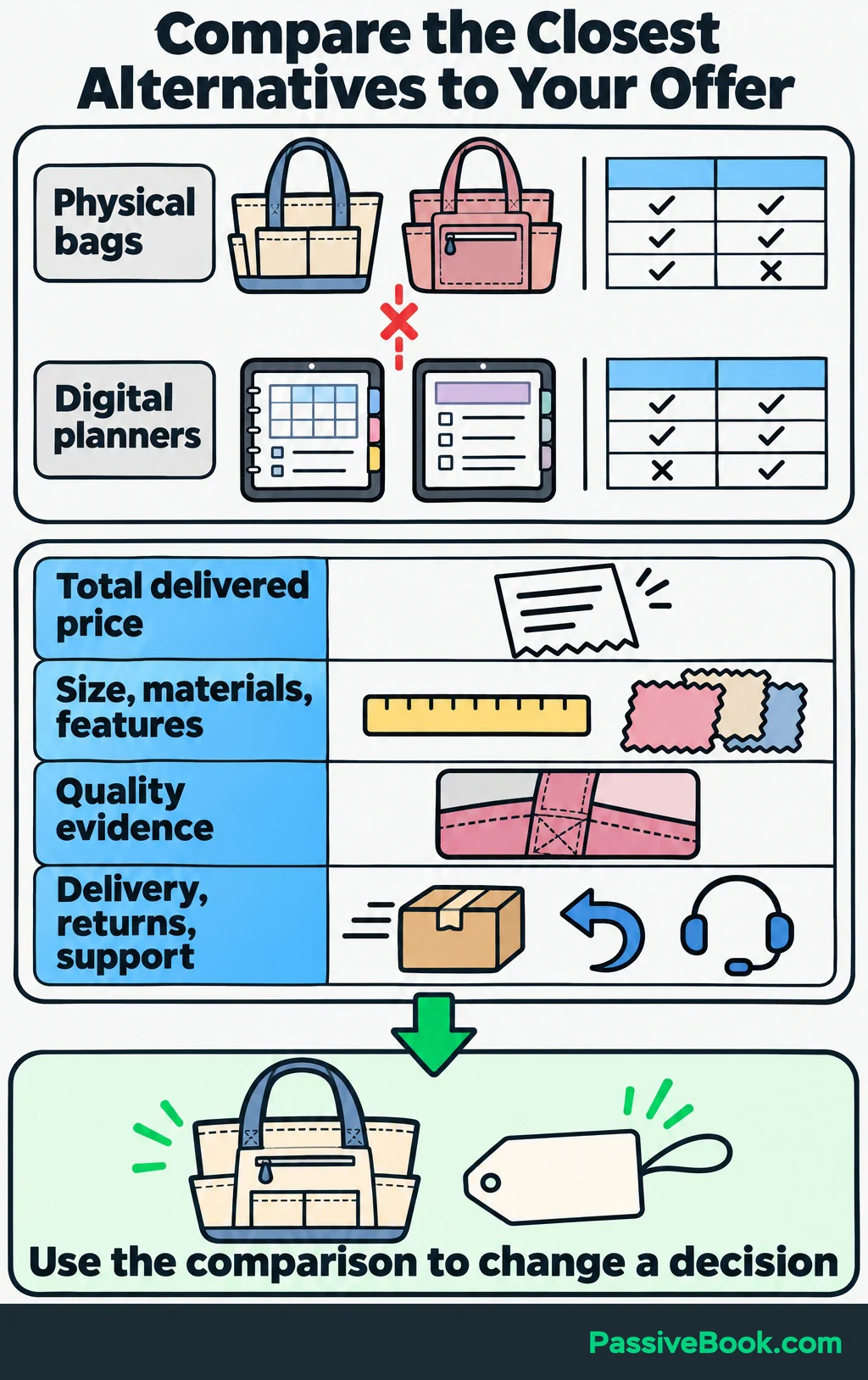
Compare physical bags with physical bags. Compare standalone planners with other digital planners. Putting both in one price range hides the difference between what buyers receive.
Look for the reason someone would choose your offer at the proposed price. If comparable products provide the same benefits for less, improve the offer, reduce costs, or reconsider the price.
A spreadsheet full of competitors is useful only if it changes a decision.
Select a Defensible Price
Choose the objective first. You might want sustainable operating profit, enough service work to fill available hours, or a controlled launch within a fixed budget.
Then choose the main basis for your price:
- Cost-plus gives you a repeatable starting calculation.
- Competitor-based pricing helps when close substitutes set buyer expectations.
- Value-based pricing fits meaningful differences that influence purchases.
Use the other approaches as checks.
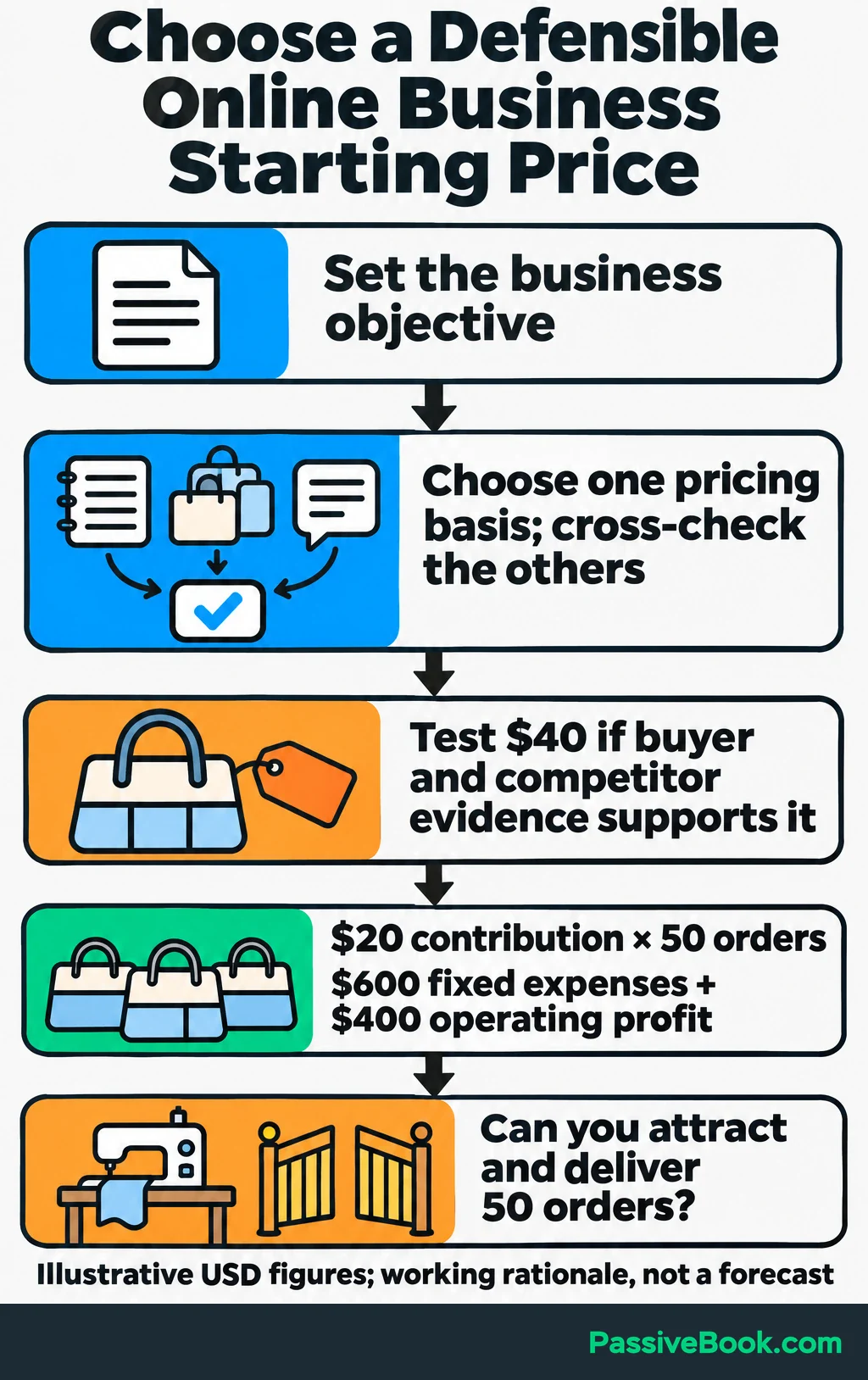
For the project bag, I would consider $40 if buyer conversations and comparable offers support its practical differences. At that price, each bag contributes $20. The shop needs 30 monthly orders to cover $600 in fixed expenses, or 50 orders to earn the additional $400 operating profit.
That gives the owner a concrete decision: can the shop attract and deliver 50 orders at $40?
Write the reasoning in a short paragraph:
The offer is a washable project bag for knitters who carry work between places. We’re testing $40 because buyers value the washable fabric and compartments, and close alternatives support that position. Each order contributes $20 after variable costs. We need 50 monthly orders to cover $600 in fixed expenses and earn $400 in operating profit.
That is a working rationale to check against evidence, not a prediction.
Before you settle on that price, check what happens if sales come in below your working estimate. This calculator works backward from your costs and available capacity, with editable examples for products and services.
Free Pricing Profit Calculator




I’ve tested digital products from $3 to $197 across different offers and formats. That range hasn’t given me a universal price rule. It has made me more suspicious of one.
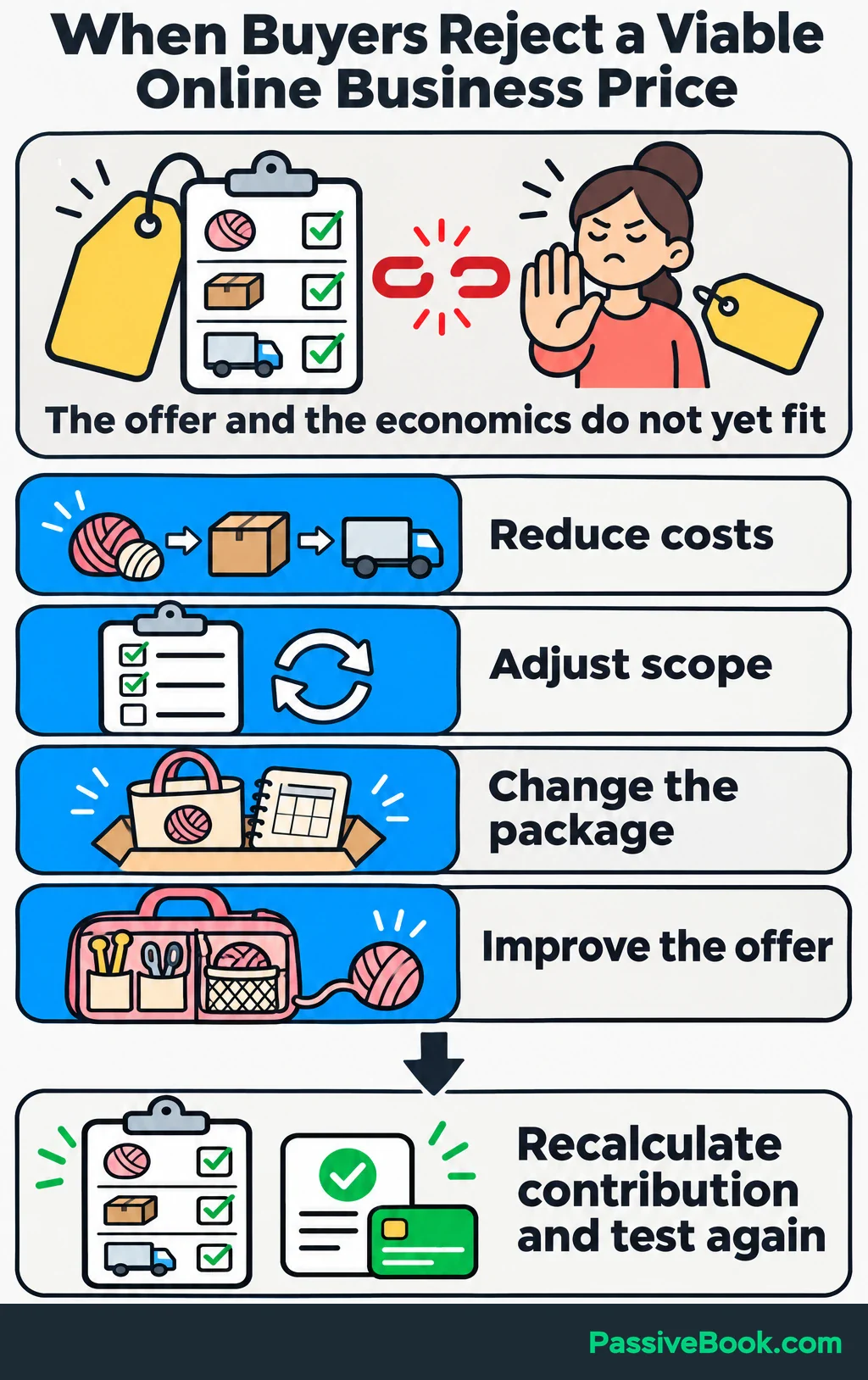
If buyers won’t pay enough to support the economics, change the costs, scope, package, or offer. Calling the price “value-based” won’t close the gap.
Test and Adjust Prices Using Paid Demand
Start With a Manageable Comparison
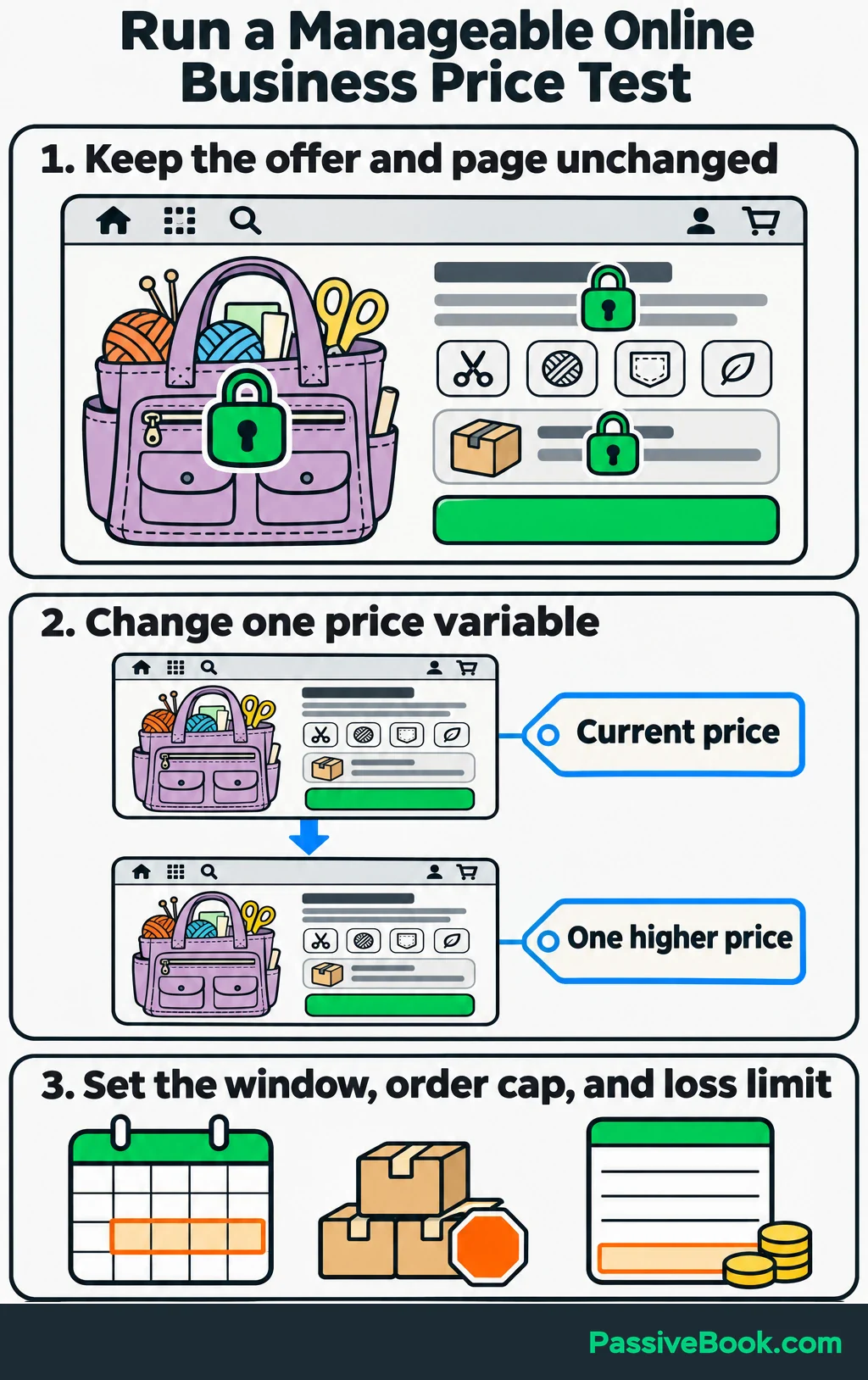
For the bag shop, compare the current price with one higher price. Keep the bag, delivery terms, and page content the same.
Set test dates and cap orders at what you can fulfill. Decide how much contribution you can afford to lose.
Use existing visitors, subscribers, customers, or inquiries. You don’t need paid ads or new software to begin.
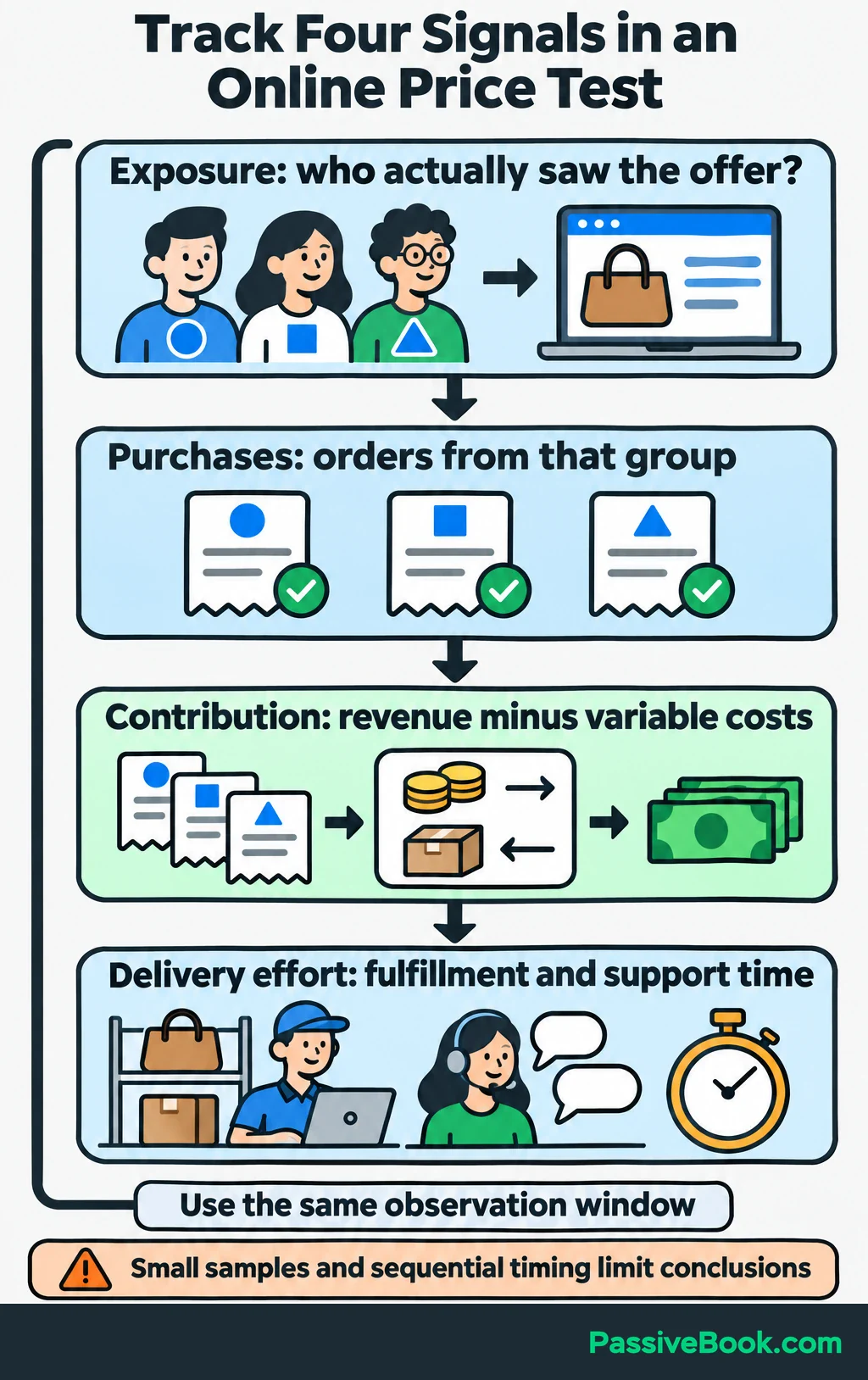
Track:
- Exposure: Visitors who actually saw the offer, or qualified inquiries that received a quote.
- Purchases: Orders from that same group during the chosen observation window.
- Contribution: Sales revenue minus variable costs, including refund-related costs.
- Delivery effort: Time spent fulfilling orders and providing support.
For services, compare quotes with similar scope and record differences that could affect acceptance.
With limited traffic, use customer conversations to help interpret a few orders. If you test prices one after another, differences in audience, timing, or season may also affect sales.
Don’t call a quiet week proof that the price failed.
Compare Contribution, Not Conversion Alone
Conversion rate is the percentage of offer visitors who buy. Also compare how much their orders contribute within the test window:
Contribution per offer visitor = total contribution from those orders ÷ offer visitors
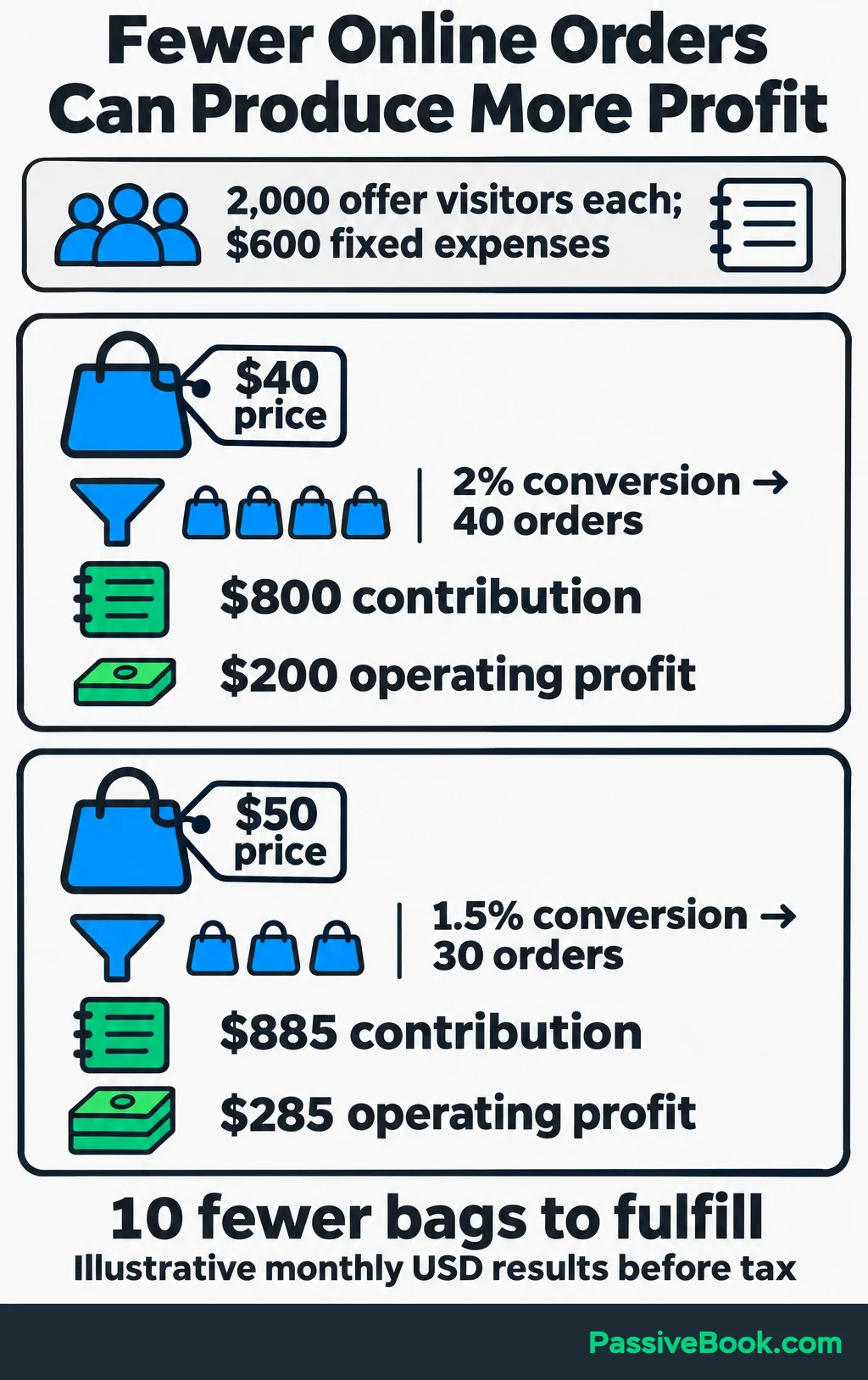
Each illustrative scenario below covers one month with 2,000 offer visitors. Each buyer places one order for one bag.
| Measure | $40 price | $50 price |
|---|---|---|
| Purchase conversion rate | 2% | 1.5% |
| Orders | 40 | 30 |
| Variable cost per order | $18 + $2 fee | $18 + $2.50 fee |
| Contribution per order | $20 | $29.50 |
| Total contribution | $800 | $885 |
| Contribution per offer visitor | $0.40 | About $0.44 |
| Operating profit after $600 fixed expenses | $200 | $285 |
The higher price produces fewer orders but more operating profit before tax in this illustration. It also requires ten fewer bags to fulfill.
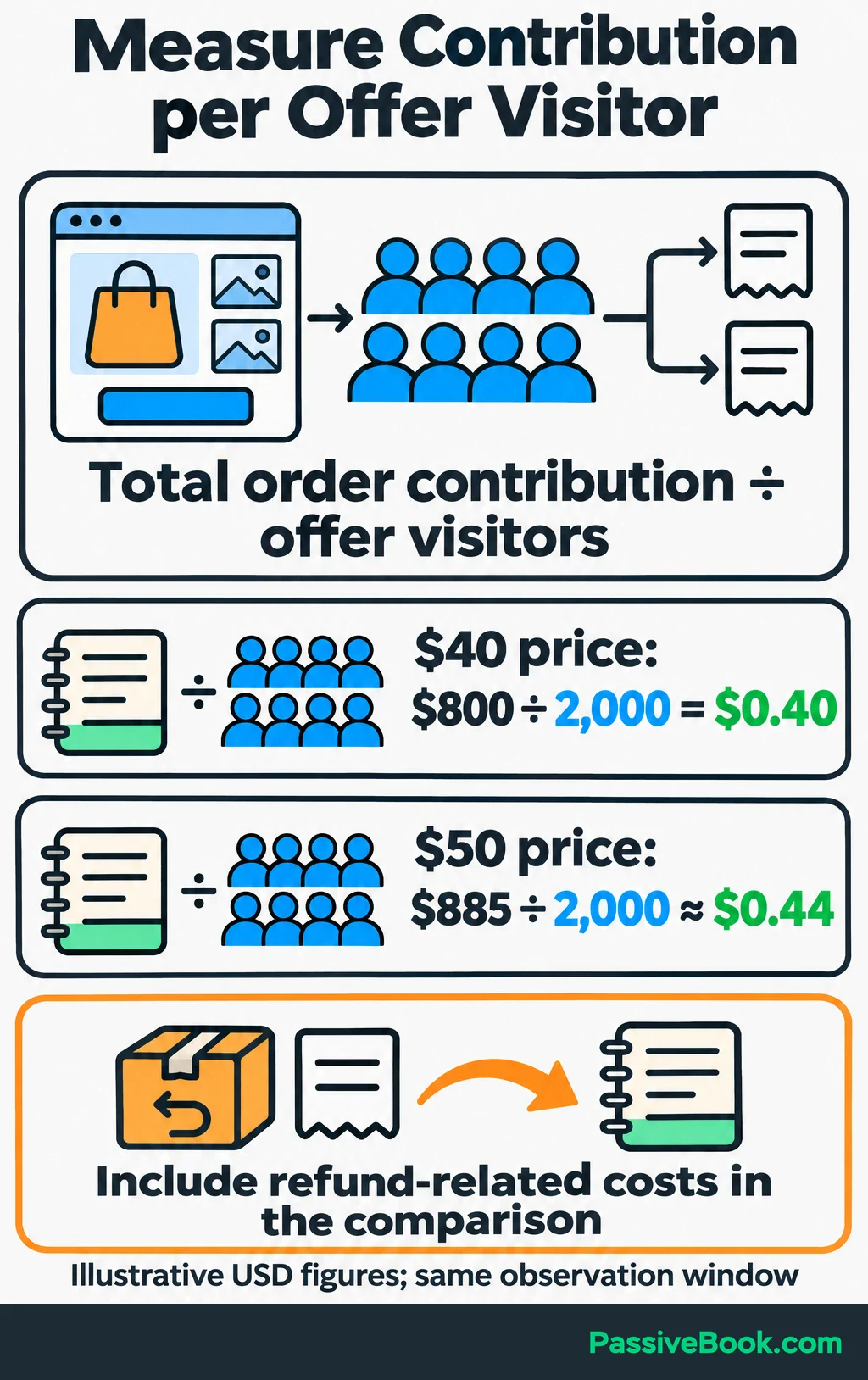
Allow time for the returns you normally see after a purchase, and include refunds and delivery effort in the comparison.
For a service, also check whether the accepted work fits your available hours. A higher quote that earns more per project may still leave too little total work to meet your target.
Check Discounts and Price Endings
Before discounting, calculate how many extra orders you need to preserve the original total contribution.
A 20% discount takes the bag from $40 to $32. The fee becomes $1.60, leaving:
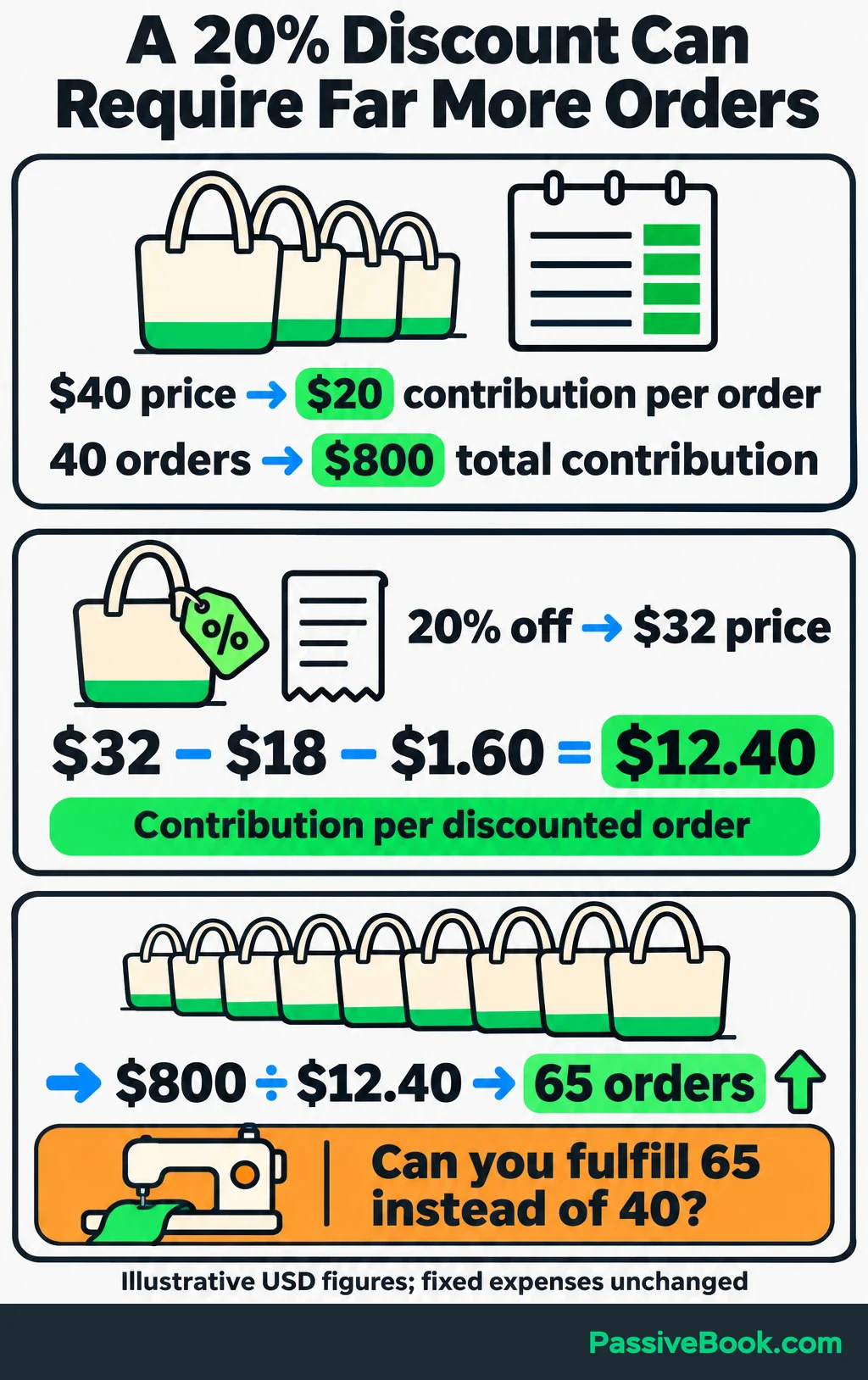
$32 − $18 − $1.60 = $12.40 contribution per order
Forty full-price orders contributed $800. To replace that contribution at the discounted price, divide $800 by $12.40 and round up:
$800 ÷ $12.40 = 65 orders
You now need 65 orders instead of 40, assuming fixed expenses stay the same. Check whether stock and working capacity can support them before scheduling the promotion.
Keep promotional comparisons genuine. The U.S. Federal Trade Commission’s former-price guidance warns against inflating an old price to advertise false savings.
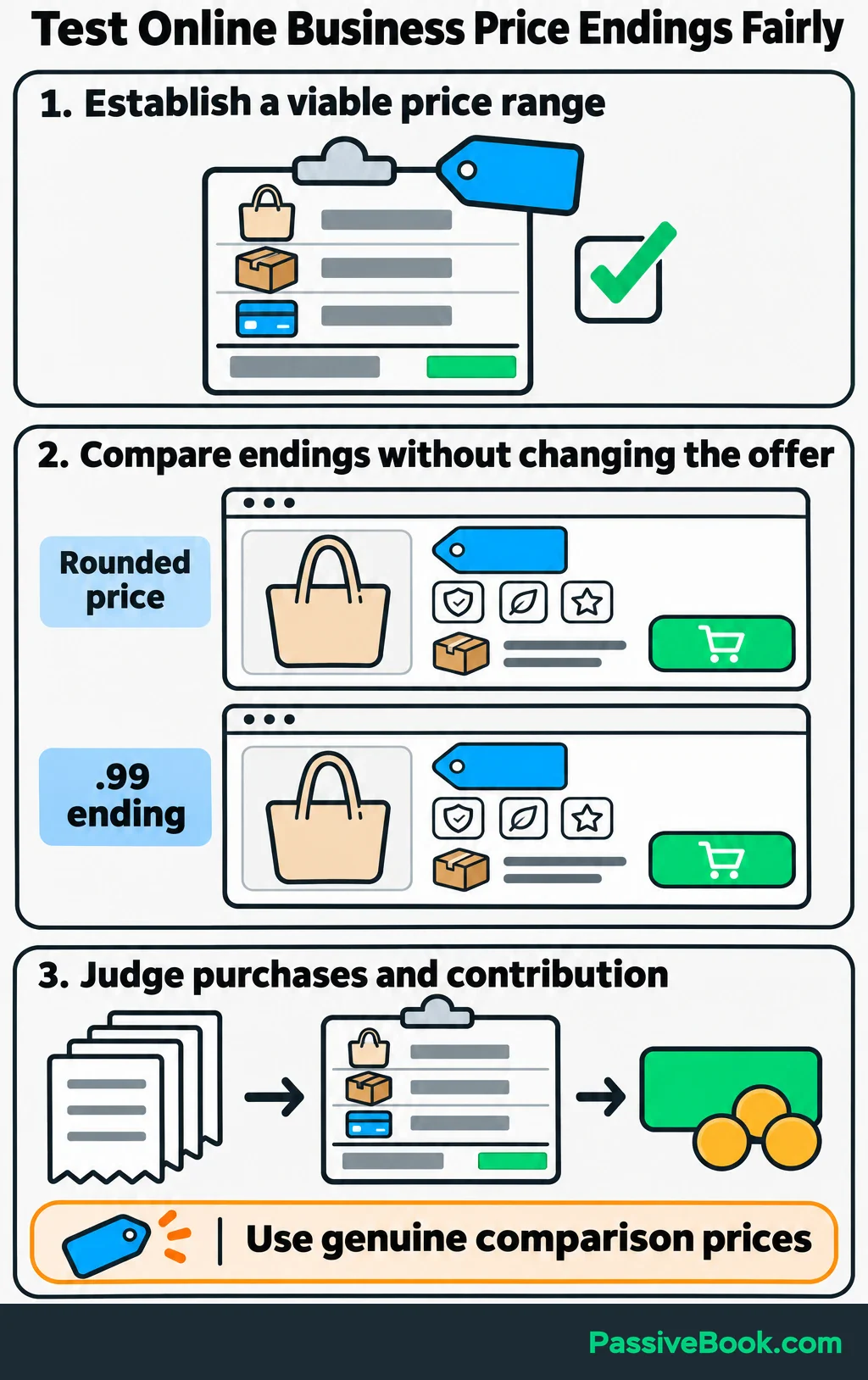
I would test rounded prices against endings such as .99 only after establishing a viable price range. Judge the result by purchases and contribution. A different last digit cannot rescue an offer whose delivery costs consume the sale.
Keep or Revise the Price
Keep a price when paid demand, contribution, and delivery capacity support your objective.
When sales are weak, check the offer before reaching for a discount. Can visitors understand what they receive? Are the visitors suitable buyers? Does checkout reveal a delivery charge they didn’t expect?
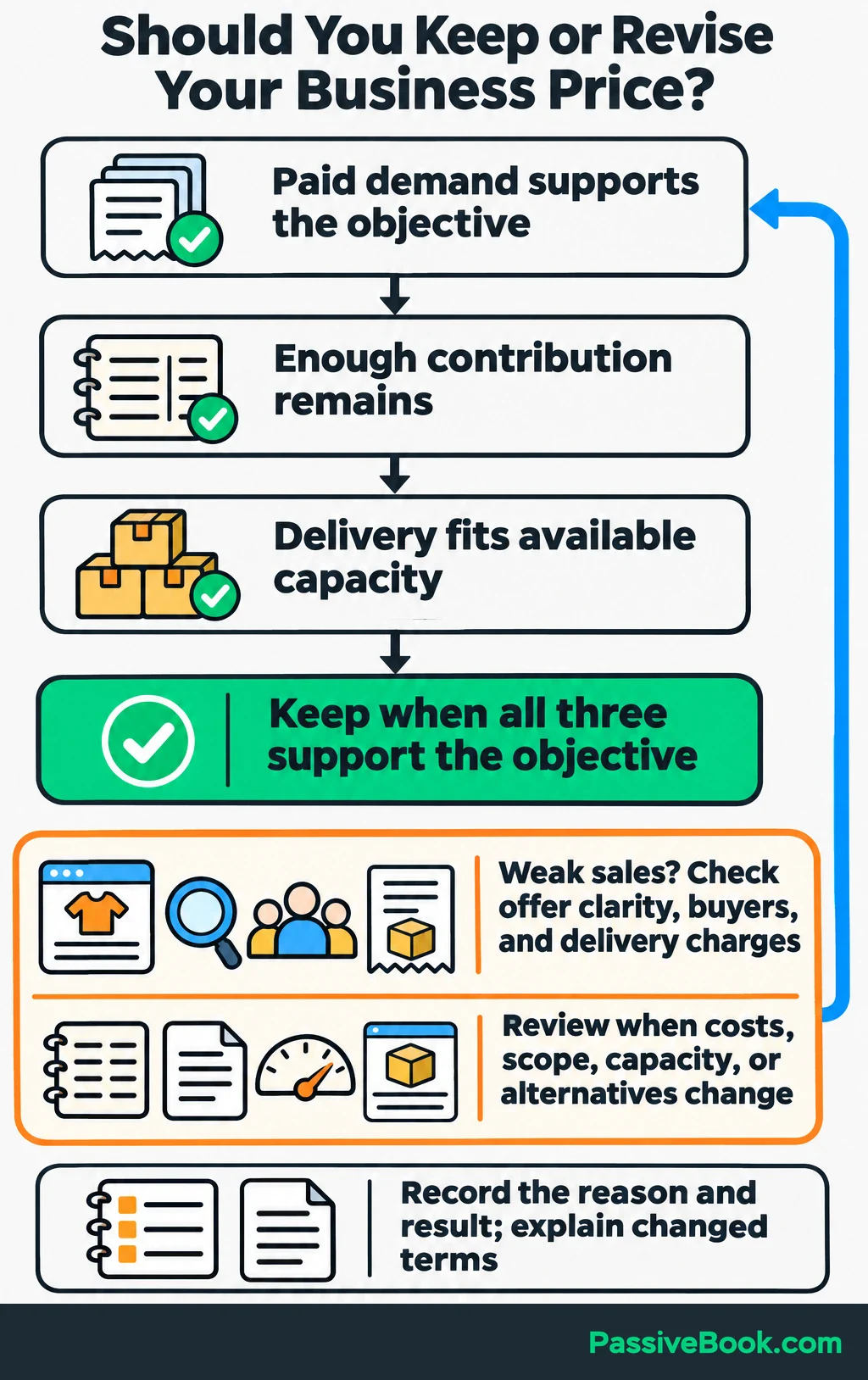
Review prices when costs, scope, capacity, or competing alternatives change. Recalculate affected bundles and promotions too.
State what’s included, delivery charges, and billing terms. Explain how price changes affect existing orders, quotes, or recurring commitments.
Record the old and new prices, reason, test dates, and result. Your next decision deserves better than memory.
What Next?
Choose one current or planned offer and calculate its contribution per sale. Then work out the orders needed to cover your monthly expenses and profit target.
Use the social buttons to share this guide if the calculations would help bring a pricing discussion back to costs, buyers, and manageable delivery.
Which assumption in your current price needs checking first: delivery cost, customer value, or expected sales volume? Leave your answer in the comments, along with any other pricing questions.
Share this post with your friends & followers:

