Your new ad gets cheaper clicks, but purchases barely move. Another version makes two quick sales, and now you’re wondering whether to give it more money or wait.
Both decisions feel risky when the budget is small. Keep spending and you might fund a weak ad. Stop too soon and you might discard something useful. The worked ad comparison below gives you a repeatable plan for deciding whether a promising result deserves more money—or another test.
Define What a Winning Ad Must Achieve
A winning ad must meet your business target and have enough evidence to justify choosing it over the alternative. Beating an ad that loses money is a fairly low bar.
Start with one primary metric:
- Similar purchase values and margins: Use cost per acquisition, or CPA—the advertising cost of getting one purchase.
- Different purchase values or margins: Compare contribution after advertising: revenue minus variable costs and ad spend.
- Lead generation: Use cost per qualified lead, with a clear definition of “qualified,” and check whether those leads become worthwhile customers.
Clicks, video views, and engagement can help explain a result. They should not replace the outcome you need.
To calculate purchase CPA, divide the ad spend by the purchases attributed to that spending:
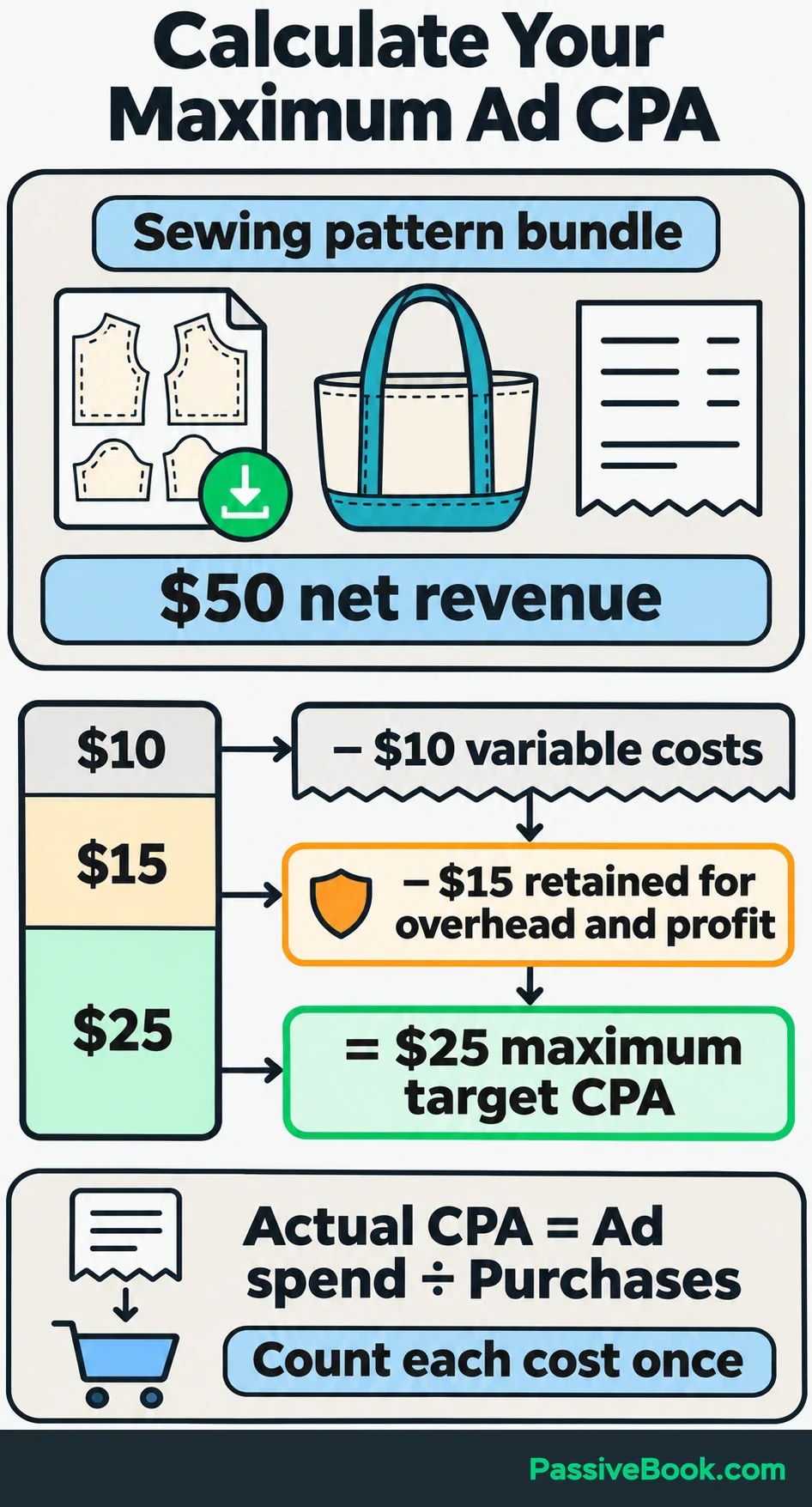
CPA = Ad spend ÷ Purchases
Next, work out what you can afford to pay for a purchase. Subtract variable non-ad costs and the amount you want to retain for overhead and profit from net revenue per order.
Imagine you sell a downloadable beginner sewing pattern bundle. We’ll follow this example through setting a target, testing a headline, and deciding what the results justify.
| Item | Amount per order |
|---|---|
| Net revenue | $50 |
| Variable non-ad costs | $10 |
| Contribution retained toward overhead and profit | $15 |
| Maximum target CPA | $25 |
The target is:
$50 − $10 − $15 = $25 CPA
Count payment fees, fulfillment costs, and expected refunds once. If refunds are already deducted from net revenue, don’t subtract them again. I would leave future purchases out of this calculation until repeat-purchase records support including them.
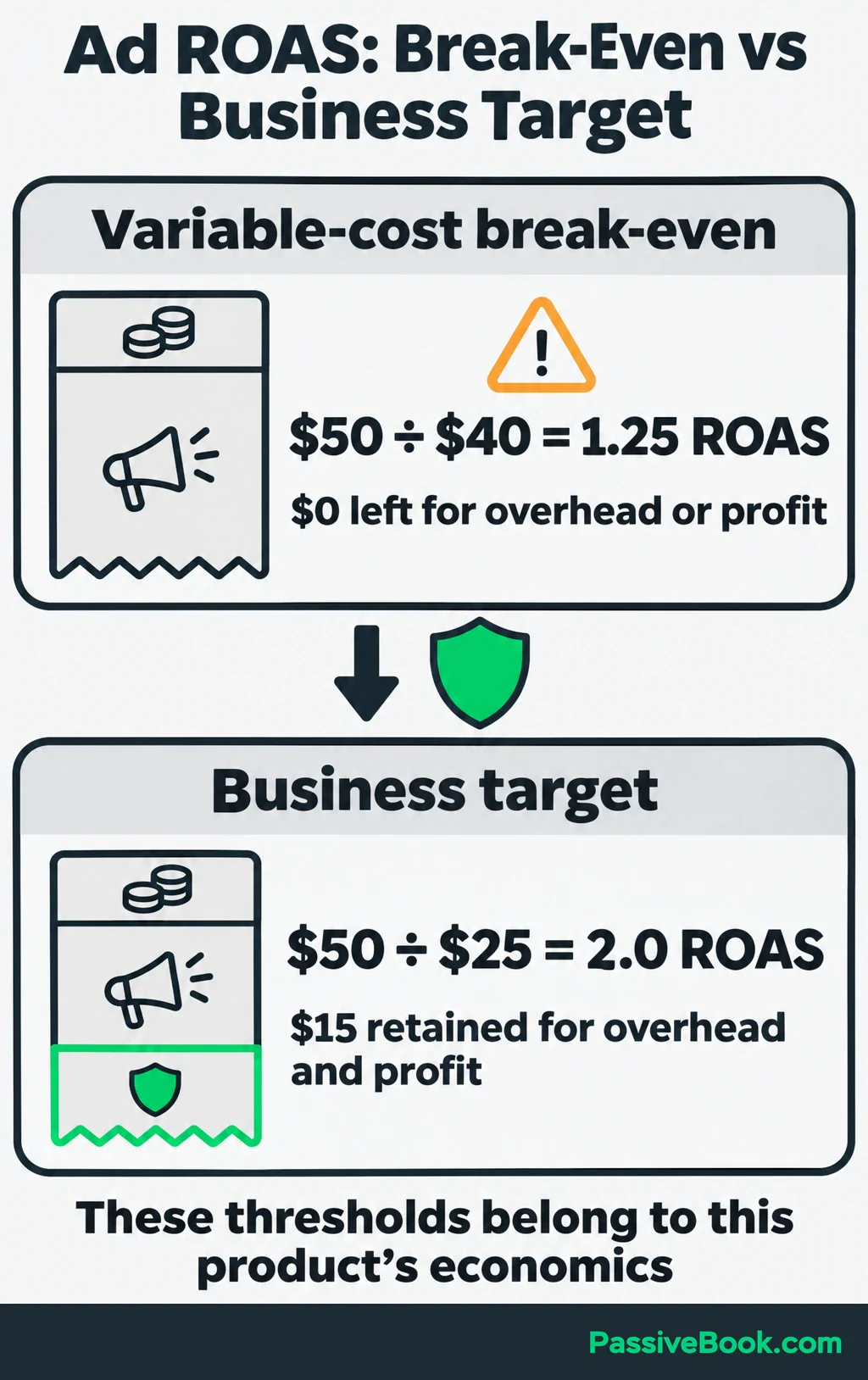
You may also see return on ad spend, or ROAS. It divides attributed revenue by ad spend.
For this bundle, the target ROAS is $50 ÷ $25 = 2.0. Its variable-cost break-even ROAS is $50 ÷ $40 = 1.25, because $40 remains after the $10 variable costs. That lower figure leaves nothing toward overhead or profit.
Use the target that keeps the business worth running, rather than the smallest number that lets an ad look successful.
Choose One Question Worth Testing
Keep a short list of uncertainties drawn from customer questions, buying objections, and campaign results. Then choose the question whose answer would change your next decision.
| What you observe | A useful question | What to test |
|---|---|---|
| People question whether the bundle is worth buying | Would a different package make the offer more appealing? | Offer |
| People understand the product but miss its main benefit | Which benefit deserves the headline? | Message angle |
| People struggle to picture how the patterns work | Would showing a pattern page explain the product better? | Visual demonstration |
| A promising ad performs poorly with one audience | Does another eligible audience respond better? | Audience, with creative held steady |
Test audience, placement, bidding, and budget questions separately from creative changes. Otherwise, a better result leaves you guessing which change helped.
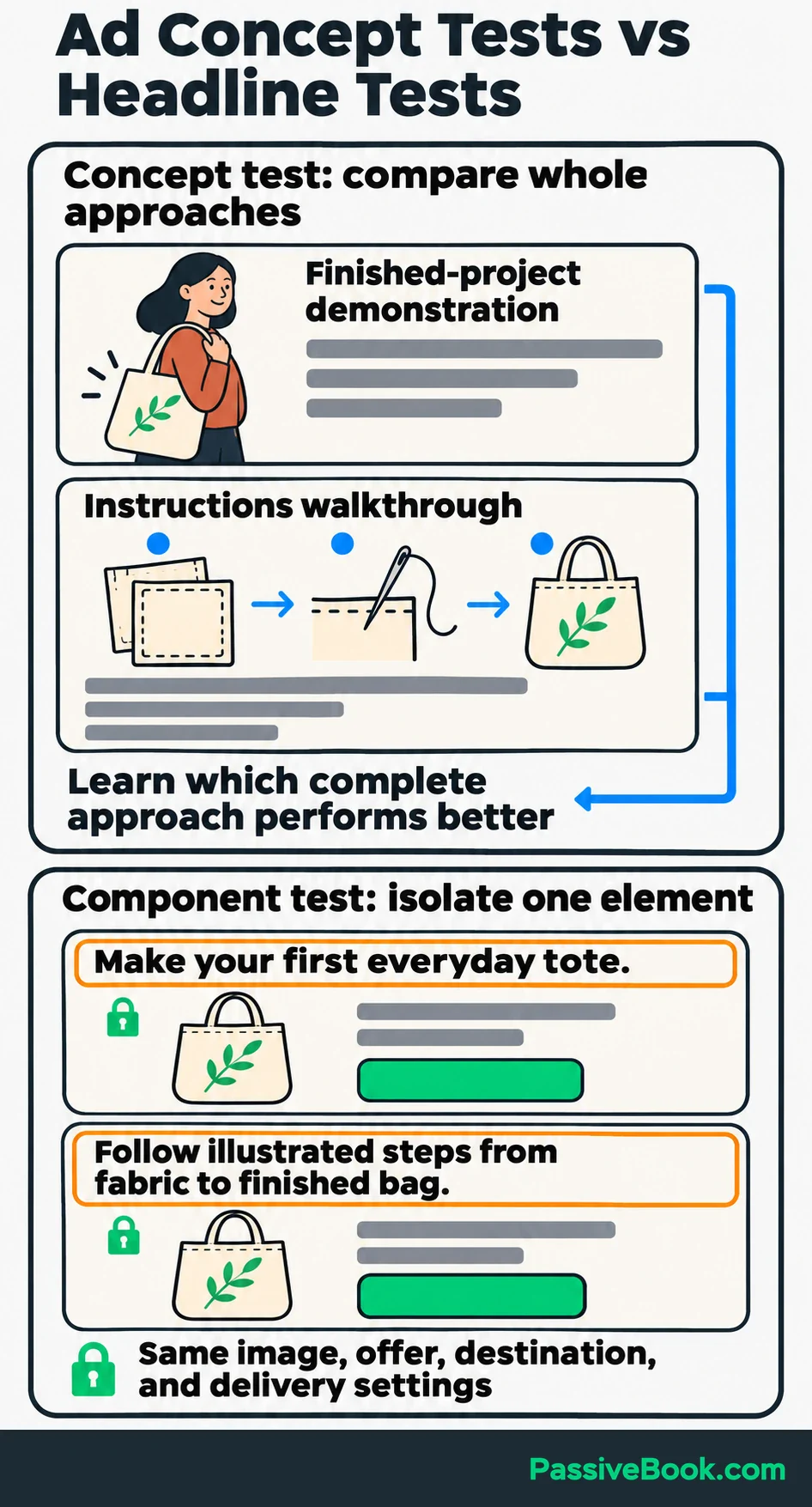
Also distinguish a concept test from a component test. A concept test compares complete approaches, such as a finished-project demonstration against a walkthrough of the instructions. A component test isolates something smaller, such as the headline.
I would test a distinct concept when the direction is uncertain. I would isolate a component when the answer would help refine an approach already worth keeping.
For the sewing bundle, suppose customer questions repeatedly focus on whether beginners can follow the instructions. Compare these headlines:
- Control: “Make your first everyday tote.”
- Challenger: “Follow illustrated steps from fabric to finished bag.”
Keep the image, format, product, price, call to action, and destination the same.
If you know the objection but are stuck on the wording, the AI Skill below can draft a matched pair from your product details. It shows exactly which copy changes so you can check the comparison before spending.

Free AI Advertising Studio




Write the reasoning before launching:
Changing the headline to emphasize illustrated instructions should lower purchase CPA because customers’ main objection is uncertainty about following a pattern.
Then state what a useful result would justify: keeping the instruction-led headline and testing another way to demonstrate the instructions.
Choose the smallest improvement worth acting on, too. From a $30 baseline CPA, a 20% reduction means reaching $24. That would also meet the bundle’s $25 target.
Sometimes the offer deserves attention before the ad. I rushed a course without validating demand, got few sales and a bad review, and took it down. Looking back, the uncomfortable part was how much work I had done before checking whether people wanted it. That experience wasn’t an ad test, but it shapes my judgment: I wouldn’t start polishing headlines when the product itself remains unproven.
Repeated testing can also reveal a direction you would miss by copying another advertiser. In its Boston Proper case study, Tinuiti describes a year of Facebook and Instagram testing that favored static lifestyle imagery with on-image copy. It reports a 37% higher click-through rate (CTR) and 11% higher ROAS for the broader program, which also changed the creative process. I would borrow the habit of testing and refining, rather than assume that format will win elsewhere.
Design a Fair Comparison
Start with one control and one challenger. The control is your current reference ad. If you have no established performer, compare two ideas and treat the initial leader as a candidate control.
Run both versions at the same time, with the same delivery conditions. For the headline comparison, hold these settings steady:
- Audience eligibility and exclusions.
- Product, offer, destination, and checkout.
- Optimization goal: purchases, so the platform tries to find buyers.
- Placements, bidding, and schedule.
- Attribution settings, which determine which purchases receive advertising credit.
This follows Google’s experiment guidance: isolate the variable and choose success metrics before the test begins.
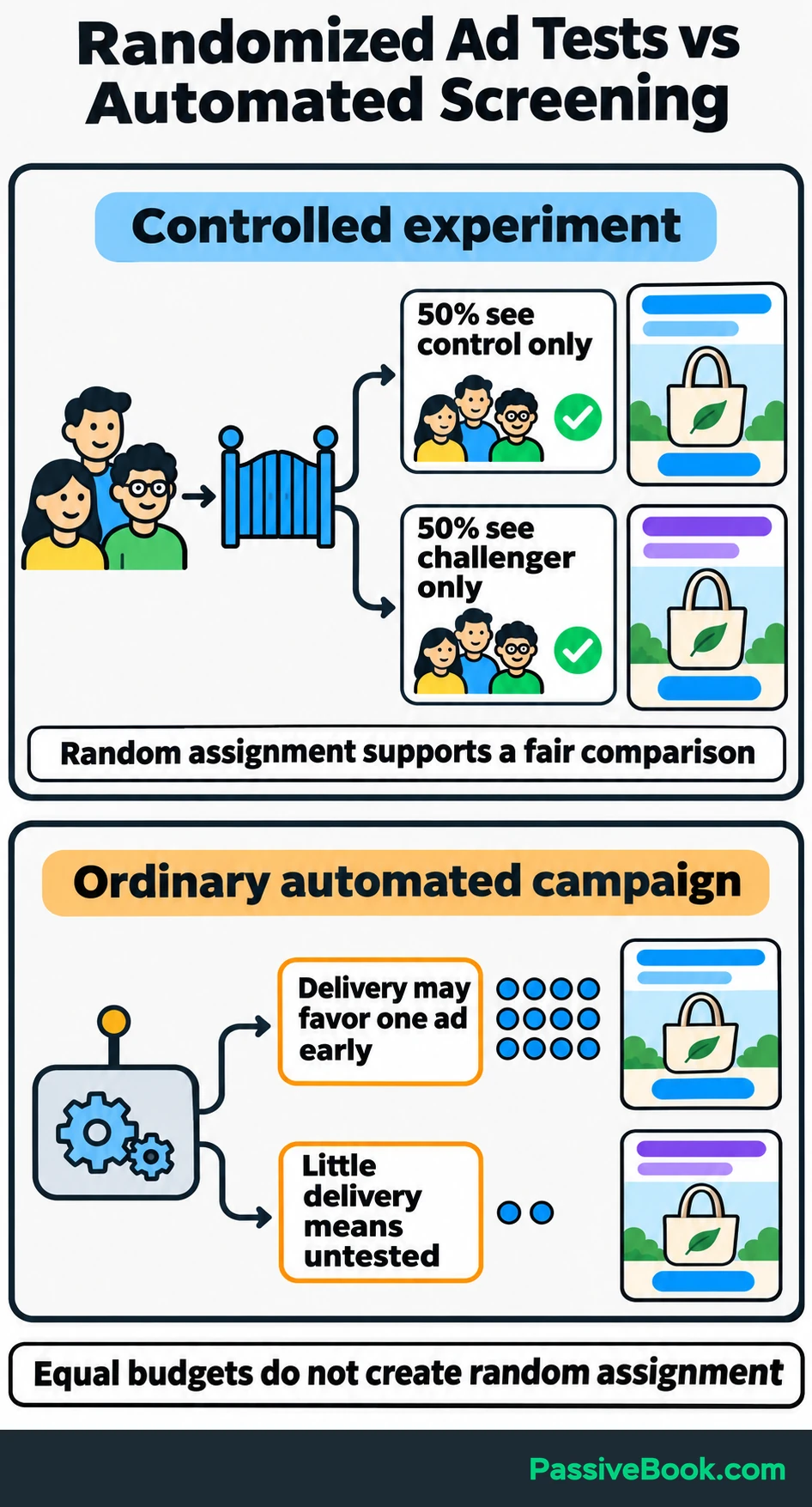
Where available, use a platform experiment that randomly assigns eligible people to separate groups. For example, TikTok’s split-testing tool divides the audience into equal groups, with each group seeing only one ad group.
Putting two ads in an ordinary campaign is different. Automated delivery may favor one early, and equal budgets do not create random assignment. Treat that setup as screening for candidates. An ad that receives almost no delivery remains untested.
For a complete concept comparison, change the copy and visuals needed to express each concept while keeping delivery conditions steady. You can conclude that one whole concept performed better. You cannot conclude that its image alone caused the difference.
Set an Affordable Budget and Review Window
Estimate the Evidence Your Budget Can Buy
Set total and per-version spending caps using money you can afford to spend without finding a winner. Keep this separate from the budget for existing campaigns.
Then estimate the purchases that budget might produce. Divide the total budget between the variants, then divide each share by expected CPA.
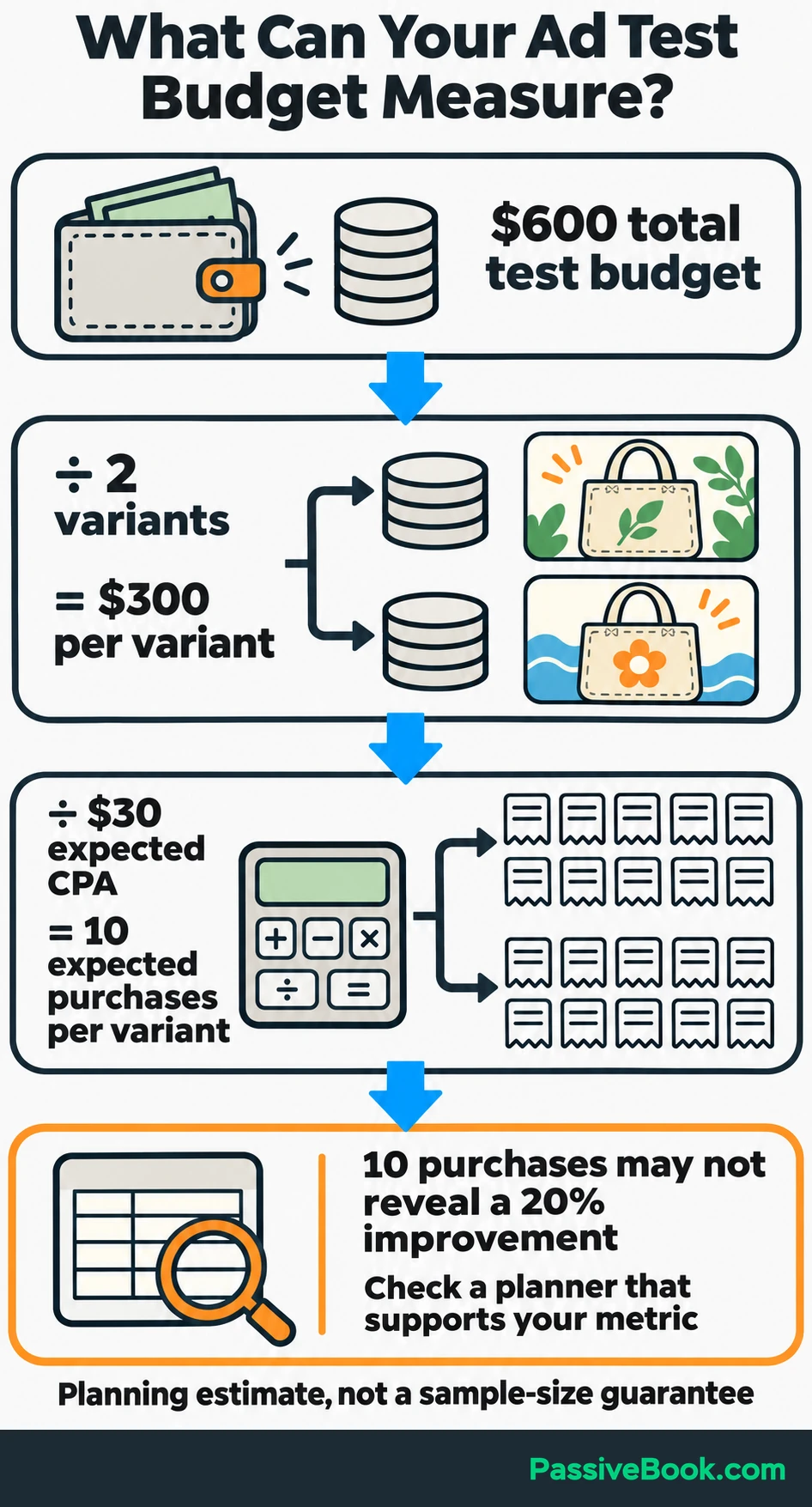
Using the sewing bundle’s $30 baseline:
$600 total budget ÷ 2 variants ÷ $30 CPA = 10 expected purchases per variant
This assumes both ads perform at the baseline; ten purchases each may not reveal a 20% improvement. Check with an experiment planner that supports your metric, baseline, budget, and worthwhile improvement.
Ten expected purchases and enough evidence to choose an ad are different things. The calculator below estimates that gap for your numbers and shows the assumptions behind the estimate.
Free Test Feasibility Calculator
TikTok’s planning guidance describes budget-based estimates of testing power: the chance of detecting a real difference of the size you want to find.
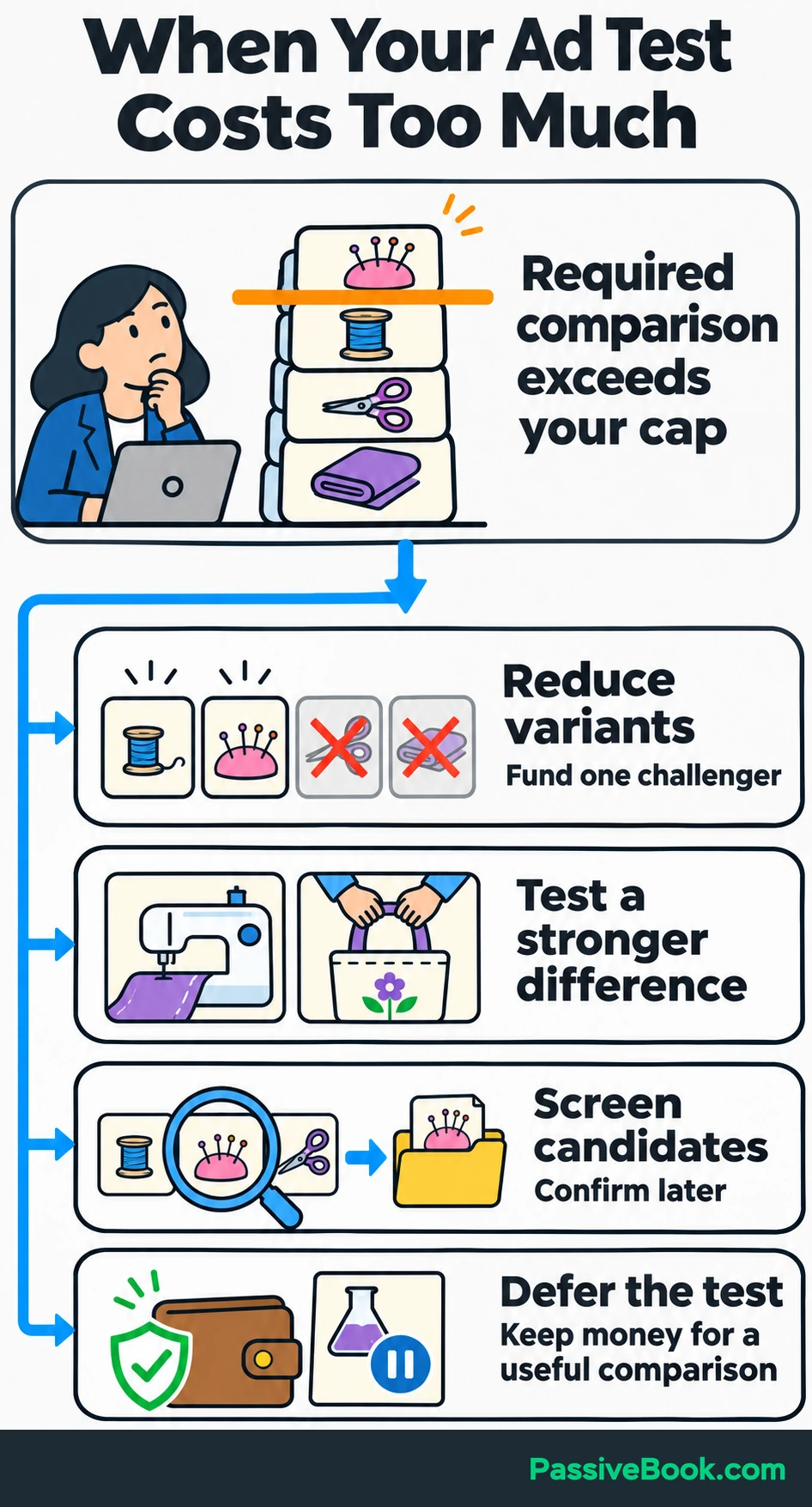
If the required comparison costs more than your cap, choose a smaller commitment:
- Reduce variants: Fund one challenger rather than spreading the budget across several.
- Test a stronger difference: Compare distinct messages instead of tiny wording changes.
- Run a screening exercise: Find a candidate for later confirmation, with limited conclusions.
- Defer the test: Keep the money when the available evidence would not change a decision.
Choose When to Stop Delivery and Review Results
Cover normal buying patterns and the experiment’s duration requirements. Avoid comparing a weekend promotion with an ordinary weekday and attributing everything to the ad.
Separate the delivery end from the final review. Buyers may purchase after their first visit, so recent CPA can look worse while those purchases are still arriving. Google explains this conversion-delay effect.
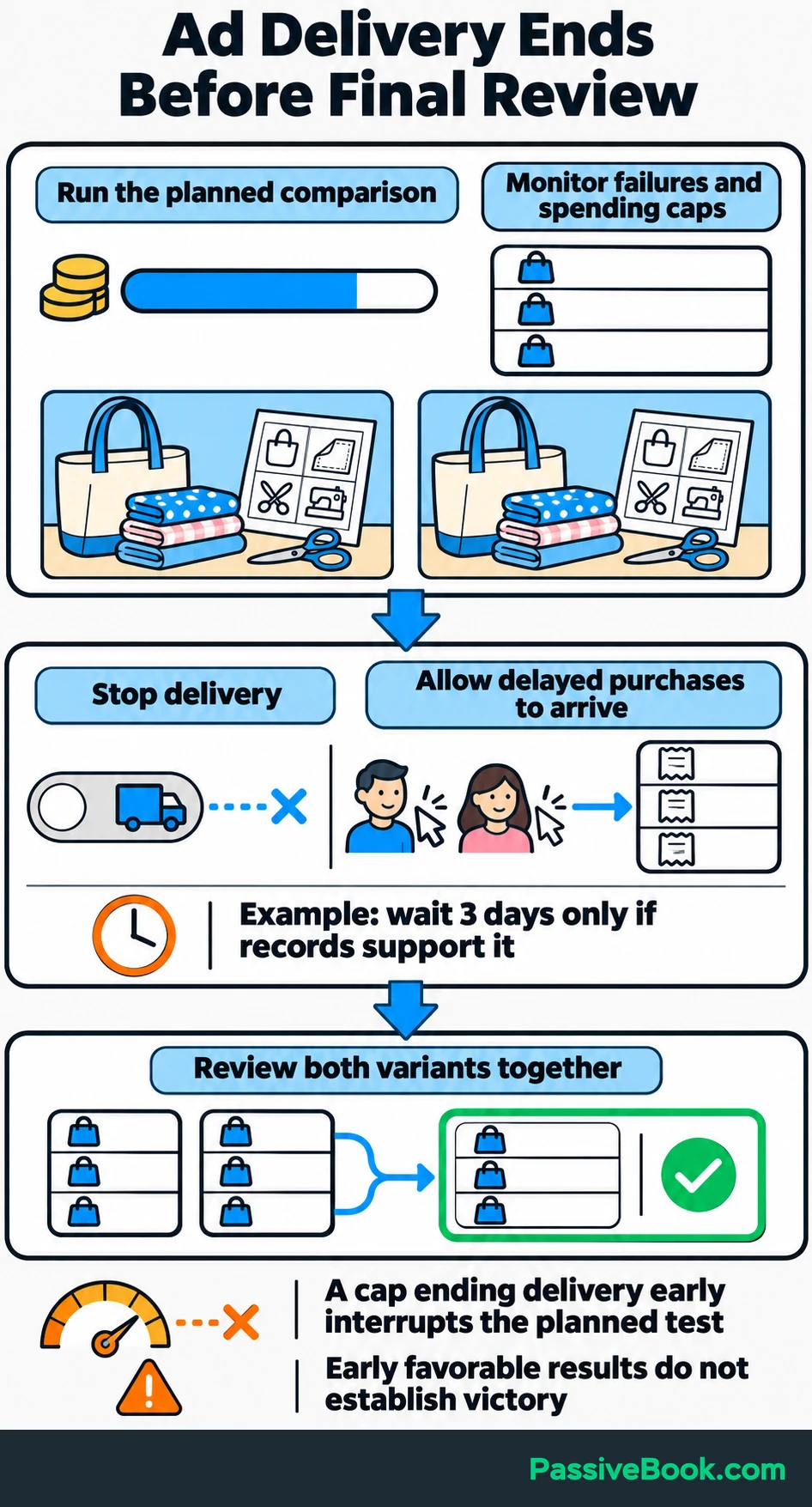
Choose the waiting period from your purchase-delay records. If those records show that relevant purchases usually arrive within three days, you might review three days after stopping delivery.
Monitor the test while it runs, but use those checks to catch failures and protect the spending cap. For a fixed-duration test, don’t declare victory at the first favorable statistical result. Microsoft’s experimentation guidance explains that repeated early checks require statistical adjustment.
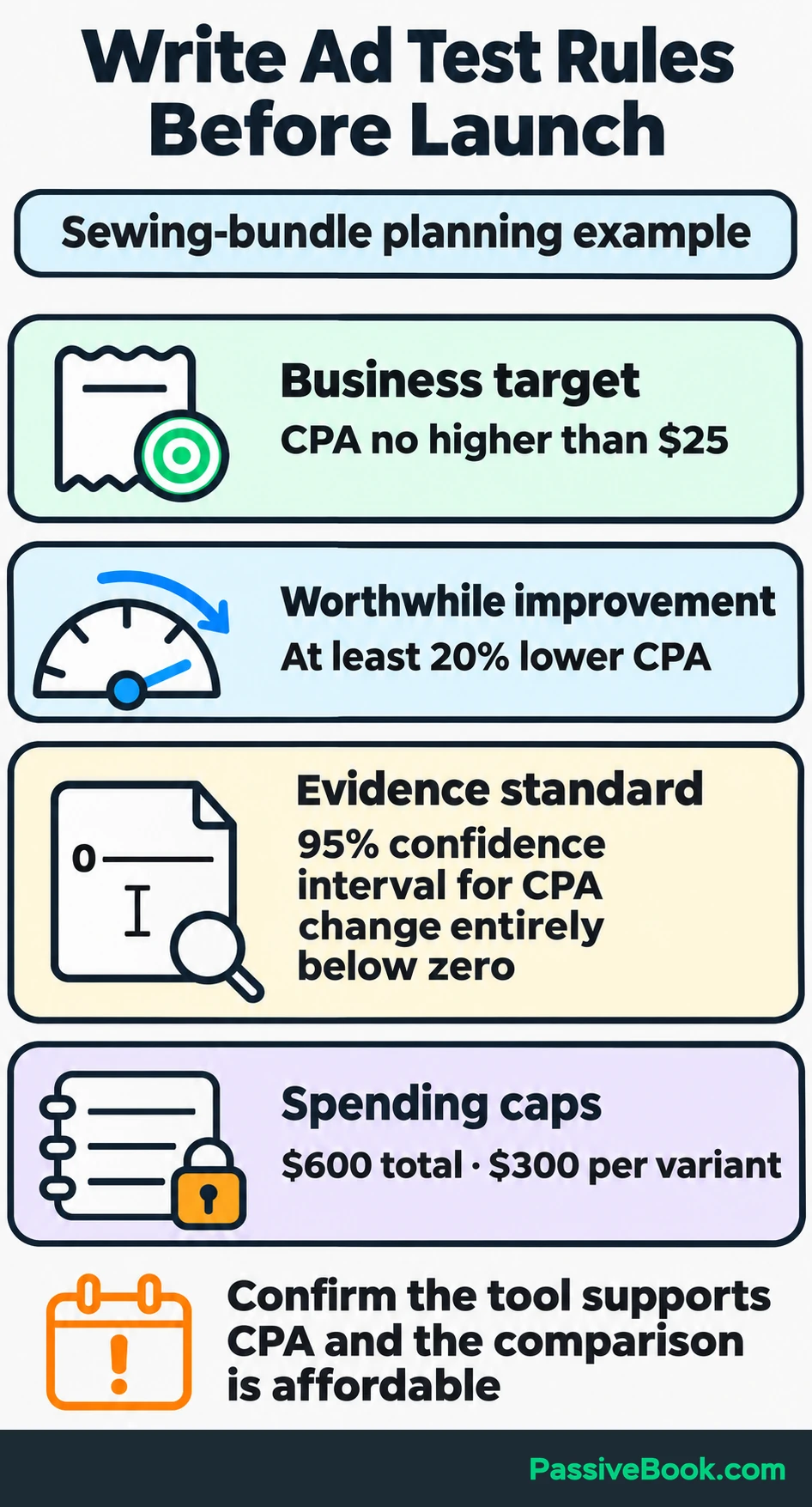
Copy these fields into spreadsheet columns and use one row per test.
| Planning field | Sewing-bundle example |
|---|---|
| Test identifier | sewing-headline-01 |
| Hypothesis | Illustrated instructions address buyers’ doubts about following patterns, lowering purchase CPA. |
| Control | “Make your first everyday tote.” |
| Challenger | “Follow illustrated steps from fabric to finished bag.” |
| Variable | Headline only |
| Fixed settings | Image, format, offer, price, call to action, destination, audience, placements, bidding, purchase goal, attribution |
| Primary metric | Purchase CPA |
| Business target | CPA no higher than $25 |
| Worthwhile improvement | At least 20% lower CPA than control |
| Evidence standard | 95% confidence interval for CPA change lies below zero: the estimated range favors the challenger throughout. |
| Allocation | Random 50/50 audience split |
| Spending caps | $600 total; $300 per variant |
| Planning check and observations | Not yet checked. Confirm required data before launch; redesign or screen candidates if unaffordable. |
| Delivery dates | Days 1–14 if platform requirements permit; stop at either spending cap |
| Final review | Day 17 if records support a three-day purchase delay |
| Adoption rule | Meet the target, worthwhile improvement, and evidence standard |
| Other decision rules | Retain only a viable control; close unresolved tests; restart invalid tests |
| Results and next action | Not run yet. Record results and the decision after review. |
The evidence standard must be supported by the tool and metric you use. A confidence interval for click-through rate does not establish a CPA improvement.
If a spending cap ends a fixed-duration comparison early, record that interruption and assess the evidence available. Don’t quietly treat it as the completed test you planned.
Verify Measurement and Launch
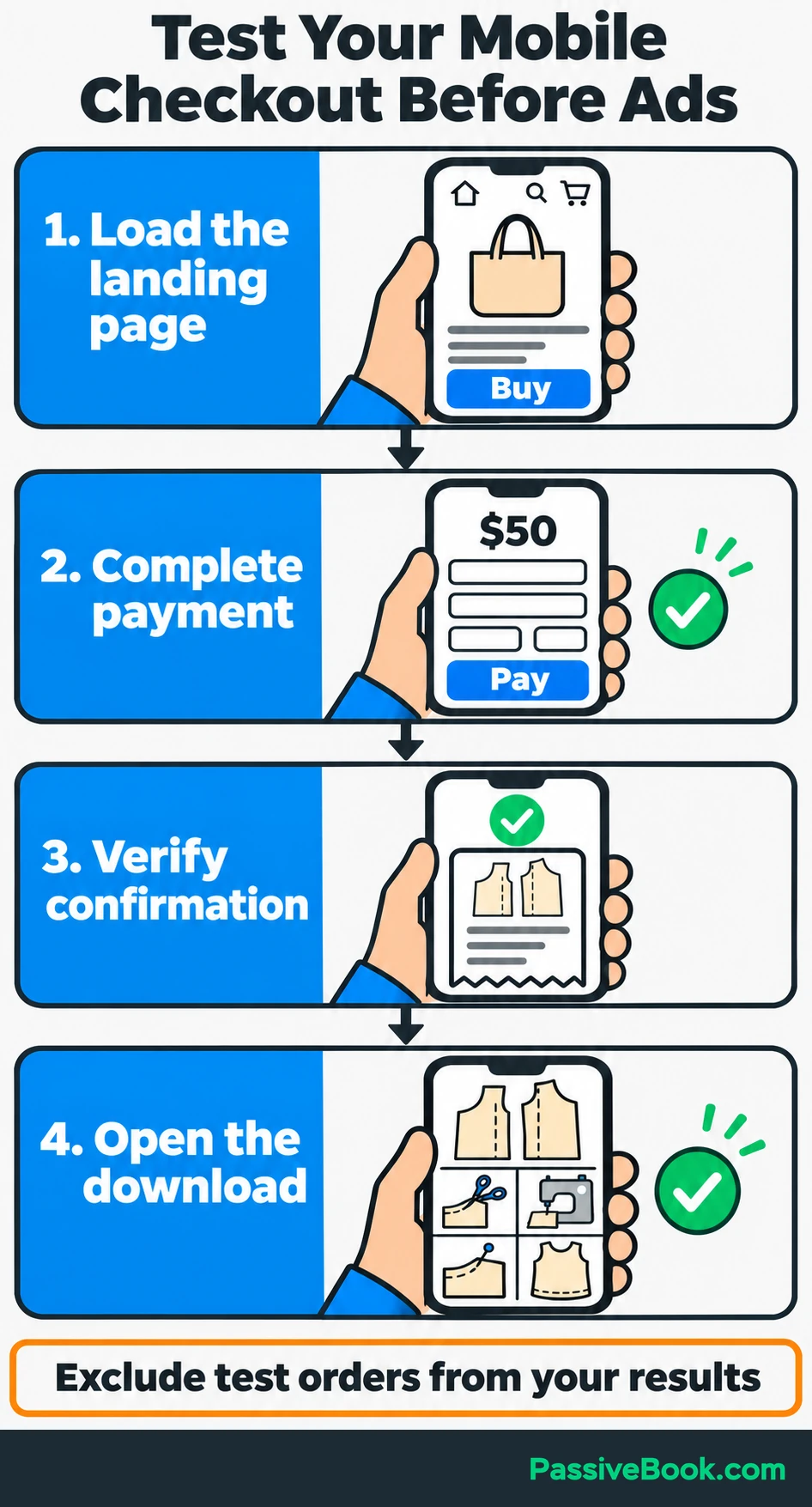
Complete a test purchase before spending money, including on mobile. Check that the landing page, payment, confirmation, and download all work.
Confirm that the purchase event sends the correct value and currency, and that one purchase is counted once. In Google Ads, a unique transaction ID helps prevent duplicate counting within the same conversion action; it does not automatically deduplicate purchases across separate actions. Google’s transaction-ID guidance explains that scope.
Exclude test orders from your evaluation.
Give the experiment and each variant consistent identifiers so you can connect the plan, ads, and results. Use one reporting source and the same attribution window—the period after an ad interaction in which a purchase can receive credit. Check discrepancies against actual orders when they could reverse the decision.
Before leaving the test to run, confirm that:
- Delivery works: Both versions are approved and receiving their planned allocation.
- Measurement works: Purchase events continue to arrive with sensible values.
- Spending stays bounded: Caps and alerts reflect the written plan.
- The destination works: Visitors can load the page and complete checkout.
Pause for a broken checkout, failed tracking, or another material problem. Record interruptions, and restart materially changed comparisons as new tests.
Decide Whether to Adopt, Retain, or Retest
Compare Business Performance and Experimental Evidence
Use the same planned reporting window for both variants, including the agreed allowance for delayed purchases.
First compare each version with the business target. Then compare the challenger with the control.
Suppose the sewing-bundle test produces these totals:
| Variant | Spend | Purchases | CPA | Target met? | Observed improvement | Experiment evidence | Action |
|---|---|---|---|---|---|---|---|
| Control | $300 | 10 | $30 | No | Reference | Not supplied | Does not qualify for continued delivery at this CPA |
| Challenger | $300 | 15 | $20 | Yes | 33.3% lower CPA | Not supplied | Check the planned evidence standard before adopting |
The control spent $300 to acquire ten purchases, so its CPA is $300 ÷ 10 = $30. The challenger spent the same amount for fifteen purchases, so its CPA is $300 ÷ 15 = $20.
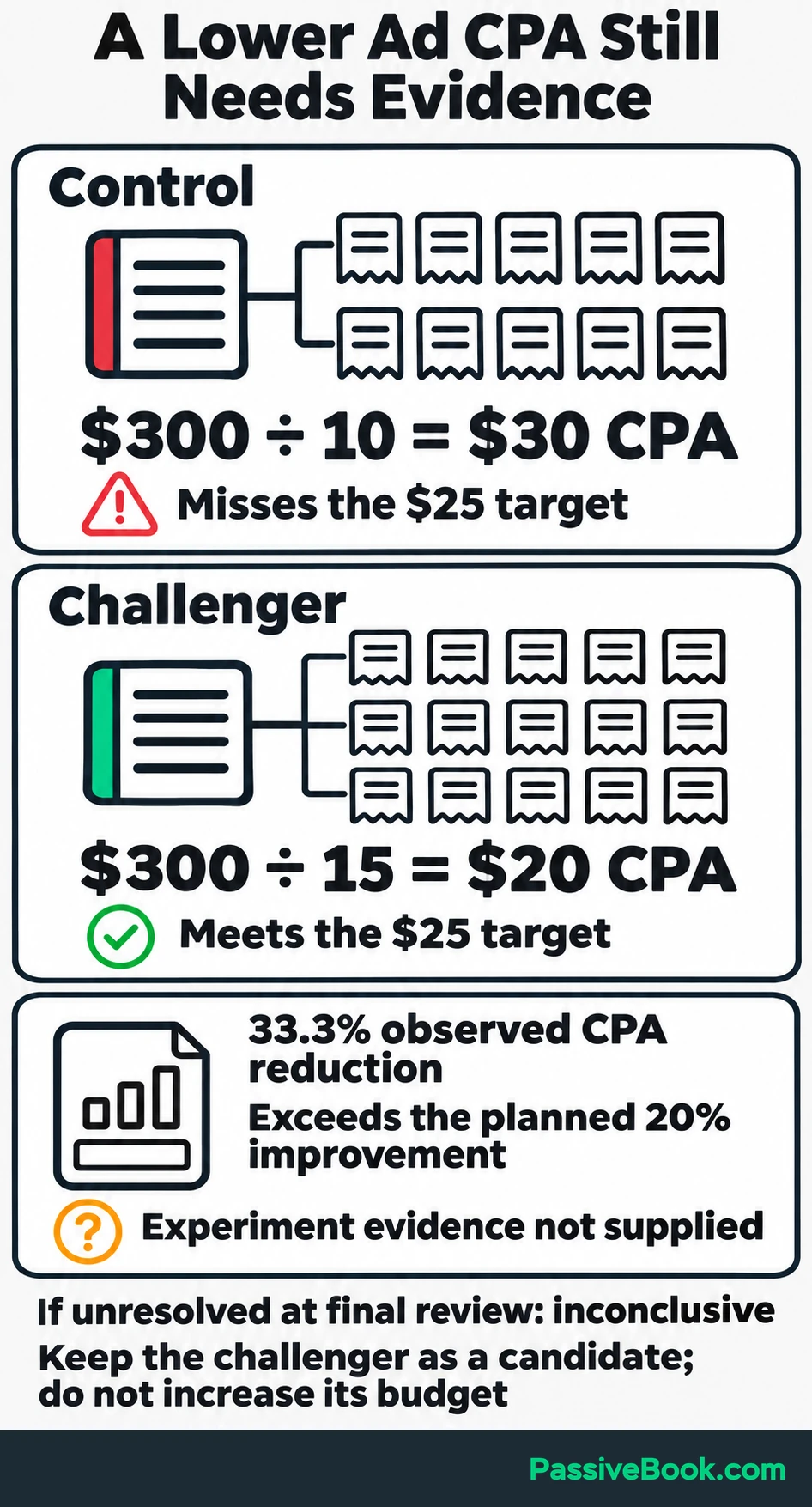
To find the observed reduction, divide the difference by the control CPA:
($30 − $20) ÷ $30 × 100 = 33.3%
The challenger meets the $25 target and exceeds the planned 20% improvement in the observed results. But these totals alone do not establish that it clears the evidence standard. If that evidence is still unavailable at the final review, I would close the test as inconclusive and keep the challenger as a candidate, without increasing its budget. I would pause the control because its $30 CPA misses the target.
Read the estimated improvement alongside its uncertainty. A confidence interval shows a range of differences compatible with the data under the statistical method. If that range includes both an improvement and a deterioration, the result remains uncertain.
Google’s experiment reporting, for example, provides confidence intervals and distinguishes clear results from comparisons without a clear winner. Check the metric being evaluated and the chosen confidence level before using the report to make your decision.
Apply the Rules Written Before Launch
This is where the written plan earns its place. Apply the rules you chose before you knew which version looked better.
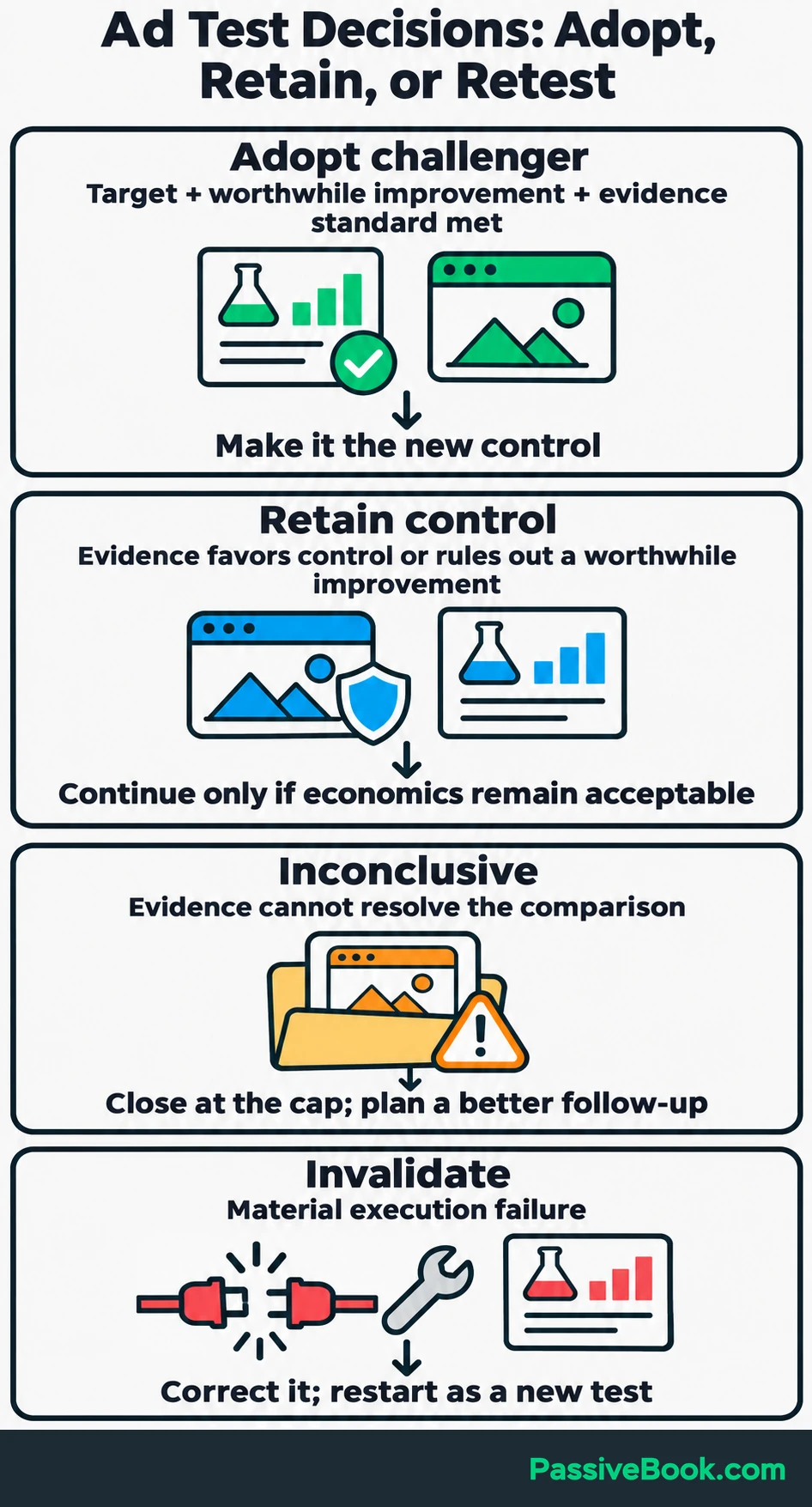
| Outcome | Required evidence | Next action |
|---|---|---|
| Adopt challenger | It meets the business target, delivers the worthwhile improvement, and clears the planned evidence standard | Make it the new control and consider a bounded spending increase |
| Retain control | Evidence favors control or rules out an improvement large enough to justify switching | Keep control running only if its economics remain acceptable |
| Inconclusive | Available evidence cannot resolve the planned comparison | Close at the cap, retain an economically viable control, and choose a better follow-up |
| Invalidate | Material tracking, assignment, destination, or execution failure makes the comparison unreliable | Correct the failure and restart as a new test |
A candidate selected through automated screening still needs a controlled comparison before you commit substantially more money.
If neither ad meets the business target, keeping the less expensive loser running is not a requirement. Pause or reduce unprofitable delivery while choosing the next question.
Use the funnel to decide what deserves investigation:
- More clicks without more purchases: Check whether the landing page delivers the promise that attracted the click.
- Checkout visits without completed payments: Inspect payment errors, unexpected costs, and checkout friction before testing another headline.
- Continued questions about value: Revisit the offer and what buyers receive.
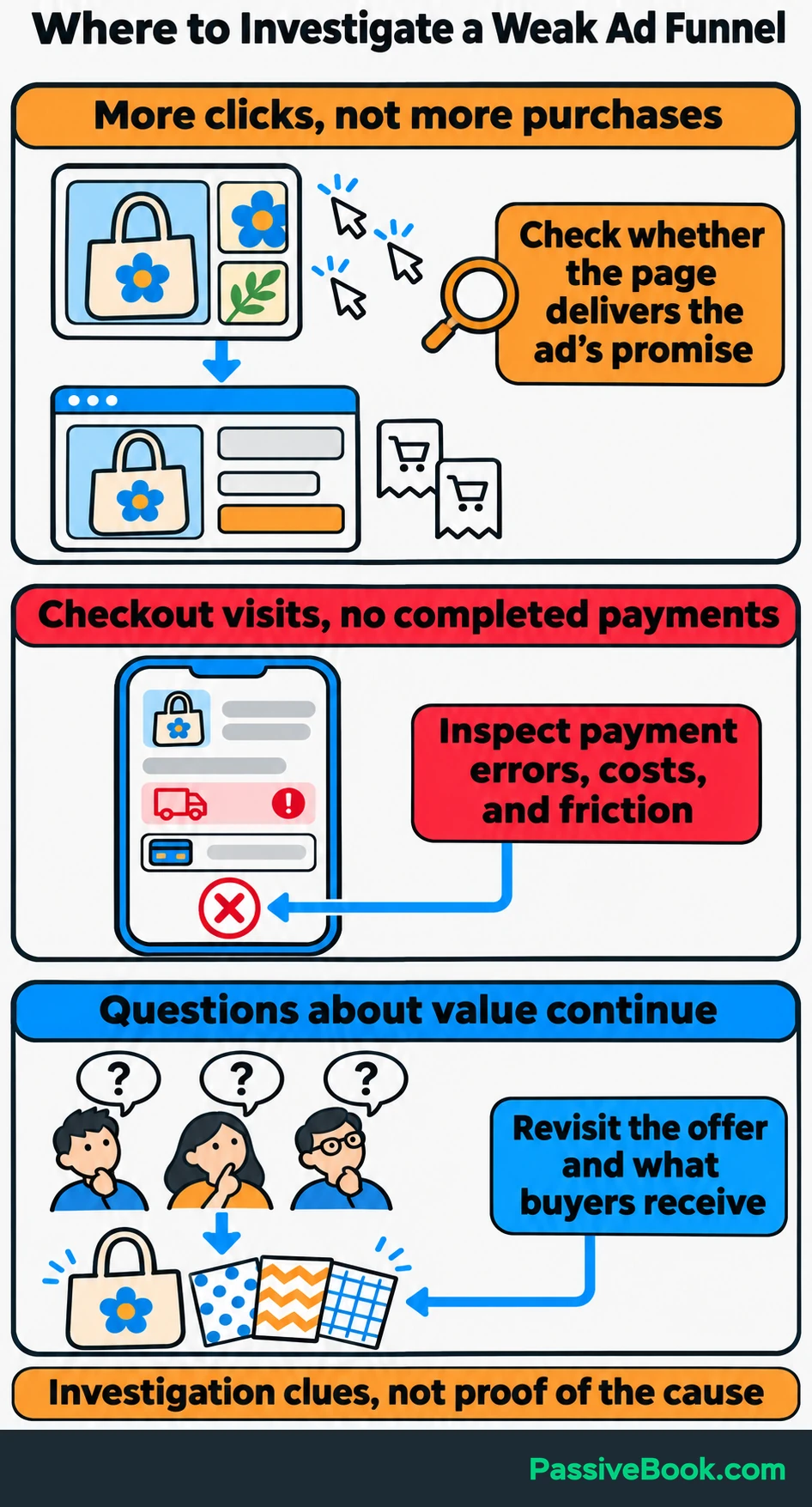
These are starting points for investigation, not proof of the cause.
For an inconclusive headline test, I would consider comparing more distinct messages rather than immediately buying another round of the same weak comparison. More spending only helps when the test can answer a question worth answering.
Record the decision, supporting numbers, and next hypothesis. Keep findings separate from explanations. “The challenger’s observed CPA was lower” is a finding. “The instructions removed buyer anxiety” remains an explanation to test.
Scale the Winner With a Spending Limit
An ad that works at one spending level has earned a controlled increase. It has not earned unlimited access to your bank account.
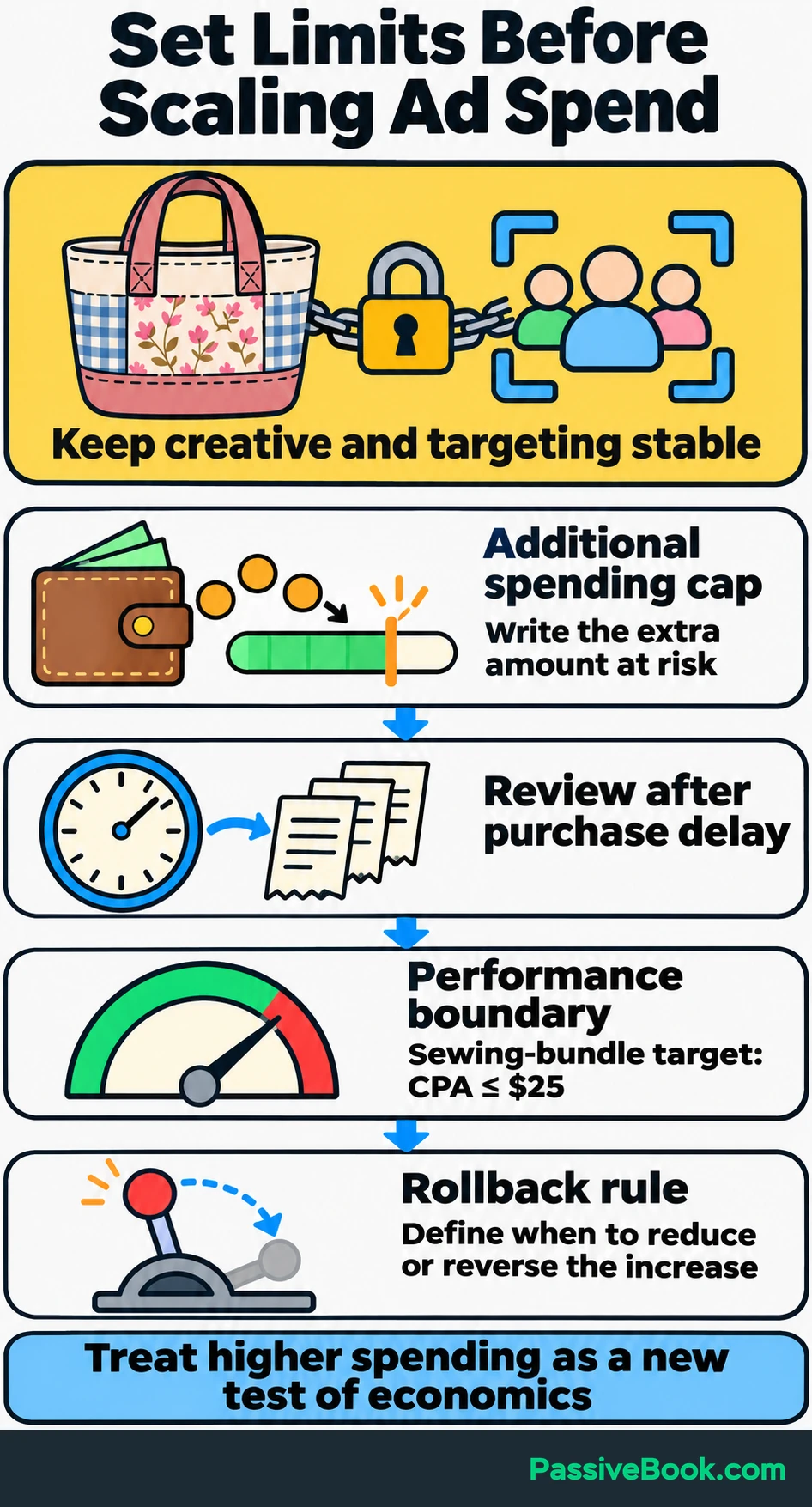
Treat the increase as a new test of delivery economics. Keep creative and targeting stable, and write down:
- Additional spending cap: The extra amount you can risk during the increase.
- Review date: When you will evaluate results after allowing for purchase delay.
- Performance boundary: The CPA or contribution the business requires.
- Rollback rule: What result will make you reduce or reverse the increase.
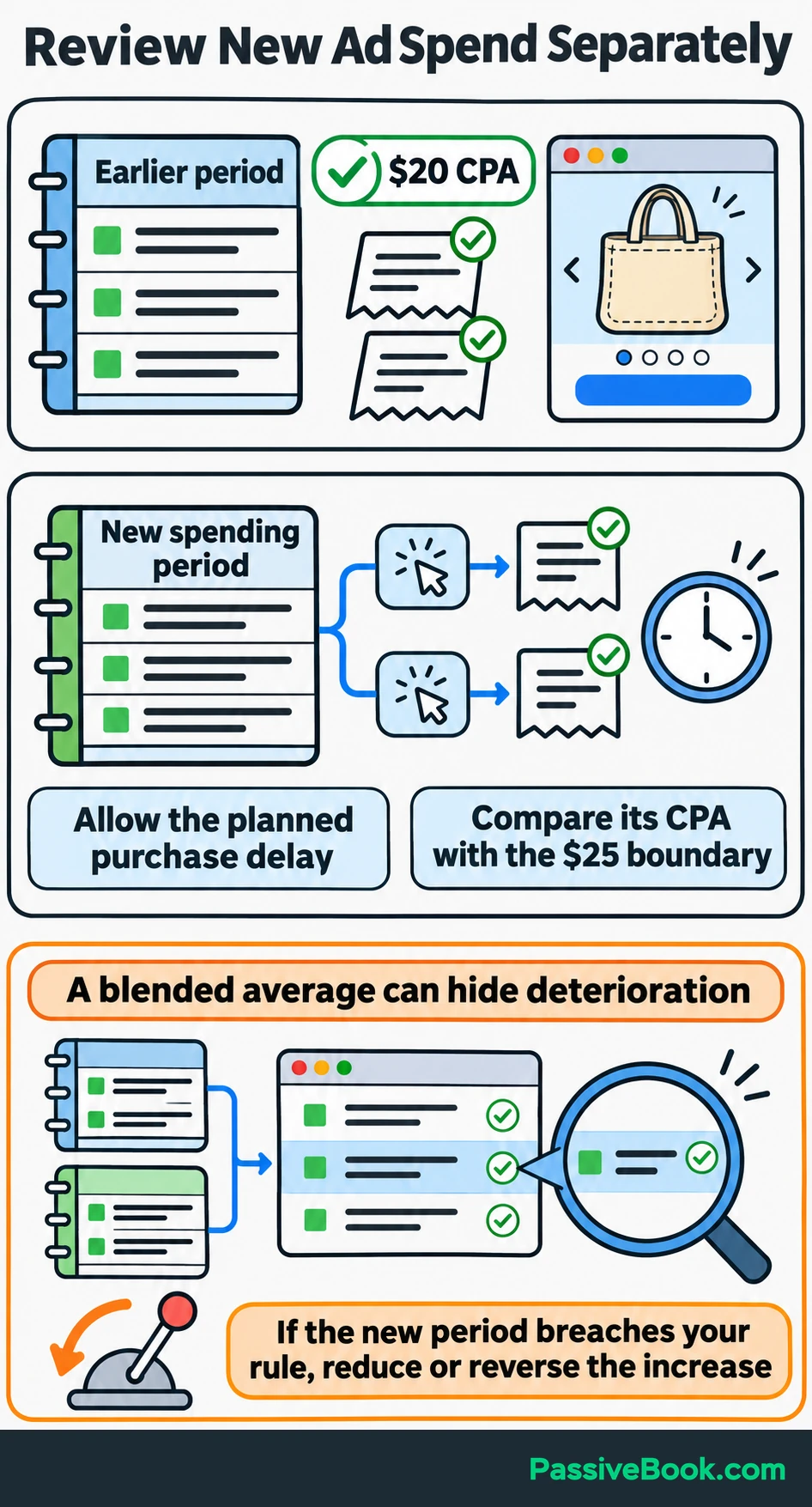
Evaluate the new spending period separately. Earlier profitable results can make the overall average look acceptable while the latest spending performs poorly.
For the sewing bundle, the $25 CPA boundary still applies. Review purchases attributed to the new period after the planned delay, rather than letting the earlier $20 CPA hide deterioration.
I would choose the next increase from those economics and the amount at risk. A universal scaling percentage cannot make an unprofitable increase sensible.
Keep a bounded allowance for fresh challengers, too. Use the testing log to repeat useful themes, answer new objections, and replace ads whose business performance has weakened.
A spreadsheet and platform reports are enough to maintain this process. Carry forward the control, write one next hypothesis, and fund the comparison your budget can support. You don’t need another subscription to remember why you changed a headline.
What Next?
Write down your maximum acceptable CPA and one question worth paying to answer. Then copy the planning sheet and set the spending cap before launching either version.
Use the social buttons to share this guide when a conversation about “winning ads” needs clearer rules for spending and stopping.
Which uncertainty would change your next ad decision most? Share it in the comments, and bring any other testing questions with it.
Share this post with your friends & followers:

