You’re ready to pay for visitors, but one question keeps stopping you: how much can you spend before a sale costs more than it earns?
An ad platform makes launching look easy. It asks for a budget, a picture and a destination. The harder work is deciding what counts as success and making sure those clicks have a clear path to buying.
You can test paid ads without a large team, but you need boundaries around the experiment. This guide connects your offer, budget, campaign and sales records so you can decide whether the next round deserves more money.
How Does Paid Advertising Work?
Paid advertising buys space in search results, social feeds, websites, videos or marketplaces. The path usually looks like this:
Relevant search or audience → ad → landing page → lead or purchase.
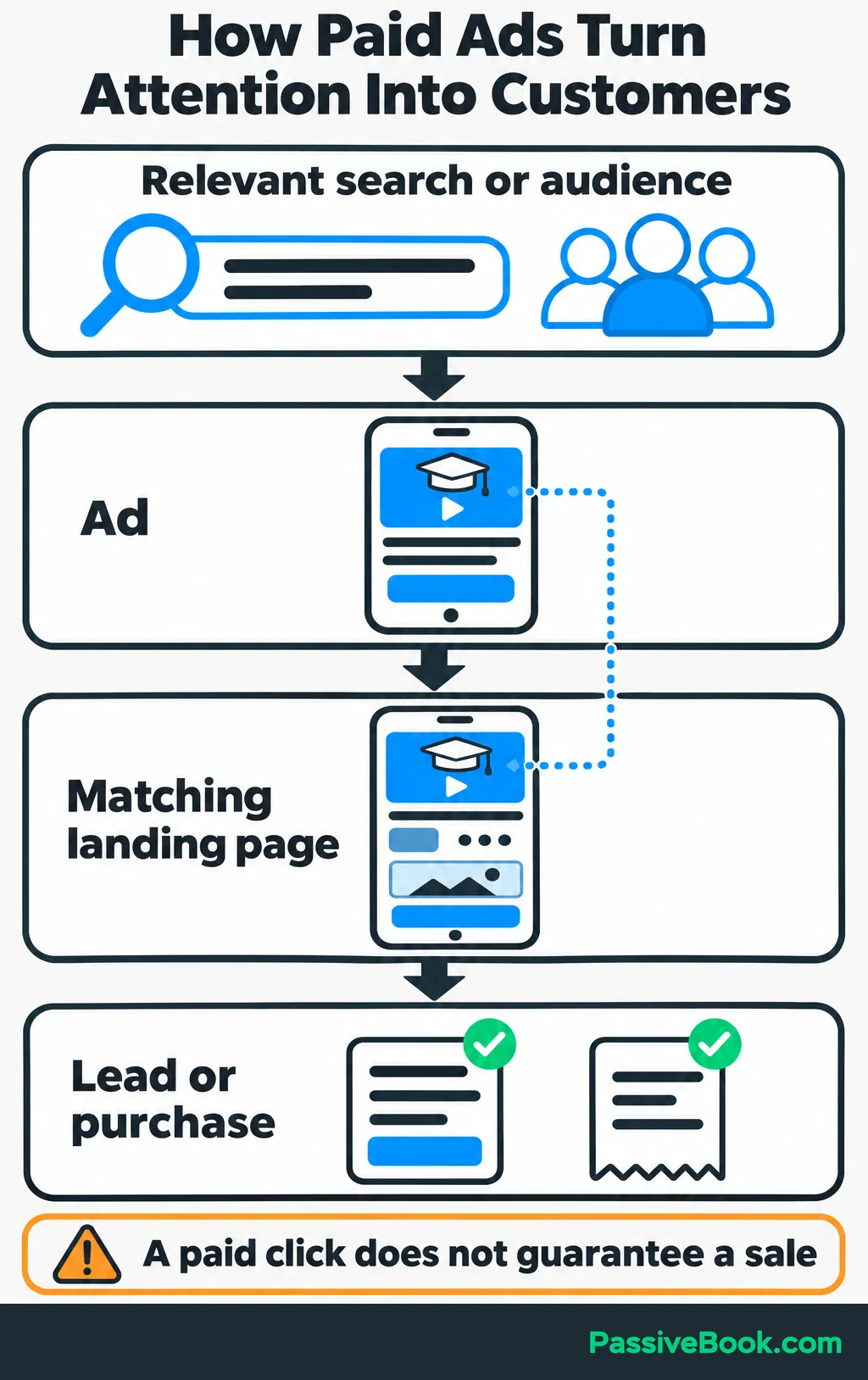
A landing page is the page someone reaches after clicking. Its job is to carry forward the ad’s promise and help the visitor take the next step.
Two common ways to describe advertising costs are:
- Cost per click, or CPC: what you pay for a click.
- Cost per 1,000 impressions, or CPM: what you pay for a thousand ad displays. One person can see the ad more than once.
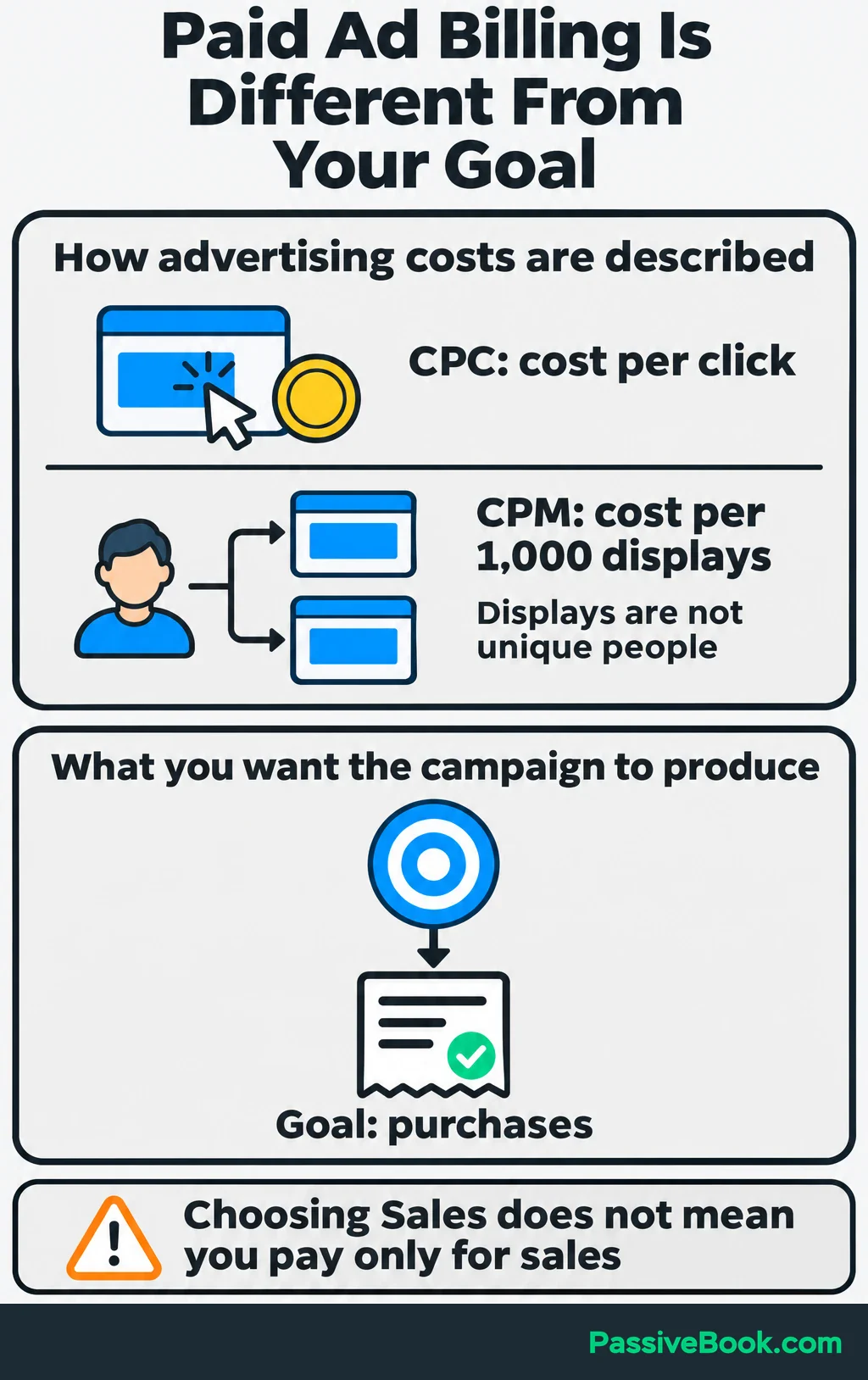
Keep billing separate from the campaign’s goal. Choosing “sales” tells the platform what result you want, but it doesn’t mean you pay only when somebody buys.
Many platforms use auctions to decide which ads appear. Google considers your bid, ad and landing-page quality, search context and other factors. The highest bid alone doesn’t win the best placement. Google’s Ad Rank explanation
Ads can bring traffic while you spend, but they still need management. I would use them alongside useful content, email and other channels you control. Paying for every visit forever is a commitment worth making carefully.
Choose One Offer and Conversion Goal
Start with a short campaign brief. Write down what you sell, who needs it, where you can sell it, the price, why someone would choose it and what you want them to do.
For our running example, imagine you sell a self-paced beginner quilting course. All prices, costs, copy and results in this example are illustrations, not benchmarks or observed outcomes.
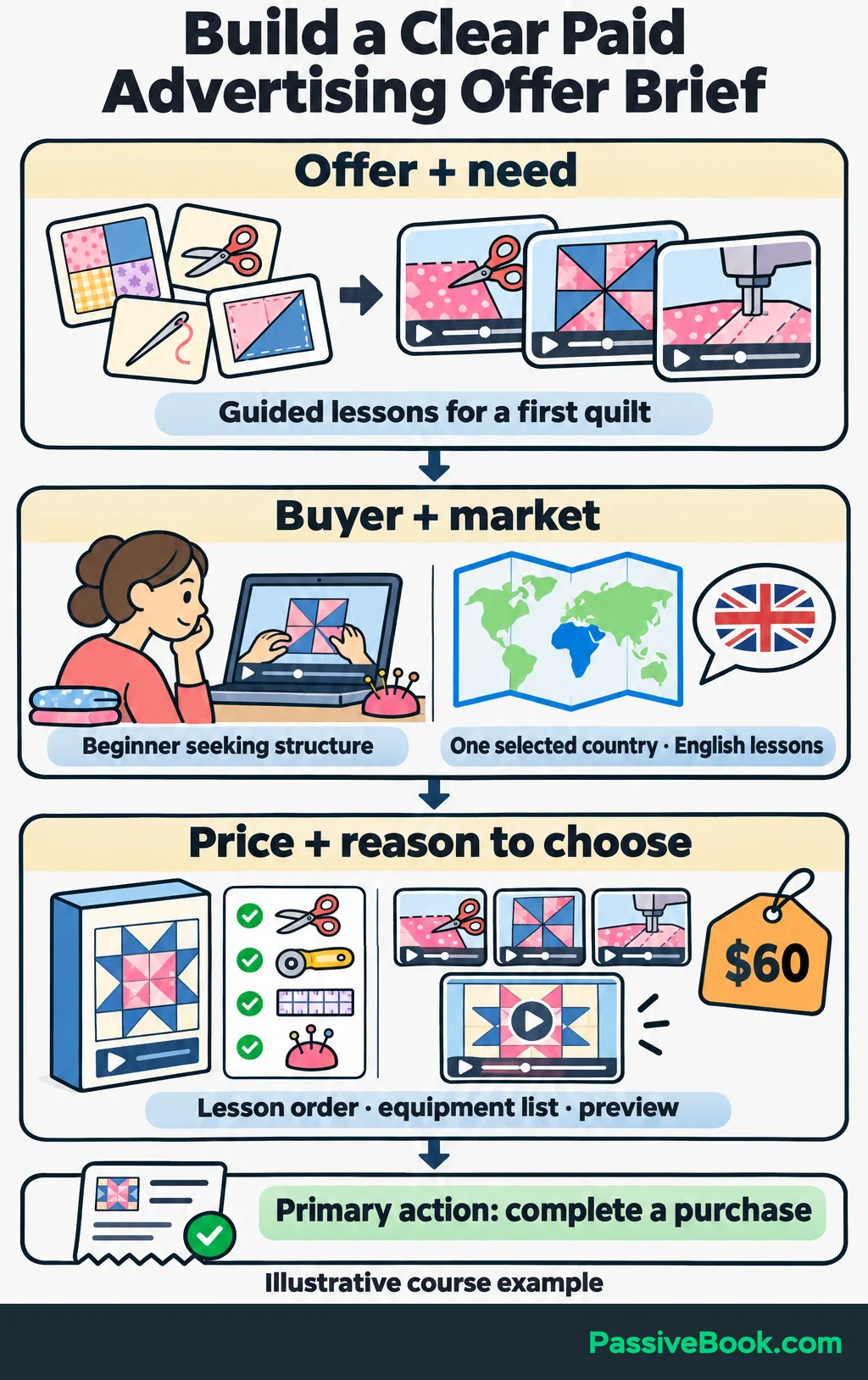
Your brief could read:
| Decision | Course Example |
|---|---|
| Offer | Self-paced video lessons for making a first quilt |
| Customer need | Guided instruction instead of piecing together separate tutorials |
| Market | Buyers in one selected country who can follow English lessons |
| Price | $60 |
| Reason to choose it | A clear lesson order, equipment list and lesson preview |
| Primary action | Complete a purchase |
Before buying traffic, look for evidence of demand: existing purchases, direct inquiries or conversations about the problem. Ask what people expect to receive and what might stop them from buying.
My online jewellery store failed because I skipped market research and ended up with unsold inventory. I lost most of that investment. That experience is why I would settle the offer question before paying to put it in front of more people.
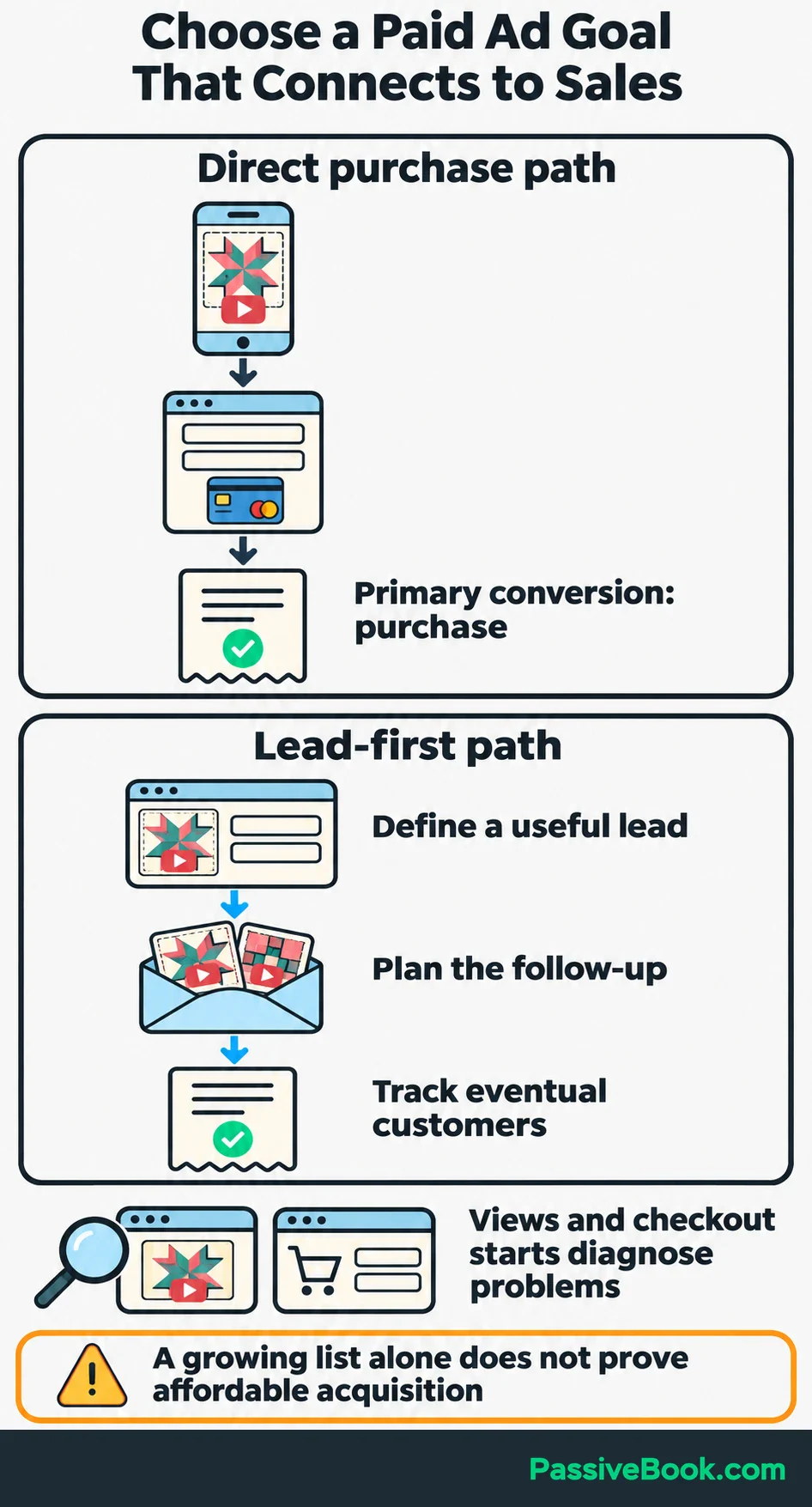
Choose one primary conversion, meaning the completed action the campaign should produce. For the course, that is a purchase. Page views and checkout starts help diagnose problems, but they don’t replace sales.
If you need leads first, define a useful lead and the follow-up. A request for course access information may deserve a personal reply. A free lesson signup may enter an email sequence. Either way, track whether those people eventually buy. A growing list alone doesn’t establish affordable customer acquisition.
Calculate an Affordable Acquisition Cost
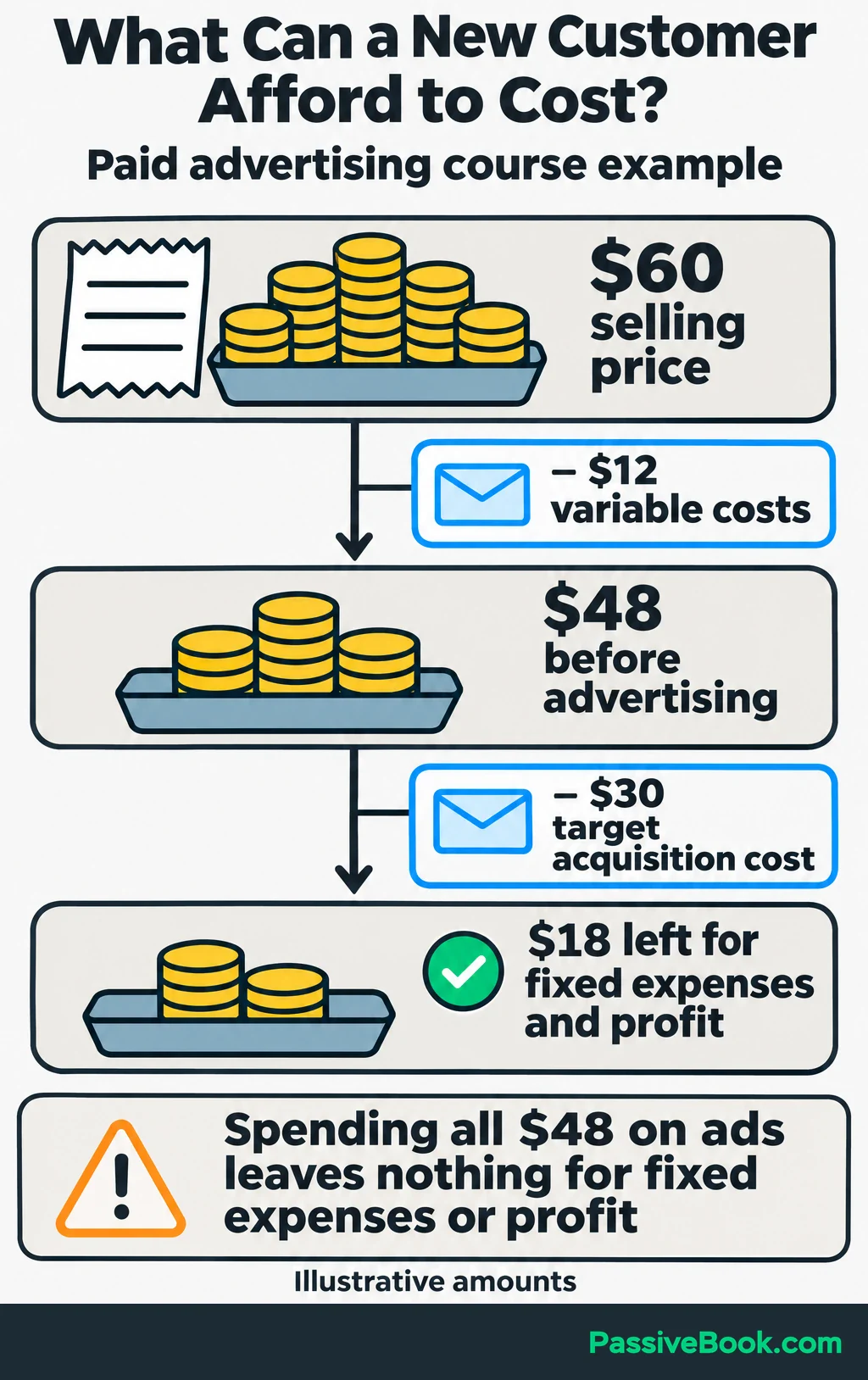
Work out what each sale leaves before advertising. Subtract the costs that rise with orders, including payment fees, delivery, fulfilment and expected refunds. Exclude taxes collected on behalf of tax authorities from the revenue you use.
For the course:
| Item | Illustrative Amount |
|---|---|
| Selling price | $60 |
| Variable costs per sale | $12 |
| Contribution before advertising | $48 |
| Target advertising cost per new customer | $30 |
| Amount left at that target | $18 |
That $48 must cover advertising, fixed expenses and profit. Spending all $48 to acquire a buyer leaves nothing toward the other two.
Cost per acquisition, or CPA, is ad spend divided by the acquisitions you chose to measure. If you’re measuring new-customer acquisition, count first-time customers separately from repeat buyers.
I would start with the first purchase’s economics. Promised future purchases are wonderfully generous when nobody has checked the customer records.
Return on ad spend, or ROAS, compares the revenue a reporting system credits to your ads with what you spent on those ads:
ROAS = attributed revenue ÷ ad spend
The course keeps $48 from each $60 sale before advertising, so its contribution margin is:
$48 ÷ $60 = 80%
Its contribution break-even ROAS is:
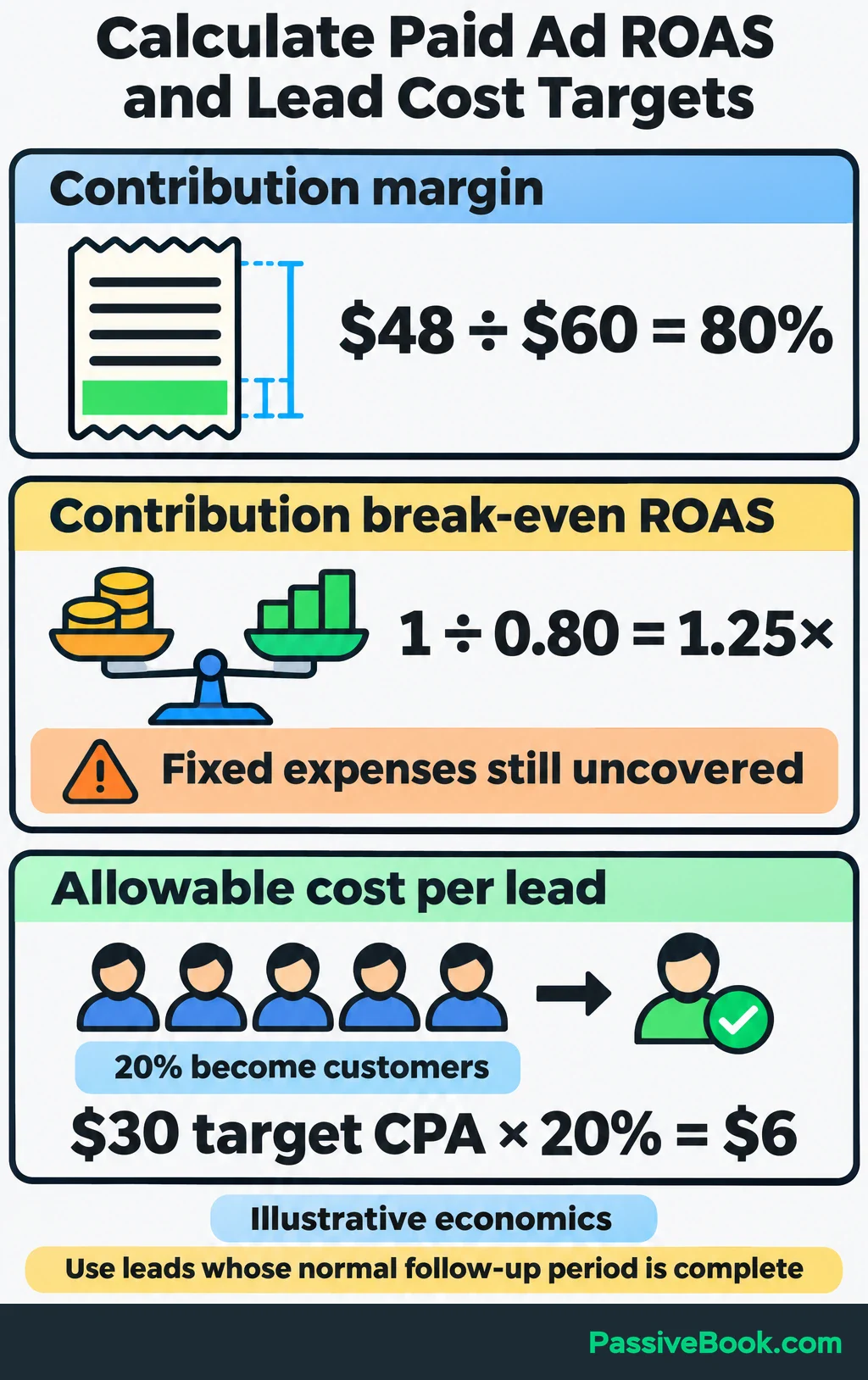
1 ÷ 0.80 = 1.25×
At 1.25× ROAS, sales cover variable costs and advertising. They still haven’t covered fixed expenses or other campaign costs. The $30 CPA target gives you more room.
For lead campaigns, connect lead cost to customer cost. Suppose records show that 20% of comparable leads became customers after their normal buying period. A $30 target acquisition cost would support:
$30 × 20% = $6 per lead
Use a rate from leads whose follow-up period is complete. Leads collected yesterday haven’t had the same chance to buy.
Choose Your First Advertising Channel
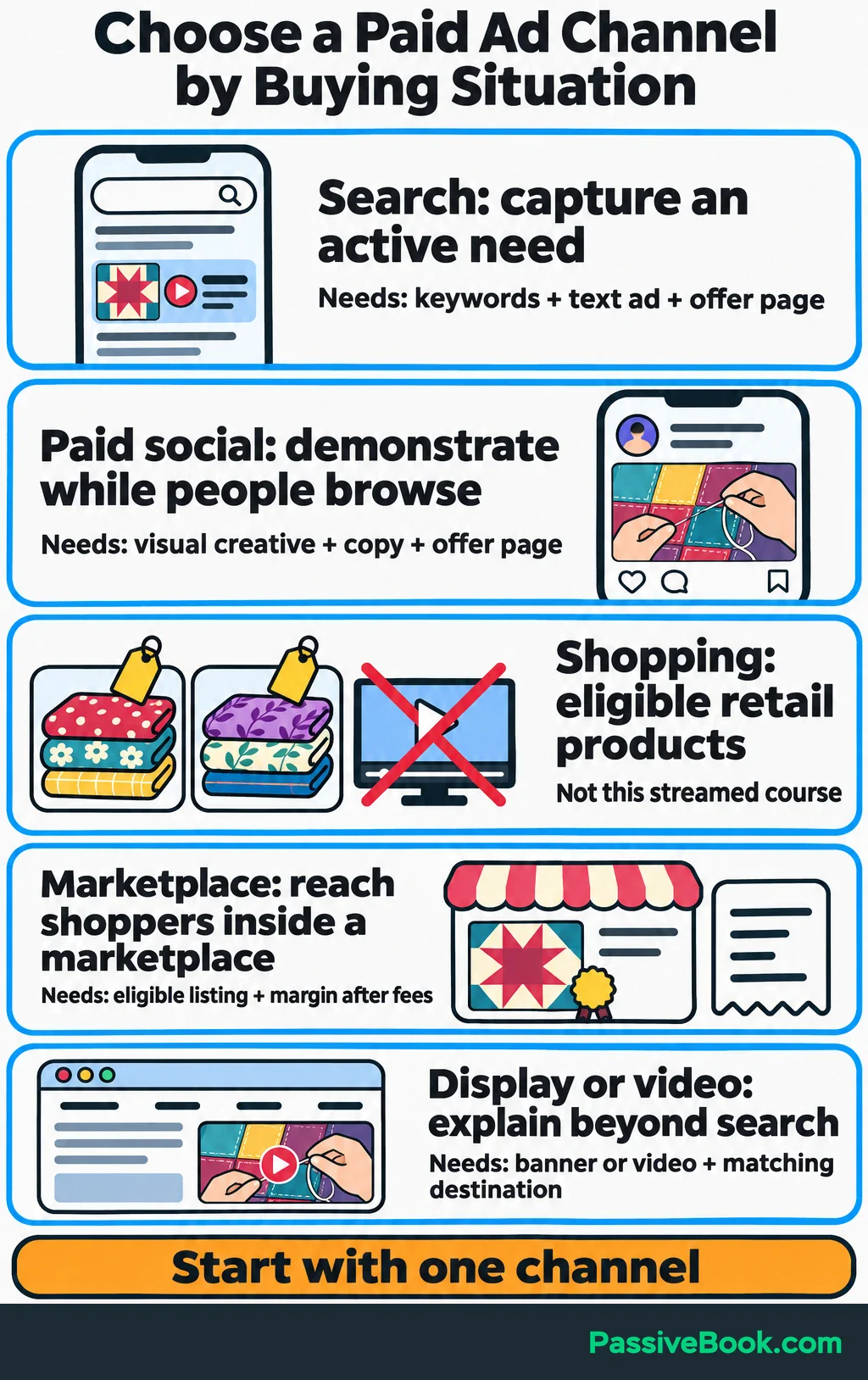
Choose a channel based on the customer’s buying situation, the offer and the assets you can make. I would put a small first budget into one channel so the results are easier to understand.
| Advertising Approach | Buying Situation | Suitable Offer | Required Assets | Main Spending Risk |
|---|---|---|---|---|
| Search ads | Someone actively searches for a solution | The course when people search for beginner quilting lessons | Relevant keywords, text ads and course page | Paying for searches seeking free patterns or unrelated supplies |
| Paid social | Someone notices a useful offer while browsing | The course shown through a lesson excerpt | Images or videos, copy and course page | Attracting interest that doesn’t turn into purchases |
| Shopping ads | Someone compares eligible retail products | Not suitable for the streamed course | Product data, store pages and connected advertising accounts | Paying for product clicks without enough margin |
| Marketplace ads | Someone searches inside the marketplace where you sell | An eligible offer already listed there | Marketplace listing and supporting images | Ad costs plus marketplace fees consuming the margin |
| Display and video ads | Someone encounters the offer beyond search results | The course when a demonstration helps explain it | Banners or video and a matching destination | Buying views that produce little useful action |
For the course, I would investigate search first. “Beginner quilting course online” suggests a different need from “quilting ideas.” Check whether relevant searches exist and whether estimated click costs fit your economics.
Google and Microsoft offer search advertising. Paid social options include Facebook, Instagram, Pinterest, TikTok and LinkedIn, but you don’t need an account on every platform. Choose where your buyers spend time and where you can produce suitable ads. I would skip LinkedIn for this course unless customer research gave me a specific reason to use it.
For Shopping ads, first check whether Google allows your product. Merchant Center stores the product details used in these ads and connects to Google Ads. Google excludes streaming content, so this course doesn’t fit. Unsupported Shopping content
These approaches can overlap. A video can run in a social feed, and retargeting can reach previous visitors through supported channels. Retargeting describes whom you reach, rather than a separate ad format. I wouldn’t make it the whole acquisition plan when the business barely has any visitors.
Choose Who Sees Your Ads
Describe the buyer’s need before choosing targeting settings.
For the course, you want someone seeking guided beginner lessons. General enthusiasm for crafts is too vague, and someone collecting free quilt patterns may have no interest in buying instruction.
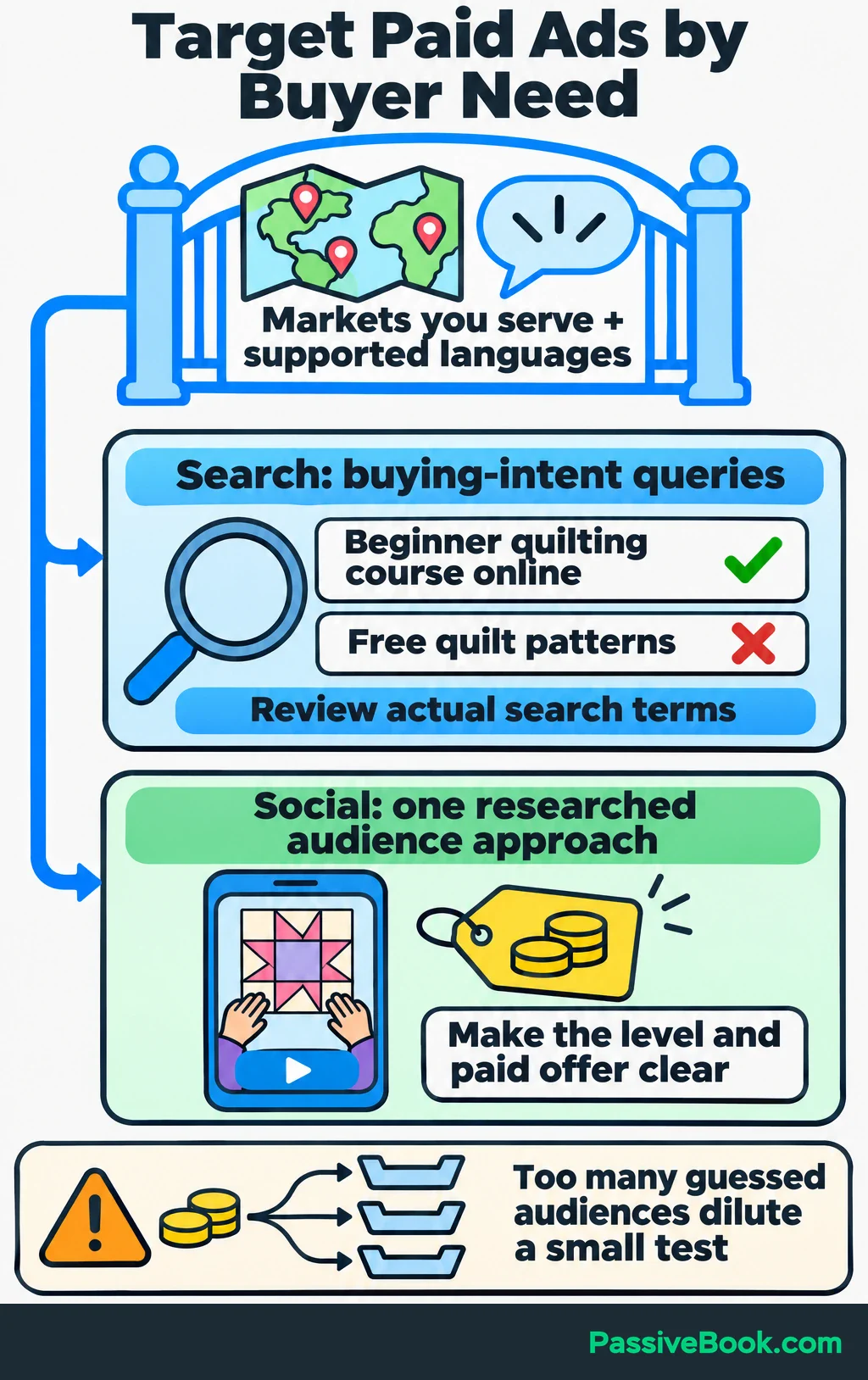
Restrict delivery to markets you can serve and languages your offer supports. Review how the platform interprets those settings, especially whether a location setting includes people merely interested in a place.
Then choose an approach:
- For search, start with queries that suggest the buying need. Review the searches that actually triggered your ads.
- For social, choose one audience approach based on customer research. Make the lesson level and paid offer clear in the creative, meaning the image, video and message.
I would skip a collection of tiny audiences based on guessed interests. Splitting a small budget among ten guesses gives each guess very little chance to teach you anything.
Set a Capped Test Budget
Choose the maximum advertising spend you can lose without affecting essential bills or order fulfilment. Budget separately for setup, creative work and software.
Then estimate how much traffic that money could buy. For search, use Google Ads’ Keyword Planner to estimate traffic and click costs for your selected keywords and market. Its forecasts use factors such as bids, budget and historical data; they aren’t promised results. How Keyword Planner forecasts work
For planning, divide the advertising budget by an assumed CPC. Then multiply those clicks by an assumed click-to-purchase rate.
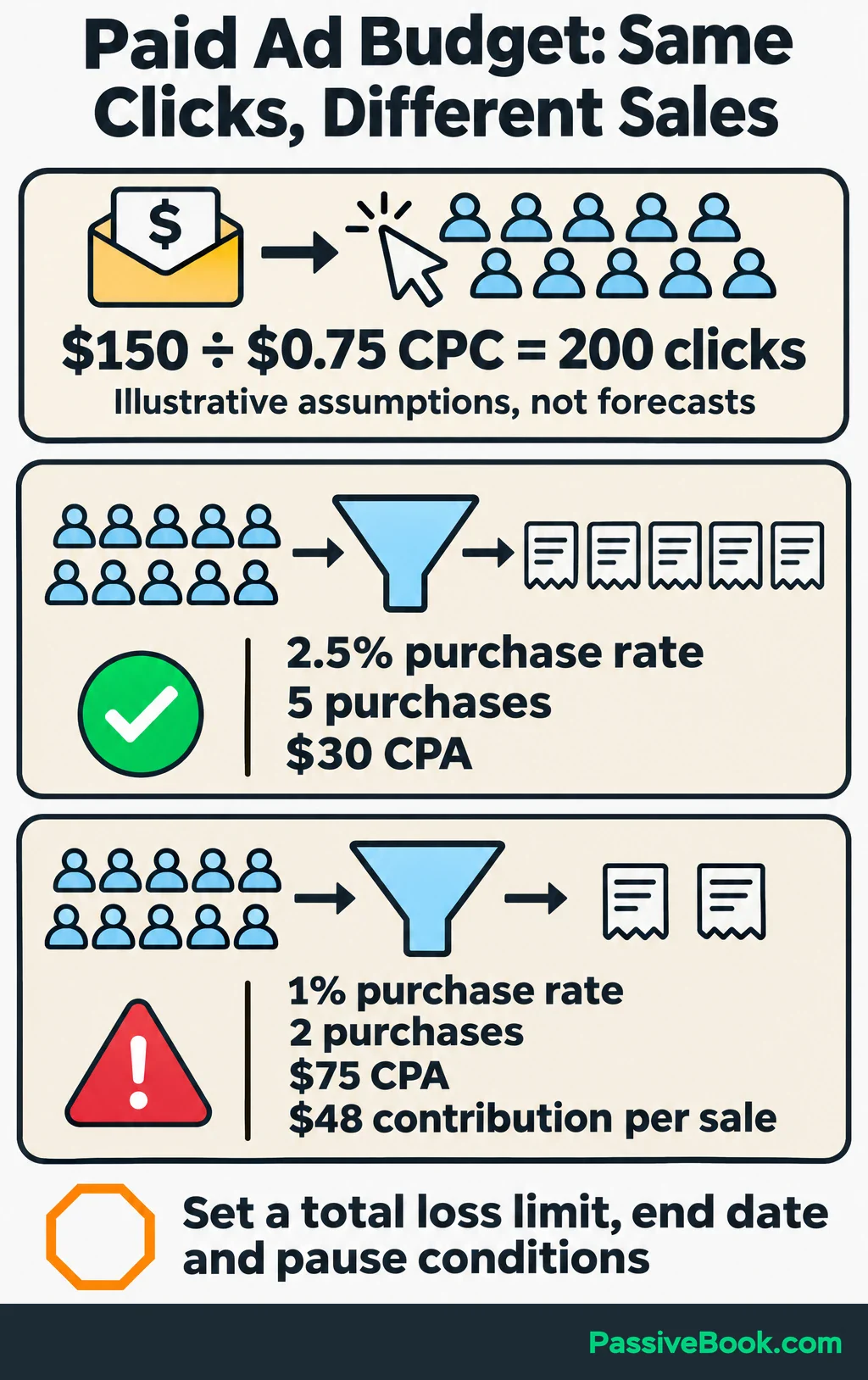
A $150 budget at $0.75 per click would buy 200 clicks:
| Planning Scenario | Assumed Click-to-Purchase Rate | Purchases | Purchase CPA |
|---|---|---|---|
| Higher-conversion case | 2.5% | 5 | $30 |
| Lower-conversion case | 1% | 2 | $75 |
The second case exceeds the course’s $48 contribution ceiling. Use that case to judge the risk, rather than building your plan around the result you’d prefer.
The useful number isn’t just your daily budget; it’s what a click can cost before the test stops making financial sense. Use the calculator below to find that limit and see how different assumptions change the risk.
Free Marketing Profit Calculator


There is no daily amount that guarantees affordable sales. If relevant clicks are expensive, a tiny budget may produce too little evidence to guide another test.
Also, check what “daily budget” means. For most Google campaigns, billed spending can reach twice the average daily budget on a day. With an unchanged budget, the usual full-month limit is 30.4 times that amount. A daily budget therefore doesn’t create a fixed total for a short experiment. Google’s spending limits
Before launch, record:
- The maximum total media spend.
- The campaign’s end date.
- A daily spend check and a date for reviewing business results.
- The conditions that trigger a pause.
Leave room below your financial ceiling for reporting and stopping delays. Where available, use a total campaign budget or spending limit as well as monitoring. If you can’t comfortably fund a useful test, keep validating through customer conversations and organic traffic first.
Build a Landing Page That Completes the Promise
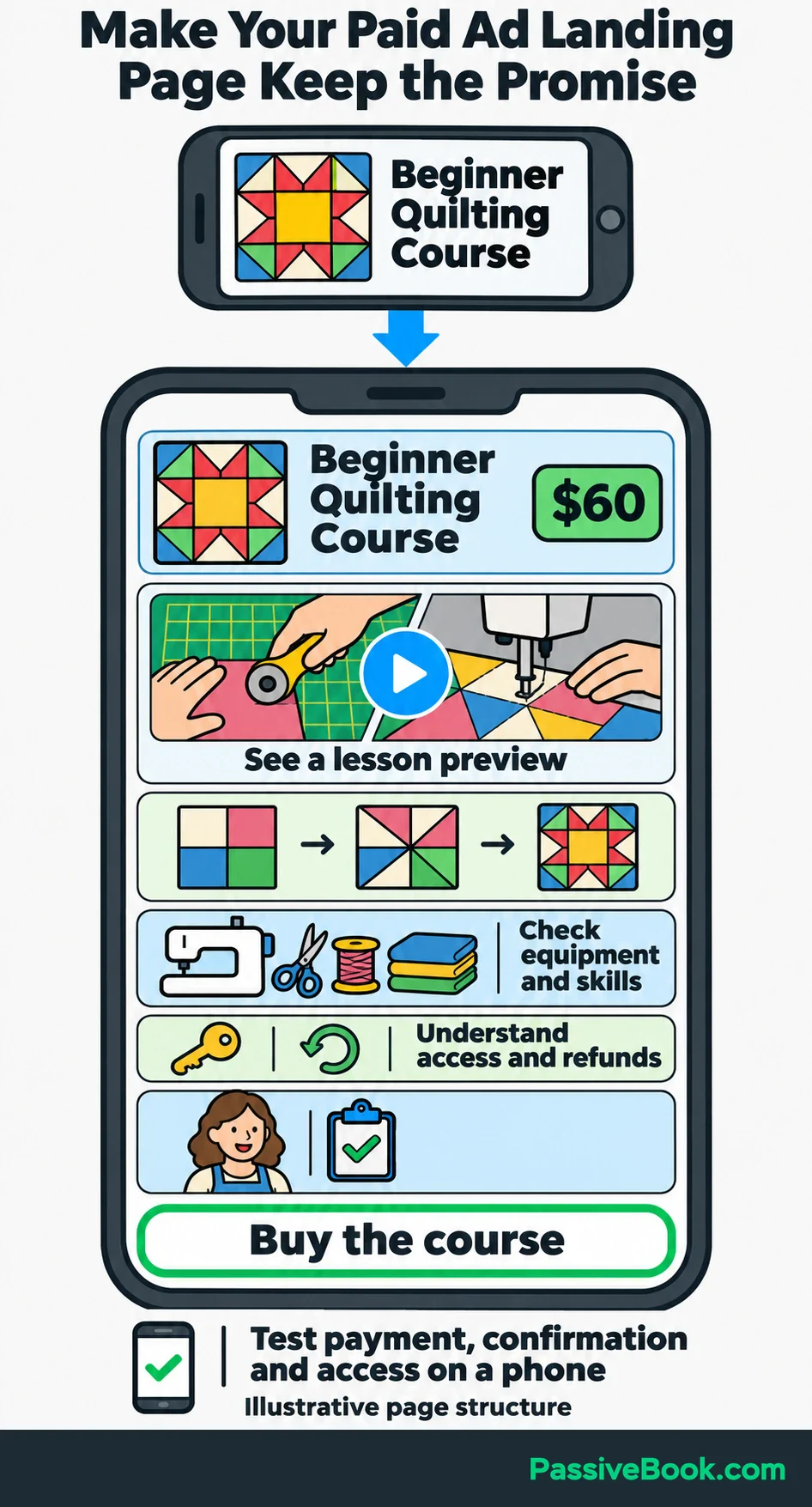
Send the click to the specific offer page. Someone who clicked for beginner quilting lessons shouldn’t have to search your homepage for the course.
The page should carry forward the ad’s message, show the price and make the next action clear. Answer the questions that could block a purchase:
- What lessons and materials are included?
- What sewing equipment and starting skills are needed?
- What does a lesson look like?
- Who teaches it, and what relevant experience do they have?
- How do buyers get access, and how long does access last?
- What are the refund terms?
I would put a useful lesson preview near the main explanation. “Easy to follow” is your opinion until visitors can see how you teach.
For a physical product, use close-up photos or a demonstration and state shipping costs, delivery times and return terms. For a service, show relevant work, explain the scope and make the inquiry or booking step clear.
Use genuine testimonials and accurate credentials. A countdown timer doesn’t become useful just because the page builder offers one.
Give the page one primary action, such as buying the course. For a lead page, ask only for information needed to qualify or follow up, deliver the promised resource and explain what happens next.
If you already use WordPress, I would build the page using the GenerateBlocks page-building plugin instead of buying another landing-page subscription.
Finally, complete the journey on a phone. Check loading, text, buttons, forms, payment, confirmation and product access. The campaign isn’t ready because the desktop screenshot looks nice.
Verify Conversion Tracking Before Spending
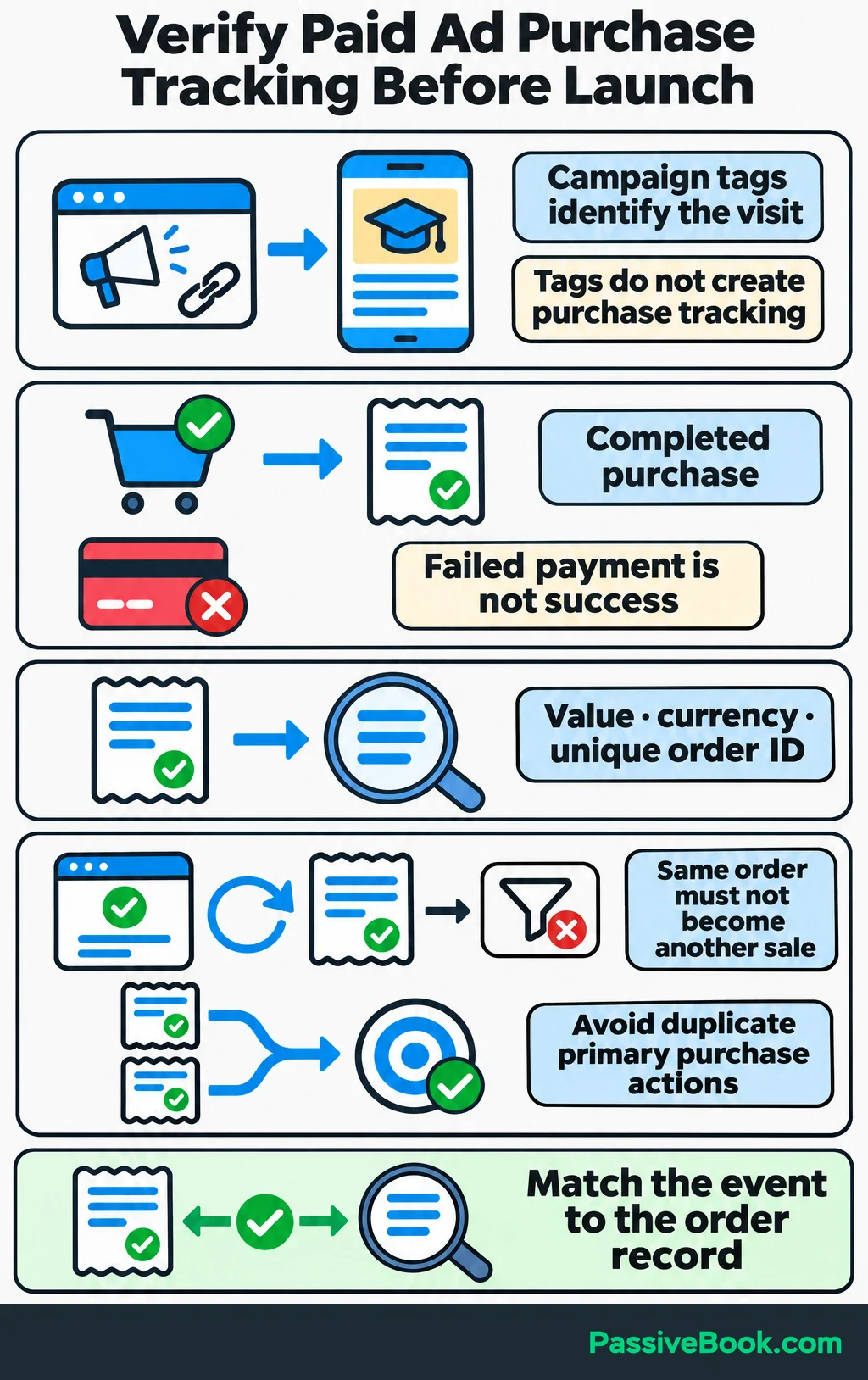
Tracking needs to record a completed business action and connect it to campaign traffic.
Start with your website or commerce platform’s supported integration. Use Google Analytics to connect visits with purchases or leads, and set up the selected ad platform’s conversion tracking. After testing the purchase or lead event, select it as the campaign’s primary conversion.
For purchases, send the order value, currency and a unique order identifier. Reloading the confirmation page must not create another sale. Google uses transaction IDs to identify duplicate conversions within the same conversion action. Also avoid counting a direct purchase event and an imported version of that purchase as two primary actions. Google’s transaction-ID guidance
Identify the traffic consistently. For Google Ads, enable auto-tagging so Google adds tracking information to your ad links. For other campaigns, add URL tags that identify the traffic source, channel, campaign and ad.
A Facebook lesson-demo ad could use:
utm_source=facebook&utm_medium=paid_social&utm_campaign=quilting_course&utm_content=lesson_demoThese tags label the visit; they don’t create purchase tracking.
Complete a test order and inspect the purchase event, amount, currency and matching order record. Check that failed payments and abandoned forms don’t trigger success. Exclude test transactions from your performance review.
Apply the consent requirements for the markets you serve. For UK users, storage and access technologies used for online advertising require consent, so configure them accordingly before launch. ICO guidance on online advertising
Keep names, email addresses and other personal information out of analytics URLs and campaign tags.
Create Ads That Attract Suitable Buyers
Build the message around a specific need, the useful outcome of your offer and one next action. Its promise must match the landing page.
For search, connect the person’s query directly to what you sell. One headline and description could read:
Beginner Quilting Course
Follow self-paced lessons to make your first quilt. Preview the course.
For social, show the teaching rather than relying on a picture of a finished quilt. A lesson excerpt could carry this message:
Learn quilt-making step by step, from cutting fabric to assembling your first project. Preview the lessons.
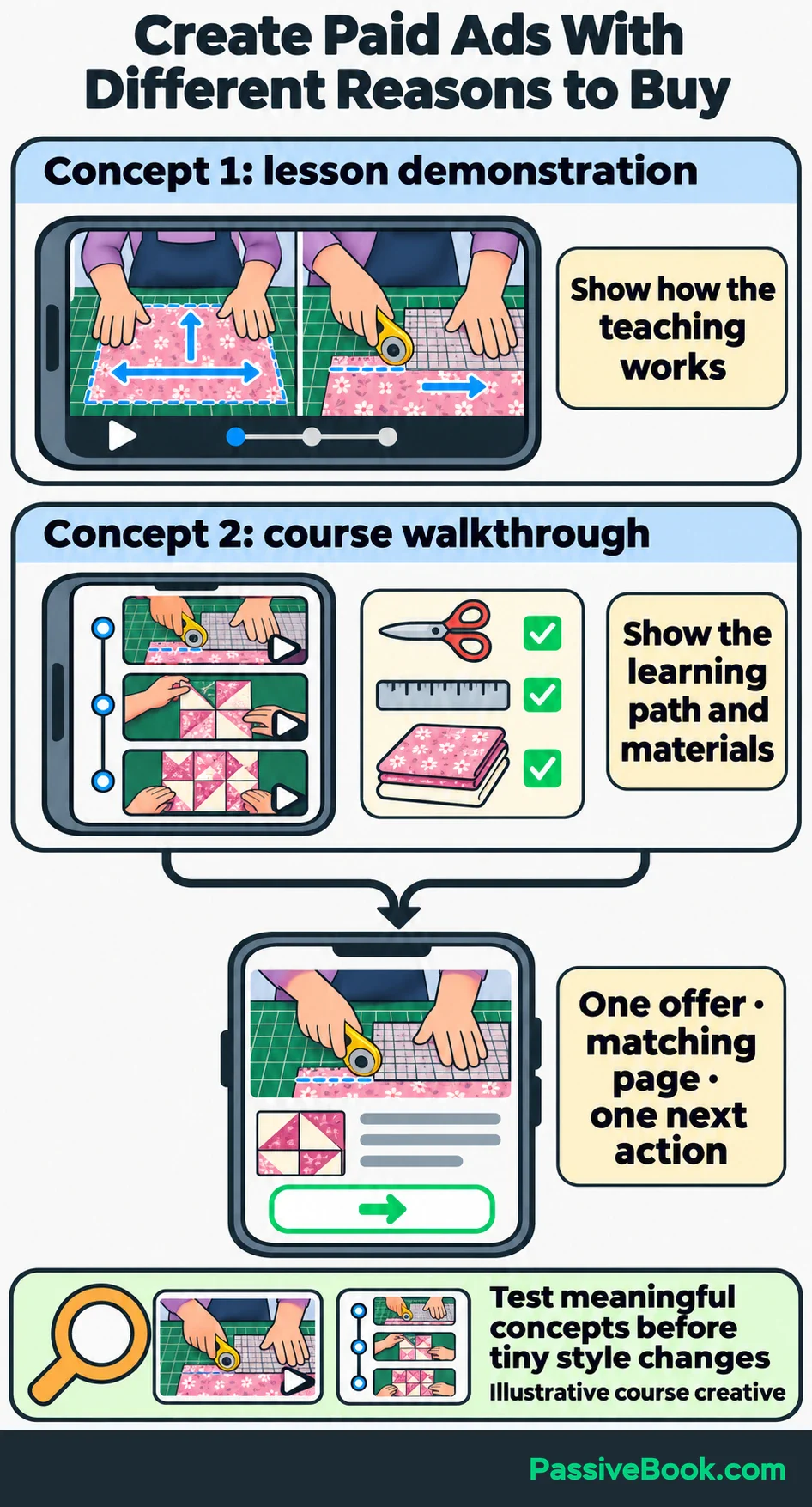
Prepare two meaningfully different concepts. For example:
- A lesson demonstration that shows how an instruction is explained.
- A course walkthrough that shows the lesson order, preview and included materials.
Those give buyers different reasons to investigate. Changing a button from green to slightly greener can wait.
If you’re staring at an empty ad editor, the AI tool below can draft both concepts from your offer details. It also writes a matching page opening, so the promise doesn’t change after the click.
Free AI Advertising Studio
Adapt the cropping, captions and readable text to the placements you choose. Canva is enough for simple graphics. Check that every claim is supportable and review the selected platform’s advertising requirements before publishing.
Launch Your First Campaign
Complete the advertising account and payment setup, and confirm the currency and time zone. Use a name you can recognize later, such as Quilting | Purchases | Search | Test 1.
The usual structure is:
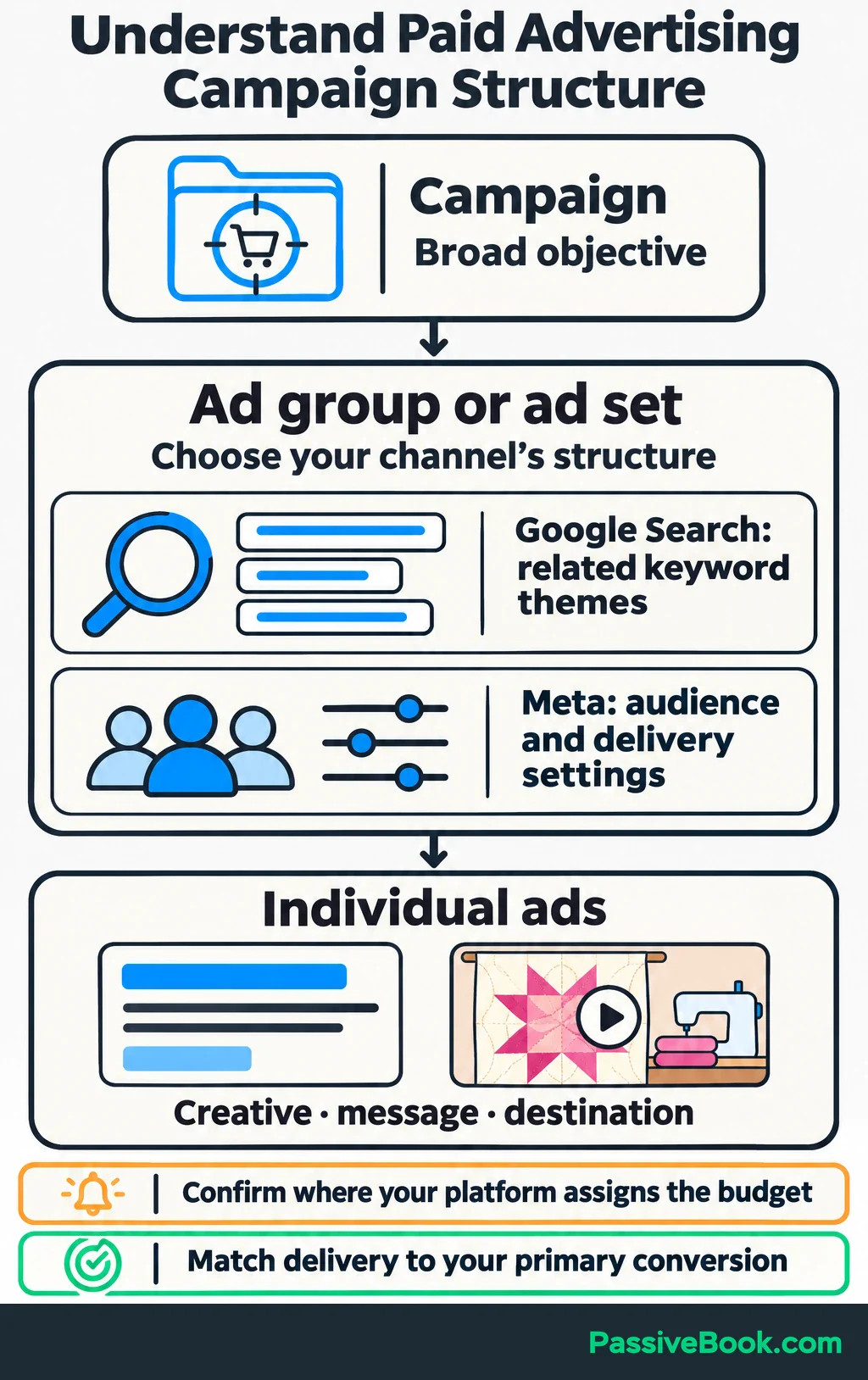
Campaign → ad group or ad set → individual ads.
The campaign holds the broad objective. Ad groups or ad sets organize related delivery settings and ads.
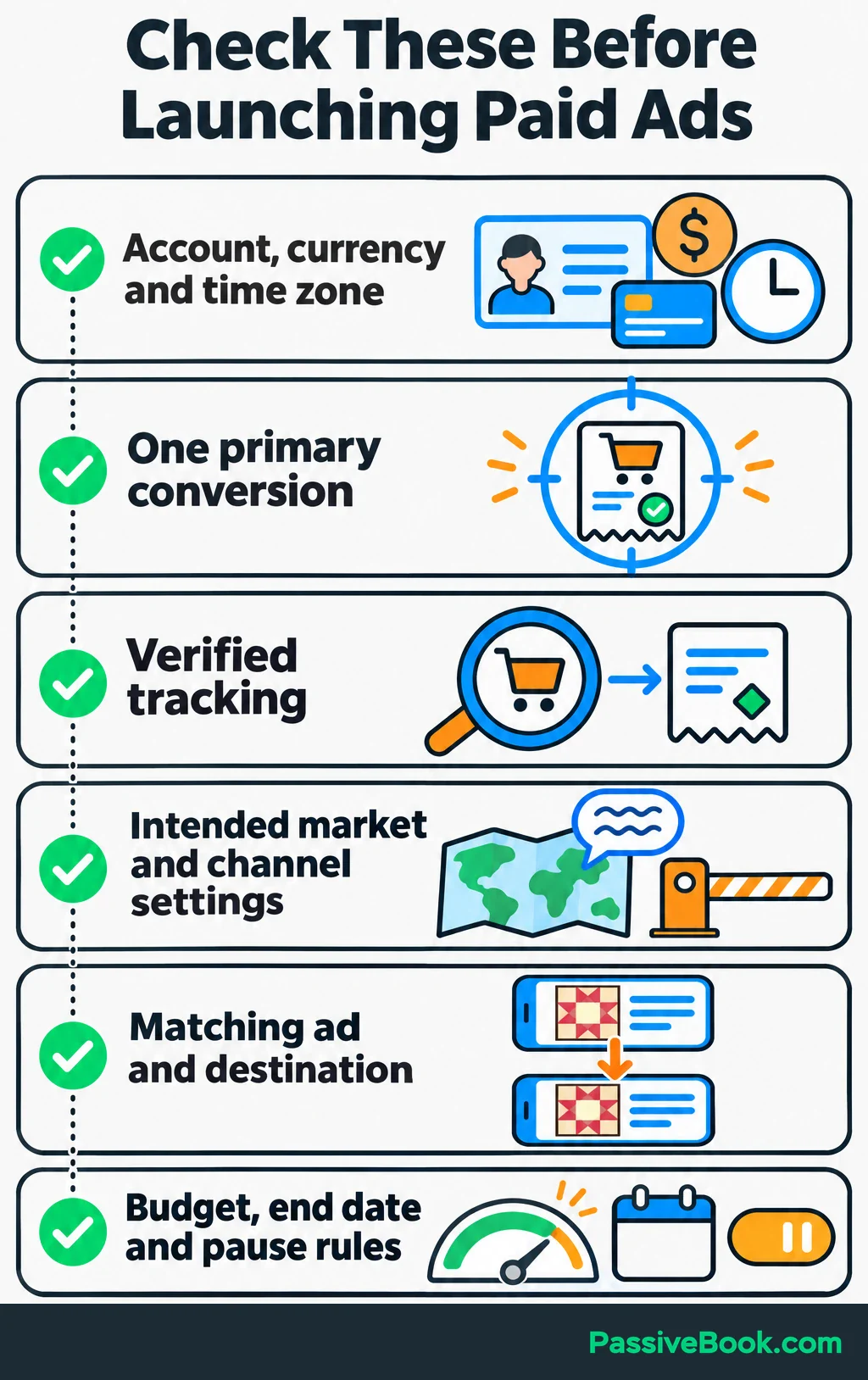
Choose the objective and delivery goal that match your primary conversion. A campaign seeking cheap visits answers a different question from one seeking purchases.
The two launch paths below are alternatives. Pick the one that fits your first channel.
Launch a Focused Google Search Campaign
Create a Search campaign for your chosen locations and languages. Review network settings so the first test runs in the search inventory you intended.
Group closely related buying-intent keywords together. For the course, start with a small set around beginner online quilting instruction, using phrase or exact matching.
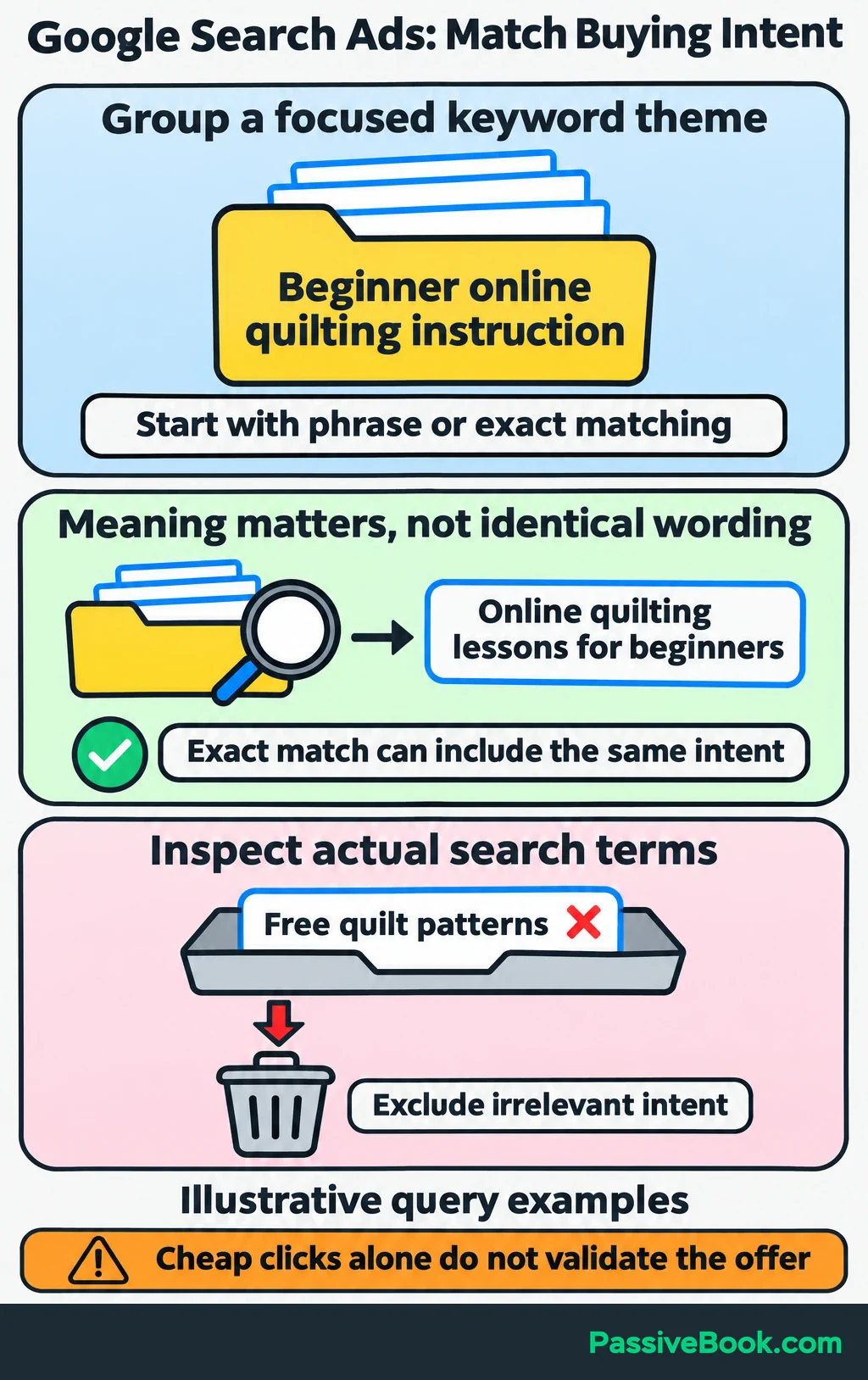
Exact match can include searches with the same meaning or intent; it doesn’t require identical wording. Inspect actual search terms after launch and exclude irrelevant intent, such as searches solely seeking free patterns. Google’s keyword-match definitions
Add clear headlines, descriptions and useful ad assets, such as links to relevant course information. Use the matching course page as the destination.
Choose bidding deliberately:
- Conversion-focused bidding seeks the selected actions. With verified purchase tracking, I would consider Maximize Conversions for a purchase test.
- Maximize Clicks prioritizes traffic. It may help investigate traffic costs, but inexpensive clicks alone don’t validate the offer.
- A target CPA is an average bidding goal. Individual acquisitions can cost more, and it doesn’t cap your spending. Google’s target CPA explanation
Check the primary conversion, budget, schedule, targeting, keywords and destination before activation. Keep the budget within the loss you already agreed to accept.
Launch a Focused Meta Campaign
I would use Meta Ads Manager, the tool for creating Facebook and Instagram campaigns, for this test. Connect your business identity and ad account. For website course purchases, choose Sales. For a defined lead-generation path, choose Leads.
Then work through a simple setup:
- Select the website destination and the tested conversion event.
- Apply your market restrictions and chosen audience approach.
- Keep one campaign and one initial ad set containing the two creative concepts.
- Add the matching course URL and a suitable call to action.
- Preview the ads across selected placements, checking cropping, captions and text.
- Set the budget and end date, confirming whether the amount applies per day or across the full run.
Review the business identity, purchase event, audience, placements, links and budget before publishing.
Measure Leads, Sales, and ROAS
Keep a small scorecard that connects spending to business results. For the course, the five-sale planning scenario could become this illustrative record:
| Field | Example Entry |
|---|---|
| Campaign | Quilting purchase test |
| Spend | $150 |
| Ad clicks | 200 |
| Measured landing-page visits | 200 |
| Verified purchases | 5, all from new customers |
| Attributed revenue | $300 |
| Purchase CPA | $30 |
| ROAS | 2× |
| Next action | Review traffic quality and purchase records before another capped test |
Clicks and measured visits happen to match in this example. In practice, check them separately because a click doesn’t guarantee a recorded page visit.
Use diagnostic metrics to find problems. For the same campaign and reporting period:
- Link click-through rate, or link CTR: link clicks divided by impressions, multiplied by 100.
- CPC: spend divided by the clicks you’re measuring.
- Landing-page conversion rate: completed conversions attributed to those visits divided by landing-page visits, multiplied by 100.
Use the same click definition when comparing ads. A platform’s “all clicks” figure can include actions other than clicks to your site.
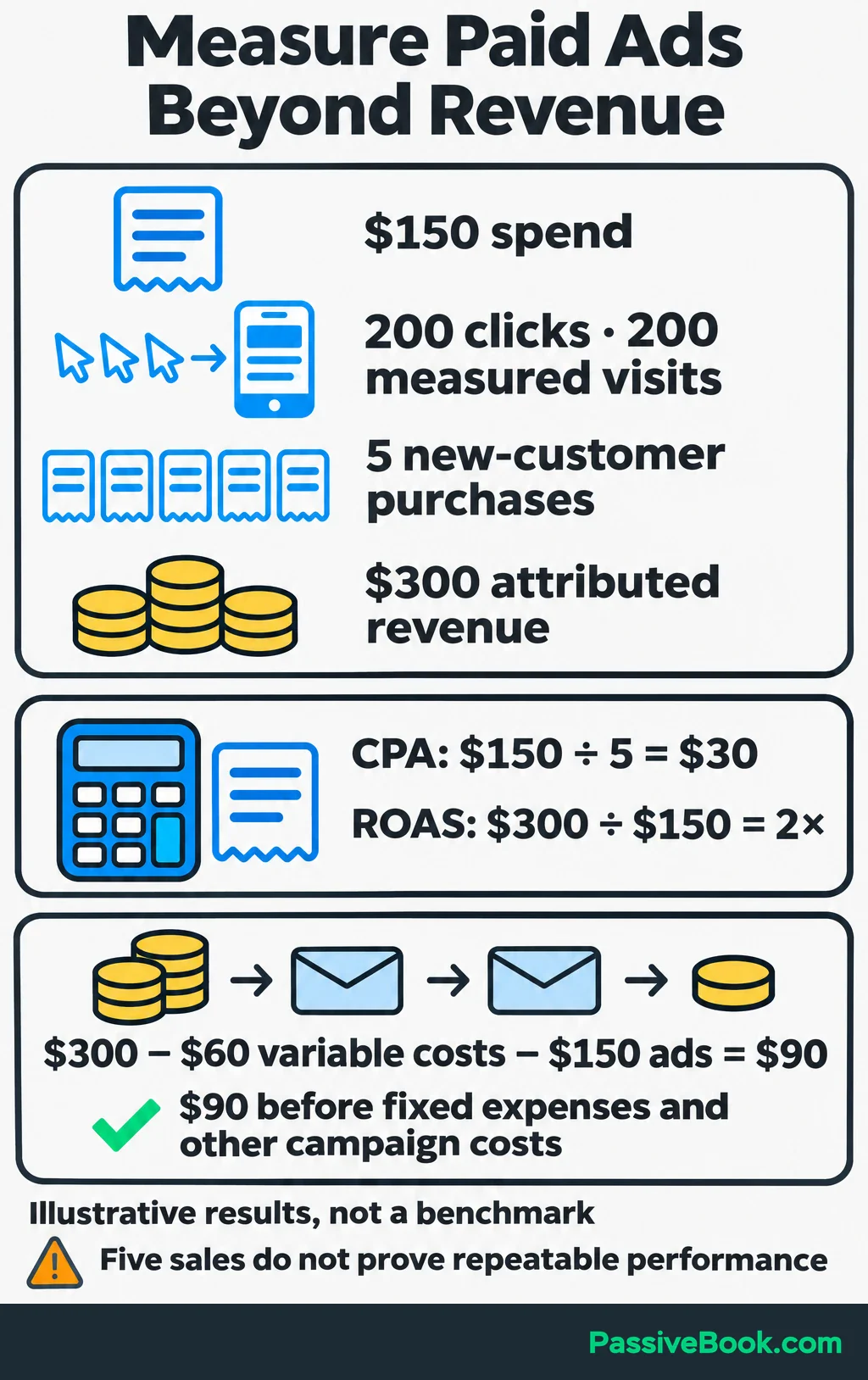
Now check the money. Five $60 purchases produce $300 in revenue:
$300 ÷ $150 = 2× ROAS
Those five orders have $60 in variable costs. After advertising, the amount left is:
$300 − $60 − $150 = $90
That is $90 before fixed expenses and other campaign costs. The $30 purchase CPA meets the example target, but five sales don’t establish that future campaigns will repeat it.
For lead campaigns, record submissions, qualified leads and eventual customers separately. A low cost per lead loses its charm when none of the leads buy.
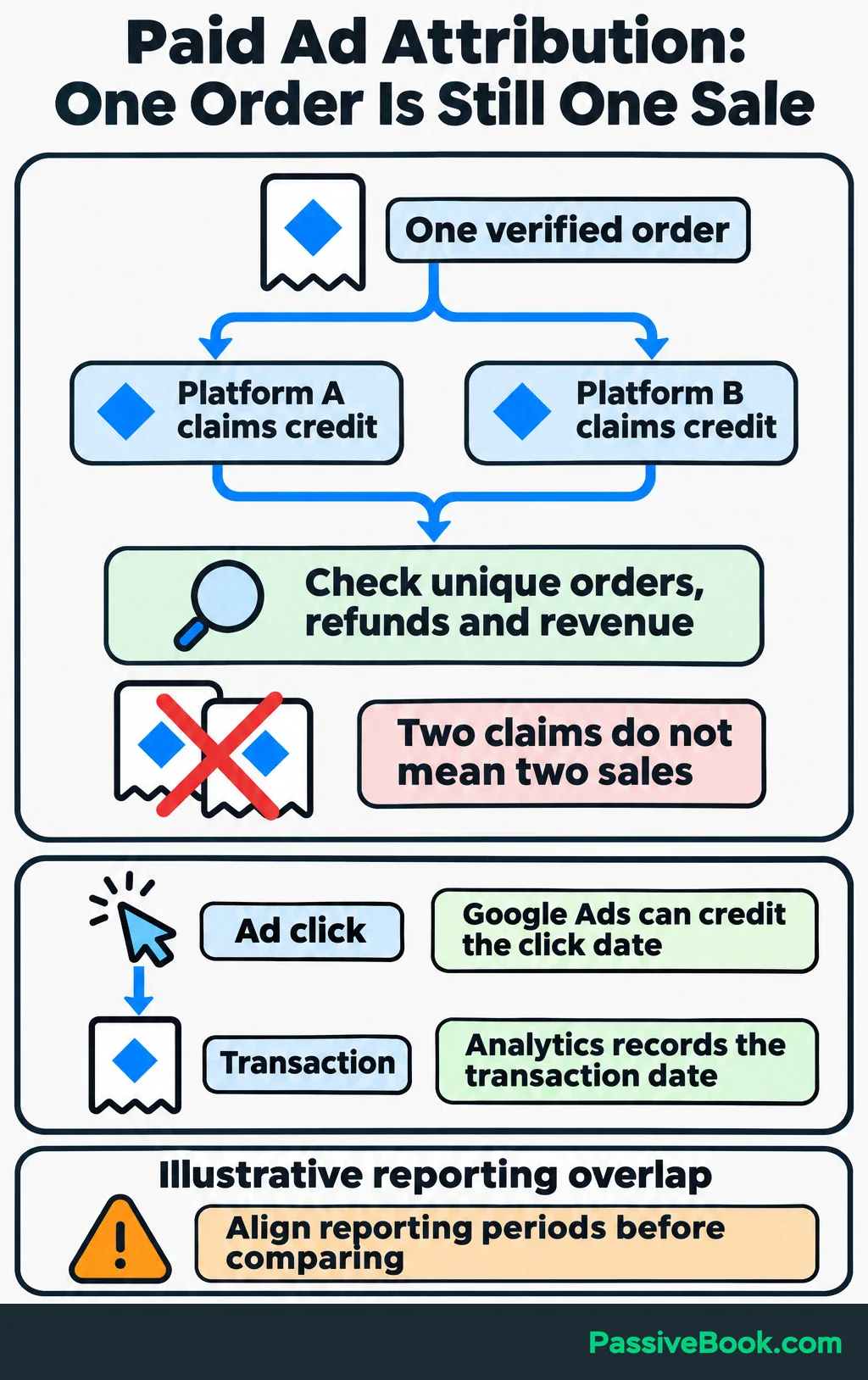
Reconcile platform reports with unique orders, refunds and revenue. Reports can differ because of attribution settings and reporting dates. Google Ads, for example, can credit a conversion to the date of the ad click, while Analytics records it on the transaction date. Google’s explanation of reporting differences
Don’t add different platforms’ reported sales together without checking for overlap. Two platforms may claim credit for the same order.
Improve the Campaign Before Increasing Spend
Use the scorecard to choose the next change. Fixing everything at once makes it hard to learn which change helped.
Fix the Point Where Customers Drop out
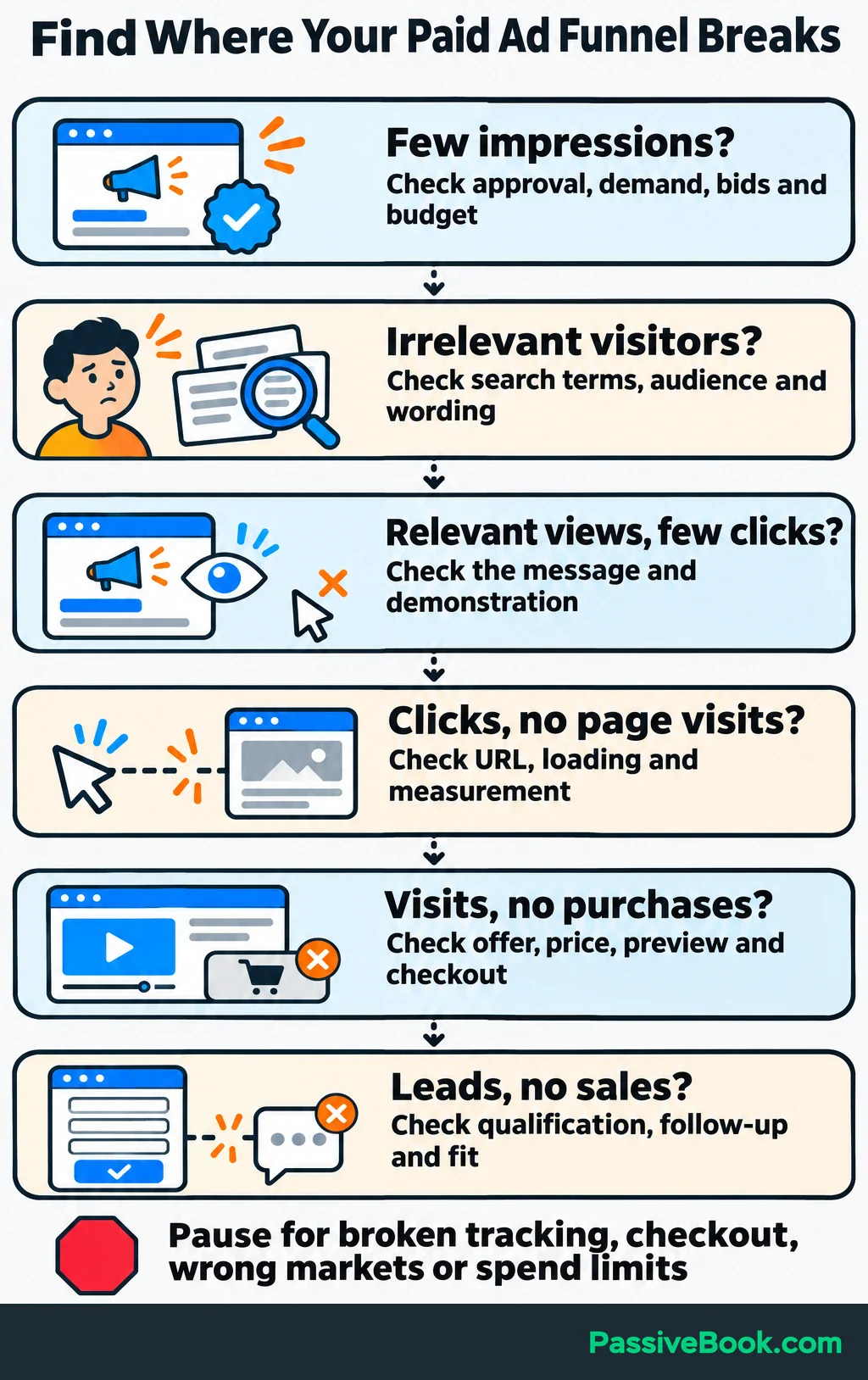
Pause immediately if tracking breaks, checkout fails, ads reach the wrong market or spending reaches your agreed threshold.
For other problems, follow the path from ad delivery to purchase:
| What You See | What to Check First |
|---|---|
| Few impressions or little spending | Approval status, available searches or audience, bids and budget |
| Irrelevant visitors | Search terms, audience choices, placements and wording |
| Relevant impressions but few link clicks | Whether the message or demonstration gives buyers a reason to investigate |
| Clicks without page visits | Destination URL, redirects, loading and measurement |
| Page visits without purchases | Offer clarity, price, preview, trust and checkout |
| Leads without sales | Qualification, follow-up and whether the offer fits the request |
For the course, visitors asking whether a sewing machine is required point to a specific information gap. Answer it clearly before paying for more visits.
I would resist treating every weak result as an audience problem. Better targeting can’t repair a payment form that rejects buyers.
Test One Meaningful Change at a Time
Choose a change that addresses the problem you found, then write down what you expect it to improve.
For example:
Compare the lesson demonstration with the course walkthrough. Keep the offer and destination stable, and compare verified purchase costs.
Use a platform experiment when you need a controlled comparison. Two ordinary ads may receive very different amounts of delivery, so simply publishing both doesn’t create an even test.
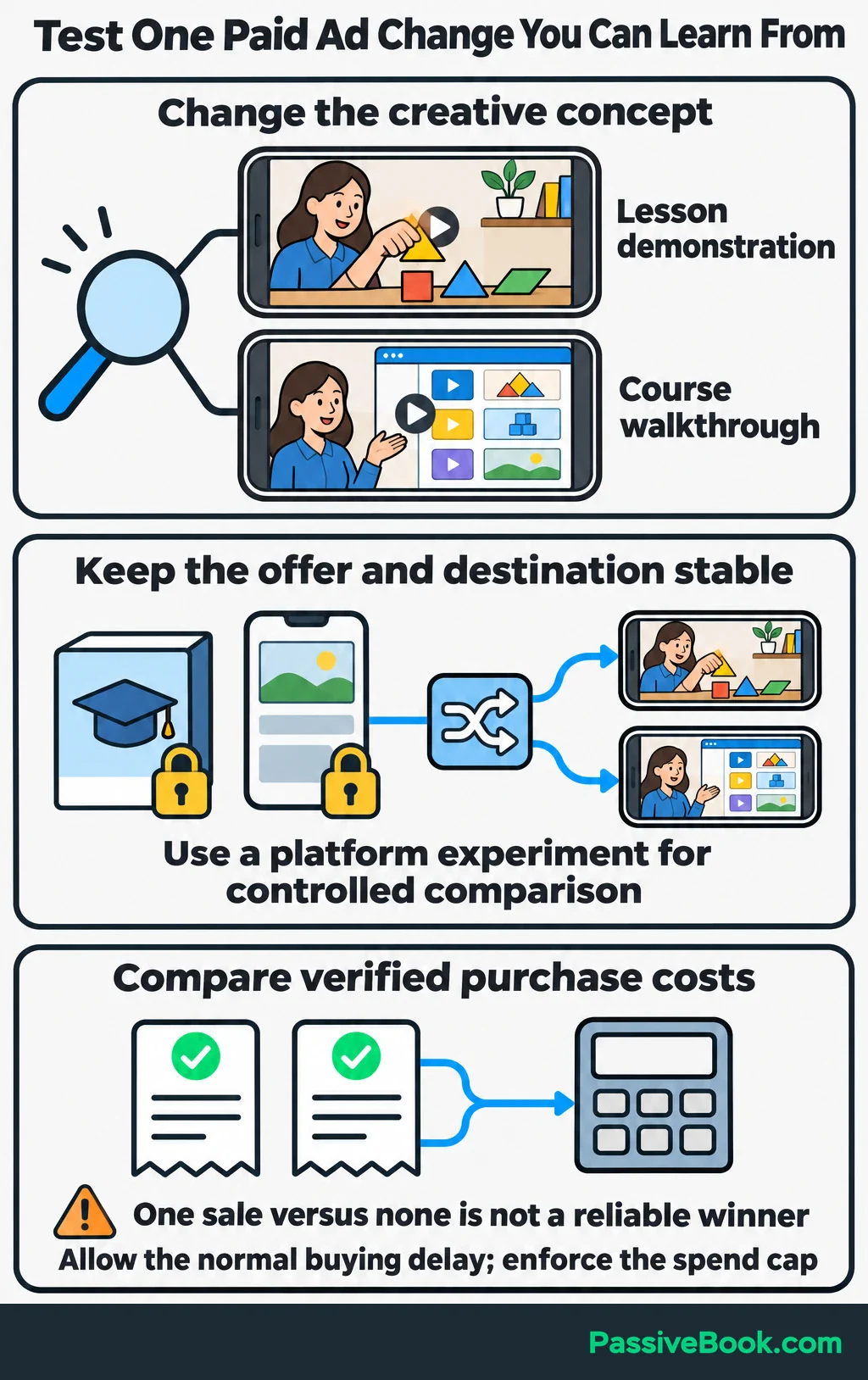
Allow for the normal purchase delay before judging routine performance. Someone buying a course may inspect the preview and return later. Keep that delay in mind while continuing to enforce the spending limit.
Sparse results also need restraint. One sale versus no sales is a reason to investigate, not a reliable winner. A fixed number of days doesn’t make thin evidence conclusive.
Record the change, spend, completed conversions and decision. That gives the next test somewhere to start.
Increase Spending When Acquisition Costs Remain Affordable
Increase spending after verified purchases or qualified leads repeatedly meet your target. Check cash flow and fulfilment capacity first, including the support work new buyers create.
I would raise spending in manageable steps and expand one dimension at a time. Changing the audience, creative and budget together makes rising costs harder to explain.
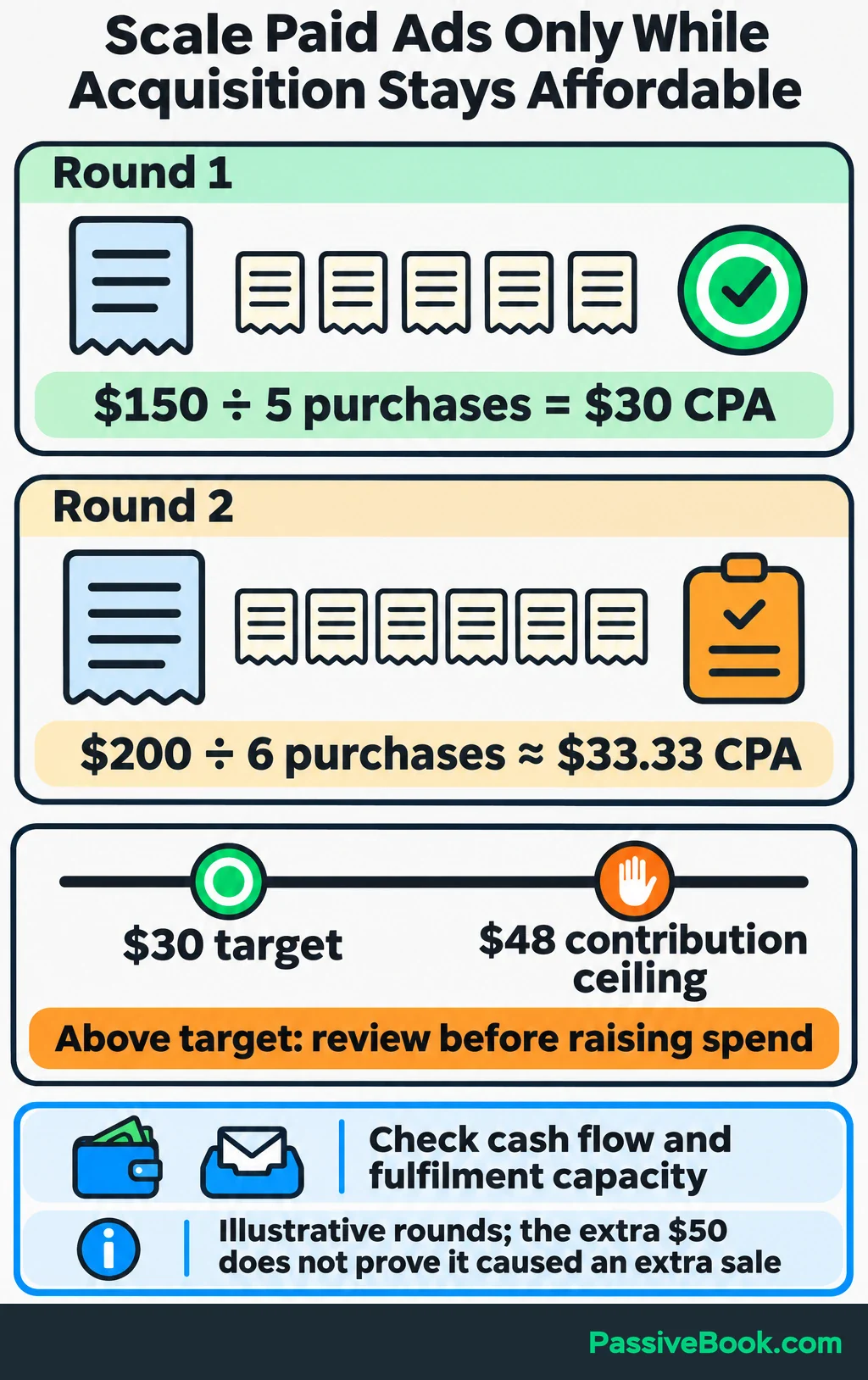
Watch acquisition costs as spending rises. Suppose one round costs $150 and produces five purchases, but the next costs $200 and produces six. CPA rises from $30 to about $33.33, above the target but below the course’s $48 contribution ceiling. I would review that increase before raising spending again. Comparing these rounds doesn’t establish how many sales the extra $50 caused.
Continue, revise or stop based on contribution after advertising and the test money remaining. If a revised page or message still can’t produce affordable customers, pausing is a useful business decision.
What Next?
Write a one-page campaign brief for one offer, including your primary conversion, target acquisition cost and maximum test spend. Then complete a test purchase before activating the campaign.
Use the social buttons to share this guide when a conversation about ads needs to move from “How much should we spend?” to “What can each customer afford to cost?”
Which part of your first test needs the most work: the offer, the page, tracking or the budget? Tell me in the comments, and bring any other questions along.
Share this post with your friends & followers: