Your best campaign brings in customers at a cost you can afford, so you raise the budget. Orders increase, but acquisition costs rise too. Has the extra spending helped, or has it eaten the margin you wanted to keep?
Opening another ad account adds another uncertainty. You might reach new buyers, but you also need more creative, another report, and money for a test that could fail.
Those decisions need clearer limits. This guide shows how to increase spending, test another channel, and judge whether the additional customers leave enough money behind.
Set Your Profitable Acquisition Limit
Start with the outcome you want to grow: new customers and the money left after acquiring them.
Purchase counts alone can hide weak margins. Cheap leads can do the same unless you can connect them to qualified buyers and eventual sales.
Keep these measures separate:
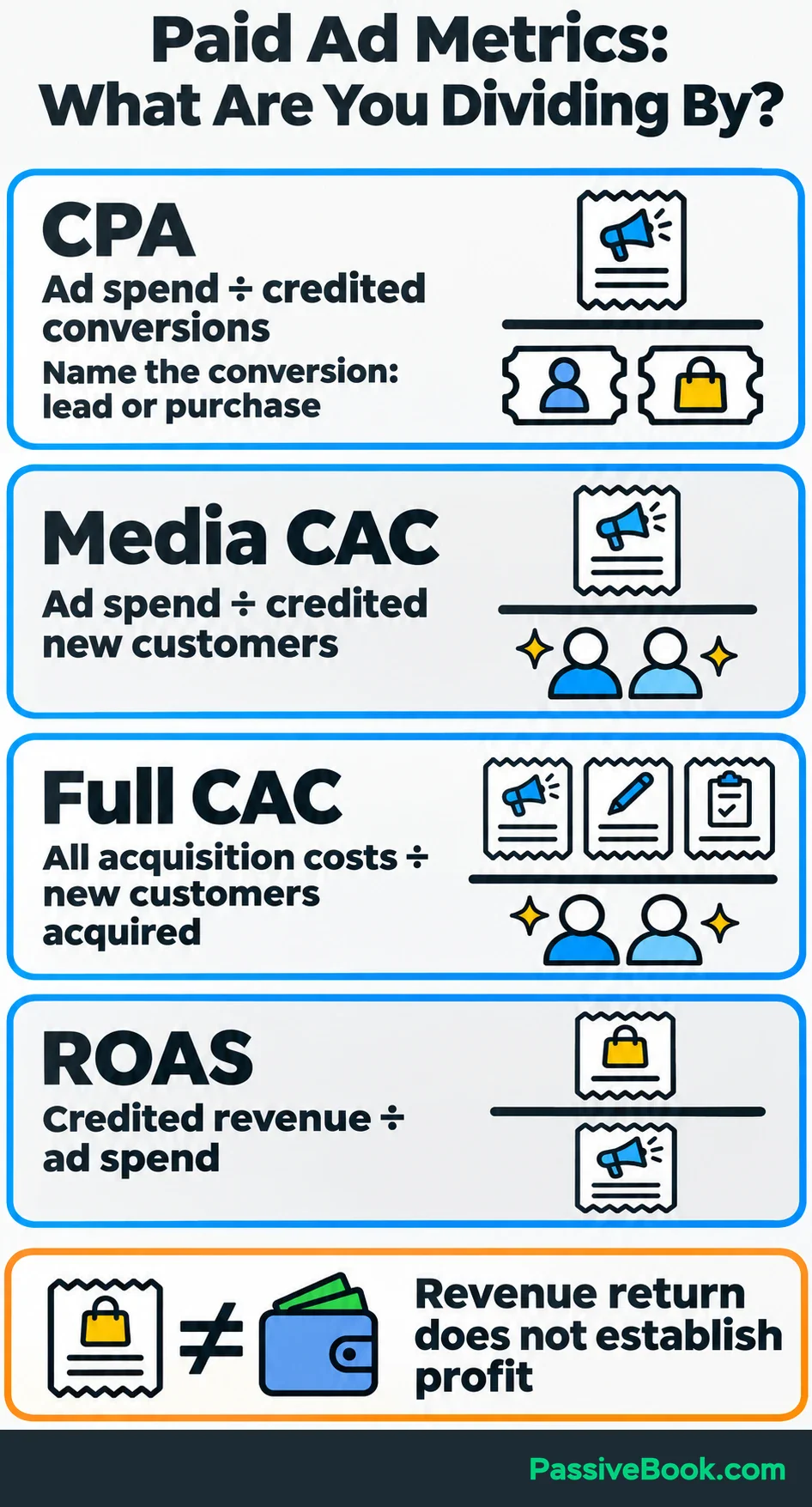
- CPA: Advertising spend divided by the number of conversions credited to that spending, such as leads or purchases. Always name the conversion.
- Media CAC: Advertising spend divided by the number of new customers credited to that spending.
- Full CAC: All acquisition costs, including advertising, creative production, and acquisition-related management costs, divided by the number of new customers acquired through those activities.
- ROAS: Revenue credited to advertising divided by advertising spend. It measures revenue, so it does not tell you profit by itself.
To set your media limit, work backward from an order. Subtract the costs of serving that order, other acquisition expenses, and the amount you need to retain for overhead and profit.
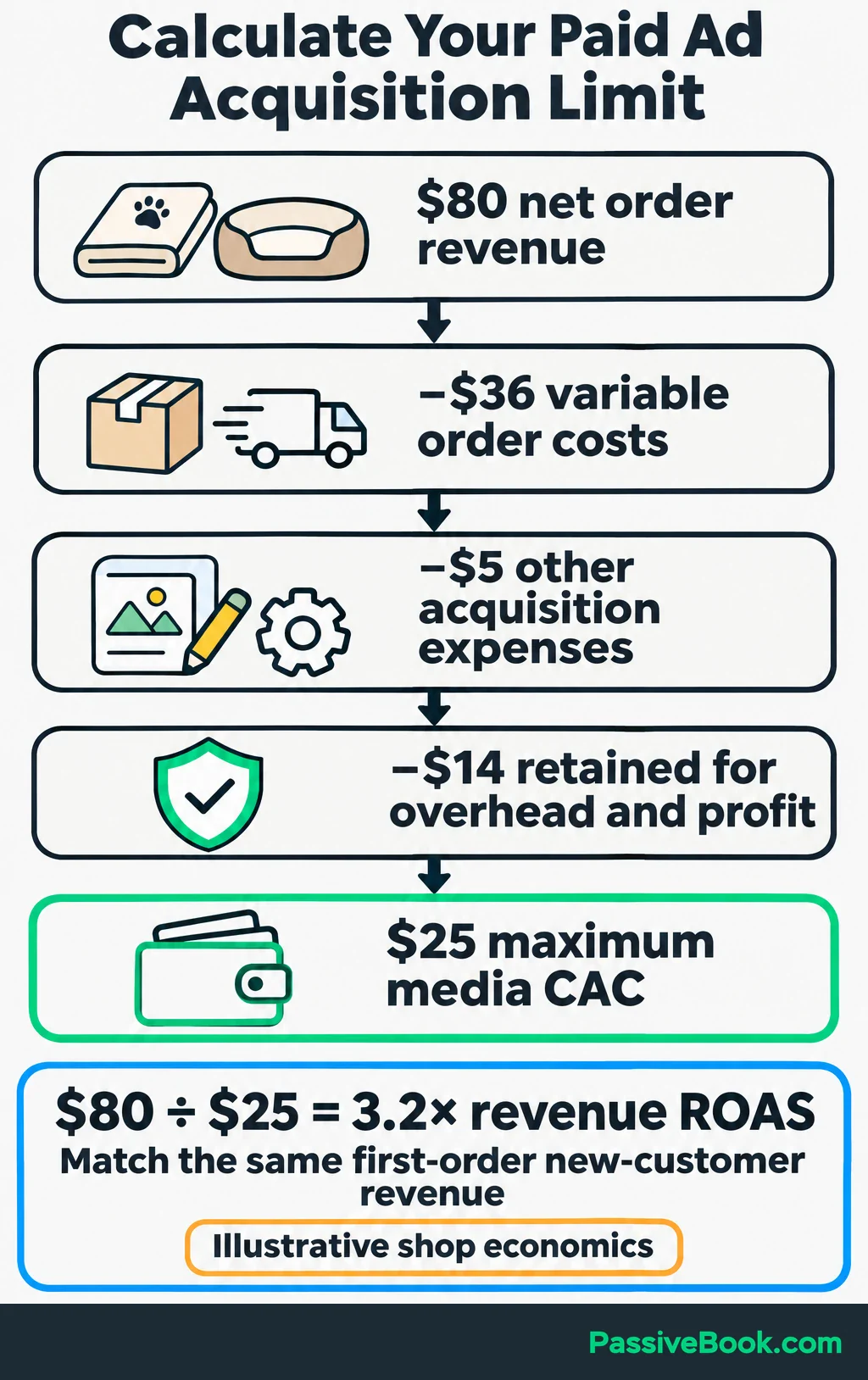
Throughout this guide, imagine you run an online shop selling washable dog-bed covers. Its figures are illustrations, not observed results or industry benchmarks.
For one new customer’s first order, the calculation looks like this:
| Item | Amount |
|---|---|
| Net order revenue | $80 |
| Variable order costs | −$36 |
| Non-ad acquisition expenses | −$5 |
| Contribution to retain for overhead and profit | −$14 |
| Maximum media CAC | $25 |
Variable costs include the cover, packing, fulfillment, payment fees, shipping you subsidize, and an allowance for returns. Count each deduction once. If refunds already reduce net revenue, do not subtract that lost revenue again under returns.
At these economics, you can spend up to $25 on ads to acquire a customer and still retain $14.
For the same first-order, new-customer revenue, that translates into:
$80 ÷ $25 = 3.2× revenue ROAS.
That comparison only works when the revenue and advertising spend cover the same new-customer orders. A platform’s ROAS that includes repeat buyers is not directly comparable.
I would start with first-order economics. Increase the allowance for repeat purchases only when actual customer groups show enough contribution from later orders, and you can afford to wait for that money. Expected loyalty does not pay this month’s supplier bill.
Verify the Results You Plan to Scale
Before increasing spend, complete a test purchase and follow it through your store and reporting tools.
Check that:
- The purchase appears once, with the right value and currency.
- Its payment and order status match your store records.
- New customers are separated from returning customers.
- Refunds and cancellations reach the reports you use.
- Purchase events do not fire again when someone reloads a confirmation page.
If you use Google Analytics 4 (GA4) to track website purchases, send a unique, nonempty transaction ID for each order. Google uses that ID to prevent duplicate purchase counts; reusing IDs or sending empty ones can cause undercounting. Google’s transaction-ID guidance
Next, make channel comparisons consistent. Use campaign tags on ad links, and record how long each platform can claim a purchase after a click or an ad view.
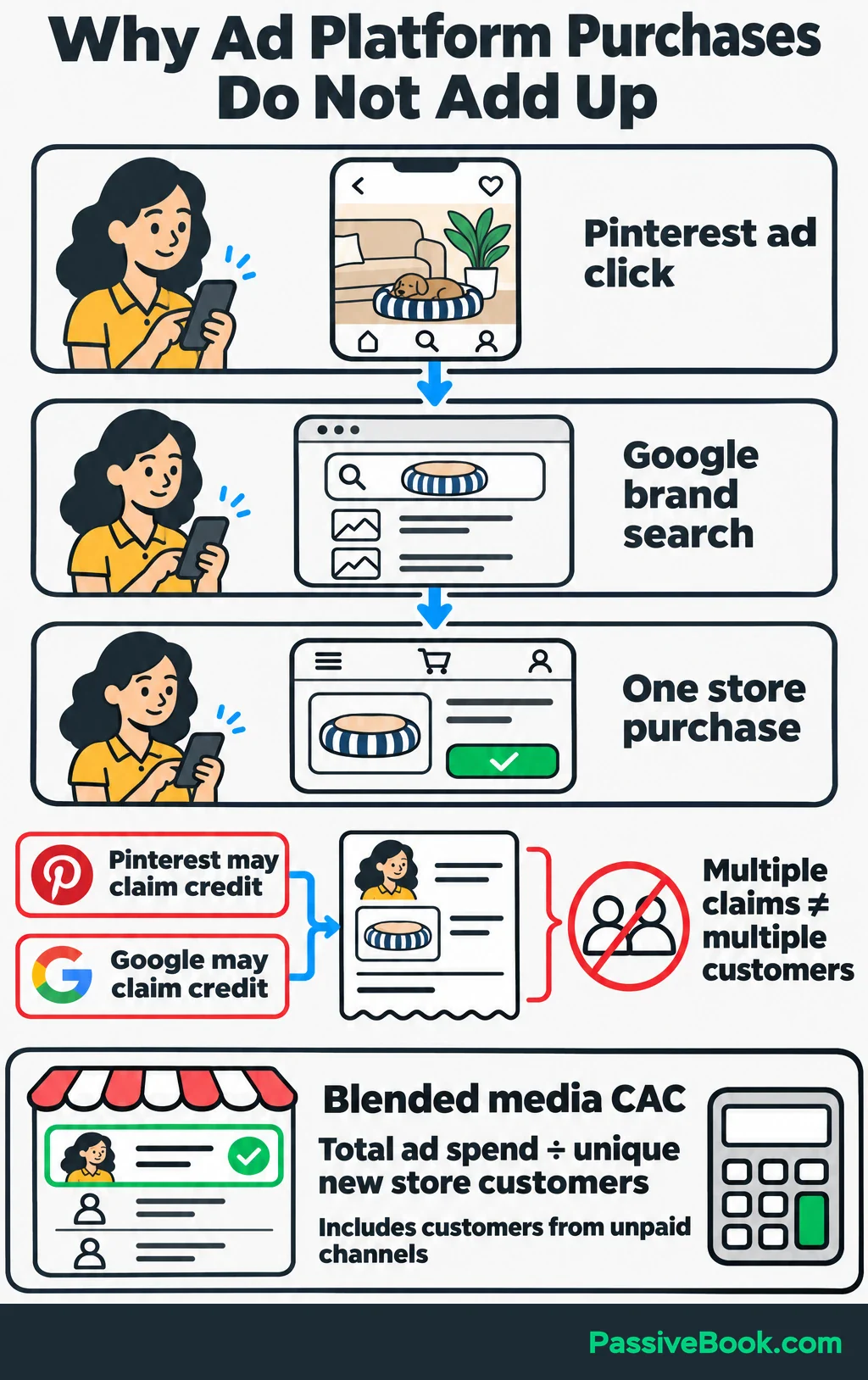
Attribution means assigning credit across a buyer’s interactions. A customer might click a Pinterest ad, search your brand on Google, and then purchase. Different platforms may each claim that order, so adding their reported purchases will not give you unique customers. Google’s explanation of attribution
Build a simple scorecard with channel, spend, credited new customers, media CAC, net revenue, and contribution after acquisition costs. Show brand searches separately from ads aimed at unfamiliar buyers. Also label retargeting, which reaches people who have already visited or interacted with your business. These groups can have different acquisition costs.
Add a business-total row using total ad spend and unique new customers from store records. Label its acquisition measure “blended media CAC.” It shows the business-wide relationship between spending and customer growth, including customers who may have arrived through unpaid channels.
Compare equal periods after allowing for your usual buying and reporting delay. Google notes that conversions still arriving can make recent CPA look inflated and ROAS look low. A sale or seasonal demand spike also makes a poor comparison with an ordinary week. Google’s conversion-delay guidance
Keep tracking within applicable consent requirements. If you use Google enhanced conversions to match purchases using customer information, its policies require disclosure of measurement-related sharing and consent where legally required. Google’s customer-data requirements
Create Room for More Conversions
A budget increase needs somewhere useful to send the extra traffic.
Follow the path from ad response to product-page visit, checkout, and purchase. Look for the point where people stop, then investigate that step.
For the dog-bed covers, an ad might promise easy washing while the product page leaves care instructions buried below several screens of photos. Or visitors may reach checkout and discover a delivery charge they did not expect.
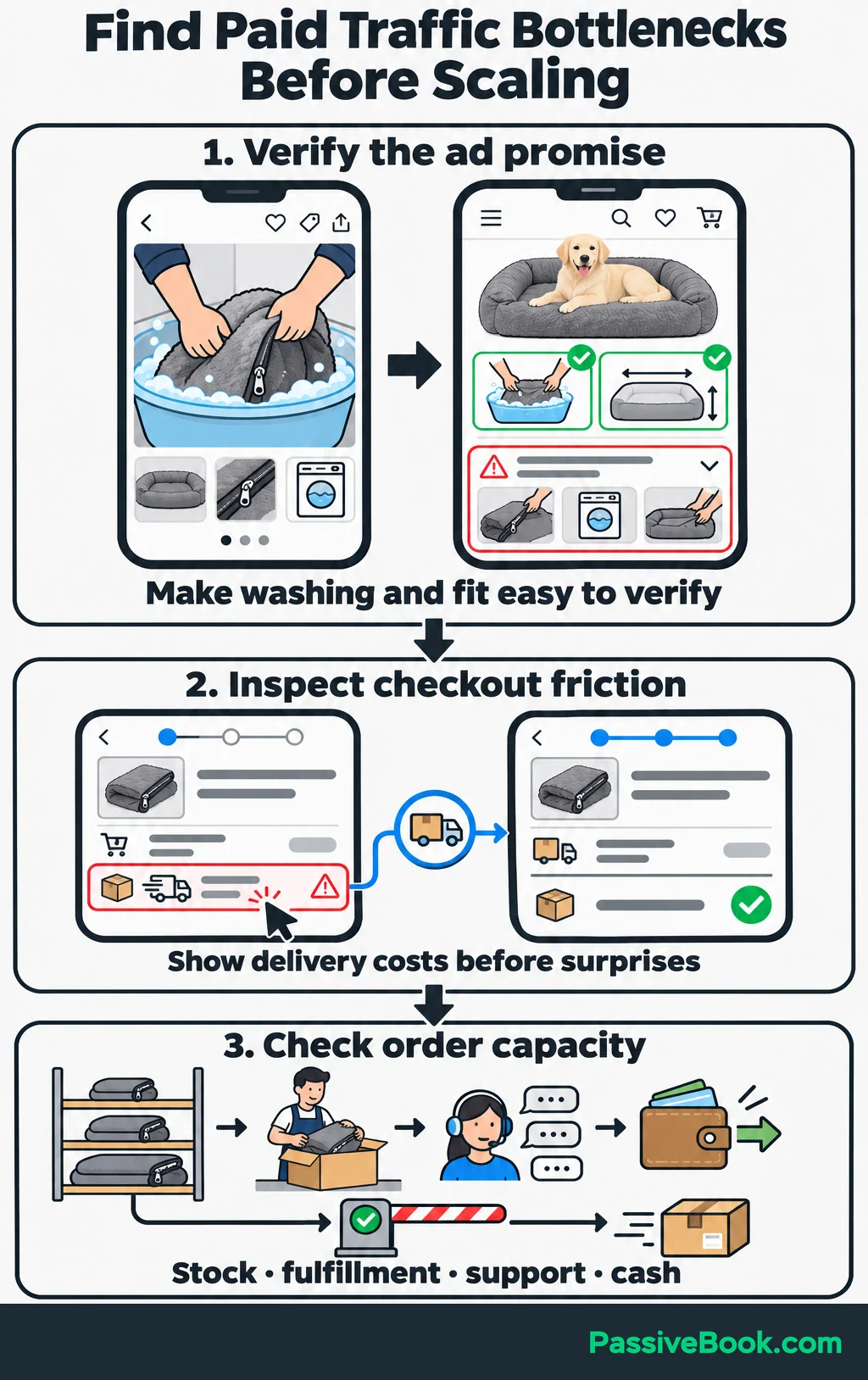
Make the ad’s promise easy to verify. Show the materials, dimensions, fit, washing instructions, price, and delivery costs where buyers need them.
Then check whether you can serve more orders. That includes stock by size and design, fulfillment capacity, support time, and cash for replenishment.
My jewellery store left me with unsold inventory after I skipped proper market research. That experience makes me cautious about treating an order forecast as money already earned. Check what you must buy and pay for before the next batch of sales arrives.
Test Distinct Reasons to Buy
Give people different reasons to consider the product.
Start with reviews, support messages, search queries, and customer questions. Look for repeated problems and objections, then turn each into an ad concept.
A concept changes the buying argument. Changing the background color usually does not.
For the covers, you could test:
| Buying reason | Creative treatment | Short excerpt |
|---|---|---|
| Easier cleaning | Show removal, washing, and refitting | “See how the cover comes off for wash day.” |
| A better-looking room | Show fabric choices on a bed in a furnished room | “Choose a cover that suits the room.” |
| Confidence about fit | Demonstrate measuring the existing bed | “Check these dimensions before choosing your size.” |
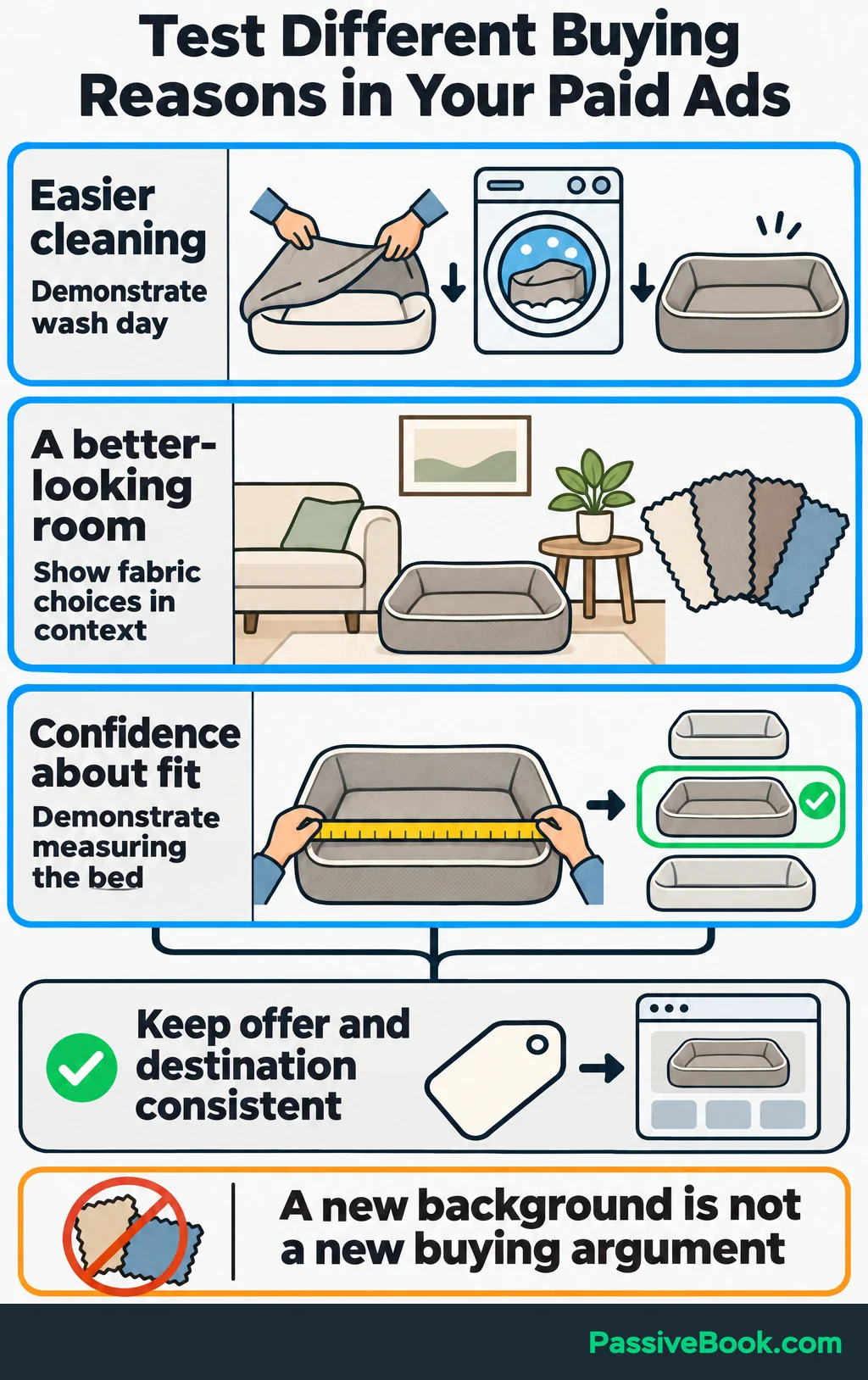
Keep the offer and destination consistent while comparing concepts. That gives you a clearer read on which argument deserves more work.
Meta’s creative-diversification guidance covers changes to messages, visuals, and formats. My practical preference is to test a few distinct arguments before making many versions of one argument. Meta Blueprint’s creative guidance
Give each concept a spending allowance and review point. Record the customer volume and acquisition cost it supports, then develop the stronger ideas while introducing new ones.
When response and acquisition costs deteriorate together, investigate fatigue. First check for changes in the offer, audience, placements, and website. Replacing every ad will not fix a broken size selector.
Expand Qualified Reach
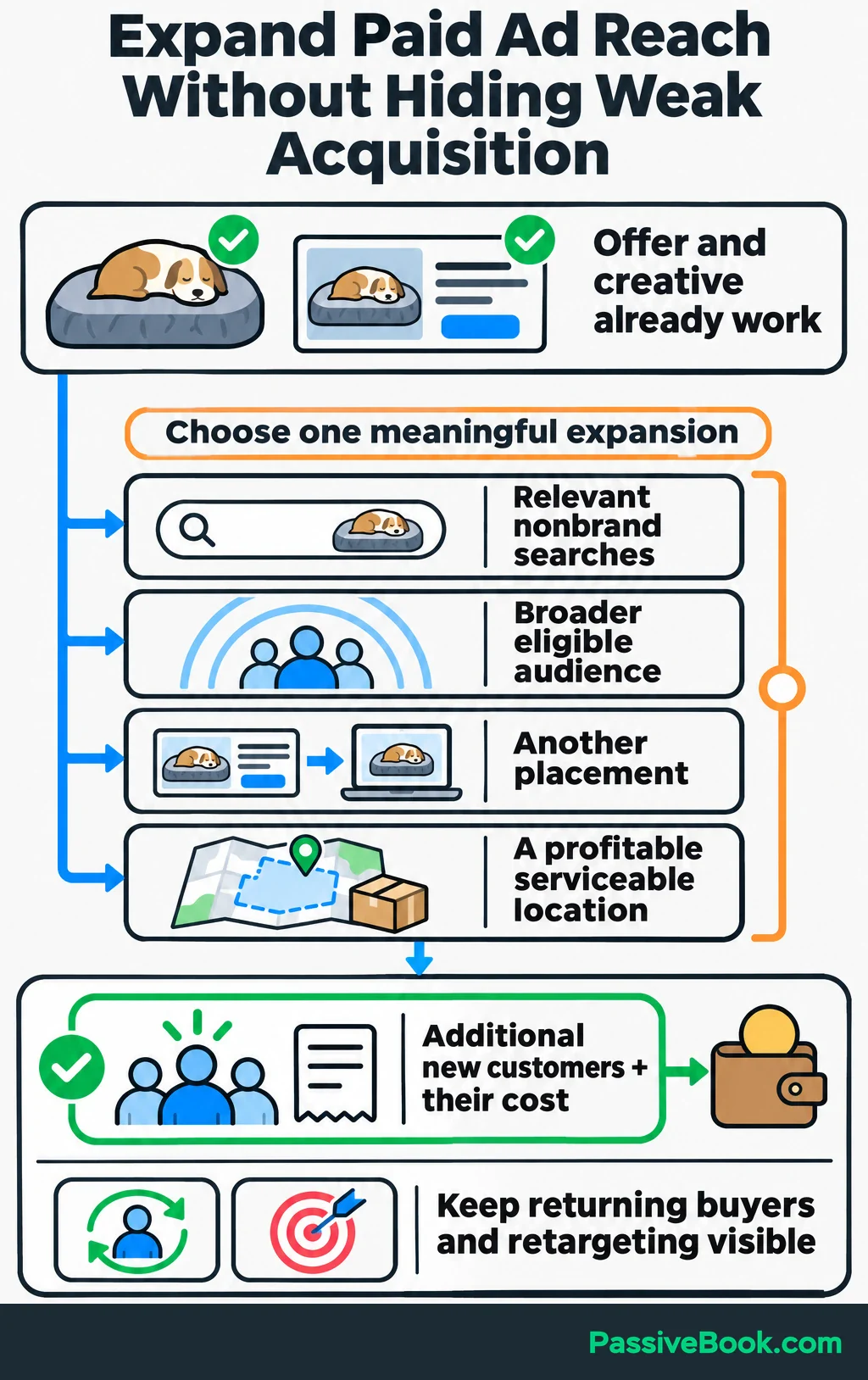
Once the offer and creative work, test access to more suitable buyers.
Choose one meaningful expansion: relevant searches that do not mention your brand, a broader eligible audience, another placement, or a location you can serve profitably.
For Google Search, distinguish a budget constraint from a competitiveness problem:
- Budget constraint: Ads miss eligible impressions because the campaign lacks budget. This can justify a spending test when customer costs already work.
- Rank constraint: Ads miss impressions because they are not competitive enough in the auction, which Google reports as low Ad Rank. Investigate bidding, ad quality, and relevance before assuming more campaign budget will solve it.
Google reports these separately as lost impression share from budget and rank. Neither measure proves that the missed traffic would be profitable. Google’s impression-share definitions
Judge the expansion by additional new customers and their cost. Keep returning-customer purchases and retargeting visible so they cannot disguise weak acquisition.
I would also consolidate overlapping campaigns when each receives too little activity to evaluate. Preserve divisions that reflect different offers, buying intent, or margins. A tidy account is useful only if it makes spending decisions clearer.
Increase Budgets According to the Cost of Additional Customers
Choose a campaign that delivers verified new customers below your limit. Then decide how much extra spending you can afford to test.
I would skip a universal rule such as “increase every budget by 20%.” The right amount depends on your remaining margin, available demand, cash, and ability to fulfill orders.
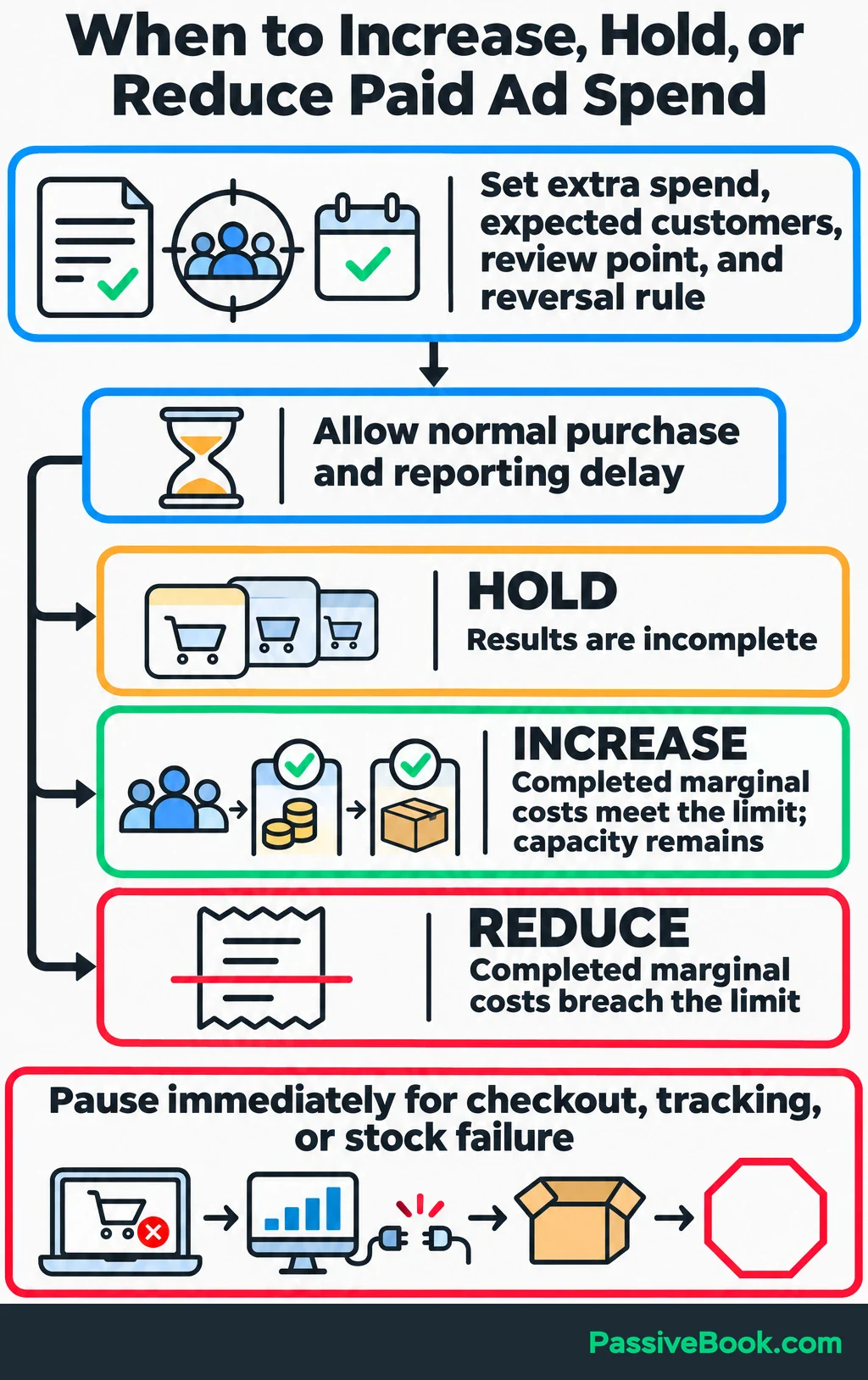
Before making the change, record:
- The additional spending allowed.
- The additional customers you expect at an acceptable cost.
- The review point, including the normal conversion delay.
- The result that would make you hold or reverse the increase.
Keep other major settings stable during the test.
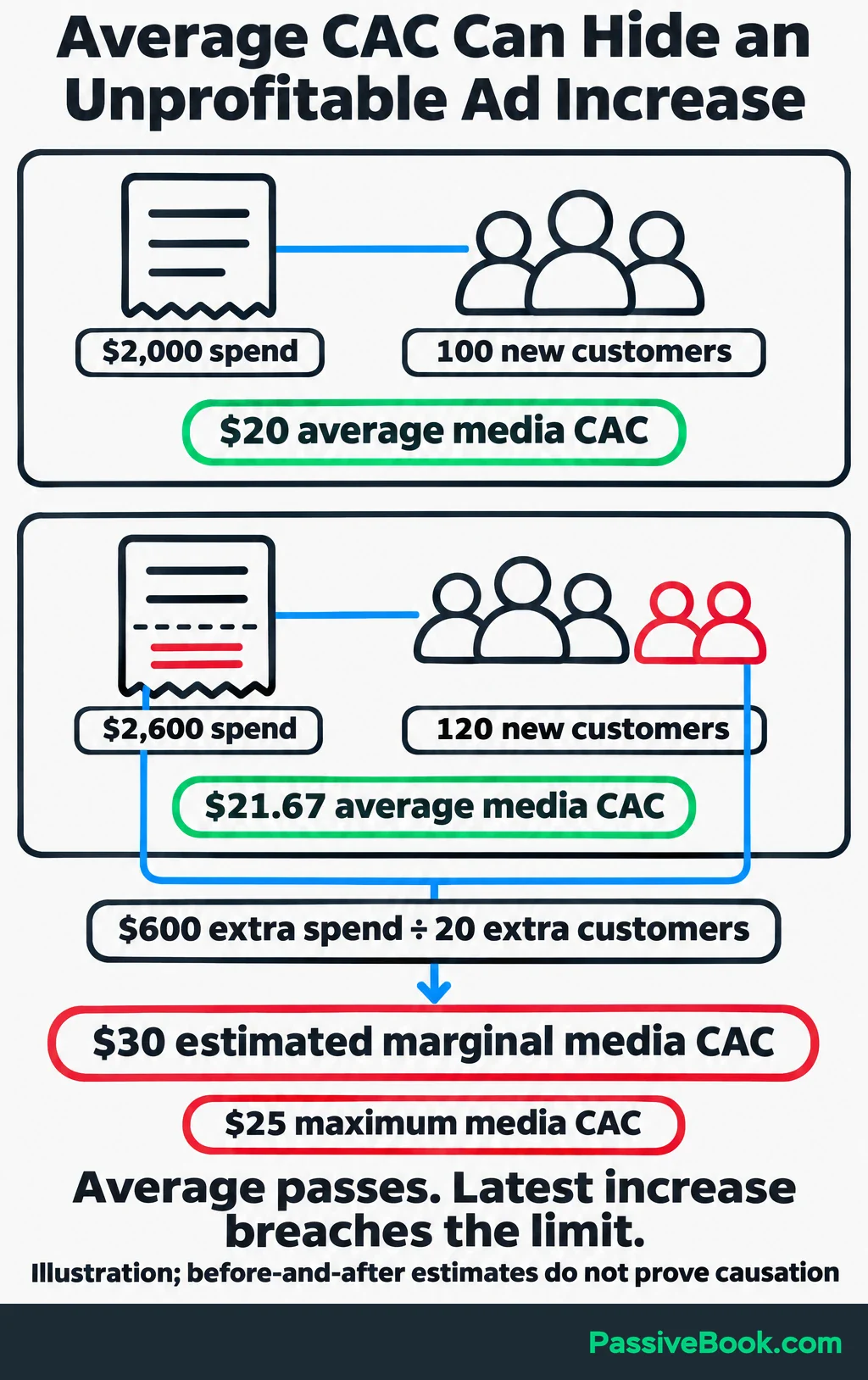
The useful measure here is the cost of the additional customers, often called marginal media CAC. Compare the extra advertising spend with the increase in new customers across equal-length periods, after allowing for the usual purchase and reporting delay.
For the shop’s Meta campaign:
| Measure | Earlier Period | Higher-Spend Period |
|---|---|---|
| Advertising spend | $2,000 | $2,600 |
| New customers | 100 | 120 |
| Average media CAC | $20 | $21.67 |
The average remains below the $25 limit. But spending rose by $600 while new customers increased by only 20:
$600 ÷ 20 = $30 estimated marginal media CAC.
Those added customers exceed the allowance. Using the same order economics, each leaves $9 after variable costs, other acquisition expenses, and advertising, rather than the required $14.
The campaign can still look healthy overall because its cheaper customers support the average. That does not make the latest increase acceptable.
You can run the same comparison for your own spending without building the calculations yourself. The calculator also shows how far the conclusion depends on genuinely additional customers.

Free Marketing Profit Calculator




This before-and-after calculation is an estimate. It does not prove advertising caused every additional purchase because other conditions may have changed.
Use it to guide the next decision:
- Increase: Completed results show that additional customers meet the economics and you have capacity for another bounded test.
- Hold: Purchases or reporting are still incomplete.
- Reduce: Completed results breach the acquisition limit.
Pause immediately for broken checkout, failed tracking, or unavailable stock. Those problems do not need a longer observation window.
Choose a Channel That Fills a Clear Gap
Diversification earns its place when another channel gives you useful access to buyers or a more independent source of acquisition.
Start by naming the gap. Perhaps search demand is limited, your current channel needs constant new videos, or almost all paid acquisition depends on one account.
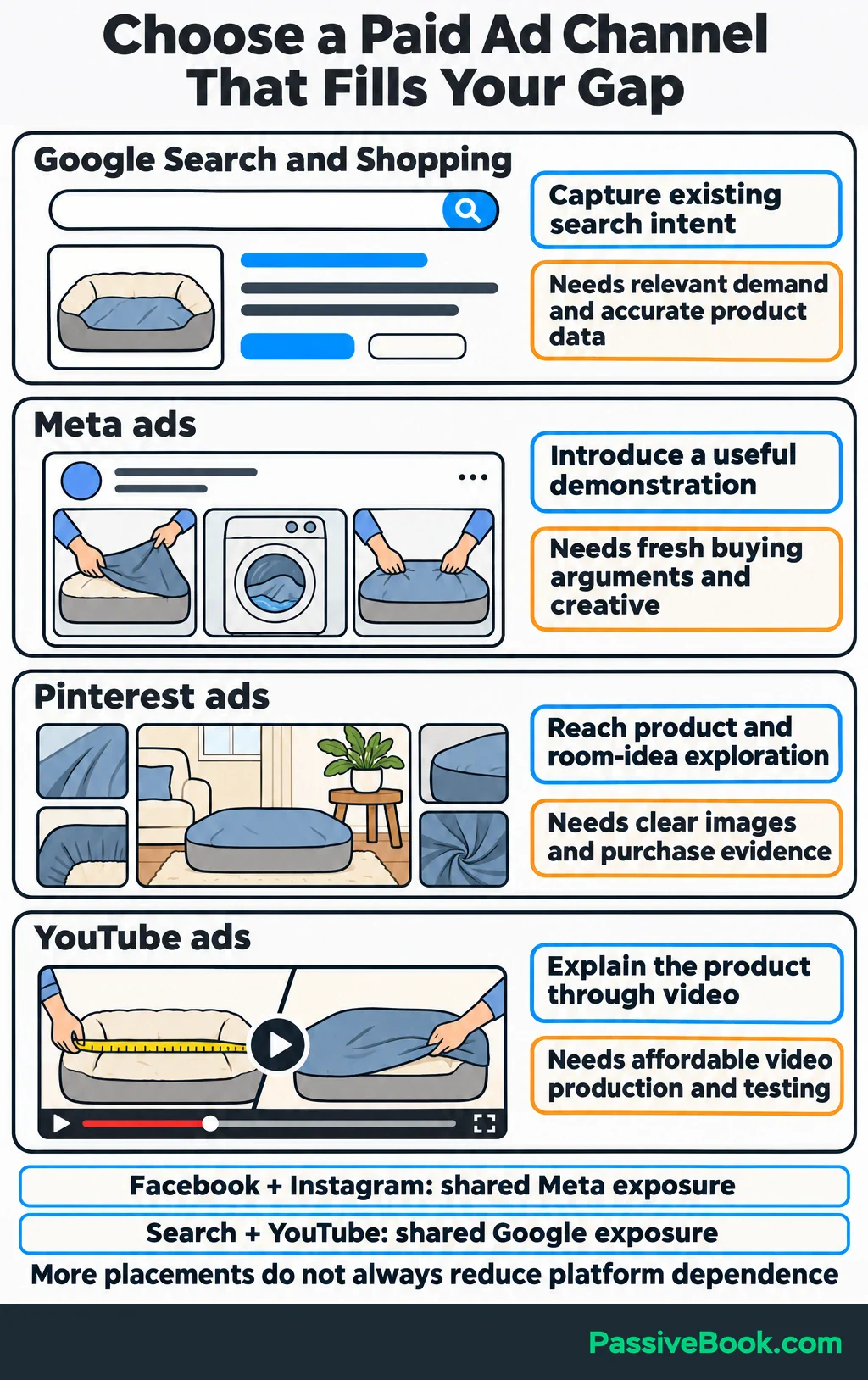
Then compare the channel’s role, assets, measurement options, operating effort, and availability in the markets you serve.
| Channel | Buying Situation | Required Assets | Pilot Question | Main Constraint |
|---|---|---|---|---|
| Google Search and Shopping | Someone is searching for a cover or replacement | Relevant search ads; accurate product data and images for Shopping | Can nonbrand searches acquire more customers within the allowance? | Relevant search demand and auction costs |
| Meta ads | Someone encounters a useful demonstration while browsing | Washing demonstrations, product photos, and distinct buying arguments | Can the ads acquire unfamiliar buyers beyond retargeting? | Time and cost of supplying fresh creative |
| Pinterest ads | Someone is exploring ideas or searching for relevant products | Clear images showing fit, use, and the cover in a home | Can this setting attract profitable new customers? | Purchase evidence within the available test budget |
| YouTube ads | Someone sees a video that introduces or explains the product | A clear demonstration adapted for video viewing | Does showing the product explain enough to generate purchases? | Video production and testing costs |
Shopping ads need accurate product details, including pricing and availability, in Google Merchant Center, the tool that supplies your product listings to Google. Link it to Google Ads and include that setup work in your decision. Google’s product-data requirements
Pinterest supports keyword and interest targeting, which gives the shop a way to test relevant searches and interests. That makes it a candidate, not a proven winner. Pinterest’s targeting options
For this shop, I would consider Pinterest if Meta already works and suitable room photos are available. I would postpone YouTube if making usable video would consume the entire experiment budget.
Also distinguish more placements from less platform dependence. Facebook and Instagram share Meta exposure; Google Search and YouTube share Google exposure.
Choose one candidate and set its target from your own economics. A channel-average CPA cannot tell you what your margins can afford.
Run a Channel Pilot With a Spending Limit
A pilot should answer one spending decision. It does not need to prove the channel’s lifetime value to the business.
Define the Test Before Launch
Write the decision question before building the campaign:
Can Pinterest acquire additional dog-bed-cover customers within our $25 media allowance while preserving contribution after other acquisition costs?
Then define the test’s boundaries. The shop’s plan uses prospecting—ads aimed at finding new customers:
| Decision | Pilot Plan |
|---|---|
| Audience | Prospecting in one serviceable market using relevant interests or keywords |
| Offer | The existing covers at the same price and terms |
| Primary outcome | Verified first purchases from new customers |
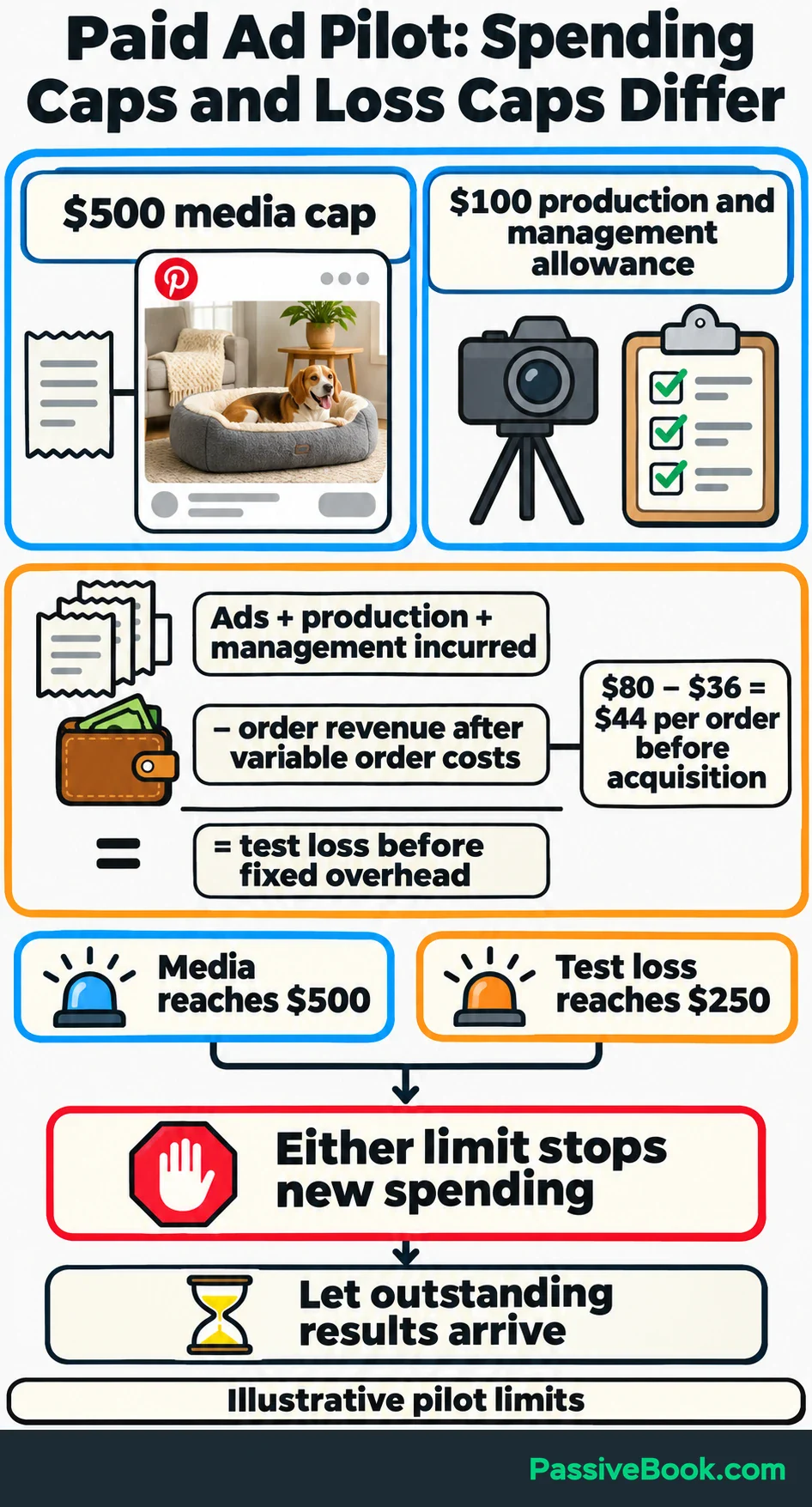
| Media cap | $500 |
| Production and management allowance | $100 |
| Maximum affordable test loss | $250, using the loss calculation below |
| Review schedule | Check delivery and caps daily; review purchases weekly; make the final decision after the usual conversion delay |
| Creative | Product images in furnished rooms, with clear fit and washing information |
To track the test loss, add the ad, production, and management costs incurred so far. Then subtract the money left from pilot orders after variable order costs. This is the test’s loss before fixed overhead. Stop new spending if the loss reaches $250, even if some media budget remains.
Check whether the media budget could produce a useful amount of evidence. Divide the budget by your target media CAC:
$500 ÷ $25 = 20 new customers at the target.
That is a planning calculation, not a forecast or a guarantee of enough evidence.
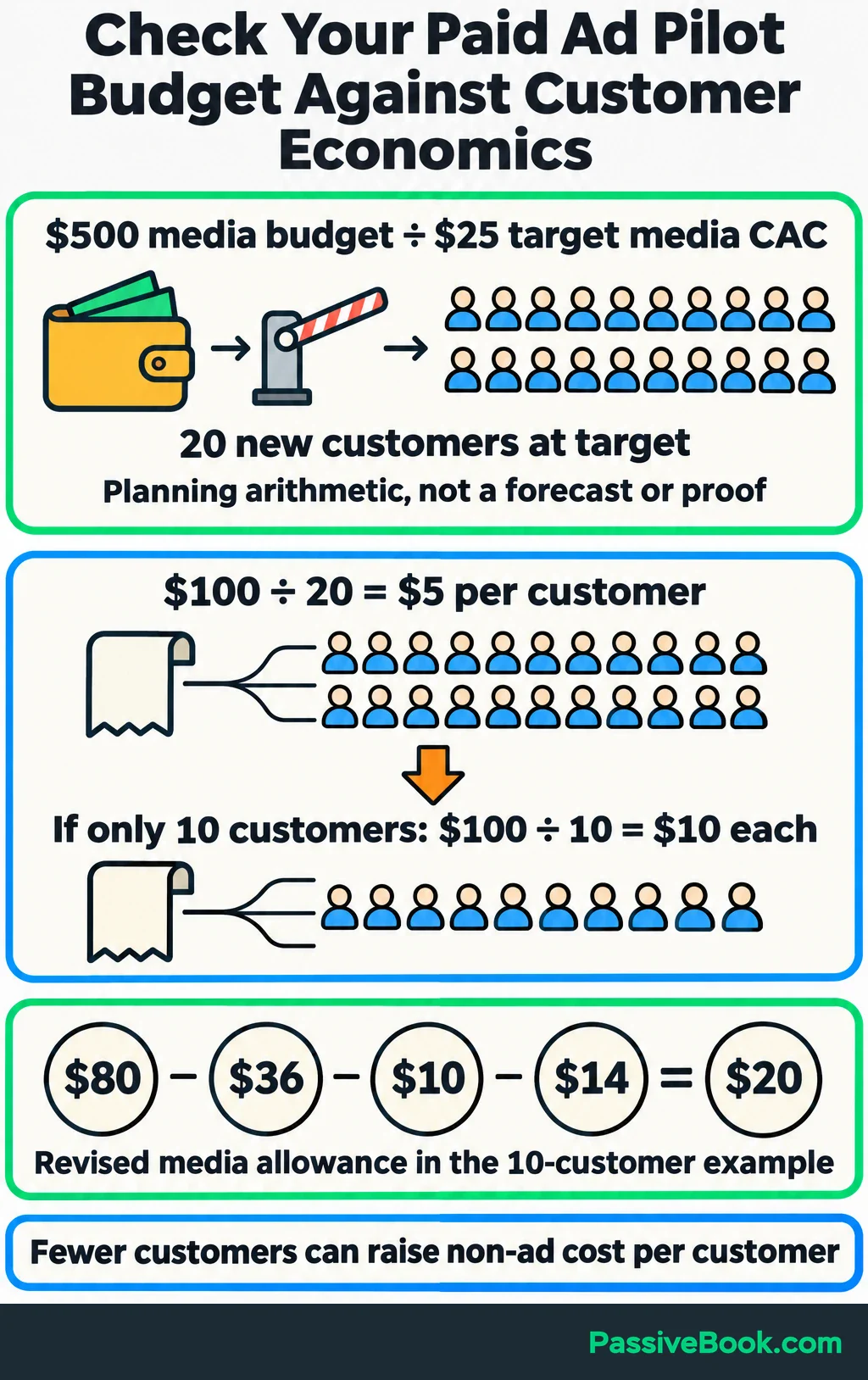
The $100 non-ad allowance equals $5 per customer if the pilot acquires 20 customers. If it produces fewer customers, or costs more to manage, recalculate the contribution. The $25 media allowance cannot absorb unlimited setup expenses.
Adapt the presentation to Pinterest while keeping the offer consistent. Show the cover on an actual bed in a room, make dimensions clear, and use washing claims that match the product.
Watch cost per click, click-through rate, and checkout behavior to diagnose obstacles. Increase spending only when new-customer costs and the money left after acquisition meet your limits.
When either cap is reached, stop new spending and let outstanding results arrive before deciding whether to fund more.
Decide Whether to Scale, Revise, or Stop
Use the rules you agreed on before launch:
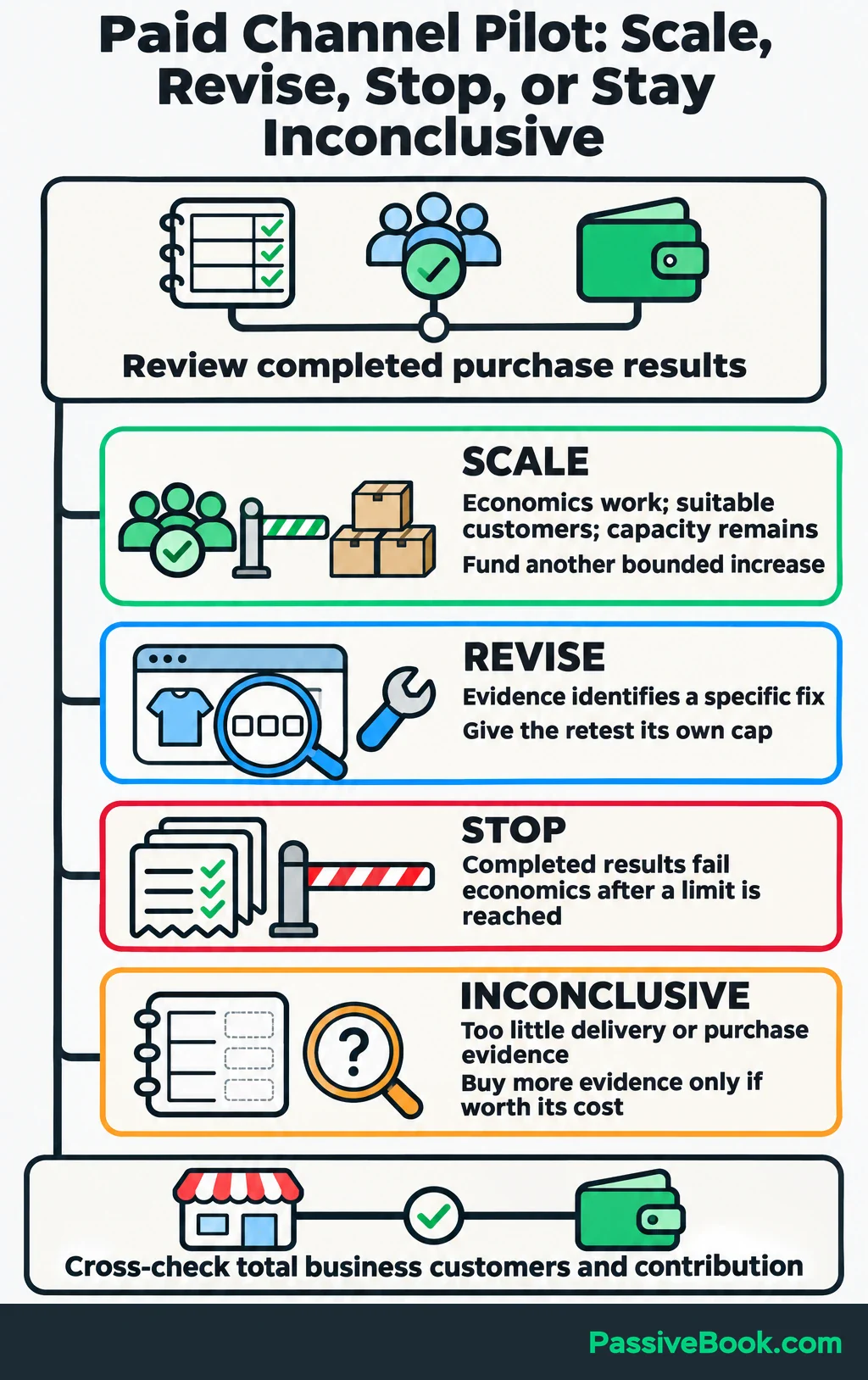
- Scale: Completed purchase results meet the acquisition limit, customers are suitable, and the channel has room for another bounded increase.
- Revise: Evidence points to a specific fix, such as unclear sizing or a weak destination page. Give the retest its own cap.
- Stop: Completed results fail the agreed economics after the spending or loss limit is reached.
- Inconclusive: Delivery or purchases are too limited to support a decision. Fund another test only if resolving that uncertainty is worth its cost.
Check total business customers and contribution alongside the channel report. A buyer introduced through Pinterest might later purchase through branded search. Equally, an ad might receive credit for a customer who would have bought anyway.
Before a large reallocation, consider a properly designed audience holdout or geographic experiment when practical. These compare outcomes with and without the advertising to estimate additional conversions caused by it. Google describes this approach in its conversion-lift guidance. Google’s explanation of conversion-lift experiments
To estimate incremental acquisition cost, divide the acquisition costs being evaluated by the estimated additional new customers. Include creative and management when evaluating full acquisition cost.
A small pilot may only justify another small test. That is a useful result.
Reallocate Spend Toward Profitable Capacity
Allocate money according to what each channel can use profitably next.
I would fund viable existing acquisition, reserve a specific amount for an experiment, and leave some cash uncommitted. I would skip a fixed percentage split until those amounts make sense for the business.
Your allocation sheet should connect spending with a decision. Suppose the shop reverses the expensive Meta increase, and its completed Pinterest pilot records 20 credited new customers.
The working view could look like this. Contribution is what remains after variable order costs and all included acquisition costs; channel figures use one consistent attribution method.
| Channel | Current Spend | Media CAC | Estimated Marginal Media CAC | Contribution | Share of Paid Spend | Next Action |
|---|---|---|---|---|---|---|
| Meta | $2,000 | $20 | $30 in the rejected increase | $1,900 | 80% | Hold; test another buying argument before raising spend |
| $500 | $25 | Not yet tested above pilot spend | $280 | 20% | Consider a small capped increase if capacity remains |
These contribution figures assume $80 net revenue, $36 variable costs, and $5 other acquisition expenses per customer. The Pinterest result meets the target, but it does not establish the cost of the next customers.
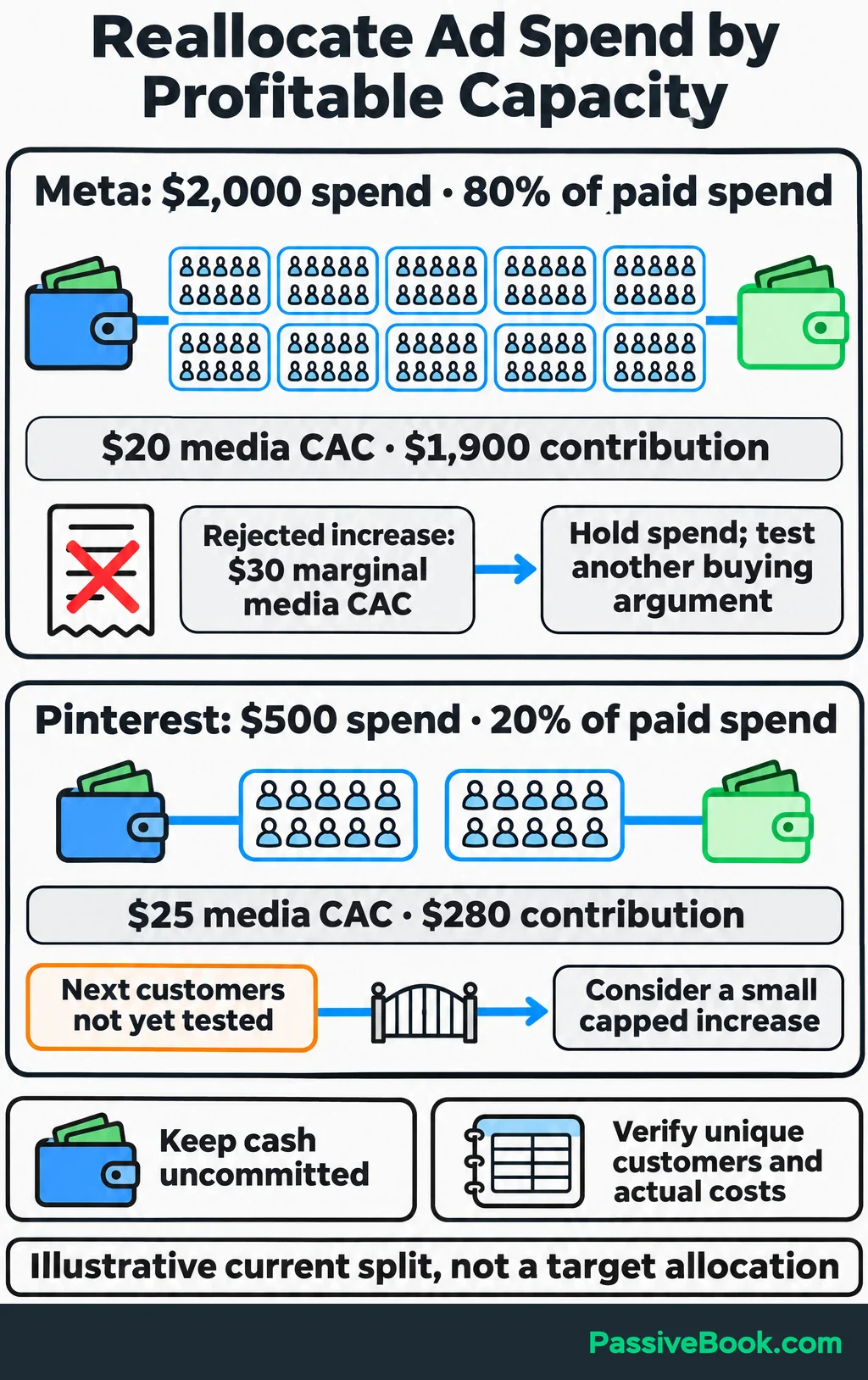
Keep a separate business-total check using unique store customers and actual costs. Platform credit should not become your accounting system.
This is how to scale and diversify paid ads without forcing an even split: move money as another channel demonstrates profitable capacity. Two channels with different strengths can be useful even when one still receives most of the budget.
Include operating effort in that comparison. A channel that needs regular filming may deserve a lower media allowance than one you can support with existing assets.
Automate recurring reports and alerts once the definitions are stable. If you already use n8n or Make to automate tasks between tools, connect spending, order, and inventory data to flag:
- Spending approaching a test cap.
- Missing purchase events or unusual reporting gaps.
- Acquisition costs above the agreed limit.
- Stock constraints that affect advertised products.
I would automate alerts first. Give any automated budget changes explicit ceilings and a named reviewer, especially when purchase data arrives late.
Keep a short decision log with the spending change, expected outcome, completed result, and next action. It gives the next increase something better to rely on than whoever last looked at the dashboard.
What Next?
Calculate the maximum media CAC for one product today, then compare it with the cost of the additional customers from your latest budget increase.
Use the social buttons to share this guide when your team is weighing a bigger budget or another channel. Having the same limits and stopping rules makes that discussion much easier.
What evidence would make you comfortable funding your next increase? Share your answer in the comments, and bring any other questions too.
Share this post with your friends & followers:

