You have enough time to do one marketing channel properly, but every platform seems to have a convincing success story. Search ads promise buyers. Social media promises reach. Someone else says you need a newsletter.
The cost of choosing badly goes beyond wasted ad spend. You can lose weeks making content without learning whether it helps anyone buy. To make that time and money easier to commit, this guide helps you choose a channel that fits your buyers, budget and workload—and define a small test that tells you whether to keep going.
Define the Result Your Channel Must Produce
Start with one business outcome. “Get more exposure” leaves too much room for a busy month that achieves nothing useful.
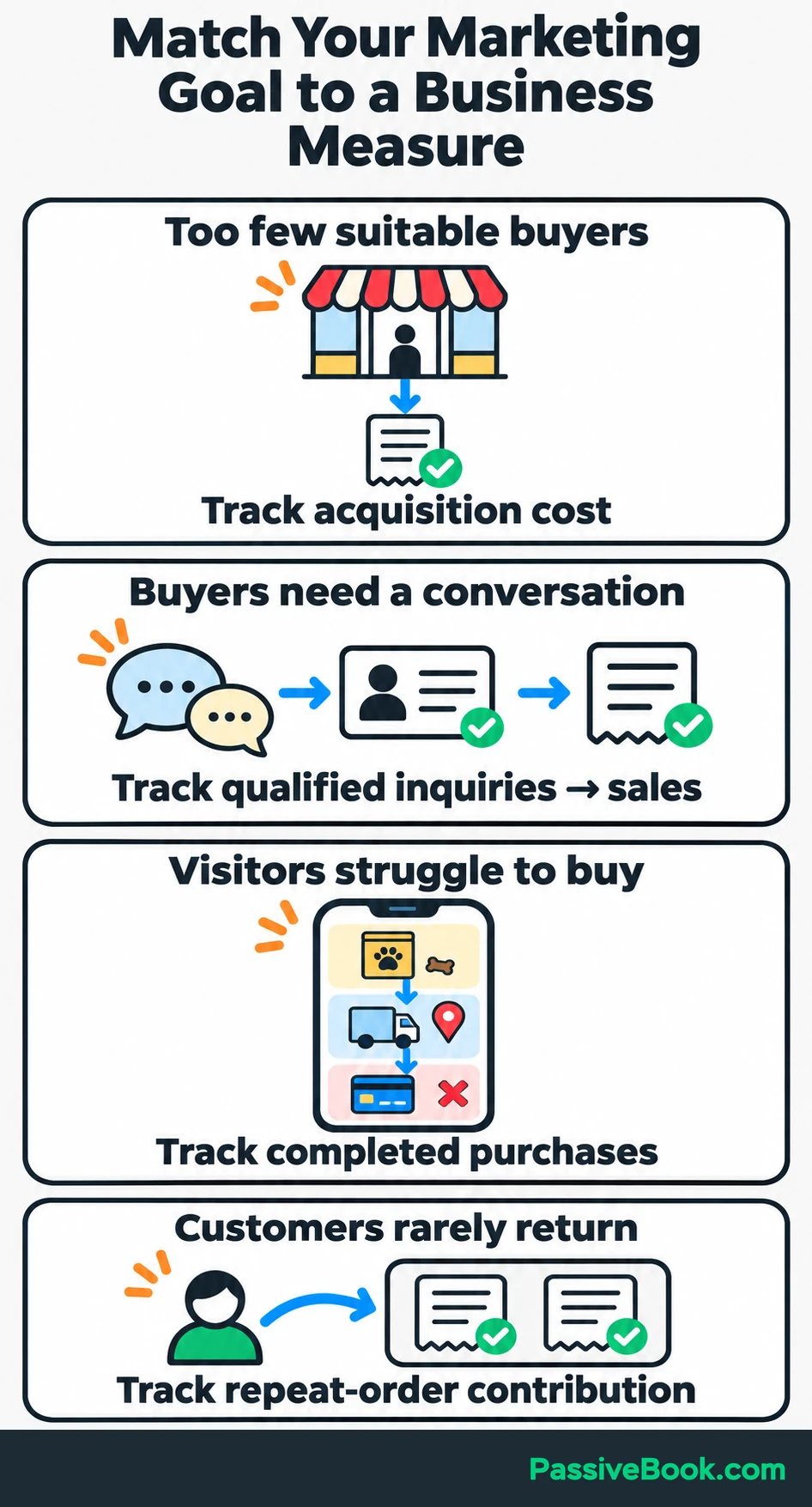
Choose the result that addresses your biggest gap:
| What Is Missing? | Priority Outcome | Main Measure |
|---|---|---|
| Too few suitable people discover your offer | Acquire new customers | Customer acquisition cost |
| People need a conversation before buying | Generate qualified inquiries | Cost per qualified inquiry, followed through to sales |
| Interested visitors struggle to buy | Improve purchase completion | Completed purchases from those visitors |
| Existing customers rarely return | Increase repeat purchases | Contribution from repeat orders after marketing costs |
If checkout fails on a phone, fix that before paying for more visitors. Traffic cannot rescue a broken purchase process.
Marketing channels include search, social media, email, partnerships and offline outreach. Advertising is the paid part of that mix. Whether you pay for ads or create content, start with the business result you need.
Throughout this guide, imagine you run an online shop selling washable treat pouches for dog walks. Its priority is first-time purchases, so the main measure is customer acquisition cost: what you spend to acquire each new customer. All figures, customer findings and results in this example are illustrations.
I spent six months chasing Instagram and Twitter/X followers in another niche. My bank balance stayed around $47. I could describe what I’d posted, but I had little commercial progress to show for it. That experience is separate from Passive Book, where blogging and Pinterest are the active channels.
Followers and clicks can help explain progress. They should not replace the result you need.
Find Where Your Customers Discover and Evaluate Solutions
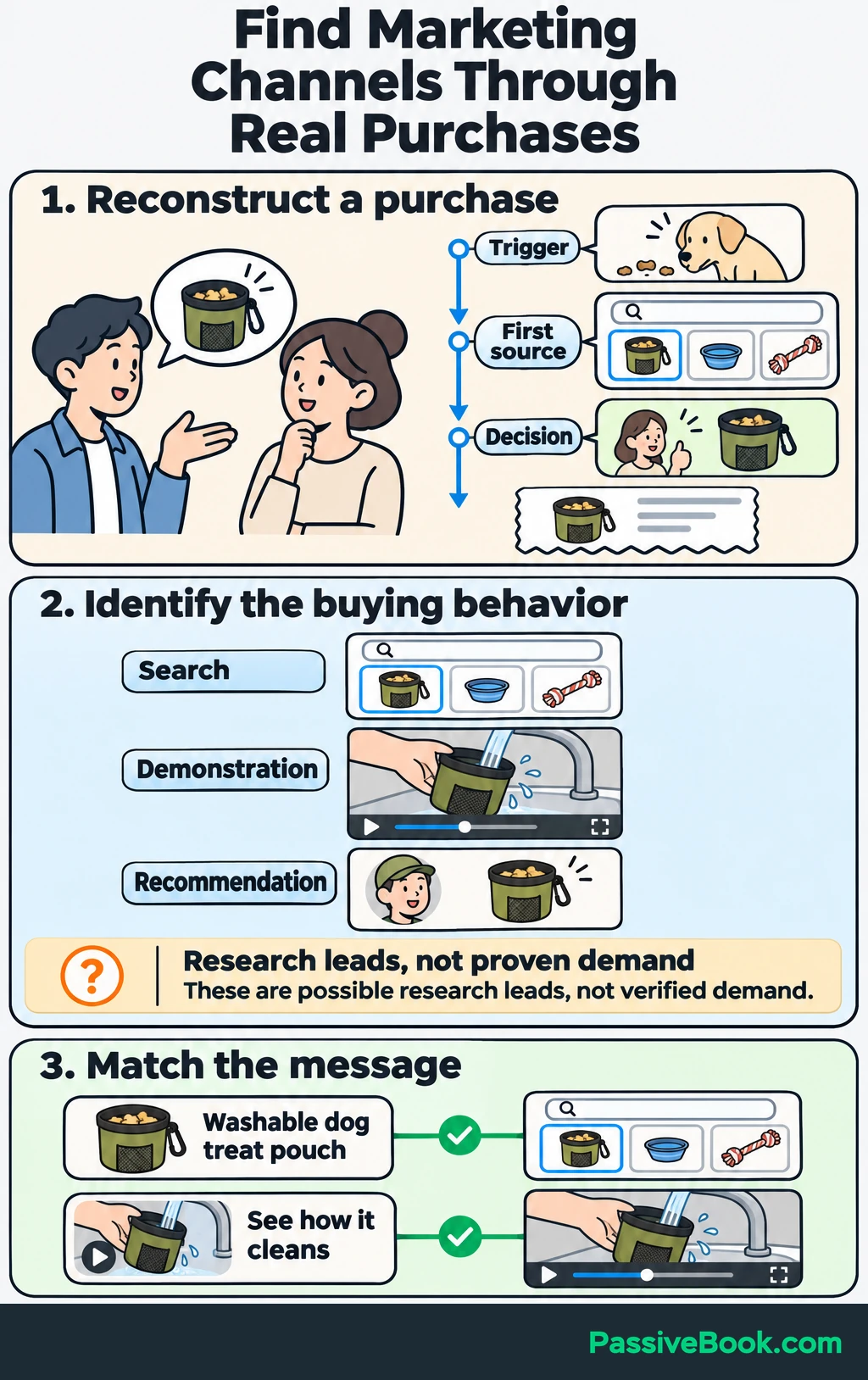
Ask about a recent purchase rather than asking which platform someone likes. A person can spend hours watching videos and still buy through a search or a recommendation.
Use questions that follow the purchase:
- What happened that made you look for this?
- Where did you look first?
- Which alternatives did you consider?
- Whose recommendation mattered?
- What helped you decide?
Check order feedback, inquiries and referral records for the same clues. If you have no customers yet, talk to prospective buyers and read relevant discussions, reviews and publications.
For the treat-pouch shop, investigate three possible behaviors:
- People searching for phrases such as “washable dog treat pouch.”
- People watching demonstrations of how a pouch opens, carries and cleans.
- People following recommendations from dog-walking publishers.
These are research leads, not verified demand.
The distinction matters because search can reach someone already looking for a solution, while a demonstration might introduce an option they had never considered. Those channels need different messages.
A search ad might say:
Washable Treat Pouch for Everyday Dog Walks
A demonstration could begin:
Here’s how the pouch looks after carrying soft treats—and how it cleans up.
Inspect competitors for useful questions and messages, but do not treat their activity as proof of profit. You can see an ad. You cannot see the advertiser’s margins.
For search, check estimates in the market you can actually serve. Google’s Keyword Planner forecasts use historical data and campaign settings to estimate traffic and costs. I would use those estimates to screen an opportunity, not to predict the shop’s sales.
Set Your Financial and Workload Limits
Calculate an Affordable Acquisition Cost
First, work out how much an order leaves before marketing. Count net sales after discounts and refunds, then subtract the costs that change with each order.
For the shop, assume:
| First-Order Item | Illustrative Amount |
|---|---|
| Net sales | $40 |
| Product, fulfillment, shipping, payment and variable servicing costs | $16 |
| Contribution before marketing | $24 |
| Target acquisition cost | $14 |
| Amount left toward fixed overhead and profit at that target | $10 |
The $24 contribution is not permission to spend $24 acquiring every customer. That would leave nothing from the first order for overhead or profit.
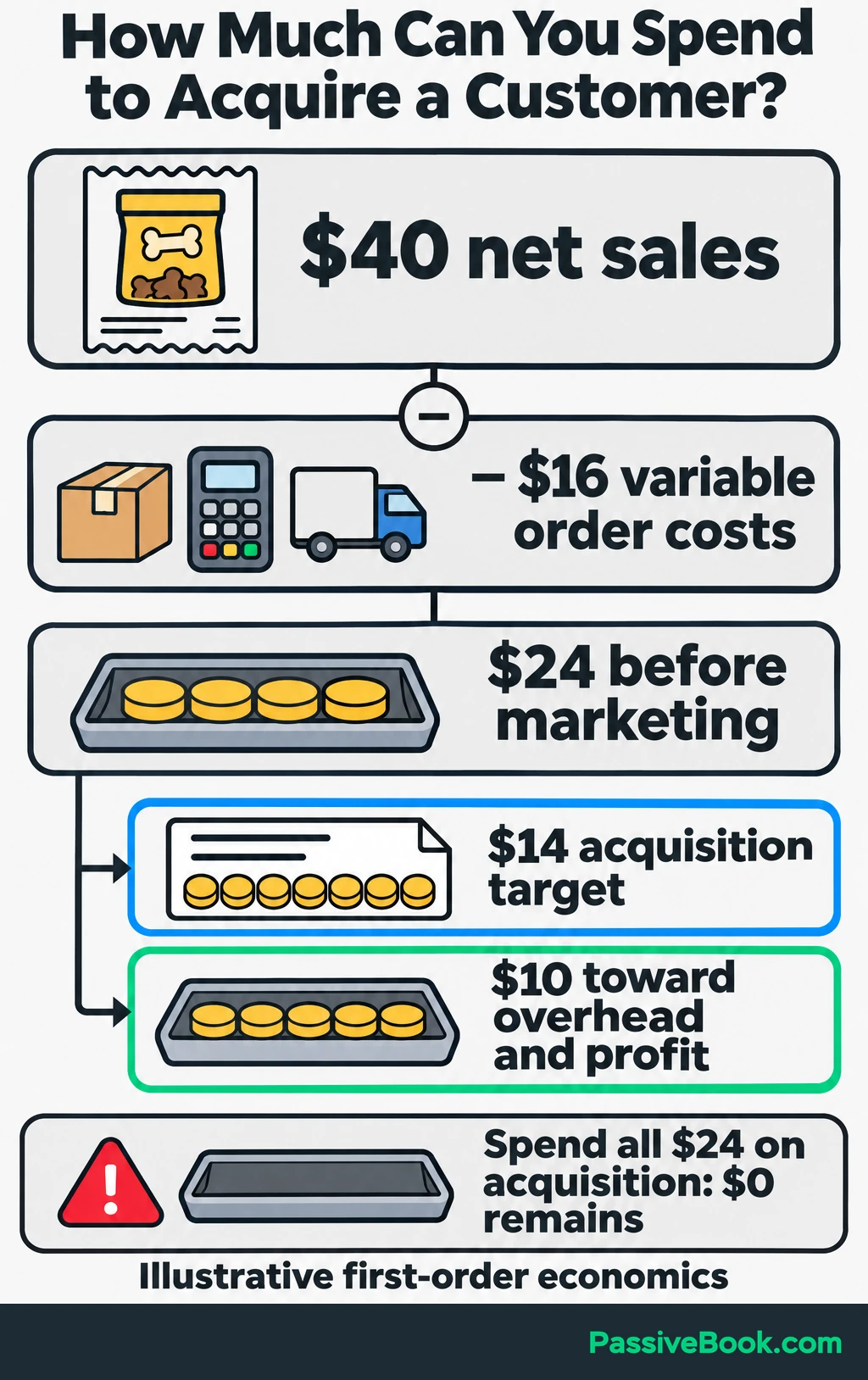
I would use the $14 target for this example and revisit it only when actual order economics justify a change.
Count advertising, paid creative, commissions, contractors and attributable tools in acquisition spending. Track your own hours separately, and use the same cost basis when comparing channels. A channel requiring ten unpaid hours deserves more scrutiny than one requiring two.
Start with first-order economics. Do not justify today’s loss with repeat purchases you have no records to support.
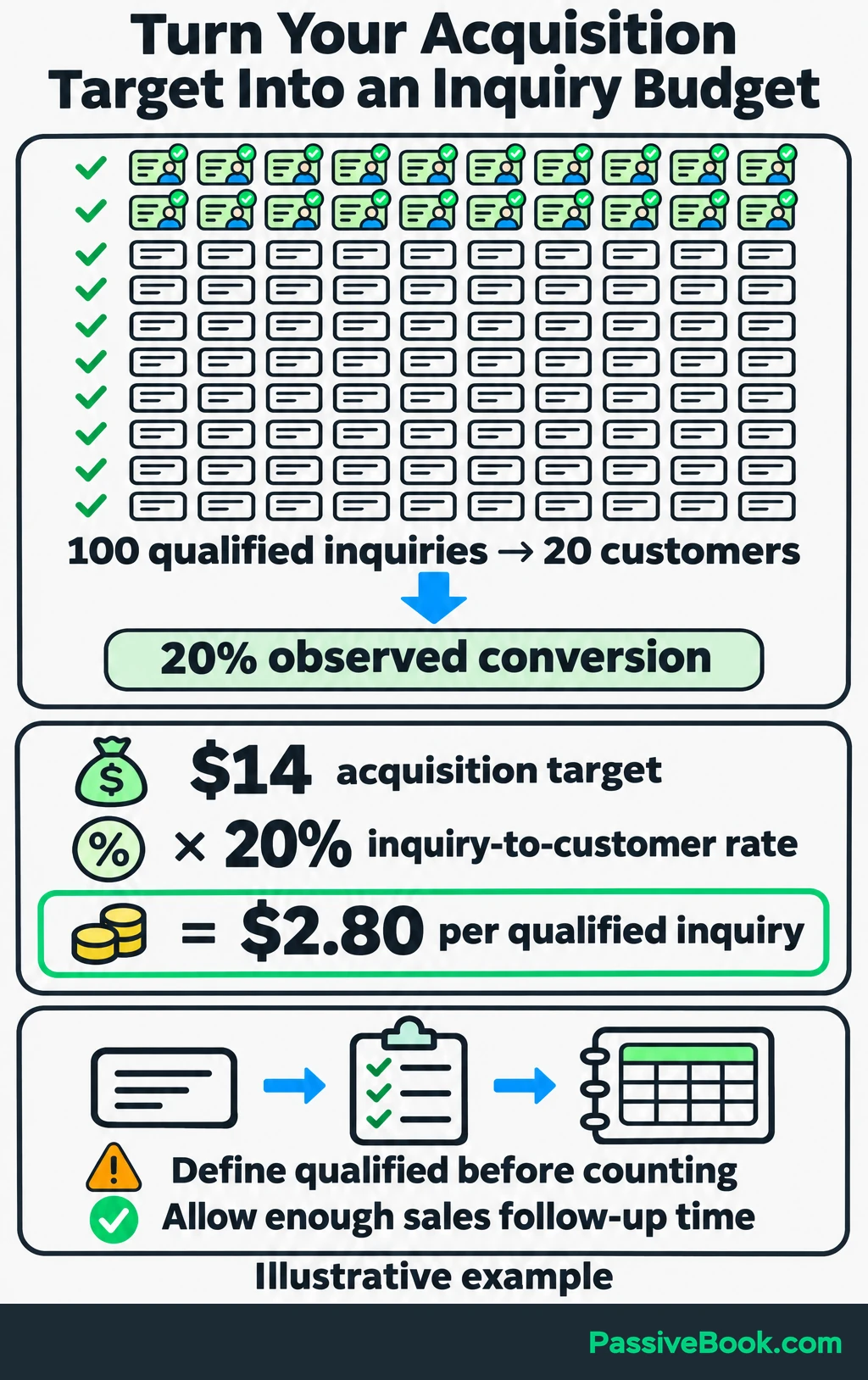
For a business that sells through inquiries, work backward from customers. If 20 of 100 qualified inquiries become customers after enough follow-up time, the observed conversion rate is 20%. A $14 acquisition target would then support a $2.80 cost per qualified inquiry:
$14 × 20% = $2.80.
Define “qualified” before counting. Otherwise, cheap inquiries can make the report look healthy while wasting your afternoons.
Check the Work You Can Sustain
Set three separate limits:
- Cash you can risk.
- Hours you can spend each week.
- Time you can wait for useful results.
Then list the actual work each channel needs. Video requires demonstrations and editing. Search content requires writing and updates. Partnerships require outreach, samples and follow-up.
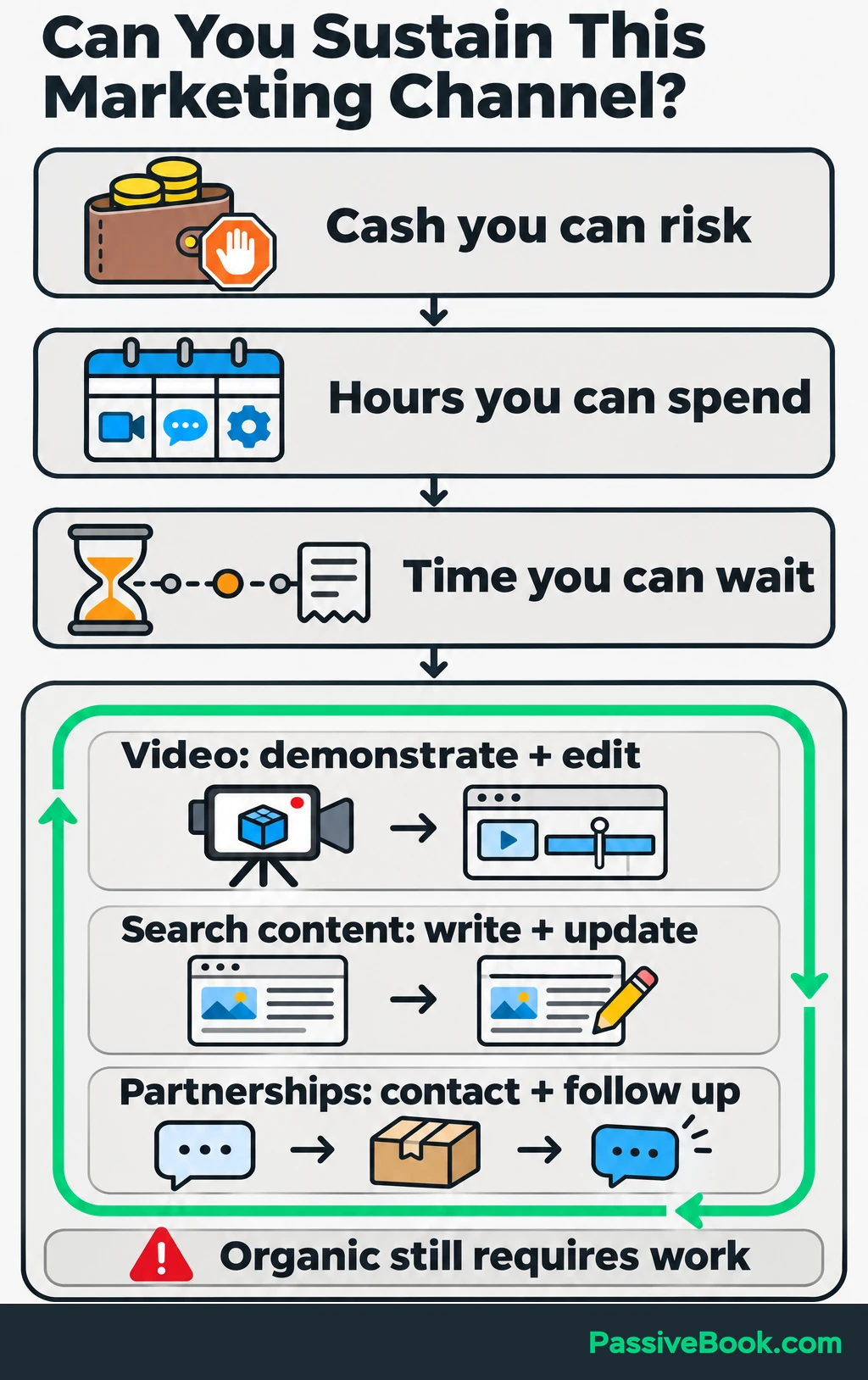
I would favor work you can reuse: a helpful product page, a demonstration or a referral relationship. Include the time needed to maintain it and the risk of losing traffic when a platform changes.
“Organic” describes how you reach people. It does not mean the work takes care of itself.
Compare Marketing Channels by the Job They Do
Compare channels against the goal, buyer behavior and limits you have already established.
Use this table to compare when each channel fits and what running it requires.
| Channel | When It Fits | Work Required | Cash Costs | Business Result to Track |
|---|---|---|---|---|
| Paid search and shopping ads | Buyers search for a product and compare offers | Prepare product pages and ads; supply product data for shopping ads. Review searches and orders. | Clicks, creative and setup help | First-time customers and acquisition cost |
| Organic search | Buyers research questions, products and alternatives | Write guides and product pages; update them and review search performance. | Writing, technical help and tools if needed | Customers and contribution from search |
| Organic social and video | Buyers discover products through demonstrations and relevant accounts | Make photos, graphics or demonstrations that lead to the offer; publish and respond. | Production and optional tools | Inquiries and purchases from relevant visitors |
| Paid social and display | Buyers discover an offer or return after an earlier visit | Prepare several ads and a matching page; monitor audiences and replace weak ads. | Advertising, production and replacements | Acquisition cost and customer quality |
| Partners, creators and referrals | Buyers rely on recommendations | Find partners, provide offer details or samples and follow up. | Fees, commissions and samples | Customers and contribution per partnership |
| Local discovery and offline outreach | Buyers choose through location or personal contact | Maintain listings, prepare demonstrations, attend events and follow up on inquiries. | Attendance, travel and printing | Qualified inquiries and resulting customers |
| Subscribers need help deciding or customers may buy again | Write useful messages and maintain offers and the permission-based list. | Delivery tools and list-building costs | Purchases and contribution from contacted subscribers |
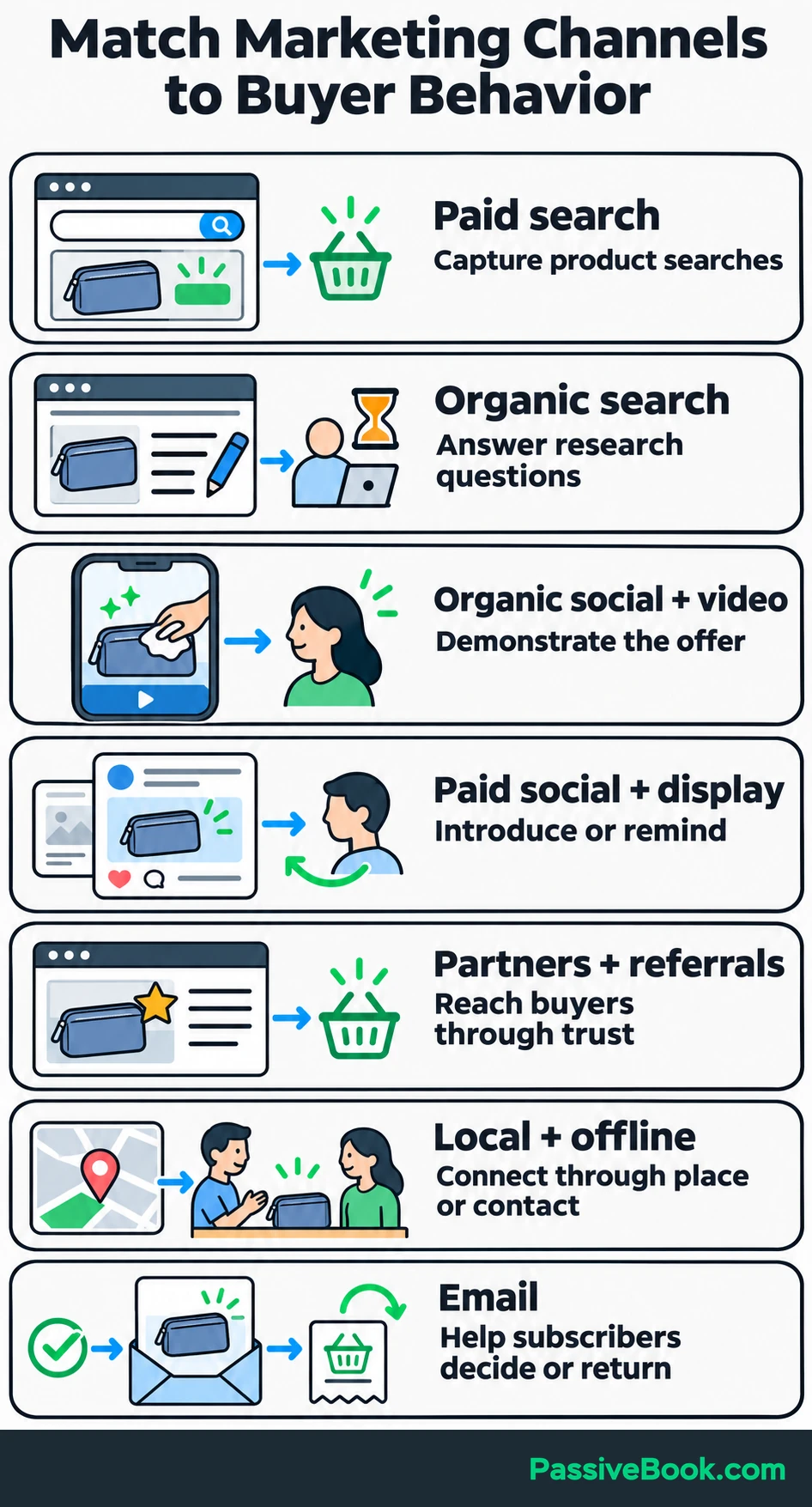
The time requirement is especially important for organic search. Google says changes can take hours to several months to appear in search results, and some changes bring no noticeable improvement. I would not judge a new search-content effort on a two-week sales deadline.
Compare substitutes serving the same outcome. Paid search and a publisher recommendation might both acquire first-time customers. Email can help those prospects decide, but an empty email list does not introduce your business to strangers.
Choose One Channel for Your Priority Goal
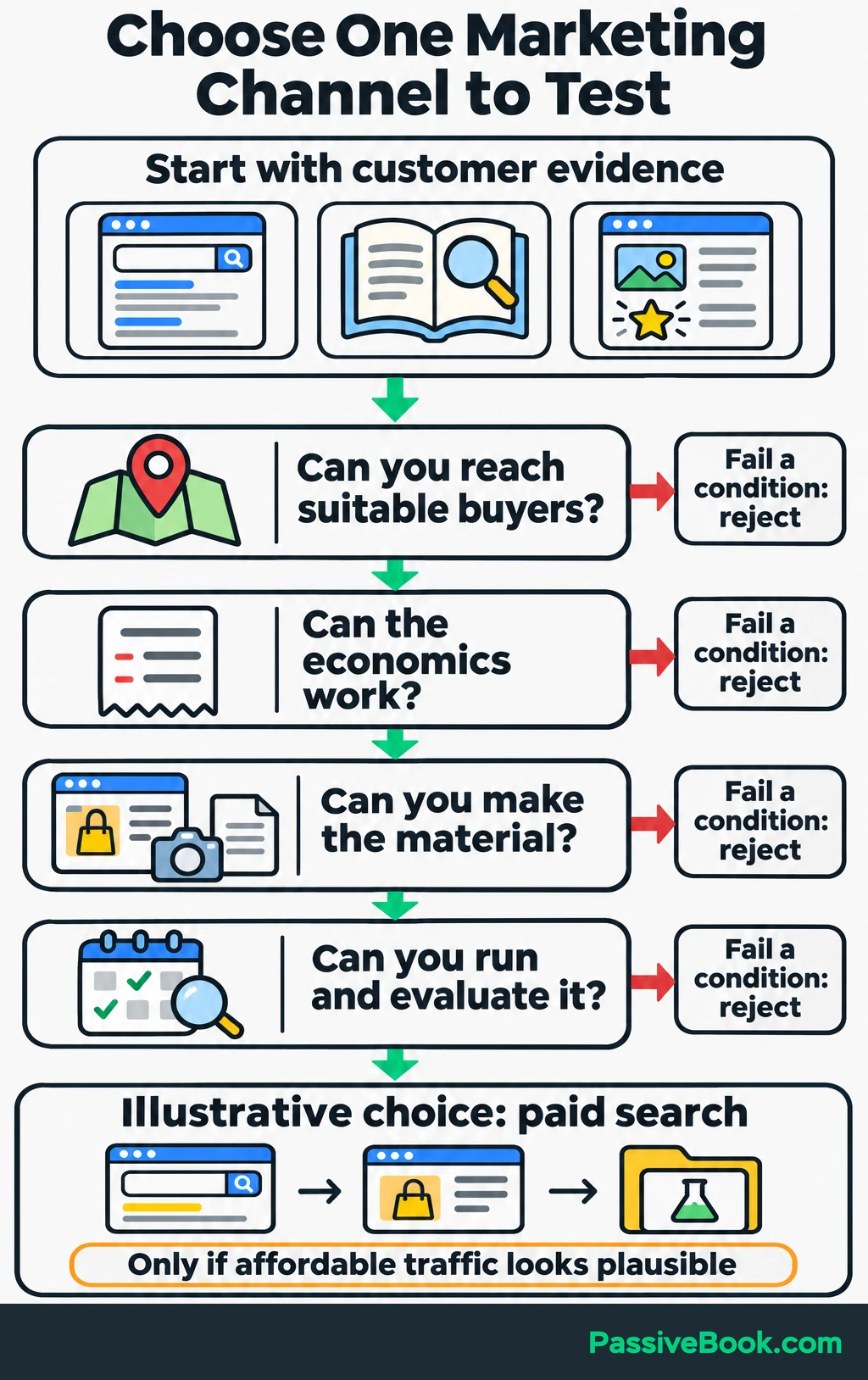
Shortlist a few candidates supported by customer evidence. Reject any that fail a necessary condition:
- You cannot reach suitable buyers.
- The likely costs conflict with your economics.
- You cannot produce the required material.
- You lack the time to run and evaluate it.
For the treat-pouch shop, suppose interviews point toward product searches and trusted walking-product recommendations. The shortlist might look like this:
| Candidate | Audience and Goal Fit | Cost and Workload Fit | Decision |
|---|---|---|---|
| Paid search | Strong: prospective buyers describe searching for this product type | Moderate: product page is ready, but click costs need checking against the acquisition target | First test if affordable traffic looks plausible |
| Organic search | Moderate: cleaning and product-choice questions could lead toward the pouch | Moderate: writing is manageable, but the shop needs sales feedback sooner | Keep for a longer review horizon |
| Publisher partnerships | Strong: prospective buyers mention trusted walking publications | Unproven: fees, sample costs and placement availability are unknown | Ask for terms before committing |
The words “strong” and “moderate” are useful because the reason sits beside them. A score of 8.3 would add decimal places, not knowledge.
Under these assumptions, I would choose paid search for the first test. Buyers describe relevant searches, the destination is ready, and estimated traffic costs can be checked before launch.
If paid traffic fails the cash limit, choose between content and a partnership using the customer evidence. I would start with one search-focused guide if buyers keep asking the same product question and you can wait for traffic. If buyers name a trusted publisher, ask about fees, sample costs and timing for a small placement. Either option must fit your available hours.
At Passive Book, blogging and Pinterest are the active channels, and Pinterest brings meaningful referral traffic. That is my experience with this business. I would still check buyer behavior before recommending that combination elsewhere.
Keep effective existing activity running. Focus the new experiment on one primary channel and the purchase or follow-up support it needs.
If two channels still look plausible, the planner below shows what each would need to deliver within your limits. It also separates a test you can afford from one that works only if your assumptions are optimistic.

Free Marketing Campaign Planner




Design a Bounded Channel Test
Write the Test Before Committing Resources
Write down what you will test, what it can cost and what evidence would justify another round. A spreadsheet or short document is enough.
For the shop, the plan could be:
| Decision | Illustrative Test Plan |
|---|---|
| Audience | People searching for washable treat pouches within the shop’s delivery area |
| Offer and destination | One pouch on its product page, with photos, cleaning information and delivery terms |
| Channel | Paid search focused on relevant product searches |
| Goal | First purchases at an acquisition cost below $14 |
| Cash cap | $240 total: $180 advertising and $60 paid creative |
| Owner-time cap | Eight hours across setup and two weeks of operation |
| Review timing | Stop traffic after two weeks or before exceeding the cash cap; allow seven days after the last click for purchases |
| Decision rule | Continue if the target is met and workload fits; fund a revision only to test a specific weakness |
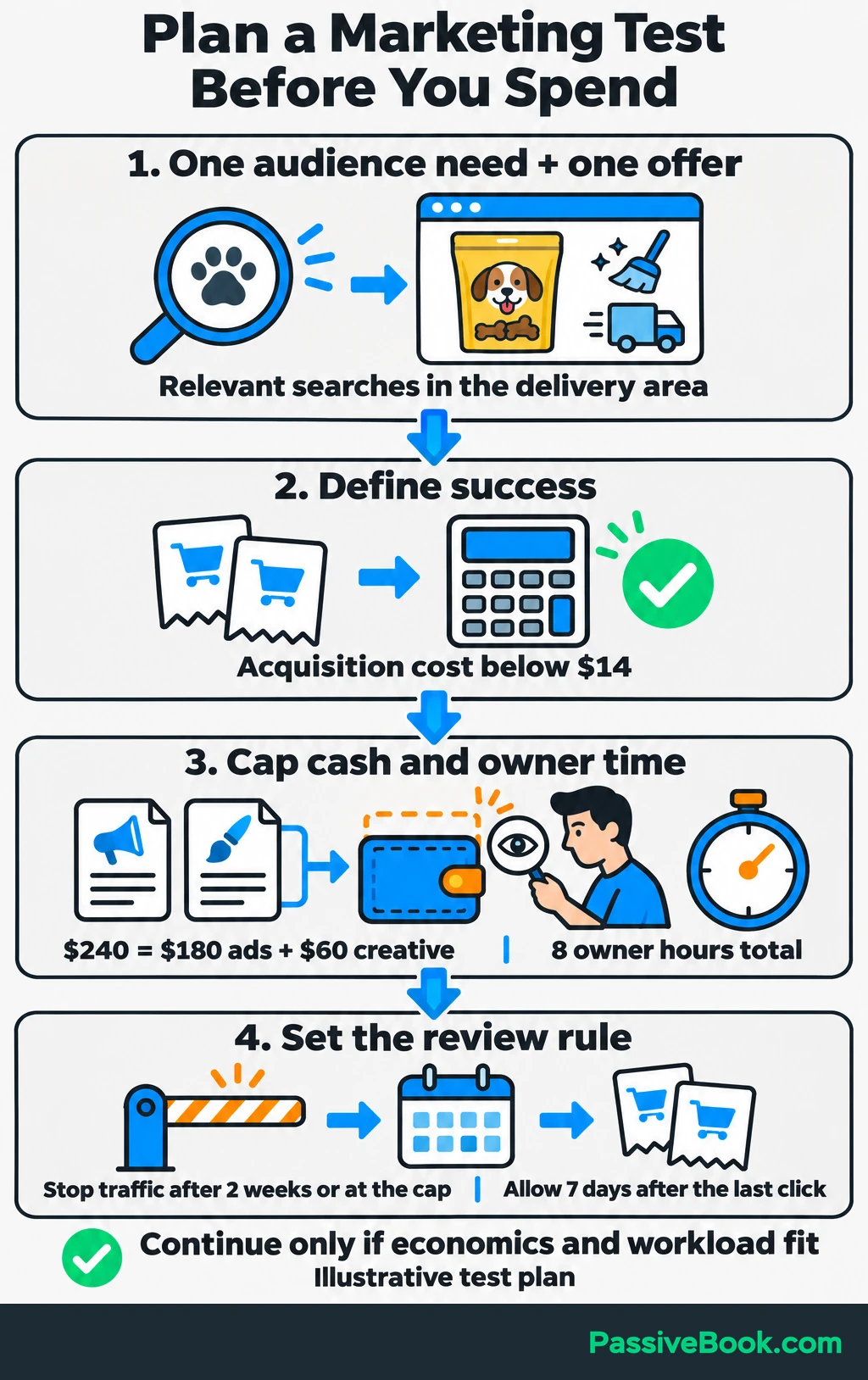
A small test gives an early signal; acquisition cost may change as you spend more.
Before committing, estimate how many ad clicks the $180 advertising budget buys and how many produce first-time customers within seven days. The purchase rates below are assumptions, not benchmarks.
| Assumed Cost per Click | Estimated Clicks | New Customers at 2% | New Customers at 5% |
|---|---|---|---|
| $0.50 | 360 | About 7 | 18 |
| $1.00 | 180 | About 4 | 9 |
Including the $60 creative bill, the shop needs at least 18 new customers to bring acquisition cost below $14. At $0.50 per click, 5% of 360 clicks produces 18 customers; 2% produces only about seven.
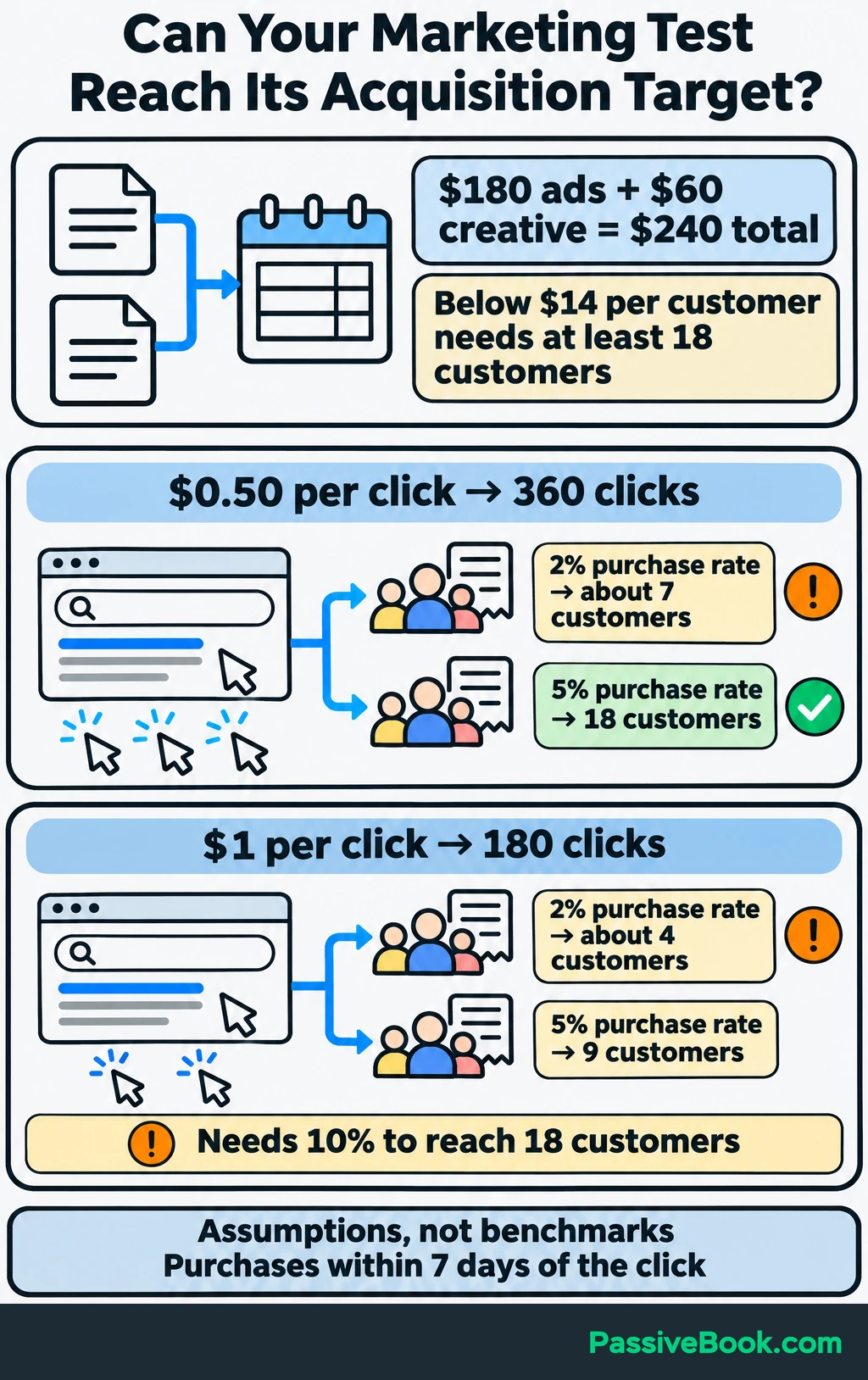
At $1 per click, the shop would need 10% of 180 clicks to produce new customers. I would not fund that version without evidence supporting the higher purchase rate or better order economics. A smaller check of buyer interest or the product page may be more useful.
Keep the test to one audience need, one offer and a manageable set of messages.
Also check how the platform controls spending. An average daily budget is not necessarily a daily ceiling: Google’s spending rules allow higher spending on individual days for most campaigns. Monitor cumulative costs and allow room for that variation before reaching your cap.
Connect Activity to Actual Business Results
Before sending traffic, complete a test purchase on your phone. Check the offer, delivery information, payment process and confirmation.
Then connect visits to orders using campaign-tagged links, partner codes or an inquiry log. Record:
- Acquisition spending and owner hours.
- First-time customers and their order IDs.
- Net sales, refunds and variable order costs.
- Qualified inquiries and the sales they eventually produce.
Decide which channel gets credit when a buyer uses several. For example, credit the last recorded marketing channel visited in the seven days before a first purchase, ignoring later visits through a bookmark or typed web address. Use that rule consistently and note any tracking gaps.
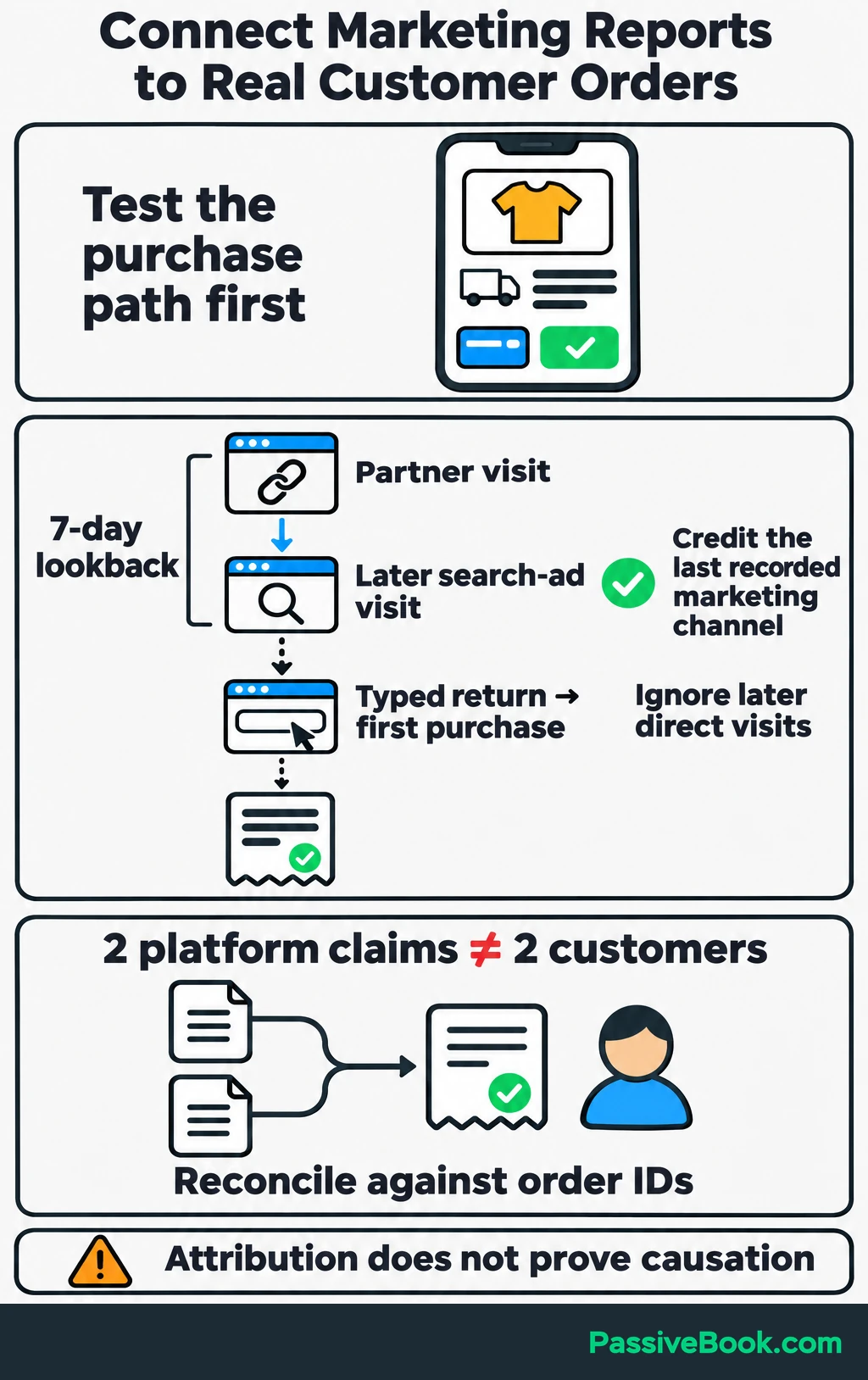
Reconcile reports with actual orders. If two platforms claim the same customer, your business still acquired one customer.
Before enabling advertising trackers, check consent requirements for the people you serve. For UK users, the ICO requires consent for storage and access technologies used for online advertising, including associated tracking.
Treat the final figures as attributed channel performance. A report giving an ad credit for a purchase does not establish that the ad caused every credited sale.
Decide Whether to Continue, Improve or Stop
Calculate Acquisition Cost and Marketing Return
Use spending and first-time customers from the same test after its purchase window closes. Acquisition cost is total acquisition spending divided by the number of those customers.
For marketing return, subtract variable order costs and marketing spending from attributed net sales. Divide what remains by marketing spending and multiply by 100 to get the contribution-based marketing ROI used here.
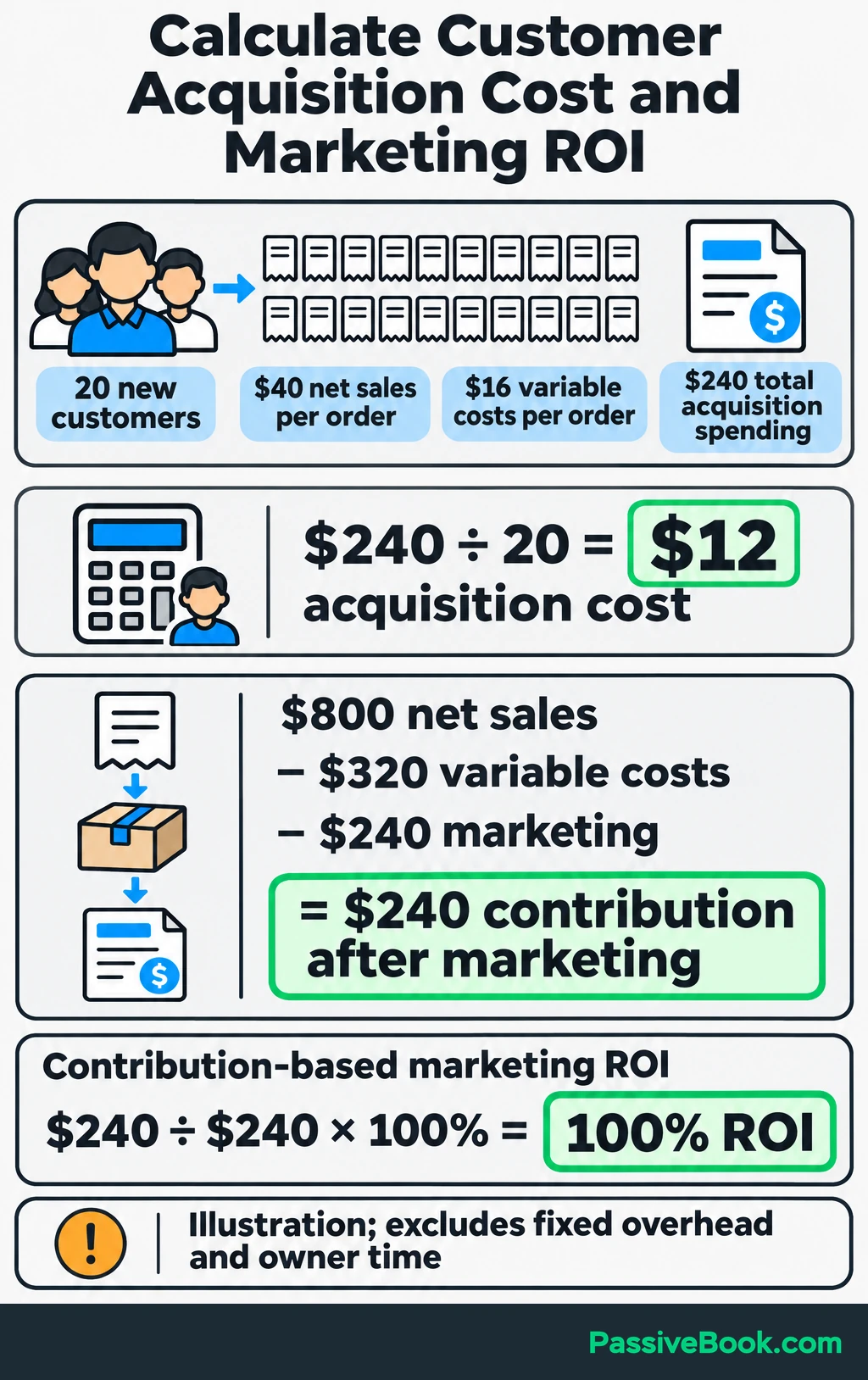
Suppose the shop spends its full $240 and acquires 20 customers. Each places one order with $40 net sales and $16 variable costs.
| Measure | Calculation | Result |
|---|---|---|
| Net sales | 20 × $40 | $800 |
| Variable order costs | 20 × $16 | $320 |
| Contribution before marketing | $800 − $320 | $480 |
| Acquisition cost | $240 ÷ 20 | $12 |
| Contribution after marketing | $480 − $240 | $240 |
| Contribution-based marketing ROI | $240 ÷ $240 × 100% | 100% |
Revenue-based return on ad spend (ROAS) compares attributed sales revenue with advertising spending. Here, $800 ÷ $180 gives about $4.44 in revenue per dollar of ads.
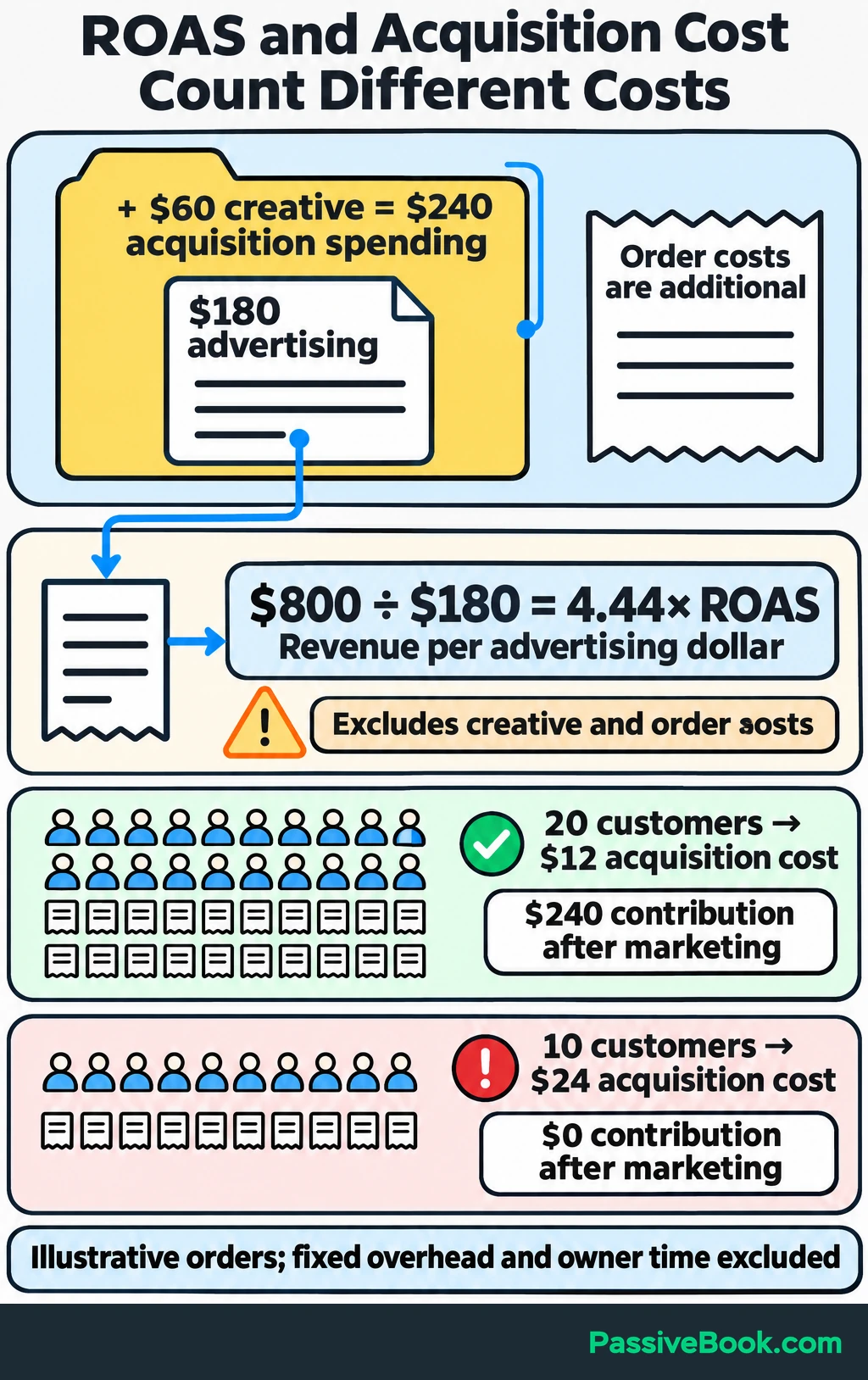
That excludes the $60 creative bill and order costs. I would use acquisition cost and contribution to make the spending decision.
With only ten customers placing the same orders, acquisition cost becomes $24 and contribution after marketing falls to zero. Neither contribution result includes fixed overhead or a value for the owner’s time, so neither is net business profit.
Use the Result to Choose Your Next Action
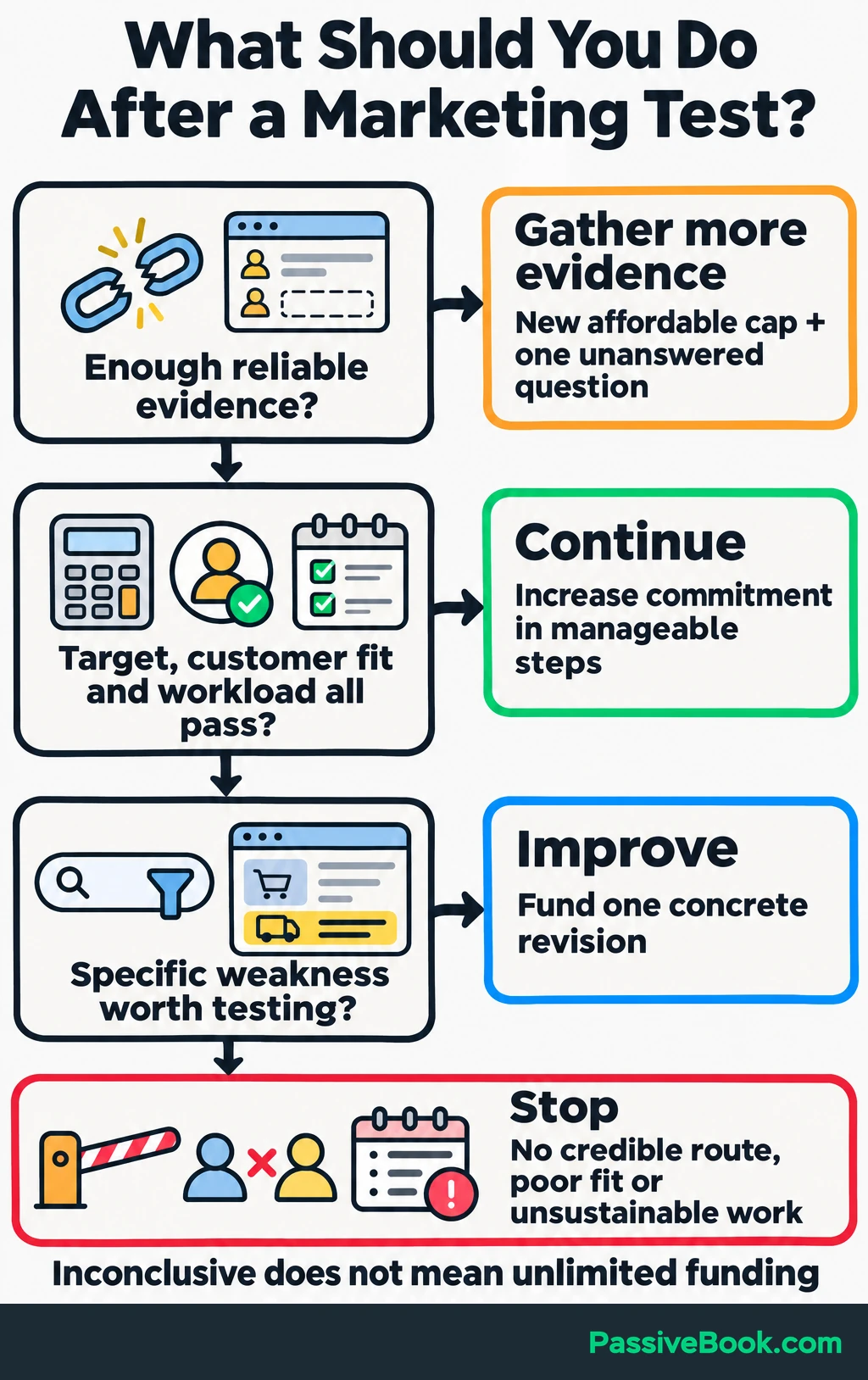
Choose the next action from the financial result, customer fit and workload together.
- Continue: The channel meets the acquisition target, attracts suitable customers and fits your available hours. Increase commitment in manageable steps and check whether additional spending produces similar economics.
- Improve: You can identify a specific weakness worth testing. Irrelevant searches suggest a targeting problem. Suitable visitors leaving without buying suggest questions about the offer, delivery terms or purchase process.
- Stop: The cap is reached without a credible route to the target, customers are a poor fit or the recurring work exceeds your capacity.
- Gather More Evidence: Tracking failed or too few suitable visitors arrived to judge the result. Extend only with a new affordable limit and a specific unanswered question.
An inconclusive test does not earn unlimited funding. It means you cannot make the judgment you planned to make.
Keep a short decision log with the hypothesis, costs, hours, results and next action. Write “test clearer delivery information” rather than “optimize campaign.” The first gives you something concrete to do.
Add another channel when it fills a clear gap and the existing work is manageable. Reuse useful photos, demonstrations and customer answers, then automate repeatable reporting or distribution once the process works.
I would rather maintain one channel that pays its way than supervise five that keep asking for content.
What Next?
Write down one business outcome, your maximum acquisition cost and the weekly hours you can spare. Use those limits to shortlist three channels and choose one bounded test.
Use the social buttons to share this guide when a marketing discussion needs a clearer spending decision.
Which channel looks strongest for your business, and what evidence would change your mind? Leave your answer—or any other questions—in the comments.
Share this post with your friends & followers:

