Your ads are getting clicks, but you can’t tell which campaign deserves another dollar. Several audiences overlap, each ad points somewhere different, and the budget keeps moving.
That makes even a small advertising test hard to judge. When sales disappoint, you need to know whether to change the targeting, the offer, or the spending—not rebuild everything because the report looks confusing.
A useful campaign structure gives each part a clear job. This guide shows how to connect your goal, audience, ads, budget, and tracking in one campaign map you can actually manage.
Understand the Campaign Hierarchy
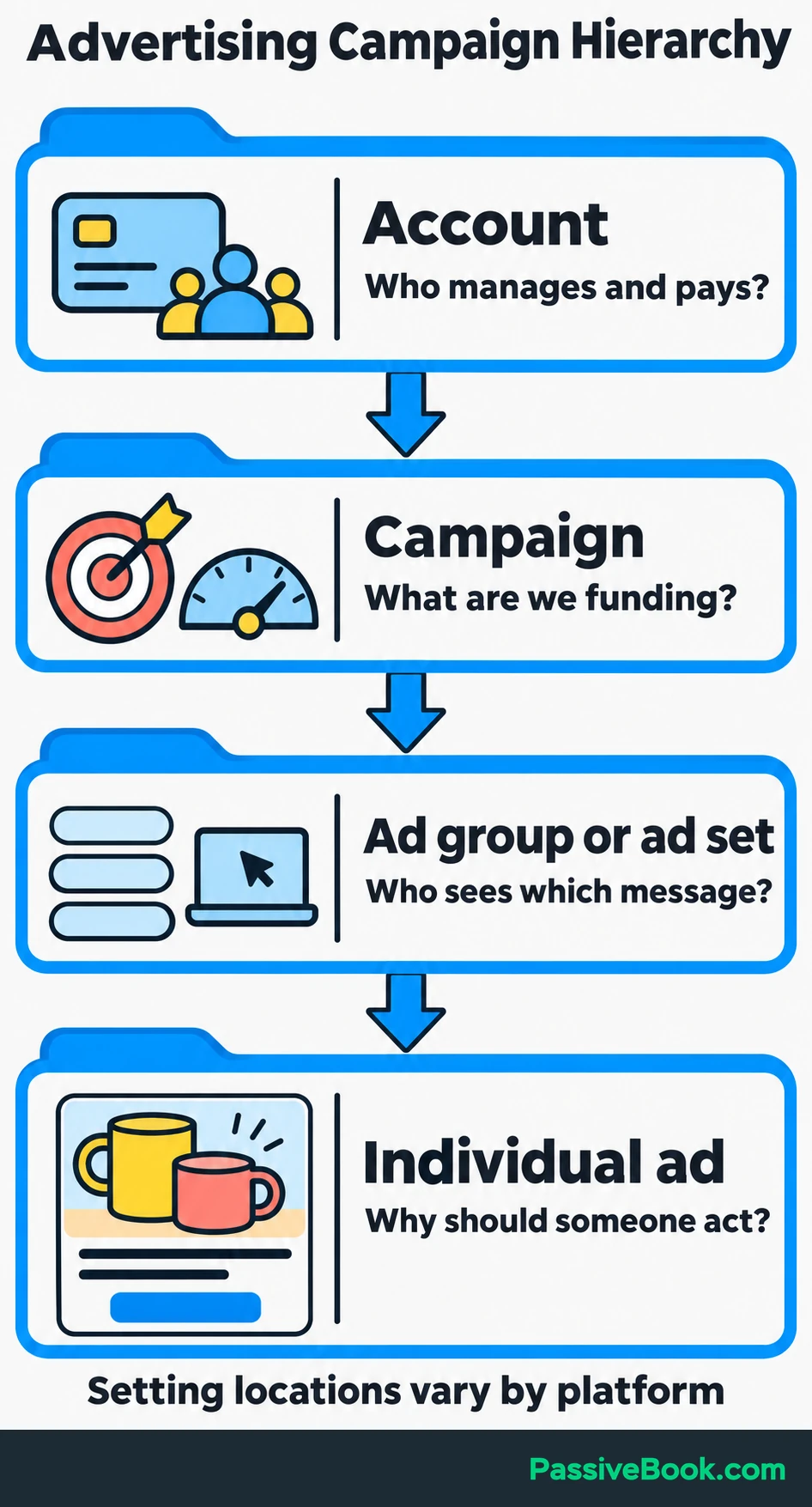
Start with this common planning structure:
Account
└── Campaign
    └── Ad group or ad set
        └── Individual ads
Each level answers a different question:
| Level | What belongs here | The decision it supports |
|---|---|---|
| Account | Business access, billing, and administrative details | Who manages and pays for advertising? |
| Campaign | A major advertising job and its spending or delivery controls | What are we funding? |
| Ad group or ad set | Related targeting and ads | Who should see which message? |
| Ad | The text, image, or video people see | What gives them a reason to act? |
In Google Ads Search campaigns, ad groups contain related keywords and ads. Budgets and geographic targeting are set at the campaign level.
Other platforms and campaign types place controls differently. Use the hierarchy to plan your decisions, then check where your chosen platform puts each setting.
Throughout this guide, imagine you run an online shop selling ceramic mug sets. Its budgets, economics, copy, and results are illustrations, not benchmarks or reported performance.
1. Define the Outcome and Affordable Acquisition Cost
Choose the business result before choosing a platform objective.
Write a sentence that names what should happen and how you will recognize it:
“Generate completed purchases of ceramic mug sets, measured through confirmed orders.”
A product-page visit helps explain the journey, but it is not a purchase. Keep add-to-cart events and checkout starts as supporting signals so they don’t inflate your sales count.
Next, work out what you can afford to spend.
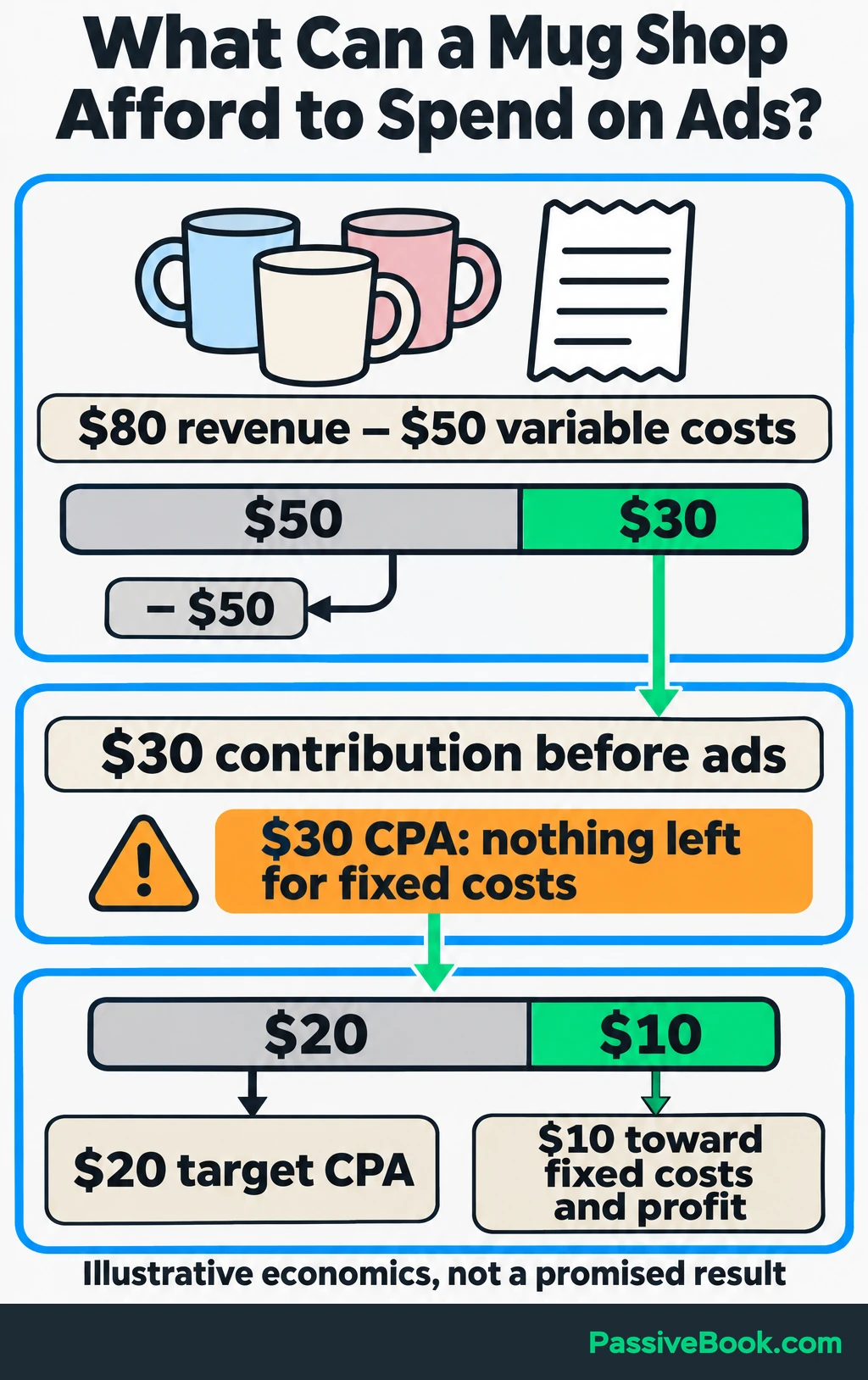
Start with the money left from an order after costs that change when you make that sale. Include the product, packing, fulfillment, payment fees, shipping you cover, and an allowance for returns.
| Mug-shop order economics | Illustrative amount |
|---|---|
| Net order revenue | $80 |
| Variable costs | $50 |
| Contribution before advertising | $30 |
| Target advertising cost per purchase | $20 |
| Left toward fixed costs and profit | $10 |
Cost per acquisition, or CPA, is what you spend on advertising to produce one completed acquisition. Here, that acquisition is a purchase.
The $30 contribution is the first-order break-even point before fixed costs. I would choose a lower target, such as the illustrated $20, because reaching advertising break-even does not pay the rest of the bills. This target is a business limit, not a promise that the platform can deliver purchases at that cost.
I lost most of the roughly $1,200 I put into my online jewellery store after skipping market research. I had inventory, but I hadn’t done enough work to establish demand. That experience is why I check demand and economics before funding another experiment. A campaign diagram cannot rescue an offer people don’t want.
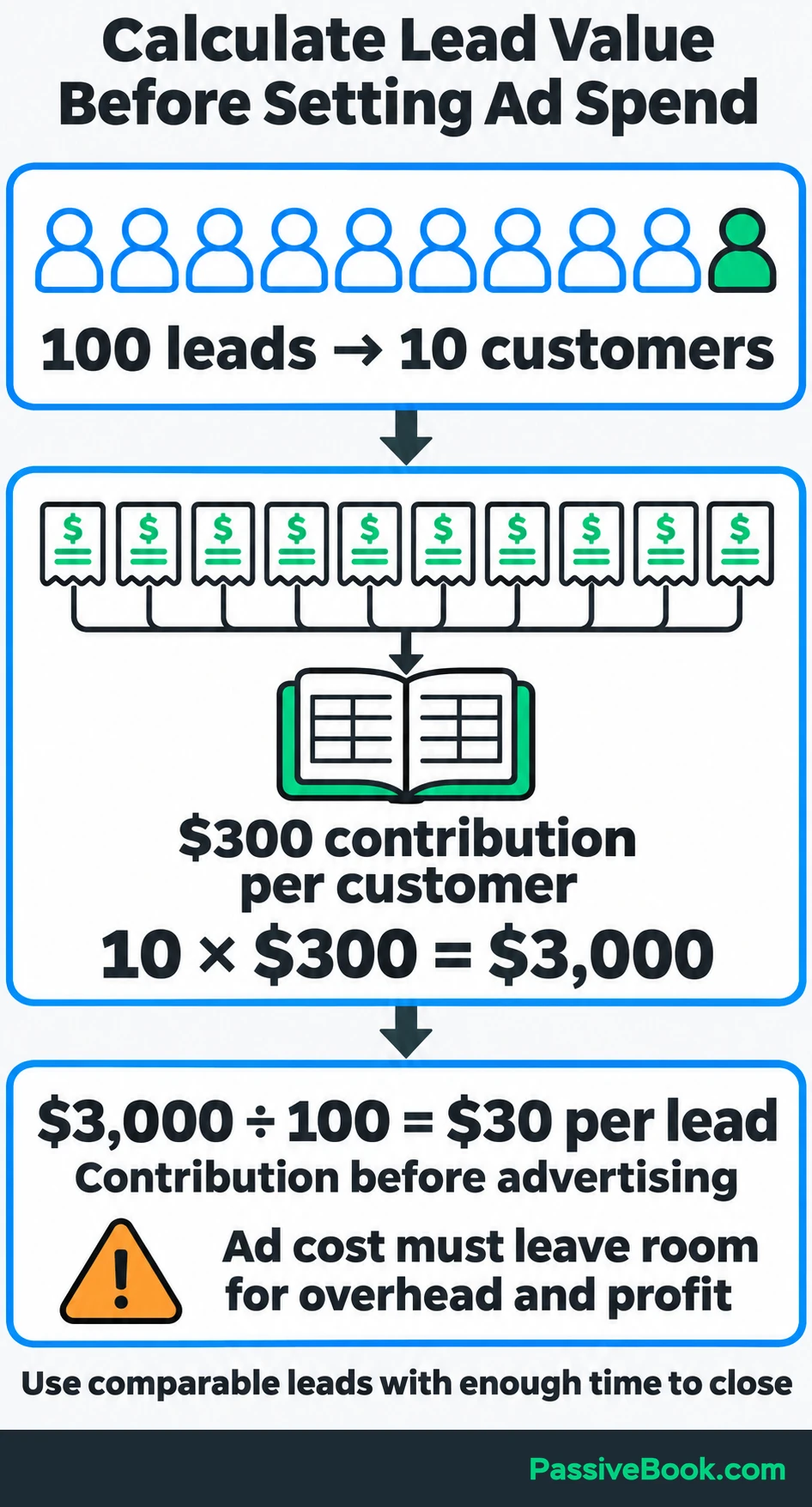
For lead generation, connect leads to customers. If contribution per customer is $300 and 10 of 100 comparable leads became customers after enough time to close, each lead produced an average of $30 in contribution before advertising. Your affordable cost per lead must leave room for overhead and profit.
Until you’ve measured how many leads become customers, cap the test at an amount you can afford to lose. Cheap form submissions alone do not establish profitability.
2. Choose the Audience and Initial Channel
Describe the buying situation before adding demographic filters.
Answer four questions:
- What does the person need?
- What might prompt them to buy now?
- Where can you serve them?
- Have they bought from or interacted with you before?
Use orders, inquiries, and customer conversations to make those answers concrete. “People buying a matching mug set for their kitchen” gives you more to work with than “adults who enjoy lifestyle products.”
Then choose a channel whose job fits that situation.
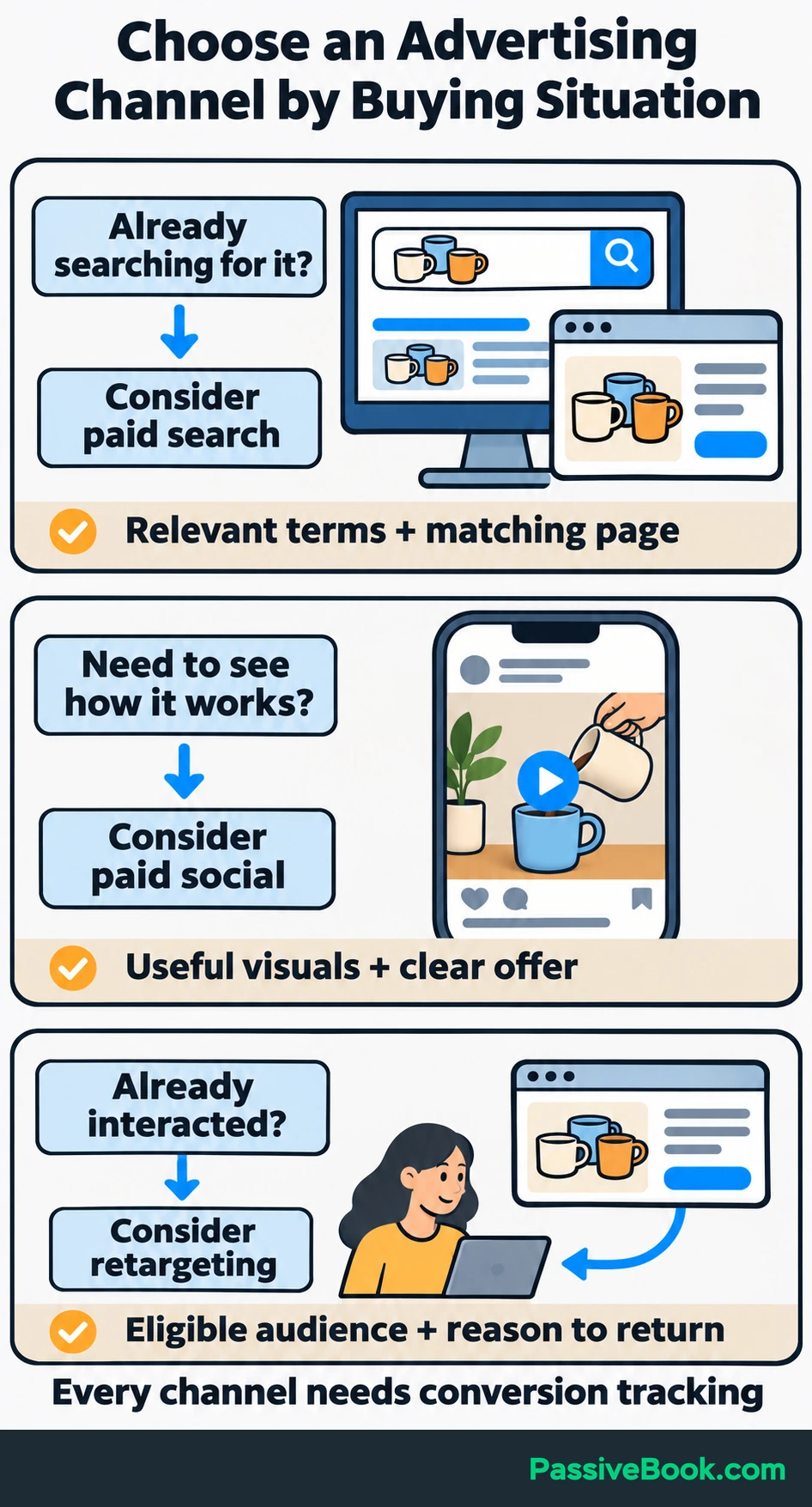
| Starting condition | Channel I would consider | What you need ready |
|---|---|---|
| People search for the product or service directly | Paid search | Relevant search terms, a matching destination, and conversion tracking |
| The offer needs showing or demonstrating | Paid social | Useful images or video, a clear offer, and conversion tracking |
| You want to reach previous visitors again | Retargeting | An eligible audience and a specific reason to return |
For the mug shop, start with Search to reach people looking for ceramic mug sets. Check whether relevant searches exist, send visitors to the matching product page, and restrict delivery to places you can ship profitably.
I would start with one channel while the budget is small. Adding another platform also adds creative work, tracking checks, and another report to interpret.
Recognize new prospects, previous visitors, and existing customers in your plan. Give them separate structures when their offers, messages, exclusions, or spending controls need to differ.
3. Build the Campaign Map
Separate Campaigns When Independent Controls Are Necessary
Create another campaign when you need to control something independently.
That could mean a different objective, a protected budget, another market, or delivery settings that cannot be shared. Google specifically identifies different budgets and location targeting as reasons to separate campaigns. Its campaign organization guidance also recommends grouping related keywords and ads around a focused theme.
Start the mug shop with one purchase-focused Search campaign.
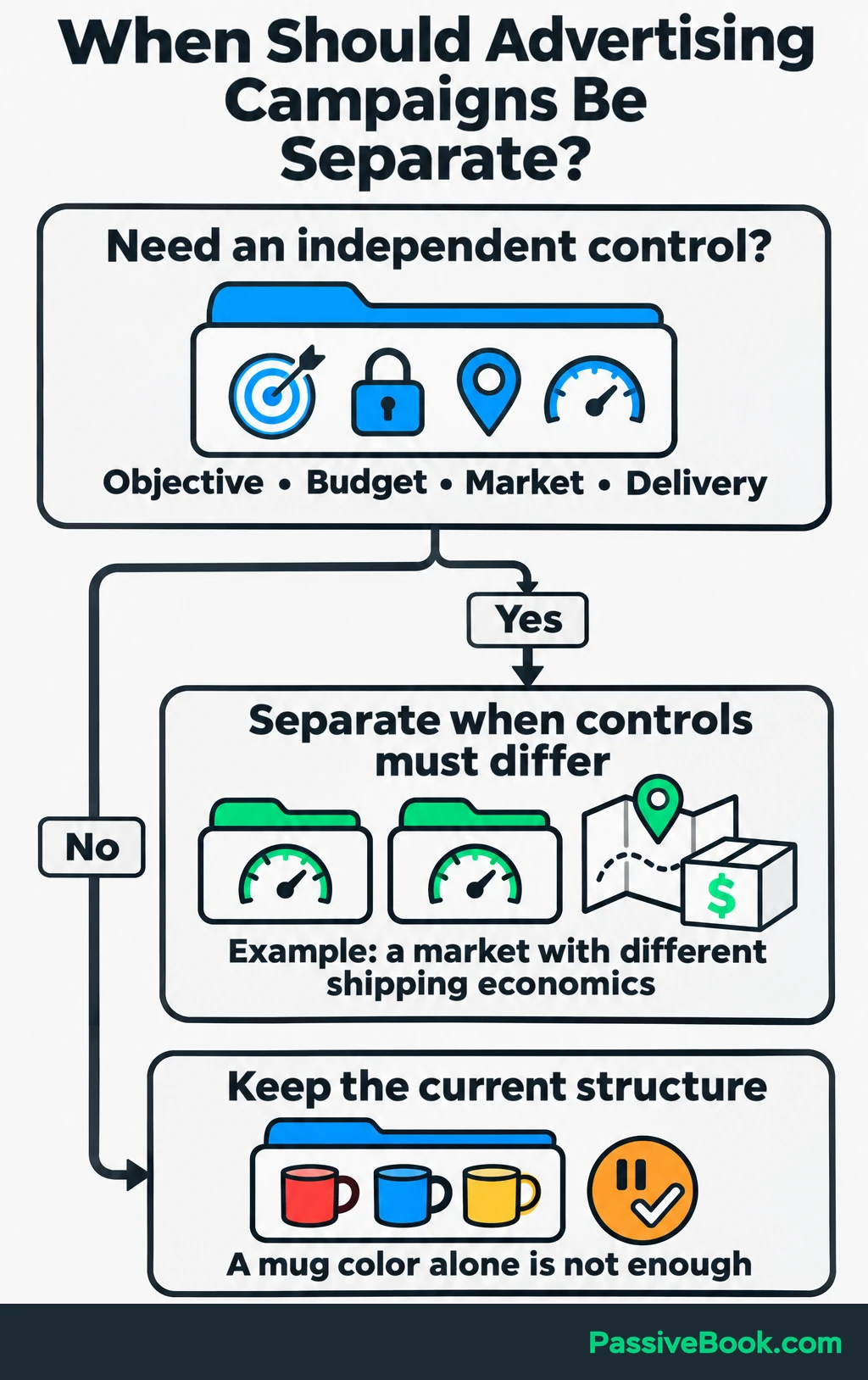
A second market might deserve its own campaign if shipping costs change the affordable CPA or you need to reserve money for that location. A different mug color usually does not.
Before adding a campaign, finish this sentence:
“This needs its own campaign because I must independently control ______.”
If you cannot fill the gap, keep the existing structure for now.
Group Targeting Around a Shared Message and Destination
Within each campaign, group targeting that can share a useful message and landing page.
For Search, these phrases can belong together:
- “ceramic mug set”
- “ceramic coffee mug set”
- “matching ceramic mugs”
They describe closely related buying intent. You do not need an ad group for every wording variation.
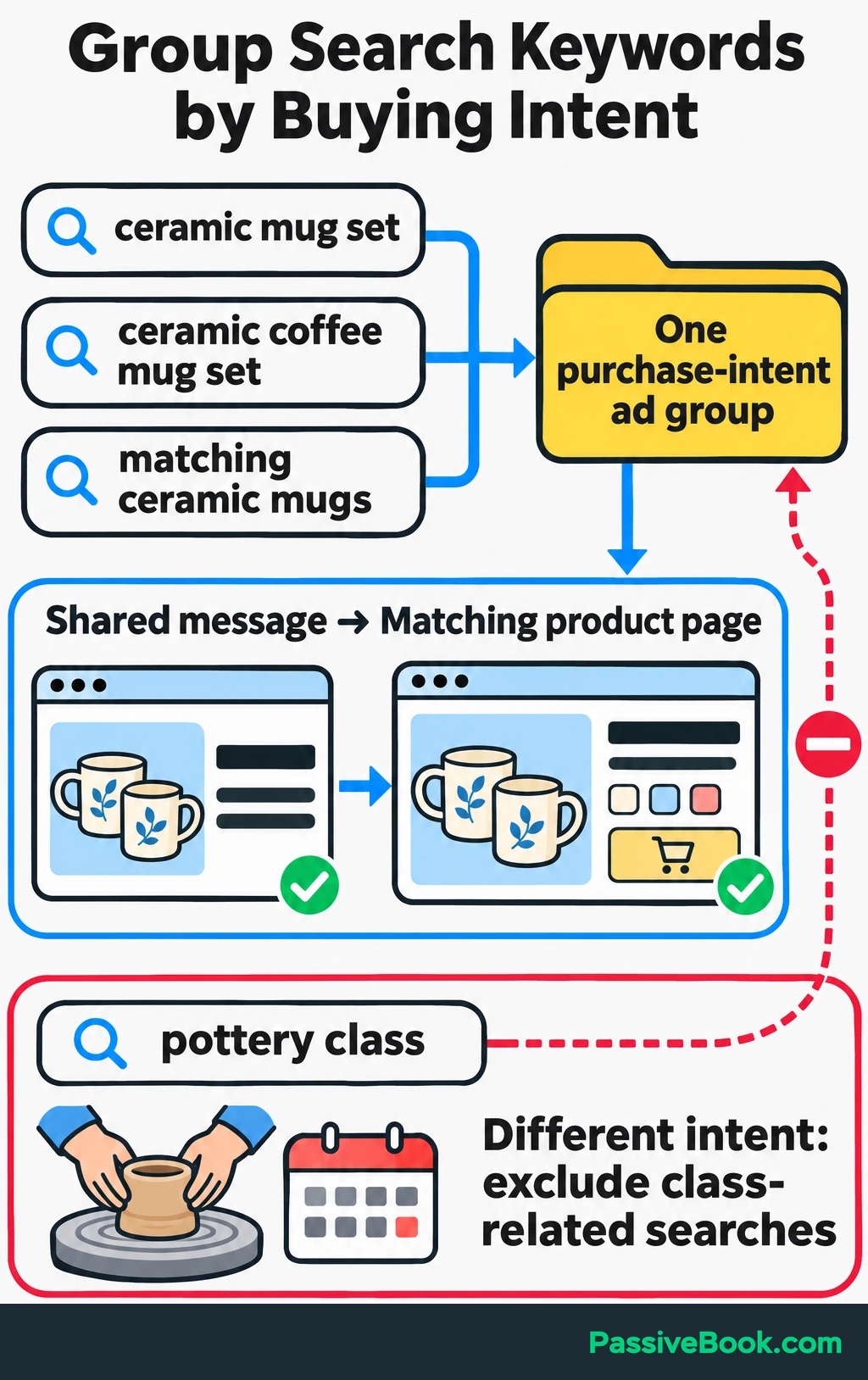
A search for a pottery class is different: the person wants to make a mug. For this shop, exclude class-related searches with negative keywords—terms that prevent ads from appearing for unwanted searches.
For audience-based advertising, use the same decision rule: separate groups when targeting, delivery settings, or a deliberate test requires separate treatment. Routine image and headline variations can stay together.
Prospecting reaches potential new customers. Retargeting addresses previous interactions. Retention encourages existing customers to buy again. These are useful jobs to identify, but they do not automatically require three campaigns and three budgets.
Record One Complete Path From Goal to Conversion
Put your decisions in a spreadsheet before building the campaign.
You can use one row per targeting group. The example below is shown vertically so the full path is easy to read.
| Map field | Mug-shop entry |
|---|---|
| Platform | Google Ads, Search |
| Campaign | Mug Sets | Purchases | Search |
| Business outcome | Sell ceramic mug sets |
| Conversion action | Confirmed purchase with order value |
| Market | Contiguous US, assuming the shop serves that area |
| Targeting group | Ceramic mug set purchase-intent keywords |
| Exclusions | Unserved locations and irrelevant searches, such as pottery classes |
| Media allocation | $600 total test allocation; spending setup covered below |
| Ad concepts | Gifting and everyday coffee |
| Landing page | Product page for the advertised ceramic mug set |
| Success criterion | Completed purchases at or below $20 CPA, checked against order economics |
| Review boundary | First review on day 7, then weekly; end by day 30 or the spending boundary |
| Owner | Shop owner monitors spending and reviews results |
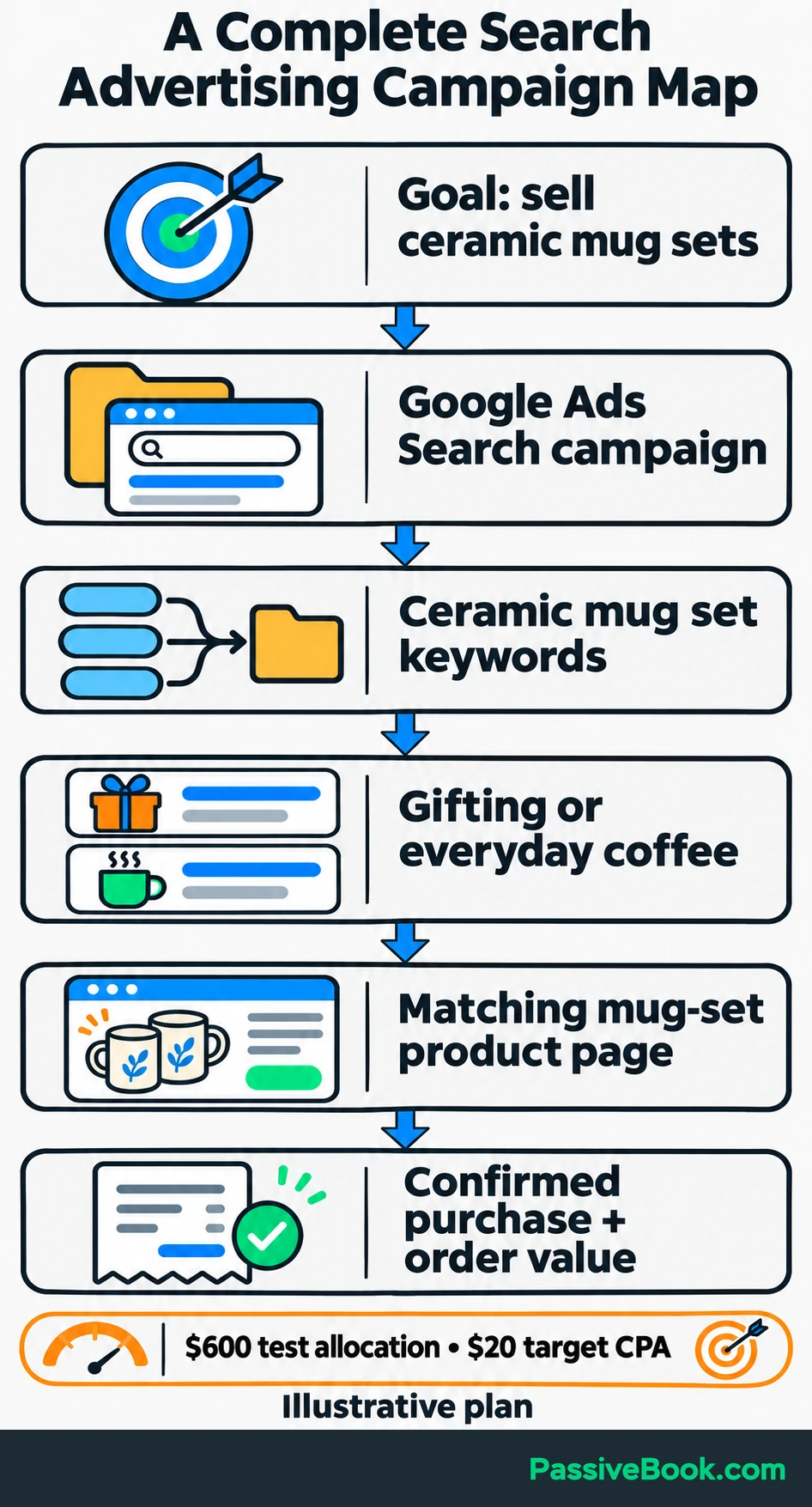
The path is simple:
Purchase goal
→ Search campaign
→ Ceramic mug set keyword group
→ Relevant ad
→ Matching product page
→ Confirmed purchase
Use descriptive names for groups and creative versions, such as Ceramic Sets and Gift v1. Record why each division exists so a later cleanup does not remove a useful control.
If translating your offer into this map is the hard part, the AI Campaign Planner can draft it with you. It also writes matching ad concepts so you can check the whole path before building the campaign.

Free AI Campaign Planner




4. Allocate a Budget the Structure Can Support
Choose a total media allocation you can afford to lose before dividing it.
Keep production costs separate. Photography, design, and outside help still cost money, even though they do not appear in the advertising-spend column.
Next, compare the allocation with your target CPA. This shows what the plan assumes.
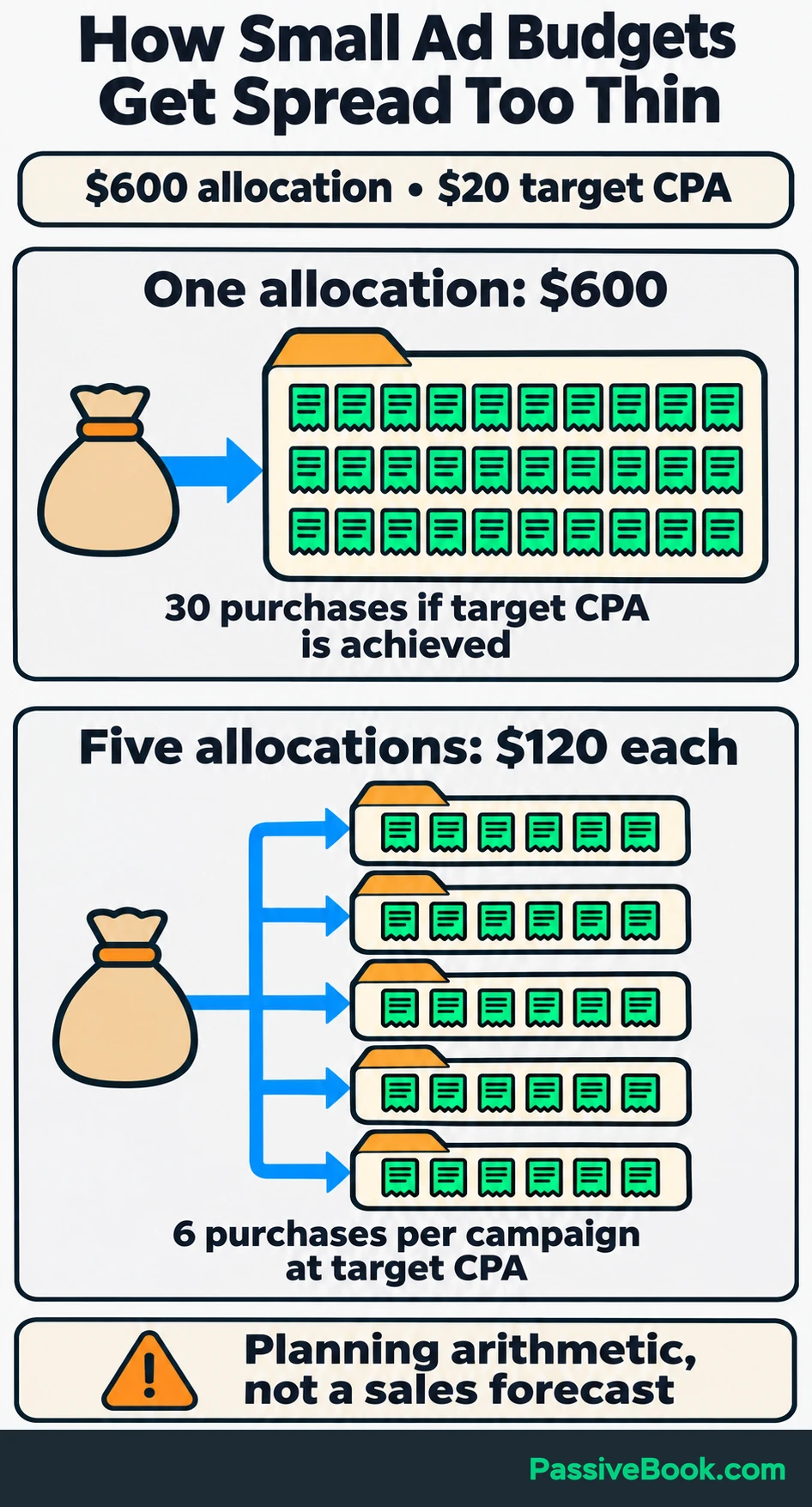
At the mug shop’s illustrative $20 target:
- A $600 allocation would cover 30 purchases if that CPA were achieved.
- Five equal campaign allocations would get $120 each.
- Each of those smaller allocations would cover six purchases at the same CPA.
That is planning arithmetic, not a sales forecast. It shows why splitting a small budget across many campaigns can leave each one with little evidence to judge.
Before dividing your own budget, compare a concentrated test with the extra campaigns you are considering. The Marketing Campaign Planner shows the trade-offs using your costs and spending limit.
Free Marketing Campaign Planner
I would fund the main acquisition job first and postpone extra audiences, markets, and creative tests.
For the example, a $20 average daily budget broadly matches a 30-day plan, but it does not impose a $600 total cap. For most Google Ads campaigns, the daily billing limit is twice the average daily budget and the monthly limit is 30.4 times that budget. Budget changes affect those calculations. Google explains its average daily budget rules here.
Monitor cumulative spending against the $600 allocation. Set an alert before the boundary and leave room for further delivery before a pause takes effect. Use a suitable total-budget control where available.
I would let groups serving the same goal draw from one budget. Reserve separate allocations when a market or offer needs its own spending limit.
5. Create Ads That Match Each Group
Build each ad around three things: a relevant benefit, a concrete supporting detail, and one next action.
The destination should continue the same offer. A visitor should find the advertised product, its current price, availability, shipping information, and a clear way to buy.
For the mug shop, explore two concepts while keeping the product and destination consistent:
| Concept | Headline ideas | What the page needs to support |
|---|---|---|
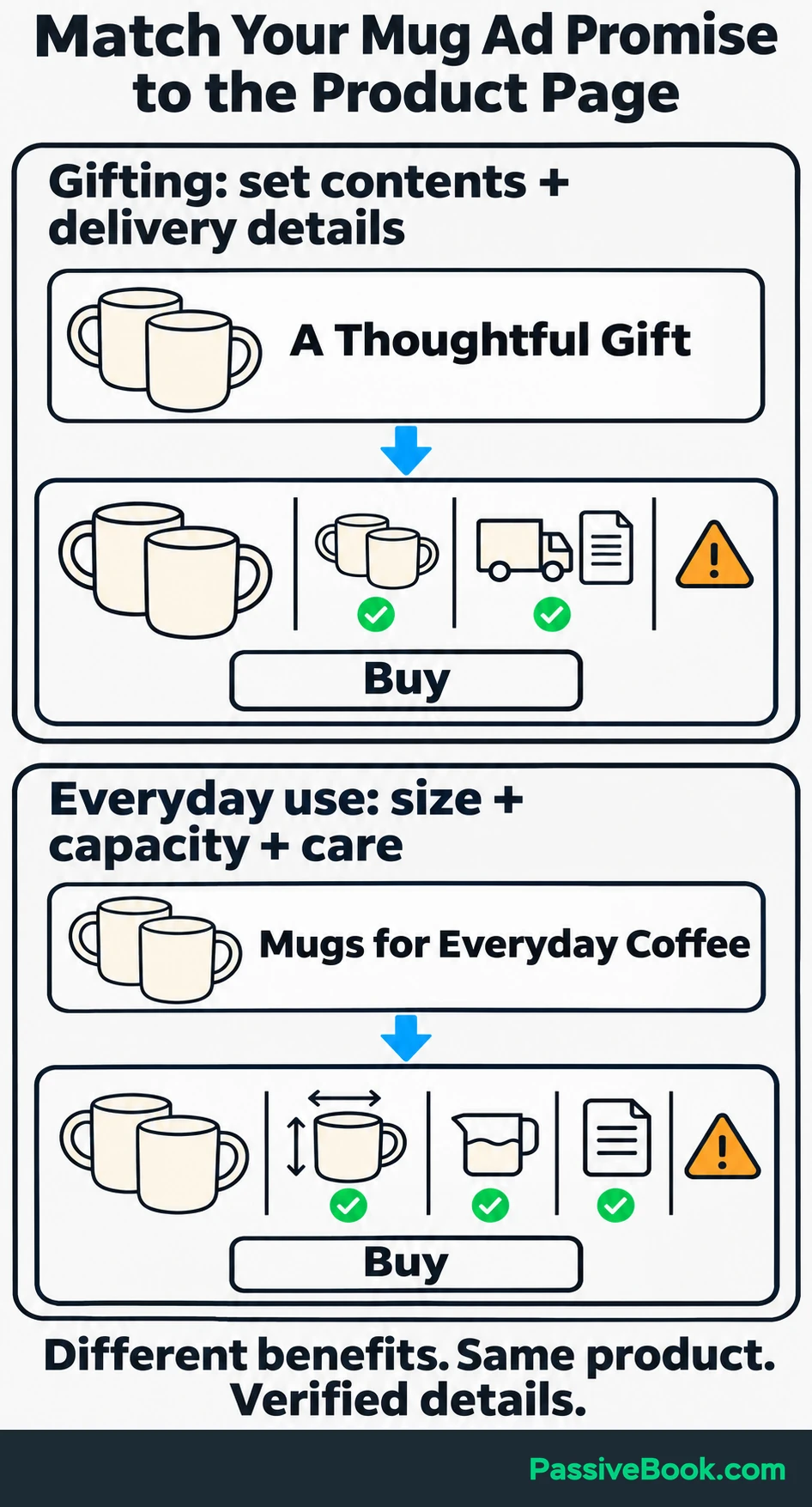
| Gifting | “Ceramic Mug Sets” and “A Thoughtful Gift” | Clear set contents, useful photos, and delivery information |
| Everyday use | “Ceramic Mug Sets” and “Mugs for Everyday Coffee” | Size, capacity, care instructions, and product photos |
Use verified details. Do not add “dishwasher safe,” “handmade,” or a customer endorsement unless you have support for it.
For Search, prepare coherent headline and description assets. For visual placements, show the product clearly or demonstrate the relevant use. I would skip another design variation until it communicates something meaningfully different.
Before a test, write down the question and success metric:
“Does a gifting message produce purchases at a lower CPA than an everyday-use message?”
Routine delivery can help you spot promising directions, but the platform may show ads to different people and give them unequal exposure. That alone does not establish which message caused a better result.
When isolating the effect matters, use a controlled experiment and change one variable. Google’s experiment guidance recommends defining the hypothesis and success metrics before starting.
If the allocation cannot support a useful comparison, run fewer concepts rather than forcing a winner from a handful of purchases.
6. Verify the Campaign Before Launch
Connect Conversions to the Campaign Map
Make sure the platform is using the action you actually care about.
For the mug campaign, purchases are the main conversion. Product views and add-to-cart events help diagnose the journey.
To guide automated bidding toward purchases in Google Ads, select the purchase goal for the campaign and mark its purchase action as Primary. Mark supporting actions as Secondary so they appear in reports without guiding bids. If you use a custom goal for bidding, keep supporting actions out of it: custom goals use secondary actions for bidding too. Google explains these settings.
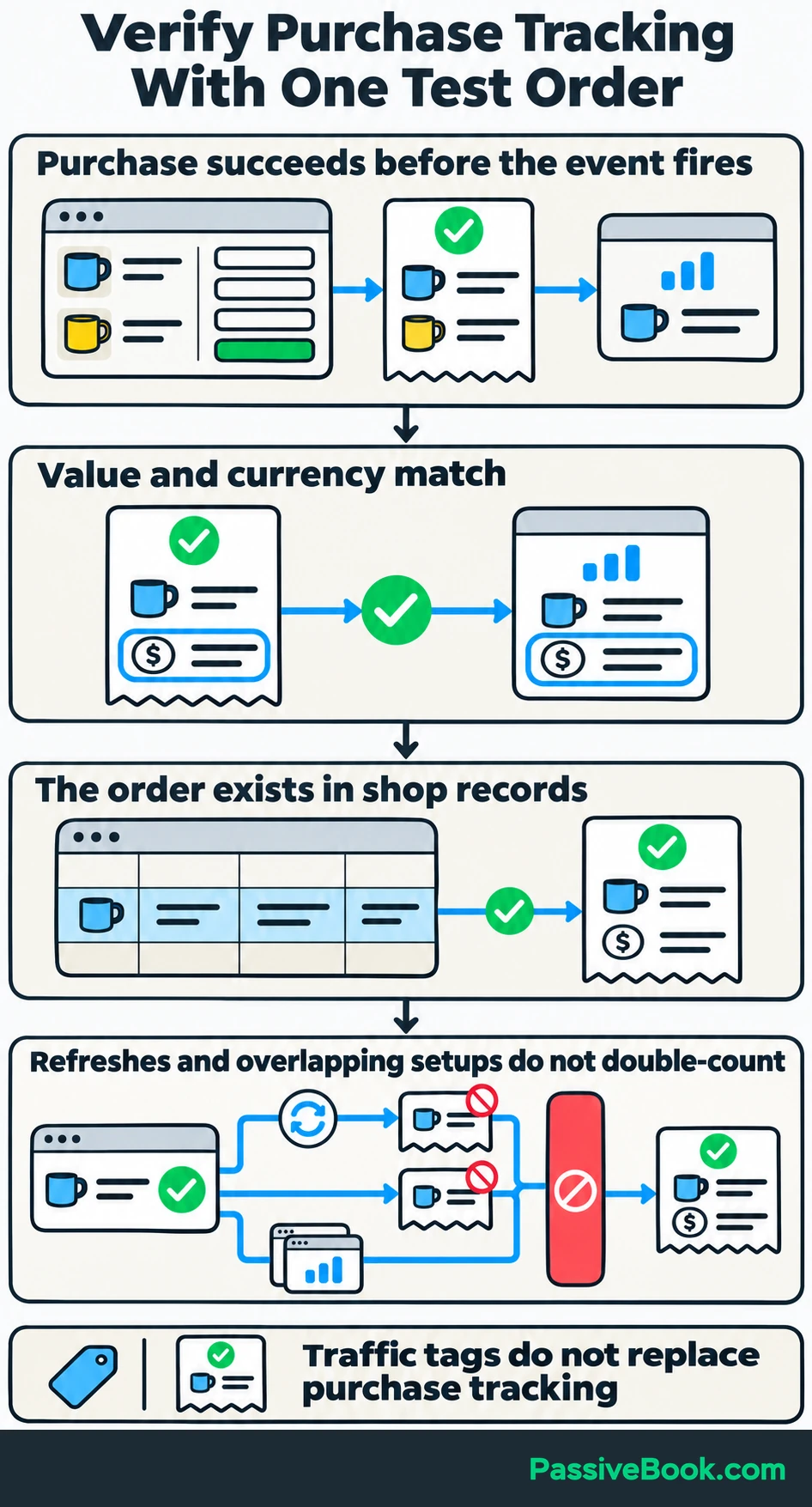
Complete a test journey and verify:
- The purchase event fires after a successful order.
- Its value and currency match the order.
- The order exists in your shop’s records.
- Refreshing the confirmation page does not count the transaction again.
- The same purchase is not counted twice through overlapping tracking setups.
Keep campaign names consistent with your map. For linked Google Ads and Google Analytics reports, turn on auto-tagging, which adds an identifier to ad links so visits can be connected to campaigns. When manually tagging other campaign links, add UTM tags—labels in the URL that identify the platform, channel, campaign, and creative version.
Tags identify traffic; they do not replace purchase tracking.
Choose one reporting source for routine campaign decisions and record its attribution window—the period during which an interaction can receive credit for a conversion. Reconcile attributed sales with actual orders. Do not add together every platform’s claimed purchases because the same order can receive credit in more than one report.
Also obtain consent for advertising tracking and audience-data collection where applicable law or platform policy requires it. Google’s consent guidance covers requirements for data sent to Google.
Complete the Launch Check
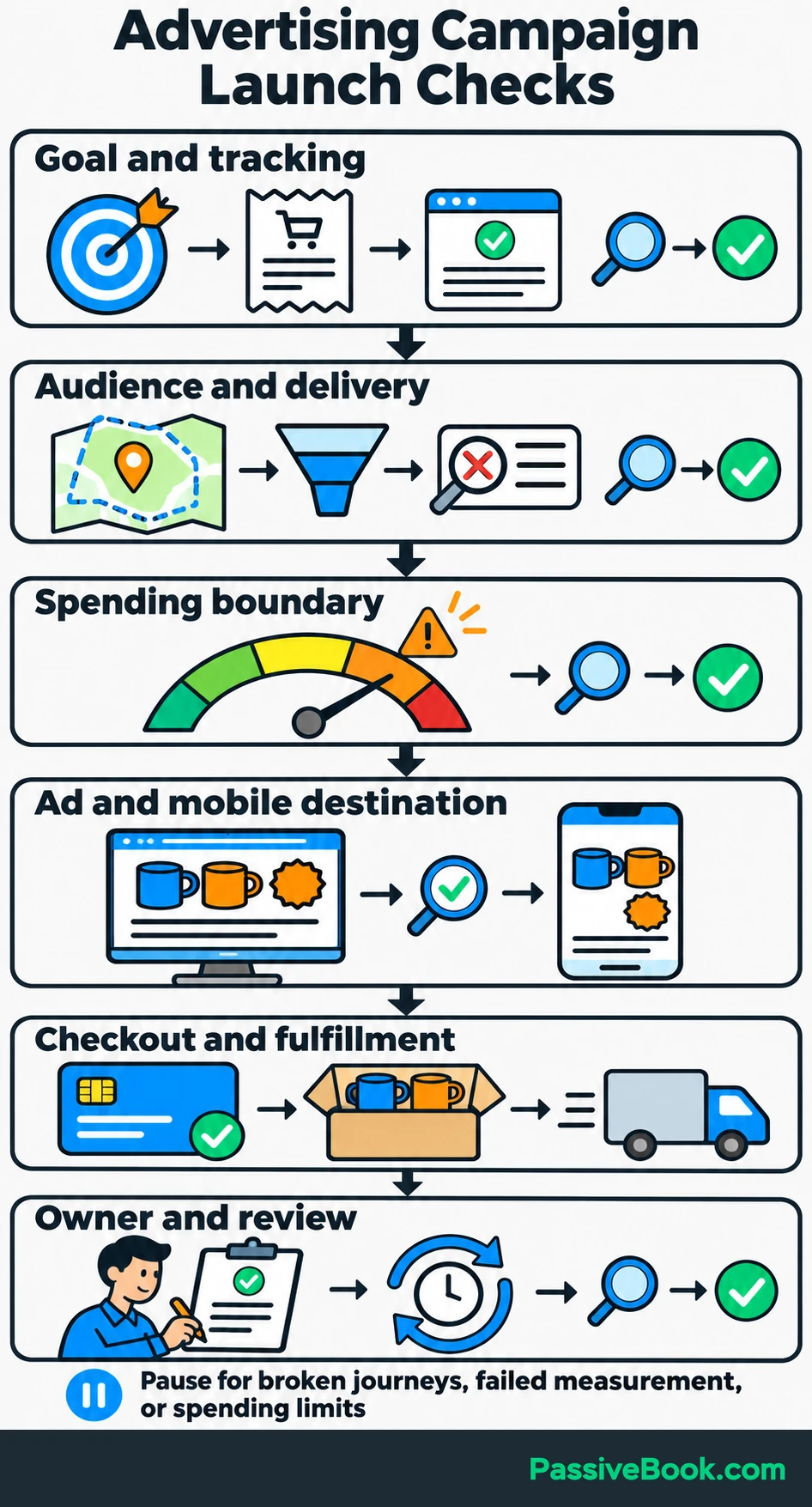
Review the whole customer journey once before switching on spending.
- Goal and tracking: Confirm the objective, selected conversion action, values, and test order.
- Audience and delivery: Check locations, targeting, exclusions, placements, and dates.
- Spending: Confirm the budget, total allocation, alerts, and stopping boundary.
- Ad and destination: Preview the ad, open the destination on mobile, and compare the offer with the page.
- Purchase or inquiry: Check stock, shipping, checkout, payment, or form submission.
- Ownership: Record who monitors spending, who reviews results, and when.
One person can own every line. The point is to make the responsibility explicit.
Save the starting settings and test question with the campaign map. Pause immediately for a broken destination, wrong targeting, failed measurement, or a reached spending boundary. Use scheduled reviews for ordinary performance decisions.
7. Improve Performance Without Adding Unnecessary Complexity
Review Results Against the Business Goal
Start with acquisitions and their economics.
For CPA, divide advertising spend by completed acquisitions attributed to that spending. For return on ad spend, or ROAS, divide the corresponding attributed revenue by advertising spend.
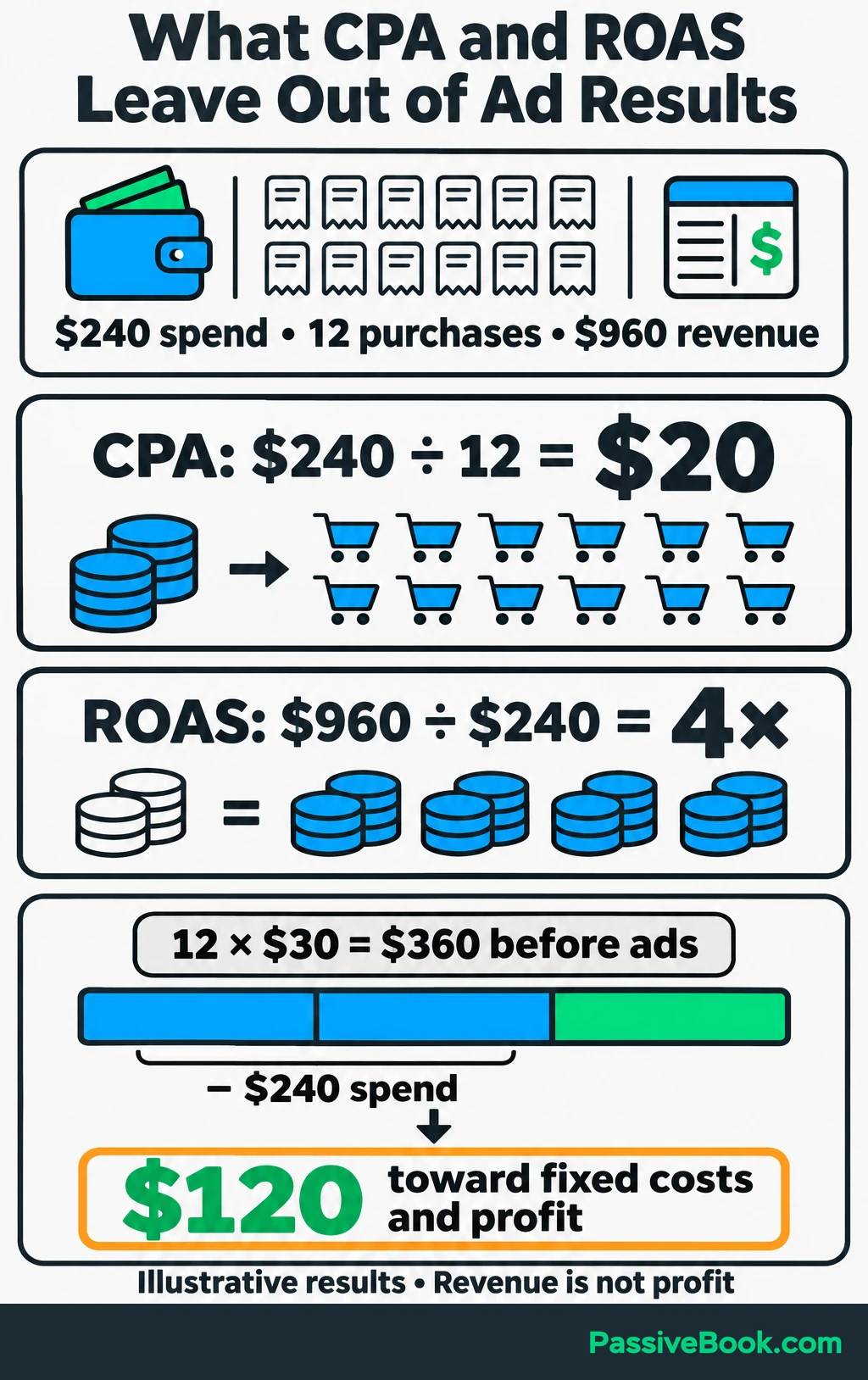
Suppose the mug campaign spent $240 and recorded 12 purchases worth $960 in attributed revenue:
- CPA is $240 ÷ 12 = $20.
- ROAS is $960 ÷ $240 = 4×.
- At $30 contribution per order, those purchases contributed $360 before advertising.
- Subtracting the $240 advertising spend leaves $120 toward fixed costs and profit.
The revenue multiple looks healthy, but the contribution calculation tells you what remains.
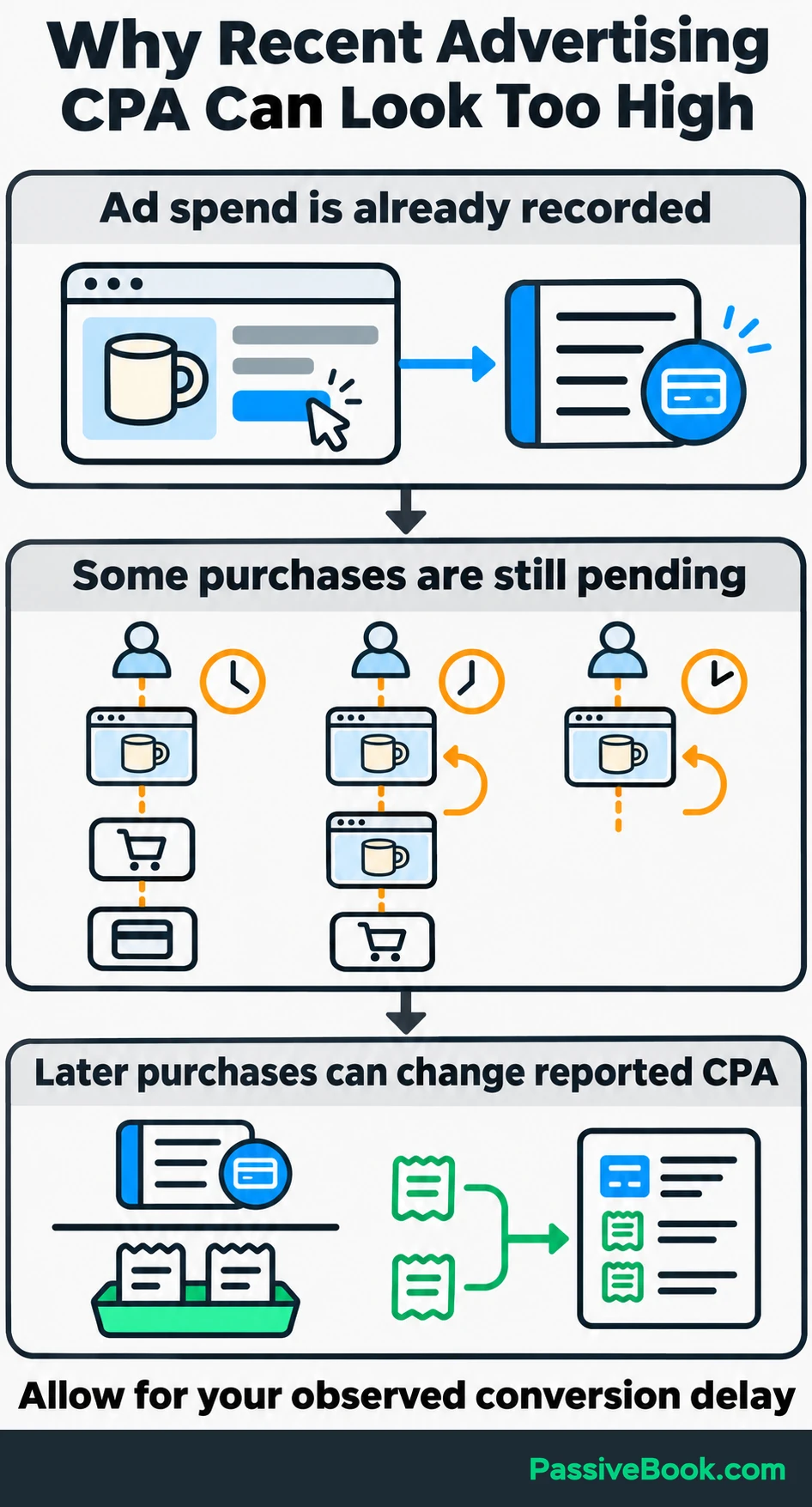
Keep a compact review sheet:
| Campaign | Spend | Purchases | Attributed revenue | CPA | Target CPA | ROAS | Diagnosis | Next action |
|---|---|---|---|---|---|---|---|---|
| Mug Sets Search | $240 | 12 | $960 | $20 | $20 | 4× | Meets the illustrated target; leaves $120 before fixed costs | Continue within the allocation and inspect search quality |
Allow for the observed delay between an ad interaction and purchase. Recent spending may already appear while some resulting purchases have not arrived, making recent CPA look worse. Google’s conversion-lag explanation describes this reporting effect.
I would review weekly at first, but wait for the relevant conversion delay before judging the latest spending. A review date is a checkpoint, not an obligation to change something.
Change the Part Causing the Problem
Use supporting metrics to locate the problem.
| What you observe | What to inspect | A useful next action |
|---|---|---|
| Little relevant traffic | Delivery, search demand, targeting, and bids | Check whether the campaign can reach suitable buyers |
| Searches about making mugs | Actual search terms | Exclude pottery-class intent |
| Relevant people see ads but rarely respond | Message and offer relevance | Test a clearer product benefit |
| Visitors arrive but do not buy | Product page, shipping, price, and checkout | Check where the buying journey stops |
| Purchases arrive above target CPA | Acquisition cost and order contribution | Find the costly traffic or weak purchase step before increasing spend |
For Search, review the searches that actually triggered ads. Your keyword list expresses your intent; the search-term report shows what happened.
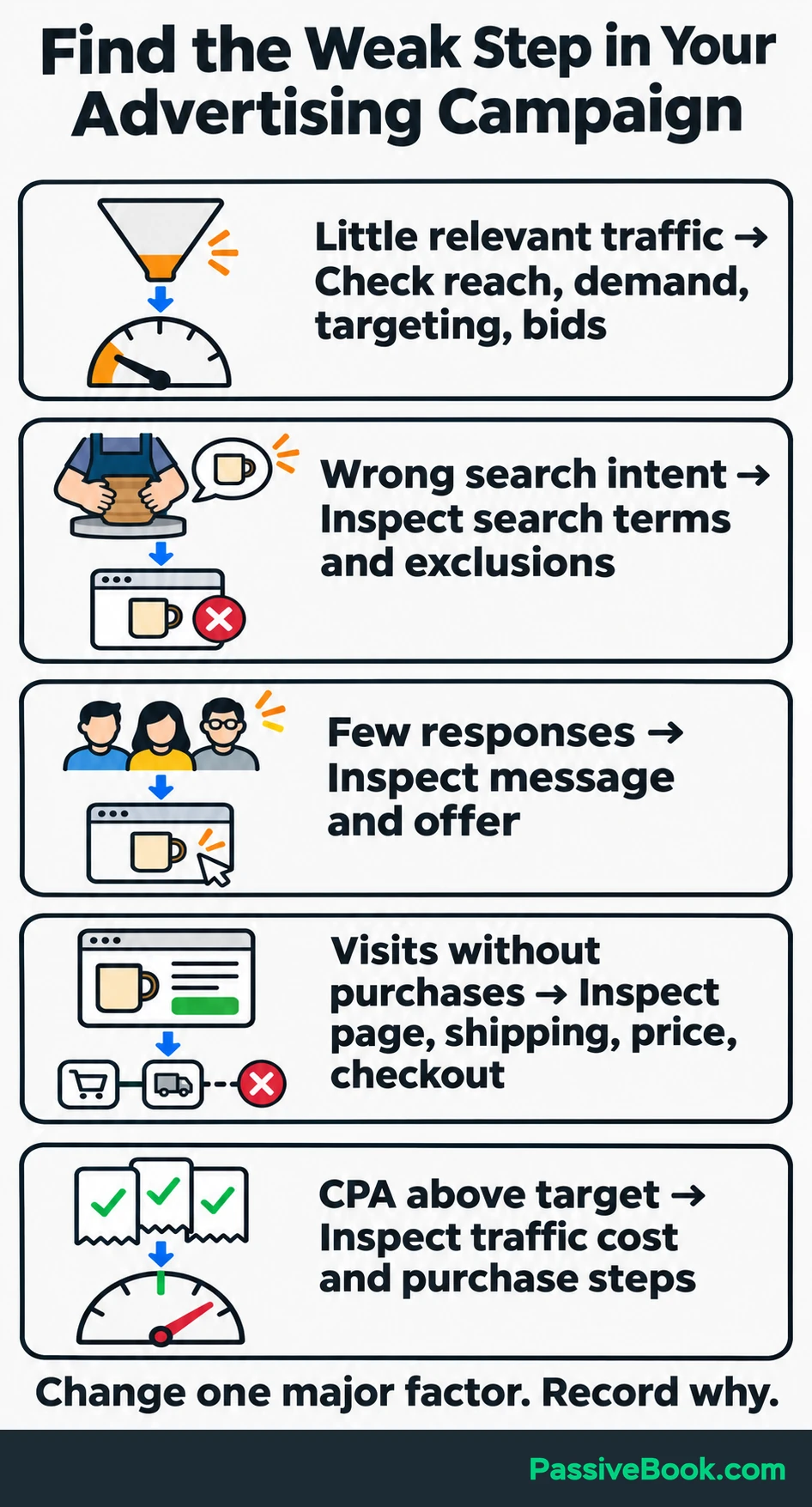
Change one major factor at a time and record the reason. Otherwise, an improvement leaves you guessing which change helped.
Consolidate groups doing the same job. Split a group when distinct targeting or a different message and destination needs separate treatment. Add a campaign when independent campaign controls become necessary.
Increase spending in manageable stages after completed conversions meet your economics and you can fulfill more orders. Recheck CPA and contribution after each increase. Update the campaign map so it remains a record of how the business is spending money.
What Next?
Write one complete campaign path today: the outcome, audience, targeting group, ad, destination, conversion, affordable CPA, and spending boundary. Resolve any blank before funding the campaign.
Use the social buttons to pass along this guide when a campaign-planning conversation needs a clearer starting point.
Which part of your current structure is hardest to justify, and what decision was it meant to support? Share your answer in the comments, and bring any other questions too.
Share this post with your friends & followers:

