Your Pinterest ad gets clicks, but the sales cost more than you can afford. You change the image, narrow the audience and lower the bid. Now the numbers look different, but you have no idea which change helped.
With a limited budget, that uncertainty makes the next round of spending harder to justify. This guide shows how to compare creatives, audiences, formats, bids and landing pages against your profit target, so you can decide what to improve and which campaigns deserve more money.
Set Your Target CPA Before Spending
Start with the outcome you want to buy. For a sales campaign, that means completed purchases. For lead generation, it means qualified leads whose later purchases you can measure.
Cost per acquisition, or CPA, measures what you spend per purchase or lead attributed to your ads. Your target CPA should come from what a sale leaves you, rather than what an advertising dashboard suggests.
First, subtract the costs that come with each sale. Include payment fees, fulfillment, expected refunds and other variable costs. What remains is your break-even advertising allowance before fixed costs.
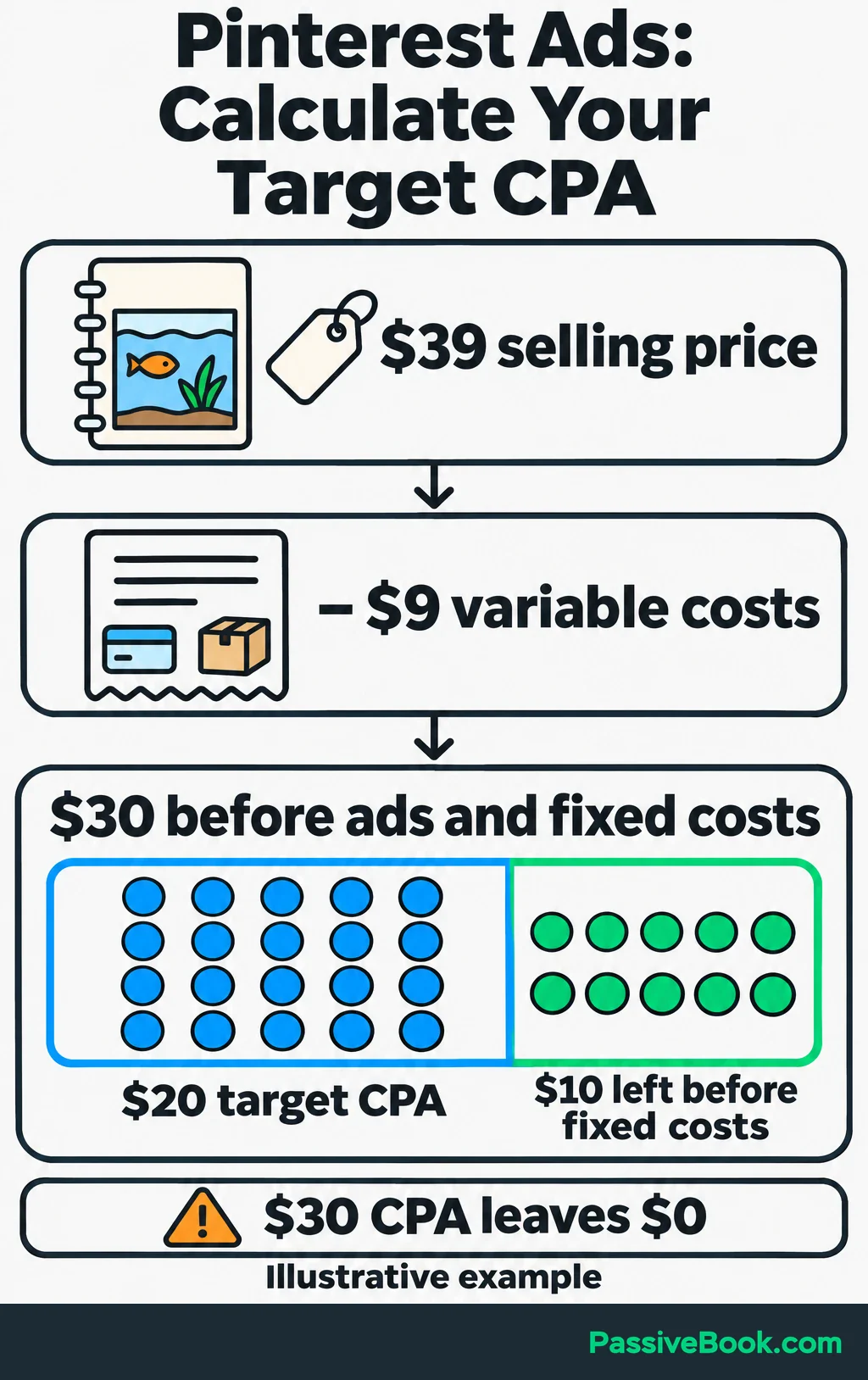
Throughout this guide, imagine you sell a downloadable freshwater aquarium maintenance planner. All prices, costs, budgets, copy and results below are illustrations, not observed campaign results or Pinterest benchmarks.
| Item | Amount per sale |
|---|---|
| Selling price | $39 |
| Assumed variable costs | $9 |
| Amount available before advertising and fixed costs | $30 |
| Target advertising cost per purchase | $20 |
| Amount left at target CPA, before fixed costs | $10 |
A $30 CPA uses the entire amount available for advertising. I would set the target lower so there is room for overhead and profit.
Return on ad spend, or ROAS, compares attributed revenue with advertising spend:
- Break-even ROAS: $39 ÷ $30 = 1.30.
- Target ROAS: $39 ÷ $20 = 1.95.
ROAS measures revenue efficiency. It does not subtract your costs, so a positive ROAS can still describe an unprofitable campaign.
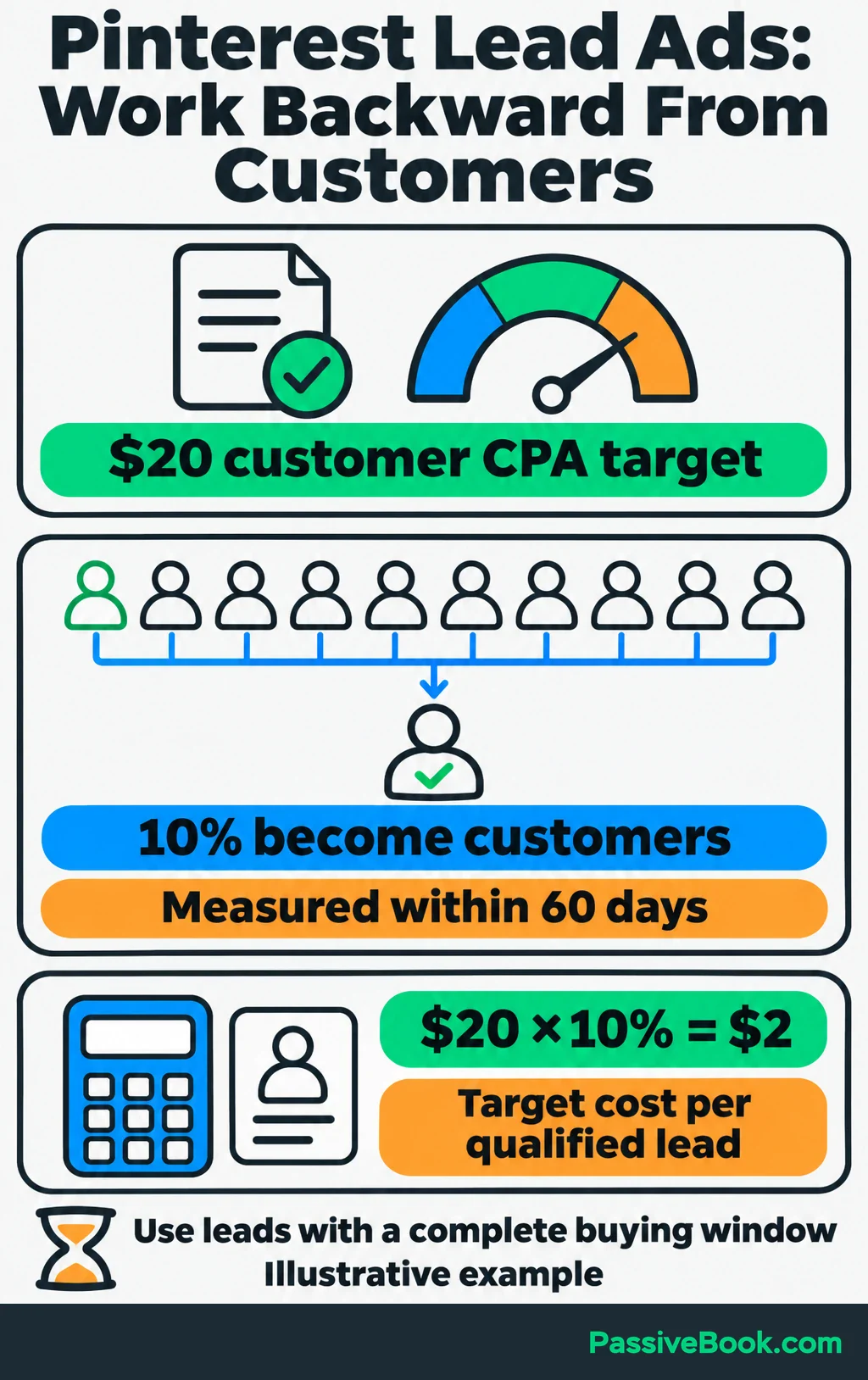
For leads, work backward from sales. Suppose 10% of qualified leads become customers within 60 days. A $20 customer acquisition target supports a $2 lead target: $20 × 10%. Use a measured rate from leads with enough time to complete that buying window.
If you cannot connect leads to customers yet, treat your first lead campaign as a measurement exercise. Cheap email addresses are not proof of affordable customers.
Verify Conversion Tracking Before Testing
Before paying for traffic, complete the buying journey yourself on a phone. Check the product page, payment, confirmation and download delivery.
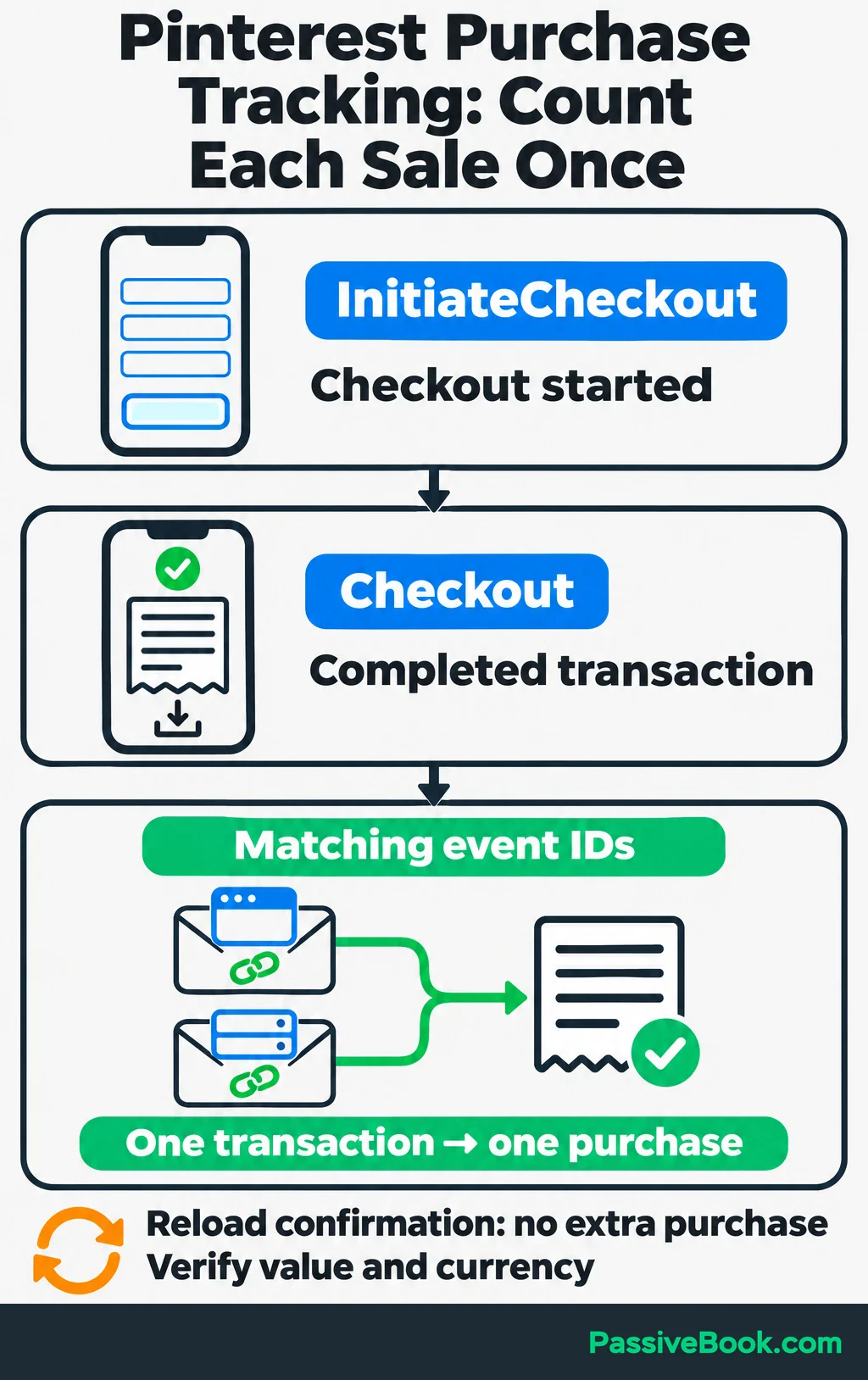
Install the Pinterest tag, which sends website activity to Pinterest, and configure the relevant events. Pay particular attention to the names: Checkout means a completed transaction, while InitiateCheckout means someone started checkout. Counting both as purchases would make your campaign look healthier than your bank account. Pinterest event definitions
Make a test purchase and check that the completed transaction sends the correct value and currency. Reload the confirmation page to check that it does not create another purchase.
If you also use the Conversions API, which sends events from your server, give both copies of the same transaction matching event IDs. Then verify that Pinterest removes the duplicate rather than counting two sales. Pinterest event testing and deduplication
Add UTM parameters to your destination URLs. These are labels that help website analytics identify the campaign and ad version. For example:
utm_source=pinterest&utm_medium=paid_social&utm_campaign=planner_test&utm_content=completed_log
Use planner_test for both versions’ campaign label, but give each creative its own utm_content value: planner_cover or completed_log.
Before comparing reports, use the same:
- Attribution window: how long after an ad interaction a purchase can receive credit.
- Reporting date basis: whether conversions appear against the ad interaction date or purchase date.
- Time zone and reporting period.
Pinterest can credit purchases after ad views as well as clicks, so its totals can differ from website analytics. Check order records alongside both reports. An attributed purchase does not establish that advertising caused an additional sale. Pinterest conversion windows
Also make sure your privacy notice explains advertising data collection and sharing, your setup obtains legally required consent, and visitors receive the required opt-out information. Pinterest Ad Data Terms
Design a Test Your Budget Can Support
Match the Campaign to the Test Question
Choose the campaign objective that matches the outcome:
- Sales: Use this for purchase acquisition and select Checkout when completed purchases are the goal.
- Leads: Use this for relevant website lead actions, such as a qualified signup.
- Consideration: Use this when the question concerns Pin clicks or outbound clicks.
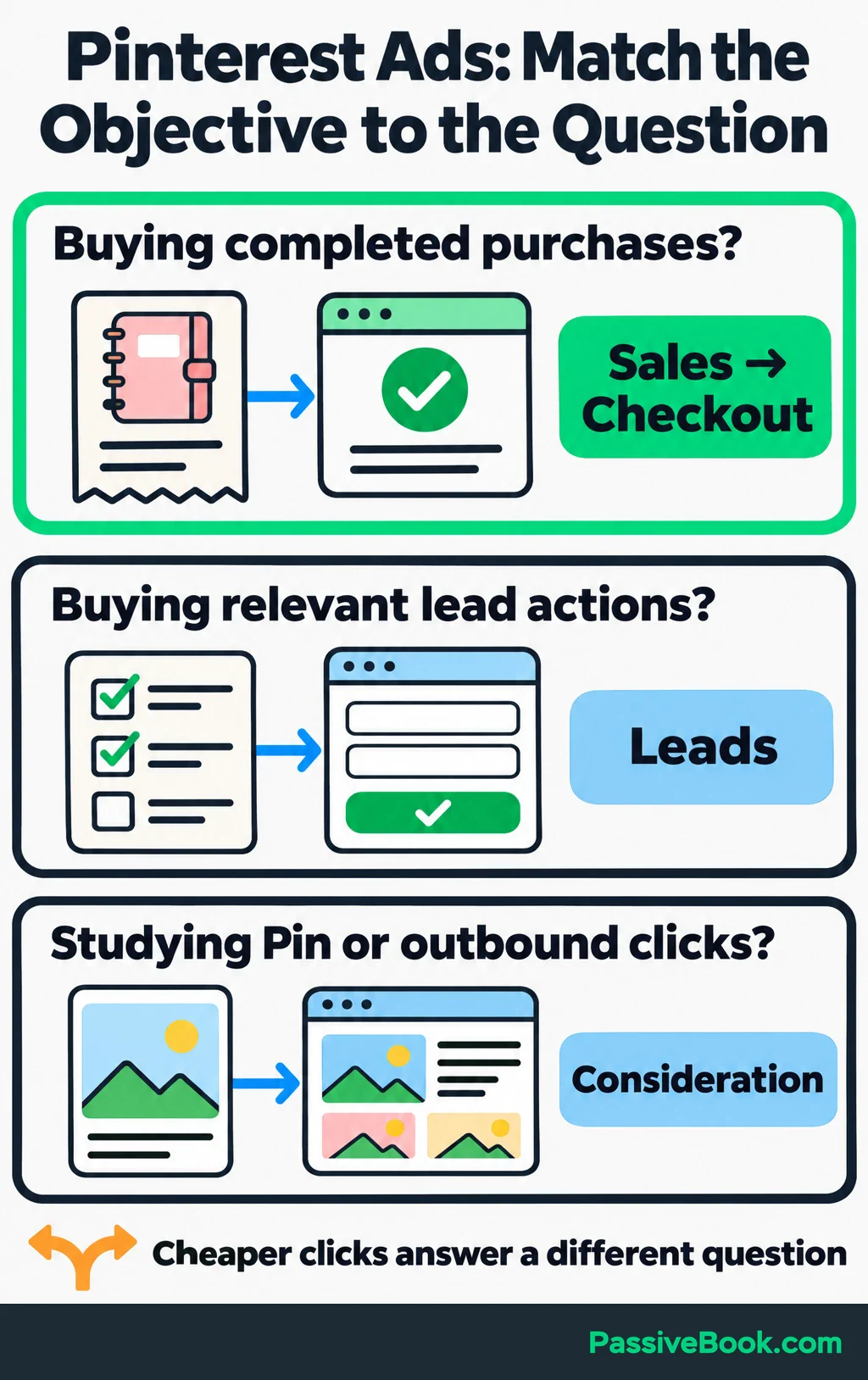
For the planner, I would start with Sales and completed purchases. Switching to a traffic goal because clicks look cheaper answers a different question.
Establish a baseline with one offer, audience, ad, landing page and bidding approach. The baseline becomes your control: the version each challenger must improve on.
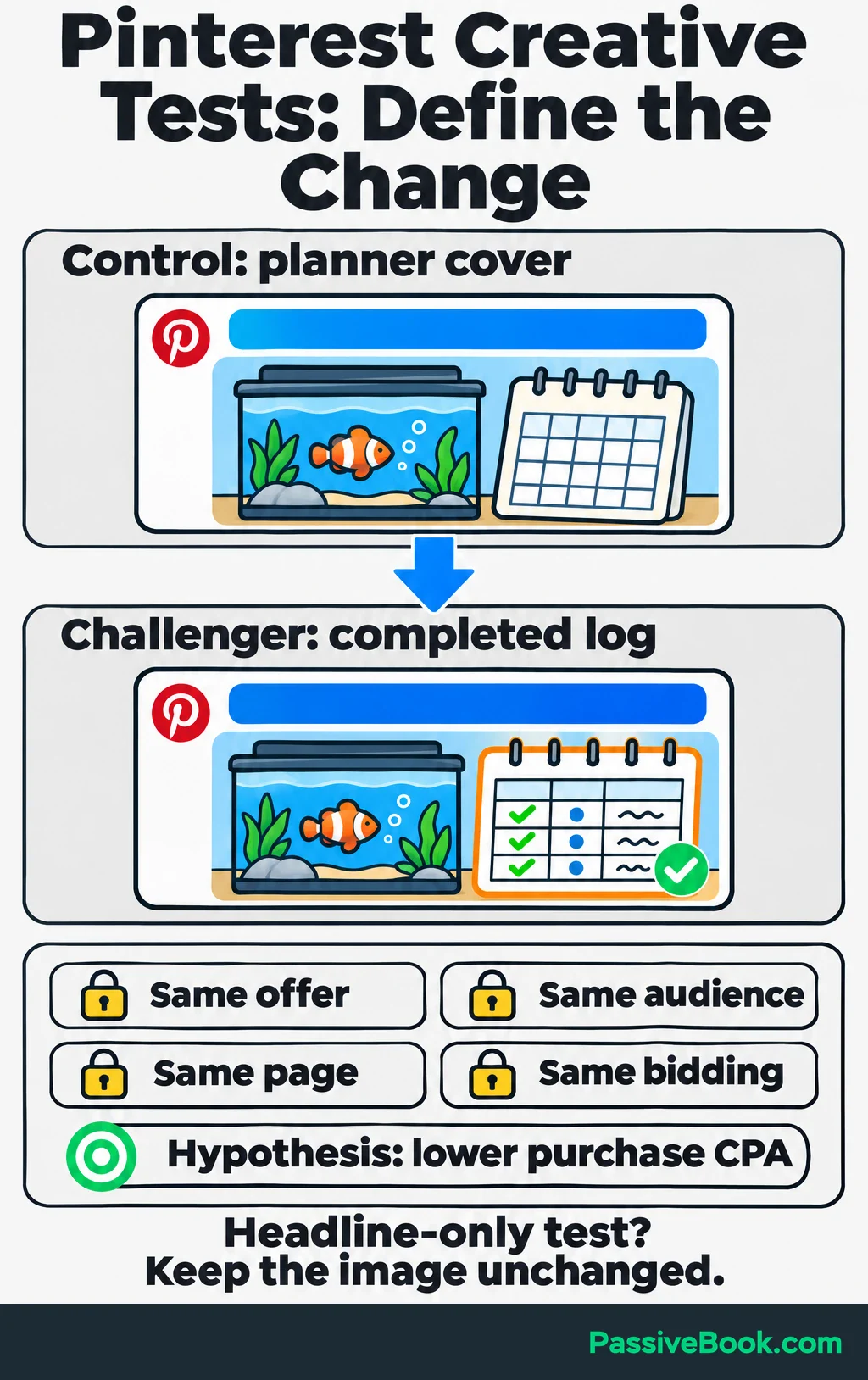
Write the hypothesis before creating the challenger:
Showing a completed maintenance log instead of the planner cover will make the product easier to understand and lower purchase CPA.
An image and headline can change together when testing a whole creative concept. To test the headline alone, keep the image unchanged. Keep the audience and page steady in either comparison.
Choose Screening or a Controlled A/B Test
When money is tight, I would screen a few distinct concepts in a campaign with a spending cap. Compare purchases, spend and impressions for clues about what deserves further testing. Delivery can be uneven, so little exposure does not establish that an ad failed.
A controlled A/B test gives you a cleaner comparison. Pinterest’s native tool randomly assigns people to separate groups, and each person sees one version. Simply running two ads does not provide that separation. How Pinterest A/B testing works
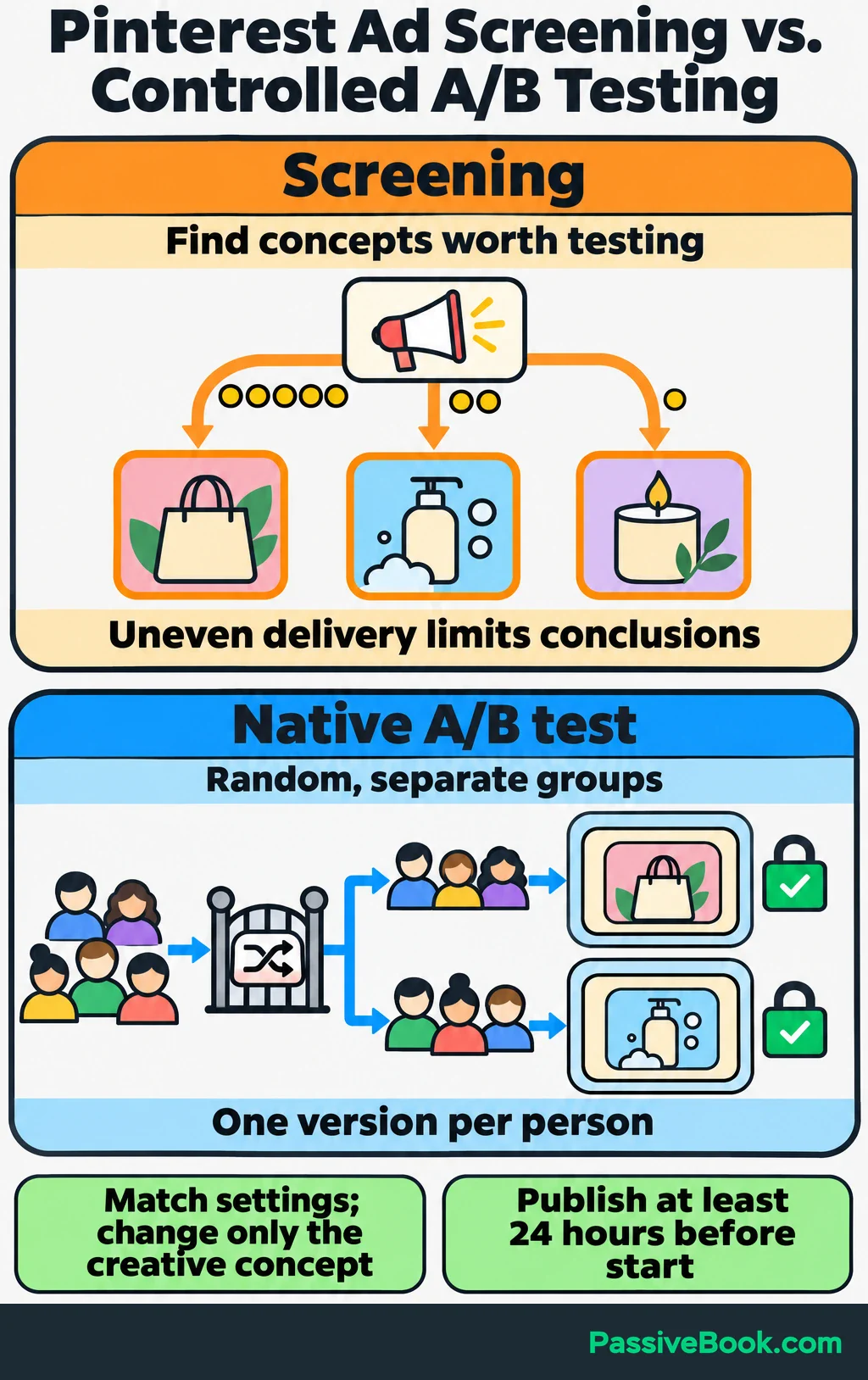
For an individual creative comparison, keep the setup simple:
- Use two versions, each in a separate campaign.
- Put one ad group and one ad in each version.
- Match the objective, budget, audience, placements and dates.
- Change only the creative concept.
- Publish at least 24 hours before the scheduled start.
Pinterest’s estimated test power indicates whether your test is likely to detect a performance difference. Its budget guidance applies per version. If the total exceeds your limit, screen fewer ideas or postpone the controlled test. Pinterest A/B test setup and budget guidance
Set the Budget and Review Window
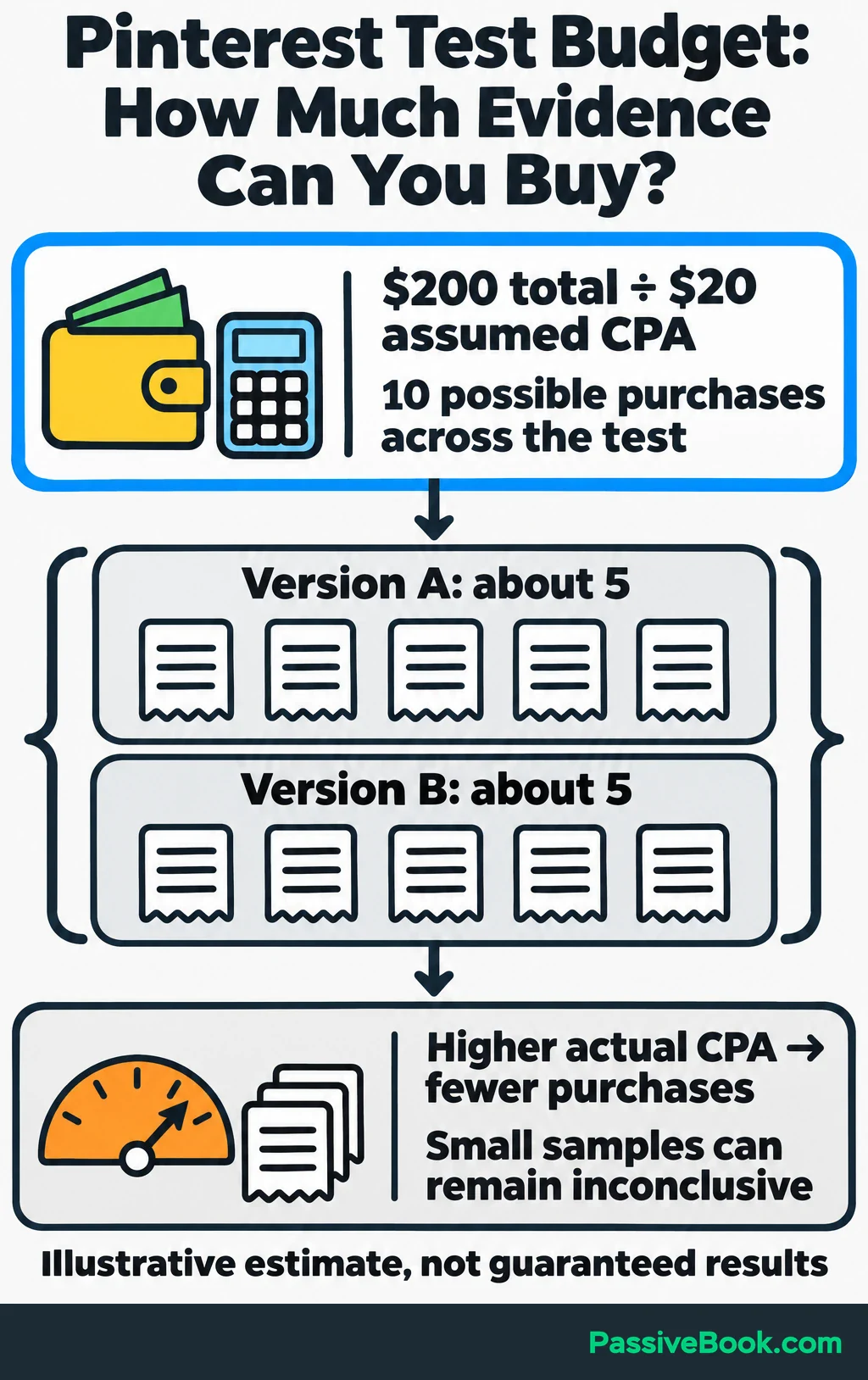
Write down the maximum total spend before launch. To estimate how many purchases it might cover, divide the budget by an assumed CPA: $200 ÷ $20 = 10 purchases across the whole test.
Splitting those purchases between two versions leaves little evidence. Actual CPA could be higher, leaving you with fewer purchases.
Before splitting your budget, check what happens if clicks cost more or fewer visitors buy. This planner shows the purchase forecast and money at risk for each version.
Free Marketing Campaign Planner




Use lifetime budgets and scheduled end dates to control total expenditure, adding both versions’ budgets when checking your limit. With Performance+ daily budgeting, Pinterest varies spending around a daily average, so it can exceed the entered amount on individual days. Campaign budgeting can also give ad groups unequal spending. Pinterest budget behavior
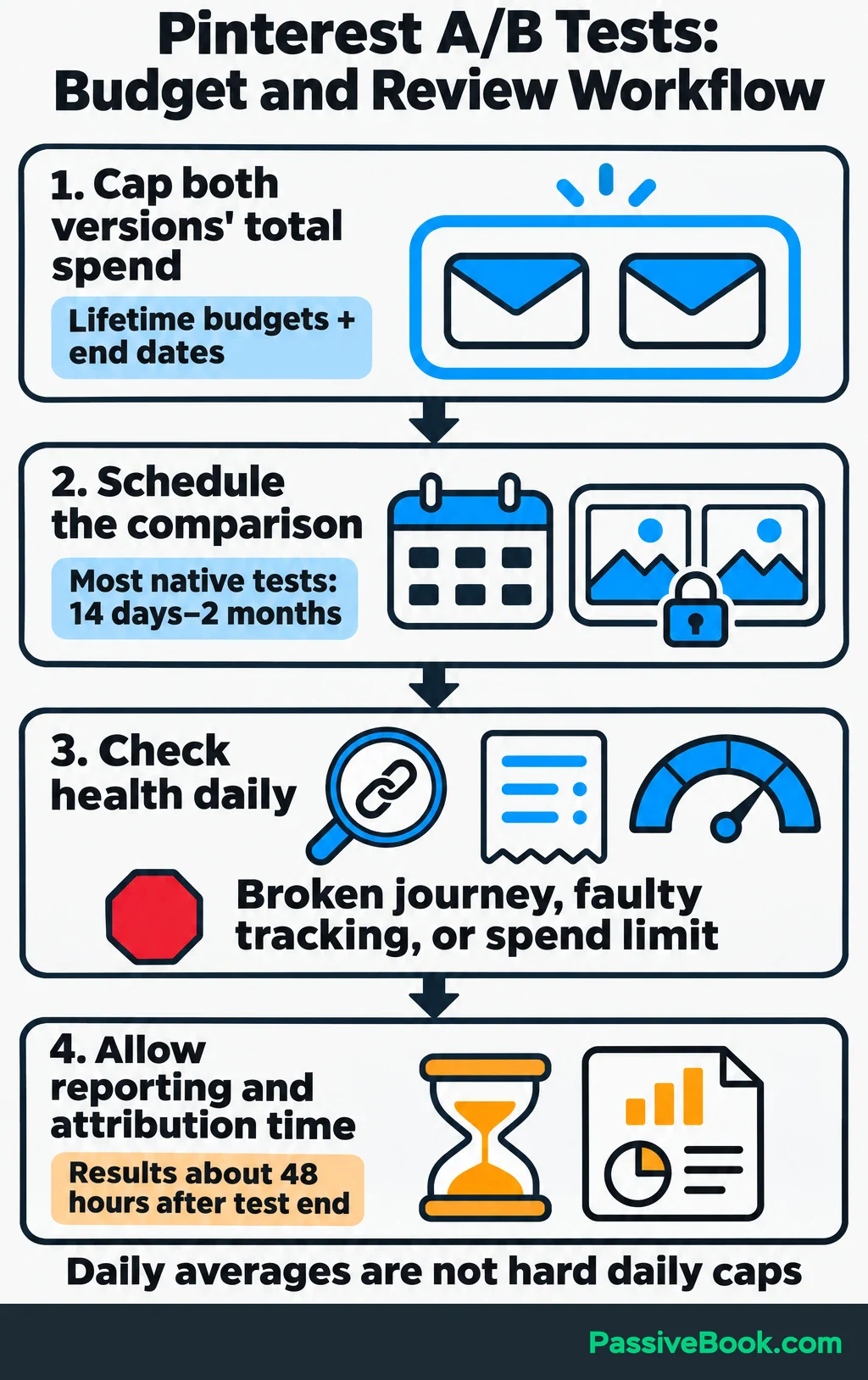
Pinterest recommends 14 days to two months for most native A/B tests; results arrive about 48 hours after the test ends. Allow time for your attribution window too, so recent ad interactions can produce purchases before your final review. Pinterest test-duration guidance
Check spending, links and tracking daily, but leave the comparison unchanged. Pause for a broken purchase journey, faulty tracking or the predefined spending limit.
“Let it learn” is not permission to spend beyond what you agreed to lose.
Use Results to Choose the Next Improvement
Review the primary metric first. For the planner, that is purchase CPA, supported by ROAS and purchase volume.
Then use traffic metrics to explain what happened. Count outbound clicks when measuring visits sent away from Pinterest. Pinterest’s standard CTR uses Pin clicks, which are a different action. Pinterest reporting definitions
Using counts from the same test version, reporting period and attribution settings, calculate:
- Outbound CTR: Outbound clicks ÷ impressions × 100.
- Cost per outbound click: Advertising spend ÷ outbound clicks.
- Purchase CPA: Advertising spend ÷ attributed purchases.
- ROAS: Attributed purchase revenue ÷ advertising spend.
Here is a complete illustrative comparison. Each purchase contains one $39 planner.
| Metric | A: Planner cover | B: Completed-log preview |
|---|---|---|
| Spend | $100 | $100 |
| Impressions | 5,000 | 5,000 |
| Outbound clicks | 75 | 50 |
| Attributed purchases | 3 | 5 |
| Attributed revenue | $117 | $195 |
| Outbound CTR | 1.5% | 1% |
| Cost per outbound click | $1.33 | $2 |
| Purchase CPA | $33.33 | $20 |
| ROAS | 1.17 | 1.95 |
A buys cheaper traffic, but B has better purchase economics. A also exceeds the planner’s $30 break-even CPA, while B meets the $20 target.
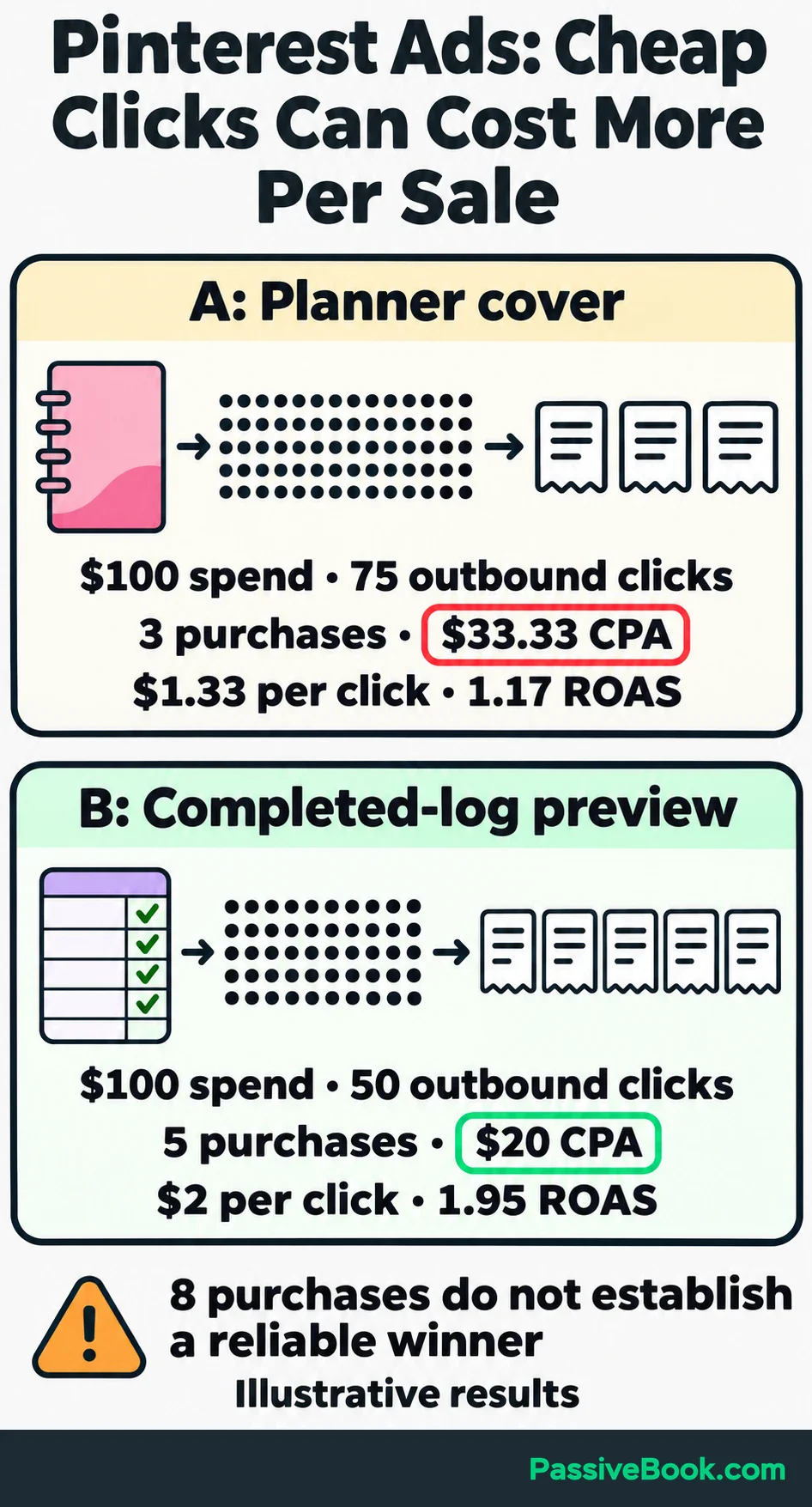
Those eight purchases do not establish a reliable winner. In a native experiment, check the reported confidence for your primary metric. If results are inconclusive, retain the control only while continued spending fits your limit. Pause if neither version meets your spending rules. Pinterest experiment results
A challenger can also beat the control and still miss your profit target. “Less expensive than the losing version” is a fairly low bar.
Use the pattern in the results to choose the next test:
| Observed pattern | First check | Next test | Success metric |
|---|---|---|---|
| Little delivery | Approval, audience restrictions and bid constraints | Broaden one restriction or test a less restrictive bid | More purchase volume at acceptable CPA |
| Weak outbound CTR | Whether the product and benefit are clear | Compare a distinct buying reason | Purchase CPA, with outbound CTR as context |
| Clicks but few measured sessions | Destination URL, loading and analytics | Repair the journey before another comparison | Successful page visits and reliable measurement |
| Sessions but few purchases | Offer, price and product clarity | Show a readable product preview | Website purchase conversion rate and CPA |
| Carts but few purchases | Payment errors, extra charges and delivery doubts | Remove the identified checkout friction | Completed purchases and CPA |
For website purchase conversion rate, divide measured Pinterest sessions that included a purchase by all measured Pinterest sessions, then multiply by 100. Use the same reporting period and attribution method for both counts. Keep this session-based measure separate from Pinterest-attributed purchase totals.
If there are no purchases, record CPA as unavailable. If spending is positive and attributed revenue is zero, ROAS is zero.
Test Creative Messages and Formats
Compare Distinct Reasons to Buy
Test the reason someone would buy before spending an afternoon moving the logo.
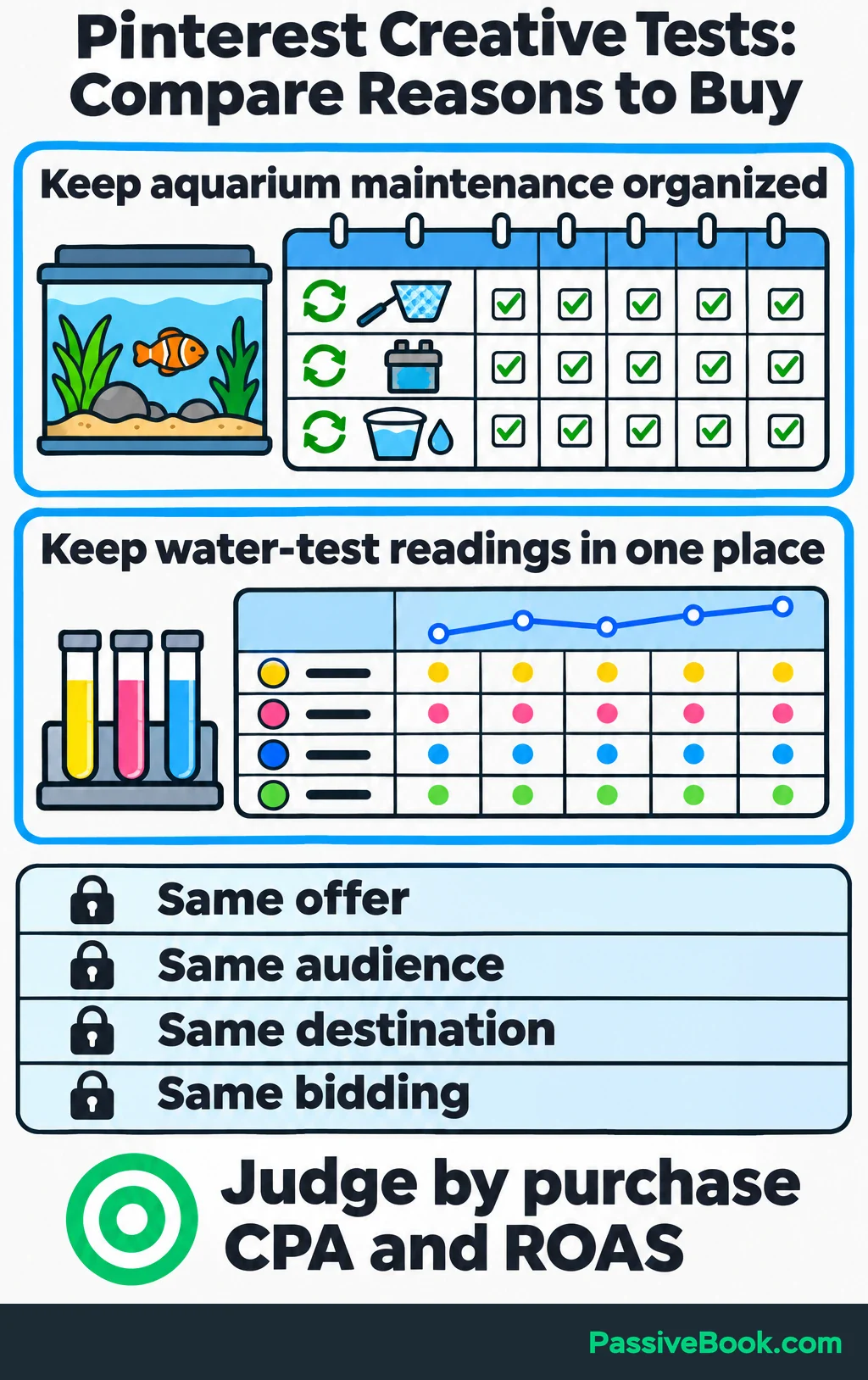
Choose one benefit for each concept, then make the image demonstrate it. For the planner, compare:
| Buying reason | Short message | Visual |
|---|---|---|
| Organize recurring tasks | “Keep aquarium maintenance organized” | An overview of the maintenance schedule |
| Keep records together | “Keep water-test readings in one place” | A readable, completed water-test log |
Keep the offer, audience, destination and bidding approach steady.
If your two ideas sound like the same ad with different wording, start with the reason someone would buy. This AI Skill drafts two copy sets from your product details while keeping the offer consistent.
Free AI Pinterest Studio
Use Canva if you want a straightforward way to build both versions from one template. For standard image ads, Pinterest recommends a vertical 2:3 design, such as 1,000 × 1,500 pixels. Show the product clearly, keep the text readable and give one next action. Pinterest creative recommendations
Judge the concepts by purchase CPA and ROAS. Outbound CTR helps explain the response, but it should not choose the winner for a sales campaign.
Once a concept earns further testing, refine its headline, product crop or call to action individually.
Compare Static Images With Video Demonstrations
A format test should keep the core message recognizable.
Compare a static preview of the maintenance log with a short video showing that same log being completed. Hold the benefit, offer, audience and landing page steady.
Make the product visible immediately and use captions so the demonstration makes sense without sound. You do not need to appear on camera to show a printable page in use.
I would reuse the same planner pages and design elements. Then compare purchase economics alongside the time needed to produce each format. Video earns more production work when its results support that work.
Refine Audiences Without Fragmenting Spend
Test audience ideas with the same creative and landing page. Otherwise, you cannot tell whether the audience changed the result.
For the planner, a useful comparison is people reached through aquarium-planning keywords versus people reached through relevant aquarium interests. Keep geography, language and other non-test settings consistent.
Choose keywords that describe the product’s job. “Aquarium maintenance checklist” and “aquarium water test log” are plausible starting ideas, rather than claims about measured demand.
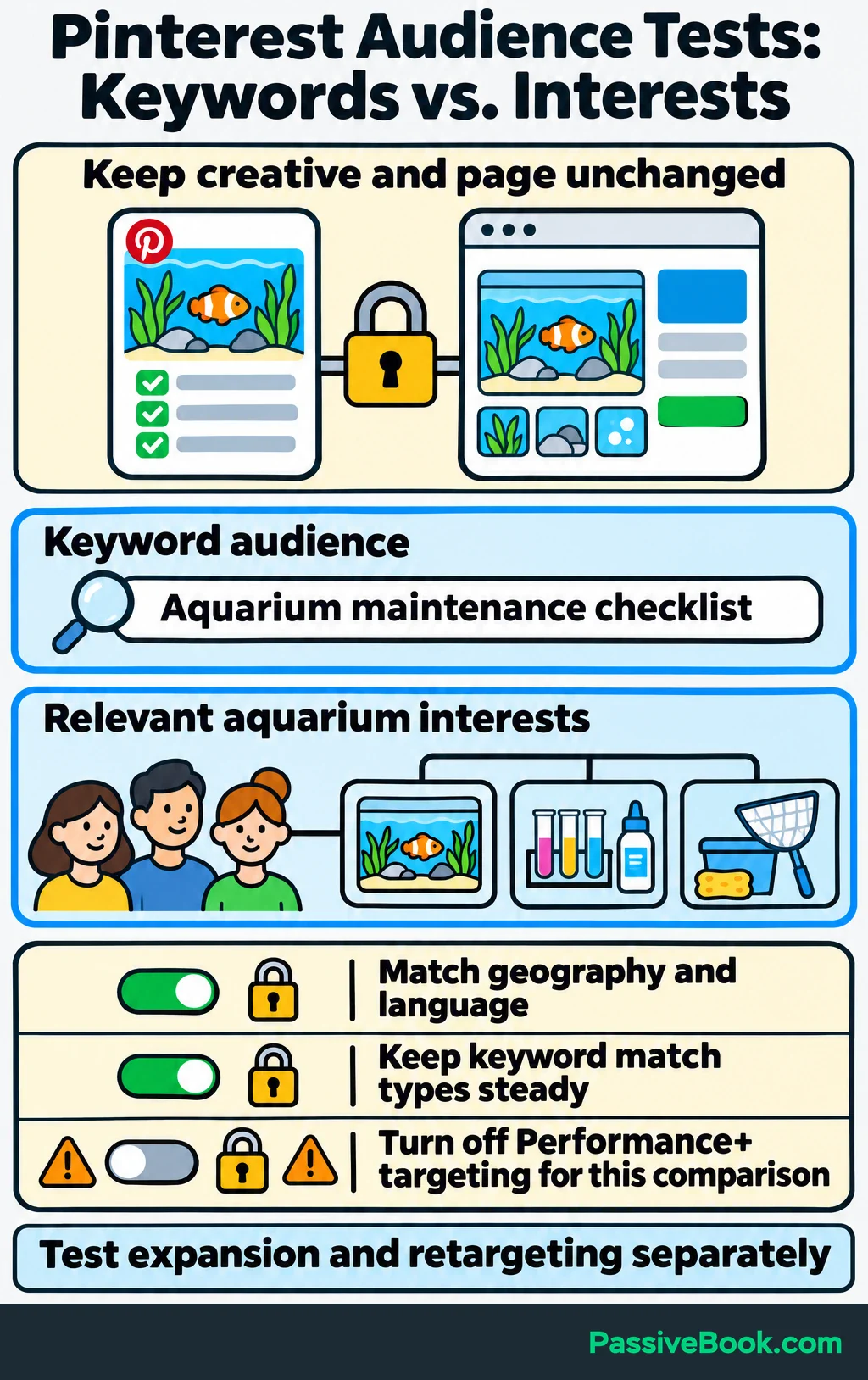
Later, compare broad matching, which reaches related searches, with phrase or exact matching, which gives tighter control over the searches that trigger your ads. Negative keywords exclude unwanted searches. Keep match types steady during the initial keyword-versus-interest comparison. Pinterest keyword targeting
For a strict comparison of your selected keywords and interests, turn off Performance+ targeting. It can expand delivery beyond those inputs. Test that expansion separately when your question is whether broader delivery improves purchase economics. Pinterest Performance+ targeting behavior
Keep new-customer acquisition separate from retargeting, which reaches people who have already interacted with your business. Exclude existing purchasers when measuring acquisition costs, and check order records to confirm which buyers are new.
I would also resist creating an ad group for every age range or keyword. Use breakdowns to suggest the next meaningful comparison. Dividing a small budget into twenty pieces mostly gives you twenty small samples.
Improve the Landing Page Where Visitors Drop Out
The page should continue the promise that earned the click.
If the ad shows a water-test log, make that log easy to find on arrival. Show the price, included files, delivery method and purchase button clearly. Buyers should understand whether they receive a download, a printed product or something else.
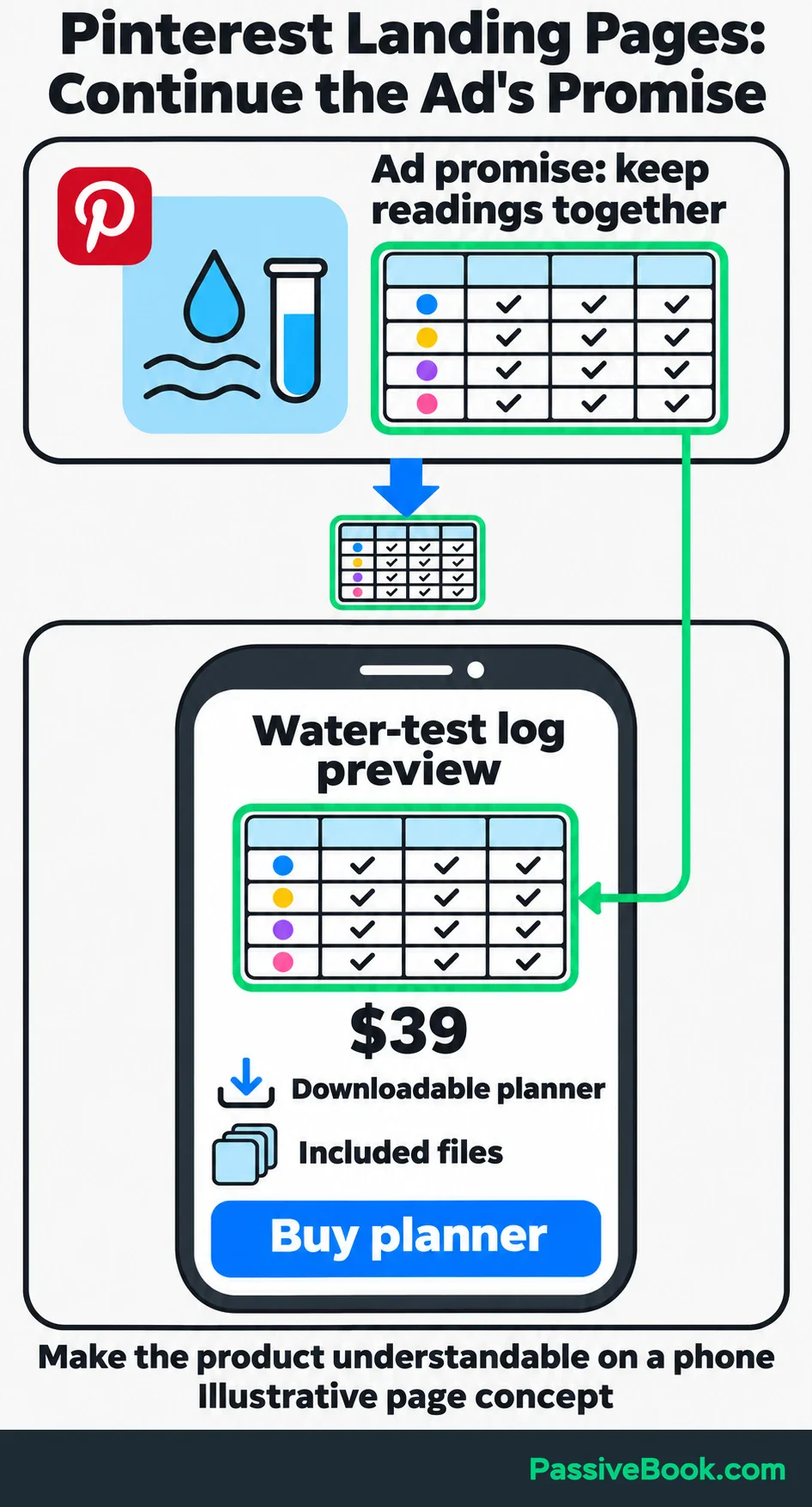
On one of my digital-product pages, I spent time polishing the cover mockup before checking the preview on my phone. The pages inside were too small to read. I could recognize my own product, but that was a generous test because I had made it.
That is why I would check whether a stranger can understand the preview before testing decorative changes.
Fix mobile loading problems, unreadable text, broken buttons and payment errors first. Then compare one substantial page change while keeping the ad and audience steady.
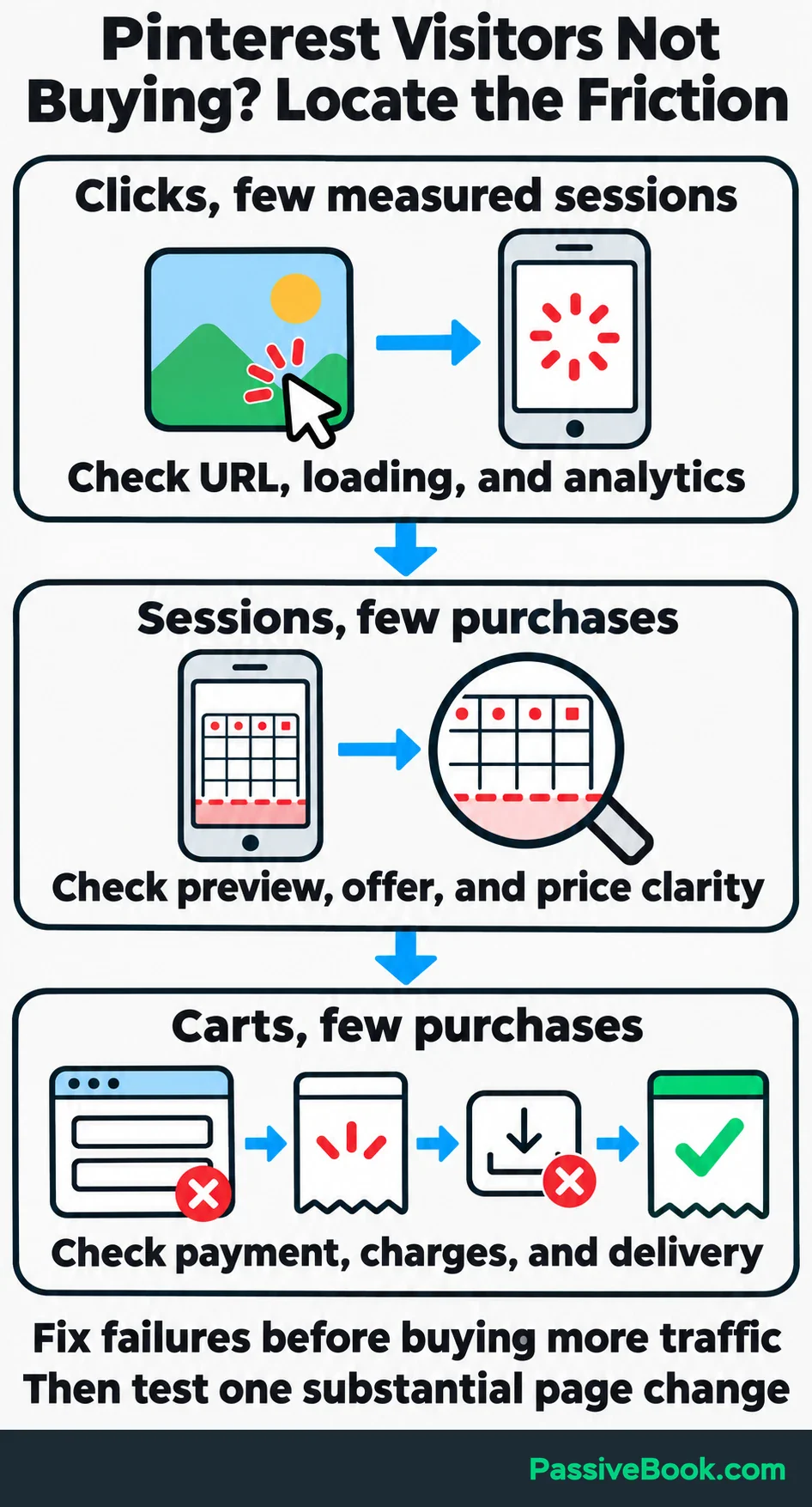
For the log-focused ad, test a readable, completed log beside the purchase button against the existing cover preview. Route comparable traffic to each page, ideally with a random split, and preserve the visitor’s assigned version.
Measure website purchase conversion rate and acquisition cost. Add-to-cart activity can locate friction, but completed purchases decide whether the change helped.
When carts fail to become purchases, check unexpected charges, account requirements, failed payments and uncertainty about download delivery. Buying more traffic sends more people into the same problem.
Test Bidding After Establishing a Baseline
I would establish the first baseline with Pinterest’s automatic Performance+ bidding. It gives you a starting point without requiring constant manual bid changes.
Performance+ bidding is an individual bidding option, so using it does not require adopting every feature of the complete Performance+ campaign setup.
Once tracking works and you have baseline purchase data, compare automatic bidding with custom target-average-CPA bidding in a Sales campaign. Keep the creative, audience, page and schedule steady. Pinterest supports both approaches for Sales. Pinterest campaign objectives and bidding options
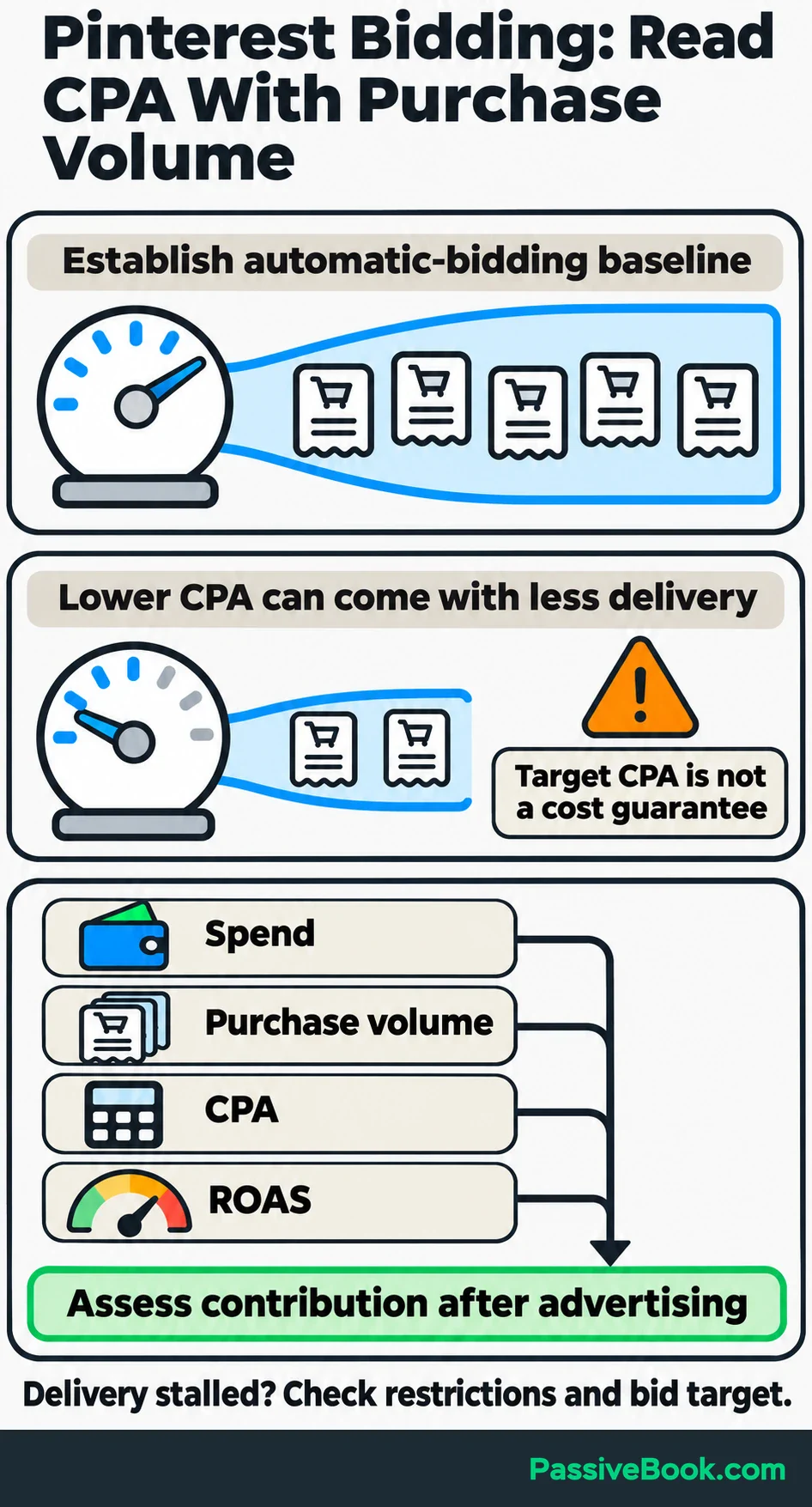
A target CPA guides delivery. It does not guarantee that every purchase costs that amount or less.
Read spend, purchase volume, CPA and ROAS together. A lower CPA with sharply reduced delivery may leave you with less total contribution after advertising.
If delivery stalls, check audience restrictions and whether the bid target is too restrictive before increasing the budget. A bigger spending allowance cannot solve every delivery problem.
Scale Combinations That Meet Your Profit Target
Scale when the comparison supports the decision and the purchase economics meet your target. Keep an inconclusive result marked as inconclusive.
Increase spending gradually while holding other major settings steady. For Performance+ campaigns, Pinterest recommends budget increases of 20–30% based on performance. Treat that as a starting guideline rather than a promise that costs will remain stable. Pinterest Performance+ scaling guidance
Review the new spending period separately from the old average, and give its purchases the same reporting window.
Suppose an additional $100 produces four planner purchases. Each sale leaves $30 before advertising, so those sales provide $120. After the extra $100 in advertising, $20 remains before fixed costs.
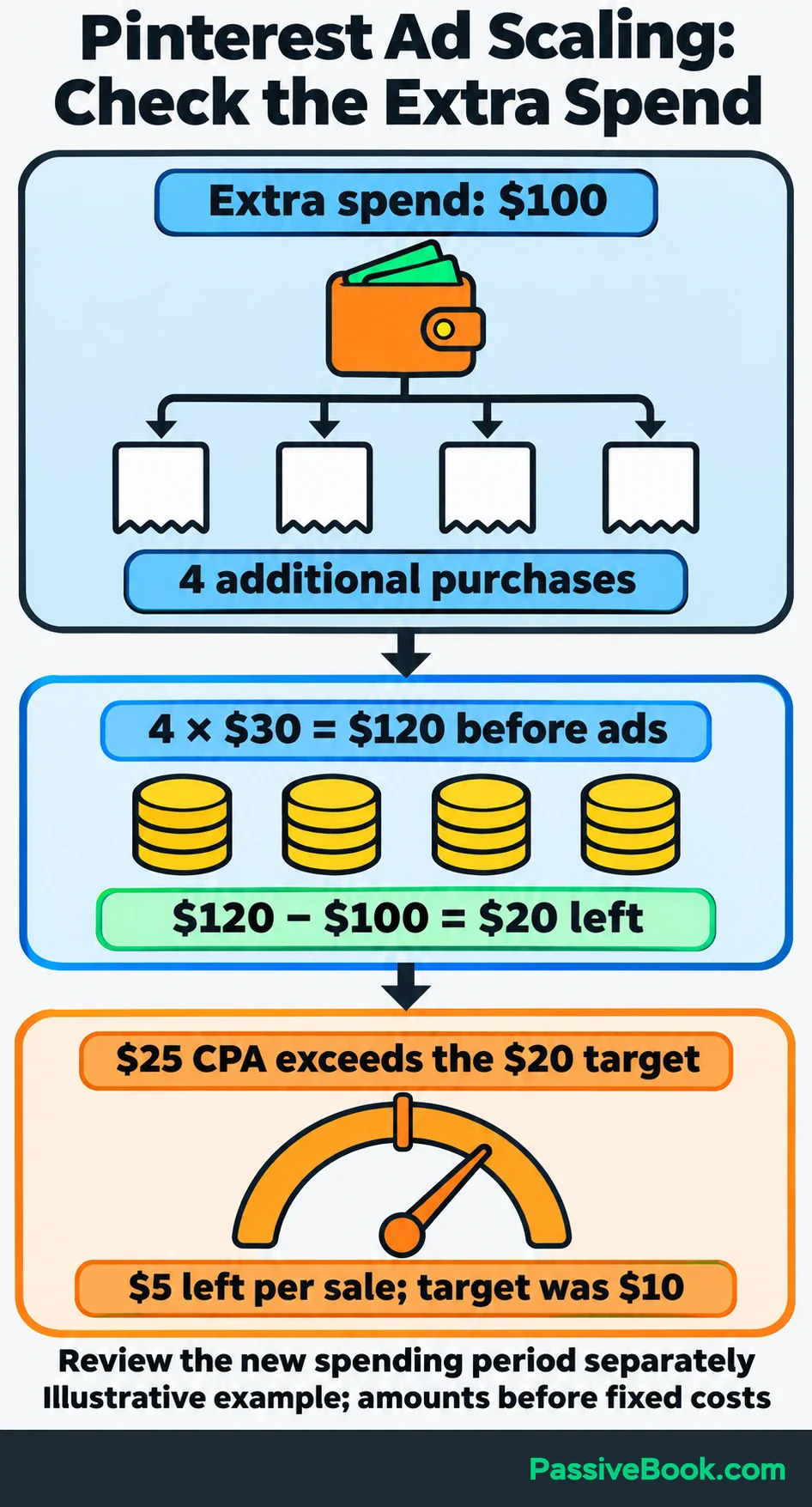
That is a $25 CPA. It remains below break-even, but exceeds the $20 target and leaves only $5 per sale instead of the intended $10. The campaign has not maintained its target economics at the higher spend.
Reduce spending or resume testing when acquisition costs exceed your target. Keep the working combination available as a control for future challengers.
Record each test in a spreadsheet or Notion table:
- Question: What did you expect to improve, and why?
- Change: Which concept or setting differed?
- Limits: What were the dates and maximum total spend?
- Results: What happened to purchases, CPA, ROAS and volume?
- Decision: Adopt, retain the control, pause or gather more evidence.
- Next action: Which specific problem deserves the next test?
Keep the record short enough to maintain. Its job is to stop you paying twice to rediscover the same failure.
What Next?
Calculate your target CPA and write one test hypothesis before launching another ad. That gives your next comparison a spending boundary and a clear decision to support.
Use the social buttons to share this guide when you want to compare Pinterest tests by purchases and profit rather than cheap clicks.
Which part of your campaign needs the clearest answer next: the message, audience, page or bid? Share your reasoning in the comments, and bring any other questions too.
Share this post with your friends & followers:

