A creator says yes to a collaboration, and suddenly your free evenings belong to scripts, recordings and edits. That effort can be worth it, but a busy launch means little if the new viewers have no reason to return.
The difficult part is choosing a partner whose audience wants what you normally publish, then giving both audiences something worth watching. This guide builds that choice into a practical YouTube collaboration strategy, with a ready-to-adapt pitch, a manageable production plan and a way to judge whether the partnership deserves another evening.
How YouTube Collaborations Grow Your Channel
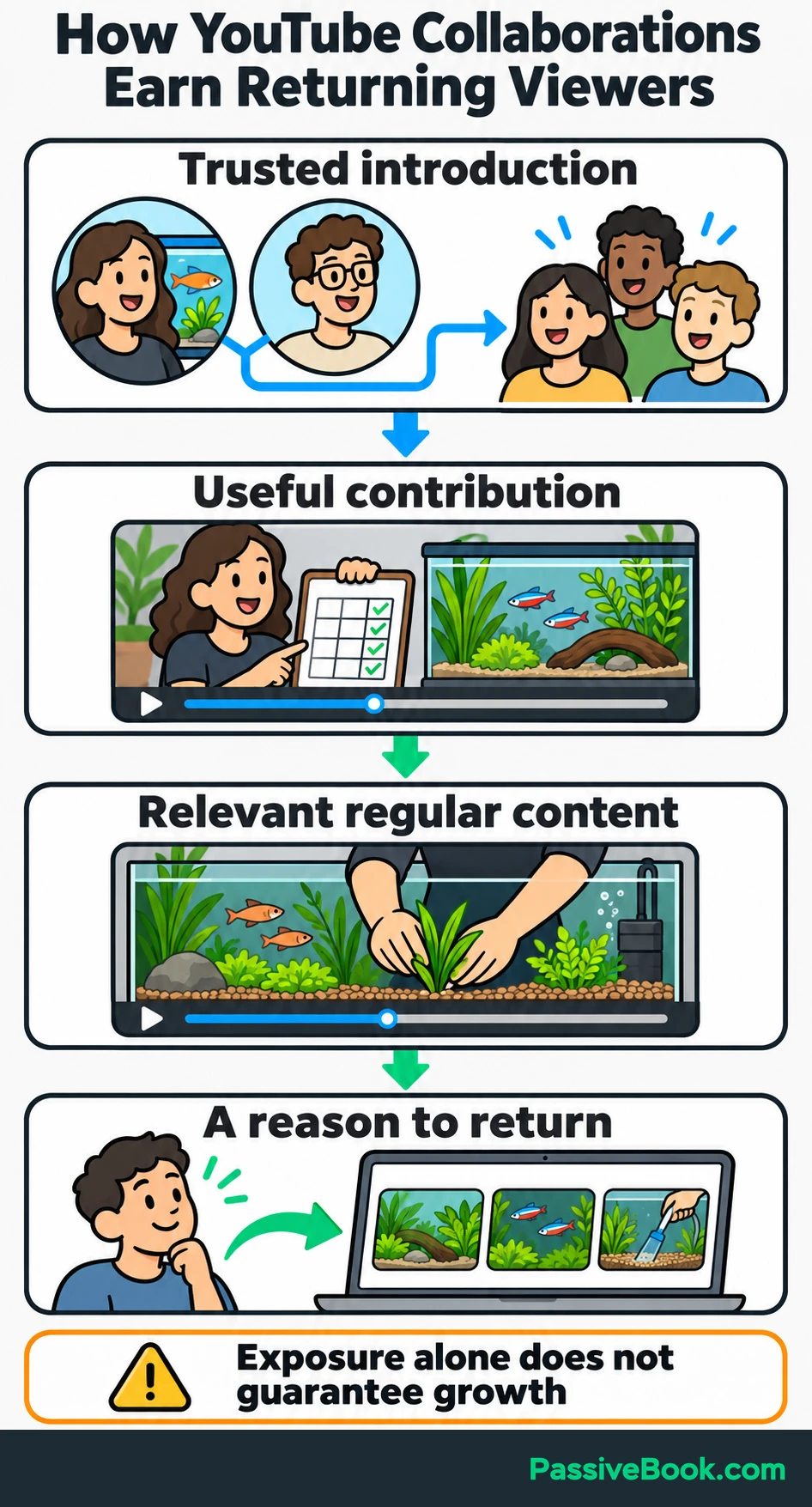
A useful collaboration lets viewers experience your work through a creator they already watch. Your contribution gives them a reason to visit, and your regular content gives them a reason to stay.
That second part matters. A guest appearance can attract attention without attracting people who want your next video.
Research offers some support for testing collaborations. An observational study found higher average views for collaboration videos in their first 12 days, but results varied widely between channels. The sample came through networks that support YouTube creators and excluded gaming videos, so it cannot predict what your partnership will produce.
I would start with one small pilot and one primary outcome:
- Discovery: Reach new viewers interested in your regular subject.
- Continued viewing: Encourage viewers to watch another relevant lesson.
- Subscriber growth: Attract people who want more of the content you normally publish.
- Business growth: Generate relevant email sign-ups or purchases.
Choose one to lead the project. You can record the others, but trying to maximize everything makes the video and its next step harder to plan.
For the examples below, imagine you run a beginner freshwater-aquarium channel supported by a printable tank-care log. You want to partner with an aquarium educator on a video about organizing care records. The business, partnership, copy and figures are illustrative.
For this pilot, I would prioritize relevant subscriber growth and use log downloads as a secondary business measure.
A smaller audience does not leave you empty-handed. You might contribute clear diagrams, useful footage, editing, a strong concept or access to questions the other creator has not covered. Those are concrete reasons to work with you.
Find Creators Whose Viewers Would Want Your Content
Build a Shortlist Around Shared Viewer Needs
Start with the problem your proposed video will solve. Then look for creators who answer a related question from another useful angle.
For the aquarium example, the shared problem might be:
“I’m learning how to care for my tank, but my readings and maintenance notes are scattered everywhere.”
Your channel can teach the record-keeping process, and an aquarium educator can explain a specific task those records support.
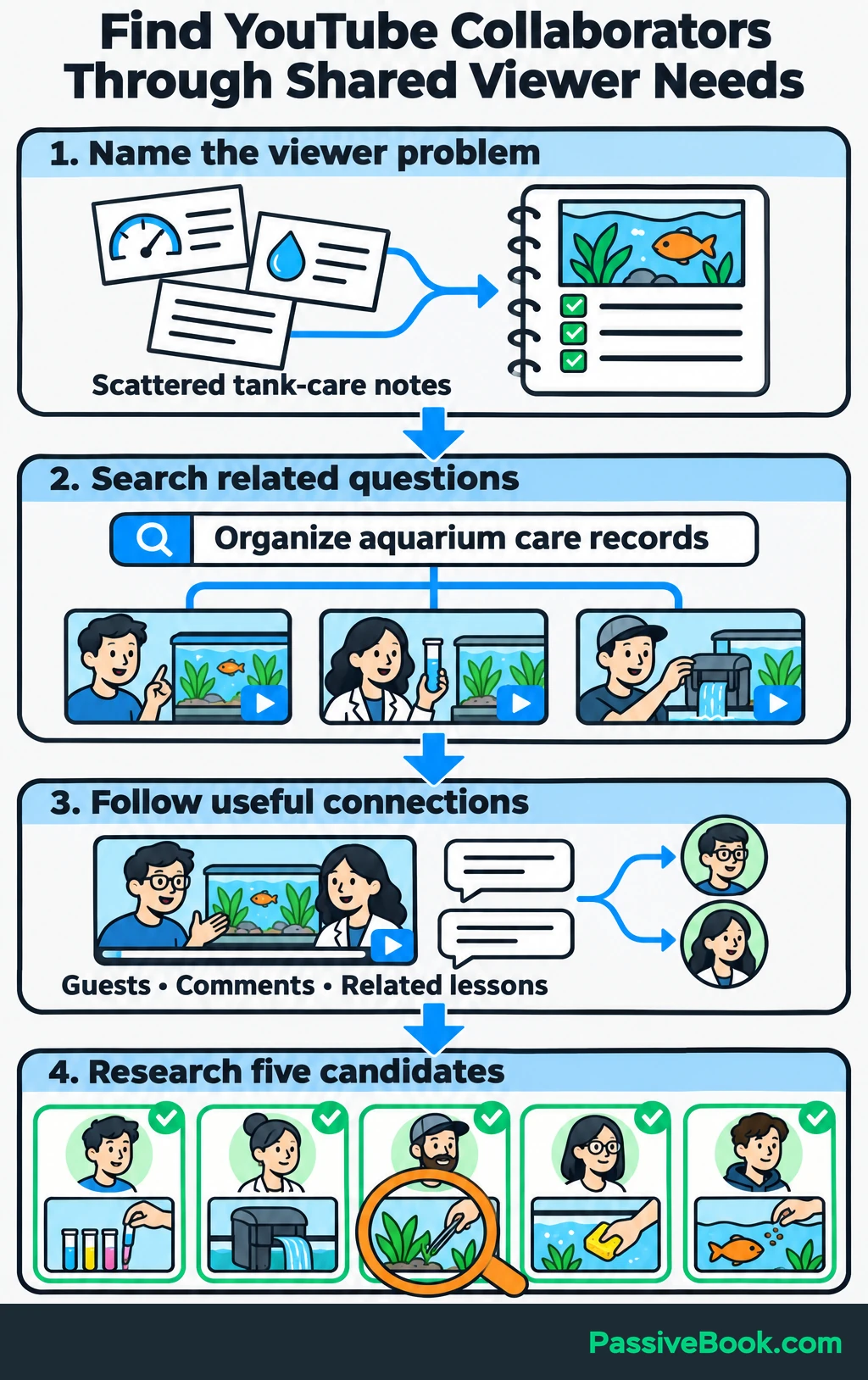
Search YouTube using the questions your viewer would ask. Look through relevant results, previous guest appearances and recommendations in comments.
You can also find potential partners in YouTube Studio, YouTube’s dashboard for managing your channel. In its Audience reports, “Channels that your audience watches” lists other channels your viewers consistently watched during the previous 28 days. If it offers no useful candidates, keep searching manually.
Put five promising creators in a spreadsheet or Notion table. Record:
- Relevant work: A specific video that connects to your proposed lesson.
- Shared viewer need: The problem both audiences care about.
- Complementary contribution: What this creator can teach or demonstrate.
- Ordinary reach: Views across several representative recent uploads.
- Contact route: Their published business email or preferred contact method.
- Pitch idea: One useful video you could make together.
Five researched candidates are enough to begin. A list of 200 names can become an impressive way to avoid sending a pitch.
Check Audience Fit and Mutual Value
Watch several recent videos before contacting anyone. Pay attention to the questions viewers ask, the assumed experience level, the language and the creator’s approach.
Then finish this sentence:
“Their viewers would want our videos because…”
For the aquarium channel, a useful answer would be:
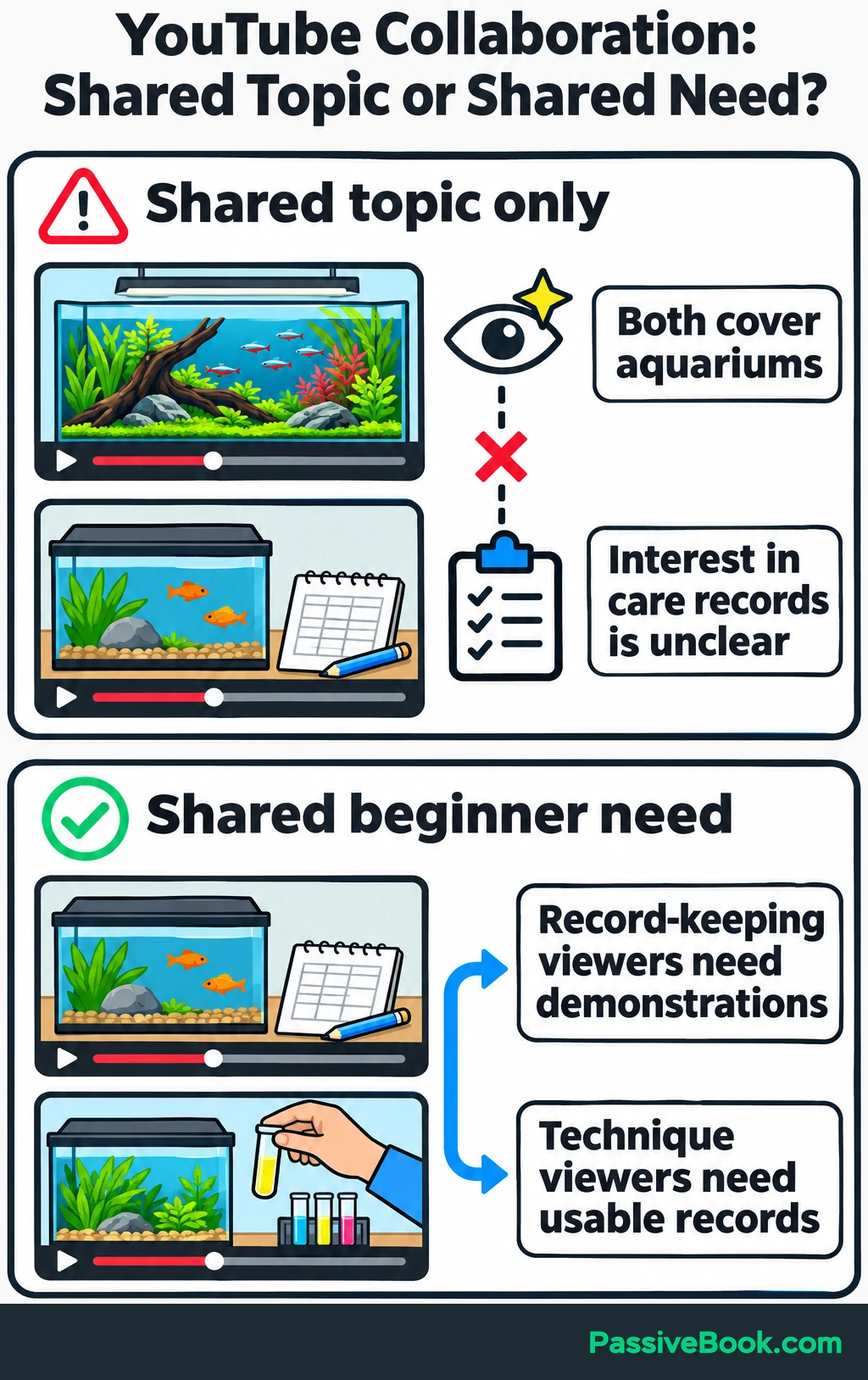
“Their viewers are learning care techniques and need a simple way to record what they do. Our viewers need demonstrations that make those records useful.”
“Both channels cover pets” is too broad. An audience watching spectacular aquarium builds may have little interest in a beginner’s care log.
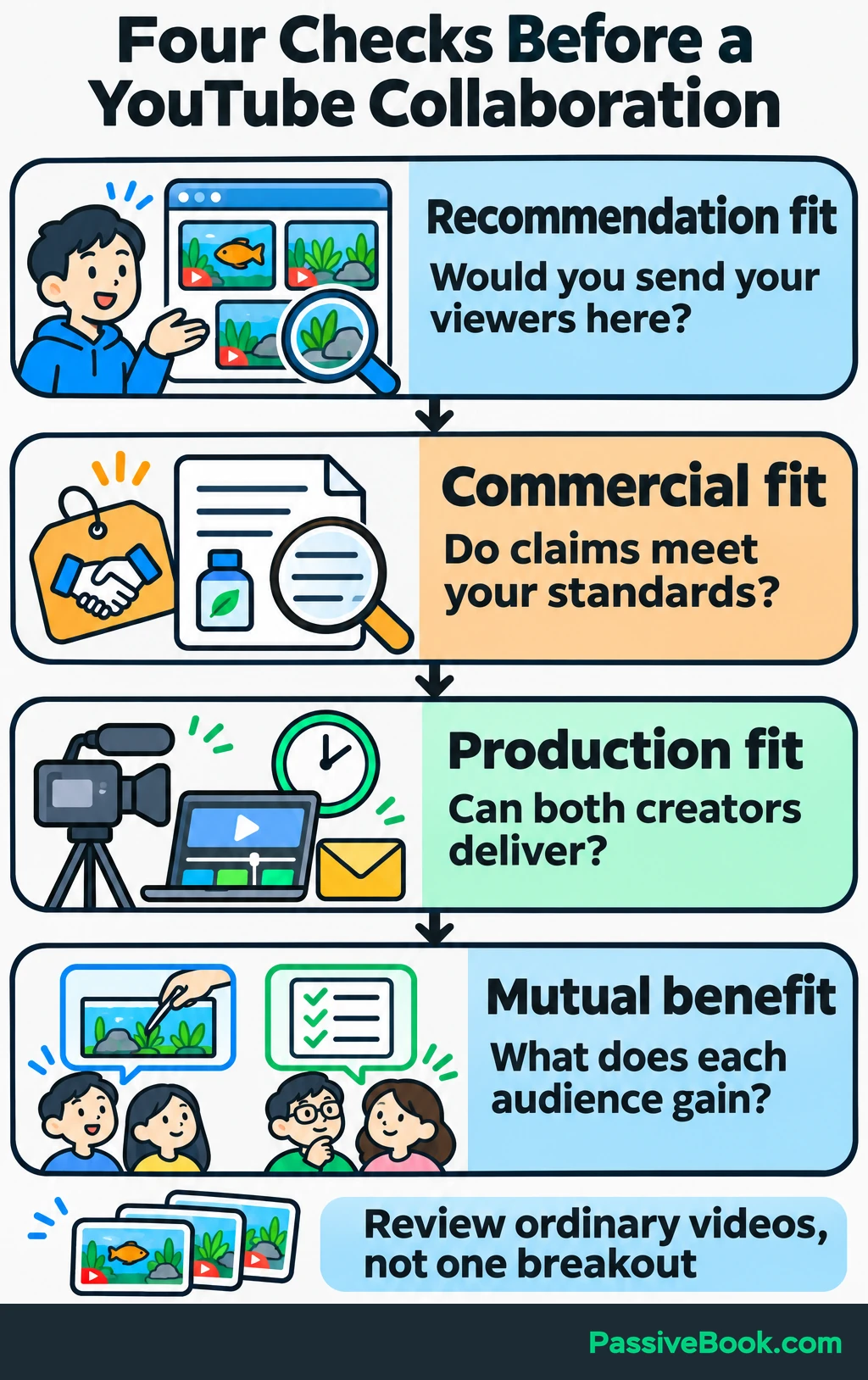
Check the working relationship too:
- Recommendation fit: Would you comfortably send your own viewers to their ordinary videos?
- Commercial fit: Do their sponsorships and product claims fit your standards?
- Production fit: Can each person deliver something useful within the available time?
- Mutual benefit: Can you explain what each audience gains without mentioning subscriber counts?
Review normal performance rather than one breakout upload. If the project would require substantial spending, ask whether the creator is comfortable sharing relevant audience information before you commit.
I would choose a smaller creator with a clear audience connection over a larger channel that requires a long explanation of why the partnership makes sense.
Choose a Collaboration Format That Serves Both Audiences
Decide what the viewer needs to learn and what each creator adds. Set your production-hour and spending limits before choosing the format.
For a first pilot, I would use a prerecorded guest segment. It gives the partner a focused task and avoids coordinating a live recording.
| Collaboration Configuration | Viewer Benefit | Each Creator’s Contribution | Coordination Demands | Publishing Destination | Next Viewing Step |
|---|---|---|---|---|---|
| Prerecorded guest segment | One clear lesson with a useful demonstration | You explain the record-keeping process; the educator supplies a short demonstration | Agree on the outline, recording requirements and one review round | Your channel | The educator’s existing lesson on the demonstrated task |
| Joint interview | Answers to connected beginner questions | You bring practical questions; the educator explains and responds | Schedule a recording, prepare questions and edit repeated answers | One agreed channel | A focused tutorial that expands on one answer |
| Two complementary videos | Two complete lessons covering different parts of the same problem | You teach care-record organization; the educator teaches the related technique | Coordinate both outlines, edits, publication order and promotion | One video on each channel | Each video recommends the other for its distinct lesson |
Paired videos are a publishing arrangement, so they can include interviews or recorded guest contributions. You do not need to treat these options as separate boxes.
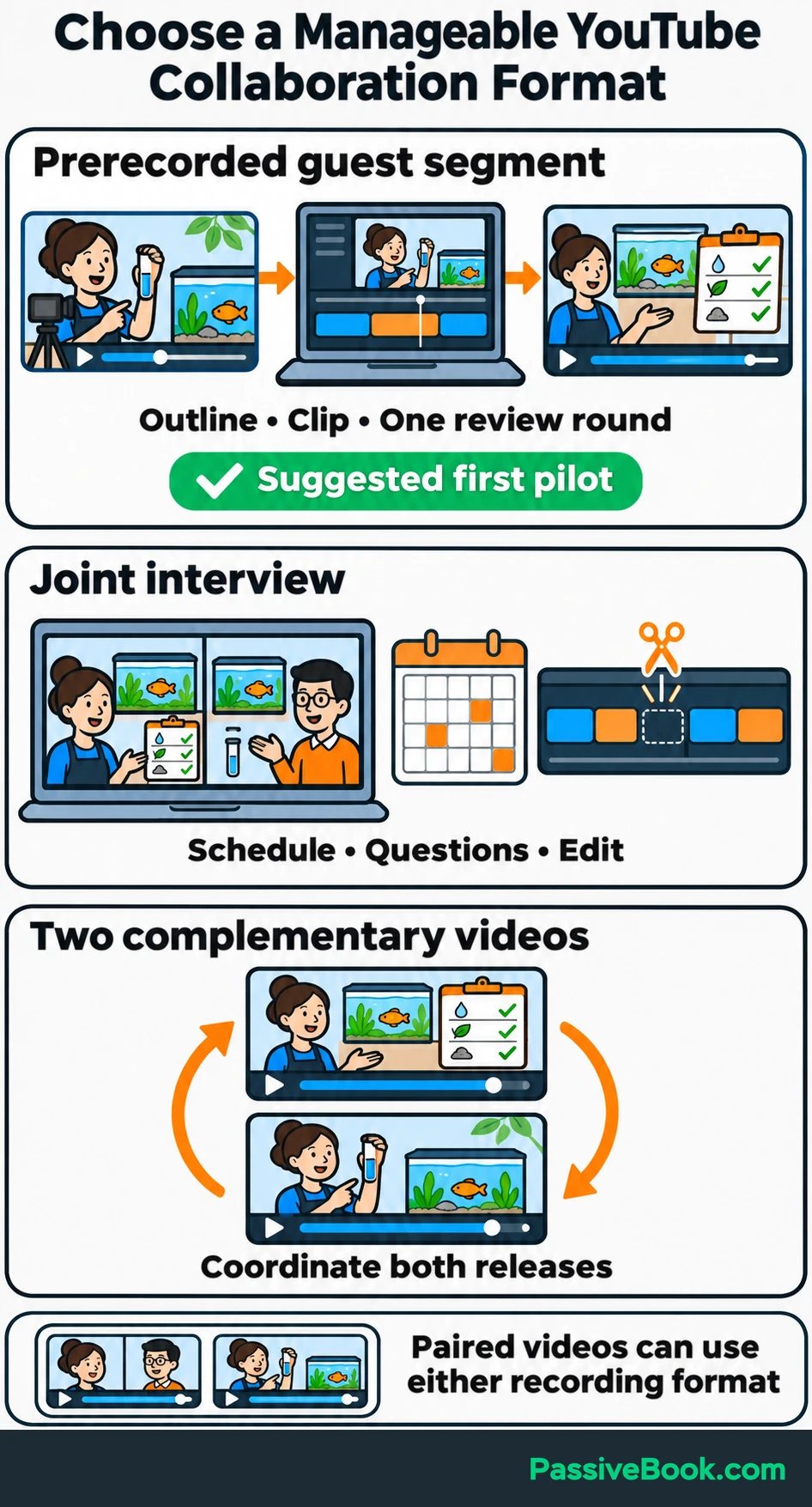
For the aquarium pilot, I would make one care-record walkthrough with the educator’s recorded contribution. Link to a suitable existing video on their channel. Add a new companion upload only if both creators have the capacity.
You can use voiceover, close-up demonstrations and diagrams without appearing on camera. Travel is unnecessary when separately recorded footage teaches the lesson clearly.
Each video should stand on its own. The companion video should add something useful rather than supply an answer deliberately withheld from the first.
Pitch a Specific Idea With a Manageable Ask
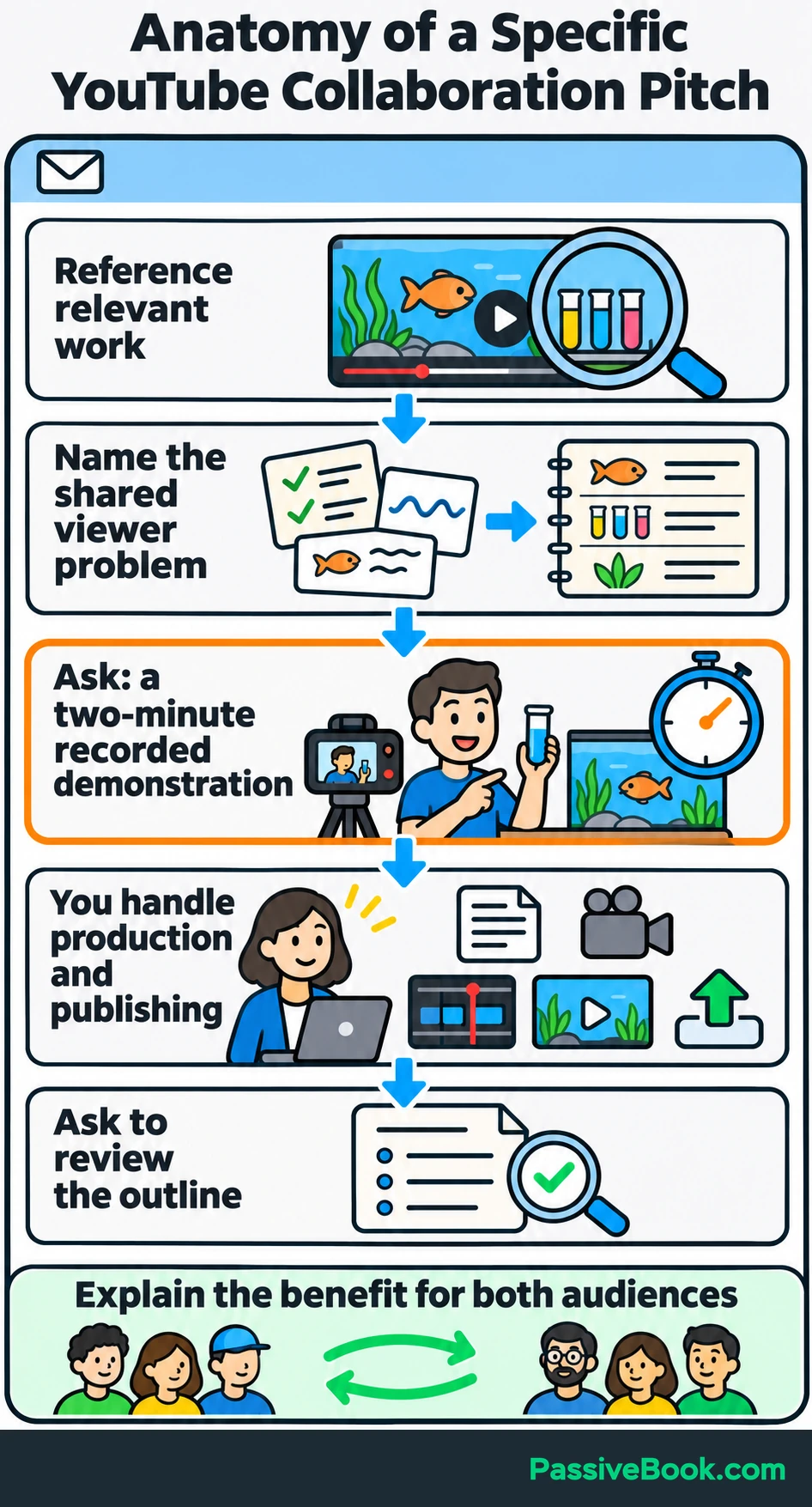
Use the creator’s published business contact route. Show that you watched their work, name the shared viewer problem and propose one contribution.
Your first message should make the workload easy to assess. Explain what they would deliver, what you would handle and where the video would appear. Include one representative link from your channel.
Here is a complete pitch you can adapt:
Subject: Collaboration idea: a tank-care log with your testing demonstration
Hi [Name],
Your video on [specific water-testing topic] explains a task my viewers are learning too.
I’m planning a video about organizing aquarium care records so beginners can keep their readings and maintenance notes together. Would you be interested in contributing a two-minute recorded demonstration showing how you record a test result?
I’ll handle the outline, my footage, editing, thumbnail and upload on my channel. I’d send the outline first, and we could agree on a small recording window and one review round before either of us commits.
Your viewers would get a practical record-keeping walkthrough to use alongside your lessons, and mine would get a demonstration from someone who teaches the technique. I’d credit your contribution and recommend your relevant tutorial at the point viewers need it.
Here’s a related video from my channel: [link].
Would you be interested in reviewing the outline?
Thanks,
[Your name]
[Channel link]
If the creator prefers a conversation, offer a short interview instead. Keep the viewer problem and proposed workload just as specific.
If the example is close but your proposed partnership works differently, AI Video Studio can draft your version. Give it the viewer connection and the work you can realistically offer.
Free AI Video Studio




After about a week, send one brief follow-up:
Hi [Name], following up on the aquarium care-record video. Here’s the short outline showing the viewer benefit and proposed contribution: [link]. Would it fit your upcoming content? No problem if the timing doesn’t work.
Record the response and next action. After an unanswered follow-up, close the request and approach another suitable creator.
Agree on Responsibilities Before Recording
Turn the accepted idea into a shared brief. A page is usually enough for a small pilot.
On one digital-product project, “promotion” sat on my task list without a deliverable. It looked covered until I had to do it. Now I assign each email, graphic or landing page to one person.
Your brief should cover:
- Viewer promise: What someone will be able to do after watching.
- Deliverables: Each recording, graphic, video and promotional item.
- Ownership of tasks: Who scripts, records, edits, makes the thumbnail, uploads and reports results.
- Deadlines: Delivery dates, review dates and the publication date.
- Review scope: What each person approves and how many revision rounds are included.
- Production limits: Maximum hours, expenses and optional work.
- Viewer’s next step: The specific video, playlist or resource you will recommend.
- Fallback: What happens if someone cannot finish.
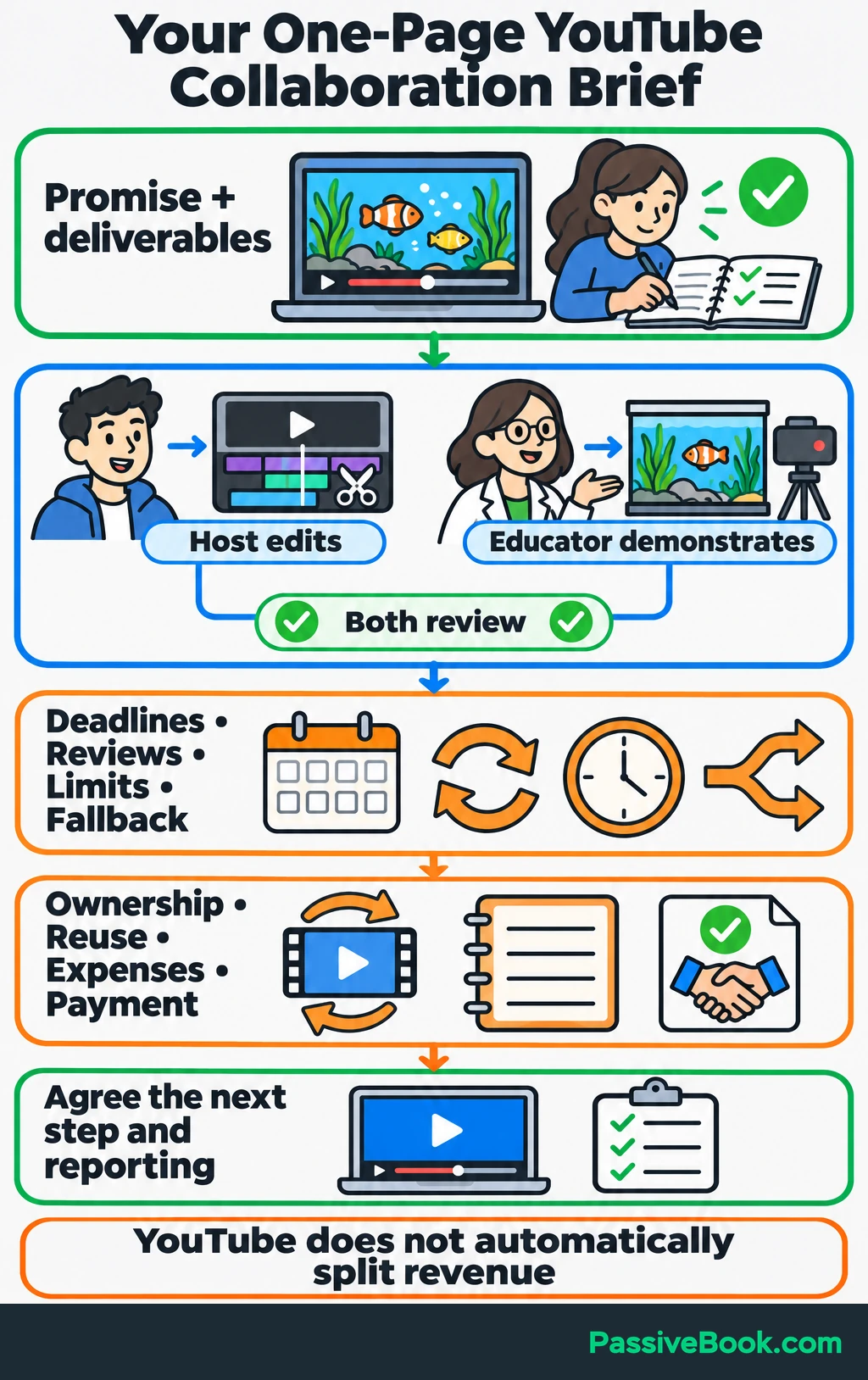
For the aquarium pilot, you edit the walkthrough. The educator supplies the demonstration, and you each approve how your work is presented.
Before launch, choose comparable uploads as your baseline. Agree which figures to share at seven and 28 days, comparing videos at the same publishing age.
Agree on payment, expenses and any revenue split directly. YouTube pays the posting channel and does not automatically split collaboration revenue. YouTube’s collaboration revenue rules
Agree in writing who owns the footage and who may edit, publish or reuse it in videos, Shorts or promotions. Permission to use a clip does not transfer ownership; confirm third-party permissions too. YouTube’s copyright guidance
Produce a Video That Earns the Next View
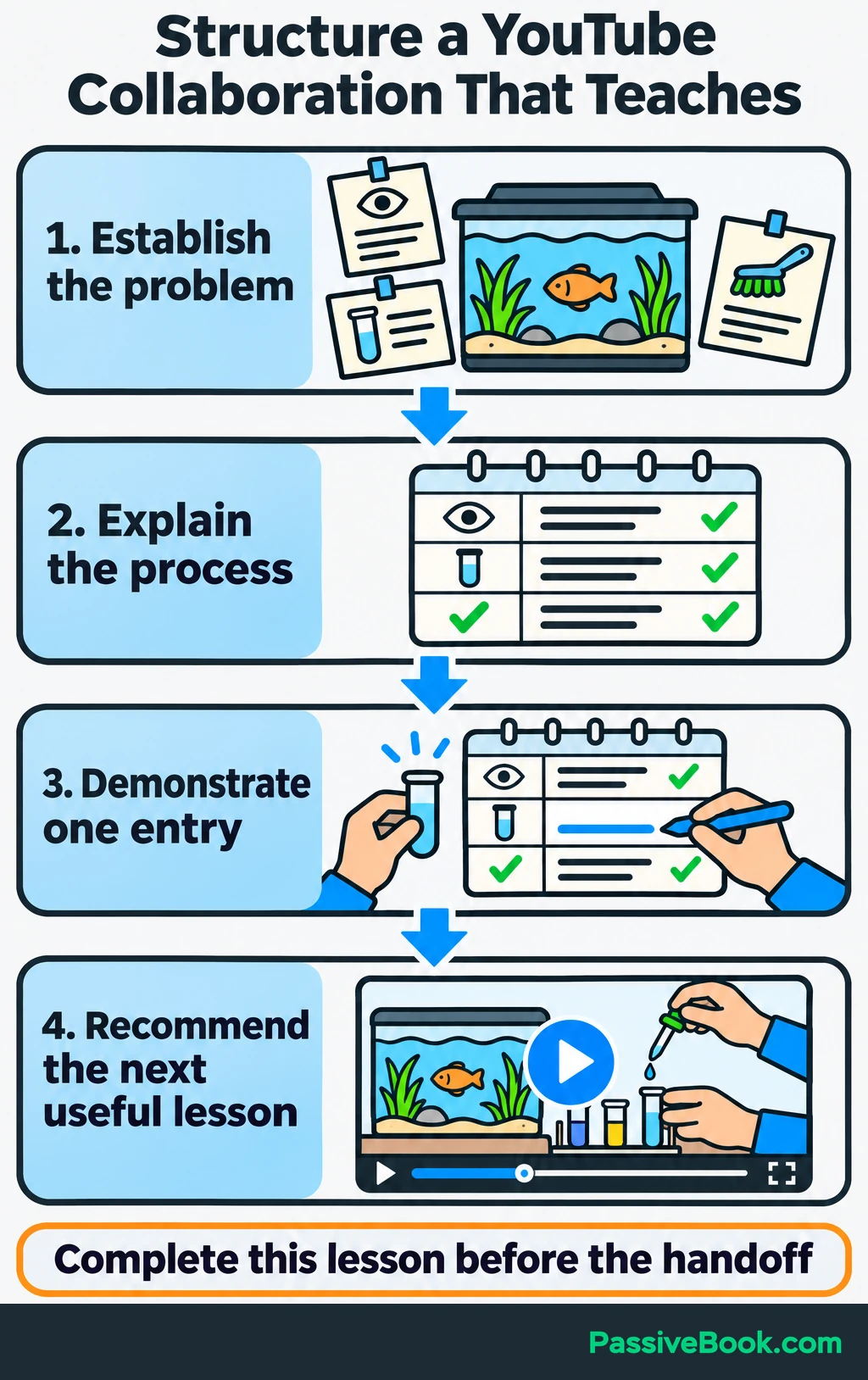
Outline the teaching before recording:
- Establish the problem.
- Explain the process.
- Demonstrate it.
- Recommend the next useful lesson.
Introduce your collaborator through what they contribute, then get into the answer. Viewers need to know why this person is helpful, but they do not need a lengthy ceremony.
For the aquarium example, explain how to organize observations, readings and completed tasks before showing a filled-in log. Then use the educator’s contribution to demonstrate one entry.
A short introduction could be:
“[Creator] teaches aquarium care, and they’ll show how they record a test result. First, let’s organize the page so those notes are easy to find.”
Before recording the full segment, agree on audio quality, framing, video orientation, file delivery and the shots you need. Review a short sample first. Discovering unusable sound after the whole recording is an expensive form of suspense.
Build the title and thumbnail around the viewer’s problem. “Organize Your Aquarium Care Notes” makes the lesson clearer than “Our Exciting Collaboration.”
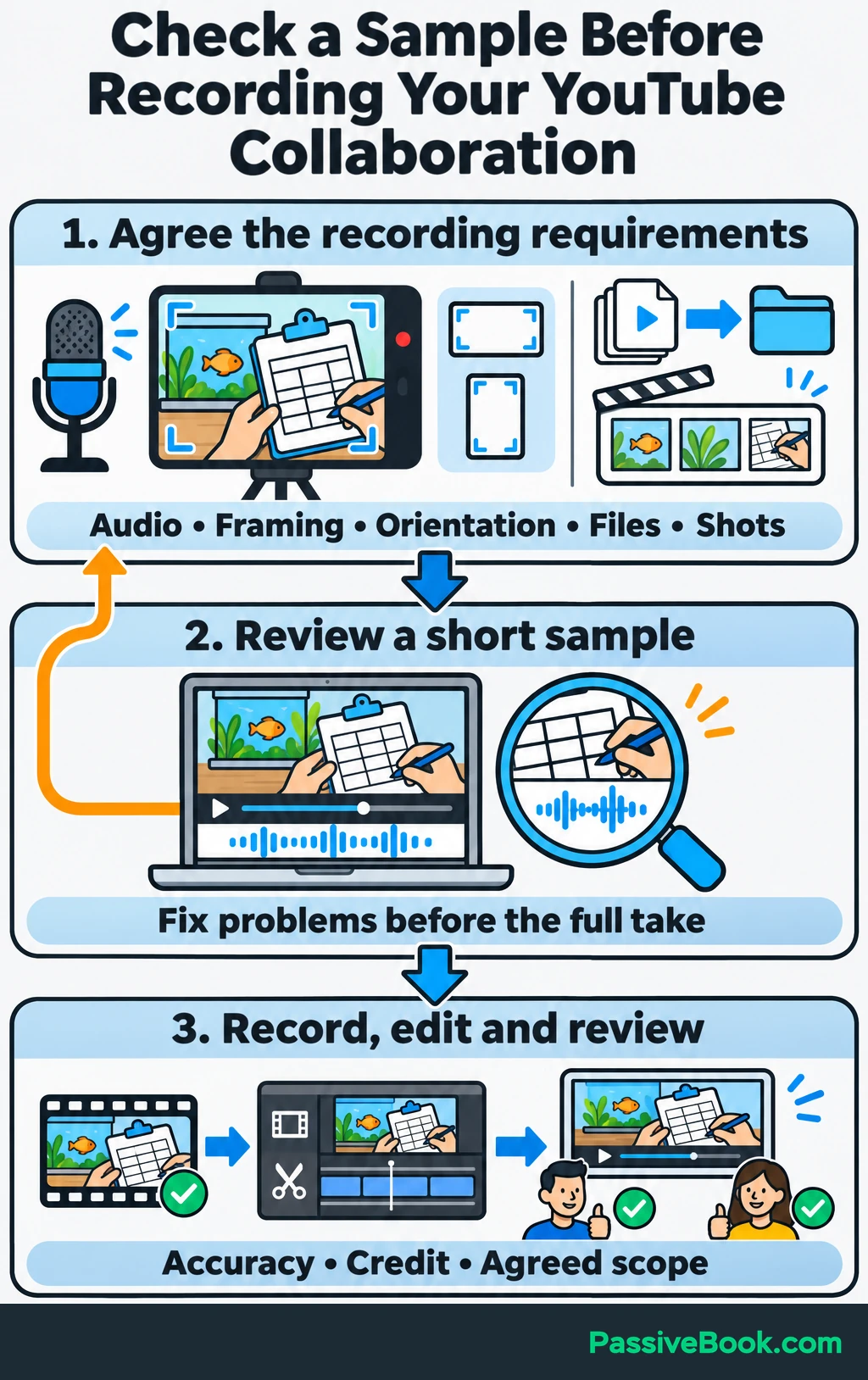
During editing, remove repeated explanations and make sure the guest contribution fits naturally into the lesson. Both creators should review the finished version for accuracy, credit and agreed scope.
Record a specific handoff:
“Watch [Creator]’s testing tutorial next if you want to see the full process behind this entry.”
Give people a reason to subscribe as well:
“I publish simple walkthroughs for organizing aquarium care, including keeping records and using a tank-care log.”
That tells an interested visitor what another video from you will offer.
Publish With YouTube’s Collaboration Tools
Add Collaborators in YouTube Studio
YouTube lets you invite up to 10 creators to a video or Short. Once they accept, their names and channel Subscribe buttons appear. Recommendations to participating audiences are a goal, not a guarantee. YouTube’s collaboration feature
To add your partner during upload:
- Open the video’s details in YouTube Studio.
- Select “Show more.”
- Under “Collaboration,” choose “Invite a collaborator.”
- Share the invitation and confirm acceptance before promotion.
For commercial relationships covered by YouTube’s paid-promotion rules, use the disclosure setting and follow applicable local rules.
Give Viewers a Clear Route to the Next Video
Have the next lesson ready before launch. Recommend its specific benefit:
“See the complete water-testing demonstration on [Creator]’s channel.”
For long-form videos, add a clickable end-screen recommendation in the final 5–20 seconds. Videos must be at least 25 seconds long and not marked made for kids. YouTube’s end-screen requirements
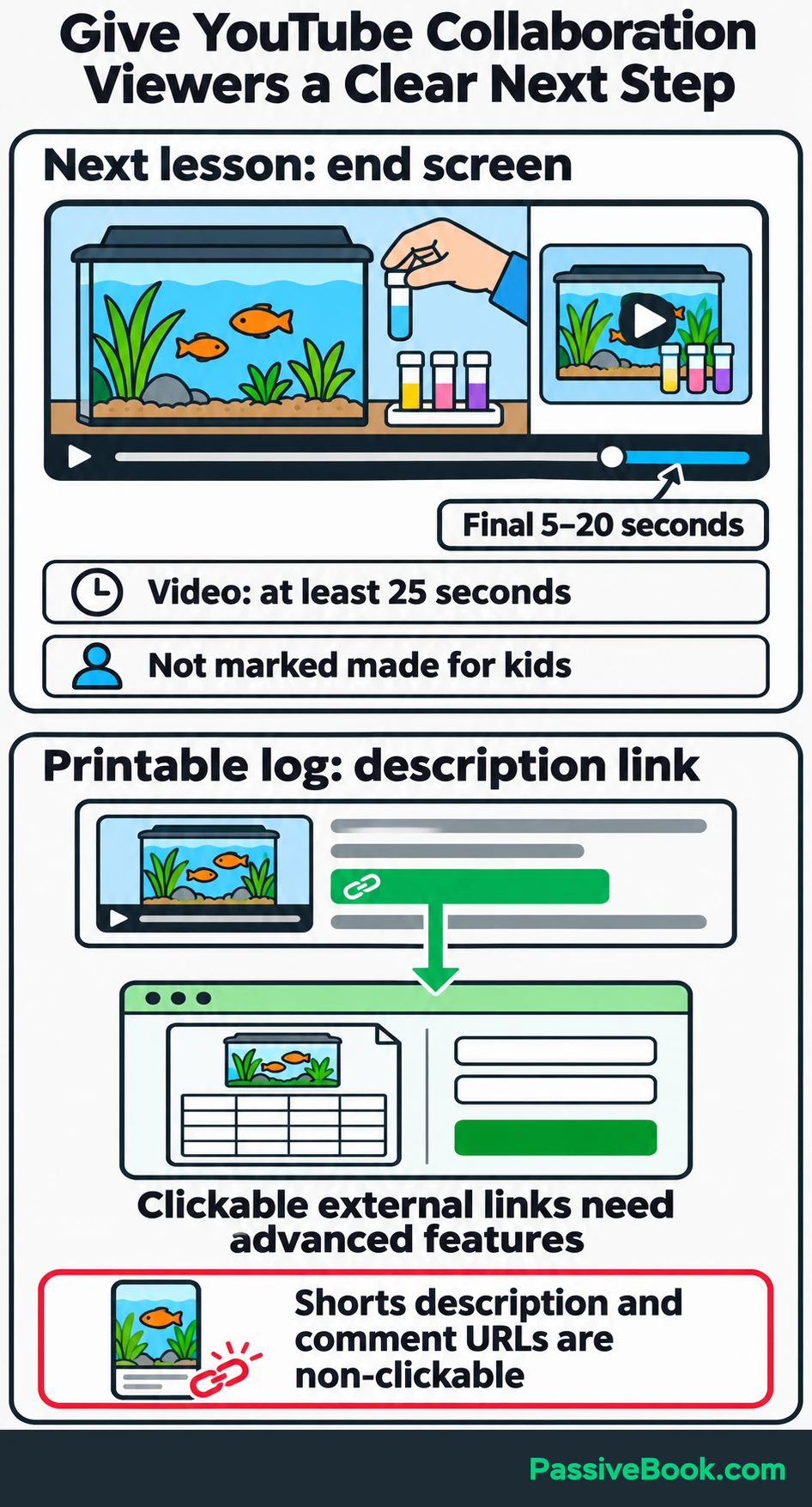
For the printable log, link to its page from the long-form description. Clickable external links require advanced features; URLs in Shorts descriptions and comments are non-clickable. YouTube’s link-placement rules
To track website visits in Google Analytics, add campaign tags—extra URL details identifying the campaign. Use these values on both creators’ links, changing utm_content by placement:
- Source:
youtube - Medium:
organic_video - Campaign:
aquarium_log_collab - Your description placement:
utm_content=host_description - Partner’s description placement:
utm_content=partner_description
Check links and credits before sending the agreed announcements. Each creator should link to the upload and explain the viewer benefit. Share permitted clips and answer viewer questions.
Measure Results Before Repeating the Partnership
Compare Audience Response With Ordinary Uploads
At seven and 28 days, compare similar uploads at the same publishing age.
| Metric | Baseline | Aquarium Pilot | Production Effort |
|---|---|---|---|
| Subscribers gained in first 28 days | Median of 8 across five comparable uploads | 12 | 6 hours across both creators; $0 cash |
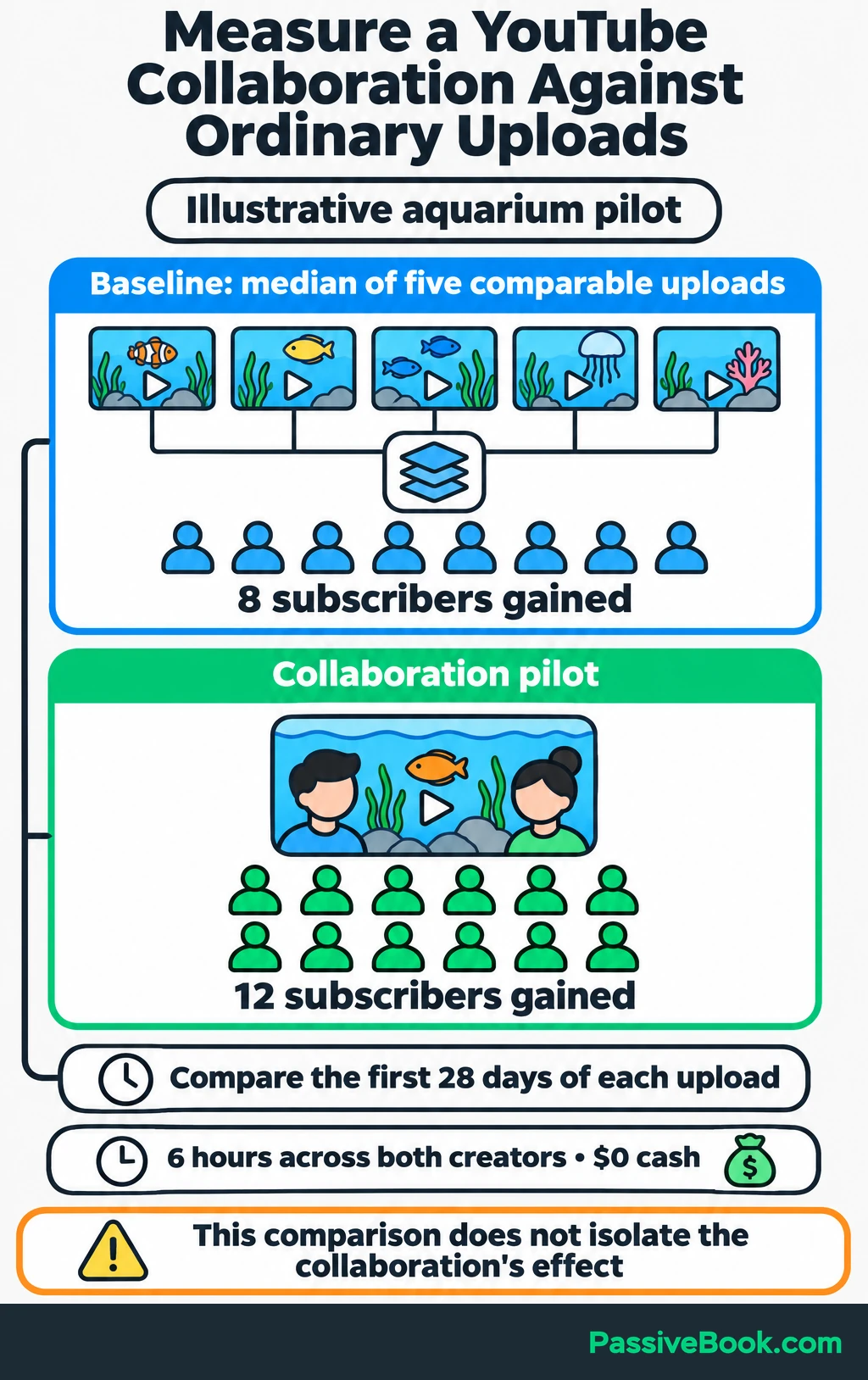
YouTube cannot identify “qualified subscribers” or track those individuals’ later purchases. Look for relevant questions and interest in later related videos alongside watch time, retention and end-screen clicks. Check traffic sources too: other YouTube channels count as internal traffic. These signals cannot isolate the collaboration’s effect.
Review Business Outcomes and Production Effort
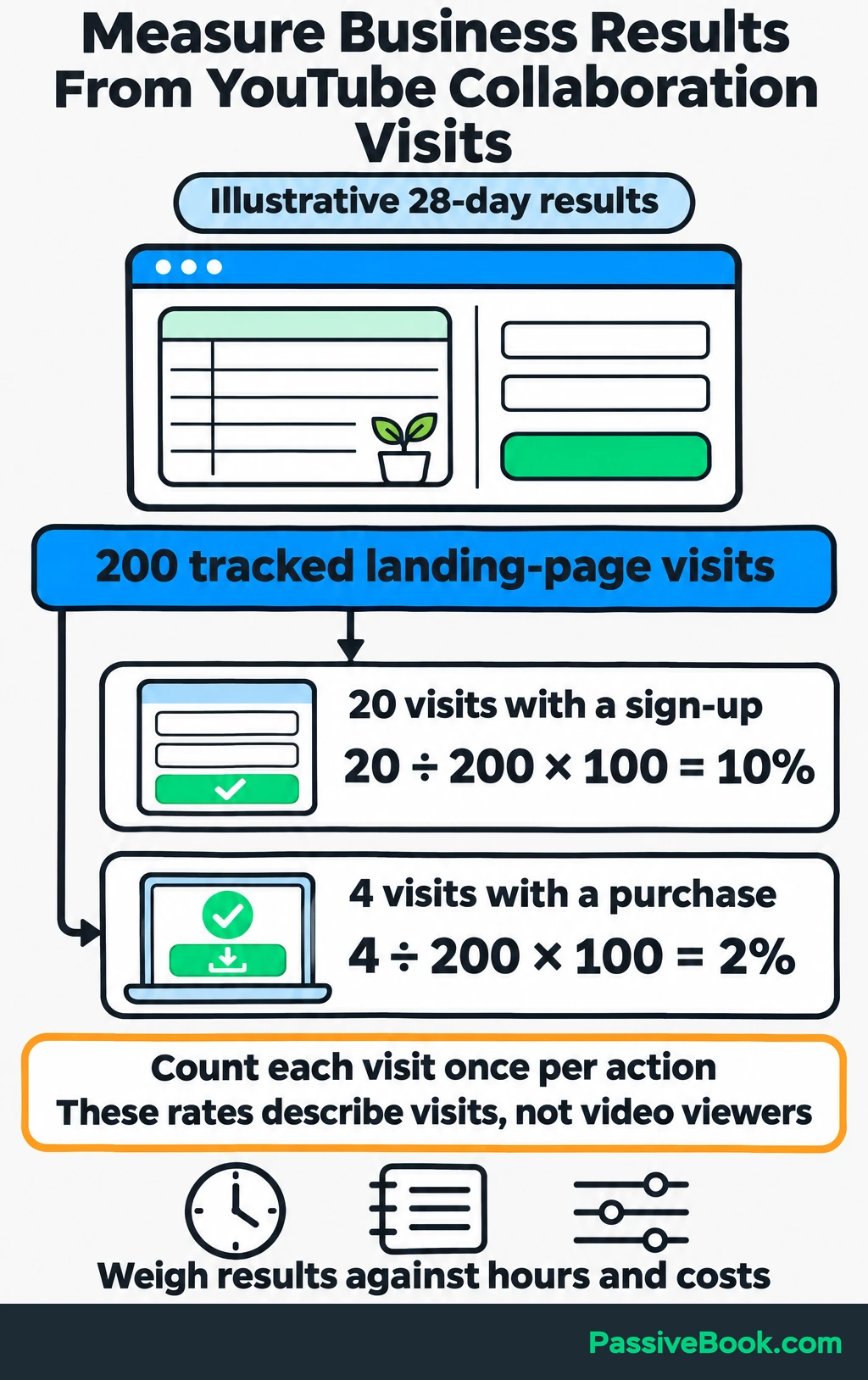
Count campaign visits and actions within the same 28-day window. Suppose 200 tracked landing-page visits include 20 with a sign-up and four with a purchase. Count each visit once per action:
- Visit-to-sign-up rate: 20 ÷ 200 × 100 = 10%.
- Visit-to-purchase rate: 4 ÷ 200 × 100 = 2%.
These rates describe tracked visits, not video viewers.
I would repeat when results justify the effort. Improve the weakest stage:
- Few clicks from impressions: Revise the title and thumbnail.
- Viewers leave early: Deliver the lesson sooner.
- Viewers watch but rarely continue: Clarify the next-video recommendation.
- Relevant website visits produce few actions: Check the page and offer.
- The audience responds but production drags: Reduce scope.
Stop if audience fit or the working relationship stays weak. Debrief together and save the shortlist, pitch, brief and results log.
What Next?
Write one sentence naming the viewer problem your collaboration will solve, then shortlist three creators whose regular videos connect to it. Finish that before drafting your pitch.
Use the social buttons to share this guide when planning a partnership together, so both creators can work from the same expectations.
What would make a collaboration worth repeating for your channel: continued viewing, relevant subscribers or business results? Share your answer in the comments, and bring any other questions too.
Share this post with your friends & followers:

