A customer buys your course, opens the first lesson, and never returns. Another makes one purchase but has no clear reason to buy again. You’re considering rewards, but the software options range from a simple store plugin to a system that needs developers.
That range makes the decision expensive to get wrong: a low subscription price can hide setup work, reward costs and ongoing upkeep. This comparison shows which tools fit store loyalty, course progress, app use and promotional games, what they cost, and what to test before committing to a bigger subscription.
Which Gamification Software Should You Shortlist?
I would start with three options:
- Shopify purchase rewards: Smile.io for a straightforward points and referral program.
- WordPress course progress: GamiPress for achievements tied to useful learning milestones.
- A small campaign pilot: Drimify for testing a quiz or game before building a larger program.
These recommendations reflect documented capabilities and my judgment about business fit. They are not hands-on test results or measured performance rankings.
Gamification connects a useful action with visible progress, recognition, or a reward. That action might be a second purchase, a completed project, a qualified referral, or repeat use of a product feature.
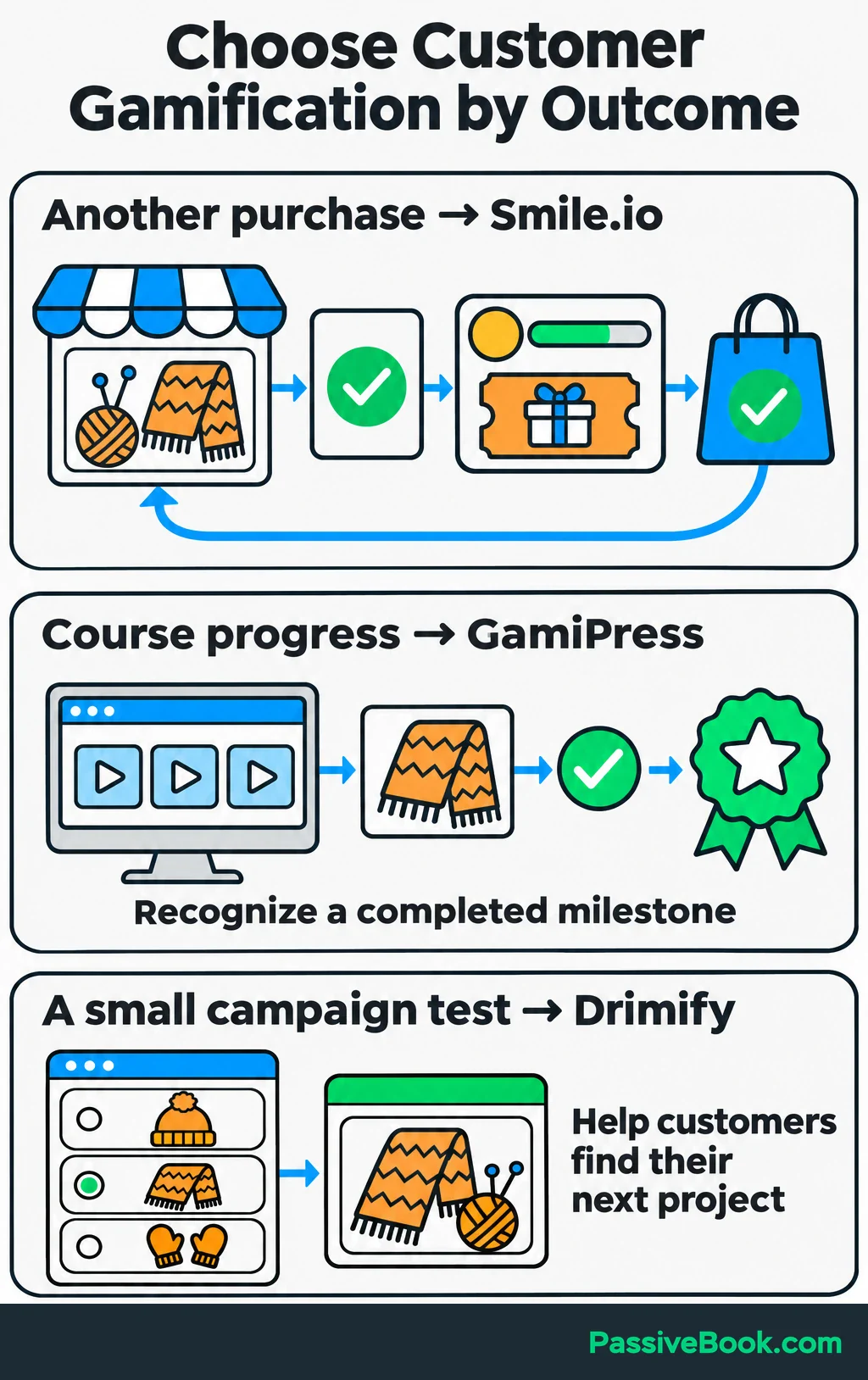
Choose that action first. A promotional quiz and a course achievement system solve different problems, even when both award points.
For the examples, imagine you run an online shop selling knitting patterns and a beginner knitting course. You want customers to finish their first project, feel good about their progress, and find another pattern they can use. The examples and figures are illustrative.
If another purchase is the priority, start with store loyalty. If customers abandon the course, investigate course progress. A spinning wheel will not explain a confusing lesson.
The table below puts published prices in one place. Dollar amounts are USD, and billing periods and allowances matter. Optional WordPress bundles are purchases you can choose; they are not required subscriptions for the free core plugins. Use the linked vendor pages for current details.
| Software | Strongest Use Case | Mechanics | Required Platform | Integration Effort | Published Paid Price and Billing Basis | Free Plan or Trial | Main Tradeoff |
|---|---|---|---|---|---|---|---|
| Smile.io | Simple Shopify purchase loyalty | Points, referrals, VIP tiers on Growth | Shopify for this recommendation | App setup and reward rules | Essential: $15/month, monthly billing, 500 orders and one integration. Growth: $199/month, monthly billing, 2,500 orders and VIP tiers | Free: 200 monthly orders | Advanced loyalty and more integrations raise the subscription |
| Gameball | Store loyalty with promotional games | Points, referrals, tiers, games | Shopify for these plans | App setup, campaign rules, integration checks | Starter: $34/month, 300 monthly rewarded customers. Pro: $159/month, 1,000 monthly rewarded customers | Free: 100 monthly rewarded customers; paid Shopify plans offer a seven-day trial | Rewarded-customer allowances need careful budgeting |
| LoyaltyLion | Loyalty connected to customer follow-up | Points, referrals, customer segments | Shopify for this comparison | App setup plus email-flow configuration | Classic: $199/month, 500 monthly orders; Shopify bills recurring charges every 30 days. Higher plans require quotes | Free: 400 monthly orders; Classic offers a 14-day trial | More suited to an established marketing setup |
| GamiPress | WordPress course achievements | Points, achievements, ranks | Self-hosted WordPress and a compatible course integration | Plugin installation, event mapping, display setup | Optional Personal Pass: $199/year for one site, including all add-ons, assets, support and updates during the subscription | Free core plugin | Extensions and site maintenance remain your responsibility |
| myCred | WordPress points and redemption | Points, badges, ranks, spending rules | WordPress; WooCommerce for store use | Earning, spending and refund-rule configuration | Optional Basic bundle: $99/year for one site; required extensions depend on the program | Free core plugin | A points balance needs ongoing rules and oversight |
| Trophy | Persistent progress inside an app | Achievements, streaks, points, leaderboards, rewards | Existing customer application | Developer integration of customer events | Pro: $299/month, including 10,000 monthly active users; $0.015 per additional user. Email and push usage have separate allowances and overages | 30-day trial | Requires technical work and a recurring app budget |
| Gametize | Hosted customer challenges | Challenges, points, achievements, rewards | Hosted web or mobile experience | Challenge setup; custom connections scoped separately | Starter: $50/month, or $45/month billed annually, for up to 50 players; includes report downloads and project export | Basic: up to 10 players | Separate customer experience and submission-review work |
| Influitive | Organized customer advocacy | Targeted activities, referrals, recognition, rewards | Hosted advocacy platform | Program setup and customer-data connections | Customer Advocacy and Digital Community require sales quotes | Demo; request pilot terms | Needs an ongoing program owner |
| Drimify | Small interactive campaign tests | Games, quizzes, connected experiences | Hosted experience shared or embedded online | Simple campaign setup; data connections add work | Starter: obtain the subscription total through plan selection; monthly billing includes 1,000 participations. Branding removal costs extra | Free: 100 participations/month | Participations can exceed the number of people |
| Qualifio | Interactive campaigns that collect preferences | Quizzes, forms, competitions, prizes; reward programs on Advanced | Hosted builder with website and mobile embeds | Campaign setup plus customer-data routing | Standard and Advanced require quotes based on scope, including markets, brands and seats | Demo; request pilot terms | Ongoing rewards require Advanced |
| Komo | Connected engagement campaigns | Interactive content, badges, tiers, points through selected modules | Hosted sites, web embeds or custom connections | Module selection, workflows and customer-data setup | Quote for Core + Engage + additions; identified contacts also affect pricing | Request trial scope | The full journey may need several paid modules |
| InAppStory | Promotional games inside an existing app | Prebuilt mini-games and connected rewards | Existing app with its software development kit installed | Developer setup, then marketer-led customization | Game Center requires a quote based on monthly active users and the selected billing cycle | One-month trial after discovery, rollout planning and integration; starts with real users | Initial app development work |
| Open Loyalty | Custom loyalty across channels | Points, tiers, challenges, badges, rewards | Your own customer-facing experience | Developers or an integration partner required | Custom one-time onboarding plus recurring platform, active-member allowance and customer-care fees | Request demo and pilot terms | Supplies the loyalty engine; you build the surrounding experience |
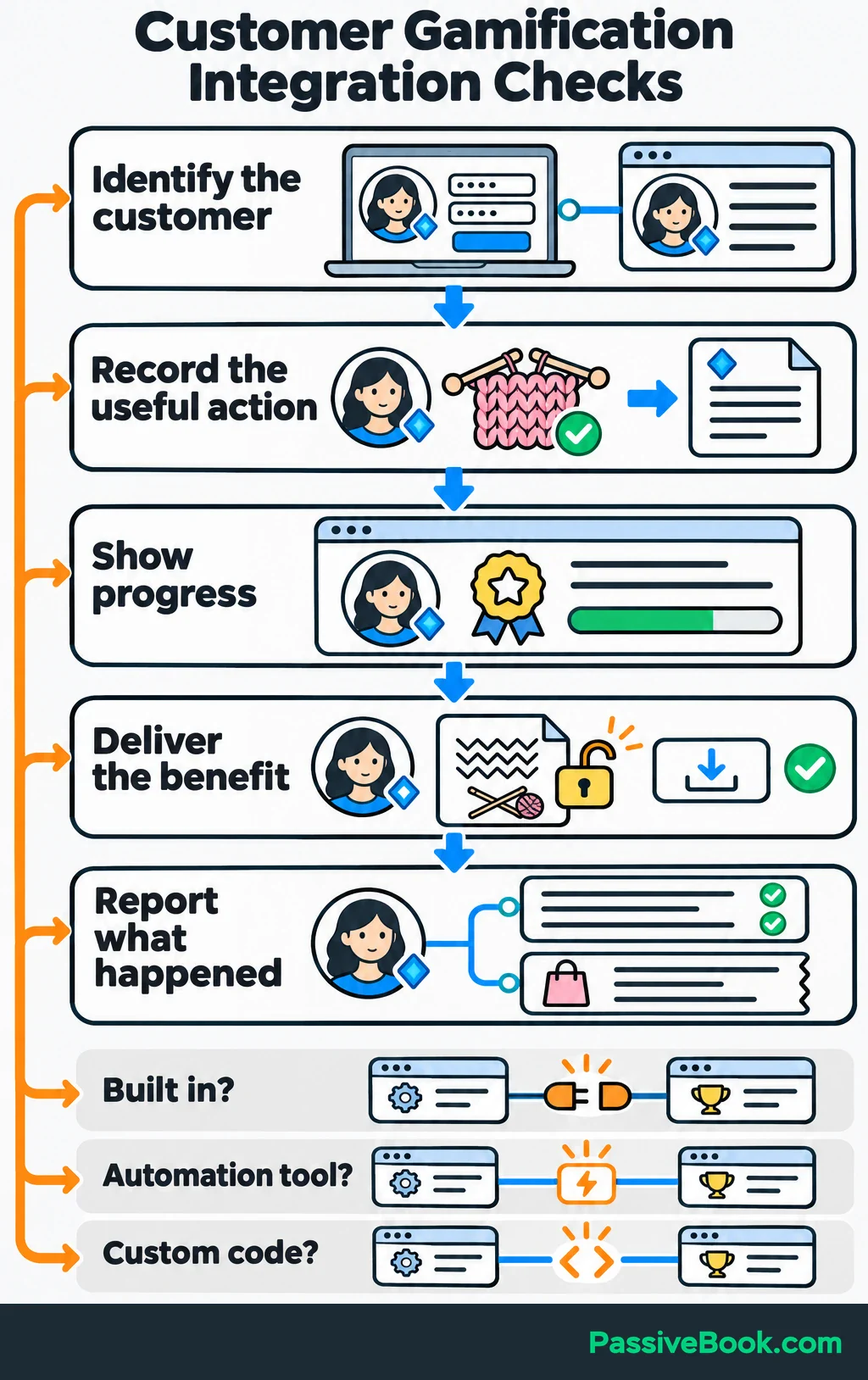
Before booking demos, check five things: how the tool identifies customers, records the action, shows progress, delivers the benefit, and reports what happened.
Then ask whether the connection is built in, needs a separate automation tool, or requires custom code. Each creates different setup and maintenance work. “Integrates with your website” is the beginning of that conversation.
The 13 Best Gamification Tools for Customer Engagement
The best gamification software for customer engagement is the tool that supports your chosen customer journey at a cost you can justify. These options cover different journeys, so use the fit described below to narrow the list before comparing features.
1. Smile.Io: Best for Straightforward Shopify Loyalty Programs
Smile.io would be my first shortlist choice when the main goal is another Shopify purchase.
Its points and referral programs give you a familiar starting point. In the knitting shop, customers could earn points from pattern purchases and redeem them toward a later order. You can explain that benefit without asking customers to learn a complicated game.
Start with one earning rule and one useful reward. Show customers where to find their balance and what they can redeem. Then test the checkout experience yourself.
The entry plan keeps the initial commitment modest, but VIP tiers and broader integration access sit higher in the range. I would leave VIP status alone until you have a useful benefit to attach to it.
Smile is less compelling when your real problem is unfinished lessons. Purchase history tells you what someone bought, but your course system must tell you what they completed.
2. Gameball: Best for Shopify Rewards With Built-in Games
Gameball is worth comparing with Smile when you want promotional games inside the same loyalty program.
Alongside points, referrals and tiers, its Shopify listing includes Spin the Wheel and Slot Machine. That gives you more ways to run a promotion, but each extra mechanic brings another decision about eligibility, rewards and follow-up.
There is an important pricing detail: the vendor lists a rewarded-customer allowance for Starter, while the Shopify listing also specifies a maximum of 1,000 monthly orders. Confirm both limits in your proposed plan.
For the knitting shop, I would introduce purchase rewards first and add one game only when it serves a clear campaign. Launching five mechanics together makes it harder to learn which one deserves its upkeep.
Pro adds advanced analytics and customer segmentation. If your systems need to exchange data with Gameball through its API, confirm that access and the required integrations are included in your quote.
3. LoyaltyLion: Best for Shopify Loyalty Connected to Customer Follow-up
LoyaltyLion belongs on the shortlist when loyalty activity should shape your customer emails.
For example, the knitting shop might want a useful reminder when a customer has an available reward. That is a more focused reason to consider it than wanting a larger loyalty dashboard.
Classic includes a branded loyalty page, onboarding support and Klaviyo integration. Klaviyo is an email and SMS platform, so this fit matters most when you already use it or have a reason to adopt it.
Check the package carefully if VIP tiers matter. The vendor’s detailed plan comparison lists them as an optional Classic add-on and includes them in Advanced.
I would choose LoyaltyLion when those connected communications justify the cost. For a small purchase-reward test with little customer follow-up in place, Smile would be my earlier stop.
4. GamiPress: Best for Achievements in WordPress Courses
GamiPress is my starting point for recognizing progress within an existing WordPress course.
Its core reward systems cover points, achievements and ranks. That suits milestones such as completing the beginner lessons or finishing a first project. The customer can see progress where they already learn.
Before installing extensions, check the precise event your course platform can send. “Lesson completed” and “finished knitting a scarf” are different events. Software can record the former directly; the latter needs a customer confirmation, submission or review.
I would begin with one achievement called “First Project Finished.” The award should follow a clearly defined completion rule, and any bonus-pattern access needs its own tested delivery step.
The free core makes an initial test accessible. Paid extensions can add capabilities, but hosting, updates and compatibility checks still belong in your workload. I would keep an existing WordPress course here rather than move it just to gain badges.
5. myCred: Best for Points and Redemption on WordPress
myCred is the stronger starting point when the customer’s points balance is central to the experience.
Its WordPress plugin supports points, badges, ranks and rewards, including WooCommerce uses. That makes it relevant when customers should earn from purchases and spend points on later orders.
For the knitting shop, the key comparison with GamiPress is practical: are you recognizing a learning milestone, or managing something customers earn and spend? Both tools have overlapping features, but that distinction helps you choose what to test first.
Set what customers can redeem their points for before building earning rules. Then test a discount, a refund and the same purchase being recorded twice. Check that each leaves the expected points balance.
The free core and optional bundles give you room to start small. However, the cheapest bundle is useful only if it includes the extensions your checkout and reporting need. I would confirm that list before buying.
6. Trophy: Best for Persistent Gamification Inside a Customer App
Trophy fits an existing application where progress should follow customers through repeated use.
It provides achievements, streaks, points, leaderboards and rewards. Your app sends meaningful customer events to the system, and those events drive the experience.
For the knitting business, this becomes relevant if you already have an app where customers record practice or completed projects. I would skip it for a shop that simply sells downloadable patterns. There needs to be an app experience worth improving.
Choose events that represent value. Opening the app is easy to count, but completing a useful practice session gives you a more meaningful behavior to encourage.
Developers still need to connect the events and customer experience. Include notification usage in the estimate, and establish how your own systems will deliver any custom prizes. Trophy reduces the work of building the underlying mechanics, but it does not remove implementation.
7. Gametize: Best for Hosted Customer Participation Challenges
Gametize is useful when you want a structured challenge without rebuilding your shop or course.
Its hosted experience supports activities such as quizzes and photo submissions, alongside progress and rewards. You can bring customers into a defined project with a beginning and an end.
The knitting shop could invite course buyers into a first-project challenge. A photo submission gives customers a way to show what they made, but you must decide who reviews it and how long that takes.
The small free allowance suits checking the experience with a handful of participants. Starter adds report downloads and project export, which matter when you want to inspect results outside the platform.
I would choose Gametize for a campaign built around quizzes, project submissions or other customer challenges. I would skip a separate challenge space when customers could complete the same journey more easily inside the course they already bought.
8. Influitive: Best for Structured Customer Advocacy
Influitive fits a coordinated customer advocacy program: referrals, feedback, customer references and other targeted activities.
Its Digital Community package adds discussions, moderation, knowledge sharing and Q&A. Those features make sense when customers have several worthwhile ways to participate and someone is responsible for keeping the program useful.
I would not start here for the knitting shop’s first loyalty experiment. A purchase reward or project challenge is a more proportionate response to the problem.
Influitive becomes worth a closer look when scattered requests need a shared system. You might otherwise be managing referrals, customer feedback and community participation across several tools.
Use the demo to follow one activity from invitation to completion, reward and reporting. Ask who handles each task after launch. A platform can organize an advocacy program, but someone still needs to give customers good reasons to participate.
9. Drimify: Best for a Small Interactive Campaign Pilot
Drimify would be my first stop for testing a small game or quiz before committing to a larger campaign system.
In the knitting shop, a short knowledge quiz could lead customers toward a suitable beginner pattern. The useful result is finding the next project. The game earns its place by helping customers reach that result.
The free plan gives you a limited test, and unlimited experience creation does not mean unlimited participation.
Drimify counts active interactions per person, per session. One person playing in three separate sessions uses three participations, and each game launched within a connected journey counts separately. Campaigns pause when the allowance is exhausted, so use its participation rules when estimating usage.
For follow-up, its integration methods include webhooks and APIs. A webhook sends an event automatically; an API lets another system request data. Include that connection in the pilot if follow-up is part of the intended payoff.
10. Qualifio: Best for Interactive Campaigns That Collect Customer Preferences
Qualifio is worth considering when the answers customers provide matter beyond the game itself.
Its campaign builder combines interactive formats, forms, opt-ins and prize management. Standard includes dashboards, exports and native integrations. Advanced adds ongoing reward programs, external events and custom integrations.
For the knitting shop, a preference quiz might distinguish customers interested in simple home projects from those ready for clothing patterns. The next step would then reflect that answer.
I would choose this direction when you have a clear use for the preferences you collect. If every answer leads to the same generic offer, the extra questions have little purpose.
Ask for a quote covering the full campaign and follow-up. In particular, include Advanced when your plan depends on an ongoing reward program. A quote for collecting answers does not cover every possible use of those answers.
11. Komo: Best for Engagement Across Connected Campaigns
Komo is worth examining when several campaigns should share customer information and recognition.
Its modular setup combines a Core module with an Engage module and optional additions. Core covers foundations such as embeds, workflows and insights. Core Plus adds customer relationship management system sync and dashboards.
The pricing detail I would watch is the loyalty scope. Badges and tiers appear in the Loyalty addition, while Loyalty Plus adds multiple programs and a points ledger—a record of points earned and spent. Identified contacts also affect the quote.
For the knitting shop, that could matter once several challenges need shared progress. It would be excessive for a single quiz with one follow-up offer.
Bring one complete journey to the sales conversation and ask for every required module on one proposal. I would compare that total with simpler tools before giving much weight to the breadth of the platform.
12. InAppStory: Best for Promotional Games Inside an Existing App
InAppStory’s Game Center suits promotional mini-games within an app you already operate.
It offers prebuilt games, marketer-led customization and game analytics. Developers first install its software development kit, which connects the service to your app. Campaign customization becomes easier after that setup.
The trial also follows discovery, a rollout plan and integration. It starts when features are turned on for real users, so arrange development capacity before scheduling the pilot.
Compared with Trophy, I would ask what customers should experience. Trophy is a closer fit for persistent achievements tied to product activity. InAppStory is worth examining for promotional play inside the app.
For the knitting shop, neither would be my first purchase without an existing app and a clear use case. Building an app merely to host a mini-game would turn a small engagement test into a much larger project.
13. Open Loyalty: Best for a Custom Loyalty Experience Across Channels
Open Loyalty belongs on the shortlist when ready-made apps cannot support the customer journey you need.
It supplies a loyalty engine that developers connect to your systems and customer-facing experience. Its challenge and badge capabilities support recognition tied to purchases, referrals and custom events.
That flexibility creates more implementation work. Your team must connect customer identities and events, show progress, deliver rewards, and bring the results into business reporting.
I would consider it only after writing down the specific requirement simpler tools cannot meet. “We may need flexibility later” is an expensive reason to commission an integration.
The vendor itself points very small programs toward ready-made loyalty apps. For the knitting shop’s first program, I agree. Open Loyalty becomes relevant when a proven journey needs a level of control that a store plugin cannot provide.
How to Choose a Platform That Earns Its Cost
Features help you build a shortlist. A complete customer test tells you whether the tool belongs in your business.
Test One Complete Customer Journey
Shortlist two tools that serve the same customer job. Then walk through identification, the qualifying action, visible progress, reward delivery, a return visit and reporting.
Ask the vendor to demonstrate that journey using your requirements. A prepared tour can look excellent while leaving your hardest connection untouched.
For the knitting shop’s course milestone, I would test this proposed journey:
| Stage | What You Would Set Up | What You Would Check |
|---|---|---|
| Customer identification | Use the customer’s existing course account | Progress belongs to the correct buyer |
| Clear next action | Show “Finish your first scarf to unlock a bonus pattern” | The customer can find the completion requirements |
| Completion record | Accept a finished-project submission and record approval | Approval reaches the achievement system |
| Recognition | Award “First Project Finished” once | Resubmitting does not create another award |
| Reward delivery | Unlock the promised bonus pattern | The customer can open and download it |
| Return visit | Show a suitable next project beside the achievement | Progress and access remain visible after signing in again |
| Reporting | Record eligibility, completion, reward access and later purchases | You can connect the activity to the same customer |
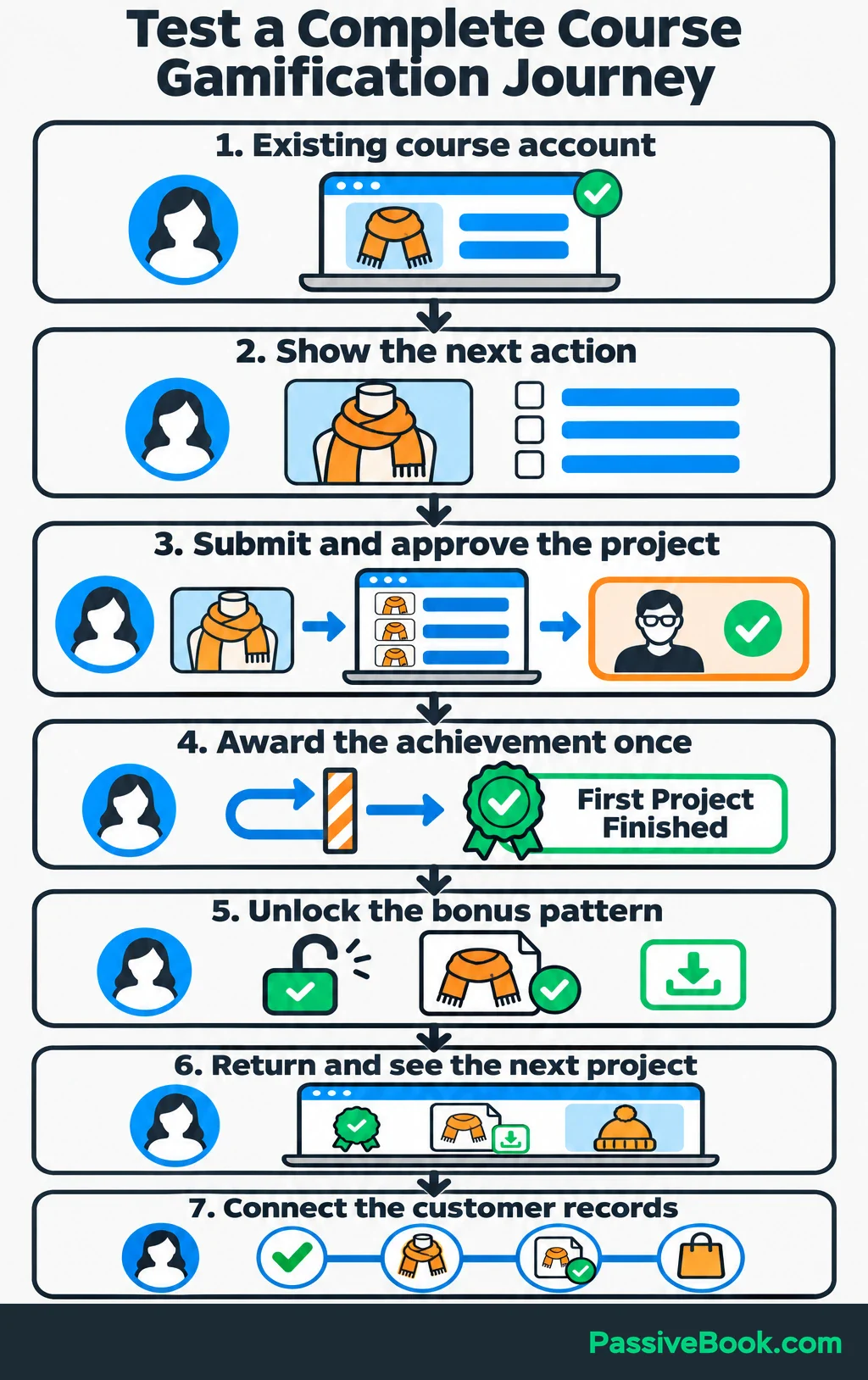
Before running this pilot, confirm which course integration, submission method and reward-access extension can connect the steps in the table.
For a small pilot, I would accept a manual project review if it helps test whether customers value the experience. Keep that review time in the cost estimate. If you later automate it, test the replacement before removing the manual check.
Give a few customers the experience without explaining every screen. Watch where they hesitate. If they cannot tell what to do or what they receive, fix the journey before adding more mechanics.
I would keep project progress private unless customers ask for a shared challenge. A public leaderboard needs a reason to exist. Being slower at knitting should not become a public performance review.
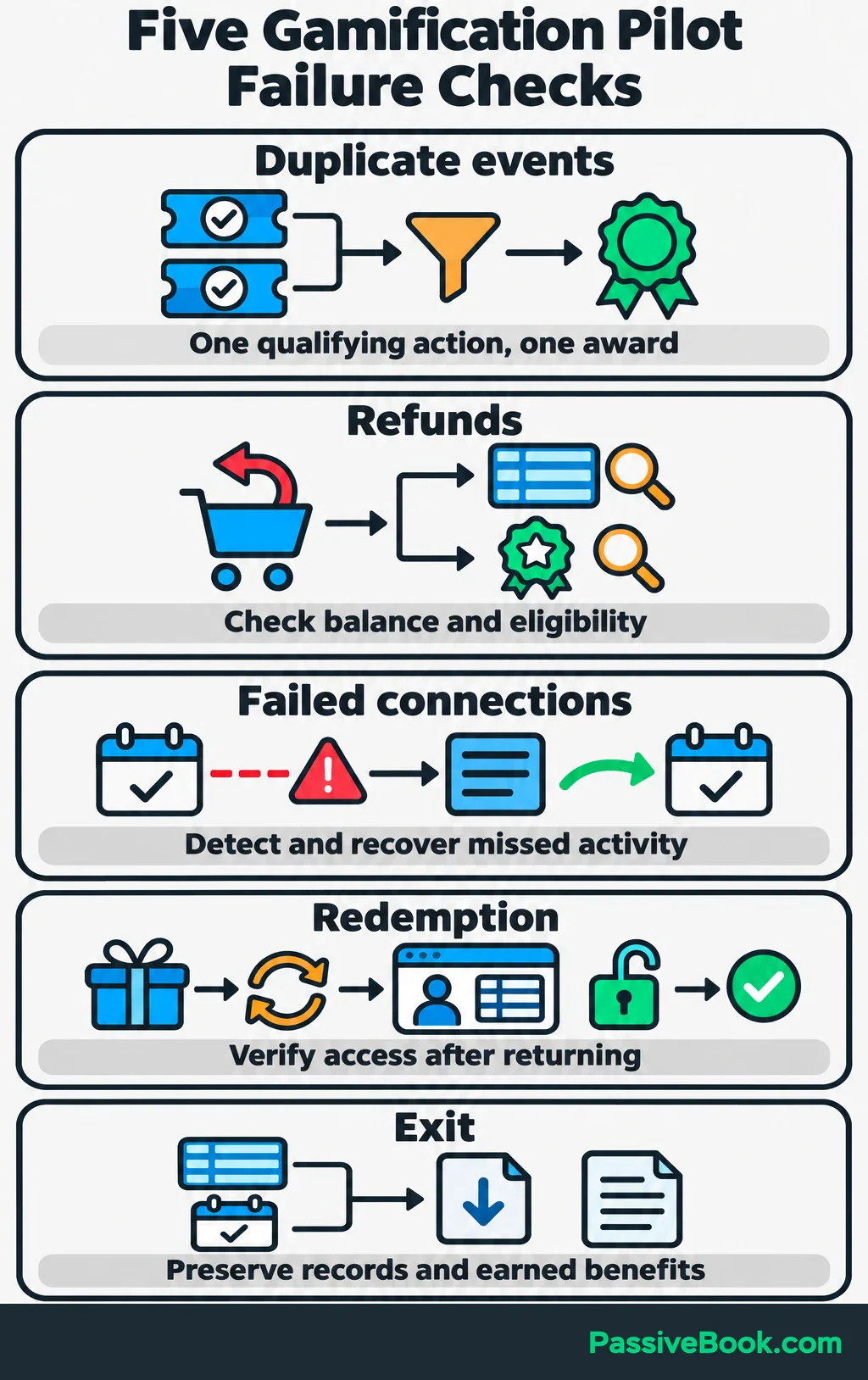
Test failure cases too:
- Duplicate events: Repeat the completion or purchase event and check that it does not issue an extra reward.
- Refunds: Reverse a test purchase and inspect the points balance and reward eligibility.
- Failed connections: Interrupt the data transfer and confirm how you detect and recover missed activity.
- Redemption: Claim the benefit, return later, and check that access and balances remain correct.
- Exit: Export sample balances and activity records, and establish how you would preserve program rules.
Before accepting a long contract, know what happens to customers’ earned benefits if you leave. An export button is useful only when it exports the information you need.
Compare Total Cost With the Customer Outcome
Price the required plan at your current usage and at a realistic growth level. Then add setup, extensions, rewards, maintenance and the work needed to keep the program useful.
A monthly price can hide a very different cash commitment and workload. Use this workbook to compare two tools and see which missing answers could change your decision.
Free Software Cost Comparator




I abandoned my membership-site attempt because producing fresh content alongside corporate work became unsustainable. When I look at a challenge platform, I apply that lesson to the calendar: who creates the next activity, reviews submissions and answers reward questions?
A program that needs a fresh challenge every week has a weekly production cost. Include it, even when you are doing the work yourself.
Choose one primary outcome before launch:
| Customer Journey | Primary Outcome | Supporting Measures |
|---|---|---|
| Store loyalty | A second purchase within a relevant buying cycle | Enrollment, reward redemption and margin |
| Course achievements | Completion of the defined course or project milestone | Starts, progress and submission drop-off |
| Product gamification | Repeat use of a feature that delivers customer value | Activation, return frequency and abandonment |
| Customer advocacy | Referrals that meet your qualification rule | Invitations, completed referrals and later sales |
Participation helps explain what happened, but it cannot carry the whole decision. Plenty of people will play for a prize. You need to learn whether offering the experience changes the customer outcome you care about.
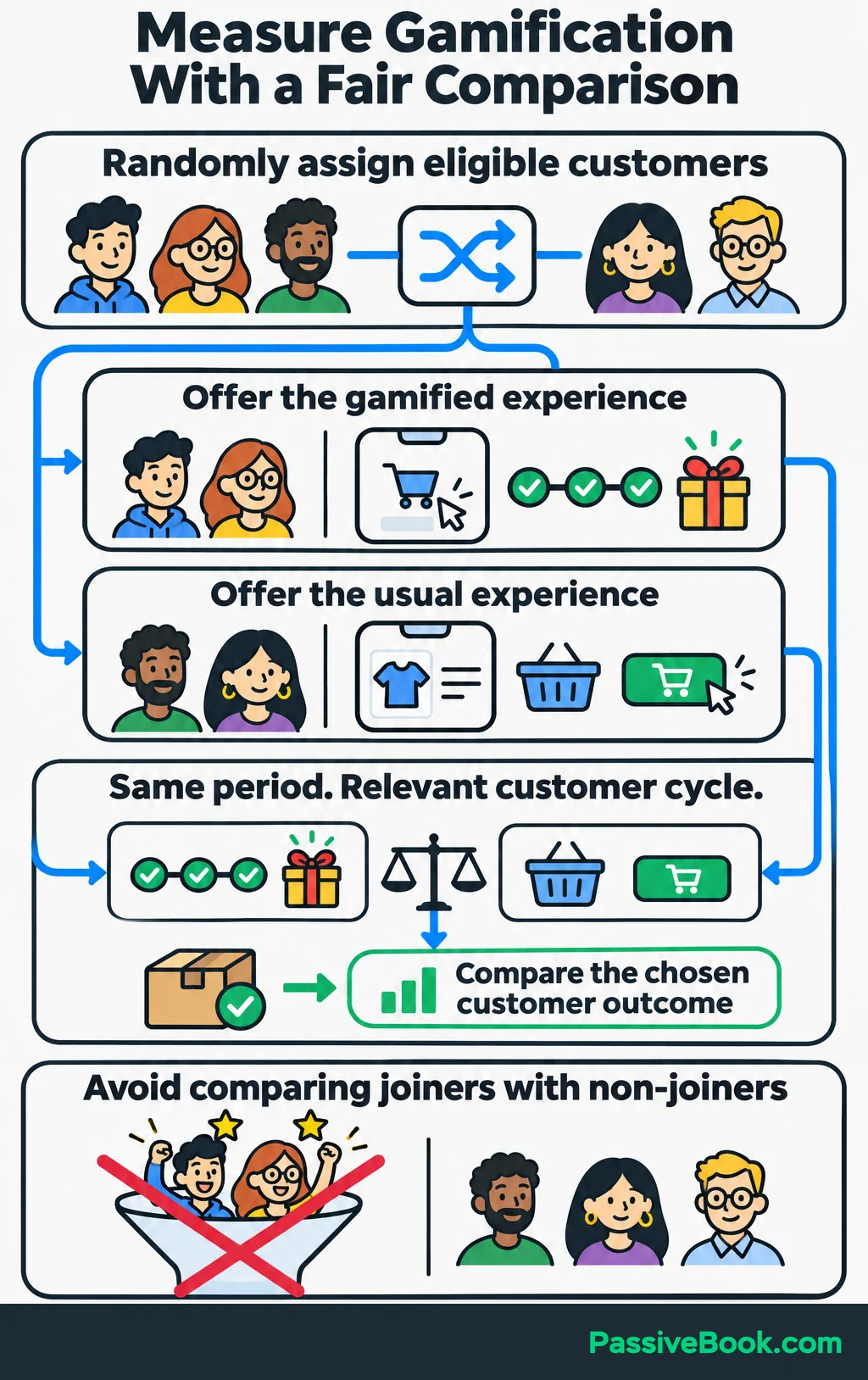
Where practical, randomly assign eligible customers to receive either the gamified experience or your usual experience. Compare the groups over the same period and allow enough time for the relevant purchase or usage cycle.
For example, do not compare challenge participants with everyone who ignored the invitation. Participants chose to join and may already have been more motivated. Comparing customers offered each experience gives you a more useful starting point.
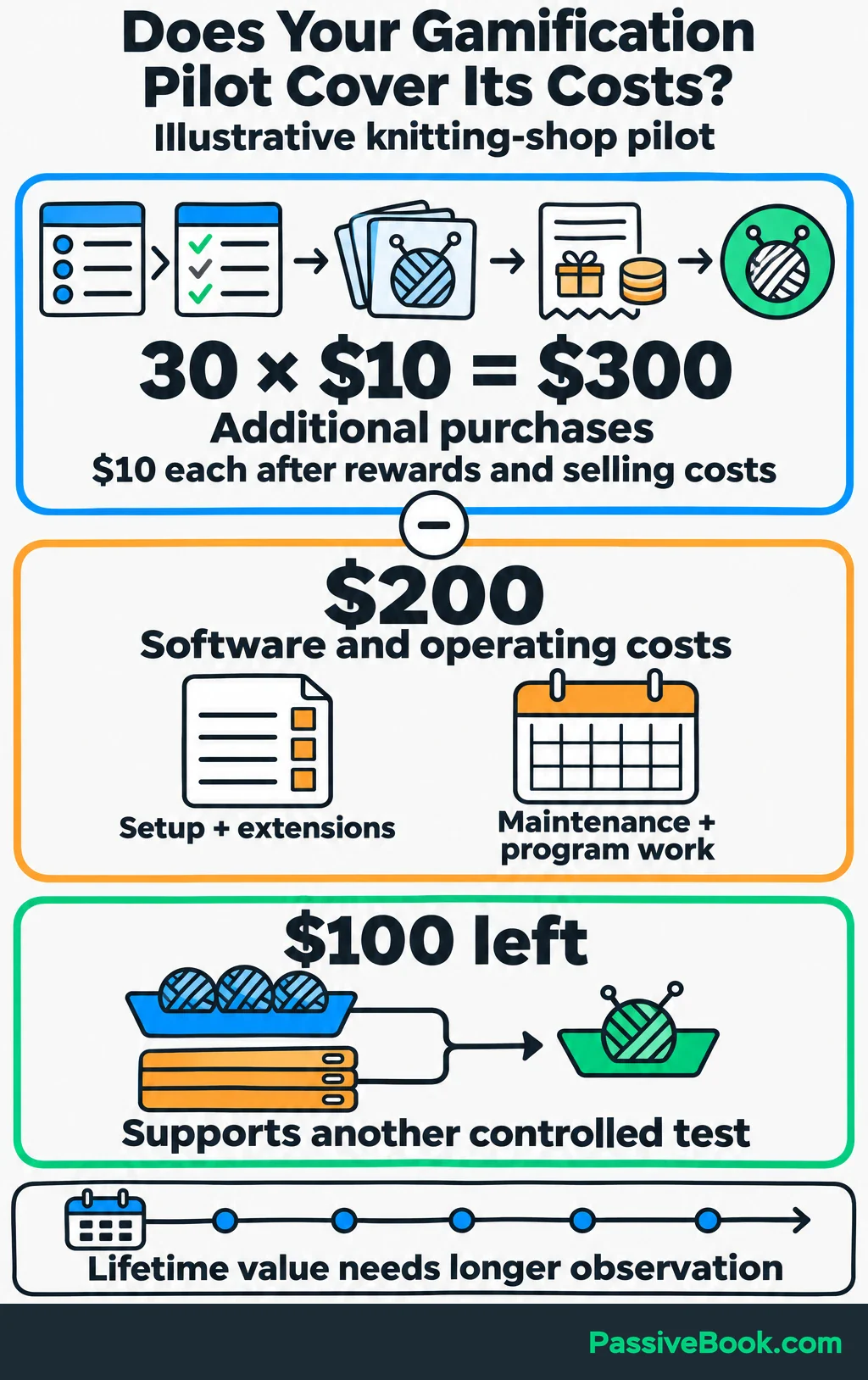
Then count the extra contribution the program produced. Contribution is what remains from those additional sales after the relevant selling costs, including rewards. Subtract the software and operating costs afterward.
Suppose the knitting-shop pilot produces an estimated 30 additional pattern purchases compared with the usual experience. Each contributes $10 after rewards and other relevant selling costs.
| Item | Illustrative Amount |
|---|---|
| Additional purchase contribution: 30 × $10 | $300 |
| Software and operating costs for the same pilot period | −$200 |
| Contribution left after program costs | $100 |
That result would support another controlled test. It would not yet establish higher customer lifetime value, which requires observing customer contribution over a longer relationship.
If participation rises but contribution stays flat, inspect the journey before buying more features. The reward may be too costly, the next offer may be weak, or the program may be rewarding purchases that would have happened anyway.
I would choose the least costly tool that completes the journey within the maintenance time available. Expand when observed behavior and contribution give you a reason to spend more.
What Next?
Write down one customer action you want to encourage, then choose two tools that can support its complete journey. Ask each vendor to show the action, progress update, reward and report using your requirements.
Use the social buttons to share this comparison when a tool discussion needs a clearer view of setup work and ongoing costs.
Which customer action would make an engagement program worth paying for in your business? Tell me in the comments, and bring any other questions about choosing a platform.
Share this post with your friends & followers:

