A creator sends you a quote for a sponsored video. Their audience looks active, but you still can’t answer the question that matters: how many of those people might want your product?
Paying before you resolve that gap leaves you buying attention and hoping it turns into something useful. A busy comment section won’t cover the invoice.
Learning how to do influencer marketing starts with making that purchase easier to judge. This guide walks through choosing a creator, agreeing on the work, and measuring whether the partnership earns another round.
Choose Your Campaign Goal
Start with the buyer and the problem your offer solves. Then choose one result you want the campaign to produce.
Throughout this guide, imagine you run an online store selling dog-walking treat pouches. You want to reach people who carry treats on walks and need an easier way to access them. The product details, budgets, and results below are illustrations, not my campaign history or typical returns.
Your primary goal could be:
- Awareness: Reach people who match your intended customers.
- Consideration: Bring potential buyers to a product page or collect relevant email sign-ups.
- Sales: Acquire customers at a cost your margins can support.
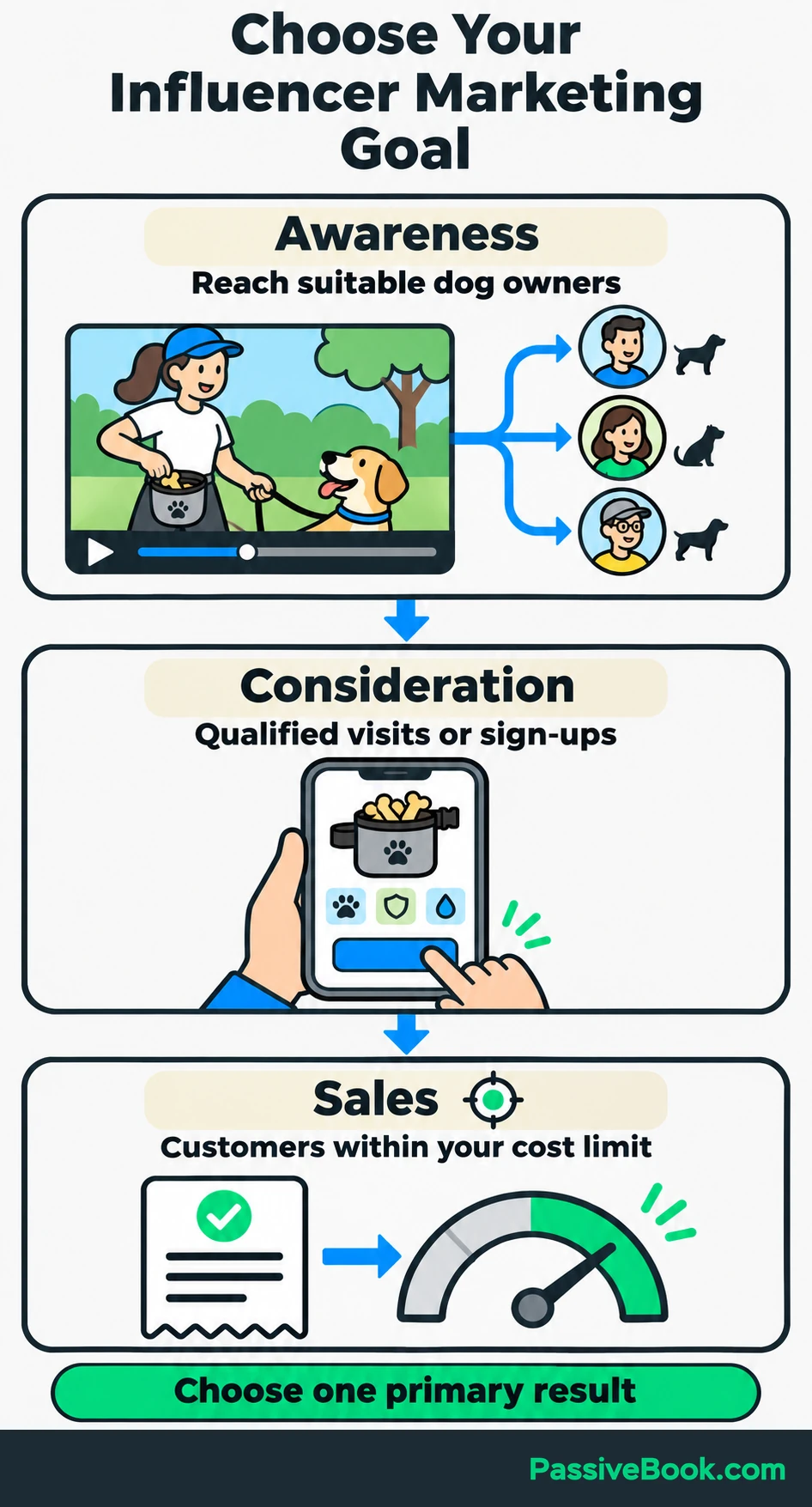
I would choose sales if the store already has a working product page and checkout. If visitors still need help understanding the product, a demonstration campaign measured by qualified visits may be a more useful first test.
During my six months chasing Instagram and Twitter/X followers in another niche, the audience numbers gave me plenty to watch. Meaningful income was another matter. That was my own social media effort, but it informs how I judge creator partnerships: decide what the attention should lead to before paying for it.
Write a campaign statement:
Show how our treat pouch fits into an everyday dog walk and acquire customers within our spending limit.
Choose one offer and one next action. Before contacting anyone, check stock, delivery coverage, shipping information, and checkout. Sending interested people to an unavailable product is an expensive way to announce that you’re unprepared.
Choose a Platform and Content Format
Look for places where potential customers already watch useful content and ask buying questions. Search their routines and problems, then notice which formats help them understand a product.
A short demonstration suits something whose value is visible in use. A detailed review gives buyers room to assess trade-offs, and a tutorial shows how a product fits into a larger task.
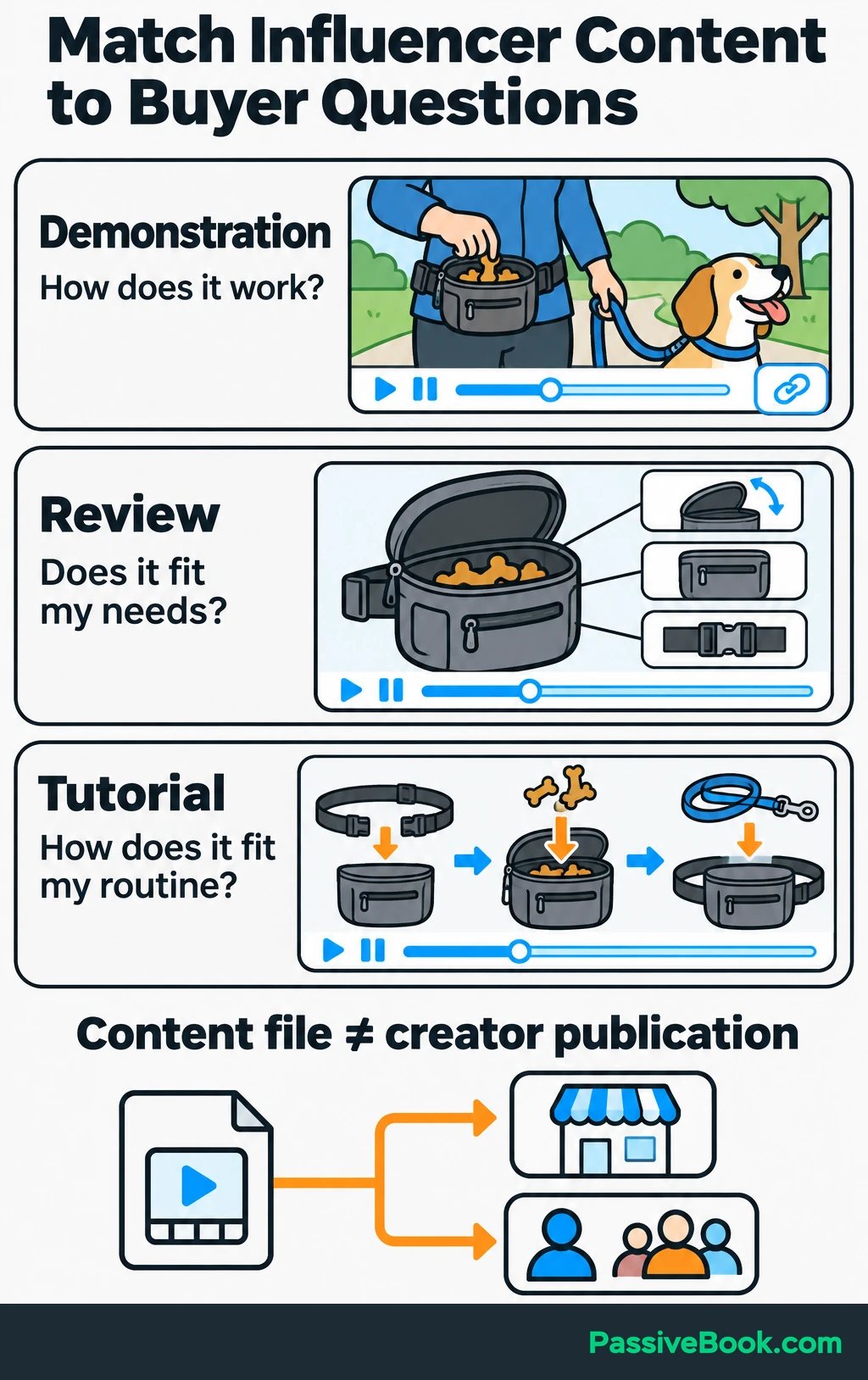
For the pouch store, I would test a walking-routine video on Instagram Stories with a direct product-page link. The creator can show the pouch during a normal walk and explain what they actually found useful. You don’t need to appear on camera.
Start with one platform and one format so you can compare results without coordinating several different campaigns.
Also confirm where the content will appear. Buying a video for your own website or social accounts does not include publication to the creator’s audience unless you agree on that separately.
Set a Budget You Can Evaluate
Set a test budget you can afford to lose before requesting proposals. I’d start with one partnership so you have time to review the work and results.
Choose How to Compensate Creators
Choose payment terms that fit both the work and your economics.
| Arrangement | What you agree to pay for | What to check |
|---|---|---|
| Fixed fee | Defined content and publication | Format, revisions, reporting, and reuse permissions |
| Product exchange | Agreed content in return for a product | Whether the creator accepts the exchange and what they will deliver |
| Affiliate commission | A share of qualifying tracked sales | Commission basis, attribution period, refunds, and payment timing |
| Fee plus commission | Content work plus a sales incentive | Whether the combined cost leaves enough margin |
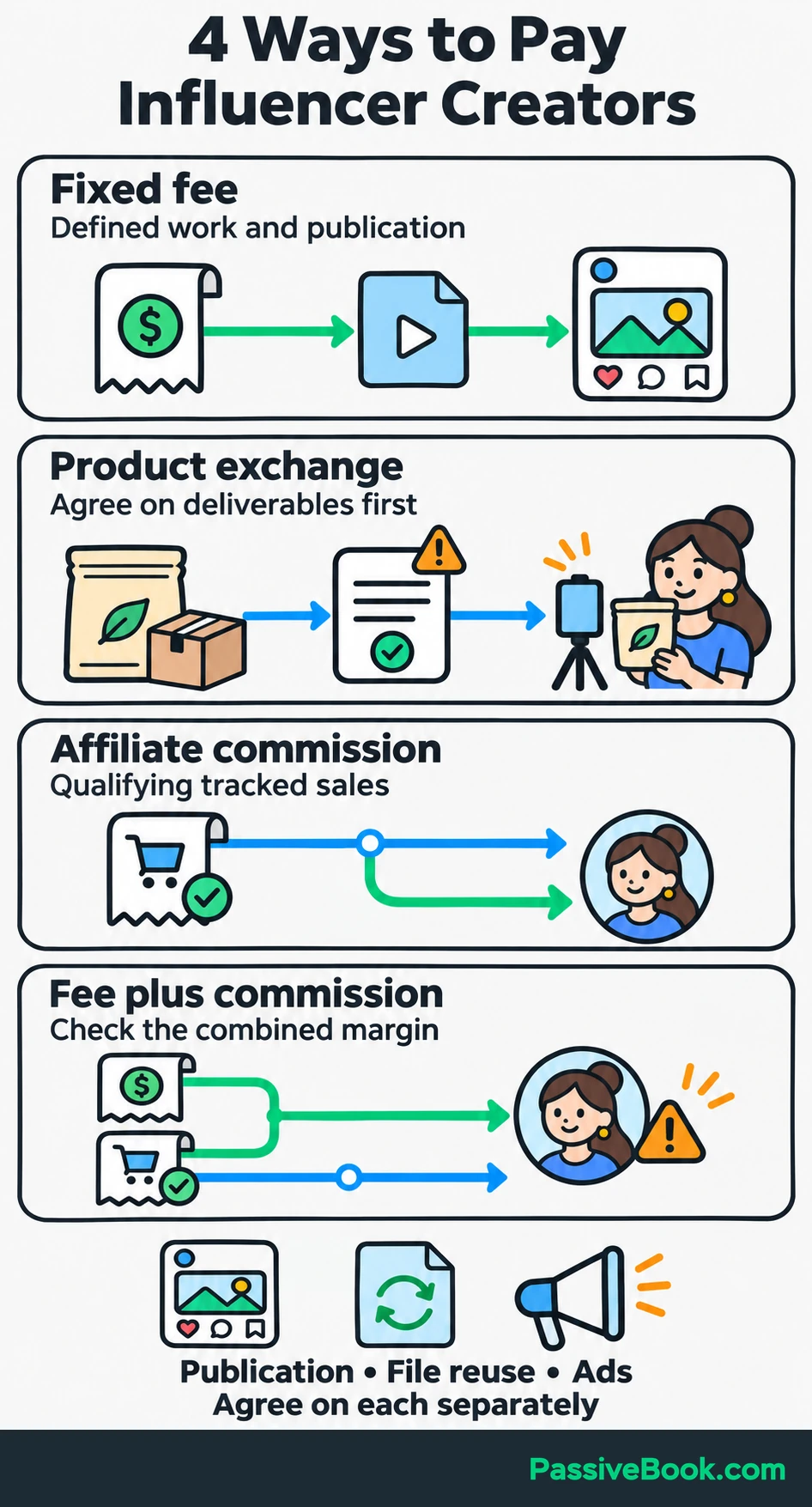
Sending a free pouch without an agreement does not secure a post. Ask creators to quote the same scope: publication on their account, a file you can reuse, and permission to run ads are separate purchases.
If a quote exceeds your limit, reduce the scope. A free product may not cover filming, editing, and access to an audience.
Calculate Your Spending Limit
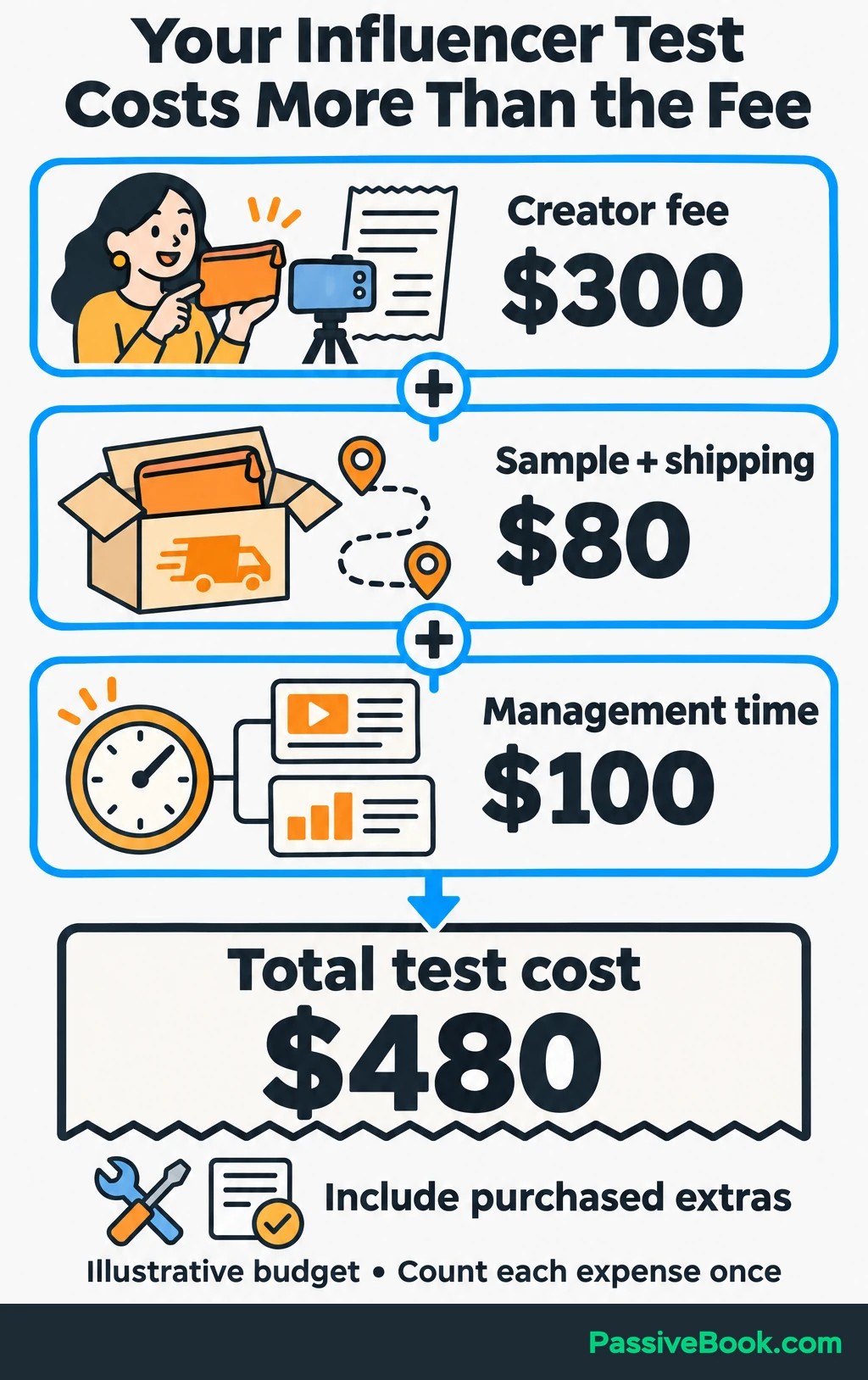
First, count the fixed costs of running the test. Include creator fees, samples at their cost to your business, shipping, management time, and any tools or permissions purchased for the campaign.
Here is the illustrative pouch budget:
| Campaign expense | Amount |
|---|---|
| Creator fee | $300 |
| Sample cost and shipping | $80 |
| Management time | $100 |
| Total campaign cost | $480 |
Next, work out what each order leaves to cover campaign costs. Start with revenue after discounts and refunds, excluding collected taxes. Subtract product, packaging, fulfillment, shipping you cover, payment fees, and any affiliate commission. What remains is the contribution per order. Count each expense once.
In this example, a $40 net selling price minus $16 in variable costs leaves $24 per order. There is no affiliate commission.
Divide the campaign cost by that contribution:
$480 ÷ $24 = 20 additional orders to break even
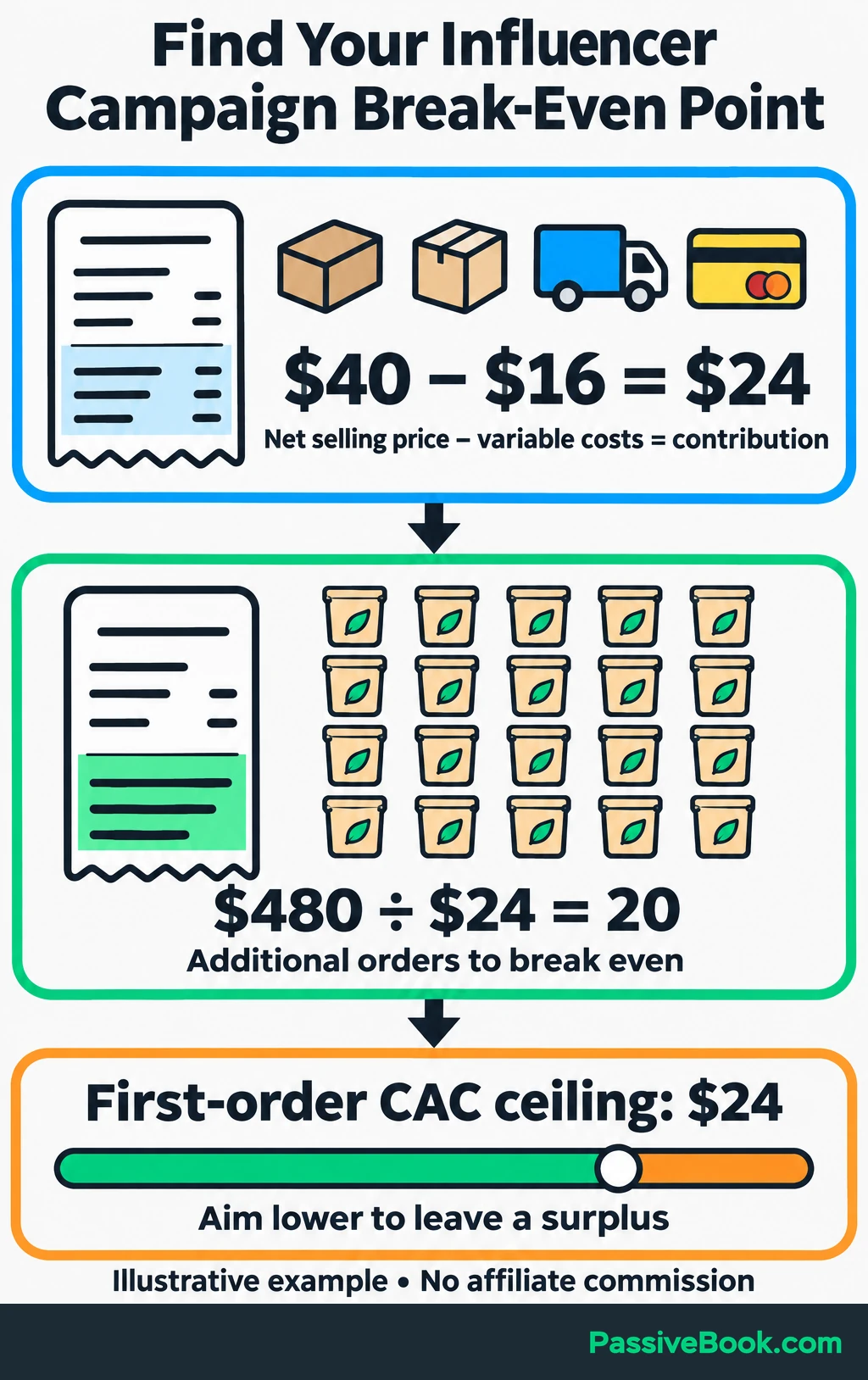
Round up when the answer isn’t a whole number. To cover acquisition on the first purchase, keep customer acquisition cost at or below that order’s contribution. Aim below it to leave a surplus.
You can also work backward from your margins to a fee limit before asking for quotes. This calculator compares payment arrangements so a lower upfront fee doesn’t hide an expensive commission.

Free Partnership Offer Calculator




For awareness campaigns, set a spending ceiling and a target for reaching relevant people. I would skip assigning an imagined sales value to every impression. That makes a spreadsheet look reassuring without making it useful.
Find Influencers Who Reach Your Customers
Build a Relevant Shortlist
Search for customer problems, routines, tutorials, and related products. Also look at creators your customers mention or follow.
For the pouch store, useful searches might cover carrying treats on walks, preparing a walking bag, or everyday reward-based training. Read the comments as well as watching the videos. Questions about pockets, cleaning, or carrying equipment tell you more than a string of heart emojis.
Include smaller creators when their audience and work fit. In three Instagram Stories field studies involving German fashion and UK beauty campaigns, lower-followership groups generated more revenue per follower. Creators received store vouchers, and purchases were tracked with creator-specific codes or links. That supports considering smaller accounts; it does not establish expected returns for pet products. Revenue Generation Through Influencer Marketing
Keep one shortlist with profile links, contact details, relevant posts, audience evidence, and your reason for including each person.
I would skip a paid discovery platform for an initial test. A spreadsheet and careful searches are enough to start making decisions.
Check Audience Fit and Credibility
Review a consistent sample of recent posts in the proposed format, including sponsored work. Don’t let one unusually popular video stand in for the creator’s normal performance.
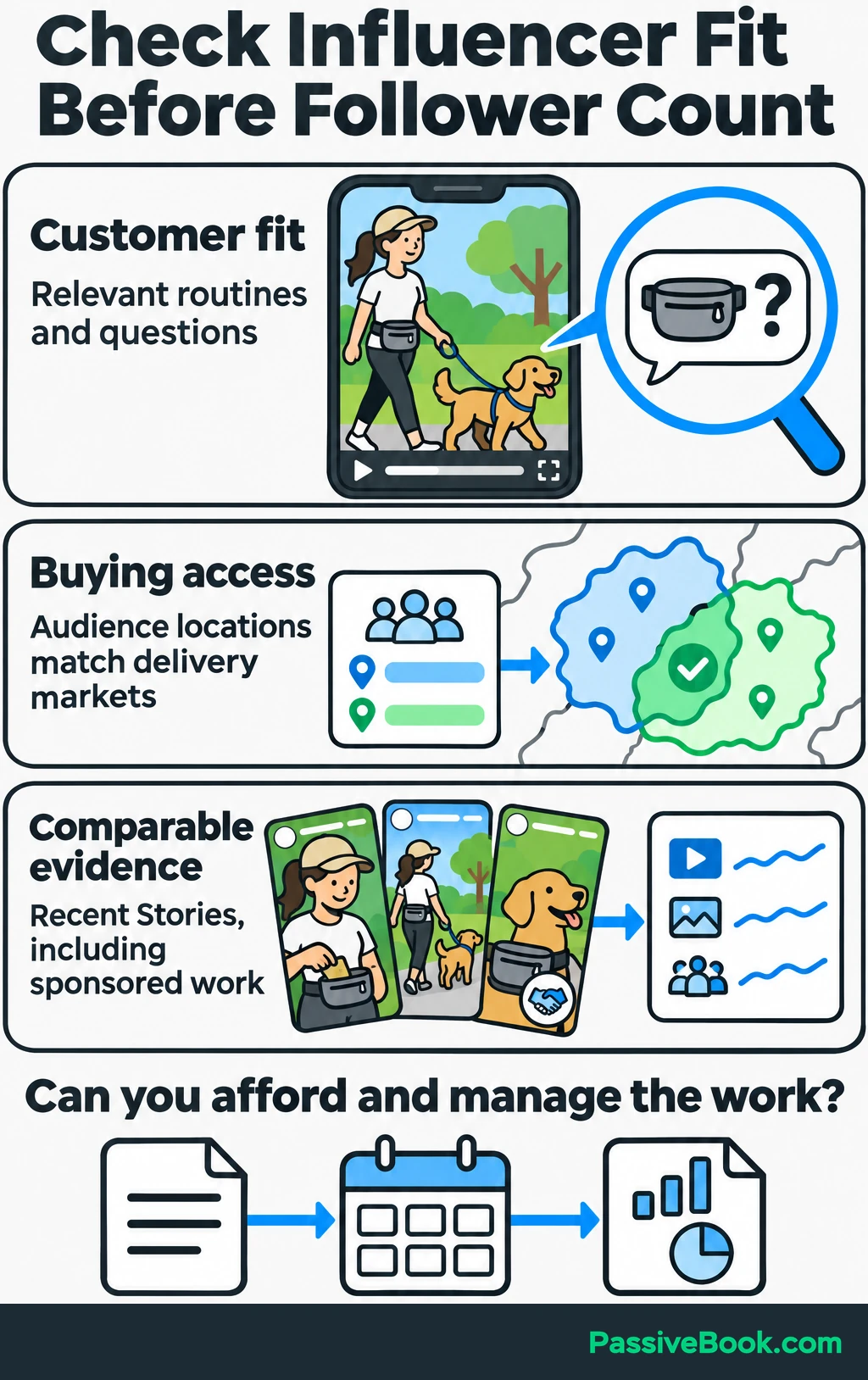
Check the evidence that matters to your campaign:
| Check | Useful evidence for the pouch store |
|---|---|
| Customer fit | Regular walking content and questions about practical equipment |
| Buying access | Recent audience-location information matching your delivery markets |
| Content quality | Clear demonstrations that show the product in normal use |
| Comparable performance | Recent Story reach or views, with sponsored examples where available |
| Audience response | Specific questions and useful replies about the products shown |
| Working arrangement | A clear quote, realistic schedule, and agreed reporting |
Ask for recent audience and format-specific performance information. If comparable campaign results aren’t available, record that gap rather than treating likes as sales evidence.
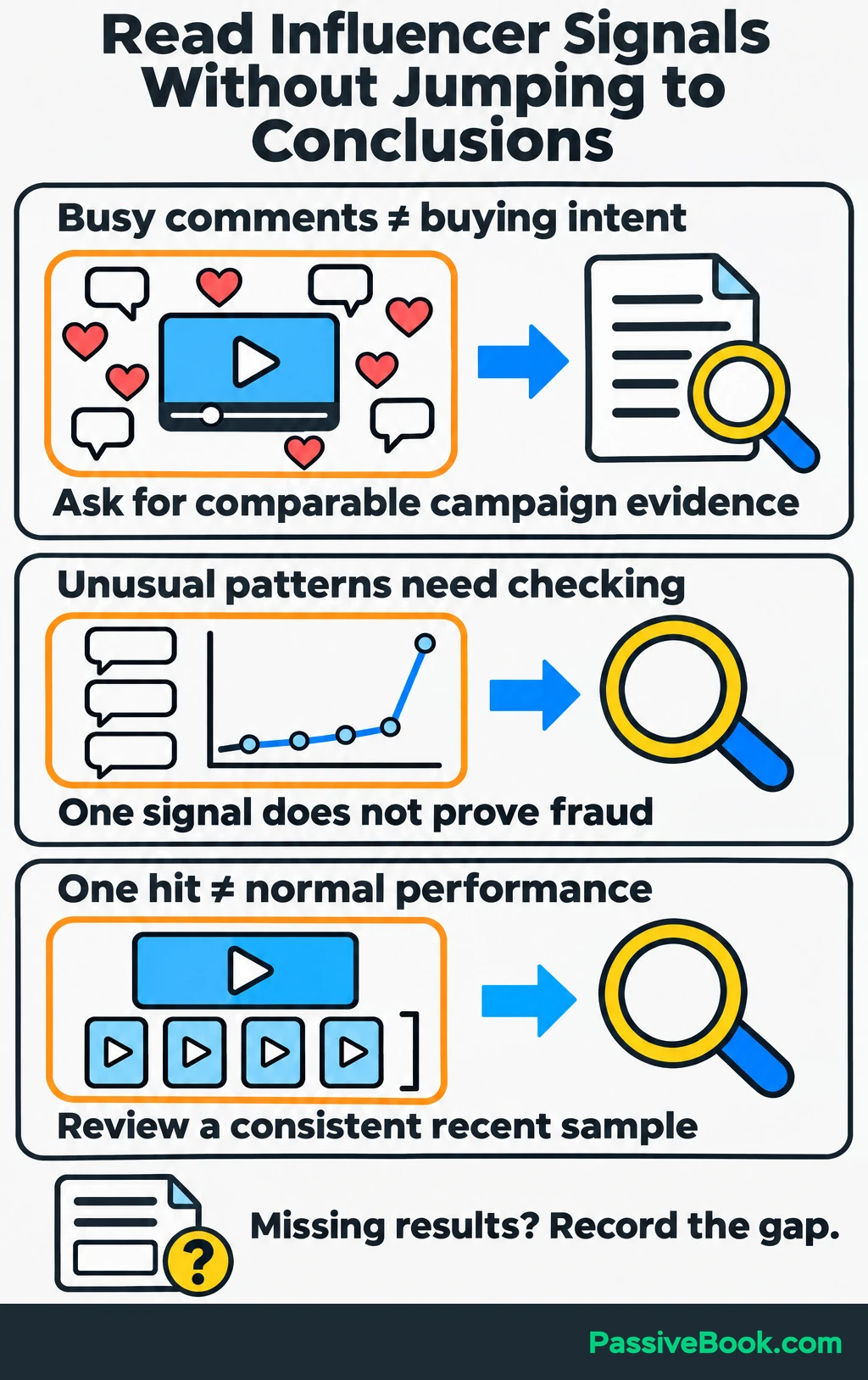
Repetitive comments, unexplained audience jumps, or a location mismatch deserve a closer look. None alone proves fraud, and lively public engagement does not prove buying intent.
Add quoted deliverables, total cost, and expected management effort to your shortlist. Choose someone whose work you can afford and whose campaign you have time to manage.
Pitch Creators and Agree on the Partnership
Send a Specific Proposal
Explain why you chose the creator, what you want to test, and what you’re asking them to provide. Give them enough product information to judge whether the partnership suits their audience.
Here is a complete outreach email you can adapt:
Subject: Paid walking-routine video partnership
Hi [Name],
Your video about preparing for a dog walk caught my attention because you showed the practical details, including how you carry treats.
I run [Store], an online shop selling dog-walking treat pouches. Would you consider a paid Instagram Story video showing our pouch during your usual walking routine next month, with a link to the product page?
We would send the pouch for you to try before confirming production. Could you share your availability, rate, recent Story reach, and audience locations? Please also let me know what your fee includes for revisions and reporting.
I can send the product details if this sounds relevant.
Thanks,
[Your name]
[Store website]
Change the opening to reference something you actually watched. “Love your content” is easy to send and gives the recipient almost nothing to respond to.
Track replies and the next action in your shortlist. Send one polite follow-up after a reasonable gap, then move on if there is no interest.
Put the Terms in Writing
Before shipping or production, agree on:
- Deliverables: Format, quantity, publication account, and how long content must remain available.
- Schedule: Product testing, draft delivery, feedback, publication, and reporting dates.
- Content requirements: Essential facts, destination link, disclosure, and included revision rounds.
- Payment: Fee, commission if applicable, payment dates, cancellation, and rescheduling terms.
- Permissions: Ownership, reuse channels, duration, editing, exclusivity, and paid promotion rights.
Expanded permissions need an explicit agreement. Paying for a Story does not automatically give you unlimited use of the creator’s image across your marketing.
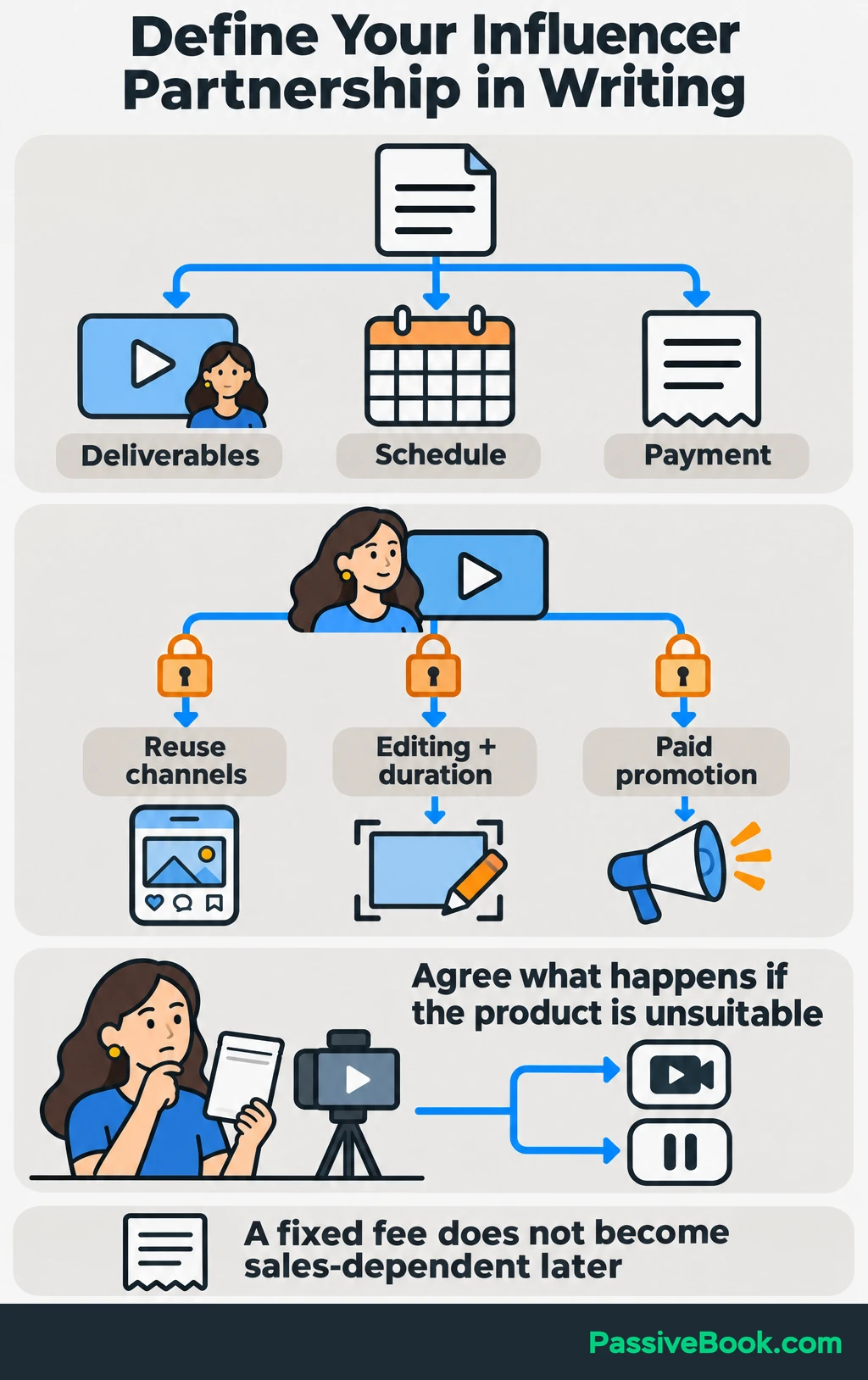
Also decide what happens if the product proves unsuitable during testing. Leave room to stop or change the project before filming rather than expecting praise because a payment was discussed.
Use one contact for feedback, and pay according to the agreement. Don’t turn a fixed content fee into a sales-dependent payment after publication.
Write a Brief That Leaves Room for the Creator
Your brief should make the requirements clear without writing the creator’s personality out of the content.
Supply the goal, audience, verified product facts, deliverables, next action, destination link, deadlines, and approval contact. Then separate those requirements from choices the creator can make.
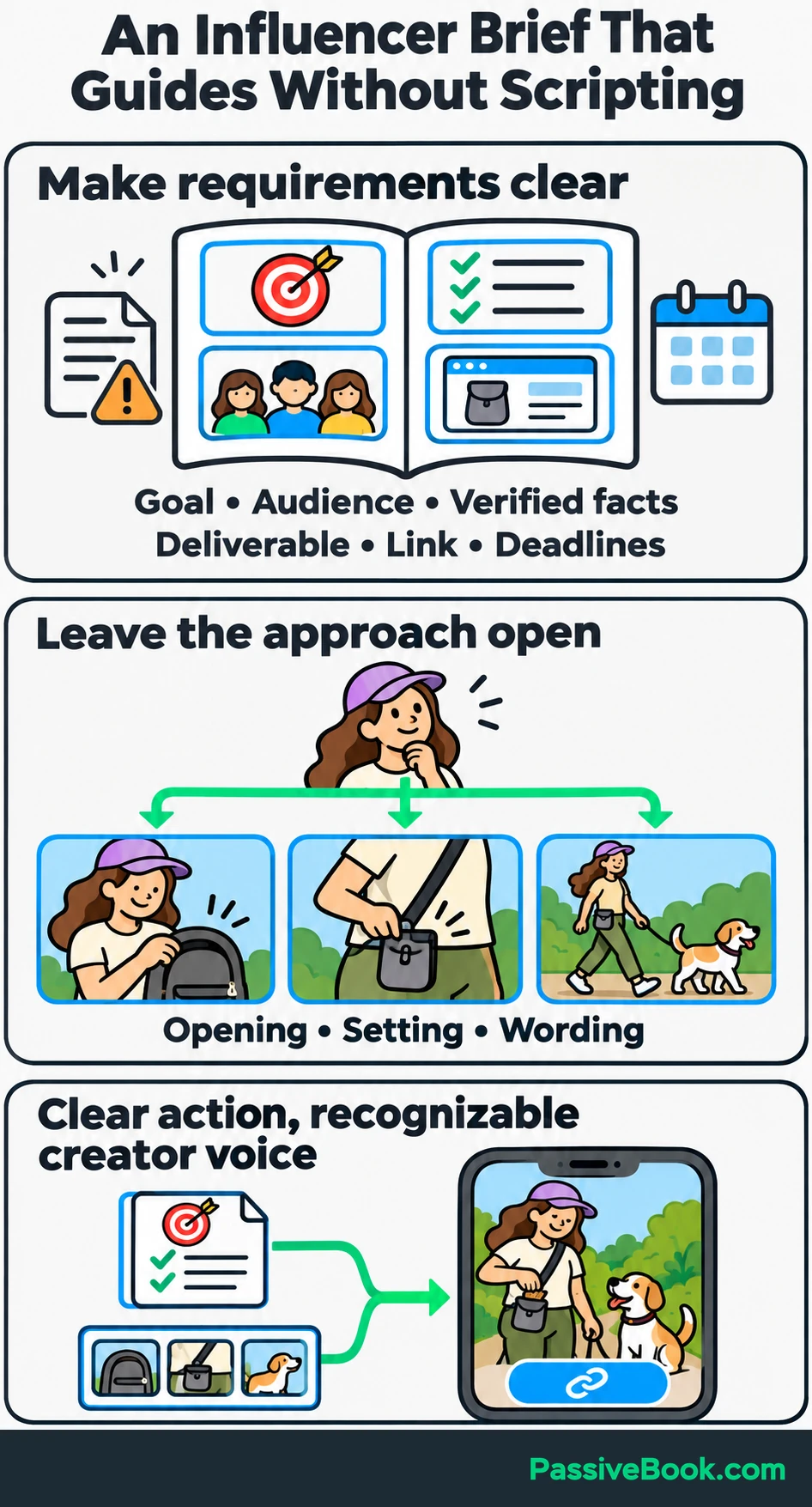
For the pouch campaign, a compact brief could say:
Audience: Dog owners who carry treats on walks.
Goal: Generate sales by helping suitable dog owners assess whether the pouch fits their walking routine.
Demonstration: Try the pouch during normal walks, then show how you carry it and access treats. Describe your actual experience.
Product facts: Use only the confirmed specifications supplied with this brief.
Deliverable: One agreed walking-routine Story video on your account, with the supplied product-page link.
Creative approach: Choose your own opening, setting, and wording.
Approval and reporting: Follow the dates and contact details in our agreement.
Send the product early enough for normal use. A demonstration filmed immediately after opening the parcel tells you very little about using it on a walk.
Require genuine experience and supported claims. Show access to treats; don’t script a promise that the pouch will improve a dog’s behavior. Payment cannot turn an unsupported benefit into a fact. The U.S. Federal Trade Commission (FTC) explains these requirements in its endorsement guidance.
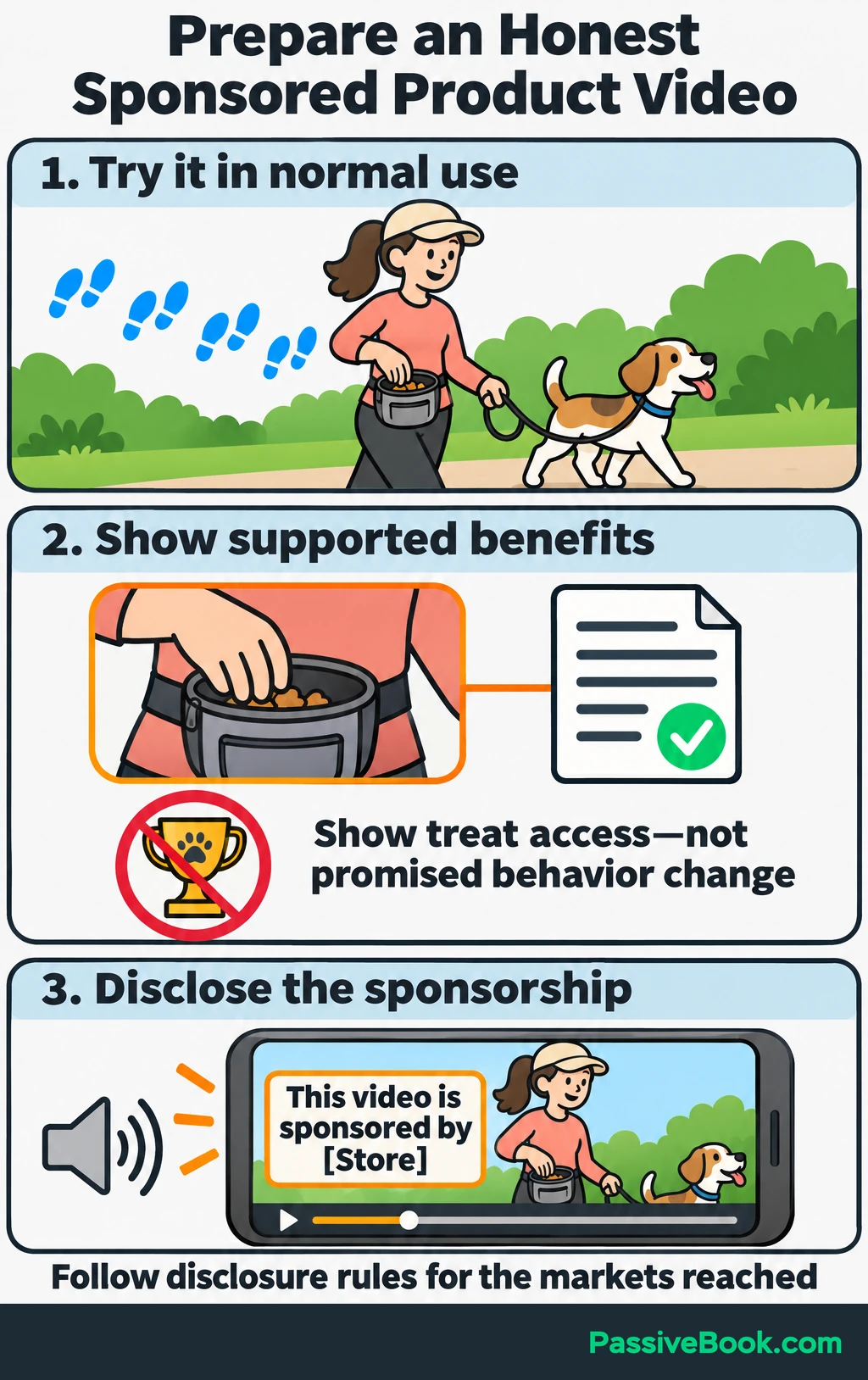
Include disclosure instructions for the markets reached. For endorsements reasonably expected to affect U.S. consumers, clearly disclose payments, gifts, and commissions with the endorsement. For video, put the disclosure inside the video, ideally both spoken and visible. Use platform labels as a supplement, and follow applicable local rules too. See the FTC’s influencer disclosure guidance.
For this paid pouch video, an opening such as “This video is sponsored by [Store]” gives viewers clear information. Don’t hide it behind a caption expansion or a pile of hashtags.
The pouch example gives you a starting point, but your offer will need its own facts and boundaries. The AI Skill below drafts your creator brief and the message you can send with it.

Free AI Partnership Writer
Set Up Tracking Before Publication
Use Google’s Campaign URL Builder to make a separate product-page link for each creator and placement. It adds UTM tags: extra information in the address that lets Google Analytics identify where visits came from.
Enter your product-page address and these values:
- Source:
instagram - Medium:
influencer - Campaign:
walking_pouch_test - Content:
creatorname_story1
Change the content value for each creator and placement. Keep the other values consistent so you can review the campaign together.
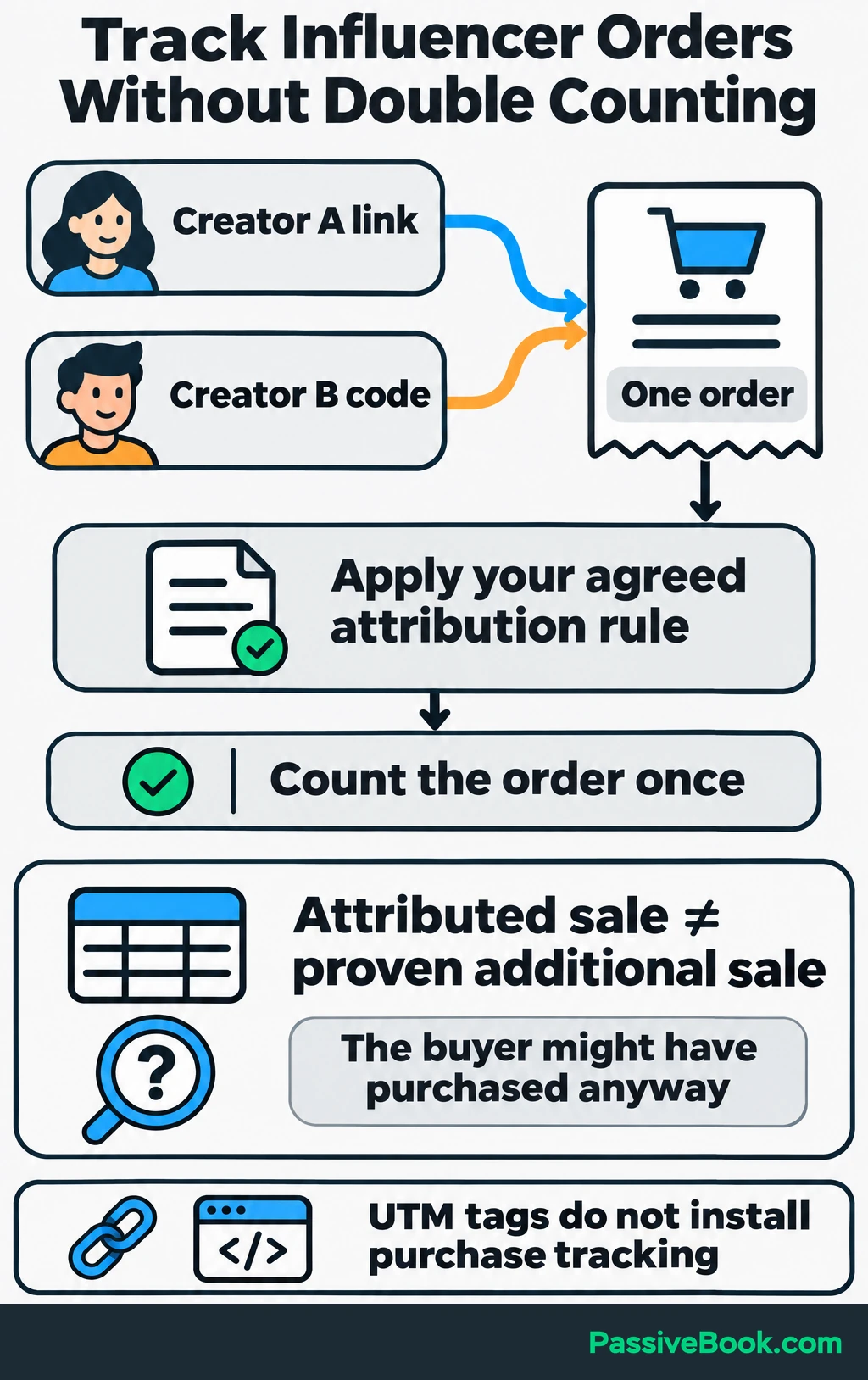
A creator-specific discount code can provide another way to identify orders, but offer a discount only if the margin supports it.
Next, test the full mobile journey. Open the supplied link, check the product page, redeem the code if used, and complete a test purchase or form submission.
Confirm that the conversion appears in your reporting. Tagged links identify traffic; they do not install purchase tracking. Google Analytics needs ecommerce events sent from your store to populate its ecommerce purchases report.
Before launch, write down your reporting window, refund treatment, and attribution rule. For example, decide which creator receives credit when an order has both a tagged visit and a different creator’s code. Count each order only once.
Links and codes identify attributable activity, not necessarily additional sales. A buyer might have purchased anyway, a code might be shared, or a visit might go untracked. Remember that distinction when comparing results with the break-even target.
Your tracker should hold the creator, publication date and link, campaign cost, reach or views, visits, conversions, net revenue, and contribution. Keep orders and new customers in separate columns.
Launch and Manage the Campaign
Before publication, confirm product receipt, stock, timing, and working links. Review the draft against the brief and send one consolidated response within the agreed revision scope.
Focus on factual accuracy, disclosure, and the promised deliverable. I wouldn’t rewrite an ordinary sentence just because I would have said it differently. You hired the creator partly because their audience recognizes their voice.
Check the live content promptly. Confirm that the link works, the agreed content appeared, and the disclosure is clear. Ask the creator to correct errors. Advertisers also have responsibilities to instruct and reasonably monitor endorsers under the FTC’s advertiser guidance.
Stay available for product questions, shipping concerns, and checkout problems while the campaign is active.
Save publication links and collect the agreed analytics. For temporary content such as Stories, agree in advance when the creator will capture and send the results. Keep invoices, payment dates, deliverables, and reporting status in the same tracker so nothing depends on remembering which message contained the attachment.
Measure Campaign Performance
Judge the primary goal first.
For awareness, review reach and audience fit. Report creator reach separately unless you can remove audience overlap; adding everyone’s reach can count the same people several times.
For consideration, review relevant visits or leads. For sales, calculate what attributed orders contributed after variable costs, then subtract campaign costs.
To calculate cost per result, divide campaign cost by the result you chose. For customer acquisition cost, count attributable new customers rather than all orders:
Customer acquisition cost = campaign cost ÷ attributable new customers
If there are no new customers, report that directly rather than trying to produce a meaningful acquisition cost.
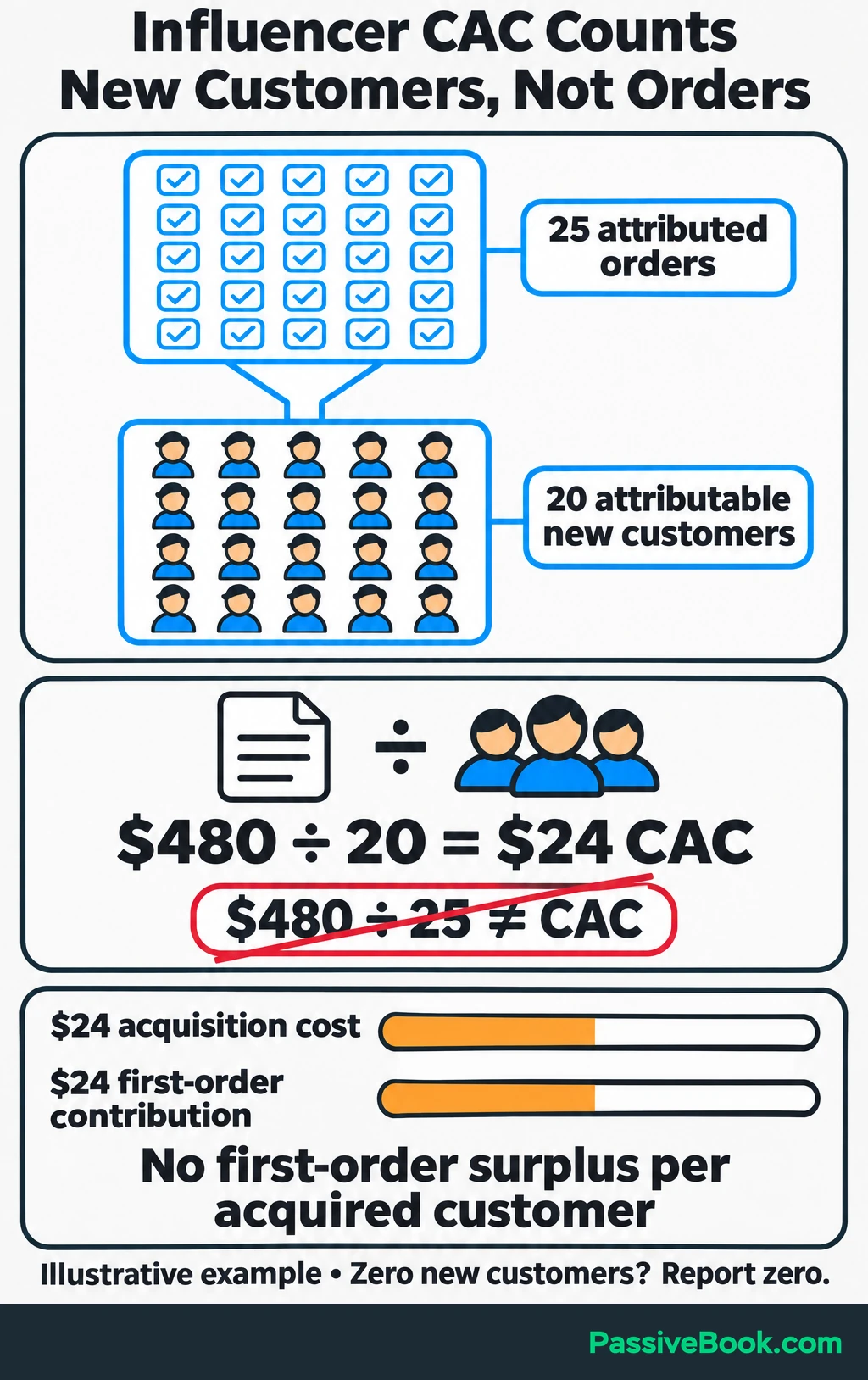
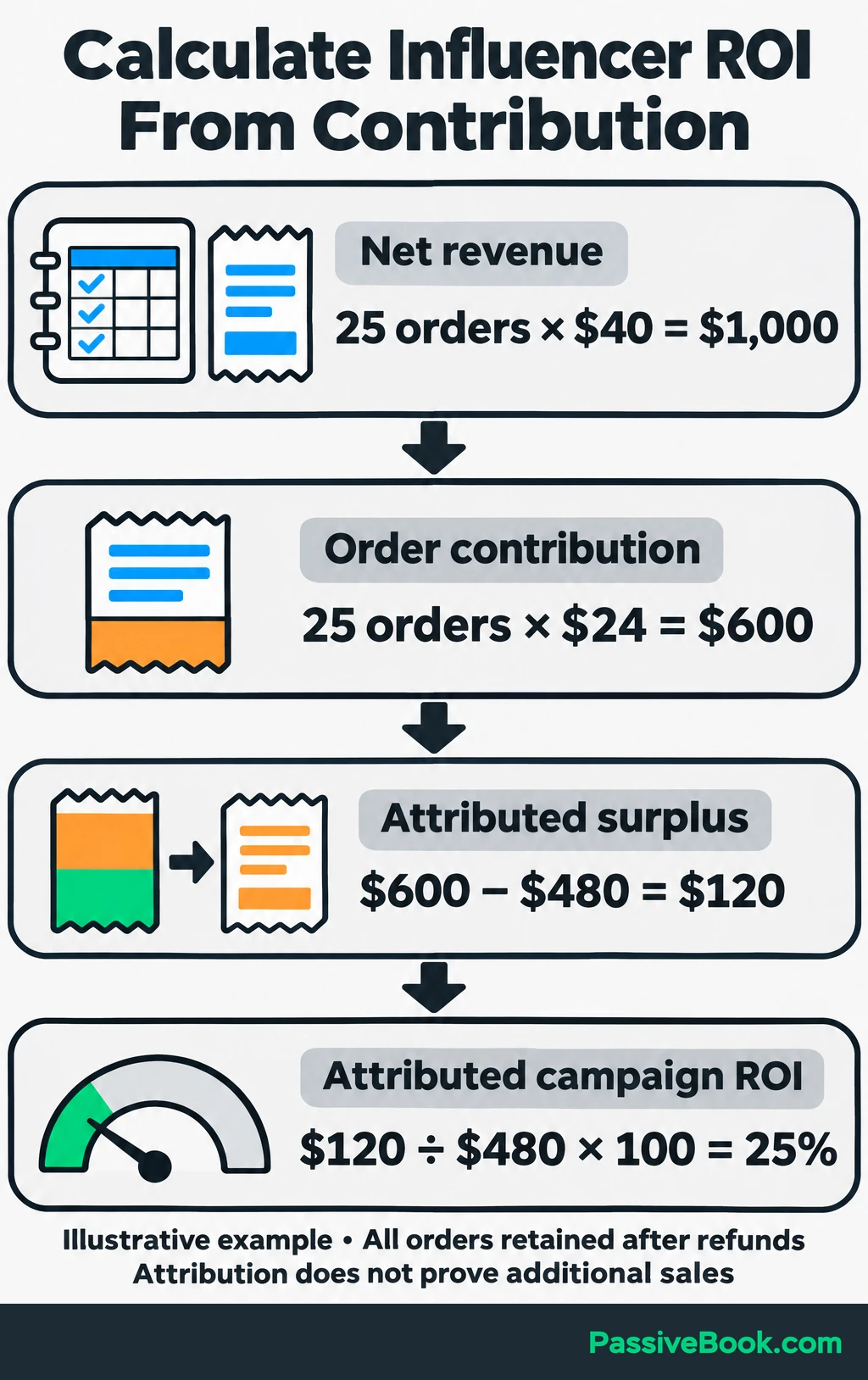
Now continue the illustrative pouch campaign. Assume the reporting window closes with 25 attributed orders, all retained after refunds, at $40 net revenue each.
For return on investment (ROI), start with what the attributed orders contributed after variable costs. Subtract campaign cost, divide the remainder by campaign cost, and multiply by 100.
| Result | Calculation | Amount |
|---|---|---|
| Net revenue | 25 orders × $40 | $1,000 |
| Order contribution | 25 orders × $24 | $600 |
| Attributed surplus | $600 − $480 campaign cost | $120 |
| Attributed campaign ROI | $120 ÷ $480 × 100 | 25% |
If 20 of the 25 orders came from first-time customers, acquisition cost would be $480 divided by 20, or $24. That equals the example’s first-order contribution, so it leaves no first-order surplus per acquired customer.
Compare creators using the same reporting window and cost treatment. Reconcile refunds before renewing.
Improve the Next Campaign
Find where progress stopped before choosing what to change.
| What you observe | What I would check or test next |
|---|---|
| Little relevant exposure | Compare audience locations with delivery markets and campaign reach with the creator’s recent Stories. |
| Views but few product visits | Test a demonstration showing access to treats, followed by a direct invitation to view the pouch. |
| Visits but few purchases | Check whether the page answers cleaning and capacity questions, shows shipping costs and delivery coverage, and works on mobile. |
| Sales but weak contribution | Recalculate contribution after discounts and fulfillment costs, then assess whether a smaller paid scope would make another test worthwhile. |
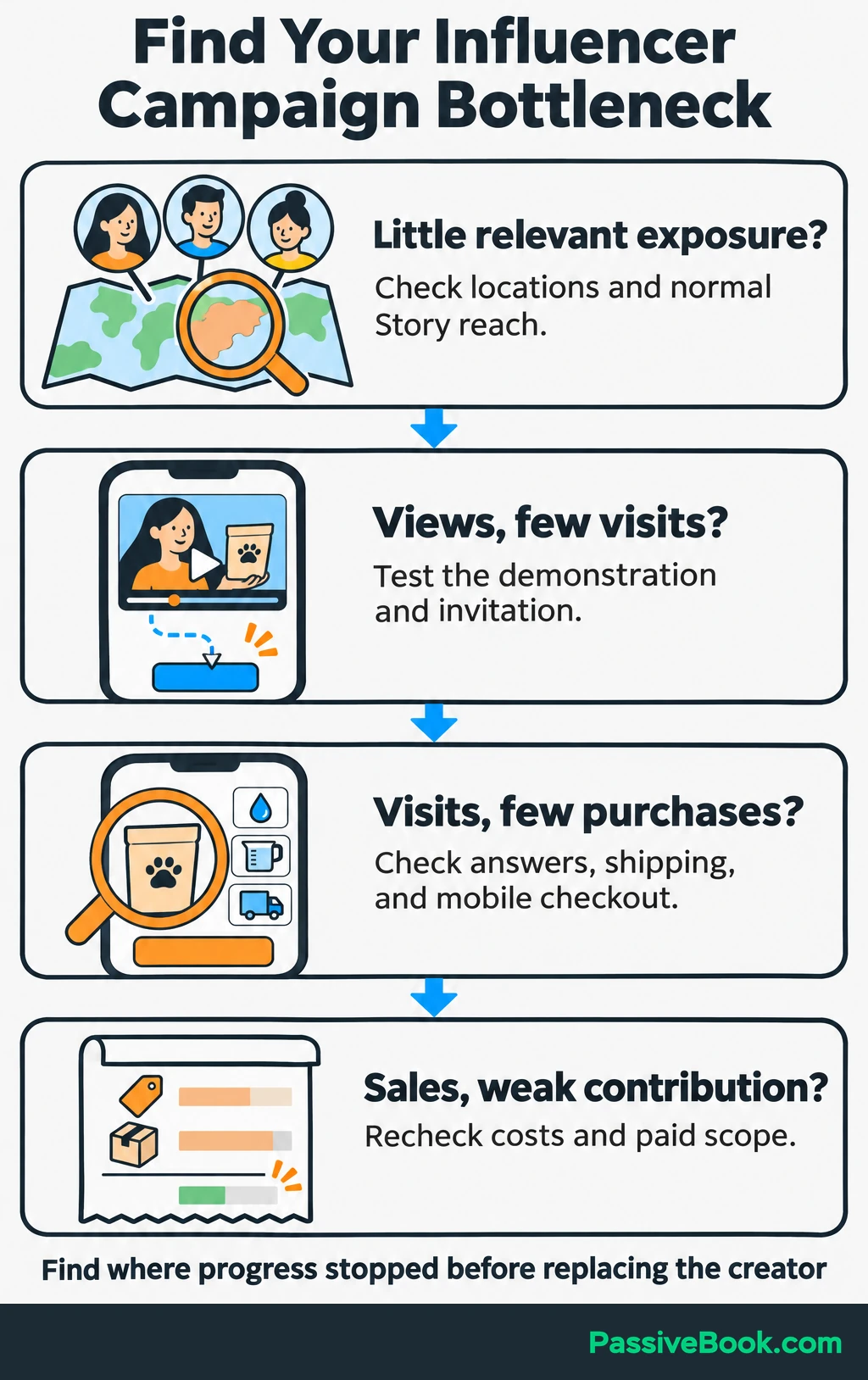
For the pouch campaign, strong viewing with few visits could justify testing a clearer invitation to see the product. Replacing the creator immediately would leave that question unanswered.
Change one major element at a time where practical, and keep the next test within your spending limit. Rebook creators who meet the objective at acceptable economics. Test a specific improvement when the evidence gives you a reason, and stop arrangements that repeatedly miss your criteria.
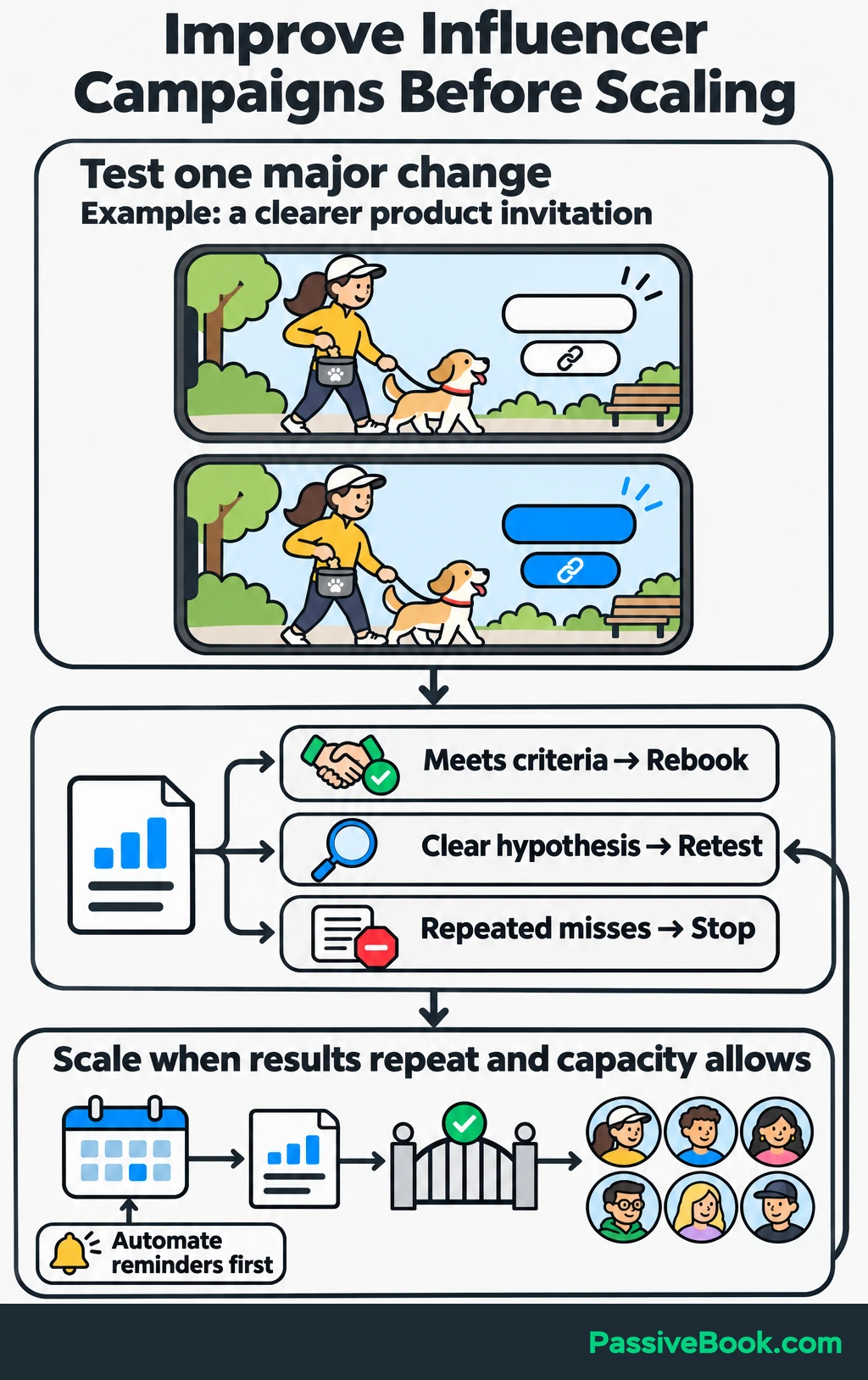
Once the process works, turn outreach, briefs, reporting requests, and payment reminders into reusable templates. I would automate reminders before automating creator selection. A missed reporting date is a scheduling problem; a poor partnership needs judgment.
Increase the number of partnerships when repeat results and your capacity to manage them support it.
What Next?
Write your campaign statement and calculate the most you can spend on the first test. Then shortlist three creators whose audience and content fit that statement.
Use the social buttons to share this guide when you want to compare campaign plans and budgets with others.
Which decision feels hardest right now: choosing a creator, setting the budget, or measuring the result? Leave your answer and any other questions in the comments.
Share this post with your friends & followers:

