A client accepts your proposal, but the work barely resembles the last project you delivered. There are different inputs, extra calls and another round of “could we also?” Before production starts, you’re already doing work you didn’t price.
Keep repeating that pattern and a full calendar leaves little room to earn more. Each new sale brings another set of decisions, so even familiar work can demand a fresh plan. This guide shows how to turn your expertise into a clear service package, test what buyers will pay and build a delivery process that needs less of your time.
What Is a Productized Service?
A productized service gives a specific buyer a defined result, clear deliverables, a price and a repeatable delivery process. Clients buy an established offer instead of helping you design a new project every time.
You standardize what clients provide, how the work moves and what counts as finished. Your judgment still matters. Two clients can receive different work through the same reliable process.
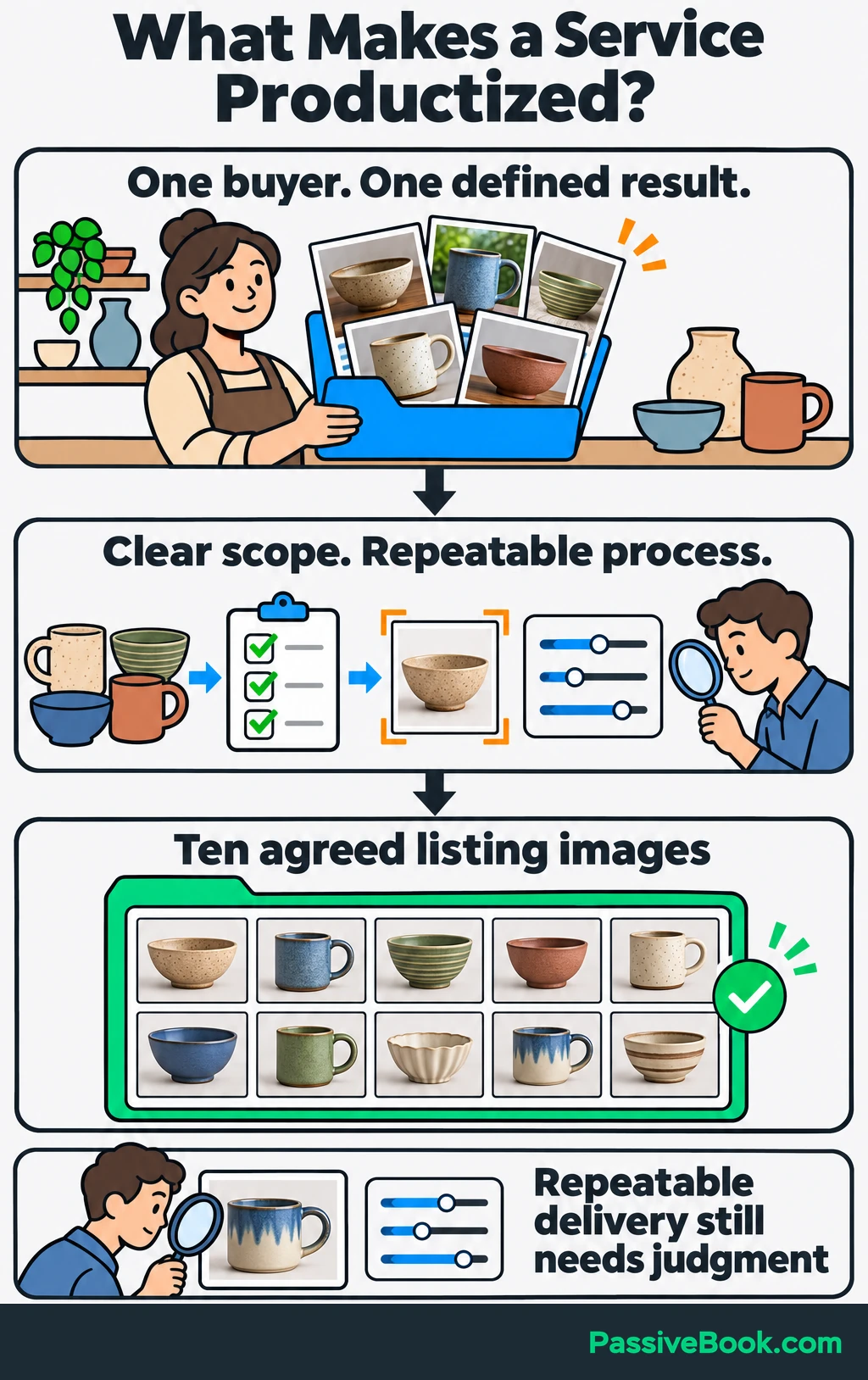
My freelancing experience is why this distinction matters to me. Even a good month depended on selling more of my time, and I eventually left because that link never went away. Putting a package name on the same workload would not have solved it.
Throughout this guide, imagine you run a photo-editing service for handmade pottery shops. You turn photographs clients already have into consistent images for their product listings. The package terms and figures below are teaching examples, not market rates or earnings forecasts.
The opportunity to scale comes from reusable settings, clear input requirements, controlled revisions and work another qualified person can follow. A subscription or a clever package name cannot do those jobs for you.
Choose One Client Problem You Can Solve Repeatedly
Start with work people already ask you to do. Review past projects, inquiries and the tasks that keep appearing inside larger engagements.
Look for four things:
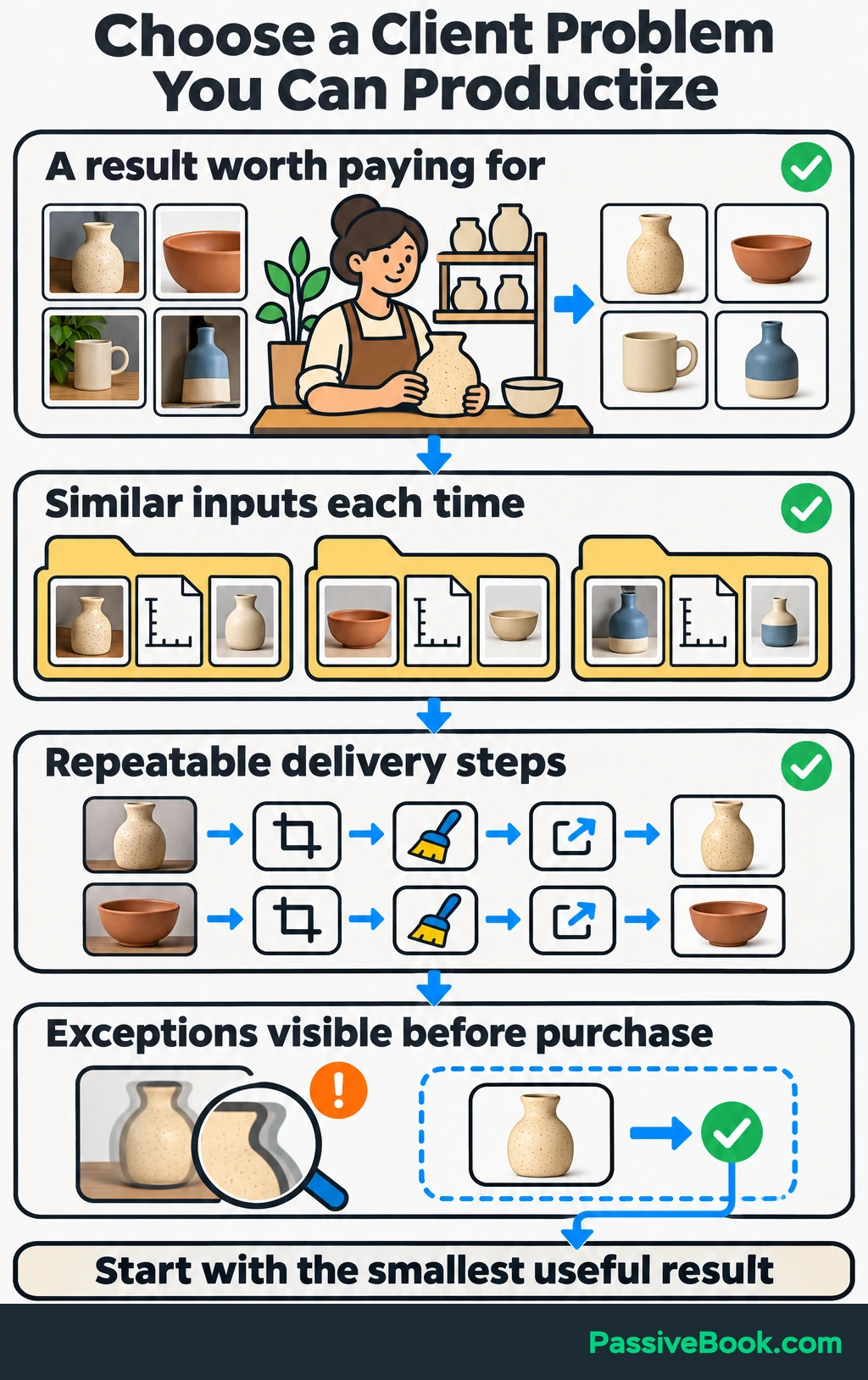
- Clients have a clear reason to pay for the result.
- They can provide similar inputs each time.
- Much of the delivery follows the same steps.
- You can identify exceptions before accepting the work.
Then describe the buyer, the event that makes them seek help, their current workaround and the result they need.
For the pottery-image service, the purchase trigger might be a new collection ready to list. The owner has photographs, but the backgrounds and crops vary. They want a consistent set of images without spending evenings editing each file.
Check that story with actual prospects. Ask:
- “Tell me about the last collection you prepared for your shop.”
- “How did you get the listing images ready?”
- “Which part took the most effort?”
- “What did you spend, including any outside help?”
- “What was still wrong with the result?”
These questions uncover past behavior. Strategyzer’s customer-testing guidance recommends asking about experiences rather than hypothetical buying intentions.
I would choose the smallest useful result you can deliver reliably. If every engagement needs a detailed assessment, package that first. For consulting work, that might mean reviewing one workflow and delivering a report of recommended changes. Quote any follow-up work separately.
Without past clients, use these conversations to select a candidate problem. The paid pilot comes later, so you don’t need a polished service catalog yet.
Define the Package and Its Boundaries
Specify the Deliverables and Required Inputs
Describe what the client receives in terms both of you can check.
“Better product images” leaves room for disagreement. “Ten edited photographs exported to the agreed listing dimensions” gives you a starting point for acceptance.
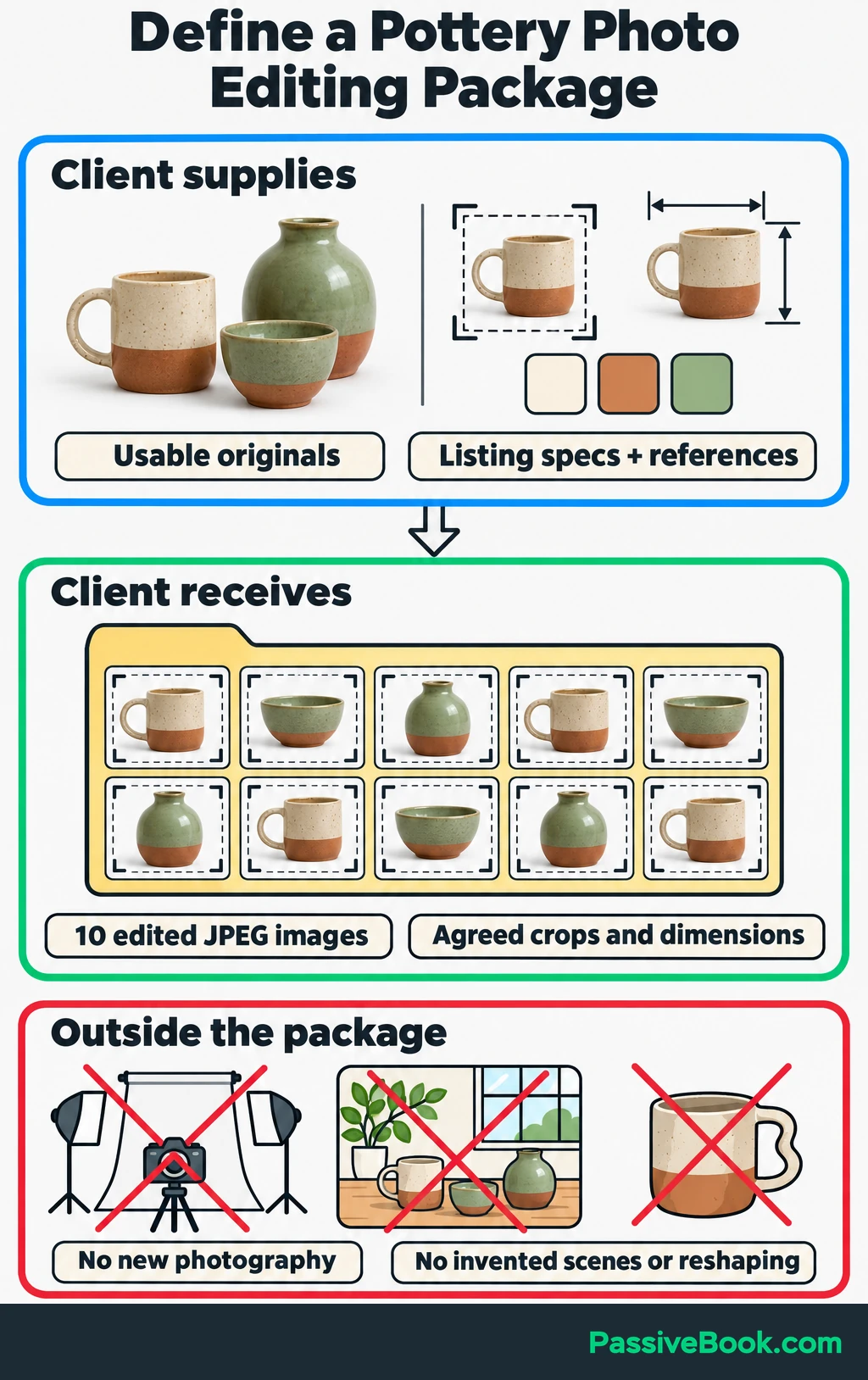
For the pottery package, specify:
- Deliverables: Ten edited images with background cleanup, agreed crops, consistent dimensions and JPEG exports.
- Required Inputs: Usable original photographs, listing specifications, crop preferences and a reference for the desired background.
- Quality Standard: Clean edges, intact product details and color kept faithful to the supplied originals.
- Exclusions: New photography, invented lifestyle scenes, product reshaping and work to rescue unsuitable originals.
Check a representative image before accepting the order. A poorly lit, blurry photograph may need a different process, and discovering that after payment creates an avoidable argument.
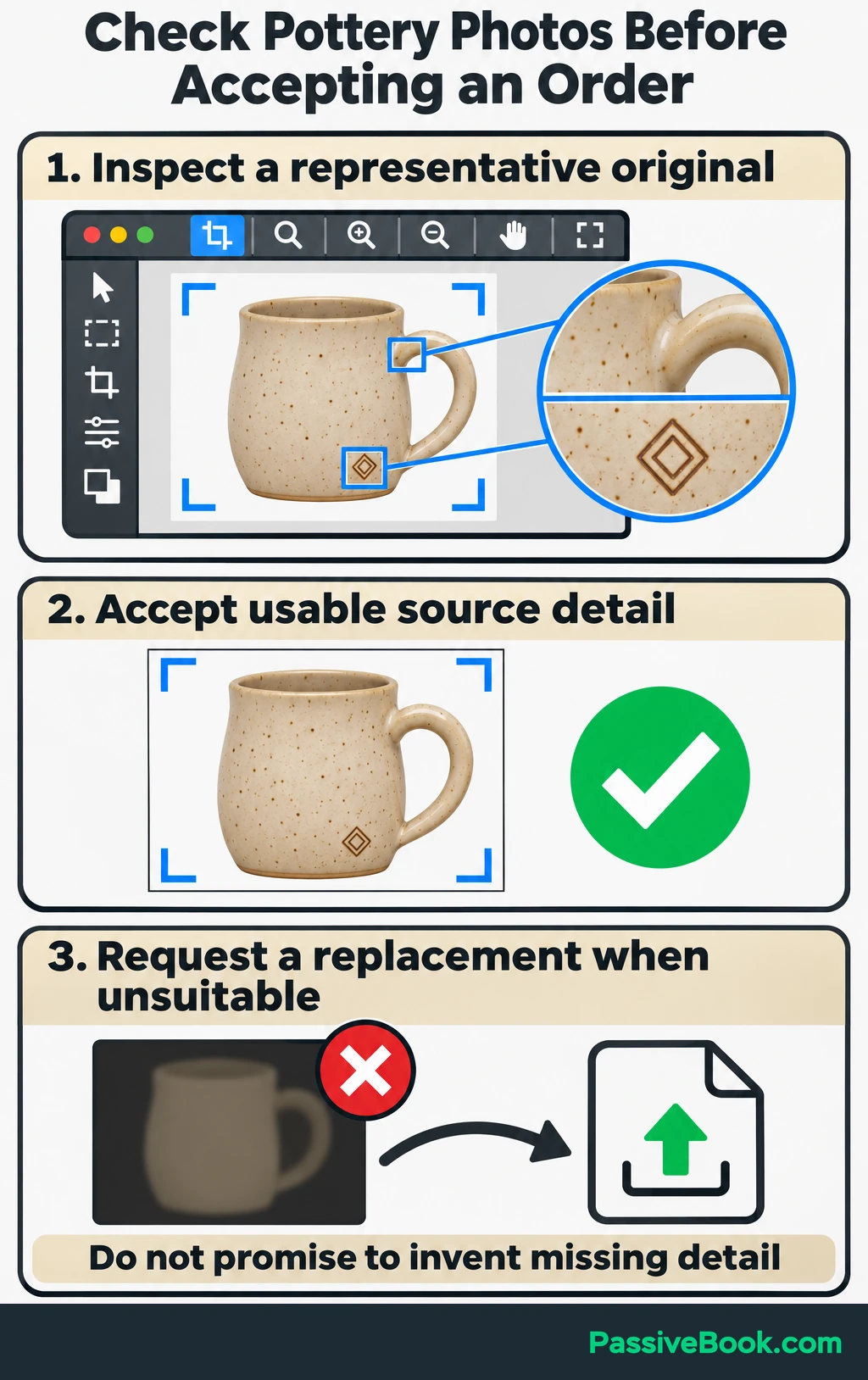
Promise the result you control. You can deliver files that meet agreed specifications. You cannot promise that those files will increase product sales.
Use this structure to describe the offer:
For [buyer], we deliver [defined result] through [deliverables], for [price], within [turnaround] after receiving [required inputs].
We’ll calculate a candidate price below. Set the scope first so the price has something concrete to cover.
Set Delivery, Revision, and Payment Terms
Your terms should answer what happens next and what happens when something changes.
For the example package, you might set these rules:
- Production Start: Check image suitability, collect payment upfront and confirm that all required inputs have arrived.
- Turnaround: Deliver within five business days after complete inputs are accepted.
- Revisions: Include one consolidated round within the original brief, requested within seven calendar days of delivery.
- Communication: Use one email thread or feedback form, with replies within two business days.
- Closure: Close the order after written approval or when the feedback window ends.
If information is missing, explain what you need and confirm the revised delivery date when it arrives. Don’t quietly leave the original deadline in place.
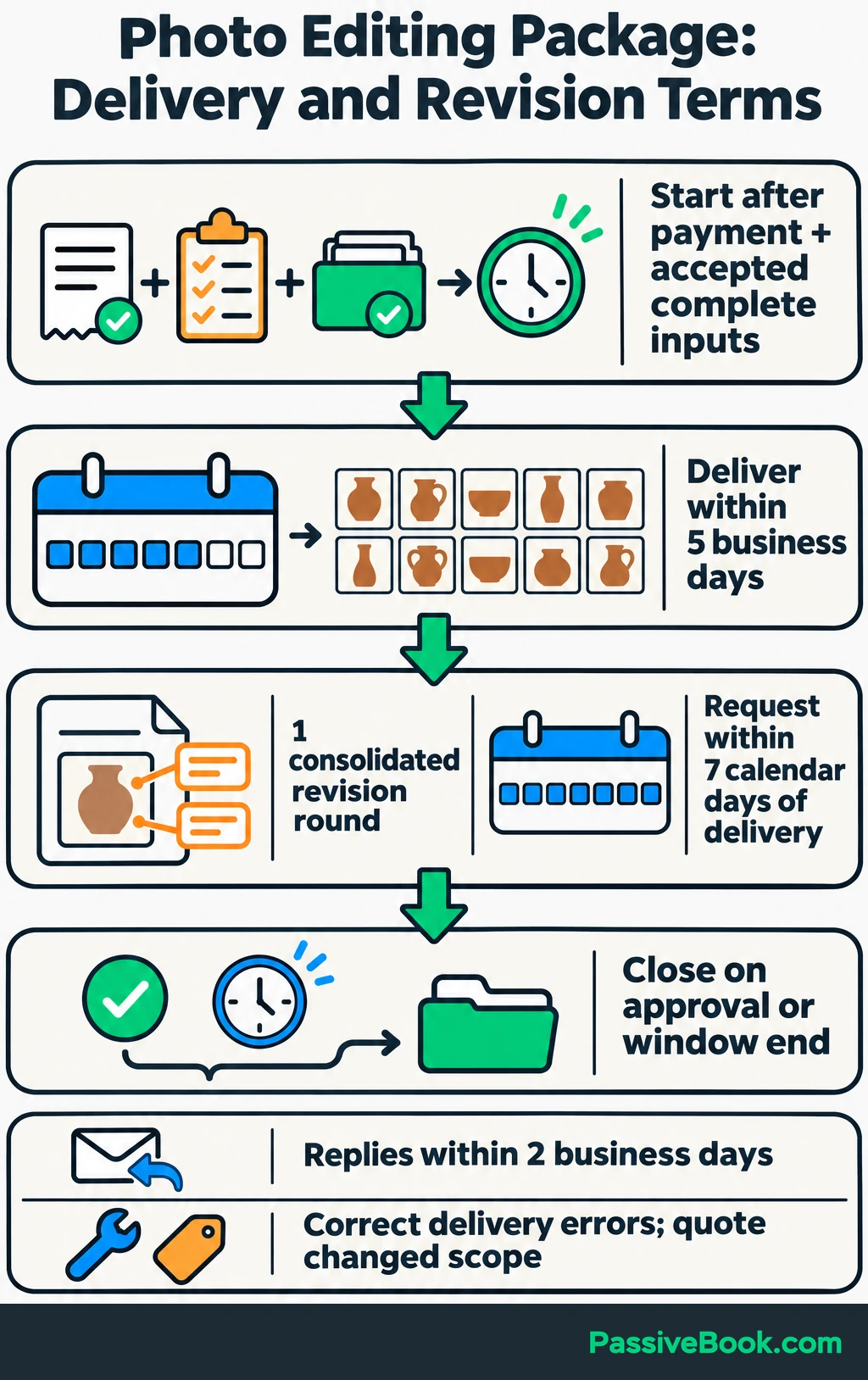
Separate corrections from changed requests. An export at the wrong dimensions needs correcting. A new background style requested after delivery changes the brief. Quote that work before starting it, and make sure your terms explain how clients report delivery errors separately from the revision allowance.
I would start with one package and occasional separately priced extras. Add recurring billing only when clients need repeated delivery. Then define each period’s allowance, what happens to unused work and how cancellation works. Splitting one project into payments does not make it an ongoing service.
You can turn these decisions into an offer before building a sales page. The AI Skill below drafts the client-facing version and helps you resolve boundaries you haven’t chosen yet.

Free AI Copywriting Studio




Set a Price That Supports Profitable Delivery
Estimate the Full Cost per Order
Count everything needed to finish an order, including the less glamorous work around production.
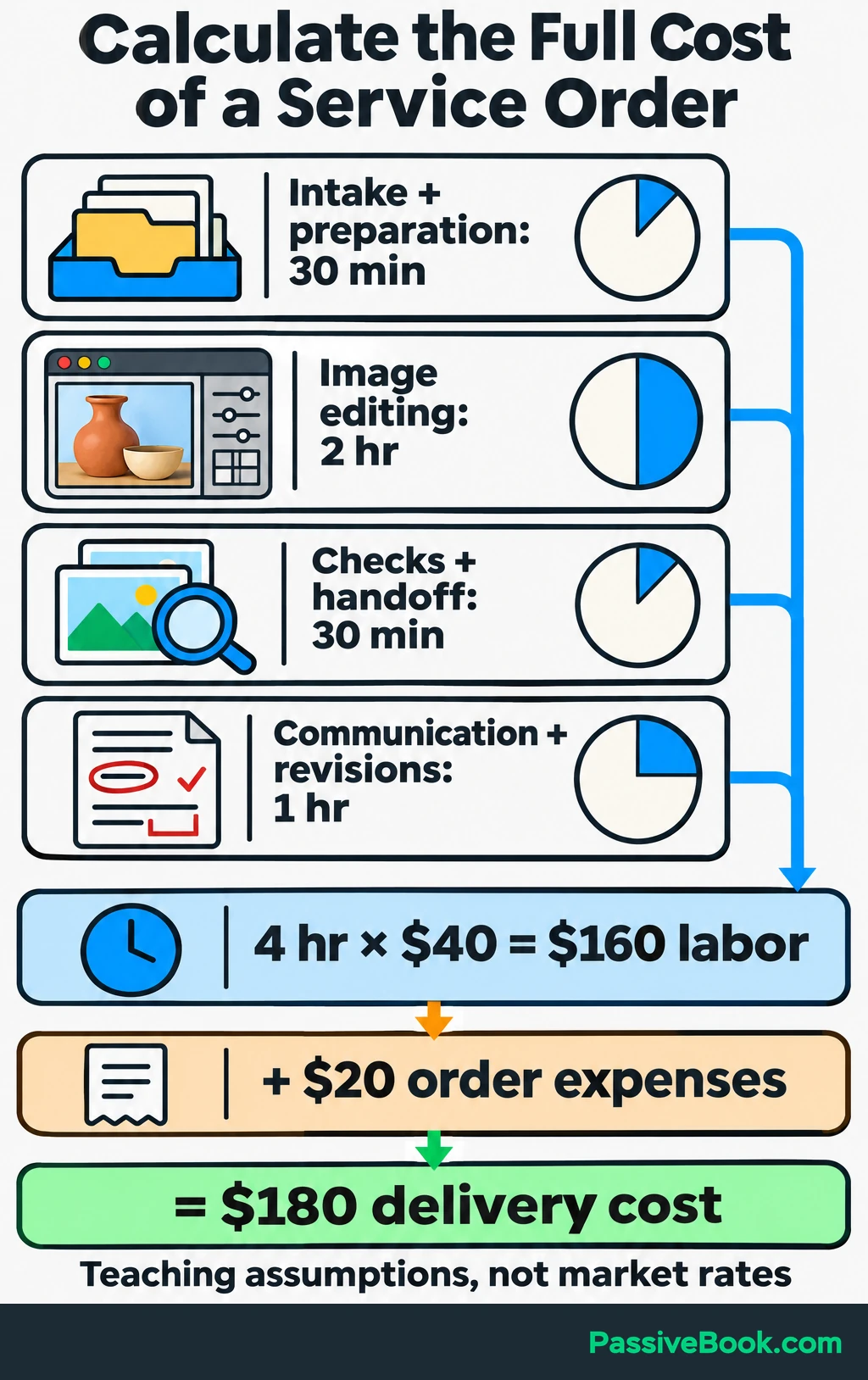
For the photo package, your estimate might include:
| Work | Assumed Labor |
|---|---|
| Intake and file preparation | 30 minutes |
| Image editing | 2 hours |
| Quality checks and handoff | 30 minutes |
| Communication and included revisions | 1 hour |
| Total | 4 hours |
The four labor hours sit within a five-business-day turnaround that allows for scheduling. Include a sustainable hourly allowance for your own work so unpaid labor doesn’t make the package look profitable.
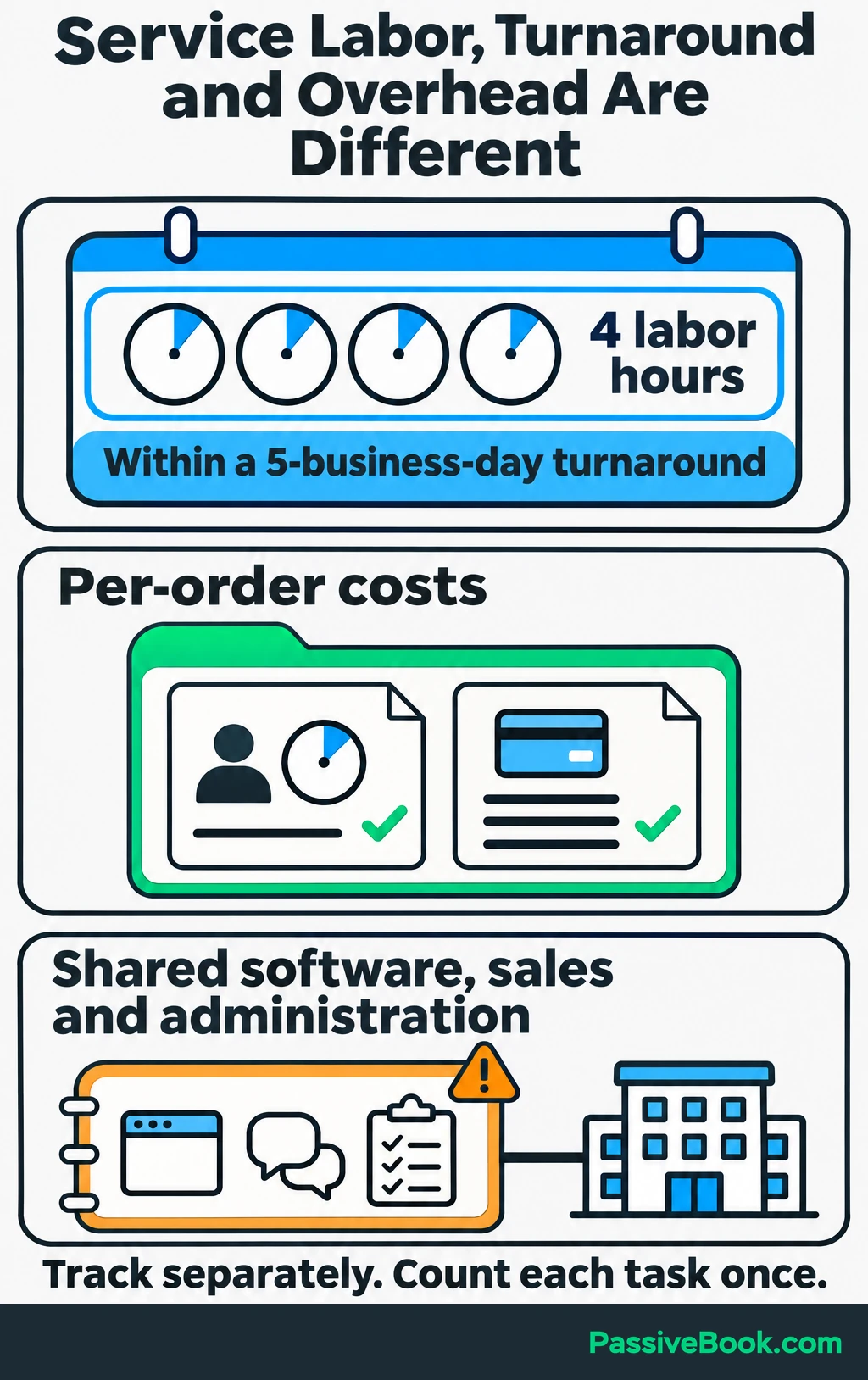
At an assumed $40 per labor hour, four hours cost $160. Add $20 for payment costs and other expenses tied to the order, and the modeled delivery cost is $180.
Count each task once. Track shared software costs and allowances for sales and administration time separately; orders must cover these too.
Calculate a Candidate Price
Decide how much of each sale should remain after those per-order costs. That remaining amount is the contribution available for shared overhead and profit.
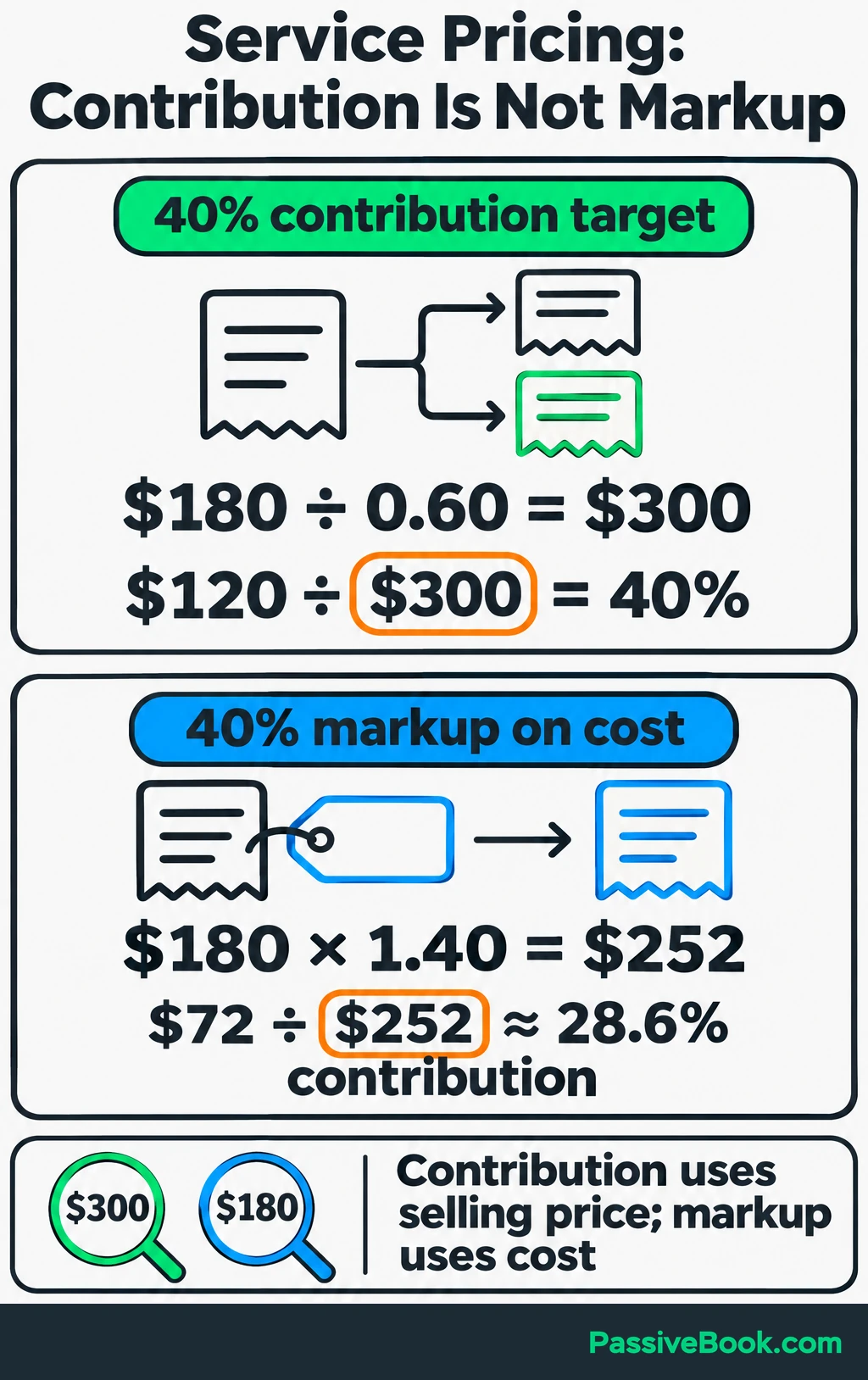
If you want 40% of each sale left for overhead and profit, delivery costs must fit within the other 60%. With $180 in delivery costs:
$180 ÷ 0.60 = $300
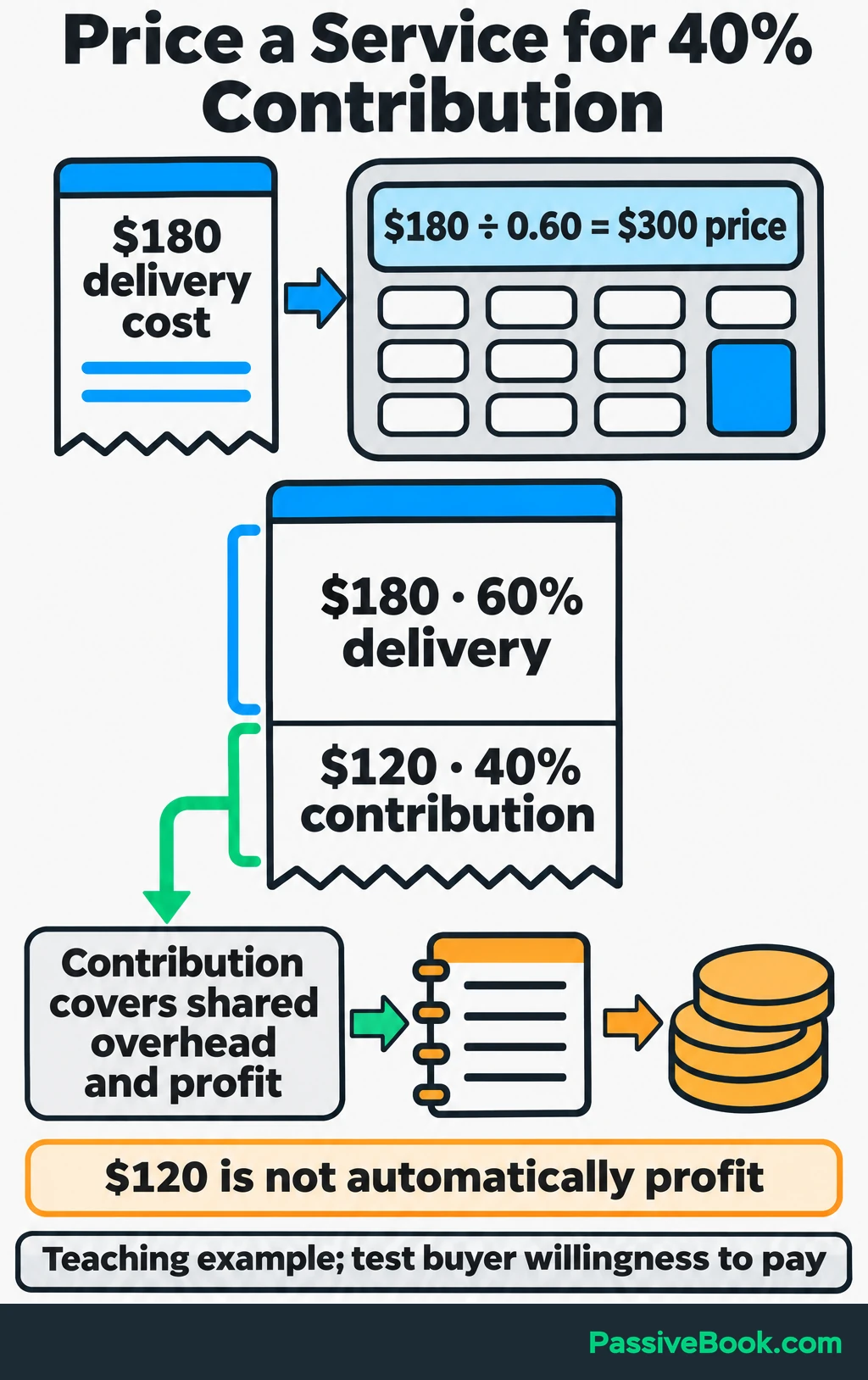
That leaves $120 per package. It is 40% of the $300 selling price, rather than a 40% markup on the $180 cost.
Test whether suitable buyers will pay $300. BDC’s pricing guidance recommends considering costs, overhead, market positioning and competing offers.
Compare services with similar scope. A cheap editing offer may exclude preparation or revisions that yours includes.
If suitable buyers won’t pay a viable price, I would first reconsider the problem, buyer or package. Cutting the price while keeping all the work is an expensive way to avoid that decision.
Check Whether Viable Sales Fit Your Capacity
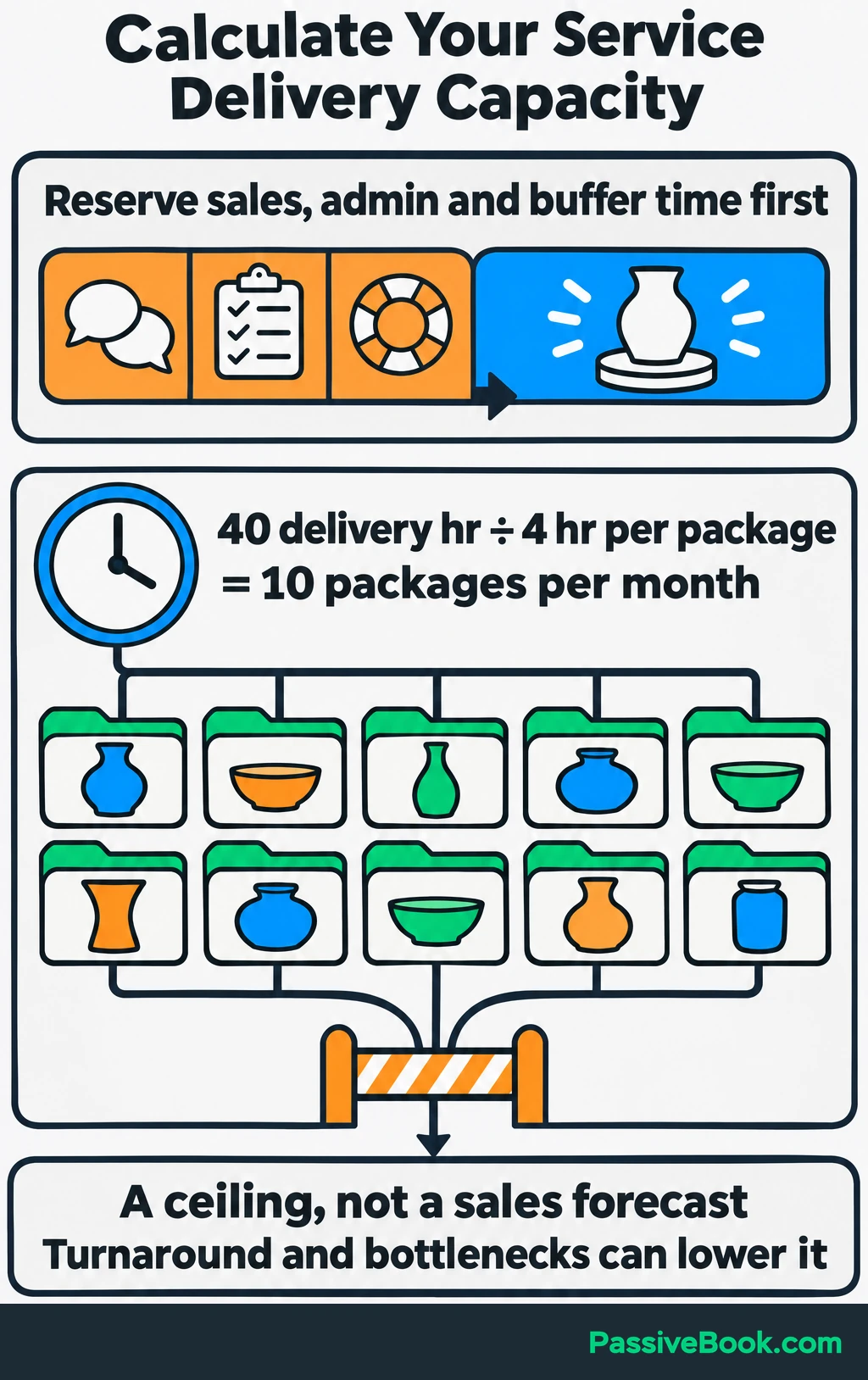
Reserve time for selling, general administration and unexpected work before counting delivery slots.
Suppose that leaves 40 delivery hours each month. At four hours per package:
40 delivery hours ÷ 4 hours per package = 10 packages
This ceiling assumes you can meet the turnaround and no delivery stage limits capacity further.
Next, check how many sales cover shared overhead. Divide monthly fixed costs by the contribution from each package and round up. This follows the SBA’s break-even formula.
With $300 in assumed monthly overhead and $120 contribution per package:
$300 ÷ $120 = 2.5, so three packages cover the modeled overhead.
Check quieter months too:
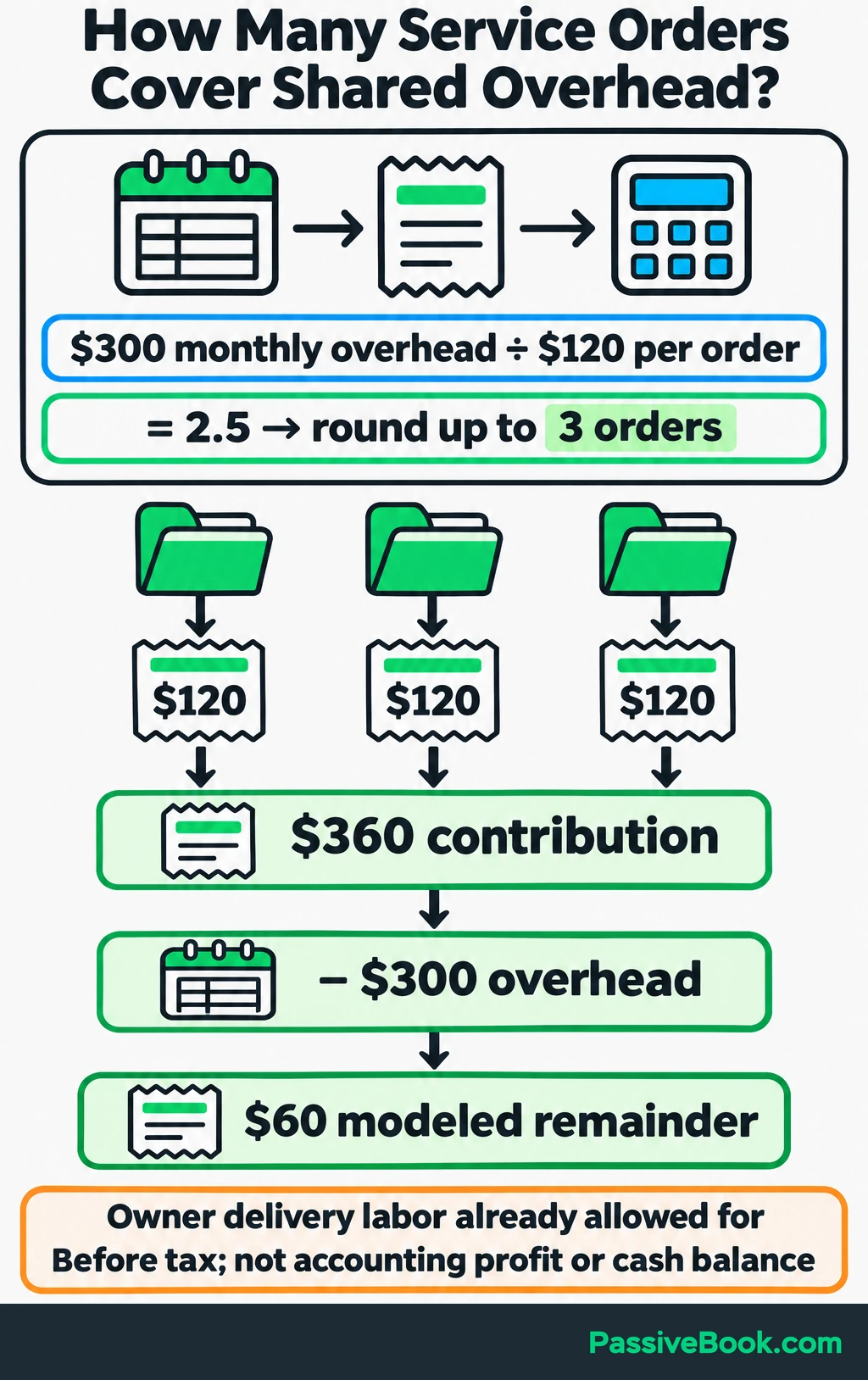
At three packages, $360 in contribution leaves $60 after overhead.
These figures include an allowance for owner delivery labor. They are before tax and are not accounting profit or your bank balance.
If your desired profit requires more sales than you can deliver, change the price, scope or process. Don’t build a plan that works only when every slot sells and nothing goes wrong.
The example works only because its price, costs and available hours fit together. Use your own estimates below to see what changes when bookings are quieter or an order takes longer.

Free Pricing Profit Calculator
Validate the Offer With a Paid Pilot
Prepare a sample output and a short delivery checklist. Then offer the bounded package to suitable past clients, referrals or prospects, with a price and an available start date.
A one-page offer is enough. Agree on the inputs, deliverables, payment terms and feedback process before work begins.
I would run the first few orders manually and accept only as many as you can watch closely. You need to learn where the work bends before connecting everything to an automation.
Purchases test willingness to pay, while delivery records test whether the package works for you. Strategyzer’s evidence guidance distinguishes quick interview feedback from stronger evidence closer to real buying behavior.
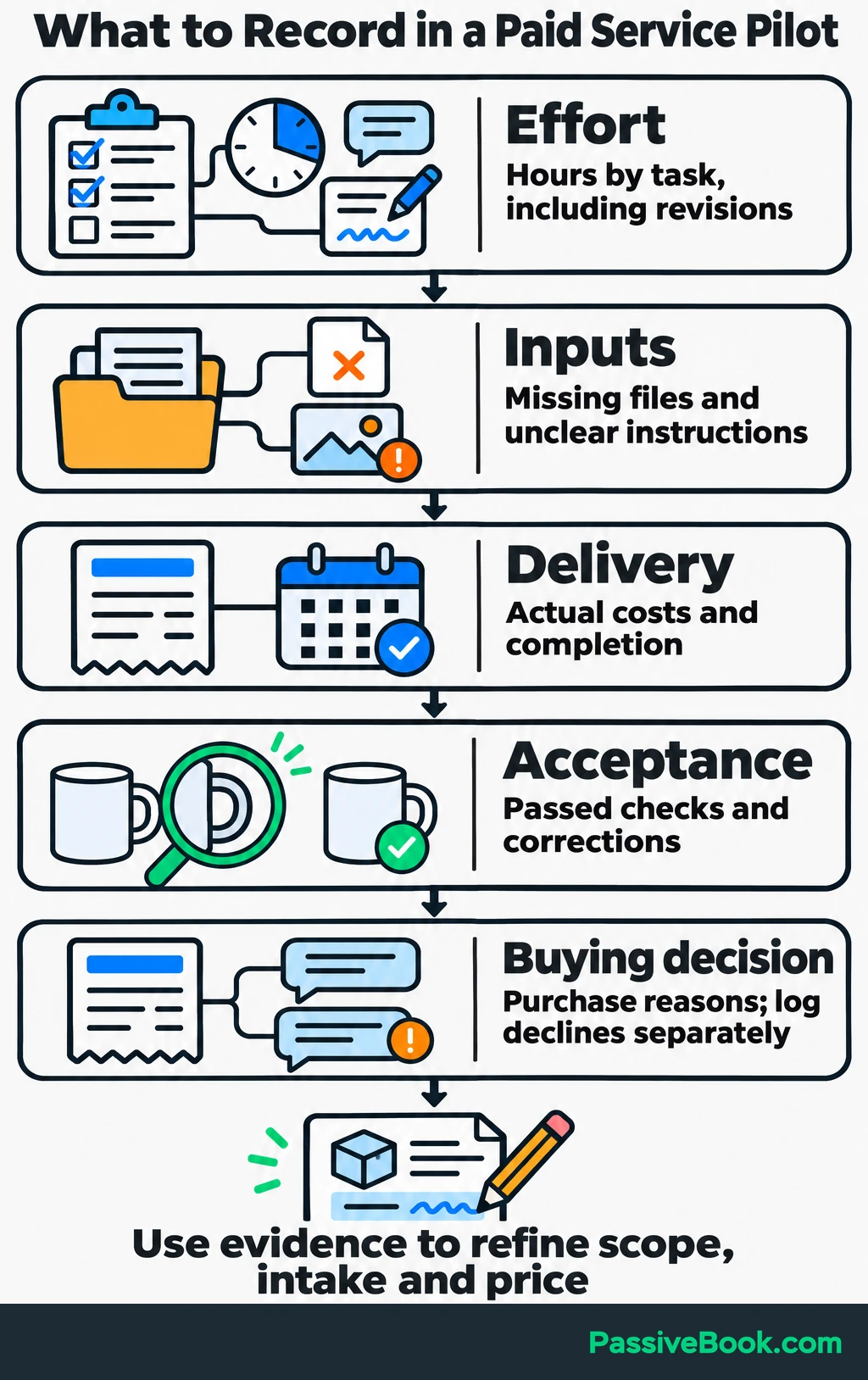
For each pilot order, record:
- Effort: Actual labor time by task, including communication and revisions.
- Inputs: Missing files, unclear instructions and unsuitable photographs.
- Delivery: Costs, completion date and any missed deadline.
- Acceptance: Whether the output met the agreed standard and what needed correcting.
- Buying Decision: Why the client purchased or requested different work. For prospects who declined the pilot offer, record their reason separately.
Continue when suitable buyers purchase and the delivery economics hold. If clients misunderstand the scope, clarify the offer. If poor originals create rework, tighten intake. If the service takes longer than expected, revise the process, price or included work.
A compliment is pleasant. It cannot tell you whether an order pays for itself.
Build a Repeatable Delivery System
Standardize Intake and Communication
Give clients one route through the service.
Use one intake form to collect the originals, specifications, reference image and contact details. Check completeness before scheduling production.
Then reuse the pieces that should stay consistent:
- Welcome Instructions: Explain what to send, what happens next and when the delivery clock starts.
- Folder Structure: Separate originals, working files, exports and revision requests.
- Status Messages: Confirm accepted inputs, missing information and delivery.
- Feedback Form: Collect one consolidated set of comments tied to specific files.
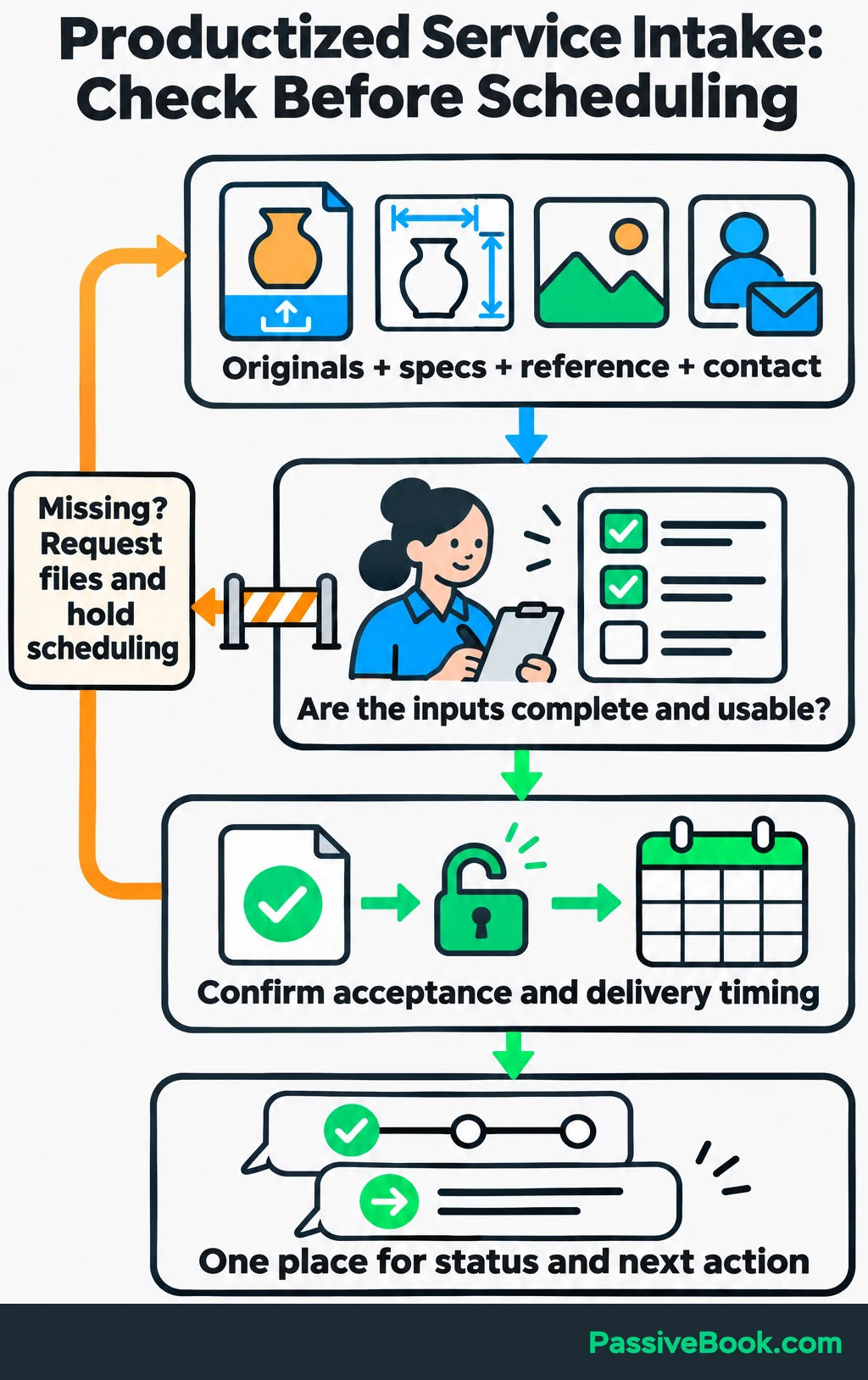
Keep progress and the client’s next action in one agreed place. A simple shared order page or email thread can do this; you don’t need a new portal to deliver ten images.
On WordPress, a form tool such as Fluent Forms can collect the brief. A shared document or Notion page can hold your internal checklist. Start with tools you already have.
Prepare a response for work outside the package:
“Adding those images would increase the order beyond the ten included. I can quote the extra work and confirm a revised delivery date before we proceed.”
That response keeps the boundary clear without making the client feel foolish for asking.
Document the Workflow and Quality Standard
Turn the method that worked during the pilot into instructions another qualified person can follow.
Include the required input, action, person responsible, completion check and route for exceptions.
For the pottery-image service, the workflow could look like this:
| Stage | Required Input | Action | Owner | Completion Criterion | Exception Path |
|---|---|---|---|---|---|
| Suitability review | Representative original and requested edits | Check whether the source supports the work | Service owner | Image is usable for the agreed result | Request a replacement or decline |
| Order setup | Complete files, brief and payment | Create folders and record specifications | Coordinator | Ten accepted originals and a complete brief are ready | Hold scheduling until gaps are resolved |
| Editing | Accepted originals and reference | Apply agreed cleanup and crops | Editor | Ten working images match the brief | Flag edits requiring changed scope |
| Quality review | Edited files and originals | Inspect edges, color, detail and dimensions | Reviewer | Every file passes the checklist | Return failed files for correction |
| Delivery and closure | Approved exports | Deliver, collect feedback and complete included revisions | Service owner | Approval received or feedback window ended | Route corrections or quote new requests |
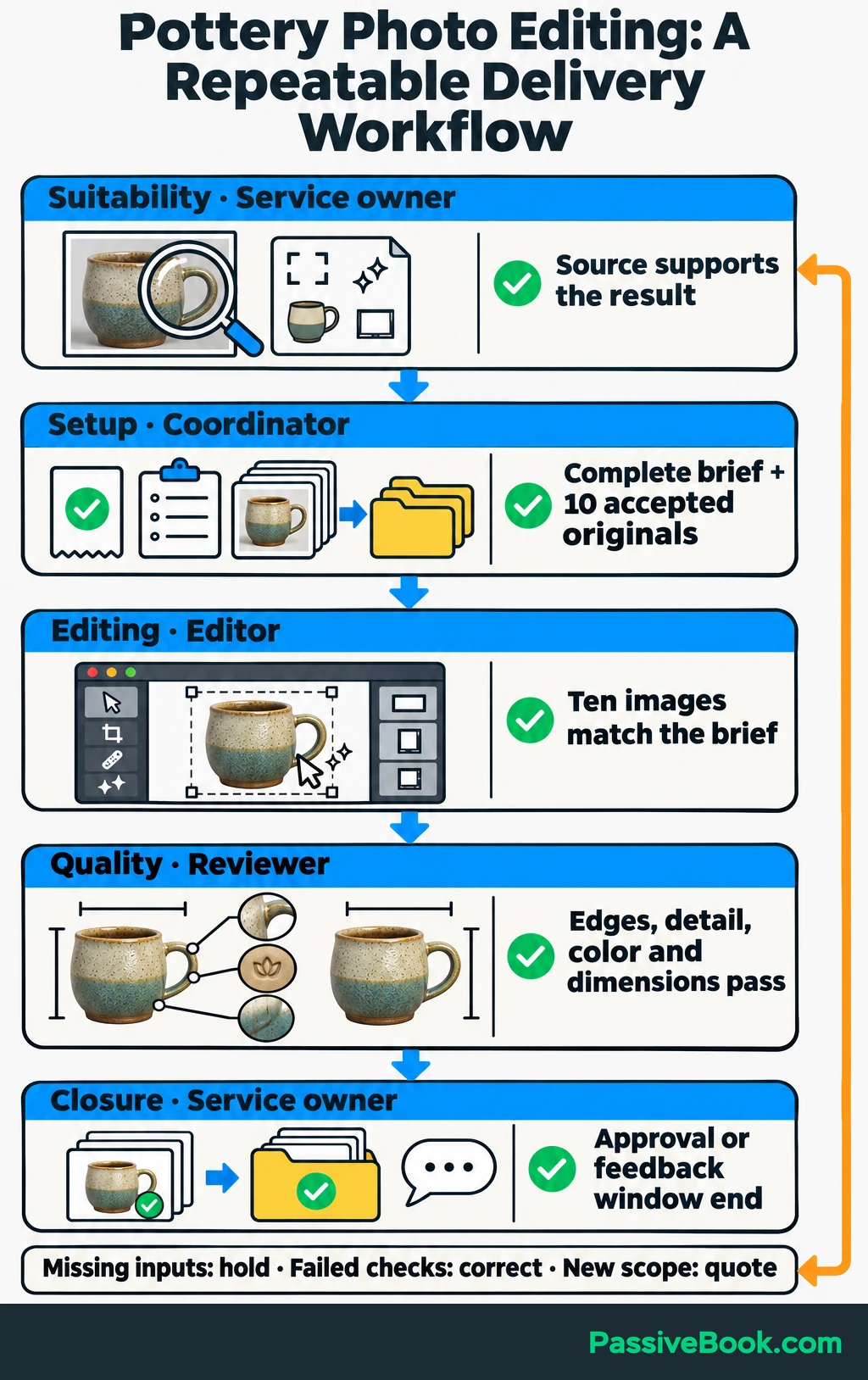
A short screen recording can help explain an editing task, but pair it with written acceptance checks and an approved sample. “Make it look professional” is not a quality standard.
For pottery images, inspect whether cleanup has clipped a handle, softened a maker’s mark or changed the apparent glaze color. Those checks protect the product the buyer is trying to represent.
Have another qualified person follow the instructions. When they need undocumented help, improve the procedure. Keep updating it when the same exception returns.
Attract Clients Who Fit the Package
Your offer page should help people decide whether their work belongs in the package.
Show the problem you solve, the deliverables, price, sample output, required inputs, turnaround, exclusions and next step. Keep the package description close to the sample so visitors can connect the promise with the result.
For the running example, the offer sentence becomes:
“For handmade pottery shops, we edit ten supplied product photographs into consistent listing images for $300, delivered within five business days after payment and acceptance of complete files and instructions.”
Support that sentence with the detailed boundaries you already defined. The practical benefit is consistent listing images without coordinating a custom editing project.
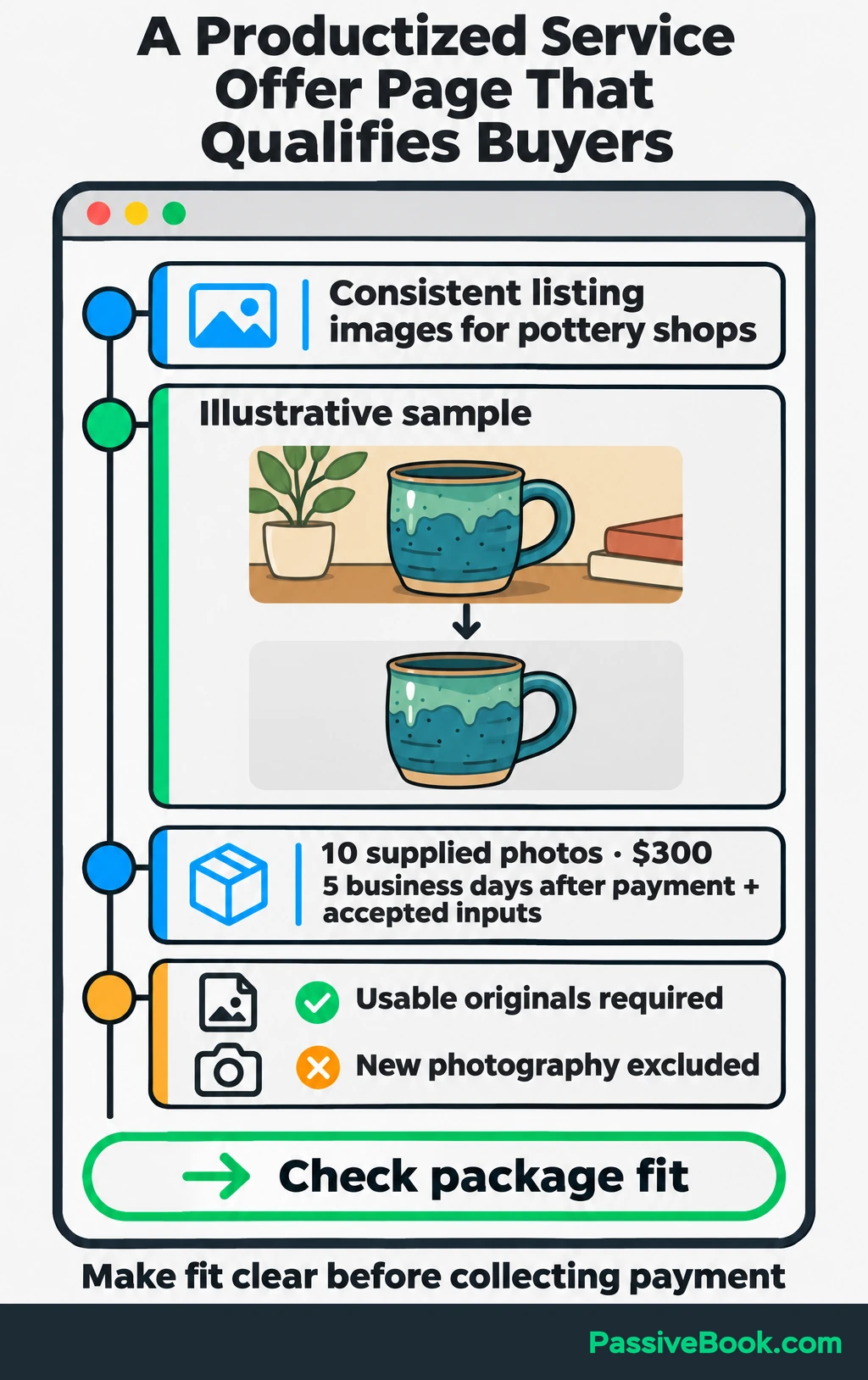
Show a before-and-after sample that demonstrates your actual editing standard. Label demonstration work clearly, get permission before publishing client images and use genuine testimonials when you have them.
I would begin with existing relationships or referrals from people who help shops prepare product listings. Choose one channel you can work consistently before spreading your effort across several.
Qualify source quality, requested edits and deadlines before collecting payment. A person who needs new photography tomorrow is a poor fit, even if they like your package.
Track qualified inquiries, purchases and recurring reasons for rejection. If suitable prospects keep asking whether background cleanup is included, improve the page. If most inquiries need photography, change where you promote it.
Move suitable existing clients into the package after their current engagement or at renewal, while honoring the work you already agreed to deliver.
Grow Income by Reducing Owner Time per Order
Improve the Delivery Bottleneck First
Look for the task that takes the most owner time or creates the longest queue. Improve that task before buying tools to speed up something else.
Start with simpler fixes: reusable export settings, clearer references, fewer handoffs and similar tasks handled together.
Once administration is stable, automate acknowledgments, folder creation, reminders and status updates. I use n8n to connect apps and run tasks automatically, but I would skip automation until the manual process is clear. Otherwise, you get missing files delivered to the wrong place at impressive speed.
Delegate one bounded production task next. Provide accepted inputs, an approved sample, quality checks and a clear rule for when to ask for help.
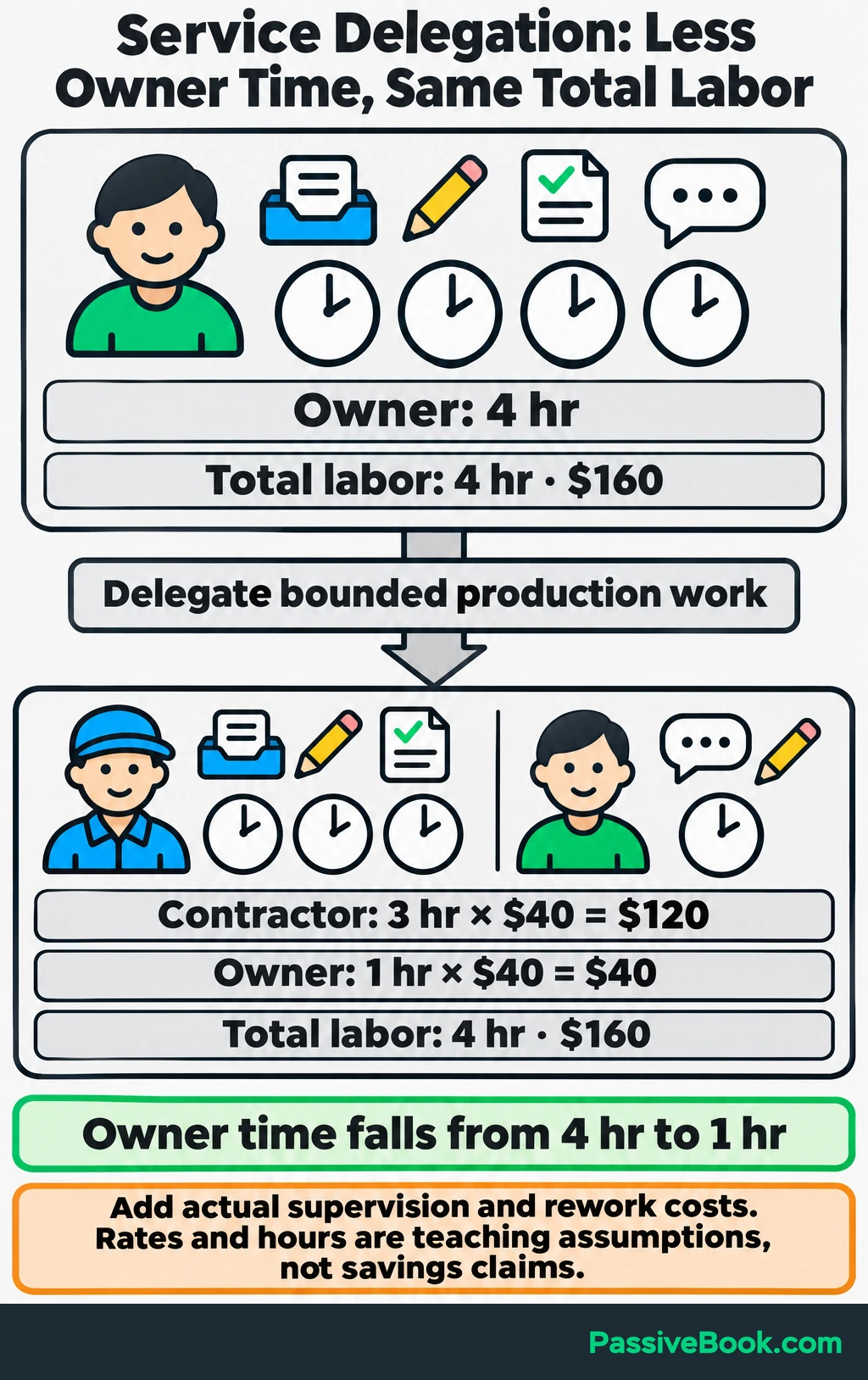
In the example, suppose a contractor handles intake, editing and quality checks for three hours at the assumed $40 hourly cost, while you spend one hour on communication and revisions. Modeled labor cost remains $160, but owner time falls from four hours to one.
That frees your time without reducing total labor. Any extra supervision or rework must go into the actual figures.
My own AI content pipeline took article production from days to hours, and that experience makes me look for repeatable tasks worth automating. For this service, I would begin with administrative assistance rather than let AI freely alter product images. Any assistance with editing still needs checks for accurate shape, detail and color.
Count setup, supervision, corrections and ongoing tool costs when deciding whether an automation saves enough to keep.
Increase Bookings Only When Delivery Holds
Review profit and workload together. Revenue alone cannot show whether the package is becoming easier to run.
Track:
- Contribution per Order: The selling price minus delivery expenses and labor costs, including an allowance for your time.
- Total Labor: Everyone’s time across production, communication and rework.
- Owner Hours: Your personal time spent on each order.
- Delivery Reliability: Whether orders met their agreed deadlines.
- Revision Volume: How much feedback required corrections or additional work.
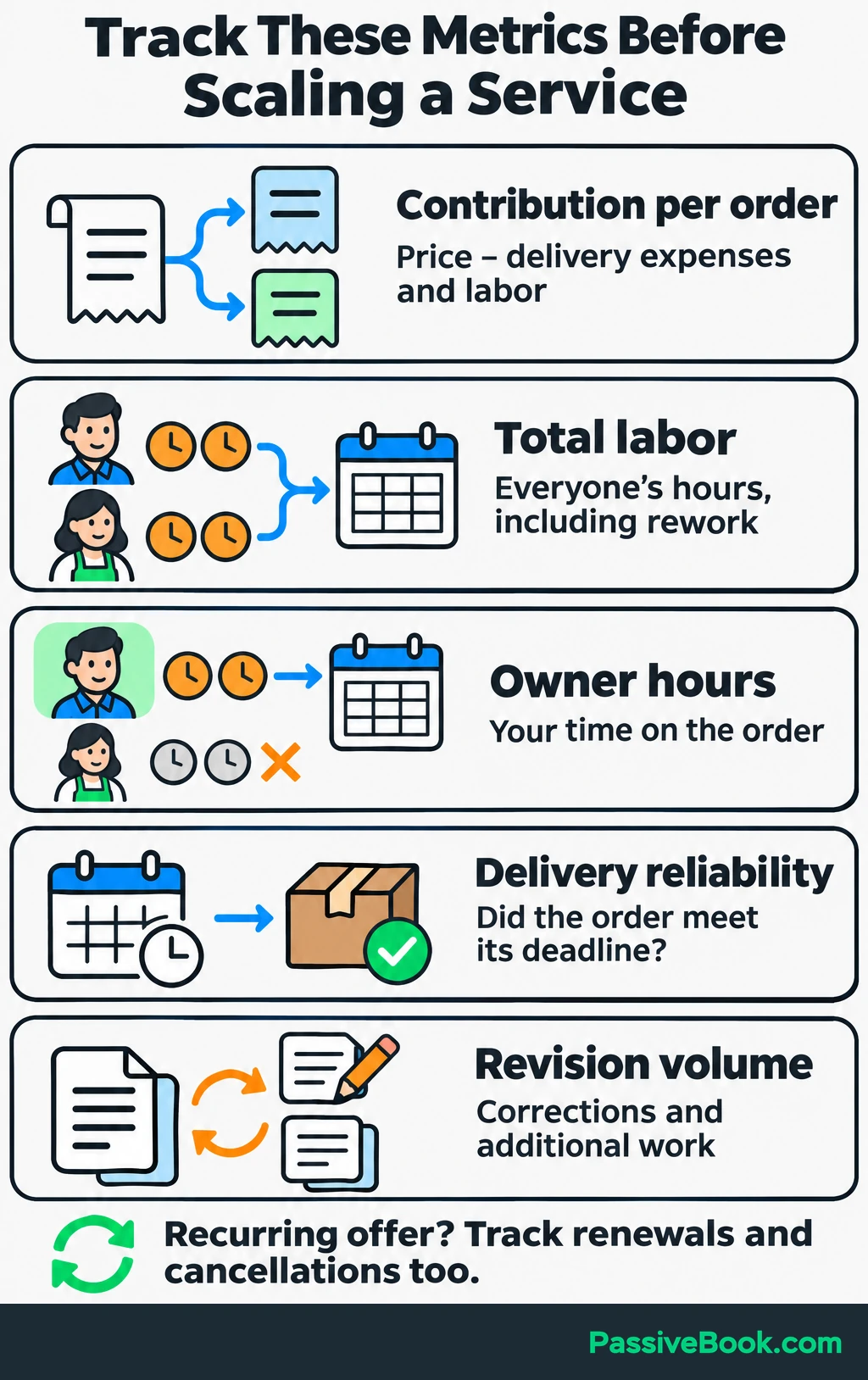
For a recurring offer, also watch renewals and cancellations.
Delegation can reduce owner hours while leaving total labor unchanged. A better process can reduce total labor. Recalculate costs and capacity after either change, because the next limit may be review time or contractor availability.
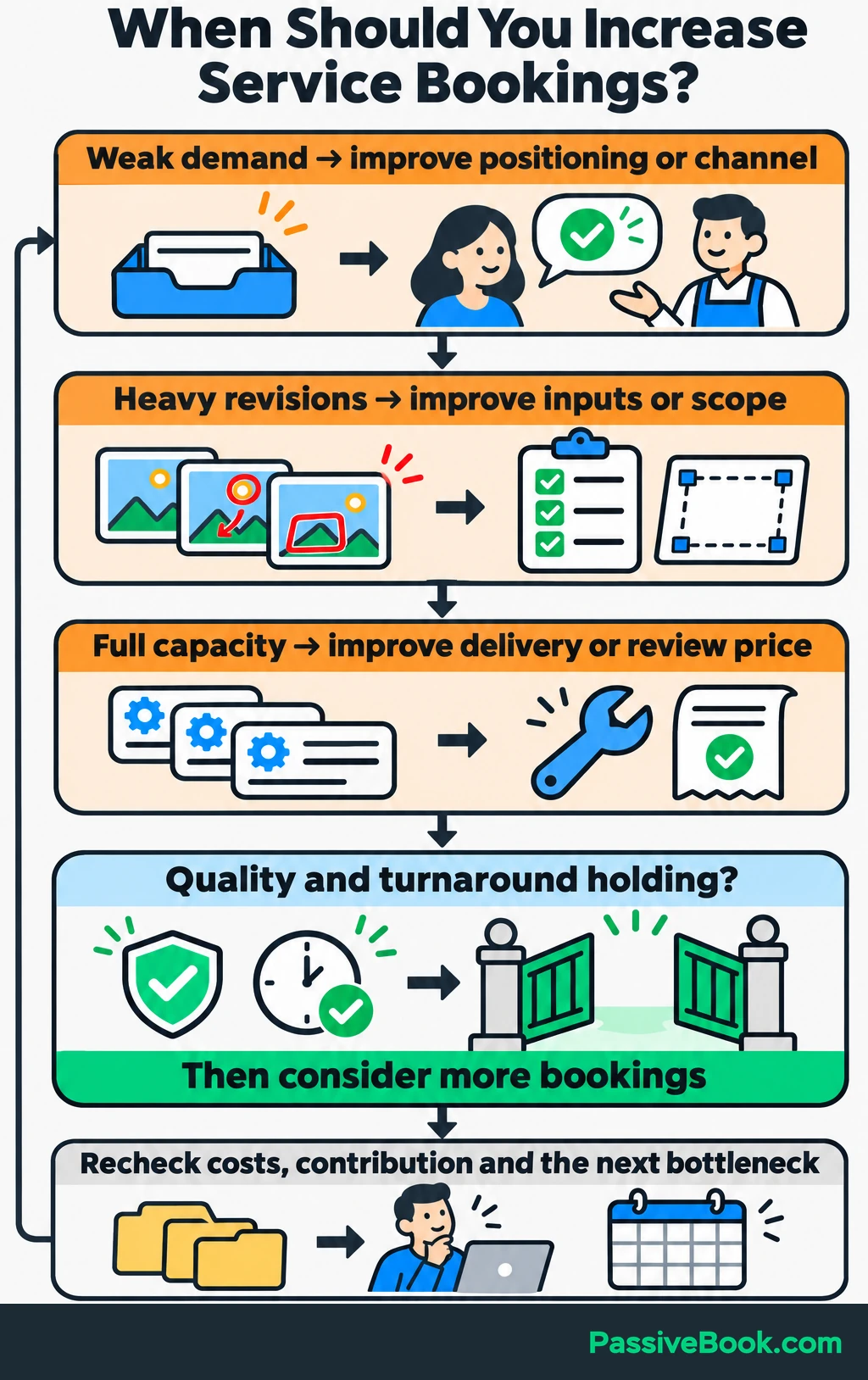
Let the evidence guide the next move. Weak demand calls for clearer positioning or a better acquisition channel. Heavy revisions call for better inputs or scope. Full capacity calls for delivery improvements or a price review.
Raise booking limits only after quality and turnaround hold at the current workload. More orders are useful when they produce enough contribution without pulling you back into every task.
Offer repeat orders when clients need the same result again. I would add another package only when a distinct, repeatable need justifies the extra process. Three offers are three systems you have to maintain.
What Next?
Choose one recent project and write a one-page version you could sell again: buyer, deliverables, required inputs, exclusions, turnaround and a candidate price. Use it to start a paid-pilot conversation before building a bigger system.
Use the social buttons to share this guide when the conversation turns to making service work more repeatable and profitable.
Which part of your current service would be hardest to standardize, and why? Share it in the comments, along with any other questions about shaping your offer.
Share this post with your friends & followers:

