You have a few hours after work and a skill someone might pay for. But turning that into a business means answering awkward questions: who needs it, what should you charge, and how do you find buyers without spending every evening chasing them?
Guess wrong and you can fill your spare time with work that barely pays. During my freelancing years, I could finish a busy week with no idea where the next order would come from. This guide takes you from choosing a service to winning a paid trial and building repeatable systems, so your first clients help you test a business worth keeping.
Step 1: Choose a Service for a Specific Customer
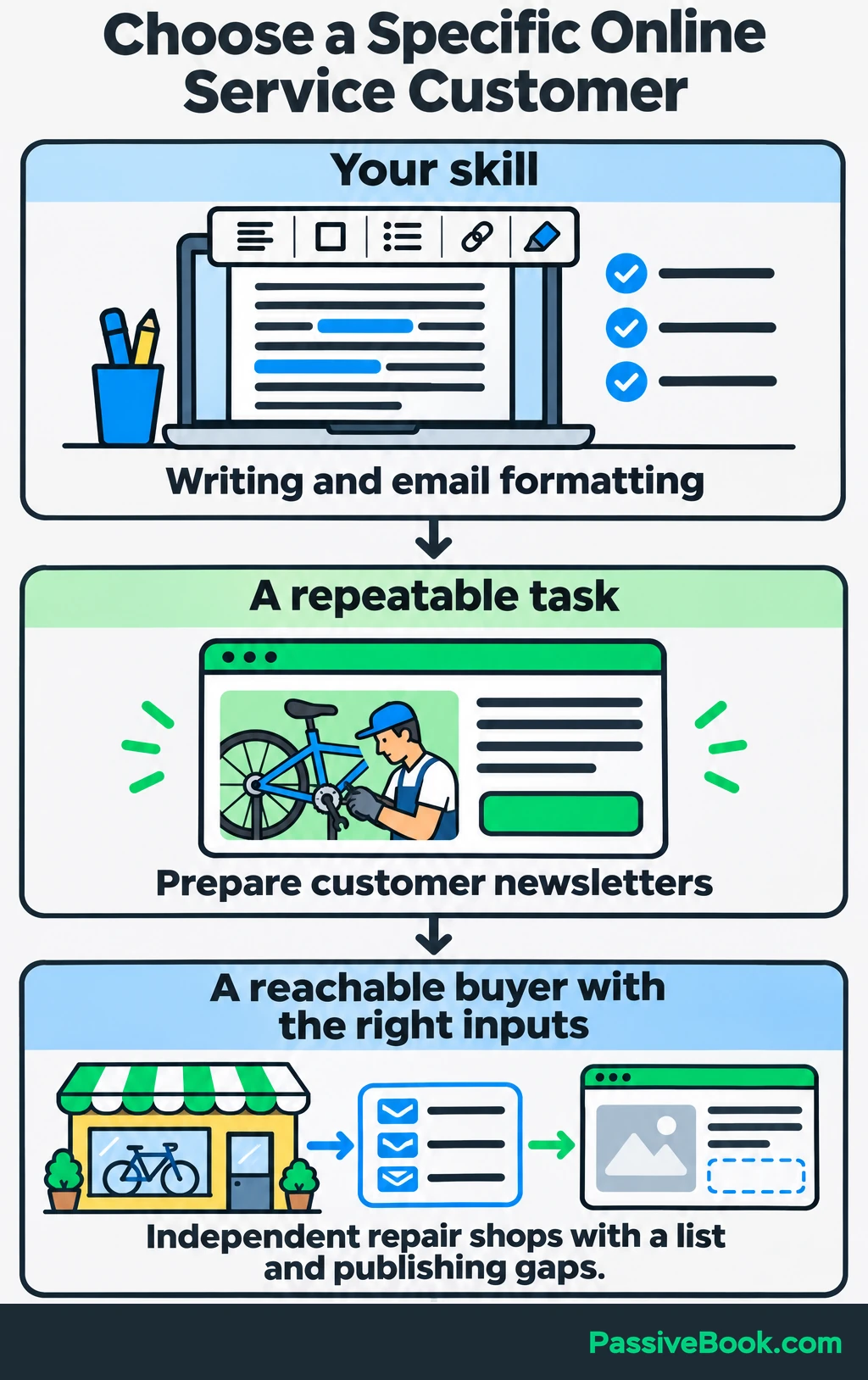
Start with a task you can complete reliably and a customer you can reach. You need enough skill to deliver the promised work, but you don’t need to be the world’s leading expert.
An online service business delivers work remotely. That could mean editing articles, preparing newsletters, designing graphics, or managing appointments. Taking online bookings for dog walks still leaves you with dogs to walk, so decide whether you want remote work or a local service with online sales.
List things you can demonstrate through work, hobbies, or personal projects. Then turn each skill into a useful customer task.
For each possible service, ask:
- Can I show a credible sample?
- Can I identify and contact likely buyers?
- Does this solve a problem they already notice?
- Can I deliver it within my available hours?
- Will they need it again?
I would choose a small, repeatable task over a broad promise such as “I handle your marketing.” Broad promises are easy to write and surprisingly hard to finish.
Throughout this guide, imagine you prepare customer newsletters for independent bicycle repair shops. The prices and figures are examples, not market rates or earnings forecasts.
Your first customer group needs more detail than “bike shops.” Look for shops with an existing customer email list, useful updates to share, and trouble publishing consistently.
Knowing bicycles helps you understand the material, but the service still requires clear writing, email formatting, and careful checking. Interest in a niche doesn’t replace the skill you sell.
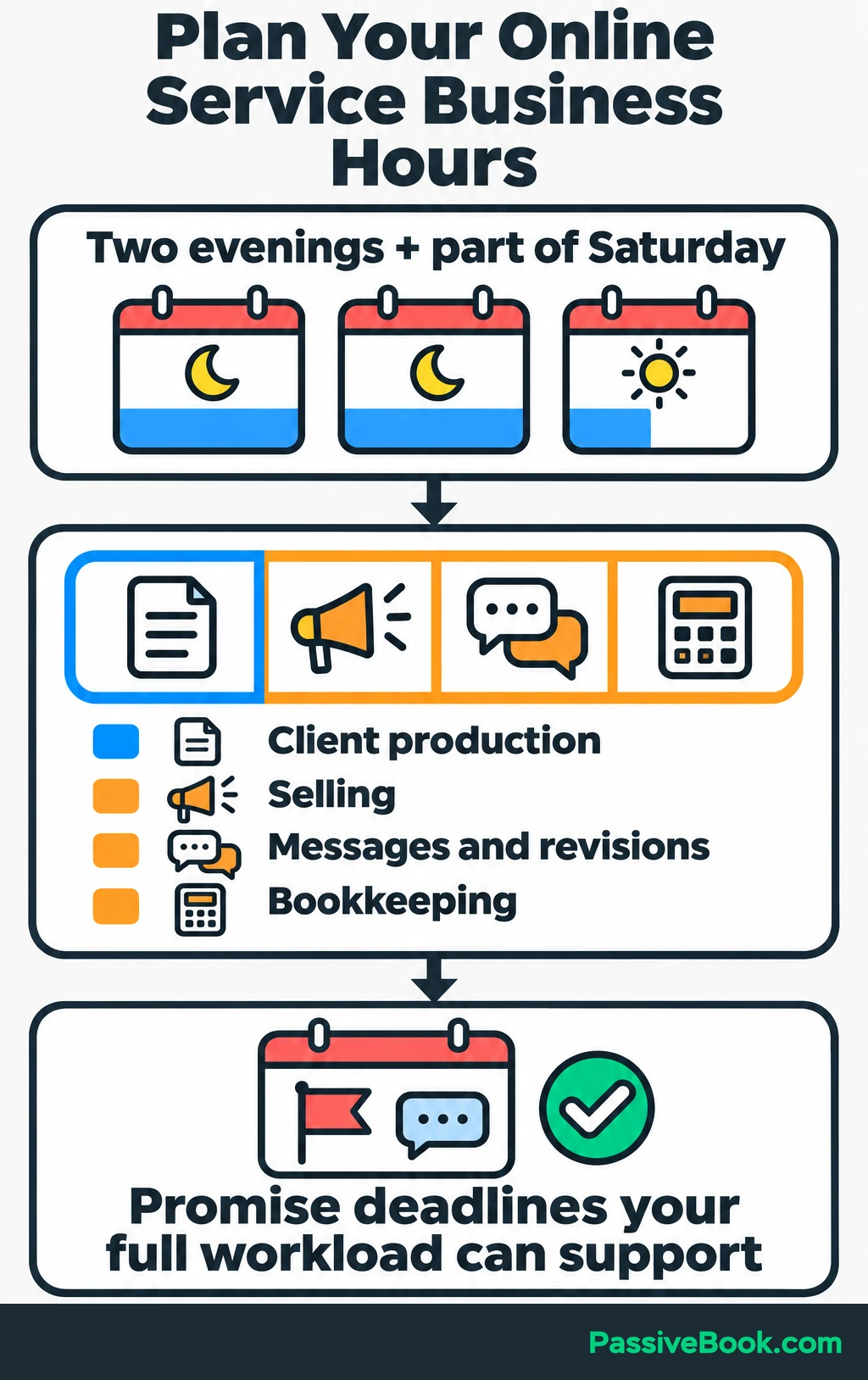
Finally, set your working limits. If you have two evenings and part of Saturday, choose deadlines and response windows that fit. Include selling, messages, revisions, and bookkeeping in that schedule. They all use the same evenings.
Step 2: Validate the Problem With Potential Buyers
Before building a website, talk to people who might buy. Your aim is to understand what happens now, rather than collect encouragement for your idea.
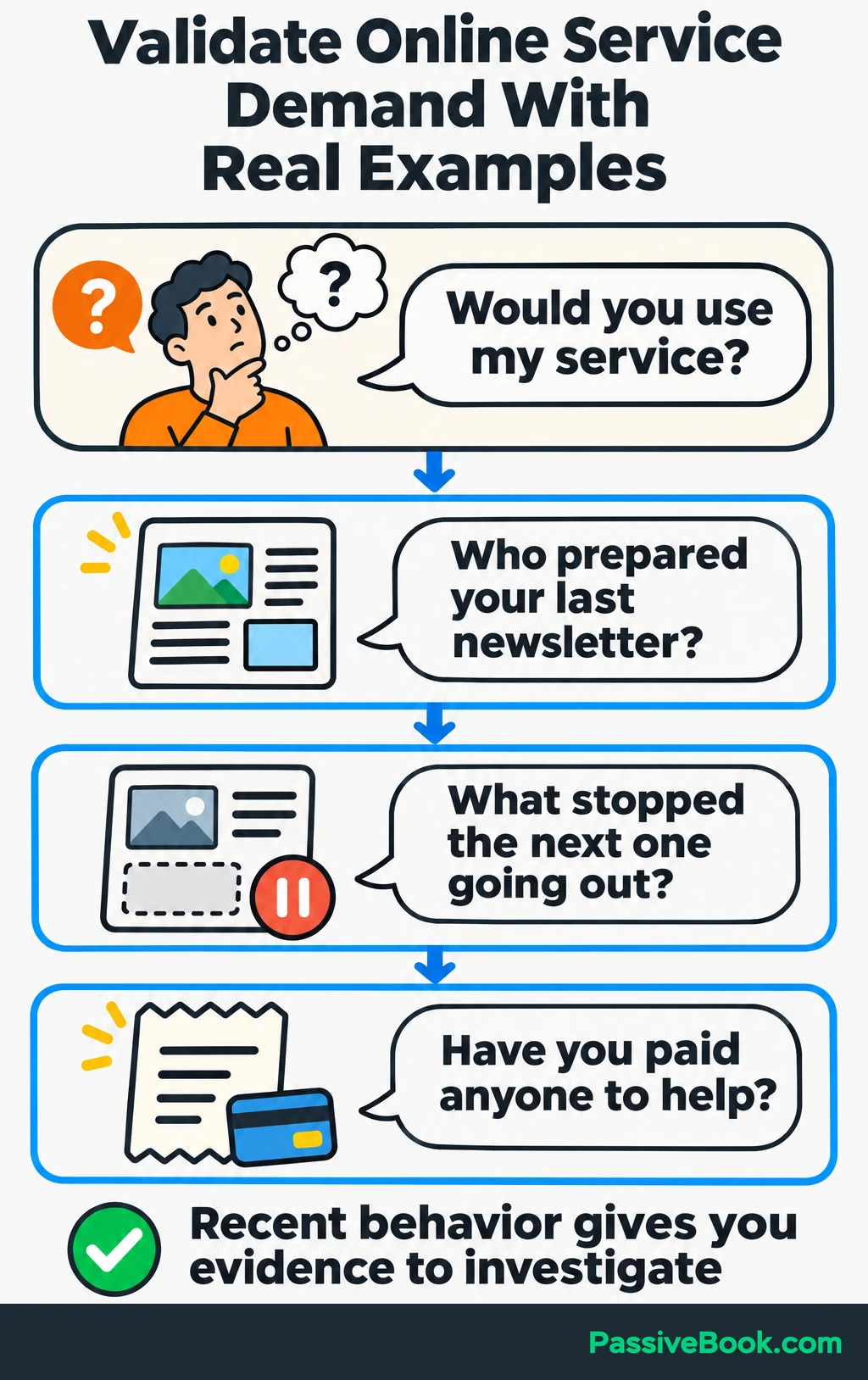
Ask about a recent instance of the problem:
- “Who prepared your last newsletter?”
- “What stopped the next one going out?”
- “How much time does preparing one take?”
- “Have you paid anyone to help with this?”
- “Who would approve hiring someone?”
- “What would need to happen for this to become a priority?”
Keep the questions in the buyer’s world. “Would you use my service?” invites a polite prediction. A story about the last missed newsletter gives you something concrete to investigate.
Also review competing offers, their prices, and customer complaints. Include the buyer’s current solution, even if that solution is the owner doing it on Sunday night. The U.S. Small Business Administration (SBA) recommends checking demand, competing offers, and what buyers pay for alternatives.
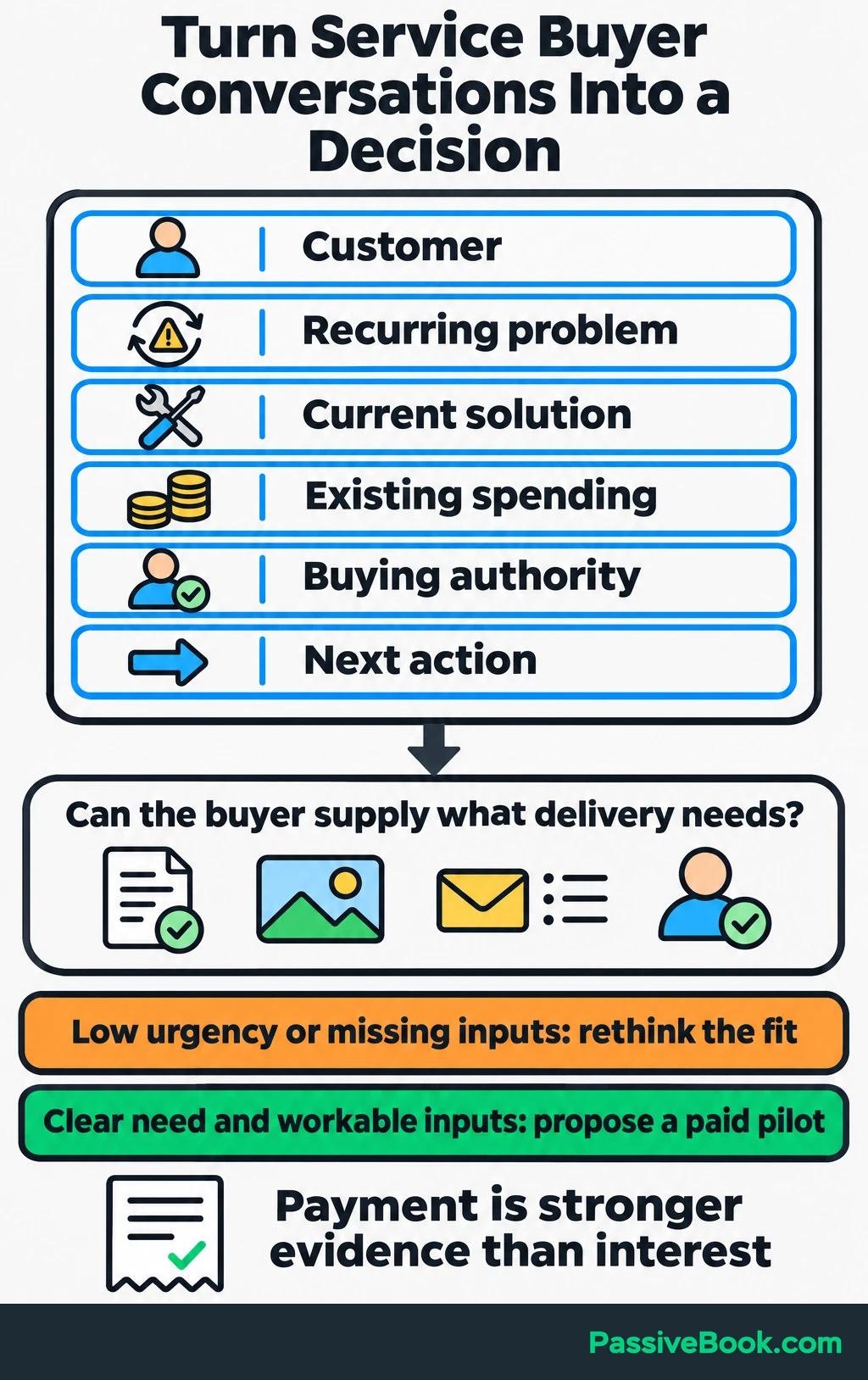
Record each conversation in a simple worksheet. Use columns for the customer, recurring problem, current solution, existing spending, buying authority, and next action.
Check whether the buyer can supply what delivery requires. For the newsletter service, that means approved shop information, usable images, an email list suitable for the planned marketing, and someone who will approve drafts.
A shop might dislike writing newsletters but have no interest in gathering material or reviewing them. Your offer needs those inputs, so that matters.
I would begin with a manageable batch of conversations, then review the pattern. Repeated low urgency, missing inputs, or resistance to any paid help is a reason to change the problem or customer group.
Once you have a clear scope and price, invite suitable buyers to a paid pilot: a small trial engagement. An interested reply is useful, but payment gives you stronger evidence that someone values the work.
Step 3: Package One Clear Offer
Write one sentence that names the customer, the useful result, and the work you handle.
For the running example:
I help independent bicycle repair shops stay in touch with existing customers by preparing their newsletters.
Then define what buying that service includes.
| Part of the Offer | Paid Pilot | Ongoing Package |
|---|---|---|
| Deliverables | One customer newsletter | Two newsletters per month |
| Client inputs | Approved information, images, brand details, and booking link | Approved information, images, brand details, and booking link for each newsletter |
| Production | Writing and formatting in the shop’s existing email platform | Writing and formatting using an agreed template |
| Revisions | One consolidated revision round | One consolidated revision round per newsletter |
| Timing | Draft within five working days of receiving complete inputs | Agreed monthly production dates |
| Approval | Named owner approves before scheduling | Named owner approves each message before scheduling |
| Exclusions | List building, photography, advertising, and unrelated marketing | List building, photography, advertising, and unrelated marketing |
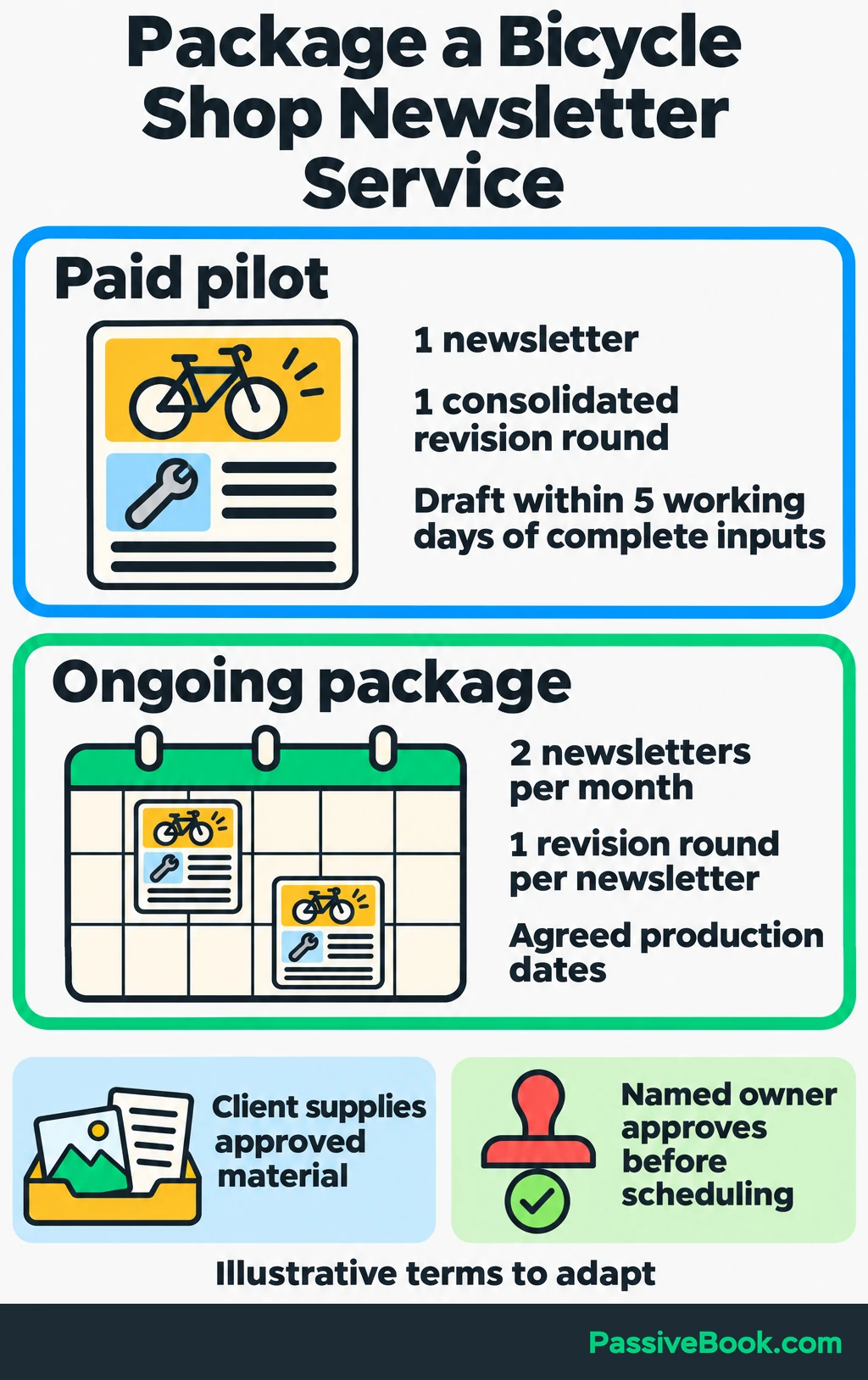
These are example terms to adapt, not a market standard. Choose deadlines you can support around your other commitments.
Explain what a revision round means. I would ask for one combined set of changes from one approver. Otherwise, three people can turn “one revision” into an ongoing group activity.
During my freelancing years, I sometimes accepted a small extra request because explaining a boundary felt harder than doing the work. Then another request arrived. The original quote stayed fixed while the assignment quietly grew.
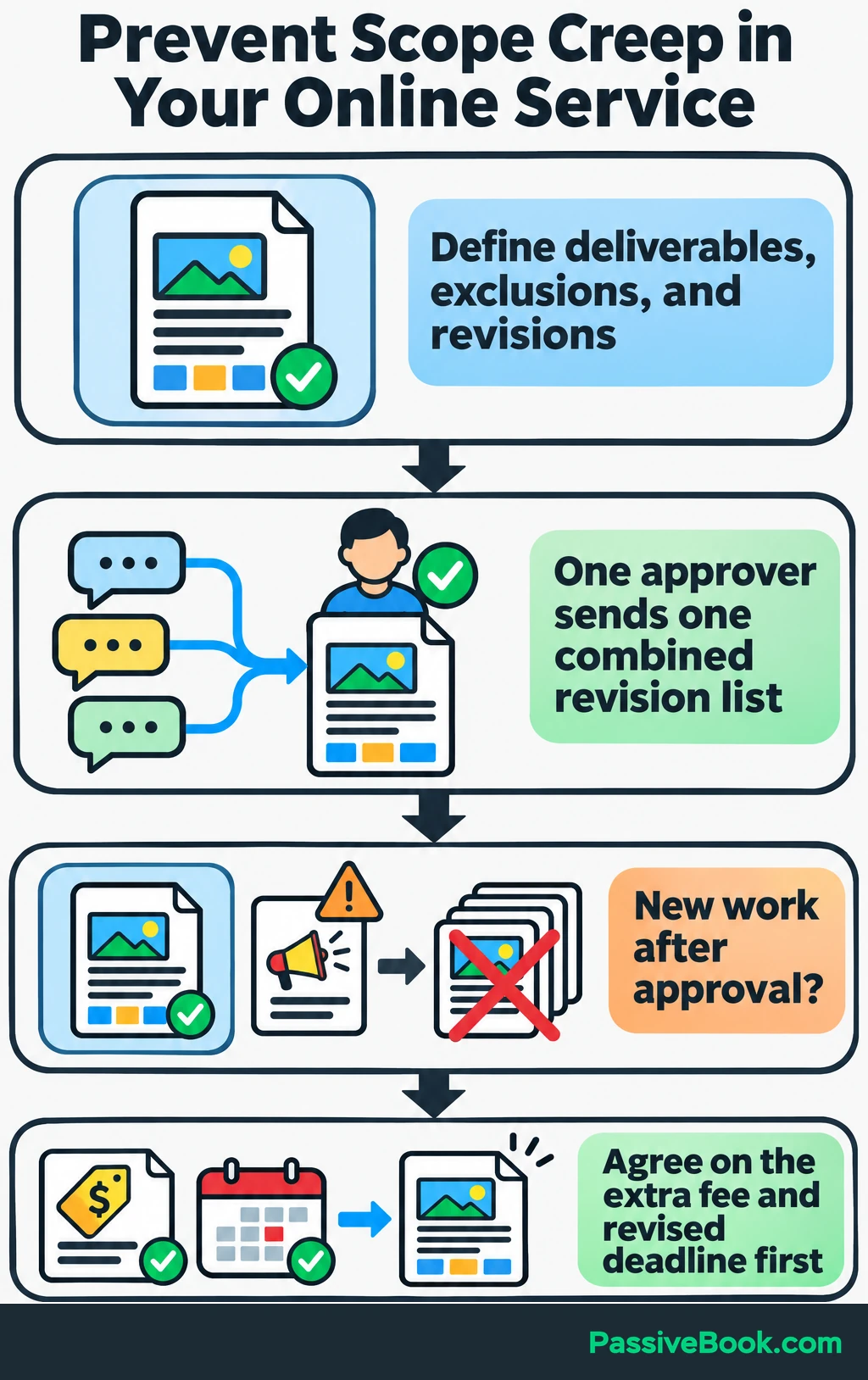
That experience is why I would define extra work before the client needs it. A new promotion after approval, for example, can require a separate quote and a revised deadline.
Use a one-time project for a bounded need and an ongoing agreement for recurring work. Either can be a productized service, which simply means the scope and process are standardized.
Promise work you control: accurate copy, checked links, agreed formatting, and delivery on time. You can help a shop communicate with customers, but you cannot promise bookings the shop hasn’t yet earned.
If the newsletter example makes sense but your own offer still feels vague, this AI Skill can help you write it. It turns your service and working limits into a draft you can review before approaching buyers.

Free AI Copywriting Studio




Step 4: Set a Sustainable Price
Budget for the Work
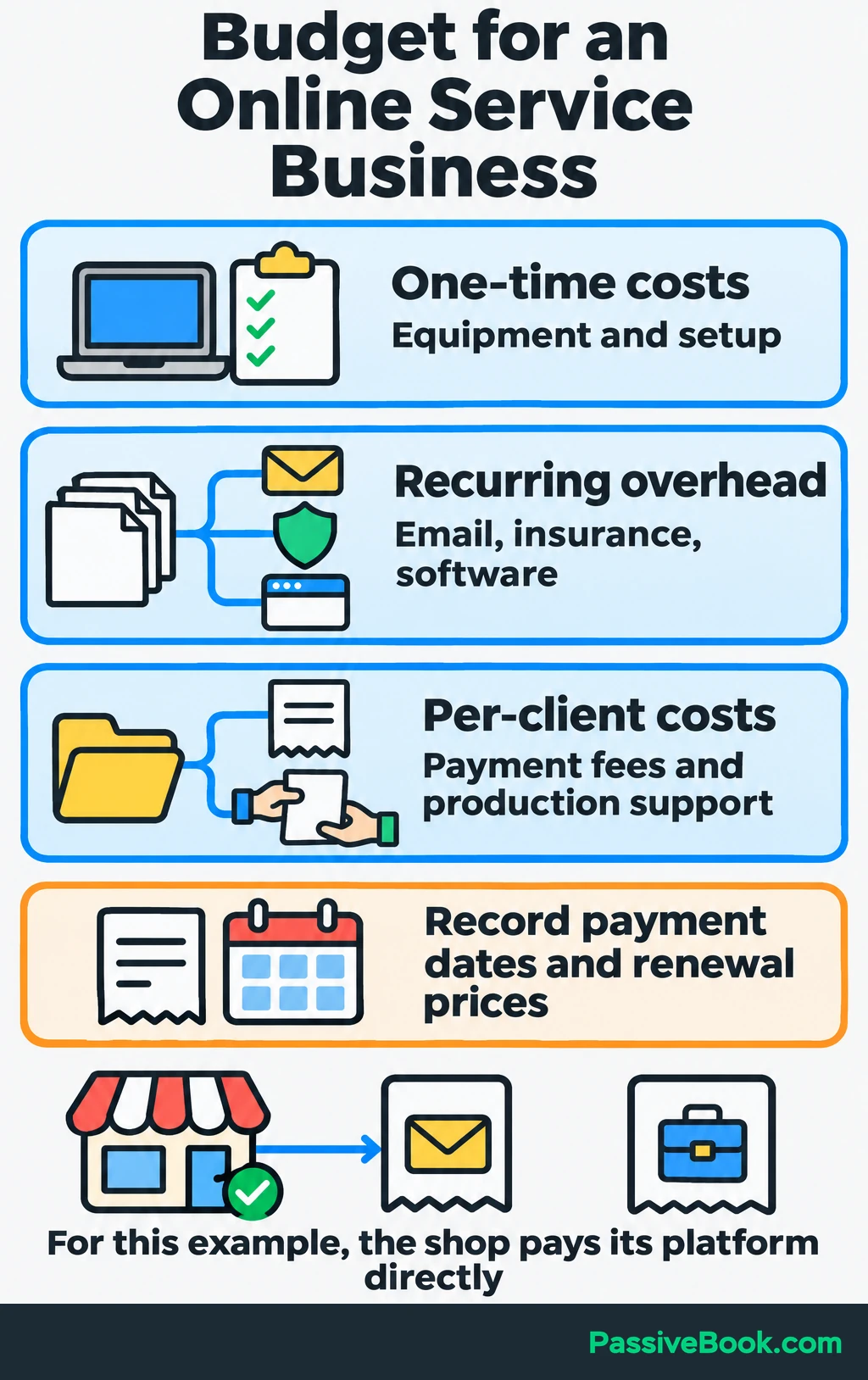
Start with the SBA’s distinction between one-time and monthly expenses. Then add costs tied to each client:
- One-time costs: necessary equipment or setup work.
- Recurring overhead: business email, insurance, and software.
- Per-client costs: payment fees or a contractor’s production work.
Record each expense, its payment date, and a current quote, including renewal prices after introductory offers end.
I would use existing equipment, a shared folder, and a spreadsheet before buying a collection of subscriptions. A project-management dashboard cannot make an untested offer more desirable.
For the newsletter service, have the shop pay for its email platform directly. State that in the offer so you don’t accidentally include a growing software bill in your fixed fee.
Check Price Against Capacity
First count the hours available for delivery after setting aside time to sell and run the business.
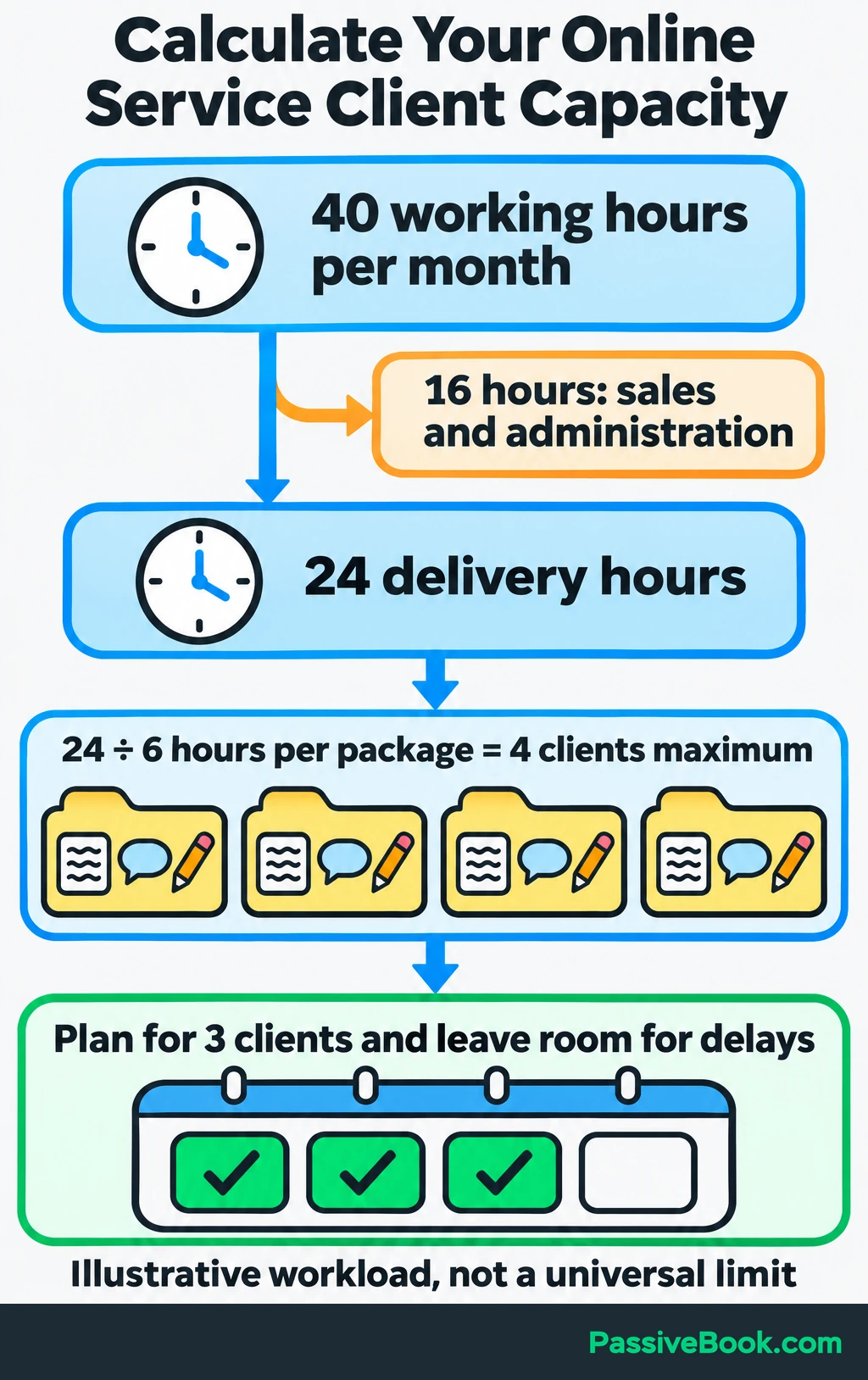
Suppose you have 40 working hours per month:
| Monthly Time | Hours |
|---|---|
| Total available | 40 |
| Sales and general administration | 16 |
| Available for client delivery | 24 |
| Delivery time per monthly package, including client messages and revisions | 6 |
| Maximum monthly packages | 4 |
Dividing 24 delivery hours by six hours per package gives a maximum of four clients. I would initially plan around three, leaving room for delays and work that takes longer than expected.
Next, check what the price leaves after expenses.
If all four clients pay $400 for the month:
- Revenue is $1,600.
- Direct costs total $80, assuming $20 per client, including payment fees.
- General overhead is $60.
- The remaining $1,460 is available for owner compensation and taxes.
Across all 40 working hours, that is $36.50 per hour before tax. It isn’t a take-home wage, and it doesn’t repay any earlier launch work.
Now check the more cautious plan. With three clients at the same price, $1,200 in revenue leaves $1,080 after $60 in direct costs and $60 in overhead.
To find your minimum fee, add your monthly pretax pay target to overhead. Divide that total by a conservative number of paying clients. Then add each client’s direct costs.
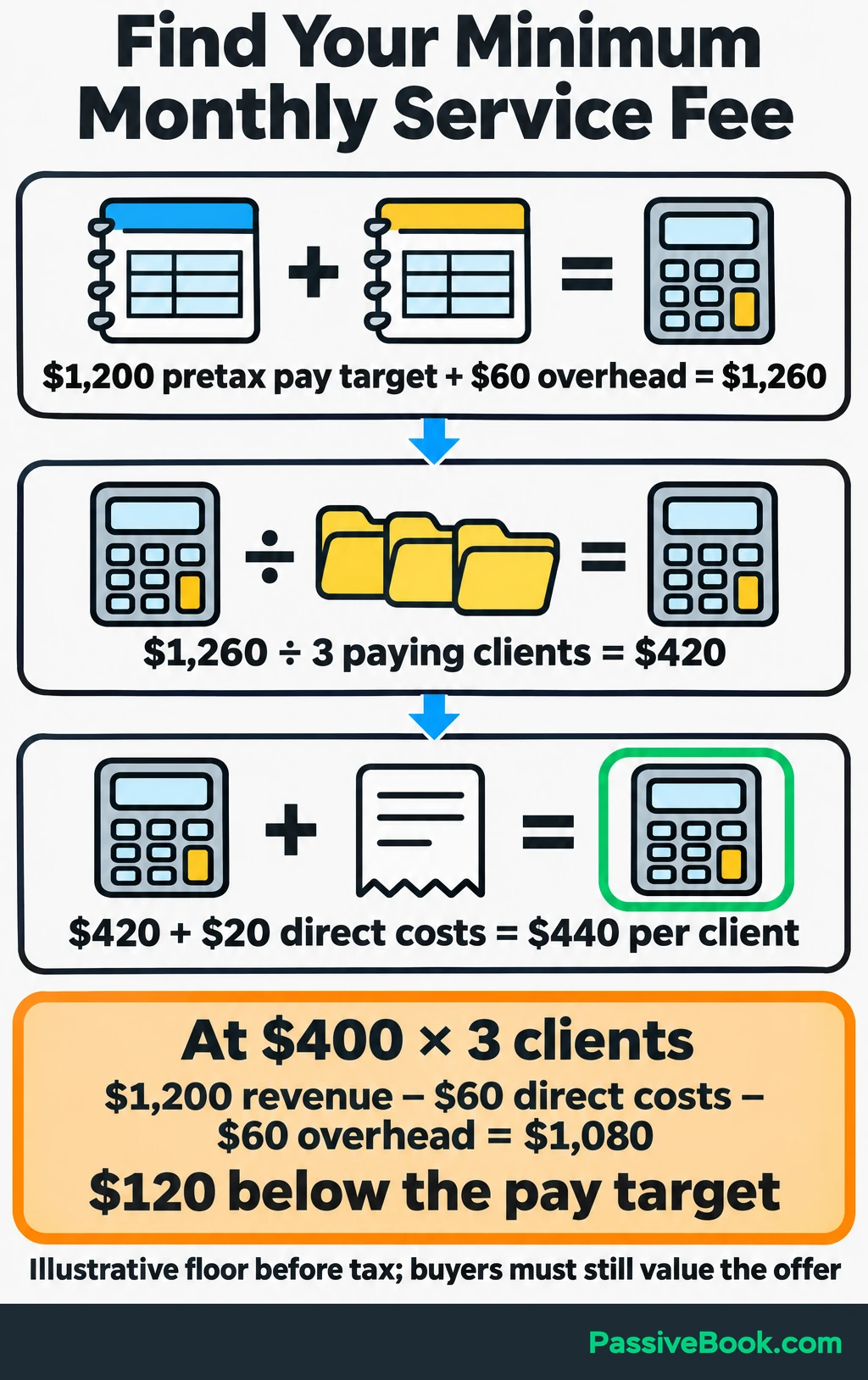
For example, a $1,200 compensation target plus $60 overhead, divided across three clients, requires $420 per client before direct costs. Adding $20 makes the floor $440 per monthly package.
At $400, the three-client plan falls $120 short of your pay target. Buyers still need to value the offer enough to pay the $440 floor.
Use fixed fees for clearly defined work. For uncertain workloads, agree on an hourly rate, estimate, and spending limit. Monthly billing can use either approach.
After the pilot, replace estimates with actual hours and expenses. If the numbers fail, narrow the scope, improve production, or change the price before repeating the problem.
A package can look profitable until onboarding or extra revisions use up the remaining hours. This planner lets you compare your own estimates and see how much room the offer leaves.

Free Offer Pricing Planner
Step 5: Prepare to Take Your First Client
Create a Simple Offer Page and Sample
Your first sales page needs to help someone decide whether to contact you.
Include the problem you solve, deliverables, process, price or quoting method, a relevant sample, and one inquiry action. Answer the questions that could block a purchase: what the client supplies, who approves the work, how long it takes, and what happens after payment.
Use your existing website if you have one. I prefer self-hosted WordPress for a site I plan to develop, but I would use Carrd for a simple standalone offer page. A shareable document can also get an early proposal in front of a buyer.
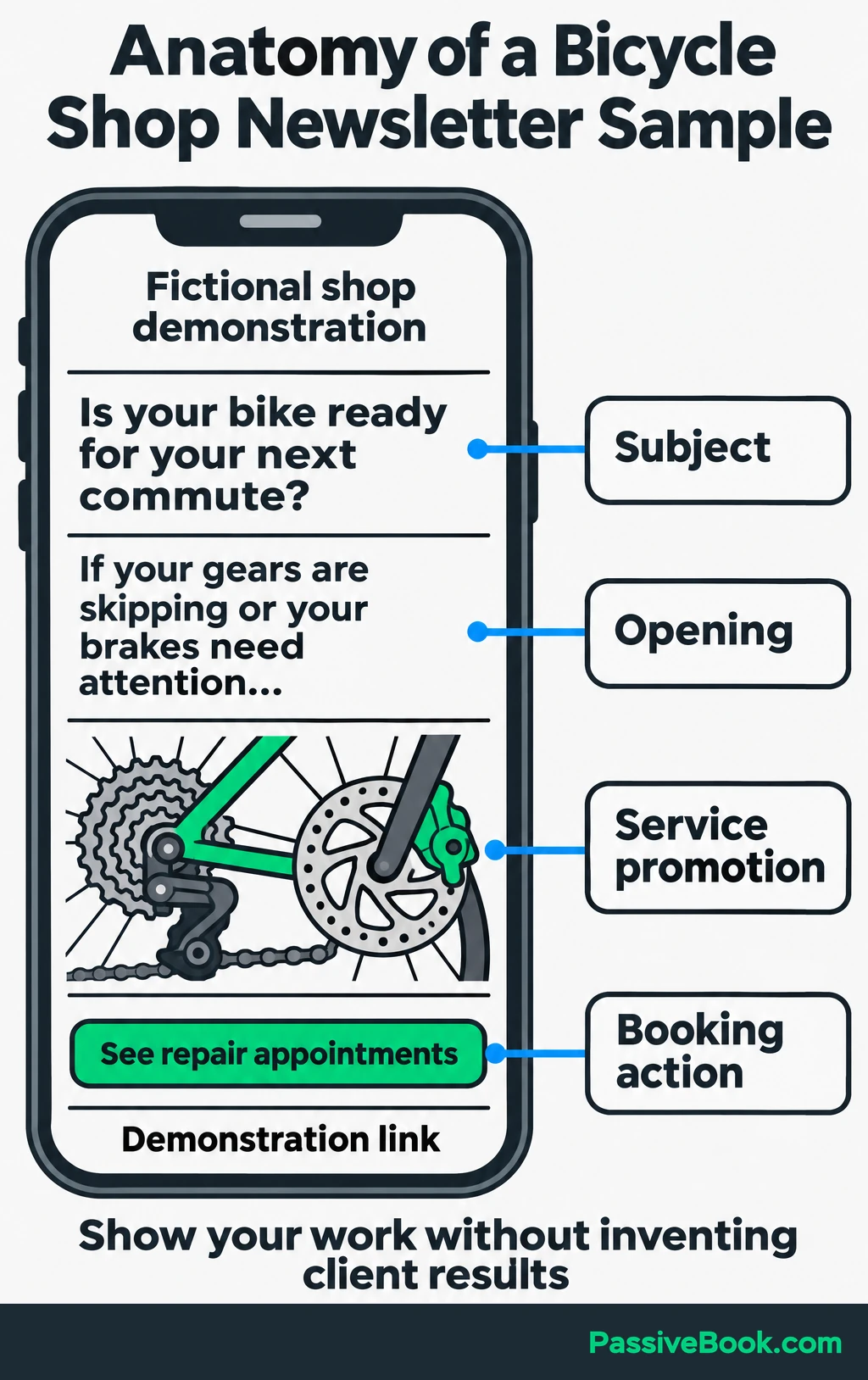
For the newsletter example, create demonstration work for a fictional shop and label it clearly. Show the subject line, short opening, service promotion, booking action, and mobile layout.
A brief excerpt could read:
Subject: Is your bike ready for your next commute?
If your gears are skipping or your brakes need attention, arrange a workshop visit before your next ride.
See available repair appointments: [demonstration booking link]
Use only service claims the sample shop would need to approve. The point is to demonstrate clear writing and presentation, rather than invent impressive results.
Keep the supporting tools small: business email, document storage, task tracking, invoicing, and the software needed to deliver. Use client names, testimonials, or completed work publicly only with permission.
Prepare Agreements and Payments
Before accepting paid work, check the registration, licensing, tax, and insurance requirements that apply to your location and service. U.S. readers can start with the SBA’s business-launch guidance; elsewhere, use the relevant government authority.
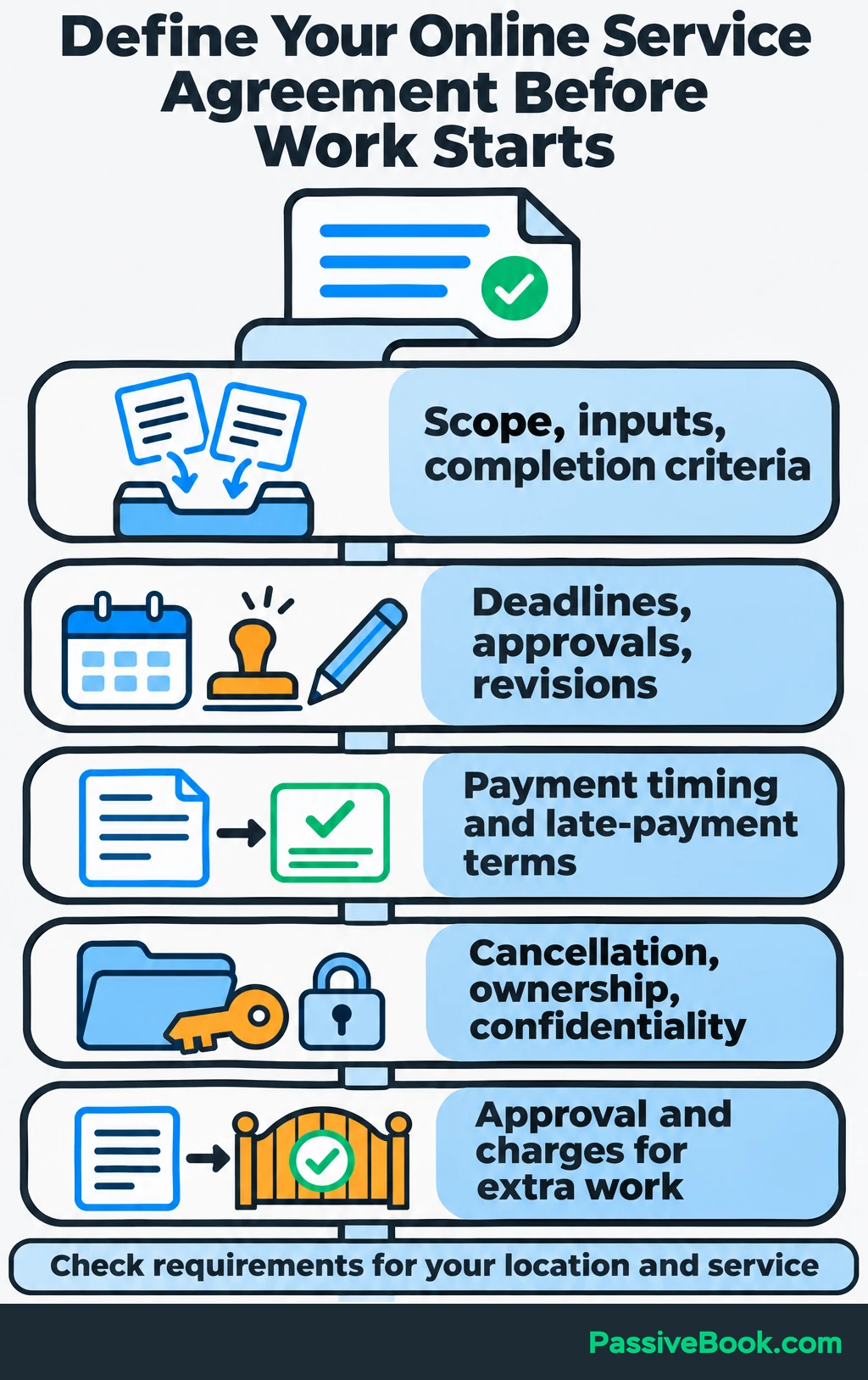
Prepare a written agreement covering:
- Scope, required inputs, and completion criteria.
- Deadlines, approval responsibilities, and revisions.
- Payment timing and treatment of late payments.
- Cancellation, ownership, and confidentiality.
- How additional work is approved and charged.
For a small pilot, I would request payment upfront. For a larger project, agreed milestones may fit better. Make the terms clear before reserving production time.
Choose a payment method available to your business. Stripe is my first choice where available, with PayPal as another option. Compare processing, currency-conversion, and withdrawal costs for the transactions you expect.
Test the full sequence: invoice, payment confirmation, receipt, and onboarding instructions.
Keep separate business financial records and retain supporting documents. Set aside money for applicable taxes rather than treating every payment as spendable income. U.S. operators should check the IRS guidance on estimated tax payments, because tax may be due during the year.
Step 6: Find and Close Your First Paying Clients
Reach Suitable Buyers Through One Channel
Choose one channel where you can reach suitable buyers consistently. That might be warm introductions, targeted outreach, relevant communities, referral partners, or a service marketplace.
For the newsletter offer, I would start with introductions to shop owners, then test targeted outreach. You don’t need a large public audience to begin those conversations.
Build a prospect list using the criteria from Step 1. Record why each shop fits, how to contact the decision-maker, and the next action. An attractive website alone doesn’t tell you whether a shop has an email list or wants help.
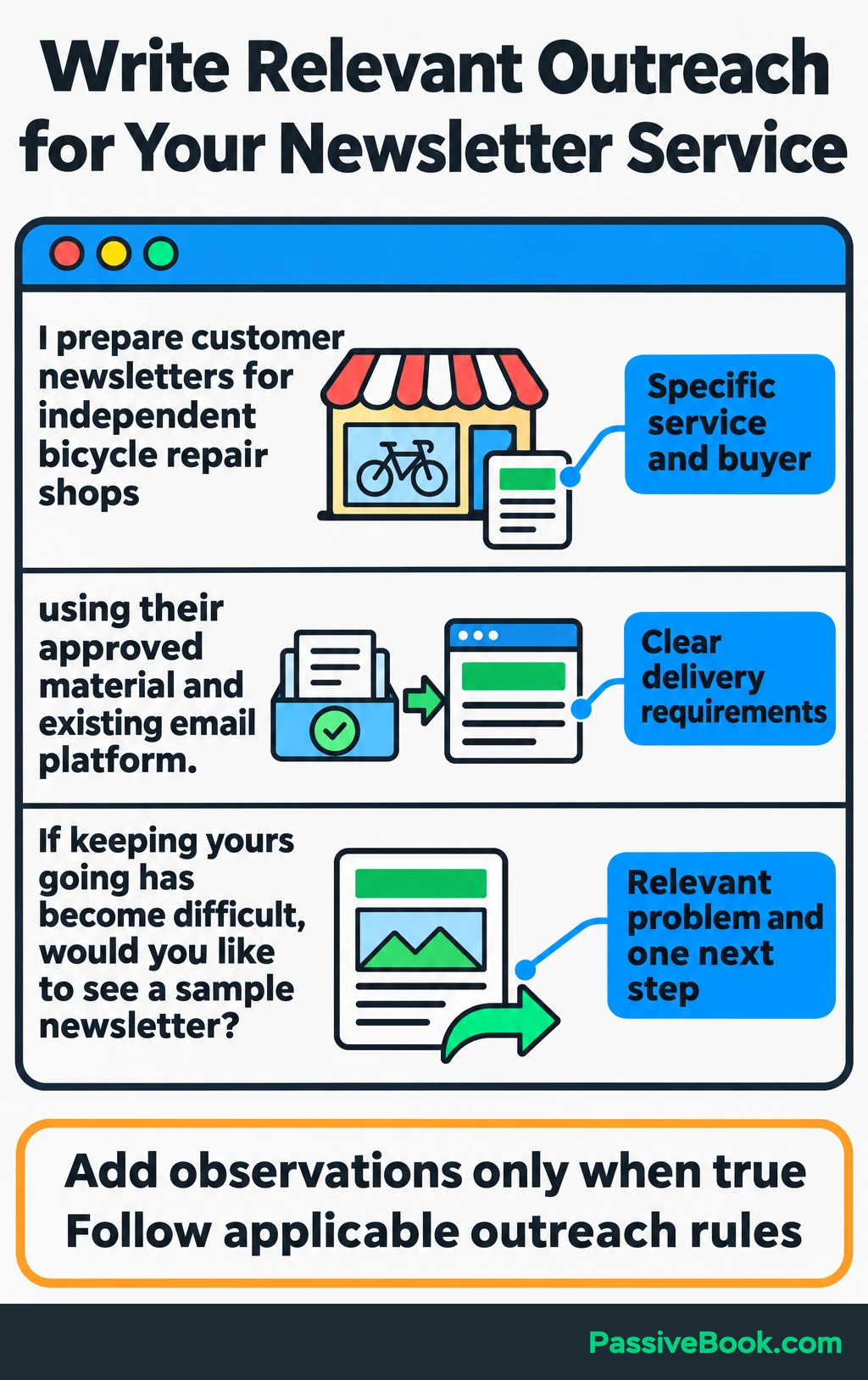
Keep the initial message short and relevant:
I prepare customer newsletters for independent bicycle repair shops using their approved material and existing email platform. If keeping yours going has become difficult, would you like to see a sample newsletter?
Add a specific observation only when it is true. Don’t pretend you have followed a business for years because you found it eight minutes ago.
Follow the outreach rules that apply to you and your recipients, plus the platform’s policies. In the U.S., CAN-SPAM covers commercial B2B email too. Requirements include accurate sender details and subject lines, advertising disclosure, a valid postal address, and a clear opt-out that you honor. The FTC’s commercial-email guide explains the requirements.
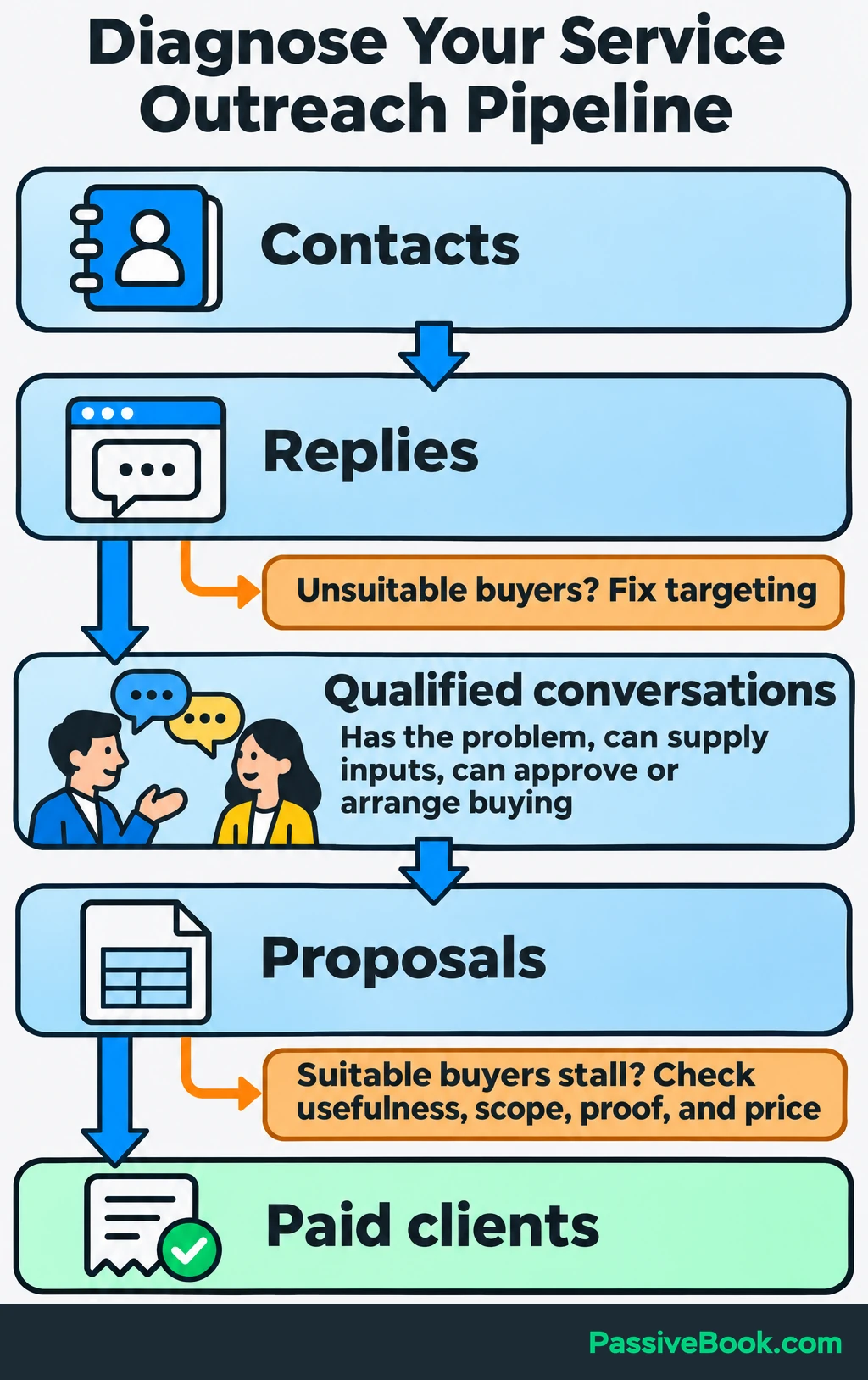
Track contacts, replies, qualified conversations, proposals, and paid clients in one place. A qualified conversation means the buyer has the problem, can supply the inputs, and can approve or arrange the purchase.
If replies come from unsuitable buyers, fix targeting. If suitable buyers engage but proposals stall, investigate usefulness, scope, proof, and price.
Sell a Bounded Paid Pilot
Before proposing the pilot, confirm the problem, decision-maker, budget, timing, inputs, and approval process.
Use a call when discussion would help, but a straightforward purchase can happen through email. A mandatory calendar meeting is not a business model.
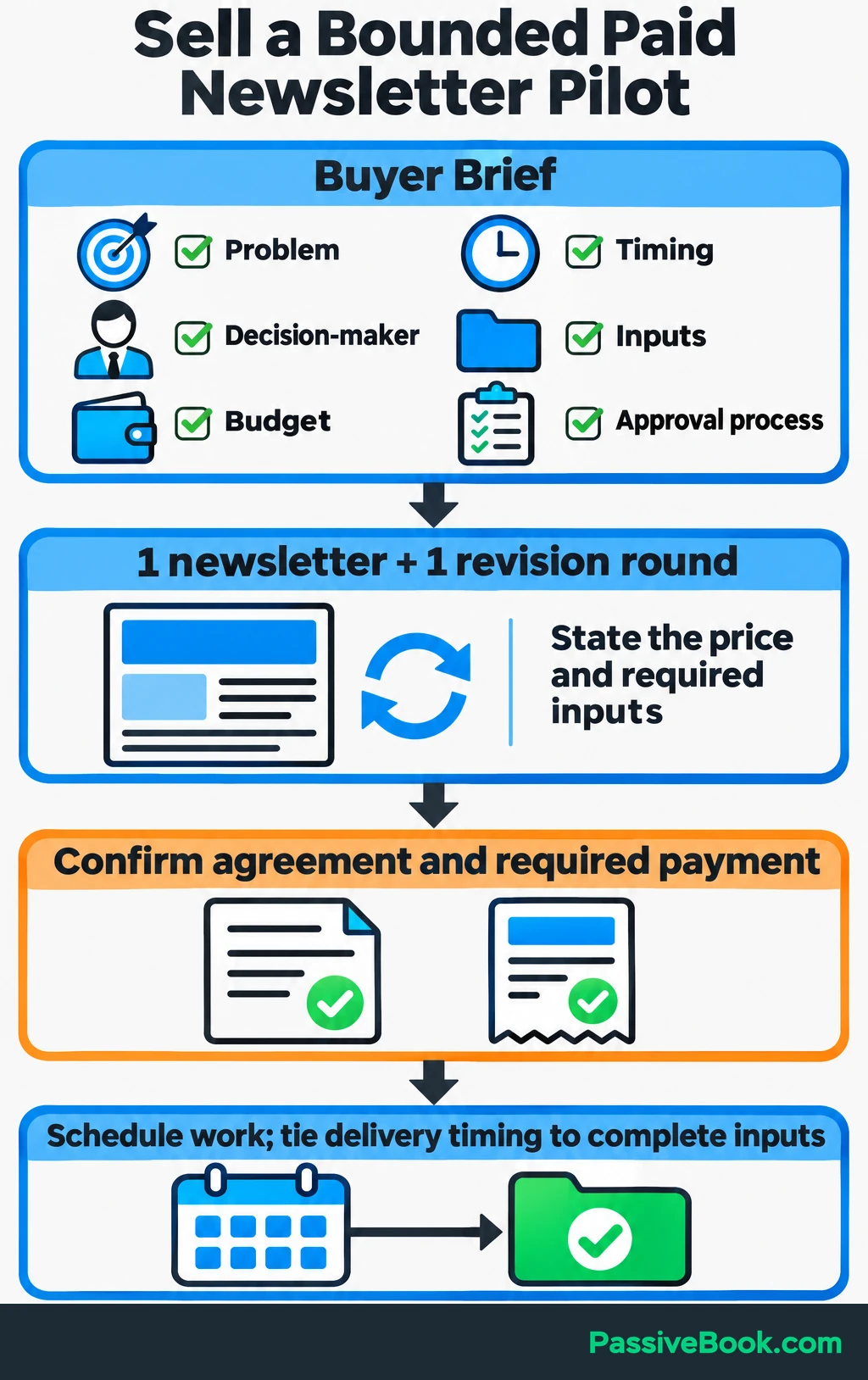
Send a concise proposal that states what you will deliver, what it costs, what the client supplies, and when the work starts. Give one next action, such as accepting the agreement and paying the invoice.
For the bicycle-shop pilot, agree on one newsletter, one revision round, and a delivery deadline tied to complete inputs. Schedule it only after the agreement and required payment are confirmed.
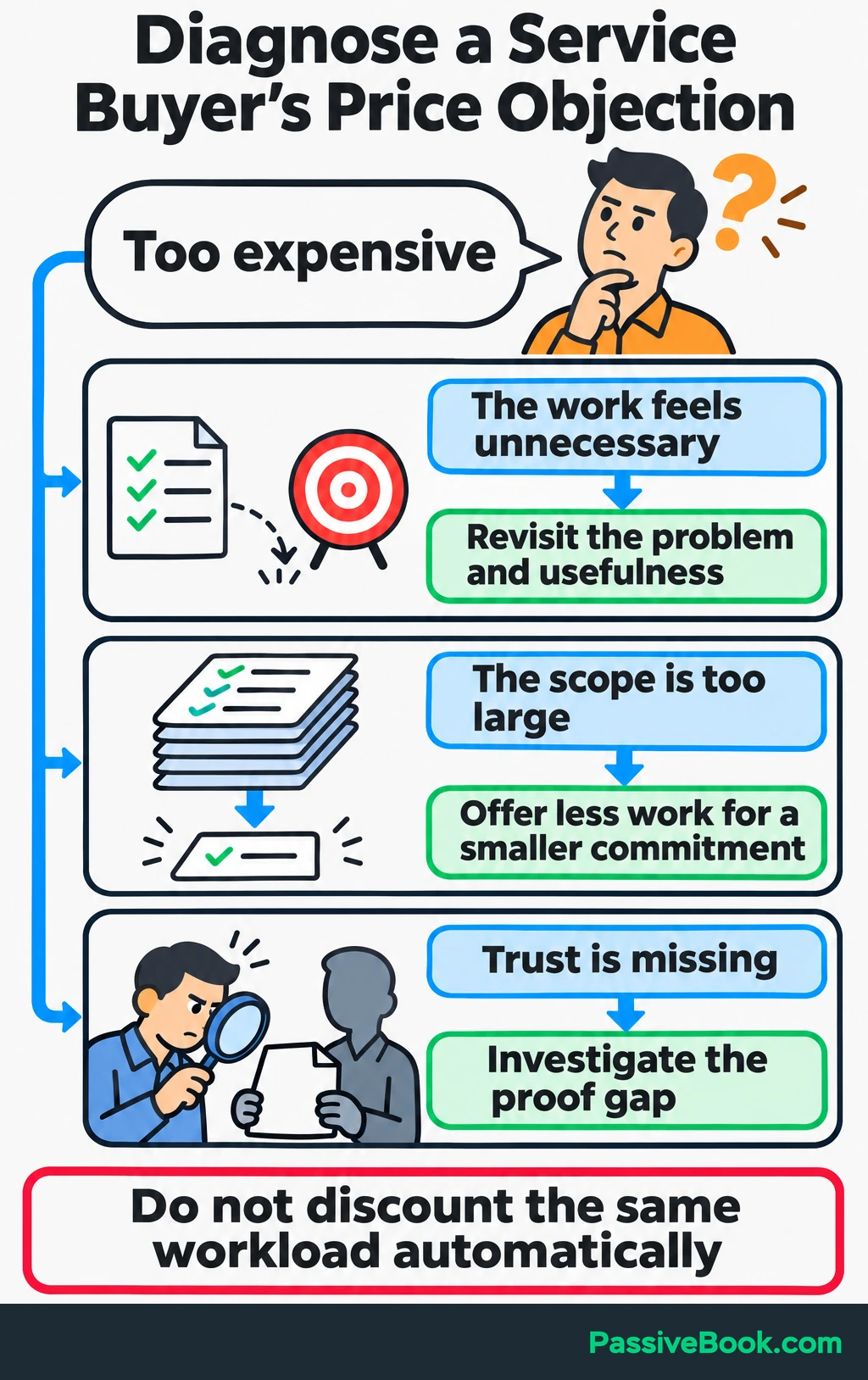
When someone objects, find out what sits behind the objection.
“Too expensive” might mean the work feels unnecessary, the scope is larger than needed, or the buyer doesn’t trust you yet. Those need different responses. A smaller paid assignment can reduce the commitment without discounting the same workload.
Use unsuccessful proposals to change one meaningful thing at a time. If you change the customer, package, sample, and price together, you won’t know which change helped.
Step 7: Deliver the Pilot With a Repeatable Workflow
Use the same basic sequence for every engagement:
- Collect the inputs.
- Confirm the brief.
- Produce the work.
- Check quality.
- Obtain approval.
- Complete delivery.
- Record what happened.
Onboard with a short questionnaire, a schedule, one named approver, and one place for project messages. Explain how late inputs or approvals move the delivery date.
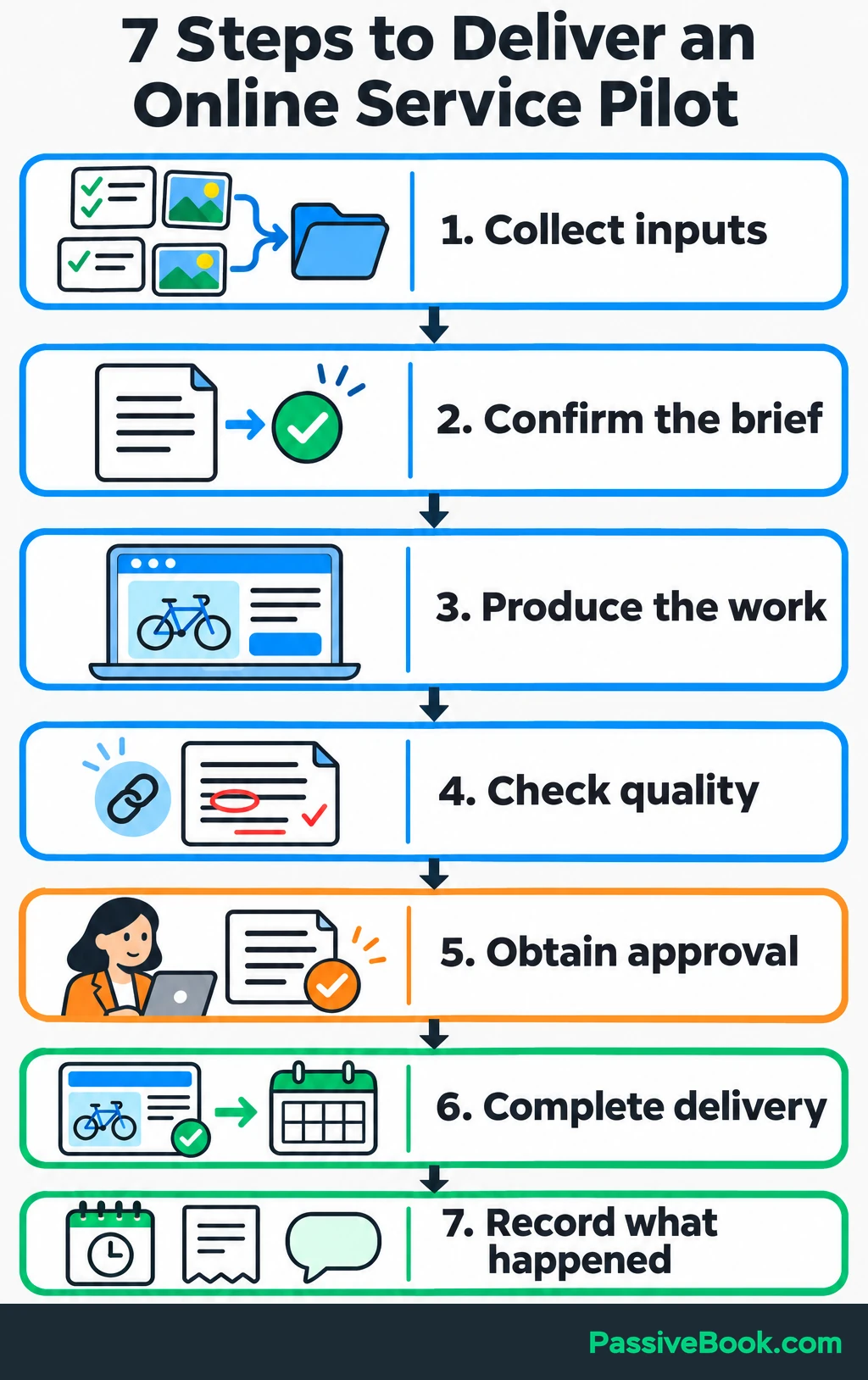
For a shop newsletter, collect the approved promotion, images, brand details, booking link, and access needed to prepare the message. Confirm any prices, service descriptions, or deadlines before writing.
Check the draft against the agreement. Test links, proofread names and figures, inspect the mobile layout, and send a test message. Obtain recorded approval before scheduling the customer email.
Use the least account access needed and avoid downloading the customer list when you can work inside the shop’s platform. Agree on secure retention and deletion, and remove access when the engagement ends. These practices reflect the FTC’s guidance on limiting data collection, access, and retention.
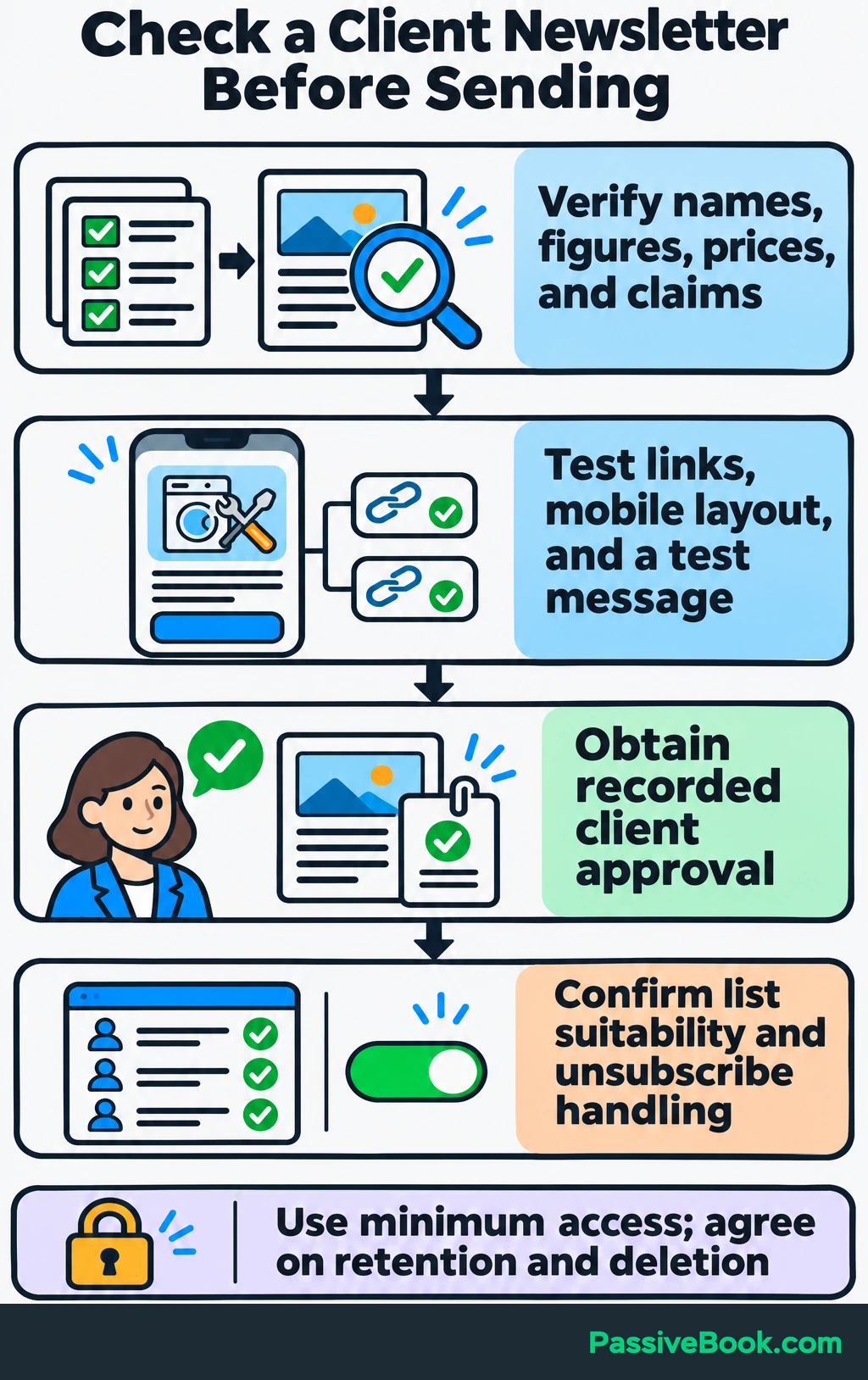
Before sending, confirm that the list can receive the planned marketing and that unsubscribe handling works. Approval from the owner doesn’t settle every compliance duty: in the U.S., both the promoted business and the sender may be responsible under FTC guidance on outsourced email marketing.
If the client adds a new assignment, agree on the fee and deadline in writing before doing it.
Record production time, messages, revisions, expenses, and delays. Then ask what the client found useful and what was difficult. The pilot should teach you whether both the service and the working relationship deserve another round.
Step 8: Build Consistent Income From Profitable Clients
Renew Useful Work and Earn Referrals
Offer an ongoing package when the need repeats and the pilot works for both sides.
Confirm the recurring scope, input deadlines, production dates, billing, renewal, and cancellation terms. Don’t assume the pilot agreement covers every future month.
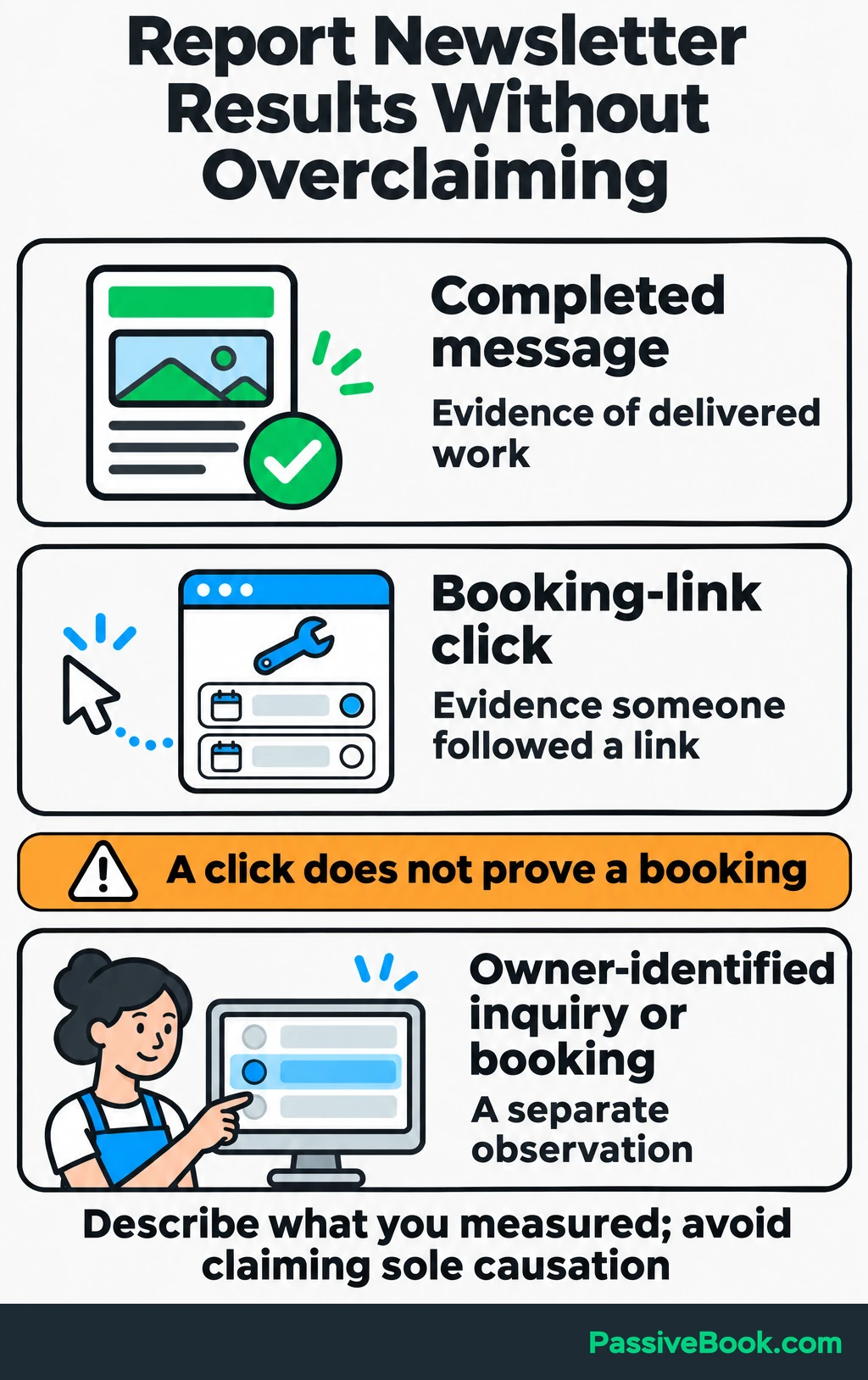
For the newsletter service, agree on the next production calendar with the shop owner. Review completed messages, booking-link activity, and inquiries the owner can identify.
Keep those observations separate. A click shows someone followed a link; it doesn’t prove they booked a repair. If you share a case study, describe what was measured and avoid claiming your work alone caused the outcome.
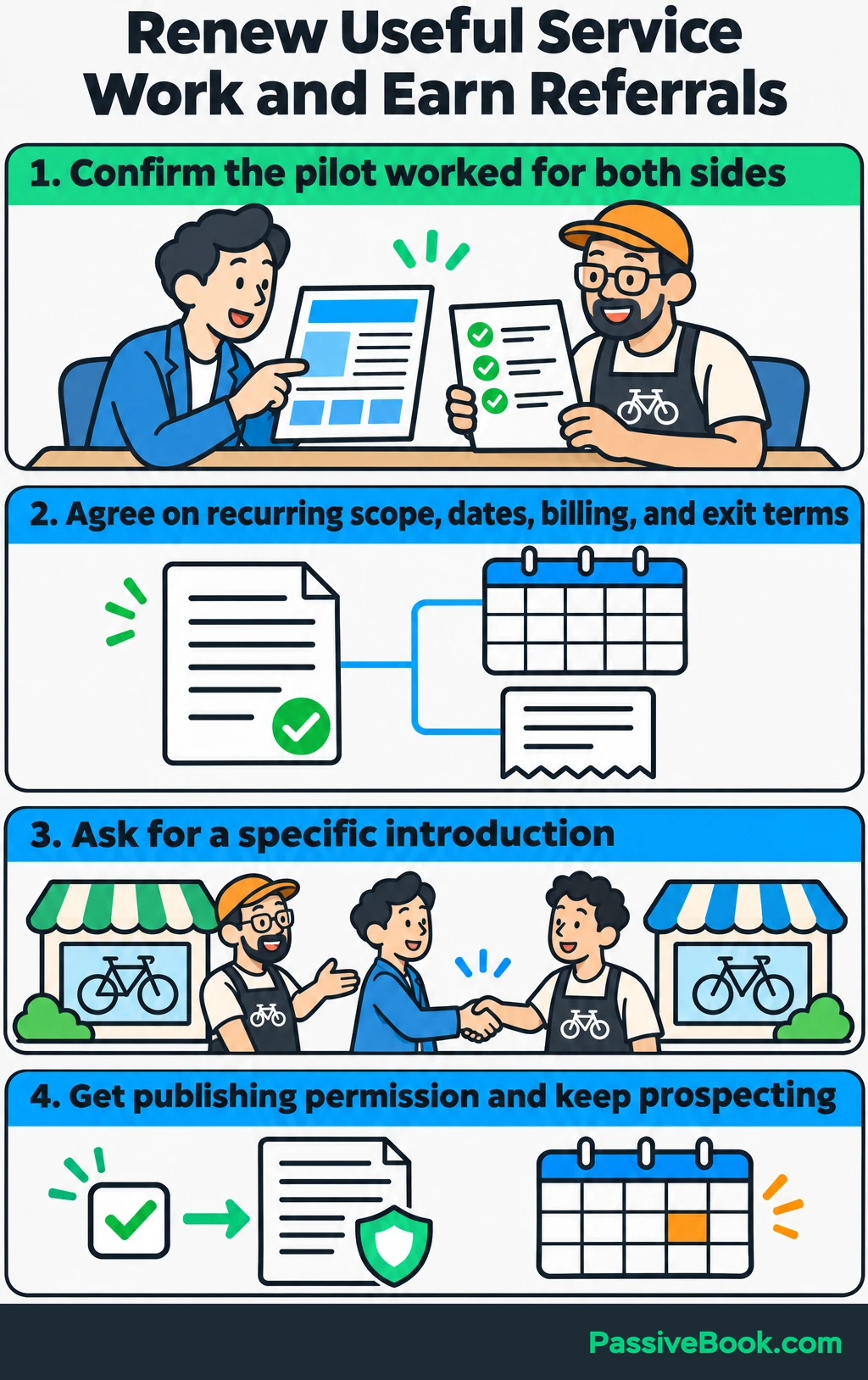
Ask satisfied clients for a specific introduction:
Is there another independent shop owner who struggles to keep their customer newsletter going?
Request permission before publishing their feedback or showing their work.
Keep a small prospecting block in your schedule even when delivery is busy. Otherwise, one cancellation can turn into an urgent search for replacement income.
Review Collected Cash and Client Profitability
Maintain a dashboard with each client’s collected payments, unpaid invoices, hours, direct expenses, renewal date, and next action.
Review it weekly. Compare fees with all the time the account uses, including calls, messages, and revisions.
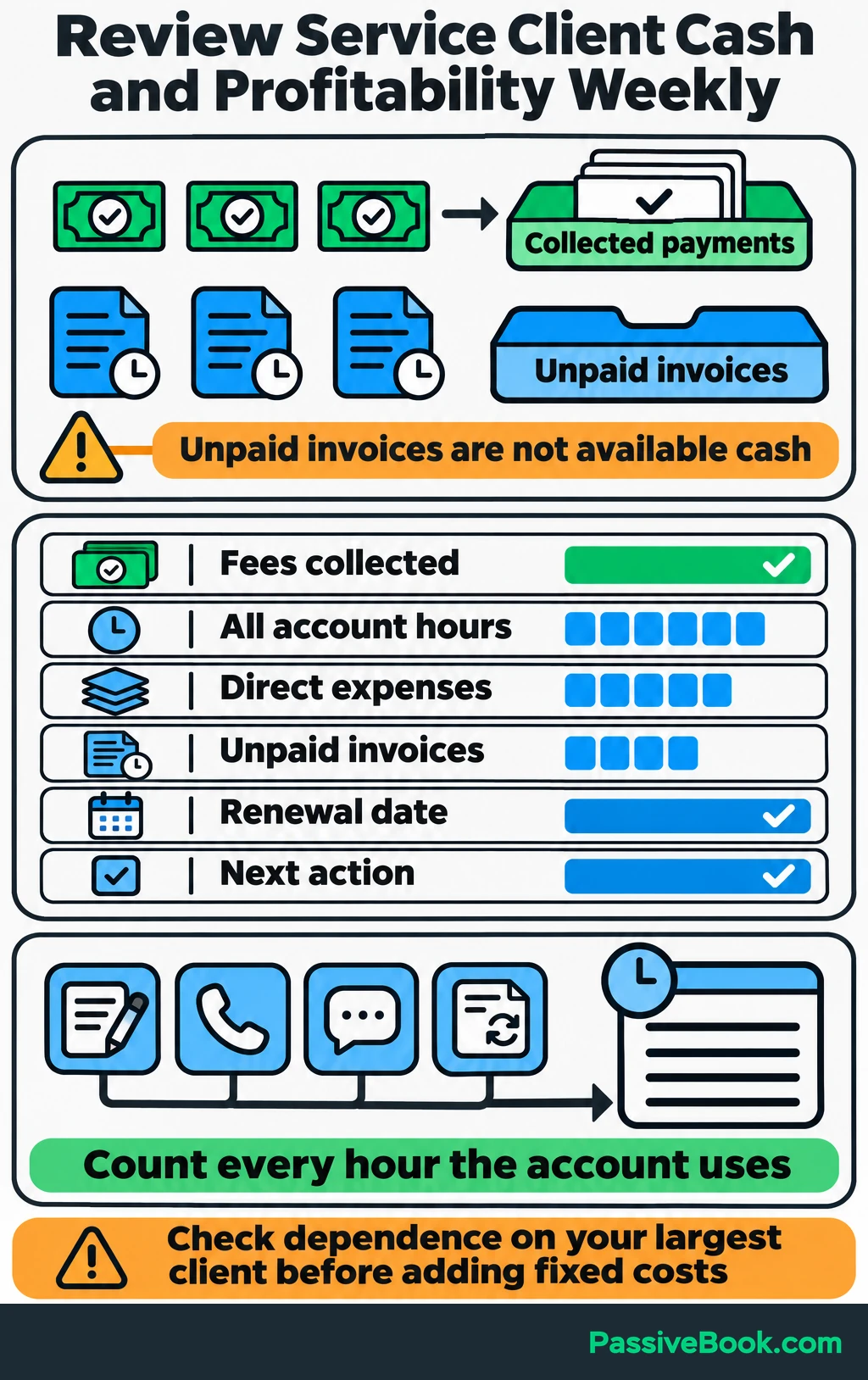
A client who pays promptly can still be unprofitable if every newsletter requires a new strategy discussion. Fix the recurring cause through clearer inputs, tighter scope, a revised package, or a higher price.
Forecast upcoming payments and expenses, but keep unpaid invoices separate from available cash. “They usually pay eventually” won’t settle your software bill.
For overdue payments, follow the agreed reminder and work-pause process. Also check how much income depends on your largest client before adding fixed expenses. One large account can make expansion look safer than it is.
Step 9: Document and Automate Proven Processes
My early freelancing income depended on work I personally completed. A good month meant more orders and more hours, and the next month still needed another round of effort. That dependence was why I eventually left the model.
A service business becomes more useful to its owner when successful work produces reusable assets: intake forms, templates, checklists, training, and reliable handoffs.
Document each repeated task with its inputs, ordered steps, quality checks, common exceptions, and definition of finished. Write enough that another person could complete it and recognize a problem.
Then automate routine movement between those steps.
For the newsletter business, a useful sequence might be:
Confirmed payment → onboarding request → completed intake → production task → approval reminder
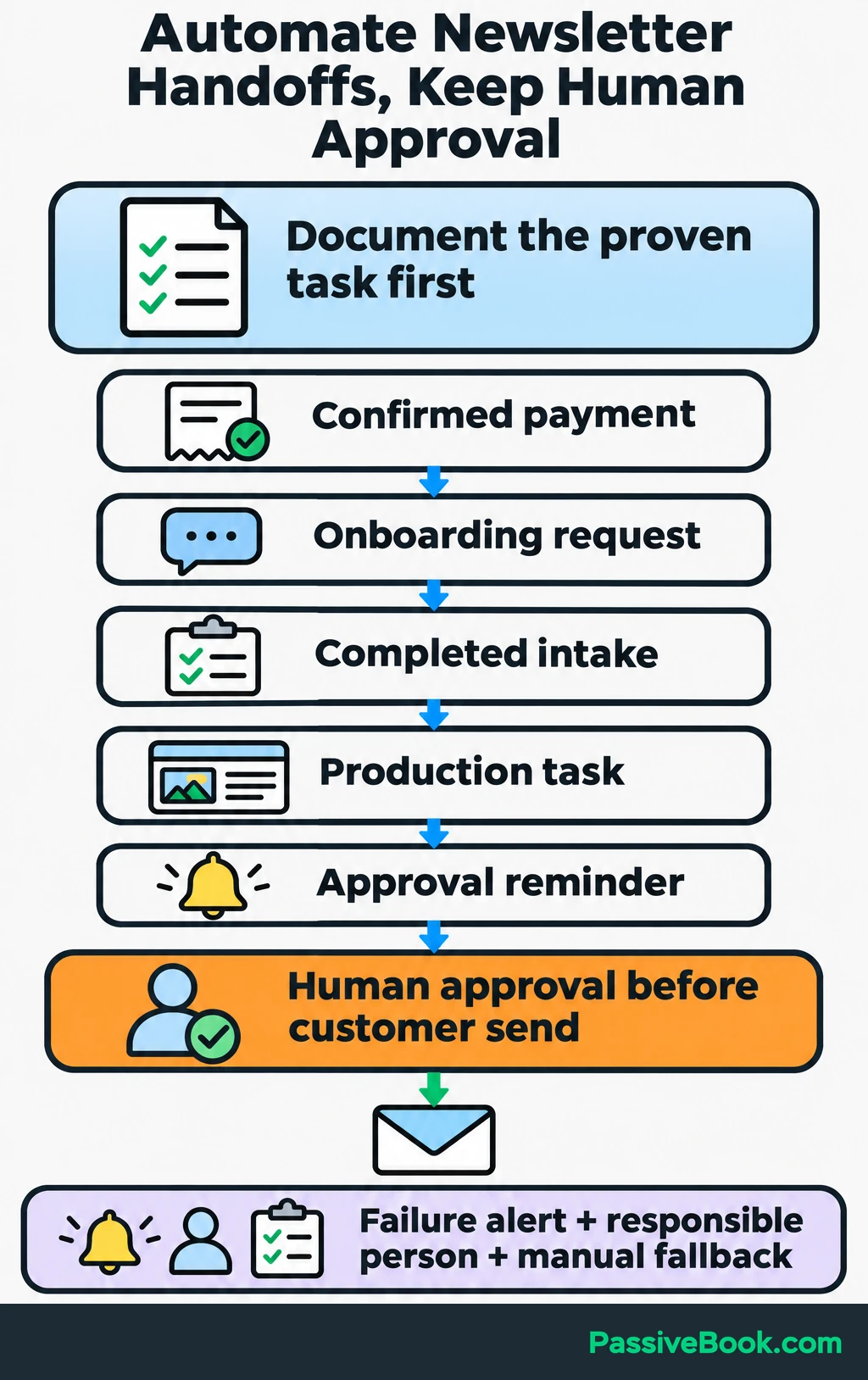
Keep the actual customer send behind human approval.
I use n8n to connect tools, and it supports self-hosting for those who want that control. I would choose Make for a beginner who wants a visual automation builder without managing a server. Pick one when repeated manual work justifies the setup.
AI can help organize approved notes, suggest subject lines, or draft within a template. I use Claude for writing work, but client delivery still needs a review against the source material and agreed brief.
Use client-approved tools and share only the information a task requires. Drafting a repair promotion does not require uploading a customer database.
Every automation needs a failure alert, a person responsible for checking it, and a manual way to finish the task. If an intake form fails to create a production task, you need to discover that before the client asks where their newsletter went.
Automation should reduce repeated handling while keeping responsibility clear.
Step 10: Grow Within Your Margins and Capacity
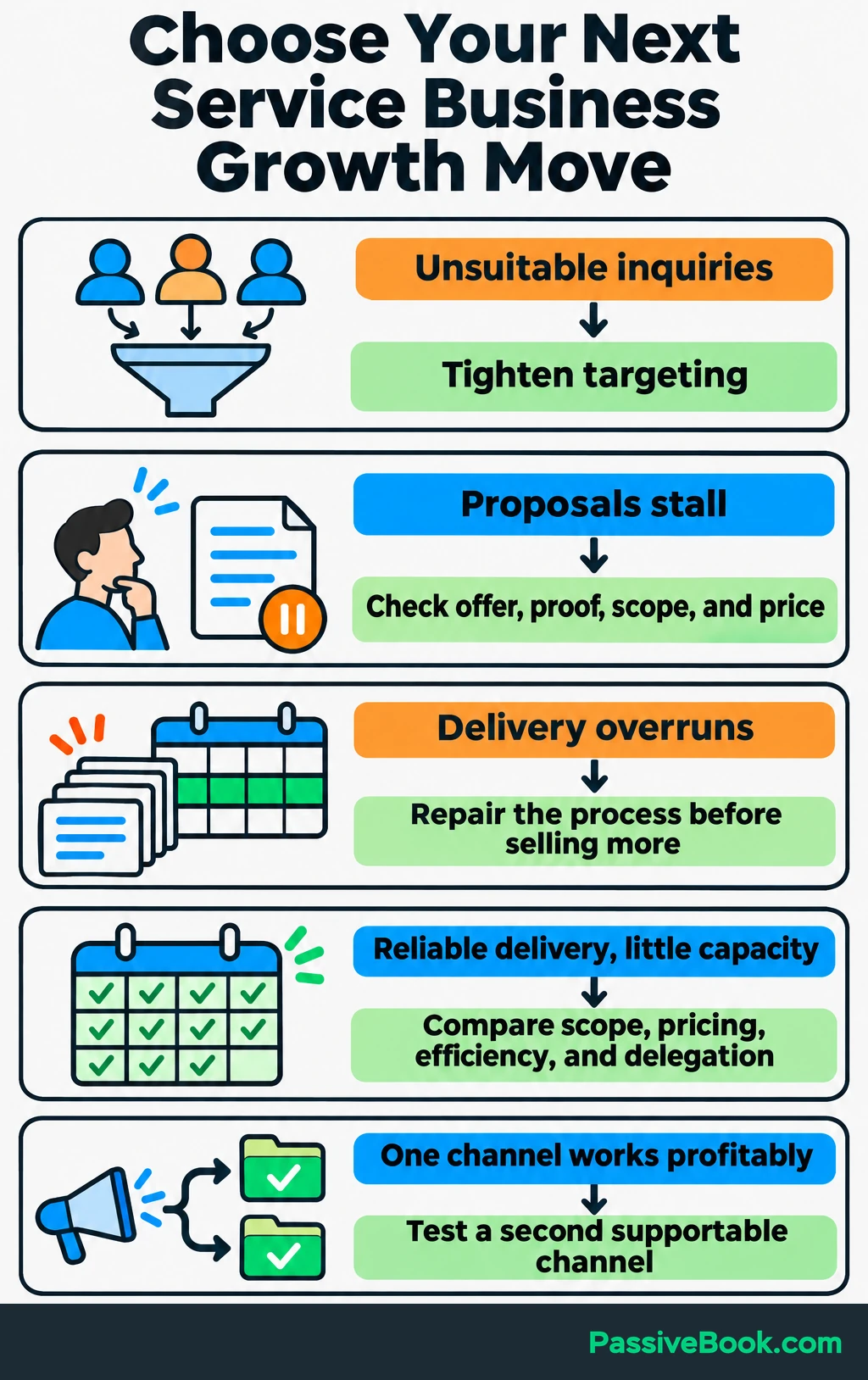
Choose the next growth move from the problem currently holding you back.
| What You Observe | What I Would Work On Next |
|---|---|
| Most inquiries come from unsuitable buyers | Tighten customer criteria and where you reach them |
| Suitable buyers stop after seeing the proposal | Investigate the offer, proof, scope, and price |
| Clients buy, but delivery repeatedly overruns | Repair the process before selling more |
| Delivery is reliable and capacity is nearly full | Compare narrower scope, better pricing, efficiency, and delegation |
| One channel brings profitable clients consistently | Test a second channel you can support |
At capacity, don’t automatically hire. First check whether you can remove unnecessary work, improve templates, or charge enough to support the service.
If delegation makes sense, test one bounded assignment. For the newsletter business, formatting is a reasonable candidate once the template and checking process are stable. You can retain final review and client approval.
Count contractor fees, your supervision time, and likely rework when checking the remaining margin. A low contractor quote doesn’t help if you spend the evening rebuilding the output.
Add a second acquisition channel after you can repeat the first and fulfill the work it brings. Relevant case studies, referral partnerships, and written answers to buyer questions can support growth without requiring you to be on camera.
If you already run an online business, the same approach can turn a task you handle internally into a service. Prove that another buyer wants the result and that client delivery leaves enough margin; an internal skill alone isn’t a validated offer.
If leaving employment is the goal, base the decision on sustained collected income after business costs, household needs, and suitable cash reserves. One busy month doesn’t show how the business handles cancellations or a quiet sales period.
Set targets for both compensation and working hours. I would rather build a smaller service with dependable margins and a manageable week than expand into a business that needs my attention every waking hour.
What Next?
Choose one task you can deliver reliably and write down the customer situation that makes it worth paying for. Then arrange a conversation with a potential buyer about the last time that problem occurred.
Use the social buttons to share this guide with your business circle and compare which offers are worth testing before spending money on tools.
What service could you deliver within your current weekly schedule, and what would you need to confirm before selling it? Leave your answer in the comments, along with any other questions.
Share this post with your friends & followers:

