You have a few hours each week and a skill you could sell, but turning that into paid work raises awkward questions. What exactly do you offer? What should you charge? And why would anyone hire you without client experience?
You can spend weeks polishing a profile while those questions remain unanswered. Paying for tools adds costs before you have an invoice to send.
Getting to that first invoice means giving buyers something clear to assess. This guide follows one service through samples, pricing, client conversations, and payment, with a workload you can sustain alongside other work.
Choose a Service Someone Will Pay for
Start with work you can already do well enough to demonstrate. Your experience can come from employment, study, volunteering, or personal projects. It does not need to come from previous freelance clients.
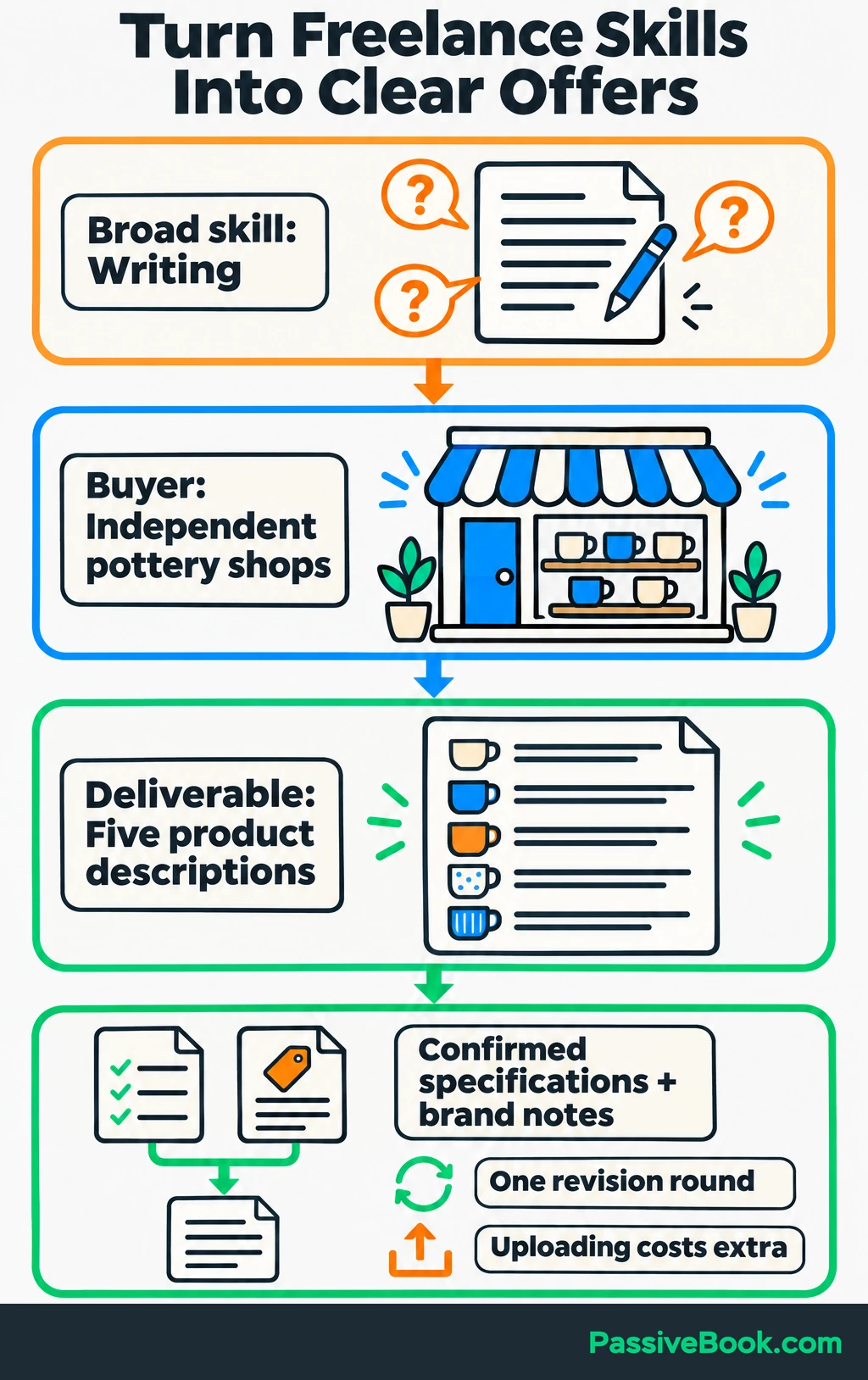
List the tasks you have completed, then turn broad skills into something a buyer can order. “Writing” leaves too much unexplained. “Five product descriptions prepared from confirmed product specifications” gives both sides something clear to discuss.
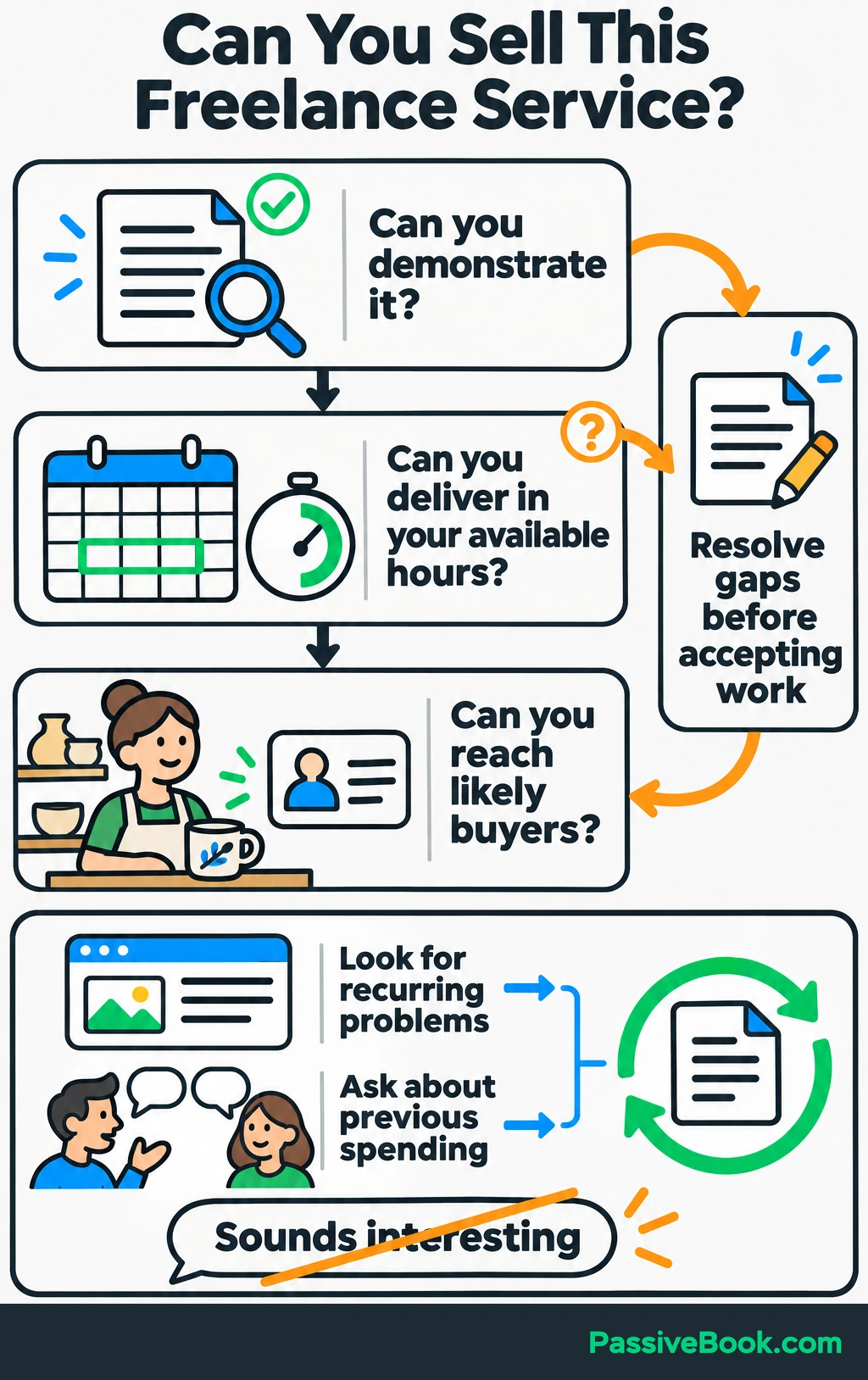
Choose a service that passes three checks:
- You can produce a sample that shows your ability.
- You can deliver it within the hours you actually have.
- You can reach people who might pay for it.
If a skill is missing, practice before accepting responsibility for client work. A paid deadline is a poor place to discover that you cannot do the task.
Next, check whether buyers want help. Read relevant project listings and talk with potential customers. Ask how they handle the work now, what slows them down, and whether they have paid anyone to help. A recurring problem and a history of spending are more useful signals than “That sounds interesting.”
For our running example, imagine offering product-description writing to independent pottery shops selling handmade mugs.
A clear offer might read:
I help independent pottery shops prepare new mug listings by writing five product descriptions from their confirmed specifications and brand notes.
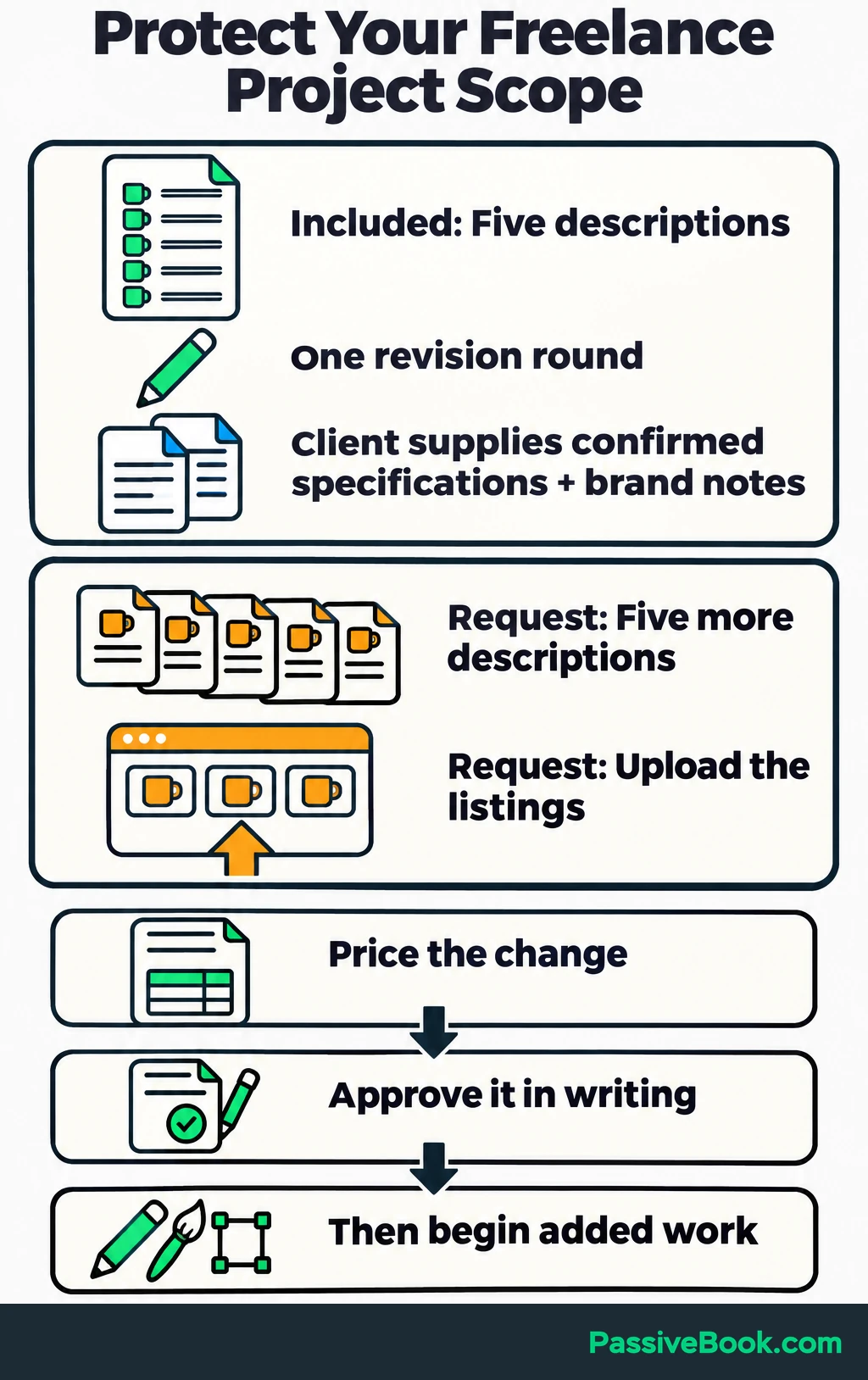
Define what comes with that offer: five descriptions in a shared document, a delivery window, and one revision round. The shop supplies product details and brand examples. Uploading listings costs extra.
If your offer still sounds like a list of skills, the AI Skill below can turn your notes into a package draft. It includes the inputs and boundaries a buyer needs to understand before discussing paid work.

Free AI Copywriting Studio




That also gives you a useful answer to “Why shouldn’t I just use AI?” Your responsibility includes checking specifications, asking about missing details, making consistent choices, and delivering usable work. I would sell that responsibility rather than promise that every sentence was typed slowly by a human.
If you are employed, review your outside-work, confidentiality, and ownership agreements before choosing clients. Keep freelance files, equipment, and working hours separate from your employer’s resources.
Build a Portfolio Before You Have Clients
Your first portfolio needs to answer one question: can you do the work you are offering?
Create a few samples of that exact service. Include the brief, the finished work, and a short explanation of your choices. A buyer should not need to guess how an unrelated personal project connects to their assignment.
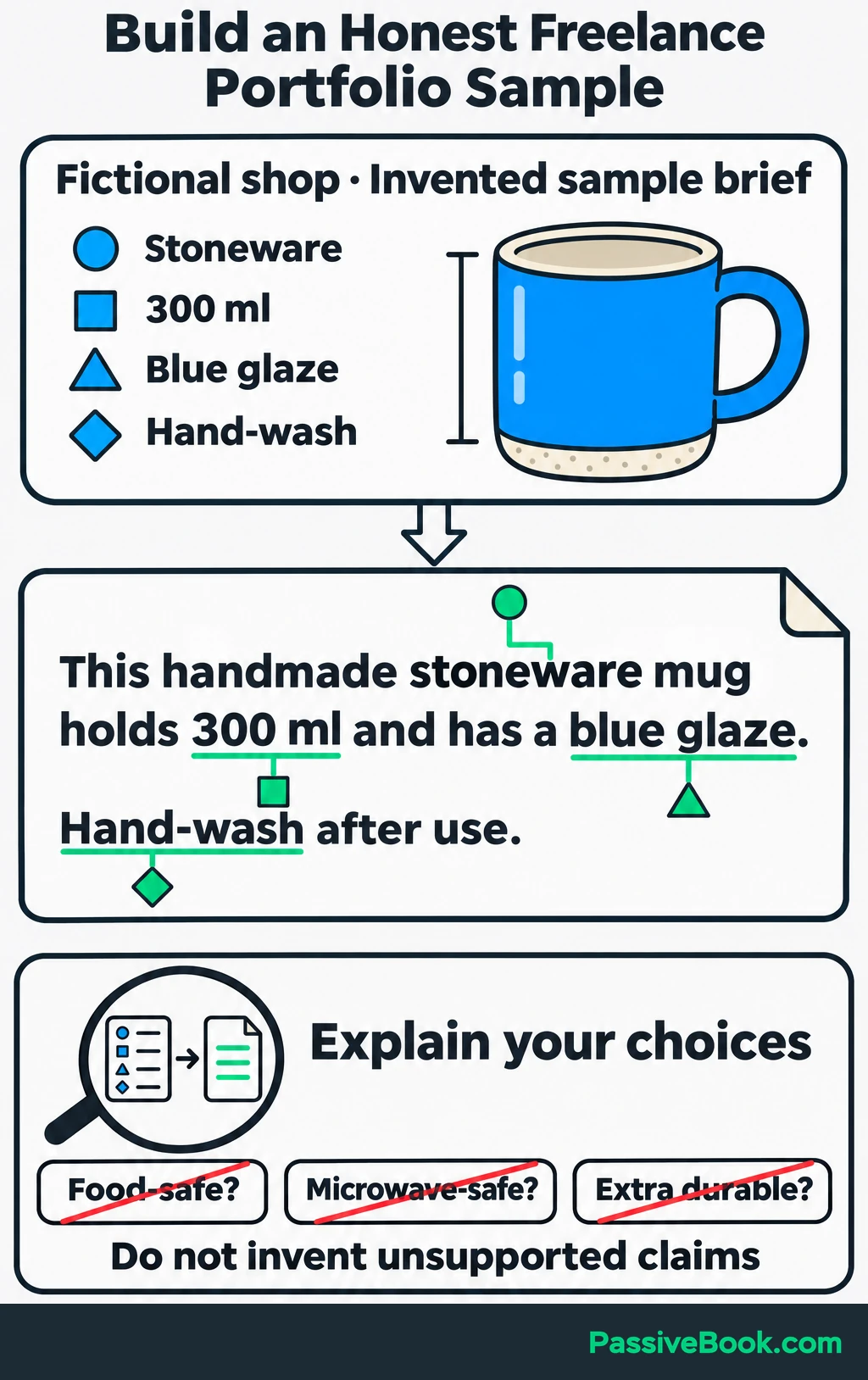
For the pottery service, create a clearly labeled fictional shop and an assumed product brief. You might specify a handmade stoneware mug with a 300 ml capacity, a blue glaze, and hand-washing instructions. Mark those details as invented for the sample.
An excerpt could read:
This handmade stoneware mug holds 300 ml and has a blue glaze. Hand-wash after use.
The surrounding sample can show how you organize useful details and match the shop’s tone. Do not invent claims about food safety, microwave use, or durability to make the copy more persuasive.
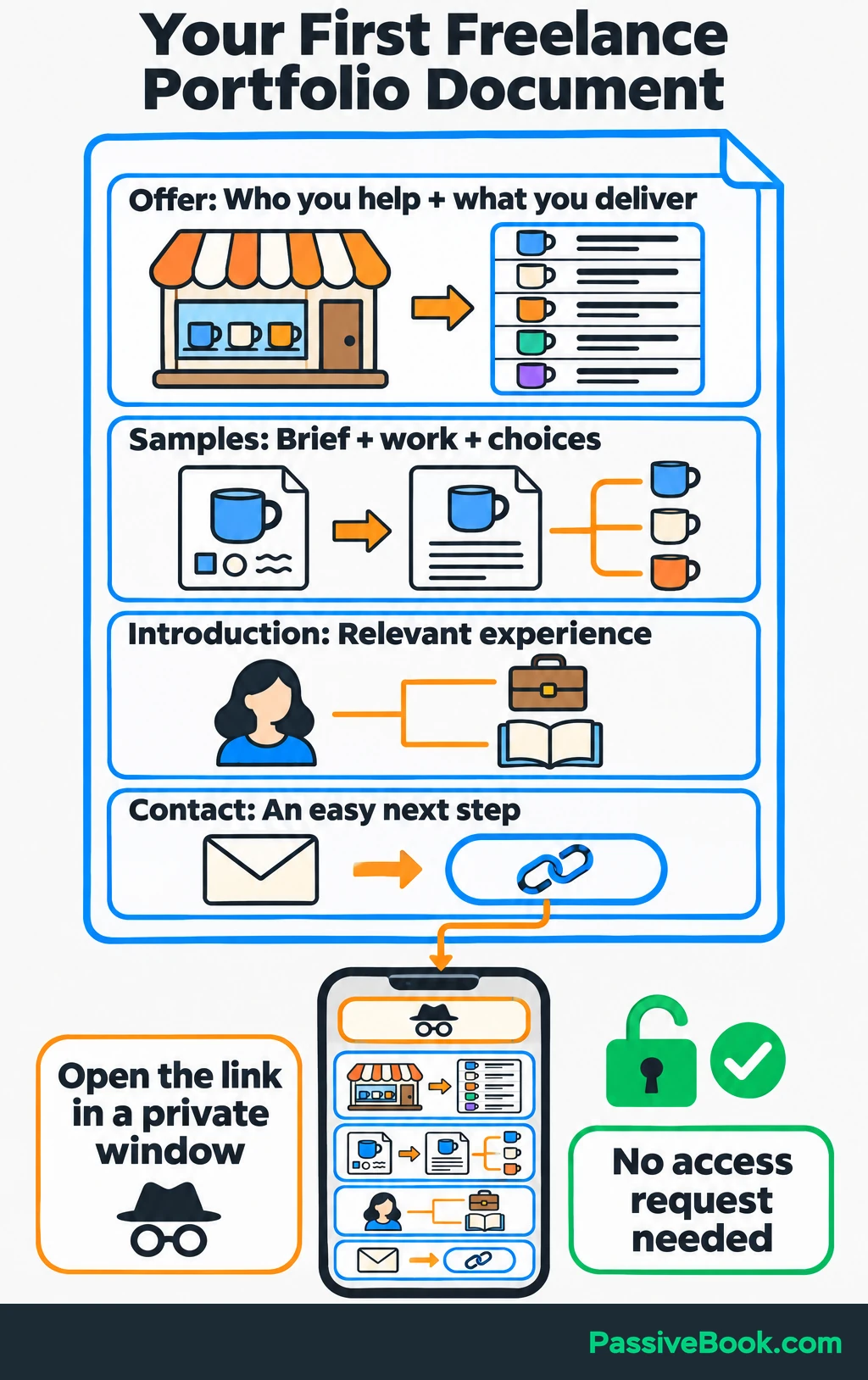
Put your offer, samples, short introduction, and contact details in an accessible document or simple page. Open the link in a private browser window to check that prospects can view it without requesting access.
I would start with that document. A full WordPress site can come later when you have a reason to build one. Your first prospect needs evidence and a way to contact you; they do not need six navigation menus.
Label self-initiated work clearly, get permission before displaying previous work, and use only genuine testimonials and measured results. Begin prospecting once the samples show your ability, then improve them using questions from actual buyers.
Set a Price That Covers the Whole Business
Your client pays for the project, but your business also needs time for sales, administration, learning, and empty spaces between bookings.
Start by counting all the hours you can give the business each month. Then reserve some for those unpaid tasks. Use the remaining delivery hours to work out a planning rate.
All package prices, hours, and payment splits in this example are illustrative USD assumptions. They are not market benchmarks or income forecasts.
Suppose you have 40 business hours available each month, but only 20 are available for client delivery. You want $900 in monthly compensation before personal taxes, and you expect $100 in business costs, including estimated payment fees.
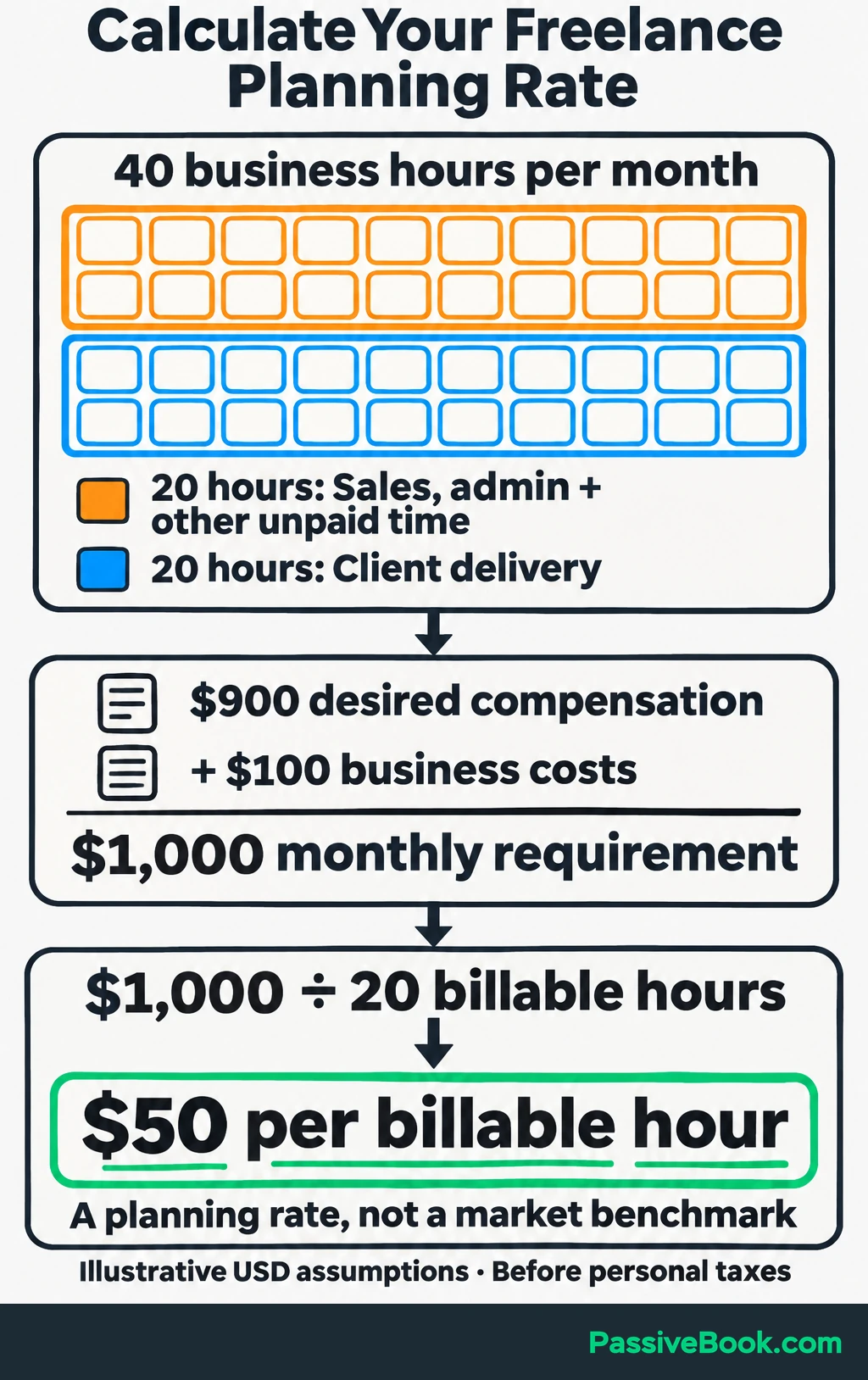
Your planning rate is:
($900 desired compensation + $100 business costs) ÷ 20 billable hours = $50 per billable hour
Now time a practice project. Count research, messages, writing, revisions, checks, and handover.
If the pottery package takes four hours and you allow another hour for unexpected work, its planning floor is:
5 hours × $50 = $250
That tells you what the package needs to earn under these assumptions. It does not tell you that a pottery shop will pay $250.
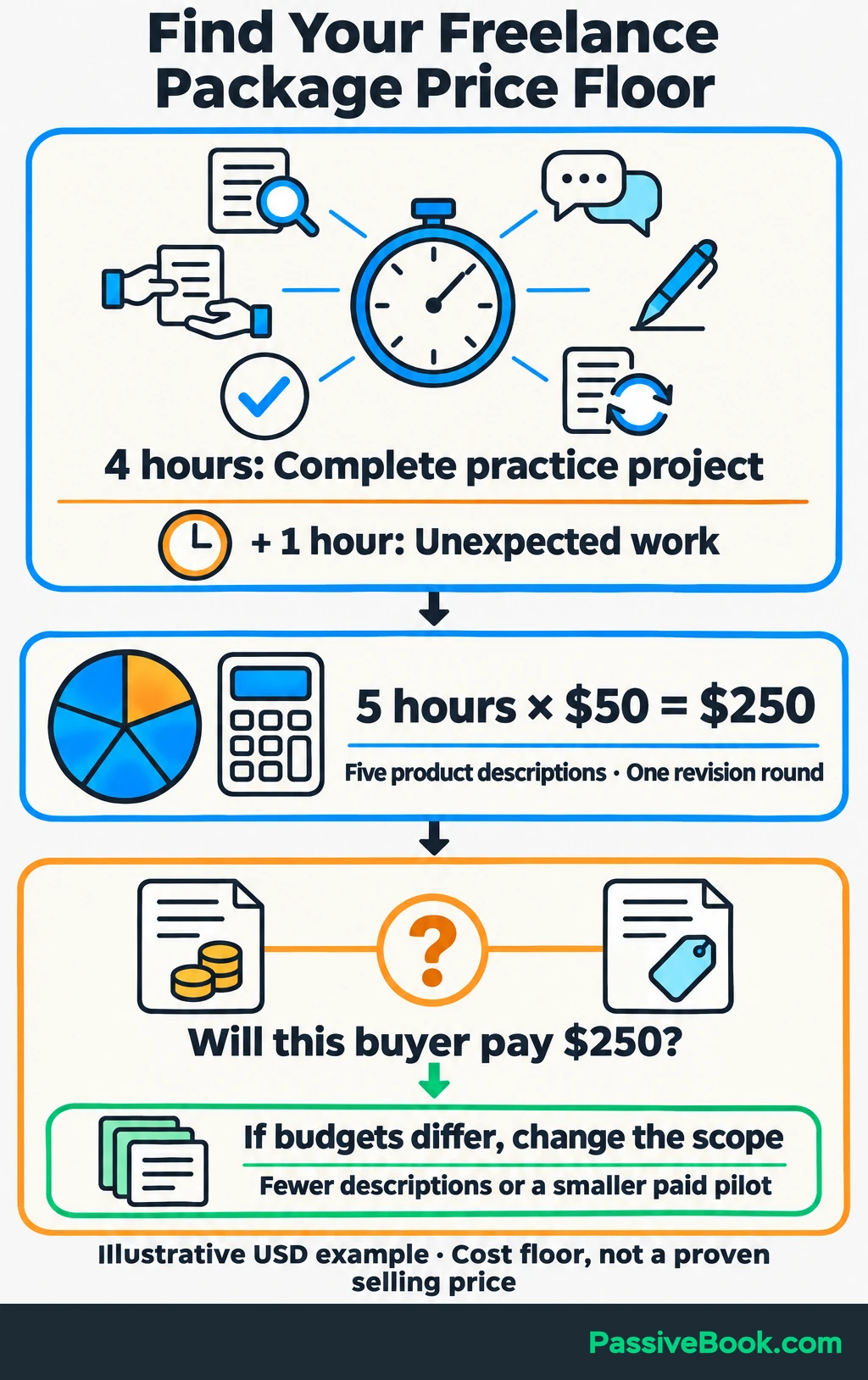
Compare the package with closely matched project budgets and discuss it with prospective buyers. If their budgets and your costs do not meet, change the scope, delivery method, or target buyer. Quietly paying yourself less does not resolve the gap.
Choose the pricing method that matches how clearly you can define the work:
| Pricing Method | When I Would Use It |
|---|---|
| Hourly | The workload is uncertain, with an agreed spending cap and a check before exceeding it. |
| Fixed fee | The deliverables, inputs, and revision allowance are clear, as with five mug descriptions. |
| Recurring fee | The client regularly needs a defined amount of work and wants you to reserve capacity. |
During my early freelancing, I treated quick changes as part of being helpful. The trouble was that several quick changes could consume the evening I had set aside for something else. I learned to define revisions before quoting.
If a buyer cannot afford the package, offer fewer descriptions or a smaller paid pilot. Negotiate the work alongside the price.
A quote can look reasonable and still require more projects than your month can hold. Use the calculator below to check the price against your capacity and see how much work a smaller budget can support.
Free Pricing Profit Calculator
Set up the Essentials for Paid Work
Keep the setup small, but make it ready to handle a real payment.
You need a dependable contact method, a written agreement, an invoice template, a payment method, and a record of income and expenses. Buy additional tools when paid work gives them a job to do.
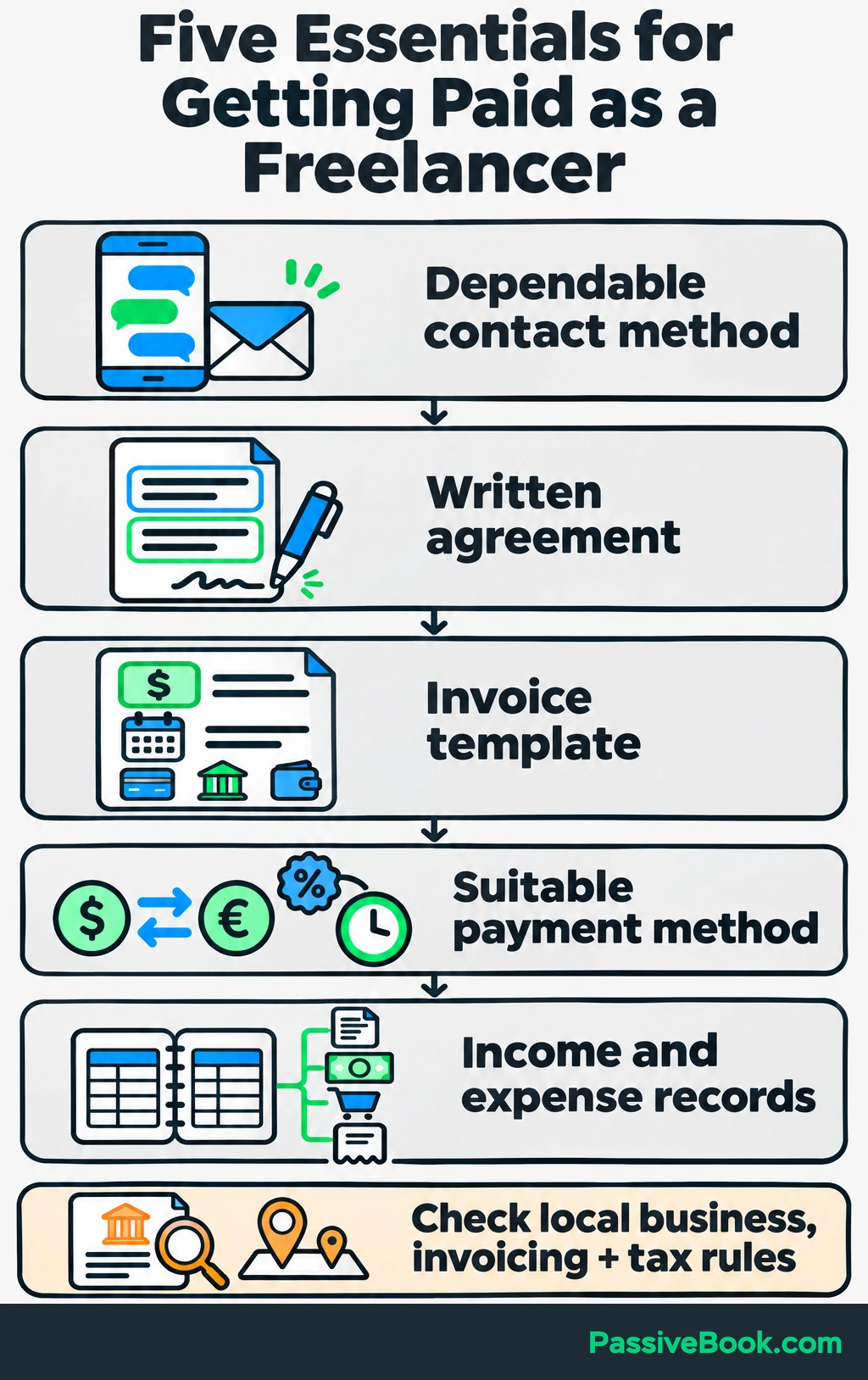
Check the registration, business-name, licensing, and invoicing rules where you operate. In the United States, you can often start without forming a limited liability company (LLC). Operating as a sole proprietor means the business and owner are legally the same, so you remain personally liable for its obligations. The SBA’s business-structure guidance explains that tradeoff.
Taxes need attention before you spend the money you collect. U.S. freelancers may owe income tax, self-employment tax, and estimated payments, including when freelancing part time. Use the IRS self-employed tax guidance to check your circumstances, and use your local tax authority elsewhere. Get help when you cannot determine what applies.
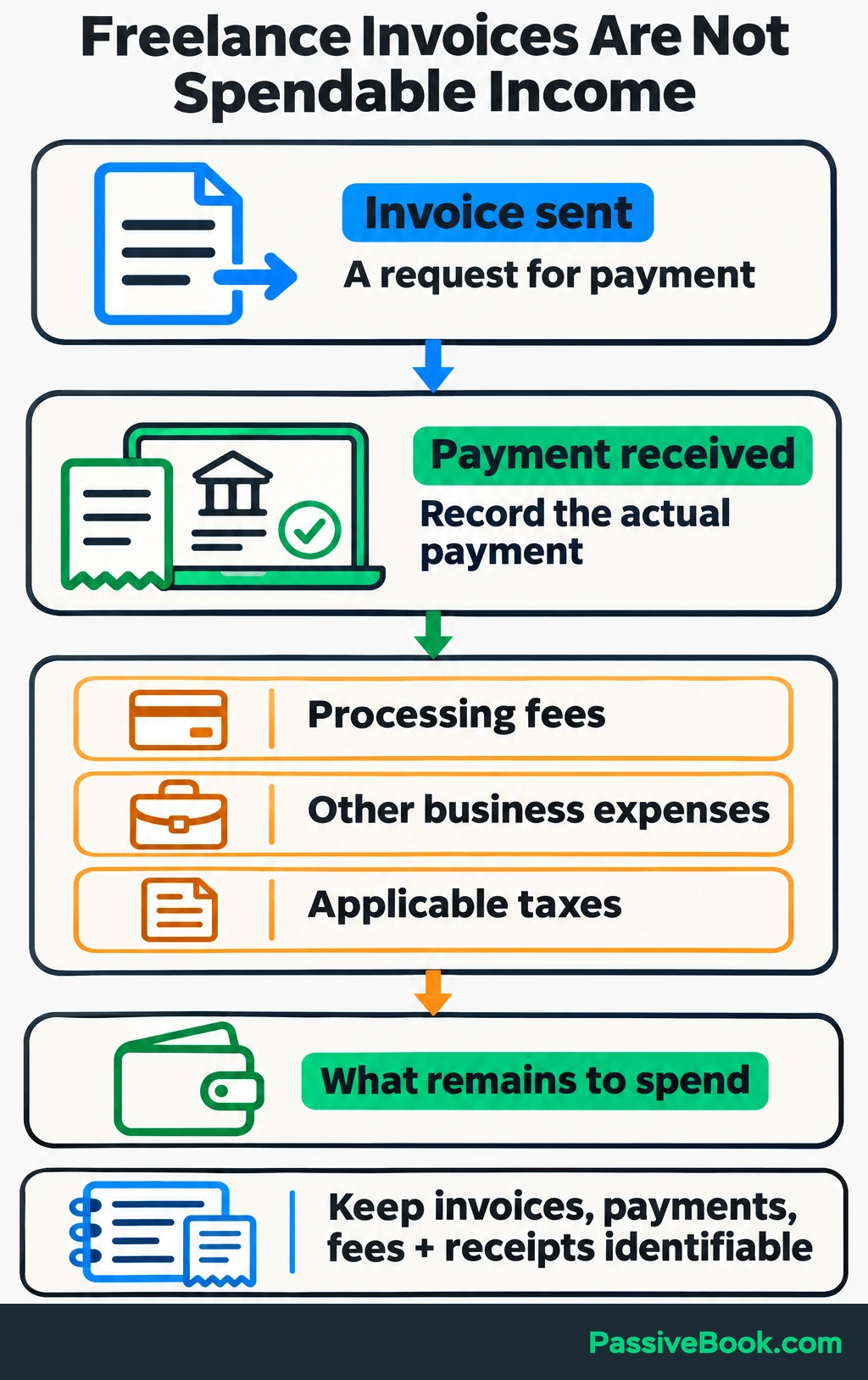
Choose a payment method that supports your location and your clients. Check processing fees, currency conversion, payout timing, and what the buyer needs to approve payment before quoting international work.
Keep business transactions separately identifiable. Record invoices, payments received, fees, expenses, and receipts. An invoice is a request for payment. Once the money arrives, fees, expenses, and taxes still reduce what you can spend.
Find Your First Qualified Prospects
Choose one main route to clients so your limited time produces follow-through. I would start with relevant introductions if you have them, then use direct outreach or a marketplace where suitable buyers already seek help.
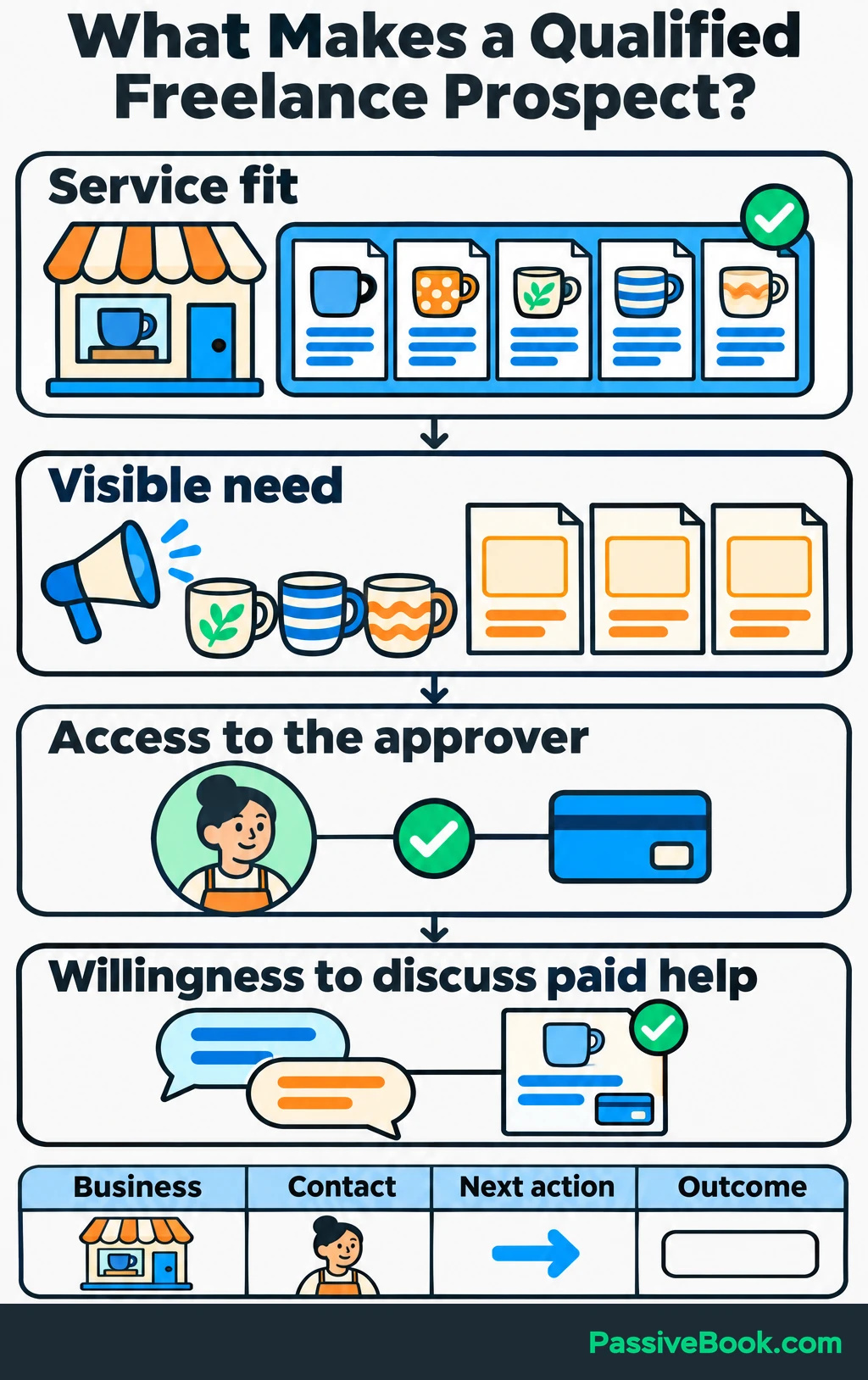
A qualified prospect needs more than a business name. Look for a service fit, a visible need, access to the person who can approve the work, and willingness to discuss paid help.
Keep a simple tracker with the business, contact, need, source, last interaction, next action, quote, and outcome. A spreadsheet is enough.
Ask for Relevant Introductions
Tell people exactly what you offer and whom it suits. “Let me know if anyone needs a freelancer” gives them homework.
Instead, explain that you write product descriptions for independent pottery shops and are looking for owners preparing new mug listings. Share one relevant sample they can pass along.
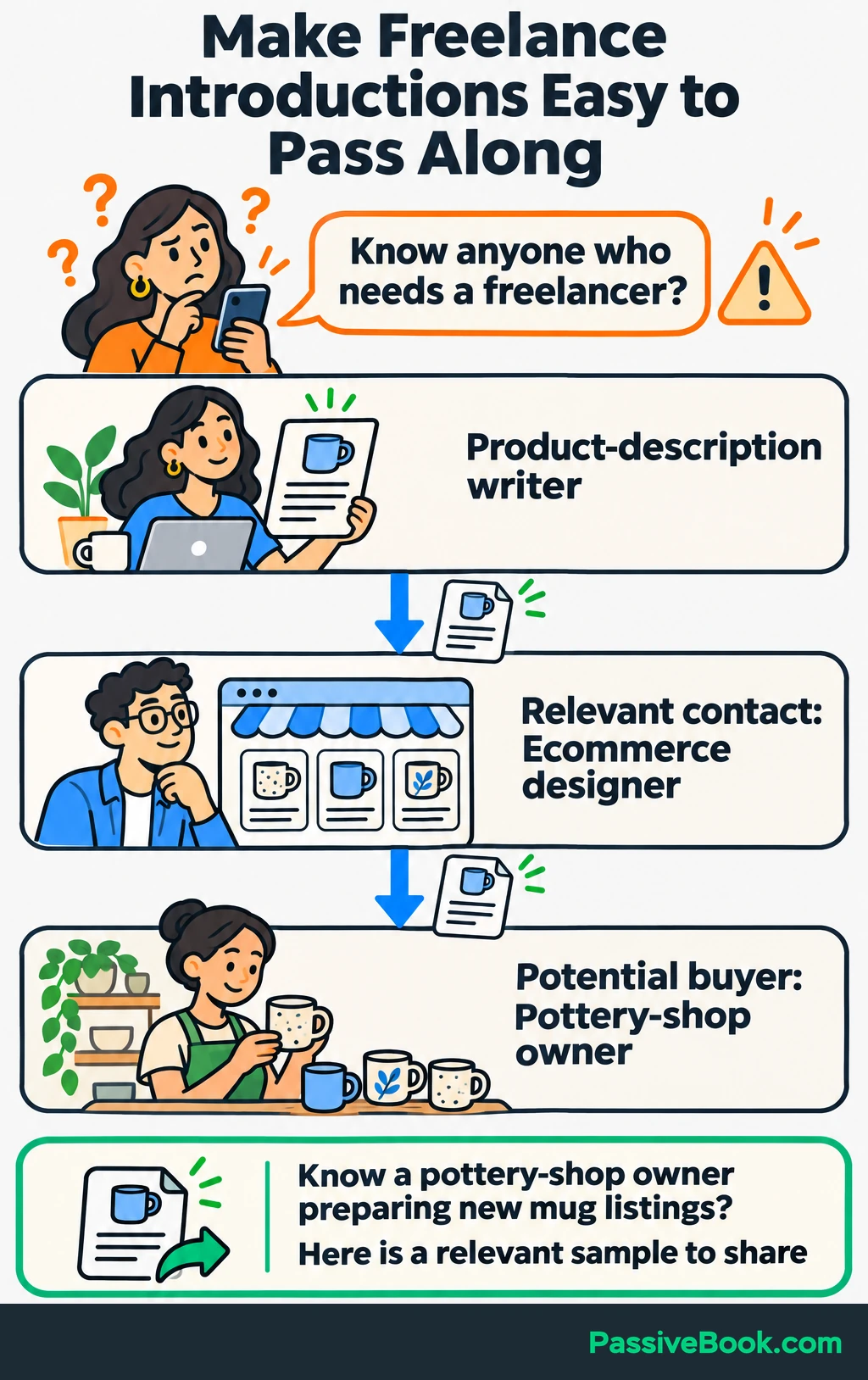
For this service, ecommerce designers may be useful contacts because they work with shop owners who need content for their sites. Ask whether they know a suitable owner rather than asking them to recommend you indiscriminately.
Relevant communities can also lead to conversations. Answer specific questions and respond to requests for help. When someone describes a problem your service addresses, ask whether they want to discuss paid support.
I would skip the daily posting routine unless you can connect it to actual buyer conversations. Publishing motivational advice about freelancing is a surprisingly efficient way to avoid doing any.
Contact Businesses With a Specific Reason to Hire
Before writing a message, find a concrete reason the business might need your service. A publicly announced collection is useful. An assumption that the owner is overwhelmed is not.
Your message should connect that observation to your deliverable, show a matching sample, and suggest an easy next step.
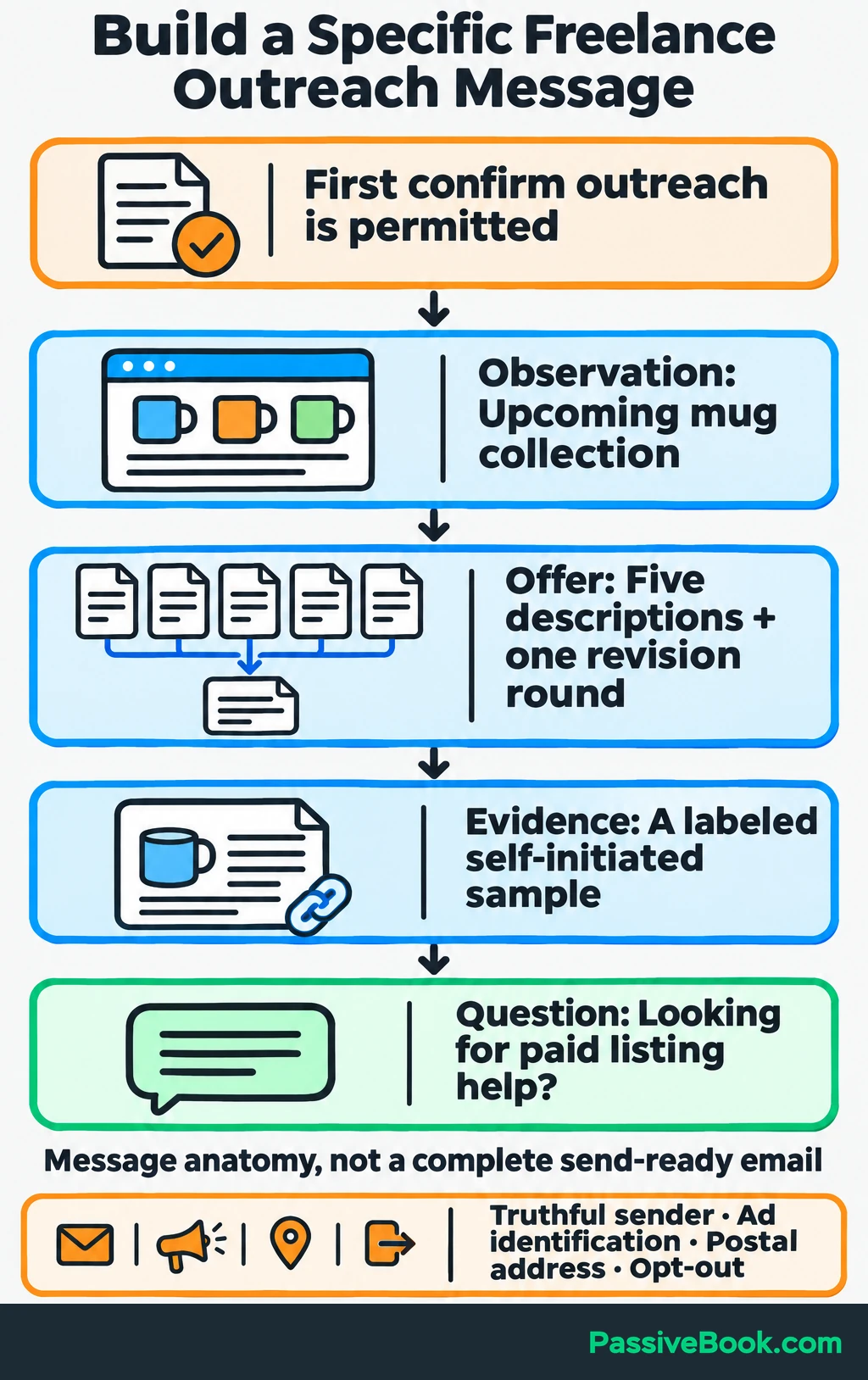
Check the rules before sending commercial messages. U.S. requirements cover business-to-business email and include truthful sender details, clear advertising identification, a valid postal address, and an opt-out method. See the FTC’s commercial-email guidance. In the UK, sole traders generally need prior consent for unsolicited marketing email unless a valid exception applies, so a published business address is not automatic permission. The ICO’s business-marketing guidance explains the distinction.
For outreach you are permitted to send, adapt this complete example using a real observation:
Subject: Product descriptions for your upcoming mug collection
Hi [Name],
I saw your announcement about [collection name] and its upcoming release.
I write product descriptions for independent pottery shops using confirmed specifications and brand notes. My package includes five descriptions in a shared document and one revision round, ready for you to upload.
Here is a self-initiated sample: [sample link].
Are you looking for paid help preparing the listings for this release?
Thanks,
[Your name]
[Contact details]
This is a service advertisement from [your name or business].
[Valid postal address]
To stop receiving marketing messages from me, reply “unsubscribe.”
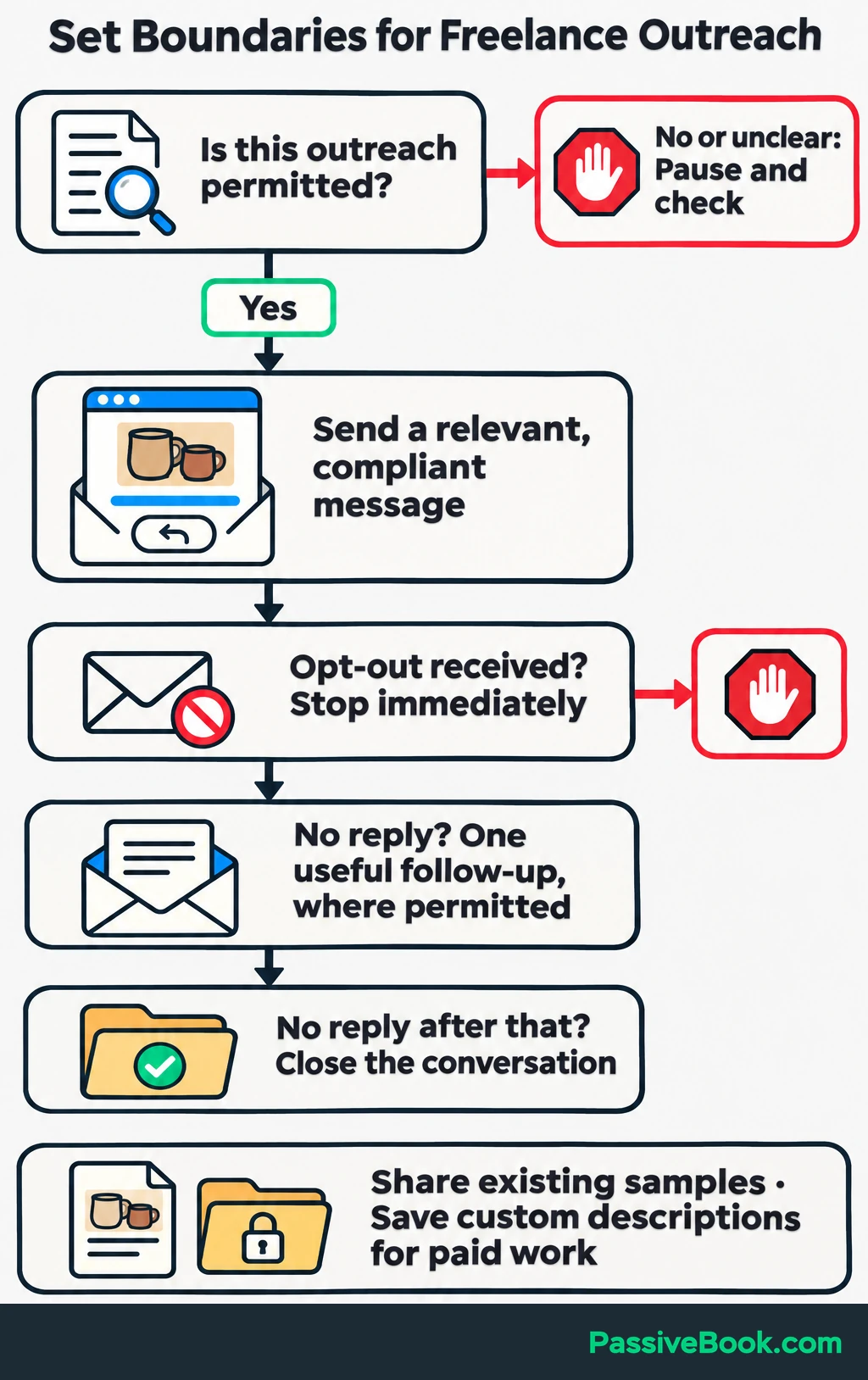
If there is no response, I would send one useful follow-up where permitted, then close the conversation. Stop immediately if they opt out.
Share existing samples and relevant observations. Save custom descriptions for a paid project.
Use Freelance Marketplaces Selectively
A marketplace is one route to clients. It does not need to become your entire business.
Look for assignments that match your samples, capacity, and minimum price. Read the scope before spending time on a proposal, and check the platform’s application costs, payment arrangements, and rules for client relationships.
Calculate what remains after fees. For example, Upwork shows the applicable freelancer service fee before you accept work; use its fee guidance when checking what a quoted price leaves you.
Set a limit on application spending and unpaid proposal time. Judge the channel by suitable conversations and paid projects rather than how many applications you submit.
Once work begins coming in, develop another route as capacity allows. Having several happy clients on one platform still leaves you dependent on that platform for access to them.
Turn a Client Conversation Into a Paid Project
Interest becomes useful when both sides agree on the work, the price, and what happens next.
Confirm the Work Is a Good Fit
Before quoting, establish what the buyer needs and whether you can deliver it. Cover these questions:
- What must the finished work contain?
- Which materials are ready, and what is missing?
- What budget and deadline are available?
- Who approves the work and authorizes payment?
- How will feedback and acceptance happen?
For the pottery package, request confirmed dimensions, materials, capacity, care instructions, and brand examples. Ask about any claims the owner wants included and the evidence behind them.
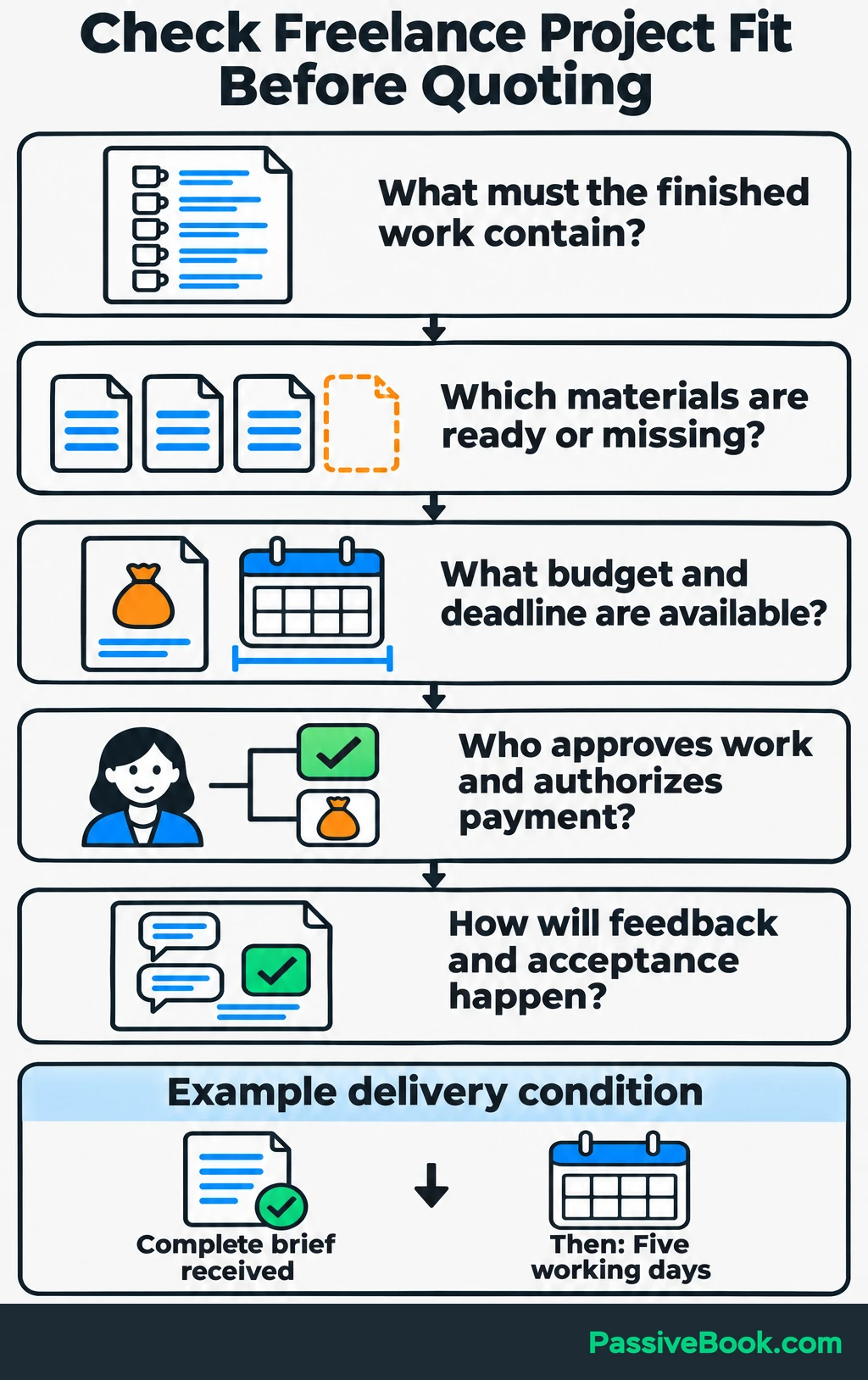
Tie your schedule to receipt of those inputs. “Five working days after the complete brief arrives” is clearer than promising Friday while waiting for product details.
Offer a small paid pilot if either side needs more evidence of fit. Narrow or decline work beyond your competence or available time.
Verify unfamiliar clients through independently found business details. Reject requests to forward part of a check or deposit your own money to unlock supposed earnings. The FTC describes both fake-check and task scams.
Agree on Scope and Payment Before Starting
Send a short proposal that covers the need, deliverables, exclusions, required inputs, schedule, price, and acceptance step.
Then put the working terms in writing. Your agreement should cover revisions, changes, cancellation, payment dates, confidentiality, and ownership or usage rights. It should also explain how work is accepted and what happens if the client delays feedback.
The Freelancers Union contract creator provides useful categories to work through. Adapt the terms to the project and applicable law rather than assuming every template clause suits your situation.
For the illustrative $250 pottery package, a 50% advance would be $125, with the remaining $125 due at the agreed completion milestone. Define that milestone and its payment deadline before starting.
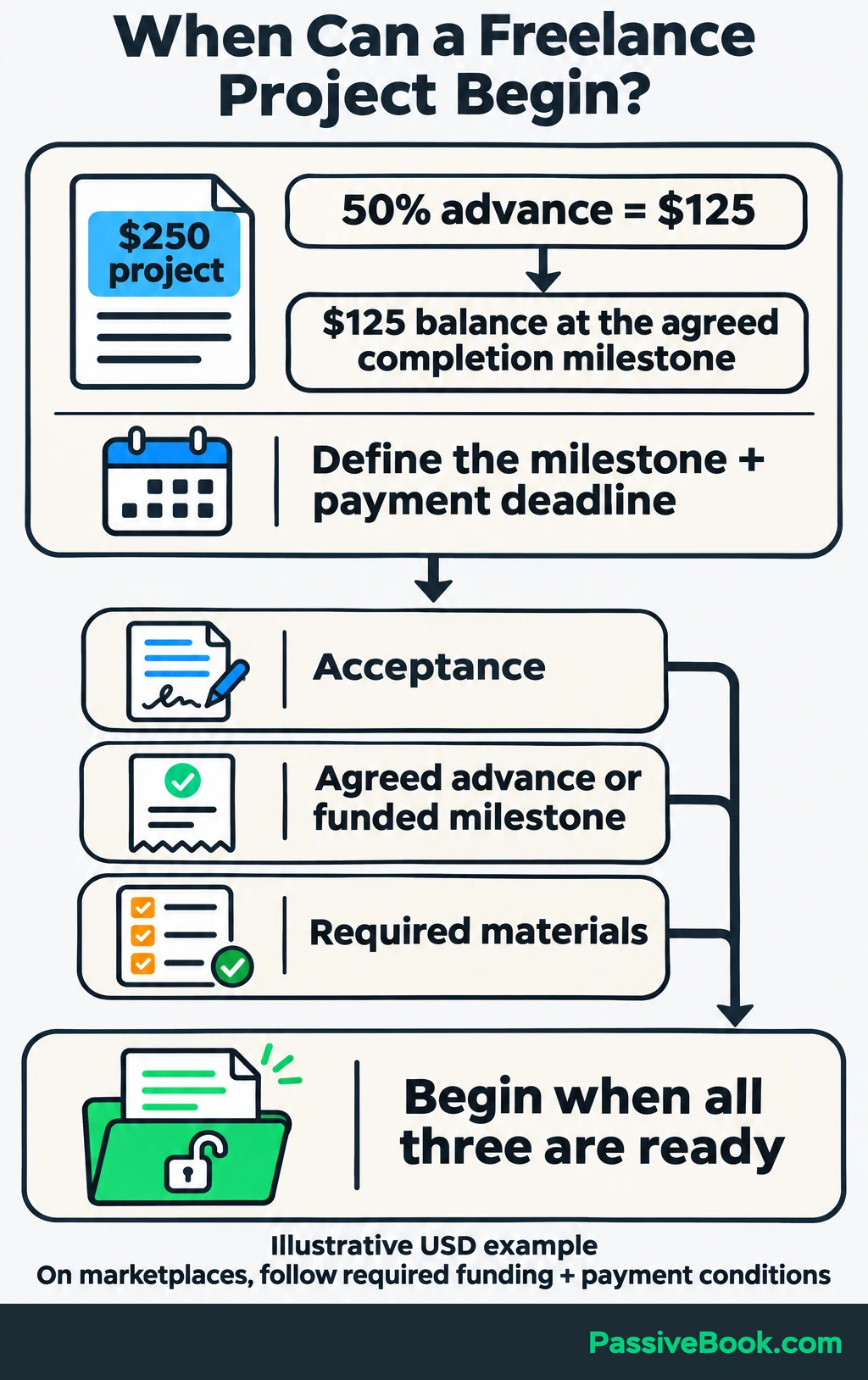
On a marketplace, use the required funded-milestone process and understand its payment conditions.
Begin once you have acceptance, the agreed advance or funded milestone, and the required materials. If the buyer adds five more descriptions or asks you to upload everything, price and approve that change in writing first.
Invoice promptly with the service, amount, currency, due date, and payment instructions. For overdue payments, follow the reminder and work-pause process you agreed on.
Deliver Through a Repeatable Workflow
A repeatable process helps you keep promises when freelance work shares a calendar with everything else.
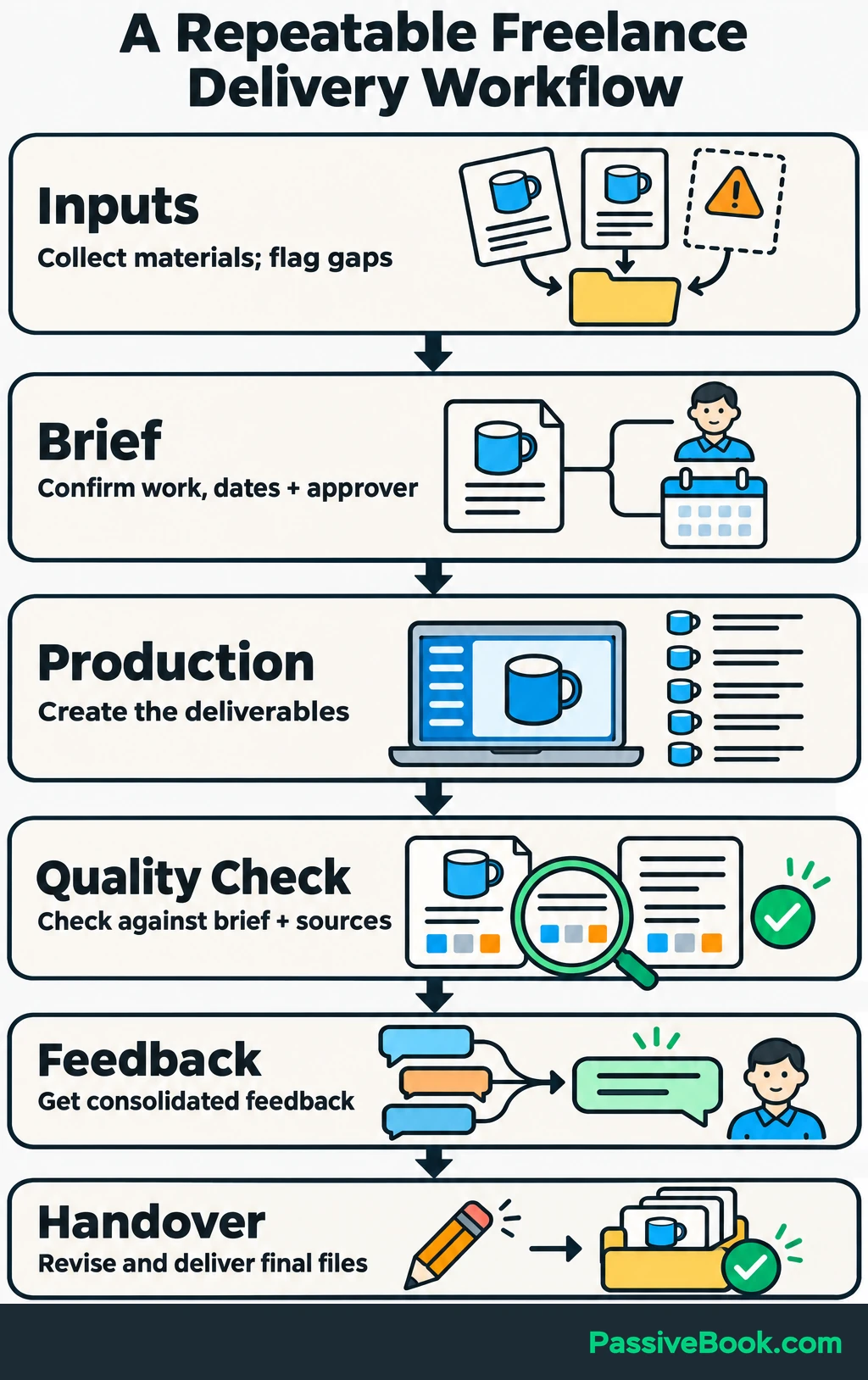
Use the same basic sequence for each project:
- Inputs: Collect the required materials and list anything missing.
- Brief: Confirm the deliverables, approver, dates, and open questions.
- Production: Schedule the work and create the deliverables.
- Quality Check: Compare the work with the brief and source materials.
- Feedback: Collect one consolidated response from the agreed approver.
- Handover: Complete the included revisions and deliver organized final files.
Give every project a visible status, deadline, and next action. A spreadsheet or a small Notion board can handle this.
For the pottery package, check all five descriptions against the confirmed specifications. Review capacity, dimensions, care instructions, tone, and formatting. A polished description with the wrong capacity still creates work for the client.
Send short updates that explain progress, the next milestone, and anything you need. If missing information threatens the deadline, raise it while there is still time to respond.
Track actual time, including messages and revisions. An overrun tells you to improve the estimate, brief, or scope before selling the next package.
Save onboarding questions, proposals, checklists, and reminders as reusable templates. I would automate stable administrative steps once the manual process works. Automating an unclear process mainly helps it become unclear faster.
Use AI for work you can judge, such as organizing notes or suggesting alternative wording. Check its output against the source materials. For confidential client information, use tools the client has approved. The FTC’s guidance on protecting sensitive personal information recommends limiting access to people who need that information.
Turn Completed Projects Into Repeat Business
Close the project properly before asking for more work. Confirm acceptance, send the final invoice, and provide an organized handover.
Ask what worked and what caused friction. A client who struggled to supply product details may need a better intake form next time.
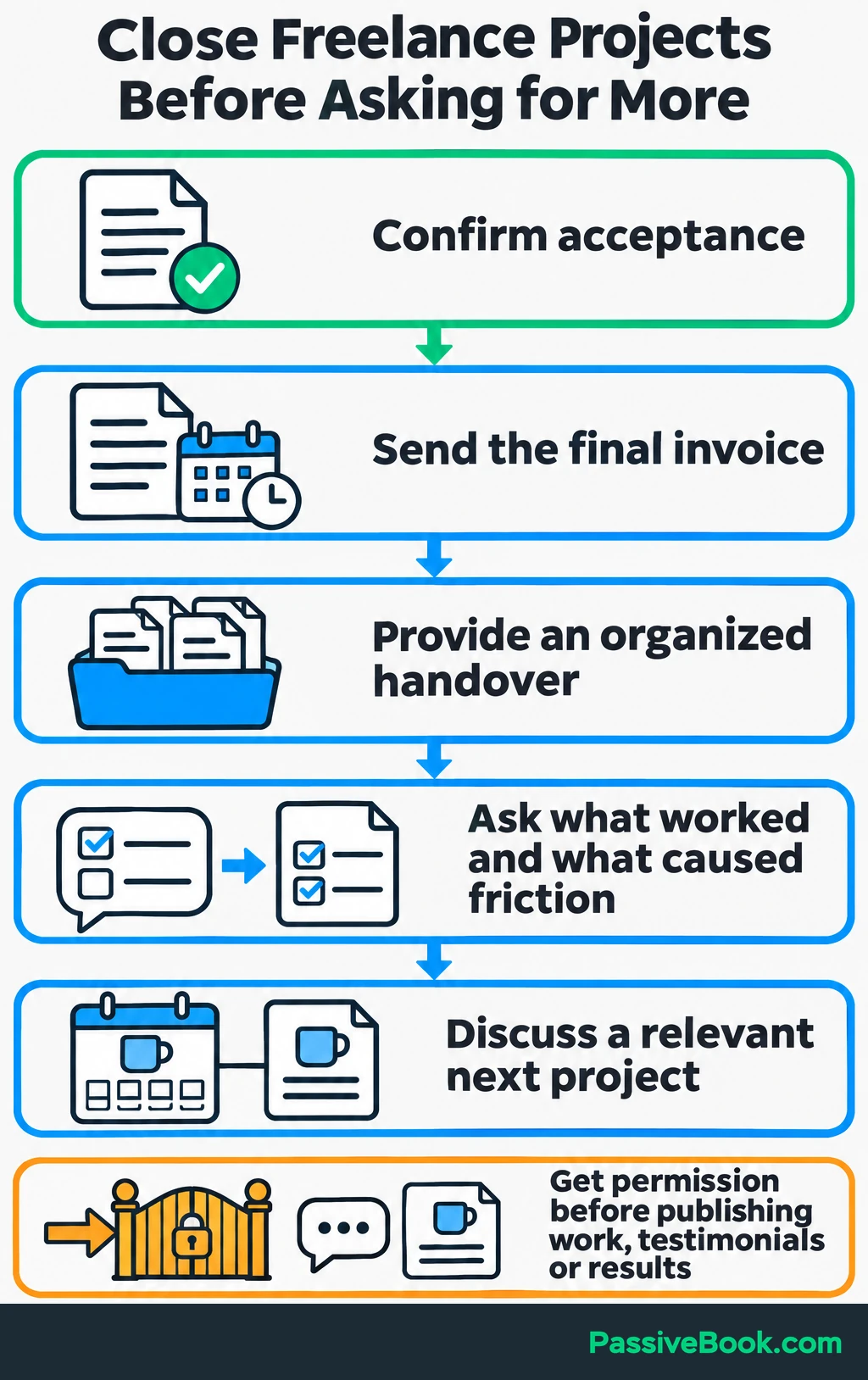
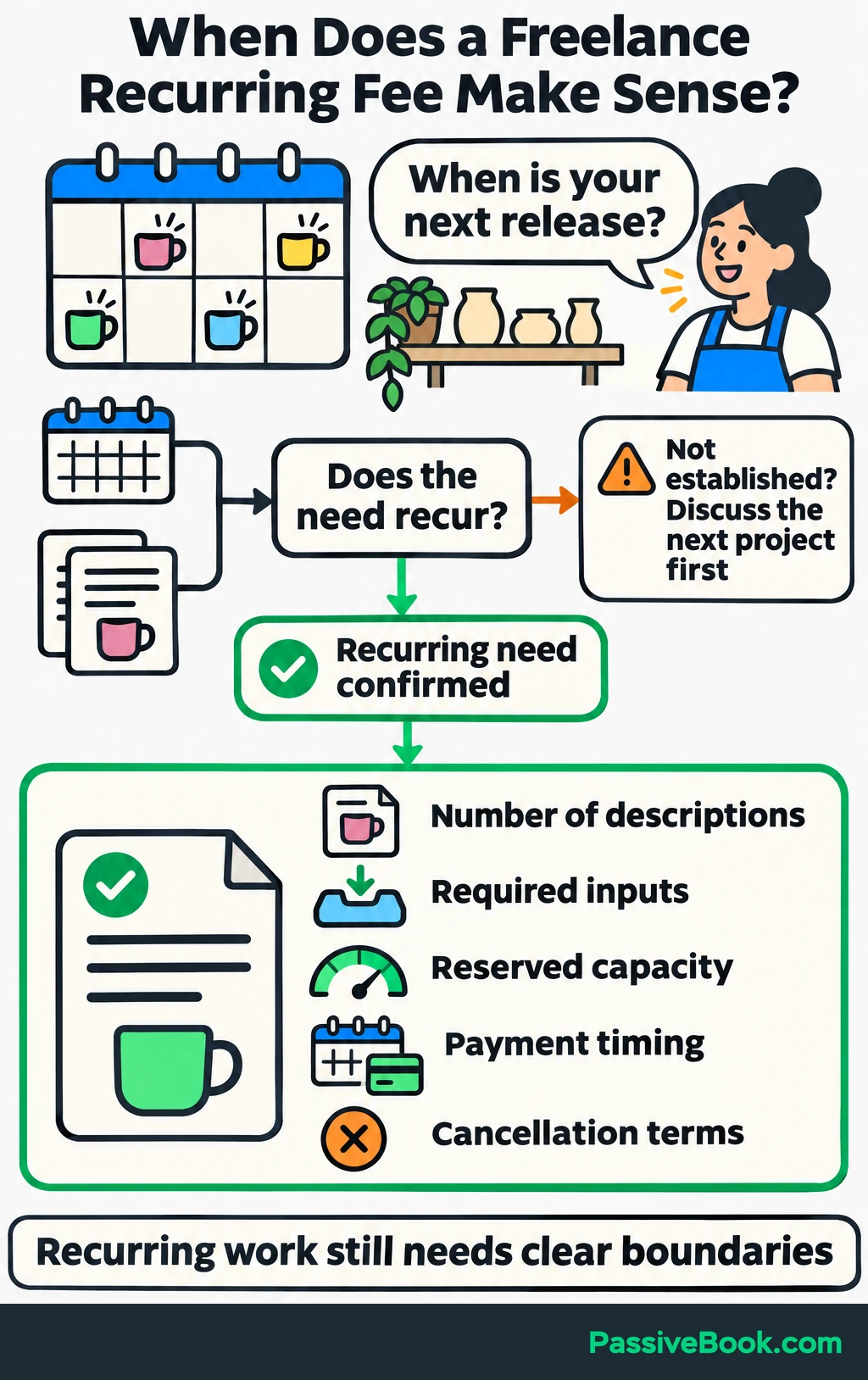
Then discuss a relevant next project. For the pottery shop, that could mean descriptions for its next mug release. Ask about the release schedule before suggesting a monthly arrangement.
Recurring fees make sense when the need recurs. Define the number of descriptions, required inputs, reserved capacity, payment timing, and cancellation terms. “Ongoing support” needs boundaries too.
A satisfied client may also introduce you to another shop owner. Make the request specific and easy to pass along.
Get permission before publishing client work, identifying details, testimonials, or results. Keep private feedback private unless the client agrees otherwise.
Build Dependable Income Before Expanding
Each month, review money collected, business costs, unpaid invoices, upcoming commitments, and active prospects.
To see what each business hour earns, subtract the month’s costs from revenue collected and divide by all business hours worked that month:
Effective hourly earnings = (collected revenue − business expenses) ÷ all business hours worked
Suppose the pottery service collects $1,000 during a month, incurs $100 in business expenses, and takes 40 hours across delivery, sales, and administration.
($1,000 − $100) ÷ 40 = $22.50 per business hour, before personal taxes
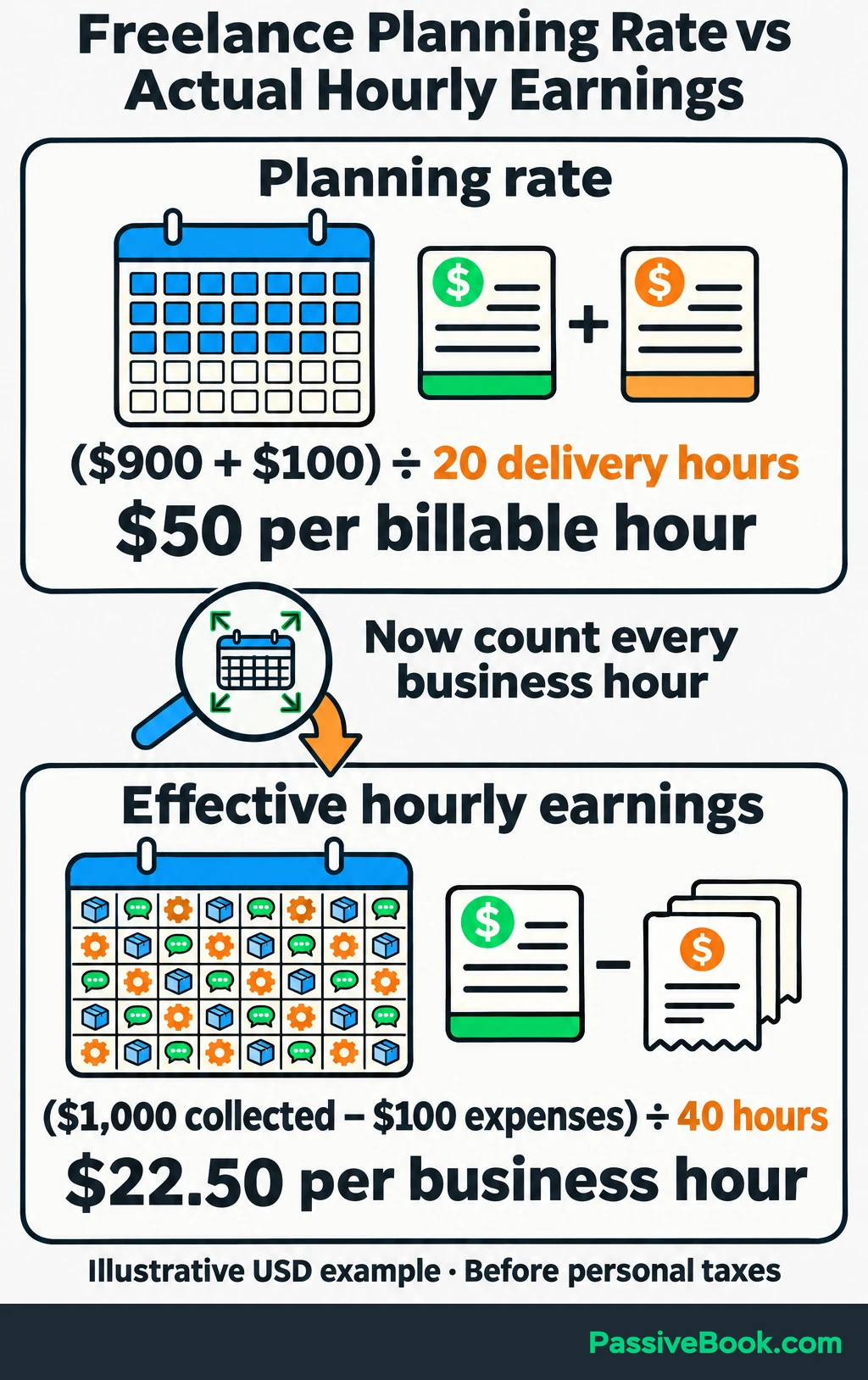
The $50 planning rate covers client delivery hours. The $22.50 figure also counts time spent finding clients and running the business.
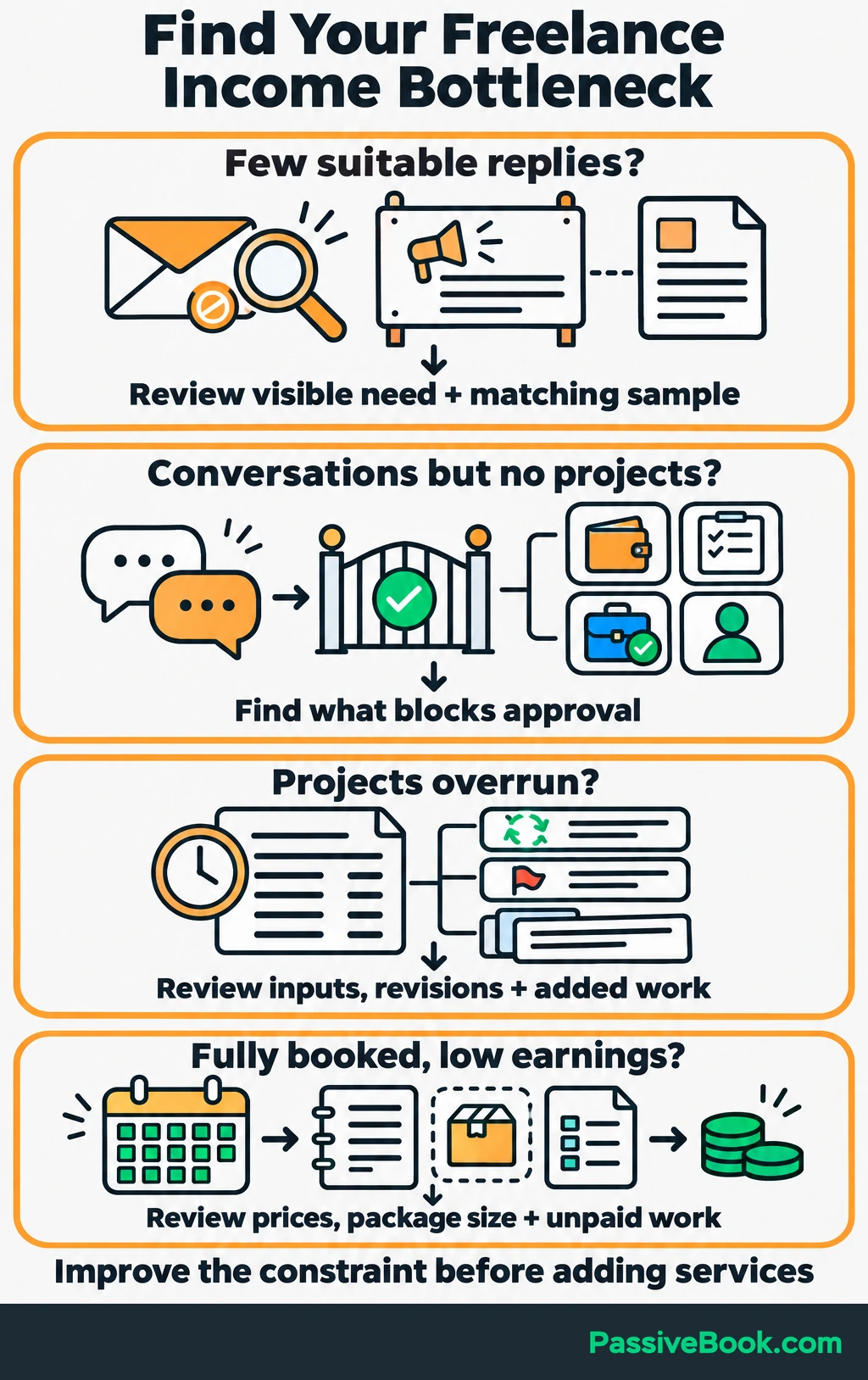
When results disappoint, look for the constraint:
| What You Observe | What to Review |
|---|---|
| Suitable prospects rarely reply | Check whether each message names a visible need and includes a matching sample. |
| Conversations happen but projects do not | Ask what blocks approval: price, scope, missing proof, or the wrong contact. |
| Projects repeatedly exceed estimates | Use time logs to find missing inputs, extra revisions, or added work. |
| Paid work fills the calendar but earnings stay low | Check whether higher prices, smaller packages, or less unpaid work would close the gap. |
I started freelancing through Fiverr during college and worked on and off for roughly two years. My best month was about $4,100 and my worst about $280. Those were earnings, not profit. That swing is why I’d judge income across several months before making commitments.
I left because income depended on my continued work, and I wanted a business that could earn without me doing every job. A profitable solo practice can still be a good choice.
Protect some prospecting time while delivering. Watch how much revenue depends on your largest client, and build a cash reserve around essential expenses and payment delays.
Before reducing other paid work, review sustained income after costs and taxes, savings, replacement benefits, and what losing a major client would do to your finances.
Improve pricing, scope, repeat bookings, and reusable processes before adding services. Set a delivery limit that leaves room to run the business. Selling every available hour leaves nobody available to sell next month.
What Next?
Write one offer today that names the buyer, the problem, and the work you will deliver. Then choose a sample you can create within the hours you have this week.
Use the social buttons to share this guide when you want to compare offers, pricing, or first-client plans with others.
Which part of your freelance offer still feels hardest to define? Leave your answer in the comments, along with any other questions.
Share this post with your friends & followers:

