People already ask for your advice, but turning that advice into paid work brings a different set of questions. What exactly will you sell? Who will buy it? And how do you avoid spending a month helping someone who still hasn’t paid?
The risk is committing time and money before you know whether the offer can support you. A full calendar can still leave you short of cash. The roadmap below follows one consulting offer from buyer conversations to paid delivery, with the pricing, contracts, and cash decisions that help make the work worth doing.
Choose a Consulting Niche Buyers Will Pay For
Match Your Expertise to a Costly Problem
Start with problems you have already helped solve. Your job title is a clue, but the useful evidence sits underneath it.
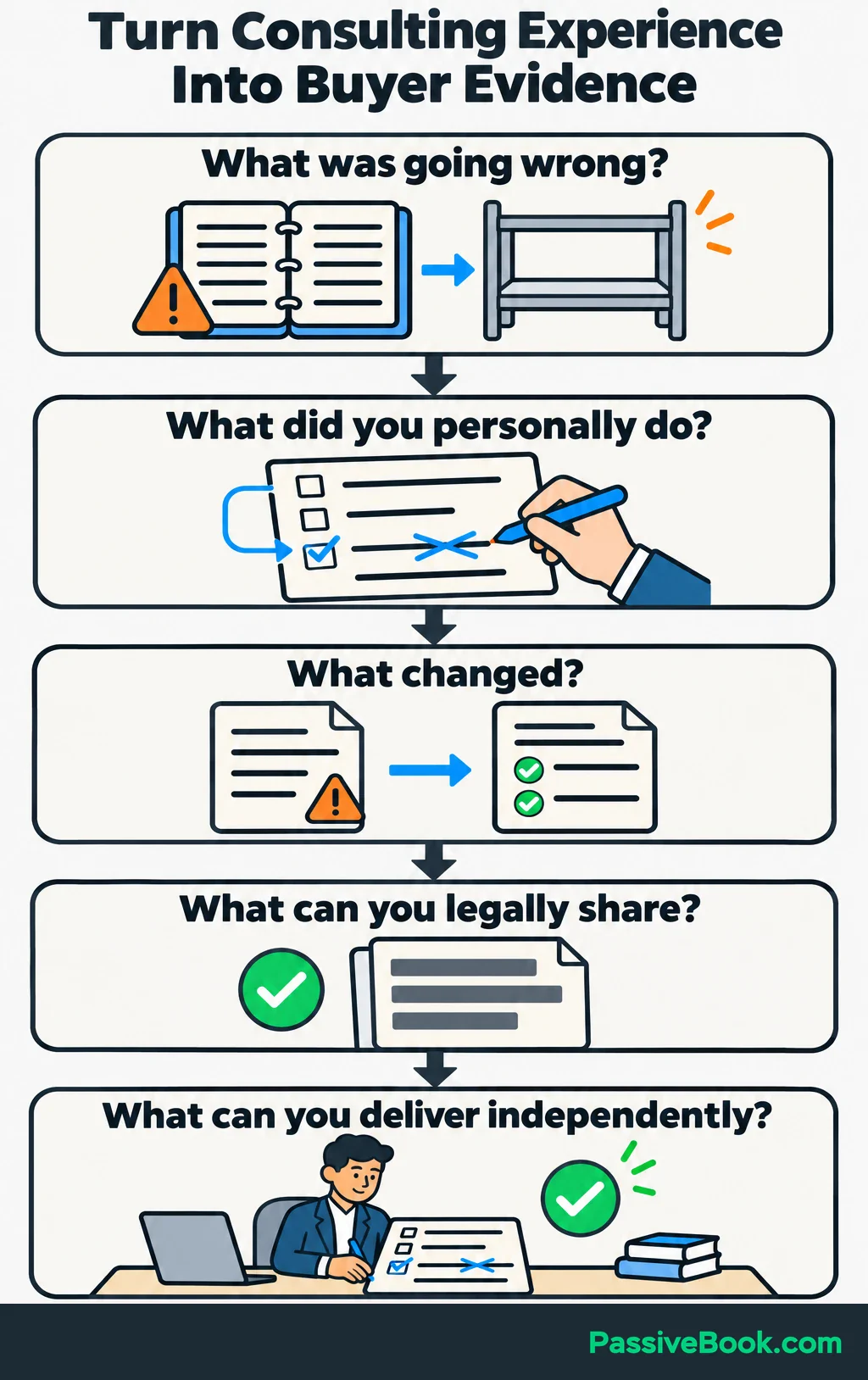
For each problem, write down:
- What was going wrong.
- What you personally did.
- What changed afterward.
- What evidence you can legally share.
- Which parts you could handle independently now.
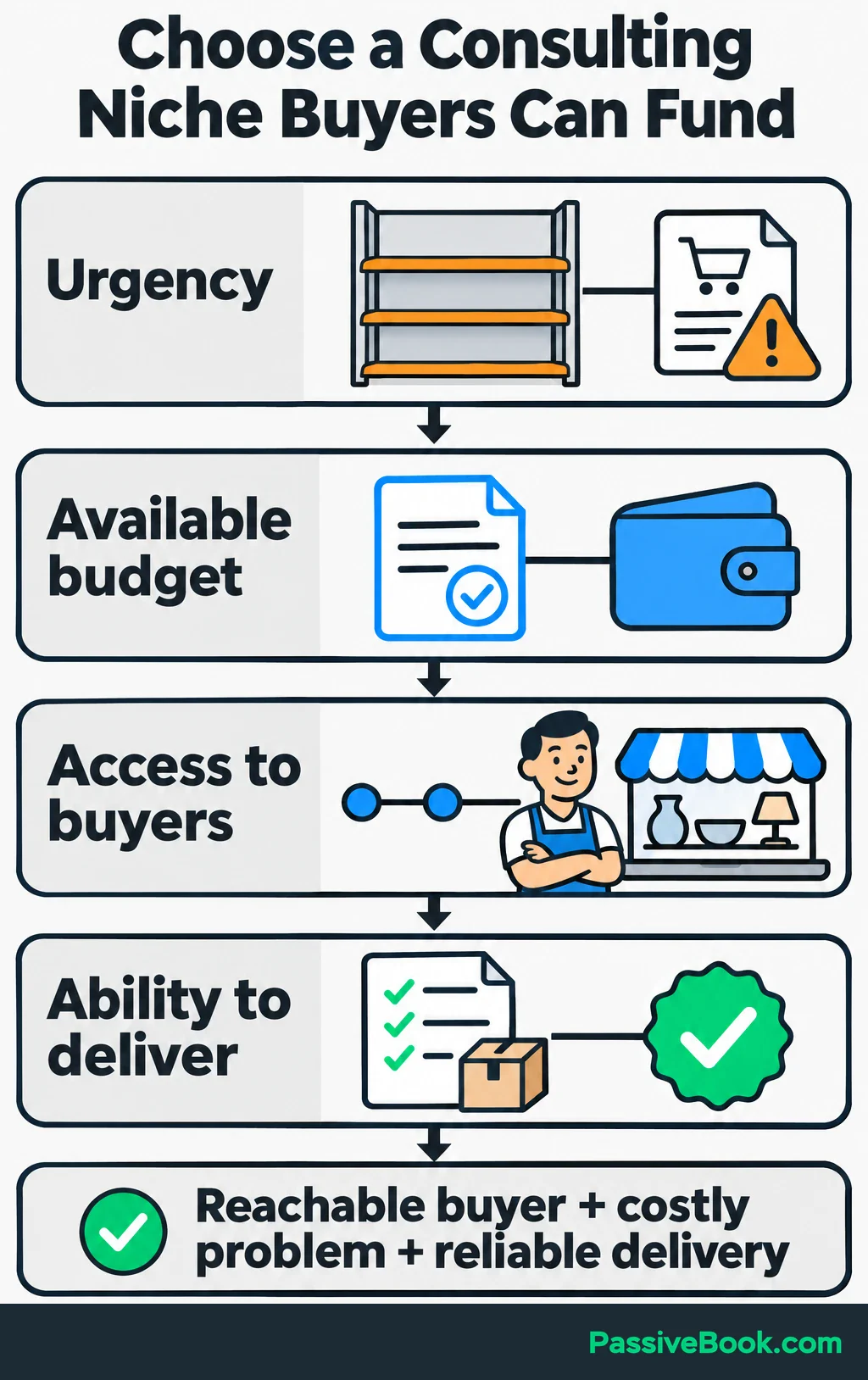
Then compare possible niches by urgency, available budget, access to buyers, and your ability to deliver. I would choose a narrow problem with reachable buyers over a broad specialty that requires explaining why anyone should care.
Throughout this guide, we’ll use a consulting business that helps independent online homeware stores decide when and how much stock to reorder. Its fees, costs, hours, and financial results are illustrations, not typical outcomes.
Its positioning could be:
“I help independent online homeware stores identify inventory-planning problems and improve replenishment decisions.”
That gives a potential buyer something concrete to assess. “Business transformation consultant” gives them homework.
Choose training around gaps that would prevent reliable delivery. A certificate should solve a competence problem or meet a requirement, rather than postpone talking to buyers. Check whether your proposed work requires a professional license before offering it.
If you’re employed, also review your contract and workplace policies before approaching prospects. Look at outside work, confidentiality, ownership of work, and restrictions on approaching clients or colleagues. For example, Acas explains how employment terms can restrict outside work and certain actions after leaving in the UK. Get local advice where your obligations are unclear.
Test Demand Through Buyer Conversations
Ask buyers about something that happened, rather than whether they like your idea.
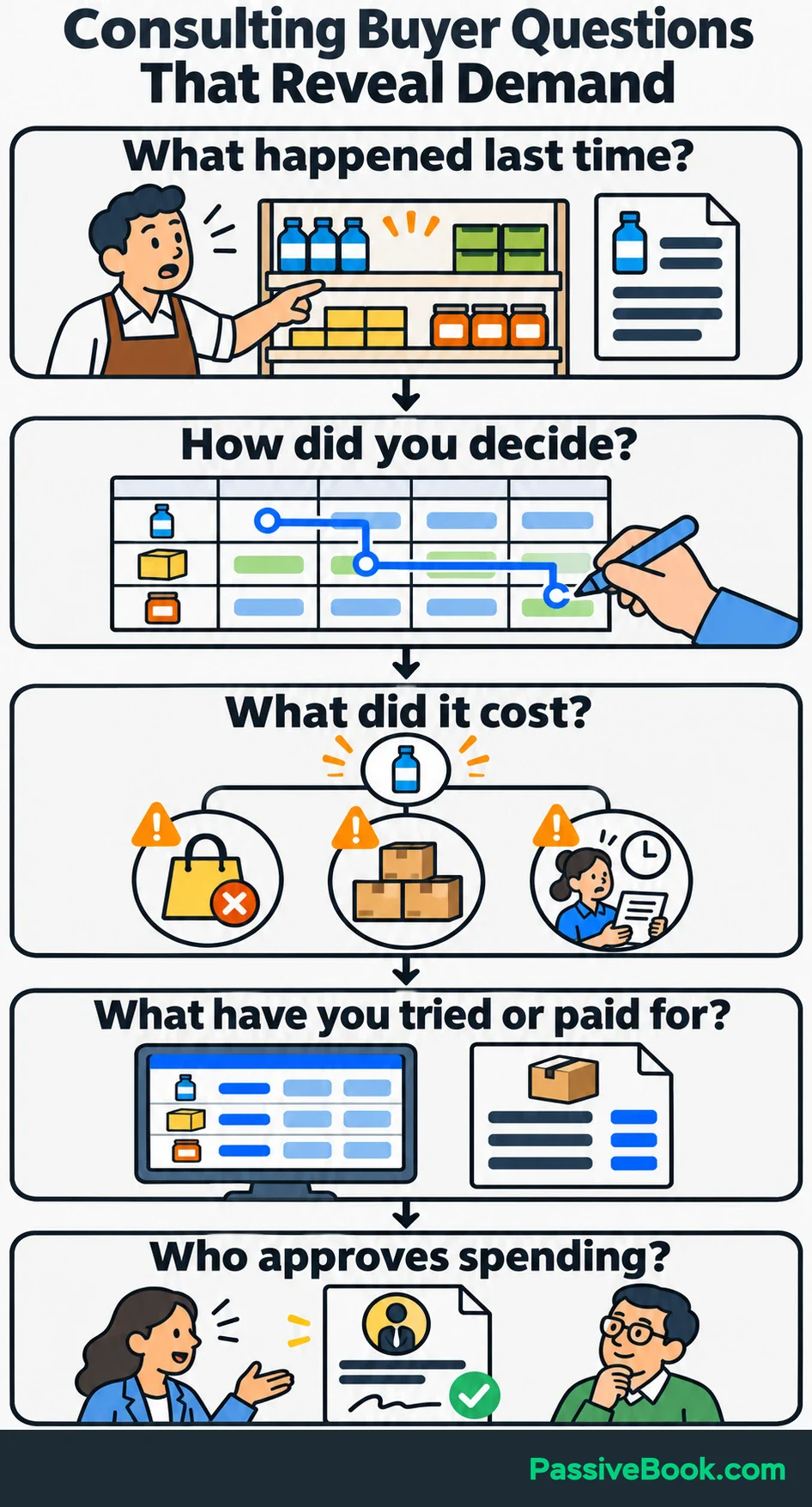
For the inventory-planning offer, useful questions include:
- “What happened the last time a bestseller sold out?”
- “How did you decide how much to reorder?”
- “What did the problem cost you in extra work, missed orders, or excess stock?”
- “What have you tried, and have you paid for help?”
- “Who would approve spending on this?”
Listen for consequences and action. A recurring problem with a named budget owner deserves more attention than an interesting complaint nobody plans to address.
Also find out what your service would replace or support. The store might already have software and an employee managing orders, but still need help reviewing purchasing assumptions. Your competition includes internal work and postponing the decision. The SBA’s market-research guidance includes both direct research and competing alternatives.
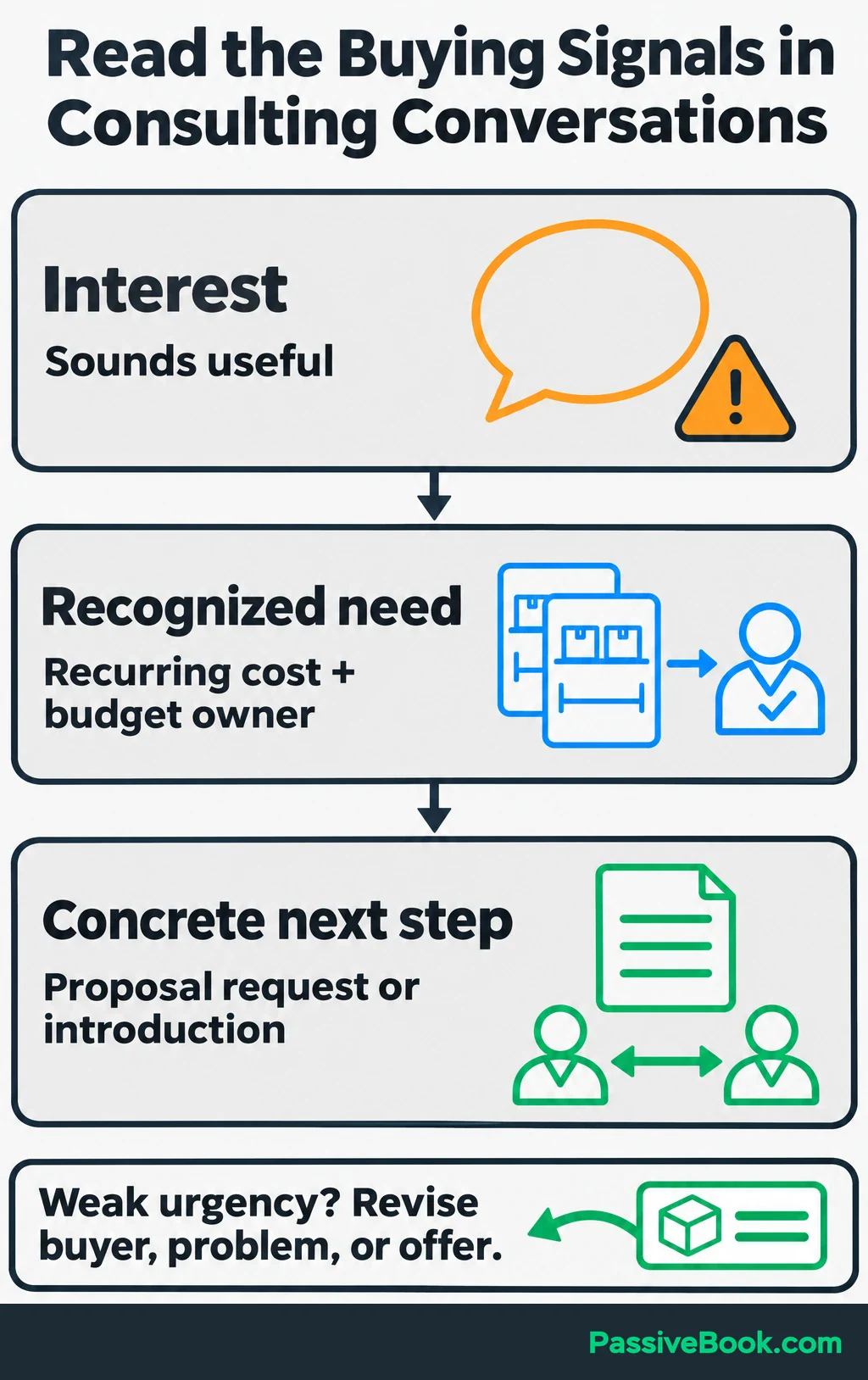
A request for a scoped proposal or an introduction to the decision-maker moves the conversation forward. “Sounds useful” is pleasant, but it doesn’t pay an invoice.
Revise the buyer, problem, or offer when urgency is weak. Once the necessary business setup is complete, test a small paid engagement.
Package Your First Consulting Offer
Turn the problem into a piece of work with a clear beginning and end. Define what you will investigate, what the client receives, what they must provide, and how you’ll both know the assignment is complete.
I would start with a bounded project that has value on its own. Don’t make the first purchase depend on a vague promise of help over the next year.
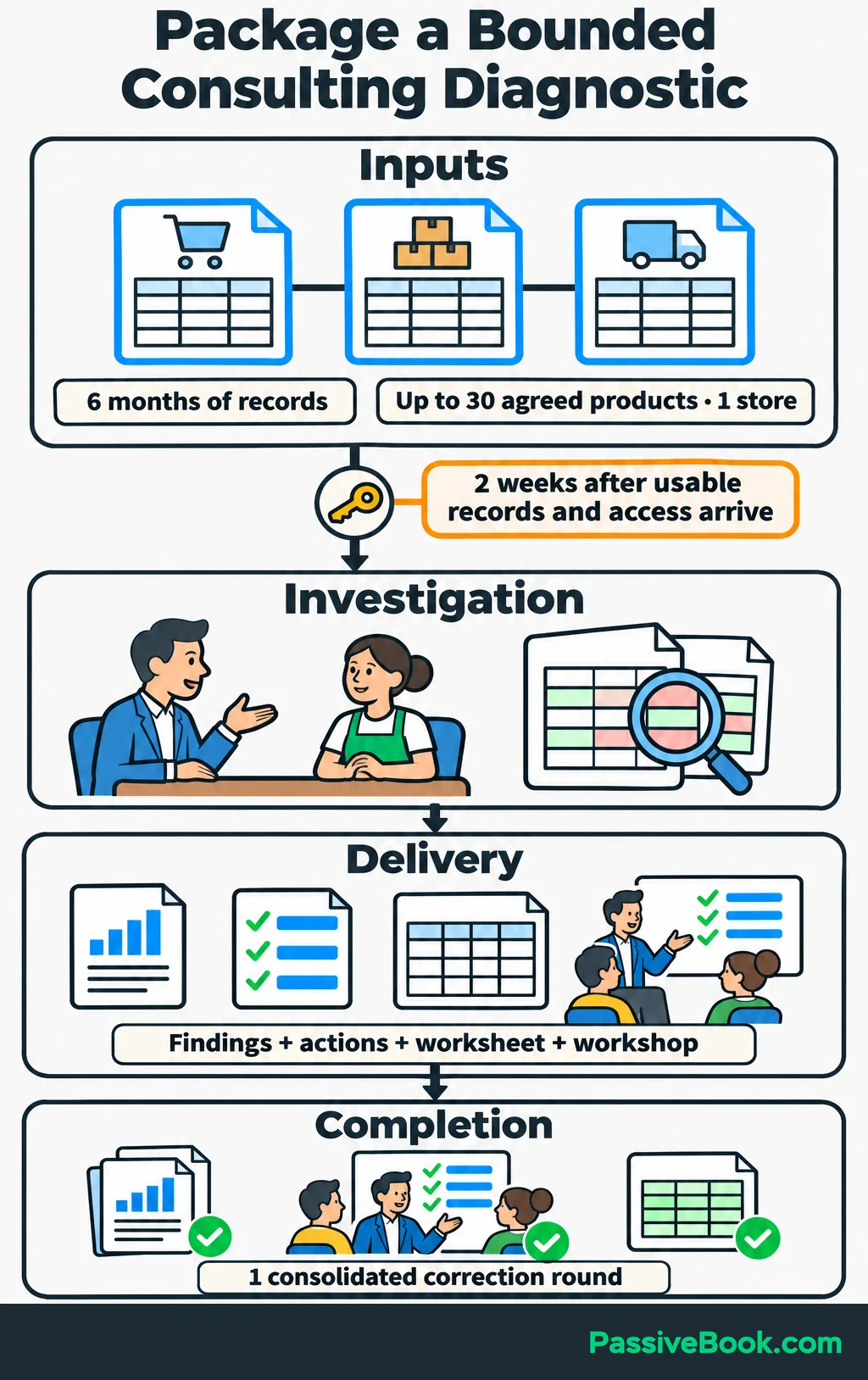
For the homeware store, that could be an inventory diagnostic—a short project to find problems in stock records and reorder decisions:
| Offer Detail | Inventory Diagnostic |
|---|---|
| Buyer’s problem | Repeated stockouts and unclear reorder decisions for an agreed product range |
| Work performed | Review six months of sales, stock, and supplier records; interview the owner; investigate planning gaps |
| Deliverables | Written findings, a prioritized action list, a replenishment worksheet, and a findings workshop |
| Scope boundary | Up to 30 agreed products from one store |
| Duration | Two weeks after usable records and required access are received |
| Client responsibilities | Supply records, explain current practices, attend the workshop, and approve purchasing decisions |
| Exclusions | Buying stock, managing orders, replacing inventory software, and cleaning unrelated records |
| Completion criteria | Agreed materials delivered, workshop completed, and one consolidated round of corrections addressed |
Separate the work you control from the improvement the client wants. You can promise a completed analysis and usable worksheet. Fewer stockouts also depend on purchasing decisions, supplier performance, and implementation.
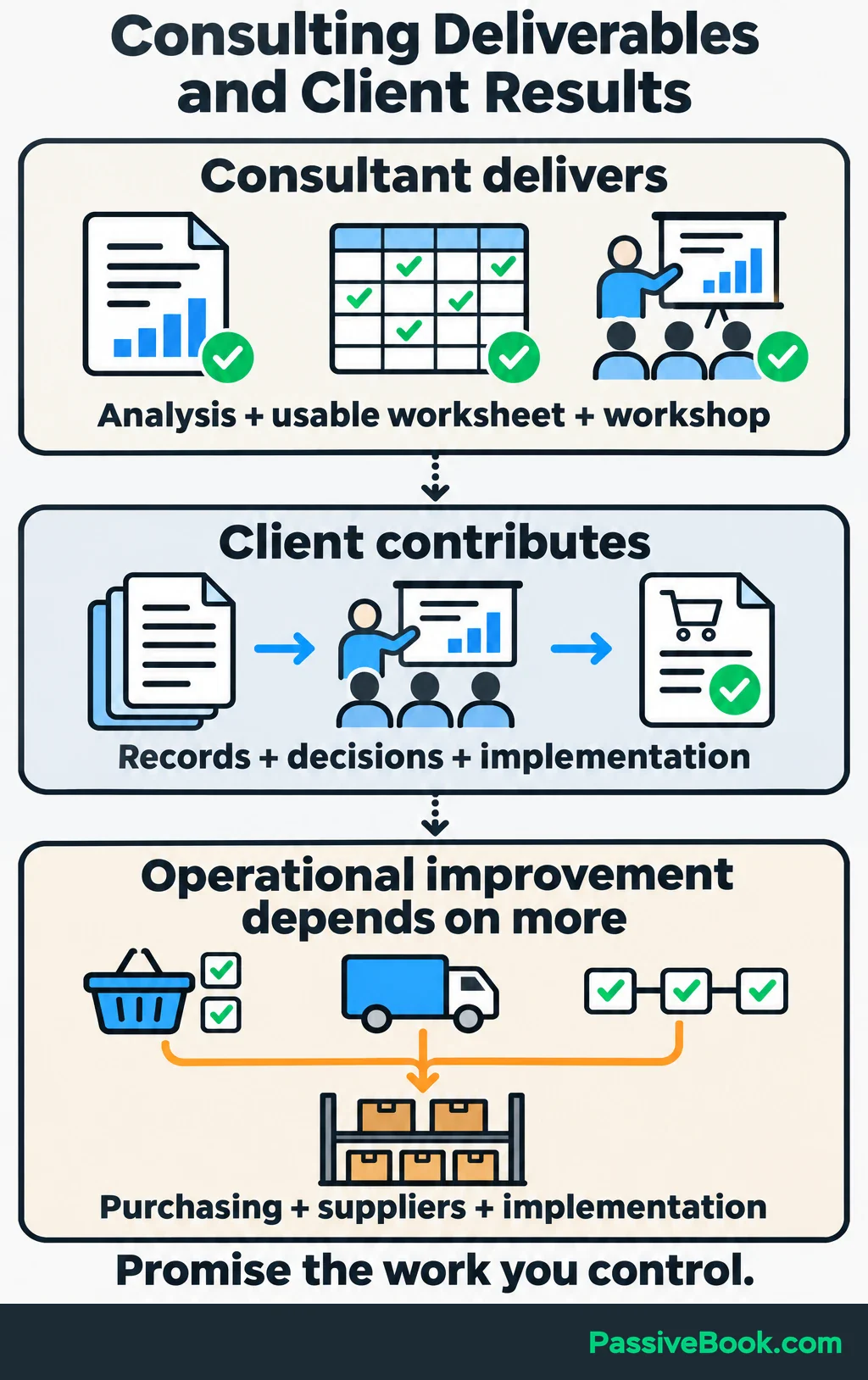
You can advise, implement, or combine both. Choose the responsibility you can competently carry and name the client’s part.
If you’re struggling to put boundaries around your own service, the AI Skill below can draft the offer and a message to introduce it. You’ll have something concrete to discuss with a buyer, without presenting untested outcomes as promises.

Free AI Copywriting Studio




Remote meetings and shared records may be enough for this diagnostic. Add site visits when observing the work is necessary. If you need substantial investigation before you can quote for a larger assignment, offer a separate paid assessment first. Give the client useful findings and a recommended scope for the larger project.
How Much Money Do You Need to Start?
Build your launch budget from actual requirements. Count setup costs, operating expenses until you expect to collect payment, and a contingency for delays or surprises.
Business.gov.au’s startup-cost guidance separates initial and ongoing expenses. Use that distinction, then obtain local fees and provider quotes.
A practical budget might begin like this:
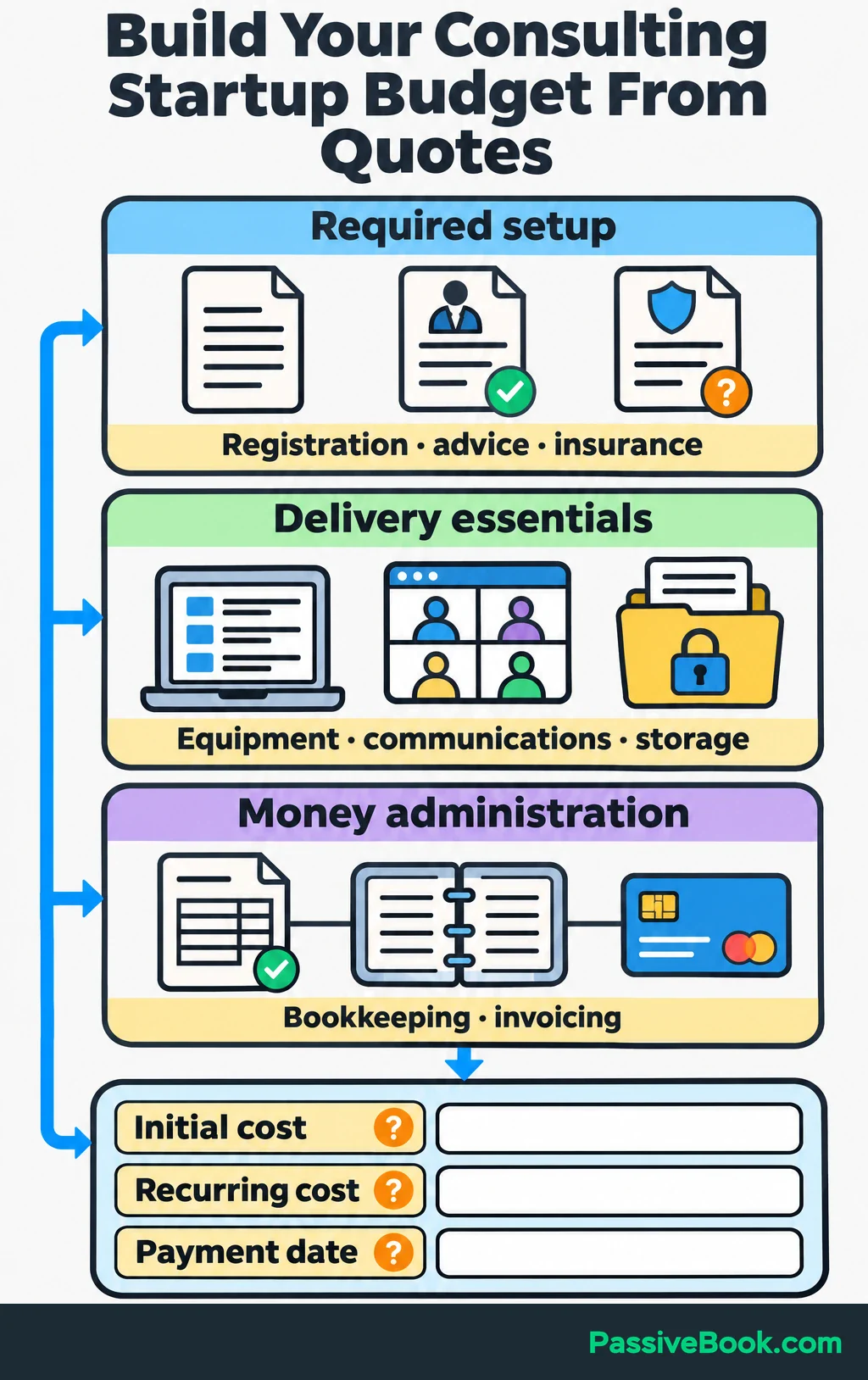
Local fees and provider quotes are still needed for this example. For each required item, record the initial cost, recurring cost, and payment date.
| Expense | What to Confirm |
|---|---|
| Registration and permits | Required filings, fees, and renewal dates with the relevant authority |
| Legal and accounting setup | A scoped quote for necessary advice and reusable contract terms |
| Insurance | A quote covering the services and risks of the first engagement |
| Equipment | Whether existing equipment meets delivery and security needs; replacement costs if it doesn’t |
| Communications and storage | Charges for suitable email, meetings, and secure files |
| Bookkeeping and invoicing | Costs of any software or support needed beyond your existing tools |
Use equipment and workspace you already have when they meet the job’s needs. I would defer office rent, elaborate branding, and overlapping subscriptions.
For the example, suppose setup costs total $600 and monthly overhead is $300. Funding setup plus three months of overhead means:
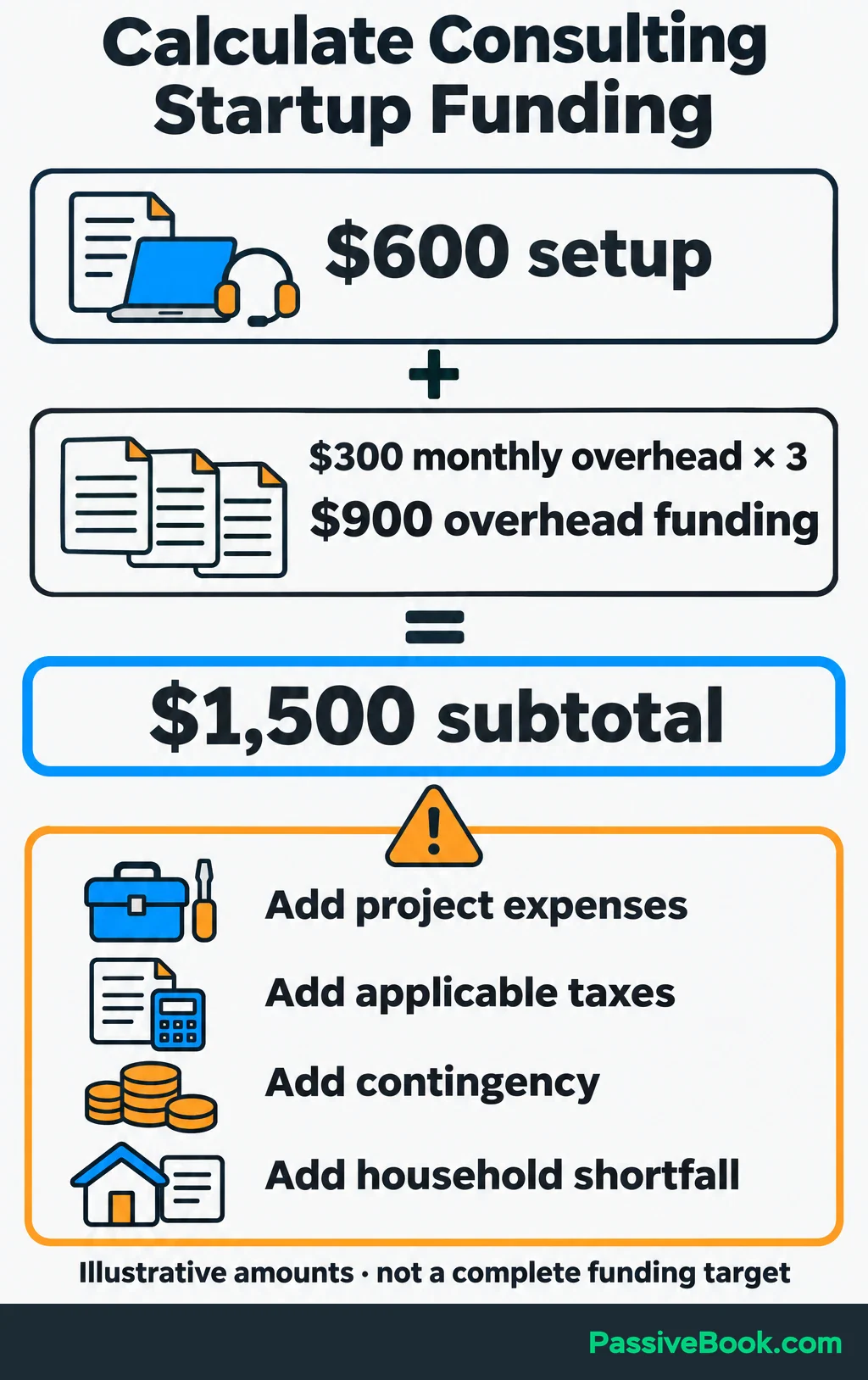
$600 + ($300 × 3) = $1,500.
That excludes project expenses, applicable taxes, contingency, and any household shortfall. Add those separately.
My earlier freelance income swung from roughly $280 in my worst month to $4,100 in my best. Those were freelance earnings, but they taught me why one good month is a poor basis for a permanent spending decision.
Before leaving employment, compare household needs with collected consulting income, repeatable demand, and remaining reserves. Choose your cash buffer around your obligations and likely payment delays.
Set Consulting Fees That Sustain the Business
Calculate a Sustainable Planning Rate
Start with the calendar you actually have. Reserve time for finding clients, writing proposals, administration, learning, and time off before counting delivery hours.
Your internal planning rate spreads three amounts across realistic client-delivery hours: what you want to pay yourself before tax, business overhead, and any extra profit you want to leave in the business:
Planning rate = (desired pretax owner compensation + overhead + planned business surplus) ÷ client-delivery hours.
Suppose you have 60 business hours available each month, and you reserve 30 for sales and administration. That leaves 30 delivery hours.
If you want $2,700 in pretax owner compensation, need $300 for overhead, and plan no additional surplus:
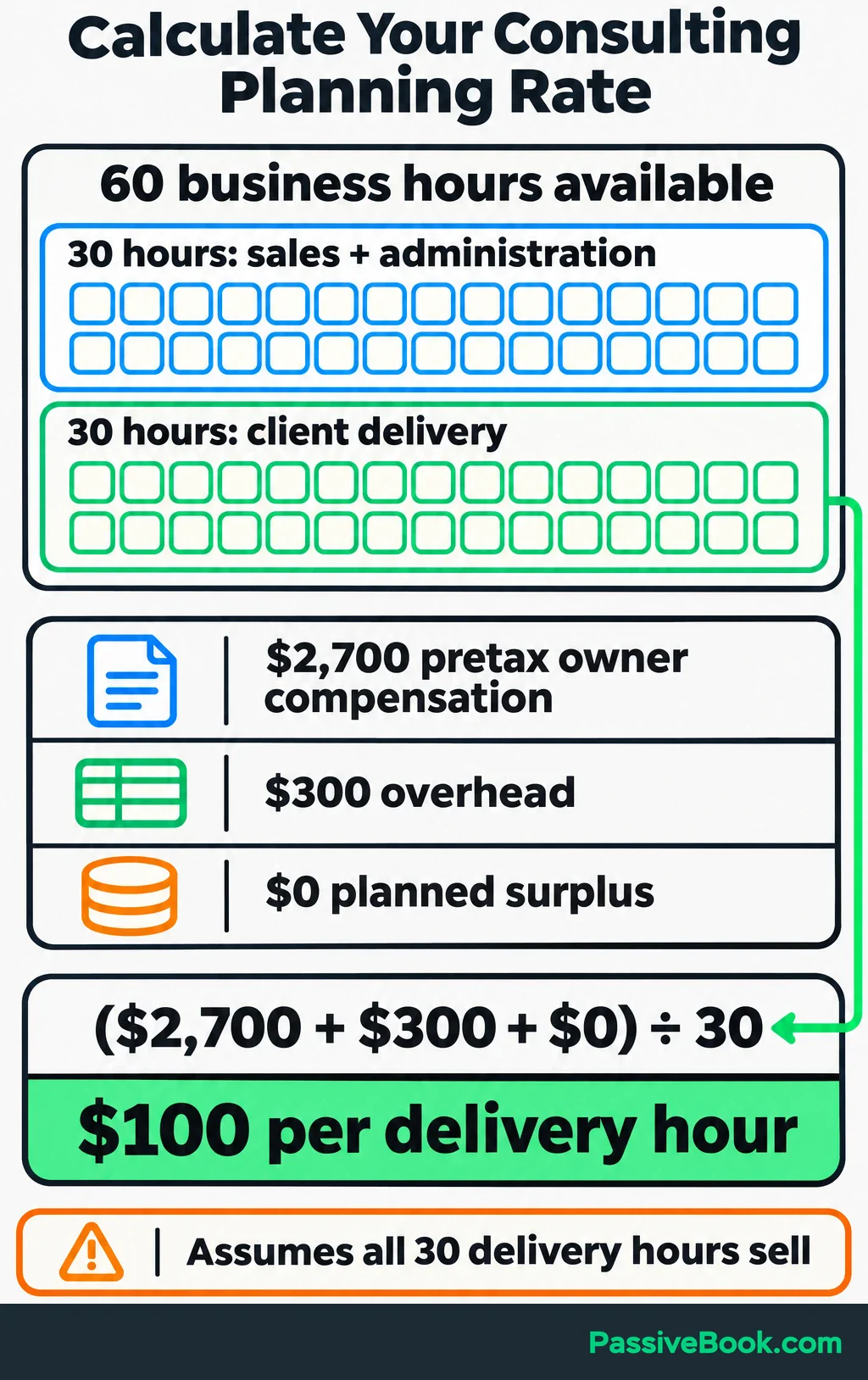
($2,700 + $300) ÷ 30 = $100 per delivery hour.
Owner compensation is a planning input here; its accounting treatment depends on your business structure. This calculation also assumes those delivery hours sell.
Estimate the whole assignment. Include preparation, meetings, analysis, email, revisions, and handover.
For a diagnostic requiring 15 delivery hours and $100 in direct expenses:
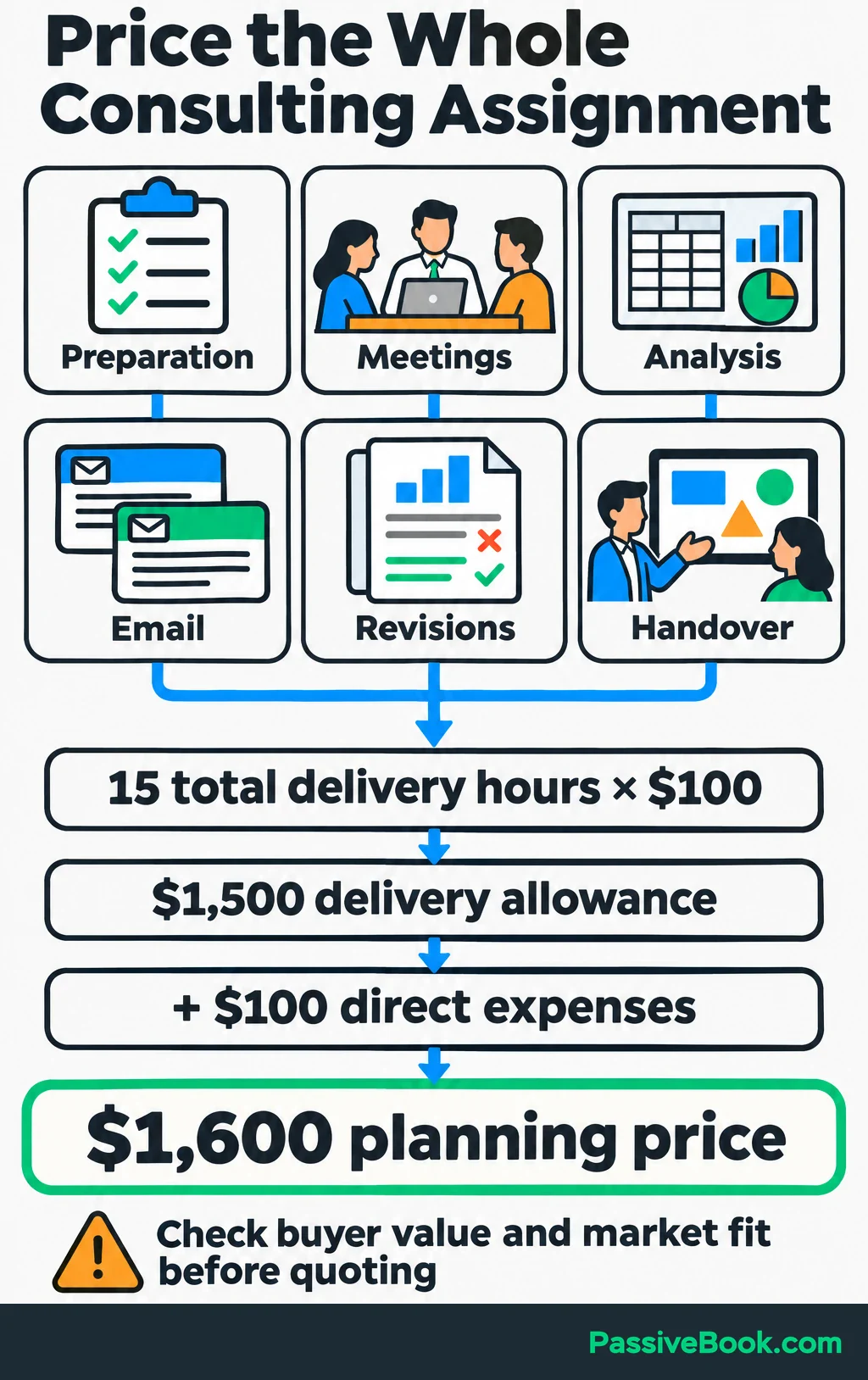
(15 × $100) + $100 = $1,600.
During my freelance years, I sometimes estimated the obvious work and left the surrounding conversation out of the price. The file looked finished, but questions and changes kept arriving. Now I would estimate that surrounding work before quoting.
Use your planning price alongside buyer feedback, competing offers, and the value of solving the problem. Business.gov.au’s pricing guidance brings together costs, market research, and customer value.
If suitable buyers won’t pay enough, change the scope, delivery process, or target buyer. A lower price doesn’t repair an assignment that takes too long.
The planning rate assumes you sell the hours you set aside. Use the calculator below to test your own quote against fewer bookings, extra work, and bills due before the final payment.

Free Pricing Profit Calculator
Match the Fee Structure to the Assignment
Choose a payment model that fits how predictable the work is.
| Fee Model | Suitable Work | Necessary Scope Controls | Main Risk |
|---|---|---|---|
| Hourly or daily | Work whose volume is difficult to estimate | Written estimate, spending limit, time reporting, and approval before exceeding the limit | The buyer fears an open-ended bill |
| Fixed project fee | Work with clear deliverables and boundaries | Assumptions, required inputs, exclusions, revision limits, and change process | Extra work absorbs your margin |
| Retainer | A defined need that recurs | Included work, meeting limits, response expectations, availability, and treatment of unused capacity | “Ongoing support” becomes unlimited access |
I would start the example with the fixed diagnostic. The buyer can understand the commitment, and you can compare estimated effort with actual effort.
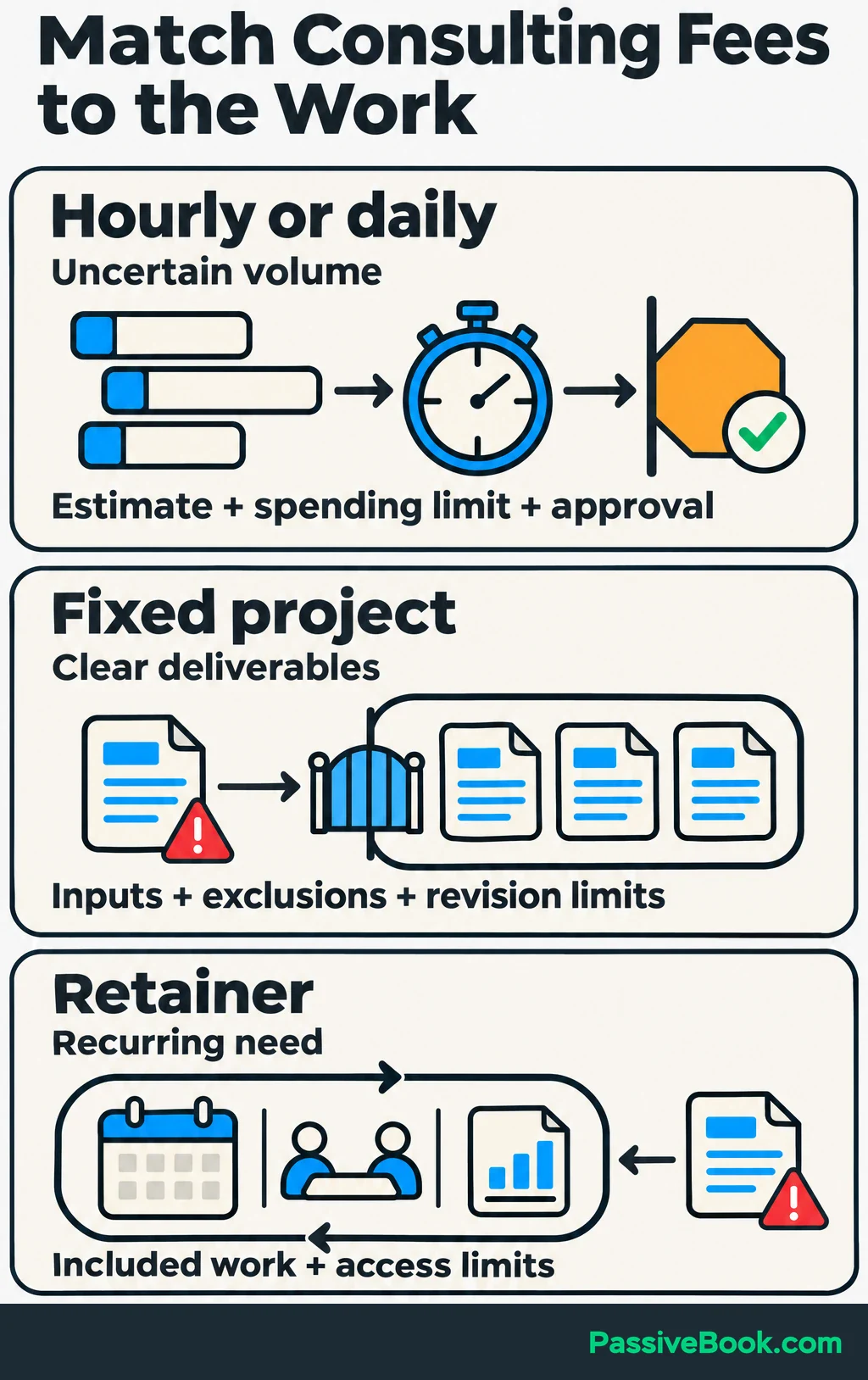
Offer monthly inventory reviews only when the store needs recurring help. Specify which records you review, which meeting is included, and what happens when the owner requests additional analysis.
Expected client value should inform the quote, but the payment basis must stay clear. Calling a fee “value-based” doesn’t explain what the client receives.
Set Up Your Consulting Business
Choose a structure based on ownership, liability exposure, administration, taxes, and ongoing costs.
For U.S. readers, a sole proprietorship does not separate personal and business liabilities, while an LLC generally offers liability protection with limits. The SBA’s structure comparison explains the main differences. Choose with local advice rather than assuming one structure suits every consultant.
Before selling or delivering work, check which requirements apply to your location and activity:
- Business-name and entity registration.
- Tax registrations.
- Professional licenses or permits.
- Permission to operate from home.
- Required insurance and client coverage requirements.
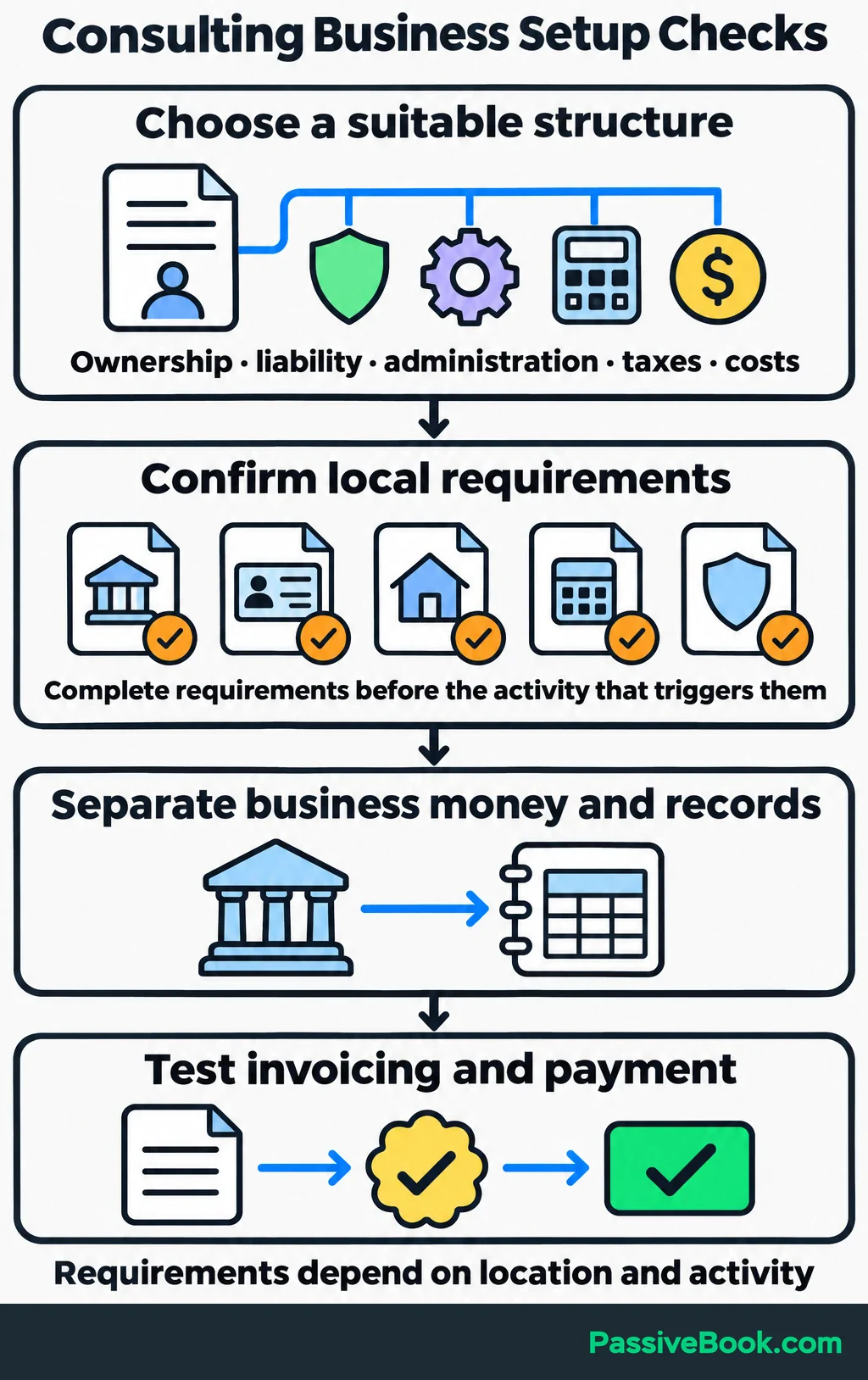
Complete each requirement before the activity that triggers it. U.S. readers can use the SBA launch guidance to identify registration, licensing, banking, and insurance checks.
Discuss professional liability coverage for claims involving errors or negligence in your services. General liability addresses different risks, such as bodily injury or property damage.
Then establish dedicated business banking, separate records, bookkeeping, invoicing, and a suitable payment method. Test the payment process before sending the first invoice.
Keep the operating tools lean: business email, a calendar, video meetings, secure document storage, and a project tracker. A spreadsheet can track prospects, and Notion can hold your delivery checklist. I would buy another tool only after identifying a job the existing setup cannot handle.
Find Your First Consulting Clients
Make Your Expertise Easy to Assess
Create one service page or a short capability document that answers:
- Who do you help?
- What problem do you address?
- What can someone buy first?
- How does the work happen?
- What relevant experience supports your approach?
- What should an interested buyer do next?
If you already use WordPress, add the page there. Otherwise, a simple page or PDF is enough to begin conversations.
Show relevant past work through short problem–action–result examples. State your own contribution and obtain permission before using employer work, client information, names, or testimonials.
My corporate data-science background belongs in my work history. It would not justify claiming consulting clients I never served. Keep that distinction clear in your own materials.
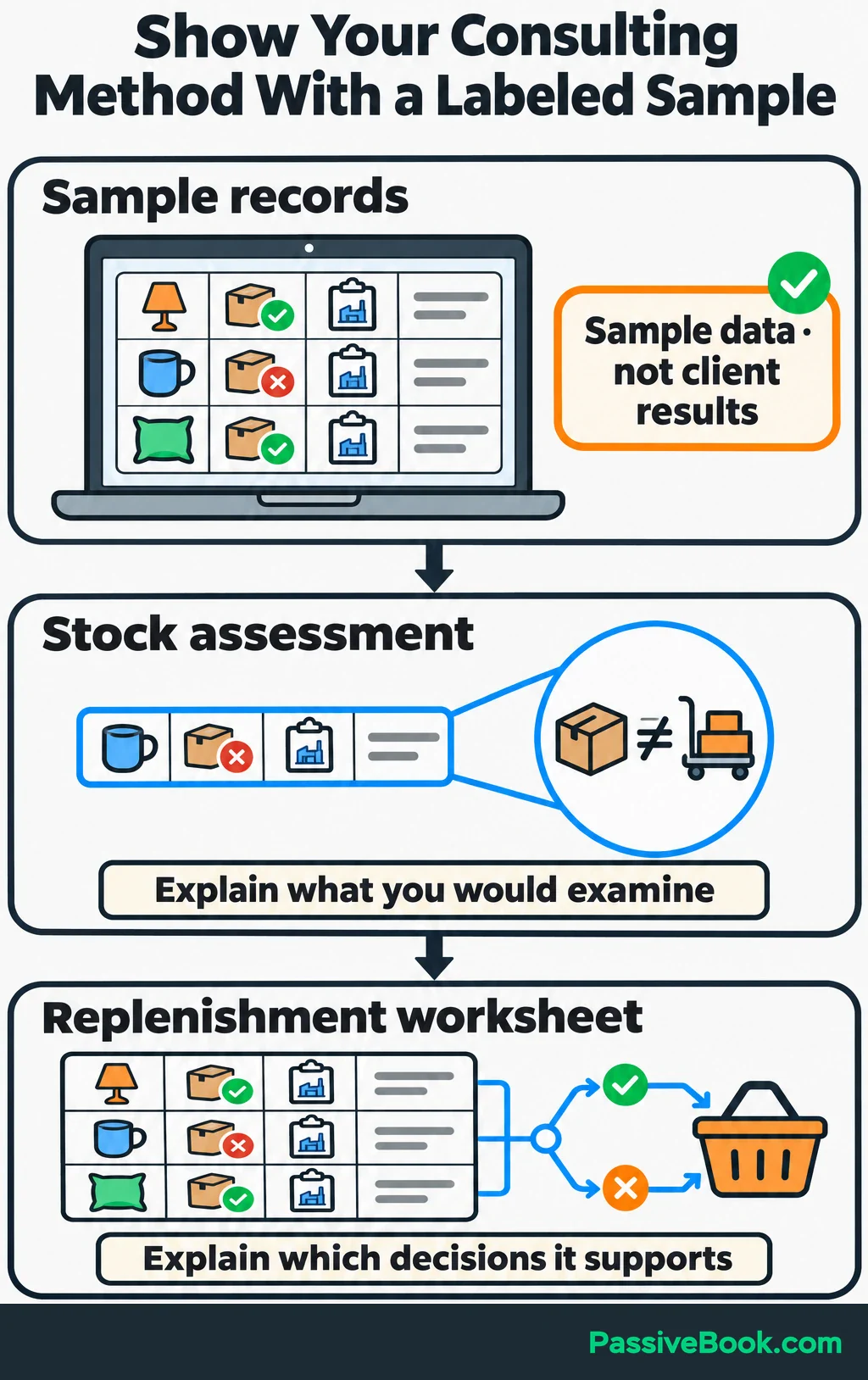
Without a consulting portfolio, demonstrate your method using a labeled sample. For the homeware offer, use sample records to show a stock assessment and a few rows of a replenishment worksheet. Explain what you would examine and which decisions the worksheet supports.
A useful sample lets buyers inspect your thinking without giving away a full diagnosis of their business.
Start Relevant Sales Conversations
Begin with people who know your work or can reach suitable buyers. Give them a specific introduction request:
“I’m offering inventory diagnostics for independent online homeware stores. Do you know an owner dealing with recurring stockouts who would welcome an introduction?”
Complementary providers can also be useful contacts. An ecommerce developer or bookkeeping provider may encounter stores with planning problems, even though they don’t solve those problems themselves.
Add targeted outreach and participation in places buyers already gather. Refer to something relevant, ask a focused question, and invite a conversation. Keep substantial diagnosis within paid work.
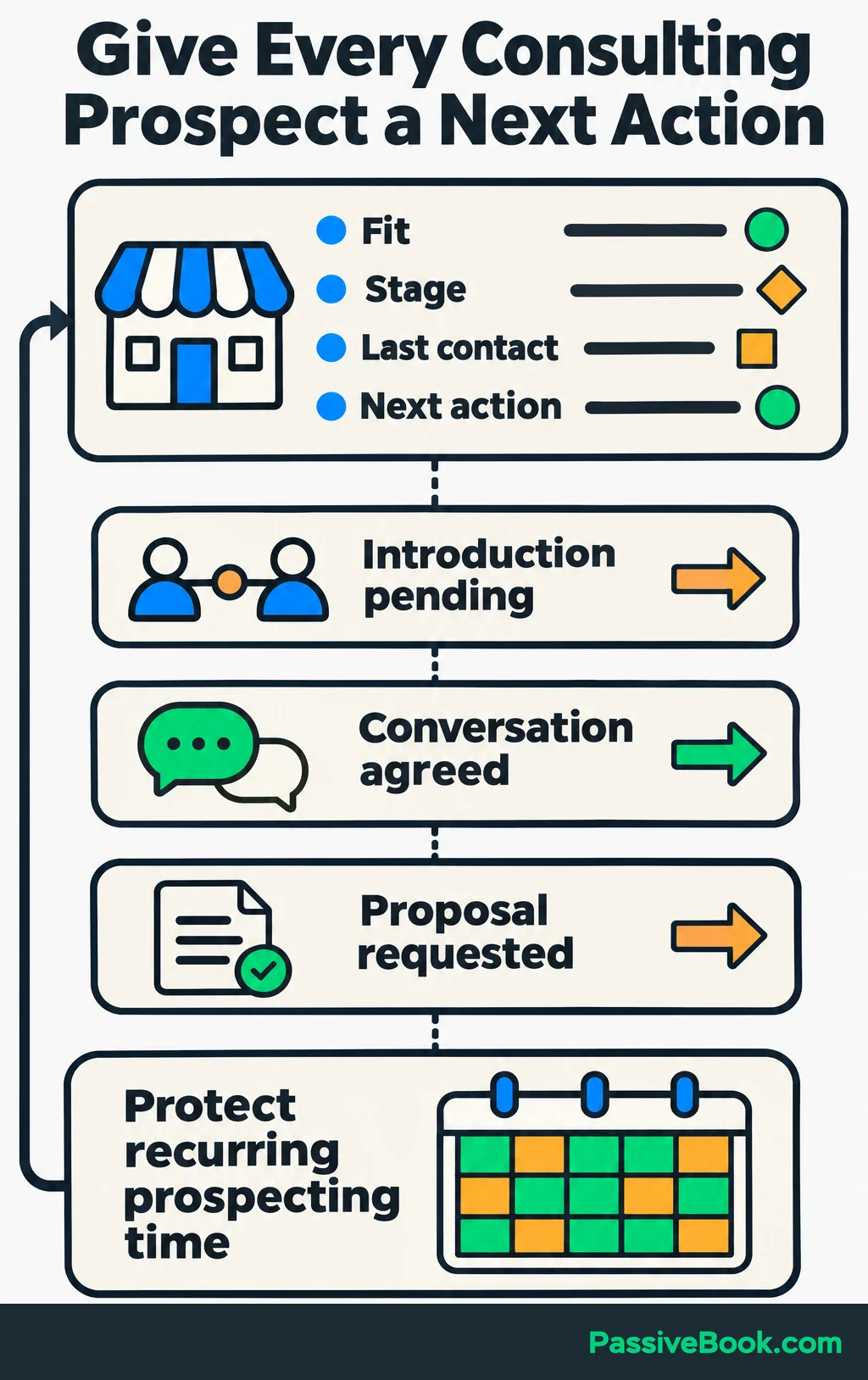
Track each prospect’s fit, stage, last contact, and next action in a spreadsheet or simple customer relationship management tool. Follow up when agreed, and record why work moves forward or stalls.
Protect a recurring prospecting block during delivery. Otherwise, finishing a project also means starting the search for the next one from scratch.
I would judge a channel by qualified conversations and signed engagements. Publish educational content around questions those buyers repeatedly ask, rather than filling a calendar with topics nobody has raised.
Turn Sales Conversations Into Signed Engagements
Qualify the Client Before Proposing Work
Use the sales call to decide whether you can help and whether the client can make the assignment work.
Establish the problem, desired change, urgency, budget process, decision-maker, and person responsible for implementation. Check required access and whether the client has time to provide inputs and make decisions.
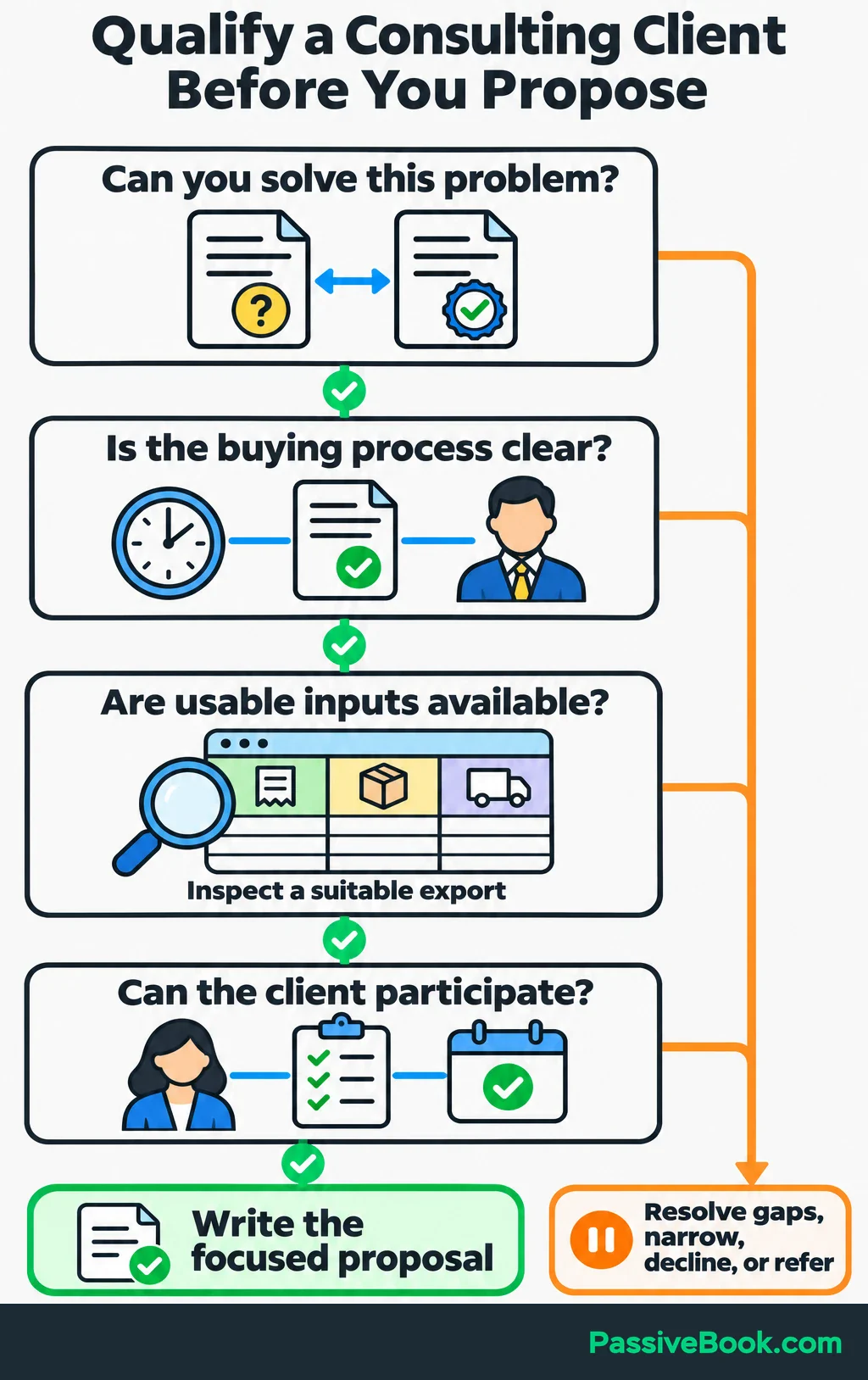
For the homeware diagnostic, ask to see the structure of a suitable data export before promising the analysis. Sales records, current stock counts, and supplier information may exist in different places. Discovering that early helps you scope the work.
Decline, narrow, or refer an assignment when it exceeds your expertise or essential cooperation is missing. A client who cannot supply records may need a different first project.
Then write a focused proposal connecting the agreed problem to your approach. Include deliverables, responsibilities, schedule, fee, and the next decision. The proposal should confirm the conversation, with any unresolved points clearly identified.
Agree on Scope and Payment Before Starting
Have both parties sign a written agreement before kickoff. It should cover:
- Deliverables, exclusions, milestones, and client inputs.
- Included revisions and how completion is accepted.
- Fees, expenses, payment dates, and overdue-payment procedures.
- How changes affect scope, price, and timing.
- Confidentiality, ownership of work, termination, liability, and disputes.
Australia’s contract guidance identifies useful topics for written terms. Have reusable terms reviewed for the law that applies to your work.
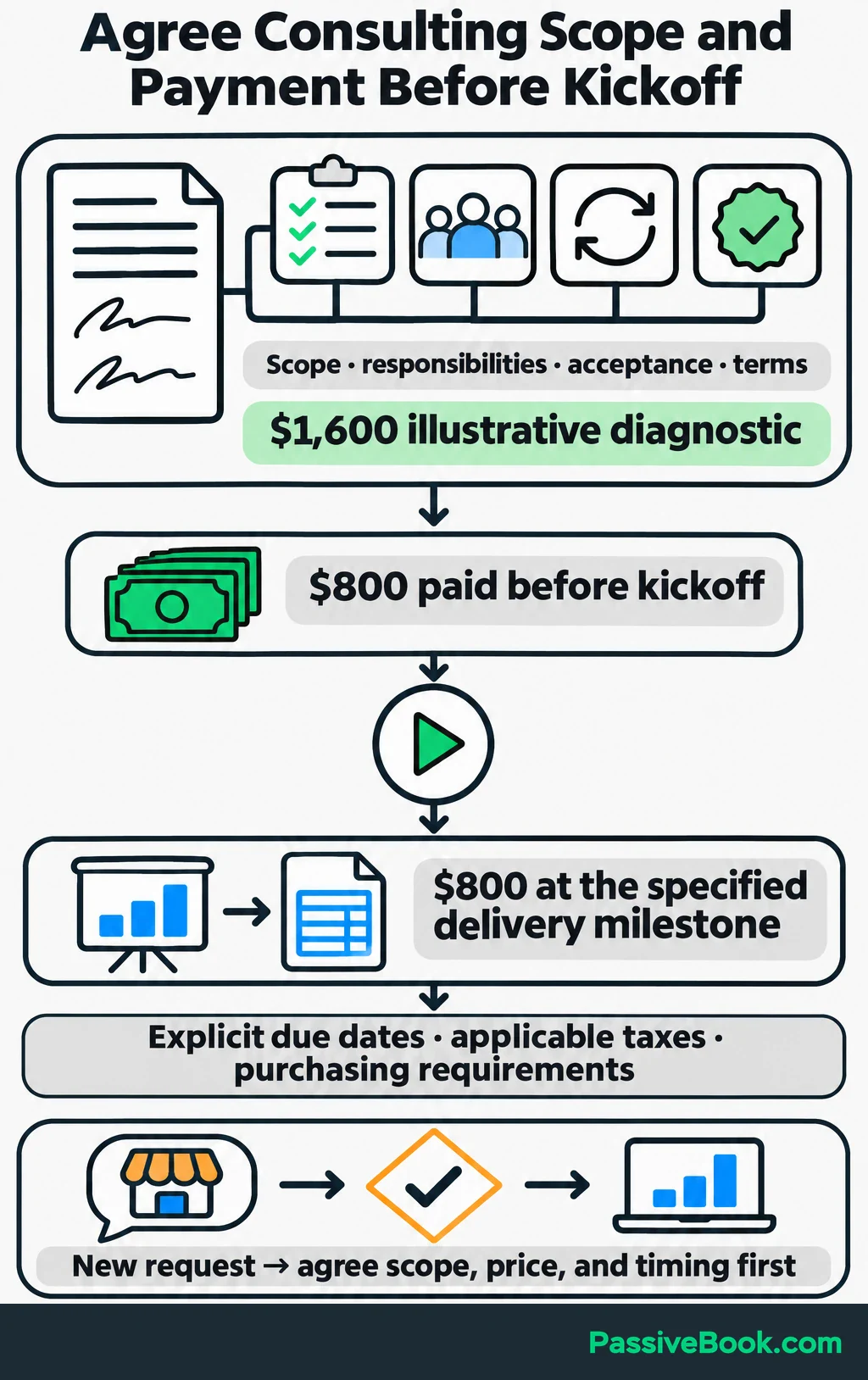
For the $1,600 diagnostic, you could agree on $800 paid before kickoff and $800 at the specified delivery milestone. Put explicit due dates in the agreement and invoices, and state how applicable taxes are handled.
Confirm purchasing requirements too. Find out who approves invoices and whether the client needs a purchase order.
When another request arrives, document its effect and agree on the change before doing it. “Can you also review our second store?” needs a scope decision, even if it appears at the bottom of a friendly email.
Deliver Consulting Work Clients Can Use
Establish a Shared Working Plan
At kickoff, confirm the objective, starting position, scope, milestones, client contact, communication schedule, and acceptance process.
Choose a baseline that fits the assignment. In the inventory example, record how the owner currently decides when and how much to reorder. If later support will measure stock availability, agree which products and observation period you’ll use.
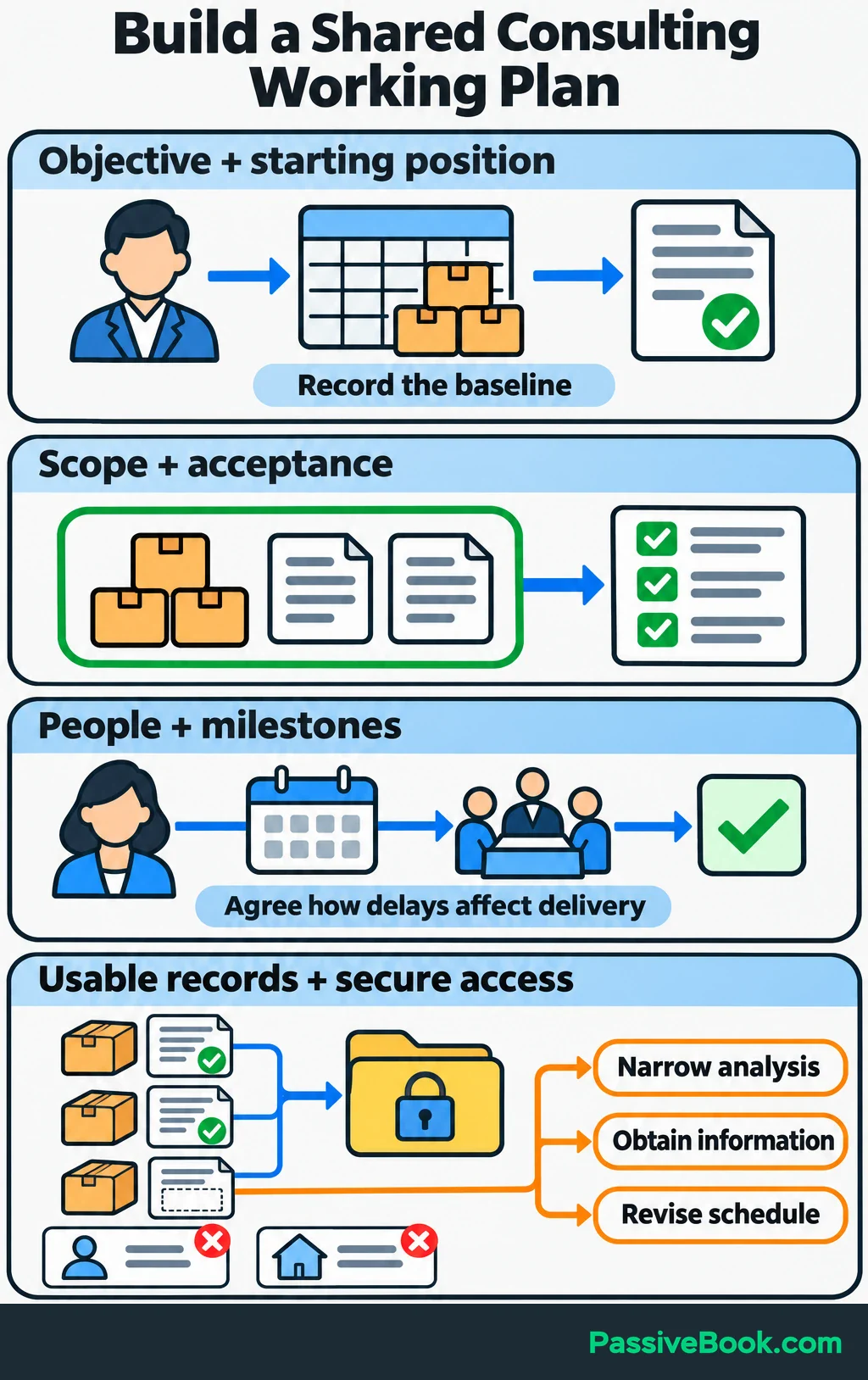
Check records before drawing conclusions. Missing stock history may limit what you can say about past shortages. Explain the gap once and agree whether to narrow the analysis, obtain more information, or revise the schedule.
Also agree how late inputs and delayed approvals affect delivery dates.
Collect only the client data needed for the job, restrict access, and agree how long to retain it. For this diagnostic, product-level records may be sufficient without customer names or addresses. The FTC’s data-protection guidance recommends minimizing personal information, protecting what you keep, and disposing of it securely.
Diagnose, Review, and Hand Over the Work
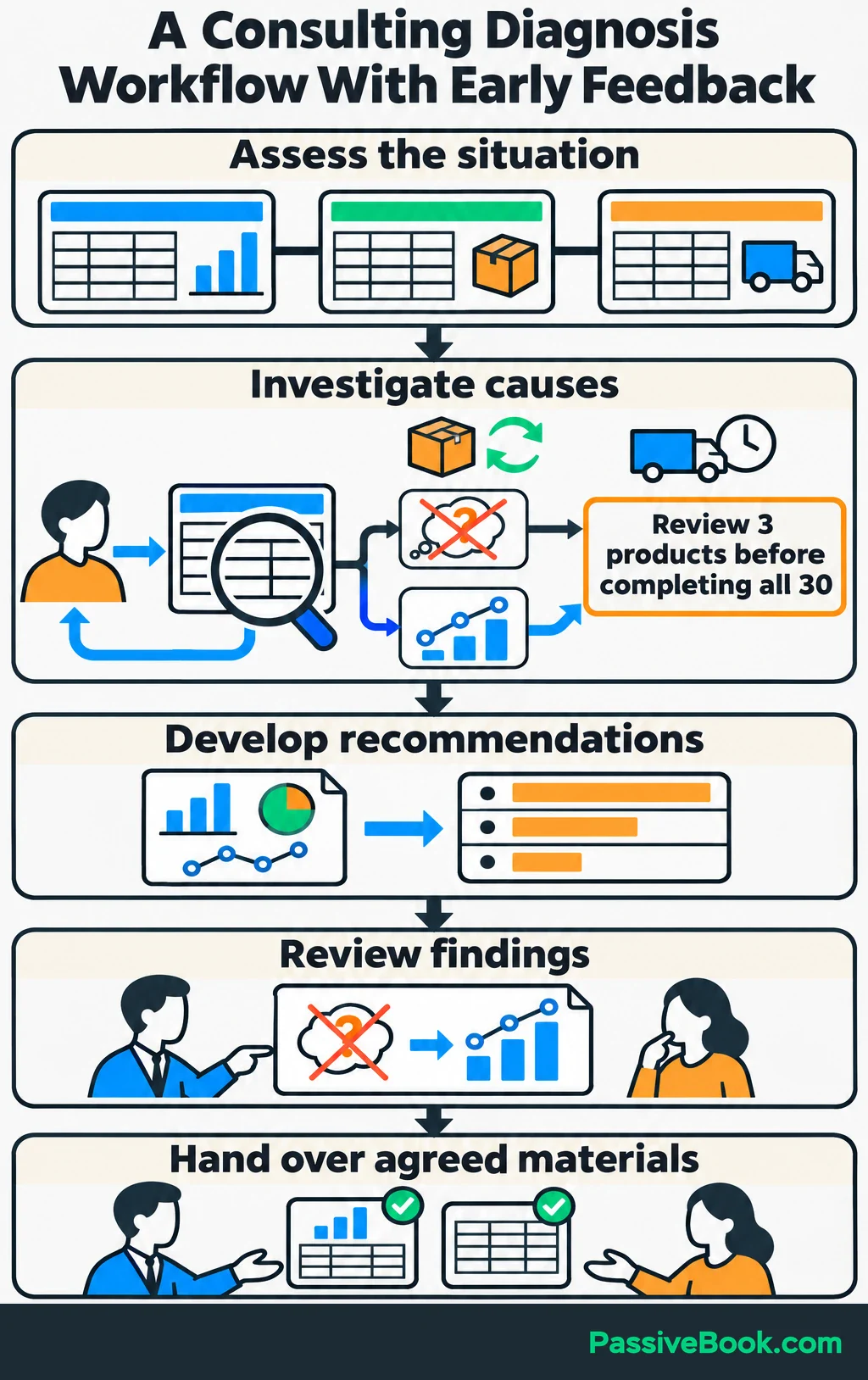
Use a repeatable sequence: assess the situation, investigate causes, develop recommendations, review findings, and hand over the agreed materials.
Review a small piece early. For example, show the owner your analysis of three products before completing all 30. That gives them a chance to explain a promotion, supplier delay, or recording habit you might otherwise misread.
Keep progress updates short:
- Work completed.
- Decisions or inputs needed.
- Next milestone and any blocker.
Track your time while delivering, including meetings and revisions. If the work expands, use the agreed change process.
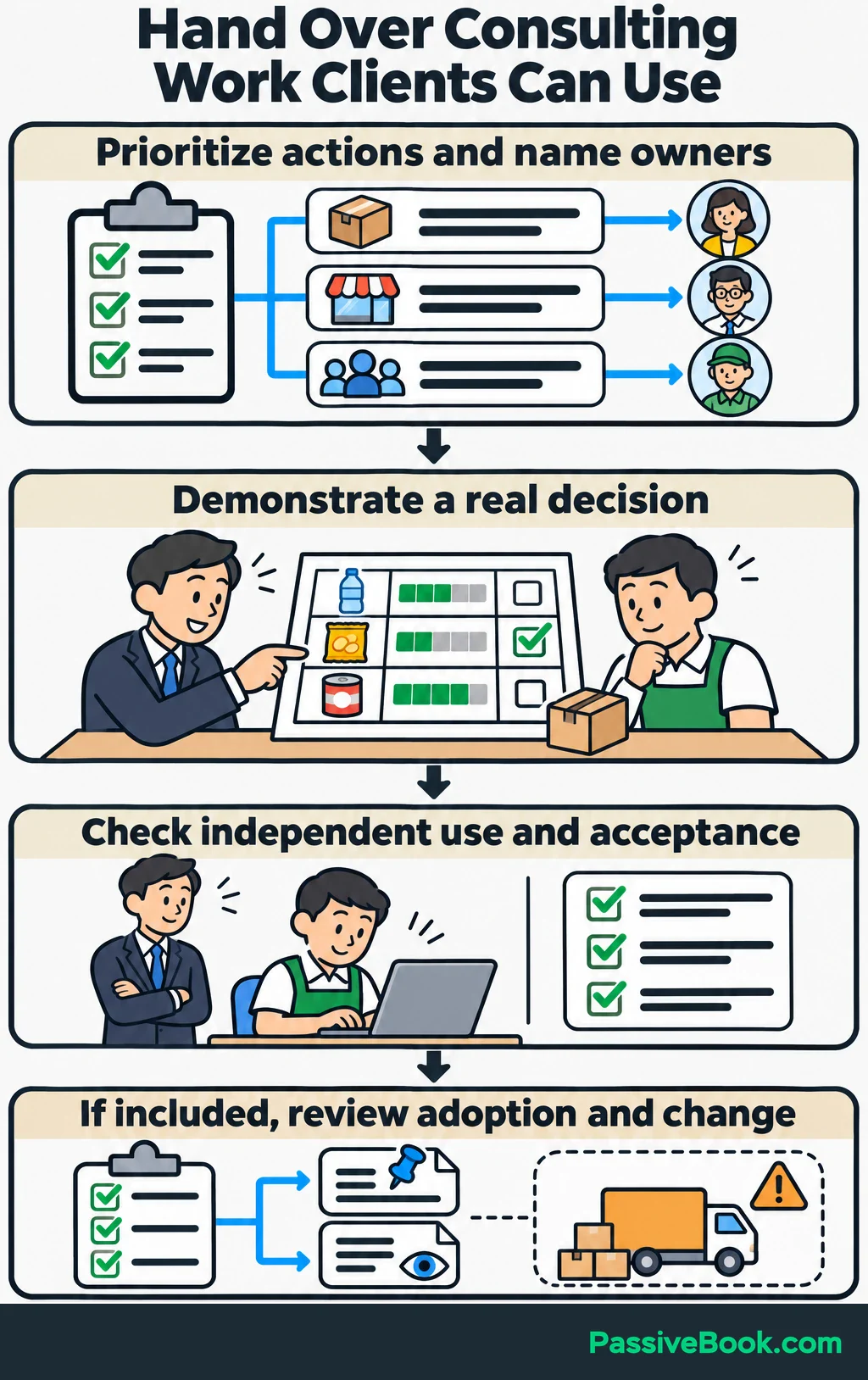
At handover, prioritize actions and identify who owns each one. Walk the owner through the replenishment worksheet using an actual purchasing decision, and check that they can use it themselves.
Complete the agreed acceptance process. If follow-up is included, review whether the recommendations were adopted and what changed against the baseline. Keep later developments distinct from results you can reasonably connect to the work.
Ask for feedback and relevant introductions after delivering something useful. A clear handover gives that request a reason to exist.
Manage Your Consulting Business Finances
Invoice and Collect Payment Consistently
Send invoices when the agreed milestone occurs. Include the invoice number, client and work reference, amount, due date, payment instructions, and applicable tax details.
Confirm receipt through the client’s required process. An invoice in your sent folder may still be missing from their approval system.
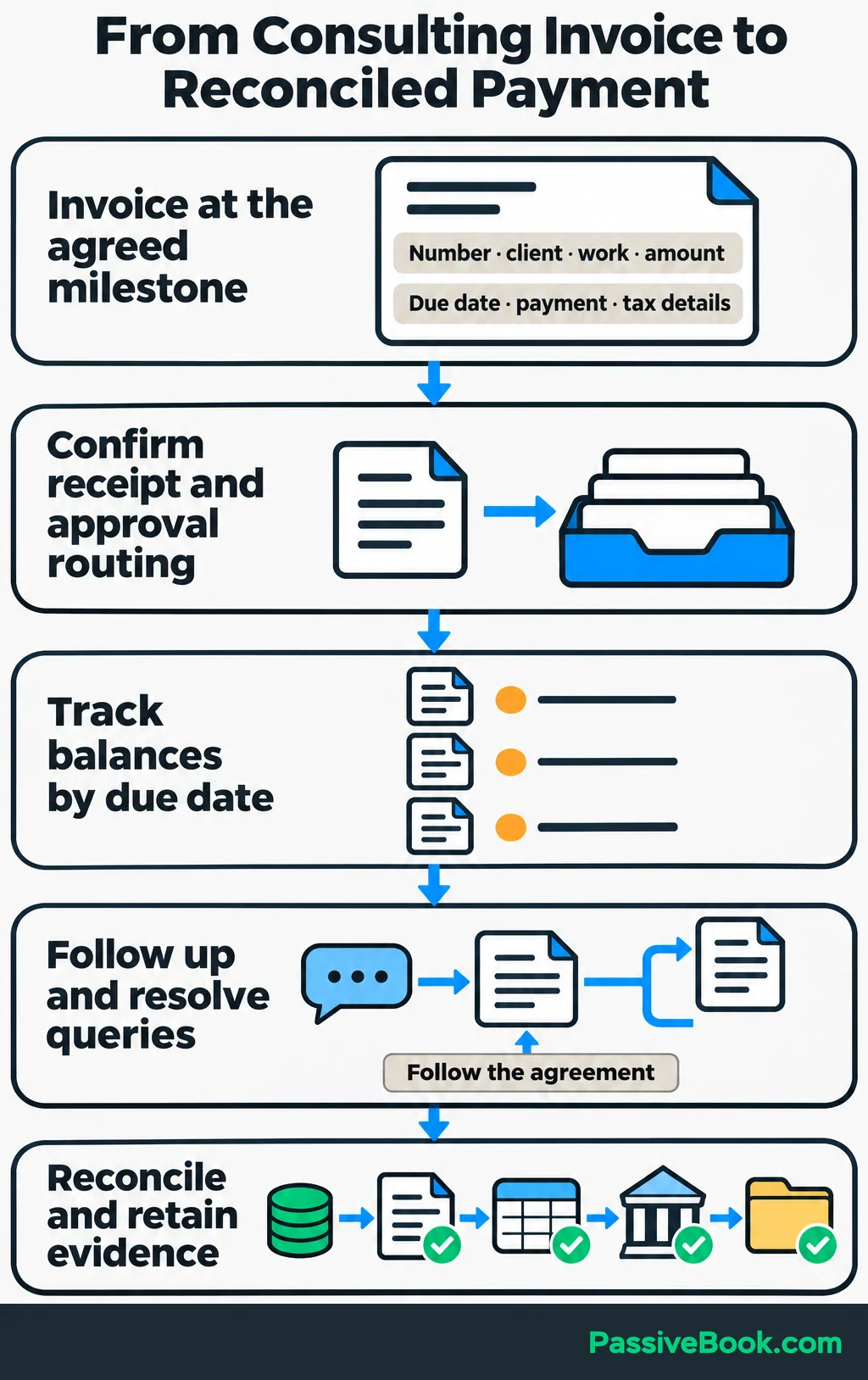
Maintain a list of outstanding balances by due date. Follow up consistently, resolve genuine queries, and apply the agreement’s escalation process when payment is overdue. If the terms allow work to pause after notice, follow those terms.
Reconcile payments and expenses regularly so your records match the bank. Keep invoices, receipts, agreements, and other supporting documents.
For U.S. businesses, the IRS recordkeeping guidance explains the need to show income and expenses and retain evidence supporting tax-return entries. Set retention rules around the requirements that apply to you.
Forecast Cash and Reserve for Taxes
Maintain a rolling cash forecast. A weekly view over the next three months is a useful starting point.
Show opening cash, expected collections, business payments, tax payments, owner withdrawals, and closing cash. Then test a late payment and a period without new work.
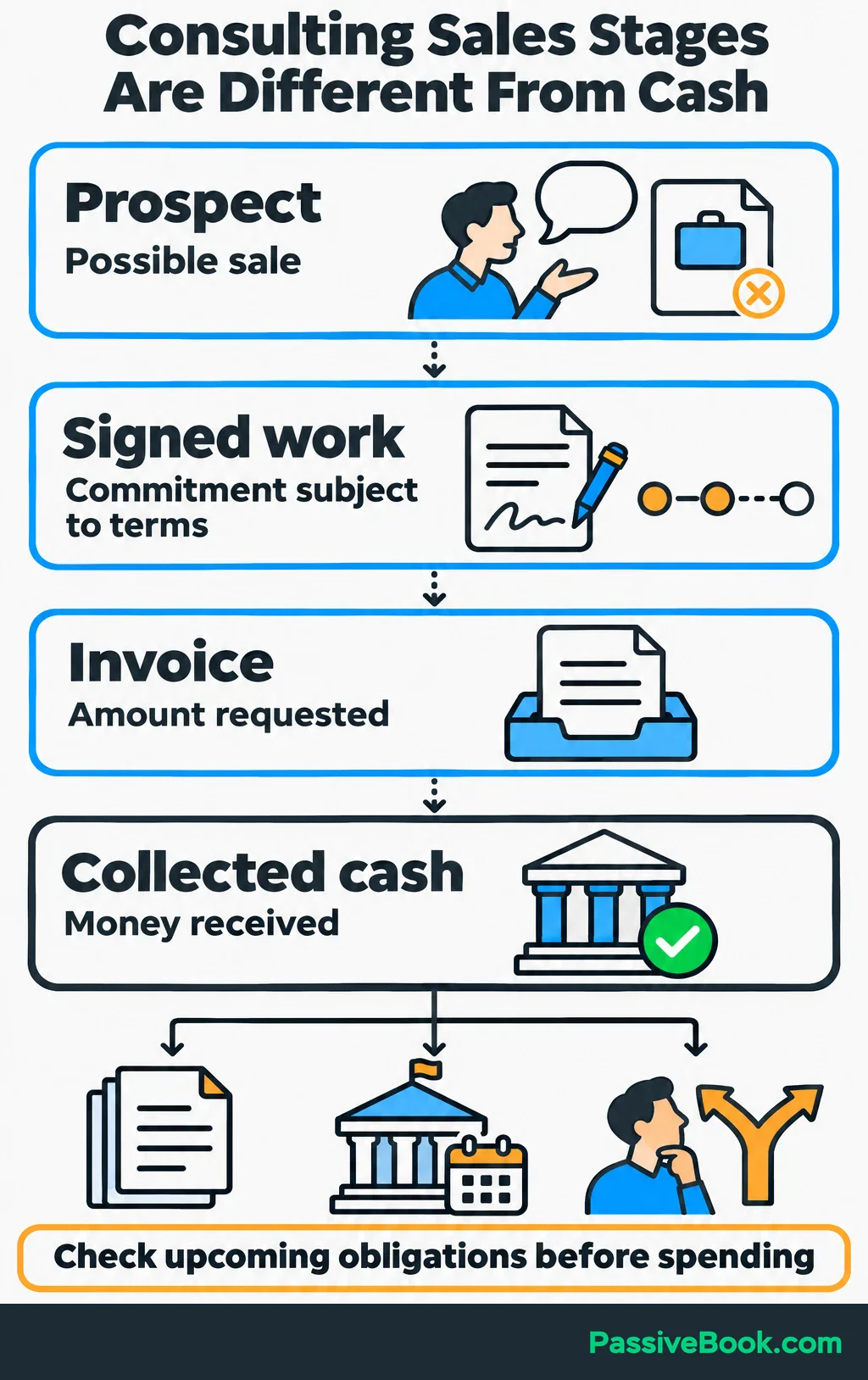
Keep these stages separate:
- A prospect is a possible sale.
- Signed work is a commitment subject to its terms.
- An invoice is an amount requested.
- Collected cash is money received.
Before spending or withdrawing money, check what that cash must cover next.
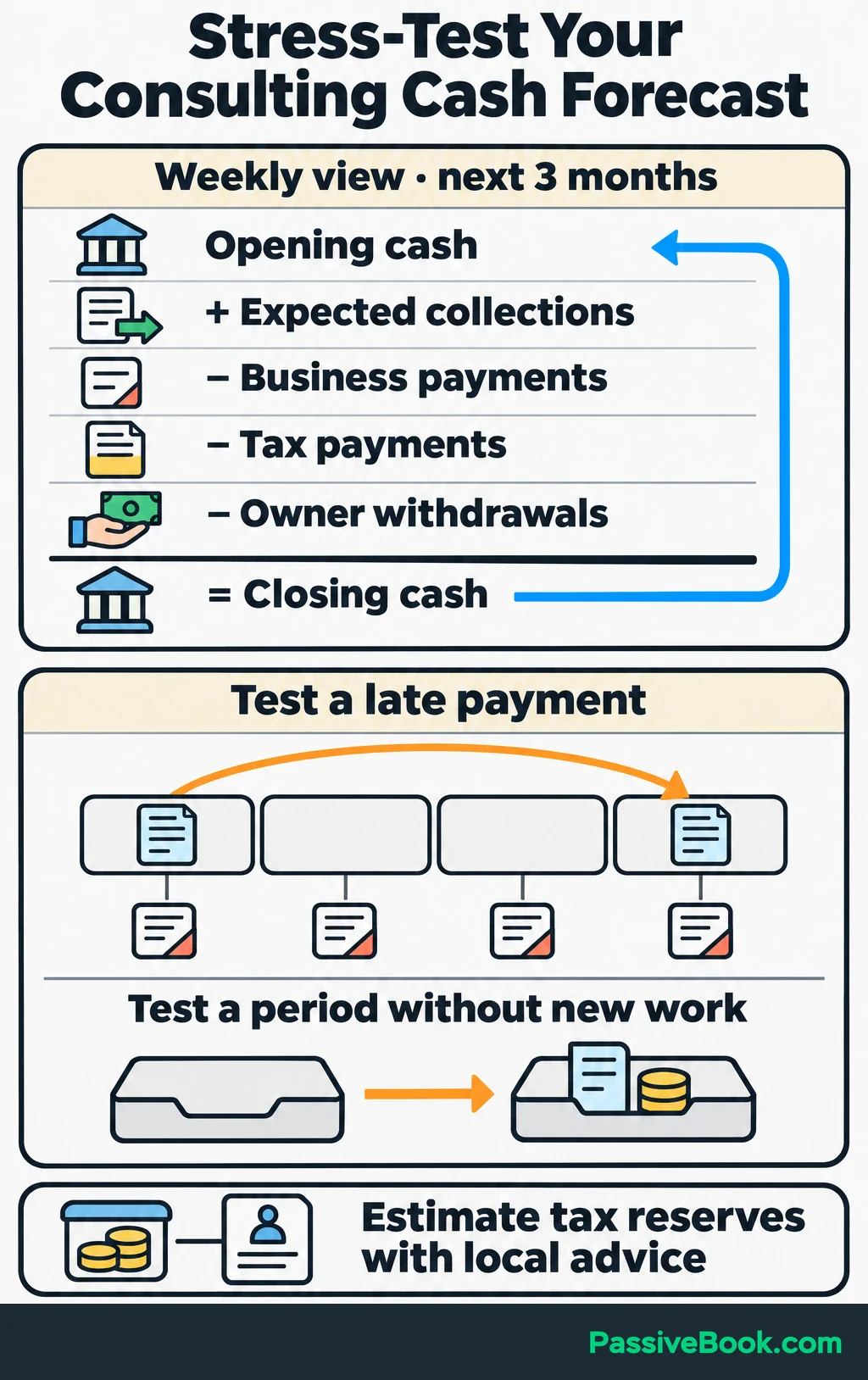
Ask a qualified local adviser to estimate taxes using your jurisdiction, structure, expected profit, and other income. Reserve money and calendar payment dates, and confirm any sales tax, VAT, or GST obligations, including relevant cross-border rules.
For U.S. readers, IRS self-employed guidance explains that self-employed individuals generally owe both income tax and self-employment tax and may need estimated payments. A reserve percentage copied from another consultant may miss your circumstances.
Improve Profitability Before Expanding
Review completed projects using revenue, direct expenses, overhead, delivery hours, and total working hours. Also look at unused capacity and how much revenue depends on one client.
Here is a completed-and-paid month for the example. Two diagnostics bring in $3,200. Direct project costs total $200, overhead is $300, and there is no setup expenditure that month.
| Item | Illustrative Monthly Result |
|---|---|
| Revenue from two diagnostics | $3,200 |
| Direct project costs | −$200 |
| Overhead | −$300 |
| Remainder before personal taxes and owner withdrawals | $2,700 |
| Delivery time | 30 hours |
| Sales and administration time | 30 hours |
That $2,700 is also the amount available to reward the owner’s work before personal taxes. To assess the return on that work, divide it by all 60 business hours:
$2,700 ÷ 60 = $45 per hour before personal taxes.
The earlier $100 planning rate covered delivery hours while funding the rest of the business. Tracking total hours shows what you earned across the whole working month.
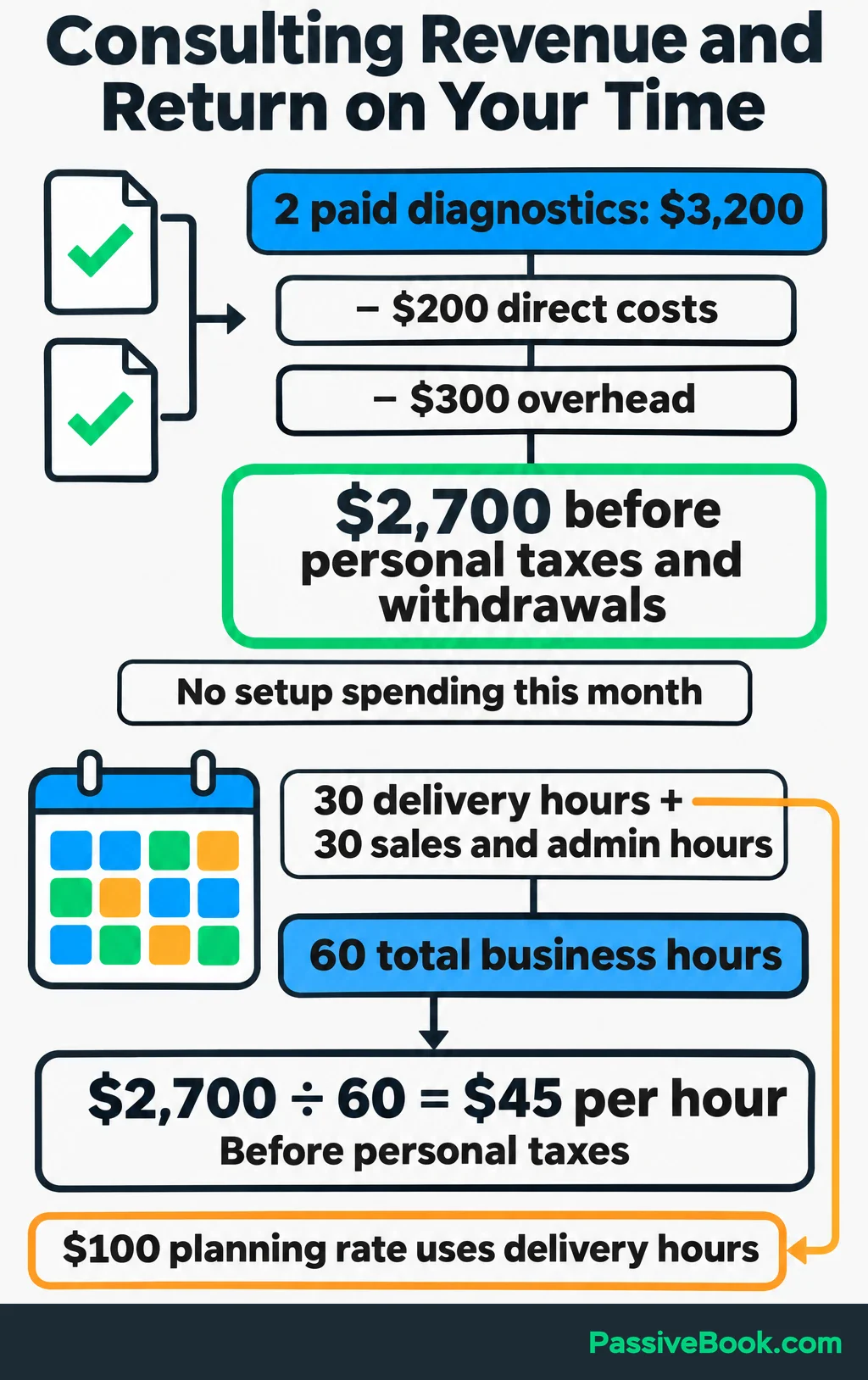
Keep cash for upcoming obligations available. Taking a withdrawal doesn’t establish that the business made a profit.
Compare estimates with actual effort after each engagement. If revisions keep overrunning, tighten the review process. If data preparation consumes the project, define input standards or price that preparation separately. Raise fees when the work and buyer value support them.
Standardize proven proposal sections, checklists, analysis templates, and handovers. Then automate stable administration, such as reminders and project-folder creation. I use n8n, a tool that connects apps and runs tasks automatically. I would document a dependable process before automating it.
Keep judgment in the work. Client-specific analysis and recommendations still need review.
Add recurring support when clients have recurring needs. Bring in subcontractors or employees only when demand, margins, cash, and documented processes support the commitment. Staying solo is a valid choice when it gives you the income and working life you want.
What Next?
Write one sentence naming the buyer, the costly problem, and the work you can competently deliver. Then choose three suitable people to ask about their recent experience with that problem.
Use the social buttons to share this guide when a conversation about consulting needs to move from “I could do this” to a practical launch plan.
Which problem could you confidently help a client solve, and what would you need to confirm before charging for it? Share your answer in the comments, and bring any other questions too.
Share this post with your friends & followers:

