Two SEO proposals arrive with the same promise: more organic traffic. One includes an audit and recommendations. The other includes writing, website changes, and reporting. Both call themselves a complete package.
That leaves you comparing fees without knowing how much work will land back on your desk. You could spend your budget and still have a list of fixes nobody has made.
Before choosing either proposal, you need to know what the service covers. This guide explains the main tasks, pricing models, and evidence to ask for so you can buy useful work within a budget you can sustain.
What Are SEO Services?
Search engine optimization (SEO) services are professional work aimed at improving your website’s visibility in unpaid search results and attracting visitors who matter to your business. That work can include research, technical fixes, content improvements, outreach, and measurement.
You pay for someone’s expertise and labor. Google does not charge for organic placement, and buying Google Ads does not improve your organic rankings. Google explains the distinction between SEO and advertising.
Search engines discover pages, analyze their content, and store information about them in a database called an index. They use that index to choose results for a search. SEO helps them access and understand your important pages, and helps visitors find useful information when they arrive.
Throughout this article, imagine you run an online-only shop selling beginner embroidery kits.
Your goal is profitable orders from relevant shoppers. Ranking for a popular embroidery phrase means little if the people searching want free patterns and have no interest in buying a kit.
The Three Core Types of SEO Services
Technical, on-page, and off-page SEO cover different parts of the work. A provider may offer all three, but your immediate problem should decide where the effort goes.
Technical SEO
Technical SEO addresses how search engines access and process your pages. Google must be able to reach a working page with content it can index. Meeting those requirements makes a page eligible for indexing; it does not guarantee inclusion. Google’s technical requirements explain these foundations.
Common tasks include:
- Removing accidental instructions that keep important pages out of search.
- Fixing broken internal links and redirects that send visitors to the wrong destination.
- Managing duplicate page addresses so the preferred version is clear.
- Investigating slow loading and problems that make pages difficult to use on phones.
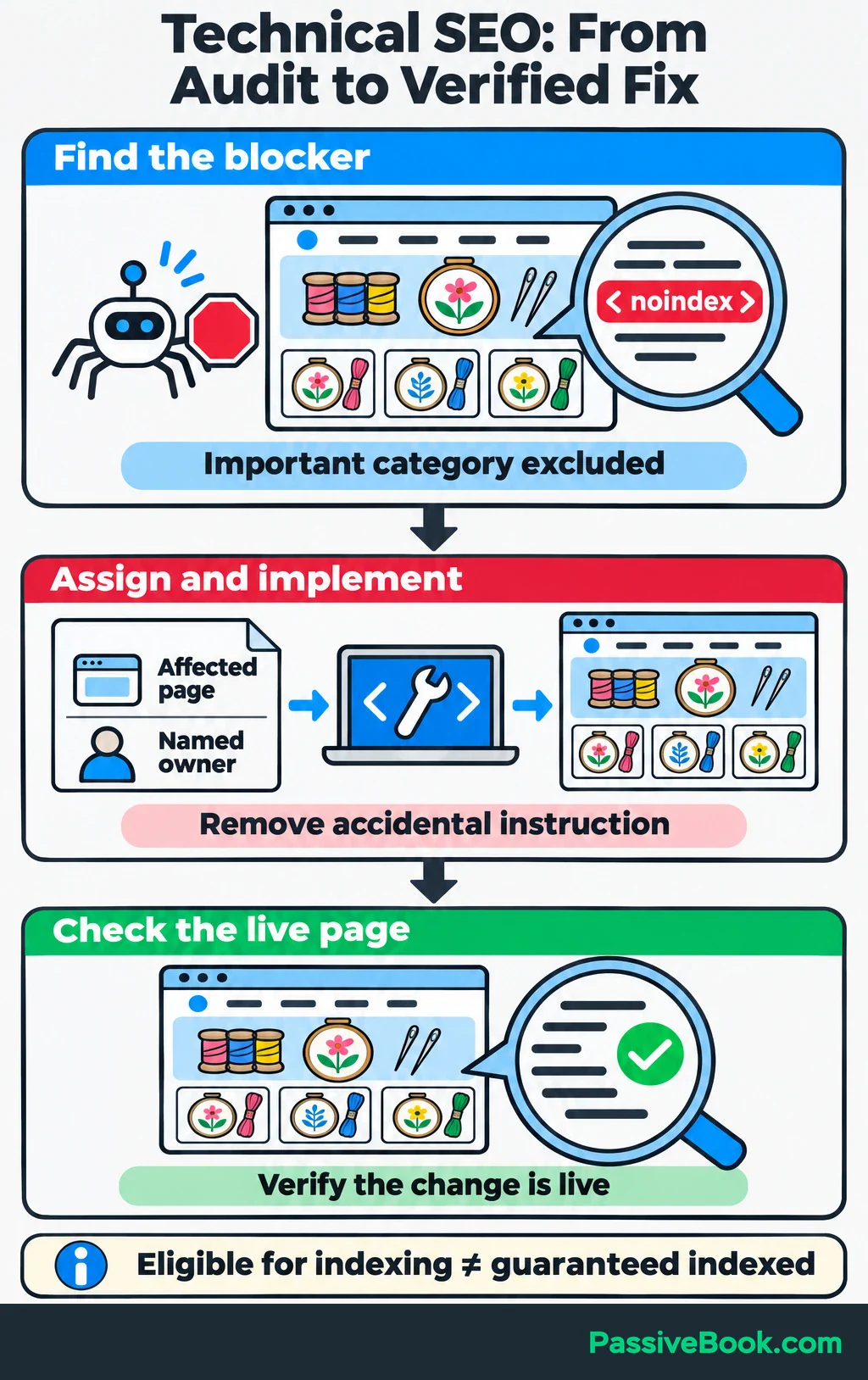
For the embroidery shop, suppose the beginner-kit category has an accidental noindex instruction, which tells search engines to exclude it. I would fix that before commissioning articles to support the category.
Ask for a prioritized issue list with affected pages, the person responsible for each fix, and a way to check completion. An audit identifies work. Someone still has to change the website.
On-page SEO and Content
On-page SEO connects customer searches with suitable pages and improves what those pages say and how they link together.
The provider might research search phrases, improve page titles and headings, rewrite product information, and add links between related pages. Content work can also include planning and creating new articles.
For the shop, a search such as “beginner embroidery kits” suggests a page where shoppers can compare products. “How to start your first embroidery stitch” calls for instructions. Those example phrases illustrate different needs; they are not verified keyword opportunities.
A useful plan could improve the kit category and product pages, then create a first-stitches guide that links to suitable kits.
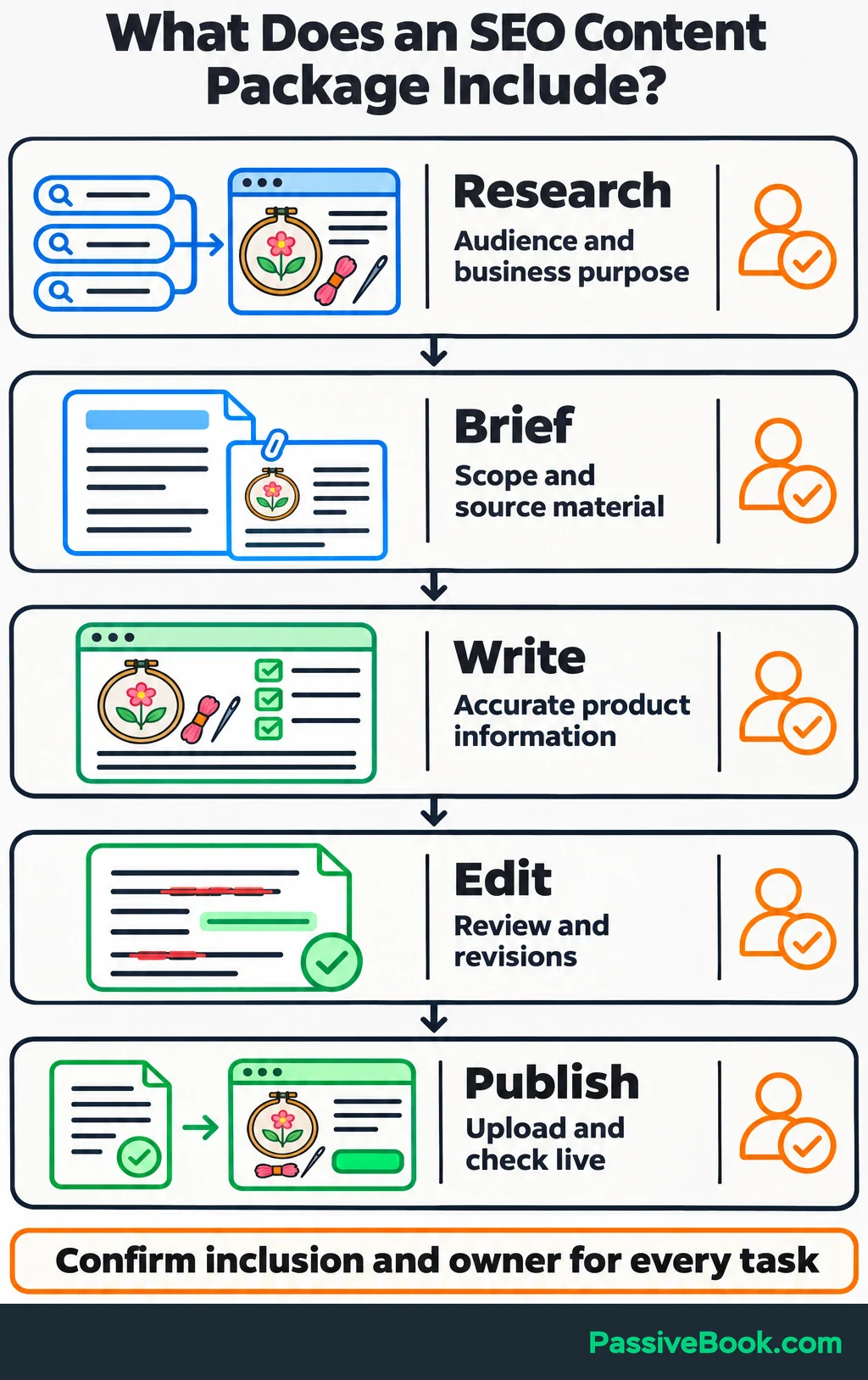
You would supply accurate kit contents, original photographs, and answers to questions customers actually ask. The writer could then explain whether the kit includes a hoop, how the pattern transfers, and what a beginner needs to buy separately.
I learned the cost of weak targeting with my productivity blog. I published more than 127 posts over eight months, but I eventually abandoned it because I judged the niche too competitive and difficult to monetize. More publishing had given me more work without fixing that decision.
That is why I would check the target searches and business purpose before approving a content quota.
Also confirm what “content included” means. Research, briefs, writing, editing, and publishing are separate tasks, and a proposal may cover only some of them.
Off-page SEO and Link Earning
Off-page SEO involves work beyond your website, such as outreach to relevant publications, useful resources other sites may reference, and contributions to stories.
A backlink is a link from another website to yours. For the embroidery shop, a provider might pitch an original stitch-reference resource to craft publications. You should be able to see who they intend to contact, what they are offering, and what coverage results.
I would skip packages sold mainly as a fixed number of links. A link count tells you little about the sites, their readers, or how the links were obtained.
Google treats buying links for ranking purposes and automated link schemes as link spam. Paid advertising links need appropriate labels in their code, such as sponsored or nofollow. Violations can lead to lower rankings or exclusion from results. Google’s link-spam policy sets out the rules.
Which SEO Specializations Fit Your Website?
Specializations apply the core disciplines to a particular website or market. Choose them according to how your business sells and whom it serves.
| Specialization | When It Applies | Additional Deliverables |
|---|---|---|
| Ecommerce SEO | You sell through product and category pages | Category improvements, product-page updates, navigation fixes, and handling of product variants and duplicate URLs |
| Local SEO | Customers visit your location or you serve them in person within an area | Location pages, accurate business information, review processes, and management of eligible business profiles |
| International SEO | You target several countries or languages | Localized page plans, language or regional page versions, and technical checks connecting those versions |
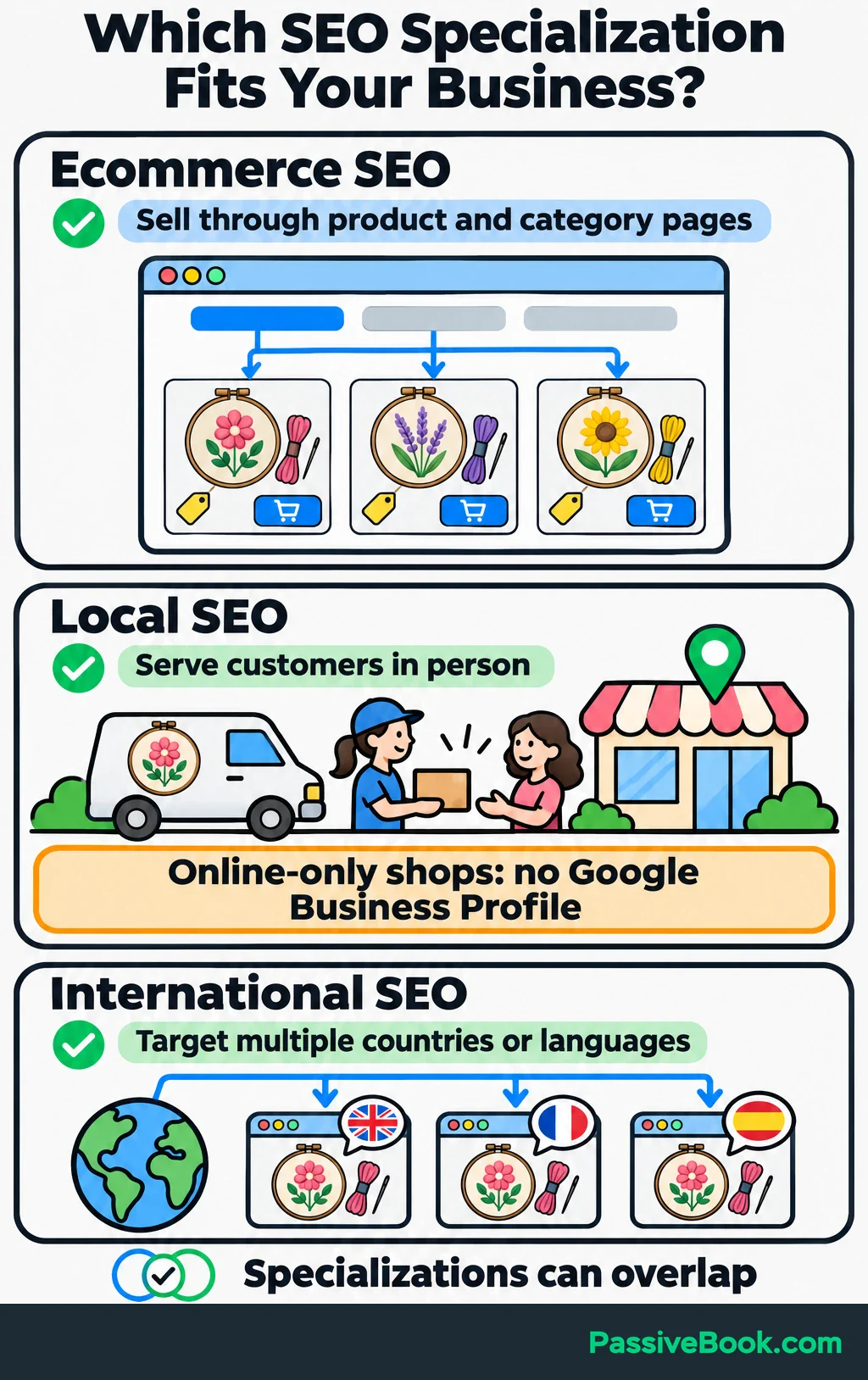
The embroidery shop needs ecommerce SEO. A practical task is checking that shoppers and search engines can follow links from the kit categories to the products.
The shop does not need Google Business Profile management. These profiles display business information in Google Search and Maps, but online-only businesses are ineligible. That restriction appears in Google’s Business Profile eligibility rules.
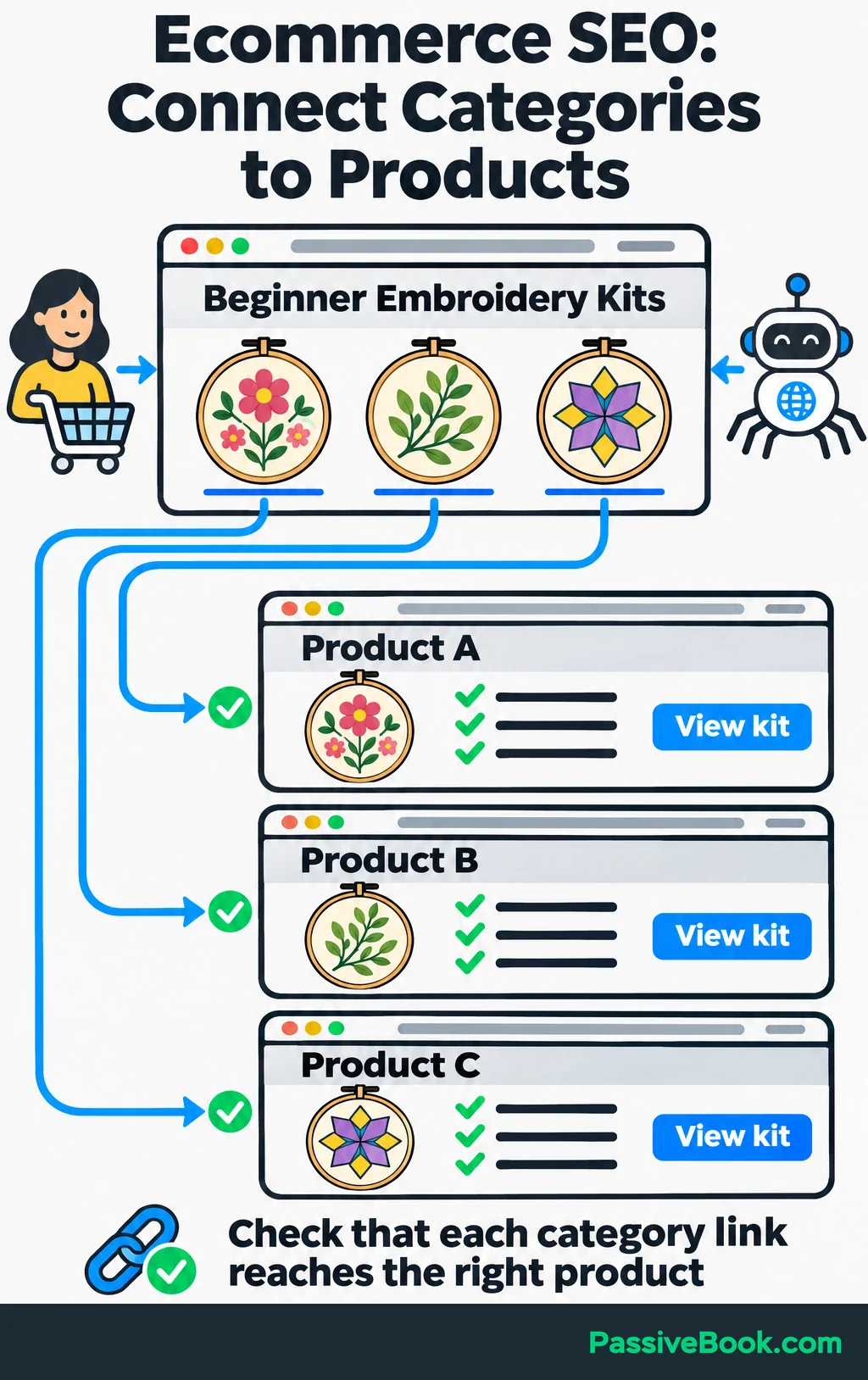
If the shop later creates separate versions for different countries or languages, international SEO may become relevant too. These services can overlap.
“National SEO” usually describes geographic reach. Ask which pages, searches, and tasks the provider means by it before treating it as a separate package.
How an SEO Engagement Works
A useful engagement moves from a business goal to completed changes, then uses the results to choose the next work.
- Agree on the Goal and Responsibilities: Choose the outcome and priority pages. For the shop, that could mean more profitable orders from unpaid search visits to beginner-kit pages. Provide product knowledge, existing performance data, an approver, and access for the agreed tasks.
- Audit and Prioritize: Review technical barriers, customer searches, existing content, and competitors. Expect a roadmap explaining each proposed change, its purpose, who will implement it, and what counts as finished.
- Implement and Verify: Assign writing, website edits, development, and publication approval. Check the published work. A recommendation marked “delivered” should not appear in the report as a completed website fix.
- Review and Improve: Examine completed work, unresolved obstacles, and performance. Decide what to continue, change, or stop.
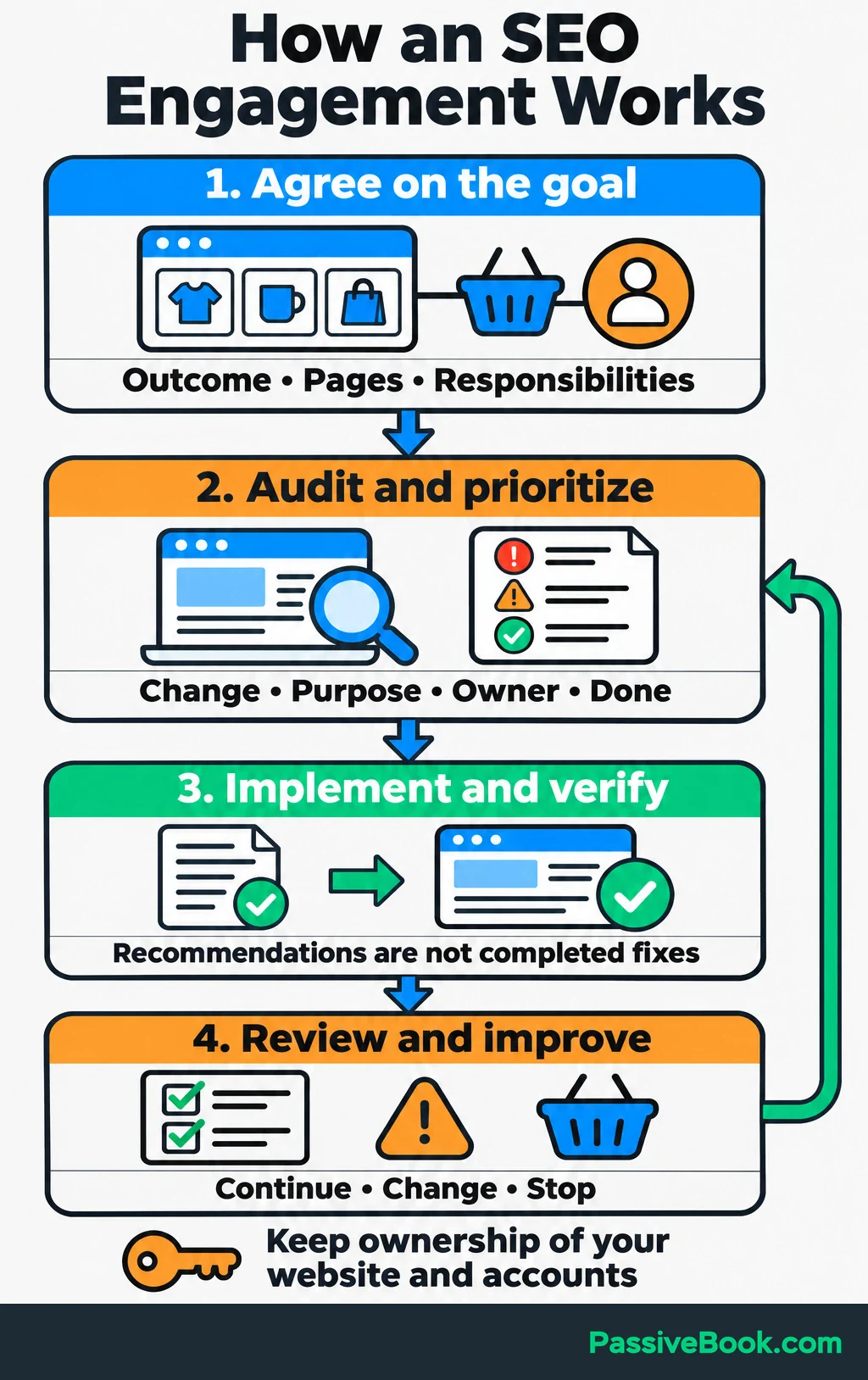
Keep ownership of your website and accounts, and grant permissions suited to the task. During a prospective provider’s audit, Google recommends read-only access to Google Search Console, its tool for checking search performance and indexing.
For the shop, the first phase might restore the category’s eligibility for indexing and improve its product links. The next phase could update the category and selected product pages. That sequence gives each piece of work a reason.
How Much Do SEO Services Cost?
The price depends on the website’s size, technical condition, competition, target market, and content needs. It also depends on who does the implementation.
Compare quotes against the same scope. An inexpensive audit can become expensive if you then need a developer and writer to carry it out.
Hourly, Project, and Monthly Pricing
Ahrefs surveyed 439 SEO providers across countries and business types. Its published USD figures offer historical context, rather than a quote for your market or website. Each percentage below refers to respondents reporting prices for that billing model.
| Model | Published Benchmark | Suitable Use | Inclusions to Confirm |
|---|---|---|---|
| Hourly | 47% reported charging $75–$200 per hour | A consultation, troubleshooting, or a limited specialist task | Estimated hours, spending cap, preparation, implementation, and follow-up |
| Project | $2,501–$5,000 was the most common bracket, reported by 21.2% | An audit, migration, or another defined piece of work | Named pages, fixes, revisions, deadlines, and completion checks |
| Monthly retainer | 42.8% reported charging $501–$2,000 per month | Continuing improvements with regular review | Monthly priorities, writing, development, publishing, and reporting |
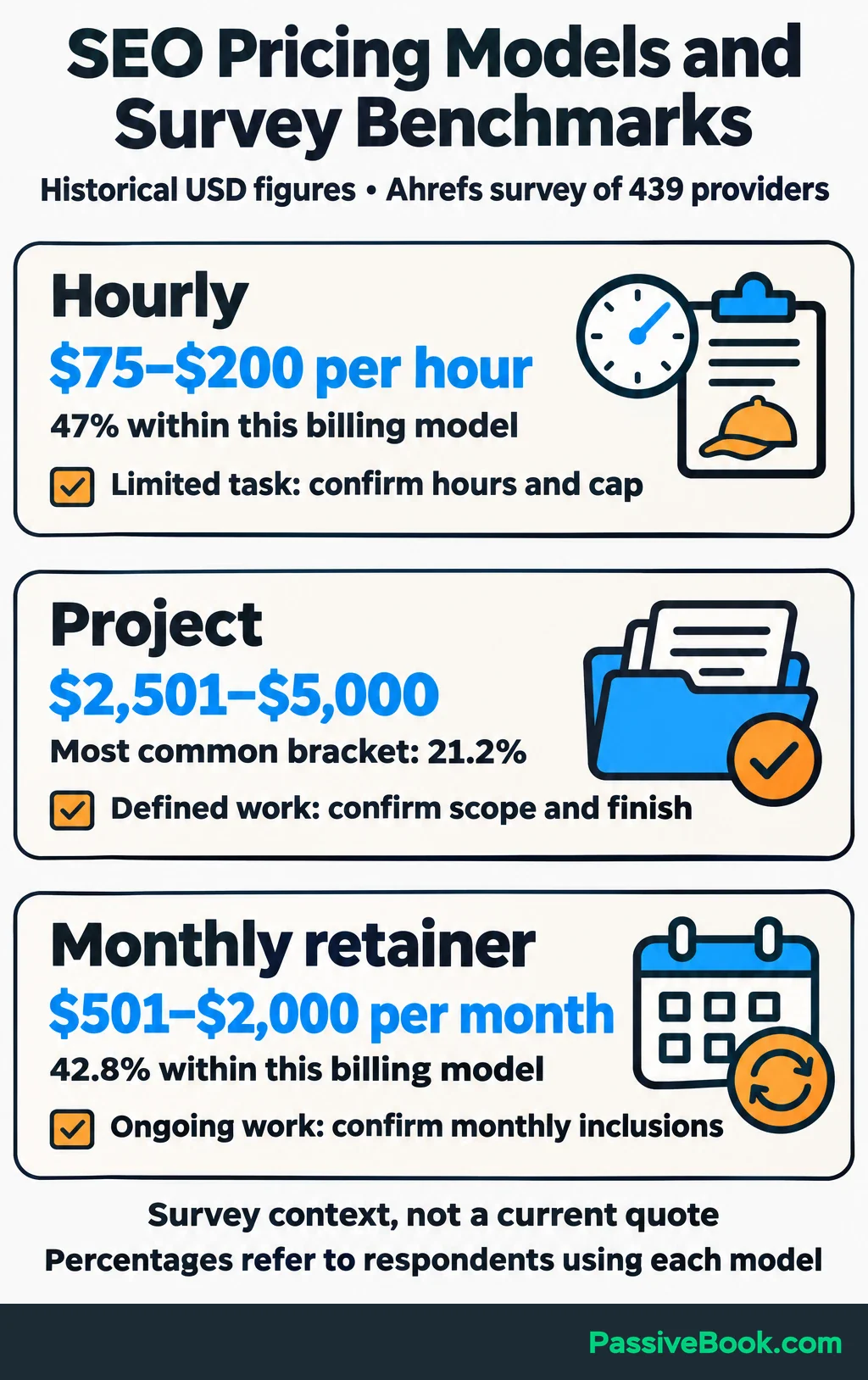
For a narrow problem, I would favor a defined project or capped hourly engagement. A monthly retainer makes more sense when you have continuing work and the capacity to approve and implement it.
The billing model does not establish value. A project can produce an unused report, and a retainer can fund useful work every month. Read the deliverables.
Calculate the Full Cost
Add the service fee and any writing, development, tools, or setup billed separately. Check what is already included so you do not count the same work twice.
Here is an illustrative budget for the embroidery shop. These are assumed inputs for the calculation, not market rates or a recommended package.
| Expense | Assumed Cost |
|---|---|
| Monthly SEO service | $600 |
| Separately billed writing | $200 |
| Separately billed development | $150 |
| Recurring monthly total | $950 |
| Separate initial audit | $300 |
| First-month total | $1,250 |
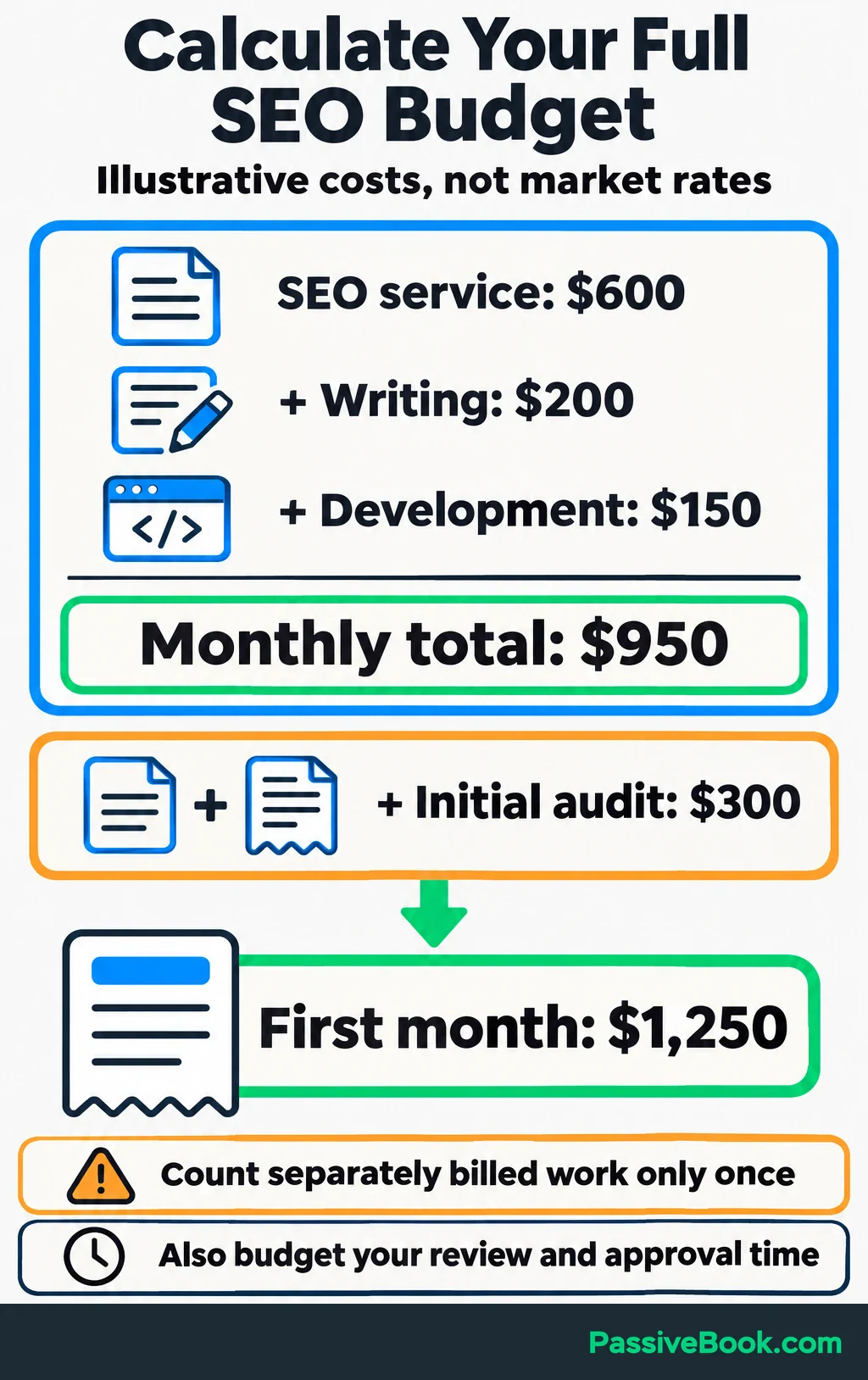
You would also spend time explaining products, reviewing drafts, and approving changes. Include that time when comparing outside help with doing the work yourself.
Set a spending limit against cash flow and the profit left from an order after its costs. A traffic forecast does not pay the next invoice, so choose a scope you can afford while results develop.
The full cost is only half the decision; the profit from each sale determines how much extra business would cover it. Use the calculator to check that hurdle and test your budget without assuming SEO brings in new orders.

Free Marketing Profit Calculator




How Do You Know SEO Services Are Working?
Judge delivery and business performance separately. You need to know both whether the provider completed the work and whether your search traffic is becoming more useful.
How Long Should Results Take?
A provider can commit to a date for fixing a page or publishing an article. Search outcomes have a different clock.
Google says individual changes may take hours to several months to affect search results and generally recommends waiting a few weeks before assessing their effects. Google’s timing guidance concerns search results; it does not set a deadline for profitable sales.
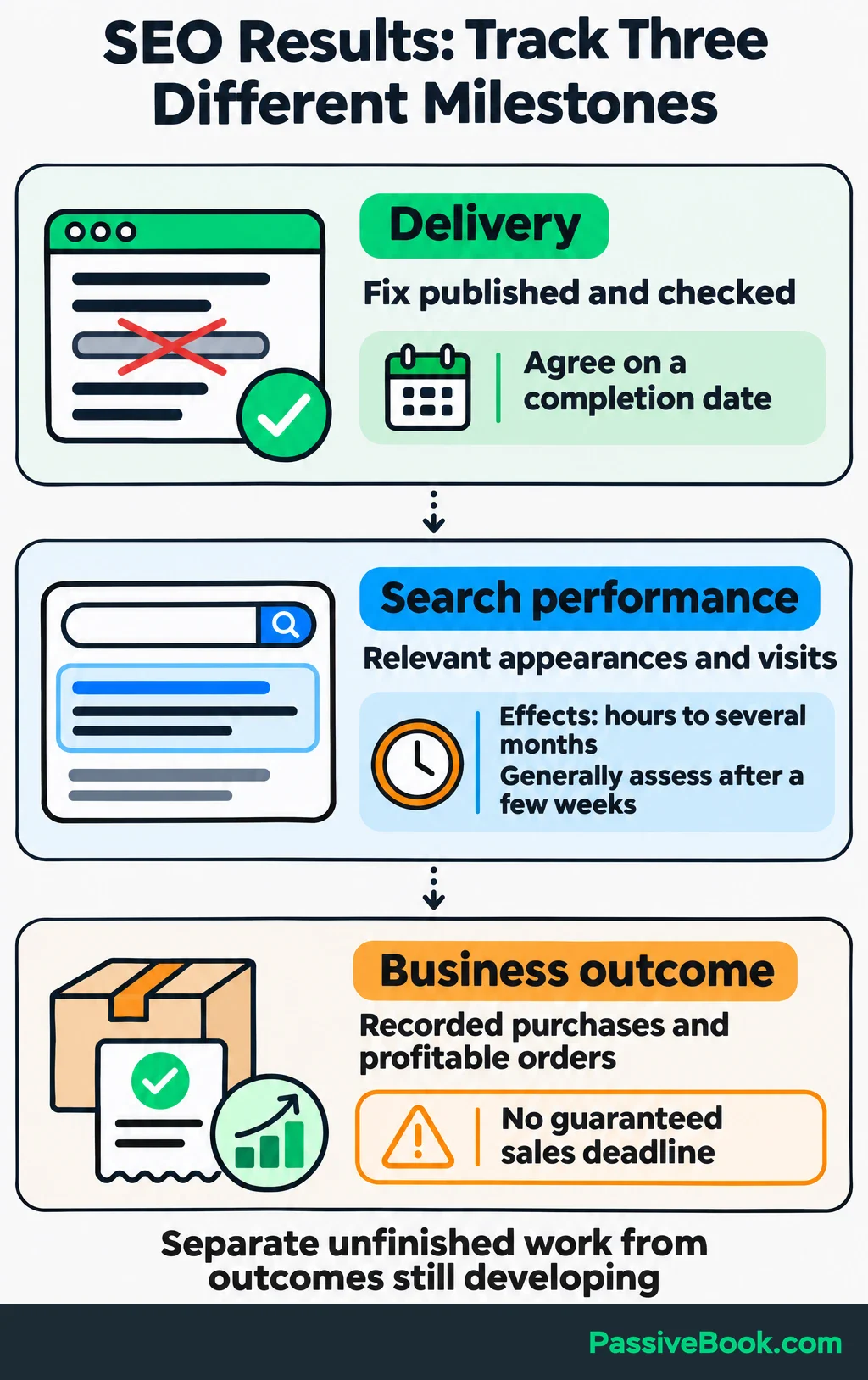
Agree on milestones for:
- Completed fixes and published pages.
- Visibility for relevant searches.
- Visits to the priority pages.
- Recorded purchases, inquiries, or another business outcome.
For the shop, removing the indexing block is a delivery milestone. Seeing the category appear for relevant searches is a search milestone. Receiving profitable orders is a business outcome.
This makes reviews more useful. You can distinguish work that remains unfinished from completed work that needs more observation.
Which Results Should Reports Show?
Establish a baseline before work begins and check that purchase or inquiry tracking records the intended action correctly.
Use Google Search Console to review appearances and clicks in Google Search. Impressions count appearances in results, clicks count clicks through to your site, and average position summarizes where your highest result appeared. Search Console’s metric definitions explain these measures.
Website analytics answers a different question: what happened during visits? Google Analytics groups activity into visits, called sessions, and records actions such as purchases as events. Use it to examine sessions from unpaid search and purchases during those visits. These measures describe different activity from search impressions and clicks. Google Analytics explains sessions, events, and traffic sources.
A useful report should name:
- Work Completed: The pages changed, what changed, and when it went live.
- Performance: Baseline and current results for the agreed pages and goals.
- Comparison Period: A comparable period, with seasonal demand considered where relevant.
- Next Action: What the evidence supports doing next and what remains blocked.
For the shop, review organic visits to the beginner-kit category alongside recorded purchases. If visits rise without orders, investigate whether the searches match the products and whether shoppers can complete checkout before buying more content.
Keep the attribution clear. A report can show purchases credited to organic search, but a before-and-after sales change alone does not prove SEO caused it.
Should You Hire SEO Help or Keep It in-house?
Keep routine work internally when someone can learn the basics, edit the website, and review performance consistently. Count that person’s time as part of the cost.
The right outside help depends on the gap:
- Consultant: Useful for diagnosis, planning, or training when you have someone who can implement the advice.
- Specialist Freelancer: Useful for a defined technical fix, content project, or other narrow task.
- Agency: Worth considering when research, writing, development, and reporting need coordination. Confirm which parts the agency actually supplies.
- Combined Approach: Keep your product knowledge and approvals inside the business, and outsource tasks that need specialist skill or more time.
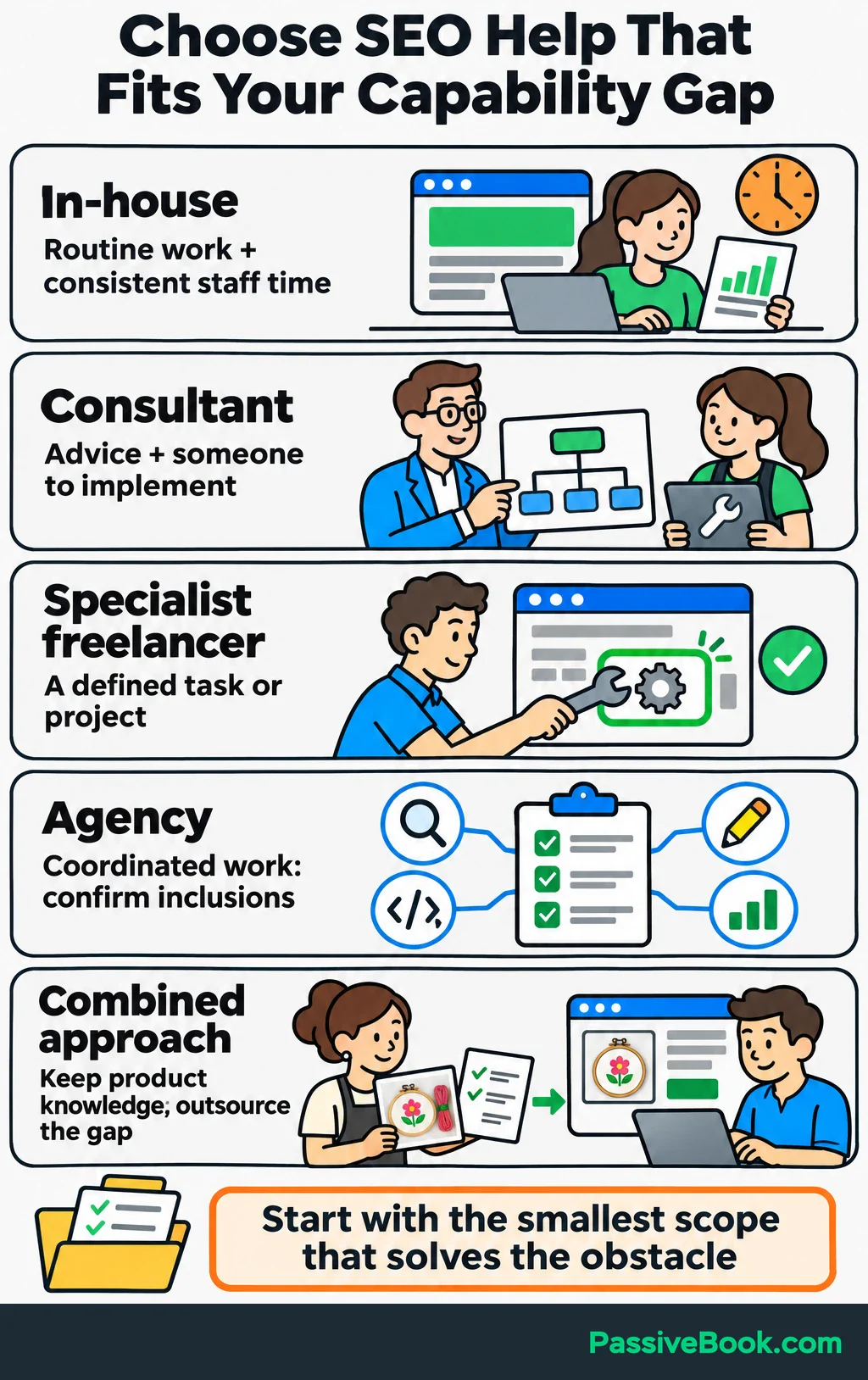
For the embroidery shop, I would keep product explanations and photographs with the owner, then hire help for technical fixes and editing. Paying a writer to guess what comes inside your kit is an avoidable expense.
Start with the smallest scope that addresses the current obstacle. If nobody can implement recommendations, resolve that before buying an audit. If the business needs immediate revenue, avoid committing money it cannot spare while waiting for search growth.
How to Choose an SEO Provider
Choose someone who can connect proposed work to a problem on your website and explain how you will assess progress.
Ask for Relevant Proof
Request comparable work, references, and a sample report. A case study is more useful when you can understand the starting problem and what changed.
Ask:
- What did you change on the website?
- Which parts did the client implement?
- Over what period did the reported results develop?
- What would you do differently on my site, and why?
- What would make you advise against this engagement?
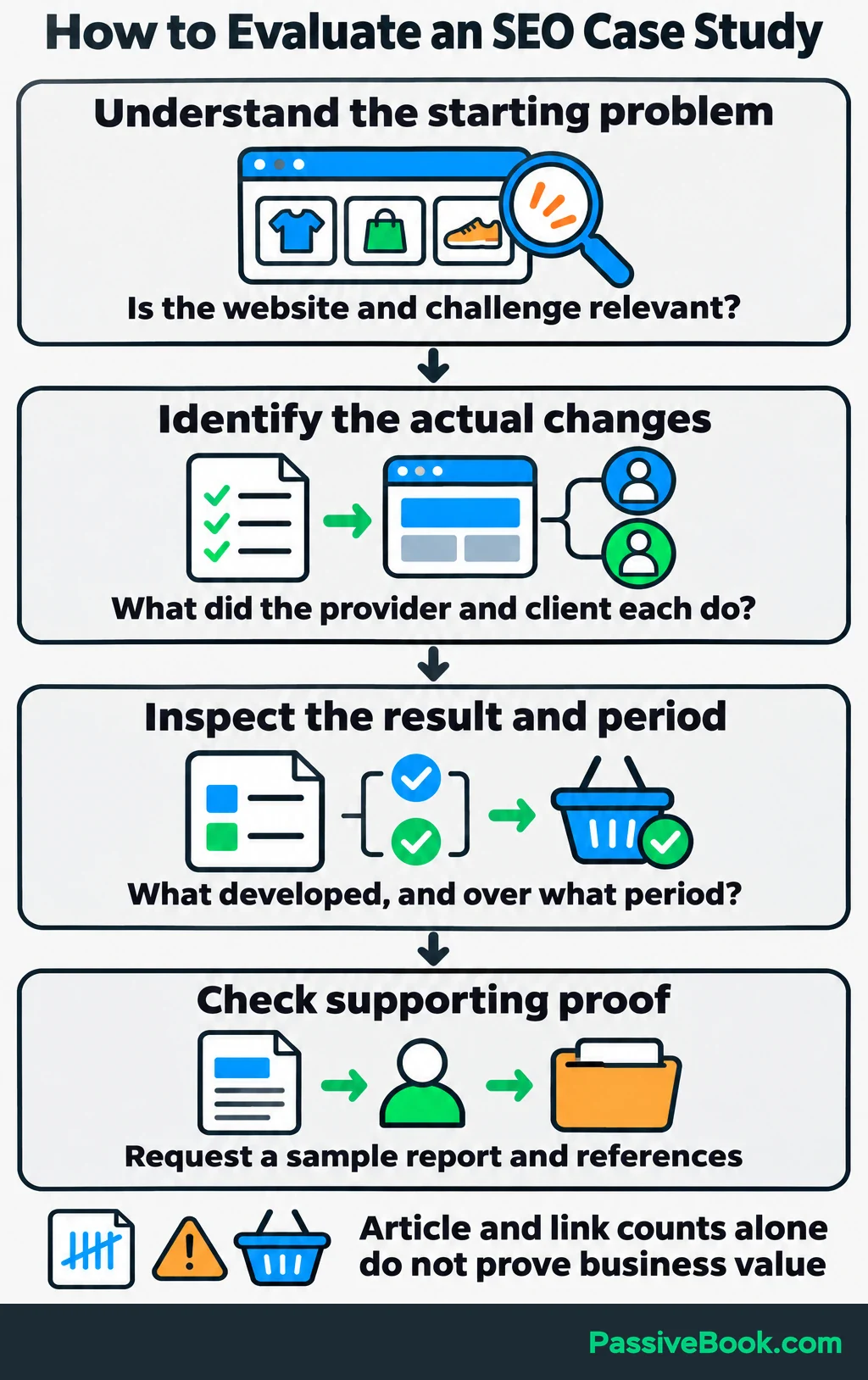
Look for relevant experience rather than an identical business. A provider who understands small product catalogs may be more useful to the embroidery shop than one whose strongest example is a large news site.
Article counts, link counts, and automated scores can describe activity. They do not establish that the work helped the business.
Compare Written Scopes
Put proposals beside each other and check whether each one answers the same practical questions.
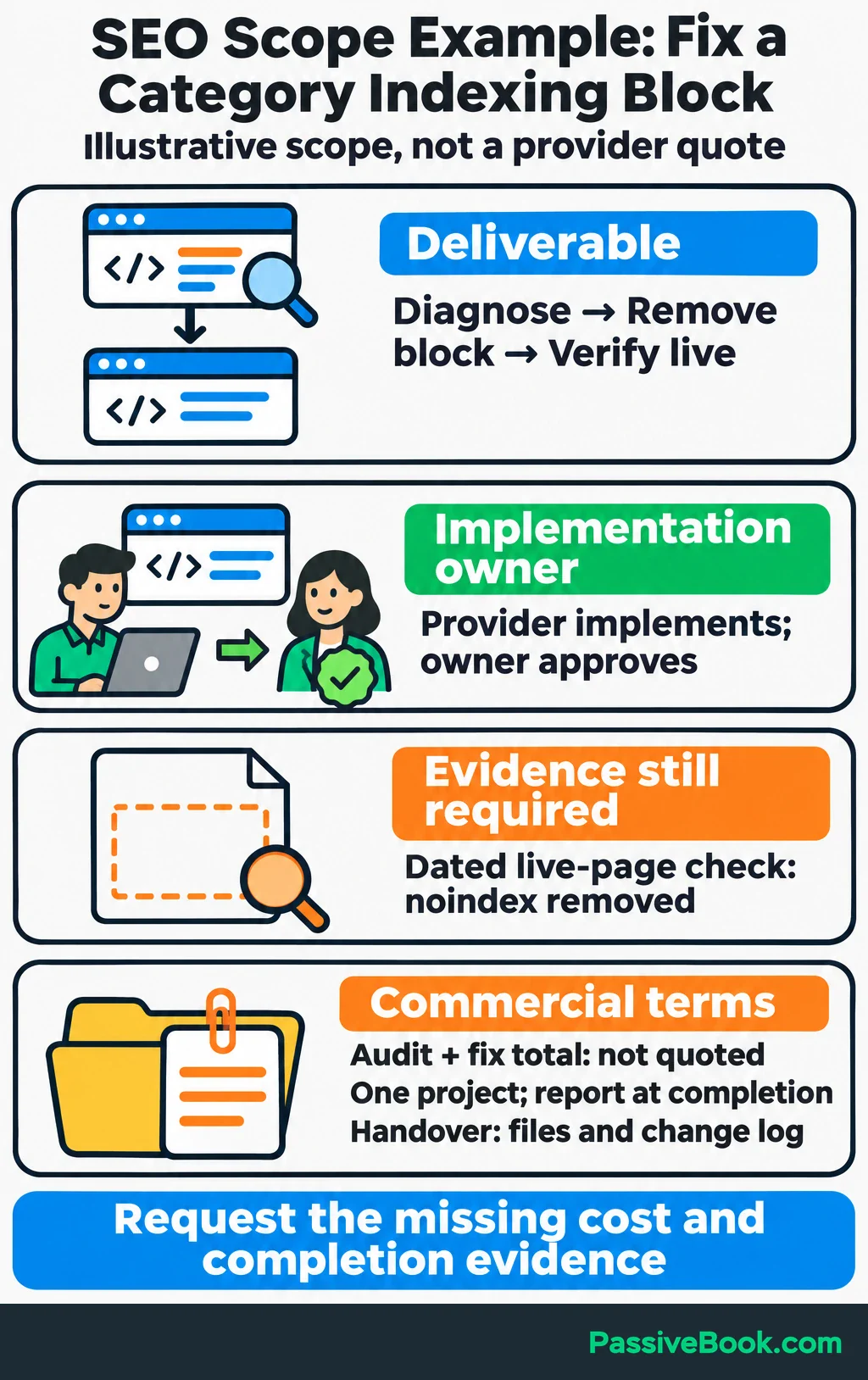
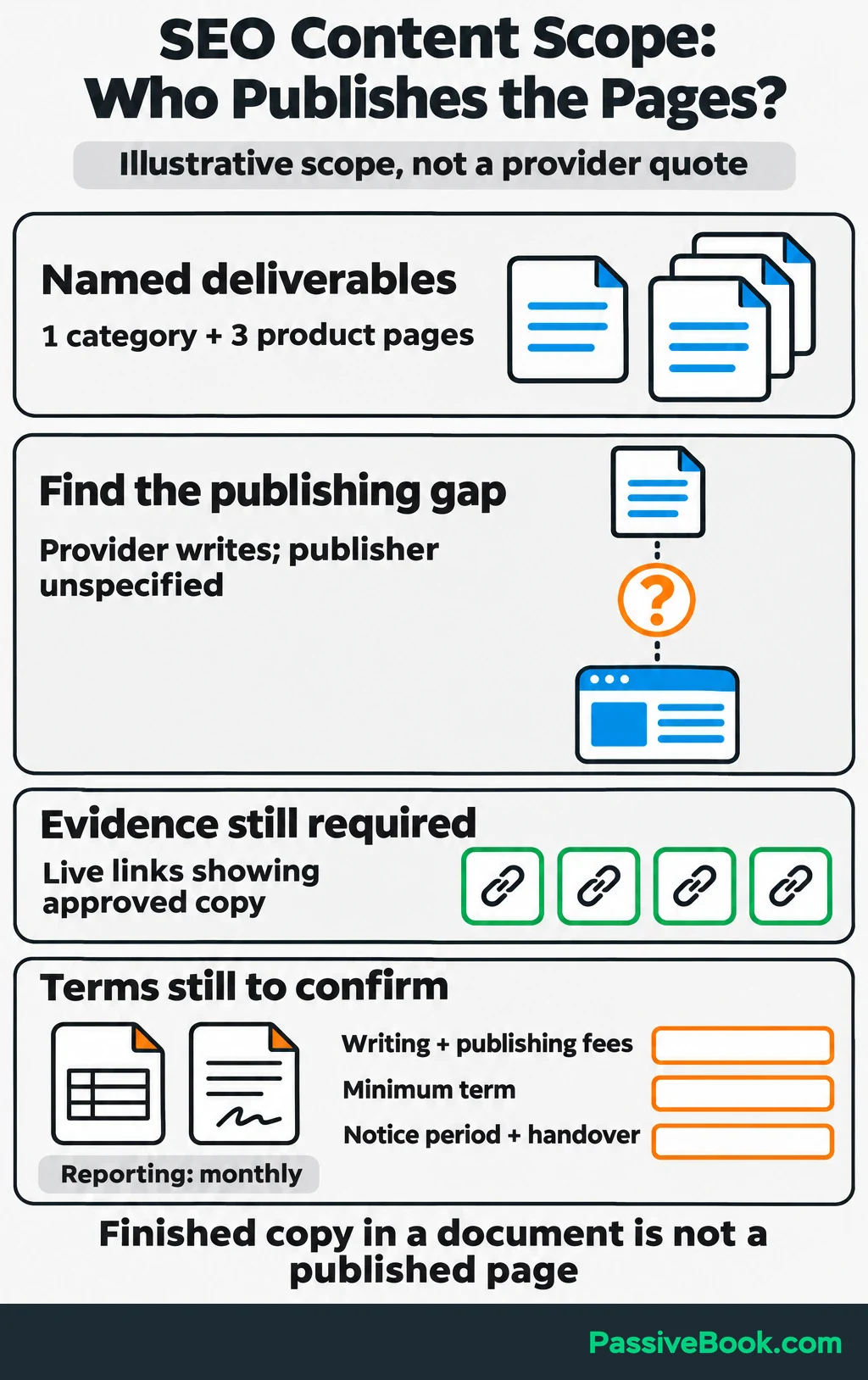
The table below shows two illustrative scopes for the shop. No provider quotes have been obtained, so missing fees and terms remain visible.
| Priority Addressed | Deliverables | Implementation Owner | Completion Evidence | Full Cost | Reporting Frequency | Contract Term | Exit Conditions |
|---|---|---|---|---|---|---|---|
| Restore category indexing eligibility | Diagnose block, remove it, and verify the live page | Provider; owner approves | Not supplied; require a dated check showing the accidental noindex instruction removed from the live category page | Not quoted; request audit and fix total | At completion | One project | Agreed files and change log handed over |
| Improve shopping pages | Update category and three product pages | Provider writes; publisher not specified | Not supplied; require links to the live category and three product pages showing the approved copy | Not quoted; confirm writing and publishing fees | Monthly | Minimum term not specified | Notice period and handover not specified |
The gaps matter. “Publisher not specified” could mean the finished copy sits in a document while you find time to upload it.
Confirm revisions, extra charges, approval requirements, ownership of produced assets, and handover arrangements. For recurring work, ask how priorities change when implementation stalls or results disappoint.
I would prefer a smaller scope with clear ownership over a longer list of tasks nobody has agreed to finish.
Recognize Warning Signs
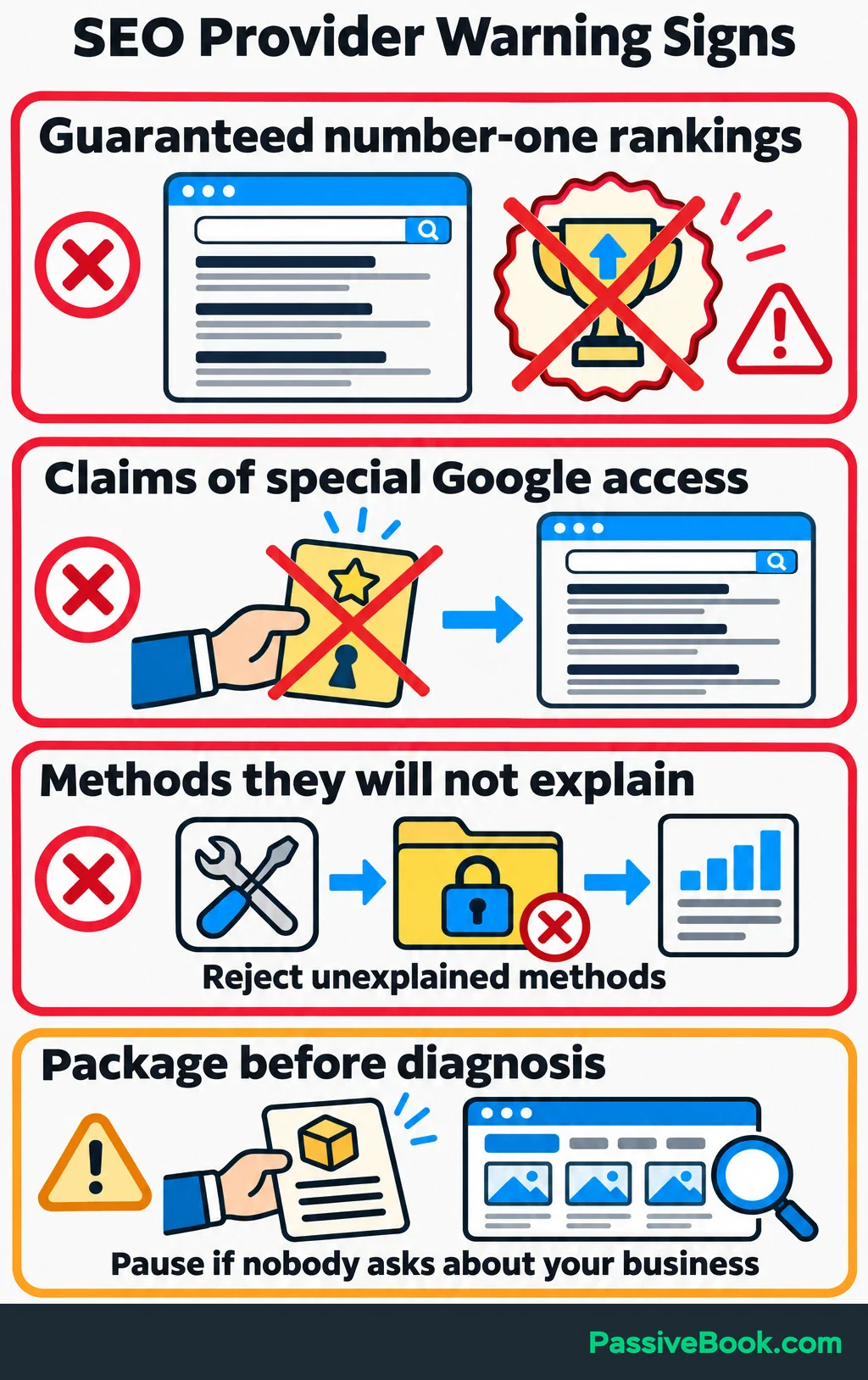
Reject guaranteed number-one rankings, claims of special access to Google, and methods the provider refuses to explain. Google flags these kinds of claims in its guidance on choosing an SEO provider.
I would also pause if the provider recommends a package before asking about your products, website, customers, or ability to make changes. A standard price list is fine. A diagnosis that never examines the problem is less convincing.
Before requesting proposals, write a short brief covering your website, goal, main obstacle, available help, and spending limit.
For the shop, the useful part might read:
“I want more profitable orders from organic search. Please assess the beginner-kit category and its product pages. I can supply product details and photographs, but I need implementation included.”
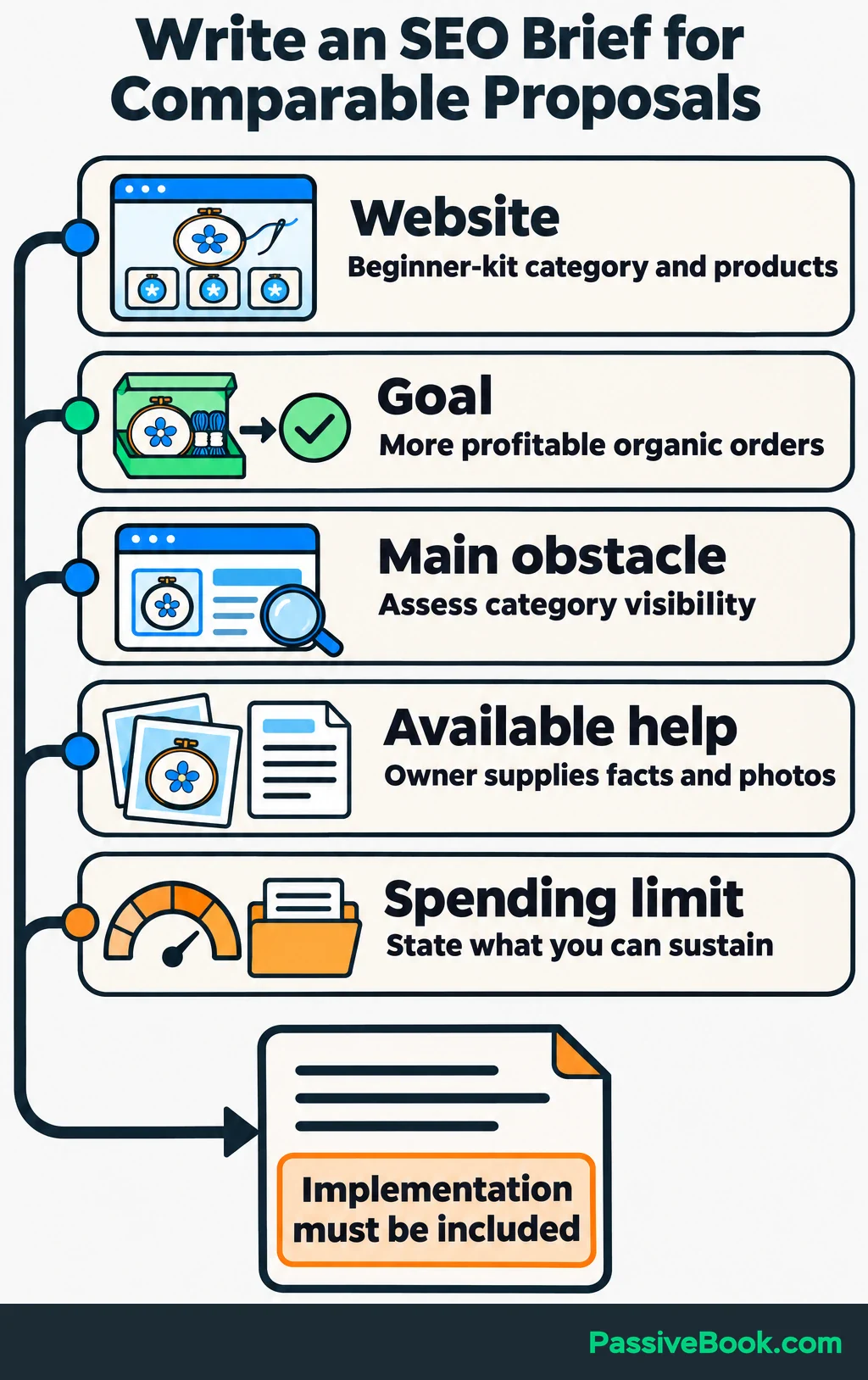
That gives providers something concrete to price and makes their answers easier to compare.
If you are unsure how to describe the work, our AI Skill can draft the brief from your business details. It includes the questions that clarify who will make the changes and what the quote needs to cover.

Free AI Provider Buying Assistant
What Next?
Choose one important page and write down what you need it to achieve, what appears to be holding it back, and who can make changes. Use that brief to decide whether your next step is learning the task or hiring help.
Use the social buttons to share this guide when comparing SEO proposals together; a shared understanding of the scope can prevent an expensive misunderstanding.
Which part would be hardest for you to handle consistently: technical fixes, useful content, or measuring results? Share your answer in the comments, and bring any other questions too.
Share this post with your friends & followers:

