An overseas customer asks whether you deliver to their country. Then another order comes from abroad, and expanding starts to look sensible. But a few inquiries don’t tell you which market deserves your next month of work.
Choose poorly and you could pay to adapt pages for customers you can’t serve profitably. Even interested shoppers may leave if they reach the wrong prices, delivery terms or checkout.
Those gaps can turn promising search traffic into work that never pays for itself. This guide helps you connect overseas demand with pages and a buying experience suited to one market, so you can judge whether expansion earns its ongoing cost.
Choose Your First Viable Market
Find Demand You Can Serve
Start with evidence you already have. Look for relevant overseas search impressions, customer questions and orders. Separate interest in your topic from interest in an offer you can actually provide.
Then check whether serving that interest makes business sense:
- Demand: Which countries already produce relevant searches, inquiries or purchases?
- Commercial Fit: Can customers buy the product, use it and afford the total delivered cost?
- Competition: What ranks locally, and what would make your pages useful alongside those results?
- Service Readiness: Can you handle payments, delivery, returns and support?
- Ongoing Work: Who will maintain the pages, product details and customer information?
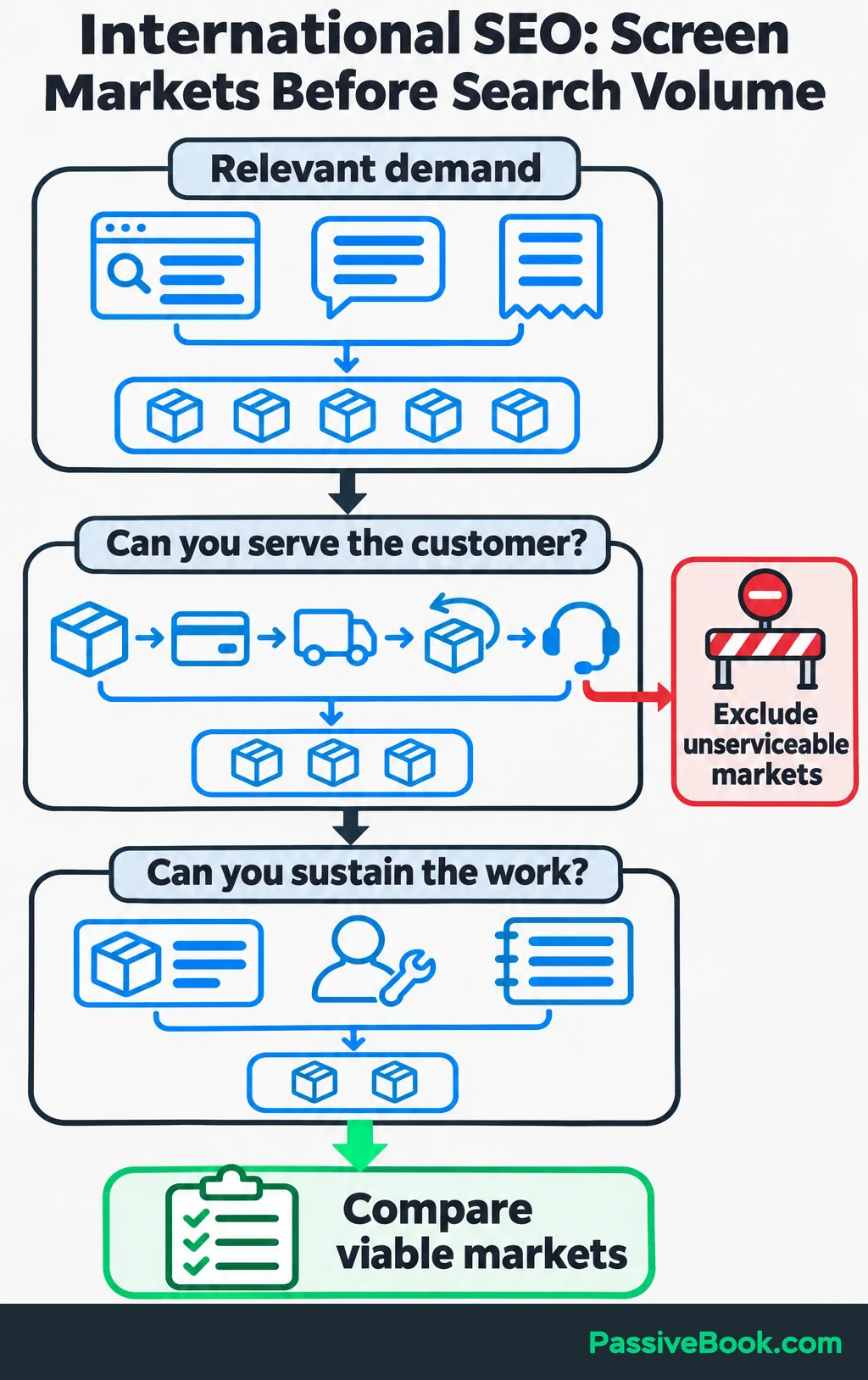
Exclude markets you cannot serve before comparing search volume. A large audience behind an impossible shipping bill is an expensive distraction.
I learned that lesson with my online jewellery store. I prepared product listings and bought inventory before checking demand, then lost most of the investment. That experience informs how I would approach international expansion: check the offer before paying to adapt its pages.
For the running example, imagine you operate an established US shop selling washable guinea-pig cage liners. After screening several markets, you select a UK pilot. The shop, market choice, search phrases and figures throughout this guide are illustrative.
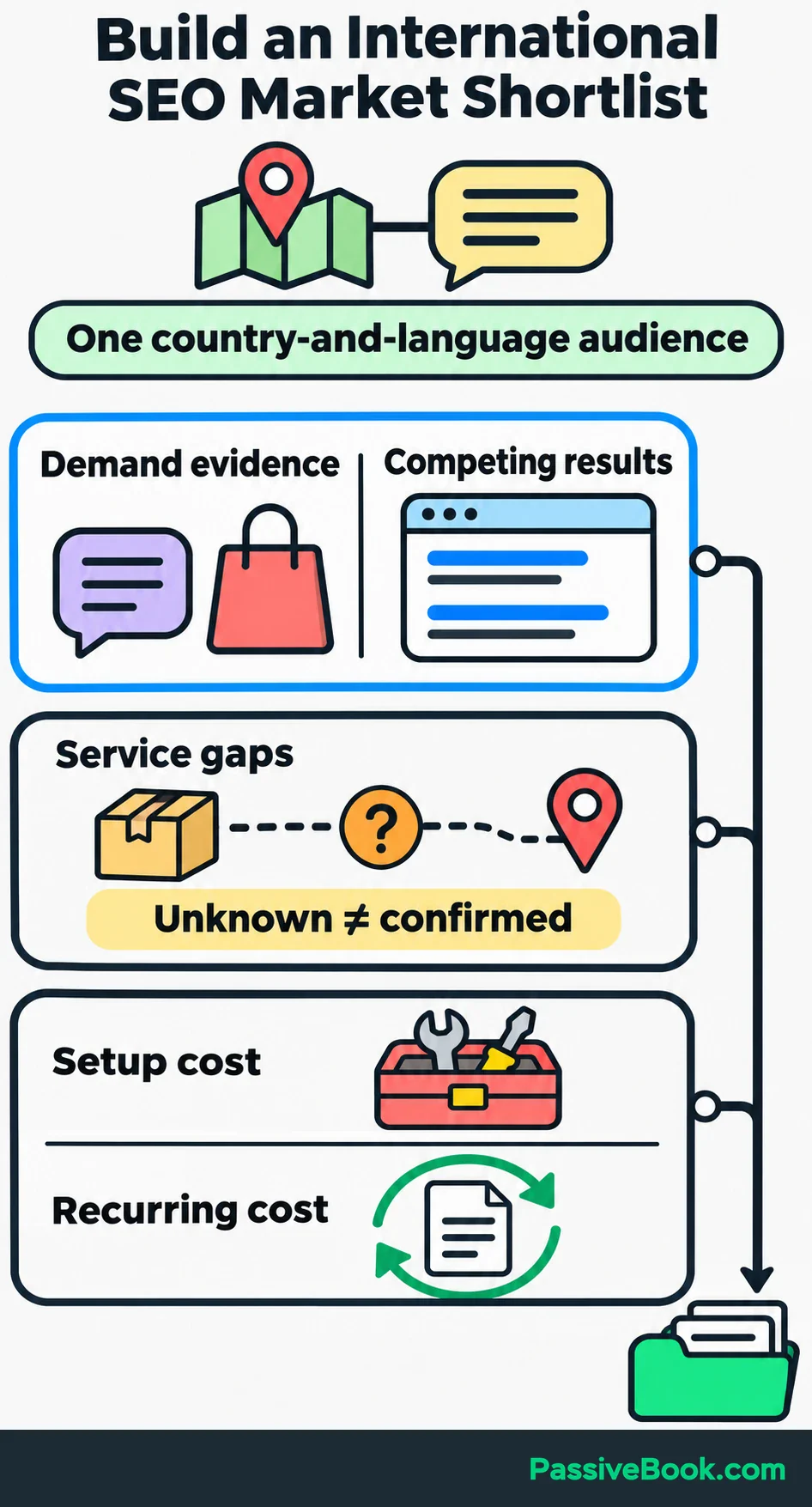
Inspect local results for buying searches and practical questions. Notice whether shoppers find product categories, individual products, comparisons or fitting guides. Read competing delivery information too. Your page competes with the whole offer.
Keep a shortlist with one row per country-and-language audience. Record the evidence, competing results, service gaps, setup cost and recurring cost. Leave unknowns marked as unknowns until you investigate them.
Choose the search engines that matter in the selected market. The technical instructions below address Google; another engine may need a separate check.
Budget for a Complete Pilot
I would fund one useful category and its supporting pages before translating a large blog archive. A translated article that sends shoppers to unsuitable delivery terms is unfinished work.
Next, estimate what an additional order leaves to cover the pilot.
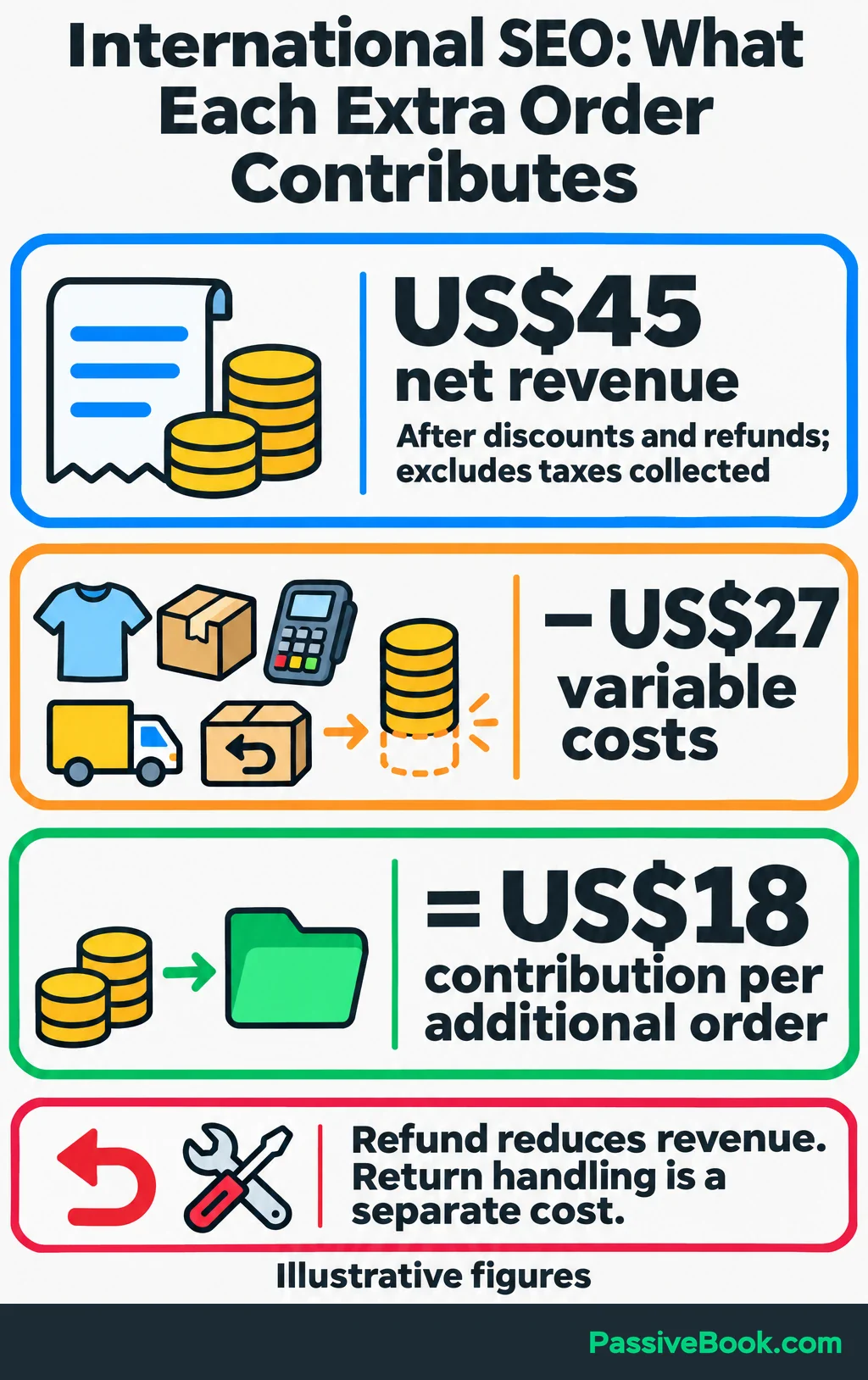
Start with revenue after discounts and refunds, excluding taxes collected. Subtract product costs and variable selling costs, including packaging, payment fees, delivery subsidies and return handling. Refunds reduce revenue; handling a return is a separate expense, so don’t count either twice.
Here is an illustrative budget in US dollars:
| Item | Assumption |
|---|---|
| Net revenue per additional order | US$45 after discounts and refunds, excluding taxes collected |
| Variable costs per additional order | US$27 across product, packaging, payment, delivery subsidy and return handling |
| Contribution per additional order | US$18 remaining |
| Initial pilot work | US$900 for research, setup, adaptation, review, support preparation and promotion |
| Recurring pilot work | US$150 a month for updates, monitoring and ongoing administration |
| Three-month pilot cost | US$900 + three months × US$150 = US$1,350 |
Divide the pilot cost by the amount left from each additional order:
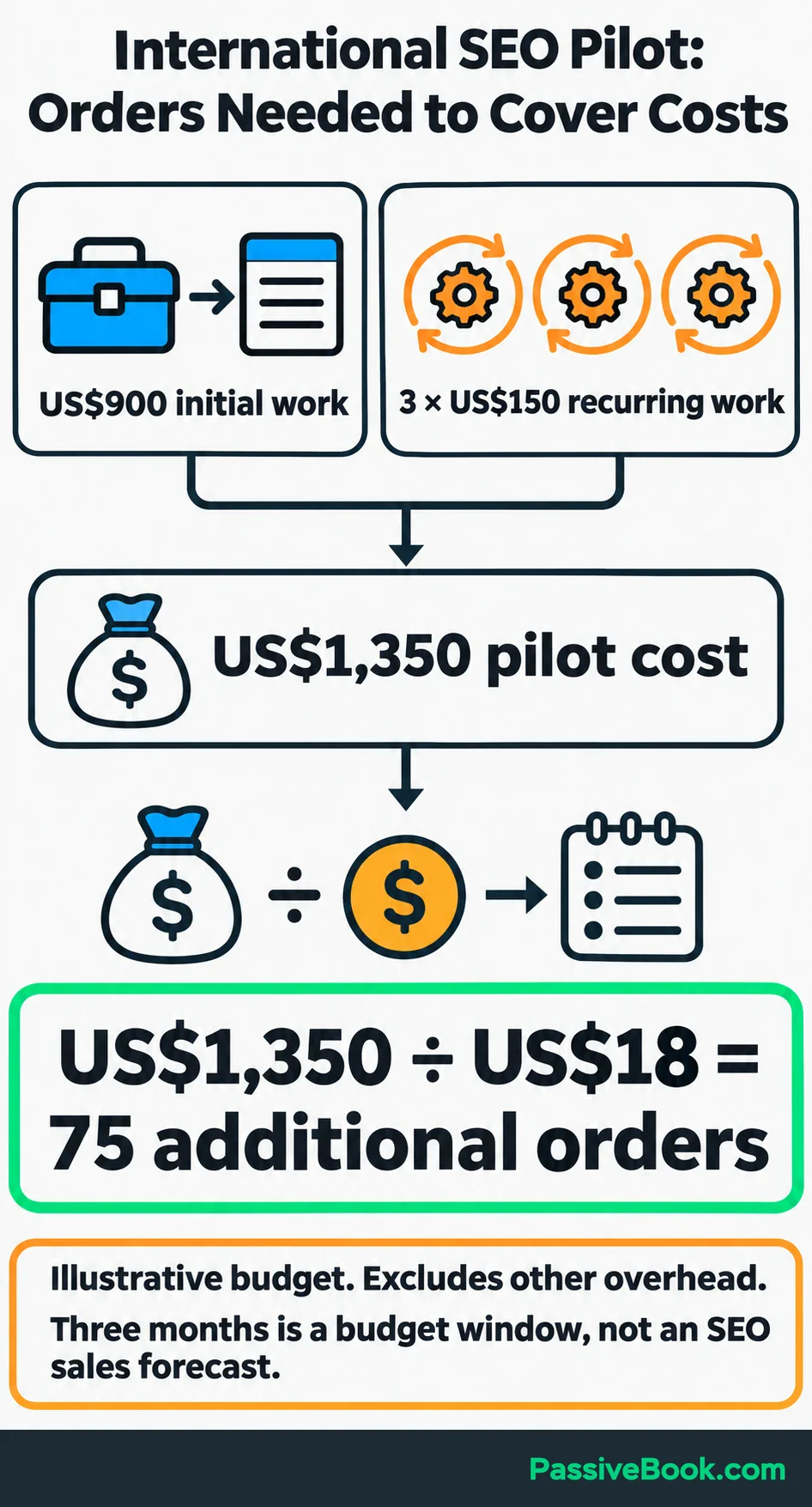
US$1,350 ÷ US$18 = 75 additional orders
Those orders would cover the specified pilot costs. This calculation excludes other business overhead, and the three-month budget window is not a forecast of when SEO will produce sales.
Compare that requirement with the demand evidence and your capacity. If covering the pilot requires more orders than the opportunity credibly supports, reduce the scope or choose another market.
Map Local Searches to a Focused Page Set
Research how people describe the product and the problem in your chosen market. A translated keyword is a candidate to investigate, not a finished content brief.
Set your research tool to the intended location. Then check local results, customer questions and wording with a fluent reviewer. Estimated search volume helps compare opportunities, but relevance and the strength of competing pages matter too.
Match each search to the page someone would expect. A shopper choosing among products may need a category. Someone checking whether a liner fits needs measurements and a guide.
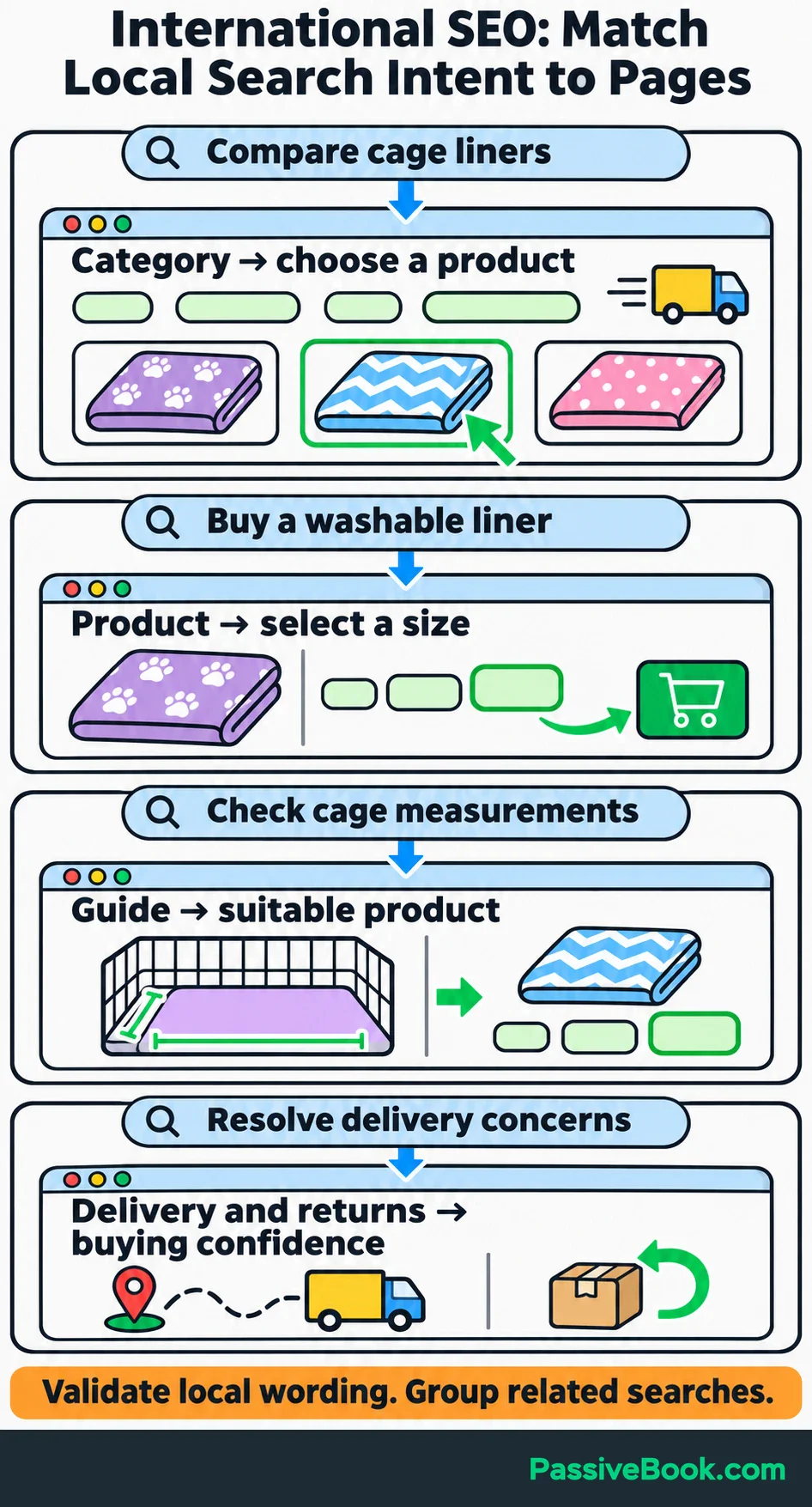
Group related searches when one page can answer them well. Don’t create three thin pages because a tool lists three slightly different phrases.
For the cage-liner shop, I would investigate a compact page set like this:
| Search Wording to Validate | Proposed Page | Useful Local Adaptation | Next Action |
|---|---|---|---|
| “Guinea pig cage liners” | Category | Available sizes, local prices and delivery summary | Choose a product |
| “Washable guinea pig cage liner” | Product | Materials, dimensions, care instructions and availability | Select a size and buy |
| “How to measure a cage for a liner” | Measuring guide | Clear diagrams and measurements matching the actual products | Open a suitable product |
| “Cage liner delivery and returns” | Delivery and returns information | Destination coverage, costs, timing and return process | Resolve the purchase concern |
Validate those phrases before treating them as targets. The table shows how to connect a need to a page, rather than reporting measured keyword opportunities.
In your working sheet, also record the locale, source page, proposed destination, reviewer and conversion action. Assign final URLs in the next step.
The priority is a complete route from search to purchase. For a content business, use the same approach but connect the article to a relevant signup, digital product or locally available affiliate offer.
Plan Your International URLs
Decide Which Versions Customers Need
Choose whether you need different languages, different country offers or both. A multilingual site offers several languages; a multiregional site targets several countries.
Use a shared language version when the same content and offer work across countries. Create regional versions when delivery, prices, availability or customer needs justify separate pages.
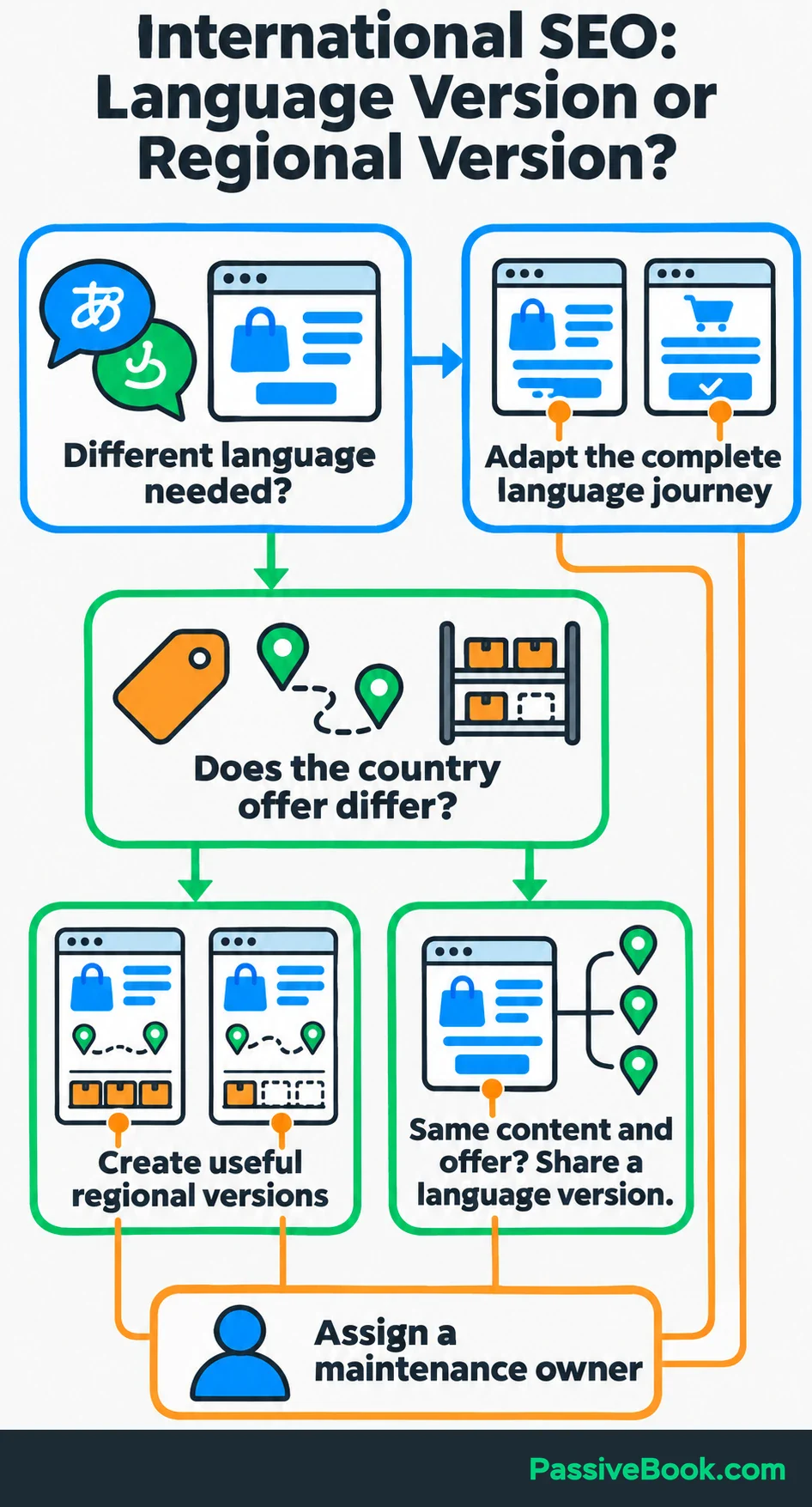
Record each locale—a language or language-and-country audience—alongside its offer and maintenance owner.
The cage-liner shop’s UK version needs useful UK purchasing information. Changing “color” to “colour” while leaving US-only delivery terms would accomplish very little.
For a new language, adapt the main content and the necessary purchase journey. Translating the menu while leaving product descriptions and checkout messages untouched gives customers only the entrance to the shop.
Choose a Structure You Can Maintain
Your URL structure should fit how you operate the business.
| URL Example | Country Signal | Operational Separation | Maintenance |
|---|---|---|---|
example.co.uk | Strong UK country signal | Separate domain for the market | Separate domain administration and potentially separate infrastructure |
uk.example.com | The label alone doesn’t establish targeting | Can support a separate site or team | More configuration across sites |
example.com/en-gb/ | The folder identifies your intended audience; supporting signals still matter | Usually managed within the main site | Convenient for shared publishing and updates |
These trade-offs follow Google’s comparison of international URL structures.
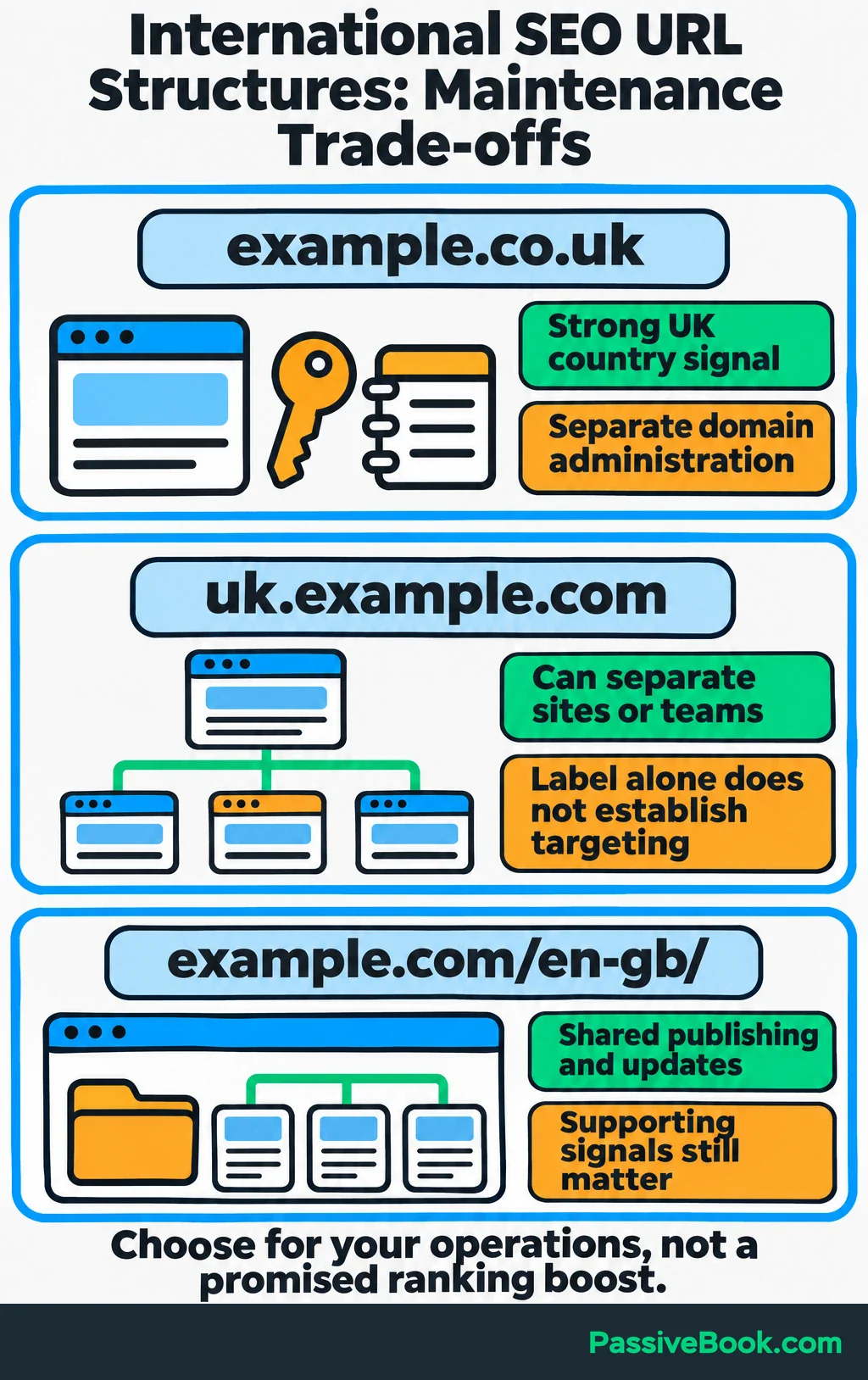
For a centrally managed business on a generic domain such as .com, I would start with subdirectories. They simplify maintenance. I wouldn’t choose them on the promise of a ranking advantage.
Preserve the shop’s established category URL:
https://example.com/guinea-pig-cage-liners/Add its UK equivalent:
https://example.com/en-gb/guinea-pig-cage-liners/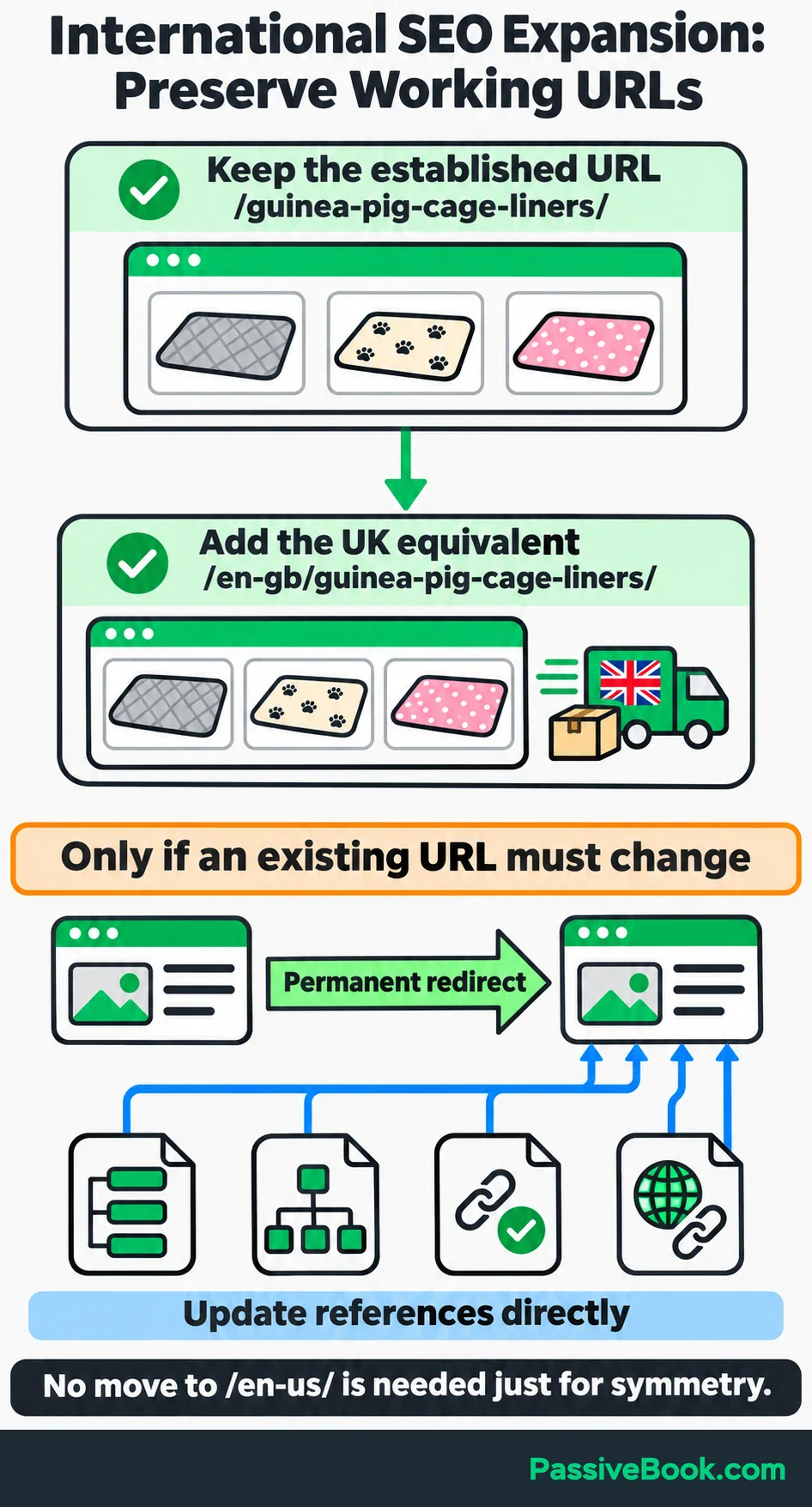
You don’t need to move the original into an /en-us/ folder just to make the addresses look symmetrical.
If an existing URL must change, map it to the relevant replacement and use a permanent redirect. Update internal links and sitemaps to use the replacement directly. Sitemaps list URLs for search engines. Canonical tags identify the preferred URL among duplicate or very similar pages; hreflang annotations connect language or regional versions. Update both to reference the replacement directly. These steps follow Google’s URL migration guidance.
I would keep an expansion and an unnecessary URL migration out of the same project. Each creates work you need to verify.
Localize the Complete Customer Journey
Adapt Pages to Local Intent
Localization means making the page useful in the selected market. Start with the questions and wording you validated, then adapt the content around them.
Review titles, headings, descriptions, product copy and buying guidance. Check spelling, measurements, currency, images and examples, but preserve accurate product facts.
For the cage-liner shop, the measuring guide deserves attention before unrelated blog posts. Show where to measure the cage’s inside dimensions and how those measurements match the sizes you sell.
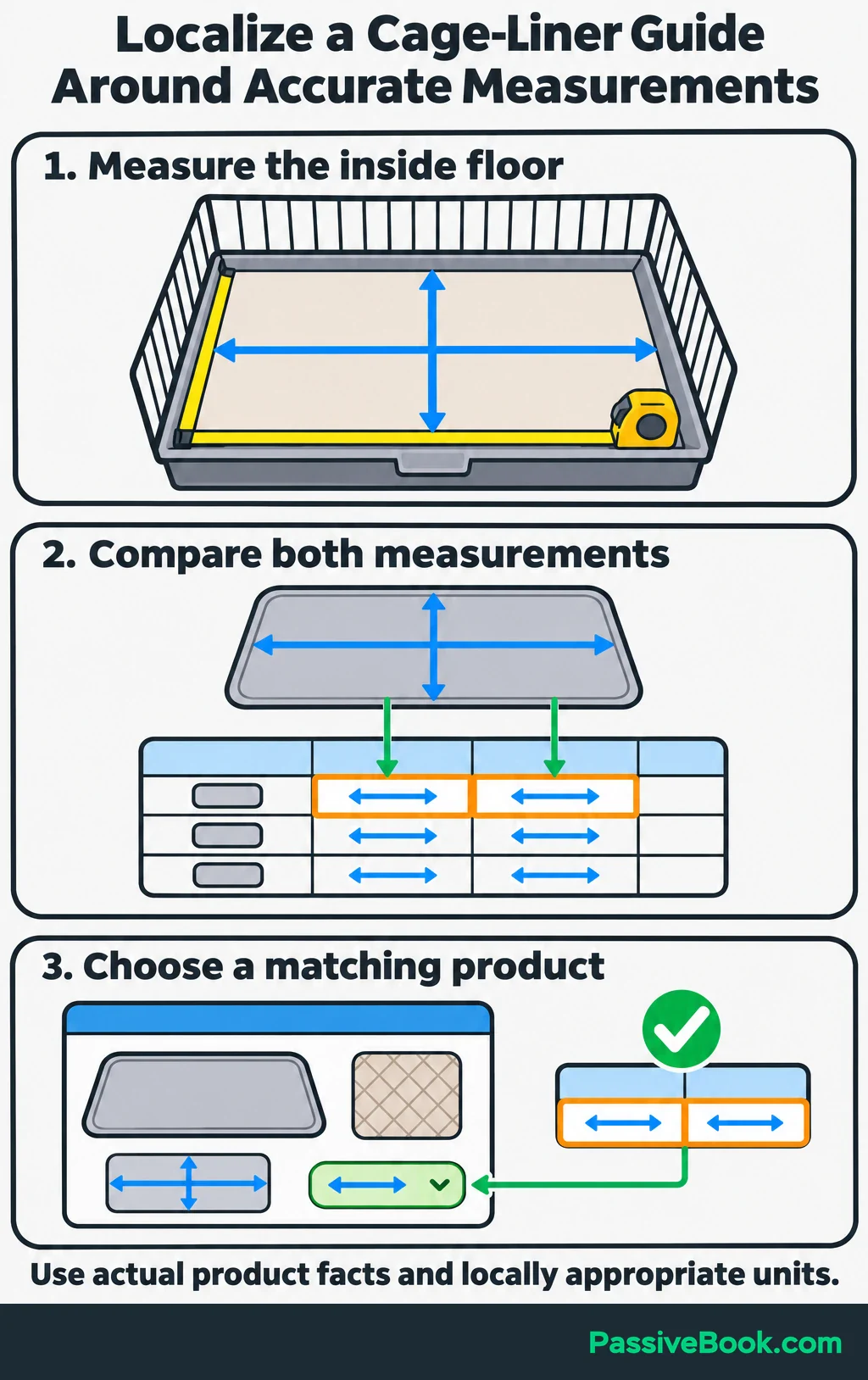
A useful excerpt might read:
Measure the inside floor of the cage from edge to edge, then compare both measurements with the liner’s listed dimensions.
The accompanying diagram and size chart must support that instruction. A smooth translation cannot compensate for a chart that describes the wrong product.
Keep visible prices and availability consistent with checkout and the product data supplied to search engines, often called structured data.
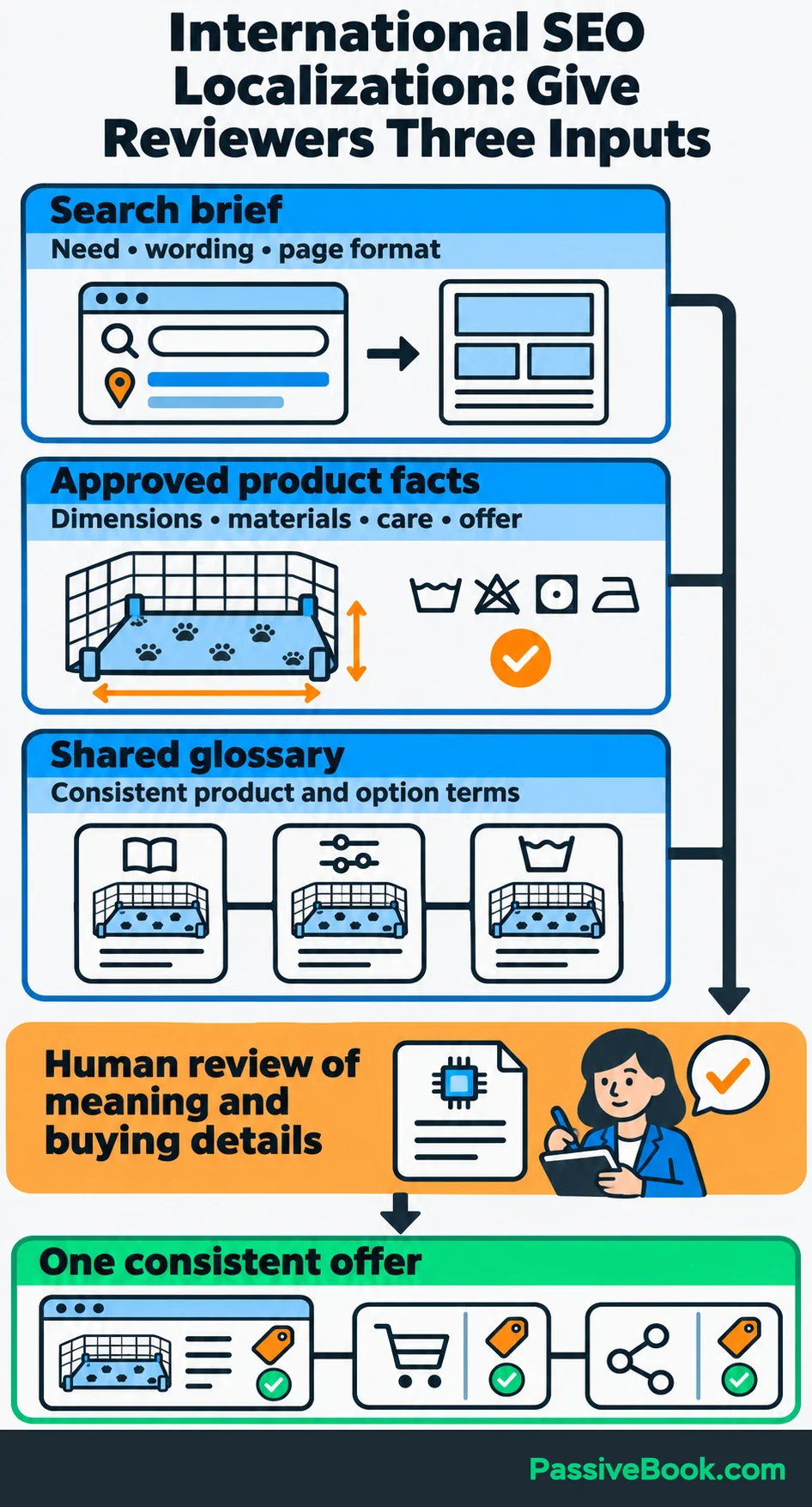
Give your reviewer three things:
- Search Brief: The customer need, target wording and expected page format.
- Product Facts: Approved dimensions, materials, care instructions and offer details.
- Glossary: Consistent terms for products, options and recurring instructions.
I would use AI to prepare a draft and flag terms for review, then have a fluent person check meaning and purchase-critical details. Pay for judgment where a mistake could change what someone buys.
You can give your reviewer a structured first draft instead of a blank brief. This AI Skill adapts one page at a time and marks details that still need confirmation.

Free AI Copywriting Studio




Make Buying and Maintenance Work
Walk through the entire journey in the selected locale. Check navigation, product options, buttons, forms, delivery information, returns, confirmation messages and support content.
Keep links pointed at the right versions. The UK measuring guide should lead to UK product pages, and the selected offer should remain consistent through checkout.
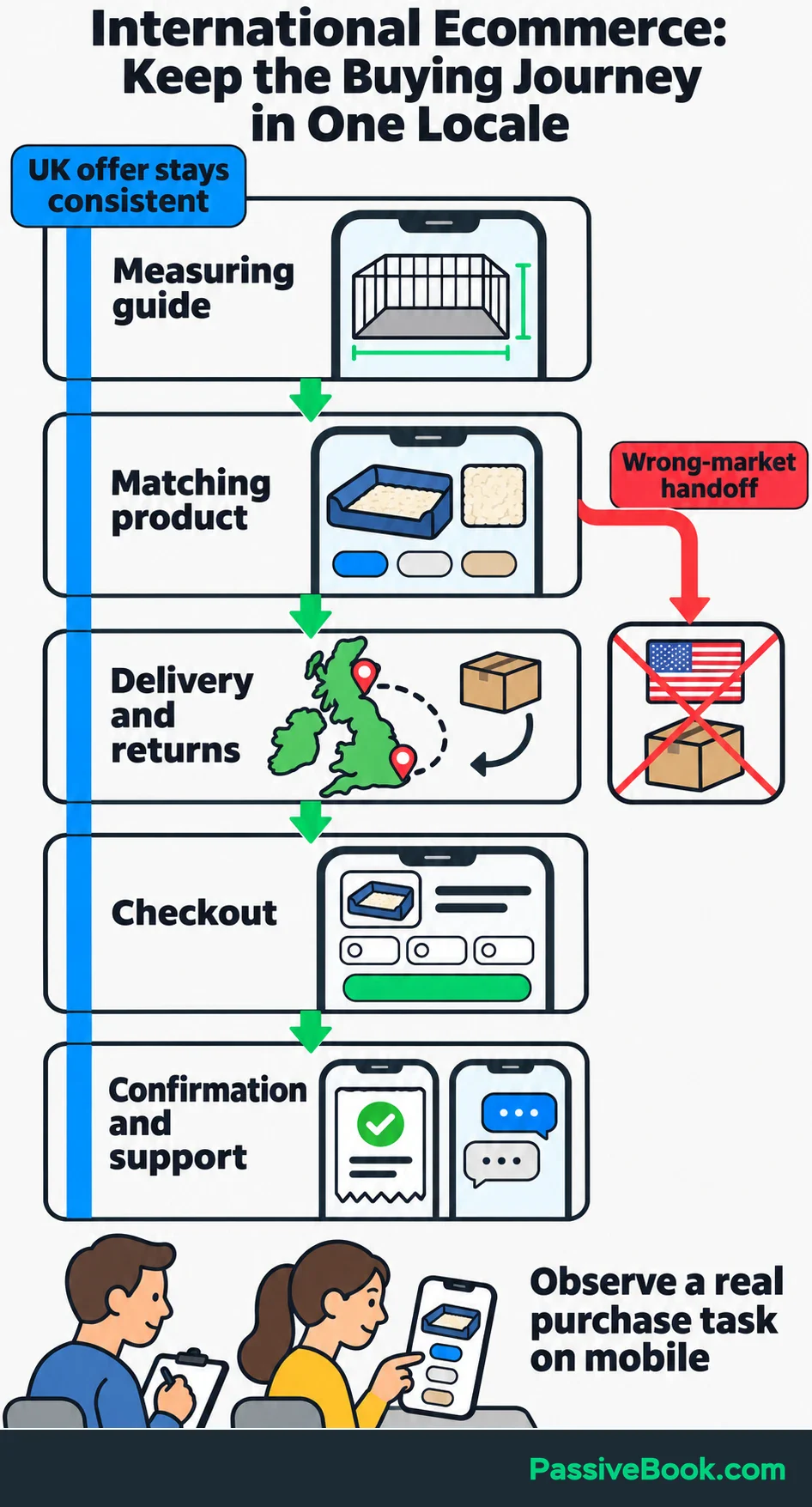
Ask a reviewer in the target market to attempt a purchase. Give them a task such as “choose a liner for these cage dimensions” and watch where they hesitate. Reading pages for errors and trying to buy something reveal different problems.
Also check which destination-market consumer requirements apply to your offer. For the UK pilot, review seller details, total prices, delivery terms and cancellation information against the applicable UK distance-selling guidance.
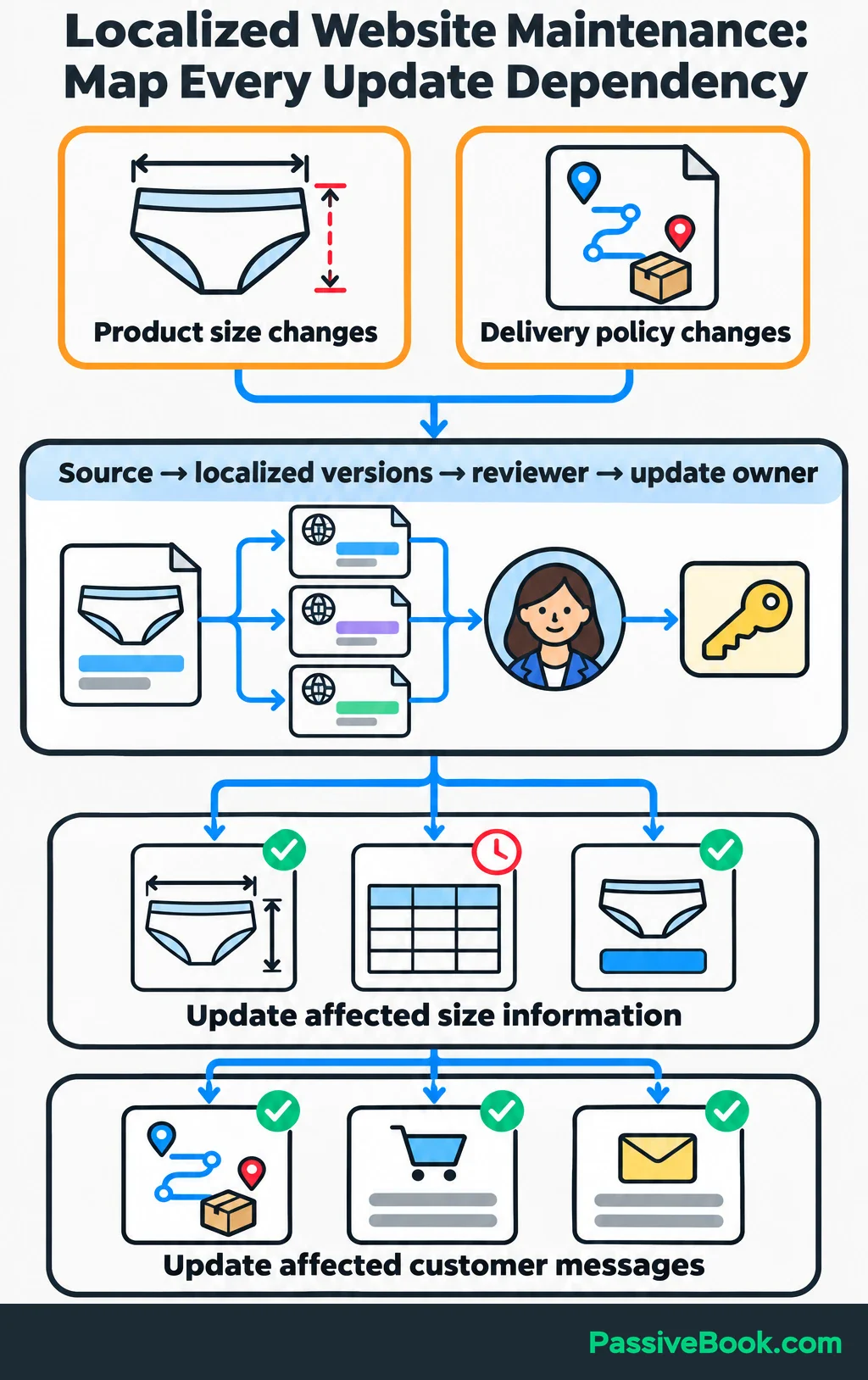
Then assign ownership. Keep a page register connecting each source page with its localized versions, reviewer and update owner.
A changed product size should trigger a review of every affected size chart. A delivery-policy change should reach the relevant pages and customer messages. Put those connections in the register so maintenance doesn’t depend on remembering them.
Make International Versions Accessible to Search Engines
Align Crawling and Canonical Signals
Give each intended search landing page a stable URL that loads successfully and permits crawling and indexing. Link to it through ordinary navigation and include its intended canonical URL in the sitemap.
For each distinct localized page you want indexed, use a self-referencing canonical: a tag that points to the page’s own URL. The UK category would declare:
<link rel="canonical"
      href="https://example.com/en-gb/guinea-pig-cage-liners/" />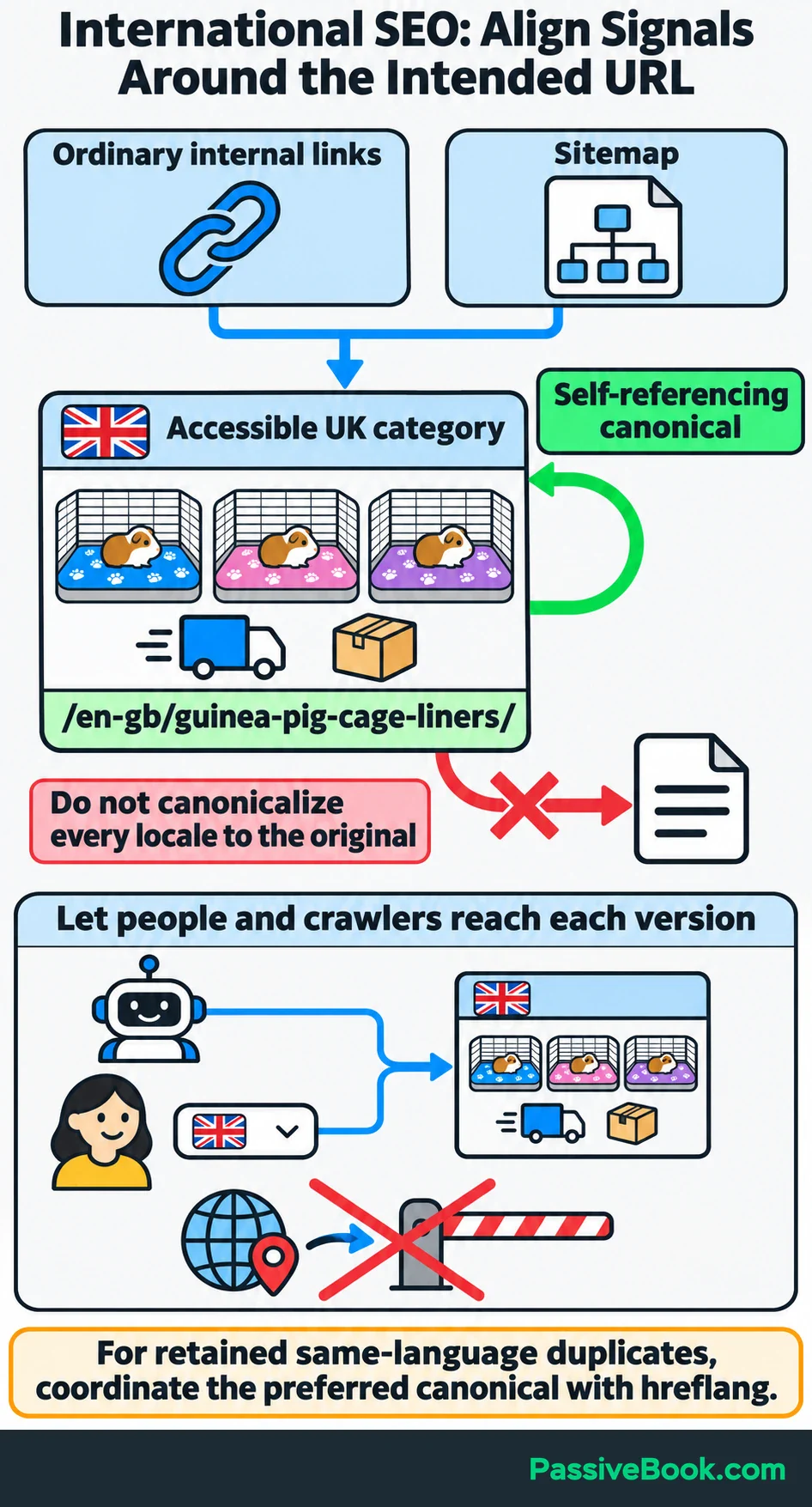
Keep internal links and sitemap entries consistent with that choice. Don’t point every translation’s canonical back to the original language. Google’s canonical guidance explains how these signals work together.
Fully translated main content isn’t duplicate content merely because it is translated. For same-language regional pages offering no useful difference, reconsider whether separate versions are needed. If you retain duplicates, choose a preferred canonical and coordinate it with hreflang.
Provide a visible country or language selector linking equivalent pages. Let visitors choose another version instead of forcing a redirect based on location or browser language.
Implement Hreflang Between Equivalent Pages
Use hreflang to identify equivalent pages for different language or regional audiences. Choose one implementation: HTML annotations, HTTP headers or XML sitemaps. Google treats these methods equally.
For the category pair, place both annotations in each page’s HTML <head>:
<link rel="alternate" hreflang="en-US"
      href="https://example.com/guinea-pig-cage-liners/" />

<link rel="alternate" hreflang="en-GB"
      href="https://example.com/en-gb/guinea-pig-cage-liners/" />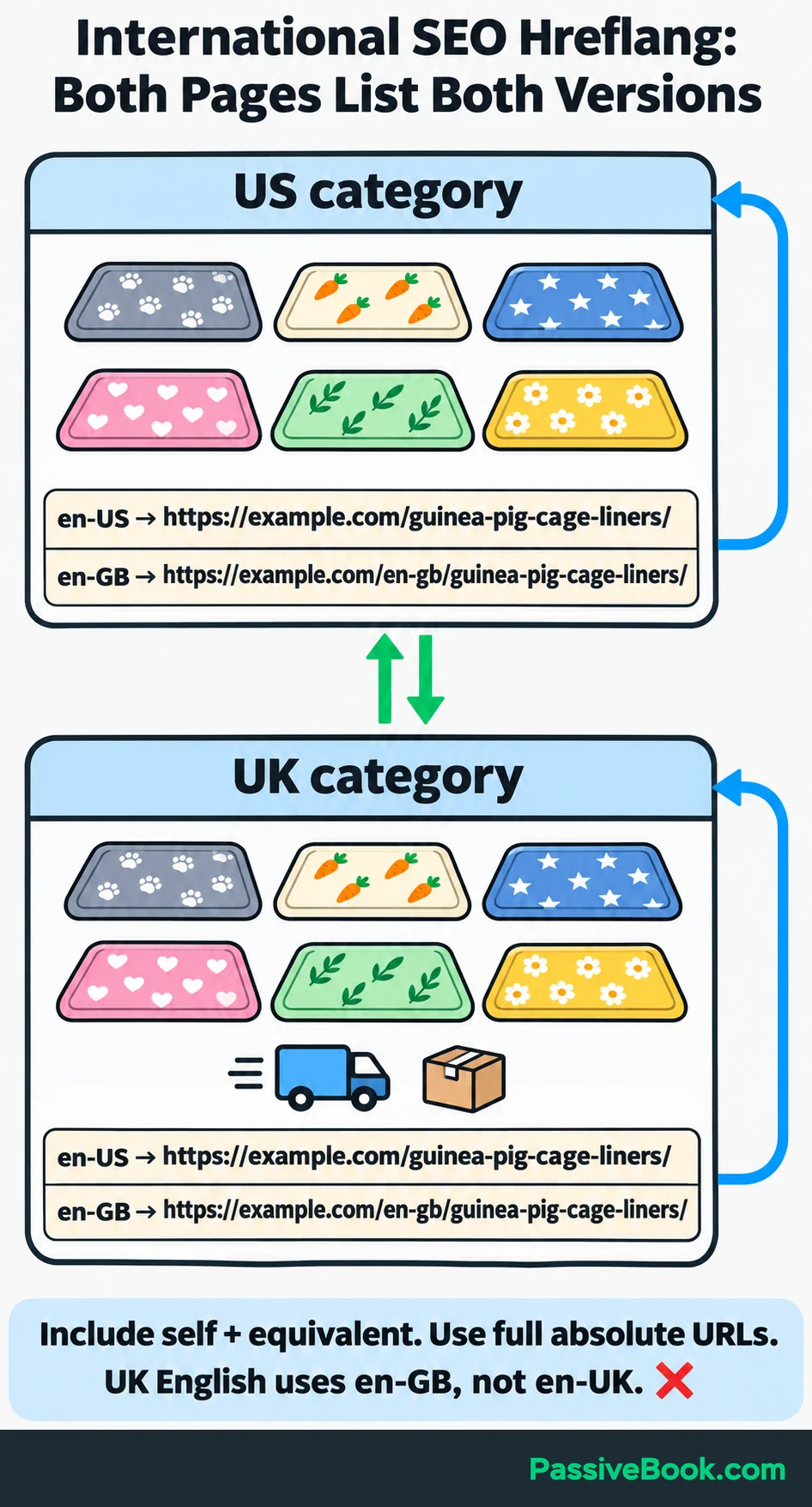
Replace example.com with your live domain. Both pages must list themselves and each other, using full absolute URLs.
Build groups from your page map: category with equivalent category, product with corresponding product. Leave pages without equivalents outside those groups.
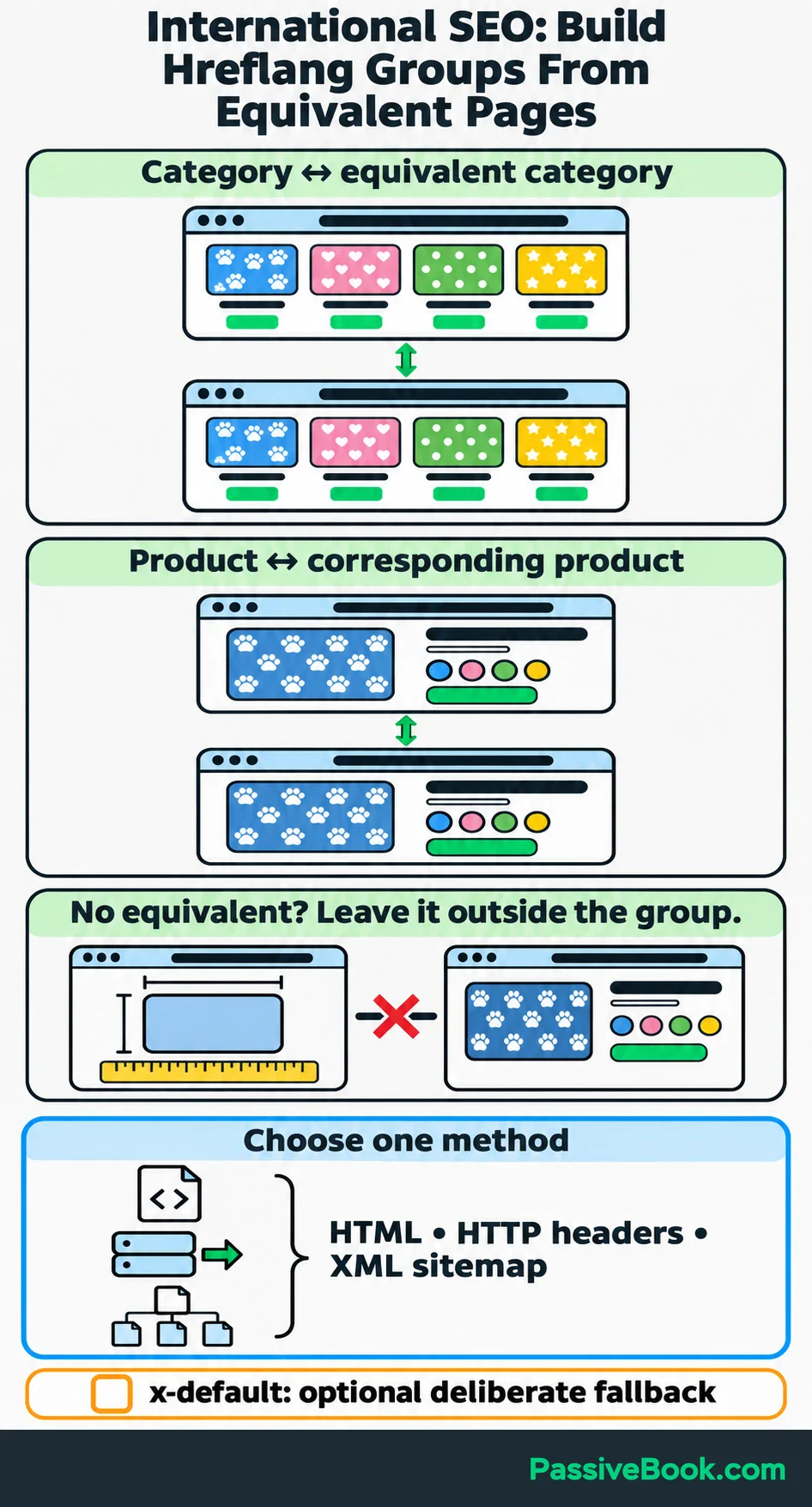
Use en for English without country targeting and en-GB for UK English. The regional code is GB, not UK. Optional x-default can identify a deliberate fallback, such as a language selector.
These requirements come from Google’s localized-page guidance. Hreflang doesn’t translate content or guarantee rankings.
Validate the Pilot Before Promoting It
Crawl the published pilot to check what the site actually outputs. A crawler follows links and records technical details across pages; for a very small pilot, combine that report with direct checks.
Use this launch checklist:
- Access: Intended landing pages load successfully and remain directly accessible.
- Indexing: No accidental indexing blocks remain from development.
- Canonicals: Declarations match the intended pages.
- Alternates: Hreflang groups contain correct, reciprocal references.
- Links: Navigation, guides and product links reach the correct locale.
- Commerce: Sizes, prices, delivery terms, payment and confirmation work on mobile.
- Tracking: Test purchases or leads appear once with the expected values.
Review representative category, product and guide pages manually. A technically valid page can still sell the wrong size.
Record the existing market’s search performance and sales before launch, and note the launch date. This gives you a baseline for investigating changes to established pages.
Submit the sitemap to Google Search Console, Google’s tool for checking search performance and indexing. Inspect representative URLs using its indexed data to check indexing and Google’s selected canonical. The live test checks current accessibility but cannot predict canonical selection, as Google explains in its URL Inspection documentation.
Earn Relevant Visibility in the New Market
Find publications, specialist blogs, businesses and organizations that already serve your selected audience. Prioritize topical relevance and real readership over a long list of websites willing to publish anything.
Give them a useful reason to reference your resource. For the cage-liner shop, that might be an illustrated measuring guide with clear diagrams and accurate product dimensions.
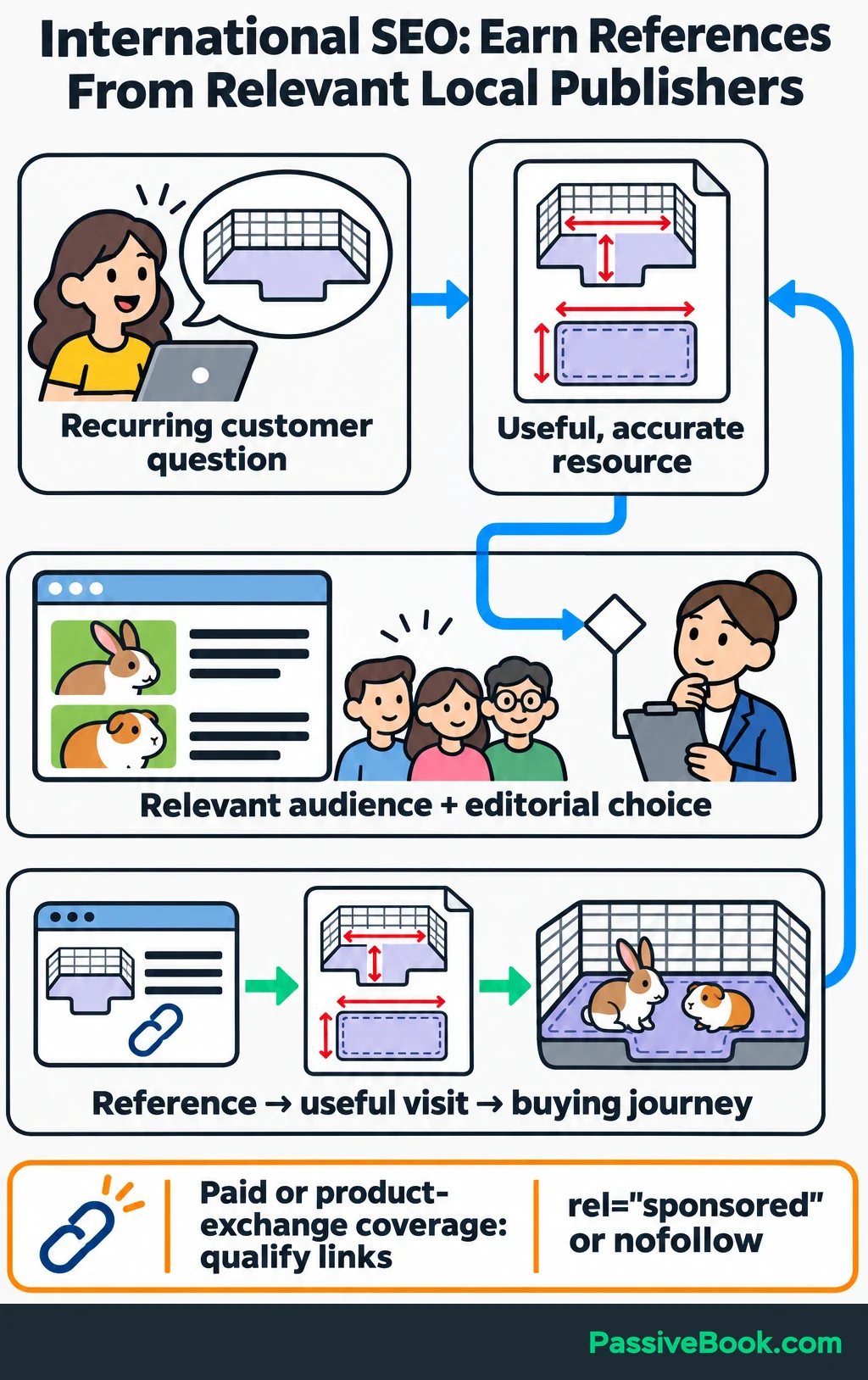
I would approach a few relevant small-pet publications before paying for broad distribution. Explain which recurring reader question the guide answers and let the publisher decide whether it deserves a reference.
Use customer questions to improve the same buying journey. If people keep asking how to measure an irregular cage, add a demonstration or explain which shapes your products support. Don’t turn every question into a separate article.
If you pay for placement or provide products in exchange for coverage, have the publisher qualify links with rel="sponsored" or nofollow. Google distinguishes properly qualified advertising from links bought to manipulate rankings.
Measure Results Before Expanding
Track Performance by Market and Page Locale
In Search Console, filter by country and examine queries, pages, impressions and clicks. Then filter the localized URL group. This helps separate UK search activity across your whole site from performance of the UK pages themselves.
Connect organic landing-page sessions with qualified inquiries, orders and revenue in analytics. For sales, combine order data with variable selling costs to assess contribution.
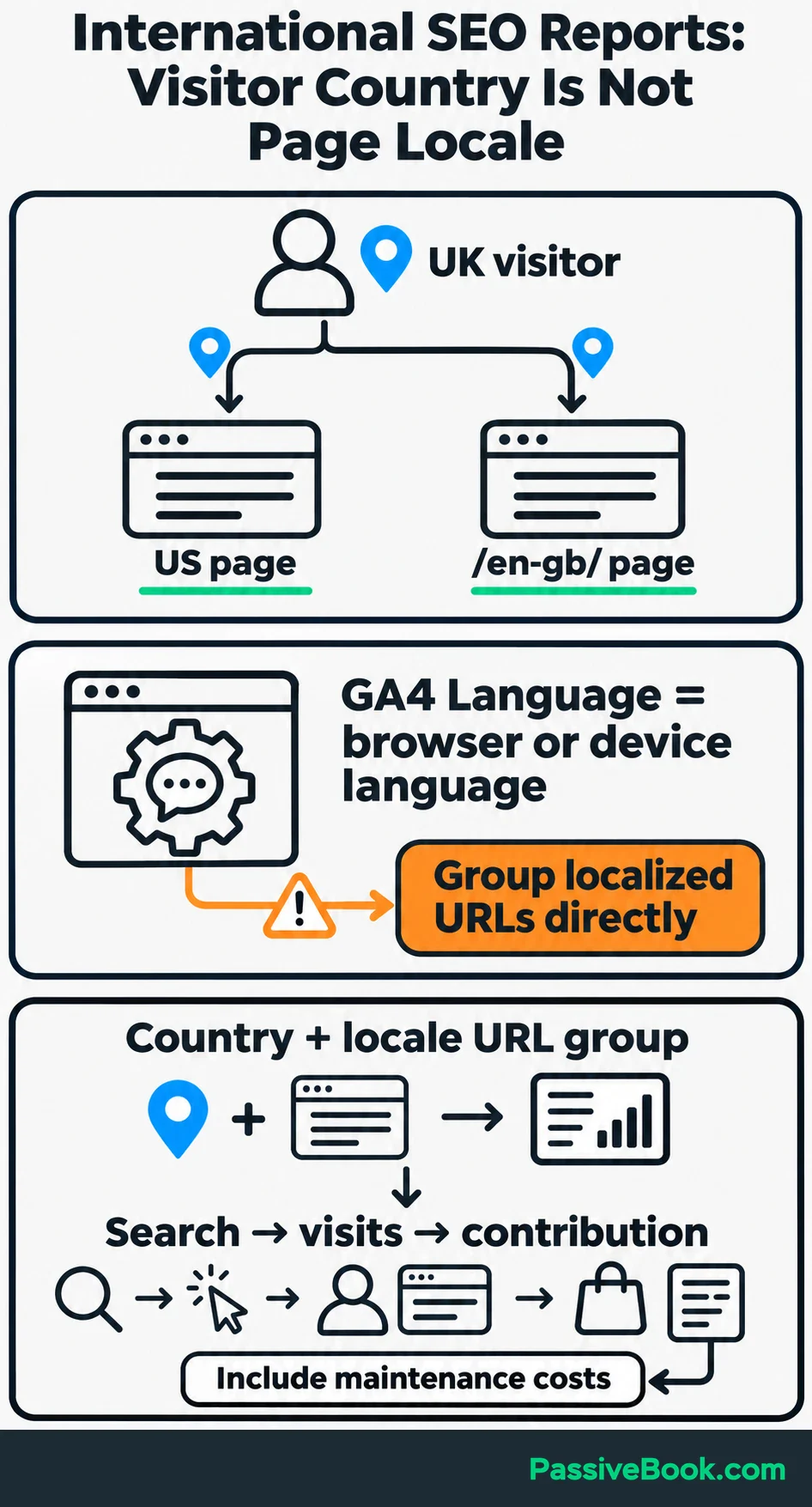
Keep visitor country separate from page locale: a UK visitor can view a US page. In Google Analytics 4 (GA4), Language describes the browser or device language. Group localized URLs directly to measure which page versions people view.
Keep one report row per market and locale URL group, and include maintenance costs alongside the search and sales figures.
Read the report as a sequence:
| Milestone | Evidence to Look For | Decision It Supports |
|---|---|---|
| Pages enter the index | Intended pilot URLs appear with suitable canonical selection | Investigate access problems before adding content |
| Relevant visibility develops | Queries match the products and questions you target | Assess whether page targeting fits demand |
| Suitable visitors arrive | Organic visits reach relevant commercial and support pages | Review listings and the on-site journey |
| Commercial value appears | Qualified leads or orders produce useful contribution | Compare results with ongoing costs |
Compare periods that reflect the market’s buying cycle and seasonality. Keep your attribution rules consistent, and don’t treat every sale to the new country as an additional sale caused by SEO.
Fix the Constraint Before Adding Another Market
Let the weakest stage determine the next task.
If pages remain unindexed, investigate access, internal links, content and canonical selection before producing more pages.
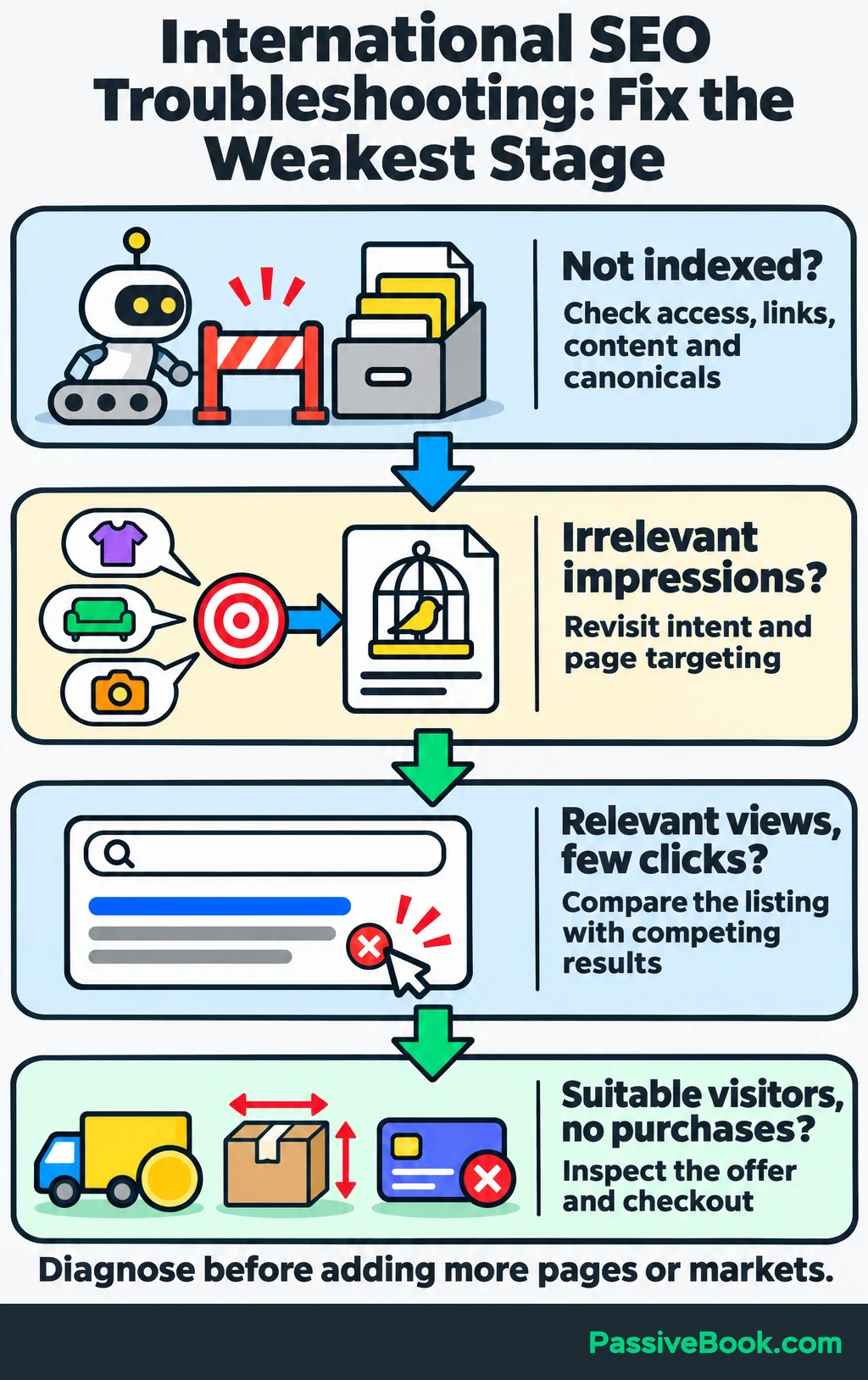
If impressions come from irrelevant searches, revisit intent and page targeting. When relevant impressions produce few clicks, compare your search listing with competing results. Check whether the title and description accurately explain the offer.
When suitable visitors arrive but don’t buy, inspect the offer itself. Delivery charges, unclear measurements, unavailable payment methods and awkward checkout steps deserve attention before another content batch.
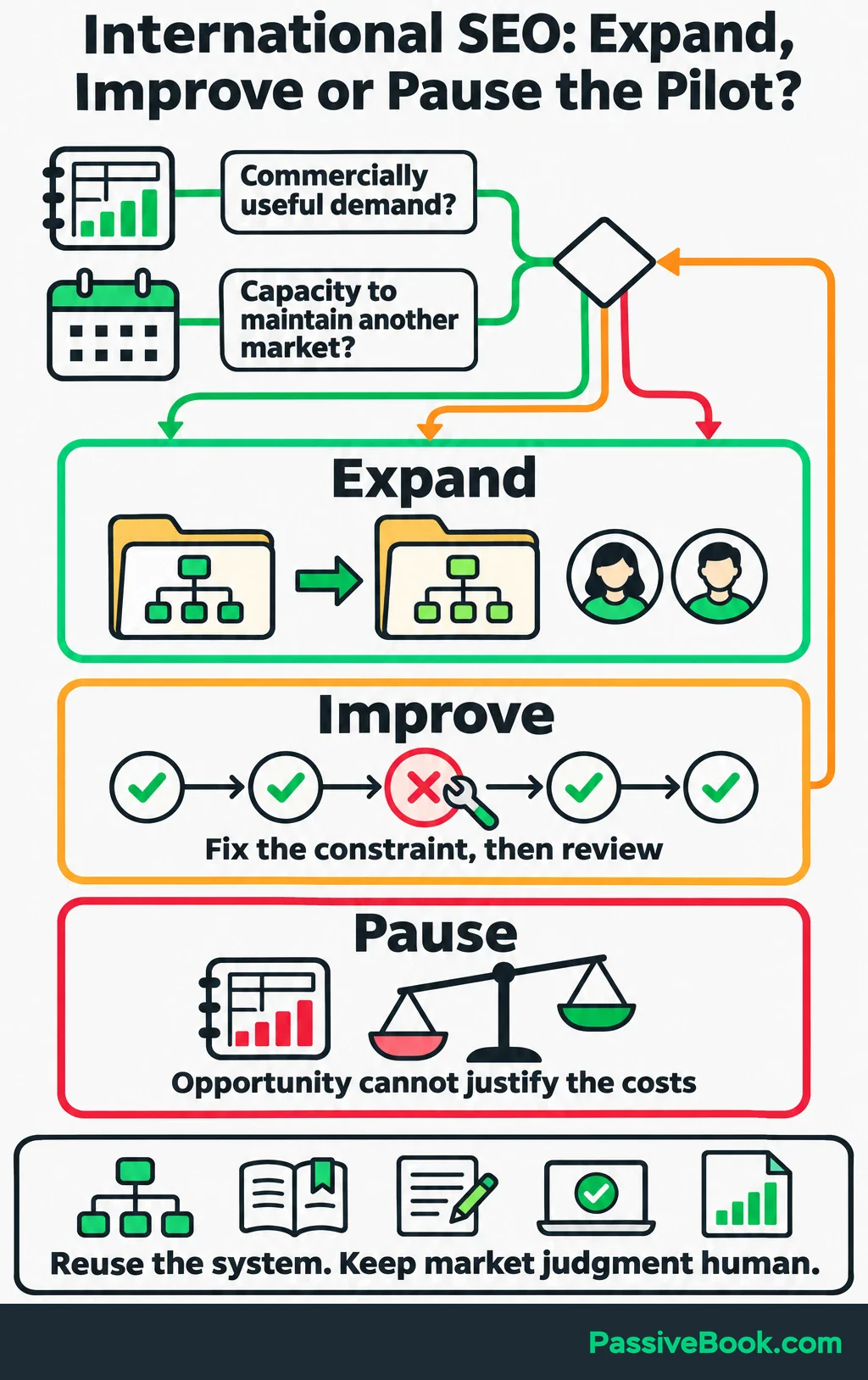
I would expand when the pilot shows commercially useful demand and you have the capacity to maintain another market. Set review points around your budget and the market’s buying cycle.
A market can also earn a pause. If the credible opportunity cannot justify its costs, translating more pages only makes the lesson more expensive.
Reuse the page map, glossary, briefs, technical checks and reporting routine. Automate repeatable checks and update notifications, while keeping language review and market decisions with a person who understands the offer.
What Next?
List three countries already appearing in your search data, inquiries or orders, then check whether you can serve each one profitably before commissioning localized pages.
Use the social buttons to share this guide when planning an expansion budget or reviewing a proposed market. It gives that discussion a concrete path from demand to maintenance costs.
Which market still looks promising after you include delivery, support and ongoing updates? Share your answer in the comments, and bring any other questions too.
Share this post with your friends & followers:

