Your best article still loads, the advice still looks useful, but fewer people are finding it through Google. Then an update announcement appears and every unfinished SEO task starts looking urgent.
That uncertainty can cost you an evening of unnecessary edits or a rewrite budget spent on the wrong pages. This guide connects Google’s major updates with the decisions they actually change. It also shows how to compare your traffic data, find the affected pages, and decide whether to repair a fault, improve an answer, or keep watching.
What Are Google Algorithm Updates?
Google algorithm updates are changes to the systems Google uses to rank search results. Those systems assess which pages are relevant and useful for a particular search.
They use signals about individual pages and the wider site. A strong site can still have weak pages, and one weak page does not automatically drag every other page down. Google explains this distinction in its ranking systems guide.
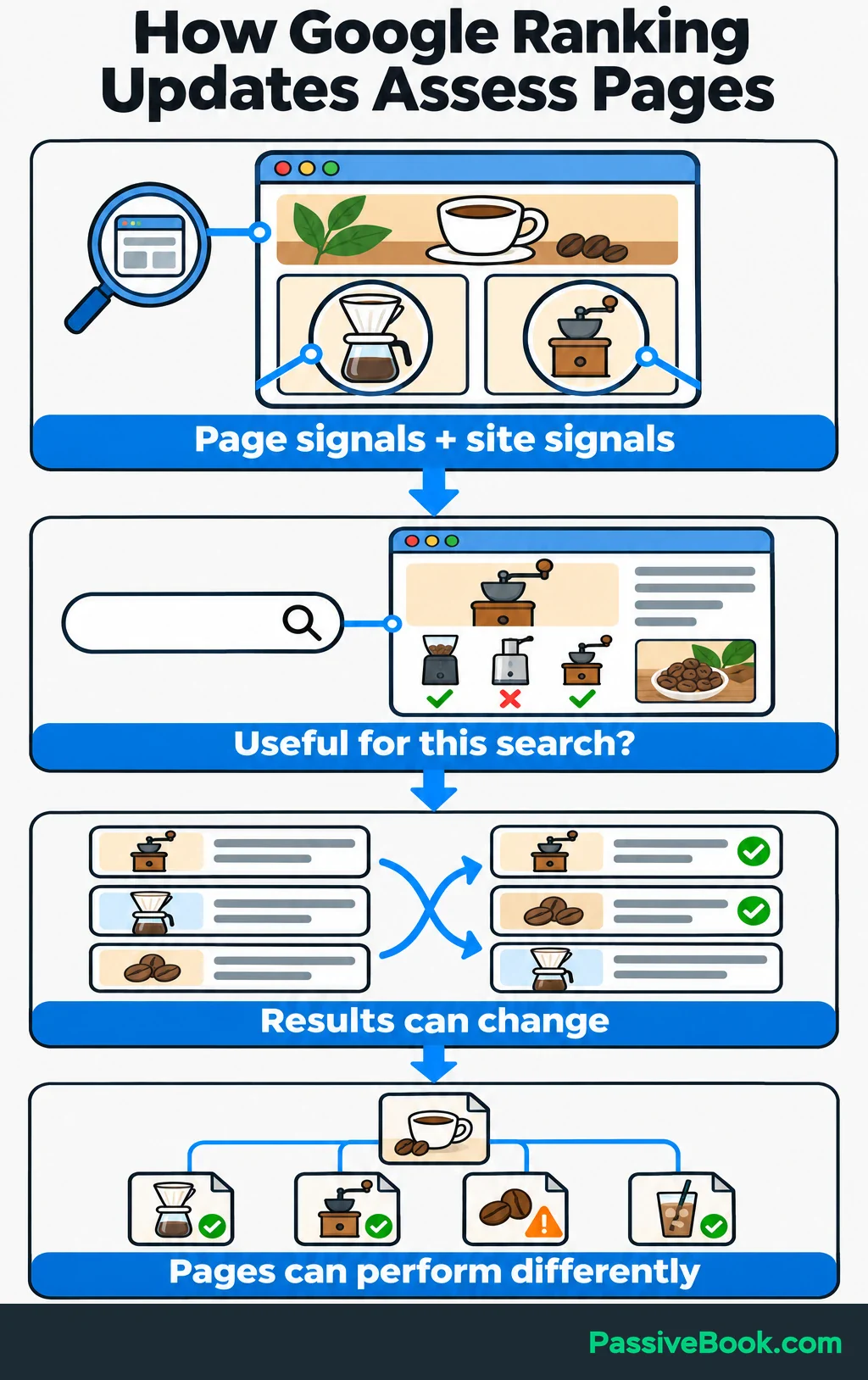
For a site owner, the useful question is what changed in visibility and whether that change points to something you can improve.
Throughout this article, imagine you run a home coffee-brewing blog. You publish brewing guides and earn affiliate commissions from grinder reviews.
Core, Spam and Reviews Updates
These update types do different jobs, and the same page can be affected by more than one system.
| Update Type | Purpose | Affected Content | Appropriate Investigation |
|---|---|---|---|
| Core | Improve the overall relevance and helpfulness of results | Content across many topics and formats | Compare affected pages with the task behind their searches |
| Spam | Improve automated detection of practices that break Google’s spam policies | Pages or sites using those practices | Check publishing and linking practices against the relevant policy |
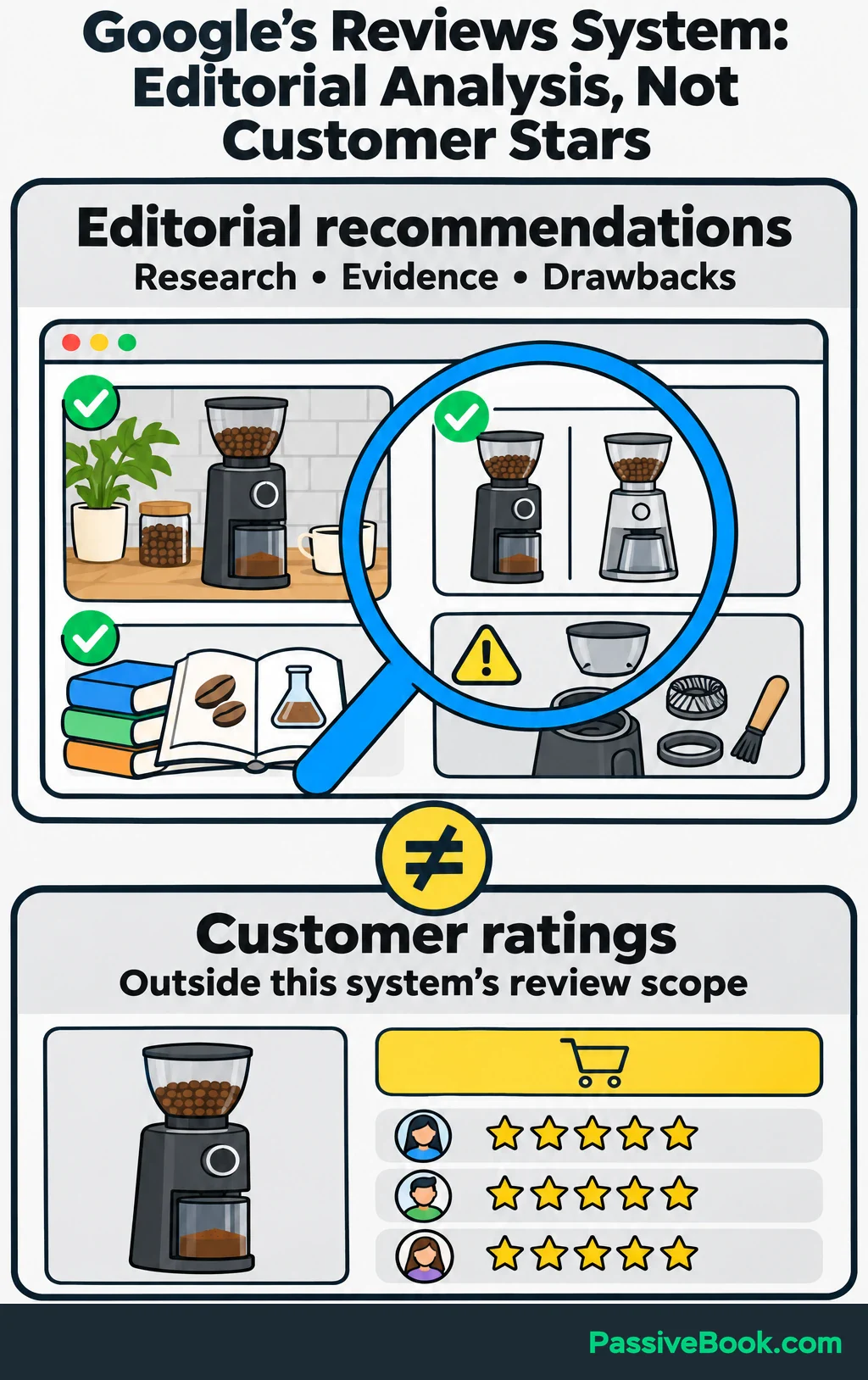
| Reviews | Reward substantial analysis and original research in recommendations | Editorial reviews, comparisons, and recommendation lists in supported languages | Examine the evidence, comparisons, drawbacks, and reasoning behind each recommendation |
A core-update decline does not automatically mean you broke a rule. Other pages may now be judged more useful for the searches where you previously ranked.
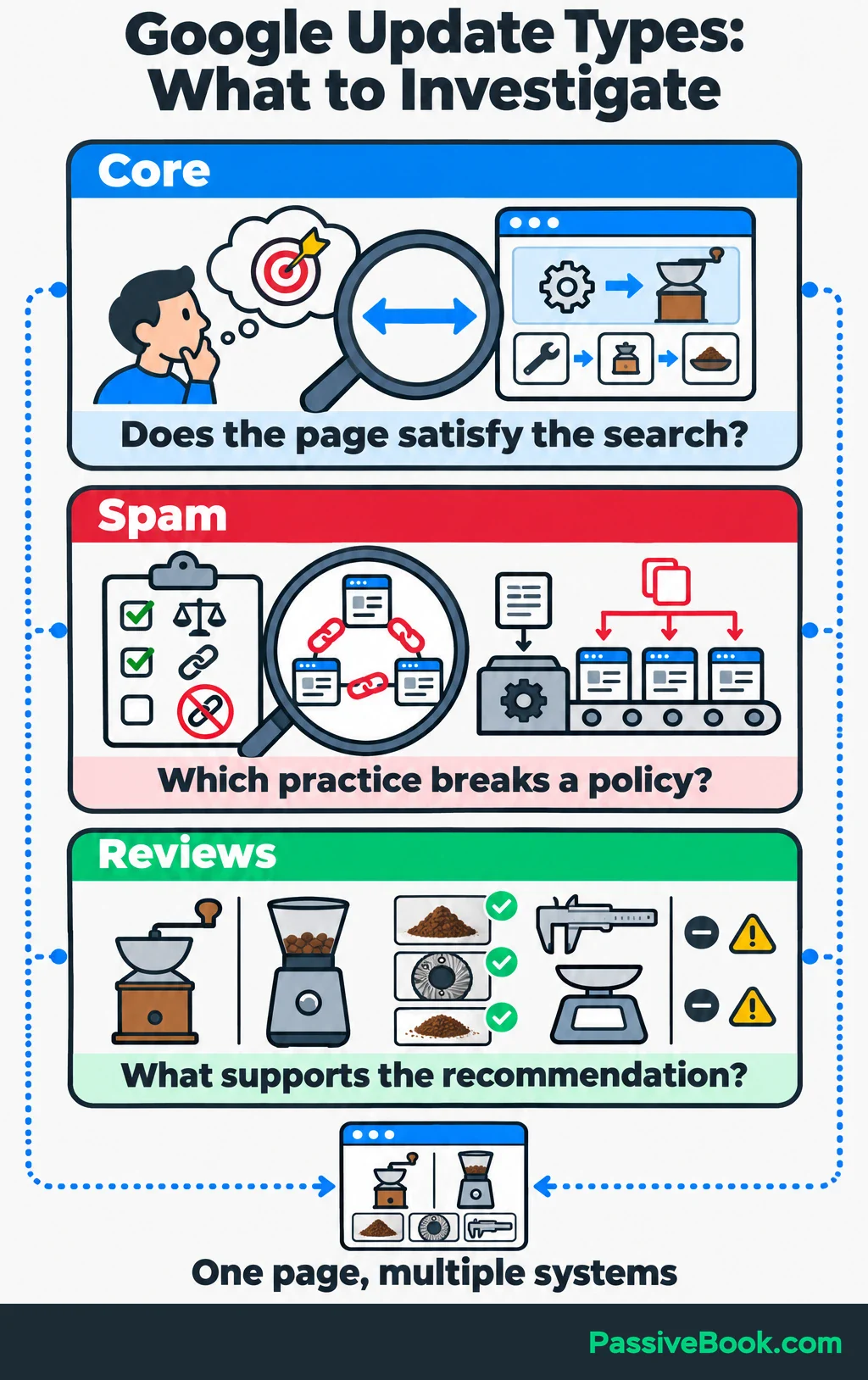
The reviews system covers editorial recommendations, including a grinder comparison on the coffee blog. It does not assess customer ratings left in a product page’s review section. Google also says the reviews system receives regular, ongoing improvements.
A manual action means a Google reviewer found a violation of Google’s spam policies. The notice appears in Google Search Console, Google’s tool for monitoring search traffic and checking whether pages can appear in results. An automated ranking decline does not come with that notice.
Keep service outages and changes to the results page separate too. A page can receive fewer clicks because the search layout changed, even when its ranking barely moved.
How Often Does Google Update Its Algorithm?
Google says it makes thousands of Search updates each year, but it announces selected changes that are especially useful for site owners to know about. Its explanation of update frequency also explains why named rollouts sometimes overlap.
Broad core updates happen several times a year. There is no fixed quarterly schedule you can build a publishing calendar around.
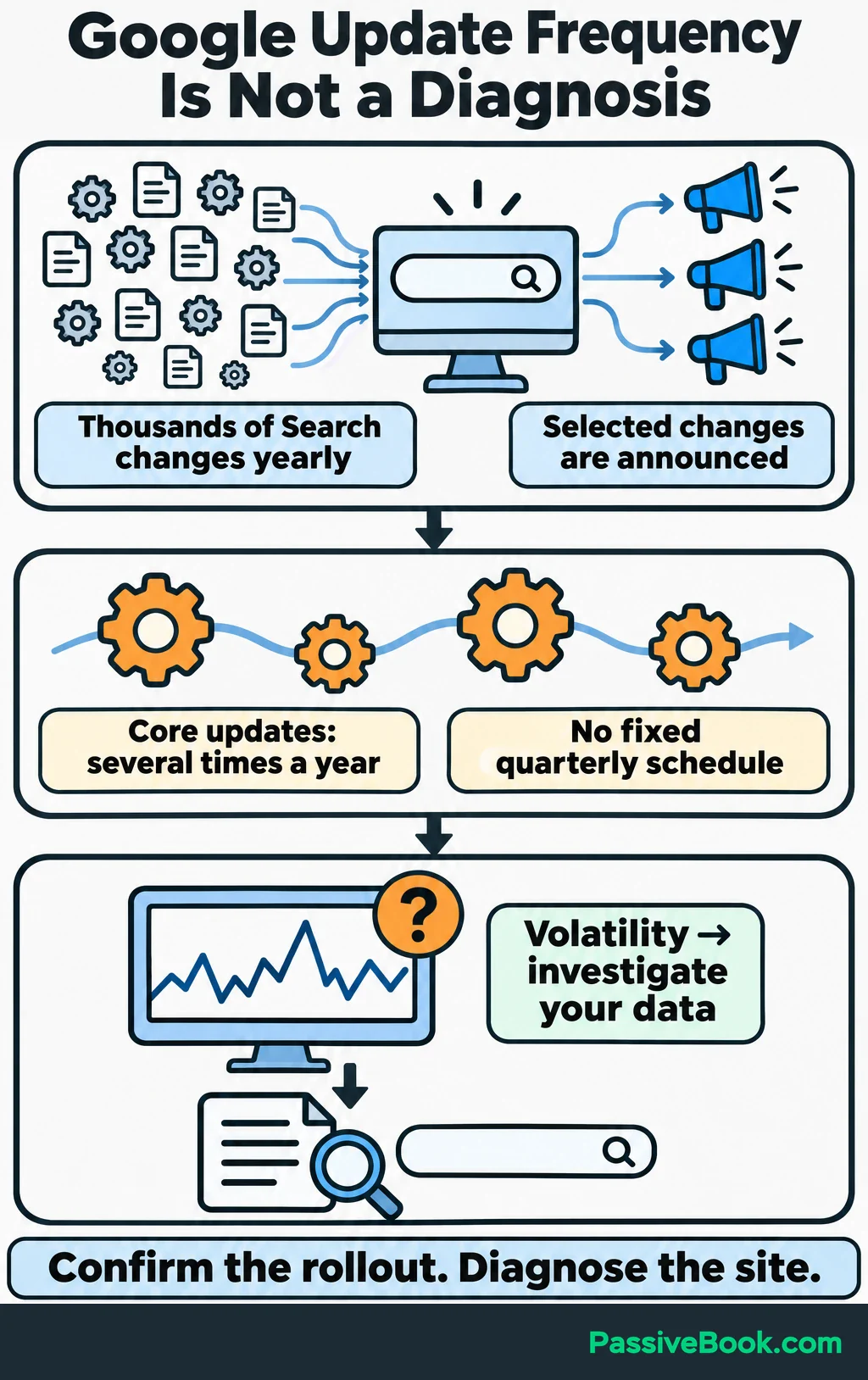
I would use official announcements to confirm a named rollout. Third-party reports of widespread ranking movement can tell you when to investigate, but they cannot tell you why your particular site lost traffic.
A busy volatility chart is a reason to open your data. It is not a diagnosis.
What Is the Latest Confirmed Google Algorithm Update?
The latest confirmed ranking update listed by Google is the September 2026 spam update, which finished on October 8. The latest general core update is the May 2026 core update, which finished on June 2.
The confirmed 2026 rollouts are below, from newest to oldest. All dates use US/Pacific time.
| Name | Rollout Start | Completion | Announced Scope | Official Source |
|---|---|---|---|---|
| September 2026 spam update | September 24, 2026 | October 8, 2026 | Global, all languages | September record |
| August 2026 spam update | August 18, 2026 | August 21, 2026 | Global, all languages | August record |
| June 2026 spam update | June 24, 2026 | June 26, 2026 | Global, all languages | June record |
| May 2026 core update | May 21, 2026 | June 2, 2026 | General core update | May record |
| March 2026 core update | March 27, 2026 | April 8, 2026 | General core update | March core record |
| March 2026 spam update | March 24, 2026 | March 25, 2026 | Global, all languages | March spam record |
| February 2026 Discover update | February 5, 2026 | February 27, 2026 | Discover core update, initially for English-language users in the United States | Discover record |
The Discover distinction matters. Discover recommends content in a feed, while ordinary Search responds to a query. If your Discover visits fell but your Web Search clicks held steady, investigate those reports separately.
Also read the announced scope before accepting a confident explanation online. A general spam announcement does not establish that Google specifically targeted affiliate links, coffee reviews, or your publishing tool.
Google Algorithm Update History
The timeline below covers the major documented milestones and their lasting SEO significance. Google does not publish every ranking adjustment, so no public history can list them all.
The timeline separates ranking changes from changes to how Google discovers pages (crawling) and stores them for search (indexing). It also includes policy announcements. The 2026 rollouts above continue the chronology.
Early Search Through 2010: Links and Continuous Indexing
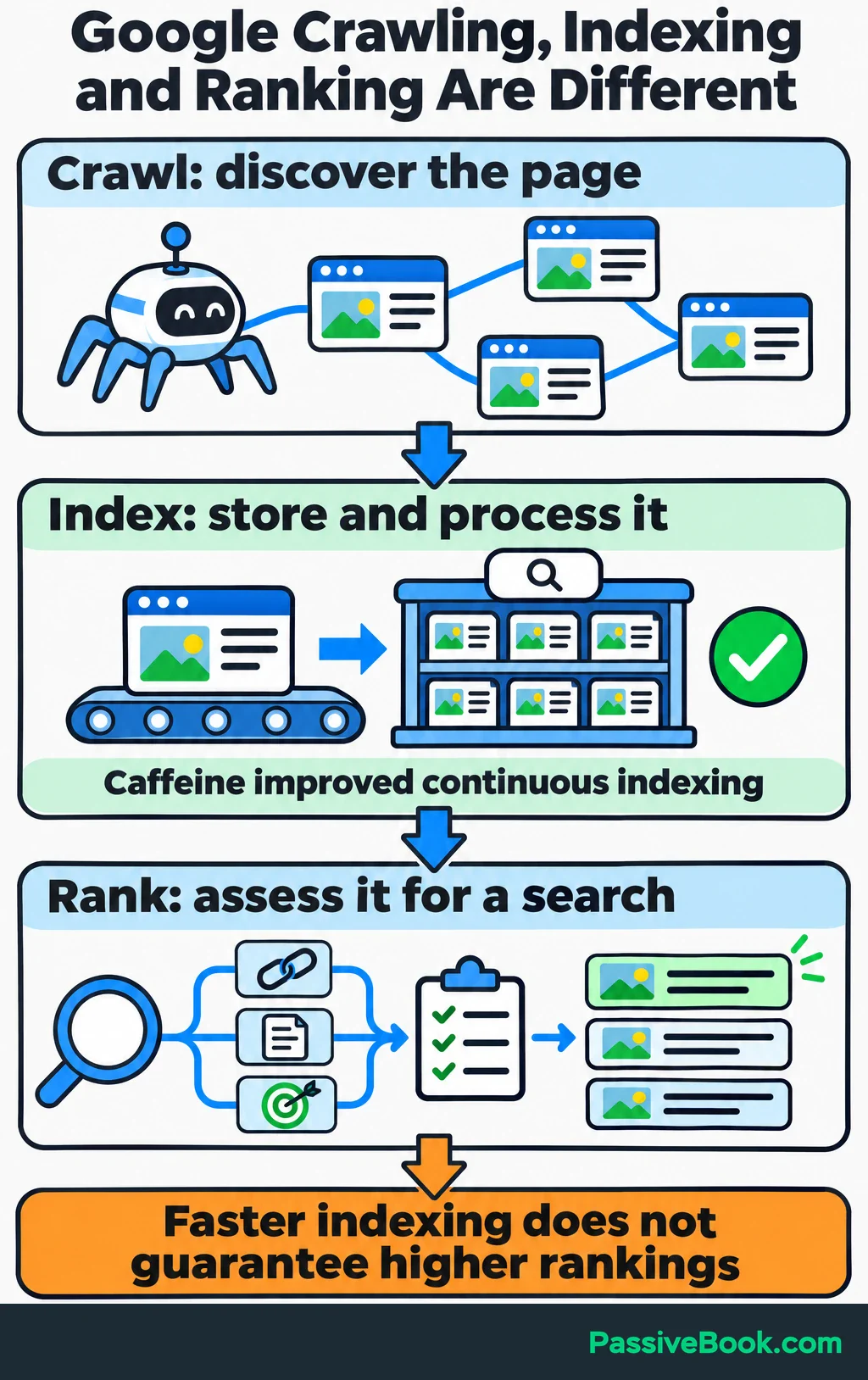
Early Google history helps explain two ideas that still get confused: getting a page into the index and deciding where that page ranks.
| Date or Period | Milestone | Change Category | Lasting SEO Significance |
|---|---|---|---|
| Early Google | PageRank foundations | Ranking | Links helped Google assess pages. Modern rankings depend on much more than backlink counts. |
| 2000–2003 | Google Dance and Fritz | Indexing | Monthly index replacements gave way to incremental daily indexing in summer 2003. |
| 2003 | Florida | Ranking | Previously successful pages could lose prominent positions after a major ranking change. |
| 2005 | Jagger | Ranking | Algorithmic ranking changes were separate from requests to restore sites removed for breaking Google’s rules. |
| 2005–2006 | Bigdaddy | Crawling and indexing | Google upgraded software used to crawl and process pages. |
| June 2010 | Caffeine | Indexing | Google could add fresh content to its index continuously and at greater scale. |
Google engineer Matt Cutts’s account of the Google Dance and Fritz makes the distinction clear: refreshing the available data is different from changing the rules used to assess it.
Florida became an early example of how disruptive those rules could be. Danny Sullivan’s contemporary reporting documented lost rankings, but proposed explanations from that period should not be treated as a confirmed formula.
Caffeine is another useful correction to update folklore. Google’s original announcement described an indexing system. Faster discovery made fresh pages available sooner; it did not promise them a higher position.
2011–2014: Content Quality, Spam and Search Meaning
This period brought several names that still appear in SEO advice. Their lessons remain useful, but they are part of a much larger set of systems today.
| Date or Period | Milestone | Change Category | Lasting SEO Significance |
|---|---|---|---|
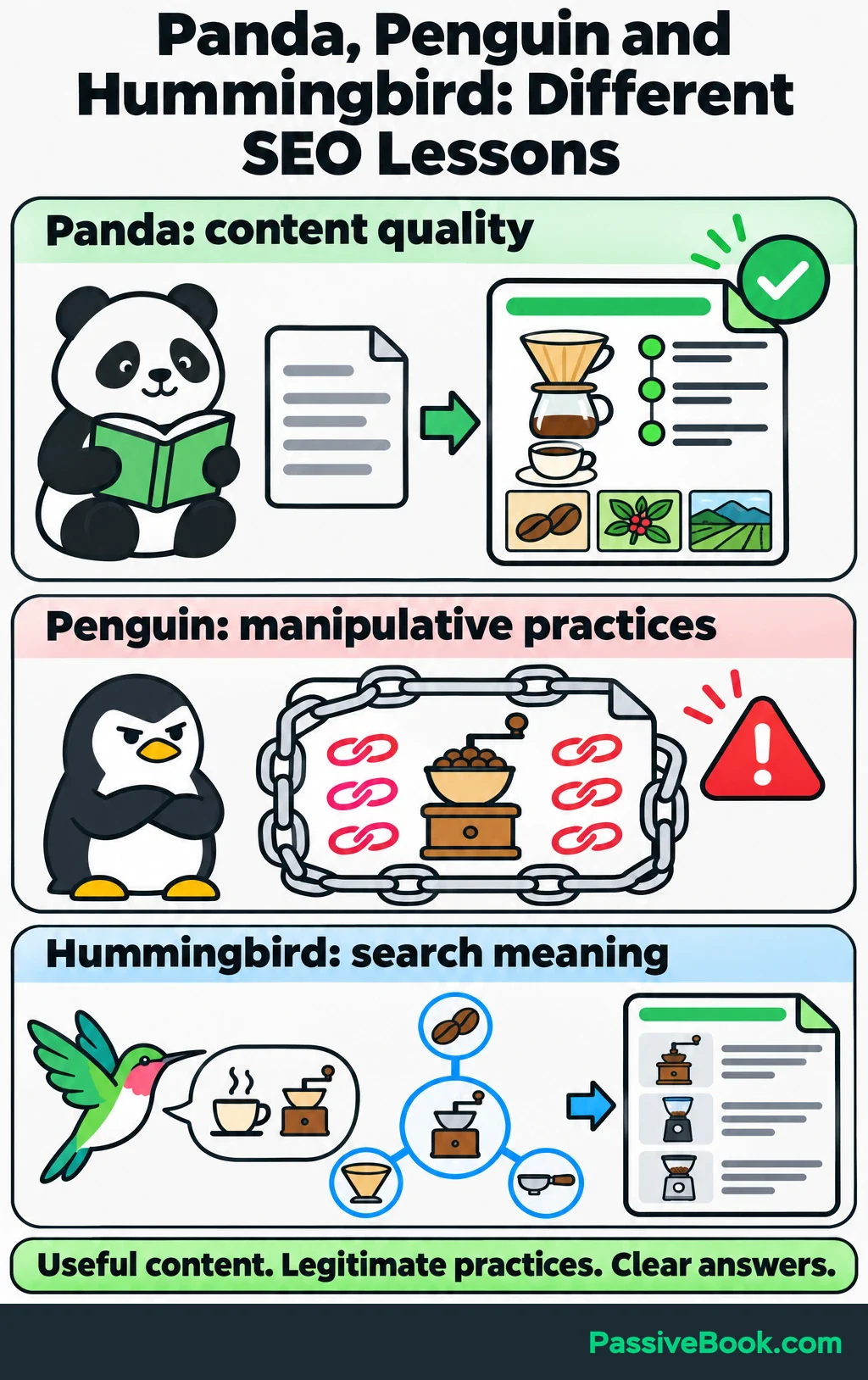
| February 2011 | Panda | Content-quality ranking | Favored high-quality, original content over low-value material. It became part of core ranking in 2015. |
| November 2011 | Freshness | Ranking | Improved results for searches where recent information matters. |
| January 2012 | Page Layout | Ranking and usability | Addressed layouts where excessive advertising obscured the main content. |
| April 2012 | Penguin | Spam ranking | Addressed manipulative practices, including keyword stuffing and link schemes. |
| August 2013 | Hummingbird | Search understanding | Made a major improvement to Google’s overall ranking systems and interpretation of searches. |
| July 2014 | Pigeon | Local ranking | Connected local results more closely with web-search capabilities and improved location handling. |
| August 2014 | HTTPS | Ranking signal | Introduced secure connections as a lightweight signal, below high-quality content in importance at launch. |
Freshness did not mean every page needed a new date. Google’s original explanation distinguished searches needing current information from those where older answers remain useful.
On the coffee blog, a guide to a discontinued grinder may need a real update. A sound explanation of how brewing ratios work does not become better because you change “updated” to this morning.
Pigeon was Search Engine Land’s nickname. In its report of Google’s statements, the change initially covered US-English results and improved distance and location parameters. That local scope matters when comparing it with a general web-ranking change.
2015–2020: Mobile Search and Language Understanding
Google’s work increasingly addressed how people searched on phones and what their words meant.
| Date or Period | Milestone | Change Category | Lasting SEO Significance |
|---|---|---|---|
| April 2015 | Mobile-friendly update | Mobile ranking | Boosted mobile-friendly pages in mobile results globally, at the individual-page level. |
| 2015 | RankBrain | Language understanding | Helped connect words with concepts, beyond exact keyword matches. |
| September 2016 | Penguin joins core ranking | Spam ranking | Began refreshing data in real time and devaluing spam more granularly. |
| 2018 | Broader mobile-first indexing rollout | Indexing | Google increasingly used the mobile version of content for indexing. |
| July 2018 | Speed Update | Mobile ranking | Addressed pages delivering the slowest mobile experiences. |
| October 2019 | BERT | Language understanding | Improved interpretation of context, including small words that change a search’s meaning. |
Mobile-first indexing and mobile speed were separate changes. Google’s mobile-first indexing announcement explicitly separated how content was gathered from the mobile-friendly ranking assessment.
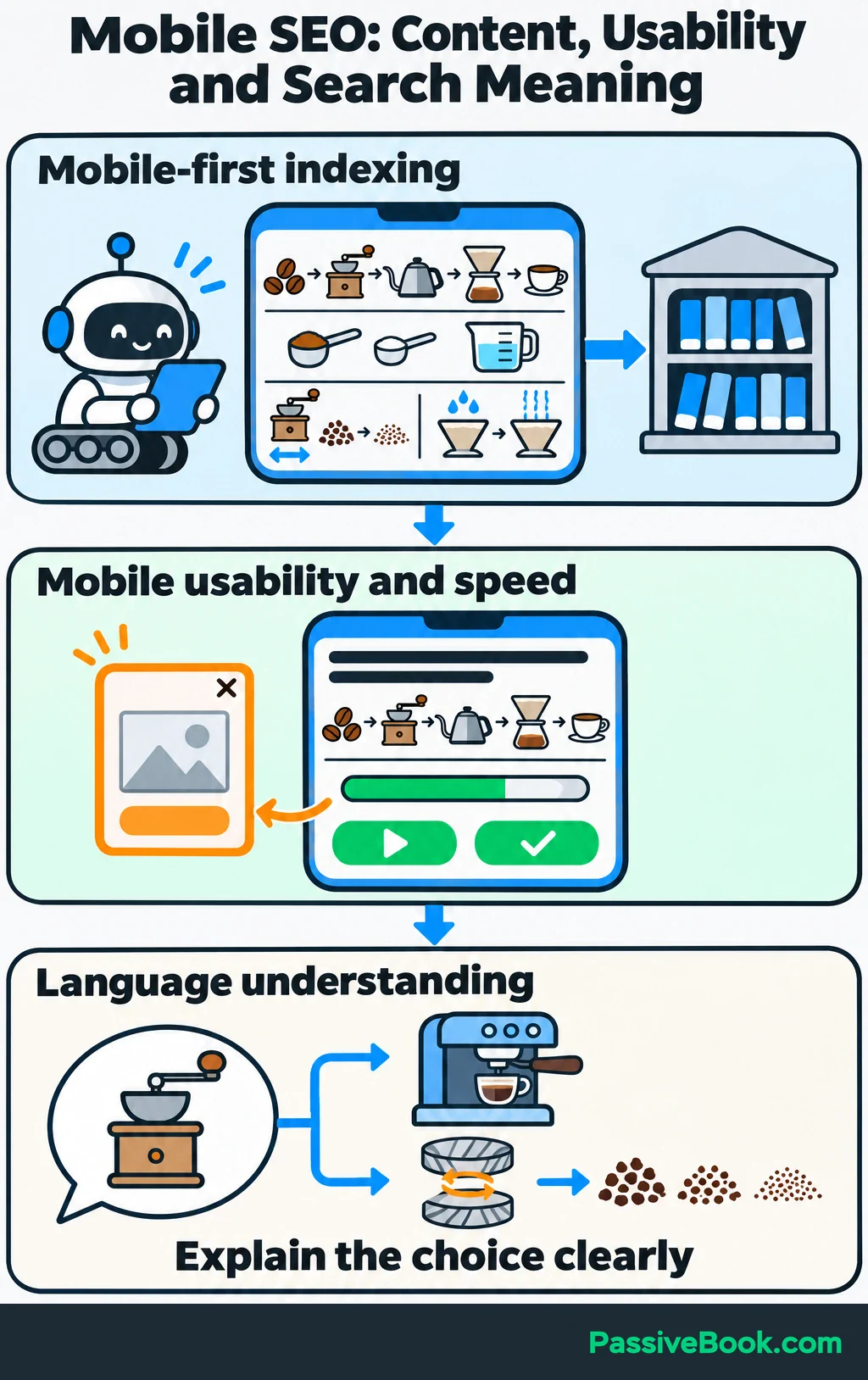
The practical lesson is straightforward: the phone version needs to contain the useful answer and work properly. A desktop page cannot compensate for important content missing on mobile.
Language improvements also weaken the case for awkward keyword repetition. A page about choosing a grinder for espresso should explain the choice clearly. It does not need six near-identical versions of the phrase squeezed into the introduction.
2021–2023: Reviews, Page Experience and Helpful Content
This period put more emphasis on useful recommendations, the experience of using a page, and content created to satisfy readers.
| Date or Period | Milestone | Change Category | Lasting SEO Significance |
|---|---|---|---|
| April 2021 | Product reviews update | Review ranking | Initially covered English-language reviews and favored substantial research over thin product summaries. |
| 2021 | Mobile page-experience rollout | Ranking and usability | Added page-experience considerations to mobile ranking. |
| February–March 2022 | Desktop page-experience rollout | Ranking and usability | Extended the rollout to desktop results. |
| August and December 2022 | Helpful content updates | Content-quality ranking | Introduced and updated a standalone system focused on satisfying, people-first content. |
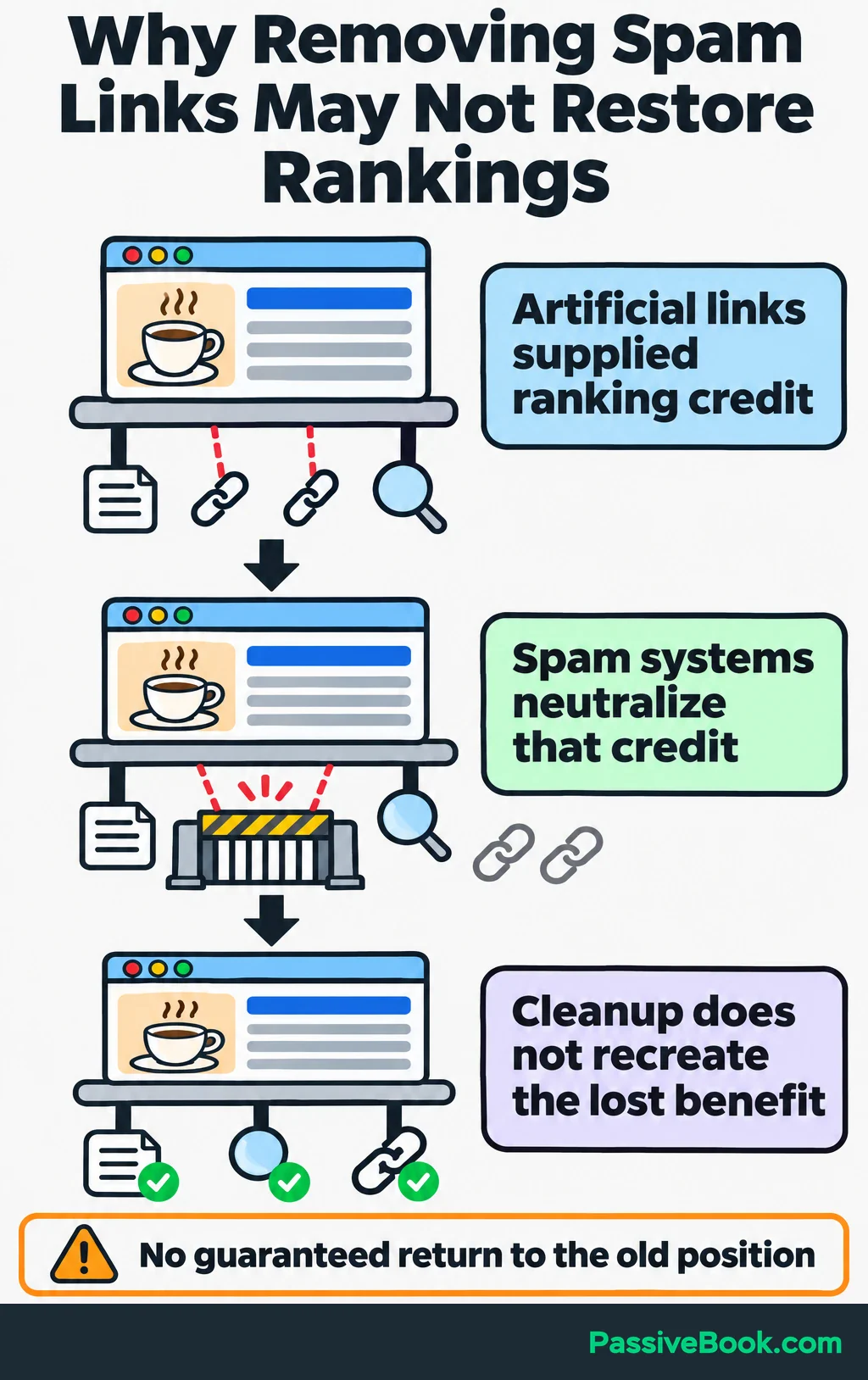
| December 2022 | Link spam update | Spam ranking | Used SpamBrain to neutralize benefits from unnatural links. |
| 2023 | Reviews expansion and overlapping updates | Several ranking systems | Reviews, helpful-content, core, and spam rollouts sometimes ran close together or overlapped. |
| November 2023 onward | Ongoing reviews improvements | Review ranking | Google moved away from periodic reviews-update announcements. |
The link-spam change illustrates why “recovery” can be the wrong expectation. Google’s December 2022 announcement explained that neutralized links lose the ranking credit they previously supplied. Removing an artificial advantage does not create an entitlement to the old position.
For reference, the main announced 2023 rollouts were:
| Update Group | Confirmed Rollouts |
|---|---|
| Core | March, August, October, and November |
| Reviews | February product reviews; April and November reviews |
| Helpful content | September |
| Spam | October |
These overlapping windows make it especially risky to name a cause from timing alone. A grinder review could sit within the scope of both a core update and the reviews system.
2024–2025: Helpful Content Becomes Part of Core Ranking
March 2024 changed how the helpful-content story should be understood. Google explained that helpfulness assessment had evolved into multiple core ranking systems. There was no longer one standalone helpful-content system to wait for.
| Date or Period | Milestone | Change Category | Lasting SEO Significance |
|---|---|---|---|
| March 5–April 19, 2024 | March core update | Core ranking | Helpful-content evaluation evolved across multiple core systems. Google announced completion on April 26. |
| March 2024 | New spam policies | Policy announcement | Addressed scaled-content abuse, expired-domain abuse, and site-reputation abuse. |
| Later 2024 | August, November, and December core updates | Core ranking | Broad ranking changes continued after the March overhaul. |
| Other 2024 spam rollouts | March, June, and December | Spam ranking | Separate spam updates ran alongside the wider ranking changes. |
| August 2024 | Ranking service incident | Service disruption | A separate incident overlapped the August core rollout and needed to be distinguished from it. |
| March, June, and December 2025 | Three core updates | Core ranking | Rollouts ran March 13–27, June 30–July 17, and December 11–29. Use these windows when comparing traffic. |
| August–September 2025 | August spam update | Spam ranking | The rollout ran August 26–September 22. It was separate from the year’s core updates. |
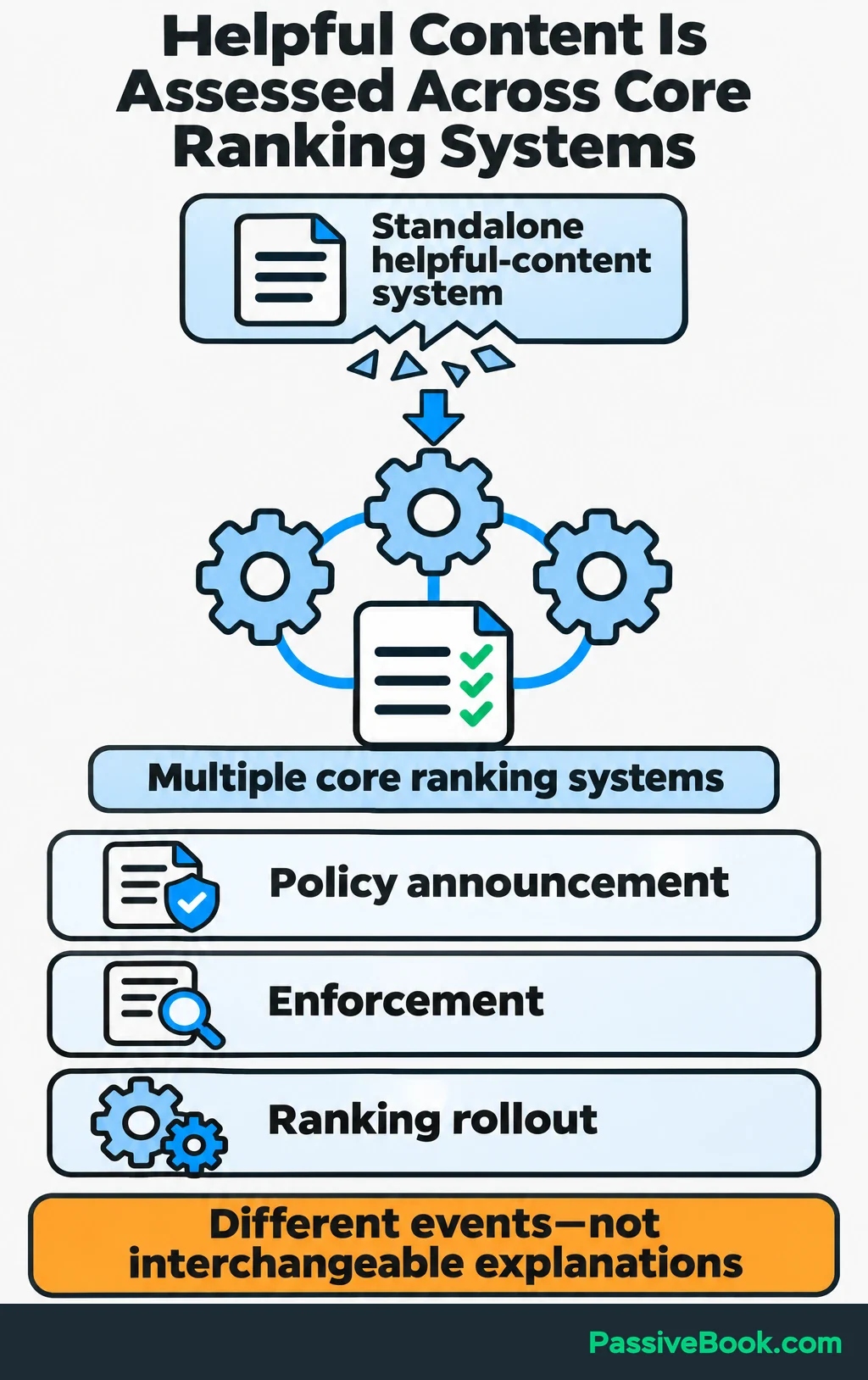
Google’s official rollout history records these updates and the separate service incidents.
The important distinction is between a policy announcement and an update window. They may happen together, but a new rule, its enforcement, and an automated ranking rollout are different events.
Did a Google Update Affect Your Site?
Start by establishing what declined, when it declined, and how widely the change spread.
An announcement overlapping your traffic drop makes an update a possible explanation. It does not rule out a broken site, a tracking change, or lower search demand.
Check Tracking, Access and Indexing First
Use Search Console to see whether Google Search clicks fell, then check whether analytics shows a similar direction for Google organic traffic.
Before editing content, check:
- Whether a tracking tag, consent setting, or analytics configuration changed.
- Whether important pages return errors or fail to load.
- Recent migrations, URL changes, redirects, and theme deployments.
- Unintended
noindexinstructions, which tell Google to exclude a page from results, or restrictions that prevent crawling. - Changes to canonical signals, which tell Google your preferred version of a page.
- Manual actions and security issues reported in Search Console.
- Google service incidents that overlap the decline.
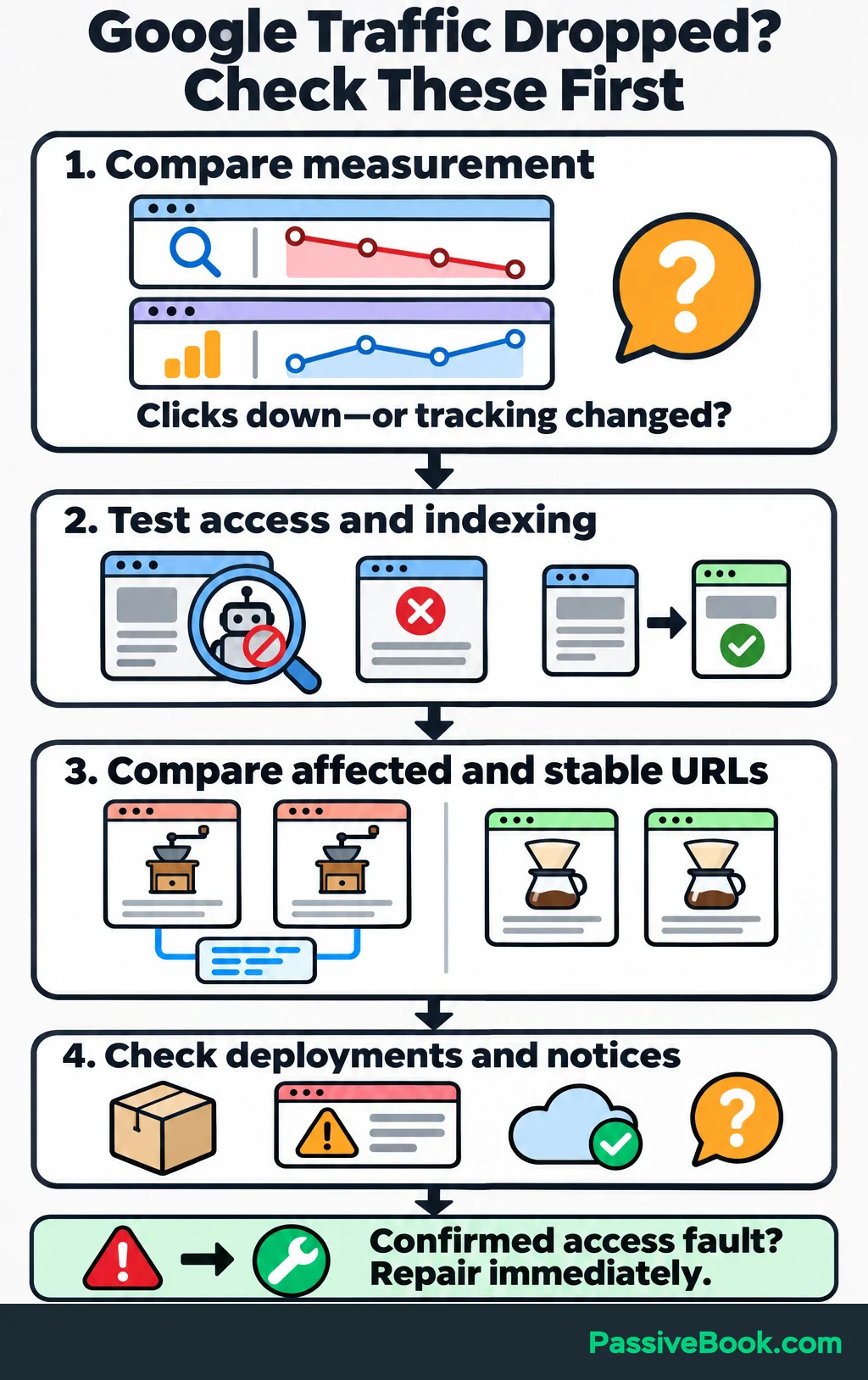
Google’s traffic-drop troubleshooting guidance covers these competing explanations.
Inspect a few affected URLs and a few stable ones. That comparison can expose a shared fault much faster than reviewing every page.
For the coffee blog, suppose grinder reviews lost clicks while brewing guides stayed steady. Check whether those reviews use a different page template or were changed in the same deployment. Their commercial purpose is relevant, but so is the code they share.
If you find a confirmed access or indexing fault, repair it immediately. Waiting for a rollout to finish will not fix an accidental publishing restriction.
Compare Matching Search Console Periods
For a core-update assessment, Google recommends waiting at least one full week after completion. Then compare a complete post-update week with a week before the rollout began. This avoids treating movement during the rollout as the final result. See Google’s recommended comparison timing.
Make the periods comparable:
- Use equal lengths with matching weekdays.
- Keep country, device, and search-type filters consistent.
- Separate Web, Images, Video, and News performance.
- Inspect Discover independently.
- Check a comparable prior-year period if seasonal demand could explain the change.
- Use longer matching periods when a single week contains too little traffic to judge.
In Search Console’s performance report, compare the dates and sort pages by lost clicks. Open the affected pages and inspect their queries.
Group losses by topic or shared template to see whether the decline is concentrated or widespread.
A note such as “grinder comparisons lost clicks on mobile searches in the United States” gives you something to investigate. “Google hates the site” does not.
Interpret the Losses Before Choosing a Fix
Read the metrics together.
Impressions count appearances in search results. Clicks count selections of a link to your site. Click-through rate, or CTR, is clicks divided by impressions. Average position summarizes placement, but it can shift when the mix of searches changes.
Compare the same page and query combinations where possible. A site-wide average can hide a large loss on one valuable search.
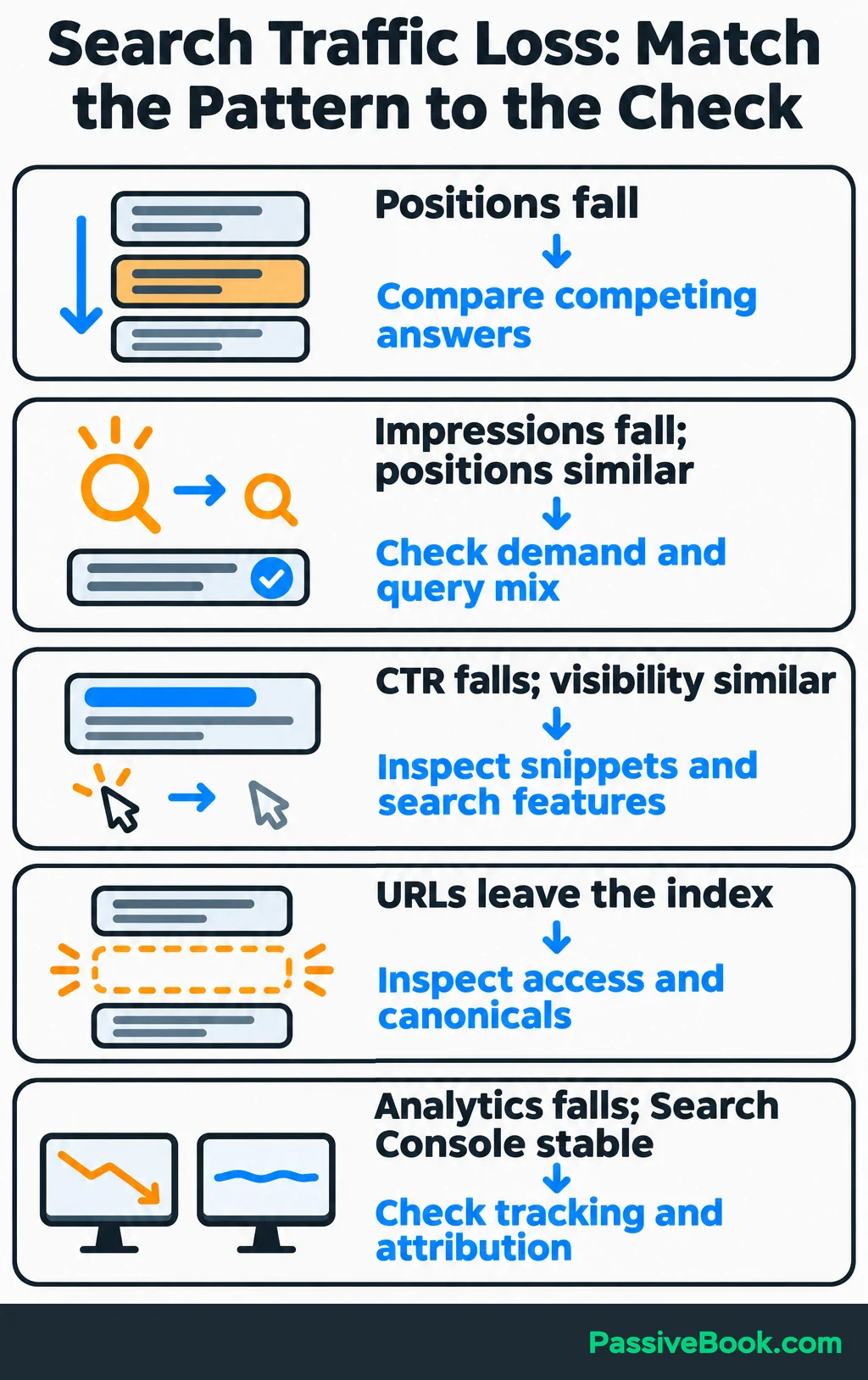
| Observed Pattern | Possible Explanation | Next Check | Appropriate Action |
|---|---|---|---|
| Positions fall for the same pages and queries | Google is ranking competing answers higher | Compare the search task, page content, and current results | Improve specific weaknesses you can identify |
| Impressions fall while positions remain similar | Lower demand or a changed query mix | Check individual queries, seasonal patterns, and Google Trends | Monitor demand before commissioning rewrites |
| CTR falls while visibility remains broadly stable | Titles, snippets, or competing search features changed | Inspect results for affected queries and devices | Improve how clearly the listing serves the search |
| Important URLs disappear from the index | Access restrictions, errors, or canonical changes | Inspect affected URLs and recent deployments | Repair the confirmed technical problem |
| Analytics falls but Search Console stays stable | Tracking or attribution changed | Check tag operation, consent behavior, and channel reports | Correct measurement before judging SEO |
Search features, including AI-generated answers, belong in the CTR investigation. Their presence alone does not prove they caused the loss.
Here is a worked example. Count impressions and clicks for the same group of grinder-review pages across equal-length periods, with the same filters.
| Metric | Before | After |
|---|---|---|
| Impressions | 30,000 | 30,000 |
| Clicks | 1,200 | 900 |
| CTR | 4% | 3% |
To calculate the change in clicks, subtract the old total from the new total and divide by the old total:
(900 − 1,200) ÷ 1,200 × 100 = −25%
CTR counts clicks from those impressions:
900 ÷ 30,000 × 100 = 3%
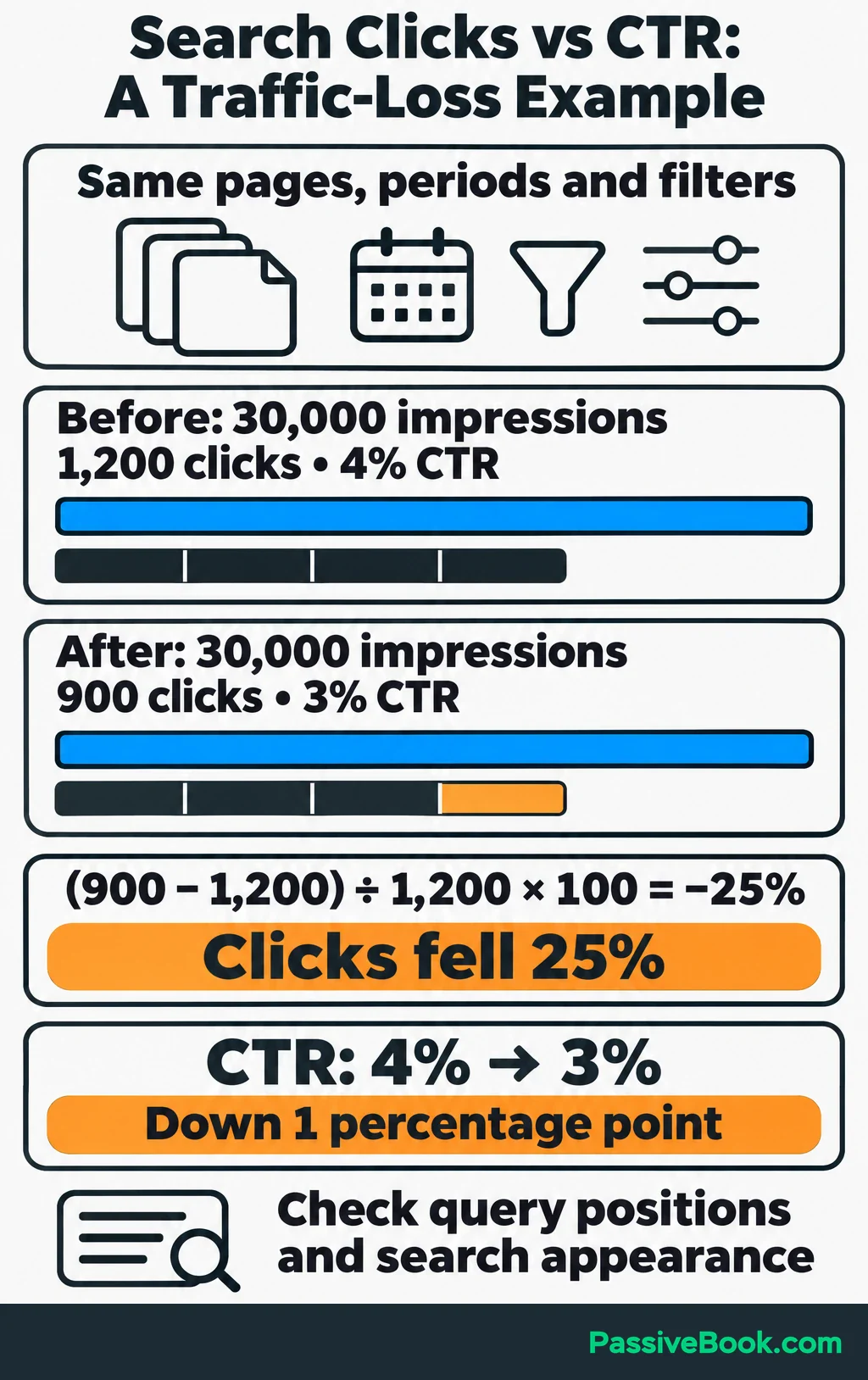
Clicks fell 25%. CTR fell from 4% to 3%, a drop of one percentage point.
That pattern would make me inspect query-level positions and search appearance before paying for a full rewrite. Stable total impressions do not prove that every important query held its position.
You can use the Website Performance Workbook to run this comparison on your own pages. It separates the numbers behind the loss and helps you choose what to investigate before committing to edits.
Free Website Performance Workbook




Also compare Google organic landing-page trends with tracked affiliate clicks or sales. I used to put Search Console clicks and analytics sessions in one “traffic” column in my weekly notes. It saved space and blurred the distinction I needed.
I now keep those figures separate. Search Console and analytics measure different activity, so I compare direction and affected pages without expecting identical totals. Google explains the measurement differences between the tools.
What Should You Fix After a Ranking Drop?
Turn the diagnosis into a short action list. Put confirmed access failures first, documented spam problems next, and content improvements after that.
Within each group, prioritize pages by business value, how widely the issue repeats, and the effort required. A broken template affecting several earning pages deserves attention before a minor wording improvement.
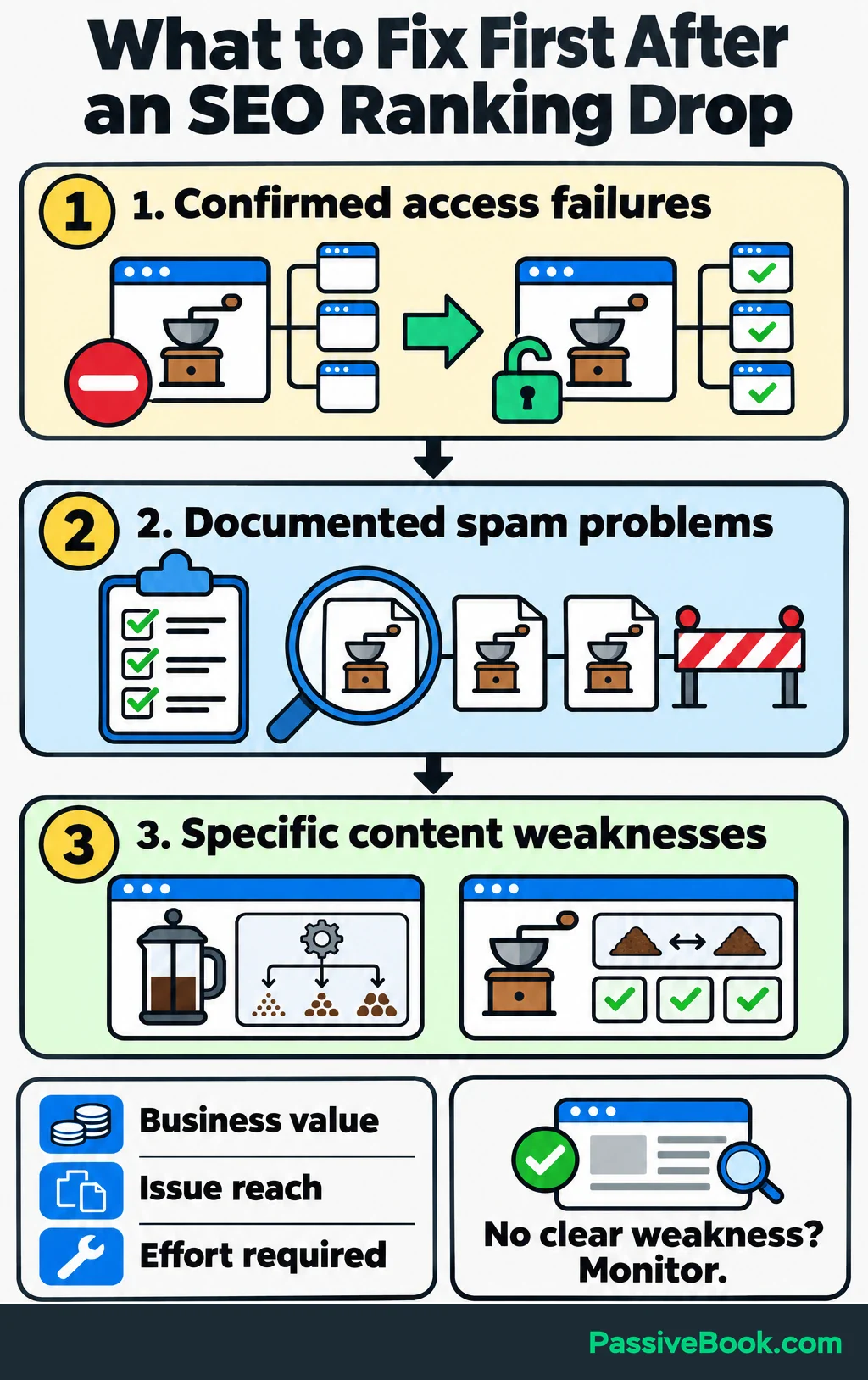
For the coffee blog, the list might look like this:
| Affected Pages | Confirmed Problem | Supporting Evidence | Proposed Change | Priority | Review Date |
|---|---|---|---|---|---|
| Grinder reviews | Unintended indexing restriction | URL inspection detects noindex after a template change | Remove the restriction and validate affected URLs | Immediate | At deployment and after recrawling |
| French press guide | Troubleshooting answer is missing | The page never explains what to change when coffee tastes bitter | Add a clear troubleshooting section beside the method | Next content task | Four weeks after publication |
| Grinder comparison | Recommendation lacks supporting evidence | The article repeats specifications without explaining the choice | Add substantiated comparisons and clear suitability advice | High | Four weeks after revision |
| Stable brewing guides | No actionable weakness found | Matching query and page trends remain broadly steady | Leave intact and monitor | Low | Next monthly review |
The review dates are planning choices, not promises about when rankings will change.
Repair Confirmed Technical and Usability Faults
Restore access to important pages and correct unintended indexing restrictions. Fix broken redirects and resolve conflicting signals about which URL should be indexed.
Validate representative repaired URLs. If the same problem appears across several pages, inspect their shared template or publishing process too.
Then use the site on a phone. Can you read the instructions, close overlays, follow links, and use important controls? A page can load successfully and still be unpleasant to use.
I would fix a popup covering the brewing instructions before spending an afternoon chasing the last few points in a performance report. Google’s page-experience guidance specifically says that pursuing a perfect score just for SEO may be a poor use of time.
Good performance matters because it helps people use the page. The score helps you find problems; it is not the business outcome.
Improve Pages That No Longer Satisfy the Search
Start with the task behind the affected query.
Someone searching for a brewing ratio needs usable quantities and instructions. Someone comparing grinders needs help choosing between them. Those pages need different evidence and structures.
For each affected page, ask:
- Answer: Can the reader complete the task without searching again?
- Accuracy: Are the facts, instructions, and recommendations still sound?
- Evidence: What supports the claims and choices?
- Clarity: Can the reader find the answer quickly?
- Purpose: Does each section help with the reason they arrived?
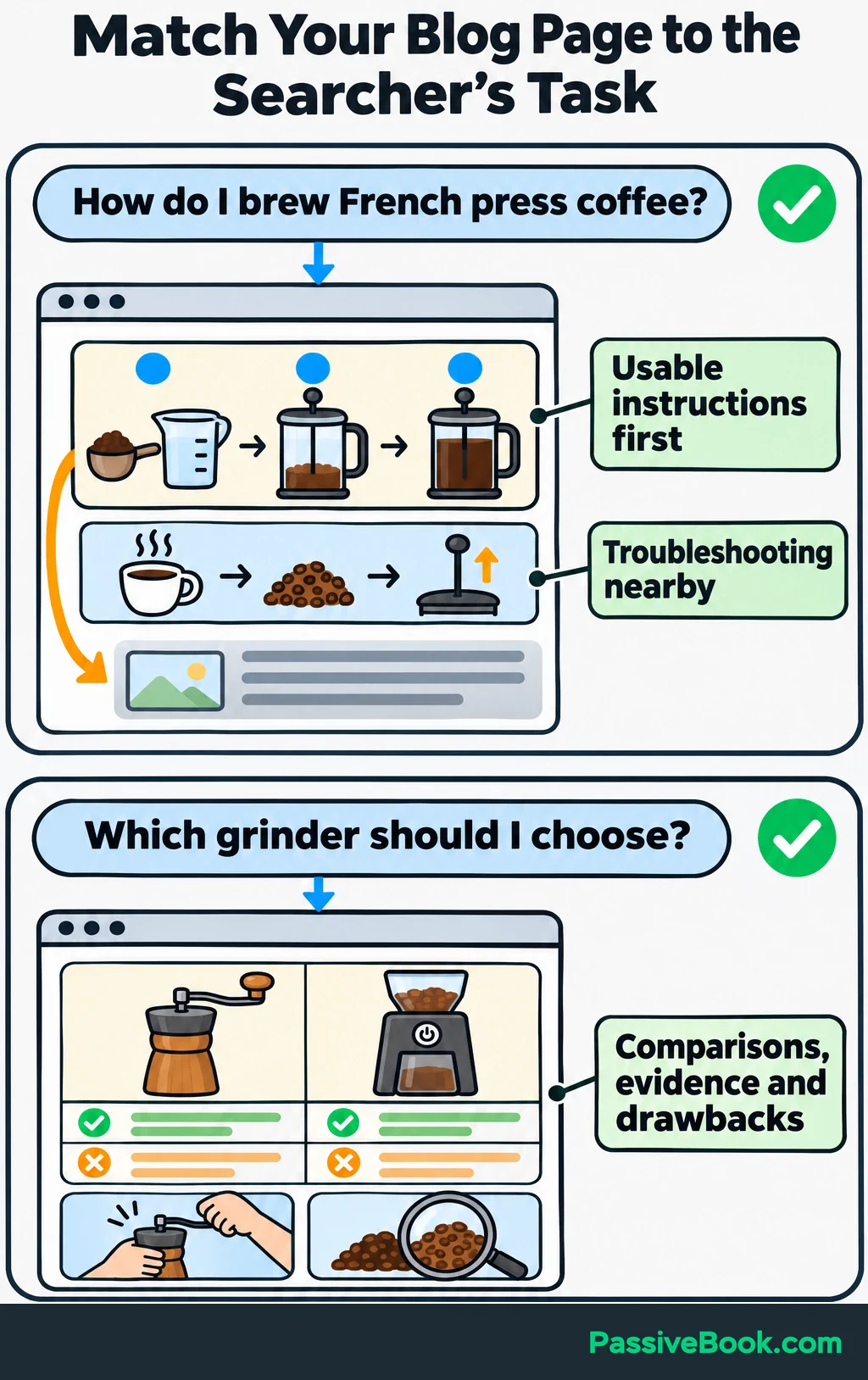
On the coffee blog, a French press guide might open with several paragraphs about coffee history before giving the method. Move the usable instructions forward and place troubleshooting nearby.
A compact excerpt could read:
If the coffee tastes bitter, try a coarser grind and change one variable at a time. Keep the coffee and water amounts recorded so you can tell which adjustment helped.
A grinder review needs a different improvement. Replace manufacturer-summary copy with useful comparisons, drawbacks, and evidence from actual use where available. Explain who should choose the grinder and who would be better served by another option. Google’s review-quality guidance emphasizes these distinctions.
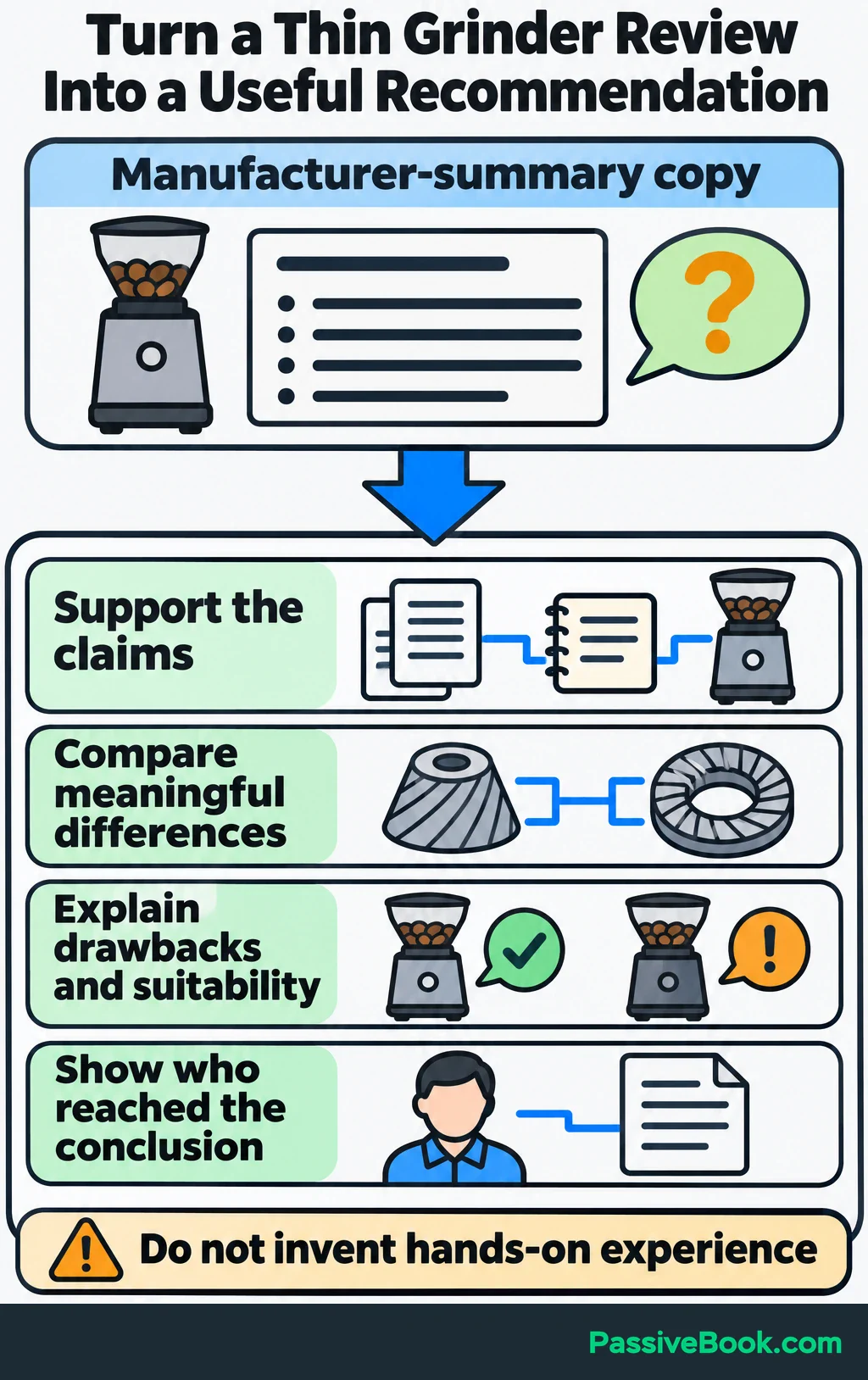
Show relevant authorship and explain how you reached the conclusions. E-E-A-T means experience, expertise, authoritativeness, and trustworthiness. Google describes it as a way to understand content quality, not a numerical score you can raise by filling out a plugin field. Its helpful-content assessment is useful for this review.
I would combine two pages only when they serve the same purpose and one stronger page would help readers more. Keep pages that answer distinct questions.
Improve salvageable content before considering deletion. A traffic drop is not a reason to start removing articles in bulk.
Correct Documented Spam Practices
Match actual practices on the site to the relevant policy. Keyword stuffing, manipulative links, and large batches of unoriginal pages call for different repairs.
For scaled-content abuse, the issue is producing many pages primarily to manipulate rankings without helping readers. That applies whether the work is automated, written by people, or uses both.
On the coffee blog, creating near-identical grinder pages with swapped product names would call for a review of the publishing process. Editing a handful of sentences while continuing the same process leaves the underlying problem in place.
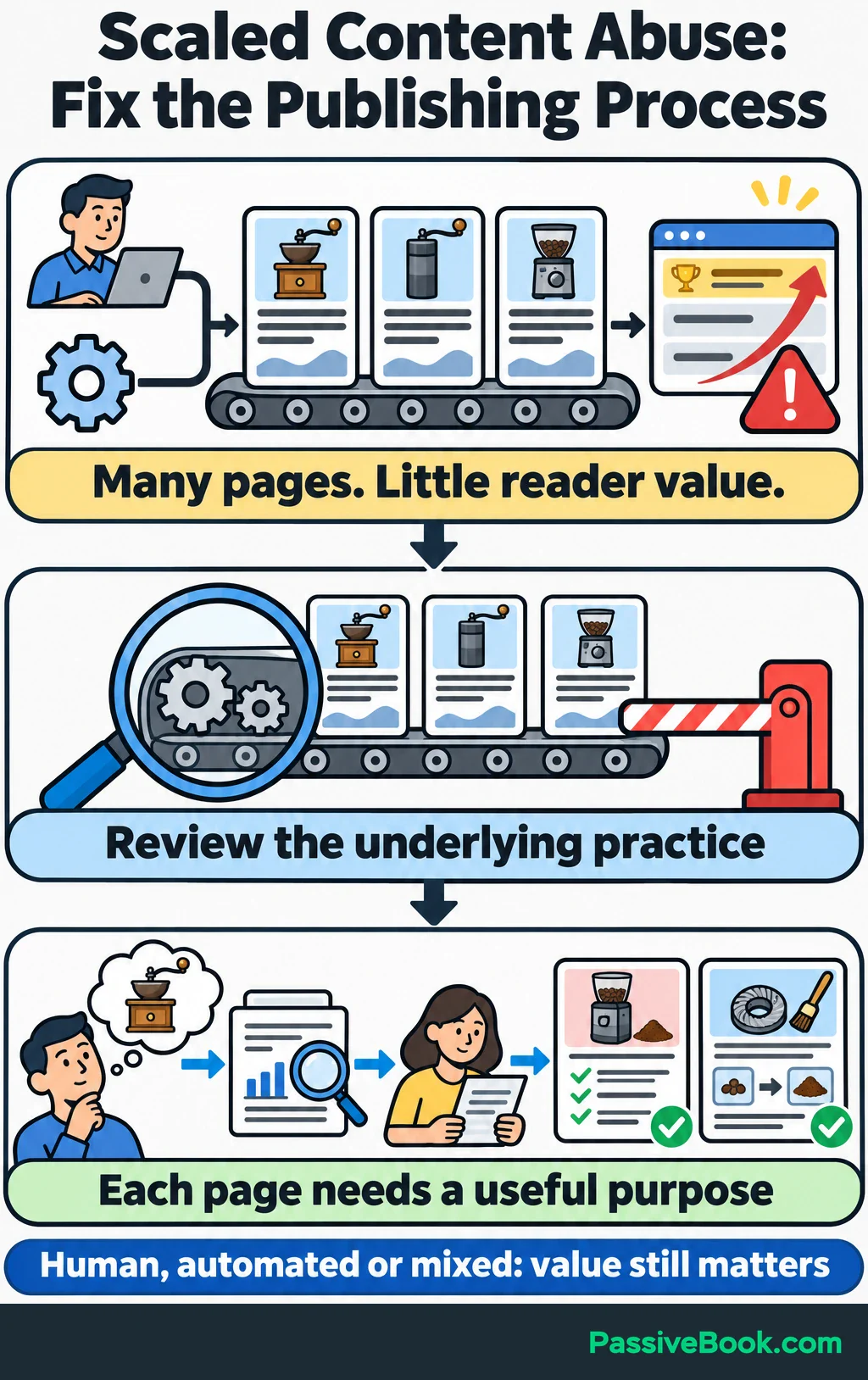
I use automation to remove repetitive work, but the useful output still needs a reason to exist. A faster content pipeline should make it easier to produce better answers.
Be equally measured with backlinks. A third-party “toxic” score alone is not a reason to upload a disavow file. Google’s disavow criteria require a considerable number of artificial or low-quality links that caused, or are likely to cause, a manual action. Try to remove the problematic links first.
If Search Console reports a manual action, address the listed issues across the affected pages and request review with evidence of the repairs. That review process is separate from responding to an automated ranking decline.
How Long Does Recovery Take?
Some improvements can affect results within days. Broader reassessment can take months, and in some cases changes may not become clear until a later core update.
Improvements can also show between announced updates. There is no guaranteed return to previous rankings. Google explains these expectations in its core-update recovery guidance.
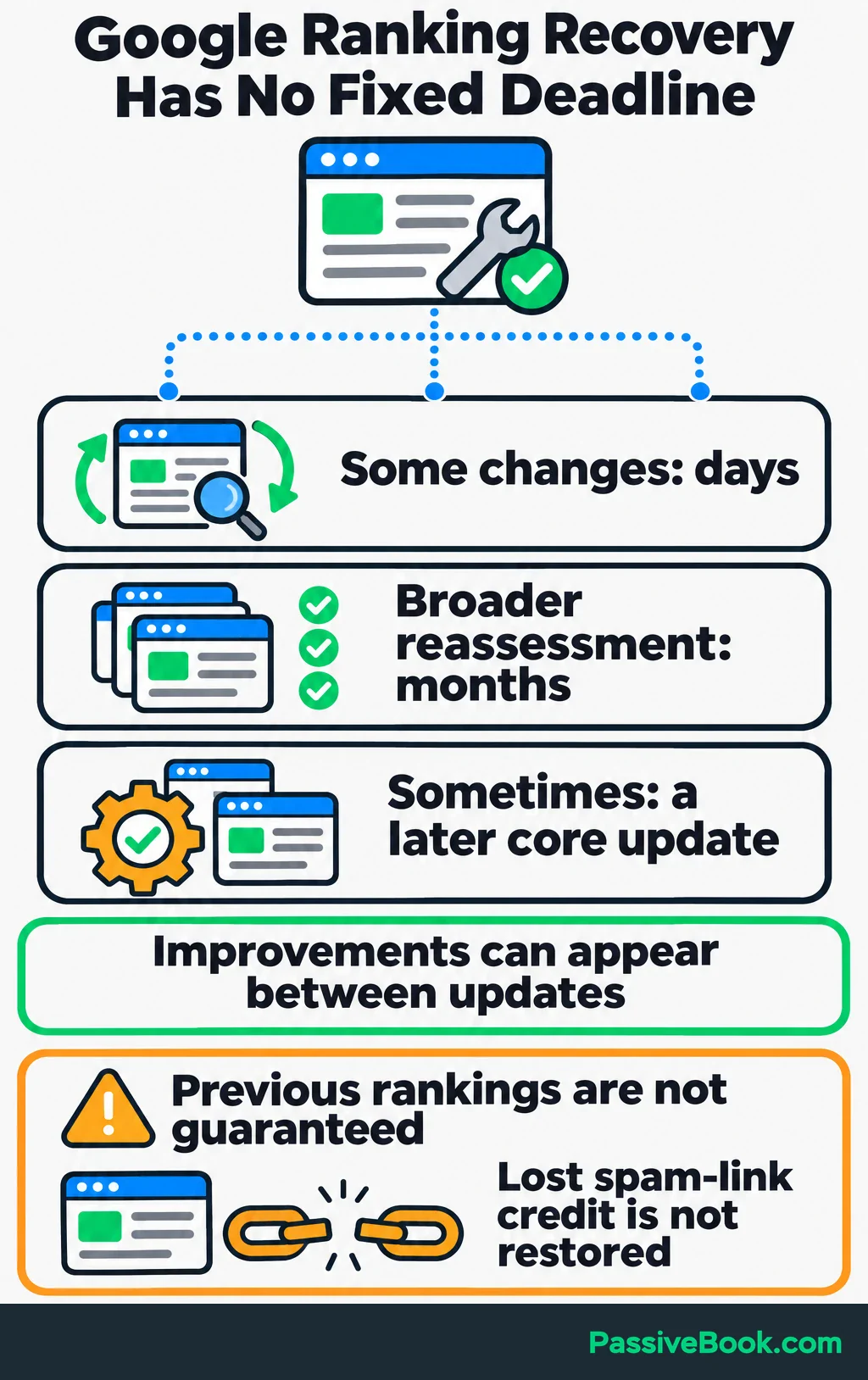
Spam-related reassessment may also take months. Cleaning up unnatural links does not restore the artificial ranking benefit those links once supplied.
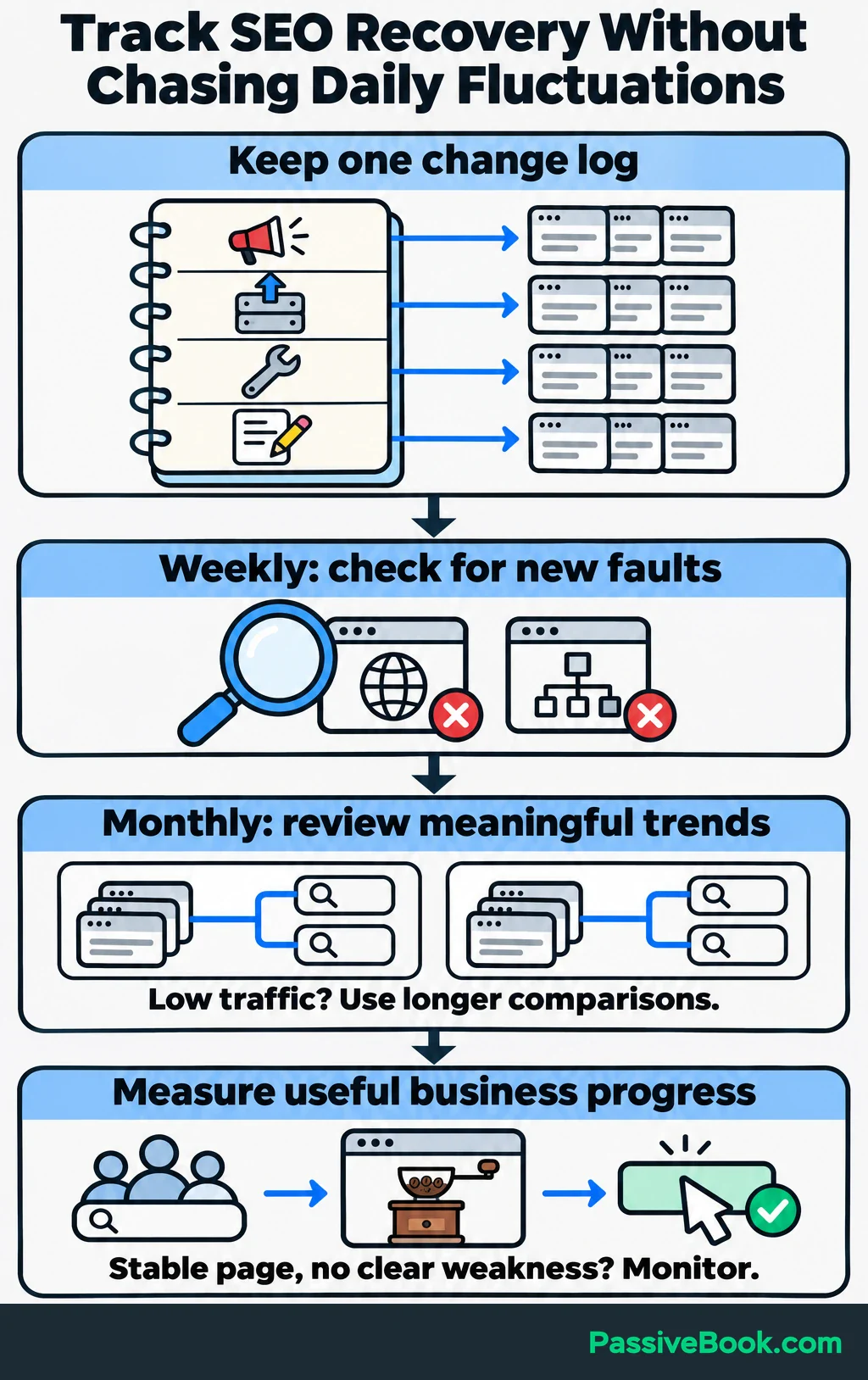
Choose a review interval that gives your pages enough traffic to compare meaningfully. I would start with a weekly check for new faults and a deeper monthly review of the pages being improved. A low-traffic site may need a longer comparison window.
Keep one lightweight log containing:
- Official rollout start and completion dates.
- Site deployments and technical repairs.
- Substantial content changes.
- The affected pages and query groups.
- Follow-up observations and business outcomes.
You can subscribe to the Google Search Status Dashboard feed for confirmed announcements.
For the coffee blog, progress means sustained visibility, relevant visits, and affiliate engagement on the improved pages. Reclaiming every old keyword is a less useful target.
Leave successful pages alone when movement is small and you cannot identify a clear weakness. Monitoring is a valid decision when you have recorded what you are watching and when you will review it.
What Next?
Choose one page that lost meaningful Google traffic and compare it with a stable page using matching Search Console periods. Write down the observed difference before deciding on an edit.
Use the social buttons to share this guide when a traffic-drop discussion needs a clearer way to separate evidence from guesses.
What evidence would help you decide whether to edit your affected pages or keep monitoring? Share your answer in the comments, and bring any other questions too.
Share this post with your friends & followers:

