You have enough ideas for a podcast, but your first episode keeps growing. A quick lesson turns into a long introduction, three side topics, and a closing pitch you haven’t quite worked out.
That makes recording harder, and it leaves you wondering whether listeners will follow the thread. Adding more editing work to every episode is also a poor bargain when you’re fitting this around an existing business.
A clear format gives those ideas somewhere to go. This guide helps you choose one, build a reusable episode outline, and turn it into recording notes you can actually speak from.
Choose a Podcast Format You Can Sustain
Start with the show’s promise before deciding who gets a microphone:
This show helps [listeners] achieve [outcome] through [approach].
That promise gives you a reason to choose a format. If you teach practical tasks, solo lessons may fit. If the value comes from drawing out other people’s experience, interviews make more sense.
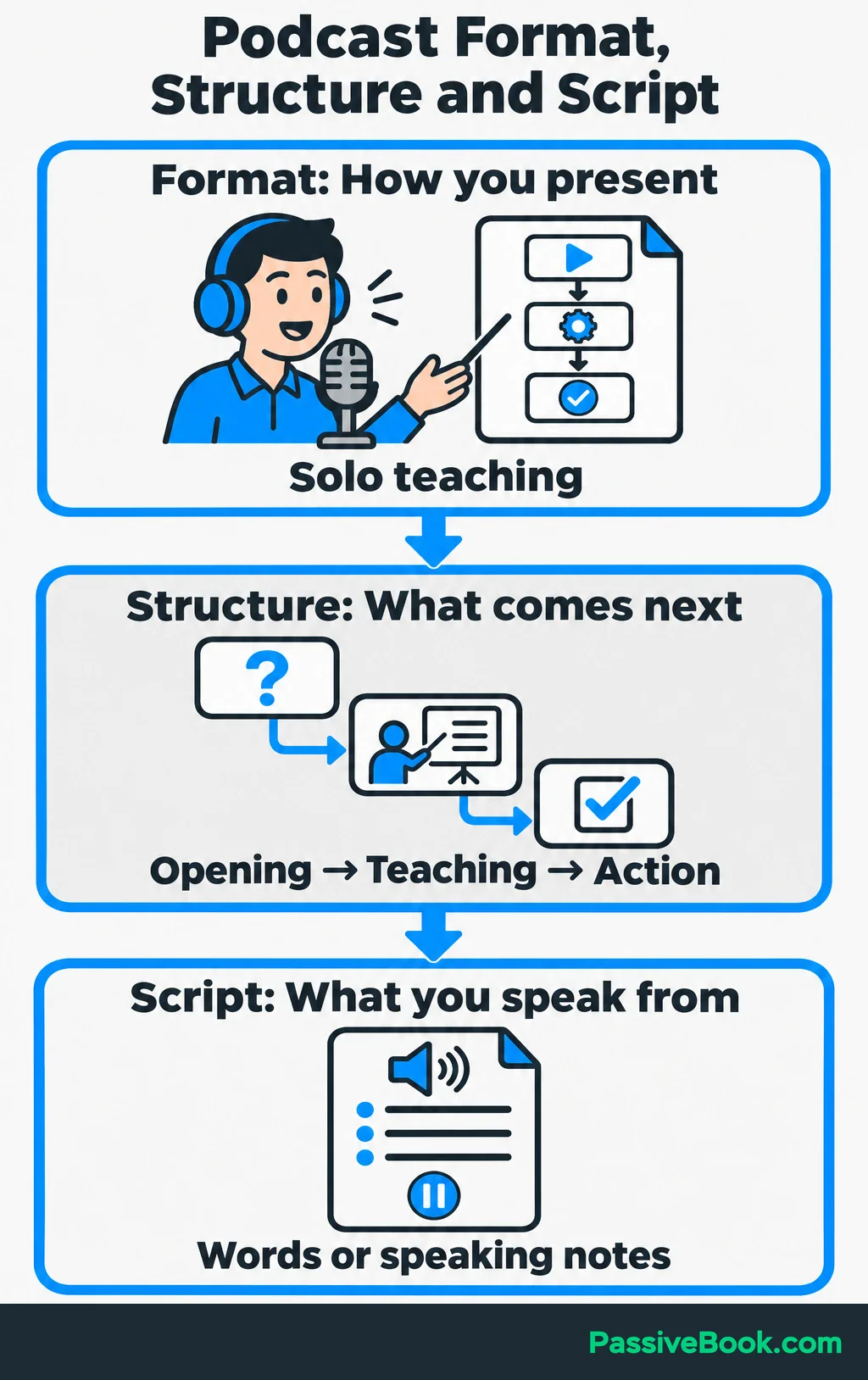
Three terms will help you keep the decisions separate:
- Format: How you present the show, such as solo teaching or interviews.
- Structure: The order of material within an episode.
- Script: The words or speaking notes you use while recording.
Throughout this guide, imagine you run an online shop selling printable cat-sitter handover templates. Your podcast, Cat Care, Clearly, helps people organize everyday cat-care information through practical planning lessons. The shop, sample copy, and timings are illustrations.
Here’s how I would compare the main options:
| Format | Suitable Content | Preparation | Production Dependencies |
|---|---|---|---|
| Solo | Tutorials, explanations, personal commentary | Build the full explanation and prepare examples yourself | Your recording time and ability to carry the episode |
| Co-hosted conversation | Subjects that benefit from two recurring perspectives | Agree on the focus, roles, and discussion prompts | Both hosts’ availability and clear handoffs |
| Interview | A guest’s experience, knowledge, or detailed account | Research the guest, book the session, and prepare follow-ups | Guest availability, usable recordings, and permission to publish |
| Panel | A focused question with several useful perspectives | Select contributors and plan speaking turns | Coordinated schedules, moderation, and more voices to edit |
| Narrative storytelling | An unfolding story told through scenes, narration, and recordings | Report and verify nonfiction; develop the plot and characters for fiction | Access to recordings or performers, plus time to assemble the story |
Spotify’s format guide describes similar tradeoffs: solo shows offer scheduling control, while guest-led and narrative shows introduce other production demands.
For the example shop, I would start with solo teaching and occasionally interview a cat sitter. Most episodes could be recorded without waiting for anyone else.
These formats can overlap. A narrative episode might combine your narration with interview clips. Listener questions, case studies, and quick tips are segments you can place inside several formats.
Audio and video are another choice. You can teach solo in either, but adding a camera doesn’t resolve an unclear lesson. I would get the spoken explanation working first.
Give Each Episode One Clear Purpose
Turn your topic into a question you can answer.
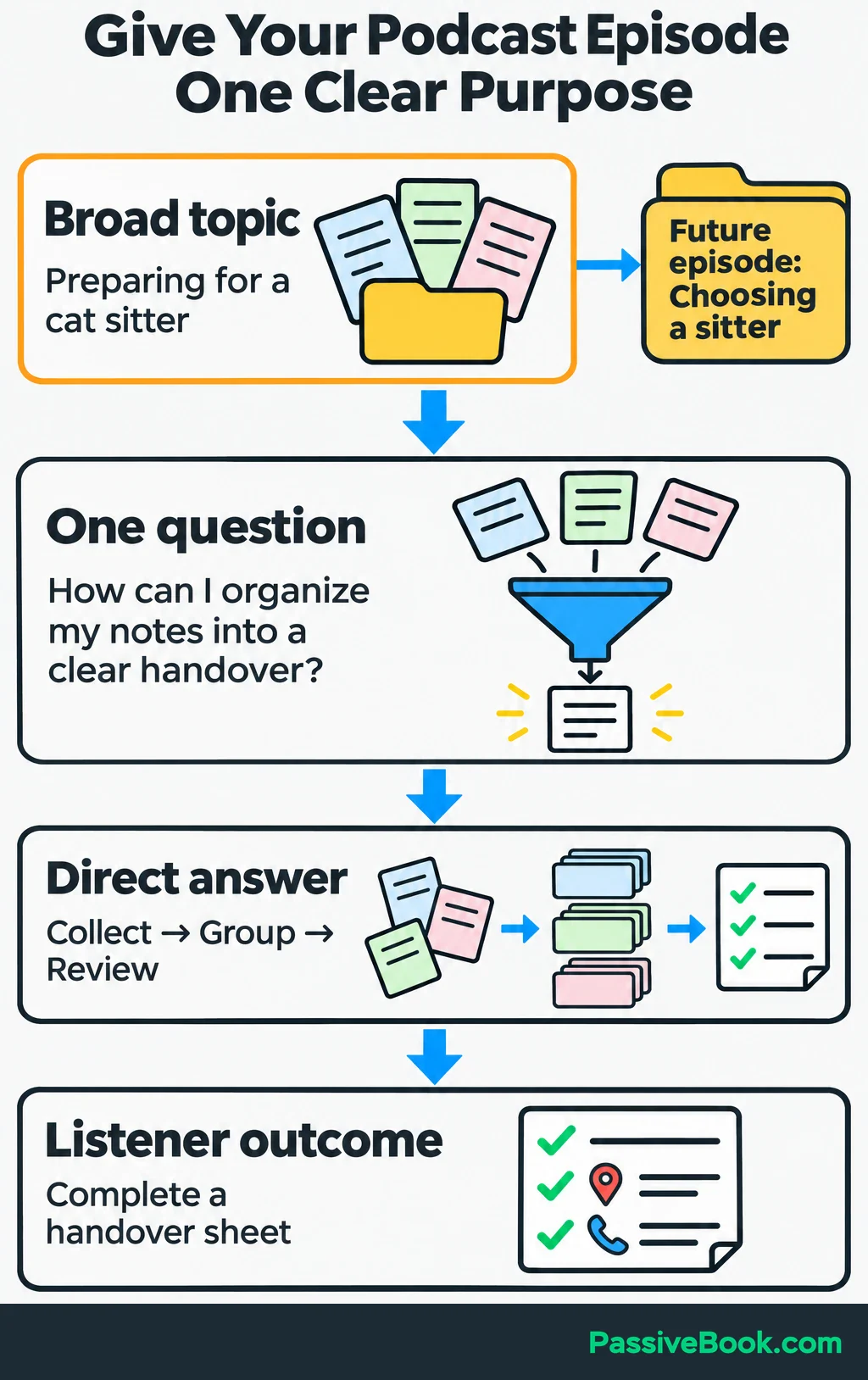
“Preparing for a cat sitter” could cover finding someone, arranging visits, writing instructions, and organizing supplies. That’s a series of possible episodes hiding inside one title.
Narrow it to:
How can I organize my notes into a clear handover?
Then write the answer and the listener’s outcome:
- Answer: Gather your existing notes, group instructions by task, and review the sheet with your sitter.
- Listener Outcome: Complete a cat-sitter handover sheet.
The answer tells you what to teach. The outcome tells you when you’ve taught enough.
Now list the material needed to get there. You’ll need to describe the finished sheet before asking listeners to organize one. You’ll also need a concrete example of turning a scattered note into a useful instruction.
Choosing a sitter can go into your future-episode list. It matters, but this episode assumes the listener has already selected someone.
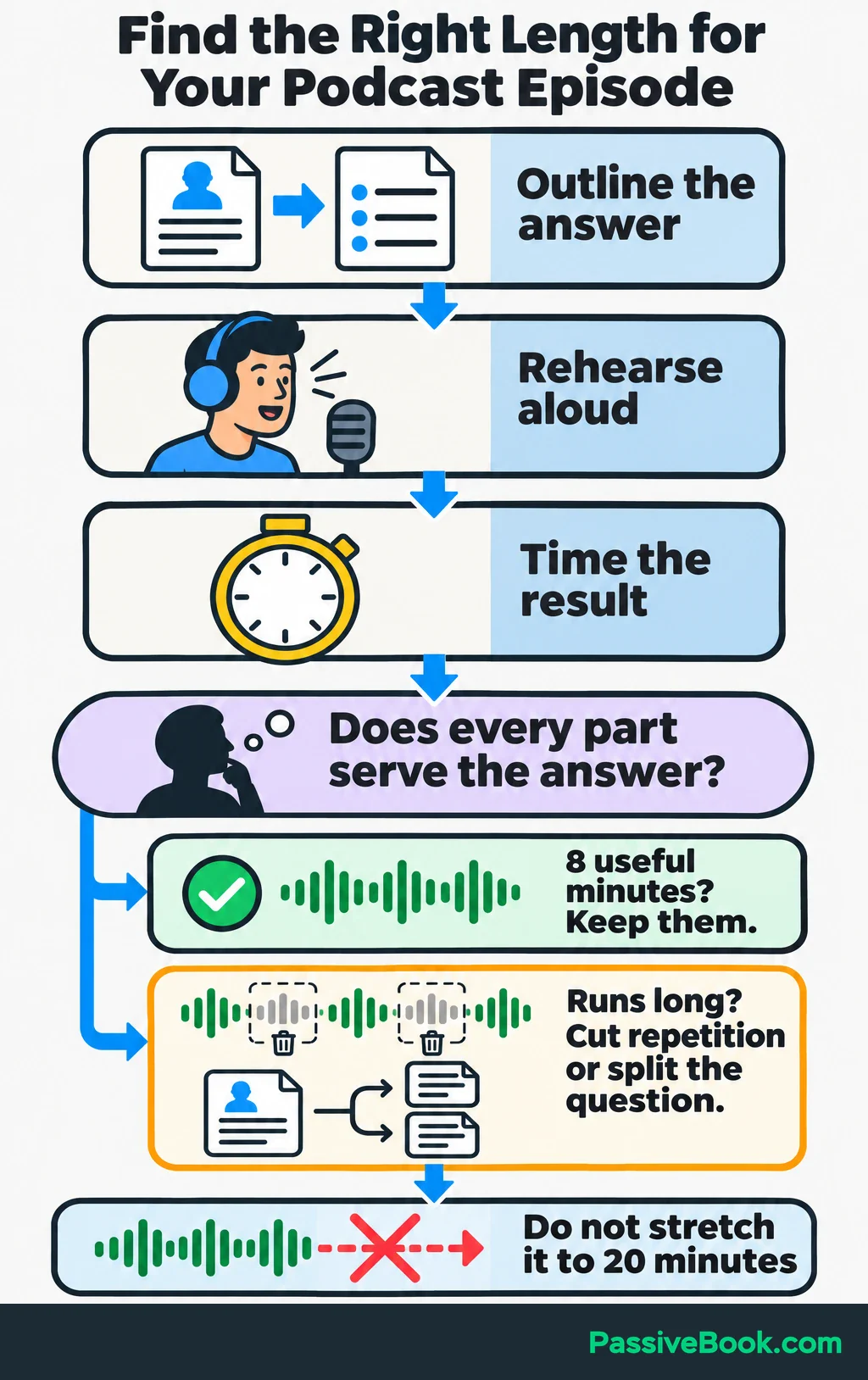
Let the necessary material determine the length. Outline it, rehearse it aloud, and time the result. If it runs long, remove repetition or split the question. If the answer takes eight useful minutes, I wouldn’t stretch it to twenty. The clock has no questions that need answering.
Structure the Episode Around a Clear Answer
Your structure should carry listeners from the opening question to an answer they can use. For a practical lesson, that usually means a focused opening, ordered teaching, and a clear next action.
Open With a Reason to Listen
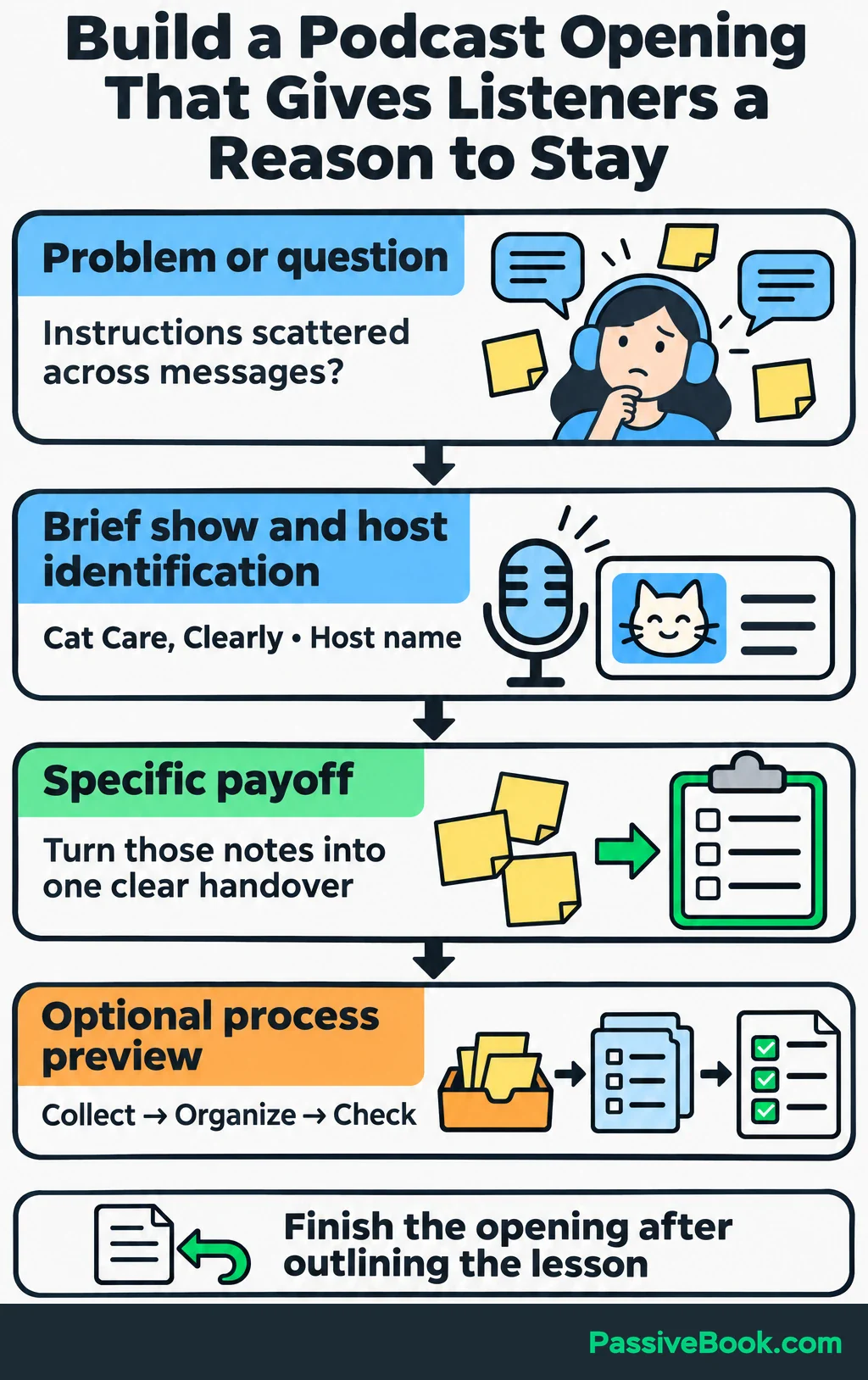
Start with the problem or question that makes this episode useful. Then identify the show and host briefly, and state the payoff.
For the example:
“Are your sitter’s instructions scattered across messages and sticky notes? I’m [host name], and this is Cat Care, Clearly. Today, we’ll turn those notes into one clear handover sheet.”
You can add a short preview:
“We’ll collect what you already have, organize it by task, and check it with your sitter.”
That preview earns its place because it helps listeners follow a process. A long account of why you started the show probably doesn’t belong here.
For an interview, introduce the guest through their connection to the question. Explain what they can help listeners understand, rather than reading their entire biography.
Finish writing the opening after you’ve outlined the main content. Otherwise, it’s easy to promise a broader answer than you actually deliver.
Keep useful recurring elements, such as a brief show introduction and a familiar closing. The University of Minnesota’s podcasting guide explains that a familiar structure helps listeners anticipate what comes next. You can provide that consistency without repeating a long preamble.
Organize the Main Content in the Order Listeners Need It
For a tutorial, teach the steps in the order someone will perform them. For an explanation, establish the idea before discussing what follows from it.
The handover episode has three main stages:
- Collect existing notes.
- Group instructions by task.
- Review the handover with the sitter.
Explain each stage before showing an example.
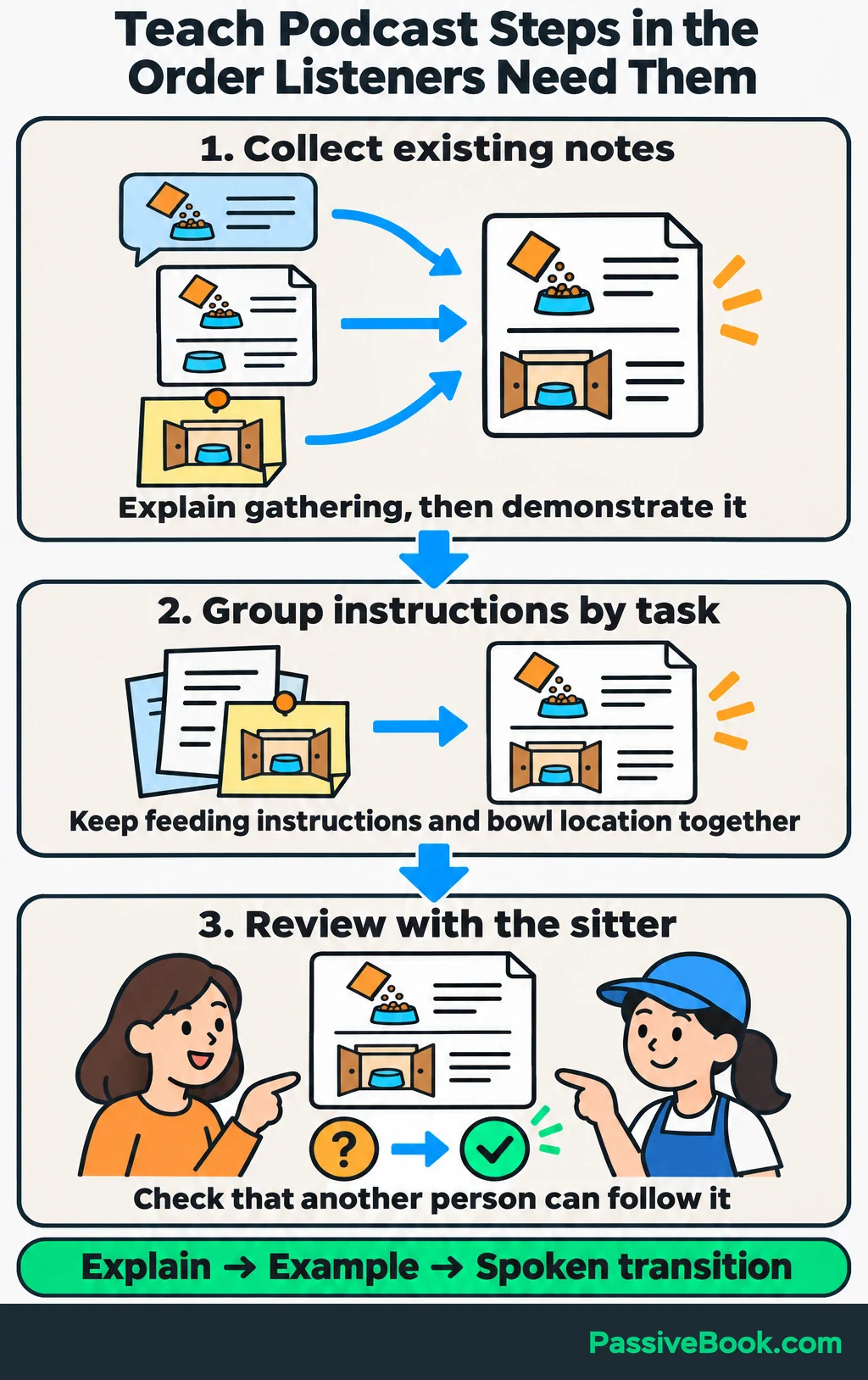
First, tell listeners to gather instructions from messages, documents, and reminders into one draft. Then demonstrate what that might uncover: a feeding instruction in a message and the bowl location on a sticky note.
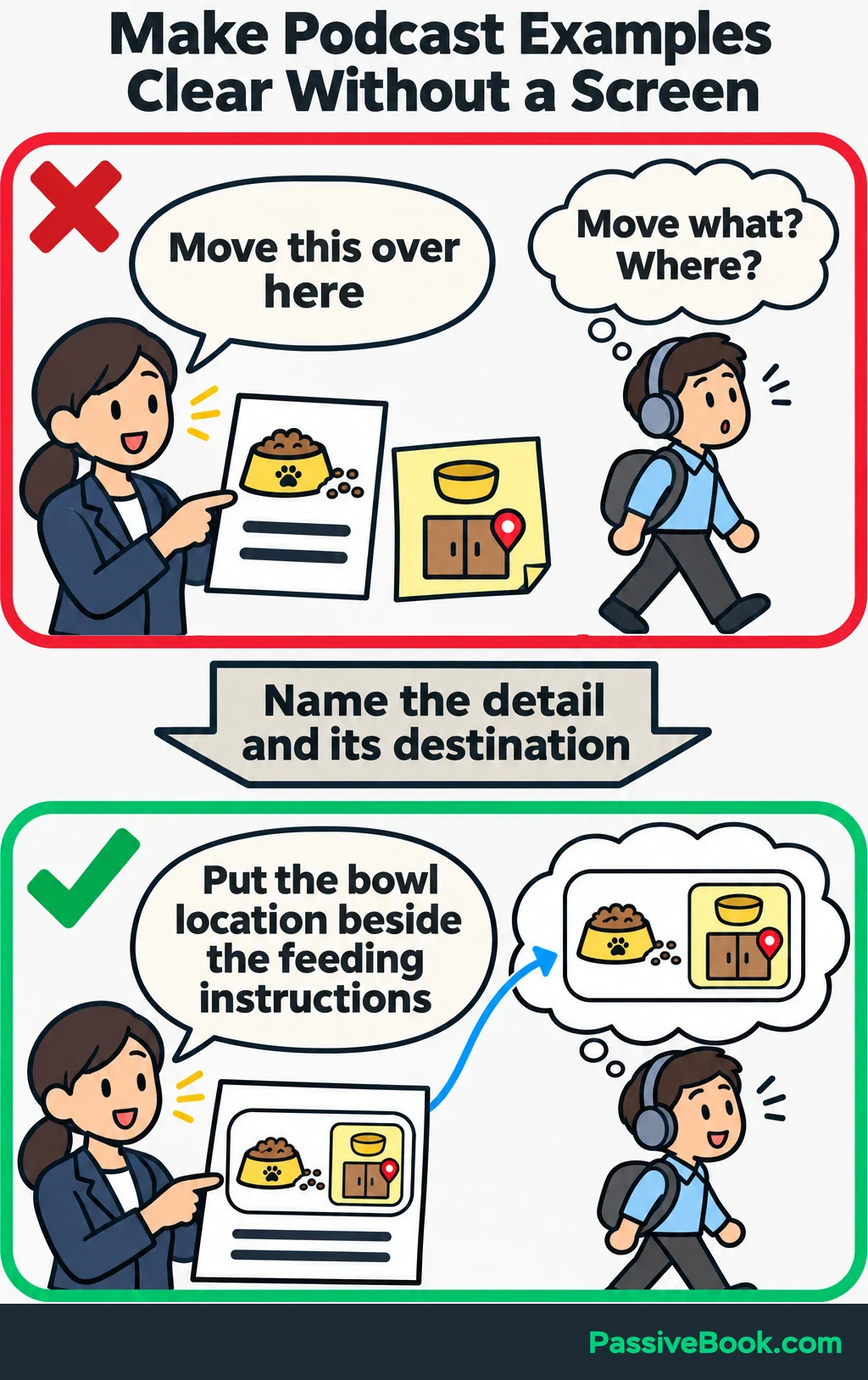
Next, explain that instructions and their related supply locations belong together. Now the example has a purpose:
“Instead of leaving ‘bowls in the lower cupboard’ under miscellaneous notes, put it beside the feeding instructions.”
Describe what changes aloud. “Move this over here” is unhelpful to someone listening while walking.
Short transitions connect the stages:
“Now that your notes are together, let’s put them in the order your sitter will use them.”
The same principle works in other formats. Interview questions should build toward the answer instead of jumping between unrelated subjects. A story needs an understandable situation, a central problem, and a resolution.
I would skip recurring segments that don’t help this progression. A “tip of the week” can become another small content deadline wearing a cheerful name.
Close With a Takeaway and One Next Action
Return to the opening question and answer it directly:
“A clear handover brings your notes together, keeps related instructions in one place, and gets checked with the person who will use it.”
Then give listeners one action that follows from the lesson.
For the shop, a blank handover template is a useful next step. It supports the task and gives interested listeners a relevant way to connect with the business.
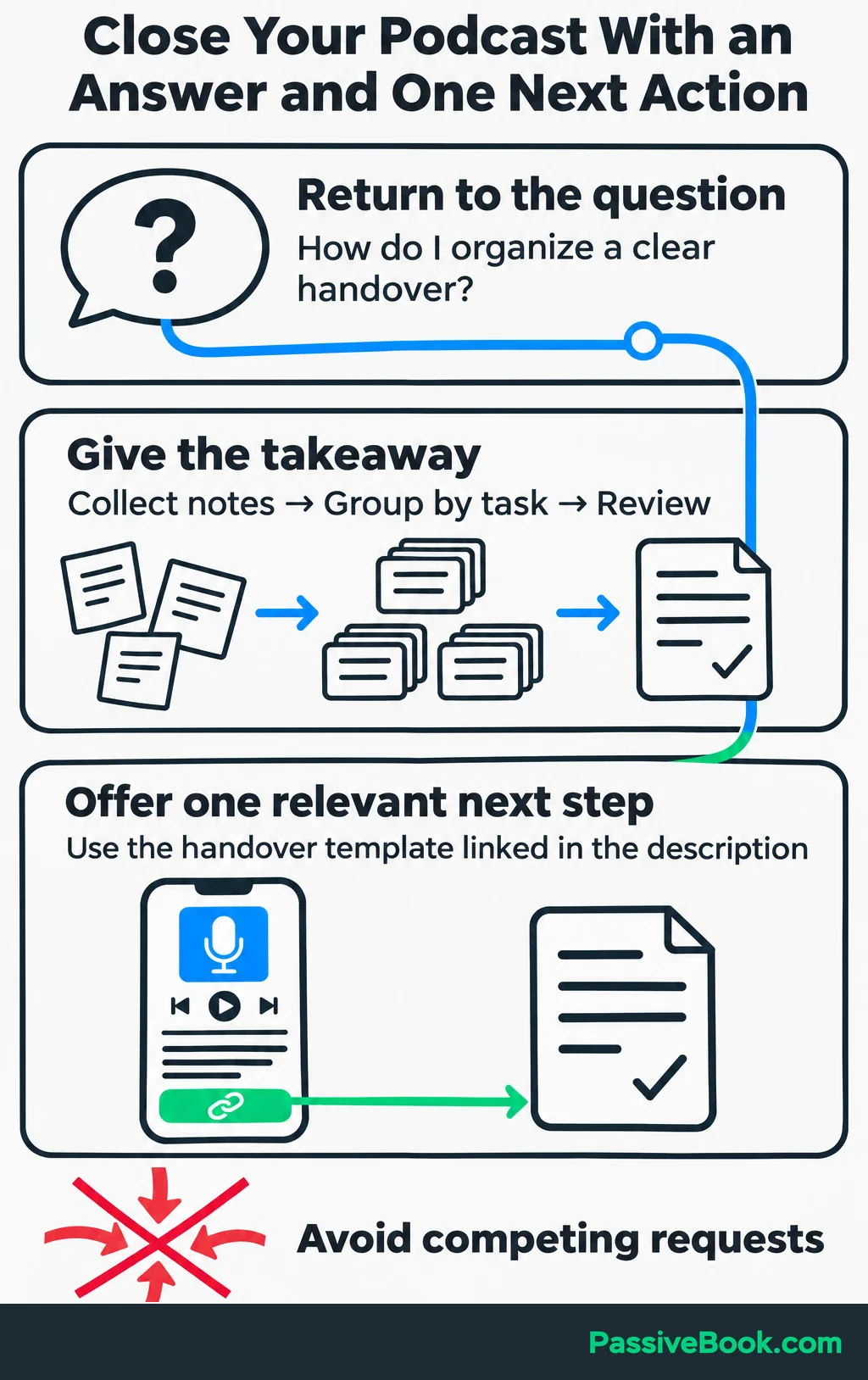
You might say:
“Use the blank handover sheet linked in this episode’s description, then review your completed version with your sitter.”
If you mention a web address, use a short one you can say clearly and include the clickable link in the description.
I wouldn’t finish this episode by asking people to download, subscribe, review, share, follow three accounts, and browse the shop. Choose the action that best serves the episode, then end cleanly.
Create a Reusable Podcast Episode Template
A template should help you make the important decisions once and reuse them. Keep the fields that guide recording, and remove anything you never consult.
A document, spreadsheet, or Notion page is enough.
A Blank Episode Outline
Copy these fields into your planning tool. The call to action is the one next step you ask listeners to take, such as using the handover template:
Working title:
Central question:
One-sentence answer:
Listener outcome:
Format:
Participants:
Estimated duration:
Primary call to action:
Call-to-action destination:

Factual checks and supporting sources:
Guest follow-ups:
Pronunciation reminders:
Useful links:
Recording notes:
Below those fields, add a run-of-show table. This is simply the episode plan in speaking order. For each segment, note who speaks and estimate the duration after rehearsal.
| Segment | Talking Points or Questions |
|---|---|
| Opening | State the problem, briefly introduce the show and host, and say what listeners will be able to do. |
| Necessary context | Note any terms, materials, or background listeners need before the main advice. |
| Main segment 1 | Explain the first step or idea, show an example, and write a transition to the next part. |
| Main segment 2 | Build on the previous step or idea and address a likely point of confusion with an example. |
| Main segment 3 | Complete the answer and show how listeners can check or apply it. |
| Recap | Write a direct answer to the central question. |
| Closing action | Give one next action and the link or instructions needed to take it. |
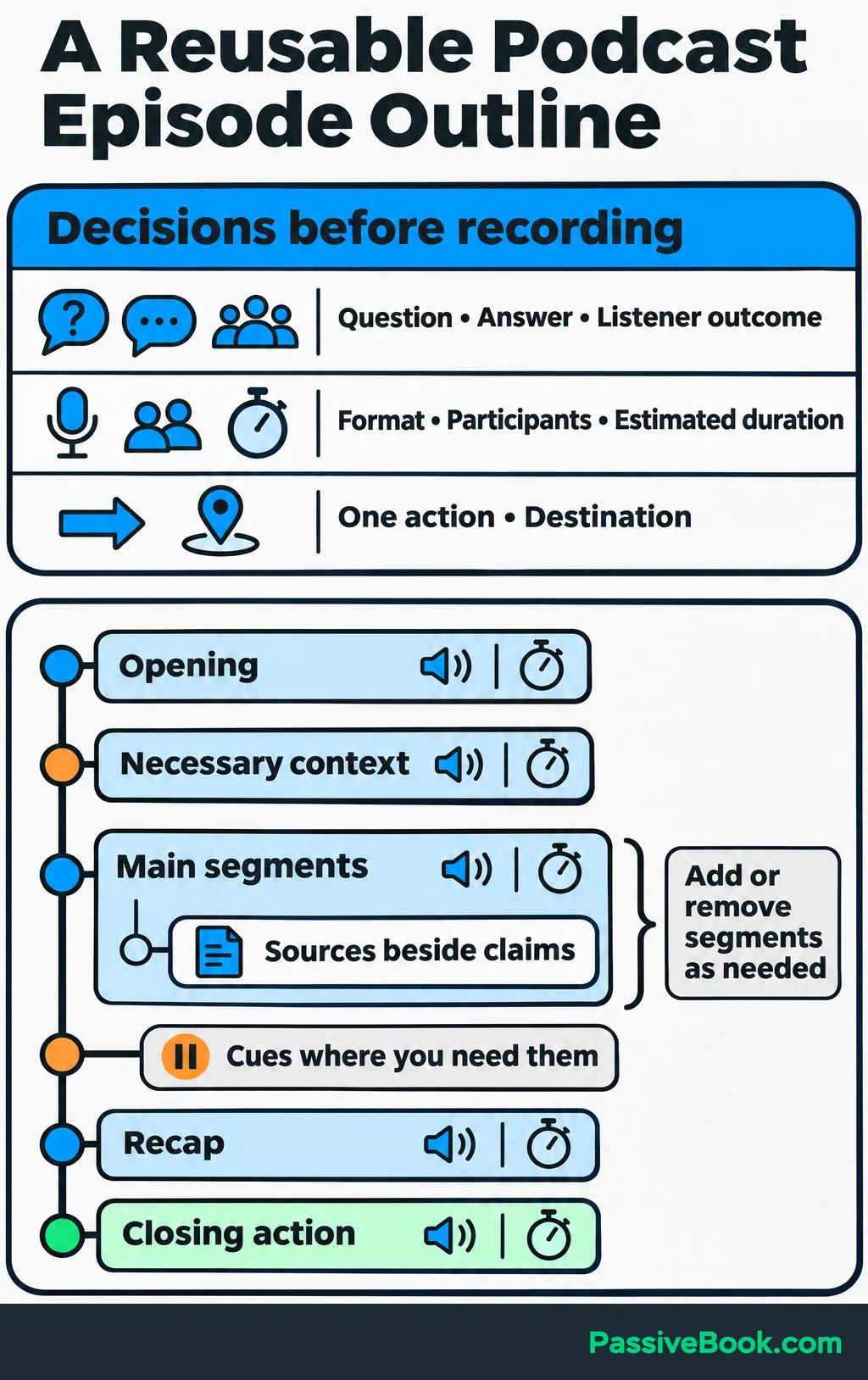
Add or remove main segments as needed. Three is a useful shape for this example, not a rule for every episode.
Keep source notes beside the claims they support so you can find them while checking the script. Recording cues should also sit where you need them, rather than in a separate document you’ll forget to open.
A Worked Solo Episode Outline
Here is the completed plan for the example shop.
- Working Title: Turn Scattered Notes Into a Clear Cat-Sitter Handover
- Central Question: How can I organize my notes into a clear handover?
- Listener Outcome: Complete a cat-sitter handover sheet.
- Format: Solo tutorial.
- Participants: One host.
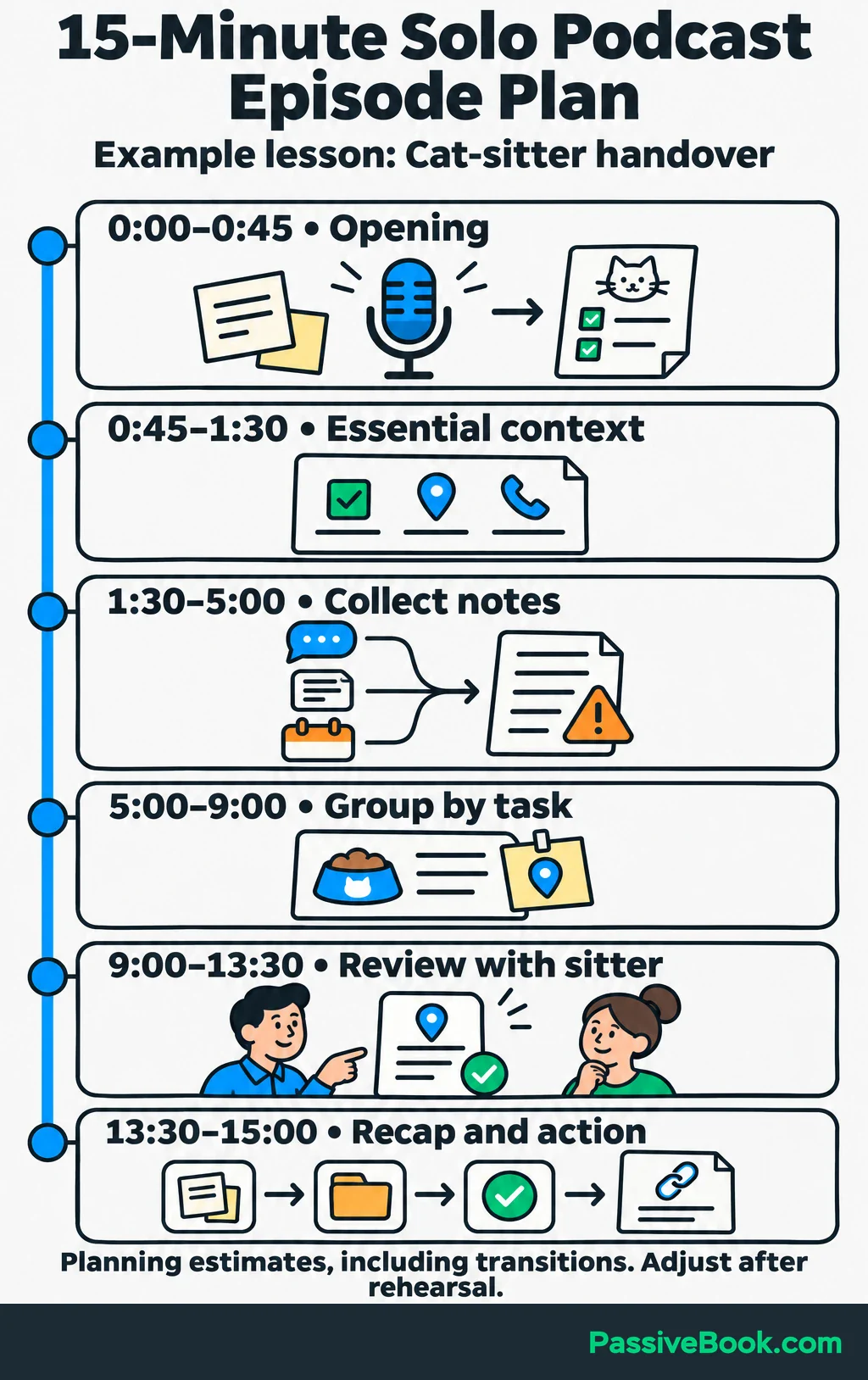
- Estimated Duration: 15 minutes, including transitions.
- Primary Call to Action: Use the blank handover template linked in the episode description.
| Time | Segment | Teaching and Example | Transition or Closing Line |
|---|---|---|---|
| 0:00–0:45 | Opening | Introduce the scattered-notes problem, host, show, and promised outcome | “Let’s start with what your finished sheet needs to contain.” |
| 0:45–1:30 | Essential context | Describe task instructions, supply locations, and contact information | “Before organizing any of that, gather the notes you already have.” |
| 1:30–5:00 | Collect existing notes | Gather messages, documents, and reminders into one draft; flag contradictions | “Now let’s group those notes by the tasks they describe.” |
| 5:00–9:00 | Group instructions by task | Put feeding instructions and bowl locations together; explain why related details belong beside each other | “The next check is whether another person can follow what you’ve written.” |
| 9:00–13:30 | Review the handover | Walk through the sheet with the sitter; replace vague locations and resolve missing details together | “You now have one sheet that’s been checked by the person using it.” |
| 13:30–15:00 | Recap and action | Restate the method and invite listeners to complete and review their sheet | “The blank handover template is linked in this episode’s description.” |
These are planning estimates. Rehearsal might show that one section needs less time, and that’s useful information.
To adapt this for an interview, keep the question and progression but replace teaching prompts with guest questions:
- Collect: “What information do you ask for before a visit?”
- Group: “Can you walk me through an instruction that needs its supply location beside it?”
- Review: “What would you clarify when reviewing a handover with the owner?”
The guest changes how you deliver the answer. The listener’s promised outcome stays clear.
Turn the Outline Into a Natural Recording Script
Choose how much wording you need before recording.
I would use a full script for precise explanations or narration, talking points for flexible teaching, and a question outline for interviews. You can mix these within one episode.
Write the opening, transitions, difficult explanations, and closing first. Rehearse the rest from notes, then expand any point where you keep hesitating or losing the thread.
Write for speaking. Use familiar words, make references clear, and read the draft aloud. The National Park Service’s podcast production case study recommends short, conversational sentences and reading scripts aloud to check their complexity and rhythm.

Below is a complete short version of the handover episode. You can record it as a pilot (a trial episode) or expand its demonstrations using the longer outline. Replace the host placeholder and prepare the linked template before recording.
HOST — OPENING

Are your sitter’s instructions scattered across messages and sticky notes?

I’m [host name], and this is Cat Care, Clearly.

Today, we’re bringing those notes into one handover sheet that you can review with your sitter.

[pause]

HOST — CONTEXT

Keep the finished sheet easy to scan.

It needs your task instructions, the locations of the supplies used for those tasks, and contact information.

You don’t need polished wording yet. Start by finding what you’ve already written.

HOST — COLLECT THE NOTES

Open the messages, documents, and reminders where you keep your instructions.

Copy them into one draft.

For now, focus on gathering the information. You can sort it in the next step.

If two notes disagree, mark that point for checking. Don’t leave both versions in the finished handover and hope your sitter guesses correctly.

[pause]

HOST — GROUP BY TASK

You’ve gathered the notes. Now group each instruction with the task it belongs to.

For example, “bowls in the lower cupboard” belongs beside the feeding instructions.

Make the location clear enough for another person to find.

“The lower cupboard” might be obvious to you. “The lower cupboard beside the fridge” gives your sitter something more useful.

Read each task from beginning to end. Keep its related details together so your sitter doesn’t have to search the rest of the sheet.

HOST — REVIEW THE HANDOVER

Next, walk through the draft with your sitter.

Ask them to explain where they would find the supplies and how they would follow the written instructions.

If they need to ask what a phrase means, improve that phrase on the sheet.

Check the contact details together, and resolve any marked questions before treating the handover as finished.

[pause]

HOST — RECAP AND ACTION

To organize your handover, collect your notes, group them by task, and review the sheet with your sitter.

You’ll find a blank handover template linked in this episode’s description.

Use it to bring your notes together, then arrange that review.

Thanks for listening to Cat Care, Clearly.
Notice the layout: one idea per line, clear speaker labels, and visible pause cues. Those details make the page easier to scan while recording.
If you’re still staring at scattered notes, AI Podcast Studio can turn them into your own episode draft. Start with a short pilot, then read it aloud to see what needs changing.

Free AI Podcast Studio




For an interview, share the focus beforehand and prepare open questions. Follow a useful answer with “What did that look like?” or “Can you give an example?” You don’t have to force every prepared question into the conversation.
For co-hosted and panel episodes, assign the opening, segment leads, handoffs, and close. Agree on a phrase for redirecting tangents, such as: “Let’s bring this back to the handover.”
Test the Structure With a Pilot
Record a complete pilot before committing to a release schedule.
Use the equipment you already have to test the lesson. NPR’s beginner podcast guide describes making a podcast with a smartphone and computer. A basic pilot can tell you whether the episode works before you spend money improving the setup.
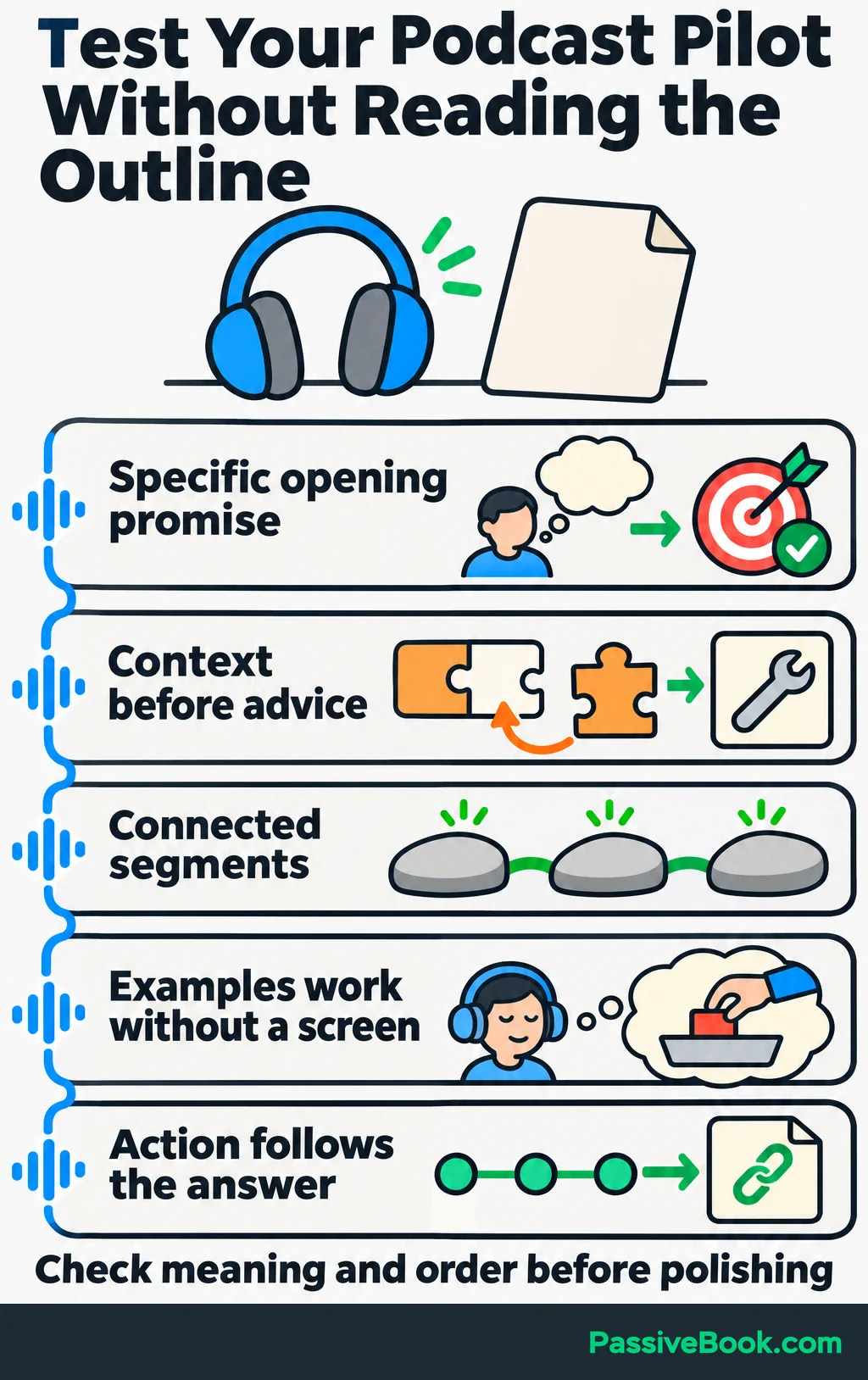
Listen back without reading the outline. Check whether:
- The opening makes a specific promise.
- Necessary context arrives before the advice that needs it.
- Each segment follows naturally from the previous one.
- Examples make sense without seeing a screen.
- The closing action follows from the answer.
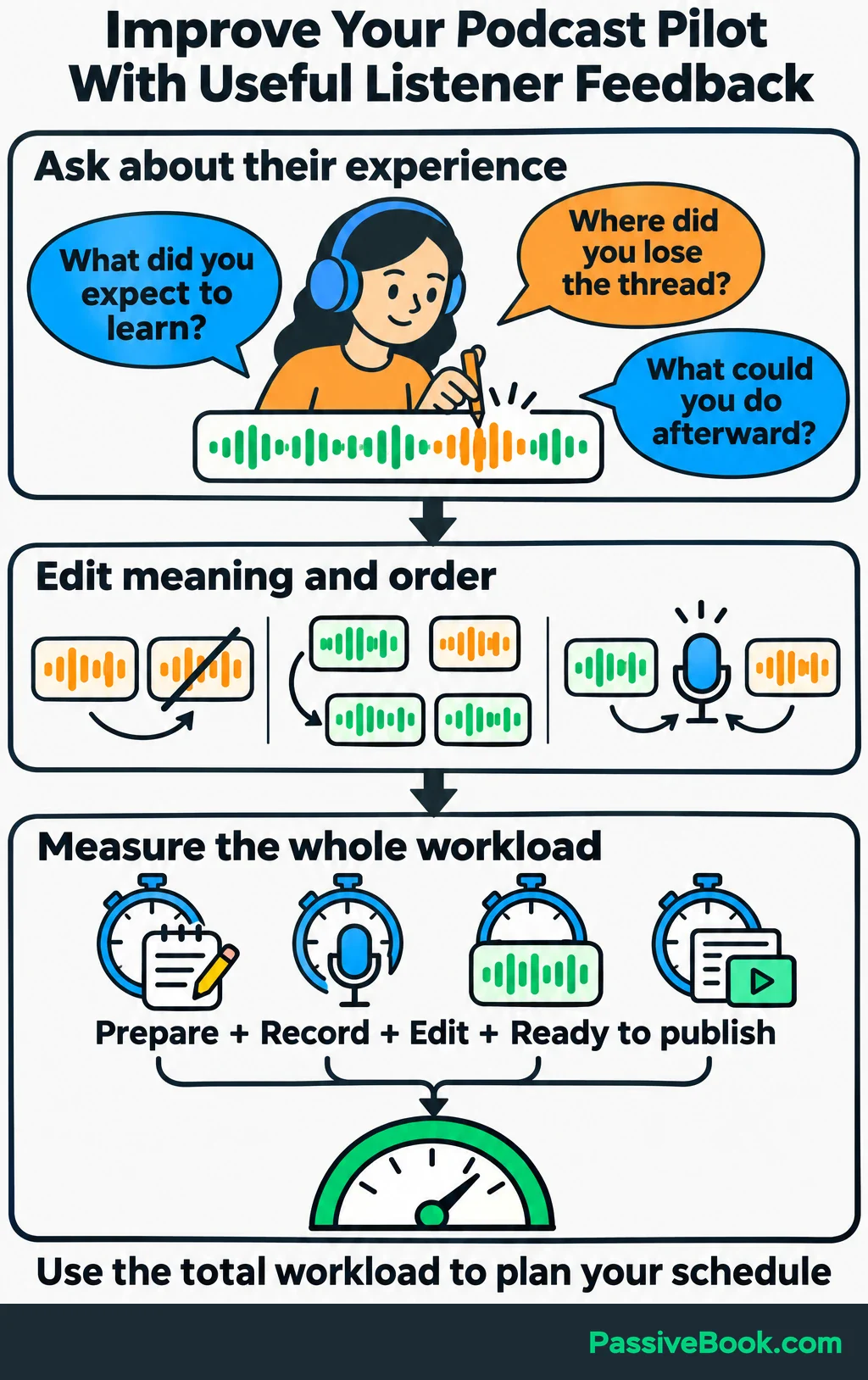
Then ask a prospective listener for feedback. Keep the questions about their experience:
- “What did you expect the episode to help you do?”
- “Where, if anywhere, did you lose the thread?”
- “What could you do after listening?”
“Was it good?” usually gets you politeness when you need useful information.
Edit for meaning and order first. Remove repeated explanations, move missing context earlier, and record a replacement transition if a cut leaves a jump.
Track the time spent preparing, recording, editing, and getting the episode ready to publish. That total is the workload your schedule must accommodate.
Make the Structure Repeatable
Save your show promise, outline, script conventions, and production checklist together. Duplicate them for each new topic.
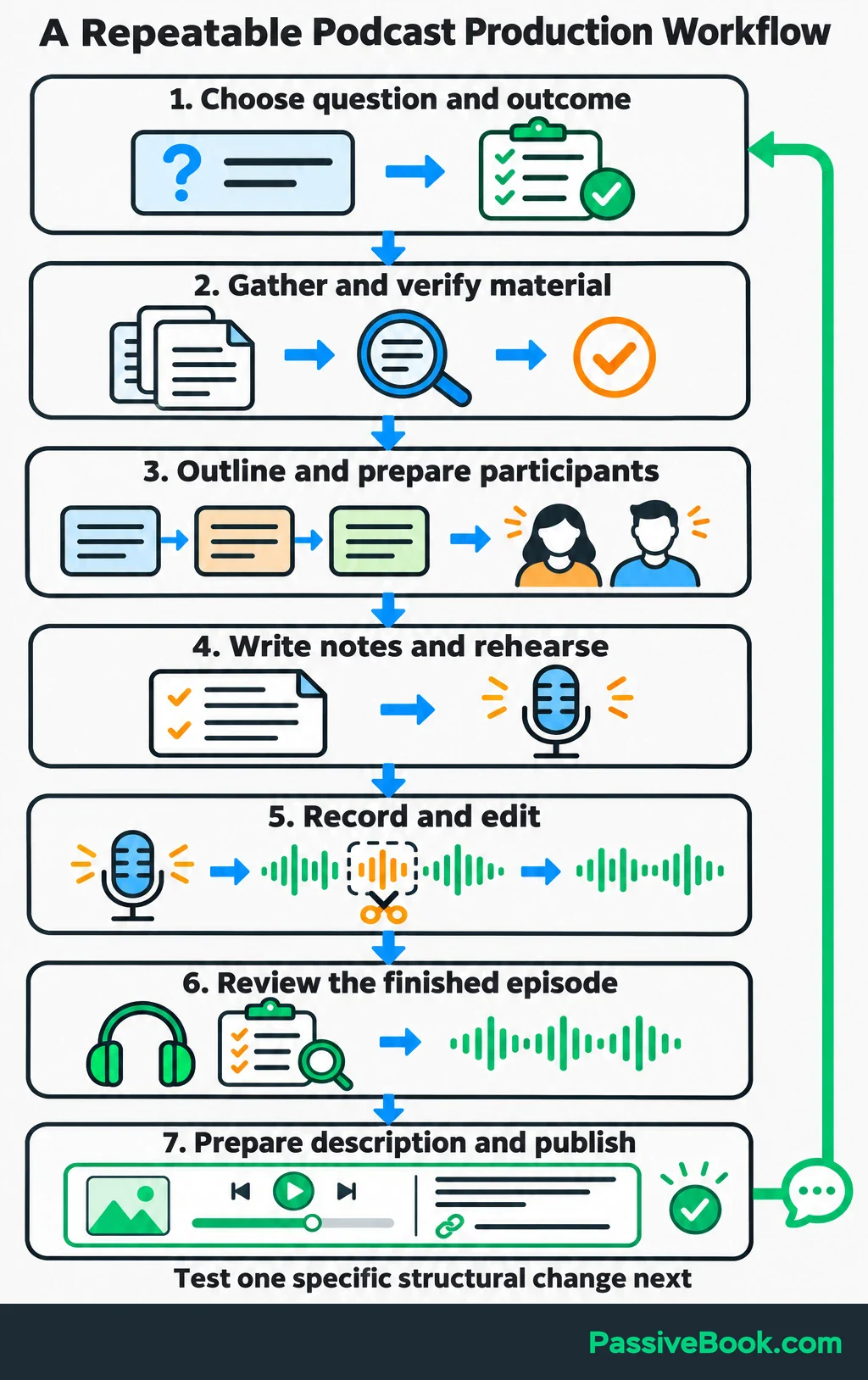
Use the same basic workflow:
- Choose the central question and listener outcome.
- Gather and verify the material.
- Build the outline and prepare any participants.
- Write the recording notes and rehearse.
- Record and edit.
- Review the finished episode.
- Prepare the description and publish.
Keep a small episode queue with each topic’s outcome, format, preparation needs, and status. If you plan interviews, keep a solo topic ready for a guest cancellation.
Batch tasks where it actually helps. You might outline several related questions in one sitting, then record the episodes separately. I would avoid recording a large batch until the pilot has exposed problems in the template.
I learned the workload lesson while building a membership site alongside my corporate job. I spent six months building it, but the ongoing demand for new premium content was unsustainable. I had planned the content more carefully than the capacity to keep producing it.
That experience shapes my advice here: choose a release interval that fits the pilot’s actual workload. If weekly publishing consumes every spare evening, change the schedule before it becomes a promise.
Use the finished outline to draft concise show notes: the episode’s answer, useful resources, and its main call to action. Check that every promised link works.
After publishing, combine listener comments with listening data. Apple Podcasts Analytics provides completion information and can help you investigate skipped sections. That data covers listening on Apple Podcasts, and a drop-off shows where to investigate rather than why someone left.
Choose one structural change to test next. Shorten a guest biography, move an essential explanation earlier, or replace a vague transition. Keep the change specific enough that you can judge whether it helped.
What Next?
Write the central question and listener outcome for one episode, then fill in the blank outline and record a rough pilot. Use that recording to decide what needs changing before you buy more equipment or announce a schedule.
If this guide helps you turn a loose idea into a recordable episode, use the social buttons to pass along the framework.
Which part of your planned show would be hardest to repeat consistently? Share it in the comments, along with any other questions.
Share this post with your friends & followers:

