You’ve published an episode that answers a real question, but most people who need that answer have no idea it exists. Sharing the cover art again gives them little reason to stop and listen.
That gap can turn promotion into another weekly chore, especially when recording already takes your spare time.
A few likes on a post don’t tell you whether anyone listened. This guide shows how to turn an episode’s useful answers into invitations that reach relevant listeners, then work out which efforts deserve a place in your next release.
1. Choose an Episode Worth Recommending
Start with an episode that solves a specific problem and represents your show well. Your latest release may qualify, but being new isn’t enough.
Write your show’s promise in one sentence. Name who it helps, the recurring problem it addresses, and what listeners gain. Then read relevant discussions and listener replies for questions that fit that promise.
For the examples, imagine you sell printable dog-walk journals and run a podcast called Weekend Dog Walks. Its promise could be:
“Weekend Dog Walks helps dog owners plan enjoyable walks and find places they’ll want to visit again.”
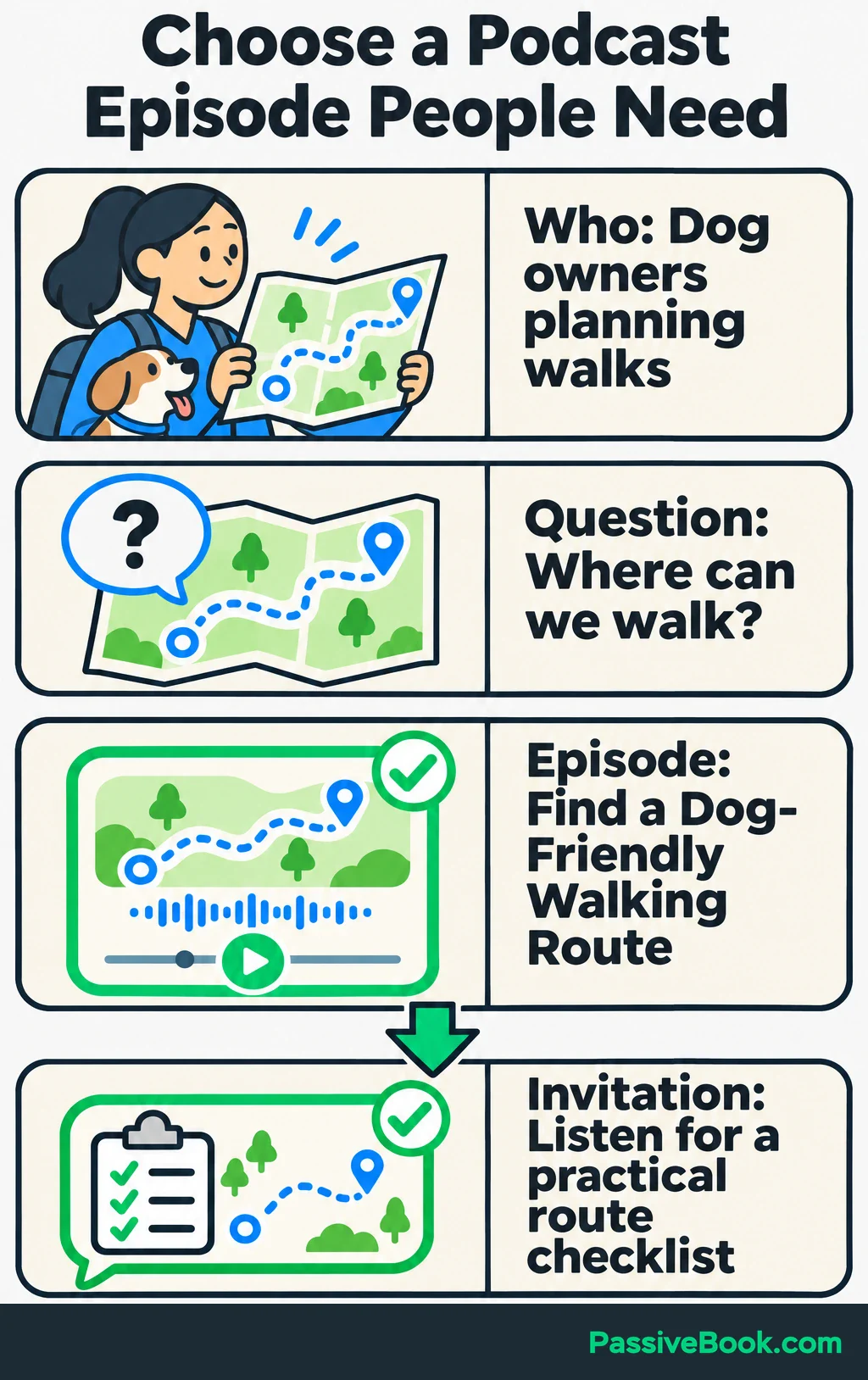
You notice questions about finding somewhere new to walk, so you choose “How to Find a Dog-Friendly Walking Route” as your starting episode. All sample copy and figures in this guide are illustrative.
Build the invitation around that question:
“Looking for somewhere new to walk your dog? Listen to ‘How to Find a Dog-Friendly Walking Route’ for a practical route-planning checklist.”
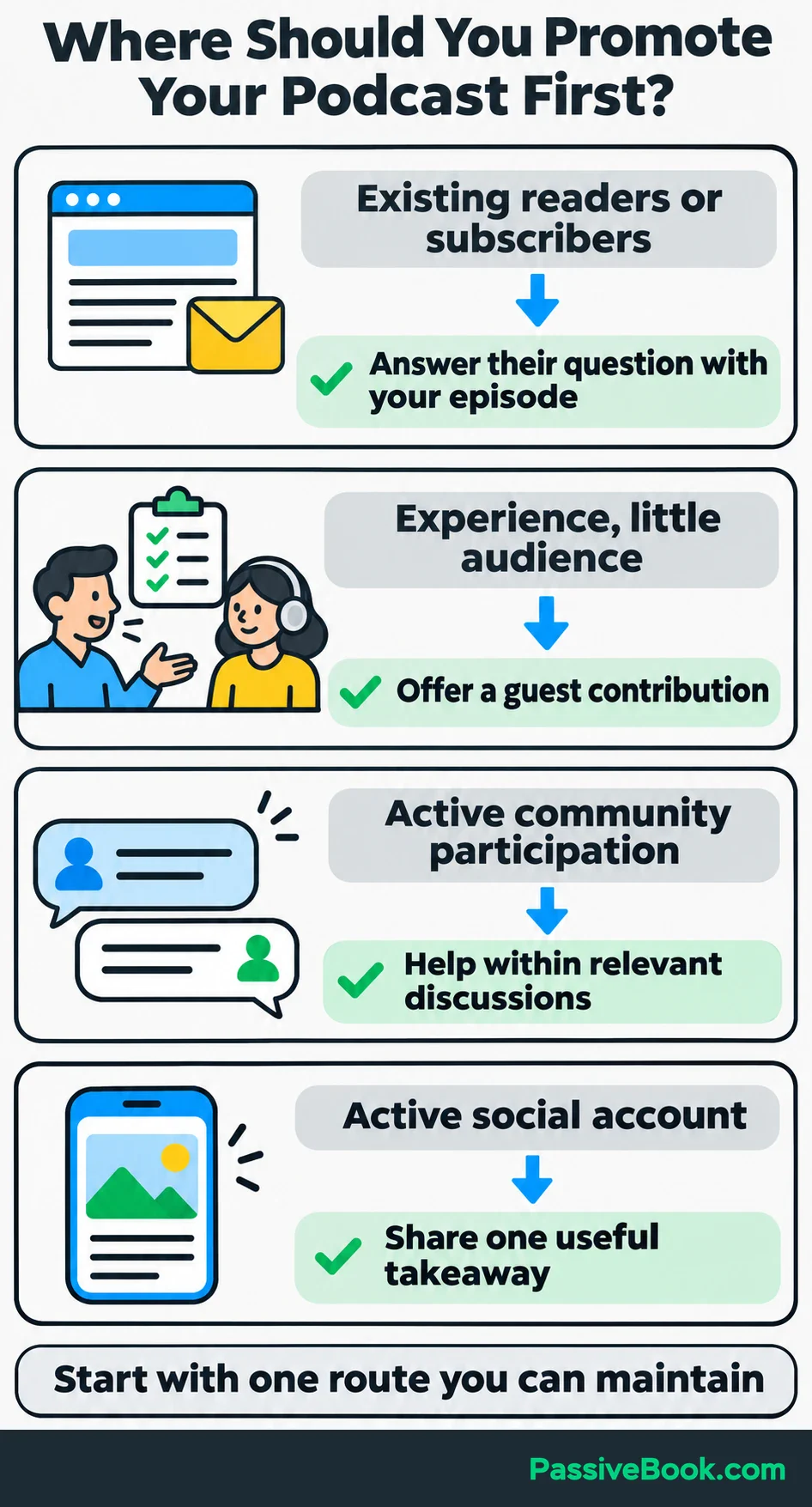
Now choose one main way to reach people. I would base this on where you already have access and what you can maintain.
| Your Starting Point | Where I Would Begin |
|---|---|
| Relevant blog traffic or an email list | Introduce the episode where it answers an existing reader question. |
| Useful experience but little audience | Offer a contribution to a complementary podcast or newsletter. |
| Regular participation in a relevant community | Answer questions there and share the episode when appropriate. |
| An active account on a suitable platform | Publish useful takeaways in a format you already make. |
You don’t need a large following to offer a useful answer or contribution. You do need a reason for people to care.
Before starting, record the episode’s current listening results. Choose one listening goal and one business outcome, such as confirmed signups for a free route-planning checklist. Keep those goals separate so you can see whether promotion attracts listeners and whether it supports the business.
Organic promotion avoids advertising spend, but it still uses time and may involve hosting, website, or email costs. Give it a realistic place in your week.
2. Make Your Podcast Easy to Find and Play
Before sending people anywhere, test the destination.
Find your show and chosen episode on Apple Podcasts, Spotify, and any other service your intended listeners use. If a listing is missing, submit your show through your podcast hosting service—the service that stores and distributes your audio—or directly to the listening service. Then test public playback on your phone.
Next, check the episode title. It should tell a stranger what the discussion covers.
“Exploring Somewhere New — Episode 12” hides the subject. “How to Find a Dog-Friendly Walking Route” gives people something concrete to recognize and search for.
Apple lists show names and episode titles among its search factors, alongside popularity and listener behavior. Clear wording helps establish relevance, but it doesn’t guarantee a ranking. Apple Podcasts explains its search factors here.
Write the description with the same clarity. State the question, name the useful takeaways, and include the relevant next-step link:
“Learn how to check dog access, compare route length, and review conditions before choosing a new walk. Get the companion route-planning checklist through the episode page.”
Keep your show name and artwork recognizable across services. Give newcomers a clear starting episode, too. For a serialized show, that should usually be the beginning of the relevant sequence.
Consider YouTube if your audience listens there. In supported countries and regions, YouTube can use the RSS feed supplied by your podcast hosting service to turn audio episodes into videos with your show artwork. You don’t need to appear on camera. YouTube describes how RSS delivery works.
I would add that destination only when you can check the imported episodes and maintain the listing. Another account still needs an owner.
3. Create a Searchable Episode Page
Give each promoted episode a stable page where people can understand its value and start listening.
Use your host’s public episode page immediately if you don’t have a website ready. You can build a fuller page later without delaying every promotion.
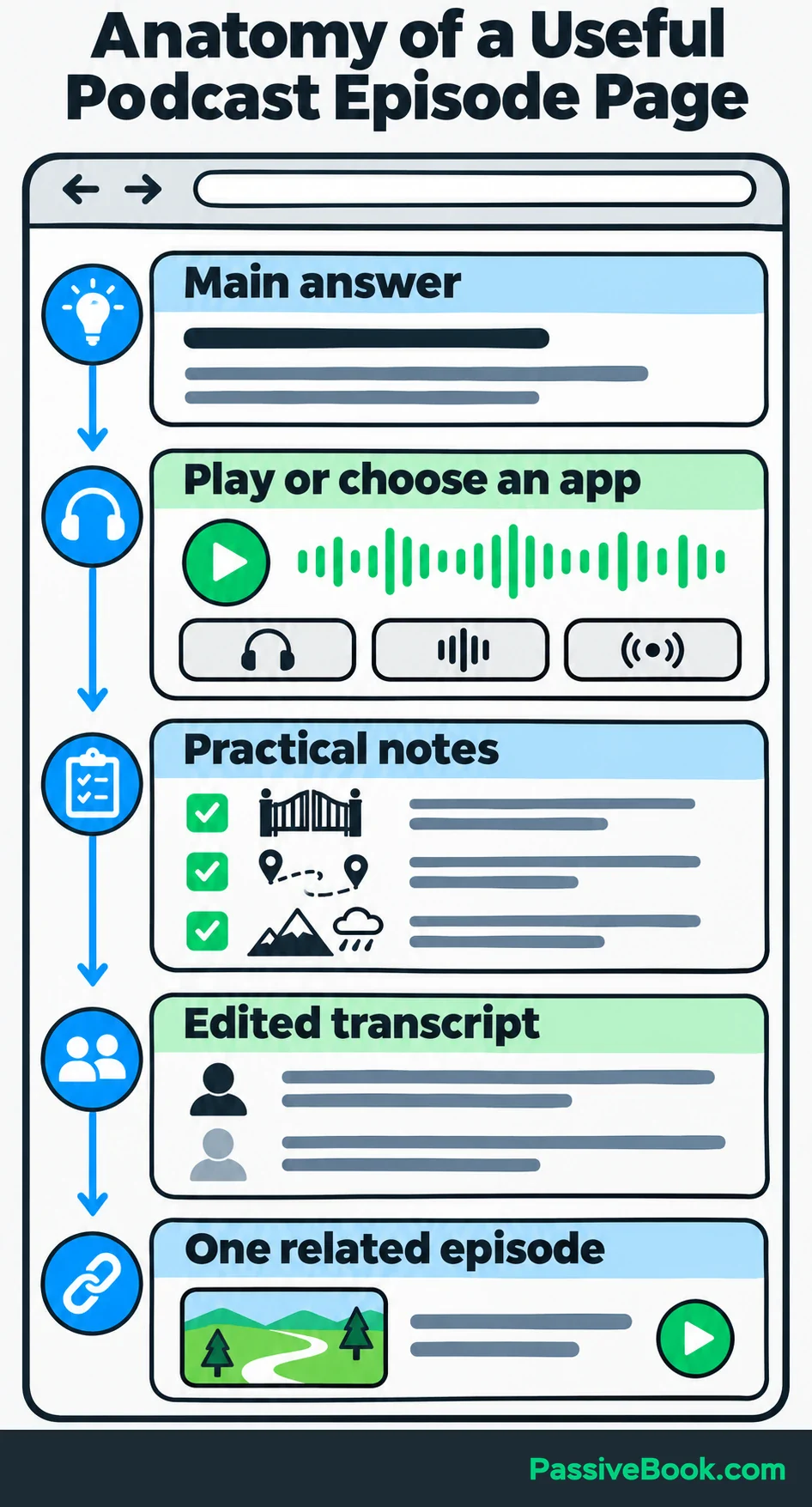
On your own site, make the page useful even to someone who reads before listening. Include:
- Main Answer: A short explanation of the problem and the approach.
- Playback: An audio player near the top, with clearly labeled listening-app links.
- Practical Notes: The checklist, resources, or examples discussed.
- Transcript: An edited version with speaker names and readable paragraphs.
- Next Episode: One related discussion that helps the listener continue.
For Weekend Dog Walks, the page could explain how to check permitted access, compare distance, and review route conditions before choosing a walk. The audio adds detail, but the page already helps visitors make progress.
Use a concise, descriptive page title that accurately represents the page, as Google recommends. Give the page one clear main heading.
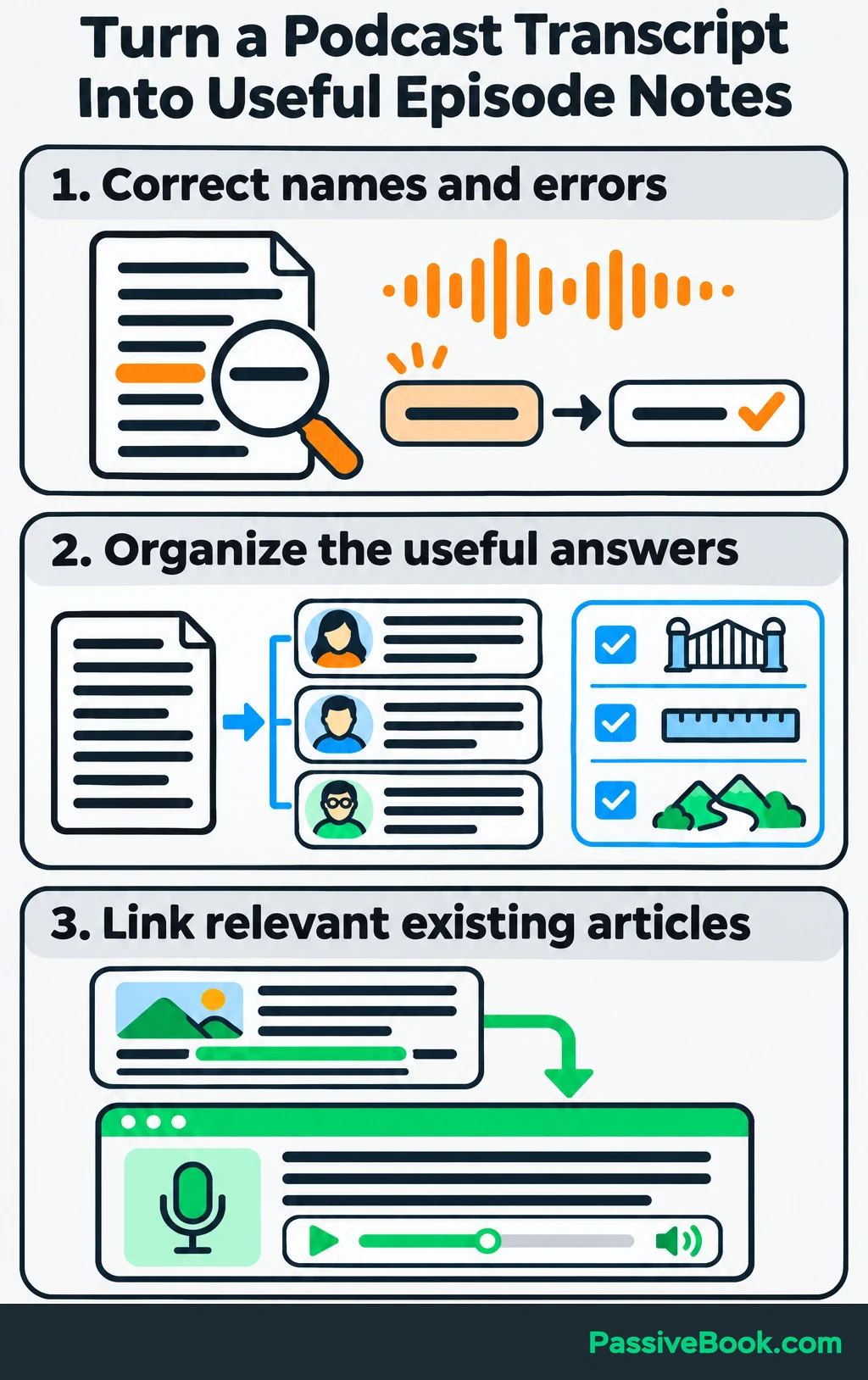
An unchecked transcript shouldn’t carry the whole page. Correct names and errors, then organize the important answers so readers can find them.
Link relevant existing articles to the episode page using useful wording, such as “check a dog-walking route before you go.” Google uses links to discover pages and understand their relevance.
Finally, confirm that your website analytics records visits. You’ll need that working before comparing where visitors came from.
4. Reach New Listeners Through Relevant Collaborations
Choose collaborators whose audiences have a reason to want your episode. A modest publication covering the right problem is where I would start.
Make sharing easy for anyone involved, including guests on your own show. Send the direct episode link, suggested copy, and one useful excerpt or graphic. Ask for a specific action, such as including the episode in their next resource roundup, and let them adapt the wording.
Arrange Podcast Recommendation Swaps
Look for active shows with overlapping listener needs and a complementary focus. Listen before pitching so you can explain the connection.
For Weekend Dog Walks, a show about weekend outings with dogs could be a fit. A broad entertainment podcast would need a much clearer reason to feature the route-planning episode.
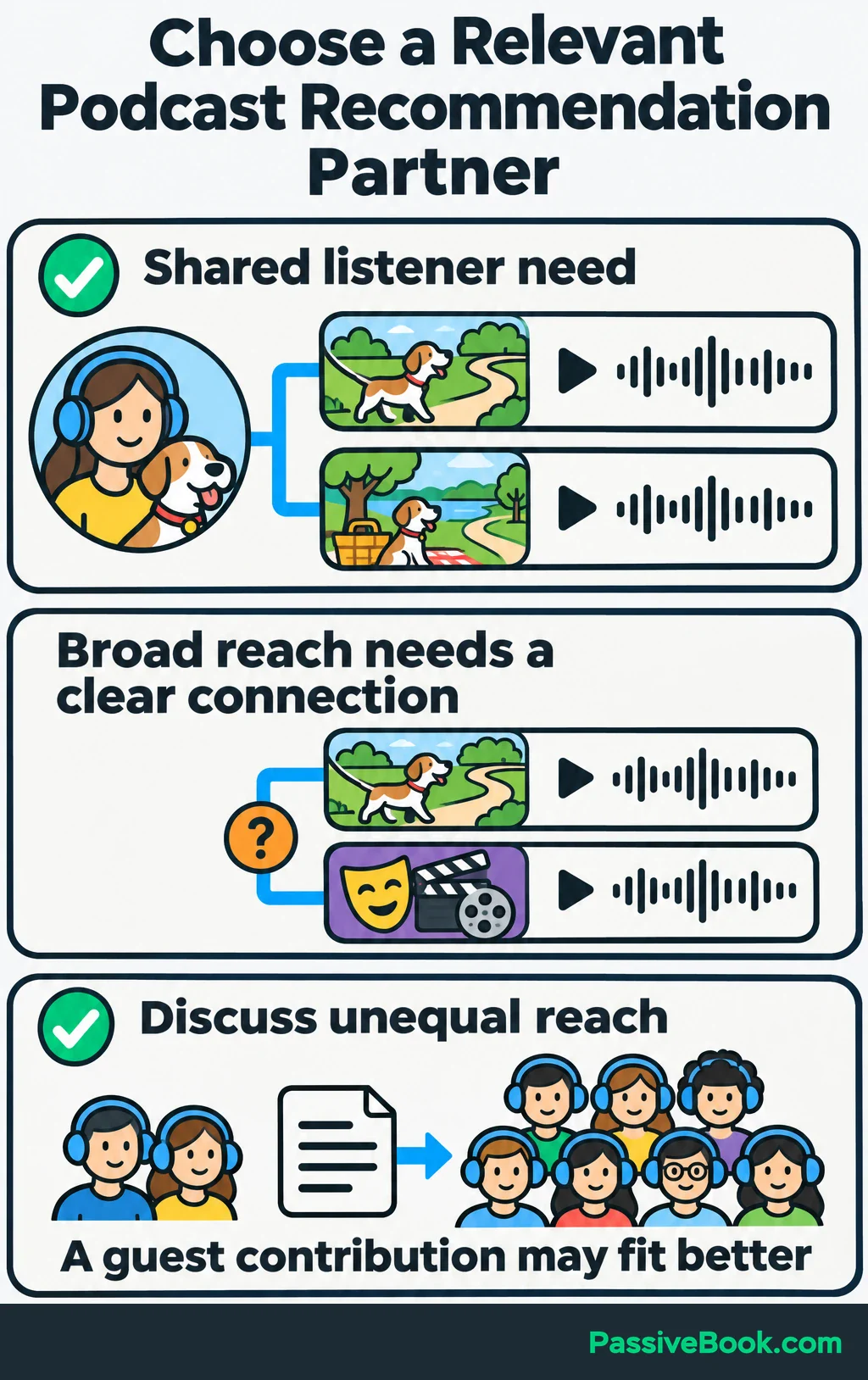
Suggest a short, unpaid exchange of host recommendations:
“Your episode about planning weekend outings complements our guide to finding dog-friendly walking routes. Would you be interested in exchanging short recommendations for those two episodes?”
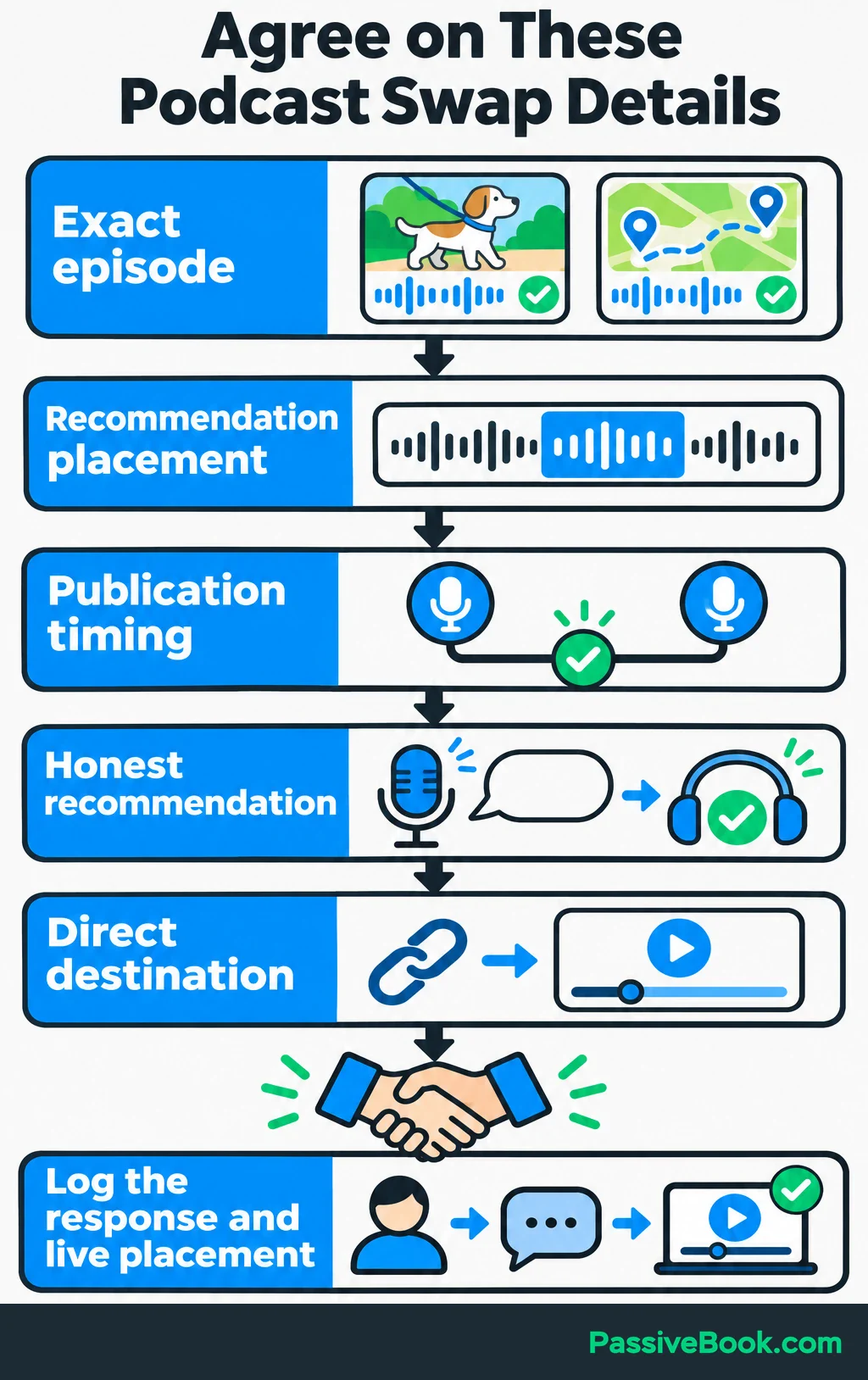
Before agreeing, settle the practical details:
- Featured Episode: The exact episode each host will recommend.
- Placement: Where the recommendation will appear.
- Timing: The expected publication date.
- Message: What each host can honestly recommend.
- Destination: The direct episode link or listening page.
Discuss reach openly. If one show has a much larger audience, an equal exchange may not offer equal value. You could propose a useful guest contribution instead.
Record the contact, response, and date the recommendation appeared. That makes follow-up and measurement possible without relying on memory.
Offer Guest Contributions and Newsletter Features
When your audience is small, useful material can be your contribution.
Offer a topic you can explain from relevant experience. That might be an interview, a short checklist, or an answer to a recurring reader question. Explain what the audience gets before mentioning your podcast.
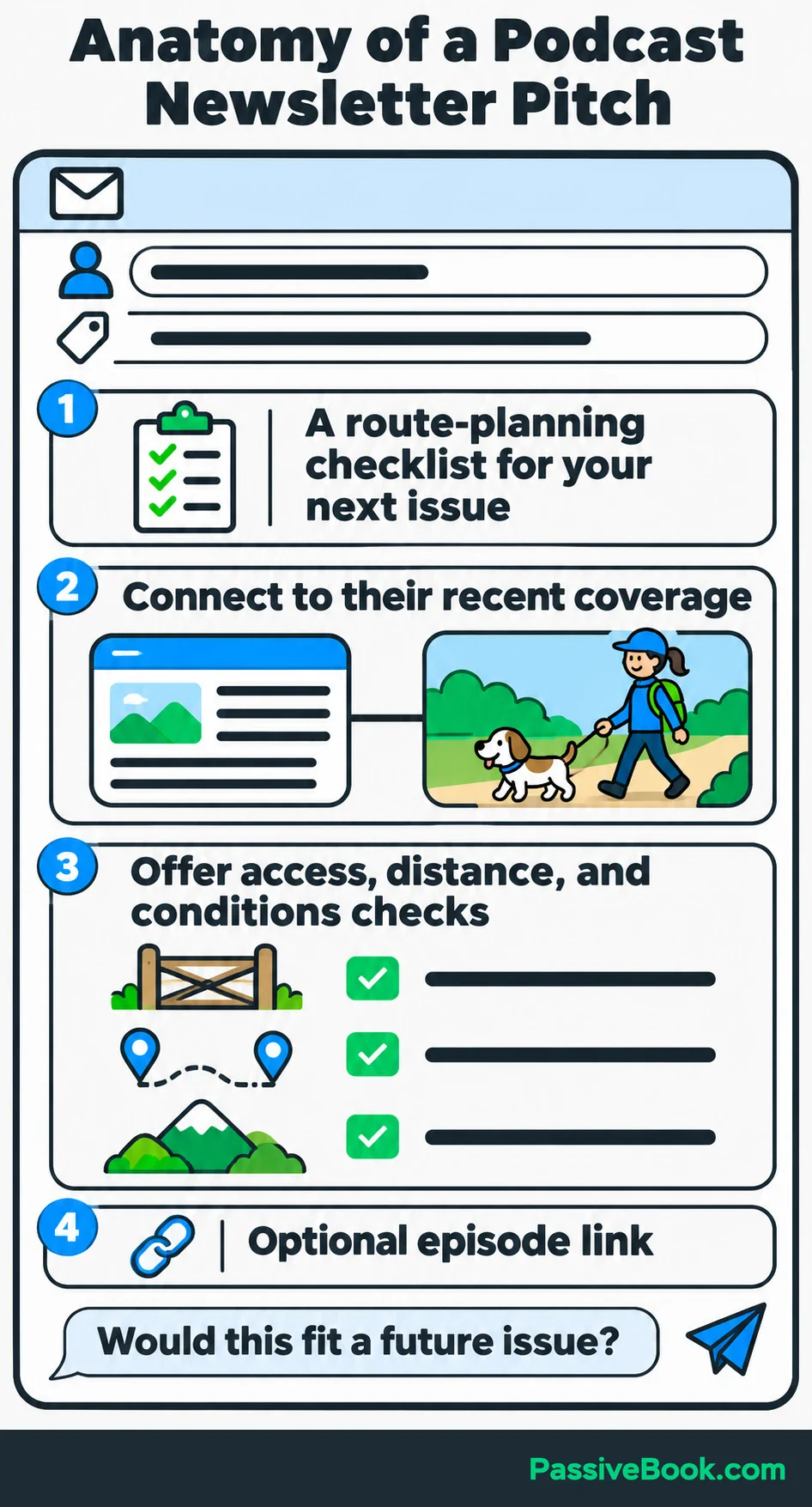
Here’s a complete pitch you can adapt after checking the publication’s interests:
Subject: A route-planning checklist for your next issue
Hi [Name],
Your recent newsletter about weekend outings made me think a short route-planning checklist could fit a future issue.
I run Weekend Dog Walks, and I can contribute a concise piece covering dog-access rules, distance, and route conditions. You could publish the checklist directly, with an optional link to our episode explaining the process.
Would that fit anything you’re planning?
Thanks,
[Your Name]
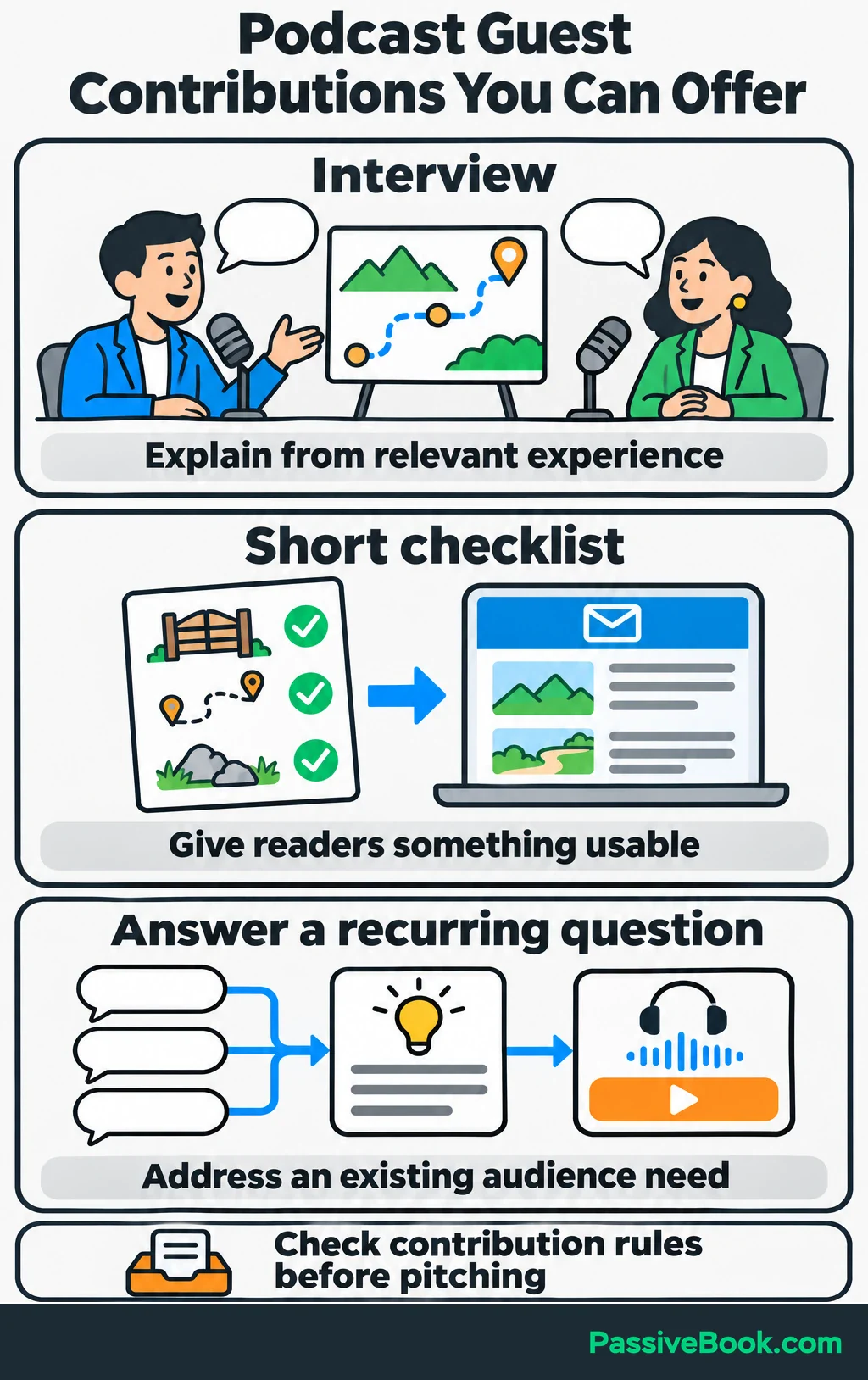
Check whether the publication accepts contributions and follow its submission instructions.
I would send a few carefully chosen pitches and improve them from the replies. Bulk outreach creates plenty of activity, but activity isn’t the outcome you’re after.
5. Share Useful Answers Where Listeners Gather
Repurpose One Strong Takeaway
Choose one complete answer from the episode and turn it into a useful post. Give people something they can apply before asking them to listen.
At Passive Book, I’ve tried drafting Pinterest copy only after finishing the article. I would end up describing the topic because I was tired of thinking about it. Choosing one useful section while editing gave me a clearer starting point.
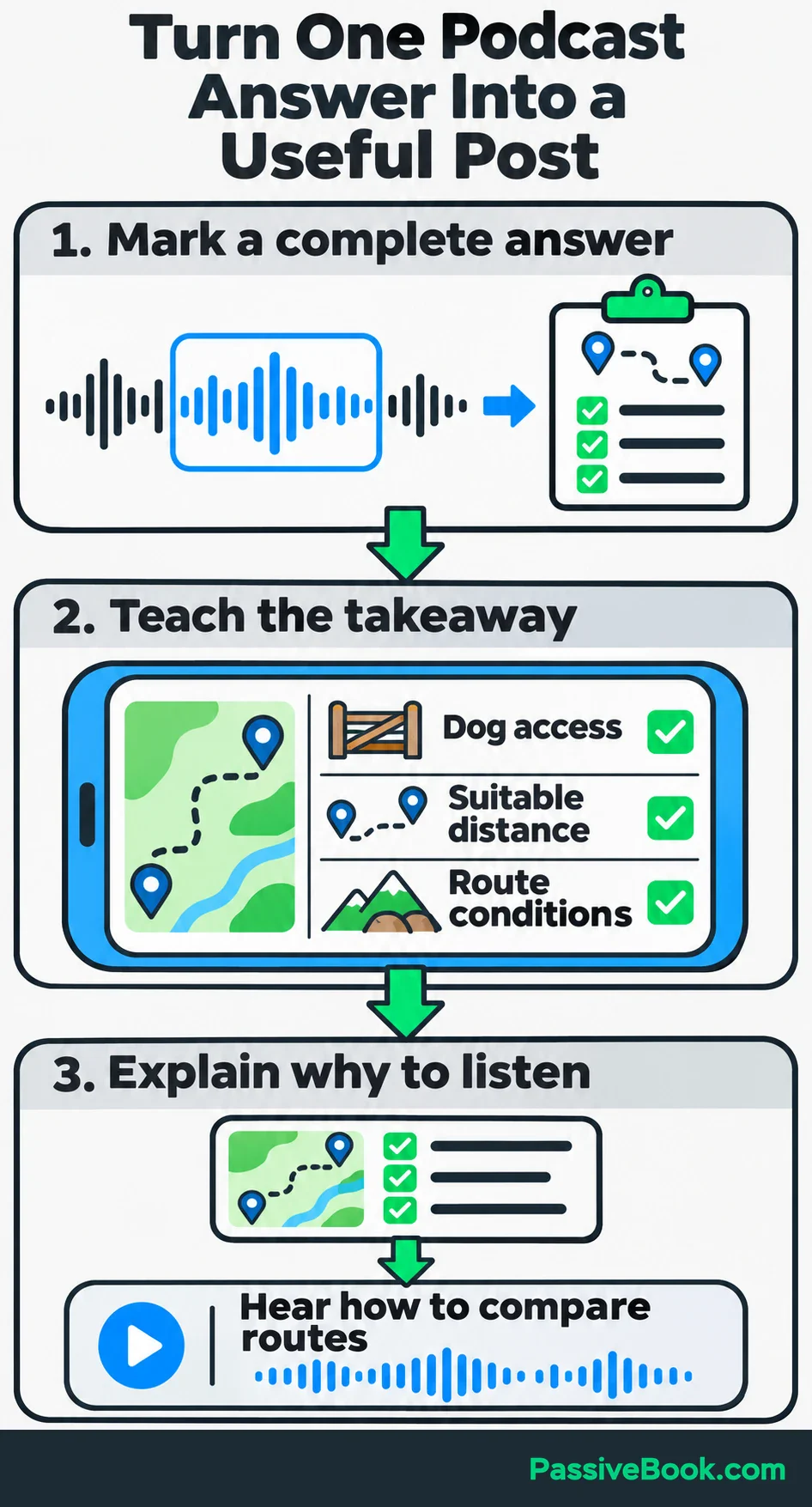
That’s the approach I would use for a podcast. Mark the strongest answer while reviewing the recording, then adapt it for your chosen platform.
For the walking-route episode, a written post could open with:
“Before saving a new dog walk, check three things: whether dogs are permitted, whether the distance suits your plans, and what the route conditions are.”
Explain each check briefly, then give a specific reason to continue:
“The full episode walks through comparing routes and turning those checks into a plan.”
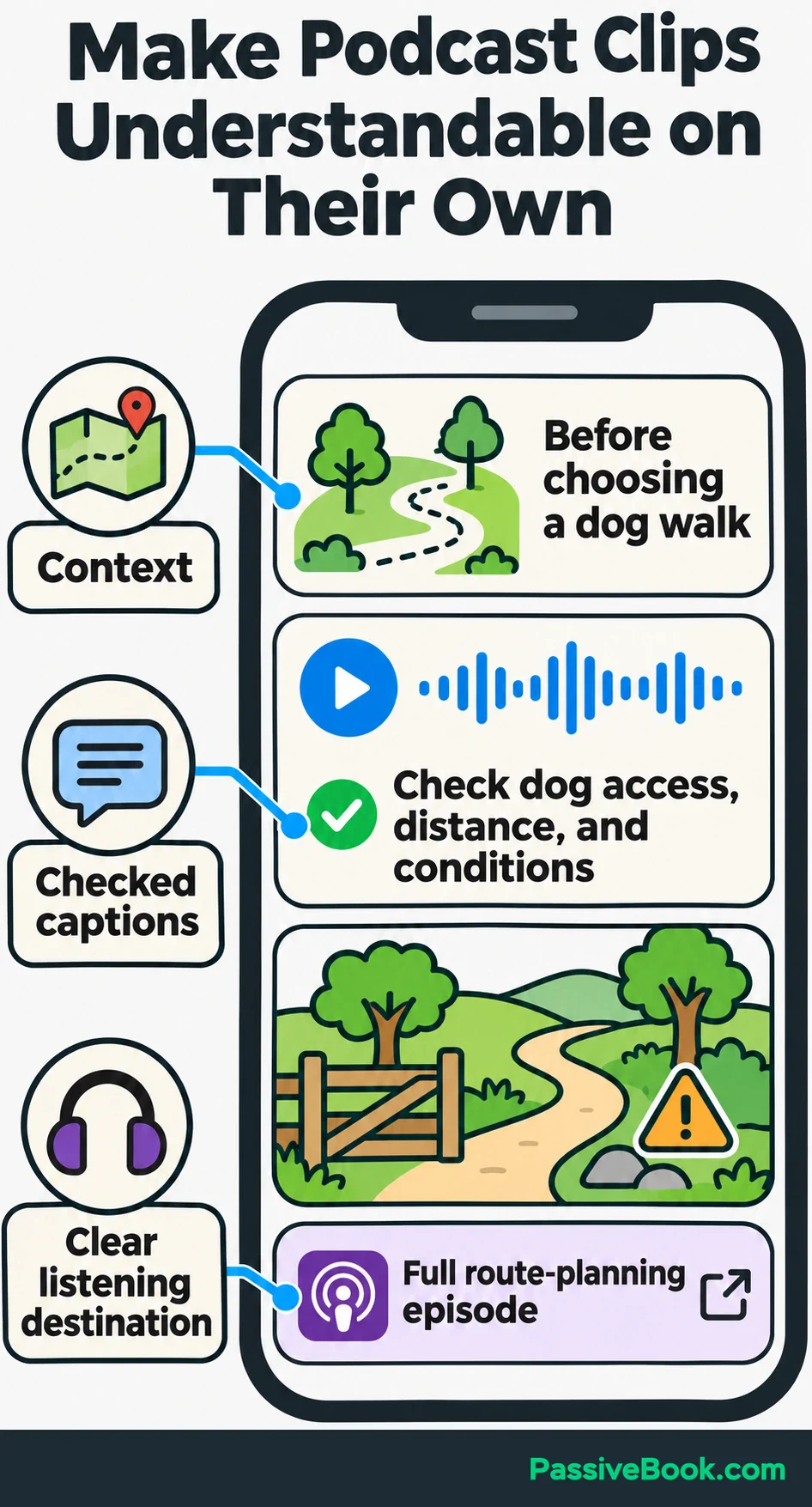
Use a format you can produce repeatedly: a written post, a series of swipeable images, a captioned clip, or an audio excerpt with graphics. You don’t need to film yourself.
If you use audio, check the captions and include enough context for the excerpt to make sense on its own. Make the listening destination easy to recognize.
I would skip elaborate clips until a simpler format earns relevant visits or listening. Fancy subtitles can become a surprisingly absorbing way to avoid distribution.
Contribute to Relevant Community Discussions
Find conversations where people are already asking the question your episode answers. Read the community rules before contributing.
Answer within the discussion first. Someone asking how to find new dog walks should get useful route-checking advice without having to leave the page.
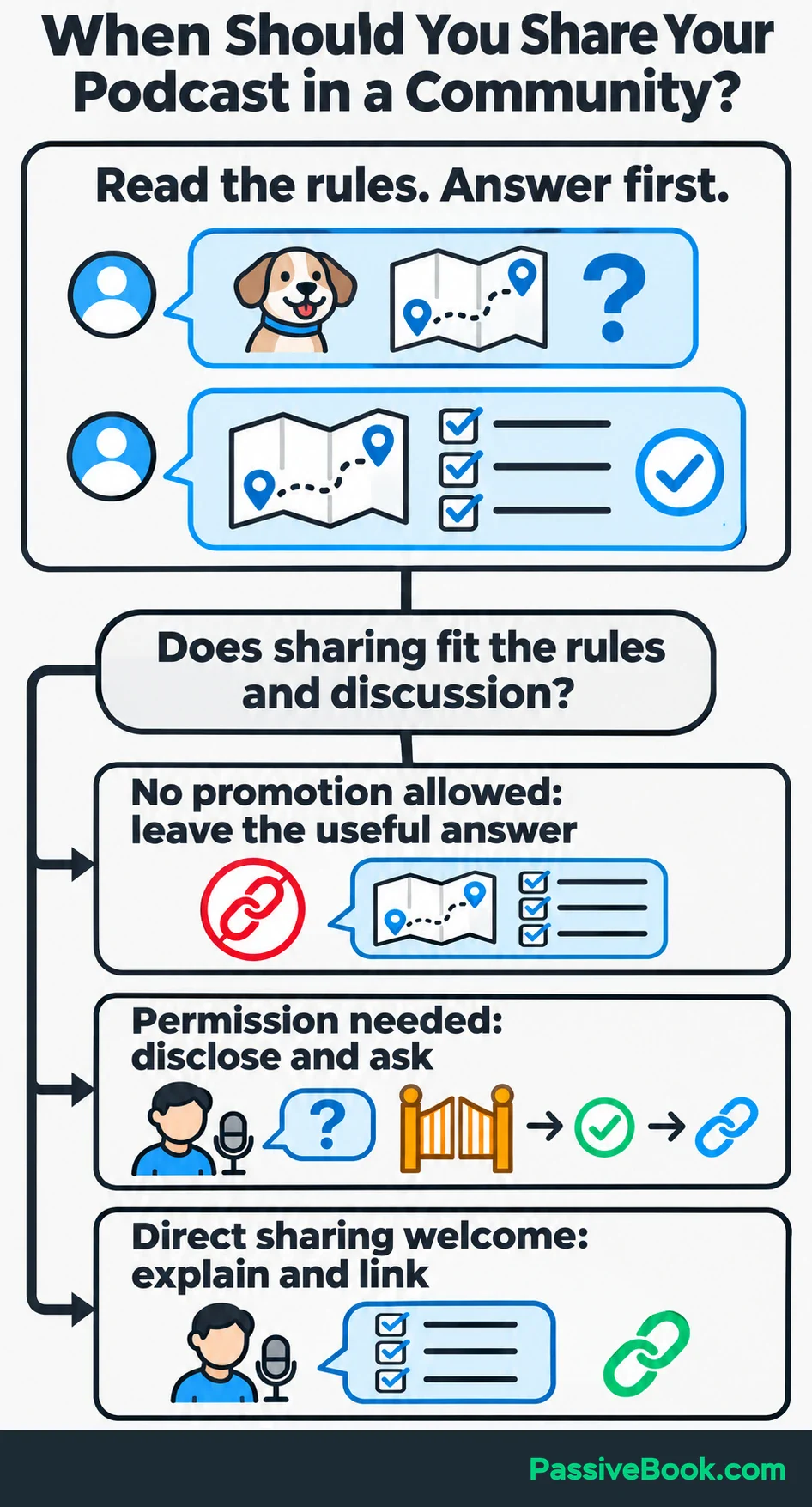
If links are permitted and the episode adds depth, disclose your connection:
“I host Weekend Dog Walks, and we covered this route-checking process in an episode. I can share it if a longer walkthrough would help.”
Where direct sharing is welcome, include the episode link with the explanation. Where promotion isn’t allowed, leave a useful answer.
Save recurring questions for future episodes and invitations. They give you the reader’s language and reveal which parts still need explaining.
Keep this work personal. Repeated link drops and unsolicited bulk messages are a poor foundation for a show you want people to trust.
6. Give Listeners a Reason to Return
Ask for One Clear Next Action
Promotion brings someone to the episode. The episode needs to reward that decision.
Deliver the promised answer early. If the title promises help choosing a walking route, begin with the route-selection problem and useful guidance. Save the long housekeeping announcements for later.
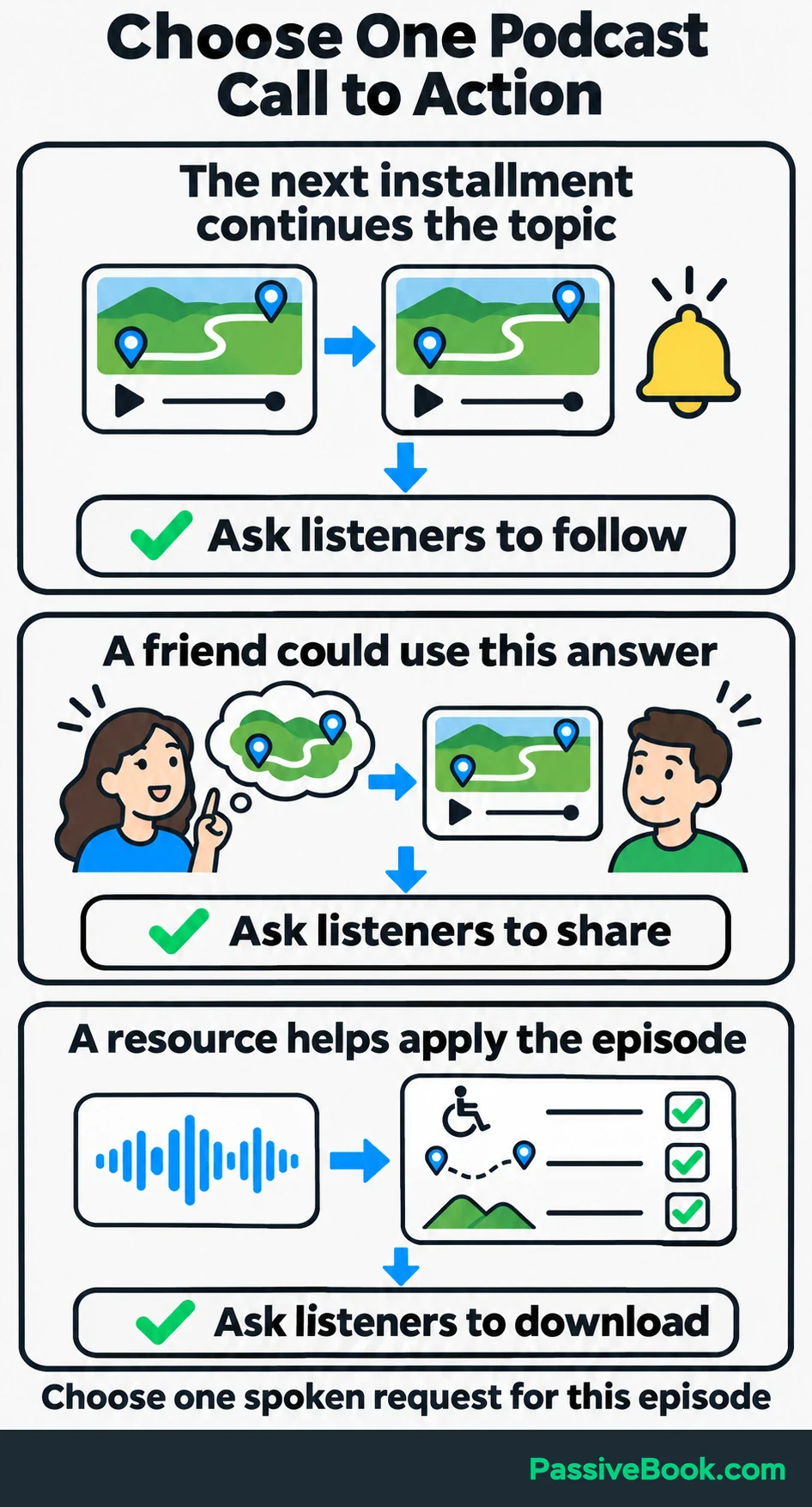
Then choose one primary spoken request:
- Follow: Use this when the next installment continues the topic.
- Share: Ask when the episode solves a problem listeners can recognize in a friend’s situation.
- Download: Offer a companion resource when it helps listeners apply the discussion.
For the route-planning episode, I would choose the checklist:
“Get the free route-planning checklist through the episode page so you can use these checks when choosing your next walk.”
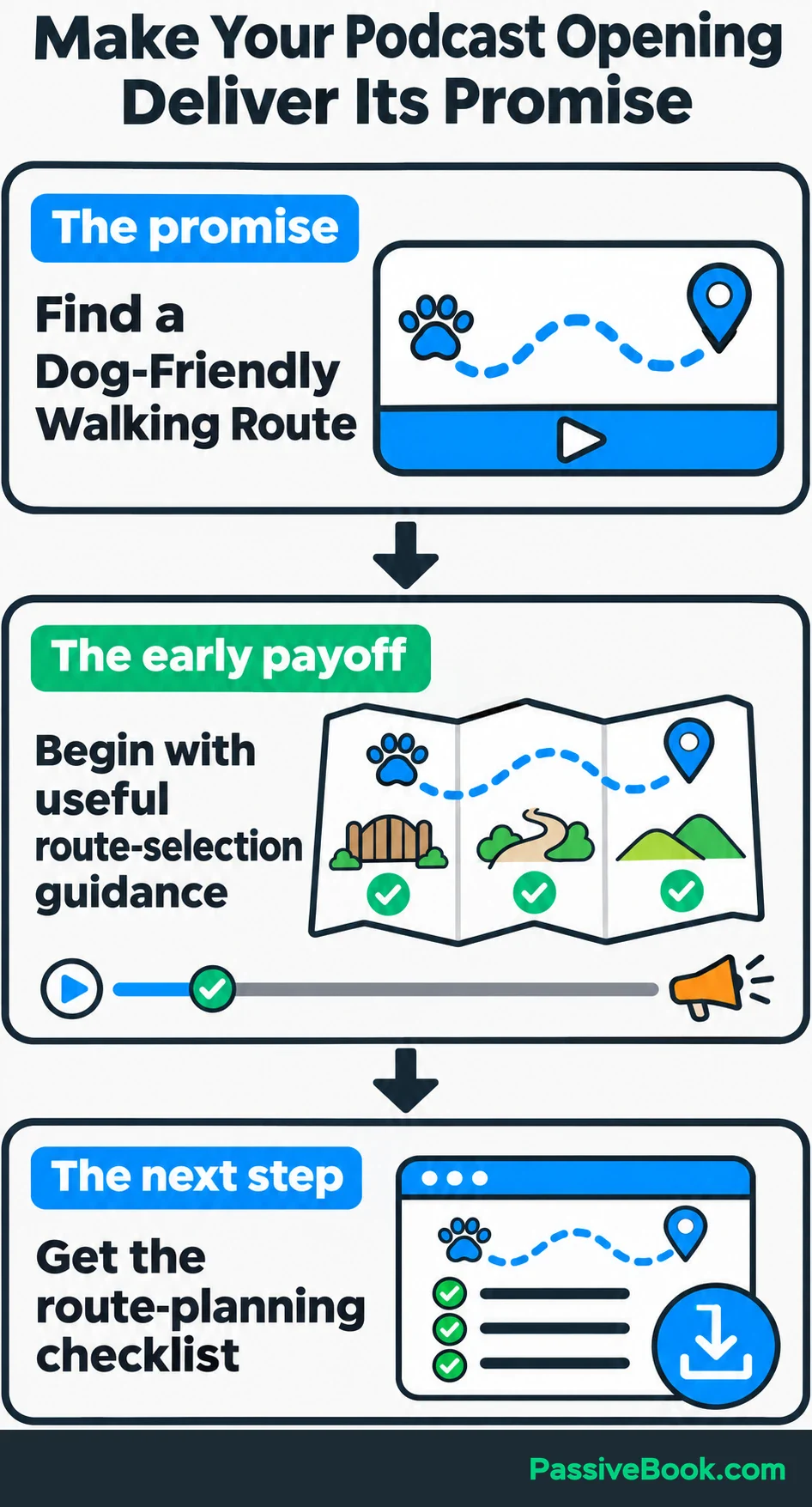
A related episode link can still appear on the page. You don’t need to read every possible action aloud.
Reviews can provide feedback and help prospective listeners assess a show. But Apple states that ratings and reviews don’t influence its Charts or Search, so I wouldn’t make a review request the centerpiece of a discovery strategy. Apple explains the role of ratings and reviews.
Build an Email Connection
Offer something that extends the episode’s value. The free route-planning checklist should help listeners do the task they came to learn.
Place its signup invitation on the episode page and link to it from the description. Explain what subscribers will receive and whether they’re also joining your newsletter.
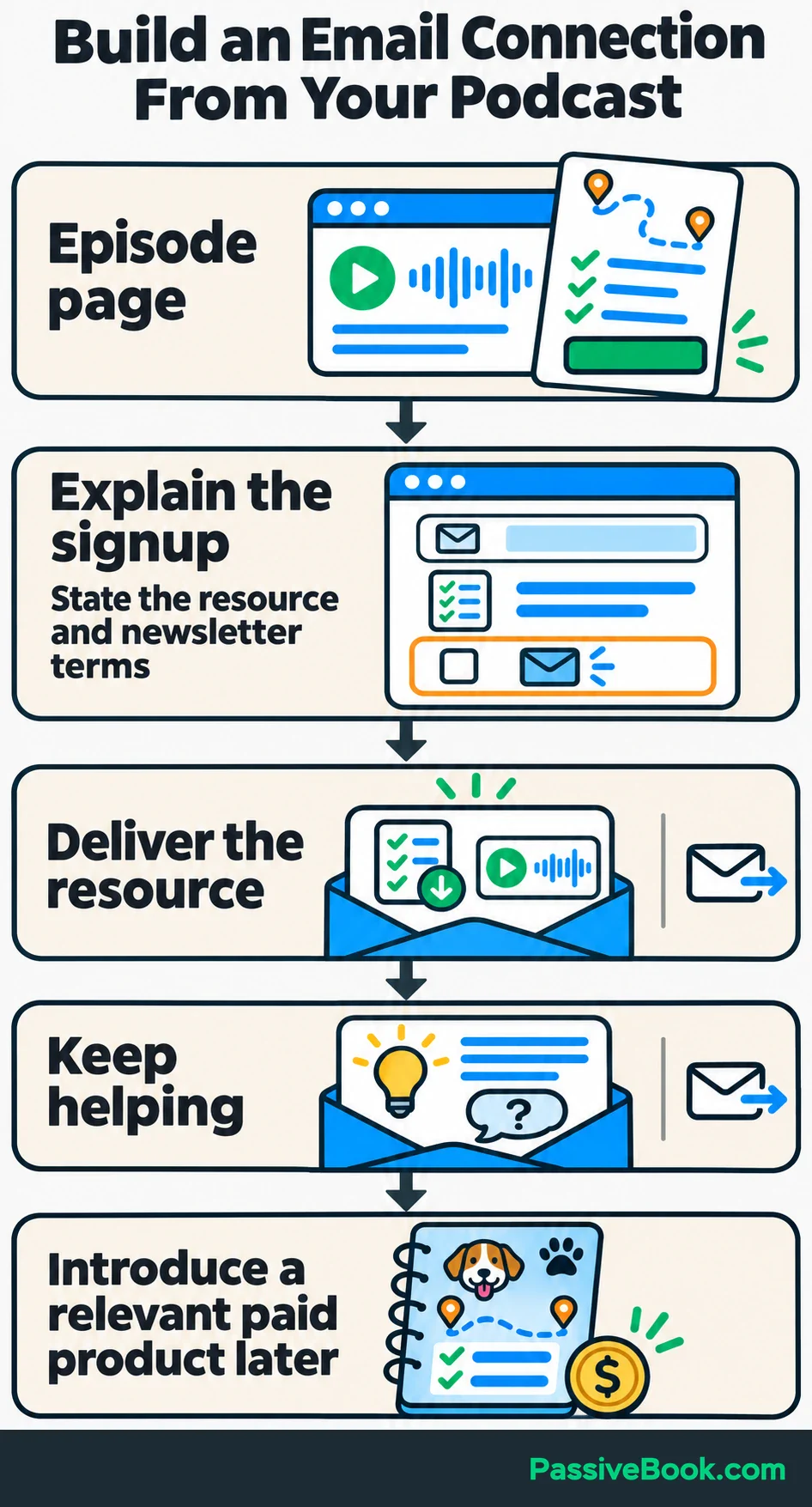
The welcome email should deliver the resource and recommend a useful next episode. Later, introduce the paid dog-walk journal as a way to record routes and decide which ones to revisit.
Use your existing email service if it handles forms, welcome emails, and unsubscribe links. I wouldn’t move a working list just to promote a podcast.
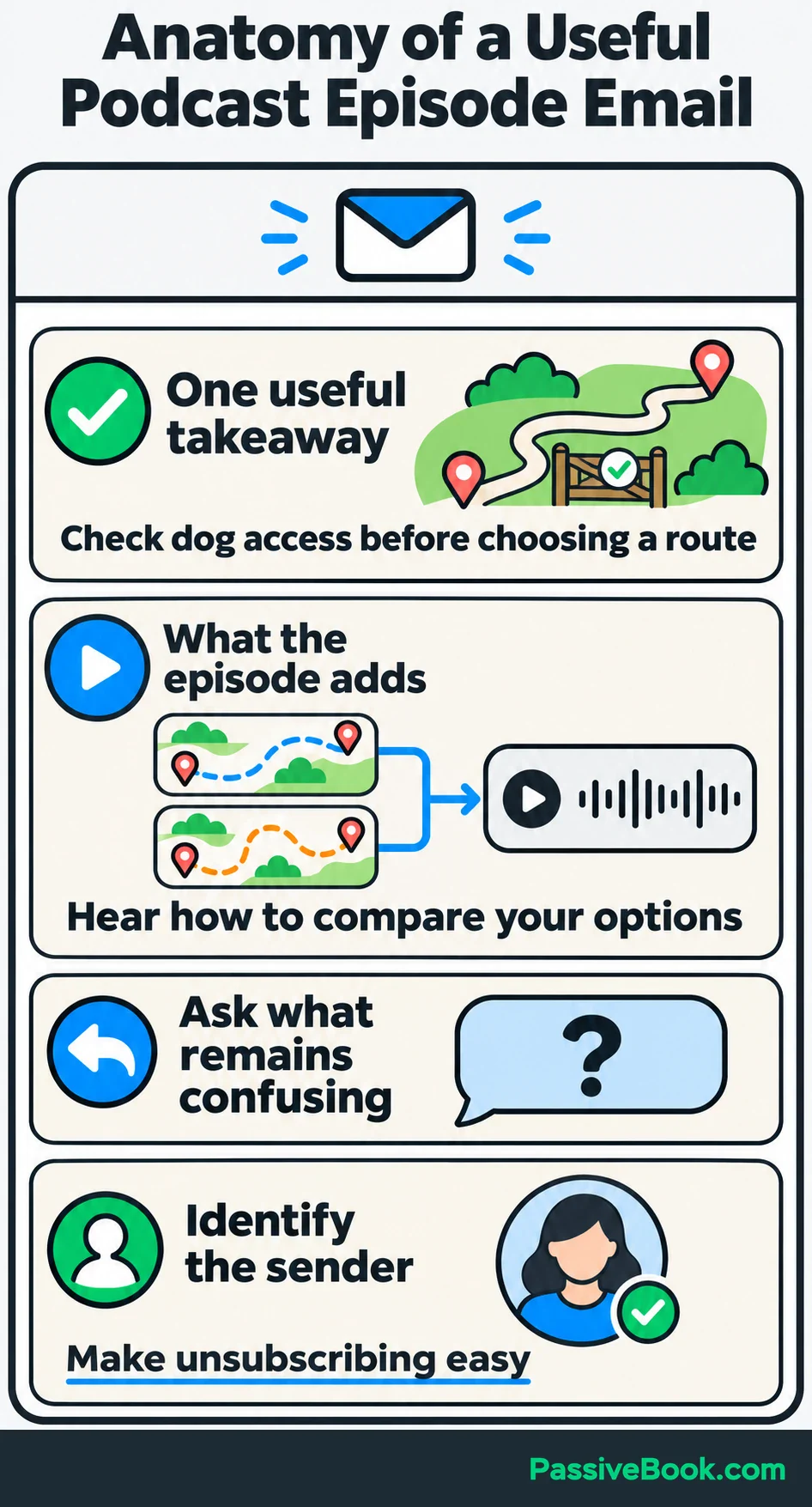
For future episode emails, share one useful takeaway and explain what the full discussion adds. Ask subscribers what remains confusing, and use their replies to choose topics.
Get explicit permission for newsletter emails, identify yourself clearly, and make unsubscribing easy.
7. Repeat a Manageable Promotion Routine
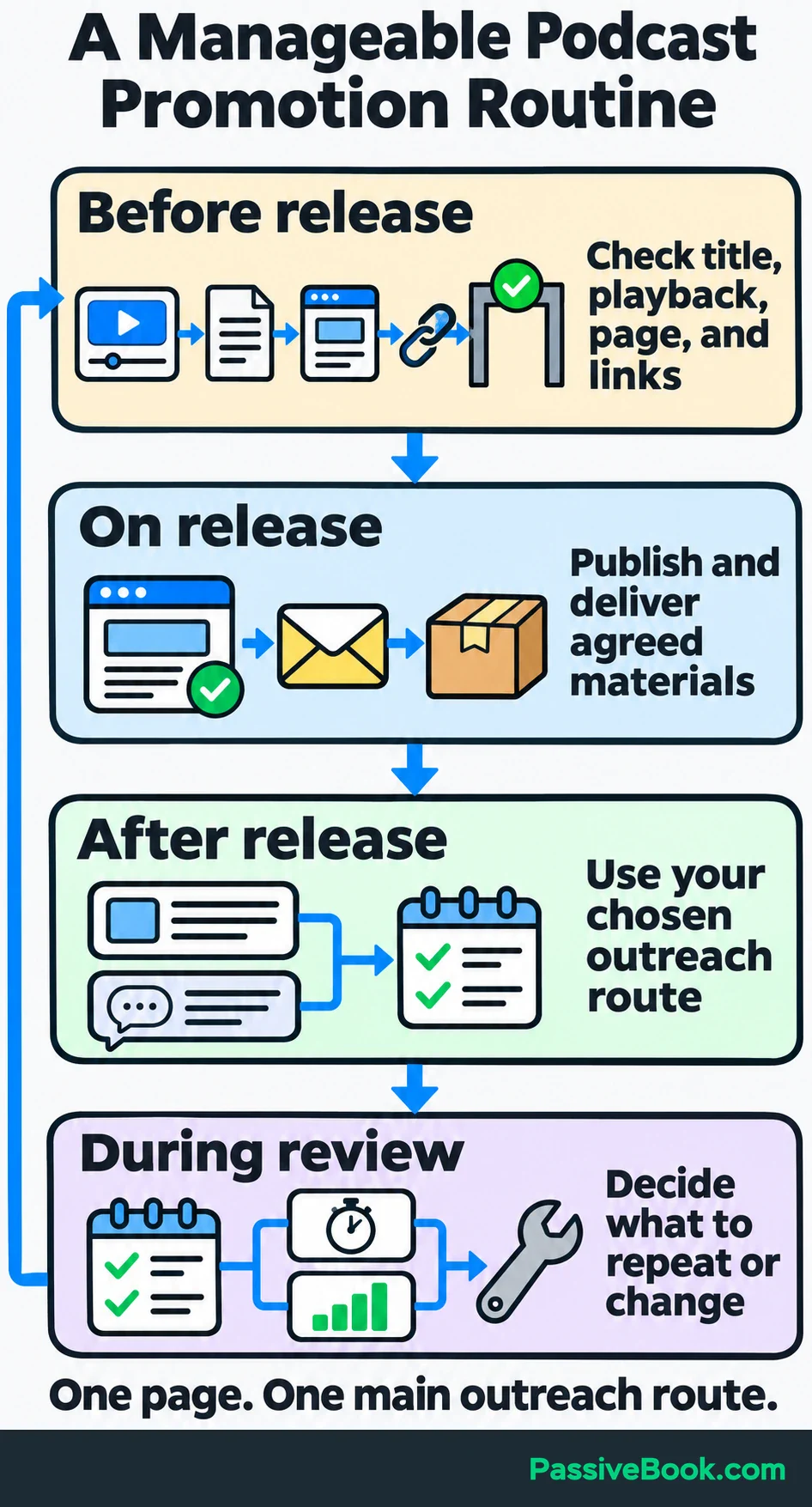
Build a release checklist you can finish alongside production. I would start with one listening page, one email if you have subscribers, and material for one main outreach route.
| Stage | What to Finish |
|---|---|
| Before Release | Check the title, description, playback, episode page, and next-step links. |
| On Release | Publish the page, notify relevant subscribers, and deliver any agreed partner materials. |
| After Release | Publish your useful takeaway or contribute to a relevant discussion. Record what you did. |
| During Review | Check results and decide what to repeat or change. |
Batch related work while the episode is fresh. Pull the excerpt, draft the email, and prepare partner copy in the same session.
If drafting from scratch slows you down, AI Podcast Studio can turn a few episode notes into copy for your main outreach route. Start with the channel you already have time to maintain.

Free AI Podcast Studio




Save reusable page layouts, graphic formats, and pitch structures. Keep the specific answer and audience connection fresh each time.
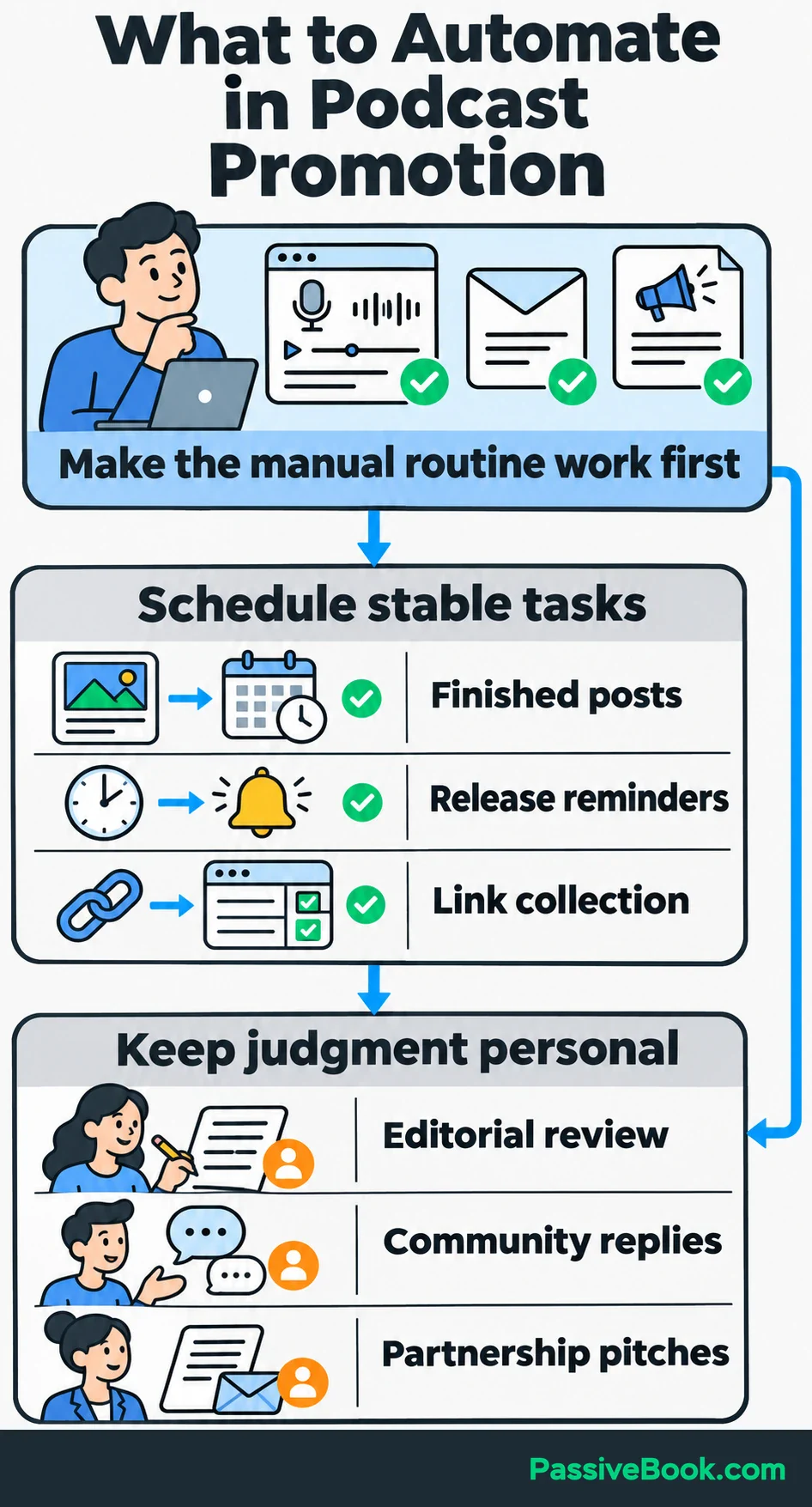
Once the process works manually, schedule finished material and automate stable tasks such as creating a release reminder or collecting links in your planning sheet. Keep editorial review, community replies, and partnership pitches under your control.
Older episodes belong in the routine too. Reshare one when a new question or related release makes it useful, and update stale information first.
Add another channel when you can maintain the current one and it repeatedly brings relevant results. I would improve a working routine before volunteering for a second unpaid job.
8. Measure Results and Refine Your Promotion
Compare episodes at the same age after publication. Their first seven days can be a useful starting window, provided you use it consistently.
Review several releases before redirecting your effort. A partner mention may arrive late, and a searchable page may need a longer observation window. Record those differences.
Keep a promotion log with:
- Activity: Episode, promotional source, and promotion date.
- Effort: Time spent preparing and sharing.
- Website Results: Tagged visits and listening-button clicks.
- Business Results: Confirmed email signups and traceable inquiries or purchases.
Alongside that log, review your podcast host’s listening totals and, where available, how long people keep listening.
Track visits from each promotion with Google Analytics, a website traffic tool. Add consistent UTM tags—labels for the source and campaign—to the episode-page links you share. For the newsletter contribution, use utm_source=walking_newsletter, utm_medium=email, and utm_campaign=walking_route. Google explains how these tags identify referral traffic.
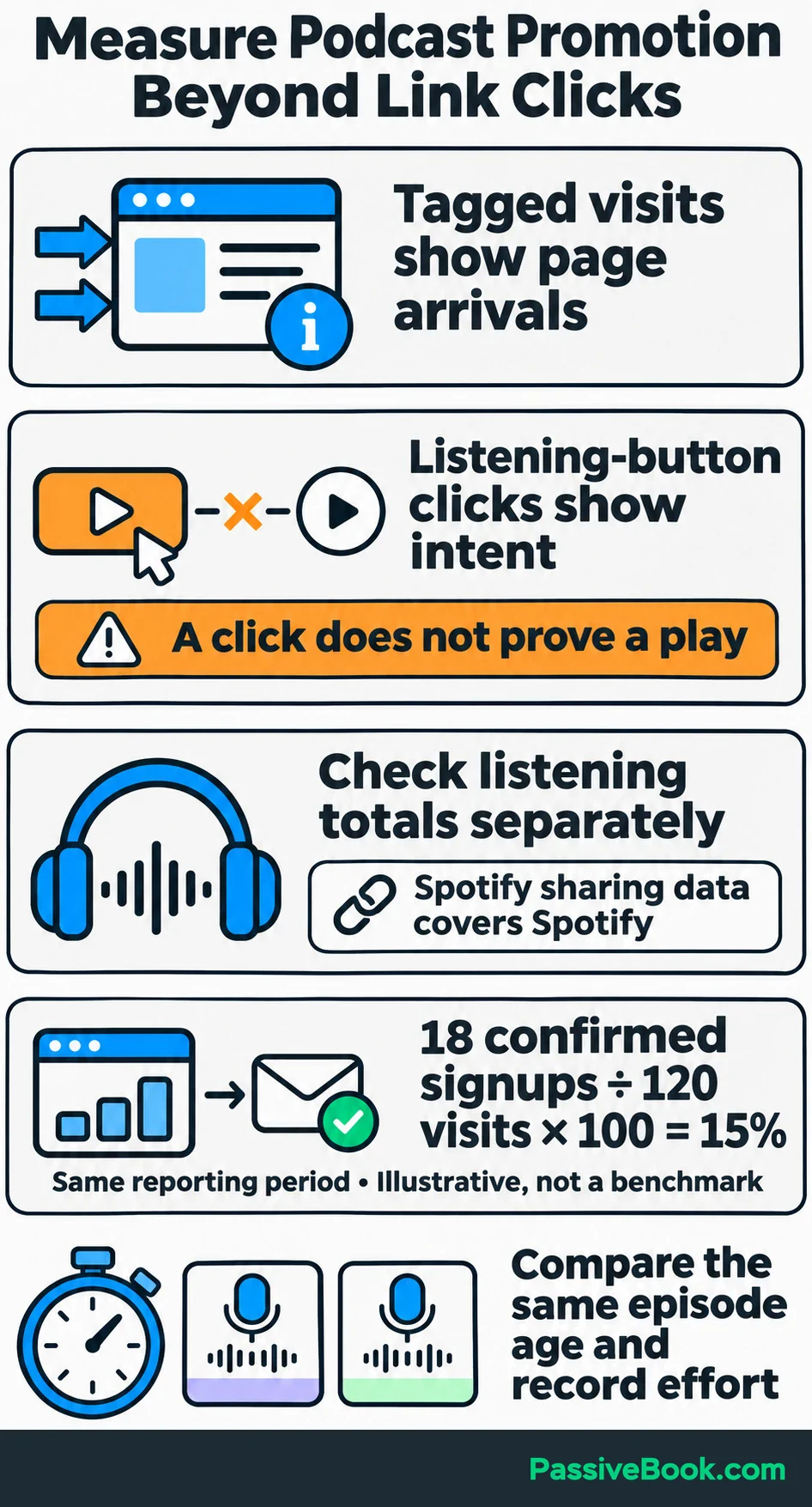
Keep visits, button clicks, and listening separate. A click on “Listen on Spotify” shows intent; it doesn’t establish that someone played the episode.
Spotify’s sharing analytics can report clicks and Spotify plays associated with links created through Spotify for Creators. That view covers Spotify listening, rather than every listening service. Spotify describes its discovery and sharing analytics.
To measure the signup rate per visit, count visits to the episode page during your reporting period and confirmed new signups from those visits within that period.
If the page received 120 visits and generated 18 confirmed signups:
18 ÷ 120 × 100 = 15%
That’s an illustrative result, not a benchmark you must match.
Use the weak stage to choose your next change:
| What You Observe | What I Would Investigate |
|---|---|
| Relevant people rarely click | Whether the invitation names a problem they care about. |
| Visitors struggle to start listening | Whether the player and listening links are easy to find on a phone. |
| Listening drops sharply near the beginning | Whether the opening delays the promised answer. |
| Listeners arrive but few request the resource | Whether the resource helps them take the next step. |
| Promotion takes substantial time with little repeated response | Whether the channel fits the audience and the effort is sustainable. |
Change one major element at a time and record the result. Keep the activities that repeatedly produce engaged listening, subscribers, or business results for the time involved.
What Next?
Choose one episode today and write a two-sentence invitation that names its question and payoff. Test its listening page, then pick one place where that answer belongs.
Use the social buttons to share this guide when a practical promotion routine would help a podcast discussion move beyond “post more.”
Which part of your promotion currently feels hardest to repeat? Tell me in the comments, and bring any other questions about putting the routine into practice.
Share this post with your friends & followers:

