You have an episode idea, but your notes keep growing. One question leads to three others, and now you’re unsure where the recording should start—or end.
That uncertainty can follow you into the recording. You repeat an explanation, chase a side topic, and leave yourself more editing work than you planned. The worked dog-care example below shows how to turn that growing pile of notes into a recording plan with checked sources and speaking notes. A reusable template helps you repeat the process without buying another tool.
1. Choose One Question Your Episode Will Answer
Start with a question your listener wants answered. “Dog care” gives you a subject, but it doesn’t tell you what belongs in the episode.
Look for questions in customer emails, listener messages, community discussions, and your own topic list. Choose one that fits your show and can receive a useful answer in a single recording.
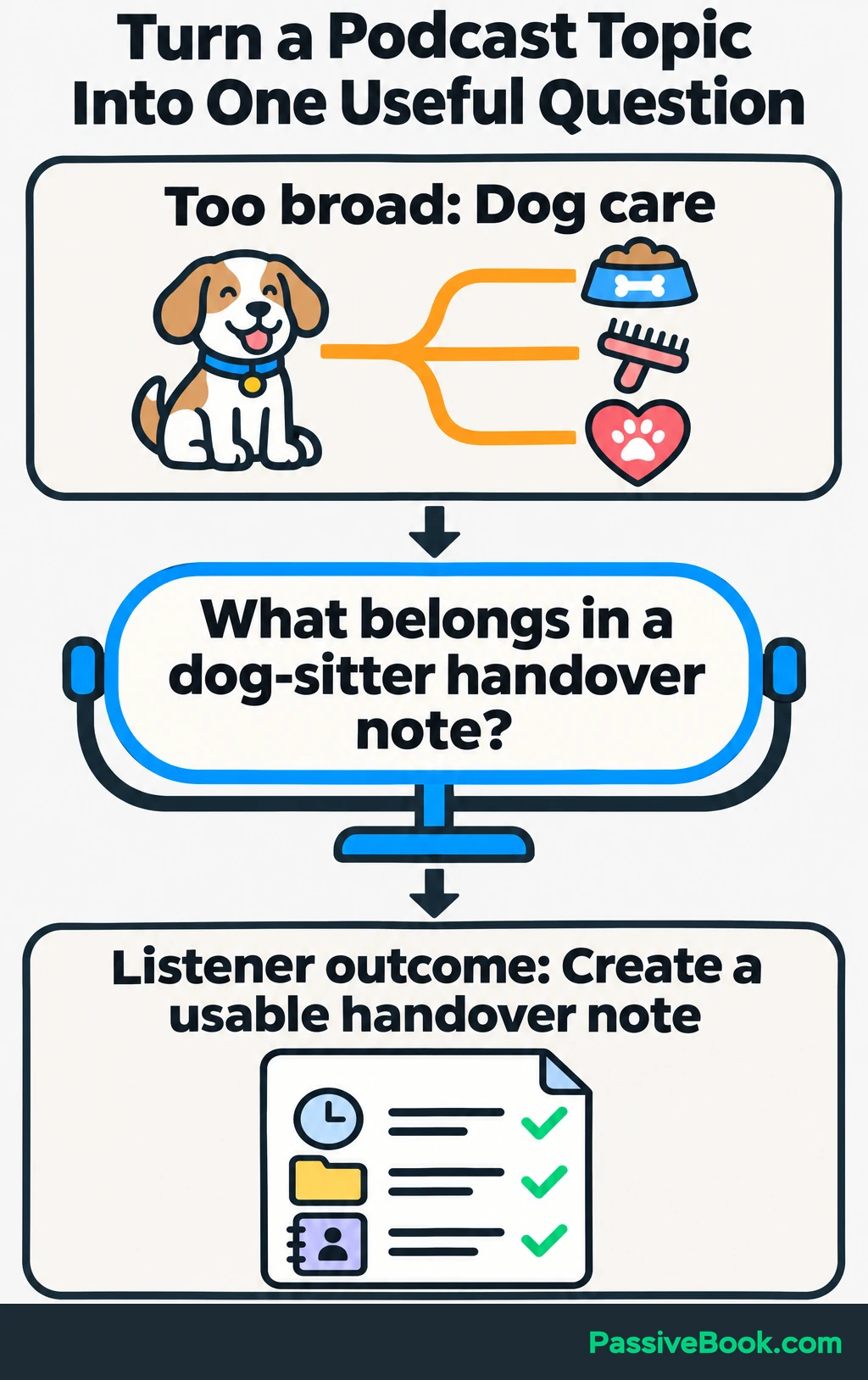
Then write this sentence:
By the end of this episode, listeners will be able to ___.
Make the outcome something listeners can do, explain, or decide. “Understand more about dogs” is too loose to guide your choices.
Throughout this guide, imagine you run an online shop selling printable dog-sitter handover organizers. You’re planning a solo episode called “What to Include in Your Dog-Sitter Handover Note.” The scripts, household details, and timings below are illustrative.
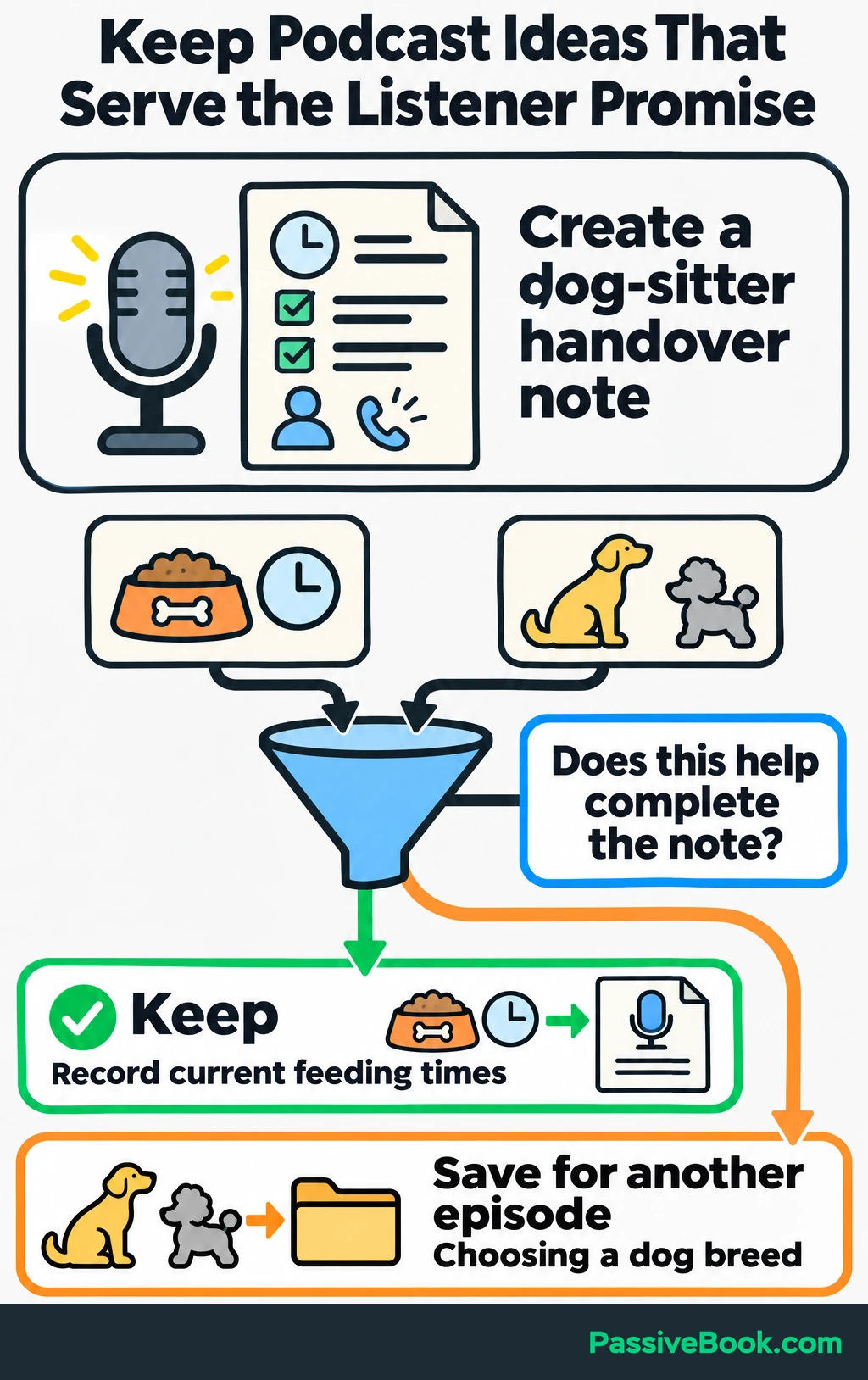
Your listener has arranged a sitter but hasn’t gathered the information they need. The episode promise becomes:
By the end of this episode, listeners will be able to create a dog-sitter handover note with daily routines, existing care instructions, and important contacts.
Use that promise to sort your ideas. A section about recording feeding times belongs. A debate about choosing a dog breed goes into your future-episode list.
Give the episode one supporting business purpose, too. Here, I would use it to answer a recurring customer question. Your printable can help listeners complete the task, but the explanation should work with a blank page.
2. Choose the Format and Set the Scope
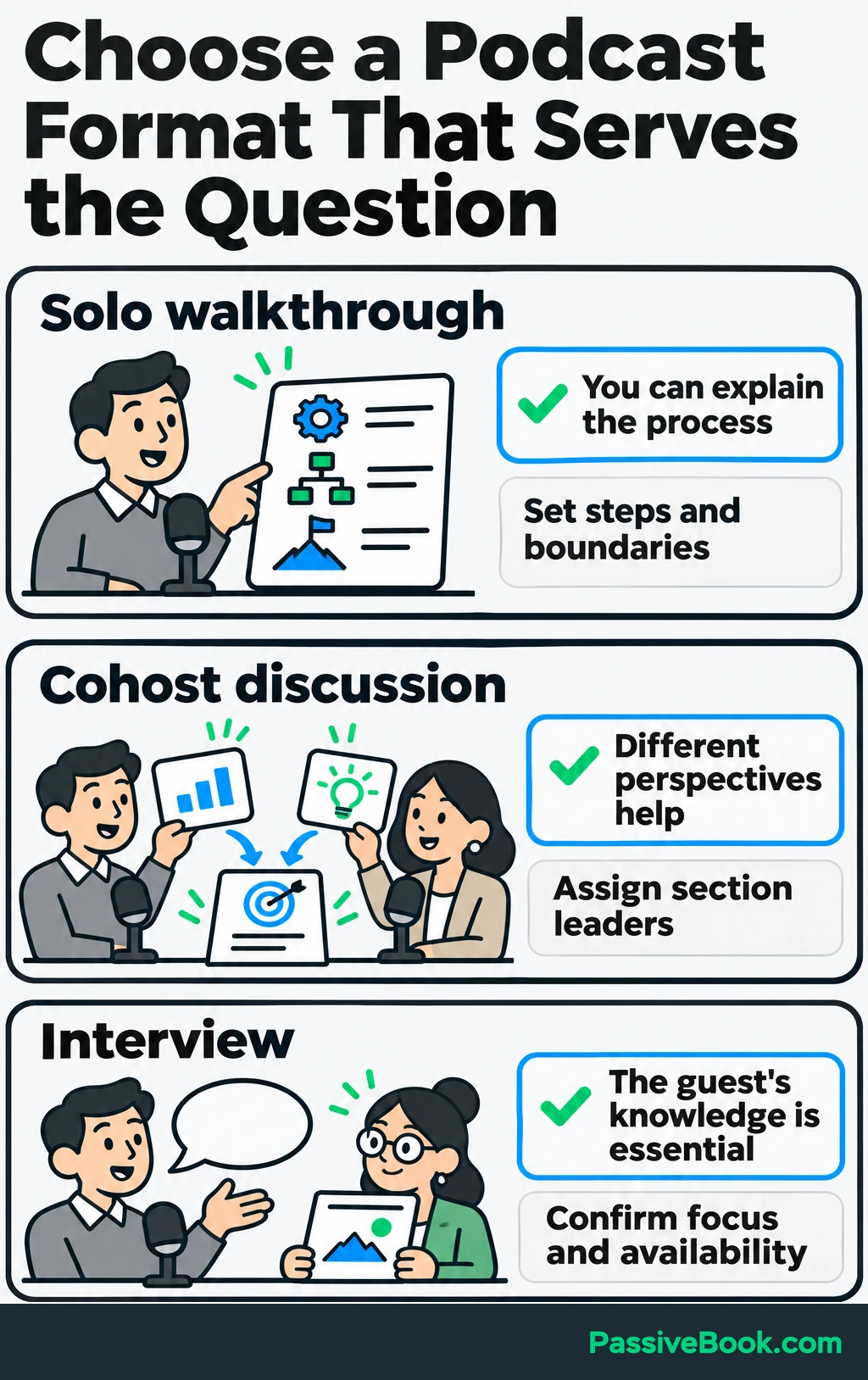
Choose the format that helps you answer the question.
| Format | When I Would Choose It | What to Settle Before Drafting |
|---|---|---|
| Solo walkthrough | You can explain the process yourself | The steps, examples, and boundaries |
| Cohost discussion | Different perspectives help listeners make a decision | Who leads each section and how you’ll reach a useful takeaway |
| Interview | Another person’s knowledge or experience is essential | The guest, focus, recording window, and questions |
I would choose a solo walkthrough for the handover-note episode. The listener needs an orderly explanation, and adding another voice would create coordination work without an obvious benefit.
Next, write down the boundaries:
Cover how to organize information for a sitter. Leave out training advice, new care recommendations, and choosing a sitter.
Those limits help you research and draft. You’re organizing instructions the owner already follows, rather than deciding what care their dog needs.
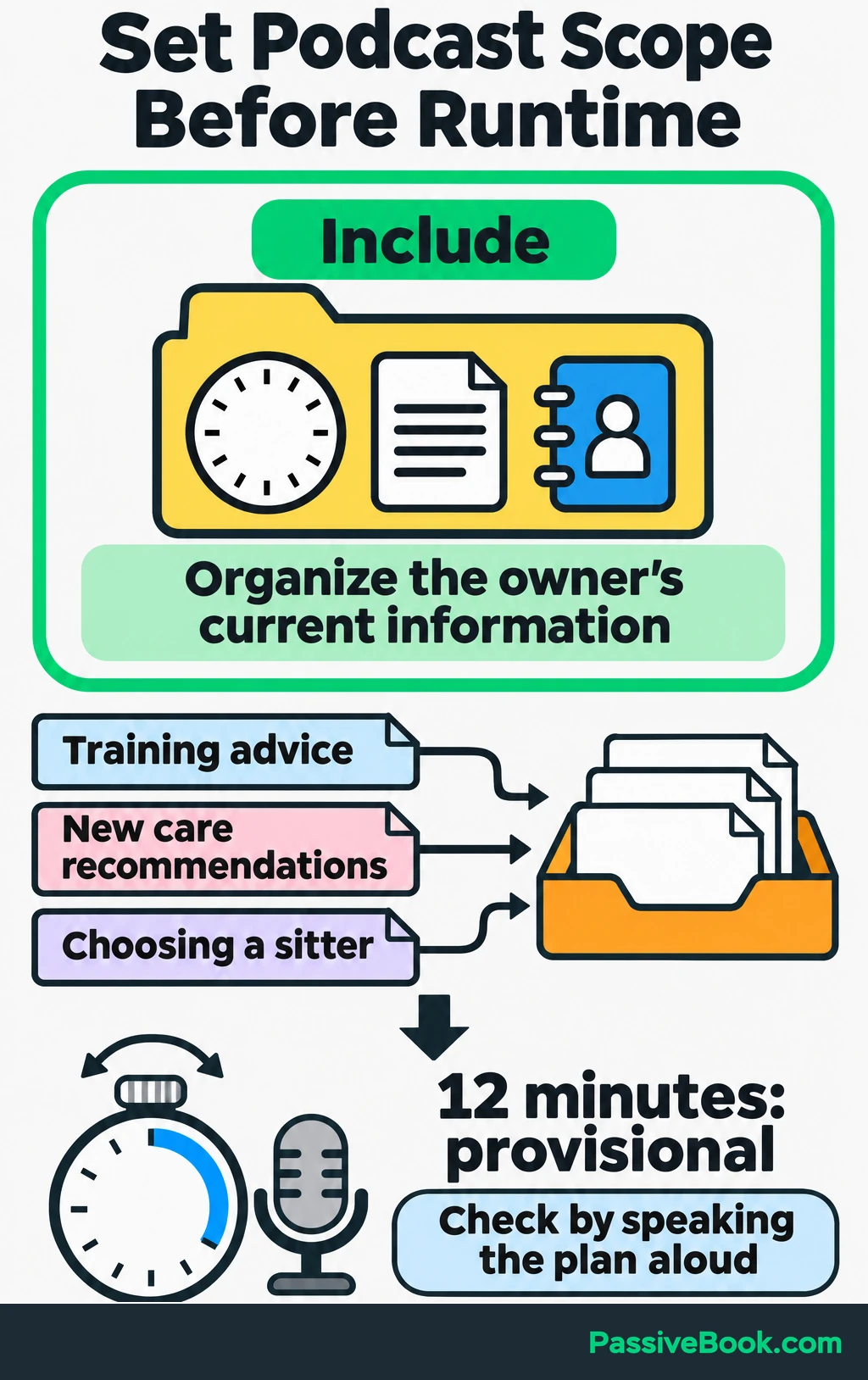
Set a provisional runtime after choosing the scope. We’ll use 12 minutes for the example, then check it during rehearsal. If the useful explanation takes less time, let it end.
For an interview or cohosted episode, confirm the participant’s role and availability before building the episode around their contribution.
3. Build a Segment Outline That Keeps the Episode Focused
Arrange the answer in the order listeners need it:
- Explain what the episode will help them do.
- Give any context they need before starting.
- Walk through the main steps.
- Show how the steps fit together.
- Recap and give one next action.
Each main segment should have one job. Write its takeaway before adding talking points. If two segments deliver the same takeaway, combine them or give them clearer boundaries.
Put this into a rundown: a segment-by-segment recording plan. USC’s podcast planning guidance recommends a worksheet that places segments beside their time allocations and key notes.
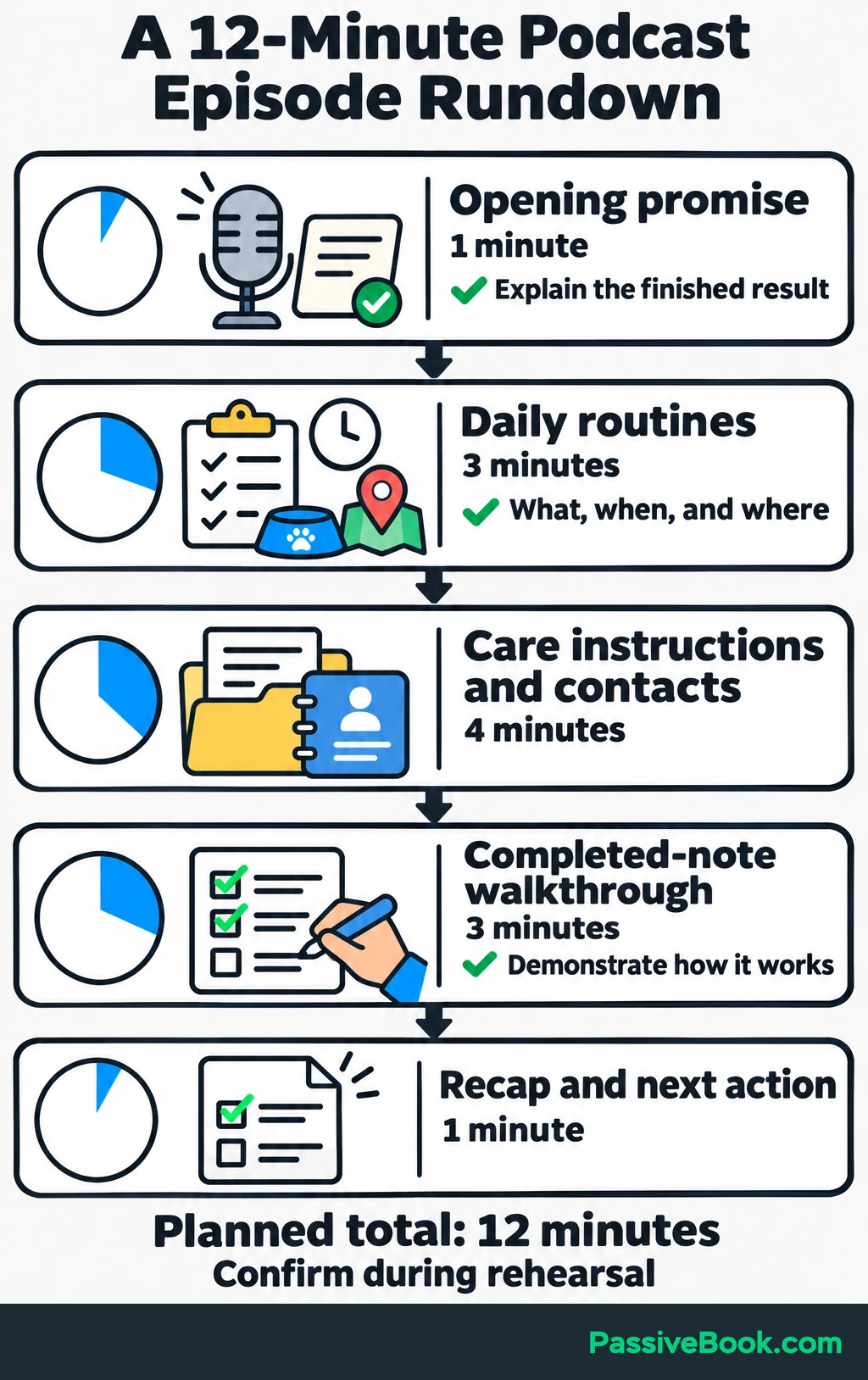
Here is the example rundown. The planned durations add up to 12 minutes.
| Segment | Planned Duration | Listener Takeaway | Talking Points | Supporting Material | Speaker |
|---|---|---|---|---|---|
| Opening promise | 1 minute | Know what the finished note will contain | Introduce the task and its limits | Opening script below: routines, existing care instructions, and contacts | Host |
| Daily routines | 3 minutes | Record what happens, when, and where supplies are | Feeding, walks, supply locations; optional second routine example | ASPCA’s “Daily Routine” section; evening-walk entry below | Host |
| Existing care instructions and contacts | 4 minutes | Gather current instructions and people to contact | Care information first, then contacts and emergency arrangements | ASPCA’s “Pet Information,” “Medication,” “Veterinary Information,” and “Plan Ahead” sections | Host |
| Completed-note walkthrough | 3 minutes | See how the sections form one usable note | Read one short entry from each section and check for gaps | Sample note still to draft before rehearsal | Host |
| Recap and next action | 1 minute | Know what to do after listening | Name the sections and invite listeners to draft their note | Closing script below: draft the note and review it with the sitter | Host |
Keep essential points separate from optional material. In this example, explaining the routine fields is essential. A second example of where someone stores a lead is optional.
That distinction gives you something sensible to cut later. Otherwise, trimming can become a contest between whichever sentences you happen to like least.
4. Research Only What the Episode Needs
Fill the Gaps in Each Segment
Read your rundown and turn each gap into a specific question.
For the handover episode, you might need to answer:
- Which routine details should the owner record?
- What existing care information belongs in the note?
- Which contacts and emergency arrangements should be included?
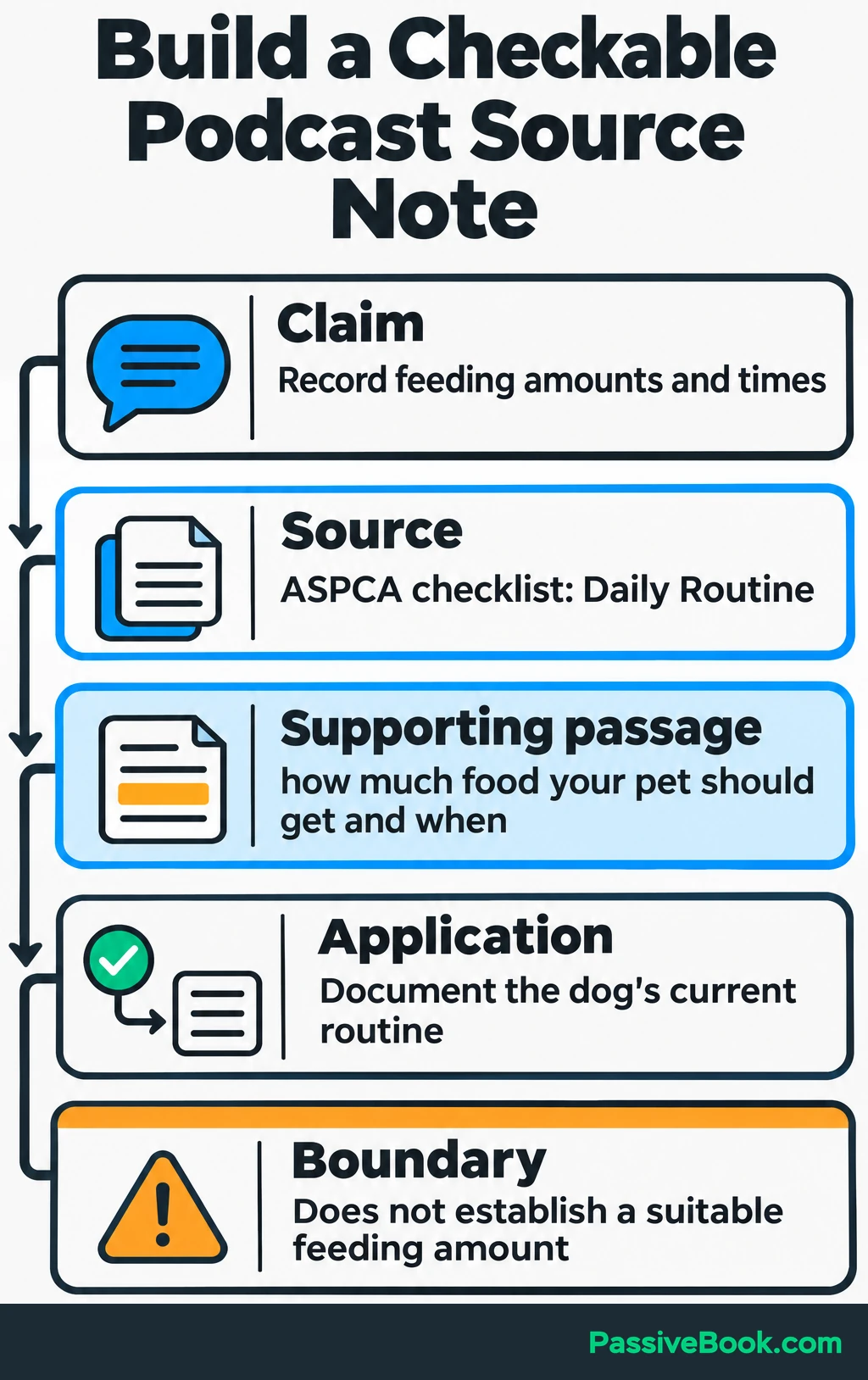
Search for those answers before collecting broader reading. A folder full of articles can feel productive while leaving your actual questions untouched.
Keep a source note beside each factual claim. Record the claim, link, supporting passage or timestamp, and any condition that changes its meaning.
For example, the ASPCA’s pet-sitter checklist recommends sharing daily routines, current pet information, veterinary and emergency contacts, and an emergency plan. That supports the main sections of our example.
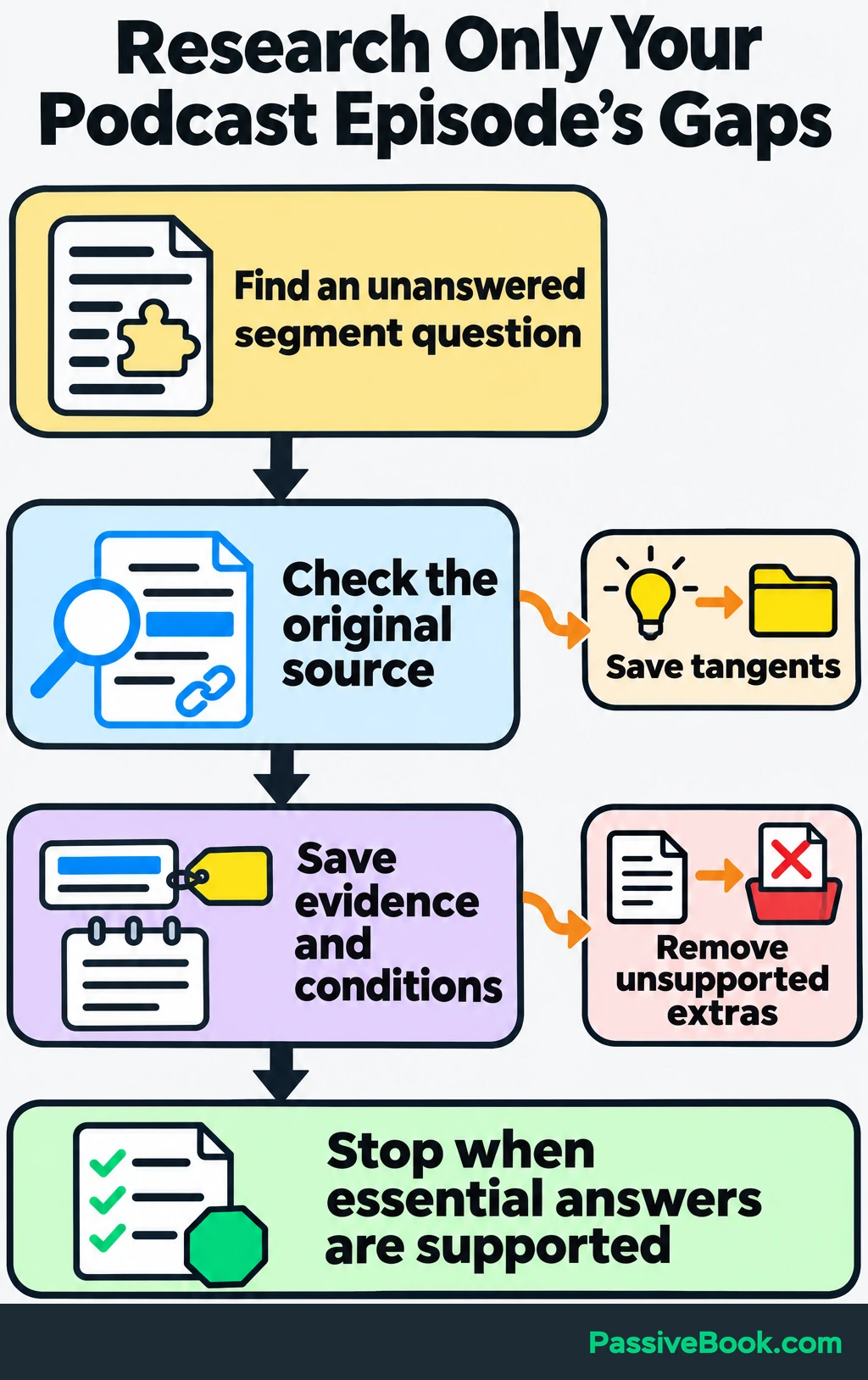
A useful source note could look like this:
- Claim: Include feeding amounts and times in the routine section.
- Source: ASPCA checklist linked above, “Daily Routine” section.
- Supporting Passage: “how much food your pet should get and when”
- Application: Prompt listeners to record their dog’s current routine.
- Boundary: This supports documenting an existing routine; it doesn’t establish a suitable feeding amount.
Prefer original guidance and relevant expertise. Open the source and check the exact claim, including anything you found in another podcast or an AI-generated summary.
Stop when the essential questions have supported answers. Remove a claim you cannot verify if the episode works without it, and save interesting tangents for another topic.
Prepare Questions for Interview Episodes
For an interview, research what the guest knows that your listener needs. Review their relevant work and arrange questions from necessary context to practical explanation.
If you adapted the handover episode into an interview with an experienced sitter, your essential questions might be:
- What information do you need before the owner leaves?
- What makes a written routine hard to follow?
- Could you show how you would rewrite one unclear entry?
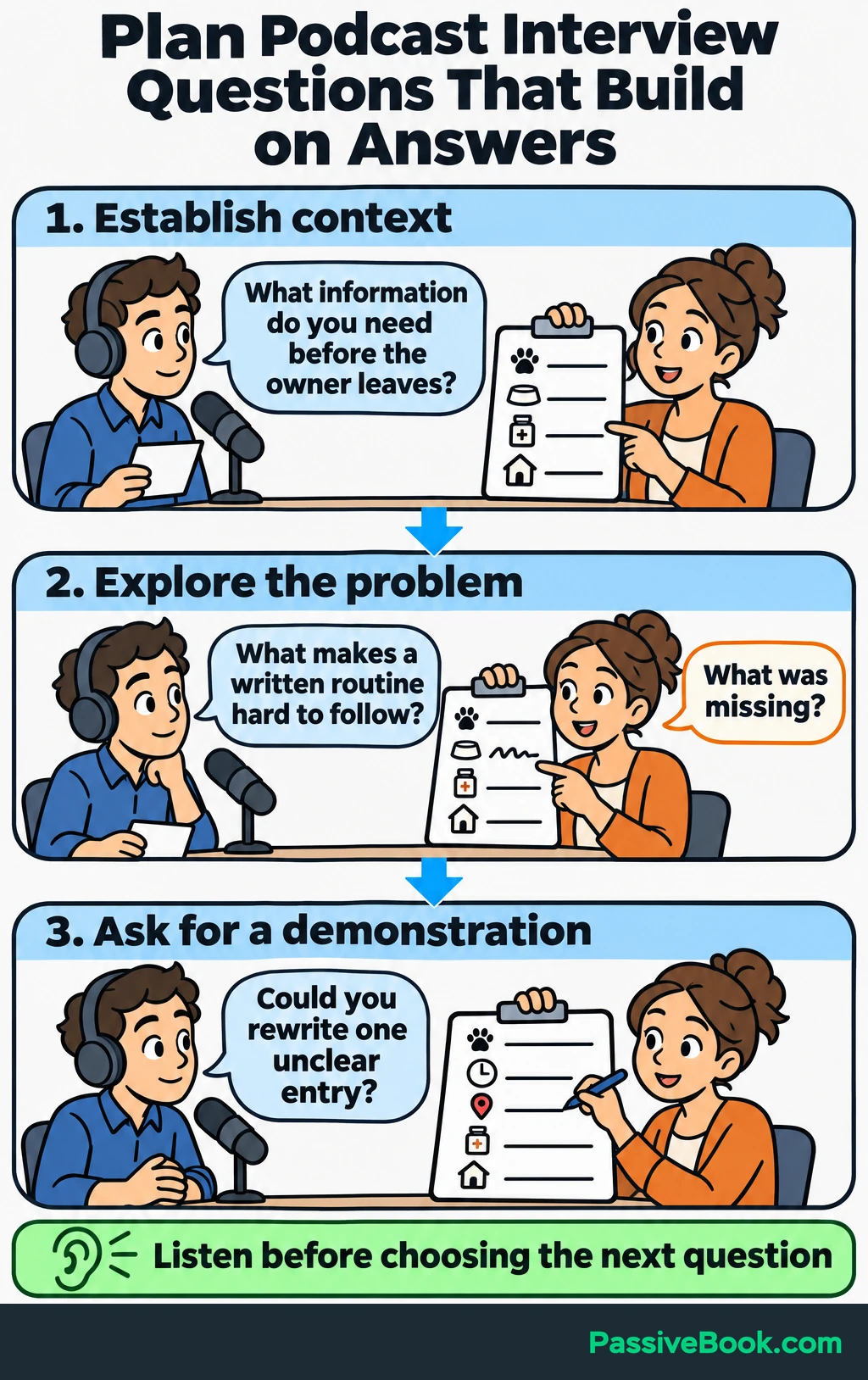
Keep optional follow-ups nearby, such as “What was missing?” or “What would that look like on the page?”
Ask one question at a time and build on the answer. BBC Academy’s interviewing guidance advises listening to the guest rather than pushing through a prepared list regardless of what they say.
Before recording, share the focus, main themes, expected duration, and practical arrangements. Confirm the guest’s name pronunciation and any credentials you plan to mention.
5. Turn the Outline Into a Usable Script
Choose How Much to Script
Choose the amount of scripting that helps you explain the material clearly.
| Approach | When I Would Use It | What to Prepare |
|---|---|---|
| Full script | Wording needs close control, or you lose your place without complete sentences | Every spoken line, including transitions |
| Bullet notes | You know the subject and can explain it without wandering | Main point, supporting detail, example, and stopping point |
| Hybrid script | You want a clear structure with room to speak naturally | Written opening, transitions, and closing, with prompts for the main sections |
I would start with a hybrid script for the solo walkthrough. It gives you definite places to begin, move on, and finish.
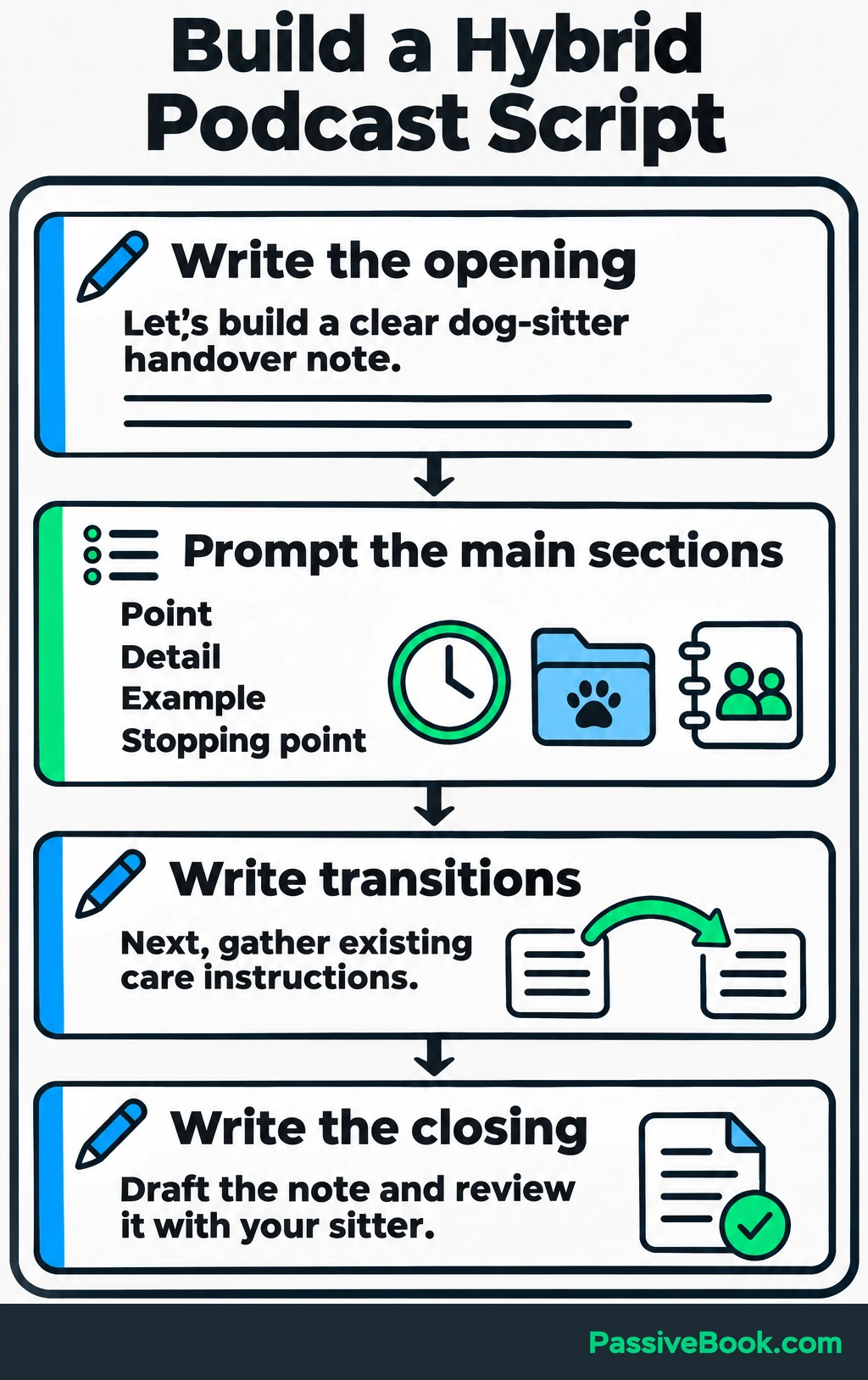
For interviews, prepare questions and follow-ups while leaving answers open. The CDC Audio Script Writing Guide recommends scripting the introduction and closing and outlining interview questions.
Make the recording document easy to scan. Use short paragraphs, clear speaker labels, and pronunciation notes where needed. Put source links beside the relevant prompts so you can find them without searching through another file.
Also describe anything listeners need to understand. “Fill in the box on the right” means little to someone walking to work without your worksheet.
Write the Opening, Main Segments, and Closing
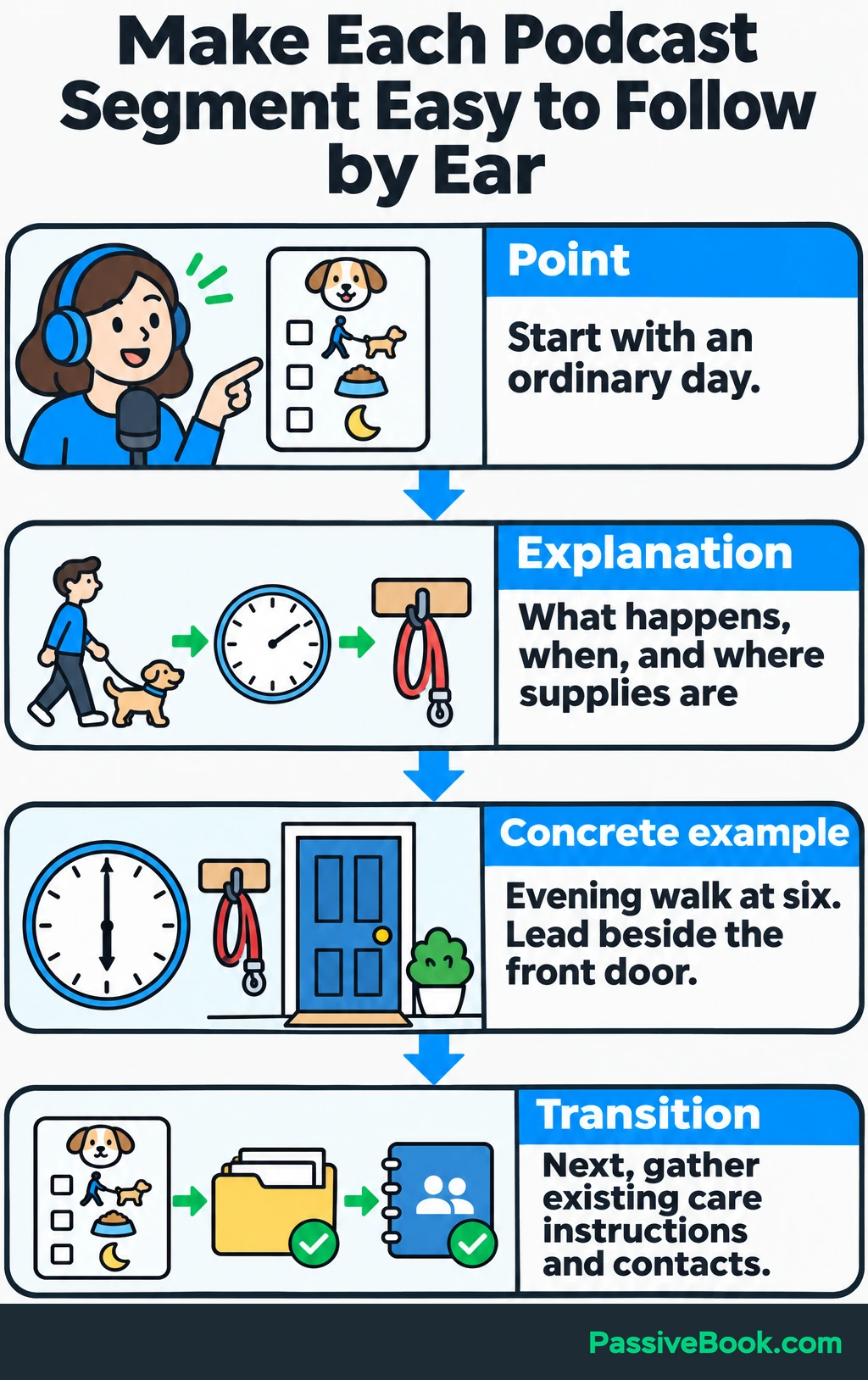
Build each main section around a point, a short explanation, and an example or action. Write transitions that explain why the next section follows.
Below is a complete hybrid script for the example episode. Read the quoted passages and develop the prompts in your own words. The rundown’s timings remain provisional until you speak through the whole plan.
- Opening:
“Leaving your dog with a sitter? Let’s put their routine, existing care instructions, and important contacts into one clear handover note.
“You can use a blank page or an organizer you already have. We’ll work through the sections, then check how they fit together. This episode covers writing down your dog’s current arrangements.” - Daily Routines:
“Start with an ordinary day. Write down what happens, when it happens, and where the sitter can find the supplies.”
Explain these prompts in order:
Read this illustrative entry:
“Evening walk at six. Lead beside the front door.”
Explain how the entry connects an activity, a time, and a location. If you need another example during rehearsal, use one briefly.- Record the current feeding amounts and times.
- Add normal walk times.
- Include supply locations beside the activity that needs them.
- Transition:
“That covers the usual day. Next, gather any existing care instructions, followed by the contacts and arrangements your sitter needs if something unexpected happens.” - Existing Care Instructions and Contacts:
Explain how to collect current care instructions and keep them with the note. Where medication instructions apply, use the dog’s existing veterinary instructions accurately.
Then walk through the contact fields: owner, backup contact, regular vet, and emergency clinic. Explain where to record the agreed emergency arrangements.
“Replace vague reminders with information the sitter can use. ‘Vet details in my phone’ leaves the sitter searching. Put the clinic’s name and contact details in the note.” - Completed-Note Walkthrough:
Before rehearsal, prepare a sample note with a routine entry, the location of any current care instructions, and completed contact fields.
“Now read the note as though you’ve just arrived to look after the dog.”
Read one short routine entry, identify where the current care instructions are kept, and locate the contact section. Ask these questions from the sitter’s viewpoint:
Keep this walkthrough focused on using the note. You’ve already explained how to write each section.- Can I tell what happens next?
- Can I find the instructions and supplies?
- Are the contact details filled in and current?
- Closing:
“Your handover note now has a place for daily routines, existing care instructions, and important contacts.
“Draft those sections on a blank page, or use the printable linked in the episode notes. Then review the completed note with your sitter before you leave.
“Start with the daily routine and fill in what your sitter needs to follow it.”
The final sentence gives you a clear stopping point. I would keep that one action and skip a closing list of requests to subscribe, review, share, shop, and join three other things.
If you’re unsure how this example translates to your topic, AI Podcast Studio can draft your own version. Start with the notes you already have, then review the wording and check any flagged facts before rehearsal.

Free AI Podcast Studio




6. Rehearse and Trim Before Recording
Speak through the whole episode with a timer. Read the scripted passages and explain the bullet sections aloud.
Silent reading won’t tell you whether a prompt gives you enough direction. During rehearsal, you may find that a short bullet produces a long detour or that a polished sentence is awkward to say.
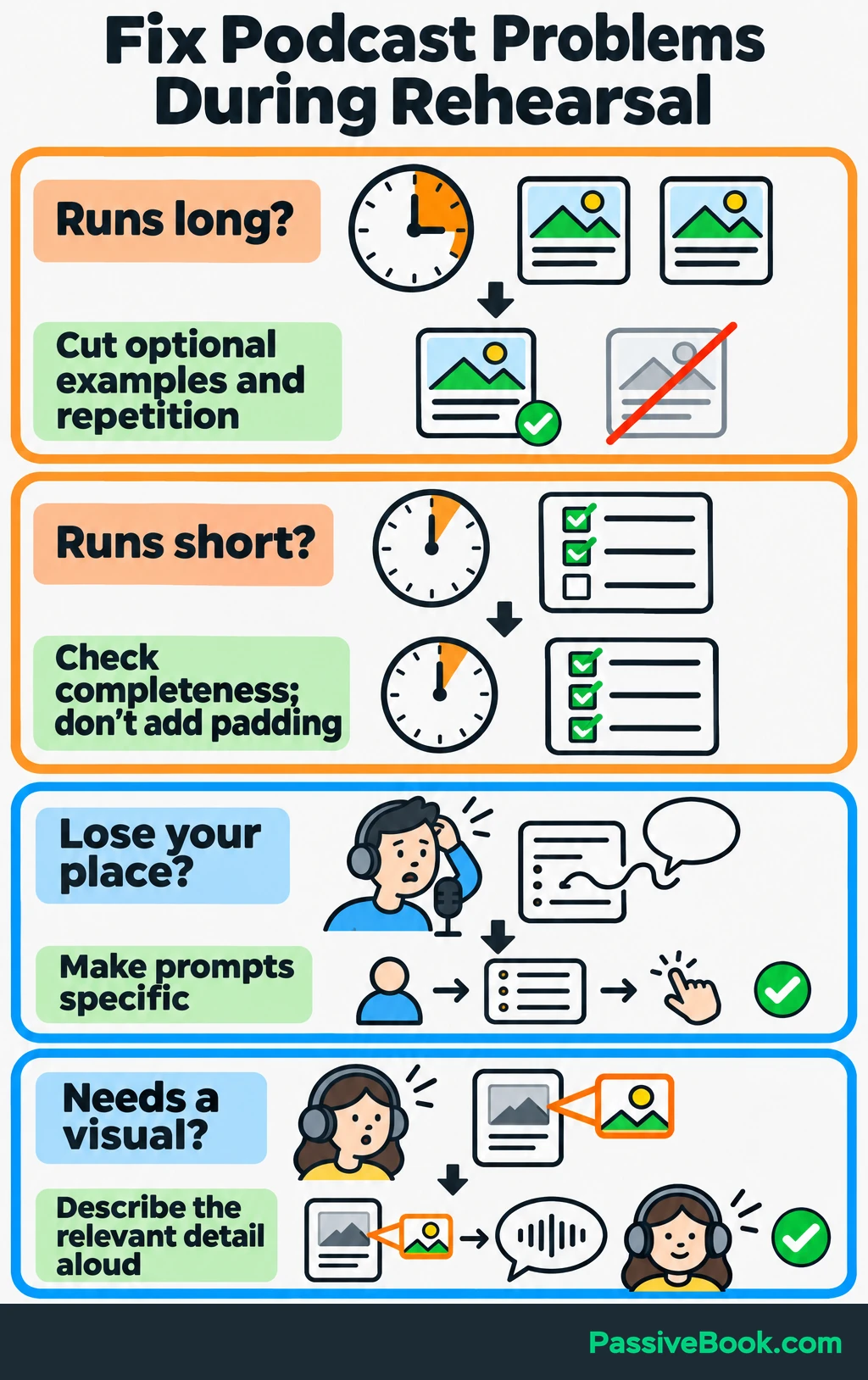
The CDC’s script guide recommends reading aloud to catch unclear wording and sentences that are difficult to deliver.
I’ve caught repeated explanations this way while preparing digital-product lessons. Both passages looked useful on the page, but saying them aloud made the overlap obvious. I cut one and kept the clearer example.
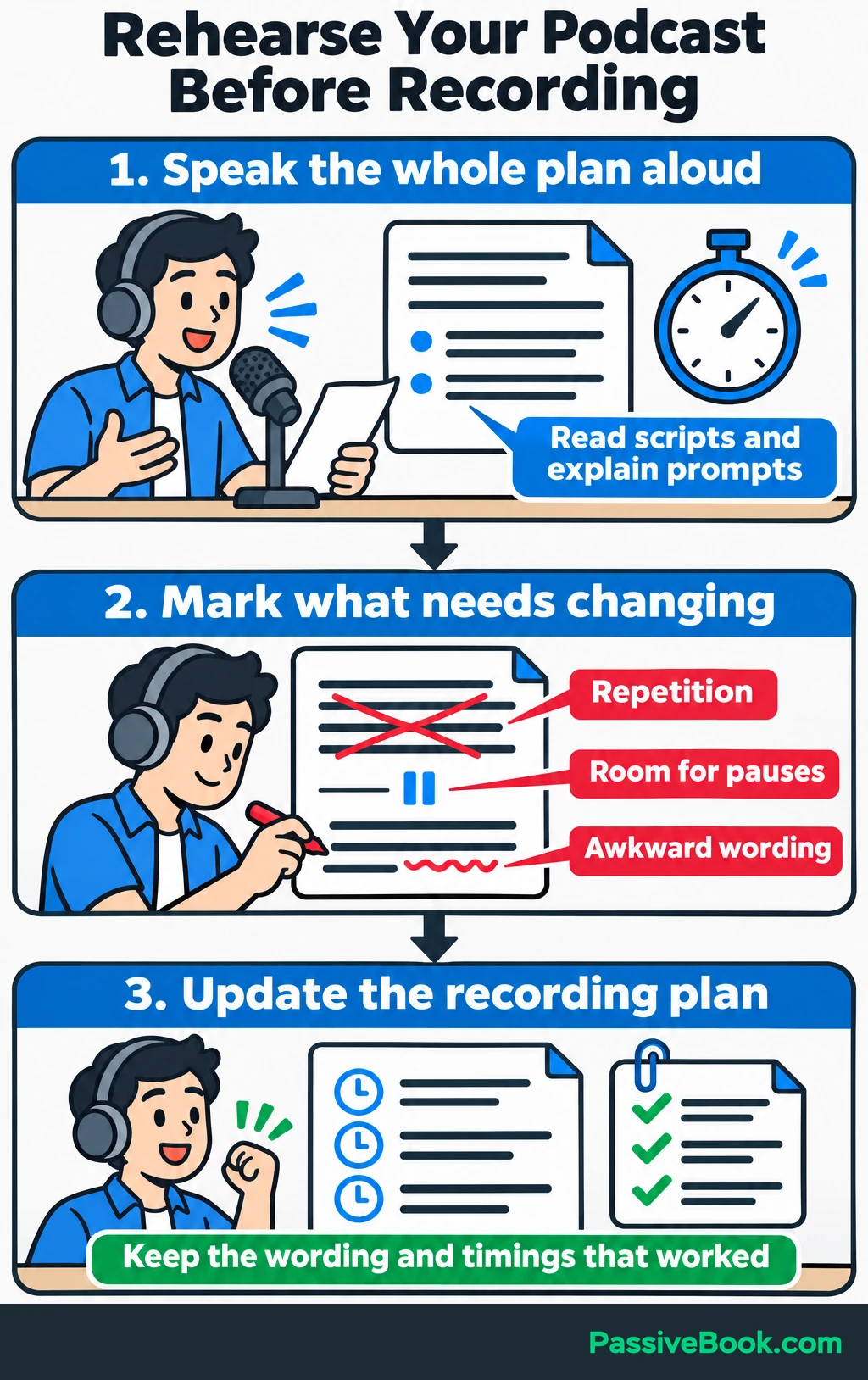
For your episode, compare the practice run with the rundown:
- If It Runs Long: Remove optional examples and repeated explanations first. Narrow the promise if the essential material still needs more room.
- If It Runs Short: Check that the promised answer is complete. Add a missing explanation, but don’t stretch a finished answer to meet the clock.
- If You Lose Your Place: Replace vague prompts such as “explain contacts” with specific instructions.
- If It Needs a Visual: Describe the relevant detail aloud so listeners can follow.
Leave room for pauses and, where relevant, conversation. Then update the plan with the wording and timings that worked.
Before recording, confirm that essential facts are checked, supporting materials are available, and any participants know their roles. Keep the finished notes readable at the distance you’ll use them.
7. Reuse an Episode Planning Template
Copy These Fields Into Your Planning Document
Keep a blank master and duplicate it for each episode. You can paste this template into your usual document tool or copy the fields into a notebook.
EPISODE BRIEF

Working title:
Intended listener:
What the listener already knows:
One question this episode answers:
By the end, listeners will be able to:
Supporting business or community purpose:
Format:
Included in this episode:
Outside this episode’s scope:
Provisional runtime:
Recording date:
Listener’s next action:

SEGMENT RUNDOWN
Repeat for each segment.

Segment name:
Planned duration:
Listener takeaway:
Essential talking points or questions:
Optional examples or follow-ups:
Supporting material:
Speaker:

RESEARCH NOTES
Repeat for each unanswered question or factual claim.

Question or claim:
Source link:
Supporting passage or timestamp:
Conditions that affect the claim:
Where this belongs in the episode:
Unresolved follow-up:

RECORDING NOTES

Opening script:
Main-segment prompts:
Transitions:
Closing script and final sentence:
Guest or cohost details, if relevant:
Name pronunciations:
Rehearsal duration:
Changes made after rehearsal:
Notes during recording:

AFTER RECORDING

One problem to fix next time:
Change to the master template: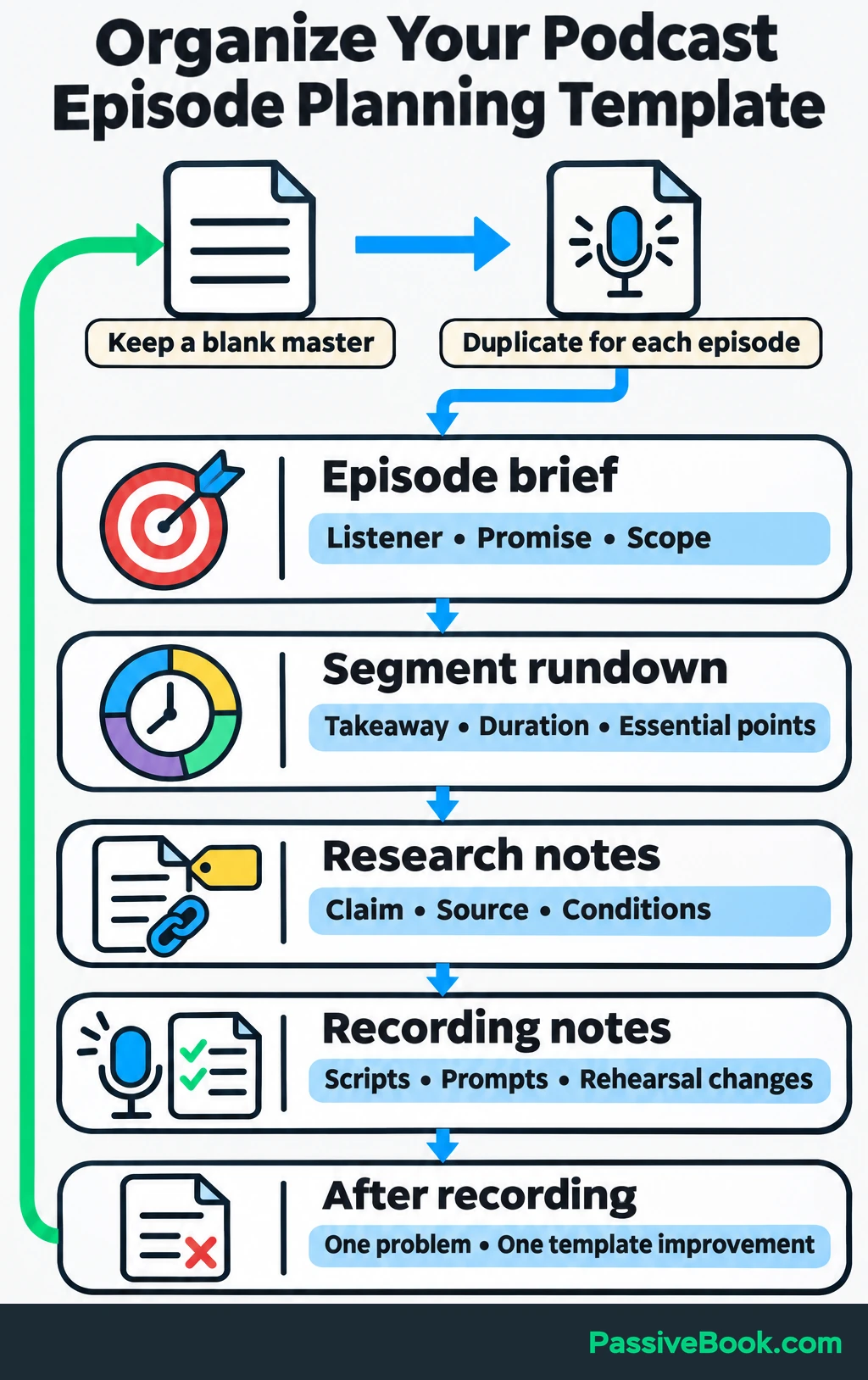
Keep the completed handover-episode plan as a reference. It shows how much detail you needed to record comfortably, so you don’t have to make that decision from scratch each time.
A field earns its place by helping you prepare or record. Remove fields you repeatedly leave blank because they serve no purpose.
Keep the Workflow Manageable
Maintain a small topic queue. Each idea needs a listener outcome, its current status, and one next action.
For the handover episode, that could be:
| Listener Outcome | Status | Next Action |
|---|---|---|
| Create a usable dog-sitter handover note | Research complete | Draft the opening and segment prompts |
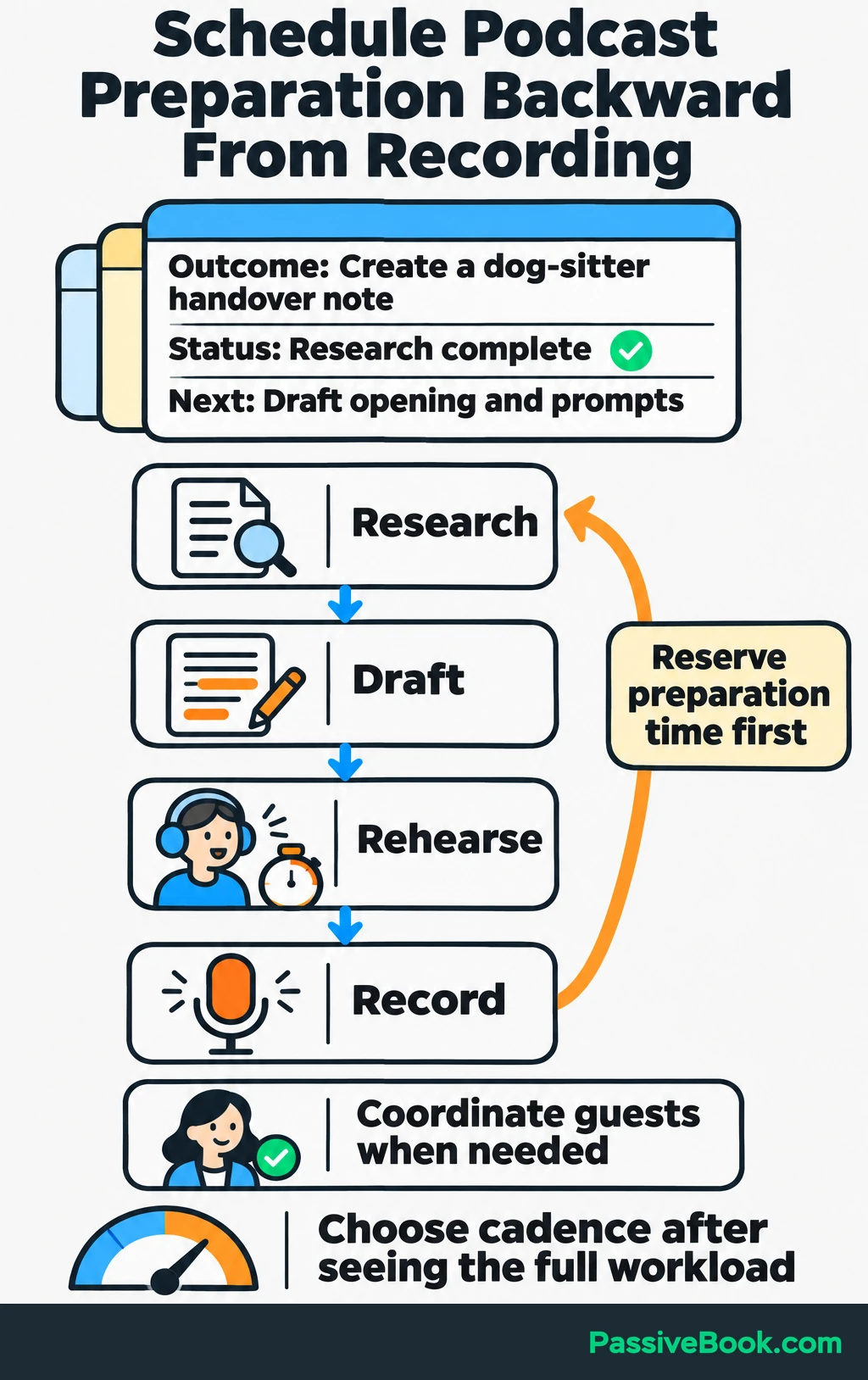
Work backward from the recording date to schedule research, guest coordination when needed, drafting, and rehearsal. Choose your publishing cadence after you’ve seen how much work a complete episode takes.
I spent six months building a membership site alongside corporate work, then abandoned it because the continuing content workload was unsustainable. That experience makes me cautious about recurring publishing promises. A schedule is easy to announce when none of the work is due yet.
Batch similar tasks when it saves setup time. You might choose several episode questions together, then draft each episode separately.
I would skip specialized planning software until your current document causes a clear, repeated problem. More places to maintain the plan can become another task.
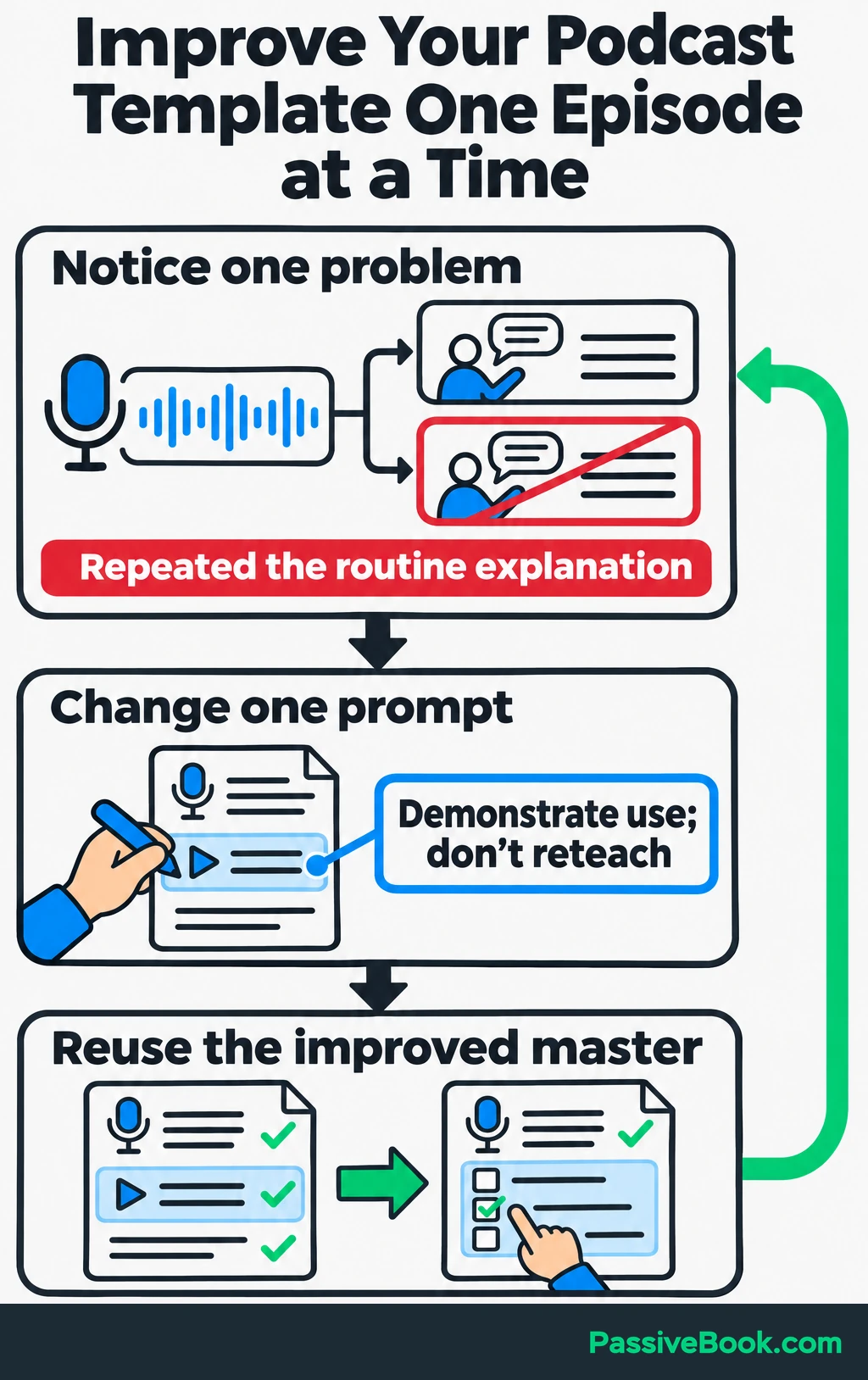
After recording, note one specific improvement. If you repeated the routine explanation during the walkthrough, add “demonstrate use; don’t reteach” to that segment’s prompt. Update the master so the next episode benefits from what you noticed.
What Next?
Choose one episode idea and write its listener promise. Then arrange the answer into segments before opening another research tab.
If this guide helps you turn scattered notes into a recording plan, use the social buttons to pass it along and make the next planning session easier for more creators.
Which part of your episode plan needs the most work: choosing the question, arranging the answer, or writing speaking notes? Share your answer in the comments, and bring any other questions there too.
Share this post with your friends & followers:

