An interesting guest says yes, and you have next week’s episode covered. But where will new listeners hear about it? If the answer is “perhaps they’ll share it,” you still have a gap in the plan.
That gap can cost you an evening of preparation and editing while the episode reaches much the same audience as usual. With limited time, it’s hard to know whether another guest deserves another evening. This guide shows you how to find partners whose audiences have a reason to listen, propose an exchange worth accepting, and decide which collaborations deserve another round.
Find Partners Your Future Listeners Already Trust
Start with the listener you want to attract and the problem your show helps them solve. “People who like pets” is too broad to guide a useful partnership.
Write one sentence describing what that person wants to do next.
For the examples throughout this guide, imagine you sell printable indoor-cat activity planners and run Everyday Indoor Cats. Your show helps new cat owners organize simple play routines. The business, pitches, and figures below are illustrations.
That focus gives you places to look:
- Ask existing listeners which podcasts, newsletters, and creators they follow.
- Search podcast directories for related questions, then check where useful guests have appeared.
- Look through your contacts and relevant communities for people already answering those questions.
A feline behavior expert with a useful newsletter could fit. So could a cat-care podcast or a small brand with an active customer community. A huge general entertainment account offers a much weaker connection.
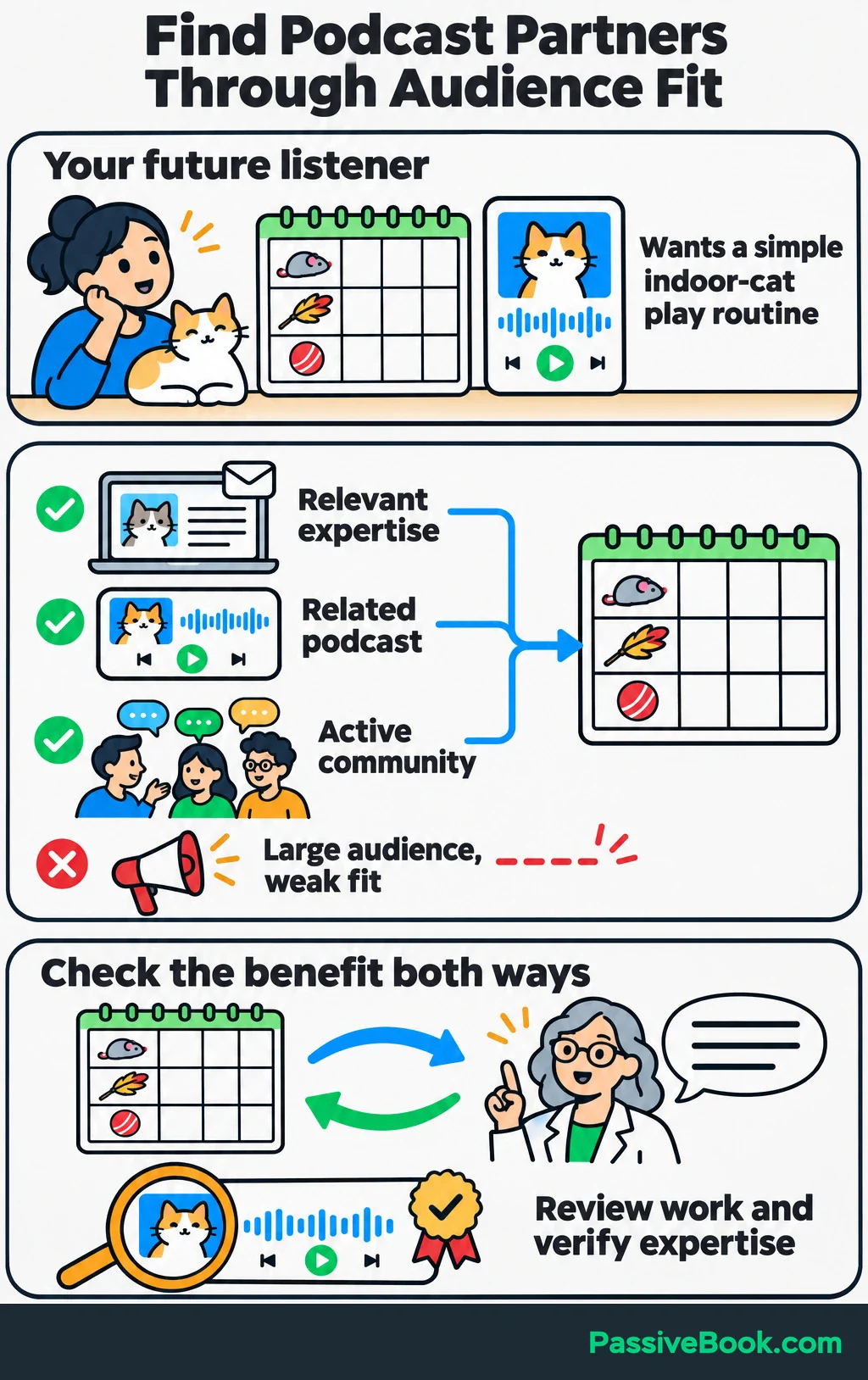
Check the benefit in both directions. Would their audience want your planning episode? Would your listeners gain something useful from their contribution?
Then review recent work. Listen to an episode, read several newsletter issues, and check previous recommendations. Verify expertise that matters to the proposed topic.
Scherrie Prince describes changing her guest selection from accepting available people to checking alignment and credibility. That is a useful editorial check before you lend someone your microphone. Her guest-selection account
Keep a shortlist with six columns: partner, audience connection, relevant work, distribution channel, proposed exchange, and contact route.
I would begin with five strong candidates. You need enough choice to keep moving, but a spreadsheet containing 200 strangers can become a respectable-looking way to avoid sending five emails.
If you’re exchanging recommendations, compare how many people each placement is likely to reach. Use episode downloads over the same period or clicks on comparable newsletter features. An unrelated social follower total tells you little about either.
Choose a Collaboration With a Clear Value Exchange
Choose the smallest format that delivers the listener benefit. If both shows already have suitable episodes, you may only need to recommend them.
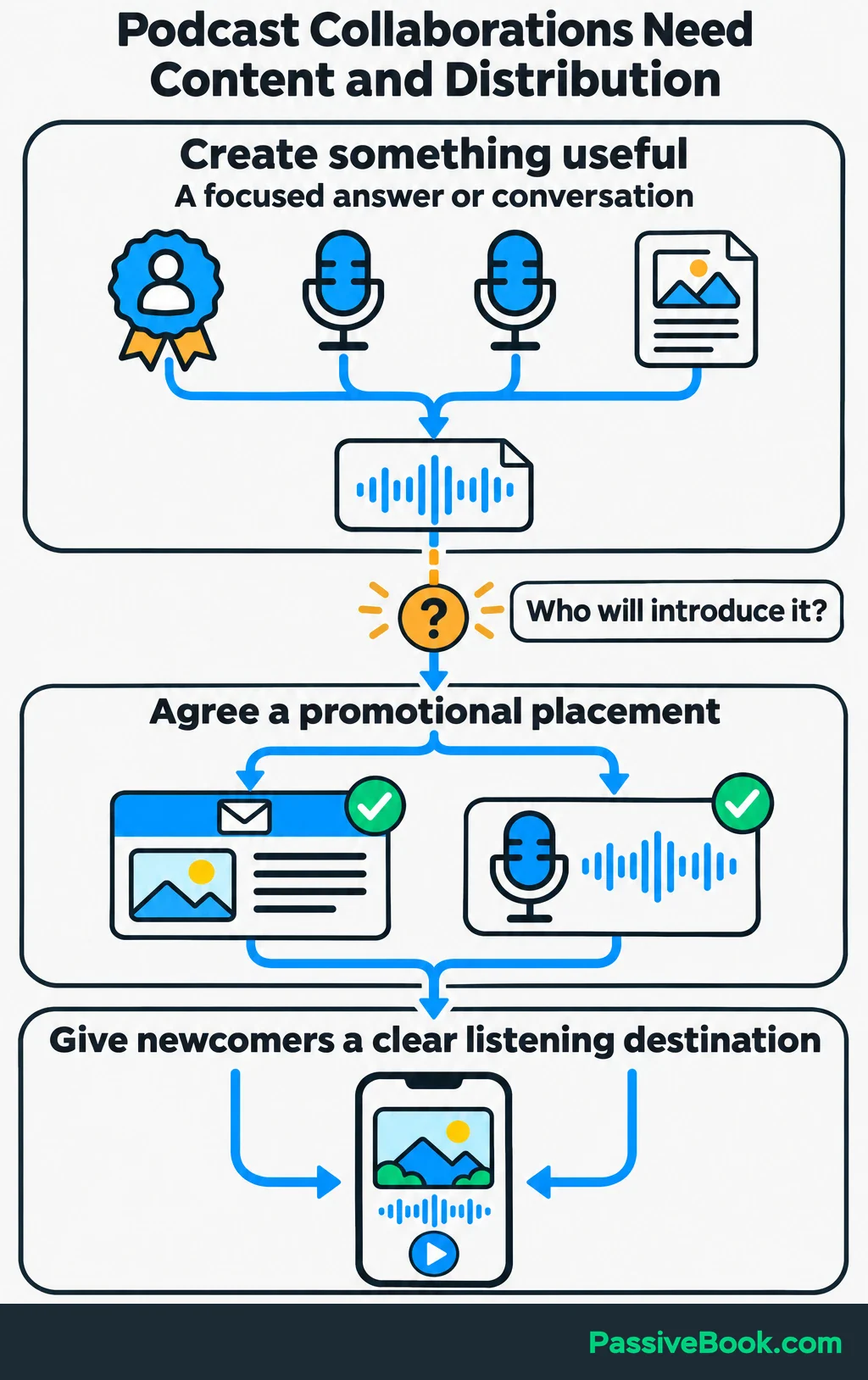
A guest conversation creates content. A newsletter feature or host recommendation distributes it. Agree on both when growth is the purpose.
| Format | Best Use | Each Partner’s Contribution | Promotional Placement | Production Effort |
|---|---|---|---|---|
| Guest interview | One person can answer a focused question | Guest supplies expertise; host prepares, records, and edits | Guest’s newsletter feature and host’s episode introduction | New conversation and edit |
| Short expert contribution | One answer would improve an existing episode | Expert records a brief answer; host supplies context | Agreed newsletter mention or community post | Short recording and insertion |
| Host recommendation | Relevant episodes already exist | Each host listens and recommends a specific episode | Agreed position in each show | Short script and recording |
| Full episode swap | Both shows closely match each other’s audience | Each supplies an episode and introduces the visiting show | Each podcast feed | Episode review, introduction, and publishing |
| Joint episode | Both partners have material needed to solve one problem | Both shape the outline and contribute distinct parts | Each partner’s established channel | Shared planning, recording, and editing |
Guest Appearances and Expert Contributions
Offer a topic you can explain well enough to make the other host’s preparation easier. A narrow promise usually makes a clearer pitch than your entire business story.
For Everyday Indoor Cats, that might be organizing a weekly activity planner. Keep behavior advice with a suitably qualified expert.
You can also invite that expert onto your show. In this example, they explain how owners can choose suitable activities, and you turn the discussion into a practical planning resource. Agree beforehand whether they will introduce the finished episode in their newsletter.
A small show can contribute preparation, editing, useful research, or a resource the expert can share. Those are concrete benefits even when your audience is still small.
If you only need one answer, request a short recorded contribution. I would skip an hour-long interview when three useful minutes would do the job.
Host Recommendations and Episode Swaps
For a recommendation exchange, each host should listen to the episode they plan to endorse. Agree on the benefit, destination, placement, and publication window.
Balance the contributions openly. If one show reaches more people, the other might offer several placements or useful production help. Equal work does not always mean identical work.
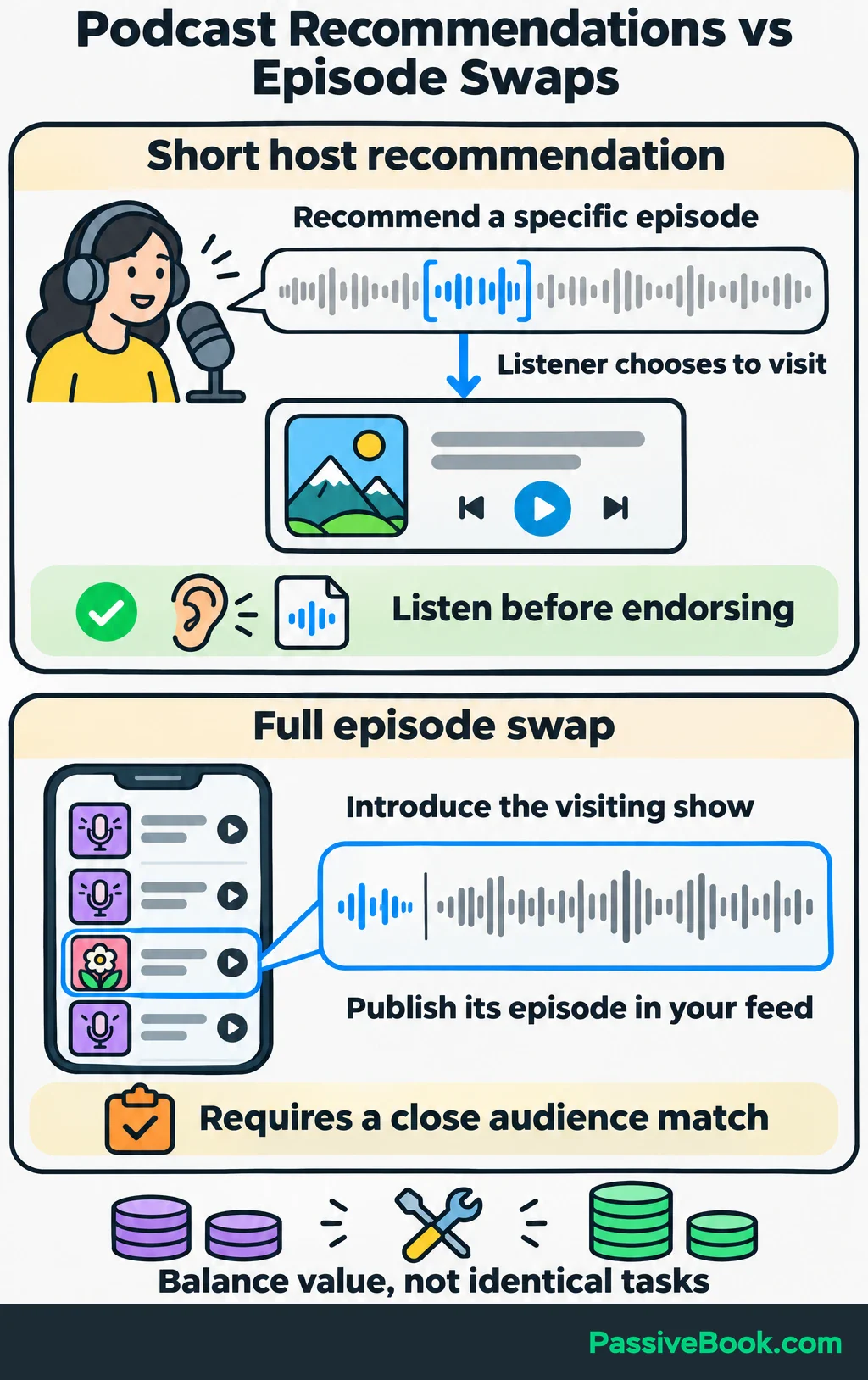
Reserve full episode swaps for a close editorial match. Your listeners followed your show, so explain why another show has appeared in their feed. Choose an episode that works without earlier installments.
Response Marketing reported more than 100,000 incremental Hackable? downloads from a reciprocal episode swap with Darknet Diaries. These were established shows within a broader marketing campaign, so the result illustrates the format rather than what a small podcast should expect. Response Marketing’s campaign report
For a first experiment, I would choose a short recommendation over a full feed swap. It asks less of both hosts and their listeners.
Joint Episodes With Creators or Brands
A joint episode needs shared planning. Both partners help decide what the listener should leave able to do, and each contributes something distinct.
For the cat-play episode, your contribution could be the planner and a walkthrough of how to organize it. The behavior expert contributes guidance on choosing activities and recognizing when the plan needs adjusting.
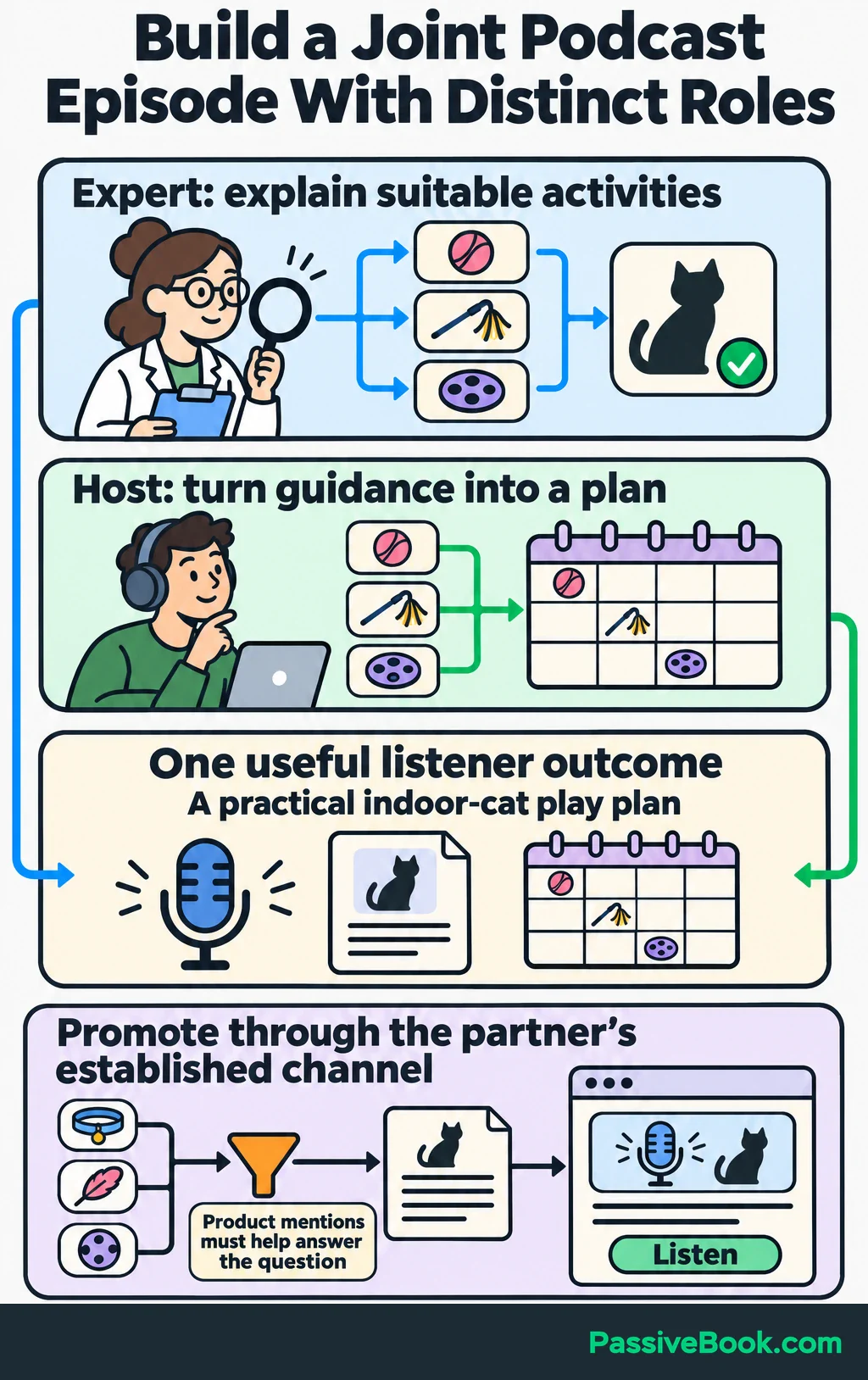
A brand could contribute useful product knowledge, but its catalogue should not become the outline. Give product mentions only the space they earn by helping answer the question.
Match promotion to the partner’s established channel. A creator with an active newsletter can publish a useful introduction there. They do not need to start a podcast to become a worthwhile podcast partner.
Pitch One Specific Benefit for the Partner’s Audience
Use the partner’s published business contact route and show that you have reviewed their work. Reference something specific, then suggest a topic that extends it.
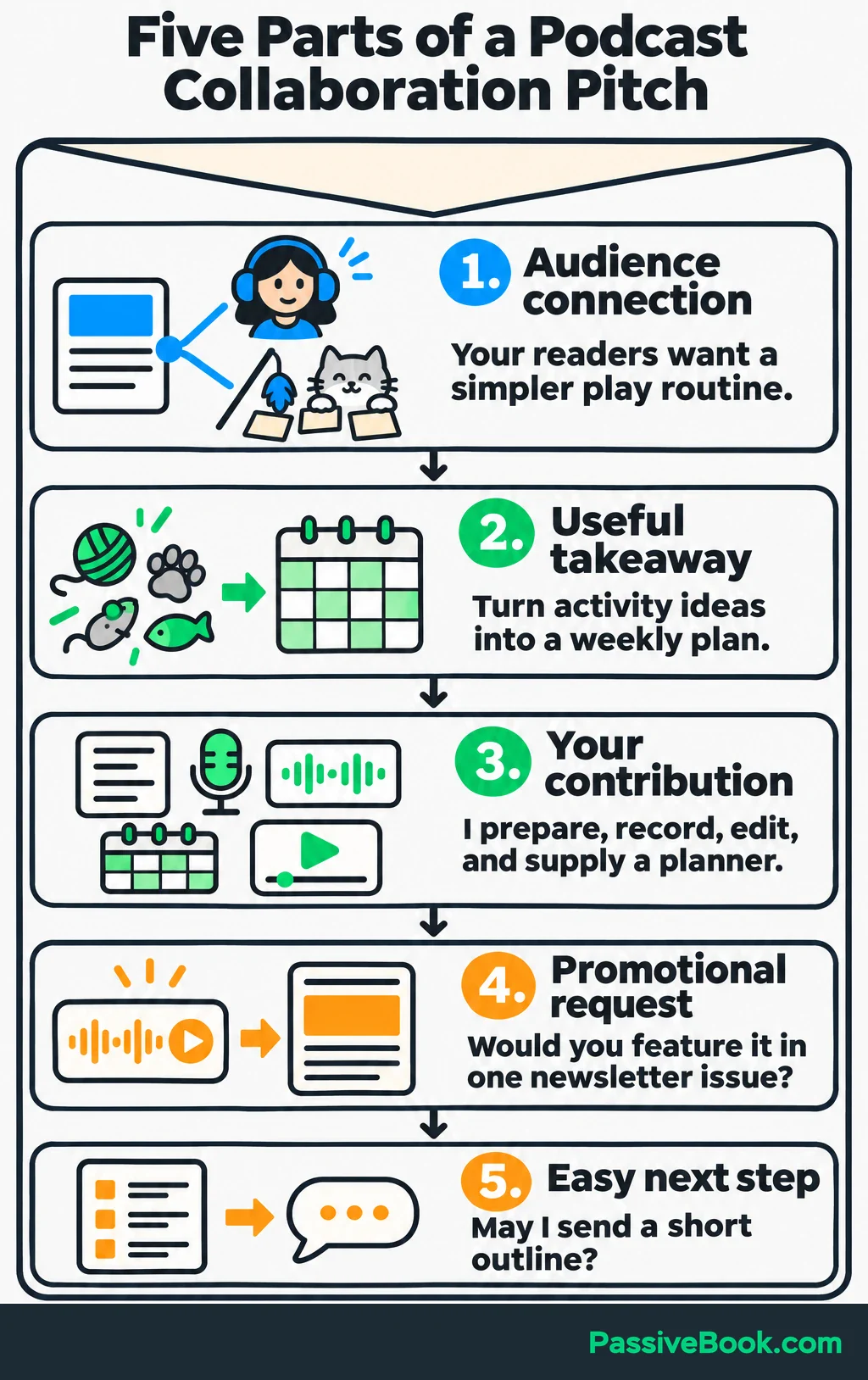
Your pitch needs five things:
- A clear connection to their audience.
- One useful takeaway.
- A contribution you can deliver.
- A specific promotional request.
- An easy next step.
Include one representative episode so they can assess your work quickly. I would send your strongest relevant episode rather than a folder of everything you have recorded.
Here is a complete pitch you can adapt:
Subject: An indoor-cat play episode for your newsletter readers
Hi [Name],
Your newsletter on [specific topic] explained [specific point]. A practical follow-up could help readers turn those ideas into a weekly plan.
I host Everyday Indoor Cats and create printable activity planners. Would you be interested in a focused conversation about choosing activities for a simple indoor-cat play routine?
You would bring the behavior guidance. I would prepare the outline, handle recording and editing, and create a planning sheet for listeners. I would also credit and link your [relevant resource] in the episode notes.
Would you be open to featuring the finished episode in one newsletter issue? I can supply suggested copy and an excerpt for your review.
Here is a sample episode: [episode link].
May I send a short outline?
Thanks,
[Your name]
For a podcast recommendation swap, shorten the offer: “Your episode on [topic] would help my listeners with [problem]. Would you consider exchanging short recommendations for these two episodes?”
Send one concise follow-up after roughly a week. If there is still no reply, move on. A partnership should begin with mutual interest, not an endurance contest.
If you know whom you want to approach but are stuck on the wording, this AI Skill can draft your pitch and follow-up. It helps you make a concrete offer without overstating your audience.

Free AI Partnership Writer




Agree on the Exchange Before Production
Confirm Responsibilities and Promotion
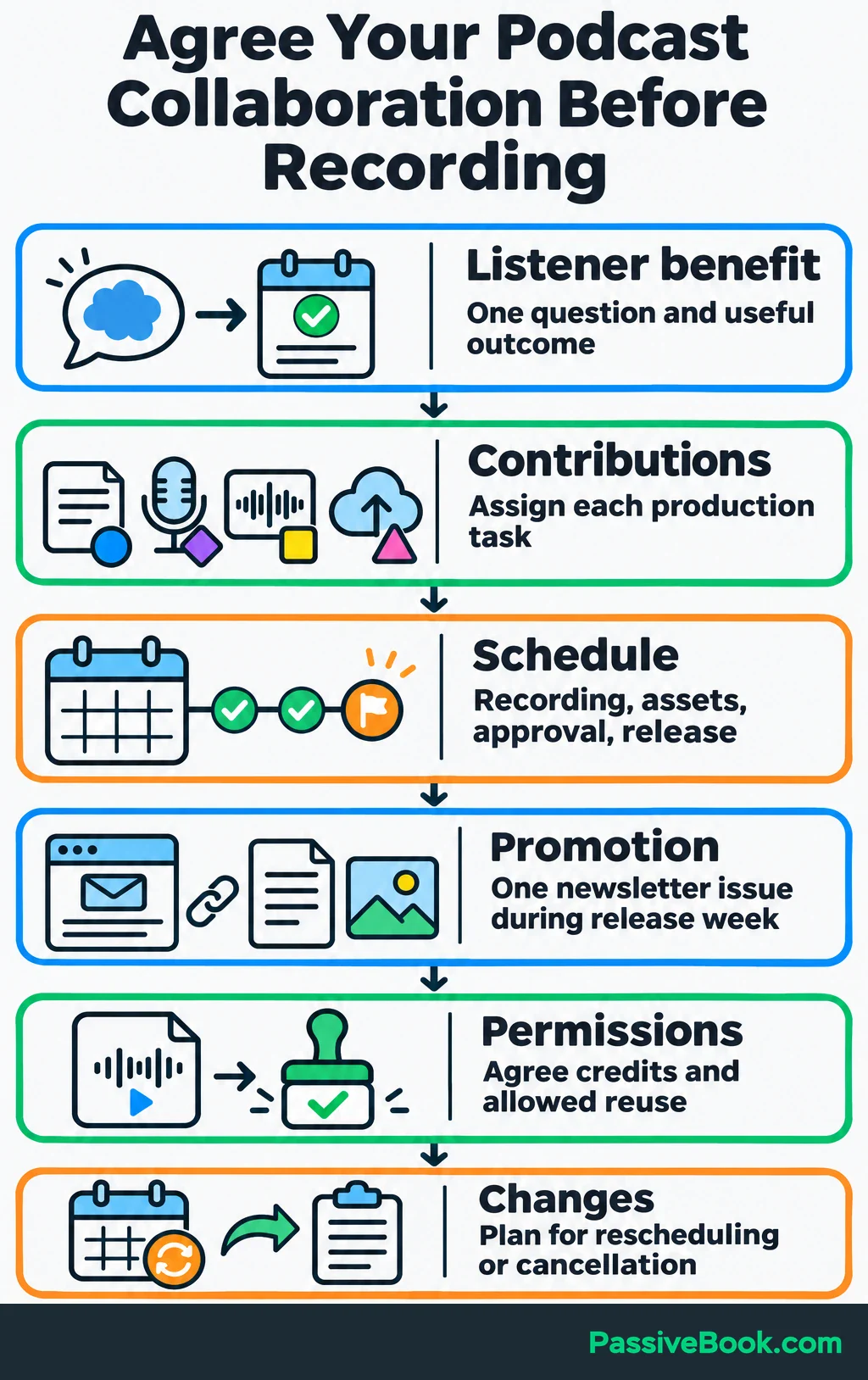
Before recording, use one shared brief to settle these responsibilities:
- Listener Benefit: The question the episode answers and what listeners should be able to do afterward.
- Contributions: Who prepares the outline, supplies resources, records, edits, and publishes.
- Schedule: Recording date, asset deadline, approval deadline, and publication date.
- Promotion: Who publishes each recommendation, where it appears, when it runs, and who supplies the copy.
- Permissions: Agreed credits and permission to publish or reuse the recording, excerpts, and artwork.
- Changes: What happens if someone needs to reschedule or cancel.
For the running example, “the expert will share it” is too vague. A clearer agreement is: the expert includes a short introduction and listening link in one newsletter issue during the release week. You supply the draft copy and artwork before their deadline.
Keep review boundaries clear too. Let the guest check factual accuracy, their description, and the agreed excerpts without leaving the entire episode in open-ended revision.
For U.S. advertising endorsements, disclose unexpected connections that could affect how people judge the recommendation. These can include payment, gifts, affiliate commissions, and relevant reciprocal benefits. Make the disclosure audible in audio recommendations and visible beside written ones. FTC endorsement guidance
For a recommendation exchange, plain wording such as “We’re recommending each other’s shows as part of this collaboration” explains the arrangement.
Prepare the Listening Destination and Tracking
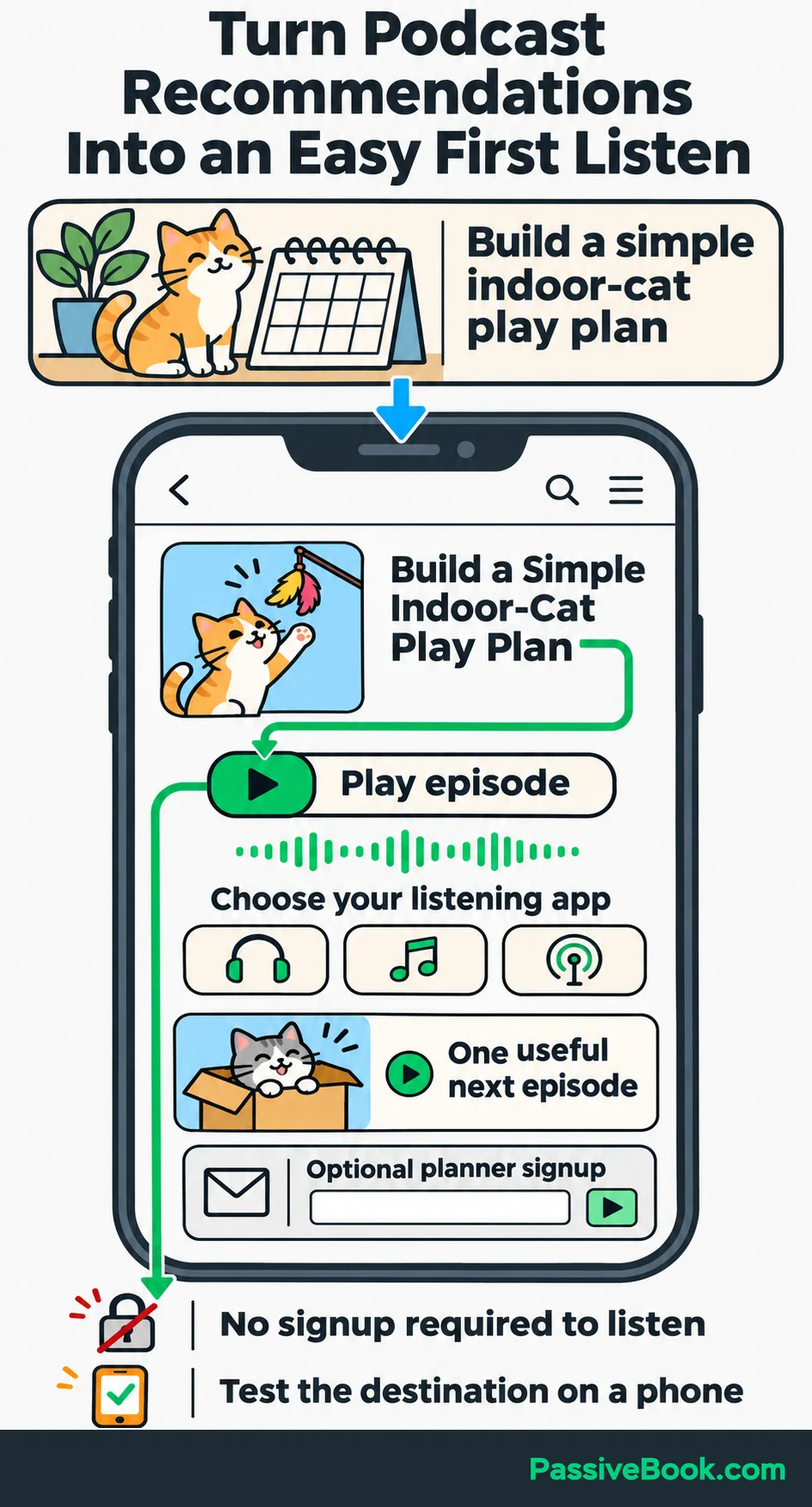
Choose one primary action for newcomers: listen to the episode that fulfills the recommendation.
Send them to a focused page with the episode, clear listening options, and one relevant episode to try afterward. Keep a planner signup available, but let people reach the promised audio without joining your list.
On a digital-product project, I once wrote promotional copy about saving time, then opened the destination page and found a list of files. I had made the visitor translate the offer. That experience now informs my check here: the destination should continue the promise that brought someone over.
For clickable placements, add campaign tags to the listening link so your website analytics can identify where visitors came from. For the expert’s newsletter, use:
https://yourdomain.com/play?utm_source=feline_partner&utm_medium=email&utm_campaign=play_routine
Replace yourdomain.com/play with your listening page’s address. The tags name the partner (utm_source), channel (utm_medium), and collaboration (utm_campaign).
For audio recommendations, prepare a short address such as yourdomain.com/play that leads to the listening page. Test the spoken address and tagged links on a phone.
Set an effort limit, such as two extra hours beyond your normal episode work, and choose a review date after all promised promotion has run.
Create an Episode New Listeners Can Follow
For a new recording, share a flexible outline and make a short audio test before the full conversation. Fixing a microphone setting takes less time than rescuing an entire interview.
Open with the problem promised in the recommendation. Introduce the guest’s relevant experience briefly, then begin answering the question.
For example:
“You want a simple play routine, but deciding what to do each day can turn into another unfinished task. We’re going to build a weekly plan, and [Name] will explain how to choose activities that suit your cat.”
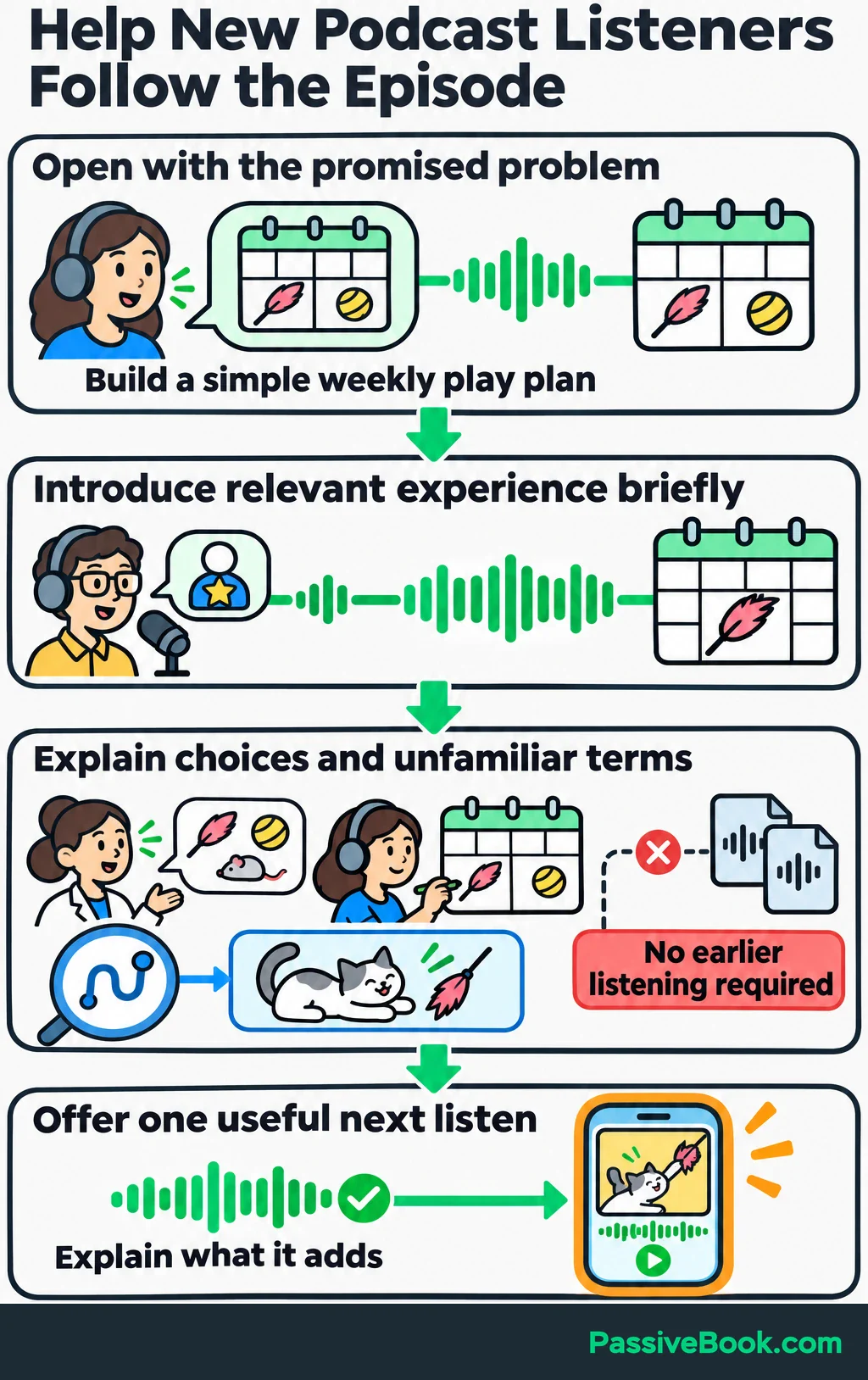
Use the planner to guide the discussion. Ask the expert to explain their choices, then show where those choices fit on the page.
Explain unfamiliar terms and remove references that require earlier listening. Apply the same check when selecting an existing episode for a recommendation or swap.
Each episode in a reciprocal collaboration should stand on its own. Give a specific reason to hear the other one, such as a deeper explanation of an activity covered briefly in yours.
At the end, recommend one related episode and explain what it adds. That gives a newcomer a useful next listen.
Make the Collaboration Easy to Promote
Prepare a small promotion pack before release:
- The tagged listening link and short spoken address.
- Suggested recommendation copy.
- One useful excerpt.
- Artwork or an audio file suited to the agreed placement.
Lead with what the listener gets. For the expert’s newsletter, suggested copy could read:
“Want a simpler way to organize your cat’s play routine? I joined Everyday Indoor Cats to discuss choosing activities and putting them into a weekly plan. Listen to the conversation here: [listening link].”
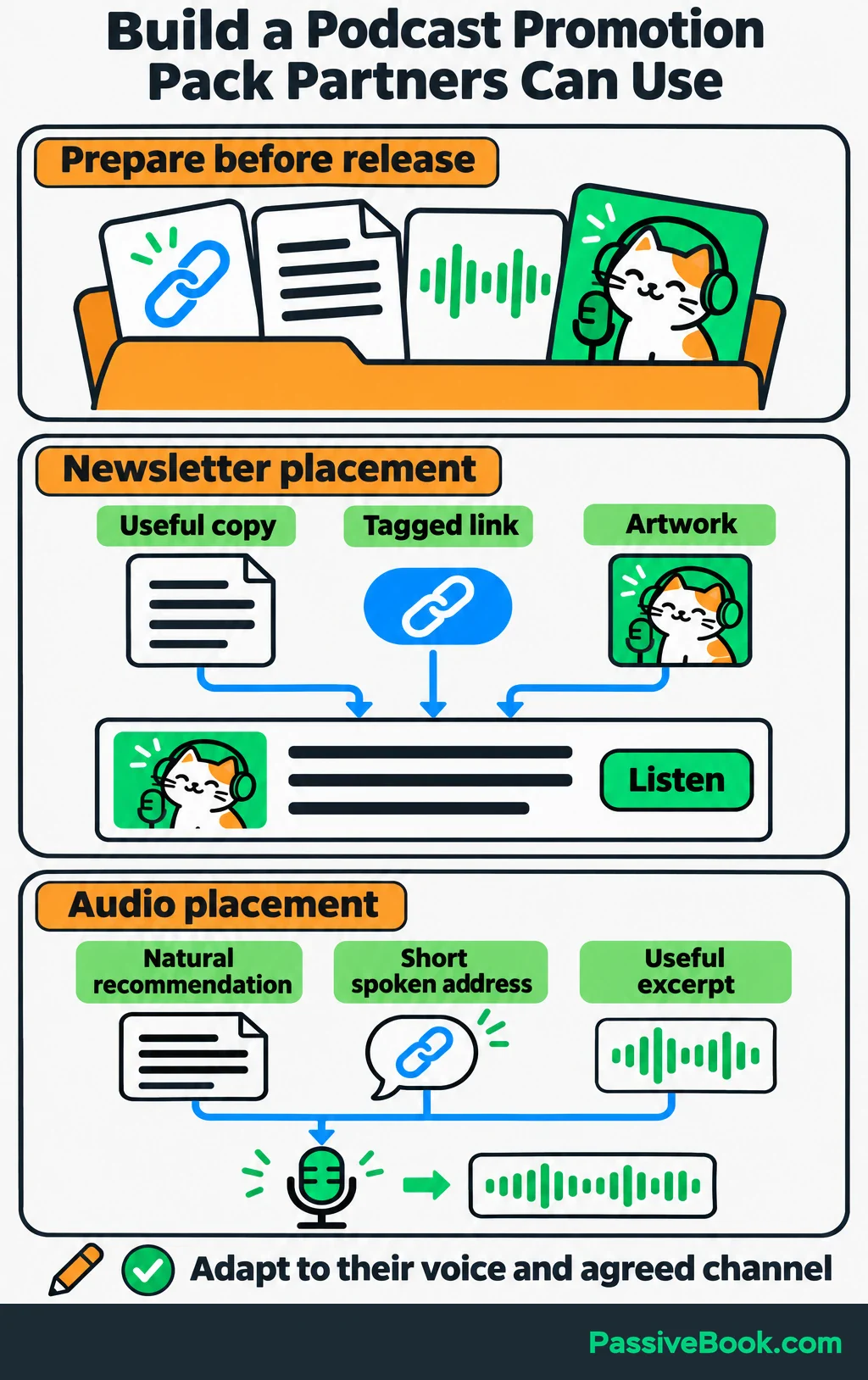
The partner should edit that copy into their own voice and add any required disclosure. A recommendation should sound like something they would actually say.
Use the channels that already reach people. I would skip video production unless video is part of the agreed distribution. A clean audio excerpt or short newsletter paragraph may be all the exchange needs.
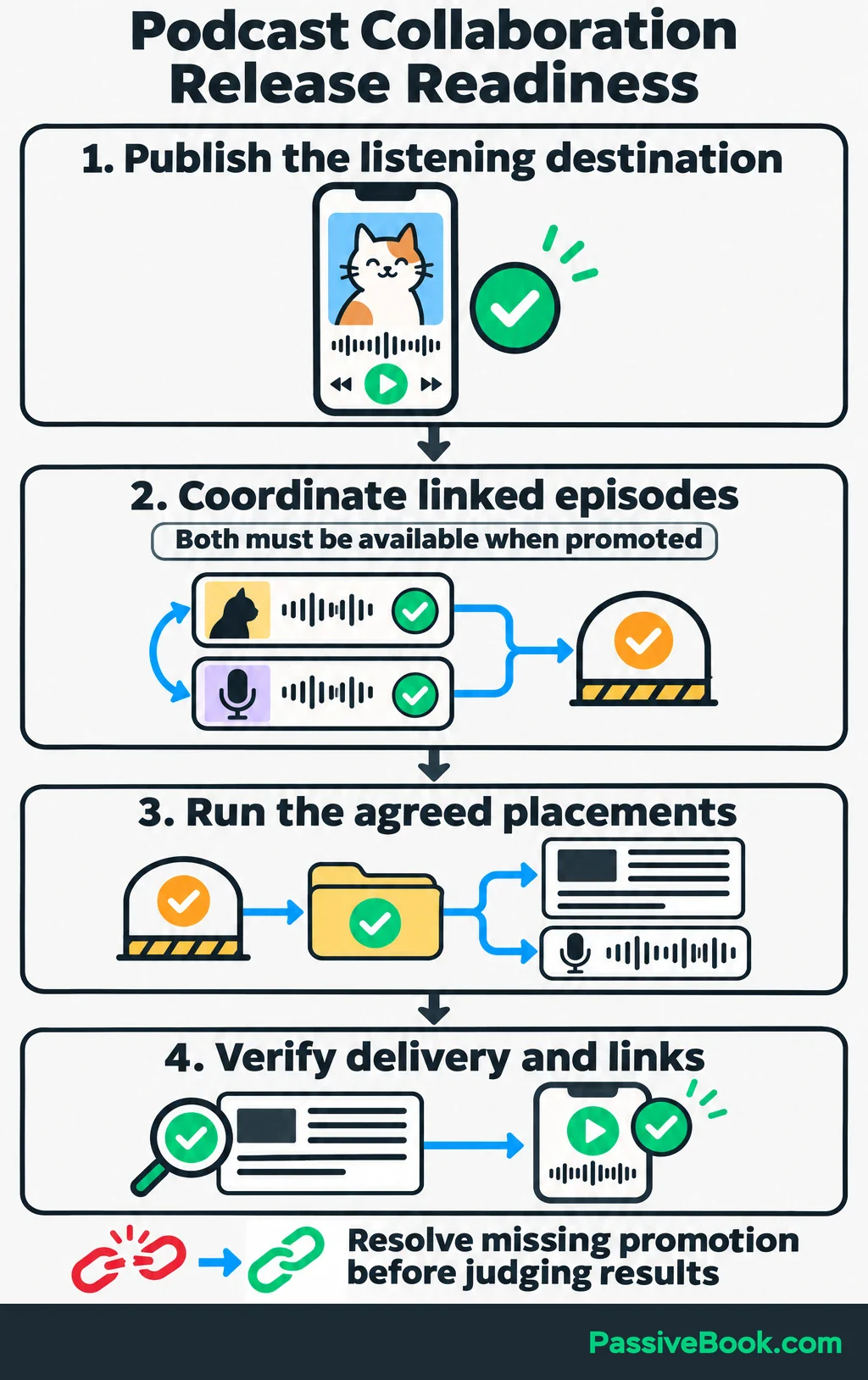
Publish the listening page before recommendations go live. If two episodes point to each other, coordinate their release so neither sends people to something unavailable.
Check that the promised placements appeared and that the links work. Resolve missing promotion before judging the partnership.
Save the brief, pitch, and asset checklist afterward. Reuse the structure, but personalize the audience connection each time.
Use Results to Choose the Next Collaboration
Measure Listening Beyond Exposure
Keep the stages separate so you can see where people stop:
- Delivery: Which agreed placements appeared.
- Visits: Traffic through partner links and clicks toward listening platforms.
- Listening: Episode downloads, available listening engagement, and follower changes.
- Business Response: Confirmed planner signups, relevant replies, and sales.
Alongside your hosting provider’s downloads, check how much of the episode people play in Apple Podcasts Analytics. Its figures cover Apple Podcasts activity, and missing reports can mean too few listeners to meet its reporting threshold.
Compare episodes over the same amount of time after release. Suppose comparable episodes average 120 downloads in their first seven days, and the collaboration episode receives 150. In this illustration, all agreed promotion runs during that first week.
You are counting the difference in downloads, then comparing it with the usual total:
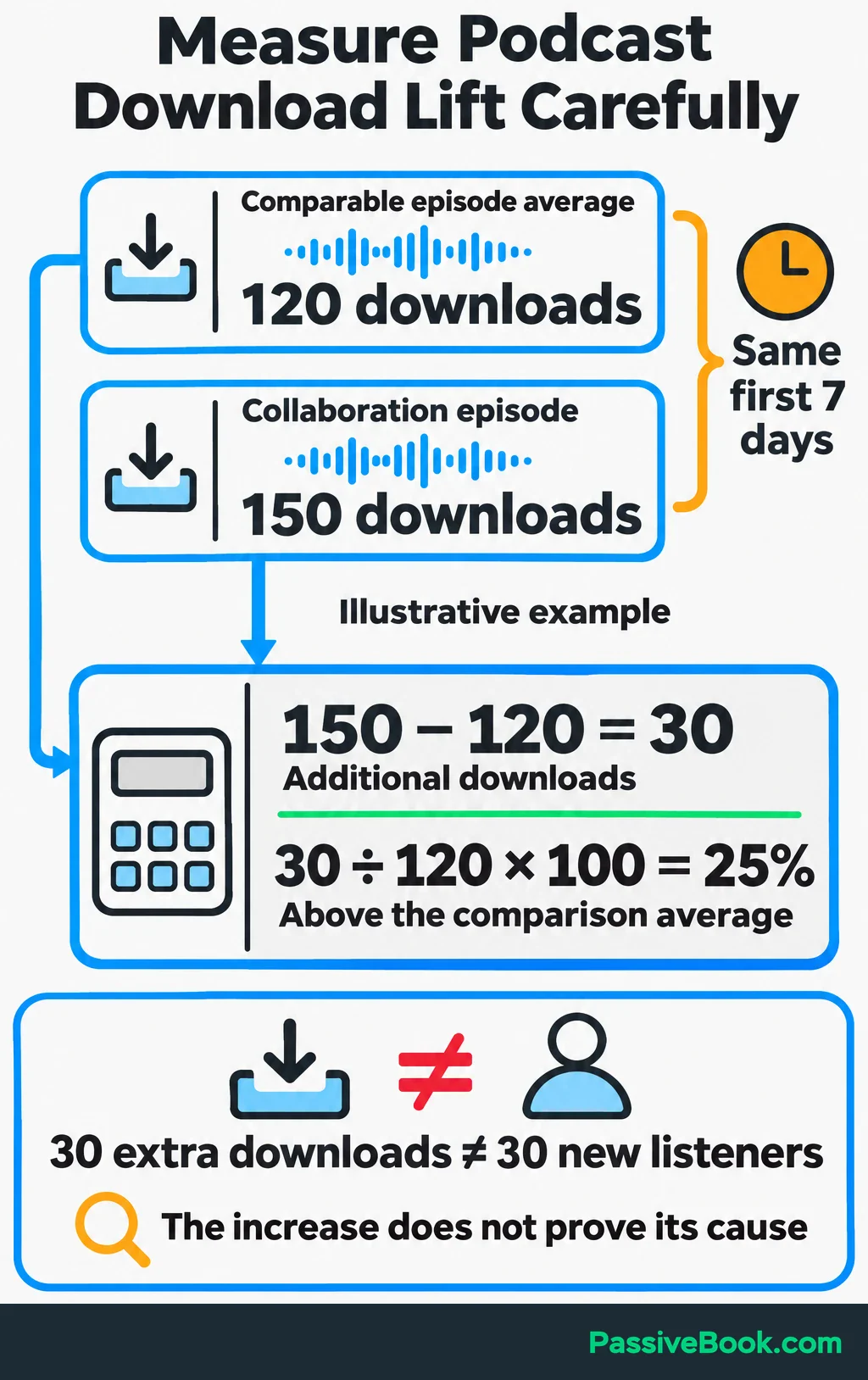
150 − 120 = 30 additional downloads
30 ÷ 120 × 100 = 25% above the comparison average
That does not establish 30 new listeners or prove the collaboration caused the increase. Likewise, a website visit or listening-platform click does not establish completed listening.
Combine those signals with useful replies and a simple “How did you find the show?” question. Look for continued interest in related episodes too.
Track signups and sales separately from podcast growth. Then compare the combined value with your time and direct costs. More downloads can be welcome while the production workload remains a poor trade.
Repeat What Works and Fix the Weak Point
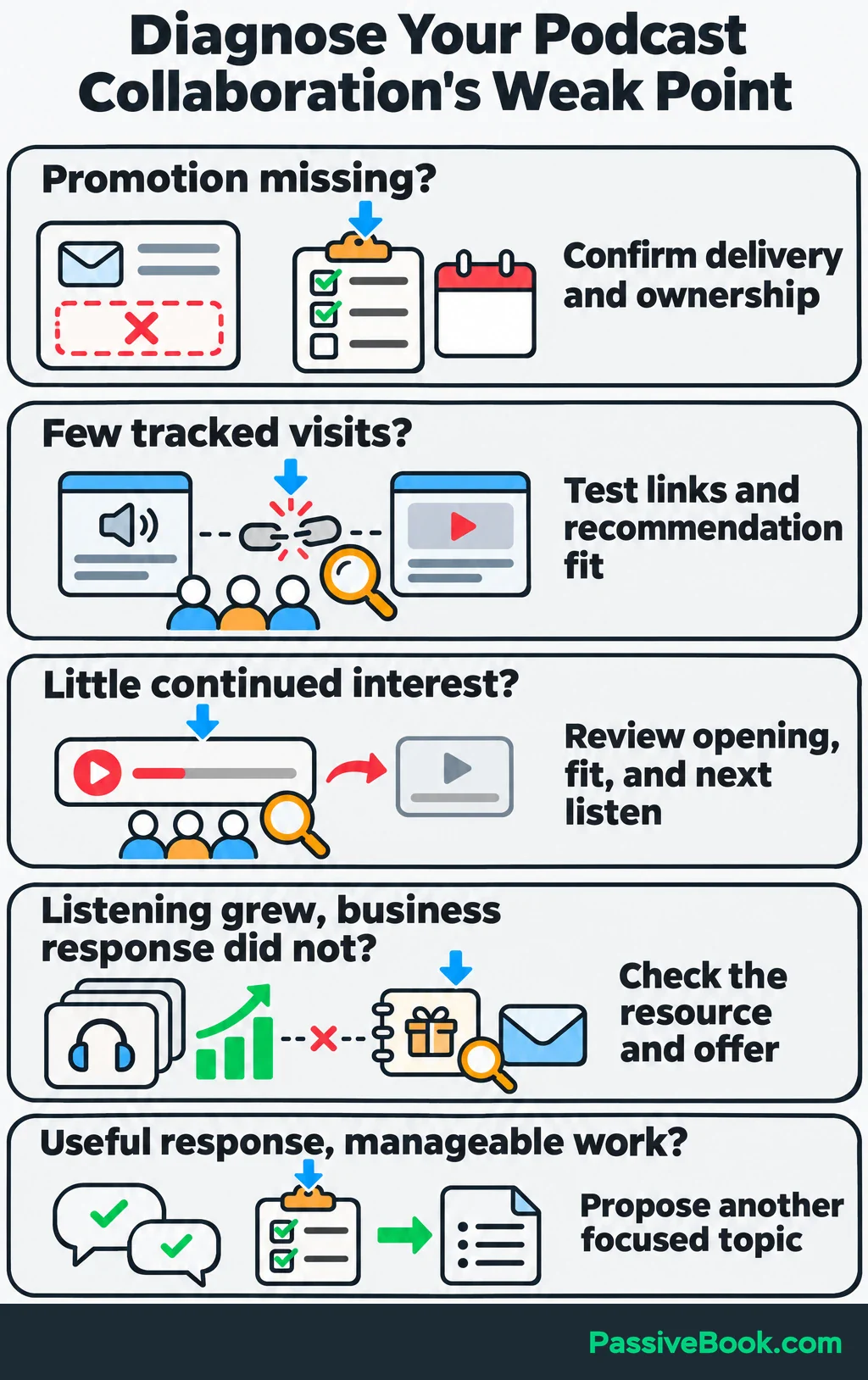
Use the results to choose the next change.
| What You Observe | What to Check Next |
|---|---|
| The agreed promotion did not appear | Confirm delivery and revise the deadline or responsibility |
| Promotion appeared, but few visits were tracked | Test the link and spoken address, then review the recommendation’s relevance |
| People tried the episode but showed little further interest | Review the opening, audience fit, and suggested next episode |
| Relevant listeners responded and workload stayed manageable | Propose another focused topic with the same partner |
| Listening grew but business response stayed weak | Check whether the resource or offer serves those listeners |
Send the partner a short recap covering completed promotion, available results, and useful listener feedback.
When the exchange earns another round, propose a specific follow-up. You can also ask whether they know another creator whose audience would benefit from the topic.
Keep the pitch, agreement, assets, results, and next action in one partnership record. A spreadsheet or Notion page is enough.
Once the process works, use n8n, a tool that connects apps, to send reminders and deliver promotional files automatically. I would keep partner selection and episode review in your hands.
What Next?
Write down five potential partners and one useful exchange you could offer each. Choose the strongest fit and send a specific pitch with a sample episode.
Use the social buttons to share this guide when you want collaborators to start with the same expectations about content, promotion, and results.
Where does your current plan feel weakest: finding the right partner, making the offer, or getting promotion delivered? Tell me in the comments, and bring any other questions too.
Share this post with your friends & followers:

