You’ve found a podcast your customers might enjoy, and the host accepts sponsors. Before you book, you need a better reason to buy than “the audience sounds right.”
The risk is paying for a placement and finishing with a download report, a handful of visits, and no clear way to judge the spend.
Learning how to advertise on podcasts starts with that decision. This guide connects show selection, ad copy, and tracking to one worked budget, so you can decide whether a first campaign deserves your money.
How Podcast Advertising Works
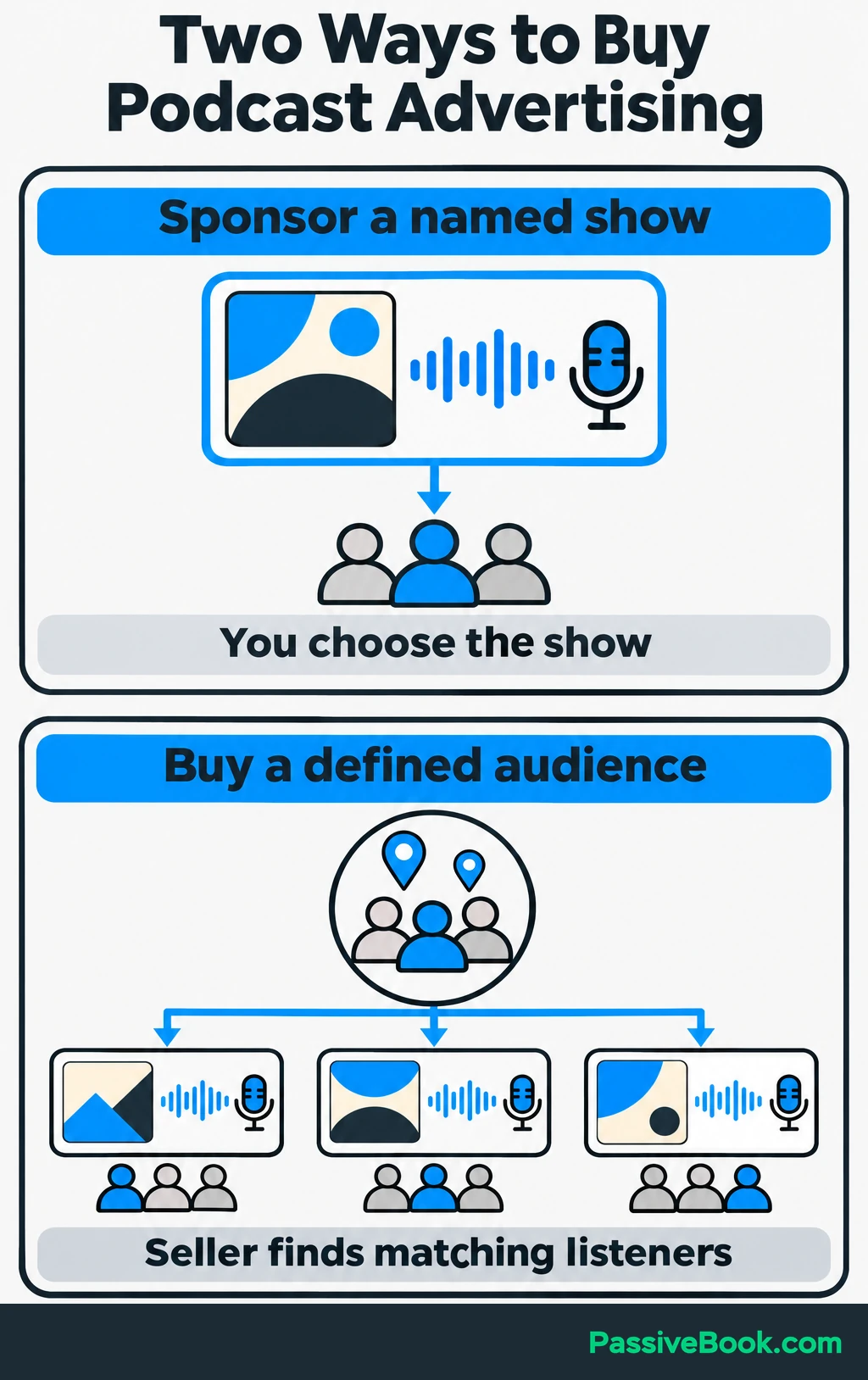
You can sponsor a particular show or buy ad delivery across several shows to reach a defined audience. A direct sponsorship gives you a specific context for your message. An audience-based purchase lets the seller find listeners who meet your targeting settings.
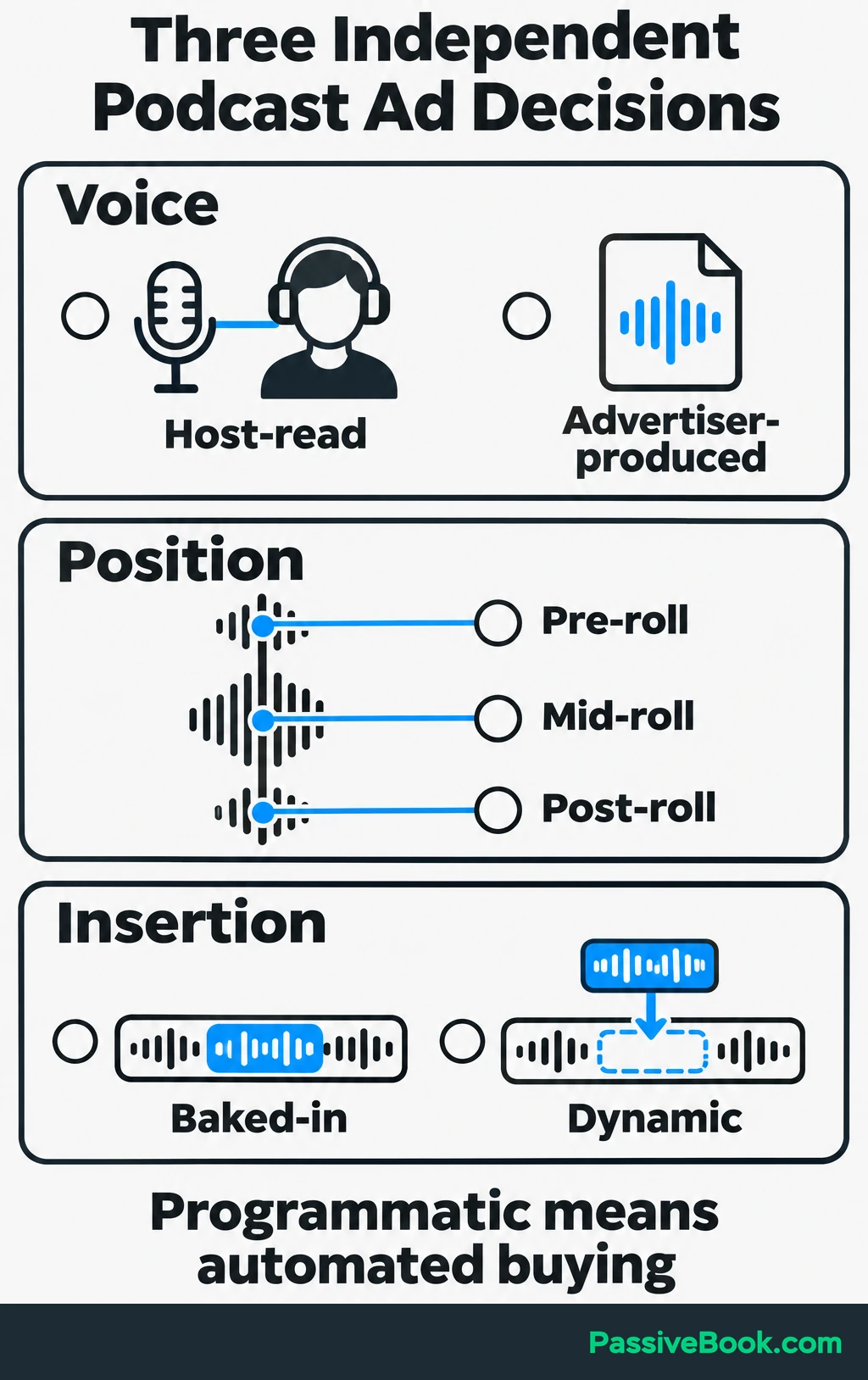
Before comparing quotes, separate three choices:
| Decision | Options | What You’re Choosing |
|---|---|---|
| Who delivers the message? | Host-read or advertiser-produced | The host creates the read with your input, or you supply a finished recording |
| Where does it appear? | Pre-roll, mid-roll, or post-roll | Near the beginning, within, or near the end of the episode |
| How is it inserted? | Baked-in or dynamic | Included in the episode recording, or served into an ad slot according to campaign settings |
These choices work together. A host-read ad can be baked into an episode or inserted dynamically. Acast’s campaign definitions describe both forms of sponsorship.
You may also see “programmatic.” This means automated buying. It doesn’t describe the speaker or the position of the ad.
I would choose a host-read sponsorship when the host can explain the offer naturally and the full quote fits the budget. A produced spot makes sense when you want close control over the wording or need a recording you can use across several placements. Neither a familiar voice nor a mid-roll position guarantees better results.
Choose the Offer You Want to Advertise
Choose one offer and one main action before looking for shows. The listener should understand what problem you solve and what to do next.
That action might be buying a product, requesting a consultation, or joining your list as a qualified lead. Avoid asking people to visit your store, follow three accounts, and download something in the same ad. Give them one job.
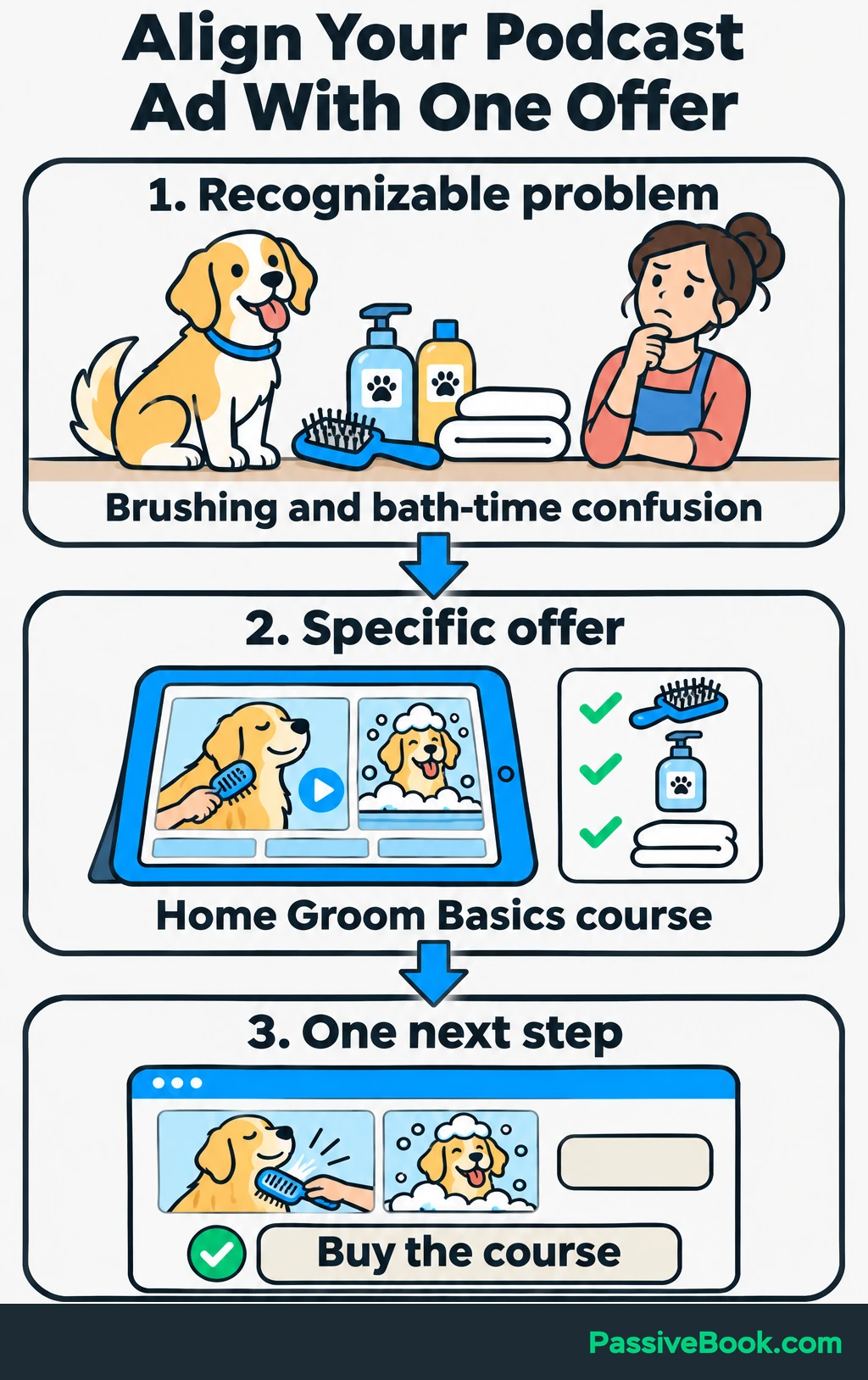
For the worked example, imagine you sell a beginner at-home dog-grooming course called Home Groom Basics. You want new customers to buy the course.
Your message focuses on learning a clearer brushing and bath-time routine, rather than promoting everything your business sells.
If you advertise a free guide instead, follow those subscribers through to purchases. Cheap signups tell you what it costs to collect an email address. They don’t tell you whether the campaign pays.
Set a Budget Your Offer Can Support
Estimate the Full Campaign Cost
Podcast ads are often quoted using CPM: the price per 1,000 billable impressions.
First, confirm what the seller counts. Are you paying for ad deliveries, episode downloads, or a flat sponsorship package? Those are different promises.
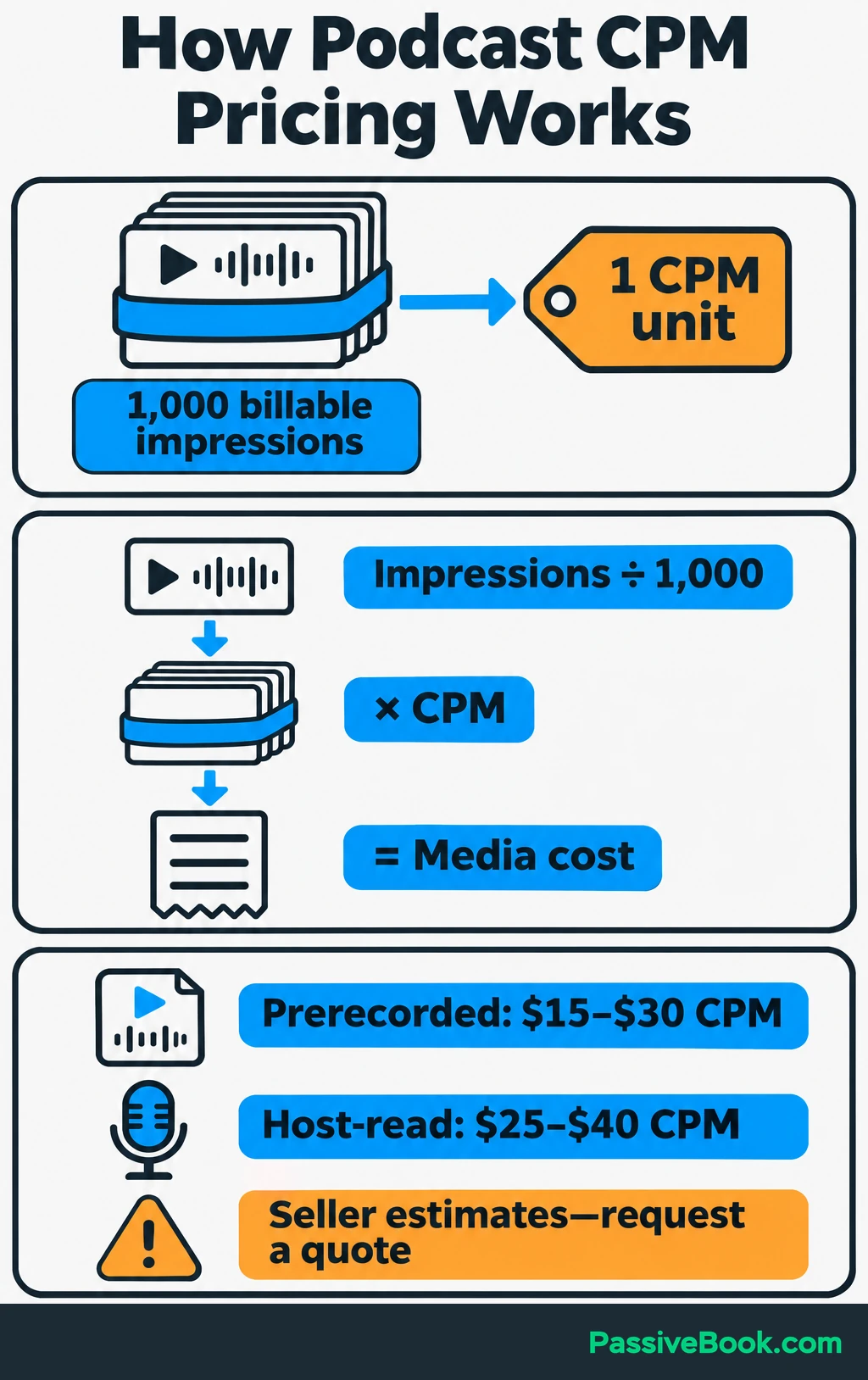
For a CPM purchase, the calculation is:
Media cost = billable impressions ÷ 1,000 × CPM
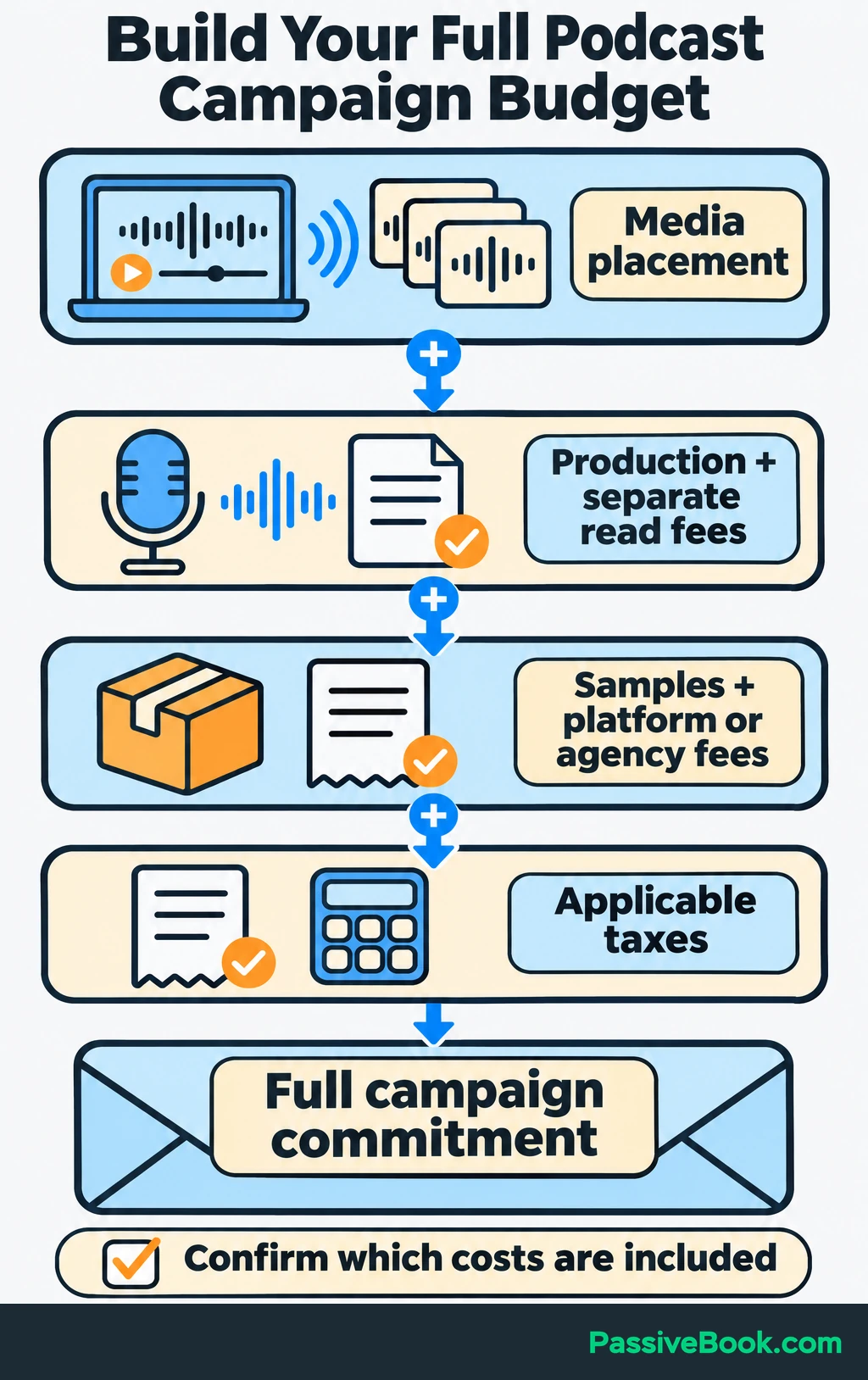
Acast’s US-facing rate guide lists roughly $15–$30 CPM for prerecorded ads and $25–$40 CPM for host-read sponsorships. Treat these seller-published ranges as planning estimates and request a quote for your placement.
For a flat fee, compare the promised reads, episodes, impressions if guaranteed, and delivery window.
Then add production, separate host-read charges, product samples, platform or agency fees, and applicable taxes. The amount on the media quote may be only part of your spending cap.
Calculate an Affordable Customer Acquisition Cost
Start with what one sale leaves before advertising. Subtract costs that rise when you make a sale, such as payment fees, fulfillment, and expected refunds. The amount left is your contribution per sale.
For one digital-product offer, I had to gather payment charges and buyer-support costs from separate records. Those costs changed what I was willing to spend to acquire a customer.
For the course example, assume:
| Item | Illustrative Amount |
|---|---|
| Course price | $79 |
| Variable cost per sale | $19 |
| Contribution before advertising | $60 |
| Target customer acquisition cost | $30 |
| Amount left at that target, before fixed overhead | $30 |
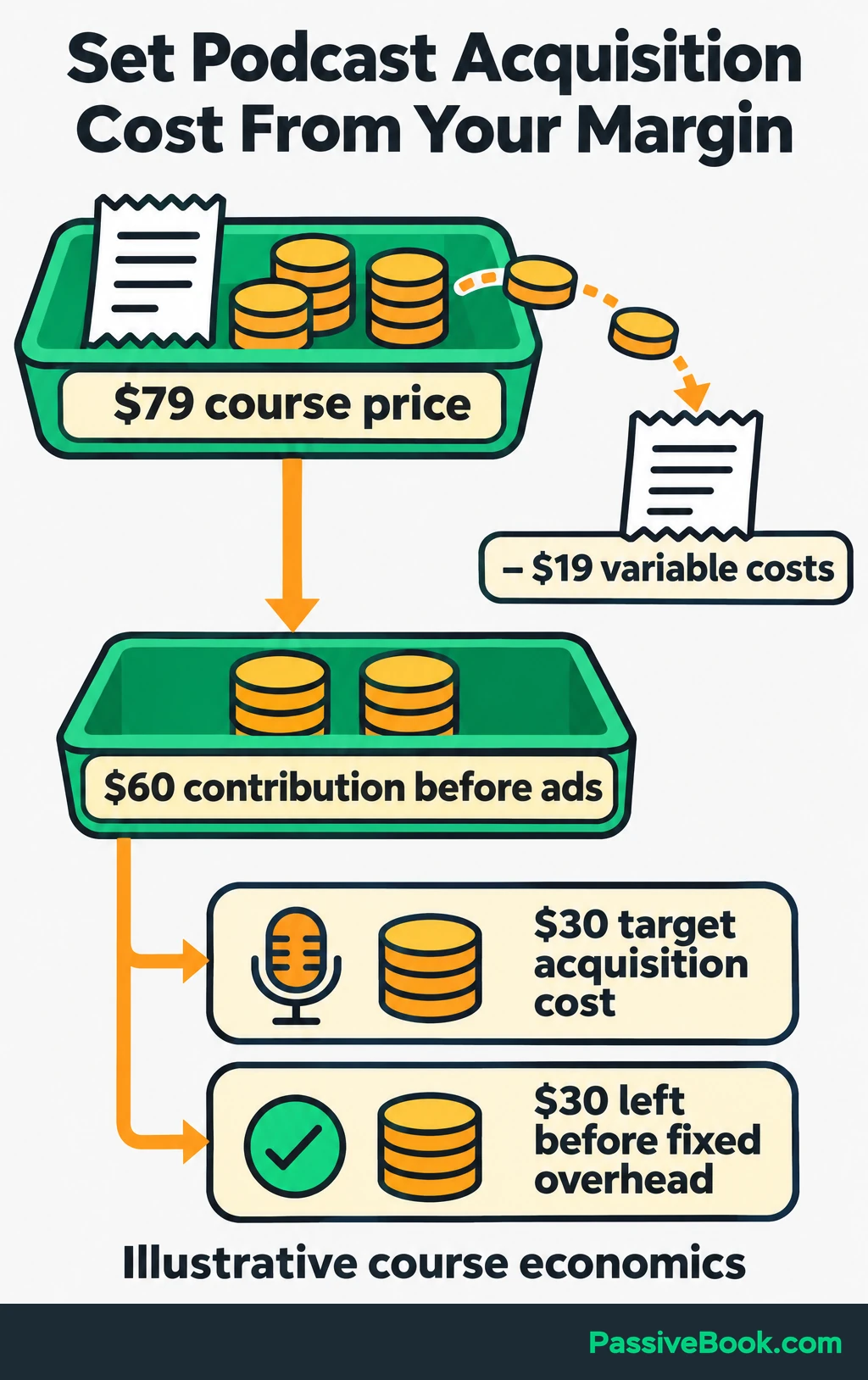
Customer acquisition cost means the campaign cost for each new customer it brings.
Now price the proposed test:
- 20,000 billable impressions at an assumed $25 CPM cost $500.
- Production adds $100.
- Total campaign cost is $600.
To find the customers needed to cover that campaign, divide its full cost by the contribution from each new customer:
Break-even customers = $600 ÷ $60 = 10
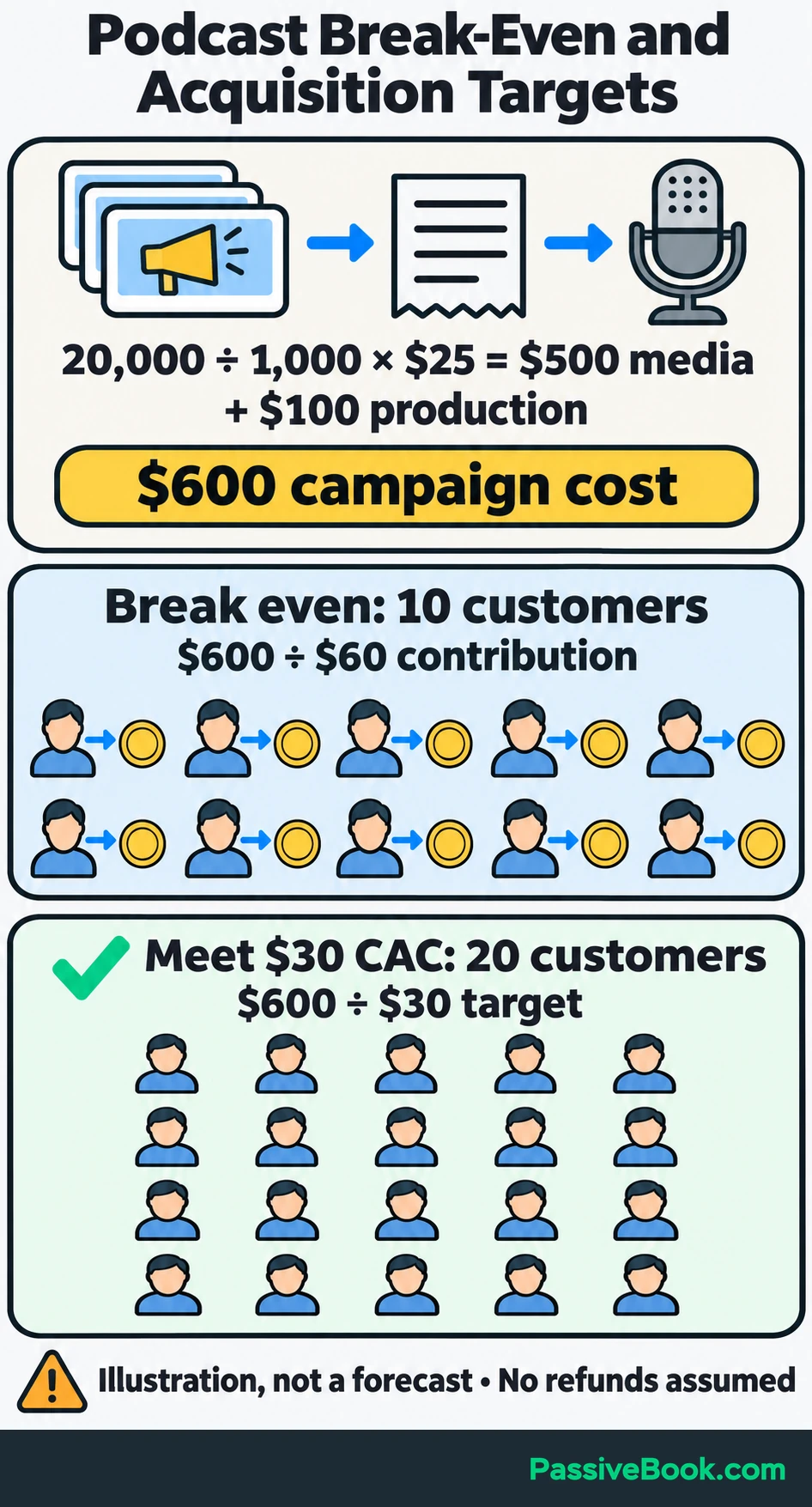
To meet the tighter $30 acquisition-cost target, you need 20 new customers.
These figures assume no refunds and demonstrate the calculation; they aren’t a forecast. Use the initial purchase unless you already have reliable evidence of repeat purchases.
Set your maximum affordable loss before booking. For a prepaid, nonrefundable placement, treat the whole commitment as money at risk.
Before requesting quotes, put a number on what your offer can support. This calculator also works backward from a proposed placement to show the response it would need.
Free Marketing Profit Calculator




Find Podcasts That Reach Likely Buyers
Build a Shortlist Around Audience Fit
Describe the buying situation before searching for shows:
- What problem is the person trying to solve?
- Where do they live, and can you sell to them there?
- What language do they use?
- Why would they want this offer now?
Search podcast apps, show websites, episode topics, and advertising catalogs. Ask existing customers which shows they listen to and why.
For the grooming course, investigate everyday dog-care shows. Then check whether listeners want to do basic grooming themselves. A show aimed at professional groomers could attract people who already know what your beginner course teaches.
Listen to several recent episodes, including the ads. Check the host’s tone, competing offers, number of ad breaks, and any content you wouldn’t want beside your brand. Also check whether the show publishes regularly.
Find the official sponsorship contact and request a media kit, audience information, available formats, and a complete quote.
Compare Audience and Delivery Evidence
Ask for recent episode reports measured over the same period. For example, compare downloads during each episode’s first 30 days, rather than mixing a week-old release with one that has accumulated downloads for a year.
Look across several episodes so one unusually popular guest doesn’t set your expectations. Request audience geography and ask how demographic estimates were gathered and when.
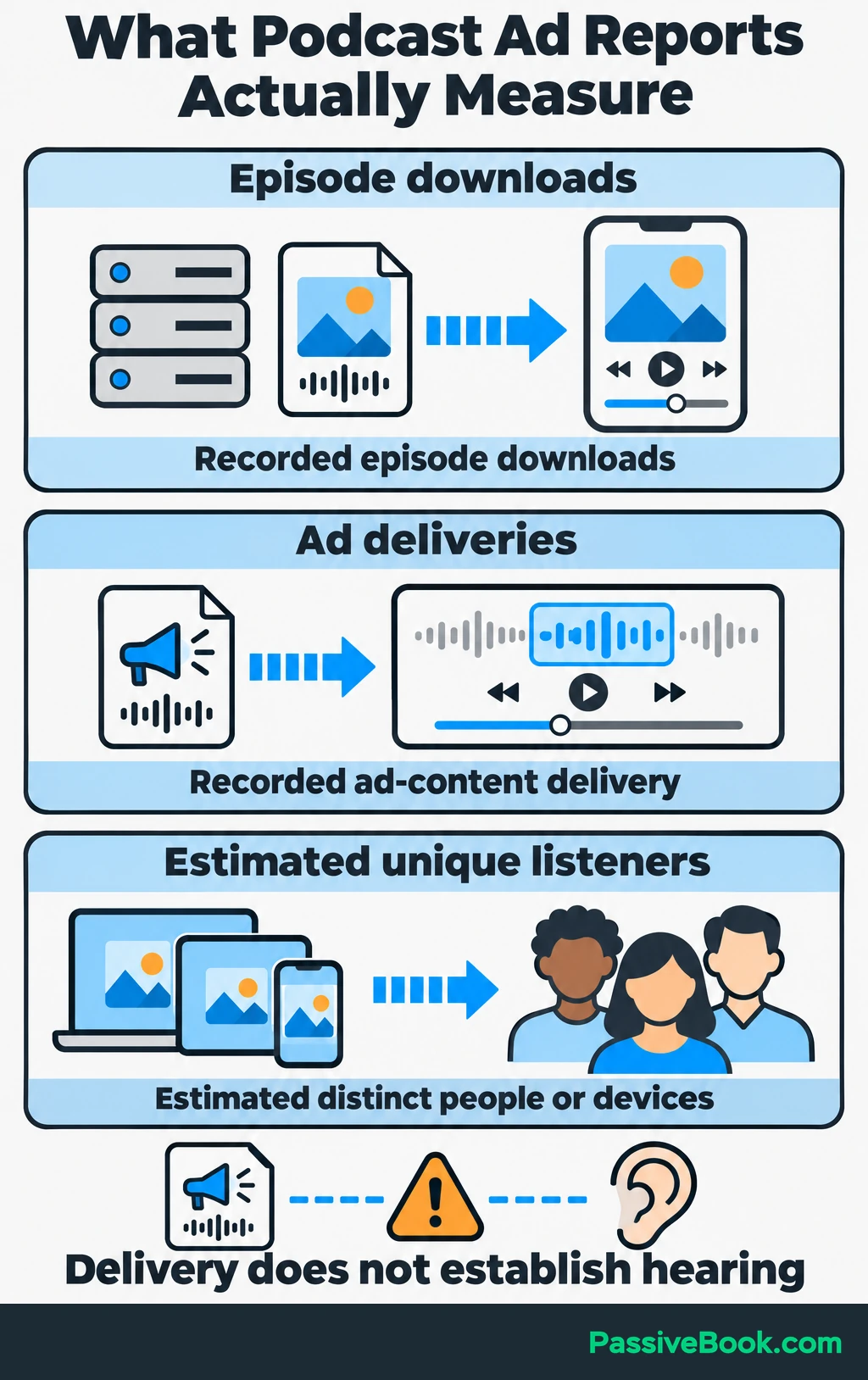
Keep these measures separate:
- Episode Downloads: Recorded downloads of the episode, according to the provider’s measurement rules.
- Ad Deliveries: Recorded delivery of the ad content.
- Estimated Unique Listeners: An estimate of distinct people or devices, rather than total deliveries.
Server-side delivery doesn’t establish that a person heard the message. The IAB Tech Lab’s measurement guidance distinguishes ad delivery from client-confirmed playback.
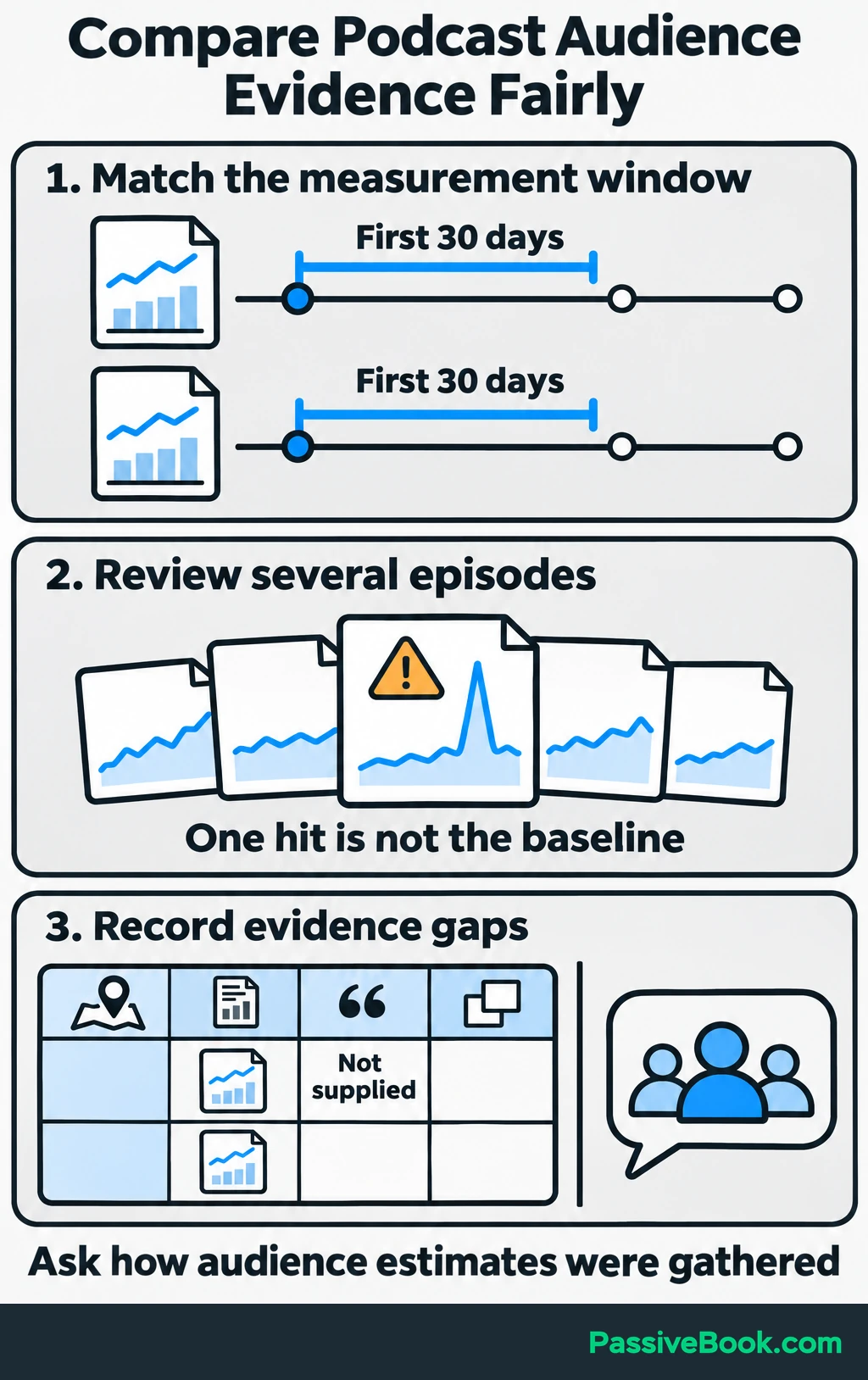
Use a comparison sheet with one row per show. Record audience fit, geography, recent delivery evidence, available placement, full quote, reporting, and content concerns.
Write “not supplied” where evidence is missing. Don’t let an attractive audience description quietly become verified audience data.
I would favor a smaller, relevant show with affordable terms and useful reporting over a large show whose main selling point is being large.
Choose Where to Buy Podcast Ads
Choose the buying route that gives you the audience and format you need with a commitment you can afford.
| Route | Where to Buy | What You Can Buy | Your Work |
|---|---|---|---|
| Direct booking | A show’s host or sales representative | A placement on a named show, host-read or produced as agreed | Request a quote, negotiate terms, and brief the host |
| Show-specific marketplace | Acast | Host-read sponsorships on participating shows | Compare show quotes, submit the brief, and approve the read |
| Audience-based network | AudioGo | Produced ads delivered across shows to your selected audience | Set targeting and budget, supply audio, and monitor delivery |
| Podcast inventory platform | Spotify Ads Manager | Produced ads in podcast inventory with available targeting | Select podcast inventory, submit audio, and review results |
Acast offers host-read sponsorships through its platform and advertises campaigns starting at $500 on its US-facing page. That doesn’t mean every show is available at that price. Check Acast’s advertising options and obtain the show’s quote.
AudioGo offers audience-based podcast buying and advertises a $250 USD starting campaign budget. Its podcast advertising page explains that model.
Spotify Ads Manager also offers podcast-only inventory for produced audio campaigns. Select that inventory deliberately when podcasts are the intended purchase; see Spotify’s podcast inventory guidance.
For a first test, I would start with a well-matched show if you can get a clear quote and usable reports. Choose a network package when its targeting better matches your buyer or direct coordination would consume too much time.
Managed support is worth considering when it saves enough work to justify its fees. A platform minimum only tells you the entry price. It doesn’t establish a sufficient test budget.
Agree on the Placement Before Paying
Send a short inquiry explaining your offer, the audience connection, preferred format, budget range, and dates.
Here’s a complete message you can adapt:
Subject: Sponsorship inquiry for [show name]
Hi [name],
Your recent episodes about everyday dog care look relevant to Home Groom Basics, our beginner at-home dog-grooming course.
We’re considering a small host-read test during [date range], with a total budget of [amount].
Could you share available placements, pricing including additional fees, audience geography, and delivery reports for several recent episodes using the same measurement window?
Please also let me know the creative deadlines, approval process, reporting provided, and terms for missed reads or underdelivery.
Thanks,
[name]
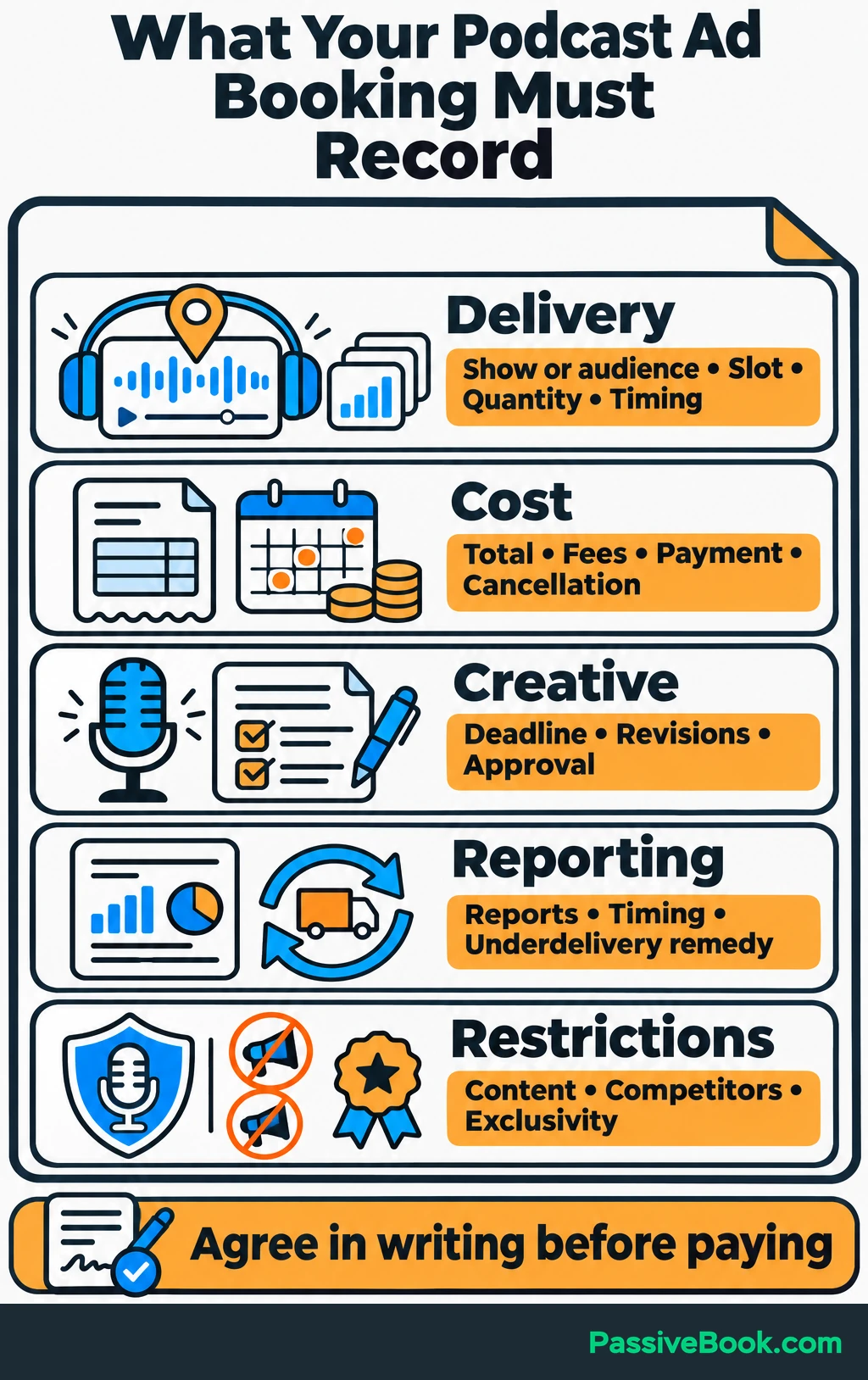
Before paying, get the agreement in writing. It should cover:
- Delivery: Named show or audience package, ad length, episode position, number of placements or billable impressions, and dates.
- Cost: Total price, additional fees, payment schedule, and cancellation terms.
- Creative: Submission deadline, revisions, approval rights, and final recording or brief.
- Reporting: What you receive, when you receive it, and the remedy for missed reads or underdelivery.
- Restrictions: Content exclusions, competing advertisers, and any category exclusivity.
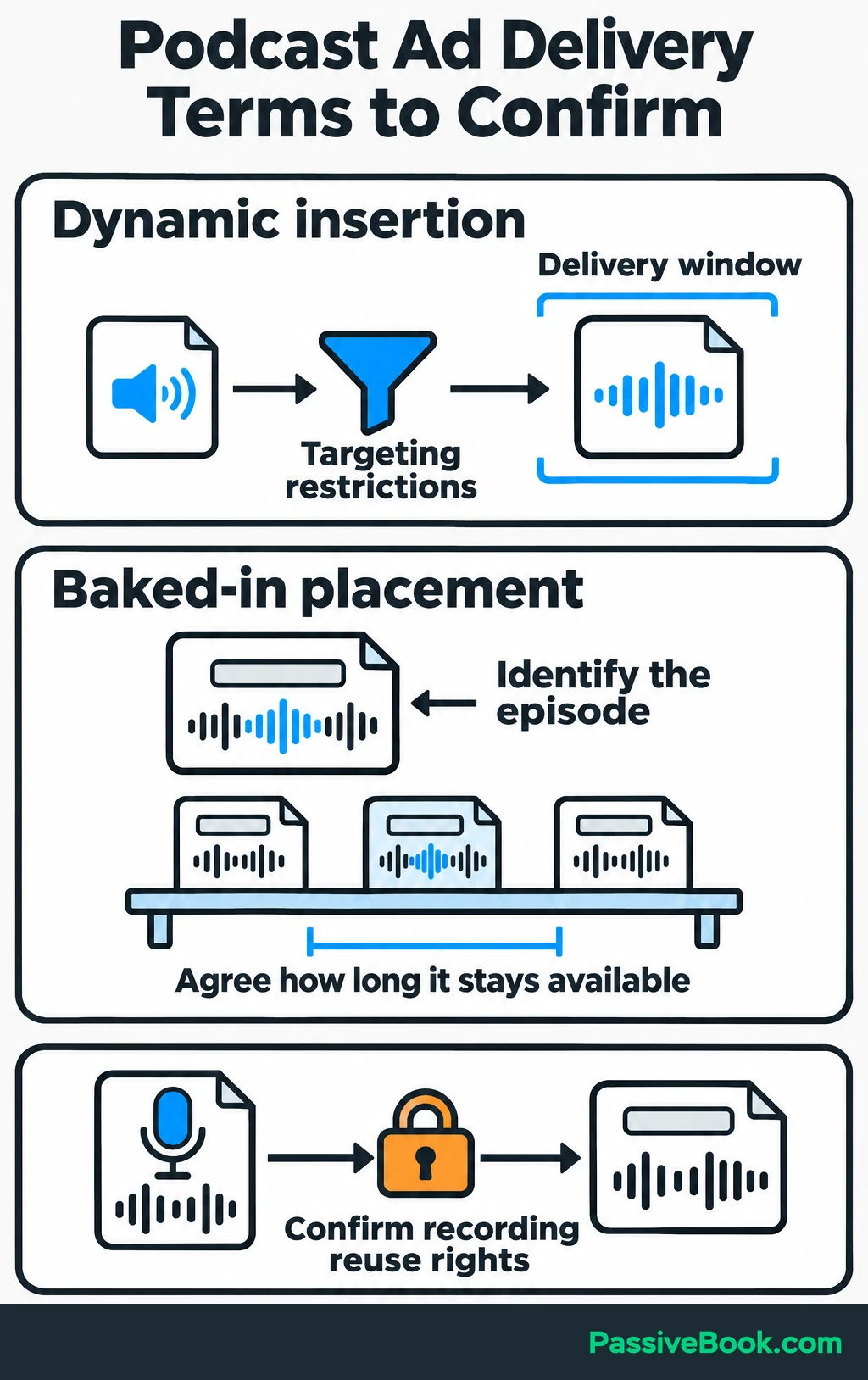
For dynamic ads, record the delivery window and targeting restrictions. For baked-in ads, identify the episode and how long the placement will remain available. Agree on recording reuse rights if you want to run the host’s read elsewhere.
Keep this booking record beside the delivery reports. It gives you something concrete to check.
Create an Audio Ad With One Clear Next Step
Build the message around a recognizable problem, your offer, a concrete benefit, and one call to action.
Write for someone listening while doing something else. Use short sentences, pronounce the brand clearly, and give a destination they can remember. A long web address with punctuation is an excellent way to advertise your punctuation.
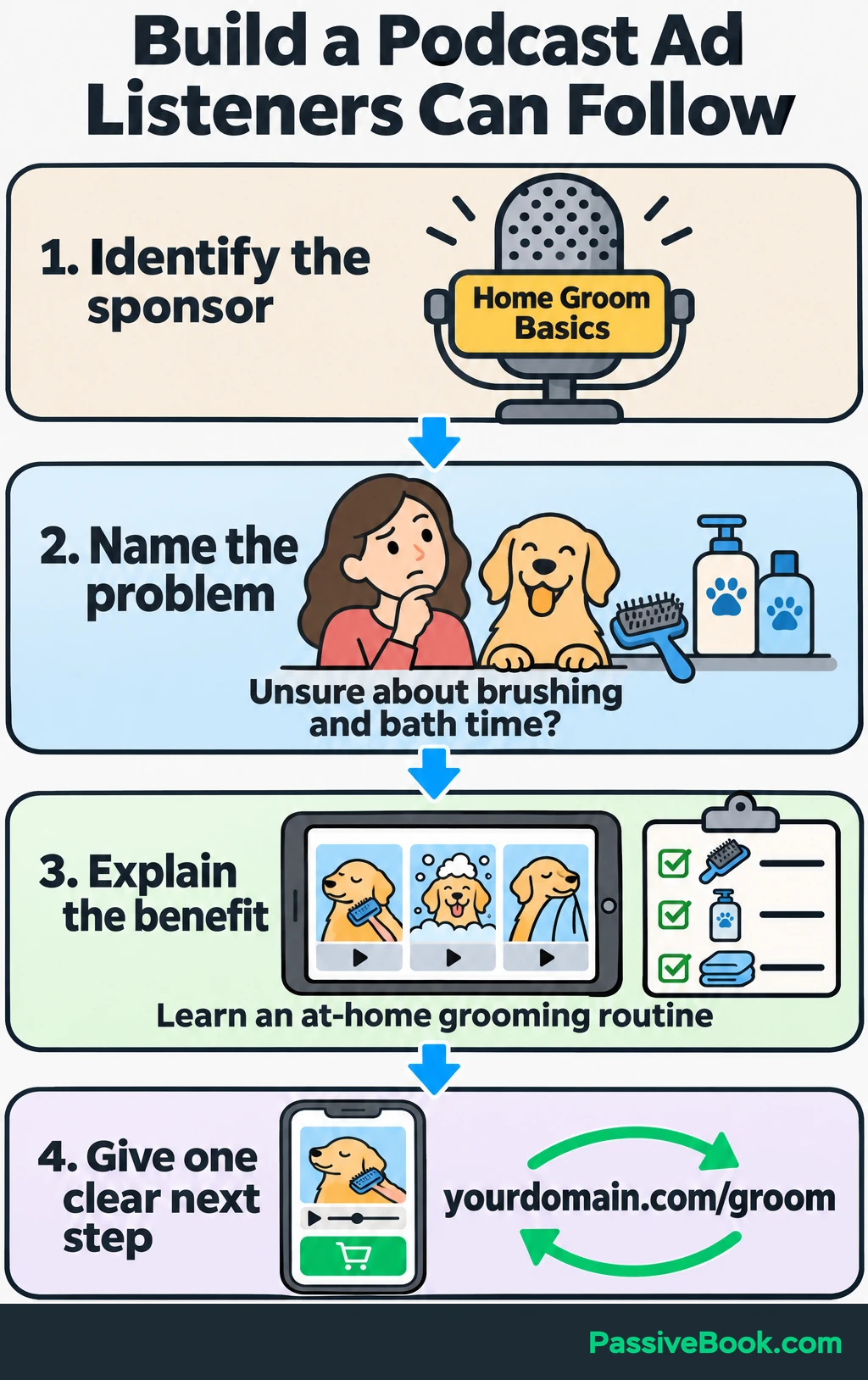
Here’s a complete sample for the course. Replace the bracketed address with your actual short URL:
This episode is sponsored by Home Groom Basics.
Not sure where to start with brushing and bath time? Home Groom Basics is a beginner course for learning an at-home grooming routine.
Follow the video lessons through brushing, bath preparation, and drying, and use the included checklist to keep your supplies organized.
See what’s inside the course at [your domain] slash groom. That’s [your domain] slash groom.
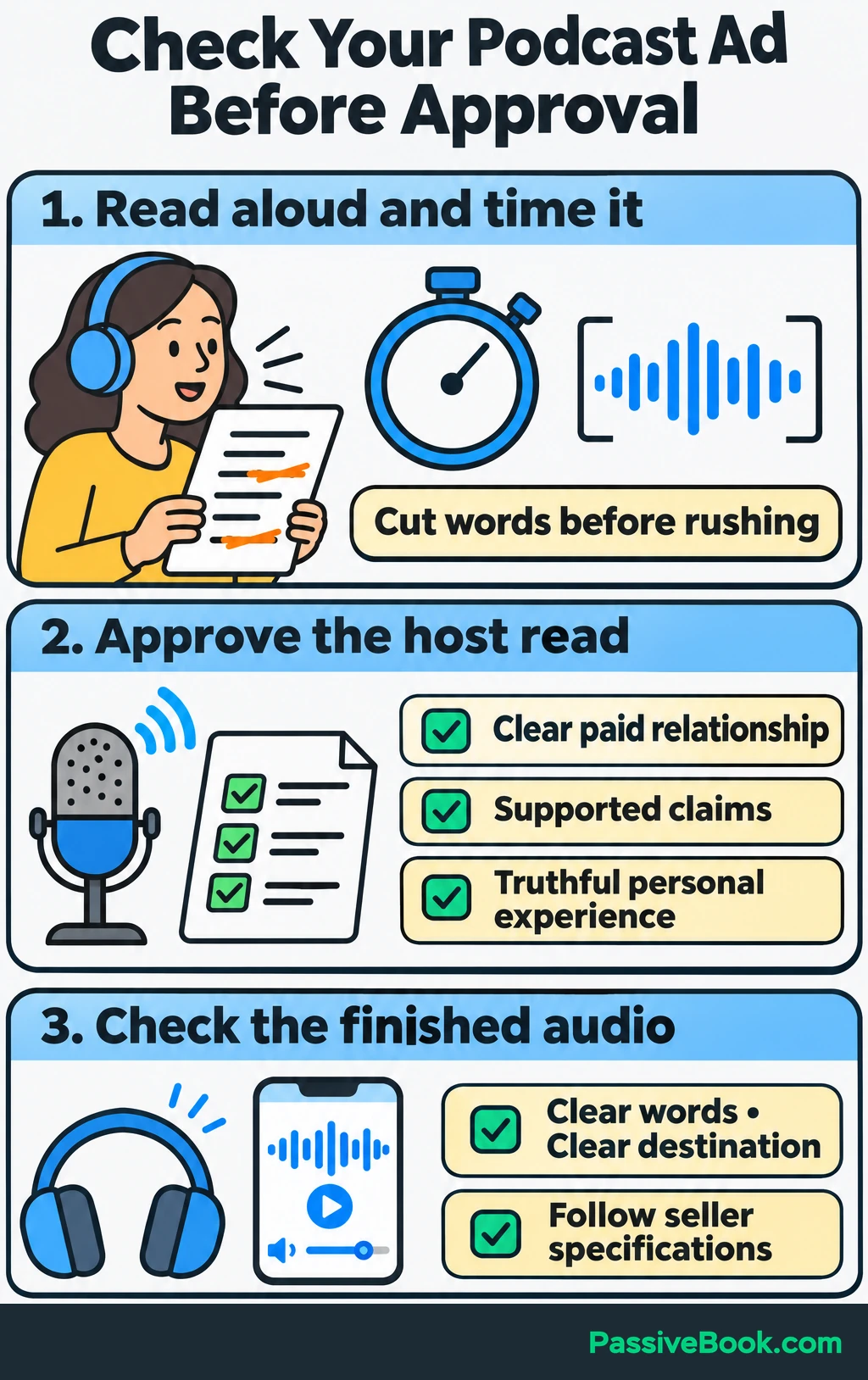
Read it aloud and time it against the purchased slot. Cut words before speeding up the final line.
For a host-read placement, supply approved talking points, pronunciation guidance, essential facts, and the exact call to action. Let the host use their normal delivery, but agree on approval of the finished read.
The grooming example gives you the structure, but your offer needs its own reason to act. This AI Skill drafts the read and host brief from your facts, with the same offer carried through to the landing page.

Free AI Advertising Studio
For US host endorsements, make the paid relationship clear in the audio, support the claims you make, and ensure personal-experience statements reflect the host’s actual experience. The FTC’s endorsement guidance explains these requirements. Don’t put “I use this every week” into a host brief unless it’s true.
For a produced spot, follow the seller’s recording specifications. Listen to the finished file on ordinary headphones and a phone speaker. Check unclear words, distracting music, and whether the destination gets enough time.
Set Up Conversion Tracking Before Launch
Send listeners to a mobile-friendly page that repeats the offer and leads directly to the intended action. For the course, show the lessons, price, relevant product details, and a clear way to buy.
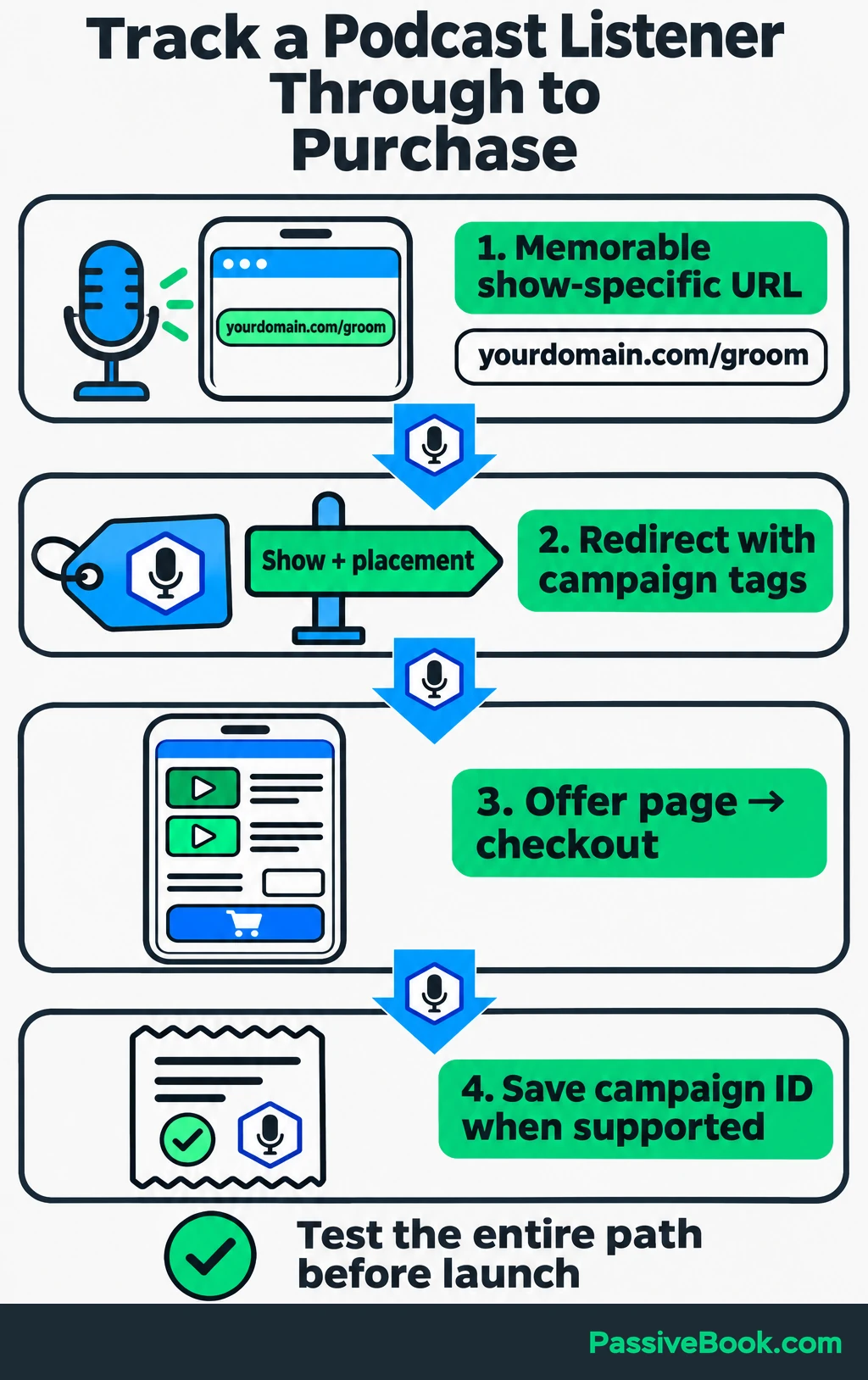
For the sample ad, use yourdomain.com/groom and reserve a different short address for each additional show. Redirect each address to the offer page with campaign tags identifying the show and placement. Your analytics tool uses those tags to record the visit’s source. Give an audience-based package its own campaign name.
Use several signals together:
- Tracked Visits: Track visits from each show’s tagged link and save the campaign identifier with the order when your checkout supports it.
- Checkout Codes: Give each show a distinct code when useful. A source code doesn’t require a discount.
- Customer Answers: Ask an optional post-purchase question: “Where did you first hear about us?” If they choose podcast, ask which show.
Customers may hear the ad and later search for your brand. In ADOPTER Media’s Ollie case study, the agency describes a customer who reported discovering Ollie through a podcast but purchased through branded search using the standard welcome offer. That illustrates why codes alone can miss relevant purchases.
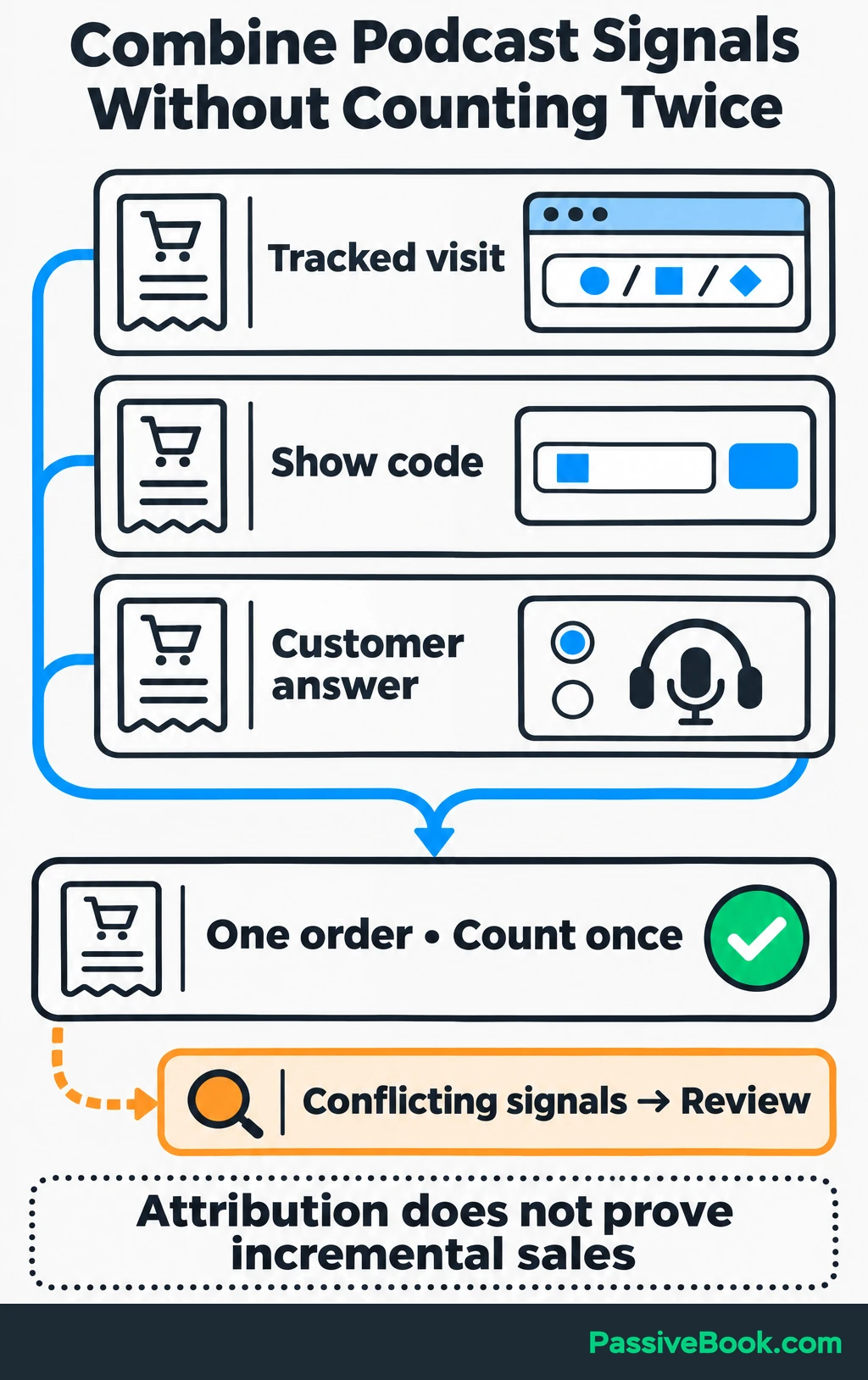
Record each order once, with new-customer status, revenue, refunds, and its tracking evidence. Decide beforehand how to handle overlapping signals. For example, count an order with both a show code and a matching survey answer once for that show, and flag conflicting answers for review.
These signals help you credit purchases to a campaign, but they can miss influenced sales and can’t show which customers would have bought anyway.
Before launch, test the spoken URL, redirect, mobile page, checkout, campaign identifier, and recorded purchase event.
Launch a Focused Test
Choose a small number of relevant shows or one clearly defined audience package. Spreading a limited budget across many placements can leave you with too little evidence about any of them.
Keep the offer and core message consistent when comparing placements. Write down:
- Primary Result: Purchases by new customers.
- Cost Target: The maximum acceptable acquisition cost.
- Commitment: Purchased reads or billable impressions.
- Spending Limit: The full amount at risk.
- Review Date: A date that allows for delivery and the offer’s normal buying cycle.
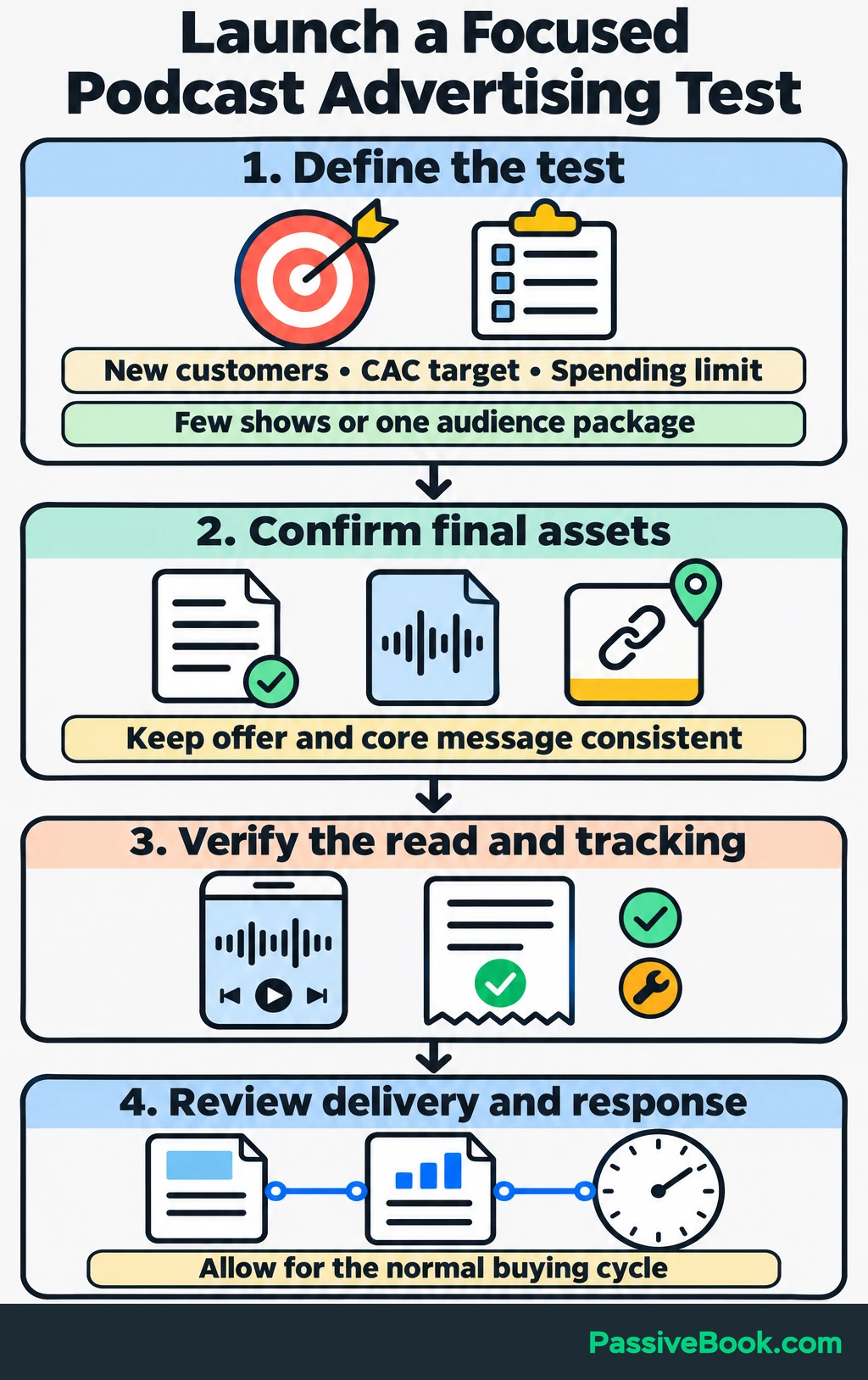
Allow time for production, approval, purchased delivery, and listener response. A course that people consider for several days needs a different review window from an immediate low-cost purchase.
Submit the approved recording or host brief, destination, and tracking details, and confirm the seller has the final versions.
Get a preview or recording to check pronunciation, the call to action, placement, and agreed content restrictions. Compare delivery reports with the booking. Fix broken tracking or an incorrect read promptly, and request replacement delivery when the agreement provides for it.
Evaluate ROI and Decide What to Change
Calculate Acquisition Cost and Campaign Return
Check actual delivery and spending against the booking, then total the revenue, refunds, and variable costs from purchases attributed to the campaign. Replace the planning refund allowance with actual refunds so you don’t subtract them twice.
Customer acquisition cost divides the full campaign spend by the number of attributed new customers. Media return on ad spend (ROAS) divides attributed revenue by media spend.
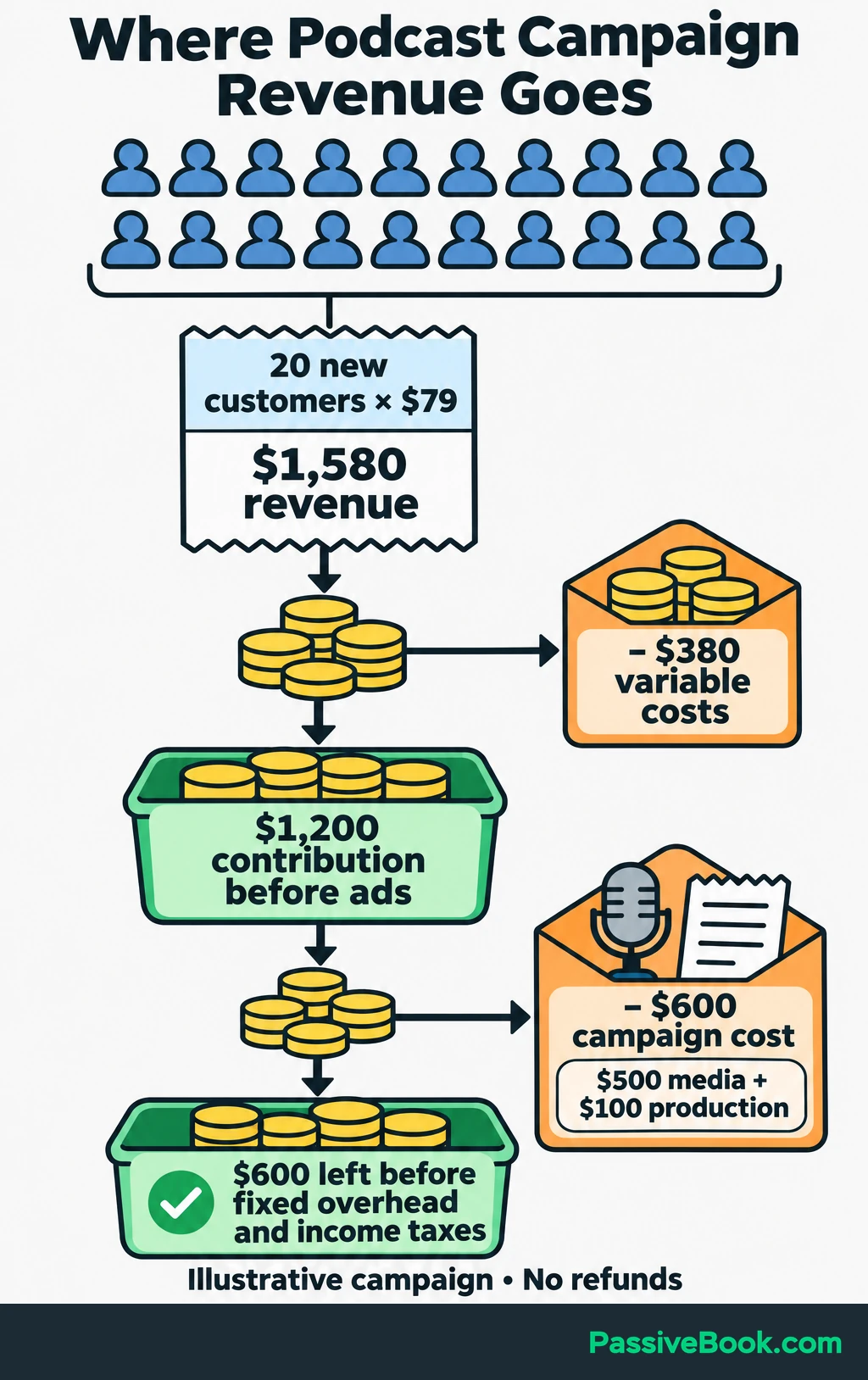
For campaign ROI, first subtract refunds and variable costs from attributed revenue to find contribution. Subtract the full campaign cost from that contribution, then divide the remainder by campaign cost and express it as a percentage.
Suppose the course campaign brings 20 new customers, with no refunds:
| Measure | Calculation | Result |
|---|---|---|
| Revenue | 20 × $79 | $1,580 |
| Contribution before advertising | 20 × $60 | $1,200 |
| Full campaign cost | $500 media + $100 production | $600 |
| Customer acquisition cost | $600 ÷ 20 | $30 |
| Media ROAS | $1,580 ÷ $500 | 3.16 |
| Campaign ROI | ($1,200 − $600) ÷ $600 × 100 | 100% |
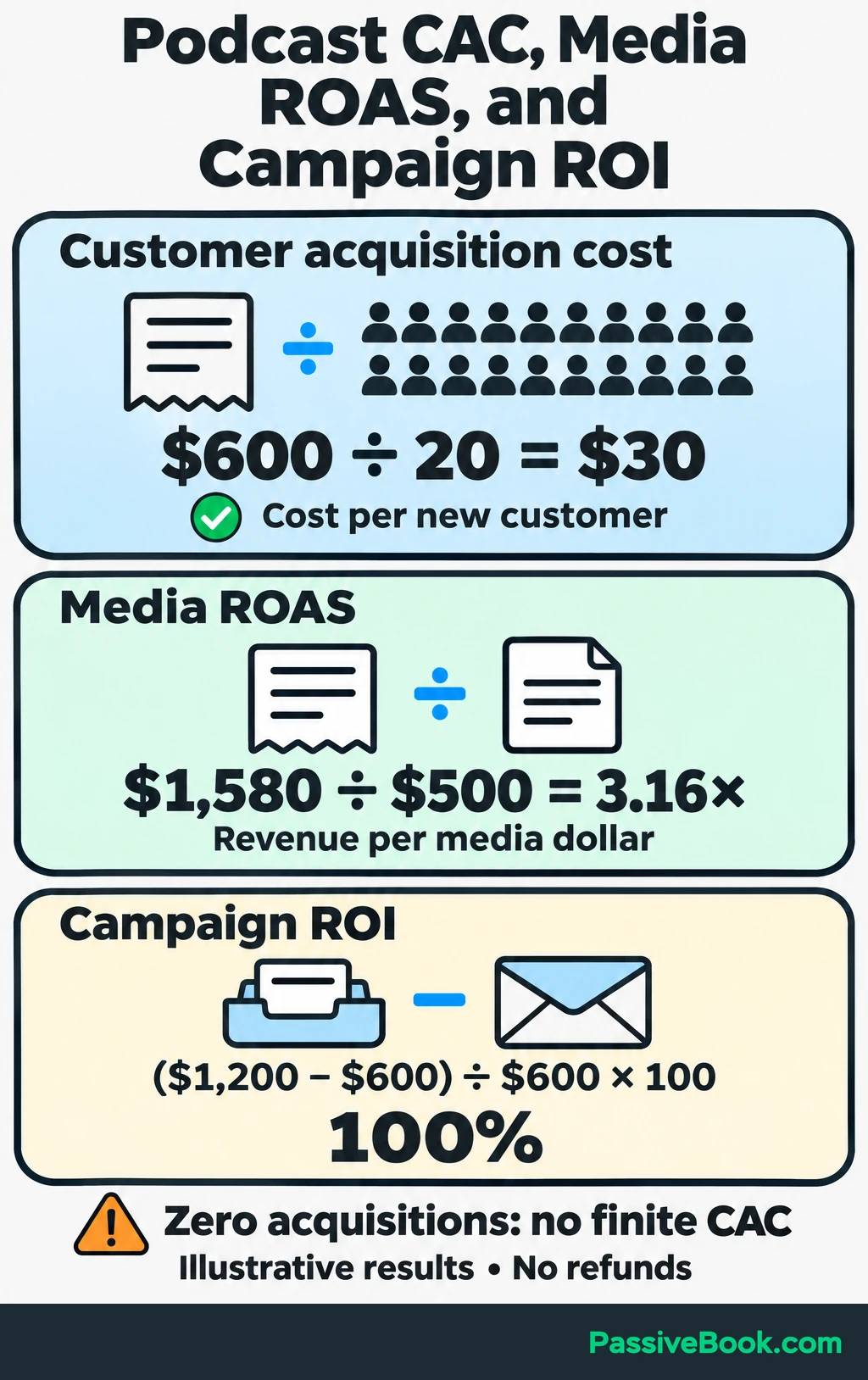
The campaign meets the $30 acquisition-cost target and leaves $600 before fixed overhead and income taxes.
ROAS alone wouldn’t tell you that. Revenue can look healthy while production, fulfillment, and other costs consume the return.
If there are no attributed new customers, report zero acquisitions and the amount spent. There’s no finite acquisition cost to calculate.
Repeat, Revise, or Stop
Keep one review row per show or audience package. Include full cost, delivered impressions, landing-page visits, qualified leads if relevant, new customers, revenue, contribution, and acquisition cost.
When results are weak, investigate in this order:
- Check delivery and tracking. Confirm the ad ran correctly and the purchase path worked.
- Review audience fit and response. Revisit who the placement reached and whether the message addressed their problem.
- Inspect the page and offer. Look for unclear details, unexpected costs, or friction between the ad’s promise and checkout.
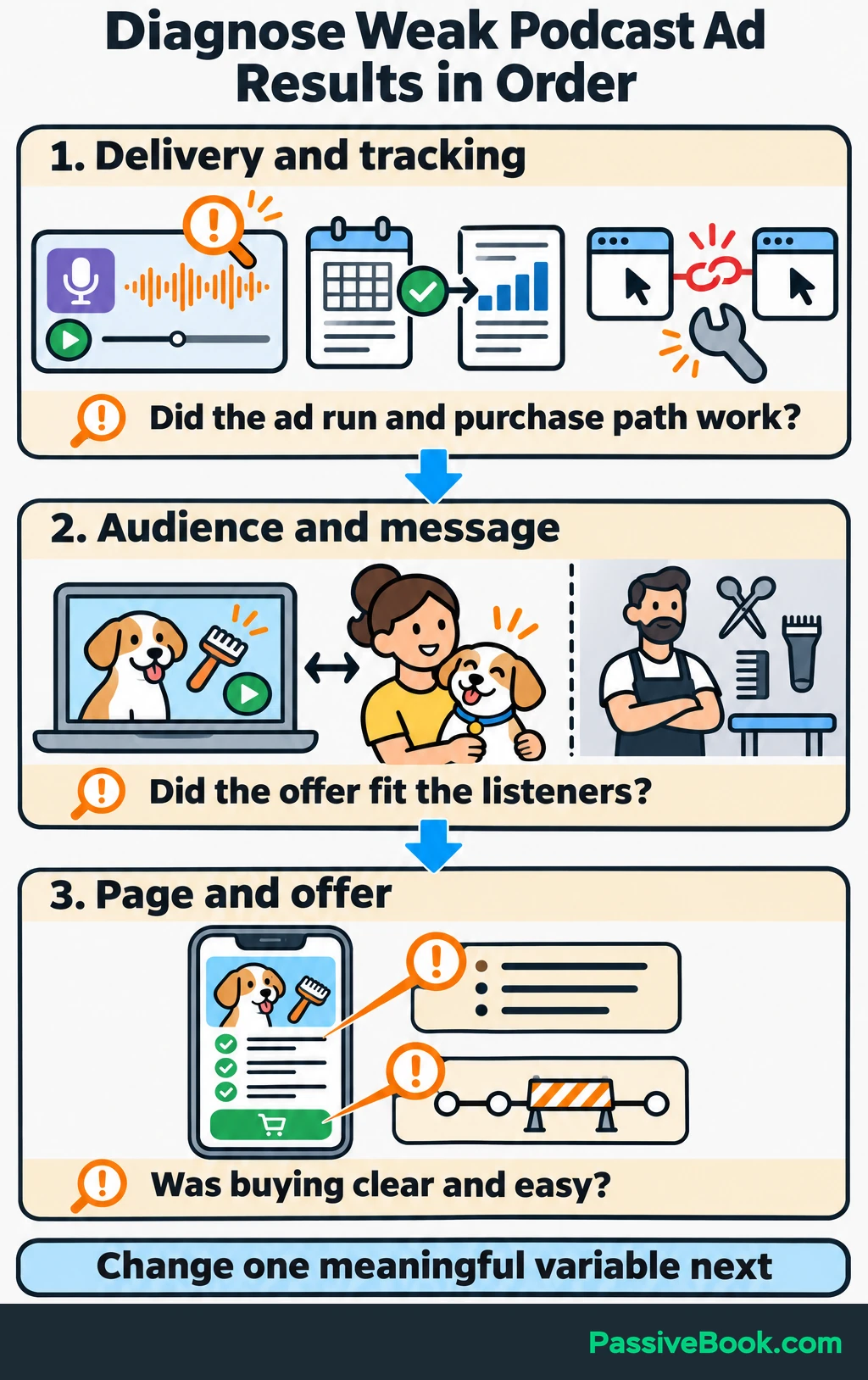
Change one meaningful variable in the next test. Rewriting the ad, replacing the page, changing the price, and buying a different show leaves you guessing about what helped.
Repeat placements that meet your acquisition-cost target and bring suitable customers. Increase commitments gradually and check whether those economics hold as spending grows.
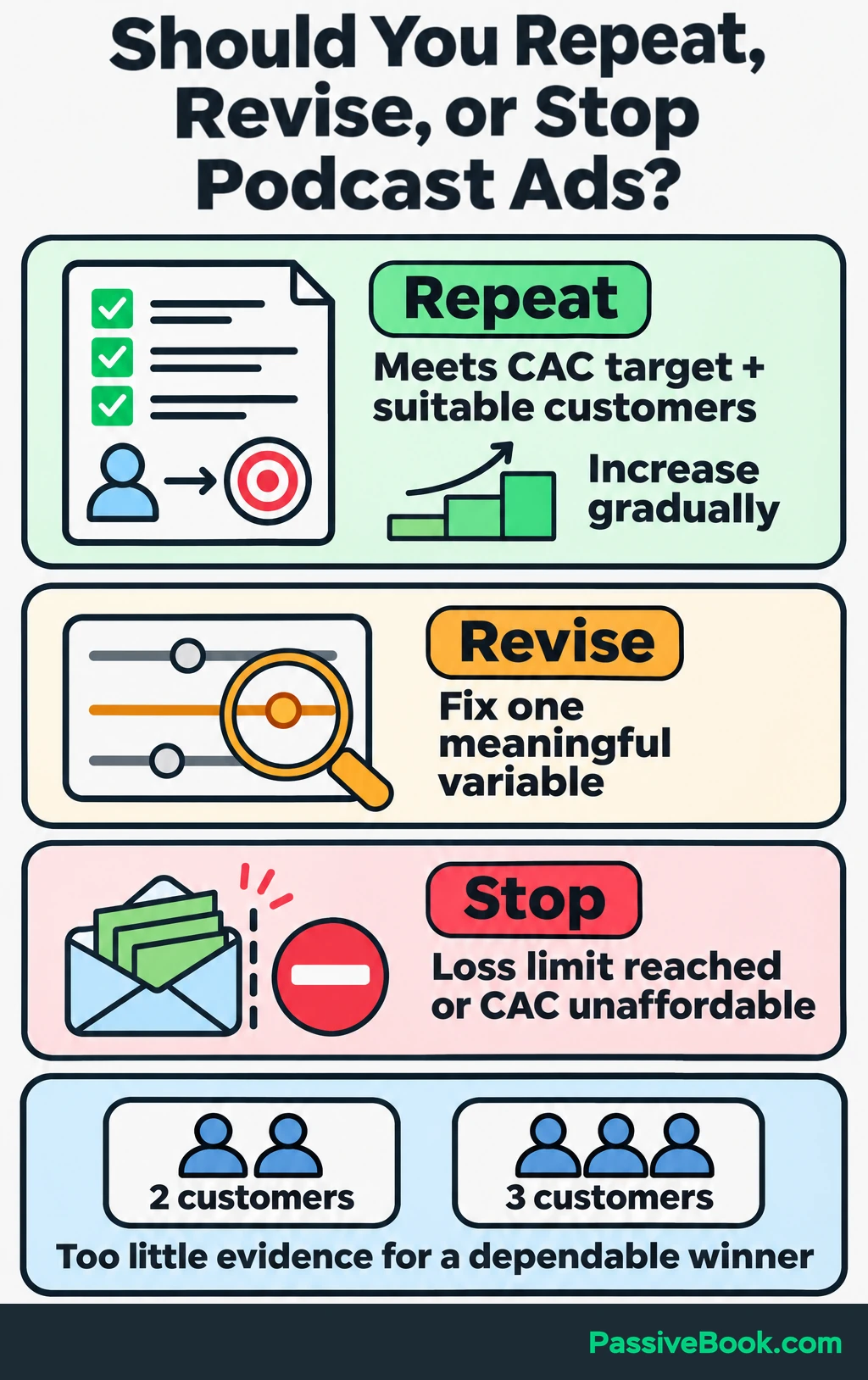
Stop when you reach the agreed loss limit or the offer can’t support the acquisition cost. You don’t owe a channel another test because the host was pleasant.
Also give small results their proper weight. One placement bringing two customers and another bringing three is a weak basis for declaring a dependable winner.
What Next?
Calculate what one sale leaves before advertising, then use that amount to set your acquisition-cost target before requesting three relevant podcast quotes.
Use the social buttons to share this guide when you’re comparing campaign ideas with a partner or team. Agreeing on the budget and tracking before booking makes those conversations more useful.
Which part of your first test needs the most work: choosing the audience, setting the budget, or tracking purchases? Share your answer in the comments, and bring any other questions too.
Share this post with your friends & followers:

