I’ve built products nobody wanted. Three months of late nights creating a course, only to hear crickets when I launched. That failure taught me the most valuable lesson: test demand before you build.
Webinars became my validation tool because they force people to invest time, not just click “yes” on a survey. If you’re working a day job and squeezing business ideas into your spare hours, you can’t afford to waste three months and $500-2,000 building something the market doesn’t want. Webinar-based idea validation lets you test real buying intent with strangers in a single week, spending less than $100 – before you commit months to build business infrastructure that nobody wants.
- •What Business Idea Validation Using Webinars Is
- •Why Webinars Outperform Surveys and Landing Pages
- •Why Most Idea Validation Attempts Fail
- Setting up Your First Validation Webinar on a $0 Budget
- Structuring Your 60-minute Validation Webinar
- Reading Validation Signals and Making Your Decision
- •Common Validation Mistakes That Create False Positives
- •Modern Tools: Using AI to Accelerate Webinar Validation
- •Frequently Asked Questions
- •What Next?
What Business Idea Validation Using Webinars Is
Webinar validation means hosting a live teaching session before your product exists. You’re not selling a finished course or digital product. You’re teaching a mini-lesson to measure whether strangers will pay you to solve their problem.
This approach works because it tests behavior, not opinions. Anyone can say they’d buy your course in a survey. Showing up to a 60-minute live session proves genuine interest.
Course creators like those on Mariah Coz’s platform use this rapid validation method to pre-sell courses that don’t exist yet. I know this sounds backwards – teach something you haven’t built? It felt like fraud the first time I did it. But here’s the thing: you’re not pretending to have a finished product. You’re openly testing whether people want you to build it.
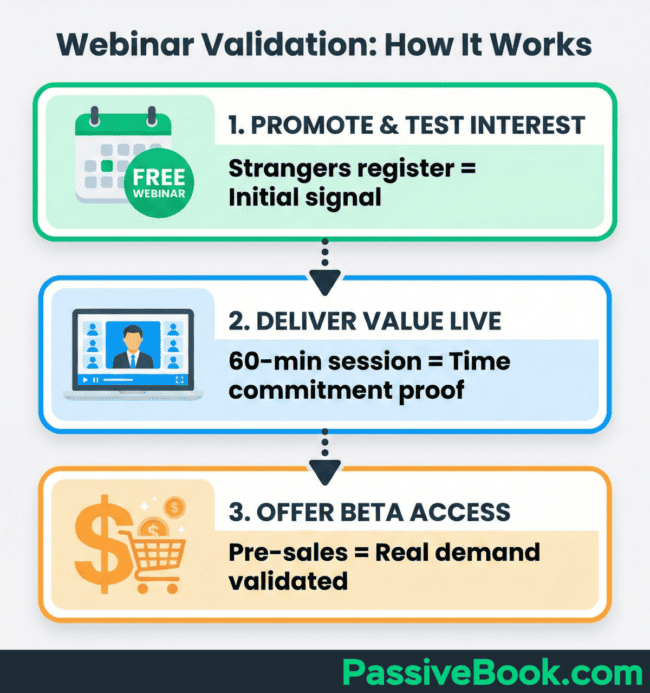
The process looks like this: you promote a free webinar on your proposed topic, deliver real value during the session, then offer discounted early access to the full course you’ll build if enough people buy.
Registration numbers show initial interest. Attendance proves time commitment. Pre-sales confirm they’ll pay.
This isn’t the same as surveys or focus groups. Those methods measure what people think they want. Webinars measure what they’ll actually do when you ask for money.
Why Webinars Outperform Surveys and Landing Pages
Live interaction reveals buying intent that passive methods miss entirely. When someone registers for your webinar, they’re giving you their email. When they show up live, they’re investing an hour. That time commitment filters out casual browsers from serious potential customers.
Research shows 73% of B2B webinar attendees become qualified leads, far exceeding what you’ll get from landing page signups or survey responses.
That’s a business context, but the principle applies to course creators: webinar attendees are pre-qualified by their time investment. The difference is engagement quality. A landing page visitor might spend 30 seconds skimming your headline. A webinar attendee spends 60 minutes listening to you teach.
Webinars with 50-100 attendees convert at 5-20% to paying customers. That means if 50 people show up and 5 buy your beta offer, you’ve validated real demand. No survey will give you that certainty.
The Q&A section during your webinar tells you everything.
Justine, a first-time course creator in Mariah Coz’s Rapid Validation program, tracked questions about pricing and timelines during her live session.
The 8 attendees who asked “When does beta access start?” all became paying customers.
Chat engagement shows whether people see themselves in your solution. Someone asking “Would this work for [their specific situation]?” is mentally positioning themselves as a buyer. Average webinar attendance rate is 56% from registrants to viewers, which means registration alone doesn’t validate anything. You need people to show up and engage.
Why Most Idea Validation Attempts Fail
I spent two months surveying my email list about a productivity course idea. The responses were overwhelmingly positive – 78% said they’d “definitely buy it.” I built the course. Seven people purchased. The problem wasn’t my teaching or the content quality. I had measured polite interest instead of buying behavior.
Research shows outdated webinar formats cause 35% to fail due to unclear goals and tracking the wrong metrics.
Most creators ask “Would you buy this?” and interpret yeses as validation. People want to be encouraging. They’ll tell you your idea sounds great because they don’t want to discourage you.
Testing with friends and family creates even worse data. Your network wants to support you personally. Their feedback reflects their relationship with you, not the market’s willingness to pay for your solution.
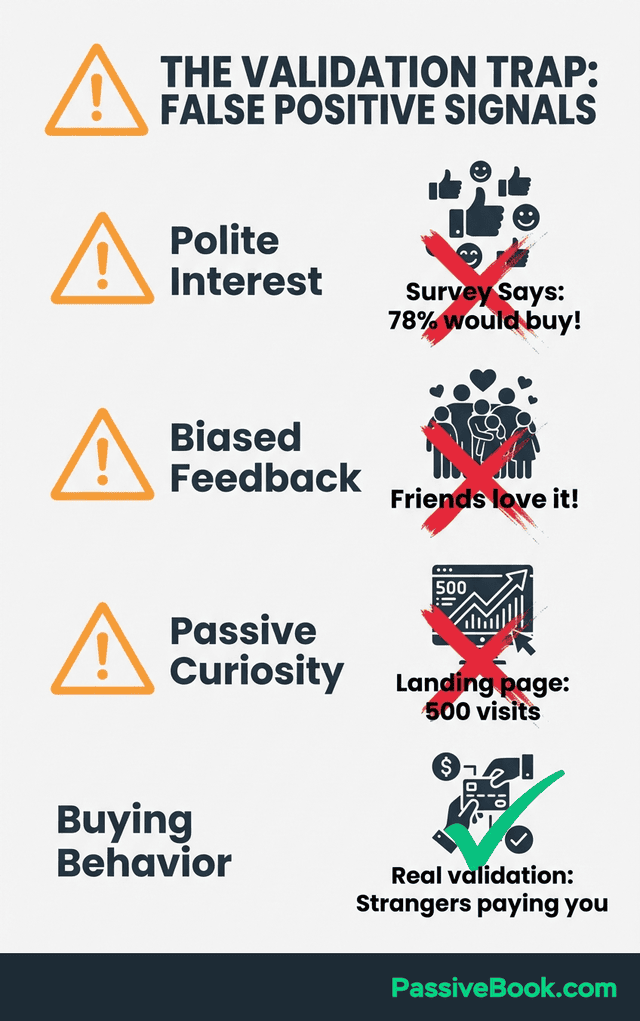
The validation trap looks like this: you get enthusiastic survey responses, positive feedback from your inner circle, and high landing page traffic from people you know.
You build business assets – course content, email sequences, sales pages – for months. Then you launch to strangers and discover none of those signals predicted actual sales.
Webinars force you to test with people who have no emotional investment in your success. If strangers won’t give you an hour of their time or $50 for early access, you’ve learned something valuable before wasting months building.
Setting up Your First Validation Webinar on a $0 Budget
You can test your business idea with a total investment under $100.
Most of that cost goes to promoting your webinar registration page. The webinar platform itself can be free, and you’ll build your presentation with tools you already have.
This approach prioritizes speed over polish. You’re testing demand for an idea, not launching a finished product. Free platforms provide everything you need to validate with 20-50 attendees. Anything more sophisticated than that is premature optimization.
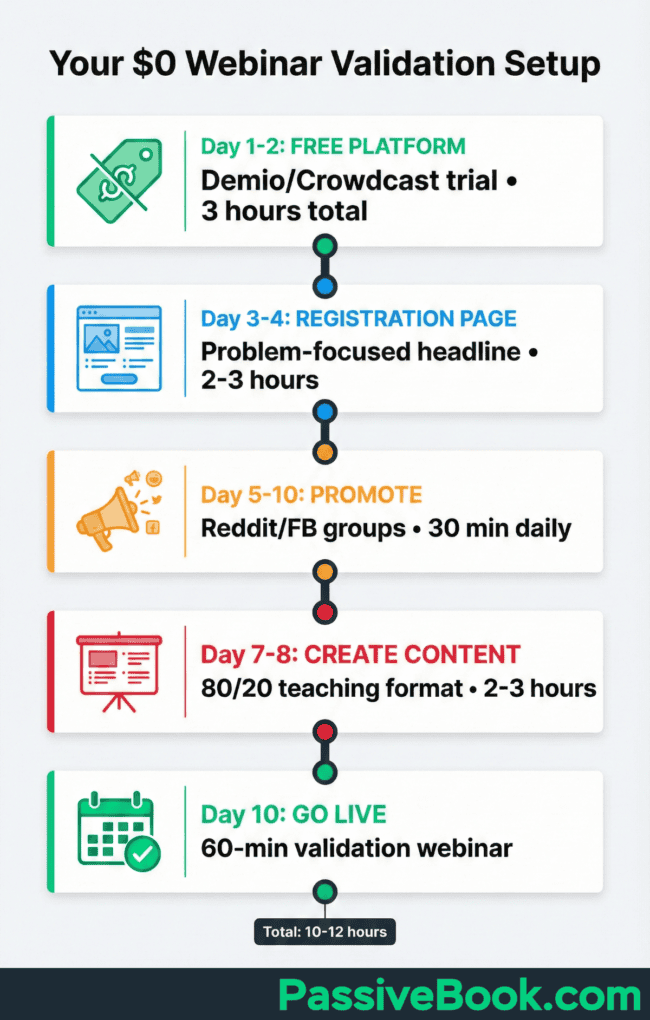
Focus on getting your first validation webinar scheduled within 7-10 days of deciding to test an idea. Seven days might sound insane if you’re used to overthinking every business decision (guilty). But the faster you test, the less time you waste if the market tells you to pivot.
If you’re squeezing this around a day job, block your calendar like this: two evenings for platform setup and presentation creation (3 hours total), one weekend afternoon for registration page and promotional content (2-3 hours), then 30 minutes daily for promotional outreach during your lunch break or morning commute. The entire validation process fits into 10-12 hours spread over 10 days.
Free Webinar Platform Options for Solopreneurs
Demio offers a clean interface with a free trial sufficient for running your first validation test. The platform handles registration pages, live streaming, and chat functionality. You can test your idea before paying anything.
For more robust features including automated recordings and chat moderation, WebinarJam gives you enough time to run 2-3 validation webinars and analyze results before committing to a paid plan.
Crowdcast specializes in interactive sessions with built-in Q&A functionality. The free tier limits audience size to 50 people, which is perfect for validation testing. You’re not trying to reach thousands of people yet.
GoToWebinar delivers professional-grade features if you need more polish. Their 7-day free trial covers your first validation attempt. The interface is straightforward enough to set up in an afternoon.
Choose based on learning curve, not features. You’ll spend 30 minutes exploring any of these platforms, not hours. They’re designed for non-technical users. Your validation webinar needs to happen quickly, not perfectly.
Before committing to any platform, review their privacy policy and terms of service. Free trials often include limitations on recording ownership and attendee data rights. Look for platforms that clearly state you retain rights reserved to your webinar content and attendee information, as this data forms the foundation of your validation insights.
Crafting a Registration Page That Converts Cold Traffic
Your registration page has one job: convert strangers into attendees.
Webinar landing pages achieve 25-45% conversion rates when optimized correctly. That means one out of every three visitors should register if you’ve written your page well.
Use a problem-focused headline that addresses a specific pain point. “Join My Webinar” is generic and forgettable.
“How to Validate Your Course Idea in One Week Without an Audience” tells people exactly what they’ll learn and who it’s for.
Ask 3-4 strategic questions beyond email address on your registration form.
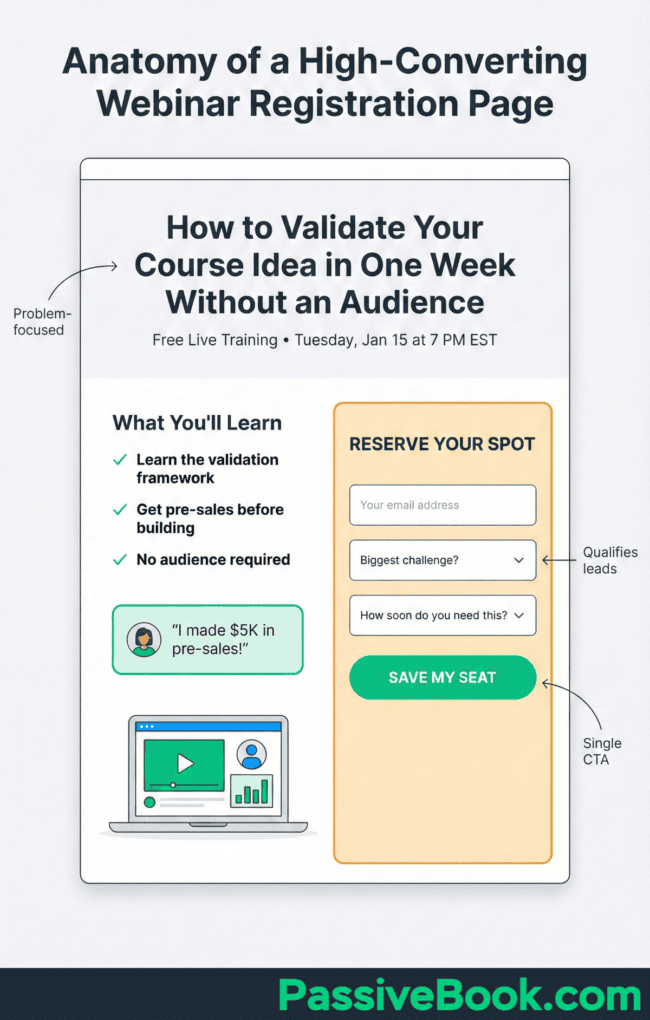
Include “What’s your biggest challenge with [topic]?” and “How soon are you looking to solve this?” These questions assess buyer fit and urgency.
Someone who says “I need a solution this month” is a warmer lead than someone who says “Just browsing.”
Simple pages convert better. One headline, three bullet points explaining what attendees will learn, a single call-to-action button, and your registration form. No navigation menus, no sidebar links, nothing that distracts from the registration decision.
The page should take you 2-3 hours to create using a free landing page builder like Carrd or your existing website platform. If you’re collecting registration data, add a brief privacy policy link (even a simple statement about how you’ll use emails) to build trust with cold traffic. Speed matters more than design perfection at this stage.
Promoting Without an Existing Audience
You don’t need an email list to fill a validation webinar.
ON24 benchmarks show 64% register within the final week before the live event, which means you can promote intensively for 7 days and still hit your attendance target.
Target niche communities on Reddit and Facebook groups where your ideal customers already gather.
Join 5-10 relevant groups, contribute helpful comments for 2-3 days to establish credibility.
Then share your webinar with context about why you’re hosting it. Frame it as a test, not a sales pitch.
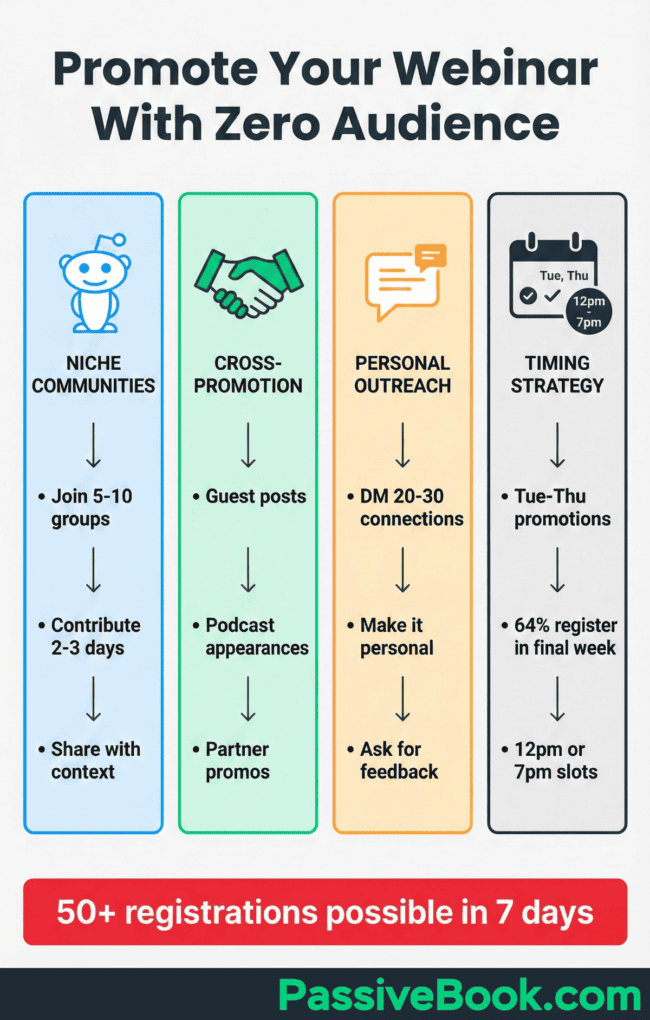
Casey Zeman’s zero-audience webinar strategy proves that guest posting on niche blogs, appearing on relevant podcasts, and strategic co-promotion with complementary creators generates 50+ registrations without an email list. You’re borrowing someone else’s audience in exchange for valuable content.
Jenna from Mariah Coz’s case studies hosted her first validation webinar with only 30 people on her list and made $5,000 in pre-sales. She promoted through relevant Facebook groups, reached out to micro-influencers for cross-promotion, and personally invited connections on LinkedIn.
Direct message 20-30 connections who fit your target customer profile.
Explain you’re testing a new teaching program and would value their feedback. Make it personal and specific to why you think they’d benefit. This isn’t spam if you’re genuinely seeking their input.
Tuesday through Thursday promotions see 30% higher registration rates than other weekdays. Schedule your webinar for 12 PM or 7 PM to catch lunch breaks or after-work hours when your audience isn’t in meetings.
Structuring Your 60-minute Validation Webinar
Research shows 60-minute webinars generate the highest average registrations while maintaining engagement.
Anything shorter feels like a sales pitch. Anything longer and you’ll lose half your audience before the end – trust me, I’ve watched the viewer count drop from 40 to 18 during a 90-minute session I convinced myself people needed.
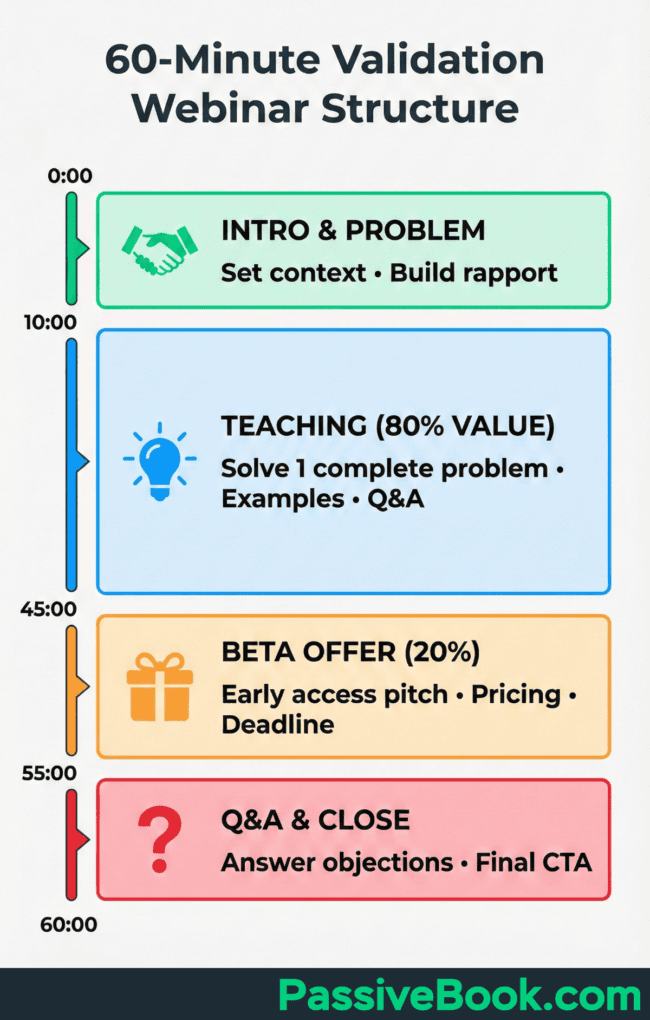
Only 40% of attendees watch until the end, which means you need to front-load your key validation questions and engagement elements. If you’re planning to make a beta offer, you need buying signals from the first 30 minutes, not just the last 10.
Plan your content as if you’re selling, but focus on gathering commitment signals rather than closing deals. You’re testing whether people want this solution badly enough to pay for deeper access.
The 80/20 Teaching Framework
Teach one complete mini-lesson that delivers 80% value before introducing your offer in the final 20% of the webinar. A creator in the rapid validation program made $10,000 from 70 pre-sales using this exact approach.
Your mini-lesson should solve one specific, painful problem your audience faces. If your full course would teach them how to build an entire email marketing system, your webinar teaches them how to write one high-converting welcome sequence. Complete, actionable, valuable on its own.
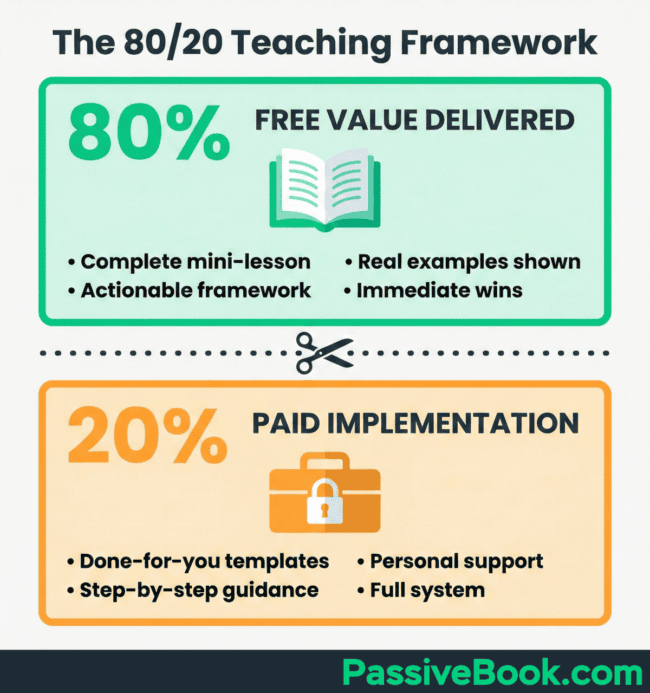
Share your solution framework without giving away the entire implementation. For example, explain the three-email welcome sequence structure, show examples of each email’s purpose, but don’t write the emails for them. They understand what to do but still need help doing it.
This demonstrates your expertise while leaving clear room for paid product value. If you give away everything, they have no reason to buy. If you give away nothing but hype, they won’t trust you’re capable of helping them.
The teaching section should run 35-40 minutes. That’s enough time to deliver one complete lesson with examples and explanation, but not so long that you lose attention before making your offer.
Interactive Elements That Reveal Purchase Intent
Live polls gauge pain points in real-time. Ask “Which challenge costs you the most time weekly?” with 4-5 specific options related to your solution. The winning answer tells you what your paid product should emphasize.
Mentimeter offers free interactive polling that integrates with most webinar platforms. You can create word clouds, multiple choice questions, and scales without upgrading to paid plans. Set up 3-4 polls before your webinar and trigger them at strategic points.
Keep a second device or window open with a Google Doc during your webinar. Copy-paste questions from the Q&A chat as they come in. Mark which attendees ask about pricing, timeline, or implementation details. These are buyer signals that matter more than generic questions.
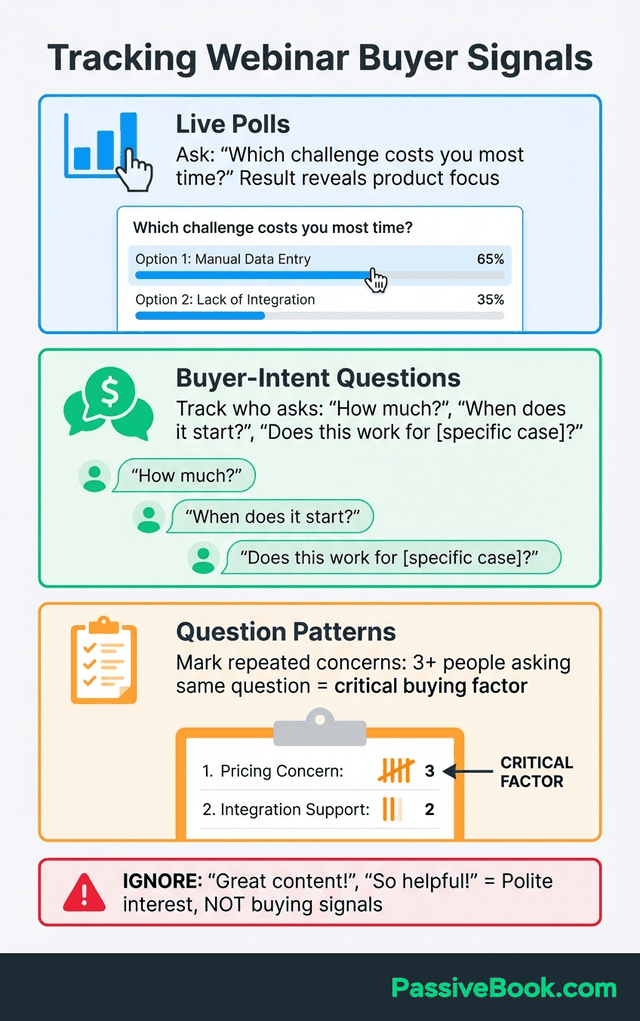
Webinars with Q&A and polls see 30% higher conversion rates than passive presentations. Interaction creates commitment. When someone types a question in chat, they’re investing mental energy in your solution.
Track which questions get asked repeatedly. If three different people ask “How long does it take to see results?”, that’s an urgent buyer concern your sales messaging needs to address. If multiple attendees ask “Can I do this without [specific tool]?”, you’ve identified a barrier to purchase.
The validation gold is in these patterns, not in individual responses. One person asking about price is curiosity. Five people asking about price is confirmation they’re considering buying.
Reading Validation Signals and Making Your Decision
Validation isn’t about measuring enthusiasm. It’s about measuring commitment behaviors that predict whether people will pay you. Positive comments and “great content” feedback mean nothing if nobody pulls out their wallet.
Strong validation requires consistent patterns across three stages: registration, attendance, and engagement. One weak metric doesn’t necessarily invalidate your idea. You’re looking for trends across multiple data points.
Don’t make permanent decisions from a single webinar. Test 2-3 times with adjusted positioning or audience targeting if your first attempt shows mixed signals. Sometimes your idea is solid but your messaging missed the mark.
Registration and Attendance Benchmarks
WorkCast research shows smaller webinars under 100 registrants achieve 53% attendance rates. If you get 60 registrations and 30 people show up live, that’s normal behavior. Don’t interpret no-shows as rejection of your idea.
Expect 35-45% attendance rate from registrants for your first validation webinar. This number improves as you refine your email reminder sequence and registration page copy, but start with realistic expectations.
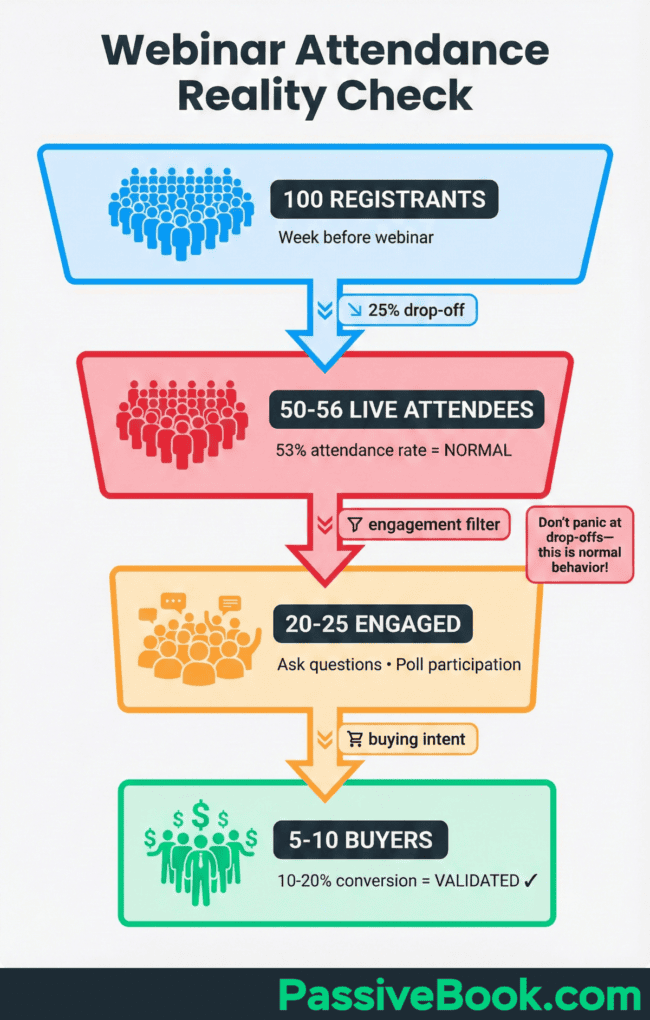
Nearly half of registrations occur in the final 24 hours before your event. Don’t panic if you only have 15 registrations three days out. Promote intensively in the final 48 hours and watch numbers climb.
Track where your registrations come from. If 80% came from a specific Facebook group, that’s valuable data about where your customers hang out. If direct messages to your network drove most registrations, you’ll need a different strategy to scale beyond validation.
The Pre-sale Test: Getting Real Money Commitments
Offer discounted beta access during the final 10 minutes of your webinar. Price it at 30-50% off what you plan to charge for the finished product. This creates urgency and rewards early supporters without devaluing your future launch.
Minimum viable validation is 5-10 pre-sales from 50 attendees. That’s a 10-20% conversion rate, which indicates real demand. One student enrolled 22 students on her first validation attempt with no prior course sales, generating enough revenue to justify building the full program.
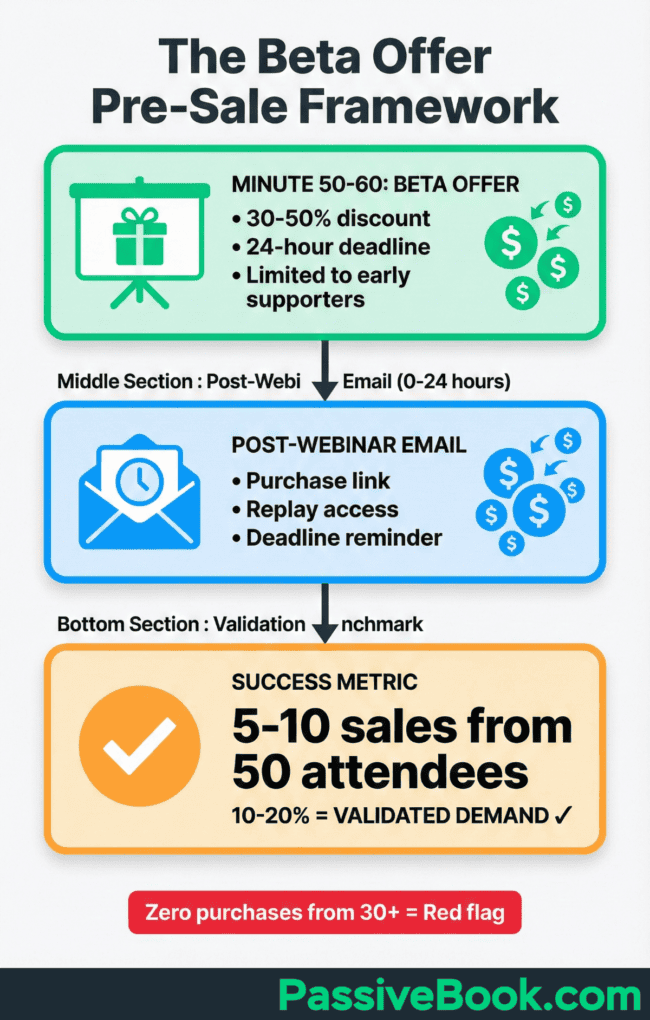
Set a 24-hour deadline for the beta offer. Announce the deadline during the webinar but send a follow-up email to all attendees with purchase details. Some people need time to think or discuss with a partner before buying.
Track both immediate purchases during the webinar and follow-up purchases within 24 hours. Both count as validation. Someone who buys 12 hours after your webinar is just as qualified as someone who bought during the live Q&A.
If you get zero purchases from 30+ engaged attendees, that’s a red flag. Either your pricing is wrong, your offer wasn’t compelling, or the pain point isn’t urgent enough to justify paid solutions.
Engagement Metrics Vs. Polite Interest
ClickMeeting’s webinar conversion research shows buyer-signal questions like “How much does X cost?” and “When can we start?” should be prioritized during Q&A. Creators who track implementation-focused questions identify three times more qualified buyers than those who measure general enthusiasm.
Questions about pricing, timeline, and implementation indicate genuine buying consideration. Someone asking “What happens if I can’t finish in 90 days?” is mentally positioning themselves as a customer working through objections.
Chat activity and poll participation score higher than passive attendance as validation signals. An attendee who answers three polls and asks one question is more qualified than someone who watches silently for 60 minutes.
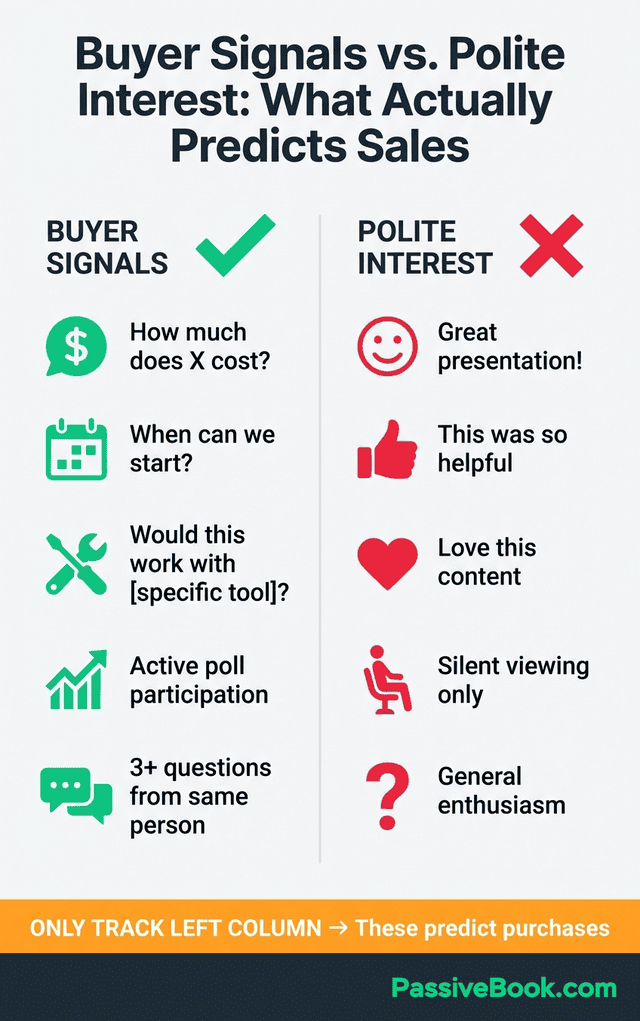
Avoid measuring compliments. “This was so helpful” and “Great presentation” create dangerous false positives. People are polite. They’ll thank you for free content even if they’d never pay for more.
Watch for specific implementation questions. “Would this work if I only have two hours per week?” and “Can I use this with [specific tool]?” show the person is already imagining themselves using your solution. Those mental rehearsals predict purchase behavior far better than generic enthusiasm.
Interpreting Results and Making Your Decision
Pre-sales of 5-10% from attendees signals sufficient validation to build your minimum viable product. If 40 people attended and 4 bought beta access, you’ve confirmed demand. Build the product for those early customers.
Compare engagement rates across your entire webinar. If less than 20% of attendees participated in polls or asked questions, that signals weak product-market fit. People weren’t invested enough to interact, which typically predicts low conversion.
High attendance with zero purchases indicates positioning or pricing issues, not necessarily a bad idea. Run a second webinar with adjusted messaging. Change your beta offer from a full course to a simplified workshop. Test different price points.
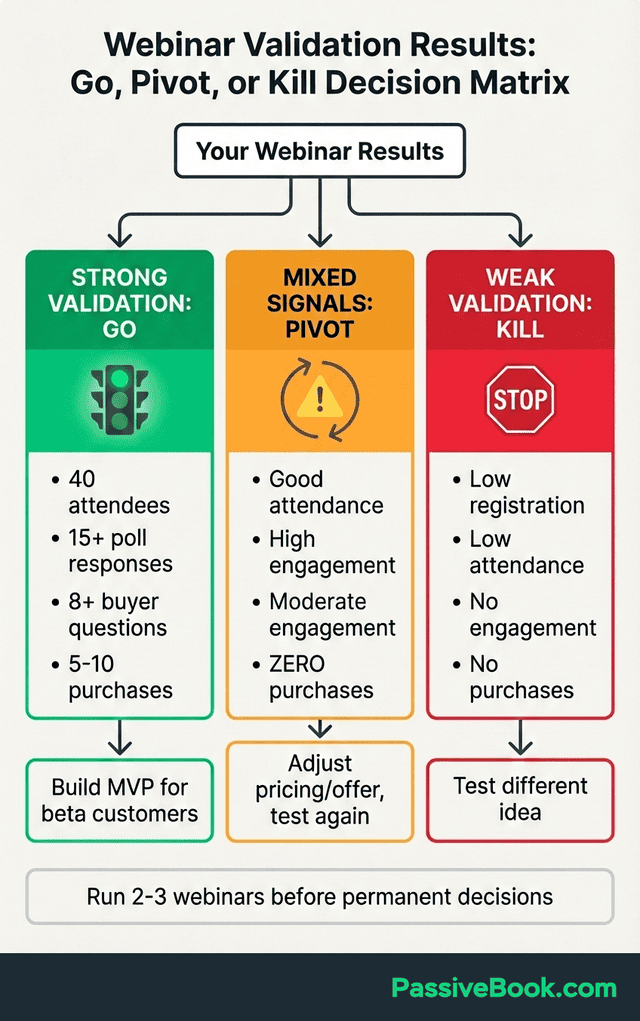
Survey the non-buyers after your webinar. Send a brief Google Form asking what prevented them from purchasing. Common objections cluster around price, timing, or missing features. This feedback tells you whether to pivot the idea or adjust the offer.
Don’t abandon a concept after one validation attempt unless every signal is negative. Low registration, low attendance, zero engagement, and no purchases is a clear message. But mixed signals – good attendance with weak engagement, or high engagement with no purchases – suggest your concept needs refinement, not replacement.
Common Validation Mistakes That Create False Positives
Testing exclusively with your existing network creates biased data. Your friends want to support you personally. Their positive feedback reflects their relationship with you, not the market’s willingness to pay for your solution.
I made this mistake with my first validation webinar. Twenty-three people registered, eighteen attended, and everyone left glowing comments. Zero purchases. They were being kind because they knew me. When I ran the same webinar with cold traffic from a Facebook group, six people showed up and two bought. The smaller, colder audience gave me accurate validation data.
Measuring enthusiasm instead of purchase behavior is the second trap. “I love this idea” and “When are you launching?” feel like validation signals, but they predict nothing about actual sales. Only money commitments matter.
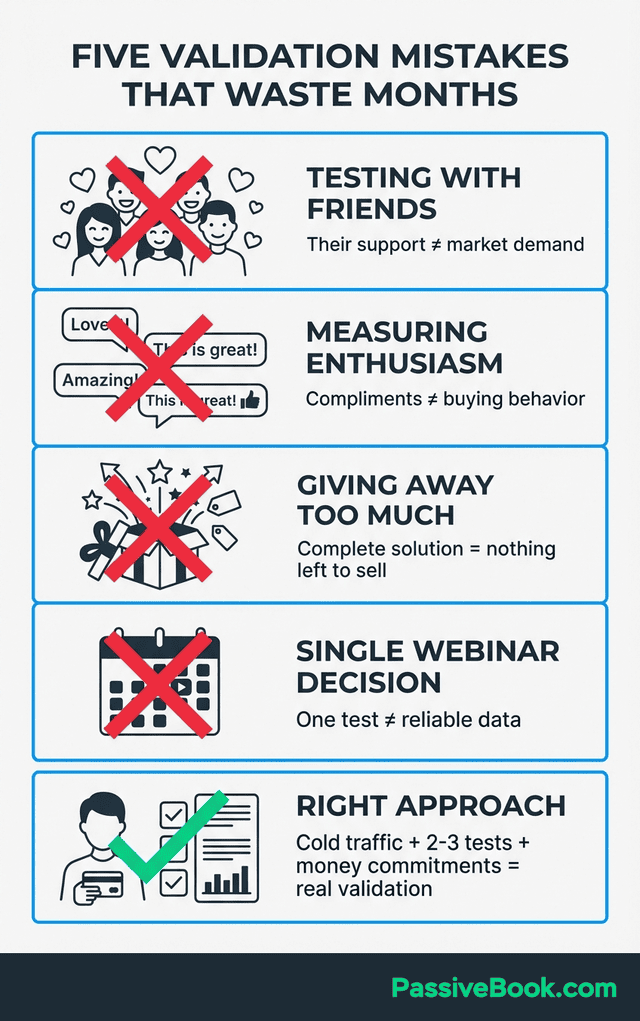
Giving away too much free value leaves nothing to sell in your paid version. If your webinar solves the complete problem, attendees have no reason to buy your course. Your teaching should create an “aha moment” that makes them want more, not make them feel completely satisfied.
Running a single webinar and making permanent decisions from limited data is premature. Market conditions vary by day of week, time of day, and promotional channel. Run 2-3 validation webinars before concluding your idea doesn’t have demand.
The validation process reveals these patterns only if you track the right metrics. Registrations, attendance, engagement, and purchases must all be measured systematically. One strong signal doesn’t validate. Multiple weak signals don’t invalidate. You’re looking for consistent patterns across attempts.
Modern Tools: Using AI to Accelerate Webinar Validation
Free AI tools eliminate most of the manual work when you’re setting up validation webinars. You can create presentation slides, write email sequences, and draft registration page copy in hours instead of days.
Gamma AI generates professional webinar presentations from text prompts in minutes using its free plan. Type a bullet-point outline of your teaching content and the platform creates 20+ slides with layouts and design. Solopreneurs can skip PowerPoint entirely and still produce professional-looking presentations.
ChatGPT or Claude on free tiers can draft complete webinar email sequences, registration page copy, and follow-up messaging. Prompt the AI with your target audience description, your webinar topic, and your tone preferences. Edit the output for accuracy and personality, but start with a solid first draft.
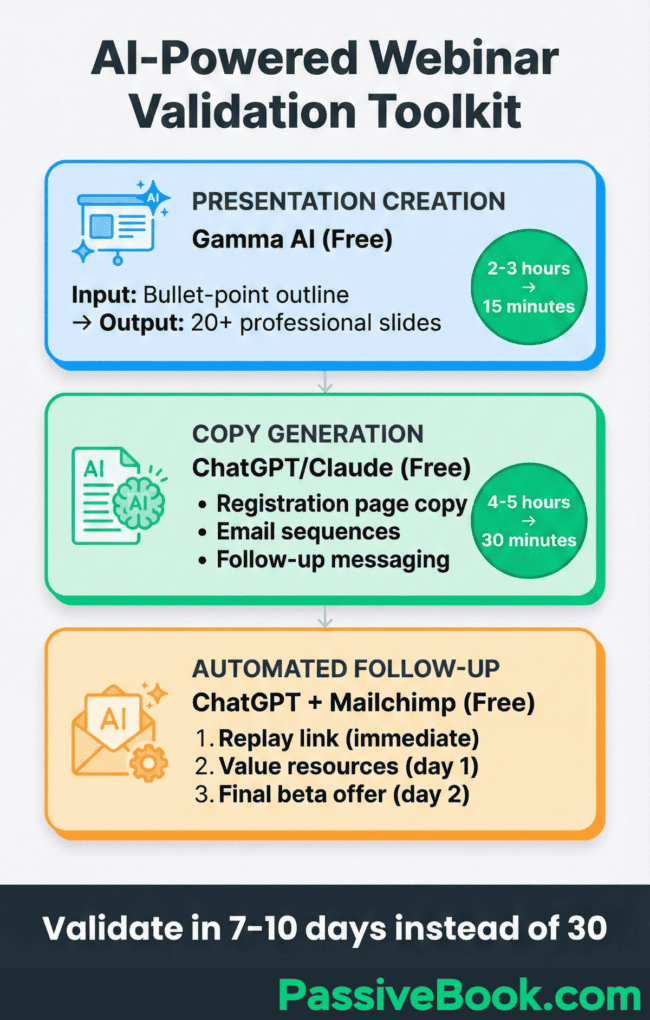
Focus on these free AI writing and design tools rather than expensive automation platforms. Validation webinars require speed and clarity, not enterprise features. You need a presentation, promotional emails, and a registration page. All three can be AI-generated at zero cost.
AI validation platforms show 89% accuracy in predicting market success. Specialized tools like IdeaProof or Prelaunch typically start at $49 per month, which exceeds most solopreneur validation budgets. Free AI writing tools combined with webinar engagement data provide sufficient insight without monthly subscriptions.
Automated follow-up sequences maintain engagement with registrants who don’t attend live. Use ChatGPT to draft a three-email sequence: immediate replay link, value-add resources related to your topic, and final invitation to your beta offer. Set these up in your webinar platform’s email automation or a free tool like Mailchimp.
The AI should handle the repetitive work – slide design, email copywriting, follow-up sequences. You should handle the strategic work – deciding what to teach, tracking buyer signals, interpreting results. This division of labor lets you validate ideas in 7-10 days instead of a month.
Frequently Asked Questions
How Many Attendees Do I Need for Meaningful Validation?
Thirty to fifty live attendees provide statistically meaningful data. This sample size reveals consistent patterns in engagement and purchase behavior. If five out of 40 people buy your beta offer, that’s a 12.5% conversion rate you can reasonably expect to scale.
How Much Time Does the Entire Validation Process Take?
Plan for 10-15 hours total spread over 10 days. Platform setup and presentation creation take 3-4 hours. Registration page and promotional content need another 2-3 hours. Daily promotion requires 30 minutes for 7-10 days. The live webinar itself is 60 minutes, plus 1-2 hours for follow-up emails and analyzing results.
Can I Validate Without Any Email List or Social Following?
Yes, but you’ll need to invest more effort in promotion. Target niche communities on u003ca href=’https://www.reddit.com/’u003eRedditu003c/au003e and Facebook where your ideal customers already gather. Guest appearances on relevant podcasts and strategic partnerships with complementary creators can generate 50+ registrations in one week without an existing audience.
What If People Attend but Nobody Buys My Beta Offer?
Zero purchases from high attendance signals positioning or pricing problems, not necessarily a flawed idea. Survey attendees about what prevented them from buying – their objections reveal whether you need to adjust your offer, lower your price, or reframe your messaging before running a second validation webinar.
How Long Should I Wait Before Deciding to Build or Pivot?
Test your idea 2-3 times over three weeks before making final decisions. One weak webinar doesn’t invalidate your idea – market conditions, promotional channels, and messaging all affect results. Consistent patterns across multiple attempts give you reliable data.
Should I Use Live or Automated Webinars for Validation?
Always use live webinars for validation testing. Automated webinars can’t gather real-time engagement signals or answer specific questions that reveal buying intent. Save automation for scaling a proven offer after you’ve validated demand with live sessions.
What’s the Minimum Investment to Run a Validation Webinar?
You can validate for under $100 using free webinar platforms, AI tools for content creation, and organic promotion through social media. Most of your budget goes to small paid promotions in niche Facebook groups or u003ca href=’https://www.reddit.com/’u003eRedditu003c/au003e to reach cold traffic beyond your immediate network.
What Next?
You now have a complete framework for testing whether strangers will pay for your idea before you spend months building it. Webinar validation works because it measures behavior – time investment and purchase decisions – not opinions from surveys or polite feedback from friends.
This process can feel uncomfortable. You’re putting yourself out there to teach something you haven’t fully packaged yet, and you’re asking people to pay for a product that doesn’t exist. That discomfort is the point. If you’re not willing to test demand with real stakes, you’re not ready to build business systems that require sustained effort and investment.
The fear you’re feeling right now? That’s exactly why most people build products nobody wants. They avoid the validation discomfort and build in a comfort zone instead. This process forces you to face market reality early, when pivoting costs you a weekend instead of six months.
I’d love to hear how your validation webinar goes. Hit the share buttons below if this guide helped you avoid wasting time on an idea with no market. Drop a comment with your biggest concern about running your first validation webinar – are you worried about finding attendees, structuring your teaching, or making the beta offer? Let’s troubleshoot it together.
Share this post with your friends & followers: