Three years ago, I spent two months building a project management tool for freelancers. I was convinced they needed it because I needed one myself. I coded features, designed workflows, and polished the interface. When I finally launched, crickets. I got seven signups in the first month, and zero conversions to paid.
The brutal truth? I never asked a single freelancer if they’d actually pay for what I was building. I learned the hard way that enthusiasm isn’t validation. That painful lesson cost me two months and countless hours. It taught me validation must happen before building, not after.
Market research for validation means testing if strangers will exchange real money for your solution before you build it. This article walks you through nine proven methods that cost under $500 and take 2-4 weeks of time and resources. No six-month time sinks here.

- •What Business Idea Validation Actually Means (and Why It Matters)
- •1. Run Problem-first Customer Interviews
- •2. Test Demand With a Low-cost Landing Page
- •3. Pre-sell Before You Build Anything
- •4. Manually Deliver Your Service First (concierge Mvp)
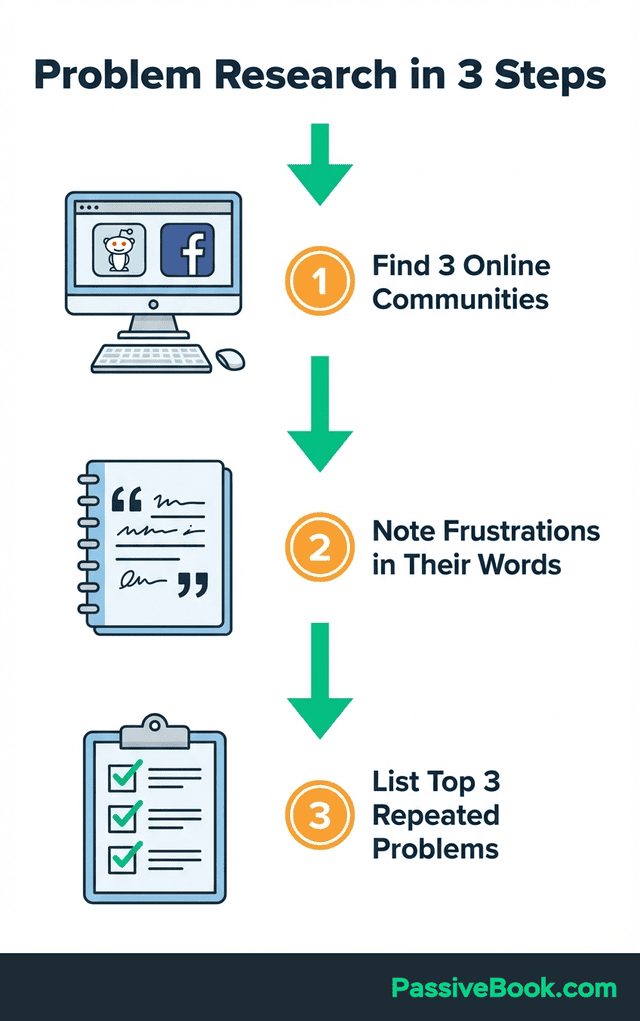
- •5. Mine Online Communities for Pain Points
- •6. Run Paid Ads to Measure Real Interest
- •7. Use Search Volume to Confirm Existing Demand
- •8. Sell a Competitor's Product First (reseller Test)
- •9. Launch a Free Workshop to Test Teaching Demand
- •What Validation Success Actually Looks Like
- •Why Most Validated Ideas Still Fail
- •Frequently Asked Questions
- •What Next?
What Business Idea Validation Actually Means (and Why It Matters)
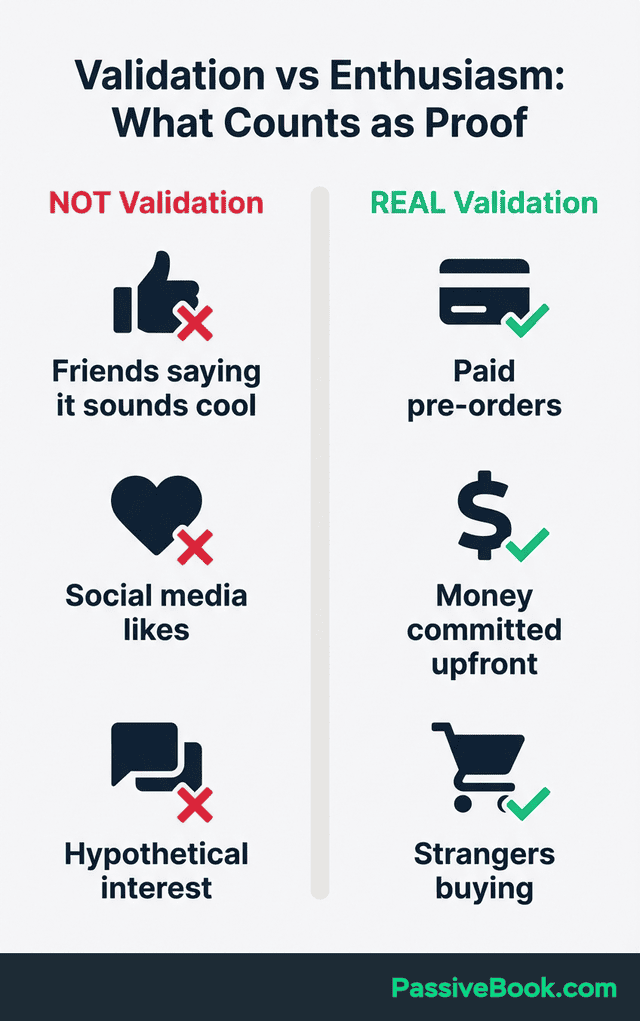
Validation isn’t about asking friends if your idea sounds cool. It’s about observing actual behavior from strangers who have no reason to be polite. The goal is simple: Will people exchange real money for your solution, or are they just being nice?
Research shows 42% of startups fail because their product doesn’t solve a real problem. Proper market validation costs under $500 and takes 2-4 weeks. Compare that to six months rebuilding the wrong product after launch.
Rebeca Huerga’s dropshipping business is a perfect example of what happens when you skip validation. She spent over $3,000 on inventory without testing if anyone actually wanted her products first. Six months and $15,000 in lost opportunity later, she had boxes of unsold stock. She never asked the market if they’d buy. She just assumed they would.
Real market validation requires strangers committing money or concrete action upfront. Friends saying “I’d buy that” is encouragement, not proof of market demand. If you’re a print-on-demand designer, Instagram likes don’t validate your idea. Paid orders do.
Justin Mares validated Kettle & Fire bone broth with just $15 for a landing page and $100 in ads. He pre-sold $500 worth of product before manufacturing anything. That two-week test confirmed demand for what’s now a $100M+ business. That’s the power of testing first.
1. Run Problem-first Customer Interviews
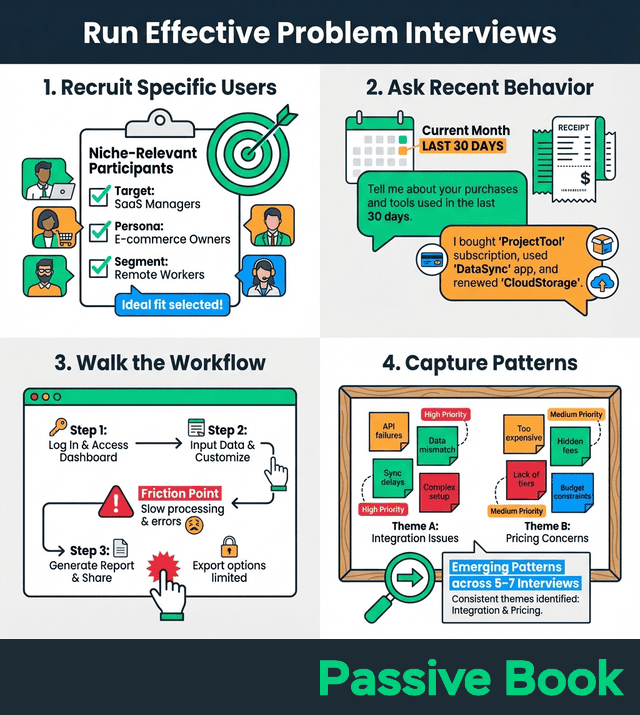
The first validation method costs nothing but your time. Schedule 10-15 conversations with people who match your target market. Here’s the deal: never pitch your solution. Only ask about their pain points.
Ask “Walk me through the last time you struggled with [problem]” to reveal what they’ve already tried and paid for. Research shows past-behavior interview questions have higher predictive validity than hypothetical “What would you do?” questions.
People accurately describe what they’ve tried, but they overestimate future purchase intent.
“What have you already tried?” is the question that matters most. This question reveals customer needs and willingness to pay. It shows which solutions failed. If someone says they’ve never tried to solve the problem you’re targeting, that’s a red flag. If they’ve tried three different solutions and still complain, you’ve found a real pain point.
Document the exact words prospects use to describe their frustrations. These become your landing page headlines. Don’t translate their language into marketing speak. Use their actual phrases. The questions you ask determine the quality of validation data.
To speed up this process, you can use ChatGPT to generate your interview script. Simply prompt it with: “Create a customer interview script for [your business idea] that focuses on past behavior and avoids hypothetical questions.” This gives you a solid starting framework in minutes instead of hours.
2. Test Demand With a Low-cost Landing Page
Create a single page explaining your solution and collect email signups. This proves strangers are interested enough to take action.
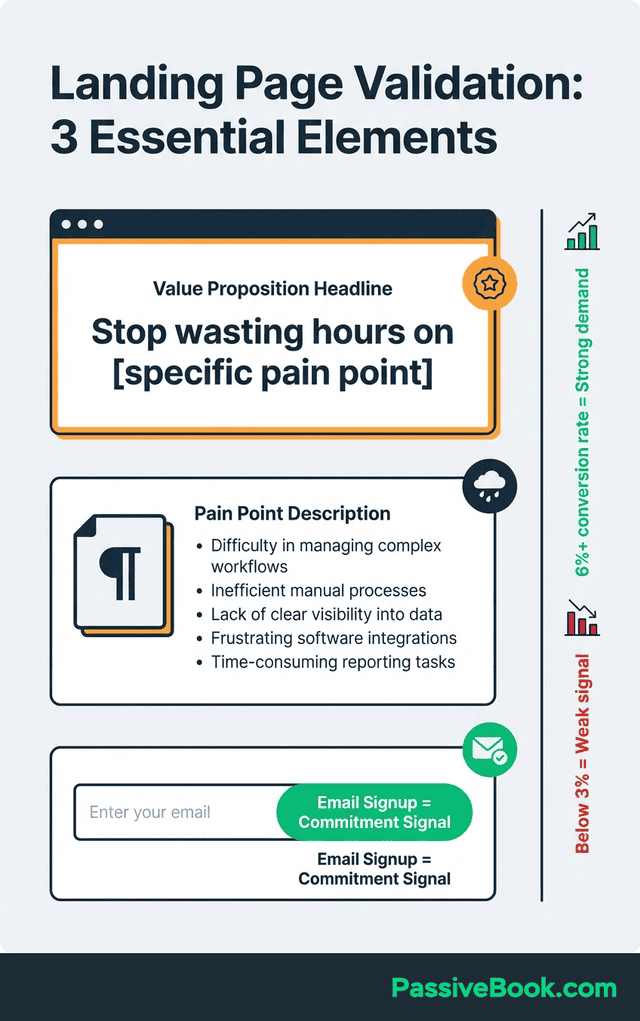
Mailchimp’s free landing page builder gets you started in under an hour. You need three elements: a headline stating your value proposition instead of features, a pain point your target audience knows cold, and an email signup as a commitment signal.
Drive 100-200 visitors from targeted Facebook groups or online communities for under $50. Don’t just post your link randomly. Join conversations first, provide value, then mention you’re testing something that solves the problem being discussed.
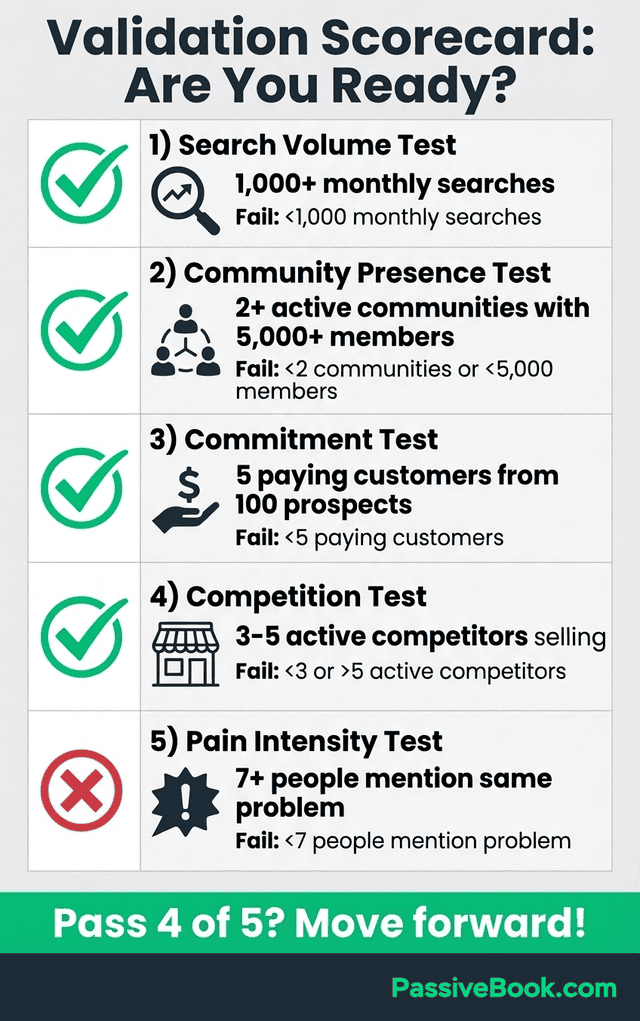
Landing pages converting 6% or higher from cold traffic signal genuine interest worth pursuing. That means six signups per 100 visitors. Below 3% suggests weak demand or unclear messaging.
Justin Mares validated Kettle & Fire this exact way. He spent $15 on a domain and basic landing page, then $100 on ads. He generated $500 in pre-orders before manufacturing any product. The landing page wasn’t fancy. It just clearly explained the problem and solution.
Your landing page doesn’t need to be perfect. It needs to be clear. If you’re stuck on copy, paste your customer interview notes into ChatGPT and ask: “Turn these customer pain points into a landing page headline and three benefit statements.” Use that as your starting draft.
3. Pre-sell Before You Build Anything
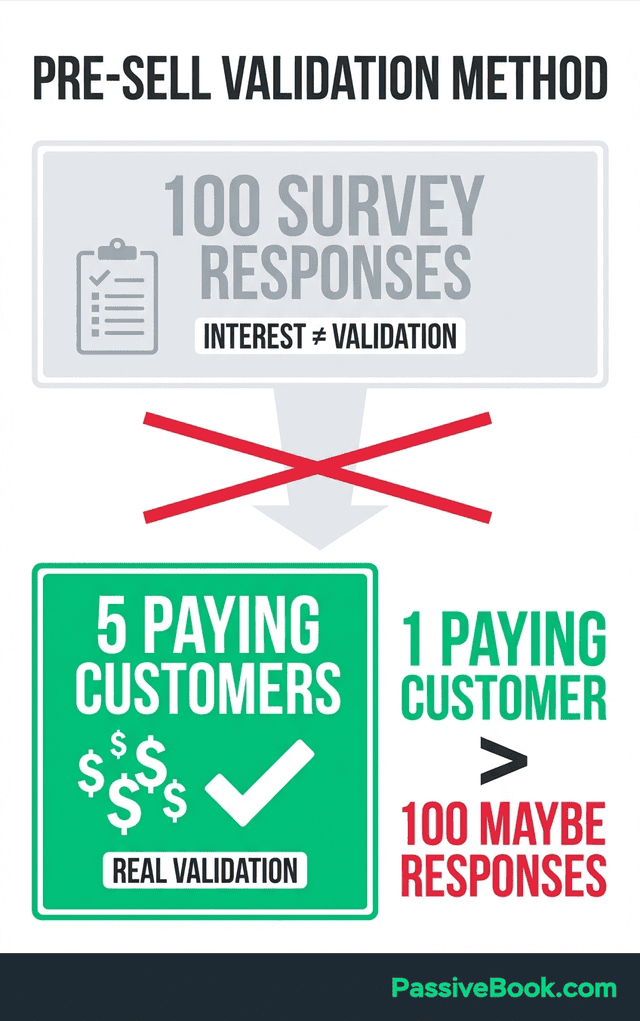
Landing page signups prove interest. Pre-sales prove people will actually pay. This validates your business model faster than anything else.
Offer early-bird pricing and accept real payments through Stripe or Gumroad. Clearly state the product service ships in 30-60 days after validation. Be transparent that you’re testing demand.
Solopreneur Justin Welsh built a $2M+ knowledge business starting with pre-sales. He validated demand before creating any content. He announced a course, set a pre-sale price, and collected payments. Only after hitting his minimum threshold did he create the actual lessons.
Getting 10-25 paying customers at a discount validates full-price viability. If you can’t get 10 people to pay $49 for early access, you probably won’t get 100 people to pay $99 at full launch.
Offer full refunds if you don’t reach your minimum order threshold. This reduces buyer risk and shows you’re serious about only building what people want. Use the commitments to finalize exact features customers want most.
The psychology here is simple: money talks. When someone gives you their credit card number, they’re voting with their wallet. That’s the validation that matters.
4. Manually Deliver Your Service First (concierge Mvp)
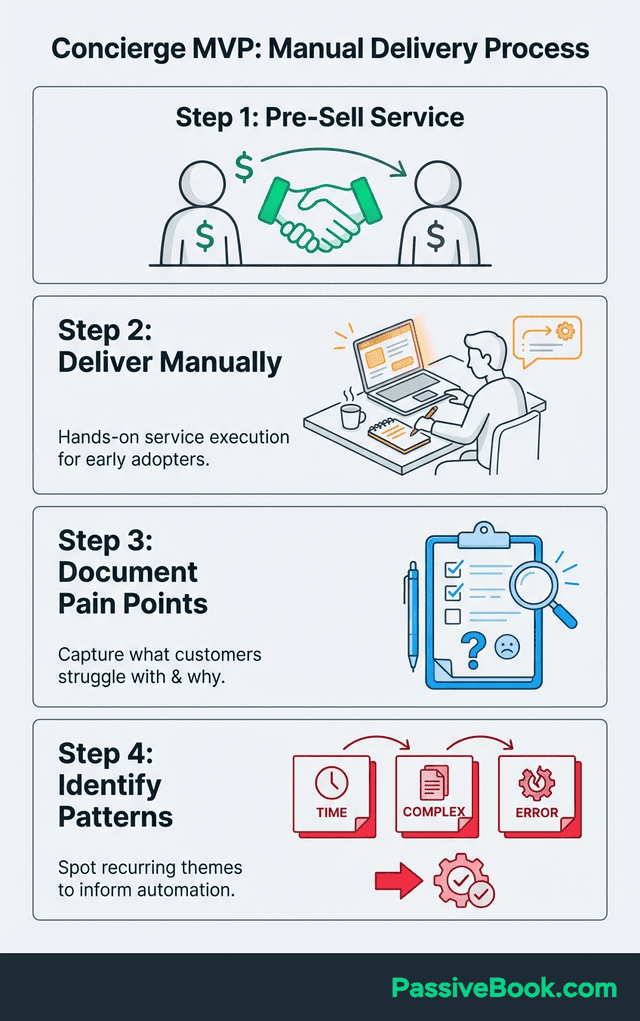
The concierge MVP is the most effective way to learn what customers actually value. Before you automate anything, personally provide value to 5-10 customers. You deliver the service manually to discover which aspects customers truly need.
Before building automation, solopreneur Marcus tested his contractor-matching platform by manually matching contractors with homeowners.
He pre-sold $15,000 worth of services in 10 days. More importantly, he discovered which features clients valued most for his now-$180,000-per-year platform.
The beauty of the concierge approach is that you’re getting paid to learn. You’re not building features in isolation. You’re watching real customers use your service and taking notes on what they struggle with. Real world delivery reveals what surveys can’t. You’ll discover which customer needs are most urgent.
This method works especially well for service-based business ideas. If you’re planning to create a course creation service, manually help five people create their courses first. You’ll learn what they need help with most, which informs what you eventually automate.
Most solopreneurs skip this step because they want to scale immediately. But you can’t scale what doesn’t work. Validate the core value first with human delivery. I’ve done this myself. It’s humbling but invaluable.
5. Mine Online Communities for Pain Points
Customer pain points are already documented online. You just need to know where to look and what to search for. This is free market research in real-time.
Search niche subreddits on Reddit for phrases like “I wish” and “struggling with.” Look for recurring complaints across 10 or more threads spanning several months. One complaint is an outlier. Ten complaints is a pattern worth investigating.
After identifying recurring complaints in r/smallbusiness about invoice tracking, a micro-SaaS founder built a $50-per-month app for mortgage brokers. Reddit validation revealed an underserved niche with urgent need. He didn’t guess at the problem. He found proof it existed.
Pay attention to phrases like “Would pay $X for” in comments. These indicate both price sensitivity and urgency. If someone says “I’d pay $100 for a solution to this,” they’ve just told you their budget and confirmed the pain is real.
Upvoted complaints with few solutions suggest underserved markets. Reddit-validated micro-SaaS ideas earning $1,000 to $10,000 monthly consistently started with 10 or more upvoted threads showing the same pain point across multiple months.
You can accelerate this research by using Perplexity to analyze multiple Reddit threads at once. Ask it: “Summarize the top 20 complaints about [topic] from Reddit discussions in the past year.” This gives you patterns in minutes instead of hours of manual scrolling. Finish your market research in hours, not weeks.
6. Run Paid Ads to Measure Real Interest
Small ad budgets reveal whether your messaging resonates. You’re not selling yet. You’re measuring. This is one of the fastest ways to validate demand and estimate your future customer acquisition costs.
Spend $100-$150 on Facebook Ads targeting your target customers through specific demographics. Set daily budget caps of $10-$15. This prevents runaway costs.
Drive traffic to your landing page and track cost-per-signup carefully.
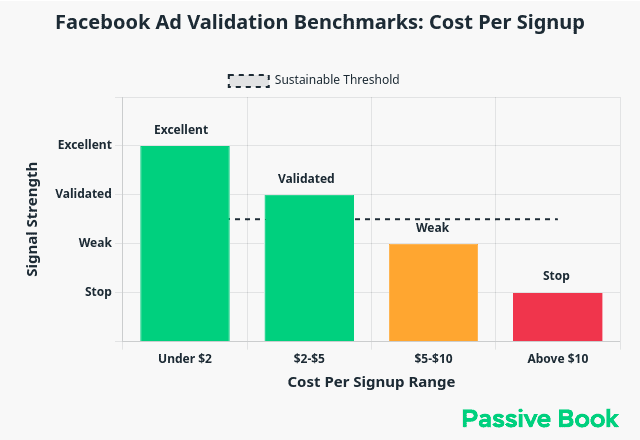
A solopreneur digital product seller tested Facebook ads for $100 and achieved a $1.50 cost-per-signup. This validated demand before building the full product. Small business benchmarks show $2-$5 per lead validates sustainable acquisition costs for most online business models.
Industry data shows average Facebook click-through rate is around 1.7%. If your ad gets a click-through rate above 2%, your messaging is more compelling than typical ads. This signals you’re hitting a real pain point with your target audience.
Cost-per-signup under $5 suggests sustainable acquisition economics. The average Facebook cost-per-click is roughly $2, so if you’re paying significantly more, your targeting or ad creative needs work.
Give your test at least 7-10 days before drawing conclusions to gather statistically meaningful data. Don’t panic after day one. But pause immediately if your cost-per-signup exceeds $5 after 50 clicks. That’s a signal the market isn’t responding strongly enough.
Pair your ad data with Google Trends to confirm whether interest in your topic is growing or declining. Rising search trends plus low cost-per-signup is a powerful validation combination.
7. Use Search Volume to Confirm Existing Demand
If nobody is searching for your solution, you’ll have to create demand from scratch. That’s expensive and time-consuming. It’s important to confirm demand exists before creating supply. Start by confirming existing demand through search volume data.
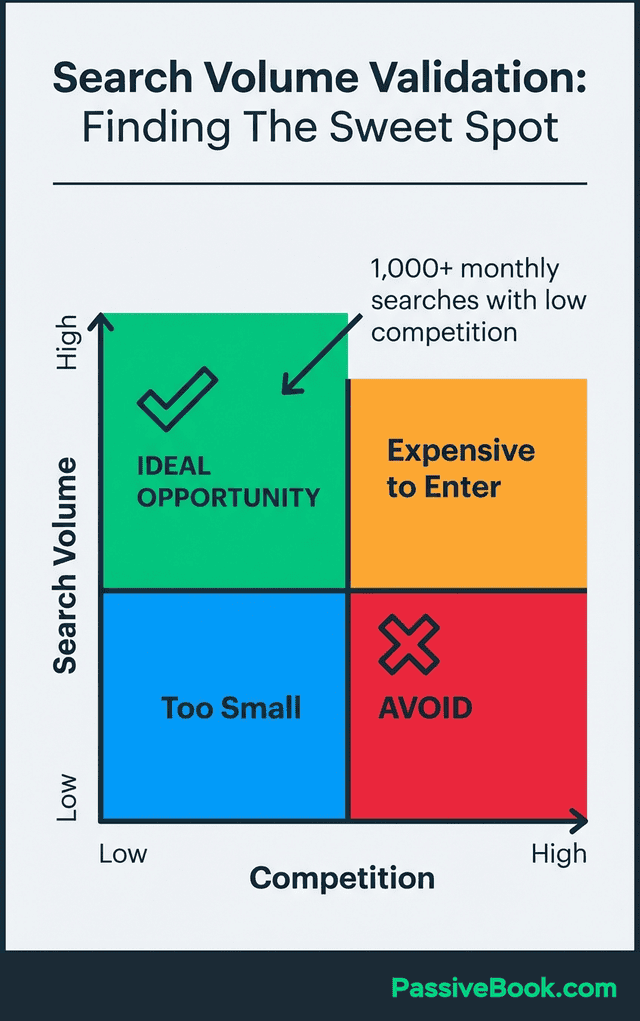
Check monthly searches for your solution using the free Google Keyword Planner. Look for 1,000 or more searches monthly with low competition. This signals opportunity where people search actively but few solutions exist. Search data reveals whether your target market is actively looking for solutions.
Before launching designs, print-on-demand sellers using Printful validate niche demand by checking keyword search volume. Finding 1,000 or more monthly searches with low competition in specialized niches like “vintage national park posters” confirms existing buyer intent.
High search volume doesn’t automatically mean opportunity. If competition is also high, you’ll struggle to rank or advertise affordably. The sweet spot is decent search volume with low to medium competition.
Combine search volume with your landing page test. If keywords show 5,000 monthly searches but your landing page converts below 3%, there’s a disconnect. Either your messaging is off or the search intent doesn’t match your solution.
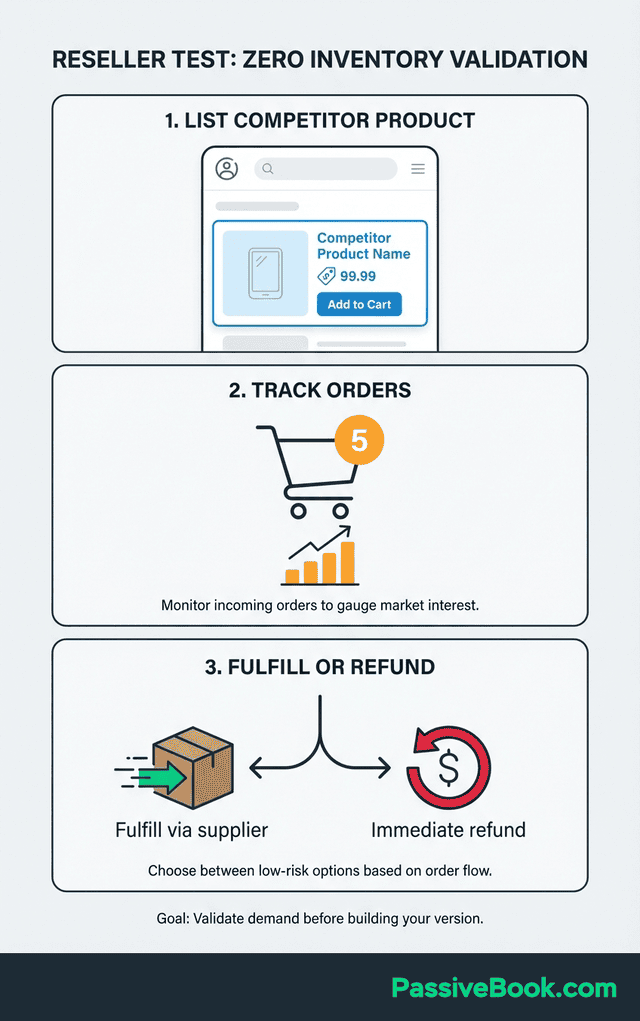
8. Sell a Competitor’s Product First (reseller Test)
This method is controversial but effective. List an existing solution on a simple site to test buyer interest before building your own version. You’re not building a reseller business. You’re testing if people will buy what you plan to create.
Bootstrapped solopreneurs using stealth MVP testing list competitor products at a small markup to validate demand. When orders come in, they either fulfill via the original seller or refund customers.
They use real purchase behavior to validate their business model before investing in development or inventory.
Orders prove demand exists before you invest in your own inventory or development. This is especially useful for physical products where upfront costs are high. You’re testing willingness to buy at your price point with zero inventory risk.
Only test with products you can actually fulfill or refund immediately. Don’t leave customers hanging. Be transparent that you’re validating demand, or be ready to fulfill orders through the original supplier.
Use orders to validate demand, then build your superior alternative. If you get 20 orders in two weeks, you know the market exists. Now you can invest in creating a better version of what competitors offer.
Contact sellers if you’re continuing beyond the initial validation test. Some may be open to affiliate or wholesale partnerships. Others may object to the reseller approach.
9. Launch a Free Workshop to Test Teaching Demand
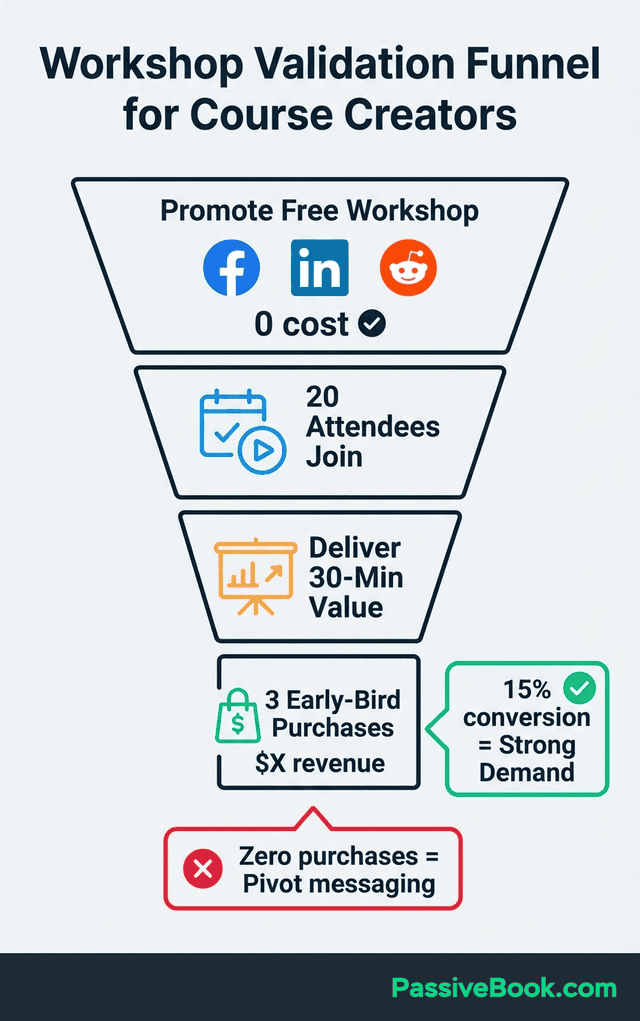
If you’re planning to create an online course or coaching program, don’t build the entire curriculum first. Host a 30-minute free workshop solving a smaller piece of the bigger problem. This validates whether people want to learn from you.
Promote your workshop through Facebook groups, LinkedIn, or niche communities for free. Don’t spend money yet. The goal is to see if your target customers show up when you offer free value.
Course creator Mariah Coz’s Rapid Validation Webinar system helped first-time creator Justine pre-sell 22 students when her goal was just 6. Another student enrolled 70 students and earned $10,000 in 3 days. Free workshops validate teaching demand before creating full course content.
At the end of your workshop, make a simple offer. “If you want me to teach the complete system, I’m creating a course launching in 30 days. Early-bird price is $X.” Track how many people say yes.
If 20 people attend your free workshop and 3 buy your early-bird offer, that’s a 15% conversion rate. This validates strong demand. If zero people buy, you’ve learned the topic isn’t compelling enough or your positioning needs work.
The workshop itself becomes content you can repurpose. Record it and use clips for social media promotion when you do launch your full product. I validated my course this way. Three people signed up. That was enough.
What Validation Success Actually Looks Like
You need clear success criteria before you start validating. Moving goalposts after disappointing results is self-deception. Define your minimum threshold upfront. Your value proposition must be clear enough that strangers convert.
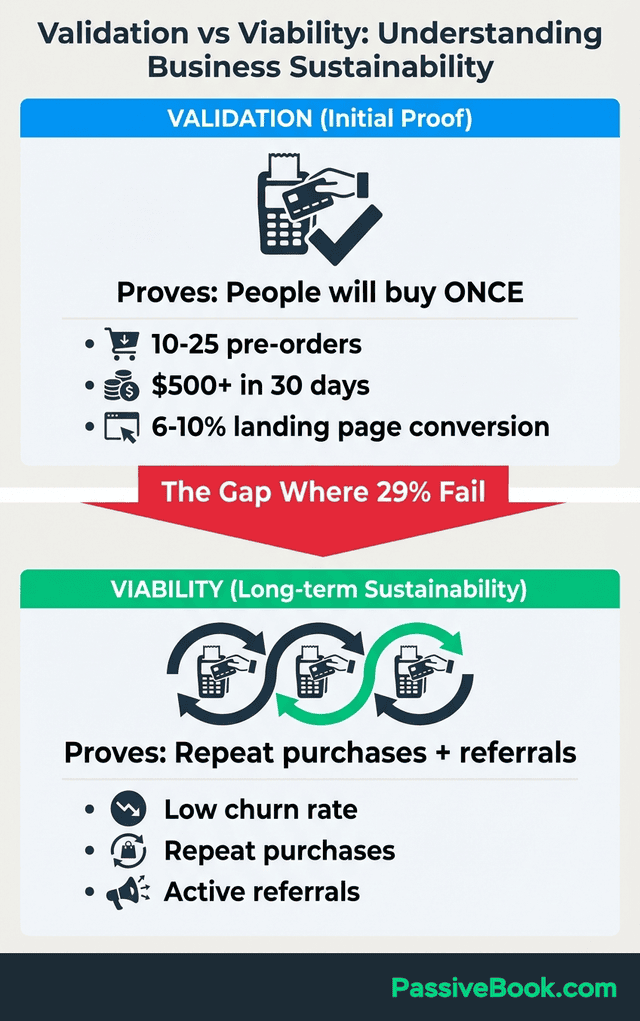
Pre-sales success looks like 10-25 paying customers or $500 or more in revenue within 30 days. Landing page success is 100-200 qualified emails with a 6-10% conversion rate. Interview success means 70% or more of your target market participants confirm they’d pay your proposed price.
The recommended validation process for beginners follows this sequence: Start with customer interviews (Method #1) and online community research (Method #5) in week one at zero cost.
This gives you qualitative validation and exact language to use.
Create your landing page (Method #2) in week two for around $50. Drive traffic from communities where you’ve already seen pain points discussed. If your landing page converts above 6%, move to pre-sales (Method #3) in weeks three and four.
Setting clear decision points prevents you from fooling yourself. “I need 15 pre-orders at $29 to validate” creates an objective standard. Either you hit it or you don’t. Market validation requires objective metrics, not gut feelings.
Avoid the temptation to lower your threshold when results disappoint. If you said 15 pre-orders and only get 5, that’s valuable data. It means demand is weaker than expected or your pricing is wrong.
Why Most Validated Ideas Still Fail
Validation proves initial demand, not long-term business sustainability. This is the harsh reality nobody wants to hear after getting early traction. Your business model must survive beyond initial sales.
Research shows 29% of startups run out of cash despite validated ideas. They proved people would buy once, but they couldn’t make the economics work long-term. Your customer acquisition cost must stay below lifetime value consistently.
First validation proves someone will buy once. After successfully validating initial demand with pre-sales, solopreneurs often fail at retention because they don’t validate that customers will finish or use their product or refer others. Second validation proves they’ll become repeat customers or active promoters. That’s what sustains your business strategy.
The difference between a validated idea and a sustainable business is repeat behavior. One purchase is a test. Ten purchases from the same customer over a year is a viable business model.
Track these metrics after initial validation: customer churn rate, repeat purchase frequency, and referral rate. If customers buy once and disappear, you have a validation problem disguised as initial success.
Don’t confuse validation with viability. Validation says “People want this.” Viability says “People want this enough to sustain my business long-term.” You need both.
Frequently Asked Questions
How Long Should Validation Take Before I Start Building?
Validation should take 2-4 weeks maximum if you’re working 5-10 hours per week. Week one focuses on customer interviews and community research at zero cost. Week two builds your landing page and runs initial traffic tests for around $50.Weeks three and four run pre-sales if your landing page converts above 6%. If you’re not getting clear signals within a month, either your idea needs refinement or market demand is too weak.
What If My Idea Fails Validation – should I Quit?
Failed validation isn’t failure. It’s the fastest way to avoid a six-month mistake. You’ve saved months of building the wrong thing for under $500. Analyze why it failed: was the pain point real but your solution wrong, or was the problem itself not urgent enough?Pivot to a related idea using what you learned. Most successful solopreneurs validated 3-5 ideas before finding one that worked.
Can I Validate Without Spending Any Money?
Yes, through customer interviews (Method #1) and mining online communities (Method #5). Schedule 10-15 conversations and analyze u003ca href=’https://www.reddit.com/’u003eRedditu003c/au003e threads for recurring complaints. This gives you qualitative validation at zero cost.But here’s the catch: it takes longer. Spending $50-$150 on landing pages and small ad tests gives you quantitative data much faster and confirms people will actually pay.
How Many Pre-sales Validate an Idea?
For most solopreneur business models, 10-25 pre-sales within 30 days validates demand. This assumes you’re offering early-bird pricing around 30-40% below your planned full price. If you can’t get 10 people to commit money at a discount, you’ll struggle to sell hundreds at full price.Set your minimum threshold before starting and don’t move it.
Can I Validate While Working a Full-time Job?
Yes, and honestly, you shouldn’t quit your job until you validate anyway. Seven of nine validation methods take 5-10 hours per week spread across evenings and weekends. Customer interviews happen during lunch breaks or after work. Landing pages take one weekend to build.u003ca href=’https://www.reddit.com/’u003eRedditu003c/au003e research happens in 30-minute blocks. The validation sequence in this article is specifically designed for time-strapped solopreneurs who can’t quit their day jobs yet.
Do I Still Need to Validate If Competitors Exist?
Yes, because competitors prove demand exists but don’t guarantee your version will succeed. You need to validate your positioning, pricing, and unique approach. Existing competitors with weak reviews or poor customer service actually make validation easier because you can identify exactly what frustrated customers want improved.Competition validates the market, but you still validate your execution.
What Next?
Start with Method #1 and Method #5 this week. They cost nothing and give you qualitative proof in 5-10 hours. If you hear the same pain point from 7+ people, move to Method #2 next week. If your landing page converts above 6%, run Method #3 in week three. That’s your validation roadmap.
Validation feels risky because you might learn your idea won’t work. But here’s the truth: finding out in week three with $200 spent beats discovering it in month six with $5,000 gone. You’re not looking for certainty. You’re looking for evidence strong enough to justify the next step.
If this article helped clarify your validation strategy, click the share buttons below and spread it to another solopreneur who’s stuck in analysis paralysis. They’ll thank you for it.
What business idea are you validating right now, and which method are you starting with? Drop your answer in the comments below. I read every single one and often reply with feedback.
Share this post with your friends & followers: