I’ve tested seven different online business ideas over the past decade, and the three that succeeded showed clear signals within 30 days. Here’s the validation timeline framework that saved me months of wasted effort.
The ones that succeeded? I knew within 30 days they had potential. The failures dragged on for months because I kept telling myself I just needed more data. If you’re a side hustler with 5-10 hours per week trying to validate your next idea, you don’t have months to waste.
You need a framework that tells you exactly how long does testing take before making a decision, and more importantly, what signals actually matter during that window. The question seems simple on the surface, but the real answer depends on your business model, weekly availability, and what validation signals you’re actually measuring.

- •What Business Validation Actually Measures
- Why Time-boxed Testing Prevents Common Failures
- Realistic Testing Timelines for Side Hustlers
- Validation Timelines by Business Model
- Adjusting Timelines for Your Weekly Time Budget
- •Low-budget Validation Tools for Bootstrappers
- How to Know When Testing Is Complete
- Common Timeline Mistakes That Waste Months
- •When to Stop Testing and Start Building
- •Frequently Asked Questions
- •What Next?
What Business Validation Actually Measures
Business validation is a time-boxed testing period where you gather evidence that real customers will pay for your solution. Most solopreneurs should plan for 6-8 weeks depending on their available hours each week.
The test isn’t whether people like your idea. It’s whether they’ll pull out their wallet.
There’s a massive difference between “That’s interesting!” and “Here’s my credit card.”
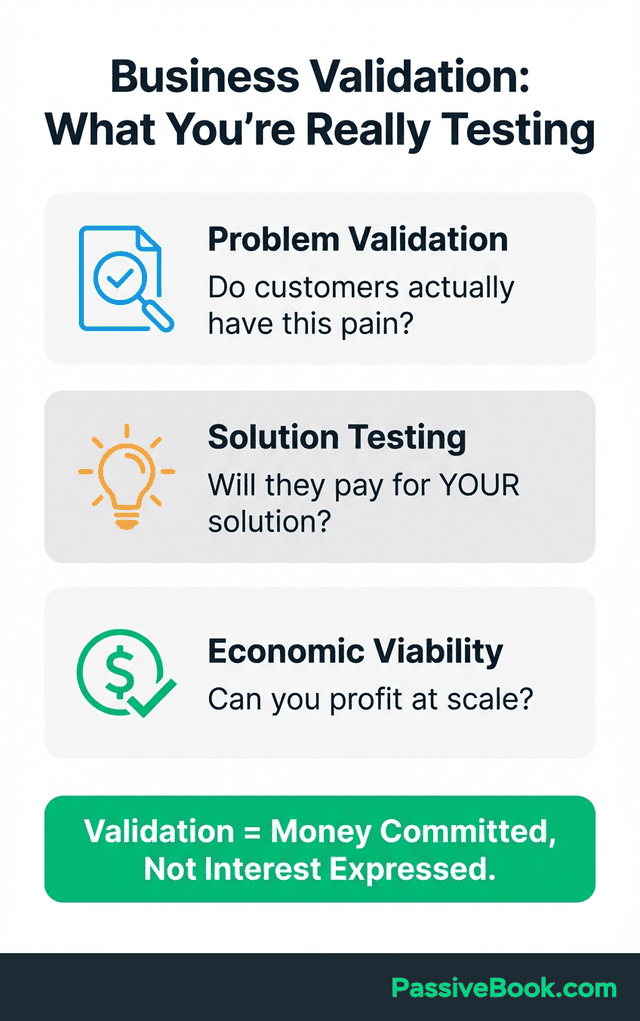
42% of startups fail because there’s no market need for their product. That’s not a building problem, and it’s not about test planning complexity. It’s a validation problem. They skipped the critical step of confirming demand before investing months into development.
Validation proves demand through purchase commitments. Not survey responses from friends. Not polite feedback from your mom. Actual commitments where money changes hands or customers pre-order at your target price point.
The goal is to spend 40-80 total hours over several weeks of testing gathering behavioral data. What do potential customers do when asked to commit? That behavior tells you everything you need to know about whether this idea deserves six months of your evenings.
Why Time-boxed Testing Prevents Common Failures
Setting validation deadlines forces decision-making. Without a clear endpoint, you’ll research forever. I’ve watched side hustlers spend six months “learning” about email marketing when their first 30 days showed zero subscriber growth. That’s not validation. That’s procrastination with extra steps.
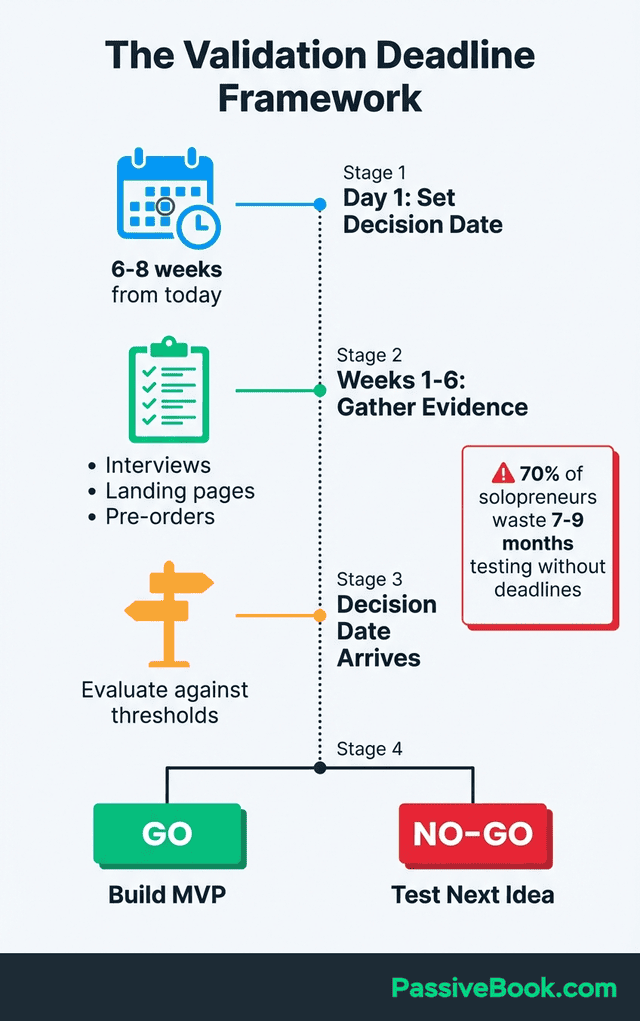
Most solopreneurs waste over 7-9 months on weeks of testing that show no buyer demand within the first 30 days. The pattern is always the same: they keep tweaking the landing page, reading one more book, taking another course.
Meanwhile, the market has already spoken through silence.
Strategic testing balances gathering enough proof against the opportunity cost of your limited evenings. Every week spent validating Idea A is a week you can’t spend testing Idea B. Time is your scarcest resource as a side hustler.
The Analysis Paralysis Trap
Solopreneurs fall into ‘paralysis by analysis’ cycles, consuming content but never implementing.
I burned three months this way on a course idea in 2019. I read 47 blog posts about course creation. Watched 23 YouTube videos. Never interviewed a single potential student.
Learning activities feel like progress, but they’re not the same as traction metrics. Watching tutorials feels productive. Posting in Facebook groups to recruit interview subjects feels risky. But only one of those activities generates validation data.
Set your minimum evidence thresholds before you start, not after months of research. Decide now: “I need 10 customer interviews and 5 paying pilot customers to validate this idea.” Write that threshold down. Schedule the decision date on your calendar. If you hit the threshold, proceed. If you don’t, move on.
The Premature Scaling Trap
Over 70% of startups scale prematurely, growing too fast before validating product-market fit. For side hustlers, this looks different than VC-backed companies. Instead of hiring a team, you’re building extensive features before confirming anyone wants the basic version.
Building elaborate features before confirming customer demand wastes your critical runway. When you have 10 hours per week, spending six weeks building an elaborate membership site with forums and gamification is premature. Start with a simple Notion page and five paying members.
The balance between under-testing and over-building determines solopreneur survival rate. Under-test and you build the wrong thing. Over-test and you never ship anything. The sweet spot for most side hustlers is 6-10 weeks of focused validation with clear decision criteria.
This founder explains the validation mindset shift:
Realistic Testing Timelines for Side Hustlers
Total validation requires 6-8 weeks minimum for simple service businesses. That’s assuming 10 hours per week of focused work, not scattered browsing or “research” that doesn’t produce data.
These timelines double if you have only 5 hours weekly. Expect 12-16 weeks instead of 6-8 weeks.
With 15-20 hours per week, you can complete validation in 4-6 weeks. The total hour investment matters more than the number of calendar weeks.
The framework below breaks validation into three distinct phases. Each phase has specific deliverables and success metrics. Don’t skip ahead to solution testing before completing problem validation.
If You Have Multiple Ideas to Test
With 5-10 hours per week, test ideas serially. Testing three ideas simultaneously means each gets 2-3 hours of attention. That’s insufficient to generate clear signals.
Rank ideas using three criteria. First, fastest validation timeline. Service businesses validate faster than product businesses.
Second, lowest initial investment. Ideas requiring $500 in setup costs go after ideas requiring $50. Third, strongest early interest signals from your existing network or audience.
Test your highest-ranked idea first for the full 6-8 weeks before moving to the next. If it fails, you haven’t wasted parallel effort on other ideas. If it succeeds, you’ve found your focus.
Week 1-2: Problem Validation
Interview 10-15 target customers about their pain points. Not your proposed solution. Listen for them to describe the problem in their own words.
Post questions in niche subreddits or Facebook groups where your target customers already gather. “What’s the biggest challenge you face with [specific problem area]?” Document the responses verbatim.
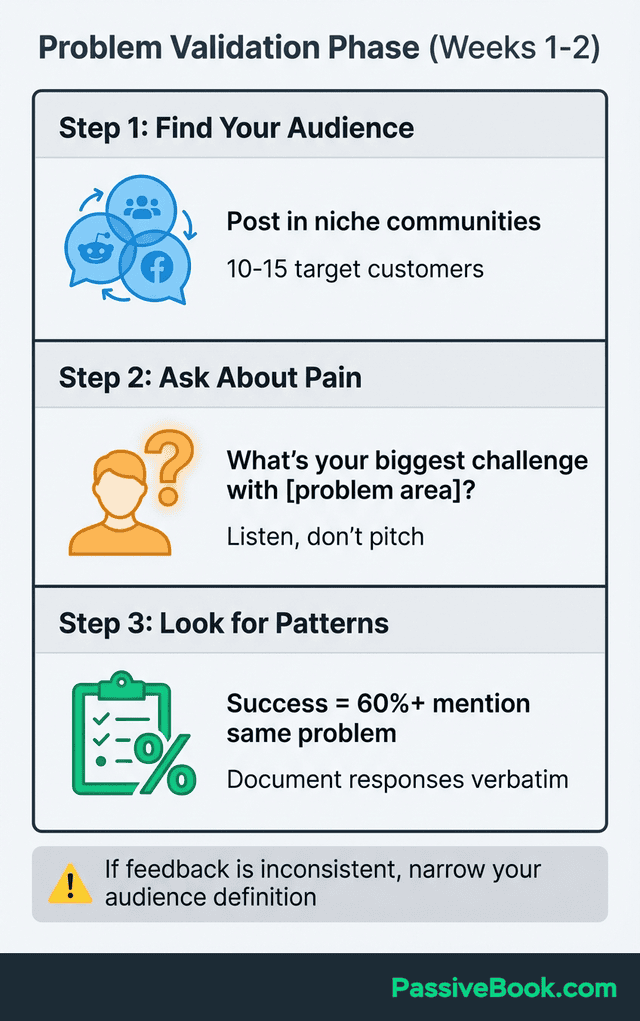
Success threshold: Most (60%+) mention the same core problem without you prompting them. If you ask 12 people and only 4 mention the problem you think exists, your hypothesis is wrong. Pivot your problem focus or choose a different idea.
Week 3-5: Solution Testing
Buffer validated with a simple landing page describing their social media scheduling tool before writing any code. This is the standard playbook for lean validation.
Create a simple landing page using Carrd, Unbounce, or WordPress. Include five elements: clear problem statement in the headline, your solution in one sentence, 3-5 key benefits as bullet points, single call-to-action button, expected launch date or early-bird signup.
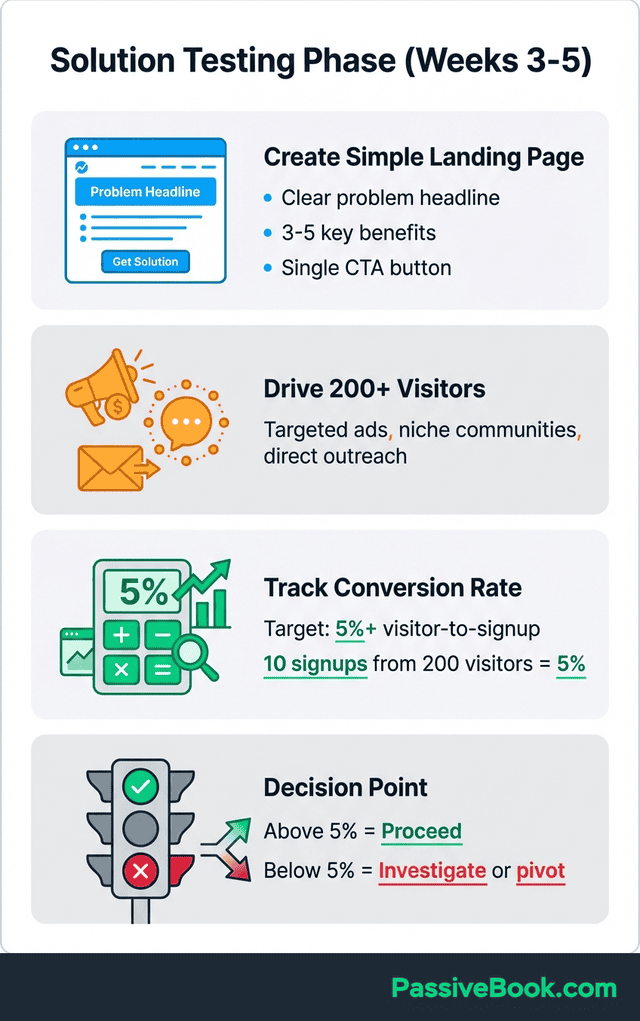
Target 5% or higher visitor-to-action conversion rate with at least 200 landing page visitors. If 200 people visit and only 3 sign up, that’s a 1.5% conversion rate. The market is telling you something doesn’t resonate.
Drive traffic through targeted Facebook or Reddit ads with a small budget, posts in niche communities where you’ve already built rapport, or direct outreach to the people you interviewed in weeks 1-2.
Week 6-8: Economic Viability Testing
SoPost founder Jonny Grubin bootstrapped as a solo founder while employed. He manually tested unit economics before scaling to over $15 million in revenue. This phase separates dreamers from operators.
Secure initial paying customers or refundable pre-orders at your target pricing. Not theoretical “would you pay $50?” questions. Actual payment processing or signed agreements with deposits.
Calculate your unit economics. Customer acquisition cost must support lifetime value projections.
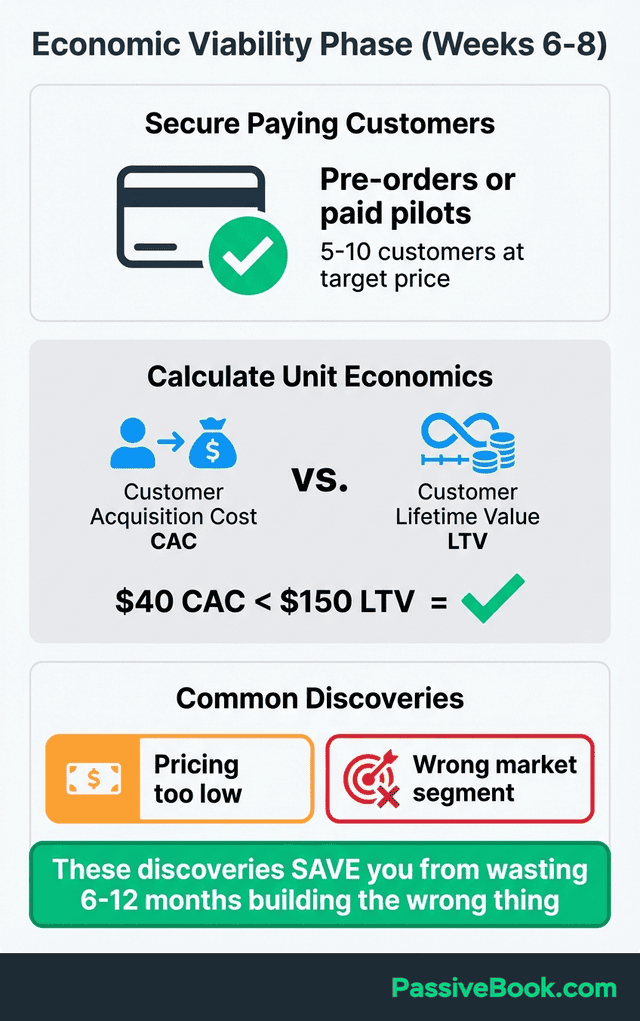
For example, spending $40 in ads to acquire a customer who pays you $30 means the math doesn’t work. You need either lower acquisition costs or higher pricing.
This phase usually reveals pricing is too low or your target market can’t afford your solution. Both are valuable discoveries before you quit your job.
Validation Timelines by Business Model
Different online business types require different validation approaches and durations. A freelance writing service validates faster than a print-on-demand store because the buying cycle is shorter and setup is simpler.
Match your testing time to customer buying cycles and business complexity. Service businesses where you deliver the work validate fastest. Product businesses with inventory and shipping logistics need longer test windows.
The timelines below assume 10 hours per week of focused validation work. Adjust proportionally for your available hours using the math from the previous section.
Content Businesses (YouTube, Blogging, Podcasting)
Minimum 6-8 weeks to publish 10-15 pieces and measure real user engagement metrics. Content businesses have the longest validation cycles because you need multiple data points to identify patterns.
YouTube chef Nick DiGiovanni validated audience engagement through consistent video publishing. Growth metrics became visible within weeks through steady content output and viewer interaction patterns.
The key was publishing frequency, not production perfection.
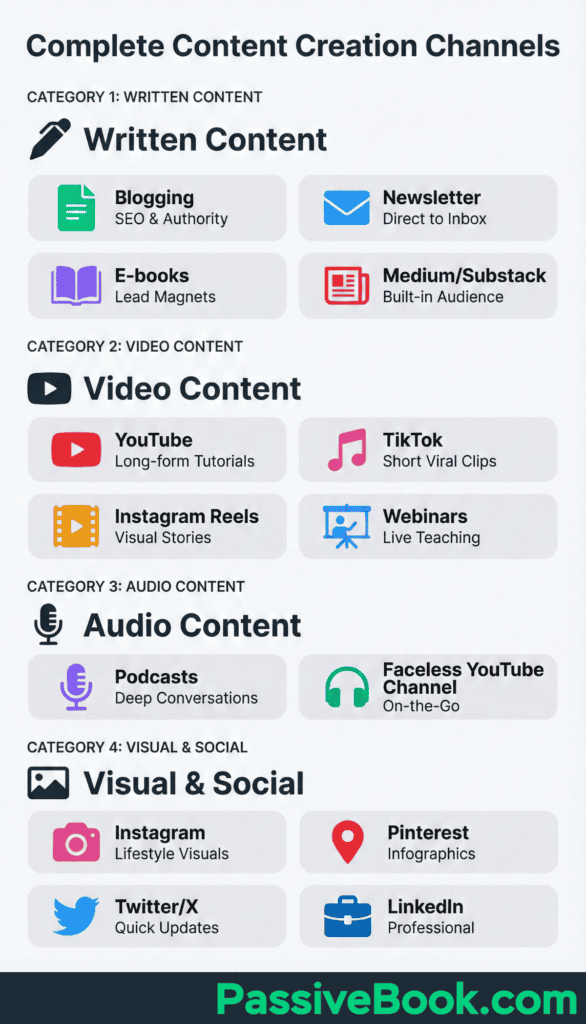
Track watch time for videos, email signup rates for blogs, and repeat visitor percentages as your demand signals. If your first 10 blog posts generate 15 email subscribers total, that’s a weak signal. If they generate 150 subscribers with 40% returning to read multiple posts, that’s validation.
Use AI to accelerate content production during validation. Ask ChatGPT: “Generate 10 blog post titles for [your niche] that solve specific problems for [target audience].” Pick the three that resonate most with your problem validation interviews and create those first.
This creator explains how they measured early user engagement:
Service-based Businesses (Freelancing, Consulting)
2-4 weeks to land your first three paying clients through targeted outreach. Service businesses validate fastest because there’s no product to build before selling.
Aim for 20-30 personalized outreach messages per week. In my experience, this typically yields 2-3 responses and potentially one client conversation.
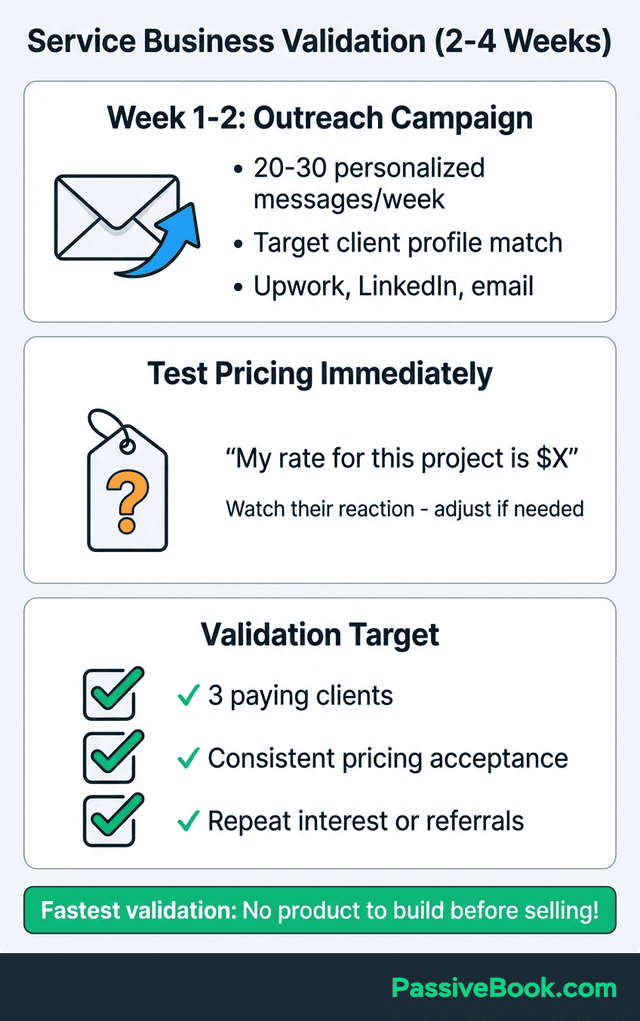
One Upwork freelancer secured their first repeat client within 3 weeks of launching their service.
Another freelancer earned $30,000 in their first year by systematically testing service offerings. The pattern is consistent: fast validation through direct sales.
Test pricing tolerance during initial conversations, not after client commitment. Say “My rate for this type of project is $X” and watch their reaction. If three prospects in a row say “That’s way too high,” your pricing needs adjustment before you waste more outreach time.
Product Businesses (Dropshipping, Print-on-Demand)
4-6 weeks minimum to test 5-10 product variations with a small advertising budget. Product businesses need longer validation because you’re testing design appeal and price point simultaneously.
Target a 3% or higher click-to-purchase rate based on typical e-commerce conversion patterns from paid traffic on Facebook or Instagram ads. Allocate your $50-100 test budget as $10-20 per product design across 5 designs. Target 100-plus clicks per design to generate statistically useful data.
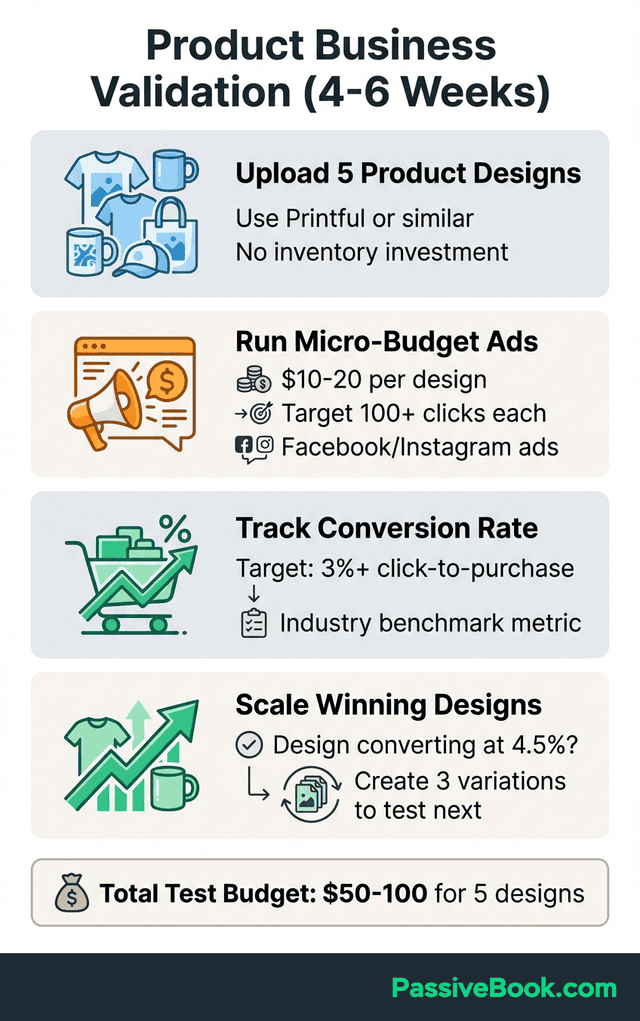
Use Printful or similar platforms to test designs without inventory risk. Upload designs, create mockups, run ads to test listings. Only the designs that hit your 3% conversion threshold deserve inventory investment.
If you’re testing mugs with funny sayings, create five different designs. Run ads to all five. The design that converts at 4.5% while others convert at 0.8% tells you which direction to expand. Create three variations of the winning design for your next test batch.
See the step-by-step process for testing product designs with minimal budget:
Digital Product Businesses (Online Courses, Templates)
6-10 weeks to validate topic demand and collect purchase commitments through pre-orders. Digital products sit between services and physical products in validation timeline because you’re selling a promise of future value.
Course creator Sarah spent months researching her target audience and validating course demand through pre-sales conversations. She broke her graphic design course into simple, actionable lessons based on validated customer needs, not her assumptions about what beginners wanted.
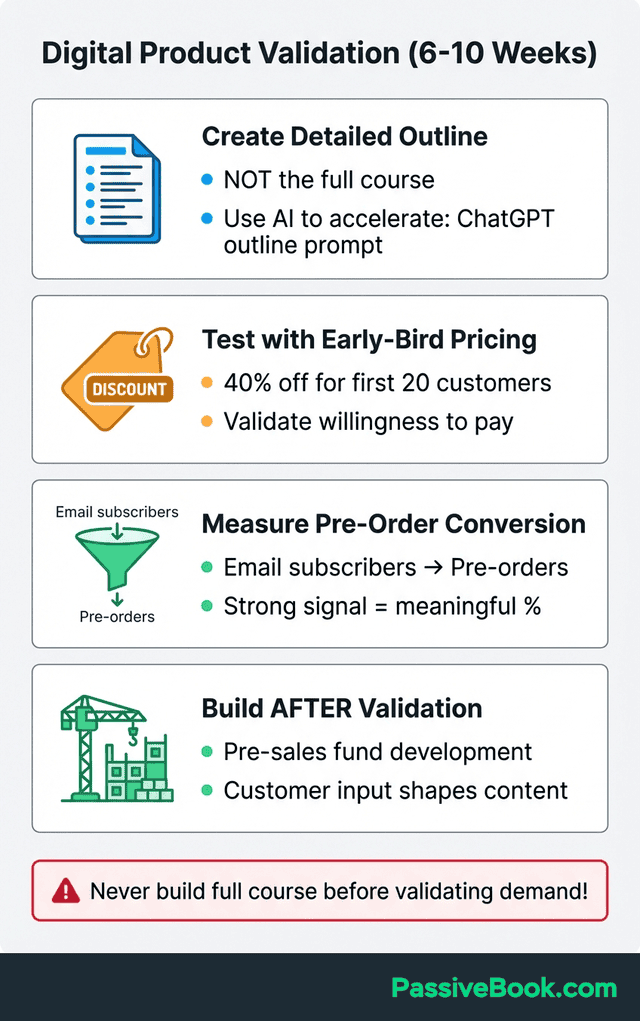
Test pricing with early-bird discounts. Offer your course at 40% off the planned final price to the first 20 customers.
If a meaningful portion of your email subscribers convert at the discounted price, you have strong market demand. Scale that to full price gradually.
Create a detailed course outline, not the full course, for validation. Use ChatGPT to accelerate outline creation: “Act as an instructional designer. Create a detailed course outline for [your topic] targeting [specific audience] who want to achieve [specific outcome]. Include 6-8 modules with 3-5 lessons each.”
Adjusting Timelines for Your Weekly Time Budget
Calendar weeks of testing matter less than total hours invested in high-signal validation activities. A side hustler working 5 focused hours produces better validation data than someone spreading 10 hours across busywork.
Batch similar tasks to minimize context switching. Schedule all customer interviews on the same two evenings. Dedicate one weekend afternoon to landing page creation.
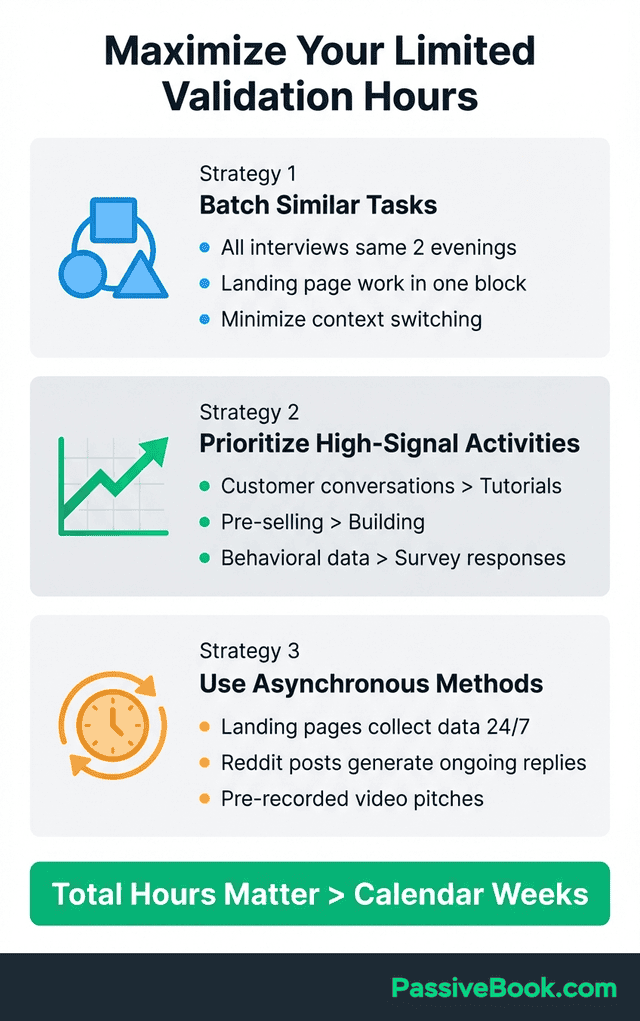
Run all ad tests during a single focused 2-hour block. Our brains work better when we’re not constantly switching between validation tasks and day jobs.
Focus on asynchronous methods when you can’t dedicate consistent daily blocks. Landing pages collect data while you sleep. Reddit posts in niche communities generate responses over days. Pre-recorded video pitches let prospects review on their schedule.
5-hour Weekly Testing (Expect 12-16 Weeks Total)
Prioritize highest-leverage activities first. Customer interviews and pre-selling generate more validation signal than building test products. If you have 5 hours this week, spend 3 hours on customer conversations and 2 hours on landing page optimization.
Use Carrd at $19 per year for simple landing pages to test demand quickly. Skip WordPress if you’re time-constrained. Carrd launches in 30 minutes versus 3 hours for WordPress setup.
Schedule two 90-minute focused sessions plus one 2-hour session for optimal progress. Monday evening for customer outreach. Wednesday evening for data analysis. Saturday morning for content creation or landing page tweaks.
10-hour Weekly Testing (Expect 6-8 Weeks Total)
Dedicate 6 hours to income-producing validation tasks. Customer interviews, landing page optimization, and paid pilot programs are income-producing. Reading articles and watching tutorials are not.
Reserve 4 hours for building low-fidelity prototypes or running small paid ad tests. This might be creating mockups in Canva, setting up a Gumroad page, or launching a $50 Facebook ad campaign.
Run concurrent experiments when you have 10 hours weekly. Validate problem and solution together through paid pilot programs. Instead of interviewing someone then waiting weeks to offer a solution, interview them and immediately offer: “I’m running a pilot version of this service for $X. Interested?” That single conversation validates both problem and willingness to pay.
Low-budget Validation Tools for Bootstrappers
Validate product ideas for under $100-500 using free and low-cost platforms. The expensive tools come after validation, not during it. I’ve wasted $200 on “premium” tools during validation that free alternatives could’ve handled.
Google Forms offers free surveys for customer research and problem validation. Create a 5-question survey and share it in Reddit communities or Facebook groups. Ask about pain points, current solutions, and willingness to pay for alternatives.
Typeform provides a more professional survey experience with a free tier for early testing. The conversational interface typically generates 15-20% higher completion rates than standard forms. Use this when you’re validating with a professional audience like B2B customers.
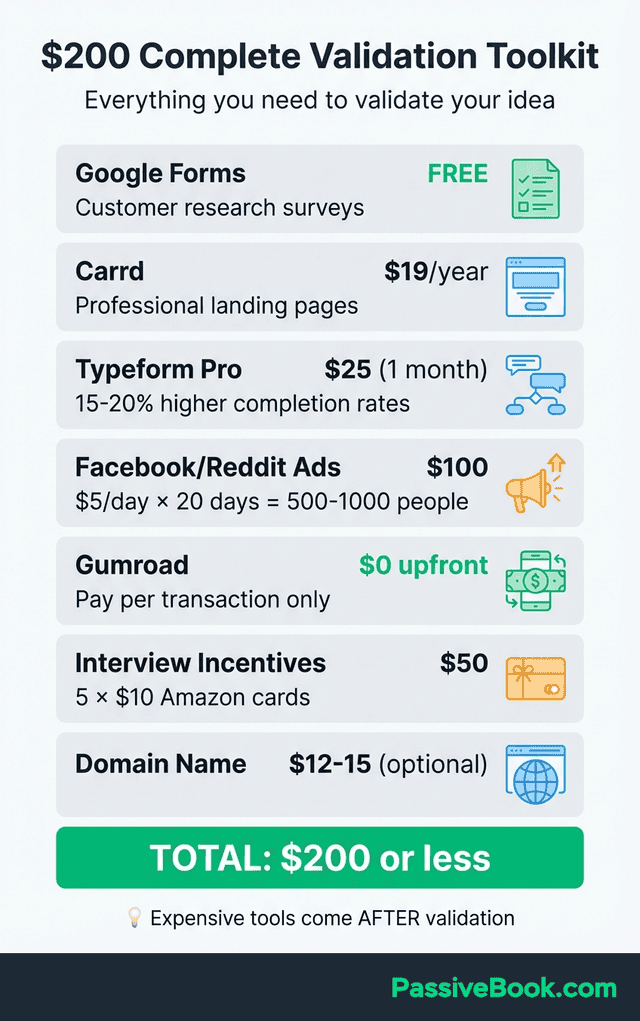
Build landing pages with Carrd for $19 annually or use free tiers from Unbounce or Webflow. All three let you embed email capture forms and payment buttons without coding.
Run micro-budget ad tests on Facebook starting at $5 per day for 3-5 days. That’s $15-25 to reach 500-1000 people in your target demographic. You’re not trying to make sales at this budget. You’re testing which headline and image combinations generate clicks.
Use Gumroad or Lemon Squeezy to collect pre-orders with zero monthly fees. Both platforms charge per transaction only. Set up a product page, accept payments, and issue refunds if you decide not to proceed after validation.
Here’s a complete validation budget for $200 total:
- Carrd landing page: $19/year
- Typeform Pro (1 month): $25
- Facebook/Reddit ads: $100 ($5/day × 20 days)
- Gumroad transaction fees: $0 upfront (pay per sale)
- Domain name (optional): $12-15
- Customer interview incentives: $50 (5 × $10 Amazon gift cards)
How to Know When Testing Is Complete
Three different validation methods with consistent user engagement and revenue signals triangulate to the same positive conclusion. If customer interviews, landing page conversions, and pre-order commitments all point to “yes,” you have enough evidence.
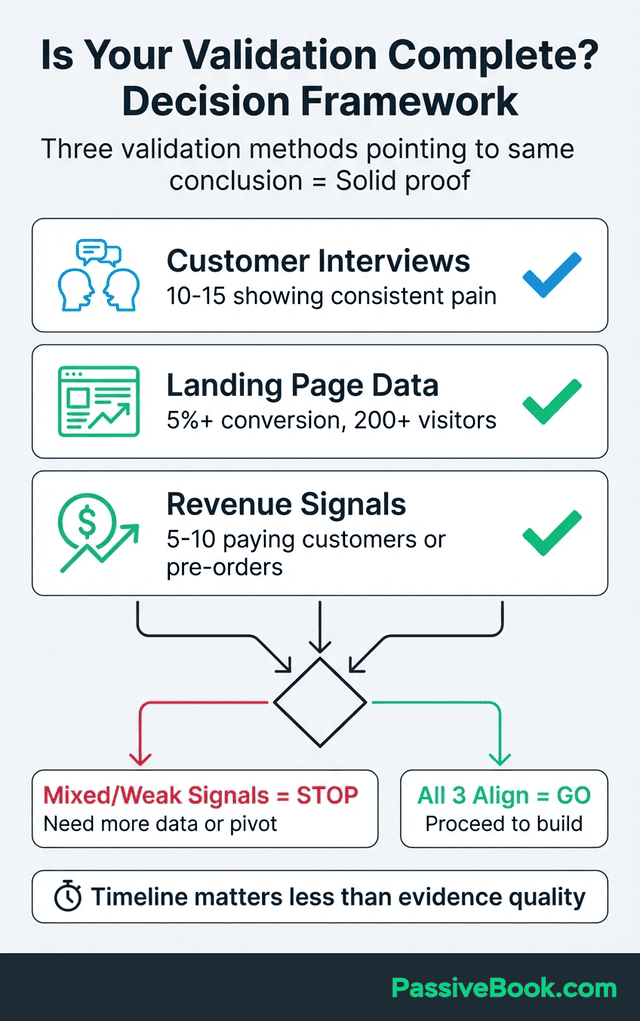
Testing completeness isn’t about calendar time. It’s about evidence quality and consistency. You might gather solid proof in 4 weeks or need 12 weeks depending on response rates and data clarity.
The sections below provide specific green lights and red flags. Use these as your decision framework, not gut feeling or fear.
Green Lights: Signals You Can Proceed
Sean Ellis PMF Survey threshold: 40% of users saying they’d be “very disappointed” without your product indicates strong market fit. This benchmark works for products with existing users. For pre-launch validation, focus on the metrics below.
You’ve reached your planned sample size. Ten customer interviews plus 5-10 paying users or committed pre-orders meets the minimum threshold for most solopreneur businesses.
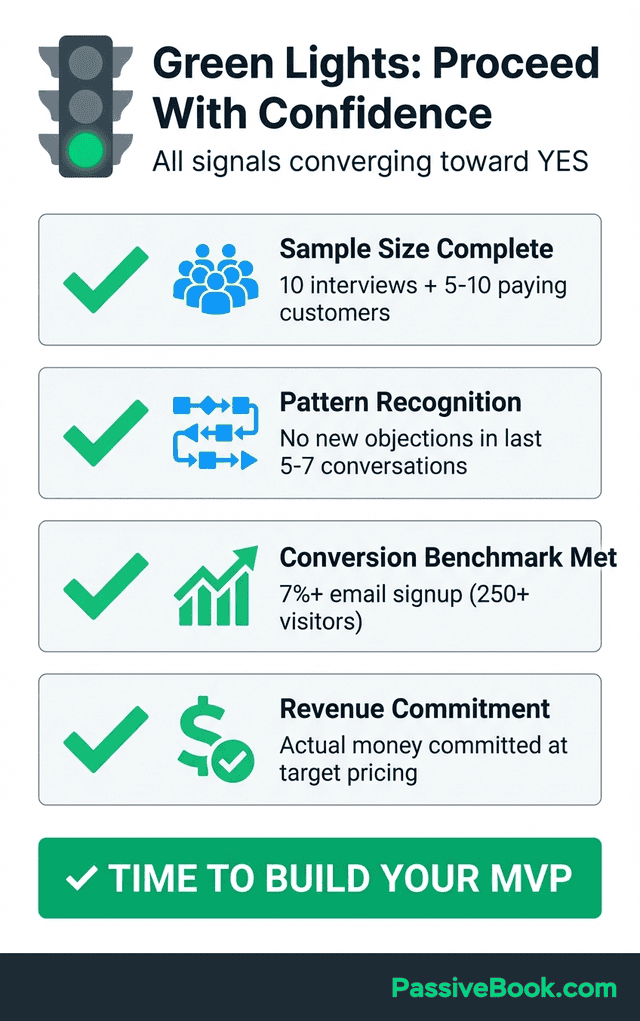
Feedback patterns repeat with no new objections after your last 5-7 conversations. When prospect number 12, 13, and 14 all raise the same questions and concerns as prospects 6-9, you’re seeing pattern completion.
The market has told you what matters.
Landing page conversion meets industry benchmark. The median conversion rate across industries is 6.6% for email signups. If you’re at 7% with 250+ visitors, you’ve validated interest at scale beyond your personal network.
Red Flags: Signs You Need More Data
Total landing page visitors under 200 people provides insufficient statistical confidence. A/B testing best practices recommend at minimum 1,000 visitors and 100-200 conversions for reliable results. For initial validation signals, 200 visitors is your floor.
Wildly inconsistent feedback creates decision paralysis. When half your interviews love the concept and half don’t understand the value proposition, you haven’t found your target market yet. Narrow your audience definition and test again.
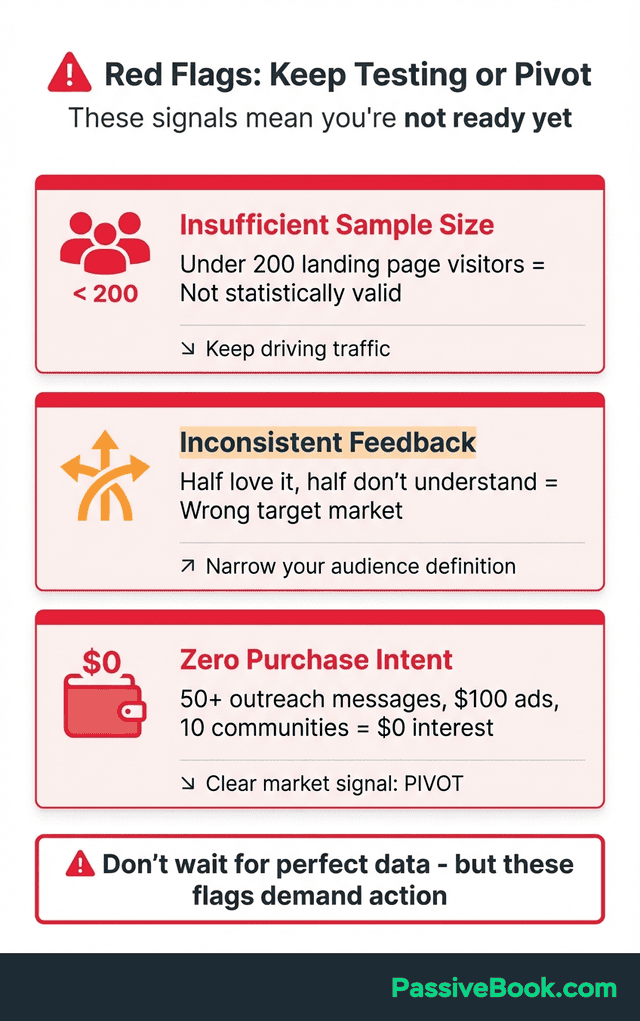
Zero revenue or concrete purchase commitments after 4-plus weeks of active outreach means the market isn’t ready or doesn’t exist. Active outreach means daily activity, not posting once and waiting. If you’ve sent 50 personalized messages, run $100 in targeted ads, and posted in 10 relevant communities with zero purchase interest, that’s a clear signal.
Common Timeline Mistakes That Waste Months
Testing for 2 weeks then building for 6 months without re-validating wastes critical side hustle time. Market conditions shift. Competitors launch. Customer needs evolve.
Your 6-month build might solve a problem that’s no longer painful.
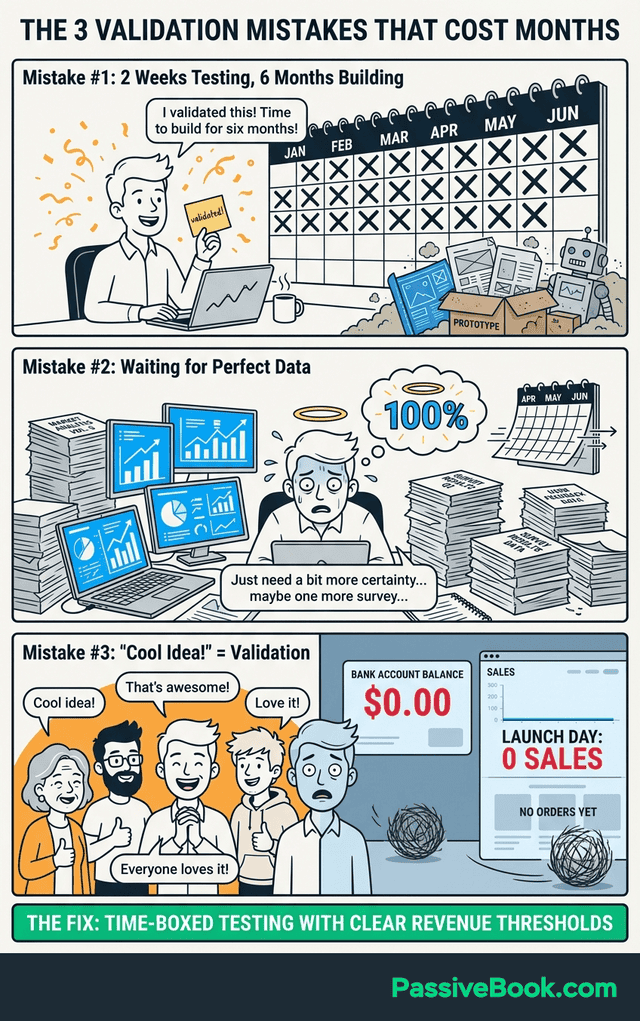
Waiting for perfect validation data delays revenue indefinitely. You’ll never have 100% certainty. Perfect data doesn’t exist. Strong converging signals from multiple sources are enough for solopreneurs working with limited runway.
Only pre-sales, paid pilots, or actual revenue validate true demand worth pursuing. Interest signals like “I’d probably use that” or “Sounds cool” have zero predictive value. Money committed is the only reliable signal.
Confusing Interest With Purchase Commitment
“Cool idea!” responses from friends and family aren’t validation signals. They’re politeness. Your mom will support any idea you pitch. Your college roommate will say positive things. Neither will become paying customers.
Waitlist signups without payment commitment convert at surprisingly low rates. Physical product waitlists often convert below 5%. Free digital product waitlists average 20-50% depending on launch timing and follow-up quality.
Last year, a side hustler in my community showed me his validation spreadsheet: 47 people said they’d “definitely buy” his productivity template. When he launched at $29, three people purchased. His “yes” responses had a 6% conversion rate to actual buyers.
Ask for purchase commitment or deposit during validation, not just email addresses. “Would you pay $47 for this?” followed by “Great, I’m accepting 10 pre-orders at $37. Want to reserve your spot?” The second question reveals truth. The first question collects politeness.
Testing Without Clear Exit Criteria
Define what “enough” validation looks like upfront.
- Ten interviews showing consistent pain patterns.
- Five paying pilot customers at target pricing.
- 250 landing page visitors with 7% conversion to email signups. Write these thresholds down before starting.
Schedule your decision date in advance to force evaluation. Put “Validation Decision: Go/No-Go” on your calendar 8 weeks from today.
When that date arrives, evaluate against your predetermined thresholds. Either proceed to build or kill the idea. No extensions.
I watched one solopreneur spend 5 months “validating” because he kept moving his success threshold. First it was 10 interviews. Then he needed 20. Then he decided he needed 50 landing page signups instead of 25. The goalpost kept moving, and he never shipped.
This breakdown shows exactly when to stop testing and start building:
When to Stop Testing and Start Building
Three different validation methods with consistent user engagement and revenue signals triangulate to the same positive conclusion.
- Customer interviews reveal consistent pain.
- Landing page conversions exceed benchmarks.
- Pre-orders or paid pilots generate actual revenue.
When all three align, you have solid proof.
Your landing page converts 5% or higher of visitors to paid commitments or 10% or higher to qualified email signups. Recent benchmarks show a median 6.6% conversion rate across industries, so hitting these thresholds places you above average.
You’ve secured 10-plus qualified customers who confirm the problem costs them $500+ monthly or 10+ hours weekly to solve. Qualified means they match your target customer profile and have budget authority. Your neighbor who “thinks it’s neat” doesn’t count.
You’ve collected pre-orders covering your initial build costs or first 3 months of runway. If building the Minimum Viable Product (MVP) requires $2,000 in tools and 120 hours of your time, you need pre-orders worth $2,000 plus whatever you value your time at. This creates forcing function to ship quickly.
If validation fails with no paying customers after 8 weeks, you’ve invested 40-80 hours to avoid wasting 6-12 months building the wrong product. That’s a successful outcome protecting your limited time. Kill the idea. Test the next one. Your constraint is time, not ideas.
Frequently Asked Questions
How Many Customer Interviews Do I Need?
Start with 10-15 interviews for initial problem validation in your target customer segment. This range provides solid data to identify patterns without consuming months of your limited side hustle time. Quality matters more than hitting a specific number. Focus conversations on actual potential buyers who have budget authority and the problem you’re solving. Stop when patterns repeat and no new insights emerge from additional interviews, typically around interview 12-14 for most solopreneur ideas.
Can I Validate a Business in One Weekend?
One founder on u003ca href=’https://www.reddit.com/’u003eRedditu003c/au003e argues ‘validation takes 48 hours, not 4 weeks’ through intensive customer conversations. This represents initial signal detection, not complete validation. Simple service businesses can presell in 48 hours if you have immediate access to target customers through existing networks or communities. Complete validation for solopreneurs working 5-10 hours weekly requires 6-16 weeks total to gather behavioral data beyond weekend interest signals, including landing page performance and sustained demand patterns.
What’s the Difference Between Validation and MVP Testing?
Validation tests assumptions before committing resources while MVP testing evaluates product-market fit after building the minimum version. Validation answers u0022Will anyone pay for this solution?u0022 through interviews, landing pages, and pre-sales. MVP testing answers u0022Will customers use it repeatedly and refer others?u0022 through actual product usage. Validation requires 40-80 total hours over 6-16 weeks depending on your schedule. MVP development typically demands 200-500 hours, so always validate first to avoid wasting months building something nobody wants.
How Do I Know If Negative Feedback Means Pivot or Persevere?
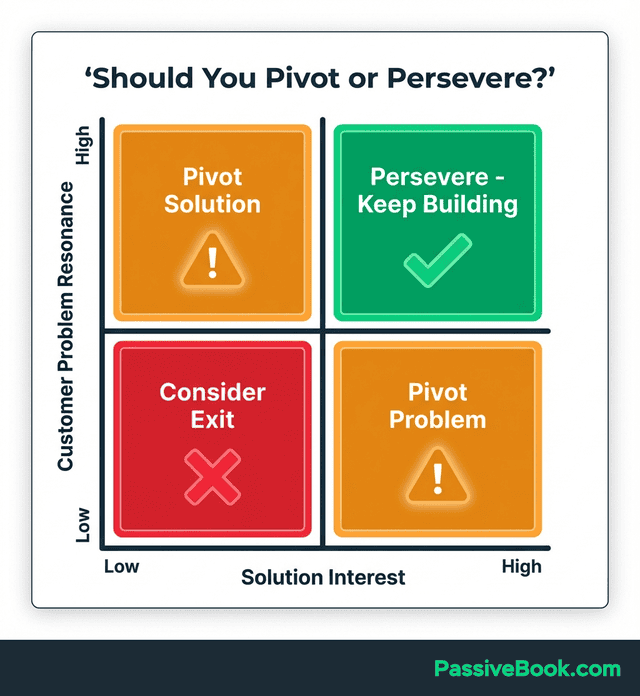
Consistent negative feedback from 60% or more of target customers indicates fundamental problems requiring a pivot or completely new direction. Single outlier opinions shouldn’t trigger pivots since every idea faces some skeptics. Look for patterns across 10-plus data points before making major directional changes. Implement a hard stop at 12 weeks: either you have paying proof demonstrating market demand, or you move to your next idea rather than extending validation indefinitely.
What’s the Biggest Validation Mistake Side Hustlers Make?
Testing without setting a decision deadline. The difference between successful side hustlers and those stuck in perpetual research is a calendar date. Pick your validation end date right now: 6 weeks, 8 weeks, 12 weeks based on your business model and available hours. When that date arrives, evaluate against your predetermined thresholds: either proceed to build or move to the next idea. No extensions. This single decision will save you months of spinning.
What Next?
You now have a framework for time-boxed validation that fits your 5-10 hour weekly availability. The structure is simple: 6-8 weeks minimum for service businesses, 8-12 weeks for product businesses, doubled if you’re working with 5 hours instead of 10. Your success metrics are concrete: 10-15 customer interviews showing consistent pain, landing page conversions above 5%, and actual purchase commitments or pre-orders.
Testing business ideas when you’re working full-time is hard. You’re exhausted after your day job. Your weekends are precious. The fear of wasting months on a failed idea is real because every evening spent validating the wrong business is an evening you can’t get back. But endless research without deadlines wastes more time than failed validation ever will.
If this framework helped clarify your validation timeline, hit those share buttons below this article. Send it to another side hustler stuck in research mode who needs permission to set a deadline and make a decision.
What idea are you testing right now, and what’s the one validation metric you’re tracking to make your go-or-no-go decision? Drop your answer in the comments. I read every one and often share additional resources for specific business models.
Share this post with your friends & followers: